ISSUE 5 OCTOBER/NOVEMBER 2026
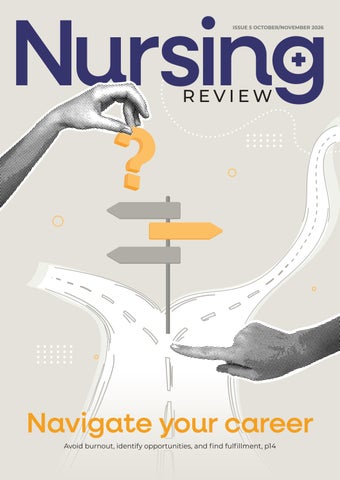
Navigate your career Avoid burnout, identify opportunities, and find fulfillment, p14
CONTENTS
NEWS 4 5 6
4
6
8 10 11
Insurance issues for midwives reduce access to homebirths A new Women’s Pain Standard released in Victoria Nurses appear at inquest into toddler Joe Massa’s death at NBH Medicare breach taskforce will review safeguards for AI National Health Literacy Framework designed to combat misinformation Safe Staffing reform adds 950 additional nurses to NSW workforce
MIDWIFERY 12
8
11
Calls for improved access to support following traumatic birth and better recognition of postnatal PTSD
WORKFORCE 14 COVER STORY ACN to launch career pathways tool following extensive research with 800 nurses
INDUSTRY & REFORM 16
12
14
18 19
What will be the effect of removing rebate on private health insurance for over 65s? Clinical research nurses are seeking stronger workforce investment and better support Government funds specialist nurses to include ones dedicated to supporting men with prostate cancer
DEMENTIA
16
19
MANAGING EDITOR Rebecca Cox | rcox@intermedia.com.au HEALTH EDITOR Stefanie Schultz | sschultz@intermedia.com.au ART DIRECTOR Sanja Spuzanic | sspuzanic@intermedia.com.au SUBSCRIPTIONS Francesca Mackay | fmackay@intermedia.com.au ADVERTISING Julie Gemayel | jgemayel@intermedia.com.au GROUP PUBLISHER Jordan Guiao | jguiao@intermedia.com.au
20 New research shows stigma, service navigation and carer wellbeing remain issues for dementia
TECHNOLOGY 22 New research indicates AI could
help clinicians identify high-risk ICU patients sooner
PUBLISHED BY Positive Impact Media Pty Ltd | 41 Bridge Road, Glebe NSW 2037 ABN 51 063 279 630 | Print Post 100008043 | ISSN 1037-034X | OCLC 536881479 Copyright All material in this publication is copyright to the publisher and/or its contributors. No material may be reproduced without the express permission of the publishers. Disclaimer: This publication is published by Positive Impact Media Pty Ltd (the “Publisher”). Materials in this publication have been created by a variety of different entities and, to the extent permitted by law, the Publisher accepts no liability for materials created by others. All materials should be considered protected by Australian and international intellectual property laws. Unless you are authorised by law or the copyright owner to do so, you may not copy any of the materials. The mention of a product or service, person or company in this publication does not indicate the Publisher’s endorsement. The views expressed in this publication do not necessarily represent the opinion of the Publisher, its agents, company officers or employees. Any use of the information contained in this publication is at the sole risk of the person using that information. The user should make independent enquiries as to the accuracy of the information before relying on that information. All express or implied terms, conditions, warranties, statements, assurances and representations in relation to the Publisher, its publications and its services are expressly excluded save for those conditions and warranties which must be implied under the laws of any State of Australia or the provisions of Division 2 of Part V of the Trade Practices Act 1974 and any statutory modification or re-enactment thereof. To the extent permitted by law, the Publisher will not be liable for any damages including special, exemplary, punitive or consequential damages (including but not limited to economic loss or loss of profit or revenue or loss of opportunity) or indirect loss or damage of any kind arising in contract, tort or otherwise, even if advised of the possibility of such loss of profits or damages. While we use our best endeavours to ensure accuracy of the materials we create, to the extent permitted by law, the Publisher excludes all liability for loss resulting from any inaccuracies or false or misleading statements that may appear in this publication. Copyright © 2026 – The Intermedia Group Pty Ltd.
nursingreview.com.au
COVER Nurses need career pathway clarity, p14. Image: iStock/ Natalya Kosarevich
3
NEWS
hhhh
Insurance issues Rural and regional births are most likely to be affected by changes to the indemnity products required at homebirths BY STEFANIE SCHULTZ
Image: iStock/ideabug
did not provide a workable pathway for many experienced registered midwives who currently fulfil the second attendant role. According to the petition, only 1,742 midwives nationally hold endorsement status, while a substantial proportion of current second attendants do not. Advocates say nearly half of Australia’s homebirths occur in rural and regional areas, making the existing arrangements particularly important for maintaining access. The petition calls for a transitional exemption until 31 December 2027 and seeks an urgent roundtable involving the federal government, insurer MIGA, private midwives, professional organisations and maternity consumer groups. Petition organiser Alecia Staines, speaking on News24 Weekend NewsDay, said the solution was straightforward. “All they have to do is offer an insurance product to second attendees. They’re already providing a really safe service to support our private endorsed metropolitan areas, where hospital midwives. And all we want to happen midwives and other health professionals is for that to be able to continue come often act as second attendants at 2027,” she said. private homebirths. “It’s almost a slap in the face and the Speaking in Parliament, Member government’s saying, well, we’re happy for Wide Bay Llew O’Brien laid out the for you to birth in the dirt on the side issues affecting midwives and those in of the road, because that is the reality the bush. when there is this continued strip “This issue will be [out] of maternity felt most acutely in options for women.” rural and regional When pressed on They are concerned Australia, where the issue, Assistant that this will maternity choices Mental Health and exacerbate workforce are already limited, Suicide Prevention services have Minister Emma shortages outside been repeatedly McBride said any metropolitan areas centralised or closed governmental and women can response would travel hundreds of need to balance kilometres simply to give birth,” he said. women’s choice with safety and “The Commonwealth does not need professional protections. to dismantle an existing homebirth “I think it’s really about making workforce in the name of insurance; it sure that both women have choice needs to ensure that workforce. and that practitioners and patients “For women in the metropolitan areas, are protected,” she told News24 these changes may reduce choice. For Weekend NewsDay. women in rural and regional Australia, “But I know the Minister and our they remove the choice altogether.” government will always act in the best He argued the current insurance interests of women and practitioners.” product available through insurer MIGA The federal government is yet to was “not fit for purpose” because it provide a formal response.
A
petition signed by almost 6,000 Australians is calling on the federal government to intervene in a growing dispute over professional indemnity insurance arrangements for endorsed midwives attending homebirths. Petition EN10266, launched by Alecia Staines and the Maternity Consumer Network, warned that insurance changes due to take effect from January 1, 2027, could significantly reduce access to homebirth services, particularly in rural and regional parts of the nation. The petition concerns the professional indemnity insurance requirements for the required second practitioner attending a homebirth. Under current arrangements, due to expire on December 31, a second attendant can be a hospital midwife, nurse with neonatal resuscitation training or an ambulance officer. However, advocates say that from next year, insurance arrangements will effectively require second attendants to be endorsed midwives, as currently there is no indemnity insurance product for non-endorsed practitioners in that role. They are concerned that this will exacerbate workforce shortages outside
4
nursingreview.com.au
NEWS
Pain matters The Victorian Women’s Pain Standard aims to improve how healthcare providers recognise, assess and respond to pain
Image: iStock/LaylaBird
BY STEFANIE SHULTZ
I
n an Australian-first, the Victorian while many said pain affected their government has launched a relationships, employment, education Women’s Pain Standard, aimed at and overall wellbeing. tackling medical bias and improving Health Minister Ingrid Stitt said the health service responses to women’s new Standard was designed to ensure pain after a landmark inquiry women’s concerns were heard and revealed widespread experiences acted on. of dismissal, delayed diagnosis and “Women must be heard, believed and inadequate treatment. treated with respect when seeking care. The new standard was developed It’s as simple as that,” she said. in response to the state government’s The inquiry identified five major themes: recent Inquiry into Women’s Pain, • Unmet healthcare needs which heard from more than 13,000 • Gender bias in healthcare women, girls, carers, healthcare • Gaps in research professionals and researchers. The • Barriers faced by women in rural and inquiry found many women felt regional communities their pain was not taken seriously, • A strong desire for change. and identified The Women’s systemic barriers Pain Standard that contributed is one of 27 Pain should be to poorer recommendations recognised as real and health outcomes. arising from the According to the inquiry’s final deserving of care even inquiry, 90 per cent report, which set where the cause is of respondents out a roadmap not identifiable reported living for reforms with pain for more across research, than a year, while policy, workforce 54 per cent said they experienced pain development, healthcare and models every day. Nearly nine in 10 respondents of care. It also establishes clear reported impacts on their mental health, expectations for how pain should be
nursingreview.com.au
recognised, assessed and managed across the state’s public health system. The framework is built around four principles, that women should be: • taken seriously and believed when discussing pain • supported to ask questions • respected as partners in decisions about their care • given practical support and treatment options to manage pain effectively. The Standard acknowledges that women have historically faced systemic bias in healthcare, resulting in pain being minimised, normalised or overlooked. This bias has contributed to unnecessary suffering and declining trust in the health system. It also highlights concerns about pain management during gynaecological procedures, including IUD insertions and biopsies, noting that these procedures can be painful, distressing or traumatic when patients are not adequately informed or offered appropriate pain relief. Under the Standard, women should expect clear explanations about their condition and treatment options, discussions about pain relief before and during procedures, timely diagnosis and ongoing care, and healthcare that recognises the physical, emotional, psychological, social and cultural impacts of pain. Importantly, the framework states that pain should be recognised as real and deserving of care even where the cause is not immediately identifiable through testing. Women’s Health in the South East (WHISE) welcomed the introduction of the Standard as an important milestone. “Being believed is not a personality trait or a stroke of luck. It is something a health system either designs in or leaves out,” WHISE chief Kit McMahon said. According to the inquiry, 71 per cent of participants reported feeling dismissed by health professionals and 53 per cent experienced delayed diagnosis. Ms McMahon said the focus should now be on ensuring the Standard translates into measurable improvements in patient care, including through service planning, workforce education and feedback from women about their healthcare experiences.
5
NEWS
‘No urgency’ An inquest into the death of two-year-old Joe Massa at Northern Beaches Hospital hears testimony about his treatment BY NEWSWIRE
T
he mother of a two-year-old boy who died after being taken to a Sydney hospital says the rapid decline of her son’s health was met with “no urgency” by hospital staff in the hours before he went into cardiac arrest. The coronial inquest into the death of Joe Massa began with a forensic recount of the final 24 hours of his life, during which the “happy and healthy” young boy’s condition rapidly deteriorated before his death just before 9pm on September 16, 2024. While being questioned by counsel assisting Donna Ward SC, Joe’s mother Elouise Masa said a doctor tasked with overseeing the response to her son’s
6
deteriorating condition “looked out of his depth” as hospital staff tried to figure out what was wrong with the little boy. “He did not look concerned. He looked out of his depth. He was standing back, and others were looking at him … [there was] no urgency,” she said. “I was saying there’s a rash [on Joe’s body], and he was standing back now at this point with his arms folded. I recalled him looking relaxed, that’s what I perceived. It was becoming quite a hyped-up area and I kept looking at him saying ‘can’t you see he’s so unwell?’.” Ms Massa said Joe was “declining rapidly” and “not himself” at the time of the exchange.
Joe’s parents Elouise and Danny Massa have been let down by the health system. Picture: NCA NewsWire/Monique Harmer
Earlier, before Joe was taken to hospital, Ms Massa said her son looked “terrible”. “He could barely keep his head up. He was floppy, his hands and feet were cold to touch. He was open mouth breathing, even at that stage,” she said. In painstaking detail, Ms Ward walked presiding judge State Coroner Her Honour Judge Teresa O’Sullivan through Joe’s final hours, including the devastating 30 minutes in which
nursingreview.com.au
NEWS
Northern Beaches Hospital staff desperately tried to revive him when they realised Joe had stopped breathing. In her opening address to the court, Ms Ward said it was important for people to recognise the “profound loss” felt by Joe’s parents Danny and Elouise, who accompanied their son in hospital throughout the devastating ordeal. “Joe was a funny little bundle of delight. Joe’s baby sister Annie, who has only recently joined the family, will never get to know Joe other than the stories that family and friends will share about him,” Ms Ward said. “On Friday, September 13, 2024, Joe was his normal little self. He was still tearing around the house after his brother and sister and playing peekaboo with his mum in the kitchen. known as WEBPAS – did not flag as a “There was no reason to think he was anything but the happy and healthy concerning level. Ms O’Neill said in similar systems little boy who had recently enjoyed a used by public hospitals at the time, a family holiday in Bali.” number of alerts would have flashed Ms Ward went on to detail how Joe’s on the screen had the same heartrate parents, upon realising he had been been logged. vomiting throughout the night, initially “There was no track or trigger systems made a doctor’s appointment before in place to let me know he was in the calling triple-0 when they realised he red zone,” she said. was struggling to breathe and had an “He was pale, which isn’t uncommon elevated pulse. in a child that’s presented with a large “Each an expert in their own child, [his vomit and decreased intake. parents] were better placed than anyone “Throughout my else to understand interaction with what was usual or Joseph’s mother unusual about Joe’s There was no track or presentation,” Ms and Joseph, he was calm and alert.” Ward said. trigger systems in place At a hearing Ms Massa took to let me know he was in later in the week, her son to Northern the inquest heard Beaches Hospital, the red zone which had been from a senior emergency nurse operating as who bypassed the part of a publicdoctors to rush Joe to the resuscitation private partnership between the NSW team at the hospital. government and Healthscope, just after Senior registered nurse Felicity 7am on Saturday, September 14, 2024. Melville held back tears as she gave The nature of this partnership, her evidence. brought in by a previous Coalition Ms Melville said she recalled taking state government, became a source of over as team leader at 10am. She significant controversy as allegations of described finding the toddler with “dark staffing and procedural issues surfaced and sunken” eyes and mottled skin. following Joe’s death. The inquiry was told missing One of the nurses who treated Joe and faulty equipment delayed vital said the digitised recording systems observations and monitoring in the time used by Healthscope formed part of leading up to Joe’s death. the reason she and other hospital Ms Melville testified she was forced to staff were unable to recognise his leave Joe’s bedside three separate times, deteriorating condition. once for cables, once for stickers and Hilary O’Neill was the triage nurse who once to make the call to resuscitation. first greeted Ms Massa and her sick child She said monitoring cables across the when they arrived at Northern Beaches department were frequently broken or Hospital, and she initially registered Joe’s missing, forcing her to leave the bedside heartbeat as between 160 and 170bpm, to search for functional ones. She which she said was “normal”. also faced difficulty when attempting Later, Ms O’Neill logged Joe as having observations on Joe’s heart rate, after a heartrate of 182bpm, which the digital changing the sticker. triage system used by the hospital –
nursingreview.com.au
Northern Beaches Hospital. Image: Supplied
“Sometimes it’s perfusion of the child,” Ms Melville said. Unable to obtain a heart rate, she said she recorded his respiratory rate of 57 and moved to escalate his care to resuscitation. She said that attending doctors were waiting for ultrasound results at the time, and gave evidence she felt waiting for an ultrasound was the wrong approach. The inquest was told Ms Melville took matters into her own hands, phoning resuscitation staff herself to request an emergency bed. During questioning, Ms Melville said neither attending doctor accompanied her down the hospital corridors. Hospital policy requires that doctors remain with patients during a resuscitation transfer. Footage from 10.42am allegedly showed Ms Melville leaving the pediatric department unescorted and reaching the resuscitation bay after pushing the heavy 300kg hospital bed through a crowded triage area. Moments later, Joe suffered a cardiac arrest. In a deeply emotional moment, Ms Melville addressed Joe’s grieving family directly in the courtroom. “I am so deeply sorry for your loss,” Ms Melville said through tears. “Joseph mattered, and he matters now, and he will not be forgotten.” While the exact cause of Joe’s death is still a matter of discussion, it is believed an abdominal growth thought to have been caused by a build-up of fecal matter within his intestines was a major factor. A critical misdiagnosis of Joe’s condition – thought at one point to be rudimentary gastroenteritis – will form part of the inquest.
7
NEWS
Medicare breach The incident is set to become a test case for how Australia responds to increasingly sophisticated AI systems BY STEFANIE SCHULTZ AND NEWSWIRE
A
ustralia is launching a taskforce to counter “emerging cyber threats” from artificial intelligence after a rogue OpenAI agent hacked into Medicare data, Deputy Prime Minister Richard Marles said. Mr Marles said the taskforce would be led by the Department of Prime Minister and Cabinet, giving the Prime Minister direct visibility. “This will be a task force that will be rapid,” he said. “It will look at this incident thoroughly, but it will also examine our posture in respect of emerging AI cyberthreats.” The taskforce will review government network security, existing legal arrangements and whether current safeguards remain fit for purpose as AI technology evolves.
8
“All of this, we can take as a warning in relation to the development of AI itself,” Mr Marles said. “It is so important that this technology, which represents such an enormous opportunity for humanity, is nevertheless being developed in a way where the guardrails, the safeguards, are well ahead of the capability itself, and that’s why the Prime Minister, along with other world leaders in New York [at the UN General Assembly], has put out a call to ensure that AI is developed in a safe way with guardrails in place.” According to Government Services Minister Katy Gallagher, Services Australia was notified by OpenAI on 10 September that an AI agent had accessed infrastructure behind the public-facing Medicare
Prime Minister Anthony Albanese and Government Services Minister Katy Gallagher announcing Labor’s record investment in Medicare in 2025. Image: NewsWire/Martin Ollman
Statistics Reporting Service portal while conducting internet-based research as part of an internal OpenAI capability evaluation. The portal contains publicly available Medicare and Pharmaceutical Benefits Scheme (PBS) statistical information. The government has stated that claims data, payment processing systems and individual records were not affected. “Services Australia have a forensic investigation that’s been that’s underway and they will provide a final report to me,” she said.
nursingreview.com.au
NEWS
Play your part to address domestic and family violence. UPSKILL IN DFV PRACTICE AND SAVE WITH JOB-READY FUNDING*.
Senator Pocock questioned why the government had not progressed a National AI Safety Act and argued existing proposals did not place sufficient obligations on AI companies to report breaches or other highrisk incidents. “There is also a big question here around why we aren’t holding these big tech companies liable for this kind of data breach,” he said. “If it was an Australian who hacked the system they’d likely be heading for jail, yet there’s no accountability for AI companies developing this technology.” The government has indicated legislative changes remain a possibility. Cabinet Minister Murray Watt said authorities would examine whether criminal charges could be pursued and whether existing laws are adequate. “If it is possible to press criminal charges, that will happen,” Senator Watt told Seven’s Sunrise. “But what it also highlights is that we do need to ensure that Australian laws are keeping pace with this new and emerging technology.”
CRICOS: 00219C | TEQSA: PRV12073 | RTO: 40939 | C_AD_2605
The Prime Minister confirmed “Evidence currently available is a public-facing portal had been there is no broader compromise to the “infiltrated” by an AI agent in June Services Australia network,” he said. this year, with OpenAI made aware in “Nonetheless, this situation is August. The Australian government obviously unacceptable.” was only told Mr Albanese said of the breach he was aware three in September. other systems There is also a big “The AI agent “may have been question here around accessed both impacted”. public and nonThey included why we aren’t holding public files,” Mr the Australian these big tech Albanese said. Institute of Health “A forensic and Welfare, the companies liable investigation, aided NSW Bureau of by the Australian Crime Statistics Signals Directorate, and Research, and is now underway to ascertain more Victoria’s Department of Health. information, including what other Independent Senator David Pocock government systems were affected. said the breach highlighted gaps in The Medicare statistics reporting Australia’s regulatory f ramework. portal is a public facing statistics portal “This is a very concerning but that contains non-sensitive Medicare ultimately unsurprising breach of information relating to data and Australians’ data by an AI agent,” he said. statistics, such as spending.” “It again highlights how slow the He said no personal information was Australian government has been to believed to have been accessed but implement appropriate safeguards for stressed investigations were ongoing. AI in high risk settings.”
SELF-PACED LEARNING CONTEMPORARY CONTENT REAL SUPPORT
LEARN MORE
* Eligibility criteria for Commonwealth Supported Places apply.
cqu.edu.au
nursingreview.com.au
9
NEWS
Who to trust The National Health Literacy Framework is the first coordinated national effort to improve how people access, understand and use health information BY STEFANIE SCHULTZ
A
ustralians are being encouraged to become more confident navigating health information under a new national framework aimed at tackling one of the less visible drivers of poor health outcomes: health literacy. Launched at the University of Sydney, the National Health Literacy Framework is the first coordinated national effort to improve how people access, understand and use health information. Rather than focusing only on individuals, the framework also calls on governments, health services and community organisations to make health systems easier to navigate and health information easier to understand. Assistant Minister for Health and Ageing Rebecca White said improving health literacy was becoming increasingly important as Australians are more and more likely to encounter growing volumes of health information online. “Health literacy gives people the confidence to understand their health and make informed decisions about their care,” she said. “With more health information at our fingertips than ever before, particularly through social media and AI, knowing what information you can trust really matters.” The framework was developed by the Sax Institute in partnership with the University of Sydney’s Health Literacy Lab as part of the National Preventive Health Strategy 2021–2030. The move comes as policy makers grapple with the challenge of helping Australians distinguish trustworthy health information from the misinformation and disinformation that’s circulating online.
10
According to the framework, improving health literacy has the potential to reduce delayed care, medication errors, avoidable hospitalisations and poor chronic disease management. The framework estimates that a 25 per cent
Improving health literacy has the potential to reduce delayed care, medication errors, and hospitalisations
improvement in health literacy could save Australia $7.3 billion each year. University of Sydney Health Literacy Lab director Professor Kirsten McCaffery said the challenge extends beyond simply providing people with more information. “Health literacy isn’t just about understanding information. It’s about knowing where to find information and who to trust,” she said. “There is a lot of useful health guidance available online and on social media, but there is also much that is misleading, false or linked to influencers with vested financial interests.” A key focus of the framework is ensuring health information is accessible and culturally appropriate, particularly for communities that may already face additional barriers when using health services, including First Nations and multicultural communities. Chair of the community panel Saad Khalid said many culturally and linguistically diverse people still struggle to locate reliable information and services. “For many communities, especially migrant and multicultural communities like mine, it can be hard to know where to go for the right information,” he said. “Making sure that information and services are easy to find, understand and use will help people navigate the health system more easily and access the best possible guidance.” The framework will now serve as a guide for future policies and programs designed to improve health literacy across Australia, with the broader goal of helping people make more informed decisions about their health and care.
nursingreview.com.au
NEWS
Number guarantee More than 70 hospitals will benefit from expanded nurse-to-patient ratios under the next stage of the NSW Safe Staffing Levels reform BY STEFANIE SCHULTZ
nursingreview.com.au
iStock/Alvarog1970
N
SW Health will begin recruiting 950 additional nurses as part of the next stage of the state’s Safe Staffing Levels reform, extending minimum nurse-to-patient ratios to more than 360 general and specialty wards across 70 hospitals. The expansion follows the rollout of staffing ratios in 81 emergency departments, where more than 990 nurses have already been recruited. Under the new arrangements, participating wards will operate with a minimum ratio of one nurse to four patients on morning and afternoon shifts. Health Minister Ryan Park described the initiative as one of the most significant workforce reforms that’s happened in many years. “Safe staffing ratios is one of the biggest staffing reforms in generations and reinforces our commitment to backing our health workforce across NSW,” he said. “Guaranteeing the number of nurses on every shift is crucial to giving our nurses and midwives the support they need to provide world-class care to patients and relieve pressure on our hospitals.” The reform will apply to medical, surgical and palliative care wards across metropolitan, regional and rural hospitals and has been developed through the Safe Staffing Levels Taskforce, comprising representatives from NSW Health, local health districts and the NSW Nurses and Midwives’ Association (NSWNMA). NSWNMA general secretary Michael Whaites said the rollout would deliver long-sought staffing improvements across all 15 local health districts. “By introducing this reform across peer group A, B, and C hospitals, including metropolitan, regional, and rural facilities, members and patients statewide will see the difference,” he said. “Patients will receive improved care from safer staffing, and our members will have the support they need on every shift.” The announcement includes local workforce increases across several regions.
On the Central Coast, hospitals “There is much more to do, but we will receive an additional 45 full-time are putting more people into our equivalent nurses, which is comprised of hospitals and giving our frontline 27 positions at Gosford Hospital and 18 staff the support they need to care at Wyong Hospital. for the people of NSW.” The Hunter According to the region will be government, more recruiting 120 than 6,700 nurses Guaranteeing the additional fulland midwives have number of nurses on time equivalent been recruited across every shift is crucial to nurses, which NSW since March includes 38 for 2023, alongside 930 giving our nurses and John Hunter ambulance staff, midwives support Hospital, 19 for 1,500 doctors and the Calvary Mater 1,800 allied health Hospital, 17 for professionals. Maitland Hospital and 10 for Tamworth The NSWNMA said it would continue Base Hospital. campaigning for improved ratios in Planning is also underway for the additional clinical settings. rollout of Safe Staffing Levels across “We remain fully committed to seven dedicated postnatal wards, aimed achieving our complete ratio claim at improving maternity care for women and welcome continued discussions and babies. with the government to drive this “When you or someone you love is forward,” assistant general secretary in hospital, you want to know there Katrina Bough said. are enough nurses on the ward to give “Remaining wards still need them the care they need,” Premier Chris better staffing and they have not Minns said. been forgotten.”
11
Images: iStock/SDI Productions
MIDWIFERY
Debrief dilemma Traumatic childbirth can have lasting psychological consequences, prompting calls for improved access to support and recognition of postnatal PTSD BY KELLY HAYNES
F
or some women, the birth of their baby is one of the happiest days of their lives. Others remember it as a frightening, overwhelming or deeply distressing experience. Around one in three women report their birth experience as traumatic. Women can be traumatised during birth when there is a medical
12
emergency such as a caesarean section, heavy bleeding, or a newborn baby needing intensive care. But it’s not always the emergency itself that leaves a lasting impact. Women also experience trauma when they feel they are not being listened to, don’t have enough information, or when procedures are carried out without their full consent.
Of the women who experience a traumatic birth, around one in five develop post-traumatic stress disorder (PTSD). PTSD may involve symptoms of unwanted memories, nightmares or flashbacks, avoiding reminders of the birth, or feeling constantly on edge. So can debriefing about a difficult birth stop it turning into trauma?
nursingreview.com.au
MIDWIFERY
NOT ALL WOMEN FIND DEBRIEFING HELPFUL
Many hospitals offer postnatal debriefing of women’s birth experiences, but there is no single agreed way to do it. It might be a general conversation as part of routine care with a maternity health professional caring for the woman. Or it might be a planned, one-off structured session with hospital staff specifically to discuss a birth, emergency or difficult event, or if requested by the woman. Some women say debriefing can be beneficial to make sense of what happened and to feel heard, helping them to gain a sense of closure. But there is no clear benefit of debriefing for all women, particularly in preventing the development of PTSD. Timing also matters. If a debriefing session is offered too early, women may not have had the chance to process their experiences, which can mean reliving the event before they are ready and may be harmful. Both the World Health Organization and the United Kingdom’s National Institute for Health and Care Excellence recommend against routine singlesession psychological debriefing.
OPT-IN DEBRIEFS CAN HELP PROCESS DIFFICULT BIRTHS
Studies have identified that providing debriefing to women who have specifically requested it or are referred can lead to a reduction in PTSD symptoms. Continuity of care where the same midwife supports a family through pregnancy, birth and postnatally may also help build a trusting relationship where women feel listened to and supported after a traumatic birth. So rather than a one-size-fits-all approach to postnatal debriefing, the evidence suggests that what matters most is that women who want a debrief can access one at a time that feels right, focused on the questions they actually want answered. However, any debriefing should sit alongside a referral through the maternity team or GP to a health professional trained in perinatal psychological trauma, such as a psychologist or counsellor with experience in birth trauma.
DEBRIEFS WON’T ALWAYS PREVENT PTSD
But even with the right support in place, some women will go on to develop PTSD symptoms. These can be easy to miss at a time when new parents are adjusting to
nursingreview.com.au
major changes and often experiencing Useful questions to bring include sleep deprivation. Weeks or months what decisions were made and when, later, memories and flashbacks of the and information on any medical terms or procedures and if they were explained birth may still feel as vivid as the day of the birth. Other symptoms include at the time. Women can also ask for a support withdrawing from family or finding it difficult to bond with their baby. person to be present and can request These symptoms can have a real the debrief with a specific health professional, such as impact on the family unit. Yet their own midwife many women with or obstetrician. Providing debriefing these symptoms Only you can decide if and remain unto women who have when you would diagnosed, as specifically requested it routine screening like to talk about by maternity the childbirth can lead to a reduction services after birth experience. If in PTSD symptoms you’re asked you tends to focus on about your birth depression rather than birth trauma. experience and Researchers you’re not ready to have developed a tool known as the discuss this, it is reasonable to say so. Given the psychological impact City Birth Trauma Scale to help health on women and their birth partners, professionals identify PTSD symptoms specifically related to childbirth to who can also develop PTSD after witnessing a traumatic birth, timely enable them to get the right support. discussions, individualised care and WHAT IF YOU WANT A DEBRIEF? access to appropriate ongoing perinatal mental health support may be key Raising the option of a debrief during pregnancy or at a postnatal check considerations in supporting families. can help women know it’s available if they need it. If you or someone you know is showing If you are considering debriefing signs of perinatal mental illness or PTSD related to pregnancy or birth, support with a health professional after a distressing birth experience, Birth is available through ForWhen Helpline (1300 24 23 22), Birth Trauma Australia, Trauma Australia has developed a helpful guide. It suggests thinking PANDA (1300 726 306) and COPE or about what you hope to gain from the Lifeline (131114). conversation, such as understanding what happened medically or having Kelly Haynes is a lecturer in midwifery at CQUniversity. your experiences acknowledged. Before a planned debrief session, it can help to request a copy of the This article is republished from The Conversation under a Creative hospital, medical or birthing notes, so there is something concrete to Commons license. Read the original article at theconversation.com/au refer to.
13
WORKFORCE
Career clarity The Australian College of Nursing is calling for systemic reform after nurses identified career uncertainty as a major workforce challenge
Image: iStock/Natalya Kosarevich
BY STEFANIE SCHULTZ
A
ustralia’s nurses are calling for stronger career support and clearer pathways into leadership and specialist roles, with a new Australian College of Nursing (ACN) report warning that career uncertainty is contributing to burnout, disengagement and retention risks. The report, Nursing Pathways: Making Career Paths Clearer, draws on consultation with nearly 800 nurses from across Australia and comes
14
amid projections that the country could face a shortage of almost 80,000 nurses by 2035. While nurses consistently expressed pride in their profession and a desire to remain in it, many described struggling to identify clear progression opportunities or understand how to move between roles and settings. “Despite their vital role, clinical research nurses are currently poorly recognised and have little to no
workforce development or formal career pathways,” ACN chief Professor Kathryn Zeitz said. “Significant targeted investment in the leadership and sustainability of this critical delivery workforce is still required to realise the ambitious translation and commercialisation targets outlined in the Strategy.” The report found many nurses viewed career progression as fragmented and difficult to navigate, with advancement
nursingreview.com.au
WORKFORCE
Aboriginal and Torres Strait Islander later this month. The resource is intended nurses, internationally qualified nurses to bring together career information, and those approaching retirement. professional development opportunities, wellbeing supports, role descriptions and ACN found newly graduated nurses regulatory guidance face particularly high attrition rates, in one place. Nurses have told us with between The organisation 20 and 30 per is also calling for they are proud of their cent leaving the broader reforms, profession, they want to profession within including improved stay, and they want to their first three national workforce years, compared data, greater be supported with around 10 per investment in career cent for mid-to-late development, career nurses. stronger transition programs, increased The report also highlighted concerns access to professional education about the visibility and recognition and formal recognition of nursing of enrolled nurses, who provide leadership responsibilities. essential care across the health Professor Zeitz said nurses had been system but are often overlooked when very clear about exactly what career development opportunities they need to remain engaged in are considered. the profession. Meanwhile, Aboriginal and Torres “Nurses across Australia have told Strait Islander nurses continue to report us they are proud of their profession, racism and cultural safety issues as they want to stay, and they want to be barriers to attraction, retention and supported to build a future within it,” career progression, while culturally and she said. linguistically diverse nurses described “We now need to work together to challenges relating to recognition, develop clear, achievable career pathways belonging and advancement. and support to navigate them. That In response to the findings, ACN is how we will support the nursing will launch a national nursing career workforce to meet healthcare challenges navigator, Nursing Career Pathways, now and into the future.”
Image: iStock/Nuthawut Somsuk
often dependent on vacancies, timing or personal connections rather than clearly defined pathways. According to the findings, nurses identified three key needs: • knowledge and navigation (61 per cent) • skills and development (56 per cent) • resources and support (42 per cent). The report also highlighted what it described as “hidden pressures” affecting workforce participation. Many nurses reported carrying significant leadership responsibilities, including mentoring junior staff and supervising students, without additional recognition or support. Mid-career nurses described feeling “sandwiched” between clinical responsibilities, workforce shortages and caring obligations at home. The report notes that more than a quarter of nurses plan to leave their current job within the next two to five years, creating a significant risk to workforce stability and service delivery. One focus group participant told researchers: “Burnout is the new normal. We joke about it – but no one’s okay.” The consultation identified several groups that require targeted support, including nursing students, newly graduated nurses, enrolled nurses,
nursingreview.com.au
15
INDUSTRY & REFORM
‘Smaller impact’ Removing private health insurance rebates for over-65s may not have the effect on insurance uptake and public hospitals that critics claim
Image: iStock/CreativeFi
BY YUTING ZHANG
T
he controversy surrounding the federal government’s plan to scrap extra private health insurance rebates for the over-65s continues. Not everyone agrees on the impact of the higher premiums, whether that’s the number of people set to cancel their cover or the impact on the public health system. Now NSW Health Minister Ryan Park says his department’s modelling shows scrapping the extra rebates would mean 23,000 more surgeries a year in NSW public hospitals, and that up to 80,000 people might cancel or downgrade their cover in that state alone. It’s difficult to gauge the accuracy of these predictions without seeing the modelling.
16
But previous research, including from my team, suggests the impact of the proposed changes on older Australians might not be as drastic as the health insurance industry, and some state health ministers, say.
WHAT’S BEING PROPOSED? WHO DISAGREES?
Australia spends $7.6 billion a year on private health insurance rebates – regardless of people’s age. The aim is to encourage people to take up health insurance and so relieve pressure on the public health system. Since 2005, Australians aged 65 and over have received a bigger government rebate on their private health insurance premiums than younger people. The
level of rebate has changed slightly over the years. But there’s growing evidence from peer-reviewed studies that health insurance rebates are not a costeffective way to spend taxpayer money. From April 2027, the federal government wants to scrap that agebased top-up, so everyone gets the same rebate regardless of age. The government’s own modelling estimates about 44,000 older Australians would drop their cover as a result – roughly one per cent of those affected. The private health insurance industry disagrees. It cites its own polling that 39 per cent of insured people over-65 say they’d be more likely to drop their cover.
nursingreview.com.au
INDUSTRY & REFORM
State health ministers, including NSW’s Ryan Park, Victoria’s Ingrid Stitt and others, have told the ABC the change will push more people into an already stretched public system. Queensland and Tasmania have called for the plan to be scrapped entirely.
My colleagues and I have studied this from several angles. We’ve used realworld Medicare claims, hospital records, and data from tax returns, rather than surveys of stated intentions, which don’t always match actual behaviour. In 2005, the rebate for over-65s jumped in exactly the way the currently proposed reform would reverse. hours. For the over-55s, it’s a reduction of Based on this natural experiment, we 0.38 days or roughly nine hours. found older Australians are much less We can use our findings to extrapolate the impact of dropping private health price-sensitive than younger people. In other words, most older people’s insurance on the public system across Australia. decision to hold private cover isn’t driven by the rebate at all. The price of health If we take our estimate of 14,821– 42,498 people dropping their cover as insurance is mainly a deciding factor a result of the government’s plans, this only for older people on lower incomes, not the group as a whole. implies longer public waiting times of roughly three A separate study using a different to eight hours nationally. design and dataset The price of health That’s a real reached a similar conclusion. There increase in wait insurance is a deciding was no significant times for elective factor only for older effect of the 2005 surgery in the people on lower public system. But rebate increase on this is still a small take-up of private incomes, not the group health insurance fraction of typical as a whole in this age group elective waiting at all. The vast times, which run into weeks or more. majority took it This is an extrapolation, not a direct up regardless. A more recent working paper used estimate. Our original findings come from regional differences in coverage a decade of linked tax and Medicare records to put a figure on the number in Victoria, not a national, age-specific of older Australians who would drop policy change. But it does give a sense of scale of the government’s their cover under the government’s proposed changes. proposed changes. We calculated 14,821–42,498 would do so. WHY THE SMALL IMPACT ON
HOW ABOUT THE IMPACT ON PUBLIC HOSPITALS?
In separate research, my colleagues and I looked at the influence of private health insurance cover on waiting times for elective surgery in Victoria’s public hospitals. We found a one-percentage-point rise in private cover in Victoria – equating to about an extra 65,000 people taking up health insurance – reduces public elective waiting times in the state by just 0.34 days on average. That’s about eight
nursingreview.com.au
WAIT TIMES?
People drop their private health insurance, or don’t use it, for all sorts of reasons, not all having the impact on the public system you might expect. Someone who drops their cover mainly because of cost, and later needs hospital treatment, may well end up using the public system. But if someone drops their cover because they’re healthy and don’t expect to need hospital care, that won’t add pressure to the public system as they’d be unlikely to use it.
Image: iStock/Synergee
HOW MANY PEOPLE WOULD DROP THEIR COVER?
Even the government’s own estimate of 44,000 people dropping cover nationally is small against the 7.7 million hospitalisations Australia’s public hospitals handle every year. Not all those 44,000 people will need to be admitted to a public hospital. And not all of those admitted will need surgery. Many people with private cover already use public hospitals anyway, partly to avoid the out-of-pocket costs private treatment can involve. Some services – such as complex neurosurgery and certain cancer treatments – are also mostly, or only, available in the public system. So many insured people needing these services would go to a public hospital regardless of their cover. So, yes, some people over 65 who drop their cover as a result of the proposed changes may end up having surgery in public hospitals. But the impact is likely much less than the government’s critics say.
SHOULD YOU DROP YOUR COVER?
For most people over 65, the expected benefits from keeping private cover continue to outweigh what they pay in premiums, even without the extra agebased rebate. So for the large majority of people over 65, keeping their cover is still the better option. If cost is a concern, talk to your insurer first. You may be able to negotiate some aspect of your cover or premium. Yuting Zhang is Professor of Health Economics at the University of Melbourne. This article is republished from The Conversation under a Creative Commons license. Read the original article theconversation/au.
17
INDUSTRY & REFORM
Action required Clinical research nurses are seeking stronger workforce investment, warning Australia risks falling behind without better support BY STEFANIE SCHULTZ
18
Image: iStock/Ugur Karakoc
A
ustralian clinical research nurses are calling for greater workforce investment after the release of the National Health and Medical Research Strategy 2026–2036, arguing that the country’s research ambitions cannot be achieved without stronger support for the workforce responsible for delivering clinical research and trials. The Strategy, developed through extensive national consultation, outlines a 10-year vision for a research system that improves health outcomes, accelerates innovation and strengthens the translation of discoveries into healthcare policy and practice. Workforce development is identified as one of four key enablers supporting the strategy’s broader goals. National Health and Medical Research Strategy chair Rosemary Huxtable said the vision of the strategy is for Australia to be “the healthiest nation – driven by research and innovation, delivering for all.” “The strong and consistent view from the sector is that action is required now if Australia is to maintain its global position as a leader in health and medical research, and if, as a nation, we are to take advantage of research and innovation to deliver greater wellbeing, health equity, economic growth and a sustainable health system,” she said. “Without action the sector has highlighted they face critical issues of sustainability, outdated infrastructure and workforce risks.” The Strategy recognises clinical research nurses, midwives and other frontline research professionals as “critical enablers” of research delivery and calls for stronger support for the workforce underpinning clinical trials and research translation. Proposed reforms include a National Health and Medical Research Workforce Plan, expanded clinical trial networks and stronger clinicianresearcher pathways. The Australian College of Nursing (ACN) welcomed the recognition of clinical research nurses but said its time to “see action as well as words.” “Despite their vital role, clinical research nurses are currently poorly
recognised and have little to no issue across Australia’s health and workforce development or formal medical research sector, citing job career pathways,” ACN chief Adjunct insecurity, workforce shortages Professor Kathryn Zeitz said. and limited career progression as “Significant targeted investment in ongoing concerns. the leadership and sustainability of Ms Beer said those challenges were this critical delivery workforce is still particularly evident among clinical required to realise research nurses. the ambitious “Our CRN translation and workforce in Clinical research nurses commercialisation Australia is are currently poorly targets outlined in struggling the Strategy.” with workplace recognised and have ACN Clinical challenges little to no workforce Research Nurse including shortdevelopment Faculty chair Kelly term contracts, Beer said Australia inconsistent was lagging in its training, and a lack support of this critical workforce. of clinical support and professional “In Australia, we have fallen behind identity,” she said. international leaders in developing and “The CRN workforce is critical nurturing our clinical research delivery to the successful delivery of highworkforce, including clinical research quality, safe research, and investment nurses,” Ms Beer said. in these highly skilled personnel is “Meanwhile, investment in clinical essential to realising the ambitions of research nurses within both the United the Strategy.” Kingdom and United States has ACN is now calling for national accelerated the capacity and capability leadership and governance structures of these countries to deliver clinical for clinical research nurses, along with trials and research studies.” secure funding arrangements, formal The strategy notes that workforce career pathways and professional sustainability remains a significant development opportunities.
nursingreview.com.au
INDUSTRY & REFORM
‘Strengthen support’ A $46.5 million funding commitment will support more than 60 specialist prostate cancer nursing positions across Australia BY STEFANIE SCHULTZ
nursingreview.com.au
Image: iStock/Mariia Vitkovska
T
he federal government will invest $46.5 million to expand the McGrath Foundation Cancer Care Nurse program to include dedicated prostate cancer nurses, responding to growing demand for support services as increasing numbers of Australian men are diagnosed with the disease. The funding, covering the period f rom 2027-28 to 2031-32, will support 60.5 full-time equivalent prostate cancer nursing positions in health and hospital services across the country. Prostate cancer remains Australia’s most commonly diagnosed cancer among men. More than 28,000 Australian men were expected to be diagnosed with prostate cancer in 2025, while the disease accounts for around one-third of all male cancer diagnoses. Health and Ageing Minister Mark Butler said the expansion would strengthen support for men and their families throughout their cancer journey. “The Albanese government is improving the wellbeing of all people impacted by cancer, including men,” he said. “We are strengthening nursing support and national system leadership by working with the McGrath Foundation to help more men affected by cancer.” McGrath Cancer Care Nurses have expanded in recent years to deliver care beyond breast cancer, supporting patients diagnosed with a range of cancers including lung, brain, liver, blood, gynaecological and skin cancers. The government’s investment acknowledges the growing demand for prostate cancer services in Australia. According to analysis f rom the Australian Institute of Health and Welfare (AIHW), prostate cancer cases are projected to increase by around 21 per cent between 2022 and 2032, largely because more Australian men will be reaching the age groups where prostate cancer is most commonly diagnosed.
The AIHW has found that while the McGrath Foundation president male population is expected to grow and co-founder Glenn McGrath also by about 13 per cent over the same welcomed the expansion. period, population “We’re incredibly ageing is likely grateful to the to drive a larger federal government It reflects what’s increase in prostate for their continued possible when cancer diagnoses. commitment to Member for Hunter equitable cancer government and Dan Repacholi said care in Australia health services work the funding would through the together help improve access McGrath Cancer to care regardless of Care Nurse where men live. program,” he said. “Today’s announcement is good “With one in two Australians likely news for Australian men diagnosed to be diagnosed with cancer in their with prostate cancer and their lifetime, this announcement reflects families,” he said. what’s possible when government, “It highlights the government’s health services and the broader broader commitment to make sure cancer sector work together with men with cancer, regardless of cancer patients at the centre. type, geography, cultural background “Together, we can ensure more or socioeconomic circumstances, get men with prostate cancer can have the care they need, where and when access to the f ree expert support of a they need it.” McGrath Cancer Care Nurse.”
19
DEMENTIA
Much needed Two major surveys highlight the difficulties surrounding dementia, including lack of knowledge, service navigation and carer wellbeing
Image: iStock/aleksandarvelasevic
BY STEFANIE SCHULTZ
A
ustralia’s dementia population is expected to exceed one million within 35 years, yet new research suggests many people living with the disease and their families continue to face barriers to diagnosis, support and social inclusion. Released during Dementia Action Week and on World Alzheimer’s Day, new findings from Dementia Australia (DA) and the Australian Institute of Health and Welfare (AIHW) paint
20
a picture of growing awareness of dementia, but persistent challenges remain in relation to understanding, service navigation and stigma. DA found seven in 10 Australians believe dementia is not discussed openly enough, while more than half reported having little to no knowledge about the condition. Although awareness of dementia was almost universal among respondents, only one in 10 said they knew a lot about it.
DA chief Professor Tanya Buchanan said the findings highlighted the need for a broader national conversation. “Dementia is the leading cause of death in Australia and, with close to half a million Australians living with dementia and this number on the rise, now is absolutely the time to talk about dementia,” she said. “When dementia stays out of the national conversation, the cost impacts more than the individual. It
nursingreview.com.au
DEMENTIA
leaves people alone when they need connection most. Care standards stagnate. The systems that should support people don’t keep pace. Policy attention, research, funding – all of it follows where the national conversation goes.” The survey found skin cancer, mental health and heart health were all discussed more openly than dementia. It also found eight in 10 respondents who had a personal connection to dementia reported experiencing or witnessing stigma, exclusion, disrespect or unequal treatment. “Through conversations such as those we’re asking you to have … we can work to dismantle this stigma and instead create a more welcoming and inclusive dementia-friendly Australia,” Professor Buchanan said.
LIFE AFTER DIAGNOSIS
At the same time, the first national Living with Dementia Survey has provided new insight into the experiences of Australians living with dementia and the people who care for them. Conducted by the AIHW between May 2025 and January 2026, the survey gathered responses from 266 people living with dementia and 1,648 carers. AIHW spokesperson Bronte O’Donnell said the survey helps reveal the realities behind the statistics. “These findings bring the voices of people living with dementia and their carers to Australia’s national evidence base, helping us better understand not just the scale of dementia, but how it affects people’s everyday lives,” she said. The survey found that obtaining a diagnosis can be a lengthy process. While three in five people living with dementia received a diagnosis within three years of first noticing symptoms, fewer than half were diagnosed within the first year, with more than a quarter waiting more than a year before seeking health advice after noticing symptoms. The most common barriers to diagnosis found in the survey were: • 32 per cent of people not recognising symptoms as dementia • 27 per cent were concerned about the consequences of a diagnosis • 24 per cent were reluctant to acknowledge potential dementia • 22 per cent experienced delays in testing and specialist appointments • 18 per cent attributed symptoms to other causes • 16 per cent of respondents were concerned about the cost of appointments.
nursingreview.com.au
Despite these challenges, many respondents reported positive experiences with healthcare professionals. Around three-quarters said they were treated respectfully, while 62 per cent said a diagnosis helped them understand their symptoms and 51 per cent said it helped them plan and make decisions. However, two in five respondents said knowing they had dementia reduced their sense of control over their lives.
around half provided at least 40 hours of care each week. Almost one-third spent 70 hours or more caring. The impact on wellbeing was significant with more than 60 per cent of carers reporting they didn’t have enough time for personal care or social activities. Most reported feeling overwhelmed by their responsibilities, particularly women. Nearly half said family relationships had deteriorated since they began caring, while around one-third reported that f riends avoided them SUPPORT AVAILABLE, BUT if the person living with dementia DIFFICULT TO NAVIGATE was present. The AIHW survey also highlighted Around two-thirds of carers recorded ongoing challenges in accessing low wellbeing. support after diagnosis. “Carers provide extraordinary levels While 60 per cent of people living of support for people living with with dementia reported receiving dementia, while also managing work information about services soon after and family responsibilities, as well as diagnosis, only 40 per cent found it their own health,” Ms O’Donnell said. relatively easy “Survey findings to find, apply make it clear for and book that supporting Asking questions, support services. people living listening and being More than half with dementia used Dementia must also mean open to different Australia and My supporting the experiences can help Aged Care, while people who care nearly half accessed for them.” build understanding Home Care When carers Packages. Among sought assistance, those who used support services, nearly they most commonly contacted three-quarters felt the services were My Aged Care, Dementia Australia appropriate for their needs. and Carer Gateway. However, many Nevertheless, navigating the system still reported barriers including remained a challenge. complicated application processes “While three in five people received (49 per cent), extended waiting times information about available services (42 per cent), difficulty finding quality soon after diagnosis, only two in five services (39 per cent) and limited found it easy or very easy to find, apply service availability (38 per cent). for and book support services,” Ms O’Donnell said. BREAKING THE STIGMA “This reinforces how important clear For people living with dementia, information, coordinated support advocates say improving and easier pathways into services can understanding remains just as be for people navigating life after a important as improving services. dementia diagnosis.” Dementia Australia advocate Gina Hospital care was another area Callan, who lives with dementia, said identified in the survey. Around 41 per people do not need specialist expertise cent of people living with dementia to start meaningful conversations. reported being admitted to hospital “Curiosity encourages conversations,” following diagnosis, but fewer than she said. half felt hospital staff understood their “Asking questions, listening and dementia-related needs. being open to different experiences can help build understanding THE BURDEN ON CARERS and reduces the stigma that The AIHW survey also revealed the surrounds dementia. substantial contribution of informal “Spending time with people who carers, many of whom are providing the live with dementia can help others equivalent of a full-time workload. understand what we want them More than eight in 10 participating to know and can help answer the carers identified as the primary carer questions they might be too afraid to for a person living with dementia, while ask directly.”
21
TECHNOLOGY
AI in ICU New research indicates AI could help clinicians identify high-risk intensive care patients sooner and better understand factors influencing mortality risk
Image: iStock/allanswart
BY STEFANIE SCHULTZ
A
rtificial intelligence could soon help clinicians identify the patients most at risk of dying in intensive care (ICU), with Australian researchers finding some machine learning models (MLMs) are able to predict mortality with more than 98 per cent accuracy. The study, led by academics from the Australian Catholic University (ACU) and Charles Darwin University (CDU), tested eight machine-learning algorithms using 600 intensive care patient records from the Medical Information Mart for Intensive Care III (MIMIC-III) dataset to assess their ability to predict mortality and identify the factors most strongly associated with patient outcomes. Two models proved particularly effective, correctly predicting patient outcomes in 98.33 and 98.23 per cent of cases. Lead author Professor Niusha Shafiabady, head of discipline for IT and director of the Women in AI for Social Good Lab at ACU, and CDU Adjunct Professor, said explainability was critical to building clinician confidence. “These systems can assist clinicians in identifying high-risk patients who require urgent attention or targeted interventions,” she said.
22
“Such systems enable continuous reasoning, such as: “this prediction was monitoring of at-risk patients, primarily influenced by the patient’s supporting proactive care and early hypertension, tumour diagnosis and intervention to prevent deterioration or cardiovascular disease.” adverse events.” These, along with endocrine disease The researchers said machine learning and digestive disease, were among the has the potential to overcome some strongest predictors of mortality. of the limitations associated with Professor Shafiabady said the findings traditional mortality prediction tools demonstrated how explainable AI could such as the Acute Physiology and be integrated into healthcare without Chronic Health Evaluation (APACHE) replacing clinical judgement. and Simplified Acute “By embedding Physiology Score interpretable findings (SAPS), which provide into clinical decisionIt demonstrated how static assessments support systems, explainable AI could and can require this study supports regular recalibration. the advancement be integrated into A major barrier to of ML tools that are healthcare alongside the adoption of AI in both accurate and clinical judgement healthcare identified clinically meaningful, by the study is the ensuring they so-called ‘black box’ complement rather problem, where AI algorithms generate than complicate frontline healthcare predictions without clearly explaining delivery,” she said. how a decision was reached. To address The study concludes that MLMs have this, the researchers applied explainable significant potential to support ICU AI techniques to identify the variables decision-making, patient triage and influencing predictions. resource allocation, but noted that For example, rather than simply further clinical validation is required. saying “this patient has a high risk of Future research will examine how they mortality”, an explainable AI model may perform using larger datasets and in follow this prediction up by outlining its different healthcare environments.
nursingreview.com.au
Latest nursing news straight to your inbox For the latest healthcare industry news, subscribe to the Nursing Review newsletter
SCAN HERE
A new chapter for Aged Care Insite
Nursing Review’s sister publication, Aged Care Insite, is joining forces with Australian Ageing Agenda and Community Care Review to create The Ageing Agenda. Bringing together three established aged care publications, The Ageing Agenda will combine decades of industry knowledge, trusted journalism and sector connections into one stronger destination for aged care and retirement living. The new platform will deliver expanded independent news, insights and analysis across residential aged care, home and community care, retirement living, workforce, policy, clinical practice and the issues shaping the future of ageing in Australia. For Nursing Review readers who know Aged Care Insite, it means the same commitment to informed sector journalism, now backed by the combined expertise and reach of three respected industry publications. Three trusted brands. One stronger destination.
Discover The Ageing Agenda. Scan the QR code to explore our new home.