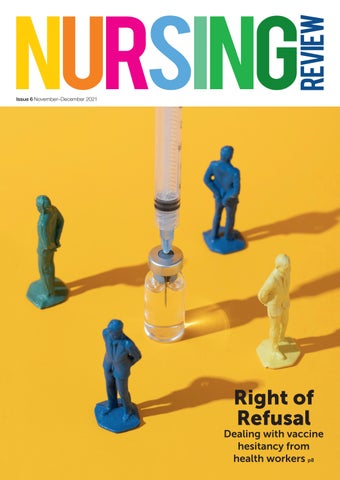
Issue 6 November–December 2021
Right of Refusal
Dealing with vaccine hesitancy from health workers p8
contents
MANAGING EDITOR
news
Richard Garfield 02 9936 8628 richard.garfield@apned.com.au
2
COVID booster approved
3
Fighting medical waste
4
Hazard pay demand
5
Nursing top uni choice
6
New pain relief option
NEWS EDITOR
Conor Burke 02 9936 8638 conor.burke@apned.com.au
industry and reform
HEALTH EDITOR
Eleanor Campbell eleanor.campbell@news.com.au
02
05
8
Listening, not labelling Understanding health workers’ vaccine concerns
SALES MANAGER
Sarah Licence 02 9936 8710 sarah.licence@apned.com.au
12 Enough is enough Time to address nursing crisis
14 On the front line
SUBSCRIPTION ENQUIRIES
Inside the home that
Daniel Omelia 02 9936 8607 subs@apned.com.au
battled Delta
16 The full story Documentaries expose
PUBLISHED BY
nursing taboos APN Educational Media GPO Box 4245 Sydney NSW 2001 ABN 58 090 900 999 ISSN 1326-0472 PP100001944
17 Learning by listening
8
14
specialty focus
18 In the small hours Strategies to get a good night’s sleep
PUBLISHER’S NOTE
© Copyright. No part of this publication can be used or reproduced in any format without express permission in writing from APN Educational Media. The mention of a product or service, person or company in this publication, does not indicate the publisher’s endorsement. The views expressed in this publication do not necessarily represent the opinion of the publisher, its agents, company officers or employees.
Life as a remote area nurse
20 Edith Blake’s war Book uncovers story of WW1 nurse
clinical practice
22 ‘Fit for purpose’ Nurses’ thoughts on telehealth
18
22
workforce
24 What nursing shortage? Why it feels like there is one
26 No time to lose Worker shortfall addressed
27 Ticking time bomb 1 in 5 could resign from aged care
technology
28 Staying safe Tips on responding
26
28
to a cyber attack
nursingreview.com.au | 1
news
Give it a boost
Greg Hunt with COVID-19 Taskforce Commander, Lieutenant General John Frewen, at a press conference in Parliament House. Picture: NCA NewsWire/Gary Ramage
Pfizer boosters approved, aged care residents are up first. By Conor Burke
T
he government has announced that COVID-19 vaccination booster shots have been approved by the regulator, with aged care residents at the head of the queue. The Therapeutic Goods Administration (TGA) has approved a booster dose of the Pfizer vaccination for adults 18 years and over, at least six months after their first dose of the vaccine. Greg Hunt, minister for health and aged care, said that subject to final advice from the Australian Technical Advisory Group on Immunisation (ATAGI), he expected the new round of vaccination would commence “no later than 8 November”. “Original priority groups, including people in aged care and disability care settings, [are] to be offered the option to receive a booster as a priority,” he said. In his statement, Hunt said that Australia, “a vaccination nation”, has administered 34.6 million COVID-19 vaccines to date, with 87 per cent of eligible Australians aged 16 and older having received a first dose and over 74 per cent have now received a second dose.
2 | nursingreview.com.au
Australians who are severely immunocompromised have already been eligible for the third shot since October 11, and the news of a booster shot will be welcome to many in aged care as Australia continues to open back up. However there has been no clear word on whether aged care staff will be included in the booster program. ACSA chief executive Paul Sadler said booster shots for staff must be a priority and that lessons should be learned from the original rollout. “On-site vaccination teams are the best way to make it easy,” he said. “ATAGI and the TGA are yet to confirm the rollout date in early November. If it does start in November, unfortunately, it means that a separate booster program is needed for staff. Especially since staff were vaccinated en masse much later than the residents they care for. “Until this happens, we must continue using other measures, such as Rapid Antigen Testing and safe re-opening of visitations in areas of concern. ACSA will continue to advocate for mandatory vaccination for home care staff across all jurisdictions.” When asked by journalists if booster shots would be mandatory for workers
“There has been no clear word on whether aged care staff will be included in the booster program. already subject to vaccine mandates, Minister Hunt was vague. “At this stage, there’s no plan or intention. And again, the Commonwealth has not been mandating other than in the aged care staff setting,” he said. “At the moment, we’re at 99.8 per cent, and I want to thank all of those staff for participating in that. And again, we’ll always follow the medical advice. So, I’ll leave that to individual states or territories,” he said. Meanwhile, ACSA believes that the sector needs more clarity. “The messaging about vaccines and eligibility is already confusing. We need to make it clear, easy and fast to give aged care the best protection possible from the virus when it is certain to be circulating in the community. “We are concerned that a whole-ofpopulation rollout might mean our workers end up behind when they should be in front,” Sadler said. ■
news
Nurse Claire Lane runs Save our Supplies out of a room in her family home. Picture: Supplied.
“We’re at the point where we realise there’s a problem, but nobody knows how to fix it.
Waste not One nurse’s fight to curb landfill and reuse medical waste. By Eleanor Campbell
F
ed up with the tonnes of unused medical supplies thrown out by her local hospital, theatre nurse Claire Lane devised a way to reduce landfills and give aid to those who need it. The 33-year-old Brisbane mother collects and redistributes clean medical items gathered from 10 hospitals in her area, which are packaged and sent to community health services and then overseas. Claire co-founded Save our Supplies (SOS), a non-profit charity, out of her parents’ granny flat almost nine years ago. “It’s kind of grown on its own, which has been amazing,” she says. “Hospitals started coming to me and then once I had one of the major hospitals on board it just kind of skyrocketed how much I stuff had, and it was proving the concept more and more.” As a university student, Claire began emptying her hospital’s 102-litre recycling bin after every shift, retrieving mountains of usable bandages, plastic masks and gowns. “The week that I actually started it, we had about three total hip packs come with the table covers, gowns, syringes and hypodermics, and pretty much all the basics that you need for an operation,” Claire says.
“There was a little nick in the outside of the packet, so that got thrown in the bin. “I’m like, ‘What do we do?’ And they’re like, ‘we throw it away’, and basically, they wanted me to stop asking questions.” Medical waste coming from hospitals, clinics and research labs is leaving a critical footprint on Australia’s environment. While national data on medical wastage is limited, recent state reports estimate that NSW hospitals generate up to 52,400 tonnes of waste a year. The increased reliance on single use plastics during COVID-19 has bred further concerns over the amount of medical rubbish being tipped into the nation’s landfills. “I think we’re at the point where we realise there’s a problem, but nobody knows how to fix it,” said Claire. “It seems that the younger generation of nurses that are coming through are more sustainability focused, and I’ve found that everyone’s mindset is starting to slowly change, which is awesome.” Nurses, doctors and other medical professionals have been at the forefront of the efforts to advance environmental sustainability within Australia’s health sector. A team of healthcare workers at St Vincent’s in Sydney are helping turn clinical waste into plastic parts for wind turbines and roller doors, and Ambulance Victoria is working to commit to net zero carbon emissions by 2025.
Claire, who was inspired by the 90’s superhero cartoon Captain Planet, wants to help introduce a mindset shift around waste in the mainstream hospital system. “I’m trying to change the idea of things being wastage, to it being just not usable,” she says. “Nobody’s going to budge on our health standards, but if it can be used somewhere else then you’re being part of the solution, not part of the problem.” After growing her charity over the past nine years, SOS now has five volunteers who visit Claire’s home every Sunday to sort and itemise each collection pile. The supplies are then sent off to charities including Rotary Australia, which helps ship the items off to developing countries such as Sri Lanka, Ethiopia, Cambodia, Fiji and the Solomon Islands. Most recently, Save our Supplies helped stock up a local maternity clinic in Papua New Guinea. “I love hearing stories of where they go,” says Claire. “It’s also my kids’ reactions, to be honest, because they’re astounded and it’s great to teach them about these things.” Universities in the area have also taken an interest in Claire’s initiative, with multiple expressing interest in including SOS in their curriculums. “I actually heard one of the educators telling the new grads about it a couple of months ago, and they went and showed them the bin and everything,” she says. “It’s starting to get where new grads come in and it just is part of what we do, so they don’t really give it a second thought.” While managing the charity, raising two children, and a part-time nursing job, Claire says that she aims to continue fighting for sustainability until it becomes the norm. “My ultimate goal is to get it in every hospital in Australia, so I want every hospital to have it as part of their workplace policy that nothing clean gets thrown away. “Once I’ve conquered Australia, I want to go to all the developed countries and just make sure this doesn’t happen anywhere.” ■ nursingreview.com.au | 3
news
RN Angel Anderson at the Burleigh Covid respiratory clinic. Photo: Glenn Hampson
‘Thankless profession’ Thousands of NSW nurses demand hazard pay. By Eleanor Campbell
N
urses are calling on the NSW government to introduce hazard pay for health workers who have risked exposure to COVID-19. Registered nurse and NSW Nurses and Midwives’ Association delegate, Jennifer Le, started an online petition urging the state premier to remunerate staff working in “dire conditions”. The petition gathered more than 25,000 signatures in over a month. Le, who works in the ICU department in one of the state’s largest hospitals, said health workers should be recognised for putting their lives at risk. “We’ve seen more patients die in the last few months than we probably ever have in the last few years in one shift,” she told Nursing Review. “A lot of us just don’t feel like there’s an end in sight, and for a lot of people, … they’re saying that it’s become a thankless profession.” Since the pandemic began, thousands of Australian nurses have felt the pressure of the overstretched health system. Hospitals in NSW COVID-19 hotspots became inundated with infected patients requiring ventilators and emergency care during the peak in early July. In the thick of it, Jennifer was admitting more than six COVID-19 patients every night. “It was crazy,” she said. “We were pretty much in COVID PPE day in, day out, pretty much every day that we were at work.
4 | nursingreview.com.au
“But you still have the risk of having a breach or catching COVID from your patients and taking it home and potentially getting your family members, or even just the community sick.” For health staff, the physical strain of wearing personal protective gear for up to eight hours each shift has taken a significant toll. Jennifer wears her full PPE for up to 40 hours a week, taking it off only when she goes home or receives her two half-hour breaks, which are not always guaranteed. Along with a plastic gown, hair net, face shield and scrubs, frontline nurses must wear an N95 mask, which fits around the nose down to the neck to create a tight seal around the face. Nurses have reported pressure injuries on their noses and allergic reactions after wearing the equipment for prolonged periods. As NSW moves into the hotter summer months, Le said that her coworkers are increasingly concerned about becoming overheated and dehydrated. “It’s hot, it’s demanding,” she said. “You can’t just step out of your space and have a drink of water, you will literally have to remove all of your PPE and step out, which unfortunately doesn’t happen when you’re in a critical care area. During the height of the latest NSW outbreak, up to 1500 cases were being reported daily. Nurses were sent into isolation due to outbreaks inside hospitals, leaving the remaining staff to juggle multiple high risk patients at a time. “They just get so sick and it just feels like we’re losing this uphill battle,” Le said.
“A lot of us just don’t feel like there’s an end in sight. “What we’re seeing now is a lot of patients coming into the hospital are mostly unvaccinated and they get really, really ill.” On top of caring for sick patients, nurses around the country have dealt with rising rates of harassment and intimidation from families. Reports of occupational violence made to the Australian College of Nursing have seen an increase over the past 20 months. Calls from disgruntled loved ones threatening to sue the hospital, claiming that COVID-19 isn’t real, and accusing nurses and doctors of “killing patients”, is a common occurrence on Jennifer’s ICU ward. “It’s hard to reason with them sometimes when they’re so firm in their belief,” she said. “We are the professionals, but suddenly we are feeling like our profession is being stamped upon.” Fed up with the conditions, Jennifer spoke with her colleagues on the ward who unanimously agreed that frontline healthcare workers should be receiving penalty pay for their demanding work. This came amid frustrations over the government’s refusal to implement staffing ratios in NSW public hospitals. Jennifer said she has spoken to many nurses who feel they have no other option but to seek out other careers. After four years as a nurse herself, she said she has considered leaving, but will stay to advocate for improved conditions. ■
news
Nursing to the front Nursing emerges as top career choice. By NCA NewsWire
I
nterest in nursing has surged despite the pandemic, with the career choice topping other fields in applications received by five out of nine Victorian public universities. A bachelor’s degree in nursing is the prime choice for students applying to
Australian Catholic University, Deakin University, Federation University Australia, La Trobe University and Victoria University, according to the Victorian Tertiary Admissions Centre data. Deakin University has had the highest number of nurse aspirants, with general nursing drawing 7987 applicants, followed by Australian Catholic University with 4947, La Trobe University with 2652 and Victoria University with 1427.
‘I don’t recognise myself’ Nurse reveals the horrifying effects of long-COVID. By NCA NewsWire
A
Tasmanian nurse who contracted Covid-19 last year has detailed how drastically her life has changed since recovering from the virus.
Department of Public Health Secretary Kathrine Morgan-Wicks told reporters that the woman contacted her while in lockdown. The nurse’s email was read aloud at a press conference because she wanted to share her story to try and encourage more people to protect themselves by getting vaccinated.
The VTAC data does not include late applications, but provides a first glance at what courses are shaping to be the most popular in 2022. Australian Nursing and Midwifery Federation state secretary Lisa Fitzpatrick said the pandemic had shifted nursing to “the forefront of people’s minds”. “It’s recognition of what such an amazing contribution nurses have made during the last two years with the pandemic,” Fitzpatrick told 3AW radio. “It’s been at the forefront of people’s minds and I think people have a great understanding of the work they have done, whether it be looking after people who are unwell, vaccinating the community, it’s very exciting to see. “All of those students, in three years’ time, will be welcomed with very open arms.” Fitzpatrick said while nursing had always been popular, the last two years had been “very different”. “[It’s] changed us in many ways and hopefully made us appreciate some of the smaller things in life that we took for granted,” she said. ■
The woman aged in her 50s said she never had any health issues in the past, wasn’t on any medication and rarely used paracetamol. But now, the nurse said she has a large list of issues including fatigues like “nothing she’d experienced before”, constant headaches that feel like her head is “being crushed” and nerve pain that makes her skin feel like its “burning”. “When you’re tired, you have a good sleep and feel better but I never feel better,” her email read. “The scariest issues I have is my diagnosed cognitive impairment. I have problems keeping up with everyday conversations and keeping up with my peers. “Covid changed my life so much so that some days I don’t recognise myself.” The nurse said there was no pleasure in anything she ate or drank because she also lost her sense of taste and smell. “I understand some people are hesitant about vaccination and what they think it can do to their health. I had those same feelings,” her email said. “But I had it and all I want is for people to seriously think about this because I wouldn’t want anyone to end up like me or feel the guilt for giving it to someone else.” ■ nursingreview.com.au | 5
news
Labor pain relief UQ research shows Labor pain could be treated by water injections. By Conor Burke
W
omen in Labor could soon have another alternative for pain relief — water. Researchers at the University of Queensland are conducting research into whether labor pain could be reduced by water injections thanks to a new round of federal funding. As unusual as it sounds, water injections have been used for pain for relief for a couple hundred years. Dr Nigel Lee, from UQ’s School of Nursing, Midwifery and Social Work, says that it started in the late 1800s prior to the discovery of cocaine, which was one of the first anaesthetics. “What they found was that if they injected a series of small amounts of water along two parallel lines, the flesh in between would become anaesthetised. That’s how they would do that prior to surgery,” he says. The practice fell out of favour for many years, before making a comeback in the 1970s and 80s and was used for a few different types of pain relief, notably back pain. Recently, Lee and his colleagues conducted a study of over a thousand women and found that injecting water in the lumbar region of women
6 | nursingreview.com.au
who experience back pain during labor took away that pain for over two hours. And now the team aims to see if the same can be applied to contractional pains. The trial consists of giving women six to eight water injections which only go not much more than a millimetre deep into the skin itself. “And there has been this theory of pain interpretation, which has been around since the 1960s called Gate Control Theory,” says Lee. “If you have pain and someone gives you a stronger pain or a pain somewhere else, the brain can only really concentrate on one at a time, so it tends to focus on the one that’s most intense.” The injections of water provide a very intense, but very brief pain when they’re injected because the water is drawn immediately into the cells, as there is no salt in the water, unlike saline, and that reacts with the cells to create a very sharp pain. The pain also triggers the release of endorphins, which are natural morphine or narcotic-like substances the body produces in response to pain. “So essentially what we’re doing is triggering the body’s own pain modulating systems to provide its own pain relief in a very localised way,” Lee says. If successful, this type of treatment could be beneficial to hospitals and pregnant
“What we’re doing is triggering the body’s own pain modulating systems to provide its own pain relief. women. It would be extremely low cost, and injecting water excludes any chance of an allergic reaction, unlike other types of pain relief. “The pharmacological options for pain relief in labour haven’t really changed in 50 years. “We know from our previous research that that’s basically what a lot of women are actually looking for. They want something that’s going to help them cope with the pain, not necessarily take all of it away. “They also want to be able to move around and actually experience the birth itself, of which things like epidurals and injections of narcotics, and even the nitrous oxide gas, detracts away from that,” says Lee. Lee says that water injection would be a safe alternative in areas of the country, such as regional and remote areas, where women do not have easy access to more common types of pain relief. Lee and his team will test the water injections over a two-year period from early 2022 at the Royal Brisbane and Women’s Hospital. ■
NURSING Specialise your nursing career with a Graduate Certificate in Mental Health Nursing & Allied Health delivered 100% Online CRICOS PROVIDER CODE: 01032F
Apply now to start in Semester 1 2022 notredame.edu.au/gc-mentalhealth-allied-nursing
industry & reform
Listen, don’t label
Why some health workers are vaccine hesitant, and how we can support them. Holly Seale interviewed by Eleanor Campbell
W
ith reports of nurses in New York burning their scrubs in protest
8 | nursingreview.com.au
against vaccine mandates and footage of workers protesting in Melbourne against lockdown, the divide between ‘vaccine mindsets’ is growing. With a small group of health workers thought to be hesitant or against receiving the COVID vaccine, Associate Professor Holly Seale, an infectious disease social scientist from the UNSW School of Population Health, recommends that employers adopt mindful language to avoid “finger pointing”. Seale joined Nursing Review to discuss ‘anti-vaxxers’, safe discussions around vaccines in the workplace, and the rights of patient safety versus the rights of health staff.
NR: What are the distinctions between being vaccine hesitant and anti-vax? HS: It’s important to note that ‘vaccine hesitancy’ is a term that has been formally recognised for many years. And certainly we apply it to other vaccine programs, not just for COVID. When we think about vaccine acceptance, we know that it happens on a spectrum, that there are certainly those in the community who will roll up their sleeve and receive their flu vaccine, including many of our healthcare workers. There will be those who are happy to receive some vaccines, but may either delay or decline to receive others. And then there are those at the other end of the spectrum, who really either decline all vaccines or even, to the furthest point,
industry & reform
actually advocate against vaccination. That might be for a range of agendas, including where people believe that natural remedies or even natural immunity is preferable to receiving a vaccine. Looking at how we refer to each of these groups, I feel that it’s really important not to use the term ‘anti-vax’, because it can be quite stigmatising. And certainly what we don’t want to do is push people in that space into a group that feels that to break away or to accept even one vaccine would be doing a disservice to others who strongly and passionately oppose vaccination. Instead we would use a term like ‘vaccine refusers’. That is acknowledging that they have opted to not accept the vaccine, but we want to certainly keep a
door open to a conversation. They may be open to discussing vaccination down the track or they may change their mind. We don’t want to make them feel like they have to walk away from all of their values and the community they feel they belong to in order to get this or another vaccine. The same goes in the healthcare setting; we will have some healthcare workers who are uncertain about vaccination, have concerns, or maybe low confidence in a vaccine. For many years we’ve documented this for the influenza vaccine and certainly have seen the same elements emerge for COVID. Many of the reasons why healthcare workers decline or refuse to get vaccinated echo the sentiments that we see in the community, but we make assumptions when it comes to health workers that they would be very open to the idea of a vaccine and that they would understand the rationale, how it’s been developed and how it’s been tested, and would have no qualms about the safety. That’s where we often fall down. Those assumptions are not accurate. We certainly have some health workers who have concerns around what would be the safety effects of a vaccine, and would share the same kind of sentiment that the vaccine has been rushed through, as we’ve been hearing some community members say. Given that we’ve got a high number of female staff members within our hospitals, there will be those who need further support because they have concerns around the impact on their fertility. That’s where we think some of the key issues lie. One of the reasons why we see this 5 to 7 per cent of staff members in some settings either refusing to get the vaccine or uncertain about it is probably because of the way that we approach conversations with staff, and about the resources we provide to staff members to support their understanding around the vaccines. When we say ‘health worker’, we often think about doctors and nurses, but health workers encompass a huge amount of personnel within a clinical setting. There are many, many staff members in those settings who don’t have the same sort of clinical background, and work in really important nonclinical ancillary roles. They may not have day-to-day conversations about immunisation, and so they may not get the same level of information that a doctor or a nurse working in primary care has.
“The reasons why healthcare workers refuse to get vaccinated echo the sentiments we see in the community. What are the worst things employers can do when their health workers are saying they have concerns about the vaccine? We jump to the conclusion that for people who haven’t received the vaccine, it’s all about hesitancy, but it could also be around access. Because the recommendations have changed, and the availability of vaccines has been up and down, in some parts of the country we are still working through those access issues. The number one thing here is making sure we truly understand what’s happening on the ground amongst our staff. We always recommend talking to staff members themselves, and if there’s capacity, do some short surveys, get in some polls, get in maybe some focus groups with staff right now to understand what is happening in those areas where coverage is still lower than where it needs to be. It may be that some of these staff members would feel more confident to go and have that one-on-one conversation with their own GP, or the health worker themselves has a chronic health condition – they may need to feel comfortable about the vaccine in terms of what drugs they’re on or about their treatments, and that might require a conversation with their specialist. It’s about having opportunity for sharing knowledge, finding the factor that may motivate the health worker. That might not be about stopping severe disease, but may be about going to visit family members abroad. It may not always be just about their clinical situation. And it’s taking this time, and that’s a challenging thing in a busy hospital or a clinical setting when you’ve got a large number of staff to get through. A proportion of staff members will have English as a second language. Having resources for them in language, in tools that actually speak to these staff members, is also incredibly important. nursingreview.com.au | 9
industry & reform
Some states have vaccine mandates and some don’t. Do you think we need a federal mandate like we have for aged care workers? It’s important again to look at the vaccine setting pre-COVID here in Australia. We’ve had mandates for flu vaccination that vary across the states and territories. This includes vaccines for conditions such as the measles, mumps, rubella, diptheria, tetanus and hepatitis. We also have variation to do with flu vaccination. If we stay in the current situation and the vaccines continue to do what they’re doing, and we get the vaccine rates, I think it’s unlikely that we will see a mandate introduced at a federal level for hospitalbased or primary care-based health workers. Instead, I think we will continue to see states and territories do their thing and implement this. In the past, mandates have worked very well. Not surprisingly, they get vaccine coverage up very high, and certainly the research literature that has mapped the introduction of flu-based mandates in the US and elsewhere has shown that in most situations. COVID, of course, is a very different beast, and it has thrown us a curve ball in a way that we’ve never seen. We acknowledge that the introduction of a mandate has to be done under a different timeframe and a different kind of setting. But still, in any kind of clinical setting, there has to be assurances that all of the other known strategies have been used to promote vaccine coverage and uptake. So that means making sure that the access is there, that we make it as easy as possible for people to either get it onsite or offsite and to record the vaccine coverage. Making sure that there are opportunities for one-on-one conversations if people have ongoing concerns. Making sure the resources are there. Making sure all of those other elements are ticked. Then we move to this space of, are we still seeing a proportion of staff who have not received it? Do we understand what’s happening amongst that group? If we’ve done that, then we are moving into this mandate space. It is really important, again, that health settings do this in conjunction with health workers. So they have the voice of the health workers on committees, they have union reps, they have people from colleges, all of the other stakeholders that will be there to communicate about the mandate, to support its introduction, and 10 | nursingreview.com.au
have the potential then to really pass on information about why this mandate has now been introduced. If we do this, based on what we know, we will lose some staff members, and that has to be acknowledged. We’ve got to make sure that they have been given opportunities, and all of those relevant touch points to go through before that termination occurs. But what we’re seeing in the media is this kind of sentiment that we will get hundreds of staff members rushing out the door because of COVID. I don’t see that coming to fruition here. I think we need to be mindful of that language. We don’t want to lose any staff members, but we also respect that there will be some staff members who don’t want to receive the vaccine. And so labelling them, and the kind of sentiment I’ve been seeing on social media is like ‘good riddance, they shouldn’t belong in health’. That’s not helpful to anyone, and we don’t want to get to finger-pointing at staff who decline the vaccine and move away, because in the US we’ve seen that many of those health workers have become the face of some of the social media campaigns to try and encourage people not to get the vaccine. We’ve got to be mindful that any healthcare worker is seen as being respected and should be listened to because of their position and their background. But if they’re putting out messages and misinformation about the vaccine that’s not true, then certainly, we’ve got to try to avoid that. So no finger pointing, no negative comments on social media. We need to avoid all of that.
Are punitive measures against healthcare workers who post vaccine misinformation online the best way to approach this? Stopping people and threatening them, I suppose, is the ‘sticks’, and we’ll always have sticks approaches in these public health emergencies. Instead, connecting with these people, maybe through a trusted intermediary, might be a better way to go. Instead of the hospital coming down with the stick approach, having a trusted colleague or someone within your own department or ward be the go-to person may help better with these staff members. This is, again, empowering people to do peer-to-peer education and to try and highlight that personal stories and conversations amongst colleagues
“We don’t want to get to finger-pointing at staff who decline the vaccine and move away. may have a lot of influence right now. The patient voice is also important. What are their expectations? I would go into a clinical setting acknowledging that the staff members there would have received the COVID vaccine. We know that when outbreaks occur in clinical settings, that it may be the staff, it may be patients, it may be family members. So again, we can’t point a finger that it’s a staff member necessarily who’s introduced COVID, but we want to reduce that risk as much as possible.
What are some things we need to keep in mind in the future to avoid stirring up this social divide? I think I’ve spent the whole pandemic saying to the media, ‘Please stop using photos of needles, because it doesn’t help,’ and I’m still seeing photos of needles going into arms; needles that are totally inappropriate. There’s only so much you can do. If there’s a lesson learned, and it’s around social media, say, certainly I would love to see more activity around misinformation and around how we approach misinformation. What role do hospitals and other health facilities play in trying to reduce that risk? I think I’d love to see a lot more breaking down of silos. We’ve had lots of action in some communities around trying to bring health workers and GPs into community forums to have conversations, and certainly I think that has proved very successful. I think there’s some really important lessons to be learned about how we can support community-based immunisation. And I certainly think there are some lessons to be learned around how do we communicate and tailor our programs within clinical settings too, to enhance staff vaccination going forward? We’ve got to be careful here, because we may hit a bit of fatigue around talking about immunisation and around thinking about next year’s flu programs, say, where we’ve come off the back of a very low season. We are going to have in the next couple of years quite challenging conversations going forward about what vaccines are going to be needed and when and why. ■
SubScribe for leSS than $2 a week
The laTesT news and resources for healThcare professionals
• Analysis of the major issues facing the health sector today
Nursing Review is essential reading for anyone involved in the healthcare sector in Australia. It provides unrivalled coverage of specialist topics from features and opinion pieces, to international news and profiles.
• Can be used as a professional development resource
At Nursing Review we pride ourselves on being at the forefront of the ever changing healthcare sector. We provide an independent source of news, and cover the issues relevant to nurses and the sector giving an informative, practical and insightful view into day to day life in hospitals and in surgery.
• 6 issues per year • Interviews and opinion pieces from professionals in the industry • Written by an independent voice • Tax deductible
Please call 02 9936 8666 to find out more.
Industry & reform
Enough is enough It’s time to urgently address the nursing crisis in Australia. By Kylie Ward
N
ursing, already under pressure, is reaching breaking point due to the pressures of COVID-19 and a disjointed healthcare system, including the acute, primary and aged care sectors. We must act now to protect our nurses and healthcare; the time has come for a national reckoning on nursing in Australia. Australian nurses cannot continue to work under the extreme pressure they are currently operating under – the impacts are mounting.
12 | nursingreview.com.au
The almost 400,000 Australian nurses – the largest and most trusted health professionals in the country1 – are a constant presence in every one of our major life milestones, national emergencies and global crises. The nurse of today holds a science degree, possesses highly technical training, valuable medical opinions, front-row expertise, is an effective trainer, and is skilled in population and systemic thinking. Importantly, there is also a major emotional and physical toll on nurses. For too long there has been a reliance on the ‘giving and goodness’ of nurses – however, there is not an endless bucket of personal resources to draw upon to keep members of the profession fronting up to do the job, whether that be in policy, research, in hospitals, in the community, in academia, politics and across the aged care and disability sectors. And now the signs are unmissable for a profession under enormous stress. We desperately need a rethink about how we support and provide nursing care in Australia.
“We desperately need a rethink about how we support and provide nursing care in Australia. Nurses around Australia are reporting to the Australian College of Nursing higher than normal levels of occupational violence over the last 20 months. This comes off the back of unacceptably high levels: in 2019, up to 10 per cent of nurses reported they had been either physically assaulted, verbally abused and/or subject to sexual innuendo, abuse or threats2. Harassment and intimidation of nurses in the workforce has become so regular that in some workplaces it is considered ‘just part of the job’. When I was establishing myself as a nurse, I also experienced harassment and violence, but we didn’t have the language or understanding to know we didn’t have to tolerate it. This outdated and damaging mentality of workplace culture needs to end, and it is
Industry & reform
the reason I am championing this as loud as I can in my role. As a predominately female workforce3 (90 per cent), the issues of sexual assault against women echoes loudly through our profession, as society grapples with the impacts of the Me Too movement, the Brittany Higgins case, and even the Women’s Safety Summit hosted by the Federal Government. For nurses, the topic of domestic and family violence as well as occupational violence is front of mind. From a professional perspective, the high rates of abuse sustained by the nursing profession has deep, lasting impacts and many members of the Australian College of Nursing report symptoms of trauma, posttraumatic stress syndrome and vicarious trauma. In January 2021, the World Health Organization confirmed the ‘mass trauma’ of healthcare workers, which was highlighted by the International College of Nursing (ICN)4. This needs to change. Today. The pressure on the nursing profession is mounting on a day-to-day level, when nurses are required to isolate from their family and friends after being exposed to COVID-19 at work. Nurses have informed me, in some sectors, they get paid for the first three days of that isolation in the public health system. However, if they acquire the virus, they are expected to take sick leave for the remainder of their recovery. Many nurses are not permanent or full-time staff, rather casual, part-time or working as agency nurses, which are often not entitled to sick leave. This vulnerable group of workers – most often women – are left without a means to earn an income after virus exposure. The regular absences of clinical staff in client-facing health environments means teams are short-staffed, or managers, clinical nurse consultants and nurse educators – all vital for the coordination, oversight and safety of health systems – are pulled off their work and asked to be clinically facing. This leaves these nursing experts to work extensive hours each day, as there is no back-fill for their roles. Nurses are turning away from the profession as a result. In March 2021, the ICN conducted global research in nurse shortages one year on from the WHO declaring COVID-19 a pandemic. They reported that nearly one in five of the National Nursing Associations surveyed reported an increase in the
number of nurses leaving the profession, and 90 per cent of them are “somewhat or extremely concerned” that heavy workloads, insufficient resources, burn-out and stress are the factors that are driving that exodus.5 The 2020 Aged Care Workforce Census reported that 29 per cent of their direct care workforce had left their employment over the 12 months from November 2019 to November 20206 and there were almost 10,000 vacant roles in aged care alone. That was before the current extended lockdowns both Victoria and New South Wales are experiencing. ICN reports the world entered the pandemic with a shortfall of up to six million nurses and an additional four million expected to retire by 2030, which puts the global nursing workforce under an intolerable strain. ICN says large numbers of experienced nurses are leaving the profession or considering calling time after the pandemic, which should be a wake-up call for governments to invest in nursing jobs, education and leadership before it is too late7. Whilst the issues are challenging, there are strategies that can be put into place to ease the pressure, to support nurses, and nursing care in Australia. Firstly, we need to immediately support the graduating class of 2021. Right now, thousands of third-year nursing students are at risk of being ineligible to graduate this year as they are struggling to obtain clinical placement hours required of their three-year tertiary degrees due to disruptions to the health care system. It is estimated almost 20,000 nurses across Australia are due to graduate in their final semester. This workforce will make a tremendous contribution, with adequate support, to all health care sectors. Governments and employers should be working to secure employment for all graduating nurses to provide a pipeline for workforce planning for 2022 and beyond. We need additional funding for refresher courses for retired registered nurses and enrolled nurses, as well as non-clinical active registered nurses, so they can supplement the workforce across Australia. This needs to be coupled with job certainty and tangible benefits to them for coming back into the workforce8. The Australian College of Nursing has always championed overseas trained eligible registered nurses provided with right to work visas in Australia. Skilled nursing migration enhances opportunity,
diversity and care delivery to those living in Australia, and nursing has long been considered a profession that can take you around the world. Support and relief must be given to the executive directors, directors of nursing, and other senior workforce executives who are dealing with tired, burnt out and exhausted staff – they must be given the support and resources they need to manage their teams, and patients. The complete transformation of health systems to deal with the impacts of COVID-19 have largely landed on their shoulders, and they need practical support, people funds and the go-ahead to overcome policies and procedures not suited to the current challenges. Funding models are outdated and exclude mental health nurses, nurse practitioners and registered nurses from accessing Medicare numbers in order to be paid for the work they do. This is having the greatest impact in rural and remote Australia, where community health care systems are often staffed by nurses who cover enormous areas. Your postcode should not determine your health outcomes in the 21st Century, but in Australia it does. We recommend a national summit to be sponsored by the federal government in collaboration with the Australian College of Nursing which is representative of all the health care systems – including aged care and disability – so a national action plan for a sustainable and supported nursing workforce can be established, prioritised and actioned in light of the pending crisis. And finally, and most urgently, we ask all Australians to please consider the way fear, frustration and stress is expressed in clinical, aged care and community settings, for this is having a major and lasting impact on the emotional and mental health of Australian nurses. We thank and acknowledge those of you who are patient, express kindness and gratitude, it means so much. We are, and have always been, the caring profession so we appreciate what toll COVID-19 is taking on people, but harassment, violence and intimidation of nurses and women in our society and workplaces will never be okay. ■ For references go to www.nursingreview.com.au. Adjunct Professor Kylie Ward is the chief executive of the Australian College of Nursing. nursingreview.com.au | 13
industry & reform
On the front line Michelle Sloane addresses the media. Photo: Adam Yip/NewsCorp Australia
Inside the home that battled Delta. By Eleanor Campbell
I
t was one o’clock in the morning when Michelle Sloane got the call. She got out of bed, drove to Baulkham Hills in Sydney’s west, and by 3.00am she was informing families that a COVID-19 outbreak had spread inside their loved ones’ home. “My heart dropped,” says Michelle as she remembers the call. Michelle was the chief executive of SummitCare at the time, a company with 10 homes across greater Sydney. “Something you never want to hear as a CEO is that you’ve got a positive COVID test in your home.” After witnessing the devastation the virus wrought on the country’s residential aged care homes, including in Melbourne where over 600 lives were lost, providers around the country began scrambling to prepare for the worst. Michelle says that prior to this year’s outbreak, SummitCare had revised multiple outbreak planning scenarios, and felt prepared when the Delta variant began its spread through NSW. But within a week of that 1.00am call, 11 people in Baulkham Hills, including five
14 | nursingreview.com.au
workers and six residents, were infected with the virus. “In the early stages, it felt a bit like a war zone,” says Michelle, who seems calm when remembering those early days, yet slightly shaken from the experience. In the early hours of that first morning, all the infected residents were transferred to Westmead Hospital and over 80 per cent of the facility’s staff were sent into isolation. For every staff member lost, two more workers were needed to fill the gaps. “I believe we were very well prepared,” says Michelle. “We had a very strong pandemic outbreak plan, and we had a very strong communications plan. “One thing we did realise is you can plan as much as you want, but when you’re in the middle of an outbreak, it’s very different to what you’ve planned.” Prior to the outbreak, Michelle and her team had performed emergency scenarios, stocked up on PPE, organised webinars, and had undergone infection control processes. Still, she hadn’t anticipated the onsite kitchen would need to be closed and that mass amounts of food would need to be ferried in to feed the residents and staff. In the thick of it, she says, it was the small details that caught her off guard. “There’s unexpected things you come across in that first outbreak –
the loss of staff, the quantity of contaminated waste. “Then the other surprises of not being able to cook onsite and not being able to shower residents.” After hearing news of the outbreak, 25-year-old registered nurse Shumayl Gulzar was asked if she would transfer to Baulkham Hills from her SummitCare home in Smithfield. “It was very intimidating going in and I calmed myself down, saying, ‘you are a registered nurse and it’s your responsibility’,” she told Aged Care Insite. “So, I walked in, and I’m glad I did.” When she told her husband that she would be on the frontlines of an active outbreak, he feared for her safety. “I told him, look, I’m a registered nurse and you married one and you should be aware that it’s part of my job.” Shuymal’s nerves calmed the moment she walked onto the premises. She was greeted by a large infection control team, an army of supplies, a large table of PPE, and a team of RNs and care workers, just like herself, ready to get to work. During the first 72 hours, the team worked tirelessly into the early hours of the morning. Shumayl says the staff had to remind each other to eat and rest, and each person took turns to go upstairs to have a break when they could.
industry & reform
Around 149 residents had been confined to their rooms and were under the team’s care, none of whom the young nurse had met before. Remembering her training, Shumayl began to highlight the highest priority residents in red, second in yellow, and third in blue. Some of the residents were confused and anxious about the new strangers dressed in large, blue surgical gowns and facemasks. “You take baby steps with them, you tell them we have to do this to make sure you are safe, and we are safe,” says Shumayl. “We used nonverbal communication with people that didn’t have the capability to understand.” Residents would sit in their doorways and play corridor bingo, and staff organised one-on-one craft and leisure activities, and visits from physiotherapists. The team, including the RNs, pharmacy staff and kitchen workers, all remained in constant communication. “Everyone played a role,” says Shumayl. It was around three days later when news of the outbreak hit the media, and photographers and reporters began to gather outside. Worried families soon began inundating the home with calls to check on their loved ones. “Managing COVID itself is stressful enough, then reassuring families that their loved ones are okay, then making sure that they’re actually okay, and on top of that, we have the tension building up from the media,” says Shumayl. “And every time you would see news, it would just be like, ‘oh my god, are they going to say something good?’.” By this stage, Michelle was speaking with Westmead Hospital twice a day to check in on the hospitalised residents. In between taking phone calls from families and checking in on staff, she was also told she was responsible for addressing the large media presence outside. Dressed in blue scrubs, goggles and a facemask, she walked outside to face the cameras. “I was naturally a little nervous,” said Michelle. “I told them exactly what was happening, there was no point in trying to hide anything.” The media glare was intense. Soon the daughter of two of the infected residents began to speak out publicly and the media camped out front of the home for the next 10 days.
Michelle also had to contend with images in the media that appeared to show distressed residents pressing their hands and faces up against the windows of the home. According to Michelle, the women in the photograph were living in the dementia unit and were simply curious about the commotion occurring outside. “At first, [the residents] were all scared,” she said. “They were seeing it on television, they were hearing it from the TV before we were able to get to them. “We were very conscious of keeping them informed, the communiqués I was sending out to the families twice a day were also being delivered to the residents on their meal trays.” For the first two weeks of the outbreak, Michelle lived onsite with about 50 of her staff on an unused upper floor of the home. It was tough as her partner was stuck in Melbourne at the time and had to support her from afar. But her two adult daughters took turns to visit and bring her clothes, toiletries and food. Before the cooked meals began coming in from other SummitCare homes, the exhausted team lived off potato chips, and chocolate. “You were caught in this kind of vortex for about a month,” said Michelle. “We just kept focusing on the end game, frankly.” A nurse through and through, Michelle wasn’t worried about catching the virus herself and as her team, with the help of NSW health, got on top of the outbreak, she felt confident in the high level of infection control they had implemented. Speaking with Michelle in October, with the Baulkham Hills outbreak under control, she says that the last few months have been a blur. As it stands, around one hundred per cent of SummitCare’s residents and staff have now received both jabs, she says. “I think that everyone would agree in aged care that perhaps it could have been done differently.” “Every year aged care providers administer their own Fluvax, usually in conjunction with their GPs and/or their own immunisers. “If the government had allowed this to happen with the covid jabs, then all residents and staff at each home could have received their jabs in a more costeffective and efficient manner.”
“In the early stages, it felt a bit like a war zone. The outbreak started in July and would last 30 days, and all of the staff and residents who tested positive have recovered. But fears of another outbreak soon followed as a fully vaccinated nurse at the SummitCare facility in St Mary’s tested positive. An infected doctor would also enter the organisation’s Penrith home causing panic in early September. While no other residents have tested positive, the threat of the virus has become routine for the staff, residents and families of SummitCare. “The subsequent outbreaks have been more manageable because the team of course is now far more experienced than they were in July,” says Michelle. “We’re very conscious of each other and the fact that everyone is tired. Therefore I think everyone’s trying to be very, very sympathetic with one another.” Residents, no longer quarantined in their rooms, can move freely around their designated zones and [at the time of writing] were preparing for in-person visits as ‘freedom day’ approached. “Clearly they are missing their families,” says Michelle. “We’ve tried to be, and continue to be, as innovative as we can in keeping them entertained and making sure that their spirits are uplifted. “The team are very tight, and they’ve become tighter as the months have gone on. “ After four years with the organisation, Michelle was recently appointed chief executive officer and co-director of Summit Healthcare. The last three months have been testing and she admits that trying to switch off in her downtime is difficult. Watching Netflix, or reading with a glass of wine in the evening helps, as does early morning walks with her dog. But her work is always front of mind. “I think that the entire age care industry is running on adrenaline right now,” she says. “Until we can get vaccinations to the level we need them in the community, and hopefully the case numbers right down, I think everyone will feel the same way. “I hope by Christmas we’ll be there.” ■ nursingreview.com.au | 15
industry & reform
“I didn’t realise some of the stories they had, like being strangled or having to call the police.
Filmmaker Daniel Delaway (left) and nurse Jackson Heilbeck. Picture: Supplied.
In the line of duty New short docu-series breaks down industry taboos. By Eleanor Campbell
I
’ve had a patient strangle me, throw poo on me, throw urine at me. I’ve been spat at,” said registered nurse Jackson Heilberg in his short docu-series about violence in nursing. “The verbal abuse is mind-blowing,” said another nurse. “It just makes an already challenging day harder when you have a patient that is really aggressive.” Physical violence, aggression, verbal insults, mental health, and death are all unfortunate aspects of the daily life of a nurse. A new web-series titled ‘Wouldn’t you like to know?’ has put the spotlight on the challenges and rewards of healthcare from the perspective of 15 nurses working across the profession. Co-creator Jackson Heilberg said he hopes the episodes will encourage nurses to talk freely about what they go through every day. “I think it’s given them the realisation that they can speak out and they can be open about what they’re experiencing,” said the 27-year-old nurse. “We don’t talk about these things because we feel like we’ll get reprised from our employer or the public. “This almost gives them like a licence to talk about some of these things: death and dying, violence and abuse.” Garnering thousands of views, the first episode of the series heard graphic stories
16 | nursingreview.com.au
of nurses being threatened, kicked and punched. One nurse recounted having to take out a restraining order after a patient harassed her and threatened to hurt her and her children. Jackson said that the series has helped to highlight the rapid nature of cumulative violence faced by nurses on shift. “It was a mix of emotions throughout the hour or so that we interviewed each person,” he said. “I knew there was physical violence, and I knew what I experienced, but I didn’t realise some of the stories they had, like being strangled or having to call the police.” Working briefly in trauma, general medicine and paediatrics, Jackson has spent most of his nursing career in emergency wards. He said originally the idea for the web series came about through his blog, The Nurse Break, which he started as a student in 2019. “There were a lot of misconceptions about the role of a nurse, and I was meeting some really interesting nurses at the time,” he said. “I really just wanted to capture some of the experiences of the people’s stories that I was meeting, and I turned it into a blog.” In developing the blog, Jackson said he wanted to showcase the varieties and complexities of nurses to build better understanding among different health workers. “Interviewing other healthcare workers, bringing in some of the multidisciplinary team together, helps us improve nursing
because we can all learn how we work better together,” he said The Nurse Break has received over half a million views and has become a wellknown platform for nurses to volunteer to share their experiences. “We’ve interviewed people from students to directors of nursing, and CEOs of organisations such as the Royal Flying Doctor Service,” said Jackson. “It’s a space for health professionals to share what they do in their careers to collaborate and learn.” Earlier this year, Jackson collaborated with his friend and filmmaker Daniel Delaway to produce the 12-part web series for YouTube. The pair both met as volunteers for St John’s Ambulance Services while attending university in Melbourne. “I only experienced a little bit of violence when I was at St John’s … but they have it on a daily basis at ER,” Daniel said. “I think it was pretty interesting to hear the specifics of people who have worked in the industry for 20, 30 years.” Daniel, whose work also explores the real-life stories of everyday people, said the process of creating the series was an “eye-opener”. “Some of the stories are amazing and very sad and very interesting,” he said. “The idea with these miniseries is to help encourage people to be more proactive about capturing their stories while they’re alive.” In the most recent episode, the nurses were asked about their relationship with death. “That’s a unique aspect of our careers,” Jackson said. “We are there at your birth and then when you die. “I think that’s a taboo that a lot of people don’t talk about openly.” In the future, Jackson hopes to touch on rural and remote nursing, meeting the needs of LGBTQ+ nurses and midwives, and paediatric experiences. “I would say that nurses have been a silent majority since the inception of nursing and it’s time to change that,” he said. ■
industry & reform Remote area nurse Terrie Ivanhoe. Source: Supplied
“This job has taught me to shut up and listen.
Listen and learn Life as a remote area nurse in Australia’s most isolated communities. By Eleanor Campbell
A
cross the vast, red desert of northwest South Australia, Terrie Ivanhoe is helping to deliver the COVID-19 response in the country’s most remote Indigenous communities. “I think out of everything I’ve done over the last 11 years this has probably been the hardest,” Terrie told Nursing Review. “If you look at access to care and our specialist services, they all slowed down, and a lot of people were not able to come into the communities.” A veteran remote nurse practitioner, Terrie has spent over two decades with the Nganampa Health Council, an Aboriginalcontrolled primary health care service. Situated on the Anangu Pitjantjatjara Yankunytjatjara (APY) Lands, the organisation works with around 3,000 people living across six remote Aboriginal communities. The vast landscape stretches over thousands of kilometres and is roughly the size of Iceland. “People speak their own language, which was a shock for me when I got out there. I was shocked at my own naivety that I had never thought about it.” Over the past 18 months, Terrie has worked with a handful of practitioners to deliver COVID-19 information, vaccinations and testing across the region. “Our pandemic response really has been a gold standard and just as good as anywhere in the country,” she says.
For her service, Terrie was awarded the 2021 CRANAplus Aurora Award, which is the highest possible accolade for nurses in remote and isolated health. She says she has learnt countless lessons in her experience as a remote area nurse, including the most important one – knowing when to “shut up and listen”. “I think this job has taught me to shut up and listen: don’t fill every space with words. Sit back and listen and seek to understand first before you make any comments.”
CLOSING THE GAP Terrie began her career as an emergency nurse in Perth over 20 years ago. When she was sent to work out-of-state by an agency, she took one glance at the desert mountain ranges and never looked back. Since then, Terrie has overseen Nganampa’s Chronic Disease Program, which works to address the disproportionate rates of chronic disease in remote Aboriginal communities. “Our rates of acute rheumatic fever are shameful and they are completely undermined by the social determinants of health,” she said. As part of the national Closing the Gap strategy, the South Australian government released its first implementation plan to improve health outcomes in Indigenous communities. Of the 200 targets, the government promised to develop more communitycontrolled health services, including establishing an Aboriginal mental health and wellbeing centre.
Terrie says that based on what she’s seen, the program has “not done a whole lot” to improve health inequity. “It is my view that we are very good at providing secondary and tertiary care, but we’re very bad at delivering primary health care and addressing the social determinants of health,” she said. “There’s lots of rhetoric around it. But doing something about it is really hard, and my role as the chronic disease coordinator is actually trying to address some of those things.” Throughout her career, Terrie has spent years visiting her clients, listening to their stories, and taking the time to get to know their families. Developing relationships with her clients has been key to establishing trust as a nonIndigenous medical practitioner, she says. “One of the things that I think we don’t always pay enough attention to is that therapeutic relationship,” she says. “We assess the patient, we see the patient, we look after them, but we don’t actually try to build a relationship with them. “If you haven’t got a good relationship with people … they will never trust you.” Remote Indigenous communities in the APY lands are among the most economically and socially disadvantaged in Australia, with some of the lowest rates of life expectancy in the country. Terrie says she looks to her own childhood experiences to understand the cycle of poverty. “I come from a very poor family, and I think that I’d always been embarrassed about that,” she says. “As I’ve got older, I’ve realised what a privilege it was to be poor. Because I’m able to see the world through different eyes. “I live a very privileged life, of course, but most white fellas do, even if you’re a poor white fella.” After 20-odd years on and off the job, Terrie plans to transition into part-time retirement next year to spend time with her 10 grandchildren. Reflecting on her time in remote area nursing, she says the profession “fell into her lap”, but she wouldn’t have had it any other way. “We all have a purpose in life and I would believe that my purpose has been to be of service.” ■ nursingreview.com.au | 17
specialty focus
In the small hours Why we often stress more at 3am, and what we can do about it. Greg Murray interviewed by Eleanor Campbell
W
aking up at 3am and worrying is a common experience, and researchers have unpacked why we have late night sleep disturbances and how we can avoid it. Professor Greg Murray, a clinical psychologist and director of the centre for mental health at Swinburne University of Technology, said that our brains are wired for “systematic bias” in the middle of night. “If you haven’t got distractions, all you’ve got is your thoughts, and you really are in danger of being led astray,” Murray told Nursing Review. A recent survey by Mental Health Australia found that experiences of fatigue, tiredness and issues getting to and staying asleep were major mental health impacts being reported by health workers.
18 | nursingreview.com.au
Murray said that people working on shifts and in distressing environments should not put pressure on themselves to fall asleep, and should try to debrief at the end of each day. Murray spoke to Nursing Review about the 3am sleep phenomenon, how the pandemic has affected our circadian rhythms, and the tools we can use to have a more restful sleep.
of life. And the more your routines have been disturbed by COVID, the more likely you are to be experiencing poor sleep and depressive symptoms.
NR: What does the research say about how the pandemic has affected the way that we sleep?
Biologically we are predisposed to move into lighter sleep in the second half of the night. So for the first half of the night, things like melatonin are helping us go to sleep and stay asleep. But that peaks by about the middle of the night and from about three o’clock in the morning, cortisol levels start to rise to launch us into the day. Apparently it takes a fair bit of work so there’s a countdown that starts from about three o’clock in the morning. It is entirely normal to sleep more lightly in the second half of the night from about three o’clock on. The theory is that if you put someone under stress, the normal light sleep that you’d be going through in
GM: The latest review that I read said that something like 40 per cent of the world is reporting some degree of sleep difficulties at the moment, and 20 per cent are meeting criteria for insomnia. That’s about a 25 per cent increase. We have done some research on the impact on circadian rhythms, which is the body clock which plays a part in sleeping, and we found a really interesting pattern showing that lockdowns and social isolation have disturbed people’s daily routines, their sense of a routine rhythm
Your recent article spoke about why we wake up in the middle of the night plagued with worrying thoughts. Why does this happen and why do our brains tend to worry more in the middle of the night?
specialty focus
that second half of the night can become full conscious awakenings. And that’s the risk factor for going down a path of negative thinking. The other factor that predisposes you to maybe go down that negative pathway is evolutionary. Humans are what we call diurnal animals, they’re designed to operate in the daytime, so it makes perfect sense that nighttime is actually a bit frightening. On average, human beings are just a little bit more on edge after dark than they are after the sun comes up.
me? And if it is that’s a red flag that you might be going down an unproductive thinking path. When life is going well, we are typically not thinking about ourselves. We’re thinking about what we’re doing, what we’re engaged with and other people. For me, the breathing technique not only gets me out of my head, but it has this feature that is something about decreasing the importance of myself, because it’s just the sound that I’m with, not ideas focused on Greg Murray.
What are the worst things someone can do when they wake that might prohibit them from getting back to sleep?
If a client came to you who was a shift nurse, for example, and was experiencing things that were quite stressful, what kind of strategies would you prescribe?
What are some of the things we can do in the day to improve our chances of getting a great night’s sleep?
There are some lifestyles that we know are really seriously challenging for sleep. I’ve had clients who have stopped being a nurse because they have serious mood problems. And I have had clients who’ve said to their manager they can’t do night shifts; they just work out over time that is not okay for their health. There are some lifestyles that are just on the surface really bad for sleep. And you might have to have a good, hard discussion with someone about the pros and cons of that lifestyle if your sleep is a problem. There are some people, of course, who cope really fine with shift work. So, this isn’t a universal rule. If I’ve had a significantly, emotionally upsetting experience, especially close to bedtime, I would be accepting that I’m unlikely to sleep well. So I would not expect that the arousal of that distressing event is going to pass quickly. I would be accepting that and think, well, maybe I’m just going to have to stay up and watch whatever is my favourite relaxing movie or read my favourite relaxing book. And the other thing that I would be thinking might be a general principle is the notion of debriefing. If I’m having concerning or distressing thoughts, a very good general principle is that I don’t want them staying just inside my head. I want someone else to know about them. So hopefully nurses and other professionals are part of a network of support where there’s some sort of debriefing available so we can share those experiences. And that sharing might create a space where you can then disengage from it and perhaps head off to sleep. We can’t make ourselves sleep. And if we haven’t set up the preconditions for
Sleep and wake are opposite sides of the same coin. We sometimes think about problems with sleep as starting in the nighttime, but the most power we have to prevent problems with sleep is actually in the daytime. One of the most powerful things you can do is set up a daily routine. Getting up at about the same time every day is one of the strongest cues that improves sleep that we know of. And when you get up at about the same time every day, ideally we then go outside and get some sunlight in our eyes, which is the cue for the body clock that the day has started and put activities in our day, like leaving for work, having lunch, getting some exercise, that happen at about the same time each day. The more we build up that strongly rhythmic pattern, the more our body learns when sleep is meant to happen. So it’s not driving sleep, it’s not forcing sleep, it’s setting up that 24-hour rhythm of which sleep is a part, that’s a really major overarching message. Nature has designed us to be engaged and active and connected in the daytime and to withdraw into sleep at night. That’s that 24-hour cycle. One of the ways to really strengthen that cycle is to have pleasurable engagement in the daytime. There’s something about that which enables us to feel prepared to withdraw. It’s something about communicating to the body and the mind that life is going okay at the moment. I always say to adolescents, and this is just an exaggeration, but any day in which you’ve laughed out loud three times with your friends is a day when you’re likely to sleep well. The quality of your engagement with life in the daytime is what predisposes you to sleep at night. ■
The sorts of thoughts that you have at that time of night are likely to be systematically biased towards the negative; that’s what we call catastrophising. It’s a really common phenomenon for people with anxiety problems, for people with depression, and even people who don’t have those diagnoses. The main thing we want them to understand is that they shouldn’t necessarily trust their thoughts, that thoughts aren’t facts. If you haven’t got distractions then you really are in danger of being led astray by your thoughts, because it’s dark, it’s quiet, there’s nothing else going on. Your thoughts can take you wherever they want. And we know from our other parts of psychology that that’s normally not a great thing, particularly if you’re someone who’s under stress or is prone to negative feelings, that’s going to end badly. All the things we propose that you should do about this are all about getting out of your head.
Can you tell us about mindfulness and how we can use it in our own lives? Many people probably use mindfulness to some extent in their daily lives; it’s such a popular approach to improving wellness and dealing with stress. I use it particularly when I wake up at night and it normally works because it’s a technique where I’ve committed to not going down the path of thinking. Instead, I listen to the sound my breath makes, so using my senses and bringing attention to the sound of the breath. When you put in foam ear plugs, you hear a nice rich sound of an organism breathing that just happens to be you. If you want to check out the quality of your thinking, particularly overnight, ask yourself, is most of this thinking about
“Hopefully nurses are part of a network of support where there’s some sort of debriefing available. sleep, we probably won’t sleep very well, and that’s okay. There’s nothing wrong with missing a night’s sleep. It’s your longterm sleep habits that matter. I wouldn’t be putting myself under pressure to get a good night’s sleep after something traumatic had happened at work.
nursingreview.com.au | 19
specialty focus Injured soldiers aboard a hospital ship off Anzac Cove. Photo: Australian War Memorial
Edith’s war New book uncovers the lost letters of an Australian nurse during WW1. By Eleanor Campbell
F
rom a bundle of old letters and a diary from 1914, Krista Vane-Tempest unearthed the story of the only Australian nurse to die in action during the First World War. As a child, Krista knew she had a great aunt who had served and died on a sinking British hospital ship. But her family, namely her grandmother, had rarely mentioned her big sister Edith. It wasn’t until Krista inherited Edie’s diary at age 19, did she realise the harrowing journey that her lost relative had embarked on. Years later her father found a bundle of tied up letters stuffed in the bottom of a wardrobe. They had been written by her great-aunt during her nearly four years of war service. “I was shocked,” Krista told Nursing Review.
20 | nursingreview.com.au
“So it wasn’t until that, I or Dad, in fact, became aware that all of this treasure trove of letters and photos and things existed.” In around 100,000 words, Edie had penned her days as a trainee nurse in south-east Sydney, her voyage over to Egypt with the British army, and her mixed relationship with German prisoners of war in England. In 2014, Krista began typing up each of the 135 handwritten letters, and slowly brought Edie’s story to life. Her book, Edith Blake’s War, was published in October. “The first point to make is I’m not a nurse,” said Krista, who studied English, law and history before becoming a lawyer. “My only experience with nurses is when I’ve been to the doctor or had my kids in the hospital. “Writing this book really showed me how tough and practical they had to be or became in doing that role, and it was really clear that nurses do tend to be pretty no-nonsense about stuff.” Edie Blake grew up in Darlington in inner Sydney and came to train at the Coast
Hospital, now known as Prince Henry Hospital, when she was 23 years old. Choices for women were limited back then, but nursing was an acceptable option for young, middle-class girls, or as Krista puts it, “the eldest, unmarried daughter”. It was almost 30 years after the smallpox pandemic had hit Sydney and the conditions at the infectious diseases hospital were horrific. When the Great War broke out, more than 2,000 civilian Australian nurses would enlist for service, including Edie. In 1915, she was allocated to the British Queen Alexandra’s Imperial Nursing Service. She boarded a ship headed for Cairo and would spend 18 months tending to the shrapnel, bayonet and shell wounds carried by soldiers fighting in the trenches of Gallipoli. “In those days, you hoped that you were born with a pretty resilient constitution, I think, because you’d be exposed to all sorts of things,” said Krista. “They’re really expending a lot of physical and emotional energy, doing all of those
specialty focus
tasks that needed to be done and having relationships with the patients, much more so than the doctors.” After the Western allies attempted to seize control of the Gallipoli peninsula, over 10,000 wounded men would be transported to Edie’s hospital at Alexandria in Egypt. As the casualties flooded in, the nurses treated the sick and dehydrated soldiers, many of whom had facial deformities, blown off body parts, and open trench wounds. The nurses worked until exhaustion and often fell sick from bugs caught off their patients. In the present world of COVID-19, where health workers face a new form of widespread sickness and devastation, Edie’s experiences draw a noticeable parallel. “I feel like in a way we’ve got a little bit of an understanding of what it must have been like to be in a world at war,” said Krista. “A lot of people have probably had a similar experience of not being at war as such, but where the world has just been flipped on its head and you just have to cope with it.” Krista details how the staff nurses, who were often several years older than the boys, would offer empathy and emotional support. “Surrounded by human wreckage, the nurses knew that although their immediate duty was to minister to their patients’ physical wounds, it was vital to keep up their spirits,” Krista writes in the book. “To be washed clean, to have a sweet cup of tea – indeed, to be in a place where women existed marked a return to civilisation after the privations of the trenches and the shock of fighting.” After 18 months in Egypt, Edie would transfer to Surrey, England, where she would care for wounded German prisoners of war. Britain was under fire from weekly German aerial bombing raids. Witnessing the bombers from her bedroom window every night, Edie would enter the ward the next morning and chat with her foreign patients and learnt a word or two in German. This struck Krista. “It’s interesting because it brings out the idea of who is your enemy? Because when she’s dealing with them one to one, they’re just her patients in a bed,” she said.
Kristina Vane-Tempest’s book is now available online. Photo: supplied
“Edie loved nursing Australians, but she cared for all of her patients as human beings, regardless of where they came from.” In November 1917, Edie boarded the HMS Glenart Castle, a hospital ship bound for the Mediterranean. Four months later, the ship was struck by a torpedo launched from a German Submarine in the early hours of the morning. Most of the crew members and medical personnel, including 32-year-old Edie, drowned with the vessel. According to Krista, she was the only Australian war nurse to have died in action during the First World War. While finishing the book, Krista travelled to England to attend a ceremony for the sinking of the ship. She met the distant families of Edie’s past colleagues and a host of extended Blake relatives. “Unfortunately the experience for those families is pretty much the same as for ours, in that nobody really spoke about it,” she said.
“She cared for all of her patients as human beings, regardless of where they came from. “You know that they did that service, but no one’s alive that I know of, that actually had any kind of in-depth conversation with these people about those experiences, it was just something that happened to them in the past.” Years before finding the letters, Krista, a volunteer at the Australian War Memorial in Canberra, searched for her great aunt on the roll of honour. As Edie was allocated to the British Army, she was not recognised on the list of men and women who died serving Australia. “World War One is a great watershed. It’s a great social watershed as well because women did step up and serve their country,” said Krista. “I would like people to see that the book not only tells a story of Edie, but of nurses, and of being a woman and an Australian at that time in history.” ■ nursingreview.com.au | 21
clinical practice
Fit for purpose What nurses thought of telehealth during COVID-19. Sharon James interviewed by Eleanor Campbell
W
ith ongoing social distancing and lockdowns, the use of telemedicine has skyrocketed across the globe, with more patients than ever reaching for the phone to meet their healthcare needs. A new survey has delved into how primary care nurses have experienced the digital change, offering insight into how telehealth can be improved post-pandemic. Dr Sharon James from Monash University’s Department of General Practice surveyed 637 nurses and spoke to 25 of them in-depth about their experiences. James joined Nursing Review to weigh up the pros and cons of telehealth, its impact on nurses, and what we need to consider shifting into an increasingly virtual future in healthcare.
NR: What do you think about this huge shift we’ve seen in how care has been provided and how do you think it’s changed the role of the nurse? SJ: I think care has changed in that some care was left undone, such as preventive health checks, or it was deferred in that people waiting to get a blood test or a cervical screening test would wait until it was perhaps perceived safe to do so. 22 | nursingreview.com.au
Even though some face to face care was still being undertaken, care was being done in a different way. Patients were being empowered to perhaps do some of their care themselves. They might have been taught how to do their dressings, or perhaps paperwork was being done over the phone to reduce the amount of face to face consultation time. I think that’s where telehealth really came in. In previous years, telehealth was reserved for initiatives such as mental health and supporting services for rural and remote settings. Even before the pandemic it was known as an efficient, cost-effective or high quality option for healthcare services. However, during the pandemic, there was a suite of those temporary item numbers that were introduced by the government. They were designed to keep people safe, but at the same time provide care in a controlled way to reduce the risk of transmission where people are likely to congregate, such as waiting rooms, and also to help keep healthcare workers safe. Telehealth also meant that small businesses such as general practices could still have some functionality with some restrictions in place. Care in those settings initially included telephone and video, but recent changes to item numbers have meant that video is the preferred method. We know from literature as well that most consultations occurred by phone. While for some consultations telehealth works really well, there are others that require face to face – things like physical
assessment of wounds, but also those opportunistic things, when you go in for a consultation and you say, ‘Oh, can you just check this out? Or would you mind taking my blood pressure please?’ That isn’t really occurring.
Does using telehealth produce any communication barriers you might not get face to face? There was one nurse who pointed out that it’s fit for purpose. And I think that encapsulates it really. You’ve got challenges in that you may not get that rapport or be able to read the nonverbal communication that you can face to face over Zoom. You can get that to an extent, but there’s the assumption that services and consumers have that technology and that it is clear enough to provide those consultations. You might want to look at a wound over a video platform, but sometimes it just isn’t clear or it doesn’t give you the full picture. It may not give you other sensory input like odour, which is often required in some kinds of physical assessments. There were some nurses in the study I recently did that commented on issues of rapport or people with language barriers, or perhaps people were confused with the need to wear masks such as those who have dementia, or who really rely on lip reading to be able to have that communication. So there’s those things around communication, but also having enough bandwidth or data to be able to provide that care was an issue.
clinical practice
What if a patient has a particularly sensitive issue and may not feel comfortable speaking over the phone or on video chat? How can we navigate those kind of communication gaps?
and they could ring up some of their vulnerable clients just to ask them how they were going. There wasn’t that funding restriction for them to provide that care.
There was concern with that relational continuity and that rapport building, but I think it depends on context. In primary healthcare we have the ability to have that temporal and relational continuity with patients. So if there’s an existing relationship, that helps, but it’s also using communication strategies around openended questions and content reflections so people actually know that you’re listening to them, ensuring that they can’t hear your keyboard typing away whilst they’re talking. I know people often write notes in that way and that people are time-pressured, but it doesn’t necessarily mean that the person at the other end feels that you’re giving them their full attention. I think if you are able to give people the space to ask those questions and have communication and ask ‘What else would you like to talk about today?’ To give them that space, I think, is helpful. It is very useful though, once you’ve got that communication between the provider and the patient to be able to have those follow up conversations. It does have a place, particularly around issues that might come about because of chronic disease management or for lifestyle coaching and all those mediums. Provided that our practitioners have those communication skills and that they learn those through experience, it is a helpful thing.
Were there any differences in the experiences of nurses who lived in different geographical areas or worked in different types of clinics?
In your interviews with nurses what was the general consensus about telehealth? We had that many responses over a period of 11 days because nurses had something to say. The interviews were taken from participants who volunteered through the survey and they were taken from both community health settings – so Aboriginal medical health services, community mental health or women’s health – as well as general practice nurses. Their challenges, while similar, were also unique. So things like the MBS really impacted general practice nurses’ scope of practice. And the issues that we found for them were quite interesting in that between the end of April and May 2020 their hours were reduced or many lost their jobs. So that was quite hard for them. Primary healthcare nurses, on the other hand, could do things like exercise classes,
Nurses in rural and remote areas are used to accessing services in that way, whether it be through specialists or flying doctors. So they’re already set up to provide those video consultations through established platforms. Others did not necessarily have the hardware to support video or have their processes in place. One nurse made the point, ‘We’ve only got so many lines in and out of our practice. We can’t all be doing telehealth at once.’ There were concerns about security of some platforms as well. I think there are some lessons that can be learned from our rural and remote colleagues about how this can be done.
Did the nurses say how they would feel if telehealth becomes the norm after the pandemic? I think there is a view that it can be done. But I think again, it needs to be fit for purpose, so a mix of services would probably be best. You’ve got people who absolutely love telehealth; it’s a way of accessing care. It meant that you can still get your script. You can get your pathology results. You can talk to people easily about health concerns. Nurses in the general practice sector wanted to be able to not just ring particular clients under a certain care plan arrangement, they wanted to check on all of their patients they thought might be vulnerable. They saw it as an opportunity to provide education about COVID and about vaccinations.
You mentioned that the initial exclusion of primary healthcare nurses from the MBS funding scheme for telehealth was problematic. How do you think that can be used in the future to consider crisis planning around telehealth services? I think there needs to be a better utilisation of nurses. I think utilising nurses to the extent of their scope is overdue in some of these areas. Issues such as infection control for the practice and funding mechanisms to support those elements of care that don’t directly attribute an MBS item number need to be addressed.
“I think utilising nurses to the extent of their scope is overdue. While there is some block funding available for nurses, we know that it isn’t necessarily used to the extent that it could or should. The other issue too is that some nurses were moved elsewhere to deal with temperature checking or immunisations, which is all warranted and useful, but those other elements of preventive care still need to be done. How we resource that going forward will be interesting to see.
We know telehealth is here to stay. What are some of the problems we need to address now? I think we need to support people or clinicians to provide care through hardware and being able to support their communication skills for assessment. We need to address how to deal with the backlog of preventive care that has not necessarily taken place. We need to be able to utilise the workforce more broadly in immunisation. So for nurse practitioners we need to utilise not only the nurses themselves, but other students within their supervised capacity to provide this care. The other issue with a pandemic is opportunities around supervised clinical assessment and whether that’s occurring or not depending on our risk to the student.
What were some of the common concerns that people raised about the care they were receiving over the phone? The nurses perceived that members of the public may not be able to use some video platforms. It’s one thing to be able to use a mobile device for conversations, it’s another to be able to interact and know how to use video technology for a medical consultation. However, some people felt that it was more a concern for the clinician than the patient. The other issue was about the care experience: nurses felt their patients may not have believed they were getting the full care experience because it wasn’t face to face. It was very focused and probably a shorter consultation because of that. There was other concerns about people with language barriers or who do not have English as their first language – they really relied on that rapport or that nonverbal communication for those consultations. ■ nursingreview.com.au | 23
workforce
Taking stock If there’s no nursing workforce shortage, why doesn’t it feel like it? By Patricia Davidson, Caleb Ferguson and Debra Jackson
T
he nursing and midwifery workforce is the largest group of regulated health professionals representing approximately 60 per cent of the registered workforce in Australia, and contributes significantly to the health outcomes of individuals, families and communities. As the COVID-19 pandemic continues to rage around the world, a common refrain has highlighted both a health workforce shortage and an increased sense of the value and importance of nursing and nurses. During the pandemic, nursing workforce shortages have been experienced globally in high, middle and low-income countries, and messages of desperation expressed with many nurses intending to leave the profession. The State of the world’s nursing 2020 report has provided data on the nursing workforce using information obtained from the National Health Workforce Accounts. This report has been an important stocktake to inform coordinated human resources for health strategy globally. Yet as in many instances, the availability and quality of data can influence conclusions made and as a consequence workforce projections. In spite of limitations, these data from 191 member states of the World Health Organization provide a persuasive case for investment in nursing education, jobs and leadership. This report identifies there is not a shortage of nurses in Australia, but we can’t help but feel it doesn’t feel like that, and this view and sentiment extends beyond the immediate crisis of the pandemic. Workforce planning projections show that in the medium to long-term, Australia’s demand for nurses will significantly exceed supply with a projected shortfall of
24 | nursingreview.com.au
approximately 85,000 nurses by 2025, or 123,000 nurses by 2030. There are also worrying issues around the nature of the nursing workforce and the need to ensure a balanced and resilient workforce across the necessary specialisms. It takes considerable time and investment to produce the highly specialised nurses required to deliver the care the community expects and deserves. The pandemic has shown that (despite assurances of surge capacity and systems resilience), nursing workforce issues remain central to our national response to COVID. Even while government assures us that hospitals stand ready to provide the care required, and that nurses from non-ICU areas are being rapidly upskilled to provide ICU care, some of our most influential nursing organisations raise concerns about sustainability and workforce burnout and exhaustion. The pandemic has provided a period of reflection on work-life balance, compensation and work conditions, work flexibility and career development opportunity. We are witnessing a global trend, referred to as ‘The Great Resignation’ or ‘The Big Quit’ where employers are seeing dramatic changes in workforce, and health is not immune. In fact, health is one of the industries with higher rates of staff turnover. Individuals are reflecting on how well they are treated by their employers and re-evaluating their relationships with their employment. COVID-19 has made many question their career choices and options. There are many issues at play, including: workplace health and safety; mental health, stress, burnout and exhaustion; pay and conditions; and attractive work options, such as remote working. New roles have been created in the health workforce, such as contact tracers, coordinating mass vaccination hubs, and COVID screening centres creating new work options and career opportunities. Due to the increased demand on specific specialties created by the pandemic,
“Many professions could learn a lot from nursing, particularly in respect of integrity, advocacy and empathy. some roles will be more at risk of burnout and exhaustion such as critical care, emergency and mental health services. This burnout may contribute to individuals exploring potentially less stressful or less labour intensive work with better pay and conditions. Many specialities face workforce concerns. The challenging findings of the final report of the Royal Commission into Aged Care Quality and Safety have identified a critical need for the registered nurse role in the aged care setting. The Health Department’s 2020 Aged Care Workforce Census has further identified workforce shortages and challenges with attrition. While nurses continue to deliver services to the community, this is often done at the expense of nurses’ wellbeing with reports of nurses working excessive hours caring for excessive numbers of patients. The Australian Nursing and Midwifery Federation has been conducting a campaign for legislated nurse-patient ratios – the ‘No more than four’ campaign. All of these factors highlight workforce shortages in crucial areas. Debate and discussion on the staff composition and number of the nursing workforce is not a new item of dialogue. There have been assertions that we have more of a distribution problem, with greater shortages in rural and remote areas rather than an absolute shortage of nurses. Across the world, models for nurse workforce planning have not accounted sufficiently for social, political and economic factors as well as contextual nuances within the profession that can influence projections. Moreover, narrow public perceptions of the role of nurses has influenced projections of fit within a contemporary job market. Nursing is a valuable degree for a range of professional roles and nurses find themselves engaged in a range of sectors because of their knowledge, skills and competencies. Marvin Krislov wrote in Forbes Magazine that many professions could learn a lot from nursing particularly in respect of integrity, advocacy and empathy. It is still common to see nursing viewed as more of a vocation than a career choice,
workforce
and attrition from the formal health sector as a failure rather than a measure of the value and transferability of skills obtained through a nursing degree. Of note degrees in law, business and medicine provide multiple career options and nursing should be considered as a similar option providing lifelong opportunities. There is much discussion and debate on what the post-COVID era will look like. In common with other assaults on society, we are living in a period of reflection, recalibration and course correction because of the pandemic. COVID-19 has emphasised the importance of social determinants of health in determining access to services as well as the complex and multifaceted role of nurses across the care continuum. The deleterious forces of racism, alienation, inequity and marginalisation have also been apparent through this pandemic. As nursing in Australia matures, evolves and assesses the impact of the pandemic we need to consider workforce planning in a new light.
Firstly, we need to address representation of all cultural groups and increase the participation of men. Secondly, there is an urgent need to increase the numbers of Aboriginal and Torres Strait Islanders in the workforce. Thirdly, we should address public perception and misconceptions of our profession. And lastly, we need to focus on the immediate priority of retention of the current workforce. We need to ensure we create and nurture ‘workplaces of choice’, fostering purpose and contribution, where kindness and wellbeing are central to the environments we work in, supported by attractive working conditions. Ensuring we have robust nursing workforce forecasting in both the long and short term is critical. For too long planning has been reactive and not considered broader social, political and economic factors as well as the push and pull factors of migration. As our society faces a post
pandemic world, which is ageing, health disparities are becoming more evident and the burden of chronic illness is increasing, ensuring we have adequately educated nurses in sufficient numbers is of the greatest importance. Our current experiences certainly do not feel like we are living through a surplus, rather a crisis considering a critical discussion of distribution, competencies, skills and support. Ignoring these issues is at the peril of not just today, but for populations of the future. ■ Professor Patricia Davidson is vicechancellor and president, University of Wollongong. Professor Debra Jackson is professor of nursing at the Susan Wakil Sydney Nursing School, University of Sydney. Associate professor Caleb Ferguson is associate professor of nursing, Western Sydney University & Western Sydney Local Health District.
subscribe for less than $2 a week The laTesT news and resources for healThcare professionals Nursing Review is essential reading for anyone involved in the healthcare sector in Australia. It provides unrivalled coverage of specialist topics from features and opinion pieces, to international news and profiles. • Latest news and resources for all healthcare professionals • Comprehensive coverage of a diverse range of topics • Analysis of the major issues facing the health sector as a whole • Delivered free of charge • 6 issues per year • Only publication in the country dedicated to reporting issues important to nurses
Please call 02 9936 8666 or email subs@apned.com.au to find out more. nursingreview.com.au | 25
workforce
No time to lose Leaders address worker shortfall as govt rolls out campaign. By Eleanor Campbell
A
report warning that over 110,000 workers are required by 2030 to sustain basic care needs has sector leaders eager to ramp up recruitment efforts. Aged care will need an annual boost of 17,000 personal-care assistants, nurses and allied health staff if it is to avoid reaching a 400,000 shortfall by 2050, according to CEDA. Chief executive of the Aged Care Industry Workforce Council Louise O’Neill, who assisted on the development of the report, said the numbers offered more granularity to the situation. “I think there’s a lot to be done, and the more we set it out and step it out about what we can do to improve the workforce and increase the workforce, then there’s a better chance of actually achieving that.” The council launched a nationwide campaign in March to attract young people currently working in hospitality, tourism and retail, to the aged care sector. Efforts to reframe the sector in the public eye have yielded promising results so far, according to O’Neill. “It resonated very strongly and positively with people.” Recently, the government rolled out a $13.3 million dollar national campaign to encourage more people to enter the disability and support work sector. The Life Changing Life multimedia campaign will air for 12 months, and features the real life stories of older people, veterans, people with disabilities and their care workers.
26 | nursingreview.com.au
In a joint media release, Minister for Aged Care Services Richard Colbeck said the campaign will help to “grow a strong and sustainable workforce that supports senior Australians as they age”. Increasing staff wages will be key to sustaining future workplace growth, said O’Neill. “I think they’re very cognisant of the fact that the aged care workforce needs to be bolstered and we’ve got to do something now … there’s also opportunities for providers to do things in that space as well.” The CEDA report noted that women make up 90 per cent of the estimated 369,000 workers in the sector, with the majority in direct care roles. Given that a lack of career progression is cited as a main reason why workers chose to leave the industry, developing more senior career pathways for women will be an important step forward. “It’s always surprised me how few women were in the senior leadership roles,” O’Neill said. “I’m really heartened lately to see that there’s many more CEOs and senior managers who are females across the range of jobs in organisations.” The need to recruit more male staff was noted in the government’s workforce strategy, ‘A Matter of Care’, which called for perceptions that aged care is ‘women’s work’ to be challenged. “You will notice from the ‘Bring Your Thing’ campaign that we had two young men on that campaign as workers, and that was intentional to say this is a career that young men and any man should look at as well,” said O’Neill. “Also, picking out other roles in aged care that might not just be direct care, but might be more around maintenance, helping people in their houses to stay at home, in
“I feel that it’s a really burgeoning industry and it’s going to grow. terms of mowing their yards or taking them out shopping. “Different types of roles that males might be more attracted to than females even, so over time I think we will build that repertoire of what is out there.” According to O’Neill, the council is currently working to build on the “future job architecture” of the industry, to help map out the new roles that haven’t yet been created. In light of technological innovation and lifestyle changes, countries including Japan have made large investments in robotics and digital healthcare to stimulate future job growth. “It’s important that we keep thinking about what’s next and looking at international evidence around where people have actually done things in Japan or in Nordic countries,” said O’Neill. In light of the CEDA report, the industry is now looking to providers and the federal government to commit to higher wage growth. Industry groups, including the Aged Care Council, are also advising the government to create more programs to enable overseas workers to enter the country. According to O’Neill, combined advocacy from the industry will continue to be significant in addressing the looming worker shortage in coming years. “I feel that it’s a really burgeoning industry and it’s going to grow, it can only grow, because we’ve got a growing ageing population, so you’ll never be without a job in aged care,” she said. ■
workforce
“You cannot provide quality care if you’re not supporting the workforce. “The biggest and most concerning thing around this report is that we need more people like that in the sector, we shouldn’t have them walking out.”
“LOVE DOESN’T PAY THE RENT”: UWU
‘Ticking time bomb’ One in five aged care workers could resign due to stress and low wages. By Eleanor Campbell
O
ne in five aged care staff plan to resign by the end of 2021, with two in five intending to quit within the next five years, according to a recent survey. The Perfect Storm report, published by consultancy firm CompliSpace, interviewed over 1000 nurses, enrolled nurses, managers, care workers, cleaners, caterers and support teams working in aged care. Two-thirds of respondents said that underpayment, high stress and excessive paperwork were major factors behind their desire to exit the sector. CompliSpace executive David Griffiths said that the survey figures were higher than expected. “It’s a fairly stark number when you see that 20 per cent are considering leaving in the next 12 months,” he said. “Contrast that with the royal commission finding that for Australia to provide an acceptable level of staffing, we need to add 20 per cent now. “It’s difficult not to use the phrase that this is a ticking time bomb.” Western Australia and Queensland were identified as the most at-risk regions of severe staffing shortages. In Queensland, 54 per cent of earlystage care workers, and 53 per cent in WA,
said they were due to leave within three years of starting their careers. By contrast, NSW had an expected early turnover at 42 per cent, with Victoria slightly above at 43 per cent. “This is a sector that we spend 30 billion dollars a year on, while other comparable countries are spending 50 billion,” Griffith said. The survey found that 85 per cent of respondents reported a dramatic increase in workload as a direct result of the royal commission and COVID-19. Sweeping changes made to regulatory standards and safety and hygiene practices have tripled the amount of paperwork aged care workers are required to fill. “It’s no surprise that we would see such a level of stress,” said Griffith. “The best employers out there are already doing things to address the additional workload. They are looking at operational efficiencies, and digitising and automating when possible. “But that’s not addressing the low pay levels in the sector, and that needs to be called out.” Despite feeling underpaid, overworked and undervalued, two-thirds of aged care workers said they were fulfilled by their choice of career. Seven in 10 respondents said their relationships with the residents drive them to stay in the sector. “What we see here is that this is a sector built around purpose, social connection and ultimately it’s a sector built of people who care,” said Griffith.
United Workers Union aged care director Carolyn Smith said she has heard similar concerns from members in the workplace. “We’re hearing that a lot of workers are saying that perhaps they won’t stay in the industry,” she said. “We talk to workers and they are telling us that almost every day there are shifts that are not filled in their workplace. “People had a lot of hope that change would come from the royal commission, but we haven’t seen any significant change, and I think that is really upsetting for people.” In the last federal budget, the government allocated $3.9 billion for providers to meet minimum staff time standards, $9.8 million to extend the Aged Care Workforce Industry Council’s workforce campaign, and $135.6 million to encourage nurses to remain in the sector. According to Smith, there is no room for significant changes until wages are increased. “There is no money allocated to the workforce or increasing wages, and we are still waiting to see how they are going to allocate it,” she said. “You cannot provide quality care if you’re not supporting the workforce because people will just get up and leave.” A bid to increase hourly pay rates for aged care staff by up to 25 per cent is currently under review by the Australian Fair Work Commission. If the case is successful, personal care workers could see their wages rise from $23.09 to $28.86 per hour. The review is expected to be finalised in 2022. Smith said the government has no other option but to agree to commit to more funding. “If we want older Australians to have quality care, we’ve got to pay people well enough to stay in the sector,” she said. “People love the sector, they love the work they do, they are really passionate about what they do. “But love doesn’t pay the rent.” ■ nursingreview.com.au | 27
technology
“Every organisation should have an incident response (IR) plan that helps them identify, contain and eliminate cyber attacks.
Safe from harm Tips on responding to a cyber attack. By Ajay Unni
T
he Australian Cyber Security Centre (ACSC) reported cyber security incidents relating to the Australian healthcare sector increased by 85 per cent in 2020. The health sector reported the highest number of cybercrime incidents to the ACSC in 2020, outside of government and individuals. Cyber attacks can have devastating effects on an organisation’s functionality and well-being. According to the 2019 Cost of Data Breach Report from Ponemon Institute and IBM Security, the global cost of data breaches in 2021 is expected to reach $6 trillion annually. Aged care providers that suffer a cyber attack are usually unaware of the presence of a malicious actor until it is too late. Even if a threat is identified, security teams within facilities regularly avoid taking the appropriate action, either downplaying the severity of the attack or ignoring it entirely. With such sensitive data under their protection, this type of response is unacceptable. Failure to appropriately communicate security breaches can open organisations up to fines and prolonged negative impacts such as reputational damage and financial losses. Prevention is always the best cure, which is why we recommend that care homes get on the front foot before an attack occurs.
28 | nursingreview.com.au
Every organisation should have an incident response (IR) plan that helps them identify, contain and eliminate cyber attacks. Design an incident response plan that takes into account the unique security needs of your facility, or enlist a security specialist who will be able to design one for you. Consider which IT assets hold critical or sensitive information, and conduct a thorough inventory of IT infrastructure including networks, servers and endpoints. Although IR plans should be comprehensive and detailed, they still need to remain clear and simple for employees to understand. A complex plan can prove to be counterproductive when it comes to managing incident responses effectively. But what if your facility has already come under attack, and you need to cope with the fallout? The first step is to identify the weakness. Was it a phishing attack? Ransomware? A rogue actor from within your facility? Answering these questions will most likely involve collecting data from IT systems, security tools, publicly available information, and people inside and outside the organisation. It’s not going to be a big red flashing light and loud warning signal like in the movies – attacks are often designed to go completely undetected. Once detected, the threat must be contained. This means stopping it from spreading to other parts of the organisation and successfully stopping it in its tracks. Without proper containment, incidents can spread across your aged care facility’s
systems and networks, giving hackers unlimited access to your residents’ sensitive information. Containment can often cause a lot of disruption to a facility, causing systems to go down and records to be temporarily blocked. The severity of your containment will depend on the level of damage the incident has caused, the ability of employees to continue operating, and the ability to continue servicing customers. For example, do you need to completely wipe your records and start from scratch? Or do you just need to change a small security detail that had been overlooked? After the incident has been successfully contained, it’s important to ensure the attack is fully eradicated. This can be achieved by removing all elements of the incident, including identifying all affected hosts, removing malware, and closing or resetting passwords for breached user accounts. Any shared accounts should be removed and replaced with individual accounts, and each individual account should have its password updated regularly. Every staff member should have their own accounts with their own unique user ID and password so that there is no need to share passwords between staff members. With unique IDs enabled, every time someone accesses your network, you can log and track exactly when, where, and who it was accessed by. This will not only keep your own business records safe, but will keep your resident’s sensitive information safe and secure too. A cyber attack can occur in many different ways, and the list of methods is only getting bigger. Staff must receive constant training with correct processes to help them spot any anomalies. Designing a healthy cyber security culture takes time and effort, but the pros far outweigh any cons. Cybersecurity is far more than installing a firewall, and you owe it to your customers to get it right before it goes wrong. ■ Ajay Unni is the founder of StickmanCyber.
The laTesT news for aged care professionals
Aged Care Insite provides the best in original journalism and is the authoritative source of news and analysis for the residential and community care sectors. At Aged Care Insite we pride ourselves on being at the forefront of the ever-changing care sector. We provide an independent source of news, and cover the issues relevant to you. • Comprehensive coverage of a diversity of topics affecting the aged care sector • News and information on medical matters and products • Analysis of the major issues facing the aged care sector as a whole • 6 issues per year • Editorial integrity and industry relevance • Keeps industry professionals up-to-date on the politics and policy that matter • Tax deductible
please call 02 9936 8666 to find out more.
Beyond every cloud, there is always blue sky. At QSuper, we plan ahead by investing in experience and expertise. So our members can focus on today, knowing their future is safe with us.
Visit QSuper.com.au today Product issued by the QSuper Board (ABN 32 125 059 006, AFSL 489650) as trustee for QSuper (ABN 60 905 115 063). Consider the PDS on our website to see whether QSuper is right for you. © QSuper Board