Issue 6 November–December 2020
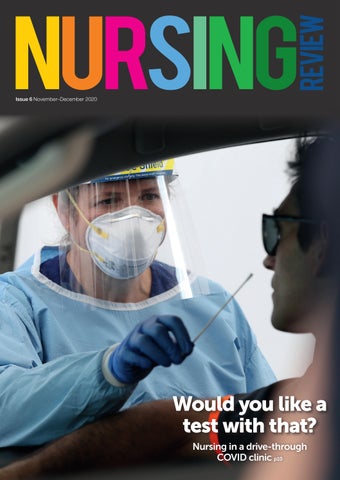
Would you like a test with that? Nursing in a drive-through COVID clinic p10
HS030 Ladies Jogger
New release Prints
SEE WHAT’S NEW FOR
2021
INSPIRED COMFORT
Support Socks CK500 Men’s Jogger
Revolution WW698 Polo also in Men’s
Silentia Folding Screen ClearPanels for hygienic monitoring Adscope Lite 619 Ultra-lite Clinician Stethoscope
Suppliers of Surgical & Medical Electronic Equipment www.medeleq.com.au Free Call: 1800 677712 sales@medeleq.com.au
contents
news
MANAGING EDITOR
Richard Garfield 02 9936 8628 richard.garfield@apned.com.au NEWS EDITOR
Dallas Bastian 02 9936 8637 dallas.bastian@apned.com.au HEALTH EDITOR
Conor Burke 02 9936 8638 conor.burke@apned.com.au
02
06
Commissioner Briggs takes aim
3
Keating’s payment plan
4
Who’s first in vaccine queue?
5
Nurses back recommendations
6
Budget response
7
Vaccine compensation needed
industry and reform
8
‘Lungs like concrete’ ICU nurses on COVID front line
10 Drive through nursing
SALES MANAGER
Sarah Licence 02 9936 8710 sarah.licence@apned.com.au
Life in a drive through COVID testing site
12 Safety first The argument for sending aged COVID cases to hospital
SUBSCRIPTION ENQUIRIES
Daniel Omelia 02 9936 8607 subs@apned.com.au
13 ‘Significant change’ Dept secretary calls for rethink
COVER
14 Families ‘broken’
Nurse at a test site in Bondi, Sydney. Photo: David Swift PUBLISHED BY
2
12
18
Legal action for Epping Gardens families
16 History lesson Pandemics more common than you think
APN Educational Media GPO Box 4245 Sydney NSW 2001 ABN 58 090 900 999 ISSN 1326-0472 PP100001944
specialty focus
18 For the long haul Pandemic’s next hurdle
20 In the limelight Netflix tackles dementia
PUBLISHER’S NOTE
© Copyright. No part of this publication can be used or reproduced in any format without express permission in writing from APN Educational Media. The mention of a product or service, person or company in this publication, does not indicate the publisher’s endorsement. The views expressed in this publication do not necessarily represent the opinion of the publisher, its agents, company officers or employees.
clinical practice
21 Allergic reaction Avoiding allergies in hospital
22 Wash and wear
20
22
Research on washing masks
23 Open access Bringing COVID research together
technology
24 Get smart Replacing pagers with smart devices
workforce
26 Who’s listening? Looming aged care nursing shortage
28 Change for good
24
28
One provider’s positive pandemic shift nursingreview.com.au | 1
news
“It is one of the few times over the past two years that the royal commission team did not seem to be on the same page.
Commissioners Pagone and Briggs. Photo: Supplied
Briggs takes aim Aged care commissioner calls recommendations ‘radical’. By Conor Burke
I
n a surprising interaction at the final hearing of the aged care royal commission, Commissioner Lynelle Briggs appeared to attack the recommendations of the counsels assisting midway through the hearing. The first morning of the two-day hearing saw counsel assisting Peter Gray run through the salient points of the mammoth 124 recommendations, explaining what evidence led them to those recommendations. Gray had gone through a few bigticket items on the proposed reforms in detail, including the creation of a new Aged Care Commission, an Aged Care Advisory Council and the creation of an inspector general of aged care – all independent oversight bodies – before Briggs interjected with her own views. Describing the recommendations as extraordinary and courageous – which did not seem to be a compliment – Briggs challenged the counsels assisting, asserting that finding land, building offices and staffing any new bodies would take too long and cost too much. “I’d really like to hear the public’s views as to whether taking the core government aged care instrumentality out of the public service and making it independent of the executive government and the minister would be in the best interests of older Australians,” she said.
2 | nursingreview.com.au
“I’m yet to hear you present arguments, counsel, as to how the [Australian Aged Care] commission will improve the quality and safety of care for older Australians or how any such benefits would outweigh the very substantial costs and disruption involved in such a radical transformation of the government’s administrative machinery.” She went on to give her view that any reform of aged care should be brought about through a revamp of current bodies and the health department, before praising recent government action on aged care. “I have had, however, detected over the last year, counsel, a growing determination among officials, and on the government, to fix the problems of the aged care system and to pursue a genuine reform agenda,” she said. A new department of “Health and Ageing” would be the way to go she said, it would be “more proactive” in the way it goes about its business, and “steward” providers towards providing care that puts people first. Furthermore, she said, the Aged Care Quality and Safety commission would stay intact, but be “reconstituted” and “revitalised” so it can be the “tough cop on the beat” that is more “curious” and “energetic” in its pursuit of better aged care performance. It was a rare insight into the thoughts of the commissioner, made more revealing when commissioner Pagone disagreed with his colleague, appearing to walk back her comments. “Mr Gray obviously those remarks are not intended to be a final decision by us,” he said. “They indicate that there are different views about how one may go about the
system …. I suspect that my own view is much closer aligned to that which you have put forward and I don’t think that the description of them as ‘courageous’ is quite the right description.” Pagone then took the time to balance Brigg’s praise of government involvement in aged care with his own feelings on a memorandum – detailed in the day’s submission – that showed previous government’s attempts to limit aged care funding with the introduction of the 1997 aged care act. It identified “the ‘billions’ in savings that had been achieved to that time by ‘capping service provision’” and also detailed the “options” the government had to reduce the cost of aged care, including applying quotas to numbers of people at various care levels. Counsel assisting Gray had told the commissioners that the memorandum is evidence that essential human services placed in the hands of the government of the day, and subject to financial pressures of the day, could lead to an erosion of the quality of care. “The reference this morning to the internal memoranda of 1997 shows what some might regard as a rather cynical approach, you’ve got the combination of the people spending the money and those guiding the money,” Pagone said. “Obviously … we will need to form a view, or possibly different views, on the model going forward.” This short 10-minute exchange was unusual as it is one of the few times over the past two years that the royal commission team did not seem to be on the same page – outwardly at least. It was interesting as it puts forth a few questions. How did Briggs come up with her plan? Where is her evidence and research backing it up? Why did she choose now to bring it up? Why is she so concerned how much it will cost to fix a system she described as “cruel and harmful”? And how will the commissioners come up with a recommendation if they are this far apart on a key reform recommendation?. ■
news
Former Prime Minister Paul Keating. Photo: AAP/Darren England
Pay it forward Keating pitches HECSstyle aged care loans.
F
ormer Prime Minister Paul Keating has told the aged care royal commission it should consider recommending a HECS-style loan for older Australians to pay for their care. Keating said the approach was superior to a pre-funding model, like the longevity levy he once thought Australia needed. Under that option, Australians would pay a levy, “some people might die at 56 or 60 and their
contribution funds the person who lives to 95 or 100”. “But then you’ve got issues about people’s ability to pay, who should get the funding, how is it levied, what is returned to the Commonwealth, etc.” Keating said he has since shifting his thinking to the need for a post-funding model, like HECS. “Higher education charge is a postpaid system. These are loans advanced to students on... mostly an income-contingent basis. So if a student goes to university then leaves and then has gainful employment the tax system puts a garnishee on the wages and pays the university debt down. If in fact a person never had any employment thereafter the loan would never be repaid. “So if we were to move and think of aged care as a post-paid system, the Commonwealth could then advance as loans to every aged Australian so much as to meet their needs in support services to stay at home or alternately in care accommodation.” Keating explained that every Australian would have an account, to which the
Last goodbye
Royal Melbourne Hospital’s ICU COVID ward. Photo: David Caird
COVID-19: How to support visits for next-of-kin at end of life.
M
any Australians who have died from COVID-19 have done so alone and many others have missed out on visiting dying loved ones, but two Deakin University experts say it doesn’t have to be this way. Writing for The Conversation, Associate Professor of Nursing Melissa Bloomer and Associate Head of School (International) Stephane Bouchoucha said there’s cause to consider whether Australia can do
more to preserve the connection between patient and loved one at the end of life. “There’s some variation between Victorian healthcare facilities in how visitor restrictions are applied,” the pair said. “Some allow visitors to enter hospitals for compassionate reasons, such as when a person is dying. But visitors are not permitted for patients with suspected or confirmed COVID-19. “Family-centred care at the end of life in intensive care is a core feature of nursing care. So, in the face of this unprecedented global pandemic, we realised we needed to navigate the rules and restrictions
Commonwealth would advance money to pay for aged care. Upon the person’s death, there would be a credit on that account to be paid from the estate of the deceased person. In the event the assets are not available, Keating said the Commonwealth would pick up the tab. “It’s a very nice way of working out what the Commonwealth should really pay visà-vis the residual assets of an aged person, be it superannuation or their bricks and mortar assets, etc.” Commissioner Tony Pagone raised the concern that people would be encouraged to divest themselves of assets before they got into the system. Keating conceded that it was an issue that would need to be addressed in policy, but added he believed that Australia would have a better chance of getting such a system up and running than a pre-funding option like a longevity levy. “The commission should be more worried about the entitlement and the need than it should be worried about funding it,” Keating said. ■
associated with infection prevention and control and find a way to allow families to say goodbye.” Bloomer and Bouchoucha published a set of practice recommendations to guide critical care nurses in facilitating next-ofkin visits to patients dying from COVID-19 in ICUs. The Australian College of Critical Care Nurses and the Australasian College for Infection Prevention and Control jointly endorsed the position statement. The authors said: “The recommendations are evidence-based, reflecting current infection prevention and control directives, and provide step-by-step instructions for facilitating a family visit.” Some of the key recommendations surrounded what visitors should do before coming to the hospital, how they can be guided through a visit and what they should be instructed to do when they return home. Bloomer and Bouchoucha said: “It’s too early to know the full impact a loved one’s isolated death during COVID-19 may have on next-of-kin and extended family. But the effect is likely to be profound, extending beyond the immediate grief and complicating the bereavement process. “We encourage intensive care teams to consider what will work for their unit and team.” ■ nursingreview.com.au | 3
news
First in line Who should be at the front of the vaccine queue?
A
ustralians want frontline nurses, paramedics, and aged care and disability workers to be first in line to receive a COVID-19 vaccine jab. That was one of the findings of an Australian National University survey that sought out attitudes of more than 3000 people on vaccine distribution. When looking at occupations, Aussies thought paramedics should be at the front of the queue, followed by aged
and disability carers, registered nurses, nursing support workers and general practitioners. Report co-author Professor Nicholas Biddle said: “The world is waiting with bated breath for a safe and effective vaccine for COVID-19. If and when it does become available, a decision will need to be made about how it will be distributed and what criteria will be used to identify who receives the vaccine first. “Such a decision will inevitably take into account the health and economic benefits of some groups receiving it ahead of others.” Biddle said the perspective that frontline workers should be vaccinated first “makes perfect sense” when considering where
Climate concerns Nurses call for climate change focus in preventive health strategy.
N
urses, doctors, psychologists and dietitians are among the healthcare workers calling on government to recognise climate change in the National Preventive Health Strategy. They were among the dozens of health groups that signed a joint statement calling on Minister for Health Greg Hunt to ensure the strategy was “fit for purpose in the 21st century”.
4 | nursingreview.com.au
many of the COVID-19 infections in Australia’s second wave have come from and how these professionals are often directly dealing with the pandemic on a daily basis. To gauge the traits Australians deemed important in working out vaccine priority, the researchers asked respondents to answer which of two hypothetical individuals should receive the vaccine first. Co-author Professor Matthew Gray said: “Unsurprisingly, Australians think those with pre-existing health conditions should have the highest priority when it comes to a vaccine. This was the group with the highest support among respondents. “Females are very slightly preferred over males and older Australians are slightly preferred over younger Australians.” And despite anti-Asian sentiments when the virus first reached Australia, Gray said there was no difference between whether or not Australians think individuals with Asian names should receive the vaccine first compared to people with Anglo-Celtic names. Ethnicity did not seem to play a role at all. ■
The statement was sparked by a consultation paper for the Strategy, released by Hunt in August that did not make any direct mention of climate change. “The World Health Organization has described climate change as the defining issue for public health in the 21st century, and it poses significant immediate, medium-term and long-term risks to the health of Australians and communities around the world,” the statement read. “Climate change affects health in many ways: directly by the increased intensity and frequency of extreme weather events, such as prolonged heatwaves, floods and bushfires; and indirectly through worsening air quality, changes in the spread of infectious diseases, risks to food safety and drinking water quality, and effects on mental health.” The Australian College of Nursing, Australian Nursing and Midwifery Federation, Health Services Union and Australian Healthcare & Hospitals Association were among the statement’s signatories. Hunt announced the Strategy in June last year and explained that it would provide an overarching, long-term approach to prevention in Australia and identify areas of focus for the next 10 years. But Fiona Armstrong, executive director of the Climate and Health Alliance, said the work would all be “done for nought” should climate change not form part of the Strategy. Dr Gemma Crawford, president of the Australian Health Promotion Association, said: “Our collective efforts will be undermined if we fail to recognise the impacts of climate change – the biggest threat to the health of our families, communities and planet. “Building capacity to implement measures to reduce health vulnerability to climate change is critical.” ■
news
“Aged care is part of every person’s individual health journey, and not simply about which accommodation option people take.
ACN CEO Kylie Ward during the CEO Sleepout. Photo: supplied.
Nurses back royal commission lawyers’ aged care recommendations. By Dallas Bastian and AAP
T
C_AD_2002_184x64_CorrNurse
he lawyers assisting the aged care royal commission handed down 124 recommendations for the commissioners to consider – and Australia’s nurses say the majority must be implemented. Counsel assisting Peter Rozen said there has been an absence of leadership by successive governments in aged care. “Even though the aged care system caters for more than 1.2 million older people, governments have treated it as a lower-order priority,” Rozen said. His and fellow counsel assisting Peter Gray’s recommendations include a new aged care act, a public star rating system and compulsory regulation of personal care workers. The lawyers also wanted to see minimum staffing ratios, increased wages and indexation of nursing salaries in residential
and home care and targeted education and training for aged care workers in palliative care, dementia and infection control – all of which were recommendations ACN highlighted. The college’s chief executive, Adjunct Professor Kylie Ward, said: “The recommendation of a staged approach to reach a staffing minimum in residential aged care of one Registered Nurse on site at all times by 1 July 2024 and respecting that case mix is vital to the determination of minimum staffing levels, are in line with ACN’s submission to the Royal Commission.” Ward said the college applauded the fact the recommendations address difficult issues such as diversity, cultural safety and pay equality. “We must recognise that aged care is part of every person’s individual health journey, and not simply about which accommodation option people take.” Wrapping up 97 days of hearings, Rozen said it was evident the level of substandard care is “far too high” and abuse “remains rife”.
WE SEE YOU EXPAND YOUR SCOPE
Equip yourself with the essential skills and knowledge to provide high-quality nursing care to the offender population with the only postgrad qualification of its kind in Australia.
WITH A GRAD CERT IN CORRECTIONAL NURSING
APPLY NOW TO START IN 2021
CRICOS: 00219C | RTO: 40939
Get on board
Almost half of the 10,000-plus public submissions received during the two-year inquiry were marked with references to substandard care, he said. He said 588 mentioned sexual assault, and the number of allegations reported to the federal health department rose from 426 in 2014-15 to 790 in 2018-19. “It is more than two reports per day of sexual assault on average, every day of the year,” Rozen said. He said the rate of alleged sexual assaults per 100 residents nearly doubled over that period. “We submit that the weight of the evidence before the commission supports a finding that high-quality aged care is not being delivered on a systemic level in our system,” Rozen said. “The level of substandard care is unacceptable by any measure. “At least one in five people receiving residential aged care have received substandard care.” Rozen said a “number of systemic failures” included a lack of skilled staff, poor planning, poor governance and leadership from providers and a lack of transparency generally in the sector. “First and most importantly the aged care system needs to put people first. The preferences and needs of older people really should drive aged care,” Commissioner Lynelle Briggs said. ■
nursingreview.com.au | 5
news
The good and the bad Health sector reacts to the federal Budget. By Dallas Bastian
A
ged care and the coronavirus pandemic were two of the bigticket items in this years’ Budget. While the Australian College of Nursing welcomed the focus on COVID-19, aged care and preventive health, it added that it missed opportunities to effectively address these challenges. Chief executive Adjunct Professor Kylie Ward said: “We are concerned that in some instances the impact of enabling nurses to practice to their full scope continues to be overlooked.” ACN commended the decision to extend the successful telehealth items and the $10.8 million over five years announced to enhance the skills and competencies of enrolled nurses and registered nurses working in aged care. “[The] Budget provides funding for those parts of the health care system where there is the most disadvantage and need, including mental health, Aboriginal and Torres Strait Islander health, rural and remote health care and preventive health. “However, until the Government and the health care system enables Australia’s 385,000 nurses to be fully utilised, gaps will continue to exist. “This year more than ever we have been faced with challenges that require innovative responses, and an investment in advanced practice nurses would have gone 6 | nursingreview.com.au
a long way to contribute to accessible and equitable health care in Australia.” And Australian Healthcare and Hospitals Association chief executive Alison Verhoeven said: “What we have learned during 2020 is that a strong public sector – in our hospitals, primary care and aged care – is critical to being able to respond effectively to these challenges. “It is disappointing that there is only a limited focus on strengthening preventive and primary health care. “An Australian Centre for Disease Control could have positioned Australia to better deal with future pandemic challenges. “While some new funding for rural primary health care is welcome, there is a missed opportunity to bring this more quickly to scale,” Verhoeven said. One of the aged care centrepieces was $1.6 billion for 23,000 additional home care packages. There was also $81 million for additional surge workforce and increased training for aged care workers on top of the funding announced in March. But Aged and Community Services Australia called the funding a “drop in the bucket” of what is required to set up the sector for the next decade. “The home care injection is unprecedented and welcome. This is good bang for the buck, however, there will still be thousands of people waiting for the right level of support or any support at all,” chief executive Patricia Sparrow said. “Measures that allow us to hire young people are good but we need more
“The impact of enabling nurses to practice to their full scope continues to be overlooked. permanent measures given aged care has to triple our workforce by 2050.” The Budget also included $8.4 million for supplementary payments to help cover quarantine costs and interstate staff and a $205.1 million extension of the Aged Care Workforce Retention Bonus Payment. There was also $9.1 million to support the establishment of the Victorian Aged Care Response Centre and more than $12.5 million to increase availability of grief and trauma support services for aged care residents and their families. Sparrow said while some of the small initiatives were useful “the system needs a reboot not tinkering”. Leading Age Services Australia said it hoped the funding set out in the Budget will be the start of ongoing investment and reform for the sector. Chief executive Sean Rooney said: “Hopefully, this Budget is just a start, a down payment on a better age care system. “Evidence to the Royal Commission has recently highlighted deep structural problems with funding for aged care. “While this Budget does not address all of these issues, it does lay a platform for the future.” ■
news
Fault line What does vaccine indemnity mean for Australians?
T
he Australian government has given the suppliers of two COVID-19 vaccines indemnity against liability for rare side-effects – but one academic argues Australia needs compensation schemes in place. Associate Professor Nicholas Wood, from the Faculty of Medicine and Health at the University of Sydney, said while details are scant, it appears the government would “foot the bill for compensation” should a member of the public win legal action against the drug companies behind
the University of Oxford or University of Queensland vaccine. Writing for The Conversation, Wood said while such a deal is not entirely unheard of or unexpected – with the government previously providing some indemnity to companies that make vaccines against smallpox and influenza – it is “not ideal” for a member of the public who believes they have been injured by a vaccine. “The person still has to engage with the legal system, which is both costly and complex, and there’s no guarantee of success,” he said. “Compensation may not even be possible via our legal system. That’s because in most cases, it will be difficult to show in court a serious side-effect was due to a fault in the vaccine composition or negligence in the way it was administered. “So in Australia, people with a vaccine injury, either COVID-19 or other vaccine, will likely bear the costs of their injury by themselves, and seek treatment by our publicly-funded or private health systems.” Australia is not alone in its approach to indemnity deals for COVID-19 vaccines
Labor leader Anthony Albanese. Photo: Bianca De Marchi
Under control Albanese promises centre for disease control. By Dallas Bastian and AAP
A
Labor government would set up a centre for disease control to strengthen Australia’s preparedness for future pandemics, party leader Anthony Albanese says. Albanese said lives and the economy depended on Australia getting its response to future pandemics right. “Ask any Australian and they’ll tell you our response to the coronavirus pandemic was too slow, too reactive and too uncoordinated,” he said. “We can’t be left playing catch-up again.”
– governments in the UK, US and the European Union have also agreed to indemnify manufacturers. However, 25 countries, including Japan, the US, the UK, Germany and New Zealand, have in place no-fault compensation schemes for rare vaccine side-effects. Wood said there are numerous benefits to a no-fault vaccine compensation system. “These include simplified access to compensation, and avoiding a lengthy, costly and complex encounter with the legal system, with no guarantee of success.” Still, he added, compensation awarded via such a scheme is usually lower than what a person would receive after a successful liability lawsuit. Wood said if the government wants to encourage people to get a COVID-19 jab when one is available, Australia needs compensation schemes in place. “Although it is important manufacturers receive indemnity for ‘certain liabilities’, we still need to look after our community. That means a compensation system the public can easily access and which provides appropriate support.” ■
The centre for disease control (CDC) would house surveillance experts and systems to monitor current and emerging threats and work with state and territory governments and service providers to improve preparedness in the health and aged care sectors. It would also manage the National Medical Stockpile and run regular preparedness drills. Establishing a CDC has support from the Australian Nursing and Midwifery Federation, the Australian Medical Association and Public Health Association of Australia. The Australian Healthcare and Hospitals Association also backed the move, with CEO Alison Verhoeven saying: “The call for this has been long-standing, with a 2013 recommendation to the Government by the Standing Committee on Health and Ageing overlooked in favour of the development of a National Communicable Disease Framework. “Inconsistent messaging and conflicting expert advice across jurisdictions was partly addressed ‘on the run’ by the establishment of the National Cabinet, with the Australian Health Protection Principal Committee reporting directly to it. “However, this has resulted in a reduction in public transparency about disease control decision-making processes. “A Centre for Disease Control requires a level of independence from political decision-making, with accountability and transparency identified in the enabling legislation.” Labor argued Australia was the only OECD country without such a centre. Labor’s health spokesperson Chris Bowen said 90 per cent of Australian deaths were associated with chronic illness, with 38 per cent of the disease burden preventable. “Health experts have been calling for an Australian CDC for more than three decades. “It’s time to get on with it.” ■ nursingreview.com.au | 7
industry & reform
‘Lungs like concrete’
An ICU nurse talks about the third wave of COVID-19. Michelle Dowd interviewed by Conor Burke
N
ursing Review has spoken to a wide range of different people throughout this pandemic, and we always try to speak to working nurses to get a real insight into what COVID is like. Michelle Dowd is a nurse manager of intensive care services at Liverpool Hospital. She’s been an ICU nurse for 28 years, and while she has worked in many different ICUs in Sydney and Melbourne, most of her career has been spent at Liverpool Hospital. She has been intimately involved in fighting COVID since March.
NR: How has your role changed from the start of the year? MD: I think probably my presence. I’ve always been that visible, present manager in the clinical space anyway, but I think I realised early on that I would need to do that a lot more, and that I had to increase my communication to staff and make sure that I’ve used a lot of different means of communication in order to capture them all regularly. We had a lot of anxiety in the team, and the information we were getting was just changing so rapidly in those early weeks and months. It was so important for us as 8 | nursingreview.com.au
a group, as an executive group, and as an ICU exec to stay on top of it. We worked longer hours. We were often there on weekends. Our senior group of nurses and doctors were in contact with each other constantly, updating things as they came in, and making sure the staff were informed. That was just so important. I’ve been an ICU nurse for 28 years. So, I think initially, you just deal with it. But what I didn’t realise was just how anxious the team would be. And I had to change my focus from, “Come on, this is what we do, let’s just do it,” to, “Yeah, I understand your anxiety. And it’s important that you have all the information and that I help you understand why we’ve come to the decisions for these different practice measures.” The aerosol-generating procedures, which we do so much in intensive care, those early COVID patients that we got had just dreadful adult respiratory distress syndrome, and they were in ICU for weeks and months. We needed to put tracheostomies in, we needed to flip them onto their stomachs. The pictures that you saw in Italy and places like that with patients on their stomachs, that was us. We were doing that as well. It required really good communication, really good presence. I’m the nurse manager, so I’m not in uniform. For me, it was back into my scrubs, back into the clinical space, ensuring that I was not
asking anything of my nursing staff that I wasn’t willing to do.
You mentioned some of the patients were very sick but we haven’t seen many of these people in the media. I think that everyone who has been tested COVID-positive didn’t want to face the media. I don’t think we’ve had the face of the patients represented so much in Australia. It was scary. Those patients were really, really sick. They couldn’t see their loved ones. At one stage, we locked down the ICU completely and nobody came in the doors except the staff. We were so strict with our infection control measures in those early weeks. All the patients saw of us were eyes behind some goggles. That was pretty much it. We had head covers, face covers, goggles on, face shields over that, and then full gowns and gumboots. Our voices just became so important. And I guess at the bedside we encouraged the clinicians to talk to these people, to let them hear your voice and keep that reassurance going. I think for our staff at the bedside that was emotionally exhausting because they knew that the family members couldn’t be there, and that if the patients didn’t recover, they were the last voices and eyes that those patients would see. Those patients that recovered were with us for weeks and months even, and they were interacting with us and then we
industry & reform
required all sorts of other rehabilitation care as well. The country really hasn’t seen the face of COVID patients. I think the complacency [around the nation] is because they don’t understand the face of it.
Is the reason you’re not seeing such severity now is because of the lack of numbers in New South Wales? Not so much. The virus is definitely evolving. I look at it in three waves with us being in the third wave now. What the infectious diseases professionals will tell us is that, that first wave we saw, very sick respiratory conditions. I heard one physician say, “Lungs like concrete”. We were really struggling to physically ventilate these patients. But the majority of our patients recovered, so the treatment that we were using was appropriate. Then, in the second wave we didn’t get anywhere near the numbers in the hospital or intensive care. The majority of people were reasonably well, and able to be looked after in the community, which is of course the preference. And what we’re seeing now in this third wave is asymptomatic carriers; people who don’t even have symptoms who are testing positive on surveillance. So the virus is definitely evolving. And even at the worst in Victoria, they really didn’t see the intensive care numbers that we were seeing overseas.
Is the fact that this virus is evolving so quickly a bit scary for a healthcare professional like yourself? Oh, it certainly is because we do deal with the most vulnerable patients in the community. On top of that, I’ve got staff who live with vulnerable patients in their community. We have a lot of healthcare workers who have elderly parents that they live with, or children who are chronically ill, and things like that. So it’s not just the anxiety. I think that COVID has brought home and work together closer for health professionals than ever before. We’re not just anxious about what we’re going to do in our workplace. We’re anxious about what we could potentially take home as well. It’s blurred those lines between work and home for us for the first time because it’s so contagious. And we’re already using the terminology in health, ‘living with COVID’. We are going to have to revert back to models of care that we were doing previously and
converting our wards back to some sort of semblance of normality, while at the same time responding to COVID too because there still are the elderly and the vulnerable in our community who are at risk if they get COVID. But then, why do we accept every single year that the elderly die of influenza? We really need to review, with our practises with COVID, our infection control practices in healthcare and aged care as a whole, because we shouldn’t accept that people die from viruses, whether it’s COVID or influenza.
What’s the longest period a patient has been with you in ICU? I think the longest a patient was with us for was two months. So that would be a patient who got terrible adult respiratory distress syndrome, or ARDS, ended up intubated and on a ventilator. We practised the proning, where we turned them onto their stomach. But once we get to about 14 days where they’ve been orally intubated for ventilation, we really need to start thinking about tracheostomy. So, that’s what we did with several of our COVID patients at Liverpool. They got tracheostomies so that we could do that slow weaning from ventilation. So a few of those patients had those tracheostomies removed or decannulated, and then it was a matter of getting them strong enough again, because you can imagine there’s so much muscle wasting.
How have you gone about keeping families informed and calm? It’s been really challenging, and we’ve seen the whole range of emotions. We expected anger from restricted visiting. We expected sadness, all of those emotions. So, it’s been very important that myself and my other managers have met with families regularly. We didn’t have visiting at all, but there’s only so much information you can give over the phone. We had to get some medical legal advice over that. It was very important to make sure that the right person from the family was being spoken to because quite often they are very big families and everyone wants a piece of information. I’ve got 40 ICU beds, so 40 families on the worst day of their life. It was really important that we were meeting them outside the ICU when they couldn’t come in, that we were apologising for the
situation, we were explaining what we were doing and why we were doing it, and how important that protection of their family member was, and for them as well, and making sure they understood that a lot of the protection was because the intensive care team needed to be protected as well. We worked closely with our dedicated social workers in intensive care. Their job changed a lot as well. They were doing less of helping people with Medicare and the forms and more of making sure of the psychological safety of relatives. We’ve had a couple of security incidents, but most of the time we can reason with people and most just want to be listened to. They just want information.
How has this COVID period been for you with these extra stresses, these extra worries about your staff and patients’ families? It’s been intense. I am lucky in that my children are grown up. I’ve got a 20-year-old and a 22-year-old that lives in Queensland. I haven’t seen my eldest since February. So that’s been tough. It’s the longest time in her life that I’ve ever not seen her. The video conferencing I do at work, I also do with my family. I haven’t had to physically care for young children anymore. I’ve been very lucky. My husband’s been able to work from home a bit. And I’ve got him washing his hands like a healthcare professional now. So, that’s been great. My sister is an ED nurse and manages one of the busiest emergency departments in Perth. We tend to do a Friday on-theway-home debrief. That’s been really good for both of us. My parents are well but they’re in their 70s. Even though they’re not far from me I’ve stayed away. We’ve been well looked after by the community. Donuts would turn up and we had a law firm in Liverpool give money to a restaurant that brought us breakfast one day and dinner another time. The community has just been so generous. In our tea room we’ve got incredible paintings and photos from childcare centres that just wanted to thank the doctors and the nurses at the hospitals. That’s been lovely as well. I guess it’s just been looking after each other. At home, our families try and look after us. I’ve done less cooking in the last seven months than ever in my life. So, I’ve been looked after. ■ nursingreview.com.au | 9
industry & reform
At the drive in The St Vincent’s drive through testing site at Sydney’s Bondi Beach. Photo: Bianca De Marchi
What is it like to be a COVID-19 drive through testing nurse? Vishnugar Arunasalam interviewed by Conor Burke
W
orkloads are higher, processes are different, but COVID-19 has also given nurses a chance to upskill and do something new: and, dare we say it, to be part of a once-in-a-lifetime health event. One new playing field for today’s nurses is the drive-through testing sites. Vishnugar Arunasalam is a COVID-19 clinical team leader who runs a number of these sites and joined Nursing Review to give us an insight into what it’s like.
NR: Tell us a bit about the work you’re currently doing. VA: I’m one of the site coordinators for the car park drive-through testing clinics for coronavirus. We’ve got about four clinics that we all share as team leaders, which involves team leading the clinical staff that come to help us and supporting the patients that come by car to get tested.
Many people wouldn’t have been tested yet. Can you run us through the process? Essentially we’re in a car park or an outdoor space, like an oval. We have marquees set 10 | nursingreview.com.au
up with the support of security guards. We are able to get the cars to come through as if you’re going to McDonald’s to buy your meals, but instead you come through to get your test. Our clinicians will come and see you as you remain in your car and speak to you, triage you, assess you. I think the main thing is about supporting you through, what to do next and debunking some things, because the community seems to have a lot of anxiety around COVID coronavirus testing. It’s important to deescalate that and reassure them that it’s going to be fine. Then they go off into the stage, which is where the test happens and that’s the pathology collectors. And they’re very good too, very gentle, and away they go back home to isolate, wait for the results to be texted to them or to receive a phone call from public health, if they’re found positive.
Run us through what the setup is like for the nurses. It must be pretty strange as not many nurses work outside or beyond their ward setting. It is very different because on a ward it’s very controlled. You’ve got the luxury of having access to designated spaces, like toilet facilities. If something happens, you can call for help and a whole team of nurses
and doctors will come flying to you. You’ve got all those workflows already set up. Because this is like a mobile clinic you’re really just starting from scratch. So, there’s a lot of safety considerations. You’ve got moving cars (some clinics do about 600 cars a day), weather conditions – we had torrential rain once where some of the tents tumbled over. I think when it all began, it started very small and then we realised we’re going to be there longer. We need a place that’s got access to toilets. We need maybe three security guards to support us with the movement of cars because we are nurses and we shouldn’t be moving cars. And on top of that, I think it’s important to be able to really think out of the box and have ideas and solve problems on the spot, because again, if you’re on a ward, you have an escalation process. If you’re out in the car park, whether it’s a clinical issue or a safety issue, as a team leader you have to just make an executive decision as to how you would move forward and mitigate risks.
How do you manage and organise tests, and where do they go at the end of the day? Does someone come in and collect them? We’ve got the clean and dirty spaces marked out, just like we have in the
industry & reform
so it can be collected and then we lock everything up. The marquees stay out obviously, and then we just cordon off that section. Some car parks actually hire a security guard overnight to guard the space so that things don’t get go missing, like traffic cones.
How do the nurses find it working outside all day? What sort of feedback are you are getting? I think we’re getting quite a mixed feedback, but I think the clinics are busy if we’re doing 600 cars. So we’re very mindful that people are getting adequate breaks and being taken care of when it’s raining. We provide wet weather gear, like ponchos and matching umbrellas and hats. For summer we’re thinking of getting everyone to wear scrubs because it’s a lot cooler and maybe to take more breaks. We’re looking to get some fans installed, and an awning attached to the marquees if possible.
How has the experience with patients been? wards. We have a space that’s only clean, only dirty, then there’s PPE, donning and doffing off stations. And the collection of tests goes straight into an esky and then that is picked up by a carrier. All of this is done in a way where there isn’t any cross-contamination, while also being very vigilant about hand hygiene and wiping off surfaces in between. We’ve been collaborating with the Westmead Infection Control CNC which has made some expert recommendations, and it’s about applying those principles in the community. So, the rationale behind infection control in ICU is adapted to the car park because you can’t make it the same as a ward.
What sort of hours do you operate in? Business hours. We start at 8:00 and finish at 4:30. We did have an extended hours period when we wanted to increase the number of tests, but it’s mainly business hours.
Is that area cordoned off overnight? Do you have to clean the area down afterwards? Every day we’ve got a company that comes and cleans at the end, but it is our duty to wipe off surfaces and bag up rubbish
Some of them have been really lovely and they’ve all been understanding. I think the frustration comes when there’s hotspots that emerge over the weekend and some of them do have to wait for their test; if only it was as quick as buying a cheeseburger from McDonald’s, but it’s not. It is a health procedure and there’s a legal component where they have to provide consent, so we need their details. And then there’s an infection control risk as well. So, generally it’s about 20 to 30 minutes, but there have been times when it’s been about an hour. The feedback has mostly been very positive and they’re all very understanding as well.
And what were you doing before this, and which skills have helped with this new role? I’m a chronic care facilitator. There are some skills that were transferable. My scope of practice at the moment is about working with patients, upskilling health literacy and empowering them to selfmanage. So those principles, I think, are very much the same when it comes to COVID work because we’re making sure patients understand their health and their needs and what to do next, when it comes to isolating.
“We're making sure patients understand their health and their needs and what to do next. The team leading was something that was quite new for me because I’m a junior nurse. I’m very thankful for the opportunity to be given a team leader role. And I’ve learnt the various styles of leading, understanding distress in clinical spaces and how you need to address people’s psychological needs in order to uplift a team. With the COVID clinics we’ve got a lot of stakeholders from various disciplines, various backgrounds, all coming together to work under the same banner. That means I don’t know these people and I don’t know where they come from, but it’s been really interesting to work with them and somehow find a way to meet on a common ground, to deliver a service to the community. That’s been really rewarding too.
How has COVID changed your life? I guess COVID has made me realise that we need to slow down, really slow down, and spend more time with our families and appreciate the smaller things. But the main thing I think is that COVID in a way has been humbling and grounding at the same time. And at the moment that self-reflection is quite necessary personally in my life at the moment.
How have your family and friends and loved ones coped with you being out there through this period? I think initially they were quite anxious, but I think now they understand that as nurses we know how to protect ourselves because it’s not just COVID that we deal with. Before COVID, we were always at risk of contracting anything. So, if we are doing our jobs correctly and following standard precautions, there shouldn’t be a reason why we would contract a disease. My parents or my family are quite aware that if I do the right thing, I should be safe. So, they have that faith. I hope so, at least. ■ nursingreview.com.au | 11
industry & reform
Safety first
Residents being evacuated from St Basil’s Home for the Aged at Fawkner. Photo: Andrew Henshaw
Why aged care residents with COVID-19 should be transferred to hospital. By Pat Garcia
M
ore than a third of care residents who have contracted COVID-19 have died1. That’s more than 36 times higher than the rest of Australia’s population. If COVID-19 was tearing through schools or workplaces in such numbers there would be uproar and a call for an urgent overhaul of how to treat this disease. So what can we do to stop more lives from being lost? Most states prefer a ‘Hospital in the Home’ type policy which aims to contain the spread of COVID-19 by treating aged care residents with the disease within the facility, instead of transferring them to a hospital. How the ‘Hospital in the Home’ system was developed was understandable. It was created partly to avoid swamping the hospital system and partly to avoid disruption to aged care residents who might be unsettled by moving to an entirely new environment. But months on, and hundreds of aged care deaths later, it’s clear that aged care homes are not designed or resourced to deal with an outbreak as infectious as COVID-19. So Catholic Health Australia is calling on state and territory leaders to adopt a
12 | nursingreview.com.au
nationwide protocol that would see the first aged care residents infected with COVID-19 immediately transferred to a hospital. It’s already standard policy in South Australia and Queensland, but these are states where the number of cases of COVID-19 remain thankfully low. We now need states like NSW and Victoria to urgently follow suit. The women and men who work in our aged care sector are striving tirelessly to prevent COVID-19 from getting into their homes. But despite their best efforts we need to be realistic: the disease will continue to breach infection control for many months to come. Aged care homes are designed and operated as home-like communal living environments with an emphasis on social engagement and interaction. The risk of cross-infection in an aged care home is therefore significantly higher than in a hospital from both a staff and physical environment perspective. For a virus like the flu, that risk is manageable and the aged care sector has decades of experience in how to keep residents safe. But COVID-19 has proven a much more deadly disease. It requires superior clinical skills and purpose built and equipped facilities which only a hospital can provide. It’s also far more contagious, making it vitally important to identify, isolate, and move the first COVID-19 positive residents out of an aged care facility as quickly as
“Aged care homes are not designed or resourced to deal with an outbreak as infectious as COVID-19. possible. This will not only minimise the chance of the outbreak spreading, but also relieve the pressure on the overall healthcare sector. Moving infected residents off site will also provide valuable time for the aged care home and other agencies such as the Public Health Units to activate their emergency plans and focus on providing a safe and comfortable home environment for remaining residents. The last thing we want to do is lock people in their rooms and turn aged care facilities into sterile wards. Despite optimism about the potential for a vaccine, the fact is this virus could be with us for years. We therefore need a robust and long-term protocol to manage it and keep older Australians safe. Switching the ‘Hospital in the Home’ model for a smarter protocol will help our aged care homes keep the virus at bay and save lives. ■ For references go to www.nursingreview. com.au Pat Garcia is chief executive of Catholic Health Australia.
industry & reform
Reset, redesign
Health Department Secretary Brendan Murphy. Photo: NCA NewsWire/Martin Ollman
Department secretary says aged care system needs “significant” change. By Dallas Bastian
S
ecretary of the Department of Health Brendan Murphy believes the aged care system needs a “fundamental reset”. Murphy, who was Australia’s chief health officer when COVID-19 hit Australia, was responding to a question posed to him at the Royal Commission into Aged Care Quality and Safety about whether the Department of Health believes the aged care provision ratio should remain in place. “At the moment the Government’s focus has been very much on meeting the demand for home care packages… but I think we clearly accept that the system does need significant redesign, including in the costing and funding and transparency of that system.” When asked whether the department says the aged care provision ratio should be scrapped in favour of an uncapped system, Murphy said it agreed that the program should be demand driven. “In fact, it is demand driven in residential care at the moment, and we are endeavouring, with frequent releases of home care packages, to meet the demand for home care. So essentially, Government is supporting that general direction.”
Murphy, along with first assistant secretary at the Department Nick Hartland, who was also speaking at the commission, said the provision ratio could be maintained as a forecasting tool rather than operating a cap. The conversation later turned to the financial pressures faced by the aged care sector. Murphy acknowledged that the system was under financial pressure at the moment but added he wasn’t sure whether there was clear evidence that there has been pressure put on service delivery. Still, he said the level of indexation needed to be addressed. In response, counsel assisting Peter Gray brought up an uptick in adverse regulatory outcomes in 2017-18. Murphy said: “…you cannot conclude that increased action by the regulator and increased outcomes necessarily reflect the deterioration in quality of care. “Often that can just be a reflection of improved regulatory oversight and improved regulatory action.” When pushed by Gray on the matter Murphy added: “I don’t think we’ve got any evidence to support the contention that care quality has declined because of financial pressures. We have evidence that prudentially there have been pressures across the sector but we don’t have evidence that there has been a decline in quality of care.”
“ We clearly accept that the system does need significant redesign, including in the costing and funding and transparency. As the questioning turned back to home care packages, Murphy said the Department strongly supports the idea that home care packages should be more generous and enable people to stay in their home with increasing levels of frailty. On the idea that the amount of funding that should be available to a person for care at home should have a connection with the care component of the funding they would have been assessed to receive in a residential setting, Murphy said: “The idea you would somehow link a dollar amount to what would be otherwise a residential aged care assessment process, it might have some technical complexities in it, but I think the general approach we are perfectly happy looking at a much broader range of home care packages that would allow people to stay in their home. “So, whether you would need to then do a full residential style of assessment for someone in home care to determine their dollar amount might be a bit tricky … but I think in general the direction is something we support.” ■ nursingreview.com.au | 13
industry & reform
Families left ‘broken’ Ambulances at Epping Gardens Aged Care Home. Photo: Andrew Henshaw
The family of an Epping Gardens resident speaks out ahead of legal action. By Conor Burke
S
he looked like a scared mouse, her eyes were rolling in the back of her head, she looked terrified, absolutely terrified,” Sue Agnello says. She is describing the final moments of her mother-in-law’s life in a Melbourne hospital. Carmela Agnello was 92 when she died in the Northern Hospital from COVID-19 and her final goodbyes with her family were done over Skype. Carmela was one of the 211 cases of COVID-19 that have so far been linked to the controversial Epping Gardens Aged Care facility in Epping, Melbourne, where at least 20 residents have since passed away. Sue’s husband Sam Agnello is the lead plaintiff in a class action lawsuit against Epping Gardens and its owner, Heritage Care. Over 60 families have joined the lawsuit which is being handled by Carbone lawyers, and partner Tony Carbone says the families involved want to make sure that what they have experienced doesn’t happen to anyone else. The class action alleges that Epping gardens failed to protect the residents who contracted the virus and, among other issues, the home allowed a baby shower to take place there on 16 July and a party on the 18th. “A lot of the concerns weren’t only around what was happening with COVID. A lot of the concerns were about the poor treatment of their loved ones pre-COVID,” Carbone told Nursing Review.
14 | nursingreview.com.au
“The reality is that the level of abuse in that place is just extraordinary. People dehydrated, not getting fed properly, not getting their medications. [They] just weren’t getting attended to. Sanitation was poor, a lack of care. The breach of the contract they signed when they entered the facility, which is that they’d be looked after, and we say they weren’t looked after.”
UNANSWERED QUESTIONS Carmela, a resident of Epping Gardens since July 2018, was transferred to the Northern Hospital on 25 July after she hit her head in a suspected fall. Doctors were shocked at her condition and overall wellbeing upon arrival. “Did she have a fever at Epping Gardens?” they asked the family. “We said, ‘We’ll ring and find out.’ She was fully dehydrated. She had fluid on the lungs, she had a cough and she needed oxygen and she had a UTI infection and her heart wasn’t working properly,” Sue says. “We said, ‘Has all that happened from the fall?’ [The doctor] said, ‘No, this has got nothing to do with the fall. From the fall she looked like she’s okay. It’s how she’s presented, we’re extremely concerned.’” Sue and her family then tried to contact Epping Gardens but could not get hold of anyone via phone or email. The next time they heard from management was the day Carmela and family said their goodbyes. Epping Gardens called to say that Carmela had tested positive for COVID-19 from a test taken, unbeknownst to Agnello’s family, on Thursday the 23rd. Carmela passed away on 28 July. Sue and her family are devastated about the treatment Carmela was given in Epping Gardens. The lack of communication
and secrecy has left them with many unanswered questions. “My question was, number one, did my mother-in-law have a fall or not? “Number two, if she had a fall, what caused the fall? Because apparently, they had no staff in there and apparently meds weren’t being given. My mother-in-law was fully dehydrated when she got to Northern. You don’t get fully dehydrated in a fiveminute ambulance trip,” she said. An ABC investigation of the failures at Epping Gardens found notes from executives at the home saying that staff levels, normally set at 110 people, were “serious” and “50 down” at the time of the outbreak.
STAFF TOLD NOT TO GET COVID TESTS Carbone says that some Epping Gardens carers have contacted his firm and intend to speak out against the home. They have told him that staffing numbers were indeed low and often inexperienced staff were left alone to look after residents. Carers also allege that they were told off by superiors for getting COVID-19 tests as they were already short staffed, leaving many carers scared of losing their jobs. Questions have also been raised about the level of infection control at the home. Staff and residents were said to have been allowed to move freely around any areas of the home. Carbone told Nursing Review that this was particularly negligent. At the time of the outbreak, Epping Gardens was leasing the bottom level of the facility to the Northern Hospital for respite, and staff allege that they were made to work across that section as well as upstairs with the regular Epping Gardens residents, and that this potentially helped spread the virus. The number of healthcare workers in Melbourne who have contracted the virus has reached 2,692, with 70 to 80 per cent of these cases caught at work according to Premier Dan Andrews.
COMMUNITY MOURNS Sue Agnello says that family friends at the home have also passed away and they have all been left “broken” as a result. Other residents are also shocked and asking what has happened to their friends, many of them unaware that fellow residents have passed away. “Every single one of the grandchildren, my nieces, my sister-in-law is still crying. My husband is broken, but you don’t send your loved ones off like this,” says Sue.
industry & reform
“When people die, in their last moment of life, you want to be there to hold their hand. As my husband said, ‘We should have been there to pat her head. We should have been there saying ‘Mum it’s okay, it’s okay, don’t be scared.’ “My mother-in-law went from Epping Gardens into an ambulance and there’s no translator. People were obviously in PPE gear, over to a hospital, in emergency, all in PPE gear, hazmat or whatever.” “Up to a ward with no translator. Everyone’s in PPE gear, you can imagine how those wards were running, with people walking around everywhere with masks and swabs. That would have terrified her.” Sue and her family are not suing for any monetary gain she says, but for every family who has suffered as a result of the aged care system. “I’m going to be honest here. This needs to never happen to any other family ever again. Aged care needs to be addressed. Our concern is we signed a contract to put
our loved ones into Epping Gardens, for them to give her a duty of care and look after her. The owners of Heritage Care own another eight or nine centres. Is this going on in their other centres?” she said. “It’s about respect and dignity of our loved ones and it’s about making the government stand up and take some responsibility and accountability, to get their heads together and get it right. “Well, as my husband said, his mother doesn’t have a voice here anymore, because that got taken away from her. He said, ‘If we don’t speak, this is going to get swept under the carpet.’”
TIME FOR RETRIBUTION Carbone has also launched proceedings against St Basil’s home in Melbourne with over 20 families joining so far. He believes that these lawsuits will shake up the aged care sector. He argues that this action is a warning to large providers and potential investors that aged care is no longer a “cash cow”.
And he says that providers should be liable for criminal prosecution in severe neglect cases such as we are seeing across Victoria. “Unless there’s some sort of retributional penalty, it seems like these things will keep going on. I think you need that to keep people honest.” As it stands, the Agnellos have not received an apology or even a message of condolence from any Heritage Care or Epping Gardens representatives. Yet this may never bring peace to the family, who now have to face months reliving it all with the impending court proceedings and the constant memory of their last goodbyes with Carmela. “We probably got the last words out of her, on that Sunday afternoon at two o’clock … she blew us a kiss and said, ‘I love you all.’ I don’t think anyone in our family will ever forget that, because every one of us should have been there holding her hand.” ■
subscribe for less than $2 a week The laTesT news and resources for healThcare professionals Nursing Review is essential reading for anyone involved in the healthcare sector in Australia. It provides unrivalled coverage of specialist topics from features and opinion pieces, to international news and profiles. • Latest news and resources for all healthcare professionals • Comprehensive coverage of a diverse range of topics • Analysis of the major issues facing the health sector as a whole • Delivered free of charge • 6 issues per year • Only publication in the country dedicated to reporting issues important to nurses
Please call 02 9936 8666 or email subs@apned.com.au to find out more. nursingreview.com.au | 15
industry & reform
History repeating A brief history of pandemics and how we’ve dealt with them. Peter Curson interviewed by Conor Burke
T
his is not the first time that a pandemic has ravaged a society, and starting with the first recorded pandemic in Athens, during the Peloponnesian War, nearly every generation has had to deal with a deadly disease. Professor Peter Curson is emeritus professor in the Department of Health Systems and Population at Macquarie University and the author of Deadly Encounters: How Infectious Disease Helped Shape Australia. He joined Nursing Review to talk about the history of pandemics.
NR: About how many pandemics have hit humans throughout history? PC: In Australia alone, we’ve had at least 20. I would say in the world, over the last few hundred years, there’ve been probably at least a couple of hundred. And pandemics have become a major feature of human life.
Which of these events really stand out for you? Well, the Black Death of course. It’s said to be one of the most significant outbreaks of a pandemic. But more recently, the smallpox outbreaks in the 19th and 20th century probably killed about 400 million people. And we know of course, flu alone in 1918/19 killed probably 60 or 70 million people around the world. But there’s a long history of such things. 16 | nursingreview.com.au
The last major outbreak of the bubonic plague, which spread out of China in the 1880s and reached Australia in 1900, probably killed 40 or 50 million people and hung on until the 1930s.
What is it about the plague then, that makes it such a hardy virus? Basically, we’re confronted by the microbial world, but we tend to believe that we are the dominant species in the world and we can control everything. Nothing could be further from the truth. The major feature of our world is that the microbial world dominates. They have the ability to change, mutate, retreat into its zoonotic environment. Many of them are nurtured among animals, where they go back to before emerging again. We think that the bubonic plague has disappeared from the world. Today, plague is more geographically widespread than at any time in human history. In Los Angeles and San Francisco, probably 20 to 30 people every year present with the symptoms of bubonic plague. Most GPs have never seen it. They’re not even sure what they’re dealing with.
Have we, as a species, developed some antibodies to the plague? Yes, we have. We have a vaccine and the antibodies, but it certainly hasn’t removed the threat of bubonic plague. And we still, honestly believe that we have moved into a post-infectious disease era. Again, nothing could be further from the truth. In our battle against major infections we’ve only really won one outbreak, and
that was smallpox, which has largely now disappeared from the world. Take polio, for example. We believed the vaccines that were developed in the mid-1950s would see the disappearance of polio, but a new variant has emerged over the last few years.
Can you paint a picture of Australia in 1918, when the Spanish Flu hit? There was an earlier pandemic of flu in 1890/91 in Australia. One of the things we face when we’re looking at infectious disease is we tend to forget what happened in the past. We tend to forget the lessons we’ve learned, and we tend to recreate the same defence measures that we’ve used for centuries. At least 800,000 Australians caught flu in 1890/91: 25 per cent of the Australian population. There weren’t that many deaths, about 3000. But even so, we’ve forgotten about that. If you move on to the 1919 flu pandemic, that outbreak produced about 1.8 million cases of flu in 1919 – 30 per cent of the population – and there were probably about 15,000 deaths. It was probably one of the greatest outbreaks in Australian experience. Basically, pandemics like we’re suffering at the moment come in a wave form, reach a peak, and then gradually decline. Occasionally, there’s a second wave. Not always. Certainly, in the 1919 influenza, there were two major waves. The second one was more severe than the first. We have yet to see whether we’re going to experience that with coronavirus.
industry & reform
How did they deal with telling people to wash their hands and stay indoors in 1918? The first efforts to understand and control the outbreaks of infectious disease probably occurred in Sydney in the 1870s when there was the major outbreak of scarlet fever among children. That’s the first time really that the government tried to develop a process of understanding and controlling. And the measures they used were simply the measures that are used today. Lockdown, quarantine, removal of cases, the establishment of places where you can put cases. Nothing really has changed. We also have another form of pandemic, and that is a slow pandemic. The best example of that in Australian history is polio, which stretched on for 50 years. Or HIV/AIDS, and there are other examples. Pandemics and epidemics have two largely important aspects. One is the simple cases and deaths, but the other, which we tend to ignore, is how people regard risk in their lives. How they regard fear, panic, hysteria. All pandemics have produced a tremendous outbreak of human reaction. In the flu pandemic of 1919, and in the plague pandemics in the early part of the 1900s, people avoided everybody, locked themselves away, tried to find somebody to blame, pointed the finger at the Chinese, argued that we need to lock ourselves away completely. And in a sense, governments today still do not understand how ordinary people regard risk. Risk is a social, psychosocial activity. It’s nurtured by what the media tells us, what people around us do, what we foresee, what we understand, how we value our family, etc. And governments often continue to ignore that, or not understand that. And while there’s a widespread belief that Australia has always responded effectively and humanely, in some ways, nothing could be further from the truth. With the possible exception of HIV/AIDS, when you look at how the state and federal governments in Australia behaved, then all you see is an endless battle between the two, as to how to control it, how to institute barriers. In late 1918, when the Australian government was concerned about the flu pandemic raging in Europe, it called a meeting of all the state leaders, and set out a policy on how to address an outbreak in Australia. That included giving the federal government responsibility for border
controls, for shipping, demanding that all states immediately acknowledge the first outbreak, and inform the Commonwealth. When flu broke out, it all fell apart. States went their own way. Queensland closed its borders with New South Wales. Western Australia threatened to leave the Commonwealth. Tasmania closed its own borders. We struggled to work out a policy of cooperation, and understand what that means during times of severe stress.
The plague epidemic is the best example. Immediately, people thought it’s from China. A good proportion of Sydney’s Chinese were living in The Rocks, and their houses were demolished. The search for somebody to blame is part of the human behaviour. And in some ways, we don’t fully understand that.
How did the working classes or the indigenous populations fair in previous pandemics?
In some ways we are more susceptible to infectious disease. We tend to ignore the significance of the biophysical environment. You’d think that if we were going to have a comprehensive health system we’d have one that combined human and animal health but, unlike many other countries, the two are distinctly discreet and we tend to ignore it. We still do not simply understand that infectious diseases mutate, change, adapt, and are beautifully adapted to our lifestyle. As we see with the coronavirus, it takes considerable time to investigate and develop an antiviral drug. In some ways, I think we’re more likely to be at threat from viral infections, particularly ones from zoonotic harbours or any animal diseases, in the next 20 to 25 years than ever before.
Well, during the plague or during the influenza outbreaks in the 19th century, businesses went to the wall. Everything was closed down. All the schools were taken over as public hospitals. And indeed, people really struggled to survive. Australia had suffered dengue outbreaks since the 1870s. The 1925/26 outbreak of dengue in the eastern part of Australia was an unbelievable epidemic. There were almost 600,000 cases and the disease spread almost right down to Sydney, from north Queensland. It created an incredible fear. Not many people died from it. And that’s one of the great ironies of a disease like dengue. In some ways, our public health system is based on, if something kills us, they do immediately do something about it. If it only incapacitates us or makes us ill, we tend to be forced to live with it. There was a major outbreak of smallpox in New South Wales between 1913 and 1917. Who remembers it? Very few. And we tend to have not learned much from the past. We say, “All right, we’ll quarantine the suburb. We’ll move infected cases. We’ll set up places where we can put them.” Exactly what’s happening in the coronavirus, now. And that’s exactly what was done in the mid-19th century in Australia. During the plague outbreak in Sydney between 1900 and 1910, literally thousands of people were forcibly evicted from their homes. Many didn’t have plague, but they had the misfortune to live next door to somebody or be thought to have come in contact. They were immediately taken over and forcibly removed by the police. One of the aspects of pandemics and epidemics is that we’ve got to find somebody to blame. You’ve got to find somebody you can point the stick at and say, “They were responsible for introducing it.”
Since 2003 we’ve seen SARS, MERS, Ebola, swine flu, to name but a few. Why are we not more prepared for these?
What do you think world bodies should be doing to prepare for the next outbreak? There’s been a lot of criticism of the World Health Organization. A pandemic should be something that affects all the people in most countries. Rarely does that happen, of course. And we usually are dependent on the World Health Organization to declare a pandemic, when they believe a most virulent disease has spread. In some ways, they’ve let us down. The Ebola outbreaks in West Africa are a classic example, where the World Health Organization took so long to respond, that literally thousands of people died. And in some ways, the same applies here. Some people can avoid infection by isolation or limited contact with others, or a degree of personal immunity, or perhaps just good luck. I guess it’s interesting to contemplate whether we can rely on institutions, like the World Health Organization, who’ve been very disappointing over the last few years in their recognition of outbreaks. Hundreds of millions of people cross international borders every year. So how do you control something like that? It’s impossible. ■ nursingreview.com.au | 17
specialty focus
For the long haul Long COVID shapes up as the next pandemic challenge. By Conor Burke
C
OVID-19 is close to 12 months old, we think, and with each passing month we learn more about what this new coronavirus does to the body. Long COVID is a term being used for one set of symptoms researchers are observing in many unfortunate people and it is exactly what the name suggests. In a British Medical Journal expert webinar on the topic, Nisreen Alwan – associate professor in public health, University of Southampton – defines long COVID as “not recovering [for] several weeks or months following the start of symptoms that were suggestive of COVID, whether you were tested or not”. For many people COVID-19 can be like a cold or the flu, but long COVID sufferers report such symptoms as conjunctivitis,
18 | nursingreview.com.au
sinusitis, prolonged headaches, chest pain, prolonged fatigue and even temporary blindness and loss of speech. New research has shown that some COVID patients have presented with severe neurological issues such as nerve damage. One study looked at the brains of people who died with the coronavirus and found that it can invade the brain cells, then choke off oxygen to the adjacent cells causing them to wither and die. According to the New York Times, 40 to 60 per cent of hospitalised COVID-19 patients experience neurological and psychiatric symptoms. In the UK, approximately 358,000 people have tested positive for COVID-19 and the Guardian reports that around 60,000 of those people have reported symptoms lasting longer than three months. Paul Garner is one of them, and he started to feel a bit off back in March. Paul is a professor involved in the work of infectious diseases at the Centre for
Evidence Synthesis for Global Health, Liverpool School of Tropical Medicine, and it wasn’t until a work conference call with public health representatives from the WHO that he considered he may have contracted the coronavirus. “This guy said, ‘Don’t quote me on this, but this is fucking scary,’” Paul tells me over Skype. “And he just said, ‘Anybody that has anything, just get yourself away from everybody,’ right, ‘just stop this transmission.’ And I did feel a bit strange. I said to everybody at work, ‘I’m going home, I don’t feel straight.’” As a fit, healthy 64-years-old, Paul spent most of his free time pre-COVID doing HIIT, yoga or running and wasn’t really showing any symptoms, but once he went home things escalated, fast. Within five days the symptoms closed in and became real in a scary way, and during another conference call he felt he was going to die.
specialty focus
“I was talking on a conference call with somebody and I said, ‘Oh fuck, I feel really awful.’ And I went to lie down and that was the stage where I felt so fatigued, like I’d been drugged, and I felt ... I had this tingling in my arms and my legs and blinding headache, my heart was throbbing and I was Googling myocarditis, because I wondered whether I’d gotten myocarditis, and I couldn’t really see the letters right, and I thought, oh God, I can’t do anything. And I just thought, well, maybe I’m actually dying,” he recalls. A cough, chest tightness, fevers and chronic fatigue followed and have dogged Paul ever since, arriving in waves and punctuated by frightening, often shortlived symptoms. “And then around week 11 [of my illness] I started living healthily. I kind of realised this relationship to exercise and because I’m into fitness so much, I was desperate to get back, I was desperate to get back to doing yoga again, and I was desperate to
get running again, and it just didn’t work. Every time I did something, it just floored me again,” he says. “From week 12 onwards, I’ve had almost a more chronic illness during the day. I started getting new symptoms, like I got tachycardia in the middle of the night on week 10, in week 14 I had this problem with my speech, and I couldn’t find words properly... I was scared shitless, but I understand this is part of chronic fatigue now, I think that is quite well documented.” The mental toll of having a largely mysterious, open-ended illness is another spoke on the COVID wheel of misfortune that Paul has landed on. “It is not normal for me to wake up in the morning on the verge of a nervous breakdown, full of tears and just, in my head just feeling so depressed, and then in the afternoon, after having a sleep, feeling as though I’m on top of the world. Even in a manic depressive illness, you don’t turn round things that quickly, if you see what I mean.” And the things which in a previous life had given Paul pleasure like food, drink or exercise now make him feel worse and his most persistent thought is – when will this end? Paul is not alone and one positive to come from this, if we could describe it as such, has been the other long COVID sufferers who have formed support groups. Paul has written blogs about his ordeal in the British Medical Journal and the Guardian, prompting many people to reach out to him in thanks. “A lot of people said, ‘Thank you. This is just what I’ve been feeling. I feel so relieved to hear other people are going through this. I thought I was going mad,’” he says. And it has been helpful from an academic viewpoint to collate all of the symptoms the group have had to contend with – including rashes, muscle twitching, mood swings, tingling in the arms and legs and sinus issues. I notice when the fatigue starts to creep up on Paul. He mentioned at the start of our call that 20 minutes may be his max, at 30 minutes I remind him, but by 40 minutes we are still going. His words get caught and muddled on their way out and it seems as if stringing his thoughts together to make sense of his illness, to a stranger, is difficult. This could yet be identified as the real cost of this disease. Worldwide, 27.8 million cases have been reported in a short time. If every one of those people suffered a long-term effect
“This is a huge chunk of my life thrown away. I wouldn’t wish this on anyone. of the virus, the cost to health systems and economies worldwide could be just as nasty as the recessions incurred due to lockdowns. More costly could be the social and mental affect this kind of long-term debilitating illness could have on our communities. I remarked, as we chatted at the start of our interview, that he looked remarkably well, considering – I’d expected worse. And he tells me, that this is a common reaction he now gets and it is frustrating. People like him now have to live with an invisible illness and although he is privileged to work from home and have understanding friends and colleagues, he worries about the thousands who don’t. I also (on reflection, stupidly) ask Paul if he is glad that it is he has got it and that he doesn’t have to deal with the dread many of us feel about contracting the virus. And maybe this will work out well for some future academic endeavour. “I wouldn’t wish this on anyone,” he replies. “Here I am at 15 weeks of illness, this is a huge chunk of my life thrown away. I wouldn’t wish this on anyone. I mean, I think that for many people, it is quite a mild illness ... not everybody’s going to die. I mean, when I first got it, I thought I was going to end up on a ventilator, that was the image. “I think it’s here forever. This has shaped my life. I’m not going to forget about this, if you see what I mean. There will be something I’ll do, but I just can’t work out what at the moment. I need to reframe everything at the moment,” he says. “It’s a wild disease.” In a blog in the BMJ on September 7 he wrote: “I thought this was going to be a short illness. I wrote my first opinion piece after six weeks of unrelenting illness, and am now writing at six months, with an illness that resembles ME/CSF. What will I write in six years? Will I be better, with memories of a dystopic world when I became infected as part of a government strategy to develop herd immunity? Or will I be reflecting wistfully on my lovely life that vanished one day in March 2020?” You can find Paul’s blog at https://blogs. bmj.com. ■ nursingreview.com.au | 19
specialty focus
Black comedy New Netflix film tackles death and dementia. By Conor Burke
T
he premise to Netflix’s new film, Dick Johnson is Dead, is simple. Documentarian Kirsten Johnson’s father, the eponymous Dick, is diagnosed with dementia, so to work through the grief, loss and impending death, she decides to chronicle the last few years of his life all the while staging her father’s death over and over again in an elaborate series of violent accidents all punctuated by fantasy scenes in heaven. Okay, it really isn’t simple. “Just the idea that I might ever lose this man is just too much to bear, he’s my dad,” Johnson says in her opening narration. “But now it’s upon us, the beginning of his disappearance, and we’re not accepting it.” Cut to Dick, smiling, walking down the street with not a care in the world and an air-conditioner falling from the heavens smashing down on his head leaving him crumpled and bloody. That’s death number one. In the next scene we’re confronted by Dick’s pretend funeral, replete with wellwishers and coffin, which he is helped into as the crew then film him playing dead.
20 | nursingreview.com.au
The Johnson’s seem to be going through the stages of grief on camera, they joke with each other, seemingly in periods of denial. The onlookers, Dick’s real friends, deal with the grief differently. “It is so weird to see your buddy in a coffin. This is not good for me,” one friend says as he watches the filmmakers cross Dick’s hands in the coffin. Kirsten puts an arm around the man, who is clearly distressed. “A resurrection,” Dick shouts as he is helped out of his coffin, to laughs from the crew. The film is full of dark comedy and gallows humour. Dick’s next death – he falls down the stairs – is when we start to get an insight into why this movie is happening, why working through dementia and death is important to them both. Dick’s wife, Kirsten’s mother, died in 2007 after a seven-year struggle with Alzheimer’s. She died on those same stairs. Old footage of Kirsten and her mother chatting, as she is in the latter stages of Alzheimer’s, nearly unable to walk and struggling with memory, cuts the levity and the scene that follows is the day Dick and Kirsten pack up his house as he prepares to move in with her. We see the moment Kirsten takes Dick’s car away and he mourns the loss of his
independence, his old life. The viewer is living every moment they go through and for people who have never had this experience, it can be uncomfortable. Each shocking death that Kirsten puts her father through, and each sad milestone we see, is salved by a laugh or a touching moment between the two. The film is as much about their close relationship, as it is about death. Dick is the epitome of good humour. He laughs his way through the film, rarely angry at a request to contort his “lifeless” body this way or the other. And Kirsten is patient, doting, but never condescending. Dick paints a vivid picture of someone with dementia. He lives well, loves his grandkids, and loves chocolate cake – a recurring joke as we learn he nearly died of a heart attack in the 1980s after he ate three slices of chocolate fudge cake the day before. “How sweet it is,” he often says throughout. When asked would he want to die if his condition worsens, he replied “I love life too much for that”. It feels at times that these “deaths”, these contrived skits, are distractions from the elephant in the room, a way to put off the real impending death. By looking at them through a lens, Kirsten is able to distance herself from the real death. But as the film moves on, and Dick’s condition worsens, they become less frequent and Kirsten becomes more emotionally in touch with the idea of losing her dad. “I couldn’t stop thinking about what’s coming. His moments of forgetfulness are going to spread,” Kirsten narrates over a scene where Dick scores poorly on a memory test. “He’ll ask the same questions over and over again. His eyes will get that distant look and his personality will begin to fade away. And he won’t be able to follow what I’m saying so I won’t be able to ask him for any more advice. And the whole time we will just be trying to get by.” This film asks us to talk about loss and confront it head on, don’t ignore it, don’t be angry at it, accept it and as we understand more, life will be easier. It’s an unusual topic for a large entertainment platform like Netflix to tackle. Both death and dementia are taboo in modern society, still, and the idea that at least some of Netflix’s 182.8 million subscribers worldwide might see the film and have conversations with friends and loved ones, breaking these taboos, could make life a bit simpler for us all. ■
clinical practice
Allergy free zone Photo: supplied
New e-training aims to avoid anaphylaxis in hospitals. By Conor Burke
N
ational Allergy Strategy is launching the first free food allergy e-training for Australian hospital staff to combat unnecessary allergic reactions in hospitals. Allergic diseases currently affect more than four million Australians and the prevalence of such diseases is on the rise. Life threatening food allergy rates have doubled in 10 years and deaths due to allergies have risen 42 per cent over the last six years to 2019. The National Allergy Strategy – a partnership led by the Australasian Society of Clinical Immunology and Allergy (ASCIA) and Allergy & Anaphylaxis Australia (A&AA) – believes many allergic reactions can be avoided, and the hospital setting is one place they should not be happening. Dr Preeti Joshi, a paediatric clinical immunology/allergy specialist and Cochair of the National Allergy Strategy, says there has been an increase in the number of reported reactions to foods in hospitals, even after an allergy was declared. “You need to be so careful about what you give people when they declare an allergy, especially if they're unwell. And we already knew that catering services in general needed food allergy training, and this is a really important branch of that,” she says. Joshi says that the issue came to national attention with the tragic death of Louis Tate at Frankston Hospital. Louis, a 13-year old
Victorian, died in hospital in 2015 and last year a coroner ruled the hospital failed to properly record his allergies in the kitchen. A meal he was served sparked an anaphylactic episode that contributed to his death. “Those sorts of tragedies are rare, but near misses are not as rare as we would like,” Joshi says. Eva Henderson from Queensland has encountered near misses at hospitals. Her four-year-old daughter Chloe has an egg allergy which was not properly managed on two separate hospital admissions. "In Aug 2018 Chloe was medevac’d by Careflight to a hospital. She had severe croup. We didn’t have much trust in hospitals preparing foods as this was not the first time we’d had concerns … however this time was worse as the hospital provided a hard-boiled egg cut in half on her plate,” she told Nursing Review. “A year ago she was admitted to the same hospital for croup also and she was served some type of battered fish fingers, and the nurse couldn’t confirm for sure there was no egg so I wouldn’t let her eat it and she was offered a sandwich. "Her allergy was disclosed, she had a red ankle band on, a white board with her allergy on it behind her bed and she had been admitted to the hospital before with her allergy. There is clearly something wrong with the hospital’s system. Someone will die if this continues and I am genuinely worried.” Briony Tyquin, a paediatric nurse with a speciality in allergy nursing, says that the lack of data on the number of allergic reactions in hospitals each year is an issue, but more problematic is the general lack of allergy knowledge in the community.
“I think because the word allergy is bandied around so much that people call them fad diets sometimes. The general community really don't understand that food can induce anaphylaxis and, realistically, some people can die from it,” she says. “Data is a shared responsibility. The patient actually has to disclose their allergies. And clinicians ask about allergies, they need to not just ask about drug allergies, they need to ask about any allergies and then actually find out what sort of reaction the person has if they were to eat that food.” The “All about Allergens for Hospitals” e-training, covers a range of different modules for different jobs, from kitchen manager to ward clerk and the complexity differs per the role. “I think nurses are actually pivotal in this. I think that they have a huge amount of contact with the patient. They get to know their patients really well, and I think the patients trust the nurses,” Joshi says. “[Nurses can] be the advocate for the patients so that they actually get what they need and the knowledge that they need. I think that's really important.” Joshi herself has to deal with the fear of anaphylaxis as her own child has a severe allergy. “You can do something potentially life-saving and learn about something potentially lifesaving in a relatively short period of time,” she says. "You have to remember now that one in 10 infants has a food allergy in Australia, one in 20 children and one in 50 adults. So you are going to come across someone who has a food allergy.” ■ nursingreview.com.au | 21
clinical practice
Wash and wear Cloth masks only work if machine washed, UNSW researchers say. By Conor Burke
C
loth masks must be washed at high temperatures after use in order to provide protection against the transmission of COVID-19, say researchers at UNSW. The research – an analysis of unpublished data from a randomised controlled trial the researchers published in 2015 – found that handwashing cloth masks did not provide adequate protection and that healthcare workers who did so had double the risk of infection. “Both cloth masks and surgical masks should be considered ‘contaminated’ after use,” said Professor Raina MacIntyre, who conducted the study. “Unlike surgical masks, which are disposed of after use, cloth masks are re-used. While it can be tempting to use the same mask for multiple days in a row, or to give it a quick hand-wash or wipe-over, our research suggests that this increases the risk of contamination.” As the study was conducted five years ago, testing mask effectiveness against SARS-Cov-2 was not possible, but researchers tested common respiratory pathogens such as influenza, rhinoviruses and seasonal coronaviruses in their analysis. “Given the potential implications for health workers or community members who are using cloth masks during the pandemic, we did a deep dive into the 2011
22 | nursingreview.com.au
data on whether the health workers in our study washed their masks daily, and if so, how they washed their masks. We found that if cloth masks were washed in the hospital laundry, they were as effective as a surgical mask,” said MacIntyre. “While someone from the general public wearing a cloth mask is unlikely to come into contact with the same amount of pathogens as a healthcare worker in a high-risk ward, we would still recommend daily washing of cloth masks in the community. “COVID-19 is a highly infectious virus, and there is still a lot that we don’t know about it, so it’s important that we take every precaution we can to protect against it and ensure masks are effective.”
MASK MALAISE Mask use across NSW has dropped, according to the government, and there are fears that complacency is starting to set in. Wendy Waller, mayor of Liverpool, where there have been several cases in recent months, is worried that her constituents are tired of COVID-19 restrictions and this has led to the decline. “Yesterday when I did my shopping locally I was the only one wearing a mask, yet a month ago everybody was wearing a mask,” Waller told her local paper Today, as reported by the Sydney Morning Herald. “So I think we have to be careful, even though it’s frustrating ... this is a very contagious disease and we have to continue to be preventative in what we’re doing.” There have been renewed calls in the state for mandatory mask wearing on
public transport as cases creep back up and testing numbers remain low. Monitoring of the mask levels at Sydney public transport hubs suggests that mask use is only at 30 per cent. Public transport minister Andrew Constance has warned that NSW could head for a Melbournestyle lockdown if people insist on ignoring public health advice. “We ask everybody using public transport to wear a mask, in addition to practising good personal hygiene, physical distancing and not travelling if you’re feeling unwell.” Professor MacIntyre, writing in the SMH, implored the government to consider making masks mandatory if the relaxation of any distancing measures in public indoor venues goes ahead. “SARS-COV-2 is spread by respiratory aerosols, mostly in close contact, but in indoor venues these aerosols can accumulate over time,” she wrote.
COVID MAY LAST ON SURFACES LONGER THAN FIRST THOUGHT New CSIRO research has found that SarsCoV-2 can survive up to 28 days on mobile phones and ATM screens. The research also found that the virus survived longer on smooth surfaces than rough and lasted longer on paper banknotes than plastic. Temperature was also found to affect the virus, with the virus lasting for 28 days at 20 degrees, while the survival times decreased at higher temperatures. The same experiments conducted with influenza A found that it survived on surfaces for 17 days. ■
clinical practice
“If there was ever a time to embrace openness in research culture, it is surely now.
Open access Bringing the best minds together in COVID fight. By Wade Zaglas
A
new inter-disciplinary database will enable researchers across the world to keep abreast of COVID’s latest developments, while also allowing them to contact lead investigators in their fields and seek resources and funding. Created by University of Birmingham experts in computer science and medicine and the Institute for Global Innovation, the user-friendly and open access COVID CORPUS, as it’s been named, “will allow researchers and funders around the globe to coordinate, collaborate and network to help shape the most effective and efficient response to COVID-19 and its many impacts”. The COVID CORPUS is interdisciplinary in its nature, collating information on fields such as health-related, behavioural, socioeconomic, cultural, educational, science and technology. “Fighting COVID-19 requires the academic community to share ideas early in the research process and avoid duplication. If there was ever a time to embrace openness in research culture, it is surely now,” Professor Tim Softley,
pro-vice-chancellor for research and knowledge transfer at the University of Birmingham said. “COVID CORPUS will play a vital role in reducing duplication of effort and allow researchers from around the world create new partnerships and better understand the SARS-CoV-2 pandemic.” Among its many practical features, the COVID CORPUS portal includes “research funded both by external agencies and resources at the University of Birmingham”. Portal users can also search for projects that might align closely with theirs, as well as search for resources or funding calls “in a specific discipline or topic or keyword”. In dealing with the wealth of COVID-19 information coming to light every day, the COVID CORPUS was seen as essential in bringing together the sheer breadth of research to a single database, and ensuring gaps in research activity are identified early. “This is the only online database to capture all research projects related to COVID-19, regardless of academic discipline, funding or location. It will also map the evidence – identifying and publishing gaps in research activity to help direct future research and research funding,” Professor Hisham Mehanna, director of the Institute for Global Innovation and Institute for Advanced Studies, said.
The COVID CORPUS is currently being run by volunteer experts from academic and clinical global communities. When a researcher uploads a potentially vital piece of COVID-19 information, the volunteers are charged with approving it and delegating the curating team to publish it immediately. COVID CORPUS used a range of analytics to advance its capacity, including “statistical, advanced AI based text & data, and visualisation tools”. These features make networking with other researchers across the world a lot easier and more effective. “Until now, similar databases have been restricted to a specific discipline, such as medicine, or limited only to research funded by the database owner. COVID CORPUS amalgamates data from these databases to provide a broad and comprehensive resource for all COVID-19 research,” portal developers and University of Birmingham researchers Mohammed Bahja and Gibran Butt said. So far, the COVID CORPUS has links to databases such as the Academy of Medical Sciences and The UK Collective for Development Research (UKCDR), equating to over 2,500 projects registered at the point of going live. Meanwhile, CSIRO research led by Professor Trevor Drew found that the COVID-19 virus can remain on some surfaces for up to 28 days, with common offenders being mobile phones and bankcards – basically any non-porous surface. “Touchscreen devices such as mobile phones, bank ATMs, supermarket self-serve checkouts and airport check-in kiosks are high-touch surfaces which may not be regularly cleaned and pose a transmission risk,” he said. Worryingly, the research, which was published in the Journal of Virology, concluded that the virus lived longer in cold weather. “We found temperature has a very profound effect on the virus, so if you reduced the temperature to around 6 degrees Celsius, you could extend the life 10-fold,” Drew added. ■ nursingreview.com.au | 23
technology
Over and out Why hospitals need to replace pagers with smart devices. By Alan Stocker
H
ospitals have been using paging technology to communicate with healthcare staff members for many years. Pagers are low-maintenance and reliable, they have a long battery life, and have proved to be extremely reliable. As modern solutions have emerged, pagers have become less desirable in hospitals. The risk involved in maintaining legacy pager services can be high. As paging systems are now ageing they are becoming more prone to outages and downtime, the lack of two-way communication capabilities wastes valuable time, and the ability of smart devices to use various redundant networks means that pagers are no longer the most reliable and effective solution for most hospitals. One of the most compelling reasons for replacing pagers is their lack of two-way communication capabilities. Using a pager to summon a healthcare worker can be like shouting into the wind. There is no guarantee that the recipient will see the message and respond in a timely fashion. The time lag between a person receiving a page and returning the call can also be significant. This can add up to
24 | nursingreview.com.au
unacceptable delays in getting the right people to the right place at the right time. Clear, effective communications are essential in any workplace, but nowhere does communication have a more immediate and significant impact than in a healthcare setting. Studies have found that poor communication among care providers can lead to various negative outcomes1. The goal of any healthcare organisation must be to improve communication and ensure that no detail is left out, especially when transferring care – such as between shifts. Anecdotes of nurses writing patient notes on their scrubs highlights the need for a better way to communicate patient information without leaving the patient’s bedside2. Handwritten information can be hard to understand even when it’s written on charts, especially in an emergency situation where fast, correct action is required. Smart devices can, unlike pagers, include various apps and functionality that make strong, immediate communications par for the course. Using smart devices, hospitals can improve communication among care team members, accelerate patient response times, save time, and, ultimately, deliver a better patient experience.
There are nine ways smart devices outperform pagers in a hospital setting:
1. ELIMINATE DELAYS IN CARE When a patient needs attention, paging the appropriate staff member simply alerts them that attention is required. Using a smart device means more information can be provided in that initial contact so the staff member understands the nature of the emergency and can prepare accordingly. Importantly, they can immediately respond to the alert to confirm that they’re on their way. This lets other staff members know exactly what’s happening so they can better perform their roles.
2. SHARE INFORMATION SECURELY Having the correct patient information to hand is essential in ensuring highquality care and minimising the potential for errors. When staff members have smart devices, patient information is literally in the palm of their hand. There is no need to track down patient information or updates from team members because all information is entered securely into the system and immediately available to authorised people. This includes the patient’s history, current diagnosis and/or symptoms, vital signs, and more. Having this information to hand
technology
streamlines hand-offs and can eliminate the inefficiencies that occur with manual processes at shift changes.
information about the alarms to staff members.
7. KEEP CAREGIVERS SAFE 3. SPEND MORE TIME WITH PATIENTS Smart devices let nurses and physicians update patient charts digitally at the patient’s bedside rather than having to find a computer to enter their notes. This reduces admin time, eliminates the need to hand-write notes, which can be time consuming, and overcomes challenges around hard-to-read handwriting.
4. STREAMLINE WORKFLOWS Pager systems are inefficient for wardspeople and other workers who complete tasks and must then return to a base to get their next task. Using a smart device, these tasks can be sent continually to wardspeople and healthcare teams, letting them work more efficiently without necessarily returning to a base. This can include locating supplies and medications, receiving critical test results, and identifying on-call physicians for rounding and follow-up.
5. REDUCE TIME SPENT RESPONDING TO ALARMS In most hospitals the nurse-call button is simply a way of attracting a nurse’s attention. The nurse has no way of knowing whether a patient is in distress or simply has a request. They must respond to the alarm, find out what the patient needs and then, in some cases, leave the room to get what the patient has asked for. Smart devices categorise alarms, providing information so that nurses can streamline their response. If the patient needs painkillers, for example, the nurse can arrange those before coming into the room. This reduces wasted time for the nurse and also means the patient gets their pain relief sooner.
6. PROVIDE AN ENVIRONMENT CONDUCIVE TO HEALING Patients often complain that they can’t sleep in hospital due to noise. Constant alarms can result in alarm fatigue for healthcare workers, too. And when hospitals use overhead paging systems, this only contributes to the clamour, preventing patients from getting the rest they need to heal. Replacing all of this noise with alarms and information sent directly to mobile smart devices reduces the impact on patients while simultaneously providing more detailed
Up to 38 per cent of healthcare workers suffer physical violence at some point in their careers, according to the World Health Organization3. Almost one-third of Australian doctors experienced physical aggression in the 12 months before a comprehensive survey4. Protecting all staff members is essential. Smart devices can put protective measures at the worker’s fingertips with personal duress alarms that let first responders track their location and find them faster. The device can include an automatically activated alarm if the device is detected running or lying flat for pre-programmed time periods, as this could indicate that the user is in distress. The automatic alarm eliminates the need for the healthcare worker to proactively notify authorities that they’re under threat or attack, which can help avoid escalating the situation with an unstable attacker. Once a duress alarm is activated, the smart device can start to live-stream video and audio to let first responders assess the situation remotely and gather evidence if needed. The screen will go blank to avoid detection by the aggressor, while the device can deliver low-intensity vibrations to let the caregiver know that help is on the way. Accurate location technology makes it faster to find the person even if they’re inside the building. All of this combined, these smart device features can help keep healthcare workers safer.
8. TRACK PATIENTS AND ASSETS Using smart devices and tracking technology, hospitals can track patients and assets to ensure people are kept safe and assets can be located when they’re needed. This also helps with infection control, as it facilitates contact tracing to accurately track an individual’s interactions with people, surfaces and equipment. Tracking technologies let healthcare professionals trace equipment-to-patient interactions, identify which assets are clean and ready for use, and provide real-time alerts if protocols before patient use are not properly followed, which means faster investigation and reporting of potential risks.
9. REDUCE THE RISK OF COVID-19 SPREADING Mobile clinical devices are far superior to pagers because they can help
“Using a pager to summon a healthcare worker can be like shouting into the wind. reduce the need for in-person meetings, which helps with the social distancing required to minimise the spread of COVID-19. Caregivers can stay with patients to record vital signs and other information, removing the need to constantly don and doff protective gear, which can be very time consuming. And, they can use the camera on the smart device to capture images of patient conditions such as pressure sores. Importantly, a smart device engineered for a hospital setting can be comprehensively disinfected in a way that pagers and other consumerlevel devices can’t. The coronavirus has been shown to live on surfaces for up to several days, so thoroughly disinfecting devices is essential5. Purpose-built smart devices can withstand disinfectant using chemicals such as bleach, hydrogen peroxide, and isopropyl alcohol, or even UV cleaning equipment. These chemicals will remove the virus from devices, ensuring they’re disinfected and not just superficially cleaned. Using them on a consumer-grade smartphone, however, could damage the device or even destroy it altogether. It’s important to note that hospitals considering replacing pagers with smart devices must choose a purposebuilt device rather than a consumergrade smartphone. Even the most rugged consumer phones can’t match the demands of a busy hospital environment. Purpose-built devices can also provide increased security, reliable connectivity, and the ability to be regularly sterilised. While some hospitals persist in using legacy pager technology, hospitals of the future are already leveraging the benefits of smart devices to provide improved patient care, better patient outcomes, a safer and streamlined employee experience, and lower risks on the healthcare organisation. ■ For references go to www.nursingreview. com.au. Alan Stocker is health practice lead at Wavelink. nursingreview.com.au | 25
workforce
From the heart
26 | nursingreview.com.au
A lack of registered nurses is the next aged care crisis, but will anyone listen? By Conor Burke
M
aree Bernoth is angry. It doesn’t appear straight away; she’s affable on the phone and the kind of interviewee you enjoy chatting to on a Friday. She’s open and likes a yarn. I ask her if I can record our conversation and she tells me that’s fine as long as I delete any swear words she might say, and I knew then that we would get on. Sometimes, talking to academics can be quite formal, formulaic and a bit stiff. But Maree talks from a place tarred with sadness, so you get the feeling that honesty is the only option. She is an associate professor at Charles Sturt University School of Nursing, Midwifery and Indigenous Health, but first and foremost she is a nurse and has spent two decades trying to get people to see the mess aged cared is in, hence her anger. She’s tried to quell the outrage and spend her time working on positive things. She sometimes feels people won’t listen if she only talks about the negative. She co-wrote a book on healthy ageing in aged care along with other positive research endeavours, but when you care about something, and you see something wrong, you have to speak out. Like on the shortfall of nurses in aged care. In July, the royal commission found that by 2050 Australia will need over 200,000 registered nurses working in aged care. Currently we have 22,000. Bernoth says that since the aged care reforms of the 90s, culminating in the Aged Care Act 1997, there has been a concerted push to get rid of the registered nurse throughout the sector as well as a reframing of what aged care is. Before 1997, when Bernoth was working as an educator in a large aged care facility, for every 60 residents there was 308 hours per week of registered nursing time. Today, she says, it’s down to a paltry 168 hours per week, even though there are frailer, more vulnerable residents in residential aged care and more care workers with variable education and experience who need supervision. “The registered nurses are seen to be expensive. I think there’s a perception also that they’re not needed. This mantra that a nursing home is the person’s home is a fallacy,” says Bernoth.
workforce
“A nursing home is not the older person’s home, and anyone can see that it’s not a home. That mantra meant that the focus was taken off their physical needs, their health needs. It was ignorant of the fact that older people who are so frail that they need to leave their homes to go into a facility have complex needs. “One manager said to my grandmother, ‘The only thing that will change is your address.’ Well, that’s ridiculous. I mean, they don’t have the kitchen, they don’t have the freedom, they don’t have the ability to welcome anyone anytime. They don’t have the familiar things around them. They can’t get up whenever they want. They can’t eat whenever they want, whatever they want, as much as they want. There are so many differences.” Bernoth says the COVID-19 pandemic has shown that the lack of qualified staff in the sector is a critical issue and that government, and just as importantly the aged care industry itself, must act to remedy the problem they created. “The government’s worried about the employment rate. What a fantastic opportunity to open up some more courses for care workers, more refresher courses for registered nurses, and make working in aged care something that’s attractive and something people want to do, and provide the courses to enable them to go in there,” she tells me. “But it’s not just the government. It’s the industry. Industry’s got to pick up, you know? Industry’s depleted this system to a criminal extent. Industry’s got to play a part. They’ve got to stop with the spin, start looking at what’s gone wrong, and make genuine attempts to improve the system. That’s attractive then to people coming to work there.” Why would anyone want to work in aged care at the minute? I ask her. And she agrees. The lack of pay parity for nurses in aged care versus hospitals is a hurdle and the scrutiny the aged care industry is currently experiencing is enough to put anyone off. But it’s a good challenge, she says, and a good career path for school leavers. We just need to remind people of that fact again. “[Nursing students] don’t always see the best of aged care. Often, they’re working as assistants in nursing and don’t get to see the registered nurse’s role. The registered nurses working in aged care need to be role models and encourage people into aged care, as well. But also, there’s not a career pathway.
“There’s not a transition to practise pathway for graduate students going into aged care. And then when they’re in there, skilled, unless they want to go into management, there’s not a clinical nurse specialist or nurse educator or that sort of role for them to move to,” she says. Mandated staff ratios would be a good start in fixing the issue, she says, as would some government intervention, making it easier for nurses to pursue post-grad qualifications. Industry, too, should provide good career advancement options. Everything Bernoth says makes total sense and she, along with a group of aged care academics and advocates, have been signing the same tune for a while now, but successive governments don’t seem to be music fans. I don’t mean to be a cynic, I tell her, but we’ve known about these issues for a while now, so is she confident anything will change post-royal commission? “No,” she says before I can finish my sentence. “I’ve been talking about abuse and neglect in aged care since about 2006. I published my first paper about older people dying from malnutrition in about 2012. I took that to the bureaucrats in Canberra. I took it to the federal government, and nothing happened,” she says. “I presented it at a conference to aged care providers, thinking that would make a difference. At the end of me talking about how older people are dying of malnutrition, one of the CEOs of an aged care organisation said to me, ‘What a shame you can’t say something positive about aged care?’ “So, no one’s listening. It’s caused me a huge amount of stress…” Her voice starts to break and is now strained as she struggles to hold back tears. “To know people are dying. And no one will listen, and then this happens, COVID happens.” There is a heavy silence on the other end of the line. I manage to break it with an awkward: ‘Are you okay Maree?’ and tell her I understand her frustration. “It’s not frustration. It’s anger. And a terrible sadness,” she tells me. I try and empathise. It can be hard to write about aged care sometimes, I say, listening to the same conversations and seeing the same outcomes, the same horror stories of neglect can, at times, feel like the very definition of insanity. “Australia as a society has been aware of it, there’s been publications about it in the press. But there’s been no huge outcry.
“Registered nurses working in aged care need to be role models and encourage people into aged care. We have Black Lives Matter and certainly black lives do matter, yes, but we have a huge outcry. There’s public out in the street, we have demonstrations, but when older people die, it doesn’t seem to quite resonate with people as much. “Maybe it goes along with what Mr Abbott was saying, maybe we should sacrifice some older people for the benefit of the younger people. Is that how society feels?” And now I’m angry too, and I feel like giving up. So why would anyone keep pursing this, keep banging on the door? “Because I worked in aged care when it was fabulous. I’ve worked in aged care since 1985 and I’ve seen the difference that skilled registered nurses in aged care can make. I’ve also worked in the community and it’s amazing the difference you can make to people’s lives, but the driving force for me is that I can’t get the images out of my head of what I’ve seen, and then with my research, what I’ve heard,” she says, again, with no hesitation. “So, to live with myself I have to ... I want to, as long as the research tells me that it’s going on, I want to be an advocate for older people.” Bernoth feels strongly. She feels strongly about aged care, and takes her job, teaching the next crop of nurses, seriously. “It’s about changing their attitudes. It’s getting them to think differently about working with older people. It’s about building that level of excitement and letting them know just how sophisticated it is to be a registered nurse in aged care. “That’s a privilege for me, to be able to influence them like that. It’s not about talking about all the negative things that are happening. It’s trying to encourage them to think about the positives and those skillsets, and if the young students want to, or if any student wants to make a difference, aged care’s certainly a place to go. “A registered nurse working in aged care has so much opportunity to use their assessment skills, really sophisticated assessment skills, and make a difference in people’s lives. “A small thing in aged care can make a huge difference to the older person’s life, but you have to know what that thing is. That thing comes through assessment skills.” ■ nursingreview.com.au | 27
WORKFORCE
Outside the box Pandemic leads to positive change for one provider. By Amber Mills and James Finnis
C
OVID-19 has created both challenges and opportunities for aged care providers, staff and clients. This article looks at how the Brotherhood of St Laurence (BSL) Aged Care division changed its approach to home- and centre-based service delivery during the first national lockdown.
“NOT JUST FAIR-WEATHER SERVICES” The division made an early decision that both Home and Community Care were essential services. Support continuity was particularly important for the BSL as many clients have complex behavioural, social and/or clinical needs. The BSL maintains a strong commitment to the most disadvantaged community members. Centre-based programs therefore do more than just provide leisure activities: centres provide meals, welfare support, social connection and a sense of community. Many members visit every day. In this context, support continuity was paramount. While closing centres, in line with government directives, staff and case managers ensured that clients were supported, heard and connected. This included adapting centre-based programs to home settings. This often involved going above and beyond ‘typical’ home care. Beyond guaranteeing essential needs, staff conducted welfare checks, linked clients with other available services (particularly if their previous supports were no longer available), checked in with families and carers, and managed people’s anxieties and fears around COVID-19. Operating across metropolitan Melbourne, BSL case managers reported the following: 28 | nursingreview.com.au
• Clients welcomed service continuity, but some families were concerned about receiving care workers at home. Case managers conducted more engagement work to reassure families and clients. • A lot of case management work already involved phone-based check-ins. During lockdown, daily phone calls allowed case managers to communicate to clients and their families that it was safe (and indeed safest) to receive care at home. • Addressing social isolation through technology has benefited some clients, but others require ongoing support to use it. Likewise, telehealth consultations have had a mixed response – useful in some instances and unsuitable in many others. • Staff saw a marked change in caseload; clients who were previously quite independent suddenly became less so. In some cases, families stepped back due to restrictions. Formal supports became increasingly important to meet personal and clinical needs. A critical decision involved rapidly upskilling home and community care staff in providing clinical support and to use outreach case management approaches. With these changes, services continued operating under the challenging circumstances imposed by social distancing requirements, even while other providers were altering, closing or withdrawing services.
KEYS TO SUCCESS Practice shifts in home and community care were rapid. Changes were underpinned by the following four factors: • Operational success was partially determined by having a “single source of decision-making” on COVID-19 matters. Daily meetings (which included senior managers and other staff from across the division and organisation) enabled updates on current information
and policy announcements. A secondary benefit was a structured management approach for escalating issues and making quick decisions. • The division is a strong supporter of case management, particularly for older people experiencing disadvantage. During this period, case management provided a basis for more proactive outreach and monitoring to check in on client welfare and wellbeing, and helped comfort clients and manage a phased return to receiving services (where they had stopped). • By responding to changing need in the community, the division had to broaden the scope of support provided; this required greater workforce assistance. Senior managers supported home care staff by developing and rolling out new learning modules that used a combination of digital and face-to-face training. Training in infection control, use of personal protective equipment (PPE) and hand hygiene was provided to all staff online. Small-scale, inperson training was used to reinforce hygiene techniques and teach correct donning and doffing procedures for PPE. • Upskilling home and community care staff had an additional positive impact, reassuring staff that they knew what they were asked to do and that their jobs were secure; subsequently, very few withdrew from work for personal or health reasons. In turn, staff could better communicate to clients and their families that it was safe to continue receiving services.
LESSONS FOR THE FUTURE This pandemic has had the unforeseen effect of enabling the BSL’s Aged Care division to improve staff skill development and strengthen its approaches to client care. In extraordinary times, staff and clients have benefited from adaptability and the introduction of different measures and approaches into daily practice. By adopting a clinical approach to upskilling our personal care workers and community support workers, services continued to operate and meet the growth in demand. ■ Dr Amber Mills is senior research fellow (inclusive ageing) and James Finnis is policy advisor (inclusive communities) in the Research and Policy Centre at the Brotherhood of St Laurence.
The laTesT news for aged care professionals
Aged Care Insite provides the best in original journalism and is the authoritative source of news and analysis for the residential and community care sectors. At Aged Care Insite we pride ourselves on being at the forefront of the ever-changing care sector. We provide an independent source of news, and cover the issues relevant to you. • Comprehensive coverage of a diversity of topics affecting the aged care sector • News and information on medical matters and products • Analysis of the major issues facing the aged care sector as a whole • 6 issues per year • Editorial integrity and industry relevance • Keeps industry professionals up-to-date on the politics and policy that matter • Tax deductible
please call 02 9936 8666 to find out more.
SubScribe for leSS than $2 a week
The laTesT news and resources for healThcare professionals
• Analysis of the major issues facing the health sector today
Nursing Review is essential reading for anyone involved in the healthcare sector in Australia. It provides unrivalled coverage of specialist topics from features and opinion pieces, to international news and profiles.
• Can be used as a professional development resource
At Nursing Review we pride ourselves on being at the forefront of the ever changing healthcare sector. We provide an independent source of news, and cover the issues relevant to nurses and the sector giving an informative, practical and insightful view into day to day life in hospitals and in surgery.
• 6 issues per year • Interviews and opinion pieces from professionals in the industry • Written by an independent voice • Tax deductible
Please call 02 9936 8666 to find out more.