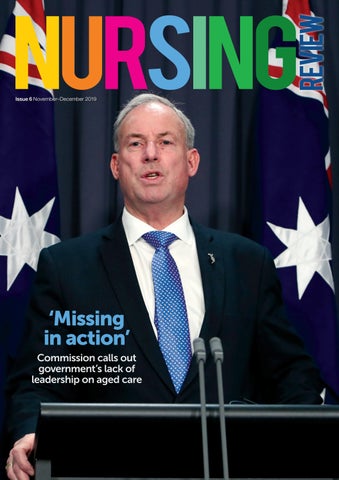
Issue 6 November–December 2019
‘Missing in action’ Commission calls out government’s lack of leadership on aged care
A combination anaesthesia that endures*
For use with:
Helps prevent pain and unnecessary expense
Minor cosmetic procedures
Vaccinations
Tattoos
EGO PHARMACEUTICALS PTY LTD
Always read the label and use only as directed. References: 1. Data held on file at Ego Pharmaceuticals Pty Ltd.
21–31 Malcolm Road, Braeside 3195 Australia australia +61 3 9586 8800 toll free 1800 033 706 ‘Ego’ and ‘Numit’ are trademarks of Ego Pharmaceuticals Pty Ltd. ©2019 Ego. ask@egopharm.com www.egopharm.com Date of Preparation: September 2019
0486-34/NR
* Lidocaine (Lignocaine) 2.5% w/w Prilocaine 2.5% w/w provides skin analgesia for 2 to 4 hours
1
contents
news
MANAGING EDITOR
2
Richard Garfield 02 9936 8628 richard.garfield@apned.com.au
3 4
NEWS EDITOR
5
Dallas Bastian 02 9936 8637 dallas.bastian@apned.com.au
industry & reform
6
HEALTH EDITOR
Conor Burke 02 9936 8638 conor.burke@apned.com.au
03
04
SUBEDITOR
‘Cruel and harmful’ Royal commission interim report released
10 Legal Corner Consent and cosmetics: a warning for nurses
12 Seat of power
Robert Santos
Do nurses make good politicians?
PRODUCTION EDITOR
14 Specialist skills
Kate Prendergast
Why we need to train more nurses in mental health
SALES MANAGER
16 What’s owed
Ben Long 02 9936 8664 ben.long@apned.com.au
The fight for better pay for aged care workers
specialty focus
SUBSCRIPTION ENQUIRIES
Nina Boyle 02 9936 8602 subs@apned.com.au
Nurse banned after writing self into resident’s will Most aged carer workers planning to leave industry The many health risks for shiftworkers Cancer patients put diagnosis down to ‘bad luck’
18 On the case
16
18
The growing field of forensic nursing
19 A quick chat with… Meet nurse and midwife Ann Blackmore
COVER IMAGE
Richard Colbeck Photo: Kym Smith
20 Childhood trauma
PUBLISHED BY
clinical practice
Compassion and support go a long way
23 Seeing stress APN Educational Media GPO Box 4245 Sydney NSW 2001 ABN 58 090 900 999 ISSN 1326-0472 PP100001944
The role of the GP nurse in anxiety diagnosis
24 Take control Letting patients make their own end-of-life choices
20
26
workforce
26 We’ve got your back Creating a network for rural breast care nurses
PUBLISHER’S NOTE
© Copyright. No part of this publication can be used or reproduced in any format without express permission in writing from APN Educational Media. The mention of a product or service, person or company in this publication, does not indicate the publisher’s endorsement. The views expressed in this publication do not necessarily represent the opinion of the publisher, its agents, company officers or employees.
27 Stronger after struggle Why one survivor of abuse went into nursing
28 Behind bars An insider’s guide to life as a prison nurse
technology
30 Batter up How baseball and big data can boost health outcomes
32 Workflow rethink
27
32
Five tips to help reduce pressure on nurses nursingreview.com.au | 1
news
Will dispute
Nurse banned from aged care work after inheriting resident’s estate.
A
nurse has been banned from working in aged care over her involvement in an elderly resident’s will. Abha Kumar was disqualified by the Victorian Civil and Administrative Tribunal from re-applying for registration or providing any health service in aged or disability care for five years, after she became over-involved in an elderly resident’s affairs.
In July 2015, 92-year-old Lionel Cox was admitted to Cambridge House, the residential aged care facility at which Kumar worked as nurse unit manager. Cox owned his own home, had no family and had not made a will. He was also sitting on an estate worth more than $1,000,000. He had previously lived in that Fitzroy home with the assistance and care of his neighbours and his case manager from the Brotherhood of St Laurence. After his case manager convinced him to try respite care, Cox told nurses his intention was to stay “until the cold months were over”. Later that month, Kumar purchased a kit from the post office, which Cox used to write his will before the witness of two staff members, under the direction of Kumar. Unknown to them, the will named Kumar as sole beneficiary of Cox’s estate. Cox died that same year of natural causes and, the following year, Kumar sold the house she had inherited from Cox for over $1,000,000.
Keeping staff safe Hospitals could face rise in prosecutions for failing to protect nurses.
H
ealth departments are risking an uptick in compensation claims if they don’t take steps to ensure staff safety. That’s the warning from an injury compensation lawyer and former emergency department nurse. Following reports that Caboolture Hospital Mental Health Unit staff are afraid to go to work after a string of assaults by patients on staff, Trent Johnson said: “Not only at Caboolture, but around the state, Queensland Health is aware its staff regularly face real risk of injury just doing their job, and what’s happening demands a tougher response from it.”
2 | nursingreview.com.au
Kumar admitted to the tribunal that she made false statements to staff about the will, saying Cox named two nephews in Ireland in it and that it had been torn up. The tribunal stripped Kumar of her nursing registration due to her overinvolvement in Cox’s affairs, and her failures to manage a conflict of interest and practise the profession of nursing in a reflective way. Nursing and Midwifery Board of Australia (NMBA) chair Associate Professor Lynette Cusack said the board would take action where nurses were benefitting from over-involvement with vulnerable patients. “Nurses are among the most trusted professions in our community, and the vast majority work with deep integrity and a commitment to providing professional care for vulnerable people,” she said. “When the actions of an individual let down the standards of the profession, we will take action to keep patients and the community safe from exploitation.” Should Kumar wish to re-register in five years’ time, the NMBA will then decide whether she is fit to do so. ■
Johnson, now a director with Queensland law firm Bennett & Philp Lawyers, spent four years working as a registered nurse at Caboolture Hospital. He said: “It’s a sad reflection on today’s society that frontline staff – including administration, doctors, nurses and security – cannot perform their work without risk of injury from physical and verbal assault. “If Queensland Health fails to take proper steps to ensure its staff can safely do their work without being abused and assaulted, it can expect to receive plenty more compensation claims against it.” Johnson added that hospitals also face increasing insurance premiums and the risk of Workplace Health and Safety Queensland prosecutions. “Unions have been pushing for safe and better working conditions for hospital staff,” he said. “It is time for Queensland Health to actively work with the unions and the Queensland Police Service to implement tough measures to prevent workplace assaults and ensure emergency response and hospital staff can carry out their duties safely at all times.” Johnson encouraged hospital staff injured by violent patients to press criminal charges and pursue claims for damages where possible against those responsible for the assaults. “The injured staff member should also lodge a workers’ compensation claim as soon as possible after the event, so they can receive appropriate and early treatment. “In many instances they may also be able to sue their employer for any ongoing injuries and loss due to the employer’s failure to provide a safe working environment, failing to provide adequate staffing, failing to have regard to prior history of aggressive behaviour of particular patients and so on. “In those circumstances, it is important to make an early report so supporting evidence can be preserved,” he said. ■
news
Mass exodus Slew of aged care workers planning to leave the sector.
A
ttrition is a key player in the aged care sector’s future workforce woes and a new survey has shown why. The survey of 5000 workers revealed more than two-thirds (38 per cent) plan to leave the aged care sector within five years. Australian Community Research (ACR) director Karen Luscombe said workers are getting less job satisfaction. “They want to deliver quality care but can only deliver basic levels of care when they are so hard pressed,” Luscombe said.
“It’s leading to the concerning situation of worker burnout with experienced staff planning to leave the sector.” Job stress and overwork due to understaffing were two of the key factors residential care workers deemed important in deciding whether to continue working in the industry, while home care workers cited pay and stress as playing a crucial role in whether they’d look for work elsewhere. The findings on intention to leave are slightly up on a 2016 survey of the aged care workforce, which found a third of residential workers and a quarter of community workers were planning to leave the sector within the next five years. Those who participated in the 2016 National Aged Care Workforce Census and Survey voiced issues with high workloads and time pressures. A report on the findings from the University of Adelaide said: “Concerns around workloads, staff numbers and skill mixes, the psychological and physical toil of aged care work, and working conditions were commonly expressed and could form the focus of future strategies at both an
Safety in numbers Nurse numbers and staff safety linked: UK report.
R
esearchers at Birmingham City University in the UK have found a link between the number of registered nurses on a ward and staff safety. The academics looked at three years of data from an NHS mental healthcare provider and found staff safety directly correlates with nurse staffing levels and skills mix. The report, published in Health Informatics Journal, found that at times when clinical demand was low – for instance night shifts – more adverse events were reported. This increased risk could be offset by increasing the number of RNs above “clinically required levels”. Dr Sarahjane Jones, senior research fellow in health and social care at Birmingham City University, said: “These findings are the
organisational and sector level to improve retention in the workforce.” Among the other key findings of the ACR survey were that three-quarters of respondents said they’d seen a reduction in staff on the floor in the past two years and that 94 per cent don’t have enough time to talk to residents in their care. United Voice assistant secretary and aged care director Carolyn Smith called the survey responses heartbreaking. “Workers and those in their care deserve so much better,” she said. “These workers can’t wait for the royal commission to report; they need a workforce strategy and investment now.” HSU national president Gerard Hayes said the figures were not surprising. “Federal budget cuts have eroded the sector’s margins. Our members often report anecdotes of $5 a day food budgets or rationing of sanitary pads,” he said. “Critically important jobs in the sector such as cleaning and catering are being outsourced to shonky operators who steal employee wages. “There is simply no fat in this sector; the government has sawed into bone.” ■
first to directly address the safety of healthcare staff using data in this way. “They offer an opportunity for a tightening up of policy governing safety culture and workforce safety and retention.” The NHS data revealed more than 10,119 “adverse events” had taken place, with more than 6500 incidents of patient aggression recorded, affecting over 12,000 staff. Nearly 500 staff were victims of “sexual incidents”, and inappropriate behaviour was recorded 1762 times, with 4058 members of staff listed as victims. In its conclusion, the study stated that renewed emphasis on all‑round hospital safety is needed, and these findings could go some way to solving a growing workforce shortage in the UK. “The way in which we value healthcare staff has been brought to light here. Traditionally, the concept of safety is prepositioned by ‘patient’, and so, safety in healthcare is conceptualised as patient safety; little consideration is given to the safety of the staff delivering care. “In a time where workforce retention is proving difficult and the quality and safety of care to patients is compromised, greater efforts should be made to improve staff safety, which might improve retention and simultaneously patient safety.” In the Australian context, violence against healthcare workers is on the rise. The NSW Bureau of Crime Statistics and Research recorded 361 violent incidents in hospitals in 2015 and 521 last year. As reported by the ABC, Victoria’s Crime Statistics Agency recorded 335 assaults on healthcare premises in 2015 — last year the figure was 539. Victoria also saw a 60 per cent increase in assaults on nurses recorded over the last three years. Queensland Health puts the number of incidents of violence and threats in hospitals at a staggering 5514 – a 48 per cent rise over the last three years. ■ nursingreview.com.au | 3
news
Weird part of the night Poor mental health and car crashes: warnings for shiftworkers.
S
hiftworkers are at greater risk of poor mental health and of crashing their car after their first shift of the week, two separate studies suggest. In the first, an international team of researchers examined the schedules and mental health symptoms of more than 28,000 participants. Dr Tracy Kolbe-Alexander from the University of Southern Queensland said that working outside standard hours (7am to 6pm) held potential physical and mental health consequences. She said shiftwork was associated with a 28 per cent increased likelihood of adverse mental health outcomes combined. And female shiftworkers were more likely to report symptoms –
particularly depressive symptoms – than women who did not work shifts. “Night work and inconsistent work hours disrupt the normal sleep-wake cycle,” she said. “Sleeping at odd times of the day, together with shifting schedules, creates challenges for maintaining a healthy work-life balance.” In the car crash study, researchers investigated the theory that the cumulative effects of night shift increase the likelihood that an accident will occur as time goes on. They found shiftworkers were more likely to crash their car after finishing their first night shift of the week rather than later on. Lead researcher Professor Greg Roach, based at CQUni Adelaide’s Appleton Institute, recruited 43 people for simulated shiftwork in their sleep laboratory. The participants completed seven consecutive eight-hour night shifts in an office, then each day had 20-minute commutes in a driving simulator – one at 10.30pm, as if they were going to work, and one to represent their trip home at 7.10am. “Most guidelines recommend a maximum of two to four consecutive night shifts, based on the notion that fatigue risk increases with each successive night shift due to accumulated sleep loss,” Roach said. “Our results challenge that notion.” The study also found that the likelihood of a shiftworker crashing on the way home from night shift on the first night is eight times greater than the likelihood of crashing on the way to work. ■
Too much of a good thing? Oxygen use put to the test.
H
istorically, oxygen has been treated like holy water, but it’s time to take a closer look at its role in hospitals. That’s the call from Professor Rinaldo Bellomo, a researcher at Monash
4 | nursingreview.com.au
University’s Australian and New Zealand Intensive Care Research Centre. Bellomo issued the suggestion following his research involving 1000 ICU patients. Participants were assigned to two groups: one receiving the normal amount of oxygen, and the other a smaller amount. The study’s findings suggested that unnecessary levels of oxygen make no
difference to the recovery of ICU patients and might actually be dangerous for some. “There’s been an underlying assumption that oxygen is good for patients and that doctors should give it to them liberally and should make sure the oxygen levels are high,” Bellomo said. “But there’s never been any data or evidence or trial [demonstrating] that that’s actually true.” What’s more, Bellomo found “a signal to suggest increased survival with less oxygen” among people who suffered hypoxic brain injury due to cardiac arrest. “So even though the totality of ICU patients put together do not appear to show a difference between these two treatments, in some specific sub-groups of people, giving less oxygen may well be a good thing,” he explained. The research team is now planning further investigation into this sub-group. Overall, Bellomo said the research could bring about a decrease in the amount of oxygen therapy that’s being given “because it’s likely to be seen to be unnecessary”. “More large trials of oxygen therapy are now a global priority,” he added. The findings of the study, ‘Conservative Oxygen Therapy during Mechanical Ventilation in the ICU’, will appear in the New England Journal of Medicine. ■
news
Luck or lifestyle? Why patients should confront the probable cause of their cancer.
B
ad luck. That’s what more than a quarter of Australian cancer patients blame for their disease. In the paper ‘What Caused My Cancer?’, published in Cancer Control, researchers asked 585 cancer patients in Australia and Vietnam about 25 possible causes.
Out-of-pocket costs on the rise
Ageing population demands increase in health spending.
T
he Australian Institute of Health and Welfare has released its annual report – Health Expenditure Australia 2017–18 – and it shows that out-of-pocket costs for individual Australians have risen 32.6 per cent. The report also reveals a slight increase in overall health expenditure. In total, $185 billion, or $7500 per person, was spent on health goods and services, with government funding amounting to two-thirds of the total ($126.7 billion). Government spending represents 24.4 per cent of government tax. Non-government entities – individuals, private health insurers and so on – made up the rest of the expenditure ($58.8 billion),
The authors were concerned the high ‘bad luck or fate’ response suggested many believe they have little control over their health. Hunter Medical Research Institute’s Dr Alix Hall said: “That may affect their willingness to change their behaviour when it comes to diet and lifestyle, and influence their decisions relating to treatment and/or care.” The researchers said the study findings underline why public health campaigns need to highlight accurate information about the possible causes of cancer. Still, they added that these fatalistic beliefs might help patients adjust to or cope with a diagnosis and avoid self-blame. Almost half of Australian cancer patients believed “getting older” was the main cause of their cancer. That was followed by “family history or genes”. They put “sun exposure” down at number four, while smoking was in fifth place. Professor David Roder, University of South Australia research chair of cancer epidemiology and population health, said there are many misconceptions about what causes cancer. “Unfortunately, people’s understanding of many cancer-related risk factors is modest to low,” Roder said. “People’s beliefs about what may have caused their cancer are complex and likely to be impacted by multiple factors, including cultural beliefs.” The team said staying aware of the issues that are being highly publicised in the media may assist healthcare providers to address any misconceptions patients may hold. ■
with individuals contributing the most at $30.6 billion. Australians paid more for their healthcare over that period, with out-of-pocket costs sitting at an average of $1578 per person, up from $1190 in the period 2016–17, a rise of 32.6 per cent. “Total health spending increased by $2.2 billion in 2017–18 to $185.4 billion in constant prices,” said AIHW spokesperson Dr Adrian Webster. “This was a 1.2 per cent increase on 2016–17 against a backdrop of 3.9 per cent average annual growth over the decade.” Contributions to health spending by private health insurers rose by $400 million to $16.6 billion in 2017–18. However, membership declined between 2016–17 and 2017–18 by about 33,000 to 11.3 million, the first decrease seen over the decade. The Australian Medical Association has called for a funding increase to keep up with an ageing population that faces a number of health challenges. AMA president Dr Tony Bartone pointed to the $27 decrease in per person spending, compared to the 2016–17 year, as a step in the wrong direction. “This is in spite of the ageing of the population, an increased complexity of the caseload, and the advent of new and more expensive interventions,” Bartone said. “We need to increase health funding enough to keep up with an increasing and ageing population with more complex health needs. “Maintaining funding at the same level will only see the situation get worse for our overstretched hospitals and patients waiting for their care.” The 2017–18 report showed that the largest expenditure increases came from hospital funding, with a $3.2 billion bump. The $74.0 billion spent on hospitals over 2017–18 was nearly 40 per cent of total health expenditure. ■ nursingreview.com.au | 5
industry & reform Aged Care Minister Richard Colbeck holding a press conference on the royal commission’s interim report. Photo: Kym Smith
Royal commission wrap-up Commission delivers interim report, plus hearings expose poor workforce conditions. By Conor Burke
A ‘CRUEL AND HARMFUL SYSTEM’ The Royal Commission into Aged Care Quality and Safety released its interim report in early November, and although it did not make any recommendations – it is saving those for the final report due next year – it threw down the gauntlet to the government and aged care sector with suggestions of things to start working on. Titled simply Neglect, the language used by the commissioners was blunt and to the point, shorn of any legalese. The foreword to the report described the current model as a “cruel and harmful system” that must be changed. “We owe it to our parents, our grandparents, our partners, our friends. We owe it to strangers. We owe it to future generations. Older people deserve so much more,” it read. Much of the report is a summary of the evidence given so far, with initial observations from the commissioners. Divided into three hefty volumes, it identifies systemic problems in need of “fundamental reform and redesign”. 6 | nursingreview.com.au
The current system is “designed around transactions, not relationships or care”, it said and “minimises the voices of people receiving care and their loved ones”. The system is also hard to navigate, ill-informs consumers, and has a workforce that is “under pressure and under-appreciated and that lacks key skills”. Residential care strips residents of their humanity, the report said. “[They become] just another body to be washed, fed and mobilised, their value defined by the amount of funding they bring with them. “They become infantilised, lose autonomy, and are prevented from making decisions or doing physical things that were routine when they lived at home, on the grounds that they ‘could hurt themselves’.” The commissioners said the sector “lacks fundamental transparency” and called out certain providers who have appeared at the commission as “belligerent in their ignorance of what is happening in the facilities for which they are responsible”. The government too is in the commission’s sights for its lack of transparency on the numbers of complaints and assaults in aged care, and for empowering a regulator that “is unfit for purpose and does not adequately deter poor practices”.
“The regulatory regime appears to do little to encourage better practice beyond a minimum standard. We were flabbergasted to hear that, until recently, it was routine practice for large sections of the reports of accreditation audits of services conducted by the Aged Care Quality and Safety Commission to be generated by computer-assisted text.” However, the good practices of some providers and staff were acknowledged. The report said these examples of “passion and dedication” are succeeding in spite of the aged care system, not because of it. The aged care system needs a “reality check” and to focus less on acting like an “industry” and a “market” force that views people as “clients” and “consumers”. The report identified three areas that need “urgent” attention. The government needs to: •p rovide more Home Care Packages to reduce the waiting list for higher level care at home • r espond to the significant over-reliance on chemical restraint in aged care, including through the Seventh Community Pharmacy Agreement • s top the flow of younger people with disability going into aged care, and remove and relocate younger people already in aged care. “We see no reason to delay action in these areas,” the commissioners wrote.
industry & reform
ROYAL COMMISSION INTERIM REPORT: THE SECTOR REACTS According to the report, leadership is lacking at the top of a workforce that endures severe recruiting and retention difficulties and where “workloads are heavy [and] pay and conditions are poor, signalling that working in aged care is not a valued occupation”. The Australian Nursing and Midwifery Federation (ANMF) said in response to the report that the “history of aged care in Australia is a story of woeful and increasing neglect”. The federal secretary of the ANMF, Annie Butler, said: “The report outlines a shameful abrogation of duty by successive governments and many sections of the industry. And, frankly, an appalling lack of respect, regard and care for our elderly by the Australian community. “There is no need for the government to continue to be ‘missing in action’ in addressing critical workforce issues. The commissioners have clearly identified that staffing is a critical element in ensuring the quality and safety of those in care. Services must have the right number of staff with the right skill mix, with compassion and empathy combined with knowledge of aged care and the illnesses and conditions of those in care. “The aged care workforce has held the system together for too long; workers can’t sustain their efforts much longer – action is needed now,” she said. The Australian College of Nursing has called for a rule stating that one RN must be on duty at all times in residential aged care facilities. “Caring for older Australians is complex. They often have chronic conditions and comorbidities and require a number of medications each day. Yet the number of registered and enrolled nurses in full-time equivalent positions in residential aged care facilities (RACF) has fallen by 13 per cent since 2003,” said ACN chief executive, Adjunct Professor Kylie Ward. United Voice welcomed the royal commission’s emphasis on workforce issues, pointing to a recent survey in which one in four workers said they would leave the sector in the next five years. The union also called out the current aged care minister, Richard Colbeck, for his lack of engagement with the sector. Carolyn Smith, United Voice’s national director of aged care said: “The issues of chronic understaffing and crushing workloads have reached crisis point. Elderly
Australians and the workers that care for them cannot wait another day. “United Voice calls for Minister Richard Colbeck’s silence on these issues to end immediately. Funding to aged care cut by the Coalition government must be restored. Otherwise we have a sector that cannot provide quality care – and the crisis will continue.” The interim report called out the general disrespect older Australians face in our society, commenting that “the language of public discourse is not respectful towards older people. Rather, it is about burden, encumbrance, obligation”. The Council on the Ageing (COTA) agreed, and its chief executive Ian Yates said that older Australians are neglected in federal budgets time and again. “COTA agrees with the royal commission that older Australians should be more valued by the wider community,” he said. “It’s not just about loving your grandparents; Australians need to also reach out as a community and support their elderly neighbours and fellow citizens, many of whom are still waiting to receive care they’ve been assessed as needing and won’t even be in the formal care system. “If the government is taking the royal commission seriously, and is also serious about respecting the many people and experts who have given their time to the process so far, then they cannot ignore this report and must commit more funds in the forthcoming MYEFO.” Yates wants an urgent funding injection of $2.5 billion to ease the Home Care Package crisis, something that the
Australian Healthcare and Hospitals Association (AHHA) has also called for in its post-report statement. Professor Jo Ibrahim, head of the Health Law and Ageing Research Unit at the Department of Forensic Medicine at Monash University, agreed that chemical
The entire system is under serious threat, and without fundamental change, we’re concerned the system will fail. restraint has been an issue known for the past 20 years and won’t change overnight, so he is glad the commissioners showed “courage” in identifying this as an area for reform. “The cultural issues around restraint or restrictive practice is something that isn’t going to occur overnight, and so work can be started on that. So examine it promptly and examine the underlying factors and start addressing those. “I think it’s reasonable. I think my note of caution is that people think that’s the only thing that needs to be done, and that’s not the case at all. What they’ve said is that we should start now and not wait,” he told Nursing Review. Ibrahim was impressed that the report threw up a few happy surprises in the form of areas for “urgent action”. “I was surprised because I wasn’t expecting that they would have any
ANMF federal secretary Annie Butler. Photo: Kym Smith
nursingreview.com.au | 7
industry & reform
Mark Knight. Photo: Herald Sun
recommendations. I think that point about not waiting is a really important one in that what’s happened in the past is we wait until the end and then discover that the changes that are needed are going to take a long time. And so I think they’re right to be saying we’ve got to be doing something now.” As for whether the government might take notice of these concerns, on past form Ibrahim is unsure. “I think that both parties and governments in the past have sat around waiting, and when they finished waiting, they haven’t actually done anything. “And the commission’s paper highlighting the 18 inquiries that have been done over the last 20 years clearly lays it out to the public that when the government says they’re waiting to the end, they’re waiting to do nothing, and I think we need this reaction to address these [issues], and that would get us prepared for the recommendations that come next year,” he said.
BETTER OFF WORKING AT ALDI? ROYAL COMMISSION WITNESS TALKS AGED CARE PAY Nurses working in aged care are paid so poorly that they are forced to stay on higher casual rates and work 52 weeks a year to attain a living wage, the royal commission heard at the third Melbourne hearing. Paul Gilbert from the ANMF’s Victorian Branch also said that due to low pay rates, nurses often take more than one job to make ends meet. 8 | nursingreview.com.au
“I think that most people we speak to do want more hours and occasionally get more hours, but it’s still not a static like it is in most other industries, where you know you’re going to be working three, four, five days a week. No-one gets to work full‑time. People are working multiple jobs to get an income.” The pay for personal care workers is also poor, according to Gilbert. “The comment I hear when I go and have meetings is, ‘I could get paid more working on the checkout at Aldi,’ and it’s technically true, because they see those jobs advertised with an hourly rate of $24 to $26 dollars. Our enrolled nurse and registered nurse members are paid more than the personal care worker cohort, but not a whole lot more,” he said. Also appearing at the Melbourne hearing was nurse practitioner Amy Lazzaro, who believes that high staff turnover is linked to poor pay. Lazzaro, who runs a geriatric outreach program covering a district of 832,000 people in Western Sydney, said: “A lot of [staff] report back to me that turnover is subsequent to pay.” She also told the commission that she was “shocked” at the staffing mixes and numbers in aged care. Lazzaro said that obtaining full patients’ histories when she enters a facility is difficult because the nurses on site are too busy. “I started the service and got out there on the road in 2015. I was shocked, to be honest. There are a large number of carers or assistants in nursing that work within
residential aged care. They seem to make up the bulk of the workforce,” she said. “I found that the RNs are responsible for sometimes a whole level or a whole wing of the nursing home, with one RN on to maybe 50 or 80 residents. “And then they’re working within their shift with a large number of assistants in nursing whom they’re responsible for overseeing within a shift. And I think that’s quite challenging for them working in those conditions.” She also believes that assistant staff training – often only 12 weeks – is “poor” and that nurse assistants and care workers are often “ill-equipped for what they’re walking into” compared to RNs. Asked if she could change one thing about the residential aged care system, Lazzaro replied: “I would implement nurse to patient ratios, including more RNs on per shift and over a 24-hour period, and I would most definitely implement more education and ongoing training to nurses at all levels on all nursing topics within aged care”.
COMMONWEALTH M.I.A. ON AGED CARE WORKFORCE: ROYAL COMMISSION LAWYER The Commonwealth appears to be missing in action. This was senior counsel assisting Peter Rozen’s assertion as he discussed governance and leadership within the aged care sector while wrapping up a week of royal commission hearings centred on the aged care workforce. Rozen said the Commonwealth needs to demonstrate leadership and commit the resources necessary to ensure delivery of an aged care system that meets community standards, and, he added, “it needs to act quickly”. “There appears to be a lack of leadership and expertise about aged care within the Department of Health,” he said. That concern was echoed by Benetas chief executive Sandra Hills, who appeared at the royal commission on Thursday and called for a Cabinet minister for ageing. When Rozen asked Hills at the hearing if the Department of Health was providing enough leadership, she responded: “No.” Earlier in the day, Rozen pushed health department secretary Glenys Beauchamp on the topic of Commonwealth leadership as it related to Australia’s Aged Care Workforce Strategy, put together by Professor John Pollaers. At the heart of the back and forth was a briefing note on the Pollaers report
industry & reform
prepared by the department for then aged care minister Ken Wyatt. In relation to a government response to the report, that briefing note read: “One of the risks to government would be that it would invite renewed criticism of the absence of similar responses to other aged care review reports including the Legislated Review of Aged Care and the Review of National Aged Care Quality Regulatory Processes. “A further risk for government is that a formal government response will invite public statements by key stakeholder groups drawing renewed attention to sensitive matters such as staff ratios, aged care funding, access to health services for older Australians and service quality.” When asked to confirm that the department was advising the government of political risks and potential embarrassment rather than advising the government that it ought to be publicly embracing the outcome of the Pollaers report, Beauchamp responded: “On this particular occasion, yes, but if I could just add, we provide a range of advice to the minister. This is one piece of advice.” Later, she said: “We have provided advice – and I’ve had conversations personally with Minister Wyatt – to embrace the recommendations.” To which Rozen responded: “This is not leadership. Is it?” “This is one piece of advice in a range of advices that go to ministers,” Beauchamp replied. Later, aged care commissioner Lynelle Briggs described the challenges the department faces in working to enact change while the royal commission completes its work and added: “It’s quite challenging for a royal commission to find a steady state here.” Beauchamp said: “There’s been a number of comments … about tardiness and delays and things. And yet you’re saying there’s so much going on, it’s hard to keep up. “That’s what it also feels like for us. There is a lot going on.” Hills, who sits on the Aged Care Workforce Industry Council, said at the hearing that she was unsure how the health department was preparing itself to support the council in delivering on the strategic actions set out in the Pollaers report. Rozen said the council is struggling to build momentum and lacks the resourcing of the broader industry and of the Commonwealth.
“Based on the current progress and the structures in place for implementation, there must be real concerns about whether the strategic actions can be achieved in the three-year time frame set down by Professor Pollaers.” The day after the hearing, United Voice said via a statement there had been “nothing but silence” from the current minister for aged care, Richard Colbeck, on the sector’s workforce issues. United’s Carolyn Smith said: “There has not been a whisper from the aged care minister on any of these serious issues raised across the week.” Smith called on Colbeck to increase funding “that is tied directly to staffing levels”.
WRAPPING UP A WEEK OF WORKFORCE WOES When it came to the issue of the aged care workforce – which formed the backbone of this week’s hearings – Rozen put it flatly: “The workforce is too small. The bare minimum has become the norm. It is unsustainable.” He added that the current workforce doesn’t have the right skills mix. “The evidence suggests skills deficits across the sector, exacerbated by
time‑poor staff and threadbare rostering practices. On current trends, the entire system is under serious threat, and without fundamental change, we’re concerned the system will fail.” Rozen also urged the commissioners to consider a registration scheme for personal care workers and to make
The workforce is too small. The bare minimum has become the norm. It is unsustainable. recommendations to “address low remuneration in the aged care sector”. Summing up his address, Rozen said: “We ought to follow commissioner [Richard] Tracey’s lead and be exceedingly grateful for the dedication that so many aged care workers display on a day-to-day basis. “However, we submit that gratitude needs to mean something in real terms. It needs to mean a safe place to work. It needs to mean respect for that work. It needs to mean that the work is properly valued.” ■
Commissioner Lynelle Briggs. Photo: Kelly Barnes/AAP
nursingreview.com.au | 9
Legal Corner
Face value Case study a warning to nurses involved in the delivery of beauty treatments and procedures. By Scott Trueman
M
any nurses are engaging in cosmetic and beauty practices for commercial benefit, either as an employee or sole practitioner. While a recent case involved the negligent actions of a person without nursing registration and training, it contains many salient legal points for nurses in the cosmetic industry. The court had to consider the nature of the relationship between a ‘cosmetic practitioner’ and a customer, the nature of the transaction, issues of consent, and the assumption of risk. The uncontested facts are that in June 2017, after making payments totalling $5000, the plaintiff, Ms J, aged 33, underwent what the defendant company had represented as a very safe, non-invasive cosmetic facial treatment procedure described as a “3D skin lifting by ultrasound”. The procedure was performed by a trained ultrasound operator employee, Ms C. She was not a nurse. The treatment commenced with the application of numbing facial cream, and then continued with heat energy being applied to Ms J’s face generated by an ultrasound device. The stated intention was to improve her appearance by delivering a low amount of focused ultrasound energy to the facial skin. As a consequence of the treatment, Ms J developed facial redness, burning, blistering, lumpiness and depigmentation to parts of her face. This caused her to suffer distress and embarrassment, for which she claimed damages in negligence. The first issue for consideration was the nature of the relationship and consultation. The defendant company denied a patient and treatment provider relationship. The court rejected this based on the quasi-medical content and terminology that appeared in the defendant’s consultation form, which referred to treatment goals and a variety of potential procedures, including facial skin tightening, filler treatment, the use of neurotoxins, ablative laser and non-laser resurfacing treatment, dermabrasion or deep facial peels, lipoplasty to the face and neck regions, facelift, blepharoplasty, and brow lift.
10 | nursingreview.com.au
Further, the form sought to record patient information about medications and other health conditions or diseases consistent with taking a patient’s medical history. It also contained spaces for notes to be made about any assessment of clinical response factors and factors relating to the assessment of face and neck skin for laxity, volume and quality. The court found the form used language that presupposed the existence of a medical/therapeutic relationship and “gave the impression of a relationship between a patient and a treatment provider”. Those findings were relevant to the consideration of the duty of care owed to Ms J. The duty of care owed by the therapist, Ms C, was to exercise reasonable care, skill and judgment in applying the treatment, including the duty to provide information about the nature of known associated risks of harm. In considering the alleged negligent operation of the ultrasound device, the court noted that the aim was not to cause damage to the dermal junction of the skin layers. The treatment did not raise any communicated suggestions of skin damage of any kind, or of scarring. The court found that in light of Ms C’s certification and training, she must have been aware of the risk of facial burns if the ultrasound was delivered at too high a dose or for too long. In finding negligence, the judge stated that the activity of promoting and charging a fee of such a large proportion ($5000) “carries with it that reasonable care would be taken … in the performance of the treatment so as not to cause avoidable damage to the appearance of the plaintiff’s face”. Informed consent and the assumption of risks by Ms J were the last issues to be judicially considered. Noteworthy for the court was that she had not had such ultrasound treatment before and did not quite understand how it would affect her skin and therefore asked Ms C how the procedure worked. She was told it would produce a very good result and make her skin firmer and look younger, and that the procedure was safe. During the same conversation, there was no discussion or information provided concerning any inherent risks of harm associated with the treatment. The defendant company also relied on Ms J’s signed consultation form as evidence of consent. The court rejected this because “proffering the last page of the consultation form to [Ms J] to sign after she was already lying down supine on the treatment bench did not relevantly constitute consent to risk ... At that time, the treatment had already commenced, with the plaintiff’s facial skin having been prepared and numbed by an unidentified anaesthetising cream as the first step in the treatment”. Further, Ms J was only asked to sign the last page for a “legal issue” that was not explained or elaborated upon at that time. In all the circumstances, this did not constitute valid consent, as the content of the form that related to risk had not been drawn to Ms J’s attention and made known to her before the treatment. The permanent facial skin damage, hyperpigmentation, lumpiness and alteration of facial appearance, when talking or smiling, resulted in a verdict for Ms J in the sum of $24,557. This case contains lessons for nurses undertaking cosmetic or beauty procedures. Courts, depending on the circumstances, may assess notions of duty of care, negligence, consent and assumption of risk in line with established medico-legal case law. The same obligations and duties apply. ■ Scott Trueman is a lecturer in the School of Nursing, Midwifery and Nutrition at James Cook University.
LATEX FREE
Syringes
Needles
Hypodermic Syringes
AGANI™ Hypodermic Needles
The clear barrel with easy to read measurements allows for quick recognition of air bubbles and accurate dosing.
Suitable for all major applications, AGANI is available in a wide range of sizes from 18G to 30G and come individually packaged in a sterile colour-coded blister pack for easy gauge identification.
CATHETER TIP
ECCENTRIC LUER SLIP TIP
LUER LOCK TIP
LUER SLIP TIP
Safety Syringes
Safety Lancets
VanishPoint® Retractable Syringes
Haemolance Plus® Lancets
The passive safety mechanism of VanishPoint® minimises the risk of needlestick injuries.
Haemolance Plus® is a single-use product that cannot be re-loaded, providing improved safety for patients and healthcare professionals.
Activation cannot be by-passed No change in clinical practice Needle automatically retracts into the syringe
BEFORE
It’s ergonomic shape and grip makes the lancet easy to use, helping provide a controlled, uniform and accurate sampling result.
AFTER
Terumo Australia Pty Ltd Macquarie Park NSW 2113 Australia Mount Albert Auckland 1025 New Zealand
T: 1800 837 866 T: 0800 66 77 57
AGANI™ is a trademarks of Terumo Corporation. Haemolance Plus® is a registered trademark of HTL Strefa SA. VanishPoint® is a registered trademark of Retractable Technologies Inc. © 2018 Terumo Australia Pty Ltd. GHP181112D1137V1 | PBD00302
industry & reform
Balance of power
The nurses representing you in Canberra. By Conor Burke
F
ew nurses have served in federal parliament in recent memory. There was Judith Adams, elected in 2004, who represented Western Australia in the Senate until her death from cancer in 2012. But until Ged Kearney came along in 2018, closely followed by Helen Haines in 2019, one of the most common occupations in the land was grossly underrepresented in Australian politics. According to an ABS workforce survey, when comparing the former jobs of Australian politicians and the population at large, nurses account for one in 50 jobs, or 2.1 per cent in the general population, but only make up 0.88 per cent of parliamentarians. “Nurses make, in my view, very good politicians. They have a breadth of experience that I don’t think any other
12 | nursingreview.com.au
politician can ever claim to have really,” Kearney tells Nursing Review. “[It’s about] what you see at a grassroots community level, at a family level. You work with people who are drug and alcohol addicted; you work with mums, older people and younger people. “You have a grasp on the community and the community’s needs like, I believe, nobody else.” Kearney has spent a career listening to these needs and fighting for others: first as an RN for 20-odd years, then when climbing the ranks of the union movement, and finally as the Labor member for Cooper in Victoria. Campaigning and listening to her constituents is something Kearney genuinely enjoys. “It is hard going, but I get energy from the community,” she says. “It actually gives me the impetus and I can go to my leadership and say, ‘I know that almost my entire electorate will support this policy. This is really popular and really good.’ “And I know that because I talk to them and they say to me, ‘Fight hard, Ged.’
They give me the energy, and that sounds a bit wanky maybe, but it’s true. They really do buoy me up. “I’m sitting here looking at a hand-drawn poster from the J S Grey Kindergarten kids saying, ‘We matter. Please look after us.’ It’s just beautiful, so it really does give you the energy to keep going,” she says. As the former federal secretary of the ANMF, Kearney has gravitated towards the health issues in parliament. She was appointed shadow assistant minister for skills and shadow assistant minister for aged care and is glad that aged care is finally on top of the list of the many “explosions” that occur daily in Canberra. “Because I had been so closely linked to aged care in my nursing life, and ran big campaigns to improve care and conditions for nurses in aged care, and carers, I sadly haven’t been surprised by the revelations of the royal commission. “I know this is going to sound a bit weird, but it’s been a bit of a relief for me that finally it’s getting the attention that it deserves,” she says.
industry & reform
Her job now, she adds, is to keep the pressure on and eventually make sure the government adheres to any recommendations made by the royal commission, whose interim report was recently released. For Dr Helen Haines – a former nurse, midwife and academic – parliamentary life can be hard as an independent MP for her home electorate of Indi in Victoria. “It’s time consuming, and it takes a lot of discipline and effort to do that,” she says. “But it’s also rather liberating, because it means on every piece of legislation that comes before the House, I can apply a rural lens across it and say, ‘What’s the impact of this bill on rural and regional Australia?’” Like Kearney, Haines is well versed on health issues, and as former director of the Rural Health Academic Network (RHAN) and executive director of the Education and Research Unit at Northeast Health Wangaratta, she is uniquely placed to work for people from country Australia. Haines believes economic prosperity is paramount to achieving high level
education and creating good jobs in the regions, and that will lead to better health outcomes. “I reckon there’s an appetite to listen,” she says of her working relationship with the Liberal and National MPs in government. “The key bit, though, is to get some outcomes, and I tell you what, I would be absolutely thrilled if I could get some outcomes in regard to uncapping university places for regional universities, most particularly in the health careers. “[If] there was an opportunity for kids who grow up in regional Australia to go to a regional university to undertake a degree in a health-related discipline and ultimately to work in rural and regional Australia, that’d be a great step, because workforce is one of our biggest challenges.” Away from the bureaucracy and dayto-day politicking, Haines also enjoys the interaction with members of her electorate, which she describes as a “great joy and an enormous privilege”. However, the academic in her enjoys another specific perk of the job too. “One of the great aspects of the job is the people I can access if I need expertise. So, it’s fabulous to have the resources of the parliamentary library, which has over 120 researchers working there. My office can pick up the phone and ask for some research to be undertaken on a particular matter that we’re concerned about. That’s just fantastic. And as an academic myself, to know that I can call on that level of expertise, I love that,” she says.
Helen Haines. Photo: supplied
Ged Kearney. Photo: supplied
For both women, their past experiences have informed their work in parliament. They share similar aims: both want to tackle climate change and inequality, and both want to better the treatment of asylum seekers and to close the skills gap in healthcare. “I’m really pleased I have my nursing background ... because it gives you a different perspective,” Kearney says. “It’s not just dollars, it’s not just legal barriers and problems that people look at all the time. You’re actually able to speak from the heart and say, ‘Well hang on, we’ve got to find a way through. We’ve got to find the money. You’ve got to make the laws change because this is what people need.’ And it’s lovely to be able to stand up and say, ‘I know why people need this, because when I was a nurse, I did this…” Haines agrees that nurses need greater representation in parliament, but points to the growing number of other healthcare professionals gaining seats in parliament as a positive development. “There’s a bit of a smattering now of health professionals, in addition to medical practitioners. As an independent, it’s easier for me to have a louder voice, because I’m free to use it. But I have no doubt that behind the scenes those other health professionals will certainly have a view about how things are going. “From my perspective, it’s about finding the people I think I can align with to improve policy, and that’s what I’m attempting to do.” ■ nursingreview.com.au | 13
INDUSTRY & REFORM
The right credentials
Additional training in mental health brings many benefits. By Richard Lakeman
T
here is an accelerating need for a skilled mental health workforce in Australia, given the growing recognition of mental illness. However, developing an informed, flexible and skilled nursing workforce in hospital, community mental health and non-traditional settings is a challenge. The critical ingredients appear to be a mix of supported practice, particularly in the transition from graduate nurse to specialist, relevant postgraduate education and clinical supervision. Nurses form the largest occupational group who work in mental health services in Australia. Nurses work in acute settings such as emergency departments in which people frequently present with mental health problems. Indeed in 2016, about 277,000 presentations to emergency departments were classified as mental health related, and the majority of
14 | nursingreview.com.au
presentations to general practitioners are thought to be related to mental health problems. In the same year, Australians had over 8.9 million contacts with community mental health workers, and some 258,300 discharges from state mental health inpatient services. However, despite the pressing need for highly skilled nurses, the majority of those who work in mental health settings are not trained mental health nurses (MHNs), and it is widely recognised that nursing graduates are poorly equipped for working in the mental health field on graduation. Since the loss of state registration and endorsement by nursing boards and councils, the only way to achieve recognition for mental health nurses is through the Australian College of Mental Health Nurses credentialing program. To be eligible, registered nurses must have completed at least a postgraduate diploma in the specialty and met further practice and supervision requirements. Increasingly, these credentials are required for advancement for nurses in the mental health field – and rightly so. The public deserve to receive mental health nursing services from appropriately skilled people. As funding of mental health programs increases, demand for skilled nurses will rise. In the 2019 federal budget, the government provided $736.6 million for mental health and suicide prevention
initiatives over seven years. Big measures include $373 million for additional services through the national youth mental health foundation, headspace. Much of this funding will be channelled via Primary Health Networks (PHNs). Credentialed MHNs have been previously able to work in primary care settings under what was known as the Mental Health Nurse Incentive Program. MHNs working in the program were found to be able to deliver and adapt complex evidence-based psychotherapies to people with the most complex mental health needs. The funding for this program has now been devolved to the PHN ‘flexible funding pool’, which is charged with commissioning services not funded or accessible to people via the Medicare Benefits Schedule. MHNs will be sought after and are in short supply, especially to address the needs of people with complex mental health needs. In 2017, there were 22,159 nurses employed in the mental health workforce, compared to 3369 psychiatrists and 26,311 psychologists (not all work in mental health), according to data from the Australian Institute of Health and Welfare (AIHW). The total number of nurses working in mental health jumped 48 per cent from 14,959 in 2007. Yet the AIHW, like much of the general public, is mistaken in calling these nurses MHNs. While there may be a higher number of eligible nurses, the number of credentialed mental health nurses in Australia stands at just 1166.
INDUSTRY & REFORM
MHNs require highly specialist skills and attitudes, including strong communication and interpersonal skills to communicate with patients and their families. MHNs require and have generally acquired the skills in psychotherapy and the capacity to form alliances and engage psychotherapeutically with people in extreme states of distress or with complex illness. Arguably, all nurses who work in mental health should have these skills but often fall short. As a consequence of MHNs being confused with nurses who work in mental health, the skill set of MHNs is often underrecognised, and patients are excluded from accessing rebates for services by MHNs under Medicare as they might for accessing services from allied health professionals. It is imperative for the survival of the specialty for a greater percentage of the nursing workforce to be skilled and appropriately credentialed and recognised. Postgraduate education is essential for nurses to meet the credentialing requirements to become MHNs.
An educated nursing workforce can also have benefits for service users, the service system and individual nurses. Nurses have a pivotal role in the leadership of healthcare organisations, and postgraduate education can strengthen a nurse’s leadership and management skills so they can positively influence workplace culture, translate the best available evidence into practice, and recognise and respond to ethical problems as they arise. Educated, and expert nurses are needed to contribute to discussion and decisions about reform and change in mental health services. Postgraduate education can also unlock opportunities for employment in many specialist mental health roles such as consultation liaison, court liaison, early intervention, intensive treatment and recovery services, community case management, perinatal-mental health programs and many as yet unimagined services. In addition to opening up career opportunities by delivering specialist skills, postgraduate study can also increase
nurses’ salary potential in a variety of professionally satisfying roles. A Deloitte Access Economics report released last year revealed that workers with postgraduate qualifications in nursing occupations were earning an average of $95,391 in 2016–17. Ignoring demographics and experience, those nurses earned 45 per cent more than the average of nurses without postgraduate education. This difference significantly affects an individual’s lifelong remuneration. That is a very healthy payoff for pursuing further tertiary education. By gaining such credentials, mental health nurses will be advancing not only their own careers, but helping to drive better health outcomes. ■ Dr Richard Lakeman is a senior lecturer and course coordinator for the Master of Mental Health and Master of Mental Health Nursing programs at Southern Cross University’s internationally recognised School of Health and Human Sciences.
Take a break on us Your organisation may be eligible for Australian Government-funded support to help alleviate the pressure of finding a temporary replacement when you or your colleagues go on leave. You will be given all the support needed to recruit, screen and place highly experienced health professionals that can hit the ground running from the moment they arrive.
For more information visit www.rurallap.com.au
nursingreview.com.au | 15
INDUSTRY & REFORM
Stop underpaying aged care workers
Why we should advocate for better wages. Gay Taylor interviewed by Conor Burke
T
he aged care industry is big business. It accounts for about 1 per cent of Australia’s GDP, with revenues of over $20 billion and approximately 5 per cent annual growth. For the near quarter of a million aged care workers, this should equate to good working conditions and fair pay. However,
16 | nursingreview.com.au
time and again we hear from frontline workers that this isn’t the case. Along with staff-to-patient ratios, there are increasing calls for aged care workers to get significant pay increases. During this year’s federal election campaign, Labor caused an uproar by promising to increase the wages of low‑paid childcare workers but not those of aged care workers. Elsewhere, COTA chief executive Ian Yates told the aged care royal commission earlier this year that: “The aged care sector overall is underpaid by a factor of at least 15 per cent. “That’s a real challenge, yes, and I think getting stuff right is going to be a very important part of the focus and outcome of this commission.” Gay Taylor, an RN with six years of experience working in aged care, believes the reasons aged care workers are ignored are myriad.
The marketisation of the sector stemming from reform in the 1980s has kept staffing levels low, and she believes these staff do not want to appear greedy or uncaring in fighting for better wages. Taylor spoke with Nursing Review to unpack some of these issues.
NR: Are all aged care workers underpaid? GT: Nurses in aged care are underpaid compared to their hospital counterparts, and of course the wages for care workers are also fairly low. Probably comparative with childcare workers, where it’s a fairly low paid industry. However, the biggest crisis in the aged care industry, in residential aged care, is critical under-staffing. The fact that there are no staff-toresident ratios mean that even in a very good home (and I worked in one), there is never a time where there is enough staff
INDUSTRY & REFORM
the best people to nursing or to care in general because of the perceived low pay.
to provide the sort of care that you would want your parents to have.
Aged care is a $20 billion a year industry, yet the big players always cry poor. They say they can’t afford to pay staff more and can’t afford more staff. When I was researching my talk for the 2019 ACN National Nursing Forum, I also believed the rhetoric, which most people believe, that residential aged care is a bottomless pit of financial need. In doing the research, I read the funding and financing of the aged care sector report 2017 – a government report on the public record. I was really shocked to read those figures that you’ve mentioned, which is that in 2015–16, residential aged care alone generated $17.4 billion of revenue, which represents nearly 1 per cent of gross domestic product. That money’s going somewhere, and I can tell you that money is not going into care.
We could say that maybe some of the issues we’re seeing in the aged care sector are a result of not attracting
That is true, and I think the negative perception of aged care as a workplace is multifactorial. I think low wages is one of the things. As I said, I think this would also relate to the childcare industry, but in combination with low wages and short staffing, the aged care industry is always a stressed and panicky place. It’s a bit like being on Survivor, where you actually run out of good manners. I’ve worked in TAFE for 15 years and TAFE was well funded, it was well structured, it was very pleasant, a nice clean place to work. You didn’t have that sense of anxiety and rushing that you get in residential aged care. The whole emotional tempo in residential aged care facilities is what’s responsible for making it visually and experientially for a very unattractive place to work. When I was working in TAFE, I was training aged care workers for 15 years, so I knew that cohort of workers extremely well. When I worked directly with them for six years in residential aged care, and after that in home care, one thing I noticed about these workers as a whole was that they were not there for the money. They were there because they cared. They were there because they were people who genuinely wanted to make a difference to people’s lives. They could have made far more money working at Coles or Woolies, or doing cleaning – they could have got $35 an hour – but they weren’t there for the money. But the experiences that they had in there meant that at the end of their work day, they continually felt unsatisfied. They hadn’t achieved what they needed to do, and they hadn’t been able to spend the time with the residents. When I was teaching at TAFE, we focused on personal sense of care, but by the time they got into the industry, it wasn’t possible.
Staffing payment and ratios is a matter of debate among academics and politicians, but we know without a doubt that there is a gender pay gap. Could the overwhelmingly female workforce of aged care and nursing be the key reason staff are underpaid? That is actually a really interesting point you raise there, and it’s a big part of it. I’d also done some interesting research
when I was preparing for this talk around that very thing. Some of the research I read was talking a little bit about how overwhelmingly female workers, particularly in healthcare, fear that financial incentives will lead to a loss of truly caring motivations, as though love and money can’t go together. The research further found that these workers are far more likely to mobilise themselves industrially around quality of care issues than pay issues, and this goes very much to the way that aged care workers identify themselves. I think it’s another reason for the low pay in aged care work, because employers are aware of this sense among the workers, and which employer would not want to take advantage of and capitalise on this perception?
We have a sector that’s trying to make changes while still trying to be financially viable. How can we fix this? The first thing we need to do is fix the ratios. Fixing the ratios means that we at least could come within striking distance of being able to provide genuinely dignified care. Workers don’t feel pride in work when they know they cannot reach the goals that they aspire to, but we do need to have staff to resident ratios mandated. It’s a bit like we don’t have plastic bags in supermarkets. I didn’t bring my own bags: they forced me to bring them. People won’t do anything until you force them. These need to be mandated in law, and of course there needs to be scrutiny of the
They could [be making] far more money working at Coles or Woolies. way that particularly private providers are using their profits. What are they using them for? Are they using them to improve care and wages, or are they using them to put up another chandelier? This is where some of the oversight needs to happen, to start directing some of those wages towards the workers and putting on more workers. In all honesty, these workers will work for the wages they’re given, but they need to know they’re working in a big enough team to provide the care that they aspire to give. ■ nursingreview.com.au | 17
specialty focus
that’s prisoners who have a mental illness and are spending some time in a forensic psych unit. Then there are the legal nurse consultants. It’s primarily nurses who have really good clinical experience, who work with a legal team or legal firms interpreting case notes and giving them advice on where they can see there have been omissions in the standard of care given.
Is forensic nursing recognised as a specialty in Australia?
In the name of the law Why forensic nursing is a growing field in Australia. Linda Starr interviewed by Conor Burke
T
he word ‘forensic’ brings to mind American procedural dramas like Law & Order or CSI, but the word forensic simply means ‘pertaining to law’. The roots of forensic practice relate to finding the causes of death, however the term is becoming increasingly associated with living forensics. The origins of forensic nursing can be traced to the US – where the occupation is well established – and Dr Harry McNamara, who described living forensics as “the application of forensic medicine to trauma cases where forensic intervention was required to investigate injuries caused either intentionally or accidentally. Forensic nursing uses these skills combined with clinical nursing skills”. In the US, nurses fill various forensic roles, such as nurse death investigators, nurse coroners, sexual assault nurse examiners, correctional nurses, forensic psychiatric nurses and legal nurse consultants. Forensic nursing is a small but growing speciality here in Australia, and Nursing Review spoke with its foremost proponent Associate Professor Linda Starr, an expert
18 | nursingreview.com.au
in the field of nursing and the law from the School of Nursing and Midwifery at Flinders University in South Australia.
NR: Can you explain what forensic nursing is? LS: ‘Forensic’ generally means pertaining to law, so any time nursing practice has a link with the law, people are technically practising in a forensic manner.
What are some of the different roles that fall under the forensic nursing umbrella? It started in 1994 in the US, when a few forensic nurses got together who were practising and collecting evidence from victims of sexual assault. They recognised that there was no developed body to support them in developing the policy and procedure, and what it is they ought to be doing, and no way to garner any focused education or courses around that. So that’s how the International Association of Forensic Nurses began. Since that time, it’s been recognised that there are many roles. In the US, they have nurse coroners, because in many states anyone can be elected as a coroner. There are some who work with death investigation, and some who work in forensic investigation into general crimes. Another huge area is prison nursing, and those who work in forensic psych – so
It is limited. We used to run a corrections course at Flinders. Correctional nursing in particular is a specialty where people must have high-level clinical skills as well as human resource skills, because they work pretty much independently a lot of the time. There are many sexual assault services in each jurisdiction that run their own courses. You can contact your own sexual assault centre and find out if they’re running a course and who’s eligible to do it. If you head down some kind of qualification with it, it’s theoretical. So, if you were to work in a sexual assault role, for example, you would have to undertake that clinical training, which is generally offered by the sexual assault services in each state.
What skills do forensic nurses need? Well, they have to be very skilled in observation. They need a lot of patience and attention to detail in evidence collection, and really good written and verbal communication skills. You might work with the police, but there are many people who’ve been the victim of assault or sexual assault who don’t want the police involved. And so it may well be that they’ve come for a forensic examination just in case they want to press charges down the track.
How many nurses in Australia currently fall under this role? What do they need to do to gain recognition? You don’t need hundreds of people, you can just have 50 or 60 working in their own areas who can start that happening. And of course these people can then become the mentors and the role models for those people who are thinking, “Hey, I’d like to do that.” For many practitioners, this is very obscure. People are unfamiliar with what forensics is about and how you go about even being involved in it. ■
specialty focus
complete a Graduate Certificate in Sexual and Reproductive Health (Family Planning NSW). I then completed a degree in Child and Family Health and Midwifery at Western Sydney University.
What are the next steps in your nursing career?
Why did you choose this career path?
See What You Made Me Do: Power, Control and Domestic Abuse by Jess Hill, and The Rosie Result by Graeme Simsion.
I have always had a keen interest in family health.
What does a typical day on the job look like for you?
A quick chat By Conor Burke
I
n this issue, we have a quick chat with Ann Blackmore about life as a nurse and midwife.
Which hospital do you work at and what do you do there? I work at Liverpool Hospital in Sydney. I work on the postnatal ward as a registered nurse and midwife.
What is your educational background? I did my registered nurse training the “old fashioned way” (chucked in at the deep end) at Bedford General Hospital in the UK. After moving to Australia, I completed a conversion course at the University of Southern Queensland. I went on to
SO, YOU’RE THINKING OF FURTHER STUDY? That’s a big step in itself and we’re here to help you make the right decision and lead change in your career.
My day is full. Caring for mums and babies, admissions, discharges, working within a team of healthcare professionals, spending time listening to families and making sure their postnatal experience is a good one. Supporting, mentoring and teaching students during their secondment to the ward.
What do you love about your job? I love the continuity of care when I am able to care for a family from the time they are admitted to time of discharge, watching and supporting new mums adapt to the new role of being a mother.
Reduce hours, retire, win Lotto.
What books are you reading at the moment?
What was your first concert? Thin Lizzy at Slane Castle, Ireland, 1981.
Most recent? Hugh Jackman tonight, or Hugh Jackman the last time he was in Sydney. I think there is a pattern forming...
What’s the best holiday you’ve ever been on? Trip to UK, Ireland, Jamaica, Paris and Amsterdam with four kids under four. They slept on every plane trip. Nothing else mattered.
What’s your ideal meal? What advice would you give to nurses entering the profession?
At home, lots of people. Doesn’t matter what we are eating!
Don’t be afraid to take up any opportunities that come your way – move out of your comfort zone.
What’s your ultimate day-off activity?
What advice would you give yourself on your first ever day? Find a mentor, ask questions and ask more questions.
Beach/bush walk with family or friends. Lunch somewhere nice, and home to a clean house. I have never managed to achieve the clean house part, but I’m living in hope! ■
We offer a variety of courses across a wide range of specialisations, some offering Commonwealth Supported Places (CSP)*, meaning your fees could be partially covered by the Federal Government! Study in a way that works best for you and your life, with flexible and modular courses and gain the opportunity to play a leading role in developing evidence-based best practice in healthcare. So be at the forefront of the next generation of nursing and midwifery leaders, challenging preconceptions and leading the way in new techniques, evidence-based practice and innovative ways of working.
With us behind you, you can be sure that when it matters you’ll make the difference! Your time is now, so we’re here for you today. Discover what’s on offer for you at monash.edu/nursing-graduate LEAD CHANGE WITH MONASH NURSING AND MIDWIFERY
*CSP is subject to availability and eligibility. CRICOS provider: Monash University 00008C
nursingreview.com.au | 19
specialty focus
A courageous life Understanding and treating adverse childhood experiences. By Tona Gillen
T
he African-American statesman Frederick Douglass (1818–95) wrote that “it is easier to build strong children than to repair broken men”. Although he was referring to the abhorrent slave trade (he had been a slave himself), it is a pertinent statement that resonates today, particularly when we consider the lasting impact of adverse childhood experiences (ACEs). The 10 most common ACEs are listed below (Felitti et al, 2006): • Physical abuse • Emotional abuse • Sexual abuse • Physical neglect • Emotional neglect • Exposure to domestic violence or where the mother was treated violently • Parental substance abuse • Parental mental illness (depression or suicidality) • Household member incarcerated • Parental discord (separated/divorced). The Queensland Children’s Hospital (QCH) admits children who have sustained injuries secondary to physical abuse. This is sometimes referred to as intentional or inflicted injury. The paediatric trauma service database captures all injured children who are admitted to QCH for more than 24 hours.
20 | nursingreview.com.au
Over a 10-year period (2008–18), this data revealed that approximately two children were admitted per month with unexplained physical injuries. Children who had self-harmed (e.g. intentional hanging injuries, burns from home-made devices) and children who reported they had been assaulted at school were excluded from this data. Patients included were those with subdural haemorrhages, rib fractures, retinal haemorrhages, as well as those with long bone fractures or extensive bruising (usually on the torso, ears and neck) with no clear mechanism of injury. There was no plausible explanation for these injuries. Ninety-seven per cent of these children were younger than two years of age. Another more detailed study of trauma patients admitted to the QCH intensive care unit over a seven-year period (2008–15) analysed 542 injured patients aged 0–15 years. Overall mortality rates were 11.1 per cent. The mechanisms of injury with the greatest mortality were intentional inflicted injury (also referred to as physical abuse) and drownings in young children aged 0–4 years (Coulthard et al, 2019). In addition to the broad term ‘emotional abuse’, there are other ACEs, which may include bereavement, bullying, poverty or community adversities such as living in an at-risk area or a neighbourhood where violence or high levels of crime prevail. To compound the child’s emotional vulnerability, there is usually no-one the child can turn to for support. Their
caregivers and their safety network, the people they should be able to turn to in times of crisis or stress, are either absent or are often the people who violate and betray them. Any of the listed ACEs can have a negative impact on the child and can be stressful. One’s capacity to deal with stress is said to be influenced by one’s family of origin, genetics, age, experience and support networks. The Yerkes-Dodson Law implies that some stress improves performance but too much stress has a negative impact. This is graphically represented as a stress bell curve, which increases initially but decreases with prolonged levels of stress. There are three recognised forms of stress (Gino, 2016): • A positive stress • A tolerable stress • A complex or toxic stress. Positive stress is perhaps best understood as a personal challenge that you can deal with, perhaps an exam. This can be a positive and motivating form of stress. Tolerable stress is a more difficult situation, such as the loss of a loved one or sustaining a severe injury. This stress can continue for prolonged periods of time depending on the situation but usually lessens over time. Complex stress – more recently referred to as ‘toxic stress’ – is the result of exaggerated and prolonged fear, perhaps from repeated exposure to ACEs or from personal violation or violence. Without conscious direction or awareness, the autonomic nervous system, made up of the sympathetic nervous system and the parasympathetic nervous system, regulates the heart rate, blood pressure, pupil dilation, body temperature and digestion. A stressful or dangerous situation activates the sympathetic nervous system, which increases the body’s heart rate, sending extra blood to the muscles. Breathing becomes faster and oxygen is delivered to the brain; an infusion of glucose is directed into the bloodstream for a quick energy boost. This response prepares us to either fight or flee the situation. The greater oxygen demand from the heart may result in vasoconstriction and secondary ischaemia, which in turn may lead to cardiovascular disease. On the other hand, there is the vagus nerve – the nerve that stimulates the parasympathetic nervous system which allows the body to calm and to slow down and enables time to ‘rest and digest’.
specialty focus
Blood pressure, breathing and glucose levels return to normal as the body settles into equilibrium. Biologically, the vagus nerve inhibits stress, inflammation and sympathetic activity. This relentless and chronic stress associated with ACEs is pervasive and allows excessive stimulation of the sympathetic nervous system, which may ultimately result in vagal withdrawal, which effectively turns off the parasympathetic nervous system. Psychological injuries or toxic stress recalibrates the arousal system of the child leaving it switched on all the time. Vagal withdrawal allows sympathetic stimulation to continue and the child’s body to act as if they are in a constant state of alarm and their brains are endlessly vigilant. This leads to increase inflammatory markers, and chronic inflammation has been linked to atherosclerosis, including heart disease and strokes, as well as some cancers. Cumulatively, chronic exposure to stress affects the biochemistry of the neuroendocrine system, which contributes to allostatic overload, which is ‘wear and tear’ on the body and brain, and accordingly this may substantially speed up the processes of disease and ageing. Duke’s long-term study of mental health outcomes after an unintentional physical injury specifically looks at burn injuries in children (0–18 years) and the association with significant long-term physical and psychological consequences. This study of over 11,000 children noted that children who had sustained burns had a 1.6 times greater rate of long-term mortality, compared to a similar cohort of children with no injury. Burn injuries are associated with decreased immunity at a cellular level and with sustained levels of oxidative stress (including the release of cytokines and neuropeptides). Negative immunoregulatory cytokines are found in mental health disorders such as mania and bipolar disorder. Duke’s study noted that rates of post-burn admissions for
mental health conditions occurred at a rate 2.6 times higher than the comparison uninjured cohort (Duke et al, 2018). Activation of the stress response in the child from physical or psychological injuries can disrupt the brain architecture and cognitive development. The first part of the brain to develop is the brain stem. It develops while babies are in utero from pre-birth until the infant is approximately eight months. It is responsible for controlling bodily functions such as heart rate, temperature and blood pressure. The limbic system is known as the emotional centre, and it stores or forgets our memories and evaluates the significance of sensory input. It is most active from age one to four years. The amygdala is part of the limbic system, located at the end of the hippocampus in the temporal side of the brain, and is thought to be responsible for emotions, especially fear and anxiety, survival instincts, and memory. It is also involved in impulse control, anger management and aggression. There is considerable growth within the first few years of structural development in both male and female amygdalae. The prefrontal cortex is in the frontal lobe of the brain and is involved in motor function, problem solving, attention span, memory, spontaneity, inhibition, language, judgement, impulse control, and social and sexual behaviour. MRI scans have revealed that children exposed to ACEs have neural connections between the left and right hemispheres that are smaller and slower. Children can be impacted differently by the effects of ACEs depending on which hemisphere is more active in its development stage at the time of exposure to the ACE (Shonkoff et al). Brains exposed to ACEs seem to slow down to conserve energy and resources for survival. The brain can revert to previous routines that are activated without variation. This behaviour is often displayed as regression in milestones. Young children may regress from being toilet trained to bed‑wetting again or have sleep disorders such as night terrors or sleepwalking. They may display behaviours such as tantrums, anger or aggression. Eating disorders such as feeding difficulties, anorexia nervosa, over-eating (often associated with sexual abuse) may ensue. School issues such as change in performance or loss of concentration have been reported. There may be social problems including poor relationships, antisocial behaviour, acting out with peers, or indeed criminal
behaviour. These children may be labelled as disruptive or defiant. Additionally, this rebellious behaviour may challenge the patience of their caregivers who may respond negatively or aggressively in an attempt to curb the difficult behaviour, thus perpetuating the cycle of abuse. Kenardy (2011) and his team recommend routine screening for traumatic stress symptoms if a child presents with new onset disruptive behavioural problems following an accidental injury, such as broken bones or a burn injury. If there is an increased risk of developing post-traumatic stress disorder as well as a range of emotional and behavioural difficulties following a one-time event, then let’s consider the risk for children exposed to chronic ACEs. Negative emotional experiences have been linked with changes in the brain structure and function; it affects the person’s emotions, behaviour, memory and learning
Brains exposed to adverse childhood experiences seem to slow down to conserve energy and resources for survival. capacity but also results in organic diseases like cancer and cardiac or respiratory disease later in life (Felitti et al, 2006). The knowledge we have about neurobiology, relationships and trauma has begun to revolutionise the way we understand children’s behaviour due to their experienced trauma with exposure to ACEs, which affects their ability to learn and to relate to others. A landmark study conducted by Vincent Felitti and Robert Anda assessed the consequences of prolonged exposure to ACEs. Anda worked at the Centers for Disease Control and Prevention, and Felitti at Kaiser Permanente in San Diego. Remarkably, the origins of this study came from a public health study done in an obesity clinic in San Diego. In 1985, Felitti could not figure out why, each year for the preceding five years, more than half of the clients in his obesity clinic dropped out. Unravelling the potential reasons for the high dropout rate turned into a 25-year quest involving many researchers and more than 17,000 participants who were recruited over a two-year period (1995–97). Seven categories of ACEs were studied, including psychological, physical or sexual nursingreview.com.au | 21
specialty focus
abuse, violence against mother, or living with household members who were substance abusers, mentally ill or suicidal, or with a family member that had been imprisoned. A questionnaire about ACEs was mailed to 13,494 adults who had completed a standard medical evaluation, and surprisingly 70.5 per cent responded (over 9000 patients). Their study revealed that exposure to adverse experiences in childhood has a powerful effect on both the physical and mental health of adults. The researchers found a strong correlation between the duration of exposure to ACEs and multiple risk factors for several of the leading causes of death in adults. A striking finding from this study showed that ACEs were more common than had been previously recognised or acknowledged. More importantly, this study also identified a graded relationship between the number of ACEs and adult
As healthcare professionals, we should be willing to influence services that fall outside the traditional realm of clinical practice. chronic illness across the lifespan. The more ACEs a child is exposed to, the greater the chance of poor health later in life, including diseases such as ischaemic heart disease, cancer, chronic lung disease, skeletal fractures and liver disease. If a child is exposed to four or more of the 10 listed ACEs, the health risks increase accordingly. In fact, the life expectancy of an individual with exposure to six or more ACEs may be reduced by up to 20 years. Healthcare professionals are aware of the factors that shape an adult’s life – such as their genetics, home and education. The psychological consequences and physiological residue from traumatic experiences such as child abuse, violence and life-challenging events are well documented. These may manifest as acute traumatic response or post-traumatic stress disorder, and these disorders may be associated with feelings of worthlessness and shame, and this can result in self-harming or risktaking behaviours. In the absence of any supportive or positive relationships, the child’s feelings of isolation and fear may be reinforced. 22 | nursingreview.com.au
The damage inflicted on the developing brain makes it difficult for these traumatised children to adapt and change to their environment. The environment (i.e. local communities) needs to adjust to help children exposed to ACEs. Fortunately, the paradigm is shifting, from punishment and blame to a deeper commitment and understanding of the underlying causes of aberrant behaviour. Much of this can be attributed to the work of Felitti, Anda and their research teams. As healthcare professionals in the 21st century, we can advocate to integrate trauma-informed and resilience-building practices in public health departments, education, social services, faith-based organisations and the criminal justice system. Interventions can be put in place to help address the causes of childhood toxic stress. As healthcare professionals, we should be willing to influence services that fall outside the traditional realm of clinical practice and engage with community resources to support and buffer these families. Three overarching principles worth considering to support families that have experienced ACEs are (Traub et al, Nadine Burke Harris): • To help support families to reduce the sources of stress that can lead to adverse experiences. • To enable children to develop essential life skills that are necessary to successfully navigate the complexities of life’s challenges. • To support positive relationships between children and their caregivers. According to Brown (2018), parental stress can influence a child negatively, based on their own psychological distress. Conversely, children thrive when their parents thrive. Families that have known adverse childhood experience need intergenerational support for parents, families and children to prevent further ACEs. They need support networks that are working together in a coordinated way to target the child’s specific needs. Patients and parents need to be linked to therapy and comprehensive community services so they are no longer isolated. This may include an early intervention ‘toolkit’ not limited to the following practical supports (Burke Harris): • Home visits – develop positive supportive relationships • Housing aid – insecure housing is a source of daily stress
• Legal assistance – legal advice, rights and entitlements • Nutritional advice – including food vouchers • Addiction programs – alcohol or drug treatment programs • Financial advice – household budgets and financial management • Workplace skills – assistance with finding employment • Assistance with transport – to attend appointments, therapy, interviews • Counselling and self-regulation – perhaps anger management • Mindfulness, meditation – grounding, self-regulation • Education around ACEs and guidance to help their children manage their anxiety (Garner AS et al). ACEs disrupt the developing nervous, cardiovascular, immune and metabolic systems, and there is now clear evidence that these disruptions can lead to lifelong impairments in learning and behaviour, as well as to both physical and mental health, and this should be fully incorporated into the training of all healthcare professionals. Our aim should be to promote posttraumatic growth, the ability to bounce back after traumatic events as a result of reprioritising important things in life (O’Leary et al). According to Danylchuk, there are five widely accepted areas of post‑traumatic growth: • Appreciation of life • Positive, supportive relationships • New possibilities in life • Personal strength • Spiritual change. Optimistic personalities tend to have feelings of gratefulness, hope and humour, and this plays a large part in the child’s overall recovery. Intervention strategies that allow self-compassion and promote positivity will help children manage the repercussions of ACEs. This may ultimately change the child’s life from a negative trajectory. Compassion and support can offer traumatised children hope and opportunity for their future. These children deserve consistent and validating responses, secure relationships and encouragement to help them grow, develop and live a courageous life. ■ Tona Gillen is nurse manager, trauma, at Queensland Children’s Hospital. * For a complete list of references, go to nursingreview.com.au
clinical practice
Breathe in GP nurses could lead the way on anxiety in older people. By Conor Burke
T
he discussion about the mental health of our older population is slowly coming to prominence, yet the scale of the issue is not fully understood. Approximately half of all aged care residents exhibit symptoms consistent with depression, but these stats are likely an underestimate. The most recent ABS National Health Survey estimated there were 4.8 million Australians (20.1 per cent) with a mental or behavioural condition in 2017–18. However, this data only provides numbers on people who currently identify as having mental or behavioural conditions and does not provide data on lifetime prevalence or incidence of mental illness in the past year. Furthermore, we know anecdotally that older Australians often do not report mental illness, and some see their symptoms as a normal part of ageing. Anxiety is a lesser known, but nonetheless large issue in this cohort, with studies linking anxiety symptoms in later life to cognitive impairment and dementia. Anxiety symptoms are also involved in up to 17 per cent of older people who die by suicide. Associate Professor Danny Hills, from the School of Nursing and Healthcare Professions at Federation University, wants nurses to be the first port of call for older Australians with anxiety. Hills and his colleagues have designed a general practice nurse (GPN) led
intervention which would see nurses attempt to diagnose and help treat the oft‑missed signs of anxiety. “It’s a serious condition, and it can cause a great deal of distress for people. And that’s why I think it’s an important problem to investigate, particularly as it’s very rarely properly detected and thus very rarely properly treated,” Hills told Nursing Review. “There’s lot of stigma around mental disorders. And a lot of people think that if you’re getting old and you’ve got all these illnesses, it’s probably normal that you’d feel anxious about things, that you’d be worried about falling and worried about this and worried about that,” Hills said. “But the fact is that it’s not normal and it can be addressed. And when older people particularly do address or are able to have those symptoms addressed, they of course feel much better in their lives.” GPs are often the first point of contact for older people, Hills said, and the symptoms of anxiety can at times be vague and hard for GPs to detect. Hills saw this as an opportunity to improve detection, and he worked the intervention into the annual health assessments for people aged 75 or older run by many general practices. The study was conducted over a period of 30 months from December 2015, commencing in three general practices in the ACT and then in five general practices in Victoria — four in greater metropolitan Melbourne and one in a regional centre in the northern part of the state. The intervention consisted of the five‑item Geriatric Anxiety Inventory-Short Form (GAI-SF) integrated into the existing health assessment. From the eight practices, 736 patients were screened for anxiety, and researchers
found that 148 (20.1 per cent) showed symptoms. “We were looking at the literature on depression, and what we found was that there were a lot of interventions available and a lot of options for depression, but anxiety was clearly not being properly addressed in older people,” Hills said. “It was a search of the literature that brought us to see that this was probably an important issue. That’s what our first study has been about. Finding out if we can identify it and also find out how much of it is a problem. “We gave this instrument to 736 people, and about one in five had the symptoms. It could be a million older Australians who have untreated anxiety, and that’s just anxiety,” Hills said. Hills and his colleagues argue that although their intervention dramatically improves anxiety detection rates, more needs to be done to clear pathways to treatment. The cost of therapies, challenges accessing practitioners and reluctance to engage with mental health providers all make accessing therapy difficult, and Hills suggests a similar evidence-informed, general practice-based intervention delivered by a known and trusted clinician may help overcome these issues for older Australians. The research argues that due to the feefor-service model of general practices and short consultation times, GPs are not best placed to implement these changes. “In contrast, GPNs are uniquely positioned to provide combined screening and therapeutic interventions for older people with [clinically significant symptoms of anxiety],” the report said. ■ nursingreview.com.au | 23
clinical practice
Letting patients choose a good death Doing ‘everything’ near the end may be inappropriate for seniors in ICU. By Magnolia Cardona, Ebony Lewis and Alex Psirides
N
o-one wants to be a patient in an intensive care unit. But if you ever do require intensive care, would you or your family like to be better informed about the harms and benefits of intensive treatment? And would having better information about what may happen during the ICU stay and after help you make informed decisions, especially if you are no longer in a position to make decisions? A recently released review of 13 medical studies published over the past two decades investigated just that. The review involved 6194 older patients or relatives from Australia, the US, Canada and France. The researchers found that asking people about their preferences for intensive care was rare (1 per cent to 53.6 per cent). Less than a third (1 per cent to 34.7 per cent) were asked about ‘goals of treatment’ – whether they wanted everything at all costs in the hope of getting back to normal and how much suffering they would endure to do so, or whether they would want treatment focused mostly on their comfort. Understanding of fears or involvement in decision-making were also low. Phrases such as ‘dissatisfaction’ with end of life care or ‘discordance’ with clinicians about the benefits of ICU procedures were common.
24 | nursingreview.com.au
Some patients felt that ‘too much treatment’ causes unacceptable suffering; or when treatments were provided despite the likelihood of improving a patient’s quality of life; or if they were given to extend life for people in a coma with little to no chance of recovery. Two messages were clear. Firstly, people are aware of the concept of ‘futility’ – providing treatment that doesn’t change what happens to patients in either the short or long term – even if they call it something else. Secondly, seniors have strong opinions about such treatments but are not often given the opportunity to express them. Some of the reasons suggested for this lack of consultation included patients’ cognitive impairment or advanced age, doctors’ doubts about prognosis, paternalistic attitudes towards decision-making, and generally a difference of opinion between health professionals and members of the community regarding what is realistically achievable in the ICU. The review concluded that what was thought to be inappropriate treatments in ICU for families and patients were usually based on social circumstances and compassionate grounds, and not necessarily confined to the medical aspects. Clinicians are urged to place themselves in the patient and family’s shoes, and involve them in reconciling these differences of opinion. In short, by asking patients and their loved ones what they would want, based on the best and worst case outcomes.
clinical practice
The theme of poor or insufficient communication between clinicians and the patient emerged repeatedly; unsurprisingly, this is not a new challenge. Sometimes families and patients themselves have not been told about prognosis or impending death, so despite the presence of frailty and multiple chronic conditions, when death comes, it can seem to be a sudden and unexpected event. There is ongoing debate about how far prognostic disclosure should go. We believe honest, clear and timely communication of expectations is an ethical obligation of clinicians. Quality end of life care encompasses many aspects: from the technical competencies of procedural staff to clinicians taking time to engage with empathy and compassion, to enabling the death to occur at a place and time of the patient’s (or their family’s) choosing. Older adults with life-limiting illness and informal bereaved caregivers of older Australian patients have told us before about their end of life priorities. They need some sense of control over what happens near the end of their life. They have made it clear that they want to be involved in treatment decisions made about them. And they need clinicians to adhere to their wishes. A recent New Zealand study confirmed that the personal traits and behaviours of ICU clinical staff affected how families felt about the care provided for their loved ones nearing death from a critical illness. Suggestions for improvement included regular and sensitive communication with families of dying patients, more contact with physicians, and flexibility in allowing larger number of visitors by the bedside towards the end. While clinicians are trained to save lives and cure disease, there is a point where ‘if they can’t save their lives, they should save their deaths’. Allowing a dignified death rather than prolonging the dying process could reduce unnecessary suffering as well as avoid giving families false hope and pathological grief. The concept of ‘inappropriateness’, in a system where ‘everything’ is both provided by default, and is an expectation of both society and medical culture, needs to be recognised and discussed. Treatments that do not impact on survival time or improve quality of life are not in seniors’ best interests, often prevent the achievement of a ‘good’ death and erode the sustainability of the health system. As one family member recently told an ICU clinician during a meeting to talk about realistic expectations for their loved one, “Sometimes, Doctor, there are things worse than death.” The often default process of ‘decisions made about me without me’ is only slowly changing. Empowering seniors and their families to challenge clinicians and ask about treatment burdens and realistic expectations, as well as encouraging open and honest conversation about dying, will only improve the care they receive. ■ Associate Professor Magnolia Cardona, Gold Coast Hospital and Health Service and the Institute for Evidence-Based Healthcare, Faculty of Health Sciences and Medicine, Bond University. Nurse Ebony Lewis, School of Public Health and Community Medicine, University of New South Wales. Dr Alex Psirides, Intensive Care Unit, Wellington Regional Hospital, New Zealand.
SubScribe for leSS than $2 per week
The laTesT news and resources for healThcare professionals Nursing Review is essential reading for anyone involved in the healthcare sector in Australia. It provides unrivalled coverage of specialist topics from features and opinion pieces, to international news and profiles. • Latest news and resources for all health care professionals • Comprehensive coverage of a diverse range of topics • Analysis of the major issues facing the health sector as a whole • Delivered free of charge • 6 issues per year • Only publication in the country dedicated to reporting issues important to nurses
please call 02 9936 8666 or email subs@apned.com.au to find out more. nursingreview.com.au | 25
workforce
because the nurses in both centres know one another and can communicate with the patient’s permission, they effectively improve the care.
Was it a little bit different for you yourself to be involved in the research? Were you using the peer support on yourself?
A helping hand We felt that it’s only if you’re in the position of case manager as a specialist breast care nurse that you really understand the needs of one another.
Did you feel like you were lacking peer support?
Rural breast care nurses form peer support network. Pammie Ellem interviewed by Conor Burke
D
r Pammie Ellem recently developed a model of professional peer support to help isolated specialist breast care nurses. And as a breast care nurse herself, she acutely felt the need for support. “These nurses, who are based across an area of 420,000km2, are dealing with aggrieved, anxious and upset patients, yet they lacked a way of connecting for professional peer support,” Ellem says. Together with eight other isolated nurses, Ellem developed Connecting the Unconnected, a model that involves face-to-face meetings, teleconferencing, education and, most importantly, listening and support. Nursing Review spoke with Ellem to hear more about the initiative.
NR: What inspired you to create this support model for specialist breast cancer nurses in regional and rural areas? After a number of years of ad hoc conversations between specialist breast care nurses, including myself, over a fairly large geographical area, we realised and recognised the need to come together as a group, but there was no formal pathway in which to do that. 26 | nursingreview.com.au
We felt that we dealt with anxious, upset patients on a regular basis. We felt that our general nurse peers didn’t understand the magnitude of the work that we do, so we probably felt a bit undervalued. In this particular study, nine of us over 420,000km2 were employed by different employers at different fractional appointments. So we didn’t naturally come together regularly, but we wanted to. There wasn’t a structure for that.
What does the peer support entail? People commonly think of professional peer support as education – and it does entail education – but it is simply a monthly meeting that brings us together face-to-face or by video conference. It is a structured meeting where we are able to debrief, case conference, talk about or review a nursing journal article for example, or a conference someone’s been to, and also invite guest speakers. The meeting actually attracts CPE points because we have new education material each meeting, but it also provides that outlet of immediate understanding from a peer. Furthermore, that increases the nurse’s confidence and improves the service they provide. It also encompasses regional to rural and remote, so now there is a really good dialogue going across the whole district which supports the patient from remote who might have had treatment regionally. When they return to the remote home,
I think we all used the peer support. It’s well researched that when you’re dealing with patients who have high needs – and cancer is emotive – you do need an outlet. Often in nursing we’re very good at providing education but not peer support. Through that recognition by all nine of us for that need for support, we came together regularly. The trust and communication is increased by regularity. Interestingly, prior to the research project, the group fluctuated. People would leave their positions. But once the research program started, we have only had one resignation in that group. So, over four years, only one position has changed, and I really believe that the increased peer support has contributed to that. I have not been attending the meetings for probably 18 months now but they have continued, so that’s a reflection that it’s valued, because the research project is essentially over but the model continues.
Could this model be easily applicable to other health disciplines in a rural setting? Absolutely. It was our aim from the beginning to support one another and improve patient care, but we wanted to design a model that was transferable to other isolated health professionals. With some tweaking, I’ve managed to do that myself for clinical facilitators who go out to support student nurses, who are also often working alone, because they’re not working within their place of normal employment. They’re not with their trusted peers.
Is this something the government health system should be looking to implement in these regional areas? I hope so. It was very interesting to me that a couple of the other nurses and I identified this problem and discussed it with the other eight participants, and we decided to go forward with the project. When I completed a literature review, looking for professional peer support models for breast care nurses, there were about six papers that suggested there should be. But there wasn’t any further research in this area, so this is probably a first in many ways. ■
workforce
I will survive How one nurse’s experience of family violence shaped her career. By Conor Burke
S
arah* is a survivor of multigenerational family violence. She grew up in what she describes as a “dysfunctional home”. Her mother was an emotionally abusive alcoholic, and at age 20 Sarah was sexually assaulted by her uncle. Sarah is not alone. Statistics from the Australian Institute of Health and Welfare show that 18 per cent of women have experienced sexual violence since the age of 15, and 23 per cent have experienced emotional abuse by a current or previous partner since the age of 15. However, research by the Royal Women’s Hospital in Melbourne has found that for female healthcare professionals like Sarah, who is a nurse, that figure rises to 45 per cent. Furthermore, a follow-up paper has found that health professionals who have experienced family violence are better at dealing with patients who have shared experiences. “What we found was that survivors of family violence who are also health professionals are doing more of the work that we consider to be best practice with patients who have experienced family violence,” says lead researcher Elizabeth McLindon from the University of Melbourne and the Royal Women’s Hospital. “This study suggests they’re an asset to the healthcare organisation in which they work.” Initially, researchers wondered if past experiences of family violence may then be a barrier to good practice for nurses. However, the study found that survivor health professionals were more likely to have undertaken domestic violence (DV) training, report more sensitive attitudes towards DV survivors and did not find discussing DV with
patients more upsetting than their nonsurvivor colleagues. “And the biggest difference between survivors of family violence on staff and those who hadn’t had those experiences was that survivors went to professional domestic violence or family violence training far more than their peers. The odds of them attending training about family violence are about 90 per cent greater if they were a survivor themselves,” McLindon says. After a few years living overseas, Sarah, now 25, went to uni to train to be a nurse, only for violence to came back into her life, this time from a partner. “I graduated … [and] became a sexual health and drug and alcohol nurse. And my nursing career started right in the thick of chaotic, marginalised people who were dealing with family and sexual violence on a day-to-day level. I was not just living it myself, but also supporting people through it as well,” she says. Sarah thinks she was drawn to nursing, and specifically to helping family violence survivors, because of her experience. “I think it was subconscious,” she says. “One of the rotations in that graduate year was this particular workplace that was a drug and alcohol community health centre. And it was just like I had found my people, that my colleagues were people who understood me and where I’d come from. It was a very supportive workplace; the management structure was exceptional. “My career took me to a place where I was then supporting women who’d survived sexual assault. I never set out to do that, but I just kept walking this path that kept drawing me further and further towards people I felt compelled to support.” Sarah now makes it her “absolute business” to ensure people know where to go to get help, information and resources. She is helping people in a way she wishes she had been helped through her trauma.
“For want of a better phrase, it’s an absolute shit storm trying to navigate the world of family violence. And you’re talking about an incredibly vulnerable group of people who need to be focused and educated and understand how to navigate these services,” she says. The statistics thrown up by the research also raise questions as to the support networks available to the clinical workforce when they face family violence. McLindon says that although this particular study did not focus on the health outcomes of the clinicians studied, the academic literature suggests that those who experience family violence suffer “chronic and serious health impacts”. “In terms of the impacts for these nurses, half the people in our study who’d experienced family violence said that it had impacted them at work. And for 80 per cent of them, they had experienced a psychological or physical injury that stopped them or impaired them at work as a result of the violence,” she says. “This is kind of a multilayered response,” Sarah says of the effects of her trauma. “I absolutely suffered from the vicarious trauma. I had no idea that after 10 years of working in that sector, I was completely burnt out.” Sarah’s saving grace was the support network she had at the time, which included a new partner and an understanding manager who saw the signs of burnout. Trauma awareness in the workplace can mean a lot to survivors like Sarah, who deal with the fallout of family violence long after it has stopped. One of Sarah’s abusive partners worked in the industry, and as a result of court appearances and other related issues she had to miss work and eventually leave town. The Royal Women’s Hospital is working hard to help its workforce. It runs the Strengthening Hospital Responses to Family Violence (SHRFV) program aimed at helping patients, and the SHRFV has now secured Victorian government funding to enable 88 hospitals and healthcare services across Victoria to better support staff disclosing their experience of family violence. “This work is in the very early stages,” McLindon says. “We need to be thinking about our hospitals as places that are trauma informed, so they’ve got an awareness that trauma can be an enormous influence in people’s lives, and that it doesn’t just affect patients, it affects staff.” ■ * Name has been changed. nursingreview.com.au | 27
workforce
Nursing in the nick
Specialist postgrad certificate announced for prison work. By Conor Burke
L
“
ook, we probably need to get you into this environment and see how you respond to it before you can actually make a decision yourself whether or not this is for you,” they said to nurse Adam Spicer after his job interview. Unusual perhaps – most people go into a new workplace blind – but not many nurses take jobs in prisons. Until recently, there were no specific postgraduate training programs for nurses moving into this specialised environment. However, next year CQUniversity will launch the GC in Correctional Nursing, the only postgraduate qualification of its kind in Australia. Australia has one of the highest prison populations in the OECD at 43,320, and that is growing every year. And with this large captive population comes a litany of serious health concerns. According to government statistics, two in every five prison entrants have been previously diagnosed with a mental health condition, and one in four take related medications. Approximately
28 | nursingreview.com.au
one in three prisoners have a chronic physical health condition, and one in five have tested positive for hepatitis C. However, these kinds of statistics did not deter Spicer, nor did that first trip around Yatala Labour Prison in South Australia. After spending the start of his career in emergency, he felt prepared for the challenge. “I remember the first day. Going through the very large barriers you have to cross between the car park and deep into the middle of Yatala Labour Prison, where the health centre was at that time, was quite daunting,” Spicer says. “However, I always say it’s safer to work in a prison than an ED because these people are scanned, they’re vetted, there is a very low instance of weapons, and there are very low instances of drugs within the prison system. So you’ve got a population that’s safer to work with.” As the clinical services coordinator at Yatala, Spicer oversaw the staff, service and general healthcare of the prison, as well as doing hands-on clinical work. A “jack of all trades” is how he describes it. “One of the biggest eye-openers you’ll have if you ever move into the prison nursing system is seeing the concentration of a population group that is significantly disadvantaged,” he says.
“As soon as a patient-prisoner comes into a prison, they will see a nurse. They do that initial admission, and that admission pretty much sets up their journey – so, whether they’re safe to be by themselves, what type of healthcare needs they have, and so on. Often these people may still be intoxicated or injured after their processes.” Add to that, instances of childhood sexual abuse, domestic violence, unemployment and “transgenerational incarceration”, mean the nursing environment can be challenging. Despite some stereotypes of prisons and prison conditions, Spicer takes pride in the fact that he can make a difference to many in this population. “The majority of prisoners will leave prison with greater health. They’ve had access to healthcare which they don’t access from the outside. They get nutrition, they get warmth, they get shelter and they get medication they normally wouldn’t have,” Spicer says. “Dental is a massive issue ... A lot of this population have very poor oral hygiene and oral dentition. My general feeling is that the prisoners will often leave with better health outcomes.” Spicer is quick to dispel any sensational notions of prison life, but admits there
workforce
are experiences that have had a profound effect on him. “People ask questions like, ‘Have you ever seen anybody hang themselves? Have you ever seen anybody slashed and bleed to death?’ It’s that gore that the general population wants to know about,” he says. “Most of the prison nurses will have been involved in a traumatic event like that, and I certainly have.” One interaction with a young inmate taught Spicer more about prison life than any traumatic event. “A young Indigenous prisoner came in and he might have been 19 years old. They were talking to him about things and asking him how he was – this was a mental health assessment – and he said, ‘I’m going okay because now I can see my dad.’ “These are the moments where you see the prisoners for what they are: just people like you and I. They may have run into difficult circumstances, but they face the same problems you and I face.” Spicer believes that, like any workplace, there could be improvements. Access
to specialists is one luxury prisoners do not have. There could be more resources for mental health and drug and alcohol services. And clean needle exchanges would greatly reduce blood-borne viruses, but “there is a separation between correctional staff and health staff” on that issue, he concedes. Dr Julie Bradshaw, deputy dean of learning and teaching from the School of Nursing, Midwifery and Social Sciences at CQUniversity, says the GC in Correctional Nursing will teach students to deal with the realities that Spicer describes, as well as many other facets of the nursing role, including primary healthcare, chronic disease management, health education and responding to emergencies. “There will be a focus on understanding offenders, why they are likely to offend, and the effect of incarceration – in particular, how this relates to the Aboriginal and Torres Strait Islander population,” Bradshaw says.
“Students will gain knowledge about licit and illicit drug use, harm minimisation strategies, and treatments relevant to the prison environment.” Overall, Spicer believes the level of health available in prisons is similar to that available to the outside population. He has now moved on to a management role – nurse consultant – liaising across the SA prison system, and he believes the introduction of a grad certificate is great news for the specialty. “A postgrad cert would be fantastic for correctional nursing, having some structure related to career path – each state seems to have different ideas of novice to expert in the field – as well as some recognition of skill set, and contemporary issues related to it,” he says. “The postgrad education around other primary healthcare fields just does not fit that well with the prison health nurse,” he adds. “It’s fascinating work. And yeah, I’m really glad I made the move.” ■
Complete our fully online
Master of Health Care Management If you’ve been thinking about progressing your career in a clinical health care workplace, you can develop the skills you need to succeed with a Master of Health Care Management at Murdoch University. Our online degree can be completed full-time, or part-time to suit your work schedule and lifestyle. With flexibility to choose from a range of units that teach key technical skills, you can gain further knowledge in the area that suits your work or area of specialty. When you study at Murdoch, you join a community of forward-thinking individuals ready to address the future issues of health care. CRICOS Provider Code: 000125J
Apply now and be surrounded by some of the world’s most progressive thinkers. murdoch.edu.au nursingreview.com.au | 29
technology
Still from the film Moneyball. Photo: supplied
Moneyball for nurses Nursing and baseball might have more in common than you’d think. By Conor Burke
D
ata. Big data. Whether it’s gathering data, using data or protecting data, modern life is data obsessed. It surrounds us and rules our lives in ways we mostly don’t see. Facebook and Google track what we engage with on the internet and target us with personalised ads, and shopping centres use our phones to track our movements in stores to tailor how they lay out their floor plans. Data can, of course, be used for good. Universities are increasingly using data to analyse student retention and teacher effectiveness, and elsewhere governments are analysing patterns to improve traffic flow, protect the environment and detect fraud, to name a few uses. Experts argue that one reason data is becoming so important is that humans are unreliable. Data analytics became famous outside of data science circles with Michael Lewis’ book, and latterly the movie starring
30 | nursingreview.com.au
Brad Pitt, Moneyball: The Art of Winning an Unfair Game. In the book, Lewis details how Billy Beane – played by Pitt – took an unfancied baseball team with the lowest payroll in baseball to regular success by using data to recruit similarly unfancied players on the cheap. Beane, himself an ex-professional, had an issue with the way baseball recruited players. He believed that the old methods relied too much on human intuition with little attention paid to on-paper performance and cold hard stats. People often rely too heavily on their own beliefs, or as psychologists Daniel Kahneman and Amos Tversky put it, people tend to use the “availability heuristic”. This theory states that, unconsciously, we operate under the principle that the more available and relevant information there is, the more likely the event is judged to be. For example, reading lots of news stories about people losing their jobs might lead you to believe this is common, and that you are in danger of being fired. Or you might think a particular baseball player is a good acquisition because he looks big and strong, and because you know other successful players who are just that. This is a problem because the human mind plays tricks, and, as Lewis wrote in
Moneyball, there is “a lot you couldn’t see when you watched a baseball game”. In any industry, there are small details, everyday details, that we may miss. This is certainly true of healthcare, but where Beane wanted to use data rather than professional intuition, the University of New South Wales wants to go further and use both. UNSW is in the second year of offering a master’s degree in health data science. And it is targeting nurses in what it describes as a “big picture approach to improving patient care”. It’s estimated that up to 30 per cent of the world’s stored data is health-related. Louisa Jorm, foundation director of the Centre for Big Data Research in Health at UNSW, says the health system is generating huge amounts of data that is currently unused, and the future of data analytics within the health sphere will be led by people with clinical experience. “A huge amount of work has gone on by people from computer science backgrounds that is useless for implementation in health settings because they don’t understand basic issues of workflow, of how patients and clinicians interact with one another, or what may be acceptable or may work in a clinical setting,” Jorm says. “I think this master’s degree puts [nurses] in the driving seat to be health data scientists, which is an emerging profession, and there’s massive workforce demand and their clinical skills will mean that they’re very effective practitioners of health data science.” The stats seem to support Jorm’s view. LinkedIn has reported that data scientist roles have grown over 650 per cent since 2012, and under the Obama administration, the US even appointed a chief data scientist, DJ Patil. Google’s chief economist, Hal Varian, has called data scientists “sexy”. “The sexy job in the next 10 years will be statisticians. People think I’m joking, but who would’ve guessed that computer engineers would’ve been the sexy job of the 1990s?” So, what does this mean for healthcare? Jorm sees health data scientists having real influence in medical research as well as policy, quality and safety issues, health outcomes, and the health economics of the system, all of which require analysis. “Nurses would be ideally placed to do that sort of unit- or ward-level analysis. And then obviously you can move up to the hospital level or the local health
technology
district, where you’re aggregating a larger amount of data and you may be looking at things like trying to decrease waste and duplication in things like pathology testing or imaging. And again, that’s something that really requires people who are sitting within a health service or a hospital,” she says. Victoria Blake is an ex-ICU nurse and current master’s student who now works as a clinical data manager and a data analyst for a private company that performs coronary angiograms and stenting procedures in Sydney’s Prince of Wales Hospital. She likes the idea that with data analysis she is having an effect on a greater scale. “I love being able to help people on a larger scale,” she says. “In this way, I can make a change to help ... how we provide care to patients,” she says. And she agrees with Jorm that nurses like her are well placed to influence change. “I didn’t really know how much I could contribute as a nurse as opposed to anyone else in this kind of field,” she says.
“But I think as I’ve gone along, I’ve really realised that nurses have this understanding of how the data is generated, and the little eccentricities and quirks the job does have, and can also see where the problems are and where the help is needed to fix those problems. So I think that nurses are great for this kind of work.” Blake says that with this new emphasis on data analytics, the job of the clinician will be made much easier, and ultimately the patient will benefit. “I just think that’s got so much potential because we’re only human, and we can only do so much and remember so much stuff. Having computers to assist us to do those kinds of things could be huge.” And much like the impact data had on baseball and the assumed knowledge of baseball scouts, it has the power to impact the performance of hospitals that may believe they are doing the right thing. Studies have found that public reporting and the release of hospital performance data encourages hospitals to identify
problem areas that need improvement. “I think in particular the public reporting and benchmarking that data allows you to do has the potential to drive improvements in care. And sometimes people don’t really think about what they are doing and may have a false impression about what their patterns of practice are. So, they can objectively look at that using data,” Jorm says. The Bill and Melinda Gates foundation focuses on health problems throughout the world and relies on data to highlight the issues, and then, using innovation, the foundation sets about solving the problems. For the foundation, data is key. “This is one of the benefits of measurement – the ability it gives government leaders to make comparisons across countries, to find who’s doing well and then learn from the best,” Gates has said. “Data and innovation are like the proverbial chicken and egg: one cannot exist without the other, and each produces a new iteration of the former.” ■
The laTesT news for aged care professionals For nearly 20 years, Aged Care Insite has remained the respected industry journal aimed squarely at the growing number of Australians working in the burgeoning aged care industry. At Aged Care Insite we pride ourselves on being at the forefront of the ever-changing care sector. We provide an independent source of news, and cover the issues relevant to you. • Latest updates in technology and research • Community stories from facilities just like yours • Comprehensive coverage of a diverse range of topics • Regular updates via email • Tax deductible • Delivered bi-monthly directly to your door
Please call 02 9936 8666 to find out more. nursingreview.com.au | 31
technology
most appropriate staff member while more highly trained staff members are reserved for the tasks that need their expertise. This helps optimise the workforce and add the maximum amount of value to patient care.
Go with the flow Why healthcare facilities need to streamline workflows. By Alan Stocker
N
urses often find themselves spending inordinate amounts of time on paperwork and data entry instead of doing what they trained to do: help patients. While they would rather spend time with patients doing clinical care, nurses are often held back by growing reams of paperwork, difficulty in communicating effectively with other nurses and healthcare practitioners, and working with clunky, siloed systems. Improving clinical workflows could potentially free up nurses to spend more time with patients and improve the quality of care they provide, letting them be more productive throughout their shifts. Clinical workflows involve numerous steps with the potential to create bottlenecks. If each step takes an extra few minutes, the overall result can be delayed significantly. It’s therefore crucial to examine each step in the workflow and find ways to optimise it. There are five key ways to optimise clinical workflows for improved patient outcomes:
1
Bring systems together Siloed systems create delays as nurses search for the right information, manually enter information, and decide what to do. Healthcare facilities tend to run different systems for different types of patient information. If nurses had access to that information in real time, they could potentially make better decisions for the patient. Organisations should, therefore, consider integrating these disparate
32 | nursingreview.com.au
systems to share information more effectively. A clinical surveillance system can help by automatically delivering alerts via a mobile device that lets nurses know that action is required. For example, using preset thresholds, systems could determine whether a patient is at risk of suffering an adverse event such as a cardiac arrest or stroke. The system alerts the appropriate clinician who can act immediately to potentially save lives.
2
Better manage practitioners’ time Nurse call buttons don’t provide any information other than that a patient needs attention. This often means nurses bounce between patients with different needs, and in the worst-case scenario a patient may not receive the urgent attention they require because another patient pressed their call button first. With a more comprehensive communication platform, nurses can prioritise which patients they’ll attend to based on contextual information. Colourcoded alerts, different alert tones and patient information can all show up on the nurse’s mobile device, letting them decide who needs their attention first. This helps nurses to focus on the patients who need them the most while ensuring everyone has their needs attended to.
3
Maximise the value of each staff member Nurses often go above and beyond the call of duty to help their patients, even if it’s not in their job description. However, for healthcare facilities to gain maximum value from each staff member, it’s important to empower them to do the activities they’re most highly qualified for. Sending alerts to the right people on the care team means that lower-value or specific tasks can be performed by the
4
Improve communications among care teams Healthcare facilities are busy workplaces with many different professionals fulfilling different roles. It’s not uncommon for care teams to work together without necessarily knowing their teammates personally. This becomes a challenge when professionals need to communicate with each other regarding patient care. Time is often wasted as team members search for information, track down their teammates, and play phone tag. Using a clinical communication platform with an enterprise-wide, web-based directory overcomes this challenge by making it simple for team members to contact each other even if they only know the person’s role rather than their name. These systems can include escalation preferences, so that if a team member doesn’t respond to their most preferred mode of communication (e.g. smartphone) then the call can be routed to a different mode (e.g. pager), or even a different person, according to the rules set by the facility. This improved communication means patients see the clinician they need to see faster, leading to better health outcomes and less wasted time for employees.
5
Encourage input into workflows from the team No-one is better placed to provide valuable input into how workflows are working than the people who use them every day. It’s important to seek feedback from team members to understand how they perceive the workflow and where improvements could be made. The improvements and additional buy‑in from staff members can mean that workflows become exponentially more efficient and reliable. Healthcare providers that examine these five elements of the workflow and act to improve each one can potentially deliver better patient outcomes, reduce unnecessary pressure on nurses, and improve workforce optimisation and productivity. ■ Alan Stocker is health practice lead with Wavelink, Australian distributor for SPOK.
Silentia’s PhotoPanels help create not only privacy and security, but peace of mind and reassurance. Studies show, that images and colors can have a positive influence on the elderly and mental health patients by creating a calm space and a feeling of well-being, unlocking memories, stimulating positive thoughts and relieving stress, pain and anxiety.
Available in wall mounted & mobile. Various heights & lengths.
Find images & examples at our website photo archive. You can choose from a large variety of imagery. Alternatively you can also use your own photo. Find your image at medeleq.com.au Made in Sweden
Albahealth Patient Safety Footwear combines soft, cozy comfort with classic coverage in multiple sizes and styles for superior protection against falls. Essential Steps, Care-Steps & Confetti
Essential-Steps
Care-Steps
Confetti
• Double tread with smooth side construction • Multiple sizes • Risk Management colours • Fall Prevention Solutions
Office & Showroom: 23/9-15 Sinclair St, Arundel QLD 4214 Phone: (07) 5529 0753 or Free Call: 1800 677712 General enquiries: sales@medeleq.com.au Shop online now www.medeleq.com.au/Shop Distribution all States www.medeleq.com.au
Pain Management Research Institute R O Y A L N O R T H S H O R E H O S P I TA L
Specialising in Clinical Pain Management Formal Degree Program - Online Graduate Certificate, Graduate Diploma and Masters Online degree course available to students worldwide. Content based on the International Association for the Study of Pain (IASP) core curriculum for interdisciplinary pain management. Study commences in February & July each year (enrolments close end Jan & June respectively).
Continuing Education Opportunities Putting Cognitive Behavioural Skills into Practice This training program consists of 7 online webinars, plus skills practice between sessions. It aims to develop cognitive behavioural therapy skills so you can help patients to manage their chronic pain. (see website for dates)
Dealing with Emotionally-Challenging Patient Encounters This workshop will help you learn how to respond to patients’ emotions, and importantly, how to manage your own emotional responses to patient behaviour. (Mar 2020)
Pain Refresh A five day multidisciplinary workshop for all health professionals that explores the extent of the problem, pain contributors & current principles of pain assessment, treatment & management. (February 2020)
CME and PD credits available For dates & further information visit: sydney.edu.au/medicine/pmri/education
T: +61 2 9463 1516 E: paineducation@sydney.edu.au