Issue 3 May–June 2019
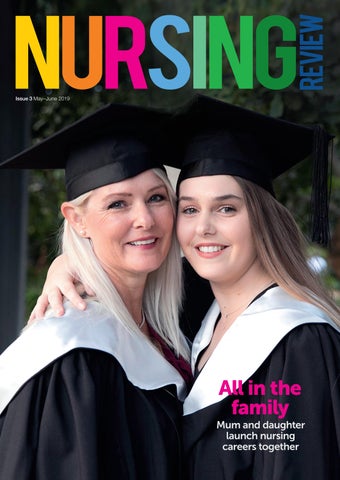
All in the family Mum and daughter launch nursing careers together
For formula-fed infants For healthcare professional use only
S-26 GOLD® NEWBORN …brings you closer Built on 4 key pillars of the Alula® Newborn PlatinumCare Complex™ These 4 key pillars provide nutritional support for key areas of infant development and function. Here we take a closer look at the Immunity pillar: Physical growth & development
Brain development
Contains a lower protein quantity of 1.28 g/100 mL. Feeding a lower protein formula* during infancy may encourage appropriate weight gain closer to breast-fed infants during early childhood development up to 6 years1-3
Our DHA content (min 0.32%) closely aligns with expert recommendations and the average DHA content of mature breast milk (0.32% ± 0.22%)4,5 Alula ® Newborn
Immunity Contains nucleotides, zinc and alpha‑lactalbumin naturally found in mature breast milk, which may help support immunity3,10,13‑18
PlatinumCare Complex ™
Digestion With added sn-2 palmitate (sn-2 palmitate enriched formula may result in softer stools) and easy to digest whey-dominant, alpha-lactalbumin enriched, whole (intact) protein6,13-16
DHA = Docosahaexanoic Acid *vs higher-protein infant formula
IMPORTANT STATEMENT: Breastfeeding is best for babies. It has benefits for the infant, such as reducing infection risk, and for the mother. It is important to have a healthy balanced diet in preparation for, and during breastfeeding. Infant formula is designed to replace breast milk when an infant is not breastfed. Breastfeeding can be negatively affected by introducing partial bottle-feeding, and reversing a decision not to breastfeed is difficult. Infant formula must be prepared and used as directed. Unnecessary or improper use of infant formula, such as not properly boiling water or sterilising feeding equipment, may make your baby ill. Social and financial implications, including preparation time and the cost of formula, should be considered when selecting a method of infant feeding. References: 1. Weber, M., et al., 2014. AJCN, 99: 1041-1051. 2. Koletzko, B., et al., 2009. AJCN, 89: 1836-1845. 3. Trabulsi, J., et al., 2011. EJCN, 65: 167-174. 4. Koletzko, B., et al., 2008. J. Perinat. Med., 36: 5-14. 5. Brenna, J. T., et al. 2007. AJCN, 85:1457-1464. 6. Bar-Yoseph, F., et al. 2013. PLEFA 89(4), pp.139-143. 7. Innis, S.M., 2011. Adv.Nutr., 2(3), pp.275283. 8. Kennedy, K., et al., 1999. AJCN, 70: 920-927. 9. Yao M., et al. JPGN 2014;59: 440–448. 10. Davis, A., et al., 2008. EJCN, 62: 1294-1301. 11. Lonnerdal B. 2011; Nestle Nutr Inst Workshop Ser Pediatr. Prog. ;67,42-54. 12. Hoffman, J. & Falvo, M. J. 2004. J. Sports Sci. Med., 3: 118-130. 13. Yu, V. 2002. J. Paed. Child Health, 38: 543-549. 14. Singhal, A.,et al., 2008. AJCN, 87: 1785-1792. 15. NHMRC 2014. Nutrient Reference Values for Australia and New Zealand. Canberra: NHMRC. 16. Donangelo, C. M. & King, J. C. 2012. Nutrients, 4: 782-798. 17. Ortega, R., et al. 1997. EJCN, 51: 253-258. 18. Affolter, M.,et al. 2016. Nutrients, 8: 504-518. ® Alula is a registered trade mark of Aspen Global Inc. ™ is a trade mark of Aspen Global Inc. ® S-26 GOLD is a registered trade mark, used under licence. Distributed by Aspen Nutritionals Australia Pty Ltd. ABN 31 160 607 509 34-36 Chandos Street, St Leonards, NSW 2065. 01322-150518. ASP3873.
ASP3873 GOLD NEWBORN Immunity_210x297mm_NR_FP_R1_FA.indd 1
15/4/19 4:01 pm
contents
MANAGING EDITOR
news
Richard Garfield 02 9936 8628 richard.garfield@apned.com.au
2 4 6 7 8
NEWS EDITOR
Dallas Bastian 02 9936 8637 dallas.bastian@apned.com.au
industry & reform
10 Harrowing truths
HEALTH EDITOR
Conor Burke 02 9936 8638 conor.burke@apned.com.au
Care worker recounts murder Call for ‘no lifting’ policy Dragon queen backs nurses Antibiotic use falls for first time Nurses and midwives celebrated
02
08
Key moments from the royal commission hearings in Sydney 12 Gentle into that good night What the Voluntary Assisted Dying Act means for nurses
SUBEDITOR
legal corner
Robert Santos
14 Social media no refuge PRODUCTION COORDINATOR
Why all your posts are subject to professional standards
Kate Prendergast SALES MANAGER
specialty
Ben Long 02 9936 8664 ben.long@apned.com.au
16 Caring for ageing minds
SUBSCRIPTION ENQUIRIES
Nina Boyle 02 9936 8602 subs@apned.com.au
12
14
Identifying mental health issues in older patients 18 Antipodean divide Expat nurse leader reflects on Aussie and US healthcare
clinical
20 Compassion over KPIs
COVER IMAGE
Lorella and Laine McLatchey Photo: USC
Understanding kindness improves patient outcomes
PUBLISHED BY
workforce
22 High five, Mum! APN Educational Media GPO Box 4245 Sydney NSW 2001 ABN 58 090 900 999 ISSN 1326-0472 PP100001944 PUBLISHER’S NOTE
16
20
© Copyright. No part of this publication can be used or reproduced in any format without express permission in writing from APN Educational Media. The mention of a product or service, person or company in this publication, does not indicate the publisher’s endorsement. The views expressed in this publication do not necessarily represent the opinion of the publisher, its agents, company officers or employees.
Mother and daughter graduate with nursing degrees 23 Remote ideas The barriers NPs face in rural areas 24 Getting on with the job Aged care taskforce chair says we can’t wait around for reform 26 Beyond the stress ball Mindfulness experts on how to reduce stress 28 Her power, her choice Shining a light on the path to leadership
technology
30 Tech for transparency
24
30
SA announces trial of CCTV in aged care facilities 32 Democratising dementia Free dementia course gives top training to all nursingreview.com.au | 1
news
Kathryn Nobes gives testimony. Photo: AAP/Royal Commission
‘There’s been a murder’ Aged care worker recounts devastating incident at her facility and warns against reoccurrence. By Conor Burke
T
wo sisters took the stand at the aged care royal commission in Sydney recently and told the room that they had held their sobbing mother’s hand as she had her teeth extracted due to neglect by an aged care facility. The sisters, named DL and DM to protect their identity, told the royal commission of the “gum erosion and rotting teeth” their mother had suffered as a result of poor oral care, which left the dentist “disgusted”. Only six months before, DL had taken her mother to the dentist with no problems. “According to the dentist, the problem was simple: the carers at Brian King Gardens were not taking her denture plate out each night. They were also not cleaning it,” DL’s statement to the commission said. The cost of the teeth extraction and new plates left the sisters over $1400 out of pocket. The commission also heard testimony from an aged care worker suffering from PTSD, the result of the murder of a resident at her facility. Kathryn Nobes, who read her statement to the commission, said her condition was aggravated as her facility made cooperating with the police difficult.
2 | nursingreview.com.au
Her statement also gave the commission an insight into the tough conditions aged care workers can face when caring for people with dementia. “In an instant, he let go of the rail, made fists of his hands and plunged them into the faeces,” Nobes said. “He quickly turned towards me and punched me in the breasts. I spun around and he continued to punch me in the arm and in the back. I ended up with his faeces all over my shirt.” She also told the commission of incidents of racial attacks on workers, escape attempts and inappropriate sexual behaviour by residents. Her testimony highlighted the scant training and support offered to aged care workers. She painted a picture of an industry understaffed and under pressure. Sometimes she had to look after 18 residents alone. “Some days were just chaotic. I had to constantly think of how to approach tasks when there were three or four incidents happening at the same time. “I had to ask myself, ‘Which one do I do first? And which one is going to cause me the most damage?’ Simple tasks take much longer with residents with dementia, and to rush them can trigger aggressive behaviours,” Nobes said. “I was repeatedly assaulted by residents. I have received blows, kicks, headbutts, twisting of the skin on my arms, grabbing and squeezing of my hands and arms, attacks with faeces, verbal abuse and threats.
“I documented these assaults on the work computer. I have not noticed any real changes in the workplace.” Nobes also recalled the violent incident between two residents that led her to come forward. “I looked down the corridor and saw the resident walking towards us,” she said. “The resident was holding a walking stick in his right hand, like it was a club … I noticed that the resident had blood on his knees and some blood on his hands. He had some indent on his knees too. I think I also saw blood on his face around his mouth.” This was dismissed as a nose bleed by staff until, a short while later, the discovery was made. “[Another staff member] came running up to us and said words to the effect, ‘While I was at break, there has been a murder. The resident has murdered another resident’.” Nobes said the resident had a history of violent behaviour. She still works at the facility and has come forward as she fears “this type of incident will be repeated”. “I am making this statement to the royal commission as I feel that the work conditions at the facility are having a serious impact on quality of care and the safety of not only the residents but also the staff,” Nobes said. “In my opinion, staff working with dementia residents need more training,” she added. “There is insufficient staffing at the facility.” ■
“I want a super fund that puts more money in my pocket.” Angie Monk, Midwife
Based on a starting salary of $50,000 and a starting account balance of $50,000, HESTA has delivered $56,437 more than the average
retail super fund over the past 15 years.*
Lower fees and higher investment earnings mean more money for your future.
*Past performance is not a reliable indicator of future performance and should never be the sole factor considered when selecting a fund. Comparisons modelled by SuperRatings, commissioned by HESTA and show average differences in net benefit of the main balanced options of HESTA and retail funds tracked by SuperRatings, with a 3 (144 funds), 10 (73 funds) and 15 (45 funds) year performance history, taking into account historical earnings and fees – excluding contribution, entry, exit and additional adviser fees – of main balanced options. Outcomes vary between individual funds. Modelling as at 30 June 2018. See hesta.com.au/superraterassumptions for more details about modelling calculations and assumptions. Issued by H.E.S.T. Australia Ltd ABN 66 006 818 695 AFSL 235249, the Trustee of Health Employees Superannuation Trust Australia (HESTA) ABN 64 971 749 321. This information is of a general nature. It does not take into account your objectives, financial situation or specific needs so you should look at your own financial position and requirements before making a decision. You may wish to consult an adviser when doing this. Before making a decision about HESTA products you should read the relevant Product Disclosure Statement (call 1800 813 327 or visit hesta.com.au/pds for a copy), and consider any relevant risks (hesta.com.au/understandingrisk).
HESTA-Testimonials-AngieMonk-210x297.indd 1
24/4/19 3:11 pm
news
Rock ‘n’ roll, push ‘n’ pull Lifting the lid on a dangerous nursing practice.
S
tudies show that during an average 12-hour shift, a nurse lifts 1.8 tonnes, re-positions patients 69 times, and performs four transfers. That’s a lot of lifting, pushing and pulling, and it can leave nurses battered and bruised. According to Kathy Whittington from medical systems manufacturer Span-America, 40kg is classed as a light lifting load in nursing. However, in other industries, OHS standards say anything over 20kg is a hazardous load. Add all of this together and Whittington is troubled. Constant lifting and straining can leave many nurses with RSIs and back problems in later life. Whittington told attendees at the recent Nursing Expo at Australian Healthcare Week that the US nursing guidelines advocate no lifting at all. She believes that nurses need to change the culture that expects them to lift and strain themselves. This starts at universities and ends on the wards.
Benefits to both sides ACN calls for minimum qualification for unregulated healthcare workers.
U
nlicensed healthcare workers need regulation, not only for the wellbeing of those under their care but to ensure they’re not putting their own careers in jeopardy.
4 | nursingreview.com.au
Whittington told the audience that nurses need to take advantage of the new technology that surrounds them. Articulating beds, lifts and slings make for safer patient handling and mobility. Avoiding lifting and logrolling also removes the likelihood of a patient falling as a result of the lift and any resultant injuries that may occur. Some in the audience took umbrage with the suggestion that universities don’t teach safe handling. However, it was pointed out that many nurses learnt their trade in pre-OHS days. One nurse in attendance, Laura Caponetto, told Nursing Review that she is constantly lifting and has suffered as a result. “I used to work in orthopaedics, so lots of lifting there,” she said. “I actually tore a muscle in my shoulder when I first started. Clients these days are getting bigger, and with the ageing population, people are relying on others to help them mobilise and transfer. “Many of them are incontinent, so you are moving them more frequently to change them.” Caponetto agreed with Whittington on teaching and culture changes. “When I was doing my degree, all those machines and things weren’t really talked about. Yes, there was a ‘no lifting’ policy, but the reality when we went on placement was that machines are barely used. “It was all nurses lifting clients, or in pairs … and when we are short-staffed with a big patient load and time constraints, it’s quicker to just push and pull as opposed to just grabbing a hoist or a lift,” she said. Whittington told the crowd to leave her talk with these ideas in mind: work smarter not harder, use the equipment available and use technology to make the job easier. ■
That’s one of the key messages the Australian College of Nursing (ACN) is sending through a new white paper. It calls for unregulated healthcare workers (UHCW) to obtain a minimum qualification before working within primary or acute settings or residential aged care, and for regulation of this growing segment of the workforce. The college’s concern partly stems from the fact that UHCWs are increasingly undertaking activities that fall within nursing work. Professor Leanne Boyd, chair of ACN’s Workforce Sustainability Policy Chapter, said while Australia’s health system could not operate without unregistered carers, “their responsibilities, level of supervision and even their job title differs across the country”. On top of nationally consistent minimum educational and ongoing professional development requirements, ACN wants there to be nationally consistent titles, codes of conduct, professional standards and scope of practice. “Nurses have witnessed the harm/detrimental effects experienced by those who rely on care from the health and aged care system, which has thus far failed to regulate UHCWs, who are increasingly providing nursing care without adequate qualifications to ensure patient safety,” the white paper said. “As the pre-eminent professional nursing body, ACN is committed to working with the Australian government to facilitate a sustainable, appropriately skilled and regulated workforce to meet the future healthcare needs of all Australians.” ■
B2B Short Courses Nursing Review Ad FA.indd 1
14/5/19 4:13 pm
news
Emilia Clarke. Photo: Gage Skidmore
Celebrity boost Campaign aims to raise the profile of nurses globally and at home.
N
urses are coming together to let world leaders know that universal health coverage needs nurses working their full scope. The message is key to the Nursing Now campaign, spearheaded in Australia by the Australian College of Nursing (ACN) and Australian Nursing and Midwifery Federation (ANMF). ACN chief executive Adjunct Professor Kylie Ward said the initiative will “empower nurses to take their place at the heart of tackling 21st century health challenges”.
The contribution nurses do and can make to healthcare has resulted in the campaign gaining high-profile supporters, including the Duchess of Cambridge, Kate Middleton. Middleton helped launch the global campaign early last year. Later in the year, Game of Thrones actress Emilia Clarke was announced as a Nursing Now ambassador. The campaign aims to raise the profile and status of nurses and to help maximise the contributions they make to ensuring healthcare access for all. “Compared to many other nations, Australia is fortunate in terms of universal health coverage through our system of Medicare,” Ward said. “However, access to the health system remains unequal. “There are still unacceptable disparities in health outcomes for those on a low income, people for whom English is not a first language, those living in rural and remote areas, and most particularly Aboriginal and Torres Strait Islanders, and the aged care tsunami is bearing down on us.” Lord Nigel Crisp, co-chair of Nursing Now and of the UK’s All-Party Parliamentary Group on Global Health, said Australia’s efforts will make an invaluable contribution to a growing global campaign. “We are united in our efforts to improve health globally by raising the status and profile of nursing and midwifery,” Crisp said. Nursing Now will run until the end of 2020, the bicentenary of Florence Nightingale’s birth. Coinciding with the launch, Crisp will announce ACN’s inaugural Health Minister’s Award for Nursing Trailblazers. ■
Scurvy scare Fears of outbreaks among older people may be justified.
O
lder hospital patients are not getting all their vitamins. Recent Flinders University research has found that large numbers in the cohort have a severe vitamin C deficiency. The findings give some credence to
6 | nursingreview.com.au
previous media reports of increased scurvy outbreaks. Led by Dr Yogesh Sharma, the study authors read the vitamin C levels of general patients admitted between September and November 2017. More than three-quarters of the patients had lower than normal levels. More than a third (40 per cent) were classified as having a severe vitamin C deficiency.
Sharma said physicians are often unaware that a large proportion of patients might be vitamin C deficient. “Socially isolated older people are the high-risk group most prone to suffer from vitamin C deficiency – the infirm, those living alone, people struggling with alcoholism and mental health issues – but our research found that this deficiency was found across all types of patients in hospitals aged 60 or over. “It is a more significant issue than we first thought.” He added very low levels of vitamin C present a serious obstacle to patients’ swift recovery and release. More broadly, Flinders research into the nutritional wellbeing of older hospital patients showed that more than 50 per cent are malnourished. Sharma said: “If proper screening was done of older patients’ nutrition when they entered hospital and an effective dietary plan was implemented, it would result in significant cost savings – an estimated $900 per patient. “If this was applied across all older patients admitted to Flinders Medical Centre, that would equate to a saving of $1.8 million a year. If applied to all hospitals in South Australia, a saving of $9 million a year.” ■
news
Antibiotic use falls But antimicrobial resistance still on the rise.
A
new report shows that the overall use of antibiotics in the community fell between 2015 and 2017 – the first decline in 20 years. However, the Third Australian Report on Antimicrobial Use and Resistance in Human Health revealed that antimicrobial resistance is on the rise as antibiotics are continually overprescribed. The report was conducted by the Antimicrobial Use and Resistance in Australia (AURA) Surveillance System,
which was developed by the Australian Commission on Safety and Quality in Health Care with an aim to support the prevention and containment of antimicrobial resistance. In 2017, total hospital antibiotic use rose for the first time since 2013, while “inappropriate” prescriptions of antibiotics in hospitals remained steady from the 2013 stats, at 23.5 per cent of all prescriptions. The five most commonly prescribed antibiotics in the hospitals that participated in the study were amoxicillin-clavulanic acid, cefazolin, flucloxacillin, doxycycline and amoxicillin. Cefalexin and amoxicillinclavulanic acid were found to have had the highest rates of inappropriate prescriptions. The most common ailments recorded for prescriptions of antibiotics in hospitals were surgical prophylaxis, communityacquired pneumonia, medical prophylaxis, urinary tract infections and sepsis. In primary care, antibiotic prescriptions declined between 2016 and 2017, the first such decline since the 1990s. However, Australia’s use of antibiotics in the community remains high, sitting in
the top 25 per cent of countries. In 2017, 41.5 per cent of the nation had at least one systemic antibiotic dispensed to them. AURA found that people were prescribed antibiotics for conditions for which there is no evidence of benefit, including influenza and acute bronchitis. The figures for aged care homes are also concerning. The report stated that “aged care homes in Australia have high levels of both unnecessary antimicrobial prescribing and inappropriate antimicrobial use”, with at least one in 10 residents of participating homes prescribed at least one antimicrobial, and “more than half of antimicrobial prescriptions were for residents who had no signs or symptoms of infection”. Kathryn Daveson, AURA clinical director, said: “While the downward shift in prescribing will help to slow the spread of resistance, these latest AURA findings indicate that the levels of inappropriate prescribing of antibiotics in hospitals and the community are still too high and there is more work to be done.” n
“The parents of sick kids in hospital are themselves patients, in a sense, plagued with worries about their child [and are] uncertain and powerless,” she said. “This is known but largely unmeasured. “Parental stress in hospital needs more attention because it can affect the care of children.” Morelius’ call comes on the back of her research that showed parents of sick children in hospital experienced higherthan-average acute stress levels. For her study, she collected saliva samples of 31 parents staying with their children in paediatric wards to look at cortisol levels.
Those remaining in hospital with their kids had low morning cortisol levels, suggesting they’d been exposed to high stress the day before. And it’s not just concern over the wellbeing of their child that is stressing out parents. Morelius said they’re also grappling with absence from work, financial impacts, general uncertainty and sleep loss. Another stressor for the parents in the study may have been the ‘waiting game’ – the authors said it has been described as the most stressful aspect of the hospital experience for family members as they struggle to maintain a balance between negative and positive thoughts. “It’s well known that stress can cause stress-related diseases and affects cognitive abilities such as memory, learning new things and behaviour,” Morelius said. “We have previously shown that waking several times during the night when in hospital affects parents’ mood and cognition, making them less concentrated and alert.” Morelius said she would like to see interventions to prevent and address parents’ stress, as it would help parents to provide the support and comfort their children need in order to recover. ■
Sick with worry Parents of hospitalised children need more attention: study.
H
ospitals often invite mums and dads to remain with their sick children but the parents aren’t given enough thought during their stay, an expert on childhood stress has argued. Stress directly affects parents’ ability to understand information, make decisions regarding their child’s care and look after themselves for the sake of their child, said Professor Evalotte Morelius, an Edith Cowan University researcher.
nursingreview.com.au | 7
news
of 1978. It advocated for health as a human right, and urged countries to recognise health as a state of complete physical, mental and social wellbeing and not merely the absence of disease or infirmity. “With a core role as a patient advocate, their scientific reasoning skills, numbers and spectrum of care across the continuum, nurses are ideally placed to lead and inform health services decision making and policy development,” ICN said.
REWARDING EXCELLENCE IN CARE
Midwife of the Year, Tracey Stephens. Photo: Supplied
‘This is my dream role’ Acknowledging the crucial role of midwives and nurses. By Conor Burke
N
urses and midwives were recently celebrated with the International Day of the Midwives (5 May) and International Nurses Day (12 May). For the former, this year’s theme was ‘Midwives: Defenders of Women’s Rights’. The International Confederation of Midwives (ICM) is encouraging midwives around the world to continue to protect “the rights of women, girls and midwives by ensuring they can exercise their full human rights, particularly their reproductive and sexual health rights, in their communities and countries of practice”. They call for midwives to fight instances of female genital mutilation and fight for the use of contraception in countries where its use is prohibited. They want to celebrate those midwives who fight the gender pay gap and who are “fighting patriarchy” in all its forms. Australian College of Midwives CEO Ann Kinnear told Nursing Review that only 8 per cent of women in Australia have access to a midwife, and that this is not good enough. Midwifery models of care
8 | nursingreview.com.au
reduce stillbirth, increase mental health support and improve breastfeeding rates. “This year’s IDM theme resonates strongly with the Australian College of Midwives,” Kinnear said. “Defending women’s rights means increasing access to midwifery models of care, particularly those where women are cared for by a known midwife through pregnancy, childbirth and postpartum. “ACM is pleased to see the NHS committing an additional £40 million ($74 million) to increase women’s access to a known midwife, with the aim of having 50 per cent of women being able to access this model by 2021. “We would like to see the Australian government follow suit and commit to improving health outcomes for Australian mothers and babies,” she said. International Nurses Day coincides with the birthday of the mother of modern nursing, Florence Nightingale. The International Council of Nurses (ICN) announced the theme for this year as ‘Voice to Lead – Health for All’. “For ‘health for all’ to be achieved, there must be a transformation in the approach to health and wellbeing,” the ICN said. The idea of ‘health for all’ was first articulated in the Alma-Ata Declaration
HESTA has also recognised nurses and midwives by announcing its 2019 Australian Nursing & Midwifery Awards. The Nurse of the Year award went to Kate Curtis, from Illawarra Shoalhaven Local Health District and professor of trauma and emergency at the University of Sydney. Curtis was recognised for her work in advocating to improve emergency hospital care across Australia and internationally, particularly for injured children. She was instrumental in obtaining federal funding to develop a National Injury Prevention Strategy and is an internationally renowned emergency and trauma nurse clinical researcher. “The most rewarding thing about this work is knowing that we’re making a difference through research and advocacy for this pandemic that is childhood injury. Injury is the leading cause of death and disability in Australian kids,” she said. Midwife of the Year went to Tracey Stephens from Monash Health in Victoria. Stephens won the award for her work in improving maternity and healthcare outcomes for Aboriginal and Torres Strait Islander women and babies by implementing culturally appropriate and safe maternity healthcare services. “Aboriginal and Torres Strait Islander women in my community are often vulnerable and experience many barriers when trying to access healthcare. This is why it’s really, really important for Aboriginal women like myself to be in roles like this. Aboriginal-led care is crucial to promoting the best possible health outcomes for these women and their babies,” she said. “This is my dream role. Every day, I get the opportunity to work with women to achieve the best outcomes in their birthing journey. After birth, I am able to follow these women into the community and watch healthy babies and competent mothers thrive.” ■
re for Healthlscaon ly Professiona Breastfeeding is the natural infant feeding method However, if a mother is unable to breastfeed or decides to mix feed or move on from breastfeeding, the choice of formula matters
Diamond pro+ Premium Infant & Follow-on Formula and Toddler Milk Drink + With Prebiotics & Probiotics + Lower protein levels in Stage 1* + Higher iodine levels* + Australian owned and made Available in Coles supermarkets and selected pharmacies nationally
Complementing first foods
Lower protein formula
When their diet is inadequate
Australia’s Own Diamond pro+ Premium Infant & Follow-on Formula and Toddler Milk Drink, with Prebiotics & Probiotics, combines leading scientific knowledge and nutrition expertise to support healthy growth and development. Brought to you by Australia’s Own trusted Australian dairy cows.
Careline Australia (Freecall): 1800 646 231 | professionals@aodiamondnutrition.com.au | aodiamondnutrition.com.au/hcp
*Compared with other leading brands
Healthcare Professionals are well placed to provide infant feeding education to families
industry & reform Merle Mitchell gives evidence via video. Photo: AAP/ Royal Commission
No voice, no choice A summary of the third round of the aged care royal commission’s hearings in Sydney, which focused on dementia. By Conor Burke
D
arryl Hilda Melchhart, a sharpminded 90-year-old who has lived in residential aged care since 2014, was the first to take the stand in Sydney at the hearings of the Royal Commission into Aged Care Quality and Safety. Inside a small courtroom, she spoke to the many problems within residential care as she sees it, from rationed incontinence pads, to bland food, to loneliness. Melchhart groaned when prompted to talk about the problems she faces when asking nurses for simple things such as getting her medical paperwork ready for the cardiologist. More shocking were her recollections of the violence she faced at the hands of other residents on the ward, where, in her estimate, only 10 of the 90 residents have their full faculties. One incident saw a resident come into Melchhart’s room to steal her jewellery box. When confronted, the resident attacked her with a mug. Melchhart has spoken to staff about all of these issues, she said, but she feels as if she has “no voice”. When she alerted a nurse to her expiring GTN spray, which she needs for a heart condition, she said the nurse refused to
10 | nursingreview.com.au
grant her a new one and took the depleted spray away. This left her without this potential life-saver for nearly four days, until her doctor intervened. Another aged care resident, Merle Mitchell, AM, gave evidence via a prerecorded video. She told the court of the “terrible” time she had transitioning from an independent life to an “institution”. She felt she had “no choice” but to conform to the strict schedules imposed upon her. Like Melchhart, Mitchell recounted her own near-death experience. “Three senior people” ignored Mitchell’s complaints of pain, telling her “it is all in your head”. Only when a fellow resident warned nurses that they were at risk of committing elder abuse was Mitchell taken to hospital, she said. She was found to have a crushed disc and broken back. When asked whether she felt that staff are adequately trained to provide care, Mitchell gave a blunt “no”. And if she could nominate one thing to change in the sector? “Ratios, ratios, ratios. Everybody will tell you that.”
‘NO LONGER THE MAN HE WAS’ Drugged without family consent and strapped to a chair for hours on end, Terrence Reeves spent a hellish 60 days in Garden View aged care facility, the royal commission was told. Wife Lillian and daughters Michelle McCulla and Natalie Smith recounted how an otherwise fit Reeves entered the Garden View facility on a short respite with dementia, and at that point was still able
to shower himself and get around with Lillian’s help. Lillian and her daughters were approached by staff about signing a restraint form for Reeves for short periods, as they “felt that during changeover shift there weren’t a lot of people that would be watching him, and that it would be for his own safety”. However, in McCulla’s testimony, the court heard that on nearly 30 occasions family members turned up to find Reeves restrained, sometimes in a secure dementia wing with many other patients strapped to chairs in a small room. On nearly every other visit to the facility, McCulla or other family members found Reeves tied down, she said, and in one instance found him “drooling” and “shivering”, barefoot and wearing only a singlet wet with saliva. Reeves was also wet from incontinence that day, and McCulla recounts hearing his screams as he was changed by six nurses all pulling at separate limbs trying to undress him. “Dad grabbed my arm and said, ‘How would you like it?’” McCulla said. Lillian told the commission that at no point did she mention to Garden View staff that she ever gave her husband risperidone, nor did she ever consent to him being administered the drug by Garden View staff. However, the women were convinced that their father was being medicated. McCulla remembered an occasion when the whole family brought a homecooked lunch to Reeves. They found him unconscious, she said, but were told he was asleep. As they tried to rouse him, he started to gag. McCulla found a piece of meat lodged in his throat. She cleared the obstruction and lifted him up to continue rousing him, only to find he had faeces smeared all along his back. There was then a disagreement between the family and Garden View as to whether Reeves had been medicated. According to notes presented to the commission, Reeves was regularly given a dose of risperidone, which staff say had been approved by Lilian. However, the family say this is not the case, and when they confronted staff that day, they were told Reeves had not been given the drug in about a month. “They said, ‘No, no, look at his charts.’ I was convinced that it was risperidone,” McCulla said.
industry & reform
An RN from Garden View gave evidence that she was told by Lillian Reeves that it was fine to administer risperidone up to three times daily. “Well, if they’re saying that we informed them that that’s something that we would do at home, it’s 100 per cent incorrect,” McCulla said. Remembering an interaction with the nurses who questioned McCulla and her sister as to what was wrong with their father, she recalled replying, “You tell us. He is no longer the man he [was when he] came in.”
INNOVATIVE SOLUTIONS “We’re not funded for how happy a resident is.” That’s one of the ways in which the aged care system fails to incentivise good practice, the royal commission heard. Lucy O’Flaherty, who heads Glenview Community Services in Tasmania and will oversee the development of its Korongee dementia village, said: “If we look at the way the industry is structured, we are … funded for the amount of medications we’re giving, how many times we shower someone and what meals we provide.” Tamar Krebs, co-chief executive of Group Homes Australia, said she would like to see a voucher system that would fund community or residential aged care as soon as a consumer needs it. Commissioner Richard Tracey welcomed the change of tone for the hearings after the weeks of harrowing testimony. “It has been refreshing to hear how a bit of innovative thinking can produce good outcomes,” he said.
BUPA UNDER THE SPOTLIGHT The second week of Sydney’s commission hearings heard testimony detailing the death of an aged care resident at a Bupa facility in late 2017. Two daughters recounted walking into the building and hearing “this loud rumbling that was so disconcerting and scary I think that as soon as my sister heard this, we ran”. The sound was their mother, struggling for breath in her final hours. DE died four weeks after she was admitted to the Bupa facility in Willoughby, Sydney, aged 70. DE’s daughters outlined the poor care their mother had received, which included bed sores, malnutrition and poor upkeep of her hearing aids and glasses, leaving her, at times, essentially deaf and blind. DE had no communication abilities and was unable to feed herself, and the
daughters were soon worried that she was not being fed properly by staff. “Every time we would go, Mum’s face was more sunken and she was becoming a lot more unwell.” The daughters tried bringing this up with staff, but say their concerns fell on deaf ears. The daughters told the commission that they and other family members could successfully feed their mother when they visited. They say other health professionals who visited Bupa knew it was an issue as well. They recalled an incident with a speech pathologist who tried to teach them how to successfully feed their mother to avoid dysphagia. “And she said to me, ‘Now I’m going to show you a 3.5-minute video on how to feed your mother so that there is no risk.’ “And I said to her, ‘Shouldn’t you be showing this to the nurses here, because I’m not here every day.’ “She said to me, under her breath, ‘There’s not a lot of point in that, and that’s why I show the family members who are here, because they’re usually the ones that end up feeding them.’” The commission also heard how DE, who was originally moved to aged care after a series of falls, was admitted to hospital after only 36 hours spent in the Bupa home, diagnosed with aspirant pneumonia. When talking to witness Maureen Mary Berry – formerly the interim chief operating officer of Bupa at the time DE lived at the Willoughby facility – counsel assisting Peter Gray discovered that although the pneumonia was said by Bupa staff to be the result of a pre-existing condition, poor practice in that short 36-hour period could have been to blame. Gray read hospital notes from DE’s discharge that explicitly state that DE should be monitored “for signs of aspiration/penetration, coughing, wet gurgly voice with oral intake, reduced chest health, and refer to medical/speech pathologist”. Berry admitted that BUPA had failed to follow this advice. On the day of her death, DE’s daughters rushed to the facility after receiving a confusing phone call from staff. They found their mother breathing heavily and in clear discomfort. It took 30 minutes for a GP to appear, they say. He stayed in the room for about a minute, before saying, “This isn’t really my area of expertise,” and leaving.
Before coming to the commission, DE’s daughters took their grievances to the Australian Aged Care Complaints Commissioner. BUPA has been dogged by negative headlines since the Four Corners investigations. As of March, nine BUPA
When asked whether she felt that staff are adequately trained to provide care, Mitchell gave a blunt “no”. facilities were under sanction for failing to meet compliance benchmarks set out by the Australian Aged Care Quality Agency.
YOUNG ONSET DEMENTIA The Sydney hearings ended with testimony from witnesses with young onset dementia. Trevor Crosby was diagnosed with Lewy body dementia four years ago at age 65. Crosby lamented the lack of support people like he and his wife, Jill, are afforded once they receive a diagnosis. He told the commission about the Living with Dementia program he undertook with Dementia Australia, which he described as a “real turning point” for him and Jill. However, after the eight-week course, he felt cut adrift. “I felt cheated. The course was so good, but there was no follow-up,” he said. The last witness was the chief executive of Dementia Alliance International, Kate Swaffer. She was diagnosed with a rare form of younger onset dementia 10 years ago, aged just 49. She told the commission that it wasn’t until 12 months into her diagnosis that she was referred to support services, which in her words “set us up to fail”. People diagnosed with dementia need “intensive brain injury rehabilitation”, she said, and called for people of her age to be “supported to stay at work with reasonable accommodations”, just as if she had suffered an accident causing brain injury. The next public hearings of the royal commission will be held on 17–19 June in Broome and then 24–28 June in Perth. The focus of these hearings will be on aged care for Indigenous Australians, personcentred care and the delivery of aged care in remote locations. n nursingreview.com.au | 11
industry & reform
Into the great unknown How will Victoria’s Voluntary Assisted Dying Act work? By Conor Burke
Y
ou don’t know.” Jac Mathieson, the chief nursing officer at the Peter MacCallum Cancer Centre, found herself saying this a lot when talking about the Voluntary Assisted Dying Act, which is soon to be law in Victoria. In this instance she was asked, “What if someone procures the drug, how do we know that they won’t share it with someone else such as their spouse, or even worse, use it on someone else?” And how might the law impact nurses generally? “[It’s] hard to say. We don’t know.” From 19 June this year, Victorians who meet strict eligibility criteria will be able to access drugs that will end their life from specialty pharmacies. These people must be diagnosed with an incurable disease or medical condition that causes intolerable suffering, the condition must be assessed by a doctor and, importantly, the condition must be predicted to cause the patient’s death within six months. Eligibility only applies to those who have lived in Victoria for a minimum of 12 months and are over 18, and they will need a designated support person who co-signs for the drug with them. A piece in The Conversation quoting a peer-reviewed paper showed that in
12 | nursingreview.com.au
countries where assisted dying is legal “between 0.3 per cent to 4.6 per cent of all deaths are reported as euthanasia or physician-assisted suicide”, and “the frequency of these deaths increased after legalisation ... Existing data do not indicate widespread abuse of these practices”. In the Australian context, Mathieson believes the Act has a number of safeguards within it and is a “long-winded process” that includes the patient having to make three separate requests before they can gain access. After an initial consultation with a doctor, a second doctor will make an assessment, then a person will have to make a written declaration verified by witnesses confirming they wish to undertake the process. No family members will be allowed to administer the drug, nor will nurses, and only in very rare circumstances – such as a patient being unable to physically selfadminister – will a doctor be allowed to administer the drug. In fact, no medical professional will be even allowed to broach the topic of assisted dying with a patient, which could cause some teething problems initially. “I think the design [of the Act] is as good as it could be. There are unknowns because, for example, in the Act it says that every patient has the right to choose and the right to access,” Mathieson said. “But then it also talks about medical professionals not having to participate. So, if you’re the patient and you’re speaking to your doctor and they don’t
have to participate, how do you actually get access? “Those sorts of things, the logistical things, hopefully, will soon iron out.” Other unknowns, according to Mathieson, include the number of patients who will actually exercise this right and the exact role of nurses going forward. “People are pretty quiet at the moment to be honest,” said Mathieson when asked how her workforce felt. “We are getting a lot of questions like: How do we know that they will actually die? What happens if they die on the ward? Really practical questions. “It’s so unlikely that it will happen on a patient ward. But if it did, it’s only then that we will be able to assess the impact. For staff that really don’t believe in it, I think that could be very challenging,” she said. The Act states that “no health practitioner or healthcare provider will be obliged to participate in voluntary assisted dying”. Still, the role of the nurse is not described, Mathieson said. She added that listening and communication will be key for nurses, as “we can’t underestimate the amount of questions a nurse will get”. The Act is also up for review in three years, so roles and practice may change. “The first year will be interesting. I’m expecting that we will get a lot of enquiries, more than actual people following through. “And then it will become business as usual,” Mathieson said. As for the future of voluntary assisted dying in other states, this too is unknown. In a recent paper looking into the future, professors of law Ben White and Lindy Willmott conclude that country-wide adoption of the practice will not be easy. “Voluntary assisted dying in Australia is ‘a train that has left the station’. International trends, growing Australian political support (coupled with strong and continued community expectation), and the weakening of key opposing arguments, all point to other states following Victoria’s lead by legalising voluntary assisted dying. “The heated debates last year in the Victorian parliament about VAD laws revealed a depth of raw emotion from many politicians. “Although reform in other Australian states is likely, that train journey will be one that is slow, uphill and with plenty of twists and turns,” they said. ■
advertorial
Sleep problems in infants The importance of healthy sleep Getting enough good quality sleep is vital for babies’ brain development (including memory consolidation and language learning) and physical growth.1 Inadequate sleep can have a significant emotional impact on both the baby and parents.2 Around 30% of parents report problems with their baby’s sleep in the second six months of life.3 How much sleep does a baby need? Sleep patterns and duration are different for everyone, but as a guide:1 At birth infants typically sleep around 16 to 17 hours a day, in short bouts day and night, since their circadian rhythm is not yet established.1 y By 6 months old babies need less day and more night sleep, requiring an average of 13–14 hours.1 y
Signs that a baby may need more sleep are if they’re wakeful and grizzly.4 Poor sleep and excessive crying: impacts on baby and parents Sleeplessness and unsettledness can impact a baby’s cognitive development.1,5 Anxiety in parents and family stress are common flow-on effects.5 Infant crying and sleeping problems are associated with maternal post-natal depression.4,5 Some solutions you can suggest for parents of sleepless infants: Encourage parents to learn to identify when they are feeling stressed and to have an action plan in place. An action plan may include:2 y Take a break: Give yourself a break – take a few breaths and make a conscious effort to calm down – before you go back to settling your baby.2 y Relax: Perhaps take a shower, make yourself a hot drink, or – if someone else can stay in the house – go for a walk.2 y Call a friend or a support service: Blackmores maternal health & infant nutrition advisory service on 1800 808 669.
Techniques for settling infants vary by age and individual, but routine and relaxation are important.6,7 In general, parents should be encouraged to do whatever works for them and their baby within safe sleep guidelines, including: Establish a bedtime routine: A positive bedtime routine can help a baby settle to sleep.6 y Set a relaxing vibe for sleep: Reduce entertainment, toys and stimulation at night. When baby wakes, keep noise down and lights low to help them settle again.7 y Let their baby see daylight: Safely exposing a baby to natural daylight, and letting night time be a dark time, might help build healthy sleep patterns. Having artificial lights on all the time might slow a baby from understanding the natural patterns of night and day and affect their sleep.7,8 y Avoid moving their baby around: Keeping their baby still and safe in a relaxed environment might make it easier for them to drop back to sleep.6
y
Infant nutrition can affect sleep and settling9 Breastmilk is best for babies, and breastfeeding mothers should be encouraged to continue. Parents should be referred to a board-certified lactation consultant (IBLC) to asses and assist with any feeding issues that may contribute to unsettled behaviour in infants. Where breastmilk is unavailable, a suitable alternative is infant formula.10 Differences in the composition of infant formulas can affect sleep and settling.9,11–13 OPO for longer sleep and less crying12 The OPO (sn-2 palmitate) used in Blackmores infant formulas is a special oil blend that mimics the structure and benefits of human milk fat.11,12
Blackmores.com.au/nutrition
In addition, infants fed high OPO cried for shorter periods of time than infants fed low-beta-palmitate formula (14.9 ± 3.8 vs. 63.9 ± 21.7 min/day; P=0.047).12 Alpha-lactalbumin helps to support quality sleep9,13† Blackmores Infant Formula contains added alpha-lactalbumin, a special whey protein found in high concentrations in human breastmilk.13 Infant’s that are fed formula enriched with alpha-lactalbumin demonstrate higher plasma tryptophan concentrations than those taking un-supplemented standard formulas. This provides a range of benefits including the reduction of time taken to fall asleep (sleep latency).13 Other benefits of Blackmores infant formulas Blackmores Infant Nutrition range is made using premium fresh Australian milk. y
y
Containing prebiotics (GOS) and essential vitamins A, C, D & E, it also contains alpha-lactalbumin, giving it a lower protein concentration than regular cow’s milk whilst still providing amino acids that babies need. Blackmores Newborn Formula has a Whey:Casein ratio the same as breastmilk (60%:40%).13
For formula-fed babies and toddlers with sleeping or settling problems, consider recommending a gentle formula like Blackmores Infant Formula. Available for newborn through to toddlers.
OPO has been clinically shown to promote longer daily sleep vs standard formula fed infants.11 Daily sleep duration at 6 and 12 weeks was higher in the OPO group than with control formula (P<0.05).11
Blackmores supports breastfeeding as the best nutrition for babies. Blackmores Toddler Milk Drink to be consumed as a supplement to a normal diet, to boost intakes of energy and nutrients. References: 1. Tham EK et al. Nat Sci Sleep 2017; 9:135–149. 2. Better Health Channel: Sleep and your baby. Last accessed 26 April 2019 at https://www.betterhealth.vic.gov.au/health/HealthyLiving/ sleep-and-your-baby?viewAsPdf=true. 3. Bayer J et al. J Paeds Child Health 2007; 43(1–2):66–73. 4. The Australian parenting website: How much sleep do babies need? Last accessed 26 April 2019 at https://raisingchildren.net.au/babies/sleep/understanding-sleep/sleep-needs-for-babies. 5. Smart J et al. J Pediatr Child Health 2007; 43:284–290. 6. The Australian Parenting Website. Changing your baby’s sleep patterns. Last accessed on 26 April 2019 at https://raisingchildren.net.au/babies/sleep/solving-sleep-problems/changing-sleep-patterns#step-3-establishing-a-positive-bedtime-routine-nav-title. 7. Barbeau D et al. Children 2017 Oct 20; 4(10):90. 8. McGraw K et al. Sleep 1999 May 1; 22(3):303–10. 9. Steinberg LA et al. J Nutr 1992; 122(9):1781–1791. 10. Canfield LM et al. Eur J Nutr 2003 Jun 1; 42(3):133–141. 11. Bar-Yoseph F et al. Clinics Mother Child Health 2017; 14(263):2. 12. Litmanovitz I et al. BMC Pediatr 2014 Dec; 14(1):152. 13. Lien L. Am J Clin Nutr 2003; 77(6):1555S–8S. Blackmores, 20 Jubilee Avenue, Warriewood NSW 2102, Australia. www.blackmores.com.au Blackmores® is a registered trademark of Blackmores Limited. Date of preparation: May 2019. 15210/PT.
nursingreview.com.au | 13
15210 Blackmores IF Full Page Advertorial 210x275_FA2.indd 1
13/5/19 4:34 pm
Legal Corner
And later he posted: “If my marriage fell apart, it would not end in divorce. It would end in murder.”
No hiding online Healthcare professionals need to maintain society’s expectations even when posting online. By Scott Trueman
W
hen nurses use social media, whether at home or at work, they need to be aware of their professional obligations. Their online behaviour is governed by the Nursing and Midwifery Board of Australia’s codes of conduct and ethics, as well as the Australian Health Professional Regulation Agency’s social media policy. A recent disciplinary hearing highlights what can happen when social media posts bring the profession and the individual into disrepute. While it relates to the actions of a medical practitioner, it is also applicable to nurses. The case concerns a medical practitioner, Dr L, who made inappropriate statements and comments in posts on overseas online forums and chat sites, starting in 2016. Dr L was readily, from his own words and photographs, identifiable as an Australian medical practitioner. His online comments included the following: “I beg to differ. This kind will NEVER learn. She needs to be abandoned in India and repeatedly raped...” “I am a medical practitioner. I also have a foul mouth and call a spade a spade.” “I can just as easily condemn your mother for a whore (if the situation warranted it) as I can save your life...” “Nah, I’m a lesbian in mind only ... I just need some alcohol.” “With her suicide, nothing of value would be lost.” In 2017, referring to an article about an Egyptian lawyer who was sentenced to three years in prison for saying that women who wear ripped jeans should be raped as punishment, Dr L posted: “I’m surprised they didn’t give him a medal instead.” In 2018 Dr L described himself as follows: “A mongrel doctor who claims to know all manner of shit on earth. He works and resides in Australia ... There’s some tiagong [sic] that he was forced into the marriage because his wife had threatened to report him to police for raping her, after he spiked her curry then upped her after their graduation prom night.”
14 | nursingreview.com.au
At the time of the disciplinary hearing in 2019, Dr L was aged 31. He submitted in mitigation that none of his sociopolitical and other personal views coloured or influenced his medical practice. Further, Dr L submitted that he did not fully appreciate that posting comments on a Singaporean online forum would have consequences on his practice of medicine in Australia and that they were made, “not in the practice of medicine” and after hours. The tribunal found that Dr L understood that the posts could be perceived as inflammatory, misogynistic and racist in tone and that the posts were clearly associated to him. It was clear from the posts and the photographs he posted that he was a registered medical practitioner from Australia. The tribunal also found that the posts conveyed socially unacceptable and extreme sentiments that were disrespectful of women and commented upon violence towards or sexual abuse of women: “Some of the online posts might reasonably be interpreted as being racially discriminatory contrary to acceptable social norms in Australia. All of the online posts had the potential to incite radical views, antagonise the reader, and they had the potential to cause harm to the public. In addition, some of the posts involved the use of vulgar language, expressions of committing violence and crime, all of which are inconsistent with the good repute of medical practitioners and the relationship of trust between medical practitioners and patients who are, of course, members of the public.” The tribunal found in relation to penalty that: “The conduct is serious and does amount to professional misconduct. Accordingly, a strong sanction is necessary in order to send a message to both the respondent [Dr L] and doctors broadly that they need to be circumspect and they must abide by the professional behaviours required of them in the code and the social media policy.” The tribunal stated that the conduct amounted to professional misconduct pursuant to the National Law. Insofar as penalty was concerned, the tribunal ordered: (a) that Dr L be reprimanded (b) that he be suspended from practising for six weeks (c) that he be required to undertake education on ethical behaviour and communications, particularly in the use of social media. This case demonstrates that even if posting on overseas forums, when physically overseas, when not in the course of employment and when on your own computer, it can still amount to professional misconduct. These clearly offensive posts fall well below the standard set by both the profession and the public of what they expect of a health professional. What was egregious in this matter was the associated posted photographs that linked the author to his name, degree of specialty, his employment and his health service employer. Remember, what you post on social media, no matter where, is literally broadcast to the world at large. ■
Looking after members’ retirements savings since 1912.
Welcome to super without surprises Product issued by the QSuper Board (ABN 32 125 059 006, AFSL 489650) as trustee for QSuper (ABN 60 905 115 063). Consider the PDS on our website to see whether QSuper is right for you. © QSuper Board 2019.
specialty focus
Optimistic times
Hopes for mandatory mental health workers in all aged care facilities. Sunil Bhar interviewed by Conor Burke
T
he issue of psychotropic drugs has been front and centre during the royal commission into aged care, but not much time has been devoted to the reason behind their use: mental illness. Approximately half of all aged care residents exhibit symptoms consistent with depression, and typically those who currently reside in aged care facilities have low mental health literacy, so identifying issues can be problematic. Unfortunately, this issue is often neglected, as it is assumed that depression just comes with old age. Sunil Bhar disagrees. As a professor of psychology at Swinburne University, Bhar believes that more should be done to
16 | nursingreview.com.au
tackle mental health issues, and a good starting point would be mandated access to psychological help. Bhar does see room for optimism, however, with last year’s federal budget allocating significant funds to mental health in aged care. Bhar joined Nursing Review to talk about this problem and his work in the mental health space.
NR: I imagine that for a great many people in or entering aged care, mental health was something that was just not talked about as they grew up. Is there a problem with undiagnosed mental health issues in aged care? SB: There’s a huge problem with undiagnosed mental health issues in aged care. Currently, we think that about 50–60 per cent of the people who live in residential aged care have a major depressive disorder, but very few are diagnosed. A lot of people have very serious mental health problems, yet very few are diagnosed.
Should we be educating elder Australians about mental health? I think the reason for the underdiagnosis is quite complex. Certainly, the older
people in our society are less literate about mental health issues. Perhaps there’s also a continuing stigma about being diagnosed with mental health issues. The other side of the problem is that the people in charge of caring for them professionally might also be less well trained, so the symptoms are just not picked up. Sometimes we hear professional carers say it’s natural to feel depressed when you’re old. There’s a continuation of this stereotype that mental health problems in old age are normal, that it shouldn’t be diagnosed and treated.
What are the more common mental health provisions in the aged care system? Are there psychologists on staff, and if not, are they readily available? Well, you’ve just opened up a hornet’s nest right there. Even when mental health problems are diagnosed, particularly in residential aged care, there are very few services to then respond. At the moment, the frontline service happens to be psychotropics. It’s usual for an older resident to be diagnosed and then prescribed antidepressants. There are in fact very few non-medication type therapies readily available and accessible to this population.
specialty focus
Perhaps the most frequently available services are those called ‘lifestyle services’. These are services within care that focus on the social wellbeing of the resident. Often it involves arts and crafts, taking people out on excursions, organising fun group activities. The second most common are pastoral care services, where people are trained to talk about the spiritual care needs of the residents. But there’s no specific service to deal with the mental healthcare needs of the residents. There are very few psychologists in the system, perhaps only a handful of residential care facilities that employ their own psychologists or counsellors. Older people who live in these residential facilities do not have access under Medicare to private psychologists, social workers and so on. It’s very difficult to provide the right sort of non-medication service to these residents.
What else should we be doing to reduce depression? Post royal commission, do you think psychologists should be mandated for aged care facilities? Absolutely mandated. In some of the other countries we’ve explored, such as the US, there are very creative ways of making sure there are some specialists in-house to deal with residents with mental healthcare needs. For example, in many of the US states, some of the larger residential aged care
SO, YOU’RE THINKING OF FURTHER STUDY? That’s a big step in itself and we’re here to help you make the right decision and lead change in your career.
facilities must have a social worker. It’s mandated, it’s a part of the code. In Australia, there’s no such code, there’s no necessity for residential aged care facilities to employ their own mental healthcare counsellors, psychologists or social workers. This is a gap we have to address.
have significantly improved in terms of the quality of life, have felt less anxious, and in some cases, have felt less suicidal. We know there are therapies that work and can work, but it’s such a pity that, at least currently, the system doesn’t mandate that kind of service within care.
Your university, Swinburne, has an Elders at Ease (ELATE) program. You picked up a grant last year for nearly a million dollars to look at improving mental health services, and ran a trial with 500 residents from over 40 facilities in Victoria. Do you have any early findings?
How much do you expect mental health to be talked about at the royal commission going forward? Do you expect to see any changes after the commission concludes?
The ELATE program is just about to start. In fact, we haven’t begun recruiting for that specific project, but over the nine years, we’ve done pilot projects along those lines. The million dollars or so we’ve just won will allow us to evaluate it properly. Over the last few years, we’ve been able to work within residential care facilities where we’ve put postgraduate psychology and counselling students, and undergraduate social worker students, in residential care facilities to work with not just residents, but the families and staff. We’ve found the best approach to helping residents is to work systemically. That is, to not just work one-on-one with the residents, but to work hand-in-hand with the residents’ extended care network. We found that just in a few sessions, the people who have received the counselling have significantly reduced their depression,
There are two very significant events happening in Australia right now. The first is the royal commission, and I do think mental healthcare needs and gaps are going to be talked about. The second event is that in the 2018 May budget, there was a provision of something like $80 million reserved for mental health services within residential care facilities. I think pre-empting the royal commission, we will see Primary Health Networks (PHNs) tendering for services for mental healthcare needs to be addressed within residential care facilities. What does this mean? I think in the next few months, we’ll start to see tenders where PHNs are going to be calling for psychologists, social workers, occupational therapists and mental healthcare nurses to work within residential care facilities. As I see it, this is a very optimistic time for mental healthcare within residential facilities. ■
We offer a variety of courses across a wide range of specialisations, some offering Commonwealth Supported Places (CSP)*, meaning your fees could be partially covered by the Federal Government! Study in a way that works best for you and your life, with flexible and modular courses and gain the opportunity to play a leading role in developing evidence-based best practice in healthcare. So be at the forefront of the next generation of nursing and midwifery leaders, challenging preconceptions and leading the way in new techniques, evidence-based practice and innovative ways of working.
With us behind you, you can be sure that when it matters you’ll make the difference! Your time is now, so we’re here for you today. Discover what’s on offer for you at monash.edu/nursing-graduate LEAD CHANGE WITH MONASH NURSING AND MIDWIFERY
*CSP is subject to availability and eligibility. CRICOS provider: Monash University 00008C
nursingreview.com.au | 17
specialty focus
Aussie pride
Wollongong-bred Johns Hopkins dean compares nursing on opposite sides of the globe. Patricia Davidson interviewed by Conor Burke.
P
atricia Davidson is a “proud Aussie nurse”. She’s been registered since 1980 and has clinical, teaching and practice expertise in cardiovascular science and the care of vulnerable populations. Starting her career at Wollongong Hospital, Davidson is now flying the flag
18 | nursingreview.com.au
overseas as the dean of America’s number one nursing school at Johns Hopkins University in Baltimore, Maryland. Davidson took on the role in 2013, so she has a unique insight into two vastly different healthcare systems. Nursing Review phoned her in the US to hear about life there and the differences between US and Australian nursing.
NR: Taking on the nursing dean role at Johns Hopkins, a world-renowned university, must have been a stark change after spending most of your career here in Australia. PD: It wasn’t such a stark change. One thing you find is that schools of nursing and education, and hospitals, are pretty much the same all around the world. Even though it was a big shock to have to go back and do my licencing exam, it’s probably more about similarities than differences.
What interesting research or innovations are coming out of the US currently? There’s certainly innovative research in the nurse-led model of care in chronic illness. It’s so exciting to see a lot of the innovation in terms of how the use of apps and other digital technologies enhance healthcare. There’s a big emphasis in the US on the care of the vulnerable population, so in the School of Nursing we have some exciting projects that are looking at addressing issues such as food insecurity and housing. Even though we have those issues within Australia, they’re not nearly as amplified as they are here in the US, where the mechanisms for health and social services aren’t as accessible and equitable.
Are there things you’ve learned from the American health system that you’d like to see in Australia? We know from league tables that Australia is actually very efficient and effective
specialty focus
Across the world, there are a lot of similarities. I would say [my former university] the University of Technology Sydney, which is a leading school of nursing internationally, and Johns Hopkins would be very similar in terms of the educational preparation. One of the things that is different in the US is addressing the importance of the role of advanced practice nurses in healthcare delivery. The nurse practitioner has been established in the US for over 50 years, and so the role of the advanced practice nurse, and the nurse practitioner specifically, is much more entrenched, recognised and valued in the healthcare system than it is in Australia at the current time.
How have you found the health system in America? I came to the US at the time of the introduction of the Affordable Care Act. As a consequence of that act, 23 million people – almost the population of Australia – had increased access to healthcare. In the media, there’s a lot of focus and attention on healthcare reform, but there are many advantages to be seen from the healthcare system in Australia and the UK and other European countries where healthcare is recognised as an essential human right and part of living in a just and civil society. We really hope in the US that healthcare reform continues and that increasing numbers of people there have access to healthcare.
in healthcare delivery. But one of the things that is particularly noteworthy in the US, especially at Johns Hopkins, is the importance of nursing within the hospital and university leadership. Certainly here at Johns Hopkins, a nurse’s role in terms of influencing healthcare is more recognised. In terms of policy decisions, most importantly, this means having nursing on, or at the head of, board tables. We’re also very excited that the head of the whole Johns Hopkins health system, which is over six hospitals and many operations internationally, is a nurse. There is a strong emphasis on the knowledge, skills and capabilities that nurses bring to healthcare, and their effectiveness at leading and managing healthcare systems.
You worked in academia in Australia for a long time. Is there anything we could learn from the US in terms of teaching?
What do your American colleagues think of the Australian and UK system of universal healthcare? Many of my colleagues in US healthcare are envious of the system, where there’s much more equitable access and where healthcare is not tied to your employer. I think many people in the US would envy that system.
As well as your role at Johns Hopkins, you are the secretary general of the Secretariat of the World Health Organization’s Collaborating Centers for Nursing and Midwifery. What does that role entail? We are very excited to take this role, which was held previously in Australia at the University of Technology Sydney. The role of the secretariat is to convene and communicate among the 42 collaborating centres of nursing and midwifery throughout the world, and we hope that at the World Health Assembly next month
it will be ratified by 2020, which will be the Year of the Nurse and the Midwife. We’re also involved in working with the World Health Organization to facilitate an important report called State of the World’s Nursing. We hope that this report takes data sets from all over the world and tries to get a handle on a whole range of issues in nursing. Not just numbers of healthcare professionals and distribution, but also their role and functions in individual countries and how they contribute to healthcare outcomes.
Do you miss the day-to-day practice and teaching of nursing? Well, fortunately, I’m still pretty actively involved at Johns Hopkins. I do teach. I don’t directly practise any more, but I’m actively involved in a number of initiatives within the healthcare system. For example, I’m an executive sponsor for a quality and safety initiative at the unit-based level. It’s also very exciting that I’m involved in a range of clinical research projects, and particularly some projects looking at developing nursing models of care.
I had a look at your CV, which is about 90 pages long. Working at Johns Hopkins, you seem to be at the pinnacle of your career. Is there anything you want to tick off next? I’m just very honoured and humbled to have this amazing opportunity to be dean at the number one school of nursing in the US, which is an amazing research university. What I’m really committed to for the rest of my nursing career is to continue to advocate for the importance of nursing
One of the things that is different in the US is ... the importance of the role of advanced practice nurses. and the role of nurses, and to influence the healthcare trajectories of individuals, families and communities. I think there’s never been a better time to be a nurse, and I feel very honoured to be at such an esteemed institution where I have the ability to advocate for the role that nurses play in improving healthcare outcomes. ■ nursingreview.com.au | 19
clinical practice
Complex questions What does it mean to have compassion? By Conor Burke
F
or Dr Anne O’Callaghan, it started about 15 years ago when complications occurred after her cancer surgery. “I couldn’t get anybody to hear that I was worried about my paralysed legs and my pain,” she says. “And I think I was labelled as a difficult healthcare professional.” The compassion was lacking. But when she thinks back to that time, it’s a new grad nurse who sticks out for O’Callaghan. She doesn’t remember exactly what that nurse did – it was just small acts of kindness – but it transformed her memory of suffering. It often takes a personal experience to shape your outlook on life and work. O’Callaghan is a palliative medicine specialist at Auckland Hospital and teaches at the University of Auckland, and time after time she has witnessed a lack of compassion for patients in her peers. “Compassion is a complex concept,” she says. In fact, sympathy, empathy and compassion are different things, she adds. “Sympathy’s often seen as a distancing kind of thing, where the person who’s giving the sympathy is not actually standing very close alongside the person who’s suffering,” she says. “Sometimes it’s seen as unhelpful by the person who’s experiencing it.”
20 | nursingreview.com.au
Empathy, she says, involves walking in someone else’s shoes and revealing more vulnerability on the part of the doctor or nurse. Whereas compassion, although it involves empathy, is more of a will or desire to act to relieve someone’s suffering, and like that grad nurse from O’Callaghan’s past, it often involves those small acts of kindness that are above and beyond the job.
ANOTHER CASE, ANOTHER NUMBER Putting yourself in the shoes of a doctor or a nurse, it would be easy to think of patients as cases. So many people come through the doors every day, and in terms of self-preservation, being emotionally detached could work for some. “Historically, doctors have been trained to be dispassionate as opposed to compassionate. To put feelings to one side and look at facts and the objective. “That is changing in medical schools. Issues of self-awareness, affection, emotions and compassion are now talked about and are part of the discourse. So, that’s an encouraging change.” O’Callaghan looks at it from a neuroscience perspective. From brain imaging, scientists have found that different parts of the brain are activated when we experience these things. “There’s something about empathy that can switch on bits of the brain associated with aversion and negative states, whereas compassion switches on bits of the brain associated with reward and positive states.
“So, that does fit with the idea that people can get overwhelmed, [especially if they] sit day after day hearing really difficult stories and have no means to alleviate that suffering,” she says. When asked how compassionate fatigue comes into play, O’Callaghan replies that ‘empathic distress’ is a more accurate term. The caregiver becomes so involved in a patient’s suffering that it becomes unhealthy, and they shut down or withdraw. So, how do we help the health professionals to better help the patients?
PHILOSOPHICAL THINKING “How do we fix this system and flourish as human beings?” O’Callaghan wonders aloud. “And how can we have environments in which everyone can flourish and heal to whatever extent they’re able to?” In the next breath we are talking about Zen Buddhism. “There’s a social anthropologist called Joan Halifax, who’s a Zen Buddhist and works in the Upaya Zen Centre in Santa Fe [New Mexico, USA]. She’s done work in Nepal, and she has also worked with the Dalai Lama and with neuroscientists, and she’s tried to bring together all these different facets to look really deeply at what makes compassion, and what can help us be more compassionate. “And she’s got a lovely little model called the GRACE model, which is a way that any individual could quite quickly help themselves to get into a compassionate state within our person.”
clinical practice
The GRACE acronym stands for Gathering attention, Recalling intention, Attuning to self/other, Considering, Engaging. It’s all about gathering your thoughts before a clinical encounter and remembering why you are where you are. Communication is another big part of compassion. O’Callaghan teaches communication skills workshops and there are often very simple things clinicians can do to improve. “Some of those skills are just moving forward, close to the patient, to show that you’re present and saying what you need to say that’s difficult for the person to hear before waiting and leaving silence. “People need time to digest what’s being told to them, and people feel cared for and heard when you give them a moment to collect their thoughts,” she says. “They’re basically skills that help you to understand what’s happening to the other person, help you recognise and respond to their emotions. “All of us have experiences in which we’ve been with people where it’s not
possible to fix the pain. And by being there, and staying there, and holding the space, and not running away, and bearing it, we do something. It’s not fixing, but it’s something.” All of these, O’Callaghan says, are ways in which clinicians can switch from the critical, scientific world to a compassionate world. It is about being aware of the difference that clinicians can make to a patient’s life.
CULTURE CHANGE Concentrating on the individual health worker is often problematic and ignores systemic issues, and compassion fatigue is often more to do with the exhaustion that comes with the job. When I put it to O’Callaghan that perhaps not all people have the natural capacity to be truly compassionate, she unpacks the last piece of the compassionate care puzzle – the culture of a workplace. “I think we’ve all got this within us,” she says. “I think most people want to and do act from a place of kindness and
Find your specialty, we have over 20 to choose from.
generosity. And things happen around them that drum it out of them. “So, for example, take a new grad nurse who is upset: a patient they’ve looked after has died and nobody talks about it, or somebody makes a negative comment about their reaction. “What message does that give about how I, as a young health professional, should act in this sort organisation?” she says. O’Callaghan says the literature shows that teams that emphasise creativity and innovation instead of targets and KPIs thrive, and going back to philosophy, teams that focus on wellbeing have better patient outcomes. “We know medical outcomes improve when the care is compassionate, when patients are communicated with well and effectively. “Then the actual medical outcome improves, and of course doctors and nurses feel better about the whole experience when satisfaction goes up and complaints go down.” ■
Mental Health/ Psychiatric Nursing
Acute Care Nursing
Cardiovascular Nursing
Gerontological Nursing
Leadership in Practice
Clinical Nursing & Teaching
Emergency Nursing
Neonatal Intensive Care
CRICOS Provider Code 00586B / OOM0598603
Study postgraduate nursing online, part time.
Develop in-depth knowledge within your field of nursing and support your lifelong learning goals. Enquire now > utas.edu.au/nursing-postgraduate
nursingreview.com.au | 21
workforce Lorella and Laine McLatchey. Photo: USC
Keeping it in the family A mother and daughter graduate together with nursing degrees. By Conor Burke
H
ow would you have gone if you’d taken your mum to uni, Conor?” recent nursing graduate and mother Lorella McLatchey asks me. As I ponder this, I imagine sitting at the uni bar while my mother stares at me disapprovingly, or us falling out when my mother gets better marks than me. I crack up laughing before I can get another question out. Lorella and daughter Laine McLatchey have both recently graduated from USC, each with a Bachelor of Nursing degree, and when I ask for any juicy stories of awkward moments during their three years at uni together, I was a little disappointed and touched in equal measures with the response. “Not really. Mum is my best friend,” Laine says. A mother and daughter studying the same degree at the same university at the same time may be uncommon, but they both entered nursing for very common reasons. It was Laine who originally wanted to go into the profession. According to her mum, she was always going to be a doctor or a nurse.
22 | nursingreview.com.au
“I think I’ve always wanted to care for people,” Laine says. “I’ve always had that side, but I actually went down the business route in school. I wanted to do marketing, and then I was like, ‘Um, no thanks.’ I didn’t like it at all. So then I came back to nursing.” “She changed all her subjects for senior year to do the nursing,” interjects Lorella. They often jump in and out of each other’s sentences in the easy back and forth way best friends do. “So that’s always been my goal. I went straight from school into doing the degree. I’ve always wanted to do it,” Laine says. As for Lorella, who had previously worked in the family business and administration roles, a nursing degree was a chance to do something new. “I’d been at that crossroads a couple of times previously and I was like, ‘You know what, I need to start using my brain again. I’m going to go to uni.’ But then we moved and life takes over again,” she says. “The timing was not right. It just didn’t work out. So when this opportunity came along, I thought I’m just going to go for it.” The two women went to open days together at a few unis, but it was USC and the conversations Lorella had with nursing professors that made up her mind. “We met a couple of the tutors and lecturers. I ended up talking with the associate professor of nursing. She was so encouraging. She said, ‘You should do it as well. Come on, you can do this’.”
And, unlike me if I was in her situation, Laine was happy her mum was joining her. “I thought it was great. Someone to pack my lunches still!” Laine jokes. “I was so excited. I think because Mum and I are very close. I was a competitive swimmer in my younger days. Mum would always get up with me at 3:30 in the morning, take me to training, then to school, then back to training in the afternoon. So we already had this close bond.” Although they had to face living with one another, family commitments, university assignments and an 18-year-old’s social life, they got through it together. “She agreed that she was going to help me,” Lorella says. “We got each other through the breakdowns. We could cry together,” Laine chimes in, finishing her mum’s thought. “It was difficult,” Lorella says, “because I hadn’t written an assignment in forever. I hadn’t done referencing or anything like that. “So, just getting back into that academic brain again, it was ... interesting. But we did it. We got there, and we helped each other.” Now that they are done with uni, the McLatcheys are heading out into the world of nursing – this time, apart. “It feels a little odd, because I’ve always had mum there. Even on our placements, we would be at the same hospital, and I could go across to a ward and be like, ‘Where’s Mum?’” Laine says. Laine has already started work in an occupational health role at Gold Coast theme park Dreamworld. “I started in January and am loving the job so much,” Laine says. “I administer first aid and do assessments on people at the park who might be sick or hurt, as well as drug and alcohol testing and mental health evaluations for staff. No two days are the same.” And Lorella is currently applying for the mid-year intake of graduate nursing programs at hospitals in Brisbane. “That’s just a matter of jumping through all those hoops, which is not that easy. It’s a long process and you kind of just have to hang in there and hope that something comes out of the whole thing,” she says. “I would encourage anyone looking at studying later in life to look at the journey as a challenge and not put too much pressure on yourself. “Enjoy the opportunity and take each day as it comes.” ■
workforce
Barriers to rural care primary nurse practitioner informants, who were also invited to nominate up to two colleagues as secondary informants. Nursing Review spoke with Smith to hear more about the barriers and enablers affecting practice.
Nurse practitioners in the bush are struggling to provide best care. Tony Smith interviewed by Conor Burke
R
ural nurse practitioners are facing a number of hurdles when it comes to delivering the best care possible. This is the opinion of a new study looking into extended scopes of practice in rural settings, carried out by researchers from the University of Newcastle’s Department of Rural Health. Legal and regulatory barriers occur and slow down the system in these areas, as does ambiguity around the scope of the NP role itself. Associate Professor Tony Smith said his team observed a number of health service gaps, and as Australia seems to have few developed extended scope practice roles, NPs are great case studies to use. “Certainly this has been raised before, not just by myself but by others, such as the Grattan Institute and even the Productivity Commission,” Smith said. “You know, we’re going back to 2005, when the Productivity Commission did an extensive analysis of the Australian health workforce. They drew similar conclusions that we needed to actually have a close look at some of these barriers. “Now we’re almost 15 years on and I think we’re still struggling with some of the same issues we were struggling with then.” Smith and his team conducted semistructured, in-depth interviews with
NR: The nurse practitioner (NP) model was introduced to address health service gaps. However, its sustainability has been questioned. What did you find when you interviewed NPs in rural settings? TS: For the most part, we found that the NP role is valued and makes a significant contribution in communities where it exists. But only about 0.5 per cent of the nursing workforce are endorsed as NPs, and only a very small proportion of those are in rural and remote areas. It was in those areas that the idea of NPs was really born. The idea was to fill gaps where there was a lack of service availability due to small numbers of medical practitioners and other health professionals. Despite the positives, we found significant barriers that prevented the implementation of the NP role. These barriers are difficult to overcome because they’re often legislative or regulatory in the way they’re constructed. Examples provided by the interviewees were the Medicare Benefits Schedule and the Pharmaceutical Benefits Scheme, where there are limitations on who can actually do what in terms of providing services, and the amount of income that can be generated via those Medicare benefits. There are also limitations on the types of medications that can be prescribed by NPs. One of the interviewees said they were only able to generate a very small amount of income for their health service through their Medicare benefits through bulk-billing. Another thing highlighted was the disconnect between Commonwealth and state policies. Often, there were incentives
that existed at a Commonwealth level that weren’t necessarily followed up at the state level in terms of legislation and vice versa. For example, the types of medications that are able to be prescribed by NPs are legislated on a state-by-state basis. So even though the Medicare benefits legislation exists at the Commonwealth level, states make decisions about what types of medications can be prescribed by nonmedical practitioners. This is a barrier to the way these roles function.
You also found that community, patient and manager attitudes were sometimes a barrier to the full use of NPs. That was really interesting. A lot of interviewees had comments about the fact that their communities were supportive of the role. They thought it was great to have an NP in their community who could provide services when they couldn’t get a doctor. However, there was also a gap in the understanding that the community had about the roles and what sorts of services could be provided by the NPs. It seems that there needs to be more promotion and greater transparency about what these roles involve so that the community can access these services more readily. Several of the NPs were saying they spend a fair bit of time promoting their role and trying to explain it. And not just to the general public, but to their professional colleagues, be they doctors, nurses or allied health practitioners. It also seems that, in some cases, roles were implemented without a clear position description, so it was up to the incumbent, the person who stepped into that role as an endorsed educated NP, to then define their role. In the view of some of the informants, this seemed to be a little back-to-front. The time could’ve been better spent delivering services to patients in rural communities.
How can we address these barriers at a government level? In many ways, it’s not so much a matter of the distribution of healthcare practitioners in rural and remote areas that is lacking, it’s the distribution of service availability. Rather than trying to increase the number of GPs in rural communities, we should ask what services might be provided by the existing health service workforce. Not just nurses, but also allied health practitioners. We need to invest in ways to better utilise the health workforce we have. ■ nursingreview.com.au | 23
workforce
Reform needed now
Taskforce chair says aged care workers are undervalued. John Pollaers interviewed by Conor Burke
N
either party has taken it particularly seriously,” John Pollaers told the crowd. Speaking prior to the federal election at the Informa National Dementia Conference, Pollaers lamented the state of politics and, more broadly, community engagement in the aged care sector. Spurred on by the poor treatment of his parents and in-laws in their latter years, Pollaers holds the view that “to change the system, you have to get inside it”. Pollaers is the chair of the Aged Care Workforce Strategy Taskforce, and through extensive research he and his colleagues have pinpointed a number of areas that need improvement. According to him, it needs to happen now. He believes national training is not in line with the needs of the community and that expectations have outgrown a purposely fragmented system. Pollaers sees the system as currently based on fear. Fear of guilt, fear of poor care and fear of burden. The taskforce published a report last year outlining 14 actions for the current and future workforce that it believes will remedy some of the sector’s current ills. “Undergraded and undervalued,” is how Pollaers describes the current workforce.
24 | nursingreview.com.au
Two parts of the 14-point strategy is improving career pathways and redefining the current recognised levels assigned to care roles. Through consultation with the workforce, the taskforce found that the engagement level in aged care is the lowest of any industry. “Twenty per cent of people don’t want to be here,” Pollaers said. Nursing Review spoke with Pollaers to unpack some of his findings.
NR: Why are politicians not getting involved? JP: For a lot of people, it’s a popular thing to show that you care, but it’s not resulting in any real action. What we’ve seen in the run-up to this election is a lot of deferral to the outcomes of the royal commission, when in fact many of the answers to the issues are understood, and the solutions are clear, and they could very well be implementing much of the strategy. The other thing that’s notable from the political point of view is that when you do something like [the ABC’s] Vote Compass, there’s a notable absence of questions relating to our elder community and their care or support. That’s very surprising, and is probably an indication that it’s just not as high on the community radar as one might expect.
You talked about the importance of a clear view for the workforce, but that this isn’t even clear at a political level. If it’s a universal aged care system, which means it’s predominantly a governmentfunded system, then you really do need leadership from the top. But I think we’ve got to stop thinking about it as a singular department within health, within the federal government.
We have to look at what the integrated strategy is across all ministries in federal government. How is that playing out through the state governments and then through local government? Ageing has to be an all-of-government conversation. It’s too easy for it to be different from one place to another. Many governments like fragmented industries because that means they can just push the issue over there and it won’t come back at you. We do need a much more united front around the issues and the activity being put in place, but it is an integrated, all-of-government conversation.
Are you fearful that the aged care royal commission might go the way of the banking commission? That people will soon forget about it and only minor changes will be made? The royal commission is a very important step forward. It has the opportunity to really open up this issue in the Australian community, and the community has to understand it has a role to play. This is not something you just pass off to somebody else to do. We all have to engage it. Will it delay some of the recommendations that have already been made? I’ve got a lot of confidence in the commissioners that have been appointed for their level of insight and pragmatism. I believe they will point very quickly to the notion that there is a strategy, get on and execute it. There are certainly going to be additions. There are certainly going to be areas that need to be given more emphasis, and some areas that need to be given a new start. But I think what we’ll find is a pragmatic approach around execution. The sad thing is, though, there are many things that could be full steam ahead right now and don’t need to wait for the final version in a verdict of the royal commission. That is disappointing, because to me that is an abdication of leadership responsibility, and we can’t really be a nation that talks about the ‘fair go’ and ‘getting on with the job’ but politically sits on these important issues for as long as we have.
Is the for-profit aged care model a barrier to good care? No. There was absolutely no evidence at all through our work that there was any difference in the commitment to the quality or the care delivered by the for-profit and the not-for-profit sectors.
workforce
In fact, it’s become a very dangerous notional division. I think it’s largely aimed at competitive rivalries and keeping the industry fragmented. The reality is, regardless of your company status, they operate the same way. They still have to do workforce modelling and skills-mixed modelling. They still need to find the capital to invest. And they still need to get a return on an investment, because everybody has to get the capital from somewhere. What I found most interesting is that if they lose that notional distinction and start talking about the purpose of their individual organisations, what differentiates them? Why is their workforce special, what is their care commitment? That’d be a far higher quality conversation to have, rather than this arbitrary structure distinction.
Management tends to have a rosier outlook than many day-to-day, hands-on carers. Is this an issue? It’s not unusual to see management think that they’re doing a good job and
the employees and staff have a differing view. In this industry, it’s a substantially different view. The only way you can solve those issues is sitting down with your executive team and employees and really trying to understand why that gap exists. And then put activities in to solve it. This is not something you do at a governmental level. It’s not something you do in academic research. It’s a businessby-business conversation. There does need to be more investment by businesses in leadership, open feedback systems and employee engagement. There needs to be a commitment at board level to listen and then respond to what they’re hearing from their employees. From time to time, there should be an industry-wide survey on these things to see how it is evolving. Then [this survey should be used] to create various benchmarks for individual businesses to identify where they sit on that continuum and to identify opportunities for improvement.
The latest in incontinence research and practice
28th National
Conference
What would be the first simple measure that could be implemented now that you think would make a tangible difference to the sector? We could make a commitment to holistic care planning that says that every advanced care plan, or every care plan produced for an individual, will include a clinical care plan, a functional healthcare plan, a cognitive healthcare plan, cultural needs identification, and the ‘living well’ aspirations of the individual. That care plan might be just one page longer than the current care plan, but it would recognise the importance of a ‘living well’ model of care and the full needs of the individual. That then has to drive into the skills mix and the minimum staffing levels across nursing, occupational therapy, physiotherapy, diversional therapy and personal care workers to deliver those care plans. Our starting position has to be the quality and the holistic nature of the care that we’re looking to deliver. ■
REGISTER EARLY AND SAVE
on Incontinence
ncoi.org.au
2019 Melbourne 13-16 November Pullman Melbourne Albert Park
nursingreview.com.au | 25
workforce
Take it easy
Mindfulness experts talk about stress reduction. Desley Hegney and Mark Craigie interviewed by Conor Burke
N
urse retention is a constant battle in healthcare. It has been estimated that replacing one registered nurse can cost anywhere between $17,728 and $104,686. The high-stress environment affects every nurse differently. Some will experience negative outcomes, such as burnout and traumatic stress, while others, known as ‘resilient’ people, will be able to adapt to this environment. Higher resilience is directly linked to nurse retention, and researchers have been trying to find ways to impart resilience on the workforce as a whole. To this end, Professor Desley Hegney of CQUniversity and clinical psychologist Dr Mark Craigie have developed a self-care and resiliency intervention based on mindfulness. Originating in Western Australia, it consists of a one‑day compassion fatigue prevention workshop, followed by weekly mindfulness training seminars. Before the workshop, participants showed a 45 per cent burnout rate compared to 15 per cent after completing the training. “I wish I’d done it six months earlier because I might not have got in the hole that I got into at the beginning of this year,” said one nurse. Another described her stress levels after the training: “You need this done and that done and it’s got to be done yesterday – and there are lots of demands. I can run around like a mad chook with my head cut off and try to satisfy everybody’s needs and become more frustrated and more unhappy, or I can take a few deep breaths, take a couple of minutes, do a little mindfulness exercise and then think, ‘Okay, what’s the biggest priority?’” Nursing Review spoke to Hegney and Craigie to hear more about the training and how we can all relax.
NR: Professor Hegney, tell us about your work at CQUniversity. DH: I head up the International Consortium of Occupational Resilience. There’s always been a concern about workforce 26 | nursingreview.com.au
shortages in the longer term, and certainly with the health workforce predicting some fairly large shortages of nurses by 2025. There’s always been attrition, particularly within the first five years of working in the nursing profession. I’d done quite a lot of nursing workforce research prior to coming into this area. What we wanted to investigate at [Sir Charles Gairdner Hospital] in Perth was the wellbeing and resilience of the nursing workforce. [Charles Gairdner] is a magnet hospital, and as such has a particular focus on the wellbeing of the nursing workforce. It also has a huge focus on nursing research. We surveyed the staff who work in what we consider high-risk areas – such as the emergency department, intensive care, and medical/surgical wards where there is a high number of older people with dementia – and we found that about 25 per cent had compassion fatigue. Compassion fatigue is a concept that’s made up of two subconcepts. One is secondary traumatic stress, or vicarious stress. That’s like having post-traumatic stress, but the stress comes from caring for people who are traumatised. You’re not actually being traumatised yourself, primarily, it’s a secondary traumatisation. The other component is burnout. Twenty-five per cent of nurses had some abnormal level of compassion fatigue. On the positive side, 25 per cent had compassion satisfaction. We found that the people who had compassion satisfaction, which is the good thing you get when you look after people, were more likely to be nurses who’d been in the workforce longer. The ones who were more at risk were those who’d been in the workforce for a shorter period of time, and also had fewer postgraduate qualifications. So there was a component of being prepared for the work that you’re doing to a certain extent. We then decided to look at all the nurses in the hospital. There was no difference. It didn’t matter where you worked in the hospital, the percentage of nurses were the same. It was about 25 per cent. We worked in collaboration with Dr Mark Craigie. He has his own private practice, but he also works at one of the psych hospitals in Perth. We sat down with the nurses and Mark and designed a program we call the Mindful Self-Care and Resiliency (MSCR) program, and we ran that initially with the senior staff. Then we put them into a wait list control trial. We couldn’t do a randomised control trial ethically, because we already had evidence that the program was effective. We also followed them up for six months. We found that the program was effective in reducing levels of secondary traumatic stress, burnout and so on, and keeping these levels down – which was important.
workforce
The important thing about the program, too, is it’s not just a one-off. They don’t just do a day and then say, “Well, I’ve been to that, tick the box.” They do three follow-up sessions, which build on the knowledge of the workshop, and this gives them the opportunity to embed it into practice. I did the interviews with the first group that went through, and we actually suggested at one stage that it would be less timeconsuming to cut it down to just the full day and not have the follow-ups, but the people in the program said the follow-ups were extremely important for that reason. And it’s still running, so it’s embedded as part of the normal continuing professional education that’s offered to their nursing workforce.
Dr Craigie, what can you tell me about the program and your involvement in it? MC: The MSCR program was originally designed for nurses, but it’ll probably be fairly effective for people like occupational therapists, social workers, psychologists, maybe even doctors, who are working in these ‘people’ professions where they’re encountering the suffering of patients or clients. Potentially, it could be useful to anyone who works in a very stressful work environment, where they’re experiencing people who are in a lot of stress, and they’re struggling to cope with it. We’ve done a number of studies, mainly with nurses at Charles Gairdner, and that’s been published. We’ve done what we call a general pilot study, and then a control trial, and we’ve had significant reductions in burnout and a few other stress-related symptoms. And that’s been maintained over the longer term. It is, what we call, an evidence-based program. I can modify it depending on the audience, but the program itself consists of the standard program of a one-day workshop, and then three follow-up 1.5 hour seminars over three weeks. Those follow-up seminars are to practice mindfulness and build and consolidate your skills. So, in the one-day workshop you learn the main skills, and then we say: ‘Go away for a week and practise on your own and then come back.’ We review how you’re going and teach you a little bit more, and then a little bit more, and help you consolidate those resiliency skills. It’s more a prevention program than a reduction program. Even so, people quite often do the program because they’re experiencing work stress, burnout or compassion fatigue. The original ideas are based on the work of J Eric Gentry, an American. He was a collaborator right at the start, and he developed a lot of these skills. He then gave me permission to integrate those skills into a mindfulness-based approach. You learn a little bit of meditation all the way through, but you don’t have to meditate to do the program if you don’t want to. We teach the basics of meditation as well as a way of consolidating your mindfulness practice.
What does that first day look like for a nurse entering the MSCR program? Usually there are 15–25 people in the one-day workshop, which is made up of four 1.5-hour sessions, with breaks. We introduce the idea of how work affects us, in terms of the negative impacts of work on our physical and emotional wellbeing. And we look at the symptoms. That’s what I call the awareness part. We learn about the symptoms and signs of stress, and how we can prevent those stresses from exacerbating or getting worse. We’re always going to experience a little bit of stress if we’re working in a stressful environment, like a hospital. You can’t
eliminate that. But it’s learning how to understand what triggers your stress, how it gets prolonged, and how you can reduce the worst aspects of that stress, or the anxiety, or the negative moods – irritability or fatigue, for example. Then, once we’ve done the awareness part, we look at some of the resiliency skills. One of the first resiliency skills is mindfulness. We do about a 1.5-hour session on what mindfulness is and how you can develop it. It’s very practical – you don’t have to go home and meditate for two hours each day; you can learn some very quick mindfulness skills, what we call self-regulation skills. After lunch, we look in more detail at the range of resiliency skills: self-regulation, intentionality, and how to change your perceptions around stress – because often what makes us stressed is the way we think about work and how we should be doing at work. We look at those perceptions and how to develop ‘more wholesome’ ways of thinking about work that minimise your stress. There’s also the social side of building connections. We’re social animals, so we need to have good social support networks that help us recover from stress. The final aspect of the resiliency skills is how you care for yourself. How do you recover after a hard day’s work and maintain that level of recovery? I use a mobile phone analogy: you use your mobile all day, but the more you use it, the more the battery discharges. You’ve got to come home and learn how to recharge your physical and emotional batteries so you’re running on a full charge the following day. Quite often what happens when people burn out is their charge keeps depleting and not recharging. That leads to long-term fatigue, and when you’re fatigued at work, you don’t think as well about work. You’re more grumpy, more irritable, and work becomes an unpleasant place to be. That’s how we burn out: our physical, emotional and psychological resources deplete. How do we learn to recharge those resources?
How long have you been running this now, out of the hospital? We started the first trial in 2014 at Charles Gairdner. We’ve been running it since then.
Do you constantly see the same people? Charles Gairdner initially ran three workshops a year; now we only run two, and it’s different nurses each time. It’s up to the hospital to decide whether someone can repeat. There’s no reason you can’t. Everybody gets a workbook so they can review what they did, and we encourage people to download a cheap app which has some mindfulness practices on it. There are also free resources online.
What would be your tip to help nurses cope with stress? First, you need to be aware of how you get stressed. That’s easier said than done, but if you’re feeling tired or fatigued regularly after work, that’s possibly a warning sign. Second, have a plan of how to let go of work. You might say, ‘I’m going home now. This is my time for recovery and recharging my batteries. What am I going to do that’s going be nourishing that helps lift me up?’ Have a plan in your diary. It could be as simple as going for a walk or reading a book. It’s good to have a mix. The problem with burnout is you could be obsessing about work and not realise it. If you’re not doing anything to step out of that obsessional thinking, it’s draining you. That’s how you can burn out. Social interactions are very complex, but people you like, respect and who are supportive help you de-stress too. Your support buddy will help you get out of your head. ■ nursingreview.com.au | 27
workforce
Smashing through
How women can navigate the path to leadership. Fiona Pearman interviewed by Conor Burke
H
ealthcare is one of the few industries dominated by women. Yet, in these industries, women hold CEO roles only 37.6 per cent of the time, and key management positions only 48.2 per cent of the time (Workplace Gender Equality Agency, 2019). Further, in these industries, men are still paid more, about an extra $15,000 a year, while female managers working in maledominated organisations are more likely to earn salaries closer to those of their male colleagues.
28 | nursingreview.com.au
The likelihood of a woman gaining a management position falls as she ages. Males, however, show an upward trajectory. Fiona Pearman, co-author of Core Confidence, believes there are a number of structural and systemic issues that preclude women from management positions in healthcare. She also believes there are things women can do to remedy this. Pearman joined Nursing Review to discuss this issue.
NR: Why do women struggle in this female-dominated industry to get into the key management positions? FP: There are a number of facets to this. What we know is there are a whole lot of systemic and structural reasons why women’s careers don’t progress as well as those of their male counterparts. Often they need to take breaks for caring roles, or parenting, and as soon as you have a career break of any length, it does mean you’re somewhat disadvantaged when you come back into the workforce. A lot of women in healthcare and other female-dominated industries return to work part-time.
At the moment in Australia, we’re really poor at career-progressing people in part-time roles. You’re kind of sidelined, and you’re not given the same training and leadership development opportunities. When we start to see all the different facets that contribute, it’s not surprising that females are not well represented at senior levels.
I imagine it’s a bit of a vicious cycle. Once a female employee leaves the workplace, a male colleague might get promoted, and then, above him, he’s promoted by a male colleague, and there are more layers of males above. You’re right, that gender bias does exist – both for men and women. When we think of the term ‘leader’, we often think of a male. All of us have a bias towards men in authority and leadership. People promote people like themselves, or even they’re quite comfortable with a man in a leadership role. One of the challenges for all of us is to start to become aware of our biases. Ask yourself: When I’m looking at the potential people that might take on the role, am I
workforce
he’s back onboard. He’s applying again, he’s feeling pretty cool about things. Sometimes women, when they don’t get that role or it doesn’t work out, have a crisis of confidence, and it takes them 6–12 months before they apply for the next role. What we think is – and this is really the fundamental piece of our core confidence work – is that the more you get reconnected to this inner resource of core confidence, it doesn’t really matter what happens out there. Yes, you are going to get knockbacks and things won’t work out the way you planned. But how quickly can you turn that around, and how quickly can you make yourself okay with the fact that not everything is going to work out? There are various things women can do individually. One is to get clear about what they want. We’ve seen from a clarity point of view – and this came back in our Women@Work research – that 37 per cent of women were not clear about what they want in the context of their career goals. The clearer we can get, the more that supports our confidence and helps us go forth and make sure we’re putting ourselves out there and getting noticed. We’re building engagement with our stakeholders, we’re making sure that people are aware of all the good work we’re doing. precluding people because I’ve got a bias against part-time workers? Or because I tend to think a man is going to be better, or a man is going to have less demands on his time? There’s a whole lot of subtle things you may not be conscious of. This can impact everything from ensuring you have 50/50 male and female potential candidates, to making sure you’re prepared to look at developing talent within the organisation. There are many things organisations can tweak or do a little differently that would see more women getting their careers progressed through organisations. At the same time, there is a piece that women can do themselves. One of the things that we’ve heard in healthcare is we all get opportunities to act up in roles, or to apply for a promotion in an organisation – but that often doesn’t work out. Usually quite a number of people apply and some people are not going to make that role. What we’ve heard, and I’ve heard this from very senior executives, male and female, is that when a guy applies for a role and doesn’t get it, within two weeks
How else can women navigate these male-dominated structures? It’s important to take the time to realise what the influences are, and what’s going on in your organisation and how you’re perceived. Sometimes women are time poor and they’re rushing around doing the best they can in the time they’ve got, and they’re not necessarily attending to some of the other things we know are crucial to career progression. Things like making sure you’ve got some sponsors and mentors in the organisation and possibly externally who are helping you and giving you tips and feedback in terms of how you can get better and have more impact. Also building relationships. If you’re not attending enough events, if you’re not being seen enough, then it’s natural that people won’t consider you as readily as they will for people who are being seen. The other area I think women sometimes don’t put enough attention on is owning your value, owning your contribution. When you do a good job, or when you’re part of a team that does a good job, really speaking up about that and positioning
it and talking about what you were able to do, and the value you contributed, is also part of this ongoing influence that you have. It’s also part of positioning your personal brand, so that when opportunities come up, people go: “Oh yes! Danielle, I remember she did that, and she was on that project group.” There’s a multitude of ways that we can do more. What I’m loath to do is to start telling women that they’ve got to spend a lot more time, because a lot of people are feeling time poor. Invest strategically and think about where you’re working and how you’re working and making sure that you’re positioning that well enough that people can actually see what you’re doing.
Would it be right to add quotas in workplaces for management positions? I think quotas are a really interesting conversation. I’m aware of the situations where it has worked well. I’m also aware of situations where it hasn’t had the impact people were hoping for. What we do need to do is be clear about who we want in our organisations and what that looks like at every management stage. Some of the healthcare organisations we’ve worked with, at grassroots, junior or entry levels, we’re seeing 65–75 per cent of female employees. Even when you’ve got 50 per cent of executive managers being women, that’s still not representative on a proportional basis. It’s an interesting conversation, and I’m not saying that it has to be this or that; I’m just saying we’re still not representing all the way through the dynamics that are true for gender across the organisation. We do want diversity of opinion. I can see why, sometimes, if there is a dominance of female leaders, someone would say, “I think it’s a good idea to have a guy in here,” and I wouldn’t necessarily argue with that. But what I would be concerned about is when the men in the organisation have only come in at senior levels – if they’ve never done any of the grassroots work, never been on the floor, never been in a hospital or in a nursing situation, never been at that patient level. If the only male voices are coming from a managerial or more senior level, is that skewing things in a particular way that hasn’t been fully thought through? And if that is the case, have you got enough representation of people who do know what that’s like at the coalface? ■ nursingreview.com.au | 29
technology
Eyes in the sky South Australia to run CCTV pilot in aged care homes. By Conor Burke
T
he South Australian government has announced a trial of CCTV installations across at least five aged care facilities in the state over a 12-month period. The government will invest $500,000 in the Australian-first trial. It will be administered by UK firm Care Protect, which runs its own facilities as well as providing CCTV monitoring in a number of homes in the UK. This will be its first foray into Australian facilities. SA Premier Steven Marshall said: “In the shadow of Oakden and the Commonwealth aged care royal commission, protecting South Australia’s most vulnerable is one of my government’s highest priorities. “This CCTV pilot will strengthen the safeguards in place for our frail, older population, provide greater transparency than ever before, and hopefully give loved ones greater peace of mind that their loved ones are receiving quality care.”
HOW IT WORKS Care Protect has been providing “smart technology camera systems” to aged care and mental health facilities in the 30 | nursingreview.com.au
UK, owning and operating four facilities itself, which is where the original CCTV technology was trialled over an 18-month period. Scott Sterling, Care Protect’s business development director here in Australia, told Nursing Review that the UK was experiencing similar problems to those faced here, and this technology was born of the need for improvement. “We’ve seen a lot of horrific things happening,” he said. “There were scandals all over the place, and a system like this can prevent that, or at least bring it to attention very fast.” Cameras are installed in communal areas, which then record continuously over 24 hours. Cameras are also installed in bedroom areas. In the UK, these cameras are only switched on with consent by the resident, next of kin, or when given under a ‘best interest assessment’ where the decision is made by a social worker. Once the bedroom cameras are switched on, they lie dormant until triggered by changes in movement, sound or light. These cameras can also be set up to have “motion windows” so that if a resident falls out of bed in the night, for example, four seconds later the hub in Belfast is alerted and can then alert staff at the facility via smartphone.
The information recorded is immediately streamed to a secure offsite facility and “military grade” cloud server. The footage is reviewed by a team of healthcare professionals, independent of the facility, who are registered nurses or trained social workers. They are also subject to background checks and are registered with the secured industry authority, giving them licence to view CCTV footage. They will review recorded footage and categorise it by severity on a ‘traffic light’ system: green for good, amber for okay and red for poor practice. Families can also have access with consent via an app. They would be able to log in and see bedroom footage of three minutes in every two-hour window. “The biggest reason we use this in the UK is from a quality assurance perspective,” said Sterling. “We had a good rating [for our homes] in the UK from the regulator, the Care Quality Commission. But once we installed the cameras, we saw that we were providing sub-standard service. “We were very quickly able to clear that up. Any client facility that we have, we spend two hours a day, every single day, retroactively reviewing footage of communal areas and bedroom settings, and compile a monthly report,” he said.
technology
Care Protect also reserves the right to report misconduct to relevant regulators in the UK if it feels residents are being neglected or if its notifications of poor practice are ignored.
POTENTIAL BARRIERS TO CHANGE One barrier to CCTV installation may be the perceived cost to providers; however, Care Protect works on a leasing model and covers all installation costs. “There is no initial cost to the provider upfront. We pay for the entire installation, and we pay for all the kit. We operate on a leasing model and charge $20 per week per registered bed, plus GST,” Sterling said. “We also carry out a commissioning process. We go to the facility, meet all the residents and the families, and present to the residents and staff members, so everyone is onboard. “We provide the facilities with screens, so they can see what we see, and we also provide them with smartphones and tablets, so we can contact them whenever we see a severe event.” Another potential problem is one of privacy and abuse of the CCTV footage. “The footage cannot be exported from the technology we use,” said Sterling. “If it’s downloaded onto the server to be reviewed, it cannot be exported to, say,
a USB. The only way that footage can be transferred is to an FTP drop site to the actual facility itself.” Footage and any data collected are legally protected and, in the UK at least, Care Protect cannot be compelled by a facility to delete footage. Privacy is often mentioned as a key concern for those not keen on the idea of CCTV in aged care facilities, and Care Protect has taken this on board. “If a resident is using, for example, a bedside commode and doesn’t want to be seen on that, we can redact that area through a black window that will always remain there,” Sterling said, and these windows can be placed anywhere, and only the facility manager will know about this blackspot, which does not affect the motion sensors or fall protections. “That was a game changer in the UK,” he said, as it gave residents some privacy while ensuring vigilance. As for staff who may be wary of being filmed, Care Protect says the technology is for their safety as well. Sterling recalls an incident in the UK where initially the staff in Care Protect homes wanted to walk off the job over the introduction of CCTV. “About four weeks after installation, there was a malfunction with one of the bed hoists and a patient was injured and taken to hospital,” he said. “The resident actually blamed two staff members. But we were able to review the footage and see that the bed hoist was faulty, so the two staff members were vindicated. “And now our staff say, ‘We wouldn’t work anywhere without cameras now, because it really does protect us and residents’.” However, Dr Bruce Baer Arnold, from the Faculty of Business, Government and Law at the University of Canberra, believes legal problems could arise. “South Australia still doesn’t have an information privacy act,” he said. “It has not recognised a tort [a legal cause of action allowing compensation] for serious invasions of privacy. Adoption of CCTV needs to be undertaken within a coherent legal framework. “We have a large literature on the use of CCTV in schools and prisons … much of which suggests that some offenders simply shift the location of the abuse [that is, they harm the victim out of sight of the camera; for example, in a hallway or a bathroom].
“Politicians and bureaucrats in search of a good news story or headline tend to think of CCTV and other technology as a silver bullet without taking a deep breath and asking whether it will be effective and whether there is a better way – for example, training, supervision and reporting [including best-practice whistleblowing by colleagues of offenders] – to deal with particular problems.”
LOOKING FORWARD Now that the green light has been given to use the technology here in Australia, Care Protect can plan for the future. “Initially, for the first facility up and running, the team from Belfast will review Australian footage,” Sterling said. “However, now that we have a projected cash flow from a 12-month commitment from SA Health, we can look at potentially opening a Care Protect hub in South Australia and employing healthcare professionals [who are registered in Australia] to monitor and review client footage in Australia. “They will be background-checked as standard, and hold relevant licences in accordance with local laws, to view CCTV.” The minister for senior Australians and aged care, Ken Wyatt, believes this is a positive step in protecting elder Australians. “Covert filming by individuals has sadly exposed poor quality of care and malpractice in some aged care settings,” Wyatt said. “The community has been asking for this, and [we are delivering] an initiative which will result in stronger protections for our elderly residents, reduced adverse incidents and improved standards of care.” Stewart Johnston, whose mother was abused in the Oakden facility, and who is now a prominent aged care campaigner, is also glad these steps are being taken. He will serve on a steering committee overseeing the pilot as a consumer representative. “This pilot will show a cutting-edge technology delivering an unparalleled safeguarding system to residents’ family and staff with dignity, privacy and choice. This is no spy camera,” Johnston told Nursing Review. “This pilot is a significant step forward not only for South Australia but the nation. The technology now exists where dignity and privacy don’t need to be traded for safety.” ■ nursingreview.com.au | 31
technology
MOOC with meaning Free course aims to boost dementia knowledge globally. By Kate Prendergast
A
massive open online course (MOOC) is seeking to improve the understanding of dementia around the world. In a paper published last month in Science of Learning, a partner journal of Nature, a research team from the University of Tasmania assessed the effectiveness of a nine-week Understanding Dementia MOOC (UDMOOC) across enrolled participants. The 42 per cent who completed the course showed “substantial improvements” in knowledge. Improvement was found across participant groups too, regardless of differences in expertise through formal education, occupational experience, or experience relating to caring for a significant other. Significantly, completing the course minimised the degree of knowledge differences associated with these different levels of exposure. While the MOOC was launched in 2013, the study took place over two years (2016–17). In the first year, 20,061 participants from 117 countries enrolled and in the second the figure was 29,039 participants from 132 countries. Australians represented the majority of all enrolments (66.5 per cent), followed by the UK
32 | nursingreview.com.au
(9.8 per cent) and New Zealand (7 per cent). With a growing number of informal carers in the international community, who are typically women with low levels of previous education, the course is designed to maximise accessibility for adult learners. Enrolment is free, with a varied pedagogy, encompassing a conversational framework, video discussions, summaries, games, quizzes and more. Modules focus on basic neurobiology, dementia pathophysiology, medical management and person-centred care. Researchers scored participants’ knowledge levels through the Dementia Knowledge Assessment Scale, a validated measurement tool for dementia researchers. They found that while those who had experience in care tended to score highly, this experiential learning “rarely addresses all of the relevant domains of knowledge”. The MOOC was therefore able to supplement this base knowledge, providing a more comprehensive awareness around the set of conditions that characterise dementia, from onset through progression. When they first emerged in 2008, MOOCs were hailed as a disruptive and democratising system of learning in the new ‘global classroom’. Since then, in part due to a catastrophic drop-out rate, their potential has been cast into doubt. The Tasmanian research lends legitimacy to the form in its given context, with the
authors describing the course as “an effective knowledge translation strategy to improve dementia knowledge for a diverse, international learner group”. It has been so successful, in fact, that the research team developed a second MOOC called Preventing Dementia. Launched in 2016, the course explores the modifiable risk factors for dementia. There is an urgent need for knowledge enhancement in this area, too – which is only going to ratchet up in the near future. “There are nearly 50 million people with dementia worldwide, and this number is predicted to triple by 2050,” the paper’s co-author, Claire Eccleston, told Nursing Review. “Yet two out of three people globally believe there is little to no understanding of dementia in their country. “Stigma about dementia is common, and formal care workers and those who care for people with dementia at home often lack the knowledge required to provide quality care. Understanding dementia reduces stigma, and helps communities to become more inclusive of people living with cognitive impairment. “It also supports the provision of informed, appropriate and compassionate care by health professionals and others caring for people with dementia.” In Australia, with a population that is both rapidly expanding and ageing fast, the number of people being diagnosed with dementia is expected to increase to 318 people per day by 2025, and more than 650 people per day by 2056. “The aged care workforce is inadequately resourced and prepared to meet the growing need for dementia care, and dependency on informal community care is increasing,” write the researchers. They also point out that literacy of dementia is important in shaping national policies around the disease. In Australia, the ongoing Royal Commission into Aged Care Quality and Safety has found a critical lack of awareness in areas of the Australian healthcare industry relating to dementia, including a dangerous over-reliance on physical and chemical mechanisms of restraint. This was further underlined in the third hearing in Sydney, which focused on residential care and those living with dementia. Enrolment for the Preventing Dementia MOOC opened on May 14, while enrolment for the Understanding Dementia MOOC will open on July 9. Both run twice a year. ■
Take the next step in your career Leaders in practical, contemporary professional development and training for nurses
matereducation.qld.edu.au
Mater_Education_Nursing_Review_Press_Ad_A4_Mar2019_V5_ART.indd 1
22/03/2019 2:46 PM
Blackmores.com.au/nutrition
Blackmores infant formula for longer, better sleep
Australia’s
most trusted brand*
1–4
#Winning
For formula fed infants, Blackmores can help ease the stress of parenting, with OPO^ to reduce crying and improve sleep duration,1,2 and alpha-lactalbumin to improve sleep quality.3,4†
Blackmores supports breastfeeding as the best nutrition for babies. Toddler Milk Drink to be consumed as a supplement to a normal diet, to boost intakes of energy and nutrients. *Australia’s Most Trusted vitamin and supplement brand as voted by Australians in the 2009-2018 Readers Digest Most Trusted Survey. ^Oleic and Palmitic Fatty Acid Structure. †Infants receiving tryptophan-fortified formula fell asleep significantly quicker than infants fed with unsupplemented formula or through breastfed milk. References: 1. Litmanovitz I et al. BMC Pediatr 2014 Dec; 14(1):152. 2. Bar-Yoseph F et al. Clinics Mother Child Health 2017; 14(263):2. 3. Lien L. Am J Clin Nutr 2003; 77(6):1555S–8S. 4. Steinberg LA et al. J Nutr 1992; 122(9) 1781–1791. Blackmores, 20 Jubilee Avenue, Warriewood NSW 2102, Australia. www.blackmores.com.au Blackmores® is a registered trademark of Blackmores Limited. Date of preparation: May 2019. 15210/PT.
15210 Blackmores IF Full Page Advertorial 210x275_FA2.indd 2
13/5/19 4:34 pm