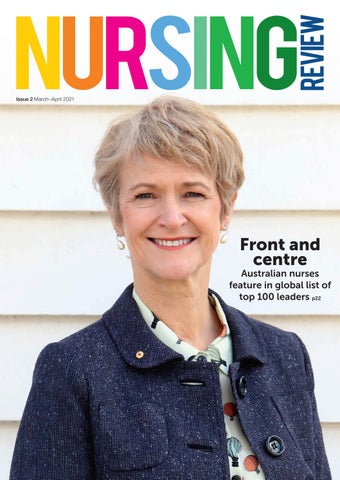
Issue 2 March–April 2021
Front and centre
Australian nurses feature in global list of top 100 leaders p22
For Healthcare professional use only. For Formula-fed infants.
NEW LOOK COMING SOON
SAME TRUSTED QUALITY S-26 Alula Gold provides nutritional support for key areas of paediatric development and function. SN-2 PALMITATE
The predominant saturated fatty acid found in breast milk may improve fat and calcium absorption, helping to soften stools1-4
S-26 ALULA GOLD NEWBORN
Infant formula enriched with sn-2 palmitate may result in softer stools.1,3
Sn-2 palmitate enriched infant formula is associated with increased bone mineral content at 4 months of age and increased calcium bioavailability.1,3,5-10
For more information, please visit www.alula.com.au or contact our Careline to find out more 1800 552 229 IMPORTANT STATEMENT: Breastfeeding is best for babies. It has benefits for the infant, such as reducing infection risk, and for the mother. It is important to have a healthy balanced diet in preparation for, and during breastfeeding. Infant formula is designed to replace breast milk when an infant is not breastfed. Breastfeeding can be negatively affected by introducing partial bottle-feeding, and reversing a decision not to breastfeed is difficult. Infant formula must be prepared and used as directed. Unnecessary or improper use of infant formula, such as not properly boiling water or sterilising feeding equipment, may make your baby ill. Social and financial implications, including preparation time and the cost of formula, should be considered when selecting a method of infant feeding. References: 1. Yao M, et al. ,2014, J Pediatr Gastroenterol Nutr;59(4):440 -44. 2. Carnielli V, et al.,1996, J Pediatr Gastroenterol Nutr, 23:553 -560. 3. Kennedy K, et al. 1999, Am J Clin Nutr; 70:920 -7. 4. Bar-Yoseph, F., et al. 2013. PLEFA 89(4), pp.139-143. 5. Bronsky J, et al. 2019, J Pediatr Gastroenterol Nutr. 68(5):742-760. 6. Nowacki, J et al., 2014, Nutr J. 5;13:105. 7. Litmanovitz, I. et al, 2013, Calcif Tissue Int. 92(1):35-41 8. Béghin L, et al., 2019, Clin Nutr. 38(3):1023- 1030 9. Lönnerdal, B.,2003. Am J Clin Nutr, 77, pp. 1537S-43S 10. Martin, C., Ling, P. & Blackburn, G., 2016, Nutrients, 8 (279), pp. 1-11 ® S-26 is a registered trade mark used under licence. Distributed by Sanulac Nutritionals Australia Pty Ltd. ABN 31 160 607 509. Level 1, 42-44 Chandos Street, St Leonards, NSW 2065. 15022021_AN05282
contents
MANAGING EDITOR
news
Richard Garfield 02 9936 8628 richard.garfield@apned.com.au
2
COVID-19 vaccine rolls out
3
Call for second Wuhan probe
NEWS EDITOR
4
Vaccine resistance growing
5
Give surplus vaccine away
6
‘Contemptable’ care called out
Dallas Bastian 02 9936 8637 dallas.bastian@apned.com.au HEALTH EDITOR
Conor Burke 02 9936 8638 conor.burke@apned.com.au
02
06
SALES MANAGER
industry and reform
8
Mental toll Nurse shortage predicted in mental health
Sarah Licence 02 9936 8710 sarah.licence@apned.com.au
10 Hard work begins
SUBSCRIPTION ENQUIRIES
12 Age is a barrier
Now’s the time to fix aged care One in two are ageist: WHO
Daniel Omelia 02 9936 8607 subs@apned.com.au
13 Brittle and broken Aged care reform starts now
14 Three factors
COVER
Caroline Homer. Photo: Aaron Francis PUBLISHED BY
What matters most to residents
10
14
Sector reacts to royal commission
18 Two for one
APN Educational Media GPO Box 4245 Sydney NSW 2001 ABN 58 090 900 999 ISSN 1326-0472 PP100001944
Royal commission numbers game
specialty focus
20 Leader recognised Nurse CEO honoured in world award
PUBLISHER’S NOTE
© Copyright. No part of this publication can be used or reproduced in any format without express permission in writing from APN Educational Media. The mention of a product or service, person or company in this publication, does not indicate the publisher’s endorsement. The views expressed in this publication do not necessarily represent the opinion of the publisher, its agents, company officers or employees.
16 ‘Watershed moment’
clinical practice
22 Showing the way
20
22
Midwife leader named in world top 100
24 Where the heart is Nurses working with new mums
workforce
26 Vaccination for all? Merits of mandatory vaccination
technology
28 Head to the clouds
26
28
Technology’s role in improving care
nursingreview.com.au | 1
news
Making progress Update on COVID-19 vaccine rollout globally and in Australia. By Conor Burke
A
s the COVID-19 vaccine is rolled out across aged care homes nationwide there have been encouraging signs from overseas as to the various vaccines’ ability to reduce infection. In the US, as of February, 1,315,000 people had been infected across 31,000 aged care homes, with at least 172,000 deaths, yet there has been a significant drop in cases. As reported by The New York Times, from late December to February new cases of the virus dropped by over 80 per cent, almost double the drop seen in the general population, and new cases in nursing homes are at their lowest point since May last year. While in the UK, people over 80 who had been vaccinated with one dose of either the Pfizer or Oxford/AstraZeneca jab had more than 80 per cent protection against hospital admission, while the Pfizer jab was 85 per cent effective at preventing death from COVID-19. Around 95 per cent of care home residents have been vaccinated, with all
2 | nursingreview.com.au
other areas of the UK over 93 per cent. Research from the British Medical Journal found that in the three weeks to 14 February, deaths in care homes fell by 62 per cent, the lowest level since the end of October last year. Overall, the number of deaths in the 85 and over age group has fallen by 45 per cent. These figures have not as yet been directly attributed to the vaccination program, but experts say that signs are encouraging. Chris Whitty, the UK’s chief medical adviser, said: “The earliest indications would imply there is some effect. But I think it’s too early to put a number on that. We would expect to see some evidence that is strong enough to put into the public domain in the next few weeks.”
ASTRAZENECA VACCINE UNDER CLOUD A number of European nations paused the rollout of the AstraZeneca COVID-19 vaccine after some reports of adverse side effects. Germany, Italy, France and Spain were among a host of countries to suspend their COVID-19 vaccine rollouts while they investigated reports of blood clotting
“There is no place for antivaccination messages in professional health practice. in patients who had been vaccinated, however the World Health Organization (WHO) urged nations to reconsider. “There is no evidence that the incidents are caused by the vaccine and it is important that vaccination campaigns continue so that we can save lives and stem severe disease from the virus,” WHO spokesperson Christian Lindmeier said. Senior members of the government, including Prime Minister Scott Morrison, Health Minister Greg Hunt and Treasurer Josh Frydenberg, were briefed on the vaccine rollout. Frydenberg reiterated that WHO had said there was “no evidence” that the AstraZeneca vaccine had caused the blood clots. “In the case of the United Kingdom, they have already distributed more than 12 million doses of the AstraZeneca vaccine, and they haven’t seen those trends or patterns across their community,” he told ABC RN. “It is still the government’s intention to roll it out, as we’ve said.”
news
FRENCH COURT WEIGHS ACTION Families of aged care residents in France have begun legal action in a bid to seek accountability for the thousands of lives lost in homes during the pandemic. Official figures show that nearly 25,000 nursing homes residents died due to COVID-19 within French nursing homes from over 87,000 lives lost altogether, reported France 24. However, many residents died after being hospitalised with the virus and many believe that the true death toll may be as high as 50 per cent of all French deaths. Multiple family members and advocacy groups appeared in a Paris court in a collective effort to get answers from authorities. The hearing involved a special measure to demand access to documents or other material involving decisions at nursing homes as the plaintiffs alleged they have been kept in the dark about the fate of their loved ones. The complaint, made by families against several nursing homes, the national health agency DGS and the Paris public hospital
authority, wants answers about what they see as mismanagement at the start of the pandemic. Mask shortages for residents and staff, testing shortages, the use of powerful sedatives (such as Rivotril) on some residents while homes were locked down and opaque decisions on which residents received hospital treatment for the virus are among the issues that families want to bring to light. “We want to ensure that mistakes aren’t repeated, that someone is held responsible,” said plaintiff Sabrina Deliry.
HEALTH WORKERS COULD BE PUNISHED FOR ANTI-VAX MESSAGES Health professionals in Australia could be barred from practising for spreading antivaccination messages, said the national medical boards and the Australian Health Practitioner Regulatory Agency (AHPRA), as reported in the SMH. In a joint statement, the medical bodies said that healthcare practitioners such as doctors, nurses and pharmacists risk being stripped of their licences if they
A bus carrying the team investigating the origins of the COVID-19 pandemic in Wuhan. Picture: Nicolas Asfouri/AFP
Second glance Experts call for second investigation into the source of COVID-19. By NCA NewsWire
I
nternational virus experts are demanding another investigation into the source of COVID-19, amid concerns China had too much control over the last. In an open letter, academics from across the globe, including the Australian National University, called for an “unrestricted international forensic investigation”.
The group said despite previous studies, we are no closer to finding the answers needed to determine the origin of the virus. “Finding the origins of SARS-CoV-2 is critically important to both better addressing the current pandemic and reducing the risks of a future one,” the letter read. “Unfortunately, well over a year after the initial outbreak, the origins of the pandemic remain unknown.” In January, a team of scientists chosen by the World Health Organization visited hospitals and research institutes in Wuhan, the virus epicentre, in search of clues. But the previous venture has been criticised by the group behind the letter. They said there were several “structural limitations” built into the endeavour.
spread misinformation to patients or on social media. “There is no place for anti-vaccination messages in professional health practice, and any promotion of anti-vaccination claims including on social media, and advertising may be subject to regulatory action,” spokesperson for the medical boards and Pharmacy Board chairman Brett Simmonds said. AHPRA chief executive Martin Fletcher urged all of Australia’s 800,000 registered practitioners and 193,800 students to follow the guidelines. “If you’re a registered health practitioner or student, the best thing to do is to read our joint statement,” he said. “It explains the National Boards’ expectations of registered health practitioners about receiving, administering and sharing information about COVID-19 vaccines. “It’s important you understand these expectations so that patients and communities are best protected against the novel coronavirus that causes COVID-19.” ■
“We wish to raise public awareness of the fact that half of the joint team convened under that process is made of Chinese citizens whose scientific independence may be limited, that international members of the joint team had to rely on information the Chinese authorities chose to share with them, and that any joint team report must be approved by both the Chinese and international members of the joint team,” the group wrote. In the letter, the group provided a list of requirements that should be met for a proper inquiry. It included being carried out by an independent team so there’s no conflict of interest or “partial control by any specific agenda or country”. They also want the team to be made of experts from various fields, from virologists to wildlife experts, and have full access to records and sites, including the wet markets at Wuhan. Earlier, experts questioned the purpose of WHO’s mission, which wrapped up in mid-February after scientists spent 28 days on the ground. “It hasn’t really given us new information,” Peter Collignon, a pathologist at ANU who has previously worked on WHO research projects, told ABC News at the time. ■ nursingreview.com.au | 3
news
Growing resistance Study shows growing hesitancy towards COVID-19 vaccine. By Wade Zaglas
N
ew analysis from the Australian National University shows resistance and hesitancy towards a COVID-19 vaccination is growing in Australia. The study is based on a longitudinal survey of 3,500 Australians that tracked individuals’ responses prior to the pandemic taking place, and is the only survey that “doesn’t rely solely on people volunteering to participate”. Recognised as the most “robust survey data available” regarding individuals’ inclination to get vaccinated, analysis of the findings shows there is a “large decline in the number of people who are likely to take a vaccine once it becomes available”. Findings were based on Australians’ attitudes towards COVID-19, as well as their experiences, and coincides with the country’s roll-out of the highly effective Pfizer vaccine. The study found that, in January 2021, one-in-five of the survey participants (21.7 per cent) said “they probably or definitely will not get a safe and effective COVID-19 vaccine once health officials notify the public that one is available”. “This is a large and significant increase from the 12.7 per cent of Australians who said the same thing in August 2020 when vaccines were still being developed and trialled,” co-author of the study Professor Nicholas Biddle said.
4 | nursingreview.com.au
“We also found more than three-in-10 Australians, some 31.9 per cent, became less willing to get a vaccine between August 2020 and January 2021. “In contrast, less than one-in-10 Australians, 9.9 per cent, became more willing to get vaccinated.” Over the course of the survey, the study found there was a substantial drop (19.7 per cent) in the number of Australians who went from ‘definitely willing’ to receive a COVID-19 vaccine to ‘probably willing’. Groups who became less willing to be vaccinated included females, Indigenous Australians, individuals who did not complete Year 12, and individuals who speak a language other than English at home. “These population groups are arguably the most urgent focus of any public health campaigns to improve willingness,” Biddle said. “This is because they have low willingness to start with, but also because there is the potential opportunity to bring their willingness back to what it was in August 2020 when there was a smaller gap with the rest of the Australian population. “There is a real need to consider a significantly enhanced public health campaign in languages other than English. “There is also a need to convey information to the general public in a way that is informative, reassuring and salient for those without a degree. “We have been tracking Australians’ attitudes to getting a vaccine for months now, giving us powerful insights into what potential uptake will be like.”
“A vaccine and its successful delivery across our society is absolutely crucial to Australia’s COVID recovery. Biddle is concerned that more Australians have “cooled” on the idea of getting a vaccine, and the challenge is to quickly work out why this ‘cooling’ has occurred and address it. This latest ANU study also includes qualitative data, providing rich insights into why some Australians won’t take the vaccine or are unlikely to do so. For instance, there are the COVID-19 doubters, who believe the pandemic is akin to fake news; individuals who express low confidence in hospitals; and individuals who do not perceive the next 12 months will be optimistic. “Clearly our leaders, policymakers and health experts need to work out why more Australians are unlikely to get a vaccine, particularly as it is about to be administered across the country,” Biddle added. “While not a magic bullet, a vaccine and its successful delivery across our society is absolutely crucial to Australia’s COVID recovery.” The study forms part of the ANU Centre for Social Research Methods COVID-19 monitoring program and is available online. Data collection for the study was provided by the Social Research Centre, with financial support from the Australian Institute of Health and Welfare. ■
news
A vial of the AstraZeneca/Oxford Covid-19 vaccine. Picture: Nikolay Doychinov/AFP
Give it away Vaccinate at-risk Aussies then send supplies to countries in need: experts.
V
accinate the most at-risk Australians – then send surplus supplies to countries that need them. That’s the message from ethics researcher Dr Ben Bramble and infectious diseases specialist Professor Peter Collignon. The pair, from Australian National University, argued in an article for The Guardian that Australia’s goal of
vaccinating as many Australians against COVID-19 as quickly as possible was not the strategy the world needs now. “Vaccinate our most vulnerable citizens, health workers and hotel quarantine staff immediately – no question about that,” they said. “As for the rest of us? We can wait.” Bramble and Collignon said the likelihood of Australia opening its borders hinged on the success of the global vaccination project. “We will vaccinate everyone in Australia – let those at-risk people in poorer countries get it before our healthy 30-year-olds here, while we’re able to keep the virus under control.” The authors said Australia has enough contracted supplies of coronavirus vaccines to inoculate the entire population three times. “That’s the kind of hoarding problem among rich countries that the World Health Organization has been warning us about.” The government recently confirmed it had doubled Australia’s order of the
Pfizer vaccine, striking a deal for a further 10 million doses. Secretary of the Department of Health Professor Brendan Murphy told national cabinet that the government may now be able to broaden access to the Pfizer vaccine depending on when the extra doses arrived onshore. Tests suggested the jab had a higher efficacy rate than the AstraZeneca version, but Murphy said both were “extremely effective” at reducing serious illness. “It’s made locally and we’ll have plentiful supply,” he said. Bramble and Collignon said Australia “should export much of the AstraZeneca vaccine we are making now in Melbourne to countries that need it more than us – as either sales or foreign aid. “With the capacity to produce a million doses of the highly transportable AstraZeneca vaccine every week, Australia has a special responsibility here. “If rich countries like Australia don’t export any of the vaccines they produce, then poor countries aren’t going to get much at all for quite a while.” ■
Photo: AFP photo/Fort Worth Fire Department
on her way to work at a north Texas hospital at around 6.30am when her car began to slide due to icy roads and she ended up crashed alongside 100 other vehicles. “I’m trying to not spin out and to figure out if I can stop. I mean, my foot was as close to going through the floorboard as it possibly could be,” Benson told ABC’s World News Tonight. Benson said she could only look on as the scene unfolded and was shaking as car after car joined the pile up. “I looked in my rear-view mirror and can see all of these cars heading towards me. So I think that was the scariest part, knowing that I survived this part but now the chances of me getting completely smashed by all the cars and semis behind me,” she told ABC. Benson was helped from her car by another motorist, called a colleague who was nearby and got a lift to the hospital in time to make her shift. She eventually got a check-up by doctors at the urging of her husband and escaped with minor injuries. “I have neck pain, shoulder pain, and my left elbow is bruised to the high heavens and, you know, typical aches and pains that you would have. But I am unbelievably blessed.” ■
Above and beyond Nurse crawls from car wreck, still makes her shift.
A
n American nurse involved in a 1.5 mile long car pile-up crawled out of the wreckage of her car and went straight to her shift.
Rebecca Benson described the scene that left six dead and 36 people injured as something out of a “zombie movie”. The crash occurred on the I-35 freeway after a night of freezing rain in the Fort Worth area. Benson was
nursingreview.com.au | 5
news
South Australian politician Frank Pangallo. Picture: James Elsby
‘Contemptable’ care MP calls for dismissal of care facility’s senior management.
A
n Australian politician has called for the senior management of a South Australian aged care facility to be stood down following public outrage over
its approach to a scabies outbreak at one of its hostels. Frank Pangallo, a South Australian MP, told state parliament that Kindred Living’s treatment of residents and staff was “contemptable”. Pangallo said that care workers reported to management numerous times an outbreak of scabies. “Senior management’s reaction to these very serious concerns was appallingly inadequate… despite the outbreak spreading to more patients and a number of workers assigned to the cottage. A consulting doctor warned the rash would spread quickly. “Management had the audacity to blame one of the resident’s husband, Peter Strawbridge, for his wife Heather’s infection, saying it was probably caused by mosquitos during one of the daily walks he took his wife on.” After he was contacted by Strawbridge, Pangallo reached out to A Current Affair, which then covered the story. “The media exposure prompted the federal government’s somewhat toothless
Tipsy or tanked? Study shows level of inebriation is tough to tell.
I
t’s the slurred catchcry of many a drunk person, ‘I’m fine!’, and new research has explored the tendency to underestimate levels of intoxication. Researchers interviewed 388 students outside three concerts at the University of Otago during Orientation Week festivities. They asked participants to rate how intoxicated they felt on a scale of 0 (meaning not at all) to 10 (meaning very) before they took a breath test.
6 | nursingreview.com.au
The research team also rated how intoxicated they believed each student to be, looking out for tell-tale signs like slurred speech and loss of coordination. People tended to have a better grasp on how drunk they were at a lower blood alcohol concentration (BAC) but both the self-rated and observer-rated intoxication level appeared to drop-off at a higher level of BAC, around three times the legal limit. Observers were significantly more likely to underestimate the intoxication of older participants, while people of European descent tended to underestimate their level of intoxication compared to other ethnicities.
watchdog, the Aged Care Quality and Safety Commission, into action despite previous complaints falling on deaf ears,” Pangallo said. A non-compliance notice was issued in November to the approved provider for failure to comply with the standards relating to personal care and clinical care, and the organisation’s service environment. The facility also received notices in 2019 and 2018. Late last year, a Notice to Agree was imposed on the facility due to “an immediate and severe risk to the safety, health or wellbeing of care recipients”, and related to all eight standards. Pangallo said: “I am now writing to its board, asking it to dismiss its senior management. “I’m also asking the federal aged care minister Greg Hunt how an aged care facility with such an appalling track record can continue to operate with current management in place and who actually controls the facility which take millions of dollar in commonwealth funding. ■
The authors wrote: “Explanations from other studies suggested that cognitive impairment may occur at the higher intoxication levels, meaning that people can no longer interpret internal signals of intoxication. “However, as we observed this ‘dropoff’ effect at the higher intoxication levels for observer-rated intoxication as well, the ‘cognitive impairment’ explanation does not apply; thus, it is possible that another explanation is needed for both effects.” One potential explanation the team put forward is that there was a ‘ceiling effect’ for observable signs of intoxication. Due to the nature of the study, none of the participants displayed overt signs of high BAC, such as unconsciousness, as they had to get themselves to the event. The researchers said that even professionals who regularly interact with alcohol-intoxicated people can struggle to correctly identify presence or level of intoxication. A study based in an emergency setting found that clinicians missed just under a quarter (23 per cent) of alcohol-intoxicated presentations. “Years of experience or receiving training may not always be enough to overcome these inaccuracies.” ■
industry & reform
Mind the gap Mental health system under strain and facing a nurse shortage. By Conor Burke
T
he mental health system is failing to provide treatment to the people who most need it. That was the opinion of last year’s report on mental health by the productivity commission which found that, among other things, mental health is costing the Australian economy $220 billion each year. “Australia’s current mental health system is not comprehensive and fails to provide the treatment and support that people who need it legitimately expect,” the report said. The report found that almost one in five Australians has experienced mental illness in a given year, and many do not receive the treatment and support they need. Since the report came out in November last year the world has been gripped by a pandemic which so far seems to have had an enormous effect on the mental health of the population. Since March last year there have been noticeable rises in people trying to access mental health services. Calls to Lifeline in the four weeks from 10 August to 6 September last year were up 15.3 per cent compared with 2019. Contacts to Beyond Blue (total of call, web chat and email) were up 38.6 per cent over the same period while contacts to the Kids Helpline were up 24.5 per cent. An ANU poll based on just over 3,000 respondents suggests that the proportion
8 | nursingreview.com.au
of the population experiencing severe psychological distress as measured by the Kessler 6 Scale rose from 8.4 per cent in February 2017 to 10.6 per cent in April 2020. Hospital admission also shows an increase in mental health needs over the last decade leading up to the pandemic. In 2018–19, there were 18,836 same day public admitted mental health-related separations with specialised psychiatric care. This increased from 16,258 in 2008–09 representing an average annual increase of 1.5 per cent over this period. Similarly, the number of overall same day public mental health-related separations without specialised psychiatric care increased from 28,339 in 2008–09 to 41,052 in 2018–19, representing an average annual change of 3.8 per cent over this period. One recommendation from the report stated that we need to invest in the mental health workforce and that the Australian Government should develop a new curriculum standard for a three-year directentry undergraduate degree in mental health nursing. In addition, all nurse training courses should include a mental health unit. In spite of these findings, mental health nursing is listed in the top three nursing disciplines that are likely to see a significant shortage in practitioners in 2021 and Dr Mike Hazelton, President of The Australian College of Mental Health Nurses, believes this shortage will be a huge obstacle to righting the mental health system. “On one hand the projections from organisations like Health Workforce
Australia is that we may not have a shortage of mental health nurses right now if what you’re doing is counting the people who work in mental health services. But we have a problem with the skill and capability of a lot of those people. That’s one issue,” said Hazleton. “The other issue is that if you look at some of the findings that have been put forward over the last decade by organisations such as Health Workforce Australia, they predicted from about 2012 onwards there would be an increase in shortfall of psychiatric nursing, or mental health nursing positions, so that by about 2030 we would be somewhere between about 12 and 24,000 positions down within the sector. And that’s not taking into account COVID, for instance. “This was all predicted well before COVID came along. So, on some readings we have been moving into a workforce shortage anyway. It’s been compounded by COVID.” Hazelton argues that there is a drastic need for nurses to be specifically trained in mental health practices and that filling the workforce shortage with untrained nurses would be problematic. “There is an absolute need for some sort of formal endorsement for someone to be a mental health nurse, so you can at least identify the difference between someone who has formal mental health nursing qualifications and skills, and someone who’s just working in the area, who may not even be a registered nurse. You have a lot of enrolled nurses working in mental health services these days. They’ve got
industry & reform
virtually no mental health input in their place-based course education,” he says. The decision to abolish the need for separate psychiatric nurse registration in the 90s is an issue according to Hazleton, and re-introducing such a register would make sure the mental health workforce is up to the task of dealing with a larger population of Australians with mental health needs. Hazelton believes there needs to be a concerted effort by the health department to plan for nurse shortages and a greater understanding of the skills a trained mental health nurse has. “The starting point needs to be that we can actually identify who a mental health nurse is, in terms of their knowledge, skills and capability. It should be people who have formal qualifications in the area, through whatever means they can legitimately obtain those qualifications,” he says. “The second point would be that we need to be planning for the predictions in terms of workforce shortage. We don’t see
much evidence of that, and we haven’t for a long time,” he says. “The third area would be that very good expert mental health nurses have quite a high skill and capability level, much of which is basically not being utilised because of the narrowness of the expectations that governments and health departments seem to have, surrounding what it is that mental health nurses can actually do. “You talk to politicians and bureaucrats; they seem to have no awareness of what it is that people can do. Here we are talking about the medium and longer term consequences of COVID and the need to significantly expand the mental health workforce, and mental health nursing doesn’t seem to be part of the equation. “We don’t have access to Medicarefunded programs, and we can’t get them to even come to the party and start to have a serious discussion about what it is that we could do to expand our practise and start actually filling in some of the gaps that everyone’s identified in the mental health service area.”
“We need to be planning for the predictions in terms of workforce shortage. We don’t see much evidence of that. And with all this in mind, Hazelton urges nurses to consider a career in the mental health space. “Mental health nursing would suit someone who really wants to make a difference and work with some of the most vulnerable members of our society. Mental health nursing can be very rewarding and embodies the concept of caring by supporting clients who are unable to maintain mental, social or physical health functions for themselves. “We work on the basis of empowering our clients to take an active role in self-advocacy and self-care,” Hazelton says. ■
subscribe for less than $2 a week The laTesT news and resources for healThcare professionals Nursing Review is essential reading for anyone involved in the healthcare sector in Australia. It provides unrivalled coverage of specialist topics from features and opinion pieces, to international news and profiles. • Latest news and resources for all healthcare professionals • Comprehensive coverage of a diverse range of topics • Analysis of the major issues facing the health sector as a whole • Delivered free of charge • 6 issues per year • Only publication in the country dedicated to reporting issues important to nurses
Please call 02 9936 8666 or email subs@apned.com.au to find out more. nursingreview.com.au | 9
industry & reform
“Like saying sorry, taking responsibility seems to be the hardest thing for the current government to do.
Now for the hard part Who will care after the Royal Commission? By Michael Fine
W
e’ve lived with it for so long, it was beginning to seem like the Royal Commission on Aged Care would always be with us. But now that the astonishing, apparently never-ending series of revelations that shocked the nation will no longer be the subject of further public hearings, the hard part starts. The RC’s report presents a final and extensive set of recommendations by the commissioners. After reading, digesting and debating their learned words, Australia enters the next stage, facing the true challenge of finally taking action. Of course, few people will read the actual report. Will you? It will take a lot of time, real dedication and probably a pack or two of tissues to get through it all. Most people are far more likely to shoot off their own opinion about what is needed, based on their experience with their parents or their long-held beliefs about what works. Those who wish to be informed are likely to rely on short and quite selective, often unreliable summaries presented in the media. Typically, these will focus on the proposed solutions but lack documentation of the evidence on which the Commissioners have reached their conclusions. The second and much harder part of the challenge is about actually taking responsibility by doing something and implementing changes. Even the simplest changes, such as introducing staffing standards that include numbers of registered nurses to be employed in residential care services (as was the case before the 1997 Act), are highly contested. The options for action will be simplified in the process of public debate, with competing interests forcing people to take sides in dumbed down debates. My bet is that the biggest debate will be around costs and funding. Should we spend more money on people in their final years of life? If so, where will the money come from? Richard Colbeck indicated that this would be the Federal Government’s main response. The government’s answers to the RC, he announced recently, will come in the budget which is released in May. Most aged care workers have long deserved better pay, decent careers and improved work conditions. Beyond this, throwing money at the system won’t change much. In many cases it will
10 | nursingreview.com.au
reward and perpetuate bad practice, perhaps, as happened in recent years, simply swelling management salaries and financial costs. As Dr Sarah Russell, director of Aged Care Matters pointed out in the Age and SMH two days before the report’s release, there should be no more money given to aged care providers without fundamental reform of the system. She called for nothing less than a complete rewriting of the 1997 Aged Care Act as a starting point. Many others, myself included, have been calling for renewed attention on the design and funding of home care services. This must go beyond fundamental reform of the Home Care Package program, with its vast waiting lists and ever-increasing management and care coordination costs that consumers find incomprehensible. We need renewed commitment to block funding to strengthen the Commonwealth Home Support Programme, and the removal of the assessment barrier to entry to such basic services. Family carers need a much better deal, and the current approach of MyCarer Gateway and MyAgedCare needs to be completely rethought. Whatever responses are made to the RC’s report, the complexity of governance in aged care needs to be acknowledged and managed, not ignored. This has been the central problem of the two keystones of system redesign since the 1997 Act, both of which have failed to deliver the intended outcomes. In constitutional terms, the most significant change over the past decade has been bringing responsibility for all aged care under Commonwealth control. This was supposed to reduce duplication and waste when states were involved, helping to provide equal access to services no matter where those in need lived. But that responsibility has then been contracted out to proprietors and service providers, as the system has been radically reshaped into a market. In theory, markets are believed to be self-regulating. But we’ve seen the system fail too many times, the horrifyingly large numbers of care home deaths due to COVID-19 being just the most recent and sensitive example. In the aged care field, regulation can’t be left to the market, any more than can funding. An awareness of the governance and legal issues uncovered by the RC requires the Commonwealth government to take responsibility, not avoid it or hide behind yet more enquiries. But, like saying sorry, taking responsibility seems to be the hardest thing for the current government to do. The release of the RC’s final report will not be the end of the revelations. These are likely to continue unabated, as shown by the emerging discussion of the prevalence of sexual abuse in residential care homes and the ABC’s expose of ‘a luxury nursing home’ in WA where residents can pay $1.4 million in accommodation bonds. But March 2021 clearly draws a line in the sand. From here on, the whole business of government taking responsibility for aged care gets serious again. ■ Michael Fine is Honorary Professor at Macquarie University.
#1 fund
for weathering market ups and downs 1
Our members can focus on today, knowing their future is safe with us.
Visit QSuper.com.au today
1 Winner of SuperRatings’ Smooth Ride 2021 award. The rating/award is issued by SuperRatings Pty Ltd ABN 95 100 192 283 AFSL 311880 (SuperRatings). Ratings are general advice only and have been prepared without taking account of your objectives, financial situation or needs. Consider your personal circumstances, read the product disclosure statement and seek independent financial advice before investing. The rating is not a recommendation to purchase, sell or hold any product. Past performance information is not indicative of future performance. Ratings are subject to change without notice and SuperRatings assumes no obligation to update. SuperRatings uses objective criteria and receives a fee for publishing awards. Visit superratings.com.au for ratings information. © 2021 SuperRatings. All rights reserved. Product issued by the QSuper Board (ABN 32 125 059 006, AFSL 489650) as trustee for QSuper (ABN 60 905 115 063). Consider the PDS on our website to see whether QSuper is right for you. © QSuper Board. ADV-195. 03/21.
industry & reform
“Let’s make this crisis a turning point in the way we see, treat and respond to older people.
The years condemn WHO report says every second person in the world has ageist attitudes. By Conor Burke
A
geism is ubiquitous worldwide, with every second person holding ageist attitudes according to a new WHO report on ageism. Ageism seeps into many institutions and sectors of society including those providing health and social care, in the workplace, media and the legal system, the report holds, and urgent action is needed to address the problem. The report looked at ways ageism, against young and old alike, affects society and found that it leads to poorer physical and mental health and reduced quality of life for older persons while ageism against younger people can appear in areas such as employment, health, housing and politics where younger people’s voices are often denied or dismissed. “As countries seek to recover and rebuild from the pandemic, we cannot let age-based stereotypes, prejudice and discrimination limit opportunities to secure the health, well-being and dignity of people everywhere,” said Dr Tedros Adhanom Ghebreyesus, WHO Director-General. “This report outlines the nature and scale of the problem but also offers solutions in the form of evidence-based interventions to end ageism at all stages.”
AT WHAT COST? The research found that healthcare rationing based solely on age is widespread 12 | nursingreview.com.au
and ageism can dictate what and who received certain medical treatments. In the US, ageism led to excess annual costs of US$63 billion for the eight most expensive health conditions. This equates to US$1 in every US$7 spent on these conditions for all Americans over the age of 60 for one year. Older adults also tend to be excluded from health research, even though they share a disproportionate burden of disease and use of medicines. One study found evidence of ageism in all 49 studies that investigated the link between age and exclusion from different types of health research. This showed that older persons were systematically excluded from clinical trials in cardiology, internal medicine, nephrology, neurology, preventive medicine, psychiatry, rheumatology, oncology and urology, even though many of the conditions under study are more prevalent in old age. The report highlights the struggle older people face in the workplace and the cost that places on many nations. One study found that employers were less likely to hire older applicants than younger applicants; that once employed, older workers had less access to training; and that those who faced ageism in the workplace were more likely to retire early. In Australia, the report shows that if 5 per cent more people aged 55 or older were employed, there would be a positive impact of AUD$48 billion on the national economy annually. Overall, it is estimated that 6.3 million cases of depression globally can be attributed to ageism.
In Europe (the only region for which the WHO received solid data) one in three report having been a target of ageism, and younger people report more perceived age discrimination than other age groups. Ageism intersects and exacerbates other forms of bias and disadvantage including those related to sex, race and disability leading to a negative impact on people’s health and well-being, WHO says, and among older people, ageism is associated with poorer physical and mental health, increased social isolation and loneliness, greater financial insecurity, decreased quality of life and premature death. “The pandemic has put into stark relief the vulnerabilities of older people, especially those most marginalized, who often face overlapping discrimination and barriers – because they are poor, live with disabilities, are women living alone, or belong to minority groups,” said Natalia Kanem, Executive Director, United Nations Population Fund. “Let’s make this crisis a turning point in the way we see, treat and respond to older people, so that together we can build the world of health, well-being and dignity for all ages that we all want.” The report outlines three strategy areas which have been shown as effective in fighting ageism: policy and law, educational activities and intergenerational contact interventions. It outlines three recommendations for action. 1. Invest in evidence-based strategies to prevent and tackle ageism 2. Improve data and research to gain a better understanding of ageism and how to reduce it 3. Build a movement to change the narrative around age and ageing. “Ageism harms everyone – old and young. But often, it is so widespread and accepted – in our attitudes and in policies, laws and institutions – that we do not even recognize its detrimental effect on our dignity and rights,” said Michelle Bachelet, United Nations High Commissioner for Human Rights. “We need to fight ageism head-on, as a deep-rooted human rights violation.” ■
industry & reform
The system is broken Time for proper, hard reform in aged care. By Ged Kearney
T
he Aged Care Royal Commission has handed its final report to the government. And fellow nurses, haven’t we been waiting for this for a long time. For decades, we’ve been raising our voices, telling anyone who would listen that the aged care system is broken. I want to acknowledge the work of the Royal Commission and all who provided evidence, including the many wonderful, wonderful nurses. While the Prime Minister could have simply acted on evidence that he’s had sitting on his desk for seven years – evidence of inadequate care, profiteering providers, neglect and negligence in aged care homes – the Royal Commission has enabled older people, their families and its workforce to tell their stories. It was harrowing and fundamentally awful to hear how badly the system has failed our elderly, their families and the aged care workforce. No one should suffer the indignity that many of our elderly have suffered. Whilst most aged care facilities are providing excellent care, the Royal Commission detailed shocking failures in many others. It outlined the structural weaknesses in the system and, to quote the Commission itself:
“The aged care system fails to meet the needs of its older, vulnerable, citizens. It does not deliver uniformly safe and quality care, is unkind and uncaring towards older people and, in too many instances, it neglects them.” This is a system where people banned from the poultry industry after starving chickens were given an aged care licence. It’s a system in which nurses and carers find themselves with impossible workloads – literally run off their feet. Where attending to a resident who has fallen may mean others aren’t fed. The Commission says that the aged care workforce is underpaid and undervalued. Ain’t that the truth? So before the politics of the recommendations of the Royal Commission begin, I want to say to those of you who work in aged care, a very sincere thank you. Thank you for everything. For hanging in there and for speaking up. I know how hard it is to care and advocate for people – especially at the end of their life. You do your absolute best to provide your residents with dignity and respect, but I know over time it’s been getting harder and harder to give them the time and the care you want to give them, and that they deserve. You have been screaming out for reform and resources – so you can do the very best job for your residents and indeed their families. But your calls have been completely ignored by the Liberal Government.
“Nurses are respected, loved and believed. Your voices are powerful beyond belief. What the Royal Commission has shown us is that it doesn’t have to be this way. Now the report has been handed down, the Morrison Government has a blueprint for how to actually fix aged care – once and for all. And we cannot let the opportunity slip by us. We must continue to push the government to act. And to act properly – not just be there for a photo opportunity and then no delivery. We need proper, hard reform. Reform I’d argue only the Labor party is capable of delivering – but in this instance, I hope I’m wrong. The Labor party knows how crucial this is. Labor’s leader Anthony Albanese has pledged to stand up and fight for the workforce, for quality care and for a system we can be proud of. So raise your voice, write to your MP and demand the government act on the recommendations in the Royal Commission. Nurses are respected, loved and believed. Your voices are powerful beyond belief – please raise them. This article was originally published prior to the release of the final report. ■ Ged Kearney is the Shadow Assistant Minister Health and Ageing and a Registered Nurse. nursingreview.com.au | 13
industry & reform
“Residents being treated with respect was a top priority for all three groups.
The big three Finding out what matters most to residents of aged care. By Conor Burke
R
esearchers from Macquarie University have identified the three most important care needs to people living in residential aged care. After conducting a number of visits to homes for the research they found these areas are: being treated with respect by staff members, opportunities for independence, and management of medical conditions. “While the Royal Commission into Aged Care Quality and Safety has identified person-centred care as a means of improving care, a key aspect is acknowledging and respecting people’s preferences and priorities, and this research provides a unique insight into what is most important to aged care residents,” lead researcher Dr Kristiana Ludlow explained. The residents completed a card sorting activity, called Q-methodology, each card with a picture and an aspect of care written on it. Residents then sorted the cards in order of importance with the help of the researchers, who then had a conversation with the resident to delve into the reasons for their choices. “For the most part, most residents said that staff members were wonderful, but there were some issues with respect sometimes, and one of the main ones was knocking,” Ludlow told Aged Care Insite. “Whether it was a bathroom door or a bedroom door, sometimes they would just
14 | nursingreview.com.au
come in without knocking, or sometimes they would knock and just enter, and especially for those residents who are quite independent, they viewed their room as their home and yet people were just entering that without permission.” Similarly, while opportunities for independence were seen as important, the feedback Ludlow received was not in criticism of the facilities per se, but an acknowledgement of the nature of living in residential aged care. “Unfortunately, it’s a bigger systems problem. Especially the transition into care. Having these routines of what time they have to eat, and even having a smaller room and things like that, it was a big adjustment. “But a lot of residents said, ‘over time, I made my room my own, or sometimes I would say to a staff member, I don’t want to shower in the morning, can I have one at night?’ So they were finding ways to have independence.” Management of medical conditions was important to the residents involved and they often felt they had to wait too long to be seen by staff. “Residents told us that staff members were doing their best with the resources they had, but were often too busy to provide certain types of psychosocial care such as engaging in meaningful conversations. Some residents spoke about not being able to access care when needed, including long waits for responses to their call bells,” said Ludlow. “But often it’s because staff members are with another resident, so there
were some people who spoke about having to wait their turn, because they acknowledged that there just weren’t enough resources.” The study comes on the back of similar research Ludlow conducted with families and staff members within the aged care space, which found that there was a lot of overlap in priorities between the three groups. “I wanted to make a complete picture and get all three viewpoints. And the reason I was focusing as part of this research on prioritisation is because residential aged care facilities are pressurised environments, they’re often under-resourced. And so if you asked, whether it was a staff member or resident, what are your preferences for care, a lot of them will list so many things; everything’s important. “So, I thought that it was really important to understand priorities. The methods I used actually forced the residents to organise their priorities from lowest to highest,” Ludlow said. “Residents being treated with respect was a top priority for all three groups. And then I found management of medical conditions was important for all three groups. “What I found really interesting was the idea of independence. Across the group, regardless of level of need or dependency, residents wanted some level of independence, whereas for family members and staff members there were mixed views amongst participants, and there was this conflict between wanting to keep residents safe and managing them medically, and giving them their independence.” Ludlow argues that to improve the aged care sector, more consumer voices need to be heard and her research gives us just that. “I feel like this research allows residents with different abilities and different capabilities to express their priorities. And while their preferences have been asked about previously, this is one of the first research studies to actually ask about priorities, what is the most important to you?” ■
industry & reform
‘A watershed moment’ Governor General David Hurley receives the final report of the Royal Commission into aged care. Photo: AAP Image/Dan Himbrechts
Aged care sector reacts to the royal commission final report. By Dallas Bastian
G
et cracking. That’s the overwhelming call from advocacy groups in response to the release of the aged care royal commission’s final report. Council on the Ageing (COTA) Australia said the report’s release places the onus on the Morrison Government to address systemic issues with home care, nursing home regulation, staffing and transparency. The group’s chief executive Ian Yates said: “The fact that there are a few alternative recommendations from the commissioners on the best way to manage and fund the aged care system in no way lets government off the hook. There are no barriers to commencing urgent and long-awaited reforms.” In a statement, Yates said COTA would prioritise advocating for home care without a wait, a stronger regulator, a star rating system for staffing, transparency and consumer control and rights. Overall, he said Prime Minister Scott Morrison should include in the Budget a major package with a clear timeline of when decisions will be made and implemented over the next four years. Craig Gear, chief executive of the Older Persons Advocacy Network called
16 | nursingreview.com.au
the release of the report “a watershed moment”. “The Royal Commission has confirmed that aged care must move from a substitute decision-maker model to a supported decision-maker model, which means preferencing the choices of the older person, and upholding their right to make these choices,” Gear said.
AN APOLOGY FROM PROVIDERS Within hours of the report’s release, a consortium of aged care provider peak bodies apologised for the harm endured by older Australians and their loved ones. Speaking on behalf of the Australian Aged Care Collaboration, which represents organisations that provide 70 per cent of the nation’s aged care services, Sean Rooney said the report cited some appalling examples where individuals or aged care services had failed in their duties to provide safe and quality care for older Australians. “These failures are unacceptable and we are sorry for the harm they have caused to older Australians and their loved ones,” said Rooney. The Leading Age Services Australia chief added there have been too many examples of individuals and services who have failed people in their care. “In recent times we have made changes to raise standards and we are continuing to do so. We are committed to doing better.”
DIFFERING VIEWS ‘DISAPPOINTING’ In handing down their report, commissioners Tony Pagone and Lynelle Briggs have set out a roadmap for reform in the aged care sector – but they couldn’t always agree on the best route. Aged and Community Services Australia called the commissioners’ divergent recommendations “disappointing” but added that “there is no split on the need for a total overhaul”. “This cannot be used as an excuse to not progress major reforms. We know what the big problems are – we now need the big solutions,” the peak’s chief executive Patricia Sparrow said. “We need an overhaul, not just more top-ups, in order to guarantee respect for older Australians for future generations.”
STAFFING The final report recommended an appropriate skills mix and daily minimum staff time for registered nurses, enrolled nurses and personal care workers for each resident, and at least one registered nurse on site at all times. The Australian Nursing and Midwifery Federation, which has long advocated for such changes, said the current government and many previous governments have done nothing to address ever-increasing shortages of registered nurses and qualified carers working in aged care.
industry & reform
The federal secretary of the union, Annie Butler, said: “The Morrison Government must now act; every day the Government delays taking action to address dangerous understaffing in nursing homes and community care is another sad day that vulnerable residents will continue to suffer.” Aged care provider HammondCare, which assisted the royal commission through submissions, appearances and roundtables, said frontline aged care workers deserve to be paid on par with health and disability workers. HammondCare chief executive Mike Baird added that the aged care sector as a whole must become more responsive to the consumer. “We also support a star-rating system to shine a light on providers and help guide consumers as they decide on the appropriate level of care and services.”
FOUR CONCERNS FOR IMMEDIATE ATTENTION In their report, Briggs and Pagone singled out four concerns for immediate attention: food and nutrition, dementia care, the use of restrictive practices, and palliative care.
Food and nutrition: The commissioners noted that many witnesses gave evidence about the inadequacy of the quality and quantity of food in residential care. They pointed to a representative study of 60 Australian residential aged care services conducted in 2017 that concluded more than two thirds (68 per cent) of residents were malnourished or at risk of malnutrition. “The current Aged Care Quality Standard for meals stipulates that ‘where meals are provided, they are varied and of suitable quantity and quality’. This leaves much to the discretion of the provider and is not easily enforceable. How ‘varied’ do meals have to be? What does ‘suitable’ mean?” Briggs and Pagone said a critical first step would be to improve nutrition using funds gained through the elsewhere recommended immediate conditional increase in the Basic Daily Fee of $10 per resident per day. Dietitians Australia said: “With a quarter of online submissions to the Commission referring to nutrition and malnourishment, we’re pleased to see food and nutrition, and support from a dietitian, given the priority it deserves.”
Dementia care: When it came to the second of the four areas for urgent action, dementia care, the commissioners offered this: “Our inquiry has revealed that the quality of aged care that people living with dementia receive is, at times, abysmal.” They said the commission heard time and time again that staff members do not have the time or the skills to deliver the care that is needed. “All mainstream aged care services should have the capacity to deliver high quality aged care for most people living with dementia – dementia care should be core business,” the report read. “This includes having the right number and mix of staff who are trained in dementia care, having the right physical environment (in residential care), and having the right model of care. “We recommend mandatory dementia training in residential aged care and in care at home.” The final report also recommended the establishment of a comprehensive and accessible post-diagnosis support pathway for people living with dementia and their carers and families. Dementia Australia chief executive Maree McCabe said within the 148 recommendations were 14 key areas with a specific focus on dementia, including an assessment of the impact of dementia-specialist support and a review of aged care standards as they relate to quality dementia care. McCabe echoed the words of people with the lived experience of dementia in saying, “if you get dementia care right you get it right for everyone”.
Restrictive practices: The final report called the overuse of restrictive practices in aged care a “major quality and safety issue”. “Urgent reforms are necessary to protect older people from unnecessary, and potentially harmful, physical and chemical restraints,” it read. “A strong and effective regulatory framework to control the use of restrictive practices should be implemented as a matter of priority.” It recommended that the government amend the Quality of Care Principles 2014 (Cth) to provide that the use of restrictive practices in aged care must be based on an assessment by an independent expert. “It should be subject to ongoing monitoring and reporting, with a behaviour
“We have made changes to raise standards and we are continuing to do so. We are committed to doing better. support plan lodged with the Quality Regulator,” the report read. At a press conference on the release of the final report, Minister for Senior Australians and Aged Care Services Richard Colbeck said the government will further establish clear new obligations and guidelines around the use of restraint to protect older Australians receiving care. “A Senior Restraint Practitioner will be appointed to the Commission to lead an education campaign for the sector and general practitioners, to minimise the use of restraint, and bring practice into line with those in the disability sector.”
Palliative care: The commissioners said a number of their recommendations will contribute to ensuring high quality palliative care becomes “core business” for aged care services. “These include a right to fair, equitable and non-discriminatory access to palliative and end-of-life care, improved access to specialist palliative care services and requirements for regular staff training. Urgent consideration should also be given to how palliative care is reflected in the Aged Care Quality Standards.” Palliative Care Australia chair Professor Meera Agar said: “Over a third of Australians will die in residential aged care, yet up until now, palliative care has never been considered core business in aged care. “... we now have a very strong case to convince governments that we need to improve palliative care in aged care.”
NO EXCUSES In his preface to the report, commissioner chair Pagone quoted Uncle Brian Campbell, who said: “I’ve sat with Royal Commissions into deaths in custody. I’ve sat with the Bringing Them Home hearing; right? And out of all of them hardly anything gets done, and is this one going to be the same?” Pagone said the chairs’ disagreement about the best way for improvement to be achieved is not a justification for doing nothing. ■ nursingreview.com.au | 17
industry & reform Photo: Jenny Evans/Getty images
“The differences between us may add to the strength of the reforms which are to be made.
Two for the price of one The royal commission numbers game shows there is still work to do. By Conor Burke
T
he final report from The Royal Commission into Aged Care Quality and Safety, titled Care, Dignity and Respect, has been a long time coming. Established way back on 8 October 2018, the commission was extended once due to the scale of the task at hand and then again due to the impact of COVID-19. It has been a commission of significant numbers – 125 weeks of harrowing, horrible testimony; or 2 years, 4 months and 24 days. It lasted 745 days from the first hearing to the last. There were 23 public hearings and 20 research papers, 10,574 submissions, 641 witnesses were heard and there were 6800 telephone calls made to the commission’s information line. There has been one interim report and one special COVID-19 report, put together by three royal commissioners, but finally, as these numbers have boiled and blipped away slowly for the last two years, we are left with a thick royal commission report – five volumes, 2,828-pages long and containing 148 recommendations for a way to finally fix this mess. The recommendations include a new aged care act, which enshrines the rights of older people and provides a universal entitlement for high quality and safe care based on assessed need. The commission also suggests that a new governing body that is “independent of Ministerial direction” be implemented. An independent, dedicated statutory body should be established as system
18 | nursingreview.com.au
governor, administrator and regulator, called the Australian Aged Care Commission. A new role of ‘Inspector-General of Aged Care’ is also recommended. This independent role will be to identify and investigate systemic issues in the provision or regulation of aged care, to make and publish reports of its findings, and to make recommendations to the System Governor and the Minister. Workforce recommendations include increasing award wages for aged care workers and professionalising the workforce through changes to education, training, labour conditions and career progression. It is also recommended that personal care workers be subject to registration which includes a mandatory minimum qualification of a Certificate III and criminal history screening. Minimum staff time should be standard for residential care, with registered nurses, enrolled nurses and personal care workers for each resident, and at least one registered nurse on site at all times. The commissioners also want the current home care package wait list cleared by the end of the year, and to keep it clear by allocating a home care package at the approved level to any new entrants to the waiting list within one month of their assessment.
TWO FOR ONE DEAL Another quirk of this particular numbers game is that the government essentially got two reports for the price of one. The commissioners agreed that for too long the focus has been on the funding of providers and not on the needs of older people. But there were many areas where
they disagreed, and the report is divided into two sets of recommendations in a number of cases. “We have agreed, with some misgivings and not without anxious consideration, to make some separate recommendations and to express different views where we diverge. But we both strongly conclude that fundamental change is needed. In the end, the differences between us may add to the strength of the reforms which are to be made,” said chair of the Royal Commission, commissioner Tony Pagone, in his preface. This divergence of opinion was hinted at during the final hearing late last year when commissioner Briggs appeared to attack the recommendations of the counsels assisting midway through the hearing. It was a rare insight into the thoughts of the commissioner, made more revealing when commissioner Pagone disagreed with his colleague, appearing to walk back her comments. It is too early to know how this divided report might affect the process of instituting sector-wide change, but it’s a fair guess that it won’t make the government’s decisions any easier. “It’s real,” Prime Minister Scott Morrison said when asked about the disagreement between commissioners. The report is complex, much like the problem and the world, he said. Discussion will now continue about how much money is enough to fund the sector, how long should it take, and much more. But the most important number when discussing aged care is impossible to calculate. The innumerable residents, victims, families and friends that have been impacted by what has been described as “a cruel and harmful system” should never be forgotten as we try and forge a safer future. At his press conference Morrison said “he is committed to dealing with the issues that will test all of us,” but the royal commission has provided a very important roadmap, which will help establish generational change. Perhaps now, with this report in hand, aged care and the people in it will finally be more than just numbers on a page. ■
Order Products Access all the healthcare products and information you need for the clients, patients or residents you support. With warehouses in every state, your orders for continence, wound care, skincare, nutrition and disability-related health products will be quickly delivered to anywhere in Australia.
As a social enterprise, the income we make is invested back into the vital services we provide to help people with disabilities. Your purchases help us to enhance people’s lives.
Visit store.independenceaustralia.com or call 1300 788 855
Trusted provider Discreet packaging available National home care & community markets
specialty focus
how a treatment might benefit a patient, but they don’t often have a nurse at the table which is the one profession that probably spends the most time with patients answering questions, explaining how to use new treatments, how to manage their side effects or why they might not be able to access certain treatments. Anything we can do to acknowledge nurses as leaders is going to help shift this current way of thinking.
It must be humbling to be recognised for a year where nurses have been so integral to our global health and the year of the nurse and midwife. How has the last year been for you professionally?
Due recognition Aussie CEO makes WHO list of nurse and midwife leaders. Catherine Holliday interviewed by Conor Burke
F
our Australians have made the 2020 List of 100+ Outstanding Nursing and Midwifery leaders around the world. The list was announced to mark last year’s International Year of the Nurse and the Midwife and is a joint venture from the World Health Organization (WHO), United Nations Population Fund (UNFPA), Nursing Now, International Council of Nurses (ICN), International Confederation of Midwives (ICM), and Women in Global Health (WGH). The list features the achievements of nurses and midwives from 43 countries and across six global regions, to recognise these women and the millions of nurses and midwives around the world. Nursing Review caught up with one of the Aussie honourees, Catherine Holliday.
NR: How does it feel to have made such a huge list? CH: I’m really honoured to have been recognised in this way but also know that there are thousands of nurses 20 | nursingreview.com.au
working just as hard and making an enormous impact every day. That’s the thing about being a nurse; whether what you are doing impacts one person or one thousand people, you are going to have an impact. I think all the nurses that made this list probably feel the same way as well, that this list is really representative of all nurses across the world. Any of us could be on it.
I would imagine as a nurse and academic you’re not used to such recognition. You would be right. As a nurse, mixed methods researcher and a woman I guess in some circles I’m seen as a triple threat, and in others, a triple non-threat. What is great about this initiative that highlights so many women and nurses is that it recognises both in the context of leadership. It’s not easy for us to get a seat at the table and having nurses in particular at the decision-making table is incredibly important. There are so many decisions that can’t be properly informed if nurses aren’t at the table. If we look at the way decisions are made in health technology assessment as an example, panels are usually filled with excellent clinicians and technical experts who are making recommendations on
I work as a telehealth nurse alongside my colleagues in the Patient Pathways program and particularly when we first started to realise what the pandemic meant, I was taking so many patient calls and advocating to government for support so much that I’d lose my voice every day. Patients were being asked to navigate a completely new health system and there was a lot of anxiety and confusion that needed to be managed. It was also worrying to think about people not seeking help, diagnosis or continuing with their normal care out of fear of infection. I think we’ll see the true impact of this over time. But given the year we’ve had and the many healthcare workers that have put themselves at risk, those that have been ill and those that have died, I feel like they are the ones that need to be on this list. Humbling doesn’t really even cover it.
Can you run us through your career so far? I graduated from ACU in the late 90s and worked as a ward nurse for a number of years in Australia. I spent some time working in drug and alcohol nursing in the USA and that’s where I started to really get more interested and involved in community-based care. I then worked in the international setting with organisations like the Global Alliance for Vaccines and again, really started to see the value and need for more community-based health care. In between all of that I also did two masters degrees, one in Health Promotion and another in Health Science, a grad diploma in nutrition and then a PhD
specialty focus
looking at the drivers of research and where the community sits within the research process. I returned to Australia to work at the community level with a focus on oncology, particularly rare disease, and then in 2012 started a charity called the Centre for Community-Driven Research (CCDR). Throughout my career I had seen that there was a gap between what patients were talking about at ‘the bedside’, and the way decisions were made at the policy level. So CCDR was a way to give patients a platform to talk about their experience and provide their recommendations so that we can turn this into evidence to support decision-making. From the research we could see that patients needed more access to specialist advice and support, and that’s why the Patient Pathways program was developed. We started by testing a central telehealth case manager service for pancreatic cancer patients which is a rare cancer. At the time, patients really didn’t have a support organisation to turn to so I enlisted a friend – Josie Keneally – who I went to ACU with to work on the program with me. Then in 2019, Greg Hunt, Minister for Health, announced funding for the program to be expanded to test it in another 10 disease areas. We’ve just done the first program evaluation and are waiting to hear whether there will be continuation of funding. In 2018, we also expanded CCDR into a global public health initiative with offices in the UK and Switzerland. The pandemic slowed us down a bit but this year we’ve opened up operations in 19 countries.
Tell us about your work. If I could sum up my work, I think I would say it is a non-stop process of solving puzzles. My role as a telehealth nurse in rare, genetic and complex disease certainly keeps me on my toes. The patients and families that come into the telehealth clinic are all completely different and there isn’t a ‘one size fits all’ fix for any of them. A lot of the consultation is spent on education, explaining their condition and also explaining how the health system works. Often patients come to us and haven’t had a proper full medical history taken, so I’ll often do that with them as well. The nurse intervention side of things varies but tends to focus on symptom management and tracking, and making sure patients are referred back into the health system. We also make sure patients understand clinical trials and where appropriate, talk about participation in trials. I think the thing patients are most appreciative of is the time that we can give them. Telehealth feels less rushed than a face-to-face clinic and people tend to be more relaxed. The research side of things is also a big puzzle. We have a great research team and my sister, Anne Holliday, looks after the quantitative team while I look after the qualitative team. For the qualitative side of our research we interview patients and then code their transcripts line by line, so literally looking for clues on what their experience has been like and what we need to do better in the future within the health system. The last piece of the puzzle is being a CEO and figuring out funding and managing all of the governance
“Wherever there is a committee or panel making decisions about health, there needs to be a nurse at that table. requirements. That somehow gets fit in between the telehealth clinic and research.
How have you seen the role of the nurse evolve over your career? Evolve yes, but the core values that drive nursing of protecting human dignity and advocating for our patients remain stable. It’s a hard question because you want to be positive and say it has evolved, but there are still a lot of misconceptions about what it is that a nurse does and until we clear that up in the community and with decision-makers, it will always be a challenge to find our place at the table.
Going into this year and the future what do you see as important areas for the profession? It’s going to be important to recognise nurses as leaders and make space for nurses in decision-making roles. If we aren’t able to recognise nurse as leaders and have that representation, it’s going to be hard to ensure for example that we have a sustainable workforce and that nurses are protected in their workplace. Wherever there is a committee or panel making decisions about health, there needs to be a nurse at that table, not only as health professionals but as patient advocates. ■
SubScribe for leSS than $2 Per week The laTesT news for nursing & healThcare professionals Nursing Review is essential reading for anyone involved in the healthcare sector in Australia. It provides unrivalled coverage of specialist topics from features and opinion pieces, to international news and profiles. • Latest news and resources for all healthcare professionals • Comprehensive coverage of a diverse range of topics • Analysis of the major issues facing the health sector as a whole • Delivered free of charge to your home or place of work monthly
Please call 02 9936 8666 to find out more. nursingreview.com.au | 21
clinical practice
celebrations and the Day of the Midwife and International Nurses Day and all these things we were going to do. There was going to be a lot of champagne drunk and a lot of fun. And in reality, none of that happened. But what actually happened was better because it has highlighted the work of the health workforce. And for us, highlighted the work of nurses and midwives, and really put us front and centre and as you say, the irony of being that year and also because it was Florence Nightingale’s 200th birthday. It was pretty special to be recognised in that year.
Well, I hope you did break out some champagne when you found out that you were on the list. I did drink champagne through the year, let me promise you that, but not in the way that I thought I would!
How has the last year been for you professionally?
Call the midwife Burning nurse’s hats, forgone champagne and postCOVID maternity care. Caroline Homer interviewed by Conor Burke
N
ursing Review caught up with another of the Aussie honourees in the 2020 List of 100+ Outstanding Nursing and Midwifery leaders, Professor Caroline Homer, the co-program director of maternal, child and adolescent health at the Burnet Institute and Visiting Professor of Midwifery at the University of Technology Sydney.
NR: How does it feel to make such a prestigious list? CH: It’s a great honour. It’s always pretty humbling when you look at the people on that list. I’ve always done things with lots of colleagues. So it feels weird to be recognised individually when these things are collective exercises. 22 | nursingreview.com.au
The last year has really highlighted particularly the work of nurses, but all healthcare workers. And that’s been a good thing. I think there’s been huge recognition of the work of nurses, midwives, all healthcare workers, but certainly in Australia we have 26,000 midwives who don’t get recognised every day for the work that they do. I’ve had a very lucky career in many ways and I’m very grateful for the opportunities that I’ve had, and for the mentors and leaders I’ve had as well because you don’t get to these sorts of roles just by accident in a way, you get the people around you who help you and support and sponsor you.
You use the word humbling, which is a common word for all of the nominees I’ve spoken to. I would imagine doubly so in the last year being the Year of the Nurse and Midwife, and then a global pandemic. We were planning the year and we had all these amazing conferences and
These days I mostly do research. I bunkered down at home and got working really. I work in the Burnet Institute, which has a history of being an infectious diseases institute from the days of HIV. We were front and centre of the COVID research in Victoria and have done huge amounts of work. I established a network in the state. We’ve now got a network across the country of people who are doing COVID work. We’ve brought together big groups of people who’ve been doing interesting work in midwifery and maternal health to do surveys around the country of what’s been happening with women, what’s been happening with women having babies, stillbirth rates, breastfeeding rates. On a global front I’m part of a group that produces a report every three to five years called State of the World’s Midwifery and we were going to release a report in 2020, but then that all got delayed and we’re just finalising the report to release this year. But we’ve collected a lot of information about COVID across the world and worked with international organisations to understand how COVID affects midwives and maternal healthcare, and what we can do to build back better. So not just get back to where we were, but how we can, post COVID, make maternity care even better than it was.
clinical practice
Are you worried about the outcomes of children who were born during the pandemic, and mothers and their mental health?
out how to keep the positives and get rid of the negatives.
We know that women who had a baby in 2020, post-March, had a lot more stress and anxiety. And we know that for many women, instead of having face to face care a lot of the care was on the phone. There was a whole lot of anxiety for women around the time their babies were being born: would their partners be allowed in, would their support people, their doula be allowed to come? And then also in that postnatal period and more importantly when women went home, a lot of women missed out on child and family health visits from nurses in those early days and weeks because services were shut down. So we are worried about all of that. We’re certainly concerned about mental health and some of the surveys that have been done at the moment are showing higher mental concerns around women’s mental health and families. Whether they are longterm impacts we don’t quite know yet. There have been some reports from other countries about higher rates of stillbirth but lower rates of preterm birth.
I trained as a nurse at the Royal Brisbane Hospital in Queensland in the days where we were sort of apprentices – we worked on the wards. I wore the big funny hat for first year, and at the end of that year we had a big protest about a parking lot that wasn’t going to be built and we wanted it built for safety. And so, we burned our hats. We were very rebellious, and we refused to wear them ever again. It was a bit sad because the status at the time was you got a stripe on your hat the more senior you became and I’d just got my first stripe so I thought I was terribly special. Then I came to Sydney and I worked as a nurse for five years, I guess, and then decided to do midwifery. And I did midwifery at the Royal Hospital for Women in Paddington and I really loved it. Not long after that I went to Africa and worked in a mission hospital in Malawi. After I came back I worked at the Royal in the labour ward for a couple of years and then went into research. So I’ve been doing research for about 20 years, but for almost all of that time, until about two years ago, I still provided clinical care to women, mostly through St George Hospital in Sydney. When you’ve become a midwife or a nurse your capacity to make a difference to one person at a time is huge. You can make sure that a patient or in my case, a woman having a baby, has the best experience possible. But for me, ultimately, one woman at a time wasn’t enough. I needed to be able to influence the care for more women at once. So education and research enables you to start to change the service delivery, change the model of care, change the experience that women get at a broader level.
The prevailing theory for preterm births was that lockdowns forced women to actually rest. Is that still the thinking? It’s quite possible that women rested and didn’t run around so much. But they also weren’t exposed to other pathogens – less flu, less whooping cough. That’s perfectly feasible, but the increased stillbirth, we haven’t seen it in Australia across the board from what we know so far. They certainly have in other countries because women did not access care when they should have. But we do know that the mental health and social support issues have been hugely concerning. There have been some upsides. We know from the research and particularly in that postnatal period after women had their babies, things are very quiet in hospitals. There are not people rushing around, there’s no visitors; it’s all very quiet and peaceful. And a lot of women really like that. Partners stayed at home because everyone was working from home, so many women have told us that actually those early weeks and months were lovely because they were home together. And we don’t know what the long-term impacts are of the negative or the positive side. What we want to do is to try and work
Give us a brief rundown of your career.
How have you seen the role of the nurse and the midwife evolve over your career? The big shift in Australia over my career is the recognition that nursing and midwifery are separate professions. We’re happy to walk alongside together and some people like me came from nursing and went into midwifery. But the big shift, basically in the last 15 years, is to recognise the two disciplines and enable people to become midwives without already being nurses.
These days I’m not registered as a nurse, although I’m a very proud former nurse, because I can’t demonstrate competence as a nurse anymore. It’s been so long since I worked as a nurse, I just couldn’t, I wouldn’t know anything about anything. So it’s safer for the public that people like me aren’t registered as nurses, but I’m safe to be registered as a midwife. I’m a perfectly capable midwife. But that’s been a big shift, that took national law changes a decade ago to understand the distinction. The other big shift has been the recognition that midwives can be a welleducated profession who can look after women without having medical doctors telling them what to do. Now we have midwifery models of care where, if they’re well and healthy, women can be cared for by midwives throughout their pregnancy, labour and birth and after they have their baby without needing to see a doctor. And we’ve seen fantastic midwifery models of care across the country, in every state and territory, very innovative ways of delivering services in the city and in rural areas and in remote settings now in Aboriginal and Torres Strait Islander communities. And I think the recognition that every woman needs a midwife and some women need a doctor too has become much clearer in the last decade. And that’s an important mantra, I think, that we’re not saying we’re better than doctors; we’re not, we need doctors, we need to work with them to make things better for women.
What do you see as important areas for the profession? I think in Australia it’s this notion of what do we take from COVID going forward? How do we build maternity services to be better? If women liked the peace and quiet in maternity wards and the quiet time at home, how do we make sure that’s normal? I think more broadly across the profession we need more women to have access to midwifery continuity of care. We’ve now got really good evidence showing better outcomes if women have midwifery-led continuity of care, and it’s really time that every woman in the country had an opportunity to have that. And we haven’t managed to make that happen. It’s probably somewhere between 10 to 20 per cent of women have that opportunity now – it needs to be 80 per cent or 90 per cent. ■ nursingreview.com.au | 23
clinical practice
“I wasn’t confident but they gave me that reassurance, which has allowed me to be the best mum I can be.
Right at home Nurses set new mums on the right path. By Conor Burke
N
ew research has found that mothers from disadvantaged backgrounds show improved mental and physical wellbeing when given regular visits from maternal and child health nurses during pregnancy, and up until the child is two years old. Maternal mental health is crucial for the health and wellbeing of young children and the early intervention program used, called right@home, found benefits in new mothers and their children up to a year after the visits ended. Led by Murdoch Children’s Research Institute (MCRI), the program involved 722 women from child and family health services at 10 hospitals across Victoria and Tasmania and was the largest trial of a nurse home visit program in Australia. Women in the intervention group received 25 home visits overall and reported lower rates of depression, anxiety and stress compared to those who received the standard free centre-based nurse consultations in Victoria (nine visits) and Tasmania (six visits). “One in five children arrive at school already with some level of developmental disadvantage. And the question is, what could we do with the system that’s likely to make a difference to the inequitable outcomes for kids?” said Professor Sharon Goldfeld from MCRI. “We know for the disadvantaged, the areas of the brain that are most impacted are those responsible for language and
24 | nursingreview.com.au
self-regulation, which is pretty important for school. “We focused on three things: parent care of the child, so feeding, sleeping, safety; parent responsivity, or bonding; and the home environment, play and language.” And the nurse role was key in the right@ home process. “There’s actually been some research using paraprofessionals to do the same work, and while paraprofessionals can definitely develop a relationship, it doesn’t seem to have the same impact outcomes that we see only with nurses,” said Goldfeld. “And I think it’s because of the qualifications of the nurses. I think it’s the non-stigmatising relationship that a nurse can have. And I think it’s also the great amount of skill that a healthcare professional like a nurse can bring.” Goldfeld said that there has been little data about the rates of poor mental health of mothers after the child turns one, although anecdotally the researchers know this burden is likely to be great. Research has found that mothers who live with disadvantage are more likely to have higher rates of poor maternal mental health and nurse home visiting has shown to make a difference. Carla Bonacci joined the program a week after her daughter was born and said she would have struggled without the regular home nurse visits. “I really needed the support, especially during the first few months after giving birth,” she said. “The nurses guided me through from helping with feeding and bonding to managing my daughter’s sleep.
“Being a single, first-time mum, I wasn’t confident but they gave me that reassurance, which has greatly helped my mental health and allowed me to be the best mum I can be.” A WHO study on maternal mental health states that antenatal maternal anxiety significantly predicted behavioural/ emotional problems in four-year-old boys and girls. This persisted for up to 33 months postnatally. Similarly, a Harvard paper on maternal mental health states that “children of depressed mothers show patterns of brain activity that are similar to those found in adults with depression”. An Australian study also found that prenatal maternal depressive symptoms predicted worse physical health during early childhood, and that by age 20 these children exhibited increased health-related stress and poor social functioning which predicted depressive symptoms later in young adulthood. “Early childhood is such an important time for children, laying down the pathways to the right outcomes. But even in the best of circumstances, I do have one caveat: right@home is really important, but as part of a compendium of things we think about that are likely to address the equity gap for kids,” Goldfeld said. “I think we need to be really conscious that we need to think of a larger number of these sorts of things, what we call a stacking approach. What do you need in the antenatal period? What do you need in the perinatal period? What do you need in the first few years in health, in education and social care that’s mutually beneficial, so that by the time kids get to grade three, they’re really on their optimum pathways? That’s when we’ll know we’ve made a difference. “We do not want babies born into adversity to be on a pathway where they are unlikely to catch up with their peers,” she said. “Everyone should have the opportunity to raise happy, thriving children who are more likely to do better in school, have good relationships in the community, and lead healthier lives.” ■
The laTesT news for aged care professionals
Aged Care Insite provides the best in original journalism and is the authoritative source of news and analysis for the residential and community care sectors. At Aged Care Insite we pride ourselves on being at the forefront of the ever-changing care sector. We provide an independent source of news, and cover the issues relevant to you. • Comprehensive coverage of a diversity of topics affecting the aged care sector • News and information on medical matters and products • Analysis of the major issues facing the aged care sector as a whole • 6 issues per year • Editorial integrity and industry relevance • Keeps industry professionals up-to-date on the politics and policy that matter • Tax deductible
please call 02 9936 8666 to find out more.
workforce
programmes,” says Associate Professor Holly Seale, an infectious disease social scientist from UNSW. Seale points to the fact that we don’t get 100 per cent coverage in the influenza vaccine each year, sometimes being as low as 40 per cent uptake. “One of the number one reasons [for low flu vaccine uptake] was because people didn’t feel the need to get the vaccine. And we know we’re in a unique situation with COVID; in Australia we don’t necessarily have a huge amount of COVID activity right now. We’ll need some assistance to help convince people and talk about the vaccine, so that they can make up their minds about it.”
SHOULD THE VACCINE BE MANDATORY FOR HCWS? Registered nurse Jen Ives receives a Pfizer COVID-19 vaccine from Tracey Coppleman at the Royal Hobart Hospital. Picture: Chris Kidd
A matter of choice Should the COVID-19 vaccine be mandatory for healthcare workers? By Conor Burke
W
ith the COVID-19 vaccine rollout underway, questions still stand about the public’s appetite to get vaccinated. Recent data from the Melbourne Institute’s fortnightly Taking the Pulse of the Nation (TTPN) survey found that willingness to take a vaccine has fallen over the last four months, from 74.4 per cent in October 2020 to 66.2 per cent in February 2021. More worryingly, the percentage of people who said they would not take the vaccine rose in the same period from 12 per cent in October 2020 to 19.4 per cent in early February 2021. Similarly, an ANU study found that six per cent of the population say they definitely won’t get vaccinated, with another seven per cent of Australians saying they will probably not get the vaccine. There are also questions surrounding uptake amongst healthcare professionals. In the US, a Centre for Disease Control report found that aged care homes had a median vaccination rate of 37.5 per cent for staff during the first month of the
26 | nursingreview.com.au
federal vaccination effort; by comparison, a median of 77.8 per cent of nursing home residents received the vaccine. In Los Angeles county, 20 to 40 per cent of the county’s frontline workers who were offered the vaccine declined. In the UK, Health Minister Matt Hancock says that uptake of the vaccine has been lower among NHS staff than the general population, as reported by The Guardian. Vaccination rates were more than 90 per cent among the first four age groups to have been offered at least a first injection – which include all those aged 70 and above – but for NHS staff it was about 80 per cent, and for care staff “around twothirds”, Hancock said.
UNKNOWN QUANTITY “It’s because I don’t know about the side effects. It hasn’t been out long,” Cheryl, a care home worker from Enfield in North London, told the BBC. But what about here in Australia? Will healthcare workers be as reticent as their overseas counterparts? “We should be mindful of talking about trends because here in Australia, we don’t necessarily have a huge amount of data to go on. We are working in a little bit of a void. And we go on what we see is happening overseas and the countries that have already launched their vaccine
Last year, the federal government mandated influenza vaccines for anyone entering an aged care facility at the height of the COVID-19 outbreak, however, it has so far resisted doing the same for the COVID-19 vaccine. Health Department Secretary Brendan Murphy said that while the idea of mandatory vaccinations for healthcare workers is on the table, it won’t be put into place until more is known about the vaccine’s effect on transmissibility. “If it is very effective, as we expect, at preventing transmission, once we have an opportunity for all of the workers to be vaccinated, that is something that will be reconsidered.” Former deputy chief medical officer Nick Coatsworth, now a senior administrator at Canberra Hospital, has said that he would not support any moves to make the vaccine mandatory for his staff. “We need to convince our healthcare workers just as much as the community at large that this is an effective vaccine and a safe vaccine … we can’t force anyone to take the vaccine,” Coatsworth said in an appearance on ABC TV’s Q+A. In the aged care space, peak body LASA says that it is appropriate to consider mandatory vaccinations in the sector. “LASA has said throughout the pandemic that it must be a national priority to do all we can to protect older Australians in-care, and the staff that care for them,” says LASA chief executive Sean Rooney. “Part of doing all we can to protect older Australians in-care is to consider mandated COVID-19 vaccinations for aged care workers – assuming it is safe to do so and with appropriate exemptions.
workforce
“Mandatory vaccinations are not new to aged care as we have had these in place for influenza vaccinations at times. “It is important that employers carefully consider their position around requiring COVID vaccinations. Clear communication with employees and prospective employees is very important and must be informed by appropriate medical and professional advice.” ANMF federal secretary Annie Butler agrees with the current health advice, and would not be in favour of mandatory vaccinations of nurses and healthcare workers in any setting until that changes. She is sympathetic to the nurses in her union who have worries about taking the vaccine, especially when there are concerns about the vaccine’s effect on women of childbearing age. On average, Australia’s health workforce is predominantly female, and aged 20 to 34 years. Studies have found that three-quarters of trials for any of the COVID-19 treatments or vaccines have explicitly excluded pregnant women without disclosing why, as reported by The Guardian. The article discusses the idea that women from age 30 to 39 were among the most vaccine-hesitant groups in society. One reason put forward is that up until 25 years ago, all women of childbearing age were excluded from clinical studies, with scientists assuming that the results of tests done on men could be applied to women. This is all part of a larger pattern of exclusion women have faced from health and science and contributing, in large part, to a distrust of the medical profession. “Most of our membership will be very keen to participate from what we gather. But, most of our members are female. Many of them are in that childbearing age. We need to be very careful about making sure we get the right advice to give to them,” Butler says. “And then how the workplace will protect them. Let’s say they say it shouldn’t be given in pregnancy and we’ve got a pregnant nurse working in ICU. There’ll need to be arrangements made for her potentially. “The average age of your care worker is a little bit older, but they’re still predominantly female and they still would have younger women in that workforce. And so we are just being very cautious around that until we get some clear, firm advice from the Australian Technical Advisory Group on Immunisation.
“The World Health Organization has just issued some cautions around it, but we need to understand it exactly and then Australia will make its own decisions.”
“I wish the government would get in and solve the potential headache.
THE LEGAL ARGUMENT Butler does worry about what might happen if a workplace takes it upon themselves to mandate vaccines for workers. “So if the governments are saying, ‘We’ll do everything we can to encourage people, but we can’t mandate it,’ will employers have a right to themselves turn around and mandate the vaccine? And so we’re trying to have discussions with the government about that, about what are the legal rights and responsibilities of everyone,” she says. “There’s a bigger risk that employers say, ‘I’m going to force you to have the vaccine or I’m going to sack you,’ rather than go, ‘Oh, but there’s still fundamental problems, lack of a proper infection prevention and control. There’s not good staffing.’” So what, then, would happen if a nurse, or aged care worker refuses to get vaccinated. Can a workplace sack the worker? And if so, does the worker have legal recourse? Recently, the Fair Work Commission ruled that a care worker who lost her job after she refused a flu jab will be allowed to argue she was unfairly dismissed. Maria Corazon Glover refused a vaccination because of an allergic reaction she had 57 years ago, when she was a child living in the Philippines. “Well, there’s workplaces and then there’s workplaces,” says Dr Giuseppe Carabetta, a senior lecturer in employment law at Sydney University. “The general starting position is that all employers in any workplace have a general common law right, so it’s an implied right, to issue lawful and reasonable orders. “Now with something like vaccines, it will come down to not whether the order to vaccinate is lawful. Because it is so unusual it will come down to the second element, which is, is it reasonable?” Three major considerations would be used to judge such a case. Firstly, the nature of the job. Can the employer reasonably redeploy the worker to accommodate them while they still do their job. Secondly, the effectiveness of the vaccine. And thirdly, whether that person has a pre-existing
condition that might preclude them from taking a vaccine. But even in that instance, the employer would only have to consider, again, if they can reasonably redeploy the worker and whether they could still complete their tasks. Carabetta believes that it would be nearly impossible to mount an argument that an order to be vaccinated is unlawful in aged care or for frontline healthcare workers due to the nature of the job. He says a firm stance by the government would avoid any potential legal headaches for workers and employers in the future. “From my point of view I wish the government would get in and solve the potential headache,” he says. “My dear mum, she is in aged care. I think society would expect or wouldn’t be too shocked if you said that – as a general rule at least – aged care workers needed to have the vaccine against COVID.”
BEST WAY FORWARD Associate Professor Seale believes that the best way to ensure uptake among the health workforce includes educating them and allaying any fears they may have with the right tools and communication strategies. This includes working with middle managers, as they are influential, trusted and can act as vaccine advocates and agents of change. They may also play a role addressing questions or concerns where they arise. Making the vaccine as convenient to take as possible, making it available outside normal work hours is another key element to increase uptake. “There are going to be those staff members who are trusted, who can act as diffusers of information, and have the potential to influence uptake and acceptance in a way that a TV or radio ad, or a poster on the wall won’t be able to do. And here’s maybe where some peer to peer education may be needed,” she says. “There will be misunderstandings, there will be misinformation passed around, and there will be those that will come out in the end and feel that they don’t want to get a vaccine.” ■ nursingreview.com.au | 27
technology
In the clouds A hopeful prediction for technology’s role in aged care in 2021 and beyond. By Craig Porte
L
ast year would have been an eventful one for the aged care sector even without COVID-19. With it, 2020 was a watershed moment. COVID-19 was, as the Aged Care Royal Commission put it, the greatest challenge the aged care sector has ever faced. Three-quarters of deaths from COVID-19 in Australia have been in aged care homes. Experts say that the pandemic exposed systemic weaknesses. With its budget announcement of $1.6 billion for 23,000 additional home care packages, the government has taken a significant step in the right direction to support the sector’s ability to support thousands more elderly Australians who need and want to receive care where they feel most comfortable – at home. Their numbers are only likely to increase in the wake of COVID-19. The government’s funding will also go some way towards helping to relieve the additional financial burden that has come about as a result of COVID-19, which was only somewhat offset by the three temporary funding packages to support aged care providers in responding to COVID-19 announced in March and May 2020. Yet it won’t go far enough. As the Aged Care Financing Authority’s eighth report on the funding and financing of the aged care industry noted: COVID-19 imposed additional costs on providers and has the
28 | nursingreview.com.au
potential to cause significant financial disruption as well as bring into question the viability of a number of providers. More recently, independent thinktank the Grattan Institute proposed Australia move to a new rights-based model of aged care because the current approach “is a mess and is not fit for purpose”. It argued the government should immediately create a $1 billion “rescue fund” to force the worst residential aged care providers to lift their quality or get out, according to the report. As we look ahead to what we hope will be a better 2021 for the sector, I wanted to share my predictions – or hopes – for how the sector can evolve to improve its viability and ability to support those who need it more.
TECHNOLOGY WILL BE REQUIRED TO DRIVE MORE EFFICIENCY AND BETTER-QUALITY MANAGEMENT Currently most providers in the market are at the lower end of the preparedness scale when it comes to cloud technology. Around 50 per cent have no client management system in place at all and have quite a way to go to get their houses in order. There is, however, clearer understanding than ever that technology, and cloud in particular, is the way to achieve improved cost-effectiveness and quality of care in the sector. I expect that increased pressures within the sector will result in growing investment in cloud-based technologies to support more efficient business to government (B2G) interaction between aged care providers and the government.
By using cloud-based technologies and allowing more frictionless B2G engagement, the aged care sector has the potential to access more accurate and up-to-date information on clients entering the system, such as assessments, case notes, funding history and demographics – enabling them to not only streamline and accelerate existing processes but to do so at a lower cost. This can drive greater efficiencies in processing times, as well as improving how the government allocates its funding, to ensure care is reaching those who need it in a timely way. Through improved use of cloud technology and B2G, providers can access accurate information quickly, anywhere and at any time. If providers were able to gain greater access to accurate and timely information from the National Disability Insurance Agency (NDIA), including consumer details such as contacts and notes, assessments, financial package balances, and other information held by the NDIA, this would enhance the customer experience significantly. I also forecast that we will see a greater uptake of self-service and digital engagement tools in the aged care and community care sectors in 2021. This will also improve client-centred care, giving elderly and vulnerable Australians more control over the care they receive by allowing them to access and actively participate in their care plans, purchase and manage services as well as their funding packages.
THE RISK OF A LESS POSITIVE OUTCOME The biggest risk facing the aged care and disability sectors in 2021 is that the implementation of digital technology takes too long, leaving providers to operate using manual and complex processes. This often creates long wait times for vulnerable applicants who require immediate support. It will be essential to accelerate the time in which digital technologies are implemented so that providers can streamline workflows and have improved visibility over funds. 2021 is the year when technology must begin to play an even greater role in how the aged care and disability sectors meet this demand – and supports those in the sectors today, both staff and clients. ■ Craig Porte is managing director of Civica Care.
SubScribe for leSS than $2 a week
The laTesT news and resources for healThcare professionals
• Analysis of the major issues facing the health sector today
Nursing Review is essential reading for anyone involved in the healthcare sector in Australia. It provides unrivalled coverage of specialist topics from features and opinion pieces, to international news and profiles.
• Can be used as a professional development resource
At Nursing Review we pride ourselves on being at the forefront of the ever changing healthcare sector. We provide an independent source of news, and cover the issues relevant to nurses and the sector giving an informative, practical and insightful view into day to day life in hospitals and in surgery.
• 6 issues per year • Interviews and opinion pieces from professionals in the industry • Written by an independent voice • Tax deductible
Please call 02 9936 8666 to find out more.