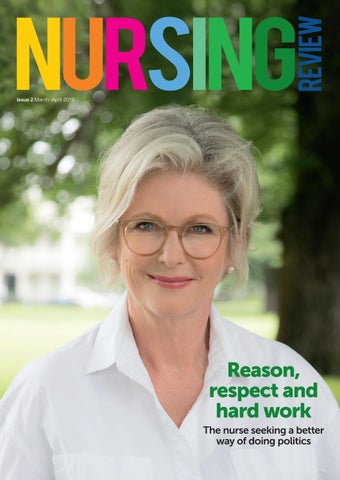
Issue 2 March–April 2019
Reason, respect and hard work The nurse seeking a better way of doing politics
For formula-fed infants For healthcare professional use only
S-26 GOLD® PROGRESS® …brings you closer Built on 4 pillars of the Alula® Baby PlatinumCare Complex™ Providing nutritional support for key areas of infant development and function Physical growth & development1-3
Brain development 4,5
• Contains a lower protein quantity of 1.3 g/100 mL‡
• Increased DHA content to 12 mg/100 mL
aligning with S-26 GOLD® NEWBORN and expert recommendations
(min. 0.32%)§ – closely aligns with expert recommendations, and the average DHA content of mature breast milk (0.32% ± 0.22%)
• Feeding a lower-protein formula* during infancy may encourage appropriate weight gain closer to breast-fed infants during early childhood development up to 6 years
• Lower energy of 273 kJ/100 mL
**
Alula ® Baby
PlatinumCare Complex ™
Digestion 6-13 • Added sn-2 palmitate (0.32 g/100 mL):
Immunity 13-18 • Contains nucleotides and
TM
sn-2 palmitate is a fat structure naturally found in breast milk. sn-2 palmitate enriched formula may result in softer stools
• High-quality whole (intact) protein with whey:
zinc naturally found in mature breast milk, which may help support immunity
casein ratio (50:50)^ similar to mature breast milk in extended lactation (after 6 months)
**
DHA = Docosahaexanoic Acid. ‡Reduced from 2.0 g/100 mL; *vs higher-protein infant formula Reduced from 275 kJ/100 mL; §Increased from 3.5 mg/100 mL (0.11%); ^From 40:60 whey:casein ratio
IMPORTANT STATEMENT: Breastfeeding is best for babies. It has benefits for the infant, such as reducing infection risk, and for the mother. It is important to have a healthy balanced diet in preparation for, and during breastfeeding. Infant formula is designed to replace breast milk when an infant is not breastfed. Breastfeeding can be negatively affected by introducing partial bottle-feeding, and reversing a decision not to breastfeed is difficult. Infant formula must be prepared and used as directed. Unnecessary or improper use of infant formula, such as not properly boiling water or sterilising feeding equipment, may make your baby ill. Social and financial implications, including preparation time and the cost of formula, should be considered when selecting a method of infant feeding. References: 1. Weber et al. 2014. Am. J. Clin. Nutr., 99: 1041-1051. 2. Koletzko et al. 2009. Am. J. Clin. Nutr., 89: 1836-1845. 3. Koletzko et al. 2013. Ann. Nutr. Metab., 62: 44-54. 4. Koletzko et al. 2008. J. Perinat. Med., 36: 5-14. 5. Brenna et al. 2007. Am. J. Clin. Nutr., 85: 1457-1464. 6. Davis et al. 2008. Eu. J. Clin. Nutr., 62: 1294-1301 7. Innis 2011. Adv. Nutr., 2: 275-283. 8. Bar-Yoseph et al. 2013. PLEFA, 89: 139-143. 9. Yao et al. 2010. J. Pediatr. Gastroenterol. Nutr., 50: E207-E208. 10. Kennedy et al. 1999. Am. J. Clin. Nutr., 70: 920-927. 11. Lönnerdal 2011. Milk and Milk Products in Human Nutr., 67, pp. 41-54. 12. Hoffman and Falvo 2004. J. Sports Sci. Med., 3: 118-130. 13. Kunz and Lönnerdal 1992. Acta Paediatr., 81: 107-11. 14. Yu 2002. J. Paediatri. Child Health, 38: 543-549. 15. Singhal et al. 2008. Am. J. Clin. Nutr., 87: 1785-1792. 16. NHMRC 2006 (updated 2017). Nutrient Reference Values for Australia and New Zealand. 17. Donangelo and King 2012. Nutrients, 4: 782-798. 18. Ortega et al. 1997. Eu. J. Clin. Nutr., 51: 253-258. Alula is a registered trade mark of Aspen Global Inc. ™ is a trade mark of Aspen Global Inc. ® S-26 GOLD and PROGRESS are registered trade marks used under licence. Distributed by Aspen Nutritionals Australia Pty Ltd. ABN 31 160 607 509. 34-36 Chandos Street, St Leonards, NSW 2065. 03346-020818. ASP3856_NR
®
contents
MANAGING EDITOR
news
Richard Garfield 02 9936 8628 richard.garfield@apned.com.au
2 4 5 6 8
NEWS EDITOR
Dallas Bastian 02 9936 8637 dallas.bastian@apned.com.au
industry & reform
10 Royal commission recap Abuse victims and families voice their grievances
HEALTH EDITOR
Conor Burke 02 9936 8638 conor.burke@apned.com.au
Nurses satisfied, but absent Mandated repositioning ‘abuse’ Autism-MMR vax link busted Transparency push for providers ‘Underused’: Nurses’ big gripe
02
08
legal corner
14 Human(e) rights Managing the online freedoms of our most vulnerable
SUBEDITOR
Robert Santos
specialty focus
PRODUCTION COORDINATOR
16 Saviours or psychopaths?
Kate Prendergast
Nurses in pop culture: two sides of the extreme
SALES MANAGER
Ben Long 02 9936 8664 ben.long@apned.com.au
18 Colonel Carer
SUBSCRIPTION ENQUIRIES
clinical practice
Nina Boyle 02 9936 8602 subs@apned.com.au
The life of an Australian Army nurse
10
14
COVER IMAGE
The pros and cons of singleroom occupancies
22 Lifelong learning
Helen Haines Photo: Supplied
Cancer nursing chair wants more nurses in research
PUBLISHED BY
24 Being earnest Nurse-patient interaction more complex than it seems
APN Educational Media GPO Box 4245 Sydney NSW 2001 ABN 58 090 900 999 ISSN 1326-0472 PP100001944 PUBLISHER’S NOTE
20 Room for thought
workforce
26 Student survival guide How to stop worrying and love clinical placement
16
20
28 Canberra calling Nurse Helen Haines shares her political ambitions
© Copyright. No part of this publication can be used or reproduced in any format without express permission in writing from APN Educational Media. The mention of a product or service, person or company in this publication, does not indicate the publisher’s endorsement. The views expressed in this publication do not necessarily represent the opinion of the publisher, its agents, company officers or employees.
30 Fatal fatigue Why your sleep deprivation is everyone’s problem
technology
32 Tech for granted Is all this technology really improving care?
34 Soft-hearted software
24
32
The therapy robot helping care for sick kids nursingreview.com.au | 1
news
Buoyant but absent Aussie nurses satisfied with their work, study says.
A
ustralian nurses work the least amount of overtime, are generally happy at work, and have more days off when compared to their international counterparts. These are the observations of a recent international study into the links between job satisfaction, absenteeism and the intention to leave nursing. With predicted nursing shortages in the future being blamed on working
conditions, and nurse migration emerging as a key concern for the International Council of Nurses, the study aimed to find commonalities among nurses globally, hopefully leading to some solutions. The study looked at 6212 RNs from seven countries: Australia, Iceland, Italy, South Korea, Lebanon, Turkey and the US. It used a survey to compare job satisfaction, intention to leave, overtime rates, patient load, and full-time versus part-time in these countries. It found that 90 per cent of nurses in South Korea had experienced working
Photo: QUT
Beating the bugs New cleaning framework reduces hospital infections.
A
trial of new cleaning guidelines used in Australian hospitals has significantly reduced major healthcare-associated infections.
2 | nursingreview.com.au
Trialled in 11 hospitals, cleaning practices improved from 55 to 76 per cent in bathroom areas and from 64 to 86 per cent in bedroom areas. The cleaning was inspected by marking surfaces with invisible fluorescent markers that could only be removed with the new cleaning techniques.
overtime in the past three months, the highest rate recorded. In comparison, Australians experienced the lowest rate at 40 per cent. The study also found that, on the whole, the nurses surveyed were satisfied in their job when quizzed on current position, occupation and teamwork. Nurses working in Iceland (87 per cent) and in Australia (82 per cent) were the happiest in their jobs in comparison with the least satisfied, Turkey and South Korea (36 and 31 per cent respectively). An unexpected finding was that the two most satisfied nursing groups – Iceland and Australia – had the highest levels of absenteeism. South Korean nurses were significantly less likely to be absent. Older nurses, full-time nurses and those who worked between one and 12 hours of overtime per week were more likely to be absent, as well as those nurses unhappy with the staffing levels in their unit. Overall, the authors contend that perceived staffing levels were the main reason for absenteeism and the intention to leave the profession. ■
The REACH (Researching Effective Approaches to Cleaning Hospitals) study, led by QUT health economist Professor Nick Graves, resulted in a 37 per cent drop in the major infection vancomycinresistant enterococci, and a 5.8 per cent decrease overall in three types of other infections. “This research project is believed to be the largest prospective, multi-site and multifactorial trial of hospital cleaning in the world,” Graves said. “Its aim primarily was to investigate whether a change in cleaning practices was effective in reducing the 165,000 healthcare-associated infections in Australia each year.” The hospitals involved actively promoted the importance of cleaning with a view to creating a cultural shift, and according to Graves, the REACH cleaning bundle is broadly applicable to any hospital. “In contrast to previous research, the cleaning bundle development prioritised evidence-based strategies that were easy to implement and [were] lower cost over newer expensive technologies,” Graves said. “Overall, the cleaning bundle cost approximately $2500 per 10,000 bed days to implement in participating hospitals.” ■
news
Sore point Mandated repositioning schedule could be a form of unintentional abuse.
A
n alternating pressure air mattress (APAM), not two-hourly repositioning, is the key to preventing bed sores. What’s more, the constant mandated repositioning of residents in aged care
could be a form of unintentional abuse and ultimately unlawful. This is according to a new study from the University of NSW. Published in the Journal of Bioethical Inquiry, it found that far from preventing sores, the repositioning practice can cause behavioural problems because of the sleep interference. “My first thought was that the practice of two-hourly repositioning would cause sleep deprivation and that it is simply torturous,” said study author Professor Mary-Louise McLaws of UNSW’s School of Public Health and Community Medicine. “It wasn’t a surprise when residents were classified as having ‘behaviours of concern’ and then chemically or physically restrained.” McLaws and her co-authors suggest that a better and more cost-effective alternative would be the APAMs. Originally thought to be an expensive outlay, and without substantial evidence of the effectiveness of the mattresses, the new study found the actual cost of these devices to be around $1.40 a day per resident and pointed out that they are available on government contract.
The power of love How relationship quality predicts mortality risk.
Y
ou’re killing me.” This might be something thrown around by couples in frustration
4 | nursingreview.com.au
when one partner won’t listen to the other, but rarely is the inverse true. A new study might change that. New research suggests that having an attentive partner can significantly improve long-term health and even life expectancy. Over a 20-year period, psychologists studied a group of about 1200 people,
“A study carried out decades ago showed that APAMs were more cost-effective than the practice of repositioning. And when you look at the costs of prevention, they are substantially lower than those required to treat severe pressure ulcers. “These mattresses relieve pressure all over the body every few minutes, continuously and gently so as not to wake or disturb the sleeper – at a frequency that human repositioning cannot match,” McLaws said. The authors also recommended the cessation of chemical and physical restraints, as the resultant inactivity also leads to ulcers. They also made submissions to the aged care royal commission on the findings of their work. Co-author Catherine Sharp said: “We are very optimistic that we will see two-hourly repositioning of residents stopped in favour of using APAMs. “This will not only improve the wellbeing of our elderly aged care residents and elderly in hospitals and the community, but it will reduce the costs and levels of unnecessary stress experienced by residents, facility staff and families alike.” ■
aged 25–74 years, who had spouses or live-in partners. Participants were asked to rate how much their partner understood, cared about and appreciated them. When questioned after 10 years, people in a long-term relationship who perceived that their partner had become less caring said they responded less well to everyday stresses. In addition, stresses recorded after that 10-year period were linked to a higher risk of death in the subsequent 10 years. The researchers found that people who reported a significant drop in their partner’s responsiveness during the first decade of the study ran a 42 per cent higher risk of mortality 20 years after the first tests. Dr Sarah Stanton from the University of Edinburgh’s School of Philosophy, Psychology and Language Sciences said the findings are among the first to investigate how long-term changes are an important marker of relationship quality and can predict mortality risk. “The results suggest that if people have someone they can turn to – and whom they think supports them – then it can help them deal with the stresses of everyday living,” Stanton said. “This also has downstream associations with later health outcomes.” ■
NEWS
No link to autism MMR vaccine in the clear, study says.
A
new study has shown no increased risk of autism after a vaccination for measles, mumps and rubella. The 10-year cohort study of over 650,000 children “strongly supports that MMR vaccination does not increase the risk for autism, does not trigger autism in susceptible children, and is not associated with clustering of autism cases after vaccination”, wrote the authors of the paper, published in the journal Annals of Internal Medicine. Danish researchers followed 657,461 children born in Denmark from 1999 through to 31 December 2010, with follow-up from one year of age through to 31 August 2013. Of the children followed, 6517 were diagnosed with autism while they were a part of the study. Senior scientist Anders Hviid said this occurred as frequently among the children who had been vaccinated, as it did among the 31,619 children who had not.
“Therefore, we can conclude that the MMR vaccine does not increase the risk of developing autism,” Hviid said. The team helped perform another large study on the issue in 2002. That also found no association between autism and the vaccine. The more recent study looked at children known to have an increased risk of developing autism themselves, such as those with siblings diagnosed with autism. Hviid said: “We also focused on other risk parameters: children with old parents, children whose mothers experienced pregnancy-related complications, children whose mothers smoked, children with low birth weight, as well as timerelated associations between the time of MMR vaccination and development of autism. “In none of the cases did we observe a higher risk of developing autism among the MMR-vaccinated children compared with the non-vaccinated children.” The Danish research team, from Statens Serum Institut, added that the study results are timely because Europe is currently witnessing a tripling of measles cases in just one year. Dr Hannah Kirk from the Monash Institute of Cognitive and Clinical Neurosciences said while it’s fantastic to see another high-quality study refute the notion that there’s a link between autism and MMR vaccine, it’s disappointing that substantial research effort, time and funds continue to be directed toward disproving something “we already know to be incorrect, rather than investigating more accurate causes of autism”. ■
1
PBS Information: This product is listed on the National Immunisation Programme (NIP) for children only and is not listed on the PBS. Refer to the NIP Schedule. Prevenar
Please review full Product Information before prescribing. Product Information is available on request on 1800 675 229 or at www.pfizer.com.au Minimum Product Information. Prevenar 13 suspension for IM injection. Indications: Active immunisation for the prevention of disease caused by Streptococcus pneumoniae serotypes 1, 3, 4, 5, 6A, 6B, 7F, 9V, 14, 18C, 19A, 19F and 23F in adults and children from 6 weeks of age. Dose: 0.5 mL I.M. Infants 6 weeks to 6 months of age: 3 doses at least one month apart. A single booster should be given in the second year, at least 2 months after the primary series. Previously unvaccinated children: Varies with age at first dose, see full PI. Children previously vaccinated with Prevenar (7vPCV): Children 12 months to 5 years who have completed primary infant immunisation with 7vPCV and children 6 to 17 years who have received one or more doses of 7vPCV may receive 1 dose, at least 8 weeks after the final dose of 7vPCV. Adults: 1 dose. Special Populations (higher risk, e.g. HIV, SCD): 1 dose. HSCT: 4 doses. If sequential administration of Prevenar 13 and 23vPPV is considered, give Prevenar 13 first. Contraindications: Hypersensitivity to any component of the vaccine, including diphtheria toxoid. Allergic or anaphylactic reaction following prior administration of 7vPCV. Precautions: Do not administer intravenously, intravascularly, intradermally or subcutaneously. Avoid injecting into or near nerves or blood vessels. Do not inject into gluteal area. Postpone administration in acute, moderate or severe febrile illness. Only protects against Streptococcus pneumoniae serotypes included in the vaccine and may not protect all individuals from pneumococcal disease. Consider the risks of I.M injection in infants or children with thrombocytopenia or any coagulation disorder. Appropriate treatment and supervision must be readily available in case of a rare anaphylactic event. Prophylactic antipyretic medication is recommended for children receiving concomitant whole-cell pertussis vaccines, and for children with seizure disorders or history of febrile seizures. Consider the potential risk of apnoea when administering to very premature infants. Very Common/Common Adverse Effects: Children 6 weeks to 5 years: Injection site reactions (redness, pain, swelling), fever, diarrhoea, vomiting, decreased appetite, drowsiness/increased sleep; restless sleep/decreased sleep, rash, irritability. Children and adolescents 5 to 17 years: Irritability, Injection site reactions (redness, pain, swelling), somnolence, poor quality sleep, injection site tenderness (including impaired movement), fever, decreased appetite, vomiting, diarrhoea, headaches, rash. Adults: Diarrhoea, vomiting, nausea, chills, fatigue, injection site reactions (redness, pain, swelling), limitation of arm movement, fever, new or aggravated joint or muscle pain, decreased appetite, headaches, rash. Adults >65 years reported fewer adverse effects than younger adults. Adverse effects were generally most common in young adults 18 to 29 years. See full PI for details (V10516). References: 1. PREVENAR 13® Approved Product Information. ®Registered trademark. Pfizer Australia Pty Limited, 38–42 Wharf Road, West Ryde, NSW 2114. PP-PNA-AUS-0060. PFA2413HP/NP. 08/17. GHG
PFAPRE2413 Flower Awareness Ad NurseRepb Half Page 185x133_v1_280817.indd 1
22/03/2019 10:45 AM nursingreview.com.au |5
news
How much for home care? Providers to be more transparent about their pricing information.
H
ome care providers will be required to publish their pricing information in a new standardised schedule on the My Aged Care website by mid-year.
Aged Care Minister Ken Wyatt said the move will help older adults understand and compare service offerings and prices across providers. “The greater transparency will also address the concerns raised about high administration prices being charged by some home care providers, which reduces the amount of taxpayer-subsidised funds
CaT Pin prototype. Photo: RMIT University
The answer to solving social isolation among the elderly may lie in a wearable device that measures conversation frequency.
H
Conversation piece 6 | nursingreview.com.au
being spent on actual support,” Wyatt said. The government is currently monitoring providers’ publication of home care pricing information, he added. “Since 30 November 2018, it has been a legal requirement for all approved home care providers to publish their existing pricing information through the My Aged Care Service Finder,” Wyatt said. And yet, as of 7 March, almost a quarter (22 per cent) of providers had failed to do so and have since been contacted by the government. While the health department has so far simply requested that the providers rectify the issue, Wyatt said compliance action could include the imposition of sanctions. “The objective of the department’s compliance program is for providers to voluntarily comply with their responsibilities and, where non-compliance is identified, to return the provider to compliance as quickly as possible,” Wyatt said. Home care providers will be able to publish their pricing information within the schedule from April this year but will be required to do so by 1 July. ■
ow many conversations do you have in a day? A wearable device might soon be able to tell you. RMIT researchers have partnered with Bolton Clarke to develop the CaT (Conversation as Therapy) Pin. It tracks the wearer’s conversation and sends alerts to family or carers if there are signs of social isolation. The technology, which can be worn as a lapel pin or a brooch, monitors baseline conversations and word count throughout the day and prompts social contact if levels drop too low. RMIT designer Leah Heiss, the project’s lead, said the CaT Pin was a low-cost solution to the loneliness experienced by older adults due to lack of social interaction. “Solutions to this challenge require a human-centred and interdisciplinary approach to technology design,” Heiss said. Matiu Bush, senior strategist in business innovation at Bolton Clarke, said addressing loneliness can help provide a better quality of life for Australia’s ageing population. “The health consequences of loneliness and isolation are dramatic and can include disrupted sleep, high blood pressure, increased depression, lower immunity and generally lower overall wellbeing,” Bush said. The team said the device, which won the Telstra Designing for Ageing Well Challenge, can be personalised for each wearer by designing around existing jewellery or items like medals or textiles. The $10,000 cash prize will allow the team to develop proof‑of-concept technology for user testing and to investigate mass customisation. ■
1
As a practice nurse, you know the importance of protecting your most vulnerable patients. Prevenar 13 is well established for the protection of infants (>6 weeks) against pneumococcal disease. It’s not just babies who can be vaccinated though; help protect all your patients who are at increased risk.1 Adults may need protection too, help protect them today. The Immunisation Handbook recommends that all patients at highest risk of pneumococcal disease (Category A) receive Prevenar 13. Refer to the Handbook for details.2
To learn more about Prevenar 13, call 1800 675 229
PBS Information: This product is listed on the National Immunisation Programme (NIP) for children only and is not listed on the PBS. Refer to the NIP Schedule.
BEFORE PRESCRIBING, PLEASE REVIEW THE PRODUCT INFORMATION AVAILABLE IN THE PRIMARY ADVERTISEMENT IN THIS PUBLICATION.
Limited safety and immunogenicity data on PREVENAR 13 are available for patients with sickle cell disease, allogeneic hematopoietic stem cell transplant, or HIV infection, and are not available for other immunocompromised patient groups. Efficacy/effectiveness has not been established. Vaccination should be considered on an individual basis. Immunocompromised individuals or individuals with impaired immune responsiveness due to the use of immunosuppressive therapy may have a reduced antibody response to PREVENAR 13. Immunisation schedules for PREVENAR 13 should be based on official recommendations. References: 1. PREVENAR 13® Approved Product Information. 2. Australian Technical Advisory Group on Immunisation (ATAGI). The Australian Immunisation Handbook 10th Ed (2017 Update). Canberra: Australian Government Department of Health, 2017. Available at www.immunise.health.gov.au. Accessed August 2017. ®Registered trademark. Pfizer Australia Pty Limited, 38–42 Wharf Road, West Ryde, NSW 2114. PP-PNA-AUS-0103. PFAPRE2413FP/NR. 09/17. GHG.
news
More to offer National workplace survey finds nurses feel content, but underused. By Conor Burke
A
survey of primary healthcare nurses has found that 46.2 per cent believe they could be doing more at work, and when they’ve asked for more responsibility, 27.9 per cent report that managers haven’t approved the request. These are just two of the findings from a national survey of 2052 primary healthcare nurses undertaken by the Australian Primary Health Care Nurses Association (APNA) and the new Health Professionals Bank. Other insights gleaned include that 27 per cent of the nurses surveyed believe they could do more with their knowledge and skills, and 12 per cent believe that most of the time they don’t get to use their skills and knowledge to their full extent. APNA’s president Karen Booth thinks this is an important insight. “There are a large number of nurses, particularly in primary healthcare and general practice ... who feel they aren’t being utilised to their full skill set,” she said. “They’re trained to do this really dynamic work, and they feel that they have so much more to offer their workplaces and their patients than they’re currently doing.” As for their views on professional development, nurse responses were mixed. Thirty-three per cent of the nurses surveyed were currently studying a postgraduate university course. However,
8 | nursingreview.com.au
some 31.8 per cent of nurses found that inadequate staffing levels prevented shift covers and that this impeded their ability to undertake education and training. Thirty-one per cent of nurses said they didn’t have the time to attend professional development and training, and over 60 per cent found training too expensive. On this point, Booth believes employers can do better, as professional development benefits the workplace in the long run. “Sponsorship from their workplace or sponsorship to scholarship schemes would be helpful,” she said. “Some employers are very good in that they’ll pay full CPD or they’ll give nurses time off, but it’s not across the board. A lot of nurses have to do all of that in their own time. They take annual leave. “All of those important things they learn, they actually bring back to the workplace and benefit the workplace,” she said. However, overall, nurses were happy in their work. When asked if they were satisfied with their current role, over 70 per cent of nurses were satisfied or very satisfied. Thirty-six per cent of nurses were satisfied with their salary – 28.8 per cent were dissatisfied – and nearly 80 per cent were satisfied or very satisfied with their physical work environment, their relationships at work, the trust and respect in the workplace, and, importantly, the job overall. Booth believes that these types of surveys are an important way of gauging the wellbeing of the sector.
“It helps us to get a better idea of the type of skills the workforce has, how well their skills are utilised, and their sense of satisfaction,” she said. “Having a sense of satisfaction and pride in your work, of course, is one of the main things that keeps nurses, in particular, in their workplaces”. APNA’s partnership with the new Health Professionals Bank has funded this recent survey, and the offshoot of the Teachers Mutual Bank aims to be an ethical institution that helps its members. Booth thinks it will appeal to the specific needs of nurses and midwives – such as shift work – and that this bank is a move back to the community-style bank of old. Health Professionals Bank general manager Carolyn Murphy said: “We are the first and only bank dedicated to health professionals and their families. “So we’re ... different to the big four. We’re a customer-owned bank, so all of our members are part-owners in the bank, and all of our profits and surplus are reinvested into the communities in which they serve. “We won’t invest in any harmful projects – so no fossil fuel projects, tobacco, gross environmental harms – and recently our deposits and mortgages were rated socially responsible. “We have no monthly fee on our transaction account. We have a great credit card which won awards as a transactor card. It has no fees on that – no additional card fees.” The Health Professionals Bank launched in March. ■
Take the next step in your career Leaders in practical, contemporary professional development and training for nurses
matereducation.qld.edu.au
industry & reform Oakden whistleblower Barbara Spriggs and son Clive. Photo: James Elsby, AAP
Speaking is not easy, she cautioned, but “speaking out lifted the lid” on the abuse being committed. Spriggs spent most of her testimony outlining her views on the changes that need to occur in the sector. These include greater accountability, improved staffing – training, salaries and ratios – a database for staff who commit abuse or have complaints made against them, CCTV in common areas, and better end-of-life plans.
View from the peaks
The royal treatment A summary of the first hearing of the Royal Commission into Aged Care Quality and Safety. By Conor Burke
DAY 1: FIRST WITNESSES CALLED “I’m sure if I had taken Bob to the Royal Adelaide Hospital in the state he was in, I would have been reported to the police.” That’s how Oakden whistleblower Barbara Spriggs recounted the injuries her late husband sustained at the infamous facility, as she gave her witness testimony to the aged care royal commission. Spriggs was the first witness to be called at the commission in Adelaide on Day 1, and at times she became emotional as she recalled the pain and suffering her late husband Robert ‘Bob’ Spriggs went through and the subsequent anguish felt by her and her children. Bob was 66 years old when he died in July 2016, after a battle with many illnesses, including Parkinson’s disease. Bob had two short stays at the Oakden facility in South Australia, one in January of 2016 and another in February of the same year which, according to Spriggs’ testimony, caused Bob’s health to decline dramatically. Before Spriggs was brought up to testify, counsel assisting Peter Gray started proceedings. In his slow, measured manner, Gray set out how the next two weeks will run, saying that these initial hearings will mainly provide context and background to 10 | nursingreview.com.au
the industry and that he does not expect the commissioners to rule on them. He told the commission that some of the 800 public submissions received so far have been harrowing, and that the commission is grateful for the bravery of those people. He told those in attendance that allegations against specific providers or individuals are for another time.
Providers slow to respond From Gray’s opening, we also learnt that the Department of Health has forwarded any submissions it received when the commission was first announced – with some previously concerned that these may be lost or not considered. We also heard that, as of now, only 900 of the 2000 registered providers, and only 79 of the top 100, have responded to the commission with details of any instances of substandard care – a fact that will not be looked kindly upon by the commissioners. “We will follow up the providers who have not responded to the request to ensure it has been received and has been receiving proper attention,” Gray said. “As commissioner Briggs noted previously, providers who do not engage with our requests draw attention to themselves and to their practices. They will be subject to careful scrutiny.” Spriggs was eventually called to testify jointly with her son Clive. She used her time not to dwell on her family’s story, she told the commission, but to encourage others to come forward.
COTA Australia chief executive Ian Yates spoke for most of the remainder of the day, covering topics ranging from overmedication, the difficulties regulators face catching misdeeds in facilities, to aged care funding and future improvements. In his witness statement, Yates told Gray that when it comes to funding aged care properly, “we don’t really know whether … the total amount that providers are receiving is adequate”. “And, in that context, what proportion should be paid for by the government, the taxpayer, which is, in the end, a subsidy to our care and in many cases to our accommodation, and what should be paid by individuals who have capacity to pay. And, at the moment, we do not have a coherent policy about that”. Using the Home Care Packages system Levels 1–4 as an example, Yates said that the financial means testing does not even out across the country, telling the commission that we need a fairer system that is plain and easy for everyone to understand and would pass “the pub test”. In his written statement, Yates said: “Improving respect for older Australians will be a critical part of any future aged care system.” He also suggested a single national plan for older Australians, which would put in place strategies to eliminate ageism, as key to future safety in the sector.
Setting the scene At the end of the first day’s hearing, Clive Spriggs told Nursing Review how important it was for him and his mother “to be the first to present and speak, and ... to be able to speak in front of the royal commission and get our point across to them and set the scene for what’s going to happen and where things are going to go”. Asked whether they thought this was finally the time that change would occur, Barbara Spriggs was confident.
industry & reform
“I think it has to change,” she said. “I don’t think it can any longer be pushed under the carpet. There are too many people now throughout Australia, not just South Australia, who are so aware of these issues that they can’t go unnoticed anymore. Change will happen. It has to happen.” The first day of the commission will be the last day the Spriggs family attends, happy now to allow other stories to be told, and hopefully, for them, time to move on. “It’s too confronting, too overwhelming,” Barbara Spriggs said. “I think we need to give other people space to do and say what they have to, and I don’t think it’s good for our health and wellbeing to be listening to every little detail.”
Care, dignity and respect Throughout her in-depth, well-reasoned testimony, Barbara Spriggs kept returning to her husband Bob, and stumbled only when she recalled her family’s struggle to be heard and the bruised state she found him in when he was hospitalised after receiving 10 times the recommended dose of antipsychotics, suffering dehydration as well as pneumonia. “To this day, I don’t know what happened to Bob at Oakden,” she said. “I wonder about those who hurt Bob and wonder where they are now and if they are employed somewhere else.” This thought hung in the air. The phrase “care, dignity and the respect they deserve” was often repeated throughout Spriggs’ testimony and could set the tone for the year to come. She ended by saying: “My testimony will not save Bob, but I hope and pray [that the royal commission will make sure] no one else will suffer as my husband suffered.”
DAY 2: INEFFECTIVE ADVOCACY The second day of the royal commission threw up some ageing statistics and a few gripes in another day where the background problems are being laid bare for commissioners Lynelle Briggs and Richard Tracey. On the first day, five witnesses were called, including Paul Versteege, policy manager at the Combined Pensioners and Superannuants Association of NSW (CPSA), who criticised a number of aged care advocacy groups. But first up, witness Justine Louise Boland from the ABS briefed the room on the way our nation is ageing. We heard that a third
of Australians aged 85 or older are in aged care, with the number of people aged 85 or older in our population set to more than double by 2066. Furthermore, and likely to pique the interest of the Australian government, the dependency ratio on those within the wage-earning population is also expected to grow. As it stands, for every 48 people who are wage earners, 52 people depend on them. By 2042, that figure will rise to 58 people for every 42 wage earners. The most contentious moments of the day came from Versteege. He used his time before the commission to take a number of workforce and advocacy groups to task for putting the providers above consumers, first taking aim at the National Aged Care Alliance (NACA). “Initially the membership of the National Aged Care Alliance was numerically dominated by aged care providers, and we believe it still is dominated by aged care providers,” he said. “At one point NACA had a direct line into government, to the office for the minister for aged care, and our concern has been and still is that an organisation, an alliance, that is dominated by a certain interest group will necessarily push those interests above all others.” Versteege also took aim at the Aged Care Workforce Taskforce, believing that the exclusion of the unions is counterproductive to sector improvements. And as for the Aged Care Sector Committee, he said that, again, it does not have residents’ interests at heart. Versteege also discussed poor nutrition standards in homes and times when meals would go uneaten due to understaffing. “What they found was that people were served a meal but were unable to get to it … And because staff were rushed, they would not be able to assist them. “Staff would come round and collect the uneaten meal and a person would basically not eat.”
DAY 3: STAFF RATIOS Properly staffing aged care facilities with an adequate nursing skill mix and at least four hours and 18 minutes per-patient per-day care minimum would not cost the sector anything more than it currently outlays. That’s according to a report presented to the royal commission by the Australian Nursing and Midwifery Federation (ANMF) federal secretary Annie Butler. The ANMF-funded, Flinders University National Aged Care Staffing and Skills Mix
Commissioners Richard Tracey and Lynelle Briggs enter the room. Photo: Kelly Barnes, AAP
Project Report made a cost-benefit analysis of the paper’s recommendations and found that although it would cost $5.3 billion to implement, any costs would be offset through tax measures and other features. Savings made by avoiding staff attrition is one such feature, which currently costs the sector $500 million. “If you had proper staffing in the places, people would feel satisfied, fulfilled in their jobs as nurses and carers, and we wouldn’t see the churn that we see,” Butler told the commission. Staffing levels were the running theme in Butler’s testimony, as well as skills mix and the pay gap between the public sector and the aged care sector. “What we hear most often from our members now is the increasing pressure they’re experiencing with workloads. “So many of them across the country describe their workloads now as unsafe. They’re untenable. They report to us that that’s why they’re leaving the sector,” she said. These shortages affect the ability of nurses to properly attend to residents in the mornings during their personal hygiene routine, during meal times and at handover between shifts, Butler said. We heard a particularly disturbing account of a man, post-stroke and aphasic, who was experiencing pain in his penis. He was found to have an indwelling catheter wound, due to a poor handover. Counsel assisting Paul Bolster read a statement from an aged care nurse about the incident that read: “I am blown away that the staff did not report the erosion as it was happening and take steps to prevent it. More-educated staff had not looked at the source of his pain. He had Panadol every night.” Nurse testimonies from ANMF surveys also highlighted their concerns about nurse hours. The federation put forward their nursingreview.com.au | 11
industry & reform
hourly care model and a mandated skills mix of 30 per cent registered nurse, 20 per cent enrolled nurse and 50 per cent personal care worker. “What we think our research clearly indicates is there’s just a gaping hole in the Aged Care Act currently in terms of how you actually staff against genuine care needs in residential aged care,” Butler said.
DAY 4: RISE IN ‘SERIOUS RISK’ The year after the government stalled aged care funding, there was a marked increase in findings of “substandard care that would impact on the health and wellbeing of a care recipient”. During the evidence of the secretary of the Department of Health, Glenys Beauchamp, counsel assisting Peter Gray alluded to a correlation between the two outcomes. In 2015–16 the Australian Aged Care Quality Agency found only two aged care providers to be a “serious risk”. The following year, concurrent with the government’s indexation of the Aged Care Funding Instrument (ACFI), there were 22 serious risk findings, and the year after a jump to 61. Gray asked whether funding levels were sufficient and if funding freezes impacted safety standards, but Beauchamp proved hard to pin down, causing Gray to repeat the question. Beauchamp suggested that “it is sufficient for the forward estimates period”. We also heard evidence, from data contained in consumer experience reports conducted in over 1100 facilities, that 98.3 per cent of aged care residents felt safe. However, when more closely inspected, those figures are misleading. Gray pointed out that in fact the survey was broken down into categories, and that of the 98.3 per cent, 17.21 per cent of respondents answered that they felt safe only “most of the time”. When asked by commissioner Briggs if she would feel comfortable putting a loved one in a facility under current standards, and if these standards reflected community ideals, Beauchamp was noncommittal. “I think the current standards require a subjective assessment, not necessarily based on how the client feels and what the client is experiencing, but I think the new standards absolutely put the care recipient at the centre,” she said.
DAY 5: AIR-CON TALK GETS HEATED The fifth day of the royal commission saw a set of tense exchanges between counsel 12 | nursingreview.com.au
assisting Dr Timothy McEvoy and Leading Age Services Australia (LASA) chief executive Sean Rooney. Rooney was taken to task by McEvoy over a number of issues, in particular LASA’s views on air-conditioning in aged care facilities. LASA’s submission mentioned – in reference to the government’s draft aged care quality standards consultation paper – the need for “comfortable internal temperatures”, which “may be interpreted that all services are required to have air-conditioning”. McEvoy pointed out that, in fact, there was no reference to internal temperatures to be found in the draft, asking: “Is it the view of LASA that it’s unnecessary to have heating or air-conditioning in residential aged care facilities?” Rooney replied in the negative, only to be pursued by McEvoy. “So, if that’s the case, why was it suggested that reference to ‘comfortable internal temperatures’ be removed and ... why was there a concern?” he asked. When asked repeatedly whether he and LASA believe that air-conditioning should be standard across aged care facilities, Rooney repeated that heating and cooling should make residents “comfortable”. Rooney was asked how this issue came up and if LASA was lobbied by providers due to a fear that air-conditioning may be a requirement. Rooney replied that the question “must have been raised by a member at some point”, causing McEvoy to question – three times – whether LASA would ever prioritise the needs of residents at the expense of providers. “I would suggest that LASA has always looked to ensure that we are supporting our members to deliver the best possible care that they can,” Rooney replied. This was not the only time Rooney was pressed during his testimony. He was also asked why some LASA members wanted to change the wording of the Single Aged Care Quality Framework. LASA’s statement reports that “some LASA members have suggested amending Clause 2.3 to remove ‘continuously monitored’ to replace it with ‘regularly monitored’”. The clause currently states that: “Care and services are implemented and continuously monitored and evaluated for effectiveness.” McEvoy then proposed that the amendments sought by LASA might serve to reduce “the standard required because there’s no requirement for continuous monitoring”.
Margot Harker, aged care service recipient, at the Commonwealth Courts in Adelaide. Photo: James Elsby, AAP
“Counsel, I would suggest that was not the intent of the suggested change to the standards,” Rooney replied. The issue of ACFI indexation was again raised. Nicolas Mersiades, director of aged care at Catholic Health Australia, said the indexation formula is “particularly harsh” and is not keeping up with the economy. Dementia Australia chief executive Maree McCabe told the commission that by 2056 there will be an estimated 1.1 million Australians with dementia, adding “there won’t be anybody that is not impacted in some way”. McCabe called for mandatory dementia training for the 240,000 aged care workers in Australia. “Seventy per cent work as personal care workers, and their Certificate III does not provide any education around dementia, not as mandatory or even optional training,” she said.
DAY 6: DEATH BEFORE RESIDENCY Some people would rather die than go into residential aged care facilities. This is according to UnitingCare Australia’s Claerwen Little, who told the commission about the findings from Uniting’s research into community perceptions of aged care. They found, among other things, that although it is in people’s minds, aged care is not seen as the most pressing issue for the government to fix. However, the research did find that the wider public had a number of misconceptions about the sector. “People thought that it was dominated by the for-profit sector, that … the big forprofits were making a lot of money out of aged care,” Little said. “That it was mostly residential care … And the sort of nuances of the community home support program and home care program
industry & reform
really weren’t part of their … understanding of the aged care system and sector.” The research also showed that people’s understanding of who funds aged care is limited, and what’s more, they don’t want to pay for it themselves. “They think that more money is needed from government. And I think one of the other key findings is that people don’t believe that they should be paying for aged care. “They do believe they’ve paid their taxes and they’ve contributed to the community all their life and that they should be supported in old age,” Little said. When asked what their findings say about perceptions of aged care, Little did not sugar-coat her response. “Sadly, some people suggested they would rather die than go into a residential aged care facility. They would rather poke their eye with a pencil than have to enter a home,” she said.
DAYS 7 AND 8: HOME CARE PACKAGES In the final two days of the first hearing of the royal commission, we heard from the people affected by the system itself and had a summary of the proceedings to date. Kaye Warrener described to the commission the near two-year wait she and her husband Les have endured while waiting for assistance from My Aged Care. Warrener is her husband’s full-time carer, and they contacted My Aged Care for the first time in November 2017 in relation to a Home Care Package. “We were told at the very beginning that it could be 12–18 months for the package,” she said. “And up until today, we’re still waiting for the Home Care Package Level 3”.
Healthy returns
Warrener described how this wait for adequate care has seen a decline in her husband’s health, and this has been hard for her too. “It’s hard to watch your loved one – I mean, we’ve been married for 56 years – to watch their health deteriorate. And I just feel with the extra support financially we would be able to help perhaps delay some of those onset things that are happening with age,” she said. Margot Harker, who is currently on a Level 4 Home Care Package, spoke of her frustration with the level of care she receives. “With one of my providers at the moment, the one that’s handling most of my evening care – so that’s paid for by the package – I’ve had at least 12 months, probably the two months of this year and going back 10 – nine or 10 months of last year, in which there was, frankly, incompetence,” she recalled. “That people who were on a roster didn’t know they were on the roster; I hadn’t got a copy of the roster. So those standard procedures where a coordinator will ring round the carers and say, ‘Would you be able to take Margot’s shift on Thursday?’ They then say yes or no.” She also spoke about the loneliness a Home Care Package engenders, with no scope for companionship. “I think it’s emotionally very crippling, in the sense that it overtakes you quite a lot at certain times. I’ve also discovered – because I was 64 when I had the stroke and I’m now 72 – that there has been a kind of accelerated ageing that has gone on in this time,” she said. We also heard from aged care resident Barrie Anderson, whose wife has advanced
Straightforward investment options
dementia and is nearing the end of her life. He had an overall positive view of his and his wife Grace’s time in care but did talk of the need for more dentists in the system and the problem of nursing staff turnover. For the positives, he cited the original facility they stayed in for its house-like layout and the various music programs they have taken part in. “I think it’s very important in terms of not only Grace’s wellbeing but mine. And in theory, music, I believe, touches the soul. With the music that Grace is provided with at the moment, we can reminisce about past times. And I think that music
These shortages affect the ability of nurses to properly attend to residents... is underestimated in its ability to enhance people’s lives.” On the final day of the hearing, counsel assisting Dr Timothy McEvoy spent over an hour summing up the thoughts from the eight days of evidence. He identified several factors affecting the provision of aged care in this country: population growth, increasing dementia levels, increasing demand for home care, workforce issues, the difficulty obtaining public health services in aged care, and the economic sustainability of the system itself. “The dominant narrative too often casts older Australians as a burden, rather than a blessing. The royal commission rejects that narrative and calls for a culture of appreciation and respect for older Australians. But this must be more than a mere statement of aspiration,” he said. ■
Fair and transparent fees
Join Prime Super | 1800 675 839 | primesuper.com.au Prime Super Pty Ltd ABN 81 067 241 016 AFSL 219723 RSE L0000277 as Trustee of Prime Super ABN 60 562 335 823 RN 1000276
nursingreview.com.au | 13
Legal Corner
Net ban Court curbs disabled man’s social media usage for his own protection. By Scott Trueman
T
his unique case from the UK brings to light the fine balance courts have to maintain between a disabled consumer’s rights and his or her need for ‘protection’ from engaging in risky behaviour. This is never more so than when the consumer is assessed as lacking capacity, which, in this legal sense, means a person does not have the intellectual and/or cognitive ability to consider and fully understand the consequences of their actions or behaviours. This recent decision concerns such matters in relation to social media usage. The case involved a 21-year-old, ‘AC’, who identified as a gay male. He had a learning disability, with an impairment in adaptive social and executive functioning. If he had not been provided with support, he would not have been able to manage his personal and domestic care needs. He had been in independent supported living for most of the past two years, and received extensive personal social care support. Concerns about AC’s internet usage first arose in early 2016 when he was living at home. His parents found he had used his Facebook account to share, with unknown males, intimate photographs and videos of his genitals. His social worker said AC’s “compulsion to communicate with others online seems to override any concern he may have for his own safety”. AC had a very low literacy level. He used the photographs
14 | nursingreview.com.au
and videos, accompanied by short, simple but indisputably provocative words, to communicate with other men. AC’s low literacy had severely impaired his ability to navigate the internet safely. He would often visit extreme pornographic sites by clicking on a series of suggested links. When unsupervised, he was known to search compulsively for sites showing paedophiliac and other illegal sexual activity. He clearly could not read nor understand the warnings regarding the content and safety of such sites. Further complicating AC’s submissions to the court were that AC had confided to a support worker that he had been raped twice by an identified male adult. An officer investigating the matter was concerned that if AC did not change his behaviour, he too might become a perpetrator of such offences “due to his lack of understanding around the subject”. When these proceedings were issued, it was known that AC was continuing to find ways of associating with perpetrators of sexual exploitation online. On one occasion, in May 2017, after his own device had been temporarily withdrawn, he obtained a staff member’s mobile and accessed over 150 extreme pornography sites. In April 2018, AC sent unsolicited text messages to the male who had been identified as the alleged perpetrator of the rape referred to above. AC said he did not know why he had done this, and could not identify any problems with doing so. In evaluating this conduct, the community nurse and social worker drew attention to the uncertainty about whether AC’s behaviour revealed a deficit in one of the areas of his functioning, or whether he was merely impulsive, risk-taking and/or ‘unwise’. The clinical psychologist, treating doctor and community nurse jointly submitted that AC “does not understand the risks and benefits which contact with others presents to him: his learning disability does result in a lack of understanding which impairs his ability to weigh the costs and benefits of contact, although there is a compulsive element to his behaviours”. The internet is important for people with disabilities and/or social communication problems. It enables ready access to information, recreation and communities for those who are restricted in leaving their homes. The internet and social media networks offer users with disabilities opportunities and enhanced autonomy, they provide a means to express social identity, and they enable the learning of new skills and
the development of careers. The importance of creating and maintaining ready access to electronic and digital technology for people with disabilities is well recognised – it is identified as a right within the United Nations Convention on the Rights of Persons with Disability (UNCRPD). Article 9 of the UNCRPD requires states (UK and Australia are signatories) to take appropriate measures to enable those with disabilities to “live independently and participate fully in all aspects of life” and to have “access on an equal basis with others … [to] information and communications technologies and systems”. There is also a requirement on states to eliminate barriers to accessibility for people with disabilities to “information, communications and other services”. Article 21 provides a complementary provision, for people with disabilities, to “exercise the right to freedom of expression and opinion, including the freedom to seek, receive and impart information and ideas on an equal basis with others and through all forms of communication of their choice” by “encouraging the mass media, including providers of information through the internet, to make their services accessible to persons with disabilities”. Article 22 enshrines the right to privacy for people with disabilities. Here’s the rub: where does the balance sit between inherent human rights, enshrined in legislation, and the protection of the ‘vulnerable’ (a state obligation)? After due consideration, the court came down on the side of ‘protective court orders’ for consumer AC. The court pronounced: “In considering [AC’s] best interests, I have had regard to the local authority’s draft ‘internet access and safety’ care plan. This provides for [AC] to use one of the iPads owned by [the service provider] for a limited period each day, under a degree of supervision; his phone contract is financially capped, and his mobile device does not have the capability to access the internet. He has agreed that staff may check his mobile phone for messages on a daily basis to support him in dealing with unwanted text messages, and to ensure that he is not engaging in inappropriate communications with others.” No matter what your general ‘human rights’ stance is, it is easy to imagine that in light of AC’s conduct and history, if something untoward had occurred, the state would probably be found legally liable in negligence and/or breach of their statutory duty towards AC as a vulnerable consumer. ■
specialty focus Edie Falco as Jackie Peyton in Nurse Jackie.
Angel of mercy or sex object?
How fictional stereotypes influence nurses and patients. Donna Lee Brien and Margaret McAllister interviewed by Conor Burke
N
obody knows you’re here. And you better hope nothing happens to me. Because if I die ... you die,” Annie Wilkes tells injured writer Paul Sheldon in Stephen King’s Misery. Sheldon had crashed his car in a blizzard and Wilkes found him. She’s his number one fan – and an ex-nurse. She’s also a psychotic killer who holds Sheldon hostage and tortures him. This is just one of the many wild representations of nurses in popular culture that range from the endlessly giving angels to the evil baddies, like Wilkes and the infamous Nurse Ratched from One Flew Over the Cuckoo’s Nest. They can also encompass the ridiculous, like the nervous and clumsy Gaylord Focker in Meet the Parents, the troubled but more realistic lead character in Nurse Jackie, or the all-knowing, sassy Carla from Scrubs. But these portrayals can have an effect on real-life nurses. Donna Lee Brien, a professor of creative industries at Central Queensland University, and Margaret McAllister, a professor of nursing at the same university, have studied popular culture’s limited view of nurses and found that it can take its toll. “To portray nurses as endlessly caring is verging on saying that it’s an inherent trait that a person has within them, and that
16 | nursingreview.com.au
therefore makes them a good nurse, but in fact it will likely make them a very vulnerable nurse who will be traumatised and burnt out,” McAllister told Nursing Review. “People are constantly disappointed that nurses don’t have the time to stay with someone in their pain or tearfulness – and that hurts two sets of people: it hurts the patient, and it also hurts the nurses,” McAllister said. Brien thinks that newly graduated nurses are particularly susceptible to the unrealistic stereotypes of nurses presented by the media. “I don’t think it’s helping our new nurses that are coming into education and then going out into nursing to also expect that of themselves, because they’re going to get hurt and frustrated,” she said. McAllister and Brien see sexism as partly to blame for these perceptions. However, nurses in media can also provide commentary on class, knowledge and power between doctors and nurses, as well as the economics of healthcare. “It’s a class thing, and it’s a power struggle between medical knowledge and nursing knowledge,” McAllister said. “For example, Nurse Jackie and Getting On are stories that are critical of economic rationalism, health policies and the austerity measures that have made, for example, the NHS in England run on skeleton staff. It’s a comment on economics and politics as much as it is on workers within a system,” she said. Nursing Review spoke to Brien and McAllister to unfold this issue.
NR: You wrote an essay recently for The Conversation about nurses in pop culture. They’re often portrayed as subordinate or endlessly caring sex objects. Why and where did this start? MM: Hospital dramas make for great stories because there’s conflict, there’s intrigue, there’s expertise in the face of suffering and questions in need. So, for a start, hospital stories are compelling, and to make hospital stories even more dramatic there needs to be some kind of interaction between the sexes. Nurses and doctors make for that intriguing interaction.
specialty focus
Way back in Florence Nightingale’s day in the 18th century, nursing became a gendered profession, and so men in nursing were excluded at that time and females took over the ranks of nursing. From then on, it’s become a very heavily gendered profession. So, what we see in hospital dramas is that not only is there conflict between nurses and doctors, it is often a gendered conflict. Even though these days more than 50 per cent of doctors are female, in nursing it’s still the case that 90 per cent are female.
It’s a context of working practice that foregrounds gender and the troubles between the sexes. Would you say that’s part of it? DB: Yes, and also that in any kind of storytelling, stereotypes actually work. They work as a kind of shorthand. When writers use this idea of the handsome, all-knowing male doctor and the attractive, submissive, helpful female nurse, it’s very easy for writers to plug into those stereotypes because, of course, they also have other things to talk about [and don’t want to waste time setting up complex personalities]. Most of these stories are not totally about nurses or doctors and how they relate, or how they’re seen in society, but some other drama or comedy or other thing going on. And so these stereotypes, which of course in other professions too are male and female, are just easy to plug into. Viewers know what they are seeing, and so the drama or comedy unfolds [without needing too much set-up].
You talk about the stereotype of endlessly caring sex objects, but there often isn’t a middle ground. They are often portrayed too far on side or the other – as malevolent, dangerous, or out of control, to paraphrase you both. Why does it go to such extremes? DB: That goes to the heart of good storytelling. In our work on these representations, we’re not saying that these representations aren’t entertaining, or good storytelling, or fantastic entertainment. When you have an idea of nurses in society as good – and research says people trust nurses more than virtually any other figure in society – if you can then turn around that goodness into badness, that’s very entertaining for viewers. MM: There has always been goodies and baddies. It’s an ancient part of storytelling to have a protagonist and an antagonist. But what we’re saying is that the danger in having these two extremes is that the nuances in between get left out. What we also argue is that pop culture is not insignificant. It has the power to persuade people that what they see on screen is what happens in reality. We would argue that reality is far more complex and nuanced. The idea of the good nurse – endlessly caring, always empathic – who has lots of patience and lots of time to sit there and calm the fevered brow, and, on the other side, the bad nurse, who is strategic and has evil in her heart and murder on her mind, is rarely the reality in nursing, which is a very diverse profession. Yet, in popular culture, that diversity in the work is not apparent. It’s not made visible, and that does the public a disservice because nobody actually really knows the complexity of nursing work. DB: That then becomes a problem when you’re recruiting for the industry, because some of the very nurses of the future are absorbing these stereotypes. That is therefore affecting their choice of career and how they fare once they go into the profession.
You mentioned the nuance in between, and in your paper you refer to many different shows and nurses. A show that I liked, with an actress I liked, was Nurse Jackie, which is about a nurse who has a drug addiction but who is also a very capable at her job. You almost it hold up as an example of one of the more well-rounded portrayals. MM: Nurse Jackie deals with more than just her personal issues. All the storylines in the series deal with complex parts of reality, such as domestic violence, people dying and suffering alone, people too poor to pay for their insurance. All of these issues are raised in Nurse Jackie because it is a satirical show, so it has a licence, I guess, to deal with the problematic. Another show that does something similar is the British television series Getting On, which is another view of nursing as being very hard work. Often it’s the working class who work in nursing, and they have to put up with all sorts of bureaucratic policies that slow care down and interfere with the relationships that could be happening between nurses and patients. Yes, with Nurse Jackie we are seeing a nurse that is not exactly balanced, and she certainly crosses ethical boundaries, but it also allows for other storylines to flow and therefore it’s intriguing and challenging for the audience. DB: Interestingly too, both of these series show that the hospital itself is not a perfect place. They show staff shortages, bureaucracies interfering with the real work that needs to go on, people with different skill sets, and so on. So even though they may not seem to, they actually offer some deep comment on the healthcare system.
What can the media and wider society do to remedy these perceptions in popular culture? MM: I think Nurse Jackie and Getting On have done a lot for encouraging writers, producers and long-form series to create more complex characters with really compelling stories. Over the weekend I watched a new series on Netflix called Dirty John, which is a true story about a male nurse who goes to great lengths to con people and is able to do so because of his access to knowledge and resources as a nurse. The story is
What we see in hospital dramas is that not only is there conflict between nurses and doctors, it is often a gendered conflict. compelling. I think the public are now ready for complex stories about protagonists who are not just rendered as sex objects or corollaries to stories, but play a central role. DB: I think too that our role is not just to criticise certain portrayals, but to look at them and say, “Wow, I really enjoyed that little half-hour comedy, but what was this saying about nurses, and what does that mean for how nurses are seen and how they see themselves?” We need to look at these films, books, stories and TV series, and then say as scholars, teachers or the media: How can we talk about them? The goodie/baddie discussion of ‘Well, here’s a nurse and she’s evil and that’s good for nursing’ is very limited. However, asking ‘Why is the public fascinated by this nasty nurse?’ is a much more interesting conversation for us all to have. ■ nursingreview.com.au | 17
specialty focus Army nurse Jo Ikin. Photo: Linda O’Sullivan
On the front line Life as a nurse with the Australian Defence Forces. By Conor Burke
W
e’d always get the cocky doctor who wouldn’t listen, and so the nurses would try a few times and then you’d go, no, let him hang,” Jo Ikin jokes. “They’d learn by their mistakes. Obviously, we’d never put a patient at risk, but you’d try to advise them.” We are talking about respect and chain of command on the wards, but more specifically in the army. There is no messing around with Ikin: mother, midwife, marathon runner, nurse and lieutenant colonel in the Australian Army’s Joint Health Command. Ikin originally wanted to go to university to study teaching, but the cost of living away at uni was too much, so she learnt a trade the old way – on the job. A nurse since the age of 17, Ikin, originally from Victoria, now finds herself based in Canberra reminiscing about a life filled with two careers: one as a civilian, and one as an army nurse. Starting her training at the Ballarat Base Hospital, Ikin found that learning on the job got her skill levels up quickly. “It was three years of training, now it’s three years at university, except our ratio of time in the classroom compared to time in the hospital was much different,” she says. “So, I did my graduate year with people who had gone through the university system. I found that I was a fair way ahead when it came to common sense in the workplace, because I’d been exposed to a lot more.” But the effect university training has had on the profession has been a big plus. “I think university’s been a good thing, because it has professionalised nursing, and obviously because we have degrees and things now, our pay system is a little bit higher than what it was when I went
18 | nursingreview.com.au
through – we didn’t get paid very much,” she says. Ikin left Ballarat for Western Sydney’s Liverpool Hospital and the “crazy busy” emergency ward. Then, when her husband who was serving in the military at the time was posted back to Victoria, she ended up at the Women’s Hospital in Melbourne and moved into midwifery. After a move to Wodonga, having twins and completing a graduate diploma in child and family health, Ikin ended up running a teenage parenting clinic. All of this sounds enough for one career alone, but it was around that time, aged 35, that she had what she describes as her “midlife crisis”. So, she decided to join the army. Stranger still, it was at a time when her military husband had just left the forces for his own career change to become a teacher. “At the age of 35, I had what I call my midlife crisis and decided to do something less stressful than working with teenage parents, so I joined the army full-time,” she laughs again. “I had already been in Defence as a reserve, when I was doing all the nursing stuff, so I sort of did have a taste for it. And I’m an army child – my dad was in the army for 25 years.” Within her first 12 months, Ikin was posted overseas to East Timor and the United Nations Hospital. There, her unit, along with Singaporeans, Egyptians and Koreans, built a hospital with re-sus capability, theatre capability, two wards and rehab. “So, it was actually pretty amazing really. It was a wonderful experience. We basically set up a hospital with the United Nations. “We integrated all the different skillsets that we had in the staffing that we took over there. Then we serviced the United Nations, so all the different countries that were working for the UN at the time would come through our hospital,” she says. Working with Indigenous communities in the Northern Territory as part of the
Army Aboriginal Community Assistance Programme is another highlight of Ikin’s time in the services. The army goes to a different community each year with engineers and health professionals, building houses, roads or whatever the community needs. “We worked in an area that was 220km from Tennant Creek, and there was a place called Wutunugurra in Canteen Creek. “Being a midwife, I was able to go in and help look after all their pregnant women for them and do all their health checks. Before, they normally would send them into Alice Springs to have that done,” she says. The mid-life crisis seems to have worked out extremely well for Ikin. After initially taking a pay cut to join the army, Ikin now earns more as an army nurse – her outside experience and natural leadership skills giving her superiority and seeing her rise up the ranks fast. Joining the army also helped Ikin to fulfil that teaching dream, as it gave her the chance to get a master’s degree in adult education and experience the diverse roles a Defence nurse can play. “We get posted every 2–3 years to a different role. I think it’s something that was really attractive to me because I always get bored after doing the same job for a few years, so the fact that they do post us around means we get to use different skills and learn new things,” she says. “There are lots of different opportunities in Defence that you don’t get in normal civilian nursing.” Currently a staff officer, grade 1, for the Defence electronic health system, working on policy and training for that system, Ikin isn’t sure what the future holds for her, but, as she turns 55 next year – the age at which Defence personnel can collect their pension – retirement looms. But as different as civilian and Defence nursing can be, the reasons to remain in the profession stay the same. “I really love the patient contact, and I think, as a nurse, we’re very privileged because we’re with people at all sorts of times in their life,” Ikin says. “We’re with them at the worst moments of their life, when they’re about to die, we’re with them at amazing moments in life when they’ve just had the birth of a child. We get to hold their hand and listen to them, to the things that other people don’t get to hear. “And I just think it’s a real privilege to be a nurse and the fact that people trust us so much in the role that we have.” ■
re for Healthlscaon ly Professiona
Breastfeeding is the natural infant feeding method However, if a mother is unable to breastfeed or decides to mix feed or move on from breastfeeding, the choice of formula matters
Diamond pro+ Premium Infant & Follow-on Formula and Toddler Milk Drink + With Prebiotics & Probiotics + Lower protein levels in Stage 1* + Higher iodine levels* + Australian owned and made
Complementing first foods
Lower protein formula
When their diet is inadequate
Australia’s Own Diamond pro+ Premium Infant & Follow-on Formula and Toddler Milk Drink, with Prebiotics & Probiotics, combines leading scientific knowledge and nutrition expertise to support healthy growth and development. Brought to you by Australia’s Own trusted Australian dairy cows.
Careline Australia (Freecall): 1800 646 231 | professionals@aodiamondnutrition.com.au | aodiamondnutrition.com.au/hcp
*Compared with other leading brands
Healthcare Professionals are well placed to provide infant feeding education to families
clinical practice
A room of one’s own
Should we move to single occupancy hospital rooms? Lynette Cusack interviewed by Conor Burke
Q
uiet and private, or isolated and hard to manage? These are the flipsides in the increasing argument for and against single occupancy hospital rooms. There is a growing trend internationally for single occupancy rooms, but the dearth of literature in the area means its benefits remain to be seen. Advocates believe that single patient rooms increase privacy and confidentiality. They can also avoid gender bed blocking and, importantly, have the potential to better control infections. Writing in the BMJ, Hugh Pennington, emeritus professor of bacteriology at the University of Aberdeen, cites a Canadian study that shows a 40 per cent reduction in
20 | nursingreview.com.au
some strains of bacteria, like golden staph, when changing intensive care wards from multi-bed to single rooms. Patients were also found to have 10 per cent shorter stays. However, those against the move believe that patients are against single rooms. Patient loneliness is a problem, and there is also a worry that a nurses’ overview of patients and ability to treat them in a hurry could be made more difficult. In an Australian context, evidence is also hard to find. Currently, the new Royal Adelaide Hospital is the only government facility with 100 per cent single occupancy. Lynette Cusack, associate professor of nursing at the University of Adelaide, and her colleagues have conducted some research into the advantages and disadvantages for patients and nurses of single rooms. Nursing Review spoke with Cusack to learn more.
NR: What does the international literature say about 100 per cent single room occupancy? LC: It appears to be the trend for more hospitals to be built as all single room capacity. We had the opportunity to look at the literature: there isn’t much written about this topic, but we did find comments about both the advantages and disadvantages for nurses and patients.
In your study of Australian hospitals, what were your predictions for the benefits of single occupancy? The literature was saying that the advantage is very much for the patients. They have control of the environment such as noise, light and temperature, and it can help to improve sleep. There’s more privacy, more opportunity to have confidential discussions in single rooms, and also more space for visitors, who may perhaps spend more time with a patient in a private environment. For nurses, some of the advantages were fewer patient transfers – so that means not having to move the beds around as much – and there is the potential for reduced medication errors.
I assume there were also disadvantages. Certainly. What the previous literature was saying is that the main disadvantage for nursing staff was increased travelling time. So that means the walking distance they have to cover on each shift is increased. There was also concern raised about the isolation of patients. So in the open bay or open ward system, the nurses can see the patients and the patients can see the nursing staff. But in an all single room environment, there was the risk that nurses may lose sight of the patient, so they’re not able to identify quickly if the patient’s condition is deteriorating.
clinical practice
Also, for some patients, they actually liked the interaction of an open ward and having conversations with the other patients and to see staff interacting. So, there’s a potential for patients to feel isolated in a single room.
From the international examples, did you find anything about the health benefits of the patients outweighing the costs? No, there’s actually very little in this area. Certainly there wasn’t anything that we saw in the international literature. Our study looked at preparing for a move to all single rooms, so it asked nurses and patients what they thought would change from the current environment – which is a mixture of six and four-bay wards. The nursing staff we interviewed echoed the concerns we found in the international literature. They saw the advantages as very much for the patients, especially in terms of confidentiality and improved sleep – it’d be quieter for patients and would improve privacy. However, they also saw disadvantages: the increased walking distance and, depending on the design of the building, the lack of opportunity to constantly observe patients and for the patients to see them. That was their big concern: the patients’ safety. The patients said they thought it would be quieter, but they also shared the same concern as the nurses: they wouldn’t get to see what was happening on the wards, they wouldn’t be able to watch people walk past, and they wouldn’t be able to have a casual conversation with people. So there was some concern about the isolation and not being continually observed by the nursing staff.
patients who may be confused or who are very unwell, where the nurses want to be able to observe them continuously, which a single room environment wouldn’t allow.
Are there examples of hospitals that currently employ the single room environment? Absolutely. There is a move to this in England. One of the sites surveyed by a colleague of ours, Jill Maven, who’s on the research team, was Tunbridge Wells, which moved to an all single room environment. I also have some colleagues I work with in Denmark and they’re just rebuilding a new hospital there, and it’s going to be an all single room environment too.
But nothing in Australia so far? I think this hospital that’s just opened up [the Royal Adelaide Hospital] is the first government, all single room hospital. Private hospitals do have single rooms, however.
As you mentioned, nurses’ voices are critical to inform design going forward.
Is that likely in the design or upgrade of hospitals and wards? Do designers of hospitals consult nurses? Again, I can’t talk to whether that actually happens, but what we’re saying is that they absolutely must talk to nurses. It’s really important that nurses are sitting at the table and have an important say in how buildings are designed – particularly if you do move to all single rooms – how they build in that line of sight so nurses can see patients at all times, as well as allow privacy for patients. What our paper is saying is that the nurses must be at the table.
Is there anything you’d like to add? I’d just like to acknowledge the Australian Nursing and Midwifery Federation. The South Australian branch funded this research and I think it was a very important research to fund. We’re hoping to repeat the study in that new environment to see whether the nurses’ and patients’ predictions come true or whether their concerns are managed. We’re looking forward to the next stage of this study. ■
One advantage of multi-bed rooms is they allow nurses to monitor many patients at once.
Did you conclude that single room occupancy is something that should be explored here? There was some caution around making sure that in moving to an all single room environment, nurses were involved in the process of change and in thinking about how they would have to work differently, such as increased patient rounding – that is, going around on a regular basis during their shift to observe and talk to patients and make sure everyone’s okay. So they’re certainly having to think about doing things differently. I think there remain some concerns that an all single room environment perhaps may not be the best, particularly for those nursingreview.com.au | 21
clinical practice
notion of having a chair in cancer nursing. So that’s where they all came from, and it really has been three years of rapid growth in the role, where there are amazing cancer nurses across the seven clinical partners, who are very keen to be able to engage in nurse-led research – those questions around the quality and safety of cancer care that they hadn’t the collaborative infrastructure to do before. And that’s what my role really brings in that domain.
Tell us a bit about the research you’re undertaking.
Get involved
Academic urges nurses to get into research. Mei Krishnasamy interviewed by Conor Burke
M
ei Krishnasamy has a strong Cardiff accent that belies her many years in Melbourne. The Welsh native has been living in Australia on and off since the early 2000s, and since 2016 has been the inaugural chair of cancer nursing at the University of Melbourne. Krishnasamy has a passion for advocating for and enhancing the nursing care of patients, borne of her first job at the University Hospital of Wales in Cardiff and continuing to this day in her roles as chair and education lead for cancer nursing at the Victorian Comprehensive Cancer Centre. Previous roles as president of the Clinical Oncology Society of Australia, president of the Cancer Nurses Society of Australia, and a lead member of the Policy and Advocacy Committee of the International Society of Nurses in Cancer Care, cement her belief that oncology nurses are pivotal in cancer care. Krishnasamy wants nurses to take active roles in research, something that wasn’t on her radar as a young nurse.
22 | nursingreview.com.au
“I always joke with students and say, ‘The only thing I remember about research from my training days was that it was probably one of the last lectures we had as student nurses. This lady came in and she had a hole in her stocking – that’s all I remember about the research session’,” she laughed. “But then, you’re moving into practice very quickly, thinking, ‘Actually, I just don’t know why I’m doing this stuff in the way I’m doing it’.” This led Krishnasamy to complete a master’s degree alongside her clinical practice and then a PhD. Now in Melbourne, her focus is education and improvements to the nursing profession. Krishnasamy spoke with Nursing Review about nurses in research, oncology education and her work at the University of Melbourne.
NR: You’ve been the chair of cancer nursing since 2016. This was a completely new role. How was the role conceived, and how has it developed over the last three years? MK: The position at the University of Melbourne came during the conversation about the opening of the Victorian Comprehensive Cancer Centre, which is an alliance of 10 organisations in Victoria, which has seven clinical partners, the University of Melbourne, and two research institutes. At that time, there was very strong leadership around cancer science, cancer lab research and clinical care. But there wasn’t leadership for cancer nursing. So, Jim Bishop, who was then the executive director of the Victorian Comprehensive Cancer Centre, bravely put forward the
There are a couple of different arms. This is one of the delights – and one of the challenges – of wearing many hats. What I’m able to do through the University of Melbourne is invest in thinking about problems that are of relevance to cancer nurses every day, problems that are relevant around the quality and safety of delivery of care, but also around organisational efficiencies and system-level thinking. So, the role at the university allows me that breadth of thinking and the ability to develop research protocols. But then, beautifully, the VCCC role allows me to network out to nurses across the seven partners and say, “We’ve got these projects we’ve developed. Who would like to be involved? Who would like to partner with us?” And so, the research roles have two great outcomes. One, they generate evidence that is relevant for nurses, and for nursing interactions with patients and family members in the system. And two, it serves as an opportunity to build a search capability among nurses which, traditionally, our training has not done. We’re quite research naive. There are few of us who have doctoral or postdoctoral studies, so this role is fantastic. It really allows me to go out and say to nurses, “I’ve got a network and infrastructure that allows you to become engaged in clinically relevant questions that perhaps you couldn’t do if you were on your own.”
I believe one of the areas you look at is understanding how you integrate support into day-to-day care for people with cancer. We have a program that looks at what the supportive care needs are, whether the needs are physical, emotional, informational, psychological or financial – the things we know people need to help
clinical practice
them cope with a diagnosis of cancer and get through the demands of treatment. So there’s a program of work that looks at that, with women with metastatic breast cancer, people affected by pancreatic cancer, and people living with multiple myeloma. We really are trying to find these groups of patients who we know have suboptimal outcomes in terms of their cancer diagnosis because of the complexity of the disease. There’s a program of work where we’ve been doing core design studies with patients and their family members to say, “Actually, what sort of interventions do you need to help you manage?” It could be the informational challenges of a complex cancer diagnosis and all of these new novel therapies, or what you need to manage the cognitive decline that comes with the treatments, or the pain that’s associated with some cancer diagnoses. Then there’s a program of work that is looking at developing our skills as nurses, particularly nurses who have cancer knowledge, but developing skills on caring for older adults with cancer. We know we’re an ageing population; we know that’s where the majority of cancer diagnoses are; and yet the challenges facing somebody who may have comorbidities, or may be at risk of frailty because of their cancer, or their cancer treatments, are particularly challenging. So, we’re looking at developing new interventions, and then testing those to see what the impact of that is on the quality of care that is then delivered to these older adults. We’re also working with the older adults themselves on a core design study to say, “What do you need nurses to know about caring for you when you’re older with a diagnosis of cancer?” So we’re really using the experts’ experience to drive our programs and research, and to inform the system changes we need. Then the final program we’re working on is looking at the workforce. We know we have this remarkable workforce of nurses. But we also know that by 2025 we’ll be around 85,000 nurses short in Australia. So how do we profile the impact and importance of specialist cancer nurses to make sure that resource-strapped organisations are investing in these nurses? That we can carry out studies to show the contribution of expert clinical decisionmaking, of being able to triage complex
and less complex patients, so that we’re really directing our expertise to those patients who need us most, but also, who have the greatest capacity to benefit from interaction with specialist nurses. The breadth of programs allows nurses who are interested in many different things to tap into our programs and say, “I’d really like to know more about research, and I’d like to do it in that program of work.”
How does it work when a nurse approaches you? Is it run through the university, or through their hospital? There are a couple of different ways. A lot of it is informal. I’m very lucky to have access across the clinical partners, so a lot of it is conversations with nurses on a dayto-day basis. The other way is people may contact me formally through the university website, either through the Department of Nursing or the Centre for Cancer Research at the University of Melbourne. But very excitingly, we just got a new initiative that’s being funded by the Victorian government, through the VCCC, which is a million-dollar investment for a nurse-led cancer innovation research hub, which will allow us to engage with nurses, both face to face, but also online and flexibly, so that they can learn research skills. But really, importantly, they can also apply to spend 12 weeks with us in the research hub to learn skills, and to think about how they would use those skills for a project that has been prioritised by their organisation, as something that is really important for the care of people and in the organisation they come from. The hub also has seed funding for research grants. So we will say to nurses, “If you can pitch an idea that has real resonance with your organisation, and importantly with at least one of the VCCC organisations, we will give you seed funding to kickstart that program of research work.”
In your time in academia, how have things changed in the way we teach students cancer nursing? I think things are changing really quickly. For a long time we’ve been fairly stable – I’m trying not to say stagnant – in the way we’ve approached teaching cancer nurses. It’s been quite didactic. It’s been heavily classroom-based. What we’re seeing, in lots of organisations, and what we’re investing in at the University of Melbourne at the moment, is taking content that is appropriate and relevant to take online, so
that we can begin to bring cancer nurses education that is flexible, that is there for them at point of delivery, when they can get to it, but also allows them to access it in the clinical environment. So they can maybe look at a quick three or four-minute learning module about how to talk to a person about exercise and cancer if they’re not sure how to introduce the conversation. So there’s a shift in mode of delivery, but I think the critical piece is that we’ve seen an enormous shift in two of the big domains, the first being that we actually have to embed the voice of the patient and the consumer in our education. We have to make the experience of having a cancer diagnosis and treatment real for nurses, because the more we can do that, the greater we will hone people skills of empathy, communication and the desire to support people, which we know from the data we have mastered is fundamentally important to the quality of care; the people see that experience of care, but also they have constant care.
Nurses are quite research naive. There are few of us who have doctoral or postdoctoral studies. The other piece that we’ve seen shift exponentially is we have this incredible, remarkable advancement in cancer therapy. So we have immunotherapies, targeted therapies, these new CAR T-cells. We have remarkable technological changes in radiation therapy. We are doing surgery that we could only have dreamed of 5–10 years ago. With that comes a complexity around the patients that we’ve never seen before. We are getting older patients, people who are coming in with far advanced disease, and we’re seeing these people thankfully live much longer. But they live longer with consequences of complex therapy, so we’re having to teach nurses not just the acute care of people with cancer, but survivorship care, complex long-term comorbidity care and, importantly, expert, exquisite end-of-life care and the communications that go with that. ■ nursingreview.com.au | 23
clinical practice
More than chit-chat Demystifying nurse-patient interactions. By Dallas Bastian and Conor Burke
H
ow are you feeling today?” It’s a question nurses ask that patients might consider a simple pleasantry, but nurses know there’s more behind it than that – and a new videographic captures that contrast. Developed by Dr Kasia Bail, assistant professor of nursing at the University of Canberra, the video introduces viewers to Kate, a nurse, and Bob, a patient who is recovering from emergency hernia repair surgery. It then walks them through a typical nurse-patient interaction, all the while speech bubbles pop up next to Kate to show what she’s thinking while speaking with Bob, detailing the assessments, planning and interventions behind her questions and comments. Bail hopes to help demystify what may be construed as ‘chitchat’ between nurses and patients and reframe it for what it is. The deep dive is designed to help nurses explain their practice and decision-making in team discussions with project managers, as well as to IT staff designing health information systems. “We wanted to come up with something that could communicate to nurses and maybe project managers and give them a platform to have a conversation about what the nursing workflow actually looks like,” Bail said. She added that while IT people, business analysts and project managers do excellent work in understanding complex and unique nursing workflows in different settings and clinical environments, it can be difficult to meet everyone’s needs and to come to a shared understanding when the work of each contributor is so different. “Clinical nurses are often invited to contribute, but so are executive nurses, and they may have very different opinions about what is the most important workflow decision for the IT product. “There are also many examples (not mine) where nurses are given a system that’s been developed without their input at all. “There are also examples where the IT vendor has done exactly what the nurse and nurse managers have asked for, but then it’s not what they actually want once they start trying to deliver care – for example, they don’t want decimal points in the fluid balance chart, and then they get a patient with an insulin infusion that does need decimal points in the documentation.”
24 | nursingreview.com.au
She added that better understanding of the various aspects involved in providing quality patient care can potentially bring about improved processes. The project was sponsored by HESTA, Guy Downes studios and Bail’s own crowdfunding campaign, for which she exceeded her $5444 target. Crowdfunding may seem a strange way for an academic to get funding, but Bail thinks this has improved her communication skills, something that other academics should heed. “Our university runs the three-minute thesis competition which you do for your PhD. This is where you have to tell them in three minutes what your thesis was about," she said. “We had a follow-on to that which was called Pitch for Funds. Instead of three minutes, you had 90 seconds to convince a whole crowd of people that they should give you some money for your idea,” she said. “We [academics] need to get better at talking to media and other people about why it is so important, [instead of relying on] 2000 words and ... a journal article that will take 18 months to come out." It was the success of the crowdfunding that convinced Bail that there is a need to improve care for older people in hospitals. “We want to run a Delphi study and ask other nurses and nurse informaticians whether they find this helpful, whether they think it would help to implement digital health platforms better in their workplaces.” In the end, Bail sees the video as a way of demystifying what is an exceedingly complex profession. “The one thing that nurses do provide, and you can see in that little two minutes of the clip as well, is that they can do simultaneous assessments and interventions. “Sometimes what we’re seeing when you have more AINs or other kinds of staffing brought in, they’re actually increasing your handovers and increasing your delegation and increasing a need for communication. “Each individual thing might be simple, but you put that all together and put it in the right order, and that’s why you need really skilled clinicians to be doing it,“ she said. ■ Those interested in being involved in a Delphi survey related to the videographic and implementing digital health projects can contact Dr Kasia Bail at Kasia.Bail@canberra.edu.au.
A UNI THAT KNOWS YOU WANT TO ADVANCE “The qualification helped my career by allowing me to move forward and experience more senior positions. I was able to go from being a registered nurse to a clinical nurse in a specialist field with more responsibility.” – Tania, Master of Mental Health Nursing If you’re looking to advance your career in Australia’s complex and dynamic healthcare environment in clinical nursing, management or mental health nursing, a postgraduate degree from CQUniversity can help you. Enjoy the flexibility of studying online and choose from: » Master of Clinical Nursing » Graduate Certificate in Hospital and Health
Services Management » Graduate Certificate in Mental Health Nursing » Graduate Diploma of Mental Health Nursing » Master of Mental Health Nursing. You’ll gain a world-class education from a university ranked in the top two per cent of unis worldwide*, and the edge you need to advance. Apply now to start this July.
*Times Higher Education World University Rankings 2019. Visit www.cqu.edu.au/reputation.
CRICOS: 00219C | RTO: 40939 | C_AD_1902_NursingReviewMAR_APR
Discover more at cqu.edu.au/nursing
workforce
Theory to practice
Surviving clinical placements: tips from a student nurse. By Ayelet Dahan
T
he nursing clinical placement is an essential part of the nursing degree and is an opportunity to solidify clinical knowledge and to get real life exposure to clinical settings. For almost all students, the transition from university-based learning to the real clinical setting is both fascinating and challenging. For many students, it will be their first exposure to highly vulnerable patients and the complex multidisciplinary ecosystem of a hospital setting. It takes some time to understand the relationships between the various members of the multidisciplinary team, the doctors, the allied health professionals and the array of staff in a hospital setting. Indeed, there is quite a gap between theory and practice, and it is essential that students traverse this gap and develop a nuanced understanding of how clinical knowledge is applied to real people in clinical settings.
26 | nursingreview.com.au
The following are some suggestions and recommendations for students beginning their first nursing placement. Have realistic expectations: Learning the complex psychosocial clinical skills of being a confident nurse takes time and involves being exposed to challenging and stressful clinical situations. So, it’s important to have realistic expectations when embarking on your first clinical placement and not to expect it to be easy. Remember, you are not expected to be a fully qualified nurse as a student; you are always encouraged to ask questions. Be prepared: Read up about the clinical field into which you are being placed, and speak to other students or nurses that have worked in that clinical setting before. Make sure you have the right equipment with you: comfortable closed shoes, a stethoscope, a watch and perhaps a drug directory so you are prepared. Be professional: One of the biggest changes moving from a university-based setting to a clinical one is the importance of the professional persona, keeping in mind that patients often hear and see the behaviour of the professional staff and students. This includes maintaining a respectful and formal clinical style and ensuring you are punctual and considerate throughout your clinical placement. Be safe: Take seriously the scope of practice and be aware of the legal requirements of a student. In other words, know what you can and can’t do in your student role. Never do something you feel unsure or uncomfortable about – always
speak up. Be meticulous with PPE (personal protective equipment), using appropriate attire such as gowns, gloves, goggles and shoe coverings when necessary. Also always remember the Five Moments of Hand Hygiene: 1. Before touching a patient 2. Before clean/aseptic procedures 3. After bodily fluid risk/exposure 4. After touching a patient 5. After touching a patient’s surroundings. Safe practice not only protects the patient, it also protects you. Self-care: When embarking on a career as a nurse, it is important to get into good habits of self-care that will help you to maintain your overall wellbeing throughout your career. These include getting enough sleep, eating a well-balanced diet, exercise, debriefing with a trusted person if you are exposed to something confronting or upsetting (always being mindful of patient confidentiality), and getting into the habit of unwinding properly after being in your professional nurse role. As a student, be aware that you can always contact your supervisor if dealing with more serious problems or stresses that you feel you need assistance with. The student placement is an essential part of the nursing curriculum, and having realistic expectations, being prepared and professional, and being safe and looking after yourself, is a great way to begin a fulfilling nursing career. ■ Ayelet Dahan is a final-year student nurse at the Australian Catholic University.
ZOOM IN ON YOUR OLDER PATIENTS THIS 2019 FLU SEASON
The oncleyd enhan vaccine influetnhzeaNIP for on rs & over 65 yena 2019 i
• FLUAD, an MF59 adjuvanted influenza vaccine, ®
is tailored to help protect those aged 65 years and over against influenza2
*
• Adding MF59 adjuvant to the vaccine improves the magnitude, breadth and persistence of the immune response, compared with standard dose non-adjuvanted vaccines2–4
1
influenza vaccine, adjuvanted
* Contains an adjuvant known to increase the immunogenicity of vaccines
2
For the 2019 FLUAD presentation, no natural rubber latex is present
2
®
Before prescribing, please review Product Information available at www.seqirus.com.au/PIs MINIMUM PRODUCT INFORMATION. FLUAD Inactivated influenza vaccine (surface antigen), suspension for injection, adjuvanted. APPROVED INDICATION: Active immunisation against influenza in the elderly (65 years of age and older), especially for those with an increased risk of associated complications. CONTRAINDICATIONS: Hypersensitivity to eggs, chicken proteins, kanamycin sulfate, neomycin sulfate, formaldehyde, or cetyltrimethylammonium bromide (CTAB), any constituent of the vaccine or in anyone who has had an anaphylactoid reaction to previous influenza vaccination. CLINICALLY SIGNIFICANT PRECAUTIONS: FLUAD should not be administered intravascularly or sub-cutaneously. As with all injectable vaccines, appropriate medical treatment and supervision should always be readily available in case a rare anaphylactic event occurs following the administration of the vaccine. Pregnancy Category B2. If Guillain-Barré Syndrome has occurred within 6 weeks of previous influenza vaccination, the decision to give FLUAD should be based on careful consideration of the potential benefits and risks. CLINICALLY SIGNIFICANT INTERACTIONS: FLUAD must not be mixed with other preparations for injection. FLUAD may be given at the same time as other vaccines although no clinical data on concomitant administration with other vaccines are available. Immunisation should be carried out on separate limbs. It should be noted that any adverse reactions might be intensified. VERY COMMON AND COMMON ADVERSE EVENTS: Local reactions, including redness, swelling, induration, pain at the injection site and ecchymosis. Systemic reactions including fever, malaise, shivering, fatigue, headache, sweating, myalgia, arthralgia. These reactions usually disappear within 1-2 days without treatment. DOSAGE AND USAGE: A single 0.5mL dose should be administered by intramuscular injection into the deltoid muscle. Gently shake before use. After shaking, the normal appearance of FLUAD is a milky-white suspension. Based on Approved Product Information, November 2018. REFERENCES: 1. Chief Medical Officer statement: https://beta.health.gov.au/news-and-events/media-releases/2019-influenza-vaccines. Accessed 6th March 2019. 2. FLUAD Approved Product Information. 3. DT O’Hagan et al. Expert Rev. Vaccines. 2013; 12(1):13–30. 4. Frey SE et al. Vaccine. 2014; 32:5027–5034. Seqirus (Australia) Pty Ltd. ABN 66 120 398 067, 63 Poplar Road Parkville, Victoria 3052. www.seqirus.com.au. Medical Information: 1800 642 865. FLUAD is a registered trademark and Seqirus is a trademark of Seqirus UK Limited or its affiliates. Date of preparation: March 2019. SEQ/FTIV/0318/0006(1)e. 15378-210x297. ®
®
®
®
®
®
®
®
™
PBS Information: This product is listed on the National Immunisation Program (NIP) Schedule. Refer to the NIP schedule.
workforce
with [current Indi MP] Cathy McGowan and saw her elected to parliament in 2013. Cathy’s shown us a different way, and I want to follow in that mould.
You’ve lived and worked in Indi for about 30 years. Where did you grow up? I grew up on a dairy farm in southwest Victoria, out on the Western Plains, with my parents and four brothers. I spent my childhood in rural Victoria, then went off and did my education and training as a nurse and midwife at St Vincent’s Hospital in Melbourne and then at the Mercy Hospital for Women. From there, I moved up to northeast Victoria and worked as a nurse and a midwife, and then over time went into academia. But I spent all 30 years of my post-initial education and training in rural health up here in northeast Victoria.
A better way Meet the indie nurse running for Indi. Helen Haines interviewed by Conor Burke
I
f nurse and independent candidate for the Victorian federal seat of Indi, Helen Haines, makes it to Canberra this year, we can be sure she won’t fall foul of last year’s most popular piece of the constitution: Section 44. She recently resigned from her role at the University of Melbourne to avoid potential conflicts of interest. This ended a 34-year career in health, which started with nursing and midwifery in rural Victoria, followed by a master’s and PhD in Sweden, and finally the directorship of the Rural Health Academic Network at the University of Melbourne. Her resignation was a “very difficult decision and a painful one because I love my work”, Haines says. “But if I can get elected to sit in parliament, I will have many opportunities to influence, at a policy level, rural and public health.” The child of dairy farmers in rural Victoria, Haines got to where she is today the hard way. Co-dux of her high school, the expense of living away meant that going straight to uni wasn’t an option. “The costs were so prohibitive for a kid from a dairy farm that I went with nursing
28 | nursingreview.com.au
because we got paid to be nurses and accommodation was cheap. And I have never regretted that for a second. Nursing was the greatest education a person could have,” she says. That tough rural start and years on the wards set her up for life. “It’s good training for life I tell you. People ask me: ‘Why would you go into politics? It’s a dirty business.’ But I haven’t had a Rolls‑Royce ride through life … When you live in a rural environment, you have to do a lot of difficult things,” she says. Nursing Review had the chance to talk to Haines about nursing, aged care and her political ambitions.
NR: Given the way politics stands at the moment, what could possibly compel a person to stand for office? HH: It is indeed an act of courage, but it’s an act of courage based on a widespread community concern that we are unhappy as a nation. Indeed, across the world, citizens are unhappy with the level of representation they’re getting in their parliaments. I’m standing because I’m one of those people who are dissatisfied. I’ve seen that there’s a better way of doing politics, and that better way is being led by a community group here in the federal electorate of Indi, where I live: the Voices for Indi. This group worked closely
You ended up in Sweden doing a PhD in medical science and reproductive health. How did that come about? It was a classic case of seeking out opportunity. When I was working as a midwife here in Wangaratta, I was one of the founding members of a new model of care for providing continuity of midwifery care for rural women. It was called the Wangaratta Community Midwife Program. When I was doing that, it became clear to me that midwives needed to play a bigger role in public health, using their experience to work with women around key public health messages. So I decided to do a master’s in public health and enrolled for that program with the University of New South Wales. I started reading widely. I came across some excellent research from academic midwives at Uppsala University in Sweden. Being a curious person, I emailed the authors of those papers and told them how interested I was in their work, and I asked how a person like me from a town like Wangaratta could come and spend some time with them to learn more. They invited me to come across, and I spent six months with them in the Department of Women’s and Children’s Health at Uppsala University, which is also a WHO Collaborating Centre for international reproductive health. They invited me to stay after I finished my master’s program and take on a PhD with them. I had a young family at the time and had to say: “I’d love to, but no thank you.” But eventually I did do that. I took up a cross-cultural study of women during childbirth here in Wangaratta and with a partner site in Sweden. I completed my PhD
workforce
in 2012 in Uppsala, travelling backwards and forwards and doing a lot of work online late at night and very early in the morning using Skype and whatever technologies I could. Following that, I was lucky enough to win a post-doctoral scholarship and spent a period studying fathers and the perinatal period at the Karolinska Institute in Stockholm. I still go back to Sweden every year, because I have doctoral students there.
What did you learn from the Swedes and their approach to health? What I’ve learnt from the Scandinavian countries is that we need to remove some of the structural [barriers] we have to optimising health and education. Both those things fit hand in glove. I tend to talk about them as almost one and the same. We need to provide opportunities and avenues for people to access good health and education. Some of that comes from alleviating poverty, from having economic policies that encourage people from all backgrounds to participate in society and to have an opportunity to get the highest level of education they can. Free healthcare across the life spectrum is bread and butter in Sweden. There is some private health availability now, but essentially it’s entirely public. That means an equity policy, which is overall better for population health. The Scandinavian approach is one of ‘the greater good’, and it dominates public discourse around health and education. We too have a universal public health system. I cherish it. It’s crucial to the overall wellbeing of Australia. It’s crucial to thriving communities. I’m a great champion for free public healthcare and education, because that’s the ticket to prosperity for everyone.
I know you’ve had some interest in aged care. What are your observations of the state of elder care in this country? People are sometimes surprised – because a lot of my academic research is at the other end of the life cycle – but I’m interested in whole-of-life care, because every part of it is connected. Families are comprised of young people, old people and everything in between. At the moment, the care of our older Australians is under the microscope with the royal commission, and I welcome that, because we’ve all seen horrifying examples of poor treatment of our very vulnerable and greatly loved older family members. The royal commission is a really important piece of work. It’s focusing,
mostly, on residential aged care. I’m deeply concerned about that, like most other Australians are, but I’m equally concerned that we put aged care into context of community, and many older people are not living in residential aged care. So I’m interested in models of care in nursing – and in medicine, allied health and health services more generally – that can really foster the best possible life experiences for older people living in the community, and ensuring that when and if a transition happens to residential aged care, that it’s as positive as it can be. So programs like age-friendly communities, for example, are really encouraging and a fabulous step forward in a whole-of-community approach to seeing old people in and around us, to ensuring that the environment they live in is safe, friendly and inclusive. I’m interested across all aspects of aged care. I do sit as a board member on a residential aged care facility. That’s a fantastic way of having some say on the quality and type of care the people in that institution receive. But bigger than that, it’s about inviting other people in as well. One of the problems we’ve had with residential aged care facilities is that they’re a very closed shop. We only walk through the doors when we absolutely have to if we’re visiting a family member or friend. I’d like to see an Australia where aged care is much more open than that.
to poor health. It’s about aligning multiple components and structures. It’s about economic prosperity that’s inclusive of all people. If we want to fix healthcare for the greater number, we need to ensure that the greater number of people have equal access to high-level education training and the opportunity to get a good job. The one thing we know about public health is that a key driver for poor health is poverty, so that’s a big discussion. It’s the discussion I’d like to see underpinning policy development in our parliamentary life. I’d be saying that to the prime minister. It’s not one simple thing. It’s many things. From a rural health perspective, I’d say: “We need to work closely right across Australia to have a strategy for rural and regional Australia.” At present, we have no strategy. We have no plan. We have short-term projects. We have short-term funding rounds, but we don’t have a long-term plan. That’s what I’d like to see for rural and regional Australia, and particularly for rural health. I’d like to see the infrastructure, then the connectivity that we need, and the opportunities for education and access to highquality health professionals in order to fix many of the problems we have in rural Australia.
Do you think death literacy and elder care literacy in Australia is pretty low?
When a candidate such as yourself comes in from a specific area, like health and nursing, it can be difficult for them. But are you, as an independent, okay with being a voice for nurses and health professionals in Canberra?
I think that, as a community, we need to be talking more about the ages and stages of life, whether that be at the very beginning and providing the support, encouragement and loving environment that a pregnant woman needs, and that young mothers and fathers need – and I emphasise fathers as well because they need lots of encouragement and support. We all know we’re not going to live forever, but we’re so bad at dealing with that. I would like to have many more open conversations about that as a community, so it’s not so scary.
This time next year, let’s imagine you’re the independent MP for Indi. The prime minister comes up to you in the halls of parliament and says, “Helen, what’s the most pressing issue regarding the healthcare system and what can we do to fix it?” The first thing I’d say is there’s never just one pressing issue. Many things contribute
Absolutely, I am. I’m a champion for nursing and midwifery. I’m a champion for healthcare in general. I’m a champion for all my colleagues I’ve worked with for so many years – doctors, pharmacists, physios, OTs, speechies, all of allied health – because we work collectively as a team. But as a rural independent, I’m not a single-issue person. I stand for reason, respect, trustworthy behaviour and thorough, hard work in integrating public policy with good evidence. I want to put a lens over public policy and ask: “How does this impact on people in rural and regional Australia? How does it impact on the national good? How does it impact globally?” ■ nursingreview.com.au | 29
workforce
Dead tired A sleep deprivation expert talks nurse fatigue and its effects on patient safety. Ann Rogers interviewed by Conor Burke
H
ow many hours do you work a day, and how much sleep do you think you get a night? According to Dr Ann Rogers, it probably isn’t enough. And if that’s the case, your patients are at risk. Studies have shown that the likelihood of a clinician making an error can increase by 36 per cent after working 12-hour shifts on consecutive days. Fatigue can manifest itself in a number of ways. Forgetfulness, poor decision making, slowed reaction times, reduced vigilance or bad moods, and the obvious nodding off. An internationally renowned expert in sleep deprivation, Rogers is in Australia to present a paper titled ‘Staff Nurse Fatigue and Patient Safety’ at a public seminar hosted by the Charles Darwin University College of Nursing and Midwifery. “Everybody needs to be conscious – not having enough sleep affects the nurse’s health, it affects patient safety, but it also affects the health of the community,” Rogers said. “Because a tired worker driving home can be very dangerous if they’re trying to stay awake.” Rogers told Nursing Review about a study that showed a 3.4 per cent probability of an error when a nurse had less than six hours sleep at night. In a hospital with 1000 nursing shifts per day, this would translate to a probability of 34 errors per day. Rogers said nurses need to ensure they get 7–8 hours of sleep a night, and that hospital policies need to ensure nurses get their breaks and are allowed to sleep during their breaks if need be.
30 | nursingreview.com.au
Nursing Review spoke with Rogers ahead of her talk to discuss nurse fatigue and its consequences.
NR: It seems to me that it’s a given that tired people make mistakes, and it’s also a given that nurses work long hours. Has there been much research on these two areas? AR: There hadn’t been until my research in the early 2000s. We’d done a lot of research in the US on the long work hours associated with physicians, but nurses in the US are the largest group of healthcare providers and we’ve not looked at them. Everybody assumed they worked eight hours, that they went home at the end of the shift. But we found that most of them were not working eight hours, they were working 12-hour shifts, and they were not going home at the end of the shift, they had to finish up. We did a small study here at the University of South Australia, and we found that most nurses were going home at the end of their shifts in the Adelaide area, but they were still tired.
Tell us about your recent paper. What were your major findings and who did you survey? We surveyed 900 nurses in the US, which unfortunately was not that recent. I’d like to replicate the survey, but the funding isn’t there. We did find that the nurses who work 12-hour shifts or longer were 2–3 times more likely to make an error. Most of the errors were very minor, but they can add up. We were quite shocked that some of our hospital staff nurses – not midwives nor other nurses – were being scheduled for shifts as long as 20 hours. On occasion, they were working 23 hours and 55 minutes. They weren’t getting any longer breaks than somebody working eight or 12 hours. Like Australia, we have a nursing shortage – actually, in most parts of the world there’s a nursing shortage – so people were working extra shifts or long shifts. While it meets patient care
workforce
needs, the nurses were having trouble driving home because they were sleepy, they made mistakes because they were sleepy, and of course, they were trying to juggle work, have a family life, do social things. It’s a very difficult situation.
I believe one of the findings of your research was that the chance of a clinician making an error can increase by 36 per cent after working 12-hour shifts on consecutive days. Yes, and most people do work consecutive days. They’ve seen this in other industries, like with factory workers. After 8–12 hours, the risk of an injury and fatality goes way up. Truck drivers after 10–12 hours on the road are more likely to have an accident. Our bodies are not designed to do precise work for long periods. We need our break, we need our sleep, but the demands of the job sometimes reduce our ability to do that.
You also found that if a nurse has 10 hours off in between shifts, they’ll only sleep about five hours.
Some hospitals are beginning to experiment with an alternative approach and saying, “If this is your lunch break, you can take a 15 or 20-minute nap. It might help you.” Of course, you’d have to get the lunch break to start with, and sometimes that doesn’t happen in nursing because of the staff shortages. As well as avoiding caffeine – so you can use it when you need it – you could stay in the nurse’s station, which should have bright lights. In other industries, you can put bright lights in the workroom, but you don’t want to put bright lights in a patient’s room at night. Bright lights could increase your alertness, but
On occasion, nurses were working 23 hours and 55 minutes. They weren’t getting any longer breaks than somebody working eight or 12 hours.
Right. Some of the time-use studies the US has done have found that this is pretty much true of any industry. If you’ve got 16 hours between the shifts, you’ll use eight hours to get sleep, but if you only have 10 hours, you only get to have five hours of sleep because you’ve got to drive to and from work, you have to prepare food, you might want to do something with your children. There are many other demands.
only if you’re sitting at a desk charting. Caring for a patient, you’re going to be in the room, and you’re going to try and keep it dim so you don’t wake them up.
You’ve made some recommendations, and one which would hurt me if I were a nurse is to avoid caffeine.
In your paper, were there any other shocking areas that came to light that you didn’t think you would encounter?
We encourage people to avoid caffeine so that when you need the alerting effect of caffeine, you’ll get it. If you’re used to consuming caffeine, like most of us, and you drink another cup of coffee or tea, it doesn’t really do anything. But, if you’re not used to it, then it will really alert you – as well as a short nap.
I think just how many hours the nurses were working. As I said, a few of them worked as long as 23 hours and 55 minutes. We had nurses who were picking up so many shifts a week that they were working 80 and 90 hours, which our medical students and residents were recently forbidden to do. Maybe it was economic, but whatever the reason, that’s a lot of work hours and very little downtime. Of course, the number of hours you worked a week affected your risk of making an error. Fortunately, at the time we did research in Australia, more nurses were working part-time and were not working as many hours as they were in the US. What I understand is 12-hour shifts are becoming more common here, and I’m guessing that the distances you have to travel between places might be a factor too in getting home. ■
What other ways would you recommend we combat this? Well, I know in Australia you have a duty of care both on the employer’s side and the employee’s. The employer should not be working nurses so long that it endangers them or their patients. The employees should also get enough sleep. However, at least in the US, even on your lunch break, you’re forbidden to leave the campus of the hospital – you’re not allowed to sleep even though you’re not being paid for this time.
The study authors recommend avoiding regular caffeine – so it works when you really need it.
nursingreview.com.au | 31
technology
Rise of the robo carers Is technology improving the care experience? By Conor Burke
T
echnology is increasingly being used in health and aged care settings to combat a number of issues. Infra-red vein finders, nurse-specific smart devices and various monitoring tools are being introduced on wards; Skype and iPads are helping to keep families connected to loved ones in aged care; and across the world we are seeing the rise of robots in care. A recent story from the US told of a doctor giving an elderly patient the news that he did not have long to live – via robot. According to reports, a nurse wheeled in a device with a screen attached and the doctor proceeded to interact with the patient from another location, leaving the family “devastated” and “upset”. It got to the point where the patient’s granddaughter had to break the news to her grandfather “because he couldn’t hear what the robot was saying”.
32 | nursingreview.com.au
The US Food and Drug Administration (FDA) has recently given out warnings regarding the use of robots in cancer surgeries, as reported by the New York Times. Robotic cancer surgery has been common for 15 years. The robot’s arms are controlled by a computer run by a surgeon. The FDA cited two recently published journal findings that showed, in some cases, patients “experienced four times as many cancer recurrences and six times as many deaths, compared with patients who had the more traditional procedure”. A study into the feasibility of iPad videoconferencing in aged care found the technology to be challenging for older residents. The researchers said that although the elderly like the idea, without training and help from staff, videoconferencing is difficult. In addition, residents had privacy and cyber-security concerns. Another option being increasingly considered is telepresence robots. Unlike the doctor robot being wheeled around, or the iPad, these robots are controlled by a remote user, likely the family of the resident.
A study of these robots in Finland found that for the elderly, telepresence provides benefits over non-mobile video connections as they can interact with it in a more natural manner. The robots also increase the feeling of security, as the elderly feel that people can ‘virtually’ pop by and keep an eye on them. Lamson, a robot currently being used in residential care, delivers medicine and meals, takes laundry and can even use lifts. The next step in patient care may well be more hands-on. Griffith University has been using social robots to interact with people with dementia, and a new startup out of Sydney has been experimenting with robots that can help patients take their medicine. Ikkiworks’ new robot, ikki, is part companion, part clinician. Trialled primarily with children living with cancer, ikki can take the temperature of a patient, as well as identify medication and alert the patient if the medication is incorrect. Eventually, ikkiworks hopes to broaden the robot’s horizons and use it for other ages, medical conditions and health spaces, such as in aged care for “monitoring and providing companionship, for a group of people who we know do tend to be isolated”, said ikkiworks cofounder Clive McFarland. Billy is another technology attempting to improve elder care. It’s a series of sensors that track different activity types – temperature, movement, motion and opening/closing doors – and send the information wirelessly to the hub in real time. A smartphone app then presents the information to family and carers, giving them peace of mind, and allowing the elderly to keep a sense of independence. But what’s in store for the near future? Aged care researcher Professor Wendy Moyle from Griffith University says: “I think the next innovations will be assistive robots integrated with smart homes to help older adults to stay at home longer. “These are multifunctional robots that are voice activated, can assist a person with the activities of daily living, monitor wellbeing, report wellbeing to healthcare professionals/family, and can virtually connect the person. “Currently, most technologies tend not to be multifunctional, whereas users want them to do multiple tasks so they don’t have to purchase multiple products. Such products must be developed with enduser involvement at all levels so that the design is appropriate for older users and it is functional." ■
technology
Meet ikki: a patient’s best friend
Penguin-like robots are helping care for sick kids. Clive McFarland interviewed by Conor Burke
I
kki can take a patient’s temperature, it can sing to a patient, and it can let a patient know when to take their medicine and if they are taking the right medicine. Ikki is your friend. Ikki is also a robot.
34 | nursingreview.com.au
Ikki is the new companion therapy robot designed to make a patient’s life better, in particular, child cancer patients. Currently being trialled at the Children’s Hospital at Westmead in Sydney, the robot aims to take some of the pressure off parents while giving the children a sense of control over their treatment. Ikki came to fruition via co-founder Clive McFarland’s need to irritate people. During his time at the University of NSW’s Graduate School of Biomedical Engineering, he made small interactive robots, which would either delight or annoy colleagues and friends. One of these friends was ikkiworks co-founder Colin Stahel, who convinced McFarland of the potential medical application of the robots. Originally codenamed project Icarus – after the Greek myth of Icarus, who
flew to close to the sun (“We kind of liked the idea of naming a tech company after something that crashed and burned,” McFarland said) – the name was shortened to ikki when they realised the massive benefits these robots could have for kids. Eventually ikkiworks hopes to broaden the robot’s horizons and use it for other ages and medical conditions, such as in the aged care space for “monitoring and providing companionship for a group of people who we know do tend to be isolated”, McFarland said. Nursing Review spoke with McFarland to hear more about his robotic pal.
NR: So what does ikki do? CM: That’s a short question with a long answer, but essentially ikki is designed to be a constant companion for children in
technology
the first instance with cancer. Typically, these children spend their lives going between chemotherapy in the hospital and spending time at the clinic. They might be at home for a while, and they might get to go back to school. They kind of bounce around between these different environments, and there often isn’t the continuity of care the whole time. Sometimes the families and the parents are responsible for the welfare of the child, other times it’s the commissions and the nursing staff when they’re in hospital, and so on. Ikki is designed to go everywhere with the child. It’s a friend and companion, but it also carries out clinical functions like taking temperatures and reminding the child when it’s time to take their medication and so on. An important element of that is that it puts the child back at the centre of everything that’s happening. Very often, it seems that the children are almost forgotten in this process. The machine starts to turn, and they are taken up into it. Things happen to them, but they have very little control over this. One of the things that ikki does, we hope, is give the child back some empowerment. They’re responsible for checking their temperature. They’re responsible for making sure they get their medication at the right time and so on. And obviously the parents are involved in that process as well, but it takes a little bit of the stress off them.
our ikki. And that’s an important factor as well: every child gets their own ikki. It doesn’t belong to the parents or the hospital. It is theirs and theirs forever, and they take it everywhere with them. So we’d be given our ikkis, and the idea would be that after a month or so – let’s say we come back to the clinic – I’ve been playing quite thoughtful games. I’ve been playing mind games, maybe lateral thinking puzzles and doing problemsolving type activities. So my ikki might be quite laid back, with a reflective sort of a personality. Whereas you might have been doing a lot more active, sporty things with ikki: playing hide-and-seek, running around, and doing more active games. Your ikki might have a little bit more of a feisty character, more like your soccer coach or whatever. The idea would be that although we’d start the same, gradually our ikkis would evolve in different directions to suit our individual personalities.
What’s quite handy is that parents and clinicians can download info from ikki via an app. They can check temperatures and whether children have taken their medicine, and so on. That’s right. There are two levels of interaction there, by the way. One as you say, for the parents or the carers. So,
that’s things like the parents can check that the child has taken their temperature, and so on. Obviously, we don’t leave the child to be solely responsible for taking their medication. As you may have seen, ikki has a sort of a penguin feel to it. So if a
The idea is that ikki would monitor how the child interacts with it … [then it would adapt to the child’s] personality. child has to take medicine, then a penguin needs to take a fish. The medicine actually comes with a fish tag, which is coded for that medicine, and the child will get a reminder that it’s time to take the medicine. It will go to their parents or the carers and get the appropriate medication in the bottle. They’ll feed the fish tag to ikki, which will then log it and say, “Okay, this is great. [The child] took the right medicine at the right time”. The parent then gives the child the medicine. The child isn’t helping themselves to medicine as and when they need it; the
Ikki is designed to be a constant companion for sick children.
Some of the videos on your website show how the child can almost communicate with ikki. There was a touching scene where a young girl was taking her temperature, and it was quite tender the way she and ikki put their heads together. Does ikki have any kind of emotional intelligence? That’s a very good question. We are actually developing AI software that essentially does exactly that. We kind of look at it as a personality. The idea is that ikki would monitor how the child interacts with it. So, you can play games, ikki will read stories to you, play music, and so on. You can talk to ikki and it’ll talk back in an ‘ikki language’. And then it will, for example, suggest games that are similar to those the child’s been playing, or activities that would fit with the activities the child’s been carrying out. It can also adapt its personality. Let’s say you and I were both given our diagnosis on the same day. We would each be given nursingreview.com.au | 35
SUPPLIERS OF SURGICAL & MEDICAL ELECTRONIC EQUIPMENT
NEW F O R
39 Years
DF-660
2019
Professional Suction Unit
120 Litre/Minute Flow Rate DF-770
Portable General Purpose Suction Pump
Shop online now
www.medeleq.com.au/Store
40 Litre/Minute Flow Rate TR800
Equipment Trolley with Drawer
MDQCMC
Mobile Roll Stand for Monitors WM001-1-BS004
ADE M320600
Patient Monitor Wall Mount with Basket
Premium Hospital Scale BMI, Capacity 250kg
Silentia Privacy Screen
NOW WITH
Photo prints!
“They don’t rest until you do”.
www.medeleq.com.au Free Call: 1800 677712 sales@medeleq.com.au
Blackmores.com.au/nutrition
Blackmores infant formula for longer, better sleep
Australia’s
most trusted brand*
1–4
#Winning
For formula fed infants, Blackmores can help ease the stress of parenting, with OPO^ to reduce crying and improve sleep duration,1,2 and alpha-lactalbumin to improve sleep quality.†3,4
Blackmores supports breastfeeding as the best nutrition for babies. Toddler Milk Drink to be consumed as a supplement to a normal diet, to boost intakes of energy and nutrients. *Australia’s Most Trusted vitamin and supplement brand as voted by Australians in the 2009-2018 Readers Digest Most Trusted Survey. ^Oleic and Palmitic Fatty Acid Structure. †Infants receiving tryptophan-fortified formula fell asleep significantly quicker than infants fed with unsupplemented formula or through breastfed milk. References: 1. Litmanovitz I et al. BMC Pediatr 2014 Dec; 14(1):152. 2. Bar-Yoseph F et al. Clinics Mother Child Health 2017; 14(263):2. 3. Lien L. Am J Clin Nutr 2003; 77(6):1555S-8S. 4. Steinberg LA et al. J Nutr 1992; 122(9) 1781-1791. 15191/NR
15191 Blackmores IF Yoga Dad HCP 210x297-FP_NursRev_FA.indd 1
1/11/18 10:14 am