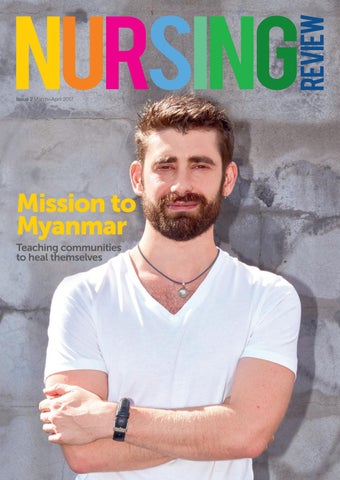
Issue 2 March–April 2017
Mission to Myanmar Teaching communities to heal themselves
contents
MANAGING EDITOR
news
Andrew Bracey 02 9936 8668 andrew.bracey@apned.com.au
02 LGBTIQ cervical screening
NEWS EDITOR
05 Spreading the hep C cure
Patrick Avenell 02 9936 8610 patrick.avenell@apned.com.au
industry & reform
04 Obligations for vax objectors
06 Comforting surrounds The challenges of healthcare in the home
HEALTH EDITOR
Dallas Bastian 02 9936 8637 dallas.bastian@apned.com.au
02
05
08 Ease the strain Community nursing’s potential
PRODUCTION MANAGER
specialty focus
Cj Malgo 02 9936 8772 cj.malgo@apned.com.au
10 Snakes, landmines and nursing Training first aid trainers
13 Look out for number one Self-care vital in palliative care settings
SUBEDITOR
Robert Santos robert.santos@apned.com.au
clinical practice
14 Fat lot of good
SALES MANAGER
Ben Long 02 9936 8664 ben.long@apned.com.au SUBSCRIPTION ENQUIRIES
It’s important to get your fats straight
08
10
02 9936 8666 subs@apned.com.au
16 Closing the gap Better management to heal all wounds
18 Urinary incontinence The hidden problem impacting nurses
COVER IMAGE
Jean-Philippe Miller Photo: Hannah Caldwell.
technology
20 Intuitive menus
PUBLISHED BY
Bedside nutrition tracking goes high-tech APN Educational Media PO Box 488 Darlinghurst, NSW 1300 ABN 58 090 900 999 ISSN 1326-0472 PP100001944
legal corner
22 Baby blues
14
18
workforce
24 Reach out
PUBLISHER’S NOTE
© Copyright. No part of this publication can be used or reproduced in any format without express permission in writing from APN Educational Media. The mention of a product or service, person or company in this publication, does not indicate the publisher’s endorsement. The views expressed in this publication do not necessarily represent the opinion of the publisher, its agents, company officers or employees.
Verdict delivered on father’s ‘unwanted’ pregnancy
Preventing the tragedy of teen suicide
26 Nursing ethical dilemmas When should health professionals stand back?
28 Support in tough times Turning Point is here to help
22
24 nursingreview.com.au | 1
news
Radio personalities Dano and Mason, from Joy 94.9, appearing in a campaign video.
Pap push for LGBTIQ people
what to do if they feel judged, discriminated against or uncomfortable with their service provider. Perera said: “When the LGBTIQ community feels unsafe or unsupported in the health system, they are left to navigate it on their own, so it’s really important for healthcare providers to convey sensitivity and understanding with these patients.”
Providers urged to promote cervical cancer screening in gay and gender diverse communities.
N
o matter your sexuality or gender identity, if you have a cervix then you’re at risk of cervical cancer. This is the key message of a new PapScreen Victoria campaign aimed at lesbian, gay, bisexual, same-sex attracted and transgender people, and those who have an intersex variation (LGBTIQ). The body also hopes health providers will help by supporting sexually and gender diverse people to participate in cervical screening. In a survey of 303 Victorians with a cervix
TIPS TO ENSURE AN INCLUSIVE PRACTICE:
who identify as LGBTIQ or gender diverse, commissioned by PapScreen Victoria and conducted by La Trobe University, one in five respondents indicated they had never had a Pap test. The top two reasons were that they were embarrassed or frightened and that they felt they didn’t need one. Hiranthi Perera, a spokesperson for PapScreen Victoria, said the campaign will empower LGBTIQ people with a cervix to participate in cervical screening and know
Penalty rate fears Nursing union stands in solidarity with workers facing penalty rate cuts.
T
he Fair Work Commission’s decision to reduce Sunday and public holiday penalty rates for people working in the hospitality, retail and fast food industries has been condemned by the Australian
2 | nursingreview.com.au
Nursing and Midwifery Federation (ANMF). The commission announced that while casual hospitality workers would retain their existing penalty rates, all other groups of workers across the industries in question
• During consultations, use culturally aware language. For example, use a gender-neutral word for partner until the gender of the partner is disclosed, and use the word the person uses for their sexual orientation. • Offer staff LGBTIQ-specific training, especially regarding confidentiality and social context of LGBTIQ experience. • Recognise that a person’s sexual orientation can change over time and sexual identity may not correlate with sexual attraction or behaviour. • Assure confidentiality regarding sexual orientation. ■
will have their penalty rates cut by between 25 and 50 per cent. The ANMF called the decision a cruel attack on some of the country’s lowest paid, and often female, workers. Federal secretary Lee Thomas said the ANMF is now concerned its members in aged care and some other health settings will be at risk of losing their penalty rates. Thomas said: “Today, it’s workers in hospitality, retail and fast food, but this has opened the door for attacks on workers in other sectors, including health. “Frontline nurses and midwives rely on penalty rates for a fifth of their income. They may be safe this time around, but for how long? Can the government guarantee that nurses and carers working in aged care won’t be next?” Thomas added the ANMF would never support the introduction of a two-tiered wage system in which some workers were entitled to penalty rates and others were not. “Whether you are a barista working on a Sunday, or a nurse working on a Sunday, or a carer working on a Sunday, it’s still working on a Sunday, and all workers should be paid penalty rates for doing so,” she said. Thomas pointed to ANMF surveys that show 80 per cent of its members would consider abandoning nursing and midwifery if they lost penalty rates. ■
sometimes you just want more Based on a starting income of $50,000 and a starting account balance of $50,000 HESTA has delivered $18,725 more to members than the average retail super fund over the past 10 years*. This was because of both lower fees and higher investment earnings.
hesta.com.au/betteroff Issued by H.E.S.T. Australia Ltd ABN 66 006 818 695 AFSL 235249, the Trustee of Health Employees Superannuation Trust Australia (HESTA) ABN 64 971 749 321. This information is of a general nature. It does not take into account your objectives, financial situation or specific needs so you should look at your own financial position and requirements before making a decision. You may wish to consult an adviser when doing this. Before making a decision about HESTA products you should read the relevant Product Disclosure Statement (call 1800 813 327 or visit hesta.com.au for a copy), and consider any relevant risks (hesta.com.au/understandingrisk). *Past performance is not a reliable indicator of future performance and should never be the sole factor considered when selecting a fund. Comparisons modelled by SuperRatings, commissioned by HESTA. Modelled outcome shows 10 year average difference in net benefit of the main balanced options of HESTA and 75 retail funds tracked by SuperRatings, with a 10 year performance history, taking into account historical earnings and fees – excluding contribution, entry, exit and additional adviser fees – of main balanced options. Outcomes vary between individual funds. Modelling as at 30 June 2016.
news
Scrutiny on vax objectors Philosopher argues that conscientious objectors to vaccination need to give back to society in other ways.
C
onscientious objectors to immunisation should make a commensurate contribution to society to account for the risk their decision imposes on the community, an Australian philosopher has argued. Associate professor Steve Clarke, from Charles Sturt University’s School of Humanities and Social Sciences, co-authored the paper Conscientious Objection to Vaccination, published online in Bioethics, which explored whether
people should be entitled to object, and if so, what constraints or requirements should be placed on the decision. Clarke and his co-authors said there was a case for conscientious objectors to make an appropriate contribution to society. “Objectors could make a financial contribution to the state that reflects the degree of risk imposed on the community, either via a penalty or lack of access to a benefit,” he said. Clarke said the federal government’s
D
Breast not best for mobiles Research reveals worrying extent of women carrying mobile phones against their skin. 4 | nursingreview.com.au
No Jab, No Pay policy, which involves withholding benefits to conscientious objectors who refuse to have their children vaccinated, was consistent with this approach. The authors of the paper also suggested that the contribution would depend on the severity of the relevant disease, its morbidity and the likelihood that vaccine refusal would lead to harm. “In particular, the contribution required will depend on whether the rate of conscientious objection in a given population threatens herd immunity to the disease in question,” the paper read. The paper also argued that people conscientiously objecting to vaccination should supply evidence of their sincerity. “Current practices don’t generally require Australians to state the reasons for their objection,” Clarke said. “They just have to fill out a form and have it signed by a practitioner to certify a healthcare professional has discussed the benefits of immunisation with them.” He added that a contribution to society may also function as a demonstration of sincerity. ■
espite manufacturers’ warnings, some women still carry their smartphone in their bra. This issue was the focus of a Monash University study, published in PLOS One, that surveyed 197 Melbourne-based women aged 15–40 to find out where and how near to the body smartphones were carried and used. While the results showed the most common location of smartphones – when not in use or when being used for purposes other than calls – was off the body, the next most common was in the hand (58 per cent), in a pocket below the waist (57 per cent), or against the breast (15 per cent). A quarter of the women surveyed also indicated they had at some stage carried their phone against their breast. Dr Mary Redmayne, adjunct research fellow with Monash University’s School of Public Health and Preventive Medicine, said people were exposed to considerably higher levels of radiofrequency electromagnetic radiation by storing their smartphones next to their skin rather than in a bag or on a nearby surface. Redmayne warned that modern smartphones were equipped with applications that updated automatically in the background and that this generated electromagnetic radiation in addition to the regular signal contact with the nearest base station. The study revealed many participants understood the potential dangers of carrying a smartphone against their skin, with only 5 per cent of survey respondents indicating they were unaware that smartphones emitted electromagnetic energy. Participants also spoke of their concerns about cancer, sleep issues and headaches or dizziness. However, these concerns did not stop them from storing their phones in a pocket or near the breast during the day. ■
news
Hep C portal launched
Interactive map tracks Australia’s hepatitis C progress.
A
ustralian health professionals now have access to an interactive online portal designed to track the nation’s progress in the fight against the hepatitis C virus. The resource, called Spread the Cure and supported by pharmaceutical company MSD, also aims to raise awareness of the disease. Users can enter a postcode or suburb to retrieve an estimate of the number of people treated in a particular area since March 2016 and compare treatment progress throughout different regions.
Professor Alex Thompson, director of gastroenterology at St Vincent’s Hospital, Melbourne, said the past decade had seen dramatic improvements in the management of HCV. Thompson said: “Now more than ever, it’s important that we spread the message that the majority of people living with HCV can be cured.” The launch coincided with the announcement that a new medicine, ZEPATIER (grazoprevir + elbasvir), given as a once daily tablet, would be available on the Pharmaceutical Benefits Scheme. Hepatitis Australia said this extended treatment options for all people with genotype 1 and 4 infection. The peak body said: “Hepatitis C treatments are continuing to evolve and improve and it is anticipated that more new hepatitis C treatments will be made available on the PBS during 2017, assisting Australia’s progress towards the elimination of hepatitis C as a public health concern. “The challenge for 2017 is to find ways to engage everyone affected by hepatitis C in care so that they can benefit from the new treatments. “An estimated 40,000 people living with hepatitis are yet to be diagnosed and many thousands more will need specific community-level support to feel comfortable about engaging with the healthcare system.” Jane Fryer, business unit manager at MSD, said by joining the fight against HCV, nurses could help spread awareness, improve treatment access and enhance management. ■
nursingreview.com.au | 5
industry & reform
Homeward bound
The Australian Centre for Health Services Innovation’s Taking Healthcare Home forum. Image: AusHSI
Healthcare in the home is increasingly popular with patients, carers and professionals, but what are the challenges holding back this model of care? Melissa McCusker interviewed by Dallas Bastian
S
ome health professionals in the acute sector may be apprehensive when it comes to releasing patients into the healthcare-in-the-home system, but it may be the best move for the patient. This was a key point raised by speakers at the Australian Centre for Health Services Innovation’s (AusHSI) recent forum, Taking Healthcare Home. AusHSI decided to hold the forum because its experts saw taking healthcare home as an opportunity to increase the quality and cost-effectiveness of healthcare services. Professor Nick Graves, AusHSI academic director, said the purpose of the forum was to explore what the facilitators and impediments may be to having more and better coverage of healthcare in the home. Graves said: “Healthcare in the home has the potential to be important for health services in the next decade because we can’t afford to look after everyone in hospital.” He said it had the potential to improve patient flow, meet national emergency access targets and increase capacity within the healthcare system. “Also, when you are in hospital, there are more opportunities for complex, costly and often unnecessary investigations and treatments to happen.” To inform debate at the forum, AusHSI produced an issues paper of the same name that compared hospital treatment with acute
6 | nursingreview.com.au
and chronic treatment services in the home. AusHSI explored the published literature about healthcare in the home and interviewed people who delivered, funded and used the services, focusing on what worked, as well the barriers and impediments. The paper found that, in many cases, it was better for the patient and more cost-effective to provide treatment at home than in hospital. Graves said that, at face value, healthcare in the home seemed like a no-brainer. Among the benefits he mentioned were costeffectiveness, reduced mortality, lower rates of adverse events, and allowing patient groups who preferred being at home to do so. He said there was a strong evidence base that supported this model of care, but added the paper had uncovered some clear and important barriers. The primary issue was that healthcare in the home was high cost to patients and carers, and that those costs were not adequately compensated. Graves said the funding issue was discussed at length at the forum. “There was a large call, mainly from patient advocates and patients, not surprisingly, to appropriately compensate patients for their own out-of-pocket costs,” he said. “Against those costs, we must realise that many patients do prefer to be looked after at home. It might be that they are willing to pay quite a bit, or at least something, out of their own pocket so they can stay at home.” There may also be a large burden on informal carers, Graves added. “I’m sure family members are more than willing to do this, but we must acknowledge that it’s a costly and sometimes difficult thing for carers to take on.” Graves added there were also some barriers to patients selfmanaging their care. “A large part of healthcare in the home is patient education, especially patients with lines and devices attached to them; they
industry & reform
NR: Some health professionals in the acute sector are hesitant to release patients into the healthcare-in-thehome system. What has been your experience of that? MM: There were, I think, five talking points yesterday. We talked about technology and the challenges and advantages around that. We talked about the professional respect and professional trust and buy-in for our hospital in the home services, and particularly any services that are provided at home in the community. We also talked about strategies for the services collecting their patients or their referrals. So how are services getting the patients onto their models of care? My personal experience is that you need very good governance. You need your governance structures to be in place, you need very good professional working relationships with all of your multidisciplinary team. There needs to be a lot of trust and transparency so that people know what you’re doing and they know what your outcomes are. And there’s a big, big focus on safety and quality. People within the hospital believe that what they’re doing is safe and of high quality, and they need to know that is what’s happening outside the walls of the hospital.
What are some of the other messages you hope to get across about healthcare in the home? What do patients have to say about it and what do staff have to say?
have to be looked after appropriately to reduce risk of infection. Education is clearly a large part of this, but some patients didn’t feel that confident managing their own devices.” Healthcare consumer advocate Martin Chambers, who spoke at the forum, said when patients chose to be a home care patient, they accepted a greater responsibility for their health, but it also meant they retained control of their lifestyle. Chambers looks after his wife Loraine, who has been on renal dialysis for the past 13 years, and he spends hours every day setting up and managing the home dialysis treatment. “There are many good outcomes,” Chambers said. “Loraine has never developed an infection, whereas the hospital renal unit has experienced relatively frequent virus outbreaks. When she first began treatment, the doctors said we could expect five years or so of dialysis and we’re now at 13.” The forum also delved into the way healthcare professionals in the acute sector viewed healthcare in the home services. Graves said: “We discussed this culture of hospital services wanting to retain patients because they’re maybe not 100 per cent confident that it’s the best thing for the patient to be sent into the home. There is a slight concern about the welfare of the patient if they leave the care of the acute based team.” Forum speaker Melissa McCusker, a nurse unit manager responsible for the Acute Care @ Home services of Queen Elizabeth II Jubilee Hospital in Brisbane, says that while home treatment is not a new concept, it can still be difficult for patients and staff to understand. “There needs to be a good working relationship and trust among the whole healthcare team,” McCusker says. “Besides the cost savings, patients often prefer being at home, and there can be other benefits like a reduced risk of hospital acquired/cross infection, medication errors and decreased patient depression and anxiety.” Nursing Review sits down with McCusker to discuss the benefits and challenges associated with healthcare in the home and what its future may hold.
Certainly with the staff that I manage, [I place a high premium on client] satisfaction. It’s very humbling to be invited into someone’s home and be able to care for them at home. We learn a little more about our patients because we get to spend more time with them and they’re in an environment where they feel safe. They’re in their home environment, and they do tend to open up a bit more and tell you more about themselves because there’s no one on the other side of the curtain in that four-bed bay that’s going to hear. I also found with my experience in hospital in the home – which is now, frighteningly, 10 years in June – that we have high patient and carer satisfaction. So our patients get to go back to their own environment with their family and supports around them. They’re much happier there; they heal quicker.
What are some of the persistent challenges in delivering healthcare in the home? It’s still fundamentally that people think this is a new model of care, and I think we’re continually challenging the kind of conditions that we can treat out in the community as well. We’re known for the ability to deliver cellulitis care and other simple infections, but we need to diversify those conditions that we treat. So that’s a challenge for us moving forward – to get into the different specialty areas now and deliver different care. Technology, I think, is going to be fabulous for us. We need to jump on board and find what technologies are out there to support us with this in home care for our acute patients.
What else would you like to see for the future of healthcare in the home? We need to stick to our fundamental principles: the right care for the right patient; the right setting at the right time with the right equipment; and we need to have a slight mindset shift that this doesn’t have to be in a hospital setting, that this can be provided out in the community. ■ See ‘No place like home’ page 8 nursingreview.com.au | 7
industry & reform
M
No place like home
Could community nursing be the solution to the ever-growing hospital bed shortage? By Rebecca Singh
8 | nursingreview.com.au
any hospitals across Australia regularly struggle to cope with the number of patients versus the number of beds available. Beds are in high demand, and doctors and nurses are often overworked, under-resourced and underappreciated as they strive to keep up with the flow of patients that come through the doors each day. But could the solution be as simple as early discharge to community nursing organisations for non-critical patients? Community nursing is not a new concept. However, in recent times there has been a rise in the number of referrals to companies that offer such services. Although there is a misconception that community nursing is just for the aged, it can help anyone who doesn’t require ongoing critical care in hospital and who can benefit from regular home visits. It’s clear to see why there has been a rise in referrals, as community nursing offers many benefits to hospitals and patients. The main benefits for hospitals include freeing up beds and resources, and redirecting health carers to more urgent patients requiring more complex care. There are huge benefits for not only aged patients, but also patients of all ages receiving care within their own home. They are in a familiar environment, which can make them more comfortable and relaxed while receiving treatment, and a relaxed patient generally recovers quicker than a stressed patient. Often, patients find it easier to rest at home in their own bed with familiar surroundings; and when a patient is well rested, their body is likely to heal faster, allowing them to be back up on their feet and enjoying their independence sooner rather than later. Many patients will also feel like they have greater control over their care as well, and they are often more involved in their treatment and ongoing care, as they feel like they are maintaining a sense of independence by staying within their own home for treatment. With community nursing, a patient will, in most cases, see the same nurse regularly. This can make it easier for the nurse to build a rapport with the patient and to notice subtle changes in the patient’s condition. Community nurses vary between RNs, ENs and AINs, and which one a patient will see depends on the type of care and services required. This is similar to how patients are treated in hospital: if they require more than one type of care classification, or if their condition changes, then they may have a few different nurses seeing them regularly. When assessing a patient for community nursing, the RN doing the assessment will also take into consideration other factors, often doing assessments around the home, checking for things such as trip hazards, unsafe stairs, lack of adequate lighting and access points. The nurse will also assess the patient’s ability to perform daily tasks, as well as review other needs such as that for OT, ACAT or even counselling services. Each patient is assessed based on their situation and needs, and the nurse will make the appropriate referrals so the patient receives the best care possible whether it be ongoing or temporary. Community nurses also liaise with the patient’s family and other healthcare providers, such as GPs and specialists, to ensure everyone is on the same page with regard to the patient’s care. There are various providers of in-home nursing care, and most offer the same services. These include things like nursing
industry & reform
assessments, psychogeriatric assessment scales (PAS) and dementia assessments, continence care assessments, wound care management, drains management (including removal), vac dressings, general hygiene and personal care within the home, and continuous hospital care (post discharge/early discharge from hospital, e.g. after a total knee or hip replacement). Other services might include administration of medication – oral, subcutaneous IM and IVI medications, cannulation, supra pubic catheter management, urethral indwelling catheter management (including insertion and removal). Often any service that can be provided by a nurse within a hospital setting can be done in a community setting. The main difference between these service providers is that they will usually either accept only public patients or private patients, though some will take on both. A public patient will be just a general Medicare patient with no insurance, whereas private patients include coverage by the Department of Veterans’ Affairs, private health insurance, WorkCover, third party insurances, or cover under certain charities such as Baptist Care. Most services accept referrals direct from nursing unit managers, CNCs, discharge planners and so on within the hospital, or through organisations such as the Triple I Hub or other healthcare providers like GPs and specialists. Community nurses and other staff within their organisations are
bound by the same privacy and record keeping laws/requirements found in the hospital setting. So, the patient’s information, privacy and confidentiality are protected in the same way they would be if the patient was being treated in a hospital. The system could work similarly to that of the antenatal GP shared care service, whereby an expectant mother can do the majority of her antenatal appointments with an approved GP and only attend antenatal appointments within the hospital’s antenatal clinic when necessary. This model of care has eased some of the strain on the antenatal clinics within hospitals sharing the care of its expectant mothers with approved GPs, while also lowering the wait times for the mothers so they can spend more time preparing for their babies and less time sitting in waiting rooms. With this many benefits to receiving care in a community setting, could this be the solution to the chronic shortage of beds? Shifting to a shared care approach, where hospitals share the care of their patients with community nursing services, and allowing the patient to be discharged early but still receive the same level of care post-hospital has the potential to make way for more critical patients, who require more complex care within a hospital setting. This may also reduce surgical wait times in cases where the wait time is based on the availability of beds. ■ Rebecca Singh is the client liaison manager at NBS Health Services.
EASY ENGLISH FACT SHEETS People with poor ● leak wee when
bladder contro
l may
they
– laugh – cough – sneeze.
They may also ● need to hurry
● go to the toilet
How to have
better bladd
er control ● wake up a
Continence
Foundation
to get to the toilet
a lot
lot at night to
of Australia
go to the toilet
● wet the bed
● wet thems Easy English
the toilet.
2016
Page 4
elves before
they can get
to
Easy to read information about how to improve bladder and bowel health Available to download at continence.org.au/easy-english
National Continence Helpline
1800 33 00 66
The National Continence Helpline operates Monday to Friday 8am – 8pm AEST Supported by funding from the Australian Government under the National Continence Program
nursingreview.com.au | 9
specialty focus
Power to the people Jean-Philippe Miller. Photo: Hannah Caldwell
The story of one nurse’s mission to empower communities in conflict zones by teaching them first aid. By Jean-Philippe Miller
M
y name is Jean-Philippe Miller. I am an emergency and trauma nurse, currently based at the Alfred Hospital in Melbourne. During my time nursing I have worked overseas for the International Committee of the Red Cross (ICRC) on several missions. ICRC’s primary focus is in areas of conflict and other situations of violence. I chose to work with the ICRC because it works to protect human life and health, to ensure respect for all human beings, and to prevent and alleviate human suffering around the world.
OFF TO MYANMAR My work with ICRC took me to the mountainous Kachin State in northern Myanmar, formerly known as Burma. Kachin State is a culturally diverse region, bordering China, India and Shan State. It is rich in natural resources, including gold and jade, with a mainly rural population of around 1.5 million. In Kachin, I worked in two main areas: Myitkyina, the capital of a government controlled area; and in Laiza, the headquarters of a non-government controlled area. Armed conflict in Kachin and other areas of Myanmar has resulted in many people being displaced from their homes, with a rise in humanitarian needs and little or no access to healthcare.
MY MISSION IN MYANMAR I had several objectives during my time in Myanmar. I aimed 10 | nursingreview.com.au
to empower the communities in Myanmar to respond to emergencies through the development of a first aid program. I was also charged with ensuring that communities receive timely, humane and effective first aid support where and when needed, by confident and skilled first responders. One of the critical parts of my job was to strengthen and improve the chain of emergency care from scenes of emergencies to referral healthcare structures, particularly in locations where there is limited or no access to pre-hospital treatment and care. In any program like this, we first reviewed the needs and capability of the communities in the areas I was working in Kachin State. We held meaningful discussions with community leaders and local authorities before proposing a program to train first aid trainers. On the one hand, we would be empowering the community to feel confident and skilled to independently respond to emergencies. On the other hand, we would be giving the community ownership of a first aid program so that they could continue it as required. One of the first questions to address was, who would become a trainer? Trainers did not require any medical background or prior knowledge of first aid. They just needed to be motivated, enthusiastic, and eager to learn and teach others. Ideally, participants were respected community members who would facilitate further first aid education. We ended up working with local nurses, teachers, village health workers and staff from a local non-government organisation.
DOWN TO THE BUSINESS OF FIRST AID Our first aid courses included generic vertical emergency cases; unconsciousness, bleeding, burns, wounds and fractures and context-specific emergency cases. Of course, first aid goes beyond providing basic life-saving techniques and applying bandages.
specialty focus
Photos: Jean-Philippe Miller
In our course, we integrated all dimensions of emergency response. We found it essential to include some key elements that are often not found in typical first aid courses, including the use of local resources, especially traditional practices and remedies, preserving dignity and providing psychosocial support. We also focused on risk and security management, stress control and communication, seeking help from bystanders and managing teams. It was also rewarding to emphasise the importance of the continuity of care, including transporting a sick or injured person and referring them on for further treatment. This was not an ordinary first aid course. On the agenda was awareness and education on the risks of landmines, dealing with the ever-present threat of snake bites and learning about the laws of war in relation to providing first aid. All the content in the course that I developed with colleagues was considered in relation to a simple first aid framework. The objective is to save lives and to alleviate suffering. The requirements are not to be hurt and to do no harm, physically or psychologically. This first aid framework was considered alongside basic humanitarian principles and values, including humanity, impartiality, neutrality and respect for healthcare. We also needed to take into account the insecure context of the local communities, their levels of emotional distress, mass casualty incidents and severe emergency cases. In mountainous Kachin, other key factors were limited resources, the remote locations, legal boundaries and cultural and ethical dilemmas faced by participants. Knowledge of first aid in the community was low. Many participants knew about traditional practices and remedies, for example using traditional leaves to stem bleeding and treating burns with tomatoes or potatoes. Practices were neither classified as ‘good’ or ‘bad’. Instead, participants were encouraged to consider whether traditional medicine practices were safe and effective. In a respectful manner,
we encouraged the use of traditional practices when it fitted within the first aid framework. We found that including and promoting traditional first aid practices encouraged community ownership and durability. It helped embed first aid in the community and prevented community members from thinking that expensive medical items were always needed. This information was fascinating and often the basis for frequent discussions during first aid courses. Concepts of traditional medicine were explored and considered in relation to the first aid framework.
A UNIQUE APPROACH Our training was unique. We strongly encouraged active and practical teaching, avoiding PowerPoint presentations and lectures. We focused on demonstrating and simulating first aid incidents with lots of group learning activities. There were plenty of laughs and learning with first aid games and a focus on meaningful first aid life-saving skills. We taught simple first aid principles, and once these were understood, we applied them to more complicated situations. We intentionally concentrated on the ‘why’, the philosophy being that if participants could understand why they were doing things, then the ‘what’ and the ‘how’ would follow. This teaching approach fed directly back to my initial objectives to empower the local community and build confident and skilled first aiders to respond to emergencies. Our approach was non-medical. In Myanmar, first aid needs to be for everyone and not exclusive to well-resourced communities. It proved fruitful to avoid medical jargon, diagnosis and the idea of ambulances and other Western systems. We promoted treating signs and symptoms, encouraged them to look at the casualty as a whole, and to use local resources as well as non-medical equipment and non-medical transportation. nursingreview.com.au | 11
specialty focus
We supported the use of local resources and traditional first aid practices and removed the idea from our training that a medical or first aid kit is needed to provide first aid. Central to our training was carefully considering what materials could be sourced and used locally. We investigated what materials locals had access to and what they could afford. It turned out that most people did not have access to any type of first aid kit, so participants needed to be reassured or shown that they could provide first aid with local materials. First aid instructors were provided with training kits stocked with local materials, including items from the local market and their households. Plastic bags could replace gloves. Cloth from local dress called longyi replaced bandages, while umbrellas and newspapers were used to splint limbs. We actively promoted first responders to use their initiative and think laterally when providing first aid.
WHY IS FIRST AID CRITICAL? Discussions with Kachin communities highlighted that traffic accidents, particularly motorbike crashes, are one of the main causes of injury. I have found that empowering communities with first aid is important because injury is a major cause of morbidity and mortality worldwide, and it is a rapidly growing public health concern. Injury has many costs, including treatment, lost or reduced productivity/wages, death or disability. The World Health Organization estimates that, worldwide, 1.25 million people die from road traffic injuries every year, and that 90 per cent of these deaths occur in low and middle-income countries. Most of these trauma deaths occur outside hospitals due to blocked airways or excessive bleeding. Both can be effectively managed with basic life-saving and stabilising first aid measures. 12 | nursingreview.com.au
Many programs in low-income countries around the world have demonstrated that lay personnel can initiate basic first aid and provide effective pre-hospital care in resource-poor settings. In Ghana, commercial truck drivers provide basic first aid for trauma and improve pre-hospital care. In Uganda, police officers, taxi drivers and local council members have been trained in first aid to strengthen pre-hospital care. In Iraq and Cambodia, village first responders have formed a pre-hospital rural rescue system, reducing pre-hospital response times and mortality.
FIRST AID SUCCESS One year after the program started, it has been pleasing to see 17 first aid instructors now educating their communities. More than 750 community members are trained in basic first aid. Curriculums at two high schools and the local nursing college feature first aid training. It’s also taught at a camp for internally displaced people. Many of those trained are feeling confident and providing first aid at work and at home. Recently a young girl fell off the back of her motorbike and was left unconscious and bleeding. Quickly and without hesitation a trained first responder checked her airway and breathing. The first aider stopped the scalp from bleeding using the girl’s scarf, while directing a bystander to locate a local tuk-tuk vehicle, safely transferring her to a local hospital for more care. I’m happy we have empowered Kachin communities to become confident and skilled first aid responders, in turn strengthening their chain of emergency care. ■ Jean-Philippe Miller is an emergency and trauma nurse currently based at the Alfred Hospital in Melbourne. For more on the ICRC visit www.redcross.org.au/movement.aspx
specialty focus
Heal thyself
be in a good position to look after others in the long term. Health professionals are so focused on caring for others that sometimes thinking about your own health needs may not seem like a priority. Then again, other people might appreciate the importance of selfcare, but they might find it difficult in practice because, for example, their workplace may not be entirely conducive to self-care practice.
Of all participants, only 6 per cent used a self-care plan, and even if provided with training, just under a third of respondents said they wouldn’t consider developing a selfcare plan. Was this surprising?
Not enough is being done to promote the importance of self-care and encourage its practice among palliative care professionals. Jason Mills interviewed by Dallas Bastian
M
ost palliative care professionals agree that self-care is very important, but a considerable proportion rarely engage with relevant strategies, a new study has found. The research, led by Jason Mills, a lecturer at Queensland University of Technology’s School of Nursing, explores the perceptions, education and practices relating to self-care among palliative care nursing and medical professionals. It finds that fewer than half frequently practise self-care strategies during a working week, and just over a 10th do so rarely. A majority of the survey’s respondents also indicate they have not received education or training in the workplace about effective self-care strategies. “The use of self-care plans is reported to be an effective selfcare strategy; however, there is very low uptake among palliative care nurses and doctors,” Mills’s team concludes in their paper. “These limitations to self-care practice should be addressed through targeted training and self-care education, as most indicated they would be receptive to this. Given that self-care practice is a professional expectation in palliative care, requisite education is necessary to support effective self-care in the palliative care workforce. Such initiatives could promote greater understanding of self-care, awareness of domains, and uptake of self-care plans.” Nursing Review sits down with Mills to discuss the importance of self-care and the different ways palliative care professionals can look after themselves.
NR: Why might some palliative care professionals forgo self-care? JM: For some people, it may be a case of not appreciating the reality that unless you first take care of yourself, you’re not likely to
To some extent, yes. But when you consider that over two-thirds of the participants had not received any education or training in self-care, then you know this is perhaps not too surprising. Essentially, a self-care plan documents a deliberate process of identifying potential personal or professional stressors and then putting into place some effective strategies that can help promote good health and general wellbeing in the face of those stressors. And as I alluded to before, I suspect that potentially a lack of education and awareness might be involved here. So care plans are essential to promoting health and wellbeing for our patients, and there’s no reason why health professionals themselves can’t be more proactive in promoting their own health and wellbeing through something like a self-care plan.
Based on the study’s findings, what suggestions would you make to palliative care professionals or the organisations that employ them? Well, especially in the context of palliative care and even residential aged care where a palliative approach is certainly practised, I think one of the striking things to come out of this study is the apparent lack of education or training for this workforce. So I guess for organisations, this might be something that they may wish to take up, in terms of promoting awareness and providing resources and training for staff on how they can better engage in self-care practice, and then potentially enhance the quality of care for patients and residents. But then also on an individual level, clinicians [and] people in the workforce need to actually be accountable and take responsibility for their own self-care as well, so there are organisational factors, but there are also personal factors, which, if, for example, an organisation was to provide training and build awareness about the importance of self-care and different strategies, that can be very effective. It’s then also up to the individual to take up those opportunities to build their knowledge, to equip themselves with those tools and then actually to put it into practice.
So what are some self-care strategies that palliative care professionals can use? In our study, participants identified, on average, four self-care strategies that they used in their practice. Physical self-care strategies were used most frequently, followed by social self-care, and inner self-care strategies. This is consistent with a self-care framework developed in line with the World Health Organization’s understanding and definition of health. So examples of physical self-care strategies included things like jogging, hydrotherapy and yoga. Social self-care strategies were things like having group debriefs in the workplace or clinical supervision with colleagues or, outside of work, spending time with friends or family. And finally, examples of inner self-care strategies included meditation, mindfulness and different forms of spiritual practice. ■ nursingreview.com.au | 13
clinical practice
FATS TO AVOID
The skinny on dietary fat Learn to separate the fat from fiction with this quick guide. By Arlene Normand
O
nce upon a time, fat was the enemy. Eating as little of it as possible was supposed to keep us trim and free of heart disease and diabetes. For some time now we have understood that fat is an essential part of a healthy diet. In fact, new research shows that drastically cutting fat may not improve heart health. All this flip-flopping has left many people confused. So what is the truth about fat?
THE BENEFITS OF FAT IN THE DIET Without fat in the diet, vitamins A, D, E and K, or fat soluble antioxidants like beta-carotene and lycopene, could not be absorbed, as they all need dietary fat to propel them through the walls of the digestive tract and into the bloodstream. Fat also provides essential fatty acids (discussed below). Fat is a beauty essential – it keeps nails, skin and hair from drying out. Fat also carries the compounds that give foods their aroma and flavour.
BUT WON’T EATING FAT MAKE YOU FAT? That depends. If you eat more calories than you burn, weight gain occurs – whether the source is fat, carbohydrates, protein or alcohol. But it is easier to gain weight when you load up on fat, since 1g of fat contains more than twice as many kilojoules as 1g of protein or carbohydrate. Still, Australians are not getting heavier because they are eating more fat (they aren’t), but because they are consuming more kilojoules and doing less exercise. Many of these kilojoules come from alcohol, cakes, confectionery, cereal bars, pastries, biscuits and soft drinks (high sugar, no fat). 14 | nursingreview.com.au
The lesson: even low-fat foods, eaten in abundance, lead to weight gain.
HOW MUCH FAT? Some fat is vital to good health – at least one or two tablespoons of healthy oil or some nuts, seeds or avocado should be included every day. Experts now agree that the type of fat you eat is more important than the amount. So the aim is to replace unhealthy fats with healthy ones. If weight loss is recommended, the whole diet should be assessed and an accredited practising dietitian can help with this.
WHICH FATS ARE HEALTHY? Technically, oils are liquid at room temperature whereas fats are solid, but the terms are used interchangeably. From a practical perspective, if an oil or ‘fat’ is liquid at room temperature, it’s more likely to contain healthy fats. Monounsaturated fats are found in olive oil, canola oil, peanut oil, sesame oil, avocado and nuts (almonds, cashews, hazelnuts, macadamias, pecans, peanuts and pistachios). When replacing saturated fats in the diet, these fats decrease total and LDL cholesterol. Polyunsaturated fats include omega-6 and omega-3 fatty acids, which are essential in the diet as your body can’t make these on its own. They decrease LDL cholesterol and can increase the HDL cholesterol. Omega-6 fatty acids are found in corn, sunflower and cottonseed oils – which are used in many processed foods. Omega-3 (DHA/EPA) provides benefits for heart and eye health and is abundant in oily fish. Since most people don’t get enough omega-3, it is advisable to eat fish 2–3 times a week – ideally, salmon, tuna, trout, mackerel, sardines or herring. Omega-3 (ALA) is found in canola oil, flaxseeds and walnuts, but conversion to DHA or EPA in the body is minimal. Omega-3 supplements can also help boost intake.
Saturated and trans fats have both been linked to high cholesterol and heart disease. They are solid at room temperature and increase LDL cholesterol. Trans fats also decrease HDL cholesterol. Sources of saturated fat include processed and fatty meats, fried take-away foods, pastry, store-bought cakes and biscuits, butter, cheese, cream cheese, sour cream, cream, ice cream, full cream milk, poultry skin, shortening, coconut milk, coconut oil, palm oil, palm kernel oil and cocoa butter. Trans fat is created when liquid oil undergoes hydrogenation, a chemical process that extends its shelf life and provides structure to foods. It is common in many foods that also contain saturated fat. Trans fat consumption in Australia is relatively low due to the types of fats/oils used here. Minimising foods containing saturated fats will also limit trans fat intake.
THE TRUTH ABOUT COCONUT OIL Conduct a quick Google search and you’ll find miraculous claims about a tropical fat that has become increasingly popular among health-conscious consumers in recent years. People make a lot of claims about coconut oil, but there is no welldesigned, peer-reviewed, credible scientific evidence to show that coconut oil speeds metabolism, promotes weight loss, cures Alzheimer’s disease, improves brain function, or improves heart health. In addition, no evidence exists to prove “virgin” coconut oil is less damaging to your heart than other varieties. More importantly, over 90 per cent of the fat in coconut oil is saturated fat. Decades of research have determined that saturated fat is detrimental to your heart and blood vessels. Use it in moderation, if at all. So the message regarding fats has changed over the years. We know now that it’s important to choose healthy fats in the right amounts, that these should replace unhealthy fats in the diet, and that there are some essential dietary fats that should be consumed as part of a healthy diet. Accredited practising dietitians can provide nutrition advice to your patients, tailored to their individual needs. ■ Arlene Normand is an Accredited Practising Dietitian (APD) with more than 15 years’ experience. To find an APD in your local area, call 1800 812 942 or visit the ‘Find an APD’ section of the DAA website at www.daa.asn.au
advertorial
Devotion on the Front Line
M
ilitary commemorations have always been an important theme at the Royal Australian Mint (the Mint) which has partnered with the Department of Veterans’ Affairs and the Australian War Memorial for the 2014 - 2018 Anzac Centenary period to produce a collection of commemorative coins. These coins capture the history, service and sacrifice of Australians at war as well as highlighting the acts of courage, mateship and duty that was displayed, on and off the battlefields. Many of these coins recognise servicemen and women who have made sacrifices but few acknowledge service nurses. These nurses have played a critical role in Australian military history, tending to the needs of sick and wounded soldiers as well as civilians whose lives have been affected by war. Australian Army Nurses have had to work in the most arduous of circumstances, faced with the threat of natural disasters and dangerous conditions, all while tending to the needs of others. The 2017 $5 Coloured Fine Silver Proof Triangular Coin released as part of the Official Anzac Centenary Coin Program pays homage to the devotion of the incredible Australian Army Nurses. This coin was an important release for the Mint as it allowed for the message of the devotion and sacrifice that military nurses gave during Australian war times to be explored. This is a unique aspect of the wartime experience to focus on as history has often ‘‘chronicled the deeds of men at war since the begging of recorded time….[with little] written about these latter day women who nursed men from the worst battlefields soldiers have known’ ( P. Adam-Smith, The ANZACs, Penguin Books Australia Ltd, Melbourne, 1991, p.291). The coin features a captivating triangular-shaped design inspired by the Australian Army Nurse image that appears in the iconic stained-glass
window in the Hall of Memory at the Australian War Memorial, depicted by artist Napier Waller. The Hall of Memory is a special place for reflection where the Tomb of the Unknown Australian Solider lays surrounded by stained-glass windows featuring impactful imagery. For those who have not visited the Australian War Memorial in Canberra many are pleased to see an image of a military nurse. The presence of the stained glass window perhaps helps to lessen a feeling of exclusion created by ‘abundance of historical and anecdotal information relating to the experiences of the Australian solider and conversely an almost total absence of information [or imagery] about the role of Australian nurses’ (Ruth Rae, From Narromine to the Nile, Australian College of Nursing, Canberra, 2015, pg. 7). The impact that Australian military nurses have had shouldn’t be underestimated and the gratitude and respect from the Australian people can be seen each Anzac Day and Remembrance Day, with people gathering to pay their respects to those that have been part of the wartime experience. The incredible Australian Army Nurses, just like the nurses of today, are the ultimate example of The incredible impact of nurses and the contribution they make to Australia cannot be underestimated, the devotion they give to caring for the health and wellbeing of others is truly a remarkable feat. ■ Visit eShop.ramint.gov.au to purchase or call 1300 652 020. $90 each.
The Royal Australian Mint in Canberra is Australia’s official mint and the sole producer of Australia’s circulating coinage. nursingreview.com.au | 15
clinical practice
NR: How did the research team collect the data for this study?
Wound for improvement
FL: Before our study, one of our team members conducted a survey and asked the nurses about their knowledge around the recommended evidence by the clinical practice guidelines on surgical wound management. And that survey identified some gaps. Some nurses were not aware of the most current recommended guidelines. That’s why we felt we should design an observational study and look at what nurses are doing. Often they say they don’t know, but maybe they are already doing what recommended guidelines require them to do. So that’s why we designed an audit tool which was based on recommended clinical practice guidelines to prevent surgical site infection. After that we used the audit tool, audited nurses for wound care practices, including tending surgical dressings, documentation, patient education etc in a number of clinical areas within the participating hospital.
Were there any areas in which the recommended wound care practice was in line with what the team observed? Yes, the nurses did very well in most of the areas we audited. For example, the hand washing before the wound care procedures compliance rate was quite high. And the hospital also had systems in place, such as online learning modules on aseptic technique for nurses, which they have to do once a year. And, there’s also a very rigorous hand hygiene compliance program at the hospital, so nurses did really well with hand washing too. And the hospital also has a very knowledgeable senior wound management team who the clinicians trust very much. So these were some of the really good things that came out that observation.
What were some of the recommendations for wound care practice that weren’t always met during the course of the study?
An evidence-based intervention aims to improve wound care practice among nurses. Frances Lin interviewed by Dallas Bastian
A
new study into surgical wound management has revealed a clear gap between recommended and observed wound care practice. Led by a team from Griffith University’s School of Nursing and Midwifery, the research aimed to describe the postoperative wound care practices of surgical nurses and whether these practices aligned with the evidence-based guideline recommendations. The research team observed 60 episodes of wound care and found that while nurses did well in most areas audited, over a third of nurses did not correctly use clean gloves, a fifth did not properly use sterile gloves, and about a quarter of wound care episodes were not documented. Informed by these findings, the researchers, along with clinicians, developed an intervention using an integrated knowledge translation approach to improve wound care practice. Nursing Review sits down with researcher Dr Frances Lin to discuss the intervention and find out why there are gaps between recommendations and observed practice.
16 | nursingreview.com.au
There were a number of areas that had room for improvement, such as hand washing after the wound care procedure, and nurses’ understanding of some of the aseptic techniques. For example, when they were changing the patients’ surgical dressings, there was a lot of confusion about when they should use clean gloves and when they should use sterile gloves. Documentation after the surgical wound care process was a main area of concern, with 25 per cent of wound care episodes not documented anywhere.
Why might we be seeing some of those gaps between recommended and observed wound care practice? There are a number of potential reasons. We actually did a followon interventional study from this initial observational study. So at the beginning of that interventional study we explored why there were these gaps. Clinical practice guideline implementation is a very complex process. It’s not as simple as sending out the new guidelines for people to read and then they will just change their practice. It has to be implemented with strategies in place to educate staff about why there were changes and then a plan to process and audit behaviour and give feedback to staff. Tell them if they’re doing well or if they’re not doing well. And continuously reinforce that the recommended guidelines are important to make sure there’s no gap between the recommended clinical practice guidelines and the practice.
What did the intervention study involve and what role did nurses play? We had a number of researchers on the team; we also had a couple of psychologists on the team helping us to understand
clinical practice
how to change people’s behaviour, and we also had a clinical team to work with us. So we co-created or developed a complex intervention to target the gap areas. We tested the intervention in one surgical ward of the participating hospital. Firstly we selected a change champion – a senior staff member who was very passionate about improving wound care. And the change champion helped us to drive the practice improvement and the implementation. Next we looked at education. So we developed a number of education tools for the change champion to use in the inservices – the education sessions with nurses to improve their understanding of the recommended clinical practice guidelines. To make sure the nurses understood the guidelines and knew how to apply them in practice, we created some quizzes for nurses to answer. And the change champion monitored how many nurses completed them, and she kind of chased every nurse to make sure they all completed the quizzes. Another area we focused on was improving documentation, because in the previous findings we found 25 per cent of the wound care episodes were not documented anywhere. Prior to this study, an electronic documentation system had already been in place in this hospital for a few years, however the wound care documentation was still in a hard-copy format so that nurses could tick boxes. There was not much room for nurses to write anything in it. From this project, we co-created a digital wound care template with clinicians. This template is on an electronic medical record
system. So nurses can [compile and compare] the pictures they take of patients’ wounds, which makes tracking the patients’ wound recovery process much easier. And also in the implementation process, we discussed what might work and what will work with the clinicians and researchers, the co-creators of the intervention, and the clinicians were the drivers who led the change, with the research team providing support to the clinicians to make the changes happen.
What are some of the lasting changes you hope that intervention will bring about? We are currently in discussions with the hospital senior managers on hospital-wide implementation of the strategy we mentioned previously. Especially the digital wound care templates that we developed in the process, because [throughout] the rest of the hospital they are still using the hardcopy digital wound care template. Through the project, the research team and the clinicians were equal partners in designing and implementing the interventions. So we hope that we have helped to build the clinical research capacity, and the clinicians who are on the team, we hope, now have the knowledge and skills to make continuous improvements and will be able to help sustain the changes we made in the study. So we think the co-creation of the implementation strategy, between the researchers and the clinicians, was the key to the success of the project. ■
SPEAKERS INCLUDE Donna Cross
Culturally Directed Care Solutions
Samantha Edmonds
National LBTI Alliance
Prof. Kostas Mavromaras
Flinders University
Matthew Moore Institute for Urban Indigenous Health
Ljubica Petrov
Readers of Nursing Review are well aware of the increasing demand for services across Australia and the related issues of a workforce unable to keep up with a rapidly aging population. Developing an efficient and sustainable industry should be a priority. An industry that supports a workforce which is inspired, skilled and valued, and that contributes to a high quality system that helps people age well, is the goal.
The Aged Care Insite Strategy 2027: Aged Care Workforce Summit will focus on: Attracting and retaining aged care workers Remuneration, working environments, staffing ratios, education and training Government policies that affect the aged care workforce Creating a culturally competent and inclusive aged care workforce The aged care workforce challenges in regional towns and remote communities.
Centre for Cultural Diversity in Ageing
Dr Katrina Radford
Griffith Business School
Chris Westacott Realise Performance
Register your interest today! agedcareinsite.com.au nursingreview.com.au | 17
clinical practice
I
A hidden problem An Australian study on urinary incontinence among nurses and midwives highlights some interesting aspects of an often neglected subject. Heather Pierce interviewed by Dallas Bastian
t is still seen as a taboo topic, even among some health professionals, but recent research reveals a high prevalence of urinary incontinence (UI) among female nurses and midwives, and it may be influencing their intention to leave their current job. Published in Neurourology and Urodynamics, the study explores the prevalence and severity of UI among women in both professions and the relationship between UI and work. Of the female nurses and midwives who answered the survey question on urine leakage, just under a third indicated they had UI. Of these women, 40.5 per cent experienced moderate and 4.4 per cent severe or very severe symptoms. The study says those with severe or very severe UI are more likely to indicate an intention to leave their job at 12 months than those with slight or moderate symptoms, even after accounting for factors such as age, work contract, shift allocations and job satisfaction. Nursing Review sits down with lead author Heather Pierce, a PhD student at the University of Technology Sydney, to find out whether these findings are unique to the nursing and midwifery professions and why UI impacts decisions surrounding work.
NR: Why did you decide to investigate the prevalence and impact of UI among nurses and midwives? HP: The experience of incontinence or UI is something that is quite prevalent, and for those who are otherwise healthy and active, it can have profound effects on their mental health and their social interactions. We know that people leak urine, but we have limited knowledge on how it impacts people when they’re at work. The study I’m doing forms part of a much larger project called Fit for the Future, which is being funded by the Australian Research Council and the NSW Nurses and Midwives’ Association. We wanted to know what the health of our workforce was and to make recommendations to managers and policymakers as to how to keep the workforce healthy and how to keep them staying at work. Our workforce is getting older, and just like the general Australian population, we’re not always at our peak of health. Incontinence or UI … can occur with activities like exercise, coughing, sneezing or simply not making it to the toilet in time when you have a strong urge to go. It is prevalent, as I said before, among women and men. However, it increases with age, and we know that the problem is present and is going to be present for some degree in the workforce because we know that the majority of nurses and midwives are female. Our studies show that [women] are around 90 per cent [of the nursing workforce]. We also know that it occurs with health issues such as obesity. So if we have a BMI greater than 30, it actually doubles your risk of having UI. The other important issue is that it is a hidden problem, so not many people disclose that they have the problem because they are embarrassed or ashamed. Statistics also show us that very few people seek help, and it takes quite a long time and it needs to be quite severe before they even do seek help, even though there is strong evidence that it can be better managed or cured. Also, my background as a midwife and as a woman made this an ideal topic for me to look into.
How common was UI among female nurses and midwives and were the findings in line with your expectations? We were looking at prevalence, and prevalence basically means how 18 | nursingreview.com.au
clinical practice
demands that they delay going to the toilet – they can’t get to the often conditions present in the population over a time period. With toilet any sooner and they leak when they can’t hold on to that the study that we put out – which was an electronic survey – we had urge any longer – but that’s just speculation. over 5000 responses from nurses and midwives in NSW and we had We also know that a strategy to prevent incontinence is using 3000 who answered the question on urinary leakage. When we asked the bathroom frequently and emptying just in case, and that about urine leakage we found that 1 in 3 of the women [responding] sort of habit can interrupt the nurse’s work pattern and be a real had some degree of urine leakage in the past month. problem if they can’t access the toilet when they need to. Previous work, particularly in Australia, has shown that women do leak and the prevalence was dependent on how old you are. In the younger age group, under the age of 30, it’s more around 10 You also explored how UI might affect a nurse’s or midwife’s per cent of women, and as we get older that prevalence increases. intention to leave their job. What did respondents who said In a very large population survey called the Australian Longitudinal they had experienced symptoms of UI reveal about their approach to their work? Study on Women’s Health, the prevalence was around 35 per cent in those over 45. So we know that it is there. We couldn’t determine what their approach to work has been. Our research shows the prevalence of 32 per cent overall, so The question I asked was one in a whole barrage of questions the that was in the group aged 18–73, and in those over the age of nurses and midwives answered, so the larger survey collected a 40 the prevalence was 40 per cent, which does appear lot of different variables into health and habits: what we higher than previous Australian figures. eat and what we drink, what our BMI was, previous [Compared to international research] of health habits in terms of health screening, things women of working age, large European studies like that. I wasn’t able to ask a question about have shown the prevalence of younger ones the approach to the work, but we did … ask The other important that are about 7 per cent, and those aged whether they worked part-time, full-time issue is that it is a hidden 40–60 around 14 per cent. [So a] prevalence or shift work and what area they worked in, of around 40 per cent in our study seems whether it was in acute care or aged care, problem, so not many high, and there are lots of different reasons etc. people disclose that they for that and it’s very difficult to compare We did find that nurses and midwives who have the problem because worked part-time hours or didn’t do shift work figures. That was a little higher than we they are embarrassed expected. – so they worked day hours – were more likely to report having incontinence. We know that or ashamed. there are lots of different reasons for work choices, Are the figures in line with what you’d expect obviously, not just incontinence. to see among women in the same demographic [If we look] back to previous research – which as I’ve but who work in other professions? said is quite limited – researchers have said that experience of It’s extremely hard to answer that question because there isn’t a UI has influenced women’s decisions by reducing the number of lot of research specific to … different jobs. With any research that has hours they work and the type of work that they do. been done, which is quite limited, it is difficult to directly compare results. In my earlier work with my supervisor, as a PhD student, I examined Why might UI be having an impact on that decision to reduce who had researched these questions – there are a few studies that working hours? have looked at teachers and academic workers and factory workers. When we talk about UI, we need to talk about how severe the So they’re quite limited. And over the past 20 or so years there was a symptoms are, because it might just be the occasional leakage handful of studies [from which I was able to draw out] 12 studies. when you play sport, or you have the flu and you’re coughing and The majority were on nurses. There were five studies on nurses sneezing. It might be something that doesn’t occur very often and and they talked about teachers being similar to nurses because so doesn’t particularly bother you. they also, due to their job requirements, may have restricted We asked in the last survey about the severity of incontinence, access to toilets. They might develop poor bladder habits and that and we were able to determine that by reflecting the frequency may in turn expose them to urinary symptoms. and amount of leakage and how much it bothered the nurse or Incontinence or leaking of urine is a symptom of being able midwife who had the condition. We found that the nurses and to hold on or store the urine in the bladder and there are other midwives who had severe incontinence were much more likely symptoms associated. You may have a very strong urge to pass to say or indicate an intention to leave their job. Not the actual urine but you can’t hold off. You might go to the toilet more workforce but to leave their current role in the next 12 months. frequently – more than 7–8 times a day – which is what we would In the study, we found [that it was only] about 40 of the nurses see as normal. Sometimes you have to get up more than once at and midwives out of a sample of nearly 1000 who actually had night. Leaking is just the symptom of another problem which is severe symptoms. So that’s around 4.4 per cent. Even though being able to store the urine in the bladder. the percentage is small, what happens is there are other factors What is interesting about our study in terms of job specific that influence the severity, and our concern is that if you can’t or occupation specific requirements was that the presence of manage the symptoms in your role, then that’s probably why something called ‘urge incontinence’ – which is where you leak you would plan to leave or change your job, work fewer hours or before getting to the toilet – appeared higher than previously work in another setting or in a role where you can manage your recorded in other studies. symptoms or have easier access to toilets. ■ Among the 32 per cent of nurses and midwives who say they leaked, 20 per cent leaked before they got to the toilet, so they Those seeking support or information on incontinence can contact had this urgency. We think perhaps that it’s just because of work the Continence Foundation’s free helpline on 1800 33 00 66.
“
nursingreview.com.au | 19
Technology
Meals on screens Putting patients in charge of their nutrition while in hospital has yielded positive results. Shelley Roberts interviewed by Dallas Bastian
H
ospital patients have tested a technology-based program that allows them to self-assess and self-monitor their nutrition at the bedside. Dr Shelley Roberts, from Griffith University’s School of Nursing and Midwifery, and her colleagues trialled the usability and patient perceptions of an electronic food-service system (EFS). The research team explored the willingness of patients to engage with the EFS, as well as the perceived ease of use, benefits and importance. Nursing Review sits down with Roberts to discuss the feedback patients provided and whether the program would be used by the people who would most benefit from it.
NR: Can you describe the EFS program you tested? SR: The program involves active patient participation in their nutrition care, through self-assessment and self-monitoring. Specifically, patients are asked to self-record their intake at meals using a personal bedside touchscreen. Patients are also able to view their nutritional goals or targets, and discuss these with their dietician using that screen as a medium. Particularly they can see their intake, which they have entered themselves, compared to their requirements, which their dietician will talk to them about. They can monitor their progress over time, and patients will ultimately have the choice of which foods or supplements they add if they need to add any to meet those requirements. It’s about involving patients in their care and allowing them to take control and responsibility for their own nutrition while they’re in hospital. 20 | nursingreview.com.au
Is there much training involved? We’re taking several measures to develop the most user-friendly and intuitive program possible, but we do expect that patients will receive some brief training on how to use the program in the first instance. We’re undergoing a rigorous and iterative development and evaluation cycle, something that’s underpinned by IT design theory. We’re also collaborating with end users – patients and hospital staff – in the design of the program. We have an interdisciplinary team consisting of academics from nursing and dietetics, as well as IT experts, and we’re partnering with industry and consumers to develop the most user-friendly version of the program we can. What we’ve done so far is develop mock-up versions of the program and tested these with patients and staff to assess usability of the layout and design of the page, as well as the functions or tasks that patients will complete. Then we modify the program based on their feedback, and that’s an iterative kind of cycle. In the current study, we used the think-aloud technique as well as some semi-structured interview questions with patients, firstly to assess the usability but also to explore their perceptions of using the program to participate in their care. In terms of training, we haven’t yet piloted the intervention as a whole, but in showing patients the different aspects of the program, in their usability testing interviews we found that most patients were able to navigate the system themselves with only about five minutes of training. Obviously, each patient is different so some patients didn’t need any training at all and they could navigate themselves just by following the prompts, but other patients required maybe a little bit more in-depth training or maybe a bit of direction through the process of going through the different pages. Once they had built their confidence though, most patients could use the system themselves. Obviously being able to use something like this can depend on the patient’s age and their familiarity with using technology, but we found from these interviews that those two factors weren’t barriers to using the program because we had patients from 22 to 80 years old, and even the older patients all said that they could use the program once they’d been shown how. A couple of quotes from patients are some things like, “I’m not any
Technology
good with computers because I haven’t even got one, but if I can navigate my way through that, then anyone can,” or someone else said, “Once I’ve done this once, it’s easy to do.” As I said, we need some brief training at the start, but hopefully once the patient’s done it once or twice, it’s fairly intuitive.
What else did the patient interviews reveal about the key benefits of the program? The main benefits patients saw with this program related to better care provision and more patient-centred care. They firstly liked the electronic meal-ordering aspect, and this is an aspect that’s already in place at the hospital, because patients found this easier than completing paper menus. They also thought it was more efficient, reliable and accurate than paper menus. They had high confidence and trust in the electronic system, and they thought it reduced human error and thought they would be more likely to get the correct meal. They also liked the flexibility and convenience of being able to order meals at any time, at their own pace, being able to review and change their order if they wanted to. Then in terms of the actual intake tracking, patients liked the thought of staff being able to see the dietary intakes they’d entered. They thought this would allow staff to plan their care better and tailor their care and make sure the care was more individualised to them. Patients also liked being able to see the nutrition content of the foods they were ordering, and they thought the intake tracking function would give them insight into what they were eating in hospital. They particularly liked the two-way information exchange between themselves and the dietician. So the patient obviously would enter their food intake, which the dietician could see, and the dietician would enter the patient’s requirements or goals, which the patient could see. Then they would be able to discuss that in conjunction with the dietician. That was seen as a benefit to the program.
You found that the degree of participation depended on the perceived importance of nutrition. Is there a risk that the patients who would benefit most from the EFS are the same people who aren’t interested in engaging with it, and if so, how can this be addressed? The patients who would benefit most from this program are those who require nutrition input because they’re either at risk of malnutrition or they have existing malnutrition. Obviously, the aim of this program is to improve energy and protein intake by asking patients to self-monitor and to be involved in their own nutrition care. In this study, and in previous work that was done, we’ve found that the patients who require nutritional input, or who are at risk of malnutrition, are actually highly interested in the program because many of them have seen a dietician before when they were in hospital and most of them understand to some degree the importance of eating enough to meet their nutritional needs. In this study, we found for example that oncology patients who commonly experience problems with eating, and often have extensive nutritional input while in hospital, tended to find the program particularly useful, and they said things like, “This would be really useful for the dietician to know what I’m eating, and they’re constantly asking me what I’m eating anyway and this would kind of streamline that process.” It was seen as beneficial in that regard. On the other hand, patients who are already eating well or haven’t experienced weight loss, they’re patients who we probably wouldn’t be using the program with. They were still included in the usability testing, but they tended to be less interested as they
thought it wasn’t as relevant or important to them, because they were already eating well. Of course, we’ll always have varying levels of interest in nutrition and varying levels of willingness to participate in care among all patient groups, and that’s why it’s important to tailor care based on patients’ preferences, and I think this program enables us to tailor that care.
This study involved patients who can communicate in English. How would the program work for patients who don’t speak English or who have trouble communicating? At the moment, we’re working on the program in English, but extending this to patients with non-English speaking backgrounds is definitely an area for future work. The program is also aimed at patients who are cognitively intact, because the underlying causal mechanisms and the underlying theory for behaviour change with this intervention – that behaviour change being changing dietary intake for the better, so eating more to meet their nutrition needs – that’s kind of underpinned by theories around self-monitoring and goal setting being motivating and encouraging for patients to change that behaviour. It really depends on patients’ cognition and their ability to understand the importance of nutrition, and that obviously then impacts on their motivation. We do recognise that cognitively impaired patients are those often at high risk of malnutrition, so this is a group who would probably benefit from nutritional intervention, but the underlying causal factors that work in this intervention wouldn’t work for those patients who are cognitively impaired. We’d have to tailor the intervention so there are avenues for potentially family participation or the healthcare professionals to use certain aspects of the program to improve care for those patients. That’s another area for future work that’s on our radar.
Does the fact that the intervention is technology-based affect patient engagement? There is wide variation in patients’ willingness to participate, and in their ability to participate in care in general. This goes for using technology as well. In this study, we found that technology enabled participation in many ways, from what patients were telling us. Firstly, patients described that this technology improved their access to information, and we know that access to information is a core component of patients being able to participate in care. Another important component of participation is good communication between patients and clinicians. In this study, several patients thought the program could improve communication with their dietician by that two-way information exchange I talked about before. They also thought the interface itself could improve communication at the bedside when dieticians were talking to patients about their nutrition. In terms of the physical capabilities needed to participate, most patients said they found the screen easy to use; for example, when they spoke about ordering meals. Most of them said the touchscreen was easy to see and easy to tap, compared to filling out a paper menu, in terms of writing using their hands and being able to see the small boxes. Patients did mention barriers such as pain, tiredness, being too sick or being unwell. They were more described as barriers to participation in general and not specifically to technology. I think in some ways technology can enable participation, but we do realise that certain patients do have trouble using this technology. Obviously, if they can’t reach the screen, or if they can’t see it well, that’s going to impact their ability to participate. ■ nursingreview.com.au | 21
Legal corner
Law offers no protection A man sues his partner after she falls pregnant and gives birth, alleging she lied about her contraception. By Scott Trueman
T
he birth of a child is usually a joyous occasion for both parents. But what if the father did not plan for the partner to become pregnant and relied on her assurances regarding birth control, which turned out to be wrong or misleading? What legal recourse does he have? In a recent decision of the Court of Appeal in Canada, a male plaintiff (Dr P), a medical practitioner, brought a civil action for fraud, deceit, fraudulent misrepresentation and battery against a female defendant (D). He claimed damages that the deception deprived him of the benefit of choosing when and with whom he would assume the responsibility of fatherhood. Dr P, it was stated, “wanted to meet a woman, fall in love, get married, enjoy his life as a husband with his wife and then, when he and his wife thought the time was ‘right’, to have a baby”. He pleaded that he consented to intimate relations with D on the understanding that she was using effective contraception. In his view, this was an express or implied misrepresentation and his consent was vitiated, having been obtained through deception and dishonesty. The facts at trial were that the couple began dating on May 14, 2014. Three days later, on a second date, they retired to D’s apartment where they engaged in intimate relations, during which
22 | nursingreview.com.au
Dr P asked D whether she had any condoms. When she replied that she did not, he asked if she was ‘on the pill’, to which she said yes. After accepting this assurance Dr P consented to further intimacy. They went on four more dates in the following three weeks. On each occasion, they engaged in consensual intimacy. On each occasion, D did not say or do anything to suggest she was not, or was no longer, on the pill. On June 10, 2014, prior to another intimate encounter, they discussed their practice of not using a condom. Dr P advised D that he would happily wear one and that he did not want her to feel uncomfortable. D stated that she preferred relations without a condom. Again, D did not say or do anything to suggest that her prior representations were not, or were no longer, true. Two more dates in June resulted in the same pattern of intimacy. By July, the pair decided to end their intimate relationship but agreed to remain friends. During the following weeks, they contacted one another several times by text message with respect to inconsequential matters, but D did disclose that she was pregnant and that Dr P was the father. Dr P sued and asserted that, on the basis of D’s knowingly false representations with respect to her lack of birth control and her implied intention not to conceive or deliver a child, he engaged in intimacy that resulted in the birth of a child. He alleged that his consent was vitiated, having been induced by D’s misrepresentations that led him to believe she was taking the birth control pill as prescribed and directed. As the child’s father, Dr P asserted that he had suffered damages. He claimed he had been deprived of the benefit of choice with respect to when, and with whom, he would conceive a child and raise a family. The court summarised Dr P’s case “as a tort claim for involuntary parenthood made by one parent against the other”.
Legal corner
“It is clear that the alleged damages do not relate to a physical or recognised psychiatric illness. In essence, the damages consist of [Dr P’s] emotional upset, broken dreams, possible disruption to his lifestyle and career, and a potential reduction in future earnings, all of which are said to flow from the birth of a child he did not want. Although the claim is not for the direct costs associated with raising the child, all of the damages claimed by the appellant are the result of consequences flowing from the unwanted birth of a child, albeit unwanted only by the father.” Dr P’s $4 million law suit was dismissed on appeal. The appeal was refused on several grounds, including: “It would be contrary to the spirit, purpose and policy reflected in [the] no-fault child support regime to view parents as equally responsible for maintaining a child but, at the same time, to allow recovery by the appellant against the mother for the loss purportedly suffered by him as a result of that responsibility, which loss would presumably increase as he devotes more of his time and resources to the child’s upbringing.” Battery against D was also alleged. That is, Dr P tried to prove on the balance of probabilities that D intentionally touched him in a sexual manner and that interference with his body was ‘harmful’ or ‘offensive’. The law was that this element is implied (assuming a lack of consent) in the context of a sexual battery. The court dismissed this argument. The court noted that Dr P was not exposed to any serious transmissible disease or other
significant risk of serious bodily harm flowing from the intimate encounters. The court went on to state: “The alleged deception in this case was not with respect to the nature of the act, but only as to the likely consequences flowing therefrom. The sexual contact in this case was consented to and there were no physically injurious consequences. There was therefore no violation of [Dr P’s] right to physical or sexual autonomy that would give rise to a claim in battery.” With surely the development of male birth control measures in the future, the court made an interesting comment in relation to the difference between the physical effects of pregnancy between a male and a female, in the context of damages suffered from acts of deceit leading to a pregnancy: “[Dr P’s] alleged damage is principally emotional harm or, in other words, hurt feelings and lost aspirations and/or career opportunities flowing from the birth of his child. His situation, as a man, is quite different from that of the woman. Clearly, there are profound physical and psychological effects on a mother undergoing a pregnancy that do not apply to the father of the child.” Should a future case arise where the facts are reversed, one could say it is an area of litigation worthy of the saying, ‘Watch this space!’ ■ Scott Trueman is a lecturer in the School of Nursing, Midwifery and Nutrition at James Cook University.
Hamilton Victoria, Heart of the Western District Combine a challenging career with a peaceful lifestyle! Located between the mountains and the sea, Hamilton offers an enviable and affordable lifestyle, stress-free commuting and stunning scenery around every corner.
Manager Community Nursing Services
Classification ZE6 - $91k plus super | Permanent Full Time - 80hrs per fortnight with ADO Are you looking for a role where: •
Your passion for high quality health care and management excellence can flourish
•
You get a real chance to be mentored into a senior management role
•
You will flourish with support for additional post graduate education
•
You have a real opportunity to contribute to better health outcomes in your community
This exciting opportunity to contribute to excellence in primary and preventative health with a focus on health promotion, patient centred care, innovation and clinical excellence in a thriving regional city may be just the role for you. For further information contact Morven Gemmill, Director of Primary & Preventative Health on 03 5551 8573 If you want to transform your career please visit our website www.wdhs.net Western District Health Services is an Equal Opportunity Employer and encourages Indigenous and Torres Strait Islander people to apply.
nursingreview.com.au | 23
workforce
Approaches to teen suicide Young people are experiencing anxiety and depression at alarming levels, and it is leading many to suicide. What can nurses do to understand and support these patients? By Tona Gillen
Imagine your busy household, on a Tuesday evening. Your children are watching TV, you are tidying away the dishes after the evening meal. Your mind drifts to the pile of laundry waiting from the weekend sports, the homework that needs be supervised. You wonder carelessly if your 13-year-old will walk the dog this evening. He has been quiet these last few days. The phone rings, it is your mother, you chat for a while. Suddenly you hear your 8-year-old daughter scream. You drop the phone, you race to your son’s bedroom, he is hanging from the top bunk bed, limp and blue with froth in his mouth. You cut him down and dial for an ambulance. Your family will never be the same again. UNDERSTANDING THE GREAT CHANGE During the teenage years, there are changes in physical characteristics but more so in behaviour. This is compounded by the surge in hormone levels. It is a time of great change for young people. They may become rebellious, argumentative, stubborn, impulsive and occasionally violent. They often display risk-taking or experimental behaviours. Adolescents are usually preoccupied with their mates, who may influence their decision-making. They desperately want to ‘fit in’ with their peers, from music to clothing and so on. Ultimately, they are trying to assert their independence and autonomy and find their identity and purpose. However, the teenage years should be a time of opportunity, of psychological and cognitive growth. Society entrusts older teenagers with certain privileges and responsibilities (driving, voting) which promotes their independence. As parents, the ideal is to nurture their strengths, navigate their challenges with them, talk with them about alcohol responsibility, and help them deal with bullying, handle money and manage technology. Most importantly, be a role model, provide appropriate supervision, listen to them actively, set clear family house-rules of acceptable behaviour with consequences that are calm, firm and consistent. Encourage them to realise their own potential, to cope with the normal stresses of life, to work productively and to contribute to society. At our major trauma centre in Brisbane, we have seen an increase in risk-taking behaviours such as exceeding red-lining limits (the fastest, furthest, highest point considered safe), driving in excess of the speed limits, travelling unrestrained, drug abuse, chroming, alcohol abuse, and experimenting with homemade explosives. New computer-mediated technological trends are always of concern; for example, recording yourself while planking (lying flat and holding yourself on your toes and elbows in precarious places), or the more recent online dare or challenge games which induce vulnerable teenagers to enact formidable exploits. One current craze is the online choking game. By definition, choking is the mechanical obstruction of air flow from the atmosphere into the lungs. Choking prevents oxygen and carbon dioxide gas exchange and can be partial or complete. Partial choking allows some, though inadequate, flow of air into the lungs, while complete choking, results in asphyxia, which leads to 24 | nursingreview.com.au
anoxia and is potentially fatal. Asphyxia may be defined as a state in which the body lacks oxygen because of some mechanical interference with the process of breathing, usually associated with an excess of carbon dioxide in the blood. The usual causes of non-violent asphyxia are suffocation or smothering, whereas violent asphyxia includes choking, strangulation (constant application of pressure to the neck) and hanging. Judicial hanging, a form of execution, is no longer prevalent, as capital punishment was abolished in all jurisdictions in Australia. The last execution by hanging was in Victoria in 1967. In judicial hanging, death is instantaneous due to the fall of the body for a few meters in the air, causing fracture and or a dislocation of cervical vertebrae with vasovagal shock. Suicidal hanging is a form of ligature strangulation in which the force applied to the neck is derived from a gravitational drag by the weight of the body or part of the body. The ligature is the material used to strangle the patient usually below the thyroid. Unfortunately, death is often a slow process, taking 8–10 minutes. Strangulation is the constriction of the airway, or trachea, by manual means (for example, an arm lock) or by ligature or hanging. These three methods inhibit normal respiratory function or impede circulation; there is vascular outflow obstruction or an occlusion resulting in a lack of blood supply and oxygen to the brain. Australian law has changed over the last 100 years. It has decriminalised suicide. People who attempt suicide are no longer excommunicated from the Church, and those who die by suicide are permitted a Christian burial. However, apart from the tragic and complex factors involved with suicide, the stigma remains. According to research from the US-based Zur Institute, teen suicides are the third leading cause of death for adolescents and young adults (2016). Our major trauma centre paediatric injury data supports this. From 2012 to 2016, strangulation was the third most common fatal mechanism of injury for all ages (0–16 years). During this period, 40 per cent of children aged 12–16 died because of strangulation. Eight teenagers used a ligature around their necks and, whether intentional or not, it resulted in death. The ligatures used were predominately of nylon or leather, most often ropes, cords or belts. Ninety per cent were males and all were aged 12–16. These strangulations took place in or near
workforce
the home (five were in the home, two in the garden and one in an adjoining building). During the same period, three teenagers survived a potential strangulation by hanging (two 14-year-olds and a 16-year-old). Data from the Queensland Family and Child Commission highlights a larger burden of teen suicides by hanging. Over the same five-year period, 94 children died by hanging, and 94 per cent of these were found to be suicide or probable suicide. All were aged 12–17, and 29 per cent were female. These patients did not necessarily present to any hospital. Whether these adolescents are experimenting with sexual gratification or completing a dare, whether their intention is suicide or not, it is impossible to say with certainty. As a nurse caring for these patients and witnessing the tragic outcomes, I urge you if you know a parent or if you are a parent of a prepubescent child to take the time to connect with them, to listen attentively, to refrain from belittling them, to encourage them to be courageous with your unremitting support. If neurosurgeon and writer Paul Kalanithi is correct and life’s meaning has “something to do with the depth of the relationships we form”, let us develop and nurture enduring relationships.
is Mental Health Week, which takes place in the second week of October. It coincides with World Mental Health Day (October 10). About 25 per cent of all adults will experience mental health issues during their lifetime. Mental Health Week is a prompt to connect with family, friends, peers and co-workers, and is an opportunity to engage with others, to have open discussions without the stigma attached to mental health. The aim is to provide psychological and mental health first aid. Will Carrigan’s suicide sparked the Where There’s A Will campaign for mental health programs in schools. Carrigan was a 24-year-old football star with a close-knit family and a thriving business as an electrician who died by suicide on Christmas Day in 2015. The campaign will introduce what is known as “positive education” to try to “immunise” young people against anxiety and depression. Mental health will be the greatest health burden to humankind by 2028, according to the World Health Organization. About 26 per cent of young Australians have some form of mental illness or anxiety now. These are staggering statistics. They are preventable deaths. We need to support these young people as they try to find meaning and a sense of responsibility in their existence. n
Building interpersonal relationships
Tona Gillen is nurse manager, trauma, at Lady Cilento Children’s Hospital in South Brisbane.
There are many theories relating to interpersonal relationships. The vital first close bond is called ‘attachment’. A secure close relationship between an emotionally available parent and child is essential for healthy relationships during childhood, and this translates positively into adulthood. It promotes strong social and emotional wellbeing. Adolescents may experience low moods, poor motivation and sleeping issues as they change their sense of identity, find their place in the world, and move towards independence. Conflict is inevitable during this time, as teens have different views on the world. This can undermine the parent-child relationship. However, it is important to remember that a bad day is not catastrophic and resolution is possible if approached with good humour and sensitivity. As a parent, be readily forgiving and maintain clear, consistent, positive communication. As the 13th century poet Rumi wrote: “Raise your words, not your voice – it is rain that grows flowers, not thunder.” Acknowledge the teen’s concerns, their ideas and their feelings. Recognise their struggles and their achievements. This will shape their future, help them feel safe, deal with stress, rebound from disappointments, and create positive healthy connections with those around them. A well-designed versatile program may help identify causative factors. The Australian mental health organisation, beyondblue, is campaigning to end the stigma associated with mental illness by promoting conversation – talking to family, friends, peers and professionals. Combined with appropriate education, increased parental and sibling vigilance, awareness of signs to look for, monitoring the portrayal of suicidal news in the media and restricting access to ligatures, this may lessen the number of teen suicides. Peer camaraderie with the involvement of young people in positive activities, specific psychotherapy preventive strategies, including care with self-talk, promoting self-esteem, incorporated with a physical exercise program, may reduce the rate of suicidal death by hanging. In 2011, Queensland had the highest incidence of youth suicide in Australia, according to the Australian Bureau of Statistics. One strategy the Queensland government put in place to change this
If you or someone you know is struggling with mental illness, contact Lifeline at 13 11 14, beyondblue at 1300 22 4636, Headspace at 1800 650 890 or Kids Helpline on 1800 551 800.
nursingreview.com.au | 25
workforce
A slippery moral high ground
Is it ever ethical for nurses to participate in abortions, executions or voluntary euthanasia? Linda Shields interviewed by Patrick Avenell
P
rofessor Linda Shields from Charles Sturt University is a specialist in nursing ethics. She has co-written a book on the role of nurses in Nazi Germany’s forced euthanasia programs and recently authored an opinion paper on the role of nurses in the fulfilment of capital punishment, titled Nurse Participation in Legal Executions: An Ethics Round-Table Discussion, which was published in the journal Nursing Ethics. “This paper brings together the views of 12 senior nurses from Australia, the US and UK discussing the ethics of nurses being part of the process of executing a person condemned to die,” Shields says. “Our intention is to highlight to the nursing world that this is occurring, to show a range of opinions and stances and to initiate discussion, argument and analysis of the topic.” Nursing Review speaks to Shields about the role of nurses in end-of-life situations, abortions and voluntary euthanasia.
NR: Can you start by giving us some background about this issue and your research? LS: In the US, nurses who work in states where capital punishment is
legal can become involved in preparing prisoners for their execution by putting in intravenous lines so that the doctors can deliver the lethal cocktail of drugs that will kill them. This goes against all the codes of conduct for nurses that are in place around the world by organisations like the International Council of Nurses, the American 26 | nursingreview.com.au
Academy of Nursing, and certainly, here in Australia, the Australian College of Nursing. While it is legal for nurses to be involved, it is ethically and morally questionable that they do these things. However, a radio interview was done a few years ago with one of the nurses who works in prisons and does this work. She described her actions as being similar to nurses who work in palliative care and end-of-life care. Her argument was that she was providing end-of-life care to someone who was going to die. Therefore, she saw it as no different to someone working in palliative care. She also argued that if she hadn’t put the intravenous lines in, they would use unqualified people to do so, and the prisoner would suffer more. Some of my research is about the role of nurses and midwives who worked in these so-called euthanasia programs of Nazi Germany. When Hitler came to power, nurses were as bombarded with propaganda as everybody else in Germany was at the time. Part of that propaganda was to propagate the idea that people who had a disability or a chronic illness were burdens on the state. They were called ‘useless feeders’ and ‘life unworthy of life’. They were systematically killed in the hospitals which were supposed to be caring for them. Doctors were involved. They signed the forms for the killings to take place, but it was nurses that carried out the killings mostly. They would give children injections of pentobarbitone or they would starve them or they would put them out on the verandas in the middle of winter to let them die of hypothermia. No nurses were coerced into doing this. If they took part, they took part voluntarily. If they didn’t want to be involved, they could say so and they would be moved to another ward or another hospital, so those who took part did so voluntarily. Very few of the nurses after were ever tried. However, those who were gave the rationale that they became involved because they believed what they were doing was right. They also said that if they didn’t do it kindly and gently, someone else would do it and
workforce
Nazi Germany is not relevant today, but this exemplar of nurses being involved in executions is a perfect example of why it is still very relevant to learn this history.
The paper you’ve just published has the views of 12 senior nurses in Australia, the US and the UK. Can you provide more detail about what those nurses said?
“
She also argued that if she hadn’t put the intravenous lines in, they would use unqualified people to do so, and the prisoner would suffer more.
they would hurt the patient. They also said that it was better for them to do it because the patient knew and trusted them and they could provide good care up until the patient died. Now, to me, the rationale given by the nurse who killed the prisoners in executions a few years ago was very similar to the rationale given by those nurses in Nazi Germany who killed their patients. My reason for studying this and bringing it to attention today is that we must learn from history. Nurses who are going to work in areas where ethical dilemmas abound; for example, in euthanasia, as euthanasia laws are becoming debated so strongly in Australia; [and] in prenatal screening, where fetuses are terminated before they … are born if they have a disability or an abnormality. I’m not saying these things are right or wrong, but what I am saying is nurses and midwives who come across these ethical dilemmas, and who might work in areas where these are being carried out, should know the history so that they can make informed decisions about whether or not they want to work in those areas.
You spoke about four distinct types of dilemma in that description: pre-birth terminations, legal executions, euthanasia and programs of orchestrated homicide during Nazi Germany. Looking at those four issues, would you classify yourself as a moral relativist or a moral absolutist when discussing what nurses should and shouldn’t do? I would have to go down a moral relativist line. I think that each situation should be judged individually, but I think nurses who are going to work in these areas – if they know the history, if they know what’s gone before and the end result of that history – can make better informed decisions about what they want to do themselves, and that’s why I think this is very important. I’ve had people tell me that nurses would not do these things and, of course, we know that’s patently untrue. I’ve had people tell me that the work I’m doing on the history of nurses and midwives in
The 12 of us were either very senior academics or senior people working in clinical areas. [We had] directors of nursing, [and] we had many professors. Many of the nurses are researchers or study ethics, some don’t. Some of them agreed that the comments made by the nurse in the radio interview in America that I cited, they agreed with her. They said that yes, if someone is going to die, it is a moral duty of a nurse to provide the best care possible for that person until they die, regardless of how they’re dying. Others disagree. Others said that no, nurses should never be involved in execution or torture of any kind. So it was a certainly a divergence of opinions on what should happen. Some of us, including me, cite the International Council of Nurses code of conduct that says nurses should never, under any circumstance, be involved in these things. We must remember that these were the personal opinions of all these 12 people. But others called for a debate around the code of conduct to consider what is happening in reality and to consider whether the code of conduct should be reviewed to take account of these circumstances that are happening and the nurses’ involvement in things like executions.
On the flip side, say there’d been a particularly heinous crime like a massacre and the accused perpetrator has been injured and has been taken to the hospital requiring medical attention. Do you feel that nurses have an obligation to treat the person who has committed the crime given that they’ve killed several people, or do they have a right to refuse to provide medical care? I personally believe that they must provide the care to people regardless of who they are and what they did. Had it been my child who the person killed, I may well change my mind. That probably makes me the moral relativist you mentioned before. The nurses who wrote the paper, would probably agree with me saying that. The difference is that when you have someone brought in for care who has done something terrible, they are still there for you to care for. If you have a prisoner in prison awaiting execution who’s going to be killed by the state deliberately, then that puts a very different perspective on it. Everybody who wrote that paper disagreed with capital punishment, but they took the view that regardless of who the patient is, what the circumstances are, they must give the best care possible. I would agree with that but I would not agree with nurses being actively involved in the killing of that patient, and that’s the difference. If they had done some horrible murder and they come into you and you have to care for them, then you give the best care you can – but you cannot cross that line and actively kill them or be involved in their killing actively. That’s the moral full stop for me. And the people who read the paper would agree with that. They would say that the nurse can’t give the lethal injection itself, but they do believe that the nurse should give care to the patient who’s going to get that lethal injection. My argument is that by being [involved by] cleaning the IV line so the injection can be given, you’ve crossed that line. ■ nursingreview.com.au | 27
workforce
Caring for the carers A new service offers nurses and midwives help in dealing with personal or work issues. Anthony Denham interviewed by Dallas Bastian
N
urses and midwives seeking advice about their health and wellbeing now have access to a national dedicated telephone and online service. Nurse & Midwife Support (NM Support) provides nurses and midwives with 24/7 access to an experienced team that can provide advice and referral on a range of health and wellbeing issues. The Nursing and Midwifery Board of Australia (NMBA) initiative is available across Australia and is open to nurses, midwives, students, employers, educators, concerned friends and relatives, and the public. NM Support is run independently by Turning Point, an addiction treatment, research and education organisation. Anthony Denham, program director of NM Support at Turning Point, says the service is about providing anonymous, no strings attached support that helps nurses and midwives deal with health issues that may be affecting their work or personal lives. Nursing Review sits down with Denham to find out more about the service and the issues nurses can call in about.
NR: How did NM Support come about and how did Turning Point get involved? AD: We were lucky enough to get the right to set up the service through a program of funding from the NMBA. This service is the first of its type in Australia in terms of it directly supporting the health and wellbeing of nurses and midwives. It’s available 24 hours a day, every day of the year. People can contact the service by telephone or by a website that’s got a wide range of resources available.
What are some of the issues that nurses and midwives can call the service about? It’s a range of things really. One of the key things about the service and the way it’s designed is that it’s nurse-led, so they’ll be talking to people who have an awareness of the context or the working environment of people that are calling into the service – anything from stress-related issues, mental health, even addiction issues, problem gambling, anything along those lines that people feel may be affecting their lifestyle or their wellbeing, and concerns about whether it’s impacting on their performance in the workplace. Part of that will be raising awareness around nurses’ and midwives’ professional requirements about how to work through these issues. 28 | nursingreview.com.au
How will NM Support team members help? The telephone service – there’ll be someone there every hour of the day to pick up the phone, and there’s a couple of key components to that. One is talking to a qualified counsellor, nurse or midwife about what specific issues have prompted the call, and then providing some assistance in working out the next steps of what that person can do to start the journey to addressing whatever that issue is. This service is really about caring for the carers. Nurses and midwives spend their working lives looking after others, and this confidential service provides a place for them to get initial advice on what they can do next about addressing their issue.
This service was established following NMBA research. What did that research involve? In the lead-up to establishing the funding for this service, the NMBA ran a survey of over 10,000 nurses and midwives, and a couple of key things were highlighted in that survey. One was that many had said that they had experienced a health impairment issue or had witnessed one of their colleagues dealing with something along those lines. The consultation also revealed that many nurses and midwives were concerned that the only available option they had was to go through their employer, and what this service does is provide an avenue outside of that workplace to go and get some initial advice. The survey also revealed that they weren’t aware of all the various services and schemes available to assist them.
Why is it important to extend the service to those working with or closest to nurses and midwives? It’s important to have that level of access, because often it will be people around someone identifying issues and having concerns and wanting to assist in that process. Indeed, with some of the other similar services we run, we’ve found [it beneficial to offer] that access for family and friends to be able to ring and get some support for how it’s impacting them and [to learn what] they could be doing to help that person through a tough time. In terms of the employers, if you put someone in a nurse unit manager position who is working through or may have made some observations around someone that needs some support, rather than feeling like their only avenue is to go through their employer, they’ve got this independent service. We’re hoping this service encourages people across the board to come forward sooner and start addressing their issues sooner.
Who else is this service for? This is a service that we want all nurses, midwives, students and employers to be aware of. It’s free, 24/7 and highly accessible. Even if you don’t feel like you need the number now, put it in your phone, because you might need it one day. ■
Simplifying aged care
We’re here to help make your life and theirs, a little easier. Talk to us. We’ll find the best care options to suit your patients’ needs, every step of the way.
Community Services
Residential Aged Care
Retirement Living
“I know with Catholic Healthcare, my patients’ care options are tailored to their changing needs, offering quality aged care services and ongoing support.” – Heidi, Registered Nurse
1300 319 011
catholichealthcare.com.au/refer
CHCS_01.17.4
Finding continued support for your ageing patients is challenging.
FOR FORMULA FED INFANTS
For infants with mild-moderate cows’ milk protein allergy
Allergy Management
Immune Support
Proven efficacy. Aptamil® AllerPro™ is tolerated by 97% of infants with mild to moderate cows’ milk protein allergy.1
An extensively hydrolysed formula of first choice available without a script #
Nutritionally supports the development of the immune system through Nutricia’s patented blend of prebiotic oligosaccharides (0.8g/100mL).*2–4
5, 6
AVAILABLE OTC IN PHARMACY ONLY BREAST MILK IS BEST FOR BABIES: Professional advice should be followed before using an infant formula. Introducing partial bottle feeding could negatively affect breast feeding. Good maternal nutrition is important for breast feeding and reversing a decision not to breast feed may be difficult. Infant formula should be used as directed. Proper use of an infant formula is important to the health of the infant. Social and financial implications should be considered when selecting a method of feeding.
For more information visit ONLINE STORE for parents and caregivers
mumstore.com.au
References: 1. Giampietro PG et al. Pediatr Allergy Immnol 2001;12:83–6. 2. Moro G et al. Arch Dis Child 2006; 91:814–819. 3. Arslanoglu S et al. J Nutr 2008; 138:1091–1095. 4. Hoffen E.V et al. Allergy 2009; 64:484–487. 5. Kemp AS et al. Med J Aust. 2008;188(2):109–112. 6. ASCIA Cows’ Milk (Dairy) Allergy 2016 http://allergy.org.au/patients/food-allergy/cows-milk-dairyallergy, accessed 8 February 2017. *Nutricia’s patented blend of prebiotic oligosaccharides (0.8g/100mL, 90% short chain galacto-oligosaccharides (scGOS): 10% long chain polyfructose (lc polyfructose); #Extensively hydrolysed formula such as Aptamil® Gold+ AllerPro™ is recommended as first choice for formula fed infants under 6 months of age for treating mild to moderate cows’ milk protein allergy (non-anaphylactic); OTC = Over the counter.
FOR HEALTHCARE PROFESSIONALS ONLY Nutricia Australia Pty Limited, Level 4, Building D, 12–24 Talavera Road, Macquarie Park, NSW 2113. March 2017. ANZ/AAP1/16/0005a. 14107-NR.