Issue 3 Jun/Jul 2025
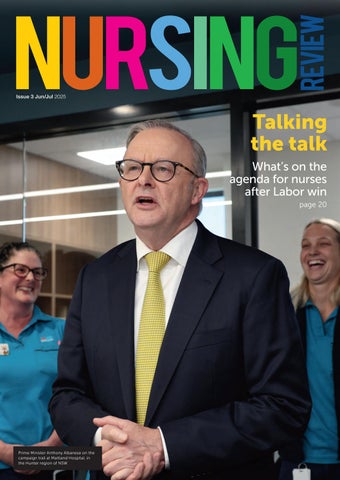
Talking the talk What’s on the agenda for nurses after Labor win page 20
Prime Minister Anthony Albanese on the campaign trail at Maitland Hospital, in the Hunter region of NSW
contents
news
MANAGING EDITOR
Rebecca Cox rebecca.cox@news.com.au
2
Paramedics union claims trial that uses SOTs in mental health team a ‘safety risk’
4
Free mobile app for nurses aims to shift CPD mindset from box ticking to career building
6
New Aged Care Minister and Assistant Minister for Health named in PM’s cabinet shake up
8
Here’s where the new Liberals, Greens and Nationals leaders stand on the issues that affect you most
HEALTH EDITOR
Stefanie Schultz stefanie.schultz@news.com.au SALES MANAGER
Sarah Licence sarah.licence@news.com.au SUBSCRIPTIONS MANAGER
Lee Burrell lee.burrell@news.com.au
02
04
COVER
What’s in store for nurses under Labor, page 20 Image: Jason Edwards/ NewsWire
industry & reform
15 Backlash to NSW government
proposed cuts to workers comp that will hit nurses hardest
PUBLISHED BY
Nationwide News Pty Ltd GPO Box 4245 Sydney NSW 2001 ABN 98 008 438 828 Print Post 100008043 ISSN 1326-0472 OCLC 536881479
18 Bill to allow NPs to supply MS-2
Step passes in NSW lower house despite heated opposition
20 COVER STORY Albanese wins
08
18
on health reform so what’s next on the agenda for nurses?
clinical practice
PUBLISHER’S NOTE
© Copyright. No part of this publication can be used or reproduced in any format without express permission in writing from Nationwide News Pty Ltd. The mention of a product or service, person or company in this publication, does not indicate the publisher’s endorsement. The views expressed in this publication do not necessarily represent the opinion of the publisher, its agents, company officers or employees.
22 How weight stigma in maternity care harms larger-bodied women and their babies
workforce
24 The government has pledged $10 million for inclusive LGBTQIA+ health care
26 WHO estimates global nurse
20
22
shortage at 5.8 million and urges wealthy countries to invest in its own workforce
28 Fair Work moves to rectify
gender-based undervaluation of female-dominated industries
24
26 nursingreview.com.au | 1
news The 12-week trial was due to begin on May 12. Picture: Matrix News
‘Untested model’ Paramedics union claims trial that uses SOTs in mental health team a ‘safety risk’ By NCA Newswire
S
ome of NSW’s most specialised paramedics have launched workplace action as the paramedics union seeks to challenge the rollout of a new mental health unit trial they claim will put staff safety at risk. Paramedics have vowed not to support the Mental Health Co-Response Team (MHRCT) trial, either by the reallocation of resources or participating in training. The Australian Paramedics Association of NSW (APA NSW) says the MHRCT would redirect Specialised Operations Team (SOT) paramedics away from critical rescue and high-risk responses to “staff an untested model”. “Our patients in need of mental healthcare deserve better than being treated as an afterthought. They deserve permanent, evidence-based solutions,” APA NSW assistant secretary Gary Wilson said. “This action is about safety. The safety of paramedics, of our nursing colleagues, and our patients. These safety risks have been raised on an ongoing basis with representatives of the employer since February.” Mr Wilson said only a handful of paramedics were trained as Specialised Operations Paramedics, and that it was “crucial they are available
2 | nursingreview.com.au
when their specialist skills are required as was the case with the Bondi stabbing last year”. “If our extremely limited SOT resources are used to cover for [NSW] Health’s failure to provide appropriate mental health services rather than treated as the scarce, highly specialised essential resources they are, safety will continue to be compromised,” he said. “Will SOT be available the next time a patient trapped in a fire zone needs medical assistance, or will the assistance for members of the community again depend on our road paramedics selflessly entering a situation they are untrained for, putting themselves at risk in the process. “This should never be a choice they have to make.” The Union has called on NSW Ambulance to cease plans to use SOT paramedics for the trial, and instead expand upon the “highly successful, evidence-based Mental Health Acute Assessment Team model”. The APA said they had also requested for the dispute to be urgently listed at the Industrial Relations Commission. In a statement, a NSW Ambulance spokesperson said the safety of clinicians, patients, and the community was the “top priority”, and that the paramedics would remain available for incidents requiring specialist expertise. “The trial aims to improve the experience for mental health patients by providing a
“Our patients in need of mental healthcare deserve better than being treated as an afterthought rapid response, assessment and referral to the most appropriate mental health pathway, and by reducing emergency department presentations. “NSW Ambulance assures the community that SOT qualified paramedics will remain available for incidents that require their specialist skills.” According to the spokesperson, the 12-week trial would allow SOT paramedics to “leverage their unique skills to treat and assess mental health patients in collaboration with the specialist nurses”. “In the event the unit is dispatched to a non-mental health emergency incident, the mental health nurse would not be required to provide health care outside their scope of practice,” the spokesman said. “During the consultation period, an assessment of risks and control measures regarding MHCRT was undertaken and shared with the Australian Paramedics Association (APA) and other stakeholders. “NSW Ambulance is committed to continue these discussions in the Industrial Relations Commission.” ■
Let our team help you take a break Taking a break shouldn’t be a burden. At Rural LAP, we provide fee-free locum support so your team can take time off without the stress. From sourcing qualified locums to organising travel and accommodation, we take care of the logistics, so you can focus on what matters most: supporting your staff.
Scan the QR code to learn more
news The free app has a five star rating and allows you to download files so you can sort and organise in a way that suits you best.
“APNA has introduced Florence as a way to help each individual recognise their own potential
‘Shining light’ Free mobile app for nurses aims to shift CPD mindset from box ticking to career building By Stefanie Schultz
N
urses and midwives can now keep career guidance in their pocket, with a new digital app created by an industry peak body, designed with and for the workforce. The Australian Primary Health Care Nurses Association (APNA) is well aware that nurses have to keep up with required continuing professional development (CPD), as their role has become increasingly professionalised. Seeing a gap in the market for a multidimensional tool that delivers the education and career support nurses need, APNA took matters into its own hands, developing a mobile application that features tailored CPD solutions.
4 | nursingreview.com.au
The app is called Florence by APNA – a free professional development and career growth application, created to support nurses and midwives throughout every stage of their working life. Named after the founder of modern nursing, Florence Nightingale, the app has been designed to tackle the key issues nurses and midwives face when completing their mandatory learning requirements, with an aim to lighten the load of keeping up with professional development. “We are kind of shining a light on how to run your career and plan your career a bit better,” APNA chief Ken Griffin told Nursing Review. “There’s a big grudge factor in doing CPD. We’ve known that for a long time. And so we’ve actually looked at how we can make that easier.” As strong advocates for nurses and midwives across the country working to their full scope of practice, APNA has introduced Florence as a way
to help each individual recognise their own potential. “[The app] will help by recommending education pathways, based on what you want to do in your career. And on top of that, as we turn on more functionality, it’s going to make it easier to secure jobs that are a good fit for your skills and for the kinds of things you want do,” Mr Griffin said. Florence will help nurses and midwives to: •G et tailored CPD recommendations based on their clinical setting and scope •C apture learning from everyday sources – podcasts, webinars, mentorship, workshops •S et goals and track their professional progress •U nderstand how their skills compare with peers across the country •B e matched with opportunities – from research to employment to leadership pathways. Mitch Wall, interim chief of staff and general manager at APNA, calls the digital tool a “career enabler.” “We’ve built it to help nurses capture their learning, reflect on their growth, and unlock new professional possibilities,” he said. “Every feature of Florence was designed with nurses at the centre. From CPD tracking to opportunity matching, the app is practical, powerful, and grounded in real nurse insights.” “We weren’t interested in just building another CPD tracker. Florence is designed to shift mindsets from ticking boxes to building careers.” Co-designed with the workforce, the app builds upon the organisation’s established career and education frameworks. “The development of Florence reflects years of research, co-design with nurses, and a bold vision to modernise how the profession grows. It’s technology with purpose, and it’s just the beginning,” Mr Wall said. “Florence is about visibility. It’s about making sure nurses can see where they are, where they’re going, and just how much they already contribute to Australia’s health system.” ■
TURN YOUR PASSION FOR CARE INTO A HEALTHCARE BUSINESS! As a Nurse or Clinical Director, you’ve given so much to support others—often working long hours with little flexibility. But what if you could create a better balance, while growing your income and doing what you love? Build a business that reflects your passion for care.
BE PART OF THE HOMECARING FRANCHISE! CALL 1300 640 887
Lead with care and make your impact! With a HomeCaring franchise, you’re in control. Set your own schedule, run your own care business, and enjoy the flexibility you deserve—all while making a real impact in your community. Be Your Own Boss Set your own hours and take charge of your career.
Ongoing Support Access expert training, operational, marketing, and clinical guidance.
Proven Success Join a network of over 80 thriving businesses across Australia in home care and NDIS.
Collaborative Business We offer flexible processes, tailored business solutions to help you manage and promote.
CONTACT OUR FRANCHISE MANAGER
Become a HomeCaring franchisee! It’s an easy and simple process! We provide all the tools, training, and guidance you need to set up and grow your own care business. From onboarding to operations, marketing to clinical support, we make the process seamless—so you can focus on delivering quality care while building a rewarding future.
STEP 1: ENQUIRE
STEP 2: COMPLETE EOI
STEP 3: REVIEW
STEP 4: SIGN
Fill out our enquiry form online, or call our Franchise Manager at 1300 640 887 or email us at info@homecaringfranchise.com.au.
If you're ready to move forward, fill out the Expression of Interest form included in your info pack.
We'll provide all the information you need, and we’ll recommend you to seek independent legal and financial advice.
Once you have fully-decided to join HomeCaring, you can proceed with the final documentation for signing.
Why Choose HomeCaring? Passion for Care
Established Franchise Network
Comprehensive Training & Support
Deliver compassionate, tailored support that helps individuals live independently with dignity.
Join Australia’s leading home care and NDIS network. We have more than 80+ locations with affordable entry costs and strong brand recognition.
Access expert training, marketing, operational, compliance, and clinical guidance to start and grow your business.
START YOUR BUSINESS TODAY 1300 640 887
info@homecaringfranchise.com.au
www.homecaringfranchise.com.au
news Anthony Albanese with the Governor-General of Australia Sam Mostyn after being sworn into Cabinet of the 48th Parliament on May 13, 2025. Picture: NCA Newswire/ Hilary Wardhaugh/Getty Images.
New recruits New Aged Care Minister and Assistant Minister for Health named in PM’s cabinet shake up By Stefanie Schultz and NCA Newswire
A
nthony Albanese has revealed the ministry for his government’s second term, elevating backbenchers and moving an assistant minister into cabinet. Unveiling his new ministry picks, the Prime Minister boasted that Labor
6 | nursingreview.com.au
had the largest “caucus in history since federation”. “A caucus brimming with capacity, talent and energy in both the House of Representatives and the Senate,” Mr Albanese told reporters at Parliament House, adding that Labor was claiming up to 92 seats and expecting more in Western Australia and Victoria. “As a result of that, it is an extraordinary opportunity for ministers, but for the entire caucus going forward, to put in place the agenda that we put forward positively to the Australian people and an
ambitious agenda to change this country for the better. “I am deeply humbled by the trust that was put into my government with the election and we certainly won’t take it for granted.”
NOTABLE CHANGES The Prime Minister outlined his new team and revealed a record number of women will join cabinet including West Australian Anne Aly. Ms Aly will enter the cabinet and take on the small business, international
news
development and multicultural affairs portfolio, and while she has been regarded as overdue for promotion, this will also ensure that Labor’s cabinet includes a minister of Muslim faith. In a major development, Tanya Plibersek has been moved from the environment portfolio to social services. Mr Albanese was grilled about the decision to move Ms Plibersek on from the key portfolio. “How did Tanya Plibersek take being given the Social Services portfolio and did you give any consideration to shifting Chris Bowen?” asked one reporter. “She was very positive about it,” Mr Albanese replied. He was pressed further about the decision later in the press conference, with a reporter asking him to explain his decision to move Murray Watt into the environment role. “I have changed a range of portfolios,” Mr Albanese replied. “I have got people who are, I think, in the best positions and that’s across the board.
There has been multiple changes made in the cabinet. That’s what happens and just as there are new members entering the cabinet, there were new members last year as well.” Former communications minister Michelle Rowland will take on Mark Dreyfus’ Attorney General position while Tim Ayres has been promoted to take over from Ed Husic as industry minister. Neither Mr Dreyfus nor Mr Husic have been given a portfolio.
HEALTH AND AGED CARE Mr Albanese kept his most senior cabinet ministers in their roles, with Richard Marles continuing as defence minister, Jim Chalmers as treasurer, Penny Wong as foreign minister and Don Farrell as trade minister. Finance Minister Katy Gallagher, Defence Minister Richard Marles, Housing Minister Clare O’Neil and Energy Minister Chris Bowen will retain their portfolios unchanged. However, Health Minister Mark Butler will now take on responsibility for the National Disability Insurance Scheme (NDIS) with
“The Prime Minister outlined his new team and revealed a record number of women will join cabinet the aged care portfolio moving from front bencher Anika Wells, now Minister for Communications and Sport, to Victorian MP Sam Rae, who has been named as Minister for Aged Care and Seniors. Sam Rae hails from the relatively new Victorian electorate of Hawke, joining the outer ministry for the first time alongside fellow Victorians Dan Mulino and Jess Walsh, Assistant Treasurer and Early Childhood Minister respectively. Meanwhile, newly elected MP Rebecca White – a former Tasmanian leader who failed three times to win a state election – entered federal politics as Assistant Minister for Health and Aged care, Assistant Minister for Indigenous Health, and Assistant Minister for Women. ■
Discover flexible online courses designed to fit around your schedule and start studying in July Graduate Certificates
Graduate Diplomas
> Epidemiology > Health Services Management > Infectious Disease Prevention and Control > Maternal Critical Care > Midwifery Studies
> Midwifery
Masters > Research
cdu postgraduate nursing CRICOS Provider No. 00300K | RTO Provider No. 0373 | TEQSA Provider ID PRV12069
nursingreview.com.au | 7
news Liberal leader Sussan Ley, Greens leader Larissa Waters and Nationals leader David Littleproud. Pictures: NCA NewsWire, Saeed Khan/AFP, Tertius Pickard and Martin Ollman.
Follow the leader Here’s where the new Liberals, Greens and Nationals leaders stand on the issues that affect you most By Stefanie Schultz
T
he weeks following the federal election have been tumultuous to say the least, with Labor’s landslide win triggering an onslaught of parliamentary changes, including new heads for the Liberals and Greens. In a shock move, the Nationals announced that the party will dump its Coalition agreement with the Liberal Party. They would hold 15 seats in the new parliament independently, reducing the Liberals to just 28. “It’s with great disappointment that I announce that we’re not going to form part of that Coalition,’’ Party leader David Littleproud said. “The National Party will sit alone on a principle basis.” The decision upends an 80-year-old partnership between the two parties, and has drawn widespread criticism, including from former prime minister John Howard. “As a strong C oalitionist, I’m very concerned about today’s developments and I hope the two parties continue to talk
8 | nursingreview.com.au
Flourish election chart
news
to each other, and I hope the Coalition is reformed well before the next election,” Mr Howard told The Australian. “The best interest of the two parties is served by being in coalition and they are strongest politically and policy wise when both parties have been together.” Just days after the split, and with increasing pressure from within both parties, it was announced there was an in-principal agreement to reunite. The Labor Party would be three times the size of the opposition if the split goes ahead. Prime Minister Anthony Albanese had been measured in his public response to the initial news that the Coalition was no more. “Our job is to remain focused … Political parties will not be successful if they’re focused on themselves. I lead a united party that is focused on the needs of the Australian people,“ Mr Albanese said the day after the split. Labor achieved its historic win off the back of a health-focused election campaign, pledging Medicare reform, more bulk-billing, cheaper medicines and major investments into women’s health. Aged Care Insite has taken a look at where the three leaders stand on health, education, economic and environmental policies, including how they‘ve voted on key legislation during in their time in parliament.
SUSSAN LEY, LEADER OF THE LIBERAL PARTY Following the Liberal’s decimating losses in the federal election, including Peter Dutton losing his seat to Labor candidate Ali France, Sussan Ley was elected as the new leader on May 13. Hailing from the rural NSW division of Farrer – which borders both Victoria and South Australia and includes townships such as Albury, Griffith and Deniliquin – Ms Ley has made history as the first woman to lead the Liberals, but she is by no means a stranger to the parliamentary floor. Born in Nigeria, Ms Ley spent her childhood in the United Arab Emirates, before migrating to Australia at the age of 13 with her family. In 2001 she entered federal politics as a member of the NSW Liberal Party. Ms Ley was named Health Minister in 2014 under the Abbott government, adding the Aged Care portfolio to her responsibilities in 2015. Her time on the frontbench was short, ending in scandal
Leader of the Opposition Sussan Ley. Picture: NCA NewsWire/Martin Ollman
in 2017 when she was found to have used a taxpayer-funded trip to purchase a $795,000 apartment on Queensland’s Gold Coast. As Minister for the Environment under Scott Morrison between 2019 and 2022, Ms Ley gave the green light to a number of new coal projects, including the approval of Adani’s massive coal mine in Central Queensland, and made claims that climate action was not in her portfolio. This famously led to a 2021 Federal Court ruling that found Ms Ley had a duty of care to future generations and should avoid causing harm with her decisions as Environment Minister. She appealed the decision and it was overturned in 2022. Following her appointment to the leadership, Ms Ley made a statement assuring the Australian public that her party will stand for fairer taxes, take education seriously, support families and build “a strong, sovereign Australia.” “Our Party values are enduring and they are optimistic. We believe in the freedom of the individual, reward for hard work and strong families being at the centre of a successful society,” she said.
“The decision upends an 80-year-old partnership between the two parties, and has drawn widespread criticism “The Australians that Robert Menzies called ‘the forgotten people’ and John Howard called his ‘battlers’ remain at the heart of our nation. They are the nurses, small business owners, tradies, teachers, farmers, parents and retirees who ask for little but contribute a lot.” She continued saying that the fact that she is a women should not be dwelled upon, nor should it overshadow the urgency and unity with which the Party must now act. “We accept that many Australian women felt neglected by the Liberal Party and that we must reconnect with them and rebuild trust. We will do so,” Ms Ley said. “I also know that Australians want a real alternative. They deserve a real alternative. > And we will give them a real alternative.” nursingreview.com.au | 9
news
< What does Sussan Ley stand for? We’ve looked through the records to see what Ms Ley has supported through her voting in the House of Representatives. She has consistently voted for the following: • Decreasing availability of welfare payments • Drug testing welfare recipients • Getting rid of Sunday and public holiday penalty rates • Increasing availability of abortion drugs • Increasing indexation of HECS-HELP debts • Increasing scrutiny of unions • Increasing the Medicare Levy to pay for the National Disability Insurance Scheme • Increasing the price of subsidised medicine • Stem cell research • Stopping people who arrive by boat from ever coming to Australia • The territories being able to legalise euthanasia In her time in the parliament, these are some of the bills she has consistently voted against: • A Royal Commission into Violence and Abuse against People with Disability • Building dedicated quarantine facilities (Covid-19) • Criminalising wage theft • Decreasing the private health insurance rebate • Doctor-initiated medical transfers for asylum seekers • Increasing funding for university education • Increasing legal protections for LGBTI people • Increasing trade unions’ powers in the workplace • Increasing political transparency • Increasing the age pension • Increasing workplace protections for women • Making TAFE education fee-free • Reducing tax on lowest income bracket • Transgender rights • Treating the Covid vaccine rollout as a matter of urgency
LARISSA WATERS, LEADER OF THE AUSTRALIAN GREENS You may remember Canadian-born Greens leader Larissa Waters making headlines in 2017 when she breastfed her daughter in the Senate. At the time, she said that “women belong in the places of power usually 10 | nursingreview.com.au
Greens leader Larissa Waters. Picture: NCA NewsWire/Luis Enrique Ascui
dominated by older men, and the more of us there are, the more we can change things for all women.” Ms Waters has a background in environmental law, and was named Australian Young Environmental Lawyer of the Year by the Law Council of Australia in 2010. She entered federal politics in 2011 as the first Greens Senator for Queensland. In July 2017 she was forced to resign from the Senate in the wake of the dual citizenship eligibility crisis. Although Ms Waters was born in Canada to Australian parents, she was brought up in Australia after the family returned when she was an infant. Ms Waters said she was not aware that this meant she held Canadian citizenship. She renounced her citizenship a month later, and was re-elected to the Senate in 2018. Now, following Adam Bandt’s loss in the seat of Melbourne to Labor’s Sarah Witty, Ms Waters has become the second woman to lead the party (Christine Milne held the top spot between 2012 and 2015). The Senator is a fierce proponent for climate action, as well as advocating for gender equity, ending gender-based violence, and addressing corporate donations and influence in politics. Upon her election as Leader of the Greens, Ms Waters said she will use her position to keep the Albanese government accountable. “There’s now no excuse for the Labor Party not to take the climate crisis seriously, to take real action on the housing crisis, to genuinely tackle the cost of living. People deserve more than just tinkering. They deserve real reform that will help
them in their daily lives, and nature cannot be put last like it has been for so long,” she said
What does Larissa Waters stand for? We’ve looked through Ms Waters’ voting record in the Senate and here some of what she consistently votes in favour of: • A Royal Commission into Violence and Abuse against People with Disability • Banning pay secrecy clauses • Building dedicated quarantine facilities (Covid-19) • Closing the gap between Indigenous and non-Indigenous Australians • Criminalising wage theft • Decreasing the gender pay gap • Decreasing the private health insurance rebate • Doctor-initiated medical transfers for asylum seekers • Ending indexation on student debt (vocational and tertiary) • Extending and increasing access to the JobKeeper Payment • Increasing access to medicinal cannabis products • Increasing access to subsidised childcare • Increasing funding for university education • Increasing legal protections for LGBTI people • Increasing trade unions’ powers in the workplace • Increasing workplace protections • Paid parental leave equality for stay-athome mothers and fathers • Transgender children and young people having access to gender affirming healthcare >
news
<
• Transgender rights • Treating the Covid vaccine rollout as a matter of urgency • Up to 12 months of paid parental leave by 2030 In her time in the Senate these are some of the issues she has consistently voted against: • Charging postgraduate research students fees • Compulsory income management for welfare recipients • Decreasing availability of welfare payments • Deregulating undergraduate university fees • Increasing indexation of HECS-HELP debts • Increasing scrutiny of unions • Increasing surveillance powers • Political intervention in research funding grants • Reducing taxes for high-income earners • Treating Covid vaccine status as a protected attribute
DAVID LITTLEPROUD, LEADER OF THE NATIONAL PARTY David Littleproud is the only one of the three party leaders who managed to hold onto his seat and keep his place at the head of the table, retaining his leadership on May 12. Mr Littleproud holds the seat of Maranoa, which encompasses most of the south west of Queensland, bordering the NT, SA and NSW, and has been leader of the National Party since 2022. Growing up in Chinchilla, in the heart of the Queensland Western Downs, and forging a career in agribusiness before entering politics, Mr Littleproud’s politics centre on small business and agriculture. The Nationals are known as the party that represents regional Australia. Founded as the Australian Country Party in 1920, the Nationals have as a core principal that “the future of regional Australia is critical to the future of our nation,” and its party policies are inherently conservative. Mr Littleproud has been under intense scrutiny since making the decision to end the Coalition agreement earlier this week but it’s not the first time he has had his decisions questioned. In 2023 he, like Ms Ley, was caught up in a travel expenses scandal, in which he reportedly left parliament early to travel to the Gold Coast with his family on taxpayer12 | nursingreview.com.au
Leader of the Nationals David Littleproud, with Kevin Hogan and Bridget McKenzie. Picture: NCA NewsWire/Martin Ollman.
funded business class flights, just three days after settling on a $1.375m beachfront apartment in Surfers Paradise. To quell any claims of unethical behaviour, Mr Littleproud paid back all expenses associated with the trip. Mr Littleproud is loudly pro-nuclear, and believes that “the all-renewables approach won’t work.” One of the reasons given for the split from the Liberals was over the Nationals’ support for a domestic nuclear power industry. He has consistently voted against climate action policies, such as federal government action on animal and plant extinctions, increasing investment in renewable energy, Net zero emissions by 2035, the Paris Climate Agreement, and the establishment of an Australian Renewable Energy Agency (ARENA).
What does David Littleproud stand for? Mr Littleproud’s voting record shows what he has consistently voted in favour of: • Civil celebrants having the right to refuse to marry same-sex couples • Decreasing availability of welfare payments • Drug testing welfare recipients • Getting rid of Sunday and public holiday penalty rates • Increasing scrutiny of unions • Increasing the Medicare Levy to pay for the National Disability Insurance Scheme • Live animal export
• Political intervention in research funding grants • Reducing the corporate tax rate • Stopping people who arrive by boat from ever coming to Australia • The territories being able to legalise euthanasia These are some the issues he has consistently voted against: • A Royal Commission into Violence and Abuse against People with Disability • Banning pay secrecy clauses • Building dedicated quarantine facilities (Covid-19) • Considering legislation to create a federal anti-corruption commission (procedural) • Criminalising wage theft • Doctor-initiated medical transfers for asylum seekers • Increasing access to subsidised childcare • Increasing funding for university education • Increasing housing affordability • Increasing legal protections for LGBTI people • Increasing political transparency • Increasing trade unions’ powers in the workplace • Increasing workplace protections • Making TAFE education fee-free • Reducing tax on lowest income bracket • Reproductive bodily autonomy • Transgender rights • Treating the Covid vaccine rollout as a matter of urgency ■
Because home is essential too. 5.45p.a 5.49p.a From
Variable Rate
%
%
1
2
Comparison Rate
Essential Worker Home Loan | Principal & Interest | Owner Occupied
Our Essential Worker Home Loan offers up to 95% LVR3, no monthly fees, and we include shift allowances and overtime4 in your borrowing power. More flexibility, more support, more home loan.
G&C Mutual Bank Limited | ABN 72 087 650 637 | AFSL & Australian Credit Licence 238311. 1. Interest rate is correct as at 26/05/25 and is subject to change. Eligibility criteria, terms and conditions and fees and charges apply. Available when at least one borrower meets essential worker criteria as a frontline ambulance officer, paramedic, firefighter, police officer, corrective services officer, nurse, aged care or disability worker, teacher, early childhood educator, defence or military personnel. For new security or new refinance applications only. Not available for existing Unity Bank or G&C Mutual Bank Loans. 2. Comparison rate based on $150,000 loan over 25 years. WARNING: This comparison rate is true only for the examples given and may not include all fees and charges. Different terms, fees or other loan amounts might result in a different comparison rate. 3. Mortgage Insurance will be required if you borrow over 80% of the value of your home (or borrow an additional amount on your existing mortgage that brings the overall loan amount over 80% LVR). 4. Overtime and shift allowances - 100% may be used in serviceability if the borrowers’ employment is in the essential services industry (e.g. Ambulance, Police Service, Nursing and Corrective Services).
Because home is essential too. 5.45p.a 5.49 p.a From
Variable Rate
%
%
1
2
Comparison Rate
Essential Worker Home Loan | Principal & Interest | Owner Occupied
Our Essential Worker Home Loan offers up to 95% LVR3, no monthly fees, and we include shift allowances and overtime4 in your borrowing power. More flexibility, more support, more home loan. G&C Mutual Bank Limited | ABN 72 087 650 637 | AFSL & Australian Credit Licence 238311. 1. Interest rate is correct as at 26/05/25 and is subject to change. Eligibility criteria, terms and conditions and fees and charges apply. Available when at least one borrower meets essential worker criteria as a frontline ambulance officer, paramedic, firefighter, police officer, corrective services officer, nurse, aged care or disability worker, teacher, early childhood educator, defence or military personnel. For new security or new refinance applications only. Not available for existing Unity Bank or G&C Mutual Bank Loans. 2. Comparison rate based on $150,000 loan over 25 years. WARNING: This comparison rate is true only for the examples given and may not include all fees and charges. Different terms, fees or other loan amounts might result in a different comparison rate. 3. Mortgage Insurance will be required if you borrow over 80% of the value of your home (or borrow an additional amount on your existing mortgage that brings the overall loan amount over 80% LVR). 4. Overtime and shift allowances - 100% may be used in serviceability if the borrowers’ employment is in the essential services industry (e.g. Ambulance, Police Service, Nursing and Corrective Services).
subscribe for less than $2 a week The laTesT news and resources for healThcare professionals Nursing Review is essential reading for anyone involved in the healthcare sector in Australia. It provides unrivalled coverage of specialist topics from features and opinion pieces, to international news and profiles. • Latest news and resources for all healthcare professionals • Comprehensive coverage of a diverse range of topics • Analysis of the major issues facing the health sector as a whole • Delivered free of charge • 6 issues per year • Only publication in the country dedicated to reporting issues important to nurses
Please email edmedia.subscriptions@news.com.au to find out more
industry & reform NSW Treasurer Daniel Mookhey has said the system overhaul would put “prevention ahead of compensation”. Picture: NCA NewsWire/Nikki Short.
‘Wiping its hands’ Backlash to NSW government proposed cuts to workers’ comp that will hit nurses hardest By Stefanie Schultz and NCA Newswire
C
ompensation payments for psychological injuries will cut off after two and a half years unless an injured worker can prove they will be significantly impaired for life, under a bid to overhaul the workers compensation scheme. Workers and employers were given their first glimpse at the potential changes after the Minns government released its exposure draft for the new Workers Compensation Legislation Amendment Bill on May 9. A parliamentary inquiry had until May 23 to give feedback on the draft
before the final version is set in stone, which NSW Treasurer Daniel Mookhey previously said would put “prevention ahead of compensation”. A revised plan is be tabled in parliament following widespread opposition from the state’s unions. Multiple unions representing teachers, nurses and a range of other fields rallied outside parliament the day before in opposition to a draft proposal. Following that backlash and a hearing into the proposal, the Labor government planned to introduce an updated Bill. Among the changes since the bill was first made public was a plan to scrap the requirement that workers obtain a finding from the IRC, as well as an expedited system for those types of claims – just eight weeks.
“They risk their mental health for the rest of us. We should support them, not cut them off The definition of vicarious trauma will also be clarified to include psychological injury arising from “repeated exposure to the traumatic experiences of others”. Other proposed changes, many of which were raised during the hearing, include reducing legal costs, greater powers to IRC to hear workplace health and safety complaints, and adding “excessive work demands” as a new compensable cause of psychological injury. Unions NSW has warned the state government that frontline workers who witness traumatic deaths and injuries > nursingreview.com.au | 15
industry & reform
NSW Unions secretary Mark Morey opposes the state government’s proposed changes workers compensation. Picture: NCA NewsWire/Simon Bullard.
< while on the job could be prevented from accessing compensation payments, if it forges ahead with its system overhaul. “Whether it’s a hospital worker or prison officer with PTSD, a child protection worker who has had to remove a child from an abusive home, or a shop assistant abused at a checkout, these workers deserve support when workplace trauma catches up with them. The Government’s plan rips that away,” Unions NSW secretary Mark Morey said. “Essential workers in our hospitals, schools and railways deal with trauma, sexual harassment and assault regularly. They risk their mental health for the rest of us. We should support them, not cut them off.” The peak body has launched an ad campaign opposing the state government’s plan, alongside a five-point plan focusing on prevention, improving return-towork rates, reducing waste, and creating sustainable funding models without cutting worker benefits. “Workers who have suffered serious psychological injuries have been supported 16 | nursingreview.com.au
and helped back to work through the workers’ compensation system. For many, this support was literally life-saving,” Mr Morey said. “There are better ways to fix the system than cutting support for injured workers – like cutting waste. “The Government’s cuts mean when you need help most, it might not be there.” Similarly, the Law Society of NSW has pushed the parliamentary inquiry committee to recommend a pause to allow time for broader consultation and key changes to the legislation. President Jennifer Ball said increasing the ‘whole person impairment’ (WPI) threshold to 31 percent will “conceivably exclude nearly all workers with psychological injury from making a claim.” “To reach 31 percent WPI, a person would need to demonstrate they’re unable to live alone, care for dependants, or to function in society,” she said. “We believe that changing the WPI threshold to 21 percent would ensure that
many workers generally recognised by community standards as being severely impacted by mental ill-health would be able to make a claim, while easing upward pressure on workers’ compensation insurance premiums. “Following the present truncated and inadequate consultation process, the Law Society urges the NSW Government to pause the progression of the Workers Compensation Legislation Amendment Bill 2025 … to permit broader consultation. This will help minimise unintended consequences and ensure the proposed changes are based on strong evidence.”
HEALTH WORKFORCE ON ITS KNEES Research shows that nurses, midwives and carers make up the largest cohort of workers with psychological injury claims, meaning the proposed changes will disproportionately impact the state’s predominantly female health workforce. NSW Nurses and Midwives’ Association (NSWNMA) acting general secretary Michael Whaites has urged the state government not to go down the “path of
industry & reform
Australians for Mental Health executive director Chris Gambian labelled the proposed bill “dangerous”. Picture: NCA NewsWire/AAP/Jordan Shields.
inflicting cruelty on its essential workers” by “simply wiping its hands of injured nurses, midwives and carers.” “Over a nine year period there was a staggering 150 per cent increase in the number of psychological injury claims by nurses and midwives,” Mr Whaites said. “The government intends to make it harder for nurses and midwives to access support, by excluding work pressure as a cause of psychological trauma. This is extremely alarming as we know excessive workloads and staffing pressures are leading to burnout and poor mental health. “The health workforce is on its knees, overwhelmed by unprecedented demand, chronic understaffing and 12 years of wage suppression, all off the back of a global pandemic. It’s no coincidence these conditions produce a hostile work environment and breed a culture of bullying. Without fair wages and improved conditions, this workforce will continue to suffer and fall through the cracks. “Nurses and midwives dedicate their working lives to caring for others; failing
to care for them when they are severely impacted at work is not only unjust, but also dangerously negligent.” In April, the government announced mental health supports would be extended to essential workers who face traumatic incidents in their day-to-day work on road sites and in national parks. The Australian Workers Union (AWU) has claimed the Minns government’s proposed changes to workers’ compensation would reverse these key mental health benefits. The proposed bill includes a new test for trauma that would require workers to prove a “real and substantial connection” to the victim they witnessed killed or injured to qualify for compensation. But AWU NSW secretary Tony Callinan said the vague term could be exploited in the courts to quash claims and rob workers of their payments. “These changes will make it harder for seriously injured workers to access long-term critical care for their mental health, and it is a betrayal of AWU members who have been campaigning tirelessly for
“If the NSW Government wants to ease pressure on the scheme, the answer is to stop people being harmed first responder recognition in NSW and the additional mental health support this brings,” he said. According to the draft bill, a worker will have to prove a “close work connection” to the victim to qualify for compensation or medical benefits, based on a “real substantial connection” or a connection that “arose because of the worker’s employment”. NSW Premier Chris Minns said the draft bill had been released “so that we could put our cards on the table, hear from unions and hear from the industry”. “The only thing we’ve said is that change needs to come, because the system as it currently works is unsustainable in the future,” he said. ■ nursingreview.com.au | 17
Workforce The bill was initially introduced by Greens MP Amanda Cohn. Picture: NCA NewsWire/Gaye Gerard
‘Work together’ Bill to allow NPs to supply MS-2 Step passes in NSW lower house despite heated opposition By NCA Newswire
A
Bill seeking to expand access to medical abortions in NSW, particularity in remote and regional communities, has reached a major milestone after passing the lower house, despite significant changes and claims of misinformation. The Bill, introduced by upper house Greens MP Dr Amanda Cohn in February, would expand access to abortions by allowing nurse practitioners to supply medication to terminate pregnancies of up to nine weeks in gestation. Since being introduced, the Bill has been significantly watered down with amendments specifying the endorsed nurse practitioners and midwives must have the needed skills and training to administer the drug, known as MS-2 Step. Opponents of the Bill – including former prime minister Tony Abbott – have argued against forcing conscientious objectors to actively refer abortion services. That component was removed as the Bill made its way through parliament. NSW Opposition Leader Mark Speakman said he would support the current amended Bill, as did Labor Premier Chris Minns.
18 | nursingreview.com.au
The lead-up to the vote was marred by allegations of misinformation, but it ultimately passed without significant discourse in the lower house after two proposed amendments were shot down by a majority of MPs. An amendment put forward by independent Wagga Wagga MP Joe McGirr requiring nurse practitioners or endorsed midwives have at least two years of experience was not supported by Health Minister Ryan Park or Liberal health spokeswoman Kellie Sloane. The MPs raised the extensive training received by both nurses and midwives, including 5000 hours of clinical practise for nurse practitioners, with Ms Sloane saying the amendment “makes it even harder for access and equity in regional areas”. “This amendment is unnecessary. It’s inconsistent with health data, ignores the expertise of nurse practitioners and endorsed midwives and makes it harder for our regional, remote communities to access this important healthcare,” she said. They also noted the Bill, as tabled, was supported by peak medical bodies, including the NSW Nurses and Midwives Association, the Royal Australian and New Zealand College of Obstetricians and Gynaecologists and Family Planning Australia Ultimately, the amendment was voted down by MPs.
As was a second amendment also put forward by Mr McGirr seeking a “certain requirement for training” prior to commencing of practise for endorsed midwives and qualified nurses undertaking terminations, facing similar opposition. Mr Park said stipulating specific training requirements was not done with any other health service and would “mean NSW is inconsistent with the rest of our country and with national guidelines”, including the Therapeutic Goods Administration (TGA) guidelines. Mr McGirr on both counts said he was not seeking to undermine the Bill. The Bill initially sought to ensure abortion services be provided across the state within a reasonable distance from residents’ homes, and would remove unnecessary reporting to health authorities about the termination. It would also have empowered the Health Minister to compel public health services to comply with directions to offer abortion services and would require practitioners who object to abortion to refer a patient to someone who will. Abortion was decriminalised in NSW only in 2019. Nonetheless, hospitals in the regional centres of Queanbeyan outside Canberra, and Orange were found to have banned
Workforce
Opposition Leader Mark Speakman backed the amended Bill. Picture: NCA NewsWire/Christian Gilles
abortions, prompting an apology during budget estimates from NSW Health secretary Susan Pearce. Dr Cohn has previously said the intention of the Bill was to expand who could perform medical terminations, which she said was necessary to bring legislation in-line with changes in 2023 to the national medicine regulator. Its introduction has stirred fiery debate since it was tabled. In a parliamentary debate in May, upper house Liberal MP Chris Rath compared abortion to the Nazi genocide of Jews, stating “it is bizarre that abortion is increasingly being categorised as a human right to health care”. Mr Rath later apologised for the statement. The Bill has also stirred protest on the steps outside parliament by anti-abortion campaigner Joanna Howe’s coalition, with one protest attended by Tony Abbott and the Catholic archbishop of Sydney, Anthony Fisher. Opposition Leader Mark Speakman accused Dr Howe of “brazen bullying”, stating that he would “vote according to my conscience and balance difficult and sensitive ethical, social, moral and medical concerns”.
“I will not cave to brazen bullying like this nor to the Americanisation of NSW … I thank all constituents who have contacted me. I have carefully considered their sincere and varying views. I will therefore vote for the Bill,” he said. “I think that, on balance, the Bill will make no material difference to the rate of abortion in NSW. “It will not interfere with freedom of conscience and will probably lead to better, not worse, health outcomes for many pregnant women seeking abortions.” Mr Speakman noted some objections were “based on misinformation” and that, despite stating he would not have supported the original bill, believed, “the attacks on freedom of conscience and freedom of religion in the original bill have now been removed by successful amendments.” A third reading of the bill was passed 65 to 20. It will now return to the Legislative Council. Greens Newtown MP Jenny Leong thanked MPs for the vote. “It’s wonderful to think that very, very soon, there will be better access to abortion care for people across the state
“Consider whether or not you’re okay with the idea of people in the city having access to better services of NSW as a result of the decision we are making today,” she said. “Sometimes it feels like when you’re in this place that we will never get good outcomes for people in their communities, and sometimes we do really good work together. “I feel like this debate has shown what we can do when we work together in the actually genuine interests of the community that we serve.” In introducing the first reading of the Bill, Ms Leong said it was about “equity in access to reproductive healthcare – access to abortion services – and increased that access to women and people across the state of NSW”. She urged MPs in the room to, despite their personal opinions, “actually consider whether or not you’re okay with the idea of people in the city having access to better services and more services … than those in regional and rural”. ■ nursingreview.com.au | 19
Workforce
High expectations Prime Minister Anthony Albanese with nurses at Maitland Hospital during the election campaign. Picture: NCA Newswire/Jason Edwards
Albanese wins on health reform so what’s next on the agenda for nurses? We talk to APNA’s Ken Griffin to find out By Stefanie Schultz
A
nthony Albanese has led Labor to a landslide win in the federal election after a nationwide swing toward the party put it on track to comfortably form a majority government. The path to victory was brutal on the opposition, costing several senior Coalition MPs – including leader Peter Dutton – their seats.
20 | nursingreview.com.au
The Greens have also taken a hit, with the minor party’s leader losing his seat of Melbourne. The Prime Minister’s campaign was one largely built on health reform, with the election labelled a “referendum on Medicare.” Labor announced a slew of funding initiatives for healthcare in the lead up to the election, from bulk-billing boosts to PBS caps, women’s health, Urgent Care Clinics and a 24-hour telehealth service, yet some argue there was very little in the way of policies to address the key issues facing the nursing and midwifery workforce.
In March, nine nursing and midwifery organisations joined forces to deliver a statement to government demanding nurse-led reform. Now, as Labor has been granted three more years at the helm, nursing peak bodies have high expectations for the sector.
WHAT THE SECTOR SAYS MATTERS The Australian Primary Health Care Nurses Association (APNA) chief Ken Griffin told Nursing Review that the organisation looks forward to continuing its work with the Labor government. When it came to Health Minister Mark Butler and Assistant Minister Ged Kearney, Mr Griffin said they have been highly
Workforce
Albanese’s strong focus on health, women and cost of living relief resonated with voters. Picture: NCA Newswire/Lukas Coch-Pool/Getty Images
engaged with the challenges of the health system up to this point but the time for real action is now. “We hope that a second term Labor government will be emboldened and really push forward with some of the much needed reform that’s been recommended for the health system,” Mr Griffin said. “We’d like to see movement on the recommendations or some of the recommendations from the Scope of Practise Review. These are really fundamental things that will increase the productivity of the health workforce by making sure there aren’t barriers to using the skills of all the professions in primary healthcare.”
Outdated and restrictive Collaborative Arrangement Laws were scrapped for nurse practitioners and endorsed midwives in November. This allowed them to work to their full scope of practice without a supervising medical practitioner. However, Mr Griffin believes too many nurses remain under-utilised nationwide. “We’ve had great advances with endorsed midwives and nurse practitioners. The work there isn’t done, but it’s been great to see that,” Mr Griffin said. “When we consider that 76 per cent of the nursing and midwifery workforce are RNs, we need to make sure that we have them in the game, because that’s where we’ll get the biggest gains from a size of the workforce and a scale of the workforce. “For nursing specifically, we look forward to the highly trained, highly skilled primary health care nursing workforce being able to play a fuller role in the health of the country. “The Government has engaged in a respectful and a sincere way and we look forward to seeing what comes out of that and what will change in the health system to keep the country healthier in the next three years.” Australian Nursing and Midwifery Federation (ANMF) federal secretary Annie Butler said the Coalition made the mistake of undervaluing nurses and midwives during its election campaign, contributing to its historic loss. “Mr Albanese again promised he’d standup for nurses, midwives and care workers,
“The Government has engaged in a respectful and a sincere way and we look forward to seeing what comes out of that which we welcome because, although we’ve made significant gains, we still have much work to do,” Ms Butler said. “Peter Dutton made the mistake of ignoring nurses and midwives in the lead-up to this election demonstrating a lack of respect for our professions and our contribution to the health of our communities. “It’s clear that Australians understood this and weren’t prepared to risk Peter Dutton but instead put their vote of confidence in Mr Albanese and his team’s positive agenda for health and aged care.” During Labor’s last term the country’s nursing and midwifery workforce benefited from key reforms, including higher wages, 24/7 RN staffing in aged care, the removal of Collaborative Arrangement laws, free TAFE courses, and the establishment of the national Nurse Midwife Health Program Australia. “We now look forward to getting down to work with Mr Albanese and his team to start implementing the ANMF’s priorities, so we can continue building a sustainable workforce which is well-positioned to respond to Australia’s growing health needs into the future.” ■ nursingreview.com.au | 21
Clinical
‘No compassion… just blame’ Stigma from health-care professionals and society at large can rob larger-bodied women of the joy associated with pregnancy.
How weight stigma in maternity care harms larger-bodied women and their babies By Briony Hill and Haimanot Hailu
A
ccording to a study from the United States, women experience weight stigma in maternity care at almost every visit. We expect this experience to be similar in Australia, where more than 50 per cent of women of reproductive age live in larger bodies. Weight stigma can present as stereotyping, negative attitudes and discriminatory actions towards larger-bodied people. It occurs in other areas of health care and in society at large. But our research is focused on weight stigma in maternity care, which can cause significant harm for larger-bodied women and their babies.
What does weight stigma look like in maternity care? Sometimes weight stigma is explicit, or on purpose. Explicit weight stigma includes 22 | nursingreview.com.au
health-care professionals having negative attitudes towards caring for larger-bodied pregnant women. This might present, for instance, when health professionals make negative comments about weight or accuse women of dishonesty when they discuss their dietary intake. Sometimes weight stigma is implicit, or unintentional. Implicit weight stigma includes maternity care providers avoiding physical touch or eye contact during consultations with larger-bodied women. Policies, guidelines and environments also contribute to weight stigma. Women in larger bodies frequently report feeling stigmatised and unable to access the type of maternity care they would prefer. Lack of availability of adequately fitting hospital clothing or delivery beds are other notable examples. In a review published last year, we looked at weight stigma from preconception to after birth. Our results showed larger-bodied women are sometimes automatically treated as highrisk and undergo extra monitoring of their pregnancy even when they have no other risk factors that require monitoring.
This approach is problematic because it focuses on body size rather than health, placing responsibility on the woman and disregarding other complex determinants of health.
How does this make women feel? Qualitative evidence shows women who experience weight stigma during their maternity care feel judged, devalued, shamed and less worthy. They may feel guilty about getting pregnant and experience self-doubt. As one research participant explained: “One doctor told me I was terrible for getting pregnant at my weight, that I was setting up my baby to fail […] I was in tears, and he told me I was being too sensitive.” A 2023 Australian paper written by women who had experienced weight stigma in maternity care recounted their care as hyper-focused on weight and dehumanising, robbing them of the joy of pregnancy. According to one woman, “there was no compassion or conversation, just blame”. Beyond making women feel humiliated and disrespected, weight stigma in
Clinical
Weight stigma in maternity care has been linked to a higher likelihood of caesarean birth.
maternity care can affect mental health. For example, weight stigma is linked to increased risk of depressive symptoms and stress, disordered eating behaviours and emotional eating. One of the key reasons why weight stigma is so damaging to pregnant women’s health is because it’s closely linked to body image concerns. Society unfairly holds larger-bodied women up to unrealistic ideals around their body shape and size, their suitability to be a mother, and the control they have over their weight gain. Self stigma occurs when women apply society’s stigmatising narrative – from people in the community, the media, peers, family members and health-care providers – to themselves.
Impacts on mum and baby Several adverse pregnancy and birth outcomes have been linked to weight stigma in maternity care. These include gestational diabetes, caesarean birth and lower uptake of breastfeeding. While we know these things can also be linked to higher body weight, emerging
evidence shows weight stigma may have a stronger link with some outcomes than body mass index. There are a variety of possible reasons for these links. For example, weight stigma may result in delayed access to and engagement with health-care services, and, as shown above, poorer mental health and reduced confidence. This may mean a woman is less likely to initiate and seek help with breastfeeding, for example. Experiencing weight stigma also leads to a stress response in the body, which could affect a woman’s health during pregnancy. In turn, the adverse effects of weight stigma can also affect the baby’s health. For example, gestational diabetes has a range of potential negative outcomes including a higher likelihood of premature birth, difficulties during birth, and an increased risk of the child developing type 2 diabetes. But the burden and blame should not fall on women. Pregnant and postpartum women should not have to accept experiences of weight stigma in health care.
What can we do about it? While it’s essential to address weight stigma as a societal issue, health services can play a key role in undoing the narrative of blame and shame and making maternity care more equitable for larger-bodied women. Addressing weight stigma in maternity care can start with teaching midwives and obstetricians about weight stigma – what it is, where it happens, and how it can be minimised in practice.
“Weight stigma may result in delayed access to and engagement with health-care services We worked with women who had experienced weight stigma in maternity care and midwives to co-design resources to meet this need. Both women and midwives wanted resources that could be easily integrated into practice, acted as consistent reminders to be size-friendly, and met midwives’ knowledge gaps. The resources included a short podcast about weight stigma in maternity care and images of healthy, larger-bodied pregnant women to demonstrate the most likely outcome is a healthy pregnancy. Midwives evaluated the resources positively and they are ready to be implemented into practice. There is a long road to ending weight stigma in maternity care, but working towards this goal will benefit countless mothers and their babies. ■ Briony Hill is Deputy Head, Health and Social Care Unit and Senior Research Fellow at Monash University. Haimanot Hailu is a PhD Candidate, Health and Social Care Unit at Monash University. This article is republished from The Conversation under a Creative Commons license. Read the original article at theconversation.com/au. nursingreview.com.au | 23
Workforce Best-practice health care services recognise different genders and family structures, for example.
‘Safe and trusted’ The government has pledged $10 million for inclusive LGBTQIA+ health care. Here’s what that means for the sector By Karinna Saxby, Mo Hammoud and Ruth McNair
I
n April, the federal government announced a $10 million commitment to make Medicare more inclusive for LGBTQIA+ Australians. It aims to improve their access to “inclusive, culturally safe primary care” through training and accreditation for GPs, nurses and other health-care providers. The precise details will depend on which training provider wins the government’s grant. But they will have a strong body of evidence to draw on, which shows the challenges LGBTQIA+ people face in health care – and what it would take to make mainstream services more inclusive.
WHY IS THIS NEEDED? Many LGBTQIA+ Australians lead happy and healthy lives. But, unfortunately, a disproportionate number experience significantly poorer health outcomes compared to the general population. LGBTQIA+ Australians are more likely to experience depression, anxiety and psychological distress. They also have 24 | nursingreview.com.au
higher rates of suicidal thoughts, self-harm and suicide. Many of these health inequalities stem from experiences of discrimination and stigma. These can lead LGBTQIA+ people to avoid health services for routine as well as preventive care (such as screening and regular check-ups). LGBTQIA+ Australians are also less likely to have a regular GP. And they report lower levels of satisfaction with the care they receive. They are also more likely to live with disability or long-term health conditions and have unmet health needs. For some groups, such as trans and gender-diverse Australians, these health disparities are even getting worse. This points to the unique and diverse needs of different groups within the LGBTQIA+ community. For example, young people are more likely to have elevated mental health distress. Some communities have higher rates of HIV, while others face barriers to preventive care. For instance, trans men and non-binary people may miss out on cervical cancer screening.
room. It’s a concrete change in how care is delivered. At a basic level, this involves respectful communication – using a patient’s correct pronouns and chosen name, and avoiding assumptions about their body, relationships or identity. For example, an inclusive GP will ask open-ended questions (“do you have a partner?”) rather than presume a patient’s partner is of the opposite sex. They will not assume a trans patient’s health-care needs are only related to being trans. Training might cover how to discuss sensitive topics (such as sexual behaviour or gender dysphoria) in a non-judgmental, inclusive way, and how to handle mistakes. Making people feel safe to disclose their LGBTQIA+ status is also crucial. This has been shown to improve continuity of care and access to high-value preventive care. It may also help people disclose other sensitive issues, such as family violence. When GPs and others in primary care understand LGBTQIA+ health needs, they’re better placed to make appropriate referrals – for example, to psychologists with relevant expertise or to specialist gender-affirming care services.
WHAT DOES ‘INCLUSIVE, CULTURALLY SAFE’ CARE LOOK LIKE?
HOW THIS FUNDING COULD HELP
Inclusive and safe health care means more than just rainbow posters in the waiting
This funding is part of the government’s 10-year national action plan to improve the health and wellbeing of LGBTQIA+ people.
Workforce
Young people in the LGBTQIA+ community are more likely to experience mental health distress.
The plan focuses on enhancing community-led and specialist LGBTQIA+ services (such as gender-affirming care or HIV medicine) and mainstream services, so they work better in tandem. It was developed through extensive consultations with LGBTQIA+ communities across Australia. These consultations found inclusive primary care was a top concern. Making “mainstream” health care more inclusive is important because it is the most frequently accessed point of care for most Australians, including LGBTQIA+ Australians. An estimated 84 per cent of LGBTQIA+ Australians use “mainstream” medical clinics for their primary health care. Only six per cent use LGBTQIA+ specific clinics – in part, because they are not widely available. Improving mainstream primary care for LGBTQIA+ Australians is therefore particularly important for those in rural areas, where there can be reduced access to specialist health-care providers. People should not have to hide who they are or travel long distances to get the care they need.
TRANSLATION INTO PRACTICE The announcement will also fund a voluntary LGBTQIA+ accreditation program for health-care providers who meet bestpractice standards. This means patients will be able to easily identify services that are “safe and trusted”
for LGBTQIA+ communities. It could affect the look and feel of the waiting room, but will also be reflected in policies, procedures and management. For example, accredited services should have intake forms that meet Australian Bureau of Statistics standards. Recordkeeping would reflect options for diverse genders, titles and family structures. Patients would be assured their information is kept private and confidential, so they feel safe disclosing personal information. Accredited services would recognise different genders and family structures. Existing training resources have been available and processes such as Rainbow Tick accreditation have had modest take-up in some larger hospitals and community health centres. But primary care providers are often overwhelmed by many other essential training needs and have under-utilised these offerings to date. This funding will be a huge incentive for many of these clinicians and services to step up, as it signals a new level of priority. If implemented effectively, this program could mark a significant step toward a health-care system where LGBTQIA+ Australians – whether a queer teenager in the city, a Brotherboy in a remote community, or an older trans woman in aged care – can get the care they need without discrimination or fear.
“People should not have to hide who they are or travel long distances to get the care they need The challenge now will be turning this $10 million promise into real on-theground change. This means accrediting a majority of clinics, training thousands of health workers, partnering with LGBTQIA+ community organisations and ultimately ensuring every patient is treated with the understanding and respect they deserve. ■ Karinna Saxby is a Research Fellow, Melbourne Institute of Applied Economic and Social Research, at The University of Melbourne; Mo Hammoud is Research Group Lead, LGBTQ+ Population Health Research Group, and Senior Research Fellow, HIV Epidemiology and Prevention Program, at the Kirby Institute, Faculty of Medicine and Health, UNSW Sydney, and Ruth McNair is Honorary Associate Professor of General Practice within Medicine, at The University of Melbourne. This article is republished from The Conversation under a Creative Commons license. Read the original article at theconversation.om/au. nursingreview.com.au | 25
Workforce The World Health Organization (WHO) has released its State of the World’s Nursing report for 2025. Picture: NCA Newswire/Fabrice Coffrini/AFP.
‘Deep disparities’ WHO estimates global nurse shortage at 5.8 million and urges wealthy countries to invest in its own workforce By Stefanie Schultz
W
idespread shortages and vast inequities continue to plague the global nursing workforce, a new report has revealed. The World Health Organization’s (WHO) 2025 State of the World’s Nursing (SoWN) report uses data collected from 194 countries to paint a detailed picture of the nursing experience across borders. It reports on education, employment, migration, regulation, working conditions, leadership and more. While progress has been made to address global nursing workforce
26 | nursingreview.com.au
shortages (estimated at 6.2 million in 2020 with a projection to decline to 4.1 million by 2030) WHO states that “overall progress still masks deep regional disparities,” with around 78 per cent of the world’s nurses concentrated in countries representing just 49 per cent of the global population. “This report contains encouraging news, for which we congratulate the countries that are making progress,” said WHO director-general Dr Tedros Adhanom Ghebreyesus. “However, we cannot ignore the inequalities that mark the global nursing landscape ... I urge countries and partners to use this report as a signpost, showing us where we’ve come from, where we are now, and where we need to go – as rapidly as possible.”
GENDER AND EQUITY The numbers show that gender and equity remain the two key issues for nurses worldwide, with women representing a staggering 85 per cent of the global nursing workforce. Similarly, WHO highlights the importance of mental health and wellbeing, reporting that less than half (42 per cent) of all responding countries have provisions for nurses’ mental health support, “despite increased workloads and trauma experienced during and since the Covid-19 pandemic.” Australian College of Nursing’s (ACN) chief executive Adjunct Professor Kathryn Zeitz said the report is a call to action, urging the government to invest in its country’s nurses. “Australia is amongst the high-income countries supplementing its nursing
Workforce
“This report highlights the moral imperative for us to increase our efforts to reduce our reliance on international recruitment
Director-general of the World Health Organisation (WHO) Dr Tedros Adhanom Ghebreyesus. Picture: NCA Newswire/Jack Guez/AFP.
The WHO says workforce inequalities have driven a surge in international recruitment and inequitable migration patterns.
workforce by sourcing nurses from lowincome countries. This report highlights the moral imperative for us to increase our efforts to reduce our reliance on international recruitment,” she said. Twenty-three per cent of nurses working in high-income countries like Australia are foreign-born, a statistic that is significantly less in regions of lower income. “The failure to address workforce shortages places extreme strain on nurses, as there are fewer of them to care for the growing number of patients who are older, sicker and amidst more climate-related health emergencies. “This makes it increasingly challenging to retain nurses who are leaving the
profession, and it makes it difficult to portray nursing as an attractive career option,” Professor Zeitz said. “ACN urges policy makers to use the information in the report to ensure that Australia is making the necessary investments in nursing education, jobs, leadership and service delivery to meet the growing healthcare challenges of our population.” International Council of Nurses (ICN) chief and co-chair of the SoWN report Howard Catton said more can and must be done to address these ongoing issues. “In the five years since the first SoWN report, nurses have played a vital role in responding to multiple global crises and
health challenges, yet support for the nursing workforce has been inconsistent and slow,” he said. “The global nursing shortage remains largely unchanged, protections against violence are insufficient, and we are seeing poor compensation, inadequate measures to ensure safe staffing and mental health support, and striking inequalities in workforce distribution, which have driven a surge in international recruitment and inequitable migration patterns.” WHO is calling upon countries to: • Expand and equitably distribute nursing jobs, especially in underserved regions; •S trengthen domestic education systems and align qualifications with defined roles; • I mprove working conditions, pay equity, and mental well-being support; •F urther develop nursing regulation and advanced practice nursing roles; •P romote gender equity and protect nurses working in fragile, conflictaffected settings; • Harness digital technologies and prepare nurses for climate-responsive care; and •A dvance nursing leadership and ensure leadership development opportunities are equitable. “We are used to nurses safeguarding society from catastrophic health outcomes when disaster strikes, just as airbags deploy to protect us in a collision. But without immediate action to invest in and care for our nursing workforce, we risk a perilous future where the nursing airbag will not inflate to offer vital protection to individuals’ and populations’ health,” Mr Catton said. “The new SoWN report offers us a compass direction, a true north to guide us to build the strong, sustainable, supported nursing workforce we need to support the world’s health and achieve Universal Health Coverage. “We now need the world’s leaders to follow this compass, which depends on facing up to the challenges and taking immediate action. ICN calls on governments worldwide to demonstrate the same courage and commitment that nurses show every day in serving their communities across the globe – by investing in nursing.” ■ nursingreview.com.au | 27
Workforce
Women’s work Fair Work moves to rectify gender-based undervaluation of female dominated industries By Stefanie Schultz
H
undreds of thousands of Australian workers are set to benefit from a historic report, evaluating the legacy of gendered pay in female-dominated industries. Initiated in June 2024, the Fair Work Commission’s (FWC) Gender-based undervaluation – priority awards review looked at the modern award classifications and minimum wage rates across a number of industries. These included aged care, social work, dental, pharmacy and childcare sectors, which traditionally have a largely female workforce. The review is an attempt to address the ongoing effects of gender-based undervaluation, and, ultimately, make steps to ensure equal remuneration for equal work. The report, released in late April, has recommended an increase to minimum award rates for health and childcare workers of up to 35 per cent. Health Services Union (HSU) national secretary Lloyd Williams celebrated the report findings, calling it a historic day for gender equality. “This is an historic and welcome decision from the Fair Work Commission. The health, care, and support sectors are critical, and most of the people performing the essential roles in these sectors are women,” Mr Williams said.
28 | nursingreview.com.au
“Boosting the minimum award rates for these workers is well overdue and will make a huge difference for members in the current cost of living crisis. There’s still work to be done, but this is a major win for our members, and for women more broadly.” As part of the review the FWC identified five awards which have been subject to “gender-based undervaluation” across aged care, social work, dental, pharmacy and childcare, including: •A boriginal and Torres Strait Islander Health Workers and Practitioners and Aboriginal Community Controlled Health Services Award 2020 •C hildren’s Services Award 2010 •H ealth Professionals and Support Services Award 2020 •P harmacy Industry Award 2020 •S ocial, Community, Home Care and Disability Services Industry Award 2010. Australian Council of Trade Unions (ACTU) president Michele O’Neil said that “for too long, jobs in which the majority of workers are women have been paid less.” “Discounting women’s work has contributed to the gender pay gap and worsened cost-of-living pressures for households,” she said. “Unions know there is still a lot more work to do to achieve gender equality. We will campaign to protect the laws that have paved the way for these life-changing pay rises.”
MINIMUM WAGE INCREASES MAY STRAIN EMPLOYERS As many celebrate the FWC ruling as a crucial step in rectifying decades
“Discounting women’s work has contributed to the gender pay gap and worsened cost-of-living pressures of discriminatory systems, concerns have been raised about the effect a minimum wage rise will have on already strained industries. Chief executive of national employer association the Australian Industry Group Innes Willox predicts the FWC’s decision will have a profound impact on employers, with many unable to meet increased awards. “If the provisional views are maintained, there will be a dramatic increase in costs for affected employers, many of which are small not-for-profit organisations in mostly government-funded sectors that lack any capacity to meet additional costs,” he said. “Many employers risk being unfairly left between a rock and an impossibly hard place by the decision. It is crucial that they aren’t left picking up the bill for the Government’s legislation without appropriate support. “What we sorely need is a plan for how the wage increases that have potentially been baked into the system by changes to IR laws will be funded, despite no clear pathway to improving productivity in what is an increasingly uncertain and fragile economic environment.” ■
SubScribe for leSS than $2 a week
The laTesT news and resources for healThcare professionals Nursing Review is essential reading for anyone involved in the healthcare sector in Australia. We provide unrivalled coverage of specialist topics from features and opinion pieces, to international news and profiles of industry leaders and those at the coal face. At Nursing Review we pride ourselves on being at the forefront of the ever-changing healthcare sector, with all the latest on industry reform, pay issues, clinical updates, what's happening in the workforce, and technology.
• Analysis of the major issues facing the health sector today • Can be used as a professional development resource • 6 issues per year • Interviews and opinion pieces from professionals in the industry • Written by an independent voice • Tax deductible
Please email edmedia.subscriptions@news.com.au to find out more
The laTesT news for aged care professionals
IN OUR VOLATILE INDUSTRY, AGED CARE INSITE KEEPS YOU UP TO DATE ON ALL THE LATEST NEWS Aged Care Insite provides the best in original journalism, and is the authoritative source of news and analysis for the residential and community care sectors. We pride ourselves on being at the forefront of what's happening in the ever-changing aged care sector. We provide an independent source of news, and cover the issues relevant to you.
• Comprehensive coverage of a diversity of topics affecting the aged care sector • News and information on medical matters and products • Analysis of the major issues facing the aged care sector as a whole • 6 issues per year • Editorial integrity and industry relevance • Keeps industry professionals up-to-date on the politics and policy that matter • Tax deductible
Please email edmedia.subscriptions@news.com.au to find out more