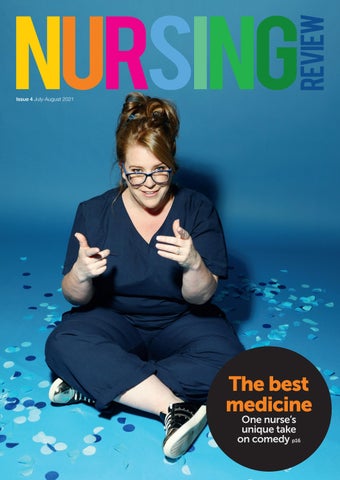
Issue 4 July-August 2021
The best medicine One nurse’s unique take on comedy p16
For Healthcare professional use only. For Formula-fed infants.
NEW LOOK S-26 Alula Gold
SAME TRUSTED QUALITY S-26 Alula Gold provides nutritional support for key areas of paediatric development and function. SN-2 PALMITATE
The predominant saturated fatty acid found in breast milk may improve fat and calcium absorption, helping to soften stools1-4
S-26 ALULA GOLD NEWBORN
Infant formula enriched with sn-2 palmitate may result in softer stools.1,3
Sn-2 palmitate enriched infant formula is associated with increased bone mineral content at 4 months of age and increased calcium bioavailability.1,3,5-10
For more information, please visit www.alula.com.au or contact our Careline to find out more 1800 552 229 IMPORTANT STATEMENT: Breastfeeding is best for babies. It has benefits for the infant, such as reducing infection risk, and for the mother. It is important to have a healthy balanced diet in preparation for, and during breastfeeding. Infant formula is designed to replace breast milk when an infant is not breastfed. Breastfeeding can be negatively affected by introducing partial bottle-feeding, and reversing a decision not to breastfeed is difficult. Infant formula must be prepared and used as directed. Unnecessary or improper use of infant formula, such as not properly boiling water or sterilising feeding equipment, may make your baby ill. Social and financial implications, including preparation time and the cost of formula, should be considered when selecting a method of infant feeding. References: 1. Yao M, et al. ,2014, J Pediatr Gastroenterol Nutr;59(4):440 -44. 2. Carnielli V, et al.,1996, J Pediatr Gastroenterol Nutr, 23:553 -560. 3. Kennedy K, et al. 1999, Am J Clin Nutr; 70:920 -7. 4. Bar-Yoseph, F., et al. 2013. PLEFA 89(4), pp.139-143. 5. Bronsky J, et al. 2019, J Pediatr Gastroenterol Nutr. 68(5):742-760. 6. Nowacki, J et al., 2014, Nutr J. 5;13:105. 7. Litmanovitz, I. et al, 2013, Calcif Tissue Int. 92(1):35-41 8. Béghin L, et al., 2019, Clin Nutr. 38(3):1023- 1030 9. Lönnerdal, B.,2003. Am J Clin Nutr, 77, pp. 1537S-43S 10. Martin, C., Ling, P. & Blackburn, G., 2016, Nutrients, 8 (279), pp. 1-11 ® S-26 is a registered trade mark used under licence. Distributed by Sanulac Nutritionals Australia Pty Ltd. ABN 31 160 607 509. Level 1, 42-44 Chandos Street, St Leonards, NSW 2065. SAN05370-12072021
contents
MANAGING EDITOR
news
Richard Garfield 02 9936 8628 richard.garfield@apned.com.au
2
New cannula standard
3
Practitioners left out
4
Pay boost, no ratios
5
Nurses most trusted
6
COVID spread in hospitals
NEWS EDITOR
Conor Burke 02 9936 8638 conor.burke@apned.com.au
industry and reform HEALTH EDITOR
Eleanor Campbell eleanor.campbell@news.com.au
02
05
SALES MANAGER
Culture shock Managing migrants’ end of life
9
‘Difficult cohort’ COVID vaccine now mandatory
10 Profit before people?
Sarah Licence 02 9936 8710 sarah.licence@apned.com.au
Inquiry pushes for staff ratios
11 Never too old Managing age with education
SUBSCRIPTION ENQUIRIES
12 Home truths
Daniel Omelia 02 9936 8607 subs@apned.com.au
Blood transfusions in the home
13 Who’s responsible? Learning from aged care deaths
COVER
14 Restore, reable
Georgie Carroll Photo: Jodi Nash PUBLISHED BY
8
The best care, not cheapest
10
14
15 Under surveillance Study looks at CCTV use
specialty focus APN Educational Media GPO Box 4245 Sydney NSW 2001 ABN 58 090 900 999 ISSN 1326-0472 PP100001944
16 The best medicine A comedic take on nursing
19 Spreading the word Celebrating Indigenous nurses
clinical practice
20 Gold standard
PUBLISHER’S NOTE
© Copyright. No part of this publication can be used or reproduced in any format without express permission in writing from APN Educational Media. The mention of a product or service, person or company in this publication, does not indicate the publisher’s endorsement. The views expressed in this publication do not necessarily represent the opinion of the publisher, its agents, company officers or employees.
Best practice use of PIVCs
22 Where the heart is Nurses and home care
23 Ready to listen
16
22
Preventing sexual assault
workforce
24 Pressure drop Restoring nurses’ wellbeing
25 Theory to practice Getting ready to work
26 Time to act Wages and conditions key
27 Stepping up Nurses taking the lead
technology
28 Tech support
26
28
Digital dementia care
nursingreview.com.au | 1
news
“If it was any other product, it would be recalled.
‘Right line, right time’ New standard prompts a rethink of cannula use. By Conor Burke
A
round 7.7 million Australians get a cannula or ‘drip’ placed each year and the procedure can be a painful experience. That may be about to change with a new clinical standard that aims to provide national guidance on best practice care and skilful use of the peripheral intravenous catheter (PIVC). Research shows that up to 40 per cent of all first-time attempts to insert a PIVC in an adult fail, and many patients face the prospect of undergoing multiple painful attempts. Once inserted, there is also a risk of complications, some of which are serious. Nurse and vascular access expert Dr Evan Alexandrou, senior lecturer at Western Sydney University and Clinical Nurse Consultant at Liverpool Hospital in NSW, says that 70 per cent of cannulas need to be removed because of these complications. “If it was any other product, it would be recalled,” he told Nursing Review. “Whether you’re a patient or whether you’re a clinician, I think everyone’s just come to accept that, ‘Oh, well, we’re going to put one in. If it fails, we’ll just put in another one.’ But the issue is if you’re on the other end of that needle and you might
2 | nursingreview.com.au
have difficult veins to cannulate … that could be very distressing and very painful to patients.” Alexandrou says that hospitals have increasing presentations of DIVAs (patients that have difficult venous access); around 30 per cent of adult patients, and up to half of paediatric patients present to hospital with hard to see or hard to feel veins. Another problem is the places clinicians commonly choose to place the PIVC. “They’re usually placed in the areas of flexion. So, in the elbow crease or in the wrist, or in the top of the hand. And so it tends to move in and out of the skin, in and out of the vein, causing irritation, pain and swelling.” PIVCs have also become a fallback device, Alexandrou says, when a medication administered might be better suited to another device. “It’s really about that early planning, early escalation of the most appropriate device. At Liverpool Hospital we have this mantra: ‘Right patient, right line, right time,’” he says. “You’ve assessed the patient, you assess their vasculature or you’ve assessed their vessels. You think about the characteristics of the medication that’s going to be given. You think about how long they’re going to require that device. And that really is what should guide the type of device you’re placing, not what is the most convenient to the clinician.”
Just as important as planning or assessment is who physically places the cannula. Global statistics show that 70 per cent of cannulas are placed by nurses, while that figure is only 26 per cent here in Australia, and Alexandrou believes that this can influence when a cannula is placed. “In nursing schools in Australia, they are not taught to cannulate. This is usually done once they start working in a hospital. In a medical school, it is taught at an undergraduate level, typically in fifth year, but again, it’s typically just breezed over,” he says. “Nurses are there all the time with the patient, there’s a vested interest, and they see the consequences of failure so they’re more likely to take the time and place [a PIVC] in a more appropriate position. And this has already been proven in the vascular access teams. “In Liverpool [hospital], we have a vascular access service. We’re like the hospital plumbers, and we take the time to place them in areas where they’re not going to fail. And we have up to 70 per cent of these devices staying in until clinically indicated for removal.” The Management of Peripheral Intravenous Catheters Clinical Care Standard by the Australian Commission on Safety and Quality in Health Care (the Commission) outlines how to insert, maintain and remove PIVCs safely and effectively. It also describes the care that patients should expect to receive if they have a PIVC inserted during a hospital stay. The new clinical care standard has been endorsed by 19 medical and nursing colleges and other professional bodies, including the Royal Australasian College of Physicians, the Australasian College for Emergency Medicine, the Australian and New Zealand Society for Geriatric Medicine, the Australian College of Nursing and the Australian Vascular Access Society. Alexandrou says this standard is a great start to fixing the issue as it sets both clinicians and organisations in a mindset of a patient-centred approach to vascular access. “But one solution that can come out of this standard is the implementation of nurse-led vascular access teams within the hospital.” ■
news
ACNP President Leanne Boase. Picture: Supplied
“I think we’re still very much seen as a subservient profession.
Out in the cold Nurse practitioners left out by ‘medico-centric’ health department. By Conor Burke
N
urse practitioners are calling on the federal government to stop ignoring them and make use of a valuable resource to help fight the pandemic. As the vaccine rollout continues to become unbearably complicated, the Australian College of Nurse Practitioners (ACNP) and its President, Leanne Boase, say that they should be included in the planning of COVID-19 responses. “We are not at the table that really counts, where there’s discussions within the department or with the Minister for Health to talk about how services are delivered, or how care should be delivered, or those big decision-making groups,” Boase told Nursing Review. “It seems to be the Department of Health, the AMA, the RACGP and the Minister, and the Chief Medical Officers ... it seems to be them that are driving all of this. And nurses in general and nurse practitioners are not generally at those tables.” Boase says that having nurses involved at a policy level is imperative when planning any health response. She points to the issue surrounding NPs administering the COVID-19 vaccine as a problem which could be solved with their input.
Nurse practitioners are currently only able to administer the vaccine if supervised by a general practitioner or “suitably qualified health professional”. Additionally, NPs working outside the public health system are not covered by the Medicare Benefits Schedule (MBS) for the vaccines, and therefore will not have access to a rebate. In some regional and remote areas there is often only a NP available, including in clinics where there is only a GP for very short periods of time, further slowing down any access to vaccines in those areas. Additionally, these provisions prevent NPs from being able to deliver vaccines in aged care facilities unless engaged by the states, who rarely get involved in aged care. Boase points to an example of a NP-owned and operated clinic in a rural town with thousands of patients on the books and which is the only health provider for several towns in the area. The NP is currently approved for government-funded vaccines, meaning that they can order and administer all of the childhood vaccines under the program. They also meet all the requirements for storage in cold chain. She currently visits aged care, but is not able to deliver the COVID vaccine. Boase says that because of this, “somebody is going to have to send a team out to rural Victoria and South Australia because [that NP] is not allowed to do it”.
“We do have the legal authority to prescribe [the COVID vaccine],” Boase says. “We also have the qualifications to administer it and manage any reactions. But it’s the federal response we’ve been excluded from. “And it’s not just that we can’t claim that Medicare rebate, we’ve been told that a Medicare-specific COVID vaccine Medicare rebate must be claimed every time it’s given in primary care. And because we’ve been excluded from it we’re blocked in both directions.” Boase believes that the federal government and its state counterparts have not adequately activated the nursing workforce during the vaccine rollout, in particular the approximately 2200 NPs who have a high level of skill and training. “Nurse practitioners have done their qualifications. So, it’s not just a piece of paper; we have to actually jump through hoops of experience and advanced level experience before we can even get into the nurse practitioner masters. So these are the people you want out there doing [vaccinations].” There are around 450,000 registered nurses and midwives in Australia, making it the largest clinical workforce in the country, but Boase, along with her counterparts at the ANMF, APNA and the ACN, consistently call for greater input at a policy level. The ACNP has sent a letter to Lt General John Frewen, the Commander Defence COVID-19 Task Force to detail their concerns. They have yet to hear back. “We’ve got a well-established medical profession and sitting alongside that the nursing profession developed so significantly in the last 50 years, it has come an awful long way,” Boase says. “My theory is the government hasn’t moved with that. The Department of Health is still very medico-centric. All of our policies very medic-centric. “But here we are now seeing the effects of it, and I think we’re still very much seen as a subservient profession. “At this point, I do have to say, it feels a lot like hitting your head against a brick wall. “Unless someone stands up and puts an end to this, it’s going to continue to hold back our health response in this country.” ■ nursingreview.com.au | 3
news
Half-way there
NSW Nurses and Midwives Association’s Brett Holmes. Photo: Joel Carrett
Pay boost for nurses, but no staff ratios.
N
urses and paramedics will receive a 2.5 per cent annual wage increase as part of the NSW state budget. The new policy marks a reversal of last year’s controversial decision to cut pay for public sector employees. Healthcare advocates welcomed the changes; however, they claim they fail
to address the issue of understaffing in public hospitals. “The money is not the be all or end all. It’s really about getting the staffing right,” said general secretary of the NSW Nurses and Midwives Association, Brett Holmes. “Our health system is currently in crisis. There aren’t enough staff and there aren’t enough beds available.” In the delivery of his fifth budget, NSW treasurer Dominic Perrotet handed down
Hidden danger Depression 50 per cent higher in women with PCOS.
W
omen diagnosed with Polycystic Ovary Syndrome (PCOS) are 1.5 times more likely to suffer clinical depression than those without the condition – whether or not they know they have it, according to a study. The findings suggest depression with PCOS is not simply a result of distressing
4 | nursingreview.com.au
symptoms or a diagnosis, but may itself be a symptom of the condition. PCOS is a common endocrine condition affecting around 12 per cent of women. Symptoms include irregular periods, excess body hair, obesity and infertility, with many women receiving a diagnosis only when they seek help with fertility. Researchers at the Robinson Research Institute at the University of Adelaide undertook a community-based study
a $120 billion-dollar investment in public health over the next four years, most of which is directed towards COVID-19 recovery. According to the treasurer, “almost 1,800 nurses, midwives, doctors and allied health staff” will be employed this year. Prior to the speech, nurses and midwives rallied outside NSW parliament house to demand mandatory staffing ratios. Holmes said that the state government had rejected attempts to negotiate. Latest reports show that wait times in emergency departments in NSW are currently at an all-time high. “We’ve now got corridor nursing occurring. Beds pushed into corridors, outside of wards. It’s something we’ve seen in emergency departments before,” Holmes continued. “It’s a dire situation when we are seeing decisions being made to nurse people in corridors without oxygen, without suction and without proper monitoring. “It’s a recipe for disaster.” ■
comparing the health profiles of almost 1,000 South Australian women. Of the 120 women with PCOS, around half had not received a diagnosis by their early 30s. This suggests many women live with the symptoms of PCOS for years before they receive appropriate care and support. And regardless of whether they were diagnosed, 50 per cent of the women with PCOS showed symptoms of clinical depression, which was 50 per cent higher than women without the condition, the study showed. Senior author Professor Michael Davies from the Robinson Research Institute says the findings reinforce recommendations in international evidence-based guidelines to screen all women with PCOS for depression and anxiety. “Our research and other findings point to depression in PCOS not simply being related to distressing symptoms, but possibly a physiological part of the condition itself,” Davies said. ‘Diagnosis delayed: health profile differences between women with undiagnosed polycystic ovary syndrome and those with a clinical diagnosis by age 35 years’ was published in Human Reproduction. ■
News
Nurses most trusted Nurses top list of most trusted professions.
A
recent Roy Morgan survey of Australians’ perceptions of the professions has once again put nurses at the top of the list. The Image of Professions Survey 2021 found 88 per cent of Australians rated nurses ‘high’ or ‘very high’ for their ‘ethics and honesty’, continuing a winning run that stretches back nearly 30 years. Other health professionals were clustered at the top of the list, with doctors following nurses at an 82 per cent rating,
pharmacists in third place on 76 per cent and dentists at fifth on 71 per cent. Only school teachers (74 per cent) prevented a healthcare clean-sweep of the top five positions in the ranking. Roy Morgan CEO Michele Levine said the COVID-19 pandemic had contributed to nurses achieving the top placing for 24 straight surveys. “Nurses have been front and centre around the world during the last year as we’ve dealt with the ravages of the COVID-19 pandemic. “Luckily for local nurses Australia has dealt exceptionally well with the pandemic and we have largely avoided an out of control situation,” Levine said. The 88 per cent result for Nurses is 6 per cent down on the previous survey from 2017, but reflects an overall slide in ratings across nearly all professional categories. Only one group, union leaders, saw a rise in approval in the 2021 survey. Despite the drop, nurses have held the position of the most trusted profession in every year of their inclusion in the survey since 1994. At the other end of the spectrum, the bottom four positions were taken up by insurance brokers (7 per cent), real estate agents (5 per cent), advertising people (4 per cent) and car salesmen (3 per cent) for the fourth year running. The Roy Morgan online survey was conducted from April 13 to 22 this year and included 1,267 Australian men and women aged 14 and over. ■
Take a break on us Your organisation may be eligible for Australian Government-funded support to help alleviate the pressure of finding a temporary replacement when you or your colleagues go on leave. You will be given all the support needed to recruit, screen and place highly experienced health professionals that can hit the ground running from the moment they arrive.
For more information visit www.rurallap.com.au
nursingreview.com.au | 5
news
The Royal Melbourne Hospital ICU and COVID ward. Picture: David Caird
Hospital transmissions Report on COVID-19 transmission in Victorian hospitals.
A
new report has revealed that 277 patients caught COVID-19 in Victorian hospitals last year. A Victorian department of health analysis looked at data from January 25 to 15 November 2020. A total of 2,492
people were hospitalised with COVID-19 during this time, and 4,170 hospital staff were infected. The analysis identified 277 patients as having COVID-19 hospital-acquired infections, or one hospital-acquired infection for every nine patients hospitalised with COVID-19. The report states that hospital-acquired infections are the most common
Picture: NCA NewsWire / Luis Ascui
Line of fire Nurses face abuse at vaccine hubs.
P
eople who oppose the Covid-19 jab have abused and spat on nurses in disturbing incidents at Victorian
6 | nursingreview.com.au
vaccination hubs, authorities have revealed. Health Minister Martin Foley revealed shocking details about an incident at Cranbourne vaccine hub where an “antivaxxer” made “completely inappropriate
complication among hospitalised patients in Australia, with over 165,000 cases annually and, as of 2018, 9.9 per cent of patients hospitalised in Australia who have an infection acquired that infection in hospital. The stats show that 30 hospitals in the state had hospital-acquired infections, while eight of those hospitals had 10 or more cases in each. Hospitals with a higher hospital-acquired Infections caseload had higher numbers of community-acquired COVID-19 hospitalisations and accepted more transfers of residents from RACFs than hospitals with few or no hospital-acquired infections. However, there was no clear relationship between hospital-acquired infections caseload and the number of RACF residents admitted with potentially unrecognised COVID-19. One quarter of all COVID-19 cases in Victoria during this period were linked to RACF outbreaks (5,049 of 20,343), and close to half of all hospitalised community-acquired cases. ■
and threatening remarks to our nursing staff”. “That has required us to get Victoria police involved, and make further efforts to make sure that these anti-science and anti-evidence dangerous fanatics are held to account,” he said. “You aren’t allowed to come in and abuse our nurses and healthcare professionals. “If you want to have your tin pot theories, fine, keep them to yourself, but keep them out of our healthcare settings.” Foley said there had been other reports across the vaccine hubs of nursing staff dealing with verbal abuse, racism and even being spat on. “Violence, physical and verbal threats against our healthcare workers and call centre staff is not okay, and will not be tolerated,” he said. “No matter what the situation is, no matter how frustrated and stressed you are, no matter what wacky theory you might think is real.” He said security had been ramped up at the Melbourne Convention and Exhibition Centre as a result of the shocking incidents. “It’s sad and disappointing that this has to happen … vaccination centres are places where people want to do the right thing and get us a ticket out of this pandemic,” he said. ■
SubScribe for leSS than $2 a week
The laTesT news and resources for healThcare professionals
• Analysis of the major issues facing the health sector today
Nursing Review is essential reading for anyone involved in the healthcare sector in Australia. It provides unrivalled coverage of specialist topics from features and opinion pieces, to international news and profiles.
• Can be used as a professional development resource
At Nursing Review we pride ourselves on being at the forefront of the ever changing healthcare sector. We provide an independent source of news, and cover the issues relevant to nurses and the sector giving an informative, practical and insightful view into day to day life in hospitals and in surgery.
• 6 issues per year • Interviews and opinion pieces from professionals in the industry • Written by an independent voice • Tax deductible
Please call 02 9936 8666 to find out more.
industry & reform
“Right now they all speak good English and have an understanding of Australian culture,” Phiri said. “But if they become cognitively impaired, they’ll go back to the things they knew before.”
HOMES FOR DIFFERENT CULTURES
Culture shock The challenges for migrants in their end of life. By Caroline Riches
W
ithin the next five years, one in four Australians aged 80 or over is expected to be from a culturally and linguistically diverse (CALD) background. As they near the end of their lives, there may be challenges both for them and the aged care system supporting them. Many migrants worry whether their needs, their beliefs, their values and even their language will be understood as they become more dependent. And many don’t want to enter Australia’s residential aged care system at all. Bunbury nurse Gertrude Phiri says when she arrived in Australia from Zambia in 2003, it was a “cultural shock” to see elderly and sick people in care homes. “In many African countries, there are no aged care homes, just hospices,” she told Nursing Review. “When people in our family are old and frail, it is our responsibility to look after them.” With African communities growing in Australia, Phiri decided to undertake a PhD at Edith Cowan University looking at how these migrants are preparing for their end of life in Australia, and how our aged care system can better meet their cultural needs. For her pilot study, she focused on three migrants in their 50s – a woman from Zimbabwe, a man from Zambia
8 | nursingreview.com.au
and a woman from Malawi – who have lived in Western Australia for more than 15 years. All now have children, step-children and grandchildren here and can’t bear to leave them. Yet when Phiri asked about advanced care plans, she was surprised to discover none had even considered one. “Their focus is more on what happens when they die, not before they die, because traditionally, all the decisions around finances and their care are made by the community or extended family.”
WHO WILL TAKE CARE OF ME? In Africa, ageing people are often cared for by siblings or cousins. If they can’t be supported by someone they know, they prefer an older person of the same sex to look after them. “Being cared for by someone of a different sex in their 20s fills them with horror,” Ms Phiri said. “They think younger women cannot see them without their clothes on. Culturally, that’s not appropriate.” All three participants in the pilot study planned to bring extended family here to care for them. If they are forced to go into residential aged care, there are other concerns, such as whether or not their beliefs will be respected. This may include the need to see a pastor, to take communion or to have someone with them when they die. There’s also a fear that dementia could cause them to revert to their native tongue, enhancing feelings of isolation.
In recent years, a number of aged care facilities aligned to certain cultures have popped up around the world. Residents living with dementia at Hogeweyk in the Netherlands are housed according to their lifestyle: Goois (upper class), homey, Christian, artisan, Indonesian and cultural. Closer to home, Perth offers a couple of aged care homes to serve its ageing Italian diaspora who arrived in the 1950s and 1960s. At Italian Village Fremantle, 90 per cent of residents are Italian. They have Italian speaking staff, Italian singers to entertain them, Italian food, and a Catholic mass on Friday. Chief executive Fifi Schirripa told Nursing Review that a cultural and linguistic understanding is crucial to their care. “Our residents revert to their old language and culture. Some have gone from being fluent in English when they arrived to years later not being able to speak a word.” Ms Schirripa believes culturally appropriate aged care may benefit other minority groups. Since the 1970s, Australia has welcomed more people from Asian backgrounds and has seen increasing migration from the Middle East and Africa. But despite higher numbers of ageing migrants, aged care trends have not necessarily accommodated them. Ms Schirripa says she’s seen a trend towards prioritising the aesthetics of the home rather than its cultural element. “People are now looking for new developments with pretty rooms in a pleasant location. They’re leaning towards a better physical environment rather than what happens inside the four walls.” From her early research, Phiri can see the benefit of culturally appropriate care in helping to meet the wishes and needs of migrants. She’s keen to conduct a bigger study on how aged care systems can better care for African Australians. “A migrant story is a migrant story, whether you’re from Africa, from Asian or from Europe,” she said. “People leave family behind so their end of life may take a different flavour, but it’s still a migrant story.” ■
industry & reform
“The reason there is low rates of vaccination has little to do with our workers.
‘Difficult cohort’ COVID-19 vaccination now mandatory for aged care workers. By Conor Burke
I
n a late night press conference after a national cabinet meeting, Prime Minister Scott Morrison said state and territory leaders agreed that by mid-September 2021 all residential aged care workers will have had one dose of the vaccine, and vaccination will be a condition of working in a residential aged care facility. The PM was reacting to a growing COVID-19 crisis across the nation, with lockdowns now in force in Perth and Darwin as well as Sydney, and fears that with a low vaccination rate and the aggressive Delta strain of the virus, the situation could worsen. “The Delta variant is proving to be a far more difficult element of this virus than we have seen to date... And the Delta variant is presenting very different challenges from those that we have faced in the past. And that was a topic of some discussion at our meeting,” Morrison said. Morrison said that all residents in aged care facilities have had their first dose, and will have had their second visit by the end of June. At the time aged care was at 99.5 per cent vaccination with two-thirds of the population aged over 70 having received their first dose.
The mandatory vaccination scheme will be run as a partnership between the commonwealth and the states, “preferably using the same system that is used for having mandatory vaccinations for the flu for aged care workers,” Morrison said. The national cabinet made the decision after new advice from the AHPPC and there will be an $11 million grant program to encourage residential aged care facilities to provide staff with leave to get vaccinated and for those who may suffer from side effects. “On two occasions I’ve made it very clear, and supported by the Premiers, that this is something we wanted to see and so tonight we received the advice that would enable us to go forward with that measure,” said the PM. “Now, we have asked, though, that there be further risk and benefit assessment conducted and that be reported back to National Cabinet by early August. We need to make sure that there are no unintended consequences of this decision.” The PM also announced that the Government will be implementing “a new no fault indemnity scheme” for GPs who administer COVID-19 vaccines. The AstraZeneca vaccine will now be available to all ages in consultation with their GP. The health advice, however, has not changed and still states that the
AstraZeneca vaccine is preferred for over 60s only. The PM also said that the commonwealth will work with providers and aged care workers to get access to vaccines at staterun clinics and therefore give them access to the Pfizer vaccine. “This has been a difficult cohort, a difficult group, to get vaccinated, and this is why I have been fairly constant and determined to ensure we got to where we are tonight, and I’m pleased that we’ve finally got here tonight. I would have preferred to have been here a little while ago, but nevertheless, our determination has paid off,” he told reporters.
FAILURE OF GOVERNMENT, NOT WORKFORCE The United Workers Union’s aged care director Carolyn Smith said that the blame for low vaccination rates among workers in the sector should lie solely at the feet of the government. “Aged care workers were supposed to have been 1A in the rollout and vaccinated at their aged care facilities,” she said. “Instead they were only given leftovers and vast numbers of them missed out. “Now aged care workers are being given a two-month deadline to be vaccinated in what has become, sadly, a familiar theme of aged care workers being blamed for the Federal Government’s failings. “The rollout of this vaccine program has been an exercise in ineptitude and aged care workers have borne the brunt of that.” Aged & Community Services Australia (ACSA) chief executive Patricia Sparrow said the decision is the right one, but this alone won’t fix the vaccination rollout. “To suggest so would just be blameshifting. The reason there is low rates of vaccination has little to do with our workers,” she said. “The best way to improve vaccination rates is to make it as easy as possible for aged care workers, including through onsite workplace vaccination. “Our workers were given priority as 1A and 1B at the beginning of the year, yet they are still waiting to be vaccinated. It’s not their fault.” ■ nursingreview.com.au | 9
industry & reform
“The decisions are made based on profits, not people.
Profit before people? NSW inquiry calls for staff ratios to ease burden on the sector. By Eleanor Campbell
I
n early June the NSW Legislative Committee published its final inquiry into the issue of chronic understaffing in aged care facilities. It found, as did the royal commission, that mandated staffing ratios and more registered nurses were urgently required. When asked why aged care providers and the NSW government have yet to implement staffing ratios, despite the insurmountable evidence supporting its benefits, Dr Maree Bernoth had one simple answer “The reason we don’t have staffing ratios is because of the power of the for-profitsector in the aged-care industry. “The decisions are made based on profits, not people,” she said. Bernoth, an Associate Professor at Charles Sturt University and a registered nurse, participated in the upper-house probe. Last year, she spoke to Aged Care Insite about the dire need to attract and retain qualified workers in the sector. “We haven’t heard anything much after the aged care royal commission report was published,” she said. The Royal Commission gave us significant evidence as to the consequences of understaffing. Horrific stories of residents left for hours in their own faeces, excessive use of chemical and physical restraints and a slew of unreported sexual assaults rattled the nation. Earlier this year, the Federal Budget offered the government’s solution to the problem, a $17.7 billion-dollar package
10 | nursingreview.com.au
wrapped in a five-year-rollout designed to overhaul the entire system. Its fifth and final pillar being a new Aged Care Act set to debut in 2023. Despite this, the recent State inquiry found that the “shocking” conditions faced by residents across residential homes in NSW had been worsening. “We were told about the increasing needs of patients with complex co-morbidities, yet there has been no increase in staff,” wrote Chair of the NSW Legislative Council Courtney Houssos. “Instead, we heard that chronic underfunding, combined with the COVID-19 pandemic, has put an increasing burden on nursing and personal care staff. “What was clear in our inquiry was that it is getting worse, not better.” One of the inquiry’s most critical revelations concerned the state government’s response to a deadly outbreak in a Western Sydney facility. Last year, Newmarch House saw 71 residents and workers infected, with 19 deaths among residents. The report highlighted that NSW Health did not dispatch crisis or surge staff and had delayed issuing personal protective equipment. It was also found that staff shortages, due to quarantine conditions and a lack of employees provided by Anglicare, had exacerbated the situation. According to an Anglicare surge worker, understaffing had also led to “extremely poor care conditions” for residents. “It is very hard to train up the agency staff and look after the residents at the same time,” she told the Committee. The chief executive of Anglicare, Grant Millard, went on to defend the recent decision to cut staff costs at Newmarch house given last year’s tragedy.
He told Committee members there was “very little else” that could have been done to ensure the organisation’s financial stability. The inquiry also determined that the role of NSW Health in supporting the facility and its workers was insufficient. “The NSW government likes to boast about being leaders in things,” Deputy Chair Mark Banasiak told Aged Care Insite. “If there’s any one issue we should be leading in, it is how to look after our elderly.” Banasiak, a member of the Shooters, Fishers and Farmers Party, introduced the Public Health Amendment bill last year. He was one of the six of nine members who voted in favour of mandated staff ratios in NSW. “It’s one of those grey areas that both the federal government and the state government like to play off each other,” he said. While unpacking the findings of the committee, Banasiak revealed that no government entity, including the state, had made efforts to respond to the inquiry. “It’s also possible that they want to push it off for two years because that will push it into a new government, and then they don’t have to deal with it,” he said. Those opposing staff ratios included National Party member Wes Fang and Liberal Party members Natasha MaclarenJones and Taylor Martin. They did not respond to Aged Care Insite when asked to comment. In a joint dissenting statement in the inquiry, the three contended that the issue should remain the Commonwealth’s business. “It is not appropriate for the NSW government to be legislating in an area of Commonwealth responsibility and should wait for their reforms and legislation to be introduced,” they wrote. The statement read that the state should hold off for two years until the Aged Care Act is implemented, a comment which has frustrated Greens Committee member Cate Faehrmann. “The safety and wellbeing of our nurses and their patients relies on adequate and safe staffing levels and this has been made clear, so there’s no reason to delay any longer.” ■
industry & reform
“Nurses today are much better informed ... they know their diseases. blood and what’s going to happen with it. They know their diseases.”
‘WRONG PRIORITIES’ IN AGED CARE
Jennie Cox with Murdoch University Chancellor Gary Smith. Picture: Murdoch University
Never too old Taking control of ageing through higher education. By Caroline Riches
J
ennie Cox has always jumped on any chance to learn. At 81, she’s just completed a degree at Murdoch University and has already enrolled for a postgraduate course. A former nurse from Perth, Cox studied for a nursing degree as soon as one became available in the late 80s. She followed it up with a postgraduate degree in clinical nursing alongside other practical studies. At one point, she was at university at the same time as her three children. When she retired at 68, it simply meant greater opportunities to learn. After attending lectures organised by the University of the Third Age, she decided she may as well enrol. She chose a subject that was “completely different to health”: a Bachelor of Arts majoring in Australian Indigenous Studies. “It was quite a challenge because there were all these concepts that I’d never really taken on board,” Cox told Nursing Review. “I just felt so stimulated.” She admits she struggled with the decision to study in her 70s at first.
“At first I thought, why would I study at my age? But then I thought, I’ve probably got another 20 years to live. I am a voter. I need to be informed. I rationalised that no education could be wasted.” Having now graduated, Cox says she uses the information she learned “all the time”. “Every day of my life there’s some connection between Indigenous people, deaths of black people, homeless people; it’s all entwined. I use my knowledge every day in talking to people.” While her mind is seemingly unaffected by the signs of ageing, Cox suffers from chronic conditions and receives a home care package. But she’s determined to keep learning, and has enrolled in a four-year postgraduate course in world food security. After that, she’s considering a masters degree.
DEGREES A ‘HUGE BOOST’ TO NURSING As well as transforming her own life, the capacity for learning has also transformed the nursing profession, she says. In the early stages of her nursing career, her day was taken up by menial tasks. When nursing degrees appeared in the 80s, she says the profession saw a “huge boost”. “Nurses today are much better informed,” she said. “They know why they’re taking
Cox worked as a community nurse on the aged care assessment team in Fremantle during the 80s, trying to keep people at home for as long as possible. Back then, she says, residential aged care was “very poor”. In recent decades she says she’s seen “huge improvements” in aged care, in rehabilitation and in the push to keep people at home for longer. Care is everything, Cox believes, but says many residential aged care facilities have got their priorities wrong. “It’s silly to offer five-star living when you haven’t got the care.”
TAKING CONTROL OF AGEING As we age, Cox believes we “become unheard”. “We simply fade away,” she said. “But it doesn’t have to be that way.” And Cox encourages Australians to take control of their own ageing – if they’re able to. “Think about your own planning, involve your family and your GP and talk to other people. What life options will you consider? Do you want to go down the euthanasia line, for example?” In the meantime, she says, live the best way you can. After all, she’s discovered something surprising: even in her later years, her life continues to get better. “A lot of people think ‘oh I’m going to grow old, I’m going to deteriorate’ and it’s not true. “As I grow older I find I’m having a better time. You have time to read and think, which is pretty special.” Cox doesn’t think she’d be in such good shape without her studies. “I couldn’t have done it without the stimulation I get from learning. I need something structured and I get so much from the involvement with other learned people with ideas. “The world is becoming so much more complicated, and there’s so much more to learn,” she said. “It’s just incredible.” ■ nursingreview.com.au | 11
industry & reform
‘Safe and effective’ The case for blood transfusions to be carried out at home. By Caroline Riches
T
he trend from hospital to homebased care, accelerated during the coronavirus pandemic, looks set to continue with the first evidence in Australia that regular blood transfusions can be safely performed by nurses in residential homes and aged care facilities. The joint study, undertaken by the University of South Australia, the Royal District Nursing Service (RDNS) and SA Health, investigated 1,790 blood transfusions involving 533 patients in homes and aged care centres across South Australia from 2004 to 2019. Lead researcher and lecturer in nursing at the University of SA Dr Rebecca Sharp says the study overwhelmingly supports home blood transfusions for medically stable patients. “This is the first study in Australia so it’s the first to provide evidence that this is safe and the system is effective. It’s the same system that’s used in the hospital, just delivered in someone’s house or aged care facility,” Dr Sharp told Nursing Review. While most healthcare systems and procedures have traditionally been set up for clinicians, Dr Sharp believes it’s about time they meet the needs of consumers. Visits to hospital every few weeks can be time-consuming, impractical and costly, she says, especially for many of those who live with haematological disorders such as anaemia, blood cancers and haemorrhagic conditions, which includes many aged care residents.
12 | nursingreview.com.au
Many of them require time-consuming blood transfusions on a regular basis. “To get into an outpatient department every few weeks or once a month is a burden and often a cost when you consider transport and parking,” Dr Sharp says. “People really appreciate being able to have this done at home so it doesn’t interrupt their lives so much. They can even continue to work.” Hospital visits can also be alienating and intimidating, she adds, with many consumers in the study describing outpatient departments as “noisy, frantic and chaotic”. For elderly people and especially those with dementia, these experiences are intensified. Often, it’s enough to prevent the blood transfusion occurring at all, Dr Sharp says. “For many elderly people and those with dementia, having to go to a hospital, navigate an outpatient’s department and then wait for their treatment can just be too difficult to facilitate.” When people are confused and they have a line in, the first thing they do is pull it out because they just want to escape, she adds. “For these people, they are more likely to have the treatment if they are in a familiar environment where they know the clinicians. That can really help with any behaviours they have. “Plus they are less likely to acquire an infection from hospital.” Performing blood transfusions at home has the added benefit of reducing the strain on hospitals by freeing up beds and resources that can be redirected towards other critical care, Dr Sharp says.
“ People really appreciate being able to have this done at home so it doesn’t interrupt their lives. LOW RISK A blood transfusion provided at home or in an aged care setting by the RDNS is performed by a highly trained nurse who is skilled in monitoring for any adverse reactions. Throughout the study, there were only five cases of adverse events – less than one per cent of all care episodes. These reactions were not serious and were able to be managed by a registered nurse, Dr Sharp says. In rare cases when the patient’s temperature rises during the transfusion and there is a risk of anaphylaxis, the nurse will stop the treatment and refer the patient to their GP. In most cases the transfusion will resume without incident in hospital. The risk of an adverse reaction was unaffected by the gender and age of the patient and their setting in an aged care facility or a home, the study found. Dr Sharp believes the demand on blood transfusions at home will only increase in time. This is because the likelihood of haematological disorders developing increases with age, and Australians are living longer than ever. “We anticipate that home blood transfusions will increase in the future,” she says. “Clinicians will see that the system is feasible, efficient and safe.” ■
industry & reform
Who is responsible?
Lessons from the high rate of COVID-related residential aged care deaths. By Michael Fine
P
erhaps the most frightening feature of the pandemic year of 2020 for those with an interest in age care was the COVID-19 mortality rate amongst the residents and staff of care homes. Governments of most of the advanced economies struggled to bring community contagion under effective control, and residential care facilities proved to be particularly vulnerable. Mortality figures have recently been published by the International Long-Term Care Policy Network, based in London. They show that in the 22 countries for which reliable figures are available for the first year of the pandemic (January 2020 to January 2021) on average, 41 per cent of all COVID-19 deaths in each country occurred among care home residents. Deaths in care homes due to COVID-19 were a disproportionately high proportion of all pandemic deaths in almost all countries for which reliable data is available. The highest care home mortality to national total was in Australia, where 75 per cent of all COVID deaths occurred in such facilities.
Although the rate was somewhat lower in other comparable countries, the number of such deaths and the proportion of care home residents who died was typically much higher. In Canada, for example, 59 per cent of all COVID deaths were in care homes. In the Netherlands it was 51 per cent, Sweden 47 per cent, Austria 44 per cent and the UK 34 per cent. In the US, there were 139,699 deaths in aged care homes: 39 per cent of the total deaths due to the pandemic in its first full year. Care home deaths served as a test case of the effectiveness of public health policies to offer protection from contagion to some of their most vulnerable citizens. As the pandemic exposed their vulnerabilities at local, national and global level, the strength of existing social infrastructure was tested. Care homes should have proven to be safe havens from contagion, offering quarantine-like conditions of a sort, providing protection for their residents. Instead, they became centres for the spread of infection amongst the most vulnerable age group, and evidence of the widespread failure of public policies. The failure of the homes cannot be attributed to either the age or chronic illness of their residents. Nor can it be blamed on individual members of staff. Although a number of specific, local factors played a part in each episode of contagion, we also need to ask a fundamental question: are there any common lessons to be learned and shared that should inform future policy decisions? One clear lesson appears to be the importance of clear government policy and
the exercise of public responsibility. As the Royal Commission found in the Australian case, competitive care markets did not prove conducive to providing safety. Over the past 30 years or so, care markets have been deliberately introduced into aged care by governments in Australia and elsewhere. In Australia, competitive market pressures apply regardless of legal ownership status. This has fragmented the system, as authority has been increasingly delegated to the corporate business level where managerial prerogative takes priority over system integration and collaboration. Public hospitals, operating under state governments, were kept quite distinct, charged with other priorities and responsibilities. In Australia, it took a long time before the Commonwealth government realised it needed to exercise its responsibilities. Despite the earlier relatively successful experience in NSW, the Federal Government – responsible for aged care policy, funding, governance and regulation – has been accused of ignoring its responsibilities in Victoria for months while the pandemic exploded. A second hard-learnt lesson from 2020 is that the conditions of employment for staff directly impact the safety of care provided. The reliance on low-paid staff with insecure jobs who often work in a number of different jobs proved dangerous. This was clear internationally, not just in Australia, with numerous epidemiological studies and reports by health authorities pointing to the link between the insecure employment of these essential workers and the spread of contagion within and between homes. Many of the same failings seem to be on replay in 2021, only this time it has been problems with vaccination supply and coverage affecting both residents and, alarmingly, care staff. And in the government’s comprehensive response to the Royal Commission, there is nothing about ending a reliance on casualised care staff in residential care or elsewhere. But there was some good news. While deaths in Australian care homes from COVID represented a mortality rate of 282.0 per 100,000 care recipients, in home care the mortality rate was much lower – just 0.82 deaths per 100,000 home care recipients. ■ Michael Fine is an honorary professor in the School of Social Sciences at Macquarie University. nursingreview.com.au | 13
industry & reform
“All older people should receive restorative and reablement care to ensure they can live their best lives for as long as possible.
Restore and reable Older people are in danger of receiving the cheapest, not the best, care. By Scott Willis
H
arrowing stories of neglect and abuse shone a much-needed spotlight on the aged care sector and led to the landmark Royal Commission into Aged Care Quality and Safety. These stories were powerful and easily understood. Less easy to understand are two words that the Royal Commission identified as critical to improving the quality of life of older Australians – restorative and reablement. Yet these two words mean the difference between someone living and dying, being bedbound or walking. Restorative care refers to the type of care delivered to address a sudden decline in health or an injury. An example of this type of care is post-operative rehabilitation, without which older people are too often left with avoidable disabilities and pain. Reablement, as defined by the Australian Association of Gerontology, challenges the belief that physical and mental declines are irreversible and unavoidable as we age. In fact, certain exercises and activities can help older people to maintain – and in some cases even regain – their
14 | nursingreview.com.au
coordination, strength, cognition and balance. Without this type of care, older people are more likely to fall, which is the leading cause of preventable death among their cohort. The Royal Commission stated: “The aged care system should help people to maintain independence, and the funding arrangements for residential aged care should be aligned with this goal. We recommend funding incentives for providers to invest in restorative care and reablement.” Promoting and maintaining mobility and reducing the risk of life-threatening falls in older people was noted as critical in the final report, which found that access to physiotherapists, who are highly trained and skilled in strength, balance and mobility training, was often lacking in aged care. Research has shown that physiotherapy can reduce falls by 55 per cent, the number one cause of preventable death in older people, and save the taxpayer money by avoiding costly surgeries and hospitalisations. It also spares older people the debilitating and excruciating injuries and recovery periods of preventable falls that are caused by lack of balance, coordination and strength. Despite its headline-grabbing investment in aged care, the Australian Government has failed to address critical Royal
Commission recommendations to ensure provision of allied health services, such as physiotherapy, that would help older people in residential aged care live more independently. The government has adopted the new residential aged care funding model, the Australian National Aged Care Classification (AN-ACC) which, positively, does not incentivise illness as the current Aged Care Funding Instrument (ACFI) does. However, the AN-ACC fails to include specific funding for allied health such as physiotherapy. Without specific funding for critical physiotherapy services, older people are in danger of receiving the cheapest, not the best, care. The ACFI directly funds residential aged care facilities to contract physiotherapists to deliver pain management for up to 80 per cent of residents. The new funding tool will no longer provide payment for pain management and is expecting aged care providers to pay for physiotherapy out of their profits. Currently only 1 per cent of residents receive a reablement or restorative physiotherapy program. There is a temporary program adopted by the Federal Government and currently being rolled out in a number of COVIDaffected residential aged care facilitates across the country that has been based on the work of physiotherapist Dr Jennifer Hewitt. Recognising the effectiveness of this type of program in residential aged care is an important first step, but this program is only temporary. Permanent programs need to be rolled out in response to the Royal Commission’s final report. All older people should receive restorative and reablement care whether at home or in residential care to ensure they can live their best lives as long as possible. We are calling on the government to introduce an additional layer of funding to enable this, particularly in residential aged care where it is most needed. ■ Scott Willis is the Australian Physiotherapy Association national president
industry & reform
“Healthcare staff need to have a culture where this is the norm and this is acceptable.
Surveillance or safeguarding? Study gathers opinions on CCTV use in aged care. By Caroline Riches
A
new project led by Edith Cowan University is investigating how CCTV could be used to improve the safety and wellbeing of residents in aged care homes. A survey and interviews will canvas opinion from the public as well as residential aged care staff across Western Australia on whether security cameras are appropriate and necessary. “We want to understand people’s concerns and opinions of surveillance in private or common areas in residential aged care,” the project’s lead researcher Dr Caroline Vafeas told Nursing Review. At the moment CCTV is not widely adopted in the sector but there are growing community calls for cameras to monitor vulnerable residents – and not simply when an incident comes to light. “You want to see whether that person in that single room is having interactions with carers during the day. You want to know how long the food has sat there. You want to know when falls happen and how long it takes someone to go in,” Vafeas said. It’s also about protecting staff. In the event of allegations of inappropriate treatment, there would be evidence, she adds. Dr Vafeas says she’d love the project to eventually persuade aged care facilities to install security cameras.
“We’d love to look at the care before installation, care after installation and see if there’s an improvement,” Dr Vafeas said. “But we can’t put cameras in until we have the opinion of those most affected.”
FEAR OF BIG BROTHER Not surprisingly, the loudest voice against the use of CCTV in aged care facilities comes from staff. A previous ECU pilot study at one Perth aged care facility found that only 36 per cent of staff wanted CCTV used in public spaces, compared to 57 per cent of family members and 38 per cent of residents. According to the study, just 14 per cent of staff wanted it used in bedrooms, as opposed to 48 per cent of families and 25 per cent of residents. While CCTV can make staff members feel they’re being watched, Vafeas says this isn’t the case. “It’s not surveillance or Big Brother, it’s safeguarding,” she said. “It’s closing the gate before the horse bolts rather than the other way around.” She believes it’s strange that society has accepted CCTV in public areas but feels uncomfortable monitoring our most vulnerable. “Healthcare staff need to have a culture where this is the norm and this is acceptable.”
DIVERSE OPTIONS Erica* is able to jump on her phone or laptop to see her 86-year-old dad in his armchair at his Perth aged care home. She can even press a button to ask him how he is, and turn up the volume to hear how carers are speaking to him.
She decided to have CCTV installed in her father’s room 18 months ago following an incident in which he claimed he was “manhandled” back to bed one night while going to the toilet. Her father was supportive of the decision. It’s just one of the ways in which CCTV cameras can be used in aged care. Some are triggered by movement, sound or light; others offer visuals but no audio. Even the recording function is optional. “I think [CCTV] is brilliant,” she told Nursing Review. “The staff know it’s there and I think it acts as a deterrent. I think all aged care residents should have a camera in their room.”
ISSUES OF CONSENT One of the murkiest areas of CCTV monitoring involves residents living with dementia or another cognitive impairment who are unable to give consent themselves. The decision then falls to family members, which can be complicated. Dementia Australia advises families and carers to discuss camera use with those living with dementia while they’re still able to understand the implications in order to create an advanced care plan. “Ultimately, decisions regarding the use of CCTV cameras in aged care must consider the balance between protecting residents’ safety and protecting individuals’ rights to privacy and choice,” it says in a statement.
ROYAL COMMISSION HIGHLIGHTED A NEED Vafeas says the Royal Commission into Aged Care Quality and Safety has only highlighted the need for CCTV. “If people aren’t happy with the quality of care, they feel that they have a voice now,” she said. Along with strategies such as improved staffing levels and training, Vafeas says CCTV is an inexpensive tool that will improve the quality and safety of aged care residents in the future. “In 10 years’ time we’ll just laugh that we were even talking about this.” ■
*Not her real name. nursingreview.com.au | 15
specialty focus Nurse turned comedian Georgie Carroll. Photo: Jodi Nash
A dolphin, a penguin and an orca walk into a bar A nurse turned comedian gives her unique take on life. Georgie Carroll interviewed by Conor Burke
T
he Dunning-Kruger effect is a cognitive bias whereby people with limited knowledge or competence in a given intellectual or social domain greatly overestimate their own knowledge or competence in that domain relative to objective criteria, or to the performance of their peers or of people in general. Or so says the Britannica online encyclopedia.
16 | nursingreview.com.au
Basically, it’s people who are not good at stuff, thinking they’re really good at stuff. I had to look that up when Georgie Carroll brought it up in our interview. She actually told me to look it up, in that firm, jocular way that she has. It’s the northern English accent. At points lyrical and light-hearted, but also stern and forceful, at least to a former Londoner like myself. We’re talking about the career change she made when Messrs Dunning and Kruger came up. Georgie is a veteran nurse of both the UK and Australia, but is now perhaps better known for her comedy. “I’ve got this obnoxious arrogance to me that I’m good at stuff before I am good at
it, and then later on I realise how shit I am,” she says. I had asked her if she was more nervous before that first hospital shift, or that first time on stage. “And then I put the work in and I did the same with comedy as well. The first one I thought, ‘I’m so good at this. I’m the best comic that ever lived,’ and I was like that as a nurse, and now looking back I was like,” she interrupts herself. “It’s called the Dunning-Kruger effect. “Like you start stuff and you think you’re amazing but your skillset is shit, and then you go to the next bit where your skillset is way better but you don’t think you’re anywhere near as good and you start
specialty focus
doubting yourself and there’s the imposter syndrome; and then right at the end there, you’ve got an amazing skillset, but you’ve also forgotten how hard it was to get there.” Listening to Georgie’s story, I think she’s being humble and it’s more of a working class attitude: having a go and working hard, coupled with a bit of cheekiness and some confidence. And she brought that same attitude (or arrogance) to writing her first book, Off The Charts, a book full of laughout-loud stories from the front-line of the hospital system. “I don’t know what it is, but it’s like a self-belief that I can probably do anything if I want to. Because it’s what you tell other people, that you can be anything. I can see it in my friends who don’t think they can do things,” she says. Compared with the pressure of nursing, writing a book and performing jokes is not life and death, she says. “We’re all a culmination of circumstances that we’ve had so far. So whatever nursing has given me, because it’s been a huge chunk of my life, it’s left me with this kind of [attitude], we’re here once, just do it. Don’t put it off.” And she applies that enjoyment of life to most things. She writes about the dichotomy of being a health professional, but not really being the most healthy person around. “I’ve seen what people can do to themselves over a lifetime and still be stood up, and I’m like, ‘I can do more’,” she says. “I mean, I’m a big girl and that contributed to me needing knee replacements.” Or “re-stumping” as she puts it in the book. “I needed knee replacements by 45. One of the factors, one of the maybe three factors, but the one I could control, I never did: it was worth it to me to go through major surgery and get the familysize pizza. “But it’s different throughout your career. Like right at the beginning, people set off very well and they come in on night shifts with their little crudite box of chopped up veg and they might section themself off three of the Haribo. You know? “And then in general, or for me anyway, there’s the whole middle years, where you’re just so busy. You’re looking after so many people outside of work, so many people in work, and it’s a little bit of a martyr role that you take on.
“You’ll be working a shift, whilst everyone else is asleep, and then they come home and they’re awake and they’ve got things to do, and you’re always putting everyone else first. “That’s generally when I think most people reward themselves with the whole bag of Haribo, and the bottles of wine and just the fun things.” My conversation with Georgie gets like that at points. Her observations come in the form of a down-to-earth self-love guide. She is, after all, an emotional black belt, or so she tells us. “That sounds arrogant, doesn’t it?” she asks. I nod, going along with the joke. “I do think I have that, I think, emotional IQ amongst people who’ve seen what we see in hospitals. It’s quite impressive.” The conversation pivots off that point to her general ideas on the human condition. She doesn’t believe there is such a thing as a bad person, “I think everybody’s a set of circumstances that got them to that point right now,” she says. Or how there is no such thing as angry. “Frustration is huge in hospitals. Like you come in, this is the sixth time you’ve been in with these unbearable stomach pains and we still don’t know what it is, and we’re just going to fast you for a few days and you feel better, then we send you home and it starts again. It’s so frustrating. “There is no such thing as angry. I’ve seen so many angry people. It’s never just angry. You’re frustrated or you’re hungry. “So, yeah, there’s something in everybody to like. I’ve forgotten even where this started now.” So did I. That’s very much a throughline for the book. It’s a scattering of common sense musings punctuated by funny stories and ideas. She’s like your funny colleague making you laugh at the nurses station, or your mate holding court at the pub. It seems natural and unrehearsed. And like all comedians, she sees life differently to the rest of us. She can sum things up simply and hilariously. Like her tale of the three stages of nursing. It all starts with the ‘dolphins’, or freshly minted grad nurses. “Your version of care is verging on Munchausen,” she says of the dolphins.
“It’s like being part of an army, and the word of mouth in nurses is insanely good. Then on to the ‘penguins’. Nurses with 7 to 30 years on the job, “still beautiful, but just from a distance”. And then you have the ‘orcas’, the nurses with 30 years-plus experience. “Majestic beasts” she says, not dangerous to humans, but the only mammal that regularly attacks dolphins. She also writes about the nurses on nightshift (“you can tell what year they started by their haircut and their music preference. Like it just stops. The pop culture stops at the second that they started the night shifts”) and the time she threatened to shoot a patient who wouldn’t get back in bed. She has stories of the time she got a less than loving sponge bath when she herself was a patient, or her love of bowel care, but her absolute hatred of the paperwork that comes after it. Or just paperwork in general. Or her love of old people, or the time her husband woke up with one massively enlarged testicle. Georgie’s life is an open book, if you’ll excuse the pun. During the first wave of the pandemic, when all of the arts and nightlife suddenly came to a stop, Georgie had a short stint back on the wards, but for the most part, these days all the world’s a stage for Georgie. Thanks to that arrogance she now makes her living making people laugh, and she loves it. But she does miss her fellow nurses, her “troop”, when she’s on the comedy scene. She credits them with supporting her on her comedy journey. “It’s like being part of an army, and the word of mouth in nurses is insanely good,” she says. “I’ve not been in hospital for two or three years. I’ve been on the cruises doing comedy, I’ve been at festivals. Literally, I work for an hour a night, daytime drink. Just the cushiest life,” she laughs. “I was just having the loveliest time, I can’t tell you. It’s like it doesn’t always happen, this life, but when it does you’ve got to fucking grab it.” ■ nursingreview.com.au | 17
specialty focus Photo: Jodi Nash
“ Like many night staff, she was frozen in the year she last lived in daylight.
Telling it like it is An edited extract from Georgie Carroll’s book, Off the charts. By Georgie Carroll
I
was on the morning shift taking over from a graduate nurse just finishing his first seven-night run in his first year of nursing. He had re-sprayed his deodorant and brushed his hair and his teeth for handover. I have been on dates with my husband where he has not put in that much effort. He read his handover from a script, so he did not miss a thing. “Bed 7 is Peter; he is a 37-year-old gentleman with a six-year history of frequent admissions to hospital with ulcerative colitis, anxiety and depression. He presented to the Emergency department last night with abdominal pain and sepsis. He was rushed to theatre; he had a perforated bowel. They have done a massive resection and they had to give him a colostomy. He had a settled night on morphine sub cut. Every admission, his biggest anxiety has been that he would need a colostomy. He does not know about it yet, but the surgeons will be around in the morning to tell him.” The mornings team leader had not turned up, so I got moved to that role,
18 | nursingreview.com.au
meaning I got handover again. This time from the night-time shift leader, Liz, a nurse who had been on permanent nights for over 30 years. Liz’s permanent nights contract had been issued to her in 1983 on account of being a single parent with school-aged children. Liz was the last house standing; all her night-nurse colleagues’ contracts had been demolished. Management had for years tried to oust her from her nights. Their argument being that if they let Liz work only at night, then everybody would want to. Never had management been less in touch with what staff were wanting. Like many night staff, she was frozen in the year she last lived in daylight. Liz had matted hair, the face of a Toby jug and the frame of a toffee apple. If working in a hospital teaches you nothing else, it teaches you that a person’s outward appearance is no indication as to their usefulness. She was absolutely the nurse you needed around when a patient deteriorated at night with only skeleton staff to revive them. Anyway, the handover. She had not brushed her teeth or hair for handover, or perhaps for many years. She was in the middle of her seven-night run threequarters of the way through a 48-year roster. Imagine if you will, this handover
delivered with Liz’s broad Liverpuddlian accent. “Bed 7, Peter. You know Peter, scabby bowel, a right soft cock. Anyway, came in last night and you will never guess what? His bowel has finally burst, surprise, surprise? Anyway, if they had chopped a couple of miles of it out and chucked it in the bin like they should have done two years ago then they wouldn’t have had to move his arsehole to his abdomen like that. He’s never been that taken with the idea of a stoma and he didn’t know about it pre-op, so we’ve not told him, kept him asleep with morphine. Surgeons will be round in the morning to tell him.” Liz is indeed a lyrical gangster; she stuck a little cherry on the top. “Pffff, surgeons will be around in the morning? But I’ll give him my arsehole if we see them before teatime.” None are immune to these character modulations; it is a necessary hardening. Even I, the cheeriest of all the nurses, have had to adapt. In my early days, I would cry and remain solemn for the rest of the shift every time I laid someone out after death. I could not keep that up; it got on the other nurses’ nerves and solemn does not suit me. I stopped the tears, but I still wanted to honour the recently dead in some way so after family and friends had visited, I would open a window so their soul could fly out. There came a point where I could no longer even do that as the hospitals had decided to glue windows shut. I have adapted to the hospital culture and practice of not chattering away about trite things during the washing, combing and shrouding. It still feels significant for the most part. I admit, however, that if I feel that someone had no one, or that I had a special connection with them, I will leave an open bottle in the room for the soul to hop into before the body is transported to the morgue, and then take the bottle outside so the soul can go wherever it needs to. Please do the same for me should I die in your care, just in case the afterlife is a thing. ■ Off the Charts by Georgie Carroll is published by Pan Macmillan.
specialty focus
Spreading the word HESTA CEO Debby Blakey (left) and head of Impact Mary Delahunty at the launch. Photo: HESTA
New book celebrates the work of Aboriginal and Torres Strait Islander nurses and midwives. By Eleanor Campbell
A
collection of stories paying tribute to the efforts of Aboriginal and Torres Strait Islander nurses and midwives was recently launched in Melbourne. Caring and Community: Stories from Aboriginal Nurses and Midwives details the achievements of eleven women who have left an enduring mark on the Australian healthcare system. One of the storytellers, Lesley Salem, is the first Aboriginal person to become a nurse practitioner in the country. A descendant of Gringai-Wonnarua Nation in New South Wales, she has spent 19 years working in health facilities across Australia. “I think it’s important that I encourage as many people as I can to become nurse practitioners,” said Salem. “As an Aboriginal person, I’ve been offered to do medicine many times. I could have earnt a great deal of better money but I would not trade the nursing mode under any condition. “My husband thinks I’m mad.” A generalist and chronic disease specialist practitioner, Lesley has travelled hundreds of kilometres to work in rural, regional and remote health facilities across the east coast of Australia.
She currently splits her time between Gidgee Healing in North-West Queensland and Biripi and Walhallow Aboriginal medical service in regional NSW. Shortages in doctors and a one-sizefits-all care model are the key barriers preventing individuals and families from accessing suitable health services, she said. “It’s poor the way people in rural and remote settings are denied a choice in care. “We have only one model of care that’s allowed in this country and it’s dreadful.” In her story, Lesley spoke of the discrimination she has experienced both as a health professional and as an Aboriginal woman. Cultural insensitivity, she said, is rife within the industry. “I simply look at the RACGP guidelines on the health assessment for Indigenous people and you have to actually ask an Indigenous person ‘do you gamble?’ and ‘do you drink heavily?’. “There’s a way of building up trust before you ask those questions,” she said. An accomplished painter, Lesley’s works incorporate Aboriginal symbolism and language to illustrate her journey working across rural and remote communities. She utilises storytelling and craft in her everyday practice to establish trust and facilitate healing with those seeking her care. “I think art has a big place in healing and breaking the ice,” she said.
“It’s poor the way people in rural and remote settings are denied a choice in care. “Many questions we ask during health assessments can be absolutely intimidating. “You give stories about yourself and you show that nobody’s perfect and that no matter what, your information will be safe to give to me.” Lesley’s story, along with those authored by over a dozen Indigenous nurses and midwives, was unveiled at the Her Place Women’s Museum in East Melbourne. The published works were commissioned by superannuation fund HESTA as part of its Reconciliation Action Plan. Head of Impact at HESTA, Mary Delahunty, said the project was initiated to highlight the achievements of each woman and to showcase the barriers they overcome on a daily basis. “This small collection of stories is one attempt to be able to recognise the importance of culturally safe practices and to be able to lead a conversation with our members to highlight the work in this area. “We know the best way to learn this is through the Indigenous and Torres Strait Islander nurses and midwives themselves.” ■ nursingreview.com.au | 19
clinical practice
“Nurses have a key role in every stage of caring for patients with cannulas.
Setting the standard It’s time for a clinical care standard to ensure best practice use of PIVCs. By Marghie Murgo and Gillian Ray-Barruel
P
eripheral intravenous catheter (PIVC) or cannula insertion is the one of the most common medical procedures in Australia, experienced by 7.7 million patients each year.1 While it is a well-practiced procedure, research reveals significant issues in the way that PIVCs are managed, flagging the need for quality improvement and a rethink of our approach. Quality and safety issues identified include frequent unnecessary cannulation, multiple insertion attempts, and a high rate of removal due to complications. Also, one third of adults have veins that are difficult to access. Major policy levers for effecting consistent best practice in Australian health care include the National Safety and Quality Health Service (NSQHS) Standards2 and Clinical Care Standards, developed by the Australian Commission on Safety and Quality in Health Care (the Commission). Together, these standards provide a foundation for safe, high-quality health care in Australia. With PIVC insertion so common during hospital admission, it is important to understand the potential impact of the Commission’s new Management of Peripheral Intravenous Catheters Clinical Care Standard released in May.
STANDARDS SPOTLIGHT PATIENT CARE Clinical care standards were introduced to Australia in 2013 by the Commission to improve patient care by reducing unwarranted practice variation and optimising the uptake of evidence-based care. Collaborative and consultative 20 | nursingreview.com.au
methods are used to develop content and ensure clinical relevance and engagement across all levels of the health care system.3 Evaluation indicates that not only are the clinical care standards relevant and feasible, they have led to muchneeded practice changes in the clinical environment. Standards are recognised as an important method for improving the provision of health care and supporting reliable performance when they allow for flexible standardisation.4 Clinical care standards are intended to support quality improvement locally, with indicators for local level measurement to help identify and address specific barriers and enablers to best-practice care.
FACING UP TO COMPLICATIONS Most hospital patients in Australia receive at least one PIVC during their admission. However, national and international research literature shows that PIVC insertion and management is often inconsistent with evidence-based practice.5 Often viewed by healthcare staff as a simple procedure, up to 33 per cent of PIVCs are inserted in patients unnecessarily in case they are needed: a waste of medical resources and staff time.6 Unfortunately, PIVC complications are also common. Almost two-thirds become blocked, dislodged, inflamed or infected long before therapy is complete, causing discomfort and additional risk to patients.7 Repeated PIVC insertions can be painful and traumatic for the patient,8 as well as time-consuming for staff and costly for the healthcare service.9 It is important that staff are properly trained in PIVC insertion and management to reduce unwanted variations in care. The new PIVC clinical care standard supports a nationally consistent approach to care and is a substantial step towards improving clinical management of PIVCs. Developed by a roundtable of vascular access experts,
healthcare managers, infection control clinicians and consumers, the clinical care standard pulls together the best evidence and sets key expectations for PIVC insertion and management.
APPROPRIATENESS OF CARE The PIVC clinical care standard includes 10 quality statements and 10 corresponding monitoring indicators. It focuses on preserving a person’s vessel health by promoting prudent insertion and appropriate care for those who receive a PIVC. The first six statements focus on competency and insertion. The quality statements reinforce steps to ensure people receive PIVCs only when clinically appropriate, and that they are inserted by trained and competent clinicians in order to avoid repeated insertion attempts. The remaining statements relate to ongoing management and removal of the device when it is no longer required. The tendency to view PIVC insertion as a simple, routine medical procedure can lead to high risk of human error. Relying on unconscious or automatic decision making can contribute to truncated clinical decisions and skills-based slips and lapses.10 The case standard is expected to reduce the risk of these errors and improve patient outcomes. It provides clear guidance to support healthcare professionals in working together to reduce the number of unnecessary cannulations, maximise first insertion success and reduce the risk of infection from PIVCs. Nurses have a key role in every stage of caring for patients with cannulas. The new standard requires policy and leadership support for implementation as well as capacity to measure implementation success. While the new standard targets PIVCs, it presents future opportunities to apply the same principles to all other invasive vascular devices. For references go to www.nursingreview. com.au. ■ Marghie Murgo is a senior nursing advisor at the Australian Commission on Safety and Quality in Health Care. Dr Gillian Ray-Barruel is adjunct senior fellow at the School of Nursing, Midwifery and Social Work, The University of Queensland.
SubScribe for leSS than $2 a week
The laTesT news and resources for healThcare professionals
• Analysis of the major issues facing the health sector today
Nursing Review is essential reading for anyone involved in the healthcare sector in Australia. It provides unrivalled coverage of specialist topics from features and opinion pieces, to international news and profiles.
• Can be used as a professional development resource
At Nursing Review we pride ourselves on being at the forefront of the ever changing healthcare sector. We provide an independent source of news, and cover the issues relevant to nurses and the sector giving an informative, practical and insightful view into day to day life in hospitals and in surgery.
• 6 issues per year • Interviews and opinion pieces from professionals in the industry • Written by an independent voice • Tax deductible
Please call 02 9936 8666 to find out more.
clinical practice
Where the heart is The vital role of nurses in home care. By Claire Zhang
A
mongst its many recommendations, one thing the Aged Care Royal Commission made clear is the important role nurses play in caring for our country’s most vulnerable. According to the final report, having enough skilled staff – in particular, registered and enrolled nurses – has a direct impact on the quality of care people receive. From my own experience, this is especially true when it comes to home care. In this growing industry, nurses aren’t just needed for their clinical training (as crucial as those skills are). Rarely discussed is how nurses, given their unique skillset and experience, often make excellent leaders of multidisciplinary teams delivering patient-centred care. I’ve had the privilege of seeing this first-hand over the last two years. At the beginning of 2019, after working as an RN for 12 years, I decided to try my hand at something new: purchasing and running my own home care business with HomeCaring. So far, it has been a rewarding journey. I landed my first client after setting up a fold-out table at my local shopping centre and chatting with passers-by about home care. There have also been some daunting times – I knew little about the financial and
22 | nursingreview.com.au
marketing aspects of growing a business when I started, and was thankful for the support I received from head office. After six months I turned a profit, and today I have a steady base of over 80 clients – a testament to the need for high quality home care in the community. One thing this business has taught me is how adaptable and advantageous nursing skills are, especially when partnered with the motivation to build something special in your local community. Being a registered nurse and former unit manager primed me for my management and leadership role. When I’m talking to clients during the intake process, I intuitively understand the clinical side of things, giving people more confidence to put their care under my management. When I’m leading teams of care workers, I can quickly identify care needs and risks so my employees are fully aware of their duties while on the job (a valuable skill to have during a pandemic). Currently there are over 59,000 people waiting for a Home Care Package, while the number of NDIS participants is expected to increase to over 500,000 over the next two years. As we move towards consumer-driven services that can be flexibly integrated into people’s lives, there is a great opportunity for nurses to be at the forefront of service delivery. With our skills and aptitude, we are well-placed to lead and coordinate the teams that provide these services. Thankfully there are rewards along the way. I’ve enjoyed the challenge of growing
“There is a great opportunity for nurses to be at the forefront of service delivery. a business, being my own boss, and determining my own work/life balance. The best reward, though, is helping clients experience long-term improvements. I have seen people go from house-bound, malnourished and in decline to thriving, independent and moving freely around the community. We can also be highly responsive to people’s needs – recently a client rang because she urgently needed medication to prepare for an important procedure. When I delivered it, her relief was as palpable as the smile on her face. Currently, my business has opened its first supported independent living home. We are expecting to fill the house within the next few weeks, and are in the process of setting up a second accommodation. As the Aged Care Royal Commission paves a path for reform, there’s much work ahead of us to ensure all Australians receive the high quality care that they deserve. Home care is a great way to be a part of this effort, while experiencing the joy of making a difference in people’s lives. ■ Claire Zhang is the director of HomeCaring Campbelltown.
clinical practice
Ready to listen
New programs help prevent abuse and sexual assault of older people. By Conor Burke
T
he Older Persons Advocacy Network (OPAN) has launched a new education program to tackle abuse of older people. The new online learning package, Abuse of the older person: eLearning program for health professionals, was developed in collaboration with Age Discrimination Commissioner Dr Kay Patterson AO and a national coalition of health professionals and funded by the Australian Government Department of Health. It features 40 online learning modules developed to protect people in aged care, but will also be aimed at health and allied health workers, such as GPs and optometrists, who may be the only people some senior Australians confide in if they are assaulted. “Assaults on the elderly, in any form, are deplorable,” Aged Care Services Minister Richard Colbeck said. “One of the five pillars of our comprehensive response is a $942 million investment in driving systemic improvements to residential quality and safety, and the learning package is certainly consistent with that objective.” OPAN is also working with researcher Dr Catherine Barrett to develop a program specifically aimed at stopping sexual abuse in aged care.
The first SIRS insight report, released in June, revealed that during the period 1 April to 12 May 2021, the Aged Care Quality and Safety Commission received reports of 149 incidents categorised as “unlawful sexual contact or inappropriate sexual conduct” from aged care providers. Testimony heard during the royal commission revealed that there are 50 sexual assaults of residents per week, nationally. The #ReadyToListen project includes a leadership course with a view to effecting cultural change in the sector. “That’s really at the heart and soul of this work,” Barrett told Aged Care Insite. “We’ll be delivering education but then really importantly, we’ll be working with the staff to say, what are the issues that they see, or staff or residents or families, what are the issues they see and what are the resources they want?” Over 12 months, Barrett will engage with 30 aged care organisations to develop these resources and provide vital education to staff. Barrett has advocated for the prevention of sexual assault, particularly of older women, for the last 25 years and she believes that education and more conversation is needed in society to truly make change. “I think there is a myth that old age is a protective factor against sexual assault,” she said. “And I say to people, it’s not, but having conversations about sexual assault is.” Breaking the silence that often surrounds sexual assault is key to providing a safe
“There is a myth that old age is a protective factor against sexual assault. environment for older people living in aged care, Barrett believes. “We’ll not only talk about it, we’ll educate service providers on how to talk about it, and how to do something effective about it, so that’s it. “Because perpetrators who are intentionally maliciously targeting women with dementia will do so because they know they can get away with it. Or they know the old woman won’t be believed if they report sexual assault.” Barrett applauds OPAN for being a leader among the peak bodies on this issue. “I don’t know of any other CEO of peak bodies, up until this point, who’ve stood up and said, ‘we’ve not done enough and it’s time for change’.” Craig Gear, OPAN chief executive, said: “We need to listen to and learn from older women how to create pathways so they can safely disclose sexual assault. The #ReadyToListen project is the start of an ongoing process of acknowledging that older people are sexually assaulted, that we must hold perpetrators accountable and develop prevention strategies.” For information or support regarding aged care please call the Older Persons Advocacy Network on 1800 700 600 or visit opan.org.au. ■ nursingreview.com.au | 23
workforce
“Be 100 per cent responsible for you, the choices you make and the consequences of those choices. RESTORE WELLBEING
From powerless to pressure-proof How to take control, restore wellbeing and optimise impact.
control is also a risk factor for burnout and so it becomes a vicious cycle in action.
By Alison Coughlan
TAKE CONTROL
I
t’s not hard to see how people working in the health care sector can develop a sense of powerlessness with the inevitable constraints, pressures and compromises we can face every day in our work. This might include a relentlessly busy environment with seemingly endless and complex demands and needs. The sense that there’s never enough time, energy, resources or enough of you to go around. Challenging interactions with colleagues and others. Exposure to stress, distress, suffering and even violence. Toxic cultures and behaviours that have become the norm. Challenges in work spilling over into our personal lives. Challenges in our personal lives spilling over into our work. It’s easy to see how we could surrender to this as our ‘lot in life’, a consequence of our choice to pursue work in this sector. The reality is that working in contexts where constraint, relentless pressure and compromises are the norm makes us vulnerable to burnout. Feeling a lack of
24 | nursingreview.com.au
Whilst there are many factors that are beyond your control, there are factors that you can. You can relinquish control over your wellbeing to the circumstances of work and life and put it in the hands of others, or you can take control and choose to chart a course ahead that is better, more fulfilling and more sustainable. Be 100 per cent responsible for you, the choices you make and the consequences of those choices – for how you respond to the circumstances of your life and work, and to the behaviour of others. Do not take responsibility for the choices of others or for their behaviour. That is their responsibility and theirs alone to take. Putting yourself first is, in fact, the only way that you can be of service to others in an optimal and sustainable way. A lack of self-compassion limits your capacity to sustain your efforts. It limits the impact you make and, as a result, also limits the connection between your work and your sense of purpose and meaning. It affects the lives and work of others in a negative way and ensures you become part of the problem, not the solution.
The only way you can sustain yourself is through an active focus on and investment in your wellbeing. This involves showing the same kindness and compassion to yourself as you would to others by carving out time for rest and leisure and for things that restore and build your energy and wellbeing reserves. Ensure that you are focusing on all the things that matter to you and that bring you joy and keep you well. See that as an investment in your resilience that will sustain you in your daily challenges and as you experience inevitable crises at work and in life. Reject busy as a badge of honour and an excuse for not taking care of yourself – thinking you don’t have time to exercise, eat well or take a break. The reality is that improving your wellbeing and resilience will improve your focus, presence, productivity and your capacity to turn up in service to others. It will make you more effective than working long hours, trading sleep for work time and neglecting your health and wellbeing. It will ensure that a path to decline and burnout is no longer an inevitability.
OPTIMISE IMPACT Once we build our resilience and have energy and wellbeing reserves that support us, then, and only then, can we be part of the change we so dearly need in our sectors. Change that eliminates, prevents or reduces the factors that limit our effectiveness. Change that creates new norms and workplace cultures that support and promote worker wellbeing as essential to optimising impact. Every worker, in every role, at every level, role modelling a better and more sustainable path ahead. You matter, the work you do matters, and your life matters too. The primary responsibility for you starts and ends with you, and you need to take control, restore wellbeing and optimise impact. ■ Alison Coughlan is the author of The Health Hazard: Take control, restore wellbeing and optimise impact.
workforce
“Moving from the academic realm into the everyday reality can throw up many real world challenges.
From theory to practice Getting students ready to work on the ward. By Karen Missen
N
ursing has changed enormously since I started my nursing training as one of the last cohort of solely hospital trained nurses in the late 1980s. Although we transitioned to a degree qualified profession more than 30 years ago, there are still debates about whether nursing training is better now and whether nursing students are really ready to practise in the clinical setting when they graduate. Having come through hospital-based training and now overseeing the education of nursing students at university, I can see both sides. One thing is sure, nursing students today study nursing and science subjects in depth in a way that was not possible in the hospital-based training system I went through. The use of simulation and various online programs in current nursing programs allows nursing students to practice their skills and critical thinking before they try them out with real patients. Clinical placements are still a crucial part of nursing training, every student must do five clinical placements in actual health care settings like hospitals, aged care facilities and mental health hospitals over their three-year degree. Quality clinical experiences that give student nurses direct experience of managing patient care are vital, especially for final year students. A challenging impact of the stress placed on hospitals by the COVID-19
pandemic was that we found it harder to organise quality clinical placements for final year students. A lot of placements were cancelled because they were considered to be in ‘COVID hot zones’ such as emergency departments, critical care units and potential COVID wards in both metropolitan and regional hospitals. With the vaccine roll out and hopefully a return to more manageable healthcare environments, this year we are placing our nursing students in a range of acute care settings where they have contact with patients with a variety of care needs. I believe a nursing student’s final clinical placement is the most exciting time as they get given more responsibility for patient care. But placements can also be intimidating and stressful – being exposed to and impacting on real patients, being required to demonstrate skills under scrutiny and in unfamiliar situations, can be nerve wracking. I’ve seen many student nurses struggle with the realities of managing their lives while on a placement. Like working nurses, they are expected to take on a range of shifts, including evening, overnight and weekends, which can be challenging for students with family responsibilities. Many students can face financial pressures, because it’s not advisable and often not possible to continue with other paid work while on a three to six-week clinical placement, twice a year. Moving from the theoretical and academic realm into the everyday reality can throw up many real world challenges.
Whilst many health care settings have high standards of care and follow strict procedures, student nurses can witness poor nursing practice, including: physical or emotional abuse of patients; breaches of patient safety, privacy and dignity; the provision of substandard or outdated care; and clinical errors. Unfortunately, there is evidence that when students try to raise concerns about poor or abusive practice with their preceptors they may encounter hostility or resistance. In worst case scenarios, student nurses experience bullying and incivility. A study published in 2017 revealed that half the nursing student respondents experienced bullying and harassment behaviours while undertaking clinical placements, and that the main perpetrators were registered nurses [Budden et al 2017]. I find this very shocking, and all the more reason to support the high standards of university-based training to try and reduce this behaviour. Another challenge graduating students face is stiff competition for nursing jobs, with 8000 student nurses expected to graduate every year. Currently there are not enough graduate positions available. Figures released by Graduate Careers Australia (GCA) continue to reveal a steady decline over the past decade in the number of nursing graduates who manage to find full-time jobs in their chosen profession. Given this reality I always stress to students to really make the most of their final placement. This is the time to practice initiating patient care and to manage a full patient load. It’s their chance to show their ability to prioritise care and to take on more responsibility. I encourage students to use their placements to develop professional relationships and networks with potential post-graduation employers and co-workers: they may become valuable referees in the search for a nursing position. ■ Dr Karen Missen is the Associate Dean of Teaching Quality and Student Retention in the Federation University School of Nursing, and a senior lecturer in Nursing. nursingreview.com.au | 25
workforce
‘We must act now’ Report shows improving staff wages and conditions key to sector transformation. By Conor Burke
N
ew research by industry super fund HESTA shows that the Australian aged care sector will miss out on a significant opportunity to grow the aged care workforce if there is not an adequate national effort to improve wages and conditions in the sector. The State of the Sector Aged Care Workforce Insights: COVID and Beyond report found poor pay and a lack of career opportunities were causing workers to leave the industry. It found that around a third of respondents did not feel valued and appreciated by their community and employer. The top three reasons for wanting to leave their employer were: 1) skills development; 2) wanting to try something different; and 3) pay. “Our research shows we must act now to improve wages and working conditions if we’re to attract the skilled and talented people needed to provide high-quality care for older Australians,” HESTA chief executive Debby Blakey said. “We have more than 200,000 members who work or have worked in aged care. Transforming the aged care system must
26 | nursingreview.com.au
start with the people central to delivering these critical services and improving outcomes for older Australians. “Improving the quality and sustainability of aged care jobs will improve the financial future of our members working in the sector. A stronger aged care system is also vital for our members and all working Australians who will directly rely on these services as they age.” The report also found that staff under the age of 30 and nurses were most likely to intend to leave aged care within two years, and in 2020, 32 to 38 per cent of aged care employees said they were highly unlikely to recommend their employers, leaders or a career in the sector. Over the past year there was improvement in aged care workforce sentiment across a range of measures in a challenging year, the research finds, with 84 per cent of aged care respondents saying they felt somewhat or strongly supported by their employers during COVID, and staff also reported that they feel prouder to work in the sector than before. “Workforce strategies implemented now could be particularly effective at attracting and retaining aged care professionals,” Ms Blakey said. “We can’t afford to waste this opportunity.” “The Royal Commission warned of an understaffed, underpaid and poorly
“Transforming the aged care system must start with the people central to delivering these critical services and improving outcomes. trained workforce. The research is clear – our members are telling us these are key concerns and would cause them to leave the industry or not recommend others work in the sector,” Blakey said. Blakey said that the pandemic has highlighted the precarious financial position that many aged care workers are in, made more apparent by the quarter of HESTA aged care members (45,000+) who made a claim to access their super early under the Government’s scheme. She said that the issues highlighted in this report will affect how the sector will be able to grow the workforce, which the Royal Commission said needed to increase by 70 per cent by 2050 to maintain current staffing levels in the face of rising demand. “Without strong advocates from employees in aged care, we’ll struggle to attract the people needed to lift standards and meet the expected increase in demand from our ageing population.” ■
workforce
Stepping up The nurse’s role in transforming healthcare. By Melinda Sawyer
A
s the world continues to navigate through an unprecedented and ever-changing pandemic, the role of nurses remains visibly crucial to the care of patients. After all, it is our nurses who spend, and continue to spend, enormous amounts of time providing direct care to patients who are COVID-19 positive, increasing their own personal exposure and that of their families to the virus. It is our nurses who are asked to maintain the highest level of care for these patients while facing the challenges associated with COVID-19. And it is our nurses who often work overtime, ensuring their patients’ needs are always met. And this work is still not over. Even when the pandemic comes to an end, nurses will be called upon on a daily basis to provide compassionate, quality care to patients who come through the doors. These noble qualities are nothing new for the profession. For the past 19 years, Americans have rated nurses as the #1 most ethical and honest profession, according to a yearly Gallop poll. In 2020, nurses earned an 89 per cent score, an increase of 4 percentage points from 2019. By all accounts, nurses are
considered the heartbeat of the medical profession. Given the critical role nurses play in all aspects of the health care system, why aren’t nurses more visible in leading the transformation of healthcare? Nurses should be full, active partners in transforming health care in the United States and around the world. We must work to ensure nurses take leadership roles at every level. Here are some steps we can take to realise change: • Enrol in formal education and/or training programs in leadership. Identify what you are passionate about and seek formal leadership training and/or programs in leadership that can assist you to lead in this area. If it isn’t the right time for formal training, consider shorter leadership development programs. Leadership is not innate; as nurses, we must learn and develop this knowledge and skills at every opportunity. • Seek mentorship for leadership development. Consider mentorship by leaders in nursing, other health professions, policy and business. Mentors can help you identify your own areas of strength and opportunities, help you reach your goals, and build confidence. If you don’t have a mentor now, identify someone you look up to and ask them to be your mentor. Don’t be afraid to go outside of nursing to stretch yourself and learn from
“We must work to ensure nurses take leadership roles at every level. someone who has different training and experiences than you. And don’t ever think you are too old for a mentor. After over 20 years in nursing, I continue to value my mentors as much as or more than when I was a junior nurse. • Get involved in health care policy making. Nurses can get involved through their professional organisations, or volunteer with policy making organisations to ensure healthcare policy decisions are taking their opinions into consideration. We need more nurses to be visible and lead in the transformation of health care. Doing so will help transform healthcare systems to provide seamless, affordable, quality care that is accessible to all, patient centred, evidence-based and leads to better health outcomes. Our profession has earned the trust of people all over the world, and rightfully so. Now it’s our time to continue to build on that trust to ensure the health care system is working better for everyone. ■ Melinda Sawyer, DrPH, MSN, RN, CNS-BC is the vice president for Clinical Quality and Patient Safety of UnitedHealthcare Global. nursingreview.com.au | 27
technology
“Technology can help carers identify the presence and quantify the severity of pain in those living with dementia.
Tech support How digital care systems can help provide better dementia care. By Tammy Sherwood
I
t is estimated there could be as many as 472,000 Australians living with dementia. Without a medical breakthrough, this number is expected to increase to 590,000 by 2028 and 1,076,000 by 2058. With this figure growing year-onyear, residential aged care settings must continuously adapt to ensure they can carry out the proper care required for people with the condition. Thankfully, advancements in technology have so much to offer people living with dementia and their carers, from access to information and advice to software that helps detect discomfort in non-verbal communication. When used sensitively and thoughtfully, this technology enhances rather than replaces human relationships and interactions and enables staff to provide more responsive and personalised dementia care. In turn, this improves residents’ quality of life. For example, agile and innovative digital clinical documentation systems designed specifically for the care sector have become more widely available in recent
28 | nursingreview.com.au
times, and are growing in popularity as care homes transition from the previous paper-based models. These are incredibly effective at fostering safe, comfortable environments for people living with any form of dementia. Incorporating profile-building software, digital clinical documentation systems improve the quality of information on a person’s life, which is vital for providing care that focuses on each person as an individual. By empowering staff with details on a resident’s life story, likes and dislikes, they can draw upon it in crucial situations to help someone with dementia. For example, if a resident with dementia is showing signs of distress, there are digital tools that can provide information such as that person’s favourite poem. This can be used to help calm them and to aid with reminiscing; a core focus for someone with dementia. With the use of technology, it is also increasingly possible for carers to interact with residents with dementia without needing to extract information from them. This can be an uncomfortable experience and even more daunting for the resident if they don’t recognise the face in front of them. A simple click and scroll on a handheld device can show carers what a dementia resident’s routine is, what they
like to talk about and what makes them feel better if they are anxious or upset. Interactions naturally become easier and more interactive for both parties, and friendships can be formed and fostered through trust. Software that enables carers to identify, monitor and reduce pain in residents is helping aged care homes deliver better dementia care, too. Able to detect and measure involuntary micro-facial expressions typically associated with pain, technology can help carers identify the presence and quantify the severity of pain in those living with dementia. Given that people with dementia often struggle to verbalise their thoughts and feelings, the value of these technologies, which make it possible for carers to intervene and reduce pain in its early stages, cannot be underestimated. Having a wealth of information at your fingertips that can improve someone’s quality of life is a remarkable thing, and not too long ago was unachievable. Now, we live in a world where technology is integrated into everything around us and can be used to enhance the mental and physical wellbeing of others. There is a reason so many care providers are digitalising their care environments – they understand that care technology is built to help and support the caregiver and receiver at a rate never achieved before. They are also seeing that digital clinical documentation systems, which focus on each resident and their individual goals or wishes, encourages a more personcentred approach to care delivery, rather than focussing on the funding aspect, which is not person-centred at all. As cases of dementia continue to rise, so does our understanding and capability to cope with the growing numbers through the utilisation of user-friendly, personcentred technology. Profile-building software allows carers to delve into the lives of the person sitting in front of them, and that is special. ■ Tammy Sherwood is the CEO of Person Centred Software Australia.
The laTesT news for aged care professionals
Aged Care Insite provides the best in original journalism and is the authoritative source of news and analysis for the residential and community care sectors. At Aged Care Insite we pride ourselves on being at the forefront of the ever-changing care sector. We provide an independent source of news, and cover the issues relevant to you. • Comprehensive coverage of a diversity of topics affecting the aged care sector • News and information on medical matters and products • Analysis of the major issues facing the aged care sector as a whole • 6 issues per year • Editorial integrity and industry relevance • Keeps industry professionals up-to-date on the politics and policy that matter • Tax deductible
please call 02 9936 8666 to find out more.
Fund of the Year Our members know whatever the future holds, there is always blue sky.
Visit QSuper.com.au today
Winner of SuperRatings’ Fund of the Year 2021 award. The rating/award is issued by SuperRatings Pty Ltd ABN 95 100 192 283 AFSL 311880 (SuperRatings). Ratings are general advice only and have been prepared without taking account of your objectives, financial situation or needs. Consider your personal circumstances, read the product disclosure statement and seek independent financial advice before investing. The rating is not a recommendation to purchase, sell or hold any product. Past performance information is not indicative of future performance. Ratings are subject to change without notice and SuperRatings assumes no obligation to update. SuperRatings uses objective criteria and receives a fee for publishing awards. Visit superratings.com.au for ratings information. © 2021 SuperRatings. All rights reserved. Product issued by the QSuper Board (ABN 32 125 059 006, AFSL 489650) as trustee for QSuper (ABN 60 905 115 063). Consider the PDS on our website to see whether QSuper is right for you. © QSuper Board.