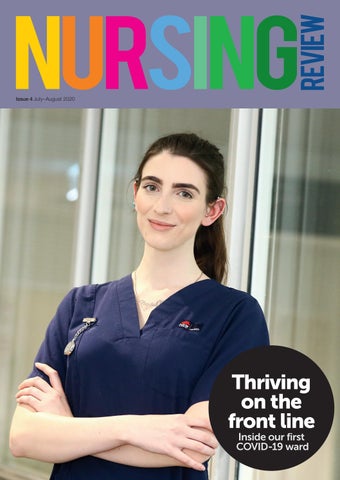
Issue 4 July–August 2020
Thriving on the front line Inside our first COVID-19 ward
FOR FORMULA-FED INFANTS AND FOR HEALTHCARE PROFESSIONAL USE ONLY
S-26 Gold Newborn. Our focus on
DIGESTION
-50% Formed stools P=0.003
Formulated with ingredients to help support digestion SN-2 PALMITATE
The predominant saturated fatty acid found in breast milk may improve fat and calcium absorption, helping to soften stools*1-4 S-26 GOLD NEWBORN and S-26 GOLD PROGRESS are both enriched with sn-2 palmitate.
+20%
Mushier soft stools P=0.026
In an 8 week, double-blind randomised study of healthy infants 7-14 days old (n=75 for control formula not sn-2 palmitate enriched, n=72 for sn-2 palmitate enriched formula), infants receiving the sn-2 palmitate enriched formula had 50% less formed stools and 20% more mushy soft stools.1
WHEY PROTEIN
This class of protein remains liquid in the stomach, and is easier to digest than casein protein.5
S-26 GOLD NEWBORN whey: casein ratio of 65:35. S-26 GOLD PROGRESS whey: casein ratio of 50:50.
Available in hospital only
IMPORTANT STATEMENT: Breastfeeding is best for babies. It has benefits for the infant, such as reducing infection risk, and for the mother. It is important to have a healthy balanced diet in preparation for, and during breastfeeding. Infant formula is designed to replace breast milk when an infant is not breastfed. Breastfeeding can be negatively affected by introducing partial bottle-feeding, and reversing a decision not to breastfeed is difficult. Infant formula must be prepared and used as directed. Unnecessary or improper use of infant formula, such as not properly boiling water or sterilising feeding equipment, may make your baby ill. Social and financial implications, including preparation time and the cost of formula, should be considered when selecting a method of infant feeding. References: 1. Yao M, et al. J Pediatr Gastroenterol Nutr 2014;59(4):440–448. 2. Carnielli V, et al. J Pediatr Gastroenterol Nutr 1996;23:553–560. 3. Kennedy K, et al. Am J Clin Nutr 1999;70:920–7. 4. Bar-Yoseph, F., et al. 2013. PLEFA 89(4), pp.139-143. 5. Martin CR, et al. Nutrients 2016;8:279. ® S-26 GOLD and PROGRESS are registered trade marks. Used under licence. ®Alula is a registered trade mark of SOMALAC S.A.Distributed by Sanulac Nutritionals Australia Pty Ltd. ABN 31 160 607 509. Level 1, 42-44 Chandos Street, St Leonards NSW 2065. AU05065-08072020
contents
MANAGING EDITOR
news
Richard Garfield 02 9936 8628 richard.garfield@apned.com.au
2 3 4 5 6 7
NEWS EDITOR
Dallas Bastian 02 9936 8637 dallas.bastian@apned.com.au
industry & reform
8 HEALTH EDITOR
Conor Burke 02 9936 8638 conor.burke@apned.com.au
New COVID-19 cases Hospital staff unsafe Push for equal pay in NZ Cheaper nursing degrees Top UK nurse silenced New reporting for abuse
02
06
Worse than death Four Corners investigates Newmarch outbreak
10 Click carefully Ensuring patient privacy
SALES MANAGER
Sarah Licence 02 9936 8710 sarah.licence@apned.com.au
11 No going back
SUBSCRIPTION ENQUIRIES
12 Keep it separated
Learning the lessons from COVID-19
Daniel Omelia 02 9936 8607 subs@apned.com.au
Socially distanced nursing degree
14 Leaders step up Postgrad study opens career doors
COVER
Ashleigh Peters Photo: Westmead Hospital PUBLISHED BY
08
18
16 Death in isolation Dealing with death during a pandemic
specialty focus
APN Educational Media GPO Box 4245 Sydney NSW 2001 ABN 58 090 900 999 ISSN 1326-0472 PP100001944
18 Pay it forward Mentoring the next generation
clinical practice
20 Funding call Palliative care asks for more
PUBLISHER’S NOTE
© Copyright. No part of this publication can be used or reproduced in any format without express permission in writing from APN Educational Media. The mention of a product or service, person or company in this publication, does not indicate the publisher’s endorsement. The views expressed in this publication do not necessarily represent the opinion of the publisher, its agents, company officers or employees.
21 Up in the air Aussie scientist rebukes WHO
22 Work in progress
22
24
How long till we have a COVID vaccine?
workforce
24 COVID ground zero On the front line at Westmead
26 New beginning Coming to nursing later in life
27 Losing out VET and TAFE system bad for nurses
technology
26
28
28 Quick thinking Upskilling online nursingreview.com.au | 1
news
Glendale aged care Facility in Werribee, Melbourne. Photo: NCA NewsWire/Daniel Pockett
Not over yet Two Melbourne aged care homes report large outbreaks, tougher restrictions predicted. By Conor Burke, Dallas Bastian and AAP
T
wo more Australians died of COVID-19 earlier this month taking the national death toll to 108, while two Melbourne aged care homes have recorded new cases in the double digits. The recent outbreak has brought total cases across Victoria to 3799, 1484 active and 562 cases suspected to be down to community transmission. The latest deaths are a man in his 70s and another man in his 90s. Alf Jordan, 90, died in hospital after falling ill at Glendale Aged Care in Werribee just three days earlier. Glendale has reported 13 cases of the virus, while there have been 26 cases reported at a Menarock Life aged care facility in Essendon. There have also been 2 cases linked to Japara Central Park Aged Care Home in Windsor. These new outbreaks bring the number of COVID-19 cases in aged care homes to 87, with 32 deaths. There have been 34 cases of the virus reported in home care recipients. There have also been 11 cases linked to Brunswick Private Hospital, eight at the Alfred Hospital and two at Box Hill Hospital. The deputy chief medical officer, Dr Nick Coatsworth, has warned Australia’s death toll could rise further given the increasing numbers of COVID-19 infections in Victoria, and as worries mount over a potential cluster linked to a pub in Sydney.
2 | nursingreview.com.au
“Deaths are a reality of COVID-19, they are the reality of a pandemic,” Dr Coatsworth told reporters in Canberra. “It is possible that the death toll will increase, there is no doubt about that.” But he said Australia had learnt a lot during the pandemic and it had been able to avoid the large numbers of deaths seen overseas, particularly in elderly members of the community. Victoria reported a further 279 COVID-19 cases, following on from 216 reported on Saturday 11 July and a record 288 infections on Friday. The state recorded more than 1000 cases in the week to 13 July. NSW recorded five new cases and authorities in the state are concerned about community transmission, especially a cluster from a Sydney pub. Nationally there has been 9,797 cases of the virus found since January 2020 with 7,728 recoveries. Globally the numbers continue to snowball with 12,866,958 cases worldwide, only two weeks after we hit the 10 million cases mark, and 568,003 deaths worldwide.
AGED CARE PEAK PREDICTS RETURN OF TOUGHER VISITOR RESTRICTIONS The worsening COVID-19 situation in Victoria could spell the return to more stringent aged care restrictions, the peak body for non-profit providers has warned. Aged and Community Services Australia chief executive Patricia Sparrow said: “Sadly, and despite everyone’s best efforts, the situation in Victoria creates a greater risk for our residents, home care clients and staff.
“Deaths are a reality of COVID-19, they are the reality of a pandemic” “We are warning that increased protection measures around visitation are likely to be necessary in the coming weeks.” Sparrow said providers will work to balance outbreak prevention with the mental, emotional and spiritual needs of residents and asked for continued understanding from visitors of the need for restrictions. She added that aged care providers are calling on Australians to remain vigilant to protect older people. “Everyone knew that as general restrictions in the community were lifted this would increase the risk of clusters and outbreaks and that’s exactly what has happened. “We can’t get blasé about aged care because older people are one of the most vulnerable groups for COVID-19,” she said. Leading Aged Services Australia chief executive Sean Rooney said it was “a matter of life and death”. “The number of aged care homes with infections is increasing and the clear and present danger persists,” Rooney said. “The entire community, especially across Melbourne and Victoria, must re-commit to absolute caution because this virus has proven deadly for far too many older people.” ■
news
Under pressure Hospital staff report being forced to work in unsafe conditions, bullied for wearing masks. By Conor Burke
D
octors, nurses and other hospital staff are being forced to work in unsafe working conditions and feel they are being put at risk of catching COVID-19. The Sydney Morning Herald and The Age newspapers reported that access to masks has been restricted at some hospitals and any staff who wear masks to protect themselves from infection are subject to bullying and “black stares”. They talked to three doctors from hospitals in Melbourne and Sydney who spoke of the fear at some hospitals, especially in the wake of a COVID-19 cluster at the Northern Hospital in Melbourne, where at least five healthcare workers have been infected. The doctors also said non-clinical areas are being used for patient rooms, making physical distancing impossible, and they described following the differing levels of caution across hospitals as difficult. “None of us signed up for these jobs in order to die on the front line. We’re not soldiers,” one doctor told the papers. “I feel like it’s getting to the point where a healthcare worker is going to have to die before they change the policy.”
Another said they were treated like an “outcast” for bringing their own personal mask to hospital. This is part of a wider global argument as to the efficacy of masks in the fight against coronavirus. The current government advice on masks is to only wear one if you have symptoms. However, in light of the ongoing Victorian outbreak, experts are calling for masks to be made mandatory. Professor of epidemiology at the University of NSW, Marylouise McLaws, recently told radio station 3AW: “If the prevalence of infection is high then you should be considering wearing some sort of face shield or face mask. “GPs should be wearing face shields, particularly in the areas that are hot spots at the moment. “If you’re a healthcare worker working across facilities that’s when … risk goes up. “Those in Melbourne, when you get on public transport wear a face mask. When you’re walking around the roads wear a face mask, particularly also in shopping malls,” she said.
AMA CALLS FOR COVID-19 RESTRICTIONS PAUSE The Australian Medical Association has called for a temporary pause in the easing of COVID-19 restrictions nationwide in light of recent spikes in cases in Melbourne. Recent lockdowns for specific postcodes and the controversial hard lockdown of nine public housing blocks are a “stark
reminder that the battle against COVID is far from over,” said AMA President Dr Tony Bartone. “These new outbreaks send a strong signal that the other States should rethink the pace of easing of their COVID-19 restrictions until community transmission in Melbourne is under control to avoid the risk of a similar situation playing out in their own communities,” Bartone said. “We all want to get our lives back to normal, but it has to be a gradual and cautious process – and it must be with strict adherence to the medical advice and public health guidelines.” Bartone said that as pubs, restaurants and other areas of life restart, we should be wary that any gains can be reversed quickly and Melbourne’s outbreak highlights the need to follow public health guidelines. “It is a stark reality check of how rapidly things can change. The disappointing reality is that the problems in Melbourne’s hotspots are directly linked to failures to follow established and successful public health guidelines. “Against the expert medical advice, we have seen a range of failures relating to family and social events not following physical distance requirements, numerous quarantine breaches, and the irresponsible actions from elite sportsmen. “Before rushing back to the pub, the footy crowds, or the big weddings and parties, Australia should pause and play it safe until the Melbourne hotspots are back under control.” ■ nursingreview.com.au | 3
news
Equal pay push
New Zealand aged care nurses push for pay parity.
J
ust under 14,000 New Zealanders have signed a petition calling for an end to the pay disparity between the country’s registered nurses who work in aged care and their counterparts in public hospitals. “Registered nurses who work in aged care in New Zealand earn on average at least $10,000 a year less than nurses who work in public hospitals,” the petition read. “That’s not because they are any less skilled or important, but because of years of underfunding of rest homes by successive governments and undervaluing of the care of older people.”
Set up by the New Zealand Aged Care Association, the petition to Dr David Clark, New Zealand’s Minister of Health, is pushing to close that $10,000 gap for each of the country’s 5,000-plus aged care nurses. The issue of pay disparity has been consistently raised in Australia over the last decade. In October last year, the assistant secretary of the Australian Nursing and Midwifery Federation’s Victorian branch, Paul Gilbert, told the aged care royal commission that while the state’s private-for-profit and not-forprofit aged care nurses earned the same as public aged care and public hospital nurses in the 1990s, a wage gap emerged between the sectors following the introduction of enterprise bargaining. “Today, despite the injection of more than $2 billion in federal government funding to boost wages, a Victorian nurse working in private-for-profit or not-for-profit residential aged care earns about 19 per cent less than a nurse doing the same work in a public aged care facility or a public hospital,” Gilbert said. In its push for better pay for the country’s aged care nurses, the New Zealand Aged Care Association said that it was thanks to their skill and leadership that the vast majority of the country’s aged care homes saw zero COVID-19 cases. And Katherine Ravenswood, an associate professor in Employment Relations at Auckland University of Technology, said that staffing issues were likely to be a factor for those that did. “It is time policymakers, funders and aged care providers address the elephant in the room: that quality care requires more staff and more time,” she said. ■
Karen Gilliland’s funeral service. Photo: Jann Houley/News Regional Media
In mourning Brother says slain nurse would want others to seek help.
B
ryan Cranston hopes the horrific death of his sister, allegedly at the hands of her estranged husband, will encourage others to reach out for help. Hundreds of people recently joined a virtual vigil for Rockhampton nurse Karen Gilliland, who died in a stabbing attack witnessed by two of her three children.
4 | nursingreview.com.au
Nigel Gilliland, who was estranged from his wife, has been charged with her murder. Cranston spoke at a candlelight vigil for his beloved sister, held on the banks of Rockhampton’s Fitzroy River and streamed online. He said Karen always put her own needs behind those of others, and was a guarded person who didn’t readily share details about her private life.
“She always had this great personality but it was a front,” he said. “That is a message that she would want to be taken from all of this – ask for help, it’s not a sign of weakness, it’s a sign of strength.” Cranston has set up a GoFundMe page for his sister’s son and two daughters, the youngest aged just six. “Karen loved these children more than anything in this world. Our hearts break as we think of the journey ahead for them, navigating life without their amazing mother,” he has written on the page. “Rest assured, they are safe in the loving arms of our family and we will do everything we can to give them the guidance and support that Karen would have wanted.” The Australian College of Nursing (ACN) said the profession was in mourning following Gilliland’s death. “Our condolences go out to all those who knew and loved Karen. Our thoughts and prayers are with her children, family members, friends and colleagues,” ACN chief executive Kylie Ward said. “As a profession we are saddened that cowardly acts of domestic violence continue to take the lives of Australian women and that we as a society have failed in our duty to protect them and eradicate this scourge.” ■
news
Study incentive Nursing fees to be slashed under new uni scheme.
S
chool leavers who are hoping to study humanities will either have to foot a bill double that of their predecessors or pick different subjects under a new scheme announced by Minister for Education Dan Tehan. On the flip side of the coin, those who want to study nursing will pay 46 per cent less for their degree than those studying this year. Under the plan, the government will fund an extra 39,000 university places by 2023 and will restructure the fees for courses to push students towards “areas where there is expected growth in job opportunities”. The move would see the cost of studying a humanities degree soar by 113 per cent. Law, commerce and communications and would also come with a higher price tag.
The bill for agriculture and maths will drop 62 per cent while people studying science, health, architecture, environmental science, IT and engineering will pay 20 per cent less for their degree. “We know we’re going to need more teachers, we’re going to need more nurses… we know there are jobs there,” Tehan told the National Press Club. “A cheaper degree in an area where there’s a job is a win-win for students.” When asked at the National Press club whether the scheme will work as intended and see students take up cheaper degrees instead of those with pumped up fees, Tehan pointed to the recently offered microcredentials. “We saw when we offered discounts in those areas that students have voted with their feet and sought out those courses,” he said. “We think that with the price incentives… students will pay attention to them.” Australian Primary Health Care Nurses Association president Karen Booth welcomed the move, calling it a major boost to the profession. “It will attract many more students into nursing by making their university education more affordable,” Booth said. “It also helps to address Australia’s predicted shortage of 123,000 nurses by 2030. Increasing the workforce pipeline is an important first step that needs to be supported by quality student placements, particularly in primary health care settings such as general practice and aged care.” ■
Australian Government Department of Health extends support of vacant positions until 30 September 2020 Your health service may be eligible to access our locum program to fill vacant positions during the COVID-19 pandemic. For more information visit https://bit.ly/3iUHCGH or freecall 1800 Rural LAP (1800 78725 527).
nursingreview.com.au | 5
news
Chief nursing officer for England Ruth May. Photo: Pippa Fowles/10 Downing street/AFP
Top nurse ‘gagged’ Britain’s top nurse dropped for refusing to back government over lockdown breach.
B
ritish PM Boris Johnson and his Government are accused of “trying to gag” medical experts after they dropped the chief nurse Ruth May from a daily briefing, as reported by The Independent. It has been reported that May refused to back Johnson’s number two, Dominic Cummings, over his recent lockdown breaking and the resultant furore.
The incident adds to the pressure the government faces over its response to the COVID-19 pandemic which has seen 297,000 confirmed cases across England, Scotland, Wales and Northern Ireland, and 41,736 deaths. Johnson has been accused of ignoring scientific advice throughout the crisis, delaying a lockdown for several weeks and making a U-turn on an earlier attempt at a herd-immunity strategy. Most recently the Chancellor Rishi Sunak admitted the government may overrule experts on social distancing measures as they seek to reopen shops and pubs nationwide. The latest incident came as part of the protracted saga which saw Cummings – an unelected advisor and Brexit architect responsible for the famous NHS bus stunt – travel 400km across the country on March 31st in the midst of strict lockdown measures. Cummings reasoned he behaved “legally” and has since refused to resign in the face of enormous public pressure to do so. On June 1st May was due to appear at a press briefing alongside health secretary Matt Hancock. However, during practice questions she was asked about Cummings and made clear she would not support his actions. She was swiftly removed from the briefing. On 30th May, England’s deputy chief medical officer, Jonathan Van-Tam, also failed to back Cummings telling reporters: “In my opinion the rules are clear and they have always been clear,” he said. “In my opinion they are for the benefit of all. In my opinion they apply to all.” He has not appeared at a briefing since. ■
Nurses in blue New mental health post for nurses at police stations in NSW.
M
ental health nurses will now be based at a number of police stations across NSW as part of the Government’s response to a growing mental health crisis. 6 | nursingreview.com.au
The Sydney Morning Herald reported that 36 mental health nurses will be placed across 10 police stations following on from a pilot program which saw a 15 per cent reduction in mental health cases dealt with by police in some areas and a reduction in hospital presentations due to mental health issues by 9 per cent, according to NSW Police.
The nurses will be part of the Police, Ambulance and Clinical Early Response (PACER) program which offers expert support to police and ambulance officers called to mental health emergencies. The program will operate in Campbelltown, Nepean, Northern Beaches, Sutherland Shire, Blacktown, Eastern Beaches, Kuring-gai, Metro Combined (Kings Cross, Surry Hills, City of Sydney), South Sydney and Bankstown police districts. Police in NSW currently deal with mental health related incidents 1000 times a week, according to Police Minister David Elliott, and attended 55,000 incidents in 2019. Elliott said in trials of the program, the time an officer dealt with a case involving mental health was reduced by 45 minutes, so an expansion of the program “makes good economic sense”. “It’s good for the taxpayers of NSW, but it is also good for the patients that are finding themselves in contact with police,” Elliott said. The program is part of a larger effort to respond to mental health in the state after a summer of bushfire devastation and now a pandemic and a failing economy. NSW Premier Gladys Berejiklian announced that $73 million will be invested into mental health and part of that package will see 180 mental health workers deployed across the state. ■
news
A
Minister for Aged Care Richard Colbeck. Photo: Kym Smith
New powers to stop abuse Elder abuse reporting rules to change with new aged care scheme.
ged care homes will soon be required to report resident on resident abuse where the perpetrator has an assessed cognitive impairment. The removal of the current exemption will be part of the rollout of the Serious Incident Response Scheme (SIRS). The scheme was earmarked in the 2019–2020 Federal Budget and last month Minister for Aged Care Richard Colbeck said an initial $23 million investment will be rolled out from July. Under the scheme, aged care providers will be required to manage all incidents. The Aged Care Quality and Safety Commission will receive incident reports and will have enhanced powers to take regulatory action where needed. The government said reporting under a SIRS will include a broader range of incidents, including neglect, psychological or emotional abuse and inappropriate physical or chemical restraint. Labor’s spokesperson for ageing Julie Collins said the government is still not doing enough to curb elder abuse. Collins said: “It has been more than three years since the Australian Law Reform Commission (ALRC) first recommended this action along with other sweeping reforms to tackle elder abuse. Sadly many of the ALRC’s recommendations from 2017 have not been implemented. “Any abuse of older Australians in aged care is completely unacceptable and it is up to the government to do everything it can to stop it.” ■
‘Tax turnaround’ Sector reacts to retention bonus ‘broken promise’
A
ged care workers and providers are saying the government has broken its promise after it released further details about its retention bonus grant. In March, Minister for Aged Care Richard Colbeck announced $234.9 million for a COVID-19 retention bonus that would
see direct care workers receive a payment of up to $800 after tax and home care workers get $600 after tax. However, in a fact sheet the government confirmed that, like the JobKeeper payment, the retention bonus payments “are considered income and are subject to income tax”. Leading Age Services Australia (LASA) chief executive Sean Rooney called the move shameful.
“This is a broken promise, a tax turnaround on what was promised in March with great fanfare,” Rooney said. Annie Butler, federal secretary of the Australian Nursing and Midwifery Federation, said its members “are dismayed and disappointed”. “This bonus was intended to recognise the dedication and commitment aged care workers have continued to show in treating and protecting older Australians during the crisis, potentially putting their own safety and their families’ safety at risk,” Butler said. On top of the tax issue, the United Workers Union was also disappointed to see that the payment will still not extend beyond direct care workers in residential aged care. “As sold to the workforce the original intention was that the bonus was to retain staff in the sector at this crucial time and to recognise the hard work aged care workers have been doing on the frontline. But roles including admin staff, cooks, cleaners and facility managers are excluded, leading to division across a facility,” the union’s aged care director, Carolyn Smith, said. LASA also called on the government to extend the retention bonus to all staff working to protect older Australians receiving care. ■ nursingreview.com.au | 7
industry & reform
‘Worse things than death’ NCA NewsWire / Jeremy Piper
ABC’s Four Corners finds mismanagement at the centre of Newmarch outbreak. By Conor Burke
T
he ABC’s Four Corners program turned its attention to the Newmarch House COVID-19 outbreak and found mismanagement, poor infection control and a lack of communication with residents and families at the centre of the cluster which saw 19 people die. The episode, titled ‘Like the plague’, followed the outbreak from its first days, when a COVID-19-infected staff member worked six shifts, and over the course of the six-week saga. It documented the torment and heartache suffered by the families of residents trapped inside with little-to-no information provided about loved ones. Residents were “sitting there waiting to die” said the families, confined to their rooms with unanswered calls, cold and receiving little food or face to face contact. One resident who tested positive for the virus wasn’t able to shower for two-and-ahalf weeks as no staff were around to help. Another resident was left alone in their room after a fall and another was left sick and struggling with undiagnosed pneumonia until family intervened. Four Corners identified poor infection control as one reason the virus was able to spread unfettered through the home. As the pandemic unfolded and staff were forced into isolation, the home faced a
8 | nursingreview.com.au
workforce crisis and Australian Nursing and Midwifery Federation federal secretary Annie Butler told reporters that the use of underqualified personal care workers as replacements would have exacerbated the spread. “There’s no minimum requirement mandated for care workers in the industry. So, there can be people who have no training at all, or who have done a socalled online aged care course, who can be available to work in the facility,” she said. “You can be the best-intentioned person in the world, but when you don’t know what you’re doing, it can be very difficult.” Many residents who eventually tested positive for coronavirus say they hadn’t left their room for weeks prior to their diagnosis.
IN-HOUSE PROBLEM Another major failure in the handling of the outbreak was the decision to keep COVID-positive residents in the home instead of transferring them to hospital. The home was also criticised for not separating the COVID-positive residents from the negative residents until 22 days after the onset of the outbreak. Of the 19 residents who died in Newmarch house, only one died in hospital. Compare that to the other large aged care cluster at Dorothy Henderson Lodge in Sydney, where swift action was taken and 80 per cent of positive cases were sent to hospital for treatment.
NSW Health would not allow concerned families to take COVID-negative residents out of the home to protect them. An Anglicare spokesperson told families this was to “reduce and contain the risk of spread. I understand as a public health order it may be legally enforceable”. NSW Health then threatened a resident and his family with an $11,000 fine and up to six months in jail if he left the home. The man later died of COVID-19. Families have accused Anglicare and the government of sacrificing their loved ones to protect the wider community.
COMMUNICATION BREAKDOWN Throughout the ordeal, families say they were kept in the dark. They often took matters into their own hands, keeping vigil outside the home in protest, and reaching out to several media outlets to hold Anglicare to account. After 18 days of the outbreak – which saw 56 positives, 22 staff, 34 residents and 12 deaths – Anglicare erected fencing around the home, totally cutting families off from loved ones. One family member described this measure as “a corporate response, not a humane response”. Communication to the residents was also criticised. One resident only found out she tested positive for COVID-19 after she stuck her head out of her room door, only to find a sign warning people not to enter. A family member had to call to confirm she had the virus. Anglicare Sydney CEO Grant Millard’s handling of the outbreak came under scrutiny as he did not appear at a meeting
industry & reform
held to inform family members of the state of the home during the outbreak. When he did appear to talk with family members they accused him of reading from a prepared script.
WHO WATCHES THE WATCHMEN? The Aged Care Quality and Safety Commission and its leader Janet Anderson did eventually step in to try and stem the unfolding disaster, appointing an independent advisor to oversee the recovery efforts. However, Anderson was admonished for appointing a former investment banker with little aged care experience and no clinical training or qualifications. “The approval of the appointment by the regulator is just yet another symptom of the sector,” Annie Butler said. “The regulator themselves doesn’t appear to understand what’s fully required when you’re in the midst of a global pandemic that’s threatening people’s health. “You need a health response. You need a health expert. Not a financial expert.”
Anderson went on to tell families in a meeting, held over Zoom, that she found “no profound failure” in the handling of the outbreak at Newmarch. Anderson would not appear on the Four Corners episode, nor would NSW health Minister Brad Hazzard, federal aged care minister Richard Colbeck or Anglicare’s Grant Millard. In interviews during the disaster, Millard conceded that if he had his time over again he would make the decision to move COVID-19 residents to hospitals straight away.
WORSE THINGS THAN DEATH As the Newmarch coronavirus outbreak has been declared over, residents and families have to try and recover physically and mentally, while facing the loss of friends and loved ones. One resident who recovered from the virus was asked if she knew how many of her friends have passed away. “That’s something I’ve gotta face when I get out of my room,” she said.
“I think it’s six. It’s sad but there are worse things than death. You come here for a couple of days. There’s worse things than death.” Families of Newmarch residents now want answers. “Any death is horrible; any family has to grieve. But with the poor communication we’ve had over the last month, there has to be an inquiry,” said Nicole Fahey, whose grandmother died. Mary Watson watched on as her mother Alice died slowly, three-and-a-half weeks after testing positive for COVID-19, and she is angry at the treatment her mother received. “This virus spread like the plague in there,” she said. “I’m 100 per cent positive that if this happened to young people we would have had a whole different outcome. “There would have been people screaming in the streets.” Thirty-seven residents were infected at Newmarch house and 34 members of staff. ■
subscribe for less than $2 a week The laTesT news and resources for healThcare professionals Nursing Review is essential reading for anyone involved in the healthcare sector in Australia. It provides unrivalled coverage of specialist topics from features and opinion pieces, to international news and profiles. • Latest news and resources for all healthcare professionals • Comprehensive coverage of a diverse range of topics • Analysis of the major issues facing the health sector as a whole • Delivered free of charge • 6 issues per year • Only publication in the country dedicated to reporting issues important to nurses
Please call 02 9936 8666 or email subs@apned.com.au to find out more. nursingreview.com.au | 9
industry & reform
• At 2.21pm A sent a reply email to the clinic requesting that future communications for him be sent to an alternate personal email address. • At 2.34pm the clinic sent an email to A’s personal email address and copied the incorrect email address concerning B. That email attached a consent form for the medical study. • At 5.34pm A sent a reply email to the clinic notifying them that it had used the incorrect email address concerning B.
Check twice, click once The legal implications of incorrectly sending patient information via email. By Scott Trueman
N
urses are required to maintain patient confidentially due to their legal, moral, ethical, employment and professional duties as they are trusted with a patient’s most intimate and personal information. This trust is often a challenge to maintain when working in busy clinical environments. For example, emailing sensitive medical information is fraught with dangers, including the difficulty of retrieving it if sent to the wrong recipient. Most nurses and health services are governed by the Commonwealth Privacy Act (1988). Pursuant to the Act there are a number of mandatory Australian Privacy Principles (APP) which need to be adhered to. When a nurse or health service breaches these APPs there are potential serious consequences, including investigation, prosecution and payment of monetary damages. This jurisdiction is governed by the Information Commissioner (OAIC). In a recent case, two patients’ grievances related to a health clinic’s disclosure of their personal medical information twice to an unknown recipient by using an incorrect Gmail address. Both patients were diagnosed as HIV positive. Patient A and his husband (Patient B) had previously been part of research facilitated by the clinic concerning HIV transmission. They had both previously provided their respective email addresses. Relevantly, A provided his work email address, which included a reference to his place of employment, and B provided a personal email address which was comprised of his first and last name, as well as his middle initial. Summarily the facts as set out are: • At 2.19pm on 22 December 2017 the clinic sent an email to A’s work email address, and to an incorrect email address containing B’s first and last name but omitting his middle initial.
10 | nursingreview.com.au
With no response from the clinic, A sent an email on 25 January 2018 to the clinic advising he would be making a complaint to the Information Commissioner. On 29 January the clinic emailed A a letter (dated 26 January 2018) apologising for the ‘inconvenience and disappointment’ caused, setting out the steps it had taken in response to the incident, and stating that it was undertaking an investigation. A and B lodged a complaint with the OAIC on 14 February 2018. In the formal complaint A claimed that the clinic interfered with his privacy because: • It disclosed his and B’s personal and sensitive information without their consent to an unknown third party. • The information included: A’s name, work/employer, partner’s (B) name, that he was part of a sensitive research study, recent diagnosis of HIV and B’s existing HIV positive condition. • They understood their personal information would not be shared with anyone and stored securely. Pursuant to the APP this is deemed ‘sensitive information’ requiring additional caution in distributing. The health service submitted that it did undertake steps to address the error, including: • Sending a follow-up email to the incorrect email address and requesting that the email be deleted or shredded – with no response. • Engaging with Google to attempt to have the email destroyed. • Offering to reimburse A for costs incurred through counselling sessions. • Making a written apology to A. • Undertaking a number of steps to protect client personal information in the future. The Information Commissioner found that (A and B’s) ‘personal (‘sensitive’) information’ had been disclosed as defined in the Privacy Act, including both A and B’s sexual orientation. Accordingly, the clinic was in breach of APP 11.1. Both A and B claimed that the disclosures caused them significant personal distress and psychological injury (including cost of treatment). The Information Commissioner ordered the health service to issue a formal letter of apology, instructed it to undertake specific steps to ensure the breach was not repeated and awarded $10,000 in compensation to A and $3,000 to B. The lessons for nurses arising from this case reinforce the requirement that if in managerial positions they must ensure their workplace has policies, procedures and training for the safe storage (digital or otherwise) of medical information and its dissemination, whether electronically or otherwise. Nurses as employees have a duty to the patient, profession and employers to ensure they act in such matters with all reasonable skill and diligence to maintain a patient’s privacy. ■ Scott Trueman is a lecturer in the School of Nursing, Midwifery and Nutrition at James Cook University.
industry & reform
‘Unprecedented’ Can we continue with the same old, same old? By Michael Fine
B
efore going further, I’d like to join with others to offer my gratitude and praise to those who have worked with older clients through the COVID-19 pandemic. Your vital contribution has been, and continues to be, way beyond important. Nurses, care assistants, other care workers, paramedical support staff, along with domestic support staff, delivery staff and others, have been acknowledged over the past months as essential care workers and finally recognised for what they are – inspiring, hardworking, skilful and dedicated. Under ‘normal’ conditions, your work is too often just taken for granted. In North America, Europe and China, the health and aged care workers have been called heroes. Here, we are less demonstrative – but there’s a quiet mood of gratitude and recognition. You’re just brilliant and we love you all. It’s time we acknowledged that without your contribution we could not continue. The number of deaths across the globe from COVID-19 so far remains much lower than the 30–35 million of the HIV/AIDS infections or of other 20th century pandemics such as polio in the 1940s and ‘50s and the Spanish Flu in 1918–19. But as is clear from the experience of shutdown and social isolation we have all been through, the social, political and economic impact of the current pandemic is greater than almost anything else in living memory. In this global event, we share a common experience of fear of contagion, lockdowns, the horror of the vast numbers of unnecessary deaths and the consequences of economic crisis. Indeed, there is just one word used to describe the massive impact of COVID-19. It is simply ‘unprecedented’. One of the most horrific aspects has been the death rate in aged care homes across the world. In most of the other countries, many which have served as models for recent aged care policy here – the UK, Ireland, Canada and the USA – residential aged care facilities have become centres of cross-contagion and death for both residents and staff. The experience in most western European countries has been no less frightening – in the Netherlands and Sweden, France, Spain and Italy, the deaths of both residents and staff have often been impossible for authorities to measure. It is only retrospectively that they have been able to include the numbers in the national death
tolls. Estimates as high as 60–70 per cent of total national deaths have been circulated in Canada; elsewhere they are commonly 40–60 per cent. In Australia, too, we have not been spared some of that tragedy. In the home most affected, Newmarch in Sydney’s west, it was reported in the Sydney Morning Herald that so many of the regular personnel were either infected or exposed to infection, that despite calling on agency staff, it was not possible to recruit anywhere near enough to replace those missing. Whether or not there were deaths where you work, there have been massive disruptions across the aged care system in Australia. Perhaps most difficult have been the regimes of isolation imposed that have in many cases stopped family visits in residential aged care facilities. Where select visits have been allowed, many family members have complained about the restrictive conditions and the arbitrary conditions such as requiring evidence of current flu vaccinations. Much less transparent have been the changes introduced to community support and home care services. It appears that some services involving home visits were cancelled, although many agencies continued to provide personal support to those clients who needed it. While we have been lucky to escape the worst ravages overseas, we would be foolish not to learn some of the lessons. Clearly, decisive policy initiatives by state and Commonwealth authorities were crucial to Australia’s successful response. Yet when it came to aged care, the approach has been far from accepting the need for central responsibility. Each service management has the authority to determine its own response – a generous and flexible intention, no doubt, but inadequate as Australia’s and international experience with residential care has shown. The Industry Code for Visiting Residential Aged Care Homes during COVID-19, negotiated in May by COTA and OPAN following a huge outcry from residents and family carers, was officially adopted by aged care providers. Amazingly, it was not mandatory, and its implementation has been left to the management of homes. Like funding and quality assurance, the rights of visitors need to be enshrined in law or least enforced as a matter of national regulation. Even before the virus hit, staffing levels for residential care in Australia had been found to be well below acceptable international standards. As an important article by Professor Kathy Eagar and colleagues published in the Medical Journal of Australia online has recently confirmed, the Australian average is well below even that in the US in staffing. Yet there is little alternative for most older Australians, as waiting lists of over a year for Home Care Packages continue. If we are to be serious about aged care quality and ensure we can feel confident about our capacity to respond to COVID-19 and future biosecurity risks, we need not just more staff, but much better conditions of employment, more job security and, especially for the personal assistants responsible for direct client care, better pay and educational support. If we truly want to recognise the inspiring contribution of those who currently work in aged care, we must take this opportunity to learn the lessons from the current pandemic. There will be many more learnings to come as research and data emerge over the coming months and years. But one lesson is already clear: the urgency of changing what we do now is simply unprecedented. ■ Michael Fine is an honorary professor at Macquarie University. nursingreview.com.au | 11
industry & reform
Degree of separation Deakin Uni responds to pandemic by providing socially distanced nursing degree. By Conor Burke
W
hile the COVID-19 pandemic has driven millions of people inside, many jobs in healthcare have not had that luxury. And as health professionals kept calm and carried on, so too did nursing schools across the nation as graduating the current crop of nursing students became a priority. Universities had to move quickly to change with the new realities of social distancing, and Deakin University’s School
12 | nursingreview.com.au
of Nursing and Midwifery redesigned its curriculum to essentially become a socially distanced nursing degree. “It was really about how we can continue building that workforce into the future and making sure that the next wave of nurses and midwives are ready to take on that mantle,” says Dr Jo McDonall, senior lecturer and director of undergraduate studies. The nursing school has taken many units online but crucially has devised socially distanced nursing and midwifery simulations in order to continue preparing the students for placements.
A monumental effort After receiving special dispensation from the university hierarchy to continue face-
to-face learning, McDonall and her team had to design the course to fit government requirements. Usually classes run on a roughly one to 16 ratio (one facilitator to about 16 students in the room) but, with what was at first a two-square-metre social distancing rule that later turned into four square metres, numbers reduced for these workshops. “It was a monumental effort, to be honest, to actually get this up and going,” McDonall says. “We had to obviously measure our spaces and make sure that the numbers of students were going to meet the government requirements within that social distancing. We had to also make sure that our staff were prepared on how to facilitate that.
industry & reform
[working out] what that was going to look like in terms of our clinical placements,” says second year student Brianna Bucca. “But it was all just a bit of, ‘I’m not too sure what this is going to look like’ and just going with the flow.” Fourth year student Jessica Williams had the added worry that the pandemic might disrupt her graduation. “Similar to Brianna, I was quite anxious at the start because it was more the fear of the unknown. You didn’t quite know if our placements were going to be cancelled or how to actually practise our practical skills,” says Williams. “But I think it helped that we already did have some online tutorials with Deakin having lots of videos. So that made it a little bit easier to adjust to the whole online situation. “I was a bit worried because, especially with the midwifery side of things, we have competencies that we have to achieve. So in that respect, it was a bit challenging because you didn’t know whether you will be on placement, whether you will be taken off placement and then how we’re going to reach the marks that we have to get for our course to be completed for our registration.”
Smaller classes, better outcomes?
“We developed videos to help staff prepare to facilitate a class using social distancing and we also had to prepare the students. So it was about what they were going to expect and what social distancing rules were in place, making sure that we had the appropriate signage. “There’s a whole lot of work that went on behind the scenes to make sure that our spaces were prepared, but also our students and our staff were prepared for this new way of teaching.”
Students adapt to change The change has been tough for students, but as future nurses who will face daily challenges, most have adapted well and welcomed the certainty that their studies would continue. “Obviously going from that face to face to an online method, especially when nursing is such a hands-on degree, there was a bit of uncertainty and also just
Both Bucca and Williams say that the transition to independent online learning was challenging, but they credit the facilitators with guiding them through the process. The same goes for the faceto-face simulations, but the smaller class sizes proved to be an unexpected bonus. “I thought that it was challenging at the start because you have to constantly have it on your mind, not to get too close to people and things like that with the distancing. But then there were lots of signs up with all the different measures. “The uni went to extreme lengths to try and make sure that all the safety measures were in place, and things like the markings on the floor and the hand hygiene was everywhere,” Williams says. “And I actually almost preferred it because of the ratio of the facilitator to the student. It was more efficient, and you got less distracted by other students and you were supported, and it was more condensed with your learning. So, if we’d come in one week, we would do three weeks’ worth of practical skills in that one week.” McDonall agrees. She feels that smaller classes help the teachers to get a better
sense of a student’s learning, allowing them to be able to provide key feedback as they’re going. However, it does add to the overall workload of the department. “It definitely was much more intensive for staff to facilitate given our sheer numbers across our undergraduates – 3500 students across our three campuses – so just managing that logistically was a lot more taxing,” she says. “And not only the facilitation staff, but also the support staff that are there to help restock the rooms and make sure that the equipment is available. We had to have more time to allow cleaning and cleaning down of equipment. “So the scheduling of it was really important. We had stairs in this particular building, so we had staff around to make sure that the students were maintaining their social distancing and preparing themselves. It was much more intensive from a teaching and learning point of view.” However, McDonall says the positives outweigh any negatives. The lessons learned during this period will inform the new curriculum that Deakin has been devising for undergraduates, and other universities have approached the team to find out more about social distanced nursing. And for Bucca and Williams, they feel the disruption caused by the pandemic has gone some way to prepare them for the hectic life of a nurse. “We do quite a lot of inquiry-based learning. And I think this experience has really shown people how important it is to be able to teach yourself when you get into the workforce. I think for a lot of people, myself included, it’s showing the importance of that skill,” Bucca says. “It’s definitely showing that the world can change very quickly, especially in healthcare, and that we have got to be able to flex and change as the world changes.” “I completely agree,” Williams adds. “It is a challenging time and it is very fast paced. And when things were changing quite quickly, it meant that we had to be flexible with different things that we were doing, like coming in and putting the PPE on and things like that because it did change so regularly. It meant that we had to adapt with it, which I think is a great. I thought it was a good challenge and it’ll help in the future.” ■ nursingreview.com.au | 13
industry & reform
care delivered by both the public and private sectors. It comprises a variety of professional groups and organisations, each with its own culture, goals and priorities. To operate successfully and efficiently in this complex system, healthcare managers need to be able to capitalise on the strengths and skills of their organisation’s multidisciplinary staff. They need to achieve efficient and effective delivery of healthcare, while also planning for the sustainability of their own institutions, inspiring staff and ensuring their safety and wellbeing. Healthcare leaders must innovate and improve systems, encourage collaboration between providers, and promote the sharing of expertise and resources. They may need to mediate between overlapping organisations and welcome input from competing interest groups, yet be prepared to make hard decisions and bring all parties along with them in the service of their vision. One of the greatest opportunities – and the biggest challenges – lies in the potential of data to inform services and drive a culture of quality and safety. Already, the analysis of health data in some cases has caused public outrage and prompted calls for greater accountability. Glaring examples are the high error rates in hospitals – estimated at one in every 10 admissions – and revelations of sub-standard care in certain aged care facilities.
POSTGRADUATE STUDY OFFERS SOLUTIONS
Opportunity knocks Healthcare managers needed to lead in complex times. By Joanne Travaglia
H
ealthcare leadership has come under the spotlight in recent months, for reasons both good and bad. The coronavirus pandemic has demanded the best from our healthcare leaders, as much as from our politicians, and their decisions have both saved, and sometimes cost, lives. While the coronavirus pandemic has highlighted the extraordinary success of Australia’s healthcare system overall, tragic failures too have emerged. The Ruby Princess fiasco and the disease clusters at two aged care homes have shown the consequences of flawed decision-making and safety protocols. Frontline staff can do little to save lives if mistakes are made at the top. The COVID-19 crisis will eventually pass, but the need for skilled healthcare managers will not. Over the long term, demand for new experts in the healthcare industry is being driven by the growing number of Australians with chronic and complex conditions, rising patient expectations and the increasing complexity of the system. This everyday pressure is guaranteed to be punctuated by other public health emergencies, with the question being not if they will happen, but when. The managers of the future will need strong technical competence, communication and people skills, and the ability to multitask under these demands. They will need the skills to operate in Australia’s fragmented healthcare system, with its governance shared between state and federal departments and
14 | nursingreview.com.au
The most convincing answer to these complex issues is postgraduate study, which can accelerate the acquisition of high-level skills and equip leaders to navigate Australia’s complex healthcare system. A postgraduate degree offers proof that the holder not only has strong clinical skills but can also facilitate great outcomes through the work of others. This warranty of expertise is highly attractive to potential employers. The health professionals in highest demand, now and in the future, will be those who have invested in training that enhances their management skills. Education can empower these professionals to take on the responsibilities that come with management: leading a multidisciplinary team, managing risk, creating a safe work environment and contributing to the effectiveness of the healthcare system as a whole.
STRONG JOB PROSPECTS According to the Federal Government’s Job Outlook report, future job prospects for health and welfare services managers is “very strong”. The number of people working in these roles is expected to grow sharply over the next five years to 23,900 by 2023 from 19,600 in 2018. There are likely to be around 15,000 job openings over five years – or about 3,000 jobs a year. As a result, there are good opportunities for all healthcare professionals to advance their careers by moving into these emerging leadership positions. The financial rewards can be significant, and professionals with postgraduate qualifications can rapidly earn back the investment in their professional development. Data from the Australian Bureau of Statistics reveals health and welfare services managers were receiving an average weekly income of $2,279 as at May 2018. These salaries easily outstripped the average Australian weekly income across all occupations of $1,525. ■ Joanne Travaglia is Professor of Health Services Management at UTS. She has internationally recognised expertise in health services research, management and leadership and has received multiple evaluation and research grants at a federal and state level.
Subscribe for less than $5 a week
The latest news and resources for professionals in the higher education industry
Campus Review provides exclusive and invaluable higher education news to the staff at universities and colleges across Australia. As Australia’s only publication dedicated exclusively to the tertiary education industry, we offer you the perfect opportunity to stay informed with what’s going on in the wider higher education community. Campus Review is Australia’s only publication dedicated exclusively to the higher education industry, making it an essential read for those working in the sector.
• Exclusive and invaluable coverage of higher education news • 12 issues per year • Tax-deductible • Widely respected industry website and magazine that consistently portray the sector accurately • Written by an independent voice
Please call 02 9936 8666 to find out more.
industry & reform
How are we to grieve now? Dealing with death in a pandemic. By Conor Burke
B
enita Kolovos recently recalled the day her family had the funeral for their beloved Papou. Kolovos, a journalist, wrote of the toll that restrictions on funerals have taken on her and her family. Calling family members to tell them they couldn’t attend the service and sitting far apart from her loved ones in the church magnified her grief. “I’ve never felt more alone,” she wrote. Worst of all was the unexpected appearance of police officers, carrying guns, to do a head count with about 15 minutes left in the funeral. “They started speaking to church staff while the funeral director cut the service short, quickly calling for the coffin to be taken out. “We were forced to feel in the wrong when we were doing everything right. “Everyone rushed to their cars, terrified of a fine. Some couldn’t follow the hearse as we made our way to the cemetery.” Kolovos’ experience will not be an uncommon one as we face living and grieving in new ways. Most of us are familiar with the theory of the five stages of grief, also known as the Kübler-Ross model. The stages of denial, anger, bargaining, depression and acceptance have long been used to help us understand and navigate our way through grief, but what about grief experienced in this current time of pandemic?
16 | nursingreview.com.au
Losing a loved one is difficult at any time, but with the added restrictions surrounding visitation in aged care and around funeral procedures coming into law in recent months, people may struggle to find the closure they need. “Even though there are some great things being done, I think there’s a lot of people [who are] going to be very frustrated,” says Dr Philip Bachelor, lecturer in cemetery practice at Deakin University and a specialist on grief and bereavement. Bachelor has been working in the funeral industry for four decades and his course at Deakin University is the first of its kind in the world. He was motivated to improve funeral practice in Australia as, when he first started, the industry was at times “dreadfully insensitive”. “We were uncaring, we were culturally offensive, we had no understanding of grief and bereavement. We basically had no idea who our clients were and what they were going through. And I decided that I wanted to find out who these people were and what they needed and what we could be doing better. It turned out to be the first such social research done in the industry anywhere,” he says. The funeral experience is key for the grieving process, as grief is both personal and communal, Bachelor found. “A funeral is a critical central focal point where if the whole family all gets together and you see your sister that you haven’t spoken to for a couple of months and you’re going to fall into each other’s arms, and they can cry and so on. “That sharing is so important. But now we’ve got people, including large attendant families, where they all feel – even the second and third cousins – that they are absolutely critical
industry & reform
family members and they must there. And Mother has got 20 or 40 grandchildren. They all feel they’ve got to be there, and now they can’t.” Bachelor points to Freud’s work on grief, which says that grief is a task that we have to perform and work through, and if we don’t, there will be consequences for our mental health. “And if we can’t work through things in a smooth process and our grief is frustrated, we can end up with some serious psychological hang-ups,” Bachelor says. “So, I am concerned in all of this, that a lot of people are not going to be able to say their goodbyes and honour their loved one in a way that they believe they should. And so I am concerned about the impact this is going to have on lots of people. “People are familiar with Kübler-Ross, but her work has been seriously misapplied because she wasn’t dealing with mourners. She was actually dealing with people who are facing their own mortality within one particular hospice, but that’s been latched on to. “And so many people talk about these specific stages of grief, and of course we all grieve differently. All that is really common in our grief is that there is a beginning, a middle and an end.” There is also potential for our grief to be compounded as panic and anxiety are heightened during the pandemic, especially for health workers who face death regularly.
AGED CARE MUST LOOK AFTER ITS WORKFORCE This may raise some questions for the aged care sector, as some experts believe that grief among staff is not properly understood. Anita Westera is a former RN who has worked in the aged and community sector as well as on policy work with state and federal governments, including advising the former NSW minister for ageing. She is now a research fellow at the University of Wollongong’s Centre for Health Service Development, and she believes the grief caused by this pandemic has the aged care workforce under “extreme stress”. She tells Nursing Review that in previous research she interviewed the major peak bodies and aged care providers who acknowledged that bereavement among staff is “underrecognised” and described it as “the silent experience of staff”. “There might be some one-off counselling and support, but there’s no real structured approach to looking after and supporting aged care staff in normal circumstances,” says Westera. “At this time, we have staff experiencing heightened stress just because of the pandemic and also the fact that they are having to provide, on a day to day basis, so much more intensive personal, interpersonal, emotional support for residents because families and visitors aren’t coming through or volunteers who would normally provide that support aren’t there,” she says. “They’re already under extreme stress, so their ability to cope in terms of death in times of COVID… the impact is likely to be far greater.” Westera said that in normal circumstances there is often a “predictive element” to death in residential aged care. About a third of residential aged care residents die each year, and staff are able to plan and often bring families into the process. However, if homes experience a spate of deaths due to COVID-19 – such as in the aged care homes in Sydney – the speed at which they occur and the unknowns which surround the virus can be frightening for staff and families alike.
“I think it highlights that there is a need for systems or the sector to actually take it more seriously than it currently does,” Westera says. “And I probably would liken it to an intensive care unit in a major hospital, albeit it’s an acute situation, but … there might be lessons to be learned from the health system that could be applied in the aged care system. But in the short term, it’s about firstly acknowledging that staff are experiencing this.” Westera has worked closely with the aged care royal commission over the last year and has found that overall staffing numbers and training are inadequate, and therefore staff are already working in tough conditions, now made worse by this crisis. “Staff are extremely stressed as it is. In our report, which we did for the royal commission, we found over 50 per cent of people living in aged care facilities have staffing levels that are what we call unacceptable. “From a government perspective, it is about increasing the staff but increasing the capacity of staff or increasing skilled staff. “A lot of our aged care personal care workers in particular are working across multiple sites. They’re not well paid, they’re not well skilled and they’re certainly not well supported. My sense is that if we had better clinical skills in the staff in terms of registered nurses and so forth, you might eventually also see improved support for those personal care workers as well.”
ADJUSTING TO STRANGE TIMES Funeral homes, churches and officiants have adjusted the best they can to the changes. Online funerals have become commonplace. “Some fantastic things have developed, firstly funerals are now pretty much all being videoed and a lot of them are being livestreamed: you can even have live captioning now on the services and that can be done in different languages,” says Bachelor. “So you can have some of the family sitting at home watching this in English and some of them watching it in Italian or whatever the language may be.” But he does believe the government messaging around funeral practice could be clearer. “Just a couple of days ago, we had a local police station phone us to say that a lady has come in and asked can she come and visit the cemetery. They [the police] were asking us if she could come and visit the cemetery. “That demonstrates to me that nobody quite knows what’s going on and what is acceptable, not even the police. I think it really is a very awkward situation, I suppose, for all of us in everything, but in funerals, which are a most sensitive thing. I understand we’ve got to try and keep people apart, but I think in some situations we should just be asking people to do their best, but allow people to grieve.” And for dealing with the new grief paradigm, Bachelor suggests that what we need to do now is to simply talk with one another. “The best thing I can suggest for people to do is talk and share,” he says. “And so, my suggestion is, you’ve got emotions for a very, very good reason, whether you’re male or female, don’t be afraid to use them. “And where you need release, take that release, no one will ever think you are less a person for it. “But I would say, be yourself.” ■ nursingreview.com.au | 17
specialty focus
Lifeblood of care The key role of mentoring in developing the next generation of aged care leaders. By Samantha Bowen
W
orkforce is the lifeblood of care and our people are the nexus of thriving, meaningful relationships between older Australians, their families and friends. It flows through the generations, particularly as we work to protect and support our elders, their families, communities and our passionate colleagues from the coronavirus pandemic. Enabling and inspiring capable leaders who can highlight opportunities within our current workplace challenges is vital, because the pillars they can provide our staff can help us overcome today’s increasing pressures. Attracting and retaining talented people has been further complicated by COVID-19, but the need to meet and exceed community expectations remains a priority set against a backdrop of changing regulations, standards and legislation. Critical to advancing leadership is providing opportunities for staff to learn by example and through personal support. Mentoring has given me an avenue to expand my understanding of the age services industry and how I fit into it. I have had support to learn about different careers, spoken to people about the challenges they have experienced and learnt there is so much positivity happening around us, despite some negative media coverage. Mentoring has been a fantastic opportunity to sit with someone to reflect on my experiences, learn from the insights of others and find resources I never knew existed. While many organisations are working hard to promote leaders, their mentoring activities may be limited to internal leadership networks. These are not always visible to a wider range of talented staff and are often not promoted effectively or widely, resulting in deserving employees missing out on professional development opportunities that help them excel and lead with confidence.
18 | nursingreview.com.au
The rapidly changing and evolving environment challenges the organisation, its leaders and staff. Growing and cultivating trust with employees fosters their growth and development but during challenging periods, there is limited time available within management and teams to support and monitor mentoring outcomes. When I started as a mentee, I had some positive experiences, with some of my mentors still providing advice and support years on. While I was taught a lot, I screwed up (a lot) but through this, I learnt the value of the lessons my mentors shared – the good and the bad. I don’t necessarily want people to go through those negative experiences and say ‘mentoring is not for them’. I wished there was a resource that provided guidance. Often all I found were programs that provided a mentoring match and left you to figure it out alone. It left me feeling uninspired and afraid to make mistakes in front of others. As I persevered, I learnt that you can reflect and learn from negative mentoring experiences, such as: • Anxiety can be normal and seek help if it becomes overwhelming • Value yourself and don’t be used solely as a free source of labour • Believe in yourself and don’t be intimidated by executives and industry leaders reaching out. They truly want to help! Meanwhile, I also developed what are shaping up as lifelong friendships, where we have ended up mentoring each other. While there are myriad personal benefits, the advantages for organisations are undoubtedly significant. It can help managers recognise who is engaged and ripe for more development opportunities, while expanding their professional network and bringing innovation and best-practice techniques into the workplace. There is growing evidence mentoring can help employees more readily adapt to change. It can also streamline leadership succession planning at many levels, while providing support to talented staff during difficult times. In a broader sense, mentoring can help leaders transcend organisational boundaries and promote leadership confidence across age services. Inspiring people to see our industry as a long term, life-changing career. My three mentoring tips for organisations and leaders are: • Ensure staff have mentoring roles modelled by managers, executives and board directors through conversations, sharing examples and more. • Use structured programs to support better mentoring practices. • Mandating outcomes is unwise. Putting someone forward and saying ‘we believe in you’ and we want you to set your own goals is a recipe for success. The LASA Mentoring Program is a resource that supports mentees to dive into mentoring with intent, support, online resources and so much more. It definitely won’t leave you to figure it out alone. Find out more about mentoring and how this program can support your organisation’s current and emerging leaders at mentoring@lasa.asn.au. ■ Samantha Bowen is the LASA Next Gen principal adviser.
SubScribe for leSS than $2 a week
The laTesT news and resources for healThcare professionals
• Analysis of the major issues facing the health sector today
Nursing Review is essential reading for anyone involved in the healthcare sector in Australia. It provides unrivalled coverage of specialist topics from features and opinion pieces, to international news and profiles.
• Can be used as a professional development resource
At Nursing Review we pride ourselves on being at the forefront of the ever changing healthcare sector. We provide an independent source of news, and cover the issues relevant to nurses and the sector giving an informative, practical and insightful view into day to day life in hospitals and in surgery.
• 6 issues per year • Interviews and opinion pieces from professionals in the industry • Written by an independent voice • Tax deductible
Please call 02 9936 8666 to find out more.
Clinical PRACTICE
$365m request Palliative Care Australia cites huge savings potential with more funding. By Conor Burke
A
new report has called for a yearly additional investment of $365 million for palliative care to “bring the system up to speed” and address significant “service gaps, meet future significant demand and reduce avoidable costs”. The report, which was commissioned by Palliative Care Australia (PCA) and prepared by KPMG, states that the investment would yield savings of $464 million a year to the healthcare system. Dr Chris Schilling, KPMG health economist and report author, said his team looked at the way palliative care is currently set up across three areas – home and community, aged care and hospitals – and found that using multidisciplinary palliative care teams that included GP or palliative care specialists could help people to be more comfortable in their own homes and to live well and stay in their homes longer in their later years, as well as save on costly, avoidable hospitalisation. KPMG estimates that the cost of death in Australia is $7.8 billion each year, with approximately $4 billion of that in hospital costs. The report recommends that $240 million be invested to increase funding and access to home and community palliative care, and $50 million to increase palliative care services in hospitals. They also recommend a $75 million investment in specialist palliative care and support across residential aged care. The KPMG team set up a trial across 12 care homes that placed a palliative care nurse practitioner in the home, and found that this reduced hospitalisation days by 12 days a month per facility.
20 | nursingreview.com.au
“I knew what palliative care was, but I hadn’t researched it in detail. And when I went to the literature and consulted with Palliative Care Australia and our steering group, and just heard firsthand of what palliative care can do for people with a life-limiting condition, it really was an eye opener to me,” Schilling said. “The other thing that really surprised me the most was that we weren’t providing, as a society, the level of funding for palliative care, particularly in aged care settings. “The way that it’s funded under the current system, under the ACFI funding arrangement, was really only providing palliative care in literally the last day or two of life.” Recently, Aged Care Minister Richard Colbeck spruiked $57.2 million in palliative care funding – already announced in previous years’ budgets – “to help reduce physical and emotional distress for individuals and their families”. PCA’s chief executive Rohan Greenland said that any funding is welcome, but stressed that more needs to be done to keep up with an ageing population. “There are gaps in the existing approach, and with an ageing and growing population, unless we address those gaps now, we will have no chance of meeting the future demand for palliative care services,” he told Nursing Review. “As the population ages and grows, and people are living longer with more complex and chronic conditions, the demand for and the need for palliative care is going to go through the roof. So we’ve got to get our house in order now. And if you overlay a COVID-19 pandemic on top of that, it’s really important. “One of the lessons about being well prepared for health emergencies and pandemics is that if you manage your palliative care needs well, you will help keep pressure off the front end of hospitals in a way that will ensure that you not only
meet the needs of people who have lifelimiting conditions and their families and carers, but you also make sure that you’ve got the capacity in your health system to meet emergency situations.” Greenland and PCA are also calling for a national agreement on palliative care between the Commonwealth and the states and territories, and a new full-time palliative care commissioner to advocate on the behalf of patients. “It’s just a way of oiling the wheels to make sure things happen,” he said of a commissioner position. “And to really help connect up systems and to break down silos, if you like, and to improve collaboration and make sure people are on track to meet agreed benchmarks and targets,” Greenland said. “And oil the wheels of government in particular, particularly the difficulties we often experience with a federated structure, so that we can get to better coordination across jurisdictions to achieving agreed priorities and targets.” Greenland argues that Australia is successful when administering palliative care but now needs the funding to give access to those who miss out. “When I first arrived at Palliative Care, one of the people I spoke to was Professor Stephen Duckett from the Grattan Institute. And he made the point saying: ‘The greatest challenge confronting palliative care is actually a failure of policy, more specifically funding policy.’ And he really, I think, hit the nail on the head,” he said. “We have very good outcomes data in Australia through the work of the Palliative Care Outcomes Collaboration at the University of Wollongong; we know that when people get access to palliative care, they tend to get very good outcomes and we’ve got consistent data over many years that demonstrates that. “It’s the problem of access. And if we invest in services to make sure those services are available to people when and where they need it, it means that they will get better quality of care, and palliative care is all about quality of life through providing holistic care approaches. And we can achieve that. And particularly for those who are missing out on that care now, that’s the key thing. “I think the report is really important for governments because it actually shows that when they invest in palliative care, it’s not just cost effective, it’s actually cost saving. And the report makes that incredibly clear.” ■
clinical practice
Up in the air
Australian scientist says WHO is ignoring COVID-19 aerosol risk. By AAP
S
ix months into a pandemic that has killed more than half a million people, more than 200 scientists from around the world are challenging the official view of how the coronavirus spreads. The World Health Organization and the US Centers for Disease Control and Prevention maintain that you have to worry about only two types of transmission: inhaling respiratory droplets from an infected person in your immediate vicinity or, less common, touching a contaminated surface and then your eyes, nose or mouth. But other experts contend that the guidance ignores growing evidence that a third pathway also plays a significant role in contagion. They say multiple studies demonstrate that particles known as aerosols – microscopic versions of standard respiratory droplets – can hang in the air for long periods and float for several metres, making poorly ventilated rooms, buses and other confined spaces dangerous even when people stay 1.8 metres from one another. “We are 100 per cent sure about this,” said Lidia Morawska, a professor of
atmospheric sciences and environmental engineering at Queensland University of Technology. She made the case in an open letter to the WHO accusing the United Nations agency of failing to issue appropriate warnings about the risk. A total of 239 researchers from 32 countries signed the letter, which is set to be published in a scientific journal. In interviews, experts said that aerosol transmission appears to be the only way to explain several “superspreading” events, including the infection of diners at a restaurant in China who sat at separate tables and of choir members in the US state of Washington who took precautions during a rehearsal. WHO officials have acknowledged that the virus can be transmitted through aerosols but say that occurs only during medical procedures such as intubation that can spew large quantities of the microscopic particles. Dr Benedetta Allegranzi, a top WHO expert on infection prevention and control, said in response to questions from the Los Angeles Times that Morawska and her group presented theories based on laboratory experiments rather than evidence from the field. “We value and respect their opinions and contributions to this debate,” Allegranzi wrote in an email.
But in weekly teleconferences, a large majority of a group of more than 30 international experts advising the WHO has “not judged the existing evidence sufficiently convincing to consider airborne transmission as having an important role in COVID-19 spread”. She added that such transmission “would have resulted in many more cases and even more rapid spread of the virus”. The proponents of aerosol transmission said masks worn correctly would help prevent the escape of exhaled aerosols as well as inhalation of the microscopic particles.
“We think the virus has been transmitted this way all along" But they said the spread could also be reduced by improving ventilation and zapping indoor air with ultraviolet light in ceiling units. Jose Jimenez, a University of Colorado chemist who signed the letter, said the idea of aerosol transmission should not frighten people. “It’s not like the virus has changed,” he said. “We think the virus has been transmitted this way all along, and knowing about it helps protect us.” ■ nursingreview.com.au | 21
clinical practice
Trials and tribulations
Can a reliable COVID-19 vaccine be developed as soon as we’d like?
Patterson spoke with Nursing review in May about the trials and the race for a coronavirus cure.
David Paterson interviewed by Conor Burke
A
lot has been said about how we might get out of this pandemic and back to some semblance of normality. Many people, including some of our experts and top politicians, have said that a full return to our old way of life will only happen when a vaccine is discovered. Some experts initially said a year to 18 months was achievable, but is that really likely? It took 28 years to find vaccines for the flu and chicken pox and researchers don’t expect to see an HIV vaccine readily available until 2030, that’s 50 years after the initial outbreak. Add to that the fact that we also haven’t found vaccines for other forms of coronavirus, and our odds seem somewhat bleak. But there are experts around the world working on solutions, including the use of existing drugs for treatment of COVID-19. Professor David Paterson, the director of the University of Queensland Centre for Clinical Research, is one of those researchers and he is involved in clinical trials of existing drugs on patients in Queensland hospitals.
22 | nursingreview.com.au
NR: What is the state of play in regards to a cure or treatment for this coronavirus as you see it? DP: While we’re all on the edge of our seats wondering when we are going to get back to normal, the bad news is that it’s certainly not going to be in 2020, I think, in terms of finding a very effective treatment or a vaccine. I think we’re going to be waiting until 2021 or even beyond. It’s important to differentiate treatments and vaccines. I guess it’s probably better to get rid of the terminology ‘cure’, because that’s something we don’t really use much in medicine and I think it clouds the issue really. Typically we’ve said for viral infections that we don’t have many effective treatments, unlike bacterial infections for which we have antibiotics. There’s no doubt that there are many infections that are due to bacteria, and if we give an antibiotic, we can get rid of those bacteria and a person’s symptoms completely resolve and they get on with their life. But there’s not really many antivirals that truly do completely eradicate an infection,
and without a risk of the infection reoccurring or, in the situation with HIV, for example, where we can truly say that we’ve got rid of the virus because we know, of course, if a person who is on an anti-HIV drug stopped their medications it would come back. With coronavirus we’ve got two things happening. One is the virus itself, and the other is the body’s immune response to that viral infection. You might say, “Well, the body’s immune response is surely only going to be a positive thing. It’s going to help get rid of the viral infection.” But we find in many viruses, including this novel coronavirus, that the immune response sometimes goes overboard and that is certainly a contributor to some of the problems that people develop. First of all, we would evaluate whether there are drugs that we can use to kill the virus. What we’ve heard a lot about in the news recently is remdesivir, which is a drug that was developed to treat Ebola, and which has some activity against the novel coronavirus. We’ve heard leaked reports, we’ve heard little snippets from the results of trials, but we don’t really know how well this drug works. It certainly doesn’t appear to be something that it works universally, and
clinical practice
we’ve got a lot to learn about it in terms of when is the best time to give it. What a lot of us have been looking at is repurposing medications used and developed for other indications and other conditions. The one that has had the most attention is an antimalarial drug called chloroquine, or a modification of it called hydroxychloroquine. Donald Trump, Clive Palmer and a variety of others have really advocated for its use and because of that there’s been a lot of political opinion, and there’s been a lot of poor science as well. There’s been what we call observational studies in which we’ve looked at the outcome of people without any selection as to who got what therapy. If you were looking at patients, a doctor may not give any therapy at all to someone who looks really well. They might give therapy to someone who looks really sick, and it wouldn’t be surprising, therefore, if the person who was already really sick would be the one who would have the higher death rate and you could easily assume, “Oh, that was because they got that particular medication,” whereas in fact, it might be their underlying illnesses. We always search for randomised trials, where we don’t have any bias at the beginning. We determine by the toss of the coin which patient gets which therapy. That’s the most rigorous way to work out if a drug like hydroxychloroquine actually works. The other thing is that these trials have to be big. They have to have typically well over a thousand patients. Otherwise, you may risk not really being able to show the benefits or otherwise of a particular therapy.
I know that you are running trials in a few Queensland hospitals. Do you have enough sick patients in Queensland? The trial that we’re undergoing is called ASCOT – Australasian COVID-19 Trial. The trial randomises people into four different arms or four different choices. One is a person who doesn’t get any antiviral drug. The second is they get the malaria drug, hydroxychloroquine. The third is that they get the HIV drug called lopinavir and ritonavir. The fourth possibility is they get the hydroxychloroquine and the HIV drug. We’ve had 70 hospitals in Australia and another 11 in New Zealand agree to take part in this study. Now there is a thing called Lasagna’s Law. Lasagna was a very famous clinical trials expert in the 60s and 70s and he came up with this law that as soon as you design the most perfect randomised trial,
suddenly the patients with the condition that you want to treat and to put into this trial disappear, and of course, they come back again when the trial is over. Unfortunately, in Australia and New Zealand, because we’ve had such great efforts in social distancing and control of the spread of the infection, we’ve got no patients to enrol in the study. So we are having to look internationally, whether that’s in Southeast Asia, or whether we collaborate with colleagues in the US and Europe and potentially Latin America.
Had you enrolled any patients in the trial before the curve was flattened? It’s a good news, bad news story. The good news is that when the hospitals opened for enrolment, suddenly they had no patients who were eligible. We really are committed to doing the trial though. One feature about the trial is that it’s got what’s called an adaptive design, which means instead of being rigid and fixed in terms of what we are going to study, if we see data that comes from an overseas trial, we are quite prepared to change the options. It might be that the HIV drug or the malaria drug don’t end up being used, but something new from the US or from Europe is slotted into the trial depending on data that’s come through when we’re ready to start the study. This is the key study being done in Australia and New Zealand. At the same time, there is a huge amount of work being done on vaccine development. You’ve got to really, first of all, develop a vaccine that has a chance of working. In other words, ensuring it is something that stimulates the immune system to prevent an infection. Then you’ve got to work out, is it safe? Historically there have been vaccines that have not had a great safety profile. Thirdly, you’ve got to work out if this vaccine produces lifelong immunity, and what is the schedule you need to give? There are some vaccines where you have the vaccine and then you might have a booster six months later. There’s a lot of work to be discovered as to what is the right regimen. Then how do you ramp up production so that billions of people around the world can get the vaccine? So there is an awful lot, that normally takes 10 to 15 years, realistically, that has to be compressed into a very short period of time. That’s our challenge. I don’t think we can truly imagine that there’ll be a vaccine out in 2020.
By the time you ramp up production, who decides who gets it, is it only to be given to the elderly in nursing homes? Is it only to be given to healthcare workers? When do we have the capacity to really say that we have a safe world where we’ve got protection against this novel coronavirus?
In your experience, how often do we find solutions for a sickness using existing drugs? One of the most famous or infamous examples was Thalidomide, a drug used in the 1960s to prevent morning sickness in women. Notoriously, it was found to have very, very serious birth defects in the children of the mothers who took it. But then interestingly, that drug was also found to be effective in treating myeloma, a type of blood cancer, obviously with very strict conditions. That is one example of where the drug was successfully used in a completely different disease process. One interesting opportunity is that antimalarials and anti-HIV drugs are both given by mouth, and both do have a history of being used for long periods of time in certain people. And so, that raises the potential that you could even give one of these medications as a preventative, but that would again require large trials. We’ve got to be sure that the safety of those medications is sufficient that if you were giving it to large numbers of people who were actually healthy, trying to prevent infection, that you could give it safely with benefits, but without significant risks. We don’t have answers yet. We’ve got trials underway, but let’s wait eagerly to see the results so that we really do know how we’re going to move forward.
You’re working on something where the whole world is absolutely hanging out and waiting for you guys to solve it. How is that kind of pressure? Is it strange? It’s strange, but it’s something that has happened before. When I was a medical student and then when I was a junior doctor, every one of my patients with HIV died. We had a situation there where, with a lot of stimulus funding, we were able to move ahead. I’ve just come from my HIV clinic and my patients are taking one pill once a day and leading completely normal lives. That’s what the infectious diseases profession has been able to do in the past. We’re eager to solve this problem of the novel coronavirus so we can do it again. ■ nursingreview.com.au | 23
workforce
On the front line Nurse educators take part in COVID-19 training at Westmead Hospital. Photo: Tony Zerna
A first-hand account of what it’s like to work in a COVID-19 ward. Ashleigh Peters interviewed by Conor Burke
A
shleigh Peters is a nurse with direct experience treating COVID-19 patients. She graduated at the end of 2018 and has been working at Westmead Hospital for nearly a year. She worked for six months in ED before changing to a surgical ward. When the pandemic hit and the surgical ward was closed to create room for COVID-19 patients, Ashleigh was retrained to work on the new ward. Nursing Review caught up with her to find out about life as a coronavirus nurse in the midst of a pandemic.
NR: Tell us a bit about an average day on the COVID ward. AP: It’s hard to say with average days because there’s really nothing really average about it. When you walk onto the ward, like any other, you change from your scrubs and you go into surgical scrubs so that you don’t have to take dirty scrubs home and potentially expose your family to COVID. 24 | nursingreview.com.au
You do a quick handover of the wards, then you go and get your bedside handover. When the mealtimes come around that’s generally when we go into the rooms. We put on all of our PPE, so gowns, masks, gloves, goggles, all of that, introduce ourselves to the patient, give them tea or coffee, and we have a bit of a chat with them, and we start from there.
How much does that extra layer of caution affect the general day to day? It does make it very challenging, mainly because we’re normally used to being able to walk in and out at our leisure to see our patients, whereas now we have to be very mindful of what we’re going in there to do and to bring everything all at once. We do have a nurse waiting outside, so if we have forgotten something we can just ask them to grab it for us and pass it through so that we don’t have to take all our PPE off to then put new ones on, and it kind of reduces the exposure as well, so we’re not constantly going in and out of the rooms. But it does make it difficult for the patients in that aspect because they don’t get as much of the physical connections that you normally get when you’re in a hospital. They’re quite isolated whilst they’re on a COVID ward for their safety
and ours as well, which is one of the unfortunate things.
You got the first patients at Westmead. Can you remember the first time you heard of coronavirus in a professional setting? I think it was when we got our first case that it started to become a bit more of ‘okay, we’re going to need to start thinking how we’re going to care for patients if this does become a pandemic’. They started the whole planning of what would go on, how we would care for them, putting all these policies and procedures in place. So pretty much from the minute it reached our borders, we were already trying to jump on top of it, taking information from other countries and how they’ve gone about it, how they’ve treated it, and implementing that into our care plan as well. When we go to uni we talk about pandemics and we have little conversations, but we never really expect them to happen. It was kind of surreal to see this escalate as rapidly as it did. So, just wrapping your head around the seriousness of it all and just trying to gather as much information about COVID was the challenging part because there was so much unknown. It just felt like we were
workforce
unprepared for everything, mainly because there was so little information that you could get.
You were retrained for the COVID role. What did you feel like when you got the tap on the shoulder? I found it very different because I’ve always been working in fast-paced environments with heavy patient loads and quick turnarounds, and to go from that to having to slow down and stop and think before entering a room, it’s very, very challenging given that we’ve got to prepare ourselves with our PPE, making sure that we’re putting it on and taking it off properly, and keeping up with our hygiene and cleaning up work stations. That’s something we did within our normal ward, but now we’ve had to step it up and make sure we do it every time we touch anything that has come into contact with a patient. It’s challenging when you can see a patient having a fall or starting to deteriorate and your first reaction is to just run in there, but you’ve kind of got to tell yourself no. You’ve got to put on the PPE before you can go in and help. It’s just going against your instinct.
What are the patients you’re treating going through? Some people tend to have more aggressive kind of symptoms from COVID in comparison to others, but a lot of it does come down to respiratory. They have a lot of difficulty breathing, their oxygen saturations tend to drop down as well. Some people end up having a productive cough and start bringing up sputum and phlegm, and others it’s more of a dry cough. They’re quite lethargic and weak. It’s quite unsettling to see people in such a condition and not be able to sit there and talk to them and help them through this because you’ve also got to look out for yourself and your own safety. With the N95, the P2 mask, there’s only so long you can stand in there wearing them before you have to step out and allow yourself to get fresh air. So, it’s kind of hard to allow yourself to be able to give the holistic care that the patient needs, while also making sure that you’re caring for yourself.
Are they scared because they don’t really know what’s happening to them? Yes, I do think that the patients are quite scared in one sense, mainly because it is a new virus. It has gotten a lot of
media attention, and particularly, when you look at other countries, you see this catastrophic death rate. People get quite anxious when they’ve got something that has such a high death toll and there really is no treatment for it at the moment. It’s pretty much just symptom management. What’s scaring a lot of people is the uncertainty of the outcome. I think another thing that causes the patients to have this anxiety and fear is because they have to go through this alone. They don’t have familiar faces. Their normal support systems aren’t there. Most people, when they are sick, it’s the simple acts of someone holding their hand and that human connection and contact that a lot of people respond well to. We do have FaceTime and phone calls and all of that, but it’s not the same as having a family member sitting across from you, being able to hold their hand, give them a hug.
Have you seen patients go to that intensive care level of care? What’s their experience like? In my experience, it’s been respiratory distress. They have increased work of breathing, their saturation levels drop down to the eighties, and they start to become a bit confused, very lethargic and tired, and just end up sitting on the side of the bed, almost gasping for air because they just can’t get enough in. So then, a few of them have had to end up in the ICU and intubated for a couple weeks.
How has this affected your personal or family life? I try to stay away from everyone. I would usually go and visit some of my aunties and uncles and my grandparents quite frequently. So, I haven’t been doing that. I’ve mainly just been staying in contact with people by calling them. It’s kind of sad because family’s important. I’d love to be able to just run up to them, give them all big hugs, but I’ve got to be mindful of where I work and that, for instance, my grandparents because they are of the aged population, they have a higher risk factor of getting COVID.
Has that been an extra pressure: worrying about coming home? When we first started, yes, it was definitely a point of concern, mainly because no one wanted to go home and expose their family. A lot of people raised issues and concerns, so that’s why [the hospital] came up with the suggestion of changing into
scrubs and giving us the facilities to be able to shower at work as well. I still take off my shoes and don’t let them into the house. Sometimes I just leave them at work. The minute I get home, I just run straight into the shower and shower again. So, once you work out a routine, you kind of settle a bit more. You feel a bit less tainted, I guess.
Have you felt an added stress or added pressure dealing with something that is the biggest issue in the world at the moment? Yes, there is an added component of stress, mainly because it’s just so different and so new. No one’s really sure what the best treatment method is and it’s always changing. I guess there’s always just that little voice in the back of your head that goes, ‘Is this what we should be doing? Is this the best thing that we should be doing for these people?’ At the same time, the group of people we work with are just fantastic. The whole multidisciplinary team, everyone’s very understanding because we’re all in the same boat. We all try to communicate effectively with each other. I think that the doctors and nurses and all of the other staff, like the orderlies, everyone, have just been doing a great job at helping the patients themselves, but also helping everyone else and the rest of the healthcare system. The extra stress is made better by having a friendly and engaging work environment where you can sit around and have a bit of a joke, and kind of debrief after any kind of bad situations that have gone on.
Have you learned anything about yourself as a person or nurse as a result of the pandemic? As horrible as this will sound, I do enjoy working in a pandemic situation. I think I like the chaos of it all. I like to be on the frontline. I like to be able to help. I like the research side of things. I find it all very interesting and intriguing. I like helping come up with the ideas of what might fit into the best practise for this kind of virus. We spend time talking before we implement something to make sure that everyone’s on the same page. We put forth suggestions as to what could work better, what isn’t working. So, there’s been a lot of debate and we’ve all been able to have our own input into how we manage with these patients. There’s something that just feels right for me. ■ nursingreview.com.au | 25
workforce
Giving back Line dancing with presidents, and other nursing stories. By Conor Burke
I
’m trying my best to get her to spill the beans, but ever the professional, Kaarin Goeldner won’t budge, but I can tell she wants to. As a former PR professional turned student nurse, Kaarin is discreet, a habit well ingrained, and despite my best efforts, she won’t give me any celebrity stories. Nor will she name names from her time in hotel management in the US, or her time in corporate IT. “The run sheet on some celebrities would be similar to the run sheet on the needs of some patients, minus the green M&Ms and stuff. But yeah, the amount of privacy required is definitely identical,” she jokes with me over the phone. “There are some doozies and some really funny things. I’ve taught a past president how to line dance.”
26 | nursingreview.com.au
“Oh, wow. Can I include that?” I reply. “I haven’t given you the name. I guess that’s fine,” she laughs. And as I’m now imagining all the past presidents I can picture, together, line dancing, I’m happy I got the scoop. This is the reason I enjoy talking with nurses. The profession is made up of a broad spectrum of the community, many different people from many different places and all of them have an interesting tale. Kaarin has lived a few different lives with multiple careers, spanning a few different continents, but now as she is settled in back in Australia with a family, she wanted to do a job where she could “give back”. “I think it’s always been there. I’ve always had a bit of a medical leaning, an interest in health, but I followed the excitement, the career, the money at the time. But now that I’m more mature, I think I need to be able to give back,” she says. “I’m looking for something that’ll really give me a sense of contribution and
looking for something that I can almost validate self-worth with. “I think everyone in their middle years starts to look for some sort of fulfilment in their job. And I thought nursing, really, at this point in my life is so appropriate, and it will pull in all of the skills that I’ve learned from other careers as well.” Kaarin – who is on her third-year placement in Coffs Harbour Hospital ED – hopes to eventually land in critical care nursing, and after years in leadership roles in her previous life, she is also part of the Australian College of Nursing’s Emerging Nurse Leader (ENL) program, one of only 11 nationwide. She credits the ACN for the “fantastic mentorship” she has received, including a career coach and mentor. As well as her colleagues at her latest placement for their endless patience, especially at a time of stress due to the COVID-19 pandemic. “It’s really an interesting placement. I do love it, but what’s blown me away the most is at Coffs Hospital, the fact that every person in ED is a teacher,” she says. “They’re all so willing. I’m going into this intense environment knowing I’m the slowest person in the room and I’m probably going to slow them up, and they’re all saying, ‘Don’t worry, you’re a student. Just be a student. It’s okay.’ “The generosity they’re showing with their time and their teaching is just mindblowing,” she says in excited tones. Often it is hard to get a good sense of someone over the phone, but Kaarin strikes me a someone who has enjoyed everywhere she has been, where she is now and who looks forward to the future. She describes herself as a “multipotentialite”. I had to look that up. It’s a person who has many different interests and creative pursuits in life. Multipotentialites have no ‘one true calling’ the way specialists do. And that might be why nursing suits Kaarin down to the ground. I ask her if this is it for her now, the last stop on the job train? “Yes,” she replies without hesitation. “And the reason I say that is because the longer you’re studying for, the more opportunities open up. I will definitely continue studying, but it will be in nursing and health. “You start off in nursing thinking, ‘I’m going to be a nurse,’ and then the more you go into it, the more you realise that there are 10 different paths and then 15 different paths with nursing. You can specialise.” ■
workforce
At a loss
“I want those trade and skills jobs to be aspired to, not looked down upon or seen as a second-best option”
Prime Minister Scott Morrison addressing the National Press Club. Photo: AAP/Mick Tsikas
Nurses losing out in ‘underperforming, excessively complicated’ VET and TAFE system. Dallas Bastian and Conor Burke with AAP
T
he Australian Vocational Educational and Training (VET) sector is underperforming, excessively complicated and suffers from ad hoc policy approaches according to an interim report released by the Productivity Commission. The sector costs the government $6.1 billion each year and services 4.1 million students per year but the report’s authors believe that the sector is not targeting that funding appropriately, and suggests overhauling the sector with
measures such as a new national regulator and reformed course pricing. “There is substantial scope to reduce waste and better target the $6.1 billion in government spending,” said Commissioner Jonathan Coppel in a statement. “We want to see an improved VET sector that gives students and employers more flexibility and choice.” The vast disparity of course pricing between different states is a major issue according to Prime Minister Scott Morrison. In an address to the National Press Club he told those gathered there was a lack of information about what future skills were needed, and added the funding system was “marred by inconsistencies and incoherence, with little accountability back to any results”. “Subsidies for a Diploma of Nursing in 2017 varied between $19,963 in Western
Australia and $8,218 in Queensland. And all of this is before the question surrounding the quality of that training is addressed,” Morrison said. “No surprise then that state-subsidised students in Queensland incur VSL debts that are on average more than double that of NSW subsidised students. “It is no wonder that when faced with this complexity, many potential students default to the university system, even if their career could be best enhanced through vocational education. “I want those trade and skills jobs to be aspired to, not looked down upon or seen as a second-best option, it is a first best option,” the Prime Minister said. The productivity commission had a similar focus and pointed out that for one of the most popular VET courses, Certificate 3 in Individual Support – the course you would study to work in aged or disability care – standard subsidies vary by as much as $3700 across Australia. The report suggests all governments apply a nationally consistent set of course subsidies. “It is time to think about shifting the focus from funnelling subsidies to training providers to giving students more help to choose the training they need. We now have dozens of different subsidy rates, even for the same courses,” Commissioner Malcolm Roberts said. The report also suggests that governments should not cap the prices of VET courses as “fixing student fees can stifle competition, inhibit allocative efficiency and reduce incentives to improve the quality of training”. “The risks of excessive student fees would be mitigated through the provision of information to students and possibly some initial price monitoring,” the report states. Skills Minister Michaelia Cash said the report underscored the government’s view that the old agreement was a major hurdle to improving the system. “We need a new funding model to better link funding to actual forward-looking skills needs, based on what businesses need,” she said. ■ nursingreview.com.au | 27
technology
Quick thinking
Nursing school moves quickly to upskill nurses in trying times. By Conor Burke
T
he COVID-19 pandemic has brought about many changes to modern life, and this generation has been uniquely placed to deal with daily tasks that may have been arduous were it not for technology. Australia, by and large, has avoided the high COVID-19 numbers we have seen elsewhere, but what the pandemic has shown us is the need for the healthcare system to be agile like other areas of life, and upskilling nurses quickly has been key to coronavirus readiness in hospitals around Australia. To that end, the university of Melbourne, in partnership with and funded by Safer Care Victoria, has developed an online course dubbed Critical Care Essentials, which looks to supports nurses’ development of essential foundational knowledge to plan, monitor and evaluate nursing interventions for the critically ill COVID-19 patient. The course was developed in just two weeks by the School of Health Sciences’ Nursing Department and could point to the future of nurse professional development. “We’re in a situation where we simply didn’t have the number of intensive care
28 | nursingreview.com.au
nurses that we would have required to mandate a one-to-one ratio to match the ventilated patient,” says course coordinator and University of Melbourne lecturer, Nick Bridge. “And so in order for that to happen, the health services were scrambling to try and come up with a way to literally educate their nursing staff about some of the really important principles, concepts and care strategies to care for the intubated mechanically ventilated patient in intensive care.” After a conversation with senior nurses at The Royal Melbourne Hospital, Bridge and his colleagues set about designing an online course that they would be able to roll out quickly and free of charge to nurses nationwide. The team of eight people put together a syllabus that would normally take six months of planning. Although the course was designed with the urgent need for nurses due to COVID-19 in mind, according to Bridge, 80 per cent of the course relates to standard practice for caring for ventilator patients in intensive care, so the course will be valuable for nurses in the future. “The course directly relates to the COVID-19 recommendations from a variety of sources around the world and in particular from the Australian Critical Care Society,” says Bridge.
“But what we did was apply the guidelines to the standards of care or to the care practises and a good example would be, this has never happened before in managing intensive care patients where you would literally have to clamp an endotracheal tube and clamp a ventilator circuit before you disconnected them. It’s never had to happen. And that’s to stop aerosolization if you’re going to disconnect tubing. “And so whilst disconnecting tubing and suctioning and those sorts of things under normal procedures in caring for ventilator patients, you would never go ahead and do something as simple as that, but as critical as that, because not only are you preventing the disease from spreading, you’re actually protecting the health care workers.” Bridge believes that even though Australia hasn’t had the need to mobilise the healthcare system like other nations, this does not mean we never will, and the ability to mobilise large numbers of nurses is key to planning for the postcoronavirus future. “I think the nursing workforce itself was very open to quickly adapting to what was possibly going to be needed. And that was widespread. There were very few people who were declining redeployment or anything like that,” says Bridge. “Nurses in the main are very agile because of the changing nature of healthcare over the last few years. That’s for sure. “I think organisations move a little bit slower, but I think this has really highlighted how to go about planning for what could have been a national disaster. We’ve been able to put in a lot of planning and preparation. And this program was just a very small part of that, because most of the work was really going on within the health services themselves.” The course currently has over twoand-a-half thousand nurses enrolled, and Bridge says that’s a massive number of nurses who could potentially be redeployed to look after COVID-19 patients in the acute setting. Nurses take 10 self-paced modules which provide online active learning with self-assessment focused on the care of the patient with acute respiratory failure and sepsis. The course is scaffolded by a series of interactive case studies and problemsolving activities. Emphasis is given to critical elements of practice to highlight application of relevant clinical practice guidelines. ■
The laTesT news for aged care professionals
Aged Care Insite provides the best in original journalism and is the authoritative source of news and analysis for the residential and community care sectors. At Aged Care Insite we pride ourselves on being at the forefront of the ever-changing care sector. We provide an independent source of news, and cover the issues relevant to you. • Comprehensive coverage of a diversity of topics affecting the aged care sector • News and information on medical matters and products • Analysis of the major issues facing the aged care sector as a whole • 6 issues per year • Editorial integrity and industry relevance • Keeps industry professionals up-to-date on the politics and policy that matter • Tax deductible
please call 02 9936 8666 to find out more.
Take the next step! Health Administration studies for NUMs and Allied Health Managers 10720NAT Diploma of Health Administration - Exclusive to AMA Training Services AMA Training Services has proudly been partnering with the healthcare industry for over 20 years in supporting the growth and development of our workforce, with training programs designed for everyone from new care workers to the frontline leaders that help deliver outstanding care in often challenging circumstances. To support the growing demands placed on Nurse Unit Managers and health leaders, AMA Training Services developed the nationally accredited 10720NAT Diploma of Health Administration. This 16-unit Diploma was developed with extensive input from the healthcare industry to ensure the outcome was more confident, business capable and agile managers.
What will your studies look like?
What subjects are covered?
hhThe Diploma is delivered using the AMA’s unique
The Diploma consists of 16 units – 10 Core and 6 Electives.
Assisted Study Program (ASP). The Assisted Study
You will have the opportunity to enhance your skills in:
Program ensures that you are given every opportunity
hhTeam leadership hhChange management hhBudgeting and funding management hhStaff recruitment hhManaging quality customer service hhManaging legal and ethical compliance hhManaging infection control hhEmotional intelligence hhWork health and safety
to succeed and develop yourself as a manager, even if you haven’t studied for some time.
hhUnit competencies are assessed via coursework. There are no examinations.
hhThe ASP guides you through two units of competency per school term, supporting your studies with weekly live online lectures in our virtual classroom. Throughout the term you will also have the opportunity to attend workshops and seminars relevant to your studies. The online lectures and seminars are recorded, so can be viewed later if you cannot attend.
hhThis approach keeps your school holidays free from study requirements whilst ensuring there are other students and dedicated trainers sharing your learning journey with you.
Plus you have a broad choice of electives, encompassing statistics, advanced spreadsheets, project management, risk management, medical terminology, compliance management and more!
hhThe Assisted Study program strikes a balance between providing you with a rich learning experience and maintaining your work/life balance.
Find out more and commence your learning journey with us at amatraining.edu.au or speak with one of our friendly staff on 1800 248 292. AMA Services (WA) Pty Ltd – RTO Provider Code 2010