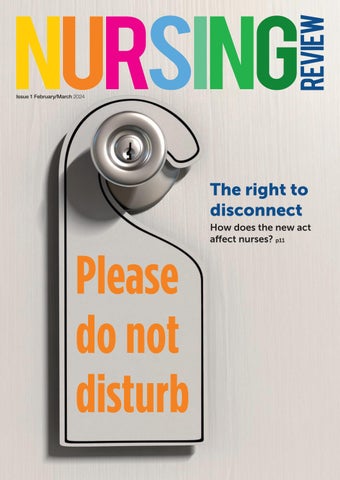
Issue 1 February/March 2024
The right to disconnect
Please do not disturb
How does the new act affect nurses? p11
ADELAIDE 25-27 JULY 2024
FESTIVAL OF NURSING
KEEPING PEOPLE WELL AND OUT OF HOSPITAL
GET YOUR TICKET NOW THE FESTIVAL IS BACK IN 2024, YOU THOUGHT 2023 WAS GOOD... 2024 WILL BE EPIC!
VIEW MORE DETAIL AND BOOK YOUR TICKETS: APNA.ASN.AU/EDUCATION/FESTIVAL OR SCAN THIS QR CODE.
contents
MANAGING EDITOR
news
Rebecca Cox rebecca.cox@news.com.au
2
WA nurses form political party
HEALTH EDITOR
4
Urgent care clinics working
Arshmah Jamal arshmah.jamal@news.com.au
6
Funding boost for cancer nurses
SALES MANAGER
Nicola Mohtram 02 9936 8666 nicola.mohtram@news.com.au SUBSCRIPTIONS MANAGER
industry and reform
02
9
9
ANMF launches work value case
Lee Burrell lee.burrell@news.com.au
10 WA nurses reluctantly
COVER
11 COVER STORY What the right
accept pay increase
to disconnect means for nurses
The right for nurses to disconnect, p11
workforce
PUBLISHED BY
Nationwide News Pty Ltd GPO Box 4245 Sydney NSW 2001 ABN 98 008 438 828 Print Post 100008043 ISSN 1836-1501 OCLC 536881479
13 Health concerns for night shift workers
14 Free TAFE nursing pipeline has record number of nurses
10
11
15 Roadblocks for leadership
PUBLISHER’S NOTE
© Copyright. No part of this publication can be used or reproduced in any format without express permission in writing from Nationwide News Pty Ltd. The mention of a product or service, person or company in this publication, does not indicate the publisher’s endorsement. The views expressed in this publication do not necessarily represent the opinion of the publisher, its agents, company officers or employees.
specialty focus
16 Continuity of care when having a baby vital
18 Home birth program in ACT extended
clinical practice
20 Poor care in aged care
13
14
21 Nurses able to prescribe abortion pill
22 How does Australian healthcare compare to the world?
24 Ratio of midwives in private health setting
technology
27 The latest in scrubs and workwear
21
27
28 Everyone needs to be involved in cybersecurity not just IT nursingreview.com.au | 1
news
State of the Union WA nurses’ union sets up party to run in 2025 state election By Arshmah Jamal
T
he Australian Nurses Federation Western Australia (ANFWA) has confirmed it will be running in next year’s state elections after formally registering the party in early February. ANFWA secretary Janet Reah said the Nurses and Midwives WA party had reached the required 500 signatures, but no candidates had been selected yet. “We will be looking at finalising policy and candidate selection processes in the very near future, which will form the team and vision of Nurses and Midwives WA,” Ms Reah said. Relations between ANFWA and the state government have declined in recent years amid pay disputes, staffing shortages, and lack of transparency. WA opposition health spokeswoman and Liberal leader Libby Mettam said the party’s formation showed the problems that exist between the union and the government.
2 | nursingreview.com.au
“These critical frontline health workers have consistently been asked to do more with less, regularly working double and sometimes triple shifts, and are now disillusioned with a government that does not seem to care and has no real plan to fix a broken health system,” Ms Mettam said. Ms Reah said that while the health system would be a focus, the party would also contribute usefully to other policy areas. “Our party won’t just be focused on health issues,” she said. “We’ll be talking about things like crime, housing, and road safety, as well as other matters that will affect every person in WA.” The party would also push for legislated patient-to-staff ratios and safe harbour provisions to protect nurses and midwives who flag staffing and resourcing issues. “The fact is WA Labor have left us behind,” Ms Reah said. “Nurses, midwives, the hospitals they work in, and all Western Australians have been struggling after years of neglect in the area of health, crime, housing, and the economy. “This is a government flushed with funds but devoid of a plan for WA.”
“The party would also push for legislated patient-to-staff ratios and safe harbour provisions to protect nurses and midwives who flag staffing and resourcing issues WA Premier Roger Cook told The Sydney Morning Herald that the party would not impact the relationship between the Union and government. “We continue to have a very strong relationship with all public sector unions as part of the work that we do to make sure that we provide the resources, the wages, and the conditions that all our public sector workers need to continue to do a great job on behalf of the people in WA,” Mr Cook said. “Anyone is welcome to set up a political party and contest any election; obviously, that’s part of our democracy. “We wish to wish everyone all the best if they choose to take that course of action.” ■
Nursing roles with ADF Health Services really are like no other Be part of a supportive community dedicated to making a real impact. Experience a work environment that values your well-being and fosters a healthy work-life balance while also providing opportunities for your growth and meaningful care. VISIT:
sercocareers.com/ADF-Health-Services
Greater work life balance
Spend more time with patients
55+ clinics across Australia equipped with everything you need
and discover a fulfilling nursing career that allows you to make a difference every day.
“The hours of work are so much more predictable and give me more time to spend with my family”
Be the health force behind Australia’s Defence Force.
news
Fifty-eight urgent care clinics have opened up across Australia. Picture: Supplied/Leighton Smith.
‘A material difference’ Urgent care clinics open up nationwide By Arshmah Jamal
T
he Albanese Government’s early campaign promise of establishing more than 50 urgent care clinics (UCC) has taken shape as 58 UCCs are now open across Australia. Health Minister Mark Butler said the UCCs were starting to deliver care seven days a week for extended hours, taking much-needed pressure off emergency departments. “This is making a real difference in the community,” Mr Butler said. “You know, tens of thousands of people getting that care, free of charge, when and where they need it in their own community. “It’s also making a material difference to the pressure on hospital emergency departments.” Early data published by the Queensland State Government found that in areas where UCCs had opened, non-urgent and semi-urgent presentations in emergency departments were down.
4 | nursingreview.com.au
“Logan Hospital was down by 10 per cent and Ipswich at 25 per cent,” the minister said. “It will take a little bit of time for hospitals to get their data and start reporting them. “But we have seen [a big spike in presentations] to UCCs, which shows, again, just how important this model of care is.” However, an analysis of the 11 UCCs in Queensland found that only four operated on extended hours, closing at 10pm. Bundaberg had the shortest opening hours of 8am to 5pm on weekdays, stating that the clinic will initially operate “during our normal business hours”. Rockhampton operated seven days a week from 8am to 5pm and Townsville from 11am to 9pm seven days a week. The rest closed at 8pm. Mr Butler said health staff shortages contributed to the reduced opening hours at the clinics. “I’ve been quite open that a number of the clinics will take a little while to attract the workforce to ensure that they operate
“I’ve been quite open that a number of the clinics will take a little while to attract the workforce to ensure that they operate at every single hour that we’d like them to at every single hour that we’d like them to,” he said. “But in the meantime, we’re working very closely with local hospital systems and with the Primary Health Networks ... to make sure that the opening hours do match the peak level or peak times of demand at local hospital emergency departments.” Last month, another $1.2bn funding was added to strengthen Medicare, with one of the focuses being on urgent care expansions. “[Urgent care] fills a very significant gap in the Australian healthcare system, delivers care that people need when and where they need it,” Mr Butler said. “It’s already demonstrably taking pressure off hospital systems.” ■
Breast will always be best
The only Australian made hospital infant formula brand with Human Milk Oligosaccharide (HMO)*
HOSPITAL FORMULATION
Made in Australia
Made in Australia from at least 60% Australian ingredients
Made in Australia from at least 70% Australian ingredients
For Formula-fed babies
HMO only supports the growth of beneficial bacteria**
Always read the label and follow the directions for use.
Made in Australia
Contains clinical Tasteless powder level of 2’-FL HMO# can be added to food or drinks^
Made in Australia
Contains clinical level of 2’-FL HMO#
Scan here to access product for professional evaluation
Low in protein
Liquid Formula for Contains clinical hospital use only level of 2’-FL HMO#
Low in protein
Scan here to learn more about HMOs
** Donovan S. Ann Nutr Metab 2016;69(2):42-21 * Contains a manufactured form of 2’-O-fucosyllactose (2’-FL) HMO, which is structurally identical to the most abundant HMO found in breastmilk. # Berger B, et al. mBio 2020;11e03196–19. 9 † Data Source: Based on Euromonitor International’s research findings as generated via desk research and trade interviews, measured in terms of global retail sales value in 2022. ^ Supplements may only be of assistance if dietary intake is inadequate.
IMPORTANT NOTICE: Breast milk is the normal way to feed a baby and is important for baby’s health. Professional advice should be followed before using an infant formula. Introducing partial bottle feeding could negatively affect breast feeding. Good maternal nutrition is preferred for breast feeding and reversing a decision not to breast feed may be difficult. Infant formula should be used as directed. Proper use of an infant formula is important to the health of the infant. Unnecessary or improper use of infant formula can effect the health of the baby Social and financial implications should be considered when selecting a method of feeding. Not for public distribution. For further information please email BiostimeNutritionAU@hh.global or visit hcp.biostimenutrition.com.au. Health and Happiness (H&H) Australia Pty Ltd. ABN: 39 105 039 914. L7, 88 Langridge St, Collingwood, VIC, AUSTRALIA 3066. Free Call: 1800 794 773. Date of preparation: Nov 2023.
FOR HEALTHCARE PROFESSIONAL EDUCATION PURPOSES ONLY
news
The funding was announced by the Minister for Health and Aged Care, Mark Butler. Picture: NCA NewsWire/Martin Ollman
‘Incredible difference’ Government allocates $74.5m for the “biggest investment in cancer nurses” By Arshmah Jamal
T
he Albanese Government is committing a further $166m for an Australian Cancer Nursing and Navigation Program, with $74.5m of it allocated to cancer care nurses. The investment is set to improve cancer outcomes across Australia, from cancer prevention and early detection to recovery, treatment, survivorship, and end-of-life care. The Federal Government invested in a first-of-its-kind program to help patients with a cancer diagnosis navigate the healthcare system by on-boarding 100 cancer care nurses – bringing the total to 250 Commonwealth-funded by 2027. Health Minister Mark Butler said these nurses were invaluable to patients, and the Albanese government had made the “biggest investment in cancer nurses on record”. “More than 164,000 Australians are estimated to be diagnosed with cancer
6 | nursingreview.com.au
this year, and our government is ensuring they have the support in place to get through their diagnosis, no matter where they live or what their cancer type,” the Health Minister said. “The Albanese government is investing in our trusted nursing workforce to provide more comprehensive care to people with cancer and help them navigate the health system.” Melanoma, breast, and lung-cancer care nurses will be recruited through the McGrath Foundation, while existing prostate cancer nurses from the Prostate Cancer Foundation will be given $74.5m. Glenn McGrath, co-founder and president of the McGrath Foundation, said the foundation was proud to be supporting the delivery of the program. “When we started the foundation, we hoped we could make a positive difference to just one family,” Mr McGrath said. “We are truly humbled by this announcement and what it means for Australian families going through cancer.” “My family understand first-hand the incredible difference this care makes, so knowing Australians will soon have access to this care no matter
“Health Minister Mark Butler said these nurses were invaluable to patients, and the Albanese government had made the “biggest investment in cancer nurses on record what type of cancer they have just blows me away.” Further funding for a new $49.6m Cancer Navigation Service led by the Cancer Council Australia will connect cancer patients to information and support. For telehealth support services, $32.1m will be delivered to non-government cancer organisations. A commitment of $9.4m was made to continue the Child and Youth Cancer Hub led by Canteen in collaboration with Camp Quality and Redkite, with $2.1m used for counselling services. An additional $48.2m has been delivered to support the implementation of a national strategy to eliminate cervical cancer. ■
Australia’s Premier HOME CARE OFFICE NETWORK TAKE CHARGE OF YOUR FUTURE Have you reached a crossroads in your life and looking to make a change for the better? Secure your family’s future and make a difference in your community, whilst building a business in the thriving and dynamic home care industry with Right at Home. You’ll enjoy the freedom to grow your own business, with the full support of a top quality, national, home care brand delivering domestic support, personal care, skilled nursing, and allied health services. Your experience in nursing will assist in maintaining our high quality standards in delivering nurse supervised home care. You will be provided the necessary business training to ensure the success of your own local office. The home care market is guaranteed to grow for the next 20 years. The entry costs and overheads are very low compared with most businesses. Following rapid growth In QLD, NSW and WA, Right at Home is expanding into VIC, SA, TAS, ACT and the NT with prime territories up for grabs. Make your dreams come true… talk to Right at Home about a home care franchise today.
Apply to be a Right at Home office owner now! Go to www.rightathome.com.au/business-opportunities and fill in a form to be sent further information.
1300 363 802 | www.rightathome.com.au.
SubScribe for leSS than $2 a week
The laTesT news and resources for healThcare professionals Nursing Review is essential reading for anyone involved in the healthcare sector in Australia. We provide unrivalled coverage of specialist topics from features and opinion pieces, to international news and profiles of industry leaders and those at the coal face. At Nursing Review we pride ourselves on being at the forefront of the ever-changing healthcare sector, with all the latest on industry reform, pay issues, clinical updates, what's happening in the workforce, and technology.
• Analysis of the major issues facing the health sector today • Can be used as a professional development resource • 6 issues per year • Interviews and opinion pieces from professionals in the industry • Written by an independent voice • Tax deductible
Please email subs@apned.com.au to find out more.
industry & reform Annie Butler federal secretary Australia Nursing and Midwifery Federation. Picture: Rob Leeson.
“It’s only fair that nurses, midwives, and AINs, covered by the national award, get recognition for their demanding work, regardless of the healthcare setting
‘Only fair’ ANMF launches work value case for 35 per cent increase By Arshmah Jamal
T
he Australian Nursing and Midwifery Federation (ANMF) has filed a “landmark” application to increase award wages for nurses by up to 35 per cent.
The application to the Fair Work Commission asks for an increase of up to 35 per cent for frontline nurses, midwives, and assistants in nursing (AIN). The basis for the ANMF application is that the work of nurses and midwives has never been properly valued. Federal secretary of ANMF Annie Butler said that the application
was to ensure that the recognition of work value given to nurses and AINs in the Aged Care Work value case would be extended to all award-covered nurses, midwives, and AINs. “It’s only fair that nurses, midwives, and AINs, covered by the national award, get recognition for their demanding work, regardless of the healthcare setting,” Ms Butler said. “We contend that award rates are set too low, stemming from the historic, gender-based undervaluation of nursing and midwifery care work.” In the ANMF’s 2024-25 pre-budget submission, it outlined four priorities for workforce support and reform, one of which is gender equity. It was also raised in its response to the federal government’s Job Security Discussion Paper, which is part of the Modern Awards Review 2023-2024. “The ANMF submits that issues of job security and the impact of gender-based undervaluation and perception of work in female dominated industries are inextricably linked.” Nurses and midwives comprise almost 54 per cent of the health workforce, and 88 per cent of them are female. However, the median weekly income for a full-time female RN is nine per cent less than a full-time male RN. Ms Butler said person-centred care was now the principle under which healthcare operated. “The training, skill and responsibility required to deliver that quality care has grown commensurately with the ever-changing demands of the healthcare system,” she said. “The Australian population has become more diverse, and expectations for a long and healthy life, supported by information, education and preventative care, are now the norm. “The need for nursing and midwifery care has expanded, as people live longer and with greater levels of chronic disease.” ■ nursingreview.com.au | 9
industry & reform
After a long standing fight, WA nurses have accepted the state government’s pay rise offer.
‘Worth so much more’ WA nurses reluctantly accept pay rise offer By Arshmah Jamal
W
estern Australian nurses have reluctantly accepted a pay rise offer from the WA government, with union members saying yes to one of the two offers that were put to them. After a lengthy battle with the state government, the WA Australian Nursing Federation (ANFWA) accepted a three per cent annual pay rise, with a professional development allowance for all nurses and midwives of between $700 and $1400, and changed nurse-to-patient ratio measures. Members were not allowed to reject the offer and resume negotiations, with ANFWA state secretary Janet Reah asking the members to choose between the latest offer and the original offer. Ms Reah said nurses would have voted against the pay rise if that option was on the table.
10 | nursingreview.com.au
“We are worth so much more than we’ve been given,” she told the ABC. “We couldn’t do any more in this negotiation, and I had to bring it to an end. “Without having a signed EBA [Enterprise Bargaining Agreement], we would not get the enforceable ratios that nurses and midwives desperately need.” More than 2000 members voted, double the second-highest vote in 2018, making it the highest membership turnout for an EBA. In an email sent to the members, Ms Reah said the union would now shift their focus to the 2024 EBA negotiations, which are set to begin in a few months. “This was a long and difficult negotiation and campaign, and I share the frustration of nurses and midwives who believe that this isn’t enough to remedy the staffing shortfalls in our public system,” she said. “Even with the pay increase, WA nurses and midwives remain the lowest paid in the country.
“This was a long and difficult negotiation and campaign, and I share the frustration of nurses and midwives who believe that this isn’t enough to remedy the staffing shortfalls in our public system “It is vital that the ANF and the government now focus on the implementation of transparent and enforceable patient ratios.” The deal is expected to be registered by the end of January; however, it will only last until October due to the fixed two-year cycles for public sector pay deals. This time, the negotiation experience will differ as Premier Roger Cook has scrapped former premier Mark McGowan’s blanket public sector wage policy, which will now allow for individual union negotiations ■
industry & reform
“What I expect will happen is that in the Fair Work Commission review, it’s going to make more tailored arrangements for specific sectors and occupations
Leader of the Greens Adam Bandt said changes to the industrial relations bill meant workers had a right to disconnect after their shift. Picture: NCA NewsWire/Martin Ollman
Right to disconnect What’s in the latest industrial reform for nurses? By: Arshmah Jamal
L
abor’s Closing Loopholes industrial relations bill has passed the Senate following deals with the crossbench, including the insertion of a Greens amendment to create a right to disconnect from work. The Greens announced mid-February that the Albanese government had accepted the right to disconnect, which would prevent employees from being punished for refusing to take unreasonable emails or calls in their unpaid personal time. “Whether you’re a nurse, teacher, or hospo worker, the Greens believe you shouldn’t have to answer calls or texts from your boss on your day off or after hours if you’re not being paid for it,” Greens leader Adam Bandt said. Many employees see the law as a huge win; however, Australian Nursing and
Midwifery Federation (ANMF) secretary Lori-Anne Sharp said it may not be widely used. “I guess with nurses and midwives and carers – because the nature of our work is shift work – it might not be as widely used as the broader community,” Ms Sharp told Nursing Review. “This is a protection that allows employees the right to disconnect or refuse to read or respond to an employer in any related matters after their working hours so they can have a proper break and feel rested before the next shift – which is a really important and critical thing. “It’s a very good idea, and it’s a really good initiative.” The amendment would be phased in over six months to give employers time to “adapt, listen, and learn”, with Ms Sharp saying ANMF would educate its members and it would be interesting to see what the law would mean for the sector. “How it is going to play out in our sector is yet to be evidenced because of the nature of our shift work,” she said.
“[The effects of it] might not be as great as a nine to five because, in shift, someone replaces the next person.” Associate professor of work and organisation at the University of Sydney Chris Wright said the amendment would show up for sectors such as nursing in the long run. “What I expect will happen is that in the Fair Work Commission review, it’s going to make more tailored arrangements for specific sectors and occupations,” Mr Wright said. “So regarding the nurses’ award, for example, I expect that there’ll be some more tailored, more bespoke arrangements around the right to disconnect in that award and in any enterprise agreements that are established as well.” Opposition leader Peter Dutton has sworn to repeal the laws and said the laws would instead be damaging to employer-employee relationships. “If you think it’s okay to outsource your industrial relations or your economic policy to the Greens, which is what the prime minister is doing, then we are going to see a continuation of the productivity problem in our country,” Mr Dutton said on Sky News. “And as the Reserve Bank governor pointed out, if you don’t address it, you’ll see interest rates continue to climb, or you’ll see them stay higher for longer.” Mr Wright, however, said he felt frustrated to hear these “evidence-free claims”. “Workplace laws actually have a pretty small impact on productivity, so for the opposition leader to say that this is going to be terrible for productivity, well, show us the evidence,” he said. “[The laws are] going to have a marginally positive impact on productivity and will help to strengthen relationships between employers and employees because it’s going to provide a guardrail that is going to mean that when people are at work, they’re at work. “I mean, I’m sure we all know the experience of feeling overwhelmed at work and how that can actually make us.” ■ nursingreview.com.au | 11
Workforce Shift workers are more at risk in developing type 2 diabetes, or of being overweight compared to their day-working counterparts.
‘Fatigue and disruption’ Study finds night shift workers need support to manage and avoid specific diseases By Arshmah Jamal
A
study by Monash University has found that work policies must be designed to target the specific barriers that night shift workers face when it comes to managing weight and metabolic health conditions. Published in Obesity Reviews, the study investigated the barriers that night shift workers face when making healthier lifestyle choices. Although they have an increased risk of weight gain and a higher risk of weight-related conditions such as type 2 diabetes and cardiovascular disease, there are currently no systems in place to assist night shift workers in making healthier lifestyle choices. Across eight studies in Australia, Sweden, Nigeria, the USA, and Botswana, the barriers to better health spanned across personal, social,
organisational, and community. They included stress, lack of routine, limited healthy food options at night, and lack of meal breaks. One of the researchers, dietitian Corinne Davis, said it was important to make healthy food options accessible. “The fatigue and disruption to routine that often accompanies working at night is challenging for night shift workers,” Ms Davis said. “We need to make it easier for them to choose healthier food options.” Nurses comprise the largest group of night shift workers at 46 per cent. In 2020, 36 per cent of residential aged-care nurses were on call and duty overnight, and 44 per cent were on duty. Senior author of the research Professor Maxine Bonham said an intervention was vital for their work schedule. “Night shift workers are critical to our 24-hour society, yet interventions to improve their health fail to acknowledge the physiological and behavioural challenges of their work schedule,” Ms Bonham said.
“[Night shift workers] have an increased risk of weight gain and a higher risk of weight-related conditions such as type 2 diabetes and cardiovascular disease The authors called for more research into the complexities of shift work and consideration of weight loss approaches that account for timing and quality of food intake, as well as factors such as sleep quality’s impact on night shift workers’ weight management. The study called on future interventions to focus on eliminating the key barriers faced by night shift workers, for example, by facilitating the availability of healthier food options within the workplace at night. “Interventions for night shift workers must be designed to target the known enablers and barriers identified by night shift workers,” the researchers wrote. ■ nursingreview.com.au | 13
Workforce Qld premier Steven Miles (centre) and skills minister Lance McCallum (left) welcomed the 2024 nursing students at TAFE. Picture: NCA NewsWire/Tertius Pickard
Miles ahead Free TAFE nursing pipeline has record number of nurses By Arshmah Jamal
A
record-breaking 1,400 students have been enrolled for a TAFE nursing diploma this year, fully funded by the Queensland Government. Students will save almost $25,000 with the initiative supporting 3,500 training places. Queensland Premier Steven Miles welcomed the first cohort, stating the fully-funded diploma would change lives. “[Free TAFE] is a legacy of our government and has now become a staple training program nationwide,” he said, “The Diploma of Nursing was one of the most popular free TAFE courses offered last year, which is why my government is fully funding its continuation in 2024. “I firmly believe that Queenslanders should have access to priority skilling for free so they can get good secure jobs in those in-demand industries.”
14 | nursingreview.com.au
Nursing has increased in popularity in the last five years, with Queensland nurses making up around 21 per cent of Australia’s nursing workforce. The health industry in Queensland has a projected 16.4 per cent change by 2026, with nurses and midwives projecting a 13.7 per cent change – meaning 11,079 jobs will be created. However, the Department of Health and Aged Care found that since 2016, there has been a 60 per cent increase in nurses and midwives who have taken an extended leave of absence. Research by the Australian Primary Healthcare Nurses Association also found that 30 per cent were planning to leave their job within the next five years. The Miles Government invested $87.5 million in Queenslanders who want to train, retrain or upskill in priority industries. These industries include aged care, disability support, child care, tourism, agriculture, and cyber security. Training and Skills Development Minister Lance McCallum said the removal of cost barriers would not
“I firmly believe that Queenslanders should have access to priority skilling for free so they can get good secure jobs in those in-demand industries only help the students but also all Queenslanders. “Last year, more than 66,000 Queenslanders embraced the golden opportunity that is Free TAFE to gain new skills and find a job, or to upskill and change careers,” Mr McCallum said. “That includes 3,100 students who started their Diploma of Nursing in 2023. “While these students will save over $24,000 in study fees, all Queenslanders will benefit from their service – contributing to a stronger, more responsive health system.” Starting this year, the Australian Government will invest $85 million over three years to deliver 43,400 fee-free training places at TAFE and vocational education places. ■
Workforce New research found that barriers prevent female nurses being considered for leadership roles.
‘Multiple barriers’ New study finds leadership roles harder to get for female nurses By Arshmah Jamal
A
review published in The Lancet by Monash University has found multiple barriers holding female nurses back from applying for, being considered for, or accepting leadership positions. The research, a systematic review and meta-synthesis, looked at 32 international studies and identified that healthcare systems and organisations limit female nurses’ skill acquisition, motivation, and opportunities in healthcare leadership due to inequitable policies, practices, and bias. The research also highlighted the ways in which gender roles, such as disproportionate childcare and family responsibilities falling onto women, led to part-time work which limited leadership opportunities that are generally seen as full-time roles. The federal government’s 2023 Status of Women Report Card confirms this, with findings that women spend 31.6 hours a week on unpaid work and care; nine hours more than men do. Even when they are the primary breadwinner, they do five more hours of unpaid housework (24.1 compare to 19.1 for men).
Senior author and professor of women’s health at Monash University Professor Helena Teede said the review confirmed a common theme. “The barriers identified show women nurses don’t have the same opportunity for leadership as men,” she said. “It follows a common theme throughout healthcare, a sector delivered by women and led by men. “These findings provide the foundation for research, co-design, and implementation of effective organisational and system-level strategies.” The study found that to break down these barriers, systems and organisations would have to change, with evidence pointing to a need for implementing industry-wide measures such as incorporating part-time roles into leadership roles. Nurses and midwives comprise almost 54 per cent of the health workforce, and 88 percent are females. However, the median weekly income for a full-time female RN is nine per cent less than a full-time male RN. The World Health Organisation (WHO) has estimated that only 25 per cent of females hold leadership roles in health despite making up 90 per cent of the nursing and midwifery global workforce. Co-author and critical-care registered nurse Mihiri Pincha Baduge was born and studied nursing in Sri Lanka. She
“The review showed that there are more barriers to attaining leadership roles when gender intersects with other social identities such as culture and ethnicity said healthcare leadership roles often overlooked people like her – a woman, nurse, mother, migrant, and person of colour. The review showed that there are more barriers to attaining leadership roles when gender intersects with other social identities such as culture and ethnicity. “We’ve found that societal issues and organisational hurdles challenge women’s individual credibility, capacity, and capability in nursing,” Ms Pincha Baduge said. “It’s like a double whammy – women nurses don’t feel confident enough, and this is reinforced as qualified women get passed over for leadership roles. “The workplace itself can be a battlefield, with unconscious bias and discrimination making it way harder for women, especially in nursing – which is seen primarily as a feminine, caring role – to climb the leadership ladder.” ■ nursingreview.com.au | 15
SPECIALTY FOCUS
Continuity of care Women want to see the same health provider during pregnancy, birth and beyond By Hazek Keedle and Hannah Dahlen
I
n theory, pregnant women in Australia can choose the type of health provider they see during pregnancy, labour and after they give birth. But this is often dependent on where you live and how much you can afford in out-of-pocket costs. While standard public hospital care is the most common in Australia, accounting for 40.9% of births, the other main options are: • GP shared care, where the woman sees her GP for some appointments (15% of births) • midwifery continuity of care in the public system, often called midwifery group practice or caseload care, where the woman sees the same midwife of team of midwives (14%)
16 | nursingreview.com.au
• private obstetrician care (10.6%) • private midwifery care (1.9%). Given the choice, which model would women prefer? Our new research, published BMC Pregnancy and Childbirth, found women favoured seeing the same health provider throughout pregnancy, in labour and after they have their baby – whether that’s via midwifery group practice, a private midwife or a private obstetrician.
ASSESSING STRENGTHS AND LIMITATIONS We surveyed 8,804 Australian women for the Birth Experience Study (BESt) and 2,909 provided additional comments about their model of maternity care. The respondents were representative of state and territory population breakdowns, however fewer respondents were First Nations or from culturally or linguistically diverse backgrounds.
We analysed these comments in six categories – standard maternity care, high-risk maternity care, GP shared care, midwifery group practice, private obstetric care and private midwifery care – based on the perceived strengths and limitations for each model of care. Overall, we found models of care that were fragmented and didn’t provide continuity through the pregnancy, birth and postnatal period (standard care, high risk care and GP shared care) were more likely to be described negatively, with more comments about limitations than strengths.
WHAT WOMEN THOUGHT OF STANDARD MATERNITY CARE IN HOSPITALS Women who experienced standard maternity care, where they saw many different health care providers, were disappointed about having to retell their story at every appointment and said
SPECIALTY FOCUS
they would have preferred continuity of midwifery care. Positive comments about this model of care were often about a midwife or doctor who went above and beyond and gave extra care within the constraints of a fragmented system. The model of care with the highest number of comments about limitations was high-risk maternity care. For women with pregnancy complications who have their baby in the public system, this means seeing different doctors on different days. Some respondents received conflicting advice from different doctors, and said the focus was on their complications instead of their pregnancy journey. One woman in high-risk care noted: “The experience was very impersonal, their focus was my cervix, not preparing me for birth.”
WHY WOMEN FAVOURED CONTINUITY OF CARE Overall, there were more positive comments about models of care that provided continuity of care: private midwifery care, private obstetric care and midwifery group practice in public hospitals.
Women recognised the benefits of continuity and how this included informed decision-making and supported their choices. The model of care with the highest number of positive comments was care from a privately practising midwife. Women felt they received the “gold standard of maternity care” when they had this model. One woman described her care as:
“Some respondents received conflicting advice from different doctors, and said the focus was on their complications instead of their pregnancy journey
“Extremely personable! Home visits were like having tea with a friend but very professional. Her knowledge and empathy made me feel safe and protected. She respected all of my decisions. She reminded me often that I didn’t need her help when it came to birthing my child, but she was there if I wanted it (or did need it).” However, this is a private model of care and women need to pay for it. So there are barriers in accessing this model of care due to the cost and the small numbers working in Australia, particularly in regional, rural and remote areas, among other barriers. Women who had private obstetricians were also positive about their care, especially among women with medical or pregnancy complications – this type of care had the second-highest number of positive comments. This was followed by women who had continuity of care from midwives in the public system, which was described as respectful and supportive. However, one of the limitations about continuity models of care is when the woman doesn’t feel connected to her midwife or doctor. Some women who experienced this wished they had the
opportunity to choose a different midwife or doctor.
WHAT ABOUT SHARED CARE WITH A GP? While shared care between the GP and hospital model of care is widely promoted in the public maternity care system as providing continuity, it had a similar number of negative comments to those who had fragmented standard hospital care. Considering there is strong evidence about the benefits of midwifery continuity of care, and this model of care appears to be most acceptable to women, it’s time to expand access so all Australian women can access continuity of care, regardless of their location or ability to pay. Hazel Keedle, Senior Lecturer of Midwifery, Western Sydney University and Hannah Dahlen, Professor of Midwifery, Associate Dean Research and HDR, Midwifery Discipline Leader, Western Sydney University This article is republished from The Conversation under a Creative Commons license. Read the original article. ■ nursingreview.com.au | 17
specialty focus
‘Growing waitlist’ Canberra home-birthing program expands By Arshmah Jamal
G
rowing demand for Canberra’s home-birthing service has led to an expansion to all of the Australian Capital Territory following 100 successful deliveries.
18 | nursingreview.com.au
The publicly funded home-birthing program has a 100 per cent success rate – meaning the 100 women involved in the program delivered their babies safely at home. Following the success and demand, Canberra Health Services has expanded the previous eligibility of having to be within 10 minutes of Canberra Hospital.
Now, as long as the birth is considered low-risk and they have ambulance cover, women across the ACT will have the option of a homebirth. During pregnancy, they will be overseen by four midwives, two of whom will be with them for the birth, and for four hours after the baby is delivered. Post birth the family will receive visits from these midwives to check
specialty focus
“It has a huge mental impact in a positive way on the mother, and the birth partners we speak to feel so empowered to be so involved
on their health and the baby’s for two weeks. Registered midwife Laura Parker, who was involved in the 100th home birth, said the program contributed to a positive birth experience for everyone involved. “Women feel extremely proud of themselves, and it’s very empowering to see what ‘normal’ birth can be,” Ms Parker told Nursing Review. “It has a huge mental impact in a positive way on the mother, and the birth partners we speak to feel so empowered to be so involved. “The rate of breastfeeding and babies not losing weight improves because [the
mother’s] oxytocin and their lactation hormones come in quicker.” Home births in Australia have become more popular in the last decade – with a 62 per cent increase. Research has also found that home births for low-risk pregnancies were beneficial emotionally and psychologically, with its reduction of birth trauma. Control during labour, less anxiety, and a positive experience of pain were also reported. Another study found that if all low-risk women had given birth at home in 2017, cesarean rates would have reduced from 13.4 per cent to 2.7 per cent.
The service in Canberra has had a growing waitlist since the expansion. Assistant director of Canberra Hospital’s midwifery department Wendy Alder said a lack of midwives in the team was one of the reasons for this. “We have the ability to offer [home birthing] services through our continuity of care program,” Ms Alder said. “It’s a small team of midwives trained to provide home birth. “It’s not so much limited by funding as it’s limited by midwife availability.” With a national nursing and midwife shortage, there is already pressure on the public health workforce. The expansion brought concern about whether it would help alleviate the stress in the wards or even remove midwives from the hospital. However, Ms Alder said the expansion was to cater for the growing interest people in the ACT had. “For midwives, in particular, it’s about women having choices as to where they want to give birth and what is the safest option for them, given their particular circumstances,” she said. “We do have a wide consumer base within the ACT of women who’ve had home births and share their experience with other mothers who express interest. “It’s more about increasing choice for women and making sure that all birthing women have choices.” ACT health minister Rachel Stephen-Smith said the expansion was welcomed by the government, and the program will continue to be invested in this year. “The ACT government is focused on building a public maternity system that supports and meets the needs of the individuals accessing the system and the health professionals who work in it,” she said. “We will continue to invest in different models of care to ensure we meet the needs of women, pregnant people, their babies and families.” ■ nursingreview.com.au | 19
clinical practice
‘Not judging’
Appropriate care levels at 50%, new study finds By Arshmah Jamal
A
ged care residents in Australia are receiving on average only half of the appropriate care and even less for other common conditions like depression, a new study has found. In world-first research, Macquarie University's Australian Institute of Health Innovation evaluated adherence to evidence-based care and clinical practice guidelines for people in long-term residential aged care across multiple common conditions. The research analysed the care received by 294 residents across 27,585 care encounters in 25 residential aged-care facilities. Aged care nurses conducted the specialised reviews and found – on average – that indicators for adherence to evidence based care was at an average of only 53.2 per cent. Common conditions such as skin integrity, end-of-life care, infection, sleep, medication, and depression had less than 50 per cent adherence to indicators for best care, whereas bladder and bowel was at 81.3% per cent. Lead author Professor Peter Hibbert said the results showed the continued difficulties faced by the aged care sector, including workforce shortages.
20 | nursingreview.com.au
"Being treated according to evidencebased care is a fundamental human right and essential for ensuring people in aged care are safe and experience the best possible quality of life," Professor Hibbert said. "Caring for older people in aged care is likely to become more and more challenging as demand increases and resources become more stretched. "Understanding where and how evidence-based care is being delivered, or not, is very important to keeping people safe and allocating limited resources." Management for depression was the lowest at only 12 per cent of appropriate care, despite more than half of the residents experiencing depression symptoms. Depression is common among older Australians, with 49 per cent of people living in permanent residential aged care having a depression diagnosis. The research found that only one per cent of residents who have been receiving antidepressants were monitored monthly for side effects, as recommended by the guidelines. Data for the research was collected from March 1 2021 to 31 May 2021 – around the time the Royal Commission reported its findings. Professor Hibbert believes the study will provide a benchmark for measuring the impact the policy changes could make. "We are not judging individual aged care providers with these results," he said.
“Being treated according to evidence-based care is a fundamental human right and essential for ensuring people in aged care are safe and experience the best possible quality of life "This is a commentary on the overall aged care sector, which is struggling to provide residents the right care at the right time. "The Royal Commission recommended that registered nurses should be onsite 24/7 and that other health care staff would be available, but broader workforce shortages have increased since 2021 – which has put pressure on the system." The authors said a significant reason for the low adherence rate was the shortage of healthcare workers in aged care and the lack of proper health workforce planning. They advocated for innovative approaches such as multidisciplinary teams, structured communication and handover, and establishing evidence-based local clinical pathways. Last year, the Intergenerational Report stated than an ageing population coupled with slowing population growth would strain Australia's economy into the future, and associated workforce shortages would mean the sector would continue to struggle. ■
clinical practice Qld minister for health Shannon Fentiman. Picture: John Gass.
‘More options’ New Qld bill proposes allowing nurses to prescribe and administer abortion drugs By Arshmah jamal
Q
ueensland nurse practitioners and endorsed midwives will be allowed to prescribe termination-of-pregnancy drugs to a person in their early stages of pregnancy under proposed changes to legislation. Under these changes, it’s proposed nurses and midwives will be able to administer and supply the termination of pregnancy drug MS-2 Step in the early stages of pregnancy. Currently, a person in Queensland in the early stages of pregnancy can get a prescription for a medical termination through MS-2 Step from a registered medical practitioner. However, amendments to the Termination of Pregnancy Act and Criminal Code will allow nurses and midwives with appropriate qualifications and training to perform early medical terminations. Minister for Health, Shannon Fentiman, said safe terminations of pregnancy was a basic human right and a significant health issue for Queenslanders. “As the Minister for Women, it is extremely important to me that
all pregnant women and people in Queensland have access to safe, world-class pregnancy and reproductive healthcare,” Ms Fentiman said. “Nurses and midwives have the necessary skills, experience, qualifications, and training to be able to undertake this important role and provide greater access to reproductive healthcare, particularly in rural and remote communities.” “This Bill will support more equitable access to termination of pregnancy care and pregnancy health care rights across the state.” According to the Australian Bureau of Statistics (ABS), 20 percent of women who have given birth around Australia are from Queensland. It is generally estimated that between 10,000 and 14,000 abortions take place each year in the state. Due to a lack of standardised data collection, the number is an estimate. The Chief of Children by Choice, Daile Kelleher, said the expansion to nurses and midwives meant “more options, closer to home”. “Being able to choose to terminate a pregnancy at home, with your support people, provides better health outcomes and reduces unnecessary travel or hospital visits,” Ms Kelleher said.
“Nurses and midwives have the necessary skills, experience, qualifications, and training to be able to undertake this important role and provide greater access to reproductive healthcare, particularly in rural and remote communities “Queensland has huge abortion deserts where no options for care are available; this change will allow nurses and midwives in regional and remote areas to provide care where it is needed. “Access to safe, compassionate and timely termination of pregnancy is fundamental for the legislation to work, and this addresses gaps within current delivery of care.” The Act will also replace references to ‘woman’ with ‘person’ to ensure all pregnant people can access termination of pregnancy care. Doctors will remain the only health practitioners authorised to perform surgical terminations of pregnancy and medical terminations for gestations nine weeks and above. ■ nursingreview.com.au | 21
clinical practice
It’s all relative How does Australia’s health system stack up internationally? Not bad, if you’re willing to wait for it By Stephen Duckett
W
hen things are going bad in the health system, we are reassured we’ve got one of the best health systems in the world. But we’re rarely told where we actually stand relative to others. A new report from the Organisation for Economic Cooperation and Development (OECD) shows where Australia is doing relatively well – and not so well. The report is more than 200 pages with dozens of charts and tables. Here we highlight five charts showing Australia’s relative performance. Overall, Australia’s health system performs well, but can come after long waits. And our use of antibiotics is trending in the wrong direction.
1. We spend less than average but live longer than average Despite the rhetoric about the unsustainability of the health system, Australia performs well. When mapping health expenditure against life expectancy, Australia (marked by the red dot) sits in the best performing quadrant – and has done so for the past decade. In contrast, the United States is stuck in the worst performing quadrant for the whole period – significantly higher spending than other countries with worse life expectancy. The life expectancy measure is used here but it involves an implicit assumption that the principal impact on life expectancy is from the health system, which is not really the case. Nevertheless, it is a good measure of overall system performance and combined with spending provides a good measure.
2. Most Australians rate their health as good or very good The vast majority of Australians (about 85%) rate their health as good or very good, with Australia performing better on this metric 22 | nursingreview.com.au
than most other similar countries. Often good health is conflated with good health care, and the data show that Australia also has more doctors per head than other countries. The founding charter of the World Health Organization (WHO) recognised that health is not just the absence of disease, but a “state of complete physical, mental and social well-being”. This points to a flaw in the nexus between good health and more health professionals. The WHO focus on well-being helps to explain why it is not surprising that, looking across countries, the number of doctors doesn’t appear to be
a key determinant of performance on self-rated health.
3. It’s harder to get a bed in aged care About 30% of people in OECD countries are over 65, while the Australian proportion is about 20%. The proportion of over-65s is rising everywhere. A minority of older Australians (14%) use aged care, with most of these using home care. However, monitoring access to residential aged care (represented here by the number of long-term care beds per thousand population over 65) might act as a “canary in the coal mine”, highlighting where access problems exist.
clinical practice
In Australia, access to aged care beds is falling, by about 27% between 2011 and 2021. We started in the middle of the pack so this is a concern and probably contributes to more Australians being stuck in acute hospitals, rather than being in more appropriate accommodation in residential aged care. This “exit block” in turn leads to problems of ambulance ramping.
4. Australians wait too long for public hospital hip replacements Most publicly funded health systems are characterised by long waiting times for access to planned procedures such as hip replacements. Some waiting is to be expected as part of efficient management of operating theatre scheduling. But long waits, especially when the person is in pain, reflect poorly on management of the public hospital system. The data shows that almost two-thirds of people waiting for hip replacement surgery in Australia waited more than three months. This is marginally worse than the OECD average. Unfortunately, our performance is deteriorating. A number of states, such as Victoria, have developed strategies to improve the performance of the planned procedure system, or have identified opportunities for efficiency improvements in public hospitals which would help address this issue. Although it’s understandable that planned procedures were affected by the first few years of the COVID pandemic, governments should have adapted their funding and provision systems to bring waiting times back to the pre-pandemic levels.
5. Our use of antibiotics is going in the wrong direction Antibiotics have saved millions of lives. But public health experts have long recognised the emerging problem of antimicrobial resistance, where inappropriate use of these drugs can lead to their reduced effectiveness over time. Worldwide campaigns to promote appropriate use of antibiotics are bearing fruit and across the OECD, use of antibiotics is going down. Unfortunately, Australia’s trend is in the reverse direction. Stephen Duckett is Honorary Enterprise Professor, School of Population and Global Health, and Department of General Practice, The University of Melbourne This article is republished from theconversation.com/au under a Creative Commons license. ■ nursingreview.com.au | 23
clinical practice There have been concerns raised about the current staffing levels of midwives at Cabrini Malvern. Picture: Supplied/Cabrini Health
Ratio wrong ANMF in Vic says number of midwives at private hospital “grossly inadequate” By Arshmah Jamal
M
idwives working at a private Victorian hospital have claimed staffing shortages are putting mothers and babies at risk. In January, members from the Australian Nursing and Midwifery Federation Victoria (ANMF Vic Branch) passed a unanimous motion to express “grave concerns” about inappropriate staffing levels at Cabrini, saying it was creating a “clinical risk”. One midwife claimed there were, at times, one midwife to six nurses in the post-natal ward. The midwife was aware of an incident where a nurse had pricked a baby’s finger instead of their heel for the heel prick test, which screens newborns for rare diseases. ANMF Vic Branch secretary Lisa Fitzpatrick said there were concerns from members about staffing as it can impact care. “They’re particularly concerned about what we call ‘skill mix’, which refers to the
24 | nursingreview.com.au
number and combination of midwives and registered nurses,” Ms Fitzpatrick told The Sydney Morning Herald. “When the staffing composition is more registered nurses than midwives, it can impact the midwives’ ability to provide midwifery care to mothers and their babies. “Members are concerned that the number of midwives rostered per shift is frequently grossly inadequate to provide safe midwifery care to mothers and their neonates.” A spokesperson for Cabrini denied the allegations and said the hospital was responding to the union to “clarify any misinformation and concerns raised in their resolution”. “The hospital employed a small number of senior registered nurses who cared for patients and their babies in the post-natal ward. “This is part of Cabrini’s strategy to address the global midwifery workforce shortage.” According to data from the Nursing and Midwifery Board of Australia, 54 per cent of Victoria’s RN workforce are midwives. A study revealed 100 per cent of midwifery managers in Victorian private
“When the staffing composition is more registered nurses than midwives, it can impact the midwives’ ability to provide midwifery care to mothers and their babies hospitals believed their services had inadequate midwifery staffing levels, compared to 70 per cent in public hospitals. The Victorian Health Department is currently reviewing regulations at private hospitals and investigating whether midwife-to-patient ratios should be introduced. A spokesperson said the state was recruiting and training an additional 17,000 nurses and making it free to study nursing and midwifery. “Our healthcare workforce are the best of us – that is why we continue to back our nurses and midwives to ensure they are properly supported and to give all Victorian mothers and babies access to the greatest care.”. ■
The laTesT news for aged care professionals
IN OUR VOLATILE INDUSTRY, AGED CARE INSITE KEEPS YOU UP TO DATE ON ALL THE LATEST NEWS Aged Care Insite provides the best in original journalism, and is the authoritative source of news and analysis for the residential and community care sectors. We pride ourselves on being at the forefront of what's happening in the ever-changing aged care sector. We provide an independent source of news, and cover the issues relevant to you.
• Comprehensive coverage of a diversity of topics affecting the aged care sector • News and information on medical matters and products • Analysis of the major issues facing the aged care sector as a whole • 6 issues per year • Editorial integrity and industry relevance • Keeps industry professionals up-to-date on the politics and policy that matter • Tax deductible
Please email subs@apned.com.au to find out more.
SubScribe for leSS than $2 a week
The laTesT news and resources for healThcare professionals Nursing Review is essential reading for anyone involved in the healthcare sector in Australia. We provide unrivalled coverage of specialist topics from features and opinion pieces, to international news and profiles of industry leaders and those at the coal face. At Nursing Review we pride ourselves on being at the forefront of the ever-changing healthcare sector, with all the latest on industry reform, pay issues, clinical updates, what's happening in the workforce, and technology.
• Analysis of the major issues facing the health sector today • Can be used as a professional development resource • 6 issues per year • Interviews and opinion pieces from professionals in the industry • Written by an independent voice • Tax deductible
Please email subs@apned.com.au to find out more.
Technology
“Some scrub manufacturers have recently introduced workwear made from antimicrobial fabrics, which help to prevent the spread of germs, and keep wearers and those they care for healthier Manufacturers may also incorporate other protective elements into these fabrics, such as designing it to be waterproof or flame-resistant. As a bonus, antimicrobial fabrics also tend to last longer, saving healthcare workers from investing in new scrubs as often.
SUSTAINABILITY IN WORKWEAR
Scrubbing up The latest innovations in workwear By Steven John Cumper
F
rom the use of robotics and artificial intelligence in surgery to wearable devices that physicians can use to monitor patients, it’s safe to say that the healthcare sector has come a long way over the last several years. It’s not only technology that’s changing – workwear, especially for those in nursing and health care fields, has also gone through numerous evolutions.
EVOLUTION OF WORKWEAR Today, medical scrubs are the norm for nurses and aged care workers but this hasn’t always been the case. From the 1800s – when Florence Nightingale founded modern nursing – up to the 1990s, it was typical for nurses to wear dresses, sometimes with white caps and aprons added. Starting in the late 1990s and early 2000s, it became more common for nurses and other healthcare workers to wear scrubs – matching pants and tops, typically made from a blend of polyester and cotton, and only available in a few colours. Today, there is much more variety for nurses and other caregivers.
The following are some of the latest uniform advancements made in the nursing and aged care sectors.
CARE WITH FLAIR Long gone are the days of basic, widelegged pants and tunic-type tops. While those scrub styles still exist (and there’s nothing inherently wrong with them), there are plenty of other, more stylish and practical options to choose from as well. For example, many scrub designers have introduced jogger-style pants with banded legs for a more fitted look and feel. They’ve also brought in a variety of patterns and colours to mix and match and create new outfits for every day of the week.
ADDRESSING HYGIENE CHALLENGES Naturally, hygiene and spreading germs are common concerns among healthcare workers – especially those working with aged and vulnerable populations. In response to these concerns, some scrub manufacturers have recently introduced workwear made from antimicrobial fabrics, which help to prevent the spread of germs, and keep wearers and those they care for healthier. But what makes fabric antimicrobial? A common practice involves embedding silver alloy into the fabric – silver alloy prevents bacterial cells from dividing.
Most medical scrubs are made from polyester and polyester-cotton blends, neither of which are particularly sustainable or eco-friendly materials. Polyester can be derived from petroleum, and cotton requires extreme amounts of water to grow – over 2650 litres are used to produce enough cotton for one T-shirt. To address these challenges, some manufacturers have started using alternative materials, such as bamboo or fabric made from recycled plastic bottles. There has also been a more significant push for healthcare workers to recycle their scrubs instead of throwing them away when they wear out. Donating or repurposing them into different items, such as cleaning cloths, helps to keep scrubs out of landfills.
FREEDOM TO MOVE In the past, medical scrub designers tended to create the same style of scrubs for all wearers – even though everyone has different body types and clothing preferences. Modern scrub manufacturers have finally started to branch out with different styles to accommodate a broader range of healthcare workers. They’ve acknowledged that medical workers don’t come in one shape and size. Many manufacturers now make scrubs designed for extra-tall people and petite scrubs for those shorter than average. They also feature a wide range of larger sized scrubs to ensure all wearers can find the appropriate fit. Properly fitting scrubs allow nurses and aged care workers to move freely and do their jobs more efficiently and effectively. ■ nursingreview.com.au | 27
Technology
“The sweet spot lies in achieving a nuanced understanding of both the potential of these technologies and the risks they introduce
‘Unified defense’ Everyone has to be part of cybersecurity, not just IT By Jason Whyte
T
he healthcare sector has embraced a range of digital technologies, from interconnected Internet of Things (IoT) devices to advanced telehealth services, all in the pursuit of enhanced patient care. While this has improved accessibility and efficiency, it has also significantly broadened the potential attack surface for cybercriminals. This expanded threat landscape is further complicated by the pace at which these technologies are being adopted. Rapid digital transformation often outstrips the implementation of adequate security measures, leaving gaps that malicious threat actors can exploit. As such, healthcare organisations must evolve their cybersecurity strategies continually to keep pace with technological advancements. The challenge lies in striking the correct balance. On one hand, organisations need to harness the latest technological innovations to provide high-quality patient care.
28 | nursingreview.com.au
On the other, there is an imperative to protect sensitive patient data and maintain robust security protocols. The sweet spot lies in achieving a nuanced understanding of both the potential of these technologies and the risks they introduce. Proactive and predictive risk management is crucial in this context. Healthcare facilities must tailor their cybersecurity strategies to their unique operating environments. However, technology alone will not suffice. For the best chance of defence, organisations must secure the digital perimeter while taking a team-oriented approach to ensure every staff member – from IT teams to frontline healthcare staff – understands the specific risks associated with different technologies and operational practices, as well as their role in remaining compliant with cybersecurity best practices. This requires a shift in perspective, ensuring all personnel view cybersecurity as an integral part of the healthcare delivery process and not as a separate entity that remains the sole responsibility of the IT department. Education about the latest cybersecurity threats and practices is vital to achieve
this. It helps hospitals and healthcare organisations make significant progress towards cultivating a culture of cybersecurity awareness. Organisations should implement regular training and education programs to inform staff about the latest threats and best practices. This culture must also extend beyond the confines of the organisation. Patients, too, play a role in maintaining the security of their data, especially as telehealth and remote monitoring become more prevalent. Educating patients on safe digital practices, like securing their home networks and recognising phishing attempts, improves care. An overarching cybersecurity strategy should include third-party vendors and partners to ensure a unified defence against potential cyber threats. The journey towards digital resilience in healthcare is ongoing, marked by a need to develop comprehensive security strategies encompassing all aspects of patient care. Effective cybersecurity in healthcare is not a one-time effort; it’s a continuous process of adaptation and improvement. It involves regular assessments of internal and external risks, updating protocols as needed, and ensuring that all employees, from the boardroom to the clinic, are educated and aware of their role in maintaining a secure digital environment. As healthcare continues to evolve, the organisations that succeed will recognise the importance of cybersecurity in patient care. They will be the ones that move beyond embracing technological innovation also to build and maintain a secure, resilient digital infrastructure that prioritises education and safeguards the well-being of their patients and the integrity of their data. ■ Jason Whyte is the general manager for the Pacific at Trustwave, a cybersecurity management and consulting company.
The laTesT news for aged care professionals
IN OUR VOLATILE INDUSTRY, AGED CARE INSITE KEEPS YOU UP TO DATE ON ALL THE LATEST NEWS Aged Care Insite provides the best in original journalism, and is the authoritative source of news and analysis for the residential and community care sectors. We pride ourselves on being at the forefront of what's happening in the ever-changing aged care sector. We provide an independent source of news, and cover the issues relevant to you.
• Comprehensive coverage of a diversity of topics affecting the aged care sector • News and information on medical matters and products • Analysis of the major issues facing the aged care sector as a whole • 6 issues per year • Editorial integrity and industry relevance • Keeps industry professionals up-to-date on the politics and policy that matter • Tax deductible
Please email subs@apned.com.au to find out more.
SubScribe for leSS than $2 a week
The laTesT news and resources for healThcare professionals Nursing Review is essential reading for anyone involved in the healthcare sector in Australia. We provide unrivalled coverage of specialist topics from features and opinion pieces, to international news and profiles of industry leaders and those at the coal face. At Nursing Review we pride ourselves on being at the forefront of the ever-changing healthcare sector, with all the latest on industry reform, pay issues, clinical updates, what's happening in the workforce, and technology.
• Analysis of the major issues facing the health sector today • Can be used as a professional development resource • 6 issues per year • Interviews and opinion pieces from professionals in the industry • Written by an independent voice • Tax deductible
Please email subs@apned.com.au to find out more.