ISSUE 4 AUGUST/SEPTEMBER 2026
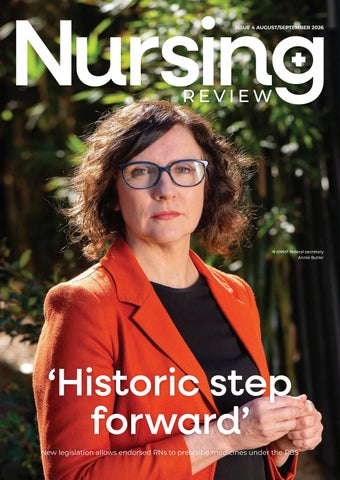
ANMF federal secretary Annie Butler
‘Historic step forward’ New legislation allows endorsed RNs to prescribe medicines under the PBS
The Australian Injectable Drugs Handbook Make sure your ward has the latest yellow book on hand.
NEW 10th edition out now! Get yours today: adpha.au/aidh
CONTENTS
News 4 5 6
5
8
7 8 10 11
More health students to receive paid prac support Healthcare worker assault hospitalisations double in a decade Judge’s exclusion ruling on viral video reversed Sydney nurse arrested after allegedly stealing confidential patient data COVER STORY Finally, new laws give registered nurses the power to prescribe PBS medicines SA parliament rejects push to tighten late-term abortion laws NSW launches taskforce to combat rising violence in hospitals
Industry & Reform
10
12
12
ACN says nurses are key to tackling Australia’s chronic disease burden
Workforce 14 SA nurses’ union prepares for 15
15
16
arbitration after members reject proposed enterprise agreement Housing and incentives identified as key to retaining remote health workers: Study
Wellbeing 16
The wellbeing of emergency nurses is at risk from ‘ethically impossible situations’
Midwifery 18 What factors drive women to
18
20
‘freebirth’ without a midwife or doctor?
Culturally Informed Care MANAGING EDITOR Rebecca Cox | rcox@intermedia.com.au HEALTH EDITOR Stefanie Schultz | sschultz@intermedia.com.au ART DIRECTOR Sarah Vella | svella@intermedia.com.au SUBSCRIPTIONS Lee Burrell | lburrell@intermedia.com.au ADVERTISING Julie Gemayel | jgemayel@intermedia.com.au GROUP PUBLISHER Jordan Guiao | jguiao@intermedia.com.au PUBLISHED BY Positive Impact Media Pty Ltd | 41 Bridge Roa, Glebe NSW 2037 ABN 51 063 279 630 | Print Post 100008043 | ISSN 1037-034X | OCLC 536881479 Copyright All material in this publication is copyright to the publisher and/or its contributors. No material may be reproduced without the express permission of the publishers. Disclaimer: This publication is published by Positive Impact Media Pty Ltd (the “Publisher”). Materials in this publication have been created by a variety of different entities and, to the extent permitted by law, the Publisher accepts no liability for materials created by others. All materials should be considered protected by Australian and international intellectual property laws. Unless you are authorised by law or the copyright owner to do so, you may not copy any of the materials. The mention of a product or service, person or company in this publication does not indicate the Publisher’s endorsement. The views expressed in this publication do not necessarily represent the opinion of the Publisher, its agents, company officers or employees. Any use of the information contained in this publication is at the sole risk of the person using that information. The user should make independent enquiries as to the accuracy of the information before relying on that information. All express or implied terms, conditions, warranties, statements, assurances and representations in relation to the Publisher, its publications and its services are expressly excluded save for those conditions and warranties which must be implied under the laws of any State of Australia or the provisions of Division 2 of Part V of the Trade Practices Act 1974 and any statutory modification or re-enactment thereof. To the extent permitted by law, the Publisher will not be liable for any damages including special, exemplary, punitive or consequential damages (including but not limited to economic loss or loss of profit or revenue or loss of opportunity) or indirect loss or damage of any kind arising in contract, tort or otherwise, even if advised of the possibility of such loss of profits or damages. While we use our best endeavours to ensure accuracy of the materials we create, to the extent permitted by law, the Publisher excludes all liability for loss resulting from any inaccuracies or false or misleading statements that may appear in this publication. Copyright © 2026 – The Intermedia Group Pty Ltd.
nursingreview.com.au
20 First Nations people face racism
in hospitals – one thing makes a difference 22 Jewish patients are hiding their faith in hospital due to safety fears
ISSUE 4 AUGUST/SEPTEMBER 2026
ANMF federal secretary Annie Butler
‘Historic step forward’ New legislation allows endorsed RNs to prescribe medicines under the PBS
COVER ANMF federal secretary Annie Butler. Picture: Rob Leeson
3
NEWS
‘Real help’ More health students to receive paid prac support to help alleviate placement poverty BY STEFANIE SCHULTZ AND NEWSWIRE
T
housands of allied health students will become eligible for paid placement support under a major expansion of the Commonwealth Prac Payment announced by the Federal Government. From 1 July next year, eligible students studying clinical psychology, physiotherapy, occupational therapy, speech pathology, paramedicine, radiography, pharmacy, rehabilitation therapies, audiology and podiatry will be able to access the payment while undertaking mandatory placements. The payment, which currently applies to eligible teaching, nursing, midwifery and social work students, provides $338.60 per week during clinical and professional placement periods.
4
Above: Speech pathology student Trista Kopeshke said the additional support would ease financial pressures during placements. Picture: Supplied
Prime Minister Anthony Albanese announced the expansion at the Australian Labor Party National Conference, describing it as support for both students and the future health workforce. “We will expand Paid Prac to physio and occupational therapy, clinical psychology, pharmacy and podiatry, speech pathology, audiology, radiography, rehab therapies, and our future paramedics,” Mr Albanese said. “Real help with the cost of living for tens of thousands of Australians.
“And a real investment in the health care workers of tomorrow.” The government says the expansion will help students manage the financial pressures associated with unpaid placements, which often require reduced work hours, relocation costs and extended periods away from home. Health and Ageing Minister Mark Butler said the measure would help address health workforce needs while supporting students through their training. “Training a domestic health workforce is crucial to ensuring every Australian can access quality health care where and when they need it,” Mr Butler said. Labor anticipates that the payment will be particularly important for students undertaking regional and remote placements, where travel, accommodation and relocation costs can create barriers to completing practical training. “Paid prac is working, that’s why we’re expanding it,” Education Minister Jason Clare said. “This will help more students finish their qualifications and move into the jobs the country needs.” The announcement was welcomed by the 2050 Alliance, a group of nine Australian universities. Alliance chair Distinguished Professor George Williams said additional support was needed to encourage students into health professions. “It is critical that we encourage and support more Australians to study in allied health fields, to ensure that we will have the skilled workforce to meet future demand in our society and economy,” he said. “The paid prac scheme helps students to deal with issues of placement poverty and to stay in study.” Speech pathology student Trista Kopeshke, who relocated from Ingham to Townsville to study at James Cook University, said the additional support would ease financial pressures during placements. “Knowing we will have this financial support while on placement is a huge relief for thousands of students,” Ms Kopeshke said. “It also means that when we have to take time off work, we are still receiving an income to support ourselves – and for some, their families as well.”
nursingreview.com.au
NEWS
‘Serious hazards’ Healthcare worker assault hospitalisations double in a decade BY STEFANIE SCHULTZ
W
orkplace assault is now the second-leading cause of injury hospitalisations among Australian healthcare workers, with new data showing the rate of assault-related admissions has doubled over the past decade. The latest Australian Institute of Health and Welfare (AIHW) data shows 126 healthcare workers were admitted to hospital following an assault at work in 2024-25, up from 49 in 2015-16. Over the same period, the hospitalisation rate for assault-related injuries rose from 4.3 to 8.1 per 100,000 healthcare workers, moving assault from the fourth most common cause of injury hospitalisation to the second. The report, Injury hospitalisations among health care workers, examined work-related injuries serious enough to require hospital admission between 2015-16 and 2024-25. “Health care workers play a vital role in caring for others, but they can face serious hazards and risks in their line of work,” AIHW spokesperson Jacqueline Rek said. Overall, there were 7,416 injury hospitalisations among healthcare workers during the 10-year period. In 2024-25 alone, 819 healthcare workers were hospitalised for work-related injuries, a rate of 53 per 100,000 workers. Falls remained the leading cause of injury hospitalisation, accounting for 36
nursingreview.com.au
per cent of cases in 2024-25, followed Above: Workplace assault is now the second-leading cause of injury by assaults at 15 per cent and contact hospitalisations among Australian healthcare with objects such as knives, tools or workers. Picture: iStock/WhiteTea machinery at 13 per cent. “The rate of hospitalisation for health care workers injured at work has accounted for more hospitalisations remained steady in recent years but overall due to their larger share of the reasons health care workers are the workforce, men were more than hospitalised has varied,” Ms Rek said. twice as likely to be hospitalised The report found fractures were the due to assault, with rates of 13 per most common injury type, accounting 100,000 workers for 28 per cent of compared hospitalisations, with 5.8 per followed by softFalls remained the 100,000 among tissue injuries at leading cause of women. 15 per cent and injury hospitalisation, Another AIHW open wounds at report, Injuries 10 per cent. followed by assaults occurring among Falls on the at 15 per cent admitted patients, same level from found falls were also tripping were the the leading cause of most common injuries among hospital patients. One in specific cause of injury hospitalisation, every 182 hospital separations involved followed by over-exertion and strenuous a hospital-onset injury over the past or repetitive movements, and assault by decade, with falls accounting for half bodily force. of those injuries. Despite the rise in assault-related Patients who experienced an injury admissions, most injury hospitalisations during their hospital stay remained in were relatively short. More than half hospital an average of 11 days longer of injured healthcare workers were than those who were not injured. discharged on the same day they were “Together, these reports provide admitted, while 81 per cent spent no important evidence to better more than one day in hospital. understand injury risks and support The AIHW also found notable safer care for both patients and health differences between male and female care workers,” Ms Rek said. healthcare workers. While women
5
NEWS
Evidence flip-flop Judge rules viral video cannot be used in trial of Sydney nurses, BY NEWSWIRE
Left: Bankstown Hospital nurse Ahmad Rashad Nadir, at left, with his lawyer. Picture: NCA NewsWire/Gaye Gerard.
A
and my lawyer,” she told waiting media, viral video in which two Sydney according to the ABC. nurses allegedly threatened Her lawyer, Rayan Kadidi, called the Israeli patients was excluded decision a “major victory” and said she as evidence in June ahead of their did not think there expected trial later was any evidence to this year. charge her client. Sarah Abu The Commonwealth Following Judge Lebdeh, 27, and Department of Public McHugh’s ruling, Ahmad Rashad Prosecutions appealed the Commonwealth Nadir, 28, made Department of international the decision to exclude Public Prosecutions headlines last the video appealed the February after a decision. video of the pair spread online in which they allegedly threatened violence against Israeli patients at Bankstown Hospital, in Sydney’s west. Judge Michael McHugh had ruled the video be excluded from trial following a two-day hearing during which the court heard arguments about whether it was taken without the consent of the nurses. “Ultimately, I have come to the firm view that all the video evidence must be excluded from each of the trials of the applicants,” he said. In NSW, it is illegal to record a “private conversation” or activity without the consent of the parties involved and carries a maximum sentence of five years imprisonment. After the ruling, Ms Abu Lebdeh said she was “grateful” for the court’s decision. “I’m thankful for everyone that supported me, my friends and my family
6
On July 31, the NSW Supreme Court set aside Judge McHugh’s decision, instead ruling the “unedited audio visual” evidence was admissible and can be used at trial. The court’s reasons will be published at a later date. The former nurses are set to stand trial from August 31. Ms Abu Lebdeh has pleaded not guilty to using a carriage service to menace, harass or offend and threaten violence to a group. Mr Nadir has pleaded not guilty to using a carriage service to menace, harass or offend. The pair remains on bail. The video attracted criticism at the time, and made international headlines. Both nurses have both been stood down from their jobs by NSW Health, and have also been hit with a twoyear ban from working with NDIS participants.
Below: Sarah Abu Lebdeh (centre). Picture: NCA NewsWire/Nikki Short.
nursingreview.com.au
NEWS
‘Downloaded data’ Sydney nurse arrested after allegedly stealing confidential patient data BY NEWSWIRE
A
nurse has been arrested in devices which they will allege contain Sydney’s north after allegedly details of patients”. The man was employed by Northern stealing confidential patient information without authorisation. Sydney Local Health District, which is one of the largest metropolitan health A 59-year-old Frenchs Forest man was arrested by detectives attached to the districts, covering 900 square kilometres NSW Police State and encompassing six public hospitals. Crime Command’s NSW Police and Cybercrime Squad Incidents such as NSW Health would after he allegedly this alleged access “accessed and not confirm which represent a clear breach hospital the man downloaded patient data without was employed at. of professional and Cybercrime authorisation”. community trust Squad commander Detectives with the Squad were Detective alerted by NSW Superintendent Matt Craft said detectives “acted swiftly Health the day before the arrest. to seize the devices and recover the A police spokesman said after executing a search warrant, the data” after receiving the alert from detectives “seized several electronic NSW Health.
nursingreview.com.au
Above: Picture: iStock/Simon Skafar
“These devices are now being examined by specialists to determine whether there has been any further sharing of the data. Initial inquiries indicate the data – while being accessed illegally – appears to have been contained to the individual,” Superintendent Craft said. “Incidents such as this alleged access represent a clear breach of professional and community trust, and it will be treated with the utmost seriousness. “NSW Police will continue to work collaboratively with NSW Health.” The man has been charged with accessing restricted data and was granted conditional bail to appear before Manly Local Court on Wednesday August 19.
7
NEWS
‘A great day’ Finally, new laws give registered nurses the power to prescribe PBS medicines BY STEFANIE SCHULTZ
R
egistered nurses will be able to prescribe Pharmaceutical Benefits Scheme (PBS) medicines for the first time after parliament passed landmark legislation expanding the profession’s scope of practice. The Health Legislation Amendment (Prescribing of Pharmaceutical Benefits) Bill 2025, passed on July 2 amending the National Health Act 1953 to allow endorsed designated registered nurse prescribers to prescribe PBS-subsidised medicines in partnership with an authorised health practitioner. Health Minister Mark Butler said the legislation represented a significant
8
milestone for both the profession and patients. “Today is a great day for the nursing profession and equitable access to medicines,” he said. “Expanding the scope of practice for suitably qualified nurses will make it much easier for people in many rural and remote communities to get the medicines they need.” The reform, which is expected to be operational from 1 October 2026 following updates to PBS administrative systems, follows years of advocacy from the nursing profession and recommendations from the Federal Government’s Scope of Practice Review.
“This reform creates greater opportunities for nurses to contribute to multidisciplinary team-based care improving access to care for all Australians,” Minister Butler said. “As the most trusted health professional group, designated Registered Nurse prescribers will improve choice and access for vulnerable people.” The first nurses have already been endorsed under the Nursing and Midwifery Board of Australia’s Below: The ANMF welcomed the new legislation, which finally gives RNs the ability to work to their full scope of practice. Picture: Rob Leeson
nursingreview.com.au
NEWS
designated registered nurse prescriber and Senators for their support for the registration standard, with further Legislation.” graduates expected this month. The Australian College of Nursing (ACN) The Australian Nursing and Midwifery also described the legislation as one of Federation (ANMF) welcomed the the most significant developments for legislation, saying it would remove a the profession in decades. longstanding barrier preventing highly “This is a major milestone,” ACN chief qualified nurses from working to their Adjunct Professor Kathryn Zeitz said. full scope of practice. “The parliament has backed nurses “This is a historic to work to their full step forward for RNs scope of practice. In and their patients,” doing so, it’s backed We thank the ANMF federal every Australian parliamentarians who secretary Annie who relies on recognised the value Butler said. timely access to “Allowing the medicines nurses bring and voted endorsed RN they need. to make this reform prescribers to “We thank the work to their full parliamentarians scope of practice who recognised the and prescribe medicines under the value nurses bring and voted to make PBS removes another outdated barrier, this reform a reality.” which will now ensure people can The legislation means patients will access medicines without the need to pay the same PBS-subsidised price for see a doctor. medicines prescribed by designated “This recognises the experience, registered nurse prescribers as they do skills and expertise of highly qualified for medicines prescribed by a doctor. RNs and will allow people to The ACN said the benefits could benefit from a more timely, flexible extend to aged care residents, First prescribing pathway and we thank MPs Nations communities, palliative care
patients and people seeking sexual and reproductive health services. However, ACN warned that important implementation issues remain unresolved. These include funding mechanisms for nurse-prescribing in aged care and primary care, clarity about which medicines RNs will be authorised to prescribe under the PBS, and access to pathology services needed to support safe prescribing. The Pharmaceutical Benefits Advisory Committee is currently considering which medicines will be available for prescribing by designated registered nurse prescribers. Professor Zeitz said the profession would continue working with government to ensure the reform delivers on its promise. “Nurses have been asking for this reform for over a decade. The evidence shows nurse prescribing improves patient outcomes, increases satisfaction with care, and reduces the burden on our hospitals and GPs,” she said. “We need to keep working to make sure that evidence drives health care delivery models for communities right across Australia.”
Game‑Based Learning for Dementia Care REMIplay by Dementia Training Australia is a free, interactive training game that helps carers build confidence and practical skills for supporting people living with dementia. Through short, real‐life scenarios, players safely practise responding to changed behaviour while reinforcing best‐practice care. Accessible anytime, anywhere on your phone, REMIplay makes dementia education easy, flexible and engaging. Improving care quality, safety and workforce confidence.
Free to download. Free to play. Available now. Download Today
REMIplay nursingreview.com.au
App Store
9
NEWS
Emotive debate SA parliament rejects push to tighten late-term abortion laws BY NEWSWIRE AND STEFANIE SCHULTZ
A
controversial bill that would have effectively banned lateterm abortion in South Australia made it through the upper house by the narrowest of margins, but was defeated in the lower house the same day. In late June, the SA Legislative Council voted in favour of a bill to place tougher restrictions on abortions after 24 weeks and six days. Introduced by Family First MP Sarah Game, it was the third time since 2024 that the bill has been debated. It was also the first time it had made it through the state’s upper house – by 10 votes to nine. The vote triggered an immediate debate in the House of Assembly later in the evening, which ultimately saw it voted down. After an emotive debate that lasted more than an hour, Speaker Nat Cook initially called the vote in favour of supporters. However, her assessment of the vocal votes was challenged, resulting in a recorded vote being held. This, in turn, saw the bill defeated, with 36 MPs voting against the bill moving to a second reading. Currently in South Australia, abortions are permitted after 23 weeks with the approval of two doctors, if the continuation of pregnancy would involve “significant risk of injury to the physical or mental health” of the pregnant person. However, the bill sought to remove this exemption in favour of more
10
Ms Game voted for the bill, as did Liberals Dennis Hood, Ben Hood, Nicola Centofanti, Heidi Girolamo, Labor’s Clare Scriven and Tung Ngo and the three One Nation MLCs. During the evening debate, One Nation MP Chantelle Thomas was among those to speak in favour of the bill. Labor MP Katrine Hildyard, South Australia’s Minister for Women, spoke passionately against it. “The reality is, South Australia already has one of the most regulated systems,” she said. “We must send a clear message that we are prepared to respect healthcare professionals and absolutely trust women.” Labor MPs were, however, divided on the bill, with party members speaking both in favour of it and against. Tom Koutsantonis, the state’s treasurer said he was motivated largely by his Christian faith. Above: One Nation MP Chantelle Thomas was among those to speak in favour of Women’s Health in the South East the bill. Picture: NCA Newswire/Eleni Tzanos. (WHISE) welcomed the bills defeat. “Abortion is healthcare, and reproductive autonomy is a fundamental human right,” WHISE chief stringent restrictions that would all but Kit McMahon said. ban abortions from 24 weeks onwards. “Later abortions are rare and often Under the proposed bill, which was occur in complex amended by Labor circumstances. MP Tung Ngo, People accessing it would require We urge governments abortion two medical to prioritise evidencecare deserve practitioners to compassion and consider that there based policy and ensure support, not stigma is a “significant equitable access or criminalisation. risk” of serious “We urge foetal abnormalities governments across that would be Australia to prioritise evidence-based “incompatible with survival after birth”. policy and ensure equitable access to Speaking on the floor of parliament, safe, legal and affordable reproductive Ms Game said there was support for the healthcare for everyone.” bill following the March election result, in which Labor had a decisive victory and One Nation and independents, including Family First, secured four seats each. “The composition of this chamber has changed; it’s changed due to the voting of the public,” she said. “The public’s been fully aware of the new parties that have entered this chamber and their stance on abortion.”
Right: Katrine Hildyard spoke passionately against the bill. Picture: NCA Newswire/Mark Brake/Getty Images.
nursingreview.com.au
NEWS
Safety taskforce NSW launches taskforce to combat rising violence in hospitals BY NEWSWIRE
A
new taskforce has been established with the sole aim of eradicating violence in NSW hospitals and ensuring staff are safe in the wake of an increase in violent incidents at medical facilities across the state. The NSW Health Safety Taskforce is made up of union members and reps from each of the state’s health districts and is expected to meet monthly and report directly to NSW Health Minister Ryan Park on its progress. In recent months, violent incidents at NSW hospitals have gained media attention, including the alleged bashing of a NSW Police chief inspector at Auburn Hospital, and the alleged hammer attack of a patient at the Royal Prince Alfred Hospital. Attacks on hospital staff have also become more prevalent, particularly for nurses and midwives. Nurses in regional hospitals have expressed particular distress. One nurse detailed her experience in the latest NSW Nurses and Midwives Association (NSWNMA) report, Occupational Violence: has no place in my workplace. In the report, she told of an incident of male patient threatening to return with an unlicensed firearm and “take out staff one by one” as he was being discharged. Mr Park said the NSW government had a “zero tolerance approach” to violence and aggression in public hospitals. “If you are acting aggressively towards others, you do not have a right to remain on hospital premises. The Safety Taskforce will provide valuable insights into how we can build on work already being undertaken by health staff,” he said. Some of the work in progress includes the use of body cameras on hospital security staff and new powers for security staff that allow them to physically remove people from hospital grounds who are behaving in a concerning manner. Health Services Union secretary Gerard Hayes said the goal was to “eradicate violence and aggression directed at health workers”. “It’s unacceptable that we’ve seen an increase in violent incidents in hospitals, but these new measures will make a real difference in creating safer work environments,” he said.
nursingreview.com.au
“I was assisting a resident with personal care and asked her permission for each stage of showering, which she agreed to. She intentionally waited for “The Safety Taskforce is key to me to start washing her feet when she attracting and retaining the health grabbed my head and drove her knee workforce the state needs.” into my nose,” one aged care nursing As part of its report, in March, the assistant said. NSWNMA surveyed 1333 nurses, “My co-worker had to help remove her midwives and carers about their hands from my hair.” experiences of occupational violence, NSWNMA general secretary Michael with 88 per cent Whaites said saying they had physical violence experienced or and verbal The Safety Taskforce witnessed violence aggression was “on is key to attracting during a six-month the rise” in NSW. and retaining the period in 2025. “This is Public sector unacceptable. health workforce the nurses were the Nurses and state needs most negatively midwives should affected, with 92 feel safe at work,” per cent saying he said. they had personally been subjected to “We welcome the establishment violence over that period. of the Safety Taskforce and will work The survey also detailed harrowing to ensure that it delivers meaningful incidents of violence against staff. change as quickly as possible.” Above: The latest Professional Issues report into occupational violence. Picture: Supplied
11
INDUSTRY & REFORM
Rising rates ACN says nurses are key to tackling Australia’s chronic disease burden BY STEFANIE SCHULTZ
A
ustralia’s growing burden of chronic disease is increasing pressure on the health system, with nursing leaders arguing that expanding access to nurse-led care could help keep more people well and out of hospital. The Australia’s Health 2026 report from the Australian Institute of Health and Welfare (AIHW) shows three in five Australians are now living with at least one chronic condition, while two in five are living with two or more. The findings come as chronic disease costs the health
12
system an estimated $98 billion each year, accounting for more than half of all disease spending. Australian College of Nursing (ACN) chief Adjunct Professor Kathryn Zeitz said the data highlights the need for significant reform in primary healthcare. “Nurses must be granted access to primary care funding they are currently locked out of,” she said. “We have the evidence to show nursing care in the community prevents expensive hospitalisations and re-
hospitalisations. But we are blocking our largest, most trusted and most widespread workforce – nurses – from delivering it.” The AIHW report found Australians are living longer than ever before, with life expectancy reaching 81.1 years for men and 85.1 years for women. However, experts say those extra years are increasingly being spent managing chronic illnesses.
Below: Picture: iStock/skynesher
nursingreview.com.au
INDUSTRY & REFORM
University of Sydney Associate Professor Nicholas Chartres said longer lives are not necessarily translating into better health. “Life expectancy has risen steadily over decades; however, chronic diseases account for most of the health burden in Australia with approximately 61 per cent of people living with at least one chronic condition and 40 per cent living with two or more in 2022,” he said. “This means Australians live longer, but with poor quality of life.” The report also identified obesity as Australia’s leading risk factor for disease burden, overtaking tobacco smoking. About 67 per cent of adults and 27 per cent of children and adolescents were living with overweight or obesity in 2022–24. Alongside rising rates of chronic illness, access to primary care is becoming increasingly challenging for some Australians. Data cited by the ACN shows the proportion of people delaying or skipping a GP visit because of cost has increased from 4.1 per cent to 7.7 per cent over the past decade. People living with chronic conditions were more likely to forgo care because of cost than those without chronic
“Failing to do so means that people illness, at 9.2 per cent compared with simply go without, or end up in an 5.5 per cent. emergency department, with one in five “The sickest Australians are the ones ED patients there because a GP wasn’t being priced out of primary care, which available in time.” ends up shifting the cost onto our The ACN is calling for a series of expensive hospital system,” Professor funding reforms, Zeitz said. including “Nurse expanding access practitioners Funding reform that to Medicareand nurse-led funded services clinics deliver unlocks nurse-led for nurse-led safe, high-quality care is the key to clinics, extending chronic disease delivering high-quality workforce incentive care – monitoring, payments and prescribing, wound care, efficiently increasing care, health checks, support for nurse prevention – at lower prescribing. cost and closer Professor Zeitz argued that better use to home. But they battle for funding of nurses in community settings could in a system that treats the GP as virtually help shift the healthcare system from the only primary health care provider.” treating illness to preventing it. She said nurses should be viewed “Around one-third of Australia’s disease as part of the solution to rising burden is preventable. Keeping a person healthcare demand rather than as with diabetes, heart disease or kidney a supplementary workforce. disease well managed in the community “General practitioners are core to saves many times what that care costs by primary health care – but we need to preventing hospitalisation,” she said. reorient the system to recognise that “Funding reform that unlocks nursenot every primary health care encounter led care is the key to delivering highrequires a medical practitioner and quality care, efficiently.” reduce pressure on hospitals.”
Open doors to specialised roles. UPSKILL WITH A POSTGRADUATE COURSE IN MENTAL HEALTH NURSING. Apply in 2026 and save on tuition fees with Commonwealth Supported Places. Eligibility criteria applies.
EXPERT TEACHERS FLEXIBLE STUDY REAL SUPPORT
LEARN MORE
cqu.edu.au CRICOS: 00219C | TEQSA: PRV12073 | RTO: 40939 C_AD_2605
nursingreview.com.au
13
WORKFORCE
‘Respect decision’ SA nurses’ union prepares for arbitration after members reject proposed enterprise agreement BY STEFANIE SCHULTZ
S
outh Australian public sector nurses and midwives have voted down the state government’s proposed enterprise agreement, setting the stage for arbitration after more than a year of bargaining. The Australian Nursing and Midwifery Federation SA Branch (ANMF SA) confirmed a majority of participating members rejected the offer, despite the union recommending the package be accepted. ANMF SA chief and secretary Associate Professor Elizabeth Dabars said the outcome reflected the careful consideration of nurses and midwives across the state’s health system. “Our members have made their choice and we respect that decision,” Ms Dabars said. “Nurses and midwives have carefully considered the offer and determined that it does not adequately address the issues they believe are important for their professions, their workplaces and the safe delivery of care across South Australia.”
14
new lead apron allowance and changes linked to South Australia’s new nurse and midwife-to-patient ratios legislation. In June, when recommending to members that the offer be accepted, Ms Dabars described the package as “the best available outcome in the current industrial and economic environment” and said it delivered “significant pay increases, important industrial improvements and a number of claims secured through member action”. However, members ultimately rejected the proposal. The ballot result means the dispute will now move into arbitration, with the South Australian government indicating it will ask the South Australian Employment Tribunal to determine the outcome. “Our legal team has been actively preparing for this possibility, and significant work is already underway to ensure we present the strongest possible case,” Ms Dabars said. “In the coming weeks, we will work closely with members across Above: With nurses voting to reject metropolitan, regional and remote the offer, the dispute will now move South Australia to identify witnesses and into arbitration. Picture:: iStock/:smartboy10 gather evidence to support our case. “The experiences of nurses and midwives on the frontline will be critical in demonstrating The proposed the realities of agreement It does not adequately contemporary included wage practice, workforce increases of 16 per address the issues they pressures, cent over three believe are important increasing years, comprising complexity of of previously for their professions care, professional announced responsibilities and administrative the issues that remain unresolved.” increases of four per cent in January The union said it would continue 2026 and two per cent in October campaigning for outcomes that better 2026, followed by increases of three recognise the profession. per cent from January 2027, three per “Our focus has not changed,” cent from July 2027 and four per cent Ms Dabars said. from July 2028. “We will continue to stand alongside The package also contained a range our members and advocate for of industrial and staffing changes, outcomes that recognise the vital including new long-term carer and role nurses and midwives play in guardianship leave provisions, keepingdelivering safe, high-quality care to in-touch parental leave arrangements, the community.” increased rural and remote incentives, a
nursingreview.com.au
WORKFORCE
Ongoing challenge Study finds housing and incentives key to retaining remote health workers BY STEFANIE SCHULTZ
S
afe housing, financial incentives and flexible leave arrangements are among the most important factors in retaining healthcare workers in remote Australia, according to new research out of the Menzies School of Health Research. The study, published in BMC Health Services Research, surveyed 228 remote primary healthcare workers across Australia to identify which retention initiatives were most likely to keep staff working in remote communities. Seventyone per cent of respondents worked for an Aboriginal or Torres Strait Islander Community Controlled Health Service. Researchers found workforce retention preferences varied across different “Providing adequate housing groups, highlighting the need for tailored (accommodation) and ensuring physical, rather than one-size-fits-all approaches. psychosocial and cultural safety for Lead author and Menzies research staff are key remote PHC staff retention fellow Dr Nanda Kaji Budhathoki issues and that appropriately addressing said workforce retention required a housing and safety is essential for staff combination of strategies. retention,” the study said. “Our research shows that health Researchers also found notable professionals have different priorities, differences between Aboriginal and so retention initiatives should be Torres Strait Islander respondents and tailored to cater to the diverse needs non-Indigenous respondents. and preferences of the workforce,” While financial incentives ranked Dr Budhathoki said. highly among many respondents, First “By investing in what matters Nations staff were significantly more most to healthcare staff, we can likely to prioritise increased First Nations build a more stable workforce and leadership, career improve healthcare advancement local in remote mentoring, oncommunities.” Initiatives should Country training Overall, the opportunities, and preferred retention be tailored to cater employment of initiatives were to the diverse needs local community bonuses, additional and preferences of members. annual leave Menzies Remote and flexible time the workforce Health Workforce off, support for Program lead training and higher Associate Professor education, stronger Deborah Russell said these findings professional support networks and reflect the ongoing challenges facing wellbeing programs, and higher salaries. the sector. The study also reinforced the “While attractive financial packages importance of housing and safety, and employment conditions are with more than 80 per cent of important for over half the staff working respondents indicating both were in remote primary health care services, at least moderately important to there is another group of staff members remaining in remote practice.
nursingreview.com.au
Above: Picture: iStock/tsvibrav.
who are not motivated primarily by financial rewards,” she said. “For this group, retention may best be supported by increased Aboriginal and Torres Strait Islander representation in the health workforce, including in leadership positions, and better training opportunities for Aboriginal and Torres Strait Islander peoples to enable greater health workforce participation and career development.” The researchers said workforce stability was critical to improving continuity of care and cultural safety in remote communities, where residents experience some of the country’s poorest health outcomes and greatest healthcare needs. “Access to primary healthcare is helping to close the gap here in Central Australia, but the ability to continue to do this is dependent on being able to attract and retain workforce,” Central Australian Aboriginal Congress chief medical officer public health Adjunct Professor John Boffa said. “Government projections show that the medical and nursing workforce will continue to decline in remote areas over the next decade. This is unacceptable. The situation is dire, and not just for health, but for all essential services in remote communities.”
15
WELLBEING
Hidden harm The wellbeing of emergency nurses is at risk from ‘ethically impossible situations’ BY STEFANIE SCHULTZ
E
mergency nurses are experiencing a hidden form of psychological harm that researchers say is contributing to burnout, workforce shortages and challenges in patient care. Recently released research led by Murdoch University lecturer and PhD candidate Clare Walters has highlighted the impact of ‘moral distress’ on emergency department (ED) nurses, describing it as the emotional burden that occurs when nurses know the right course of action for a patient but are unable to deliver it because of institutional or system barriers. The scoping review, published in the Journal of Clinical Nursing, examined a decade of international research into moral distress among nurses in the ED. “I’ve been that nurse. I’ve stood in overcrowded emergency departments
16
trying to provide safe, compassionate care, while managing too many patients with too few resources,” Ms Walters said. “Those experiences stay with you. They don’t just end when the shift finishes.” The review found moral distress is consistently linked to emotional exhaustion, reduced professional satisfaction, increased intentions to leave the profession and perceived compromises to patient care. “Moral distress has been recognised as a critical issue in nursing ethics, with research identifying its association with burnout, psychological distress, disengagement and attrition from the profession,” the authors wrote. Researchers identified recurring causes including overcrowding, understaffing, resource shortages, organisational constraints, perceived futility of care and the
depersonalisation of patients in busy emergency settings. According to the review, emergency nurses represent a particularly vulnerable group because they regularly work in environments characterised by unpredictability, high patient acuity, limited resources and rapidly changing priorities. The paper notes that emergency nurses must often balance competing priorities under significant time pressure while managing multiple patients simultaneously, frequently with limited information. The World Health Organization has estimated a global nursing shortfall
Below: Researchers identified recurring causes including ED overcrowding, understaffing, and resource shortages. Picture: iStock/psisa
nursingreview.com.au
simultaneously expecting them to work of 4.1 million nurses by 2030 and has in systems that repeatedly place them in warned that significant investment will be required to educate and retain ethically impossible situations.” the workforce. Researchers identified a lack of evaluated interventions, organisational Australia is already feeling the effects strategies and leadership approaches of workforce shortages, with the review specifically designed for emergency citing evidence that more than 300 nursing environments. emergency nursing positions are advertised on any given day. The authors argue that moral distress is largely driven Ms Walters said by system-level the profession Moral distress is factors and that needed to move organisational beyond placing consistently linked responsibility for responses should to emotional extend beyond coping solely on wellbeing programs individual nurses. exhaustion and and resilience “If we want to perceived compromises retain experienced training. to patient care They recommend emergency nurses, a stronger focus we need to stop on safe staffing thinking of resilience as an individual responsibility,” she said. levels, appropriate skill mix, support for graduate and early-career nurses, “We cannot keep asking nurses clear escalation pathways, supportive to become more resilient, while
nursingreview.com.au
Above: Moral distress is largely driven by system-level factors and responses should extend beyond wellbeing programs and resilience training. Picture: iStock: serts
mentorship and leadership practices that encourage staff to raise ethical concerns. “Leaders who promote open communication without reprisals and respond transparently to concerns may help validate nurses’ moral agency and mitigate distress,” the review said. Ms Walters said the consequences of moral distress extend beyond nurses themselves. “This is not just about nurse wellbeing. It is about the patients waiting hours to be seen, only to be put in a corridor bed with no privacy,” she said. “It’s about creating a healthcare system where nurses can provide the care they came into the profession to give.”
17
MIDWIFERY
Humanise care What drives women to ‘freebirth’ without a midwife or doctor? BY HANNAH DAHLEN
A
coronial inquest is examining the death of Melbourne wellness influencer Stacey Warnecke after a freebirth at her home in September. About 25 minutes after her son Axel was born, Ms Warnecke had a postpartum haemorrhage (severe blood loss after birth) and without timely treatment, went into cardiac arrest. The inquest is trying to determine why Ms Warnecke decided to have a freebirth, in order to prevent similar deaths in future. It heard Ms Warnecke believed a freebirth was the only way to have a baby entirely on her terms. But what does the research say about other women who seek a freebirth? My colleagues and I have been researching this question for the past decade. Here’s what we’ve found.
WHAT IS A FREEBIRTH AND A BIRTH KEEPER?
A freebirth is when a woman chooses to have a birth, usually at home, without a registered health professional, such as a midwife or doctor, in attendance. This is different to a homebirth, where women are cared for by a registered midwife. Freebirths are also referred to as unassisted or wild births. Sometimes only the partner or a friend or relative are there, but more often women hire an unregulated birth worker such as a “birth keeper” or doula for support. Unregulated birth workers don’t have the formal training, medical equipment or skills to detect and manage any complications. But our research has shown unregulated birth workers often provide care that is clinical, such as assessing the growth of the baby or listening to the baby’s heart during labour.
WHAT ARE THE RISKS OF FREEBIRTH?
There are risks with freebirths that a trained midwife at a homebirth could pick up early and manage, or that would prompt a timely transfer to a nearby hospital.
18
where communities seek a more natural approach to life. A previous negative birth experience – which may result from a traumatic event, health provider abuse, coercion or care delivered without consent – is a major motivator to have a subsequent freebirth. A previous negative birth experience may include an unwanted medical intervention such as a caesarean section, or a lack of choice, such not being able to have a homebirth or a vaginal birth after caesarean in mainstream maternity care. Some women who have a freebirth tried to make the process safer for themselves and their baby. They may have tried to find a midwife to see them at home but couldn’t afford the cost or were not able to access a homebirth because it was considered too risky. RISING POPULARITY BUT LITTLE Sometimes, a woman had a birth that DATA ABOUT HARMS went very well the first time or was very We don’t know how the statistical risks fast, which made a freebirth seem like a of freebirths compare with homebirths safe alternative. that have a private registered midwife It’s not that women who choose or are linked to a hospital, as this data a freebirth are unaware of the risks. isn’t collected. However, the number of coronial Women carefully consider the risk but often consider findings and media things such reports of harms as unwanted from freebirths Addressing systemic intervention and over the past few birth trauma as a years is a cause for changes and behaviours risk in itself they concern. would reduce the find unacceptable. In recent years, numbers of women The recent New and particularly South Wales Birth since the Covid choosing to freebirth Trauma Inquiry pandemic, social received thousands media influencers of submissions from have set up women who reported their traumatic communities of like-minded people experiences. We analysed 1213 of these to share content about freebirths. publicly available submissions and These messages have gained found over 75 per cent of reported birth momentum and interest, while trust trauma was due to disrespect, abuse or in institutions and experts has declined. health care provided without consent.
Home births with a registered midlife linked to a responsive health system have a good safety record in Australia. Midwives now provide more than 20 publicly funded homebirth services linked to public hospitals across Australia as well. But most homebirths are with privately practising midwives that families pay for out of pocket. Even when a woman’s pregnancy and birth is considered low risk, emergencies can occur: postpartum haemorrhages, the newborn baby needing resuscitation, or the mother needing extra medical care. These emergencies require specialised skills and equipment, and timely transfers to hospital.
WHY WOMEN MIGHT MAKE THIS CHOICE
Women who choose to freebirth are more likely to have had a baby before (77 per cent), be white and well-educated. Freebirths seem more common in regions with higher rates of homebirths,
WHAT CAN WE DO TO REDUCE FREEBIRTHS?
Our maternity system needs to give women choices and humanise the care it provides. Sometimes health services unintentionally recreate conditions
nursingreview.com.au
and memories of a previous traumatic experience or a past birth experience that prompts women to avoid this care in the future. Health-care providers need to be part of the solution, not part of the problem. Like any skill, they need training in informed consent and trauma-informed care. A landmark Victorian judgment in March clarified the legal stakes of coercive maternity care. Plaintiff Larissa Gawthrop’s birth plan stated: “I decline all vaginal examinations unless there is an urgent medical reason to do so.” When she arrived at Bendigo Health in labour, she was told she would not be
nursingreview.com.au
admitted unless she agreed to a vaginal examination. After several hours, she relented. Bendigo Health was ordered to pay $275,000 in damages as consent was not given in a free, informed or voluntary way. This judgment, alongside the 2024 NSW Birth Trauma Inquiry, represents a significant shift in how women’s autonomy and informed choice must be respected. Addressing systemic changes and behaviours would then reduce the numbers of women choosing to freebirth. High rates of birth intervention in Australia are also leading to more birth trauma and fear about birth. Likewise,
Above: Picture: iStock/Marsell Gorska Gautier
the lack of birth centres and availability of homebirth without huge private fees needs to be addressed to provide women with safe and acceptable options. Hannah Dahlen is Professor of Midwifery, Associate Dean Research and HDR, Midwifery Discipline Leader, at Western Sydney University. This article is republished from The Conversation under a Creative Commons license. Read the original article at the conversation.com/au.
19
CULTURALLY INFORMED CARE
Much needed First Nations people face racism in hospitals – one thing can make a difference BY ELISSA ELVIDGE AND YIN PARADIES
W
e know First Nations people and trust with a patient, involving encounter frequent and them in decisions, making the physical pervasive racism in every environment more welcoming for facet of their daily lives. But since families, respecting cultural practices the 2023 Voice referendum, these and being explicitly anti-racist. experiences have increased significantly WHY IT’S URGENT – including in health care. When First Nations people face racism First Nations participants in our study told us about the psychological toll of at the doctor’s office or in a hospital overt and widespread racism in hospital. or pharmacy, it can profoundly impact both their mental and physical health. One person told us: “Staff don’t even try to hide being racist.” Evidence shows it can lead to Another said: significant health disparities. First “I’m just another Aboriginal person, a Nations people are less likely than body in a bed – they don’t really give a other Australians to get screened for a medical condition, or receive a shit. You can see how they talk to other diagnosis, follow-up patients differently. care or treatment. They spend more As a result of time, more kindness You can see how they past negative and respect.” experiences, they Providing talk to other patients may delay or culturally safe care differently. They spend avoid seeking care is a way of closing more time, more altogether. the gap in health In our research between First kindness and respect with First Nations Nations and nonpeople in New First Nations people, South Wales, we’ve by removing access gathered more than 400 accounts of barriers and improving the quality of being in hospital. Participants described care and health outcomes. both the racism they experienced, and There is also an economic argument for what made them feel culturally safe. improving cultural safety and eliminating We found the single biggest factor racism: the health impacts of racism are was having access to an Aboriginal estimated to cost the Australian economy hospital liaison officer to help them $37.9 billion each year. navigate the system while in hospital. Here’s why that works, and what else WHAT OUR RESEARCH FOUND First Nations people need. The only way to determine whether or not a service is culturally safe is to ask the patient and, in some cases, their FIRST, WHAT IS CULTURAL SAFETY? family or community. This concept originated in Aotearoa This is why our team developed a New Zealand in the late 1980s, when tool to measure the experiences of Māori nurses identified the need First Nations patients in hospitals. to counter institutional racism and Between 2018 and 2021, we used this cultural bias encountered by both tool with more than 413 First Nations Māori patients and clinicians in the people across 49 hospitals. mainstream health system. Participants, who had been in Cultural safety means creating an hospital at some point in the previous environment where people are safe and 12 months, completed a survey about their identity, culture and experience their experience. are recognised and respected. This included questions about how In health care, this can look like a hospital staff spoke to them and clinician taking the time to build rapport
20
whether they communicated clearly and honestly, if the participant’s family felt comfortable visiting, and whether there was genuine respect for the participant’s culture and health concerns. Participants were also able to add more detail about what made them feel safe or unsafe. We then did a statistical analysis of the survey responses that produced a cultural safety score for each hospital, as well as for individual participants. One of the most significant findings was that participants who had access to an Aboriginal hospital liaison officer during their stay had the highest scores overall.
WHAT DO ABORIGINAL HOSPITAL LIAISON OFFICERS DO?
Aboriginal hospital liaison officers help patients navigate the health system and feel supported while they’re in hospital. They can explain medical information in culturally appropriate ways, advocate for First Nations patients and families, help them make informed decisions about their care and connect them with other services. One participant told us the role “is much needed and appreciated. She is a beautiful woman and made my stay so much better than last time. I feel like there is someone looking out for us.” Another said “talking to [the Aboriginal hospital liaison officer)] really helped because I knew someone was listening and that she would protect me. She has authority in that hospital, and she would fight for me and make them listen.” Aboriginal hospital liaison officers also work alongside hospital staff to provide care that is more culturally responsive and respects individual cultural and family needs. They can improve trust and communication and educate non-First Nations staff about cultural considerations. One participant said: “I felt like I had to beg for them [the hospital] to listen. That’s why it was good to have [the Aboriginal
nursingreview.com.au
hospital liaison officer] there and have someone on my side who would listen and look after me.”
BUT ONE PERSON IS NOT ENOUGH
Despite their crucial role, it isn’t mandatory for hospitals to employ Aboriginal hospital liaison officers. Those that do are often underresourced. In the hospitals we looked at in our research, the majority had just one person doing this role for the entire hospital. First Nations staff also frequently face racism when supporting patients, either directly or vicariously.
nursingreview.com.au
Addressing cultural safety and institutional racism in hospitals is a systemic issue. The responsibility should not, and cannot, rest on one person. But we need to make sure those who do work in this essential role are properly remunerated, have manageable workloads, and are given proper access to resources and support, so they are also culturally safe.
Above: First Nations people are less likely than other Australians to get screened for a medical condition. Picture: iStock/Thurtell
If you or anyone you know is experiencing mental health challenges, please contact WellMob. This resource has a list of culturally responsive organisations for First Nations people.
This article is republished from The Conversation under a Creative Commons license. Read the original article at theconversation.com/au.
Elissa Elvidge is a Research Fellow in the School of Medicine and Public Health at the University of Newcastle. Yin Paradies is Professor of Race Relations at Deakin University.
21
CULTURALLY INFORMED CARE
‘People are afraid’ Jewish patients hiding their religion in hospital due to safety fears BY NEWSWIRE
J
ewish patients have asked Above: People are concerned about saying that they’re Jewish on hospital admission hospitals to take their religion off forms. Picture: iStock/ AJ Watt their medical records over fears of anti-Semitic treatment, the Royal Commission into anti-Semitism and against Israeli patients at Bankstown Social Cohesion has heard. Jewish House CEO and rabbinical Hospital, in Sydney’s west. Both have pleaded not guilty to charges of using fellow Rabbi Mendel Kastel said Jewish a carriage service to menace, harass or patients have also tried to hide their offend and are due for trial next month. accents and last names to avoid “What we identified after the story experiencing anti-Semitism in hospitals. with the nurses, there was real fear,” In his evidence, he referenced a he said. high-profile incident before the courts, “People are concerned about going involving nurses allegedly making to hospital. People threats against are concerned Jewish patients, as I went to Bankstown about putting down the turning point on their admission for when fears hospital, and the form that they are intensified. warmth and the Jewish. People Sarah Abu are afraid. Lebdeh, 27, and kindness was just “I’ve had people Ahmad Rashad fantastic across who have an Israeli Nadir, 28, made the board accent who are international afraid to talk to headlines last the nurse because February after a they’ll pick up that they might be Israeli.” video of the pair spread online in which Rabbi Kastel said a new system for they allegedly threatened violence
22
patients who experience anti-Semitism in hospital was being developed. “After the Bankstown nurses, I must say that I was nervous to go [to Bankstown Hospital] myself. I didn’t know what to expect,” he said. “But I went to Bankstown hospital, and the warmth and the kindness was just fantastic across the board ... didn’t matter what religion, which culture, everybody was welcoming.” Rabbi Kastel also said Jewish doctors and health staff had been targeted and excluded in group chats, as well as one instance of a doctor being called a “Zionist pig” by a patient. He said that alternative options of providing healthcare to Jewish patients who were scared to attend a hospital were also discussed with NSW Health. “My answer was, absolutely not,” he said “We need to make sure that hospitals are safe and people feel safe in hospitals. “If there’s somebody who’s pushing a particular agenda, they might prejudice or change the care of that particular patient. “And we can’t have that happening.”
nursingreview.com.au