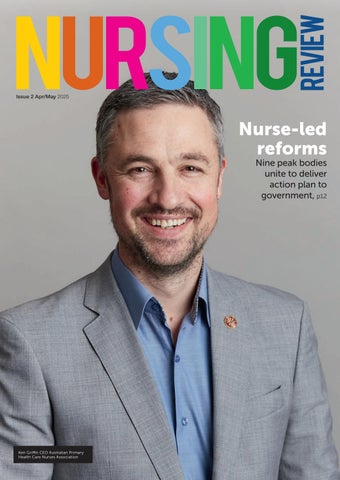
Issue 2 Apr/May 2025
Nurse-led reforms Nine peak bodies unite to deliver action plan to government, p12
Ken Griffin CEO Australian Primary Health Care Nurses Association
contents
news
MANAGING EDITOR
Rebecca Cox rebecca.cox@news.com.au
2
NSW Health Minister unable to use public hospital funding to up nurse wages
4
Parliamentary inquiry into Northern Beaches Hospital after death of two year old boy
7
Government invests in local production of IV fluid to address ongoing shortages but what about opioids?
9
Queensland nurse and midwife strikes loom as tens of thousands of wage contracts expire
HEALTH EDITOR
Stefanie Schultz stefanie.schultz@news.com.au SALES MANAGER
Sarah Licence sarah.licence@news.com.au SUBSCRIPTIONS MANAGER
Lee Burrell lee.burrell@news.com.au
02
04
COVER
Ken Griffin on why nine nursing peak bodies united, page 12
11 NSW public system doctors strike for three days over disparities in pay and conditions between states
PUBLISHED BY
Nationwide News Pty Ltd GPO Box 4245 Sydney NSW 2001 ABN 98 008 438 828 Print Post 100008043 ISSN 1326-0472 OCLC 536881479 PUBLISHER’S NOTE
industry & reform
12 COVER STORY Peak bodies unite to deliver reform action plan – APNA chief Ken Griffin tells us why
07
11
14 Australia will vote on May 3, could this be a turning point for healthcare?
© Copyright. No part of this publication can be used or reproduced in any format without express permission in writing from Nationwide News Pty Ltd. The mention of a product or service, person or company in this publication, does not indicate the publisher’s endorsement. The views expressed in this publication do not necessarily represent the opinion of the publisher, its agents, company officers or employees.
clinical practice
16 Australia’s medicine supply shortages aren’t going away any time soon
18 When patients are harmed in hospital, issues aren’t always fixed to avoid it happening again
20 Soaring flu cases prompt
14
15
16
18
warning from nation’s peak health bodies
nursingreview.com.au | 1
news NSW Minister for Health Ryan Park. Picture: NCA NewsWire/John Appleyard
Fixing the cap NSW Health Minister unable to use public hospital funding to up nurse wages By NewsWire
U
sing federal funding to come up with a better pay offer for NSW nurses has been ruled out. In March, members of the NSW Nurses and Midwives Association (NSWNMA) gathered to demand the government direct new money to ensure nurses and midwives get fair and equal pay in line with other states, claiming the workforce was leaving for better paid jobs in the private sector and interstate. Addressing budget estimates, NSW Health Minister Ryan Park said he hadn’t improved the wage offer of 10.5 per cent over three years following the federal government’s announcement of $1.7bn to fund public hospitals. He said it was “one-off” money, which means it can’t be used for remuneration increases, explaining that if he were to use it for that purpose it would only be shortterm fix as it wasn’t ongoing funding.
2 | nursingreview.com.au
“So what I would be doing is essentially saying... you could have this amount for one year while your wages are adjusted, and then it has to go back, because there’s not a flow on. We did not secure a fiveyear deal,” Mr Park said. Mr Park said a better GST deal from the Commonwealth could help with wage increases, as well as a five-year national health reform agreement rather than the one year offered. Mr Park was asked about whether the fact that NSW nurses are the second lowest paid in the country is contributing to the challenge of filling vacant positions. When asked whether he was happy with the progress of the safe staffing levels initiative, which aims to bring in more nurses at hospitals under minimum staffing levels, Mr Park said he wanted it to be rolled out “faster”. “Well, probably those who know me know that patience is not one of my strengths, so I always want it to go faster,” Mr Park said. He said recruitment of healthcare workers was a challenge at a state, national and global level.
“We are moving at a fairly rapid rate, and I will continue to personally drive it as hard as I possibly can “We are moving at a fairly rapid rate, and I will continue to personally drive it as hard as I possibly can.” “I’ve been clear, I think having a wage cap in place [in NSW under the Coalition] for 12 years has seen big gaps set out,” Mr Park said. “One of the reasons we moved very quickly last year to remove the wages cap was to try and start the process of rebuilding.” “We haven’t got that issue resolved yet. We remain in discussions with the Nurses and Midwives Association, I met with them a few days ago. “We’ll continue to have those discussions, it’s in the Industrial Relations Commission. We’re not resolved yet, but we remain at the table.” ■
news Northern Beaches Hospital in Frenchs Forest will be subject to a parliamentary inquiry. Picture: NCA NewsWire /Max Mason-Hubers
Scope to improve Parliamentary inquiry into Northern Beaches Hospital announced after death of two year old boy By Stefanie Schultz and NewsWire
T
he NSW government will conduct a parliamentary inquiry into Northern Beaches Hospital after a two-year-old boy died after receiving care at the hospital. Joe Massa was taken to Northern Beaches Hospital on September 12 2024 after he began vomiting. His parents, Elouise and Danny Massa, allege they were forced to wait two hours for a bed and wrongly triaged into a lower priority despite Joe having a high heart rate and a severe loss of fluid. He was transferred to Sydney Children’s Hospital in Randwick after suffering cardiac arrest about three hours after arriving at the emergency department. He died as a result of brain damage. NSW Health Minister Ryan Park wrote to NSW Parliament Public Accounts Committee chair Jason Yat-Sen Li in March requesting an inquiry into the safety and quality of health services provided by Northern Beaches Hospital. The scope of the inquiry will stretch back to October 2018 when the hospital opened, operated by Healthscope, for public and private patients.
4 | nursingreview.com.au
It will consider incidents at the hospital – including those that are the subject of serious adverse event reviews – and how the facility responded, along with the extent to which it implemented any changes prompted by those incidents. The inquiry will also look at how the hospital supports patient and carer escalation, including the recognise, engage, act, call, help (REACH) protocol, which was implemented by the NSW health system in 2013 and guides how loved ones or family members can escalate their concerns around how a loved one is being treated. As part of the inquiry, hospital staff standards and capabilities will be examined as well as the adequacy of systems and processes designed to prevent adverse events. Mr Park said he was grateful to the Massas for their “generosity in time and spirit” in working with the government to “honour Joe’s memory.” “We made a commitment to Elouise and Danny to undertake the necessary reviews to understand how they and their son have been let down as well as to learn what changes need to be made to prevent such a tragedy from occurring again,” Mr Park said. “To that end, I’ve asked the NSW Parliament’s Public Accounts Committee to conduct an inquiry into the safety and
quality of health services provided at Northern Beaches Hospital.” The Northern Beaches Hospital opened in 2018, replacing two smaller public hospitals, and is operated as a public/private partnership. It’s run by Healthscope, a Canadian company that operates 38 private hospitals across the country. The hospital was the subject of a similar parliamentary inquiry in 2019 that examined its operations and management. Mr Park confirmed the parliamentary inquiry would focus on the quality of health services and safety of the hospital while using the findings of the previous inquiry. The inquiry will also examine which findings and recommendations from the 2019 inquiry the hospital has implemented. Mr Yat-Sen Li said he understood the “strong community interest” in Joe’s death and was “confident the committee is well placed to undertake this important inquiry”. “I am determined to get this inquiry underway as quickly as possible, but I also want to get it right,” he said. The submission launch date will be announced in due course, Mr Yat-Sen Li said. A Healthscope spokesperson said the operator “will co-operate fully with the NSW Parliament’s Public Accounts
news
Premier Chris Minns with Danny and Elouise Massa, parents of two-year-old Joe, who died at the Northern Beaches Hospital. Picture: NCA NewsWire/Nikki Short
Committee inquiry into Northern Beaches Hospital”. In late February, the Massas met with NSW Premier Chris Minns and Mr Park, who pledged to overhaul the REACH system to improve and expand its services.
JOE’S LAW In April, Premier Chris Minns announced a change for acute hospitals, banning all future public/private partnerships and preventing any future governments from entering into such partnerships that may limit control over hospital services, such as emergency, surgical and inpatient assistance. “Today we are announcing that under ‘Joe’s Law’, NSW will ban all future public/ private partnerships being imposed on the state’s acute hospitals,” Mr Minns said. “As a Labor government, we believe critical public services like acute hospitals should remain in public hands, safeguarded from privatisation.” The death of Joe Lassa has also prompted a review of the REACH (Recognise, Engage, Act, Call, Help)
program, which was implemented following the 2013 death of Kyran Day, as a way for parents and guardians to advocate more effectively for their children during a hospital visit. The system will be renamed Joe’s Rule once examined and improved. “What we’re so pleased about is that Joe’s Rule is coming into effect, so that means that we are going to solidify the REACH protocol that was put into place over 10 years ago and make it really tangible, put it into the back of every person’s mind in NSW that they have rights, empowered, and they know how to escalate a situation if they ever feel unsafe in hospital,” Ms Massa said. “We are so thrilled with that outcome.” In late February, Healthscope admitted there were “unacceptable failings” in Joe’s treatment and was “sorry that Joe did not receive the care he deserved at our hospital”. “We agree with Joe’s parents, Elouise and Danny Massa, that every effort must be made to prevent such a tragedy occurring again and restore the confidence of the community in the hospital,” the statement read.
Healthscope said it had accepted “all findings and recommendations of the Serious Adverse Event Review” and had already implemented “several changes” to its operations. “These include prioritising the paediatric emergency department (ED) in staff specialist rounds, paediatric ED are now put first on ward rounds; morning handover meetings in the ED are now taking place in the Paediatric ED; all triage of paediatric ED patients are now double triaged including consultation with the nursing unit manager, the most senior nurse; new visual aids for triage and training are being provided; working with Dedalus and Telstra Health to rectify issues identified with systems failures; and strengthening access to the REACH protocol via QR code which all parents will be provided with at triage,” the statement read. “This proactive step will provide a clear explanation of the ability to ask for help. “Healthscope also wholeheartedly supports changing REACH to become ‘Joe’s Rule’.” > nursingreview.com.au | 5
news
<
The operator will also launch an independent review and will invite “views from patients, including the Massa family, to regain the trust of the local community.”
NURSES DEMAND BETTER Also in April, Healthscope nurses and midwives started a series of rolling work stoppages as part of historical industrial action against their employer. The NSW Nursing and Midwifery Association has been in negotiations with Healthscope since May 2024, with members seeking mandated nurse/ midwife to patient ratios, a 15 per cent one-year wage increase, 30 per cent night shift penalties, and improved leave entitlements. Strikes have taken place across the state at Healthscope hospitals, including Northern Beaches, Newcastle, and Norwest Private Hospitals. A Healthscope spokesperson said the company is disappointed that
the union has chosen to again take industrial action. “As always, our priority is to provide our patients with the best possible care. We are working with doctors and staff to manage this work stoppage with minimal impact on our patients and employees,” they said. “We’ve made what we consider to be a market leading wage offer (of 13.55 per cent over three years) in NSW with improved conditions and have negotiated with the NSWNMA in good faith. We have listened carefully to our people and consulted with them throughout the EBA process. We will continue to do so as we seek an agreement that’s fair and sustainable for our people and our hospitals.”
UP FOR SALE Now, Healthscope is preparing for sale after reaching agreements with senior lenders following reports the national private healthcare provider is $1.6bn in debt.
“These arrangements provide time and enhanced liquidity for Healthscope to focus on agreeing a longer-term solution for the business with its key stakeholders,” a spokesperson said. “As part of these forbearance arrangements, Healthscope will commence preparations for a potential sale of the business and concurrently engage in broader restructure discussions with its key stakeholders.” The spokesperson went on to say the loan repayment relief would provide “stability of ongoing operations” as well as a “greater likelihood of a longer-term solution in the best interests of all stakeholders.” The healthcare provider also agreed to a short-term deferral with landlord Northwest Healthcare Properties REIT. Healthscope was purchased by Canadian private equity group Brookfield for $4.4bn in 2019, according to The Australian, but the company is more than $1bn in debt from rent payments among other costs. ■
Join us for the premier event for nursing professionals in Australia The National Nursing Forum (NNF) is the Australian College of Nursing’s signature annual leadership and educational event bringing together nurses, students and other health professionals from around the country and across the globe. The 2025 NNF will take place from Wednesday 23 – Friday 25 July 2025 at the National Convention Centre Canberra. Attendees will enjoy a full and rich forum experience with face-toface presentations and interactions with the nursing network, the opportunity to connect with valuable sponsors and exhibitors to learn about the latest products, and more.
REGISTER TODAY Scan QR code or go to acn.edu.au/nnf
acn.edu.au/nnf 07.03.25
6 | nursingreview.com.au
news
More or less Govt invests in local production of IV fluid to address ongoing shortages but what about opioids? By Stefanie Schultz
I
n a bid to circumvent ongoing global supply chain issues of vital intravenous fluids, the Albanese government has announced they will invest $20 million to ramp up local manufacturing. Baxter Healthcare production facility in Western Sydney, Australia’s only onshore manufacture of IV fluids, will match the $20m investment, ensuring the nation’s sovereign capability in delivering critical hospital medicines. Health Minister Mark Butler said the combined funds will expand Baxter Healthcare’s capacity, creating jobs and ensuring the production of 80 million units per year from 2027. “The Albanese Labor Government is building Australia’s future by ensuring that critical medicines and medical supplies are manufactured here in Australia, by Australians,” Minister Butler said. “This is an extraordinary investment in IV fluid production.
“Our investment will now cover IV demand for Australia and we will no longer be hostage to overseas supply. “Baxter Healthcare’s facility has been an important part of manufacturing in Western Sydney for 50 years, and this investment will help it expand to produce another 20 million IV fluid bags every year. “It means more jobs, more bags of IV fluid, and less dependence on overseas production.”
THE OPIOID SHORTAGE While Palliative Care Australia (PCA) has welcomed the news, questions remain around how the Health Department will address the ongoing pain relief medication problem. “Ongoing shortages of IV fluids have been a huge concern for clinicians since 2023, but over the same time frame, even longer in some case, we have seen heartbreaking shortages of pain relief medications for people of all ages at the end of life,” PCA chief Camilla Rowland said. “In the same way that government and industry are now investing in local production to solve the IV fluids shortage, we need to do the same for pain relief medications so that people can die with peace and dignity, and so families aren’t
“Our investment will now cover IV demand for Australia and we will no longer be hostage to overseas supply left with the trauma of seeing loved ones in pain and distress.” PCA reminds the Health Minister that Tasmania is the world’s largest producer of opium poppies, supplying “almost half of the world’s demand of the alkaloid material.” “This is a significant competitive advantage for Australia as global supply chains falter and business models are challenged,” Ms Rowland said. “Our experience during Covid also demonstrates that we have the skills and capacity to manufacture vaccines locally – at that time we were able to have some independence from supply shortages and global transport challenges and look after our own. “A future made in Australia must include medicines. Using Australian grown poppies to make pain relief medications for Australians just makes sense.” ■ nursingreview.com.au | 7
SubScribe for leSS than $2 a week
The laTesT news and resources for healThcare professionals Nursing Review is essential reading for anyone involved in the healthcare sector in Australia. We provide unrivalled coverage of specialist topics from features and opinion pieces, to international news and profiles of industry leaders and those at the coal face. At Nursing Review we pride ourselves on being at the forefront of the ever-changing healthcare sector, with all the latest on industry reform, pay issues, clinical updates, what's happening in the workforce, and technology.
• Analysis of the major issues facing the health sector today • Can be used as a professional development resource • 6 issues per year • Interviews and opinion pieces from professionals in the industry • Written by an independent voice • Tax deductible
Please email edmedia.subscriptions@news.com.au to find out more
news
Queensland Health nurses and midwives outside the office of Qld Premier David Crisafulli. Picture: NCA Newswire
Time’s up Qld nurse and midwife strikes looms as tens of thousands of wage contracts expire By NewsWire
T
he Queensland government is on the brink of a major union showdown, as wage contracts for tens of thousands of nurses and midwives are being negotiated. Tensions have risen, with strike action looming alongside the critical deadline, as exhausted frontline workers demand more than the government’s current wage offer – an eight per cent pay rise over three years – which unions have slammed as inadequate amid surging inflation. After weeks of failed talks, the Queensland Nurses and Midwives’ Union (QNMU) held a last-resort meeting with Deputy Premier Jarrod Bleijie before considering protected industrial action with its 50,000 members. QNMU secretary Sarah Beaman said nurses and midwives were now
“understandably losing patience” with the Crisafulli government. “The time for answers is now,” she said. “Premier David Crisafulli made a written promise to maintain nation-leading wages and conditions for nurses and midwives on the frontline of Queensland Health. “Despite ongoing negotiations ... we don’t yet have answers regarding how and when the government will deliver their promise.” Under the former Labor government’s central wages policy, a consistent wage increase was offered across frontline sectors, with negotiations between the government and the sector. Mr Crisafulli has indicated he wants that policy to continue, however, as the QNMU agreement has now expired, union members will be permitted to take protected strike action. Queensland Council of Unions secretary Jacqueline King urged the government to recognise that fair wages were critical to attracting and retaining workers. “Public
“Under the former government’s policy, a consistent wage increase was offered across frontline sectors sector workers have been clear: they want a respectful negotiation and a wages offer that reflects the essential work they do every day,” she said. The QNMU has held meetings across the state in anticipation of protected action, with members unanimously voting to reject the current offer. “An announcement regarding next steps will be made once we have discussed the government’s response with members,” Ms Beaman said. The government has formally offered frontline public servants a three per cent wage increase this year and 2.5 per cent each year in 2027 and 2028. ■ nursingreview.com.au | 9
The laTesT news for aged care professionals
IN OUR VOLATILE INDUSTRY, AGED CARE INSITE KEEPS YOU UP TO DATE ON ALL THE LATEST NEWS Aged Care Insite provides the best in original journalism, and is the authoritative source of news and analysis for the residential and community care sectors. We pride ourselves on being at the forefront of what's happening in the ever-changing aged care sector. We provide an independent source of news, and cover the issues relevant to you.
• Comprehensive coverage of a diversity of topics affecting the aged care sector • News and information on medical matters and products • Analysis of the major issues facing the aged care sector as a whole • 6 issues per year • Editorial integrity and industry relevance • Keeps industry professionals up-to-date on the politics and policy that matter • Tax deductible
Please email edmedia.subscriptions@news.com.au to find out more
news
‘We do not want this’ Doctors are pushing for a large pay rise and better working conditions. Picture: Supplied/Australian Salaried Medical Officers’ Federation
NSW public system doctors strike for three days over disparities in pay and conditions between states By NewsWire
O
n April 8 doctors walked off the job for three days in NSW public hospitals. The doctors said they can be paid 20 to 30 per cent more in Queensland or Victoria and are hoping to be awarded pay rises as the state’s police, public servants, paramedics and teachers have been in the past 18 months. “We’re striking because we want to keep the best doctors in the public hospitals we possibly can. And in the current conditions, with the current award, we just can’t do that,” Westmead Hospital doctor Mark Priestley told Channel 9. “There are people leaving and the people that are staying here are working under conditions that we wouldn’t expect from anyone else or anywhere else in the country.” Dr Priestley has been at Westmead for more than 40 years. “I love my job, I love the people I work with. There are some particularly dedicated and talented people, and we just want to
do what’s right for the patients and the patients appreciate it,” he said. “Our colleagues, the nursing staff, they’re all very good people and work together. We just want to stay in the public system. But to do that, we just need to be remunerated properly.” The Australian Salaried Medical Officers’ Federation initiated the three-day strike. More than 5000 public sector doctors, from different specialties and levels of seniority, took action. The state government has offered a 10.5 per cent pay rise over three years. The union wants a 30 per cent bump in one year and then three per cent rises so doctors are at parity with other states. The union’s NSW branch director said the state government had failed to address overwork issues, such as doctors doing back-to-back 16-hour shifts. Some elective surgeries and clinic appointments with specialists were cancelled. The state government expected about 700 elective surgeries will be cancelled. “We do not want this,” Health Minister Ryan Park said. “I share the community’s desire to see our healthcare workers paid more – it’s why we’ve offered a 10.5 per cent multi-year wage increases (on top of the 4.5 per cent
“The doctors said they can be paid 20 to 30 per cent more in Queensland or Victoria and are hoping to be awarded pay rises already in pockets) and sat down with unions over many years to deliver those pay increases,” he said in a statement. The union had walked away from negotiations and the independent Industrial Relations Commission, Mr Park said. Of the strike, he said that patient safety was being put at risk, a contention the striking workers disagreed with. Westmead Children’s doctor Zach McPherson said, “Our members will be in our emergency departments looking after people … You’ll be safe in NSW”. “If we were to move to Queensland or Victoria, we would be earning about 20 to 30 per cent more. And ultimately we are losing our best people across the border,” Dr McPherson said. “We have the longest wait lists in the country. We have four-year wait lists for our clinics. And people are waiting for hours just to get seen for their chest pains.” ■ nursingreview.com.au | 11
industry & reform Representatives from nine peak bodies announced their action plan for nurse-led reform. Picture: Supplied/CAN
Nine perfect planners Peak bodies unite to deliver reform action plan – APNA chief Ken Griffin tells us why By Stefanie Schultz
N
ine nursing and midwifery organisations have come together to advocate for better utilisation of the nursing workforce ahead of the upcoming federal election. In a move reminiscent of the push to professionalise the roles some 40 years ago, nine of the country’s peak groups have presented a united front to the federal government, demanding nurse-led reform. The bodies are: •A ustralian Primary Health Care Nurses Association •A ustralian Nurses and Midwives Federation •A ustralian College of Nursing •A ustralian College of Midwives
12 | nursingreview.com.au
•A ustralian College of Nurse Practitioners •C ouncil of Remote Area Nurses of Australia •C ongress of Aboriginal and Torres Strait Islander Nurses and Midwives •A ustralian College of Mental Health Nurses •C ouncil of Deans of Nursing and Midwifery Their joint election statement details a seven-point action plan that the industry bodies say will “improve care, reduce waiting times, and deliver better health outcomes with minimal budget impact.” “For too long, our highly skilled nurses, nurse practitioners, and midwives have been held back by outdated regulations, restrictive funding models, and professional silos,” the statement reads. The bodies are calling for commitments to the following actions: ACTION 1: Enable Nurse Practitioners and Endorsed Midwives to directly refer patients to relevant specialists, reducing waiting times for care.
ACTION 2: Introduce funding and regulatory reforms that support nurse and midwife-led clinics and innovative care models, particularly in rural, remote, and underserved communities, enabling nurses and midwives to take leadership roles in delivering community-based primary care. ACTION 3: Work with State and Territory Governments to pass laws to support qualified Registered Nurses in every State and Territory to prescribe approved medications under the Pharmaceutical Benefits Scheme. ACTION 4: Increase the Workforce Incentive Payment Practice Stream to cover up to seven healthcare professionals, and tie payments to higher scope clinical care. ACTION 5: Authorise Nurse Practitioners, Endorsed Midwives and qualified Registered Nurses to order diagnostic tests such as mammograms, X-rays and DEXA scans. For Endorsed Midwives, this includes
industry & reform
“Seventy-six per cent of Australia’s nurses are registered nurses. Imagine if even half of them had a script pad
APNA CEO Ken Griffin. Picture: Supplied/APNA
tests such as NIPT, pelvic ultrasound, multiple pregnancy items and iron studies. ACTION 6: New and amended Medicare Benefit Schedule items for Endorsed Midwives to support pre-conception counselling, primary sexual and reproductive health, intrapartum care outside of a hospital setting (homebirth), and a general consult item for women’s health. ACTION 7: Implement a primary healthcare workforce development strategy to unlock 15,000 extra education and training places for Registered Nurses, Nurse Practitioners and midwives in the places and settings that need them most.
“We’ve got data from the APNA workforce survey that shows in primary health care, 30 per cent of nurses say that they only worked to their full scope of practice rarely or never,” he said. “They’re skilled, they’re experienced and trusted. But they’re underutilised.” Nurses and midwives represent 54 per cent of the country’s health workforce and are the profession with the best geographical spread – not to mention the average Australian nurse has 21 years of experience. The collective argues that the expansion of the scope of practice for nurses and midwives, such as allowing them to prescribe medications, will significantly improve access to healthcare and reduce pressure on the system. The Department of Health and Aged Care’s Scope of Practice Review, released last October, proposed a new national skills and capability framework aimed at removing the red tape preventing health professionals from delivering the most accessible and efficient care possible. “Seventy-six per cent of Australia’s nurses are registered nurses. Imagine if even half of them had a script pad and were able to continue the benefit of a health consultation by prescribing medications in a safe way. That would be do much for access and decreased pressure on the system,” Mr Griffin said.
RAISING OUR VOICE NURSES ARE THE SOLUTION Nursing Review sat down with Australian Primary Health Care Nurses Association (APNA) chief Ken Griffin to hear about the collective’s goals and his vision for future of nursing and midwifery.
The average Australian nurse holds 2.1 memberships to a nursing peak body, yet collaboration between those bodies is rare. “The nursing voice hasn’t always been heard as loudly as it should, and it hasn’t
necessarily been as unified as it should,” Mr Griffin said. “The peaks are really working together because we believe it’s time.” The joint election statement is a powerful message to government that nurses and midwives are united, organised and demanding to be heard. There is precedent that collaboration like this creates real and lasting change. In the mid-1980s, shortages of nurse educators in some of the country’s biggest hospitals led a group of peak bodies to push for nursing education to formally transition from hospital-based training to university qualifications, laying the foundation for the professional recognition of nurses and midwives nationwide. In a sector as complex as the health system, it is crucial that reform is led by a unified force.
THE FUTURE OF NURSING Mr Griffin said there needs to be a shift in the way nurses and midwives are educated and utilised to increase access to safe and effective care for all Australians. “Australia trains really amazing health care professionals. They work hard and there is demand all over the world. And nurses and midwives are no different,” he said. ”It doesn’t make much sense to be training them with all these great skills and then not actually letting them use those skills once they’re in the position to increase the health of Australians. “We need to make sure that we are educating nurses and midwives in more of the preventative end of the spectrum, and make sure that they’re prepared for that really vital role in primary health care. “Part of that is we need our university degrees and our TAFE diplomas making sure nurses learn in the full range of clinical settings that nurses can work in. Because at the moment they tend to focus more on the hospital environment where 70 per cent of the workforce is. “But we know that the primary health care workforce is going to become a larger percentage of the overall nursing workforce in the coming years,” he added. ■ nursingreview.com.au | 13
industry & reform
A ‘health’ election? Australia will vote on May 3, could this be a turning point for healthcare? By Stefanie Schultz
T
he nation will head to the polls on May 3 to decide on the next Prime Minister of Australia, in what will be a key moment for the healthcare sector. After much anticipation, Prime Minister Anthony Albanese called the general election, after his Treasurer, Jim Chalmers, had delivered the Labor party’s fourth federal budget just three days prior. “Over the last few years, the world has thrown a lot at Australia in uncertain times,” the Prime Minister told reporters. “Because of the strength and resilience that our people have shown, Australia is turning the corner. Now, on May 3, you choose the way forward.” We have already seen the major parties battling over health reform,
14 | nursingreview.com.au
with bulk-billing, Medicare and public hospital funding all rising to the top of political priorities. However, the sector is calling for more. “Funding to grow our GP workforce faster is critical to keep pace with the need for care across the country. Australia’s population is growing and ageing, and there’s an epidemic of chronic illnesses, which requires highquality and ongoing general practice care,” Royal Australian College of General Practitioners (RACGP) president Michael Wright said. “It’s heartening to see bipartisan political support for significant investment to improve access to specialist GP care, and to grow Australia’s GP workforce faster to meet increasing patient needs.”
MORE FOR NURSES AND MIDWIVES The federal budget papers included the $2.6 billion investment into raising the wages of nurses in aged care, announced
earlier in April, as well as $10.5 million over two years to expand the Department of Health and Aged Care’s Primary Care Nursing and Midwifery Scholarship Program, allowing more RNs to complete subsidised postgraduate study. However, the general response from industry peak bodies is that the federal government is not doing enough to address the immense challenges faced by nurses and midwives in 2025. As the Australian Nursing and Midwifery Federation (ANMF) succinctly put it: “Our politicians must stand-up for nurses and midwives.” “We now need all of our political leaders to outline how they will work with the ANMF to build on the wins we’ve achieved under the Albanese Government – and how they will stand-up for nurses and midwives with measures which improve their pay and everyday working conditions and with more cost of living relief,” ANMF Federal Secretary Annie Butler said.
industry & reform Prime Minister Anthony Albanese and Leader of the Opposition Peter Dutton have begun campaigning ahead of the May 3 election. Picture: NCA NewsWire/Martin Ollman
Annie Butler speaks at a press conference as nine nursing and midwifery peaks deliver reform plan to federal government. Picture: Supplied/ACN.
“Committing to further reforms, such as implementing the Scope of Practice Review, to support nurses and midwives will mean we build a stronger, sustainable workforce, giving Australians easier, equitable access to quality care when and where they need it.” Both major parties have promised an overhaul of the Medicare system, pouring funds into bulk-billed GP visits, more Urgent Care Clinics and mental health services. Australian College of Nursing chief Adjunct Professor Kathryn Zeitz said now is the time to “unleash“ the full potential of the country’s nurses. “Nurse-led clinics and services have been operating successfully in Australia for decades. We need more of them,” she said. “Nursing is an agile, versatile, and highly educated profession with skilled professionals working in every health setting across Australia.
“We need policies and funding to attract more people to the profession, retain nurses and midwives in life-long careers, and entice nurses who are not working as nurses back to the profession. “As more doctors retire in rural and remote Australia – with no younger doctors moving out of the cities to replace them – country people will miss out on quality care if nurses are not empowered to work to their full scope of practice, using all their clinical skills and knowledge and experience.”
PRIORITISING RURAL In a bid to address the ongoing health disparities between metro and rural areas, the National Rural Health Alliance (NHRA) is calling for a $1 billion National Rural Health Fund, designed to reduce healthcare delivery payments and build the necessary infrastructure for a healthy future. The NHRA has reminded political leaders that while rural Australians generate 70 per cent of the nation’s export income, they receive $848 less per person in healthcare funding. “We urge all Australians and the candidates who seek their votes to
NRHA chief executive Susi Tegen. Picture: Supplied.
“Committing to further reforms, such as implementing the Scope of Practice Review, to support nurses and midwives recognise and address the healthcare challenges and earlier deaths that persist in rural areas, ultimately impacting all Australians,” NRHA Chief Executive Susi Tegen said. “We ask for their support to implement a National Rural Health Strategy to coordinate Commonwealth, State, and Territory policy, investment and service delivery. This will ensure grassroots-led, sustainable solutions for rural communities throughout the patient journey. “It is time for all political leaders to step up, commit to the 7.3 million rural people that they would implement long-term solutions, and ensure that no Australian, no matter what their postcode, is left behind when it comes to accessing quality health care.” ■ nursingreview.com.au | 15
Clinical
Ongoing issue Australia’s medicine supply shortages aren’t going away any time soon By NewsWire
P
atients are struggling to fill their prescriptions in the face of hundreds of medication shortages across the country. As of March, the Therapeutic Goods Administration (TGA) has more than 400 medications listed as experiencing shortages, whereas in March 2022 that number was at 263.
Which drugs are impacted and why? Ongoing shortages include ADHD medication Concerta, hormone replacement therapy (HRT) patches and diabetes medication Ozempic. The TGA anticipates upcoming shortages of ADHD medication Ritalin. 16 | nursingreview.com.au
In 2024, Australia also experienced shortages of ADHD drug Vyvanse and HIV prevention drug PrEP. Pharmaceutical shortages in Australia are complex, as each medication has numerous ingredients with their own supply and demand pressures. Few drugs are produced in Australia due to the prohibitive production costs and comparatively small market. Australia only comprises about one per cent of the global pharmaceutical market, which is dominated by the United States and Western Europe. Though Australia has a National Medical Stockpile for health emergencies, stockpiling critical drugs often isn’t a viable solution as expiry dates need to be closely managed. Royal Australasian College of Physicians president Jennifer Martin said Australia is facing “critical medicine shortages” across the country.
“Australia imports 90 per cent of our medicines, making us highly susceptible to disruptions in supply,” she said. “We need to invest in domestic manufacturing of medicines to ensure a stable and reliable supply of critical medications for Australian patients.” In February, the TGA established the Medicine Supply Action Group, a forum to address the issue of ongoing medicine shortages. The group comprises stakeholders including the Pharmacy Guild and Australian Medical Association, and is yet to meet. Dr Martin says the lack of Australian drug manufacturing, though part of a broader trend of offshore reliance, presents a “sovereign risk of not having the things we need when we need them”. “At some level we’ve got to bite the bullet and appreciate it might not be as efficient economically or as cost-effective to manufacture [medicines] locally,
Clinical
which is only approved in Australia for the treatment of diabetes. While Ozempic is approved for diabetes treatment, it can be prescribed for other purposes at a doctor’s discretion. The TGA has issued warnings regarding supply concerns related to this practice.
What can patients do if they are impacted?
we need to do this from a sovereign risk perspective.” ADHD medications are in short supply globally due to manufacturing limits and increased demand. Despite differences in the drugs, shortages in one tend to impact others as patients with ADHD try to avoid being without medication. The active ingredient in Vyvanse, lisdexamfetamine, is produced in the US. Its production quotas are tightly regulated by the Drug Enforcement Administration (DEA) due to its potential for abuse as a stimulant, and they have not been increased despite higher demand and calls from Australian healthcare groups. HRT shortages are also global, with the TGA attributing the shortfall to “manufacturing issues and an unexpected increase in demand”. Ozempic shortages are primarily driven by increased global demand for the drug,
The general advice to patients experiencing shortages is that they should be seeking medical advice. There may be alternative options available, as advised by their healthcare provider. They may be able to switch to a similar drug that is in stock in Australia, and in some cases can use imported medicines. Importation is not always a viable solution, as alternatives still need to be approved by the TGA. Drugs not registered in Australia can be approved for importation under section 19A of the Therapeutic Goods Act in place of registered medication with supply issues. To counter the Concerta shortage, the TGA has approved the importation of overseas-produced Concerta tablets from Switzerland. Drugs approved under section 19A must be purchased at full price as they are not subsidised under the PBS. A Pharmacy Guild spokesperson said “any medicine shortage is difficult to manage and can be frustrating for patients”. “Community pharmacists will always work to discuss alternative options with patients so they can get the healthcare they need.” Due to the shortage of HRT patches, the TGA has allowed pharmacists to dispense alternative brands or strengths of the hormone treatment. Patients undertaking the therapy may also be prescribed tablets and gels instead of patches, with three new gels added to the PBS from March.
When will the shortages end? The TGA has warned the Concerta shortage, which began in October 2024, is expected to continue until the end of the year due to manufacturing issues. Shortages for HRT patches, depending on strength, are expected to resolve either in late June or December this year. Ozempic shortages are also expected to stretch until the end of the year as global demand continues to rise.
“Australia imports 90 per cent of our medicines, making us highly susceptible to disruptions in supply TGA indications of shortage lengths are only estimates, and may be further lengthened by raw materials shortages, natural disasters, panic-buying or stockpiling. The TGA considers a shortage to be resolved when a quantity of the drug arrives onshore, but these medicines can take time to filter through the Australian supply chain to consumers.
Will US tariffs affect medication availability? US pharmaceutical representatives have lobbied US President Donald Trump to target Australia with drug tariffs due to the “damaging pricing policies” of subsidised medicines on the PBS. “Egregious and discriminatory pricing policies in several markets, including Canada, Japan and Korea, continue to undervalue American innovation, threaten billions of dollars in lost sales and put American competitiveness, jobs and exports at risk,” said the submission from the Pharmaceutical Research and Manufacturers of America. Labor has made a pre-election commitment to reducing the maximum price of filling a script to $25, with the Coalition matching the cheaper medicine policy. Tariffs are usually imposed on imports rather than exports, so tariffs from the US are unlikely to impact the prices of American drugs imported to Australia. Nonetheless, President Donald Trump has talked recently about our PBS, calling it “smart” because if the way it fixes prices for imported medications. “But we’re going to do something that we have to do. We’re going to put tariff on our pharmaceuticals and once we do that, they’re going to come rushing back into our country because we’re the big market,” President Trump said. “The advantage we have over everybody is that we’re the big market. So we’re going to be announcing very shortly a major tariff on pharmaceuticals.” The majority of drugs imported to Australia are not from the US, but are instead sourced from cheaper markets including India and China. ■ nursingreview.com.au | 17
Clinical
Do no harm When patients are harmed in hospital, issues aren’t always fixed to avoid it happening again By Peter Hibbert and Jeffrey Braithwaite
O
ver the past weeks, the media has reported several cases of serious “adverse events”, where babies, children and an adult experienced harm and ultimately died while receiving care in separate Australian hospitals. When a serious adverse event occurs, hospitals investigate what happened and why, and propose recommendations to reduce the risk of similar harm occurring again. About 1600 patient safety investigations are undertaken each year. And the
18 | nursingreview.com.au
stakes are high. If not managed well, the hospital’s response can compound the psychological harm to the patient and their family. If lessons aren’t learnt, patient safety doesn’t improve. Despite three decades of concerted effort, the rate of adverse events remains stubbornly high in Australia. One in 10 people will experience harm associated with their hospital care. What can be done to reduce this harm? There is no quick fix but our research shows improving hospital investigations can have a big impact. Here’s how this can be done.
What exactly are ‘adverse events’? Thirty years ago, one of the first large-scale studies of the rates of harm to patients in Australian hospitals was published – the Quality in Australian Health Care Study.
Alongside subsequent studies in other countries, it found one in 10 hospital admissions were associated with an “adverse event”. These included: • incidents with medications (such as administering the wrong dose or drug) • hospital-acquired infections (associated with surgery or intravenous lines) • physical or mental health deterioration which is not detected and managed in a timely way. Some adverse events can lead to patients suffering serious or permanent physical disabilities and psychological trauma. Clinicians involved in such events can also suffer significant psychological distress and grief.
Clinical
How are they investigated? When a serious adverse event occurs, hospitals form a team to undertake a patient safety investigation. The teams harness experts from the clinical specialties involved in the adverse event (such as emergency department or surgery) and health service safety personnel. The investigation also informs “open disclosure” – information for the patient and family about why the adverse event occurred and what changes the health service intends to prevent a similar adverse event from happening again. But our research has shown most recommendations in these investigations are unlikely to reduce harm to patients. The complexity of health care, workforce shortages and broader pressures on the health system (such as an ageing population requiring more complex care) often work against health services effectively implementing recommendations.
So what can be done? We are undertaking research with four state and territory governments (New South Wales, Victoria, Queensland and the Australian Capital Territory) to test these strategies and inform how they can be redesigned for safer care. Here’s what we’ve found so far. A well-recognised problem with some investigations is their lack of specialised expertise in patient safety. The field is backed
by robust research, yet often the people undertaking the investigations are experts in their clinical field, or in the running of a hospital, but not in safety science. Added to that, the sheer complexity of health care makes the task of finding the factors that contributed to the harm and developing effective recommendations even more challenging. Consider the contrast this has with biomedical sciences, such as developing new drugs or tests. These use large, specialist, independent research institutions with highly trained scientists. Yet patient safety problems, which are arguably as complex, are expected to be solved with fewer resources, using part-time staff with variable task-specific experience and training, at a local hospital. Complex patient safety problems require appropriate investments in expertise and independence. Findings of investigations tend not to be shared. This means learning remains local. Repeated investigations of the same type of adverse event may be undertaken at multiple hospitals, duplicating effort. More sharing of adverse events by hospitals and health departments would reduce this duplication and make learning more efficient. Aviation does this well. If a commercial jet experiences a problem or near miss, the issue is shared so every airline knows about it. If we did this, we could redesign hospital systems to support safer care. This
“There is no quick fix but our research shows improving hospital investigations can have a big impact could, for example, include standardising how medication information, such as the dose, is displayed on all hospital computer systems. Doctors going from one hospital to another would be less likely to make errors in prescribing medication, which is a common patient safety risk. Thirty years after the rates of adverse events were first reported in Australia, patients and the broader public deserve to know that investigations are being conducted effectively and that strategies are being adopted to keep every hospital visit safer. ■ Peter Hibbert is Honorary Professor at the Australian Institute of Health Innovation, Macquarie University. Jeffrey Braithwaite is Professor of Health Systems Research, and Founding Director of the Australian Institute of Health Innovation, Macquarie University. This article is republished from The Conversation under a Creative Commons license. Read the original article at theconversation.com\au.
subscribe for less than $2 Per week The laTesT news for nursing and healThcare professionals Nursing Review is essential reading for anyone involved in the healthcare sector in Australia. It provides unrivalled coverage of specialist topics from features and opinion pieces, to international news and profiles. • Latest news and resources for all healthcare professionals • Comprehensive coverage of a diverse range of topics • Analysis of the major issues facing the health sector as a whole • Delivered free of charge to your home or place of work monthly
Please email edmedia.subscriptions@news.com.au to find out more nursingreview.com.au | 19
Clinical
Vaccinate now Soaring flu cases prompt warning from nation’s peak health bodies By Stefanie Schultz and NewsWire
A
ustralians have been urged to get a flu vaccination as cases surge across the country, almost doubling in one state. The National Notifiable Diseases Surveillance System reported there has been more than 46,300 cases of influenza across Australia this year to the end of March, representing an increase of about 50 per cent from this time last year. The report showed 67 people in Queensland had been hospitalised with influenza and another 900 were diagnosed in just one week. More than 10,000 flu cases have been reported in Victoria, which is almost double the cases compared to last year, with numbers continuing to rise. Falling influenza immunisation rates due to vaccine fatigue and misinformation, combined with the risk of a horror flu season like the one experienced in the Northern Hemisphere, could result in more lives lost in Australia from flu and other respiratory diseases this year. Australian Medical Association president Danielle McMullen said there had been a fall in the number of Australians receiving their flu vaccine in 2024 compared with
20 | nursingreview.com.au
the previous year, and the decline can’t afford to continue. “I can’t be too blunt about this: Thousands of people die each year from respiratory disease including flu, Covid-19 and RSV,” Dr McMullen said. “Older people, immunocompromised people, babies, young children, pregnant women and people with underlying medical conditions are particularly vulnerable to some of these respiratory viruses. “People should get their flu vaccine each year, as the formulation is updated annually to match circulating strains, and the protection from a flu vaccine only lasts a season.” Pharmaceutical Society of Australia senior pharmacist Peter Guthrey said the peak in cases recently seen in the Northern Hemisphere should stand as a warning for Australians. “Lots of people in the US and UK have been sick with flu and this has continued late into their flu season. Influenza can spread around the world rapidly through international travel, so Australians need to be ready for the potential of a big flu season here,” he said. “Flu vaccination is recommended annually for everyone aged six months and older and it’s the most important measure to prevent flu and its complications. Flu cases are already on the rise so it’s important that people talk
“Falling influenza immunisation rates due to vaccine fatigue and misinformation, combined with the risk of a horror flu season to their pharmacist or doctor early about influenza vaccination.” Among the predictions for a heightened flu season this year, pharmaceutical manufacturer CSL Seqirus announced earlier this month that it has released over seven million flu vaccine doses into the Australian market. “Flu is unpredictable but the data shows that the virus is already circulating and notifications are increasing. We don’t know when cases will peak, which is why we’ve worked hard to ensure our vaccines are available to help protect people,” CSL Seqirus medical director for vaccines and biosecurity Dr Jules Bayliss said. “This year, we manufactured an extra 100,000 flu vaccines to ensure there were enough doses for every person who wants to be vaccinated.” It is highly recommended that people aged over 65, children aged six months to five years, pregnant women and people with a pre-existing medical condition get vaccinated. ■
The laTesT news for aged care professionals
IN OUR VOLATILE INDUSTRY, AGED CARE INSITE KEEPS YOU UP TO DATE ON ALL THE LATEST NEWS Aged Care Insite provides the best in original journalism, and is the authoritative source of news and analysis for the residential and community care sectors. We pride ourselves on being at the forefront of what's happening in the ever-changing aged care sector. We provide an independent source of news, and cover the issues relevant to you.
• Comprehensive coverage of a diversity of topics affecting the aged care sector • News and information on medical matters and products • Analysis of the major issues facing the aged care sector as a whole • 6 issues per year • Editorial integrity and industry relevance • Keeps industry professionals up-to-date on the politics and policy that matter • Tax deductible
Please email edmedia.subscriptions@news.com.au to find out more
SubScribe for leSS than $2 a week
The laTesT news and resources for healThcare professionals Nursing Review is essential reading for anyone involved in the healthcare sector in Australia. We provide unrivalled coverage of specialist topics from features and opinion pieces, to international news and profiles of industry leaders and those at the coal face. At Nursing Review we pride ourselves on being at the forefront of the ever-changing healthcare sector, with all the latest on industry reform, pay issues, clinical updates, what's happening in the workforce, and technology.
• Analysis of the major issues facing the health sector today • Can be used as a professional development resource • 6 issues per year • Interviews and opinion pieces from professionals in the industry • Written by an independent voice • Tax deductible
Please email edmedia.subscriptions@news.com.au to find out more