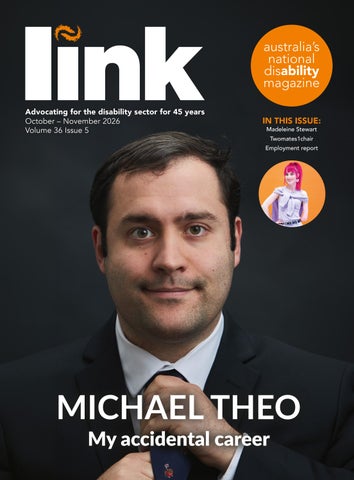
Advocating for the disability sector for 45 years October – November 2026 Volume 36 Issue 5
IN THIS ISSUE: Madeleine Stewart Twomates1chair
Employment report
MICHAEL THEO My accidental career
Tailored Postural Support for all ages
CareFlex has been at the forefront of postural and pressure care seating for over 30 years. Renowned for its clinical excellence, innovation, and craftsmanship, CareFlex continues to set the global standard in specialist seating solutions that promote comfort, stability, and independence. Each CareFlex chair is thoughtfully designed to provide optimal postural support, pressure management, and ease of use — helping clinicians meet the complex needs of their clients with confidence. Backed by years of research and continuous development, the range offers adaptable, durable solutions that improve quality of life for individuals of all ages and abilities.
Explore the CareFlex Range
AlphaCare Chair
MultiAdjust
SmartSeat Pro II
The right product for every seating need. Let us help you find your perfect fit.
Imported by:
Our Brands: Your Partner For Good 1300 212 192 apexmobility.com.au
Isabelle Isabelle Assistive Technology Assistive Technology That Fits You Perfectly That Fits You Perfectly At Astris PME, we believe no two people are the same - and neither are their assistive technology needs. Made for Me
our commitment to two delivering Mobility Positioning Assistive solutions that fit the individual, At AstrisisPME, we believe no people are theand same - and neither are Technology their assistive technology needs. Made fornot Mejust their body, but their life. Mobility and Positioning Assistive Technology solutions that fit the individual, not just is our commitment to delivering their body, their being life. the big sister means staying close to the action - spending time with her family and sharing For but Isabelle, everyday moments with her two younger sisters.toWith support of her stander, can engage with the world For Isabelle, being the big sister means staying close the the action - spending time withIsabelle her family and sharing around her at eye level and take part in daily routines, play and family life. everyday moments with her two younger sisters. With the support of her stander, Isabelle can engage with the world
around her at eyegreat levelassistive and take part in daily play and family Because technology isn’troutines, just about positioning. It’slife. about belonging, confidence and growing stronger every day. Because great assistive technology isn’t just about positioning. It’s about belonging, confidence and growing stronger every day.
Looking for your perfect fit? Looking for your Let’s get to know you and get it right. perfect fit? Let’s get to know you and get it right.
1300-131-884 1300-131-884
astris-pme.com.au EXPLORE OUR FULL RANGE astris-pme.com.au
Mobility and Positioning AT Solutions
EXPLORE OUR FULL RANGE
Mobility and Positioning AT Solutions
Got a question about Telstra’s disability products or services? Call 1800 068 424 The Disability Enquiry Hotline provides specialist advice to customers with disability and their carers across Australia. Visit telstra.com.au/accessibility-and-disability for more information.
Inside 07
From the Editor
08–09
Cover Story – Michael Theo’s accidental career
12–13
Charmaine Idris and her entrepreneurial life
14
08
12
14
17
24
28
Breaking down Grattan Institute’s Better jobs and fair wages report
17
A career after sport
24
Redesigning workplaces – Better for Care
28–29
Madeleine Stewart’s dating disasters and advice
30
When body and mind disconnect
35
After dark. Supporting choice for intimacy
39
Disability sports new era
44–45
Adventure trip highlights from Twomates1chair 6
October/November 2026
From the Editor A truly equitable and inclusive society can, at times, feel like an elusive target. In employment, the sheltered workshop model, established in the 1950s, was in response to the hard ‘no’ to mainstream employment opportunities. As a society, we struggle to leave outdated models behind and wholeheartedly commit to inclusive workspaces with equal rights to pay and conditions. Even after decades of community advocacy. In this issue, Michael Theo tells us his story of self-determination, and the importance of finding your people at work (p.8), Charmaine Idris takes us through her steps into an entrepreneurial career (p.12). And we review campaigns for change and new research around Australia’s disability employment position (p.10, 14, 17). Our additional topic feature builds on recent public conversations of sex and intimacy. Comedian Madeleine Stewart shares her awkward dating experiences (plus a few dating tips) alongside the social progress she’s noticed (p.28). Kyle Montgomery explores what it means to reconnect with sexuality in a body that’s disconnected (p.30), and psychosexual therapist Candice Care-Unger discusses how reframing
Group Publisher Mark Ryu
Executive Advisor Simon Cooper
Editors
Heidi Bain hbain@intermedia.com.au Kymberly Martin kymberly@intermedia.com.au
Heidi Bain
intimacy and sexuality can support self-identity and relationships (p.36). We’ve introduced a new Accessible Travel section. We’d love to hear from readers about any business, event or local council that’s raising the bar on inclusivity. We also cover the accessibility-focused 2026 Travel Marketing Summit (p.26) and how South Australia’s Discovery Parks used research on sensory regulation to transform the holiday experience for many more families and visitors. Next issue, we’ll reflect on the impactful events and decisions of 2026 and speak with leaders across the sector to hear what they predict for the sector in the year ahead. As always, stay connected with weekly news and events by subscribing to our newsletter at www.linkonline.com.au. Heidi Bain Editor, LINK
NEXT ISSUE
December 2026 / January 2027
Advertising
Suzy Rashoo srashoo@intermedia.com.au 0419 564 960
Design
Leanne Hogbin
Prepress
Tony Willson
Production Manager Jacqui Cooper
Subscribe
To subscribe visit www.intermedia.com.au P: 1800 651 422 or E: subscriptions@intermedia.com.au www.linkonline.com.au Link is published six times a year by Positive Impact Media Pty Ltd ABN: 51 063 279 630 A: 41 Bridge Road, Glebe NSW 2037 P: +61 2 9660 2113 Reprints from Link are permitted only with the permission of the publisher. In all cases, reprints must be acknowledged as follows: ‘Reprinted with permission from Link Magazine’, and must include the author’s byline. The opinions expressed in this publication are those of the authors and do not necessarily represent those of the publisher. The Intermedia Group takes its Corporate and Social Responsibilities seriously and is committed to reducing its impact on the environment. We continuously strive to improve our environmental performance and to initiate additional CSR based projects and activities. As part of our company policy we ensure that the products and services used in the manufacture of this magazine are sourced from environmentally responsible suppliers.
• Insights and industry projections for 2027 • Education, training and learning Advertising booking date: 30 October 2026 Advertising material deadline: 6 November 2026 Publication date: 23 November 2026 For article proposals, contact the Editor: hbain@intermedia.com.au
This magazine has been printed on paper produced from sustainably sourced wood and pulp fibre and is accredited under PEFC chain of custody. PEFC certified wood and paper products come from environmentally appropriate, socially beneficial and economically viable management of forests.
PEFC Certified
For advertising, contact the National Partnerships Director: Suzy Rashoo 0419 564 960 srashoo@intermedia.com.au
Paper from sustainably managed forests and controlled sources PEFC/21-31-119
Like us on Facebook /linkdisabilitymagazine
linkonline.com.au
pefcaustralia.org.au
linkonline.com.au
7
Link to...Cover Story Michael Theo in Austin
An unexpected career journey By Heidi Bain
M
ichael Theo didn’t intend to become a household name, yet when he applied for the ABC show Love on the Spectrum with the intention of finding love, it became an unintentional step into an acting career, and much more. “I didn’t go on the show to become famous. I went on the show in a quest to find love,” he said. Love on the Spectrum became a nationwide hit and led Theo to take on other acting roles such as the lead in Austin, but his career evolution is still gaining momentum. He is now a children’s book author, podcaster, brand ambassador for Wable, a social app for neurodivergent communities, and the autism consultant for Aspect. Even with this busy schedule, it’s important to Theo to use his platform to help others take brave steps, stay motivated and believe in themselves. The central theme of his children’s book ‘Edward’s Astonishing Animals’ is that finding 'your people' takes time, and this motto can weave through all areas of life, including the workforce. Theo said, “The book’s overall message is that you may not
8
October/November 2026
have found your crowd yet, but you will, but it takes time. The same thing applies to employers and workplaces.” Initially working in produce and manufacturing roles, Theo said he’s had good experiences in those workplaces, but there were painful and disheartening experiences too. Looking back, he felt employers at the time didn’t know how to accommodate neurodiversity, or how to respond to workplace bullying. “The company believed I needed fixing because I’m on the spectrum, which is highly false,” he said, adding “some colleagues called me names. Some even called me ‘a waste of oxygen.’” The public’s limited acceptance that human capabilities and functioning vary greatly, remain major obstacles, as people with disability confront these perceptions out and about, and in workplaces every day. Kristy Kelly from Aspect echoes Theo’s experience. “Workplace bullying is more likely to happen when there is a focus on ‘one right way to work’, leaving differences misunderstood, with detrimental outcomes if bullying goes unaddressed.”
Jobs and Skills Australia reports that people with disability have a lower employment participation rate (60 per cent) compared to those without disability (80 per cent), yet the agency estimates that 260,000 people are not employed but are ready and able to work. An opportunity exists for business leaders to discover the value and skills that neurodiverse team members can bring to their business and workplace culture, Theo said, “employers tend to view neurodiverse people as productivity hindrances, but that’s wrong. Neurodiverse people could be their most reliable assets and some of their hardest working employees. They turn up on time and just get the work done without fuss.” To address change in workplace cohesion and build respectful workplaces, Kelly said “employers play an important role in workplace education, setting expectations of kindness and addressing issues straight away so employees feel safe to speak up.” Small adjustments that make the dayto-day environment smoother are a positive first step. “Turning off music
Link to...Cover Story
for an hour, keeping the lights a little lower, offering a place where lunch can be had away from noisy areas,” Theo said. He also suggests that because everyone is different, “If you don’t know what would help them, just ask them.” From the workplace floor to management-level actions, inclusion only comes through a multi-pronged approach. For business owners, Kelly said, “Make a genuine public accountability commitment to inclusion. Then work to uphold that commitment by embedding inclusive approaches into policies, systems and everyday work practices. Starting at recruitment, onboarding, the daily workplace environment, and even understanding why someone has chosen to move on.” Although operational elements like low light and minimal noise can work for many, Kelly added that “Autistic people are so varied in talents and support needs that single strategies alone often don’t make much difference over time.” As Australians with disability struggle to find open doors to full time employment and advocates campaign
tirelessly for mandated employment equality, it’s no surprise the disability community can be left disheartened by a cycle of application rejection and stressful interview processes. Theo believes that everybody wants to feel the purpose that comes with a job, so he encourages his peers to keep trying and see what happens. “If you’re given a job opportunity, take it. See how you go. And if you’re knocked back from potential employers, don’t feel too disheartened, stay determined and press on. Cause life is like that – it still goes on.”
OUR COVER
Advocating for the disability sector for 45 years October – November 2026 Volume 36 Issue 5
IN THIS ISSUE: Madeleine Stewart Twomates1chair
Employment report
MICHAEL THEO My accidental career
Not all workplaces are a good fit for everyone, and Theo says “If someone knocks you back, it means that employer is not the right fit for you. But there will be one out there that is right.” A personal area to focus on that can help is to not worry what people think of you. “If others don’t think highly of you, that’s on them. If there are people in this world that can’t accept you for who you are, that’s not your problem.” With a lot of focus on Theo’s professional development and his budding acting career, Theo’s life
Michael Theo My accidental career
goals remain unchanged to the person that signed up for Love on the Spectrum, he’s simply adding goals as he goes. LINK asked where he sees himself in ten years, “I see myself still working with Aspect, and being a married man and having a place in Melbourne. I think I’ll still be making television shows, but I’d like to do films as well.”
“If there are people in this world that can’t accept you for what you are or who you are, that’s on them.”
linkonline.com.au
9
Link to...Employment & Careers
The employment model debate
iStockphoto.com/24K-Production
With 16 per cent of adults with disability living in poverty, compared to 10 per cent of adults without disability, advocates, policymakers and people with disability alike agree that something has to change. The harder question is, how?
W
ork gives shape and purpose to our lives. The routine of rising and arriving on time, and the quieter reward of being part of a group that meets a deeply human need. Yet for Australians with disability, finding a job, upskilling within it and going home with a fair wage, while feeling genuinely included and respected at work, remains an uphill battle. THE CHALLENGES The labour force participation rate for Australians with disability sits at 53 per cent, compared to 84 per cent for those without disability. For people with profound disability, the employment rate falls to just 34 per cent, with many working under the Supported Wage System, where the legal pay rate can be as low as $3.31 an hour, compared to a minimum of $26.44 for other workers. Add social stigma, discrimination and bullying to the mix, and it’s clear why the most effective employment model for people with disability remains so fiercely contested.
10
October/November 2026
OPPOSING VIEWS The national disability employment strategy, Employ My Ability, launched in 2021 with a ten-year vision to build a workplace culture where people with disability can thrive. Its priorities are to lift employer engagement, capacity and demand, help young people build skills and experience, improve pathways for job seekers and employers, and shift stigmatising community attitudes. Now past its halfway mark, the strategy’s outcomes remain, far from positive. And the sector is still divided on what structural change should look like.
STIGMA AND COMMUNITY ATTITUDES Assumptions about capability and workplace discrimination continue to stall individuals’ opportunities and career growth. Research by the Australian Human Rights Commission in 2022 found 45 per cent of employed people with disability had experienced unfair treatment from their employer in the previous 12 months. But fair treatment isn’t the employer’s job alone. A comparative survey found the share of workers who valued the contribution of employing people with disability fell from 77 per cent in 2022 to 74 per cent in 2024.
National Disability Services, the peak body for service providers, along with Australian Disability Enterprises, backs the SWS model, calling for an upgraded version with greater focus on skill-building and job diversity.
REVIEWING THE MODELS Under the Fair Work Act, employees with disability hold the same minimum wage entitlements as anyone else, except where the Supported Wage System (SWS) applies. Under the SWS, pay is calculated by assessed work capacity: a worker assessed at 70 per cent capacity is paid 70 per cent of the award rate. In practice, this leaves some workers legally earning as little as $3.31 an hour.
WHERE TO FROM HERE Few dispute that the status quo is failing too many Australians with disability. What divides the sector isn’t the goal, but the road to get there — reform the existing model, or replace it altogether. What is clear is that real change demands more than policy on paper it needs genuine collaboration between government, employers, service providers and people with disability.
People with Disability Australia takes the opposite stance, advocating to phase out both the SWS model and segregated workplaces in favour of open employment, built around a new benchmark with inclusion embedded from the ground up. Inclusion Australia shares this view, describing pay rates under the Australian Disability Enterprises model as discriminatory.
Link to...Employment & Careers
A different way to learn when the classroom isn’t working
F
or some autistic students, getting to school can be one of the hardest parts of learning.
Anxiety, sensory overwhelm, burnout and other challenges can make attending a traditional classroom difficult. When this happens, distance education can provide another way for students to stay connected to learning without the pressures of the school environment. There are five primary reasons families opt for distance education for their autistic child. SCHOOL ENVIRONMENTS CAN FEEL OVERWHELMING Busy classrooms, noise, transitions and the unpredictability of the school day can be challenging for some autistic students. Learning from home can reduce these pressures and create
an environment where they feel more comfortable and ready to learn. THEY LEARN BEST WHEN TEACHING IS PERSONALISED Every autistic student has different strengths, interests and support needs. Aspect Distance Education provides individualised learning, helping students engage with the curriculum in ways that work for them. THEY NEED GREATER FLEXIBILITY TO STAY ENGAGED For students experiencing anxiety, burnout or school attendance difficulties, a more flexible approach can help them remain connected to education while supporting their wellbeing. THEY WANT CONNECTION – JUST IN A DIFFERENT WAY Distance education doesn’t have
Autism-specific online school
to mean learning alone. Live online lessons allow students to connect with teachers and classmates, while Aspect also offers group activities, connection days and excursions. THEY NEED A PATHWAY THAT CAN CHANGE WITH THEM Distance education doesn’t have to be forever. For some students it is a long-term option while for others, it provides time to rebuild confidence, wellbeing and skills before returning to a classroom when they are ready. Aspect Distance Education currently supports autistic students across NSW and South Australia, providing specialist teaching and support to help students stay connected with learning in a way that works for them.
Now Enrolling for 2027
Flexible, personalised education for Autistic students in a learning environment designed for them. • • • •
60 years of expertise in autism education Live online sessions Small class sizes Building confidence and wellbeing Join one of our free online information sessions to learn more aspect.org.au/distance-education
Supporting students in: Years 3–12 in NSW | Years 3–6 in South Australia
linkonline.com.au
11
Link to...Strap
An entrepreneurial life By Kymberly Martin
C
harmaine Idris leads an extraordinary life – freelance writer, art critic, entrepreneur, stylist, public speaker, exercise enthusiast, disability advocate and peer support leader. In 2021 and again in 2026, Idris underwent intensive chemotherapy for multiple myeloma, a cancer that attacks the bone marrow. She is again in remission. Idris left South Africa in 1980. Confident about her decision to migrate she purchased a one-way ticket to Australia after receiving her permanent residency. Melbourne became her chosen city where she
12
October/November 2026
embarked on a journey of healing after being subjected to the divisive apartheid system of governance. In 1994, with her two children she accompanied her ex-husband to Malaysia to assist him in establishing a business. A few years later an attack in a car park left her with an incomplete spinal cord injury. This turning point in her life inspired her to write her first play that highlighted migration, racism, religion, parenting, relationships and disability. Fiktre and Charmaine
Idris returned to Australia in 2007 and settled in Brisbane.
Link to...Employment & Careers
A decade later her entrepreneurial spirit emerged with the launch of Diva Headwraps – colourful hair accessory collections that feature intricate patterns on cotton fabrics in batik, linen, bamboo, merino wool, denim and velvet designs. Idris has recently launched a new range - pre-sewn pocket headwraps for those with hair loss. Her latest headwrap collection features contemporary motifs in a predominantly black and white range. This includes her first batch of monochrome tote bags, designed and made exclusively for her small business by a small business. Both are anticipated to be launched in October. Idris holds regular headwrap workshops, attended by divas who are interested in knowing not only how to style a headwrap but also the history and culture about wearing a headwrap. “It gives attendees the opportunity to experience firsthand what it’s like to wear a head covering, many admitting that this ‘mere piece of cloth’ has the ability to elevate them to queen status.”
Fiktre wearing Diva Headwraps
Idris’s momentum continues – she recently completed an indoor rockclimbing exercise with Paraclimbing QLD, putting a 4x4 all-terrain wheelchair to the test while exploring the Mary Caincross Scenic Reserve on the Queensland Sunshine Coast, and covering one of the state’s most colourful celebrations, the Carnival of Flowers in Toowoomba. “I’m keen to attend a come-and-try day with Para Ice Hockey QLD, which
Cotton headwraps
is my next challenge, so I can write about my experience for The Advocate, a quarterly magazine published by Spinal Life Australia, to highlight the importance of trying different sports. She told LINK, “For people with disability who excel at sports and take any form of exercise seriously, it requires a certain mindset, determination and resilience to keep your body moving when you have a disability and even more importantly, as you age”. Asked about Artificial Intelligence she said her biggest critique is assembling information en masse (vis-a-vis the destruction of books) that comes with a huge cost to society and the indiscriminate, eco-unfriendly building of infrastructure that is required to keep AI labs working. “If utilised defensively, AI can be an assistive mechanism, but if utilised offensively, it could become a replacement for critical thinking, the realm of which belongs to humans. As a result, we only rely on AI information, forcing our most magnificent organ - the brain to decay, to be neglected. AI should be relegated to being an enhancement where relevant, not a replacement.” As for the NDIS. “After all the extensive lobbying done by PWDs, including a Royal Commission, the results have fallen on deaf ears, yet still the new Bill has been passed. Mahatma Gandhi said: “The true measure of any society can be found in how it treats its most vulnerable members’’. The NDIS should take heed!”
Celebrating Diva Headwraps 10th anniversary
For more on Charmaine Idris and Diva Headwraps visit www.divaheadwraps.com linkonline.com.au
13
Link to...Employment & Careers
Disability employment falling short iStockphoto.com/Bill Oxford
practices, and is out of step with community expectations. Government should play an active role in lifting expectations for Disability Social Enterprises, encouraging a model that is commercially sustainable and has the capacity to pay fair wages.
A
ustralia’s disability employment system is not delivering for those who need it most, and despite sustained policy attention and more than $1.3 billion in annual public investment, outcomes remain persistently weak, particularly for people with high support needs. Australians with disability face labour market disadvantage, are less likely to be in paid work, and earn much less when they are, according to a report from the Grattan Institute. Too many with high needs remain excluded from the workforce altogether, diverted into day programs that substitute for work, or confined to sheltered work at low pay, with little prospect of progression. The NDIS was supposed to drive improvement in disability employment rates, but progress has been slow and uneven and few people with high support needs have been assisted into mainstream jobs. Yet the evidence on what works is clear. In Australia and internationally, better results are achieved when systems
14
October/November 2026
prioritise open employment, regardless of level of need. This requires tailored job matching, ‘place and train’ approaches, job customisation, and dedicated pathways from education. The report recommended that the Federal Government should systematically embed these features across the Australian system. But improved services alone will not be sufficient. Demand-side barriers remain significant: too few employers recruit, accommodate, and retain people with disability. Shifting employer behaviour requires more deliberate policy action – government should build capability, increase transparency and accountability, and leverage its role as a major employer to create stronger incentives for inclusive hiring. Reform must also address the role of disability employment-focused social enterprises. While specialist employers provide important work opportunities and are a valid choice for some people, the current model is commercially fragile, entrenches systemically low wages, is built on last century’s work
Transitioning the sector to this preferred model cannot happen overnight. But international experience shows that with the right policy settings in place, changes that lift wages and increase employment rates are possible. The consequences of inaction are profound: continued low participation, suppressed wages, and structural fragility that leaves enterprises, and the jobs they provide, at risk. Targeted upfront investment can deliver reform that is budget-positive within 10 years, with better resource allocation, reduced welfare payments, and higher tax revenue more than offsetting the cost. A more effective disability employment system is within reach. With clearer policy direction from government, stronger alignment of funding and incentives, and the ambition to reform how employment is supported, structured, and remunerated, Australia can deliver better results while ensuring no Australian with disability is left behind. The report recommended the following: • Prioritise open employment for disabled people with high support needs • Expand mainstream employment opportunities for people with disability • Preference sustainable jobs in commercially visible Disability Social Enterprises paying fair wages • Move away from sub-minimum wages and disability-only employment.
Link to...Employment & Careers
“Mum, we’re going out. Are you coming?”
A
For children or carers, it can mean less effort getting the wheelchair in and out of the car and more confidence about taking it along. It glides smoothly indoors and out, making it nearly effortless for caregivers to push and handle.
t just 8.6 kg, having the Breezy Carbon folding wheelchair makes it easier to say yes.
Staying active and continuing to enjoy life with friends and family is what matters most. And for children, it is often about helping Mum or Dad get out and about, without making every outing feel like an effort.
FOR MUM, FOR DAD. FOR THE WHOLE FAMILY The Breezy Carbon is designed to help people maintain their connection with the world around them, while making life a little easier for the family members who support them.
MEET THE BREEZY CARBON The Breezy Carbon is an ultralightweight carbon folding wheelchair designed to make everyday outings easier for both the person using it and the people helping them. Made with a lightweight carbon-fibre frame, it is easy to lift, transport and store whether you’re heading to a family lunch, visiting the shops, taking a trip away or simply enjoying a day out together. The high-gloss carbon finish gives the Breezy Carbon a sleek, premium, and stylish look while the back and seat upholstery ensure a comfortable ride.
BREEZY CARBON Part of the freedom that folds family. Just 8.6 kg. Easy to take. Ready to go. BECAUSE EVERY KILOGRAM MAKES A DIFFERENCE Lightweight design can mean less dependence on others and greater freedom to say, “Yes, let’s go.”
Learn more about the Breezy Carbon and the other “Freedom That Folds” products www.sunrisemedical.com. au/wheelchairs/breezy/manualwheelchairs/breezy-carbon
Super light foldable transport chair High-gloss Carbon finish adds a touch of luxury and style.
Super light only 8.6 kg
Easy folding
Fits in most cars
Scan the QR code to see the Breezy Carbon in ACTION!
linkonline.com.au
15
Link to...Employment & Careers
Where employment opportunities can bloom and Welfare indicates that while employment outcomes are improving for students with disability who have completed vocational or education training, the community is still confronted with a challenging public perception of who they are.
Tabitha, Susan and Val
Stigma, unconscious bias and limited understanding of disability in the community remain strong barriers to people with disability transitioning into working life. Australia’s Disability Strategy incorporates elements to improve disability awareness, foster respect and reduce discrimination, yet these attitudes are often deeply embedded in both personal and professional settings.
A
s young people leave high school, contemplation around what to study or what job to start with takes over. For Valeria and Tabitha, the idea of working with flowers and creating feature displays for important days in people’s lives piqued their interest. Northcott Disability Services’ work and study programs support students to get job-ready by teaching vocational skills and offering learning environments tailored to each individual’s needs. The program is giving them exposure to a day in the life of a florist while learning the techniques and artistry of floral work and assisting on a wedding order. Susan Colless from Northcott said, “They’ve put a tremendous amount of effort into creating beautiful designs for a wedding, and through this process they’re developing valuable floristry skills. “They’re using tools such as wire cutters to understand flower placement and design principles. They’re also developing time management skills by working to real project deadlines.”
16
October/November 2026
Northcott works with students to understand their skills and strengths, and then creates a unique, flexible plan that supports the way they learn. “The skills participants are developing through the program will help create future employment opportunities and build their confidence in the workplace,” said Colless, who is particularly pleased that program participants have gone on to enrol in a Certificate II at TAFE. Work and study programs for people with support needs can be just the start they need for a fulfilling working life. Projects often take a holistic approach to employment preparation, covering planning and time management, resumes and interview skills, money and budgeting, public transport, and building resilience for unexpected workplace situations. COMMUNITY ATTITUDES With practical skills and preparednesscentred programs in place, young people still face additional hurdles in the workforce. A 2026 report by the Australian Institute of Health
The national strategy uses surveys to measure progress in attitudes, and unfortunately these indicate that the rate of change in community attitudes has, for the most part, remained stagnant. This means more impactful awareness programs and sustained community engagement will be needed to steer Australia toward a future that’s truly inclusive. Programs like Northcott’s are great examples that, with the right support, young people with disability can build the job skills and confidence needed for real pathways into work. The next step is ensuring the wider community meets that readiness with the same openness.
Link to...Employment & Careers
iStockphoto.com/PomInOz
Carving a career after sports
P
ara-athletes commit their lives to their chosen sport, and keep Australians rushed with pride, particularly when Olympic fever dominates our screens every four years. While their peers are taking first employment steps with after school jobs, athletes spend long hours training and preparing for competition. Early 20s sets in and their peers may have full-time work or a career direction in university underway. To support Australian para-athletes to transition from a sporting career to workforce employment, Paralympics Australia aims to encourage more employers to consider the exceptional skill and work ethic that athletes can bring to a workplace. The Beyond Sport Mentoring and Employment Program supports paraathletes and people with disability through mentoring and career
“A sporting career is only one chapter in a Paralympian’s life” development, helping to carve out meaningful employment pathways with them. In tandem, the program helps employers build diverse, skilful and inclusive workforces and workplace cultures. The program is acknowledged and endorsed as global best practice by the International Paralympic Committee (IPC) as its foundations provide para-athletes with valuable guidance. Following a recent expansion, Paralympics Australia has broadened flexible employment opportunities for para-athletes and people with disability, strengthening career
transition partnerships and enhancing profiling to better match candidates with employers. Training and entrepreneurship initiatives also help build candidates’ workplace confidence and decision-making skills, equipping them to take the tactical steps needed to develop a long-term career. Paralympics Australia CEO Cameron Murray said the program was changing perceptions about disability employment, leading to positive employment outcomes. “The Beyond Sport Mentoring and Employment Program is about recognising talent, not limitations. Every day, Paralympians and people with disability demonstrate resilience, adaptability, leadership and problem-solving skills that employers are actively seeking. A sporting career is only one chapter in a Paralympian’s life,” he said. More on the Beyond Sport program at www.paralympic.org.au linkonline.com.au
17
Link to...Employment & Careers
Your goals. Your career. Your future.
W
hat would having the right job mean to you?
hospitality, warehousing, manufacturing and administration.
For Georgia, it meant earning her own money, building independence and getting back into the workforce.
Your employment journey can also include study, training or volunteering to help build skills and confidence.
With personalised support from Endeavour Foundation through Inclusive Employment Australia (IEA), Georgia turned that goal into reality.
And if your first job is not the right fit, your team can continue supporting you to explore other opportunities that better match your strengths and goals.
Georgia
BUILDING SKILLS AND CONFIDENCE When Georgia joined IEA through Endeavour Foundation, she had a clear goal. She was ready to work.
SUPPORT BUILT AROUND YOU Inclusive Employment Australia (IEA) is a free, government-funded employment program that helps people with disability find and keep work that suits their skills and goals.
Georgia took the lead in her employment journey, reaching out directly to a local resort. Her positive attitude and friendly nature made a strong first impression.
IEA is separate from the NDIS, so you do not need an NDIS plan to participate. Some people may be able to access IEA alongside NDIS supports, depending on their circumstances.
With support from her Career Development Advisor, a work trial was arranged so Georgia could show what she could do.
Endeavour Foundation is an intellectual disability specialist provider of IEA, with personalised employment support across Queensland, Victoria and South Australia.
Her focus, attention to detail and willingness to learn stood out. She was offered a job as a housekeeper and room attendant on the same day. “I am so happy I finally have work and can make my own money,” Georgia said. As she learnt the role, Georgia’s team found ways to make new tasks meaningful to her. When preparing guest rooms, they encouraged her to imagine she was getting each room ready for her favourite singer, Keith Urban. Georgia connected with the idea immediately and took pride in making every room feel complete. She has since progressed into a new role with Peppers Hotels, where she continues to build her skills and confidence. Her next goal is learning to travel independently on public transport.
18
October/November 2026
When you join, a Career Development Advisor gets to know your strengths, interests and employment goals. Depending on what you need, support can include: • preparing a résumé and applying for jobs • practising for interviews • connecting with inclusive employers • training and skill development • support with travel and workplace adjustments Support can continue after you get the job, helping you settle in, build confidence and succeed at work. FINDING WORK THAT FITS YOU There is no single type of job you need to pursue through IEA. Endeavour Foundation works with inclusive employers across a range of industries including retail,
The goal is not simply to find a job. It is to find an opportunity where you can contribute, develop your skills and build greater independence. COULD IEA BE RIGHT FOR YOU? Checking your eligibility is easy. IEA could be for you if you: • have a disability, injury or health condition • are looking for help to find or keep a job • are at least 14 years old and younger than Age Pension age. You do not need: • an NDIS plan or Disability Support Pension • previous work experience • a referral before contacting Endeavour Foundation. If you are unsure whether you are eligible, our team can help you understand your options and next steps. START YOUR EMPLOYMENT JOURNEY Whether you are preparing for your first job, returning to work or looking for your next opportunity, the right support can help you move forward with confidence. Just like Georgia, your employment journey can start with one goal and lead somewhere exciting. Ready to explore where your skills could take you? Visit endeavour.com.au or call 1800 112 112
Find a Job That Works for You Discover disability employment opportunities that match your strengths, interests and goals, with different ways to work and support at every step.
“I am so happy I finally have work and can make my own money.” Georgia
Build Your Career with the Right Support Work with Endeavour Foundation
•
Build skills, confidence and independence in a supportive workplace with a team around you.
• • •
75 years supporting people with intellectual disability Local expertise, backed by a national organisation Trusted not-for-profit focused on your goals Personalised support to find and maintain employment
Ready to take the next steps?
Discover disability employment with Endeavour Foundation.
Work in a local business Explore opportunities with inclusive employers in your community, with personalised support to help you succeed.
Link to...Employment & Careers
Discover what’s possible at the 2027 ATSA Independent Living Expos
S
ometimes the hardest part of finding the right assistive technology is simply knowing what is out there. A new mobility solution, piece of equipment or everyday living aid can make a significant difference to independence, comfort and confidence, but finding the right option can take time. Online research is useful, but when it comes to assistive technology, there is real value in being able to see a product, try it for yourself and ask questions before deciding what might work for you. That is exactly what visitors can do at the 2027 ATSA Independent Living Expos. In 2027, these expos will be held in Hobart, Perth and Melbourne, bringing together assistive technology suppliers, people with disability, families, carers and health professionals for free events dedicated to exploring what is possible. SEE, TRY AND COMPARE Across the expo floor, visitors can discover products and solutions covering mobility, seating, daily living,
20
October/November 2026
beds and pressure care, bathroom equipment, home modifications, vehicle solutions, communication and adaptive technology, all under one roof. Importantly, the expos are hands-on. You can compare different products, speak directly with suppliers, ask the questions that matter to you and discover technology you may not have known existed. As one 2026 visitor described it, “ATSA is basically the Disneyland of assistive technology.” Whether you are looking for something now, planning for the future or simply curious about new developments, there is no expectation that you arrive knowing exactly what you need. Bring your questions, take your time and explore. IDEAS AND INFORMATION TOO The expos are about more than products. Visitors can also attend a program of free educational sessions featuring practical information, new ideas and developments across
assistive technology, disability and independent living. For allied health professionals and others working in the disability sector, the events also offer the opportunity to keep up with emerging products, connect with suppliers and see solutions outside the usual clinical or workplace setting. JOIN US IN 2027 The 2027 ATSA Independent Living Expos will be held: Hobart: 4 March Perth: 19–20 May Melbourne: 26–27 May Entry is free and visitors who pre-register will also receive a complimentary coffee. Come along, have a look, try something new and start a conversation. You might just discover a solution that makes everyday life a little easier, or opens up possibilities you had not considered before. Register at www.expo.atsa.org.au.
FREE REGISTRATION! FREE COFFEE! FREE SEMINARS!
Australia’s foremost assistive technology event
BY THE INDUSTRY FOR THE INDUSTRY
REGISTER NOW
HOBART
4 MARCH 2027 PRINCES WHARF NO. 1
PERTH
19-20 MAY 2027 CLAREMONT SHOWGROUND
MELBOURNE 26-27 MAY 2027
MELBOURNE SHOWGROUNDS
Media Partners
(02) 8006 7357
www.expo.atsa.org.au
Link to...Mobility
Key considerations in the wheelchair/stroller debate Will the child propel independently, be pushed by someone else, or use both approaches? Will the equipment be used all day or occasionally? Distances, surfaces and environments can influence which features are most useful. For some children, a manual wheelchair may support independence. For others, an attendant-propelled wheelchair or supportive stroller may better suit longer distances, community access or fatigue management. TRANSPORT AND PRACTICAL CONSIDERATIONS How the equipment fits into family routines can be just as important as how it performs.
C
hoosing wheeled mobility for a child involves many considerations. The goals are often similar – supporting comfort, function, safety and participation, reducing fatigue, and helping them to access everyday activities. How those goals are achieved will differ for every child and family.
families and clinicians to compare frames, seating configurations and features in practice.
One question that comes up regularly is: Do we need a stroller or a wheelchair?
Features such as tilt-in-space, recline, lateral supports, head supports and specialised seating may be important, while other families may prioritise simplicity, portability and ease of use.
There is not always a simple answer. The most suitable option depends on the child, their needs, environment and how the equipment will be used. For some, a supportive stroller may provide the right balance of positioning and portability. For others, a configurable manual wheelchair may better support postural, functional or independence goals. This is where Astris PME’s Made for Me approach begins. By looking beyond the equipment to understand the person using it. ASSESSMENT IS KEY A thorough assessment with the child’s treating clinician helps build a picture of the child’s needs from their mobility equipment and which options may be appropriate to explore. Trials allow
22
October/November 2026
POSTURE, POSITIONING AND FIT Consider the support required for the head, trunk, pelvis, hips and lower limbs, along with muscle tone, fatigue and changing needs throughout the day.
Fit matters too. Seat depth, hip and trunk width, back and shoulder height and lower-leg length can help guide sizing, together with positioning needs. Growth should also be considered. Many paediatric mobility products available through Astris PME offer adjustment or growth capability. The frame may also need to carry medical equipment or communication devices. COMFORT, TRANSFERS AND EVERYDAY USE Consider how the child will transfer in and out of the equipment and whether they can assist. Seat-to-floor height, frame design and removable supports can influence practicality.
Folded size, weight, storage and setup all affect usability. Accessories such as trays, postural supports and weather protection may also make a difference. In some cases, more than one mobility solution may suit different environments or activities. BUILDING THE MOBILITY PICTURE Ultimately, the wheelchair-versusstroller question is less about choosing a category and more about identifying what the child needs their mobility equipment to do for them. With the right assessment and trials, families and clinicians can compare suitable options and make informed decisions based on comfort, function, safety, participation and everyday life. That is Astris PME thinking process behind Made for Me. Specialist consultants work alongside children, families and treating clinicians to explore paediatric mobility and seating solutions that fit the individual. Ready to explore your options? Talk to the Astris PME team about arranging an equipment trial with your treating therapist. Call 1300 131 884 or visit astris-pme.com.au to get started.
Link to...Employment & Careers
Link to...Employment & Careers
iStockphoto.com/Morsa Images
Building stronger workplaces Design for Care’s next stage brings masterclasses and online modules. Johnson said, “This transformational program is designed to support professionals in people and culture, work health and safety, and organisational development, along with senior managers to empower them to act on work design challenges or psychosocial risks, with support and guidance from field experts.” The masterclasses are five full-day workshops held across six months, with additional support from the Design for Care team. The online modules support carers, health professionals and their leaders to understand work design and how to adjust their own work to support their wellbeing and are conducted in onehour online training sessions.
T
here’s a concerning trend that has been quietly building among Australia’s care sector workers. Psychological pressure and stress are increasingly prevalent, and researchers have directly connected the issue to the workplace environment, the way work is organised and the sometimes confronting experiences workers are exposed to. icare NSW workers compensation claims analysed by researchers, found that psychological injury claims by people in care and social assistance roles were, on average, higher than those in non-care specific roles and increasing at a faster rate. The analysis found claims fell into three main areas: workplace harassment and bullying, high-pressure work environments, and occupational violence. On dissecting further, the research also highlighted that for many workers, capability and confidence in a role’s requirements was not an issue. However, knowing what a given role’s specific responsibilities were, and
24
October/November 2026
where and how the employee should prioritise their time to achieve them, was an issue — leaving tolerance for challenges low and stress levels high. Building on these insights, researchers from the Centre for Transformative Work Design at Curtin University, the University of Sydney, and Monash University collaborated to create Design for Care, an initiative to improve care-centric workplaces. They have created a process to redesign carers work to improve employee mental health. With the initial research stage complete, Design for Care piloted the SMART Work Design model and the participatory redesign process with eight healthcare and social assistance organisations. As well as initial positive signs of improved psychological impacts from the pilot, Professor Anya Johnson from the University of Sydney said, "We have also seen improvements in retention and lower levels of absence. "And we're seen higher motivation and engagement and improved collegiality."
As an organisation moves through structural changes, support from industry and field experts can help cement learning and settling into a new workplace framework. “For the participants of the masterclass series, we will have both informal drop-in sessions between workshops and support from our team to embed work design change within the organisation,” Johnson said. To be eligible for the free program, organisations need to be NSW healthcare and social assistance service providers (aged care, disability care and out-of-home care), be insured by icare NSW, be able to apply learning directly and commit at least two learners to the program. In-person sessions will be held at the University of Sydney Business School to facilitate the in-person experience of the learning, and to encourage a collaborative exchange between executives and managers across the sector, to work together to establish a reformed working model for the care sector that builds a sustainable future and healthy and motivated employees.
Link to...Mobility
Looking for that escape?
W
ith the weather warming up and the days becoming longer, many of us are eager to head outdoors and explore everything Australia has to offer. Whether it’s a trip to the beach, a picnic in the park or a scenic nature trail, getting outside is one of life’s great pleasures.
driven on. Whether you’re providing access for a family gathering, beach visit or temporary pathway, GOtrax helps remove the barriers that uneven terrain creates. Designed for durability and ease of use, GOtrax gives individuals greater confidence to explore and participate while helping event organisers, councils and families create more accessible environments for everyone.
For people living with mobility challenges, these adventures can often be cut short. Walking with crutches, a walker, or using a mobility device, can make soft or uneven ground a significant obstacle. Gravel, sand and muddy surfaces can quickly turn an enjoyable outing into a frustrating experience.
Best of all, creating accessible pathways doesn’t have to be expensive. GOtrax access matting is available from as little as $880 for a 4.5-metre section, making improved accessibility an affordable investment for organisations and individuals alike.
GOtrax matting offers a simple yet highly effective solution. Lightweight, portable and incredibly versatile, GOtrax mats can be deployed in minutes to create a firm, stable surface that can be safely walked or
With GOtrax, more places become accessible, more adventures become possible, and more people can enjoy the freedom of getting outdoors.
This spring, don’t let the ground beneath your feet determine where you can go. To find out more, contact GOtrax on 0488 375 223 or email enquiries@uniquiphealth.com.au
“LOOKING FOR THAT ESCAPE?”
GOtrax can make all the Difference Sales enquiries contact: 0488 375 223 enquiries@uniquiphealth.com.au
Follow us online GOTRAX
gotrax.com.au
ORDER ONLINE NOW
linkonline.com.au
25
Link to...Mobility
Built for Adventure. Engineered for Independence to changing physical needs over time. Rather than simply providing mobility for where a young person is today, its flexible design is intended to support where they’re going next. For a young person preparing for employment, the ability to move confidently and independently through different environments can be an important part of developing workplace readiness. Being able to position themselves at a desk, approach colleagues, navigate shared spaces or independently access facilities can support participation and confidence. But independence is personal.
F
or young people living with disability, independence is about more than getting from A to B. It’s about having the freedom to explore, participate, make choices and build the skills and confidence needed for the future. As children grow, their world grows with them. School becomes work experience, work experience becomes employment, and everyday activities become opportunities to develop independence and discover what’s possible. Having mobility equipment that can keep pace with that journey can make a meaningful difference. MEET THE AMYLIOR ALLTRACK P3 MWD POWER WHEELCHAIR Designed specifically for younger and lighter users, the Alltrack P3 brings the proven performance and durability of the full-size Alltrack M3 into a compact, kid-friendly package. Built for exploration and growth, it combines stability, comfort and manoeuvrability with a suspension system specifically tuned for lighter users.
26
October/November 2026
Importantly, independence doesn’t stop at the front door. The Alltrack P3 is designed to perform across both indoor and outdoor environments, supporting participation in everyday activities, from navigating classrooms and workplaces to getting around shopping centres, community spaces and outdoor environments. Its compact footprint can be particularly valuable in environments where space and accessibility matter. Available in narrow configurations, the base can be as narrow as 535 mm with Group 22NF batteries and 355 mm drive wheels. A seat-to-floor height as low as (395 mm) can also make it easier for young users to interact with their surroundings and access everyday activities. And because growing up means changing, the Alltrack P3 is designed to change with the young person. With a 130 kg weight capacity, a seat pan that grows in both width and depth, and suspension kits that can be changed as the child develops, the P3 can adapt
For one young person, it may mean navigating the school grounds independently. For another, it may mean getting to their first part-time job, participating in work experience, meeting friends after school or exploring a new environment without relying on someone else to provide every aspect of their mobility. The Alltrack P3 has been engineered with that broader picture in mind. Its robust M3-derived base provides stability and durability, while its compact design and customisable features allow the chair to be configured around the individual. The result is a power wheelchair designed not simply to support mobility today, but to help young people engage with the opportunities around them as they grow. Because building independence starts long before entering the workforce. It starts with having the freedom to explore, participate, make choices and experience the world on your own terms. Built for adventure. Engineered for independence. Designed for what comes next.
Small footprint. Big possibilities.
Confident indoors. Capable outdoors. Compact for everyday spaces. Powerful for the adventure ahead. Designed to adapt as they grow and their needs change. Giving young users more freedom to explore, participate and be independent
www.lindsrehab.com.au
1800 501 601
sales@lindsrehab.com.au
Link to...Strap
Dating is hard. Make it funny.
By Heidi Bain
M
adeleine Stewart discovered that her natural wit could both defuse and spotlight disability related topics from the moment she fronted a stand-up comedy mic at age 16. She said comedy helped her discover herself, and it was a fantastic medium to bring ‘taboo’ disability-based topics to mainstream conversations, finding ways to ease social awkwardness through laughs and jokes. “I felt like I had power and voice,” she said of the comedy scene. Yet the lead-up to finding her place, particularly in love and dating, was not an easy path. Stewart admits she wasn’t overly picky when she started dating as a teenager, “I had such low self-esteem then, I was just happy for the attention. I didn’t connect with the disability community
28
October/November 2026
until after university, so before that I had no structures to understand my experiences and that people saw me differently.” Now at 32, she’s well connected to her disability community and channels humour to instigate meaningful public dialogue. Her advocacy work covers topics of disability rights, employment, housing and period poverty. “I’m an advocate for disability rights, but I do it through creative mediums,” she said. LINK spoke with Stewart about her recent comedic advocacy around sex, dating and disability in hosting the ABC Compass episode Intimate Access and the SBS podcast Love Without Limits, combined with her personal experience and whether she believes that society is tracking toward true inclusion.
DATING DISASTERS Dating for people with disability can be a cringy and degrading experience, yet Stewart prefers to find the comical angle in hers. “I once went on a blind date with a vet. As we met, he didn’t say ‘hello’ - he said ‘oh look, one arm!’ Then went on to reassure me that he was okay with it, and that he had seen this kind of thing before. Turns out this ‘vet’ wasn’t the animal-doctor kind, but a military veteran! Then to make things worse, he shifted to disability jokes. I could tell he was trying to joke to change the awkwardness. But it wasn’t awkward because I was disabled, it was awkward because he blows up towns.” Stewart is often asked for tips on using dating apps. She admits she is no expert but has worked her way through some red and green flags along the way:
Link to...Sex & Intimacy
DEALING WITH DISCLOSURE A common conundrum is whether to show disability (if it’s visible) or let it be revealed organically. “Initially I avoided pictures that showed my one arm. I wasn’t confident in myself then, and that’s where situations like ‘vet guy’ can happen. I then used a Halloween costume photo, and it was a great icebreaker. Yeah I’m disabled… but I’m ‘fun disabled’. I just choose to have fun with it.”
SAFETY AND FIRST DATE JITTERS “Safety first. Always let a friend know where you’ll be, and location sharing phone features are helpful safety tools. And being nervous is totally normal but just go for it. And if it turns out to be a disaster date… at least you have a great story for your friends,” she said. BE YOURSELF AND HAVE FUN “Never let your body or disability stop you from getting out there. Get smooched, go to weird putt-putt golf places - get out there, and give it a try! If you come across an awful person, it’ll make you appreciate the good ones even more.” YOU’RE MORE THAN ANY RELATIONSHIP STATUS “We should not be defined by our bodies or what people think of us. I would love everyone in our community to find what makes them happy, to be ourselves and have faith that we don’t need a life partner to succeed. We are very capable independently and there’s a lot of love and connection in our community.
The open disclosure strategy can lead to thoughtless messages, with starters like ‘what happened?’ or ‘why do you have one arm?’ She has a positive reframe for these questions. “For my disability community, consider these awful starter questions as little gifts to us. A clear sign that this person is not worth your time. You don’t even have to reply, just leave rude people on read. Or if you want to have fun with it, I just cut them down and be like ‘stop flirting with me…sometimes brushing it off with a joke helps.”
“If you are keen to find someone, unfortunately dating apps can be pretty grim, so go old school! Go to dating events and disability spaces. Shmooze in lobby areas at conferences, they are great mingling spaces."
COMMUNICATING ACCESSIBILITY NEEDS Not sure how to bring up a disability before you meet someone in person? Stewart suggests using access needs as a conversation starter. “Ahead of time you could say, ‘Let’s meet somewhere that’s accessible, because I use a wheelchair’, or maybe, ‘mobility is not my friend, so let’s choose a stair-free place.’”
WHAT’S CHANGED Stewart’s mum had zero education or support around Stewart’s disability when she was born in the mid-90s, but she is aware that around this time a wave of advocacy began reshaping disability work and political rights. “When people with disability were first able to be in the workforce and hold powerful positions, that’s when others in the community started to pay attention.
“There are some very stereotypical, and very weird, date ideas; like PuttPutt golf. I would say ‘a quick heads up - I only have one hand - I can’t play putt-putt golf. That’s just not going to work out.’
snowball effect on others. Accessibility plays a big part here. When someone who loves stand-up can access venues to watch it live and see others like them on stage, that’s how they’ll be inspired to give it a go as well,” she said. When it comes to topics that have long been taboo about the disability community, Stewart said she’s noticed a shift in social perception, “Today we have podcasts and shows about sex and disability, which is fairly new. Change is slow and gradual, but it’s getting there.” As well as making people laugh, Stewart is an advocate for her community and works to highlight issues such as sexual violence against women, employment equality and marriage/partnership rights. She will host the ACT’s Chief Minister’s Inclusion Awards and the International Day of People with Disability events later this year and watch out for more creative projects and collaborations with the ABC. Head to Maddie’s website for more at www.madeleinestewart.com
FLAUNT IT! “Get out there and flaunt it! Find things that make you feel confident. For me, I feel beautiful when I’ve had my hair curled. For you, maybe it’s a certain shirt that makes you feel sexy – just go out there in that!”
“When I started in the comedy scene at 16, I was the only one I knew. Now there are many comedians with disability, and this representation has a linkonline.com.au
29
Link to...Sex & Intimacy
Re-finding sexuality: When body mind communication system goes dark
W
e give little thought to the reality that our bodies are electrical. A communication tower of sorts, with signals running on a continuous loop from skin to spine to brain. A key transmitter here is touch, and sexuality is an instinctual drive. Carl Jung once ranked sexuality second only to hunger among our most self-preserving instincts, suggesting the drive is so fundamental it sits just beneath the human will to survive.
most was the closeness with the other person. Being face-to-face, kissing and savouring the emotional connection that comes with lying down, being close in that physical sense,” he said. INTIMACY AND HUMAN BONDS For people with 24-hour support needs, constant body to body closeness isn’t a choice, it’s a daily reality. “When someone is physically supporting you by washing you and feeding you… they act as a stand-in for the body you’ve lost connection with. Obviously, there is an insane amount of time together, and you naturally develop a level of connection,” Montgomery said.
But what happens when the communication system goes dark? When wiring between body and the brain is severed. For the tens of thousands of Australians living with paralysis, the challenge becomes an emotional journey, discovering a new frequency and defining what desire and intimacy mean to them. Kyle Montgomery became quadriplegic seven years ago. He found that spiralling into comparing the sexuality, sexual capacity and intimacy of his pre and post-disability lives to be emotionally dangerous. “The unique part of acquiring a disability especially older in life, is I have such a vivid account of my life before. I can’t feel 80 per cent of my body now, so to think about sex before and now it won’t compare at all. It’s quite dangerous to try to compare things actually” he said. RELEARNING SELF-CONNECTION After time, when Montgomery felt ready to experiment with his sexual capabilities, he researched for information to help. He said, “I went to talks about sex which I quickly found where purely fertility driven. There was no talk of the spectrum of sex, it was very clinical and they focused
30
October/November 2026
on encouraging you to freeze sperm quickly if you wanted kids, because your fertility only drops.” Along this path, Montgomery picked up a common misconception from people who don’t understand paralysis. “There’s an assumption that sexual desire and pleasure sit in the mind and is driven by the imagination. But that’s not the case when you have no mental or emotional connection to your physical body. “When I did start to have sex again, obviously I couldn’t feel anything, but I tried to focus on her body and connect to my feelings and what I could try to ‘sense’ within my body. After a few experiences, I found what I enjoyed
Not long prior to his accident, Montgomery’s long-term relationship broke down. In a short space of time, he lost his ongoing physical intimacy, emotional closeness and active sex life. Relearning his body, what it could do, and how he related to it sexuality, took time. After time, he started dating again and made deliberate decisions about the roles the important people in his life played when it comes to his care. “I need 24-hour care, but I fought to live on my own because I didn’t want my relationships with my friends and family to turn into care relationships. I think it’s good to keep that separate if you can in some way.” For Montgomery, rebuilding intimacy and sexuality is about building something entirely his own. The body may have gone quiet in places, but the desire to be touched and intimate hasn’t. If anything, it needs to be stronger so he can find and tap into his new frequency.
When “something’s not right” is part of your job
A
s a carer or frontline worker, you’re often alongside the people you support through everyday moments, helping with appointments, work, routines, family and friends, and navigating relationships. That closeness can mean you notice things others don’t. Perhaps someone suddenly stops attending work, therapy or social activities. They seem anxious or agitated when a particular person is around. Someone else may have little control over their money, phone or transport. Or they may talk about a partner making decisions for them, controlling who they see, or sexually pressuring them. Individually, these things can be easy to dismiss. Together, they may be signs of domestic and family violence. For women with disability, violence can be
particularly complex. A perpetrator may exploit a person’s reliance on support or use disability-related needs as a means of control. Abuse can include financial or psychological abuse, restricting access to support, interfering with communication, or sexual violence and reproductive coercion. This is where frontline workers have an important role: not to investigate or ‘fix’ the situation, but to recognise signs, respond appropriately and connect someone with the right support. It also makes understanding healthy relationships and sexual health part of the job. The people we support have the same rights to intimacy, privacy, consent and bodily autonomy as anyone else. A professional, respectful approach means knowing when behaviour crosses the line from support into control or abuse. DV-alert’s Women with Disability Focused Workshop is designed for
Link to...Support
frontline workers supporting women with disability. It builds practical understanding of how domestic and family violence can present, including barriers that can make violence harder to recognise or respond to. Building this knowledge isn’t about becoming an expert, it’s about being better equipped for the moments when you think, ‘something’s not right.’ Because sometimes, recognising that moment can help someone have greater safety, choice and control. DV-alert is funded by the Department of Social Services and the training is delivered on behalf of Lifeline Australia (RTO 88036) at no cost to eligible frontline workers. Some financial assistance for travel or staff backfill is available in some circumstances. For more information visit www.dvalert.org.au.
linkonline.com.au
31
Link to...Mobility
From the footpath to the beach: Dani’s journey to greater independence with the Omeo
F
or Dani, independence has always been important. A T8/9 complete paraplegic following a car accident in 1987, she has always loved getting out, exploring and experiencing new places. But as she has got older, accessing anything beyond hard, flat surfaces in her wheelchair has become increasingly difficult.
“To be on the sand and go off and look at something different is just amazing for me,” she said. Her Omeo has also become a natural conversation starter. People are curious when they see Dani riding it, and she enjoys explaining what it can do and watching their reactions as they discover the possibilities it can create.
One place had remained frustratingly out of reach: the beach. “I live just down the road from the beach and have never been to the beach independently. I was always relying on others to push the beach chairs, so I had no control over anything, but that’s changed now,” Dani said. Dani describes herself as ‘quite stubborn’ when it comes to maintaining her independence, so when her occupational therapist at Levaro and physiotherapist introduced her to the Omeo, she was immediately intrigued. The possibility of travelling across sand, uneven ground and off-road tracks opened up a world of places she could explore with family and friends that had previously been difficult or impossible to access. “When I first saw it, I was mind blown... it’s a beast!” she said. Her first ride came with a few nerves as she wasn’t sure how the Omeo would feel or how it would respond to her movements. Those nerves, however, quick disappeared. “Joy took over,” she added. Dani was surprised by how quickly she became comfortable using the Omeo. What she expected would be a long learning process soon became a newfound sense of freedom as she began exploring her local area.
32
October/November 2026
Dani Omeo
Sometimes, that freedom meant something as simple as heading out for a mocha at her local café. But instead of taking the easiest paved route, Dani can now choose the bush track and tackle the hills along the way. Another memorable first came during a visit to a park with her sister and niece. The Omeo allowed her to glide across the woodchips and get right up to the playground equipment to play with her niece. “Getting to go up to the playground equipment and playing with my niece while easily gliding over woodchips was an absolute first!” she said. But perhaps the biggest change has been the beach. For the first time, Dani can independently travel across the sand, choose where she wants to go and stop to explore whatever catches her attention, without relying on someone else to push her. Her most memorable moment so far on the Omeo was going into the caves at the beach and exploring different ones she never knew existed.
For Dani, it is about more than simply getting from A to B. It is about opening people’s eyes to accessibility, inclusion and what greater independence can make possible. LOOKING AHEAD Dani’s Omeo has changed where she can go, and she wonders where else it might take her. One destination high on her bucket list is exploring the base of Uluru. First, she just needs to work out how to get her Omeo there. If she had to describe the Omeo in three words, they would be exhilarating, freeing and adventurous. Her advice to anyone considering one? “Trial one! You’ll be hooked once you do,” she said. For Dani, the Omeo isn’t simply another way to get around. It has given her the freedom to explore, make her own choices and experience places she once couldn’t access independently. WANT TO EXPERIENCE THE OMEO? Freedom Motors Australia can arrange Omeo trials for customers across NSW, ACT and WA. A trial is the best way to experience the Omeo firsthand and discover what it could make possible. Contact Freedom Motors Australia to arrange a trial and start exploring what’s possible.
FREE CALL 1800 672 437 WWW.FREEDOMMOTORSAUSTRALIA.COM.AU 17 PLASSER CRESCENT, ST MARYS NSW 2760
ENQUIRE to book a demo in your state
WE DELIVER FREEDOM YOU CHOOSE THE DESTINATION NSW, ACT & WA AGENTS. CONTACT NOW FOR AN OBLIGATION FREE TRIAL
ALL-TERRAIN PERSONAL MOBILITY DEVICE
Cite Code “FREEDOM” for a free attachment with your new Omeo
Link to...Accessibility
iStockphoto.com/PonyWang
Smart glasses, accessibility and privacy •
•
•
•
A
s AI technology and associated product development ramps up, the government, privacy advocates and disability groups find themselves at a stalemate over how to approach the influx of smart glasses into Australian society. Baseline models of smart glasses feature cameras, microphones and internet search technology, pitched to consumers by tech giants like Meta as the latest tech development and the evolution of the mobile phone. Privacy concerns stem from the fact that members of the public can be filmed covertly, with that footage then used to cause harm. Harmful or exploitative examples include cyberbullying or blackmail, harmful content, the creation of deepfake material, or, in child protection cases, videos of children at risk of appearing on child abuse websites. The government recently announced it would not support a full ban on importing smart glasses. However, Attorney-General Michelle Rowland
34
October/November 2026
said the consultation and draft legislation aim to improve privacy laws in the fast-moving digital age. “We have opened public consultation to hear from regulated entities, experts and civil society about the design and implementation of these measures to protect Australians, while supporting innovation.” An additional move by the government has been to place responsibility for public action in the hands of local councils, with Brisbane City Council taking the first national step and banning the act of filming without consent through smart glasses in public pools. As the case for privacy and public protection continues, disability advocates hope their case for improved accessibility for their community members will not be lost in the wider public debate. Smart glasses offer life-changing assistive technology for people with disability, including:
for a user who is blind or has low vision, smart glasses can describe a person, product or scene in elaborate detail someone who is deaf or has low hearing may benefit from realtime speech-to-text technology, where a conversation’s dialogue is transcribed on the inner lenses sign language can be interpreted, helping deaf or low hearing individuals maintain communication flow similar to some smartphones and watches, GPS tracking, emergency calls and fall detection are helpful features that improve independence and peace of mind.
Blind Citizens Australia said in a media statement in response to the government’s announcement, “We welcome efforts to address covert recording and protect privacy, and we encourage parliament to ensure that any regulatory framework also protects the rights and independence of Australians who are blind or vision impaired.” The concern from representative groups of people with disability is not only for public privacy protection, but also that this does not deter the life-altering outcomes that can come from current advances in AI-driven technologies such as smart glasses. “Restrictions aimed at preventing covert recording should be carefully designed so they do not inadvertently limit access to camera-enabled glasses used by people who are blind or vision impaired for disabilityrelated purposes. Any exemptions for legitimate accessibility uses should be clear and sufficiently broad to accommodate the ways these technologies are actually used,” the statement read.
Link to...Sex & Intimacy
AT after dark By the Australian Rehabilitation and Assistive Technology Association (ARATA) iStockphoto/simon2579
The technology may not need to change. The questions we ask about it do.
I
n assistive technology, we talk readily about getting out of bed. We talk about getting into the shower, onto the toilet, into the car and out into the community. We prescribe equipment to help people work, study, cook, communicate, parent and participate in leisure. But there is one thing many professionals remain remarkably reluctant to talk about: what people might want to do once they’re in bed. Sexuality, intimacy and relationships are part of being human. Yet somewhere between our assessments, equipment trials, funding applications and risk assessments, they can quietly disappear from the conversation. Perhaps it is because we’re uncomfortable. Perhaps we’re worried about saying the wrong thing. Or perhaps our systems have become so focused on safety, independence and ‘essential daily activities’ that
Instead of only asking, “Will this help you get into bed?”, perhaps we also need to consider, “What do you want to be able to do while in bed?”
we sometimes forget that assistive technology is supposed to enable people to live, not simply complete tasks. And living includes intimacy. When we hear the words sex and assistive technology, it is easy to jump immediately to specialised products. Those certainly exist, and can be important. But supporting intimacy through AT can be much broader, and much more ordinary than that. An adjustable bed might provide positioning options for intimacy as well as sleep. Environmental controls can give someone privacy and control over lighting, doors, blinds or music. Communication technology may help someone express consent, affection and/or preferences. Hoists, transfer equipment and positioning supports can potentially facilitate closeness with a partner. Even something every day, like accessible clothing, can make a significant difference.
That does not mean every AT practitioner needs to become a sexuality specialist, although we are fortunate in Australia to have some fabulous practitioners with considerable expertise in this area. Nor does it mean making assumptions about whether someone is sexually active, has a partner, what intimacy or sexual expression looks like for them, or whether they want to discuss it at all. It means creating enough space for the person to tell us what matters to them - and being comfortable enough not to shut the conversation down if intimacy happens to be one of those things. Person-centred AT practice should encompass the whole person. That includes relationships, connection, pleasure, identity and intimacy, alongside mobility, self-care, communication and community participation. As AT practitioners, professionals and users with expertise, perhaps we also need to examine the language we use around outcomes. Independence is not always the goal. Sometimes the goal is connection. Sometimes it is being close to another person. Sometimes it is having choice, privacy and control over an intimate part of your life. Perhaps it is time to acknowledge that pleasure itself can be a perfectly legitimate outcome. Assistive technology has always been about making participation possible. We just need to remember that participation doesn’t stop at the bedroom door. linkonline.com.au
35
Link to...Sex & Intimacy
Psychosexual therapy Q&A
L
WHAT’S THE MAIN REASON PEOPLE COME TO CARE REHAB? Most of our clients have an acquired disability, and we generally help in two ways; education and counselling. We inform them on the brain and body connection, how that translates to sexuality and sexual function and offer counselling. With acquired disability grief is a prominent emotion due to the sense of loss experienced. How the person views sex and intimacy and the impact it has on their relationship, if they are in one, or their sexual life from here on. WHAT ARE THE COMMON TOPICS DISCUSSED? We provide psychoeducation about the role of the brain and the spinal cord, as neurological functioning is very important in sexual functioning. There are a range of concerns, and we can explore some of the changes people experience. From a holistic psychosexual therapy perspective, we support and educate clients about the impact of medication, their injury, and give practical advice like sexual positions, assistive tech that might help as well as a wide range of psychological concerns associated with changed sexual functioning. From here, we guide them to relearn their bodies post injury and how they can innovate and evolve. WHAT SUPPORT OR ADVICE MOST LEADS CLIENTS TO IMPACTFUL CHANGE? Sexual communication is important. How to talk about what’s happening
36
October/November 2026
iStockphoto/mitay20
INK spoke to Candice CareUnger, director of Care Rehab, a psychosexual therapy service offering virtual services, to learn about how psychosexual therapy can support people with acquired disability. And how reframing the concept of intimacy and sexuality, may help with self-identity, partner and family relationships.
with their partner if they have one and helping them to find what sex and intimacy means to them specifically, because everyone is different. Looking for answers in digital forums is a common starting point for people. From there we can become the interface between them and their health professionals and link them to evidence-based medicine. With a genuinely holistic psychosocial understanding of their circumstances, we work with them according to their unique needs and build an actionable plan to help them achieve what they would like to do. CAN YOU GIVE AN EXAMPLE OF A PRACTICAL STRATEGY? One common framework we use is to create a new script. This requires a lot of reflective counselling around thoughts and beliefs, like ‘what does sex mean to you?’ and ‘what’s the purpose of sex in your relationship?’ Through this sort of framing, we start to realise the role sex plays. Psychosexual therapy is all talk based and very explorative for the client. IS THERE A REOCCURRING THEME? Gender roles in relationships and belief systems arise often. Pre-injury life and functioning are reflected on a lot, especially around meaning and purpose. How to meet people and disclose their disability is often talked about and issues of sexual self-esteem
is a reoccurring theme. Then there is the carer / lover dynamic they might need guidance on. DO YOU WORK WITH THE INDIVIDUAL AND THEIR PARTNER TOGETHER? If that’s what’s required, absolutely. Every partner is different. For some, they might want to maintain the lover role and not want to become their partner’s caregiver. If they are also the primary caregiver, finding time to be a lover when daily life is already exhausting can be a challenge. Many people also find enormous intimacy in caregiving, and it is an expression of their love. Some partners might be worrying about hurting their partner in sexual activities and can become intimidated or unsure how to physically express their love making. ANY TIPS TO MANAGE THE LOVER AND CARER RELATIONSHIP? In all partner relationships there are three dynamics - you, me and us. Individual identity is vitally important and sometimes we need to be reminded of this. Maintaining interests outside of care giving is essential, feeling loveable and capable are essential. Practically speaking, if you spend all day together, what can you do to feel like ‘friends and lovers’ and not just focused on care related tasks. It’s natural that relationships ebb and flow but being aware if it becomes unbalanced is important and being able to talk about it essential. Given that intimacy is an umbrella term that includes intellectual, social, physical, sexual and spiritual intimacy, we help them review what’s missing and how to recover it. You can connect with Care Rehab at www.carerehab.com.au
Link to...Accessibility
VIP Access – your partner in home accessibility
V
IP Access specialise in creating safe, functional, and accessible homes that support independence for people with disabilities, the elderly, and those with evolving care needs. From entryways and bathrooms to kitchens and outdoor spaces, their tailored solutions help people live confidently in their own homes. Tailored home modifications include working closely with occupational therapists to ensure every solution is practical, safe, and meets individual goals. Our expertise covers: • •
•
•
• • •
Bathroom upgrades – level-access showers, wheelchair-accessible vanities, grab rails Kitchen modifications – accessible
•
cabinetry, pull-out pantry systems, adjustable workspaces Access solutions – lifts, ramps, widened doorways, step-free entrances Operating under the Specialist Disability Design Standards, and Universal Design Principles ensures every project meets industry compliance while maximising functionality and comfort A streamlined process Consultation – site assessment and personalised planning Assessment and design – collaborative planning with OTs and families Project delivery – seamless construction and installation, keeping you informed at every step
•
As an NDIS Registered Provider and Master Builders Queensland Member, VIP Access has been delivering high-quality, end-to-end home modification services since 2008.
If you’re considering home modifications, reach out for a site consultation. The team will work with you to set priorities and provide need-specific guidance on the best modifications. Offering services in South East Queensland, from the Gold Coast to south Brisbane River. Enhance your home and your independence today, call 07 3807 4309 or visit www.vipaccess.net.au for a site consultation.
Accessible Home
Modifications Specialists
Creating Independence at Home – with Experience You Can Trust For over 15 years, VIP Access has been helping people live more freely and safely in their own homes. From major renovations to small changes, we specialise in home modifications that make a real difference. We also offer flexible rental options for essential equipment, including accessible bathrooms, ramps & more – delivered and set up with care. Led by Scott, who brings personal insight into every project, we focus on practical, tailored solutions that remove barriers and empower independence.
QBCC 1209552 ABN 18 264 719 046 NDIS Provider Number: 405 000 6996
07 3807 4309
enquiries@vipaccess.net.au
www.vipaccess.net.au linkonline.com.au
37
Link to...News
A new way to move is coming to Australia
W
hat if a mobility chair could give you both the agility to navigate a supermarket aisle and the confidence to explore a rugged outdoor track? That is the thinking behind the HOSS R1, an innovative all-terrain mobility chair that combines a compact, manoeuvrable design with the capability to go beyond the footpath. With its unique two-wheel selfbalancing technology, the HOSS R1 automatically maintains its balance while on the move. Gyro and acceleration sensors continuously monitor the rider and terrain, while an integrated support mechanism provides additional stability when parked or in an emergency. Easily controlled with a joystick, the HOSS R1 can turn on the spot and navigate tight spaces, while its large wheels, seat suspension and ground clearance make it capable of tackling uneven outdoor terrain.
not-for-profit disability services provider, Novita. For Bruno Pavic, NovitaTech’s senior occupational therapist and one of Adelaide’s recognised experts in mobility, the benefits of the HOSS R1 are clear. He said, “We see people every day who want to remain active and independent, but finding a mobility solution that works equally well indoors and outdoors can be a real challenge. The HOSS R1 offers a completely different approach. “Its self-balancing technology gives the chair an agility you wouldn’t necessarily expect from an all-terrain mobility device, while its robust design means people can venture well beyond the places a traditional indoor chair might take them.” NovitaTech’s partnership with HOSS is about more than introducing another product to the Australian market.
With a top speed of 15km/h and a range of up to 60km, it is designed for people who want to keep moving and make the most of the places they want to go.
NovitaTech’s general manager Louis Dade, said the partnership reflects NovitaTech’s commitment to connecting people with assistive technology that provides greater choice and independence. She said, “Our guiding principle is simple: Make the world fit you. We want to give people more choice and greater independence by connecting them with the world-class technology that can change what’s possible.”
Australians can now experience it exclusively through NovitaTech, the assistive technology arm of
As a not-for-profit, NovitaTech has a broader purpose behind its work. Profits generated through its
The result is a mobility chair that brings together two things that can be difficult to find in a single device: indoor agility and outdoor capability.
38
October/November 2026
operations are reinvested into services, equipment and initiatives supporting people living with disability. “Being a not-for-profit changes the reason we do this,” Dade said, adding, “We’re not just interested in selling technology. We’re interested in finding technology that can make a meaningful difference to our clients and to our broader community. When people purchase through NovitaTech, the impact goes beyond the individual.” The HOSS R1 is now available exclusively in Australia through NovitaTech, with opportunities to experience the technology firsthand available in-store in Adelaide. Interstate customers can book a demo at novitatech.com.au. TECHNICAL SPECIFICATIONS Range: 60km, top speed: 15km/h Maximum load capacity: 120kg Net weight: 115kg Dimensions when parked: 84L x 67W x 90H cm The future of mobility has arrived.
Link to...News
A new era for disability sport By Kymberly Martin athletes, people with disability, those recovering from injury or surgery, or managing chronic or complex conditions, to older adults wanting to stay active and independent or athletes and anyone wanting support exercise. According to Riches, as well as individuals and families, it suits GP and specialist referrals, NDIS participants, and allied health professionals seeking a role in the wider community. Every aspect of the precinct will be accessible from the outdoors to indoors right down to a bar menu in braille. Accessible parking and transport are available too.
T
he field of play is changing direction with a unique new project unveiled in Queensland.
The Gold Coast Sports Club, the brainchild of general manager Andrew Riches, is a one-of-a-kind facility. The precinct, formerly the Gold Coast Italo Australia Club, has had a major renovation, transformed into a totally accessible and inclusive experience for everybody, every age and every ability with sports/wellness/recreation and a specially designed health centre all under one roof. Speaking about the new facility exclusively to Link, Riches said: “I took a lease agreement on this site with a different purpose in mind, and it was not to establish another highperformance soccer camp, as there are plenty of those around. The big question was how to turn this into not just a sports space, but a health club that would be fully accessible for any disability as well as able bodied players of all levels.” The new space is fitted out with Pulse Fitness equipment from the UK, designed specifically for people with disability, a first for an Australian facility.
In addition to sporting facilities there will be a full range of disability and allied health services with occupational therapists, psychologists, physio and speech therapists on site. Complimenting this is a full day program incorporating indoor and outdoor activities with craft, gardening, painting, games, music, yoga and “any modality that supports positive wellness”. PlayABLE Sport has also been launched at the venue with allied health teams and qualified coaches delivering a range of appropriate sports training, games and movement programs. “This is a unique, fully fledged training facility,” Riches said. “Sports programs are being rolled out now with cognitive and physical indoor supports such as therapy, boccia and all recreational sports, complete with trainers and allied health professionals to assist participants. And four hectares of ovals are ready to accommodate integrated and multi-sports activities.” The aim is to create a thriving fitness and wellness community centre open to everyone including NDIS participants and Paralympian
“It’s always been a bugbear for me as to why people with disability are shoved to where no-one else plays. It’s time for everyone to play together. This represents a fantastic integration heading into the Paralympic Games being held in Brisbane in 2032.” Riches is looking for sponsors but does not want to rely on government grants or NDIS funding. “It presents an open field of opportunities for sponsors … which we are already seeing in men and women’s Para Cricket with Westpac. We are in discussions with international groups working towards the Paralympics.” Accessible travel is on the agenda too. With only five per cent of people with disability estimated to be travelling to the Gold Coast, discussions with the local airport and the Gold Coast Council are underway towards making disability travel more accessible and appealing for people with disability. For more information visit: www.goldcoastsportshub.com.au
linkonline.com.au
39
Link to...Assistive Technology
New podcast series helps Australians stay safe online
T
o coincide with Cyber Security Awareness Month in October, Vision Australia Radio is launching a six-part podcast series that brings leading cyber security experts to discuss the threats Australians face and how to protect themselves online. Hosted by Vision Australia’s Matt Power, the podcast explores topics including scams, identity theft, passwords, online banking, social media security and new AI powered threats. Recent government data shows that people with disability are more likely to experience scams and fraud than Australians without disability. One series guest was Bec Caldwell, a cyber intelligence specialist with CyberCX, who says cyber criminals increasingly rely on manipulation rather than technical expertise. “Scams and social engineering attacks are
becoming more like an ongoing conversation,” Caldwell said. “It’s not just phishing emails anymore. It can be delivered step by step, sometimes across multiple communication channels, which makes the interaction feel more legitimate.” Caldwell encourages people to pay attention to behaviour. “Was the contact unexpected? Is the person creating urgency? What are they asking for?” she said. “If they’re asking for money, passwords, personal information or a security code, that’s a signal to slow down and verify the request through an official channel.” The series provides listeners with practical and actionable tips. Caldwell recommends multi-factor authentication, password managers and checking whether personal information has appeared in known data breaches. She also stresses the
Vision Australia Radio Disability news and information service • On radio • On podcast • On your smart device. Search for Vision Australia Radio or visit varadio.org.
40
October/November 2026
importance of removing the stigma often associated with being scammed. “The biggest thing we’re facing in cyber security is shame,” she said. “When individuals get scammed, they feel ashamed and don’t talk about it. The more we talk about it, the more we can report it and the more we can fight it.” For Power, the series is about helping people feel informed and empowered. “Cyber security doesn’t have to be complicated,” he says. “Our goal is to provide practical information that helps listeners make confident decisions and stay safer online.” The new podcast series will launch on Vision Australia Radio platforms this October as part of Cyber Security Awareness Month. For more details visit varadio.org.
Link to...News
Positioning support beyond the wheelchair iStockphoto.com/elenabs
By Bas Jansen, Physiotherapist
A
wheelchair can be carefully fitted to support someone’s comfort, movement and independence. Assessment, trials, customised seating and pressure management all help make everyday activities possible. But what supports the person when they get out of it?
changes in the spine, chest, pelvis and hips. Growth, muscle tone, weakness and joint changes also matter. Postural care draws on research into positioning, pressure management and movement, alongside clinical expertise and the person’s experience. The aim is Bas Jansen to improve comfort and everyday life now, while working to protect body shape and preserve future options.
In a lounge chair or bed, their body may settle into a familiar curled or asymmetrical posture. For someone who cannot independently reposition, that posture may persist for hours. Support outside the wheelchair deserves the same thoughtful attention. The issue is not whether a position looks unusual. It is whether the person is comfortable, can move away from it, and what repeated time in that position may mean for their body. Most of us shift in our chair, stretch, stand or roll over in bed without thinking about it. These movements change where pressure and load fall. Some people with severe physical disability have far fewer opportunities to make those adjustments. Over time, limited movement and habitual positions may contribute to
Protecting body shape is about preserving the physical foundation for everyday life. As changes become more pronounced, comfortable seating, transfers, dressing and personal care can become harder. Pain, breathing and participation may also be affected. I recently supported a person with younger-onset dementia who rapidly lost mobility and became sensitive to touch. Their body curled into a tight foetal posture, making comfortable sitting and everyday care difficult. Carefully introduced support enabled them to rest comfortably on their back, with their trunk and limbs supported. This reduced their muscle tension and they had a more settled rest, which made this alternative part of their wider postural care. Additionally, our
goals were to reduce risk of pressure injury and any further joint tightening that could make sitting, dressing and personal care harder. Protecting comfort mattered as their dementia progressed. For 24-hour postural care considers sitting, lying, standing and movement collectively. It asks how different daily elements support someone’s comfort and function, and if any repeated positions need closer attention. It doesn’t mean turning someone’s life into continuous therapy, but to look for opportunities to move, exercise, communicate, work, play and enjoy relationships. Good postural care should fit around their life and become part of ordinary routine in stages. Comfort, sleep, dignity and personal preference matter. Appropriate support may provide stability for useful movement, but it shouldn’t restrict someone’s movement. Start by looking at the whole day. If they can change position independently, which positions do they return to? Have you noticed change in their body shape or comfort level? Listen to those who know them best and will notice subtle signs of comfort or distress. Bring those observations to their physiotherapist or occupational therapist. Together, identify a practical change that supports something the person values in daily life. First in a three-part series on postural care. Next: the therapeutic opportunity of supported lying. Bas Jansen is a Perth-based senior physiotherapist and founder of Jansen Therapy and Postural Care Australia, specialising in complex wheelchair seating and 24-hour postural care for people with severe disabilities. linkonline.com.au
41
Link to...News
Why difference is dope Rachael Leahcar
Fletcher Crowley and Lachie Bennett (Two Mates 1 Chair)
A
cross Australia, thousands of people with disability, their families and carers, will attend one of Impact Institute’s My Future, My Choice Disability Expos every year. The Impact Institute team were especially thrilled to welcome Expo ambassadors; Hannah Diviney, Ashlee Morton, James “Chappo” Chapman, Carol Taylor, Racheal Leahcar, Fletcher Crowley & Lachie Bennett from Two Mates 1 Chair and to catch up with Chloe Wigg and Fiona Denmark later this year.
At the Hunter Disability Expo, Ambassador James “Chappo” Chapman brought his trademark positivity and advocacy to the event. Known internationally for his message that ‘difference is dope’, Chappo inspired audiences with his commitment to inclusion and community connection. Reflecting on the importance of events such as the Disability Expo, Chappo highlighted the value of bringing people together, creating opportunities to learn from one another and ensuring people with disability feel seen, supported and celebrated. In Sydney, guests and exhibitors got to know the boys from Two Mates 1 Chair, Fletcher and Lachie, fresh from their 3-month around the world adventure. Together they challenged the limits of how accessible travel really is (or isn’t) and we can’t wait to see what’s next for this adventurous duo.
James ‘Chappo’ Chapman
42
October/November 2026
Throughout the year our ambassadors helped create meaningful conversations around independence, accessibility, employment and community participation and collectively represent the sector’s powerful voices.
Hannah Diviney
“It is the stories we hear and the connections we see being made at our events that make our My Future, My Choice Disability Expos unique,” says Kathryn Carey from Impact Institute. “Our expos are about much more than products and services, they are about creating community and ensuring people with disability and their support networks have access to information and choice. The passion, engagement and lived experience shared by our ambassadors throughout 2026 helped make every event more meaningful, and we are excited to build on that momentum in 2027.” With strong attendance, record engagement and overwhelmingly positive feedback from exhibitors and visitors alike. Impact Institute has announced the 2027 My Future, My Choice Disability Expo calendar: • Geelong Disability Expo 5-6 March 2027 • Nepean Disability Expo 2-3 April 2027 • Hunter Disability Expo 7-8 May 2027 • Gold Coast Disability Expo 4-5 June 2027 • Sydney Disability Expo 6-7 August 2027 • Canberra Disability Expo 24-25 September 2027 • Brisbane Disability Expo 29-30 October 2027 • Melbourne Disability Expo 26-27 November 2027 The team look forward to continuing to create the inclusive spaces where the community can access information, discover possibilities and connect with the services and support needed to achieve their goals.
My Future, My Choice In 2027 we will be back in Western Sydney with the Nepean Disability Expo as well as making a return to Geelong plus all your other favourites.
Disability Expo Calendar 2027 05 - 06 MAR
Geelong Disability Expo
02 - 03 APR
Nepean Disability Expo
07 - 08 MAY
Hunter Disability Expo
04 - 05 JUN
Gold Coast Disability Expo
06 - 07 AUG
Sydney Disability Expo
Exhibit with us and save
24 - 25 SEP
Canberra Disability Expo
Early Bird and Alumni Pricing is now available.
29 - 30 OCT
Brisbane Disability Expo
26 - 27 NOV
Melbourne Disability Expo
geelongdisabilityexpo.com.au
Join us for: Leading disability product and service providers Fun, connections and entertainment
nepeandisabilityexpo.com.au
Informative presentations
”We achieved a fantastic result from attending the South West Disability Expo a few weeks ago. We’ve been searching for new support staff for so long and we’ve found the most amazing girl. It’s a true testament to the value of attending the expos” - Attendee at South West Disability Expo
Exhibitor booths and Sponsorships are selling fast - Don’t miss your opportunity to be part of it!
Book now and save up to $1000. events@impactinstitute.com.au
call us 0499 553 394
hunterdisabilityexpo.com.au
goldcoastdisabilityexpo.com.au
sydneydisabilityexpo.com.au
canberradisabilityexpo.com.au
brisbanedisabilityexpo.com.au
melbournedisabilityexpo.com.au
an initiative of
Link to...Accessible Travel
‘The world isn’t accessible, we are’ – Two Mates1chair
Fletcher Crowley and Lachie Bennett
By Heidi Bain
L
INK sat down with Sydney Disability Expo event ambassadors Fletcher Crowley and Lachie Bennett of TwoMates1chair. These two mates have turned their commitment to friendship and their love of travel into a social media storm that’s pushing the boundaries of what travel accessibility can mean, with @twomates1chair. Q: WHAT ARE SOME OF THE MOST IMPACTFUL MESSAGES YOU’VE RECEIVED FROM FOLLOWERS? Some of the messages we’ve received have really made us realise that what we’re doing means something to people, beyond the travel itself.
44
October/November 2026
One that stuck with us was from a mum of a daughter who uses a wheelchair. She said, “Travel is not easy, but your mateship and determination is next level… and it can be done, and you are proving it to the world.”
We’ve also had people tell us they’re travelling along with us through their screens because they can no longer travel themselves, and someone whose friend had just sustained a spinal cord injury told us they were watching our videos together in hospital and that we’d brought some lightness to a really difficult time. But probably what means the most is hearing that our friendship gives people hope. One person told us, “This kind of content will give people like my cousin hope that they too can live a bigger life than they might feel they can.”
Link to...Accessible Travel What we hope people take from it is that disability doesn’t have to mean giving up on the things you want to experience, and having the right people around you can make a massive difference. Q: HOW DID SOME OF THE DIFFERENT CULTURES REACT TO YOUR HIGH-STAKES ADVENTURES, AND WERE PEOPLE GENERALLY HELPFUL? One of the biggest things we’ve learnt from travelling is that accessibility is really important, but people’s attitudes and willingness to help can make such a massive difference as well. We’ve ended up doing some pretty crazy things that probably weren’t designed with a wheelchair user in mind, and most of the time people have just embraced it and helped us have a crack. That’s probably been one of the biggest surprises of the whole trip. Sometimes the places you expect to be the least accessible can actually give you some of the best experiences, because the people are so willing to make it work. Q: WHICH EXPERIENCES DID YOU THINK “WHAT HAVE WE DONE, WE MIGHT NOT GET OUT OF THIS ONE SAFELY”? Fortunately, we didn’t have too many moments where we genuinely thought we might not get out safely, but one that definitely stands out was in Brazil. Fletch was in a UTV with a Brazilian friend who was driving, while Lachie was in the UTV in front, waiting for them around a corner. As Fletch came around the corner, the UTV clipped a wheel, rolled, possibly twice, and ended upside down.
Thankfully it all ended safely, but it was a pretty good reminder that adventure travel doesn’t always go according to plan.
He was blown away by the quality and technology behind my chair compared with the cheaper, heavier, off-the-shelf chair he was using.
Q: WHAT WAS THE MOST EMOTIONAL MOMENT, AND WHY? There were definitely some difficult emotional moments as well as some really positive ones.
It really made me stop and realise how lucky I am to live in a country where I have access to such incredible equipment and support. The chair gives me a level of independence and the ability to do things that I probably take for granted.It was a pretty powerful reminder that access to the right equipment can completely change what’s possible for someone with a disability.
In the second week, I (Fletch) was feeling really emotional and homesick. Three months suddenly felt like a very long time to be away from my family, especially being away from home by myself for the first time. For me (Lachie), tiredness definitely caught up with me at times too. Travelling for that long, constantly moving and having to navigate new situations, can take its toll. But one of the really positive emotional moments was at the end of the European leg of the trip, when we were staying at a chapel in France. We sat at the top, looking out over the French countryside and the little villages below, and just reflected on everything we had done. We actually agree that this was one of the highlights of the whole trip. It was one of those moments where we stopped and appreciated just how much we had experienced. Q: WHAT WAS THE MOST SURPRISING RESPONSE TO YOUR ‘CHAIR’? One of the most surprising reactions was from a para in Florianópolis, Brazil.
Q: WHAT AREA OF CHANGE DO YOU MOST WANT TO INFLUENCE? More than anything, we hope we can impact the way people with disability think about accessing the experiences they want to have. We want people to feel like they can give things a crack and have a go, even if they’re not sure whether it’s going to work. Sometimes just having a go is the success. It doesn’t have to work perfectly, and it doesn’t have to look the way it does for everyone else. We’ve learnt that you can’t always wait for something to be perfectly accessible or perfectly set up for you. Sometimes you have to find a way, ask for help, adapt, and just give it a crack. If people finish watching what we’re doing and think, “Maybe I could give something a go too,” then we reckon that’s a pretty good impact to have.
Both of us were pretty freaked out and the adrenaline was absolutely pumping. Thankfully, everyone was okay, but being in the middle of nowhere, the adventure was far from over. We had to take the other UTV to find a large truck capable of towing the broken one out. What should have been a fairly straightforward adventure turned into a very long night of driving, waiting around and trying to work out how we were going to get everything, and everyone, home.
Crowley and Bennett at Sydney Disability Expo
linkonline.com.au
45
Link to...Accessible Travel
Accessibility is no longer a ‘nice to have’ – Travel Summit 2026
A
ustralian media group Mumbrella hosted the Travel Marketing Summit in September where presenters, panellists and guests traded wisdom on consumer trends and insights to make accessibility and inclusion standard practice. People with accessibility needs took 70 million trips in 2024 and spent 97.1 million nights in Australia, accounting for a large proportion of 2024’s total trips. They spent $29.2 billion – 17 per cent of the total spend of tourism. The forum's panellists were, Zoe O’Sullivan (Tourism Australia), Priya Addams-Williams (Dylan Alcott Foundation) and Bridie McKim, a disability consultant, access coordinator and actor who brought lived experience as someone with cerebral palsy.
people with toddlers? The list goes on. A pool ramp is intuitive and eliminates the barriers for everyone.”
Zoe O’Sullivan, Bridie McKim and Priya Addams-Williams
INVITING INCLUSION The panel highlighted that accessibility opens opportunities for everyone. “A great example is getting in and out of a pool,” McKim said. “Some places have a hoist designed for people who are wheelchair users. But what about people like me, with low mobility? Or someone with a broken ankle, or
INFORMATION IS KEY For people with access needs, knowing what’s ahead is vital. “I’ve got limited mobility so for me it’s railings on stairs, help with heavy bags, things like that,” McKim said. “Information is key. I can make most situations work, but being organised to make the adjustments I need is important.” DEEPER BUSINESS INCORPORATION Incorporating inclusion and accessibility into operations tells customers that you're serious, O’Sullivan said, “We started with marketing to communicate who we are as a brand, then to our industry position with the aim to be a resource that helps everyone in the tourism sector unlock their potential.”
Visit the Big Banana – North Coast Regional Tourism Awards 2026 Finalist
T
he legendary Big Banana Fun Park in Coffs Harbour on the NSW Coast has many accessible attractions for visitors with mobility, sensory and additional support needs. For starters there’s accessible parking spaces close to the main entrance, the water park, ice rink, café and retail areas, to minimise travel distance. There is parking for a range of vehicles including family and group transport, coach and larger vehicles, with EV chargers on site. Wheelchair access covers key areas including pathways and retail spaces with step-free or ramped entry to some attractions. Staff can assist where there are ride safety restrictions with specific access requirements. Café and food outlets also have accessible entry.
46
October/November 2026
The park has introduced monthly accessibility-focused events with a rotating attraction designed with inclusive and sensory-friendly elements. These include laser tag sessions with lighting and no flashing effects along with fun zone sessions without music. There are accessibility guidelines for attractions suitable for the visual or hearing impaired and are wheelchair accessible. Amenities include wheelchair accessible toilets, parents’ rooms and baby change facilities, located throughout the park.
And for those experiencing sensory overload, there is a fun park quiet zone, and the park is assistance dog friendly within designated areas.
The marketing and ticketing team has consulted with local NDIS providers so visitors with specific needs can enjoy the inclusive activities.
Companion card holders have free entry, and be sure to let the park know if you’re celebrating a birthday. That comes with a special surprise!
What goes into the cost of a supported holiday
C
ost is the initial question people ask when they start to investigate supported holidays, and it’s a fair one. A holiday with the right level of care and support is different to a standard holiday, and it’s worth understanding why. The price covers far more than accommodation and flights. It covers qualified staff who support you throughout the trip, transport suited to different accessibility needs, meals, activities and equipment. It also covers less visible costs such as insurance, professional accreditation, and the cost associated with being a registered NDIS provider which includes ongoing audits. None of these elements show up on a brochure, but it’s what makes a genuinely supported holiday possible. Accredited travel providers also book well ahead, often up to 12 months before departure. This protects
Travellers with disability on tour with Leisure Options
accommodation quality and availability. For group travel, it means rooms can be located close together. Cruise cabins can sell out early too, so booking ahead is often the only way to secure quality, accessible rooms. It also means more stable pricing, locked in before flight costs shift around peak periods or global events. The result is far fewer surprises for travellers.
Link to...Accessible Travel
There’s real value in booking through a licensed, experienced travel agency. You get an established supplier network and priority access to bookings. Agencies also stay across travel warnings and industry changes, so disruptions are managed quickly with little impact on travellers. This is more vital when the agency is also a registered NDIS provider. It means regulated travel protections and disability-specific safeguards, both in one place. Understanding what goes into the cost of a supported holiday helps you plan with confidence, and know exactly what you’re paying for. Leisure Options is a nationally registered NDIS provider and ATIAaccredited travel business, with over 30 years’ experience in supported travel. Visit leisureoptions.com.au or call 1300 363 713 for more.
Great holidays and travel for people with disabilities With more than 30 years’ experience in both the travel and disability industries, Leisure Options is Australia’s only national award-winning, accredited travel agent specialising in supported travel for the disability sector. • Focus on providing holidays that allow maximum choice, loads of fun, high staffing ratios, commitment to individual needs, and a supportive holiday environment • Choice of either group or individualised touring • Respite care offered in a stimulating and fun-filled environment • Over 80 departures annually to local, national and international destinations • Passionate, energetic, and professional tour leaders with extensive qualifications and a world of experience • Registered service provider with the NDIS
We support the
For more information call 1300 363 713 or visit our website www.leisureoptions.com.au
linkonline.com.au
47
Link to...Accessible Travel
ACCESSIBLE NIGHTLIFE Thanks to government grants like Sounds NSW’s Venue Upgrade Grants, venues such as Sydney’s Club 77 were able to shut down for extensive venue and accessibility upgrades. It reopened in July 2026 as a leading venue for accessible nightlife, with a refit that
included an accessible entrance with wheelchair lift, accessible bar with lowered countertop and haptic vests onsite for offering deaf or hard of hearing music fans an immersive experience. For music artists with accessible needs, the DJ booth was adjusted too. ACCESSIBLE THEATRE Improv Theatre Sydney (ITS) core mission is inclusive performance. They offer workshops and classes in improvised, stand up and sketch theatre. They pride their venue and company as a space where all people can perform together, embracing the mosaic of Sydney’s multiculturalism, religious plurality, ability, gender and sexual diversity for thriving in the plethora of ideas they provide. ACCESSIBLE MUSEUM Sovereign Hill (Museums Association) has taken gold in the Excellence in
Accessible Tourism at the Victorian Tourism Awards. The businesses are credited for investments like improved wayfinding, sensory-friendly programming, upgraded pathways, accessible gold panning, Auslansupported guides, and social scripts for visitors.
iStockphoto.com/snokid
iStockphoto.com/alexkoral
Accessible venues and experiences
SA park opens inclusive space
A
new sensory room at Discovery Parks, Goolwa, South Australia has opened for holidaying families. It’s also the starting point for a new 12-month research study into sensory regulation in holiday environments. The space has been created to give people of all ages a quiet place to reset when holiday sights, sounds and activities become too much. It is designed using evidence-based sensory principles to help reduce stress, lower cognitive load and support nervous system regulation. Discovery Parks is inviting guests, local families, carers and individuals across the Fleurieu Peninsula to take part and share their experiences. The findings will be used to better understand what works and help inform more inclusive holiday experiences across the tourism industry.
48
October/November 2026
thinking about contingency plans if it gets too much, what we can and can’t do and the impact on her,” he said. “We have even cancelled trips due to the anxiety it’s created, so knowing there’s somewhere we can go to reset within the holiday park is a gamechanger for us.”
Research from Autism Spectrum Australia found that sensory overload, uncertainty and anxiety can make travel significantly more stressful for families with sensory-sensitive members. For Scott, whose daughter has autism, having somewhere to retreat when things become overwhelming could make the difference between a stressful holiday and one the whole family can enjoy. “We’re constantly
Discovery Parks’ interim chief operating officer Michaela Webster said the initiative marks the next step in making holidays more accessible for families who can find travel challenging. “Over the next 12 months, we’ll be listening to families and gathering evidence about what genuinely helps people regulate while travelling and look to expand the spaces across our parks.” Families and those interested in participating in the study can register through Discovery Parks, Goolwa.
Link to...News
SKAFIT thermal silver clothing
S
KAFIT clothing with silver yarn is designed for individuals with chronic skin conditions where reduced circulation and cold related complaints play a role. Examples include rheumatoid arthritis, systemic sclerosis, and Raynaud’s phenomenon. Thanks to the unique properties of silver, these garments can stimulate circulation, support skin recovery, and reduce cold related discomfort. The silver yarn works to reflect your body heat back to the skin, reducing heat loss and keeping you warm. The SKAFIT range of thermal silver clothing is designed to be functional and comfortable. Where possible, seams and pressure points have been avoided, so the skin receives no further stress, making it ideal for sensitive skin. The range includes t-shirts, pants, socks, gloves and headwear. SKAFIT thermal silver clothing works best when worn as a base layer.
Another important property is SKAFIT’S antibacterial effect. Silver can inhibit bacteria and fungi, greatly reducing the risk of infection. It also wicks away moisture, keeping the skin dry. This combination provides warmth, circulation, moisture regulation, and hygiene, protecting the skin effectively. SKAFIT thermal silver clothing is low maintenance being easily machine washed at 40°C. There is no need for fabric softener as this can insulate the silver yarn and reduce its effectiveness. The garments must be air-dried only, avoiding both the use of a tumble dryer and iron. For optimal effect, it is important that the silver fits snugly against the skin, maximising the conductive and reflective properties of the silver. For extra insulation against the cold, wearing additional layers over the clothing is recommended.
All SKAFIT products are exclusively available in Australia via WILA Innovations. For more information visit, www.wila-products.com.au or email, info@wila-products.com.au
linkonline.com.au
49
Link to...Happenings
Farewell and welcome After many wonderful years with LINK and Freedom2Live, our National Sales Manager, Michelle Stevens, retired in July. Michelle played an integral role in the journey of both publications and built strong, lasting relationships with advertisers and organisations across Australia’s disability sector. Her dedication, warmth and genuine commitment to supporting our partners made a significant contribution to LINK and Freedom2Live over the years, and she will be greatly missed. The LINK team would like to sincerely thank Michelle for everything she has contributed and wish her all the very best as she steps into the exciting new life chapter. Following Michelle’s retirement, we are pleased to welcome Suzy Rashoo to the team.
In her role, Suzy will work closely with existing LINK and Freedom2Live partners while also developing new relationships and opportunities across the disability sector.
Suzy Rashoo
Suzy brings more than 20 years of media experience across a diverse range of sectors, spanning fashion and homewares to healthcare and manufacturing. Throughout her career, she has worked across the full media spectrum, including print, digital, events and performance marketing. This empowers her strong understanding of how different channels work together to deliver effective outcomes for advertising partners.
“I’m really excited to join LINK and Freedom2Live and to build on the solid relationships Michelle has developed over the years. I look forward to getting to know our partners, to understand their objectives and explore how we can work together across our different platforms to connect them with our audiences,” Suzy said. As LINK and Freedom2Live continue to evolve across print, digital and events, Suzy will play an important role in helping our partners make the most of the opportunities available across both publications. We look forward to introducing Suzy to many of you over the coming months.
Art gallery opening night Author and disability advocate Gayle Kennedy was a guest at a preview of artist Heather B Swann: The Forest of Symbols at the UNSW Galleries in Sydney. Kennedy has been a part of the arts scene for 50 years, and her body of work includes fiction and non-fiction, memoirs and plays. She told LINK she writes poetry – “but I am not a poet – I think of them as the altruists of the literary world.” She attended with her support worker Nils and his dog Lillian, photographed in front of Frog – an acrylic on canvas – that Kennedy said reminded her of Tiddalick, a giant thirsty frog which is part of Aboriginal culture. The exhibition of painting, sculpture and drawing runs until November 22. It is free entry, open seven days and wheelchair accessible. The project was presented by The Copyright Agency Partnerships, an annual commissioning series that supports artists, writers and creative organisations.
50
October/November 2026
Gayle Kennedy with Nils and Lillian
RUBBER ACCESS RAMPS WHOLESALE MANUFACTURE & SUPPLY
Supporting Home Modification Teams, Installers, Resellers & Healthcare Providers Australia-wide
3 AS 1428.1 COMPLIANT NEED A RAMP?
Email us for your nearest approved reseller
SCAN TO VISIT OUR WEBSITE
AUSTRALIA WIDE DELIVERY
SUSTAINABLE SOLUTIONS
BECOME A RESELLER?
Ask us about joining our wholesale network
03 9909 5371 sales@envirorubber.com.au envirorubber.com.au