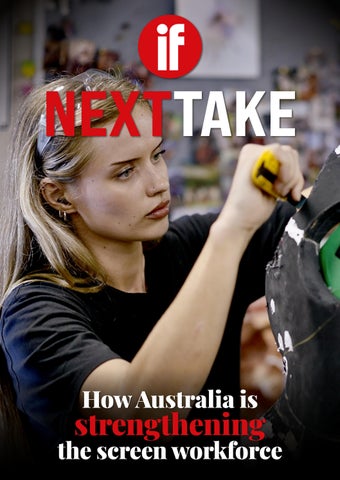
NEXTTAKE
How Australia is
strengthening
the screen workforce
if.com.au Industry news in the palm of your hand
Wherever you are, stay up to date with the latest in screen content at if.com.au. Sign up to our newsletter for production and development news, features, trailers – all straight to your inbox and device.
CONTENTS
NEXTTAKE ALL WORDS BY BRENDAN SWIFT
04
BEYOND THE BOOM
The Australian screen industry knows how to attract new crew, but the harder task is retaining them and helping them build sustainable careers.
08
LOCATION OFFSET: CAPACITY OR COMPLIANCE?
Hollywood productions are now required to train Australian crew. While early signs are positive, questions remain over whether the spend is too short-term and production-bound.
12
HOW STUDIOS TURN PLACEMENTS INTO CAREERS
Docklands Studios Melbourne chief Antony Tulloch says crew need a place to grow their careers.
14
RETHINKING HOW WE WORK
Training more crew won’t fix the skills shortage if working conditions push experienced people out.
16
WHO’S RUNNING AUSTRALIA’S TRAINING PIPELINE?
Screen skills training is delivered through a patchwork network across the country. The PICA wants a new committee to oversee it.
NEXTTAKE Cover photo, and all photos above, courtesy of NIDA.
IF was founded by David Barda and Stephen Jenner, co-founded by Martin Zoland. The views expressed in this magazine are not necessarily the views of the editor and publisher. This magazine is not to be produced in whole or part without the express permission of the copyright owners. ©Copyright 2026
Published by: COMMUNICO MEDIA GROUP PTY LTD ABN 69 647 866 091 POST: PO Box 55, Glebe NSW 2037 Australia STREET: 41 Bridge Road, Glebe NSW 2037 Australia PHONE: 61 2 9660 2113
Managing Director: Simon Grover
WEB: www.if.com.au
Prepress: Tony Willson
Writer: Brendan Swift Editor: Jackie Keast, jkeast@if.com.au National Sales Manager: Tom Solis, tsolis@intermedia.com.au Designer: Jacqui Cooper
IF NEXTTAKE 3
BEYOND THE BOOM
Beyond
The Australian screen industry knows how to attract new crew, but the harder task is retaining them and helping them build sustainable careers.
the boom: T Australia’s next skills challenge Netflix’s ‘Thrash’, filmed at Docklands Studios Melbourne. (Photo: Ben King)
4 IF NEXTTAKE
he Covid pandemic shut down much of the world but sent Australia’s screen industry to record highs. International productions flocked to the country’s relatively safe borders and drama spend hit a then-record $1.9 billion in 2020–21. It was a mixed blessing for crews, who were stretched thin by back-to-back shoots. Four years on, the headline number is even bigger – a record $2.7 billion in 2024–25 – but the work looks different. Much of it comes from a handful of bigbudget international films, while the local series that once kept crews in steady work are getting fewer and shorter. The pressure on crews has changed, yet many of the same skills shortages remain. “Forever, we’ve been focusing on the pathway and the barriers to entry to get into the industry, but the realities now are staying in the industry,” says Docklands Studios Melbourne chief executive Antony Tulloch, who began his career in the lighting department.
BEYOND THE BOOM
The 2026 Production Infrastructure and Capacity Analysis (PICA), conducted by Olsberg SPI and commissioned by Screen Australia, identifies four pressure points: skills gaps, infrastructure constraints, a lack of business scalability and limited career progression. The comprehensive study updated a 2021 analysis, flagging several of the same hard-to-fill roles including line producers, production accountants and location managers. What has changed is the mood on set. In 2021, crew were exhausted from overwork; now they’re anxious about where the next job is coming from. Workplace culture, leadership and business skills have also come into sharper focus as the industry looks to build more sustainable careers.
THE MISSING MIDDLE Industry development programs have ensured that entry-level roles are relatively well supplied. The PICA’s highest capacity scores went to jobs such as art department runners, camera assistants and trainees. But mid-career is where the shortages remain, with positions such as art directors and line producers hard to fill. Limited mentoring, little recognition of skills gained and few pathways linking one project to the next are just some of the issues. Midcareer attrition rates are also high, driven by workloads, inconsistent leadership, inadequate support and a lack of family-friendly conditions. “We were losing people at midcareer stage or five years in, and there’s that old phrase: people don’t leave jobs, they leave managers,” AFTRS head of industry and alumni engagement Robbie Miles says. Others simply hit a ceiling, he says, with no role to grow into and no training to help them “go from a second AC to a first AC or from a location scout to a location manager”. An AFTRS survey of graduates and industry about four years ago found the same fall-off, according to CEO Nell Greenwood. Alongside an uneven
‘Insidious: Out of the Further’, which filmed at Docklands Studios Melbourne. (Photo: Narelle Portanier)
production pipeline, management problems and burnout, it found a less obvious pressure: crew priced out of the capital cities who moved further out and lost touch with the networks that get people hired. Production model consultant Racheal Rauch, who led this year’s Scene Change report exploring alternative production models, says a shift to more flexible workplaces is an underappreciated component of the skills and training debate. “It’s almost quite a narrow view of the problem because obviously, yes, people do need to be trained to enter the industry,” she says. “But if we’re not creating the environment to retain those people, then they’re just going to leave. And then we’re back to the skills shortage. And then we have to train more people.”
MANAGING THE TIME BETWEEN JOBS Part of the problem is structural. Most productions run through a special purpose vehicle that exists for a single project and then disappears – and with it, any responsibility for the crew’s next step. “We don’t have HR departments,” says Generate Crew co-founder Nerida Groth. “We don’t have anyone looking out for us longer term. We don’t have anyone who’s invested in our career because that company comes and goes within a few months.” The training grounds that once bridged the gaps have thinned. The PICA points to the loss of Neighbours in 2025 and fewer long-running and children’s series, which gave crew repetition, credits and stable pay. Screen Careers national manager John Kachoyan says the format of the work has also changed. “Shows aren’t 25 episodes anymore – returning series might be four,” he says. “It’s not just the volume of work, it’s actually the longevity of people’s careers.”
Employment status over the past three years:
38%
Full-time, Freelancer or Contractor
27%
Full-time, Employed by a Company
27%
Full-time, Self-Employed or Company Owner
39%
Part-time, Various Arrangements or Other
Source: Production Infrastructure and Capacity Analysis (Physical Production, n = 500)
IF NEXTTAKE 5
BEYOND THE BOOM
BUILDING THE RUNGS
Ausfilm CEO Kate Marks.
Insecurity shapes behaviour, too. Crew told the PICA consultants that even when exhausted they worry turning down a job will cost them future work, while squeezed budgets mean shorter pre-production, smaller crews and more crunch. The business scalability pressure point is another aspect. The PICA finds many companies operate hand-tomouth, assembling finance without the resources to keep core staff between projects, which erodes their ability to invest in long-term capability. AFTRS’ soon-to-be-published Producer Skill sets 2030 research points to producers shifting to “business-led models rather than project-led models”, Miles says, with HR, finance and legal literacy among the gaps.
The most promising fixes target the career step up. The PICA recommends treating mentoring as a funded, explicitly costed part of production budgets rather than an informal task that production pressures sideline. Some of the hardest-to-fill roles, such as line producers and unit production managers, are also the hardest to teach in a classroom. “There’s definitely a need for them,” Miles says, “but they are so specific to have a course of, say, 15 to 20 people learning wouldn’t necessarily be an economy of scale or particularly productive.” AFTRS is also developing new award courses aimed at step-up roles – where people move into managing teams and stakeholders – designed to be flexible and modular for people juggling work and family, says director of teaching and learning Maia Horniak. A director and AFTRS alumna herself, she says the mid-career squeeze is personal. “I’ve gone through it and I know all my peers have gone through it as well.” NIDA runs a short course for specialists stepping up to head of department, covering managing creative teams, contracts and IP, while Screen Careers runs HR workshops for heads of department and seconds-in-command. The step-up gap is not confined to crew. New York’s Atlantic Acting
Challenges
Key challenges surfaced during the consultations and within the survey
School offers part-time and intensive programs designed to let working actors deepen their technique without stepping away from their careers or personal responsibilities. “We recognise that artistic growth doesn’t stop once an actor enters the industry,” says executive director Mary McCann. Australian performers have trained there through the Equity Foundation scholarship, and McCann says the aim is to see people take skills home rather than to leave. “We see international training not necessarily as a pathway to relocation, but as an investment in an actor’s continued development.” On-set training remains crucial, although time is a constant pressure. The result is productions tend to squeeze training into pre-production, when people are already stretched, says Screen Well managing partner Jonathon Dutton. “One of the biggest challenges with upskilling within our industry is when and how do you do it?” The Location Offset’s new training requirement is a step towards strengthening onset training. For example, the Australian Production Design Guild created an assistant costume supervisor role, in which a trainee shadows and supports the costume supervisor, for a major offshore production that shot in Queensland.
BTL Roles Facing Capacity Concerns Combined results from the survey across states and territories BY WEIGHTED RANKING
IDENTIFIED BY HIRERS
• Ageing senior workforce: Concerns about succession plans for HoDs and senior crew approaching retirement age
Pyrotechnic Supervisor
Line Producer
• Senior role shortages: Capacity is low for senior and HoD roles. Burnout, retirement, and lack of opportunities all contribute to this
Shoe Maker
Location Manager
• Interpersonal skills gap: Identified across all levels and grades
Special Effects Supervisor
Production Accountant
• Work/life balance and burnout: An issue amplified by the pandemic and the boom of production in Australia
Headwear Department and Milliner
Production Coordinator
• Loss of long-running television for training: Lack of opportunities for emerging BTL crew to build their skills over a sustained production cycle
Model Maker
Production Manager
Source: Production Infrastructure and Capacity Analysis 6 IF NEXTTAKE
Source: Production Infrastructure and Capacity Analysis (Physical Production)
BEYOND THE BOOM
film school Hollywood FROM
TO A
'Anaconda', which filmed in Queensland. (Photo © 2025 Columbia Pictures Industries, Inc. and TSG Entertainment II LLC. All Rights Reserved.)
WHO OWNS THE FIX? The PICA says its recommendations will require a stronger partnership between industry, education providers and government, underpinned by clear accountability. Beyond a proposed national skills committee, it calls for a dedicated national funding program for training, citing Ireland’s Screen Stakeholders Funding Scheme, which offers grants of up to €60,000 for substantial programs. It is understood that Screen Australia views a new national skills and training committee as a matter for the Office for the Arts, and workforce development as an industry-wide responsibility. The national screen agency is itself facing growing demands on its funding. Ausfilm CEO Kate Marks says it remains unclear “who is going to lean in and move some of those recommendations forward”. The funding question is just as open. “Do you want to fund training as a vital national support? Do we want the industry to broadly contribute to a training fund or training pool?” Kachoyan says. Line producer Anne Bruning suggests grants for owner-operator businesses that make up much of the crew base, such as grips, gaffers and unit managers with substantial equipment. “If they could perhaps access some government funding that allowed them to bring on trainees, I think that would be a useful way of looking at it.” Workforce capability is strongest when it is planned over several years, rather than in response to shortages at peak production. That is how Tulloch built his own career, from lighting technician to studio chief. “My own career grew because people trusted me with the next job,” he says. “And later as a gaffer, I could give others that chance in a deliberate way.”
blockbuster A traineeship paid for by the new Location Offset has turbocharged Liz Harris’ career.
Liz Harris handed in her final university assessment at the end of October 2024. A week later, a friend mentioned there was a props attachment going on a big feature. By the time Harris formally graduated, she was two weeks into the job. The film was Anaconda, starring Jack Black and Paul Rudd. “I had a lot of warning about the first few years – that I may not get a single job,” Harris says. “When I got this call asking if I wanted to be on the props team, it was yes – the perfect dream scenario.” It is just one example of the benefits of the Location Offset’s new training requirement, which was managed by Generate Crew on Anaconda. It onboarded several trainees, helped structure and track on-set skills development, provided broader care and support, and managed offboarding to foster their careers between productions. Harris says her five-month traineeship as a props attachment included a wide range of experiences. She tracked department expenses, ordered supplies for the prop makers and monitored product placement regulations. She also dressed and unpacked sets, backed up standbys during shooting, prepared food for food scenes, and used an airbrush and Dremel to finish props alongside the makers. “We also had three interns on the job and there was about a three-week window there where I was in charge of three interns. So there was a leadership element there where I was teaching them how to present on set and what the right etiquette was.” Generate Crew provided support and structure, and a checkin halfway through production led to more on-set time. The experience has fast-tracked her career and led to roles as a props coordinator and art coordinator on local productions. She is now in Sydney working in an art department accounts role – a deliberate move to strengthen her understanding of the financial side. “It was pretty magical for someone straight out of uni,” she says. “It was a massive film, working in the art department, doing anything you could really imagine.” IF NEXTTAKE 7
LOCATION OFFSET
LOCATION OFFSET:
capacity or compliance?
Netflix’s ‘The Mosquito Bowl’, which filmed in Queensland. (Photo: Kane Skennar / Netflix © 2026)
Hollywood productions are now required to train Australian crew under the Location Offset. The early signs are positive, but questions remain over whether the spend is too short-term and production-bound to build a lasting pipeline.
O
ffshore productions have invested almost $3 million into training Australian screen workers under the bolstered Location Offset, according to new government data. It is the first public window into how Hollywood productions are meeting the scheme’s strengthened workforce development requirements, although industry participants warn it has yet to boost established film schools or fund longer-term skills programs. “Before the introduction of the training requirement there was often a bit of pushback from overseas producers who were reluctant to spend any money on bringing in a trainee,” says line producer and unit production manager Anne Bruning. “Well, now they have to.” The government announced the training requirement alongside the Offset’s increase to 30 per cent in May 2023, but the phase-in was gradual. Productions starting principal photography from July 1, 2024 had to spend 0.5 per cent of qualifying Australian production expenditure (QAPE) on training (capped at $250,000). The figure doubled to 1 per cent (capped at $500,000) a year later.
8 IF NEXTTAKE
Only 11 productions have applied for final certification at the 30 per cent Offset rate given productions typically take six to 18 months after wrapping to lodge claims, according to the Office for the Arts. Of those, four had the 0.5 per cent minimum QAPE training investment applied, and none the full 1 per cent. Nonetheless, more than 60 people have received employment opportunities under the minimum training expenditure requirements. “Since the changes, approximately $2.9 million has been invested into training Australian screen workers,” Jesse Fatnowna, assistant secretary of the creative industries branch at the government’s Office for the Arts, told Senate hearings in May. “Training activities have taken place across all aspects of production activity, including on-set formal training courses and postproduction activities as well. The practitioners benefiting from that training range from entry-level trainees working on their first production through to mid-career personnel seeking to reskill in another area of the sector or to progress to senior levels.”
LOCATION OFFSET
Ausfilm CEO Kate Marks says roughly 50 projects have come through the Offset since the reforms, so the $2.9 million figure is likely to grow substantially. Most are meeting the obligation through training rather than infrastructure, she says, and international partners have embraced it. “It’s win-win,” Marks says. “It’s good for them ensuring that there’s a strong pipeline of workers into the future.” While the early signs are positive, whether the training requirement is generating the kind of systemic workforce development the sector needs – or leans more towards a compliance cost – remains an open question as the scheme matures.
PLUGGING THE GAPS
‘Spa Weekend’, which filmed in Queensland. (Photo courtesy VVS Films)
FILM SCHOOL PARTNERSHIPS Last year, five recent AFTRS graduates were selected for paid traineeships on Disney’s Sam Raimi thriller Send Help, while Disney also sponsored three runs of the AFTRS On Set Onboarding courses. “Disney had attachments they wanted across five different departments,” AFTRS head of industry and alumni engagement Robbie Miles says. “We worked with our internships team to pull together a group of applications and worked with Disney to shortlist those applicants who then went to interview. Then we put those successful applicants, through a customised version of our On Set Onboarding training that Disney devised with us.” The On Set Onboarding courses attracted 80 applicants for 40 spots. “It was about them being more hireable when more productions come to town and creating a pipeline for Disney.” It is an indication of how the system could work, although the involvement of Australia’s screen education institutions in Offset-funded training has, so far, been limited. One reason is the legislation, which requires training spend to count as QAPE incurred by the applicant company. Companies can’t contribute to a training program that won’t directly benefit their production unless they invest in long-term training across multiple productions. “We had big hopes that this was going to be exactly Minimum Location Offset training spend by production size
600
Minimum training spend ($'000)
The data suggests that the new Offset training spend is largely going to the departments identified as having shortages in the PICA report, with trainees employed in accounts, costume and art departments. “Other opportunities were available in the locations management and sound departments as well as in various post-production roles,” the Office for the Arts said in a follow-up written response to the Senate. “Training has also focused on the camera department, with productions recruiting female participants in what has traditionally been a male-dominated field.” Those trained under the expenditure requirements were split between entry-level trainees with five or fewer years’ experience in the industry and mid-career or experienced practitioners entering a new role or upskilling. “Many trainees report securing further employment opportunities at a higher level as a direct result of the experience gained,” the Office for the Arts said. Bruning – who has worked on many Hollywood productions shooting in Australia – says the requirement has produced a definite increase in training, particularly at mid-career level, where she now engages mentors to shadow crew stepping up to higher duties on bigger films. “We’ve engaged mentors and paid these mentors, which is the great thing about the training scheme. They shadow that person they are training and help them set up the department budget, the crewing and what the requirements are on a bigger film, which are quite different from a smaller film.” Bruning says funding to pay a mentor eases the worry that crew may not be ready to step up to the next level, particularly on a bigger film. “The great thing about a bigger production is that instead of just coming in for six to eight weeks, we can engage crew on a much longer contract, say for 20 to 26 weeks, which really gives them a decent amount of time to learn the skills and to become confident in what they’re doing.” Ausfilm’s Marks says the skills crunch has eased since the 2021 production boom. “When we’re talking to clients, I don’t feel like it is as much of a scramble to find people. There’s more people coming in. There is better coordination between education… and getting people out job ready.”
500 400 300 200 100 0
0
25
50
75
100
125
150
Qualifying Australian production expenditure ($m) 2024–25: 0.5% of QAPE, cap $250k ($'000)
2025 onwards: 1% of QAPE, cap $500k ($'000)
Source: Office for the Arts
IF NEXTTAKE 9
LOCATION OFFSET
where that money would make a big difference,” says NIDA CEO Liz Hughes. “Unfortunately, it hasn’t quite panned out yet, but we’re hopeful that it may pan out in the future.” Nerida Groth, co-founder of training consultancy Generate Crew, says productions often move too fast for institutional programs. “Sometimes they’ll say we need this position filled by the end of the week. That’s our recruitment and setup time.” Line producers are also focused on delivering a single film through a special purpose vehicle. “There’s no incentive for them to think beyond their film,” she says. A new kind of intermediary has emerged to bridge that gap. Groth and fellow Generate Crew co-founder Louise Hodgson were brought on to structure the training spend on Anaconda and have now worked on three Offset productions, embedding a skills development officer on set to onboard trainees, prepare supervisors and track their progress. “Everything we’re supporting that is being counted towards that minimum training expenditure is absolutely a training role,” Hodgson says. “When we think they’re doing the job, then we’re not tagging that wage anymore to the spend.” Generate Crew’s internal reporting shows it supported 36 trainees across three international films accessing the Offset, and 89 per cent of them are still working in the industry. All of the trainees it recruited directly remain in the industry, while 88 per cent of on-set trainee supervisors said they would rehire their trainees on future productions. NIDA’s Hughes says the institution could roll out specialist courses nationally with industry partners. One example is costume making, where the PICA report flags an ageing and shrinking pool of cutters, makers and shoemakers. “We have the modules, we have the training, we have Generate Crew co-founders Nerida Groth and Louise Hodgson.
10 IF NEXTTAKE
the trainers,” she says. “With a little bit extra financial support, we could actually address that head on. “Maybe the settings need to be changed a little bit, I would suggest, to enable NIDA to play an even bigger role.”
LONG-TERM TRAINING PROGRAMS YET TO EMERGE Offshore productions can also meet the training requirement by establishing or upgrading permanent Australian film infrastructure or running a training program across multiple screen productions (one production must be the film accessing the Offset, but the other can be a domestic production). The consecutively shot Marvel films Shang-Chi and the Legend of the Ten Rings and Thor: Love and Thunder provided a template in 2020–21, before the training requirement existed. Training was a condition of the federal government’s $24.1 million grant for Thor, with Marvel taking on students from AFTRS, NIDA and other institutions to target skills shortages. But Miles says studios have so far stuck to training on a single production. “We haven’t seen any want to take that up yet because no one’s been able to guarantee a pipeline of production yet,” he says, adding that this should change as studios gain confidence they can reliably access the Offset across several productions. Ausfilm’s Marks says studios haven’t been able to commit to a certain number of projects over, say, the next 12 months, while work in different states adds another complicated layer. “There are other challenges,” she says. “What do you do in the downtime in between? Whose responsibility is it to look after these people?” AFTRS has already drafted programs built around a career ladder. A graduate would take an attachment on an
LOCATION OFFSET
Disney traineeship OPENED DOORS FOR AFTRS GRADUATE ASHWINI KANGATHARAN
From AFTRS classroom to Disney set, Ashwini Kangatharan’s traineeship on Send Help reveals the benefits of a structured industry pathway. Ashwini Kangatharan had studied production at AFTRS and worked on documentaries at SBS, but nothing quite prepared her for the scale of a major Hollywood feature shooting in Sydney. As one of five AFTRS graduates selected for paid traineeships on the 20th Century Studios feature Send Help – directed by Sam Raimi and filmed at Disney Studios Australia – Kangatharan spent around five months embedded in the production department working across pre‑production, production and early post-production. “It was just an amazing experience to work with the production department and see how they run such a huge feature from the ground up,” Kangatharan says. The traineeship was coordinated jointly by AFTRS and The Walt Disney Company, part of a broader partnership that provided hands-on training to 45 emerging screen creatives through On Set Onboarding courses and immersive tours of the nine-stage Disney Studios Australia facility. Kangatharan says AFTRS prepared her well for a trainee-level role, with the leap to a large-scale feature bringing theory into practice. Crucially, the experience opened professional networks and has kept her working. Since Send Help wrapped, Kangatharan has worked on another feature film and several television shows, and remains active in production. “I’ve been able to connect with a lot of people in the industry,” she says. “It’s a cool time to be in the industry. There’s so much happening in Sydney. My goal, ultimately, is to be a producer.”
international production, then move into formal training or a more senior role on a local production, before returning at a higher level on the next international shoot. “We’ve drafted programs for exactly that, which we think is a very strong model, but are waiting for that production company or international studio that has a pipeline of those to commit,” Miles says. The only publicly known long-term program is ITV Studios Australia’s Crew Academy, launched in July 2025. It allowed four crew members to gain six months of paid training and real-world experience across multiple productions, including I’m a Celebrity… Get Me Out of Here! UK. Screen Careers national manager John Kachoyan, who managed the program, says two of the four were
(L–R): Jo Barwick, Ashwini Kangatharan, Kat Liberman, senior manager, HR & crew experience Disney, Eleni Thomas, Ella Stone Richards and Ella Keogh.
The Disney–AFTRS partnership builds on previous traineeship programs on Marvel Studios’ Thor: Love and Thunder and 20th Century Studios’ Kingdom of the Planet of the Apes.
offered work at ITV, or had already started, before their training ended. “I think the long-term training programs are brilliant. I hope that the mechanisms continue to evolve to support them – ITV took a real risk – but they’re really effective. Being on set is a muscle.” The program also took in people early in their careers from outside the screen sector, including a music industry accounts worker who moved into a production accounting department – one of the shortage areas flagged in the PICA report. However, Kachoyan says the long-term training program option was built for scripted production companies, which rarely have enough production quantity to create a longterm training program. “The system is unintentionally,
at the moment, rewarding a shorter training activity and discouraging longer-term spend. Really, what we want is a funding mechanism that supports workplace development across the sector and across a person’s career, rather than just when it fits within a particular production offset. “That might be long-term training plans, training that follows someone through and the ability to link up multiple productions.” Generate Crew says domestic productions, which aren’t bound by the requirement, are now budgeting for skills development officers after seeing them in action. “Those crew don’t just stay on international jobs,” Hodgson says. “The domestic ecosystem should be benefiting from that money as well.” IF NEXTTAKE 11
PLACEMENTS INTO CAREERS
HOW STUDIOS TURN
placements
into careers Docklands Studios Melbourne chief executive Antony Tulloch says crew need a place to grow their careers. Could the Location Offset offer a new way to build it?
A
ntony Tulloch knows what it takes to climb from the studio floor. He started as a lighting technician in the mid-1980s “pointing bright, shiny things at famous people around the world” before eventually becoming chief executive of Docklands Studios Melbourne (DSM). “I’m living proof that if there is support for the industry, there are people who can progress through it and find opportunities in a global industry – if they have the intent to make that work,” he says. Studios act as an anchor for ongoing productions where people gain experience, hone skills and build careers. Steady production bookings turn a placement into a career: Programs such as VicScreen’s work, Tulloch says, “if we are providing enough work for there to be the next opportunity for those people”. The rejigged 30 per cent Location Offset recognised the importance of studios by allowing productions to meet the training requirement instead by
Antony Tulloch in his younger years on set. 12 IF NEXTTAKE
establishing or upgrading permanent film infrastructure in Australia. While no production is yet known to have taken the infrastructure route, Tulloch says the conversation is happening and evolving. “When everybody says infrastructure, they immediately think sound stages. But maybe it’s sound stages at a different level. We’ve got a gold class, world class facility at Docklands Studios, but does everything need that? Does the domestic market need a silver offering or a bronze offering? Does the international market that’s looking at capacity go, ‘We’ll take the silver offering?’” Streamers have taken long-term leases at Pinewood and Shepperton in the UK, and in Los Angeles, but that may not be the answer in Australia, he says. Investment can take many forms, such as making studios more environmentally sustainable. “We have an EV charger on the lot here which was donated by All Her Fault, NBCUniversal and Carnival Films, where we work collaboratively with them on infrastructure plays. It didn’t qualify as an infrastructure play, but it qualified as a spend piece.” Since the 2021 PICA report, Australian sound stage space has grown 40 per cent, although that was outpaced by international rivals such as Georgia (114 per cent) and New York (144 per cent). Capacity remains a regular limit on both large international productions and local independents trying to find studio space. Tulloch says DSM’s stages are 98 per cent occupied for the
Docklands Studios Melbourne CEO Antony Tulloch.
financial year to date. “Our risk is not demand at the moment – our risk is capacity,” he says. The PICA report recommended an annual tracking report on stage supply and demand, modelled on FilmLA’s Sound Stage Production Report. Tulloch says he’s open to the idea, although conversations between studios are already happening informally. Capacity is as much about crew as studio space – and a busy studio’s real value is keeping people in work from one job to the next. “What I’ve really liked seeing recently is one of my old best boys is now the rigging gaffer on a film called Fog City where he had a split of really experienced guys teaching young guys – safety, work practice, respect in the workplace, clarity, clear guidance. And I know that these young guys will be on the next job because they responded to that.” SA
WA
2.3%
13.9%
QLD
42.2%
VIC
16.6%
NSW 25%
Stage space by state Source: Production Infrastructure and Capacity Analysis
Put us on the call sheet AUSTRALIA’S CREW DEVELOPMENT SPECIALIST
ONNSET TRAINEE MANAGEMENT MASTERCLASSES TO CLOSE SKILLS GAPS CREW SUPPORT BEYOND WRAP
generatecrew.com.au
RETHINKING HOW WE WORK
Rethinking
HOW WE WORK Training more crew won’t fix the skills shortage if working conditions push experienced people out. Alternative working models exist, so why are so few adopting them?
S
tan’s Critical Incident was not just a six-part psychological crime drama – it was also the production that hosted Australia’s first scripted television job-sharing pilot. Unfortunately for the industry, the question that pilot raised off set has proved harder to resolve than anything in the script. The pilot, which drew more than 200 expressions of interest, proved the model could work and produced a detailed roadmap for producers. Yet almost three years on, the practice has stalled. “The demand for job sharing is still absolutely there from the crew side,” says production model consultant Racheal Rauch, who helped deliver the job-sharing pilot with Screen Well. “But you don’t really hear about productions trying to attract job sharers and letting it be known that they’re really open to job sharing.” She reframes the issue as not just a skills and training problem but a retention one. “There’s plenty of people sitting around that say, ‘Yes, I have those skills and I have that experience, but do I want to or can I work a 50-hour-plus week? No’,” she says. “So it’s automatically a deal breaker. Whereas, if the conversation could have been, ‘is it an eight-hour day or a nine-day fortnight or a job-sharing role?’, then that would have helped to fill that role and alleviate the skills shortage.”
WHY IT’S STUCK Rauch says the barriers she identified in the job-sharing pilot remain firmly in place. “I hear a lot about what you could refer to as the ‘old guard’ – this is how it’s always been, this is how it just needs to be done, and the budgets are so tight,” she says. “It’s a very closed mindset.” Roles on productions are often informally spoken for early, and unless producers and heads of department signal openness to job sharing early, the window never opens. Jonathon Dutton, managing partner of Screen Well, says the industry needs greater support for “accidental leaders” – heads of department who step into people-management roles without training in leadership, communication or psychosocial safety. “We’re not trained – we don’t have a lot of access to leadership training and resources like many other industries do,” he says. Poor leadership drives poor culture, which drives people out – compounding the retention problem the alternative models are designed to address. The cultural issue is exacerbated by the nature and structure of an industry constantly stretched for time, money and capacity. Asking 14 IF NEXTTAKE
Screen Well managing partner Jonathon Dutton and Racheal Rauch on stage at Screen Forever in April.
producers to adopt a model they have not tried before – without dedicated support to help them do it – means it can be consigned to what Rauch calls “the too-hard basket”. Meanwhile, the industrial framework hasn’t kept up. Screen Producers Australia and the Media, Entertainment and Arts Alliance remain locked in discussions about a proposed suite of clauses in the crew agreement that would formally enable job sharing, nine-day fortnights, job splitting and staggered rosters.
THE COST OF DOING NOTHING The Scene Change report, commissioned by Screen Australia’s Gender Matters Taskforce, led by Rauch and released in April, modelled three alternatives to the standard 50-hour week on a high-end six-part drama. An eight-hour day added 2.3 per cent to the total budget while a nine-day fortnight added just 1.23 per cent. Job sharing – applied to almost a fifth of crew roles – added just 0.34 per cent, with no extension to the production schedule. While any cost increase can be anathema to producers, the cost of not changing may be higher given burnt-out crew are then unavailable. “Really experienced line producers needing to have six months off – that’s just one role as an example, but it’s part of the boom-and-bust cycle,” Rauch says. “If crew weren’t getting so burnt out from the hours on each job, maybe they could work more consistently across the year.” Rauch says job sharing is the simplest path for a producer to create a more sustainable set. The cost is low and the risks are minimal given job sharing can be shaped to the participants. The initial conversation needs to happen early: A producer going into pre-production
RETHINKING HOW WE WORK
can signal to heads of department that the production welcomes job sharers and HODs can pass that message to their crews. “You can look at each department and ask which role is best suited – or maybe we’ll just say we’re open to all of them and see what comes in,” Rauch says. Some job shares need a formal crossover day, while others can be handled through shared documents, voice notes and a phone call. On the leadership front, AFTRS is developing a three-day course with industry that trains heads of department in leadership, communication and psychosocial safety. The course incorporates legislative obligations around positive duty and is designed to be run flexibly around production schedules. AFTRS’ head of industry and alumni engagement, Robbie Miles, says it addresses the gap between craft skill and people leadership.
“It’s about dealing with hot moments on set or acute difficult conversations, giving feedback under pressure,” he says. “That is one of our really important initiatives this year.”
THE LAW IS MOVING FASTER THAN THE CULTURE Workplace health and safety laws have been strengthened across every state and territory, with Victoria the last in December 2025. They require productions to proactively manage psychosocial hazards in the same way they manage physical safety. “Just like you do with a safety supervisor, you prepare a risk report and you would have interventions in place,” Dutton says. “It’s exactly the same thing, except for psychosocial safety.” While the legislation doesn’t mandate alternative working models, it does create a framework in which the conditions that drive people out – long hours, unpredictable schedules,
poor leadership – are no longer just cultural problems. They are legal risks. Screen Well’s Mental Health Action Plan has attracted more than 80 organisational supporters and its ACT NOW recommendations are designed to be low-to-no cost and achievable for all productions. They provide advice on psychosocial risk assessments, peer support networks and bullying and harassment contact officers. Screen Careers national director John Kachoyan sees the early signs of change. “I’ve definitely heard of individual cases of job sharing and adjusted hours,” he says, but notes it is rare. The challenge is moving from individual cases to standard practice. “There’s a critical mass of people coming through who have different cultural ways of working or have been supported by a really cool producer or a really cool production company who understands,” he says. “But it’s a big ship to turn.”
Australia’s National Film and Audio School
Building sustainable screen careers and strengthening industry.
Short courses, industry training and award courses.
New postgrad pathways launching soon.
aftrs.edu.au
SCREEN TRAINING PIPELINE
Who’s running Australia’s
SCREEN TRAINING PIPELINE?
AFTRS head of industry and alumni engagement Robbie Miles, CEO Nell Greenwood and director of teaching and learning Maia Horniak.
Screen skills training is delivered through a patchwork network across the country. The PICA wants a new committee to oversee it.
S
creen agencies have invested millions of dollars in screen workforce training programs, while offshore productions must now spend at least 1 per cent of QAPE on training – capped at $500,000 – under the Location Offset. Yet the system overseeing that investment remains fragmented and lacking national coordination. “When you look at the various states and territories, the federal agencies, and the great work they’re doing – the common thread is a lack of resources amidst all that great work,” says AFTRS CEO Nell Greenwood. “So we’re constantly advocating – is there a way that we can have a bit more of a joined up approach?” The gap between investment and impact is partly structural. Australia is a federation of 16 IF NEXTTAKE
competing and cooperating states, each running its own screen agency and workforce programs. The prospect of footloose international productions moving between jurisdictions adds to the complexity.
A COORDINATION EXPERIMENT THAT FADED The Covid production boom caused severe pressure on crews and the local industry. Ausfilm convened a working group to examine below-the-line workforce capacity, which included the Office for the Arts, Screen Australia, state and territory screen agencies, AFTRS and NIDA. “The working group as we convened it ended some time ago,” says Ausfilm CEO Kate Marks. Ausfilm, whose core remit is
attracting foreign productions to Australia, stepped back from the training and skills agenda when Screen Australia became more heavily involved. This was around the time they appointed Ken Crouch as head of industry development in early-2023 (he later moved to Screen Queensland). “Although that working group doesn’t exist, the information that has been presented throughout the course of the last five years is now forming parts of individual state plans and other frameworks that have been developed,” Marks says. While Screen Australia continues to support workforce development – it funded the 2026 PICA report – it no longer offers specific funding programs for below-the-line training, leaving that largely to state screen agencies and industry.
SCREEN TRAINING PIPELINE
A NEW NATIONAL VOICE The latest PICA report’s answer to this fragmentation is to establish a new national committee with a skills and training focus – a body that would unite key players from existing state, territory, regional and national groups to provide oversight, coordination, and minimise duplication. NIDA CEO Liz Hughes backs the report’s goal of a nationally coordinated approach and sees a natural role for NIDA and AFTRS to co-lead the new body rather than a screen agency. “They don’t necessarily then have a budget specifically for training because they’re prioritising their budget on production outcomes,” Hughes says. “As a leading provider of practicebased training, we believe we can play an important role in helping industry, government and training providers work together to build the workforce Australia needs for the future. To be frank, it may be something that AFTRS
and NIDA could do together. If you look at the skills that we train, it’s extremely complementary.” Nell Greenwood says a more coordinated approach would create a more efficient industry to “find some economies of scale, think about actually how we can join forces to deliver training or whether it’s an initiative”. “I think, for us, it’s the rising tide lifts all boats,” she says. AFTRS has individual partnerships with interstate universities and education providers to deliver courses on the ground, giving it flexibility to tailor programs to each jurisdiction’s needs. But these relationships are bilateral, rather than coordinated. The PICA report suggests one model could be a temporary, task-focused initiative modelled on the UK’s BFI Screen Sector Skills Task Force – a seven-month collaboration between 28 pan-sector organisations that produced a strategic framework for skills. Sub-committees focusing on
Filmmaker First. Our stages. Your stories.
Melbourne’s home of screen production, with world class stages and premium facilities designed for stories of every scale.
physical production, post-production and visual effects, animation and digital games could ensure the body covers the full breadth of the sector.
BESPOKE AND AD HOC While the sector waits for national coordination, the work is being done at state level through a patchwork of bespoke partnerships. Screen NSW recently undertook a partnership with AFTRS, NIDA and TAFE NSW, in which each institution trained participants in specific skills gaps – NIDA in art department and costume, TAFE in production management and post-production supervision and AFTRS in locations and production accounting. Two participants from each stream received paid placements on productions, and all were brought together for a networking night with heads of department and production companies. “And all people who’ve been through the same training are hireable,” says Robbie Miles,
SCREEN TRAINING PIPELINE
NIDA CEO Liz Hughes.
AFTRS head of industry and alumni engagement. “That’s the kind of model that would be replicable across other states.” Smaller jurisdictions are adapting the principle to their own scale. NIDA worked with Screen Territory over two years to provide skills training in areas hand-picked to suit the Territory’s smaller population and industry. A key goal was versatility across formats – if crew can move between music festivals, arts festivals and screen productions in Darwin, they can maintain consistent employment year-round. “When they’ve got lots of music festivals and arts festivals in Darwin, people can be employed, and then if there’s a screen production in town, they can work on that – to be able to move around so they have consistent employment the whole time,” Hughes says. In Queensland, where production has grown strongly, the focus has shifted further up the ladder.
“The key workforce challenge now is not simply attracting people into the industry, but supporting longterm career progression, leadership development and retention,” says Ken Crouch, Screen Queensland’s executive director, industry and audience engagement. Beyond the screen pipeline, AFTRS has recruited from adjacent sectors, including a program for ex-defence personnel transitioning into screen production roles. The PICA report frames this federated diversity as a structural opportunity: Each state operates as an “innovation node”, and when coordinated effectively, successful models can be piloted in one jurisdiction and scaled nationally. But the report’s own finding – that competitive dynamics and the need to attract productions can complicate the sharing of resources, facilities and funding – suggests that coordination will not happen by itself.
Education undertaken by screen professionals (%)
18 IF NEXTTAKE
Secondary school (screen-related subjects)
13% 10% 8%
TAFE (screen-related course)
9% 8% 7%
TAFE (non-screen-related course)
4% 4% 4%
University (screen-related course)
30% 42% 29%
University (non-screen-related course)
21% 14% 19%
Specialist screen/film/ digital games school
21% 16% 9%
On-the-job training (e.g. traineeship, apprenticeship)
25% 26% 8%
Federal governmentsupported training program (e.g. Screen Australia)
6% 4% 2%
State/territory government supported training program
10% 3% 3%
Self-taught
45% 51% 60%
Other
13% 10% 13%
Physical production PDV & animation Digital games
Source: Screen Australia / Olsberg•SPI, A Production, Infrastructure and Capacity Analysis for Australia’s Screen Production Sector (PICA), April 2026, Figure 98, p.144. All respondents, n = 775. Note: respondents could select more than one pathway, so columns do not sum to 100%.
Premium content. Exclusive and in-depth.
Keeping you connected to the Australian screen industry. Subscribe now for in-depth features, opinion, business intel, analysis and talent profiles, covering topics across production, distribution, exhibition and tech. Sign up for an annual subscription and add-on our In Production listings, which include more than 300 features, scripted series, documentary and factual projects in development and production.
SUBSCRIBE NOW AND GET ONE WEEK FREE
www.if.com.au