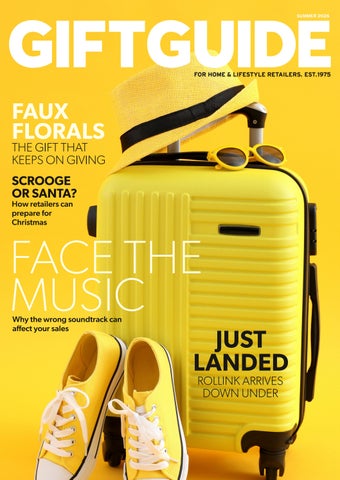
SUMMER 2026
FOR HOME & LIFESTYLE RETAILERS. EST.1975
FAUX FLORALS
THE GIFT THAT KEEPS ON GIVING
SCROOGE OR SANTA? How retailers can prepare for Christmas
FACE THE MUSIC Why the wrong soundtrack can affect your sales
JUST LANDED ROLLINK ARRIVES DOWN UNDER
06
Giftguide is published by
CHARTED MEDIA GROUP (a division of The Intermedia Group) 41 Bridge Road Glebe NSW 2037 Australia Ph: 02 9660 2113 Fax: 02 9660 4419 MANAGING DIRECTOR: James Wells EDITOR: Marion Gerritsen NATIONAL ADVERTISING MANAGERS: Katherine Ross Charlotte Marshall DESIGNER: Katy Brack SUBSCRIPTIONS: 1800 651 422 | subscriptions@intermedia.com.au Print Post Approved Publication No. PP 250003/01405 ISSN 0312-5327
DISCLAIMER This publication is published by The Intermedia Group Pty Ltd (the “Publisher”). Materials in this publication have been created by a variety of different entities and, to the extent permitted by law, the Publisher accepts no liability for materials created by others. All materials should be considered protected by Australian and international intellectual property laws. Unless you are authorised by law or the copyright owner to do so, you may not copy any of the materials. The mention of a product or service, person or company in this publication does not indicate the Publisher’s endorsement. The views expressed in this publication do not necessarily represent the opinion of the Publisher, its agents, company officers or employees. Any use of the information contained in this publication is at the sole risk of the person using that information. The user should make independent enquiries as to the accuracy of the information before relying on that information. All express or implied terms, conditions, warranties, statements, assurances and representations in relation to the Publisher, its publications and its services are expressly excluded save for those conditions and warranties which must be implied under the laws of any State of Australia or the provisions of Division 2 of Part V of the Trade Practices Act 1974 and any statutory modification or re-enactment thereof. To the extent permitted by law, the Publisher will not be liable for any damages including special, exemplary, punitive or consequential damages (including but not limited to economic loss or loss of profit or revenue or loss of opportunity) or indirect loss or damage of any kind arising in contract, tort or otherwise, even if advised of the possibility of such loss of profits or damages. While we use our best endeavours to ensure accuracy of the materials we create, to the extent permitted by law, the Publisher excludes all liability for loss resulting from any inaccuracies or false or misleading statements that may appear in this publication. Copyright © 2026 — Charted Media Group Pty Ltd
2
giftguideonline.com.au
10
contents
Contents
18
20
34 26 32
IN THIS ISSUE
38
06 travel accessories Rollink lands in Australia
Cover image: iStock/Liliia Bila
10 christmas how retailers can prepare for the festive season 18 marketing the wrong soundtrack can affect your sales 20 home & living faux florals, curated clutter & homewares 26 in focus 6 brands from New Zealand 30 retail how to get honest customer feedback 32 technology trends to reshape customer loyalty in 2027 36 retail insights how productive are retailers? 38 summer sizzlers products to take your store from spring into summer
48 SUMMER 2026
3
THE EASIEST WAY TO DISCOVER NEW BRANDS FOR YOUR STORE
giftguideonline.com.au
australiangiftguide
ausgiftguide
START SOURCING TODAY
GIFTGUIDE
Flex 360° Spinner
JUST LANDED
Rollink finally arrives in Australia with its innovative and pioneering foldable luggage concept.
6
giftguideonline.com.au
travel accessories
A
s interiors become more considered and every square metre works harder, the way we use space at home is changing. Storage is no longer simply about organisation; it has become an integral part of good design, particularly as homes become more compact. From furniture that adapts to multifunctional rooms to everyday essentials designed with a smaller footprint, intelligent design increasingly considers not only how something performs when in use, but the space it occupies when it isn’t. Rollink is a global travel brand pioneering patented foldable luggage designed around a simple idea: a suitcase should work just as intelligently between journeys as it does during them. Recognising that traditional luggage spends most of its life in storage, Rollink reimagined the hard-shell suitcase to deliver premium performance during travel while taking up less space at home. Flex 360° Spinner collection
Since Rollink was launched (and co-founded) in 2018 by CEO Eyal Azoulay, the brand has sold over one million units and expanded to 25+ countries and now it has finally landed in Australia. Rollink’s space-saving philosophy extends beyond the home, according to the Australian Rollink team based in Adelaide, SA. “By reducing the volume luggage occupies during transport and storage, its foldable design also creates efficiencies throughout the supply chain. Rollink’s foldable construction can reduce shipment volume by up to 75 per cent, allowing up to four times more units per shipping container compared with traditional luggage. It’s a design approach that considers not only how luggage travels, but the footprint it leaves behind. “Longevity is equally central to that thinking. Rather than designing luggage for short-term use, Rollink combines carefully selected materials with rigorous
Flex 360° Spinner
testing for impact resistance, wheel endurance, handle durability, zipper performance and structural integrity.” The award-winning Flex 360° Spinner is lightweight, water-resistant and secured with a TSA-approved lock, combining practical travel performance with a refined hard-shell design. Available in carry-on, medium and large across a colour palette including atlantic blue, rose smoke, black and warm grey, the collection travels as a set, with the folded carry-on fitting inside a larger suitcase. Durable and impact-resistant, it glides on four double 360° spinner wheels. Setting up the Flex 360° Spinner is also very simple. Unfold the suitcase from its slim stored profile, extend the flexible sides and position the four internal support flaps to create a strong, stable structure. Once secured, Flex 360° transforms into a full-size hard-shell suitcase, ready to pack using the internal mesh pockets and cross straps. When the journey is over, simply reverse the process, fold it back into its slim profile and store it away until next time. “Backed by a limited lifetime warranty in Australia, Flex 360° is designed for lasting performance across journey after journey, supporting a more considered approach to consumption by reducing the need for frequent replacement.” G SUMMER 2026 7
travel accessories
American Crew fibre travel gift set (RRP $62.90). www.americancrew.com
Amaree Collection refillable travel perfume (RRP $35). info@amareecollection.com.au, amareecollection.com.au
aerre full perfume discovery set (RRP $79). hello@aerre.co, aerre.co
Lonely Planet travel books (RRP $29.99-$60). shop.lonelyplanet.com Maison Elle Sleepy Elle (RRP $98). hello@bymaisonelle.com, bymaisonelle.com
8
giftguideonline.com.au
Istock.com/Fresh Splash
N Aussies are feeling the pinch this Christmas
SCROOGE OR SANTA? Aussies are more cautious and stressed this Christmas with almost two in three Aussies experiencing moderate to high cost of living impact.
Istock.com/Edwin Tan
Cost of living is dampening the Christmas cheer
10 giftguideonline.com.au
ew research conducted by global data and insights company Pureprofile reveals that the costof-living crisis is dampening the Christmas cheer, as Australians head into the festive season more cautious and stressed than previous years. Almost two in three (62 per cent) Australians say they are experiencing moderate to high cost-of-living impact, cutting back on both essential and non-essential purchases. Less than a quarter (24 per cent) think the economy is strong (down from 29 per cent in 2025) and only a third (33 per cent) report having had a ‘good’ or ‘fantastic’ year (down from 36 per cent last year). The report reveals cost-of-living pressures are directly affecting festive season sentiment, with 79 per cent of Aussies adjusting their spending accordingly. Thirty-five per cent plan to spend less on gifts and 30 per cent are choosing more budget-friendly food and drink options (up from 21 per cent in 2025). This year’s Christmas research highlights how cost-of-living pressures are reshaping consumer behaviour across Australia and New Zealand, says Mellyza Tanoto, general manager, ANZ Pureprofile. “With shoppers becoming more deliberate about where and how they spend, Black Friday is playing an increasingly important role in Christmas planning. For retailers and brands, delivering genuine value and understanding these changing priorities will be critical. “At the same time, we’re seeing an interesting balance between innovation and tradition. AI is emerging as a tool for gift inspiration, price comparisons and finding deals, yet physical stores remain the preferred destination for Christmas shopping. The opportunity for retailers is to embrace new technology while recognising that the in-store experience still matters.” For the 62 per cent of Australians experiencing moderate to high cost-of-living pressures, these figures are far higher: 90 per cent expect to adjust their expenses, 44 per cent plan to spend less on gifts and 34 per cent will look for cheaper food and drink options. Despite seeking bargains, Australians still expect to spend more on food and drink at $518 on average (up $12 from 2025) than gifts at $487 on average (down from $491 in 2025). To meet this non-negotiable spending, Australians’ top categories to cut this Christmas are decorations (70 per cent), eating out (65 per cent) and experiences (58 per cent). Pureprofile CEO Martin Filz says consumers are increasingly focused on genuine value for money and budget-friendly options as they navigate the festive season and look ahead to 2027. “Brands and retailers that enter 2027 seeking to meet people where they are will be tapping into the dominant mood over the vital Christmas retail period,” he notes.
“Given the ongoing cost-of-living crisis facing many Australians, this means offering comfort, reassurance and affordable options.”
Black Friday: a budget lifeline but a double-edged sword Black Friday is becoming an essential part of helping Australian consumers manage the festive budget. Fifty-eight per cent of Australians plan to leverage sales to bridge the Christmas budget gap. This increases to 76 per cent for families with children aged 0 to 12, a key Black Friday audience. However, the shopping festival is a double-edged sword and can encourage overspending. Nearly half (47 per cent) of Black Friday shoppers admit they often spend more than planned, increasing to 58 per cent for young families and 51 per cent for both Gen Z and Millennial shoppers. And while Black Friday sales are becoming increasingly appealing to Australians feeling the cost-of-living crunch (61 per cent, up from 48 per cent in 2025), 44 per cent say the sales create pressure to spend money they didn’t plan to (up from 34 per cent in 2025) and 37 per cent find the sales period ‘too overwhelming’ (up from 29 per cent in 2025).
“As Black Friday becomes the major sales event of the year, Australians are increasingly experiencing both choice fatigue and the fear of missing out. Retailers can win trust by showing they understand the pressure shoppers are under and helping them stay in control. Clear and honest discounts, easy comparisons, price-match promises and flexible returns are keys to seeing carts fulfilled,” Filz adds.
Diverse discovery driving deals Retailers should also be aware of the increasing importance of social shopping. One in five (21 per cent) Gen Z are buying more products directly from social media platforms such as TikTok, Instagram and Facebook than a year ago. Targeting shoppers with Black Friday deals requires a multichannel approach. Gen Z should be targeted via social media or in-store, while Google search and retailer emails will have more impact with older generations. Interestingly, this shift is happening concurrently with a renaissance of in-store commerce for younger shoppers. Despite being raised with online shopping at their fingertips,
Black Friday is now the most important sales event of the year Istock.com/mediaphotos
Australians are looking for the best sales discounts this festive season
Istock.com/CentralITAlliance
christmas
SUMMER 2026
11
Gen Z (65 per cent) are even more likely than Millennials (50 per cent) to prefer shopping for gifts instore rather than online. “With a desire for experiential environments, ‘third spaces’ to hang with friends and tactile product evaluation, Gen Z are redefining what in-store shopping means and turning it into a cultural moment. “Mecca, Kmart and Glassons are key examples of retailers catering to Gen Z and retailers should take note of these elements to streamline and entice in-store visits as it no longer suffices to merely have products on display.” Twice as many Gen X (37 per cent) and Boomers (35 per cent) respond to retailer emails and newsletters as Gen Z (18 per cent). While only half as many Gen X (29 per cent) and Boomers (24 per cent) use social media to discover deals as Gen Z (57 per cent). Boomers (33 per cent) are the main demographic discovering deals through TV, radio and print advertising, which plummets to just 11 per cent for Gen Z.
Among those likely to use AI, the top uses include comparing prices or finding deals (41 per cent), getting gift ideas for specific people (31 per cent) and seeking product recommendations while shopping online (28 per cent).
Smart shoppers seeking AI assistance
Staying close to what matters most
AI assistants may also be an important dealfinding channel for one in five Australians, particularly younger generations. More than one in four Millennials (26 per cent) as well as Gen Z (26 per cent) plan to use AI this year specifically to help with Christmas plans and gifts.
With economic instability forecast to continue into 2027, Australians’ priorities reflect a shift to focus more on the things people feel they have immediate control over. Top personal priorities for the new year are led by saving more money (53
12
giftguideonline.com.au
Practical, personal and perhaps homemade The most popular gifts Australians are hoping to receive in 2026 are oriented around necessities and/or the freedom to choose such as gift cards (45 per cent), clothes or shoes (44 per cent), money (37 per cent) and food and drinks (33 per cent). What people plan to give largely mirrors what they would like to receive, though strained gift budgets are leading to some behaviour shifts. Significantly more people in Australia (15 per cent, up from 11 per cent in 2025), particularly Gen Z (20 per cent), are planning to give homemade gifts. Unfortunately for those planning handmade presents, these are among the least desired gifts with just 17 per cent hoping to receive one.
Aussies are looking to save more money in 2027
per cent), followed by improving health and fitness (39 per cent), and spending time with family (37 per cent). The shift away from aspirational areas like travel (25 per cent) and career advancement (14 per cent) reveals a desire to prioritise emotional and financial safety. “This research offers a timely view of how shoppers are approaching the festive season in a more financially cautious mindset, with sharper expectations around value and a stronger pull toward discounts,” notes Anastasia Lloyd-Wallis, senior insights manager, the Iconic. “Understanding those needs takes more than tracking broad market shifts—it means getting closer to what different customers are weighing up and what matters most to them. That understanding can help us look beyond price alone and shape experiences that feel relevant, worthwhile and easy to navigate during the busiest time of year.” G
Istock.com/CatLane
christmas
Christborn
THIS IS CHRISTMAS
AM Design
Glamorous and cloud-soft: trends for 2026
L
avish splendour or cosy comfort? One thing is clear for 2026: this Christmas is set to be opulent, emotional and animal-inspired. Alongside inspiring design, sustainability and practical innovation continue to play an important role. Christmas baubles made from recycled glass prove that style and sustainability go hand in hand, while gift ribbons complete with gold foil detailing are fully compostable. Decorating is also becoming easier thanks to innovative new string light systems. Multiple shorter sections connect magnetically, making the lights easy to install, adaptable to different tree sizes and—best of all—completely tangle-free.
Festive opulence In 2026, Christmas trees will sparkle with lavishly decorated glass ornaments that shimmer and shine from every angle. Colour palettes feature shades such as cream, wine red and burgundy, beautifully paired with gold, black and metallic finishes to create a luxurious festive atmosphere. Richly detailed designs range from intricate decorative patterns and pearl embellishments to gold leaf finishes and colourful motifs. Premium candles
with delicate gold-dust finishes and radiant metallic surfaces add refined highlights, perfectly complementing this luxurious aesthetic. The same sense of extravagance extends to gift wrapping. Papers and ribbons with elaborate designs transform even the smallest presents into eye-catching gifts.
Cosy Christmas The cosy Scandinavian style with its light natural tones has become a firm favourite in festive decorating. For 2026, this clean, understated look receives an irresistibly soft update. Faux fur, feathers and wool feature throughout an endless variety of Decorated glass ornaments that shimmer and shine are one of this year’s festive trends
tactile decorative elements that evoke warmth and comfort. Among the season’s standout accessories are cloud-soft stars made from plush fabrics, knitted textiles and faux fur, perfect for creating an inviting atmosphere. They are complemented by the ever-popular Christmas gnomes, complete with irresistibly soft beards and fluffy bows. Velvety flocked finishes transform nutcrackers and deer into wonderfully tactile decorative pieces. Adding an even lighter touch, feather Christmas trees create an ethereal festive ambience, while traditional glass baubles are given a cosy makeover with knitted appliqué details.
The dachshund takes centre stage After quietly stealing the spotlight last year, the dachshund becomes an essential Christmas motif in 2026. The much-loved little dog appears everywhere, from festive figurines to Christmas tree ornaments. It is reimagined in countless styles: crafted from mouth-blown glass, woven from straw or made from knitted fabric, felt or wood, often dressed in scarves, woolly hats, sunglasses or even full ski gear. The faithful companion also finds its place as a charming candle holder and, naturally, features prominently on gift wrap and ribbons, making it one of the season’s most playful festive icons. G Source: Christmasworld (Christmasworld 2027 is held from 29 January to 2 February 2027) Köhler
SUMMER 2026
13
GIFTS UNDER $25
American Crew beard serum (RRP $23.99). www.americancrew.com
Amaree Collection 2-in-1 car diffuser (RRP $25). info@amareecollection.com.au, amareecollection.com.au
MooGoo edible lip balm pucker pack (RRP $19.90). info@moogoo.com.au, moogoo.com.au
The Seventh Lion vinyl stickers, pins & sticker packs (wholesale $3-$12). info@theseventhlion.com, wholesale.theseventhlion.com
My Vibe DIY bag kits (RRP $24.95). natalie@toynetworksinternational.com, www.myvibemystyle.com
14 giftguideonline.com.au
christmas
Neo naturally Australian tea range (RRP from $16). info@neoaustralia.com.au, neoaustralia.com.au Sydney Sock Project collection (RRP $17.95). support@sydneysockproject.com, sydneysockproject.com
SUMMER 2026
15
STOCKING FILLERS
Annalise Paints inkless paw print kit (RRP from $26). www.annalisepaints.com
Royal Selangor hipflask in wooden gift box (wholesale $117.73). sales.au@royalselangor.com, royalselangor.com Wild Romantic instax album collection mini and wide (wholesale $40.45). elif@wildromantic.com.au, wildromantic.com.au
Inika Organic Lunar Bloom range (RRP from $69). inika@inikaorganic.com.au, www.inikaorganic.com
16
giftguideonline.com.au
Contour Cube mini mystery box (RRP $29.95). sarah@contourcube.com, contourcube.com
christmas Ministry of Sight reading glasses (wholesale $34.50). ahoy@ministryofsight.com.au, www.ministryofsight.com.au
ver many years, I’ve collected sayings, quotations and reflections from writers, thinkers, politicians, comedians and ordinary people.
Some made me laugh, others made me think, and some expressed an idea so perfectly that I wanted to remember it. Often, the right words can capture the essence of a discussion, illuminate a complicated issue or express something we have struggled to put into words ourselves. For me, these quotations have become a way of making sense of the world and expressing how I see it. Some offer wisdom, others provoke debate, challenge assumptions or reveal life’s many contradictions. And some remind us not to take ourselves too seriously. This collection brings together the words that have stayed with me over the years — thoughts and insights that, in one way or another, have helped me understand the world and find my own words within it.
For What It’s Worth
O
For What It’s Worth
Observations on Life, People, Politics and the World
For what it’s worth.
Michael Boland
Michael Boland
aerre eau de parfum (RRP from $35). hello@aerre.co, aerre.co
For What It’s Worth book (RRP $24.99). michaelboland.books@gmail.com
idea for A bright or a natty stellar folke style-setter gift for thour life. in y agazine eekend Good W
M
For wholesale enquiries please contact E. wholesale@songbirdcollection.com T. 0409 942 293 Or register via our wholesale portal:
unique artisan-crafted whistles, jewellery & gifts
wholesale.songbirdcollection.com
SUMMER 2026 17
FACE THE MUSIC
The wrong soundtrack can affect retailers’ sales as 40 per cent of shoppers walk out over music.
W
e all like a good tune, but when it comes to in-store music, the wrong soundtrack is actively driving customers out the door of Australian businesses. Research by OneMusic shows that 40 per cent of Australian and New Zealand shoppers have left a venue because of the music. However, around 50 per cent have stayed longer when the music felt right. “This isn’t about taste—it’s about business performance,” says OneMusic director Karen Holmes. “Music is a controllable, low-cost lever that directly impacts customer experience and revenue. In 2026, a business needs to create strong experiences to bring customers in-store. This new research confirms the effectiveness of the music playlist to connect with customers and create a tangible experience.” Indeed, music is far more than background noise. It actively shapes 18
giftguideonline.com.au
customer behaviour, influencing how long people stay, how much they spend and whether they return. The benefit is clear. In both countries about half of shoppers say they’ve stayed longer because the music felt right. Positive soundscapes increase dwell time, leading to more browsing and more opportunities for impulse purchases. This effect is strongest among younger groups, but it’s observed across all ages. A similar trend shows up in spending, says the study. Many Australians and New Zealanders agree that they spend more when the music matches their mood and surroundings. In other words, music not only influences how people move through a space but also boosts sales at the counter. Four behaviours—walking out, staying longer, spending more and refusing to return—form the core of the music story across both markets.
Age amplifies these dynamics in both Australia and New Zealand: • Younger shoppers (under 45) are much more likely to report walking out, staying longer or spending more because of the music. For Gen Z and younger Millennials the playlist is part of the offering, not just background noise. • Older shoppers (65+) are less likely to change their behaviour in response to music, but they remain attentive to comfort: they notice when the volume is too loud or the atmosphere feels jarring, even if they do not always leave. Contrary to the common belief that customers always prefer high-energy settings, the data reveals a clear preference for comfort. In both markets, the most popular atmospheres are ‘welcoming’ followed by ‘calm’. • In Australia, 38 per cent of shoppers prioritise a welcoming atmosphere, with 26 per cent looking for calm.
Research shows that 40 per cent of Australian and New Zealand shoppers have left a venue because of the music
AdobeStock/Krakenimages.com
• In New Zealand, the preference for ‘welcoming’ is slightly greater (40 per cent), emphasising the cultural importance of friendliness and approachability. ‘Lively’ energy ranks a distant third in both countries (18 per cent in Australia, 19 per cent in New Zealand). This offers a key insight for brands that rely on high-tempo, club-style playlists: unless you are clearly a high-energy youth brand, you might be overstimulating a customer base that wants to feel comfortable. Before customers notice which song is playing, they first hear how loud it is. Volume is the most significant factor in shaping first impressions across both markets, surpassing genre, song familiarity and overall fit. This challenges the notion that curation is solely about selecting songs. The perfect track played too loudly becomes noise; played too softly, it seems forgettable.
marketing
For operators in New Zealand especially, volume control isn’t just a technical detail; it’s the main way customers assess the vibe. In both markets, the playlist’s aim is rarely to attract attention. Instead, it acts as emotional glue, smoothing the retail experience, filling awkward silences and making the space feel familiar and safe. Customers expect music to align with a brand’s overall identity. Just as you wouldn’t use blackboard chalk for a luxury brand’s signage you shouldn’t play top 40 hits in a fine dining restaurant. The data shows that in both Australia and New Zealand the playlist directly reflects brand professionalism. When the music clashes with the brand, the damage is reputational, not just atmospheric. Across both markets, the primary response to mismatched music is a sense of disconnection. • In Australia, 44 per cent of consumers believe mismatched music makes the brand feel disconnected from its identity. • In New Zealand, the sentiment is similar (40 per cent), but Kiwis are slightly more likely to judge the business as less professional (26 per cent vs 24 per cent in Australia) or cheap (18 per cent vs 15 per cent in Australia). This indicates that New Zealand shoppers might interpret musical missteps as a sign of operational incompetence or budget cuts, while Australians tend to see it mainly as a branding issue. In both cases, about 25 per cent of shoppers will actively downgrade their opinion of your business’ competence because of your playlist. When the music suits the environment, it acts as a trust signal. • 43 per cent of Australians and 40 per cent of New Zealanders say it explicitly improves their impression of the brand. • New Zealanders are marginally more likely to regard a well-curated venue as thoughtful and professiona (18 per cent vs 15 per cent in Australia). This confirms that a curated soundtrack is a cost-effective, high-impact tool for improving brand perception. It transforms a passive environment into an active asset, showing customers that you’ve considered their entire experience, not just what you are selling.
Creating a soundtrack isn’t just about selecting genres; it’s about how you deliver it. A common trap for businesses in both Australia and New Zealand is to cut costs by using royalty-free or generic stock music. The data shows this is a false economy, especially if your audience includes anyone under 40 with over 70 per cent of Gen Z consumers saying they can instantly tell the difference between ‘real’ music (artists they know) and ‘elevator music’ (generic stock tracks). However, going without music isn’t the way to go either as consumers in both Australian and New Zealand markets describe silent retail environments as awkward and unfinished. A large share of respondents in Australia and New Zealand describe completely silent spaces as odd or flat, suggesting that the absence of music makes the environment feel unfinished or uncomfortable rather than calm. For operators who have chosen not to play music to ‘play it safe’, the data shows not having music is anything but: silence itself is perceived as a negative design choice, not a neutral one. Getting the soundtrack right increases dwell time and boosts spending. Getting it wrong accelerates walkouts and for a significant minority leads to lasting customer loss. The report makes it clear that retailers who treat music strategically—aligning genre, managing volume and prioritising authenticity—can unlock a ‘dwell time dividend’ that translates into increased browsing, higher spend and stronger loyalty. “It’s more important now than ever for bricks and mortar retailers to create an experience and keep that fresh,” comments Australian fashion designer and boutique owner Megan Park. “My approach to my stores is the same. I think about the whole process of shopping, senses need to be engaged. Music is vital to the whole sensory experience in retail as much as the scent of the store, interior design and lighting and the tactile displays and merchandising need to make a statement.” G SUMMER 2026 19
Narcissus pot plant
THE GIFT THAT KEEPS ON GIVING Faux florals make a lasting gift. Adore Home Living’s founder Cindy Wang shares her tips on how gift retailers can sell them through spring and the lead-up to Christmas.
A
lmost one in four people in Australia reported hay fever or allergic rhinitis in 2022. For gift retailers stocking faux florals that figure matters at the counter whenever a customer is choosing flowers for someone else. Recommending faux stems well depends on knowing the recipient. Staff who ask about that person’s health and daily routine can judge whether a floral gift will be enjoyed or become a chore and can point the customer towards fresh or faux accordingly.
Who the gift suits When customers are buying for someone else, the case for faux is practical: the stems need no watering or trimming, which makes them a lasting floral gift for someone who lives with hay fever. Asking whether the recipient has hay fever is a sensible first question for staff, because a yes gives a clear practical reason to choose faux over fresh. 20
giftguideonline.com.au
Silver oval glass vase
home & living
Routine matters as much as health. A faux arrangement is easier to live with for someone who has never kept a pot plant alive or who works a long fly-in fly-out roster. Because the stems do not die, the arrangement keeps its place on the shelf long after a bouquet would have been cleared away. Allergies can also rule out a potted plant as a longer-lasting alternative to cut flowers. The National Asthma Council lists removing indoor pot plants, which promote mould growth, among the measures that may reduce mould exposure for people whose asthma is triggered by mould. The same ABS survey found that 10.8 per cent of people in Australia had asthma in 2022. A faux arrangement should not be described as allergen-free, but it does give that recipient some greenery without a pot of damp soil indoors.
Timing the message for spring In Australia and New Zealand, grass pollen counts are usually highest between late September and December, although the allergy body notes that changing weather patterns and climate have affected this timing. That period overlaps the lead-up to Christmas, so a hay fever message on faux florals can sit alongside the season’s gift displays. Durability carries into the season as well. A faux centrepiece for the Christmas table can be arranged days ahead and will not die off before the meal. Corporate orders can be made up in advance and sent interstate without the arrangements spoiling on the way.
Where the claims should stop Faux greenery should not be sold as a wellbeing equivalent of living plants. In a 2021 study of 30 adults in their 20s, participants looked at real plants, artificial plants, a photograph of plants and no plants for five minutes each. The authors concluded that real plants induced physiological relaxation and participants gave them significantly higher ratings for feeling comfortable, natural and relaxed. The study was small and limited to young adults in Seoul. Even so, it gives retailers
Magnolia pot plant
good reason to keep wellbeing claims out of the pitch for faux stems. Care instructions belong with the gift. Ask suppliers for written cleaning instructions for each range and pass them on to the customer. If the recipient plans to put the arrangement near a sunny window, check the supplier’s guidance on whether that range suits bright spots before recommending it. Environmental claims need the most care. Calling a long-lasting product the greener choice is a claim like any other and the ACCC’s eight principles for making environmental claims ask businesses to have evidence to back up their claims and to avoid broad and unqualified ones. Unless a supplier can document what the stems are made of and what happens to them at the end of their life, leave ‘eco’ off the swing tag. The same discipline applies to social media promotion over the gifting season. In a 2023 sweep of Australian influencer accounts, the ACCC found that 81 per cent of the home and parenting influencers it reviewed made concerning posts. The most common concern included posts that displayed and tagged household goods and furniture brands without disclosing whether the content was sponsored. Any retailer sending faux arrangements to creators for Christmas content should make sure the posts say so clearly. Reviews deserve similar attention: an earlier ACCC sweep found that 37 per cent of the 137 businesses it examined raised concerns about fake or misleading online reviews
and testimonials and home improvement and household was among the three sectors with the greatest proportion of concerning reviews.
Setting up the range Grouping stock by the person it suits helps shoppers see who each piece is for. Signs such as ‘for the hay fever sufferer’ or ‘for the friend who’s away all summer’ also give staff an easy opening for a conversation. Present the vessel as part of the gift. An arrangement in a well-chosen vase, jug or repurposed teapot is ready to place once it is unwrapped. Shelves and dining tables are natural homes for faux florals, so style the display in those settings to show customers how the gift will look in a home. Gift purchases raise the question of returns, so staff should be able to explain the store’s position clearly. Under the consumer guarantees, a customer is not entitled to a repair, replacement or refund simply because they changed their mind or decided they didn’t like the purchase. If a business offers a change-of-mind policy though, the ACCC says it must follow it, so any gift return terms printed on receipts need to match what happens at the counter. Two questions help staff steer the sale: whether the recipient has hay fever and whether they will be home enough to look after fresh flowers. If either answer points away from fresh stems, a faux arrangement is likely the better gift. Finish with a care card carrying the supplier’s cleaning instructions, so the recipient knows how to keep it looking its best. G SUMMER 2026
21
home & living
ORGANISED LIVING SPACES necessarily want less—they want better ways to live with the things they love.
Istock.com/Igor Suka
Kitchen bench battles, passive-aggressive piles and misplaced belongings
Australians are increasingly favouring homes that feel lived-in
Minimalism is out as Australians embrace a new era of ‘curated clutter’, research reveals.
A
ustralians are turning their backs on minimalist living and embracing a new approach to life at home: ‘curated clutter’. New research from Ikea reveals Aussies are increasingly rejecting perfectly paredback interiors in favour of homes filled with the belongings, hobbies and memories that matter most. Ikea’s latest 2026 Store and Organise Report found almost two-thirds of Australians (62 per cent) prefer a home that’s organised but still reflects their personality, while 87 per cent admit they’ve held onto items purely for sentimental reasons. Yet as Australians fill their homes with the things they love, they’re also grappling with where to put it all. From cluttered kitchen benches and lost keys to silent household stand-offs over mess, 22
giftguideonline.com.au
the research reveals a growing tension between self-expression and organisation.
The rise of ‘curated clutter’ Forget stark white interiors and owning less. The research suggests Australians are increasingly favouring homes that feel lived-in and reflect who they are, rather than spaces designed around minimalism alone. Just 23 per cent prefer a minimalist aesthetic focused primarily on functionality, while almost two-thirds (62 per cent) favour homes that are organised but still full of personality. Australians are also highly sentimental, with 87 per cent admitting they’ve held onto items for emotional reasons and 73 per cent confessing to having an ‘everything drawer’ or box filled with items that don’t have a permanent home. The findings suggest Australians don’t
While Australians may be moving away from minimalism, households are still grappling with the realities of sharing space. More than one in three Australians (38 per cent) say clutter has sparked arguments with a partner, child or other member of the household, while almost half (49 per cent) say searching for misplaced essentials such as keys, wallets or phones can ruin their day. The research also uncovered some surprisingly relatable household habits: • 42 per cent of Australians admit to staging a ‘silent protest’ by deliberately leaving items out in the hope someone else in the household will deal with them. • More than one in three Australians (38 per cent) say clutter has sparked arguments with a partner, child or other member of the household • Almost half (49 per cent) say the frustration of searching for misplaced essentials like keys, wallets or phones, can ruin their day. • Two-thirds of Aussies (67 per cent) confess to quietly moving other people’s belongings back to what they consider their ‘proper place’, without saying a word. The findings reveal a uniquely modern household tension: Australians want homes filled with the things they love, but not the stress that comes with managing them. When it comes to clutter hotspots, one area stands above the rest. More than one-third of Australians (35 per cent) say the kitchen bench is the hardest place in the home to keep organised, significantly higher than the global average (24 per
Ikea Store and Organise Report statistics
cent). It’s also the space most likely to spark disagreements, with 38 per cent saying kitchen bench clutter has caused tension at home.
The clutter divide While Australians agree homes should feel more personal and less perfect, exactly how that plays out varies significantly across the country. To better understand the nation’s relationship with clutter, organisation and the possessions people value most, Ikea commissioned additional research into state-by-state attitudes and behaviours. The findings reveal every state has developed its own approach to life at home: • Victoria has earned the title of Australia’s clutter capital, with almost one in 10 Victorians (8.5 per cent) describing their home as ‘disorganised’, the highest rate in the country. • Victorians are also among Australia’s most sentimental homemakers, with 71.5 per cent admitting they hold onto sentimental possessions, whether regularly reviewing them or struggling to part with them altogether. • Tasmanians are Australia’s biggest clutter hiders, with more than half (50.7 per cent) admitting they’ve moved clutter into another room before guests arrive. • Queenslanders are Australia’s biggest keepers of forgotten tech, with 45.3
per cent holding onto cables and chargers for devices they no longer own, the highest rate in the country. • NSW residents are leading the shift towards personality-filled homes, with 61.9 per cent preferring an organised home that still feels lived-in and reflects who they are. Together, the findings reveal there is no single Australian approach to organisation. From sentimental Victorians to clutterconcealing Tasmanians and cablecollecting Queenslanders, Australians are finding their own ways to balance the belongings they love with the realities of keeping a home organised. Ainslie Woodham, head of home furnishing and retail design, Ikea Australia and New Zealand, says the findings reflect a shift in how Australians think about the role of their home. “Our research shows Australians are moving away from the idea that a welldesigned home needs to look perfect,” she explains. “Instead, they’re embracing ‘curated clutter’, making room for the belongings, memories and passions that make a home uniquely theirs. “What’s fascinating is that while Australians want homes that feel organised, they don’t necessarily want homes that feel empty. The challenge is creating space for the things you love while keeping everyday clutter under
control, whether that’s the pile building up on the kitchen bench or the drawer full of bits and pieces we all seem to have. “The findings show there is no onesize-fits-all approach. From sentimental Victorians to Queenslanders holding onto old chargers and cables, Australians are finding their own ways to balance organisation with personality.”
Ikea invites Aussies to reclaim their space with Ikea Open House As part of its ongoing Store and Organise campaign, Ikea Open House came to stores nationally in September 2026, helping Australians tackle the everyday organisation challenges highlighted in the latest research. Visitors could explore practical storage and organisation solutions, gain expert advice, discover inspiration for every room of the home and access exclusive offers designed to help create more organised living spaces. As part of the global campaign, Ikea also unveiled its smallest-ever pop-up: a handcrafted miniature Melbourne home created by globally renowned artist Christopher Robin Nordström, better known as @TokyoBuild. On display at a Melbourne CBD shopfront, the installation explored how people can make room for the belongings, memories and passions that matter most.G SUMMER 2026
23
JodiesWoodStudio hand-carved wooden animal ornaments (wholesale $8.41-$16.65). hello@jodieswood.com, jodieswood.com/trade/australia
Florabelle Living Cereria Mollá 1899 candle & reed diffuser (RRP $79-$119). sales@florabelle.com.au, www.florabelle.com.au
Produce Pod reusable fridge storage (RRP $46.99). fiona@producepod.com.au producepod.com.au
Shower Canary shower monitor (RRP $195). info@showercanary.com, www.showercanary.com
Soapnut Republic laundry liquid (RRP $23.95). info@soapnutrepublic.com, soapnutrepublic.com
Warmur office chair blanket (RRP $189.99). hello@bewarmur.com, bewarmur.com
Amaree Collection floral reed diffusers (RRP $49.99). info@amareecollection.com.au, amareecollection.com.au
24
giftguideonline.com.au
Bora Qvac (RRP $729-$789). support.apac@bora.com, bora.com/en-au
Soapnut Republic citrus multipurpose spray (RRP $14.95). info@soapnutrepublic.com, soapnutrepublic.com
home & living
Amaree Collection room sprays ($22). info@amareecollection.com.au, amareecollection.com.au
Seed & Sprout organic pocket tote shopping bag (RRP $39). hello@seedandsprout.com, seedsprout.com.au
Wild Romantic Lovers and Forget Me Not coffee table albums (wholesale $67.73). elif@wildromantic.com.au, wildromantic.com.au
Seed & Sprout wood fibre chopping board trio (RRP $189). hello@seedandsprout.com, seedsprout.com.au
SUMMER 2026 25
in focus
MEET THE
MAKERS More choice online can still make it difficult for independent retailers to find something genuinely different. By Graeme Sissons, founder of the Authentic New Zealand Collection.
A
retailer can now search through thousands of products without leaving the shop. That should make finding distinctive new suppliers easier than ever. In practice, the product that would suit a store perfectly may be hidden far beyond the first few pages of search results or may never appear at all. Search engines are very good at showing us businesses that are easy to find. The businesses that appear first in an online search are not necessarily those with the best products. They may simply be the businesses that are best at being found. A small maker may produce exceptional work but have neither the time nor the marketing budget needed to compete for attention online. Search visibility increasingly belongs to businesses that understand digital marketing, advertising and search-engine optimisation. Craftsmanship alone does not guarantee that a buyer will ever discover the maker. This creates a problem on both sides. Independent retailers want products that help their shops feel different. Their customers can already find mass-produced goods almost anywhere, so a product with an authentic story, a strong sense of place or a genuinely individual character can be valuable. At the same time, the people creating those products are often busy doing exactly that—making them. They must also serve existing customers, manage orders, purchase materials, maintain their websites and handle the daily realities of running a small business. This was the inspiration behind the creation of the Authentic New Zealand Collection. The Collection brings together six independent New Zealand businesses. Their products are different, but they share a common thread: they are small, authentic businesses offering products with genuine stories. Together, they represent different aspects of New Zealand—from natural materials and native botanicals to traditional craftsmanship, outdoor lifestyle and premium locally made products. For a busy retailer, the Collection provides a quick way to discover several distinctive New Zealand suppliers and give carefully selected makers a fair opportunity to be seen. 26
giftguideonline.com.au
1.TRADITIONAL MĀORI FLAX WEAVING This collection is created by a 100 per cent Māori-owned and operated business dedicated to preserving and sharing the traditional art of weaving with harakeke (New Zealand flax). Working from Opononi in the far north of New Zealand, every piece is individually handcrafted using traditional weaving techniques while creating contemporary products that can be enjoyed and used today. The business combines traditional Māori knowledge, craftsmanship and carefully prepared harakeke to produce authentic woven pieces that celebrate New Zealand’s indigenous weaving traditions.
feature
2. ANCIENT KAURI GUM LIGHTING Using two of New Zealand’s rarest natural materials—ancient swamp kauri timber and kauri gum (New Zealand amber)—each handcrafted piece is individually created, ensuring that no two are ever the same. The collection combines craftsmanship, contemporary design and a deep respect for New Zealand’s natural heritage. Each illuminated artwork is created using ancient swamp kauri and kauri gum, materials formed naturally over thousands of years. Rather than simply producing decorative objects, the philosophy is to help people recognise kauri gum as New Zealand amber—a material with its own geological history and unique connection to New Zealand.
SUMMER 2026 27
in focus
3. AWARD-WINNING NATURAL NEW ZEALAND SKINCARE From a family farm in the Takahue Valley in New Zealand’s far north, this small business creates natural skincare, body care, haircare and wellness products. Every product is made using 100 per cent natural, crueltyfree and palm-free ingredients without synthetic ingredients. Purified water used in the products comes from the family property, reinforcing the connection between the range and the place that inspired it. The collection includes facial skincare, serums and oils, body care, balms, body butters, haircare, beard care, essential oils, wellness products and gift collections. Products are 100 per cent natural, cruelty-free and palm-free. The business, launched in 2015, has developed an established network of stockists throughout New Zealand and welcomes wholesale enquiries. The brand has also attracted international interest including sales to customers in Rarotonga and Japan, providing further independent validation that the range can appeal to customers outside its home market.
4. SKINCARE FROM RAKIURA/ STEWART ISLAND The business began in 2015 with a belief in offering wholly natural products free of synthetics and ‘chemical nasties’. Every product is handmade on Stewart Island/Rakiura using organic, homegrown and locally sourced ingredients. The balms embrace pure, fresh ingredients sourced in New Zealand and grown locally on the land. Even seaweed washed ashore is used as nourishment for the plants. The spa range was created to showcase New Zealand seaweed in natural and organic skincare. Macrocystis pyrifera seaweed provides protein, vitamins, antioxidants and moisture-retaining properties, alongside Mamaku (Black Fern) and Tiare (Tahitian Gardenia). The range includes face creams, body butters, exfoliate and cleanse cream, body wrap and face mask, detoxifying seaweed body polish and spa duos. Sustainability is considered throughout production. Packaging has been changed from recyclable plastic to recyclable non-frosted glass, reducing processing and energy use. Unusable jars and bottles are recycled. The range is also box-free apart from gift boxes. 28
giftguideonline.com.au
infocus
5. NEW ZEALAND-GROWN WOOL CLOTHING Following the disruption of global supply chains during Covid, the decision was made to bring knitwear manufacturing back to Christchurch and invest in a new generation of 3D whole-garment seamless knitting technology. The investment in advanced seamless knitting technology allows garments to be produced with precision while reducing manufacturing waste. They now produce premium knitwear entirely within New Zealand—from carefully selecting wool through to spinning, knitting and finishing the final garment. The collection includes men’s and women’s knitwear, superfine merino, wool clothing, outdoor wool garments and merino thermals and tees. The focus is on modern classics that move easily between city life, travel and the outdoors.
6. NEW ZEALAND TIMBER CRAFTSMANSHIP This small New Zealand woodworking business has built its reputation around a love of timber, craftsmanship and creating pieces with their own individual character. Working with native and exotic timbers, the business combines skilled workmanship with bespoke design to create beautifully crafted products that are very different from massproduced alternatives. Rather than simply producing identical products in large quantities, the focus is on quality, individuality and allowing the natural character of the materials to become part of the finished piece. For retailers looking for products with genuine provenance and a story behind them, the collection offers an alternative to standardised factory-made merchandise.
SUMMER 2026 29
RATE AND REVIEW
Customer feedback is an important part of a store’s strategy
A
How gift and homewares retailers can ask for honest customer feedback without turning the request into a five-star campaign. By Jamie Carmichael
review prompt works best when it feels like a natural part of the customer journey. In a gift or homewares store that usually means a small, clear invitation placed where the transaction or service experience has just ended. The aim is not to push shoppers towards a five-star result, it is to make it easy for customers who choose to comment to share an honest account of what happened. That distinction matters. Google says reviews should reflect a genuine experience and allows merchants to encourage genuine feedback when they do not offer incentives or try to influence the rating or the words used. Its current Maps policy also says businesses must not discourage negative reviews or selectively ask only for positive ones. In Australia, the ACCC says reviews should be independent and genuine and warns that fake reviews, hidden 30 giftguideonline.com.au
commercial relationships and manipulated negative feedback can mislead consumers. For retailers, the practical response is simple: design the prompt around convenience, choice and consistency. Treat it as a storeservice detail, just like a receipt option or a clear returns sign.
Choose the moment before the hardware Start with the point in the visit when a customer is most likely to understand what the request is for. At a staffed checkout, a small counter card can appear after payment when the conversation is complete. At click and collect, the collection desk is often a better location than the store entrance because the customer has received the service. A service desk can be appropriate after a gift-wrapping request, exchange or product enquiry. An exit
retail
display can work for customers who prefer to respond later. Avoid placing the prompt where it interrupts browsing or creates social pressure. A customer should not feel watched while deciding whether to leave feedback. If staff mention the option, do it once and after the service has finished. Give the customer room to use the link later rather than waiting for an on-thespot rating.
Use neutral language The wording on the sign and the wording used by staff should make the same promise: honest feedback is welcome. Phrases such as ‘share your experience’ or ‘tell us how your visit went’ are clear without steering the result. Avoid ‘give us five stars’, ‘help us keep our rating’ or any script that asks for a particular score. A short staff line is enough: ‘If you would like to share feedback, you can tap or scan here.’ Staff should not ask only visibly happy customers, set review quotas or tell customers what to write. A neutral invitation offered under the same conditions is easier for teams to follow and for managers to audit.
Offer tap scan and a readable web address NFC can reduce friction for customers with compatible phones, but it should not be the only route. Put a QR code beside the tap point and add a short readable web address where space permits. Label each option plainly so customers know where it leads before they use it. Check the physical setup as well as the link. The card should sit where a customer can reach it without leaning over merchandise or the payment terminal. Text needs enough contrast and size to be read under store lighting. Do not hide important instructions in a decorative typeface. If the display is freestanding, keep it stable and away from spills, moving doors and crowded queue lines.
Keep every customer on the same path Do not create one path for positive customers and another for complaints.
A screen that asks ‘were you happy?’ and sends only satisfied customers to a public review page is a form of selective solicitation often called review gating. It gives the public a distorted sample and conflicts with Google’s rule against discouraging negative feedback or selectively seeking positive reviews. Retailers can still provide a separate customer service contact for order problems, returns or urgent matters. The key is not to use that private channel as a filter that stops unhappy customers from reaching the same public review option offered to everyone else. Keep the review invitation neutral and make complaint support available independently.
Do not reward the review A discount, free gift, competition entry or loyalty bonus linked to posting a review can create legal and platform risk. Google prohibits incentives in exchange for a review including payment, discounts and free goods or services. The ACCC says incentives for positive reviews risk misleading consumers; where businesses offer incentives for reviews more generally, they must apply regardless of sentiment and be clearly disclosed. The safer store practice is to separate review requests from promotions. Run the loyalty offer for the purchase, not for the review. If staff need a service metric, measure whether the display is working and whether links are accurate, not how many five-star reviews each person generates.
Manage links across every location Multi-store retailers should keep a simple register of every card, stand or plate. Record the store, physical position, destination URL, date tested and person responsible. Each location should lead to the correct business profile. A card moved between stores without updating its destination can send feedback to the wrong listing and confuse both customers and managers. Test the customer journey on both iPhone and Android devices and test the QR code with more than one camera app. Confirm that the destination opens without asking
The wording on the sign and the wording used by staff should make the same promise: honest feedback is welcome. Phrases such as ‘share your experience’ or ‘tell us how your visit went’ are clear without steering the result. for unnecessary personal information. Repeat the check after a profile change, relocation, rebrand or website update.
Run a monthly store check A five-minute review of each touchpoint can prevent most practical failures. Check that: • the tap and QR routes open the intended location • the sign uses neutral wording and does not promise a reward • staff are not screening customers or asking for a score • the display is readable reachable and undamaged • the location register shows the latest test date Customer reviews are valuable because they describe real experiences in the customer’s own words. A well-designed prompt preserves that independence. It gives willing customers an easy route to comment, gives staff a clear and repeatable process and gives the retailer a touchpoint that can be checked like any other part of the store. G Jamie Carmichael is the founder of DigiPlate, a Sydney-based supplier of NFC and QR customer-link products. SUMMER 2026
31
Istock.com/Lemon_tm
THE HUMAN CONNECTION
32 giftguideonline.com.au
technology
How AI, agentic commerce and changing consumer expectations will reshape customer loyalty in 2027.
valuable not only to people, but potentially to the AI agents acting on their behalf. For loyalty leaders, the challenge is not simply adopting the latest technology, it’s building the data, organisational and technological foundations that allow new capabilities to create better customer experiences.
Loyalty is moving beyond points
L
oyalty is in a period of significant change. As customer expectations evolve and new technologies reshape how brands interact with consumers, the traditional loyalty model built around points, rewards and transactions is becoming only one part of a much broader conversation and relationship between brands and customers. Insights point to a future where loyalty is less about the mechanics of earning and redeeming rewards and more about relevance, recognition, experience and genuine customer value. AI is accelerating that shift, creating new opportunities to understand customers and deliver more relevant experiences, while also introducing new challenges around trust, security and the role of human connection. At the same time, the emergence of agentic commerce could fundamentally change how customers discover and purchase products, requiring loyalty programs to become visible and
The future of loyalty is unlikely to be defined by points and tiers alone. Several industry experts have highlighted a shift towards experiences, emotional connection and recognition as brands look for new ways to create meaningful relationships with customers. Aziz Kastoun, account executive at Eagle Eye, believes emotional and experiential loyalty remain underused opportunities. Rather than relying solely on transactional rewards, brands can look for ways to create experiences that connect with customers beyond their everyday purchasing behaviour. “Points are starting to become a little bit more expected or traditional,” he notes. “There are definitely some new ways and more expectation from younger generations to move away from points and more into experiential or emotional focused loyalty and rewards. There’s a big opportunity for a plethora of businesses to change their perception on points and what’s going to resonate with their customers and members.”
Alison Caston, head of digital marketing at Funlab, similarly sees loyalty propositions becoming more emotionally driven, with recognition and reward extending beyond purely financial benefits. “I think we’ll see a lot more loyalty program propositions skew to emotional connection with the consumer and away from points. Moving recognition and reward away from just a financial perspective and more emotional connection will gain more popularity.”
AI will reshape loyalty, but relevance matters more than hype AI is likely to become increasingly embedded across loyalty, from personalisation and customer engagement to operational processes and fraud prevention. But the experts have also cautioned against treating AI as an answer in itself. Bel Lloyd, customer success lead at Amperity, draws an important distinction between hyper-personalisation and relevance. More data does not automatically mean a better customer experience. “If brands personalise every possible interaction without considering whether it is genuinely useful, they risk making customers uncomfortable rather than understood,” she suggests. “That makes relevance the more useful measure of personalisation. The goal is not necessarily to demonstrate everything a brand knows about a customer, but to use that knowledge selectively to make an interaction more valuable.” Steve Hui, CEO & co-founder of The iFLYflat Flights Club, also questions whether current approaches to personalisation consistently deliver on SUMMER 2026 33
The human connection remains the differentiator
their promise. Customers may be told that brands can understand them at an individual level, but the experience does not always match that expectation. “All the loyalty programs talk about having data they can personalize, but I don’t think I’ve ever received anything that’s truly personalised to me,” he comments. “That’s what we overestimate. We assume with the use of AI and the ability to personalise, people will want to buy, but I think it’s way more complicated than that. There has to be a lot more breadcrumbs before you get to the point where you actually buy and buy from a specific brand.” This creates a higher bar for loyalty overall. Customers increasingly expect brands to make intelligent use of the data they have provided, but they also need to understand and trust how that data is being used. For Billy Loizou, AVP and general manager APAC at Amperity, that means AI should ultimately enhance, rather than remove, the human element. “The one thing about AI that I’m most paranoid about is it making everything the same,” he says. “If I think of the best loyalty experiences I’ve had, there’s a level of human connection. We can use AI to make the service element, concierge element 34 giftguideonline.com.au
Istock.com/Vertigo3d
behind the program easier and empower humans to make it more human. I still believe the human connection inside of brands is the most important thing.” The opportunity, therefore, is not simply to automate more, but to use technology to make loyalty more useful, relevant and human.
Agentic commerce will change who, or what, loyalty is designed for Perhaps the biggest emerging question for loyalty is the rise of agentic commerce. Mandy Gallie, vice president loyalty sales APAC at Mastercard, describes the growing shift towards AI agents making purchasing decisions on behalf of consumers. “We’re estimating about 25 per cent of all transactions will be done online and over half of those will be agentic transactions, so not even performed by a human,” she says. “What that means is that we’re going to give over our decision-making power for more than 12 per cent of all retail transactions and that’s just by 2030.” If that trajectory plays out, loyalty programs will need to consider a new kind of customer interaction: one where an AI agent is evaluating brands, offers and benefits before a human ever sees them.
James Roth, general manager of operations at the Australian Loyalty Association, highlighted the challenge this presents. Human purchasing decisions are not always rational or based purely on price. Customers may value status, points, affinity or emotional connections with brands, all of which need to be understood if AI agents are going to make decisions on their behalf. “That creates a new imperative for loyalty programs,” he explains. “Their value propositions may need to become understandable and discoverable by machines, without losing the human motivations that make those propositions valuable in the first place. “For loyalty teams, agentic commerce is therefore not simply another digital channel. It potentially changes the mechanics of discovery, consideration and purchase and raises questions about how loyalty earns influence when the customer is no longer making every decision directly.”
Strong data foundations are becoming essential The ability to deliver relevant loyalty experiences, whether to a person or an AI agent, depends on the quality of the underlying customer data.
technology
...loyalty programs will need to consider a new kind of customer interaction: one where an AI agent is evaluating brands, offers and benefits before a human ever sees them.
Loyalty technology is becoming more connected
Lloyd points to the risks created when customer information is fragmented or poorly connected. A customer may be recognised by a loyalty ID but not understood in the wider context of their relationship with the brand. For Loizou, this fragmentation can also create significant inefficiency, with organisations potentially investing repeatedly in acquiring customers they already have. Roth sees loyalty increasingly taking on responsibility for this broader customer understanding. Because loyalty sits at the intersection of data, marketing, customer engagement and brand, loyalty teams can play an important role in building and enriching the customer data that the wider organisation relies on. This also changes how loyalty should be measured. Membership numbers alone provide limited insight into whether a program is creating value.
Loyalty technology is becoming more connected The technology supporting loyalty is changing alongside the customer experience. Loizou describes an environment where specialist platforms work together, with customer data,
engagement, offers and personalisation connected across the technology stack. This shift towards interoperability matters because loyalty itself increasingly crosses organisational and technological boundaries. It is no longer confined to a loyalty platform or marketing team. It touches customer data, media, commerce, customer experience, fraud prevention and increasingly AI. That makes technology architecture an important part of the future of loyalty, not because customers care what platforms sit behind their experience, but because flexible infrastructure can make it easier for businesses to respond to changing expectations.
The human connection remains the differentiator Despite the pace of technological change, perhaps the strongest theme emerging from the industry discussion is that the future of loyalty remains fundamentally human. Customer expectations are rising as AI and data make increasingly sophisticated experiences possible. This makes loyalty harder, not easier, as customers become accustomed to smarter technology, they expect brands to deliver experiences
Istock.com/NongAsimo
that justify the data and information they provide. Loyalty is a privileged relationship, where customers give brands consent and expect a fair value exchange in return. That value exchange can take many forms—better personalisation, relevant offers, recognition, experiences or simply being understood. But the underlying principle remains the same: customers need to feel that the relationship benefits them. The future of loyalty will therefore not be determined by whether brands adopt AI, agentic commerce or the latest technology fastest. It will be determined by how effectively they use those capabilities to create experiences that customers genuinely value. Simplicity will also matter. Loyalty propositions need to be easy for both businesses and customers to understand. The most effective program may ultimately be those that make sophisticated technology feel simple: knowing what matters to a customer, recognising them at the right moment, delivering something relevant and giving them a reason to return. The technology behind loyalty may become considerably more complex. The customer experience should not. G SUMMER 2026 35
Istock.com/monkeybusinessimages
Independent retailers need to think carefully about how much value they are getting from their existing stores
RETAIL INSIGHTS Australian retail generated more nominal value per worker despite falling employment.
N
ew analysis by Mills Shelving indicates that Australia’s retail sector generated more nominal economic value across a slightly smaller workforce in 2024–25, highlighting the growing importance of how effectively retailers use existing staff, inventory and physical store capacity. The Australian Retail Productivity Report 2026, which analysed publicly available data from the Australian Bureau of Statistics and Australia Post, shows that nominal industry value added per retail worker increased approximately 3.8 per cent from $82,818 to $85,962, while nominal EBITDA per worker increased approximately 4.9 per cent from $33,863 to $35,527. Over the same period, retail employment fell from approximately 1.502 million to 1.494 million workers—a reduction of around 8,000 people. The findings indicate that growth in the sector’s nominal economic output occurred without a corresponding expansion in employment. Mills Shelving also examined the scale of activity supported by Australia’s existing retail business base. Using the average number of actively trading retail businesses 36 giftguideonline.com.au
during 2024–25 together with ABS industry totals, Mills Shelving calculated approximately $4.25 million in annual income and $339,200 in EBITDA per active retail business. The analysis comes as the number of actively trading retail businesses recorded almost no growth in 2025–26. Retail business numbers increased just 0.1 per cent compared with 3.1 per cent growth across the overall Australian business population—a difference of three percentage points. “The figures suggest that Australian retail is increasingly being asked to generate more from the capacity it already has,” Neil Webster, CEO of Mills Shelving, says. “That does not mean individual workers necessarily became more productive in real terms. These are nominal industry figures. What they do show is that more economic activity was supported across a slightly smaller employment base and a retail business population that has remained relatively stable. “For established retailers that makes the productive use of existing stores, staff and inventory increasingly important. Growth is not only about adding more locations or more people. It is also
retail insights
about how effectively the resources already inside the business are being used.” The report also identified a significant divergence between retail sales and company profits in the June 2026 quarter. ABS figures showed retail sales of goods and services increased 0.4 per cent, while company gross operating profits fell 5.2 per cent. Mills Shelving calculated a 5.6-percentage-point difference between the reported movements. Wages and inventories both increased one per cent during the quarter, although the report notes that these indicators cannot be used to establish why company profits declined. “The June quarter is a useful reminder that higher sales and stronger economics are not necessarily the same thing,” Webster notes. “A retailer can sell more while also requiring more labour, carrying more stock or absorbing other operating costs. Looking at turnover in isolation does not tell you how effectively the business is converting its resources into economic value.” Mills Shelving also analysed Australia Post’s 2025 ecommerce figures. Australia Post reported that Australians spent $82.6 billion online, with 9.8 million households participating in ecommerce. By dividing total online expenditure by participating households, annual ecommerce expenditure is estimated at approximately
$8,429 per participating household, equivalent to around $702 per month. Online purchases represented 24 per cent of total retail spending under Australia Post’s measure, meaning the majority of expenditure continued to occur outside ecommerce. For physical retailers, Mills Shelving says the combination of a relatively stable business base, fewer retail workers and substantial ecommerce participation places greater emphasis on making existing stores easier and more productive to operate. This includes how effectively retailers use floor space, position inventory, replenish shelves, present products and help customers navigate physical stores. “With Australia’s retail business population barely growing, independent retailers need to think carefully about how much value they’re getting from their existing stores,” adds Webster. “Stock accessibility and store layout play an important role in that. When products are easy to find, reach and replenish, staff can spend less time managing stock and more time helping customers. “It’s not simply about fitting more products into a limited space. It’s about making every square metre work harder, improving product visibility and creating a shopping experience that is easier for customers and more efficient for the business.” G SUMMER 2026
37
Paperie Millefiori Milano car diffuser and refills (RRP $44.95 and $21.95). caroline@paperie.com.au, paperie.com.au
Solmates Australia refillable pot (wholesale $5.89). kelly.riley@solmates.com.au, solmates.com.au
Lozi & Gabe wet dry bag & beach chair (RRP $29-$139). hello@loziandgabe.com, loziandgabe.com
Rudie Nudie play mat (RRP $79). hello@rudienudie.com.au, rudienudiedesigns.com
Lonely Kids Club Be Kind to Your Mind tee collection (RRP $45). warwick@lonelykidsclub.com, lonelykidsclub.com
38 giftguideonline.com.au
summer sizzlers
Soapnut Republic hand soap (RRP $18.95). info@soapnutrepublic.com, soapnutrepublic.com
K Juliet summer beach robe collection (RRP from $140). hello@kjuliet.com.au, www.kjuliet.com.au
Lozi & Gabe pop-up tent (RRP $159). hello@loziandgabe.com, loziandgabe.com
Carmex lip gloss with shimmer (RRP $10.99). info@carmex.com.au, carmex.com.au
Solmates Australia refillable roll-on applicator (wholesale $14.98$18.16). kelly.riley@solmates.com.au, solmates.com.au
SUMMER 2026
39
COMING SOON THE JANUARY
HOT 100 EDITION
SPECIAL OFFER GET YOUR FREE PRINT SUBSCRIPTION FOR 2027 VALUED AT $89
SUBSCRIBE
Don’t miss our January 2027 print edition featuring the Hot 100 winners as well as our cover story on the rise of La La Land.
giftguideonline.com.au
australiangiftguide
ausgiftguide