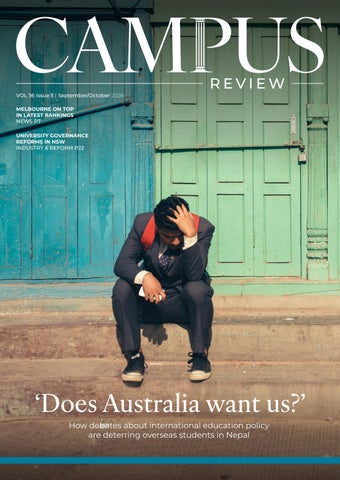
VOL 36 Issue 5 | September/October 2026 MELBOURNE ON TOP IN LATEST RANKINGS NEWS P7 UNIVERSITY GOVERNANCE REFORMS IN NSW INDUSTRY & REFORM P22
‘Does Australia want us?’ How debates about international education policy are deterring overseas students in Nepal
What Can AI Do for Your Institution? Artificial intelligence is reshaping tertiary education — but not all AI is built the same. Generic AI recognises patterns. Ellucian AI understands how institutions actually work, using institutional intelligence to reflect the policies, workflows, governance, and business logic unique to tertiary education. In this guide, you’ll discover: • What institutional intelligence is and why it sets AI built for tertiary education apart • The difference between AI Assistants, AI Capabilities, and AI Agents — and how they work together • Real examples of AI in action across the Ellucian Platform • How trusted governance and SaaS modernisation help institutions adopt AI with confidence Scan the QR code to download your free guide
CONTENTS
NEWS 4
7
9
Universities Australia and the University Chancellors Council join up to improve governance and executive leadership Professor Jessica Vanderlelie becomes Griffith’s first graduate VC, bringing a strong student-focused vision University of Melbourne tops THE Rankings for Australian unis for the 15th year running Two unis rollout ChatGPT Edu AI to students in a move criticised by the union Universities Accord (Opening the Doors of Opportunity) Bill finally passes through parliament
6 7 8 9
10
12
INTERNATIONAL EDUCATION 10 Reforms to stop visa hopping, close
transfer loopholes, and prevent students bringing family go live The Coalition joins Labor and One Nation in restricting international student numbers COVER STORY As policy settings and visa rules change, what do prospective international students think? Although debates focus on student numbers, the bigger question is what we want international education to be
11 12
15
18
15
AI & TECHNOLOGY 18 Instead of searching for signs of
cheating with AI, teachers should look for what students have learned
20
22
MANAGING EDITOR Rebecca Cox | rcox@intermedia.com.au ART DIRECTOR Sanja Spuzanic | sspuzanic@intermedia.com.au SUBSCRIPTIONS Francesca Mackay | fmackay@intermedia.com.au ADVERTISING Nicola Mohtram | nmohtram@intermedia.com.au GROUP PUBLISHER Jordan Guiao
INDUSTRY & REFORM 20 The future of careers starts with
industry-aligned higher education in applied degrees 22 NSW senate report calls for university governance reforms to restore public trust in institutions
PUBLISHED BY Positive Impact Media Pty Ltd | 41 Bridge Road, Glebe NSW 2037 ABN 51 063 279 630 | Print Post 100008043 | ISSN 1037-034X | OCLC 536881479 Copyright All material in this publication is copyright to the publisher and/or its contributors. No material may be reproduced without the express permission of the publishers. Disclaimer: This publication is published by Positive Impact Media Pty Ltd (the “Publisher”). Materials in this publication have been created by a variety of different entities and, to the extent permitted by law, the Publisher accepts no liability for materials created by others. All materials should be considered protected by Australian and international intellectual property laws. Unless you are authorised by law or the copyright owner to do so, you may not copy any of the materials. The mention of a product or service, person or company in this publication does not indicate the Publisher’s endorsement. The views expressed in this publication do not necessarily represent the opinion of the Publisher, its agents, company officers or employees. Any use of the information contained in this publication is at the sole risk of the person using that information. The user should make independent enquiries as to the accuracy of the information before relying on that information. All express or implied terms, conditions, warranties, statements, assurances and representations in relation to the Publisher, its publications and its services are expressly excluded save for those conditions and warranties which must be implied under the laws of any State of Australia or the provisions of Division 2 of Part V of the Trade Practices Act 1974 and any statutory modification or re-enactment thereof. To the extent permitted by law, the Publisher will not be liable for any damages including special, exemplary, punitive or consequential damages (including but not limited to economic loss or loss of profit or revenue or loss of opportunity) or indirect loss or damage of any kind arising in contract, tort or otherwise, even if advised of the possibility of such loss of profits or damages. While we use our best endeavours to ensure accuracy of the materials we create, to the extent permitted by law, the Publisher excludes all liability for loss resulting from any inaccuracies or false or misleading statements that may appear in this publication. Copyright © 2026 – The Intermedia Group Pty Ltd.
campusreview.com.au
VOL 36 Issue 5 | September/October 2026 MELBOURNE ON TOP IN LATEST RANKINGS NEWS P7 UNIVERSITY GOVERNANCE REFORMS IN NSW INDUSTRY & REFORM P22
‘Does Australia want us?’ How debates about international education policy are deterring overseas students in Nepal
COVER The view from Nepal, p12. Image: iStock/ Oleh_Slobodeniuk
3
NEWS
Universities Australia chair Carolyn Evans said the “change reflects our shared commitment to ensuring [universities] are well governed”. Image: Peter Wall
advancing education, research and the public good,” Dr Kaine said. “Throughout this inquiry, the committee was reminded that universities derive their legitimacy not only from academic achievement, but from public trust. “Preserving that trust requires governance arrangements that are open, representative and accountable, and that consistently place the long-term public mission of universities ahead of short-term managerial priorities.” UA chair Carolyn Evans said the changes to the organisation will allow it to better meet those community expectations of the sector. “As publicly funded institutions, universities have a responsibility to maintain high standards, and this change reflects our shared commitment to ensuring they are well governed, well represented and well placed to meet the expectations of the communities we serve,” she said. The convenor of the University Chancellors Council (UCC) John Pollaers also recognised the importance of these issues. “Bringing chancellors and vicechancellors together strengthens our collective leadership of the sector. It carries forward the work of the Universities Australia and the University Chancellors Council join forces in a UCC while building our capacity to commitment to improving governance and executive leadership. strengthen governance, anticipate emerging issues and maintain public BY REBECCA COX confidence in Australian universities,” he said. Three new interim chancellor directors recommendations centred on the n the wake of ongoing issues around have been appointed to the board of UA, governance in the sector, Universities transparency of university councils, with the election for permanent board Australia and the University including how members are appointed, members slated to take place at next managing conflicts of interest, oversight, Chancellors Council are joining forces to year’s annual general meeting in March. create one peak body. regulations and The new UA community Coming together under Universities board will be made Australia (UA), the change will give expectations. up of its CEO, seven ‘Bringing chancellors and UA a greater advocacy role and The chair of the vice-chancellors vice-chancellors together inquiry Dr Sarah more responsibility for two university (one of whom will functions that have been the subject Kaine said lack be the chair), and strengthens our collective of transparency of sustained public criticism and lots three chancellors. leadership of the sector’ of media attention – governance and was undermining A new committee executive leadership. universities’ dealing specifically social license. The recent senate committee with university “Universities are not private report on university governance in governance will also be established, NSW, called for sweeping reforms, corporations; they are public institutions chaired by one of the board chancellors. finding that governance structures established by Parliament, supported The UCC will cease operations on are not “fit for purpose”. Many of the by public resources, and entrusted with October 31.
‘SHARED COMMITMENT’
I
4
campusreview.com.au
Simple, personalised support across the entire student journey. Students can ask Guide questions in plain language and receive tailored guidance across timetables, accommodation, scholarships, assessments and academic support. The result is personalised, real-time support, and greater clarity, confidence, and engagement for every student.
Learn more
Making life simple for our community
NEWS
GRADUATE TO VC An alumnus of the university, Professor Jessica Vanderlelie becomes Griffith’s first graduate vice chancellor, bringing her strong student-focused vision. BY EUAN KYLIE
F
ormer faculty member and proud belonging built my confidence as a firstgraduate of Griffith University, in-family student and sparked a passion Professor Jessica Vanderlelie has for the student experience that has been appointed its next vice chancellor. shaped my career.” She is the first graduate to be appointed Along with her leadership role at to the role in the university’s history. Deakin University, Professor Vanderlelie Professor Vanderlelie began her has also done advocacy work with academic career at Griffith’s Gold Coast Universities Australia (UA), reflecting campus teaching her academic biochemistry, interests in equity before eventually and inclusion and ‘Her commitment to holding senior participation. leadership positions In her time at UA, students, particularly those at a number of she has mentored from underrepresented other universities. early career backgrounds, has defined Speaking about academics and her appointment to those in leadership her career’ the role, Professor positions to Vanderlelie said her support them in time as a student at becoming agents Griffith marked a change in her life. of change in the sector. “From the first day I stepped onto the She’s also won a number of teaching Gold Coast campus 30 years ago, it felt awards over the years, recognising her like home,” she said. commitment to student success. “You could feel being part of a Griffith University’s Chancellor Andrew genuine community. That sense of Fraser praised Professor Vanderlelie’s
6
Professor Jessica Vanderlelie. Image: Supplied/Griffith University
leadership record and understanding of the transformative power of higher education and said she would bring energy to the role at a time of change at the institution. “Professor Vanderlelie is an outstanding educational leader and is passionate about the opportunity for education to make a difference,” Mr Fraser said. “Her commitment to students, particularly those from underrepresented backgrounds, has defined her career.” He also said she was on board with the current plans for the university. “Professor Vanderlelie is fully committed to our strategic plan and the vision launched earlier this year. “This appointment does not signal a change in direction. It signals the energy required to deliver on our strategy in a way that focuses on students,” he said.
campusreview.com.au
NEWS
The University of Melbourne is the top Australian institution in the 2027 THE rankings. Image: NCA NewsWire/David Geraghty
underscores our role as a globally connected university, working with our valued partners to address complex challenges and create meaningful impact for communities in Australia and internationally.” Five other Australian universities made it into the top 100 institutions.
‘MORE INCLUSIVE’ The University of Melbourne is the top Australian university for the 15th year running, according to the latest THE World University Rankings. BY REBECCA COX
T
“They also highlight the strength and he University of Melbourne has diversity of Australia’s higher education remained Australia’s highestsector and the important contribution ranked institution for the 15th universities make to our country. year, rising three places to 34th on the “Universities transform lives Times Higher Education’s (THE) World through education, drive discovery University Rankings. and innovation, build international Oxford University has maintained connections and contribute to its place at number one, as did the Australia’s cultural, social and Massachusetts Institute of Technology economic prosperity.” at number two. Stanford jumped University of Melbourne Deputy two places to join Princeton at third, Vice-Chancellor (Global, Culture and swapping places with Cambridge, which Engagement) came in fifth. Professor Michael University Wesley said of Melbourne ‘This ranking recognises the maintaining (UoM) Acting its position at Vice Chancellor collective contribution of number-one in Jane Gunn said our people and the strength the country was that apart from also a testament recognising of our global networks’ to the university’s the value of her reputation on the institution, the international stage. results are also a “Remaining Australia’s highestgong for the higher education sector ranked university for 15 consecutive overall. years is a significant achievement in an “These latest results reflect the quality increasingly competitive global higher of our education and research, the education environment,” he said. dedication and talent of our students “This ranking recognises the collective and staff, and the enduring partnerships contribution of our people and the that support our work around the strength of our global networks. It world,” Professor Gunn said.
campusreview.com.au
• University of Sydney came in at equal 51, up from equal 53 in 2026. • Monash University dropped three places to 61. • University of Queensland improved by seven spots to equal 73. • University of NSW is up four spots to equal 75. • The Australian National University has dropped four ranks to 77. This year’s THE rankings assessed 2297 institutions from 118 countries, which is its largest cohort since it began. The United States, India, Turkey, Japan, and Great Britain respectively are the top five countries with the largest number of universities assessed in the rankings, and universities from Albania and Malawi were represented for the first time. Also for the first time, universities in Asia outranked those in continental Europe, with China’s Tsinghua University at number 11, and the National University of Singapore rising to 15. THE’s chief global affairs officer Phil Baty said the increase in numbers has made the rankings more inclusive. “It is fantastic that the World University Rankings will be more inclusive and more diverse than they’ve ever been, as more universities from across the world meet our demanding participation criteria to join an elite group of research-intensive universities on the global stage,” he said. “And we are delighted to reflect this consistently increasing inclusion and diversity with more detail and clarity in the published tables themselves: new, more granular rankings bandings will help users to better differentiate between institutions and will support better benchmarking and better decision-making.” The increase in the data set means THE has been able to produce two new regional rankings; one each for Central Eurasia and South East Asia.
7
NEWS
The University of Sydney. Image: iStock/jimfeng
of its AI Sustainability Research and Innovation Fund to look at the environmental impacts of AI, and said the implementation of ChatGPT will be guided by the university’s Responsible AI Framework . The announcement came barely a week after staff at USyd held a strike over concerns about how AI encroachment would affect job security. At UNSW, the OpenAI partnership will bring ChatGPT Edu to more than 80,000 students by 2027, with access to the tool also being extended to higher degree research candidates and casual academic staff. NSW deputy vice-chancellor for education and student experience Professor Sarah Maddison said the rollout was about equity and knowledge for students. “Our ambition is to produce AI-capable graduates,” she said. “To do that, we need to ensure all students have equitable access to a range of AI tools to help develop their capability and improve their exposure Two universities have announced the rollout of ChatGPT Edu AI and experience with AI tools. This to students in a move criticised by the education union. includes tools that are being used in the industries they will likely go into.” BY EUAN KIELLY The UNSW announcement said AI would support academic integrity and student job pathways. n a move criticised by the education loss-making vendor in the middle of a Mr Caughley said a lack of market-share war,” Mr Caughley said transparency reveals governance issues. union, two Group of 8 universities “Why would any responsible university “Everyone should be concerned have entered the AI arena, with both lock itself into that bet?” that with little demonstration of the University of NSW (UNSW) and the USyd Vice Chancellor Mark Scott said benefit to university communities University of Sydney (USyd) announcing partnerships with OpenAI. the access to ChatGPT Edu AI is part beyond marketing hype, university of the university’s managements The universities said the partnerships investment in its are falling over will see ChatGPT Edu AI tool integrated students’ future. themselves to into learning and research. ‘Let’s be clear: OpenAI “AI is rapidly hand OpenAI USyd’s National Tertiary Education isn’t selling our universities reshaping the access to hundreds Union (NTEU) branch said there should workforce our of thousands of have been more staff consultation, with a product, it’s buying graduates will NSW staff and NSW division secretary Vince Caugley a market’ enter and our goal students without arguing that the move “is as shameful as is to help all our the appropriate it is reckless.” students use AI assessment and “They have been promising a effectively while ensuring they leave consultation,” he said consultative, human-centred approach university with the human capabilities, “University managements do while doing everything they can to rush the knowledge, skills, judgement, not have a blank cheque to make to adoption and avoid proper process,” creativity, ethical awareness and high-risk strategic bets with our he told Campus Review. adaptability they’ll continue to need to public institutions. Decisions of this “Let’s be clear: OpenAI isn’t selling thrive in the jobs of the future,” Professor scale demand proper scrutiny and our universities a product, it’s buying a Scott said. transparency. It is the clearest indication market. It’s absolutely gobsmacking that At the same time, the university that our universities are being put at risk USyd would race UNSW to be first to also announced the establishment by poor governance,” he said. sign a multi-year contract with a single
‘RUSH TO ADOPTION’
I
8
campusreview.com.au
NEWS
Minister for Education Jason Clare announced the Accord legislation has passed both houses. Image: Martin Ollman
Prior to the Bill making its way to the Senate, it had been scrutinised by a cross party inquiry, which ultimately recommended that it be passed. At the inquiry, Universities Australia (UA) chief Luke Sheehy said his organisation had concerns about the ministerial powers in the legislation. “In this Bill, we believe the Minister is seeking too much power over individual universities,” Mr Sheehy said. “The government has sensibly narrowed section 36-65, and we welcome that, but the underlying power remains. A minister could still impose unreasonable conditions directly on the funding of an individual university. Universities are accountable for public money, governments should set national priorities. But universities are autonomous institutions, they are not departments of state.” The Group of Eight (Go8) also had serious concerns about the section After 42 amendments, the Universities Accord Bill will enshrine dealing with ministerial powers, which needs-based and managed growth funding. was ultimately removed from the legislation after lobbying by the sector. BY REBECCA COX Go8 chief Vicki Thomson said this an important outcome. “This preserves an appropriate balance he federal government has The Bill also puts in place what the between government oversight and secured passage of its “Gonski government had dubbed Managed institutional autonomy,” she said. for universities” legislation, which Growth Funding. From 2027 an extra “Universities are publicly accountable is aimed at helping more Australians 16,000 places will be added for students institutions, but it is equally important access higher education, particularly across the sector each year until 2029. that broad discretionary powers are those from disadvantaged and From 2030, that number will rise to not used to impose conditions on underrepresented backgrounds. 19,000 extra places a year. funding grants that could undermine Education Minister Jason Clare has These will be funded through institutional independence.” announced that the Universities Accord Commonwealth Supported Places with UA welcomed the passage of the Bill (Opening the Doors of Opportunity) Bill the newly established Australian Tertiary but was circumspect about the how the will be the seventh piece of legislation Education Commission (ATEC) allocating additional places would be funded. passed in the implementation of the these to institutions. “We’ve always supported the ambition Universities Accord. The Bill also lays out the framework behind this Bill, and we pushed for The major reform of the Bill is in how for ATEC, giving it powers to set changes to make it stronger. Opening universities are allocated government enrolment numbers and work out how the door is important. But doors only funding. An additional $3.6 billion dollars to set the cap create opportunity is available with 230,000 more places for on international if people can An extra $3.6 billion dollars students over the next decade. students. walk through “Talent is everywhere. It’s opportunity The legislation them. If we want is available with 230,000 that’s not,” Mr Clare said. had been held up more teachers, more places for students “These reforms will mean more young by a large number nurses, engineers people from poor families and from of amendments and other skilled over the next decade the regions and the bush get a crack by the Coalition, workers, we need at university.” the Greens more funded Universities will attract needs-based and Independents, and ultimately university places,” Mr Sheehy said. funding on the number of students passed after 42 of the 43 Senate “The ambition of the Accord can from disadvantaged backgrounds that amendments were agreed to in the only be realised if growth is matched are enrolled at their institution. House of Representatives. with funding.”
‘GONSKI FOR UNI’
T
campusreview.com.au
9
INTERNATIONAL EDUCATION
VISA CHANGES GO LIVE The government reforms are designed to stop visa hopping and close transfer loopholes. BY REBECCA COX
T
he Labor government has implemented its reforms in an attempt to stop visa hopping, close transfer loopholes and impose tighter rules around international students bringing family with them to Australia. As of October, the changes laid out in its new immigration policy have come into effect. International students will no longer be able to apply for visas from within Australia, switch from university to vocational training, or transfer between institutions, according to Assistant Minister for International Education Julian Hill. While acknowledging the value of the international education market, Mr Hill said the changes aim to retain the quality of the industry, while targeting misuse of temporary visas. “This is a sweeping package of reforms that gets the balance right to tighten integrity, manage numbers in a sensible way without trashing one of our nation’s largest and proudest export sectors as some loud, ill-informed voices seek to do,” he said.
10
The government said it is taking what it calls a “firm, balanced approach” to reform, which includes stopping students from transferring to lower-level courses once they arrive in Australia through implementing a new student visa transfer stream. Although this won’t come into effect until mid-2027, interim measures have already been put in place. This is one way the government said it aims to “disrupt the business models of providers targeting students with lowcost or lower-quality courses after they arrive in Australia.” Students from Pacific and Southeast Asian countries, those studying for PhDs, or sponsored by governments, will be exempt from the new rules around visas for partners and children. The aim of this reform is clearly stated: “to remove the ability of most students to bring family members with them.” The changes come in the same week the Coalition touted its immigration reforms as the “biggest cut to immigration in the history of
International Education Assistant Minister Julian Hill. Image: Luis Enrique Ascui
this country”, with leader Angus Taylor announcing proposed restrictions to international student visas should they win office. Responding to the Coalition’s proposals, Universities Australia chief Luke Sheehy said the policy alignment of the major parties over international students was concerning. “We have been clear with all sides of politics: cutting international student numbers too hard comes with real consequences for Australia,” he said. “International education supports jobs and communities, helps build the skilled workforce we need and strengthens Australia’s relationships and standing around the world. “For nearly four decades, governments of both persuasions have supported the development of a world-class international education sector because it is good for Australia.”
campusreview.com.au
INTERNATIONAL EDUCATION
Image: iStock/hamzaturkkol
students, or those who are studying at regional universities. It would also scrap secondary visas for most students, meaning they could no longer bring their family or partner with them to Australia. “Part of what we have seen under Labor is our universities selling not education but visa pathways, migration pathways,” Mr Taylor said. “That will end under this policy. We want our universities selling worldclass education.” The largest group of migrant arrivals in Australia between 2024 and 2025 were temporary student visa holders, which made up 157,000 of the 306,000 net overseas total. The cuts come amid projections of Australia’s tertiary education export value to be about $55bn a year. Getting ahead of criticisms of what stripping 650,000 temporary visas out of the economy could do to Commonwealth coffers, Mr Taylor insisted “this package is budget neutral”. Community Strong Australia MP Zali Steggall described the dramatic slashing of international student and The Coalition has joined Labor and One Nation in setting a migration worker numbers proposed by both target that restricts international student numbers. One Nation and the Coalition as a ploy to make Australia’s population “older, BY NEWSWIRE poorer and dumber”. “I disagree with the discussion around having an immigration problem,” Ms Steggall said, speaking to Today. he Coalition has released a fourensure our country has the breathing “What we have is an infrastructure year policy plan pitching what space it needs after the record levels of problem where, for too long, leader Angus Taylor is calling immigration under Labor”. governments have failed to properly the “biggest cut to immigration in the “It got up to 550,000, more than plan the rollout of infrastructure and history of this country”. double what we have ever seen before have good density plans to make sure The plan, released in October, in this country, and our country needs that when we have immigration, that proposes slashing net overseas breathing space it is matched migration (NOM) to 100,000 per year for right now,” Mr with services. ‘Part of what we have two years before raising it to 130,000 in Taylor said. “If we cut year three, and levelling out at 160,000 “It is also true for immigration too seen under Labor is in year four. NOM is the total number those coming into dramatically, our universities selling of people arriving to live in Australia Australia – Australia what we will be in for at least a year minus the number of should be a home, Australia is older, not education but people leaving. not a hotel. Right poorer and dumber visa pathways’ The Coalition would hit its target by now we see under because the reality cutting temporary visa holders by about Labor a guest is much of our 650,000 over the four years, halving the worker economy. economy relies on humanitarian intake to 10,000 places per “We want people coming to this immigration, from aged care to nurses, year, and capping international student country who are committed to the doctors, construction. commencements at 240,000 per year. future of our country.” “We won’t build the Brisbane Unveiling the policy, the opposition The proposal would effectively abolish Olympics without targeted construction leader said the steep NOM cut “will temporary graduate visas. It would immigration to meet the demand. We take pressure off roads, off schools, also restrict transitional visas only to will be poorer simply because we won’t off infrastructure, houses and it will PhD graduates, health and education have the skills in our economy.”
‘OLDER, POORER, DUMBER’
T
campusreview.com.au
11
INTERNATIONAL EDUCATION
COMPARING COUNTRIES As policy settings and visa rules change, prospective international students are getting more and more discerning about which countries will welcome them to study. BY MUKESH DHAMALA
DOES AUSTRALIA STILL WANT STUDENTS LIKE US?
In the decade I’ve spent working with Australian education providers from Kathmandu, I’ve met students excited about leaving home, parents trying to understand an unfamiliar education system, and graduates who return to tell us how much their lives have changed. For years, most of the questions were predictable. Which course? Which university? How much will it cost? What is Sydney like? Will my English be good enough? These days, the question is different: does Australia still want students like us? I often find myself explaining Australian politics before I am ever asked to explain a course.
12
Young people who have never set foot in Australia follow announcements from Canberra, share headlines about student visas and ask what the Labor government or the Coalition might do next. In this way, Australia’s migration debates have found their way into our conversations in Kathmandu.
A POLITICAL DEBATE HEARD AT THE FAMILY TABLE
During the 2025 Australian federal election, international students became part of a much larger argument about migration, housing and how many people Australia should welcome. Labor defended its tighter visa settings and management of international education. The Coalition
argued for further restrictions, including lower international student commencements. I understand why these questions matter to Australian voters. Housing costs are real. So, too, are concerns about infrastructure, poor recruitment practices and providers that have not acted in students’ interests. I’ve worked in this sector long enough to know that some of the criticism is justified. But the same political message can sound very different in Nepal. Consider a hypothetical student who has finished Year 12 and hopes to study business in Sydney. Perhaps his older brother studied there, so Australia feels familiar, even though he has never visited. He might be preparing for an
campusreview.com.au
INTERNATIONAL EDUCATION
Image: iStock/gawrav
Australia is not an easy place to live for everyone. But the chance to belong to a diverse society has mattered English test, looking at courses and enormously. I have seen young people discussing fees with his parents. Then leave Nepal unsure of themselves and, his phone fills with election headlines over time, become confident enough about cutting student numbers. to work with people from many He wonders whether he will still have backgrounds, speak up in class, and a chance. His father worries about the build a life far beyond what they had money: what if they pay the visa charge, imagined at 18. arrange finances, and the application is That story is part of Australia’s refused? What if another rule changes reputation in Nepal. It has been passed halfway through the process? from older siblings to younger ones, This is a representative situation, from graduates to neighbours, and from not a transcript of a particular family families who have seen what a good conversation. But the worries are drawn education can do. It is not something from the kind an advertising of questions I campaign can encounter in my manufacture. No application is work. No one When withdrawn. No offer is is asking for a international shortcut or special students are deferred. No visa is refused. treatment. They spoken about as The student simply does are trying to a number to be make a serious reduced, I worry not apply. decision with that this richer information that story is drowned keeps changing. out. The people being counted are also When politicians speak about the people who fill classrooms, make international students, their immediate friends, volunteer, work, celebrate and audience is Australian voters. But the sometimes become lifelong members of message does not stop at the border. Australian communities. It travels through news feeds, family groups and student conversations THE DIFFICULT CONVERSATIONS in places such as Kathmandu. Often, WE NOW HAVE it arrives without the explanation or It would be wrong to suggest that context that accompanied the original every policy reform is unfair. There have announcement. been genuine failures in Australia’s international education industry THE AUSTRALIA WE GREW UP for students. They have been given HEARING ABOUT unrealistic expectations. Some have One of the things I have always admired been pushed towards courses or about Australia is how comfortably so transfers that made little academic many different communities can be sense. Some operators have treated visible in public life. In Sydney, a student recruitment as a transaction rather than can hear several languages on a train, a responsibility. find food that reminds them of home, Better standards are necessary. But and meet classmates whose families better standards also require clearer come from all over the world. communication to the people expected For Nepalis, festivals such as Dashain to follow them. and Tihar do not simply disappear A student asks whether they can after migration. Families and friends change providers if a course is not gather to celebrate them in Australia. suitable. A parent asks whether partOther communities mark Diwali, Lunar time work will cover the next semester’s New Year, Eid and Christmas. People fees. Someone else repeats advice from carry their traditions into the life of a cousin who arrived in Australia five the country rather than leaving them years ago, unaware that the rules have behind at the airport. changed since then. I do not want to romanticise that In July 2026, the standard student picture. Students can be lonely. They visa application charge rose to $2,500. can face discrimination, high rents and Changes to student transfers and visa exhausting days balancing study with settings have added further questions ordinary living costs. that families need to understand before
campusreview.com.au
Mukesh Dhamala. Image: Supplied.
making commitments. Even when a reform has a reasonable purpose, it can take time for accurate information to replace rumours. In the conversations I’m having with prospective students and their families, I often have to prepare them for difficulties: do not assume you can change colleges easily; do not build your financial plan around part-time employment; and do not confuse a student visa with a promise of permanent residency. Sometimes I advise a student to wait, improve their preparation, or think again about the course they have chosen. That may mean losing an enrolment today, but it may also prevent a family from making a much more expensive mistake tomorrow. For those of us representing Australian education providers, this is not a side issue. Honest advice is part of protecting the reputation of the sector.
A YOUNGER GENERATION IS COMPARING COUNTRIES
The students I meet today know much more about studying overseas than just a few years ago. They compare tuition fees on their phones, watch graduates describe their lives overseas, and discuss the details of visa rules in online groups. Some of what they find is misleading, but they are no longer waiting for an education agent to tell them what to think. Germany is an attractive option because of tuition arrangements at public universities and its strengths in technical fields. The United States appeals to students interested in particular universities and research opportunities, while the United
13
INTERNATIONAL EDUCATION
View of Kathmandu. Image: iStock/sphraner
WHAT I WISH CANBERRA COULD HEAR
Kingdom attracts some who want a shorter postgraduate course. Canada is familiar, although its own restrictions have made students more cautious. Every destination has its specific issues. Germany may require learning the language. American education can be expensive. The UK and Canada have their own policy uncertainties. I’m not suggesting that any one country has discovered a perfect approach. What interests me is the change in the questions now being asked by prospective students. Previously, they came to see me asking which Australian institution might suit them. Now, the conversation begins with which country suits their course, finances and future plans. Australia is still attractive, but it is being compared more carefully. I do see something positive in that. A student choosing a country because the education genuinely fits their goals is likely to ask better questions and make a more informed commitment. Australian institutions should welcome such students, not expect them to choose Australia out of habit.
THE STUDENTS NO UNIVERSITY EVER COUNTS
Working with Australian providers, I know how closely institutions follow applications, offers, visa outcomes and enrolments. These numbers are necessary. They help teams plan courses, staffing and student support. But there is another group that does not appear in those reports: students who were seriously considering Australia and never applied. Perhaps a student spends months comparing degrees in Sydney and
14
Melbourne, then decides to study in Germany. Perhaps a parent attends an information session and later decides the total cost is beyond the family’s comfort. Perhaps a prospective student becomes uncertain after another visa announcement and starts researching somewhere else. No application is withdrawn. No offer is deferred. No visa is refused. The student simply does not enter the system. From Kathmandu, I think these decisions deserve more attention. Universities may know exactly how many applications they received last month, but they don’t know about the students who almost applied and changed their minds. Was it because of the course, the cost, the way a rule was explained, or a growing feeling that Australia had become less welcoming? Sometimes the reason will be due to misinformation. Sometimes it will be a perfectly sensible decision about another destination. And sometimes it may be something Australian institutions need to hear, however uncomfortable it might make them. International offices have representatives and agents around the world. We should use those relationships for more than enrolment forecasts. Australian institutions need to ask what it is that families are worried about. They need to know which questions are becoming harder to answer, and what students are saying when they decide against Australia. Listening to people who never become applicants may be one of the most useful forms of market research a university can do.
I do not expect Australian governments to design migration policy around the wishes of prospective students in Nepal. Australians have every right to debate policies around housing, migration, public services and the standards expected of education providers. Nor do I believe international students should be promised jobs, residency or an easy future. Many of those promises have proven false in the past and have done enough damage already. But there is a difference between explaining that a visa system needs stronger rules and leaving young people with the impression that they themselves are unwanted. HIghly charged political arguments can make that distinction disappear, especially when a headline is all that reaches someone overseas. I still believe strongly in Australian education. I have seen what it can offer students academically and personally. I have seen graduates come home with new skills, and others become part of Australian workplaces and communities. Those experiences are why I have continued this work for so long. What has changed is the confidence with which the next generation approaches the decision. They are asking much harder questions, comparing more destinations and paying closer attention to what Australia says about them. I sometimes wish a policymaker could sit quietly for an afternoon in a student counselling office in Kathmandu. Not to give a speech or defend a policy. Just to listen as a teenager asks whether the rules will change again, or a father asks what happens if the visa is refused. Those conversations will never decide an Australian election. But they may decide whether a young person ever enters an Australian classroom. Australian voters choose their governments. Far beyond Australia, young people who cannot vote are listening to what those governments say – and making choices of their own. Mukesh Dhamala is an international education professional with more than a decade of experience representing Australian education providers in Nepal and South Asia.
campusreview.com.au
INTERNATIONAL EDUCATION
FROM SURGE TO SLOWDOWN The international student debate seems primarily focused on reducing numbers, leaving out the bigger question of what Australia wants the sector to achieve. BY PETER HURLEY AND MELINDA HILDEBRANDT
T
he Australian government has announced visa changes making it harder for international students to bring their families with them while they study. There are also new rules designed to stop students from cycling through courses just to prolong their stay in Australia. Home Affairs Minister Tony Burke has framed these changes as part of a broader, “orderly” and “fair” approach
campusreview.com.au
to lowering net overseas migration. But they also continue a years-long push by the federal government to lower international student numbers. What has been announced? And what is happening with international student numbers more broadly?
WHAT DID TONY BURKE SAY?
Mr Burke told the National Press Club in September that most international
Image: iStock/ampueroleonardo
students will have to come alone to Australia. There will be some exceptions, including for people from Pacific and ASEAN countries and PhD students. Last year, more than 45,000 visas were granted to family members of an international student. Mr Burke also flagged the government would clamp down on “visa hopping”
15
INTERNATIONAL EDUCATION
by international students. Students will need to prove they are progressing to a course at a higher level to prolong their student visa. As Mr Burke explained: “One of the classic areas of visa hopping is people finish a course, hop to the next course, hop to the next.” These changes are part of the federal government’s wider bid to bring down net overseas migration from about 290,000 to 225,000 in 2027-28. The peak body, Universities Australia, described the latest move by the government as “worrying”. Chief executive Luke Sheehy explained students often bring family members to Australia if they are doing research degrees “because they can be here for up to three or four years while they do that”.
Students will need to prove that they are progressing
of “workarounds”. These include increases to student visa application fees and slower visa processing times. After the pandemic, international students returned to Australia more quickly than expected. In 2022, the Australian government suggested it might take four years to reach pre-pandemic levels of students. It took one year. This surge created an increase that continues to work its way through the system. After completing a course, many international students can apply for a graduate visa. This means they can extend their stay for a further 18 months or more. The number of students on graduate visas has more than doubled from 70,000 in June 2019 to 199,000 in June 2026 as students who finish their courses transition to these visas. Further increasing the total number of current and former students are “secondary” visa holders. These are normally immediate family members, such as partners and children who come with students to Australia. The total number of student and graduate secondary visa holders has increased from about 92,000 in June 2019 to about 142,000 in the most recent available data.
WHAT HAS BEEN HAPPENING?
Over the past three years, the government has been trying to lower the number of international students in Australia. Legislation to give the government greater powers to do this was blocked before the last election, so the government has had to use a series
16
campusreview.com.au
INTERNATIONAL EDUCATION
OTHER MOVES TO REDUCE INTERNATIONAL STUDENTS
To reduce net overseas migration, the number of residents leaving the country must be higher than the number of residents entering the country. Many of the measures announced by Mr Burke give the government more ways to ensure student visa holders leave. In the meantime, there has been a reduction in the intake of new international students. Our analysis of immigration data (shown in the chart below left) shows the visa refusal rate for international students has increased significantly over the past six months. Student visa refusal rates are currently the highest they have ever been. The government has said this is because it is more strictly applying a financial capacity test. These are the funds an international student must demonstrate when applying for a visa – to prove they can support themselves while in Australia.
HOW DOES LABOR’S PLAN COMPARE TO OTHER PROPOSALS?
The complicated nature of migration means it can be difficult to make direct comparisons between different proposals. However, One Nation announced a much harsher plan. Its target of 350,000 international students would come close to halving the number in Australia, as part of its proposal to reduce the overall number of temporary migrants by 750,000. Such a cut would have a huge impact on the university sector and beyond. The Australia Bureau of Statistics says international education is worth $54.7 billion per year, of which $24.3 billion is from student fees. International students also take a huge range of courses at different types of institutions, such as vocational colleges, private providers or Englishlanguage schools. Universities can be the face of international students, but they only account for about half of the international student enrolments in Australia.
campusreview.com.au
Further increasing the total number of current and former students are ‘secondary’ visa holders AN INTERNATIONAL STUDENT COULD BE YOUR BAKER OR YOUR CARER Our analysis of tax data (shown in the chart above) shows international students play a significant role in certain occupations. These include jobs as hospitality workers and food trades workers (such as bakers and cooks). About 10 per cent of carer and aides jobs, such as child carers and aged care workers, were held by current and graduate international students.
OTHER COUNTRIES ARE DOING SIMILAR THINGS, BUT…
Australia is following a global trend to tighten settings for international students. Canada has also wound back its international student program. Rather than having an open-ended number of visas, there are planned ceilings. The United Kingdom also
announced a restriction on family members applying for student visas in 2024. What is missing from these announcements is a clearer picture of how international education fits within the wider migration program. The debate has focused on reducing numbers, but the bigger question is what Australia wants international education to achieve. That means deciding which skills to prioritise and how education, migration and workforce planning can work together. Peter Hurley is Director and Melinda Hildebrandt is Policy Fellow at the Mitchell Institute., Victoria University, This article is republished from The Conversation under a Creative Commons license. Read the original article at the conversation.com/au.
17
AI & TECHNOLOGY
FALSE FLAGS Instead of searching for signs of cheating with AI, teachers should look at whether students have learned what an assessment was designed to measure. BY MARK A. BASSETT
S
ince artificial intelligence (AI) software ChatGPT was released in 2022, teachers have been looking for ways to tell when AI has been used to generate text in assessments. AIdetection software is still sold by some tech companies, such as Pangram, as a potential solution.
18
In September, the New South Wales Education Standards Authority (NESA) updated its rules to stop schools from relying on AI-detection software when deciding if a student has cheated. The reasoning is that these tools are not always reliable. While most Australian unis have already shifted away from
AI-detection software in some form, my research suggests the education sector should go one step further and not use AI-detection tools at all.
WHERE ARE UNIS AT?
Unis each have their own rules around how they use AI-detection software, or
campusreview.com.au
AI & TECHNOLOGY
Image: iStock/hapabapa
whether they use it at all. Some unis, such as the University of Melbourne, the University of Sydney and the University of NSW, use AI-detection tools in some form to assist in flagging potential cases of misconduct. Other unis, such as Curtin University and the University of Queensland, have opted to not use AI-detection tools at all.
NOT ALWAYS RELIABLE
The reason is because this software is not always accurate. When AI-detection tools incorrectly flag a student’s work as including AI-generated text, this is called a false positive. AI companies want to develop detectors that have low falsepositive rates. For instance, Turnitin, a United Statesbased company that sells AI-detection software, promotes a false-positive rate of less than one per cent. However, Turnitin says this software is only reliable in detecting AI use when documents contain more than 20 per cent AIgenerated content.
IMPACTS ON STUDENTS
A small false-positive rate can still lead to big problems. In 2023, academic integrity expert Phillip Dawson estimated that even a 0.7 per cent false-positive rate would result in over 100,000 assessments being wrongly flagged as AI generated each year in the Australian higher education sector alone. This happened on a smaller scale at the Australian Catholic University, which referred nearly 6,000 students for alleged academic misconduct in 2024, about 90 per cent of them over AI use. The ABC reported last year the uni later dismissed any cases where the evidence for misconduct was solely based on Turnitin’s AI-detection technology. Turnitin states its software should not be used in isolation to decide whether a student has used AI improperly: “Rather, we provide data for educators to make an informed decision based on their academic and institutional policies.” But this still has an impact on students’ wellbeing. Research shows false accusations of academic misconduct harm students and causes significant stress and anxiety.
campusreview.com.au
WHY AREN’T DETECTION TOOLS MORE ACCURATE?
Companies measure the accuracy of AI-detection software under controlled conditions. To calculate the false positive rate, companies test text they know was AI generated and text they know was entirely human written. Using these texts, they then measure how often the detector gets it right or wrong. However, we don’t really know all the details of how companies test their AIdetection software.
are all built on the same assumption that humans and AI write differently. Agreement between multiple AI detectors doesn’t mean they are right. It only means they made the same mistake. False negatives are also a problem. This is when a detector fails to identify text where AI has been used. These mistakes get far less attention than false positives and are a big problem for educators when determining whether a student has cheated.
TESTING DOESN’T TRANSLATE WELL
WHAT’S THE ALTERNATIVE?
My research with colleagues, published The question assumes there must in the Journal of Higher Education be a technical solution that allows Policy and Management, suggests us to continue using unsupervised these controlled tests do not translate written assessments as the sole basis well when AI detectors are used in real for judging student learning. But world contexts, such as in unis. not every unreliable technology First, detection tools attempt to needs a replacement. The same distinguish between AI-generated applies to AI watermarking, which text and human-written text. However, has its own limitations. this is not always so straightforward, Instead of searching for signs of as anything produced by AI could cheating, teachers should look at plausibly have been written by a human whether their students have learned depending on their writing style. what an assessment was designed Students may also submit work that to measure, and if the work they has been written with the assistance of submit provides valid evidence of AI, rather than sections of text simply that learning. generated by it. Rather than attempting to make all Second, even if a teacher uses an assessments AI-proof, they can identify AI detector with a number of points a very low falseacross a course positive rate, it still where it matters doesn’t tell them A 0.7 per cent false-positive most that students the chance an demonstrate key rate would result in over individual student’s outcomes under 100,000 assessments assessment is supervision, AI generated. through exams, being wrongly flagged as This is because practicals, AI generated a one per cent presentations or false positive rate interviews. means one wrong It’s an approach flag for every supported by hundred papers that humans wrote. So Australia’s higher education regulator if you know how many human-written that leaves room for students to use AI papers there are, you know how many where it suits the task, and to learn how to expect to be falsely flagged. But in to use it well. None of this depends on the real world, where students complete software guessing how a piece of text assessments outside the classroom, was written. we can never know in advance how many papers are human written – that’s Mark A. Bassett is Associate Professor why we’re using an AI detector in the and Director of Academic Quality, first place – so we can’t know what the Standards, and Integrity at Charles chances are that the flag is correct. Sturt University.
MULTIPLE AI TOOLS ARE NOT A SOLUTION
It seems like using more than one AI detector would increase the chances of an accurate result. But AI detectors
This article is republished from The Conversation under a Creative Commons license. Read the original article at theconversation.com/au.
19
INDUSTRY & REFORM
WORK-READY STUDY The future of careers starts with industry-aligned higher education in the form of applied degrees. BY SARAH LIGHTFOOT
20
campusreview.com.au
INDUSTRY & REFORM
Image: iStock/sturti
WHAT DOES IT MEAN TO BE WORK-READY?
Being work-ready isn’t just about ustralia’s workforce is rapidly competence and technical know-how. There is a difference between knowing changing. Technology is reshaping something and knowing how to use it. how we work, industries are rapidly While a student might understand evolving, and, as a result, so are the skills the theory behind solving a business employers value most. problem, developing software or responding to a cybersecurity threat, the At the same time, growth across different parts of the economy are workplace adds another layer: applying shaping new opportunities for the this knowledge to an unfamiliar next generation of workers, from IT to situation and adapting when things business management. might not necessarily go to plan. These capabilities are difficult to Against this backdrop, one of the develop through theory alone and most important questions we should be students benefit enormously when asking as a nation is whether those in higher education and work experience the workforce, especially those entering are closely integrated. the workforce for the first time, have Students should have opportunities to the skills and experience they need apply what they are learning while they to succeed. are learning it. They should be exposed Higher education has an increasingly to industry challenges, hear from vital role to play in answering people working in their chosen field and this question. understand both the knowledge their In years gone by, we have future careers require and how that understandably placed significant knowledge is used in practice. emphasis on qualifications as the bridge between school and employment. While NOT JUST MORE EDUCATION these remain an incredibly valuable As Australian industries evolve, our foundation, increasingly it cannot be higher education offerings need to viewed as the end point. evolve with them. Employers need graduates who We should not underestimate the can do more than demonstrate what value industry can have in the higher they know. education sector, shaping what students They need people who can apply that learn and the capabilities they develop. knowledge, solve unfamiliar problems, While employers understand how communicate clearly, work with others roles are evolving in real time, education and adapt as technology and business providers bring academic expertise, needs change. creating the broader foundations And we know learners themselves students need for are questioning the rest of their how well further careers. Bringing study is preparing Higher education needs those perspectives them for this new to be much more closely together can workforce reality. create a stronger Research connected to what the connection commissioned world of work looks between the by UNSW College like now classroom and found nearly half of the workplace. Australian workers This thinking sits (46 per cent) were behind UNSW College’s new Applied unconvinced their original education Degrees in Business Management, IT pathway had fully prepared them for Cyber Defence and Networking, and IT today’s workforce. Software Development. At the same time, 89 per cent believed Built with industry input, the degrees continuous learning was important to are designed to give students practical, staying relevant, yet only 35 per cent career-connected learning experiences were currently undertaking professional that reflect the skills and capabilities training or development. employers value. To bridge this gap, higher education They combine academic learning with needs to be much more closely industry exposure and Work-Integrated connected to what the world of work Learning throughout the programs. now looks like.
A
campusreview.com.au
Rather than workplace experience being something students encounter only towards the end of their studies, students have opportunities to tackle actual industry challenges and build experience applying what they learn before they graduate. It’s one example of what a more applied model of higher education can look like, and as our workforce continues to change approaches like this will become increasingly valuable.
PAYOFF BIGGER THAN EMPLOYABILITY
For students, stronger connections between education and industry can provide clearer pathways into meaningful careers and give them greater confidence to enter the workforce.
Sarah Lightfoot, CEO UNSW College
For employers, it can create a stronger pipeline of graduates with greater exposure to how organisations operate and how their studies translate into the real-world. And for Australia, closer alignment between education and industry can help build a more agile workforce, capable of responding as technology develops and new skills are required. The future workforce is unlikely to be defined by one qualification followed by one career. People will learn, work, retrain and adapt throughout their lives. For parents, teachers, career advisers and others helping young people make decisions about their future, that makes awareness of the breadth of pathways available more important than ever. If Australia wants a workforce ready for the industries of tomorrow, we need to start building those capabilities today, and that means bringing the world of work much closer to the higher education classroom. Sarah Lightfoot is the CEO of UNSW College.
21
INDUSTRY & REFORM
Committee chair and NSW Legislative Council member Sarah Kaine. Image: Supplied
public mission of education, research and service to the broader community.” Other recommendations said the review of the Acts should consider any effects on the health and wellbeing of staff and students, including their psychological safety, to address fear of reprisals and prevent bullying. This should include providing “checks and balances on the very significant power held by Heads of School, Deans and other senior leaders.” Many recommendations related to transparency, including around appointment and removal of vicechancellors, declaring conflicts of interest, and amending acts to strengthen representative governance through diversity and increasing the number of elected positions on university councils. Once councillors are appointed or elected, the report recommended they undergo specific governance induction A NSW senate report has called for reforms to curb corporatisation, improve and ongoing training to ensure they transparency and restore public trust in institutions. properly understand the regulations and expectations. BY EUAN KIELLY As part of this, the report recommends establishing an independent university council secretariat at each institution, niversity governance is not “fit for only from academic achievement, but operating under the governing body purpose”, too corporatised and from public trust. not management, to provide the lacks transparency, according to “Preserving that trust requires governance support the councils need. the report of a parliamentary inquiry governance arrangements that are open, Other recommendations included released in September. representative and accountable, and that clear processes when remuneration is The Standing Committee on Social consistently place the long-term public increased, accountability in executive Issues New South Wales University mission of universities ahead of shortdecision making, standardised financial Governance final report builds on its term managerial priorities.” reporting and annual reports, the use interim report, which found issues at the The report’s 21 findings covered of consultants, and better stakeholder University of Technology Sydney and the the lack of transparency in relation to consultation practices. University of Wollongong. decision making and appointments, Universities have a duty to the The final report investigated the makeup and support available communities they serve, Dr Kaine governance and decision-making to university said, and the processes at the other eight universities councils, the use recommendations in the state. It found that public of consultants, and of the inquiry The report recommends confidence in universities was being lack of external or reflect that. the establishment of an eroded by poor governance structures. internal oversight. “At its heart, this Committee chair Dr Sarah Kaine said It also recognised inquiry is about independent university corporatisation of universities, coupled the impact this has ensuring that council secretariat with a lack of transparency were behind on “universities’ public universities many of the governance issues. human capital … remain accountable “Universities are not private with significant to the communities corporations; they are public institutions consequences for staff, students, and they serve. Universities are not private established by Parliament, supported the broader university community.” corporations; they are public institutions by public resources, and entrusted with The first of the report’s 23 established by Parliament, supported advancing education, research and the recommendations reflected the findings by public resources, and entrusted public good,” Dr Kaine said. around the social licence of universities. with advancing education, research “Throughout this inquiry, the It urged the state government to look and the public good. Their governance committee was reminded that at all the legislated enabling Acts to arrangements must reflect that public universities derive their legitimacy not “reorient universities towards their responsibility,” she said.
‘PRESERVE TRUST’
U
22
campusreview.com.au
SUBSCRIBE FOR LESS THAN $5 A WEEK
The latest news and resources for professionals in the higher education industry
Campus Review provides exclusive and invaluable higher Australia. As Australia’s only publication dedicated exclusively opportunity to stay informed with what’s going on in the wider higher education community.
Campus Review is Australia’s only publication dedicated exclusively to the higher education industry, making it an essential read for those working in the sector.
• Exclusive and invaluable coverage of higher education news • 6 issues per year • Tax-deductible • Widely-respected industry magazine that consistently portrays the sector accurately • Written by an
Please email edmedia.subscriptions@intermedia.com.au to find out more
SUBSCRIBE FOR LESS THAN $2 A WEEK
The latest news and resources for schools and teachers across Australia
Education Review is Australia’s highly-respected industry publication, providing unrivalled coverage of the primary and secondary school education sectors to thousands of schools and teachers every day.
• Comprehensive coverage of a variety of relevant topics
At Education Review we pride ourselves on being at the forefront of ever changing teaching practices.
• Can be used as a professional development resource
We provide an independent source of news, and cover the issues relevant to teachers and the classroom giving an informative, practical and insightful view into day to day life in schools.
• 6 issues per year
• Latest updates in technology and enhanced teaching strategies
• Interviews and opinion pieces from professionals in the industry • Written by an independent voice
Please email edmedia.subscriptions@intermedia.com.au to find out more