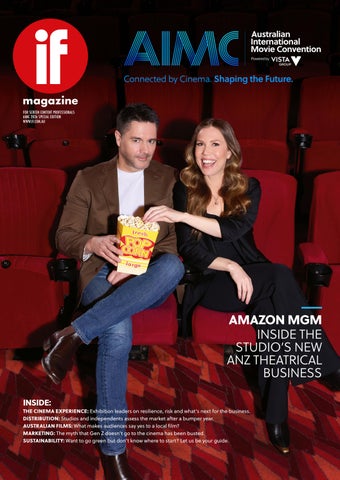
magazine FOR SCREEN CONTENT PROFESSIONALS AIMC 2026 SPECIAL EDITION WWW.IF.COM.AU
AMAZON MGM INSIDE THE STUDIO’S NEW ANZ THEATRICAL BUSINESS INSIDE:
THE CINEMA EXPERIENCE: Exhibition leaders on resilience, risk and what’s next for the business. DISTRIBUTION: Studios and independents assess the market after a bumper year. AUSTRALIAN FILMS: What makes audiences say yes to a local film? MARKETING: The myth that Gen Z doesn’t go to the cinema has been busted. SUSTAINABILITY: Want to go green but don’t know where to start? Let us be your guide.
AIMC
WELCOME
O
n behalf of the Cinema Association Australasia (CAA), welcome to the 79th Australian International Movie Convention powered by Vista Group (AIMC). Representing more than 90 per cent of the ANZ box office, CAA is proud to host the region’s premier celebration of cinemagoing. Together, we are here to recognise our shared achievements, network, preview upcoming slates, showcase innovative technologies and unite to drive growth into 2027 and beyond. And what a year it has been for cinema! Starting with an exceptional Q1 that saw ~17 per cent growth on the prior year across Australia. The top 10 films included a diverse mix of well promoted releases, with contributions from all studios and distribution partners, that appealed to every cross-section of our community. Project Hail Mary, Wuthering Heights, Song Sung Blue, Goat, The Magic Faraway Tree, Hoppers, Marty Supreme, Dhurandhar: The Revenge, Scream 7 and Hamnet combined to create a compelling offering with something for absolutely everyone. From this strong start, box office has boomed with YTD Australian box office increasing on the prior year by ~24 per cent (New Zealand +10 per cent). August 2026 was the highest grossing August in history and the fifth consecutive month of $100 million+ at the Australian box office – another record-breaking result. Importantly, these trends are reflected globally. The Odyssey and Spider-Man: Brand New Day have combined to drive a record-breaking result worldwide. US cinemas recorded the biggest May to September of all time, while the UK enjoyed a 56 per cent rise in audiences for August. This exceptional growth was eclipsed by Europe, the Middle East and Africa, which saw an 88 per cent year-onyear lift, according to Gower Street and the International Union of Cinemas. We are in exceptional company, and the full year forecast looks bright with Australian box office estimated to exceed A$1.1 billion, 4 AIMC 2026
Cameron Mitchell.
and New Zealand forecast to eclipse $NZ170 million. Importantly, 2026 is the year where monthly box office has reached a level of consistency. Blockbusters continue driving attendance and headlines, but multiple well-made and well marketed films are combining to drive attendance, without over-dependence on specific films, distributors or genres. A diverse line-up is mission-critical; compelling content for every demographic drives repeat visits, frequency and long-term sustainability. Ideally, this consistency across months is maintained through the strength of line-up, and we work together to avoid the troughs. This powerful resurgence has been driven by high engagement and exceptional value across the country. Over the last decade, Australians have enjoyed more than 600 million cinema visits, making our cinemas the nation’s most popular cultural venue (Australian Bureau of Statistics), with regional box office growth accelerating by double digits. This momentum is further fuelled by high ticket affordability relative to global standards. Australia is a top ten international box office market, with one of the highest per capita box office rates on the planet. The ultimate proof of this emerging box office era lies in the titles captivating audiences: an astounding seven of the top ten highest-grossing films in Australian history have all been released in the last four years. That is what the AIMC is all about: supporting filmmakers, giving our talented distribution partners a stage to showcase their incredible line-ups, supporting our innovative trade partners and coming together to collaborate, network and create the future together. Connected by cinema, shaping the future! The AIMC team, led by the incredible Kerry Westwood has again been working tirelessly to enhance your experience based on your feedback from prior years. You will find that this year’s AIMC has extended breaks, enhanced F&B and events, more keynotes,
exceptional distributor showcases and screenings, whilst capturing the same spirit of camaraderie and love for the cinema experience AIMC has become synonymous with. This year, we are delighted to be partnering with the talented Amazon MGM Studios team for their inaugural AIMC presentation, and we are deeply appreciative of the MPDAA members and the extended Australasian distribution community for once again bringing their best to the convention. Our association’s members continue to invest heavily in the cinema experience to ensure that Australasian audiences can enjoy the latest films in the world’s best cinemas. We are also thrilled to welcome a number of new partners to the AIMC in 2026, showcasing their worldclass experience locally, including RealD and Fandango, along with representatives from Golden Link, Snapco and Zinc. A huge thank you to Vista Group, Christie, IMAX, Dolby Laboratories and Barco for sending international representatives to the AIMC to support their regional teams. Equally we are excited to welcome international distribution representatives from A24, Amazon MGM Studios, Paramount Pictures, The Walt Disney Studios and Warner Bros. Our distribution partners have delivered a stellar line-up of upcoming films to showcase at this year’s AIMC, including Ink (Studiocanal), I Play Rocky (Roadshow Films), The Debut (Madman Entertainment) and Mr. Irrelevant (Paramount Pictures). All four films are slated for release from Boxing Day 2026 and carry exceptional word-of-mouth from early screenings. Each has the potential to over-index locally. We remain incredibly appreciative of all industry partners that continue to support the AIMC, including the passionate distribution community and our major sponsors the MPDAA, Vista Group, our new exclusive beverage partner Coca Cola Europacific Partners, Christie, the HOYTS Group, and of course, the incredible support of Screen Australia, Screen Queensland and Invest Gold Coast, who have helped curate what I am confident will be another exceptional Screen Australia Filmmaker Masterclass. Without this collective support, AIMC simply could not happen in this world-class format. I would like to also express my personal gratitude to the talented and hardworking
AIMC AIMC team for their passionate curation of this week’s event. Pulling off another first-class event with more than 70 partners is no small feat, yet Kerry Westwood, Rachel McGowan, Lauren Simpson, Rob Crawford and Tim Laven consistently deliver far above and beyond every expectation. I remain incredibly appreciative of the time, enthusiasm, and tireless passion that this team pours into the AIMC, ensuring it rightfully remains the premier celebration of cinemagoing in the Southern Hemisphere. Guillermo del Toro famously once said, “I’m a lover of cinema... It’s the only place where I feel truly at home.”
Mayor Tom Tate.
That emotional anchor was reflected locally recently when we surveyed the flood-impacted community of Lismore upon reopening their local cinema. As residents shared: “Rebuilding is about more than infrastructure; it’s about rebuilding community, connection, and hope... When the cinema reopened, it felt like the heart of Lismore was back.” That’s what our industry brings to our communities. The lesson from 2026 is unmistakably clear: when a sufficient quantity of well-made and well-marketed films tailored to diverse audiences are showcased in premier, well-invested
THE GOLD COAST is on the rise with significant investment in the screen and television industry. Global productions, new facilities, homegrown talent and strong partnerships are opening the door for an exciting new chapter in our city’s storybook. I’m delighted to welcome more than 900 delegates to the 2026 Australian International Movie Convention. You’ve come to the right place with incredible momentum behind your industry. Over the next few years, we will open the city’s new Live Music Hall and continue developing the Miami Arts Depot, a purpose-built art and creative
cinemas, cinemagoers respond in force. CAA remains dedicated to supporting our members, filmmakers, distributors, and trade partners in our shared mission. Together, we will continue to innovate, listen to our audiences, and elevate the cinema experience, while ensuring a steady year-round slate of extraordinary stories are available to showcase in your cinemas. Welcome to AIMC 2026 – let’s shape the future together. #cinemaforever Cameron Mitchell Cinema Association Australasia Executive Director
precinct which will set the standard both nationally and internationally. Through our Gold Coast Film Commission, we are strengthening partnerships with the industry and helping deliver more screen magic for production houses, investors and the box office. Enjoy your time in Australia’s favourite holiday playground and I look forward to building on the success of last year’s AIMC event. Tom Tate Mayor
MASTER WHAT MOVES THE WORLD. From content preparation to final delivery, Deluxe powers the global cinema ecosystem with expertise you can count on.
DELIVERY. MADE. SIMPLE.
MAST E RING
DIST R IB U T ION
KEY S
LIVE
T RAI L ERS
Any content from trailers to features
Deliver with Electronic & Hard Drive
Track and manage all keys in one place
Expand reach, project live events on the big screen
End-to-end servicing from mastering to social media
YOUR #1 PARTNER FOR ALL CINEMA SERVICES
WWW.BYDELUXE.COM
FAST FACTS
FAST FACTS
‘Spider-Man: Brand New Day’ is the highest grossing film of the year, earning more than $90m in Australia and $US2.5 billion worldwide.
Using anonymised ticketing and loyalty program data from Movio, these snapshots show how Australians are heading to cinemas in 2026. There is a broader shift to less frequent moviegoers, while female and younger audience share is up.
AUDIENCE COMPOSITION SHIFTED MODESTLY TOWARDS INFREQUENT MOVIEGOERS
‘Spider-Man: Brand New Day’ alone accounted for 15.2% of all ‘infrequent’ attendance by 12-24 year olds, well above 2025’s leading title ‘A Minecraft Movie’ at 10.5% WHERE IS THE AUDIENCE SHIFTING? • 12–24s showed the strongest audience-share growth in 2026 YTD, +1.7pp Infrequent moviegoers (<2 sessions) were up +1.8pp, while at the same time all higher-frequency segments lost share: Occasional (2-3) declined by 0.5 pp, Frequent (4-11) by 1.1 pp, and Very Frequent (12+) by 0.3 pp.
WHAT GENRES ARE DRIVING ATTENDANCE? The 2026 YTD slate was more diversified across familyoriented and event genres • Action was down – falling from 16.1% in 2025 to 8.7% in 2026 • The strongest gains came from animation +2.7pp, music +2.5pp and adventure +2.3pp, thanks to films like Toy Story 5, Zootopia 2, The Super Mario Galaxy Movie, Minions and Monsters and Michael • Comedy and science fiction also gained ground, at +1.4pp and +1.2pp respectively
6 AIMC 2026
“More people have come back this year. It’s reflected in the box office. My wait and see is what happens next with those people.”
Matthew Liebmann, Vista Group chief product, innovation and marketing officer on the rise of ‘infrequent’ moviegoers
• Female share increased from 51.7% to 53.5% (+1.8pp). The increase was stronger outside the top 20 (+2.9pp) than within it (+0.9pp) • Female share rose in all age bands, led by women 45-54 (1.3pp). Male share declined most among 25-44 (-1.7pp) • Female-skewed titles such as Wuthering Heights (77% female), The Devil Wears Prada 2 (74%) and The Housemaid (73%) sat alongside strongly male-skewed films including Star Wars: The Mandalorian and Grogu (64%) and The Odyssey (60%) • For top 20 titles, two ticket visits rose sharply (+2.8pp), while outside they declined slightly and 3-4 ticket groups edged higher • 17 of the top 25 films over-indexed with infrequent moviegoers, while the gap versus the rest of the slate widened compared with 25 • Young casual attendance (12-24 infrequent) became more concentrated around a few major titles. The top three films accounted for 29.8% of attendance versus 23% in 2025, while top 10 rose from 47.7% to 59.6%
TECHNOLOGY
YOU HAVE THE DATA. SO WHAT’S NEXT?
Vista Group has consolidated its AI models to help exhibitors make best use of their stores of data. Matthew Liebmann, chief product, innovation and marketing officer, gives Jackie Keast the lowdown on Vista Intelligence.
Vista Group chief product, innovation and marketing officer Matthew Liebmann.
S
ay your national cinema circuit keeps returning average customer satisfaction scores. When you drill into one state, scores are worse. At one location, they’re worse still. Looking deeper again, you find that poor score is driven by low ratings on food delivery in the venue’s upscale auditoriums. Improve that issue, the data suggests, and you can move the dial overall. Such is a real example from a recent pilot of Vista Intelligence, in which AI was able to sift through huge volumes of customer feedback to identify not only what was causing a net promotor score issue for an exhibitor, but help make suggestions of how to fix it. Vista Intelligence, live now, brings together 12 of the Vista Group’s individually developed AI models into a single intelligence layer. It takes an exhibitor’s operational, transactional, behavioural, demographic and attitudinal data to generate recommendations, predictions and insights across all areas the business. The layer works alongside Vista’s broader suite of products, which exhibitors can use to enact the 8 AIMC 2026
recommendations and measure the results, which, in turn, further informs the AI model. “It becomes a flywheel, a continuous improvement cycle,” says Vista Group chief product, innovation and marketing officer Matthew Liebmann. In practice, Vista Intelligence could recommend what showtime schedules will maximise visitation and spend, how staffing and concessions can be best aligned to forecast demand, or what circuit and site-level forecasts mean for investment priorities. According to Liebmann, Pathé Netherlands has already cut the amount of time spent on scheduling in half thanks to the tool, freeing programmers to focus less on “grunt” work and more on discretionary decisions. “Data tends to be, if left it to its own devices, backward looking. We put this layer on it, we find connections and we help with decision support. It helps say, ‘What should I do next?” Liebmann says. Often the richest layer of data exhibitors hold is about moviegoers. Vista Intelligence can identify from that data not only potential audiences for a film, but what might motivate different segments to attend, Liebmann says. That “One-to-one personalisation”, in his view, is increasingly important as exhibitors seek to sell audiences an experience worth leaving home for. “If you were to go and see a movie tonight, we could see what cinema, what movie, what showtime, how you saw it, how you paid, when you paid – if it was pre-release, post-release – and what concessions items you bought, right down to the size and flavour. We build all of that to create personas. Our AI layers aren’t
Vista Intelligence.
just about who’s likely to enjoy a movie in and of itself, it tells you who’s likely to enjoy it in a certain way,” Liebmann says. “All of us want to see Spider-Man. It doesn’t get to $US2 billion+ if it isn’t overly popular. You could scattershot communicate, but there will be people who want to see it in PLF. There’ll be people who bring the kids along and have the pester power of all the merch and the collectibles that go with them. You’ll have film nerds who want to see it because of the Marvel history and they collected comic books as a kid, and you’ll have the casual audience who come four times a year and this is the biggest blockbuster. All four of them, if you polled them and said ‘On a scale of one to five, how much do you want to see Spidey?’ They might all say ‘five out of five’, but they want to see it different ways. “So we don’t just say, ‘Hey, go see Spidey’. We’ll say, ‘Go and see it in a recliner at IMAX and get the blue or the red cocktail that goes with it’, because you’re a luxury lounger. Or we know you go with the kids, so, ‘Make sure you get the plastic popcorn container, the collectible, on the way in’. It’s not just about the content, it’s the occasion.” Into the future, Liebmann expects that exhibitors will be able to automate the recommendations out of Vista Intelligence should they wish. Yet humans will always be in the loop, he says. In his view, the health of the industry, more than ever, relies on customer engagement and connection. Among the key aims of Vista Intelligence is to remove points of friction and allow exhibitors to offer a more “concierge-like” service, rather than a transactional one. “Can we get rid of the mundane and then allow exhibitors to elevate the humanity with the guests that come through their doors?”
COVER STORY
OPENING ACT Amazon MGM Studios head of theatrical distribution ANZ Gino Munari and head of theatrical marketing ANZ and Asia Amy Dickman sat down with Jackie Keast to talk building a local distribution operation from scratch.
W
hen Amazon MGM Studios began building out its international distribution business, Australia and New Zealand was the first territory to become fully operational. ANZ and Asia head of theatrical marketing Amy Dickman was the first international territory lead appointed, followed a few months later by ANZ head of theatrical distribution Gino Munari. Together, they’ve assembled a 13-strong team based primarily out of Sydney. Earlier this month, the operation launched its first title, Colleen Hoover adaptation Verity, to $4.3 million with previews in Australia and $NZ493,990 in New Zealand. Setting up a local distribution business from scratch might sound daunting, but it was the appeal of the job for Munari, who reports into Amazon MGM head of international theatrical distribution Helen Moss. He argues he and Dickman have been given meaningful latitude over the local operation. Their work setting it up has helped to inform the establishment of Amazon MGM’s other territory offices. “We were given a lot of support from our home office, but a lot of autonomy,” he says. “No one interfered with how we wanted to set up, who we wanted to hire or what our culture would come to be, by design or organically.” 10 AIMC 2026
Amazon MGM Studios head of theatrical marketing ANZ and Asia Amy Dickman.
Munari has worked on both sides of the fence, having served at Village Cinemas for 17 years in senior roles such as chief operating officer and general manager of programming, and at Mushroom Studios as head of distribution. At Amazon MGM, he wants to be a partner to exhibitors in a way that isn’t transactional, listening to what they can share in terms of audience insights and real-time performance data. “It’s pure partnership from the outset,” Munari says. “Having been an exhibitor, I’m looking at it through the lens of, ‘How did I want to be treated by a studio or distributor’... There’s that mutual respect.” This new gig was a return home to Australia – and to Amazon – for Dickman, who had been living in the US for 12 years, most recently serving as head of international marketing at Apple TV. She’d worked for Amazon previously for more than four years in various roles, including head of global go-to-market strategy, APAC. The draw of Amazon MGM for her was the unusual marriage of a legacy studio and a tech company. Amazon’s culture is forward-looking and one of “test and learn”, meaning the ANZ operation has freedom to take risks. As a new business, there’s no hangover of “this is the way we’ve always done it”, meaning they can focus on what is best for any one individual title.
“We don’t have any benchmarks. We are creating benchmarks as we go,” Dickman says. In hiring, she says there was “an embarrassment of riches”, with more than 1,500 applications from across the world for the roles in her team alone. “That was one of the best challenges, to really figure out and curate a team that would culturally fit together in the right way,” she says. The team includes PR manager Xanthe Bates, who has worked at Sony, Universal and Netflix; senior theatrical marketing manager Lisa Di Giacomo and theatrical marketing manager Madeleine Dera, both formerly of Universal; senior theatrical sales manager Joel Hedrick, previously of eOne and Paramount; and theatrical sales manager Chris Smith, formerly of 20th Century Fox and Transmission. Munari says that from its “petri dish” of experience across rival studios and exhibition, he hopes Amazon MGM can offer something refreshing and new for the local industry. Dickman and Munari have intentionally kept the operation small so there is fluidity and ownership of the work. One of their guiding principles is there are no silos between theatrical sales and marketing. “We wanted that collaboration to happen from day one for two reasons,” Munari says. “One, it creates smarter decisions, and two, you continue to
COVER STORY learn. Otherwise, all you’re doing is sales, or all you’re doing is marketing. We make sure that we have meetings that are meaningful, that have everybody involved, and that everybody knows what everybody else is doing.” Munari says Australia, with strong cultural ties to both the US and UK, is often a barometer market; cinemagoing is buoyant, with returns to the US powerful, and the quality of cinemas very high. Australians really value authentic storytelling, he adds. Audiences are sophisticated; upscale films can overindex here relative to the US on a pro-rata basis, as do genres like romantic comedy. English productions also tend to overperform given our cultural ties, but he say this has expanded now to also include films from other countries, pointing to the growth of Indian cinema here and the success of Chinese films like Ne Zha 2. “We’ve got a rich tapestry of cultures in Australia that’s made us sophisticated in taste,” he says. “That’s the beauty of releasing films in Australia. You get a fair chance.” At CinemaCon this year, Amazon MGM reaffirmed its commitment to releasing 15 titles a year by 2027. When it comes to the slate for ANZ, Dickman says they want to ensure what they bring to market fits with an Australian voice and audience. That extends to marketing strategy, with a key part of her work determining what elements of a film to lean into for campaigns that will resonate locally. “We wouldn’t be doing our job if we didn’t speak on behalf of the culture here,” she says. With Verity, they set out to make a good first impression, with Dickman calling it an intentional campaign supported by “cross-pollination” with other business lines like Amazon Books and Audible. “What better way to kick it off than with this incredible female-led film that is based on such a rich text of Colleen Hoover,” she says. Looking ahead, both executives are particularly excited by The Thomas Crown Affair, directed by and starring Michael B. Jordan, slated for March 4 next year. “The scope and the ambition of the film is so big,” Dickman says. In Munari’s view, Jordan is among the next generation of Hollywood megastars alongside Timothée Chalamet and Robert Pattinson.
“He’s the real thing,” he says. “The previous two are much loved films, and this new take, we’re really excited about. It’ll be a very big focus next year.” Spaceballs: The New One, shot in Sydney, is dated for late April, and Munari has already been fielding exhibitor interest. “When we came out of the CinemaCon featurette on Spaceballs, I reckon about 10 of the Aussie exhibitors came up to me straight after going, ‘When can we see it?’,” Munari says. “That sort of repertory, Scary Movie or Naked Gun, etc, it’s having its own moment.” Other dated titles include Ali G: Who IZ I? (October 23), The Beekeeper 2 (January 14) and The Chosen: Crucifixion (March 11). Munari has been a keen supporter of Australian film across his career. He doesn’t rule out local acquisitions at Amazon MGM, with the caveat they are probably something for down the track. “It’s about finding the right project, and when we do, we’ll back it and be proud of it.” The Amazon MGM ANZ theatrical team enters the market at time when there is renewed momentum in the industry, with the box office seeing an unprecedented run of five consecutive months above $100 million.
While joking this was “by design”, Munari says it’s heartening to feel like the industry is walking with more of a spring in its step. “There’s been real hardship. I felt it as an exhibitor,” he says. “I feel like the industry’s in a renaissance at the moment... I was actually at a wake, and people were talking about films and what they’d seen. They’d seen Prada and Michael – it’s been so long since I’d heard that in general conversation. “There’s a confidence that’s come back to the industry, and that means studios have more confidence to invest in productions. Exhibitors have more confidence to reinvest in their theatres. “It feels like it’s back to where it was pre-pandemic. It’s taken a long time, but we’re just thrilled to enter in this period.” So far, Dickman says the reception by industry to a new market player has been warm, something she doesn’t take for granted. “It could have been very different. I feel very supported. We just want to do the best by our company, by the audience, by our exhibition partners. We want to be partners; we’re in this together, and we want to do things differently where it makes sense.”
Amazon MGM Studios head of theatrical distribution ANZ Gino Munari.
www.if.com.au 11
DISTRIBUTION
DISTRIBUTOR RAPID ROUND
After a strong year at the box office, distributors share their thoughts on the market and highlight what’s next. Jackie Keast reports.
UNIVERSAL PICTURES MIKE BAARD, MANAGING DIRECTOR, UNIVERSAL PICTURES INTERNATIONAL AUSTRALASIA
You must be thrilled with the performance of The Odyssey, now Universal’s highest-grossing film ever in Australia. Beyond the strength of the film, what do you think went particularly right? We were successful in aligning Christopher Nolan’s extraordinary vision and filmmaking craft with an ambitious campaign which brought together compelling creative, extraordinary talent support, and a coordinated global campaign to eventise the release. Locally, we delivered an unmissable media campaign and created activations that elevated the film beyond traditional advertising and into the cultural conversation. Our exhibitors were also outstanding partners, offering audiences an incredible range of formats and experiences to view the film. Ultimately, The Odyssey reminded us that an impactful theatrical release can turn a great film into a shared cultural moment that audiences feel they must be part of. 12 AIMC 2026
It’s been a bumper year at the local box office, including a record run of consecutive months exceeding $100m. What do you think is driving that momentum and how confident are you that it can be sustained? We’ve always been a business of hits, what feels particularly encouraging right now is the breadth of titles driving success. Spider-man: Brand New Day and The Odyssey were built to be blockbusters, and they delivered at the top end of expectations. Breakout successes such as Obsession and Backrooms brought a sense of discovery from fresh voices that gave audiences something they haven’t experienced before. Equally, exhibitors understand that the competition for people’s time and their out-of-home dollar has never been greater, and they’ve responded by investing in the cinema experience and reminding audiences that there is still something uniquely special about seeing a great movie on the big screen. It’s also worth noting that the Melbourne and Sydney film festivals have achieved record box office this year, showing demand is coming from multiple corners of the theatrical landscape, which should give us all enormous confidence in the enduring appeal of cinema. Other than The Odyssey, what titles this year have you been pleased with? What were the biggest lessons from the films that didn’t connect as strongly as hoped? We expected Michael, The Super Mario Bros. Galaxy Movie and Minions & Monsters to be successful and they met or exceeded our expectations. We are also pleased with the results from more targeted titles such as Song Sung Blue
and Hamnet. There remain titles which struggle to connect, even when they are critically acclaimed or develop strong word of mouth. The takeaway is that not every film is going to be as successful as one hopes or needs it to be, but there is an audience for most everything and we need studios and exhibitors to continue to work together to find the most effective ways of motivating audiences to see films at the cinema. What films are you most excited by on your upcoming slate? Comedy has been a challenging genre post-pandemic, yet remains one of the great, shared experiences in cinemas. We believe strongly in rebuilding this audience segment so are working diligently to reach the target audience for Judd Apatow’s The Comeback King, starring Glen Powell, and Dave McCary’s The Catch starring Emma Stone. Animation is a core business for Universal, and next year we have a good balance of originals (Illumination’s Not Alone) and sequels (DreamWorks Animation’s Shrek 5) amongst others. We had a big hit with the live-action How to Train Your Dragon and have the sequel releasing in June, and we have a new Mummy film with Brendan Fraser and Rachel Weisz returning. I am personally excited for the currently Untitled film from The Daniels, starring Matt Damon, their follow up to Everything Everywhere all at Once. I’m also looking forward to Anything But Ghosts, the next film from Curry Barker, the writer-director of Obsession. I appreciate there may be limits to what you can say about ongoing developments, but how do you see consolidation in the global studio landscape potentially reshaping the theatrical business in Australia? The business will continue to evolve. If history teaches us anything, it’s that consolidation in one area creates opportunities elsewhere. The key is delivering experiences that consumers see value in; if the industry makes more films which people elect to see in cinemas, we will see growth. I am confident this will be the outcome given how strongly we have ultimately bounced back following the pandemic and strikes.
DISTRIBUTION
“The DNA of Sony is a slate of a broad range of films for all audiences, big and small. I really feel the team delivered great results across all genres and for all audiences.” by this year’s results because it’s not just the recent releases of Spider-Man and Odyssey that have delivered this, but a range of broadly appealing films for every audience segment: Toy Story 5, Michael, Obsession, Backrooms, Project Hail Mary and The Devil Wears Prada 2. That has given everyone confidence that the momentum will continue; it’s not just isolated to one target segment. We are all pumped about the line-up for the remainder of 2026 and beyond.
SONY PICTURES STEPHEN BASIL-JONES, EXECUTIVE VICE PRESIDENT AND MANAGING DIRECTOR, SONY PICTURES RELEASING ANZ
You must be over the moon with Spider-Man: Brand New Day. Beyond the strength of the film and franchise, what do you think went particularly right? We are ecstatic, at $90 million – I mean, wow. It’s become Sony’s biggest ever film. It’s the all-time no. 1 film in North America, and top 5 here in Australia and globally too. The results Down Under are even more impressive given that we had no holidays for the first two months of its release, given its appeal to young kids/ families and tweens (most of the world had summer vacations). The film truly was exceptionally good – a 98 per cent Rotten Tomatoes score – and there was also a grounded maturity to it for all fans who had grown up with Spidey. To paraphrase 14 AIMC 2026
our chairman and CEO Tom Rothman, fundamentally, Brand New Day is “not so much a superhero film, but ‘super-person’ film... it’s about a lonely guy, it’s about friendship. It’s very human. It’s very emotional... It’s got plenty of whiz-bang, but that’s not what the secret is. The secret is it’s a relatable story that almost everybody has related to.” I would strongly add that Tom and Zendaya brought the X factor - or should that be the “Z” factor.
It has been encouraging to see many original films breakthrough theatrically this year. Has that changed the way you think about the potential of original films in the Australian market? It is reassuring, but every time we say it’s originality that counts, we see a resurgence of established film IP score big. So it is “swings and roundabouts”; a healthy mix of both is the key. The secret for me though is that those established franchise films better be original to be successful!
It’s been a bumper year at the box office, including a record run of consecutive months exceeding $100m. What do you think is driving that momentum and how confident are you that it can be sustained? Everyone has been heartened
Other than Spider-Man, what titles this year have you been particularly pleased with? The DNA of Sony is a slate of a broad range of films for all audiences, big and small. I really feel the team delivered great results
across all genres and for all audiences. The Choral, a discerning/arthouse film that was so beautifully handled from a sales and marketing perspective, grossed over $3.4 million. GOAT was an original animated story that delivered a rousing $12 million. Project Hail Mary, another original film that we handled for Amazon, we aggressively chased and were rewarded with a BO of just under $40 million. The Sheep Detectives, at near $10 million, was the “little film that could”. To cap it off, at time of writing, Zac Cregger’s Resident Evil has had a brilliant opening and within its first week will surpass the highest ever GBO result of any of the prior films in the franchise. It looks set for a ‘boffo’ final result. What films are you most excited by on your upcoming slate? I should list every film on the Sony slate but if I had to pick only a few, I’d say Jumanji: Open World, the sheer joy again to see everyone coming in over the holiday season and have such a good time, Prima Facie (Aust/UK co-production) for its boldness and relevancy, finally Spider-Man: Beyond the Spider-Verse. This film will creatively break ground no other film has before and will be one of the most original and visually creative films ever seen. It will be that dynamic, and an Oscar winner.
DISTRIBUTION
THE WALT DISNEY COMPANY KYLIE WATSON-WHEELER, SENIOR VICE PRESIDENT AND MANAGING DIRECTOR, THE WALT DISNEY COMPANY ANZ AND JOSH BRIGHAM, GENERAL MANAGER, WALT DISNEY STUDIOS, ANZ
It’s been a bumper year at the box office, including a record run of consecutive months exceeding $100m. What do you think is driving that momentum and how confident are you that it can be sustained? KWW: It has been an extraordinary year for cinema, both locally and globally. A strong, diverse slate has reminded audiences of the power of great storytelling on the big screen, and of the unique energy that comes from experiencing a film together. Cinema continues to offer something that simply cannot be replicated at home: scale, immersion, emotion and a shared sense of anticipation. That momentum is being driven by quality films, smart marketing, premium experiences and audiences’ continued appetite for events that feel distinctive and worth leaving home for. As an industry, the opportunity is to keep reinforcing the value of cinema at every touchpoint – from discovery and anticipation through to the moment audiences take their seats and are immersed in stories made for the big screen. What titles this year have you been particularly pleased with, and what drove their success? I assume Toy Story 5 and The Devil Wears Prada 2, especially given the latter significantly overindexed in Australia? KWW: 20th Century Studios’ The Devil Wears Prada 2 created a genuine cultural 16 AIMC 2026
moment. It became a must-see cinema event, particularly for female audiences, and the campaign tapped into the nostalgia, fashion and attitude that audiences love about the franchise. The strong result in Australia speaks to that connection, and to the appetite for films that feel fun, social and worth seeing together. Disney and Pixar’s Toy Story 5 was also very special. It is one of those rare franchises that speaks across generations. This new chapter brought a fresh, contemporary perspective to much loved characters that are always deeply relatable for both children and parents. It delivered the emotion, humour and heart audiences expect from Pixar, while giving families a very clear reason to see it together on the big screen. JB: It was great to see fans embrace Lucasfilm’s Star Wars: The Mandalorian & Grogu. George Lucas envisioned Stars Wars as a cinematic experience, and it was great to have the first Star Wars film in seven years back on the big screen. Fans were rewarded and it helped ignite excitement around the franchise. The theatrical campaign worked alongside retail and Disney+ activity to keep Star Wars front of mind and build momentum ahead of Star Wars: Starfighter in May 2027. What films are you most excited by on your upcoming slate? KWW: It is hard to look past Marvel Studios’ Avengers:
“As an industry, the opportunity is to keep reinforcing the value of cinema at every touchpoint...” Kylie Watson-Wheeler
Doomsday. The four previous Avengers films delivered $US7.8 billion globally, and the arrival of Doctor Doom in the MCU gives us a powerful event proposition to close the year. Looking ahead to 2027, Pixar’s original film Gatto is incredibly exciting. It has a distinctive creative world, a strong emotional hook and the kind of originality that makes Pixar so special. Star Wars: Starfighter will also be a major moment, with Ryan Gosling starring and Shawn Levy directing. It is an exciting creative combination and an important next chapter for the franchise on the big screen. JB: And I can’t wait for audience to see Searchlight’s next award contender, Wild Horse Nine, with incredible performances from both Sam Rockwell and John Malkovich. Hexed is an all-new Disney animation that cast a magical spell over all audiences, and everyone will love the character Beef. And of course, we’re also enormously excited for The Bluey Movie. Bluey is a beloved Australian story with extraordinary global
resonance, and bringing Bluey, Bingo, Chilli and Bandit to cinemas is a very special opportunity. It will be one of our biggest campaigns, and rightly so. How do you see consolidation in the global studio landscape potentially reshaping the theatrical business in Australia? KWW: Change has always been part of the theatrical business, and consolidation is one expression of that. What matters most is that audiences continue to show us they value cinema when the offer is strong and truly cinematic. This year’s Australian box office is expected to approach $1.2 billion, returning towards pre-pandemic levels and reinforcing the enduring appeal of films on the big screen. JB: Our collective focus as an industry should remain very clear: deliver high-quality films, support them with compelling campaigns and ensure the cinema experience itself is consistently excellent. If we do that well, audiences will continue to respond.
THE ONLY LICK FOR THE FLICKS
DISTRIBUTION
“This year, we’ve seen audiences embrace everything from a musical biopic, an epic action adventure, family films, legacy comedies, sci-fi adventures and even horror.”
PARAMOUNT PICTURES BRIAN PRITCHETT, VICE PRESIDENT AND MANAGING DIRECTOR AUSTRALASIA
It’s been a bumper year at the box office, including a record run of consecutive months exceeding $100m. What do you think is driving that momentum and how confident are you that it can be sustained? Firstly, it’s the quality of the films, not just from a production perspective, but from an audience perspective. We are seeing movies that are resonating with people and telling stories that feel relevant and relatable. Combined with outstanding production quality, these films become cultural moments that audiences feel they need to experience together, in a cinema, at that moment in time. The growth of premium large formats has also played an important role. Premium screens, sound and projection further elevate the experience and make the cinema trip feel even more worthwhile. Audiences are looking for experiences, not just content. Younger audiences, especially Gen Z, are seeing themes on screen that they connect with, but they also value the cinema as a place where they can switch off from everyday life and fully immerse themselves in a story. The theatrical experience allows people to disconnect from distractions and engage with something that entertains, inspires, and moves them. Another positive sign is the diversity of genres succeeding at the box office. This year, we’ve seen audiences embrace everything from a musical biopic, an epic action adventure, family films, legacy comedies, sci-fi adventures and even horror. It demonstrates that audiences are open to all genres when the story is compelling and relevant. What titles this year have you been particularly pleased with? What were the biggest lessons from the films that didn’t connect as strongly as hoped? Scary Movie significantly overperformed in ANZ. It captured the spirit of the original films that could make fun of anyone and everyone, while also connecting nostalgic fans with younger audiences discovering the franchise for 18 AIMC 2026
have a limited window to create a cultural event around a film, so it is critical that we identify the right audience and create the right emotional connection from the outset.
the first time. Our teams in Australia and New Zealand did an outstanding job finding the right way to connect the film with local audiences with a marketing campaign that had highly localised creative advertising, like a vegemite spoof, a fake drone show over Sydney Harbour and jokes specific to ANZ audiences that were dubbed into the film. Scream 7 was another major highlight. It’s not easy to release the seventh film in a franchise and have it become the highest-grossing entry, but we found a way to make the film feel fresh, exciting, and essential viewing for both existing fans and new audiences. Billie Eilish - Hit Me Hard and Soft: The Tour (Live in 3D) also exceeded expectations. We successfully positioned it as a premium 3D event experience and elevated that narrative through our marketing campaign. It certainly helps when you have two creative geniuses like Billie Eilish and James Cameron working together. Jackass: Best and Last also overperformed in both markets. It brought back long-time fans for one final ride with the Jackass gang and proved there is still a strong appetite for well-loved brands when they deliver on audience expectations. One of the biggest lessons this year is that with more movies being released, it is becoming increasingly difficult to break through. That means we are being very thoughtful about dating, audience targeting, and campaign positioning. We
What films are you most excited by on your upcoming slate? In November, we have Ebenezer which marks Johnny Depp’s return in what I believe is one of his best roles. It takes a familiar and beloved story and presents it in a way that feels fresh, original and unexpected. We also have Focker-In-Law, bringing the Circle of Trust back together while introducing the franchise to a whole new generation through Ariana Grande. Mr. Irrelevant is one of the best films I have seen this year. It’s an incredibly emotional true story that I believe will generate a lot of conversation and connect strongly with Australian audiences. For family audiences, we have an outstanding lineup, including Angry Birds 3, Zac Power and Children of Blood and Bone, based on the bestselling novel. K-Pop: The Debut is another title I think can overperform in Australia and New Zealand. At its heart it’s a coming-of-age story about an ordinary girl pursuing an extraordinary dream of becoming a pop star. Add great music, romance and some of the best K-pop songs, and it has all the ingredients for a major audience hit. We also have a new Sonic film, a new Paranormal Activity, the next chapter in the A Quiet Place franchise and a new Teenage Mutant Ninja Turtles movie. For female audiences, we are especially excited about A Place In Hell, starring Michelle Williams and Daisy Edgar-Jones, as well as Teyana Taylor’s directorial debut, Get Lite, and the adaptation of the bestselling novel Tomorrow, and Tomorrow, and Tomorrow, also starring Edgar-Jones.
2x brighter picture, the deepest blacks, and more vivid colors
DISTRIBUTION
MADMAN ENTERTAINMENT PAUL WIEGARD, CEO AND CO-FOUNDER
fallen out of love with cinema. They’ve responded positively to exhibitors continuing to invest in the experience and giving audiences more reasons to see films on the big screen.
It’s been a bumper year at the box office, including a record run of consecutive months exceeding $100m. What do you think is driving that momentum and how confident are you that it can be sustained? What’s encouraging is the breadth of the success. It hasn’t been one film or even one genre – studio pictures, franchises, original films, documentaries and event cinema have all contributed. The films that have worked have tended to significantly outperform, accounting for a disproportionate share of the box office. The paradox is that, at the same time, an unusually large number of films have struggled to find an audience in a record-breaking gross box office run. Obviously, consistency of supply really matters. Cinemagoing is habitual, the more the films audiences screen, the more trailers etc. they are exposed to. In addition, the major film festivals in Sydney, Melbourne, Adelaide and New Zealand have done a stellar job of championing independent cinema and cultivating the habit of cinemagoing. That has been complemented by the continued growth of Letterboxd and an increasingly influential ecosystem of critics, creators and film-focused social media voices, all helping films find and build audiences beyond traditional marketing channels. Theatrical will always be a hit-driven business, but audiences clearly haven’t 20 AIMC 2026
What titles this year have you been particularly pleased with? And what were the biggest lessons from the films that didn’t connected as strongly as hoped? Nuremberg was particularly satisfying. It proved there is still a substantial audience for intelligent, adult cinema when the proposition is clear, and Australian and New Zealand audiences love ‘Rusty’ and his support was exceptional. We’ve also been delighted with Sentimental Value, It Was Just An Accident, No Other Choice and Journey Home, David Gulpilil – very different films, but each with a clear audience and a compelling reason to see it theatrically. The lesson is not new – for films to connect with cinema audiences there must be some sense of urgency. “It’s a really good film” isn’t quite enough anymore – there are thousands of really good films ready to be streamed at home. For documentary, start where the audience is, build advocacy and earn your way out.
“Independent cinema often needs time for advocacy and word of mouth to develop. This makes the relationship between distributors and exhibitors more important than ever.” There seems to be exhibitor optimism around local title The Fox. How are you positioning it? The Fox is a film we love: funny, absurd, off-the-wall humour and completely confident in its own peculiar universe. Dario Russo has made something closer to a darkly comic Australian folktale than a film designed by committee. And with Jai Courtney, Emily Browning, Damon Herriman, Sam Neill, Miranda Otto and Olivia Colman, there is something magical for audiences to grab onto.
Australian audiences should be invited to see local films because they look entertaining and distinctive, not because seeing them is somehow a civic obligation. What other titles are you most excited by on your upcoming slate? Our acquisitions team have delivered a terrific spread of films. Lomu has an extraordinary subject and will resonate on both sides of the Tasman. John Wilson’s The History of Concrete is rich in an authentic sense of discovery and is strangely profound, despite the banal subject matter. Then we have prestige arthouse films Fatherland and Palme d’Or winner Fjord. The Debut is our Boxing Day release which tells you we are confident in this wildly entertaining film about a timid New Jersey woman who throws herself headfirst into a new thespian life after she’s cast in her local musical. Boss Cat is particularly exciting – a vibrant, big-hearted Australian dramedy about independence, family and selfdetermination, anchored by a fearless lead performance. What is the biggest challenge facing independent theatrical distribution in Australia? I’m sure I speak for all distributors: discoverability, and increasingly, time. We’re competing with an abundance of entertainment while trying to build awareness. Independent cinema often needs time for advocacy and word of mouth to develop. This makes the relationship between distributors and exhibitors more important than ever. The right cinemas, sessions and runway can matter just as much as the number of screens. There’s obviously looming consolidation in the global studio landscape. How do you see that reshaping the theatrical business in Australia? The interesting question is whether consolidation ultimately means more films and greater ambition, or fewer release decisions being made by fewer organisations. Either way, it makes a healthy independent sector more important. Cinema works best as a broad church; including independent distributors like Madman taking risks on distinctive filmmakers.
DISTRIBUTION
STUDIOCANAL ANZ ELIZABETH TROTMAN, CEO
It’s been a bumper year at the box office, including a record run of consecutive months exceeding $100 million. What do you think is driving that momentum and how confident are you that it can be sustained? The results for The Odyssey and SpiderMan: Brand New Day have been terrific for driving the local GBO, but this year we’ve also had two very strong outcomes for the independent films The Housemaid and Obsession, so they are also helping drive positive results. It has been encouraging to see many original films breakthrough theatrically this year. Has that made it any easier to position and build audiences for original properties? Yes, I think we’ve seen the box office bounce back for original concepts, in particular amongst the Gen Z audience who are becoming very film literate and help drive WOM on social media platforms in much the same way as BookTok.
The Housemaid was a huge success for Studiocanal at the start of the year. Looking back, what do you think went particularly right with that release in Australia? Full activation with our synergy partners Hachette elevated our overall campaign, including utilising their relationships with BookTok/social content creators, running nationwide promotions across their retail network around the film/tie in book. All this was executed at a low cost for maximum impact to our P&A. Paul Feig touring prior to our also release generated strong publicity, and Lionsgate provided a clear overall campaign strategy from a year out and shared it with us - inviting ideas and conversation, in particular driving fan awareness over social/digital.
What titles this year have you been particularly pleased with? What have been the biggest lessons from the films that haven’t connected as strongly as hoped? Given most of the box office for The Housemaid came in this year, it is without a doubt the success we are most proud off. We’ve recently secured the sequel, The Housemaid’s Secret, and will be doing all we can to drive a similar result. Aside from that there have been some films that haven’t quite fired at the box office in the way we’d like, mainly due to the level of violence or a backlash against some use of AI on one acquisition. What other titles are you most excited by on your upcoming slate? 2027 is a busy slate for us with 18 films. I want to bring to your attention my favourite Studiocanal film aside from the Paddington movies, Elsinore. It’s magnificent and I really think Andrew Scott deserves to win best actor. What is the biggest challenge facing independent theatrical distribution? Building and maintaining the momentum on a strong affordable slate of films.
MORE THAN JUST PoS “We’ve used two PoS solutions in recent years – TAPOS is the best of both. The perfect balance of detail, but with an ease of functionality for users of all levels.”
“We spent years gathering information before committing to a change... TAPOS has not only lived up to our projections, they’ve completely blown them away!”
Steve Jones
Robert Sweringin
General Manager of Gwyn Hall Cinema & Theatre (Wales)
VP of IT at B&B Theatres (USA)
“Our 30-year relationship with TAPOS has lasted thanks to their personal service. Their innovations have kept us competitive with the major circuits.” Mark Williams
Owner-operator of WTW-Scott (UK)
TAPOS is the chosen engine for hundreds of venues around the world. Book a demo with sales@taposapp.com so we can show you why.
SALES@TAPOSAPP.COM
WWW.TAPOSAPP.COM
Rentrak Movies Know what’s happening now.
Box office results from all key markets: fast, reliable and intuitive. Driven by our love of movies, committed to advanced box office insights.
And with mobile optimisation, it can be used on any device. COLLECTING
11
95%
OF THE GLOBAL BOX OFFICE
625
OFFICES WORLDWIDE
PARTNERS
33,000+
175,000+
THEATRES
SCREENS
C OL L E C T IN G
100% OF THE AUSTRALIAN & NEW ZEALAND BOX OFFICE
Contact your Renttrak team at apac@rentrak.com for subscription inquiries
24
HOURS A DAY
7
DAYS A WEEK
365
DAYS A YEAR
movies.rentrak.com
BRING MOVIES TO LIFE Experience total immersion with D-BOX haptic feedback sparking the imagination through motion PROUD LONGTIME PARTNER OF
CINEMA EXPERIENCE
STEERING THE SHIP The exhibition industry is emerging out the other side of one of the most turbulent periods for cinemagoing in recent memory. What have leaders learnt and where do they feel the business is heading next? Jackie Keast reports.
Daniel McCabe.
DANIEL MCCABE, GENERAL MANAGER CINEMA OPERATIONS AUSTRALIA, EVENT CINEMAS For Event Cinemas general manager of cinema operations Australia Daniel McCabe, the last six years been challenging, but they’ve afforded the rare opportunity to get out of “continuous operational mode” and properly assess where growth is possible. “Our team at EVT has spent the last few years better understanding what our business model looks like at a time when volumes have been lower, and narrow in on our customers’ wants, especially from a premium cinema experience,” he tells IF. “We’ve been able to double down on how we tailor our builds around that and drive innovation across all aspects of the cinema experience.” He sees opportunity in remaining adaptable and continuing to focus on premiumisation, which he describes as the biggest shift in the business since he started his career. He’s also excited by the potential of AI from a real-time analytics perspective. Challenges for the sector lie, in McCabe’s view, around a consistent supply of product and the theatrical window. However, he feels momentum is back and is heartened to see studios commit to longer windows ahead of PVOD. McCabe has spent his whole career in exhibition, starting out at Birch Carroll & Coyle when he was just 14 years old. From 24 AIMC 2026
there, he’s worked across almost every layer of operations, including two decades working across Queensland, regional NSW and Sydney. “I’ve spent a large part of my career on the front line of our cinemas, and that’s given me a genuinely customer-led perspective. It’s taught me the importance of listening, both to our customers, and to our teams on the ground, and using that to shape decisions we make at HQ,” he says. “I’d describe myself as an empathetic leader who likes to get in there with the team. I firmly believe we’re only as successful as our team; you can build the most amazing cinemas in the world, but if you don’t have the right team on the ground, it doesn’t matter.” He also firmly believes his own career path still exists today. He wants to give all young staff members the chance to upskill, as well as security, purpose and sense of progress. “We all remember our first job, and it can be an incredibly positive experience at a formative time. It shapes the choices people make well beyond that first role,” he says. “I know that firsthand: I had a leader who taught me how to be an usher at 14, but who also taught me valuable life and business lessons I still carry today.”
STEPHANIE MILLS, MANAGING DIRECTOR HOYTS CINEMAS When there’s a strong slate, admissions should follow. Yet Hoyts Cinemas managing director Stephanie Mills says the last few years have allowed cinemas to look past releases to understand other levers that motivate people out of home. As a result, Hoyts is now a braver business, which experiments more. “We’ve become much more comfortable testing ideas on a smaller scale, and either scaling them up quickly or moving on. Not everything works, and that’s the point. The learning is what matters,” she says. “We’ve come out of this period with genuine momentum, and we are firmly focused on creating the future of cinema.”
Mills was promoted to the MD role in July, having worked for the Hoyts Group since 2013. Her career in exhibition spans more than 20 years, including a decade at Reading Entertainment Australia. “My career in cinema started in a finance role, then moved into marketing, then content, and eventually I oversaw all the departments focused on driving admissions. Admissions are the lifeblood of our industry. Consumers have more choice than ever in how they spend their free time, and reaching and influencing their decisions remains a key focus and challenge for Hoyts and our studio partners. That’s never far from my mind when I think about where we need to go next,” she says. “This latest career step into the managing director role brings in the cinema experience itself. My focus is no longer only about getting people through the doors, but also about what happens once they’re inside. Spending real time in each part of the business has given me a holistic view, and that’s how I approach decisions. I understand how a choice in one area affects the others, and I always come back to the guest. Everything we do should connect back to delivering exceptional guest experiences.” Mills says the biggest shift she’s seen in her career is how considered a trip to the cinema has become, one she says Hoyts saw early when it began its major refurbishments in 2015. In her view, Hoyts’ comfortable powered recliners have “reinvented cinemagoing” and raised expectations of a cinema trip. This has extended to audiences now expecting to choose the experience that suits the occasion, whether that is IMAX, D-BOX or Hoyts LUX. “Our job is to make sure we have the right experience for every film and every kind of visit,” she says. Stephanie Mills.
“The biggest opportunity is that cinema offers something people increasingly value, which is a shared, social experience away from screens at home. Film releases are becoming events again, and audiences are responding to that sense of occasion. There is also a lot of room to broaden what cinema means, through a wider mix of content, new ways to use our sites, and making it easier for people to come more often. “Film supply will always fluctuate, so exhibition needs to build a kind of resilience that doesn’t rely solely on a traditional movie slate. The cinemas that do well will be the ones that stay focused on the guest and give people a clear reason to leave their home.”
DAVID HILL, MANAGING DIRECTOR VILLAGE ENTERTAINMENT The last few years have demanded clarity, resilience and honesty from leaders, according to Village Entertainment managing director David Hill. “When conditions are uncertain, teams do not need manufactured optimism. They
need leaders who acknowledge the reality, set clear priorities and create confidence through action,” he says. “It has also reinforced that standing still is often the greater risk. My appetite is not for risk for its own sake, but for disciplined experimentation. “Be clear about the guest or commercial problem, test the idea, measure it honestly and scale what works. The brighter 2026 market is encouraging, but the work done during the more difficult years to simplify the business, strengthen capability and keep investing in the guest experience is what positions us to benefit from that momentum.” While cinema has been written off many times, Hill says the enduring power of a shared experience keeps proving itself. Exhibition should be confident about its distinction from home entertainment, but never complacent. “Our responsibility is to protect what is timeless about cinema while continuing to evolve everything around it,” he says. Audiences now compare a trip to the cinema with every other way they spend their time and money, Hill says. While the fundamentals – great films, picture and
David Hill.
sound, comfort, cleanliness and service – still apply, an experience that feels worth leaving home for is now critical. Village has become more guest-led in recent years, with Hill citing IMAX Fountain Gate and its new digital experience as examples. Having pioneered Gold Class back in 1997, the company continues to see opportunities in broadening the cinema experience beyond the screening itself, through things like premium formats, eventled sessions, better food and beverage, loyalty, partnerships and locally relevant programming. “The opportunity is to give guests meaningful choices rather than assume everyone defines value in the same way.” Looking ahead, Village is also exploring how data and technology can remove friction and build stronger relationships
Sharon Strickland.
CINEMA EXPERIENCE with guests. It’s investing heavily in new digital platforms and the continued evolution of its rewards program. A consistent and diverse film slate remains a challenge, alongside growing competition for audiences’ discretionary spending, Hill says. “Shorter theatrical windows and the convenience of home entertainment continue to raise the standard. Our response cannot simply be to charge more. We have to make the value more obvious, maintain excellence in delivering the experience and give people compelling reasons to visit more often.”
BENJAMIN ZECCOLA, CEO PALACE CINEMAS The turbulence of the last few years often reminded Palace Cinemas CEO Benjamin Zeccola of a line from The Leopard: “If we want things to stay as they are, things will have to change.” “And so it is with cinema,” Zeccola says. “Audiences still want the same thing: to indulge and escape; to be moved and feel connected to something bigger. What’s different is their expectation of luxury and service. “The demands of leadership were to maintain eyes on the horizon, on the mission and on the values that guide decision making.” Emphasis on the cinema experience has long been central to Palace’s identity, from its decades-long fight to allow general admission patrons to enjoy alcohol to its focus on serving quality espresso coffee. In more recent times, premium cinemas have helped win back lapsed millennials and Gen Xers, while Gen Z is embracing cinema despite digital bombardment, Zeccola says. Benjamin Zeccola.
26 AIMC 2026
More broadly, he feels the growth of premium formats over the years have helped spur “the de-commoditisation of cinema”, helping to restore a sense of value to the moviegoing experience. However, he argues “ever larger screens have a natural limit”. “The industry needs to sustain a worthwhile and affordable entry level proposition from which to screen original stories and new IP, ” he says. He feels the industry’s future opportunities lie in using data to support the moviegoing habit, but the challenge is in the rising waterline of costs. “Cinemas cost a mint to rent, power prices are ruinous, and wages keep rising faster than ticket prices can absorb. As more venues go underwater, communities lose a safe and fulfilling cultural hub.” Success for Palace into the future would look like a strong group of prestigious venues, with a steady stream of movies to answer customers’ needs, Zeccola says. “Environments where patrons connect with films, emotions and each other, fulfilled by the films they want to see, in places they love to be.”
SHARON STRICKLAND, CEO DENDY ICON GROUP Once upon a time, or at least pre-COVID, you could put a film out there and trust the audience would find it. That doesn’t work anymore, according to Dendy Icon Group CEO Sharon Strickland. Audiences today want more than a film. They want a complete experience, which means better seating, projectors, sound and F&B. Yet these changing audience expectations have come amid a difficult financial period for cinemas, particularly independents. “As an organisation, we are working, as I’m sure most of the cinema companies are, much harder to get those bums on seats,” she says. “From a leadership point of view, you’ve had to try and remain calm.” Strickland came to the exhibition industry from an accounting and finance background, something she says has served her well when things have been tough. “I’m not one of these CEOs that just leaves it to the accounting team,” she says. “I’m heavily involved in the budgeting and the cash flow analysis. From a risk
perspective, I understand where we sit on things. Sometimes you take more risk because you understand what the downside is if it’s not that much, because you’re aware, you understand the numbers. Other times you go, ‘we just can’t.’” Dendy has taken some swings in the post-pandemic period, opening an IMAX screen in Canberra in 2024, but Strickland says they’ve also held off on refurbishing some sites out of cautiousness about ROI. After a good year for the industry in 2026, she’s starting to feel a lot more hope. However, as president of Independent Cinemas Australia (ICA), Strickland observes some regional cinemas are still carrying a lot of losses. ICA has been lobbying the Federal Government via the No Cinema Left Behind campaign to co-invest in replacing ageing digital projection fleets. “It is going to take a long time for some of these [regional] cinemas to really turn around,” she says. On the flip side, the biggest opportunity for independents is their connection to community and differentiation. “It always has been. But I think there’s even more need for that now,” she says. Dendy Newtown, for example, has had great success with things like its House of Horror takeover event on Halloween. People are invited to dress up and get real, film-inspired tattoos from Newtownbased tattoo artists on site. “It’s those little things that we see as completely different to what some of the bigger guys can do,” Strickland says. She’s hopeful the next few years will see Dendy remain financially strong, stay relevant to its audience and continue to be the independent brand it is known for. “We have, as an independent, played it very cautious over the last few years. I’m hoping we’re turning that corner in the industry, and we can start to see some growth.”
DIGITAL ADVERTISING TO GROW MOVIEGOING AUDIENCES
FILM ADVERTISING EXPERTS CONNECTING EXHIBITION AND DISTRIBUTION REAL-TIME REPORTING Driven by a passion for cinema, our mission is to help audiences discover and enjoy more films. By collaborating with both exhibitors and distributors, we generate unique customer insights that boost ticket sales.
DISCOVER HOW GRUVI OUTPERFORMS INDUSTRY BENCHMARKS
TURN YOUR CINEMA INTO A Proven at HOYTS APEX in Australia HOYTS APEX Karrinyup features the – at nearly 25m wide with over 24 million pixels – delivering next generation PLF experiences powered by GDC’s advanced LED media server.
Meet GDC at AIMC
21m-wide Tricorne Premium LED Screen HOYTS Melbourne Central
26 – 29 October 2026 The Star Gold Coast
GDCTechnology Hong Kong · Beijing · Shenzhen · Barcelona · Jakarta · Los Angeles · Mexico City · Mumbai · Seoul · Singapore Powering your digital cinema experience PA-1555-2609-V1E
Copyright © 2026 GDC Technology Limited. All rights reserved.
#GDC Technology www.gdc-tech.com
COMMUNITY
(LIS)MORE THAN A CINEMA
As Lismore Cinemas prepares to mark a year since its post-flood reopening, owner Luke Mackey and QUT senior lecturer Ruari Elkington reflect on the case for treating cinemas as cultural infrastructure. Sean Slatter reports.
W
hile doing the promotional rounds for his 2026 sci-fi blockbuster Disclosure Day, legendary director Steven Spielberg reflected on the value of cinema beyond entertainment. In an appearance on Michelle Obama and Craig Robinson’s IMO podcast, the filmmaker noted the movie theatre’s enduring ability to bring people together through a shared experience, regardless of their individual beliefs. “For one moment, we are in communion, and we are in agreement, and we are a community,” he said. “We’re a community of strangers watching something that makes us laugh and cry and sing out and want to share those feelings.” Few locations have exemplified this notion over the past 12 months more than Lismore Cinemas, which was forced to close its doors for more than three years following the devastating 2022 floods. Having previously operated under EVT, Lismore Cinemas reopened as a fully independent venue in December 2025 under the stewardship of former EVT director of entertainment Luke Mackey, who purchased the site upon leaving his position in the first half of last year. It didn’t take long for him to experience first-hand how vital the cinema was to the town. A staggering 800 people applied for just 44 staff positions, and more than 10,000 people had joined the Cinema Culture Club shortly after opening. Their enthusiasm has been rewarded with a state-of-the-art upgrade. The auditorium known as The Big Screen features a 16.5-metre high-gain screen, 4K Barco laser projection and three distinct seating concepts. Alongside a 3D cinema and traditional auditorium sits The Wilson, a premium boutique auditorium named in 30 AIMC 2026
honour of a local figure, offering recliners, Dolby Atmos sound and professional sound mixing and editing facilities. Reflecting on the past nine months, Mackey says his driving philosophy has been that cinema is an enjoyable experience that includes world-class seating, picture, sound and acoustics. “We had pent-up demand from the flood and the cinema being closed, and then that followed on with probably the best lineup cinema seen since probably pre-COVID, and so it all culminated at the right time for us,” he says. “For a couple of years there, we only had blockbusters, none of that mid-tier content, none of the horror, and that’s all come back at the right time. So we’ve attracted all of the audiences back. “Part of our strategy when we went to reopen was making sure it was affordable. All of our paid members get a $14 ticket to go to the movies, which is what they were charging at Lismore in 1996 when it opened.” Outside of mainstream titles, Lismore Cinemas has championed diverse programming, screening Bollywood releases, retro classics, arthouse features, and regionally-specific titles such as Jordan Giusti’s Floodland and Catherine Barker’s When the River Rose, both of which focus heavily on the 2022 floods. The cinema also hosted screenings of the student-made documentary The School the Kids Built, chronicling year 5 to 8 students’ efforts to transform Lismore’s historic Brown & Jolly building into a new educational institution. The pupil-led film ended up selling out nine sessions after being initially programmed for just two. Mackey says the project demonstrated the cinema’s unique power to serve as a community beacon. “I think the kids and families seeing themselves on the big screen has probably
A screening at Lismore Cinemas.
inspired the next couple of generations,” he says. “We’ve got a couple of staff who started with us in December that are going to uni next year. One of them was going to study business but now is doing film studies, which I think is awesome. He’s been inspired by being part of things like Q&As and just falling in love with film like I did 30 years ago.” Mackey’s efforts were recognised at this year’s Independent Cinemas Australia Awards, where he received the inaugural Deluxe Cinema Award for best renovation, restoration, technical upgrade, or new build. For Dr Ruari Elkington, senior lecturer in creative industries and chief investigator at the QUT Digital Media Research Centre, the revival of regional cinemas invites a broader examination of their cultural, social and public value. In his submission to the National Cultural Policy, Elkington wrote that while cinema is often treated as discretionary entertainment or commercial retail, it offers communities accessible gathering places, low-barrier cultural participation, shared storytelling, intergenerational connection and local cultural identity. Speaking to IF, Elkington emphasises that leisure is only the tip of the iceberg. “We’ve had some research that points to improved sense of wellbeing for cinemagoing, even going down to things like social cohesion and connection,” he says. “These are not fluffy, vague, general terms; these are real things. Cinemagoing, in terms of people actually leaving their homes or their workplaces and coming together for a shared experience and a shared story, does contribute in measurable and positive ways towards some of these qualities.”
COMMUNITY Elkington, alongside Digital Media Research Centre colleague Dr Tess Van Hemert, previously partnered with Palace Cinemas for a comprehensive audience survey. Conducted across September– December 2022, the research spanned more than 10,000 respondents across 24 locations, 90 per cent of whom were Movie Club members. Asked what they personally valued about the cinema experience, 2,350 of 9,731 respondents cited the overall atmosphere itself – ranking as the thirdhighest response. Content, community and comfort (parking, seating, and food options) also ranked highly in terms of what made an outing memorable. More recently, Elkington has sought to explore the influence of cinemas on community via a social prescribing and cinemagoing trial through QUT Design Lab. The trial builds on an existing pilot program run out of the North Townsville Community Hub to address social isolation and loneliness through fully funded social events and activities at no cost to participants. “The community centre uses cinema as one of a couple of different means to get
people out to connect with the community and query their expressed sense of social isolation and loneliness,” Elkington said. “There’s evidence from those community centres that when people report back on whether they feel better as a result of going to cinema… that they do, and that’s certainly in line with our own survey research around cinema.” As part of his National Cultural Policy submission, Elkington recommends the federal government recognise cinema exhibition, including independent, regional, local and outdoor cinema, as cultural infrastructure rather than purely commercial sites; fold cinemas into audience development, cultural participation and community wellbeing settings, particularly where they serve young people, older Australians, multicultural communities and regional communities; and fund pilot programs linking cinemas with councils, schools, community organisations and socialprescribing and wellbeing initiatives. Greater recognition of cinema as social infrastructure, he argues, changes the conversation around urban planning, funding and resourcing.
“If it’s ‘Cinema is a nice place to go and watch The Odyssey’, the dismissal of cinemas becomes very easy,” he says. “If we start categorising the vital social infrastructure for people to connect and for communities to understand each other better, then the provision of it and the funding and the resourcing actually becomes something far more pressing.” Reflecting on his visits to regional cinemas over the past 12 months, Mackey describes what he saw as “beautiful”, but warns that many operators are still navigating a heavy financial backlog. “There’s a lot of pride. I know a lot of those owner-operators are going to be looking to invest in the things that matter when they get the opportunity, but I think there is an important piece, which is they’ve got to invest in projectors and air conditioning,” he says. “Customers don’t see that first – it’s just the expectation. I think we’ve got to, a) find a way to retain these assets because they are so culturally important, and b) look at them as a cultural asset and ask whether they should receive funding at an appropriate level to help keep that experience alive for generations to come.”
CINEMA EXPERIENCE
ESCAPE, WONDER AND TOGETHERNESS
With plans to build cinemas in children’s hospitals across Australia and New Zealand, new charity CineCare is calling on the screen industry to help bring its vision to life. Jackie Keast reports.
A
newly established charity hopes to bring a sense of normalcy and connection to children experiencing extended hospital stays, using the power of cinema. Inspired by the MediCinema charity in the UK, CineCare plans to build fully accessible, state-of-the-art cinemas in children’s hospitals across Australia and New Zealand, giving children and their families access to the latest films free of charge. Suitable non-clinical spaces will be retrofitted into 40-60 seat theatres featuring professional projection, surround sound and climate control, with sufficient room for wheelchairs and hospital beds. CineCare is the brainchild of Cinema Association of Australasia (CAA) executive director Cameron Mitchell and Australian International Movie Convention event director Kerry Westwood. While CAA funded the charity’s establishment, it’s independent of the organisation. “Our ambition is to harness the power of cinema to support the wellbeing of children experiencing extended hospital stays,” Mitchell says. “A hospital can be an incredibly frightening and isolating environment for a child, and we want to provide an opportunity to escape that environment, even if only for a couple of hours. “Our long-term goal is for children in every major territory across Australia and New Zealand to have access to a CineCare 32 AIMC 2026
cinema within their local children’s hospital by 2035.” CineCare executives and directors are all volunteers, meaning funds raised can be entirely directed towards building and operating CineCare cinemas, and employing on-site team members. Mitchell and Westwood lead the organisation and sit on the board alongside Village Roadshow Group CEO Clark Kirby and Walsh Accounting principal Tom Walsh. Retired businessman Terry Jackman will also serve as an advisor. The Motion Picture Distributors Association of Australia, which represents the major studios, has already agreed to support the charity by providing films day-and-date. “That commitment is incredibly important because it means children in hospital can experience the same newrelease films as their friends and families outside the hospital,” Westwood says. CineCare hopes to announce the location of its first cinema before the end of the year. Unick Consulting, one of the leading specialist cinema architecture and consultancy firms globally – it also supports MediCinema in the UK – will take the lead on the design. Both Mitchell and Westwood hope the industry will get behind the charity, which is seeking financial, operational and in-kind support from cinema owners, operators, distributors, suppliers and other industry partners. Carnival Studio has designed the charity’s branding pro bono.
Cameron Mitchell and Kerry Westwood.
“We believe CineCare provides our industry with an opportunity to come together and unite to support a charity that has a very direct and meaningful impact on children and families,” Mitchell says. Once operational, the CineCare team will work closely with hospital, medical and nursing teams to identify children who are medically able to leave their wards and attend a screening. Hospital volunteers and the team will then assist children and families in making their way to the cinema. Westwood anticipates one or two sessions a day, but notes the charity expects to learn a great deal from its first cinema and will refine the operating model in partnership with hospitals. She adds the vision for CineCare is to enhance hospitalised children’s recovery through “the shared cinematic experience of escape, wonder and togetherness.” “We want CineCare to provide positive distraction, support emotional wellbeing, reduce feelings of isolation and create opportunities for connection and normalcy during what can otherwise be an incredibly difficult time. “Ultimately, we want kids to be able to arrive at hospital knowing that, despite everything they may be going through, they can still experience some of their favourite things they would normally enjoy outside of the hospital environment,” she says. “Surrounded by family and friends, kids can temporarily step away from treatment rooms and hospital routines and immerse themselves in a shared story. They can laugh together, be surprised together and simply enjoy being a family again.”
A cinema experience inside hospital With support from the Cinema Association Australasia, we’re proud to launch CineCare, a new registered charity building accessible cinemas in hospitals across Australia and New Zealand. Supported by the Motion Picture Distributors Association of Australia, the cinemas will give hospitalised children and their families the chance to experience new release films free of charge on their national release date, providing families a welcome escape. LED BY INDUSTRY ADVOCATES
GET INVOLVED
CineCare is volunteer-run, with board members and advisors including Terry Jackman, Clark Kirby, Kerry Westwood, Tom Walsh and Cameron Mitchell.
Connect now to support CineCare and our children’s recovery
HOW YOU CAN HELP
Fundraising is underway. We welcome tax-deductible donations, equipment and industry partnerships.
cameron.mitchell@cinecare.org.au kerry.westwood@cinecare.org.au VISIT
www.cinecare.org.au
MARKETING
Jacob Elordi with young fans at Brisbane screening of ‘Wuthering Heights’. (Image: Universal)
THE KIDS ARE ALRIGHT
From viral horror hits to a potential bidding war for Letterboxd, Sean Slatter speaks to Gruvi’s Nguyet Robbins, social researcher Claire Madden and marketing chiefs from Sony and Universal about what’s really driving Gen Z back to the cinema.
T
he recent release of Dave Green’s Looney Tunes liveaction mash-up Coyote vs. Acme was a unique study in what appeals to different cinema audiences, according to film advertising and insights agency Gruvi. Despite featuring its most enduring historical IP, Warner Bros. Discovery shelved the completed $US70 million film as a tax write-off in 2023, before allowing the filmmakers to shop it to other studios, leading Ketchup Entertainment to buy the worldwide rights for $US50 million. In advertising the film across several regions, Gruvi Australia managing director Nguyet Robbins says younger filmgoers for whom Looney Tunes may not have had the same resonance still turned out to support the film. “Sure, we have the aspect of the Looney Tunes that the older generation will care for… but I would say that the older 34 AIMC 2026
generation doesn’t even know the context about the movie,” she says. “It’s the Gen Z [audience] that is fighting for it, to want to show the big corporation that there’s a reason behind the art and craft and why they should save this movie.” A greater craving for authenticity is shaping the cinemagoing behaviours of younger generations and forcing major studios to rethink traditional marketing campaigns, Robbins says. There has been renewed interest in how younger generations consume cinema off the back of Kane Parsons’ Backrooms and Curry Barker’s Obsession, both of which managed to rally audiences domestically and internationally upon their release earlier this year. After the films claimed the top two positions at the Australian box office at the end of May, Val Morgan Cinema group sales manager Ben Thomas wrote
that more than 50 per cent of the total audience for both films came from the 14-24 year old demographic. He added that while cinema admissions in Australia were up 16 per cent on the same period last year, youth admissions were up 22 per cent. Thomas noted that Backrooms arrived with “years of internet fandom already behind it”, with audiences showing up for a “world they had already spent years exploring online”, while attributing Obsession’s success to a wave of online conversation following a strong opening. Robbins, who services clients across Australia, Asia and the Middle East, says knowing and trusting relationships with younger audiences is key to reaping the benefits of an online following. “It’s not about taking one person who has got a following to have him create a movie – it is really about making it about the story about [a] movie,” she says. “Build that authenticity.” Claire Madden, one of the country’s foremost social researchers on generational engagement and author of Hello Gen Z: Engaging the Generation of Post-Millennials, says Gen Z is an entertainment-focused generation. However, they’re increasingly aware of the effects of regularly consuming bite-sized content online, leading them to seek alternatives. Cinema offers a rare combination of sociability and genuine disconnection. “Gen Z recognise that their ‘digital diet’ of constant scrolling is not often beneficial, and they are savvy as a generation to find ways for a ‘digital detox’ or a break from their phones,” she says. “For them, the cinema provides a way to still be social, experience a film together with peers and still be entertained, but through long-form media, which can help them be immersed more deeply into a story or journey. Perhaps surprisingly, going to the cinema can be a way of switching off from the constant bombardment of their online worlds and be a place to actually let themselves relax.” At the same time, those online worlds are building momentum for films, as evidenced by the ever-growing popularity of New Zealand-founded discovery platform Letterboxd. Now home to more than 28 million members globally, more than half of whom are under the age of 35, it made TIME’s sixth annual TIME100 Most Influential Companies list in April,
It’s time to put on your glasses.
90 WITH
%
SATISFACTION RATE,
3D
IS THE HIGHEST GROSSING PREMIUM FORMAT IN THE WORLD *Among films offered in 3D
2026 3D GLOBAL BOX OFFICE
25
IS OUTPACING TOTAL GLOBAL BOX OFFICE BY
% pt
*ex. China
MARKETING
Tom Holland in ‘Spider-Man: Brand New Day’ . (Image: Sony Pictures)
recognised in the publication’s Pioneers category. In its profile, the US magazine noted the platform’s “immense reach”, particularly among young people, now “shapes the film industry directly”. The platform’s growing cultural weight has since attracted commercial interest. In September, reports emerged that The New York Times and distributor A24 had surfaced as potential buyers, in a deal that The Hollywood Reporter states could value the company at as much as $US300 million. Similarly influential is social platform TikTok and its film-focused community #FilmTok. According to the company, 80 per cent of TikTok users globally have engaged with their favourite show or movie on the platform, with an average of 6.5 million posts about film and TV shared every day on TikTok in 2025. Fan edits on the platform have become a way for distributors to turn fandom into sustained cultural momentum, as seen through Universal’s campaign for Emerald Fennell’s adaptation of Emily Brontë’s Wuthering Heights, where local editors were invited to reinterpret the film through fan-edit culture. It was part of a promotional push that also included an activation at Laneway Festival and collaborations with creators across #BookTok, dating, fashion and lifestyle communities. The campaign leaned into the language young audiences use to discuss relationships, yearning, obsession, toxic love and romance. Universal Pictures ANZ director of marketing Suzanne Stretton-Brown says the approach connected strongly with Gen Z, particularly young women. “A classic novel could easily have felt remote to this audience,” she says. “Instead, the campaign presented it through obsession, fashion, music 36 AIMC 2026
and contemporary romance culture, supported by incredibly strong assets including the Charli XCX soundtrack, provocative visual identity, and the appeal of Margot Robbie and Jacob Elordi.” More broadly, she says Gen Z audiences retained a genuine appetite for cinema, but their attendance has become far more selective. “What we’re observing is that Gen Z absolutely has an appetite for cinema and, when engaged, can be a powerful driver of box office success,” she says. “Examples this year such as Obsession and Backrooms demonstrate just how quickly this audience can mobilise around a film. However, their cinemagoing is increasingly selective rather than habitual. They have an unprecedented number of entertainment choices competing for their time, so a film needs to feel worth leaving home for.” For Sony Pictures director of marketing Ali Lawton, the studio’s approach to Gen Z audiences starts from the belief that cinemagoing is fundamentally social. “We believe Gen Z go to the cinema not only to see a movie, but to share an experience and be part of something with other people,” she says.
Letterboxd now has more than 28 million global users.
“Audiences need to believe that not only do they want to see the movie themselves, but that people ‘like them’ also want to see the movie. Yes, this means people of the same age, but also people with the same taste, the same interests, the same beliefs and worldview, the same cultural identifiers.” Sony’s campaign planning now begins by identifying which audiences are most likely to attend a film, then working out what would drive each of them to do so. For Spider-Man: Brand New Day the company adopted an partnered with cultural brands and figures, including Lionel Messi, Samsung, McDonald’s, BMW, Liquid IV, Takis, TikTok and Google, as well as fans and content creators globally and locally. “For younger generations, having a campaign strategy that incorporates and inspires opportunities for people to visibly participate with the film and its campaign is key,” she says. “This is why working with content creators is valuable; audiences can see someone resonant to them interacting with the film in a way that feels authentic.” However, it’s an approach that may yet need to be revised when appealing to the next generation, due to the introduction of Australia’s under-16 social media restrictions. Stretton-Brown says the laws have led Universal to think more broadly about how it reaches even younger audiences through age-appropriate gaming, immersive environments, family entertainment, brand partnerships, live sport and real-world experiences, alongside outdoor and cinema advertising for broader awareness. “Ultimately, there is a difference between simply ‘reaching’ a younger audience and becoming relevant to them,” she says.
Technology that loves cinema
Love is… Sharing stories Let us help you tell yours
Congratulations
On 79 years of showcasing Australian cinema exhibition
christiedigital.com/tlc
TECHNOLOGY
DRIVING DIFFERENTIATION Hoyts chief technology officer Adam Wrightson believes cinema’s next phase of technological advancement will help deliver increasingly differentiated experiences. Sean Slatter reports.
T
he future of cinema technology may be less about a single development and more about combining different enhancements, according to Hoyts chief technology officer Adam Wrightson. Although he expects laser projection to become the standard, Wrightson says cinemas are entering a period where premium large formats will start to diversify significantly. “It’s an important technical and operational evolution, but most customers aren’t walking out of a cinema talking about the light source inside the projector,” he says. “What I think they will notice is the increasing differentiation of the premium cinema experience.” Of particular interest to Wrightson is the use of direct-view emissive display technology, where pixels within an LED screen generate and emit their own light, taking away the need for projectors. Hoyts installed the world’s largest LED cinema screen at Karrinyup in Perth earlier this year. Measuring 24.9 metres by 10.8 metres and powered by more than 24 million pixels, the fully acoustically transparent screen allows sound to pass directly through the display, placing audio precisely where the on-screen action occurs. It also delivers up to six times the brightness of traditional cinema projection, a 160-degree wide viewing angle and a contrast ratio of 600,000:1. “Brightness, contrast and colour can be extraordinary, but developments such as acoustically transparent LED are arguably just as important because they allow us to maintain the fundamental relationship between picture and sound that great cinema requires,” he says. 38 AIMC 2026
Adam Wrightson.
Auditoriums have become a focus area for technological innovation, with formats like CJ 4DPLEX’s ScreenX and 4DX extending the experience through peripheral imagery, environmental lighting, motion and sensory technologies. Wrightson says the industry needs to be careful such technology serves the experience rather than becoming a collection of gimmicks. He sees scope to customise environments that can subtly change character depending on the content. “Imagine the visual world of a film extending beyond the primary screen at selected moments, or architectural lighting and other elements of the auditorium responding to the presentation,” he says. “It doesn’t mean putting moving pictures on every available surface. Sometimes the most effective technology will be something the audience perceives without consciously thinking about it.” He says the “really interesting moment” will be when filmmakers begin authoring specifically for these environments. “Once directors, cinematographers, production designers and sound designers know that the auditorium itself can become part of their canvas, you potentially start creating a new cinematic language,” he says. “So the ultimate premium large format experience isn’t simply the world’s biggest television or brightest projector. It’s a room specifically designed to disappear around you and place you inside the filmmaker’s world.” On the operational side, Wrightson expects most of the transactional cinemagoing journey, such as ticketing and food and beverage, to be technically capable of full automation within five years, driven in large part by AI agents.
But Wrightson is clear that just because something can be automated doesn’t mean it should be. “There’s an important distinction between transactions and hospitality,” he says. “Technology is extremely good at removing repetitive transactions, queues and friction. People are much better at welcoming customers, solving unusual problems and making a night out feel like an occasion. I’d therefore automate the transactional parts aggressively and use those efficiencies to allow our people to concentrate more on hospitality and the customer experience. Asked how technology could make cinema feel more social and more essential, Wrightson says it ultimately came back to “choice, experience and content”, adding cinema didn’t need to “become something other than cinema to remain relevant”. “People still want to see great movies together,” he says. “Our opportunity is to use technology to give audiences more choice over what they see, how they experience it and to make it much easier for them to discover the content that appeals specifically to them.” Better use of data, he argues, can potentially allow exhibitors to match niche content with audiences. “The opportunity isn’t simply an algorithm saying, ‘You watched this, therefore you might like that.’ It’s understanding that different people value completely different cinema experiences.” He also sees technology playing a role in group decision-making, helping friends settle on a film and session together, and in “eventising” cinema itself through opening nights, fan screenings, marathons, anniversary screenings and filmmaker introductions. “Technology should help us curate that abundance, connect audiences with the films and experiences they care about, and create a sense that seeing something at the cinema is an occasion and a shared experience that cannot be replicated at home.” For Wrightson, the whole conversation ultimately comes back to something technology alone can’t manufacture. “’Worth leaving home for’ isn’t a technology specification,” he says. “It’s knowing that there’s something happening at the cinema tonight that I want to be part of. Technology’s role is to make that happen more often.”
The technology behind the experience More than just a partner
Experts in Projection & Sound
Trusted by Australian Cinema Brands
Installation, Support, Maintenance & Servicing
Proud sponsors of AIMC
Premieres, Festivals & Events
AUSTRALIAN FILMS
GIVING LOCAL FILMS A FIGHTING CHANCE It’s been a bumper year at the box office, but most Australian films have struggled to cut through. Jackie Keast explores how the industry can give audiences more reasons to say yes to local films.
W
hen Adrian Chiarella was deep in development on his feature debut Leviticus, he found it hard to envisage how audiences might one day embrace it. He was writing something personal, excited by the potential of a queer love story in a horror film and just trying to solve story problems as they arose. He certainly didn’t imagine fans would one day create crocheted dolls of the film’s characters. Leviticus debuted at the Sundance Film Festival in January, where global rights were snapped up by Neon in a seven-figure deal. The film has gone on to generate just shy of $1.5 million at the Australian box office, making it the fifth highest-grossing local film of 2026 so far, and $US7.2 million Stateside. For the horror, local distributor Maslow Entertainment mounted its most social media-led campaign to date, investing in paid media, content creation and community outreach, including through Letterboxd. It sold more than 4,000 tickets via Sydney Film Festival and secured trailer support from exhibitors ahead of Backrooms and Obsession. With Neon’s encouragement, Chiarella released clips from the film for anyone to make edits of, helping fans find each other online and build a community around its love story. The director believes the connection between the two leads has been key to the 40 AIMC 2026
film’s appeal, with some young fans he met at in-season Q&A screenings having seen it more than 20 times. “The audience we have found, they’re quite young and they’re very, very passionate,” Chiarella says. “That’s been very exciting. I wish I knew what the secret formula was to have achieved that. All we did was just make the best film we could.” Leviticus is one of just a handful of local titles to cut through commercially this year. While the broader box office saw an unprecedented run of five consecutive months above $100 million, only six Aussie films have made more than $1 million so far. None of the other 45 Australian titles released earned more than $400,000, and of those, 34 made less than $100,000. By total gross for local titles, 2026 now trails 2025 at the same point ($19.8 million vs. $21.4 million). Next year looks somewhat brighter. Bluey: The Movie, slated by Disney for August 5, has the potential to be one of the highest grossing Australian titles ever, both here and internationally, with Walt Disney Company ANZ general manager studio Josh Brigham already stating it “will be one of our biggest campaigns”. Two other titles also have major studio distribution, with Sony handling Prima Facie and Paramount releasing Zac Power. Yet even a strong 2027 would not necessarily signal a broader turnaround. While Australian films have historically accounted for around 5 per cent of the
‘Leviticus’. (Photo: Ben Saunders)
box office, their average market share for 2023–2025 was just 2.8 per cent. Upcoming Screen Australia research into the value of theatrical window for local titles signals there are broader structural problems that need to be addressed. Chief operating officer Grainne Brunsdon says the forthcoming report, Big Screen, shows the number of Australian films being released over the past 10 years has roughly doubled as demand has contracted and the number of screens across the country – 2,300 – has stayed the same. Opening weekend has fallen “materially”, and titles land with low awareness and truncated marketing campaigns. Brunsdon concedes that most of Screen Australia’s funding, and that of the state agencies, is focused on development and production. However, this year it’s introduced several initiatives to help filmmakers better understand audiences and plan release strategies, alongside support for marketing assets and audience testing. “The market and audience programs that we’ve brought in the last year are about trying to get people thinking about audiences while they’re in development,” she says. In Brunsdon’s view, it’s “probably more challenging than it’s ever been” to finance a feature. Recent Screen Australia data found fewer than half of feature films with a sales agent attached secured an upfront minimum guarantee and $5-15 million films were most reliant on gap financing. Against this backdrop, Brunsdon says Screen Australia wants the new programs to also help filmmakers make informed
Looking to unlock private finance for your film project? Attract and secure investors with Screen Australia’s free Private Investment Toolkit screenaustralia.gov.au/private-investment-toolkit
AUSTRALIAN FILMS decisions and realistically assess their projects’ prospects, including whether a film is best suited to festival play, theatrical release or streaming. Audience has also become a bigger focus when assessing applications. Screen Australia wants to see producers have thought about audiences beyond mere demographics, but to how, when and why a person might see the film, and who they might go along with. “It doesn’t have to be broad, it can be a niche audience, as long as you know who it is and how you might find them,” Brunsdon says.
A CHANGED MARKET
Vista Group chief product, innovation and marketing officer Matthew Liebmann describes Australia’s theatrical market as “bifurcated”; increasingly divided between huge blockbusters like SpiderMan or The Odyssey and a “sharply distinct” second tier of titles. Prior to the pandemic, the average Australian went to the cinema 6.5 times a year, while in the last three years, they’ve averaged 4.6 times. The challenge for the industry as a whole is to encourage cinemagoers to return more often for smaller films. “[Australian films] are never going to be the first choice like Spider-Man. How do we make sure they’re a second choice, not no choice at all?” When Vista does comps, Liebmann says it doesn’t look at what’s on screen, but who’s in the seats. With access to individualised moviegoer data, exhibitors can identify overlaps in audiences across genres and use targeted marketing to encourage those who have seen a blockbuster to consider an Australian title. “People have diversity of tastes. Look for the overlap. If you break the story down to their essence, there are probably a lot of Aussie films that walk and talk at their almost atomic level, their building block level, like these blockbusters,” he says. Understanding “precisely” who might love a title is key, says Madman Entertainment CEO Paul Wiegard, as is creating a sense of urgency and occasion around seeing it theatrically. “We need distinctive films with clear propositions, distributors involved early, a real understanding of audience, and enough resources and runway for the 42 AIMC 2026
films with genuine theatrical potential to connect,” he says. As someone who wears both distributor and exhibitor hats, Dendy Icon group CEO Sharon Strickland would like to see greater marketing support from Screen Australia, adding marketing is the vital third ingredient to success alongside a good story and recognisable cast. There could also be more education for filmmakers on the realities of the market. “If we’re distributing Australian film, we can’t force an exhibitor to take it,” she says. “They’re giving up a screen potentially, say, an Odyssey, for an Australian film. When we’ve come out of such difficult times, you do follow where the money’s going to be at times… it’s not what we necessarily want to do, but sometimes you’ve got to make those difficult decisions.” For local films to get the longevity and space they deserve, Event Cinemas general manager film Claire Gandy would like to see more thoughtful release strategies and marketing campaigns. Event is happy to share its audience data within commercial boundaries to help inform filmmakers and distributors’ positioning. However, she says it’s imperative to be clear about the limits of the data. “We can see who is going, when they’re attending, what age they are and how often they go to the movies. What it can’t tell us is what’s missing, because people can only attend the films that we have access to. It shows how audiences behave around the existing slate but doesn’t provide data on the audiences who aren’t being served.” Her advice to filmmakers is to make the film they want to make but go in with realistic expectations. “A great film doesn’t guarantee an audience.”
SO WHO IS ATTENDING?
When Causeway Films came on to produce Leviticus, Chiarella says they had the strong belief a local film targeting Gen Z could succeed theatrically. “They hadn’t given up on a younger generation of Australians going to see Australian films in cinemas,” he says. “When you think about where we’re confident about certain audiences going to see Australian films at the movies, we have kids’ films, young family films, and we have films at the total other end of the demographic spectrum, appealing to
older audiences. It feels like there’s this whole generation we’re leaving behind.” Appealing to Gen Z has been a hot-button topic for the industry off the back of the success Backrooms and Obsession. While agreeing both films had a large Gen Z cohort, Gandy says: “You don’t get box office results like that without millennials and Gen X turning up to support them as well.” Rather, genre is one of the most useful indicators of audience, she says, pointing to Australia’s strength in horror. “Right now, horror is finally having its big moment. It’s become a staple of the line-up across recent years, with audiences of all ages openly embracing it, and social media making it easier for likeminded fans to find each other,” she says. “Horror can also be made for less in any territory because it isn’t wholly dependent on cast, so it’s a genuine opportunity for Australian producers. “But the female and older audiences are just as big an opportunity, and they’re ones we can serve with the right slate.”
INVESTING IN ORIGINAL STORIES FOR CINEMA
Connecting Australian films with audiences is only part of the equation, with Chiarella arguing the industry also needs to invest in development. Leviticus came out of VicScreen’s Originate initiative, a program he calls “integral” to getting it started at a script level. He worries the broader industry’s emphasis on TV and streaming means we have “forgotten a little bit about the importance of investing in original stories for cinemas”. “We make so much great television, and there’s a perception that television is more likely to get made. Therefore, if you have an idea, just do it in television – expand it out to eight hours and just run with the TV series. People have given up on even trying to develop their ideas for features.” With Leviticus nearing the end of its theatrical run, he has lost count of the number of Q&As he’s done. He was more personally involved in the campaign than he expected, but he feels that the audience engagement, by him, the cast and the producers, has helped the film be discovered by more people. “We don’t have the massive marketing spend, and it is all those little events and things that really count.”
SUSTAINABILITY
GOING GREEN:
A BASICS GUIDE
Want your cinemas to be more environmentally sustainable but don’t know where to start? Jackie Keast looks at ways to begin the journey.
START WITH MEASUREMENT, NOT PERFECTION
While there are lots of helpful tools out there, EVT head of sustainability Katharine Hopper tells IF often the quickest and most effective is good old Excel. Collate energy, waste and water data, set out by location and month. “Start with measurement, not perfection,” she says. “Compare the current year with the prior year and quite quickly some questions will emerge about up or downward movements. You can also create a benchmark with this data across your portfolio using energy use per seat to understand efficiency drivers in your cinemas.”
MAKE TIME TO ASK QUESTIONS
Hopper says attitude and behavioural change is often underrated. Practical steps only happen at scale by asking questions like: “Is this the best, most resource-efficient way to run our business, this process or this task?” “Asking that question is easy, but you have to make the time to ask it,” Hopper says. The entertainment division at Event Cinemas questioned if its gift cards could be made more sustainable. A switch to fully recyclable gcards, crafted from FSC certified materials and printed using soy inks has diverted an estimated 6.74 tonnes per year from landfill.
COLLABORATE WITH LANDLORDS
Hopper says “sustainability is a team sport”. Many landlords have their own emissions, energy and waste targets, so there is often common ground. “Useful starting points include better data sharing, HVAC settings and recycling infrastructure,” she says.
44 AIMC 2026
ENERGY
Managing energy efficiency and purchasing renewable energy is key for reducing Scope 1 and 2 emissions, Hopper says. Laser projection is about 40 per cent more efficient than traditional projection; Event Cinemas has installed 63 laser projectors across ANZ so far. The Green Cinema Toolkit from the UK’s Independent Cinema Office recommends low or no-cost measures include switching off unused equipment and reviewing heating and cooling settings. Other improvements could include insulation and LED lighting, while larger upgrades can be considered as part of scheduled refurbishments. Cinemas can also consider switching to a renewable electricity provider or installing solar panels where practical.
TALK TO SUPPLIERS
To reduce Scope 3 emissions, Hopper recommends cinemas look at their supply chains to understand how to source lower-emissions products, and talk to suppliers about their own sustainability efforts. She sees the biggest opportunity for cinemas in waste reduction, in terms of waste creation through things like packaging through to diverting waste from landfill. “The first step is data – talk to your suppliers to understand their sustainability progress and ability to provide the data you need to understand your emissions. A good place to start is data on waste in kilograms, separated by waste stream, alongside energy in kWh or MJ and water in kilolitres,” she says. Some questions to ask: Does the supplier measure its own emissions, use renewable energy and provide product emissions footprint data? Are the products made of recycled or recyclable materials? Is there a lower-waste alternative? Where is the product manufactured and shipped from? Do the products hold any relevant product certifications?
BRING STAFF AND CUSTOMERS ALONG
“Every job is a sustainability job,” according to Hopper. EVT started with simple education to get staff on board, like short pop-up sessions explaining concepts like Scope 1, 2 and 3 emissions, sustainability takeovers, practical examples relevant to each division and a 15-minute interactive e-module. “Now, most weeks, someone contacts me with a practical idea to reduce waste, save energy or improve the way we work – I love that sustainability has become a two-way dialogue.” Communicating with customers could be as simple as sharing information on a container deposit scheme or clear recycling signage. Together, customers and staff on the ground will often bring the best ideas, Hopper adds. “A small example in our Event Cinemas in Queensland was swapping to reusable containers for portioning food – every action counts.” Cinemas can also encourage greener travel for all by providing information on public transport, walking and cycling routes on their websites.
BORROW BRILLIANCE
Cinemas don’t have to solve everything on their own. “Borrow brilliance” from suppliers, landlords or other businesses, says Hopper. EVT’s Cinestar has introduced a reusable cup scheme in Germany, with the group exploring how lessons from that model can inform trials at Event Cinemas.
TYPES OF EMISSIONS:
Scope 1: Direct emissions from operations. Scope 2: Indirect emissions from operations, deriving from an organisation’s purchase of electricity, steam, heat or cooling. Scope 3: Indirect emissions from operations that arise across the value chain, both upstream and downstream. This could include things like transport, waste and manufacturing.
INTRODUCING
HIGHER GAIN . L O WER S P ECK L E . EXCEPTIONAL 2D P ER F O R M ANC E. Developed for today’s laser projection, Perlux Ultra 250 delivers increased brightness with low speckle and outstanding image quality.
ID EAL FOR PREMIUM 2D AN D LARGE-FORMAT AUDITORIUMS.
MEET HARKN ES S AT AIMC 20 26 Proud to support cinema across Australia and New Zealand.
Pre-show superheroes. Making messages memorable since 1894.