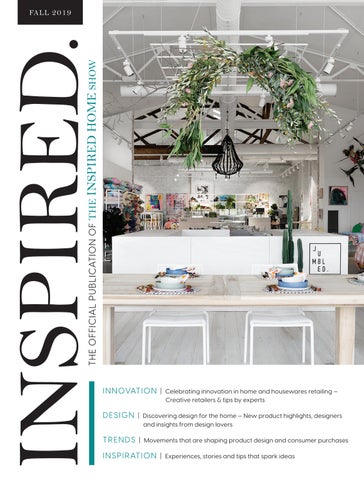
THE OFFICIAL PUBLICATION OF THE INSPIRED HOME SHOW
INSPIRED.
FALL 2019
I N N OVAT I O N | C elebrating innovation in home and housewares retailing — Creative retailers & tips by experts
DESIGN | D iscovering design for the home — New product highlights, designers and insights from design lovers
T R E N D S | Movements that are shaping product design and consumer purchases I N S P I R AT I O N | Experiences, stories and tips that spark ideas
LETTER FROM THE EDITORS Lifestyle — That’s the buzzword in home and housewares retailing today. Today’s consumers are getting very specific about how they build their daily lives, based on their key values and beliefs – not simply choosing the obvious or what’s easily available, but looking for products, solutions and services that fit and support their personal style and way of life. Even though people’s lives and homes don’t look the same across the globe due to different cultures, climates and socio-political realities, there are similarities with common key values growing in importance all around. Concern for environment definitely is one – more people are now making conscious choices, big and small, to support the sustainable way of life. Also, time spent and experiences shared with family and loved ones are valued. And consumers are paying more attention to their wellbeing, both physical and mental – eating healthy, improving sleep quality and creating a healthy home environment as well as surrounding themselves with objects that inspire and increase relaxation. The good news is that many of these choices have to do with the home. What’s also noteworthy is that consumers now have a much better access to and know more about different cultures and opportunities around the world – they’re combining products and practices from different backgrounds to create a style that’s uniquely theirs.
and connecting with your customers through tips from experts for visual merchandising, engaging service concepts, social media marketing and more. The latest insights and ideas will be highlighted at The Inspired Home Show in Chicago next March. With a lifestyle focus, our goal is to to help you understand how design and function fit into your customers’ lives and to find ways to inspire them to purchase products that complement those lifestyles. We expect this to be the most inspiring Show ever — with the NEW and INNOVATIVE made easy for you to see and experience – and very much look forward to seeing you there!
Piritta Törrö
International Marketing International Housewares Association
For the home and housewares industry, this means new challenges and – on a much greater scale – new opportunities. More than ever, it’s important for retailers to keep up with change and understand the developments and the shifting consumer mindset in order to be proactive and successful. With this issue of INSPIRED. magazine, we take a look at the various trends and movements affecting the home and housewares industry with an update on the latest technologies for retail and home. And help you find new ideas for creating experiences
2
Leana Salamah
Vice President, Marketing International Housewares Association
INSPIRED. TABLE OF CONTENTS
I N N OVAT I O N Martin M. Pegler on Retail Innovations. . . . . . . . . . . . . . . . . . . . . . . . . . . . . . . . . . . . . . . . . . . . . . . . . . . . . . . . . . . . . . . . . . . . . . . . 4 gia – Honoring Global Retail Excellence. . . . . . . . . . . . . . . . . . . . . . . . . . . . . . . . . . . . . . . . . . . . . . . . . . . . . . . . . . . . . . . . . . . . . 8 Introducing the 2019 gia Global Honorees. . . . . . . . . . . . . . . . . . . . . . . . . . . . . . . . . . . . . . . . . . . . . . . . . . . . . . . . . . . . . . . . . . 9 gia Expert tips . . . . . . . . . . . . . . . . . . . . . . . . . . . . . . . . . . . . . . . . . . . . . . . . . . . . . . . . . . . . . . . . . . . . . . . . . . . . . . . . . . . . . . . . . . . . . . . . . . 14
DESIGN Elevated Design – Design Highlights from the 2019 gia Product Design Awards. . . . . . . . . . . . . . . . . . . . . . . . 16 Discovering Design – Stasher. . . . . . . . . . . . . . . . . . . . . . . . . . . . . . . . . . . . . . . . . . . . . . . . . . . . . . . . . . . . . . . . . . . . . . . . . . . . . . . . . 18 Trending Today – Sustainability . . . . . . . . . . . . . . . . . . . . . . . . . . . . . . . . . . . . . . . . . . . . . . . . . . . . . . . . . . . . . . . . . . . . . . . . . . . . . 22
TRENDS Pantone Style and Substance – PANTONEVIEW home + interiors 2020. . . . . . . . . . . . . . . . . . . . . . . . . . . . . . . . 28 Staying Relevant – Consumer Trends by Tom Mirabile. . . . . . . . . . . . . . . . . . . . . . . . . . . . . . . . . . . . . . . . . . . . . . . . . . . 32 Housewares Industry Trends by Trend Bible . . . . . . . . . . . . . . . . . . . . . . . . . . . . . . . . . . . . . . . . . . . . . . . . . . . . . . . . . . . . . . 36 Innovative Retail Trends . . . . . . . . . . . . . . . . . . . . . . . . . . . . . . . . . . . . . . . . . . . . . . . . . . . . . . . . . . . . . . . . . . . . . . . . . . . . . . . . . . . . . 38 Future of the Smart Home – Products and Retailing . . . . . . . . . . . . . . . . . . . . . . . . . . . . . . . . . . . . . . . . . . . . . . . . . . . . . . 46
I N S P I R AT I O N Inspiring the Industry – Nikolai Gruschwitz: Future Retailing. . . . . . . . . . . . . . . . . . . . . . . . . . . . . . . . . . . . . . . . . . . . . . 52 Social Media with Melissa Maker. . . . . . . . . . . . . . . . . . . . . . . . . . . . . . . . . . . . . . . . . . . . . . . . . . . . . . . . . . . . . . . . . . . . . . . . . . . . 56 Keeping It Real Online. . . . . . . . . . . . . . . . . . . . . . . . . . . . . . . . . . . . . . . . . . . . . . . . . . . . . . . . . . . . . . . . . . . . . . . . . . . . . . . . . . . . . . . 60
CONTRIBUTING EDITOR
Michelle Hespe is a publisher, editor and writer with over two decades of experience in the media industry, spanning Australia, the US, Europe and Asia. Michelle has a solid grounding in news and journalism, has written a book on industrial design, and has a passion for creating moving content across all media platforms. She is a regular travel presenter on Sky Business Class TV (a travel program for executives) and is working on her first novel while managing a suite of print and digital magazines under her new boutique agency, Publishing ByChelle. publishingbychelle.com
3
SIGNAGE & POP by Martin M. Pegler
When is enough enough?
When do you say “I have put up enough signs and repeated the message often enough so that the shopper knows there is a special promotion or event going on?” When does the Point of Purchase material start acting as a negative force rather than a sale stimulus? When—and how—do you know that you have reached your shopper’s point of saturation?
MANUFACTUM, GERMANY
I have visited retail stores and supermarkets around the world and have always been surprised at the amount of signage generated and used to announce a clearance sale in some areas of the world. With all of their fashion sense and sophistication, one would think that Parisian department stores would know better than to create a deluge of flying paper signs overhead since they have this event annually. I have been drenched and drowned in signage — the message repeated over and over again every three feet in Hong Kong and Singapore in upscale and better merchandised shops where they should know better. In contrast, in Santiago, Chile, I found a small discreet sign in the window and a few, well spaced small sale signs inside the store working even more effectively. Customers know when an event is on and can tell a new product is being offered without being overwhelmed.
The overdoing of the paper and the over-repetitive nature of the sale presentation demeans the client’s intelligence and the value of the product being offered. It is not much different from how much Point of Purchase material one should use to introduce a new product or to highlight improvements in an established one. Always, it would seem to me, brand name recognition should be the first and foremost reason for the POP campaign, followed up by the reasons for why the product deserves to be purchased by the shopper. POP is about getting attention — favorable attention — arousing the shopper’s interest, directing him/her to where the product is and then providing the necessary information to “sell” the product. The POP promotion should end up by reinforcing the shopper’s opinion that he/she made the right decision.
4 | I N N OVATION
Martin M. Pegler is an author, editor, educator and lecturer, and has been a professor at the Fashion Institute of Technology in NY for over 30 years. He has worked with the IHA Global Innovation Awards (gia) from the beginning of the gia program in 2000 as an Expert Juror, and since 2016 as an honorary member of the gia Expert Jury.
YOUCOPIA LIVERPOOL, MEXICO
5
SIGNAGE & POP (continued)
All of this has to be done with a distinctive, brand-aware look; a style, knowledge of the shopper’s needs and desires and something that leaves a memorable impression on the shopper. So, rather than bombarding the shopper with the same repetitive message placed every few feet apart overhead, the message and the brand image should be introduced, reintroduced and re-re-introduced in novel, clever, interesting and distinctive ways so that as the customer moves through the retail setting, he/she will find these cues — these novel “reminders” — and the mental image reinforcements of what is being offered and to whom. The POP promotion can start with a window display that makes the original statement, shows the product, maybe includes a giant enlargement of the package or the item and possibly even a lifestyle graphic of the product in use. A window display or an up front, in-the-aisle store display can make an indelible impression! From there, lead the shopper to the on-the-floor location of the product with “clues” or “teasers,” like an occasional banner or sign, markings on the floor, overhead balloons or streamers, an on-the-aisle demonstration of the product or an opportunity, if feasible, for the shopper to try or taste the product. MANUFACTUM, GERMANY
LIVERPOOL, MEXICO
6 | I N N OVATION
LIVERPOOL, MEXICO
“ Be a welcomed guest and know when to stop with the sales pitch so that you will get invited back!” Interaction between the potential customer and the product can make the sale. Small free samples tell shoppers that the manufacturer really believes in the product and is so sure of its value and virtues that he is willing to allow shoppers to try it and convince themselves. The sample — if it is a miniature of the product package — serves to further reinforce the brand’s image. People respond to surprises and the unexpected so let the POP promotion be filled with unusual but striking color combinations, assorted shapes and forms (rather than the usual rectangles), squares and circles, cut outs, touches of appliqué or layering to simulate dimension and novelty materials. Just as shoppers are intrigued by the unusual and the unexpected, so can they be turned off by the trite and the too often repeated and same old message. The mind says, “I’ve heard this and seen this before so I can really ignore it from now on.” It is like the TV commercial you have seen so many times before that when it goes on, you don’t even see or hear it anymore. However, repetition can still be a good thing. It does mean “emphasis” — it can reinforce a name, an icon or an image, but it does have its limitations. When tempered, balanced and used with other messages and images and with elements of surprise or customer interaction, it can be an effective POP technique. Know the brand, the brand image and the potential customer, his/her lifestyle, likes and dislikes and then create the delicate balance that will work. Remember that adage about the welcomed guest who outstays his welcome? It’s the same with POP presentations. Be a welcomed guest and know when to stop with the sales pitch so that you will get invited back! |
•
TOKYU HANDS, JAPAN
7
Every March in Chicago, the IHA Global Innovation Awards (gia) are hosted by the International Housewares Association. The IHA Global Innovation Awards program was created to celebrate excellence and innovation in home and housewares retailing on an international level. Since the launch of gia in 2000, there have been over 430 gia retail award winners, from 47 countries on six continents. A jury consisting of retail experts and housewares trade publication editors from around the world decide on the gia Global Honorees after looking at all aspects of the participating stores, including visual merchandising, marketing, branding, staff training and other innovative offerings.
2018-2019 National gia Winners: COUNTRY STORE NAME Argentina ......................................................................... Interio Australia.......................................................... Jumbled Austria................................................................................. Manufactum Brazil.. ................................................................................... Tania Bulhões Canada. . ............................................................................ G. D’Aoust & Cie China................................................................................... LivingKitchen Colombia. . ......................................................................... Cachivaches Denmark......................................................... Bahne France. . ............................................................................... Shoji Germany......................................................... S-KULTUR India. . .................................................................................... Ajmal Bismi Enterprise Ireland................................................................................. Arboretum Home and Garden Heaven Italy....................................................................................... Abitare Baleri Japan.............................................................. Futako Tamagawa TSUTAYA ELECTRICS Mexico................................................................................ Liverpool Middle East - United Arab Emirates. . ................... THE One Netherlands..................................................................... La Cuisine New Zealand.................................................................. Città Poland. . ............................................................................... 9design Portugal.. ............................................................................ Pollux Russia. . ................................................................................. Glediz Southeast Asia - Vietnam. . ....................................... Kitchen Art Vietnam Spain.................................................................................... GADGETS&CUINA Sweden.............................................................................. Iittala Rörstrand Store Switzerland...................................................................... Elsasser-Peter AG Turkey.............................................................. Porland United Kingdom. . ........................................................... Potter’s Cookshop Uruguay............................................................................. sobremesas USA - Gift Retailers........................................................ Absolutely Fabulous Unique Gifts & Décor USA - Housewares Retailers.................................... Artichoke Indicates a Global Honoree Visit TheInspiredHomeShow.com/Explore/Awards/gia-Excellence-in-Retailing for more information on the IHA Global Innovation Awards program and to find short introductions and images of all 30 gia winners of 2018-2019. Watch a quick gia video at youtube.com/watch?time_continue=1&v=nHeRXLtQtFk
8 | I N N OVATION
IHA Global Innovation Awards 2019: Stars of the Show by Michelle Hespe At the 2019 gia, the five exceptional stores chosen as gia Global Honorees were: Jumbled from Australia, Bahne from Denmark, S-KULTUR from Germany, Futako Tamagawa TSUTAYA ELECTRICS from Japan and Porland from Turkey. The Martin M. Pegler Award for Excellence in Visual Merchandising was awarded to La Cuisine of the Netherlands and the gia Digital Commerce Award for Excellence in Online Retailing was awarded to 9design of Poland.
Introducing the five GLOBAL HONOREES:
Australia JUMBLED came to life in 2012 when owner Pip Brett created both a homewares bricks and mortar store and an accompanying online store. Today it is a colorful, artistic space where the work of exciting artists and designers are showcased alongside an array of inspiring products meticulously chosen and creatively displayed. Jumbled is all about giving customers a relaxing yet invigorating experience where the element of surprise ensures engagement and the light-hearted, bright and sometimes cheeky tone shines through in everything from the pages of its e-magazine to the carefully personalized wrapping and thoughtful newsletters. Loyal Jumbled customers are sent a free downloadable artwork on a quarterly basis and purchases are always accompanied by a little thank you gift. The gia expert jury agreed that Jumbled executes “wonderful storytelling,” and that the store incites an “artistic, dreamy feeling.” They also commented that the floorplan promotes exploration – like a treasure hunt – and that the staff are not only motivated and empowered, but full of life and inspiration because they are involved in decision-making, daily breakfast brainstorming sessions and other activities that make life and work fun. To learn more about Jumbled, visit jumbledonline.com or see the Jumbled gia blog.
9
gia Stars of the Show (continued)
Denmark Established in 1965, BAHNE focuses on offering customers extraordinary service with a unique assortment of product offerings. The latest of the now 20 stores opened in 2018. The 1,300 m2 space has four entries, an extraordinary ceiling up to 18 meters in height, a 130 m2 wall decorated with an enormous wall painting by Danish artist Rene Holm and four different types of wood used in the striking architecture and décor. Embracing technology and innovation, Bahne is proud of its centrally located internet browsing and online purchase + click and collect facility. For a more exploratory experience, in the design department there is a huge wooden house where different rooms have been curated in exhibitions to showcase new brands and trends. Keeping customers engaged and excited with social media, direct marketing, physical and online catalogues, the combined store and website are instrumental to Bahne’s success. And the store’s events – such as a skincare-focused evening run by a famous TV host or a girls’ night with special offers, treats and bubbles – keep loyal customers flocking back. The gia expert jury liked the fact that Bahne places much emphasis on well-trained, happy staff. They also commented on the fact that the entire store changes every three months with the seasons, and that the innovative fixtures and extraordinary lighting housed in the impressive building create a unique space that exudes luxury and a sense of pampering. To learn more about Bahne, visit bahne.dk or see the Bahne gia blog.
10 | I N N OVATION
Germany S-KULTUR, a café, bar, cookery school and shop focusing on barbecues, is a retail store that attracts those wanting to indulge in lifestyle, food, wine and socializing. As the owners say, “S-KULTUR feels like home.” The first S-KULTUR store, a household goods store with a luxury café-bar, was established in 2003. In 2007 the company opened its Weber BBQ store, which includes cooking and BBQ seminars. That successful venture evolved into a cookery school welcoming its first attendees in 2011. The new flagship store that opened in 2016 integrated the shop, café-bar and cookery school, leading to the creation of an experiential retail business that is also a thriving social and culinary hub. To enhance and grow this hub, S-KULTUR organizes around 200 events per year, inspiring and educating customers about grilling and barbecue, with how-to classes and recipes. Product offerings and experiences all happen on and around a meandering path through the store, where people can stop for coffee, test out products, visit the illuminated tables that showcase themed collections such as “baking” or “preserving” and watch presentations, shop and socialize.
The gia experts thought that overall the S-KULTUR store was an incredibly considered concept providing a great culinary experience. They also commented that the store is underpinned by a true passion for grilling and barbecue, and extra offerings such as home delivered steaks and a catering service add to the whole experience. To learn more about S-KULTUR, visit skultur-gunzenhausen.de or see the S-KULTUR gia blog.
11
gia Stars of the Show (continued)
Japan
FUTAKO TAMAGAWA TSUTAYA ELECTRICS — The name of this business is deceiving, as it’s a far cry from being simply a retail store selling electrical items. It’s a cool place that sells a lifestyle in the best possible way – offering customers an entire world of design, art, books and seemingly endless possibilities to discover, test, reflect upon and buy. Shibuya Tsutaya, a now-famous store selling books, magazines, games and more, opened in 2000, cleverly merging Starbucks with the store. This led to the opening of a “lifestyle commercial facility” called Daikanyama T-Site, and an enormous bookstore where customers could hang out. In 2015, Futako Tamagawa Tsutaya Electrics was born, encapsulating the essence of this company’s driving mission: to inspire people to buy a beautiful lifestyle perfectly suited to them. A pivotal part of this company’s success are the many “relax” areas provided for visitors, as the store aims to make people feel as though they are at home rather than in a store. There are 240 seats in the cafe, which can double-up as an event space, and a place for talk shows, demonstrations, autograph signings and much more. Concierges are available on every floor to assist visitors with demonstrations, offer ideas and ultimately help them make choices about their lifestyle. The gia expert jury all agreed that Tsutaya Electrics is a “true cultural hub – a place where people want to spend time, and keep returning to.” To learn more about FUTAKO TAMAGAWA Tsutaya Electrics, visit store.tsite.jp/futakotamagawa/ or see the Tsutaya Electrics gia blog.
12 | I N N OVATION
Turkey Known for its vibrant colors and beautiful patterns, PORLAND produces tableware, kitchenware, decorative home products, textiles and bathroom products and accessories. The company now has 1,600 employees, 40,000 m2 of concept store space and it produces more than 17 million pieces annually. Despite its long history and evolution, Porland has remained true to its brand, which is captured in its logo featuring a ballerina. “From clay particles to the visual presentation in our stores, we consider every detail, we design and produce with the dedication and the discipline of a ballerina.” In the physical stores, online and in their clever app where customers can create their own table settings and customize their own porcelain, Porland is all about creativity, color and beautiful arrangements that are always stylish, and usually exotic. Within the concept stores, household scenes called “Inspiration Zones” are set up to engage and excite customers, transporting them to another world. Scents, sounds and lighting are also used to achieve spaces that are both intimate and dynamic. Events such as chef demonstrations, kitchen workshops and blogger meetings further add to the Porland experience. The gia expert jury commented that “nothing is left untouched in this store,” and that the company “provides a next-generation, next-level omni-channel experience, superbly blending the digital and physical space.” To learn more about Porland, visit porland.com or see the Porland gia blog.
13
gia Expert Tips
for Visual Merchandising by Anne Kong
Surprise and delight shoppers with a dry, faux or
paper floral installation that celebrates the season. Place on a wall, at the entranceway or in an open space on the selling floor to spark up the store atmosphere. These types of installations visually inspire and draw customers into the store.
Vary the types of the display set-up. Create
table displays near the entrance or center of the store, wall displays can attract from afar and floor displays allow the shopper a 360-degree experience. The store window must change in style regularly, don’t just remerchandise the same configuration.
Go Local. Showcase local artisans and their products for
consumers to purchase. Partner with a local school group to display art or invite them to engage in an in-store activity. Connect with a local museum to feature historic images or artifacts in the window.
Natural colors and textures add a distinctive style
to the store environment. Use color-coordinated merchandise, props and furniture to create eye-catching merchandise stories. Green walls, plants and flowers relax the eye and liven the store environment. Large-scale imagery can set a theme for a display or convey a season or holiday spirit. |
•
KOSKELA, AUSTRALIA BAHNE, DENMARK
14 | I N N OVATION
JUMBLED, AUSTRALIA
JUMBLED, AUSTRALIA
TERRAIN, USA
BAHNE, DENMARK
15
Discover Design, the premier design destination at
The Inspired Home Show, features innovative, design-oriented companies and brands from around the world, representing all Show categories. At the 2019 Show, several exhibitors from Discover Design were selected finalists in the IHA Global Innovation Awards (gia) for home + housewares product design excellence.
DESIGN STARS
Design Highlights from the gia Product Design Awards
Best Product Design – Global Honorees CLEANING
BendITBrush | Fusionbrands fusionbrands.com
HOME ORGANIZATION + STORAGE
Stand Up Stasher | Stasher stasherbag.com
HOUSEHOLD + HOME ELECTRICS
Octagon One Desk Light | Gingko Electrics ging-ko.co.uk
KITCHEN HAND TOOLS + CUTLERY
Ortwo – Grind One-Handed or Two | Dreamfarm dreamfarm.com
TABLETOP
Visibility Bottle | Magisso magisso.com
16 | D E S I GN
Best Product Design – Finalists COOK + BAKEWARE
KITCHENWARE
Steamer II JIA jia-inc.com
HOME DÉCOR + GIFTS
Atmos Vacuum Canister FELLOW fellowproducts.com
PET PRODUCTS
The Five Seasons Leaf Fragrance Diffuser Brrr ALESSI alessi.com
Articulate Gallery 12”x18” Picture Frame ARTICULATE SCOTLAND articulategallery.com
Steam Waverz GOURMET KITCHEN WORKS gourmetkitchenworks.com
KITCHEN HAND TOOLS + CUTLERY
Leak-Tight AutoDogMug HIGHWAVE highwave.com
TABLETOP Collapsible Water Bottle with Carbon Filtration HYDAWAY hydawaybottle.com
The Perfect Pint THE PERFECT PINT theperfectpint.com
Flexicut GEFU gourmetkitchenworks.com
Chop N Spin Garlic Chopper TOVOLO / SPECTRUM DIVERSIFIED DESIGNS tovolo.com
Visual Measuring Cups WELCOME INDUSTRIES welcomeindustries.com
For more information about Discover Design, visit TheInspiredHomeShow.com/Explore/ Expos/Discover-Design. For more information about the 2019 IHA Global Innovation Awards for home + housewares product design excellence, visit TheInspiredHomeShow.com/Explore/ Awards/gia-Excellence-in-Product-Design.
17
Discovering DESIGN by Vicki Matranga
18 | D E S I GN
Vicki Matranga, design programs coordinator at the International Housewares Association, speaks with Kat Nouri, CEO and founder of Stasher, to learn about how a mom’s frustration with packing kids’ lunchboxes inspired an award-winning new product and social activism.
A California mother of three, Kat Nouri tired of using wasteful, disposable plastic snack bags in her children’s lunches. Searching in kitchen cabinets for lids to mismatched containers and the single-use nature of most plastics also irritated her. So Kat set out to develop a reusable bag that would offer the market a better solution.
“As a consumer, a mother, a designer and a responsible manufacturer, I believed the food storage category begged for innovation – in design, functionality, as well as sustainability,” Kat explains. “I set out to disrupt the market by designing the first radically functional and plastic-free bag made from silicone that could be used for cooking, storing and freezing food,” she continues. “Stasher was that product – not only versatile but intended to be repurposed and endlessly reused.” The market responded immediately. In 2016 Stasher premiered at the International Home + Housewares Show and won the Global Innovation Award (gia) for product design. It was also featured in Inc. magazine as one of the Seven Most Brilliant Product Designs of the year.
KAT, GIVE US SOME BACKGROUND ON HOW YOU DEVELOPED STASHER.
At the time I conceptualized Stasher, social consciousness around plastic
was just starting to gain some global traction. I had prior experience with owning a business that championed better alternatives to plastic by utilizing silicone as a superior and more innovative base material. I was fascinated by the functional qualities of silicone – it could take the heat and temperature variance better than other plastic alternatives and was made to be more durable and long-lasting than the thin film plastics that are so prevalent in the marketplace. At the time, broader market adoption had not reached mass awareness and the single-use plastic epidemic was not at the level that it is today. I also aimed to create a business that not only provided a healthier and more sustainable product but bettered the world for future generations. We are a B Corp, Women-Owned, and a 1% for the Planet member, which are organizations and certifications committed to better business practices, supporting others to become future women leaders, as well as actively engaging and providing support of nonprofits and organizations tackling our largest environmental challenges.
HOW HAS YOUR EXPERIENCE AT OUR SHOW CONTRIBUTED TO YOUR SUCCESS?
The Show has been instrumental to our success since our debut in 2016.
We were awarded the Global Innovation Award, not once but twice in the past three years. It was such an honor to be among the best from around the world and to be recognized for disrupting a category that traditionally belonged to multinational organizations.
19
Discovering Design (continued)
IS THERE AN APPROACH OR LOOK THAT JOINS THE FUNCTIONALITY, FORM OR EMOTIONAL APPEAL OF YOUR PRODUCT LINE?
At first glance, Stasher is super unique in its design aesthetics. It is a beautifully-
designed bag that’s more functional, durable and a more modern take on a familiar household essential product, single-use plastic bags. All of our products function much like their single-use plastic counterpart does, which has helped consumers make that transition to plastic-free. Their small change of switching to an endlessly reusable and plastic-free option has an important impact.
HOW DO YOU USE SOCIAL MEDIA?
We launched the product line for everyone. But it was millennials and young moms who championed Stasher, mostly through social media. As more awareness swelled up around the plastic-free movement our customer base exploded.
We’ve used Instagram to help educate, celebrate, guide and provide broader awareness with an inclusive approach where we can all play a role in the universal challenge of tackling plastic pollution. Our 228,000 Instagram followers are vocal advocates. We love celebrating our customers’ passion and love for the brand through social media.
HOW DO YOU SEE DESIGN’S IMPORTANCE IN OUR INDUSTRY AS IT MOVES FORWARD?
We believe that smart, beautiful design is essential in a modern world
where consumers are inspired by design and have an eye for detail. Design and function are two critically important factors to our success. For the industry as a whole, design will continue to play a vitally important role. Stasher’s multi-purpose bags continue to merit industry acclaim. In 2018, Fast Company named Stasher as a World Changing Ideas Finalist. |
•
For more information on Stasher, see stasherbag.com
20 | D E S I G N
21
22 | D E S I G GN N
Eco-friendly Aspirations Becoming ‘New Normal’ Around the World by Rachel Crippin Clark
It’s no longer a novelty to say a product is green. And consumers seeking a more sustainable way of life are no longer in the minority. What started as a small, upstart movement is now going mainstream. In many markets around the world, aspirations toward a more sustainable lifestyle are now (or soon to become) the new normal. “Global attention on sustainability has skyrocketed over the last five years, in line with growing pressures on natural resources and climate change, combined with an increase in conscious consumption and ethical living,” said Maria Coronado Robles, senior consultant, sustainability, at Euromonitor International, in the company’s market research blog earlier this year. According to Euromonitor’s 2019 Lifestyles survey, 64 percent of consumers now feel they can make a difference in the world with their purchases. That’s one reason ethical living (being mindful when making life decisions) is one of Euromonitor’s eight megatrends for the year. But consumers put even more responsibility on the shoulders of the corporate community. In a recent online survey, Nielsen found that a “massive” 81 percent of global respondents feel strongly that companies should help improve the environment. “A new era of sustainability is rising, and it’s touching every corner of the world,” according to Nielsen’s report, The Evolution of the Sustainability Mindset. “Looking for a better lifestyle, consumers are searching for options that are healthier for them and for their homes.” REUSABLE SILICONE STORAGE BAGS, STASHER
23
Eco-friendly Aspirations (continued) Global Movement, Regional Variations Of course, attitudes and attention to sustainability vary in different parts of the world. But don’t assume consumers in established markets are the only ones demanding sustainable practices. “Facing rapid urbanization and a growing disparity between classes, many people in emerging markets are experiencing the harsh reality of pollution in this post-modern industrial age,” said Regan Leggett, executive director, Thought Leadership and Foresight, Global Markets for Nielsen, in its report. “As a result, sustainability has become an urgent opportunity for companies to connect with consumers who are excited about change.” That’s a message department store chain Liverpool is seeing in Mexico. Thanks to school education programs and a nonprofit campaign started about 15 years ago to recycle PET, “People in Mexico are realizing the impact non-sustainable resources have on their environment, and they are starting to take actions to prevent this,” explains Liverpool Home Display Consultant Alejandro Reyes Martínez. “People are getting more concerned about the planet.”
In Denmark, sustainability issues are also top of mind. “Sustainability is a keyword in everything we do,” says Jacob Bahne Sørensen, owner of Bahne home stores. “Within the last 12-18 months, we have experienced a very strong growth in demand (for sustainable products) from our customers.”
In the U.K., “We get a lot of customers from every age group with sustainability concerns,” shares Sarah Wood, managing director of kitchen supply store Trevor Mottram. She adds that “anything that gets rid of single-use plastic” is especially popular.
In China, the country’s “central push on protecting the environment mainly targets the companies, but it is also trickling down to the general public being aware of the importance of sustainable living and making greener purchases,” says Jackson Liang, managing director of the Chinese distributor Genesis Household Products.
KOZIOL
24 | D E S I G N
“ 64 percent of consumers now feel they can make a difference in the world with their purchases.”
KITCHEN COMPOSTER, POLDER
25
Eco-friendly Aspirations (continued)
Customers are now asking where products are made. ISLAND BAMBOO
Opportunities in Home and Housewares As a result of the growing movement, many retailers are looking for home and housewares goods that are sustainable or which help support an eco-friendly lifestyle.
Other Sustainable Strategies Simply offering a product made with sustainable materials or that helps support a sustainable lifestyle is just one way to be environmentally friendly.
According to Maria del Pilar Marín Flores, kitchen buyer for Mexico’s Liverpool, their shoppers are looking for any products they can use over and over so they won’t produce waste. Those products include water bottles, tumblers, reusable bags, reusable straws, reusable storage containers, sustainable textiles and portable flatware.
Strategies any company can employ range from re-examining suppliers to reducing energy consumption to reducing packaging. In addition, retailers can help educate shoppers (and in some cases, manufacturers) on the topic and diversify their product offerings. And don’t forget to share your efforts with current and potential customers.
Wood of the U.K.’s Trevor Mottram says more conscientious customers are now asking where products are made. She believes more will start choosing local goods to help cut down on carbon emissions needed for transporting them.
“We regularly speak to suppliers about cutting down on the amount of single use plastic and cardboard sent to us (as part of product packaging shipments),” said Wood.
Of course, sustainably made products often come with a higher price tag…at least right now. Yet Nielsen said half of global respondents (49 percent) say they’re inclined to pay higher than average prices for products with high quality/safety standards; 41 percent said the same for products that are organic, 38 percent for products made with sustainable materials and 30 percent for products that deliver on socially responsible claims. “There are many Mexicans who are willing to pay more because of their commitment to the environment,” says Miguel Angel Herrera Montes, display manager for Liverpool Perisur. “But there are some who prefer cheaper products because of their income. It depends on their income and education.” “We have had success with products with price increases ranging in 10-20 percent due to sustainability,” says Bahne’s Sorensen.
26 | D E S I G N
“Everything we do backstage is sustainable, if possible,” says Sorensen. “We’re also working on reducing our energy consumption by changing to LED lighting.” Other retailers have moved to sustainable shopping bags and gift packaging, efforts that will likely pay off in this new era of the sustainability movement. “Businesses that embrace ethical living, the circular economy and sustainable packaging will make headways in enhancing their brand image and reputation, and winning over more ethical and demanding consumers,” said Euromonitor’s Coronado Robles. Crystal Barnes, senior vice president, global responsibility and sustainability at Nielsen, agrees: “By identifying an opportunity to be more sustainable, and implementing a reasonable play of action to accomplish it, companies achieve an authenticity that paid advertising can’t buy.” |
•
FREEZABLE GROCERY BAG, PACKIT
LIVERPOOL, MEXICO
Trending Today PREVIEW: Saturday, 14 March 8:00-10:00 am Room S100, South Building, McCormick Place Featuring up to 60 exhibitors with sustainable products, or those that support an eco-friendly lifestyle Open exclusively to buyers and news media Runs concurrently with the New Exhibitor Preview
27
PANTONE VIEW home + interiors 2020 ®
by Leatrice Eiseman, Executive Director, Pantone Color Institute
28 | T R E N D S
Color in the New Era: Trends, Twists and Tweaks Diverse color palettes with never-ending patterns and combinations will be the name of the game more than ever before.
The most important new color trends for 2020 can be grouped in eight palettes.
This is where softer palettes come into play, though there is still a need to update these with unusual twists to attract attention. The popularity of health and wellness treatments, hydration and herbal tea all factor into these color groupings. In terms of on-trend materials: Marble can be seen in everything from the interior of Infiniti’s QX concept car to wedge heels on women’s shoes. Metallic materials are especially popular when combined with an unlikely partner – wood – and texture is important, it is often needed to contrast with the sleekness of metallics. Felted products are becoming popular, as are birds and feathers.
1 | Metropolis Conjuring up images of steel-girded skyscrapers, light reflecting off windows and the gritty asphalt below, Metropolis is a mix of glamour and industrial chic, combining striated old-world marble, deepened wood patinas and futuristic metallics. Accents of plum wine and elegantly deep lavender add a sophisticated touch.
2 | Trekking Influenced by fashion favorites of plaid flannel and well-worn denim, Trekking is a grounded palette that shows an appreciation of the outdoors. Red plays very heavily in this palette and a spicy mustard adds warmth to it.
29
PANTONEVIEW home + interiors 2020 (continued)
3 | Skill Set Demonstrating an appreciation of things that are hand-made, Skill Set evokes the hues of hand-thrown pottery, hand-tooled leather, forged steel treatments and wine-dyed spoons rescued from old oak barrels.
4 | Prints Charming This palette is inspired by an image of a modern-day Prince Charming dressed with some traditional Royal stylings but with some modern twists, including patterned tattoos. Bright blue, red and yellow are calmed by an umber brown and a minted green, and black and white provide contrast to it all.
5 | Beyond the Pale “Taking pastels and kicking them up a notch,” Beyond the Pale shows that different permutations of pinks can co-exist, and includes a smoky green, a blue-green, a mid-tone Infinity blue, a lively greenish-yellow and a contrasting tawny brown.
30 | T R E N DS
6 | Tempered Tastes Tempered Tastes is a palette that goes beyond just neutrals to incorporate some shimmery metallics including Pantone’s Gold Leaf and the rose-toned Agave Nectar.
7 | Show Stoppers The energy is palpable in this palette packed with vibrant hues such as Twinkling Diode Blue, Leprechaun Dust, Spectra Yellow and Purple Orchid. It’s a combination that kids (or kids at heart) would be drawn to.
8 | Tea Garden Evoking the calm and natural beauty of a Japanese tea ceremony, Tea Garden features blue in the shades of sky and sea, serene greens, lavender, yellow-green, a “pungent chai shade” and a touch of mango.
The audio recording of the presentation is available at TheInspiredHomeShow.com/Experience/Education/Keynotes. Extracted with permission from PANTONE®VIEW home + interiors 2020 trend forecast.
At the 2020 Show, color and material trends for 2021 will be revealed at the color seminars by Pantone. Visit also the Pantone ColorWatch display to view, first-hand, detailed forecasts and trend identification.
To learn more about Pantone or to purchase the PANTONEVIEW home + interiors 2020 trend forecast, please visit pantone.com.
31
How to Thrive in the Retail Revolution by the International Housewares Association
We’re now in a consumer-centric period of retail where the consumer is in control. As a result, housewares suppliers and retailers need to focus all their efforts on what consumers want, how consumers see themselves, and how the industry can help create solutions for them. We need to stop looking at objects and start looking at what those objects deliver. The key message right now is: People aren’t buying objects, they’re buying experiences. Looking at the different generations, there are some important “need-to-knows”: GENERATION Z is on track to be the most well-educated generation (according to Pew Research), with a liberal set of attitudes and openness to emerging social trends. They also may be the first generation where cooking is no longer seen as a gendered task and viewed more as a craft or skill and less as a chore. This generation is also skewing more towards ‘traditionalist’ life cycles, with many saying they want to start a family and own a home.
32 | T R E N DS
Based on the keynote presentation by Tom Mirabile, Consumer Trend Forecaster for the International Housewares Association, at the 2019 International Home + Housewares Show.
A much less traditional generation, MILLENNIALS prefer staying home over going out. But they’re less likely to eat collectively around the dinner table – they rather at the kitchen counter or in the living room, many even eat in their bedrooms. Research also indicates that many Millennials are replacing on average one meal a day with snacking. Another way of bucking the norms, Millennials aren’t blindly brand loyal. Loyalty does exist, but must be earned through consistent innovation and relevance to their lifestyles, evolving needs and even sociopolitical beliefs. GENERATION X is smaller in numbers but is entering its prime earning years. While only 13 percent of the U.S. population, Gen X represents 31 percent of discretionary spending today. Gen X is very self-sufficient and does more pre-purchase product research than any other generation. They’re also a true shopping hybrid – they still enjoy a trip in-store but have fully embraced online shopping. Meanwhile, BABY BOOMERS still control nearly 40 percent of discretionary spending in the U.S. and are clearly focused on the comfort and convenience of their living spaces. More of them plan on remodeling their kitchens and bathrooms than any other generation, and they are spending more on those remodels, as well. That means they will be buying more housewares to outfit and enhance those spaces. Also, many Boomers are in a period of personal reinvention, so they’re looking for products which deliver new skills and new experiences in the kitchen. Most importantly, don’t think of them as just retirees. Today’s Boomers are healthy, active and socially engaged – and they are strongly influenced by Millennials and even Generation Z when it comes to home and housewares trends.
Further, there are some key tenets that are important for housewares suppliers and retailers trying to keep pace with today’s rapidly changing marketplace – one in which the consumer has harnessed the power of ratings and social media to gain unprecedented influence.
These tenets, tied to the acronym “FASTR,” are:
F A S T R
Be Flexible Be Fun Be Fearless Be Addictive Be Aware Be Aspirational Be Surprising Be Shareable Be Simple Be True Be Transparent Be Trustworthy Be Real World Be Responsible Be Reactive 33
How to Thrive in the Retail Revolution (continued)
Be Flexible
Change is constant, but even the most established brands must reevaluate and evolve to stay in step with consumers and their changing needs and expectations.
Be Fun
(Brands and companies) who can have fun and make fun of themselves send a message of self-confidence and ‘realness.’
Be Fearless
Don’t be afraid to take a stand or do something different from the norm. It helps make your brand feel authentic and stand out from the competition.
FASTR Be Simple
Simplicity is the key to adoption. Today’s consumer has neither the time nor the attention span for complexity. Intuitive functional and time savings are value drivers.
Be Trustworthy
Consumer trust levels are at an all-time low, whether it comes to government institutions, businesses or media... and if we don’t trust, we don’t buy.
Be Transparent
Whether you’re talking about ingredients, labor usage or product materials. Significant numbers of people across all generations will pay more money for eco-friendly materials.
Be Addictive
Be True
Be Aware
Be Real World
Be Aspirational
Be Responsible
American adults spend over 11 hours per day listening to, watching, reading or generally interacting with media, according to the 2018 Nielsen Total Audience Report. You must have a plan to engage them.
There’s a tremendous amount of information out there, but you’ve got to be self-educated, you’ve got to be a culture vulture and keep up with what consumers want and need.
Today’s consumer doesn’t dream of owning, but of becoming. Stop telling the customer who you are and start telling them you know who they are and who they want to be.
Be Surprising
This often starts within your own company culture and then rises through the ranks of everything you do.
Successful companies identify real-world problems and solve them. Selling solutions is the most direct path to meaningful demand.
Whether environmental or social, corporate responsibility and ethical behaviors have become a key issue for many generations of consumers.
Be Reactive
Getting negative reviews? Be quick to react, explain and make things right online.
The subscription e-commerce market has grown by more than 100 percent per year over the past five years. Why? They deliver boxes of surprising items a consumer may never have found on their own (or without a lot of time and effort).
Be Shareable
These days, this doesn’t simply mean sharing an image, though that still does have value. It’s more about inspiring people to physically share real world experiences, such as the opportunity for a family to cook and eat a meal together.
34 | T R E N D S
A video recording of the presentation can be found on the IHA’s website at: TheInspiredHomeShow.com/Experience/ Education/Keynotes. Make sure to attend Tom’s Top Trends 2020 presentation at The Inspired Home Show next March, exploring the consumer and retail shifts that are reshaping the home and housewares industry in the year ahead.
35
Meaningful Life: Spring Summer 2020 by Naomi Pollard, Head of Home and Interiors, Trend Bible
Trend Bible is a global trend agency and leader in predicting the future of life at home. They work collaboratively with the world’s best brands helping them seize tomorrow’s opportunities.
If it can be done in or to the home, Trend Bible is already tracking early signs of upcoming shifts in taste and habit around the world. Whether it’s the future of eating, decorating, playing, celebrating or bringing up children, Trend Bible applies its expertise to develop those signals into strong and simple trend forecasts that create commercially successful products that connect with future audiences and stay true to brand. We’re sharing an exclusive glimpse into their Spring Summer 2020 trend “A Meaningful Life.” Busy lives mean the home becomes a place of calm to facilitate and regain balance. A focus on Japanese culture due to the 2020 Tokyo Olympics provides the inspiration for living a life of meaning and introspection. Well-being and awareness are at the centre of this balanced story, taking inspiration from traditional Japanese interiors. This trend offers an easy update for Scandi style homes.
TREND BIBLE
Color
Wabi-sabi
A soft nature-inspired palette defines this trend. Contrasting cobalt blue and pale mint green set fresh accents. Moonlight Jade and Cornflower Blue add a fresh feel to this deeply calming story, defying time and space and fitting urban and rural homes alike.
Wabi-sabi aesthetics continue to be of importance in response to the modern-day search for a sustainable way of life. The perfectly imperfect is paired with textural accessories and layered materials. Consider tactile effects, pock marked surfaces and splattered glazes when creating ceramics and decorative pieces.
ARTILLERIET
KANGAN ARORA
36 | T R E N DS
MERCI PARIS
JONAS EDVARD
MATTHIAS KAISER
Japanese Mending
Slow Rituals
This story is about finding beauty in imperfection. Repaired effects adorn ceramics, decorative accessories and textiles, offering a cherished feel to homeware. Highlighting the flaw with golden or silver fillings enhances the beauty of the broken goods.
The idea of ceremony, repetition, methodical activities and self-care is reflected in kitchenware design featuring slow pouring kettles and ritualistic inspired product collections.
YENCHEN YAWEN
MANETTI
POTTERY90
MANUAL
YENCHEN YAWEN
Meaningful Life forms one of four trends published in the Trend Bible Spring Summer 2020 Home & Interiors trend book, available to buy now from their online shop at trendbible.com/shop. — For more information on how trend forecasting can grow your business, contact enquiries@trendbible.com. — To receive free monthly trend updates by Trend Bible, sign up for their free newsletter at trendbible.com.
Trend Bible will be presenting some of the key trends for the home that retailers should be responding to for 2020 at The Inspired Home Show 2020 in March. To learn more, visit TheInspiredHomeShow.com/ Experience/Education.
37
“ Don’t let your retail gravestone read: “We couldn’t adapt: the future caught us.” | Scott Kohno
38 | T R E N DS
Scott Kohno is an entrepreneur and an expert in retail marketing and the creation of unique, identifiable retail environments that build corporate brands. Here he outlines what he thinks retail in 2019 taught us.
SELFRIDGES, UNITED KINGDOM
Top Retail Trends, from the Experts SCOTT KOHNO
by Michelle Hespe
We talk to the four gia Expert jurors to get an update on trends in retailing. “Retail is not dead – being mediocre in the retail
space is dead,” Scott Kohno says with conviction. He emphasizes that today more than ever, when so many people are living their lives through their smart phones, they are actively seeking places to meet and socialize. “They want landmark destinations that they can take photos of and put on social media, events and entertainment. Serendipity. Calmness. Or excitement. Places where things were once just sold are no longer the destination of choice.” Scott uses Starbucks as one of the best examples in the last two decades to illustrate his point. “In the 1970s retailers had expansive lounge areas, fitting rooms, lobby areas, etc. And then in the 1990s it was all about SKU (stock keeping unit) and that eventually led to stores becoming a sea of racks. Then Starbucks took the MBA (Master of Business Administration) metrics of customers per hour, table turns, etc. used in the food industry and turned it on its head by building large lounge areas/chill-out zones and allowing customers to camp out in their stores. This has proven that the balance of customer service/amenities is extremely important, and each retailer must find that ultimate balance. There is no one way to find that balance, as each amenity and the accompanying SKU density has varying gross profit contributions.”
Trends in retail have a very short time period and now you need to inspire people and give them more than just a product, because products are everywhere. Today to be a successful retailer, you have to know what is going on in someone’s mind. Data is king. But be wary. “As a retailer, it is very difficult to solely rely on focus groups and surveys because customers are trained to answer the questions the way society expects,” Scott warns. “Retailers must find creative methods to observe the customer, by having many staff members and associates study the customers at their own individual level. Whatever it takes, the retailer must find a way to put themselves in the customer shoes.”
PORLAND, TURKEY
And the ultimate question – if being mediocre means that you end up with a retail gravestone on your horizon, how do you be exceptional without breaking the bank?
FUTAKO TAMAGAWA TSUTAYA ELECTRICS, JAPAN
Scott says the journey for a customer is also more important than ever. “Today they need a concierge to give them a whole level more when they are shopping,” he says. “Create your own story, as always, but remember that customer experience is not just one thing – it is many little actionable ideas that make up an entire experience. It’s a bunch of little things that win every time, every day.”
“Retailers must fight complacency by setting goals to recreate their business in a major way once a year,” Scott advises. “This does not have to be through a major renovation or re-branding effort, but there has to be a goal to change at least 30 percent of a business every year, whether it be a dramatically new merchandise mix, new co-branding opportunities, new customer amenities, etc. Retailers are so busy with just keeping their heads above water that suddenly in five years, they realize that their stores, merchandise mix and customer service are outdated, and it may be too late to recover and catch up. Once a year, a retailer needs to set a specific date and meet with staff to plan and execute their annual update to prevent mediocrity. Think of it as one’s annual medical check-up – this meeting and execution must occur EVERY year.” |
•
39
Top Retail Trends, from the Experts
ANNE KONG
“Spark joy and make a connection with your customers.” | Anne Kong
Anne Kong is an educator and designer specializing in Visual Merchandising, Exhibition Design and Special Events.
TERRAIN, USA
“Creative visual merchandising defines the
attitude of your store and sparks a connection between your store and the consumer,” says Anne Kong. “Consumers are attracted to a higher level of visual experiences when shopping in the physical store today, so retailers need to deliver.” If you’re feeling out of the loop or just need some fresh inspiration and guidance, here are three steps she recommends for getting your retail business back on track this year.
Step Two: Work the current Visual Merchandising Trends Go local. Coordinate with the local environment, a school group or historical location. This approach personalizes the customer experience. Try using natural materials and textures – consumers respond more to color, textures, natural materials and plant walls. Geometric patterns and shapes can help organize merchandise and provide a visual flow for displays.
Step One: Change it up Displays and visual merchandising must utilize a diverse line-up of visual tactics. Don’t get into a rut of producing the same type of displays with different merchandise.
40 | T R E N D S
TERRAIN, USA
POTTERY BARN, CHELSEA, NEW YORK CITY
Step Three: Use creative resources – start with a Pinterest Board Engage co-workers to pin up ideas as well as yours. Use themes such as color, texture, scale or the seasons. Tell stories with merchandise by adding imagery. Research for creating displays can come from a trip to the museum, watching a great documentary or visiting an exciting destination. Most importantly, visual merchandising should vary in style with each new installation. Retailers (just like a great artist who knows when to stop in order to create a masterpiece) need to know when they have hit it on the head and achieved what they set out to do. And that’s pivoted into another 2019 trend: data gathering.
S-KULTUR, GERMANY
One of Anne’s fortes is events. It’s everyone’s worst fear to throw a party that doesn’t work out as well as planned, let alone having fewer guests than expected. So, in an era when events are paramount to success, what can retailers do to ensure that theirs is not a failure? “Events require excellent flow of social media, direct mail or email contact,” she says. “Plan ahead and build up momentum. Do a countdown on your store window and send email blast reminders. Make the event worth attending by providing entertainment, food or beverages. Music is a must. Create an interactive experience for your customers by hosting an interactive game or contest that offers prizes. Incentives such as a local celebrity, free seminar or hands-on activity can be drawcards too.” Another trend in 2019 has been Marie Kondo; her decluttering philosophy has taken the world by storm. However, in order to gain a customer’s attention, attracting them with things that pique their interest and elements such as artful walls and interesting (sometimes eclectic) collections might also be key. So how does a retailer pare it back but also attract attention?
“Don’t design in bubble,” warns Anne.
“Instead, poll the audience. Get feedback from your trusted team of retail experts, including your senior sales force. It’s also wise to hire an experienced (freelance) visual designer for expert assistance with visuals.”
“There is a happy medium between strong visual merchandising and decluttering,” Anne states. “Strong visual merchandising should incorporate artistic elements such as textured surfaces, inviting imagery, vintage props and more, however the merchandise story should always be carefully curated. Don’t overwhelm the consumer – break up displays into separate stories and be sure to leave a LA CUISINE, NETHERLANDS resting place for the eye. There should be a noticeable beginning, middle and end to a good visual merchandising journey.” |
•
41
Top Retail Trends, from the Experts
HENRIK PETER REISBY NIELSEN
“ Technology should be a facilitator – a tool to offer a seamless service. Not a goal in itself.” | Henrik Peter Reisby Nielsen
There’s no escaping it today – in order to
be successful, retailers should be on social media. “But it’s better to not be on social if you’re not doing it well,” Henrik warns. “You can’t afford to be doing it badly when so many others are doing it well. If you are not in the position to do it well, then you should hire someone. Everyone is now using viral loops for instance, and you should be too.” For those who do not understand what a viral loop is, it’s a type of marketing campaign used to promote a company or product. It’s meant to “infect” a person and cause them to share it with other people. A viral loop can go from zero to thousands or even millions of viewers in a short period of time, so it can quickly spread word of a product across the world, as each new customer or user shares the content with friends and associates. For example, the 2018-2019 gia France winner Shoji placed lovely woven shopping baskets by their entrance, with blue and red ribbon tied to them. A blue ribbon signaled that the shopper was hoping to get assistance shopping, whereas a red ribbon
42 | T R E N DS
Henrik Peter Reisby Nielsen is an entrepreneur, former award-winning retailer of gia, and the CEO of Reisby Consult
indicated that no help was needed. A similar approach has been used by some supermarkets, with the shopping basket colors indicating whether the shopper was single and happy to be approached by someone or if she/he was taken. “This offering gives people something to talk about, they feel amused, happy or entertained, and then they might share it on social media,” Henrik explains. “It stirs emotions. And if people comment on their experience, or even offer a review, you are winning. Reviews matter more than ever today – they are more important than advertising now. An efficient website is also crucial in retailing. “Sixty percent of people don’t return to your website if it’s problematic,” Henrik explains. “If images don’t load quickly, if it’s not easy to navigate, if there are glitches or mistakes, they immediately leave.” If you are not a web developer or designer, it’s important to find someone who knows websites instead of trying to create one yourself, Henrik says. The same goes for Facebook.
Reviews matter more than ever today – they are more important than advertising now. “Don’t start putting money into FB ads if you’re not an expert – hire someone,” he recommends. “And always remember that people live through their smartphones today, so your website has to look perfect on the smartphone. Images and text do not appear the same on both platforms. You need to keep it clean, with no clutter, as a smartphone screen is small and easily crowded. “Engaging bloggers and influencers to do some work for you is also a clever move, as they often have thousands of followers. Find the right influencer, someone that you trust, and invite them to events and pay them to push word of your product out through their social channels,” Henrik says. “They make a living out of it so they know how to do it well.” Henrik reminds retailers that people today live through their devices. “The road to a shopper’s heart goes through the smartphone,” he says. “But remember that technology should be a facilitator – a tool to offer a seamless service, not a goal in itself. Look at the use of iPads in stores now. The point of sale is no longer restricted to counter areas – staff can sell something and take a payment anywhere in the store. You can offer customers the option of using the store’s iPad while they are in your shop. They can touch the product, see it, then click on it on the iPad, buy it and have it sent to their home.” |
•
JUMBLED, AUSTRALIA
MANUFACTUM, GERMANY
43
Top Retail Trends, from the Experts
WOLFGANG GRUSCHWITZ
“ If you are close-minded, how can you open and understand the minds of others?” | Wolfgang Gruschwitz
Wolfgang Gruschwitz is the owner and managing director of the Gruschwitz Corporation, which offers full-service retail store design and visual merchandising expertise to retailers.
GRUSCHWITZ GMBH/COMMA, GMBH & CO KG, ROTTENDORF
During 2019, retailers noticed a spate of expectations
around what people receive for free to enhance their shopping experience, because offering customers add-on services now seems to be a part of the game. The question is, should you be charging for things such as knife sharpening for those who purchase a set of knives, a cup of coffee so that people can relax in your store or a cooking lesson to show off a new set of pots? Wolfgang believes that the answer is rooted in the quality of what you are offering customers, and the way you present the package to them. “Everything has a worth – and as a retailer you will always need someone who wants to give money for something,” he says. There will also always be people who want things for free. “As long as you offer people something they can use, and something as an add-on that assists them further or simply makes them happy, there will always be someone who will pay for it,” he says. So, include the add-on experience or freebie in the price that someone pays for a product or offer free experiences that don’t cost you anything, and people will come back and perhaps buy more. It’s a win-win for everyone.
44 | T R E N D S
As Anne Kong also stated, retailers need to spark joy in a customer. “Firstly, remember that most people have everything they need today – most of us are spoilt for choice and so our senses have become saturated and dulled,” says Wolfgang. “So to create joy, motivate people with something that makes them elated, curious or something that creates surprise and makes them emotional. Take them out of their comfort zone. Now more than ever, customers need to be touched mentally, by something interesting making its way into their brain.” As the touchpoint is totally different for every person, Wolfgang explains that the main mission of the retailer today is to get the exact information that they need from the client. “You have to know what drives your customers,” Wolfgang says. “If you are close-minded, how can you open and understand the mind of others? Someone might come into your store, but do you know how they are feeling?” he asks. “No, you don’t, but you have to try and find out so that you can give them what they need.
GRUSCHWITZ GMBH/COMMA, GMBH & CO KG, ROTTENDORF
They could have been through anything – they could be happy, mad, sad – you need to know these things and then be there for them. This will create trust and loyalty.” Today, with everyone living through their devices, Wolfgang says that there is no such thing as “too personal.” “Trust in yourself, your brand and your product. If you are too cold or too distanced, this will result in customers rejecting you and everything you stand for. You will lose them,” he says.
One battle for retailers is getting people off their smart phones and paying attention to what is around them. Again, Wolfgang recommends the element of surprise. “Give people something that they weren’t expecting and you will capture their attention,” he says. “Create something that will make people stop, look and think. Spark some different feelings and ideas that they are not accustomed to feeling or thinking, and you have distracted them from their own life enough for them to pay attention to you and your store.”
LA CUISINE, NETHERLANDS
One thing that didn’t change in 2019 was that stories are still pivotal to success in retail. “Think of some new stories for your store,” says Wolfgang. “For instance, bring green and nature into your store and people might think: ‘I can breathe! I can relax. I am free.’ Bring old art and some history into your store and a customer might feel as though they are in a museum – and they are filled with wonder and a need to learn.”
People are searching for something unique and authentic, so touch their emotions. “A store is no longer a store,” Wolfgang says. “As a retailer, you have to go beyond selling products – you should be a purveyor of style, emotion, hospitality and service. You need to create an emotional journey that people want to go on.” |
•
OPUS DESIGN, AUSTRALIA
45
Taking the Smart Road by Michelle Hespe
Carley Knobloch (aka Carley K) chats about developments in the future of the Smart Home and offers some tips to retailers on how to take the scariness out of Smart products. Just like the basis of great industrial design – where it’s all about the creation of products that solve problems and make a person’s life easier – the best type of Smart Home is one that houses smart products that are useful, convenient, look great and give their users more time to concentrate on real life. As a retailer, you need to help your customers understand the new products available and help them determine which ones fit into their lives. “In retail today, we are returning to the idea that an in-person experience is complimentary to online retail,” says Carley. “We can still benefit from being able to hold something and be around people who can educate us about products. You can order a shoe online, but do you really know how it feels unless it’s on your foot? I sometimes liken it to the proverbial cookie: You see a photo of a cookie, or you might see someone eating it on a video, but the experience of eating it yourself and learning about the ingredients from a knowledgeable person is unparalleled. You want more cookies!” Carley has built a business and a life around taking the scariness out of smart products, with a focus on guiding and assisting women in their day-to-day lives. She makes it easy for people to understand what smart products can and should fit into their lives. She also makes it easy to take one step at a time into the “smart” world. “I think we’ve always traded privacy for convenience,” says Carley. “People, companies, have been collecting information, data, for a very long time and it’s gone unchecked. These days, your phone knows where you are, and yet many people feel helpless. ‘I don’t want my phone tracking me like that!’ they’ll say – but in the end there’s little they can do to control the situation… unless they want to stop using their phones.”
46 | T R E N D S
PHOTO BY CARLEY KNOBLOCH
“ In retail today, we are returning to the idea that an in-person experience is complimentary to online retail.”
47
Taking the Smart Road (continued)
Carley explains that we need to remember that there is “Smart” and then there is “Intelligent.” “I, the human being, am the smart and intelligent one. I should know what’s going on and make decisions about my life,” she says. “I should be able to choose smart products to suit my life and make it better for myself and for my family. For instance, look at mood lights now that have different hues for sleep or motivation depending on what time of day it is or what you’re doing. That’s intelligent help. Some of the features, though, can scare people. Like a thermostat that knows when you are sleeping.” Being a part of a busy family with children who come and go, Carley loves her smart locks. “I love that I can open the garage door from anywhere,” she says. “I might have a furniture delivery while I’m at work, and I can let someone in and then lock it again. You might remember that you left the garage door open and then check that it’s locked. My children all have their own individual passcodes to the lock, so I know instantly who has arrived at home, and who hasn’t. It’s great for a parent, and it makes my life and theirs easier.” When it comes to Smart Home products, a retailer’s role is to help a customer to evaluate what they need or don’t need, and data gathered from social media and direct marketing can make this easier. However, because their information is being used for marketing to them, consumers are feeling less in control and less trusting as they think their privacy has been violated. “As a retailer, you need to inform consumers of innovations and keep them in the loop,” Carley says. “To do this, you need to think of personal ways to engage with your customers – such as asking them for a wish list. Get them to think about where there are pain points in their life and then think about the pieces of tech that they might want to fix the problems, or just make life easier.” Carley explains that the easier you make someone’s life, the more they’ll appreciate you and your business. “Many consumers are fatigued, so you need to help them. There is too much out there to understand, and that’s on top of social media and emails and everything else. Be their helpful friend and you will gain loyalty. Create engaging content. Continue to talk to them. Everyone wants a personal connection.” When creating content, Carley says retailers should avoid relying on gimmicks and remain true to their brand. “Speak to customers in a very personal way – they know we can now micro-target so make them feel special. Emotion is still one of the best ways to make people loyal. If there is a connection, people buy things.
48 | T R E N D S
PHOTO BY HANNAH GARVIN
CARLEY KNOBLOCH, PHOTO BY ALEXIS ADAM PHOTOGRAPHY
PHOTO BY ALEXIS ADAM PHOTOGRAPHY
PHOTO BY HANNAH GARVIN
These people are opening their homes to you, so you have to be respectful of that. They are deeply concerned about their privacy and security. They’re fearful that everything is listening and recording. If you can alleviate their concerns by being transparent, you’ll be ahead of the game.” As a technology lifestyle guru, Carley says her job is similar to retailers – encouraging people to try one thing at a time that might work for them. “They might not even know that they needed it!” she says. “For instance, I might encourage someone to try out the Smart lightbulb. They might install one light in a lamp that changes the mood of the room. Then they might decide to install lights that turn on and off at particular times when they are away, so its looks as though someone is at home and deters burglars. They might then progress to lighting a whole floor of the home that is activated by movement and creates a pathway to the bathroom at night. If they keep moving forward with great solutions, everyone’s making progress.” When a customer takes that first step of trusting a new smart product and what it is doing for them, they also gain trust in you as their preferred retailer. Together you can make more of an inroad into the Smart Home world. One step and one product at a time. |
•
You can check out Carley’s blog at: carleyk.com PHOTO BY HANNAH GARVIN
49
So where exactly is the smart home market today, and what will it look like in 2020 and beyond? by Rachel Crippin Clark Just two years ago at the International Home + Housewares Show (now known as The Inspired Home Show beginning in 2020), Carley compared the smart home marketplace to the Wild West: A place where everyone was shooting, but not everyone was exactly sure where they were shooting, or why. Today, “it’s absolutely evolving and straightening itself out,” she says. “As it gets harder to compete with Amazon and Google on smart home, product development companies are finding it easier to align themselves with the leaders from the start. Plus, these companies are seeing the benefits of making products easier for consumers to set up, to sync with other systems and to help solve problems. “The customer experience is really paramount,” Carley adds. “And I think we’re going to see the continued pursuit of more elegant solutions for consumers and more refinement in existing products.” The global smart home market is forecast to grow to $53.45 billion (U.S.) by 2022, according to Statista, a leading provider of market and consumer data. They project the total installed base of Internet of Things-connected devices to reach 75.44 billion worldwide by 2025, a fivefold increase in just 10 years. Household penetration rates are currently highest in the United States, Norway, the Netherlands, Denmark and Sweden, says Statista. Product categories with the highest market share are video entertainment, smart speakers and home security or monitoring devices, according to IDC Worldwide. As we look to the future, look for smart home devices to become smaller, cheaper and smarter, says Carley. An analogy? The evolution of TV sets or computers.
Some of Carley’s other top trends to watch are: ARTIFICIAL INTELLIGENCE This is where products are moving from just being “smart” to actually being “intelligent” and learning as they go along. Think of a toaster that has a sensor that automatically knows you’ve put in a bagel – without you telling it – and toasts it at the right temperature and for the right length of time.
CROSS-COMPATIBILITY One of the early lessons in smart home is that consumers “don’t want to get painted into a corner” with every single smart product they own. Look for more sellers to make it easier for products to talk to each other and work across different operating systems.
HOME HEALTH Carley’s excited about the many products coming to market to help consumers improve health and well-being for themselves and their loved ones at home. These include products to help improve air quality and water quality, and many items related to babies, kids and pets.
VOICE CONTROL “The ubiquity and popularity of voice-controlled products is only going to grow,” says Carley. It democratizes the home so that you no longer need a phone or computer to talk to your devices… even grandma can turn off the lights or lock the doors.
BATHROOMS Yep, they’re pretty much the last room in the house to get some attention in the smart home world. But look for smart lighting solutions, mirrors (that might even share today’s weather!) and bathtubs that autofill so they never overflow.
50 | T R E N DS
Future Retailing
The retail landscape has changed drastically over the past decade. So much so that it’s hard to believe that we’re on the cusp of yet another monumental metamorphosis. We speak to Nikolai Gruschwitz about retail stores of the future.
by Michelle Hespe Retail Playgrounds
Retail stores these days are like playgrounds for adults – filled with entertainment, events, interactive displays, chill-out zones, VR and AR and whatever else a retailer can dream up to keep their customers engaged and eventually, loyal. But what does a retailer need to do in order to be at the forefront of the next retail revolution? What does the retail store of the future look like?
“ The store of the future should be a store which is highly interactive with different digital tools for customization, and the gamification of products is also important,” explains Nikolai. For those not up to speed with gamification, it’s the application of typical elements of game playing (for example point scoring, competition with others, rules of play) to other
52 | I N S P I RATION
areas of activity. Gamification is typically used as an online marketing technique to encourage engagement with a product or service. “Stores of the future should also have an outstanding atmosphere, with design and décor created to evoke emotional responses, and, as always, very well-trained, service-oriented staff,” Nikolai says. “These days, many store owners hire staff for the personal skills, not just their retail experience, as people need that human touch. More so than ever today, as so much of our lives are lived online.”
Get Emotionally Involved and Strip Things Back Nikolai believes that in the future there will be no place for non-emotional stores. “Brick and mortar retail stores need some advantages over e-commerce as so many people now make their purchases online,” he says. “The big advantage that retailers have is the emotional aspect of shopping and the face-to-face consulting and interaction with staff. The important thing about retailing in the future is the emotional connection that people feel when in your store. How good they feel being there is the important factor.”
Nikolai also points out that retailers no longer need to stock thousands of products and have them on the biggest shelves in town. Strip things back and leave more room for your messages – your branding. “All you need today is a big warehouse and same-day delivery,” he says. “You no longer need to have every color of every product that a customer can buy, as they can see and test the product and then choose it in another color and order it online.”
“All you need today is a big warehouse and same-day delivery.”
Educate, Embrace Tech & Get Social Despite some people assuming that robots will be replacing humans in retail, Nikolai says that face-to-face dealings will always have a place in the new world, but that education is key. “If people come into a store they don’t want to use a tablet or screen to talk or chat with store assistants,” he says. “The reason they chose to come into a store is to see the products in real life, and to get information straight from a store’s staff. However, as a retailer, do keep in mind that the clients come to you very well prepared, and they will have very specific questions because they can find a lot of the information that they need on their smartphone. This is why store assistants have to be prepared and well-trained. They have to know more than the customer.”
ALL PHOTOS BY GRUSCHWITZ GMBH, MUNICH, GERMANY
53
Future Retailing (continued) Augmented Reality burst on to the stage years ago, but many businesses are now turning to it to help create exceptional experiences in retail stores. Once considered highly technical and so not accessible to the masses, today there are ways that retailers can implement AR without too much hassle and without breaking the bank. “We have developed AR cases for different brands such as WMF and Rosenthal. Our experience has shown that this technology is necessary for some industries, but some others should think twice before implementing anything AR related because it can be very difficult to keep up the maintenance. For a successful AR case you need high-end visualizations of 3D objects you are promoting, and if the quality is not great, then the user will not be happy with the tool,” he explains. Nikolai and his team always insist that their clients have a social media presence, and this will only continue to explode in popularity. “We recommend creating a multi-channel concept for your marketing,” he says. “Get involved with different platforms such as Snapchat, Instagram, Facebook, Tumblr, Pinterest, YouTube, WhatsApp Broadcasting etc. and decide what is best for your specific business and clients, and which platform performs the best. “When it comes to daily usage, and percentage of time by a particular user, Instagram and smaller platforms like Snapchat are rated higher,” says Nikolai. “Instagram shopping
PHOTO BY GRUSCHWITZ GMBH, MUNICH, GERMANY
54 | I N S P I RATION
is growing rapidly and many successful start-ups and gadget companies announce their products and commercials on social, prioritizing Instagram. I think Instagram will continue to develop and be a part of retail stores of the future.” Finally, Nikolai considers the size of retail outlets, and big is not always better. In fact, he believes that stores of the future will be smaller in order to lessen costs for retailers, and that as technology becomes less expensive, this also assists with the bottom line – profit. People will utilize technology to enhance a customer’s experience and to lessen monetary burden. “Ultimately, people want to be happy,” says Nikolai. “So I’m quite sure retailing in the future will revolve more around socializing, as people will want to find an alternative to the e-commerce experience. People still want to be around people. But as with everything, only time will tell!” To learn more about Nikolai Gruschwitz and the projects of Waketo GmbH, visit waketo.de. Waketo will bring the future of face-to-face retailing to life during The Inspired Home Show 2020 in the new Smart Retail Experience. Attendees can join Nikolai and the team for interactive demonstrations of technologies that will reimagine the brick-and-mortar experience and delight your customers. |
•
Introducing Retail as a Service by b8ta by Rachel Crippin Clark Speaking of innovation in retail, b8ta will be back by popular demand at The 2020 Inspired Home Show. If you’re not familiar, b8ta is a California, USA-based start-up that pioneered a model called Retail as a Service. The revolutionary concept? Their stores don’t sell a thing. Instead, they provide an easy way (basically, leasing space) for innovative new product companies to let consumers
experience their products first-hand, all while getting invaluable feedback. That feedback comes via b8ta’s proprietary software platform, which companies can subscribe to for a short or long term. Because of its nimble model, b8ta can curate a collection of innovative tech products – often from start-ups – that is always changing and often not seen anywhere else. Exactly what will b8ta be featuring at the Show in 2020? Your guess is as good as ours, as b8ta promises to bring the very latest in promising new
products – and won’t be selecting them until just before Show time. But last year, attendees got to see items ranging from the first smart art frame to a fitness and sleep tracking ring to a pocket-sized flying digital camera that allows you to take photos from the sky. In addition, attendees may be interested to learn more about the Retail as a Service concept, and b8ta’s latest venture – opening their model and software platform to other retailers so they can bring the best products and measure meaningful interactions in their own stores.
b8ta has recently partnered with retailers such as Lowe’s and Macy’s, and is currently working with Tru Kids Brands to create new Toys “R” Us stores inspired by the b8ta model of retail spaces as interactive showcases for new products. b8ta executives will also be featured in the Show’s Smart Talks sessions, which feature education and discussions with subject matter experts and thought leaders in smart home. |
•
To learn more about b8ta, visit https://b8ta.com.
PHOTO BY b8ta
55
SOCIAL STANDING
We speak to Melissa Maker – cleaning expert, business owner and the star of YouTube channel Clean My Space – about recent developments in social media, how retailers can work with influencers and new approaches to marketing.
by Michelle Hespe
“ When it comes to business, Instagram is the social platform that retailers need to be on,” says Melissa Maker. “In fact, it is detrimental to your business if you aren’t.”
One of the latest trends sweeping social media is Instagram Stories, an app where users’ content can only be seen for 24 hours after posting. Stories also allows users to add text, drawings and emoticons to their images or videos – and filters and augmented reality (AR) stickers can also be applied. The images and videos can then be displayed in a sequence and appear in the feeds of those following the user. In Stories you can skip ads in between the content and swipe up, which allows the user to jump from the Instagram platform to the website of the person or business who is posting, making it a great marketing and sales tool. “This is a great way to cultivate and maintain a relationship with a consumer when they are not in your store, when they are not in front of you,” says Melissa. “It’s about brand persona building – like someone showing you little pieces of what they have to offer – a glimpse into their life or business.”
56 | I N S P I RATION
Using Instagram Stories If a retailer has not yet moved into the Stories realm, Melissa recommends looking at the stories of businesses that are complementary to their own. “By using Stories, you are adding to the liaison with the consumer and the brand,” she says. “That ongoing conversation is what will keep your business top of mind. It puts your content in front of someone’s face, wherever they are.” Melissa uses one of her favorite local boutiques as an example. “I love this little boutique in Toronto and follow it on Instagram,” she explains. “The owner and staff are always putting up new Stories, so I know what new products have just come in, when they’re having sales, when they are hosting an event, and I can swipe up if I want to buy something.” Instagram polls also are a useful tool for retailers. You can upload two photos of a dinner set for instance, in two different colors, and ask users which one they prefer. “By doing this, the retailer learns more about their demographic,” Melissa says. “You can ask things such as ‘What is your perfect Christmas table?’ It’s a great way to do market research and know exactly what to order and stock.”
Via this method, retailers can speak directly to their customers – a staff member can show off objects they’ve just unpacked, it could be anything from scatter cushions for a bed to a bathroom storage set, and then show people how to style them. “It doesn’t have to be a fancy video,” Melissa says. “Just show your followers how to incorporate new products into what they already have in their home and they’ll love the advice. Talk them through it like a good friend and they’ll keep coming back.”
User-Generated Content & Swiping Up Melissa also recommends sharing user-generated content. “That can be fun,” she says. “As an example, you might say to your followers ‘Show us a photo of your favorite Le Creuset pot while in the thick of things in the kitchen and you could win a cutlery set.’ People share their photos, and they tag your store. The store then responds and thanks the user for sharing their photo, commenting on the photo. The user is happy with their five minutes of fame (and maybe even a prize), and, meanwhile, it’s a lucky break for the retailer as they are receiving great free content that they didn’t have to take the time and energy to create, and the sharing of their product. It’s a two-way street!” “Swiping up” on Instagram is also a fantastic marketing/ sales tool for retailers. “It takes followers right to your website and turns them into customers,” explains Melissa. “When someone likes a product being shown off on a story, they can swipe up and it takes people off the Instagram platform and on to your website. If you have just recorded stories about unpacking a new line of dishes for the shop that you have up on your website, generate a link to the page that you have the dishes available at and create a swipe up link to that very page when you are sharing your stories. It takes seconds to do and costs nothing.”
57
Social Standing (continued)
In-Store Tours & Step and Repeat Conducting in-store tours on social media is another way of creating engaging content to get the attention of potential customers. When you walk into a physical store, you’ll see staff merchandising – doing things such as creating great table settings or making up a lovely looking bed. “Tours are a really good way to get people’s senses engaged, and you can do this on Facebook or on Instagram,” says Melissa. “Show your followers how beautiful they can make a dining room look. Take them into corners of your store and show them things that they might otherwise miss. Use this as an Instagram story. I might not notice that blouse that really suits me on a rack in the corner for instance, but if someone pulls it out and shows it to me, I might go – ‘Oh, I like that.’ Then I can swipe up, buy it and have it sent to my home. You can also do ‘Instagram TV’ which is live Instagram without the 15 second (or so!) time limit. You can do a tour and have that IGTV spot live on your Instagram account for people to see and enjoy long after you have filmed it.” Melissa says that Step and Repeat set-ups are also becoming popular in retail. Previously, these branded backgrounds that guests and celebrities stand in front of to have their photo taken were only used at events. “Retailers are now using this powerful method for marketing,” says Melissa. “It’s perfect for Instagrammers. You set up a great backdrop, like a kitchen setting, and customers can stand in front of it holding their favorite vase or pot and they have their photo taken and post it on Instagram.
58 | I N S P I RATION
It’s all about creating a moment that people want to share. Give people something to talk about and they’ll share it and use your hashtag. Also encourage others to use your hashtag. For retailers, it’s not hard to do. Just ask customers to take a photo at your step and repeat, post it and follow you on Instagram (a simple chalk board with instructions often does the trick). It’s a simple way to drive engagement and grow your Instagram followers. And it’s more likely if they are following you, that they are going to purchase from you.”
Immersion Events & Influencer Kits Immersion Events are another relatively new and cost-effective marketing tool for retailers. A retailer can hold a party for local influencers – such as people in styling, food or product reviewing, editors – anyone who has a big following.
“For instance, I might receive a cool Spring Cleaning Box. In it there might be a beautifully scented dish soap, a microfiber cloth, a pair of fun sunglasses and a candle. The idea is that the influencer receives the gift, loves it, takes a photo of the products, shares it and thanks the shop by @mentioning and hash tagging your store.”
Melissa recommends reaching out to them through direct message on social media and let them know that you are having an event at your store and you would like them to come. You can manage the event yourself or hire a PR company to run it. “Give them a reason to go,” says Melissa. “Such as good wine, great food, a little something nice to take home. Create excitement over a new product such as a new line of cookware by giving followers an in-store tour and show them what they’ll see at the event. Hype it up. If it’s a bunch of food influencers for instance,
Melissa’s recommendations are modern, social-media-driven ways for retailers to engage customers and market products in an exciting fashion. “As a retailer you need to find a point of differentiation – from other stores and from large online retailers like Amazon,” she says. “You need to give people exciting reasons to come to you, so you should be using tools such as Instagram stories to create a sense of community, cultivate a deeper connection to your shop and your brand and show the personality of your store.” |
hire a chef to show them how to cook a meal and then have that chef cook for them. Give people a great experience while sharing your key messages.”
For more information on Melissa and Clean My Space, visit cleanmyspace.com.
•
Influencer Kits are another relatively new trend. This is when a retailer packages up a new product in a lovely box with nice wrapping that includes a handwritten message on a card with key messaging and a reminder to hashtag the store. This is then sent to selected influencers.
59
Keeping it Real Online by Michelle Hespe
Henrik, in solidarity with many other retail experts around the world, believes that the brick and mortar store is still king. However, today’s savvy retailers need to ensure that their physical store and online shop work seamlessly, and in unison, with technology. And just as retailers need to create an enticing destination and experience that draws people to their physical store, they also need to offer an amazing experience online because the majority of consumers today live life (and shop) through their devices. Henrik emphasizes that retailers have to stir emotions in people and make them feel special, while giving them an experience that they want to share with others. This can be done in a brick and mortar store and online. And the more technology develops, the more emotions can be stirred online.
As an example, Henrik uses Jumbled, a 2019 gia winner from Australia. This store proves that retailers can be just as “touchy feely” with their customers online as they are in their physical store. Jumbled implemented a regular giveaway for loyal customers, sending them exclusive artworks that they can print. Customers end up collecting the pieces of art and thus look forward to receiving the Jumbled newsletters. A gift from the store is like receiving a present in the mail – and Jumbled’s staff has grown to really know their customers (through data collection and spending time with customers on social media and in person) so they also understand what kind of art customers are likely to cherish. The online store is also just as friendly and as upbeat as the physical one. For instance, the store’s current message to sign-up for its newsletter reads: “Join the JUMBLED gang! We only send REALLY cool emails and you’ll automatically receive a FREE downloadable Anna Cole print!”
JUMBLED, AUSTRALIA
60 | I N S P I RATION
We chat with gia Expert Juror Henrik Peter Reisby Nielsen about how to create a successful online store, and why you should now think of your brick and mortar store and your online store as one thing.
Henrik is always telling his retail clients that they need to “keep it real” and “be personal” on their website and in-store:
“ Take the OPUS store in Australia for instance. Before Valentine’s Day they put a cute sign outside their store saying: ‘You are the gin to my tonic.’ And then they let people know that they would be open late in case their customers had forgotten to buy their loved one something special. It’s a cute message that makes people smile, and it also encourages people to purchase products.” This fun/chatty approach is reflected in the online store – fun products are arranged in lovely environments with cool messages on the products. The home page currently features a tote bag with a cheeky message: “Don’t touch my stuff, or my face, or my hair.” It’s sends a fun, young message that ties in with the OPUS branding. Henrik admits that retailers can never beat Amazon on price, so their differentiating factor has to be the service, experience and the environment they are offering customers. And this is true online as well. Make your online store personal and ensure that someone is always there to answer inquiries and respond, online and on social. “Remember that technology is simply another tool to provide a more personalized service,” he says. “And today, people’s Instagram and their Messenger is like their phone – it’s how they communicate, so you need to as well.”
60%
of those who visit your online store will not go back if you do a bad job.
40%
will go to a competitor.
Henrik emphasizes that you also need to have a highly responsive website.
“ You can’t afford to be left behind or your customers get stolen by your competitors.” “ Sixty percent of those who visit your online store will not go back if you do a bad job, and 40% will go to a competitor. So your online store needs to be quick to get around, and easy for anyone to use, especially when they are on their phones and on the move, as they are doing other things and can easily be distracted.”
61
Keeping it Real Online (continued)
Ease Is the Name of the Game
Today people want the process of purchasing products to be as quick and simple as possible because that’s what they are accustomed to online. “They search for a product, find one in stock nearby so they can order it and have it delivered to their office or their home,” Henrik says. “So, you also need to offer a click and collect option and be able to ship products immediately. Make it easy for someone and they will come to you.”
Henrik offers examples of previous gia winners who have created successful online stores.
Henrik firmly believes that AR is one of the biggest disruptors in retail today, and those who understand it will survive.
“ MAISSONE (www.maissone.com), based in Singapore, delivers the same atmosphere online as in their brick and mortar store,” he says. “It’s an oasis of calm, and the style is clean, fresh and engaging. It’s modern, chic, welcoming and homely. It makes you want to spend time – in the store and online browsing.
“Digital natives expect tech. They can hold their phone up to a product in a store window, their app recognizes it and they can be informed of a better deal somewhere else. Why then, would they then go into that store? They would only enter if the store offers a more exciting experience,” Henrik says. “There is so much that you can do to get a customer into your store and keep them there – surprise them, entertain them and touch their emotions. However, also remember that you need to promote what you are doing through your online store, as it might be their first point of contact. So many people, so many shoppers, live their lives online.”
“ OPUS in Australia is a great example of how to sell products well via social media platforms,” Henrik says. “Their Instagram site (@opusdesignstore) promotes new products and those on sale, but with beautiful, cool, engaging images rather than salesy ones.” Henrik also points out that 9DESIGN from Poland (9design.pl) includes a virtual reality tour online to understand the physical store, encouraging people to explore both. Collaborations are another great way for retailers to merge their product offering online and in the store. Henrik mentions a store in Italy, QUALITY LIVING, where a real estate company and a furniture store have joined forces so you can purchase a home and decorate it in the same place, online or in the store. “It seamlessly merges tech with personal service and is also easy for the customer,” he says. “They can come in and look around, but really, they can do everything online too.”
With AR, a retailer can offer services to customers (online and in a physical store) such as placing virtual objects into their home to see how they look, or they could create a virtual table setting to test out colors and patterns of plates and cutlery with tablecloths. Customers can gather in-store information on their phone, information that they might not be able to get from a sales executive on the shop floor (such as “how many bad reviews does this get?”). They can scan a product and bring up product information, pricing and reviews from other customers. In fashion, virtually try on 3D products or create a virtual fitting room, which is great for busy periods where there is a queue – customers simply stand in front of the camera and see how an item of clothing looks. AR basically builds brand awareness in unique and inspiring ways. |
•
62 | I N S P I RATION
Henrik’s bottom line is that if a retailer or a brand is doing an excellent job, the customer will stay with them. But retailers need to understand that the online store is not just an extension of the physical store.
“ It’s no longer about having an online store and a physical shop – think of it as one store,” he says. “And remember that it’s not easy to steal a customer from someone doing a great job, so make things personal, interact and keep innovating.”
63
Where the industry connects around
Innovation and Inspiration Differentiate your offering and gain a competitive advantage by sourcing products, trends and ideas not yet
Find: Thousands of new & innovative home, housewares and Internet of Things products Learn: About color and consumer trends, retail best practices, design and smart home
available in your market!
Discover: Inspiring new retail concepts, merchandising and branding
TheInspiredHomeShow.com
Visit: World-class retailers such as Crate & Barrel, Williams-Sonoma and The Container Store
14-17 March 2020 | Chicago, USA For hotel reservations for the Show, visit: www.onpeak.com/ihs20