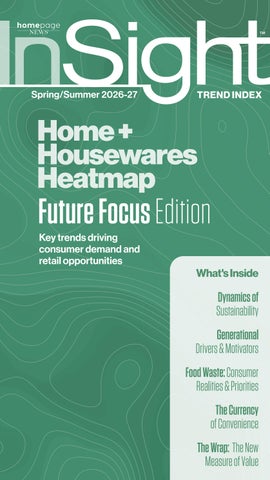
Spring/Summer 2026-27
TREND INDEX
Home + Housewares Heatmap
Future Focus Edition Key trends driving consumer demand and retail opportunities
What's Inside
Dynamics of Sustainability Generational Drivers & Motivators Food Waste: Consumer Realities & Priorities The Currency of Convenience The Wrap: The New Measure of Value
From the Creators The Intersection of Performance and Purpose As consumers place greater value on every square foot, every minute and every purchase, expectations for the products they bring into their homes continue to evolve. Increasingly, buying decisions are shaped not by a single benefit, but by the ability of products to solve multiple challenges at once—saving time, reducing effort, maximizing space and reflecting a commitment to more responsible consumption.
Tom Mirabile
Principal, Springboard Futures Consumer & Lifestyle Trend Analyst Curator & Author, InSight Trend Index
Convenience and sustainability are no longer competing priorities; they are becoming complementary expectations. The greatest opportunities lie where these values intersect, delivering smarter design, greater efficiency and lasting utility without unnecessary waste. In this issue of InSight Trend Index, we explore the innovations redefining everyday living—and the products best positioned to earn consumer attention, trust and long-term loyalty. Dawn Evans
and
Founder, Creative Sweet Marketing Creative Director, InSight Trend Index
2
Informed Perspectives Adrian Bredeson
Leila Reid
Co-Owner E-Power Marketing
Global Market Coverage Springboard Futures
David Mackrell
Lora Morsovillo
President, Tabletop & Foodservice Lifetime Brands
Joe Derochowski
President, Home Durables Circana
Michelle Lamb
VP, Home Industry Advisor Circana
Co-Founder The Trend Curve
Kiki Gerard
Peter Giannetti
Global Market Coverage Springboard Futures
Editor-in-Chief HomePage News
Leatrice Eiseman Director, Eiseman Center for Color Information and Training, Executive Director, Pantone Color Institute
Leigh Ann Schwarzkopf Co-Founder, Project Partners Network
Scarlette Tapp Executive Director Sustainable Furnishings Council
Sonja Schultheiss-Safer Global Market Coverage Springboard Futures
Exhibitions Index In Market Order:
3
The HomePage News InSight™ Trend Index Winter/Spring 2026/27 accepted no payment for product placement, promotion, sponsorship, endorsement or other paid advertising.
Future Focus
Dynamics of Sustainability The Four Pillars of Sustainable & Responsible Practices Defining these practices continues to be a moving target. However, as we analyzed current consumer and industry landscapes, four pillars emerged as fundamental to understanding the importance of sustainable behaviors in the modern marketplace. While few products can claim all four pillars, we’ve used the following icon system to indicate the primary focus and attributes of each product.
Upcycled & Recycled Design & Production Products created using rescued waste materials that are no longer usable in their initial form or materials originally intended for recycling. Repurposing materials to minimize resource use and environmental impact.
Environmentally Friendly Materials Products that utilize organic materials and renewable resources, designed to minimize environmental impact by reducing pollution and conserving resources.
Renewable Materials
Recyclable Materials
InSight Trend Index | Spring/Summer 2026/27
1
2
Upcycled Post-Consumer & Commercial Waste Renewable Materials
Recycled Materials
Recyclable Materials
4
Resource Aware Design & Production
Social & Environmental Stewardship
Designed to maximize waste reduction and minimize the use of resources such as energy, water and raw materials. Prioritizes durable, multi-use designs and expands focus on full lifecycle awareness, from raw material extraction and production through use, reuse and eventual disposal or recycling.
Products created under socially responsible and fair trade and labor conditions and/or promoting social and cultural development in producer countries.
3
Resource Aware Manufacturing Renewable Materials
5
Companies demonstrating holistic environmental stewardship and the responsible use and protection of the natural environment through conservation and sustainable practices. These may include audited cause marketing and public awareness programs.
4
Recycled Materials
Environmental Stewardship
Recyclable Materials
Social Responsibility
HomePage News InSight Trend Index assumes no responsibility or liability for any errors or omissions in the content as it relates to claimed sustainable practices or product descriptions. The information contained in this index is provided by manufacturers or brands shown who are solely responsible for their accuracy.
Expert Perspective Scarlette Tapp
Executive Director Sustainable Furnishings Council Now Powered by Cascale
Q: Trust has become a primary purchase driver for consumers. How can manufacturers and retailers address consumer concerns about greenwashing? A: Absolutely! And the connection is only deepening. Consumers increasingly understand that sustainability isn't just about the planet; it's personal. The sofa you sit on, the finish on your dining table—these shape the air your family breathes. When shoppers learn that indoor pollutant levels can run two to five times higher than outdoors, "sustainable" stops sounding abstract and starts meaning "healthy home." For our industry, wellness is sustainability's most powerful translator. Added resource bonus: Sustainability Furnishings Buying Guide: sustainablefurnishings.org/buying-guide
InSight Trend Index | Spring/Summer 2026/27
6
Future Focus
Generational Drivers & Motivators It’s crucial to understand that there are very real generational differences in sustainability attitudes, but these differences are less about whether consumers care and more about why they care.
One of the clearest shifts emerging in recent research is this: • Younger consumers tend to view sustainability as part of identity, ethics and social alignment. • Older consumers are more likely to approach sustainability through practicality, durability, waste reduction, health and value. his shift matters in home and housewares T because it determines: • Messaging • Merchandising • Product Positioning • Material Storytelling • Pricing Tolerance • Trust Expectations
7
Future Focus
Generational Drivers & Motivators Gen Z
Millennials
Core Mindset
Identity & valuesdriven sustainability
Sustainability as lifestyle management
Primary Motivation
Align purchases with beliefs and social values
Create healthier, more balanced, efficient lives
Definition of Sustainability
Ethical, transparent, circular, socially responsible
Healthier, safer, lower-waste living
Top Purchase Drivers
Transparency, authenticity, recyclability, ethical sourcing
Wellness, convenience, reusability, energy efficiency
Material & Product Preferences
Recycled, upcycled, refillable, low-waste systems
Non-toxic, reusable, energy-efficient, multi-use
Response to Sustainability Messaging
Highly responsive— but highly skeptical of greenwashing
Responsive when tied to lifestyle benefits and ease
Emotional Drivers
Expression, activism, authenticity, trust
Reassurance, control, wellbeing, balance
Barriers to Purchase
Distrust, price sensitivity, lack of proof
Cost vs. value trade-offs, convenience gaps
What Converts Them?
Proof, traceability, certifications, visible impact
Clear lifestyle improvement and long-term value
InSight Trend Index | Spring/Summer 2026/27
8
Generational Drivers & Motivators
9
Gen X
Baby Boomers
Core Mindset
Practical, efficiency-led sustainability
Stewardship & longevity mindset
Primary Motivation
Make smart, durable, cost-effective choices
Preserve value, reduce waste, maintain quality
Definition of Sustainability
Efficient, durable, resource-conscious
Long-lasting, low-waste, sensible consumption
Top Purchase Drivers
Durability, performance, value, reliability
Quality, longevity, ease of use, energy savings
Material & Product Preferences
Long-life materials, repairable goods, efficient design
Durable materials, classic construction, low maintenance
Response to Sustainability Messaging
Responsive when framed as practical and cost-saving
Less responsive to messaging; more to tangible benefits
Emotional Drivers
Confidence, smart decision-making, dependability
Security, familiarity, pride in ownership
Barriers to Purchase
Perceived inconvenience or lack of performance
Complexity, unclear benefit, higher cost
What Converts Them?
Demonstrated durability and efficiency
Proven quality, simplicity, and reliability
Future Focus
Food Waste: Consumer Realities & Priorities According to the USDA and FDA, an estimated
30–40% of the U.S. food supply is wasted, equivalent to roughly: 133 billion pounds and $161 billion of food annually. U.S. Food and Drug Administration Jan 2025
Annual Impacts Include:
24%
7+ showers
114B
Amount of landfill material that is food (EPA Estimate)
worth of water use per day for every person in the U.S.
Lost meals—enough to feed nearly 1/3 of the U.S. for a year
ReFED 2026 Food Waste Report
Food waste costs the
average American consumer approximately:
$728 per person
annually.
2025 U.S. Environmental Protection Agency (EPA)
InSight Trend Index | Spring/Summer 2026/27
Total annual U.S. surplus food reached roughly
70 million tons Nearly 29%
of all food in the U.S. goes unsold or uneaten. ReFED 2026 Food Waste Report
10
Consumers increasingly understand as both an environmental issue and personal economic issue. Food waste has quietly become one of the most important intersections of: • Sustainability • Financial Responsibility • Meal Planning • Food Storage • Convenience • Home Storage & Organization • Wellness • Consumer Guilt • Resource Efficiency
That’s why industry growth and innovation opportunities include: • Food Preservation Systems • Reusable/Flexibile Storage • Vacuum Sealing • Meal Prep Tools • Freezer-Friendly Organization • Smart Kitchen Technology • Portion-Management Solutions • Composting Systems
11
Future Focus
Trust & Transparency
Sustainability Values for the Long Game
The Challenge: Trust
One of the biggest emerging barriers to purchase is skepticism. In a recent survey
81%
of consumers stated that trust is very/extremely important when choosing a retailer or brand for home and housewares products. (87% for Millennials)
Consumers care about sustainability— but they increasingly distrust vague claims like “eco-friendly,” “green” and “sustainable” without clear proof or transparency. That means these things are becoming more important purchase drivers: • Certifications • Traceability • Measurable Claims • Material Disclosure 2026 Springboard/IHA Value Equation Index
InSight Trend Index | Spring/Summer 2026/27
12
•
In the home and housewares sector, sustainability initiatives most often succeed when framed as: • Longevity • Efficiency • Practicality • Quality rather than sacrifice or moral obligation. Consumers surveyed said:
Durability (49%) Reliable Performance (42%) were the top two quality traits most likely to influence their purchase decision. Consumers respond especially well to: • Multifunctionality • Reduced Food Waste • Lower Energy Consumption • Long-Life Construction • Refillability & Reusability 2026 Springboard/IHA Value Equation Index
13
Gen Z and
Millennials are especially likely to expect brands to: • Demonstrate Transparency • Communicate Values Clearly • Support Measurable Environmental Initiatives 2026 Springboard/IHA Value Equation Index
Future Focus:
The Currency of Convenience Time Scarcity Is Reshaping Consumer Priorities Convenience has historically been defined as speed, reduced physical effort and accessibility. But newer research increasingly frames convenience as including mental and emotional effort as well. This creates a new mandate for features and benefits which can lower stress, save time and reduce cognitive burdens. One of the most important current macro shifts is the rise of perceived “time poverty.” That means consumers increasingly view time savings, effort minimization and simplification as core forms of value, not just as "convenience perks." As a result, these considerations have become three of the strongest drivers of home and housewares consumer purchasing.
InSight Trend Index | Spring/Summer 2026/27
14
This has huge implications for home and housewares because products most often succeed when they: • Reduce Stress • Create Efficiency • Reduce Preparation Steps • Simplify Cleanup • Reduce Clutter • Automate Repetitive Tasks • Improve Storage Efficiency That’s why categories providing opportunities for innovation and growth increasingly include: • Multifunctional Appliances • Meal Prep Systems • Organizational Solutions • Robotic Cleaning • Easy-Clean Materials • Modular Storage • Smart Home Automation • Refill/Reorder Systems • Products That Reduce Maintenance
15
Future Focus:
The Currency of Convenience Diverse Priorities and Perspectives As always, each generation has different purchase drivers when it comes to meeting time and effort challenges. This is especially true for Millennials and Gen Z households, where time scarcity is felt most intensely. This is why the same product may need very different messaging depending on audience.
GENERATION
Primary Time/ Effort Concern
What They Value Most
Messaging Focus
Gen Z
Cognitive Overload
Simplification, Automation, Flexibility
Reduce Overwhelm
Millennials
Time Scarcity & Household Management
Efficiency, Multitasking, Stress Reduction
Simplify Your Day
Gen X
Practical Optimization
Reliability, Convenience, Reduced Friction
Smart Dependable Solutions
Baby Boomers
Physical Effort & Ease of Use
Accessibility, Simplicity, Comfort
Easy to Use & Maintain
InSight Trend Index | Spring/Summer 2026/27
16
Expert Perspective Tom Mirabile
Principal, Springboard Futures Consumer & Lifestyle Trend Analyst Curator & Author, InSight Trend Index
Q: Why have multifunctionality and time savings become such an important purchase influencers in home and housewares categories?
A: As homes become harder-working, more multifunctional and emotionally central to everyday life, consumers are increasingly reassessing the role of space, ownership and complexity. The result is a growing shift toward intentional purchasing, simplified environments and products that justify both their footprint and their function. Research increasingly suggests that crowded, poorly organized, or functionally constrained living environments can contribute to stress and reduced wellbeing. Consumers are responding by seeking homes and products that create a greater sense of control, organization, flexibility and emotional restoration.
17
Expert Perspective Lora Morsovillo
President, Home Durables Pracitce Circana
Q: Which trends are driving meaningful industry growth within the home and housewares sector?
A: Health and wellness trends are still a growth engine for the home industry, driving demand for products that support healthier cooking, cleaner living environments and stress‑reduction at home. Consumers are increasingly choosing appliances for air and water purification, non‑toxic cookware and organization products that improve wellbeing. Consider health & wellness trends as drivers that help boost both product innovation and consumer spending across the home and housewares industry.
93% 85%
of Americans expect to cook as much or more in the next 12 months than they did last year cite economic pressures as a reason for cooking more
InSight Trend Index | Spring/Summer 2026/27
HelloFresh State of Home Cooking 2025–2026 Report
18
Future Focus
The Wrap: The New Measure of Value The future of consumer satisfaction lies in products that earn their place in everyday life. Consumers are increasingly gravitating toward multifunctional solutions that simplify routines, reduce effort and eliminate complexity while supporting more intentional living. As time becomes more precious and living spaces more purposeful, products are expected to deliver value on multiple levels—saving space, minimizing waste, reducing stress and making everyday tasks easier. These priorities are reshaping the marketplace, fueling demand for products that help consumers declutter, organize, maximize limited space and make smarter purchasing decisions. Brands that recognize this convergence—and design solutions that respect consumers' time, space and values— will be best positioned to earn lasting attention, trust and loyalty. The future belongs to products that do more with less—less time, less effort, less space and less waste—while delivering more value, more purpose and more satisfaction.
19
Click the cover below to view the full Home + Housewares Heatmap Portfolio
© 2026 HomePage News. All Rights Reserved. HomePage News is a service of the International Housewares Association (IHA).