THE INNIS HERALD VOLUME V, ISSUE 4
Sitting down with Paint Dept.
14 FEBRUARY 2019
Daria Mancino ARTS & CULTURE
Inside this issue
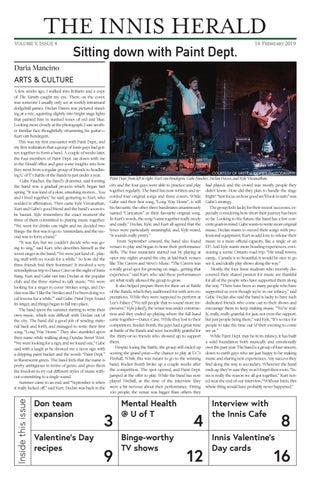
A few weeks ago, I walked into Robarts and a copy of The Varsity caught my eye. There, on the cover, was someone I usually only see at weekly intramural dodgeball games. Declan Dawes was pictured standing at a mic, squinting slightly into bright stage lights that painted him in washed tones of red and blue. Looking more closely at the photograph, I saw another familiar face thoughtfully strumming his guitar— Kurt van Bendegem. This was my first encounter with Paint Dept., and my first realization that a group of Innis guys had gotten together to form a band. A couple of weeks later, the four members of Paint Dept. sat down with me in the Herald office and gave some insights into how they went from a regular group of friends to headlining U of T’s Battle of the Bands in just under a year. Gabe Faucher, the band’s drummer, said forming the band was a gradual process which began last spring. “It was kind of a slow, smushing motion… You and I lived together,” he said, gesturing to Kurt, who nodded in affirmation. Then came Kyle Visvanathan, Kurt and Gabe’s good friend and the band's soon-tobe bassist. Kyle remembers the exact moment the three of them committed to playing music together: “We went for drinks one night and we decided two things: the first was to go to Amsterdam, and the second was to form a band.” “It was fun, but we couldn’t decide who was going to sing,” said Kurt, who describes himself as the worst singer in the band, “We were just kind of… playing stuff with no vocals for a while.” So how did the three friends find their frontman? It involved a very serendipitous trip to Dance Cave on the night of Innis Bang. Kurt and Gabe ran into Declan at the popular club, and the three started to talk music. “We were looking for a singer to cover Strokes songs, and Declan was like ‘I like the Strokes and I’ve been doing vocal lessons for a while,’” said Gabe. Paint Dept. found its singer, and things began to fall into place. The band spent the summer starting to write their own music, which was difficult with Declan out of the city. The band did a good job of sending material back and forth, and managed to write their first song, “Long Way Home.” They also stumbled upon their name while walking along Dundas Street West. “We were looking for a sign, and we found one,” Gabe said with a laugh as he showed me a neon sign with a dripping paint bucket and the words “Paint Dept.” in fluorescent green. The band feels that the name is pretty ambiguous in terms of genre, and gives them the freedom to try out different styles of music without committing to a single sound. Summer came to an end, and “September is when it really kicked off,” said Kurt. Declan was back in the
Don team expansion Valentine's Day recipes
COURTESY OF BRENDA GOMES PHOTOGRAPHY
Paint Dept. from left to right: Kurt van Bendegem, Gabe Faucher, Declan Dawes, and Kyle Visvanathan. city and the four guys were able to practice and play had played, and the crowd was mostly people they together regularly. The band has now written and re- didn’t know. How did they plan to handle the stage corded four original songs and three covers. While fright? “Just focus on how good we’ll look in suits” was Gabe said their first song, “Long Way Home”, is still Gabe’s strategy. his favourite, the other three bandmates unanimously The group feels lucky for their recent successes, esnamed “Caricature” as their favourite original song. pecially considering how short their journey has been In Kurt’s words, the song “came together really nicely so far. Looking to the future, the band has a few conand easily.” Declan, Kyle, and Kurt all agreed that the crete goals in mind. Gabe wants to write more original lyrics were particularly meaningful, and, Kyle noted, music; Declan wants to record their songs with professional equipment; Kurt would love to release their “it sounds really pretty.” From September onward, the band also found music in a more official capacity, like a single or an venues to play and began to hone their performance EP; And Kyle wants more bonding experiences, enviskills. The four musicians started out by playing at sioning a scenic Ontario road trip: “Hit small towns, open mic nights around the city, at laid-back venues camp… Canada is so beautiful, it would be nice to go like The Cavern and Steve’s Music. “The Cavern was see it, and ideally play shows along the way.” a really good spot for growing on stage… getting that Mostly, the four Innis students who recently disexperience,” said Kurt, who said these performances covered their shared passion for music are thankful are what really allowed the group to grow. for all of the people who have supported them along It also helped prepare them for their set at Battle the way. “There have been so many people who have of the Bands, which they auditioned for with zero ex- supported us even though we’re in our infancy,” said pectations. While they were supposed to perform at Gabe. Declan also said the band is lucky to have such Lee’s Palace (“We tell people that to sound more im- dedicated friends who come out to their shows and pressive,” Kyle joked), the venue was under construc- encourage them to keep making music. “We’re realtion and they ended up playing where the full band ly, really, really grateful, for just, not even the support, came together—Dance Cave. While they lost to their but just people being there,” said Kyle, “It’s so nice for competitors, Rocket Bomb, the guys had a great time people to take the time out of their evening to come at Battle of the Bands and were incredibly grateful for see us.” the thirty-or-so friends who showed up to support While Paint Dept. may be in its infancy, it has built them. a solid foundation both musically and emotionally Despite losing the Battle, the group still ended up over the past year. The band is a group of four sincere, scoring the grand prize—the chance to play at UC’s down to earth guys who are just happy to be making Fireball. While this was meant to go to the winning music and sharing new experiences. Any success they band, Rocket Bomb broke up a couple weeks after find along the way is secondary. Wherever the band the competition. The spot opened, and Paint Dept. ends up, they’re sure they won’t forget their roots. “Injumped at the offer to play. While the band has now nis is really the reason we all got together,” Kurt notplayed Fireball, at the time of the interview they ed near the end of our interview, “Without Innis, this were a bit nervous about their performance. Fitting whole thing would have probably never happened.” 100 people, the venue was bigger than others they
3 9
Mental Health @ U of T Binge-worthy TV shows
4 12
Interview with the Innis Cafe
8
Innis Valentine's Day cards
16
2
14 FEBRUARY 2019
THE
INNIS HERALD
ICSS holds inaugural mental health benefit concert
EDITOR-IN-CHIEF JAMES CHAPMAN MANAGING EDITOR MICHELLE ZHANG CREATIVE DIRECTOR LOUISA YOU LAYOUT EDITOR DARIA MANCINO ONLINE EDITOR & SOCIAL MEDIA COORDINATOR JULIE SHI
COURTESY OF WINSTON CHAN
IRC President, Daniel Li, accompanied by his ukulele, sings his original song “Rice Milk.”
Emma Paulus
SENIOR COPY EDITOR SARAH LAUDENBACH
INNIS LIFE
CONTRIBUTORS AL-AMIN AHAMED MEGHAN GHERON CALDER MORTON-FERGUSON JADINE NGAN SABINE OSMANN-DEYMAN EMMA PAULUS JARRET SORGER SHANKHALIKA SRIKANTH MARLOES STREPPEL MELVYN TAFRI ANDREW ZHAO
On Saturday, February 9, the ICSS hosted a Benefit Concert in Innis Town Hall in support of mental health. Organized by Innis student Lauren Cao, the event brought students from the college and across the university together to fight stigma and raise money for the cause. She told the Herald that “[many] people very close to me have experienced mental health challenges. People often have a hard time getting the help they need or are not fully aware of how they can gain access to the resources available to them. I’ve always wanted to contribute to changing this. I wasn’t sure how to go about it but I figured the concert is a start!” All of the funds raised for this event went towards helping improve care for people who call in to Kids Help Phone. Kids Help Phone is a non-profit organization dedicated to providing free mental health assistance to Canadian youths. They offer call, text and live chat contact with trained mental health counselors 24/7 across the nation. The organization is dedicated to privacy and quality to ensure that all of the children and youth that they help feel safe and welcome. The event began at 8 pm with a performance by the band Wooly, who formed in 2017. They performed three original songs, “Mother,” “Stone,” and “Giant Steps.” They were followed by the Hart House Small Jazz Ensemble, a group of U of T students who rehearse at Hart House and perform throughout the year. For the concert, the ensemble played “I’ll be Around,” “Nardis,” and “East of the Sun.” Next up was another U of T band, First Pressing, who performed covers of “Summer of ’69” by Bryan Adams, “I Saw Her Standing There” by the Beatles, and an original song entitled “Rebuttal.” After the first few performances, a brief intermission allowed guests to enjoy some refreshments and purchase tickets for the raffle that was held by the organizers. Once intermission ended, everyone was brought back to Town Hall and the raffle winners were picked. Prizes included donations from Metro, Cineplex, and Innis College’s very own Principal Kiel. The event continued with a dance performance by Innis
PHOTOGRAPHERS AND ILLUSTRATORS AL-AMIN AHAMED WINSTON CHAN SABINE OSMANN-DEYMAN CHIAO SUN THANKS TO RYAN DENNISTON ASHLEE REDMOND KURT VAN BENDEGEM BEN WESTRATE DANIEL ZANGRANDO
FOLLOW US! @theinnisherald www.theinnisherald.com The Innis Herald has given a voice to the students of Innis College and the University of Toronto since 1965. We circulate 1000 copies of our paper to Innis students, alumni, faculty, and anyone else who happens to come across it.
COURTESY OF WINSTON CHAN
U of T band, First Pressing, sings their rocking cover of Bryan Adams' “Summer of ‘69" at last weekend’s benefit concert. student and former ICSS president Brianne Katz-Griffin. She was followed by the current IRC president, Daniel Li, who gave a very exclusive performance of his original song, “Rice Milk.” Singer/songwriter Lyly Kyd from Kitchener, Ontario, performed two originals next, “Orange and Ice” and “Babypants.” Calder Morton-Ferguson followed, shaking things up with a dramatic reading—while accompanying himself on the piano—of his text messages with another Innis student regarding the mystery of who damaged the TV in the residence common room. This improvised performance was the result of Morton-Ferguson giving the audience three options for his performance; the piano song he was intended to play, the reading he ended up giving, or to simply end his performance after the vote, without actually performing anything. Tony Niu, ICSS International rep, and Victoria Hue, former ICSS vice-president and current Innis Choir director, closed off the night with a performance of Ed Sheeran’s “Perfect.” According to Niu, “Victoria and I really appreciated the opportunity to perform at the Benefit Concert as it was a great event which addressed mental health issues. I think that although more people are aware of mental health issues now, we still need to tell people the resources that are available on campus.” Throughout the night, hosts Andrew Zhao and Daria Mancino brought attention to both Kids Help Phone and the broader topic of mental health. They also gave information on the Health and Wellness services offered at the university, such as group and individual counselling. With a great turn out and lots of funds raised, the event was a major success. It would be great to see this event continue running in future years, as it sheds light on an important issue and gives students a chance to give back. Michelle Zhang, one of the ICSS Equity and Outreach directors who helped run the concert, thanked her co-organizers at a recent ICSS meeting,“thanks to everyone who came out to the ICSS Benefit Concert on February 9th in support of Kids Help Phone! The money we raised will go to support free online and telephone counselling for children and youth all over Canada. We hope you enjoyed the night and keep the discussion about mental health going!”
We are committed to covering stories that matter to students. Our content aims to help students connect to their college, campus, city, and world.
RECYCLE OR DIE. COURTESY OF WINSTON CHAN
ICSS International Student Representative, Tony Niu, and Innis College Choir Director, Victoria Hue, sing Ed Sheeran’s "Perfect."
COURTESY OF WINSTON CHAN
Calder Morton-Ferguson presented a dramatic reading of his text conversation with an anonymous student.
14 FEBRUARY 2019
3
Dean sees potential in don team expansion
Innis Dean seeks to increase leadership opportunities and student support with don team expansion, writes Jadine Ngan.
Jadine Ngan INNIS LIFE Students returning to residence at Innis College next year can expect to see an increased number of faces in leadership: the number of residence dons is set to increase from seven to eleven, beginning in the Fall term of 2019. Within the current system, each don is assigned to one ‘house’ in the residence, with houses varying in size. The Office of Student Life (OSL) hopes to even out the distribution of dons to residents by the next school year, anticipating that this will bring various benefits to both the residents and the student staff. The goal is to achieve a don-to-resident ratio of approximately 1 to 30; current numbers rest at about 1 to 55. This will be accomplished by adding an additional don to every house except First House, which already enjoys a 1 to 30 ratio. The OSL recognizes that a smaller don-to-resident ratio enables student staff to develop deeper and more meaningful relationships with the residents that they are responsible for, and hopes to use First House as a model moving forward. In many of the larger houses, getting to know students on an individual level poses a considerable challenge for the singular assigned don. With the increase in numbers will come an additional alteration to the current don system: there are no plans to hire a Transition and Support Don for the upcoming school year. The role of the Transition and Support Don was originally designed with Engineering and International students in mind, in recognition of those student communities’ distinct needs. Rather than retaining it as a separate position, the College is looking to instead equip the entire team of dons to fulfill those responsibilities and thus broaden the accessibility of support services. The Herald spoke with Steve Masse, who was responsible for initiating the expansion, to learn more about the motivations behind the increase in dons. Masse came to Innis from a previous role at Woodsworth College, and is currently serving his first year as Innis’s Dean of Students. The change comes after Masse conducted an “environmental scan” of other student residences across campus, as well as other housing organizations
across Canada and the United States. Alongside this, he engaged in extensive conversations with current don staff about potential areas of improvement, as well as what works well within the current scope of their roles. “It became apparent that there was an opportunity here for us to increase the level of support and service that we provide to students living in residence,” he said, as well as “increase the number of leadership opportunities for students who are looking to work on campus and build skills.” Current don responsibilities include holding office hours, facilitating house meetings, and serving on-call should emergencies involving residents occur. Masse expects that in some ways, the increase in staff will entail a redistribution of these responsibilities—but he also sees it as a welcome opportunity to advance initiatives and become more responsive to residents’ various needs. Such an increase in responsibilities may not be as viable with a team of the current size. The role of a don is intended to be manageable for a student with a full-time course load, and the OSL is carefully attentive to keeping it so. “The level of support we’ve been working to provide in residence has really evolved in the last ten fifteen years, as we’ve seen an increase in mental health difficulties and supports that students require, and we want to make sure that we’re able to meet that need as best we can. But a student still has a lot of courses, and they’re often involved on campus, so the increase in the size of the team will allow for some responsibilities to be distributed across a bigger pool of student staff. For example, on call responsibilities will likely decrease. “What I’m most interested in—and these are conversations that are ongoing with students and our current don team—are what students want to see. We’ll be using that to guide how we proceed next year with adding new programs.” As for what this entails regarding current first-years who sent applications in for the position, Masse is optimistic. “Given the new structure, I’m thinking creatively about how we might be able to utilize those teams-- those co-dons—perhaps [placing] someone who is maybe a third or fourth year student with someone who might be a little bit younger. Now that’s not going to be a hard rule, but I think that there’s an opportunity for that.” “So first year students who will be second year
COURTESY OF JULIE SHI
students should absolutely consider applying, and I think there’s definitely an appetite and an interest to hire the best folks for this job, regardless of their year of study.” “I’m really excited to have a new crew of folks on the team next year. I think this year, based on some early signals, it seems like we’re going to be hiring a significant number of new folks to the team, which is always exciting.” “I think this change is something we should all be excited about. And we’re certainly open to feedback. With any change, there’s always going to be bumps in the road and things we can improve on, but our team, here in the office, is really focused on hearing from students about how things are evolving, I think we’ll be able to head off any of those and get to something that really works well.” Sarah Tran, a first-year in residence thinks the increase in leadership will bring the Innis community closer together, in a way that the current system can make challenging. She’s also hopeful it will bring better hiring prospects: “There are obviously more positions open, and also it divides the workload. Going into a position as a don, you’re not expecting to be so overwhelmed.” Daniel Li, who serves as President of the Innis Residence Council, is likewise looking forward to seeing the change implemented. “I’m strongly in support of it, solely because of the fact that the resources for dons are now going to be split up such that each don can now manage a fewer amount of students, and so they can spend more time knowing those students. "Because there are now 11 dons, I’d definitely like to see more representation in terms of our don makeup. Last year we had six dons; only one of them is a person of colour. Five of them were not. As far as the three years that I’ve been here, I don’t think I’ve seen a single don that has been an international student. In the past we’ve had an international don as a position, but it’s never been an international student. It’s always been somebody from Canada, or within the province that has supported international student without knowing the experiences of being an international student. I think it’s a good thing to have 11 dons and potentially have greater diversity there, to serve a diverse population at the residence.”
4
14 FEBRUARY 2019
How I started to find mental wellness beyond U of T ing for Health and Wellness to open so that I could talk to a doctor and admit that I have depression. My thoughts were too overwhelming. When I was turned away, I wasted an hour and then visited my registrar as soon as it opened. I broke down.)
Finding help elsewhere
COURTESY OF SABINE OSMANN-DEYMAN
Sabine Osmann-Deyman writes how the shortcomings of U of T’s mental health services forced her to look elsewhere for the help she needed.
Sabine Osmann-Deyman STUDENT LIFE I am mentally ill. I have been fully diagnosed with depression and anxiety by several doctors. I was, of course, not always someone with a diagnosis. This diagnosis took at least a year (and likely more) of me experiencing symptoms for me to maybe admit that I might have depression. It took a crisis to get me to see a doctor. (Everyone I knew with depression always seemed to have it worse than me. Sometimes, when I’m in a higher mood, I have trouble convincing myself that any depression I’ve experienced is real. But that’s another, longer story.)
Trying to find help at U of T As you can guess, finding help at U of T backfired for me. This doesn’t mean you can’t get help at U of T, but it just didn’t work out for me. You probably get tons of newsletters every week in your U of T email inbox. From your OSL, from your registrar, and from other institutions in this university. Some of them, if you’re lucky, will mention some mental wellness resources for you. You have to be even luckier for any of them to actually be helpful. My OSL writes in a newsletter to “keep your body, mind, and soul healthy” with resources like Health and Wellness. They do not actually say how those resources are helpful to you; instead, you are meant to guess what these resources actually have for you and how to access them. This is the bare minimum effort and leaves you to do the tedious research when you are already burdened with the hard work of getting help in the first place. Institutions who strive to support your mental wellness should also strive to make it as accessible for you as possible. When I tried to access services at Health and Wellness in my mental health crisis, it didn’t go well. I was told countless times that if I ever needed help to go to Health and Wellness. What I wasn’t told, however, was that when I was in crisis and needed to speak with a doctor that I would be turned away because Health and Wellness at U of T does not offer mental health walk-ins. I was offered an appointment instead, which would have taken over a month to access. In crisis (to put it lightly), that wasn’t a feasible option for my health. (I had stayed up the whole night in crisis, wait-
My general physician is where support for my mental wellness really started. I visited the walk-in clinic that I had visited before when I was worried my cold had developed into something severe the previous winter. I waited anxiously for them to call my name and let me into the patient’s room. When my doctor finally saw me, he asked what I was in for. I was honest. (“I think I have depression,” I told him, and broke down. He pursed his lips and nodded. We went over my symptoms– do you enjoy your hobbies, do you have issues with fatigue or insomnia, are you suicidal. I answered his questions honestly.) He agreed with me– I likely have depression. He can only do so much for me as a GP, but we went over my options and I left with a bottle of Cipralex and a referral to CAMH. It took a little over a month for my referral to CAMH to actually get me a psychiatrist there in ambulatory care. He’s a very nice man– very empathetic, and very good at helping you believe that you will overcome your illness. We went over my medication and my continued symptoms together. From seeing my GP I had already gone from a low dose of Cipralex to a fairly high one, with little change in symptoms. He agreed with my doctor’s diagnosis and helped me understand my options from there. Medication has never been a big deal to me. It makes sense to me that if you take it when you have a cold, you take it when you have an illness like depression. (Although, that’s not to say it is necessary; plenty of people are not comfortable with medication for mental illnesses and find successful ways to heal without it!) My psychiatrist and I went over my options together, and since I had already started medication we focused on what we could do with that. Since the medication I was already taking wasn’t doing much for me, we decided together that it would be a good idea to try to take another medication along with it, which is known to boost the effects of the medication I was already taking. Thanks to this medication and repeated visits to this psychiatrist, I’m lucky enough to have a dose of medication that works for me. I no longer see this psychiatrist now that I know what medication I need my GP to prescribe me, but I’ve started therapy at CAMH instead. I got referred to CBT (Cognitive Behavioural Therapy) on my first visit, and it took about six months for the waitlist to enrol me in a session. I haven’t been to many sessions since it’s only just started, but I am confident that it is a step in the right direction for my mental health.
viding a relatively safe space to hang out to groups for yoga, DBT (Dialectical Behavioural Therapy) groups, etc. They have shorter waitlists than CAMH and are a great option if you’re just starting out on your path to getting help. To get started, check their schedule for drop-in intake sessions and attend one of those. Then, you’ll be able to have a private intake session that will allow you to participate in their intake-only groups. They can be found at stellasplace.ca Finding help through a private service: It turns out, with the health insurance you might have as a student at U of T, that you can get at least part of each session with a private therapist covered (as long as this therapist matches the given qualifications). With some research, I managed to find a therapist with a social working background covered completely by the university’s health insurance (and she was only a three minute walk from my place!) To find a therapist in Toronto, there are several websites and resources available to help you with the search. I personally used Psychology Today (psychologytoday.com), since you can filter therapists by their illness specialty and by price range. There are many other filters to help, such as their sexuality, language, etc. I’ve currently discontinued private therapy in order to complete CBT at CAMH, but I do plan on going back to it and making the most out of the university’s health insurance program! Finding help at the college registrar: Now, the registrar is not a way to get therapy by any means. They are, however, a great way to access help for your academic career when you are suffering from illness. The advisors I've met at my registrar have done everything in their power to help me, from giving me advice on my course load to writing letters to my professors on my behalf because of missed assignments. I owe a lot, if not most of my continued academic career to them. You can make an appointment at the front desk of the registrar or by emailing them at registrar.innis@utoronto.ca Other resources: Good2Talk is free help line for post-secondary students in Ontario and one of the default resources you will be recommended as a university student. You can talk about a variety of issues with Good2Talk anonymously, from mental health to financial or school concerns. You can reach them at 1-866-925-5454. If you are in crisis, the Gerstein Crisis Centre is an all day mental health crisis service. You can call them at 416-929-5200 to talk to someone, or access other services they offer such as their mobile crisis team, their crisis beds, etc. You can learn more at http://gersteincentre.org/our-crisis-services/.
A snapshot of where I am now
I am in a car with my mum driving home. She smokes a cigarette, I talk about the therapy I’ve been Other resources I accessed attending. I am nervous; she is happy and hopeful for Finding help at Stella’s Place: me. We listen to folk music on my phone. My brothStella’s Place is a rare gem in the city that offers er messages me about getting me coffee, and my free mental health services for young adults. I’ve ac- dad waits at home with the dogs. I cannot wait to be cessed a few different services here, like their drop home and sleep in a large bed that used to be mine in mental health appointments (particularly helpful with my animals. when I wasn’t doing CBT and didn’t have a private “You sound like yourself,” my mum says. I’m not therapist). sure if it’s true, but I’m happy to believe her. It’s a step Stella’s place offers a variety of services, from pro- in the right direction.
14 FEBRUARY 2019
5
A meditation on all the things I don’t want to do COURTESY OF PIXABAY
Michelle Zhang STUDENT LIFE As I was scrolling through Instagram a couple days ago (probably procrastinating on writing this article) I came across a Buzzfeed post from a few weeks ago, featuring a tweet by @TheEssenceOf_. It confidently told me that if I ever felt like I was lazy or not doing enough, I should just remember the time I took off my makeup in the middle of the night and give myself some slack. I interpreted it as a supportive message telling makeup wearers all over the world to be proud of all the important and difficult things we do: like cleaning our faces before sleep (which can honestly take a solid ten minutes sometimes). What a big mood, I thought, as I shared the post with a couple of friends. Here I am now, at 2 am, trying to write a piece I should have finished a week ago. After that very productive Instagram session, I opted to vegetate in my unmade bed and listen to my newest half-complete Spotify playlist instead of writing. For the rest of the week I did nothing except sit in various places and wait for all my pre-reading week deadlines to smack me in the forehead. I can’t even pretend I was doing anything more useful with my time! Maybe that’s the problem — that we need to find an excuse to justify doing “nothing useful” speaks to the degree to which our lives have become dominated by the idea of work and progress. At some point, having a good work ethic turned into having a good life. Not long after, this type of “good life” turns into total burnout. Anne Helen Petersen addresses this issue in her recent article for Buzzfeed News, “How Millennials Became The Burnout Generation.” Her main point is that the entire millennial generation suffers from a chronic burnout which makes mundane tasks seem nearly insurmountable. That argument is hard to refute, even if we widen the millennial category to include current students born at the end of the 90s and the early 2000s. Just consider that people actually need to tell us that successfully cleaning our faces means we’re doing okay. Ask yourself how many of your friends actually make their beds every morning, wash all their dishes everyday, or do their laundry before they totally run out of clothes to wear out. Walk into the ICSS office and try to count how much unclaimed reimbursement money is contained in all the ancient unclaimed cheques (much respect if you’re that good at mental math). Petersen blames this inability to bring ourselves to complete daily tasks and errands like cleaning and picking up cheques on our upbringings. She argues that we have been conditioned to be continuously productive and aggressively self-improving since childhood. To her, this is a fate which is so draining on our mental energies that, as young adults, we simply cannot function fully anymore. Perhaps Petersen is right. When I was a tiny kid, I wanted to be a breakout star like Roxie in Chicago or the girl in ABBA’s Dancing Queen. Everyone told me neither of those were real jobs (would they call Billie Eilish unemployed, then?). When I got a little older, I dreamed of being a journalist or a writer like Ernest Hemingway, sitting for hours drinking coffee and alcohol I’d never heard of before from little Parisian cafes. Now that I think about it, drinking that much cognac really can’t be healthy…but that’s not the reason I changed my dream. I ultimately decided to go to
university for social science because I couldn’t stand the thought of going into STEM (just because I felt like that’s what society expected my Asian immigrant self to do), and I think something vaguely resembling “Political Science” has a slightly better chance of landing me a stable career than the whims of Broadway or Gertrude Stein’s ghost. Even so, not a day goes by without somebody suggesting to me that I’ll be living in my parents’ basement for the rest of my life with a B.A. that will have cost me several years of my time and thousands in student debt. Heck, I even tell myself that. No wonder parents are opting to push their kids down increasingly intense paths: drilling them in reading and math starting in elementary school, driving them to dance lessons or hockey practice or tutoring (or improv class!), spending small fortunes on AP and IB and whatever other “elite” acronyms they can find – anything to push their kids to be the best of the best and thus first in line for that fading dream called a good career. Meanwhile, these children are being told that they have to work hard if they want bright futures. They’re being told that if they slack off, that dream can only slip further from them, that if they don’t pick their paths wisely, they may end up with no prospects. Then there’s my parents, arts majors themselves, who endorse my decisions but warn me that social science is all or nothing. In other words, if I don’t make a big splash with either my grades, my extracurricular involvement, or my networking skills, I won’t make it at all. But is this really the only reason for burnout? Personally, I don’t buy it. Of course, it’s part of it. The economic shift to increasingly precarious employment is scary and makes it easy to internalize the constant pressures to gain a competitive edge over the next person. Petersen argues that life in the past was easier, however – somehow more relaxed, less breakneck. I think she’s slipping into dangerous territory here by sweeping history into an idealized and generalized past. I can’t speak for other people, but my own parents certainly didn’t have it easy – they came from the second most populous country in the world with an immense cultural emphasis on education. They are no strangers to intense stress and competition as students. My grandparents – all of them various kinds of educated people, bankers, and scholars – had to deal with the arrival of the Communists, the Cultural Revolution, and a famine during their lives. They had it even harder, yet they and their generation doesn’t seem to share the same sort of crippling relationship with chronic burnout. So why? Why us? My parents suggested that maybe my generation is
just not as disciplined. They don’t mean it a bad way, but rather say that life is so much better for us with all our new technologies and conveniences that we can’t deal with suffering through things we don’t either enjoy or need to do to survive. If that were so, though, why would we break into literal and/or metaphorical cold sweats every time we’re faced with filing paperwork or doing the dishes after we eat? I think a lot of it comes down to the fact that our entire generation has forgotten how to power off. While many of our parents had intense pressure put upon them, they were able to escape it all by simply leaving their physical place of work: by going home. For so many of us, that’s just not possible. What place of work are we supposed to leave, if we do all our work on the mobile devices we carry everywhere on our persons? And even if we were to leave those pieces of hardware behind, what of the internet? That amorphous space that exists in some digital dimension we can’t even see is not escapable. Even if we aren’t checking our emails or the number of likes on our latest Instagram post right at this moment, we’re constantly inundated with information about other people’s “successes.” We hear talk about so-and-so’s Instagram live from Google’s offices, or about how our classmate worked on that one essay for a solid week. There’s a constant pressure to measure up – to compete against other people small successes and avoid their large failures. There’s a constant reminder that we’re on the edge of failing, that we must be exceptional and that to do we need to constantly be better and never clock out. The New York Times recently published a great piece on the pervasive culture epitomized by the punchline “love your work and you won’t work a day.” They argue that now, especially in tech and innovation, this toxic and controlling attitude that one should live to go to work in the morning and loath going home is increasingly internalized by young workers. All over social media I see articles with titles like “Make 2019 The Year You Finally Fall In Love With Your Career” circulating and getting attention. If we do what we love as children, we won’t ever find “success” as adults. Instead, we’re told that we should love those careers which have been linked with this notion of success and happiness. And once we find ourselves on this career path – or perhaps to achieve it in the first place – we must never give ourselves a break. No wonder we have trouble getting small tasks done. No wonder we’re so burned out. No wonder we’re always tired and drained. So maybe instead of sharing posts that tell us that we aren’t lazy because we took off our lipstick last night, we turn to each other and wholeheartedly embrace doing absolutely nothing every now and then.
6
14 FEBRUARY 2019
Is Netflix coming to Toronto? Julie Shi ARTS & CULTURE For many of us, the perfect escape from life is a feast of comfort foods and some Netflix binge-therapy — all without leaving your bed. But would you still stay at home if a Netflix studio was suddenly a short ride away from your doorstep? As of last month’s Toronto Film Critics Association Awards gala, Mayor John Tory has suggested that one will be. In an interview with CBC, Tory emphasized his “very high level of confidence, without betraying confidences that aren't yet concrete, that they're going to.” Tory has reportedly “been in active discussions” with Netflix about a Toronto base since he started making annual trips to Los Angeles to speak with industry representatives four years ago. He hopes to speak with Netflix representatives again during this year’s trip. With numerous TV shows and films such as Suicide Squad and Suits hosted, produced, and staffed in Toronto in recent years, Toronto seems like a prime location for a Netflix expansion and studio. The news has also reportedly spurred efforts to expand the qualified talent pool and available studio space in Toronto, for which other film and TV studios have also called. According to Tory, “they certainly have a strong interest in being here, so fingers crossed.” While the possibility of more job opportunities and even more celebrity sightings is certainly exciting for the public, Canadian industry professionals have since voiced concerns. In a controversial statement at the Canadian Media Producers Association’s Prime Time conference in late January, CBC President Catherine Tait warned that Netflix’s growing Canadian influence is akin to the cultural imperialism “of a new empire.” Although her comments were met with some
COURTESY OF PIXABAY
laughter, other established producers and directors present in her audience concurred. Speaking to National Post, producer and CEO of OUTtv, Brad E. Danks of Vancouver explained that “now with the internet, things arrive without any sort of regulation.” Co-founder of Verite Films in Toronto, Virginia Thompson agreed, saying that “we’re now dealing with global players having free access to our country, our market, our audiences.” Tait and Thompson, alongside Vancouver-based producer and filmmaker David Paperny, acknowledged that Netflix has helped to foster “probably the most exciting time for screened entertainment.” Despite this, Paperny had this to say about Netflix’ Canadian operations: “should they be regulated, as Canadian broadcasters are, to support Canadian content?” In order to protect “the voices of the country,” Thompson hopes that the production company will dedicate a programming platform to Canadian voices that is of the same degree as it has pledged for Europe. The announcement of the potential studio follows Netflix’s September 2017 pledge to the federal government committing a minimum $500 million toward “Canadian creative productions” over five years.
In exchange, the company continues to be exempt from mandatory quotas and financial contributions to the Canada Media Fund (CMF). Funds received by the CMF are redistributed to producers and filmmakers of audiovisual Canadian content. Soon after going public, the pledge came under fire from several directions. According to Quebec Minister of Culture Luc Fortin, the agreement allows “Netflix [to pay] itself $500 million to produce content that it will sell for a profit.” At the time of the announcement, no details were given about the actual scope of “Canadian creative productions” or how Netflix would go about allocating funds to projects created by, in, or for Canadian interest groups including Indigenous and Quebecois filmmakers and audiences. A new Netflix Original production based out of Québec with upstart director Patrice Laliberté was announced in November in a move toward this initiative. Existing Canadian content including CBC’s Schitt’s Creek, Alias Grace, and Kim’s Convenience have gained international recognition since becoming available on Netflix last year. The streaming giant’s relationship with the francophone province has grown tense in recent days, however, after stock footage of the 2013 Lac-Mégantic tragedy was discovered in at least two fictional productions, Bird Box and Travelers. The derailment and subsequent explosion saw 47 people killed in the Quebecois town. Although a unanimous motion in the House of Commons demanded compensation for victims of the disaster and removal of the footage and all associated images, the company declined CBC’s request for comment. Based in California, the company is a foreign digital entity. This means that federal and provincial sales taxes are not collected or remitted, however tax credits are available for work done in Canada. The company’s operations also fall outside of the Canadian Radio-television and Telecommunications Commission’s jurisdiction.
Why is this still a thing? U of T’s bureaucratic inefficiency
Andrew Zhao OPINION Like many other students, I was on my way to class when my phone buzzed at 5:52 PM. “Classes cancelled on St. George campus,” read the email. I’ll be honest, my first impulse was to jump up and down and cheer—but my elation was followed by annoyance. Why cancel classes at 5:52 PM? I was already outside, freezing my ass off, on my way to class. And if I’m already on my way to class, there must be countless commuters who have already endured hours on the TTC just to arrive and be told that their class is… cancelled? Why couldn’t the university have made this call earlier? The university’s snow day debacle is just the latest symptom of an dysfunctional, inefficient, and inconsiderate bureaucracy. Don’t get me wrong—sometimes bureaucracy makes sense. Sometimes institutions are slow-moving by design, and for good reason (see Parliament). Eugene McCarthy once wrote that
“the only thing that saves us from the bureaucracy is its inefficiency.” But let’s be clear: U of T’s bureaucratic efficiency isn’t doing students any favours. Let’s turn to exhibit A: the exam schedule. Why does it come out so late? As reported earlier this year by The Varsity, “it is unclear who specifically is responsible” for creating exam schedules. According to their reporting, “faculty and registrars from across many different departments are involved,” leading to a too-many-cooks situation. Maybe all universities encounter this problem— except that they don’t. Last semester, McGill released their schedule on October 5th; UBC released their full schedule on October 10th, a full three weeks ahead of U of T. UBC actually released their finalized exam schedule (without room locations) on September 18th. And when did U of T students get theirs? October 31st. UBC uses an exam scheduling software because that’s how modern universities operate. So what about Canada’s #1 research institution? The Varsity found that U of T has “little in terms of institutional policy.” The 2018 fall exam schedule was actually
delayed because administration needed extra time to “look right down to the student level to look at the schedules and try to adjust them to reduce the number of students that have conflicts,” according to a university spokesperson—that doesn’t sound like they’re using any sort of automation. The list goes on and on. Every year a bunch of course grades are released late by Arts & Science. Last year some course grades were released on January 17th—literally the day of the add/drop deadline. The big takeaway here is that central administration doesn’t seem to be overly concerned with the impact of their delays on students. U of T prides itself on drawing students from all around the world, but doesn’t seem to understand that those students need to book flights to go home. It doesn’t realize that commuter students need more than 8 minutes notice that their class is cancelled. How are students supposed to choose courses if they don’t even know whether they have the prerequisites? This University would not be able to operate without its undergrads. It’s time for administration to at least pretend that we are a priority.
14 FEBRUARY 2019
7
The Woman Who Loves Giraffes A story written for Innis College
James Chapman INNIS LIFE
INNIS THROWBACK
For the college that founded the University of Toronto’s Environmental and Gender Studies programs, and today houses the university’s Cinema Studies Institute, there was perhaps no better venue for last month’s screening of The Woman Who Loves Giraffes than Innis College – not to mention the film itself is centred on the life of Harold Innis’s youngest daughter, Anne Innis Daag. On January 24th, in front of a full house at Town Hall, Alison Reid’s 2018 documentary was presented for a final time before it hits American distribution and the festival circuit in the coming months. Following the screening, the film’s director, Alison Reid, producer, Joanne Jackson, as well as Anne herself and her daughter, Mary, were all on hand to take the audience’s eager questions. At risk of making a reductionist argument, The Woman Who Loves Giraffes, is truly an embodiment of Innis College’s historical component parts. For starters, the forthcoming film begins by focusing on the events of Anne’s life following the death of Harold Innis. The film commences after Anne’s completion of her undergraduate degree at the University of Toronto, at which point she set off on a solo trip to rural South Africa – an adventure as equally unfathomable in today’s world of extreme concerns over personal safety, as it was in the world prior to smart phones and satellite navigation. The movie follows Anne’s adventure in South Africa, where she sought to study giraffes in the wild, something groundbreaking at a time when biology consisted almost exclusively of dissecting dead specimens. From when Anne’s car (nicknamed Camelo after the scientific name for ‘giraffe’) breaks down, forcing her to walk through a foreign jungle in the dead of
COURTESY OF CHIAO SUN
COURTESY OF CHIAO SUN
Right to left: moderator Joanne Mackay-Bennet, Anne Innis Dagg, her daughter Mary, and producer Joanne Jackson.
Anne holds a beaded giraffe from the non-profit, Monkeybiz, a gift from Innis College.
night, to her insistence that her black passengers ride up front with her in apartheid South Africa, the film is filled with as many scenes about biology as about Anne’s own personality. Yet, a central theme of the movie - conservation - is also not to be missed. Indeed, Anne is to giraffes what the more famous Jane Goodall is to chimpanzees – a comparison I take it, Anne, who actually began studying animal behaviour prior to Goodall, is not fond of. As the film retraces with Anne her travels through South Africa, the audience and the scientist herself are horrified to learn of the effect deforestation and urban sprawl has had on Africa’s once abundant giraffe population. The long-necked creatures have become increasingly difficult to spot among the safari as portrayed through the fact that local school children in the town closest to where Anne stayed tell the filmmakers they have never seen a giraffe in the wild. A theme of feminist struggle also plays a central role in both Anne’s life and in the plot of the film. Anne’s career, which is now only emerging from obscurity outside of the giraffe community (in which her book is elementary reading), was essentially derailed by the patriarchal academic system of her time. Despite being a popular academic in her field, and highly respected and widely published biologist, Anne was
never granted tenure at the University of Guelph – a decision which not only kept the talented Dagg from teaching and producing additional scientific knowledge, but from returning to Africa to study her favourite mammal. Indeed, any viewer of the film cannot help but feel impassioned on Anne’s behalf and invigorated to challenge oppression. The movie closes with footage of the 86-year-old Dagg, participating in the Women’s March on Washington two years ago. The Woman Who Loves Giraffes is a testament to the genre of documentary film. The film’s candid presentation of Anne, in her often quintessential giraffe-yellow t-shirt, presents the themes of feminism and conservation in a remarkably personal way. Furthermore, the director’s choice to overlay clippings of personal letters and footage from Anne’s original journey to Africa, with her recent return almost 60 years later, emphasizes the film’s dramatic coming of age narrative. For those privileged enough to watch The Woman Who Loves Giraffes with Anne herself at Town Hall last month, the movie left a truly inspiring mark upon the hearts of all those in the audience. For those interested in Innis’s history and lovers of documentary films or animals alike, this film is simply a must-see.
Vlad House remembered Louisa You INNIS LIFE
COURTESY OF INNIS COLLEGE ARCHIVES
Vlad House featuring dean Garry Spencer, circa 1983-4
Pictured here is Vladimir House, the first Innis College student residence. The residence was located at 651 Spadina Avenue, where it has since been replaced by the U of T Graduate House. In honour of this original student hub, the fourth floor of the current Innis College Residence building (which was built at 111 St. George Street in 1994) is named Vladimir House. Former students of Vlad House had a reunion at Innis in August 2017. Built in 1969, the original Vlad building housed 43 students, including a House Manager. Described in a 1985 edition of the Innis Herald, Vlad featured hundreds of parties including the “world-renowned Toga party,” where students were “barely coherent by 9:30.” The Herald also featured a recurring Vlad column, where columnists detail days in the lives of “Vladniks,” including the boisterous parties of the residence, protests that residents joined and organized, as well as other student initiatives.
8
14 FEBRUARY 2019
An Innis Institution
Family-run Innis Café celebrates 20th anniversary next year James Chapman INNIS LIFE It’s 10am Tuesday morning. I’m sitting in the sunbasked Innis Café, preparing for a rare behind-thescenes look at Innis College’s much-loved family-run restaurant. Following the winter storm that entangled the city Monday night, the usually bustling servery is quiet this morning, buying me time to sit down with the café’s owner and operator, Gunash Agar. For the veteran business owner, having time to step away from her usual post behind the order counter is a rarity. Indeed, in recent months, with the café’s increasing popularity on campus, lunch lines often stretch far from the order window and into the hallway where Innis’s heritage building meets the college’s more modern façade. What keeps Gunash cheerful during these frenzied hours of service? Her family, whom she likes being close to, and shares most of her days with at the Innis Café. From the start of our time together, she tells me how everyone has a role. Her husband, and former classmate from their university days in Turkey, is in charge of shopping and organizing purchases. Her son, another familiar face for frequent visitors, handles customer service, catering, and occasionally manages the grill. She herself is often at the cash, and takes care of all the accounting. For the Agars, food service comes naturally. Before her family immigrated to Canada, Gunash actually worked in Turkey’s food control agency. When she and her husband immigrated more than 30 years ago, they bought and operated a Carrot Heads franchise at Hillcrest Mall just north of Toronto. In the early 2000s, they began their relationship with Innis College when the University went looking for healthy, reasonably-priced, and tasty food vendors to serve students – something that was hardly challenging for Gunash and her husband, both of whom hold PhD’s in Food Science and Technology from a university in Turkey. Unsurprisingly, however, producing food to meet the university’s requirements and her family’s dedi-
COURTESY OF JAMES CHAPMAN
Long-time chef of Innis Cafe, Felicia, is one of few members of the Innis Cafe team not related to the Agars.
cation to make everything from scratch does require its fair share of hard work. Gunash tells me there is a rarely a day in which her family is not baking, cooking, or preparing a catering order. Paperwork often also keeps her at work well past the café’s 5pm close. Likewise, her kitchen staff—some of the few members of her eight person team who are not related to her— regularly start their day at 6:30am to prepare ingredients and start baking. For frequent visitors of the café, it will come as no surprise that Gunash attributes her business’s success to the feeling of home it creates for students. She tells me that the reason she has chosen to stay at Innis all these years is because students have often told her the café felt like a home throughout their sometimes lonely first years at the university. In fact, for some time she also owned a second café in the Health Sciences building, but Innis students, faculty, and administrator’s outward displays of affection for the popular lunch spot in the college made choosing to stay at Innis the obvious choice when a decision between the two had to be made. The family has even received
COURTESY OF JAMES CHAPMAN
Long-time owner and operator of Innis Cafe, Gunash Agar, at her usual post behind the order counter.
letters from alumni thanking them for their service. Perhaps another attribute contributing to the café’s success is its menu items, of which the chicken kabob, quesadilla, and burrito are the most popular. Gunash tells me that she is constantly adopting and adjusting items to meet her customer’s needs and wants. The most recent addition to the menu, curry chicken, is the recipe of Assistant to the Principal, Maitri Vosko, who brought the item to the café earlier this year. Beyond the front-end service, the café and the Agars are kept busy fulfilling numerous catering orders across campus. The family’s personal touch and small size, as well as their assurance that every member of their teams’ has knowledge of an order from placement to delivery makes Innis Café a popular choice for campus groups and departments. Gunash proudly tells me stories of how quickly her business can fulfill orders, including once when they were called the night before to serve hot chocolate to hundreds of movie festival goers at Town Hall, and another time when they served lasagna at a faculty picnic of 300. Not only does the family know how to work on a tight timeline to feed the masses, but with the assistance of her PhD knowledge no request seems too obscure for Gunash. She tells me how once she looked up dozens of recipes and went to numerous Indian markets to recreate the popular fried snack, pakora, for a customer. What’s next for the nearly 20 year old café? I ask Gunash if she is worried upcoming renovations to the college, which will dramatically impact the day to day flows in the college’s west wing. She tells me she “loves Innis Café.” While the renovations may force her to close temporarily, it sounds like Gunash has no intentions of leaving - in fact, she hopes both to continue to experiment with new menu items, and to renew her five year contract with the university when it comes due again in 2 years from now. For students and faculty across campus the home made food and family-run charm of Innis Café has become a quintessential part of life at Innis College. On a campus where franchises and over-priced pizza have increasingly become the norm, the familiarity, affordability, and flavours of Innis Café make it a valuable staple in U of T’s food scene.
14 FEBRUARY 2019
9
Netflix and chilling? More like Netflix and eating A homemade Valentine's Day feast
Al-amin Ahamed RECIPES IT’S FEBRUARY! You know what that means: an entire month devoted to love and appreciation towards those that matter most to us…and my birthday…. Whether you are single, committed or in something ‘complicated’ this month calls for a lot of chocolate, and boo let’s be real, that’s not good for the figure we are trying to maintain. We all want to get that something extra on Valentine’s Day, and I don’t mean weight. It’s super easy to give into our temptations, especially with all these holiday bake sales and promotions going on. But hey, I’ve said it before and I am going to say it again: eating right doesn’t mean you must sacrifice flavour and indulgence. It means you need to be conscious of what you eat, how you eat it, and make smarter decisions. Now hear me out, I know you are probably booking these fancy restaurants to impress bae, or even just planning a dinner date with your best friends. But let’s face it, for whatever occasion that can get quite costly and it’s not like school is getting any cheaper, thanks Doug Ford! What I recommend is a cute night in, Netflix, food and chill…or just food…because the dinner menu I’ve got planned will have you coming back for more without breaking the bank…or your belt! OKAY! Facts are facts Canada, everyone loves Italian food. Who can’t resist a thick piece of salami, or a sweet mouth-watering piece of tiramisu? I know I can’t, I mean just think of all the pasta-bilities! Uh oh! Yikes, you think we hit a snag, right? Italian food is filled with butter and cheese and all that fatty goodness, so how can we be making a healthy Italian feast? Well, hold nonna back because my recipes are lower in fat but don’t sacrifice flavour.
4.
5. 6. 7. 8.
9.
out all your aggression and pound each slice until it is equally flat on all sides. Ensure to use a piece of plastic on top and under the chicken beforehand. On a plate mix the flour, rosemary, thyme, paprika and salt. Pat down the chicken so each side is evenly coated in the flour mixture. Set the chicken aside. In a pan, add 1 tblspn of olive oil and sear each chicken breast on both sides until golden brown (4 min each side). Take the chicken out and place on the side. Add in chopped onion and mushrooms and sauté until soft. Then add in garlic and sauté for 1 minute. Add 1tblspn of the leftover flour mixture and sauté for 2 minutes. Add chopped parsley (optional). Add in low sodium broth (any kind will do). Whisk until sauce becomes thick. Add 1 tblspn of butter and capers, 2 tblspn of lemon juice. Salt and pepper to taste. Place chicken back into the pan and cover. Simmer for 5-10 min. Serve.
Garlic and Herb Mashed Potatoes:
Ingredients: 4 large potatoes (any kind), 1/3 cup chopped parsley, 1tsp rosemary, 1 garlic clove, ½ cup milk, 1 tblspn butter, salt and pepper to taste.
Now, if your mouth isn’t jumping for joy, if your salivary glands aren’t upregulated just at the thought of this feast, reread the menu because this meal will bring all the people to your backyard. So, let’s get started.
Chicken Piccata:
Ingredients: 6 mushrooms, 1 medium onion, 2 garlic cloves, 2 chicken breasts, ½ cup flour, 1tblspn rosemary, paprika and thyme, 1 cup broth, 1/3 cup chopped parsley, 1 tblspn butter, 1 tblspn capers, 2 tblspn lemon juice. Method: 1. Prep the mushrooms (optional), onion and garlic for the butter sauce by chopping them however you like. 2. “Butterfly” your chicken breast by simply cutting each breast in half horizontally. If the breasts are super big, cut into 3 pieces. 3. Using a meat mallet (or a flat pan like I do), take
Valentine's Day can be delicious and (kind of) nutritious with these recipes, writes Al-Amin Ahamed.
Pour over chocolate and let it sit for 5 minutes. Stir until smooth. 2. Whisk the rest of the cream with the sugar until Method: soft peaks form. 1. Wash and peel potatoes (sweet potatoes are a 3. Take half of the whipped cream and mix it into healthy and nutritious option). Keep skin on if the chocolate mixture. Then pour the chocolate preferred. mixture into the rest of the whipped cream and 2. Cut into small chunks and add into salted and cold gently. Cool then serve. boiling water until tender with 1 garlic clove. 3. Strain all the water and add in a handful of It certainly seems like a lot of food. The good thing chopped parsley, and rosemary. about this menu is that not everything needs to be 4. Add milk, butter (optional) and salt and pepper made. Pick and choose based on your preferences to taste. Serve. and adjust recipes according to your taste!
Linguine Alfredo:
Ingredients: ½ pack of linguine pasta (whole wheat), 1 small onion, 2 garlic cloves, ½ tblspn butter, 2 tblspn On today’s menu, we have: 1. Chicken piccata with a lemon and caper butter flour, 1/3 cup of broth, milk as needed,1/3 cup mozzarella cheese (optional), 1 tblspn paprika and lemon sauce. zest, parsley for garnish. 2. Garlic and herb mashed potatoes. 3. Linguine alfredo. 4. Simple side salad 5. Dark chocolate mousse
COURTESY OF AL-AMIN AHAMED
Method: 1. Boil linguine pasta (whole wheat preferred) in salted and boiling water for approx. 9 minutes or until cooked. Save some cooking water (1/4 cup). 2. In a pan sauté onion (chopped) and garlic (diced), in 1 tblspn olive oil and butter, until tender. (This is the time to add any type of protein if you like, sauté until cooked through). 3. Add flour and sauté again for 2 minutes. Add broth (any kind) and then gradually add milk until sauce is the desired thickness. 4. Add lemon zest, paprika, salt and pepper to taste. You can add cheese at this point if you want as well. 5. Put pasta in the sauce and mix for 2 minutes, add pasta water if too thick. Garnish with chopped parsley and serve.
Dark Chocolate Mousse:
Ingredients: 3 cups heavy cream, 7 ounces’ dark chocolate bare (broken into pieces), 1/3 cup powdered sugar. Method: 1. Heat ¾ cup of cream in a pan until just boiling.
These aren’t necessarily the healthiest recipes out there, but they’re healthier takes on very popular and typically fatty foods. I did use some butter, chocolate and cheese, but very minimal and that is not a problem in moderation. Considering this is for a special occasion, it’s okay to splurge just a tad, even with carbs, right? Another important thing to consider is how most of these ingredients are likely in your pantry already. Things like protein, pasta and cheese are on sale regularly, so be sure to keep an eye on flyers to get the most out of your buck. Garlic is used a lot in these dishes, but don’t worry it doesn’t over power the dish and make you have garlic breath. It adds a subtle flavour and is rich in vitamin C, vitamin B6 and manganese. Sweet potatoes are super delicious and nutritious. What is great about them is how versatile they are, they can be used in both sweet and savoury dishes. They are amazing sources of beta-carotene, potassium and vitamin C. Lemons are very common in Italian cooking. They offer a refreshing acidity to help cut sweetness in desserts and fattiness in rich dishes. They are full of vitamin C, antioxidants and folate. Now let’s be clear. Food is a friend, it doesn’t have to be an enemy. Healthy food doesn’t have to be associated with expensive food. Good food doesn’t have to be fatty food. Be conscious, and be smart: you aren’t at U of T for nothing. So, give these recipes a try, I guarantee they won’t taste ‘healthy’ but they are a healthier spin to their classic recipes. Buon appetito!
10
14 FEBRUARY 2019
Japan withdraws from the IWC Impact on whale populations uncertain
COURTESY OF FLAVIO GASPERINI
Marloes Streppel SCIENCE On December 26th, 2018, Japan announced that it would be withdrawing from the International Whaling Commission (IWC). The nation stated that it would resume its commercial whaling business in its coastal area in July of this year. While this decision has sparked a much-justified backlash from the international community and conservation groups, Japan’s decision to leave the IWC presents a tangible opportunity for the IWC to take a definite step towards ending whaling on a global scale. The IWC is an international organisation focused on regulating commercial whaling until populations are high enough to allow for limited and sustained commercial whaling. In 1986, the IWC placed a temporary prohibition on whaling as a means of restoring populations to a sustainable level. The ban is still in effect today. Excluded from this moratorium, however, is the practice of scientific whaling, which allows whales to be hunted and studied for the purpose of research. For years, Japan has used this cover of “research” to catch thousands of whales a year, selling the meat as a commercial product afterwards. They have argued that the killings were necessary to obtain basic biological information about the animals, such as re-
INNIS INTRAMURALS
production rates; but Leah Gerber, a marine mammal biologist at Arizona State University, states that the killings are unnecessary. In fact, blubber biopsies, which can be extracted from a whale without harming the animal, are able to provide a multitude of information on both diets and reproductive rates. Japan was also unable to justify the number of whales used for their research, which, according to the National Geographic, consists of 850 minke whales, 50 fin whales, and 50 humpbacks. In 2014, the International Court of Justice sided with Australia, who argued that the scientific whale hunt was a clear cover to allow Japanese whalers to continue the commercial whale meat industry and banned the practice of whaling under the shield of research. However, due to the limited enforcement options, Japan has been able to continue its illegal whaling activity, most of which is conducted in the Southern Ocean around Antarctica, with few repercussions. Japan’s decision to leave the IWC in December of last year presented both advantages and disadvantages for the IWC and the future of whaling. The main issue is the return of open commercial whaling to Japan after 33 years. Kyodo News agency has obtained sources in the fisheries association reporting that the new commercial whaling fleet would spend weeks hunting Minke whales, Baird’s beaked whales, and black whales until late August. Yet, there are currently no plans for the Japanese boats to hunt beyond their coastal lines into international waters. The loss of Japan as a member also includes a significant financial loss for the IWC. By contributing a total of US$158,429 per year, Japan was the largest donor to the organisation's core budget, the bulk of which went to staffing costs and research. Alongside the continuation of the open commercial hunt and the financial loss accompanying Japan’s decision, Japan has faced much criticism from the international community. The Australian government,
Co-ed Dodgeball
The ICSS Athletics portfolio supports over a Jan. 17 dozen intramural teams. If you're interested in getting involed, contact: athletics.icss@gmail.com
Co-ed Water Polo
Feb. 7
10 - 8
Jan. 23
Innis
2-3 Innis
3
St. Mike's
0-5
Innis St. Mike's
Chestnut
Men's Soccer 9-7
Jan. 30 Innis
Nov. 17 Medicine A
Men's Ice Hockey Feb. 2
2-5
Innis
Skule
Women's Soccer
5-1
Innis
Jan. 30 Skule C
Innis/New
7-0 Medicine
which has often been a vocal critic of Japan’s whaling policies, said it was “extremely disappointed” by the move. Melissa Price, Australia's Environment Minister, as well as Foreign Minister Marise Payne, both stated that “Australia remains resolutely opposed to all forms of commercial and so-called ‘scientific’ whaling,” and expressed their sincere disappointment at Japan’s decision. Greenpeace also criticised the decision and argued that Japan’s view that whale stocks have recovered is unstable, as ocean life is still under the dire threat of pollution and overfishing. Following Japan’s announcement on December 26th, Sam Annesley, the executive director at Greenpeace, stated that “The declaration today is out of step with the international community, let alone the protection needed to safeguard the future of our oceans and these majestic creatures.” The move means Japan will join Iceland and Norway in openly defying the decades-old ban set by the IWC. There are also clear advantages associated with Japan’s decision that could benefit the organisation and work to end, or at least seriously decrease, future whaling practices. Japan’s Chief Cabinet Secretary, Yoshihide Suga, said his government left the IWC because the organisation was too dominated by conservationists and was not focusing on developing the whaling industry. However, this decision terminates Japan’s ability to conduct their whaling under the research permit. The fact that Japan can no longer exploit the organisation's exception means that any “scientific” trips to Antarctica and the Northwest Pacific stop in July. Japan will instead limit their fleets to a 200-mile radius along its coast. The hunt will focus on three species, all of them baleen whales: Minke, Sei and Bryde's whale. Japan states that its catch limits will be calculated “in accordance with the method adopted by the IWC to avoid negative impact on cetacean resources.” Suga also stated that the return to commercial whaling will be “in line with Japan’s basic policy of promoting sustainable use of aquatic living resources based on scientific evidence,” and that Japan will develop a quota system designed to deliver a sustainable catch. Japan has also long been accused of using its financial power to influence the decisions of other IWC members, as Matthew Collis of the International Fund for Animal Welfare told New Scientist. Without Japan’s presence in the organisation, the IWC increases its ability to function and work for the conservation of whales. According to both Sea Shepherd, a non-profit marine conservation organisation, and Nature, a British multidisciplinary scientific journal, one of the most significant benefits to Japan leaving the IWC is the increase in autonomy and independence for the organisation’s remaining members and its researchers. Now that some of the politics that halted cetacean science and conservation efforts have dissipated, it will allow the IWC to pass a motion establishing the South Atlantic Whale Sanctuary outlawing all whaling in the international waters of the Southern Hemisphere. Although the loss of a significant whaling nation is a major blow to the IWC and activist groups, efforts can now be focused on finalising a permanent sanctuary in the Southern Ocean, as well as looking towards establishing sanctuaries in the Northern Hemisphere. Ironically, Japan’s departure might just have been the catalyst to a brighter future for whale conservation.
14 FEBRUARY 2019
11
Food guide encourages healthy eating—the University clearly does not Daniel Li SCIENCE After more than a decade, Health Canada has updated Canada’s Food Guide, which presents nutritional guidelines to educate individuals on what they should be eating and how they should be eating it. The new food guide is innovative, and although it has some flaws, it’s likely the best food guide to come from Health Canada so far. A lot of praise goes to the evident lack of industry influence on its creation. It no longer emphasizes daily servings of meat, milk, and juice. Instead, the food guide informs Canadians of plant-based protein sources and encourages water as the beverage of choice. The older 2007 food guide was heavily criticized for being influenced by the agricultural industry. The new guide has left dairy farmers cheesed, as they are worried about the potentially decreased demand for dairy, which has already been dropping slowly each year. Further combating industry influences, Health Canada’s food guide also makes Canadians aware of food marketing. The guide warns of common marketing practices and provides tips on how to make more informed food choices. Another notable change is the lack of defined portions and serving sizes. The old guide was confusing and left Canadians either apathetic or puzzled. After all, how can you easily determine the serving size of a home-cooked meal? The new food guide clears the confusion by dividing a plate into sections of food groups. For each meal, half should consist of vegeta-
bles and fruits, a quarter protein and a quarter whole grain foods. Many health professionals have also applauded the new food guide for stressing the importance of home cooking. Home-cooked meals are usually healthier than getting take-out or eating at a restaurant. More home cooking means relying less on processed foods, while being aware of what exactly you’re eating. Despite the improvements, the food guide faces a greater issue — people have a hard time following it, which is especially true for postsecondary students. Transitioning to university, students are expected to be more independent decision makers, especially when it comes to what they eat. Deciding between a cheap meal at the food truck and a home-cooked meal is an easy one when students are carefully rationing their time. While parents may have discouraged unhealthy eating habits in high school, students now have the freedom to gorge on fast food without repercussions. It’s because of this that students in university are more vulnerable to weight gain and food insecurity. At the University of Toronto, resources to help develop healthy eating habits are almost nonexistent. HealthyU, the university’s health promotion group, has a team dedicated to informing students about nutrition. However, efforts from their nutrition team have been lackluster. The last social media post from HealthyU related to nutrition was in May 2018, nearly 9 months ago. Nowhere on the Food Services website is there information on healthy eating choices offered on campus. The only valuable resource available to students is at the Health and Wellness Centre, where students can make an appointment to see a dietitian — though, this service is largely unheard of
COURTESY OF HEALTH CANADA
among the student population. While the University of Toronto steps up their efforts to promote healthy eating, students can still find ways to improve their eating habits. For students with access to a kitchen, cooking more often is a great start. It doesn’t have to be fancy — sandwiches and salads are simple portable lunches. Student chefs should consider making beans and lentils their primary protein source to save money. In addition, there are plenty of recipes online that are easy to follow and are budget friendly. Students with a meal plan should try to be aware of what they have on their plate. Resist the urge to eat greasy foods at dining halls and grab some extra fruit on the way out to save for snacking. In general, all students should be as mindful of the food guide as possible. No matter how small, making healthier choices can have substantial benefits for your health in the future. The university is falling behind in healthy eating, but it doesn’t mean students should be too.
Exploring the intersection between technology and the humanities Shankhalika Srikanth SCIENCE As the divisions between academic disciplines become more and more blurred, within individual fields, we are seeing an increase in the use of research tools and methodologies that would not traditionally be associated with that field. This happens to be the case for many disciplines that have been traditionally grounded in the humanities. An example of this would be the many disciplines that have been affected by the quest for artificial intelligence. Since at its core, work in AI necessarily spans multiple academic areas, it is not surprising in itself that it would serve as a breeding ground for cross-disciplinary research processes. The study of vector semantics is a good example of this. Vector semantics involves the use of mathematical and statistical modelling in order to represent the meaning of words. The motivation comes from an issue in natural language processing known as “word-sense disambiguation.” This is the problem that arises with sentences such as “he hit the ball with a bat”: a human reader would be able to use context and general knowledge of the world to make the inference that the “bat” being used is likely a piece of sporting equipment and not a flying mammal; the issue arises in ensuring that a computer also understands this. Vector semantics aims to be able to disambiguate the word “bat” the same way humans do — by considering the word in context.
The key idea is to link the meaning of words to the environments they appear in. In this model, words are stored as vectors in a vector space, and are situated near other words that they share a common theme with and frequently appear next to. Not only does this help a computer to better understand the meanings of words using context, but it also allows for a more efficient way of finding related words for any given search term. A more industry-driven approach to combining linguistics with statistical modelling is seen in sentiment analysis. This tool is used by brands to gauge consumer “sentiment” towards their product or service. Since consumers now can express their opinion not only through online reviews, but also via many different forms of social media, the sheer volume of data available to a marketing analyst may end up becoming impossible to process manually. Sentiment analysis softwares are able to analyse data to provide the user with the key information that they require. For example, it could tag every review with either a “positive”, “negative”, or “neutral” label depending on what it determined the general tone of the review to be. The number of reviews corresponding to each label can then be tallied, and this numerical data then becomes much easier for a human to process quickly. Automatic speech recognition (ASR) is a technological tool that is used primarily in linguistic research. Specifically, it is invaluable in language documentation and revitalization. This is a subfield of linguistics which focuses on documenting threatened languages in efforts to revive them. Since these languages tend to have fewer speakers, it often takes countless hours
to process and transcribe oral data manually. Though ASR tools are not 100% accurate, they help speed up the documentation process significantly. Students who are interested in studying this merge of humanities and technology have the option of pursuing the digital humanities minor that is currently being offered by Woodsworth College. As described on the program website, “Digital humanities (DH) is a discipline at the intersections of the humanities with computing. DH studies human culture— art, literature, history, geography, religion — through computational tools and methodologies; and, in turn, DH studies the digital through humanist lenses. Digital humanists can study social media phenomena or medieval manuscript archives; computationally analyze thousands of newspaper articles to trace economic developments; construct video games to study literary narratives; or resurrect historical cities through digital maps and virtual reality exhibits.” Along with certain required courses, students can choose from a range of cross-listed courses from disciplines such as book and media studies, cinema studies, computer science, English, geography, history and philosophy of science and theology, medieval studies, music, religion, and urban studies. In addition, students complete a capstone experience, in which they have the opportunity to contribute to a faculty research project or conduct their own original research. As technology progresses and becomes integral to fields that were previously considered to be isolated from advancement, it serves as a reminder that the use of tools not native to their field can hugely benefit every academic discipline.
12
14 FEBRUARY 2019
Five shows to binge-watch this reading week Meghan Gheron ARTS & CULTURE
COURTESY OF BBC
Peaky Blinders (4 Seasons) Available on: Netflix If you liked: Frontier, Boardwalk Empire, Taboo Set in Birmingham, England following the conclusion of WWI, Peaky Blinders focuses on working-class and marginalized characters while delivering a slick crime drama faithful to its historical roots. Its setpieces are fantastic: Birmingham feels like a living and breathing city, as much a character as the show’s main cast of the Shelbys, a crime family characterized as “blinders” because of the razors they keep in their caps to blind their enemies. Unlike most peers in its genre, Peaky Blinders takes great care in focusing on classism, racism, and the mental health of veterans — protagonist Tommy Shelby (Cillian Murphy) suffers from post-traumatic stress disorder after returning from serving in the war. Great character work and visual design set to excellent music — Nick Cave’s “Red Right Hand” gets a special mention here — make it one of Netflix’s most compulsively watchable and well put-together shows.
Okay, so I guess it is called reading week, but that doesn't mean we students don't also deserve the chance to binge-watch multiple seasons of multiple shows. If you're looking to continue procrastinating a semester's worth of readings, assigments, and upcoming tests, then check out these addictive TV series. From plucky sitcoms like The Good Place to the never-ending drama of Suits, these shows are guaranteed to have Netflix ask "Are you still watching?" when you very obviously are.
COURTESY OF NETFLIX
A Series of Unfortunate Events (4 seasons) Available on: Netflix If you liked: Anne with an E, Gravity Falls, Sabrina the Teenage Witch After years of complaining about the movie, fans have finally been treated to a faithful adaptation of Lemony Snicket’s A Series of Unfortunate Events. Delivering its third and final season in January, this show is best described as a short and snappy black comedy. The best TV shows are the ones that know not to linger, and the best adaptations usually involve the creator. The author of the books was directly involved and wrote several scripts for the show, which has been praised for its faithfulness and its excellent pacing. Really, A Series of Unfortunate Events is worth it for Neil Patrick Harris’s portrayal of the villainous Count Olaf alone, and for its wacky and wonderful set design. It constantly walks the line between cartoonishly fun and terribly tragic, making use of its colorful world and characters. This is one Netflix original you won’t want to miss out on.
COURTESY OF NETFLIX
Daredevil (3 Seasons) Available on: Netflix If you liked: Into the Spider-Verse, Agent Carter Another addition to the ever-growing Marvel Cinematic Universe, Daredevil tackles what might be considered a B-list (or even C-list!) superhero in Matt Murdock, a New York City resident who gained super senses from the same chemical accident that took away his sight. It’s a fascinating glimpse into the world of so-called ‘street-level’ heroes, in a world so greatly impacted by the grandiose events of film series like Iron Man and Avengers. What stands out most about Daredevil is its beautiful cinematography and its brilliant fight choreography; the single-take hallway fight scene in its first season has been described by some as the best fight scene on television. Beyond its kicks and punches, the show’s commitment to a disabled protagonist is admirable, and Vincent D’Onofrio does a stellar job as famous Marvel villain Kingpin. If you enjoy Daredevil, you can check out Marvel's other television projects like Jessica Jones and Luke Cage.
Free Friday Films March Screening Dates COURTESY OF USA NETWORK
COURTESY OF NBC
Suits (8 Seasons) Available on: Netflix If you liked: Law & Order, How To Get Away With Murder, White Collar Who doesn’t love a good legal drama? Suits is so popular that it got itself a Korean and Japanese adaptation—not to mention it has a duchess on its cast list in Meghan Markle. The show is compulsively watchable, easy to binge, and full of constantly quotable characters—Harvey Specter manages to be one of the coolest characters on television, to the point of actual jealousy on my part. If nothing else, watch it out of loyalty to your city: Suits may be set in New York City, but it’s filmed right here in Toronto and it shows. They’ve shot in the Newman Centre, Knox College, and even in front of our beloved brown food truck. If you're lucky, you may be able to spot stars like Patrick J. Adams or Gabriel Macht wandering around campus when they film season 9.
The Good Place (3 seasons) Available on: Netflix, Hulu If you liked: Brooklyn Nine-Nine, The Office One of the most consistently-delivering comedies on television, The Good Place follows Eleanor Shellstrop as she realizes that she has been mistakenly sent to the wrong afterlife and must correct her behavior before she is found out and sent to “the bad place.” This is a return to serialized, episodic comedy that soars. It’s fresh, funny, and addictive, capitalizing on its inventive premise and offering genuine character work and development while still prioritizing comedy. Before writing each episode, The Good Place’s writers remind themselves to be funny, to further character development, to tackle a question about ethics, to remain compelling, to coincide with the long game, and to make use of the premise and format. This is as an effective a formula as I’ve ever seen; no comedy has captured me as quickly as The Good Place has.
Innis Town Hall @ 7pm March 1: Tommy (1975) March 8: A Hard Day’s Night (1964) March 15: Josie and the Pussycats (2001) March 22: Wizard of Oz (1939) March 29: Straight Outta Compton (2015) April 5: Honey Moccasin (1998)
14 FEBRUARY 2019
13
Every Oscar's Best Picture nominee, reviewed Jarret Sorger ARTS & CULTURE The Oscars are only a few weeks away, and it seems like this year’s award season has largely come and gone with a shrug. What is usually the most highly anticipated awards show of the year seems to be losing its cultural importance, seen most starkly in the lack of a host and the plethora of social issues surrounding Hollywood and the film industry this past year. The slate of films nominated seem a bit weaker than usual as well, but as always there are a few diamonds in the rough. Here are my thoughts on the 8 movies nominated for Best Picture, ranked from best to worst:
COURTESY OF NETFLIX
Roma is Jarret Sorger's top pick to win Best Picture at this year's Academy Awards.
Roma Much has been already said about the technical mastery of Roma, something we’ve come to expect of an Alfonso Cuarón film. But it really is worthy of all the recognition, as Cuarón masterfully combines cinematography, sound, and editing (2 of those 3 handled by Cuarón himself) to create a world that’s not only fully immersive but also wholly emotional. But lost in all this discussion is how weird the film often gets. There are numerous digressions in movie theaters, martial art classes, vacation homes, and department stores — it’s a film packed with many different settings, ideas, and feelings, but nothing feels out of place. Although it may look inaccessible on the surface, it is a film that really has something for everyone. And no, you don’t necessarily have to see it on a big screen. A Star Is Born On paper, this is a film that rightfully received apprehension. It is the fourth adaptation of a story that’s been done before to varying degrees of quality and success, and it centered on two big personalities taking on roles that were new to them in directing and in acting. But it worked, and it feels like we all should’ve seen it coming. What I appreciate about this film is its earnestness; in a world of irony and post-irony, it’s nice to watch something that really cares about both its main characters and treats their romance and separate journeys with sincerity. I could also see an argument made that this is the most experimental film nominated for Best Picture this year, in how it gently shifts between the focus on the two characters, and how Bradley Cooper lets the camerawork and editing tell the story to visceral effect. It’s main flaw is that perhaps Cooper puts too much emphasis on his own character and doesn’t give Lady Gaga the proper weight in her ascension, an error considering who the titular star is. If this film didn’t emotionally affect you, U of T has made you too cold. And “Shallow” has not gotten old.
BlacKkKlansman Perhaps the most boringly efficient movie nominated this year, Spike Lee’s BlacKkKlansman nevertheless feels exciting and current. About a black cop who, with the help of his coworkers, goes undercover as a member of the Ku Klux Klan, it may feel on the surface more conventional and procedural than Lee’s more stylistic and political work. And a good amount of the enjoyment does come through it’s procedural elements, seeing stars John David Washington and Adam Driver slowly make their way in on the case. But the political implications and the thorniness of the situation are not forgotten, and there are multiple stunning sequences playing with this tension. What I found most touching about the film was the relationship between Washington and Driver’s characters, one black and one Jewish, showing the importance of allyship under oppressive regimes. Not to spoil it, but BlacKkKlansman has a suckerpunch of an ending, which puts together the relevance of this story and why it still remains vital today. Green Book Green Book has become the punching bag of the 2018 awards season. Ever since winning the audience award at TIFF, the reception has diminished and the vitriol towards it on social media has gone up. While it certainly has issues, I feel there has been a lot of unnecessary fuss made about what is a completely fine and pleasant movie. There seems to be two misunderstandings: one, that this is a film primarily about race, oversimplifying complex issues and not giving one party it’s necessary credence. While these criticisms are worthy, the film appeared to be more about class difference than racial difference, and how the two main characters played by Viggo Mortensen and Mahershala Ali overcome their different backgrounds and statuses. Moreover, reporting has proven that much has been left out from the backstory of Ali’s character, Don Shirley. This is definitely true, but I prefer to judge a film by what’s in it, rather than what isn’t (this issue is more of a problem for a couple films we’ll talk about later). But, for what’s in the movie, director Peter Farrelly does a good job at applying his comedy background to more sophisticated material. While it is the type of self-congratulatory film that the Oscars tend to reward, it is one of the better movies that they’ve nominated that your grandma loves. Black Panther I am fully willing to acknowledge that I am not the one to speak on this movie, as I am white, and I have also been thoroughly exhausted by superhero movies for the past few years. Black Panther does its job well, and offers some slight originality and depth to the template. It also has a very good collection of actors, and actually does well to fulfill its promise of expanding the representation of diverse peoples on screen. But its style of storytelling and set piece after set piece is one that made me growingly weary. Ultimately, it shows that all a comic book blockbuster needed to do was put in the smallest effort to receive major critical acclimation and awards recognition. The Favourite It is very disappointing for me as well to see this film so low on this list, as I am a big fan of Yorgos Lanthimos’ previous work. Dogtooth, and to an extent The Lobster and The Killing of a Sacred Deer, all take on social themes with excellent dark humor. But in a shift to Oscar-friendliness, Lanthimos seems to have missed the mark. Maybe its biggest crime is that it’s not very
funny, unless you find the initial idea of 18th-century English bureaucrats swearing and provoking normative sexuality hilarious in the first place. It is missing the bite of Lanthimos’ previous films in exchange for something safer for a wider audience. While it does certainly have its moments, it seems to me like a film that wants to give off the impression that it is saying something important but is actually rather empty. The love for Olivia Colman’s performance and her promotion to the lead has been baffling to me, as the attention should be going to the quite good Emma Stone and Rachel Weisz. It has some cute ducks and bunnies, though. Bohemian Rhapsody The huge success of this film seems to be a surprise to even its most dedicated believers — I wouldn’t have expected it to be still around come Oscar season, let alone be a box office smash. But there’s something about this film that is connecting with people, despite how evidently terrible it is, as both an offence to Queen and to cinema as an art form. This is the closest we’ve come to a filmed Wikipedia article: everything is formed to fit the conventional biopic structure and anything interesting about Freddie Mercury’s life or the band’s story is passed by, given no depth in order to satisfy the average audience member and give them a good feeling going home. Bryan Singer’s direction is incompetent, the costumes and sets seem amateur for a film of its status, and Rami Malek’s performance as Freddie Mercury comes off as a cheap impression. It almost works as a parody of the musical biopic, à la Walk Hard: The Dewey Cox Story, from the non-presence of the rest of the band and Mercury’s poorly dramatized conflicts with them, to the diminishing of Mercury’s bisexuality in ways that could read as homophobic, and the coincidence that every important life event and encounter for Mercury happens on the same day as his Live Aid performance. The songs are very good though, and with all this in mind, it is fun to watch. Vice Coming off of a career of comedies and his Oscar breakthrough The Big Short, Adam McKay has gotten too confident, making a film about Dick Cheney that comes off as condescending to any viewer, no matter their political beliefs. His portrayal of the horrors committed by Cheney is constantly in your face, and consistently dumbed down, making anyone who watches it feel like a sucker, which ends up having the opposite effect of making us feel that we’re above what we’re watching. What is even more intolerable is that the film is stylistically horrid: it’s an eyesore to look at, and the quick style of editing that made The Big Short work completely fails with this material. Christian Bale’s performance does anchor the film well — it’s enjoyable to watch all his slight mannerisms learned from Cheney — but everyone else seems to be doing a Saturday Night Live-style impression of the person who they’re playing. Occasionally, it makes poignant observations, and a thread of the film involving its mysterious narrator is unexpected and emotional, but this is undone by the film’s insidious one-two punch of closing scenes. It also features perhaps the most embarrassing scene of the year, involving Macbeth. You can say it does serve a social function of reminding many that the current president of the U.S. is not an anomaly, but only if it was done in a way that isn’t so insulting to its audience.
14
14 FEBRUARY 2019
The Implications of Rare Astronomical Phenomena on Human Life
(And More Specifically on the Life of a Student Attending Innis College at the University of Toronto) COURTESY OF PEXELS
Calder Morton-Ferguson LIFE “We shall not cease from exploration, and the end of all our exploring will be to arrive where we started and know the place for the first time.”-T. S. Eliot I sincerely believe that deep insights into the meaning of our existence can be found by examining celestial bodies and the shadows they cast on one another. By this, I mean the rare, once-every-thousand-years eclipses that we seem to see every few years. These fixed and absolute astronomical phenomena, ones astronomers can predict years in advance and that we have no control over whatsoever, are markers of our time on earth. In 2014 and 2015, two fundamentalist Christian pastors, Mark Blitz and John Hagee, shared my enthusiasm for eclipses. What occurred over the course of these two years was the “lunar tetrad” — a sequence of four lunar eclipses which coincided with the traditional feasts of Passover and Tabernacles. What turned the attention of these pastors to these eclipses was a piece of scripture: in the Hebrew Bible’s Book of Joel, there is a passage predicting the “moon turning to blood,” linking the reddish hue visible during any total lunar eclipse to further religious predictions. The eclipses, they concluded, were not coincidental. Blitz and Hagee viewed these four eclipses and their alignment with Judeo-Christian holidays as sending a message that the Second Coming of Christ was afoot, and that the biblical rapture would occur on April 15, 2014. Current consensus among astronomers and theologians alike is that the rapture did not occur in 2014. This consensus has led me to believe that these pastors were incorrect about their prediction. Most people would also agree, with the rationale that lunar eclipses are meaningless and that they do not exist to send messages to human beings. This is the point
at which I depart from consensus, and the small detail on which I agree wholeheartedly with Blitz and Hagee. Eclipses, I claim, are anything but meaningless. I also believe sincerely that all astronomical phenomenon do exist to send messages to human beings! Of course, this is not the sole reason for their existence, but I believe it is as important a factor in their happening as a thing like gravity, or the sun’s ability to emit light. In my understanding, this claim is both ridiculous and one of the fundamental truths about the universe and the connections within it. For me, astronomical phenomena serve as some of the many factors which guide the way I conceptualize my place in the universe and reflect on the path I have taken in life. Inspired by Blitz and Hagee, I would like to examine two lunar eclipses which aligned perfectly with my time at the University of Toronto, and existed, in part, for this very purpose. Instead of the pastors’ “lunar tetrad,” these well-placed eclipses served as a personal “lunar dyad.” September 28, 2015 I’ve never got around to reading Ernest Hemingway’s 1940 classic For Whom The Bell Tolls, but it seems clear to me that it was named in anticipation of the total lunar eclipse of September 2015: the eclipse whose significance rang through the lives of first-year students like me as the ringing of a bell marking the beginning of something new. I remember walking through King’s College Circle, stepping around blankets and weaving through groups of students huddling around telescopes. The first few weeks of school had been hectic: exciting, busy, and nerve-wracking. The moment when the moon hid itself on September 28th was the first clear moment of calm in the first month of the first semester of the first year in this new city, at this new school. On that night, the moon sent us a clear message. It marked the beginning of an era; an era that would end with another tolling of the lunar bell (see Eclipse II).
It was as if the moon’s gravity pulled people into the huddles I saw to share their awe for the eclipse. Looking backward through time, we see that the gathering of students and their ensuing conversations were responsible for the eclipse in the first place. January 21, 2019 The biggest and most exciting news story of 2019 was the so-called “super blood wolf moon.” Super, because it was bigger and brighter than usual, due to the moon’s remarkable proximity to the Earth; blood, because of the reddish tinge the moon acquires during lunar eclipses; wolf, because of the traditional moniker given to the full moon which occurs every January; moon, because of the large pale sphere which orbits the earth at nighttime. An eclipse which was bigger, brighter, and shinier than ever: it was a beautiful and hopeful marker of the end of a period of growth and exploration. This was the end of the era that began with 2015’s eclipse (see Eclipse I). Years ahead of time, astronomers could predict exactly when these bookending eclipses would occur, down to the minute. They foresaw the era’s beginning and they foresaw the era’s end — its Alpha and its Omega — just as the Book of Joel foretold of the 2014-2015 lunar tetrad. I contend, without trying to make any theological claim whatsoever, that these two predictions were equal in their certainty and in their meaning. The fact that a piece of ancient scripture coincidentally fit well with a lucky sequence of consecutive eclipses is rich with meaning, even when stated in these terms. The same richness is present in the fact that two beautiful eclipses happened to fall in such a way that I could interpret them as welcome bookends to my time as an undergraduate. I don’t mean to claim that any of these things were not simply the product of mere circumstance, but that mere circumstance is worth the reverence and worship that many reserve for what they perceive as the deliberate.
14 FEBRUARY 2019
15
WINTER SOLSTICE Sarah Laudenbach
PLAYLIST
It’s been a harsh Winter for Toronto this year, and it’s only going to get colder. Some days, it seems like it’ll be impossible to get through the rest of the semester – especially when UTSG refuses to close down for anything short of the apocalypse. But, it’s at times like this that it’s important to remember: if the Vikings could survive winters like these, so can we. Winter Solstice is your introduction to Nordic, Viking-esque acoustic music, for getting through those cold and grey days. Scan the QR code to listen on Spotify! #1 "Nature Boy (Acoustic)" AURORA
#7 "House of the Rising Sun" Lauren O'Connell
Originally recorded by Nat King Cole, “Nature Boy” is a beautifully melancholy piece. AURORA’s acoustic cover is haunting and tender, with a unique instrumentation that gives the song a Nordic-folk sound.
A cover of a traditional New Orleans folk song, Lauren O’Connell’s “House of the Rising Sun” is heavily beat-driven with echoing vocals. If you’re a fan of this song, have a listen to some songs off of the Peaky Blinders soundtrack.
#2 "Två Konungabarn" Myrkur
#8 "If I Had A Heart" Fever Ray
Developed by Danish musician Amalie Bruun, Myrkur is the quintessence of modern Nordic folk music. Influenced by Scandinavian nature, “Två Konungabarn” is a quiet, ambient song that gently introduces this genre of music.
You’ll recognize this song if you’re a fan of the History channel’s show Vikings. Fever Ray’s “If I Had A Heart” has since become a go-to song for acoustic Viking playlists, and with it’s low, droning tones, it’s easy to understand why.
#3 "Herr Mannelig" Garmarna
#9 "Thanatos" Soap&Skin
With a heavy drum beat, Garmarna’s ballad “Herr Mannelig” is a light taste of so-called Viking war music. If more hardcore Nordic music is something that piques your interest, take a look at bands like Brothers of Metal.
The experimental project of Austrian artist Anja Plaschg, Soap&Skin came to top the Austrian charts. With nothing but layered voices and a harsh piano, “Thanatos” is an incredibly powerful song despite its few instruments.
#4 "Blood Moon" Saint Sister
#10 "Ghosts in My Heart" Mariee Sioux
Saint Sister’s “Blood Moon” has an eerie vocal melody that is highly characteristic of Nordic folk music. With a stronger bass line, however, this song—and many others by Saint Sister—is good to listen to if you like to study to a beat.
The most upbeat song on Winter Solstice, Mariee Sioux’s “Ghosts in My Heart” is a more Western-sounding acoustic song. However, it stays true to Nordic folk music with the use of multiple voices and unusual instrumentation.
#5 "Juniper" Myrkur
#11 "Wilde Rose" Faun
Myrkur’s most recent hit, “Juniper”, definitely has the black metal feel to it that the project is known for. Starting and finishing off more slowly, this song is designed to be Viking-esque –just take a listen to the lyrics.
A German pagan-folk band, Faun is exemplary of the Viking acoustic genre. With songs sung in German, Latin, and Scandinavian languages, much of Faun’s discography has distinctly ‘medieval’ and Celtic sounds to it.
#6 "Wistful" Sylvaine
#12 "Helvegen" Wardruna
With more of an ambient acoustic sound, Sylvaine’s “Wistful” focuses on the droning instrumental tones rather than on the vocals. Using multiple voices in true Nordic fashion, the song features a haunting hummed melody.
Nordic, dark-folk group Wardruna creates music that sounds traditional but incredibly epic all the same. If you like “Helvegen,” the most ambient song on the playlist, listen to their song “Fehu”—it may sound surprisingly familiar.
16
14 FEBRUARY 2019
CROSSWORD
SUDOKU COURTESY OF PUZZLES.CA
EASY
COURTESY OF THE INNIS HERALD
DOWN
ACROSS
1. The month of the first of the lunar dyad 2. The main character of the Broadway musical, Chicago 4. Anne Dagg's favourite long-necked mammal 7. Daniel Handler's pen name 9. The dean before Tim Worgan 11. The current Dean of Students 15. A type of baleen whale
3. The University's health promotion program 5. Number of years the Innis Cafe has been open 6. This university released their exam schedule on 26 days before U of T did last semester 8. This show is an adaptation of a book whose author is a famous Victoria College alumni 10. Paint Dept.'s first original song 13. The college that offers the Digital Humanities program 14. The exclusive original song performed by Daniel Li 16. This soundtrack featured a cover of the House of the Rising Sun 17. Free help phone line for post-secondary students
All answers to the crossword can be found in the articles in this edition of The Herald!
HARD