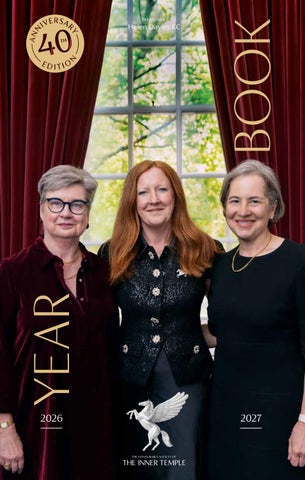
YEAR
Helen Davies KC
BOOK
TREASURER
2026
2027
Trusted by the Inner Temple since 2012
Choose a cleaning contractor and you inherit their standards. Exceptional cleaning should support the people who use your building, protect your place and reduce environmental impact. That has been our belief since 1994, and it shapes the service we are proud to deliver at The Honourable Society of the Inner Temple. Our B Corp certification means you do not have to take that commitment on trust. As London’s legal cleaning specialists, we build sustainability into the undivided attention we bring to every clean.
Discover what higher cleaning standards could mean for you.
www.juliusrutherfoord.co.uk | 020 7819 6700
From the Editor
The Inner Temple Yearbook 2026–2027
FROM THE EDITOR
Inner Temple Yearbook 2026–2027 Treasurer: Helen Davies KC Reader: The Rt Hon Lady Justice Juliet May DBE Reader Elect: Tracy Ayling KC Sub-Treasurer: Greg Dorey CVO Treasury Office: Inner Temple, London EC4Y 7HL | 020 7797 8250 yearbook@innertemple.org.uk innertemple.org.uk Editorial Team: Master of the Yearbook: Master Minka Braun Editor: Martin Mensah Assistant Editor: Henrietta Amodio Desk Editor: Carolyn Dodds Yearbook Manager: Isabelle Keltie Editorial Assistants: Sandra Alvarez, Imogen Halcrow Archivist: Celia Pilkington Education & Training: Julia Armfield Photographs: Garlinda Birkbeck, Miranda Parry Photography, The Inner Temple photograph archive
It has been an honour to have edited this 40th Anniversary Yearbook. I had the privilege of attending the PASS (Pegasus Access and Support Scheme) Skills Day in June which reminded me of the wonderful facilities and outreach conducted by the Inn and of course, the brilliance of the students that are so engaged with the Inn’s activities. I am delighted that that quality is also demonstrated in the range of insightful and compelling articles delving into judicial independence, AI and the abolition of jury trials – to name but a few of the topics covered in this 40th anniversary edition. It has been fascinating to delve into the rich history of the Inn and to have worked with the fabulous people that are behind this quality publication. I have enjoyed gaining a greater understanding of and reading about the adventures and stories of members of the Inn. In editing this edition of the Yearbook, I am reminded of the depth and richness of the Inn’s history.
TI
I am proud to be part of this ever evolving and inspiring Inn which continues to promote excellence and diversity at the Bar. Massive thanks to all of the brilliant contributors, to Master Braun, Henrietta Amodio and the wider editorial team who have worked tirelessly to produce this fantastic record of life at the Inn. I hope that you heartily enjoy this landmark edition. Martin Mensah Nine Chambers
Yearbook Design: Jon Ashby | Noun Ltd, 10 Kingshill Court, High Wycombe, Bucks HP13 5FN | wearenoun.com Advertising: HTDL Ltd | htdl.co.uk Printed by: John Good Limited, Progress House, Butlers Leap, Rugby CV21 3RQ | johngood.com /company/theinnertemple @honsocinnertemple @innertemplevideos @innertemple.org.uk
Sandra Alvarez
Henrietta Amodio
Julia Armfield
Isabelle Keltie
@TheInnerTemple @theinnertemple
This publication is wrapped in a 100% compostable bag, which can be disposed of both in home composting bins or, where accepted by authorities, in food waste recycling or green bins.
© The Honourable Society of The Inner Temple
1
The Inner Temple Yearbook 2026–2027
CONTENTS
I
From the Editor
Contents
1
Martin Mensah I
View from the Treasurer
4
Master Helen Davies T
Without Fear or Favour
6
Master Victoria Sharp
Sir John Finch and His Unusual Legacy T
12
The Sub-Treasurer T
Upholding Our Values: 14 The Inner Temple Code of Conduct
Celebrating International Women’s Day
The Sub-Treasurer
Treasurer, Master Helen Davies
T
The Constitution: Fact or Law?
16
Master John Baker
Celebrate the Life: Master Stephen Brown C
22
T
The Inns of Court Alliance for Women T
The Head Gardner
Employed Bar Forum: 25 ‘Fireside’ chat with Philip Bramwell
A
The Social Context of the Law: Is the Rise in Mass Litigation Distorting Our Legal System and the UK Economy? T
History Society Review
48
Master Donald Cryan
Joshua Blew FSA – Butler, Librarian, and Collector L
26
44
Reaching New Heights 46
The Rt Hon Sir Andrew McFarlane
Louise Steel
43
Master Barbara Mills G
T
I
TC Farewell to Robin 40 Master Rory Phillips and the Master of the Temple
50
The Librarian and Keeper of Manuscripts
Estelle Dehon KC, Martyn Day and Fredrik Erixon
40th Anniversary of The Yearbook I
28
Isabelle Keltie and Imogen Halcrow
READER’S LECTURE SERIES RL
To Prorogue or not to Prorogue
54
Master Sue Carr, The Lady Chief Justice T
Junior Bar Association Round Up 57
Christie O’Connell
Inner Templars and the Birth of the United States A
30
L
Your Library
58
E
Education & Training
59
AI and the Role of the Modern Law Library
82
The Archives Volunteer READER’S LECTURE SERIES
The Future of AI in the Justice System: A Principled and Practical Approach RL
34
Master Robert Buckland
Master Willink: The Forgotten Public Servant T
Master Inigo Bing
37 L
Sally Mclaren, Reader Services Librarian PS
2
Pegasus Scholars
84
Contents COIC
The COIC Pupillage Matched Funding Scheme
89
Should Jury Trials be Abolished 90 for Lesser Offences? T
Nicholas Grimshaw T
International Activity in 2026
Teamwork: Learning from Surgery and Other Industries
92
94
Timeline
I
In Memoriam
123
TC
Temple Church Music
124
Thomas Allery and Robert Ogden T
Geoffrey Nice Foundation
126
Your Bar Liaison Committee 129 Harriet Holmes, Chair of the Bar Liaison Committee T
A
Oral History
130
Excerpts from recent Oral History interviews
Master Martin Elliott A
The Inner Temple Yearbook 2026–2027
Master Geoffrey Nice
Secretary to the International Committee T
T
98
The Inner Temple Summer Party 134
The Archivist
The Social Context of the Law: Historic Trials of Soldiers T
Strength in Community: 101 The Inner Temple LGBTQ+ Society T
LGBTQ+ Society
The Social Context of the Law: The Duty to Rescue T
102
Master James Goudkamp, Master Andrew Warnock and Amelie Berz T
The Inner Temple Big Picnic
Unveiling the Portrait of The Master of The Temple T
T
Portrait of a Lady
T
Becoming a Bencher Weddings and Baptisms
142
I
Bar Liaison Committee
144
I
New Silks 2026
146
New Masters of the Bench 2026–2027
148
I
Masters of the Bench
150
I
People Finder
154
I
Committees
156
108
The Temple Church Demi-Figures 110
I
TC
I
Master John Baker
140
Master Hannah Smith
106
Master Alison Foster TC
Sir Nick Parker, John Finucane, Master Charles Falconer, Master Geoffrey Nice
104
The Treasurer, Master Simon Davenport and Master Oliver Sells
136
KEY ARCHIVES CELEBRATE THE LIFE COIC E EDUCATION & TRAINING E ESTATES G GARDEN I INNER TEMPLE INFORMATION L LIBRARY PS PEGASUS SCHOLARS RL READER’S LECTURE SERIES TC TEMPLE CHURCH T TREASURY A
COIC
C
T
‘Eating Dinners’
114
Master of the Silver, Badges and Staff, Richard Parsons T
MITAA at Twenty
118
Master Faizah Jamaludin C
Celebrate the Lives
120 3
The Inner Temple Yearbook 2026–2027
View from the Treasurer
VIEW FROM THE TREASURER A COMMUNITY, FIRST It is easy, in describing an institution of this age and grandeur, to reach first for its history and its estate. But the Inn is, before anything else, its people – the students attending their qualifying sessions and being called to the Bar, the pupils and new practitioners receiving world class advocacy training and finding their feet, the Benchers and all the other volunteers who give their time freely, and the staff whose care keeps the whole enterprise running with dedication and a quiet competence that is too rarely acknowledged. Much of the pleasure of the year to date has lain simply in being amongst them: at Call nights, at the advocacy training weekends, over tea in the Treasury Building, at lectures in our wonderful education centre, at events in the balmy summer evenings in our beautiful gardens and on the visits I have already been fortunate to make to many of the circuits, where the warmth and vitality of our members away from London is a genuine tonic.
EDUCATION AT THE HEART OF IT
TI
Helen Davies KC, Treasurer 2026 © Garlinda Birkbeck
The annual appointment of a Treasurer has been recorded in the Inn’s Acts of Parliament since 1505, and the office itself reaches back further still, to Thomas Welles, named as Treasurer in 1484. To be entrusted with it, more than five centuries later, has been a true privilege. That I do so as the first practising female barrister appointed to the role, and moreover do so alongside the first all female team of Principal Officers in any Inn, is a distinction I feel keenly – not as a personal achievement so much as a marker of how far the Inn, and the profession it serves, have travelled. I hope that such matters as now form firsts will soon seem unremarkable. Until that happens, I have been honoured to contribute to the journey. I came to The Inner Temple in 1990 as a student and the recipient of a major scholarship, was called to the Bar the following year, and undertook my pupillage in Brick Court Chambers, where I have practised ever since. I mention this not by way of curriculum vitae but because it explains something of how I have approached the year. The Inn opened a door for me when I had neither the means, nor the connections, to open it for myself. Everything I have tried to do as Treasurer has been, in one way or another, an attempt to ensure that that door is kept open for those coming after.
The Inn’s core purpose is education, and it remains the truest expression of what we are for. This year the advocacy training weekends, the qualifying sessions, the Reader’s Lecture Nights, our Social Context of the Law series and our Established Practitioners’ programme have again drawn our most experienced members and other distinguished speakers to teach and inform those who are more junior – the ancient collegiate idea that one generation owes something to the next, made practical. Through the Pegasus Access and Support Scheme and our scholarship programmes, the Inn has continued its work to widen access to the profession, so that talent, rather than background, decides who comes to the Bar. There have already been so many highlights that it is impossible to do justice to them all. I have particularly enjoyed each of the four advocacy training weekends I have attended to date, where the quality of training I have witnessed has been universally outstanding. I have genuinely been left only wishing that similar programmes had been available when I started at the Bar – I am sure that would not only have given me more confidence as a young advocate, but also have helped me avoid at least some of the mistakes that I inevitably made. I am very grateful to all of the trainers at these weekends who on each occasion made me feel exceptionally welcome. We were also particularly fortunate that Master Victoria Sharp, the first female President of the King’s Bench Division who is shortly retiring from that role, delivered a fascinating and insightful lecture entitled Without Fear or Favour in the Inn. And, as a mother of two young adults, the two Reader’s lectures respectively on the adolescent brain and the age of criminal responsibility, included moments that particularly resonated.
T hrough the Pegasus Access and Support Scheme and our scholarship programmes, the Inn has continued its work to widen access to the profession, so that talent, rather than background, decides who comes to the Bar.
4
From the Treasurer
HARMAN At the start of the year, I made the Inn’s implementation of the recommendations of the Harman Report in relation to bullying, harassment and sexual harassment one of my priorities. It is incumbent on us all to take all steps we can to ensure that behaviour that has no place in the modern working world is no longer tolerated. I am therefore particularly pleased that the Inn has already decided to appoint its own Master of Conduct (together with an Assistant Master) and adopted its own Code of Conduct identifying the standards of conduct expected of us all. There inevitably remains further work to be done in implementing the report’s recommendations, but the universal support at all levels of the Inn’s management for the steps taken to date is encouraging. Many thanks are particularly due in this respect to Master Jeremy Richardson and the members of the Inn’s Harman Working Group.
THE GARDEN AND THE CHURCH As members of Inner Temple, we are also custodians of an extraordinary place. The Garden has been a source of great pleasure – a green refuge in the heart of the City – and I record my thanks to those who tend it so beautifully. 2026 is of course also the year that the much-loved Master of the Temple, Master Robin Griffith-Jones retires. His last Evensong, with a packed church and the choir in absolutely magnificent voice, was the most wonderful of tributes to his incredible tenure. I am sure everyone in the Inn joins me in wishing him a happy and restful new chapter. I am very much looking forward to welcoming the new Master of the Temple, the Reverend Dr Andrew Bowyer to the Inn after the summer.
His last Evensong, with a packed church and the choir in absolutely magnificent voice, was the most wonderful of tributes to his incredible tenure. FRIENDSHIP AMONG THE INNS AND BEYOND The amity of the four Inns has been much in evidence this year, and I am grateful to my fellow Treasurers for their fellowship. At my initiative, the four Treasurers and the Sub/ Under-Treasurers have held a number of breakfast meetings to discuss issues that are common to us all that came to focus in the context of the timing of Call debate of last year. Those meetings (which are ongoing) have proved a fruitful forum for constructive discussion as to ways in which the Inns might co-operate to advance matters in our collective interests, and I hope that they will continue to do so in the future.
The Inner Temple Yearbook 2026–2027
The Inn’s engagement overseas also continues. We held our first, extremely enjoyable, International Circuit dinner in the Hague in April and I must thank Master Jo Korner for all that she did to make that event such a success. I am also very much looking forward to visiting both Malaysia and India on behalf of the Inn in September. In Malaysia we will be celebrating the 20th anniversary of the Inn’s Malaysian Alumni Association, and in both I will be meeting with many of our overseas Benchers and members. The links with our colleagues in other jurisdictions continue to remind us that the values we hold, of the rule of law and an independent Bar, are neither parochial nor to be taken for granted.
DRAMA Under the leadership of my predecessor, Master Richard Salter, 2025 was a year of music in the Inn. Given my love of the theatre, I have sought this year to introduce more of a theatrical theme, starting earlier this year with a special screening of Prima Facie to support the Schools Consent Project (schoolsconsentproject.com). Following on from that, I am delighted that the Inn will be hosting this autumn not one, but two, new theatrical productions, namely Paradise Lost in October and The Winding Stair, based on Jesse Norman’s renowned book of the same name, in November.
THANKS No Treasurer governs alone, and the truth is that the Treasurer governs least of all. I owe an enormous debt to the SubTreasurer and to the whole of the Inn’s staff, whose dedication I have come to appreciate more with every month. I thank my fellow Principal Officers, Master Juliet May and Master Tracy Ayling, for their always incredibly wise counsel, and the Benchers and all our other volunteers, who give so generously of their expertise and support. And I thank my predecessor, Master Salter, for the state in which the Inn was handed to me: flourishing, forward-looking, and in good heart.
LOOKING FORWARD An institution of nearly seven hundred years does not depend on any one year, or any one Treasurer. My task has been to hold the office well for its brief tenancy and to pass it on undiminished. If I have managed, in some small way, to leave the door a little wider open than I found it, I shall be content. My warmest good wishes to every member of The Inner Temple, and to all who work for it. I hope to see as many of you as possible in the Inn. Helen Davies KC Treasurer 2026
In addition, I am delighted that in the autumn not one, but two, amity dinners will take place with other Inns. Firstly, a joint amity dinner on the Midlands Circuit with Middle Temple – which is a repeat of an event that has been held successfully in the past. And secondly, an amity dinner in London with Lincoln’s Inn, whose Treasurer is also the first female practising barrister to hold that office. And lest it be thought that Gray’s is in some way being left out, the Reader, Master Juliet May, is I know, planning an amity dinner with them in her year.
5
TI
The Inner Temple Yearbook 2026–2027
Without Fear or Favour
WITHOUT FEAR OR FAVOUR: JUDICIAL INDEPENDENCE, PAST, PRESENT AND FUTURE
This is an abridged version of a lecture delivered by Master Victoria Sharp on 22 June 2026, to mark her imminent retirement as President of the King’s Bench Division.
T
INTRODUCTION Many years ago, my family and I went on a holiday to Brazil. I had just been appointed to the High Court bench and decided to visit the courthouse in a small city in Maranhao. When those there discovered I was an English judge, there was great excitement. The local press was summonsed, and photographs were taken of me shaking hands with the other judges. We shook hands not because we shared a job title but because we were part of a judicial family: sharing values and aspirations and subject to similar pressures. The judicial path is certainly not one for those who want a quiet life or to be popular, because those pressures can come from all quarters: from the executive branch of the state, from the media, from the general public and from the litigants themselves. Depending on the decision made, we can be excoriated as ‘out of touch’ or attacked as dangerously radical. The internet and social media have been of considerable assistance to those who wish to take public issue with decisions they dislike, and ‘keyboard warriors’ frequently express themselves in very strong terms, which can be picked up and amplified by those with particular agendas to pursue. The information age has led to a proliferation of echo chambers, social media influencers and confirmation bias.
6
However, judges up and down the land every day of the week make decisions they think are the right ones to make, in the light of the facts they find and the applicable law. Judges give their reasons for what they do, and open justice means this is visible to the litigants and to the public. Judges work under the spotlight. And there is good reason for this: “Publicity is the very soul of justice. It is the keenest spur to exertion and the surest of all guards against improbity. It keeps the judge himself while trying under trial”, as Jeremy Bentham put it as long ago as 1790. If judges get it wrong, the appellate system is there to put things right. It is by that means that legal rights or wrongs are decided in this country. Legal disputes are not decided by the court of public opinion. Cases must be decided according to their merits, without regard to the clamouring voices of interest groups. Sometimes the voices are off stage. Sometimes they can be more direct. In 2023, I heard an appeal against sentence by a woman who had pleaded guilty to administering poison with intent to procure her own miscarriage. There is no doubt that the case was a controversial one and attracted strong public comments from different sides of the abortion debate. A group of leading medical practitioners and academics wrote to the judge before he passed sentence. They did not believe this aspect of the law on abortion was just. They asked him not to impose a custodial sentence for reasons they considered important and for an opportunity to address the court.
Treasury
In the judgment, we reduced the sentence and suspended it, but this was for legal reasons. As for the letter sent to the judge, we said the judge was right to say this form of special pleading was inappropriate. We went on to say: “Our democratic society of course allows for the open expression of different views on the merits of any sentence that is passed, and we do not doubt that the authors of the letter have the serious concerns to which they refer; but the duty of the independent judiciary, in accordance with their judicial oath, is to sentence according to the law and to apply the law to the facts of the individual case before them, rather than be swayed by the views of special interest groups, however eminent and well-intentioned they may be.”
I will do right to all manner of people after the laws and usages of this realm, without fear or favour, affection or ill will.
Sentencing is rightly a matter of public interest and can attract a great deal of attention and comment. Judges are not robots. The law on sentencing is complex, and sentencing in individual cases can often be a difficult and challenging exercise. It is an art, not a science. The offence we dealt with in the case I just mentioned did not have a sentencing guideline. Many offences do, however. In that context, it is worth mentioning something about the general approach to sentencing in this jurisdiction that is less well understood than it should be. The Sentencing Council for England and Wales was established by Parliament in 2010 to promote greater transparency and consistency in sentencing, while maintaining the independence of the judiciary. It is an independent, non-departmental public body accountable to Parliament. The primary role of the Sentencing Council is to issue guidelines on sentencing, which the courts must follow unless satisfied in a particular case that it would be contrary to the interests of justice to do so. The Council has a statutory responsibility to develop sentencing guidelines and monitor their use; to consider the impact on victims of sentencing decisions; to monitor the application of the guidelines; and, when developing guidelines, to promote understanding of, and public confidence in, sentencing and the criminal justice system. When developing a new guideline, the Sentencing Council carefully considers the principal factors by which the seriousness of a particular type of offence should be assessed. It publishes a draft in which it sets a range of sentences which appropriately reflect the range of seriousness of individual examples of that offence. It engages in widespread public consultation on that draft, and where appropriate makes amendments in the light of the responses. The definitive guideline which is then brought into effect is published on the Council’s website. That is a transparent process. It provides members of the public with the information which enables them to understand the guidelines issued by the body which Parliament has created for that purpose, and to have confidence in sentencing. The judicial system is an essential part of a functioning democracy; I have always thought of it as the backbone of the skeleton which supports the body of the state; and judicial independence is central to what judges do. The judicial oath or affirmation that judges take is laid down in statute. Its roots are deep. Bracton recorded that medieval justices were required to swear to do right justice to rich and poor alike. The words “without fear or favour” appeared in English constitutional materials by the 17th century and found their settled home in the Promissory Oaths Act 1868. The language of the oath is suitably archaic, but the meaning and importance of it is clear: “I will do right to all manner of people after the laws and usages of this realm, without fear or favour, affection or ill will”.
The Inner Temple Yearbook 2026–2027
I last saw the oath taken a few days ago when I attended the swearing in of the newest member of the Supreme Court. Before the ceremony Lord Reed reminded those present that the judicial oath was etched above the door of the court, and of its two essential components: judicial impartiality and judicial independence. These concepts are connected. “The reason why judicial independence is of such public importance is that a free society exists only so long as it is governed by the rule of law. The rule which binds the governors and the governed, administered impartially and treating equally all those who seek its remedies or against whom its remedies are sought. However vaguely it may be perceived, however unarticulated the thought, there is an aspiration in the hearts of all men and women for the rule of law. That aspiration depends for its fulfilment on the competent and impartial application of the law by judges. In order to discharge that responsibility, it is essential that judges be, and be seen to be, independent.” These words were spoken by the Chief Justice of Australia 30 years ago and they have a special significance over and above their admirable qualities as prose. They are cited in the commentary to the Bangalore Principles of Judicial Conduct of 2003 – one of a number of international resolutions addressed to the issue of judicial independence, judicial ethics and judicial integrity, intended to complement the UN’s Basic Principles on the Independence of the Judiciary. Some of the key principles they contain are derived from the milestones along the path to judicial independence in this jurisdiction. Magna Carta pronounced that even kings are subject to the law. Another great milestone in our legal history was the Act of Settlement in 1701. This laid down for the first time what is still a fundamental feature of judicial independence, that judges should have security of tenure: they should hold office during good behaviour and could only be removed by address of both Houses of Parliament. The Act of Settlement was passed not for the benefit of the judges but in the public interest. The Bill of Rights of 1689 was another important constitutional enactment in the development of the rule of law. It was well understood by the committee that drafted it that those rights were of no value unless the judges who enforced the law were protected from intimidation and victimisation. The history of English judicial independence is, in large part, a history of separation: of the slow separation of adjudication from administration; of law from prerogative; and of court from council. It is also a history of money. Early judges were poorly paid, and corruption was a real concern. In 1346, judges were required to swear that they would not accept gifts or rewards from parties before them.
7
T
The Inner Temple Yearbook 2026–2027
Without Fear or Favour
Returning to the present, judges are inevitably targets, often attracting the enmity of the people they encounter. But if their independence is to be preserved, they must be protected from external pressure to decide cases for reasons which have nothing to do with the merits. It is not merely because of the risk that some might succumb – there is also the risk that in the ever-increasing din of complaints encouraged by the notion that they might have some effect, something precious will be lost. When people rise when judges come into court and bow, that is not a personal matter. It is a visible demonstration of the respect that everyone must pay to the law. Diminishing respect for the law and those whom society entrusts to dispense it is a dangerous and slippery path, ultimately corrosive to the rule of law and the protection it affords to democracy and the freedoms it is our privilege to take for granted.
The problem is not confined to these shores. The European Network of Councils for the Judiciary conducted a survey last year. It found that judges in many jurisdictions feel inappropriate pressure from media and social media at the individual case level, and many do not feel their independence is respected on social media. The survey also considered intimidation, threats and attacks on judges. In half of the judiciaries surveyed more than 10 per cent of judges had experienced intimidation or threats. These concerns are not confined to what is said on social media or anonymous online abuse. In 2025, the Attorney General described political attacks on judges as “dangerous” and as “a huge threat to the rule of law and the independence of the judiciary”, after criticism of judges moved from social media onto the floor of the House of Commons. The Lady Chief Justice has expressed her concern about these matters in her evidence to the Constitution Committee and the Justice Select Committee.
Sydney Kentridge KC put the matter precisely in my view: “There are some aspects of the rule of law on which, among ourselves, we take different views…But one aspect of the rule of law on which we would certainly agree is the independence of the judiciary. It is secured in part by laws which give the judges security of tenure and in part by ensuring that as far as possible they are persons of integrity, appointed on merit rather than by reason of political connection. Independence here means more than independence from government direction. It means also that judges in making their decisions should as far as humanly possible not be influenced by public opinion, or by any sense of obligation to the government or to any individual, party, or pressure group.”
T
Lord Atkin’s famous observation that justice is not a cloistered virtue remains as true now as when it was uttered and no sensible judge seeks immunity from criticism. Open justice invites scrutiny. Appellate review invites correction. Academic commentary can improve the law. The press performs a vital constitutional function in explaining and criticising what courts do. But there is an important distinction between criticism and abuse; between disagreement with a decision and an attack on the integrity or motives of the judge. Lord Hodge made that distinction in his 2018 lecture on judicial independence. As Lord Hodge pointed out, the Divisional Court’s decision in Miller No 1 concerned a legal question about the relationship between prerogative power and statute. The reaction in some quarters was not confined to criticism of the court’s reasoning. It included personal attacks on the judges and suggestions that they were acting politically. Attacks on judges are nothing new. In the anxious present, it is important to keep a sense of perspective. However, the modern environment has changed the scale, speed and texture of the public conversation. A misunderstanding can be repeated many thousands of times before the judgment has been read. A false allegation can acquire authority by velocity. A judge who cannot answer back can become a convenient screen onto which anger may be projected. Social media compresses the space between criticism and intimidation, and rewards heat rather than accuracy. It allows anonymous hostility to appear as public opinion. And where online campaigns are conducted to put pressure on judges trying cases and which target judges by name, photograph, address, family, ethnicity, religion or gender, the problem ceases to be merely reputational. It becomes a problem of personal security and a threat to the administration of justice.
ocial media compresses S the space between criticism and intimidation, and rewards heat rather than accuracy. 8
This brings me to another point which is sometimes misunderstood: judicial independence is not the opposite of accountability. It is a particular form of accountability. Judges are accountable through open hearings, reasoned judgments given in public, appellate review, ethical rules, disciplinary processes and public scrutiny. Senior judges appear before parliamentary committees. Annual reports are published. Proceedings of the Supreme Court and the Court of Appeal can be broadcast. The public can see more of what courts do than at any time in our history. But accountability in this respect does not mean control. There is a constitutional difference between requiring a judge to explain a decision and requiring a judge to answer politically or personally for the result. Judicial independence is often discussed as if it were concerned only with the individual judge: security of tenure, freedom from improper influence and the duty to decide according to law. Those things are fundamental. But they are not enough. Constitutional principles do not live by doctrine alone. They depend upon institutions, conventions and, sometimes, money. The warning by Sir Sydney Kentridge against any measure which undermines judicial independence, included “appointments to the Bench for political reasons”. Diversity, he said, is of real value, and merit may often be a matter of opinion, but the aim should be to make merit the sole criterion for judicial appointment. “A succession of political appointments”, he warned, “undermines the respect for the judiciary as an institution.” That warning is not theoretical. In a number of jurisdictions, the capture of the courts has begun, not with soldiers at the courtroom door, but with changes to the way judges were appointed, promoted, disciplined, retired or replaced. Court-packing, forced retirement, politically controlled judicial councils, and appointments made on the basis of loyalty rather than merit are familiar methods by which constitutional democracy is weakened from within. The creation of the Judicial Appointments Commission was one of the most significant changes effected by the Constitutional Reform Act. The Act requires the Judicial Appointments Commission to select candidates solely on merit; to select only people of good character; and to have regard to the need to encourage diversity in the range of persons available for judicial selection. The Judicial Appointments Commission is not a piece of constitutional machinery; it is a safeguard to all those concerned in the administration of justice. Appointment on merit does not mean a narrow reproduction of the familiar or appointing only those who look, sound, think and practise like judges of an earlier generation. It means identifying those who possess the intellectual and personal qualities required to be a judge: independence, integrity, legal ability, fairness, courtesy and courage.
Treasury
The Inner Temple Yearbook 2026–2027
THE FUTURE So, what of judicial independence in the future? There are some interesting issues or risks on the horizon, or perhaps they are already here. One, inevitably, is the use of AI. Such issues may seem of a second order of significance when we are dealing with a judicial system which is significantly under-resourced. However, developments in AI and Big Tech raise potentially existential questions about the proper functioning of justice systems in their current model and of the role of judges within them.
Nor are AI systems value neutral. The datasets selected, the material excluded, the categories used in annotation, the reinforcement signals chosen, the safety policies imposed, the retrieval sources connected and the commercial incentives of the provider affect outputs. A model trained on historic legal material may reproduce historic inequities. A model optimised for speed and settlement may undervalue the need for a public hearing. A model procured by the executive may, without impropriety, reflect executive priorities.
It is useful to begin with the technology itself. Modern large language models do not reason as lawyers or as judges reason. They convert text into tokens; represent those tokens mathematically as embeddings; and use transformer architectures to weigh the relationships between words or sub-words in context. They are trained on immense datasets to predict the next token or sequence of tokens most statistically likely to follow. The result can be astonishingly and beguilingly fluent, but false. Fluency is not truth and coherence is not judgment. There are two ways of looking at the problem: internal and external.
This leads to what may be called system capture. If courts become dependent on a small number of proprietary systems, updated invisibly and controlled externally, the practical independence of judicial reasoning may be compromised. The danger is not a dramatic coup by machine. It is of a gradual drift: standardised prompts, standardised summaries, standardised risk scores, and eventually standardised dispositions. A court system may appear formally independent while its informational architecture has been captured by technology it cannot inspect, challenge or control.
Starting with internal use, that is by the judges and by the system, the first risk is conceptual. A judge who treats AI as a source of ‘judicial reasoning’ rather than a useful tool risks outsourcing part of the judicial function. Summarising material, translating text, locating authorities already known to exist or managing large quantities of documents may be legitimate uses, provided confidentiality, accuracy and responsibility are preserved. But there is a qualitative difference between assistance and influence. The danger is not merely that an AI system will make a crude mistake. It is that it will produce an attractive formulation which subtly narrows the judge’s own analysis.
We must be candid about the pressures on the justice system. The Crown Court open caseload reached 80,203 cases at the end of December 2025, more than double the 2019 figure; 21,002 cases had been open for a year or more; and median waiting times in jury cases remain at an unacceptable level. Delay is not merely administrative inconvenience; it undermines justice. The Ministry of Justice (MoJ) is an unprotected department, and the figures tell their own story. The House of Lords Constitution Committee put the point starkly: in 2019–20, MoJ funding for HM Courts & Tribunals Service (HMCTS) was 21 per cent lower in real terms than in 2010–11.
9
T
T
The Inner Temple Yearbook 2026–2027
Without Fear or Favour
Judicial independence requires practical support, and in that context, it would be irresponsible not to use AI. Used responsibly, AI may release judicial time for genuinely judicial work. The danger arises when AI is presented not as support for justice, but as a substitute for the public investment justice requires and which the Lord Chancellor, by his or her oath or affirmation, promises to provide. HMCTS has recently stated that AI should support people, not replace final judicial determinations, and that responsible AI in the justice system must be lawful, proportionate, fair, reliable, secure, explainable, transparent, accountable and contestable.
There are already important safeguards in place. The judiciary has issued guidance on AI for judicial office holders, for example. At governmental level, the United Kingdom’s AI regulatory approach identifies principles of safety, transparency, fairness, accountability, governance, contestability and redress. Internationally, the Council of Europe Framework Convention on Artificial Intelligence, Human Rights, Democracy and the Rule of Law is an important development. More will be needed. The world, and not merely the judicial world, is playing catch up with an accelerating technology.
The second way of looking at the problem is external, in other words, the use of AI by those who use the courts: litigants, witnesses, legal advisors and so on. AI can certainly improve access to justice by helping people understand their rights, in drafting documents and navigating unfamiliar procedures. Every jurisdiction, however, is experiencing a boom in lengthy applications from litigants in person, or sometimes less than well qualified legal advisors. Each of those applications requires careful judicial appraisal, and many are rather less than legally sound. All of this puts a strain on a system that is already under-resourced.
CONCLUSION
The courts are grappling too with the associated problem of false legal material. There are now many cases involving actual or suspected use of AI-generated legal arguments, false citations, false quotations and authorities that do not exist. Dealing with such material is resource intensive. More importantly such material is capable of misleading opposing litigants and the court, thereby corroding trust in the administration of justice. The evidential risks are still more troubling. The courts are accustomed to testing evidence. They examine provenance, disclosure, metadata, expert evidence and consider inherent probabilities. But AI changes both scale and cost. As synthetic evidence becomes more familiar, genuine evidence may be dismissed as fake. Improperly used, AI can create false evidence, and unchecked or unregulated, it can destabilise confidence in the entire process of judicial adjudication.
T he danger arises when AI is presented not as support for justice, but as a substitute…
I have spoken about AI at some length because it will be that which will determine the future. Jensen Huang, the CEO of Nvidia, said the other day that AI will not take your job, but your job will be taken by someone who uses AI. The future of judicial independence will depend as much on such practical matters as on constitutional declarations; on what is done rather than what is said. Nevertheless, it needs constant explanation. In schools. In Parliament. In the press. Online. By the legal profession. By academics. By responsible journalists. And, where appropriate, by judges. A judiciary that cannot explain its constitutional role risks that role being defined by others. But explanation must be disciplined. Judges must not become political actors or enter the partisan arena. But we can explain why reasons matter, and why personal attacks on judges harm the public interest, not the judge alone. Judicial independence is, as Sir Henry Brooke described it many years ago, a fragile bastion; and one that it is in everyone’s interests to protect. ‘Without fear or favour’ is a promise to the public that the case will be decided by law, by an independent and impartial judge. Challenges to it are nothing new. That independence is continually tested. Our answer must be constitutional steadiness. To judge without fear or favour is not to stand above society. It is to serve society in the particular way the constitution requires: by doing right according to law. That task remains difficult but indispensable. The Rt Hon Dame Victoria Sharp President of the King’s Bench Division 2019–October 2026 For the full lecture and video recording: nrtm.pl/withoutfear
10
Drink and dine at the Pegasus Bar & Restaurant Open for drinks and dining five days a week, the Pegasus is the perfect spot to recharge or relax away from the bustling streets of London. From pastries and coffee to dinner, our seasonal menus and fine selection of beverages offer something for everyone. Alternatively, celebrate all your special occasions with exclusive hire available on weekends between 11am-11pm. Just moments from Temple Church, the Pegasus is a convenient location for pre or post church gatherings and concerts too. 020 7797 8230 | venuehire@innertemple.org.uk | innertemplevenuehire.co.uk
Standing events:
Up to 50 guests Seated events:
Up to 28 guests Private Hire available on weekends 11am – 11pm. Table bookings available via the website.
Gifts
innertemple.org.uk/store gifts-halfpagers.indd 1
03/09/2021 11:59
11
The Inner Temple Yearbook 2026–2027
Sir John Finch and His Unusual Legacy
SIR JOHN FINCH AND HIS UNUSUAL LEGACY By the Sub-Treasurer
T
Sir John Finch, c.1665–70 (oil on canvas) © Dolci, Carlo (1616–86)
Sir Thomas Baines, 1665–70 (oil on canvas) © Dolci, Carlo (1616–86)
2026 is the 400th anniversary of the birth of Sir John Finch, a member of The Inner Temple. He is one of those I featured in a talk to the Inn’s History Society in 2019 on Temple Diplomats from the mid-16th to the mid-20th century (see Yearbook for 2020). Finch was clearly a polymath of learning and ability, though he left little mark on history in the many fields in which he was expert. But he remains well-known for a long and close relationship, immortalised in a splendid memorial in Cambridge.
Together with Baines, in 1651 Finch embarked on a Grand Tour of Italy, following which they graduated together in medicine in 1656 from the University of Padua, where he was also appointed Pro-Rector and Syndic (slightly curiously, of the jurists at the University). In 1659, the Grand Duke of Tuscany, a Medici, had Finch appointed Professor of Anatomy at the University of Pisa. There he became known as a “lynx with a knife” and wrote learned essays on the torpedo fish and vipers as well as becoming embroiled in many academic disputes – in which he was consistently on the side of the conservatives rather than the innovators. His particular interest was the anatomy of the brain and both he and Baines were known as excellent anatomists from a technical point of view. He rejected an offer around that time to become English Consul at Padua, using the excuse that it meant getting drunk “at least forty times a year”. More probably he wished to avoid an overly close relationship with the Cromwell Protectorate.
Finch came from an illustrious family of royalists (and perhaps served in the King’s army at some point). His father Heneage Finch had been Speaker of the House of Commons, and he was the younger brother of Sir Heneage Finch, 1st Earl of Nottingham, a Lord Chancellor and another Inner Templar (and a “silver-tongued lawyer”!). After obtaining a Bachelor of Arts degree at Oxford in 1647, John Finch studied at Christ’s College Cambridge with Henry More, the philosopher and theologian. It was there that he met his thereafter inseparable companion, Thomas Baines, who was four years older. Finch was admitted to The Inner Temple in 1644.
12
Treasury
Finch was clearly a polymath of learning and ability, though he left little mark on history in the many fields in which he was expert. But he remains well-known for a long and close relationship, immortalised in a splendid memorial in Cambridge.
A major task of Finch’s in Constantinople was to obtain the Sultan’s confirmation of privileges formerly granted to English residents of his dominions (and oppose the efforts of other foreign competitors). But after a promising start and like many of the other long-suffering representatives and merchants based there, he ended with few or no substantive achievements to his name. Although he possessed a modicum of diplomatic skill and understanding of mercantilism, Finch was constantly outwitted by the Grand Viziers Ahmet Koprili and Kara Mustafa. This was despite investing quantities of his measures of best wine on the former, which the Court euphemistically referred to as “English sherbett”. The latter, more violent and grasping than his predecessor, was sadly not even susceptible to this form of diplomatic bribery. As Finch put it, “…the perplexity of doeing affayrs is still attended with more of difficulty and intrigue, by having to doe with a people who neither in language, custome, manners, or religion, have any affinity with us”. He was also obliged to keep a careful eye on the machinations of various Dutch and French colleagues.
Finch and Baines (who became Professor of Music at Gresham College) returned to England (together with the monarchy) in 1660. They were both simultaneously made Fellows of the Royal College of Physicians and Finch was knighted by King Charles II (proving the wisdom of having avoided the Consular Commission). Cambridge made them Doctors of Physic (again simultaneously) and in 1663 they were ‘nomination Fellows’ of the Royal Society – notwithstanding this, neither ever contributed papers to the Society. Despite all these signs of favour, Finch seems to have been rather unenterprising and more inclined to lose himself in poetry and philosophy – his correspondence with the pedantic Baines indicates that his was by far the finer intellect. Baines’ influence over him was considerable though – he soon saw off a young lady from Warwickshire who appears to have taken Finch’s eye in 1661. Both men were active collectors of fine art. The ‘two doctors’ returned to Italy briefly in 1663 and from 1665 to 1671 Finch was a largely undistinguished British Minister to the Ducal Court at Florence, where he had Baines appointed physician to the Legation. It was a time of many conflicts between the Tuscan authorities and British residents of the region, which took up his time: perhaps because of that he did little or nothing to promote Anglo-Italian cultural relations. Despite Finch’s love for Italy, and especially Tuscany, he was soon complaining about the level of remuneration for this role. His many friends therefore arranged to have him appointed Ambassador in Constantinople in 1672, a position he took on somewhat unwillingly: “I doe perfectly abhorr the thoughts of goeing to Constantinople”. In those days it was not for the most part a prepossessing city – “a sink of men and sluttishness” as one of his predecessors in the role described it. Baines was knighted through the influence of Finch’s brother-in-law Lord Conway in 1672 and accompanied Finch as friend and confidant – the merchants in Constantinople joked that there were two Excellencies, the Ambassador and the Chevalier. Finch’s position carried a generous salary of £2,500 a year plus perquisites, paid not by the British Treasury but the slightly more dependable Company of the Levant (whose leading members included some of his relatives). This enabled him to live in some style, assisted by the ambassadorial privilege of being allowed to import 7,000 measures of wine a year duty-free. Finch was not however a successful English Ambassador to the Sublime Porte of the Ottoman Empire. The job had become somewhat dynastic, with Finch succeeding his recently deceased cousin Daniel Harvey – who in turn succeeded Finch’s uncle Heneage Finch, 3rd Earl of Winchilsea. The story of Finch’s time there has been written up in considerable detail by George Abbott in his very readable and surprisingly amusing Under the Turk in Constantinople (pub. 1920). Aside from official papers, this is based on the copious contemporary writings of the Consul at Smyrna, the Treasurer at Constantinople and the Chaplain (John Covel, later Master of Christ’s College from 1688).
The Inner Temple Yearbook 2026–2027
Despite never publishing anything, between 1674 and 1681 Finch and Baines wrote a great deal about statecraft, religion and the Ottoman Empire, which remains of interest. Finch in particular developed a theory of sovereignty in which liberty and coercion are seen as equally useful and legitimate tools of governance. While believing in freedom of conscience, he set bounds on tolerance in order to preserve peace and decorum. The academic Sarah Hutton has speculated that his views may have influenced the architect of the 1689 Toleration Act, his nephew Daniel Finch, 2nd Earl of Nottingham. Baines died of malarial fever at Constantinople in 1681, after Finch’s successor Lord Chandos had arrived in Turkey and on the day when Finch received his own official leave to depart. Finch was distraught, writing that this had “cutt off the thread of all my worldly happiness”. He described their relationship as a “sweet and unbroken marriage of souls, and a fellowship undivided for thirty-six entire years” and “sacred to an unspeakable love”. After recovering from an attack of fever, he left Turkey with the embalmed body of his friend, returning to England via Tuscany. Finch himself died from pleurisy in 1682, after which he was buried side by side with Baines under the same elaborate black and white marble canopy at Christ’s College. Their portraits by Carlo Dolci, painted during Finch’s Residency in Florence, hang in the Fitzwilliam Museum. The exact nature of Finch’s relationship with Baines is not confirmed anywhere yet discovered. Contemporaries, at least, had no difficulty with it, often mentioning “the two doctors” with affection. And David Kinloch, the Scottish poet, has no doubts in Baines: His Dissection, in which Finch refers several times to his “lover”. (Abbott, in his fairly lengthy book, mentions “the vicarious pride of a lover” when commenting on Finch’s record of Baines’ theological utterances.) A passage on their final resting place reads:
“…I’m determined we’ll have our own display, dear Tom, our profession of unusual friendship, our trade as doctors, diplomats, decked out upon a Cambridge tomb, our ensigns of affection flagged up and out for prayerful and tourist to decipher.” Greg Dorey CVO Sub-Treasurer
13
T
The Inner Temple Yearbook 2026–2027
Upholding Our Values: The Inner Temple Code of Conduct
UPHOLDING OUR VALUES:
THE INNER TEMPLE CODE OF CONDUCT
T
The publication of the Harman Review Report on Bullying, Harassment and Sexual Harassment at the Bar in September 2025 marked an important moment for the profession. The Review challenged all organisations connected with the Bar to consider how best to foster workplaces and professional communities that are respectful, inclusive and safe for everyone. Since the Report was published, the four Inns of Court have been working both collectively and independently, and with the Bar Council, to consider and implement the recommendations relevant to our work and culture. One of the Review’s recommendations was that “the standards of behaviour relating to bullying, harassment and sexual harassment must be clear and consistent across the profession.” In response, the four Inns agreed a shared set of principles for conduct that reflect the values expected across the Inns of Court. Building on those principles, the governing board of the Inn, Bench Table, has approved a new Code of Conduct for all members of The Inner Temple, together with accompanying Guidance on Positive Behaviours and Potentially Unacceptable Conduct.
14
The introduction of the Code represents an important milestone in the Inn’s continuing commitment to maintaining a professional, respectful and welcoming community. While prompted by the Harman Review, the Code is not simply a response to one report. Rather, it reflects the principles that have long underpinned life at The Inner Temple and brings together, in one place, the standards of behaviour that members, students, staff and visitors should be able to expect throughout the Inn. At its heart, The Inner Temple is a collegiate community founded on mutual respect, integrity, courtesy and professionalism. These values have shaped the Inn for centuries and remain essential to supporting an independent Bar that reflects the highest standards of personal and professional conduct. The new Code articulates these expectations clearly and consistently, helping to ensure that every member of our community can participate fully and confidently in the life of the Inn.
Treasury
The Code applies to all members of the Inn, irrespective of seniority or status. It covers conduct connected with the Inn in all its forms, including educational activities, dining, social events, committee meetings and communications through digital and online platforms.
Unacceptable conduct may occur in person, in writing, online, by telephone or through social media or other electronic communications.
The scope of the Code may also extend, where appropriate, to conduct occurring outside the Inn where that conduct may affect the safety, wellbeing, dignity or reputation of others, or where another professional body may exercise regulatory jurisdiction. It is important to note, however, that the Code does not replace or override existing statutory, regulatory or professional obligations. Instead, it complements those obligations by setting out the behavioural standards expected within The Inner Temple community.
STANDARDS OF CONDUCT The main standards of the Code are set out below. Members of the Inn are expected to: 1. Promote an inclusive, welcoming, collaborative and supportive environment, recognising and valuing equality and diversity in accordance with the Equality Act 2010; 2. Treat all individuals with dignity, fairness, courtesy and respect; 3. Act in a manner which upholds the reputation and values of the Inn, the profession, the administration of justice and the rule of law; 4. Abide by an express prohibition on bullying, harassment and sexual harassment and sexual misconduct; 5. Maintain appropriate professional boundaries in relationships; 6. Be mindful of actual or perceived power and influence imbalances; 7. Avoid conduct which may be regarded as intimidating, humiliating, degrading, hostile, abusive or offensive; 8. Behave responsibly and professionally at events particularly where alcohol is served; 9. Take appropriate action to challenge, report or otherwise address unacceptable or potentially unacceptable conduct; 10. Abide by the barristers’ duty to report serious misconduct to the Bar Standards Board (BSB) in accordance with the current BSB Handbook; 11. Under no circumstances victimise those who have reported concerns regarding behaviour; 12. Adhere to all relevant Inn policies, including the Bench Table Orders, the Volunteer & Participant Code, the Equality and Diversity Policy and the Inns of Court Anti-Harassment Policy.
The accompanying Guidance has been developed to provide practical assistance in understanding how these principles apply in everyday interactions. It includes examples of positive behaviours that contribute to a respectful and inclusive environment, alongside examples of conduct that may be considered unacceptable.
The Inner Temple Yearbook 2026–2027
Further details of these expectations are provided in the Code. The accompanying Guidance has been developed to provide practical assistance in understanding how these principles apply in everyday interactions. It includes examples of positive behaviours that contribute to a respectful and inclusive environment, alongside examples of conduct that may be considered unacceptable. The purpose is not to prescribe every eventuality, but to encourage considerate and professional engagement between members. Perhaps the most important point to emphasise is that the Code is not about creating new rules for their own sake. Rather, it brings together expectations that many members will already recognise as fundamental to the culture of the Inn. By setting these standards out clearly, the Code promotes consistency, transparency and shared understanding across our diverse membership.
Perhaps the most important point to emphasise is that the Code is not about creating new rules for their own sake. Rather, it brings together expectations that many members will already recognise as fundamental to the culture of the Inn. The strength of The Inner Temple has always rested on more than its buildings, traditions or history. It rests on the quality of its community and the relationships between those who learn, practise and work within it. A culture founded on dignity, respect and collegiality benefits everyone – from students attending their first Qualifying Session, to junior practitioners developing their careers, to Benchers, guests and members of staff who contribute to the life of the Inn every day. By embracing these standards, we reaffirm the values that have long defined The Inner Temple and demonstrate our collective commitment to ensuring that the Inn remains a welcoming, inclusive and professional community for all. We encourage all members to take a few moments to read the Code of Conduct and accompanying Guidance, which are available on The Inner Temple website: innertemple.org.uk/ who-we-are/how-we-operate/policy-statements/code-ofconduct. Familiarity with the Code will help ensure that we continue to foster an environment in which everyone is treated with dignity, courtesy and respect. If you have any questions about the Code or its application, please contact the Sub-Treasurer, Greg Dorey CVO at subtreasurer@innertemple.org.uk Greg Dorey CVO Sub-Treasurer For the Inn’s Complaints Policy Complaints: innertemple.org.uk/who-we-are/ how-we-operate/policy-statements/complaints
15
T
The Inner Temple Yearbook 2026–2027
The Constitution: Fact or Law?
THE CONSTITUTION: FACT OR LAW? By Master John Baker What is the basis of the British constitution? It is obviously derived from the old English constitution, with necessary adjustments resulting from unions. But is it attributable to some remote political compact between government and people, or to a series of historical accidents, or to the common law? Perhaps it is a little of all three. In the great constitutional debates in the 17th century, history was at the forefront. Legal history was a core subject, and Master Selden (d. 1654) became a national figure through his deployment of historical sources in debate. That was a different era, and we have perhaps cut ourselves loose from our anchorage, though it is still obvious that the unwritten constitution has evolved over time. Its ability to do so is a strength shared with the unwritten common law. Both are living organisms which evolve in dealing with age-old problems as they constantly present themselves in new ways. They have memories, a body of accumulated experience. At their core is supposed to be the sovereignty of Parliament, often lauded as a triumph of democracy; but it could also be seen as the means of undermining and destroying democracy.
T
16
Centuries ago, the House of Commons provided the hardwon means by which governments could be kept in check. Some kings tried to manage as long as they could without Parliaments, relying on prerogative powers; but since the law would not allow them to raise money without parliamentary approval, they were forced to summon Parliaments and accept the consequences. That is almost the reverse of the world in which we now live. Parliament is in constant session and has become the means through which governments exercise their power. If a government cannot persuade Parliament to enact what it wishes, it is supposed to resign. It is true that effective challenges can still sometimes be made to unduly sweeping powers, especially in bipartisan select committees, or through outcries in the press. But they are effective only if the Government can be made to see the point and accept amendments. We have what Lord Hailsham called an ‘elective dictatorship’. Could our constitution prevent temporary dictatorship from becoming a tyranny?
Treasury
There are many alarming threats to constitutionalism in today’s world, some of them in countries we used to regard as civilised partners. We may like to believe that such things could not happen here. But some of the machinery is already in place. For instance, the Civil Contingencies Act 2004 provides (s. 22) that “Emergency regulations may make any provision which the person making the regulations is satisfied is appropriate for the purpose of preventing, controlling or mitigating an aspect or effect of the emergency” … and that they “may make provision of any kind that could be made by Act of Parliament” for the “requisition, confiscation or destruction of property, with or without compensation, and the prohibition of movement or any other activities”. They may create an offence of failing to comply with the regulations. And in doing these things they may disapply or modify any other statute. In other words, something close to absolute power is available under our present law to a minister making such regulations. It is at least limited to emergencies; and we would obviously need drastic emergency action in the event of a nuclear attack or foreign invasion. But an ‘emergency’ is defined more broadly in the Act. It could include “an event or situation which threatens serious damage to human welfare by causing or involving … damage to property, disruption of a supply of money, food, water, energy or fuel, disruption of a system of communication, disruption of facilities for transport, or disruption of services relating to health”. The measure was based on the Emergency Powers (Defence) Act 1939, though it goes a good way beyond what was deemed necessary as World War II approached. And the Act gives ministers power to extend it further.
I am not suggesting that such provisions have been misused as yet, though similar powers have been invoked to undermine the rule of law in other countries. Nor am I suggesting that the driving force behind them is necessarily a growing taste for authoritarianism. It may just be the inbuilt mindset of draftsmen to create powers as broadly as possible and see if anyone objects. And there is, thankfully, growing opposition to them within Parliament. Nevertheless, on 16 February 2026 there was an article in The Times by a special adviser, in which he wrote that “When there are roadblocks, ruthless use of emergency legislation, amendments, and a programme to roll back judicial review … must be de rigueur.” So, it actually is very much in the mindset of our policy-makers.
Similar legislative powers are creeping into other statutes in what are now called Henry VIII clauses. A notorious example is the ‘Power to change the law’ section in the Banking Act 2009, s. 75, which empowers the Treasury, by order, to amend the law to enable its new powers to be used effectively, including power to “disapply or modify the effect of [any] provision of [any] enactment”. The Constitutional Reform and Governance Act 2010, s. 51, likewise empowers ministers to make any provision they consider ‘appropriate’ in consequence of any provision of the Act, and this can include amending, repealing or revoking any other Act. The Childcare Act 2016, s. 4(2)(d), which confers a power to “amend, repeal or revoke any provision made by or under [any] Act (whenever passed or made)”, provoked condemnation from the then Lord Chief Justice (Lord Judge) as being almost entirely an enabling Act, not laying down any principles but merely giving ministers wide powers to make up law when they felt ready to do so. In an age of prolific and detailed regulatory legislation there is a good case for permitting minor amendments to primary legislation being made by ministerial order; it is of everyday occurrence and probably unavoidable. But the statutes I have mentioned go beyond that.
oth are living organisms which B evolve in dealing with age-old problems as they constantly present themselves in new ways.
The Inner Temple Yearbook 2026–2027
I t may just be the inbuilt mindset of draftsmen to create powers as broadly as possible and see if anyone objects. There is said to be nothing which cannot be done by Act of Parliament – save for limiting the power of Parliament itself. This was once explained on the ground that everyone was represented in Parliament (even if they had no vote) and was therefore stopped from objecting to its acts. That was a principle of law, resting on fiction. Now it is simply a matter of dogma. The sovereignty of Parliament is somehow a given: the indisputable basis of the British constitution. If it is indeed a fact of life, rather than a principle of law, it leaves no room for judicial control, since judges cannot alter facts. But it gives Parliament the power to overturn judicial decisions and direct the courts what they can and cannot decide, even in relation to the constitution itself. An extreme manifestation of this power is the Dissolution and Calling of Parliament Act 2022. Following the repeal of the Fixed-Term Parliament Act 2011, the royal prerogative of dissolution had to be reinstated. Stung by the decision of the Supreme Court in Miller II, the Government decided to introduce a new prerogative immunised against judicial review. Section 3 provides that no court or tribunal may question (a) the exercise or purported exercise of the prerogative powers of dissolution and summoning of parliaments, (b) any decision or purported decision relating to those powers, or (c) the limits or extent of those powers. This calculatedly judge-proof clause creates the most absolute royal prerogative ever devised, far beyond anything the common law would have tolerated, and is a most dangerous precedent. What if a defeated government, upon a dissolution, instructed the Lord Chancellor that no writs of summons for a new Parliament should be issued for a year or two: could that really not be the subject of judicial review? No doubt there are informal checks and balances at present to prevent such things happening, but they might not operate in the event of an authoritarian regime.
17
T
The Inner Temple Yearbook 2026–2027
In the light of all this and contemplating a political climate in which a future government might actually want (like James I and Charles I) to rule as far as possible without accountability to Parliament or the courts, I would like to point to a historical analogy. In the 16th and 17th centuries the principal constitutional concern was not the sovereignty of Parliament but the prerogatives of the monarch. Many of the prerogatives were absolute, as some still are. They could at that time be used to establish tribunals with extensive jurisdiction, to privatise government for profit, to raise money short of direct taxation – for instance, by creating monopolies or laying impositions (what the Americans call ‘tariffs’) – perhaps even to govern by executive orders (called proclamations). The judges of the Elizabethan period faced these powers head-on and brought them under judicial control through the medium of habeas corpus. It was one of the greatest achievements of the earlymodern common law and helped ultimately to save us from a root-and-branch revolution of the French kind. The foremost champion of the rule of law was Sir Edward Coke, first as Attorney General under Elizabeth I and James I and then as Lord Chief Justice. He held that prerogative courts and prerogative acts could be reviewed by the King’s Bench, principally by means of habeas corpus and mandamus. Until quite recently we still referred to these remedies as ‘prerogative writs’. That might seem ironic, since they were designed mainly to curtail and regulate prerogative powers; but Coke managed – even while still a law officer – to present the writs as the means whereby the king exercised his ultimate prerogative (and sworn duty) of doing justice, through the mediation of his judges.
T
What, then, of Parliament? Coke, a former Speaker of the Commons, subscribed to the basic concept that Parliament was “transcendent and absolute” (his words), but he did not regard that as altogether precluding judicial review. In his well-known report of Dr Bonham’s Case (1610) he went so far as to declare that “when an Act of Parliament is against common right or reason, or repugnant, or impossible to be performed, the common law will control it and adjudge such Act to be void.” In all our law books this is treated as an unacceptable statement of English law. None of the other judges in the case even addressed the point; it was either an obiter dictum or an afterthought when Coke wrote it up. Lord Chancellor Ellesmere objected strenuously: “When … the king, the lords and the commons have spent their labours in making a law, then shall three judges on the bench destroy and frustrate all their points because the Act agreeth not in their particular sense with common right and reason?” The answer (then and now) must be, ‘Of course not’. Yet it is worth looking into the logic underlying Coke’s characteristically robust language. He was not the first judge to treat statutes contrary to reason as void. To us, ‘void’ is a strong word which imports a lack of legal validity. But its primary meaning was emptiness, an absence of content; and in this context it meant an absence of content to which legal effect could or should be given. It had been stated in Plowden’s reports in 1554 that a statute could even be read contrary to its wording when it was against all reason. Statutes had to be interpreted according to the presumed intention of the makers, and one could not presume that members of Parliament were so stupid as to intend something absurd. It does not in theory impugn the validity of an Act of Parliament to say that it lacks any meaning which can be given sensible effect. It is just ineffective, in the same way that a statute which has not yet been brought into force is already a statute but wholly ineffective. Likewise, if two provisions in the same Act directly contradict each other, at least one of them must be disregarded: it is, in that sense, void. Coke thought the same applied to obvious errors. He gave the example of a statute which carelessly provided a punishment for everyone who did not offend against a statute; that, he said, would be against reason and therefore void.
18
The Constitution: Fact or Law?
T he judges of the Elizabethan period faced these powers head-on and brought them under judicial control through the medium of habeas corpus. Moreover, statutes can only change the law, not the facts of life. Coke said in 1597 that Parliament could do anything except make a woman a man, or an infant a man, though it could make an infant of full age. Parliament did indeed alter the age of majority as from 1970, making infants of 18 to 20 instantly of full age; and it has now allowed women to become men in some respects. But Parliament still cannot alter a person’s age or chromosomes; it can only enact that these do not determine adulthood or gender, for legal purposes, in the ways they did formerly. That was Coke’s point. No amount of deeming can alter facts, making the false true; and a provision which purports to do so is, in that sense, void. The difficult question is whether the notion of ineffectiveness by reason of factual or linguistic impossibility or absurdity can be extended to legal absurdity or incongruity. Coke thought it could. In Bonham’s Case (No. 1) (1607), which I discovered recently in a manuscript, he admitted that Parliament could by express language confer validity on an unlawful royal charter which encroached upon the liberty of the subject; however, “if, for want of sufficient foresight and penning, an Act cannot be put into execution without manifest wrong and injustice, then such imperfect Act is in judgment of the law void and of no effect.” He was thinking in that case of a power to fine without specifying any procedure to ensure natural justice. His proposition can be reconciled with parliamentary democracy under the head of interpretation. Indeed, there are recent judicial opinions pointing in the same direction, though they do not now use the word ‘void’. In taking on the king’s prerogative, Coke relied on legal history. His legal history was not the quite the same as historian’s history. It was an intellectual interpretation of the past. He held that the law must have preceded monarchy because the law determines who shall be king and what powers he has. Whether this is historically true is neither here nor there. Logically there could be de facto kingship before the law defined its limits. But it is equally logical to argue that any legal notion of constitutional monarchy must be predicated on the prior existence of a concept of law which can define the extent of regal power. In the memorable words of Chief Baron Fray in 1441, “the law is the greatest inheritance which the king has … for without the law there would be no inheritance, and no king.” It was on this basis that Magna Carta was accepted as a declaration of the common law. If the charter had simply been an ex gratia grant of something the people did not enjoy previously, that tended to prove that there was essentially an absolute monarchy which a bad king could resume. Instead, as a declaration of fundamental common law, it justified the development of judicial review of the prerogative three or four centuries later. Of course, no one had thought of habeas corpus in 1215; but it was a practicable way of giving legal effect to a statute which did not specify a remedy. And history showed that king after king had formally confirmed the great charter. There was an inveterate understanding that the king – the government – was under the law.
Treasury
The Inner Temple Yearbook 2026–2027
One of four known surviving 1215 exemplars of Magna Carta © The British Library, Public domain
The question I would pose, without answering, is whether the arguments used to justify judicial review of the king’s executive prerogative could ever be deployed to justify judicial review of the king’s parliamentary prerogative. The executive prerogative may once have been seen as an unalterable fact – that residual part of the king’s de facto power on which the law did not trespass – but lawyers such as Coke turned it into a legal concept. “The king”, wrote Coke in 1610, “has no prerogative but that which the law…allows him”. Could this also be true of the king’s prerogative to legislate through Parliament? If the supremacy of Parliament could be seen as deriving from the common law, rather than as an incontrovertible fact, it would not be outrageous to suggest that there are certain vires determined by the law. That must at least be true of interpretation. There is no way of asking Parliament what it meant, and even should it decide to clarify its meaning by further legislation this would still need interpreting by the courts. Legislation is unavoidably mediated through the courts, for (as was said in 1589) “whereas judges have no voices in making of laws, in expounding of laws no man hath voice but they”. And since the intention of Parliament is obviously a fiction anyway, it is necessary for the common law to determine how it is to be ascertained in practice, including the use of presumptions derived from legal and constitutional traditions of which Parliament is deemed to be aware. Of course, it would be unthinkable for a few judges to undo the policy decisions of members of Parliament acting in accordance with their democratic authority, and there are legitimate concerns about judicial activism when the courts seem to take on political questions. We even hear complaints that judicial review, like war, has become a way of pursuing politics by other means. But there might be cases where some aspects of an ill-considered statute were so inconsistent with basic concepts of justice that the great powers conferred by the electorate on Parliament had been exceeded. It would be better if such things were tackled within Parliament; but often there seems not to be time.
A step has already been taken in relation to Henry VIII clauses. Orders made under such clauses effectively result in changes to the statute-book, even though laying the order before Parliament is little more than a ceremony. When a minister exercises a power to amend a statute, the amendment becomes in a sense part of the Act itself, and is so treated in online versions (albeit with a note of explanation): it would be confusing if it were not so. Yet there is no amendment of the parliament roll containing the original Act. The amendment is contained in a statutory instrument, and the Court of Appeal last year confirmed that such an instrument is subject to judicial review, so that the amendment may be struck down as ultra vires the enabling power. This is not a newfound judicial tactic depending on the supposed entrenchment of the rule of law in the Constitutional Reform Act. The presumptions deployed in interpretation would be similar to those suggested by Coke, and the effect is as if the amendment had not been made. In that case, therefore, we have judicial review of an Act of Parliament – a power to declare a purported statute void. The courts are said to be prevented from doing the same with primary legislation because (a) what Parliament does cannot be ultra vires if there are no vires, and (b) it would impeach proceedings in Parliament and therefore infringe parliamentary privilege. But are there no common-law limitations? Suppose Parliament enacted that a named person should be executed without trial, that this should not be questioned in any court of law, and that the Human Rights Act should not apply. Would the courts be powerless to modify the operation of such a statute? Most authorities would say, ‘Yes’. That was also Coke’s view, as a matter of fact: commenting on the fate of Thomas Cromwell in 1540, he wrote that the attainder and execution of an individual without trial was lawful if expressly authorised by Act of Parliament, but it was nevertheless wrong and he felt sure it would never happen again.
19
T
The Inner Temple Yearbook 2026–2027
If a statute truly appears to be the will of the people, embodied in unambiguous primary legislation, appeal to a higher law is thus said to be impossible. On this footing, the courts could not even review a statute ordering the massacre of all infants under the age of two. Perhaps, as with Cromwell’s execution, we can reassure ourselves that that would never happen in England. But only time will tell if there is somewhere a line which cannot be crossed. It might, of course, mean revolution. If the king refused the royal assent, he might well be deposed, and if judges declared it unlawful a way might be found to remove them – which is what happened to Coke. The only comfort is that a written constitution would provide no better protection.
nly time will tell if there O is somewhere a line which cannot be crossed.
T
That alarming prospect brings me to my final reflections. Under a constitutional monarchy, the law is enforced by the forces of law and order which function in the king’s name. The principal threat to this order comes from foreign enemies. Domestic law obviously cannot protect against the devastating range of powers possessed by today’s potential enemies (or even by supposed friends). But extra-legal danger is also lurking on the domestic front. No legislation or written constitution can prevent a revolution, if that is what the people want. I am told that the King of Bhutan a few years ago used the absolute power of his hereditary monarchy to force his people – somewhat against their inclinations – to accept a constitutional monarchy. It could equally work the other way round. If the populace thought life would be better under a charismatic authoritarian leader who had the freedom to govern without legal restraints in order to get things done, they could reach a democratic decision to dispense with the legal system as we know it. Their chosen government would govern by executive decree, constrain the courts and the forces of justice to do its will, employ armed agents in masks to enforce its policies outside the law, disseminate egregious falsities and overpower the news media so as to obliterate any concept of truth, and grant itself exemption from legal consequences for its conduct: it is a familiar pattern which we have witnessed elsewhere. There is no need to go back to King John: the lessons are in the present.
20
The Constitution: Fact or Law?
they could reach a democratic … decision to dispense with the legal system as we know it. The only way to forestall such an outcome is by creating a general awareness, through education, that if constitutional government is weighed in the balance against despotism, the former – even if creaky and comparatively inefficient – is the more beneficial option for everyone except the power-hungry and the profiteers. We used to take this for granted; but it is not so clear that it is still part of our national ethos. It is a simple enough message to put across. Authoritarian government is irreversible. Once people realise that the Utopia they envisaged is not going to materialise, or discover that the successors in office to the demagogue they fell for are less attractive (or even positively evil), it is always too late. There is no easy means of return. Despotism would remove any protections people have for their assets, their employment, their family life and their personal freedom. The turning point might come when social changes result in a substantial part of the electorate having no assets, no employment and no family life worth protecting. One can only hope that, if we find ourselves in that dangerous situation, some memory of what our judges, lawyers and parliamentarians strove for in the past (and why) will be remembered with sufficient clarity to draw us back from the brink. It is a lesson more effectively absorbed by an acquaintance with the past than from mere assertion, which might be waved aside as politically motivated. The country has been through some rocky times over the centuries, but the rule of law has always triumphed so far. That may be ‘Whiggish history’; but it is a story worth knowing. Professor Sir John Baker KC LLD FBA Downing Professor Emeritus of the Laws of England Honorary Bencher This is an extract from a presidential address to the Bentham Club at University College London on the 200th anniversary of the foundation of the College. The full lecture, with supporting footnotes, may be found on the College website.
The Art of Elegant Stationery | Exceptional Print – Excellent Service Formal & Wedding Invitations
Corporate & Practice Stationery
Die-Stamping, Engraving & Bespoke Print Finishes
Office Supplies
Lithography • Letterpress • Digital Print • Thermography • Foiling • Embossing • Die Stamping • Die Cutting • Card Edging Brochures • Leaflets • Posters • Business Cards • Letterheads • Greeting Cards • Formal Invitations • Wedding Stationery Personal Stationery • Printed Envelopes • Branded Merchandise • Lever Arch Files • Folders • Copy Paper • Toner Cartridges For a quotation – or to discuss our print and online stationery supply services – please call or email Robert Miller on: Mobile: Email:
079 6088 6079
info@bridgeandco.com
Main:
020 7539 3486
Web: www.bridgeandco.com
www.bridgestationery.com
Gifts
innertemple.org.uk/store gifts-halfpagers.indd 2
03/09/2021 11:59
21
The Inner Temple Yearbook 2026–2027
Master Stephen Brown
CELEBRATE THE LIFE:
MASTER STEPHEN BROWN From a tribute by the Rt Hon Lord Justice McFarlane, delivered at Master Brown’s memorial service in Temple Church on 5 March 2026.
C
Master Stephen Brown © Birkbeck
The Right Honourable Sir Stephen Brown, Knight Grand Cross of the Most Excellent Order of the British Empire (GBE), awarded the Chevalier de la Legion D’honneur by France (twice) and the Russian Commemorative Medal (again twice), QC, judge of the High Court and Court of Appeal, President of the Family Division, was born on 3 October 1924. He died on 1 October 2025, just two days short of his 101st birthday. Whilst we are gathered here in sadness that a wonderful and most valuable life has ended, we do not meet in shock that a man of such an age should have died. We are here to remember Stephen with warmth and pleasure as we recall all that he did and all that he meant to us during the 36,862 days of his long life.
We are here to remember Stephen with warmth and pleasure as we recall all that he did and all that he meant to us…
22
Before embarking on these few words, I should justify my presence here. Stephen was 30 years older than me. Whilst I joined the same small chambers in Birmingham that he had headed, Stephen was already a High Court judge, having been appointed in 1975. And, although I typed this script sitting at the desk that Stephen will have used as President of the Family Division, by the time I was made a judge in 2005, Stephen had been retired for six years. Thus, as many of you will, I hope, have spotted as I walked towards the lectern, I was neither a contemporary nor close colleague. Nevertheless, our paths crossed a good many times, through the Birmingham connection and, more particularly, during Stephen’s time as President when I, and others, worked closely with him around the implementation of the Children Act 1989. Much more recently, I had the pleasure of interviewing Stephen to mark his 100th birthday. On that occasion we spent well over an hour together. During that time, it was clear that, whatever physical limitation he may have had, his intellect, his memory, his humour and his humanity were as chipper as ever.
Celebrate the life
First, some basic coordinates: Stephen Brown was born in Staffordshire to Wilfrid Brown and Nora Elizabeth Brown. He attended Malvern College. In later years, he served as Chair of governors for that school for nearly two decades. Stephen will have been around 16 years old at the outbreak of war. Although he went up to study law at Queens’ College, Cambridge on leaving Malvern, very soon, at the age of 19, he joined the Royal Navy Voluntary Reserve (the RNVR). His ship, the HMS Scourge, was engaged in escorting The Arctic Convoy of ships bringing vital supplies to Russia through the channel of sea between the Arctic ice and the German occupied Norwegian coast. The Scourge, an S Class Destroyer, then took part in D-Day. Its role was to open up bombardment of the German gun batteries an hour or so before the landings began. As Stephen told me when we met in 2024, “Well, the Germans had nothing else to do but to shoot at us”. We can all pause and think just what that experience must have been like for a 19 year old and, indeed, everyone else on board. After D-Day it was back to the Arctic, and after the war, in 1946 it was back to Cambridge for two more years. The contrast between all that he had seen in the awfulness of war, and the tranquillity of Cambridge was, Stephen agreed, hard to adapt to. He told me “they called us ‘The Returning Warriors’”, which of course they were. He completed his studies and was called to the Bar by The Inner Temple in 1949. He commenced practice in Birmingham. In 1951, Stephen married Patricia Ann Good, daughter of Richard Good from Tenbury Wells, Worcestershire. It was a marriage that lasted nearly 70 years, ending with Pat’s death in 2020. In those days, the various sets of chambers in Birmingham were dotted around buildings in Temple Row. Stephen’s set was in the Law Library building at 8 Temple Street. In a feat of collective endeavour, which is rare at the Bar, the various sets came together in the 1960s to finance and build a purposemade block conveniently located 100 yards from the main law courts. Stephen was at the forefront of this project and was justly proud of Fountain Court, which came to house eight sets of chambers. It not only provided modern and convenient premises, it also did a great deal to create a feeling of collegiality between the various sets and to provide cohesion for the Birmingham Bar as a whole. Stephen’s set became No 2 Fountain Court. He told me that the sets had been allocated by lottery and “We were lucky to get No 2”. “Why?” I asked. “Well, it was only one floor up” came the reply. Alan Taylor, who was Stephen’s pupil in 1962, tells me that Stephen’s practice was widely based, taking in both criminal and civil work, together with planning. Alan recalls travel to all parts of the Oxford circuit, particularly Stoke and Stafford and, of course, Birmingham. The Midland and Oxford circuits later merged in 1969, but, as Stephen told me with a broad smile, “oh, there was still rivalry and real division!”
The Inner Temple Yearbook 2026–2027
Time for some more basic coordinates: Stephen was appointed Deputy Chairman of Staffordshire Quarter Sessions from 1963 to 1971, and Recorder of West Bromwich from 1965 to 1971, when the system changed, with assizes and quarter sessions being abolished, at which time he was made a Recorder. He took silk in 1966. As was the custom then for a regional practitioner becoming a QC, he joined a set of London chambers, 1 Paper Buildings and soon became its Head. From 1972 to 1975 Stephen sat on the Butler Committee inquiring into the treatment of criminal psychiatric patients and the subsequent protection of the public when they are released. This followed the conviction of a 24-year-old man of murdering two of his workmates in a photographic laboratory. The man’s employers had not been told that he was a former Broadmoor patient who had poisoned his father, his sister and a schoolfriend 10 years earlier. Stephen was appointed as a High Court judge and knighted in 1975. He was initially assigned to the Family Division, but, in 1977 he transferred to the Queen’s Bench Division. The Lord Chancellor’s decision to place the new judge in the Family Division was slightly left field, as Stephen’s practice had not included many, if any, family cases. But, as we shall see, those two years in family may have played a significant part in subsequent events. For four, no doubt very happy years, Stephen was Presiding Judge of the Midland and Oxford Circuit from 1977 to 1981. From my own experience, there are few judicial roles better than that of being a presider on your own Circuit. During this time, just as he had done with Fountain Court when at the Bar, Stephen was instrumental in establishing new Judges Lodgings in Birmingham. I joined the Birmingham Bar during his time as presider. I was the lowest form of barristerial life. To me, Mr Justice Stephen Brown was in the stratosphere – even though he was still known in chambers by his nickname of ‘stainless Stephen’. In 1983, he was appointed Lord Justice of Appeal and, with it, membership of the Privy Council. During this time, in 1988, Stephen was one of three judges, together with Lord Chief Justice Geoffrey Lane, hearing the first appeal made by the Birmingham Six, who had been convicted of the IRA Birmingham Pub Bombings in 1975. I will not dwell on that case, but, when we met, both of us had a ready recall of one night during that time when there was a grand dinner at the Birmingham Botanical Gardens to mark the opening, that day, by Her Majesty the Queen Mother of the new Law Courts in the City. Security at the event was at the highest level. Stephen’s recollection was: “I remember that evening very well indeed. I was sitting in London with Geoffrey Lane and others. We left early. I changed into my black tie on the train and we had a police escort at Birmingham New Street to go to the Botanical Gardens.”
In a feat of collective endeavour, which is rare at the Bar, the various sets came together in the 1960s to finance and build a purpose-made block conveniently located 100 yards from the main law courts. Stephen was at the forefront of this project and was justly proud of Fountain Court, which came to house eight sets of chambers. It not only provided modern and convenient premises, it also did a great deal to create a feeling of collegiality between the various sets and to provide cohesion for the Birmingham Bar as a whole.
23
C
The Inner Temple Yearbook 2026–2027
Master Stephen Brown
Changing in the loo, followed by a police escort; high living indeed!
What was he like in court? I have my own memories, but I cannot better the description that Peter Jackson, now Lord Justice, has given:
After five years in the Court of Appeal, Stephen was appointed to be President of the Family Division, a post that he held for 11 years until retirement at age 75 in 1999 – making him the longest serving PFD, so far. The President had, hitherto, always been appointed from amongst the senior judges of the Division. When the vacancy occurred, on the retirement of Sir John Arnold, Margaret Thatcher, as Prime Minister, decreed that that practice must change and the appointment should be drawn from amongst the Court of Appeal judges. In that context, Sir Stephen’s previous experience as a Family judge will not have been irrelevant and, coupled with his other undoubted attributes as a senior judge and leader, he was appointed to be the PFD. I put that story to Stephen. He could not recall it, but he was clear that the appointment of a Court of Appeal judge to the post really changed things and put the Family Division firmly on the map. I am sure that is right, and I am equally sure that the manner in which Stephen Brown discharged the role during those 11 very influential years contributed far more to the enhancement of Family justice than the simple fact that he had been a Court of Appeal judge. During his time as President, Stephen showed great kindness to David Hershman and to me, two young unknown barristers, as we began to write a book on children law. He was then, and throughout all the years that followed, immensely supportive to me and I will remain forever grateful for his generosity.
C
Standing back, we are thinking about a man who not only did the day job, but, it would seem, at every stage went the extra mile and more. Spotting something that needed to be done and then stepping up to lead the doing of it. In the Birmingham chambers, at a time when the clerks recorded all bookings for work in a handwritten diary, if a barrister was due to sit as a part-time judge it would go into the book as ‘PD’, meaning ‘public duty’. Stephen Brown demonstrated a commitment to public duty in the widest sense throughout his life. From the decks of HMS Scourge, to the building of Fountain Court, leading his chambers in both Birmingham and London, serving on the Butler Inquiry, chairing the governors at Malvern, serving with conspicuous distinction as a judge for 24 years, being President of the Family Division, to hearing the most taxing of cases, he saw that there was a job that needed to be done, and he did it to the best of his immense ability.
“I appeared in front of Sir Stephen regularly as a junior in the 90s. He set the tone with his brisk way of coming into court, his smartness and his ramrod posture. He was always kindly, but like the Ancient Mariner he held you with his glittering eye in a way that discouraged any unmeritorious submissions. “He is insufficiently remembered for the extremely high quality of his judgments, probably because he was not given to generalising. He wrote beautifully, telling the story with clarity and authority. He conferred dignity on people in distress. For example, the father of Tony Bland was “a splendid straightforward Yorkshireman”. But where criticism was called for, he had the words for that too. We have all seen people being dismantled by judges over many a long page, but for me no reproach was more powerful as that delivered in two words by Sir Stephen to my clients when he said that he regarded their conduct as being ‘most unworthy’. And it was.” At the close of my interview with him I asked: Of all the stages of your career – young barrister, busy barrister, silk, High Court Judge, Court of Appeal and President – which time did you enjoy most? Sir Stephen: Well, I haven’t really researched that! McF: I get the feeling you’ve enjoyed all of it? Sir Stephen: I did. There have been fearful times, when you were scared stiff, when one never felt very certain about how things were going. But I think it’s gone extremely well, which is very fortunate. Put it like that. There is a great deal of very good fortune about it and it says a lot about the company that you’re with and the people you are dealing with. We were a band of brothers, I’m sure. McF: Last question: if you were talking to a youngster about to start off in a career at the Bar what advice would you give them? Sir Stephen: Don’t expect too much too soon. You have got to pick up by getting yourself used to speaking to people and taking issues as they come. Don’t expect it all to be laid out as a career. No, it’s all full of surprises. Remember you are dealing with human nature, that is the important thing. As I said at the start of this address, we are here to remember, with warmth and gratitude, a man of real intellect, humour and great humanity. He lived such a long time, but I do not imagine that many of those days were wasted. He was not one of life’s passengers; on the contrary, he was at the helm in so many ways. Stephen Brown’s was a long, long life that was profoundly well lived and we are all grateful to have been some part of it. The Rt Hon Sir Andrew McFarlane President of the Family Division 2018–April 2026 Treasurer of Gray’s Inn 2026
24
Treasury
The Inner Temple Yearbook 2026–2027
EMPLOYED BAR FORUM
‘FIRESIDE’ CHAT WITH PHILIP BRAMWELL
In conversation with Philip Bramwell, former General Counsel of BAE Systems plc. By Louise Steel
The spring Employed Bar Forum event in April 2026 took the form of a ‘fireside’ chat with Philip Bramwell. Called by Lincoln’s in 1983, Philip spent more than twenty years as an international corporate lawyer, specialising in mergers and acquisitions in the pharmaceuticals, IT and telecommunications industries across Europe, the United States, Asia and the Middle East. Philip stepped into his first General Counsel (GC) role in 2001 when he joined the mobile phone company O2, where he also served as Company Secretary. In 2007, he moved to be Group General Counsel of BAE Systems plc (BAE), Europe’s largest defence and security company and a FTSE25 company. He retired from BAE some fifteen years later and now spends his time mentoring other GCs and senior corporate counsel across a range of industries. I first met Philip when I joined BAE in 2015 as a junior lawyer. By then, his formidable intellect and dry sense of humour was already legendary amongst both the BAE legal function and the wider company itself. For a while, Philip and I were the only members of the employed Bar in-house at BAE, and I’m sure the only reason he accepted my invite to speak at the Inn was in recognition of the many times I’d helped him and his Chief of Staff navigate the annual Authorisation to Practice process… We opened the fireside chat by speaking about the early stages of Philip’s career. It was a surprise to learn that he had originally read Mechanical Engineering at Sheffield, before realising that his true passion was Law. It wasn’t straightforward to switch degrees from one discipline to another, and he had to take a year out whilst he sat A-levels in subjects related to Law in order to meet the entry requirements for his newly chosen degree. He funded this by taking a series of low-paid, manual jobs in warehouses. It was during his undergraduate years in Law that he formed his ambition to become GC of a FTSE30 company by the age of 40. He was almost blown off course by pupillage where he worked on health and safety prosecutions and associated personal injury claims. But he held firm and joined a pharmaceutical company working on patents. Philip spoke about how, throughout his career, he had deliberately targeted roles in companies in innovative growth industries, because he could surround himself by enormously skilled and visionary people who were passionate about delivering important products and services for the benefit of society, and ultimately come to share in that passion. He skilfully engineered his own career along the way, by studying the careers of those who had become GCs at major multinational companies, identifying the gaps in his knowledge and experience – both in legal and jurisdictional terms – and took action to fill those gaps. It was clear that the ability to identify a goal, and then work tirelessly and objectively towards it, was important to him. He did not deviate from his ambition to become a GC, and made a point of learning as much as he could from his work and colleagues around him, always making a mental note along the lines of “If I ever get to be a GC, I will follow that example, or I will never let that happen…”
Philip gave a fascinating insight into how the role of in-house corporate counsel has evolved from early 1980’s UK industry being a whole generation behind the US, when at that time neither the role of GC nor a career path for corporate counsel were developed let alone established in the UK. Legal departments reported into Company Secretaries, or Finance Directors, and the selection of law firms was driven by carefully cultivated long-standing relationships between law firm partners and Board members. Philip recalled how it took a cadre of pioneer solicitors and barristers to establish the role of GC in the boardrooms of major UK companies, and that it was often a hard-fought battle to overcome significant resistance in certain quarters. Philip spoke with pride when he shared his opinion that in the space of a single generation the role of corporate counsel has transformed beyond recognition, and with it the quality of governance, compliance and non-financial risk management within the UK corporate landscape. Philip firmly believes that an in-house legal function should sit at the core of this, and that the key to being a strong in-house lawyer is the ability to bring together many different strands of knowledge, not just legal knowledge, and combine that with a deep understanding of the sector. In his experience, some corporate counsel acquire a depth of expertise in certain practice areas which exceeds anything available from private practitioners. We touched on some of the recent discussions regarding in-house lawyers and professional ethics. Philip was clear that every lawyer should remain mindful of their professional obligations throughout their career, and their duties to act with integrity, competence and independence. His school motto of fac recte, nil time (do right, fear nothing) had served him well in that regard.
I n the space of a single generation the role of corporate counsel has transformed beyond recognition. Philip concluded by recognising that an in-house career can be an attractive option for those at the Bar. He feels that his own in-house career has been demanding, satisfying and rewarding in equal measure, and that a career as corporate counsel can be extremely fulfilling for those with the ambition, commitment and ability. Philip suggested that any in-house move should be well-thought out and not entered into lightly. There is stiff competition for places, and anyone considering becoming corporate counsel should invest the time and effort to examine honestly from the outset their motivations for doing so and give thought to where they would aim to start their corporate career, and what they hope to achieve from it.
Louise Steel
Head of Business Conduct Compliance
BAE Systems
25
T
The Inner Temple Yearbook 2026–2027
Is the Rise in Mass Litigation Distorting Our Legal System and the UK Economy?
SOCIAL CONTEXT OF THE LAW:
IS THE RISE IN MASS LITIGATION DISTORTING OUR LEGAL SYSTEM AND THE UK ECONOMY? From a Social Context of the Law discussion between Martyn Day (Leigh Day) and Fredrik Erixon (European Centre for International Political Economy) held on 18 November 2025, chaired by Estelle Dehon KC and introduced by Master Geoffrey Nice. Sir Geoffrey Nice: The Social Context of the Law series was established to ensure that contemporary and sometimes controversial issues can be discussed between leading experts of this country, possibly of the world. This evening the panel will be introduced by our chair, Estelle Dehon KC. She is environmental law focused in a way that will be of great importance for cases to come, and for the benefit of the world as a whole.
T
Estelle Dehon KC: We couldn’t have asked for two betterinformed speakers to talk about mass litigation and the legal system in this country and any implications for the UK economy. First, we have Fredrik Erixon, who is a distinguished Swedish economist and co-founder of the Brussels-based think tank, the European Centre for International Political Economy (ECIPE). He has authored a number of papers on the rise of mass litigation in Europe; he has advised heads of government in two different countries, and worked with the World Bank based in Nairobi. We then have Martyn Day, who is senior partner of Leigh Day and co-founder of the firm; he specialises in international environment and product liability claims, often brought as group actions. He needs no introduction to a legal group, having been the head of a team of over 20 lawyers for a long time, representing claimants in high-profile, long-running controversial cases, both in this country and abroad, always with the reputation of fighting for the underdog. Martyn Day: Leigh Day was founded in 1987, and a few years later, we managed to get Legal Aid for a big group case. It was a massive case to do with childhood leukaemia around the Sellafield nuclear plant. We didn’t win, but the trial lasted for a year, it was massively interesting, and I realised it really was where my professional life was going to be. As a result of doing that sort of case, Lord Woolf, back in the 1990s, asked me to be on his committee, and I was part therefore of setting up the group litigation order system. That is the main way of bringing a group claim within the High Court. There have been 125 over the last 25 years – an average of five per year. In the United States they have over a thousand class actions every year. What’s interesting is that in the early days when the system first got into place, Legal Aid was pretty much withdrawn. By the late 2000s, there were almost no Legal Aid cases that you could bring under the group claim system. That carried on until about seven years ago when suddenly funders started to bring money into the system.
26
Now these are funding outfits that started by helping to fund individual actions in relation to the commercial sector. They did pretty well out of it, and as a result they thought that it would be good to diversify into mass claims. The difficulty is that for a funding case to work you have to have a claim that’s worth around £100 million. In most cases the way they make their money is that if they do the deal with the claimants, they get around 30 per cent. If you’ve got a claim of £100 million, then they will rake in about £30 million; the cost will be around £10 to £15 million. The funding world has meant two or three things. The first is there are hardly any firms out there to represent ordinary individuals in group claims that were formed after about 1990. And since the new funders have come into operation, we’ve seen a plethora of them. The good thing is that it means that there’s much more choice for consumers to be able to bring claims. The other side of what’s been going on is the Competition Appeal Tribunal (CAT), where opt out is used. Group claims are opt in when individual clients have to be signed up with their details on the claim form. Opt out is like a class action in the United States. So, you get somebody who leads the class, but they represent the class as a whole. In a famous case called Walter Merricks, who took on Mastercard over their interest rates, the case was basically on behalf of all Mastercard users from a particular period. So, 99.9 per cent of people would never know that they were part of this group who are bringing the action. The advantage for the funders is that these claims can be worth hundreds of millions and even billions. In the last five or six years there have been something like 50 cases that have started in the CAT, largely driven by funding. One of the issues of the CAT is that it’s very front-loaded. To become certified to be a class, the court has got to approve it. Often the costs of getting to that stage may be £3, £4, £5 million. So, there are very few firms who could afford to do that without funding. In the Mastercard case, Walter Merrick thought it was worth a few billion, they ended up doing a deal for $200 million. The costs that the funder had paid in were $45 million by the time that deal was struck. In the Post Office case – involving hundreds and hundreds of postmasters and mistresses who had been found responsible for a Post Office system that actually was not worth its weight – they managed to do a deal for £57 million with the Post Office in terms of a few hundred of the Post Office postmasters and mistresses and the funder took something like all but £11 million of that money.
Treasury
To conclude, the opt out system has changed the system quite dramatically. But in terms of the High Court, it still ambles along at around five a year. So, even though the funding in this system is improving access to justice, there is still quite a long way to go before we ever hit that thousand per year in the States.
They are proposing that anti-money-laundering rules should be applied. That is directly connected to a British company who was found to be in violation of the law and also had to pay out to a class. But once the bill was supposed to be paid, they weren’t really sure if they could do it, because it was unclear who the company was, because they were located in a place where antimoney-laundering rules were difficult to apply.
The opt out system has changed the system quite dramatically. But in terms of the High Court, it still ambles along at around five a year. Fredrik Erixon: Martin has done the very important task of explaining what’s been going on in recent years. There has been a remarkable rise in cases over the last eight years. Depending on how you cut the figures, if you compare the last four years with the previous four years, there’s been an increase of 400 per cent in the number of cases that have been filed. Almost 50 per cent of all cases now are competition cases, and they appear before the CAT. The other cases which have the highest growth rates will be securities cases and GDPR cases. The opt out system is one of the biggest factors if you want to understand this growth, especially if you compare the UK with the rest of Europe, where opt out systems are not in use, the other factor being the availability of funding. Law firm CMS provides an annual report on collective litigation in the UK and they reported around 655 million class members in the UK by the end of 2024, and the total sum in these claims added up to around £135 billion. I cut my teeth in competition and litigation funding for a consultancy called National Economic Research Associates in the United States. One thing which strikes me when you compare now with back then is that liability insurance costs have skyrocketed. This is one of the obvious economic aggregates you can look at to understand some of the economic consequences. We find that the claim sizes also have impacted significantly companies in how much money they need to hold onto in the balance sheets when a claim is being made against them. There are lots of other different consequences as well. But my point is, and which brings me to my concern, that when you have a system which is moving so fast in this direction, you are likely going to have an economic impact from these type of cases which affects the capacity in the economy to innovate. Lastly, given that the UK has now become such an outlier in Europe when it comes to collective litigation, what can be done? The Civil Justice Council reported just before the summer a very good proposal. They are not proposing direct regulation. They are proposing a couple of disciplines in this system in order to avoid undesirable consequences. They are proposing different type of transparency rules when it comes to location and who the investors are because of developments that we see where you have litigation funders who get money from competitors to companies that start to sue other companies in order to achieve competitive gains. There was such a case recently in which AstraZeneca had to settle in America for about $50 million because of claims that were made by pharmaceutical buyers, but behind that were also companies that were competing with AstraZeneca.
The Inner Temple Yearbook 2026–2027
The Civil Justice Council also are right in pointing to alternative dispute resolution mechanisms, and that there are lots of things that can be done in order to avoid litigation which is very costly for everyone. This is a system which I favour, partly because of my own experience of it coming from Sweden where we have a strong system for alternative dispute resolution mechanisms which in the end tend to lead to better payouts to consumers and others that have been wronged, at a much lower cost than going to court to litigate all these issues. Estelle Dehon KC: I shall add three matters of context to this discussion. First, this year, we had the UK Civil Justice Council publish its long-awaited report on the regulation and future of litigation funding. The report makes 58 recommendations; a super-interesting, light-touch, statutory regime of regulation suggested to replace the current self-regulatory approach. Not looking for a cap on funding returns but looking for a court maybe to approve that the returns are fair, just and reasonable, and early disclosure by the funded litigants of the existence of the funding, the funders’ identity and the ultimate source of the funds. Second, this year the Office for Budget Responsibility warned that the UK’s national debt is on course to double to 270 per cent of GDP by 2070, and that climate-related risks are the major driver of that. Modelling concerning the damage to UK GDP from climate change, showed it would be more severe than previously thought. So, climate-related risks have a very serious potential economic impact. Finally, and most recently, the High Court ruled in the case which is probably the biggest of Brazil’s environmental disasters being litigated in the UK in relation to the BHP group. The High Court found in its first-stage judgement that BHP is liable under Brazilian environmental law for the collapse of the Fundäo Dam. That collapse occurred in 2015 and resulted in the release of about 40 million cubic metres of tailings from iron-ore mining. A village was destroyed, 19 people were killed, the tailings polluted the river system along its entire course to the sea. The court held that BHP was liable and, although it wasn’t the direct legal owner of the dam: it was directly or indirectly responsible for the polluting activity: this was a case and a piece of litigation not capable of being brought without litigation funding. Estelle Dehon KC OBE Cornerstone Barristers
Martyn Day Leigh Day
Fredrik Erixon European Centre for International Political Economy
For the full video recording: innertemple.org.uk/masslitigation
27
T
The Inner Temple Yearbook 2026–2027
40th Anniversary of The Yearbook
40TH ANNIVERSARY OF
1986
1988
JILL C PAGAN 1986–1988
1991
1992
DONALD CRYAN 1990–1993
VERITY JONES 1993–1994
& DONALD CRYAN 1989–1990
2000
2004
ALASTAIR HAMMERTON 2000–2004
NICHOLAS ASPREY 2004–2007
2011
2014
2005
2015
MINKA BRAUN 2013–2016
2021
2022
2023 LILY WALKER-PARR 2023–2025
28
The Inner Temple
The Inner Temple Yearbook 2026–2027
THE YEARBOOK
1994
1995
NICHOLAS PADFIELD QC 1994–1996
2006
1996
1998
MARK EVERALL QC 1996–1998
THOMAS SEYMOUR 1998–2000
2007
2010
ANDREW GOODMAN 2007–2010
MICHAEL SIMON 2010–2013
2016
2019
ALEX WRIGHT 2016–2019
EMMA HYNES 2019–2023
40TH ANNIVERSARY OF THE YEARBOOK
2026 MARTIN MENSAH 2026–2027
2026 marks the year of three female Principal Officers and we could not have hoped for a more momentous occasion to coincide with the 40th anniversary edition of this publication. This timeline is an attempt to showcase the Yearbook’s long and winding evolution. From its inception in 1986 and the heyday of print advertising; fascinating editorial comments from our host of wonderful editors; front covers that have forgone their plain aesthetic for more vibrant and colourful designs; and some particularly outstanding articles from too many contributors to count. We estimate that we have published over 100,000 hard copies of the Yearbook, and while we now offer a digital option too, the continuous history of its print is cause for celebration. In an increasingly digital world, it is more important than ever to engage with physical media. If you have an old copy of the Yearbook lying around, we encourage you to pick it up and flick through it – what you find will definitely be interesting and there will no doubt be some surprises in there too. Isabelle Keltie and Imogen Halcrow Treasury Office
29
The Inner Temple Yearbook 2026–2027
Inner Templars and the Birth of the United States
INNER TEMPLARS AND THE BIRTH OF THE UNITED STATES By Rory Bell, Archives Volunteer The role of lawyers from all Inns, and none, in the creation of the United States, is generally well recognised. Many of the Founding Fathers had some level of legal training; more than half of the 50 or so commonly counted amongst the Founders. The greatest number of those were members of the Middle Temple, including famously five signatories of the Declaration of Independence. However, members of The Inner Temple also had a significant part to play, both in the revolutionary moment and, perhaps even more interestingly, in establishing the common law on the American continent, and developing a distinct American legal culture, based in the shared heritage of the common law that continues to unite the legal culture of the Temple to that of the United States, 250 years on from its founding.
A Coat of Arms, Robert Ludlow © Glasshouse licensed under CC BY-SA 4.0.
ROGER LUDLOW (1590–c.1664, ADMITTED 1612): THE FIRST AMERICAN MEMBER Ludlow was born in Dinton, Wiltshire, second son of a gentry family that included among its wider members Edmund Ludlow, Inner Templar, Parliamentarian and regicide. He matriculated at Baliol College, Oxford on 16 June 1610, before being admitted to The Inner Temple on 28 January 1612. He was chosen as an assistant to the newly established Massachusetts Bay Company, setting sail for America on the 20 March 1630, settling at Dorchester, Massachusetts. Almost as soon as he landed, Ludlow was appointed to the Court of Assistants, then the highest court in the colony, then appointed Deputy Governor in 1634, but defeated in the 1635 gubernatorial election by John Haynes. Ludlow and others, dissatisfied with what they saw as the de-Puritanising of the Colony, received permission to settle in three foundations downstream the river Connecticut: Hartford, Wethersfield, and Windsor, where the Ludlows lived. The settlers’ movement provoked a response from Native American communities in the region, and the Pequot War was the background to Ludlow’s petition to Governor Winthrop of the Bay Colony, for the colonists around the River Connecticut to unite themselves into a separate self-governing colony.
Seal of Connecticut, Modern © Svgalbertian, Public Domain via Wikimedia Commons
30
The Fundamental Orders of Connecticut, adopted by the General Council of Connecticut on the 24 January 1639, are the first example of a written constitution in America. The drafting is traditionally attributed to Ludlow; certainly he was a member of the convention that adopted it. Ludlow served as a magistrate in 1637 and 1638, before being elected as the first Deputy Governor of Connecticut in 1639. He then served variously as a magistrate and the Deputy Governor. The General Court appointed Ludlow on 9 April 1646, to draw up a law code for the colony, which was eventually adopted in May 1650. It dealt alphabetically with topics from ‘Actions Civil’ to ‘Wrecks’ but was also deeply infused with the harsh moralism of the New England Puritans, containing entries on ‘Witchcraft’, ‘Lascivious Carriage’ and a whole entry on ‘Shuffleboard’ and its prohibition. His final years in Connecticut were marred by a trial for slander, falsely accusing a woman of witchcraft. He left for Virginia in May 1654 and from there to Ireland in September, being appointed on 3 November by Cromwell to his Commission for the administration of justice in Ireland. Parish records for his death no longer exist, but it is estimated as occurring between 1664 and 1668, in Dublin.
Archives
The Inner Temple Yearbook 2026–2027
Map from Coxe’s Descripton © Reproduced from carolana.com
A
WILLIAM SPENCER (1666–1705, ADMITTED 1685): THE FIRST AMERICAN-BORN MEMBER
COLONEL DANIEL COXE (1673–1739, ADMITTED 1691): PIONEERING POLITICAL UNIONIST
Spencer was born in Virginia, in the county of Westmoreland, where his father Nicholas Spencer, a member of Lincoln’s Inn, had settled after emigrating in the mid-1600s. William was schooled in England, first at Northill, Bedfordshire, near the family estate at Cople, then at Christ’s College, Cambridge, matriculating in 1685, before being admitted to The Inner Temple on the 22 June of the same year. William’s return was due to his adoption as heir by his uncle, his father’s eldest brother, who had remained childless, and William was to take up his position as the squire at Cople. His uncle and father died within quick succession, leaving the American possessions, including multiple properties and slaveplantations, to other members of the family, and William coming into his role in England. Standing unopposed in the Bedford by-election of 1698, William was returned as one representative for the two-member constituency. He seems to have been Whig, being noted in lists of supporters and receiving pensions from Whig patrons, and his voting record does seem to draw this out. He had apparently decided not to stand for re-election, winding down his Parliamentary attendance. He did, however, change his mind, standing again in 1705, but coming last amongst all candidates. By October of that year he had died, being buried at Cople on the 20th of the month. This compounded with other tragedies, and by 1720 all of his brothers had died, and the Cople estate was sold to the Duchess of Marlborough; the American plantations descended through the female line.
Coxe was born in the environs of London, being baptised in St Botolph, Aldersgate. His father, Dr Daniel Coxe, had purchased the patent to the province of Carolana, a territory covering what is now central Virginia southward though Florida and west into the Mississippi valley. He funded a variety of expeditions to the area, whose settlement was prevented by pre-existing French and Spanish colonies, before property in West and East Jersey. Coxe the younger first made the Atlantic crossing aged 28, in 1701, settling on family property in West Jersey, becoming in quick order a member of the council, Speaker of the Assembly and a Judge of the Supreme Court and, eventually, receiving the honorary title of Colonel, granted by the Governor. In addition to his active participation in the life of the colony, he had been collating the papers brought back from the various expeditions his father had funded to Carolana, which he eventually published in London in 1722 as A Description of the English Province of Carolana. While of historical interest generally for its descriptions of the areas it surveys, it is primarily remembered for containing the earliest printed plan for a colonial union: a confederation under a Supreme Governor, to whom the other Governors are subordinate, and a General Council to be created consisting of two members elected by the assemblies of each colony. This pioneering proposal was not taken up by anyone at the time, but provided the basis upon which Benjamin Franklin later developed his ideas. Marrying into the Quaker upper class in West Jersey, Colonel Coxe died on 25 April 1739, being buried in St Mary’s Church in Burlington, New Jersey.
31
The Inner Temple Yearbook 2026–2027
Inner Templars and the Birth of the United States
The Signing of the Declaration of Independence © Smithsonian American Art Museum, Gift of International Business Machines Corporation
A
STEPHEN BORDLEY (1710–1764, ADMITTED 1729): LEADING LAWYER AND CITIZEN
WILLIAM PACA (1740–1799, ADMITTED 1762): INNER TEMPLAR, FOUNDING FATHER
Stephen was born in Annapolis, Maryland, in early 1710, to Thomas Bordley, member of the House of Assembly, a leading lawyer and sometime Attorney General. Colonial society had grown, still looking to London and England for leadership, but confident in its own identity. The Bordleys were members of the burgeoning colonial gentry and Stephen’s generation was representative of the newly confident colonial society, with Annapolis described by one British observer as the Bath of America, with a society polished to match any in Britain. Stephen was educated in England, and after his father’s death left him with a sizeable income, derived from both city property and plantation holdings, he turned to the law. Admitted to The Inner Temple on 5 November 1729, he returned the Annapolis in 1733. There his talents, breeding and drive launched him to the front rank of the Maryland legal profession, and by 1740 was established among the leading lawyers in the state. He then moved into politics, just as the growing political storm that would eventually break in 1775 was beginning to build.
Born in Baltimore, Maryland, to John Paca, a wealthy slaveplantation owner, on 11 April 1740, Paca was educated at the College of Philadelphia (now the University of Pennsylvania), and was admitted to The Inner Temple on 14 January 1762, and to the Maryland Bar on 11 April 1764. He rose to prominence due to his opposition to the Stamp Act 1765, helping found the local chapter of the Sons of Liberty with Samuel Chase. From 1771–1774 he was a member of the Provincial Legislature, notable as a leader of the revolutionary cause, and, from 1774–1779, was a delegate from Maryland to the Continental Congresses. This culminated in his signing of the Declaration of Independence, the only signature of an Inner Templar on the Declaration.
He began his political life associated with the ‘country’ party opposed to the proprietor of the colony, representing British power, but over his career gradually moved away. In 1750, he was a Commissioner for Maryland on the board delineating the Maryland/Pennsylvania border, then elected to represent Annapolis in 1754. His conversion to the proprietary party was sealed in 1756 on his acceptance of the roles of Attorney General and naval officer for the port of Annapolis. He was also a moving force in the social life of the colonial aristocracy: his library was esteemed the best in Maryland, his tastes – both artistic and gourmand – were refined, his attendance at the various dances, clubs, races and dinners of the area was unquestioned. Finally, he was the legal mentor of Thomas Johnson, future Governor of Maryland, and William Paca, another Inner Templar. Bordley died in 1764, just as the colonial society that he loved was on its way out, with the political tensions that were the background to his life becoming starker. tephen Bordley © John Wollaston the Younger, Public Domain via Wikimedia Commons S Tucker Blackstone Commentaries Frontespiece © George Wythe Collection, Wolf Law Library, College of William & Mary
32
He returned to take up a position in the new State of Maryland, serving as a State Senator from 1777–1779, and from 1778–1780 as Chief Judge of the Supreme court of Maryland. In 1780, he was elevated as the Chief Judge of the Court of Appeals in the Case of Capture, the United States’ first federal court, dealing with prize and admiralty work, but returned to Maryland as Governor in 1782, staying in the role for six years. In his retirement, President George Washington, in a recess appointment, appointed him to the newly created District Court for the State of Maryland, following its creation with the ratification of the US Constitution in 1788. He held this position from 1789 until his death in 1799.
Archives
The Inner Temple Yearbook 2026–2027
St George Tucker © Charles Balthazar Julien Févret de Saint-Mémin,
William Paca © United States District Court, District of Maryland, Historical Society
Public domain via Wikimedia Commons
ST GEORGE TUCKER (1752–1828, ADMITTED 1773): PROFESSOR, POET, JUDGE, WRITER Born in Bermuda on 10 July 1752, to Henry Tucker, a merchant, St George was sent to finish his education in the Colony of Virginia, aged 19. He entered the College of William and Mary, graduating the following year, taking private lessons in law from George Wythe, later a signatory of the Declaration of Independence. St George went to England to continue his legal studies, being admitted to The Inner Temple on 19 November 1773. He fought in the Revolutionary War, serving in the Virginian militia, rising to lieutenant-colonel and serving with distinction at Yorktown. In 1782, St George began his legal career anew, quickly rising to prominence such that, in 1788, the Virginian legislature appointed him to the reorganised General Court, where he served until his elevation to the state Court of Appeals, in 1804. His retirement in 1811 was short lived, being appointed by President James Madison to the federal district court in Virginia in 1813, serving there until 1824. While serving on the bench, St George also found time to write poetry, political satires, political pamphlets, essays and take copious notes of the cases before him. In addition to his judicial work, St George was a key influence in the professionalising of legal education. In 1779, the first professorship of law in the United States had been established at the College of William and Mary, with the first holder being St George’s old teacher, George Wythe. When he resigned in 1790, the College elected to award St George a DCL and appoint him to the post. The course was taught from Blackstone’s Commentaries, but as yet there was no detailed treatment of the differences that there may be with American law. In 1804, St George published a five-volume annotated edition of the Commentaries, the first systematic effort to describe the outlines of the new federal system, based on his lectures that had analysed the ways in which American and Virginian law had departed from that set out in Blackstone. This became a leading legal text, the first major treatise of American law. He was also one of the only Southerners to specifically propose the elimination of slavery in his Dissertation on Slavery, noting the fundamental contradiction between slavery and the principles of democracy underpinning the United States. Although one of the first detailed histories of slavery in North America, its proposal for emancipation was weak, outlining a process
that would take nearly a century. His intellectual qualms did not stop St George from owning slaves, nor for working for the College, a slaveholding institution, until 1804. St George died at Warminster, Virginia, on 10 November 1828. The influence of The Inner Temple can be seen at all levels of the story of the birth of the United States, and the lives of the Inner Templars as characteristic of that story in all its contradictions. In the early colonial period, Inner Templars, such as Roger Ludlow, helped to establish the legal order in the new English colonies in North America, embedding the ideas of the common law and the forms that provided the basis for a new legal culture to grow. People like William Spencer demonstrate the interdependence of this period, coming ‘home’ to his family’s holdings to serve as MP. Colonel Coxe marks the passing of the old-style explorer and colonist into the new established societies that have grown up on the eastern seaboard. Stephen Bordley’s life shows the high point of this colonial aristocracy, polished society, and learned men at home in both their identities as colonial and British subject. The shaky foundations of the relationship between the colonies and the UK were exposed during William Paca’s life, compounding political crises culminating in the breaking point of the Revolutionary War and, ultimately, the Declaration of Independence, 250 years ago. What the second part of men like Paca and St George Tucker’s lives, crossing the divide of colony and independence, shows is the strength of the legal and political culture that had developed in British North America. The materials and legal culture was put to the use of newly independent societies. This story can be seen concluding with Tucker’s annotations to Blackstone. It is fitting, maybe, for an Inner Templar to be the one to produce the United States’ first major legal treatise, and to do so based around the Middle Templar Blackstone’s text. Taking this as a synecdoche, we can say that The Inner Temple influence has come full circle: from the first written constitution in America, of a colony, to the first work of constitutional exegesis of the newly independent country.
A
Rory Bell Archives Volunteer
33
The Inner Temple Yearbook 2026–2027
The Future of AI in the Justice System
READER’S LECTURE SERIES
THE FUTURE OF AI IN THE JUSTICE SYSTEM: A PRINCIPLED AND PRACTICAL APPROACH An abridged version of a lecture given by Master Robert Buckland on 8 October 2025, introduced by the Treasurer.
RL Helen Davies KC: Tonight’s lecture is The Future of AI in the Justice System, a topic which sits at the intersection of law, ethics, technology and one which will shape the future of how justice is delivered. To provide us with his insight into this important topic, we’re honoured to have with us the Right Honourable Sir Robert Buckland, KCMP, Master of the Bench. Throughout his career, Sir Robert has been a forward-thinking advocate for justice reform, committed to making the legal system more accessible, fair and effective. As we all look ahead to how AI may reshape legal processes, access to justice and even judicial decision-making, there are few people better placed to guide us through both the possibilities and the challenges. Sir Robert Buckland KBE KC: On an almost hourly basis, we seem to be bombarded with more news about the latest developments in machine learning, quantum computing and agentic artificial intelligence. It is very tempting to let things just wash over our heads and plod along as we’ve always done, hoping for the best. I don’t think that such an approach will do. As lawyers, judges and administrators of justice, we are in danger of taking a passive role, assuming that we will only be asked to address AI issues reactively as and when the administration of justice processes themselves deploy the emerging technology. The reality is that the world around us is already full of AI. An increasing amount of material that we consider as lawyers is AI-generated in whole or in part. Some of it will be misinformation, disinformation or deep fakes. How well-equipped are we really to deal with these developments? And do we lawyers know what we want, what we need and how we would like to work with AI?
34
In my first Harvard paper, AI Judges and Judgments: Setting the Scene, I decided to focus not on the technology itself, but on the very essence of justice – namely the question of judgment itself. Precisely what is it that lies at the heart of justice and judgment? And what is it about that human element that makes us have trust and confidence in our system? AI offers the potential to enhance efficiency, reduce backlogs and even correct certain human biases. But these technologies do not exist in a vacuum. They are created, trained and deployed by people. As such, they inherit our values, our assumptions and our failings. We’re seeing technology that can process vast amounts of data, identify patterns and even predict outcomes with remarkable speed. In our system that could mean faster case resolution, reduce backlogs and improve access to justice. AI has the potential to enhance fairness, at least in theory, by removing some of those inconsistencies and biases that human judges might bring to the bench. But we must tread carefully. Judgment in its truest sense is not just about applying rules to facts. It’s about understanding context, exercising moral reasoning and sometimes showing empathy. Bias is another critical concern. The systems are only as good as the data they’re trained on. I identified four sources of bias in AI: (1) The algorithmic bias from flawed or prejudiced data; (2) A coding bias, where laws are misinterpreted or oversimplified; (2) A misuse where systems are deployed for political or commercial ends; and (4) A human AI interaction bias where judges either over-rely on, or reject, AI input without proper scrutiny.
Reader’s Lecture Series
Transparency is therefore vital. Many of these systems are proprietary, meaning that their inner workings are hidden from us. This undermines due process. We need explainable AI systems that can justify their decisions in terms that we humans can understand. Then there’s the threat of deep fakes. These technologies can already fabricate convincing audio and video evidence, casting doubt on the authenticity of real evidence. I concluded that first paper by stating that the starting principle should be that AI should assist not replace human judges. In my second Harvard paper, which is the title of this lecture, I sought to come up with some solutions that will be a framework for the use of AI in our justice systems. A growing and real question now is: Will people still want to use conventional court litigation systems if they can access private dispute resolution processes that are cheap and fast? Does increasing familiarity with AI mean that more and more people will readily consent to automated decision-making in justice? I think that the answer is a resounding ‘yes’, but that the consequences for the existing system and our rule of law do not have to be a zero-sum game. Instead, state systems of justice can at their heart enshrine principles of fairness, human rights and independence of decisionmaking that will be the gold standard of a justice system that has true integrity. But here in England and Wales, reaching that gold standard is proving difficult. The justice system is under strain, and traditional methods are no longer sufficient. I’ve advocated the use of agentic AI, with the automation of routine administrative tasks and assistance in evidence reviews that can ease the burdens for court clerks and judges. I think that agentic AI can help to create a culture of compliance with court orders, but efficiency must never come at the expense of fairness.
The Inner Temple Yearbook 2026–2027
We know that the digital age has transformed the nature of evidential materials with investigations now involving vast amounts of digital data. AI can help, but its deployment must be carefully governed. And we’ve got to distinguish between mere assistive technologies, which support human decision-making, and automated adjudication, which can replace it. Now, the former is already here. The latter demands rigorous ethical scrutiny. But that does not mean that we should baulk at its introduction to the system. In England and Wales, the Ministry of Justice published its action plan on AI just over two months ago, and a chief AI officer and justice AI unit have now been created. And already we’re seeing initiatives developing. But it was in the underlying principles of the action plan that I gained most encouragement. Firstly, that AI and justice must work within the law. It must protect individual rights and it must maintain public trust. Secondly, they say that AI should support not substitute human judgment. Because the independence of judges, prosecutors and oversight bodies will and must be preserved. Thirdly, they want to design AI tools around the needs of users: victims, offenders, staff, judges and citizens. And finally, no duplication. Where there is a common solution that can be used across the system, avoid each arm of government building its own technology. So, what could be guiding principles for the use of AI systems in the administration of justice? I set out six rules in my paper. Number one I call ‘algorithmic humility’. AI must recognise its limitations, and it must defer to human judgment in complex or sensitive cases. This principle stipulates that any AI system deployed in a judicial context must be programmed with an acute awareness of its own limitations. This ensures that AI will complement rather than compromise the integrity of judicial processes.
35
RL
The Inner Temple Yearbook 2026–2027
The Future of AI in the Justice System
The second rule is the principle of opt-in consent or informed choice. In the initial stages of AI integration, participation in automated judicial processes should be on a voluntary basis. Defendants should be given a clear and informed choice between traditional human-led proceedings and AIassisted adjudication.
So, I propose a system of calibrated transparency which will offer varied levels of explanation, detailed breakdowns of the algorithmic process for judges and legal professionals, but more general explanations for defendants and the public, all published in accordance with the vital principle of open justice. I think regular updates to the AI parameters will help to prevent gaming, and ongoing audits and adaptive measures are vital as new forms of gaming or imbalances emerge. These techniques can clarify AI decision-making by showing the importance of certain factors and using standardised explanation formats. Now increased explainability might lead to even more sophisticated gaming, and an undue deference to AI by judges. To mitigate that we should firmly maintain the principle that AI must remain advisory, with a human rationale required when there is a divergence.
The third rule in the framework is the principle of contextual sensitivity. AI systems must be capable of recognising and flagging cases where there are broader societal or systemic issues. This ability to identify potentially systemic issues is crucial in ensuring that AI systems do not inadvertently perpetuate or exacerbate existing inequalities or flaws in our system. The fourth rule is one of continuous human oversight. Whilst AI systems may be entrusted with certain decision-making processes, there must always be a clear chain of human responsibility and the possibility of human intervention. The fifth principle is one of ethical transparency. Any AI system that is deployed in justice must be open to scrutiny, with its decision-making processes explicable in clear non-technical language. And then the final rule in that framework is the principle of adaptive learning. Whilst AI systems must operate within strictly defined parameters, they should also have the capacity to learn and improve over time, based on feedback from human oversight. So, those six rules give us the first robust framework for assessing the suitability of AI integration into our system. So, how then to actually deploy it? I think that we should be developing a tiered framework approach.
RL
The first tier is one of human-only adjudication that would be reserved for complex or precedent-setting cases. The second tier would be AI-assisted human adjudication, supporting perhaps cases of a less significant importance by aiding research and analysis, with humans making final decisions. The third tier, which I describe as human overseen AI adjudication, allows AI a much greater role in minor matters like traffic or small claims, always with human oversight for unexpected complexities. And then finally, fully automated processing without a human to handle routine uncontested cases, boosting efficiency. Even here, safeguards ensure that appeal rights and regular audits maintain fairness. Now, integrating AI into the system offers benefits, but it also presents challenges. Ensuring transparency and accountability in AI-driven legal decisions is crucial, but too much disclosure has the danger of allowing individuals to potentially manipulate outcomes. This raises questions of legislative intent and fairness. Ethical concerns about AI-assisted judicial processes highlight the need therefore for robust oversight.
36
Now, I just want to bring us back to some of the current challenges. We’ve got the dangers of synthetic media and deep fakes. We’ve got these realistic fake images around us all the time. They pose real risks to legal proceedings. They make the authentication of evidence difficult. They can lead to potentially unfair trials or reliance on what should be wholly inadmissible evidence. I believe that some law reform is needed to ensure that we criminalise the use of harmful synthetic content in courtrooms. Another challenge posed by AI is future reliance on the court system itself. As AI becomes widespread in daily life, public trust and reliance grow, but this might lead to private dispute resolution via entirely automated systems, making state courts less relevant, less central for private cases. Now, this shift should raise concerns in all our minds about how we evolve the law itself through accessible public judgments. So, whilst AI is increasingly used for administrative and now some civil legal tasks, justice systems should proactively establish ethical and professional standards. And in England and Wales, we must ensure that the ‘do no harm’ principle is followed. As a member our Inn’s IT and AI committee, I will do all I can to ensure that The Inner Temple is at the forefront of thinking on this most exhilarating, yet bewildering, of challenges with a sense of humility and a willingness to engage in genuine collaboration. Then AI can expand access to justice whilst upholding the rule of law – a true alignment that will retain that vital human element of justice. The Rt Hon Sir Robert Buckland KBE KC Foundry Chambers For the full video recording: innertemple.org.uk/futureofai
Treasury
The Inner Temple Yearbook 2026–2027
MASTER WILLINK:
THE FORGOTTEN PUBLIC SERVANT By Master Inigo Bing
T
Sir Henry Urmston Willink, 1st Bt by Antony Barrington Brown © Gonville & Caius College, Cambridge
Henry Willink, who was elected a Bencher of the Inn in 1942, was a member of chambers at 3 Essex Court and a respected practitioner at the Commercial Bar when he took silk in 1935. He became a Conservative Member of Parliament in in 1940 and was Minister of Health in the wartime coalition. The historian Baroness Sheila Fowler called Willink “one of the most intellectually able members of the coalition government.” After his death in 1973 his obituary in The Times described Willink as “a man of exceptional gifts.” Yet, despite Willink’s undoubted abilities, he remains a forgotten figure in public life. This is largely due to the fact that he voluntarily resigned his seat in parliament in 1948 and did not return to private practice at the Bar. Instead, he devoted his life to public service by chairing two Royal Commissions and becoming Master of Magdalene College, Cambridge and later vice-chancellor of the university. Had he followed the career paths of his slightly older Conservative contemporaries in the House of Commons, David Maxwell-Fyfe and Donald Somervell, he might be better known. The former remained in parliament and became Lord Chancellor; the latter rose through the law and became a Lord of Appeal in Ordinary. As the Conservative historian, Andrew Gimson, commented in 2018 the name Willink ‘is seldom, if ever, on the lips of the man in the street.’ Members of The Inner Temple, however, should remember his achievements.
Henry Willink was born in 1894. By the time he was called to the Bar by The Inner Temple in 1920 he had obtained his degree as a scholar at Trinity College, Cambridge and had been awarded the Military Cross and the Croix de Guerre for his exceptional bravery as an acting Major in the Royal Field Artillery during the battle of the Somme in 1916. Like Donald Somervell, he became the pupil of William Jowitt, a commercial barrister who founded his own chambers at 1 Brick Court (later Brick Court chambers) and was later Lord Chancellor in a Labour government. At 3 Essex Court Willink quickly established a reputation as a commercial and common law barrister. As a junior he was appointed standing counsel to the Board of Trade. In 1932, Eustace Roskill, who became an appellate judge and a Law Lord, was his pupil. Willink’s busy junior practice propelled him into silk after 15 years’ Call, but, like Somervell, he had his eye on parliament. Somervell entered the House in 1931. Willink followed after a by-election in Croydon North in June 1940. His talents were immediately recognised. Three months after entering parliament Lord Wootton, Churchill’s Housing Minister, appointed him a special regional commissioner for the homeless in London. The job of regional commissioner, originating from bombing in the First World War, was to co-ordinate the fragmented and disjointed response to the Blitz in 1940.
37
T
The Inner Temple Yearbook 2026–2027
Master Willink: The Forgotten Public Servant
Historians have estimated at around a million and a half people in London (one in six of the population) were made homeless in the Blitz and Willink’s job was to organise, in conjunction with the construction industry, repairs to damaged houses and work with local authorities to provide temporary accommodation in rest shelters, camps or evacuation from London for families who had lost their homes. It was an enormous task but, by January 1941, 80 per cent of the damaged homes had been repaired sufficiently for people to return to their neighbourhoods. The Prime Minister, Winston Churchill, rewarded his efforts as regional commissioner by making Willink Minister of Health in his coalition wartime government in November 1943. He became a Privy Counsellor in the same year.
This was easier said than done. As Minister of Health, Willink had the difficult task of negotiating with the British Medical Association (BMA) and three Royal Colleges representing surgeons, physicians and obstetricians who each had their separate vested interests in maintaining the status quo which consisted of a complex patchwork of general practice being organised as small independent businesses and hospital care being divided between municipal hospitals run by local authorities and voluntary hospitals financed by paying patients and charitable bequests. Willink was occupied full-time in completing his negotiations and then writing the White Paper A National Health Service, which was published in February 1944. Inevitably, short of wholescale nationalisation and the entire provision of health care being placed under the auspices of the Ministry of Health, Willink’s proposals were something of a compromise. The wartime coalition could not agree on nationalisation. The incoming Labour government in 1945 did. Aneurin Bevan’s plans for implementing Beveridge differed from the coalition’s plans, but Willink’s discussions with the medical profession laid the groundwork for Bevan’s task in convincing the profession that change was necessary.
This was an important appointment. In December 1942, William Beveridge had published his report under the rather inauspicious title Social Security and Allied Services, but Beveridge was a broadcaster and a journalist as well as being an academic and he made sure the public became aware of his work. The first print-run of 60,000 copies sold out quickly and by end of 1944 more than 200,000 copies of the Beveridge Report were sold. Beveridge had caught the public imagination by his bold, not to say revolutionary, proposals to slay the ‘five giants’ that had cast their long shadows over the lives of ordinary people in the 1930s. The giants were Want (social security), Disease (health), Ignorance (education), Squalor (housing), and Idleness (unemployment). Public enthusiasm for the giants to be cut down and replaced with something better could not be ignored. Churchill’s wartime coalition took the decision that the broad principles of Beveridge would be accepted and implemented. In March 1943, Churchill took to the airways to announce that under his coalition plans would be put in place to make health care free for all “from the cradle to the grave.”
Beveridge had caught the public imagination by his bold, not to say revolutionary, proposals to slay the ‘five giants’ that had cast their long shadows over the lives of ordinary people in the 1930s.
Winston Churchill, ‘The Roaring Lion’ © Public domain. Courtesy of Yousuf Karsh, Library and Archives Canada, e010751643 via Wikimedia Commons
38
Willink’s involvement in health policy did not end with the election of a Labour government. He became shadow health minister and had the arduous task of scrutinising the details of Bevan’s health Bill in its passage through parliament while being careful not to oppose the principle of the creation of a National Health Service. When the Bill finished its stages in parliament, Willink had been working full-time on either housing or health for the coalition or the Conservative opposition. In the meantime, under the wartime coalition Donald Somervell served as Attorney General and Maxwell Fyfe as Solicitor General. Both were able to maintain their links with the Bar through their daily work. Their appointments as law officers were to hold them in good stead later. Somervell lost his seat in the 1945 Labour landslide but on Jowitt’s suggestion the Prime Minister, Clement Attlee, made him a Lord Justice of Appeal. Maxwell Fyfe stepped up as Attorney General, a position that led inexorably to the woolsack in 1954. Somervell, by now a Law Lord, became Treasurer of The Inner Temple in 1957.
William Beveridge, 1943 © Public domain. Courtesy of British Government via Wikimedia Commons
Treasury
The Inner Temple Yearbook 2026–2027
While the government took time to digest Willink’s report, Harold Macmillan, who greatly admired Willink, was now Prime Minister. He revived an ancient constitutional practice of baronetcy creation by recommending to the Queen that Willink be created a baronet in 1957. The creation of baronetcies, in the gift of the sovereign, was used extensively by James 1st in 1611 to create a style of “lesser nobility” who could be called ‘Sir’ (there were no ‘Dames’ in those days) in exchange for providing the King with an income. The creation of new baronetcies had fallen into disuse in modern times, and it was a tribute to Willink’s past and present work that Macmillan should so honour him. But Willink’s public service was not over. In the mid-1950s a series of scandals involving corruption within the police was sapping public confidence. In 1960, Willink was asked once more to chair a Royal Commission with a wide brief “to review the constitutional position of the police in the United Kingdom.” The Commission were not required specifically to make proposals about police corruption and Willink concentrated on the out-dated administrative structure which he concluded “had remained unchanged since Victorian times.” There were more than 158 separate police forces bearing no relation to the size of the population the police were serving nor the crime levels within the areas covered by the forces. Willink proposed route and branch reform involving new combined police areas, the abolition of the cosy relationship between chief constables and Watch Committees consisting of local councillors and he recommended that complaints against an individual officer or a police force in general be conducted by an individual from another force. The Commission’s proposals led to the Police Act 1964 being passed by parliament. A National Health Service : The White Paper proposals in brief, 1944 © Copyright expired. Courtesy of Ministry of Health via Warwick Digital Collections
The National Health Service came into being in 1948 and in the same year Willink voluntarily resigned his seat. It is likely he felt life as an opposition Member of Parliament was not sufficiently fulfilling as an occupation and his work on health and housing kept him away from the Bar. Returning to private practice as a silk who had been away for eight years was difficult. He built a new career as a public servant and academic administrator becoming Master of Magdalene College, Cambridge but his capacity for hard work and his decisive intellect made him the ideal candidate to chair a Royal Commission in 1949 on betting, lotteries and gaming. Willink found a regime of gambling and betting, in the words of his report, “obscure, illogical and difficult to enforce.” The betting industry was strictly controlled by a cartel of bookmakers who insisted that betting on horses and dogs could only take place on the racetrack but the general public who could not or did not want to attend a live race had to rely on unofficial ‘bookies’ runners’ who were breaking the law every time a citizen placed a bet with them on a horse or dog away from the racecourse. The police had the virtually impossible task of enforcing this law as runners merged into the crowd inside pubs and private clubs. While bookmakers, who made their living by on-course betting, lobbied for the law to remain unchanged, Willink had to pacify the Puritan streak within Britain which regarded all gambling as sinful. In the end, Willink was successful through strength of logical argument in recommending that off-course betting should be legalised, paving the way for betting shops and recommending also games of equal chance should be legalised leading to Bingo Halls springing up in Britain’s towns and cities. Willink saw his recommendations put onto the statute book in the Betting and Gaming Act 1961.
It is arguable that Willink’s work as chairman of two Royal Commissions which led to substantive changes to betting and gambling and to the organisation of the police were just as valuable to the nation as the work he might have done as Attorney General, Home Secretary or Lord Chancellor had he not chosen to resign from the House of Commons in 1948. His only competitor for those positions was David Maxwell Fyfe. There was such a dearth of legal talent on the Conservative benches that Churchill was forced to appoint Walter Monkton KC as Solicitor General who did not have a seat in parliament in his caretaker government in 1945. It is doubtful, however, if Willink ever regretted leaving parliament. His entry in the Oxford Dictionary of National Biography notes that he was his happiest at Cambridge where he remained Master of Magdalene until 1966, a member of the council of the senate from 1951–60 and Vice Chancellor from 1953–5.
Willink proposed root-andbranch reform of a police system that had remained unchanged since Victorian times. He was sustained throughout his life by a profound Christian faith and was Dean of the Court of Arches from 1955–71, a post recently held by another Inner Temple member, Master Charles George. At the memorial service of Sir Henry Urmston Willink, 1st Baronet, MC PC QC in February 1973, held in Westminster Abbey, the address was given by the Archbishop of Canterbury, a fitting tribute to a life well-lived in the service of others. His Honour Inigo Bing
39
T
The Inner Temple Yearbook 2026–2027
Farewell to Robin
FAREWELL TO ROBIN Speech given by Master Rory Phillips in tribute to Robin Griffith-Jones at a special dinner on 20 July 2026 hosted by The Inner Temple and Middle Temple to mark Robin’s retirement as Master of the Temple.
Ladies and gentlemen, it is very good to see so many people here, gathered together in this packed hall to mark Robin’s retirement and to salute his nearly 27 years of distinguished service as Master of the Temple.
TC
And before we eat a morsel, I would like to thank the two Treasurers for laying on this festive dinner – and everyone at the two Inns and, in particular, the catering staff here at Inner for all the hard work which has gone into the evening. Turning, then to the star of the show:
The service was a simulcast: it took place both here in London and in the Roman Catholic Co-Cathedral in Jerusalem. Two Cardinals took part, as did a Patriarch and an Archbishop, alongside Anglican and Orthodox Bishops. In the ranks of exalted clergy, there were at least two men who answer to ‘Your Beatitude’ with a straight face. It was a magnificent, an utterly improbable occasion – not least in that the considerable technology required to make the simulcast possible actually worked.
In the final line of his famous poem and later hymn, Praise (2), (more familiar to us as King of Glory, King of Peace), the Welsh poet and priest, George Herbert, explained: “Ev’n eternity is too short to extol thee.”
Although, in fairness, perhaps the most remarkable aspect of the whole thing had occurred a few weeks earlier, when the late Pope, His Holiness Pope Francis, sent a long and supportive message of good wishes to all those participating in the service.
And although it seems appropriate to start with words from Herbert’s great collection, called The Temple, you will be both pleased and relieved to hear that I have something very considerably less than eternity allotted to me in order to sing Robin’s praises before we tuck in – in fact just a few minutes. And, of course, I have at my disposal nothing approaching Herbert’s “utmost art”.
As Robin pointed out to me at the time, when passing on the dense paragraph of capitalised English text, he did not often get messages from the Pope. Indeed, I suspect that there had been precious little by way of communication between the Pope and the Master of the Temple for many hundreds of years.
Which means that I need to make rapid forward progress but, perhaps appropriately for Robin – a church historian whose job title long pre-dates the existence of the Inns – I would like to start by taking you all back to the year 325 in the Christian era. Because, as most of you no doubt know, it was on 20 May that year that the Great Council of Nicaea started its deliberations. Which meant that last year marked its 1,700th anniversary. And on 20 May last year, there took place in the Temple Church one of the most extraordinary of the many remarkable services which have taken place there during Robin’s time as Master – a service held to mark this anniversary with due solemnity.
I conjure all this up for you this evening because it seems to me to provide us all with a neat illustration of just what Robin has brought to the Temple Church and to the two Inns he has served for so long. First, it was an occasion steeped in HISTORY. Robin has an unmatched knowledge of the history of the Temple Church and of its place in the wider history of this country and of the common law. Nor does he have an equal in his understanding of the fabric of the building, of its form and architecture. There is, simply, no one with a greater, a deeper appreciation of its many glories.
Robin has an unmatched knowledge of the history of the Temple Church and of its place in the wider history of this country and of the common law. 40
The Temple Church
The Inner Temple Yearbook 2026–2027
Robin, the genius of this place, master of liturgy, brilliant preacher and caring pastor, thank you for everything you have done for the Church and for the two Inns and for your most distinguished service.
So, although, as he would be the first to point out, he has only been here for a tiny fraction of the total life of the Church, his life and work have become so intimately entwined with it that many of us have come to think of it and him as one. He is, for most of us, something very like the spirit of the place – the genius loci. And it is entirely fitting that, after years of discussion, his final months here have seen the start of restoration work on perhaps the finest and most exquisite part of this ancient and beautiful building, namely the West Door archway. This, as most of you will know, is a project on which he has long set his heart and to which he has contributed so much to bring it finally to fruition. And I am glad to say that he has kindly agreed to edit the book which is being produced to record in lavish detail the restoration. Returning to the simulcast, it was also a striking example of Robin’s unique gifts as a liturgical impresario and perhaps the most exalted of the many ‘specials’, as he calls them, which he has created and produced over the years in the Church. He is a master of liturgy and of liturgical innovation, with an acute sense of occasion – able to turn a bold and strikingly inventive hand to celebrations and commemorations and to bring his astonishing energy and enthusiasm to events of all kinds, however unlikely. But the simulcast was also a perfect illustration of the ecumenical, the liberal and open-hearted approach which he has taken to his work in the Church. All are welcome there – of all faiths and none. And that approach has been critical in his work because, of course, the Church is the great gathering place of the Temple, where people from both Inns (whether regulars in the pews or not), as well as people from much further afield, can come together to mark the staging posts of their lives – the marriages and baptisms, the confirmations, the funerals and memorial services. Generations of Inn families have now had him by their side for these great moments – and I know how precious and important that sense of continuity has been for so many. And, like the good pastor he is, he has provided comfort and consolation to people in times of need and in their grief – and he has also rejoiced with so many in times of celebration.
But, as he would point out, it is the CHURCH which abides and will, we must all hope, continue to play its crucial, central part in people’s lives, long after his retirement to Norfolk – indeed long after we have all passed on – as it has for so many generations of lawyers and for hundreds of years. Returning, finally, to that simulcast once more, Robin’s own speaking part was a small one. By contrast, however, in the weekly round of services, his has been the inimitable voice which we associate with our liturgy, expressed as it is in the matchless language of the Book of Common Prayer and the King James Bible. And it is in that context that he has led his congregation and, through his hundreds of sermons, continued to shed light on the fundamentals of faith. He has long abandoned the elevated pulpit, and this is just as well, because I cannot imagine how late period Robin could safely have been confined to that narrow space. For Robin is a preacher almost constantly on the move. I do not just mean intellectually, although his exceptionally acute intelligence can lead his listeners forward at dizzying speed, but also physically, as he leaves his lectern to illustrate or even enact a point or to make a joke (humour runs like a seam through much of his preaching), his hands in vigorous and unpredictable motion, as the voice swoops high and low and the volume dial is turned from very soft to clarion. In this, as in every aspect of his work, he has brought to the Mastership his own unique and irreplaceable style, and we have been the fortunate beneficiaries of all its glories over so many years. So, Robin, the genius of this place, master of liturgy, brilliant preacher and caring pastor, thank you for everything you have done for the Church and for the two Inns and for your most distinguished service. And now I would like to ask you please to stand and join me in a toast TO ROBIN. Rory Phillips KC Chair of the Temple Church Trust
41
TC
The Inner Temple Yearbook 2026–2027
Farewell to Robin
RESPONSE BY THE MASTER OF THE TEMPLE
There is so much to remember:
Several years ago, a Treasurer, who had no allegiance of his own to Christendom or the Church, told me that the Church is the beating heart of the Temple. That’s quite a thought.
I will remember the projects that have, I hope, laid foundations for success and engagement through years – and decades – yet to come: the genesis of the Temple Music Foundation; Islam in English Law; the history of the Church itself; Magna Carta and from there the Church’s American friends; schools-outreach in music and civics; and now – at last actually under way! – the restoration of the Round’s Great 12th century Doorway to its proper beauty. (Dan Brown and the Da Vinci Code should be in this list somewhere; but perhaps not, really!)
Rory, thank you. It had never occurred to me that my years here would be marked with such a happy and celebratory occasion, let alone that so many people would be here whose roles are far more important and demanding than mine have ever been. Treasurers, I am more than touched that the Inns should arrange such an unforgettable dinner, alive with such long and deep friendship. I might find the whole thing rather emotional. Well, here goes. On the first Sunday in October 1999, I mounted the pulpit of the Temple Church for the first time. I had only one thing to say: Thank you.
But these will be, somehow, peripheral memories. What I will really remember, with immense affection and gratitude, is our calling: to be the living heart of the Temple.
Thank you to the Benchers who had chosen me – one of whom is here this evening, – and to the Inns for appointing me, and to those who had already made me welcome and at home.
There are the services. We have in my time celebrated over 700 weddings, and 300 Memorials; and the immense care we have taken over the preparation of every one, and over their families. We have lost count of the Baptisms. (I have for some time been baptising the great-grandchildren of those for whom I led a Memorial in my early years.) And with a steady, unerring drumbeat, we have sung our services week by week, year by year.
Thank you to our musicians, who were already elevating every service. (I was slightly embarrassed to be greeted that day with Zadok the Priest. Seemed to be rather overstating my arrival!) Twenty-seven years have passed. Over half of my adult life. About 3% of the Church’s history. Perhaps that is not so bad. And again, I have only one thing to say: Thank you.
TC
And I will remember this wonderfully beautiful place: the Church itself, and the whole Temple. Indeed, I will.
Thank you now to generations of Benchers and of Treasurers, all of whom have warmed and cheered and supported my life and work here. Thank you to the Inns, who by their generosity make possible all we do. Thank you to our present cohort of musicians, who have raised the level of our music to something – within the beauty of the Church – utterly transcendent. Thank you as well to those behind the scenes: our colleagues in the Church itself; and your own colleagues within the Inns. These, year after year, have been the scaffolding that supports all we do.
I will, as well, remember all those – whether or not they, you ever come to our services – whose cheerful wave or ‘Good Morning’ in Church Court, or arrival with visitors, or for another concert, or for the Bar Choral have enlivened every week. That is, in sum: I will remember you. Without its people, the Temple is a whited sepulchre. With its people, with you, it is a place of life and generosity and belonging: it is a home. And for Tethys and her boys and myself, it has been exactly that: home. It is hard to imagine a more special place to serve and to live as a minister, than this. And it has been so special, because of yourselves. It is frankly rather overwhelming, that so many of you are here this evening. After 27 years I still have, I really still have, only one thing to say: Thank you. Helen, Bernard, Rory, might I ask that everyone stands for a second toast: The Temple Church. The Rev’d Dr Robin Griffith-Jones Master of the Temple 1999–2026
Thank you as well to those behind the scenes: our colleagues in the Church itself; and your own colleagues within the Inns. These, year after year, have been the scaffolding that supports all we do.
42
Treasury
The Inner Temple Yearbook 2026–2027
CELEBRATING INTERNATIONAL WOMEN’S DAY A speech delivered by the Treasurer, Helen Davies KC, at a special breakfast gathering for female Benchers and committee members, held on Wednesday 11 March 2026.
I would just like to welcome you all this morning, to this ‘Breakfast’ to mark International Women’s Day – the first time, as I understand it, that such an event has been held in the Inn. It provides an opportunity for me to thank you all for everything you do for the Inn. As you all know, Inner Temple has for many years been an Inn which has truly celebrated the very many achievements of its female members. That starts with the first woman to be called to the Bar, Ivy Williams, who was a member of this Inn. There are so many other female ‘Firsts’ at this Inn that I could spend quite some time listing them – but of course they include Elizabeth Butler-Sloss, the first female member of the Court of Appeal and the first female Treasurer of this Inn. She has always been a great supporter of young women at the Bar, and I am delighted that she has joined us this morning. Elizabeth in fact interviewed me for silk so I personally owe her a big ‘thank you’ for having confidence in me back in 2008 – undoubtedly part of the journey that led to me standing here before you today!
And now the ‘Firsts’ of course include the first Lady Chief Justice whose portrait adorns the Hall. And this year is the year of notable female ‘Firsts’ for any Inn. For the first time ever, all three Principal Officers here are female – Treasurer, Reader, Reader Elect. No other Inn has managed two in a row – let alone three!! Whenever I have been asked previously, I have always said that the moment I stop being asked about being a female at the Commercial Bar will be the moment that I know full equality has been achieved. Unfortunately, we are still not there yet. In addition to the issues highlighted in the Harman report of the independent review into bullying, harassment and sexual harassment at the Bar, there are also the issues of earnings disparity across the Bar highlighted by the Bar Council. But whereas previously it felt in someways as if we were on a steep hike uphill, now it seems as if we are finally into something more approaching a full sprint. The very fact that there are now so many more women in senior and leadership positions is, I believe, making a real difference. And the support that we can all provide to each other is also an important part of that. So, I hope that you will enjoy your conversations and sharing mutual experiences this morning. Thank you. Helen Davies KC Treasurer 2026
43
T
The Inner Temple Yearbook 2026–2027
The Inns of Court Alliance for Women
THE INNS OF COURT ALLIANCE FOR WOMEN On 7 July, the Inns of Court Alliance for Women (ICAW) held its annual Cross-Profession Garden Party. With 600 female barristers, solicitor clients, judges, academics, students and male allies, this event continues to be one of the most sought after and well-attended in the calendar. Introduced by ICAW Co-Convenor Brie Stevens-Hoare KC (Lincoln’s Inn), Master Barbara Mills, went on to deliver an inspiring speech set against the beautiful surroundings of The Inner Temple Garden. INTRODUCTION Welcome to another wonderful ICAW Garden Party. Looking around we definitely have the most colourful stylish and uplifting Garden Party at the Bar each year. Thank you all for coming and making this event so wonderful. The ICAW has been busy this year. Last autumn we had a lively and interesting panel discussion about Navigating Parenting. The discussion focused on being at the Bar and being a parent at all stages of parenthood, from birth into teenage and university years and including various routes to parenthood.
T
At that event and more generally ICAW has been proud to support the publication of the amazing book Baby at the Bar by Emma-Louise Fenelon and Emma Price. The book is a deep dive into the realities of parenthood at the Bar for good and ill. It’s a very real look at the topic drawing on the experiences of and solutions found by 100s of barristers who contributed to Emma and Emma’s research. A shining example of proactive collaboration. I can’t recommend it enough as a book that is intended to be your companion on dark lonely nights but also to inform and encourage at various points along the way. In the spring we had another panel discussion on Harassment and Bullying at the Bar. In true ICAW style there were very frank exchanges about real incidents and their impacts, and helpful discussions about how to navigate them in the moment as well as addressing them in the longer term. Can I also give a plug for ICAW’s autumn event this year. On 14 October, we are holding an event entitled The Money Question: Financial Wellbeing at the Bar. This event will look beyond the gender pay gap and consider the longer term and wider impact it has on women at the Bar and consider individual and collective strategies for navigating those barriers. We have an impressive panel including Claer Barrett from the Financial Times, and a range of practitioners and judiciary of differing areas of practice and seniority. My main task this evening is to introduce our keynote speaker. I know people always say keynote speakers need no introduction, which is absolutely true about our speaker, so forgive me if I give her a bit of a ‘fan girl intro’ because she is a truly inspirational and inspiring woman: Barbara Mills KC. Last year’s Chair of the Bar, Barbara was the first person of colour to hold that position. She is a highly respected family practitioner. She sits as a Deputy High Court Judge – somewhere else women of colour are wrongly a rarity. Barbara has been a key player in the Bar Council’s Race groundbreaking race work in the aftermath of the murder of George Floyd. Among the many things Barbara has achieved for the profession in her time at the Bar Council was the Harman Independent Review into Bullying, Harassment and Sexual Harassment at the Bar; an important initiative producing a solid roadmap for change and leading to our first Commissioner of Conduct: Dame Maria Miller, who we are also honoured has joined us this evening. 44
Barbara is a gentle, very approachable women who drives real change with power, grace and style and surprisingly limited ripples. Truly inspirational, maybe you can show Barbara if you think I am right about how amazing she is by welcoming her to the microphone in the traditional way. Brie Stevens-Hoare KC Gatehouse Chambers Bencher of Lincoln’s Inn
MASTER BARBARA MILLS Thank you, Brie, and your Co-Conveners of the Inns of Court Alliance for Women, for the invitation to say a few words at the start of this party. It is wonderful to be here and to see everyone looking resplendent. I just love the colour and vibrant energy in the gardens this evening. This party is an opportunity for women – from across the legal profession – to socialise and to network, to share experiences and challenges, but also to pause, enjoy the sunshine, have a drink and to celebrate our many individual as well as collective successes. And we celebrate with our male allies, too, many of whom are with us and who are, of course, most welcome. As I look around this beautiful garden, I can’t help thinking what an appropriate setting it is for this celebratory gathering for women. Gardens, like people, don’t flourish by accident. They thrive because someone plants seeds, nurtures new growth, removes obstacles, and has the patience to believe that today’s small shoots will become tomorrow’s magnificent trees. It’s an exercise of hope of what is possible. The invitation to deliver this keynote address came towards the end of my year as Chair of the Bar when I was in a deeply reflective place. The full enormity of the year was beginning to hit me – a year that was as stressful as it was joyous; challenging yet hugely rewarding – sometimes all in one day! I simply could not have managed the raft of emotions and challenges without my tribe of loyal friends, mainly women, who have always been around and whose support meant I was able to to thrive in 2025. So, I wondered where others find their tribe and what ICAW means to women in law. When I spoke to other women about ICAW, three distinct themes emerged. First, women told me that ICAW actively promotes the value and importance of community. That really chimed with me. It has always been important for me to have a space, however big, which promotes inclusion and a sense of belonging. A community like ICAW, especially one that draws from across the four Inns and beyond – was not available to me ‘back in the day’ and so I am delighted that ICAW exists today and offers us a community of professionals where we can find our people
Treasury
– the ones who celebrate with us when we are winning and hold space and provide guidance when things are challenging.
The title is not where leadership lives. Leadership lives in conversations, and brave personal decisions and in the ability to show courage to do things differently. Leadership is about influence and you don’t have to have a title to have influence. And that means every one of us at this garden party, regardless of status or title, has the ability to change things around them.
Because, the bottom line, as ICAW understands well, is that we all do better in community. The second theme that emerged was how much, once connections have been made within ICAW, individual women are willing and prepared to go above and beyond the call of duty, to assist each other. I found that so inspiring not just because of the causes ICAW champions, but because it understands and promotes, through everything it does, that change happens when women unite – collaborate, uplift, and stand together. When women lift each other up, extraordinary things happen. This resonated with my own experience. So many of the people who lifted me and guided me were women. From the pupil mistress who insisted that I sat alongside her in counsel’s row in court from day one of my pupillage which meant I was really visible and created the illusion that I had been around for longer than I had been by the time I got on my feet as a second six pupil. It was a woman in silk, who was like a dog with a bone, as she encouraged me to apply for silk and would not take no for an answer. She even downloaded the form for me! Two female judges refused to take no for an answer about applying to be a Deputy High Court Judge. I could go on. I am nothing without those other women. I am also nothing without the women who taught me how to balance all aspects of family life with my professional life and to do so unapologetically. It is to those women that I owe the courage to have made wellbeing – the sense of pausing and being intentional about practice – one of my priorities last year. A couple of years ago, I went to dinner with a group of colleagues. We all started our careers around the same time and were now the recipients of a range of very impressive titles senior partners at magic circle firms, judges, KCs, heads of chambers and so on. One of our colleagues had taken several years off to have her children and then worked part-time when she returned. As a result, she had not taken silk, become a judge or achieved any of the so-called marks of leadership. She mentioned at the dinner how much of a failure she felt when she compared herself to everyone else at the table. I was totally shocked and realised I, and other women, had not told her that she was the female barrister who had inspired us to strive to find balance between home and work. Without her example of choosing family, I may have followed those other women who said take as little time off as possible. Her way of being a barrister had been hugely influential on me and to me that made her a real leader.
The Inner Temple Yearbook 2026–2027
Whatever your style, our profession needs you. Because diversity in leadership is every bit as important as diversity in background, experience and thought. Back to where I started with this beautiful and healthiest of gardens. It is not filled with one species of flower. Its beauty comes from variety. Different colours and the different heights. It looks different at different times of the year. The same is true of our profession. We do not all need to lead in the same way. In fact, we shouldn’t. One of the greatest gifts we can give ourselves is permission to lead authentically. Not by trying to imitate someone else’s success. But by discovering your own. When we reflect on our own journeys, most of us can identify someone who watered our confidence before we had the chance to grow it ourselves. They may never know the impact they had. But we do. And now it is our turn. Because leadership is not about standing in the sunshine yourself but about holding your hand out and making sure others have the light they need to flourish. There are more women entering the law than ever before. More women are leading organisations, sitting on the bench, building successful practices and shaping public life. That progress deserves celebration. But every gardener knows that flourishing isn’t a one-off achievement. It requires continual care. There are still barriers to remove. Still voices to amplify. Still talent waiting to bloom if only someone believes in it. That is why gatherings like today matter so much. They remind us that leadership is not an individual pursuit. It is a shared responsibility – of learning, encouraging and challenging one another. So, wherever you are on your own professional journey, remember this. You are needed to be a part of change we wish to see. You do not need another promotion or another qualification or decades more of experience before you can influence. Start now – where you are and with what you have. Leadership begins the moment you choose to leave people better than you found them.
The third and final theme flows from this – and it was that ICAW was re-defining who and what is a leader.
I will leave it there – I am aware that I am stopping the drinks and food from flowing!
Like many of you, when I heard the word ‘leader’ back in the day, I thought of certain positions:
So, enjoy the party and I hope you
Senior Partner Silk Head of Chambers Judge Managing Director Nothing wrong with them but they are leadership positions and titles that don’t in fact tell you anything about the qualities of a leader.
make new connections. strengthen old ones. and mostly – just celebrate in the sunshine. Thank you.
Barbara Mills KC Chair of the Bar Council 2025 Listen to the Baby at the Bar podcast:
innertemple.org.uk/podcast/episode-3
45
T
The Inner Temple Yearbook 2026–2027
Reaching New Heights
REACHING NEW HEIGHTS By The Head Gardener I shouldn’t take delight when friends who are also gardeners exclaim their envy when they come to the garden in awe of our Echium pininana, Melanoselinum decipiens and Geranium maderense. When hearing their endeavours to grow these wonders in other parts of the country, I realise how fortunate we are to have our special microclimate. The envy has been particularly strong this year where we have had an exceptional season for these spectacular plants – I would say the best in the eight years I have now been at the Inn. There are many factors that makes The Inner Temple Garden special, and one is certainly the city microclimate. We are blessed by the protection provided by our impressive architecture and the River Thames to the south. This means that it is rare for the Garden to experience frosts below minus three or four. In some ways our microclimate makes gardening at The Inner Temple akin to mild coastal gardening in Cornwall or the Scilly Isles, where unusual specimens from all over the world can thrive if carefully tended.
G
Echium pininana are biennial or triennial, meaning they create a rosette in their first year, which then takes another year or two to develop before then pushing the impressive spikes which are covered in thousands of small blue flowers. The nectar of each of the small flowers are over 26% sugar making them a magnet for bee species, butterflies, and moths. They are also monocarpic, so once they flower and have set seed, the plant then dies. This year has been a standout year with mini groves flowering at once, alongside single specimens across the garden, all at what seem record heights. Our largest specimen this year measured an impressive 4.7m tall! It was certainly our most common question during our summer open days as to what the “huge spires of blue flowers covered in bees are”. We have allowed some of the seed to drop, and also collected seed to sow in seed trays, with the resulting plants then dotted in choice areas to look as though they have self-seeded naturally. If the top prize for most questions goes to the Echiums, the second was to the wonderful large umbel that is Melanoselinum decipiens, commonly known as Black Parsley, or Madeiran Parsnip. This is fantastic, looking like cow parsley from a tropical dream-world with their large white to dusky pink flowers set on tropical stalks. ‘Melano’ means black and ‘selinum’ is Greek for parsley, the black referring to the large black seeds which develop after flowering.
The most dramatic of these are undoubtedly the impressive spires of Echium pininana, sometimes known as Tree Echiums. In the wild, these are endemic – native and restricted – to La Palma in the Canary Islands. There, they grow along sunny volcanic slopes and in the understory of prehistoric subtropical laurel rainforests known as Laurisilva. These rainforests consist of trees in the Lauraceae family and evergreen hard woods dating back twenty to forty million years. I have not been to see these in the wild yet, though they do bring back happy memories of my time at Tresco Abbey Gardens in the Scilly Isles where I was fortunate to do an exchange some seventeen years ago when I was a trainee at RHS Wisley. I remember being blown away by the iconic spires of Echiums growing alongside palm trees and huge agaves – they are now one of my favourite features of The Inner Temple Garden.
46
Similar to Echiums, this plant also exhibits characteristic ‘gigantism’ an evolutionary phenomenon where plants isolated on islands free of large grazing mammals or other inhibitors develop large flowers, seed, or overall stature. Also monocarpic and biennial, these thrive in both sun and semi shade and are as beautiful in their winter form with their dried structural stems (similar to giant fennel) as in flower.
Gardener Polly measuring Echium pininana
Garden
The Inner Temple Yearbook 2026–2027
The Garden Team: Sean, Polly, Dylan, Imogen, Sophie
Sean and Master Horwood Smart recieving the Chairman’s trophy
‘The inner sanctum’ article in the RHS ‘The Garden’ May edition
Another horticultural showstopper moment came from another island-dweller in early March, with the magenta domes of the Geranium maderense flowering across the High Border. This is also biennial or triennial, and monocarpic. In the wild in Maderia, it is also found in humid laurel forests, though near waterfalls and streams, and is classed as Critically Endangered. I love the vivid pink flowers which are such a rare colour for so early in the year. Sophie, our talented Deputy Head Gardener, grew these from seed sown three years ago and has ensured they survived any cold spells out in the High Border – such as the one we had in late January where we wrapped the large domes covered in flower buds just to be on the safe side. The magenta pink is not to everyone’s tastes –the Master of the Garden, Rosamund Horwood Smart was fortunate to see them in the wild in Maderia earlier this year, though she finds the colour not her favourite – we did have one plant produce white flowers flushed with pink this year which we have collected seed from which she will love. For those that prefer a more restrained colour palette there is also a pure white cultivar called Guernsey White. For the Echiums we ensure we always have a succession of plants to guarantee that we get the wonderful flower spires each year. For the Gernaium maderense we have again collected seed to sow with a dramatic display planned for three years’ time. Thankfully we enjoy their dissected lush foliage so there is interest whilst we patiently wait for the dramatic flowers. It has been an exceptional year in the Garden in many ways, which has been especially joyful to share with so many keen gardeners who have visited after reading the article in the May edition of the RHS’ The Garden magazine. The Inn was approached over a year ago by the RHS asking if they could commission writer Kate Bradbury – whose award-winning writing specialises in gardening with nature and for biodiversity – to write a piece on all the developments which have been taking place to develop The Inner Temple Garden for beauty and biodiversity. Of course, the Inn was delighted to accept.
Melanselinum decipiens flowers
Photographer Maria Savoskula in May 2025
To accompany the piece, the RHS sent rising star of garden photography, Maria Savoskula to capture the garden in May 2025. Maria travelled from her home in Kyiv via two trains and then a flight from Poland, taking twenty-six hours. She was then in London for two weeks to photograph RHS Chelsea Flower Show and The Inner Temple before the same journey home. Maria is an exceptional photographer and plantsperson – It was inspirational hearing Maria share her experiences of gardening through the war where she too grows Geranium maderense on her balcony. The title of the subsequent article was The Inner Sanctum and it reconfirmed the importance of gardening for biodiversity but also the welfare of people in what are turbulent times. Also, earlier this year the Garden was delighted to receive the Chairman’s trophy from the Worshipful Company of Gardeners’ Flowers in the City awards. The judges were especially impressed by the “creativity,” “attention to details,” and commented on the “excellent example of the contribution to environmental enrichment”. It is wonderful to get this acknowledgement which is the result of the talent and dedication of the whole garden team. As I write this article, our current trainee, Dylan is coming to the end of his two-year traineeship in the Garden. It is always a moment of pride for the team watching the garden trainee develop and grow, and it is now with excitement of what will come for Dylan in his horticultural career. Our new Trainee, Eve Kennedy will now join the team for her two years of experiencing our special microclimate, plant collection, and to be a part of developing our sanctuary for people and biodiversity. Sean Harkin The Head Gardener
47
G
The Inner Temple Yearbook 2026–2027
History Society Review
HISTORY SOCIETY REVIEW By Master Donald Cryan
Dr Valentin Jeutner and Master Cryan
A The last year has seen lectures from two Masters of the Bench who are titans of legal and historical learning, Master Sumption and Master Baker. Every year The Inner Temple is involved with the Selden Society and Four Inns of Court Lecture Series. The Selden Society is the pre-eminent legal history learned society in the Common Law world. It has a massive international reach with members across the Globe. Since their inception in 2020 these lectures have attracted speakers of the very highest calibre, including two former members of the Supreme Court and a former Lord Chief Justice. In 2025, Master Sumption spoke on the origins of public international law. It is rumoured that Master Sumption was once introduced by his opponent in a case as “the cleverest man in England”, which had echoes of John Milton’s description of another Inner Temple member in the 17th century, John Selden, who he described as “the chief of learned men reputed in this land”. Accepting that there might be a degree of challengeable hyperbole in those descriptions, it was an undoubted privilege to listen to Master Sumption’s brilliant dissertation. His eminence as a lawyer is unquestionable. His standing as a medieval historian demonstrated by his deeply researched and highly readable publications on the medieval period. Master Sumption disputed the prevailing historiographical orthodoxy that locates the origins of international law as a discrete legal discipline in the aftermath of the Peace of Westphalia (1648) and the writings of Hugo Grotius. He sought to demonstrate that the medieval period saw the development of a coherent notion of sovereignty and an elaborate code of what would now be called customary international law.
48
Master Baker spoke to record audiences at The Inner Temple History Society on the Early History of the Bar, a question that has long intrigued members of the Inn and academic historian alike, and which a very long career has placed him in the best position to answer. Master Baker, Professor Sir John Baker KC, has published very extensively. He has lectured and taught both nationally and internationally and is widely regarded as the doyen of English Legal History. His work in the field probably has no living equal and his contribution to the work of the Archives of the Inn and the History Society has been unequalled.
His work in the field probably has no living equal and his contribution to the work of the Archives of the Inn and the History Society has been unequalled. Master Baker traced the emergence of judges, attorneys and pleaders in the 1250s. Alongside which the Inns of Court developed and, by 1388, had acquired a special status and responsibility for training. He explained how the Inns evolved into special societies providing training through moots and statute readings formalising the qualification for practice at the Bar. Another such exhibition accompanied the symposium to consider the significance of the exceptional annotated volume of Paradise Lost recently acquired by the Inn. It included the Inn’s 1688 copy of Paradise Lost, and further biographical details of the members who are listed in the flyleaf of the book, and other early Milton pamphlets and books in the Inn’s collection.
Archives
The Inner Temple Yearbook 2026–2027
Honorary Bencher, Dr Tom Kinninmont, chaired the panel discussion. Having an academic background in English literature he was able to make an active contribution to the dialogue between two leading Milton experts, Professor Joe Moshenska and Dr William Poole. The discussion ranged widely over the topics of Milton the man, the poem, its significance and the dramatic potential of Paradise Lost. Although there is no clear record that part of Paradise Lost was performed at the Inn, it seems very likely from the annotations on the 1688 edition that there was such a performance at the Inn in the late 17th century. It is planned that in the Michaelmas term 2026 Master Kinninmont, who is also an award winning producer and drama director, will produce and direct another such performance, after over 300 years. The final talk before the publication of this Yearbook was given by Dr Valentin Jeutner from the University of Lund. His theme was the evolution of the legal concept of ‘the reasonable person’. Dr Jeutner traced the origins of the reasonable person back to the ancient world, drawing connections to the silent person of Ancient Egypt (geru maa), the earnest person of Ancient Greece (ho spoudaios), and the paterfamilias of Ancient Rome. He explained how the concept later emerged in common law during the period of British industrialisation, shaped in part by the ideas of the Scottish Enlightenment, as a tool to support fairer and more accurate judgments in an increasingly complex society. For what might at first sight have seemed a somewhat esoteric subject the talk drew one of the larger audiences of the year, with over 100 people attending in person and, of course, more online.
For what might at first sight have seemed a somewhat esoteric subject the talk drew one of the larger audiences of the year, with over 100 people attending in person and, of course, more online.
Court of Chancery c.1460 © Inner Temple Library 2014
The Michaelmas term 2026 will see the Selden Society and Four Inns series being hosted at The Inner Temple. The Rt Hon The Lord Burnett KG, the former Lord Chief Justice, will trace the development of the English jury trial with particular reference to the criminal courts, and explore the boundaries over time between the courts which tried criminal cases with juries and those which did not. He will examine the current issues surrounding the limitations on the jurisdiction of Magistrates in their historic context. The History Society, with the backing of Rob Hodgson and his staff in the Library and Celia Pilkington, the Inn’s Archivist, has had an outstanding year and I am sure that my successor will enjoy working with them as much as I have. I look forward to attending many interesting talks in the future. His Honour Donald Cryan (Hon) LLM Chair of the History Society 2022–2026 History Society Talks: innertemple.org.uk/englishbar innertemple.org.uk/paradiselost innertemple.org.uk/reasonable-person
We sadly say farewell to Master Cryan, who retires in December after a fruitful and distinguished tenure as Chair of the Inner Temple History Society. His Chairmanship has brought us a host of fascinating lectures exploring the history of the Inn, from its silver, buildings and library to more esoteric legal topics, including the history of the concept of the law’s reasonable person and the early history of the Bar. His tenure also coincided with his Presidency of the Selden Society, roles which he combined through his innovative Four Inns and Selden Society lecture series. This brought
distinguished speakers, including Lady Hale and Lords Sumption, Burnett and Neuberger, to the four Inns to speak on subjects of national and legal interest. Under Master Cryan’s Chairmanship, audiences have grown and the History Society has continued to delight us with a rich and varied feast of lectures. We are enormously grateful to him for all that he has contributed and wish him a very happy and well-deserved retirement, with our warmest thanks. Celia Pilkington Archivist
Donald Cryan © Birkbeck Court of Chancery c.1460 © Inner Temple Library 2014
49
A
The Inner Temple Yearbook 2026–2027
Joshua Blew FSA – Butler, Librarian, and Collector
JOSHUA BLEW FSA – BUTLER, LIBRARIAN, AND COLLECTOR By Rob Hodgson, Librarian and Keeper of Manuscripts
Joshua Blew must have been one of the most extraordinary servants that any English institution ever had. – Conway Davies, 1972
Blew’s sketch of ancient windows and doors discovered in the Buttery. Records of the Inner Temple v.5, 78. © The Inner Temple
L
Blew’s duties and diligence in all things Inner Temple are well preserved and documented. His signature and initials appear on records of meat-weighing, statements on presidency, notes on soil, sketches of ancient windows, library catalogues and much more. Only one piece of personal correspondence has survived, as an adjunct to a business letter confirming the ‘dispatch of oysters’. It references the aftermath of a great fire that struck the Inn in January 1737. Many buildings, including Blew’s chambers were destroyed. In the note, sent 12 months later, Blew records excellent progress in rebuilding chambers and the kitchens, but on a personal level he confides that he is concerned that his wife, much affrighted by the fire, had to spend a long time under Dr Douglas’s care. In relation to his own wellbeing, he laments the loss of his “valuable collection of curiosities both of art and nature” which “daily distress of my mind with too many anxious thoughts”. This glimpse into his personal life struck a chord and made me look beyond Blew the Butler-librarian to focus on Blew the person (and, of course, his lost collections).
LIFE AND CAREER He first appears in the written record in 1687. The register of his birth in Bromyard, Herefordshire to butcher William Blew and his wife Grace. By 1709, aged c.21 (by his own reckoning), he was employed at the Inn although his lowly rank does not merit mention in the records until 1713 where he appears as fourth butler, commanded to ‘attend and keep the Library open at library hours till further order’. By July 1713 he has become Librarian and given the former Librarian’s chamber in Hare Court ‘to hold during pleasure’. i.e. for the duration of his employment. Six months later he is married to Mary Mounteney (b c.1698), and a son, Mark Anthony, is born in 1727. By 1728 Blew is promoted again and the family move into the chambers of his predecessor (Chief Butler John Crowder) at 8 Fig Tree Court. In a nice note of administrative and domestic interest, we also know that the Inn ordered ‘the carpet to be mended’. 50
Blew is on the rise, but over the next 8 years we see tragedy and upheaval that must have impacted the couple terribly. By 1733 the deaths of Mark Anthony and a second son Broderick (a baby) are both recorded in the Records of Temple Church. In January 1737, a different and terrifying upheaval strikes Joshua and Mary Blew; the fire of Fig Tree Court. The fire burned from the early evening on Tuesday morning until 5am the following, when, according to Read’s Weekly Journal or British Gazetteer (Sat Jan 8 1737), its “fury was quite quenched by the engines and firemen”. 33 chambers are reported to be ‘entirely burnt down’ and ‘Mr Blew the Librarian’ is one of the 17 named in the article who have lost their chambers. The article continues that “Mr Peters the Deputy Treasurer’s chambers over the Kitchin are also burnt down; but his Chambers where he kept his Office and Papers are not much damaged, and he sav’d every Thing”. Mr Blew and his wife however were not so lucky. The London Evening Post (4–6 January 1737) reported that “Mr Blew, the Librarian, a very honest, worthy, communicative Man, who has been for several Years collecting Medals, Coins, Stones, etc. to the value of 5 of 600l (£) has lost them all in the Fire, besides his Goods”. That equates to well over £100,000 in the modern terms – a devastating loss. Within a month, Bench Table was discussing locating fire-cocks (hydrants) throughout the estate. A small consolation, Bench Table Orders record: “Mr Blew to be excused the payment of rent from Michaelmas, 1736, to the 4th January following the chamber being burnt”. Despite all these hardships Blew’s indefatigable work in support of the Inn continued. We can only speculate on the reality of his final years, but between March 1762 and January 1765 we learn of the death of his wife Mary (August 1762), witness of the sale of his collections, see his retirement from the Inn, and ultimately his death on 22 January 1765. He and Mary were both buried in the Round of Temple Church. Blew’s epitaph concluding “He lived / Beloved by all good Men / And died / Universally lamented.”
Library
The Inner Temple Yearbook 2026–2027
Personal Correspondence, Records of the Inner Temple v.5, 14 © The Inner Temple
BLEW THE COLLECTOR There are no extant lists of Blew’s collection before the fire but despite the losses he clearly continued collecting and was part of a ‘collector’s network’. What has survived are a posthumous sale catalogue, an auction catalogue, and occasional archival and print references to Mr Blew. By 1741 he was elected a Fellow of the Society of Antiquaries. Between 1743 and 1751 their minute books recall that Blew exhibited: two Roman denarii, a silver piece [sic] of William and Mary “the whole beautifully struck and in fine preservation: supposed to have been a pattern for a farthing”, “six Silver Consular coins lately found in the Ruins at or near Genoa”, “a fine Silver Medal double gilt of Henry the IIIIth of France”, and “transcript of a marriage settlement in the time of Richard the First 1189–1199” (noted as ‘penes Jos Blew’). As part of a network of antiquarians, circulating curiosities, his personal and professional interests overlap in and around the Inn. For example, in 1745 Blew’s annotations record that he has a copy of a manuscript ‘Concerning the Temples’ received via ‘Mr. John Nicholls, a curious antiquary, near the Bear Key, London, and by him lent to me, J. Blew’. This note and the manuscript copy remain in The Inner Temple Library collection. In the Herefordshire County Archive there is a bundle with a note: “All these old deeds were given me many years ago by Mr Joshua Blew … And: Coltee Ducarel.” Andrew Ducarel was resident in the Temple at the same time as Blew, on the panel that approved his fellowship of the Society of Antiquaries, and ultimately, executor of Blew’s will.
Beyond the silver, medals and documents, in 1751 Blew is acknowledged by George Edwards (the ‘father of British ornithology’) as a supplier of specimens from which the plates in various of his works are based. Blew provided a Bullfinches, a Black and Yellow Manakyn, and mammalian rather than avian, a Gerbua. The text accompanying plate 219 in Edward’s Gleanings of Natural features the Gerbua and a note that “Mr Blew Librarian to The Inner Temple had also lately one of them living”, adding elsewhere “the stuffed skin of which he lent me to examine”. The display of these curios including living specimens, must have been quite a spectacle within his chambers. The year before Blew’s retirement, in March 1762, Mr Langford hosted the auction sale of ‘Genuine and Entire collection of Roman and English Coins and Medals… of Mr Joshua Blew’. The reason for the sale? Blew “has left off collecting”. In the main, the Antiquaries exhibits do not feature in the sale catalogue. Nevertheless, we can wonder if “the Silver Piece about the size of a new shilling with the heads of K William and Q Mary …beautifully struck and in fine preservation: supposed to have been a pattern for a Farthing” exhibited by Blew in April 1751 could have featured in Lot 27 of the Langford sale; ‘Proof Coins in Silver – five different farthings of William and Mary’. Amongst the coins, there are other fleeting glimpses into the variety of Blew’s collections; “part of a blade of an antique Roman sword”, “fossils and petrifactions”, trade tokens, and a ‘scarce’ noble from the time of Edward III.
The Inner Temple after the Fire of 4 January 1737, Richard Wilson 1713–1782 © Tate
51
L
L
The Inner Temple Yearbook 2026–2027
Joshua Blew FSA – Butler, Librarian, and Collector
Bullfinch and Manakyn from A natural history of birds (1743) by George Edwards
The Geruba from Gleanings of Natural History, (1758) by George Edwards
© Edwards, George, 1694–1773, Smithsonian Libraries and Archives, Biodiversity Heritage Library
© Edwards, George, 1694–1773, Smithsonian Libraries and Archives, Biodiversity Heritage Library
We know from his will that his books, curiosities, and plate were to be sold with the profits “divided and paid to my nephews and niece”. Fortunately, the catalogue of that posthumous estate sale from March 1765 has survived. From this we can add colour to the emerging picture of the Blews and their rooms. Featuring day-to-day items of household paraphernalia most rooms seem functional, although the ‘four-post bedstead with crimson harrateen furniture’ and the wonderfully described ‘curious piece of work for a toilette, spangles etc.’ may be a little more expressive. Despite ‘leaving off collecting’, there are still curios in the sale catalogue. In the dining room we glimpse the likely remnants of collections; ‘six pictures of seaweeds framed and glazed’, ‘two pictures of Caesar and Domitian’, and ‘eighteen India pictures’ adorn the walls in room where the upholstery is of ‘green damask’. Other listed collectibles include, rare coins, ‘an Amythyst seal set in gold’, two swords, a roman lamp and finally, “twelve prints of birds etc. beautifully coloured by Edwards”. It would be satisfying to assume that these prints feature illustrations of specimens provided by Blew. Many of these items may have been new acquisitions – does any collector truly give up collecting? However, taken alongside clearly personal keepsakes such as ‘a child’s worked mantle and sleeves’, I prefer to believe that these remaining items and ‘curios’ are the things he simply couldn’t part with when selling his collections.
Despite ‘leaving off collecting’, there are still curios in the sale catalogue. In the dining room we glimpse the likely remnants of collections; ‘six pictures of seaweeds framed and glazed’, ‘two pictures of Caesar and Domitian’, and ‘eighteen India pictures’ adorn the walls in room where the upholstery is of ‘green damask’. Other listed collectibles include, rare coins, ‘an Amythyst seal set in gold’, two swords, a roman lamp and finally, “twelve prints of birds etc. beautifully coloured by Edwards”.
52
Library
The Inner Temple Yearbook 2026–2027
L–R: Trade token – stamped IT and a Pegasus on the reverse; Trade Token – Humphrey Tomlinson, Miliner at The Inner Temple Gate; Coin – A noble of the Treaty Period (1361–1369) in the Reign of Edward III similar one auctioned when Mr Blew ‘left off collecting’. This coin was presented to the Inn by Master Topley (March 1999)
HIS WILL With frequent amendments (six codicils) his estate provides a glimpse into the family affairs and temperament of our aging butler. His nieces and nephews are bequeathed annuities from his South Sea Stock, but not without some pointed comments: “to my other nephew Henry Blew … although he deserves no more of me than a crown piece to enable him to make up the odds of five pounds to a crown at the next cock match he shall happen to be at yet for the sake of his good wife and the poor children I give and devise to him the like sum of five hundred pounds … for the benefit of himself and family in hopes he will make a better use of it than what he did with what was left to him by his Uncle Harry.” It is very tempting to draw our own conclusions of gambling and squander. Other cousins are similarly treated, original bequests precisely altered to leave the money in support of wives and families, pointedly keeping the funds out of the hands of the men who Joshua clearly is displeased with. He is similarly plain speaking about his original executor and ‘loving cousin’ Benjamin Fidoe (butler and brewer to the College of Westminster and Clerk of Works to the Abbey). Somewhere between November 1762 and November 1763 his feelings towards Fidoe change leading Blew to ‘utterly revoke and disannul’ all previously granted powers. The codicil records that “some time past for reasons utterly unknown to me [Fidoe] behaved himself with great coolness and indifference towards me in not so much as sending to enquire after me nor coming himself to see me”. Dr Andrew Ducarel, his friend and fellow antiquary is nominated executor to replace Fidoe, but “to show him [Fidoe] the love and esteem I still retain for him I leave him ten pounds only for mourning and a guinea ring as witness”. A considerable reduction from the 20 guineas promised to Fidoe prior to his ‘coolness’.
A potted history of his service to the Inn is impossible to fit into this space. For a detailed examination of Joshua Blew’s service to The Inner Temple readers are directed to the 2017–2018 Yearbook article ‘Joshua Blew: Chief Butler and Librarian 1713–1765’. Conway Davies breaks Blew’s duties into two categories – services to the Library, and general adviser and researcher to the Bench. After examining the remaining echoes of his personal life I am left wondering if the contacts made in his professional life enabled this butcher’s son and butler to operate in the same antiquarian circles as Ames, Ducarel, Norroy et al. He clearly faced hardship in his personal life, although financially he seemed very secure. The overall impression is of one who was efficient and business like. Who did not suffer fools and was frustrated (if not downright disappointed) by his wider family’s behaviour. This frustration, perhaps even more acute given that he had outlived his own immediate family, is balanced with a kindness – he was at pains to make sure the more vulnerable family members were looked after. Hunting for traces of Joshua Blew has been thoroughly rewarding, although I may not be done investigating quite yet. There were 74 lots of books entered into the estate sale – it seems unlikely that this librarian will be able to resist investigating Blew’s personal library… Rob Hodgson Librarian and Keeper of Manuscripts
SOURCES: • This stone is now lost. According Arundell Esdaile author of Temple Church Monuments, 1933, ‘this was legible in 1893, near the grave of Oliver Goldsmith … the description is vague and rubbing several possible stones has given no results” • Records of the Inner Temple, Vol. 31 • (Herefordshire County Archives – CF54/1) • Society of Antiquaries (SAL/02/006/062) • Based on James Conway Davies Catalogue of Manuscripts in the Library of the Honourable Society of The Inner Temple, OUP 1972. Joshua Blew me fecit © The Inner Temple
53
L
The Inner Temple Yearbook 2026–2027
To Prorogue or not to Prorogue: Miller II and MacKinnon v Canada
READER’S LECTURE SERIES
TO PROROGUE OR NOT TO PROROGUE: MILLER II AND MACKINNON V CANADA
From a Reader’s Lecture given by The Lady Chief Justice of England and Wales, Master Sue Carr, on 12 November 2025.
RL
Helen Davies KC: I am delighted to welcome our speaker, the Lady Chief Justice of England and Wales, Baroness and Master Sue Carr. The Lady Chief was appointed in 2023, becoming the first woman in over 800 years to hold this ancient and prestigious office. Tonight, the Lady Chief turns her attention to one of the most constitutionally significant cases of our time, the prorogation judgment in Miller and the Prime Minister, as well as the Canadian judgment in MacKinnon and Canada. We are also delighted to be joined this evening by Baroness Hale, who was the President of the Supreme Court at the time the Miller judgment was delivered. Lady Carr: To be or not to be? For Hamlet, that was the question. To prorogue or not to prorogue? That was the question that faced the UK Government, and then the Supreme Court, in 2019, in Miller II. It was also the same question that the Chief Justice of Canada faced in MacKinnon against the Attorney General for Canada this year. I want to explore some of the issues that arose from the two decisions, to compare the approaches taken – approaches that led one court to decide that it was a case of ‘to not prorogue’, and the other to decide that it was a case of ‘to prorogue’.
54
I’m going to start with Miller II. It was twenty to two in the afternoon, 10 September 2019. The Lord Privy Seal informed Parliament that it was prorogued until 14 October. Fourteen days earlier, the Lord President of the Privy Council, the Lord Privy Seal and the Conservative Party’s Chief Whip had travelled to Balmoral Castle. There, at a meeting of the Privy Council, advice was given to Her Majesty, and an order in Council made, setting in train the events that took place that day in Parliament. Ordinarily, prorogation is a routine event. But on that September day, the Lord Privy Seal was not met with the usual parliamentary shrug of the shoulders. Opposition MPs sang. Many held up signs with one word written on them: SILENCED. The Speaker of the House of Commons was clear: this was not a standard or normal prorogation; it represented an act of executive fiat. It wasn’t standard because its length meant that Parliament would not sit for 34 days, a much longer period than normal. If that wasn’t unusual enough, legal proceedings were then commenced in Scotland, England and Wales, and Northern Ireland challenging the legality of the prorogation.
Reader’s Lecture Series
The background of the events was Brexit. That had been subject to a national referendum in 2016. The consequences of that decision had already been a subject of one set of proceedings in the Supreme Court, Miller I. Earlier in 2019, it had become apparent that the use of prorogation was on people’s minds as a means to halt parliamentary scrutiny of the process by which the UK was to give effect to Brexit. Professor John Finnis argued that prorogation was just what was needed to secure the UK’s exit from Europe. Taking the opposite view, the Speaker of the House of Commons suggested that he would fight with every breath against prorogation. MPs took steps to mitigate the risk of a long prorogation to ensure that Parliament’s voice would not be stilled; that it could be heard at what was a crucial time in the culmination of the Brexit process. In Scotland, legal proceedings came before the Court of Sessions’ Inner House, allowing an appeal from its Outer House, ruling that the prorogation was both justiciable and unlawful. It held that the Prime Minister had acted with the improper purpose of stymieing Parliament. The Divisional Court in England and Wales took the opposite view. Prorogation was not justiciable. Consequently, it was not for the courts to consider if it was lawful or not. The Court in Northern Ireland didn’t rule on the issues, given the previous judgments. With such opposing judicial views in two jurisdictions, the scene was set for the Supreme Court to enter stage left. It first held that prorogation was justiciable. It went on to hold that a decision to prorogue, or to advise the monarch to prorogue, will be unlawful if the prorogation has the effect of frustrating or preventing without reasonable justification the ability of Parliament to carry out its constitutional functions as legislature, and as the body responsible for the supervision of the executive. It went on to hold that the Court would only intervene “if the effect is sufficiently serious to justify such an exceptional course”. In this case, it held it was so exceptional the prorogation was unlawful, and as a consequence, a nullity. It was as if Parliament had never been prorogued.
The Inner Temple Yearbook 2026–2027
The background to MacKinnon starts on 25 November last year, on Truth Social. On that day, President-elect Trump posted a message aimed at the United States’ next-door neighbour; on his first day as President, he would bring into effect a 25 per cent tariff on all Canadian and Mexican products entering the United States. This was followed by further posts in which he referred to the Canadian Prime Minister as “the Governor” and Canada as the “great state of Canada”. On 16 December, the Canadian Finance Minister resigned from government. She said that the incoming American administration was pursuing a policy of aggressive economic nationalism, and that Canada faced a grave challenge. Two days later, the Canadian Parliament was adjourned for the Christmas and New Year recess, scheduled to resume on 27 January. But on 6 January, the Canadian Prime Minister announced his intention to resign, and the Governor General, on the advice of the Prime Minister, issued a proclamation proroguing the Canadian Parliament until 24 March. As had happened over here, objection was taken to the prorogation. Applications to challenge the decision to prorogue were issued. They stated that the Prime Minister had advised the Governor General to prorogue Parliament for an improper purpose; that he had done so as part of a stratagem designed to interrupt the business of Parliament and stymie the publicly stated intent of a majority of the House of Commons to bring a motion of no confidence in the government. In reaching its decision, the Federal Court noted, and drew upon, Miller II. The Chief Justice in Canada concluded that the issue was justiciable, so agreeing with the Supreme Court on that point. But the Chief Justice took a different approach on the question of the prorogation’s legality. Unlike here, the Canadian prorogation was held to be lawful.
The Chief Justice in Canada concluded that the issue was justiciable, so agreeing with the Supreme Court on that point. But the Chief Justice took a different approach on the question of the prorogation’s legality.
55
RL
The Inner Temple Yearbook 2026–2027
To Prorogue or not to Prorogue: Miller II and MacKinnon v Canada
The two decisions show differences in approaches to the law, and I’d like to highlight three. The first issue that the Supreme Court had to determine was the one of justiciability; was the Court the proper constitutional venue for resolving disputes over prorogation? The Supreme Court noted a distinction between two questions. The first focused on whether a prerogative power existed, and if so, what its extent might be. Such questions, it noted, were essentially legal ones, and so well within the Court’s jurisdiction.
The UK system is one of parliamentary supremacy, in contrast to Canada’s system of constitutional supremacy.
The second question focused on whether a power that exists, and has been exercised within its legal limits, can be subject to legal challenge on another basis. That question may or may not be within the Court’s jurisdiction. The Court had to determine whether a legal limit existed in respect of the power to prorogue, and if so, whether the Prime Minister went beyond that limit, or whether the appeal concerned the lawfulness of the exercise of its powers within its lawful limits. Was it an example of the first or second question? The Court’s answer was that the appeal was concerned with the first. It was concerned with the limit or the scope of the prerogative power, and so well within the Court’s jurisdiction.
The first issue that the Supreme Court had to determine was the one of justiciability; was the Court the proper constitutional venue for resolving disputes over prorogation?
RL
How does that compare with the approach taken in Canada? The first difference is that a different argument was advanced in Canada. The starting point for the Canadian government was that the case there was not concerned with the exercise of a prerogative power. On the contrary, it was argued that power to prorogue was a matter of constitutional convention. This argument was dispatched swiftly by the Chief Justice on the basis that it was well-established in Canadian authority that the giving of advice by the Canadian Prime Minister was the exercise of a prerogative power. The conclusion there, therefore, was to find that this too was such a case. The second difference between the two judgments stems from another argument raised by the Canadian government. It was argued in Canada that Miller II could be distinguished because the Supreme Court had assumed that the Queen had to act on the advice of the Prime Minister. By contrast, the Governor General of Canada was not required to act on the advice of the Canadian Prime Minister. It was argued that the power to prorogue was a reserve power of the Crown, a personal prerogative. The Chief Justice concluded that the Governor General had acted on the advice of the Prime Minister, but he did not reject outright the idea that the power to prorogue might be a reserve power. The third and most significant difference between the two judgments is that the Canadian Court declined to apply the approach taken in Miller II. Whilst also accepting that the decision to prorogue was justiciable, Canada rejected an invitation to adopt the approach of the Supreme Court to determine if the decision was a lawful exercise of the prerogative. The decision was due to several factors. The most significant of these was that the approach in Miller II was informed by the uncodified nature of our Constitution. The UK system is one of parliamentary supremacy, in contrast to Canada’s system of constitutional supremacy.
56
Finally, I want to turn to the last question considered by the Supreme Court. The question is whether the courts actually have the jurisdiction to hear the challenge in the first place. This is about Article 9 of the Bill of Rights 1689: “That the freedom of speech and debates or proceedings in Parliament ought not to be impeached or questioned in any court or place out of Parliament.” The essential point put by the government before the Supreme Court was that prorogation was a proceeding in Parliament, and thus its validity, and that of any decision leading to it, could not be questioned in legal proceedings. The Supreme Court dealt with the issue shortly. First, it noted that the Bill of Rights and its Scottish equivalent, the Claim of Right, were both acts of Parliament. They were thus both for the courts to interpret. Secondly, the Court noted that Erskine May’s Parliamentary Practice made clear that the primary meaning of ‘proceedings’ was some formal action, usually a decision taken by the House in its collective capacity. This, said the Court, clearly encompassed parliamentary debates, actions, decisions. The Court concluded that prorogation was not a proceeding in Parliament. The debate on this point is one that will no doubt continue. A broader point can be taken from the judgments, one that does not concern the substance of the decision in Miller II, but the broader role that judgments can have. It is sometimes said that our civil justice system exists to resolve disputes. It is also sometimes said that our civil justice system is not a system of judgments, but a system of settlement; that it operates to promote the resolution of disputes in many other ways than judgment. But our civil justice system has a much wider role. Professor Jolowicz put it this way: “Civil proceedings serve to demonstrate the effectiveness of the law. Secondly, they provide the opportunity for the judges to perform their function of interpreting, clarifying, developing and, of course, applying, the law.” The two prorogation judgments did just that. They demonstrated how, as a society, we determine matters through constitutional, through legal, means, rather than through the application of might. Judgments are one of the means by which our courts are democratically accountable. Such accountability has several facets. That includes that judgments can and do play an educative role. As judgments interpret, explain or clarify the law, they provide the means through which society gains an understanding from it. They are one aspect of what it means to have an open society, where issues of substance of differing opinions are aired, discussed and then, ultimately perhaps, subject to parliamentary consideration and legislative action. Rarely – as the prorogation cases have demonstrated – will it be the case that once judgment is given, as it was for Hamlet, that the rest is silence. The Rt Hon the Baroness Carr of Walton-on-the-Hill Lady Chief Justice of England and Wales Inner Temple Bencher
For the full video recording: innertemple.org.uk/prorogue
Treasury
The Inner Temple Yearbook 2026–2027
JUNIOR BAR ASSOCIATION ROUND UP By Christie O’Connell
This year has brought a change at the helm of The Inner Temple Junior Bar Association, with Christie O’Connell becoming sole President and Nancy Kelehar remaining an important and much-valued member of the committee. We were also delighted to welcome Beth Payne, who has already proved to be a brilliant addition to the team. We were sorry to lose Tom Gilchrist from the committee, although we have every hope that he will continue as our Quizmaster. Few people can combine obscure general knowledge, ruthless scoring and good humour quite so effectively. The JBA continues to support the professional and social development of junior members of the Inn. Our events are intended to help members develop their practices, build lasting professional relationships and navigate the early years at the Bar with a little more confidence and companionship. We ended last year with the second JBA Annual Dinner, which is now firmly established as a staple of the calendar. Junior members were treated to a wonderful evening of dinner, music and dancing, and the dance floor remained impressively busy. We look forward to returning for the third Annual Dinner on 27 November 2026. Our programme for 2026 began with the annual Surviving on Your Feet event for pupils. The panel shared practical advice, together with some entertaining tales from their own early appearances in court. The discussion continued over drinks afterwards, giving pupils the chance to speak informally with the panel and, for some, to have their heads duly wetted following recent presentations. Attendees found the event engaging, candid and genuinely useful. We also held an online event for prospective barristers who had narrowly missed out on pupillage, whether at interview, final round or reserve-list stage. The session offered practical guidance on refining applications and interview technique for the next cycle. It was well attended and provided a constructive and encouraging forum for applicants who had already come very close to securing one of the Bar’s most coveted opportunities.
In the summer, we returned to The Inner Temple terrace for the JBA Summer Soirée. The weather was firmly on our side, the Pimm’s flowed, and junior members made the most of the opportunity to bring professional colleagues and instructing solicitors. It was an excellent evening for renewing existing connections and making new ones in considerably more relaxed surroundings than the robing room or courtroom corridor.
LOOKING AHEAD The Autumn Quiz and Networking Evening will take place on 18 September 2026. The quiz remains one of the best-supported events in the JBA calendar, and we expect the usual combination of impressive knowledge, strategic guesswork and highly questionable team names. The evening is generously sponsored by Xeinadin, formerly Silver Levene, and tickets are now on sale. We will then bring the year to a close with the JBA Annual Dinner on 27 November 2026. Following the success of the previous two dinners, we hope that as many junior members as possible will join us for another memorable evening in the Inn. We are also extremely grateful to Henry Dannell for their continued sponsorship of the JBA. Their support allows us to maintain a varied programme of events while keeping ticket prices affordable for junior members. Tickets for upcoming events are available through The Inner Temple Members Area. The JBA is always keen to hear from junior members. Anyone interested in becoming involved with the committee, or with ideas for future events, is encouraged to contact us at jba@ innertemplesocieties.org or follow The Inner Temple Junior Bar Association on social media. Christie O’Connell President of the Junior Bar Association 1 Hare Court
57
T
The Inner Temple Yearbook 2026–2027
Your Library
YOUR LIBRARY The Inner Temple has had a Library since at least 1506, when the first reference appears in the Inn’s records describing a single room “set aside for the reading of books.” Today, the Library provides an attractive, well-equipped space for study in the heart of London. For members who are unable to visit in person, we also offer a wide range of services that can be accessed remotely.
L
A PLACE TO STUDY AND WORK
LEGAL RESOURCES
EXPERT LIBRARY SUPPORT
Our Library offers a variety of study spaces and facilities to suit different ways of working, including:
We have a range of resources to support your legal research including:
Our experienced Library staff are available to assist with:
Individual study desks located in the window bays, each equipped with a computer terminal. Large shared tables with ample workspace and convenient access to power sockets. Two height-adjustable desks. A private phone booth for making and receiving calls. A bookable Basement Reading Room for longer calls or small group discussions. Printing, photocopying, and scanning facilities. A range of equipment to support accessibility and comfortable study, including book rests, coloured overlays, headphones, high-contrast and large-print keyboards, laptop risers, portable monitors, reading lamps, lined tinted paper, trackballs, trackpads, and a vertical mouse.
58
Access to leading commercial legal databases available to use on the Library terminals. A comprehensive collection of English law. Specialist Commonwealth and Scottish law collections. An extensive archive of superseded editions for historical and point-in-time legal research.
Legal research enquiries in person, by telephone, or by email. One-to-one training sessions, available both in person and online. Check My Citation – Unsure about a case citation or questioning whether a case exists? We can verify citations using leading legal databases and print sources. Document supply services.
Overnight and weekly loans. A Patron-Driven Acquisition Scheme, allowing members to request books not currently held by the Library. A daily Current Awareness blog featuring legal news, recent legislation, and case law updates.
For full details of our collections, services, opening hours, and contact information, visit www.innertemplelibrary.org.uk
EDUCATION & TRAINING # E
59
The Inner Temple Yearbook 2026–2027
Education and Training: A Year in Review
EDUCATION & TRAINING: A YEAR IN REVIEW We are currently in year two of the Inn’s five-year Education and Training Strategy (2024–29). Our strategic priorities are: Aspiring to excellence Supporting our members Valuing our volunteers Being innovative Being inclusive Collaborating with others
In the first academic year, our focus was on looking at what we do and evaluating whether it is having the intended impact. We had a valuable external review of the esteemed Pegasus Access and Support Scheme (PASS) for prospective barristers. The feedback was excellent, and we have taken forward some recommendations to develop the programme content further. In 2024, we commissioned an independent review of our Bar Course scholarships. We continue to implement the recommendations; changes this year include the introduction of shortlisting applications and interviewing on circuit. You can read more about developments in this area in the article on page 63 from Master Saira Kabir Sheikh KC, Chair of the Scholarships and Outreach Committee.
E
This academic year, our focus has shifted slightly to how we can best support our members and volunteers while continuing to aspire to excellence. Our Established Practitioner Programme has gone from strength to strength, with an outstanding flagship event in May 2026 on inquests and inquiries. A full write-up is included on page 77. In addition, we now have a series of events and webinars on a different theme each term. This year, our themes have been legal reform and human rights, understanding accounts and artificial intelligence and the Bar. At the end of 2025, we launched our new monthly podcast series, designed to provide accessible and engaging information for those who have had a career break or are planning a move in their practice. All podcasts are available on major streaming channels, as well as YouTube.
Our digital educational offer to members extends beyond podcasts. At the end of 2024, we launched our refreshed Digital Learning Hub, hosted by the Inns of Court College of Advocacy. This year, we have moved to a standalone Hub, which we can tailor more specifically to our needs. We are extremely grateful to ICCA for all their help and support. The Hub is a key element of our Pupils’ and New Practitioners’ courses and will be extended to other programmes next year. The number of student members at the Inn continues to grow year on year, with the biggest growth in the Midlands and the North. We are continually reviewing our provision to ensure it is accessible for all. One solution has been to host collaborative Qualifying Sessions with the other Inns. We continue to assess whether the timing and format of these sessions are optimal for our students on circuit. We are always indebted to our volunteers, without whom the Inn’s Education and Training and scholarship programmes could not function. Towards the end of last year, we surveyed our volunteers to find out more about why they volunteer and how we could improve their experiences. It was perhaps not surprising to hear that members volunteer as part of the Bar’s strong culture of giving back to the profession. In addition, volunteering is considered to be enjoyable. We heard that our communications about volunteering could be better, so we launched a new volunteer registration form to gather better information about the types of volunteering activities individuals would like to assist with. To date, we have received over 1300 volunteer registrations, which is a testament to what a fabulous pool of volunteers we have. If you would like to sign up, you can access the form at www.innertemple.org.uk/ membership-services-support/volunteering-opportunities. In September 2025, the Bar Council published its review of Bullying and Harassment at the Bar led by Baroness Harriet Harman. It is a very concerning read, and there are actions for us all arising from this. Within the Inn, we have completed a programme of work to improve how we process and manage complaints. This includes the introduction of an anonymous reporting form, as we recognise that sometimes individuals do not feel confident to raise concerns but wish to share them. The four Inns have now also agreed a common set of principles for our Codes of Conduct, and as a result, our Code of Conduct is currently being refreshed. We will also shortly be developing an EDI refresher module reflecting the key points from Harman. Finally, a few words on the Pegasus Scholarship Trust. We welcomed Master Penny Reed as the new Chair of the Trust in January 2026. We were also delighted to have secured new placements in Singapore, Malaysia and Australia in the last year, all of which are either now taking or ready to take barristers on placement. You can read more about some of the Pegasus scholars’ experiences on pages 84–88. Applications for the scheme are live every autumn. The Inn said a sad farewell this summer to David Miller. David has worked at the Inn for over 15 years, most recently as Education Programme Manager (Established Practitioners). He will be greatly missed by both staff and members, and we wish him well in his new role at Goodenough College. Gail Fleming Director of Education
60
Education & Training
The Inner Temple Yearbook 2026–2027
CONTACT US OUTREACH
OUTREACH outreach@innertemple.org.uk 020 7797 8240
SCHOLARSHIPS PROFESSIONAL TRAINING SCHOLARSHIPS scholarships@innertemple.org.uk 020 7797 8211 PEGASUS SCHOLARSHIP TRUST pegasus@innertemple.org.uk 020 7797 8210
PUPILS AND NEW PRACTITIONERS pupils-practitioners @innertemple.org.uk 020 7438 2310 ESTABLISHED BARRISTERS establishedbarristers @innertemple.org.uk 020 7797 8209
E
PREPUPILLAGE PRE-PUPILLAGE pre-pupillage@innertemple.org.uk 020 7438 2311
GENERAL AND VOLUNTEERING EDUCATION education@innertemple.org.uk 020 7797 8208
CALL TO THE BAR call@innertemple.org.uk 020 7797 8257 QUALIFYING SESSIONS qs@innertemple.org.uk 020 7438 2311
61
The Inner Temple Yearbook 2026–2027
Notes on PASS
NOTES ON PASS 2025/2026
The Pegasus Access and Support Scheme (PASS) is our flagship outreach programme. PASS is for aspiring barristers from underrepresented socioeconomic backgrounds and is designed to give them contact with the profession through a minipupillage, contact with barristers and judges, and spending time at the Inn, as well as the provision of skills workshops. This year, we asked our 2025/26 PASS scholars to provide some feedback about their time on the programme.
E Master Treasurer welcomes attendees to Dinner to the Universities
OUR TIME ON PASS “PASS has been one of the most transformative experiences of my journey towards the Bar. Before joining, the profession often felt intimidating and far removed from my own circumstances. Through the scheme’s networking events, workshops and placements, I have been able to meet barristers and judges who have helped demystify the profession and give me the confidence to believe that a career at the Bar is genuinely within reach. As a result, the scheme has opened doors that would otherwise have been unavailable to me.”
“PASS opened doors I never imagined through incredible workshops, inspiring barristers and unforgettable experiences like visiting The Old Bailey, mock interviews and mooting for the first time. It has been an unforgettable journey of learning, lifelong friendships and personal growth, leaving me with greater confidence and an even stronger determination to join the Bar. Thank you to everyone at The Inner Temple for creating such a supportive and inspiring programme. I’m very grateful to be part of an incredible group of people.”
“PASS showed me that the Bar, a historically elitist profession, is accessible to everyone regardless of their background. Without being on PASS, I wouldn’t have the confidence to think about applying for anything Bar-related!”
“The Scheme has been incredibly valuable in giving me, as someone new to the profession, real insight into the Bar and greater confidence in my career path.”
PASS showed me that the Bar, a historically elitist profession, is accessible to everyone regardless of their background.
“Perhaps most importantly, PASS introduced me to an exceptional community of aspiring barristers. Alongside the professional opportunities, I have made friends for life and developed mentoring relationships that I know will continue to guide and support me as I progress towards a career at the Bar. For that, I am incredibly grateful.”
We would like to thank the numerous barristers and judges who happily gave up their Saturdays and evenings to deliver skills workshops and panel discussions to encourage the next generation of aspiring barristers. Our thanks, too, go to our partner chambers who facilitate the scholars’ mini-pupillage placements. PASS would be nothing without you all. 62
Education & Training
The Inner Temple Yearbook 2026–2027
A SCHOLARSHIP PROCESS FIT FOR THE FUTURE: REFLECTIONS FROM THE CHAIR One of the greatest privileges of chairing the Scholarships and Outreach Committee over the past year has been seeing first-hand the commitment of the Inner Temple community to supporting the next generation of barristers. Every year, the Inn provides more than £2 million in funding to the Bar Course and GDL scholars. These awards do far more than provide financial assistance: they open doors, remove barriers and enable talented individuals from a wide range of backgrounds to pursue a career at the Bar. Protecting the integrity of that process, while ensuring it remains accessible and fair, has been at the heart of the Committee’s work. The past year has been one of significant progress and positive change. Our aim has not been to change tradition for the sake of change, but to ensure that our scholarship process continues to reflect the values of the Inn: excellence, fairness, opportunity and inclusion. A key driver of our work has been the independent Equality, Diversity and Inclusion review of the scholarship process, commissioned in 2024. We were determined that this review should lead to meaningful action. Three Task and Finish Groups were established, bringing together Committee members and volunteers from across the Inn’s membership to examine the recommendations in detail. Their work on paper sifting, interview questions and outreach provided valuable insight and ensured that reforms were grounded in evidence and practical experience. Perhaps the most significant change has been the introduction of a shortlisting paper sift for Bar Course scholarship applications. This was a decision that was carefully considered and not taken lightly. Historically, the Inner Temple interviewed every applicant, reflecting our commitment to giving candidates the opportunity to demonstrate their potential beyond their written application. However, the scholarship landscape has changed. Applications have grown significantly, exceeding 500 for the first time in 2025. As numbers increased, we had to ask ourselves an important question: how do we preserve fairness when the scale of the process risks reducing the time and attention that each candidate deserves? The answer was not simply about managing numbers. It was about improving the quality of assessment. The independent EDI review highlighted concerns that very large interview cohorts could place pressure on panels, reduce discussion time and create inconsistencies. The introduction of a carefully designed paper sift enables us to focus interview resources where they can have the greatest impact, while ensuring that applicants with a realistic prospect of securing a scholarship continue to have the opportunity to demonstrate their abilities at interview. Importantly, contextual information and mitigating circumstances remain central to the process. We recognise that achievement must always be considered in context, and the Committee remains committed to ensuring that potential is identified alongside academic and professional achievement.
We have also responded to one of the defining challenges of our time: the growth of artificial intelligence. Like many institutions, we have had to consider how technology affects assessment processes. Our priority has been to protect the integrity of our selection process while recognising that AI is now part of education and professional life. To safeguard the interview process, we made the decision that Bar Course interviews should return to being held in person except in exceptional circumstances. At the same time, we recognised that accessibility matters. Introducing Leeds as an interview location for the first time, alongside our Travel Reimbursement Policy for candidates experiencing financial hardship, has helped reduce practical barriers for applicants outside London. Our approach to AI in applications has also evolved. Rather than attempting to ignore a technology that is increasingly embedded in society, we have focused on ensuring that applicants demonstrate genuine understanding, motivation and personal insight. The Committee’s decision to permit appropriate use of AI within the application process reflects a commitment to remaining realistic, modern and forward-looking. Alongside these reforms, we have continued to improve transparency and support for candidates. Our feedback policy means unsuccessful applicants now receive their application and interview scores, giving them meaningful information to reflect on and helping them make informed decisions about their future applications. Outreach remains a central priority. Looking ahead, the Committee has approved a positive action programme for implementation in 2027, alongside a video project sharing the experiences of former scholars and barristers from across the Inn. Representation matters, and it is important that aspiring barristers can see the many different routes, backgrounds and journeys that lead to the profession. None of these achievements would have been possible without the extraordinary contribution of our staff and volunteers. Their expertise, generosity and commitment make the scholarship process possible every year. We have also created more flexible opportunities for members to contribute, including through application marking roles for those who may not be able to attend interview days. I am proud of what the Committee has achieved over the past year. We have shown that it is possible to honour the traditions of the Inn while embracing thoughtful reform. By listening, evaluating evidence and being prepared to adapt, we have strengthened our scholarship process for the future. Our purpose remains unchanged: to identify exceptional talent and support the future advocates, judges and leaders of the Bar. Master Saira Kabir Sheikh KC Chair of the Scholarships and Outreach Committee
One of the most rewarding aspects of this change has been the benefit it provides to both candidates and our volunteer panellists. By reducing the number of interviews, we have been able to increase the time available for panels to consider candidates after interview. This directly responds to feedback from our members, who have consistently told us that meaningful discussion is essential to making the best possible decisions.
63
E
The Inner Temple Yearbook 2026–2027
The Inner Temple Scholarships
THE INNER TEMPLE SCHOLARSHIPS INNER TEMPLE 2026 BAR COURSE AWARDS
INNER TEMPLE 2026 GDL AWARDS
PETER TAYLOR SCHOLARSHIP
PRINCESS ROYAL (Two Awarded)
Oscar Heaney Brufal.
Cara Dartnell-Steinberg, Helena McConnell.
STEPHEN CHAPMAN AWARD
MAJOR SCHOLARSHIPS (Four Awarded)
Ben Mays.
PRINCESS ROYAL (Five Awarded) Amelia Holloway, Lois Ireland, Nathalie Podder, Rohini Jaswal, Ted Perkin.
MAJOR SCHOLARSHIPS (20 Awarded) Alex Seddon, Anas A Qazi, Anna Herzog, Antoni Cieslik, Ebenezer Azamati, Emilie Wiedemann, Gabriele Caon, Gwynfor Dafydd, Jack McKenna, Jasmine Melia, Joanna Henney, Luca Geary, Maesa Hussain, Molly Venables, Nizalia Tariq, Olivia Evans, Oluwatoni Adewole, Poppy Evans, Wajiha Anwar, Zara Cherry.
EXHIBITION SCHOLARSHIPS (92 Awarded) Abdullah Al Hinai, Alexander Mash, Alexander Saunders, Alliyha Ahmed, Angelina Vago Ancarola, Arthur Pinkney, Ashanti Okor, Ayisha Eltilib, Barsa Mirtahmasebi, Baz Chan, Ben Coady, Beth Samson, Charlotte Taylor, Cheuk Ho Lau, Daniel Horner, Diana Reed, Eashan Nakra, Ella Francis, Elza Tessenyi, Emilia Warchus, Emily Holt, Evan Tighe, Fatimah Malik, Finn Kinsler O’Sullivan, Freya Williams, Harriette Pickering, Helene Li, Henry Ramsay, Holly Pritchard, Imogen Davis, Isaac Clark, Isabella De Jesus, Isabella McNicholas, Isabelle Clark, Ishani Canisius, Jesus Antonio Siller Farfan, Jodi Bemand, Joe Atkinson, Joel Horsman, John Stavropoulos, Jonathan Akpakpavi, Jude Shayeb, Julia Markus, Kamaria Brown Whittingham, Katie Bhanja, Katie Hackworth, Kezia Niman, Kriti Virmani, Lauren Fletcher, Laurence Hall, Lavanya Dev-Kauffmann, Lerryn Eveleigh, Lila Walker, Lucy Heap, Madison Ellis, Mahnoor Shoaib, Maja Koscicka, Martinius Enzell-Tangen, Meagan Beunder, Megan Tiley, Mehleen Gehler-Rahman, Michael Mannering, Miza Alisya Mohd Zameer, Natalie Bates, Nicholas Kilford, Nicolas Cantone, Olivia Millard, Omotola Ariyo, Paige Chantler-Dobson, Paris Williams, Phoenix McCallum, Rachael Martin, Reuben Holland, Richard Griffiths, Roisin Spragg, Samantha Walton, Samar Ahmed, Samuel Wagman, Shayda Darwish, Simon Delf-Barnes, Simren Chug, Sreemantini Mukherjee, Sukhmani Kaur Basra, Tom Moreland, Tom Quinn, Tomaz O’Donoghue, William Brown, Wing Hei Miriam Lo, Zaynab Gangat, Zi Wei Lam, Zoe Combe, Zofia Halbersztat
E
This year, the Inn received 550 applications for the Bar Course Awards, shortlisted 405 applicants and, after allowing for withdrawals, interviewed 389 candidates in February 2026. We have awarded 119 scholarships, with a total value of over £1.7 million.
64
Alex Martin, James Ford, Rawdah Uddin, Saffron Bragman-Usiskin
EXHIBITION SCHOLARSHIPS (25 Awarded) Abigail Light, Benjamin Craig, Cameron Rowland, Daniel Weeks, Diana Hysenaj, Eden Swimer, Elizabeth Lord, Fabian Zwiener, Gabriel Ade-Browne, Harry Stopes, Jack Lubner, Joseph Morgan, Martha Swift, Mathias Davies, Meg Sheppard, Melanie Onovo, Nabendu Krishna Ghosh, Nikeesha Judge, Sahar Mulji, Sasha Howard, Sebastian Short, Susannah Ames, Talaith Campbell, Theo Gordon, Toby Watts. This year, the Inn received 119 applications for the GDL Awards and, after allowing for withdrawals, interviewed 115 candidates in June 2026. We have awarded 31 scholarships, with a total value of over £200,000.
Education & Training
The Inner Temple Yearbook 2026–2027
SCHOLARSHIP BENEFACTORS We would like to acknowledge the great generosity of the many donors who have provided support for scholarships, awards and prizes over the years. Their funds allow us to offer the best candidates access to excellent training for a career at the Bar, allowing them to develop and thrive as part of a vibrant legal community whose members are representative of the people it serves. If you are interested in making a contribution, please get in touch with the Sub-Treasurer’s office.
THE INN GIVES THANKS TO: Yarborough Anderson John Archer QC The Hon Sir John Ashworth Michael Aubrey The Rt Hon Sir Horace Avory PC James Beeton Professor Arthur Berriedale Keith Alexander Forster Boulton The Rt Hon Sir Henry Brooke Family of Alexander Cameron KC Martin John Burr Sir Stephen Chapman Judge Wilfred Clothier QC Sir Richard Curtis QC Caroline J Davis Elfreda Edwards Guy C C Fetherstonhaugh KC Peta Fordham Frank Gahan QC & Burriss Gahan The Rt Hon the Lord Robert Goff Nicholas J Hall Michael Hodge Rachel Mary Howard Sir David Hughes-Parry David Humphreys James Jardine KC David Jarman Family of Nicholas Jarman QC J Jarman Neville Laski QC Rachel Lawrence David Lederman KC Peter Lees Alan Levy QC The Rt Hon The Lord Lloyd of Berwick
Fredman Ashe Lincoln QC Gerald Lumley WA Maakad Paul Methven His Honour EF Monier-Williams The Hon Sir Basil Nield GBE DL Edward Nugee TD QC His Honour Judge David Paget KC A & J Parsons Sir Harry Poland Baron Profumo KC Kiron Reid Otto & Sadie Rix The Rt Hon Sir Bernard Rix Mark Sheldon CBE Ethel & David Solk Kenneth Solomon The Rt Hon Sir Christopher Staughton Evan Stone QC Captain CFW Struben Major Philip Teichman The Honourable Society of the Knights of the Round Table The Maxwell Morrison Family Charitable Trust The Monica Rabagliati Charitable Trust Sir Geoffrey Veale James Wadsworth John Harold Wards E J Whitehouse Edwin Winters Leonard Woodley QC Cecile Yahuda
E
65
The Inner Temple Yearbook 2026–2027
Home Away From Home with the Pre-Pupillage Team
HOME AWAY FROM HOME WITH THE PRE-PUPILLAGE TEAM
Our quiz winners from May with Quiz Master Reagan Persaud
E
This academic year has been busy as ever for the PrePupillage team. As always, we have run a diverse and varied programme of Qualifying Sessions, with sessions taking place online and in person, with topics varying from ethics in practice to practical advocacy training, to panels on EDI and advice on applying and interviewing for pupillage. We implemented a new structure for our QS programme, formalising the layout of the themes and topics our students encounter across the academic year and ensuring they complement the education offered on the Bar Course wherever possible. Our aim was to refine our offering, providing students with a developing series of sessions that built on existing knowledge and gained in complexity over the course of the year. We are extremely proud of the work achieved and will continue to upgrade our offering as the need arises. Our annual Introductory Evenings were once again accompanied by our clothing drive, where experienced members of the Bar and judiciary donated professional clothing to be taken by the students for free. This year’s was our most successful yet, with the largest number of donations and, correspondingly, the largest number of students finding new items for their professional wardrobes so far! We were happy to have our student societies represented at the events, along with other external organisations such as LPC Law, London Lawyers’ Music and FRU.
Crewe Hall Quiz Night in January
66
In addition to this, our programme of events held outside of London has gone from strength to strength, with a number of multi-QS days and residentials held at hubs around the country. We successfully trialled a residential weekend at a new venue, Moor Hall CIM in Cookham in December, as well as revisiting Crewe Hall in January and hosting a third student weekend at the Inn in May. On circuit, we adapted our programme to increase uptake for the Skills Days run across the UK. The Inn ran four full-day Saturday sessions outside of London in Bristol, Manchester, Newcastle and Nottingham between October and collaborated with the other Inns of Court to open Manchester and Nottingham sessions up to students from all four Inns. As always, the travel element is considerable, with the QS team driving, catching trains and, on one memorable occasion, finding themselves trapped in a service station with a nonfunctional rental car for seven hours ahead of a residential weekend. Our residential and circuit provision is a truly vital element of our educational work, and this can come at the cost of long weekends and many hours on the road. The schedules are often packed, with particular pinch points occurring in October, January and March; however, we hope that with continual tweaking, the programme can continue to be made more streamlined, whilst continuing to offer real value and variety to students across the country.
The Inner Temple at Moor Hall at Christmas
Education & Training
Student Advaocacy Weekend Training
The Inner Temple Yearbook 2026–2027
Our panel for the London Introductory Evening
Sightseeing on the drive home from Newcastle
Master Elizabeth Nicholls at Manchester Circuit Skills Day
QS STATS FOR THE ACADEMIC YEAR 2025/2026
54
6,253
184
E
Qualifying Session events
Qualifying Session event tickets available to book
hours of training, lectures and panels
A selection of our clothing donations ready to go
13
9 18 14
18
Hybrid London Online Circuit
Exterior of Moor Hall
67
The Inner Temple Yearbook 2026–2027
Inner Temple Call to the Bar 2025–26
INNER TEMPLE CALL TO THE BAR
2025–26
“Being called to the Bar of England and Wales by the Honourable Society of Inner Temple is both a profound honour and the beginning of a lifelong responsibility. This moment reflects years of perseverance, sacrifice, and support. I leave with gratitude, humility, and a commitment to serving justice with integrity and purpose.”
“Being called to the Bar at the Inner Temple is the fulfilment of a lifelong dream and a moment I will always cherish. Celebrating this milestone with my family, whose unwavering love and support made this journey possible, made the occasion even more meaningful. I look forward to the next chapter of my legal career.”
Ahadur Rahman Souad
Farida Elsheikh
E
“What an exhilarating and unforgettable journey this has been. From being pregnant with our first baby while writing my final exams to celebrating this milestone with my husband and our little girl in our arms – it truly couldn’t have been a more perfect day. I couldn’t have wished for a better way to celebrate.” Mary Adekanye
“To listen is a powerful thing, by allowing others to feel heard we can truly understand and appreciate their problems. It is this appreciation that will fuel our passion in practice at the bar.” Charles Lapinskas
68
Education & Training
The Inner Temple Yearbook 2026–2027
“Being called to the Bar by the Honourable Society of the Inner Temple is a truly unforgettable milestone. Thank you to my parents, my uncle, family and friends for your love, support and encouragement throughout this journey. I couldn’t have done it without you. Here’s to the next chapter!” Leah Rahman
“Call Night was an unforgettable experience and a truly significant milestone. It was a privilege to celebrate with my family and fellow callees. I am immensely grateful to the Inn for everything it did to make the evening such a wonderful occasion. I will always look back on the day with great pride and gratitude.” Amelia Bradley
E
“As a transferring lawyer from Sri Lanka, it is a privilege to join the long line of those Called by the Honourable Society of the Inner Temple, and bound to uphold the rule of law, a duty I hope to carry with integrity throughout my career.” Suranga Bandara Wijeyasiri Weeraparakrama Mahapa Jayalath
69
The Inner Temple Yearbook 2026–2027
Student Societies
STUDENT SOCIETIES INNER TEMPLE RACIAL EQUALITY SOCIETY
INNER TEMPLE STUDENTS’ ASSOCIATION
INNER TEMPLE DRAMA SOCIETY
The Society has enjoyed another impactful year, delivering a range of events focused on professional development, networking and the wellbeing of its members.
The 2025–26 academic year has been another busy and rewarding year for the Inner Temple Students’ Association. Throughout the year, ITSA has created opportunities for students to engage with the profession, strengthen their pupillage applications and connect with members of the Bar.
The Inner Temple Drama Society kicked off the academic year with some festive Christmas cheer through a traditional adaptation of Charles Dickens’s beloved A Christmas Carol. Adapted by Blue DeBell and directed by Blue and Thomas Phillips, the production featured an incredibly talented cast of students who were new to the Inn this academic year. It was a truly atmospheric and emotive production that transported audience members to the heart of Victorian London.
In March, we hosted our first Advocacy Skills Training Session at the Inner Temple. Combining advocacy training with performance coaching, the session focused on physical presence, voice projection and managing nerves. Participants received tailored feedback in breakout sessions led by experienced barristers, leaving with greater confidence and enhanced advocacy skills. Following the success of our wellbeing event last year, we continued the conversation in May with ‘Wellness First: Life at the Criminal Bar’. This year’s panel reflected on the professional journey from pupillage to tenancy and the challenges of senior practice. Drawing on their lived experiences, the speakers offered practical strategies for navigating the unique pressures of life at the Bar.
E
None of these initiatives would be possible without the invaluable support of our volunteers. We extend our sincerest thanks to the barristers who gave so generously of their time and expertise to our members. We now look forward to the remainder of the year as we prepare for our upcoming South Asian Heritage Month and Black History Month celebrations. These events have become cornerstones of the Society’s annual programme, and we anticipate further meaningful dialogue across the profession. Finally, we express our gratitude to the Master of the Society, Selva Ramasamy KC. His continued dedication, support and encouragement remain instrumental in continuing the Committee’s ongoing mission to foster equality, inclusion and professional growth at the Bar. Jamilia Kwajah-Ellimah & Reisha Davids Co-Presidents – Inner Temple Racial Equality Society
One of the highlights of the year was our January Pupillage Panel Series, comprising four online events covering commercial and chancery, criminal, family, and civil practice. Bringing together barristers from a range of practice areas and Circuits, the series gave students practical insight into pupillage applications and life at the Bar. We were also pleased to host a scholarship advice panel, providing guidance on the Inner Temple Bar Course scholarship applications. Alongside its professional events, ITSA has continued to bring students together through its social programme. Following the success of Burns Night, we look forward to welcoming students to our summer party on the terrace in July with the Gray’s Inn Students’ Association, before concluding the year with our annual Christmas party in Parliament Chamber. This year, our essay competition invites students to consider how digitalisation and advances in artificial intelligence are likely to shape practice at the Bar. ITSA will also host two Circuit events, connecting Inner Temple students studying outside of London with members of the Bar across England and Wales. The work of ITSA would not be possible without the continued support of the Inn’s Education & Training Department, the wider Inner Temple staff, the many barristers who have so generously given their time and expertise, and everyone who has attended our events. My thanks also go to the ITSA Committee for their hard work and contribution throughout the year. It has been a privilege to serve as President, and I look forward to continuing to support our student community for the remainder of my term.
In May 2026, the Inner Temple hosted the annual Temple Shakespeare Cup, once again competing against Middle Temple to produce the best hour-long adaptation of a Shakespeare play. This year, the Inner Temple staged a comical yet thought-provoking production of The Taming of the Shrew, directed by Thomas Isaac, while Middle Temple opted for a dramatic adaptation of Pericles. Middle Temple’s original interpretation ultimately proved successful, winning the award for Best Play. Maxine Quintyne-Kolaru received the award for Best Actor for her portrayal of Baptista, with judges commending her commanding stage presence, vocal delivery and the authority she carried throughout the performance. This summer, the Inner Temple Drama Society will perform Old School, an original play written by Maygan Forbes. Old School is a revenge-comedy thriller about privilege, bad faith and the one person in the room you never thought to fear. Some scores take 25 years to settle; one night, the bill comes due. Because the worst people you went to school with always forget who was watching. The production will be performed in Inner Temple Hall on 10 and 11 September 2026. A friendly and welcoming society, the Inner Temple Drama Society is open to all members with up to seven years’ practice. Kat Cutler President – Inner Temple Drama Society
Monique Simone Fremder President – Inner Temple Students’ Association (ITSA)
Rawlinson cup Final – Master Tracy Ayling, Samantha Walton- runner up, Michelle Price-winner, Master Mark Sutherland Williams and Master Anupama Thompson
70
Education & Training
The Inner Temple Yearbook 2026–2027
INNER TEMPLE DEBATING SOCIETY
INNER TEMPLE MOOTING SOCIETY
We introduced a hybrid format for practice sessions this year, enabling members to attend both in person and online. Members responded positively, particularly valuing the opportunity to develop in person debate skills.
We had another busy year, both internally and externally. We would like to thank all the volunteers who have given up their time to coach teams, facilitate training sessions, act as judges, timekeepers and write moot problems. To Master Paul Infield (Master of Mooting), Jonathan Schaffer-Goddard, and all our sponsors who have helped to provide participants with experiences that will help them boost their CV, and pupillage applications, we could not do it without you.
We continued the handover show debate tradition introduced two committees ago, with Team 2025 winning this year’s debate. The Harrison Plate, held in honour of Master Peter Harrison, took place at the Inn on 31 January. We welcomed 23 teams from across the UK, including one team from Ireland, and the event was a significant success. Our members participated in several external competitions, sending teams and adjudicators to IV, Pro-Am and Open competitions including Queen Mary’s, LSE, Bristol, Cambridge and Oxford. Our strongest result came at the Oxford IV, where Geneva Roy and Teck Wei Tan progressed through the preliminary rounds, quarter final and semi-final before reaching the grand final. Henry Clement-Jones successfully broke as an adjudicator. We are sending a team and adjudicator to the European Universities Debating Championships in the Netherlands from 26 July to 1 August. The Inter-Inns competition took place at Lincoln’s Inn this year. The Inner Temple reached the final and finished as runners-up. The team consisted of Henry Clement-Jones, Leon Cording, Tom Morris and Alex Jamal, with Rhea Ranjan as reserve. Our internal competitions included the Rawlinson Cup, Public Speaking Competition and Debating Shield. Michelle Price won the Rawlinson Cup, reaching the final alongside Samantha Walton, Richard Jones and Leon Cording, who debated before a panel of Benchers. The Public Speaking Competition final will take place in Manchester on 4 July. The finalists are Nye Ullman and Naomi Hunter-Epson. Sixteen teams progressed from the Debating Shield heats to the semi-final, from which the top eight teams will progress to the final. We thank the Committee, our members and all those who supported the Society throughout the year. Henry Clement-Jones & Michelle Zaher Co-Presidents – Inner Temple Debating Society
Congratulations to all those who won internal competitions through the year: Pepperdine Moot – Pepperdine University (Winners), Inner Temple’s Luke Marsden & Charlotte Haws (Runner-Ups) Magna Carta Moot – Inner Temple’s William Dobbs & Keiran Power (Winners) Lawson Moot – Barnaby Potts (Winner) & Alexander Baxter (Runner-Up) Intervarsity Mooting Competition – University of Oxford (Winners), BPP University (Runner-Ups) One Essex Court Commercial Law Moot – Charlotte Salomon (Winner) & Anna Power (Runner-Up) Criminal Law Speed Moot – Maia Olesky (Winner) & Lincoln Booth, Megan McPhee, Soryoung Han (Runner-Ups) Inter-Inn Mooting Competition – Inner Temple’s Alex Arnold & Gbenga Oniyelu (Winners) 11 South Square Intellectual Property Moot – Tom Morris, Alex Castro-Jamal, Julienne Chipesia & Theodore Mould (Winners) Revenue Bar Association Tax Moot – Yousif Shami & Natasha Forst (Winners), Stephanie Rideout & Yusur Jabar (Runner-Ups)
Thank you to those who represented Inner Temple externally this year:
E
33rd Willem C. Vis Commercial Arbitration Moot Competition in Vienna – Hannah Phillips, Joshua Hurst, Serhan Karadeniz, Sophie Kamhi, Vikita Khetani, and Oscar Minto (Coached by Louis Flannery KC, with the support of Nicole Terry, James Piercy, and Grace Okafor). Sports Arbitration Moot in Madrid – James Piercy, Ferdinand Flannery, Catherine Berus, Eleanor Ackworth, Rachel Hannah, and Katie Harney (Coached by Louis Weston and David Sharpe KC) Telders International Law Moot in Vienna – Hamzah Mahomed, Lara Canivari, Angel Obi, and Nizanka Yoganathan (Coached by Lanea Williams). International Criminal Court Moot in Vienna – Dolly Richardson, Soryoung Han, Kirsty Cooper, Miles Ratcliffe, and Farida Elsheikh (Coached by Master Steven Kay and Joshua Kern).
Geneva Roy President – Inner Temple Mooting Society
71
The Inner Temple Yearbook 2026–2027
Student Societies
REPORT: THE INNER TEMPLE DEBATING SOCIETY THIS HOUSE HAS HISTORY – 65TH ANNIVERSARY DEBATE AND DINNER The Inner Temple Debating Society has a proud and distinguished history. It was founded in April 1961 by Sir Ivan Lawrence KC (first Chair) and His Honour Judge Roger Sanders (first ITDS Secretary), who were both Inner Temple students at the time. The spirit of those early days was captured by Roger Sanders in an article he penned for the 1995 Inner Temple Yearbook about the founding of the Society, from which the extract below is taken: “The support was rapid and overwhelming. Ivan Lawrence joined me and we formed a founding committee, with himself acting as Chairman and with me acting as Secretary. We obtained the Benchers’ blessing and the services of the young Jean Morris, who had our first letterhead made and who did all the typing and copying of leaflets and posters at the Inn’s expense. Through her kind permission, we were permitted to use the Niblett Hall for our meetings and debates.
E
By April 1961, the Society was fully launched. We held debates on every topic of the day, including Capital Punishment and the Common Market. Practising barristers and Benchers were as numerous as the many students that attended. I still remember all the students with whom I used to spar in debate, and many of them have become my colleagues, judges and lifelong friends.” It is thanks to those early pioneers that The Inner Temple Debating Society was able to mark a significant milestone this year with its 65th Anniversary Debate and Dinner, held on Friday 24 April 2026, with both Sir Ivan and Roger Sanders in attendance (pictured). The evening brought together alumni, current members, two former Master Treasurers, the Reader-Elect and supporters from across generations of the Society, reflecting its long-standing contribution to advocacy, public speaking and the development of future members of the Bar. For over six decades, the ITDS has provided a forum for rigorous debate and intellectual exchange. Through its doors, many students destined to become legal luminaries have passed, including many would-be KCs, judges, Masters of the Bench and politicians. Former committee and other members have included Sir Robert Buckland, a previous Lord Chancellor; Her Excellency Joanna Korner, Judge of the International Criminal Court; Dame Theresa Villiers, former Secretary of State for Northern Ireland; and television’s Rob Rinder.
Since its foundation, the Society has evolved into a vibrant and inclusive community. From its earliest debates addressing issues such as the role of women at the Bar and broader societal change to its present-day activities, the Society has consistently engaged with topics of importance and controversy. The anniversary event commenced with a show debate in the Parliament Chamber, with the motion ‘This House Would Turn Back Time’. The audience were treated to a humorous and engaging to-and-fro, capturing the spirit of the occasion by reflecting on the evolution of the Society and the past 65 years. The debate featured a distinguished panel drawn from across the Society’s history, including: Sir Ivan Lawrence KC (founding member) Henry Clement-Jones (current President of the Society) Jessica Fitzpatrick (former Vice President) Oliver May (former President)
A central strength of the event was its success in bringing together multiple generations of Inner Temple Debaters. Structured in the British Parliamentary format, the debate combined intellectual rigour with a deliberately accessible and engaging style. In so doing, it successfully demonstrated the enduring strength of the Society’s core purpose: developing confident, articulate advocates capable of engaging with complex issues in a persuasive and thoughtful manner. And for the record, while it was a close-run thing, the motion was defeated. Following the debate, guests gathered in the Luncheon Room for a drinks reception and dinner, which, as is typical for The Inner Temple, provided a warm and convivial setting for alumni and current members to reconnect. The evening was enhanced by speeches delivered by senior figures closely associated with the Society, reflecting on ITDS’s history and achievements. The Anniversary Debate and Dinner stood as a fitting tribute to its past and a confident statement of its future. The tone of the evening was celebratory and reflective. It reinforced the Society’s reputation as a cornerstone of The Inner Temple’s educational and collegiate life and as a lasting source of inspiration, opportunity and friendship for those who pass through it. My thanks to those who took part, our current Presidents and committee, and all in the Education and Training Office and the Catering Department who helped make the evening such a success. Master Sutherland Williams Mark Sutherland Williams is the current Master of The Inner Temple Debating Society and was the 1994–5 Chair of the Society. For more information on the current Inner Temple Debating Society, please visit: innertemple.org.uk/membership-services-
support/societies/student-societies/debating-society
72
Education & Training
The Inner Temple Yearbook 2026–2027
ADVOCACY: PUPIL AMBASSADORS This article represents the views of Pupil Ambassadors from the 2024/25 cohort. It has been co-written by Beth Payne, who started her pupillage in September 2024 and is now a tenant at Coram Chambers, and Lucy Moran, who also started her pupillage in September 2024 and is now a tenant at Exchange Chambers.
E
WHAT WE FOUND MOST REWARDING ABOUT BEING A PUPIL AMBASSADOR Giving our peers a voice is a crucial part of being an Ambassador. Even though the Inn is based in London, Ambassadors come from circuits all over the country, representing the cohort as a whole and maintaining the important connection between the Inn and the circuits. We enjoyed collecting feedback from other pupils in the hope of making a change both for current and future pupils. This role also gave us valuable insight into the work of the Inn, including behind-the-scenes discussions and planning that underpins its effective operation. It made us feel like valuable members, and we were grateful to give back after being supported by the Inn when seeking pupillage ourselves.
THE IMPACT WE FELT THE ROLE HAD The role gives Ambassadors the chance to effect actual change: for example, ensuring that family pupils are specifically catered for in the Inn’s pupil advocacy training programme. We were able to engage with new initiatives at the planning stage and develop current structures, including testing the Digital Learning Hub, delivering feedback on its functionality and suggesting improvements.
Our suggestion to create a network to connect pupils across different circuits has also been adopted, and we hope that it assists current and future pupils to connect more easily over their pupillage and beyond. The opportunity for one of the Ambassadors to sit on the Inn’s Education and Training Committee is invaluable. As a pupil representative on the Committee, you have a direct line of influence into shaping the Inn’s Education and Training policies, programmes and initiatives. It was announced during our year as Ambassadors that negotiation training would become part of the pupil advocacy training syllabus. By having a voice on the Education and Training Committee, we were able to make clear that this new addition to the advocacy training pupils received, whilst valuable, would need to be balanced with the many burdens pupils already shoulder (with most already undertaking in-chambers advocacy training, assessments, Inn or circuit training and preparing for the pupil ethics exam). Without a clear representative for the pupil cohort within the Inn, this crucial feedback may have gone unheard. This is just one example of how the role played a crucial part in shaping Education and Training policies in the year that we sat as Ambassadors, but similar challenges will arise every year, highlighting the real need for Ambassadors.
73
The Inner Temple Yearbook 2026–2027
Student Societies
WHY THE ROLE OF PUPIL AMBASSADOR IS IMPORTANT AND WHY THE SCHEME SHOULD CONTINUE
Learning Hub) and are expected to engage with fellow pupils wherever possible to gather feedback. If you are selected to act as the Ambassador representative to the Education and Training Committee, you attend the Committee meetings once per quarter (and you can attend remotely if you are not based in or around London) and read the agenda and papers prior to the meeting. It is entirely feasible to succeed in your pupillage whilst participating, and demonstrating your dedication to your future at the Bar by getting involved with the Inn can be attractive to chambers when it comes time to make your case for tenancy.
Without Pupil Ambassadors, the Inn has limited opportunities to hear from pupils directly. Pupils are the future of the Bar, and it is of great importance that their opinions and views play a part in developing this future. With no criticism intended of practising members, the further one gets from the time of undertaking pupillage, the harder it is to remember the struggles that pupils face and the unique stresses that come with this time. It is therefore of great importance that pupils directly have a voice, via the Ambassadors, to remind decision-makers of what matters to pupils and how best to take into account their interests and experiences. It is also not to be understated that Ambassadors represent a safe space. Where a pupil may feel uncomfortable bringing feedback, making comments or relaying experiences to staff at the Inn or a bencher, Pupil Ambassadors provide an anonymous route to having their voices heard.
A FEW REASONS WHY PUPILS SHOULD CONSIDER GETTING INVOLVED AND REACHING OUT TO CURRENT AMBASSADORS
E
Being an Ambassador is a great way to get involved with the Inn at a very early stage in your career, connecting you with pupils and focusing on making positive change for your peers. It is a rewarding role that is only going to continue growing in importance and influence. It is also, as we have said above, a great way to feel that you are paying a small something back for the support that the Inn provides prior to pupillage (and beyond!). We would wholeheartedly endorse the role as a valuable and worthwhile experience. Practically, the role does not overburden you during your pupillage. Ambassadors are called on to meet with members of the Inn several times during the year, occasionally called on to deliver practical feedback (eg our stress-testing of the Digital
Being an Ambassador is a great way to get involved with the Inn at a very early stage in your career, connecting you with pupils and focusing on making positive change for your peers.
74
Ambassadors are well suited to representing their peers, as they share similar levels of experience and have a direct understanding of the challenges faced and opportunities presented to pupils.
Being an Ambassador is a great way to get involved with the Inn at a very early stage in your career, connecting you with pupils and focusing on making positive change for your peers. CONCLUSION If it wasn’t clear enough already from our answers above, we thoroughly enjoyed our time as Ambassadors. Pupillage is an intense, often stressful (sometimes enjoyable!) and unique time in your career as a barrister. It looks different for everyone – chambers provide different levels of support and training – and the Inn gives a pillar of support and consistency throughout. We assist in ensuring that support and consistency is the best it can be for pupils, present and future, and that views are truly heard. The role of Pupil Ambassador can act as an important bedrock for your continued involvement in the Inn (something we would all entirely endorse) and ensure you make a positive impression at the very start of your career. Being a barrister is a vocation, and you make of it what you wish: if you want to play a part in shaping the future of your profession, we highly recommend getting involved as a Pupil Ambassador. Your current Pupil Ambassadors are Alessandro di Adamo, Amelia Leventhorpe, Sophia Pascoe, Hartej Saund-Matharu, Andreas Wildner and Bartek Wytrzyszczewski.
Education & Training
The Inner Temple Yearbook 2026–2027
THE INNER TEMPLE’S ADVOCACY PRIZE FOR PUPILS Nicholas Jarman Prize
E
Dr Jack Sheard (Winner), Master Sarah Clarke, Satyam Verma (Runner Up)
Each year, the Inn runs an Advocacy Prize for Pupils. Pupils are shortlisted based on their performance at the Pupils’ Advocacy Training Programme Residential Weekend. The Pupils’ Advocacy Training Programme is a compulsory part of training, which pupils must complete before commencing their second six. The Inn runs two courses per year (Course A and Course B). Course A runs from October to November, and Course B runs from January to February. At the residential weekend, pupils engage in a series of exercises designed to assess their ability to perform as an advocate using the Hampel Method. To determine the winner of the £1000 cash prize (generously donated to the Inn by Mrs Julia Jarman, widow of Nicholas Jarman QC), shortlisted candidates participate in a mock trial final.
The final was attended by the prize donor Mrs Julia Jarman, Tracy Ayling KC (Reader Elect 2026), Master Jennie Oborne and Master David Wood (Course DIrectors), Master Denise Saunders (Lead Trainer from the Pupils’ Advocacy Residential Weekend) and members of the Inn’s Education and Training department. The competition was judged by Master Michael Soole, Master Alastair Hodge and Master Sarah Clake (Advocacy Training Committee, Chair). After a series of performances which included witness handling and a closing speech, the judging panel concluded that Jack Sheard, 42BR, would be crowned winner of The Inner Temple’s Advocacy Prize for Pupils 2025/26. The evening concluded with a drinks reception, and the winner was also formally announced at the Inn’s annual Advocacy Dinner for Trainers in July.
This year’s mock trial final took place at the Inn on Thursday 18 June 2026, featuring Satyam Verma, Wilberforce Chambers (Prosecution) and Jack Sheard, 42BR (Defence).
75
The Inner Temple Yearbook 2026–2027
In Terror of Errors: Unpicking Legal Errors and Learning From Them
IN TERROR OF ERRORS: UNPICKING LEGAL ERRORS AND LEARNING FROM THEM
L–R Master Johanna Higgins, Aidan Fowler, Master Robert Francis, Chris Richards
E
On 4 November 2025, a panel chaired by Sir Robert Francis KC looked at legal errors – how they happen, how we deal with errors and what we can learn from them. Chris Richards (one of the speakers) summarises the talk. It is tempting to think that barristers are protected from making errors. Pupil barristers are selected through a highly competitive process, ensuring that only the best candidates make it through. Once qualified, barristers must do an excellent job for their clients, and if they do not, they will quickly find themselves out of a job. The Bar, as a profession, is intolerant of error, and it has to be. But the dirty secret is that barristers are not immune to making mistakes. Like any professional person, barristers will get things wrong from time to time. How do we keep those two thoughts in our heads at the same time – that mistakes can have terrible consequences and should be avoided, but also are guaranteed to happen from time to time? How do we deal with that? Sir Robert Francis KC, an eminent barrister, former Treasurer and a Bencher of the Inner Temple, introduced the discussion. He explained that one of the speakers on the panel was from the medical profession, and so the idea behind the talk was partly to compare how doctors and lawyers deal with errors. He also explained that doctors, on one view, have more of a culture of openness about errors than lawyers do. Johanna Higgins, a Bencher of the Inner Temple and also a Commissioner at the Criminal Cases Review Commission, continued the discussion, covering the various types of errors which barristers might see. There might be errors which are not really errors – judgment calls or differences of opinion. However, some mistakes are much more clear-cut. She explained that the Criminal Cases Review Commission often sees mistakes that result from decisions being made without having all the evidence. She also discussed some of the cases with which the Criminal Cases Review Commission had been involved with and gave the example of a case in Northern Ireland where the police, the prosecutor, the defence barrister and the court had each been simultaneously misinterpreting a law about car insurance.
76
Professor Aidan Fowler was the next speaker. Professor Fowler is a former surgeon who is now the National Director of Patient Safety in England. He talked about the idea that errors occur as part of wider systems and how lots of smaller errors often combine to create a larger error. He explained that there are often multiple opportunities to prevent errors happening. In addition, he discussed the scale of avoidable deaths within the National Health Service and the efforts which had been made to reduce them. Professor Fowler discussed the national reporting system, where incident reports are collected together and analysed, and talked about the need to make sure that people can speak up if there has been an error. Chris Richards, a personal injury barrister at Exchange Chambers in Leeds, then finished off the discussion. He explained that there were many similarities between doctors and barristers – both are very talented people, dealing with things which are very complicated, under pressure of time and with the opportunity to get it wrong. He explained that barristers are as vulnerable to making mistakes as any other professional, and in some respects may be more so. Barrister training is short, barristers tend to work alone, there is little checking of work and harm can easily happen without being noticed. Barristers also lack the culture of investigating errors which doctors have. Chris explained that barristers need to be able to talk about mistakes as a way to stop them from happening in the first place. Sir Robert Francis KC concluded the discussion by saying that there needs to be a broader conversation about why barristers make mistakes and how barristers can be supported to deal with mistakes when they happen. Chris Richards Exchange Chambers
Education & Training
The Inner Temple Yearbook 2026–2027
REPORT ON ‘INQUESTS & INQUIRIES:
INQUISITORIAL OR ADVERSARIAL?’ CONFERENCE
L–R: Jenni Roberts KC, Jason Beer KC, Kate Grange KC
Toby Williamson, David Enright, Lord Arbuthnot, Master Christina Lambert
THE INNER TEMPLE 16 MAY 2026
The afternoon panels provided an opportunity not just to hear from experienced practitioners but also promoted interactive discussion with the attendees. Master Beer again underlined the more ad hoc nature of inquiries, pointing out that the form of advocacy could be traditional, restricted (where counsel for core participants ask virtually no questions) or a hybrid of both, ie the vast majority of questioning is done by Counsel to the Inquiry (who would both examine and cross-examine, using questions given by counsel for the core participants), and cross-examination by counsel is time-limited.
In light of the ever-increasing number of inquiries and inquests, it was decided that, as part of the Established Practitioners Programme (EPP), a one-day conference would be held to discuss these forms of hearings. In recent years, both have attracted criticism regarding their length, the areas of their investigation and, not least, the content and style of questioning. The objective of this event was set out as “to enable participants to obtain a better understanding of the purpose and structure of the hearings and the skills required for effective advocacy in them”. It was also considered that advocates would be assisted by hearing from those who had appeared as witnesses at either an inquest or an inquiry. The programme was devised by Masters Korner and Leonard (with the assistance of Master Stein and Master Wilson, as well as the Inn’s staff). It was divided into the following sessions: ‘Inquests & Inquiries: Perspective of Coroner & Chairman’ (Speakers: Master Lucraft and Master Hughes) ‘Preparing and Conducting Inquests and Inquiries: Counsel’s Perspective’ (Speakers: Master Beer and Stephen Simblett KC) ‘Are the Proceedings Inquisitorial or Adversarial?: The Witnesses’/ Supporters’ Perspective’ (Speakers: Lord Arbuthnot of Edrom, David Enright, Toby Williamson – session chaired by Master Christina Lambert) Separate breakout panels to discuss representation and advocacy in inquests and inquiries (Thea Wilson chaired the inquests panel and Master Beer chaired the inquiries panel). The Conference benefited from the huge experience of the speakers (no doubt a factor in filling the lecture theatre almost to capacity). Master Lucraft (as the former Chief Coroner) presided, inter alia, over the inquests following the London Bridge/Borough Market and Fishmongers’ Hall terrorist attacks. Master Hughes chaired the Salisbury Novichok Inquiry. Whilst there is a Bench book for Coroners’ courts, no such guidance exists in respect of inquiries; as Master Hughes explained, the procedures are left entirely to the Chairman. Moreover, he pointed out that there is a relationship between the Chair and Counsel to the Inquiry. Regarding questioning during inquests, Master Lucraft pointed out that it is the coroner who asks the key questions.
The last session in the morning – expertly chaired by Master Lambert (who had been Counsel to the Coroner in the Hillsborough Inquiry) – brought together Toby Williamson (who had been present at the Fishmongers’ Hall attack and gave evidence at the inquest), Lord Arbuthnot (who gave evidence at the Post Office Inquiry) and David Enright (a solicitor who has acted for core participants in inquiries including Grenfell and the Post Office). This was a unique opportunity for practitioners to hear what the experience was like for those who had to appear as witnesses in inquests and inquiries. Each of the speakers gave a real and valuable insight into just how emotional an occurrence it had been, and Lord Arbuthnot highlighted the importance of the assistance he had received through the questions put by Master Beer as Counsel to the Inquiry. The feedback forms from attendees variously described this session as “especially fascinating,” “particularly insightful” and “exceptional”. The feedback forms, in general, demonstrated that the conference had achieved its objective. To quote but one attendee, “Fantastic event. I didn’t expect to find this [so] engaging and genuinely helpful. The selection of speakers was excellent. I learnt an enormous amount today.” When asked about future events as part of the EPP course, more than one person suggested that it would be useful to hold an advocacy training course/mock trial with a case study based on an inquest scenario.
77
E
The Inner Temple Yearbook 2026–2027
Navigating Career Transitions at the Bar: The First Year of the Movers & Returners Podcast
NAVIGATING CAREER TRANSITIONS AT THE BAR: The First Year of The Movers & Returners Podcast
E
In the recording room for Episode Four
In the recording room for Episode Six
This year marked the launch of the Movers & Returners podcast, a new initiative from The Inner Temple created to support barristers navigating transitions in practice. Designed as a space for honest conversation and practical insight, the first series brings together voices from across the profession to explore the realities of moving Chambers, returning after time away or stepping into new areas of work.
DESIGNED FOR THE PROFESSION
In a profession where career paths are rarely linear and where change can sometimes feel isolating, hearing directly from others who have navigated similar transitions offers both reassurance and practical guidance. Over its first year, the Movers & Returners podcast has begun to establish itself as an accessible and trusted resource, shaped by the profession, for the profession.
RESPONDING TO A RECOGNISED NEED The podcast forms part of the Inn’s wider Movers & Returners initiative, developed in response to long-standing challenges around retention and progression at the Bar. These challenges are particularly felt by those returning from career breaks, balancing caring responsibilities or navigating significant changes in their practice. Feedback from The Inner Temple flagship conference in 2025 identified a clear gap – namely that, although resources exist, there is limited ongoing support tailored to those balancing professional development with time constraints and competing responsibilities. The challenges highlighted in feedback from conference delegates – and topics on which they said that they would particularly welcome support – included loss of confidence, maintaining professional skills (especially advocacy) and navigating complex career pathways. The podcast was created to meet that need. Transforming a one-off event into an ongoing resource, it offers flexible, on-demand access to insight and experience – enabling listeners to engage at a time and pace that suits them.
Launched in December 2025, the first series consists of eight episodes, released on the first Tuesday of each month and designed to be concise, focused and easy to access. This ‘bite-sized’ format enables listeners to engage in a way that fits around the realities of life at the Bar, whether during a commute, between court hearings, alongside other commitments or even as a companion when exercising! Crucially, the content is shaped by the profession itself. Topics are informed by member feedback, ensuring that each episode responds to real challenges and emerging needs.
BRINGING EXPERIENCE TO LIFE A key strength of the podcast is its focus on lived experience. Across the first year, episodes have featured a diverse range of contributors, including Barristers, Judges, Clerks, Inn staff and sector organisations. The opening episodes explored the role of pro bono work in supporting transitions in practice. Conversations with representatives from Advocate, the Bar’s national pro bono charity, highlighted how volunteering can help practitioners build skills, maintain engagement and rebuild confidence during periods of change. These discussions were complemented by reflections from Barristers with direct experience of pro bono work, offering practical insight into its benefits for both individuals and the wider profession.
EXPLORING THE REALITIES OF PROFESSIONAL LIFE ‘Parenting in Practice’ brought together Barristers to discuss the challenges of balancing life at the Bar with the demands of parenthood. From preparing for parental leave to returning to practice and adapting to changing family responsibilities, the episode offered a relatable exploration of an experience shared by many within the profession. In contrast, ‘Navigating the Unexpected at the Bar’ addressed the impact of unplanned events such as illness, burnout and bereavement. Bringing together perspectives from across the profession, the episode highlighted both the challenges involved and the support mechanisms available – emphasising the importance of understanding, flexibility and practical support in times of disruption.
78
Education & Training
REBUILDING CONFIDENCE AND REFRESHING SKILLS Alongside these broader themes, the podcast has placed a strong emphasis on practical development. ‘Advocacy Unpacked’ explored the loss of confidence that can follow time away from practice or a change in professional direction. Through a combination of personal experience and expert guidance, the episode examined how advocacy skills can be rebuilt and highlighted the training opportunities available at The Inner Temple to support continued professional development through the Inn’s Established Practitioner Programme. This focus continued in ‘Written Advocacy: The Silent Persuader’, which combined judicial perspective with practical advice. By offering insight into what makes written submissions effective, alongside guidance on accessing research and support through The Inner Temple Library Services, the episode provided valuable tools for those returning to practice or entering new areas of work.
REFLECTING CHANGE Later episodes in the series turned to broader forms of transition within the profession itself. ‘Changing Sides’ explored the realities of moving between the employed and self-employed Bar, with contributors sharing candid reflections on the motivations, challenges and opportunities associated with such transitions. ‘On This Side of the Bench: Crossing Over’ examined the experience of taking on judicial roles alongside practice, offering insight into a different but equally significant form of professional development. These discussions reinforce a central theme of the series, which is that careers at the Bar are increasingly diverse and evolving. Supporting these varied pathways is thus essential to a sustainable and inclusive profession.
EARLY IMPACT
The Inner Temple Yearbook 2026–2027
A TEAM ENDEAVOUR The success of the podcast reflects the contributions of many across the Inn’s community – and beyond. Guests have been candid and engaging when sharing their experiences, often speaking about challenges that are not always easy to discuss. Without our guests being so generous with their personal stories, the Movers & Returners podcast would simply not have been possible. Our heartfelt thanks go to all of our guests, as well as to the inaugural Inner Temple working group and hosts of the first series, Master Bibi Badejo, Master Simon Regis and Sunyana Sharma, for their unwavering support, enthusiasm and commitment.
LOOKING AHEAD Work is already underway on the second series, which will go live in October 2026. Future episodes will continue to respond to the needs of the profession, exploring new themes while expanding the range of voices and perspectives represented. We would be delighted to hear from any members who wish to be involved with series two – please do get in touch with us.
LISTEN TO OUR PODCAST For those who have not yet explored the Movers & Returners podcast, we invite you to listen. The podcast is available via Apple Podcasts and Spotify, with all accompanying resources on the Inn’s website: innertemple.org.uk/podcast Whether you are considering a move, returning after time away or simply interested in the experiences shaping today’s Bar, the podcast offers insight, reassurance and a sense of connection. We hope that each episode provides an opportunity to learn from others, reflect on your own journey and engage with a wider professional community. Master Rachel Spearing KC Karen Taylor
Although still in its early stages, the Movers & Returners podcast has already demonstrated meaningful impact. Listener feedback has been very positive: “Insightful. Full of practical nitty-gritty.” “Excellent discussion… Conversations like this are an important part of sustaining professional practice at the Bar.” “Really love how pro bono opens doors… incredibly valuable.” Feedback has highlighted the value of hearing honest, experience-led conversations that reflect the realities of practice. The podcast listenership is international too, reaching over 25 countries, including the USA, Spain, Sweden and Hong Kong. Members have described the podcast as insightful, practical and reassuring, particularly at points where confidence may be low or the way forward feels uncertain. The opportunity to hear from others who have navigated similar challenges has emerged as an important focus of the series. Beyond individual experiences, the podcast also contributes to a wider cultural shift, helping to normalise conversations around career breaks, caring responsibilities and wellbeing. In doing so, it supports a more open, inclusive and supportive professional environment.
The Movers & Returners Podcast
79
E
The Inner Temple Yearbook 2026–2027
Volunteering with the Inn
VOLUNTEERING WITH THE INN The strength of the Inner Temple’s Education & Training programme lies not only in the quality of its facilities, staff and resources, but also in the expertise and commitment of its members. Whether inspiring future barristers through outreach activities, interviewing scholarship candidates, mentoring students, delivering advocacy training, contributing to Qualifying Sessions or helping to develop an established practitioners programme, volunteers are at the heart of almost everything the Inn delivers. Their contribution helps ensure that members at every stage of their professional journey have access to high-quality education, guidance and support. Volunteering is a direct contribution to the Inn’s vision of attracting diverse talent to the Bar and providing outstanding education and support throughout every stage of a barrister’s career. For many, volunteering is also one of the most rewarding ways to engage with the Inn. It offers an opportunity to give something back to the profession, support the next generation, develop new skills and build connections with fellow members across different practice areas and career stages.
E
As the range of programmes offered by the Inn continues to grow, so too do the opportunities to become involved. Earlier this year, the Inn launched a new volunteer registration form designed to make it easier for members to express an interest in volunteering and to help match individuals with opportunities that reflect their experience, interests and availability. The previous registration process focused primarily on the programmes members wished to support. The new form takes a more flexible approach, allowing members to indicate both the types of programmes that interest them and the activities they would most enjoy undertaking. The new approach recognises that there is no single model of volunteering. Some members may have time to support one or two events each year, while others may be interested in ongoing commitments such as mentoring or marshalling. Equally, some may be volunteering for the first time, while others will bring years of experience and are looking for new ways to contribute.
olunteers are at the heart V of almost everything the Inn delivers. olunteering is one of the V most rewarding ways to engage with the Inn.
80
The Inn is keen to ensure that volunteering opportunities are accessible to members throughout their careers. Valuable experience is not defined by how senior a member is; different programmes benefit from different perspectives. The insight of a junior practitioner can be just as valuable in supporting aspiring barristers as the experience of a Master of the Bench advising established practitioners. Maintaining up-to-date volunteering records also enables the Inn to draw upon the widest possible breadth of skills, expertise and backgrounds when developing and delivering its programmes. In doing so, participants benefit from engaging with volunteers whose experiences reflect the diversity and richness of the modern Bar. Importantly, the registration form is not only for those who have never volunteered before. Existing volunteers are encouraged to review and update their preferences as careers develop and interests evolve. A member who previously supported outreach work may now wish to become involved in mentoring. Someone who has recently developed expertise in a particular area may be interested in joining a working group. Keeping details up to date helps ensure that future opportunities are relevant and well matched. Completing the form takes around ten minutes and may introduce members to opportunities they had not previously considered. It also helps the Education & Training Department build a clearer understanding of the knowledge and experience available across the Inn’s membership, enabling volunteers to be approached for activities where they can make the greatest contribution. Every volunteer plays an important part in the success of the Inn’s educational mission. Whether you can offer a few hours each year or make a more regular commitment, your time, knowledge and experience help support fellow members, strengthen professional development and sustain the vibrant collegiate community that makes the Inner Temple unique. If you have not yet registered your volunteering interests, or if your circumstances have changed since you last did so, we encourage you to complete the volunteer registration form via the Inn’s website. You may discover that there is an opportunity that is the perfect fit for you.
Accommodation at your convenience The Inn’s two equally stunning rooms, the Boswell and Chaucer, are available every day and are located on the third floor of 3 Dr Johnson’s Buildings which was built in 1858 by the architect Sydney Smirke. Whether you are in town for business or pleasure, our accommodation, along with the Pegasus Bar which is open Monday-Friday, offers respite from a long day of meetings or sightseeing.
2026/2027
£220
per room per night
Choose from the four-poster luxury of the Chaucer or the more modern Boswell with views overlooking Temple Church. 020 7797 8230 | venuehire@innertemple.org.uk | innertemplevenuehire.co.uk
RAISING THE BAR ON
Conference and Meeting spaces Book a meeting room or conference space at The Inner Temple and you will have everything you need for a successful day. All rooms feature high-tech integrated AV, with interactive Clevertouch screens, cameras for room capture, recording and streaming, allowing you to reach audiences near and far and to revisit your meetings when needed. There is also a spacious shared breakout space for attendees to take time out, with access to the viewing balcony which overlooks the award-winning garden and the surrounding areas.
Lecture:
Up to 120 Meeting:
Up to 24 Classroom:
Up to 28
020 7797 8230 | venuehire@innertemple.org.uk | innertemplevenuehire.co.uk
81
The Inner Temple Yearbook 2026–2027
AI and the Role of the Modern Law Library
AI AND THE ROLE OF THE MODERN LAW LIBRARY By Sally Mclaren, Reader Services Librarian
L It is difficult to think of another technology that has moved so quickly from novelty to necessity as generative AI. When ChatGPT 3.5 appeared in November 2022, it transformed public access to large language models by placing sophisticated AI behind a free and easy to use conversational interface. In the years since, generative AI has evolved from a curiosity to the commonplace, embedding itself into the workflows of many different professions, law being no exception. For law libraries, the significance of AI extends beyond the introduction of just another research tool. AI is transforming the way legal information is created, discovered and consumed, while simultaneously making questions of trust and verification more important than ever. As information becomes easier to generate but harder to verify, the modern law library has an increasingly important role in helping practitioners distinguish authoritative legal information from convincing but unreliable content. The growing importance of trust and verification is inseparable from the speed with which AI has become part of everyday legal practice. A LexisNexis survey of UK lawyers found that the proportion using generative AI rose from 46% to 61% in just eight months during 2025, having stood at only 11% two years earlier. More recently, Clio’s 2026 Legal Trends Report found that 89% of legal professionals now use AI in some capacity.
82
Across the legal profession, AI is becoming an increasingly routine part of practice. Barristers and other legal professionals are using it to summarise lengthy documents, organise and index bundles, build chronologies, assist with legal research and support drafting, while Microsoft Copilot is being utilised across the judiciary, and organisations throughout the justice sector continue to explore a growing range of use cases. Used appropriately, these tools can deliver significant efficiency gains, reducing the time spent on routine administrative tasks, allowing practitioners to focus on legal analysis and advocacy. At the same time, AI is raising difficult legal and ethical questions at every stage of the justice system. Police use of live facial recognition technology has prompted concerns about privacy, bias and civil liberties, while the recently announced piloting of AI legal assistants in the Crown Court has reignited debate over whether such tools might undermine the fairness of proceedings if not deployed with appropriate safeguards. Alongside these wider questions, AI-generated fabricated authorities have begun appearing in court submissions from both unrepresented litigants and legal professionals, demonstrating that rapid innovation is being accompanied by equally significant risks for the administration of justice. Adoption, although increasing, remains uneven. Specialist legal AI platforms can be prohibitively expensive, while some practitioners consciously choose not to use generative AI at all, citing concerns ranging from reliability and professional ethics to its massive environmental impact. Yet AI is increasingly becoming part of the everyday architecture of legal work. As AI capabilities are embedded within office software, search engines and document management systems, choosing not to use generative AI no longer necessarily means avoiding it altogether.
Library
The more routinely these tools become part of everyday research and drafting, the easier it becomes for their mistakes to pass unnoticed. Recent high-profile cases involving fabricated authorities illustrate this point.
In many respects, this is familiar territory. Law librarians have guided practitioners through successive waves of technological change, each transforming how legal information is accessed without diminishing the need to evaluate its authority. Generative AI represents the latest stage in that evolution.
The Divisional Court’s decision in R (Ayinde) v Haringey London Borough Council [2025] EWHC 1383 (Admin) brought the issue sharply into focus when submissions relied upon authorities that simply did not exist. Yet fabricated citations are only one manifestation of a broader problem. AI systems can misstate legal principles, omit important context or present uncertain conclusions with complete confidence. Because the output is often fluent and persuasive, users may mistake plausibility for accuracy. That lesson was reinforced in Tobosaru v Court of Law Craiova, Romania [2026] EWHC 1720 (Admin). Non-existent authorities found their way into submissions made on behalf of the respondent and were identified only by the opposing party. The CPS accepted that while generative AI was the immediate source of the error, the underlying cause was human: the authorities had not been verified prior to them being put before the court. Framed in this way, the profession has less of a hallucination problem than a verification problem. Why is verification so hard? Automation blindness is the well-established tendency for people to place increasing trust in automated systems while checking their work less rigorously. As AI becomes more capable, users naturally become more
The Inner Temple Yearbook 2026–2027
Our role is therefore expanding from supporting legal research to supporting AI-enabled legal research. That means helping users understand both the capabilities and limitations of these systems, encouraging responsible experimentation and reinforcing the habits of verification that remain essential regardless of how information is generated. Education has become one of the defining responsibilities of the modern law library. Experienced practitioners need support in recognising the limitations of AI-assisted research, while those entering the profession must continue to develop the underlying legal research skills that AI cannot completely replace. Constructing effective searches, tracing legislative amendments, checking authorities and evaluating competing sources remain core professional competencies. AI should augment those skills, not substitute for them. Professional bodies and regulators have reached much the same conclusion. Although their guidance differs in emphasis, the underlying message is consistent: AI can be a valuable professional tool, but it does not alter the duties of competence, diligence or independent judgment that already govern legal practice.
Adoption, although increasing, remains uneven. Specialist legal AI platforms can be prohibitively expensive, while some practitioners consciously choose not to use generative AI at all, citing concerns ranging from reliability and professional ethics to its massive environmental impact. Yet AI is increasingly becoming part of the everyday architecture of legal work. inclined to rely upon it. Alongside this sits the twin risks of a gradual de-skilling of experienced practitioners and the risk of ‘never-skilling’ for those newly entering practice where AI shortcuts risk bypassing the development of robust legal research skills. The case of Cork v Smith [2026] EWHC 1199 (Ch) concerns a solicitor who quoted an AI system’s output, despite its explicit warning that it could not verify the legislation it was citing. The warning was ignored. The problem was not that the technology failed to signal uncertainty, but that the human user failed to act upon it. These cases illustrate that the principal risk is rarely solely technological. Rather, it lies in the interaction between human judgment and increasingly persuasive automated systems. Law libraries therefore have an important educational role: not discouraging the use of AI, which I would argue would be unrealistic and retrograde, but ensuring that practitioners retain the habits of verification and critical evaluation on which legal research has always depended. If the profession’s challenge is no longer access to legal information but the ability to evaluate increasingly persuasive automated output, then the role of the modern law library must necessarily evolve alongside it.
L
AI will undoubtedly continue to evolve, becoming more capable, more accessible and more deeply integrated into legal practice. The question is no longer whether AI has a place in the profession; it already does. The more important question is whether legal professionals continue to develop the judgment needed to use it effectively and responsibly. That challenge places the modern law library at the centre rather than the margins of legal practice. In an age when information can be generated instantly but not necessarily trusted, our role is not simply to provide access to legal information. It is to help practitioners distinguish authoritative information from persuasive imitation, fostering the habits of critical evaluation on which the administration of justice depends. For members of The Inner Temple, that means an open invitation to experiment with these tools, explore their potential, and bring us your questions, concerns and the occasional AI-generated puzzle to untangle. The conversation about AI in legal practice is only just beginning, and the modern law library has an essential role in shaping how that conversation develops. Sally Mclaren Reader Services Librarian
Increasingly, we are asked not simply which databases to use, but which AI tools can be trusted, when they are appropriate, how their outputs should be verified and by what means. These are questions relating to authority, provenance, evidence and professional judgment – the very foundations of legal information work.
83
The Inner Temple Yearbook 2026–2027
Pegasus Scholars
POLAND By Brenda Efurhievwe
PS
Due to my personal background, I have long been alarmed by the humanitarian crisis caused by my country’s policy of pushbacks of asylum seekers at the Polish-Belarussian border. The Pegasus Trust’s focus on the benefit of international perspectives and forging links between lawyers around the world was perfectly aligned with my commitment to international human rights. My personal experience as a Black Polish migrant in the UK inspired my long-term interest in this area of law, with a particular focus on the rights of asylum seekers. This unique perspective influenced both my interest as well as my commitment to approaching the law from an intersectional perspective.
Overall, my placement at ALI enabled me to become involved in complex and impactful work beyond my year of call. I had the chance to offer practical assistance to my colleagues in their ongoing cases by carrying out research and drafting. My placement exposed me to proceedings before the ECtHR, which I would otherwise be unlikely to experience for many years to come. I understand from my supervisors at ALI, that even after my departure, my work product was used in further applications for interim measures before the ECtHR. I am incredibly proud to have been able to build on my experience to assist this inspiring organisation in safeguarding the rights of vulnerable victims.
I am incredibly grateful to Stowarzyszenie Interwencji Prawnej (the Association for Legal Intervention) for agreeing to host my placement as a Volunteer Lawyer last autumn. Undertaking a placement in Warsaw presented me with the rare opportunity to combine my longstanding passion for assisting asylum seekers, with my Polish background. The Association for Legal Intervention (ALI) provides free legal and integration assistance to refugees and migrants in Poland. Where necessary, its lawyers represent asylums seekers and migrants before Polish courts and the European Court of Human Rights (ECtHR). ALI’s support of asylum seekers includes both those already present in Poland, and those stranded on the Polish-Belarusian border.
Another equally important aspect of the Pegasus placement was the cultural exchange itself. Immersing myself in Warsaw’s tumultuous history, even as a Pole, was a fascinating and sobering experience. During my first week in Warsaw, the country was rocked by reports of Russian military drones entering Polish air space. The reality and proximity of this war was impossible to escape. It also made me reflect about the duality of Poland – a country initially so willing to open its borders and homes to (native) Ukrainians fleeing war, but adamant about pushing back, criminalising, and vilifying asylum seekers from other countries, fleeing equally brutal wars, or persecution.
The Association’s lawyers and Caseworkers are renowned for their dedication and their groundbreaking work, protecting universal human rights. For example, ALI’s Małgorzata Jaźwińska recently lead the legal team in R.A. and Others v. Poland before the ECtHR Grand Chamber, representing 32 Afghan nationals who were stranded in the Polish borderzone in August 2021.
In spite of these contradictions, I was pleasantly surprised by how multicultural Warsaw has become. I felt truly at ease throughout my stay in the capital, without the scrutiny I usually experience as a Black woman in Poland. It was gratifying to reacquaint myself with my home country and its curious mix of modernity and tradition.
Joining the inspiring team at ALI presented me with the unique opportunity to not only familiarise myself with the operation of asylum procedures in another jurisdiction, but to also assist its clients in accessing regional forms of protecting human rights. During my 2025 Pegasus placement in Warsaw, I had the opportunity to assist ALI with: providing legal assistance to refugees and migrants in Poland; challenging pushbacks at the Polish-Belarusian border; applications for interim measures before the ECtHR; drafting official submissions to the European Commission; drafting and reviewing submissions related to the execution of ECtHR judgments; and legal research concerning EU law, ECtHR case law, and international human rights law. My time in Poland also exposed me to other aspects of the asylum procedure in an EU Member State. For example, I had the opportunity to accompany one of ALI’s clients to their asylum interview at Urząd do Spraw Cudzoziemców (Office of Foreigner Affairs).
This experience felt incredibly timely: once again, the world stands on a precipice. The international law order introduced in response to these atrocities, is currently under unprecedented challenge. We are witnessing the increasingly rapid deterioration of adherence to the basic principles of international law, at a time when the commission of genocide, war crimes and crimes against humanity is once again met with impunity. At a time when those fleeing persecution, war and extermination have no safe way of reaching sanctuary. Growing up in Poland, there was naturally a significant focus on learning about the history of World War II. This was probably one of the initial catalysts for my interest in human rights. I spent many years internalising “Never Again” as a foundational concept. My Pegasus placement reminded me that these words can only hold meaning if we all hold those in power accountable. Laudable ideals alone cannot protect anyone whose very humanity is being put into question. The defence of the universality of human rights is incumbent on all of us. I am immensely grateful for this reminder. Perhaps pulling up the drawbridge and attempting to maintain the illusion that European countries can exist unaffected by the policies they support, is not the best way forward? By Brenda Efurhievwe Goldsmith Chambers
84
Pegasus Scholars
The Inner Temple Yearbook 2026–2027
UGANDA By Elizabeth Garcia Arriving in Uganda at midnight, I was struck by the heat, the dust and the vibrantly coloured buildings on the road to Kampala. As soon as I stepped outside, I heard horns beeping and shouts from vehicles and passers-by of ‘Mzungo’ meaning white person, it is meant in friendly terms and is a welcoming greeting. This is a national characteristic: Ugandans pride themselves on their friendliness. I started working with Judge Andrew Khaukha in the High Court and observed a part-heard murder trial, the previous judge hearing the case had recused himself due to bias, and the case was resuming with Judge Khaukha. The case concerned a woman who disappeared and 8 months later was found dead in the septic tank of the home. The accused was her husband, alongside a security guard. Both men had been on remand for 4 years. We heard from a witness via Zoom who couldn’t attend court due to health issues, as well as substantial legal argument about whether it was permissible to take a photograph of the deceased’s diary, to show to the witness via Zoom. It was decided it would turn primary evidence into secondary and therefore be inadmissible and the only solution was for an Officer to courier the diary to the witness. The legal argument took over an hour, and made me realise how grateful I am for the Crown Court digital case system, where uploading exhibits is standard. It was impressive to see the option to have remote video-links. Whilst the trial was adjourned, the Judge dealt with eight ‘plea bargains’, six of which were rape cases. These are cases where defendants have been on remand for a period of time, a plea on full facts and a sentence has been agreed between prosecution and defence. It was interesting to see this procedure, which was developed by Judge Khaukha with previous Pegasus Scholars. The Prosecution opened the facts briefly, although did not refer to anything relating to the investigation, any previous convictions, refer to the sentencing guidelines or address any aggravating or mitigating factors. There was mostly no mitigation offered by the defence other than occasionally ‘remorse’ and the sentence agreed was passed every time.
The Court sat from 10:40, after a pre-court hearing in chambers, until 18:15, without any break whatsoever. This was a test of endurance that I would come to expect from the Judge, who demonstrated on that first day that he was concerned with effective case management, proactively dealing with cases, and also hard work to get through a busy list as he was mindful that some of the defendants hoping to have their plea bargain dealt with had been on remand for up to five years. During my month in Uganda, I learnt of many similarities and differences with the procedure and practice of criminal law in England and Wales. For instance, in Uganda every application must be made in writing, and that nobody in the court uses a computer. The rules of hearsay don’t apply in the same way, and very little evidence is agreed. There is no requirement for the defence to provide anything similar to a defence case statement ahead of the trial, and disclosure appears to be discretionary. I was fortunate to meet a number of judges and lawyers, including one lawyer who was a former child soldier involved in a very interesting case of terrorism. I also met with Supreme Court Judge Justice Mike Chibita, Assistant DPP Samali Wakooli to discuss prosecution methods and practices particularly when dealing with cases of rape and serious sexual offences. I was impressed with their dedicated Children’s room which has toys, snacks, and clothes so that children do not have to give evidence in their school uniform, which may be identifiable as it is permissible to take photographs and report names of complainants in all cases, and sensory play items so they could meet the Prosecutor ahead of giving evidence in a safe environment. I was invited to attend a lecture at the Law Faculty at Makerere University, given by a visiting Australian lawyer. The lecture on Australia’s constitutional obligations and compatibility with transgender rights laws was interesting to observe and listen to the discussion with the Ugandan law students given the countries’ prohibition on homosexuality, although it is unclear what the law is on trans rights. I also attended the First National Symposium on Juvenile Justice, which I found incredibly interesting, particularly in light of learning that there is no wide-spread process for registering births, so age determinations of defendants is complex, and although the law requires all children to be represented, there is no funding or system in place to ensure this actually happens. I was also able to explore the country, seeing the source of the Nile Jinja, sailing on Lake Victoria, as well as hiking in Bwindi Impenetrable Forest to see mountains gorillas and go on a small safari. A particular highlight was attending the memorial lecture of the First Chief Justice of Uganda, who was murdered by Idi Amin’s forces. The Judges performed a procession around the High Court compound of Justice Benedicto Kiwanuka’s last known movements before the lecture, which I found incredibly moving. I am extremely grateful to Judge Khaukha, and the Pegasus Trust, as well as members of the Inn who provided considerable support in allowing me the opportunity to go to Uganda. Elizabeth Garcia Freemans Solicitors
85
PS
The Inner Temple Yearbook 2026–2027
Pegasus Scholars
USA By Alexandra Sutton To quote Justice Arthur G. Scotland, Sacramento Pegasus co-ordinator, my time in California was “go, go, go.” With a professional background spanning self-employed criminal practice and an employed position in the Government Legal Department, I arrived keen to explore a range of legal settings: Sacramento delivered. I was interested in California’s law-making process, meetings with lawyers from the Office of Legislative Counsel, with Governor Gavin Newsom’s Legal Affairs Secretary, with legislative representatives and experienced lobbyists as they provided insight into the journey from policy to statute. I particularly enjoyed discussing the nuances of giving legal advice in a political context, including consideration of our professional duties as counsel when working ‘in-house’. Conversation with members of the Sacramento judiciary was equally illuminating. I was struck by the diversity of the bench and discussed the appointments process with Luis Cespedes, Governor Newsom’s Judicial Appointments Secretary. We compared efforts in California and England and Wales to broaden representation within the judiciary – while progress has been made at home, my impression is that the United States has moved further and faster.
PS
Observing criminal proceedings was a particular highlight of my time in California. During a sentencing hearing, I noted the defendant’s participation in the process: standing beside counsel rather than sitting in a dock and addressing the judge directly in an elocution statement. At home, such exchanges are of course ordinarily conducted through counsel – I can see merit in both approaches, but in that courtroom the direct dialogue felt constructive and humane. In the Superior Court, discussions about managing heavy caseloads and systemic pressures felt strikingly familiar. Less familiar was witnessing the penalty phase of a capital trial. I am well used to divorcing my own opinion from the factual matrix of a case, and I strongly believe in the duty to act without fear or favour within the relevant legal framework. Nonetheless, it was difficult to imagine dealing with such matters, and this was thrown into sharp relief later in the program when observing the latter appeal stages of a capital case in Florida. In Brevard County, Florida, I was hosted by the Vassar B. Carlton Inn of Court. At the Moore Justice Center, I observed criminal hearings with a focus on plea bargaining. The efficiency of this model was evident, but it does prompt questions about proportionality and the potential pressure on defendants to avoid trial. Explaining the English system led to lively exchanges about the fairness of the respective approaches. American colleagues were also surprised to learn that self-employed barristers in England and Wales both prosecute and defend, and that part-time judicial roles are common. In my opinion, this approach fosters independence and breadth of perspective, and I enjoyed advocating for it as an approach to legal practice.
86
I also visited the Fifth District Court of Appeal in Daytona Beach and courts in Orlando, participated in a wide-ranging Q&A on the English legal system, and toured the county jail with the Brevard County Sheriff’s Office. Autumn was quite the time to be in DC. I arrived at the outset of a federal government shutdown – the longest in US history. The effect on public services and direct impact on people’s lives was striking, but it was certainly interesting to hear views about it across the political spectrum. Appellate advocacy formed a central component of this part of the program. I observed oral arguments in the Maryland Supreme Court, the District of Columbia Court of Appeals, and the Supreme Court of the United States. Appellate advocacy in the US functions as a distinct specialism, with emphasis on written briefs and timelimited oral submissions. The style felt more conversational than that typical of English courts, with robust judicial questioning, which I thought was largely very constructive. Attending an argument at the US Supreme Court was extraordinary. The justices’ engagement demonstrated acute awareness of their constitutional responsibility. I was particularly interested in the relationship between jurisprudential philosophy and political ideology, which seems much more prominent in the US legal system than at home. I also met senior figures across the legal and political landscape, including White House Counsel and the Director of the FBI. Conversations with journalists, legislators, police officers and students broadened my understanding of the legal system beyond the courtroom. A favourite experience was observing a criminal trial in the DC Superior Court – the rhythm of the day, the war stories, and the cut and thrust of the courtroom were comfortingly familiar. In Boston, hosted by the Boston American Inn of Court, I observed proceedings in the Massachusetts Supreme Judicial Court and the federal District Court, met members of the judiciary, and discussed the operational pressures facing modern courts. A Commonwealth remembrance service at Old North Church was an unexpectedly poignant experience, particularly as the 250th anniversary of American independence approaches – I was certainly not expecting to sing God Save the King. Throughout the trip, I was asked whether the UK has certain things the US does, from bond systems to Halloween to political polarisation. My answer was usually: “yes, though perhaps not quite to the same extent.” The Pegasus Scholarship was as much about learning about the American legal system as it was being invited to examine the system in which I live and work, and I can honestly say that it was one of the most inavluable, intellectual and personal experiences of my life. Alexandra Sutton Government Legal Office
Pegasus Scholars
AUSTRALIA By Michal Hain In December 2024, the Commercial Bar Association of Victoria and the Pegasus Trust entered into an agreement for the exchange of junior commercial barristers from their respective Bars. Resultingly, I spent six weeks in Melbourne in 2025 as the first of what hopes to be a long line of outgoing Pegasus scholars. Paul Hayes KC, then-President of CommBar, took responsibility both for setting up the scheme and for my itinerary. He could not have been a more generous host. I will always remember our time together, and I am hugely grateful, not least for his kind invitation to the Melbourne Cup and patient indulgence of my ignorant questions about horse racing, and an unforgettable farewell dinner at the end of my placement. While the Bar of Victoria resembles its English counterpart, much of that early influence can be traced not to London’s Inns of Court, but to the King’s Inns of Dublin. Many of Victoria’s first barristers and judges had been Irish barristers before their arrival in Melbourne. Resultingly the Melbourne bar has much in common with the Dublin bar: solicitors sit in court facing counsel with their backs to the judge, and Victorian silks – like Irish silks – wear a rosette at the back of their gowns. There are also important structural differences between the bars in London and Melbourne. The self-employed bar in England is organised around chambers, whereas the organising unit of the Victorian Bar is a list. Lists are either owned by clerks or by barristers, and they are much larger than English sets – some have several hundred members. Members share clerks, but do not share in the costs of premises. Instead, the Victorian Bar Association performs a function similar to that of the Inns: it owns the buildings in which most barristers rent a room and organises a range of educational programmes. The Bar prides itself on a great sense of collegiality. This is particularly apparent in recruitment. After passing an exam, and completing a course, readers (the equivalents of pupils) sit with mentors for six months. There is an expectation that mentors accept readers on a ‘first come, first served’ basis, and the mentors need not be a member of the same list as the reader. Another difference between pupils and Victorian readers is that most readers previously qualified as solicitors, and very many of them have worked as associates to judges either at state or federal level. All this makes Melbourne an ideal place to see out the vision of Lord Goff, first Chairman of the Trust, that through the scholarship, “bridges should be built between the legal professions in the many of the countries of the world which live under” the common law.
The Inner Temple Yearbook 2026–2027
An early highlight was a black-tie dinner held at the Melbourne Arts Centre organised by Dever’s List, which can trace its roots to the 19th century. This event capped my first week, part of which I got to spend learning from Philip Solomon KC, the chair of Dever’s List, as he was appearing in the Court of Appeal in an appeal against the judgment in Selak v National Tiles Co [2024] VSC 438 (a contractual dispute arising from an employee share option plan). During my second week, I accompanied Ben Gibson and Doug Porteus during a trial in the Federal Court in Re Castel Electronics Pty Ltd (No 2) [2025] FCA 1629 (an indemnity claim). Ben and Doug were both excellent company, and I was especially pleased that I was still in Melbourne when it was announced that Ben would deservedly be appointed as a Senior Counsel by the Chief Justice of Victoria. Another chance to visit the Court of Appeal came shortly thereafter. Mark Costello KC was the first barrister I met when I arrived in Melbourne, and it was delightful to get to know him. I enjoyed spending time with him and Neil Young KC, David Heaton, and Marcus Roberts, the appellant’s counsel team in Oil Basins Ltd v Esso Australia Resources Pty Ltd [2026] VSCA 6. The appeal, which turned on the scope of an arbitral tribunal’s Kompetenz-Kompetenz, pitted Neil Young KC and Bret Walker SC, two doyens of the Australian Bar, against one another. Since the state of Victoria has a very active class action litigation market, it was also particularly interesting to go to court with Fiona Forsyth KC leading Kathryn J Browne in a dispute as to who should be the representative of the class. Judges of the Federal Court of Australia sit both as trial judges and appeal judges in panels of three. This meant that, when spending time with Jonathan Beach J, I saw two appeals as well as a day of interlocutory applications. This was a real privilege, and he could not have been more welcoming in our discussions about the cases, law, and life in general. I am also indebted to his extremely kind Executive Assistant Yota Amanatidis for making all of the necessary arrangements. In the Supreme Court of Victoria, Patricia Matthews J went out of her way to make time for me. She and her associates were wonderful guides to the ins-and-outs of the working of the Commercial Court, whilst Joanne Boyd, the Court’s archivist, showed me around, and educated me on the history of the labyrinthine and hugely impressive home of the Court. I would like to end by thanking additionally all of those named above, in alphabetical order because no other way seems appropriate: Albert Dinelli KC, Alexander Campbell, Andrew Beckwith, Dion Fahey, Georgia Dougles, James Waters, and Scott Cromb. Michal Hain Twenty Essex
87
PS
The Inner Temple Yearbook 2026–2027
Pegasus Scholars
DUBAI By Colleen Cumbers I was delighted to be selected as the Pegasus Scholar to the UAE. The scholarship involved spending three months in Dubai: one month with the DIFC Courts, and two months with Al Tamimi & Company (“Al Tamimi”), one of the region’s leading commercial law firms. The first month of the scholarship was spent at the DIFC Courts. I was made to feel extremely welcome from the outset and was fortunate to be involved in a wide variety of cases and projects. I attended hearings, reviewed judgments, and provided legal commentary on matters ranging from freezing injunctions to a multi-million-dirham dispute arising out of the construction of the Museum of the Future. It was fascinating to see a common law court operating within the wider legal and commercial context of the UAE. Outside of the courtroom, one of the most substantial projects I worked on at the DIFC Courts was an update to the Rules of the DIFC Courts (the jurisdiction’s equivalent of the CPR). This work focused in particular on the impact of the New DIFC Courts Law. I also supported the Registry with internal court initiatives, including preparing a presentation for the Annual Judges’ Meeting and drafting committee charters. It was a real privilege to see the work of a court from the inside: not only in terms of individual cases, but also in terms of the wider procedural, administrative, and strategic work that allows a court to function effectively.
PS After my month at the DIFC Courts, I moved to Al Tamimi & Company, where I worked mainly with the international litigation team, while also spending time with the international arbitration team. This gave me the opportunity to see cross-border disputes from a different perspective. At the DIFC Courts, I had seen cases from the judicial side. At Al Tamimi, I was able to see how complex disputes are managed and fought from the perspective of the lawyers advising the parties. The work at Al Tamimi was varied and interesting. The matters I worked on involved a broad range of underlying disputes, including civil fraud, shareholder disputes and contractual claims. Procedurally, I also gained experience of applications for injunctive relief, including freezing orders, as well as enforcement proceedings. One afternoon I found myself researching Kuwaiti law; on another, comparing the position under common and civil law systems. At first, the scale of the disputes and the number of potentially relevant jurisdictions can feel intimidating. However, I quickly found that the essential discipline remains the same: step back, identify the core issues, work out which law applies and why, and only then start digging into the detail. The experience I gained helped me to develop my confidence and demystify complex, high-value international work, making it feel much more accessible.
88
One of the things I appreciated most at both the DIFC Courts and Al Tamimi was how friendly and welcoming everyone was. I was involved in interesting work, but I also had the opportunity to attend networking events, meet lawyers working across the region, and learn more about the legal market in Dubai. It is an extremely international environment, both in terms of the people working there and the disputes themselves so it was a very exciting place to be. It would be impossible to write about my time in the region without mentioning the conflict that escalated while I was there. I happened to be in Qatar for a short weekend trip when the situation changed very suddenly. I had flown there straight after work on a Friday with a small overnight bag, intending to return to Dubai on the Sunday evening in time for work on Monday. On the Saturday morning, I woke up to the news of strikes on Iran. Within hours, emergency alerts were being sent to phones, the airspace had completely closed, and missiles were visible overhead. After two weeks of being stranded in Qatar, I was assisted by the UAE authorities in returning safely to Dubai, which involved travelling by land overnight via Saudi Arabia. It was certainly not an experience I had expected, but it gave me something of a “wartime story”! The Pegasus Trust very kindly offered me the opportunity to return to the UK early. I decided not to do so. I still felt safe, I was still enjoying the placement, and I was still able to continue working and exploring. At the same time, I was conscious that for many people in the region, the conflict was not surreal or anecdotal, but devastatingly real. I felt very fortunate to have been kept safe and well informed, and very grateful to everyone who helped me during that period. Looking back, the placement was one of the most rewarding experiences of my career so far. I gained exposure to complex international disputes, high-value litigation and arbitration, court administration, and procedural reform. I became more confident and more willing to take on challenges that might once have intimidated me, both in my professional and my personal life. I came away with a much deeper interest in international commercial work, and with a real affection for Dubai, the UAE and the wider region. I am extremely grateful to the Pegasus Scholarship Trust, the DIFC Courts, Al Tamimi & Company, and everyone who welcomed, supported and encouraged me throughout the placement. It was an unforgettable experience, and I very much hope to return to the UAE soon. Colleen Cumbers Crown Office Chambers
The Council of the Inns of Court
The Inner Temple Yearbook 2026–2027
THE COIC MATCHED FUNDING SCHEME By the Chair of the COIC Pupillage Matched Funding Grants Committee. COIC welcomes applications for matched funding for 2027–2028 and 2028–2029 pupillages. The COIC Pupillage Matched Funding Scheme (PMF), funded by the four Inns of Court, supports the creation of additional pupillages in chambers and other approved training organisations that are predominantly engaged in legally afunding grants continues to grow, reflecting increasing demand for the scheme and its role in expanding training opportunities within the legally aided sector. How the scheme works
How to apply
It is a prerequisite of the scheme that chambers understand that matched funded pupillages are in addition to those they would have offered in any event. COIC match pupillage funding already provided by chambers with a total grant of £12,400 for 2027–2028 London pupillages and £11,350 for 2027–2028 out of London pupillages and, £13,500 for 2028–29 London pupillages and £12,350 for 2028–29 out of London pupillages, to fund the first six months of a second pupillage. Chambers are responsible for ensuring that the total pupillage award meets the BSB’s minimum award for the year in question.
Applications to match fund 2027–2028 and 2028–2029 pupillages are invited between 1 September and 16 October 2026. Decisions will be communicated during the week commencing 2 November 2026. Online applications can be made at www.coic.org.uk/pupillage-matched-funding.
Castle Gate Chambers pride themselves on being communal and supportive and are keen to grow organically to ensure that they attract the best candidates who are most likely to thrive within the set.
Rose Court Chambers is a small friendly ‘boutique’ set of criminal barristers which was set up during the pandemic in early 2021. It was born out of necessity and a desire to offer a more personal service to its professional and lay clients.
Castle Gate Chambers is incredibly fortunate to have received support from the COIC’s Matched Funding Scheme over the last six years. That support has enabled us to invest in the future of our profession by offering high-quality pupillages year in, year out.
The provision of matched funding by COIC offers invaluable assistance to the training of future members of the bar. In no other area of law are there the challenges that the criminal bar faces and Rose Court Chambers is proud be to AETO accredited and aiming to expand the number of junior members. We are incredibly grateful to the COIC for the help offered.
To find out more please email Hayley Dawes at COIC on hdawes@coic.org.uk. The Right Honourable Lady Justice LIeven DBE
COIC
Chair, COIC Pupillage Matched Funding Grants Committee
Castle Gate Chambers strives for excellence, with its pupillage selection process aimed at finding the Criminal Bar’s stars of tomorrow and encourages candidates who have a real sense of who they are to apply – the pupillage process, and tenancy beyond, can be demanding. Katrina Wilson Head of Pupillage, Castle Gate Chambers
As Rose Court Chambers recruits’ pupils for the second year running the matched funding scheme allows us to recruit and train those from underrepresented groups and those from non-traditional backgrounds who will no doubt remain part of the Rose Court family for years to come. Matheos Lefteris Head of Pupillage Committee, Rose Court Chambers
89
The Inner Temple Yearbook 2026–2027
Should Jury Trials be Abolished for Lesser Offences?
SHOULD JURY TRIALS BE ABOLISHED FOR LESSER OFFENCES? By Nicholas Grimshaw
T In 1179, when Henry II introduced panels of knights to determine land disputes at the Grand Assize, it is unlikely he would have foreseen that trial by jury would catch on quite so widely. Trial by battle no doubt had its 12th century adherents and trial by ducking stool persisted as an apparently reliable method for determining certain witchcraft offences until 1750. However, we are now forced to consider whether the jury trial remains fit for purpose or was ever quite as fit as we thought it to be. Eligibility for jury service has required surprisingly recent refinement, to include women and remove property ownership qualifications. The UK’s socio-economic landscape is increasingly uncertain and post-truth narratives interfere with our ability to make any objective decisions. The jury system is not coping with the volume of adjudications required of it. In March 2025, the Ministry of Justice announced a record Crown Court trial backlog of 76,957 cases. Abolishing this medieval anachronism for less important offences seems like a quick and righteous fix. Yet does it really address the underlying causes of our current difficulty? And what are the consequences of imposing summary justice? This essay acknowledges the huge drain on resources that jury trials present but will conclude that further change is undesirable and addresses symptoms rather than the cause of the problem. The ‘affective’ analysis of the courtroom process highlights the centrality of emotion to judicial determination. The jury system is at the heart of community decision making but can’t sustain the community by itself.
90
THE DRAIN ON RESOURCES AND CRIMINAL JUSTICE SYSTEM BACKLOG The right to fair trial is a fundamental aspect of the Rule of Law. However, when A.V. Dicey was expounding the Rule of Law, the UK’s population was estimated to be around 27 million. A century and a half later, it stands at just over 69.5 million. The Criminal Justice System is now on its knees from endless budget cuts, compounded by social change and a global pandemic. In 2023, the average cost of a Crown Court sitting day was £3,036. A streamlined service would help accessibility to a fair trial and would free up money, time, and human resources. Sir Brian Leveson has been a vocal advocate for reform. He argues there is a need to step away from any fanciful imaginary we might have of the justice system and realise that this is simply a numbers game – there are too many cases, taking too long, presided over by too few judges. By removing the right to elect trial by jury in cases where the maximum sentence is less than two years imprisonment, creating a new Crown Court Bench Division (CCBD) and moving serious fraud cases to be heard by judges alone, Sir Brian argues 9,000 sitting days could be saved in the Crown Court each year. Law need not always be a quest for justice, sometimes it is purely transactional. The broad success of reforms within the civil courts, guided by the overriding objective and ADR, offers a template for fast track solutions and restorative justice.
Treasury
ALTERNATIVES TO JURIES
A climate protestor with Insulate Britain has recently been acquitted of contempt of court for holding a placard to inform jury members of their ancient right to acquit a defendant based on their conscience, regardless of directions from the judge. An appeal to the conscience of the jury seems to have been behind the acquittal of Just Stop Oil protesters for throwing orange dyed powder at Stonehenge, causing £620 of damage. Self-determination according to conscience is the canary in the coal mine of our criminal justice system, which would be snuffed out by the abolition of juries in ‘lesser’ cases. Who holds the sorting hat which determines their importance?
Putting aside the arguments for efficiency, we must consider public perception of change. Taking power away from the jury and handing it to the judiciary creates a symbolic and practical disconnect from community led determination. Decision-making is concentrated in an unrepresentative group, potentially eroding checks and balances upon reflexive guilty verdicts. There is no shortage of criticism for the lack of racial, gender and socio-economic diversity on the Bench and indeed, at the Bar. Public confidence in the justice system is fragile, with some regarding it as still a “[White] Man’s Game”. Whilst the argument for reform appears straightforward as an accounting exercise, non-fiscal factors must also be balanced. It may be argued that judicial selection and training have evolved to be a superior form of justice. Judges can be alert to cognitive bias in all its forms, inoculated to the distraction of hyperbolic advocacy and on top of the lesser offending game. But if efficiency becomes the overriding metric, why permit any human involvement? The computational power of AI is progressing exponentially and will likely come to define the next human epoch. If AI can be trained to read fraud trial documents without confusion (or boredom), detect every vocal inflection and physical gesture in the Courtroom, and ignore the cognitive bias which afflicts all humanity then why should we hesitate to change?
LEGAL REALISM The partition between law and emotion is a deeply entrenched paradigm. Hobbes noted that the ideal judge is divested “of all fear, anger, hatred, love and compassion”. This clean separation stems from Cartesian ideals of Mind-Body dualism; the rational mind should be detached from the irrational and messy body. Alex Jeffrey states “one of the key achievements of law is its ability to produce stability, to perform a sense of legal spaces as timeless, ordered and rational”. Courtrooms are thought of as spaces of impartiality, candour and objective truth. The phrase ‘Sine ire et studio’ – without anger or passion – has long been used to describe proper practice in the court of law. This reality is enforced by the court itself – “the emotive-cognitive judicial frame systematically silences emotions”. Indeed, Terry Maroney states that “to call a judge emotional is a stinging insult, signifying a failure of discipline, impartiality and reason”. Those who would abolish jury trials for lesser offences see the courtroom through a lens which is dispassionate and sterile. The 20th century Critical Legal Studies Movement argued that this is all a long con. From the perspective of the layman, law is a distant notion, clouded by “jargon designed to bamboozle and impoverish the average citizen”. They attempted to unpack this jurisprudential scam, attacking “the conception of law as a brooding omnipresence in the sky”. When we distinguish – or seek to distinguish – between serious and lesser crime, we add another layer of obfuscation, decided under the smoke and mirrors of judicial misdirection.
But if efficiency becomes the overriding metric, why permit any human involvement? The computational power of AI is progressing exponentially and will likely come to define the next human epoch.
The Inner Temple Yearbook 2026–2027
The sensations, compulsions and restraints involved in the exercise of law should be understood as a networked process. Notions of ‘affect’ are not limited to the whims of a judge or jury, nor to their written or spoken language. They are present in the relations between courtroom actors, in the material experience of the environment, and in the ‘affects’ of individual and collective emotion which percolate. It is this essay’s submission that those who would abolish jury trials for lesser offences fail to appreciate this delicately balanced system or why it is that our focus should be upon the messy systemic whole. Budget cuts in the justice system have been burning the candle down at both ends. The Courts cannot cope with increasing numbers of jury trials, and the police lack the resources to investigate offending. The highprofile shoplifting trials of the 1990s are long gone. The reality is that shoplifting, domestic violence and antisocial behaviour are now rarely charged, let alone triable either way. For the victims of these crimes, for whom the impact may not be lesser at all, justice is a non-starter. It is vital to think about how we got here. Housing, education, youth engagement and employment are the key controls upon lesser offending. Prisons operating at 97% of capacity are unlikely to offer much by way of rehabilitation. Closure of Court Buildings leave us in seemingly permanent deficit. None of this is a function of jury trial election.
CONCLUSION In his lecture “The English Criminal Trial: Credits and Debits”, Lord Bingham references Oliver Cromwell’s instructions to his portrait painter. His instructions were candid and simple; to be in his likeness, including all the “roughness, pimples, warts and everything else you see”. Much like Cromwell’s face, Lord Bingham continues, the English Criminal Justice System has its imperfections. This essay has not sought to conceal these blemishes. However, abolishing jury trials for lesser offences is not the answer. In the courtroom, affective atmospheres do not have a simple hierarchy of cause and effect, nor are they self-contained. They continually shape procedural mechanisms and are also shaped by them. Once communities give up making their own emotional decisions, they cease to be communities. To regard emotion as capable of extraction from the judicial process is shortsighted and fundamentally flawed – we should instead look to the externalities and political lifestyle choices which have resulted in the impasse. Nicholas Grimshaw ITSA Essay Competition Winner, 2025
91
T
The Inner Temple Yearbook 2026–2027
International Activity in 2026
INTERNATIONAL ACTIVITY IN 2026:
BUILDING RELATIONSHIPS ACROSS BORDERS By the Secretary to the International Committee
T International Circuit in The Hague
The legal profession has always been international in outlook, but never more so than today. Technology, global commerce and increasingly cross-border legal practice mean that today’s barristers will work with colleagues from other jurisdictions far more frequently than previous generations. Whether advising multi-national businesses, appearing before international courts and tribunals, participating in cross-border disputes or addressing global challenges such as artificial intelligence, climate change or international crime, barristers increasingly operate in an interconnected world.
Supporting the next generation of internationally-minded lawyers remained a central theme throughout the year. The Inn continued its long-standing support for the Central and Eastern European Mooting Competition by providing sponsorship and through the participation of members as judges. The winning team from the University of Ljubljana once again demonstrated the exceptional standard of advocacy being developed across the region, while a separate two-day bilateral conference with the Bucharest Bar Association in Romania explored topics including judicial independence, professional ethics, AI and the evolving role of legal professionals in a rapidly changing world.
Against that backdrop, the Inner Temple’s international programme continues to play an important role in fostering relationships between legal professionals across jurisdictions. Throughout 2026, the Inn welcomed visitors from around the world, strengthened existing partnerships and created new opportunities for dialogue, learning and professional exchange.
The International Committee’s programme reflected the breadth of modern international practice. Panel discussions examined international justice, rule of law capacity building and international practice opportunities, while a wellattended session on international arbitration provided practical insights for practitioners at all stages of their careers. These events brought together barristers, judges, academics and international practitioners to exchange experience and perspectives, reinforcing the Inn’s role as a forum for thoughtful professional discussion.
The year began with visits from law students from the University of Iowa College of Law, Stanford University and Belmont University College of Law, alongside delegations from the Bar Association of Washington DC and a group of judges and practitioners from Kazakhstan. These visits offered overseas students and lawyers an introduction to the history, traditions and modern work of the Inns of Court through tours, discussions and opportunities to meet members of the Inn. They also reminded us that while our legal systems may differ, the values that underpin them – integrity, independence, professional excellence and service to justice – are widely shared.
92
International advocacy also featured prominently. The California Lawyers Association returned to the Inn for its biennial Transatlantic Demonstration Moot, bringing together advocates and judges from England and Wales and the United States in a lively appellate hearing followed by discussion and networking. Such events illustrate not only the enduring common law connections between jurisdictions but also the value of learning from different approaches to advocacy and legal reasoning.
Treasury
The Inn also continued to support initiatives that engage with some of the most pressing international legal issues of our time. The annual Geoffrey Nice Foundation Master Class in Dubrovnik brought together participants from across the world to consider the role of international humanitarian law in preventing armed conflict. Meanwhile, collaboration with the Law Society of Singapore during Singapore Convention Week explored the opportunities and challenges presented by AI in legal practice – a subject that increasingly transcends national borders and demands international cooperation.
These activities are more than a programme of overseas visits or international hospitality. They are investments in professional relationships that we hope will benefit today’s practitioners and tomorrow’s leaders of the profession. As legal practice continues to evolve, the ability to build trust, share expertise and learn from colleagues across jurisdictions will become ever more important. The Inner Temple’s international engagement ensures that, while rooted in centuries of tradition, the Inn remains confidently outward-looking and committed to strengthening relationships that will shape the future of the legal profession.
One development during the year was the launch of the Inn’s first International Circuit event in The Hague. The visit of 32 members, led by the Treasurer, included a panel discussion at the International Criminal Court (ICC) followed by a very enjoyable dinner. The Hague is of course home to a number of international courts and legal institutions, making it a fitting location to strengthen relationships with members practising on the international stage and to reaffirm the Inn’s support for the rule of law internationally. Looking ahead, the international programme shows no sign of slowing. At the time of writing, preparations are under way for visits to Malaysia to celebrate the 20th anniversary of the Malaysian Inner Temple Alumni Association and to Delhi for the COMBAR India Roundtable Conference and to mark the 10th anniversary of the partnership between the Kapila & Nirmal Hingorani Foundation and the Pegasus Trust; for a high-level panel discussion on Humanitarian Law and Diplomacy; a visit to Washington DC for the American Inns of Court Celebration of Excellence; and for advocacy teacher training and vulnerable witness programmes in The Hague.
The Inner Temple Yearbook 2026–2027
As legal practice continues to evolve, the ability to build trust, share expertise and learn from colleagues across jurisdictions will become ever more important. Our sincere thanks go to the members of the International Committee and to the many members of the Inn who have contributed so generously to our international work over the past year. Whether by welcoming overseas visitors, speaking at events, judging moots, mentoring young lawyers or representing the Inn abroad, they have demonstrated that lasting international relationships are built not by institutions alone, but by the commitment, generosity, and goodwill of individual members. Jennie Collis Price Secretary to the International Committee
T
California Lawyers Association and Inner Temple Moot
International Practice Panel QS
Bar Association of Washington D.C.
93
The Inner Temple Yearbook 2026–2027
Teamwork: Learning from Surgery and Other Industries
TEAMWORK:
LEARNING FROM SURGERY AND OTHER INDUSTRIES By Master Martin Elliott To paraphrase President Lyndon Johnson in conversation with JK Galbraith, “Making a speech on teamwork is a lot like pissing down your leg. It feels hot to you, but it never does to anyone else”. I shall run that risk. Whilst clients may talk about their legal team, the law has a reputation as a bastion of individualism, fostered through an education promoting that individualism through historic, hierarchical structures. Such a culture used to exist in surgery, and my generation can indeed remember real life Sir Lancelot Spratts strutting their stuff. We have learned to behave differently. Good teamwork is critical; an ‘A’ surgeon in a ‘B’ team is unlikely to succeed. I spent my professional life operating on the hearts of babies, often seen as an archetype of individual technical proficiency. High-stakes surgery; a craft with minimal margin for error. Yet it is not a one-person sport. From diagnosis, through decisionmaking, surgery itself, after care and follow up, large numbers of often unseen people are involved, and each is critically important to the whole. Wide ranging skills are needed, and whilst we all understand each other’s role, we cannot actually do each other’s job.
T
In any large team, the individual can feel like a valueless little cog in a big machine, whereas any engineer will know that without that little cog, the big machine does not function well. In the law, as in medicine, these cogs are people and as the psychologist Kurt Lewin proposed in his 1943 heuristic equation B = f(P,E), behaviour is a function of the person and their environment. Where you work, and who you work with; human factors. The complex inter-relationships of team-based work are shown in Fig.1. This model places you at the centre and describes you as having certain liveware; your physical and mental attributes, the knowledge you possess, the attitudes you hold, the cultures you represent and the stresses to which you are subject at any time. When you start interacting with others, they too have their own liveware and so it becomes necessary to interact via teamwork and communication. Norms of behaviour are formed and often leadership of some kind becomes necessary. You also must interact (especially in my world) with ever increasing and rapidly changing technology and equipment, theoretically supported by sets of procedures, policies and manuals (he terms these software) which back up any organisation but are often rarely read. And finally, the external environment in which you work may change radically in many ways, political, economic or physical… think Brexit, Trump’s tariffs or a move to Canary Wharf.
THE COMPLEX INTER-RELATIONSHIPS OF TEAM-BASED WORK; HUMAN FACTORS
SOFT WARE PROCEDURES POLICIES MANUALS
ENVIRONMENT PHYSICAL ORGANISATIONAL POLITICAL ECONOMIC Figure. 1
94
HARDWARE TECHNOLOGY EQUIPMENT
LIVEWARE (YOU) PHYSICAL KNOWLEDGE ATTITUDES CULTURES STRESS
LIVEWARE (OTHERS) TEAMWORK COMMUNICATION LEADERSHIP NORMS
Treasury
All these interactions influence you and your behaviour. Individual failure is less common than problems occurring at the interfaces, and the bigger the team the greater number of possible interactions. For a team of 4, there are 6 possible 1:1 interactions. A team of 8 has 28 possible 1:1 interactions, and 255 if interacting with greater than one member of the team. You can calculate the number of potential 1:1 interactions for a team with n members from this simple formula: n(n–1)/2.
We all recognise when we are in a dysfunctional team, characterised by some or all of the following factors; autocratic or weak leadership, defensive or introverted behaviour, lack of self-criticism (often associated with inadequate or poor data to review), lack of focus on the patient/client, inconsistent or absent strategic vision and context, lack of measurable goals and a tendency to blame, the last being extremely destructive. All of these are avoidable but do require leadership and vision.
A seminal review of the leadership and management of surgical teams by Giddings and Williamson provides a strong evidence base for good practice, applicable in many professional and corporate settings. The authors draw attention to the problematic nature of teamworking in healthcare because of varying (and often large) size of teams, varying quality of interfaces with other teams, and the cultural history in which teams have evolved. Similar issues beset legal practice. In fact, in many organisations people think they are working in teams but actually are working in groups.
The Inner Temple Yearbook 2026–2027
Hogan and Hogan considered what characterises a strong leader in contrast to what they described as a derailing leader. STRONG
DERAILER
Diligent
Perfectionist
Charming
Manipulative
Confident
Arrogant
Shrewd
Mistrustful
This table (adapted from Giddings and Williamson) highlights the differences between the two.
Careful
Cautious
Independent
Detached
TEAM
GROUP
Imaginative
Eccentric
Decisions by consensus
Decisions often not made
Vivacious
Dramatic
Enthusiastic
Volatile Dependent
Disagreements examined and resolved
Disagreements unresolved
Dutiful
Goals well understood and accepted by the team
Goals often not defined or agreed
All members contribute ideas
Personal feelings hidden
Frequent review of team function/performance
Performance review/ discussion avoided
Most people presented with this table clearly state that they would prefer to work for the leader on the left. But it is interesting to consider the similarity between some of the characteristics, e.g., careful: cautious, or vivacious: dramatic. Considered as a whole, however, the list works well. Indeed, the right-hand column might easily characterise a well-known current world leader.
Roles understood by all members
Individuals tend to protect their role/niche
Shared leadership occurs on an as needed basis
Leadership is appointed
We have all endured workplace meetings where some individuals (usually male) dominate meetings and quieter voices are not heard. Body language can be aggressive and inhibiting to free discussion. People leave the meeting feeling their views have not been heard or valued. Keeping this table in mind is very useful, and a shift to the left is recommended! It can be immensely helpful to video such meetings and play the recordings back to the participants. Most of us are unaware of our latent aggression or passivity, and behaviour, and hence teamwork, tends to improve.
It is interesting to consider the similarity between some of the characteristics, e.g., careful: cautious, or vivacious: dramatic. Considered as a whole, however, the list works well. By both defining and describing aspects of teamwork and leadership and being open to change it should be possible to improve both in any professional or corporate environment if the organisational will and appropriate leadership exist.
95
T
The Inner Temple Yearbook 2026–2027
Teamwork: Learning from Surgery and Other Industries
To bring these concepts to life, I will use an example of institutional failure and the (successful) lessons learned from it to demonstrate the fundamental importance of human factors in teamwork. During the 1980s and 1990s, the best paediatric cardiac units in the world began preferentially to operate on neonates, rather than infants or older children, to correct congenital anomalies as early as possible and thus avoid adverse consequences of living with an inefficient heart or circulation. Such changes required significant new skills, equipment, facilities and differently trained personnel. The ability of units to operate on neonates became a currency of success for individual surgeons and teams. Considerable pressure (individual, peer, and community) was felt by surgeons to make this transition, and in some cases neonatal surgery was begun when the underlying infrastructure and culture were inappropriate or incompletely trained.
During surgery, the close-knit surgical team of anaesthetists, nurses, surgeons, perfusionists and technicians work for several hours on one child. The child is intensively monitored, receives multiple and varying drugs and fluids, and is subject to dramatic temperature changes and changes in blood flow. It is a complex, highly monitored and controlled environment. The team learns how that baby ‘works’ and how it responds to the stimuli, beneficial or adverse. That knowledge is hard to acquire and hard to express but is deeply understood by the team members.
Such was the case in Bristol at around the turn of the century when many children with congenital heart disease suffered death or harm at Bristol Royal Infirmary. The subsequent Public Inquiry was chaired by Professor Sir Ian Kennedy (a fellow Honorary Bencher of The Inner Temple). His excellent and comprehensive report made 198 recommendations to improve the care of children, most of which have gone on to do just that.
T
In his report, Kennedy observed that “the transfer from the operating room to the intensive care unit is one of the most difficult stages in the care of a child.” This came as a bit of a surprise to most of us in the field. The surgery itself was self-evidently dangerous, and intensive care after surgery is complicated and has its own well-described hazards. But the journey between the two? Surely not. However, in a landmark study of human factors in paediatric cardiac surgery, my predecessor at Great Ormond Street, Marc de Leval and colleagues observed similar risks in all the units in the UK.
When the surgery is complete, the child is prepared for a move along the corridor to the Intensive Care Unit (ICU). Syringe pumps are moved from AC to battery power, the baby is disconnected from a mechanical ventilator and the anaesthetist has to squeeze a bag manually to ventilate the child (significantly altering the physiology), and the warm cocoon in which the baby has been resting is changed for an open trolley ready for the journey. This is a shock to the baby’s system…its stable environment changed. Once the baby arrives in the ICU, all these processes are reversed, in a logical order, before the additional key stop of transferring information from the surgical to the ICU team is carried out. As you will read, we did not do this well. At the Great Ormond Street Hospital for Children, London one Sunday lunchtime (now 20 years ago), after operating all day Saturday, most of the night and on Sunday morning, my colleague Allan Goldman and I found ourselves watching the Spanish Grand Prix and seeing the MacLaren team change four tyres and refuel the car in the pits in 6.8 seconds. That observation, combined with a bird’s eye view of a pitstop, with the driver in the car surrounded by people doing their jobs to peak efficiency, made us ask the question, “if they can do that, why can’t we move a baby safely?” The aerial view could have been superimposed onto our precious baby on its trolley with skilled people around it trying to do their best.
Ferrari pit, 2012 Italian Grand Prix © Francesco Crippa, licensed under CC BY 2.0 via Wikimedia Commons
I t is a complex, highly monitored and controlled environment. The team learns how that baby ‘works’ and how it responds to the stimuli, beneficial or adverse. That knowledge is hard to acquire and hard to express but is deeply understood by the team members. 96
Treasury
After exploring a financially unsustainable engineering solution with MacLaren, we were lucky enough to be introduced to Ferrari and obtained grants to learn how they made pitstops work, and thus how we could improve. Ferrari’s observations were humbling (and often unprintable), but largely related to unstructured communication, lack of appropriate checklists, unclear leadership at various phases, a tendency to get in each other’s way, lack of rehearsal or practice, and not being clear enough about the importance of everyone being able to speak up if problems were noted. There is not space to list the detail of what we learned and changed; read the reference if you wish at the end of this article. Suffice it to say that the application of Ferrari’s human factors approach to teamwork resulted in a fourfold reduction in multiple errors; the process has proved reproducible and now a standard of care worldwide.
At Great Ormond Street, our joint cardiac conferences (JCCs) formed the nucleus of our work. Even though they were highly successful, we still learned lessons from F1 and the airline industry and continue to seek improvement. I would like to quote Professor Kenneth Catchpole, the organisational psychologist who led our teamwork studies.
It is no coincidence that the extraordinary safety of commercial airline systems is also dependent on human factors research. Aircrew are regularly assessed on their Crew Resource Management (CRM). The components of CRM are communication, leadership skills, decision-making, situational awareness, teamworking, managing stress and fatigue and understanding one’s limitations. These are non-technical skills assessed in addition to the expected simulations. Few of us in medicine or the law are subjected to such regular assessment. Formula 1 and the airline industry have come to exemplify safety and excellence. Both emphasise the importance of each team member (even the most junior) being encouraged to speak up if they see something which is a potential or actual risk. Both emphasise the importance of rehearsal and repetition. Practice does indeed make perfect. Regular open team meetings to review performance with hard data provide a great stimulus to continued improvement. Secrecy does not create the trust that is required to sustain a successful team. In paediatric cardiac surgery the results of the various teams in the UK are now available online and in considerable detail (www.childrensheartsurgery.info). This meets some of Kennedy’s recommendations after Bristol and has resulted in an extraordinarily uniform high standard across the UK.
The Inner Temple Yearbook 2026–2027
“The JCCs – especially when it came to end-of-life considerations – were some of the most amazing conversations I’ve ever had the privilege to observe. Surgeons, Intensivists, Cardiologists, Nurses – all with different backgrounds, perspectives, attitudes and motivations – all focused on the best thing for the child. Even if it meant that nothing further could be done and that the most caring thing was to let nature take its course. In many respects, clinical teams are even more astounding than F1 or aviation. The teams are large and diverse, and have to deal with immense complexity, risk and uncertainty with both rationality and compassion.” It has become clear that strong teamwork builds an atmosphere of trust, and transparency around performance, as a team, results in an overall improvement in the quality of our work. I see no reason why these lessons, drawn from disparate workplaces and professions, should not apply to the legal profession. I am grateful to Professor Kenneth Catchpole of the Medical University of South Carolina for his continued advice and excellent criticism of this article in draft form. Professor Martin Elliott MD FRCS FGC Professor Emeritus of Cardiothoracic Surgery at University College London Professor Emeritus at Gresham College, London Former Paediatric Cardiothoracic Surgeon at The Great Ormond Street Hospital for Children, London
For further reading: www.econlib.org/archives/2006/04/best_line_ive_r.html Giddings, AEB, Williamson, C The Leadership and Management of Surgical Teams www.rcseng.ac.uk/-/media/files/rcs/library-and-publications/ non-journal-publications/leadership--management.pdf Hogan R, Hogan J. Hogan Development Survey Manual. Tulsa: Hogan Assessment Systems; 1997 Catchpole, KR et al. Pediatric Anesthesia 2007 17: 470–
97
T
The Inner Temple Yearbook 2026–2027
Timeline
TIMELINE By the Archivist
A
Genealogical Chronicle (Adam to King Harold)
Charles I (1600–49) after Anthony Van Dyck (1599–1641)
© MS 546 @The Parker Library , Corpus Christi College Cambridge
© Royal Collection, Public domain
1527 – Ambrose Middleton and His Genealogical Roll
1627 – The Case of the Five Knights
The Bar has always attracted polymaths of all kinds. Such was the case in 1527 when Ambrose Middleton of Barnard Castle was admitted to The Inner Temple on 28 May 1527.
In March 1627, the imprisonment of five knights sparked one of the most important constitutional disputes in English history, ultimately leading to the Petition of Right (1628). The case involved prominent Inner Templars, including John Selden (called 1612) for the defence and Sir Robert Heath (called 1603), Attorney General, for the Crown.
Unlike many students admitted at this period, Middleton chose not to devote himself to carousing and drinking but penned a 17-foot paper genealogical roll in 1527 tracing the history of the world from Adam, via Noah and other Biblical figures. The earliest kings of England feature, such as Lud, Arthur and the Anglo-Saxon Kings. It ends with Harold and his death at the Norman Conquest. It is possible that it was copied by Middleton, but its completion at such an early date perhaps means that Middleton may have become distracted by other more irresistible temptations in London. The manuscript was donated to Corpus Christi College by Thomas Whincop, fellow in 1692.
The Bar has always attracted polymaths of all kinds.
Unable to obtain sufficient parliamentary funding for war, Charles I imposed forced loans on his subjects and imprisoned those who refused to pay without trial. Seventysix people were detained, and five knights challenged their imprisonment by seeking writs of habeas corpus. Before Lord Chief Justice Sir Nicholas Hyde, the Crown argued that the King could detain individuals under the royal prerogative during times of national crisis without giving reasons. Selden countered that English law required every imprisonment to be supported by a stated legal cause, even when ordered by the King. Despite the absence of any specified offence, the court upheld the detentions per speciale mandatum domini regis (“by special command of the King”) and refused bail. The judgment provoked widespread opposition in parliament and contributed directly to the Petition of Right (1628), drafted by Inner Templar Sir Edward Coke (called 1578), which declared that taxation required parliamentary consent and that imprisonment without lawful cause was illegal, reinforcing the principle that the Crown was subject to the law.
98
Archives
Cruelty in Perfection, William Hogarth, 1751, etching and engraving
War Damage at Temple Library
The Inner Temple Yearbook 2026–2027
© Rosenwald Collection, 1944.5.38. Public domain
1727 – Murder in the Temple
1827 – Death of Randall Norris
Although violent crime was rare within The Inner Temple, the tranquillity of the precincts was shattered by a series of shocking murders during the late 1720s and early 1730s.
On 20 January 1827, Randall Norris, Sub-Treasurer of the Honourable Society of The Inner Temple, died aged 76. The Temple Church burial register records:“Randall Norris, esq., Sub-Treasurer of the Honourable Society of The Inner Temple, died January 20th 1827, aged 76 years and was buried in the Churchyard on the 27th of the same month, by me WH Rowlatt, Reader.”
In 1727, Mr Darby, a clerk in the chambers of Sir George Cooke, Prothonotary of the Court of King’s Bench, was found murdered. He had been shot in the head, with wounds to his ear and hand, while his rings, watch and other valuables had been stolen. Six years later, in 1733, the Inn was again horrified by the triple murder of an elderly woman and her two female servants in Tanfield Court. Darby’s murder caused widespread alarm among the Benchers, prompting immediate measures to improve security. At the Bench Table on 25 April 1727, it was resolved that: “A sum of £100 be offered by this Society as a reward to any person (except such person as shall have committed the fact) for discovery of the person or persons who lately murdered and robbed Mr Darby residing in this Society.” The reward was to be paid upon the conviction of the offender and the offer was advertised in the London Gazette. The same meeting ordered that the number of Inner Temple watchmen be increased to ten. Just three days later, on 28 April, their number was doubled to 20. Watchmen were required to perform their duties in person, watch boxes were to be placed in every court, and the Chief Porter was instructed to provide the Under-Treasurer each evening with a list of those on duty. Despite these enhanced security measures, Mr Darby’s killer was never identified, and the murders in Tanfield Court demonstrated that even the Inn’s strengthened watch could not entirely prevent violent crime.
Few servants of the Inn can have matched Norris’s loyalty and length of service. Admitted as a student in 1778, he was appointed Librarian in 1784, a post he held until 1806 on a salary of £20 a year. In 1801, he also became Sub-Treasurer, with a substantial increase in salary to £300 a year. Norris was immortalised by Charles Lamb in his essay ‘The Old Benchers of The Inner Temple’. Writing to his friend Crabb Robinson after Norris’s death, Lamb described him: “Letters he knew nothing of, nor did his reading extend beyond the pages of The Gentleman’s Magazine. Yet there was a pride of literature about him from being amongst the books, and from scraps of doubtful Latin which he had picked up in his office of entering students, that gave him very diverting airs of pedantry. Can I forget the erudite look with which, when he had been in vain trying to make out a black-letter text of Chaucer in the Temple Library, he laid it down and told me that ‘in those old books, Charley, there is sometimes a deal of indifferent spelling’, and seemed to console himself in the reflection!” Lamb concluded his letter with a tribute to a man who had been a fixture of The Inner Temple for almost 50 years: “In him I have a loss that the world cannot make up. He was my friend and my father’s friend, all the life I can remember.” His 1806 Library catalogue, for which the Inn paid him £20, is still in the Library and can be viewed online: https://babel.hathitrust.org/cgi/pt?id=chi.42148901&seq=6 The black-letter edition of Chaucer with which Norris had such difficulty can also be found in the Inn’s collection: The Workes of Our Ancient and Lerned English Poet, Geffrey Chaucer, Newly Printed; London: Printed for George Bishop, 1602; edited by Thomas Speght.
99
A
The Inner Temple Yearbook 2026–2027
Timeline
Teo Soon Kim
1924 Teo Soon Kim portrait in Shanghai
1927 – Teo Soon Kim (1904–1978), Pioneering Singaporean Barrister
A
Called to the Bar at The Inner Temple in 1927, Teo Soon Kim made history by becoming the first woman admitted to the Straits Settlements Bar, the first woman barrister in Hong Kong, and the third Malayan Chinese woman to qualify as a barrister in England at a time when the legal profession was almost completely male.
Although she appeared infrequently in court, Teo made history through her successful defence of her father, who had been detained by the Kuomintang authorities in China following his association with the Wang Jingwei regime during the Second World War. She secured his release and the restoration of the family’s assets.
Born in 1904, Teo was the eldest daughter of Singapore pioneer and rubber magnate Teo Eng Hock. After attending Methodist Girls’ School, she travelled to England in 1923 to study at University College London before entering The Inner Temple.
Teo later devoted much of her life to teaching English at universities across Asia. During China’s Cultural Revolution, she endured repeated persecution and imprisonment before her death at Anhui University in 1978. She ended her life alone in the tiny staff quarters of Anhui University in Hefei. We commemorate her life and remember that her achievements opened the doors for future generations of women in the legal profession across Asia. Celia Pilkington Archivist
alled to the Bar at The Inner Temple in 1927, Teo Soon Kim made history C by becoming the first woman admitted to the Straits Settlements Bar, the first woman barrister in Hong Kong, and the third Malayan Chinese woman to qualify as a barrister in England at a time when the legal profession was almost completely male.
100
Treasury
The Inner Temple Yearbook 2026–2027
STRENGTH IN COMMUNITY:
THE INNER TEMPLE LGBTQ+ SOCIETY The Inner Temple is an institution built on centuries of legal tradition and throughout its history, it has educated and supported generations of barristers. Yet one of the Inn’s greatest strengths lies in its ability to evolve. As the profession continues to change, so too does the responsibility of the Inn to ensure that every member has the opportunity to thrive, contribute, and feel that they belong. The Inner Temple LGBTQ+ Society is an important expression of that commitment. Established three years ago with the principal aim of encouraging visibility and fostering an inclusive social environment for LGBTQ+ members and allies, the Society is a member-led community open to everyone at the Inn – including students, pupils, barristers, Benchers, and staff – regardless of sexual orientation, gender identity or gender expression. It provides a welcoming space where members can build professional relationships, exchange ideas and celebrate the diversity of the Inn’s community. For an institution with a history stretching back centuries, embracing inclusion is not about leaving tradition behind. It is about ensuring that the key values underpinning the profession – fairness, integrity, respect and justice – are reflected across the whole professional community. The Inn recognises that excellence is achieved when talented individuals from every background are supported to reach their full potential. The Bar is of course a close-knit profession, and one in which relationships matter. Finding a supportive community early in one’s career can make an enormous difference. For many students, joining an Inn of Court marks the beginning of an exciting, but sometimes daunting, professional journey. The transition into a profession steeped in tradition can raise questions about where you belong, how you build your professional network and who you can turn to for guidance. The LGBTQ+ Society seeks to offer some answers to those questions by creating opportunities to meet members from across all stages of practice in a supportive environment. For practising barristers, the Society provides something equally valuable: a forum to connect with colleagues, discuss issues affecting LGBTQ+ practitioners, mentor the next generation and contribute to an Inn that continues to evolve. Alongside networking receptions and informal social gatherings, the Society’s programme of educational events has included discussions on topics ranging from the lived experiences of LGBTQ+ practitioners at the Bar to the historical and international legal challenges affecting LGBTQ+ communities. These events are intended to encourage thoughtful discussion, broaden perspectives and demonstrate how issues of equality and inclusion intersect with legal practice itself.
Perhaps the Society’s greatest contribution, however, lies in the quieter moments. It is in the sense of belonging it helps to create. It is the student attending their first Qualifying Session and discovering a welcoming community. It is the junior barrister making a connection with someone who understands the challenges of practice. It is the opportunity to exchange ideas with colleagues from different practice areas, generations and backgrounds. These moments build confidence and remind us that professional success is rarely achieved in isolation. Importantly, the Society exists not only for those who identify as LGBTQ+. Allies are fundamental to creating an inclusive profession, and the Society warmly welcomes anyone who shares its commitment to fostering a culture of respect, openness and belonging. Inclusion is never the responsibility of one community alone; it is something achieved collectively. A key objective of the Society also includes emphasising that diversity and professional excellence are mutually reinforcing, and personal authenticity and professionalism are entirely compatible. Today’s Bar is stronger because it is increasingly able to attract talented individuals from a wide variety of backgrounds and experiences. The administration of justice benefits when advocates bring their whole selves, and a broad range of experiences and perspectives, to their work. Clients are ultimately better served when the profession reflects the communities it represents. While significant progress has been made, maintaining that momentum requires continued commitment from institutions and individuals alike. The Inner Temple’s investment in societies such as this demonstrates that inclusion and representation are not optional extras but an important part of sustaining a modern, independent Bar in which every member can participate fully and confidently. The Inner Temple has always been shaped by its members, and each generation contributes something new while preserving the values that define the Inn. As the Inn looks to the future, the LGBTQ+ Society will continue to play a role in working to strengthen its community. Whether you are joining the Inn for the first time, returning to attend events after years in practice, or simply looking to broaden your professional network, the Society offers a welcoming space to connect with others who value collegiality, mutual support and inclusion. Becoming a member of the LGBTQ+ Society is a simple way to stay informed about our activities and we warmly encourage you to sign up. Whether through attending an event, supporting the Society’s work or simply joining the conversation, every member can play a part in building an Inn where everyone can feel that they truly belong. Register as a member of the LGBTQ+ Society here: https://nrtm.pl/lgbtqsociety LGBTQ+ Society
101
T
The Inner Temple Yearbook 2026–2027
The Duty to Rescue
SOCIAL CONTEXT OF THE LAW:
THE DUTY TO RESCUE From a Social Context of the Law discussion held on 17 March 2026 between Master Andrew Warnock and Ms Amelie Berz, chaired by Master James Goudkamp.
T
Professor James Goudkamp: I’m pleased to introduce our speakers for this evening. Andrew Warnock, King’s Counsel, practises from Deka Chambers. He has been a barrister for 30 years. He has appeared before the Supreme Court in numerous high-profile cases. These cases include, relevantly for the topic of this evening’s lecture, Tindall v Chief Constable of Thames Valley Police, which concerned whether police officers were obliged to assist motorists.
Our other speaker is Amelie Berz. She’s a doctoral student at Worcester College at the University of Oxford, where she is writing a thesis concerned with tort law and artificial intelligence. Amelie has the significant advantage of training and experience in two legal traditions, having completed a law degree at Heidelberg University. She is therefore particularly well-positioned to complement Master Warnock’s presentation.
Andrew Warnock KC: I’m speaking about the commonlaw position in relation to the duty to rescue. In general, common law does not impose a duty of care on one person to help another. Common law distinguishes between causing harm – for which there is liability – and failing to protect from harm – for which there is no liability. This is often referred to as the ‘omissions principle’. Common law does not generally require people to confer benefits on others. An extreme example of the omissions rule is that if you see someone about to walk off the edge of a cliff, oblivious to that fact, you do not owe a duty to shout a warning.
What proved to be the most contentious issue was whether the police had interfered in a rescue or the possibility of the road being made safe by someone else. Mr Kendall, who had the first accident, had got out of his vehicle and tried to flag down traffic to warn them of the ice. He said that had the police not turned up, he would have continued to do so, and he was confident his efforts would have been successful. Instead, because the police did turn up, he assumed that they would make the road safe, and so he went off in an ambulance. He didn’t inform the police of his thoughts, nor of his intended plans had they not attended. The argument was that the police had made matters worse or interfered with a rescue attempt, and so should owe a duty of care.
There are exceptions where a defendant may be liable for failing to protect another person, even where the defendant did not create the danger. For example, assumption of responsibility. If you assumed a responsibility to protect the cliff walker from the danger of walking off the edge, you will owe a duty to shout a warning. Another exception is if you do something which prevents another from protecting the cliff walker from the danger. A third exception is if you have special control over the source of danger. The Supreme Court has commented that there’s no clear authority for the application of a control exception beyond cases of parental or quasi-parental responsibility. Fourthly, there may be situations where a defendant’s status creates an obligation to protect another person from a danger. For instance, if you are a parent or in loco parentis of the person about to step off the cliff, then you will owe a duty to shout a warning to them. The omissions principle also applies to statutory rescue organisations. Under the common law principle of equality, all persons, private and public, are treated equally before the law. These principles were considered recently by the Supreme Court in the Tindall and Thames Valley Police case. The police had been called to rescue a motorist who had had an accident on an icy road in the middle of the night. They did so, but they left without making the road safe or leaving any warning for later drivers. About 20 minutes later, a fatal head-on collision happened on the same patch of ice. Both drivers were killed, and the widow of one of the drivers (Mr Tindall), sued the police. In this case, the police had not created the source of danger. The ice was already there. The police had not done anything to expose others to an unreasonable or reasonably foreseeable risk of harm. So, it was a case squarely within the ‘omissions principle’, where the starting point is no liability. The assumption of responsibility exception did not apply, because the police had not undertaken to make the road safe, and nor could later motorists using the road have relied on them doing so. The control exception did not apply, because the police had not taken control of the ice. The status exception did not apply, because private and public individuals are treated equally. 102
The Supreme Court held that there is such a thing as the ‘interference principle’, which is a specific example of making things worse: If A knows, or ought to know, that B is in need of help to avoid some harm, and A knows or ought to know that he has done something to put off or prevent someone else helping B, then A will owe B a duty to take reasonable steps to give B the help she needs. The principle did not avail Mr Tindall’s widow, however, because the police did not know about Mr Kendall’s plans, and hence could not have known that they were putting him off protecting future motorists on the road. So, the claim failed. What underpins the common law’s approach to omissions and the duty to rescue? Lord Hoffmann identified a number of policies which underpin the ‘omissions principle’. Firstly, imposing a duty to rescue or protect involves an invasion of freedom of the person that’s said to owe the duty. Secondly, a duty to prevent harm or rescue others may apply to a large and indeterminate number of people. The common law asks why should one be held liable rather than another? By contrast, if you carry out an activity, then it’s right you should pay compensation for any damage that it causes. In relation to the rest of us, there’s perhaps another reason which underpins it, which is that perhaps not every aspect of life needs to be subject to law and compulsion. Perhaps there should be room for moral choices. If you do not leave space for cowardice, then you have no room for heroism either.
Treasury
Amelia Berz: I was asked to say a few words about comparative law, particularly about European approaches to the duty to rescue. Across much of continental Europe, there does exist a duty to rescue. Section 323c of the German Criminal Code makes it a criminal offence to fail to render assistance in an emergency, where help is both necessary and reasonably possible. The requirements are straightforward. First, there must be an emergency. This means a sudden event creating a real risk of serious harm to life, health or bodily integrity. Secondly, assistance must be necessary and capable of being given. Thirdly, the assistance must be reasonable for the particular person to provide. The law does not require heroic acts. A non-swimmer is not expected to jump into deep water. But if you see someone walking towards the end of a cliff, and it only takes you shouting “stop”, then yes, you do have to do that. In practice, the duty is often satisfied simply by calling emergency services.
You might be wondering where private law fits into all of this. Under German law, many criminal offences have direct implications for civil liability. The central provision of German tort law is Section 823 of the German Civil Code. Paragraph One provides that a person who intentionally or negligently infringes certain protected interests must compensate for the resulting damage. That provision does not generate omission liability unless a special relationship between the parties or responsibility for a source of danger exists. However, under Paragraph Two, a person who breaches a statute intended to protect others may also be liable for damages, and criminal provisions often operate as protective statutes for victims. In principle, breach of the duty to rescue could give rise to both criminal and civil liability.
German law, like English law, becomes much stricter where the person creates or controls the danger. In that situation, a duty as a guarantor arises and so-called ‘result-based crimes’ such as bodily injury or homicide can be committed through omission where someone either has responsibility for a source of danger or is responsible to protect a vulnerable person. The classic example is homicide by omission in cases where a parent starves their child. Section 323c contains a second paragraph, making it an offence to obstruct someone who is trying to render assistance. Paragraph Two is sometimes called the ‘rubbernecking provision’, which is one way of saying, “If you’re not going to help, at least don’t stand around turning an emergency into a spectator sport, and obstruct the ambulance.” This provision would not have applied to the police in Tindall for several reasons: first, there is a separate liability scheme for police failures. Second, Mr Kendall, who had been involved in the first accident, was not attempting to assist a person in immediate danger following a sudden emergency. Rather, he was warning oncoming motorists about the presence of the ice on the road, and the ice was not a sudden event. Third, the concept of obstructing assistance is not interpreted broadly enough to cover reasonably telling someone that they should leave and thereby interfering with their warning. Finally, the offence requires intentional conduct which would presuppose knowledge of Mr Kendall’s efforts, which the police didn’t have. The duty to rescue in Germany took shape in legislation adopted in 1935. At that time, the rule referred to the so-called ‘healthy sentiment of the people’, allowing courts to punish behaviour inconsistent with the moral expectations of the community. It signalled a shift away from an individualist liberal legal order towards a system that emphasises obligations of the collective. The ideological language was removed after World War II, and the provision’s justification was reframed as mutual responsibility within an interdependent society.
The Inner Temple Yearbook 2026–2027
There is again a separate provision for public authority liability. Public authority liability arises for breaches of specific public law duties that are not equal to those of natural persons. An official breach is a public duty under Section 839 of the Civil Code, and liability is transferred to the state. The claim is then brought against the public authority, not against the individual officer. In practice, liability for police failure usually falls on the state. Applying this to a case like Tindall, German courts say that different public bodies must make roads reasonably safe, depending on their function, but they don’t have to eliminate all risks. So, there could be liability where the black ice is in a known exceptionally dangerous spot, and it was reasonable to warn, grit or close the road, especially where the police had been notified about the danger. But liability wouldn’t have anything to do with Mr Kendall’s prior warnings. What is the comparative here? In England, emphasis is on preventing people from causing harm. There’s a greater reluctance to impose general duties to rescue. In continental Europe, there is stronger acceptance of limited duties of solidarity, especially where life or bodily integrity are at risk. I suggest that the duty to rescue is a symptom of the pattern we see in other areas of law. German law, influenced by the constitutional idea of the Sozialstaat, the social state, has traditionally been more comfortable with legal frameworks that impose duties designed to protect structurally weaker parties. England historically emphasises autonomy and individual choice. The duty to rescue, therefore, illustrates something broader about the social context of law. Legal systems reflect a society’s underlying assumptions about individual liberty, solidarity and the responsibilities citizens owe each other. Andrew Warnock KC Deka Chambers
Amelie Berz Career Development Fellow in Law Jesus College, Oxford
Professor James Goudkamp Professor of the Law of Obligations Fellow of Keble College, Oxford
For the full video recording: innertemple.org.uk/rescue
103
T
The Inner Temple Yearbook 2026–2027
The Inner Temple Big Picnic
THE INNER TEMPLE BIG PICNIC
T
104
Treasury
The Inner Temple Yearbook 2026–2027
T
105
The Inner Temple Yearbook 2026–2027
Unveiling the Portrait of The Master of The Temple
UNVEILING THE PORTRAIT OF THE MASTER OF THE TEMPLE Private Guest Night 10 June 2026
T
On 10 June, guests at Private Guest Night were treated to a ‘private viewing’ of a portrait by Richard Foster RP of the Master of the Temple, the Reverend Robin GriffithJones. Commissioned by the Inn to mark the retirement of the Master of the Temple, the portrait now hangs on the staircase of the Treasury Building overlooking Church Court. Before unveiling the painting, the Treasurer, the Master of Pictures, Master Simon Davenport, and Master Oliver Sells spoke about the significance of the portrait, and how the commission came about.
MASTER TREASURER Good evening. For those of you who do not know me, my name is Helen Davies, and I have the honour of being Treasurer of the Inn this year. I am delighted to welcome you all to this particularly special Private Guest Night when shortly we will be unveiling a portrait of the Master of the Temple – our much loved and respected Reverend Robin Griffith-Jones. We extend a particularly warm welcome to Robin and Tethys this evening. It is entirely fitting that, thanks to help from Master Oliver Sells, the Inn commissioned this portrait to mark Robin’s distinguished tenure as Master of the Temple. Spanning nearly 27 years, Robin’s tenure very sadly comes to its conclusion at the end of July. As they say, all good things must eventually come to an end!
106
The Inn has much to thank Robin for and it is wonderful that we will have a lasting memory of all that he has done through this portrait. The portrait has been painted by renowned artist, Richard Foster, whom I am also delighted to welcome this evening. We are very grateful to Richard Foster for completing the portrait in time for you all to enjoy on this special occasion. Whilst I have the opportunity, it would be remiss of me not to mention that we have finally this afternoon been able to announce that Robin’s successor will be the Reverend Dr Andrew Bowyer. Tonight is not the night to say more than that – but I know that whilst he undoubtedly has very big shoes to fill, Andrew is looking forward to taking up his position in September. But returning to Robin – tonight is the first of several occasions before the end of July on which we will be celebrating Robin’s tenure. Before I hand over to the Master of the Pictures, Simon Davenport KC, I should like to mention one specific such occasion – namely 22 July. That will be Robin’s last evensong, which will be followed by a jazz band playing in Church Court. It would be lovely to see many of you there. Helen Davies KC
Treasury
MASTER SIMON DAVENPORT – MASTER OF PICTURES
MASTER OLIVER SELLS
This is an exciting time for portrait commissioning at the Inn; with the completion last year of the portrait of the Lady Chief Justice which, those of you unfamiliar with the Inn will see when we dine in Hall later this evening, and now Richard Foster’s portrait of the Master of the Temple. In early autumn, we look forward to the start of a portrait of Supreme Court Justice, Lady Ingrid Simler by Louise Pragnell, the Treasurer’s guest this evening, Next in line will be a portrait of Her Excellency Judge Joanna Korner. Commissioning gives us the opportunity to celebrate distinguished members of the Inn, and the increasing number of distinguished women.
Commissioning gives us the opportunity to celebrate distinguished members of the Inn, and the increasing number of distinguished women. From a personal point of view, Robin has been a dear friend to me and my family, having participated in the baptisms of all my four children by the Bishop of London; I am delighted that after such a distinguished ministry at the Temple Church, Robin has been honoured in this way. Simon Davenport KC
The Inner Temple Yearbook 2026–2027
I am very grateful to have the opportunity to say a few words about the origins of this commission and its artist. The original idea for this commission came to me about a year ago: I realised that whilst we have many paintings of distinguished lawyer members, not for centuries have we had a portrait of the Master of the Temple. Robin’s tenure of this ancient office has been most distinguished, and we have all been in our different ways beneficiaries of his wonderful ministry for over a quarter of a century. We will all have and treasure our own personal memories. For me the marriage of my daughter last year in the church was an unforgettable day. I took the idea of this portrait to Master Foster, the then Master of Pictures. She was immediately of a like mind, having already proposed such a commission to the Executive Committee. We were very keen that the artist should be someone of distinction in their field and I did not have to go very far to find the right person. Just down the road from both Robin and my family in Norfolk lives Richard Foster whom we have both known for many years. A past President of the Royal Society of Portrait Painters, he is well-known across his world for a range of thoughtful and illuminating works. Indeed, this is not his first commission for the Inn. This work speaks of the very best of Christian values: a deeply thoughtful and warm human being with real spirituality as well as a man of great intellect. I hope very much that it will hang in this Inn as a lasting legacy of Robin’s time here, for which we are all immensely grateful.
T
Oliver Sells KC
107
The Inner Temple Yearbook 2026–2027
Portrait of a Lady
PORTRAIT OF A LADY
T Keith Breeden at work
In an atmosphere of intense anticipation, the portrait of the Lady Chief Justice by Keith Breeden was unveiled at the Treasurer’s reception for members on 29 September 2026. Before the unveiling, Master Alison Foster, Master of Pictures, spoke about the choice of artist. I am tempted to start by saying – Keith was not my choice. But that’s because he was everybody’s choice. How did this come about? As Master of Pictures, I am fortunate to have a Deputy in Simon Davenport KC and a small Committee. Between us a short list of artists was created, discussions were had, and a choice canvassed. I was mightily glad about the result. As Sue, the Lady Chief Justice, knows, I was always keen for Keith to paint her. This wish to have a significant portrait by him started a long time ago when I first saw his head of Lord Rawlinson in the Drawing Room. His portrait captures the essence of a personality, not just Lord Rawlinson’s status. Then, I was having supper in my old college where portraits range from a fabulous portrait of the founder Elizabeth 1st down to – as it were – Harold Wilson, via Lawrence of Arabia. My eye lit on a fantastic picture of the previous principal, Lord Krebs. The firm, intellectual essence of the man sparkles in a beguiling bucolic setting – it is quite startling. This was another ‘Keith’ as I discovered afterwards. So, when the time came, I thought of him.
I had, as well, rather wanted the artist who did the fabulous new portrait of Lady Arden for Lincoln’s Inn. You’ll know the punchline – that too is a ‘Keith’, as I discovered. He himself speaks of establishing the presence of the sitter on the canvass, of his dedication to the task, and his attempt to tell the truth. I hope you agree with me that this impressive, thoughtful picture captures Sue, the power, the intelligence – the person. I shall finish with very brief thanks. So, thank you to the gentleman who used to hang where she does now… thank you for holding the place for the Lady Chief – and I’m sorry! Thank you to the Pictures team, and a special thank you to the Executive Committee and Finance Sub-Committee for allowing us to commission a big, big picture. And to Henrietta for being resolute, patient and ever active in helping to bring this to fruition. The Hon Mrs Justice Alison Foster DBE Master of Pictures & Clocks 2017–2025
To explore the Inn’s collection of paintings: nrtm.pl/paintings
The Lady Chief Justice’s Chain of Office
108
The Inner Temple Yearbook 2026–2027
The Temple Church Demi-Figures
THE TEMPLE CHURCH DEMI-FIGURES By Master John Baker
Figures N1–4
TC
Thousands of people walk down Inner Temple Lane past the magnificent west doorway of Temple Church. It is doubtful whether many of them notice the eight small carved demifigures on plinths between the capitals supporting the arch. The capitals themselves were replaced in the 1840s, but the old figures were retained. They have sustained considerable damage from erosion by smog, the application of chemical reagents, the devastating air raid of 1941, and not least – but to an undetermined extent – the restoration work of the 1840s. The best photographic images we have were taken by Bedford Lemere in 1912, the negative of which is in the National Buildings Record (part of the Historic England archive). This year some laser scans were made of what remains today, and these show more detail of the present figures than is apparent to the naked eye. More informative is the drawing of the entrance by John Thomas Smith (1810, published in 1811), which seems more accurate than the sketches by Frederick Nash in the Society of Antiquaries (engraved by Basire in 1818), but both are helpful in showing that any subsequent restorations followed the original details. With the assistance of all these images, it is time to reassess what they represent.
Figures N1–4 laser scan
110
They have received very little attention in print. In the Gentleman’s Magazine for July 1783 one ‘Ruben d’Moundt’ – an anagram of Edmund Burton – opined that they represented (on the north side) King Henry II and three knights Templar, and (on the south side) the Patriarch Heraclius of Jerusalem (who consecrated the church in 1185), two priests, and (facing the king) Queen Eleanor of Aquitaine. Interestingly, he said ‘it would be almost a proof of deficiency in sight to say that they have been impaired by time’. On their condition Burton may have been misled, since it was found in the 1840s that much of the crumbling decoration was held in place by coats of plaster and paint. But on the identification of the figures he could hardly have been more wrong. It was a conjecture based on the automatic assumption that the figures were coeval with the Round; but he failed to take advantage of his good eyesight to look carefully at the sculptures and reflect on their appearance. Burton’s suggestions were repeated without criticism in Hugh Bellot’s The Temple (1927). William Burge in 1843 distilled them down to a king or queen (presumably on each side) and half a dozen ‘monks’. In 1975, the late Professor George Zarnecki (d. 2008), a distinguished expert on Romanesque art, having noted some anachronistic features such as buttons and the absence of beards, and the lack of any parallels on similar 12th century doorways, likewise accepted that the ‘busts’ were part of the original conception. He thought the figures could not include Heraclius because he did not come to England until the Round was completed, and that they were not Templars because they did not wear crosses; but he mentioned a new ‘interesting possibility’ that they might be Saracens.
The Temple Church
It is a little audacious for a legal historian to challenge an eminent art historian who became deputy director of the Courtauld Institute. But it seems clear that the demi-figures – they are not merely busts – cannot be from the 12th or even the 13th century. The style of carving and dress belongs more to the middle or second half of the 14th century. A second observation is that several of the figures seem to have their mouths slightly open – not wide enough to be singing, but enough to be speaking – and a number of them hold scrolls. Thirdly, and most importantly, they are not saints or patriarchs, tonsured clerics or monks, and certainly not knights. The dress is varied but none of it is academical, clerical, religious or military. Even if it could be shown to resemble Middle Eastern clothing of the period, it is hardly credible that the Templars should have magnanimously memorialised their infidel enemies as lively talkative figures at the entrance to their church. With those considerations in mind, we may turn to the individual figures to see whether they provide any clues. There are four figures on the north side and four on the south, so these will be designated N1–4 and S1–4, numbering clockwise. N1 is now badly defaced but is clearly wearing a mantle fastened in the centre and holding a scroll in the right hand. The headdress is impossible to make out but is not a coif. It is engraved as a crown in the magazine of 1783, helpfully supporting Burton’s conjecture that it represented Henry II, and it is clearly a crown in Smith’s drawing. There also seem to be indications of a crown in the 1912 photograph. It is not, however, the plainer cylindrical crown of Henry II’s day. N2 is the sharpest of all the figures, but that is seemingly a result of restoration. He is wearing a buttoned tunic with close sleeves and a turn-down collar with rounded points. There is a narrow band over the left shoulder terminating in a slightly broader end at about elbow height. The headdress is a round bonnet or bourrelet. He is also holding a scroll in his left hand. Much the same features are shown in the drawings of 1810 and 1818, though the band on the left shoulder is more three-dimensional and could be seen as a scarf or liripipe attached to the headdress, while the collar appears to be rolled rather than turned down in ‘Peter Pan’ fashion. N3 is wearing much the same dress, without the appendage on the shoulder, and he is holding a scroll in the right hand. This figure seems also to have been restored, but the general appearance matches the old drawings.
The Inner Temple Yearbook 2026–2027
N4 appears to be wearing a closed robe, with pleats at the throat and a round skull-cap (not a coif). Here there is a narrow band or strap on the left shoulder which does not terminate but curves round to the right hip. Zarnecki interpreted these straps as cloaks, which suggests that he did not examine the figures at close quarters. S1 is very defaced but is clearly wearing a mantle parted in the centre, like N1. The 1912 photograph shows that he was wearing a skull-cap similar to that of N4 and holding a scroll in the left hand. S2 has a buttoned tunic similar to those of N2 and N3 but is either bareheaded or wearing a skull-cap like S1. He has a strap over the left shoulder extending to the right hip, like that of N4, but no scroll S3 is unclear even in the 1912 photograph, but the dress seems to be a plain tunic without a shoulder-strap or a scroll. S4 was in a bad state in 1912, but the photograph shows a long strap over the right shoulder and seemingly a crown, hints of which are also discernible in the laser scans. This figure was omitted from Nash’s drawing and indistinct in Smith’s, which shows objects in both hands but no crown. If N1 and (perhaps) S4 are indeed wearing crowns, their appearance is nevertheless generic. English kings from Henry II to Henry IV seem in reality to have had beards, but the only portraits readily to hand at the time – their coins – show them all as clean-shaven. Several explanations could be offered for the presence of royalty, but we will leave them aside to concentrate on the other figures. Who, then, do the other six little figures represent? Since they seem to be wearing lay dress and no beards, the obvious answer – by elimination – is that they must be lawyers or law students. There would be no reason to commemorate random members of the public, who would typically have beards and would not in any case wander in clutching scrolls. The open mouths most naturally indicate speech: presumably not random chatter, but speaking associated in some way with whatever they represent.
everal of the figures seem S to have their mouths slightly open – enough to be speaking.
Figures S1–4
111
TC
The Inner Temple Yearbook 2026–2027
The Temple Church Demi-Figures
The few 14th century images we have of serjeants-at-law show the close-fitting coif tied under the chin. This was a headcovering by then no longer in general use by the middling classes but, like wigs 400 years later, an anachronism preserved as a professional distinction. They also wore hoods with cowls, the judges with mantles on top, or else the undress habit of a tabard with labels (flap-like lapels) – as shown on the effigy of Sir David Hanmer (d. 1387), a King’s Bench judge, in Gresford church near Wrexham. We may therefore discount the possibility that the figures portray senior members of the profession: the few skull-caps shown are not tied under the chin and do not cover the ears, like coifs; the mantles are not fastened on the right shoulder, as was already by 1400 the custom for judges; and there are no hoods with cowls. Serjeants did not, in any case, have any association with the collegiate inns once they took the coif.
The figures are believed to be unique in English art, but there is an interesting parallel with the lively – and far superior – 14th century carvings of Italian law students on the tombs of their professors, now displayed in the Museo Civico Medievale, Bologna. Those on the tomb of the canonist Giovanni di Andea (d. 1348) mostly have identical skull-caps, some with buttoned garments, and one with a mantle. Those on the more famous tomb of Giovanni di Legnano (d. 1383) have either round hats or turbans with the end hanging down (though not reaching the shoulder). The professors and graduate students are wearing their academical dress, not unlike that of our judges and serjeants. Here, then, is confirmation of the varieties of dress appropriate for students at this period.
That leaves the ‘apprentices of the law’, the learned members of the profession below the rank of serjeant, encompassing both students and what we now call barristers. The apprentices took possession of the Temple around 1340, at once forming two communities centred on the two halls left by the Templars, at least one of which (in The Inner Temple) was rebuilt soon afterwards. Most importantly, they established by the 1350s a system of oral legal education through lecture and disputation. The Temple thus became a new residential law school, an important event in the life of the nation which escaped the notice of chroniclers. This chronology coincides tellingly with that of the sculptures.
The few 14th century images we have of serjeants-at-law show the close-fitting coif tied under the chin. This was a head-covering by then no longer in general use by the middling classes but, like wigs 400 years later, an anachronism preserved as a professional distinction.
TC
14th century carvings of Italian law students on the tombs of their professors, now displayed in the Museo Civico Medievale, Bologna The southern doorway at Temple Church, 1912, Lemere © Historic England Archive
112
The Temple Church
The Inner Temple Yearbook 2026–2027
Figures S2 detail
We have no pictures of English apprentices at law until the mid-15th century, when practising lawyers are shown in the miniature paintings (1450/53) in The Inner Temple library. They had no regular habit comparable to that of the serjeants: the first barristers’ gown (with velvet welts) dated from the time of Elizabeth I, the present gown from 1685. But the miniatures show that apprentices dressed in a similar way to the demi-figures of the previous century. The uniform attire is an ankle-length parti-coloured robe or cassock with a girdle at the waist, close sleeves and a tunic collar, but without the hood, mantle or coif shown for the serjeants and judges. This is simply a formal civilian dress, though the length of the robe marked them out as men of learning. One figure, in the Court of Exchequer, has a diminutive chaperon suspended by a liripipe from his left shoulder. The thin strap over the shoulder of some of the demi-figures is only matched in one of the illustrations, an official sitting at the table in the Court of Chancery. It was most probably the strap of a pouch or satchel for holding pen and ink. Some of the clerks in the King’s Bench and Common Pleas miniatures have removed their penners and inkwells and placed them on the table; but when coming and going these would have been hung from a girdle at the waist, as shown on some 15th century monumental brasses; 14th century fashion did not usually include girdles, and therefore a shoulder-strap would have been necessary.
They survive as remarkable vestiges of the nascent legal societies which went on to flourish in the Temple for seven centuries.
The most convincing conclusion, therefore, is that the nonroyal figures represent apprentices of the law. This might seem at first glance like wishful thinking on the part of a legal antiquary from the Temple, daring to contradict the opinion of a recognised art historian. But, weighing all the evidence, who else could they possibly be? Why the apprentices were so immortalised can only be a matter of speculation, though it is plausible to suppose that the sculptures celebrated the establishment of a law school in a place originally intended for a different sort of resident. Whatever the reason, they are the earliest representations of English lawyers not of the coif, and the only images of pre-modern English law students. Though ravaged by time and war, they survive as remarkable vestiges of the nascent legal societies which went on to flourish in the Temple for seven centuries. Professor Sir John Baker KC LLD FBA Downing Professor Emeritus of the Laws of England
SOURCES: • [E. Burton], ‘Observations on the Old Temple Church’ (1783) 53 Gentleman’s Magazine 547–9. • W. Burge, The Temple Church: an Account of its Restoration and Repairs (1843), at pp. 16–17. • H. H. L. Bellot, The Temple (4th ed., 1927), p. 46. • G. Zarnecki, ‘The West Door of the Temple Church in London’ in Beiträge zur Kunst des Mittelalters: Festchrift für Hans Wentzel, ed. R. Beckmann and others (Berlin, 1975), at pp. 251–3. • J. H. Baker, The Order of Serjeants at Law (1984), pp. 67–83. • Idem, ‘History of the Gowns worn at the English Bar’ (1975) 9 Costume 15–21, abridged in ‘The Mystery of the Bar Gown’ in Collected Papers on English Legal History (Cambridge, 2013), vol. 2 (esp. at p. 859). • Idem, ‘Origins of the Inns of Court’ in Collected Papers, vol. 1, pp. 145–57; ‘The Apprentices and their Inns’, ibid. 273–77. 113
TC
The Inner Temple Yearbook 2026–2027
‘Eating Dinners’
‘EATING DINNERS’ By the Master of the Silver In the 1860s Charles Dickens published an unflattering article about becoming a barrister. It was later published in a volume of articles called Uncommercial Traveller where he described the process of dining as “having a frayed old gown put on in a pantry by an old woman, and so decorated, bolted a bad dinner in a party of 4…”
T
‘Eating Dinners’, ‘Dining Nights’ and ‘Keeping terms’, even today, immediately identifies the rite of passage of a student into the profession of barrister. How it has changed from the earliest times when textbooks and law schools did not exist and young entrants to the profession learned the law and the professional norms and ethics from more senior members of the Inn – the Readers and practitioners – over dinner in Hall. My own baptism in the later 1960s, a hundred years after Charles Dickens published his view, required me to eat 36 dinners over three years without once being exposed to any law! We sat in Messes of four students, ate food of a very different quality to the Bar and Bench tables. The bonus was that each Mess was provided with a half bottle of sherry, a litre of wine and a half bottle of Lord Goddard’s Port. It was said that Lord Goddard had been to Portugal on holiday, had tasted excellent vintage port and had taken it upon himself to buy several pipes for the Benchers of Inner. Alas, what arrived in due course did not appear to be of the remembered standard that the Lord Chief Justice had tasted. Caveat Emptor! It was, however, deemed suitable for students and we rejoiced in its high alcohol content and repented the next day. ‘Dinners’, no longer qualifying sessions, are now rather different – enjoyable opportunities for learning and for meeting senior members of the Inn. They serve their original, educational purpose in a more contemporary and effective way, giving students opportunities to learn ‘soft’ skills, to interact and learn from more senior members.
Silver items for sale
114
Currently, dinners in Hall tend to be for more formal occasions, which are held less often and the food provided by our caterers is of a much higher standard. For obvious reasons, they do not want the responsibility of using, or losing, the silver cutlery accumulated by the Inn over the centuries. The Executive and Bench Table have approved the sale of this now unused tableware, and we have decided to offer it first to members and staff of the Inn. Most of it is engraved with our emblem – the Pegasus – and we hope many will wish to purchase some item or items to remind them of their connection to this Inn. Aside from knives, forks and spoons of differing patterns, there are pieces that reflect past eating habits; beautiful silver meat skewers, lump sugar tongs, bone marrow scoops, salt and mustard spoons, fish knives and forks and asparagus tongs. Samples of what is for sale are contained in a display case on the fourth floor of the Treasury Building. Do go and look. If you are tempted, please check with the staff in the Treasury Office, or email silversale@innertemple.org.uk for a catalogue. The money raised will be used to add to our collection of Silver. This year our silver articles are of a more domestic nature and Richard Parsons, our expert silver adviser has written about the need for Porters and Watchmen at times when the area was less salubrious. Three of our Porters’ badges are on display in Hall. They are beautiful items and have an interesting history. His Honour Michael Lawson KC Master of the Silver
Treasury
The Inner Temple Yearbook 2026–2027
INNER TEMPLE PORTERS’ & WATCHMANS’ BADGES, HEAD PORTER’S STAFF
Map of the Temple and surrounding areas at the time of the Reformation, 1538, from W B Bell Fleet Street in Seven Centuries (1912)
‘A Scuffle between Templars and Alsatians’: a reconstruction of the 1691 riot from Walter Thornbury’s Old and New London Vol. I (1873) p175
From early times and certainly over the last three hundred years it has been a City of London practice for the display of authority to be distinguished by a mace, staff, badge and or clothing. This article considers the need for security and order in The Inner Temple estate and the display of authority through the wearing of silver badges and a staff. For the Inn these silver badges, often worn on a cloak, sleeve or chest were made of different sizes depending on the rank of the wearer, whether a porter or watchman.
Another problem for the porters and watchmen were the press gangs that roamed the City during the 18th and early 19th centuries forcing men into naval service. The wearing of a recognised badge or token helped men avoid being captured and pressed. For residents of the Inn to see a watchman wearing a badge must have provided a feeling of security, particularly at night.
The location of The Inner Temple was next to the Carmelite monastery known as Whitefriars, a place of sanctuary for all manner of criminals seeking protection, which created an unpleasant community. Though the monastery was torn down with the dissolution, the ground still provided sanctuary, and it turned into a chaotic refuge for debtors, criminals and a disreputable theatre called the Alsatia. A famous clash occurred on 1 July 1691 after the Benchers of The Inner Temple became sick of the Alsatians creeping into their land. On bricking up a common passageway between the two sites a massive, pitched battle took place and it took a major military intervention to restore order. It is thus possible to understand why the Inn needed its own almost police force to keep the peace and security particularly after another two crimes of murder. In 1727, Mr Darby, a clerk in the chambers of Sir George Cooke, was found murdered, which prompted an immediate review of security. He had been shot in the head, with wounds to his ear and hand, while his rings, watch and other valuables had been stolen. The other is a grizzly triple murder in 1733 of an elderly woman and her two female servants in Tanfield Court.
Currently security of the estate is maintained by the Inn’s porters who are identified by a small silver Pegasus found on their jacket lapel. Six such badges are recorded in the Temple silver inventory. One of this group is hallmarked for London 1882, the others for London 1949 and apart from the 1882 example they are numbered from 1 to 5. Unfortunately, any further silver hallmarks they bear are rubbed making them undecipherable. In the Parliament records of 28November 1574 there is an early record for the need of porters and their badges. “Whereas, as well on the feast day of the Purification of our Lady as on the feast day of Allows, store of pewter of long time hath been used to be lost within this House partly for want of diligent porters of the said feastdays 8s for the payment of sufficient persons to act as porters”. An early mention of silver badges is in the General Account book of Richard Fifield, Chief Butler from 4 November 1660 to 3 November 1661 nearly 100 years later, where there is a record for a silver ‘barge’ for the basket porter which cost 5 li, a considerable sum of money compared with the organist receiving 12.1/2 li for half a year.
115
T
The Inner Temple Yearbook 2026–2027
‘Eating Dinners’
The Press Gangs of the City: Badges of Extinction. The 18th and 19th century badges of Insurance Office Firemen by Brian Henham and Brian Sharp
T
Further at the Bench Table held on the 1,9,11 and 12 February 1688–9, it is recorded that “Buckle the badge porter and William Berry who is nominated the head porter to deliver him the badge and chain, and that a committee consider the duties of the porter”. This entry illustrates that another metal badge existed at the time, probably of silver, and was worn from a chain around the neck as a chest plate. Neither of these badges exist in The Inner Temple’s silver collection. The earliest mention of the staff is in the Bench Table Minutes of May 1684 “that the porter’s staff be delivered to the deputy porter and that the deputy porter pro hoc vice (for this occasion) have a gown and staf.” In the same year, “To the goldsmith that made the porter’s staff and for a bamboo, the silver head 16 oz. 8 dwt. The fashion, the ferrule, fastening and engraving 4li”. All did not go well for the deputy porter for in May 1693 “Upon witnesses being heard touching the robbery of John Legh is ordered that John Browne, the under-porter, be immediately put out of his place, and that William Berry, the head porter do bring the said Browne’s staff to the treasurer”. Further between 17 November 1692 and 19 November 1693 the staff suffered “To the goldsmith for altering the porter’s staff and ‘horse’ 4li 14s”. However, the head of the staff is engraved for the year 1705 and the Treasurer’s name of Thomas Walker for that year. It is also engraved for the assay results as “This head more by ye Essay 4dts” being a fineness of 0.20 oz troy. Then again between 18 November 1704 to 18 November 1705 in the Treasurership of Thomas Walker “to the silversmith for the flying horse on the porter’s staff [for the horse in new starling wayes’, 31 oz. 14 dwt. at 5s. 5d. per oz., the fashion of it at 1s. 9d. per oz. for engraving two inscriptions and the assay], 11li .8s. 2d”. The detail ‘in new starling wayes’ could be translated as new sterling wares as previously lower grade silver had been used to make the cane top prior to 1685, as shown by the assay and the piece bears no hallmarks because it would fail to meet the sterling standard even with the additions.
116
The following are a group of eight badges recorded in the Bench Table Orders for the Trinity Term of 6 July 1728 for the watchmen after the murder of Mr Darby. “Upon the petition of Rice Jones, Robert Huxley, Samuel Jones, Henry Lloyd, Thos. Jones, Wm. Norris, James Browne and Jno. Sharp, watchmen to this Society, silver badges to be given to them with the arms of the Society engraved thereon, not exceeding ten shillings each in value, and recommended to the Under Treasurer to take care there of”. The cost of these badges does not appear as a separate item in the accounts. On 27 November 1728 the following badges were authorised for the porters. The Treasurer “to order 6 badges for the porters, of silver plate, not exceeding thirty shilling for each badge, to be worn as long as they continue porters and to be returned on demand to the Treasurer of the Society for the time being”. The eventual purchase of these badges is found in the accounts for 19 November 1728, to 21 November 1729. “Mr. Jonathan Barber for 6 badges with the arms of this Society thereon, at £1 10s. each, to be worn by the porters £9-0-0”. Neither Heal nor Grimwade (directories of London gold and silversmiths’ marks and lives) help in identifying who Jonathan Barber might be, but it is interesting that a Huguenot silversmith named John Barbut (beard in old French) could be anglicized into the name Barber. He registered his first mark on 22 July 1726 which would fit with the first mention of Jonathan Barber in The Inner Temple Calendar of that year, perhaps a recently indentured apprentice might cost a little less than a master. Grimwade mentions some confusion of the names at this time as the immigrant French Huguenot silversmiths became accepted in the English trade, which they revolutionised after a time and often changed their French names to be accepted.
Treasury
In passing, on 10 June 1735 “The head and second cooks, and Mr. Farlow, the head porter, were fined 6s. 8d. apiece, and Cox, the steward’s man, 3s. 4d., for their indecent and disorderly behavior behind the screen”. From many other entries it would seem that Mr Farlow was highly regarded, but clearly life was not dull.
Heal records Thomas Whipham senior being removed from Ave-Mary Lane to the Grasshoper (No 61), near White Friars, on the South Side of Fleet Street so he would have been quite local to The Inner Temple. Grimwade mentions Whipham was apprenticed to Thomas Farren for £21 and was free on 3rd July 1725; he died in 1765. His son Thomas continued the business as Whipham and North at the same address and was Prime Warden of the Goldsmiths’ Company in 1790 and died in 1815. It could possibly be that because Heal records that he, Thomas Whipham Jr, worked from 1790 to 1802 still at the same address, he subcontracted the work out to Phipps and Robinson hence the badges bear their mark. Although not himself working he was still retained by The Inner Temple.
The Inn’s collection contains 12 ancient silver porter’s badges which were replacements for the earlier badges mentioned above, where no distinction in size was made between a porter or watchman, except for the Head Porter’s badge which was much larger. They are cast, of a good weight, with rings on the back for garment attachment or neck chains. Often old silver was sent to the silversmith to be reworked saving on the replacement cost, and one can imagine that it happened here with the old, possibly worn, badges being re-worked. Of the surviving badges, seven are marked with the London date letter of 1804/5, (numbered one to six). A larger one is (unnumbered) with the maker’s mark of Thomas Phipps & Edward Robinson II. In the accounts for 1804–5 a Mr. Whipham, silversmith, was paid £38.12 as the supplier of the seven badges although they bear the maker’s mark of Phipps & Robinson.
The Inner Temple Yearbook 2026–2027
Three are for London 1827/28 and the maker’s mark is of Charles Rawlings. His first mark was entered in the London Assay Office on 3 July 1817. One is for London 1854 (numbered 8). The maker’s mark is for Charles Thomas Fox who worked for a number of retailers including Lambert and Rawlings. He also made the 16 silver Pegasus salts seen on the table at dinners. To view examples of the silver, the large badge for 1804/05 can be seen in the Hall display cabinets with two of the greater number of smaller badges placed either side and within the gold Abinger collar. Richard Parsons Jeweller and Silversmith To explore the Inn’s collection of silver: nrtm.pl/silver With thanks to The Inner Temple Archivist, Celia Pilkington, for access to information. Alsatia: The Inner Temple’s Lawless Neighbour by Dr. C M Rider, Archivist. Many Volumes of the Calendar of The Inner Temple Records. London Goldsmiths 1697 to 1837 by Arthur Grimwade. The Directory of Gold & Silversmiths Jewellers and Allied Trades 1837 to 1914 by John Culme. The London Goldsmiths 1200 to 1800 by Sir Ambrose Heal FSA. Badges of Extinction: The 18th and 19th Century Badges of Insurance Office Firemen by Brian Henham & Brian Sharp.
T
An illustration of 18th century Badge Wearers. Badges of Extinction: the 18th and 19th century Badges of Insurance Office Firemen by Brian Henham and Brian Sharp
117
The Inner Temple Yearbook 2026–2027
MITAA at Twenty: Fellowship with Purpose
MITAA AT TWENTY: FELLOWSHIP WITH PURPOSE By Master Faizah Jamaludin
T
His Majesty Tuanku Abdul Rahman bin Tuanku Muhamad © Ahmad Zakii Anwar
Tunku Al-Haj (1st Prime Minister of Malaysia) © Amirudin Ariffin Crop
In 2026, the Malaysia Inner Temple Alumni Association (MITAA) turns twenty. From a gathering of 37 barristers in Kuala Lumpur, it has grown into what the Inn describes as its most active overseas alumni association. Its story is one of fellowship made practical: a collective voice for Malaysian Inner Templars, a platform for legal education and a durable partnership with the Inn.
MITAA was registered on 23 August and formally launched on 15 September 2006 by the Rt Hon Baroness Butler-Sloss of Marsh Green GBE, a former Treasurer, accompanied by the late Patrick Maddams, then Sub-Treasurer. It was the first overseas alumni association in the Inn’s history and, from the outset, was committed to serving its members and the wider legal community.
That story began on 14 April 2006 at the Royal Lake Club in Kuala Lumpur. The initiative was led by the late Justice Tan Sri Abdul Malek Ahmad, then President of the Court of Appeal and an Honorary Bencher. His aim was simple and enduring: to foster fellowship among Malaysian Inner Templars and maintain close links with the Inn.
That purpose was tested almost immediately. In November 2006, MITAA opposed a Bar Standards Board proposal to defer Call until completion of pupillage in England and Wales, explaining the consequences for overseas students intending to practise in Malaysia. The proposal was dropped in 2007. When the timing of Call was reconsidered in 2023–24, MITAA again ensured that the Malaysian perspective was heard.
118
Treasury
Legal education has been another defining strand of MITAA’s work. The Tun Azmi Inner Temple Scholarship was established in 2010 for deserving Malaysian Bar students. That year, MITAA worked with the Judiciary, the Bar Council, Lincoln’s Inn Alumni of Malaysia and others to organise Malaysia’s first Advocacy Teachers Training Course. Six trainers from the Advocacy Training Council taught 50 Malaysian judges and senior lawyers the Hampel method.
In April 2025, Treasurer Richard Salter KC delivered a keynote address at the Securities Commission Malaysia on Regulating Cryptocurrencies and Digital Assets: Current Issues and Emerging Trends, alongside senior representatives of the Commission and Bank Negara Malaysia. The event brought UK and Malaysian regulatory perspectives into dialogue. Later that year, MITAA joined the Pegasus Scholarship Trust exchange programme, hosting Fatima Ismail of 1 King’s Bench Walk for six weeks. In 2026, we welcomed Christian Weaver of Garden Court North Chambers, Manchester. Tailored placements and court visits enabled both scholars to experience Malaysian law in practice and build lasting professional relationships.
The Inn’s support was instrumental in bringing the course to Malaysia. Patrick Maddams hosted a lunch at the Inn for Tun Zaki Azmi, then Chief Justice of Malaysia, and Charles HaddonCave QC (now Lord Justice Haddon-Cave), then Chairman of the Advocacy Training Council. At that lunch, agreement was reached to send trainers to Malaysia. Further courses followed in 2011 and 2012; today, Malaysian trainers continue through the Bar Council to teach advocates nationwide. The Inn has called students to the Bar from what is now Malaysia since at least 1926, marking a century of connection in 2026. Malaysia’s first Prime Minister, Tunku Abdul Rahman Putra Al-Haj, and first Yang di-Pertuan Agong, Tuanku Abdul Rahman, were both members of the Inner Temple. To mark the 400th anniversary of the Inn’s Royal Charter, MITAA presented a portrait of Tunku Abdul Rahman in 2008. For the 60th anniversary of Malaysia’s independence in 2017, it presented a portrait of Tuanku Abdul Rahman, who was called to the Bar in 1928. Both portraits now hang in the Treasury Building, linking Malaysia’s constitutional history with the Inn’s. In 2019, MITAA and the Inn further honoured Tuanku Abdul Rahman with the documentary Tuanku Abdul Rahman: The Making of a King. When the pandemic interrupted travel, MITAA continued its educational work online. In June 2022, a Family Law Arbitration webinar with the Bar Council’s Family Law Committee attracted 240 registrations and featured former Treasurer, Master Donald Cryan, and Suzanne Kingston of the Institute of Family Law Arbitrators. In September, Inner Temple librarians Rob Hodgson and Tracey Dennis delivered ‘Legal Research Tips’ with the Kuala Lumpur Bar Committee; more than 100 participants stayed for the full 90-minute session.
The Inn has called students to the Bar from what is now Malaysia since at least 1926, marking a century of connection in 2026. During MITAA’s first twenty years, the Inn has had just two Sub-Treasurers: the late Patrick Maddams, who served from 2005 to 2018, and Greg Dorey CVO. Patrick was a steadfast friend and adviser who visited Malaysia often, made the country a regular fixture in successive Treasurers’ programmes and encouraged meetings with judges, lawyers and students. Greg has continued that tradition, sustaining the Inn’s engagement with MITAA and its links with Malaysia’s judiciary, Bar and students. In 2024, he accompanied the then Treasurer, The Hon Mr Justice Michael Soole, to the Palace of Justice and the Kuala Lumpur High Court, took part in an advocacy seminar and met 150 law students.
The Inner Temple Yearbook 2026–2027
Both portraits now hang in the Treasury Building, linking Malaysia’s constitutional history with the Inn’s. Our anniversary programme in September 2026 will welcome the 2026 Treasurer Helen Davies KC and SubTreasurer Greg Dorey to Kuala Lumpur. At its centre is the MITAA @ 20 Conference on 7 September, organised with the Securities Commission Malaysia. Under the theme ‘Digital Assets, AI, Law and Regulation: Courts, Markets and Institutional Responsibility’, it will bring together the judiciary, regulators, practitioners, financial institutions, market participants and academics. The Chief Justice of Malaysia, the Rt Hon Tun Wan Ahmad Farid bin Wan Salleh, will deliver the keynote address. Master Helen Davies, Tan Sri Nallini Pathmanathan and speakers from Malaysia, Singapore and the United Kingdom will examine pressing questions for courts and markets: legal certainty, investor protection, digital asset regulation, algorithmic contracting, AI-generated evidence and institutional responsibility. On 8 September, the programme will continue with a courtesy call on the Malaysian Judiciary at the Palace of Justice, hosted by the Chief Judge of Malaya, the Rt Hon Datuk Seri Hashim bin Hamzah. Visits to the Kuala Lumpur Commercial Courts and other institutions will renew the personal connections on which this relationship depends. The Anniversary Dinner on 9 September will honour those who built MITAA and those who will carry it forward. A commemorative publication will gather their memories and photographs. Together, these events celebrate what has been achieved and invest in the next chapter.
A commemorative publication will gather their memories and photographs. Together, these events celebrate what has been achieved and invest in the next chapter. Twenty years on, MITAA remains guided by Justice Tan Sri Abdul Malek’s founding vision of fellowship with purpose. That vision has been sustained by the commitment of our members and the friendship and steadfast support of The Inner Temple. As we enter our third decade, our purpose is not simply to preserve this relationship, but to deepen it: to connect Malaysian Inner Templars more closely with the Inn, contribute more actively to its life and work, and create new opportunities for the next generation. The foundations laid over the past twenty years are strong. We now look forward to building the next twenty years together. The Hon Justice Faizah Jamaludin Court of Appeal, Malaysia President, Malaysia Inner Temple Alumni Association
The Palace of Justice, the Court of Appeal and the Federal Court of Malaysia © NajmiArif – stock.adobe.com
119
T
The Inner Temple Yearbook 2026–2027
Celebrate the Lives
© Garlinda Birkbeck
CELEBRATE THE LIVES THE RIGHT HONOURABLE SIR DAVID KEENE PC 15 April 1941–18 August 2026 Master Keene was called to the Bar by the Inn in 1964 and took silk in 1980. He was appointed a Recorder in 1989. He practised mainly in public law cases and at planning inquiries. In his career as a barrister, he obtained planning permission for a number of large developments, including London City Airport, and the second runway at Manchester Airport. In 1993, he became a Deputy High Court Judge, and in 1994 was appointed a Judge of the High Court of Justice (Queen’s Bench Division), also sitting in the Employment Appeal Tribunal from 1995 to 2000. In 2000, he was elevated to the Court of Appeal as a Lord Justice of Appeal, serving until his retirement in 2009.
Alongside his judicial career, he served as Chairman of the Judicial Studies Board from 2003 to 2007, Deputy President of the Qatar International Court from 2011 to 2013, and Chairman of the Qatar Financial Centre Regulatory Tribunal from 2013 to 2019. He was elected a Bencher of the Inn in 1987 and served as Treasurer in 2006. His year in office saw the retirement of Brigadier Peter Little CBE, the appointment of Patrick Maddams Hon FRIBA as Sub-Treasurer, and an active period of engagement for the Inn during the debates surrounding the draft Legal Services Bill. To mark his Treasurership, he generously presented a red oak and a magnolia to the Inner Temple Garden. The Inn’s flag was flown at half-mast in his memory on Wednesday 2 September.
At the time of going to print, a fuller biography of Master Keene, past Treasurer, was not available.
C JAMES PETER HYMERS MACKAY, BARON MACKAY OF CLASHFERN KT PC FRSE KC 2 July 1927–7 July 2026 Master Mackay studied mathematics at the University of Edinburgh and Trinity College, Cambridge, before lecturing in the subject at the University of St Andrews. He subsequently turned to law, graduating from Edinburgh University, and was admitted to the Faculty of Advocates in 1955. He was appointed Queen’s Counsel (Scotland) in 1965 and built a practice particularly in tax law. He served as Sheriff Principal of Renfrew and Argyll, Vice-Dean and then Dean of the Faculty of Advocates, before being appointed Lord Advocate of Scotland in 1979, the same year he was appointed a Life Peer. He went on to serve as a Senator of the College of Justice in Scotland and as a Lord of Appeal in Ordinary, before serving as Lord High Chancellor of Great Britain from 1987 to 1997, becoming one of the longest-serving Lord Chancellors. His career in public service and academic governance included serving as Chancellor of Heriot-Watt University, Commissary of the University of Cambridge, Lord High Commissioner to the General Assembly of the Church of Scotland, and Lord Clerk Register of Scotland and Keeper of the Signet from 2007 to 2022. He also served as Editor-in-Chief of Halsbury’s Laws of England from 1998 to 2015. He was appointed a Knight of the Order of the Thistle in 1997. Master Mackay was elected an Honorary Bencher of the Inn in 1979. He was a Trustee of the Pegasus Trust when it was first established by Master Goff and was a long-term resident of 5 Paper Buildings.
120
Lord Mackay’s last visit to the Inn, 20 July 2022
Perhaps the best-documented Inner Temple occasion involving Master Mackay occurred immediately after he was unexpectedly appointed Lord Chancellor in October 1987. A dinner had already been arranged by the Inn to honour his predecessor, Sir Michael Havers. When Master Havers was forced to resign through ill health and Margaret Thatcher appointed Master Mackay instead, in consultation with Master Havers the Bench decided to proceed with the dinner. Master Mackay later recounted: “…the menu had been printed the week before and it simply said the dinner was given by the Benchers of the Inner Temple in honour of ‘the Lord Chancellor’ without further specification – so it proved to be in honour of us both.” He also recorded that Master Havers made “the most generous speech” welcoming him despite having himself lost the office only days earlier (wssociety. co.uk/features/2016/6/6/from-the-highlands-to-high-office). On leaving his flat in the Inn in 2022, Master Mackay donated an Elizabeth II silver dish engraved with the Mackay coat-ofarms and motto ‘Justitia Populi’. The dish had been presented to Master Mackay when Lord High Chancellor of Great Britain to commemorate the official opening of Nottingham Magistrates’ Court on 3 May 1995.
Celebrate the Lives
The Inner Temple Yearbook 2026–2027
PATRICK GROUND KC 9 August 1932–7 April 2026 Master Ground was called to the Bar by the Inn on 9 February 1960 and took silk in 1981. He specialised in planning law. He served as a councillor for the London Borough of Hammersmith from 1968 to 1971, representing the Parson’s Green ward. Master Ground served a Conservative Member of Parliament for Feltham and Heston from 1983 to 1992. He was elected a Governing Bencher of the Inn in 1987. Master Ground was a regular attender at Benchers’ Nights. He and his wife Caroline were parents of four children and grandparents of nine.
HIS HONOUR JAMES WADSWORTH KC 9 September 1940–17 February 2026 Master Wadsworth was called to the Bar by the Inn in 1963 and took silk in 1981. He became a Deputy Circuit Judge in 1977 and a Recorder in 1980. In 1999, he sat as a Deputy High Court Judge and, in the same year, took up the role of fee-paid legal member of the Restricted Patients Panel. In 2000, he was elevated to the office of Circuit Judge, serving until his retirement on 7 September 2010. Alongside his judicial duties, he served as a fee-paid legal member of the Mental Health Review Tribunal from 2004. He was elected a Bencher of the Inn in 1988.
SIR SYDNEY LIPWORTH KC 13 May 193–27 June 2025
© Photoshot / TopFoto
Master Lipworth was called to the South African Bar in 1956 and to the Bar of England and Wales in 1991. He practised at One Essex Court, chaired the Bar Association for Commerce, Finance and Industry, and served as chairman of the Monopolies and Mergers Commission. He was also a successful businessman, philanthropist, and supporter of the arts, including the Philharmonia Orchestra Trust and the Royal Academy of Arts. Master Lipman was elected a Governing Bencher of the Inn in 1989.
PROFESSOR SIR ROYSTON GOODE CBE KC FBA 6 April 1933–24 June 2026 Master Goode was admitted as a solicitor in 1955 and was called to the Bar by the Inn in 1988. He was appointed Queen’s Counsel in 1990. He spent 17 years in private practice as a solicitor before turning to academia. His academic career included roles at Queen Mary University of London, as Professor of Law, Dean of the Faculty of Laws, and founder of the Centre for Commercial Law Studies. From 1990 to 1998, he served as the Norton Rose Professor of English Law at Oxford University and a Fellow of St John’s College, Oxford, later becoming an Emeritus Fellow. His public service appointments included, among others, chairing the Pension Law Review Committee and serving as a member of both the Crowther Committee on Consumer Credit and the Monopolies and Mergers Commission. He also held key leadership roles as Chairman of the Executive Committee of JUSTICE and as a member of the Governing Council of UNIDROIT. He was awarded the OBE in 1972, followed by the CBE in 1994, before being knighted for services to academic law in 2000. Master Goode was elected an Honorary Bencher of the Inn in 1992.
121
C
The Inner Temple Yearbook 2026–2027
Celebrate the Lives
ANTHONY HACKING KC 12 January 1941–8 November 2025 Master Hacking was educated at Warwick School and Lincoln College, Oxford, where he took an MA in Jurisprudence. He was called to the Bar by the Inner Temple in 1965 and took silk in 1983. He served as a Recorder from 1985 to 2006 and as a Deputy High Court Judge in the Queen’s Bench Division from 1993 to 2001. He was Head of Chambers at 1 King’s Bench Walk from 1999 to 2005. Master Hacking was elected a Bencher of the Inn on 5 August 1993.
THE RIGHT HONOURABLE SIR KENNETH KEITH ONZ KBE PC KC 19 November 1937–3 May 2026
C
Master Keith was admitted to the New Zealand Bar in 1961 and took silk in 1994. He was a leading authority on international and constitutional law. He taught in Victoria University’s Faculty of Law from 1966 to 1991, rising to full Professor in 1974 and serving as Dean from 1977 to 1981. He served on New Zealand’s High Court and Court of Appeal from 1996, and was one of five inaugural judges appointed to New Zealand’s Supreme Court in 2004. He was the first and remains the only New Zealander to serve as a judge on the International Court of Justice, where he sat from 2006 for nine years. He also sat on the Judicial Committee of the Privy Council. He was elected a Governing Bencher of the Inn in 2007.
THE REVEREND HUGH MEAD 11 January 1939–14 August 2026 Master Mead was a Lightfoot Scholar in Ecclesiastical History in 1961. He was awarded a Bachelor of Letters in Theology at Oxford in 1966. He was Senior History Master at Karachi Grammar School in 1964 and 1965, before joining St Paul’s School, London, where he taught from 1966 to 1997. At St Paul’s, he was successively Head of History and, following his ordination in 1980, Chaplain and Head of Religious Studies. He published a history of St Paul’s School in 1990 and was also the founder of St Paul’s Croquet Club. From 1985 to 2009, Master Mead officiated at the Chapel Royal as Priest and Deputy Priest in Ordinary to The Queen. He served as Reader of the Temple from 1995 to 2015, during which time he regularly took Thursday Holy Communion services and provided invaluable support to the Master of the Temple. He was elected an Honorary Bencher of the Inn upon his retirement in 2015.
122
In Memoriam
The Inner Temple Yearbook 2026–2027
IN MEMORIAM Remembering members who have died in the past year:
Ardhendu Bhattacharyya
16/07/2026
Lady Helen Broughton
17/10/2025
The Rt Hon Sir Stephen Brown GBE**
30/09/2025
Charles Burton
01/02/2026
Sebastian Clegg
31/01/2026
Andre De Moller
09/06/2026
Professor Sir Royston Goode CBE KC FBA*
24/06/2026
Patrick Ground KC*
07/04/2026
Anthony Hacking KC*
18/11/2025
James Hartson
05/02/2026
David Hughes
03/12/2025
Charles Judge
10/11/2025
His Excellency Kenneth Keith KBE KC*
13/05/2026
His Honour Robin Laurie
06/05/2026
Patrick Lynch
12/08/2025
The Rt Hon the Lord Mackay of Clashfern KT*
07/07/2026
His Honour Gordon Murdoch KC
08/07/2026
His Honour Philip Richards
18/09/2025
His Honour Jonathan Van Der Werff
01/04/2026
His Honour James Wadsworth KC*
17/02/2026
Mrs Linda Watts
13/02/2026
Keith Wilding
12/11/2025
The Revd Hugh Mead* 13/08/2026 The Rt Hon SIr David Keene PC**
18/08/2026 of the Bench * MasterPast ** Treasurer Some dates of death are estimated.
© Paul Debois
123
I
The Inner Temple Yearbook 2026–2027
Temple Church Music
TEMPLE CHURCH MUSIC Thomas Allery, Director of Music of the Temple Church, speaks to Robert Ogden, Chief Executive of the Temple Music Trust about programming and visions for the future of music at the Temple Church.
TC Music at the Temple Church © Chris Christodoulou
Thomas Allery Conducting © Kristina Allen
Thomas Allery Conducting © Kristina Allen
Robert Ogden: This has been a very busy year for the Temple Church choirs. What have been some of your highlights in 2025–26?
Thomas Allery: I have always been drawn to the musical language of baroque music, for its dynamism and variety, and for the mindset one needs to bring it off the page. I trained as a harpsichordist as a postgraduate, so I have developed something of a specialism in the music of the 17th and 18th centuries.
Thomas Allery: Yes, I think it has been our busiest year to date. We started the legal year with a performance of Dixit Dominus by Handel, one of his early Italian sacred works, a piece full of dazzling virtuosic writing for choir and orchestra. That concert set off the year to a flying start, with our new cohort of choral scholars also taking part. We also performed the St John Passion by Bach for the first time in the church choir’s history and then closed the year with coronation anthems by Boyce and Handel and also Thomas Tallis’ motet for forty voices Spem in Alium. Robert Ogden: Baroque works have a particular place in your programming at the Temple Church. What draws you to these?
124
There is very little written down on the page in music of this era, in terms of performance instructions, and so every performer must consider their phrasing, core sound, pacing, and ornaments with more freedom than in some later music. I feel happiest when able to combine my continuo playing at the harpsichord with direction, as this is how this music was designed to be performed. Baroque music is engaging and popular with audiences too: it is music full of contrast, with dancing rhythms alongside searing dissonance and sequence, designed to move and inspire the emotions. Children love to perform this music too, and so this music fits my vision for our chorister education. It is music perfectly suited to the acoustics of the Temple Church, with its balance of warmth and clarity.
The Temple Church
The Inner Temple Yearbook 2026–2027
Robert Ogden: What is it like to direct from the harpsichord, rather than more traditional conducting?
Robert Ogden: How did you go about pairing this with other works, with so many singers at your disposal?
Thomas Allery: Baroque music was written before the modern notion of a conductor. Directing from an instrument therefore fundamentally changes all of the relationships on stage. The role of the leader (first violin) is also very important as they provide so much of the leadership to the rest of the orchestra, and especially the strings. You will notice that the strings always watch the leader’s bow to match its stroke and its speed, placement and intensity, to create different colours and, in turn, the leader is taking that energy and vision from the director. It becomes, above all, a far more collaborative process where everyone feeds ideas and energy into a whole, rather than just waiting for instruction. At the harpsichord, it is my job, therefore, to give the gestures and energy for the music, so eye contact and body language are crucial. Essentially, we are trying to create one big chamber ensemble, where each performer is contributing to the whole with their energy and vision, and reacting in the moment.
Thomas Allery: My idea was to draw on themes of the Temple Church itself, and on strands which I know are central to Robin’s research and writing. We began with a piece for twenty-four voices by the 15th century Franco-Flemish composer Josquin des Prez, called Qui Habitas, a setting of psalm 91: “Whoso dwelleth under the defence of the Most High, shall abide under the shadow of the Almighty”, foreshadowing the themes we see in the Tallis. Here the twenty-four solo voices sing exactly the same line one after another: a sort of musical puzzle. I wanted to represent Robin’s support of the music at the church through John Tavener and Gabriel Jackson’s setting of Celia Virgo, a medieval poem for St Cecilia, the Saint of music. Two 16th century works by Andrea Gabrieli and John Taverner describe the resurrection, and the showstopping double choir Magnificat by Stanford represents the Church’s dedication to the Virgin Mary. I also included a modern piece for forty voices by David Bednall, which uses the same distribution of voices as Tallis to blazing effect to describe light.
Robert Ogden: Performing Spem in alium by Thomas Tallis was a momentous occasion this year, in a concert dedicated to Robin Griffith-Jones on his retirement as Master of the Temple. Why did you choose that piece? Thomas Allery: I wanted to dedicate a programme to Robin and thought that this piece seemed perfect, not only in terms of the experience of hearing forty voices in an amazing piece, but because of its text. A piece for forty individual parts is a monument of Western composition that is often performed as a concert piece but it is easy, therefore, to overlook the words it sets, which seem to perfectly capture the moment that a priest retires: I have never put my hope in any other but in Thee, God of Israel
Robert Ogden: What are some of your visions for the next few years, in terms of programming? Thomas Allery: I want to continue to build our reputation for ambitious and innovative programming which allows our choirs to shine and share their joy of singing with our community and visitors. I am aware that careful programming is key to drawing new audiences to the church, so balance is crucial. I am also committed to performing and commissioning new works. I feel grateful for the support we have at the Temple Church; from our communities, supporters, and audiences, and from working alongside you and the Temple Music Foundation to put on concerts in such an inspiring building in which I feel incredibly lucky to work!
who can show both wrath and graciousness, and who absolves all the sins of man in suffering.
Thomas Allery Director of Music, Temple Church
Lord God, creator of Heaven and Earth, regard our humility
Robert Ogden Chief Executive, Temple Music Foundation
From a responsory in the Sarum Rite, adapted from the Book of Judith
Hearing this piece live is a physical, emotional and spiritual experience. We placed the singers around the edge of the church so that the audience was surrounded by sound and could experience the layers of the piece physically.
Thomas Allery Conducting © Paul Gain
Thomas Allery © Lucy J Toms
125
TC
The Inner Temple Yearbook 2026–2027
Geoffrey Nice Foundation
GEOFFREY NICE FOUNDATION By Master Geoffrey Nice
Master Geoffrey Nice delivering the opening address alongside Nada Bruer Ljubišić, Executive Secretary of the Inter-University Centre, at the welcome reception on the first day of the course
T
The Geoffrey Nice Foundation (GNF) on Law, History, Politics and Society in the Context of Mass Atrocities was established in 2014. The aim of the GNF is to promote a better understanding of what can be done to avoid mass slaughter and of the role law and the individual can play. In order to achieve this, the GNF organises informal seminars each year lasting about a week covering legal, philosophical, political and religious issues. The seminars are attended in person by young people of widely different backgrounds from all over the world. A ‘faculty’ of speakers, some online others in person, with backgrounds in law, history, sociology, the armed forces and human rights also attend. During each seminar the participants talk with each other seeking to discover what in practice can be done now to minimise the chances of mass slaughter in the future. Parts of each seminar are made available online to the outside world. The late 20th century wars in the former Yugoslavia ended in 1999. In 2014, they were nearer in memory than they are today. To begin with GNF Master Classes focused on accountability for war crimes committed in those wars. Every year since, some Master Class students came from the former Yugoslavia to hear and talk about what their parents, relations and even they had in common – armed conflict and its consequences. There was no desire, then or since, from component parts of the former Yugoslavia – Slovenia, Croatia, Bosnia-Herzegovina, Serbia, Macedonia, Montenegro – to reconstruct the Federal Socialist Republic of Yugoslavia (FSRY). Rather did all former components – already or becoming independent republics – seek ways forward; if possible, within the EU, the Council of Europe and/or the UN. This reality was central to all accountability mechanisms: the UN’s International Criminal Tribunal for the Former Yugoslavia (ICTY), where many Inner Templers have served as interns, lawyers or judges, as well as at courts of once-component FSRY republics conducting war crimes trials.
126
The Inner Temple supported competitively selected young barrister students each year; first, four per year, more recently six. There were regularly students from the Netherlands and, with the passing of years, from all round the world. They created highly diverse multinational year-groups of students, many of whom have retained contacts with one another ever since. There was and is much goodwill towards the former Yugoslavia and it was never difficult to find high level speakers to give their time pro bono to speak to GNF students. The Inner Temple contributed several speakers – practitioners and judges – as part of the faculty of speakers. They joined former presidents of parts of the former Yugoslavia, leading academics, judges of various courts and practitioners in law, a former European High Representative to the region, MPs from different countries, members of the UK House of Lords, a retired US War crimes ambassador, a sometime adviser to Putin, a leading UK businessman, international journalists, a former British General, Commander-in-Chief of UK’s Land Forces, the last surviving prosecutor at the post-World War II Nuremberg trials and many others. At first the Master Classes lasted two weeks; more recently they are of six highly concentrated days – ‘immersion courses’, if you like – always in early July. All bar two at the Inter University Centre (IUC) in Dubrovnik, a centre created in the FRSY’s soft communist past to encourage freedom of discussion and exchange of ideas in many disciplines. Each year the title and overall theme of the Master Classes has changed to reflect a changing – and increasingly dangerous – world. This year’s title reflected the fundamental issue worrying many, even those who enjoyed the uninvaded peace in the UK of the Cold War between 1945 and 1981 – ‘peace’, despite the UK being party to very many armed conflicts overseas:
Treasury
HOW CAN WE HUMANS STOP [KILLING MILLIONS OF EACH OTHER IN] WARS?
commission of war crimes and crimes against humanity on a massive scale. It was fundamental to the restoration of peace and order that those most responsible for these crimes, both as leaders and perpetrators, should face justice.
Can we rely on International Humanitarian Law? If not, on what else? Politicians seem incapable of answering the question and it is easy to argue that war crimes trials and convictions do little or nothing to stop future wars – they do much else of value but not this. To help with this very broad question we found ourselves hearing from and asking questions of lawyers and of those with knowledge and experience of the UN and other politics, of religion, pacifism, the arts and sport. Given the imperative for survival of the human race of stopping wars might all these and other disciplines help? Over the years alumni have said attending GNF Master Classes has been life changing. Nothing so special about that. Any learning experience – a school lesson or university lecture, a film or a piece of music – can be a life changing event. But it has been reassuring to hear that those attending these modest events have found them valuable and for Inner Temple students there may be special value in being detached from the privilege of representing others, often over-focused on some narrow discipline, and in looking around and thinking freely. Next year’s Master Class title has yet to be announced. But then the world has a few more turns to make before next July. Who knows where; Trump, Putin or even the Pope, the Archbishop of Canterbury or Iran’s Supreme Leader may by then have required us to move our thinking. Master Geoffrey Nice
MASTER IAN BONOMY writes: Two extraordinary events, the widespread and bloody wars in various parts of the then Yugoslavia in the early nineties, and the brief but exceptionally vicious genocide in Rwanda in 1994, raised in the international community grave doubts about the capacity of the constituent States of Yugoslavia and the new regime in Rwanda to re-establish order and properly functioning organs of government quickly enough to ensure that disorder did not spread to the surrounding regions. Both of these events were characterised by the
The Inner Temple Yearbook 2026–2027
What followed was the first really significant development in international criminal procedure since World War II and the ensuing trials at Nuremberg, Tokyo and other locations, namely the establishment by the United Nations Security Council of two ad hoc international criminal tribunals; the first in 1993 to try those responsible for serious violations of international humanitarian law in the former Yugoslavia since 1991 (the ICTY); and the second in November 1994 to try persons responsible for genocide and other serious violations of international humanitarian law in the territory of Rwanda, and Rwandan citizens responsible for genocide and other such violations committed in the territory of neighbouring States (ICTR). In the campaigning to establish these novel institutions, the focus was not simply on the application of the criminal law as an instrument of justice replacing a failed justice system, and the obvious criminal justice benefits; punishment, deterrence and removal of any impunity gap. Emphasis was placed on a suite of additional benefits that were likely by-products of successful prosecution of senior figures in the conflicts. These included the establishment and thereafter the maintenance of peace, reconciliation within communities of those from different ethnic backgrounds caught up in conflict, the rendering of justice to 1,000s of victims and their families, and the compilation of an authoritative historical record of the conflicts. As I recall events surrounding the establishment of the GNF, it was with a view to providing a means of increasing the chances that those potential benefits would be realised that Geoffrey devised the Master Class to provide a forum for education and debate about the need to find ways to avoid repetition of mass atrocities such as those in Rwanda and Yugoslavia in the broad context of law, history, politics and society. Over the years since, while the conflict in Yugoslavia has inevitably featured prominently in light of the involvement of Geoffrey and other presenters in the ICTY, many other comparable situations have featured. And, as I speak, the ongoing conflicts in Ukraine and the Middle East underline the continuing relevance of this Master Class to the ambition of all supporters of the GNF to bring an end to war and the inevitable related atrocities.
GNF Master Class 2026 attendees in front of the Inter University Centre, Dubrovnik
127
T
The Inner Temple Yearbook 2026–2027
Geoffrey Nice Foundation
MASTER KONRAD SCHIEMANN writes:
A STUDENT PERSPECTIVE
I have never been able to attend the seminars in person and thus inevitably have missed taking part in most of the participants’ discussions as they tease out together what the underlying questions and tensions are.
MOHAMMED SUBHAN HUSSAIN writes:
In the course of preparing my contribution I was much stimulated by the following thoughts in the writings of Jonathan Sacks, an Honorary Bencher of The Inner Temple which I shared with the participants. In order to function effectively as a society, individuals come together as a group. This defines itself by including some and excluding others. So inevitably groups divide as they unite. Groups can live peacefully together but, in times of change and disruption when people are anxious and afraid they turn to what he calls pathological dualism which divides the world into two – our side, the children of light, and the other side, the children of darkness. Both religious and secular beliefs are prone to this. It can give rise to what he terms altruistic evil which recruits people to do evil things in the name of what is thought of as a compelling cause. Other sources of stimulation for me as I got ready for the seminars were the philosophical attempts by Kant and others to identify universal truths of reason, philosophy and science. But Jonathan Sacks points out that these have not been universally accepted and have been succeeded by a belief in the unassailable and all-embracing sovereignty of the nation state, beliefs in the universal value of a political system or beliefs in the superiority of a particular race. These beliefs have led to wars, the Gulag and the KGB and mass racial murders.
T
Participants addressed questions such as what meanings have historically been given to the expression ‘human rights’; should they be regarded as rights of the individual or of a larger group; what are their sources? This joint search for truth and reality seems to me to have been eminently worthwhile and we all emerged not just better informed but, I like to think, wiser.
Sir Geoffrey Nice opened the week by stressing the value of cross-fertilisation between the ideas of the young and the old, and added, pointedly, that the old are not necessarily right. I arrived with a position: that ordinary people do not merely stop wars but start them, sustain them, and make them possible; that Nuremberg happened, the Rome Statute happened, and this century is still burying its dead in Ukraine, in Gaza, in Sudan, in Myanmar, regardless; and that peace and justice are outcomes, not mechanisms, and outcomes do not tell you what to build. Six exchanges revised that position in the following respects: (i) individual responsibility, from Lord Bonomy; (ii) the crime to which that responsibility attaches, from Horst Junk; (iii) responsibility at the level of the state rather than the individual, from General Sir Nick Parker; (iv) the provenance of rights themselves, from Sir Konrad Schiemann; (v) the cost of adjudication to those who carry it out, from Her Excellency Judge Kimberly Prost; and (vi) the cost of documentation to those who carry it out, from Alex Crawford. I came to Dubrovnik with a position built from doctrine: peace, justice, the architecture of international courts, and an abiding scepticism that any of it deters much. I left with something narrower. Violence is constrained only where three conditions hold together: (i) enforceable responsibility, whether individual or state; (ii) protected documentation; and (iii) dissent that fits the culture in which it arises. It recurs wherever any one is missing. The result is closer to an infrastructure than a doctrine, and not something a textbook could have given me.
I came to Dubrovnik with a position built from doctrine: peace, justice, the architecture of international courts, and an abiding scepticism that any of it deters much. Sir Geoffrey’s opening remark cuts both ways. The old are not necessarily right, but on this showing, neither are the young: every exchange that changed my thinking ran in the same direction, from the more experienced to the less, and I do not take that to be coincidental; it is what the week was designed to produce. Its most consequential effect was on the postgraduate research I am now developing for doctoral study. The doctoral thesis I am now proposing asks whether international law can hold a state responsible for force it deliberately finances but does not command. What Dubrovnik gave that question was not an answer but a second vantage point: General Sir Nick Parker had identified precisely the same blind spot from an operational perspective that no research proposal could have supplied. I return from the Master Class with fewer assumptions, sharper questions, and a firmer resolve to see that thesis through. Of the twenty or more faculty speakers, six in particular had already lived the accountability problem my doctoral thesis takes as its narrower case: Bonomy’s responsibility, Junk’s crime, Parker’s state, Schiemann’s rights, and Prost and Crawford’s cost, each with a face attached to it before it had a footnote. That is not a bad place for a thesis to start.
Master Konrad Schiemann addressing the class via Zoom
128
Treasury
The Inner Temple Yearbook 2026–2027
YOUR BAR LIAISON COMMITTEE:
BAR LIAISON COMMITTEE ELECTIONS – YOUR COMMITTEE NEEDS YOU! Any member of the Inn who is in practice at the Employed or Self-Employed Bar and who is not a Bencher is eligible, with the support of three proposers, to be elected to the Bar Liaison Committee (BLC). The BLC plays an important part in the governance of The Inner Temple. The upcoming triennial BLC elections provide an ideal opportunity to become more involved in the work of YOUR Inn. To reflect the objectives of the profession and the Inn’s commitments to fairness and equality of opportunity, we encourage as diverse a membership as possible. I would like to enlist your support to make this a successful election by putting yourself forward for election to the BLC. Membership of the BLC comprises 29 elected and co-opted members of whom up to 17 are directly elected by members of Hall across all the Circuits. In addition, representatives from each of the Circuits, the Senior and Junior Bar Auditors, the Editor of the Yearbook and the President of the Junior Bar Association are appointed as Ex-Officio members of the committee.
The BLC plays a significant part in the administration and formulation of policy for the Inn through appointed representatives from the committee on all the Bench committees and activities of the Inn, such as the Executive, Estates, Education & Training, Outreach & Scholarships, and Library Committees. Full details of the role and purpose of the BLC can be found innertemple.org.uk/who-we-are/ how-we-operate/committees/blc. Furthermore, the BLC is asked regularly to comment or respond to Bar Council or Bar Standards Board consultations. I will be writing to all members of Hall in the next few weeks to encourage their participations. In the meantime, please keep in mind the election timetable. I very much hope that members of Hall will engage with this election to make YOUR BLC a dynamic and effective conduit to influence decision-making at the Inn and within the profession. Harriet Holmes Wilberforce Chambers Chair of the Bar Liaison Committee
ELECTION TIMETABLE Date
Action
By Thursday 8 October 2026
Letter/email/social media notifications to members of Hall from the Chair explaining the purpose of the BLC and the election process, with a timetable of actions and deadlines
Thursday 22 October
Nominations Open
Monday 2 November
BLC members formally retire at the BLC meeting
Thursday 12 November
5pm deadline for receipt of nominations
Thursday 19 November
If more than 17 nominations have been received, online ballot opens
Thursday 26 November
In the event of a ballot, online voting ceases at 5pm
Monday 30 November
First meeting with newly elected members. At this meeting, nominations for co-opted members will be approved. The Chair and Vice Chair(s) will be elected either at this meeting or immediately following the meeting.
129
T
The Inner Temple Yearbook 2026–2027
Oral History
ORAL HISTORY We were delighted to continue the third phase of our oral history project this year, welcoming a new group of students and barristers to a training day in May with Sarah Lowry of the British Library. It is intended that they will capture the collective memory of the Inn through conversations with long-serving staff and members. The trainee oral historians have already conducted several interviews, offering fascinating glimpses into life at the Inn at a particular moment in the legal world. Together, these personal recollections form a rich and increasingly important record of the Inn’s professional and social history, preserving experiences, memories and perspectives that might otherwise be lost. For this yearbook each interviewer has selected a favourite extract from their interview and explains what makes it particularly memorable or significant to them. These early interviews provide a snapshot of the project recording fascinating lives which we hope will inspire others with insights for their own career journeys. Featured interviews include:
A
ABHISHEK DHOL, student member of the Inn, in conversation with Margaret Clay, former Librarian of the Inn (1991–2020) MASTER BIBI BADEJO, interviewed by Maxine QuintyneKolaru, a Trade Union representative and barrister (Unregistered). She volunteers regularly for the Inner Temple’s Education and Training department MASTER SIMON REGIS, interviewed by Shiven Chudasama, student member of the Inn and Fees Clerk at 7BR MASTER LAWRENCE, interviewed by Professor Susan Edwards KC (Hon)
MARGARET CLAY interviewed by Abhishek Dhol Margaret Clay, whom I interviewed, was the Librarian and Keeper of Manuscripts at the Inner Temple from 1991 to 2020. Speaking with her taught me much about how institutional cultures change. Her advocacy for positive change in her leadership capacity is an object lesson in abandoning preconceived assumptions when thinking about culture changes in institutions. I understood how an open-minded approach focused on learning about the individual impact of systemic issues, and a determination to do something about them, are key ingredients for successful positive culture change. This interview also demonstrates the importance of a holistic approach. Clay comments on old-fashioned dressing customs being observed until recently, a possible barrier to certain talented people accessing the Inn and its offerings. The collaboration to change such cultures, combined with work to make the Library more accessible to disabled people, highlights the need for a holistic approach to positive culture change. The selected extracts highlight the positive character traits that contributed to Margaret Clay making a significant positive difference: humility, kindness and generosity, courage to remain undaunted by difficult problems, and a willingness to tackle them. My only critique is perhaps an excess of humility: a tendency to understate her achievements. This makes her a challenging, but ultimately rewarding, case study for the student of leadership. The picture that emerges is of a person whose approach to life and service for others is worth emulating.
EXTRACTS FROM INTERVIEW WITH MARGARET CLAY Interviewer: What were your first impressions of the Inner Temple when you came to work here? Margaret: When I arrived at the Inn, it felt a very traditional and conservative working environment – such a hierarchy, Lunching in Hall, Benchers were at the top table with everyone else in the main body of the Hall. There was a strict formal dress code. Men had to keep their jackets on, whatever the temperature, and would not be admitted if they were not wearing a tie, and women were not allowed to wear trousers. Over the years that kind of formality disappeared and a much broader range of the membership lunched in Hall.
130
Archives
The Inner Temple Yearbook 2026–2027
MASTER BIBI BADEJO interviewed by Maxine Quintine-Kolaru Interviewer: How has the demographic of the membership changed over your time here? Margaret: Definitely more women and more Black and Asian students training for the Bar. As for where students are educated, there are probably more state-educated students than there were, which may be due to the Inn’s outreach work with schools. Interviewer: How did the Library contribute to those outreach efforts? Margaret: The Deputy Librarian, Tracey Dennis, took the lead. She participated in Education and Training events at the Inn when school and university groups visited, and gave tours of the Library when time allowed. She also led on legal research training activities. Outreach to prospective members was mainly through tours and talks. Interviewer: How did your work with housebound library users influence your thinking about… adapting services for disabled users [at Inner Temple]? Margaret: We gave a lot of thought to accessibility generally and access to online materials. […]We bought heightadjustable tables so that users could work in their wheelchairs and be comfortable. We had portable induction loops for those who were hard of hearing. I made a number of visits to the RNIB to see what they would recommend as aids to blind and partially sighted library users… As a result, in the Library we had large screen terminals and video magnifiers. We purchased Jaws screen-reading software and headphones so they could be used with commercial databases. That was all done in the early two thousands, and we upgraded the hardware and software over time. There were barristers with physical disabilities that prevented them from using the Library. We could make a special case for these individual members who needed access to one of the extensive online services such as Westlaw or Lexis. If I put forward a case to the providers, they would usually allow remote access for that particular user.
I really wanted to interview Bibi Badejo. After receiving the Oral History Project training, I specifically requested the opportunity and had the great pleasure of interviewing Bibi on 19 June 2026 at her chambers, 4 Paper Buildings (4PB). I first met Bibi through Bridging the Bar, where she delivered a fantastic advocacy workshop as part of The Advocacy Coach, which she founded. Bibi is phenomenal: a governing Bencher, advocacy coach and trainer, podcaster, published author and working mother. I was fascinated to gain insight into what ignited and sustained her passions and achievements, and documenting this as part of the Oral History Project has been a real privilege. The interview was fascinating and engaging, providing a real spotlight on her brilliance. Selecting particular insights was therefore a challenge, but what would a barrister be if they didn’t like taking on challenges? Given the highly competitive nature of pupillage, I assumed Bibi’s route must have been smooth. Surprisingly, she told me her “journey to pupillage had been long and rather protracted.” She explained: “I didn’t do as well in my A levels as I had hoped, and so I had to go through clearing, and ended up doing a History and Politics degree, which I absolutely loved.” After graduating at 20, she completed a three-year law degree at UCL, was called to the Bar, and then waited three years for pupillage. “It took me three years before I got pupillage… you’re just there waiting and doing your best to refine your CV and get all of this experience and try and stand out in some way.” She described this as: “probably the most frustrating and the saddest time of my life because it was my dream to be a barrister, and it felt like it was being taken away from me.” Characteristically, Bibi never gave up, buoyed by advice from Inn members to “Just persevere.” She did, and ultimately secured pupillage with one interview. When I asked what drove her passion for law, she laughed: “it feels really silly, but I love LA Law… I loved it, and thought: ‘I want to be a lawyer.’” Bibi also spoke passionately about equality and inclusion, describing her “genuine commitment to equality, diversity and inclusion” and the positive changes she has seen at the Inner Temple. Yet she has experienced sexism and racism in practice. One lucrative ten-day hearing was removed because: “the client wanted a man.”
131
A
The Inner Temple Yearbook 2026–2027
Oral History
As a Black woman, she described being mistaken for a social worker or list caller: “So little things like that, I think, are microaggressions, because my counterparts don’t get that.” Her response is sometimes: “calling it out and letting them squirm, or just pausing and allowing someone to explain themselves.”
For Bibi, “it’s an external imposition of that imposter syndrome.” Her own confidence came through years of learning, practice and perseverance. Her honesty extended to wellbeing and work-life balance. “I laugh because I haven’t achieved it… I struggle with it.” Yet she ensures that difficult cases are addressed: “if there’s a case that’s on my mind and I’m not able to shake it off, I speak to someone about it and deal with it.”
Her commitment to collective support is evident through the Black Barristers’ Network, where she has helped provide networking, professional development and seminars, recognising that Black barristers: “can feel like they’re the only one… when actually, that’s not true, there are more out there, but they just don’t know them.” I was particularly fascinated by Bibi’s passion for advocacy training. “I have a huge passion for advocacy training… I learned so much and thought – Wow, I really want to share this with so many people.” Her approach emphasises practice, coaching and continuous improvement. Asked about imposter syndrome, Bibi recalled Leslie Thomas KC’s observation: “sometimes it’s other people that are making you feel like you don’t belong, but you do.”
To conclude, I asked what the 16-year-old Bibi wanted to be. The answer was unequivocal: “A barrister. Honestly, this is my dream… I didn’t have a plan B.” Her future ambition is equally clear: “Silk and being a Recorder (Judge).” She remains: “very much committed to changing the percentage of judges who are black” and increasing the number of Black silks. Interviewing Bibi has filled me with a great sense of purpose and possibility. Her story demonstrates what hard work, dedication and perseverance can achieve. I hope her dreams of becoming both a Silk and a Judge are realised in the not-too-distant future. Thank you, Bibi, for making the seemingly impossible – possible.
A MASTER SIMON REGIS interviewed by Shiven Chudasama This interview with Master Simon Regis gave me an opportunity to reflect on the changing nature of the Bar, from the realities of pupillage and self-employment to the responsibilities of becoming a Bencher. His reflections challenged some of my own assumptions and encouraged me to consider how experience and perspective shape a barrister’s journey. I have chosen these extracts because they demonstrate not only how the Bar has evolved, but also how Master Regis’ own journey has inspired and informed my understanding of my own. On looking back at pupillage and the self-employed Bar “You know, looking back on it now with hindsight and experience, I wouldn’t get – I would definitely, if I was to have a conversation with my younger self, it would be, “You need to get off your principled pedestal about how you think things work, and actually look properly at how things do work and what you need to do to be able to get ahead in the profession in the way in which you wanted to at that particular point in time.” I have decided to go with this extract for a number of reasons. Firstly, I think it perfectly encapsulates Mr Regis’ position in reflecting upon transitioning from the self-employed to the employed Bar. Secondly, his reflection is not of regret but of nostalgia and sound advice. Thirdly, it allows me to learn from him challenging my own preconceptions of the Bar in terms of networking and marketing. It is important when you’re young, I think, to learn how things work and use that for your benefit rather than to stick rigidly to your principles which can sometimes hinder your chances of progress and growth. I would not want to compromise myself, but I would not want 132
to shut off learning opportunities because of something I do not like or want to do. Throughout the interview, Mr Regis was educating and this distinction he made was valuable. I learnt that you have to be uncomfortable to develop. Master Regis’ reflections encouraged me to approach my own journey with a combination of conviction and pragmatism, whilst being open and adaptable to see how things work. On being a Master of the Bench at the Inner Temple “So when it’s on your – the table cards, I recognise that [it] has to go there. I’m not going to say anything. I’m not going to take a pen and scratch it out. But in terms of personal address, or if people are communicating with me from the Inn, as a Master of the Bench, they will always address me as Master Regis, and I will then respond to it, and then normally say to them, “Oh, by the way, the next time you email me or communicate with me, can you just call me Simon?” The outward view of Benchers is that they are a community of senior Barristers and judges who belong to an Inn at a position of high authority and reverence. I wasn’t quite sure what Benchers did until Master Regis explained during and after the interview. At no point did Mr Regis strike me as a typical Bencher, and maybe that is an indication of the evolving Bar. So this extract is interesting to me, because he was explaining having titles before and after his name and the unique feeling that comes from it, which separates you from people before they may have even put a face to the name. As a Bencher, everyone at the Inn addresses him as Master Regis, and officially he is also known as Master Simon Regis CBE, having been awarded the Order in 2024 following his legislative work on Brexit and the Coronavirus Pandemic.
Archives
The Inner Temple Yearbook 2026–2027
MASTER LAWRENCE interviewed by Professor Edwards KC [Hon] When you think you know a person, it is a special pleasure to interview Master Lawrence, Sir Ivan Lawrence, knighted in 1992, barrister and former Member of Parliament for Burton, reflecting on his distinguished career in law and politics. I first met Master Lawrence MP over thirty-five years ago when domestic violence was a matter of public concern. Elected Chairman of the Home Affairs Committee on Domestic Violence in 1992–3, he said in Parliament: “Paragraph 136 of our conclusions defines that most basic of a citizen’s rights: the one of living a life where violence is not feared and individual dignity is respected”. In his interview he recalls: “The importance of the select committee was, it was an institution whereby government was supervised by backbenchers sitting on these committees. And we had the right to call anybody to give evidence, including government ministers, to say, “What are you doing about domestic violence?” Listening to Master Lawrence’s life narrative, his selfeffacement, humility, humour, enthusiasm and passion for life, desire to do justice and meticulous attention to detail were traits formed early. These were apparent to Hugh Trevor-Roper and those who granted him, a grammar school boy, a scholarship at Christ Church, Cambridge. Selfdeprecatingly, he considered he hadn’t done well at interview: “I’m not going to get this Common Entrance because they didn’t ask me any of the questions you would expect them to ask, like why did I want to read Law”. He was awarded a place. At Oxford, his tutors were legal and philosophical luminaries. He then went to the Bar, breaking another ‘class ceiling’, and was called to the Bar (Inner Temple) in 1962. The influence of Lipman Oviotchki, Master Lawrence’s paternal grandfather, and his library of famous trials was seminal: “I was very attached to my paternal grandfather, and he had books in his library of the famous cases in Britain, and I used to read them avidly, and then I thought, that’s what I’d rather like to do. If I wanted to learn anything about anything, learnable, important, I would go up to London and read my grandpa’s books”.
His insatiable reading, preparation, and note-taking won him a tenancy at Queen Elizabeth Building: “I was a pupil at Queen Elizabeth Building, the famous venue of the outstanding criminal lawyers of the time: Jeremy Hutchinson, Victor Durand, Dick Du Cann, Dai Tudor-Price, Robin Simpson, John Streeter … the great people of the time in criminal practice”. As pupil to James Burge, he was part of the defence team in the Stephen Ward trial: “I was blessed … to be James Burge’s pupil, and James Burge represented Stephen Ward, and so I was his junior when the trial of Stephen Ward took place in the early stages in the magistrates’ court at Marylebone”. He was later junior counsel representing Ronnie Kray. His pursuit of justice and experience as barrister and MP contributed to the Judges’ Rules and Police and Criminal Evidence Act 1984, introducing tape-recorded police interviews to combat ‘verballing’: “Look, why do you not allow tape-recorded interviews? Then there would be no dispute.’ Because it would be there on tape. One tape would be given to the prosecution, the other tape would be given to the defence, and they couldn’t be falsified”. He describes the jury system as “the height of democracy” and fiercely defends justice and the importance of seeing law from all sides – prosecution, defence and judge. His advice to students of the law is: “If you want justice in a society, you’ve got to have barristers who test the evidence, the defence counsel; barristers who produce the evidence in an understandable way [for] the jury; judges who are knowledgeable about the law”. Professor Edwards: Master Lawrence, you have always acted justly and walked humbly. Thank you very much.
133
A
The Inner Temple Yearbook 2026–2027
The Inner Temple Summer Party
THE INNER TEMPLE SUMMER PARTY
T
134
Treasury
The Inner Temple Yearbook 2026–2027
T
135
The Inner Temple Yearbook 2026–2027
Historic Trials of Soldiers
SOCIAL CONTEXT OF THE LAW:
HISTORIC TRIALS OF SOLDIERS From a Social Context of the Law discussion held on 18 May 2026 between General Sir Nick Parker KBE CBE DL, John Finucane MP and The Rt Hon the Lord Falconer, chaired by the Treasurer, Helen Davies KC and introduced by Sir Geoffrey Nice KC
Sir Geoffrey Nice: The evening’s Social Context of the Law event concerns the deployment of members of our armed forces to Northern Ireland during the Troubles between August 1969 and July 2021. The April 1998 Good Friday Agreement left controversial legacy issues concerning accountability for possible crimes, especially alleged unlawful killings by and against all parties. In July 2021, Boris Johnson’s government considered whether restorative justice would be preferable to criminal trials, generating criticism and anger from Northern Ireland’s political parties, from the Irish government and from families on all sides of those who’ve been killed and injured in the Troubles. Johnson’s Northern Ireland Troubles Act provided conditional immunity from prosecution for those who cooperated with investigations conducted by a newly established commission.
T
The Northern Ireland High Court and the Northern Ireland Court of Appeal found conditional immunities and other provisions of the Legacy Act to be incompatible with the European Convention on Human Rights. That led to this Labour government’s Bill – still working its way through Parliament – which will replace parts of the earlier Act, and indeed repeal some. Is the proposed legislation fair and proportionate? Does it undermine the spirit of the Good Friday Agreement? Will it violate the principle that in the United Kingdom crimes such as murder are without restriction of any statute of limitations? Will the state be able to draw a line under the Troubles and move forwards for victims and veterans in the spirit of truth and reconciliation?
Will the state be able to draw a line under the Troubles and move forwards for victims and veterans in the spirit of truth and reconciliation?
136
Sir Nick Parker: This is not simply a technical legal issue, nor is it just about Northern Ireland. Nor is it about veterans, or servicemen and trials. This is a constitutional question about security, lawful authority and the democratic state. We can only judge the lawful use of force if Parliament, public debate and the legal process understand the context. Northern Ireland sat awkwardly between policing, insurgency and concurrent evolving legal circumstances and frameworks, and this makes retrospective judgment hard. The key issue is that endless re-examination will weaken trust in the lawful authority of the state, and its moral legitimacy, and this has significant long-term implications for the security of the state. Starting by looking at the human dimension – I am not seeking sympathy, nor am I suggesting immunity for those who served the state. Accountability is key, but the context is equally critical. The operational reality in Northern Ireland was extremely complicated. When you’re dealing with an insurgency, you tend to be reactive, because the insurgent normally has the initiative, and the consequences of tactical action by a soldier on the street will resonate in Whitehall, at the strategic level, rapidly. Democratic societies deliberately ask young people to make morally dangerous decisions that no court or seminar can ever properly recreate. Now, the limits of resolution are clear, but our effectiveness along with the police brought all sides to the negotiating table and resulted in the Good Friday Agreement. It was a deliberately ambiguous solution to an intensely complex issue. And it was a remarkable shift from the gun to the ballot box, hugely successful. But its ambiguity is being exploited. Reconciliation becomes a battleground. And all attempts to produce some sort of truth and reconciliation structure have failed over the years. The Northern Ireland Troubles Bill brought in by the previous government was a clear attempt to do that. But there was no definitive political leadership from Westminster to use the Good Friday Agreement to draw a line under this endless search for retribution from all the sides involved in the conflict. I believe that post-conflict democracies have to decide whether an endless retrospective process is still serving peace, or has it actually become part of a continuing conflict?
Treasury
So, what is the state’s obligation? In the current Bill passing through Parliament, some protections have been introduced which are, in my view, merely procedural protections inside process. I’m not arguing for immunity, but I’m asking for clarity and amendment to this Bill, which serves other political purposes. The Bill must state that only will servicemen or women be brought to account if there is compelling new evidence that has been scrutinised by a Supreme Court judge or somebody in the England and Wales judicial system. The issue here is not whether wrongdoing should be accountable, but it’s whether a democracy can distinguish between criminality and lawful service which has been carried out under its authority.
John Finucane MP: One of the difficulties in legacy discourse is that the conversation has increasingly become framed almost exclusively around whether former soldiers should continue to face investigation or prosecution decades after the conflict. The deeper question is whether any democratic society genuinely committed to the rule of law can credibly maintain that state actors should enjoy a lesser degree of scrutiny or accountability than anyone else involved in a conflict. That is not an anti-military position, but it is a constitutional one.
This isn’t just about the past. It is also about the strategic context in which we deliver security in an uncertain world. We have to have credible deterrence and defence. This isn’t just about kit, tanks, ships. This is about a willingness of our servicemen and women to fight. The idea of retrospective scrutiny in a hugely complex future security environment is terrifying to those who serve. The future depends on trust in the moral authority of the state, and this process risks undermining that. So, can a democratic state ask young men and women to exercise lawful force on its behalf while offering them no meaningful certainty that their actions will not remain open to reinterpretation for many years?
T his isn’t just about the past. It is all about the strategic context in which we deliver security in an uncertain world.
The Inner Temple Yearbook 2026–2027
It is important to state that we are speaking about a very small percentage of the many thousands of British military and intelligence personnel deployed in Ireland over a period spanning almost 40 years. But where there exist credible allegations of murder, collusion, unlawful killing or serious criminal wrongdoing, those matters must be capable of independent scrutiny and lawful investigation. It cannot be disputed that unlawful killings occurred during the conflict. Nor can it be disputed that, in many cases, there was collusion between state agencies and loyalist paramilitaries. And, in some instances, with Republican actors also. These are matters established across inquiries, inquests, judicial findings, ombudsman investigations and official state reports. In relation to the murder of my own father, Patrick Finucane, then British Prime Minister David Cameron formally apologised on behalf of the British state and referred to what he described as “shocking levels of collusion”. Yet despite that acknowledgement, there has never been meaningful accountability for the broader system of collusion surrounding his murder or indeed many, many others.
T
Survivors of the Troubles gather in Killough, Downpatrick, Co Down, to watch the sun rise to mark the 25th anniversary of the Good Friday Agreement © Liam McBurney/PA via Alamy
137
The Inner Temple Yearbook 2026–2027
Historic Trials of Soldiers
Very often, the reason these cases remain live today is because the original processes lacked independence, credibility or rigour. Bloody Sunday is one such clear example. The Widgery Tribunal was presented at the time as authoritative and conclusive. Yet decades later, the Saville Inquiry fundamentally dismantled its conclusions and established that those killed were unarmed and that the shootings were unjustified and unjustifiable.
Lord Falconer: This is SUCH an important issue, and it determines the extent to which our society is willing to adhere to the principles of law and not simply do that which is politically convenient. During the Troubles in Northern Ireland, 3,520 people lost their lives. Between August 1969 and July 2007, 1,441 UK military personnel died. The rest who died were civilians. And of those civilians who died, 301 of them were killed by the British military.
The actual prosecution figures themselves are worth reflecting upon. Since the Good Friday Agreement, there has been one conviction of a former soldier, connected to the conflict, for manslaughter. One. And no custodial sentence followed. The Secretary of State also confirmed that of the current live prosecutions relating to the conflict, the overwhelming majority concern non-state actors. That reality sits in stark contrast to the public narrative here that former soldiers are uniquely persecuted by the legal system. Accountability before the law cannot become conditional upon the identity of the suspect. That is where some of the historical asymmetry in this debate becomes important. Academics estimate that during the conflict more than 15,000 Republicans were imprisoned alongside many thousands of Loyalists. The British state demonstrated enormous capacity to surveil, investigate, detain, interrogate and prosecute. At the same time, however, the state itself occupied an entirely different position from every other actor in the conflict. It controlled policing, it controlled intelligence, it shaped emergency legislation, it shaped the legal framework through which the conflict was administered, and in many respects, it shaped the architecture of accountability itself.
T
That distinction matters enormously. Because this is not simply a debate about individual soldiers. It is a debate about whether the state itself can ever be meaningfully accountable before the law when the state is also the institution defining the limits of accountability. Ultimately, I suspect most families affected by the conflict understand that no legal process can undo their loss. But many still believe that truth, accountability and equal application of the law remain essential if reconciliation is to have any durable or credible foundation. And the real test for any democratic society is not whether it applies those principles when it is easy or politically convenient. It is whether it is prepared to apply them consistently even when the scrutiny falls upon the state itself.
138
Can we just wipe the slate clean on both sides and say, ‘OK, we’re not going to investigate any more whether the military and the state apparatus was guilty of murder, or other crimes and equally we’re not going to investigate any more whether people who weren’t part of the state apparatus were guilty of crimes.’ I don’t think that we can, and there is absolutely no support in Ireland, both sides of the border, for such a wiping of the slate clean. Listening to both John and Nick, they both clearly accept, rightly, there can be no abandoning of the criminal law. And the criminal law has got to be enforced fairly and equally to all. I understood Sir Nicholas Parker to be saying he does not want immunity from prosecution for the military. What he wants is a degree of understanding that there will be pressures on the military that might make acts done 50 or 60 years ago look criminal now, when with a proper understanding of the context at the time there would be circumstances – for example genuine fear or an understandable spur of the moment reaction there was legitimate a self-defence, and it wasn’t a crime. And moreover, he makes the very valid point that soldiers serving their country need some sense, after a possible crime has been investigated and they have not been charged, that the same facts will not be raked over again. Both points have validity; I completely agree that the context has got to be looked at in considering whether there is a crime, and the same investigation should not be repeated. But there is absolutely no doubt that what some agents of the state did was unequivocally murder, or collusion in murder.
But there is absolutely no doubt that what some agents of the state did was unequivocally murder, or collusion in murder.
Treasury
The Inner Temple Yearbook 2026–2027
T I was the Solicitor General at the time that the British state decided it would revisit the Widgery Inquiry into Bloody Sunday. The Widgery Inquiry, which is a short, absolutely appalling, document by the Lord Chief Justice of England and Wales and in effect an apologist for the way that the military behaved, not an objective judge of their conduct. And the last part of that inquiry contains a description in which even Lord Widgery acknowledges that a number of the deaths at Bloody Sunday were people shot in the back whilst running away. If you have a situation where the Lord Chief Justice himself becomes an apologist for criminal behaviour, then faith in the criminal justice system will be completely gone. What the government has tried to do in its new Bill is get rid of the ‘immunity for everybody’ approach contained in the previous Bill, which has rightly been struck down by the courts. You cannot expect to be protected by the criminal law, whether or not you’re a soldier, if it can be set aside for political expediency as a result of pressure from the media. As part of a mega peace deal, amnesty is significant and sensible. Because of a political campaign which the Daily Mail supported, no. It does not mean the law cannot be improved.
But the criminal law cannot be set aside wholesale. Patrick, John’s father, was a solicitor who was engaged in defence work, defending many people who had been charged as a result of their involvement in the Troubles, and he was gunned down by gunman, assisted by agents of the state. Of course we should understand context, and we should not subject uniformed and other agents of the state to repeated investigations on the basis of the same material. We shouldn’t have immunity. We should have an understanding of context, just as there should be in any prosecution. I also think it’s right that if the matter has been already investigated by a genuinely independent investigative body, then there needs to be new evidence before the particular person, whether a soldier or somebody else, should be investigated again. I think the Bill is the right Bill. I think we should certainly talk about whether or not the protections for everybody are enough, but broadly the principle of the Bill is right. General Sir Nick Parker KBE CBE DL Former Commander Land Forces
John Finucane MP Sein Féin, Belfast North
The Rt Hon the Lord Falconer of Thoroton Former Lord Chancellor and Secretary of State for Justice
Sir Geoffrey Nice KC For the full video recording: innertemple.org.uk/historictrials
139
The Inner Temple Yearbook 2026–2027
Becoming a Bencher
BECOMING A BENCHER By Master Hannah Smith I’m an employed barrister working in professional regulation at the General Pharmaceutical Council and been involved in supporting the Inn’s activities for around ten years now. The main things I do are qualifying sessions weekends, scholarship interviews and outreach events, and advocacy training for pupils and new practitioners. I also sat on the Bar Liaison Committee in 2024 and 2025. I was elected as a Bencher in 2025, and this year have been a member of the Advocacy Training Committee and co-Assistant Master of the Employed Bar.
T
I wanted to become a Bencher because of the overwhelmingly positive experiences I’ve had engaging with The Inner Temple, including before I joined. I chose to join The Inner Temple as a student because of the excellent hospitality and welcome they provided at a student event, which compared very favourably to other Inns’ offerings. I took advantage of various activities offered for development – mentoring, marshalling, and pupillage application support. Through those experiences I engaged with members of the Inn of varying levels of seniority, all of whom were generous with their time and warm with their encouragement. As someone with no family background in law or connection to the legal profession, I relied very heavily on what The Inner Temple provided to better present myself in pupillage applications. I have no doubt those experiences contributed to me eventually obtaining pupillage. I had always wanted to return the favour and support Inner’s activities when I was in a position to do so, and had my eye on becoming an advocacy trainer and supporting other educational activities when I had reached the requisite level of experience – 7 years’ qualified. At the time I wasn’t aware that there were other activities I could have got involved in as a very junior practitioner, such as scholarship interviews, the Junior Bar Association, and the Bar Liaison Committee. As it turned out I started supporting qualifying session weekends earlier than the 7-year cut-off the Inn usually expected – they doubled capacity at short notice for one December weekend in 2013 and were desperate. I acted as a group leader supporting Bar Course students through an advocacy exercise based on that weekend’s topic – stalking law. I found that weekend immensely enjoyable and incredibly rewarding. It was great to see the students gaining confidence in performing advocacy. I also found the experts’ panel fascinating. However, my personal highlight was Lady Laws performing a poem based on the 12 Days of Christmas from the perspective of the unwanted recipient, directed to the sender of the gifts. That her husband – a Court of Appeal judge – was happy to be the butt of the joke of that poem reinforced my earlier perception that the Inn’s ethos was not wedded to tradition and hierarchy, and that the role of a Master of the Bench was about much more than status.
As a practising barrister, as opposed to a judge or academic, my application was for a position as a Barrister Governing Bencher. Whilst the process is the same for different types of Governing Bencher, there is an additional layer of consideration for Barrister Governing Benchers because of the cap on numbers, which doesn’t apply to other types of Bencher. Anyone who is practising as a barrister can apply to be a Barrister Governing Bencher. The focus of the appointment criteria is what contribution you have made (or can make if circumstances such as caring responsibilities have limited your capacity to contribute previously) to The Inner Temple, as well as the wider profession, and will make to running the Inn and its activities. There is consideration of your distinction and ability in practice, but this would not take priority over contributions to the Inn and is not the level of distinction that would be expected for an application for silk, for example. To apply you will need the support of three Governing Benchers, only one of whom can be a judge for a barrister applicant. However, you don’t need to wait for someone to tap you on the shoulder to apply. That being said, it is definitely worth having a think about who might be able to support your application well ahead of the application deadline in around April each year. If, like me, you find the idea of contacting people you don’t know very well and asking them to say nice things about you vomit-inducing, then I’d recommend starting this process very far ahead of time, which will allow you to drop it in more casually when you come across these people at events. Everyone I have spoken with is delighted to be asked to support an application, as long as they have come across you as part of the Inn’s work, so don’t worry too much about asking. If you’re not sure who might be able to support your application, there are lists of all Benchers and the membership of each committee on the Inn’s website, so you can check those to see if people you’ve come across are Benchers. I was lucky to have been given a nudge by a Bencher I met in scholarship interviews who suggested I join the Bar Liaison Committee and later supported my application by providing a reference. She also pointed me to the Committee memberships to help me identify people I knew who could speak to different areas I’d volunteered with. Having given my time to a range of activities, I wanted supporters who could directly comment on my contribution across each area, so I asked Benchers who could talk about scholarship interviews, qualifying sessions weekends, and advocacy training. I was able to demonstrate significant commitment to the Inn as a consequence of having volunteered across different activities for over a decade. However, this was probably far in excess of what is expected of Bencher applicants and the timeframe is largely as a consequence of my own discomfort about asking people to act as supporters.
I had always wanted to return the favour and support Inner’s activities when I was in a position to do so, and had my eye on becoming an advocacy trainer and supporting other educational activities… 140
Treasury
The application involves setting out your volunteering/ contribution to the Inn and the profession more widely, providing details about your practice, and giving the names of your three supporters – the Inn will contact them directly for their references. There will often be more applications than there are spaces available, so there are several stages to the process. Firstly, the Bencher Nomination Committee will review all of the applications and identify those who meet the criteria and are therefore considered to be eligible for election. For employed barristers or those practising outside of the South Eastern Circuit the Bencher Nomination Committee can recommend direct referral to Bench Table (the final round). All eligible candidates will be notified to the Executive Committee who will either go forward as direct referrals or be put into a ballot where all Governing Benchers can vote. Directly referred candidates and those with the most votes in the ballot, equal to the number of spaces available, will then be notified to Bench Table for election.
I have really enjoyed my first year as a Bencher. I managed to have lunch at High Table almost immediately, and just before Hall closed for summer. The food was as fabulous as ever, but I really enjoyed the table service as a treat. There was a really helpful induction from the Sub-Treasurer, which was after my name had been added to a peg in the Lady Benchers’ hallway, so I got to take a picture of that. The appointment includes two places at the Benchers’ dinner in November, so I took my mum along. All the new Benchers are invited along and, although it’s not a ceremony like some other Inns have, it is very much a celebration of newly elected Benchers. The food and wine were also some of the best I have had dining at The Inner Temple. The process for paying bench commons by direct debit is really straightforward and using this to book events, rather than having to book and pay for things individually, does take away a lot of admin.
The Inner Temple is incredibly keen to encourage members of the Inn from underrepresented groups to become involved in its governance and, ultimately, have a more representative group of Benchers. That includes type/ location of practice as well as protected characteristics. For my application this meant as an employed barrister I was directly referred for election at Bench Table. I would strongly encourage anyone interested in becoming a Bencher to apply. It can definitely be a competitive process, but if you’re not put forward by the Bencher Nomination Committee you will be given a steer as to the reasons and steps you can take to put in a stronger application in future. Your application will also carry over into the next year if you are unsuccessful. Each year the Inn circulates a questionnaire for Governing Benchers to identify areas where they are interested in supporting, primarily through membership of the various committees established to administer the Inn’s activities. There are a huge variety of areas to get involved in, from the many facets of the education and training offering, including outreach and scholarships, to the management of financial assets, the Library and the buildings themselves. Some roles involve representing the Inn externally. For my first allocation, I was given Co-Assistant Master of the Employed Bar and the Advocacy Training Committee.
The Inner Temple Yearbook 2026–2027
My time commitment since being made a Bencher is fairly similar to what I was doing before, with the addition of regular Bench Table (governing board) meetings. The Advocacy Training Committee meets five times a year, holds four advocacy weekends per year as well as other days and evenings – I aim to go to all the meetings, but the same doesn’t apply to all the training events, nor is it expected. Dates for these are circulated far ahead of time. The meeting dates are set by January, and the advocacy training dates are confirmed many months ahead. Similarly, availability for scholarship and outreach events is requested and confirmed months ahead of time. There are many opportunities to support the work of the Inn, but there’s no requirement or expectation to get involved in everything, or even multiple things. However, most people I encounter do volunteer across various activities because they are all passionate about the work of the Inn. With a full-time job it can be challenging to fit in the various meetings (I’ve put myself forward for a number of working groups above my “official” allocation so I have quite a few) as the times often mean I need to start my working day 30–60 minutes earlier than usual and the reading has to be fit in during my lunchbreak or another evening. That being said, the amount of things I am involved in is because I’ve chosen to be, and I wouldn’t do as much it if it wasn’t manageable. Overall, if you’re committed to the Inn’s operations and want to help shape how these are delivered, then I’m sure you’d be a great asset and I would strongly encourage you to apply. Hannah Smith Principal Lawyer General Pharmaceutical Council
For any questions about Bencher elections please visit our website or contact the Head of the Sub-Treasurer’s Office, Jennie Collis Price at jcollisprice@innertemple.org.uk 141
T
The Inner Temple Yearbook 2026–2027
Weddings and Baptisms
WEDDINGS AND BAPTISMS
Lena Sullivan Baig’s baptism with parents Rachel Sulliva n and Fahd Baig
TC
rdon
ld and Jack Go
Margery Infie illiams © Gary W
tasha and William
sm with parents Na
sack’s bapti Rufus Eastwood Cu
142
Cusack
The Temple Church
The Inner Temple Yearbook 2026–2027
-Grubbe
Alice Arbuthnot and Rupert Hunt © Mark Bothwell
Alice Johnson’s
s and Matthew
Claudia Matthew
baptism with
parents Chris
TC
topher and Ha
nnah
Page
unt
nt @susiejh © Susie Hu
Ella Clark
© Jack Th
and Ben
omas
Wild
143
The Inner Temple Yearbook 2026–2027
Bar Liaison Committee
BAR LIAISON COMMITTEE
HARRIET HOLMES BLC Chair, Executive Committee, Bencher Nomination Committee, Garden Wilberforce Chambers Called 2011
FRANCESCA O’NEILL
JOHN CLIFFORD
BLC Joint Vice Chair, Education & Training Committee, Advocacy Training Committee Deka Chambers Called 2012
BLC Joint Vice Chair, Executive Committee, Temple Church Trust, Car Park 3 Temple Gardens Called 1998
YAA DANKWA AMPADU-SACKEY
NASSTASSIA HYLTON
MARTIN MENSAH
LIAM RYAN
Inner Temple Students Association, Student Engagement and Support Committee, Pegasus Scholarship Trust Trinity Chambers Called 2007
Debating Society, Library Committee 1 GC Family Law Called 2007
Staff, Scholarships & Outreach, Yearbook 9 St John Street Called 2004
Estates Committee, Trusts, Qualifying Sessions Old Square Chambers Called 2007
I
144
LOUISE STEEL
SPENCER TURNER
LILY WALKER-PARR
Library, Employed Bar Forum BAE Systems Called 2009
Scholarships and Outreach Committee 39 Essex Chambers Called 2016
Communications, IT and AI Committee, Education & Training Committee 5RB Called 2018
REBECCA BROADBENT
NICOLA CARROLL
JASON HADDEN
North Eastern Circuit Mentoring Dere Street Barristers, Newcastle-upon-Tyne Called 2015
Northern Circuit Deans Court Chambers, Manchester Called 2016
Midland Circuit St Ives Chambers, Birmingham Called 2011
EMILY NEILL
STEFAN RAMEL
Blackstone Chambers Called 2008
Western Circuit Guildhall Chambers Called 2002
DOMINIQUE SMITH South Eastern Circuit Inns of Court Alliance for Women, Wellbeing Deka Chambers Called 2016
Bar Liaison Committee
The Inner Temple Yearbook 2026–2027
AARIF ABRAHAM
MAVIS AMONOO-ACQUAH
KEVIN ATHOW
Qualifying Sessions Committee, Social Context of the Law Doughty Street Chambers Called 2016
Student Engagement and Support Committee, (co-opted member of the EDI Sub-Committee) Harcourt Chambers Called 2013
Silver, Scholarships & Outreach, BSH Home Appliances Called 1999
SIMON ATKINSON
MICHAEL D’ARCY
Estates Committee, EDI Sub-Committee, LGBTQ+ Society, Pictures Wilberforce Chambers Called 2011
Co-Opted, Archives Committee One Essex Court Called 2008
RICHARD FOWLER Library Committee, International Committee Maitland Chambers Called 2003
ELIZABETH GARCIA
NANCY KELEHAR
LAURA PAISLEY
Criminal Department at Freemans Solicitors Called 2016
Education & Training Committee, Inner Temple Bar Council Representative Temple Garden Chambers Called 2022
Moots, Advocacy Training Committee, Revels, Drama Mountford Chambers Called 2015
I
STEPHANIE COKER
CHRISTIE O’CONNELL
Junior Bar Auditor, Executive Committee, Estates, Insurances, Marshalling Fourteen Called 2015
Junior Bar Association President, Education & Training Committee 1 Hare Court Called 2022
HENRIETTA AMODIO
THE REV’D DR ANDREW BOWYER Ex-Officio Master of The Temple
Director of the Treasury Office, Secretary to the BLC
GREG DOREY CVO Sub-Treasurer
KEY Elected
Co-opted
Circuit Representatives
Ex-Officio
In attendance
145
The Inner Temple Yearbook 2026–2027
New Silks 2026
NEW SILKS 2026
146
SOPHIE BELGROVE
MALCOLM BIRDLING
EIRIK BJORGE
RORY BROWN
Called to the Bar: 01/10/2001 11 King’s Bench Walk
Called to the Bar: 13/10/2011 Brick Court Chambers
Called to the Bar: 25/11/2021 University of Bristol Law School
Called to the Bar: 08/10/2009 South Square
DAVID CAPLAN
ROSEMARY DAVIDSON
ANTHONY DONKIN
SUSAN EDWARDS
Called to the Bar: 23/11/2006 One Essex Court
Called to the Bar: 22/07/2004 6 KBW
Called to the Bar: 22/07/2004 New Park Court Chambers
Called to the Bar: 22/07/2004 Northumbria Law School Red Lion Chambers
JOHN FITZGERALD
ELLIOT GOLD
ROBIN GREEN
SIMON GURNEY
Called to the Bar: 08/10/1998 6 Pump Court
Called to the Bar: 22/11/2001 Serjeants’ Inn Chambers
Called to the Bar: 13/10/1992 Cornerstone Barristers
Called to the Bar: 27/07/2006 Lincoln House Chambers
New Silks 2026
The Inner Temple Yearbook 2026–2027
OLIVIER KALFON
TIMOTHY KILLEN
CHRISTOPHER KNIGHT
BARRY McELDUFF
Called to the Bar: 09/10/2003 Maitland Chambers
Called to the Bar: 14/10/2010 3 Verulam Buildings
Called to the Bar: 24/07/2008 11 King’s Bench Walk
Called to the Bar: 2002 2 King’s Bench Walk
ROBERT MORETTO
JONATHAN MOSS
WATSON PRINGLE
LYDIA SEYMOUR
Called to the Bar: 12/10/2000 Old Square Chambers
Called to the Bar: 12/03/2009 Hogarth Chambers
Called to the Bar: 28/07/2005 Maitland Chambers
Called to the Bar: 09/10/1997 Outer Temple Chambers
JAMES WEALE
PHILIPPA WEBB
Called to the Bar: 11/10/2007 Serle Court
Called to the Bar: 10/03/2016 20 Essex Street
147
The Inner Temple Yearbook 2026–2027
New Masters of The Bench 2026–2027
NEW MASTERS OF THE BENCH
2026–2027 In seniority order
BIN TAN SRI ARIFF ROZHAN
MISS LISA SAM
HIS EXCELLENCY TU’INUKUTAVAKE AFEAKI
THE HON MR JUSTICE YAHYA AFRIDI
Lord Chancellor of Tonga
Chief Justice of Pakistan
Called to the Bar: 06/02/1990 Managing Partner of Ariff Rozhan & Co
Called to the Bar: 25/07/1996 Former President of Law Society in Singapore
MOHAMMAD FAIZ AZMI ESQ
THE HONOURABLE JUSTICE CLYDE CROFT AM
HER EXCELLENCY JUDGE KIMBERLY PROST
PROFESSOR ANDREW SIMESTER
Executive Chairman of the Securities Commission Malaysia
Former Judge of the Supreme Court of Victoria
Judge of International Criminal Court
Dean and Professor of Criminal Justice at National University of Singapore
THE RT HON LADY WISE
MS OLIVIA WILLIAMS
The Rt Hon Lady Morag Wise President of the Scottish Tribunals and Senator of the College of Justice in Scotland
Actress
PROFESSOR MICHAEL LOBBAN
HER HONOUR JUDGE SARAH PLASCHKES
Professor of Legal History, University of Oxford, Senior Research Fellow, All Souls College, Oxford
Called to the Bar: 28/07/1988 Circuit Judge
I
148
New Masters of The Bench 2026–2027
The Inner Temple Yearbook 2026–2027
MRS TINA CLAPHAM CBE
PETER GOATLEY ESQ KC
THE HON MR JUSTICE COPPEL
TRIBUNAL JUDGE EWAN PATON
Called to the Bar: 27/07/1989 Director Trusted Data and Technology at UK Health Security Agency
Called to the Bar: 19/05/1992 No5 Chambers
Called to the Bar: 24/11/1994 High Court Judge, King’s Bench Division
Called to the Bar: 10/10/1996 Judge of the First-tier Tribunal, Property Chamber
I MR TOBY WATKIN ESQ KC
HER HONOUR JUDGE ANYA LEWIS
MISS SHELLY GLAISTER-YOUNG
JUDGE SHELLEY BROWNLEE
Called to the Bar: 10/10/1996 Landmark Chambers
Called to the Bar: 27/11/1997 Circuit Judge
Called to the Bar: 22/07/2004 42 BR Barristers
Called to the Bar: 24/11/2005 Judge of the First-tier Tribunal, Health, Education and Social Care Chamber
MS EMMA CORKILL
DR ANTON VAN DELLEN
MISS REAGAN PERSAUD
JOSHUA KERN ESQ
Called to the Bar: 22/07/2010 39 Essex Chambers
Called to the Bar: 22/07/2010 Fraser Chambers
Called to the Bar: 10/10/2013 Spire Barristers
Called to the Bar: 28/11/2013 9BR Chambers
KEY Barrister Governing Benchers
Judicial Governing Bencher
Academic Benchers
Overseas Bencher
Honorary Bencher
Other Governing Bencher
149
The Inner Temple Yearbook 2026–2027
Masters of the Bench
MASTERS OF THE BENCH The Honourable Society of The Inner Temple Masters of the Bench in Seniority Order Correct as of 20 August 2026
TREASURER 2026 Miss Helen Davies KC (B) ROYAL BENCHER Her Royal Highness The Princess Royal KG KT GCVO GCStJ ADC (R)
The Rt Hon Lord Sumption OBE (S) Dame Elizabeth Slade DBE (S) The Rt Rev and Rt Hon Lord Carey of Clifton (H)
READER 2026
Sir Ivan Lawrence KC (B)
The Rt Hon Lady Justice May DBE (J)
James Goudie Esq KC (S)
READER ELECT 2026
Christopher Lockhart-Mummery Esq KC (U)
Miss Tracy Ayling KC (B) MASTERS OF THE BENCH, EX-TREASURERS The Rt Hon the Baroness Butler-Sloss GBE (S) The Rt Hon Sir Konrad Schiemann (O) The Rt Hon Sir John Chadwick (S) The Rt Hon Sir Bernard Rix (S) Vivian Robinson Esq KC (S) The Rt Hon The Baroness Hallett DBE (U) Simon Thorley Esq KC (O) The Rt Hon Sir Stephen Tomlinson (O) The Rt Hon Sir Martin Moore-Bick (S) His Honour Donald Cryan (Hon) LLD (O) David Pittaway Esq KC (B) The Rt Hon Dame Elizabeth Gloster DBE (O) The Rt Hon Lord Hughes of Ombersley (O)
I
Her Excellency Dame Rosalyn Higgins GBE KC JSD FBA (S)
Guy Fetherstonhaugh Esq KC (B) Her Honour Deborah Taylor (O) Sir Robert Francis KC (O) The Hon Mr Justice Soole (J) Richard Salter Esq KC (B) MASTERS OF THE BENCH John Willmer Esq KC (U) The Rt Hon The Lord Woolf CH FBA (U) Professor Francis Reynolds DCL FBA KC (H) Sir Michael Morland (S) Nigel Inglis-Jones Esq KC (U) The Rt Hon the Lord Scott of Foscote (S) Sir Allan Green KCB KC (U) Sir Christopher Holland (U) The Rt Hon the Lord Irvine of Lairg (S) His Honour John Previte KC (U) Michael Lyndon-Stanford Esq KC (U) The Rt Hon Sir Jonathan Parker (S) John Beveridge Esq KC (U) His Honour Humphrey LLoyd KC (U) Sir Edward Cazalet (S) The Rt Hon Sir Mathew Thorpe (U) William Crowther Esq KC (U) Roger Henderson Esq KC (U) His Honour Anthony Thompson KC (S) Ian Hunter Esq KC (S) Sir Peter North CBE DCL FBA KC (H) Professor Sir John Baker KC LLD FBA (H) Jules Sher Esq KC (U) Sir Michael Tugendhat (U) John Crowley Esq KC (S) The Rt Hon Sir Stephen Sedley (U)
150
Sir David Steel (U) Neil Kaplan Esq CBE KC SC (HK) (S) Paul Purnell Esq KC (U) His Honour Jonathan Playford KC (S) Sir Thayne Forbes (S) The Baroness Mallalieu KC (U) Anthony Anderson Esq KC (U) Harry Turcan Esq (S) Gerald Angel Esq (U) The Rt Hon Sir Richard Buxton (U) John Swift Esq KC (U) His Honour James Stewart KC (U) The Rt Hon The Lord Howard CH KC (U) His Honour Jeremy Roberts KC (S) Sir David Clarke (U) His Honour Michael Lawson (O) The Reverend Roger ter Haar KC (S) Stephen Bickford-Smith Esq (S) Mrs Margaret Bickford-Smith KC (O) The Rt Hon Sir Jeremy Sullivan (U) The Rt Hon the Lord Wilson of Culworth (U) Gerard Elias Esq CBE KC (S) The Rt Hon Sir Jack Beatson FBA (O) Sir Hugh Bennett (S) Dermod O’Brien Esq KC (S) The Rt Hon Sir Anthony Hooper (U) Bruce Mauleverer Esq KC (S) His Honour Neil Butter CBE KC (U) His Honour Duncan Matheson KC (U) Her Honour Christian Bevington (S) Miss Caroline Willbourne (B) Her Honour Judge Hughes KC (J) Michael Sayers Esq KC (U) Sir Richard Henriques KC (S) Martin Bowley Esq KC (S) The Honourable Justice Stephen Breyer (H) The Honourable Justice Anthony Kennedy (H) Thomas Shields Esq KC (S) Sir Mark Havelock-Allan Bt KC (O) His Honour Simon Brown KC (U) Jonathan Acton Davis Esq KC (B) Anthony Temple Esq KC (S) Sir Robert Owen (U) Christopher Purchas Esq KC (U) Miss Pamela Scriven KC (S) Nicholas Padfield Esq KC (S) The Rt Hon Sir Patrick Elias (S) Michael Shorrock Esq KC (S) Sir Gordon Langley (S)
Sir Christopher Pitchers (S) Nigel Pascoe Esq KC (S) Her Excellency Judge Korner CMG KC (J) Oliver Sells Esq KC (B) Kenneth Aylett Esq (S) Andrew Tidbury Esq (U) Sir Timothy Walker (U) Nicholas Merriman Esq KC (U) Peter Birkett Esq KC (S) Robin Purchas Esq KC (S) Sir Geoffrey Nice KC (S) Sir Frederick Crawford DL FR Eng (H) Rt Hon The Baroness Deech DBE KC (Hon) (S) Professor Sir Ian Kennedy KC FBA (H) Sir Brian Keith KC (S) Michael Spencer Esq KC (O) Victor Temple Esq KC (S) Sir Robert Akenhead (S) Dame Caroline Swift DBE (S) Justin Fenwick Esq KC (B) Kevin de Haan Esq KC (S) His Honour Jeffrey Burke KC (U) Ian Glick Esq KC (B) The Rt Hon the Lord Falconer of Thoroton (S) The Rt Hon Jack Straw (S) Judge Richard Posner (H) Professor Andrew Ashworth PhD DCL FBA (A) His Honour John Adams (S) Robert Webb Esq KC FRAeS (O) Nicholas Davidson Esq KC (B) Miss Rosamund Horwood-Smart KC (O) Stuart Brown Esq KC (S) His Honour Mark Everall KC (O) His Honour John Milford KC (U) Stephen Solley Esq KC (O) The Hon Mr Justice Field (U) Sir Hayden Phillips GCB DL (H) Justice Richard Goldstone (H) His Honour Michael Fysh KC SC (S) David Friedman Esq KC (S) Nicholas Stewart Esq KC (S) Timothy Raggatt Esq KC (S) Dame Laura Cox DBE (U) The Rt Hon Lady Black DBE (S) Sir Richard Gibbs KC (U) The Rt Hon The Lord Collins of Mapesbury LLD FBA (S) The Rt Hon The Baroness Clark of Calton KC (S) George Staple Esq CB KC (Hon) (H) Michael de Navarro Esq KC (S) Godfrey Carey Esq KC (S) Rex Tedd Esq KC (S) His Honour Toby Hooper KC (O) Sir Raymond Jack (U) His Honour David Hodson (U) His Honour Richard McGregor-Johnson (S) Sir Alan Wilkie (S) Peter Joyce Esq KC (S)
Masters of the Bench
Christopher Moger Esq KC (S)
Sir Alex Allan KCB (H)
Patrick O’Connor Esq KC (B)
The Hon Philip Havers KC (O)
Sir Edward Caldwell KCB KC(Hon) (H)
James Corbett Esq KC (B)
His Honour Iain Hughes KC (U)
Ian Laing Esq CBE DL (H)
His Honour Judge Bayliss KC (S)
Tim Charlton Esq KC (S)
Sir Ian McKellen CH CBE (H)
Steven Kay Esq KC (S)
The Rt Hon Lord Justice Floyd (J)
David Spens Esq KC (S)
Sir David Green CB KC (S)
The Hon Mr Justice Patrick Chan (H)
His Honour Judge Ford KC (S)
Peter Wright Esq KC (B)
Professor Sir Alan Dashwood KCMG CBE KC (S)
His Honour Judge Hammerton (J)
Miss Deborah Eaton KC (B)
Nigel Pleming Esq KC (B)
His Honour Thomas Crowther KC (U)
The Hon Mr Justice Lavender (J)
His Honour Owen Davies KC (O)
His Honour Nicholas Coleman (O)
His Honour Charles Harris KC (S)
Charles George Esq KC (U)
The Rt Hon Lord Hamilton (H)
His Honour Mark Brown (S)
The Rt Hon the Lord Cullen of Whitekirk KT (H)
The Hon Justice Michael Kirby AC CMG (H)
The Rt Hon Dame Victoria Sharp DBE (J)
His Honour Peter Collier KC (O)
Philip Mott Esq KC (U)
Michael Redfern Esq KC (S)
Thomas Seymour Esq (U)
The Honourable Tan Sri Dato’ James Foong Cheng Yuen (V)
Robert Smith Esq KC (S)
David Streatfeild-James Esq KC (B)
Andrew Trollope Esq KC (B)
The Rt Hon Lord Justice James Dingemans (J)
Iain Milligan Esq KC (U)
The Rt Hon The Baroness Carr of Walton-on-the-Hill (J)
Miss Elizabeth-Anne Gumbel KC (B) John Marrin Esq KC (S) Richard Drabble Esq KC (S) Gavin Kealey Esq KC (S)
The Inner Temple Yearbook 2026–2027
Guy Beringer Esq KC CBE (H) His Honour Nigel Lithman Esq KC (J) Her Honour Judge Hildyard KC (O) Andrew Goodman Esq (B)
Dr Mary Malecka (S)
Grahame Aldous Esq KC (B)
The Reverend and Valiant Master of the Temple (H)
Matthew Reeve Esq KC (B)
Adrian Brunner Esq KC (S)
The Hon Mr Justice Russell Coleman (V)
Nicholas Asprey Esq (S)
His Eminence Cardinal Vincent Nichols MA MEd STL (H)
Augustus Ullstein Esq KC (S)
Michael Humphries Esq KC (B)
John Ross Esq KC (B)
The Rt Hon The Baroness Levitt KC (O)
Professor Michael Lerego KC (S)
His Honour Stephen Oliver-Jones KC (S)
Jeremy Storey Esq KC (O)
His Honour Charles Wide KC (U)
The Hon Mrs Justice Lang DBE (J)
Sir Thomas Woodcock KCVO OStJ DL FSA (O)
The Hon Justice Salihu Moddibo Alfa Belgore (V)
Professor Barry Rider OBE (A)
His Honour Nicholas Browne KC (S) His Honour Jeffrey Pegden KC (O)
His Honour Simon Davis (O)
David Wilby Esq KC (O)
The Hon Mrs Justice Arbuthnot (J)
Sir James Goss (S)
Sir Wyn Williams (S)
His Honour Judge Leonard KC (J)
The Rt Hon Lord Justice Moylan (J)
The Hon Mrs Justice Alison Foster DBE (J)
Robert Rhodes Esq KC (S)
Roger Stewart Esq KC (B)
His Honour David Tyzack KC (S)
The Hon Mr Justice Ribeiro (H)
Patrick Upward Esq KC (S)
Professor Christopher Forsyth KC (Hon) (A)
His Honour Judge Melville KC (S)
Dr Mads Andenas KC (Hon) PhD MA DPhil (A)
Miss Sally Smith KC (O)
Professor John Spencer CBE KC (A)
His Honour Judge Jeremy Richardson KC (J)
The Rt Rev and Rt Hon Dr the Lord Williams of Oystermouth (H)
Nigel Giffin Esq KC (B)
His Honour Gary Burrell KC (S) The Rt Hon Sir Julian Flaux (S) Edward Fitzgerald Esq CBE KC (S) His Honour Melbourne Inman KC (O) The Rt Hon Lord Justice Green (J) Sir Stuart Lipton (H) Anthony Porten Esq KC (U)
Malcolm Bishop Esq KC (S) Mrs Gay Martin (O) Philip Sapsford Esq KC (U) His Honour Simon Bourne-Arton KC (S) The Rt Hon Lord Justice Nugee (J) Professor Dr Jürgen Schwarze (H) His Honour David Paget KC (S) Her Honour Elisabeth Fisher (S) Sir Peter Openshaw (S) His Honour Christopher Critchlow (S) The Rt Hon the Lord Macdonald of River Glaven KC (B) The Rt Hon Sir Dennis Byron (V) Andrew Caldecott Esq KC (B) Jonathan Gaisman Esq KC (B) The Rt Hon Lord Justice Popplewell (J) Sir Philip Moor (O)
The Hon Mr Justice Jonathan Swift (J)
Professor Robert Walsh (A) Judge David Baragwanath KNZM KC (V) The Rt Hon Lord Justice Peter Jackson (S) The Rt Hon Lord Justice Ian Dove (J) The Honourable Justice Iain Morley (V) Dr Colin Ong KC (V) The Rt Hon Lord Bonomy LLD (H) Judge Koen Lenaerts (H) His Honour Simon Tonking (O) Paul Bleasdale Esq KC (B) Andrew Tait Esq KC (B) Simon O’Toole Esq (B)
Christopher Brougham Esq KC (S)
The Rt Hon Sir Stephen Cobb , President of the Family Division (J)
Nicholas Atkinson Esq KC (S)
Sir Peter Caruana KCMG KC (V)
Miss Susanna FitzGerald KC (B)
Dr Navinchandra Ramgoolam GCSK FRCP (V)
Orlando Pownall Esq KC (U)
His Majesty King Jigme Khesar Namgyel Wangchuck of Bhutan (H)
Richard Lissack Esq KC (B) Abbas Lakha Esq KC (B) Her Honour Frances Kirkham CBE (H) The Rt Hon Lady Justice King DBE (J) His Honour Ian Grainger (O) Miss Margaret Bowron KC (O) His Honour Nigel Seed KC (O) Charles Gibson Esq KC (B) The Rt Hon Lady Simler DBE (J) Stuart Catchpole Esq KC (B) Iain Christie Esq (O) His Honour Giles Forrester (S)
His Honour Philip Waller CBE (S) The Rt Hon The Lord Maude of Horsham (S) Michael Pooles Esq KC (O) The Hon Mr Justice Martin Spencer (J) Her Honour Patricia Lynch KC (S) Her Honour Susan Jacklin KC (O) Aftab Jafferjee Esq KC (B) Richard Barraclough Esq KC (B) Peter Village Esq KC (B) Ian Stern Esq KC (O) Insolvency and Companies Court Judge Agnello KC (J)
His Honour Gregory Stone KC (S)
151
I
The Inner Temple Yearbook 2026–2027
Professor the Worshipful Mark Hill KC (B)
Miss Fiona Jackson (B)
Ms Patricia Robertson KC (B)
Andrew Cayley Esq CMG KC (B)
Sam Stein Esq KC (B)
The Rt Hon The Lord Hunt Of Wirral MBE (H)
Professor Nicola Lacey CBE FBA (H)
The Rt Hon The Lord Remnant CBE ACA (H)
The Rt Hon the Baroness Prashar CBE (H)
The Rt Hon Sir Robert Buckland KBE KC (B)
The Baroness Shackleton of Belgravia LVO (H)
Professor Spyridon Flogaitis (A)
Professor Timothy Endicott (A)
Paul Infield Esq (B)
Professor Timothy Macklem (A)
Miss Anne Richardson (B)
Professor Julian Webb (A)
The Hon Simon Davenport KC (B)
The Rt Hon Lord Reed (J)
Professor Leslie Thomas KC (B)
His Honour Inigo Bing (S)
Miss Sara Lawson KC (B)
Charles Parsley Esq (B)
Christopher Quinlan Esq KC (B)
The Hon Mrs Justice Dias (J)
Miss Camilla Bingham KC (B)
The Hon Mrs Justice Finola O’Farrell DBE (J)
Ms Anneliese Day KC (B)
His Honour Judge Blair KC (J)
Mr Scott Matthewson (B)
Alistair Schaff Esq KC (B)
The Hon Mrs Justice Kelyn Bacon DBE (J)
His Honour Judge Neil Clark (J)
Miss Rachel Spearing KC (B)
Harry Matovu Esq OBE KC (B)
The Hon Mr Justice Nasir-Ul-Mulk (V)
The Hon Mrs Justice Lambert DBE (J)
His Honour Jeremy Carey DL (S)
Miss Taryn Lee KC (B)
Her Honour Judge Louise Bancroft (J)
Philip Moser Esq KC (B)
Her Honour Michelle Corbett (O)
His Honour Judge Simon (J)
His Honour Judge The Reverend James Patrick (J)
Alexander Hall Taylor Esq KC (B) Professor Cheryl Thomas KC (Hon) (A) John Griffith-Jones Esq (H) Michael Payton Esq KC (Hon) (H) Ms Libby Purves OBE (H) Judge Paul Mahoney (V) Chief Justice Sundaresh Menon (H) Nigel Aiken Esq KC SC (V)
I
Masters of the Bench
His Honour Roger Thomas KC DL (U) Michael Burrows Esq KC (B) Jonathan Laidlaw Esq KC (B) Rory Phillips Esq KC (B) The Hon Mr Justice Griffiths (J) Sir Richard Heaton KCB (U) His Honour Judge Hiddleston (J) Tim Lord Esq KC (B) Daniel Toledano Esq KC (B) Miss Sarah Clarke KC (B) The Hon Mr Justice Constable (J) Dr Vanessa Davies (O) The Rt Hon Lord Menzies (H) The Chief Rabbi Ephraim Mirvis (H) Lyonpo Sonam Tobgye (H) Philip Punwar Esq (V) His Excellency Elliott Belgrave GCMG KA CHB KC (V) The Hon Reginald Rhoda Esq CBE (V) Datuk Sulong Matjeraie (V) Dame Alison Saunders DCB (B) Ami Feder Esq (S) John Ryder Esq KC (B) Mark Wyeth Esq KC (B) Jeremy Hill-Baker Esq (B) Crispin Aylett Esq KC (B) Richard Humphreys Esq KC (B) Miss Máirín Casey (O) Miss Eleanor Laws KC (B) Martin Goudie Esq KC (B) Alastair Hodge Esq (B) Graham Chapman Esq KC (B) Ms Desiree Artesi (B)
152
His Highness Tunku Besar Seri Menanti Negeri Sembilan (H) The Rt Hon Sir David Lidington KCB CBE (H) The Hon Mr Justice Williams (J) The Hon Mr Justice Choudhury (J) The Hon Mr Justice Julian Knowles (O) Professor Nigel Lowe KC (Hon) (S) His Honour Judge Simon Phillips KC (J) Miss Elizabeth McGrath KC (B) Nicholas Griffin Esq KC (B) Cyrus Larizadeh Esq KC (B) Miss Leigh-Ann Mulcahy KC (B) Dr Annette Prandzioch (O) Patrick Goodall Esq KC (B) Simon Baker Esq KC (B) Peter Clark Esq (B) Faisel Sadiq Esq (B) Miss Hui Ling McCarthy KC (B) Ms Kay Firth-Butterfield (V) The Hon Mrs Justice Cutts DBE (J) The Rt Hon Lady Dorrian (V) Lawrence Teh Esq (V) Professor Thom Brooks (A)
Dr Anselmo Reyes (V)
Michael Stevenson Esq (H)
The Rt Hon The Lord Gove (H)
The Rt Hon the Lord Fowler (H)
The Honourable Justice Ann Ainslie-Wallace AM (A)
Miles Young Esq (H)
The Hon Mr Justice MacDonald (J) Christopher Sharp Esq KC (O) His Honour Judge Tolson KC (J) His Honour Judge Sloan KC (O) His Honour Graham Robinson (J) Thomas Kark Esq KC (B) Her Honour Judge Munro KC (J) Her Honour Judge Gillian Matthews KC (J) The Hon Ms Justice Ruth Henke (J) The Rt Hon The Lord Wolfson Tredegar KC (B) Paul Greaney Esq KC (B) Dr Catherine MacKenzie (O) Kieron Beal Esq KC (B) Miss Saira Kabir Sheikh KC (B) Justice George Wei (V) Sir Timothy Le Cocq KC, The Baliff of Jersey (V) Sir Michael Arthur KCMG (H) Dr Tom Kinninmont (H) Professor John Wass MA MD FRCP (H) His Honour David Farrell KC (O) His Honour Judge Aaronberg KC (J) Lloyd Williams Esq KC (B) Miss Penelope Reed KC (B) His Honour Judge Lucraft KC (J) Ian Winter Esq KC (B) Adrian Keeling Esq KC (B) Deputy Senior District Judge Ikram CBE (J) Her Honour Judge Evans-Gordon (J) Andrew Warnock Esq KC (B) Thomas Mitcheson Esq KC (B) Ms Harini Iyengar (B) Ms Minka Braun (B) The Hon Mr Justice Butler (V) Professor Iyiola Solanke (A) Edward Chandler Esq (H) Ms Fiona Gilmore (H)
The Hon Justice Faizah Jamaludin (V) The Rt Hon The Baroness Buscombe (O) His Honour Judge Townsend (J) His Honour Judge Oliver (J) Ms Alix Beldam KC (Hon) (O) His Honour Andrew Menary KC DL (O) Her Honour Judge Nicholls (J) Miss Lorna Meyer KC (B) District Judge Foster (J) Kyri Argyropoulos Esq (B) Dr Paul Brown KC (B) Her Honour Judge Clemitson (J) His Honour Judge Bird (J) Upper Tribunal Judge Frances (J) His Honour Judge Saxby KC (J) Benjamin Myers Esq KC (B) Jason Sugarman Esq KC (B) John Kimbell Esq KC (B) His Honour Judge Petts (J) Rhys Taylor Esq (B) Charles Bagot Esq KC (B) Carsten Zatschler Esq (B) Miss Diya Sen Gupta KC (B) Joseph Hart Esq (B) Miss Elizabeth Fitzgerald (B) Miss Sonia Nolten KC (B) Miss Rehana Azib KC (B) District Judge Prest KC (O) Dr Tunde Okewale OBE (B) Ms Kathryn Arnot Drummond (B) Justice Vinodh Coomaraswamy (V) Professor James Goudkamp (A) The Hon Alexander Downer AC (A) Christopher Hayward Esq (H) The Rt Rev James Jones KBE (H) Dr Nikki Lack (A) Kannon Shanmugam Esq (H)
Masters of the Bench
The Hon Mrs Justice Eady DBE (J)
Professor Judith Bourne Ph.D. (A)
Stephen Wood Esq KC (B)
The Hon Mr Justice Andrew Henshaw (J)
Dr Gus Casely-Hayford OBE (H)
Paul Wright Esq (B)
Dr Adam Scott OBE TD (O)
Professor Norman Doe KC (Hon) FBA (A)
Jonathan Akinsanya Esq (B)
Upper Tribunal Judge Jacobs (J)
Paul Manduca MoM (H)
Simon Regis Esq CBE (B)
Martin Bowdery Esq KC (B)
Sir Kenneth Olisa OBE FRSA FBCS, HM Lord-Lieutenant of Greater London (H)
Saul Herman Esq (B)
Andrew Oldland Esq KC (B) Teertha Gupta Esq KC (B) Simon Kealey Esq KC (B) Thomas Cosgrove Esq KC (B) His Honour Judge Sellers (J) The Hon Mrs Justice Brunner (J) Nicholas Craig Esq KC (B) Ms Ruby Sayed (B) James Kitching Esq (B) Craig Hassall Esq KC (B) Mr Simon Heptonstall (J) Professor Rebecca Bailey-Harris (B) Jonathan Rees Esq KC (B) Miss Rebecca Dix (B) Miss Bibi Badejo (B) Jonathan Bremner Esq KC (B) Upper Tribunal Judge Hirst (J) Miss Jennifer Oborne (B) Alderman Gregory Jones KC (B) Dr Shazia Choudhry (A) Professor Dimitrios Giannoulopoulos (A) The Rt Hon The Baroness Amos PC CH (H) Professor Rachael Field (A) Her Honour Judge Hampel AM SC (A) The Reverend Mark Hatcher (H) Ms Elizabeth Howe OBE (H) Thomas Leighton Esq (H) Her Honour Anne Molyneux MBE (H) His Honour Thomas Teague KC (S) Jonathan Waite Esq KC (O) The Hon Mr Justice Eyre (J) Her Honour Judge Wigin (J) Simon Mallett Esq (B) Miss Karon Monaghan KC (B) Miss Barbara Mills KC (B) Her Honour Judge Anupama Thompson (J) Tom Weisselberg Esq KC (B) Her Honour Judge Leigh (J) Mr Zachary Bredemear (B) David Temkin Esq KC (B) Richard Honey Esq KC (B) Miss Joanne Cecil KC (B) David Wood Esq (B) Christopher Bond Esq (B) Miss Thea Wilson (B) Ms Saoirse Cowley (B) The Honourable Justice Glenna Thompson JSC (V) Mrs Johanna Higgins (V)
Lemn Sissay Esq OBE MBE (H) The Hon Mrs Justice Hill DBE (J) His Honour Judge Dennis Watson KC (J) Miss Caroline Goodwin KC (B) Miss Christine Agnew KC (B) Her Honour Judge Spiro (J) Judge Mark Sutherland Williams (J) Miss Heidi Stonecliffe KC (B) Ms Samantha Hillas KC (B) Miss Sophie Cartwright KC (B) His Honour Judge Payne (J) Dr Oliver Lewis (B) His Honour Judge Lazarus (J) John Mehrzad Esq KC (B) Thom Dyke Esq (B) Austin Stoton Esq (B) Miss Fallon Alexis (B) Ms Rehana Popal (B) Justice Adrian Saunders (H) Ms Nazhat Shameem Khan (V) Justice Ketanji Brown Jackson (H) Dame Karen Pierce DCMG (H) The Hon Mr Justice Ritchie (J) Raymond Tully Esq KC (B) Stephen Simblet Esq KC (B) Miss Catherine Heyworth KC (B) Malek Wan Daud Esq (B) Selva Ramasamy Esq KC (B) The Hon Mr Justice McKendrick (J) Simon Gurney Esq KC (B) Ryan Kohli Esq (B) Miss Lisa Wilson (B) The Hon Justice Courtney Abel (V) Miss Allyson Maynard-Gibson KC (V) Judge Prateek Jalan (V) Professor James Lee (A) Professor Yvonne McDermott Rees (A) The Hon Ms Justice Ann Power (V) Simon de Quidt Esq (H) Professor Martin Elliott (H) William Koch Jr Esq (A) The Hon Barbara Lynn (H) Professor Clare McGlynn KC (Hon) (A) Alastair Moss Esq (H) Emeritus Professor Gillian Triggs AC (H) Professor José Barroso (H) The Hon Mr Justice Clive Sheldon (J)
The Inner Temple Yearbook 2026–2027
Rahul Varma Esq (B) Miss Sarah Martin (B) Her Honour Judge Saunders (J) The Hon Mr Justice Dexter Dias (J) Miss Sirah Abraham OBE (H) Professor Mark Hallett (A) Professor David McLachlan KC (A) Professor Jennifer Payne (A) Justice L Nageswara Rao (H) Dr James Renwick AM CSC SC (H) The Hon Mr Justice Richard Harrison (J) Ms Errollyn Wallen CBE (H) Brigadier General Malinda Dunn (H) Her Honour Judge Boye (J) His Honour Judge Julian Smith (J) Stephen Akinsanya Esq OBE (B) Ms Grace Brown (B) The Rt Hon The Lord Murray of Blidworth (B) Ms Tamara Oppenheimer KC (B) Ian Mullarkey Esq (B) Mrs Hannah Smith (B) His Honour Judge Grimshaw (J) Baldip Singh Esq (B) Miss Katherine Duncan (B) Bin Tan Sri Ariff Rozhan (V) Miss Lisa Sam (V) His Excellency Tu’inukutavake Afeaki (H) The Hon Mr Justice Yahya Afridi (H) Mohammad Faiz Azmi Esq (H) The Honourable Justice Clyde Croft AM (A) Her Excellency Judge Prost (H) Professor Andrew Simester (A) The Rt Hon Lady Wise (H) Ms Olivia Williams (H) Professor Michael Lobban (A) Her Honour Judge Plaschkes KC (J) Mrs Tina Clapham CBE (O) Peter Goatley Esq KC (B) The Hon Mr Justice Coppel (J) Tribunal Judge Paton (J) Toby Watkin Esq KC (B) Her Honour Judge Anya Lewis KC (J) Miss Shelly Glaister-Young (B) Judge Shelley Brownlee (J) Ms Emma Corkill (B) Dr Anton Van Dellen (B) Miss Reagan Persaud (B) Joshua Kern Esq (B)
Miss Vanessa Meachin KC (B)
KEY (B) Barrister Governing Bencher
(O) Other Governing Bencher
(H) Honorary Bencher
(S) Senior Bencher
(J) Judicial Governing Bencher
(U) Supernumerary Bencher
(A) Legal Academic
(V) Overseas Bencher 153
I
The Inner Temple Yearbook 2026–2027
People Finder
PEOPLE FINDER TREASURY
020 7797 8250
enquiries@innertemple.org.uk
Sub-Treasurer
Greg Dorey CVO
020 7797 8177
subtreasurer@innertemple.org.uk
Head of the Sub-Treasurer’s Office
Jennie Collis Price
020 7797 8177
jcollisprice@innertemple.org.uk
Executive Assistant to the Sub-Treasurer
Wanda Szwed
020 7797 8179
wszwed@innertemple.org.uk
Director of the Treasury Office
Henrietta Amodio
020 7797 8182
hamodio@innertemple.org.uk
Assistant to the Director of the Treasury Office
Isabelle Keltie
020 7797 8182
ikeltie@innetemple.org.uk
Membership Registrar and Data Protection Lead Jude Hodgson
020 7797 8206
jhodgson@innertemple.org.uk
Records and Membership Assistant
Jacqueline Fenton
020 7797 8241
jfenton@innertemple.org.uk
Member Events and Administration Manager
Kate Peters
020 7797 8183
kpeters@innertemple.org.uk
Member Events and Administration Assistant
Rosy Humphrey
020 7797 8264
rhumphrey@innertemple.org.uk
Communications & Social Media Co-ordinator
Sandra Alvarez
020 7797 8227
salvarez@innertemple.org.uk
Treasury Office Assistant
Imogen Halcrow
020 7797 8182
ihalcrow@innertemple.org.uk
Receptionist – daytime (main entrance)
Kushmanda Khetoo
020 7797 8247
kkhetoo@innertemple.org.uk
Receptionist – evening (main entrance)
Maryam Khan
020 7797 8247
mkkhan@innertemple.org.uk
EDUCATION and TRAINING
020 7797 8208
education@innertemple.org.uk
Director of Education
Gail Fleming
020 7797 8214
gfleming@innertemple.org.uk
Head of Teaching and Learning
Karen Taylor
020 7797 8213
ktaylor@innertemple.org.uk
Education Programmes Manager (Pre-Pupillage)
Julia Armfield
020 7797 8207
jarmfield@innertemple.org.uk
Education Programmes Officer (Pre-pupillage)
Kerry Upham
020 7797 8189
kupham@innertemple.org.uk
Education Programmes Manager
Vanessa Bennett
020 7797 8261
vbennett@innertemple.org.uk
Education Co-ordinator
Mercy Quaynor
020 7797 8253
mquaynor@innertemple.org.uk
Education Operations & Projects Manager
Richard Loveridge
020 7797 8212
rloveridge@innertemple.org.uk
Education Engagement Co-ordinator
Tiffany-Rochelle Louis-Byfield
020 7797 8257
tlouis-byfield@innertemple.org.uk
Education & Training Administrator
James Batterson
020 7797 2386
jbatterson@innertemple.org.uk
(Pupils & New Practitioners)
I
Senior Manager (Scholarships & Outreach)
Stephanie Baughen
020 7797 8262
sbaughen@innertemple.org.uk
Outreach Co-ordinator
Jess Brown
020 7797 8240
jbrown@innertemple.org.uk
Scholarships Manager
Georgina Everatt
020 7797 8211
geveratt@innertemple.org.uk
Pegasus Trust Co-ordinator
Shahzadi Hussain
020 7797 8210
shussain@innertemple.org.uk
COLLECTOR’S DEPARTMENT
020 7797 8187
collectors@innertemple.org.uk
Collector (Finance Director)
Jane Whittaker
020 7797 8185
jwhittaker@innertemple.org.uk
HR Manager
Maxine Cummins
020 7797 8225
mcummins@innertemple.org.uk
Financial Controller
Ania Johnson
020 7797 8242
ajohnson@innertemple.org.uk
Assistant Collector (Finance Manager)
Emma Prayer
020 7797 8186
eprayer@innertemple.org.uk
Accounts and Payroll Administrator
Joanna Zawada
020 7797 8187
jzawada@innertemple.org.uk
Accounts Assistant
Kate McCue
020 7797 8184
kmccue@innertemple.org.uk
HR Administrator
Aamna Chohan
0207 438 2393
achohan@innertemple.org.uk
Head of IT
Peter Higgins
020 7797 8220
phiggins@innertemple.org.uk
Senior Network Administrator
Jonathan Delaney
020 7797 8188
jdelaney@innertemple.org.uk
Technology and Communications Officer
Paul Clark
020 7797 8229
pclark@innertemple.org.uk
LIBRARY AND ARCHIVES
020 7797 8217
library@innertemple.org.uk
Librarian and Keeper of Manuscripts
Robert Hodgson
020 7797 8215
rhodgson@innertemple.org.uk
Reader Services Librarian
Sally McLaren
020 7797 8221
smclaren@innertemple.org.uk
Library Administrator
Tina Williams
020 7797 8216
twilliams@innertemple.org.uk
IT
Assistant Librarian (enquiries and cataloguing)
Michael Frost
020 7797 8178
mfrost@innertemple.org.uk
Senior Library Assistant (enquiries and acquisitions)
Simon Hindley
020 7797 8222
shindley@innertemple.org.uk
Senior Library Assistant (enquiries and binding)
James Rowles
020 7797 8223
jrowles@innertemple.org.uk
Graduate Trainee Librarian
Jessie Leach
020 7797 8218
jleach@innertemple.org.uk
Library Assistant
Karolina Laigonaite
020 7797 8219
klaigonaite@innertemple.org.uk
Assistant Librarian (Acquisitions)
Lily Cush
020 7797 8248
lcrush@innertemple.org.uk
Enquiry Desk
020 7797 8217/8218
Archivist
Celia Pilkington
020 7797 8251
cpilkington@innertemple.org.uk
Assistant Archivist
Umut Kav
020 7797 8251
ukav@innertemple.org.uk
154
People Finder
The Inner Temple Yearbook 2026–2027
SURVEYOR’S DEPARTMENT
020 7797 8200
surveyors@innertemple.org.uk
Director of Properties and Surveyor
Richard Snowdon
020 7797 8203
rsnowdon@innertemple.org.uk
Facilities Manager
Lukas Jelinek
020 7797 8199
ljelinek@innertemple.org.uk
Operations & Facilities Officer
Monika Kieller
020 7797 8192
mkieller@innertemple.org.uk
Office Manager
Rene Hicks
020 7797 8173
rhicks@innertemple.org.uk
Estates Officer
Albena Ahjem
020 7797 8202
aahjem@innertemple.org.uk
Mechanical and Electrical Engineer
Darren Readings
020 7797 8198
dreadings@innertemple.org.uk
Works Supervisor
Paul Simmonds
020 7797 8190
psimmonds@innertemple.org.uk
Facilities Foreman
Fausto Gonzalez (Julius Rutherfoord)
020 7797 8195
fgonzalez@innertemple.org.uk
Lead Electrictian
Ian Ward
020 7797 8197
iward@innertemple.org.uk
Lead Plumber
Tony Baca
020 7797 8196
tbaca@innertemple.org.uk
Lead Carpenter
Steve Hanks
020 7797 8239
shanks@innertemple.org.uk
CATERING
020 7797 8230
catering@innertemple.org.uk
Head of Catering
John Ellis
020 7797 8231
vportinari@innertemple.org.uk
Deputy Head of Catering
Priya Patel
020 7797 8233
ppatel@innertemple.org.uk
Executive Head Chef
Robbie Lamb
020 7797 8232
rlamb@innertemple.org.uk
Sales and Marketing Manager
Stacey Barber
020 7797 8280
sbarber@innertemple.org.uk
Senior Sales Executive
Raeesah Rahman
020 7797 8246
rrahman@innertemple.org.uk
Senior Sales Executive
Katheryne Barros
020 7797 8194
kbarros @innertemple.org.uk
Pegasus Bar Manager
Chris Foley
020 7797 8245
cfoley@innertemple.org.uk
Senior Events Manager
Csaba Hons
020 7797 8191
chons@innertemple.org.uk
Senior Events Manager
Nick Sutton-Smith
020 7797 8249
nsutton-smith@innertemple.org.uk
Events Manager
Polly Steel
020 7797 8266
psteel@innertemple.org.uk
Events Coordinator
Julia Olczak-Smith
020 7797 8267
jolczak-Smith@innertemple.org.uk
GARDEN
020 7797 8243
pottingshed@innertemple.org.uk
Head Gardener
Sean Harkin
020 7797 8243
sharkin@innertemple.org.uk
Deputy Head Gardener
Sophie Tatzkow
020 7797 8243
statzkow@innertemple.org.uk
Gardener
Polly Cetin
020 7797 8243
pcetin@innertemple.org.uk
Gardener
Imogen Hambridge
020 7797 8243
ihambridge@innertemple.org.uk
Trainee Gardener
Eve Kennedy
020 7797 8243
ekennedy@innertemple.org.uk
PORTERS (including weekends and silent hours)
020 7797 8255
porters@innertemple.org.uk
Head Porter
Ryan Ross
020 7797 8255
rross@innertemple.org.uk
Porter
Robert Grier
020 7797 8255
rgrier@innertemple.org.uk
Porter
Jason Perry
020 7797 8255
jperry@innertemple.org.uk
020 7438 2390
tudorgate@innertemple.org.uk
020 7353 8559
master@templechurch.com
Tudor Street Gate and Night Security TEMPLE CHURCH Master of the Temple
Reverend Dr Andrew Bowyer
Chief Executive Officer, Temple Church Trust
Paul Cutts
paul@templechurch.com
Verger
Matthew Power
020 7353 3470
verger@templechurch.com
Administrator
Catherine de Satgé
020 7353 8559
catherine@templechurch.com
Marketing and Communications Officer
Olaide Akinleye
olaide@templechurch.com
Director of Music
Thomas Allery
020 7427 5650
thomas@templechurch.com
Liturgical Organist
Charles Andrews
020 7427 5650
charles@templechurch.com
Head of Outreach and Choral Education
Yvette Murphy
020 7427 5650
yvette@templechurch.com
Music Administrator
Susan Keeling
020 7427 5650
susan@templechurch.com
MUSIC OFFICE
TEMPLE MUSIC FOUNDATION (TMF)
tmf@templemusic.com
Chief Executive
Robert Ogden
020 7427 5641
rob@templechurch.com
Events & Administration Officer
Ellen Durkin
020 7427 5641
ellen@templechurch.com
COUNCIL OF THE INNS OF COURT (COIC) (at Gray’s Inn)
020 7822 0760
info@coic.org.uk
Director of COIC
Andy Russell
020 7822 0761
arussell@coic.org.uk
PA to Director of COIC
Hayley Dawes
020 7822 0762
hdawes@coic.org.uk
Head of Quality & Standards
Joanna Robinson
jrobinson@coic.org.uk
BAR TRIBUNALS & ADJUDICATION SERVICE (BTAS) (at Gray’s Inn)
020 3432 7350
info@tbtas.org.uk
BTAS Registrar and Head of Administration
Ailís Lockhart
020 7822 0761
ailis.lockhart@tbtas.org.uk
BTAS Administrator
Maria Dellow
020 3432 7348
maria.dellow@tbtas.org.uk
THE INNS OF COURT COLLEGE OF ADVOCACY (ICCA)
020 7822 0763
info@icca.ac.uk
Operations Manager
Beth Phillips
020 7822 0764
bphillips@icca.ac.uk
Dean
Lynda Gibbs KC (Hon)
lgibbs@icca.ac.uk 155
I
The Inner Temple Yearbook 2026–2027
CHAIRS OF BENCH COMMITTEES & SUB-COMMITTEES
MASTERS OF ACTIVITIES & ASSISTANT MASTERS
EXECUTIVE COMMITTEE
MASTER OF THE CAR PARK
Master Treasurer
Master Edward Jacobs
ADVOCACY TRAINING COMMITTEE
MASTER OF THE CELLAR
Master Sarah Clarke
Master Andrew Popplewell
ARCHIVES COMMITTEE
MASTER OF DATA MANAGEMENT
Master Julia Dias
Master Tom Mitcheson
BENCHER NOMINATION COMMITTEE
MASTER OF THE DEBATING SOCIETY
Master Reader
Master Mark Sutherland Williams
COMMUNICATIONS, INFORMATION TECHNOLOGY & ARTIFICAL INTELLIGENCE COMMITTEE
Master Kieron Beal
Master Tom Mitcheson EDUCATION & TRAINING COMMITTEE
Master Simon Heptonstall EQUALITY, DIVERSITY & INCLUSIVITY SUB-COMMITTEE
Master Jeremy Richardson ESTATES COMMITTEE
Master Elizabeth Fitzgerald FINANCE SUB-COMMITTEE
Master Sonia Nolten (Senior Bench Auditor) INTERNATIONAL COMMITTEE
Master Kieron Beal INVESTMENT SUB-COMMITTEE
Master Matthew Reeve LIBRARY COMMITTEE
Master James Dingemans PEGASUS SCHOLARSHIP TRUST
Master Penelope Reed QUALIFYING SESSIONS COMMITTEE
Master Henrietta Hill SCHOLARSHIPS & OUTREACH COMMITTEE
Master Saira Kabir Sheikh
I
Inner Temple Committees
STUDENT ENGAGEMENT & SUPPORT COMMITTEE
Master Samantha Hillas TREASURER NOMINATION COMMITTEE
Master Richard Salter
MASTERS OF THE DRAMA SOCIETY MASTER OF THE EMPLOYED BAR
Master Simon Regis MASTER OF THE GARDEN
Master Rosamund Horwood-Smart MASTER OF THE HOUSE
Master Philip Moser MASTER OF INSURANCES
Master Nicholas Craig MASTER OF INNER TEMPLE STUDENT ASSOCIATION
Master Philip Moor MASTER OF THE LGBTQ+ SOCIETY
INTERNATIONAL:
MASTER OF MARSHALLING
Master Michelle Corbett MASTER OF MENTORING
Master Samantha Hillas MASTER OF THE MOOTS
Master Paul Infield MASTER OF THE PICTURES & CLOCKS
Master Simon Davenport MASTER OF THE RACIAL EQUALITY SOCIETY
Master Selvaraju Ramasamy MASTER OF REVELS
Master Tom Kinninmont MASTER OF THE SILVER
Master Michael Lawson Master Alastair Hodge
MASTER OF THE TRUSTS
Master Christopher Nugee
MIDLAND:
MASTER OF WELLBEING
Master Heidi Stonecliffe MASTER OF THE YEARBOOK
LGBTQ+ SOCIETY
Master Craig Hassall (President) BAR COUNCIL
Master Saira Kabir Sheikh Master Minka Braun Nancy Kelehar (BLC Rep) BARRISTERS’ BENEVOLENT ASSOCIATION
Master Daniel Toledano
BAR TRIBUNALS & ADJUDICATION SERVICE (BTAS) INNS’ CONDUCT COMMITTEE Master Tom Cosgrove TRIBUNAL APPOINTMENTS BODY
Master Ingrid Simler (Chair) Master Richard Humphreys Master Ruby Sayed
COUNCIL OF THE INNS OF COURT (COIC) COIC BOARD
Master Nicholas Green (President) Master Patricia Robertson Sub-Treasurer COIC MATCHED FUNDED PUPILLAGE SCHEME
Master Ruby Sayed INNS’ STRATEGIC ADVISORY GROUP
Master Treasurer Master Reader Master Patricia Robertson Sub-Treasurer
INCORPORATED COUNCIL OF LAW REPORTING Master Margaret Bowron Master Mary Malecka
INNS OF COURT & BAR EDUCATIONAL TRUST Master Martin Griffiths
INNS OF COURT COLLEGE OF ADVOCACY (ICCA)
Master Minka Braun
ICCA BOARD
TEMPLE CHURCH TRUST
Master Nicholas Green (COIC President) Master Richard Honey
NORTHERN CIRCUIT:
Master Joseph Hart Master Nigel Bird Master Samantha Hillas Master Simon Gurney
INNS OF COURT ALLIANCE FOR WOMEN
Master Jennifer Eady (Co-Convenor)
MASTER OF STATUTES
Master Nicholas Lavender
Master Joanna Korner Master Kieron Beal Master Richard Grimshaw Master Michael Burrows Master Elizabeth McGrath
EMPLOYED BAR FORUM
Master Simon Regis
Master Jeremy Richardson
MASTER OF THE STAFF
MASTERS OF THE CIRCUITS & ASSISTANT MASTERS
INNER TEMPLE REPRESENTATIVES ON EXTERNAL BODIES
Master Rory Phillips (Chair)
ICCA EDUCATION COMMITTEE
Vacant
MARSHALL HALL TRUST
ICCA FINANCE & OPERATIONS COMMITTEE
Master Anne Richardson Master Simon Mallett Master Gillian Matthews
Master Jonathan Waite
Master Richard Honey (Chair) Master Christopher Bond
SOUTH EASTERN:
Master Guy Beringer
NORTH EASTERN CIRCUIT:
Master Fiona Jackson Master Christine Agnew Master Simon Oliver WALES & CHESTER:
Master Rhys Taylor Master Jonathan Rees Master Catherine Heyworth
TEMPLE MUSIC FOUNDATION
ICCA INTERNATIONAL COMMITTEE
Master Rehana Azib Master Bibi Badejo Master Sarah Clarke Master Richard Honey ICCA APPEALS COMMITTEE
Master Rebecca Bailey-Harris ICCA MISCONDUCT PANEL
Master Peter Clark
WESTERN:
Master Christopher Quinlan Master James Townsend Master Ray Tully
INNS OF COURT LIBRARIES LIAISON COMMITTEE Master James Dingemans
INSTITUTE OF ADVANCED LEGAL STUDIES (IALS) Master Andrew Goodman
SELDEN SOCIETY Master Donald Cryan Master Tom Leighton 156
AT
THE INNER TEMPLE