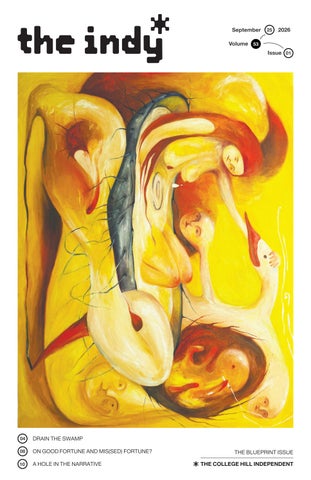
September
25
2026
Volume 53 Issue 01
04
DRAIN THE SWAMP
08
ON GOOD FORTUNE AND MIS(SED) FORTUNE?
10
A HOLE IN THE NARRATIVE
THE BLUEPRINT ISSUE THE COLLEGE HILL INDEPENDENT
53 01
09.25
01 LEDA WORLD Cindy Wang R’28
03 WEEK IN PROVIDENCE Julia Sprung
04 DRAIN THE SWAMP Isabel Tribe
07 WHERE DO WE GLO FROM HERE? Zoe Yu
08
ON GOOD FORTUNE AND MIS(SED)FORTUNE? Joy Chen
Masthead MANAGING EDITORS
DESIGN EDITORS
WEEK IN REVIEW
DESIGNERS
Andrea Li Cindy Li Peter Zettl
Julia Sprung ARTS
Nadia Mazonson Gabriella Miranda Sasha Watson EPHEMERA
Annelie Delgado Elliot Stravato FEATURES
Anika Kotapally Keya Mehra Kendall Ricks LITERARY
Chloe Costa Baker Audrey He Alya Nimis-Ibrahim METRO
Layla Ahmed Isabel Tribe Ben Underwood
10 A HOLE IN THE NARRATIVE
METABOLICS
12 POST MORTEM
SCIENCE + TECH
Mo Saoud
Gabriella Miranda
14 ALIENATION Ray Eggerts
16 INTEGRALS AND DERIVATIVES Katya Michkovskaia
18 TURNING AND TURNING Daniel KZ & Coby Mulliken
19 INDIE-SCRIBABLE DUO
Ray Eggerts Evander Gray-Williams Nahye Lee Daniel Kyte-Zable Coby Mulliken Lila Rosen SCHEMA
Selim Kutlu Mo Saoud WORLD
Caiden Demundo Eric Ma Neda Ravandi DEAR INDY
Ilan Brusso Talia Reiss
BULLETIN BOARD
Sarya Baran Kılıç
Ilan Brusso & Talia Reiss
20 BULLETIN
Sarya Baran Kılıç
MVP
Design Editors
FROM THE EDITORS Conmag, our corner of the world, is beautiful but also rather dirty. Why is the ceiling dripping? How old is the food in the fridge? Why do we have $300,000 in hard cash stored in a safe beneath our table, and why is the code to unlock this box 4839? Apologies, but we’ve started this note with a lie. We will amend our first statement accordingly; we will place it in the past tense. Conmag *was dirty—before we lovingly rubbed grease on our autumn-dry elbows and got down to work. That is to say: We Cleaned Conmag. Amid piles of dusty papers, we found abandoned scarves and sweaters tangled limblike on a corner table (stripped during the bacchanal fests that are copy meetings, we assume), an “Office Hierarchy” mug missing its handle, signs of millennial optimism (Racism Is The Disease Revolution Is The Cure)... Now we gather in a room that is not quite sparkling but glistening a little, though perhaps we are looking at the puddle accumulating beneath the ceiling leak. But that is just one slightly damp point and not the main one. Which is this: conmag is reoriented and ready with open arms and seats to embrace Our Beloved Staff. And you! Change is in the air, and other aphorisms of that nature. By all accounts, it’s giving and taking, and the Indy always gives. What do you want us to give you? If we promise to do it, will you pitch to us?
❤🧢 The content of all News & Publications groups recognized by USC/GSC is generated independently from Brown University. The statements, views, opinions, and information contained in the publication are personal to those of the authors and student group and do not necessarily reflect those of Brown University. The publication is not reviewed, approved, or endorsed by Brown University or its faculty or staff.
02
THE COLLEGE HILL INDEPENDENT
Mary Elizabeth-Boatey Sara Parulekar Kayla Randolph Isabella Castro Dasha Derevianko Caroline Fenton Hongrui Guan Koji Hellman Rose Holdbrook Jordan Kinley Jennie Kwon Soohyun Iris Lee Zara Lagumdžija Mailee Phan Cathy Rong Radhika Tibrewala HEAD STAFF WRITER
Benjamin Flaumenhaft STAFF WRITERS
Carolyn Nakawungu Batabye Sebastian Botero Joy Chen Jacqueline Dean Benjamin Flaumenhaft Lucas Friedman-Spring Kaliyah Graham Paulina Gąsiorowska Mohamed Jaouadi Elena Jiang Annie Johnson Evan Li Nathaniel Marko Ekaterina Michkovskaia Maia Riggs Fatima Shafi Samdöl Lhamo Sichoe Riya Singh Josh Stearns Ellie Wu Ange Yeung Zoe Yu SOCIAL CHAIRS
Benjamin Flaumenhaft Evander Gray-Williams Rachel Sang FINANCIAL COORDINATORS
Sasha Gordon Constance Wang
DEVELOPMENT TEAM MEMBERS
ILLUSTRATION EDITORS
Jaxon Rivera Serena Yu
ILLUSTRATORS
Rosemary Brantley Kieran Campbell Daria Derevianko Joy Dunn Cayden Garrett Koji Hellman Claire Hua Madeline Kim Paul Li Ellie Lin Megha Nambiar Mingnah Ng Camila Salinas Alexandra Sanguinetti Cindy Wang Ella Xu Naomi Zaro Faith Zhao COPY CHIEFS
Kainalu Faucher Jordan Coutts COPY EDITORS
Aram Adler-Smith Nabiha Allahwala Christine Anyanwu Tyki Cantu-Wang Emma Yvonne Chandler Karen Le Emma Mathew Advaith Shyam Ambreen Sidhu Zeke Tesler WEB EDITOR
Casey Gao
WEB DESIGNERS
Julianne Jin Savv Omare Rachel Sang
SOCIAL MEDIA EDITORS
Olivia Falk Inderjot Nijjar
SENIOR EDITORS
Benjamin Flaumenhaft Paulina Gąsiorowska Nahye Lee Nadia Mazonson Talia Reiss Kendall Ricks
Aram Adler-Smith Avari Escobar Maira Magwene Muñiz Mingnah Ng Inderjot Nijjar Alexander Sayette
JOURNALISM LEADS
STAFF PHOTOGRAPHERS
STAFF LIASION
William Bigby Pin Kasemsri
Jacqueline Dean Talia Reiss
DIVERSITY LEAD
Nahye Lee
Nadia Mazonson
*Our Beloved Staff
MISSION STATEMENT The College Hill Independent is a Providence-based publication written, illustrated, designed, and edited by students from Brown University and the Rhode Island School of Design. Our paper is distributed throughout the East Side, Downtown, and online. The Indy also functions as an open, leftist, consciousness-raising workshop for writers and artists, and from this collaborative space we publish 20 pages of politically-engaged and thoughtful content once a week. We want to create work that is generative for and accountable to the Providence community—a commitment that needs consistent and persistent attention. While the Indy is predominantly financed by Brown, we independently fundraise to support a stipend program to compensate staff who need financial support, which the University refuses to provide. Beyond making both the spaces we occupy and the creation process more accessible, we must also work to make our writing legible and relevant to our readers. The Indy strives to disrupt dominant narratives of power. We reject content that perpetuates homophobia, transphobia, xenophobia, misogyny, ableism and/ or classism. We aim to produce work that is abolitionist, anti-racist, anti-capitalist, and anti-imperialist, and we want to generate spaces for radical thought, care, and futures. Though these lists are not exhaustive, we challenge each other to be intentional and self-critical within and beyond the workshop setting, and to find beauty and sustenance in creating and working together.
WEEK IN REVIEW
( TEXT JUL IA
SPRUN
G DESIGN SARA PARULEKAR ILLUSTRATIO N ALEXANDR
A SANGUINE
c Two years ago, I came to Providence. In two years, I’ll leave it. Whatever. The weather’s nice today. There’s salience in the wind—twelve miles an hour. Just yesterday someone told me that I’m easily distracted. You know the type. I gaze at my reflection in the melted remnants of an iced matcha. I am slightly green with the envy of others. Here, my focus lingers. But it’s dear Providence that’s at issue. Whom I am just now so desperate to get to know. This is the place and this is the time. Soon it will be the weather and the shivers and the panna cotta morality of this age. I have a real feeling for this place. Here I have freed the nipple, have bled from the toes… Toes of whom— of the eternal, which does not discriminate between toes and fingers. Fingers and toes. I wax calcific. People seem nicer this year. I lie to you. I haven’t tried very hard at all to know this city, have always been instead content to mock and to mourn College Hill. None of this was my idea. I wanted to write articles about pubic hair and the meaning of the Ratty. Someone asked me to take over this section and I, in a fit of generosity, said yes. I thought that I might write about Self and Time and Place and Self, guided by the Spirit of Review and the Angel of History. Then I learned what Week in Review would in fact entail: some real writing about Providence, a monogamous commitment to the fact. I have historically been averse to such commitments. But it was all proposed in a manner so compelling and warm that I began to attribute to myself a genuine interest in the human spirit, or Providence, or whatever. Apparently, I don’t know that other people have feelings. Somehow, though, I’ve already conceded that Providence is the point. After all, I begin with the tremendous advantage of not knowing Providence. I can’t be cynical about it, can’t even try. There’s nothing stale about my interaction with this city. I’m fresh and floating. A country bumpkin from New York. Bright-eyed and bushy… so soon, I will have known Providence. Oh, to the future perfect. I will have known it and we will belong to each other and knowing it now is something that can stop but we all know that you can’t stop the future. The past rears its pierced and trembling ears. And thus: I’ve had my legs waxed in Wayland Square. I’ve had dinner with a person who really lives in Providence. Twice I sort of went to Federal Hill. I try to walk to the train station and I pay attention to the timetables of the commuter rail. A friend of mine likes to eat out; too much cruel slurping and failed flirtation at PVD Noodle Bar. Another one had her passport renewed in the area. There are grown-ups in Coffee Exchange. I like the Ratty. Its staff reside presumably off-campus. Before the second snowstorm of last winter there was a run on milk and eggs at Trader Joe’s. That felt very real. Very alive to the hierarchy of human needs. At last, something more than College Hill. And that is quite true, because we were in Fox Point. But I hold these memories all the way up my innards, in imitation of the constipated child whose bowels now otherwise run free with quinoa. The past is ambivalent about me; and I quite tenderly resentful of it. We deny each other like lovers who are not certain of how they came to part. But you cannot forget the future. Who needs the poets? 1 We all need milk and eggs. After the snowstorm, I remembered the vegans. The memory of milk and eggs is indeed a little too much for me. It makes me think of mothers. Calves and chicks never have to leave home. “Easily distracted” —moo and please note the passive form of the adjective. Things, et cetera—they distract me. And what was it that first left an impression? Perhaps I am going to tell you about my mother. So what? She’s interesting. Or actually, I’m just going to get my mother to write the rest of this for me. She’s long nursed literary ambitions. She only nursed me for eighteen months. My daughter is a bit of a headcase. Well, that’s what she’s taken to calling herself. Between you and me, it’s just her latest method of avoiding trouble. She’s very cute and extremely special. She’s better than anyone else’s daughter. But it’s also true that she’s a little lazy and, like her father, extremely sensitive. Her little brother is like that too. Because she’s female, she’s become a little tougher. As a baby, in fact, she had quite a high pain tolerance. I’d never seen anything like it. And I am a doctor. Specializing primarily in menopause and hormone replacement therapy, but sexual health is an important part of my practice. She’s asked me to write about Providence, because she has yet to unpack. Apparently, writer’s block has struck. In this sense, she resembles her father. He too is very talented, but things aren’t quite natural for him. They’re deliberate creatures, though she has something of the animal. What can I say about Brown? Sorry, Providence. It’s a good school.
1
“Was bleibet aber, stiften
die Dichter” – but what stays, the poets establish. Friedrich Hölderlin actually lived in a tower, though not the same one from which I now climb down, bereft of eager golden braids. I have dark hair. The Hölderlin story is actually quite unfortunate.
TTI
)
There are opportunities and the students really can wander freely. It’s a good place either to be special or not to be special at all. Nothing in between. Providence is a beautiful city. Nice and safe, for the most part. As a mother, I was really shaken by the shooting. So many good places for coffee. I’m not supposed to talk about restaurants, because that embarasses my daughter. She says that she approves of middleaged prosperity but doesn’t wish publicly to identify with it. She says that she’s lost. I know that she’ll figure things out. Then she makes some bitter little joke about the Puritan street names. Young people just need a lot more sex. Not that I wish to discuss my daughter’s sex life in a public forum. She’s my favorite female and I wouldn’t wish to expose her like that. As my darling beautiful sex maniac who is currently a little too frustrated to plan with any confidence her next move. I was like that at her age. Her intellectual ambitions are, I think, more important to her than she realizes. I love her feeling for Indo-European languages. She told me yesterday that she loves Brown just so much but that here, she thinks, foolishness is the point. Anything worthwhile is just noise. And though I’ve encouraged her in her snootiness, knowing that pretension is impossible for one so naturally gifted, I find in her now this rigid quality that I don’t like. I, too, have a real capacity for suffering. But she is such a fine creature, like her father, and it’s a shame that she makes this false distinction. When young people are having enough sex, there’s no point, just pleasure. Though, as a doctor, I do believe in helping people. This is a shit species. Anyone who loves it is insane. That’s why I don’t mind the incipient nastiness in my daughter. Good taste begins in well-educated despair and nastiness is only the uncaffeinated face of good taste. My lovable little weirdo, who refuses to wear tight shirts. I am back. Relying on your parents is no good. My mother, the arbiter of reality, couldn’t help me out with Providence. She gives pretty good boy advice and sends things to the mail room. She has all sorts of ideas about me. Growing up is one course of action. But I know that I’m not enough. Providence, I tremble toward you. My mind lingers in its place, waiting for a lecture, finding only seminars for which it is too clever, for which it has not read. You’re the best that I’ve got, but I don’t know you at all. I’m beginning to suspect that I like it this way. The question, I suppose, is whether I want what I want—whether this nonsense that I spout about milk and eggs, blood and iron, present and future is a way into reality or out of it. Soon enough I will pass away from this place, but it will remain. How can that be true? How is it that all that matters to me about Providence—the rather picturesque setting that it provides for the movie that no one has yet sought to make about my life—is the one thing that is certain to matter to it not at all? I am hardly a quality of this place. And yet I begin to suspect that I, as I reflect with the aid of great flourishes, am only a quality of myself. A former boyfriend thinks that I have object permanence issues. Fair enough. I am sitting in a room full of noise and everyone postures as though they are the point. No, they do not really think so—look at this bad ginger haircut, that boy standing anxiously erect—but they aim to convince rather than to please. Oppress me up with your superiority, Blue Room randos. I remember some of you from freshman year. I will not say hello. O, my mood, my mind. O, everything that will happen. Fill down my mind as you will. Come, cloaked in falsehood, and do not leave. Providence, you frighten me. I must learn to be convinced, in order to convince. I know only how to please—and how to render wretched. Will I ever really be interested in you? I have given my solemn word, in an email, croaked again through bites of muesli over Google Meet. For all of my preferences, I’m quite scared of saying no. I do not like to become useless, lest things turn away from me. O noble City, I am fairly certain that you and I both belong in the third person. Julia lives in Providence, a city that gestures toward the sky. My mother told me that I came, as a present, from the sky. Did I strike her, like hail, between collar and scarf? But I came from her body, in which I’ve always been a little too interested. It’s so unrelentingly genuine. Thence I came; whither do I go? But I’ve always been convinced that it’s a whence, not a whither. I’m going back, going in, going deep. Can I penetrate my own depths? Am I deep enough to escape myself within myself? And somehow I suspect that my reservations regarding this time and place are the reservations that I am always to feel about the present, in which I am nearly utterly myself. Too much! Relent! And Providence is not the womb—that much I will pretend to concede—but like my mother I sense that it is warm of bust, rude of hip—eye-glass gold glints at me from the spires of its churches. And these eyes do look down on me. I do not know why else they might have learned to see. I get tired of watching myself. I wonder whether they tire of watching over me. JULIA SPRUNG B’28 has a father, too.
VOLUME 53 ISSUE 01
03
WORLD
DRAIN THE SWAMP SWA MP THE NEW RIGHT’S VERY OLD FEAR OF FE M I
Y
( TEXT ISABEL TRIBE DESIGN IRIS LEE ILLUSTRATION MINGNAH NG )
cAnother day in Trumpworld, another bizarre video from the Department of Homeland Security (DHS)’s social media feed. A police officer pops a Zyn while John Wayne’s voice drawls in the background. A Counter-Strike avatar flicks open a butterfly knife, superimposed over a high-speed maritime pursuit. Anonymous armored supercops engage in various supercop activities: operating tactical vehicles, wielding assault rifles, jumping from helicopters, fastening handcuffs, riding horses. “Today belongs to the lions,” thunders an AI baritone. The video is only 30 seconds long, but, like all DHS posts, it is ideologically saturated. A microcosm of the account’s larger project, the video bombards the viewer with a slew of in-jokes drawn from the manosphere’s many overlapping subcultures. Government agents transform into a rotating cast of male archetypes: the Zyn-addicted frat bro, the cowboy, the soldier, the gamer, the bodybuilder. Unifying this patchwork of symbols is a hypermasculine ideal: the MAGA warrior, a man defined by his virility, hardness, and brute strength. By now, the memes churned out ad nauseam by the second Trump administration have been exhaustively scrutinized for their nativist rhetoric and white supremacist dog whistles. Receiving far less attention to date is how obsessively gendered they are. What the DHS social media feed so efficiently distills is the broader aesthetic of the New Right imaginary. Gender is the prism through which the entire MAGAverse— its politics, values, and vision of governance—refracts, from MAHA’s testosterone fixation and tradwives to
04
THE COLLEGE HILL INDEPENDENT
Trump’s “bomb the shit out of ’em” geopolitics and insistence that he is “the fertilization president.” That misogyny is a common denominator in the MAGA movement will come as a surprise to no one. Much ink has been spilled on the rise of Trumpism as a male-dominated backlash against the perceived overreaches of #MeToo-era feminism and increasing gender equality. But we can go further, beyond the policies and podcasts, into murkier, psychological terrain. The memes, the videos, the excesses of online
The rot at the heart of Western civilization, it turns out, is the tyranny of the HR lady and the Montessori kindergarten. verbiage, and even the polemical provocations of the MAGA brain trust suggest a more primal, largely unconscious fear of women: of their soft, permeable bodies, of their emasculating emotions, all of which must be contained and controlled. +++ It’s no accident that women are largely absent from the Trump administration’s social media propaganda. Or that when they do show up, they are almost always depicted as mothers in need of protection or victims of violent crimes committed by illegal immigrants—martyrs to be avenged. Women are
acceptable, so long as they are weak, pregnant, or maidens in distress. Once they enter the workforce, they become much more problematic for the MAGA right. In the words of prominent far-right influencer Bronze Age Pervert (the alias of Yale political science PhD Costin Vlad Alamariu), the “liberation of women” is an “infection” from which the West “can’t recover without the most terrible convulsions and the most thorough purgative measures.” According to Darren Beattie, a Duke political theory PhD turned January 6 conspiracist who has occupied various positions in the Trump administration (speechwriter, policy aide, State Department official): “Competent white men must be in charge if you want things to work.” Such claims are not so different from what Helen Andrews—also a Yale graduate and a woman, no less— argued more decorously in her viral October 2025 article “The Great Feminization,” based on a speech she gave at the National Conservatism Conference last September. As Andrews tells it, when women came marching into the workplace with their rainbow lanyards, passive aggression, aversion to conflict, and, worst of all, their feelings, America’s institutions began to decay from within. “Everything you think of as wokeness,” she writes, “involves prioritizing the feminine over the masculine: empathy over rationality, safety over risk, cohesion over competition.” The rot at the heart of Western civilization, it turns out, is the tyranny of the HR lady and the Montessori kindergarten. It’s no surprise that Andrews’ speech and essay are still racking up views; she provides a veneer of calmly reasoned credibility to a worldview
WORLD
in which the country’s ongoing health depends on its inoculation against femininity—the ultimate source of national fragility and weakness. The gendered fears and fantasies of the government’s social media feeds have their real-world counterparts in the manly men and hyperfeminine women of Trump’s cabinet. Consider Secretary of Defense Pete Hegseth. At a signing of the executive order rebranding his agency as the Department of War, Hegseth outlined its new “warrior ethos”: “We’re going to go on offense, not just on defense. Maximum lethality, not tepid legality. Violent effect, not politically correct.” This jingoistic spoken word poem is tinged with an implicit gender valence, recalling Andrews’ apocalyptic portraits of institutions plagued by the feminine evils of empathy, restraint, and inclusivity. Read between the lines, and a consistent logic surfaces: Power is masculine, weakness is feminine, and the feminine must go. The fixation on fit male bodies runs through the Trump administration and its supporters on the right. When Hegseth is not culling female, trans, or Black officers from his ranks, or railing against the “fat troops” of the “woke” military, he’s posting workout videos that show off his hulking musculature and Christian crusader tattoos. Health Secretary Robert F. Kennedy Jr. also spends a lot of time shirtless on Instagram, chugging milk in a hot tub with Kid Rock or cranking out pull-ups in jeans and hiking boots. Hegseth and Kennedy have even faced off against each other at the pull-up bar, racing to complete 100 pushups and 50 pull-ups in the ultimate display of top dog braggadocio. Though these two men come from opposite backgrounds—Hegseth, the middle-class Midwestern commoner, Kennedy, the blue-blooded scion of an East Coast political dynasty (the type of guy Hegseth resented at Princeton)—they are united in a shared quest: the rescue of American masculinity from the enervating effects of feminization. Kennedy has framed falling testosterone levels and plummeting sperm counts in young men as an “existential” threat to humanity. Senator Josh Hawley, a Missouri Republican, blames the left for labeling traditional masculinity “toxic” and pushing men into an “enclave of idleness, and pornography, and video games.” On the campaign trail in 2024, Trump spun paranoid tales of boys going to school and returning home as girls: “Imagine you’re a parent, and your son leaves the house, and you say, ‘Jimmy, I love you so much, go have a good day in school,’ and your son comes back with a brutal operation?” Emasculated by the womanly cancers of liberalism, transgenderism, and DEI, men are cast as a threatened species at risk of extinction. Jimmy needs to cowboy up, get on testosterone, and hit the gym. Like their male colleagues, the most high-profile women in Trump’s original cabinet—Kristi Noem, Pam Bondi, and Tulsi Gabbard—appeared as walking gender caricatures pushed to campy extremes. With voluminous hair, smoky eyes, and pillowy lips artificially frozen into a perpetual pout by rounds of cosmetic enhancement—a look known as “Mar-aLago face”—these women dispensed with the androgynous pantsuits of the Clinton-era girlboss in favor of the pageant queen’s exaggerated femininity. Still, none of them lasted. In just three months, Trump’s cabinet lost four women: Kristi Noem and Pam Bondi were fired, while Tulsi Gabbard and Labor Secretary Lori Chavez-DeRemer resigned. All four women have been replaced by men. It is not much of a stretch to see these oustings as symptoms of MAGA’s squeamishness when it comes to gender contradictions. Expected to look like Barbies but act like men, these women were caught in the impossible bind of performing feminine submission while running executive agencies. (“To a true chauvinist—and there are plenty of these in the Trump coalition,” critic Becca Rothfeld notes, “both a girlboss and a tradwife are sub-human pregnancy
machines.”) Secretary of Homeland Security Kristi Noem’s gender transgressions were perhaps the most egregious. While she posed in front of “Alligator Alcatraz” and tagged along for ICE raids in full tactical gear, stealing too much spotlight from Trump, her husband was at home stuffing balloons under his shirt and being dominated by women in the “bimbofication scene.” This gender inversion, though it neatly aped MAGA’s hammy gender binary (strong, hard men; soft, big-breasted women), amounted to an untenable breach. The Noems were out. +++ There is a precedent for this phenomenon—1930s Germany, another period of aspiring strongman rule—and a theory to go with it, promulgated by German sociologist Klaus Theweleit in Male Fantasies, his dissertation-turned-bestseller first published in the 1970s. At the root of authoritarian politics, Theweleit contends, lies a terror of femininity. In an attempt to understand the psychological origins of fascism, Theweleit methodically dissected more than 250 memoirs, novels, and journals written by members of the Freikorps, a collective of roving mercenaries that formed in the aftermath of World War I and ultimately became the militant vanguard of the Nazi movement. What he found, in page after page, was a lust for violence inextricably coupled with a revulsion toward women. In The Nation Awakes (Aufbruch der Nation), a 1929 novel by World War I veteran Franz Schauwecker, for example, the sight of a naked woman sends the book’s soldier protagonist into a baroque delirium of horror and death: “With a jolt his breath rushes into his blood, filling it with pearls of pure, quivering bubbles, a gushing froth, just as the blood of men shot in the lungs leaves them lying yellow and silent like corpses.” A nationalist, pro-war manifesto and ode to trench-warrior masculinity, the novel allegedly moved Joseph Goebbels to tears. In the 1937 autofictional novel Rebel Mountain (Der Berg der Rebellen) by Kurt Eggers—a Freikorps member who went on to become a soldier for the SS—the narrator revels in the annihilation of women. “With their screams and filthy giggling, vulgar women excite men’s urges,” Eggers writes. “Let our revulsion flow into a single river of destruction. A destruction which will be incomplete if it does not also trample their hearts and souls.” Theweleit’s book goes on in this manner, accumulating seemingly limitless examples of the Freikorps’ femicidal fantasies, often evoked via liquid metaphors—the swamp, the flood, the tide, the flow. As Theweleit’s meticulous psychoanalytic reading reveals, in the Freikorps’ work, the female body is a deluge that threatens to engulf the male ego. Fascism, his argument goes, emerges as a response to this dreaded dissolution, a ritual armoring of the male self into an impenetrable “man of steel” that culminates in an explosive release of violence and destruction. Theweleit intended his book as both a historical analysis and a warning. For him, the fascism of the Freikorps was not merely a political phenomenon but a potential always lurking in the interactions of men and women. “I don’t want to make any categorical distinction between the types of men who are the subjects of this book and all other men,” he writes. “Our subjects are equivalent to the tip of the patriarchal iceberg.” Male Fantasies teaches us how to read for these unconscious, misogynistic fears wherever they bubble up, cueing us into the language, imagery, and fixations that betray the psychosexual fascist drive. The New Right is not known for its literary prowess; its creative production is primarily digital. Instead of novels, MAGA expresses itself through memes—works of the imagination which are as revealing of the minds behind them as the Freikorps’ texts are of their authors’.
Viewed through Theweleit’s template, the DHS social media feed becomes a window into the collective MAGA unconscious, abounding with eerie echoes of the Freikorps’ gender neuroses. A screenshot of soldiers operating a tank from the video game Halo is accompanied by the words “Destroy the Flood,” a reference to illegal immigrants that recalls Trump’s mantra “Drain the Swamp” but could just as easily have come from the pages of a Freikorps autobiography. Like the dreaded liquidity of the female body, the immigrant is one in a surging, nameless mass that promises to invade the nation’s porous borders. In another post, a skeleton deadlifts a barbell beneath the words “My body is a machine that turns ICE funding into mass deportations.” Excised of its fleshy softness, the skeleton is the male body hardened to the extreme, a “machine” optimized for expelling the seeping influence of the feminized other. Living under an administration where trolling is the de facto official sport, you might be tempted to write off the shitposting as ragebait designed to trigger pearl-clutching libs who can’t take a joke. That is certainly part of the ethos. One White House post gleefully reads, “oMg, diD tHe wHiTE hOuSE reALLy PosT tHiS?” But the carnival of memes is more Trojan horse than dog and pony show: Couched in the slippery rhetoric of a joke, a very real and very misogynistic agenda—one shaped by an arcane but influential network of far-right thinkers—is being advanced. In her seminal 2025 book Furious Minds: The Making of the MAGA New Right, the political theorist Laura K. Field traces the ascendancy and radicalization of a new movement of conservative academics, thinkers, and influencers who have coalesced behind Trumpism, mapping out the anatomy of institutions and actors who would become the intellectual architects behind January 6 and Project 2025. Threaded through this network is what Field terms the “Hard Right Underbelly,” a group of edgelords with provocative noms de plume—including Bronze Age Pervert (BAP) and his “bro scientist” counterpart Raw Egg Nationalist (REN)—many of whom openly call themselves racists, misogynists, and fascists. The theorists of the New Right are united in their rage against the feminized liberal bureaucracy, for which they have a slew of epithets—the gynocracy, the longhouse, the childless cat ladies—and seek, essentially, to replace democracy with rule by iron fist.
VOLUME 53 ISSUE 01
05
WORLD In these circles, irony and humor are deliberate strategies, used to slather extremist ideology in plausible deniability—a memeified 21st-century update to fascism’s previous, more covert manifestations. Curtis Yarvin, a software entrepreneur and reactionary blogger (and Brown graduate), believes America needs absolute monarchy, his pet alternative to fascism (because the fascist dictator, unlike the king, is constrained by his dependence on a base of popular support). Yarvin has fans in JD Vance, Steve Bannon, and Elon Musk—whose DOGE movement seems partly copy-pasted from Yarvin’s RAGE policy (Retire All Government Employees). For Yarvin, irony is a critical tool in the neo-monarchist playbook. As he helpfully advises, the “entire project of 21st-century monarchism” should be “both utterly ironic, and completely sincere. Every part of making it happen will feel like a joke. The result, however, will be completely real—both sincere, and irreversible.” When viewed in this light, the Trump administration’s cringy slopfest assumes a chilling, noxious edge. Bronze Age Pervert, whom JD Vance follows on X, seems to have heeded this counsel. Bronze Age Mindset, his vitriolic, self-published screed, is rife with megalomaniacal claims, Nietzschean posturing, and rabid bigotry of all stripes—even Michael Anton’s otherwise sympathetic review of the book for the Claremont Review of Books contends that it is “racist,” “anti-Semitic,” “anti-democratic,” “misogynistic,” and “homophobic.” However, as Anton (former Trump administration official, Project 2025 contributor, and one-time adopter of the pen name Publius Decius Mus) shrewdly suggests, BAP’s repugnant rhetoric serves to “provide air cover for the outrageous things he means in deadly earnest.” As Graeme Wood wrote in The Atlantic, “those capable of reading him without being rage-blinded quietly learn from him and heed his advice to bond, network, and plot.” Bronze Age Mindset—which has been described as a Trumpworld “cult book” by one former White House official—is the stuff of Freikorps nightmares. BAP inveighs against the “gynocracy,” his term for bureaucratic, egalitarian, and democratic society, which he views as a modern reprisal of prehistoric “longhouse” communalism, a system of matriarchal tyranny under which men were cowed into submission by “obese mammies.” Alternately referred to as a “global slave state” and an “iron prison,” the “gynocracy” is depicted as a “putrid evil dripping blood from its claws and seeking the dissolution of all higher life, spiritually and biologically, to the amorphous muck
06
THE COLLEGE HILL INDEPENDENT
of the primeval swamp.” To submit to the “Venus Willendorf and all ‘earth mammies’” is to be reduced to a “surfeit of flesh” plagued by “spiritual obesity,” to rot in the “fetid valleys” and degenerate into “yeast life.” At the heart of BAP’s lurid diatribe is the same primal fear Theweleit locates at the center of the fascist impulse. In the foreword to the English edition of Male Fantasies, essayist Barbara Ehrenreich writes, “this hatred—or dread—of women […] is a dread, ultimately, of dissolution—of being swallowed, engulfed, annihilated. Women’s bodies are the holes, swamps, pits of muck that can engulf.” Channeling the Freikorps, BAP argues that the apotheosis of society is the military state and promotes a “regime of sun and steel” (tanning and lifting) through which men can expunge themselves of all traces of the feminine and become the idealized bronzed and brawny warrior. As Field succinctly puts it, BAP’s “life’s goal appears to be to inspire bodily and military strength among young white men” and to “weaken or destroy everyone else, especially women.” The same could be said of Raw Egg Nationalist, the pseudonym of hard-right influencer and Oxford PhD Charles Cornish-Dale, whose extremist conspiracies were mainstreamed by Fox News in Tucker Carlson’s 2022 histrionic mockumentary The End of Men (and whom JD Vance also follows on X). REN is similarly preoccupied with the fattening and enfeeblement of American men, according to him, the product of “soy globalism,” a secret cabal of globalists working to weaken bodies and destroy nations. (“Just to be clear,” REN writes, “what we are dealing with is not a conspiracy theory.”) The plot to decrease sexual dimorphism can be combatted via bodybuilding and the “slonking” of raw eggs to boost testosterone, as he proposes in his book, The Eggs Benedict Option. This bizarre cookbook was released by Antelope Hill, a fascist publishing house better known for its translations of Nazi literature, including Eggers’s Rebel Mountain (they offer a discount on Hitler’s birthday— code “birthday boy”). Undergirding REN’s paranoid masculinity is, no surprise, a distaste for women. “Maybe men and women shouldn’t work together in the same spaces,” he suggests. Investigative journalist Katherine Stewart neatly sums him up: “Once you get past REN’s abstract world-historical patter about globalism and the agricultural revolution, it becomes clear that the real issue for him is women.” The real issue for all of these men is women, and they are acting on their quest to control and contain women’s bodies. The media has extensively covered
the concerted effort to strip women of their bodily autonomy, restrict access to reproductive healthcare, undermine Title IX protections, and repeal DEI programs. But there are also mounting calls on the right to roll back no-fault divorce, permit gender discrimination in salaries, criminalize homosexuality, install head-of-house voting, and strike down the 19th Amendment. White nationalist influencer and zealous misogynist Nick Fuentes’ suggestion that women be sent to “breeding gulags” is especially nauseating when paired with Louisiana Representative Danny McCormick’s tweet of a pregnant woman’s belly, accompanied by the words, “This is the ideal female body, you may not like it, but this is what peak performance looks like.” Though JD Vance has now recanted his infamous comment that the country is being run “by a bunch of childless cat ladies,” he has also made it clear that he likes his wife, Usha—a Yale JD—to stay home and breed; he recently persuaded her to have another baby, their fourth. +++ Once you tune in, it is impossible not to hear the Freikorps’ language everywhere, to sniff out the compulsive fear of the feminine roiling away in the MAGA mind. Here is Trump, presenting the Commander-in-Chief’s Trophy to the U.S. Navy Midshipmen football team in March, where he lavished praise on the team’s co-captain, Landon Robinson, a man “so strong that the team had to special order a longer barbell.” At the ceremony, Trump indulged in one of his favorite hobbies, fawning over Robinson’s arms of “steel.” For the President, squeezing the midshipman’s taut bicep functioned like Proust’s madeleine, the trigger for an outpouring of charged words and images. Out tumbled the migrating floods and flows, the ambiguous bodies, female contamination—the entire MAGA unconscious on florid display. “The Democrats keep pushing these things,” Trump said. “Open borders, transgender for everybody, and they want to have men playing women’s sports.” He twisted to gaze at the cadet while the audience laughed. “Think we could have a woman take your position?” he asked. “I didn’t think so. You know, we’re trying to end that.”
ISABEL TRIBE B’27 is writing from the swamp.
SECTION LITERARY METRO
WHERE DO WE GLO FROM HERE? “STICKING POINTS” IN THE GRADUATE LABOR ORGANIZATION’S CONTRACT NEGOTIATION ( TEXT ZOE YU DESIGN ISABELLA CASTRO ILLUSTRATION SERENA YU ) c On June 30, 2026, the 2023–26 Collective Bargaining Agreement (CBA) between Brown University and the Graduate Labor Organization (GLO), a union at Brown for graduate workers, expired. The negotiation process to formalize a new agreement for the 2026–29 term has been ongoing since February. Both parties remain in limbo over what GLO considers three main “sticking points”: a stipend increase for GLO members, logistics of the grievance procedure, and Brown’s official adoption of graduate fellows as employees. Until the new contract is finalized, Graduate Student Employees (GSEs) continue to be paid $52,198 annually under the terms of the expired CBA. During negotiations, GLO proposed a 36.8% compound raise over three years (amounting to $71,786), which Brown countered with a proposal of a 6.7% compound raise over five years (amounting to $57,008). These negotiations are happening at a time when Providence is listed as one of the least affordable cities in the country amidst a nation-wide affordability crisis. Nicolas Heliotis, a fifth-year Philosophy PhD student, spoke about academia as a marriage of work and passion. “In addition to us providing services to Brown, as students, we’re really happy to be here. If we’re doing our jobs properly, I hope that shines through to the undergrads. The fact [is] that people do what they’re doing because they’re passionate about it,” Heliotis said.
Although GLO put forward its proposal to Brown on February 23, the University responded with their first counter-proposal in late April. GLO shared in a July 3 Instagram post that “Brown itself took 77 days after bargaining began to put forward its first wage proposal and responded to just under half of GLO’s initial proposals on the last day of the contract.” GLO members hold that Brown anticipated the impasse. In an interview with The College Hill Independent, Adrianna Layne, GLO’s Communications Chair, said that at monthly labor management meetings between February and April, Brown had hinted to the union that they were going to be “unhappy with [Brown’s] counter.” The July status update anticipated that “[they] would likely encounter a number of points to work through in sessions,” leading Brown to propose an earlier start. Moreover, Layne remarked upon an instance where Brown and GLO’s professional “courtesy” differed with respect to adhering to mutually agreed Bargaining Ground Rules, one of which requires that “all initial and counter proposals must be in writing and exchanged at least 48 hours before the bargaining session.” “The way we typically would read that is 48 business day hours,” Ziegler remarked. “[Brown’s] management actually ended up violating our ground rules because [their submission] was not, in fact, 48 hours before. Their guy in the session was like, ‘Well, you’re not supposed to review these,’ and we go, ‘Well, what are we here to do if not to discuss the proposals you sent?’”
+++
“It’s only that I worry that the passion itself becomes basis for us getting screwed over when it comes to how much we get paid, because, if we are so passionate about it—this is the dream thing we want to do, and Brown knows that—they can lowball us when it comes to how much we get paid,” he added. This tension between passion and labor makes managing a work-life balance difficult for many graduate students, according to GLO Organizing Director and third-year Pathobiology PhD candidate David Firer. “‘Publish or perish’ is associated with grad students and faculty, but also you often hear a rhetoric of, ‘You must overwork. You must make this your whole life because you are now dedicating your life to this learning.’ In doing so, people often forget we have to maintain our own livelihoods,” he said. “We do go in [to bargaining] with eyes wide open that grads have historically been underpaid,” GLO President Michael Ziegler commented. “The [Brown] management line is that ‘Our grads are among the best compensated in the country.’ Okay, well, that might be true. But in any field, if there’s a class of workers that’s historically been underpaid, being the best out of the underpaid group still means you’re underpaid, particularly for the work we’re doing.”
+++ While bargaining began in February 2026, road bumps emerged in Summer 2025 when “the union declined” the University’s invitation to begin negotiations, according to a Today@Brown bargaining status update released on July 1. As reported by the Brown Daily Herald, Ziegler shared that the union decided to hold off negotiations until February to allow sufficient time to field opinions among union members before entering negotiations and to adhere to the previous timeline: The contract had been negotiated from February to June 2023.
While GLO serves all graduate students, there is a distinction between how Brown treats graduate students on fellowship versus non-fellowship. Graduate fellows, as officially defined by Brown’s Graduate School website, are graduate students who are awarded fellowships through a “departmental nomination process.” They spend their time on coursework, research, and dissertation writing. Across all disciplines, students typically start as a fellow their first year, take up teaching positions in their second and third years, then enter a year-long fellowship status again in their fourth or fifth years. During the academic year, approximately 600 fellows work at Brown. In the summer, the number of fellows can increase to more than 700 when a vast majority of graduate students enrolled in humanities or social sciences programs are put on fellowship. GLO’s proposed contract recognizes fellows as employees, largely in response to a series of 2025 interviews in which more than 70% of fellows expressed a desire to join the union. Rhode Island House Bill 5187, passed in July 2025, expands the definition of “employee” to include any “teaching assistants, research assistants, fellows, residential assistants and proctors.” Despite that, Brown’s recent counterproposal regarding the “Recognition and Bargaining Unit Description” excluded “Fellows” from the Bargaining Unit—GSEs eligible for bargaining participation and inclusion under the contract. Graduate student workers are categorized as GSEs (Teaching Fellows, Teaching Assistants, and Research Assistants), proctors, or graduate fellows. These roles carry similar responsibilities, but according to the July 1 status update, graduate fellows “receive Brown funding exclusively in support of their academic work, with no exchange of services performed for the University” and are “therefore not eligible employees.” University Spokesperson Brian Clark reiterated this reasoning
to the Indy when asked why the Bill 5187 definition has not been adopted by Brown. Fellows are promised the same stipends as standard GSEs, as outlined in “Side Letter of Agreement” in the 2023–26 CBA. Brown’s fellowship website also outlines that graduate fellows “receive a stipend, full tuition, a health-services fee, and health insurance.” Heliotis, who is currently on fellowship, said, “My stipend hasn’t changed. It’s a little vague to me what exactly Brown loses by recognizing fellows because in a way their position was, ‘We’re gonna treat fellows just like we treat regular in-Unit grad workers.’” Fellows get paid the same stipends and receive health insurance benefits as GSEs included in the Bargaining Unit. However, a student’s categorization greatly influences certain processes, such as the grievance procedure.
+++ When GSEs perceive a contract violation—from small infractions like disputed academic assessment to grave offenses like harrassment—they have two options for filing a grievance procedure with Brown. GSEs are able to utilize the union grievance procedure as outlined by the CBA, or opt for an internal grievance procedure, which Brown refers to as the Graduate Student Grievance Procedure. Graduate fellows are excluded from the union grievance procedure because they are not GSEs. Brown introduced additional limitations on this procedure’s use through their August counterproposal that stated grave offenses must be dealt with via internal investigation— with no third-party arbitrator present to determine whether a violation occurred. These offences are class discrimination, harassment, and sexual misconduct. GLO prefers unmitigated access to the union grievance procedure because it allows for a third-party arbitrator. According to the current 2023–26 CBA, the third-party arbitrator’s findings are “final and binding upon” Brown and the parties involved. In contrast, the internal grievance procedure is broken up into the “Program Level,” typically operated by department, and the “Graduate School Level,” handled by the Dean of Graduate School. Both procedures have their own committees that determine whether a violation occurred; however, there is no mention of what will be done with such findings.
+++ While bargaining meetings between GLO and Brown have continued since the August counterproposal, the two parties remain deadlocked. In the meantime, graduate students continue to provide integral services to the Brown community. As Firer said, “I think personally a lot of folks forget, especially among university leadership, that we do the work that keeps the university running, whether that is teaching, whether that is doing the research that brings the money into [the] school, that brings the donations in as well.”
ZOE YU B’27.5 thinks about how innocuous differences in contract language could have ramifications on real people.
VOLUME 53 ISSUE 01
07
FEATURES
ON GOOD FORTUNE AND MIS(SED) FORTUNE? VIGNETTES FROM PROVIDENCE’S SUPER-HUGE ASIAN SUPERMARKET ( TEXT JOY CHEN DESIGN ZARA LAGUMDŽIJA ILLUSTRATION MEGHA NAMBIAR ) Due to privacy and safety concerns of interviewees,pseudonyms have been used to replace their real names. Conversations with “Tom,” “Sam,” “Jeanie,” and “Alan” are also partial translations by the writer from Mandarin/ Cantonese to English. c Good Fortune Supermarket loomed large on 101 Cadillac Drive amidst a series of smaller local businesses and meat shops. It was September 2025, and rows of glistening roast geese hung from stands. The walls were stacked high with foldable tables and tiny plastic stools. The familiar grandparent scent of Chinese medicine filled the hallways and at once, reminded me how far away from home I was. Good Fortune, as a grocery store that sells Asian wares in a majority-white state, acts as an essential cultural and economic anchor for Rhode Island’s Asian and Latino communities. Dialogue faded in and out as I walked around the store: Chinese dialects (mostly Toishanese and Mandarin), Spanish, English, and sometimes Vietnamese. In the background played a mixture of sad Taiwanese pop (disturbingly heavy amounts of Jay Chou), sprinkled with some ’80s Cantonese songs. There was also a week when “WAP” by Cardi B played occasionally at the front of the store. Historically, ‘ethnic’ grocery stores served as vital cultural anchors for immigrants, providing economic opportunities amidst exclusion from certain workplaces, as well as access to familiar foods, languages, and social interactions. They acted as temporary refuges from the cultural dissonance of life in a new country—and as safe spaces for political activism to propagate. Amidst escalating vigilance on immigrant communities in the United States, culturally specific urban food spaces and ‘ethnic enclaves’ have come under scrutiny as sites of racial and cultural negotiation. +++ “Ask away, I’ve got nothing to hide.” Already slightly balding, chubby, and with a delighted smile across his face, “Alan” first introduced himself to me as the general manager of Good
Fortune Supermarket. It was October 2025 and we sat face-to-face in his office, tucked away in the back of the store, and hidden behind mountains of cardboard boxes. His arms rested on a large, dark wooden desk, gleaming with shellac, and finished with ornate designs characteristic of the elderly Chinese. Save for the wall full of monitors displaying live surveillance footage of the entire store, the rest of the office was bare. Alan closed the door behind us as we sat down. He asked me how this worked, stating that he’s “never done an interview like this before.” Alan moved from Guangdong Province to New York City when he was five years old. Now, in his late 20s, Alan lives in Rhode Island and works full-time at Good Fortune Supermarket. He told me his favorite way to spend his rare moments of free time is playing League of Legends. He started working at Good Fortune in 2023: “This is pretty much my first real job. Before, I would only work part-time in Best Buys and GameStops and stuff like that.” After Alan graduated with an undergraduate degree in information security—which he expressed was a path that he followed not out of passion but to appease his parents—he described feeling lost. He made no attempts to find a job or “do anything else.” Instead, he talked about how he spent time at home, hung out with friends, and played video games. One miraculous day, his sister, who was friends with the manager at the time, introduced him to a job at Good Fortune Supermarket. When asked about his cultural identity, Alan told me that growing up he felt more American than Chinese—the latter, he only felt “20%” of his identity belonged to. “I think it’s because my mom and dad [were] always at work…and even on off-days, they couldn’t spend time with me because they had other things to do, like chores, groceries, and other things to take care of,” he said. Alan confessed that working here helped him learn more about his culture than living with his family ever did. Through constant conversations in Toishanese, stories about times long-passed, playful reprimands, and discussions about superstition, he felt he was re-learning what he missed in his childhood. +++ “Here’s where I keep all the things that children leave behind at my desk,” “Sam” said, opening up a drawer next to the cash register to reveal an assortment of small stuffed animals. Sam is Taiwanese and moved to Texas in his adolescence. He joked that he ended up in Rhode Island because one of his friends “conned him” into coming to live with him. According to Sam, a lot of his job at Good Fortune consists of him “being really OCD” and ensuring that everything is aligned properly. Good Fortune is known around Rhode Island as one of the cheapest large grocery stores in the state; that is precisely why many of the customers I spoke to chose to shop there. Eggs are $1 a dozen, and
08
THE COLLEGE HILL INDEPENDENT
chicken drumsticks are $1 per pound. However, they also carry specialty items popular amongst younger people—especially wealthier Brown and RISD students—$1.99 for one small box of Pocky, $5.49 for one bottle of Wang Lao Ji Herbal Tea Drink, $2.99 for a bag of Haw Flakes. “At the start of every month, it gets crazy in here because that’s when everyone comes in to use their food stamps […] Sometimes people will come in buying lobsters and steak with their stamps, and I’ll be sitting there checking out their groceries, thinking, damn, I’m working so hard and eating so sparingly, and they’re not working but still eating like kings,” Sam laughed bitterly. “I guess this is where all my tax money is going.” Still, Sam organizes the different ramen sections to benefit low-income customers, placing the more expensive Korean and Chinese ramen in the front of the store, and stashing the more affordable ramen brands such as Indomie in the back. “This is so that the wealthier customers will come by and only see these expensive noodles, while poorer regulars know where to find the cheap noodles,” Sam said. +++ When I returned to Good Fortune on October 22, 2025, the store was suddenly full of security guards—uniformed, batons in hand, next to the pink Pocky stick displays. “Some people might take advantage of this situation [government welfare cuts], you know, they might use it as an excuse to go on a riot or cause some trouble,” Alan said, explaining the Good Fortune management’s decision to increase security measures within the store. According to Alan, a large percentage of Good Fortune’s customer base relies on Supplemental Nutrition Assistance Program (SNAP) benefits. And in the beginning of October 2025, when I revisited Good Fortune to find the amplified security there, the Trump administration had recently threatened cuts to SNAP, which provides federal aid to help feed millions of families. These threats were realized on October 26, 2025, when amidst government shutdown, the U.S. Department of Agriculture posted a notice stating that “the well has run dry” and that no regular federal food aid benefits would go out on November 1. Confusion and fear reigned among at least 12% of the U.S. population who rely on monthly SNAP benefits, with this number increasing to 12.9% in Rhode Island alone. Alan continued justifying the increased surveillance. “Before November 1, people already did not have enough stamps to pay for their food, so there was a lot of looting, especially in New York. They were looting Walmart, Target, big places like that. So me and the managers, we had a discussion and agreed to have more security. Get more protection. If there’s anything, security can handle it, right? They can stop and call the police, detain some of them,” Alan claimed.
FEATURES
Perhaps Alan, in his mention of “looting” was referring to the wave of falsified TikTok videos that emerged in late October, which claimed that SNAP recipients were threatening to loot grocery stores if food stamp payments were delayed. Alan did admit that the cuts had dealt a severe blow to the business. According to him, before November 1, food stamps made up a big portion of the store’s revenue, with the store making at least $10,000 on the first day of the month. While afterwards, there was a sudden drop by 80% to around $2,000 for the same timeframe. “It’s bad for business, and it’s also bad for the people that desperately need [SNAP benefits] to access food. I hope that the government will open up so that people can get food, and we can get the business going.” +++ With a store management so openly protective and proud of their large immigrant employee and customer base, the possibility of bringing policemen into a store seemed counterintuitive to facilitating a safe environment—especially in addition to the underlying tensions of increased ICE activity and food insecurity. Alan shared that many customers and employees were concerned about having their IDs checked on the streets—regardless of their legal status. “Our employees are scared that [ICE] might come after
them […] that they might come after their neighbors in this area. Fear plays a lot of factors in business too. If they’re scared to come out, they’re gonna stay home,” Alan said. +++ “Tom” is an elderly Chinese man who introduced himself to me as the “boss” of Good Fortune’s vegetable section, though he did so only after a few minutes of coaxing by Alan and with great suspicion on his part. After a few minutes, we got to chatting about China. “I miss home, when was the last time you got to go back?” Tom looked at me inquisitively, hands busy with organizing heads of cabbage for display. According to Tom, a lot of Chinese immigrants left home during the Chinese Cultural Revolution to avoid the famine and other harsh restrictions imposed by Mao’s regime. But unlike many of his coworkers, Tom told me he came to the United States because he fell in love with an American woman back in Hong Kong. He also prefers the cooler weather here. Tom smiles at Alan, who has his arm slung around his shoulders. “The conditions for Chinese immigrant workers are so much better now than they used to be,” Tom told me. When he first came to the United States, working in a Chinese restaurant was the only option available to him due to language barriers. He was often exploited by his bosses, who would overwork and underpay him. “I still wake up very early in the morning to come to work, but I am paid so much more. We also often get breaks in the afternoon to drink tea with our coworkers,” Tom said. Hearing this, I’m reminded of something Sam said to me earlier: “Working with older
employees can be frustrating,” he confessed. “They like to live a slow life. It’s hard to manage them. I need to coax them into spending less time drinking tea together. Sometimes they will take tea breaks that last hours, and I have to remind them that they are on the clock.” He laughed to himself. Tom taught me how to cut the bok choy properly (X-Acto knife, two to three cuts maximum at the stalks, and prepare them for sale. Fill the plastic bag as much as you can, then twist it rapidly in mid-air, one hand on each side). He gushed about the invention of the X-Acto knife: “In the older days, I had to use an actual vegetable knife, and it was so hard to carry around. Now, I can just slip the blade in and out and put it back in my pocket. It’s so convenient.”
bus to sit next to me on the sidewalk. “Ah, I wanted to take a break anyway.” Worried that the bus had already left, I asked, “Do you know when this bus is meant to head out?” He looked me up and down and laughed. “Relax, girl, we’ll get you home! I’m just taking a breather because I’ve been driving since the morning.” He stretched his arms out and leaned back. “James” moved to Providence from the Dominican Republic in 1991, and has been on this line since January 2025. He recommended that I go to the Chinese grocery store, Good Fortune Supermarket, because it was “really cool.” He said that the store had been there for 7–10 years and that he had driven in this area for so long that he had seen everything change. Good Fortune used to be a car dealership, then another business that he couldn’t recall the name of. He offered to show me photos of the changes in Providence on his phone while he drove, but I was worried about distracting him, so I politely declined. “No, please, I really want to show you this. I’ll tell you my phone passcode and everything; don’t worry, I trust you not to snoop too much.” It took me a few more minutes of pleading with him, assuring him that his phone security was not the issue, to keep him from scrolling while driving the huge bus through pothole-ridden roads.
+++
+++
“Jeanie,” a pink-haired Cantonese woman who works in the fruit section, also liked to use the X-Acto knife. It seemed like something the whole store agreed on. As I walked past her, she was slicing a peach for her coworker and gossiping to him in English. She looked straight at me and insisted that I must try a piece too. The first piece she cut slipped out of her hand onto the ground. Immediately, she cut another piece and brought my hand closer so that it could fall into my open palms. She told me that the harder ones are better, and that the softer ones are bad. A customer came by and looked at me, asking in Cantonese if the peach was sweet. Hearing her home language come out of my mouth in response, Jeanie’s face lit up: “Your Cantonese is so good! I have two daughters like you, but they’re already out of college. One is 30 and one is 25.” I was shocked. I assumed she was only 30 years old herself—which I told her. When asked how she stays so young and healthy, her advice was to “exercise and be happy,” because “if you’re not happy, you’ll get sick.” +++
When the store got too loud, or I started to feel creepy roaming around in circles for hours, clearly eavesdropping, I would hide in the back with the good fortune papers and incense joss sticks, just to breathe. Other times, I would end up next to Sam’s register. “Want a snack?” he would call out to me as I walked into the store, displaying his new offerings for the week. He told me he was slowly making his way through all of the snacks that the store offered, testing out a few per shift. I took a two-week hiatus to focus on midterms. When I walked into the store, the automatic sliding doors let the cold December air leak in. I was immediately flagged down by Sam, whose register was directly next to the entrance. “You’re finally back! Did you get a boyfriend or something? Why don’t you come around anymore?” JOY CHEN BRDD’29 is still hard at work on her bok
choy-bag-wrapping skills.
Rhode Island’s early Chinese community was largely rooted in immigrants from Toishan, Guangdong Province, who arrived around 140 years ago. Due to systemic racism, many Chinese immigrants were barred from legal employment. As a result, Toishanese immigrants built their livelihoods around independent businesses in areas such as Providence’s historic Chinatown. Like most of the East Asian demographic who work at Good Fortune, Alan’s family is Toishanese. Alan notes a shift in his voice when he speaks the language. “You know, I don’t feel like this when I speak Chinese. I speak more aggressively. You might think I’m talking bad about you, but I’m not. I’m talking normally,” he said. However, not every Chinese immigrant speaks Toishanese. Once, Sam confided in me that he felt excluded from the store gossip because he speaks mainly Mandarin. Since he started working at Good Fortune, Sam had noticed the linguistic divides that run through the store. He recalled how some of the employees only speak with the Cantonesespeaking employees and customers, or other East Asian–looking people. “There’s even Google Reviews about this issue,” he said. +++ As the RIPTA rolled into the station across the road from Good Fortune, the driver stopped, saw that I was the only one waiting at the station, and got off the
VOLUME 53 ISSUE 01
09
A Hole in the Narrative SCHEMA
A TOPOLOGICAL READING OF REDLINING IN PROVIDENCE c In 1936, a federal surveyor from the Home Owners’ Loan Corporation (HOLC) drew a red line around Mount Hope in Providence, deeming the majority Black and working-class neighborhood as “hazardous.” The government’s mortgage-lending agency’s rating steered banks away from lending to residents of the area. Thirty years later, the Providence Redevelopment Agency (PRA) leveled the homes that comprised Mount Hope for a freeway and a USPS ① warehouse. During this period, Black residents made up about a third of everyone displaced by urban renewal citywide, although they made up around 5.8% of Providence’s population in 1960. Even today, the majority of eviction filings in Providence target people of color ②. It is tempting to say that the boundaries the government drew in 1936 have since been erased, as redlining is no longer an explicitly enforced policy. In reality, the boundaries were traced over in the 1960s, and have since been transposed onto maps of high evictionfiling rates to encompass Black neighborhoods. It’s more accurate to call this process a deformation. The distinction between erasing and deforming a shape is central to a mathematical tool this piece is going to borrow, formally called topology. Topology is an approach to geometry that ignores size, shape, distance, and appearance, and asks only one question: What characteristic remains unchanged when a shape is stretched, twisted, or crumpled? To a topologist, a square and a circle are the same object because you can squish one into the other without ever tearing it; following the same logic, a coffee cup and a donut are topologically equivalent because they each have one hole piercing them ⑤. Topology throws out the intuition most of us use to judge sameness, and asks us to think critically about the different invariants that distinguish an object. What it cares about is whether two things are structurally connectively the same, however different they appear visually. In Providence, one of the invariants is the expulsion of people of color from a stable place to live, however the boundary enforcing it happens to be drawn.
( TEXT MO SAOUD DESIGN CATHY RONG )
Lay the following maps of Providence on top of one another:
③
The 1936 HOLC map (the legal, coded order of who was graded worthy of a mortgage and who wasn’t), ① The 1960s maps of urban renewal and demolition plans, and ②,④ What’s happening right now, from eviction filings to which parcels of land are tax-exempt.
② 2026 Map of Eviction Filings by Census Tract
Upper South Providence Renter Population: 55% Black 44% Hispanic 6% White
Number of Eviction Filings Since Sep 01, 2025
0
206
Residential Buildings
① Mount Hope Neighborhood Before and After Urban Renewal 1955
10
THE COLLEGE HILL INDEPENDENT
1972
2026
Non-Residential Buildings
SCHEMA
③ 1936 HOLC Map of Providence by Neighborhood
Mount Hope
⑤ Topological Deformations Coffee Cup
Mount Hope
Donut
Upper South Providence
Fox Point
Best Still Desirable Definitely Declining Hazardous Border of Modern Providence
④ June 2025 Fox Point Map of Tax-Exempt Buildings Education Other Exemptions
After the demolition of Mount Hope, nearly 500 Black families were forced to relocate; however, the city’s Family Relocation Service only made 66 out of 946 units available to Black families. Numerous Black and Hispanic families relocated to South Providence. Why then, although redlining is a thing of the past, and the PRA is not actively demolishing the neighborhood, do eviction rates in South Providence exceed those of any white-majority neighborhood in the city? Such a question can be answered when we examine the maps closely and observe how the boundaries drawn in the ’30s never disappeared, how they keep following people of color, entrapping them in cycles of systemic housing disadvantage despite narratives of change and repair. The city’s more recent story about itself paints a picture of a wound closing: the elevated highway rerouted, Mount Hope’s rehabilitation, the Providence River uncovered after decades buried beneath downtown, and even Brown’s own published reckoning with its history in the Slavery and Justice Report. However, despite their shrinkage, displacement, and the change of labels under which they are drawn, these boundaries remain topologically equivalent, pointing out the collectivity in the injustice experienced by working-class people of color. Overlaying Brown’s current tax-exempt parcels onto the 1936 map, one sees that some of that tax-exempt footprint falls inside the neighborhoods graded C and D in 1936, once “definitely declining” and “hazardous.” This is land the university has since acquired through
expansion, most visibly in Fox Point, after its local immigrant communities were expelled when the PRA labeled it “a slum.” This is a boundary stretching, the way you can pull a strip of paper longer without ever interrupting its singular continuous surface. What was once excluded, marked unbankable and disinvested, is now included as a campus exemption, while the neighborhood around Fox Point keeps being priced out by the institution that just annexed it. Topology can describe a structure without ever implying it has a clean, stable boundary. French psychoanalyst Jacques Lacan used it in his later work, having grown suspicious of pictures. Lacan would describe pictures as containers, smuggling an inside with an outside, or a before with an after. Lacan thought this picture-thinking deceives the observer about how psychic and social structures actually work, so he turned to topology instead. One topological object that he relied on a lot is the Borromean Knot, a somewhat deceiving name considering it is not topologically a knot. Defined as three interlocking rings such that no two rings are linked, the Borromean Knot falls apart if you remove one of its rings. Every two rings are held together by the third, so removing any single one of them makes the other two drift apart unbroken. This property is what attracted Lacan. In his Seminar XX, he presents this knot as the structure of human subjectivity, with each of the loops representing the Symbolic, the Imaginary, and the Real.
The pieces of the puzzle fit perfectly into this structure. The 1936 map, the 1960s urban renewal policies, and the current lack of rent stabilization and affordable housing in Providence all fall into the symbolic ring, the coded order that assigns worth and worthiness; the narrative of repair falls into the imaginary, the self-image the city offers itself; the racial discrepancy of eviction filings and homeownership rates in Rhode Island fall into the real. Together, these three rings define our reality. To change the real, it is not enough to break the knot. It is structurally and topologically insufficient to fix one of the rings, as the other two will remain. The standard account of redlining’s afterlife is a legacy of discriminatory acts, the effects of which linger in the present through decades of compounding disadvantage. This causal story quietly implies that redlining is a geometry of the past, and that with different policy choices in the intervening 80 years, the map has been healed and transformed. However, this account is itself merely what Lacan describes as a suture—a discourse stitching over its own gap to produce a comfortable sense of continuity. The suture will always fail to close a wound because as the topological nature of redlining suggests, it was never actually a wound in the first place, but rather an invariant property inherent to the financial and home-ownership systems that profit off of it. MO SAOUD B’28 just took a sip from his donut.
VOLUME 53 ISSUE 01
11
ARTS
POST MORTEM
Charli xcx has something to say about oblivion
( TEXT GABRIELLA MIRANDA
DESIGN RADHIKA TIBREWALA ILLUSTRATION MADELINE KIM )
c The death of art has long been threatened with
the paranoia of a prophecy: people don’t read anymore; museums are being sanitized; new music is formulaic, and god, how many franchises can they squeeze out of Tom Holland? Whether or not these platitudes are true, you can’t deny that they are everywhere, that contaminant you can’t quite filter out of the cultural run off. It’s the same genre of complaint: too much reference, not enough originality, a crisis of fluency with art. Yet, this panic is itself uninventive and worthy of suspicion, a kind of cultural conservatism redressed in perpetuity. I’m less interested in whether art is dying, but more so what people mean when they argue it is. But if art were to ‘die,’ would it just be dormant, or gone altogether? Or would it be resurrected as a copy, immortal but disingenuous? Charli xcx’s newly released album Music, Fashion, Film—a paean to art in multiple forms— suggests an answer. The album’s cover, featuring art icons John Cale, Marc Jacobs, and Martin Scorsese, may be a transparent appeal to authority at best and pretentious at worst, but its thesis statement is genuine and perhaps even self-effacing: No one lasts forever. The culminating track of the same name, like much of Charli xcx’s most resonant work, merges intimate reflection with accessible art pop, as she laments losing the relevance afforded by Brat cultural saturation, but also being forever confined to its mode of production. Of these musings, the most penetrating is presented in director David Cronenberg’s recorded monologue at the end of the album. He insists, “some artists have created art that has really survived thousands of years and that’s fantastic, but experientially for them, they are dead, they are gone […] and hear me reassuring you that oblivion is freedom.” Rather than Cronenberg’s import of ‛oblivion’ as an artist’s separation from their art in death, I want to use the term more materially: oblivion as a process that enacts an artwork’s removal from public access, the depletion of its singularity, and its physical disappearance. Fear of this process is the impetus behind what we think of as preservation.
“While artists like Charli xcx may cling to their image and body of work as residue of a life lived, the rest of us can only receive their eucharist: the art itself.” 12
THE COLLEGE HILL INDEPENDENT
But art is not immobile; it is lost, recovered, discarded, and immortalized in real time, despite how perpetual our access and command may seem amid contemporary archives and digital reproduction. At an institutional level, we are beholden to curatorial authority before we can even experience art as such: primarily the power of deaccession, or the ability to retract pieces and narratives from public view and memory. Streaming services diminish their catalogue each month, digital libraries can exist under strict purview. The catalogue is superficially permanent, left up to someone else’s discretion. Cultural critic and philosopher Walter Benjamin diagnosed this shift in art’s presentation a century ago, evading a distinction between the death or endurance of art and instead charting the movement of its authority. Within his highly revisited text “The Work of Art in the Age of Mechanical Reproduction,” Benjamin coins the unfortunately-named idea of “aura,” defined as an artwork’s distinct presence in time and space—and ultimately—its authenticity. He argues mechanical reproduction produces a decay of aura, a dislocation of the work from its singular domain of origin through a plurality of copies. Subsequently, the value of art transitions from its ritualistic function to its “fitness for exhibition.” Reproduction may strip a kind of “ritual authority” from the art, yet Benjamin argues this shift is what allows art to be politicized, disseminated, and gain mass appeal. For contemporary artists, the need for reproduction has only grown since Benjamin’s 1936
text, almost outpacing the appetite for artistic consumption. Mechanical reproduction greatly democratizes access to art, preserves the legacy and relevance of artists in the ever-kinetic ‘digital-age,’ and for physical, fallible art itself, may be the closest way to achieve immortality. However, I do not doubt that each screenshot, Etsy print, and remastering may be a little death in its own way, despite preventing a piece’s descent into “oblivion.” It wasn’t until I hung a laminated poster of Gustav Klimt’s The Kiss in my freshman dorm that I realized it might be kind of ugly, and that looking at this copy from an art seller in Kalamazoo did not inspire anything resembling aesthetic arrest. But like countless undergrads with a loose interest in art history, if I could not see “The Kiss” at the Österreichische Galerie Belvedere museum in Vienna, then the walls of my Metcalf double room would have to do. Aura or not. Similarly, over the past decade, museums and scholars alike have voiced their longing for an authentic, original piece of art, theirs being the long-lost Rembrandt painting The Vision of Zacharias in the Temple. It wasn’t until March of 2026 that the Rijksmuseum museum in Amsterdam announced the painting’s “retrieval” through contact with its current owner, following a two-year authentication process. The work had long been presumed gone—lost to “oblivion,” to borrow Cronenberg’s word—through numerous private purchases, but had physically remained unchanged, merely exempt from access until restored to public view.
ARTS
Though the retrieval of this painting is not a direct, mechanical act of reproduction, it does reintroduce a piece of art to a modern audience, just as preservation of photography or archival footage would. As Benjamin argues, “reproduction [emancipates] the work of art from its parasitical dependence on ritual,” perhaps diminishing the work’s “cult value,” but freeing it from reliance on elitism to assert its stitch in the cultural fabric. “Oblivion” thus functions as a reinsertion of aura, albeit an artificial one. The excitement of the painting is of course that it is the original, intact, an invitation to a 400-year-old in-group—but its aura is forever altered. It has been bought and sold at private auction numerous times over. Its maintenance and status has not been accounted for since 1961. At the same time, the painting’s absence imbues it with enormous value. It was a lost ruby in the crown of Rembrandt’s oeuvre. It is a mystery resolved, but it is also changed. It will never again be The Vision of Zacharias in the Temple, but instead the long-lost The Vision of Zacharias in the Temple, inextricable from its tale of death or disappearance. A more pernicious example of reproduction’s effect on art is startlingly recent. A lawsuit brought in August against the AI company Anthropic revealed that they had conducted a mass acquisition of millions of first edition and vintage copies of books. Contractors for Anthropic then sliced the bindings off these books to allow for high resolution scanning to train its AI models. Physically, the books were desecrated. In contrast to the case of the Rembrandt painting, the books’ potential for reproduction—largely for the benefit of AI companies evading pirated online book archives, or as they allege, to make rare books more accessible—has now become motive for eliminating original artifacts altogether. The aura is not diluted; it is defunct. Yet the destruction was ruled legally defensible, the scanning process deemed ‘transformative’ under fair use. Rather than serving as a conversion, the AI-generated text (read: muck) becomes categorically different, absorbed into a cavernous dataset. Whatever resultant the material may be, it is synthetic. This reproduction commences a dislocation Benjamin perhaps did not anticipate: one from the human labor behind literature. Because art—and yes, I use this term broadly— is already an ‘industry’ scrutinized for how it alternatively manifests human labor, belittled for its perceived lack of capitalist potential and engineering, and thus deemed increasingly peripheral to calculuses of ‘value,’ this erasure of labor is both treacherous and derogatory. The converted text is no longer a testament to an artist’s ability, but to technology’s advancement, as well as its hubris. While oblivion could be considered a unilateral antagonist to an artwork’s survival, it’s more productive to characterize it as
“Each rediscovery and regurgitation is simultaneously destructive and generative, as we weigh the value of democratization against the terror of demolition.” an inevitable condition of contemporary preservation. What makes the longstanding mediation of institutions in access to art novel is the current scale and speed at which works can be revived, deconstructed, and killed, all actions that have already or may be met with a distinctly modern indifference. To return back to my interpretation, perhaps even misuse, of Cronenberg’s assertion that “oblivion is freedom” and thus inherent to art, I still don’t think one way or another that art is ever dead or alive at once. Of course its consumption is dictated by curatorial authority, legitimate or illegitimate, reproduced or authentic, but even when art is lost it belongs to public consciousness. Even when it is found it is evasive. Many works of art achieve recognition only after the artist’s death. The contents of many museums will be forgotten instantaneously by visitors upon their exit. Reproduction is admission. Reproduction is dishonest. But I digress. As Charli xcx wrote in her seminal Substack article “The Death of Cool,” “Confusion is sometimes cool anyways and maybe it’s cooler to have a Salvador Dali fake than a Salvador Dali original? […] Maybe cool can live forever?”
GABRIELLA MIRANDA B’28 is about to party on u. Watch her, watch her party on u. Watch her, watch her party on u.
VOLUME 53 ISSUE 01
13
METABOLICS
ALIENATION THE RIGHT AND THE IMAGINED OTHER ( TEXT RAY EGGERTS DESIGN ROSE HOLDBROOK ILLUSTRATION KIERAN CAMPBELL )
c Do you have extra limbs? Is your skin rough, or a strange color? Do you reproduce differently, monstrously? Are those shrieks and screams your language? Are you not from here? If so, I’m afraid you may be an alien. More specifically, you may be an arachnid, a species of giant, bug-like aliens featured in Robert Heinlen’s 1959 sci-fi novel Starship Troopers and Paul Verhoeven’s 1997 film of the same name. In both versions of the story, the human–led United Citizen Federation (UCF) wages war against the arachnids after they kill a group of Mormons trying to settle on their planet, and, allegedly, hurl an asteroid into Buenos Aires. Heinlen’s book follows Johnnie Rico, an eighteen-year-old UCF enlistee, throughout his training, first deadly deployments, and subsequent rise through the ranks of the military. Heinlen tells his story straight-faced, a way to express admiration for duty, bravery, and all things military valorism. Its closing line reads “To the everlasting glory of the Infantry—” Conversely, Verhoeven’s take on Heinlen’s militaristic romp is a biting satire of everything the original stood for. “Robert Heinlein’s original science-fiction novel was militaristic, if not fascistic,” he wrote in a 2018 Guardian article, “so I decided to make a movie about fascists who aren’t aware of their fascism.” All aspects of Heinlen’s world, from targeted recruitment of bright young people into elite forces, to requiring military service to vote, to the blind acceptance of deadly deployments in the name of duty, are revealed to be not hallmarks of a meritocratic utopia, but symptoms of a sick society. Mobs of mobile infantry members charge into battle, smiling until the moment they kamikaze the bugs. Verhoeven hints that the bugs may, in fact, be more than an unfeeling hive of invaders. The arachnids never take their fight to Earth, so the UCF’s campaign is, essentially, one to invade the arachnids’ homeland. He even,
14
THE COLLEGE HILL INDEPENDENT
editorializing a tad, suggests that the conflict’s inciting incident, an asteroid crashing into Buenos Aires, was not an intentional arachnid attack, but rather a natural disaster used by the UCF as pretext to wage war. Despite their grotesque appearance, their inherent Otherness to the audience, the arachnids’ intentions are left ambiguous. They are not the villains of Verhoeven’s story. In the end, though, who cares if the arachnids are villains or victims? There are, for now, no aliens to worry about. The arachnids aren’t real.
The UCF military, on the other hand, is becoming more real as I write. On September 5, 2026, President Donald Trump released an AI-generated design for new Space Force uniforms on Truth Social. According to the graphic, the outfits, fitted with black caps and “space gray” insignia, are “inspired by the discipline and functionality of the Starship Trooper [sic] uniform.” Of course, this refers to the outfits worn by Verhoeven’s not-so-subtly-dressed fascist protagonists. Like the rest of the film, the fashion of the mobile infantry draws heavily on the aesthetics of Nazi Germany. Neil Patrick Harris’ character even sports an ominous black trench coat, which I can only assume was pulled directly from Hugo Boss’ sketchbook. Naturally, this choice worries me. Many X users share my worries, though fewer than one would hope. Starship Troopers’ success as a satire is, actually, a perennially relevant topic of discourse on X and similar political forums, often involving two distinct groups. The first group, into which I neatly fall, is best characterized by agreement with a Verhoeven quote: “I want to make a movie so painfully obvious in its satire that everyone who understands it lives in perpetual psychological torment inflicted on them
by all the people who don’t.” The people subjecting me to perpetual psychological torment, then, are the alt-right users who insist that it would be entirely illogical to view the UCF as anything but the good guys. “The Starship Troopers posting will continue till the bug lovers go back to their holes,” @docstrangelove2 posts, accompanied by a clip in which Johnnie Rico epically blows an arachnid to bits. The replies echo the sentiments: “Imagine taking the side of disgusting, objectively bad, fictional bugs just because you want to show people how ‘anti-fascist’ you are,” one decries. My favorite reads “Oh look, the communists are identifying with literal insects again.” Search Starship Troopers on X and you, too, can discover endless threads of similar sentiments expressed in similarly snarky ways. These users, in defending their right to empathize with fictional fascists and imagine war with a hypothetical Other, are knowingly and purposely buying into the aesthetics of fascism. Their outfits look nice, and killing aliens looks even nicer. To subjugate aliens is cathartic, providing the comfort of a binary world in which an enemy can be “objectively bad” simply because they are foreign, unfamiliar, and dangerous. The alt-right posters indict Verhoeven for adding fascist elements to Heinlen’s world to make his critique of militarism more coherent. At the same time, they insist that, despite the added biases, Verhoeven’s film still unwittingly depicts the UCF as the story’s moral core. There’s little justification for this other than the fact that the UCF are humans and so are we. At the center of their argument is the purportedly noble sentiment of putting humanity above all else. It’s preposterous, the posters imply, to identify with the arachnids. They are “disgusting,” nothing more than “fictional insects.” Humanity represents a seemingly legible category for the nationalist right to protect from the Other, like the family, the nation, or ‘Western civilization.’
METABOLICS
Similar reactionary rhetoric crops up around other alien-decimating sci-fi properties like Warhammer 40k, or the heavily Troopers–inspired video game Helldivers II. Right wing commenters ignore these works’ rather obvious anti-human leanings in order to venerate the space marines, and, more importantly, cum at the thought of mowing down a throng of things from somewhere else. Anyone who points out these franchises’ satirical twists, lurking just beneath—nay, on—the surface, is an idiot. A particularly snarky sarcastic screenshot of a 4chan post often appears, reading “when the media literacy kicks [sic] and the giant man-eating insects are the good guys.” The protagonists are humans. We are humans. The humans are the good guys.
“THEY WALK AMONG US” flickers across the screen at whitehouse.gov/aliens, digital stars drifting by behind the green serif font. “Aliens have been walking among us, living in our neighborhoods, and interacting with us in our daily lives,” the warning continues. “They’ve shopped in the same stores, attended the same classes as our children, and lived seemingly normal human existences. With one exception—they do not belong here.” Alas, the Trump administration has not made first contact. The White House clarifies: “THEY WEREN’T LITTLE GREEN MEN. These ‘Aliens’ are the millions of ILLEGALS who invaded our country.” This website is yet more propaganda sensationalizing the current regime’s inhumane deportation efforts. Under the U.S.’s Immigration and Nationality Act, an alien is “any person not a citizen or national of the United States.” The page’s primary goal is to brag about recent “abduction[s]” of immigrants across the country, sporting a live map of arrests and a tracker of police encounters beneath its ridiculously cruel and ominous Star Wars–inspired text crawl. (The full site is genuinely insane; please take the time to read it yourself). From the get-go, legal uses of the term ‘alien’— derived from alienus, the Latin word for ‘foreign’–– have served to isolate and deprive vulnerable groups.
Its origins trace back to 1705, when English law defined Scottish nationals living in England as aliens to limit their property rights. It made its way into American governance with the Alien and Sedition Acts of 1798, which allowed the president to freely deport adult men from nations at war with the U.S.—a law which Trump revived from decades of dormancy to justify the early stages of his deportation spree. To be designated an ‘alien’ is to be declared the Other, inevitably and permanently set apart from the human body politic. Drawing on various scholars for his American Quarterly review of Lisa Lowe’s book Immigrant Acts: On Asian American Cultural Politics, Viet Thanh Nguyen writes that a political alien “serves as the demon onto which America’s various phobias and actual social and economic ills are displaced, justifying otherwise reprehensible political tactics to destroy the alien […] the continually-present alien in America’s history is neither the Communist nor the traitor, guilty by act, but the racialized immigrant, guilty by nature.” To call someone an alien is not an empty rhetorical choice: It materially affects the way the public thinks about immigrants and immigration policy. A 2010 study published in the journal of Social Influence found that the term “‘illegal aliens’ invoked greater prejudice than ‘undocumented workers,’ indicating that the term ‘illegal aliens’ is associated with increased perceptions of threats.”
With this in mind, the alt-right’s fantasy of eviscerating the extra-terrestrial aliens of Starship Troopers takes on new meaning. It serves as a particularly effective dog whistle for anti-immigrant white nationalists. “Kill all aliens! They’re nothing but dirty bugs,” they can shout, with the retort “No, not that kind of alien. The ugly bugs from the movies,” in their back pocket for plausible deniability. The alien invader is a particularly potent image for their purposes. An alien is about as Otherized as one can get—anatomically, cognitively, socially Other. In the alt-right view, to call someone an alien is to categorize them into a group against which violence is not only permissible, but a necessary part of protecting society.
The alt-right, then, uses discussion of fictional aliens to simultaneously encode violent rhetoric towards immigrants, signal their sympathy with the project of fascism, and reentrench the use of dehumanizing language. However, I do believe that the alt-right’s discourse partially stems from an honest, violent disgust for the aliens of science-fiction. To reduce these discussions to nothing but dogwhistling is putting the cart before the horse. The anti-alien stance is adopted not only to make their anti-immigrant messaging possible, but also to earnestly express distaste for the nonhuman, for the alien, for the Other—a distaste which is itself the origin of xenophobia. Of speciesism’s connection to racism, sexism, and homophobia, Dr. Steve Best writes “the machinery of exploitation is rooted in a binary logic. A rigid dichotomy is established between different groups—whites/blacks, men/women, and humans/nonhumans—that denies their commonality and shared interests. But these oppositions are not innocent or unmotivated; they are arranged in a hierarchy that privileges one group as superior and denigrates the other as inferior.” If comparisons to aliens ‘dehumanize’ immigrants, the first impulse is to shut these comparisons down and leave it there. I would go even further: Perhaps we should call into question the treatment of aliens that makes this comparison possible in the first place. Why do we allow the creation of a category, fictional or not, to which any treatment is permissible? Dehumanization would not be so dangerous if being human were not considered so important. To hate a fictional alien solely for not being human is to buy into a logic of binaries and hierarchies that extends beyond the fiction, and justifies similar structures in contemporary politics. The catharsis we find in subjugating imagined Other normalizes, even incentivizes, the construction of real Others. RAY EGGERTS B’29 wants to believe.
VOLUME 53 ISSUE 01
15
LITERARY
INTEGRALS AND DERIVATIVES ( TEXT KATYA MICHKOVSKAIA DESIGN DARIA DEREVIANKO ILLUSTRATION CLAIRE HUA )
The story is a work of fiction. No actual person or event is depicted; all characters and events portrayed are purely fictional. iii. c I had a dream about my laundromat. Dozens of washing machines, like porthole panes, rustled and whined, likely preparing for takeoff. Just as I was ready to unseal one of them to take my clothes to the dryer, someone behind me said, Here you are. The woman had white-rimmed eyes, and she was holding a bag of my laundry. How did she make it there before me? I was hoping she didn’t see my silly Rick and Morty panties. Don’t talk to strangers, my mom told me when I was a child. We were reading Winniethe-Pooh. She would not trust this woman, that’s for sure. She barely allowed me to touch our laundry, let alone allow a slimy creep around it. She considered laundry to be an intimate matter. 1. I dreamed that I had no fingerprints. It was not noticeable at first, but then I saw that the pads of my fingers were smooth like rice dough mochi. How will I leave the country, I thought. How will I unlock my laptop. How will I do finger painting. 2. I dreamed about the first time I met Maya. In a volatile apartment made up of uncannily big rooms and distorted hallways, she approached me with a glass of wine. I have hair like yours, she said. She had a slickedback bun. What’s your name? I replied. Medea? Your name is like mine but weird. I’m Maya. Then we flew to the North Pole and held hands. 3. I once watched a movie about Sor Juana, so in my dream, much like her, I was questioned by men to prove my intelligence. They said they could not believe a woman could be smart enough to do chemistry. I thought this sounded like a reasonable procedure. We sat at a large polished table, where I was at the head. They asked me to recite any poem I knew in Spanish. I did—something about treasures and the mind. The rest of the dream was in Spanish. They made me draw a mechanism for nucleophilic substitution, and then oxymercuration, and then ring expansion. Crooked triangles and curly arrows danced on my paper. Then they asked me to show my breasts. I did. They said they weren’t good enough so I could not go to their university. i. The head of the political opposition died in prison. He was in my dream. He had a big, honest smile. I said I’m sorry I don’t know how to do more. I said I’m scared, and I’m ashamed of being scared, and
16
THE COLLEGE HILL INDEPENDENT
for not saying enough, and for being weak. He said it’s okay to be scared. He said I’d done a lot. Then I asked—how did it feel to die? He said he lost a lot of hair and was very hungry, but the last thing he thought about wasn’t politics or activism or protests, but the dinners for which his family gathered and the syrniki his wife made—with blueberries. Then he said—if people die for the country, it means it’s worth dying for. I said I’m not sure this place is worth dying for.
King. He looked waxy. He reminded me of the cocoa butter in mom’s jar: gooey and soft. I approached him and pinched his snide pinky face. He squeaked when I bit him. Looking at him so closely, I felt the need to be a representative, to say something we all wanted to say, but didn’t know how to phrase it best. His malice is beyond words. I should’ve said no one wanted this war. That he lost his mind, that his perverted ambitions ruined lives. That he’s evil evil evil evil evil evil evil evil
4.
6.
I had a dream about Tom. That’s because he once gave me a jar of pickles. In my dream, he asked if I was straight. I realized I was in a dream, but this time, I decided to explore a man. I lied. Placed my hands on his torso. A man felt weird and dense. Tom watched me do this with glee and pulled me closer. I knew he would do me no harm: Tom is as blooming magnolia, as loose-leaf green tea, as overcast. I ran my fingers through his chestnut hair, which reminded me of my dog. In the next life, Tom will most definitely be a longhaired dachshund. A man felt boring. I lightly pushed him away. We were in an entryway, the one I always dream of. There is an elevator with a see-through mechanism, a gritty concrete floor, and drab walls. What is that building? Sterile and suffocating, with beeping and humming in the background. A pile of orphaned dirty plastic shoe covers, hospital blue. Have I been here in real life?
I had a dream that Maya cut the strings of my harp. The synthetic ones bounced pitifully and curled into tight spirals; the metallic ones she had to saw. I watched her do it and didn’t say a word. Why would she do it? This one didn’t bode well.
5. Maya dreams about the war a lot, and I wish I could too. It’s unfair that when I dream it feels like the war isn’t there. I know it is. In this dream, I saw the
7. I had a dream that they announced that our city would once again have embassies. People seemed happy; everyone danced and held envelopes with colorful visas, granted for many years. They all looked good on their passport photos, the lines to the embassies were short. There were enough foreign currencies in ATMs. Everyone booked cheap tickets to every possible destination. They packed straw hats and flip flops and left for vacations. They visited Switzerland, Germany, even England, because direct flights were resumed. Everyone came back well-rested, and the border control took barely any time. Their belongings were not searched and the border guards smiled when they saw their passport covers. When they came back, they shared stories about their adventures and made plans for next time. New magnets appeared on fridges, and postcards appeared in mailboxes—very, very promptly. iv. My Rick and Morty underwear feels weird. It burns, and it makes me dizzy. It gives me cramps and micro-spasms. It makes me think of cholinesterase inhibitors, a thing they use in many powerful poisons. Such a hypochondriac. I ask Maya to call an ambulance, but she doesn’t hear. 8. I dreamed that I was taking an exam on integrals and derivatives. Naturally, I was short on time. Solving those fifty problems was agonizing in its realism, a true yawnfest. I remembered some of them very well:
LITERARY
Shit, I forgot. Anyway, I realized I was in a dream, but I couldn’t leave the terrace of this ambiguous palace, and I felt so upset that I had to suffer even in my dreams. I cried and kept solving these tricky backand-forth’s. Integrate-derive. Why would I dream of math. Unfair. 9. I wish my dreams were more intricate. For now, they are simplistic, even repetitive—especially this white noise of hospital machines, the omnipresent low humming, no matter the setting. When the problem follows you everywhere, you start to wonder whether you are its source. I wish I dreamed of more places, of more elaborate imagery, of more abstract concepts. Are my dreams a reflection of myself? Do they depict that I’m selfish and moronic? Maya’s dreams are complex, like the pattern on a Turkish carpet, and very provocative. She often kills someone, or steals something, or screams, as if her mind is not scared of breaking moral rules. Maya told me that after she learned to control her lucid dreaming, she could have sex with anyone she wanted. She just thought about them before going to sleep and there they were. But she’s also dreamed of fields, and elephants, and churches, and ritualistic sacrifices. I just dream of her, my harp, and dirty entryways. I wish I dreamed more about my mom, or my dog, or the books I read. 10. In my dream, Maya asked if I wanted to be a princess. She said I could hardly even be one, because my calves were too bulky. She kept slowly walking around me, looking up and down. She pinched my arm. I said, if I became skinnier, would she like me then? Would she like me more? Could I be a princess then? I said, I don’t even want to be one, but could I? She said I was just built this way and I could never be a princess and my calves would always be the same. She looked mischievous and said other mean things. I felt sorry for the way I was, or am. I said, forgive me Maya, I’m sorry. 11. I had a dream about graphs and one of them was very important (at least, that’s what I thought in the dream).
Maybe this was something I learned in my calculus class. Math, much like languages, or dance, slips away from me when I don’t do it for a while. I get rusty, and it takes me some time to snap back. It’s different with people. When I don’t see Maya for a long time, I can still replay her voice in my head. But I forget how to expand a power series. Which is arguably a more important skill. 12. In this dream, I was in this entryway again. Maya was mad I never invited her to my house, and didn’t give her enough attention, and was, overall, unreliable. Even for a dream, this was nonsense. I am a good friend and I know that. Whereas Maya is a narcissist—I know that, too. 13. I dreamed of David Foster Wallace; that I was there with him when he decided to kill himself. We were all together in the same room, him and Mayakovsky, both of them writing their suicide notes.
Mayakovsky was more concise. I sat down, looked them in the eyes. Held their hands. I had never been so focused before. In my dreams, everything takes both more and less effort than in real life. They never killed themselves. They changed their minds, tore apart the notes, and left me alone in the room. 14. I had a dream that Maya and I were in Paris. We went to this place Cortázar wrote about—I don’t remember what it’s called, there is a monument on top, and this little protruding piece of land under the bridge is a park. Cortázar came there at midnight. Today, that’s where people smoke weed. I said to Maya—let’s go to this Nabokovian beach. I don’t know how I came up with that, maybe I just liked the phrasing from one of my literary classes. A beach materialized on the little piece of land, and we ran. It was quite Nabokovian. v. My dreams feel weird and stagnant. The noise is driving me mad—I try to shake it away, to dig it out of my eardrums, but it’s always there. I dreamed of a subway train, but it never left, it just continued to stand with the doors open, sniffling. I started to go up the escalator, but realized that it was going down. I was strenuously overcoming the reverse current of the stubborn staircase, but the landing was far, far away. The air seemed thin, and the vent of the upstairs door was tempting and fresh. The voices of the subway hummed, We’re waiting. Try harder. You’ll find your way out. 15. I had a dream I was in our old wooden dacha, the one that burned down. I was sitting on the bulky stove, and on every surface in the room there were pomegranates. Ripe, crimson, luscious burgundy, faceted, brick red, matte, the size of a big-boned fist. I was holding one, and it felt like holding a pigeon, elusive, warm, and pulsating. I pressed it against me and realized that I was entirely naked. The warmth, almost heat, of the stove accompanied me. The pomegranates were in the sink, piled up on top of the rusty hand-wash basin, where the water oozed out of it; they were densely packed on the shelves, stacked in the flimsy plastic boxes where Granny used to dry golden onions. Pomegranates laid on the stove— bloodshot, like inflamed eyes, on the thin lace of the tablecloth. They were stuffed into the gap beneath the cracked whitewashed window frame and stuffed into dusty jars for pickling. And then people came in and started carrying the pomegranates out. They had big, greedy hands and thick-soled rubber boots with which they crushed the pomegranates on the floor. The grains jumped out of the broken, styrofoam-like skin. The people took the pomegranates from the sink, and the hand-wash basin fell silent. They shoved an improvised gag—a crumpled tablecloth—into my mouth. There were hardly any pomegranates left: just a crimson mess on the floor. When they came in for the last time, I realized that I had the last pomegranate in my hands. My stomach clenched from the acid wave, and, suddenly very hungry, I ran to the window and tried to jump out. Everything shrank to the size of a grain and became very quiet. ii. I dreamed of the article I wrote about the way they treated that politician in prison. The government announced a cause of death even before the autopsy, I realized. That’s where they made a mistake. Such a diagnosis wasn’t possible without examining the
body, which prompted me to start digging. Finally, I put my student ID to good use— concierges never argue with chemists, especially those who, like me, by a fortunate coincidence have the same last name as the Minister of Health. Making the most of corruption. In that dream, I relived collecting tox screens, talking to the security, ignoring their aggressive shushing in response to my questions. Gathering the samples from the ‘hygiene kit’ the politician was provided with. The unmistakable trace of thallium acetate in the report. In my dream, the article was a huge success. My investigation was seen as astonishing, eye-opening. The article was never taken down. They never expelled me. Everyone read it and went on a strike. The King stepped down, and the war was over. vi. I feel like I’m stuck in these dreams, as if they are my new life. They feel too all-encompassing, and that’s unsettling. Do I wake up at all? The humming is still there, and there are voices. They are lukewarm and concerned, but to a certain extent empowering. I hear Maya, and Tom, and even my mom: Come back, I miss you.
I said I’m not sure this place is worth dying for. vii. I dreamed of a hospital. A web of tubes and oxygen probes pierced the inner bends of my elbows and swallowed my fingertips. I was lying on a stiff bunk. They probably thought I wouldn’t feel how uncomfortable the mattress was and decided to keep their best beds for more conscious patients. Consciousness—did they extract mine, suck it out through one of those tubes? Did they take my words, just like they did when they took down my article? Did they pour one of their mind-numbing liquids into my veins to complete the mission, the task for which the poison wasn’t enough? No one sat by my bedside table, but for the first time in forever I smelled something. I couldn’t tell if it was the fragrant antiseptic gel in the corner of the room or an actual pomegranate that someone thoughtfully peeled for me, but I puffed out my nostrils and swallowed the buildup of saliva. 16. I had a dream that Maya confessed her love for me. She brought calla lilies, and read to me, and looked at me in a peculiar way—that particular look someone gives you, and you feel perceived, as if you suddenly take up more space in their world. The look is always with a tinge of seriousness, or slight disbelief. I said it’s mutual and we both screamed. Maya melted in my hands, she felt like mother-of-pearl. Our hair fused into a cohesive whole. Maya said—we are the convergent series. Maya ≈ Medea Maya converges → Medea converges
The voices were calling my name, but I pretended not to hear them. It could never get better than this. When someone hands you a ticket to purgatory, you don’t hold on to your unpacked belongings in hell.
KATYA MICHKOVSKAIA B’28 is playing hopscotch.
VOLUME 53 ISSUE 01
17
TURNING TURNING SCIENCE + TECH
AND
NAVIER-STOKES AND THE ENDS OF ACCELERATION ( TEXT COBY MULLIKEN & DANIEL KYTE-ZABLE DESIGN MAILEE PHAN ILLUSTRATION JOY DUNN ) c Besides his cancer diagnosis, 1955 was a prodigious year for John Von Neumann. Half of his time was spent at Princeton, simultaneously pioneering quantum mechanics, fluid dynamics, and computing; the other half was spent at Los Alamos developing the hydrogen bomb. Von Neumann’s work on modeling shock waves—highly discontinuous waves propagating out from explosions—led him to the Manhattan Project in 1943. In March 1955, at the insistence of President Eisenhower, Von Neumann gave up his largely academic existence and moved to Washington to help run the Atomic Energy Commission. In June of the same year, Von Neumann posited in his essay “Can We Survive Technology?” that the combination of increasingly accessible nuclear energy and faster communication would extend humanity’s technological reach to the planetary scale. Von Neumann’s model of prescribed stability is that of a world gently nudged away from chaos by small perturbations rather than rigidly enforced policy, which he derides as ultimately ineffective. Climate control, Von Neumann contends, could be accomplished by small perturbations to unstable atmospheric processes. As for technological acceleration writ large, only “a long sequence of small, correct decisions,” made day-to-day could stave off cataclysm. Humanity “seems to have a congenital ability to come through,” he concludes, “after varying amounts of trouble.” +++ OpenAI announced last Tuesday that it had, via the work of some 10,000 instances of an unreleased large language model, solved the Navier-Stokes existence and smoothness problem—a “Millenium Prize Problem” in fluid dynamics for whose solution the Clay Mathematics Institute had posted a million-dollar reward. There are seven such problems of which five remain unsolved, if we take OpenAI at its word. One, the Poincaré conjecture, was solved in the 2000s by Grigori Perelman, a reclusive Russian mathematician who rejected the prize money. In the Institute’s words, these questions are records of “some of the most difficult problems with which mathematicians were grappling at the turn of the second millennium.” The Navier-Stokes equations describe the behavior of an idealized fluid. While in actuality fluids consist of trillions of molecules bouncing around in space, they are understood by mathematicians as smooth surfaces jostling themselves around, subject to the competing effects of large-scale motion, pressure, and friction. The corresponding Navier-Stokes Millenium Problem asks whether it is possible for a fluid satisfying the equations to develop a “singularity”—effectively, a region in which the fluid moves infinitely fast after a finite amount of time. OpenAI’s proof shows that it is. There is a certain configuration of fluid in space that, though initially perfectly smooth and well-behaved, ultimately degenerates into such a state. The proof proceeds by finding an appropriate forcing term—namely, a small nudge to the fluid. Scientists who study turbulence use large scale forcings to regulate a flow, ensuring that it neither implodes nor dissipates away. OpenAI’s challenge was instead to produce a forcing that could turn the equation set into a circuit stimulated by its own output, whereby ensuing waves spiraled into themselves,
18
THE COLLEGE HILL INDEPENDENT
thereby birthing further, faster-spiraling waves. Only through hijacking this recursive process latent in the dynamics could infinite speed be achieved. It is fitting that the techno-political setting that produced this pathological forcing was dictated by its own positive feedback loop. Circulating rumors that rival AI company Anthropic was close to deriving its own proof spurred OpenAI into frantic action on September 1. Company A surpasses Benchmark X; Company B returns the volley some days later. So this pair proceeds: bitter and increasingly paranoid; frail before their own totalizing power; aware of the collateral damage being levied against the norms of an increasingly large set of domains of life; unwavering still. +++ The turn toward accelerationism—toward an unflinching acceptance of the destructive possibilities contained within accelerating change—in the public-facing rhetoric of tech moguls is a curious phenomenon. When we hear someone like Peter Thiel (venture capitalist and founder of PayPal) hesitate at the question of whether the human race should endure, we ask ourselves: Why is he doing this? This can’t be good for the brand, right? Right? Cynics escape that confusion by characterizing the obsession with this set of images—the human extinction stuff and the more earnest pleas from AI executives to take seriously the dangers inherent in the technologies they are developing—as a mirage. Thiel is rambling like a psycho about transcending the human body on Ross Douthat’s podcast because it
“Accelerationism offers a release; we accept this force and attempt to work alongside it.” makes him look significant. Dario Amodei is warning that models in the near future could pose existential threats to humanity because it makes investors and consumers alike believe in the power of those models. (Amodei is, in this sense, no accelerationist: but, unlike his skeptics, he believes in the reality of acceleration.) Marc Andreessen is issuing aphorisms like “our enemy is stagnation” because this drives hype in the growth of the companies he invests in. We remain in the comfortable realm of material interests; the drastic language is only a veil. There is some merit to this view. Accelerationism’s language of inevitability launders what we imagine to be political decisions into the realm of theology. To what extent should we regulate the development of artificial intelligence? How many data centers should we build? Should we let people alter their embryos to increase the likelihood of producing ‘Übermensch’ offspring? Accelerationism posits that these questions will be answered not by a specific sovereign power, but by a force external to history (maybe God, if you’re a Christian like Thiel; maybe ‘progress’ if not). We mere humans are powerless to halt or alter the arc of development—and so we should not even try. We should, rather, sit back and let history, concretized in the actions of these
moguls, take its course. Not so bad a conclusion if you are a tech executive seeking to evade oversight. But there is more to the story. Accelerationism cannot be merely a post hoc narrativization of corporate greed. Greed is pointless, after all, if its fruits are destroyed by nuclear armageddon. ‘Roko’s Basilisk,’ an infamous thought experiment among Bay Area ‘rationalists’ imagines a future artificial superintelligence that decides to punish those humans that did not contribute to its development; rationally, then, one ought to contribute to the realization of this nightmarish scenario in order to avoid punishment should it succeed. What is interesting about this setup is that it preserves the thinking, fearing, calculating subject—those individuals who participate in acceleration will avoid its consequences. Harder to make such a calculation when faced with the more realistic prospect of the total extinction of the human race. Accelerationism, for all the trans- or post-humanism of its exponents, may, we suppose, reflect a deeply human impulse. We are for better and for worse Promethean creatures; we are drawn to transgression, to violating taboo, to rebelling against that which appears larger than us—be it the Millenium Problems, social organization, the weather, or biology itself. And in so doing we unleash processes and procedures that are larger than us too, that threaten to escape our grasp. Accelerationism offers a release; we accept this force and attempt to work alongside it. The accelerationist says: I accept that mathematics will be transformed by artificial intelligence; I will participate in its transformation. I accept that techno-capitalism will uproot beloved aspects of the old world; I will help with the uprooting myself. I accept that I do not understand the future; I will bring it about. This is one way of understanding one’s disempowerment. It suffers, though, from a constitutive contradiction: if these transformative forces are really so strong as to render the coming eschaton (or, for the more optimistic, techno-utopia) inevitable, what does it matter if we participate? We are finite, after all. Does something so transcendental-sounding as self-propelling artificial intelligence really need our help? We may, in following such a thread, ironically be placing ourselves back at the helm of history, just as we are attempting to admit our removal from it. The fact of the matter is that we are here today. We may not be able to command this widening gyre—how remarkable that OpenAI’s solution to Navier-Stokes resembles Yeats’s prophetic image—but perhaps we can, in the meantime, summon the qualities Von Neumann thought capable of delaying, if not indefinitely, the cataclysmic ends latent in technological advance: “patience, flexibility, intelligence.” COBY MULLIKEN B’27.5 & DANIEL KYTE-ZABLE B’? are slouching towards Bethlehem.
DEAR INDY
indie-scribable duo c This semester Indie is double trouble. Indie is Janus-faced, but purely in the sense of having two faces. Indie is Cerberus, with one head sliced off, or a normal dog with a second head sewn on. We are two halves, each indescribable, but the following binaries might give you a flavor: up and down, Eros and Thanatos, IN and DIE. Add two halves and you get a whole! It’s nice to be split in two, composed of two, because any more parts and we’d have to massively beef up our counting skills, and with any fewer, the work of writing a weekly column might be all too much. Why two? Well, honey, our student body is bloated with woes. In fact, earlier this evening, an unnamed PRESIDENT PAXSON beckoned us in to her study, anointed us each with a bob, and whispered the following statement, which bordered on an incantation: please dear students, use College Hill’s most politically incredible alt-weekly publication to lessen the emotional load of existence for my students who I care about. So, President Paxson (herein: P.P.), consider us compliant.1 Here. We. Go.
( TEXT ILAN BRUSSO & TALIA REISS DESIGN JENNIE KWON ILLUSTRATION VERA DANE )
Dear Indie, Lately I’ve been feeling hopeless in the face of inevitability. I’m thinking of going into finance once I graduate, all because I can’t risk being a starving artist. But this doesn’t make me happy at all—I just want to feel justified in everything I’m currently doing at college. How do I deal with the grief of crushed dreams? Or should I give up and do the starving artist thing? Thanks in advance, Student Sellout Baby, it’s 2026. Things have devolved since 2016, when we feel like this question was written. The mannequin challenge has ended, no one ever beat it. The election of that year happened, with results that many people were unprecedented by. Honey, COVID! In the chaos and calamity of the last decade, though, something a little bit nevertheless and all the while happened. A counterforce rose to counter the force of the main force. The name of this subversive force? Non-binary people. We count your year, 2016, as the genesis of that identity because it was when one of our moms learned about it. Now, even lib suburbanites hunt down binaries in every form and squash them like the dweebs they are. Fuck the dweebs, honey, fuck the dweebs. So back to your question. You assume that you need to choose between either big money no art, or big art no money; either the starving artist, unshowered and roughing it in a tobacco-yellowed attic, or the slop-bowl slurping financial analyst who would actually also have a nicotine addiction. Well, let us raise you the non-binary: namely, therapists, eco-consultants, creative writing professors, Rabbis, and phlebotomists. Let’s meditate for a second on therapists. Ours, let’s call her Beronica, uses a billing platform called Simple Practice™, which necessitates a deep knowledge of insurance networks on top of the already required mother-mimicking capacities. Art and finance handin-hand, in non-binary, perhaps super-binary, Beliciousness. And, given the sweaters she wears, she wants for neither creativity nor cash. And yet, like a magnet or a stripper, you are drawn to the poles. You force yourself to anticipate extreme grief, yet you dream of exuberance. What’s up with this! Let’s call up a professional therapist with great credentials: Freud. The cigar deep-throater had a grandson, Ernst. Over and over, Freud describes little Ernst tossing away a wooden spool and retrieving it, saying “fort” and “da,” gone and there. The boy reenacts the trauma of his mother leaving and returning, imagining it as something within his control, playing with his dependence until it becomes bearable. When one day she leaves this world for good (death reasons), Ernst is calm as can be—he had spent his whole life preparing. Is this true or good? Who knows. But, like little Ernst, you pull towards yourself the possibility of a creatively fulfilling life, but then push away financial security. You reel in financial security, and cast away creative thrill. Push, and pull, fort and da. Could we call this preparation? Perhaps your mental oscillations will prepare you for the glories and disasters inevitable in a life, even an average one. Perhaps they prepare you to find fulfillment wherever you land, to withstand the loss of pure creative satisfaction or monetary dominance, because you have already practiced it. So, let us take this exhausting pendulum and reframe it as a different noun: vaccine. You are inoculating yourself to the sting of either end, but as you adjust, you’re worn-down and phlegmy. But trust us, just like ¹The content of UCS/GSC recognized student publications is generated independently from Brown University. The statements, views, opinions, and information contained on the site are personal to those of the authors and student organization and do not necessarily reflect those of Brown University. The content of this publication is not reviewed, approved, or endorsed by Brown University or its faculty or staff, including P.P.
chicken soup and an age-inappropriate Caillou binge can quickly mend the flu shot side effects, so, too, will time clarify your path. In the meantime? Invest as much as you can in Zoom. It’s 2016 (remember?)—soon you’ll understand why.
Dear Indie, I recently broke up with my ex girlfriend and I’m upset with how the breakup happened and especially how she talked about me to our mutual friends. How can I move on? Sincerely, Immobile Irene Irene, put the rosé down. Lick the Trader Joe’s taki dust from your finger, and feel the pucker of your lips as you do so. Stay there for a second. Good. Now you are somatically centered. Here is exactly how you can move on from the upsetting break-up which happened in a way you found upsetting. First, lace up your shoes, which is to say, buy shoes with laces on them, ballet flats are horrible for your back. While you’re at it, buy socks too, not scalloped. Feet matter, Irene, don’t ever fucking forget that. Sorry, Irene, we won’t curse again. Enter your Honda Civic and shift into drive. Get on I-95 west, drive south until you reach Tashtassuc in Jamestown, RI and take the Helm Street exit, following Beavertail Road to your destination: Beavertail State Park and Beach, aptly named with two distinct ways to refer to a vagina. The ocean, Irene, was always a womb. Write that down. Enter the ocean, naked or clothed, and encounter Claudia, a brass player. She’s wave riding, clad in a gauzy gown with tendrils that flit through the water as though they were living. A hug is how she will say hello. Lay with Claudia, sun your bush, listen as she describes her failed nihilist upbringing, which landed her an obsession with Buddhism and Spanish jazz. She will ask you to play her trumpet, a request you will first mistake for a sexual innuendo, but was actually made entirely in earnest. And you, having never once touched a trumpet, somehow blare out a moving rendition of O Canada, the anthem. Flocking towards you will be a flock of seagulls, bobbing their heads as your brass beast croons. Look into Claudia’s wise eyes, sparkling with history. So graciously were they set upon you for one glorious hour of your life. What a gift: Care and time from a stranger. Do you deserve it? How could you? Yet here it was, trumpet and all. She swims towards you. Lightly but resoundingly, she kisses the back of your head. Home, she says to you, come home. Or, maybe none of this will happen. But, Irene, honey, it could. It could if adventure became a regular commitment. Maybe then, ghosts of a relationship departed would no longer be the only presence in your head. Sure, Claudia was not real in the technical sense. But she is real in something important: the potential sense, which is also what we both think this entry made. Alright, time for milk. ILAN BRUSSO B’27 & TALIA REISS B’27 are drinking milk.
VOLUME 53 ISSUE 01
19
20
THE COLLEGE HILL INDEPENDENT
Namwali Serpell, “On Morrison” Book Talk September 29 at 4 p.m.–5:30 p.m. Rockefeller Library, Room: Racial Justice Resource Center
Getting Started in Undergraduate Research | Undergraduate Research Workshops September 29 at 4 p.m.–5 p.m. Stephen Robert ’62 Campus Center, Room: Petteruti Lounge
Setting your Academic and Career Goals: Employment Pathways for F-1 Visa Holders September 29 at Noon–1:30 p.m. Stephen Robert ’62 Campus Center, Room: Petteruti Room
Public Humanities Talk | Shey Rivera Rios September 29 at Noon–1 p.m. Ruth J. Simmons Center for the Study of Slavery & Justice, 94 Waterman St, Room: Seminar Room
Love & Basketball | Movie Screening + Crafts September 29 at Noon–1 p.m. 128 Hope St, Room: 103
COLLOQUIUM | Cripping Anthropology: Access Moves for Ethnographic Knowledge Production September 29 at Noon–1 p.m. Riffraff Bookstore + Bar, 60 Valley St #107A
Exploring the Jhana Factors | A Day of Samatha Breathing Mindfulness September 27 at 11 a.m.–4:30 p.m. Pembroke Hall, Room: 305
On Campus
EVENTS
We want to dedicate our first issue to Dick Shapiro, who had been distributing The College Hill Independent since we started partnering with Special Delivery many years ago. If you’ve ever had the pleasure of turning the corner on a Friday morning and seeing the Indy in a neat and ready pile—you have Dick to thank. Last February, Dick peacefully passed away in his home in Cranston, at the age of 94. On behalf of all past and future. Indy members, we will be forever grateful.
Coming Out with Dykes to Watch Out For: A Discussion with Alison Bechdel." Friday October 9, 5:00 p.m. Edwards Auditorium, University of Rhode Island 64 Upper College Rd, Kingston, RI 02881 Free, registration required
Super Smash Bros Tournament @ Moniker September 29, 6:00 p.m.–8:00 p.m. 432 W Fountain St
The House Combo @ Nick-A-Nee’s September 28, 9:00 p.m.–12:00 a.m. 75 South St
Providence Flea September 27, 11:00 a.m.–3:00 p.m. 10 Sims Ave
Indie Comics Creator Con September 26 Teamworks Warwick 170 Jefferson Blvd, Warwick, RI Tickets are $5
Farm Fresh RI Farmers Market September 26 9:00 a.m.–1:00 p.m. 10 Sims Ave
Providence
The Effects of School Phone Bans: National Evidence from Lockable Pouches September 30 at 4 p.m. Watson School of International and Public Affairs, 111 Thayer Street, Room: 155, Joukowsky Forum
PITCH TO BULLETIN
Tam Tran Distinguished Lecture Series | The Monroe Doctrine as Internationalism September 30 at Noon Nicholson House, Room: 101
Chaplains and Religious Life Telephone: 1-401-863-2344
BWell Health Promotion Telephone: 1-401-863-2794
Suicide and Crisis Lifeline Telephone: 988
Student Support Services Telephone: 1-401-863-3145
Counseling and Psychological Services (CAPS) Telephone: 1-401-863-3476
COMMUNITY RESOURCES:
Sudoku
We at Bulletin want to provide a space for brief and snappy opinions on current events. Whether it’s a review of a movie you just saw at the Avon or your thoughts on Ed Sheeran getting canceled, we’re down to hear just about anything — just reach out! We want this to be an accessible (and friendly) space for you to try your hand at writing. So pitch to us, tell your friends to pitch to us, tell your grandmother to pitch to us — we don’t care… just pitch!
On July 22nd, Brown University Health announced that they would hire former U.S. Customs and Border Protection acting COO and Chief of Border Patrol Jason Owens to act as its Vice President of Security. Scan the QR code to access a petition calling for Owens’s removal.
BROWN UNIVERSITY HEALTH: REMOVE JASON OWENS AS VP OF SECURITY!
Natalia Molina, “Latinx Studies: Origins, Crossroads, Futures” September 29 at 4 p.m.–5:30 p.m. Cogut Institute, Andrews House, Room: White Family Salon, Room: 110
The Bulletin BULLETIN
( TEXT SARYA BARAN KILIÇ DESIGN KAYLA RANDOLPH )