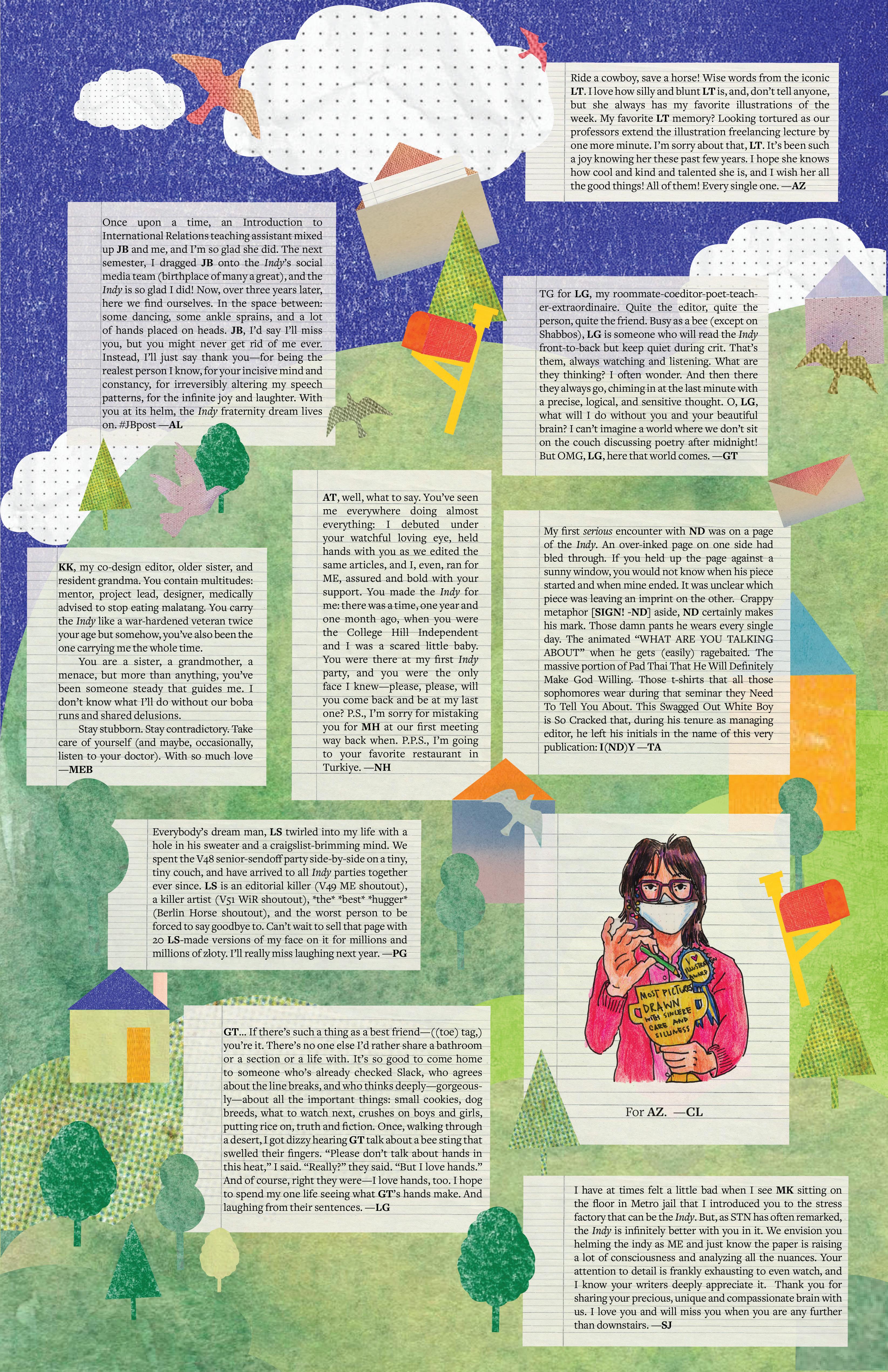
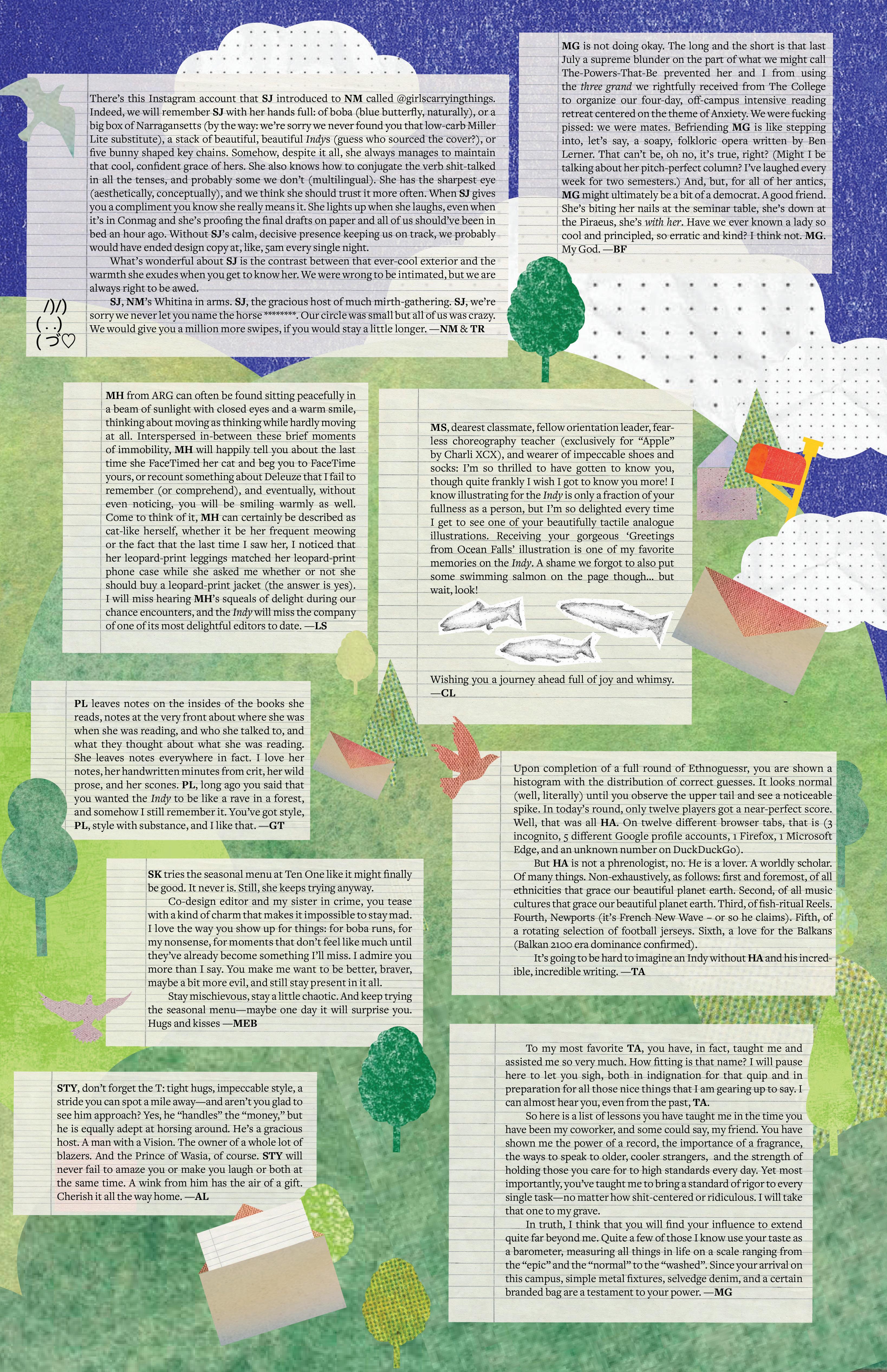
We can’t, but if we could, we’d put the final FTE to music. Sing this song to the tune of “Bless The Telephone” by Labi Siffre (the sped-up tiktok version).
So let the theme be bye for now
It’s ten-thirty pm
Conmag is full of laughs and friends
It’s strange, this paper squeals and squirrels a few long nights a week
Something something to an end
It’s like the song’s a manifesto
“On: coming up too quick, radical potential of the bends”
But very soon it’s time to go!
We’ve got no job to do, just sitting ‘round and eating glue.
Strange We walked into the empty house
Called conmag conmag
We collectively effervesced Bless this fucking mess
It’s cool, the way we did this thing We were kings up here, leaves upon the river bank, the Seekonk right out our window Long live V52. There will be swimming, friends.
There will be swimming, friends, it’s true.
MANAGING EDITORS
Benjamin Flaumenhaft
Nahye Lee
Kendall Ricks
WEEK IN REVIEW
Maria Gomberg
ARTS
Lucas Friedman-Spring
Martina Herman
Gabriella Miranda
EPHEMERA
Heidi Lin
Sara Parulekar
FEATURES
Sebastian Botero
Chloe Costa Baker
Peter Zettl
LITERARY
Liliana Greyf
Ayla Tosun
Georgia Turman
METRO
Jackie Dean
Elena Jiang
Mikayla Kennedy
METABOLICS
Annelie Delgado
Evan Gray-Williams
Evan Li
SCIENCE + TECH
Jolie Barnard
Selim Kutlu
Lila Rosen
SCHEMA
Paulina Gąsiorowska
Cindy Li
WORLD
Emilie Guan
Sabine Jimenez-Williams
Andrea Li
DEAR INDY
Angela Lian
BULLETIN BOARD
Caiden Demundo
Sarya Baran KılıÇ
MVP All of us
DESIGN EDITORS
Mary-Elizabeth Boatey
Kay Kim
Seoyeon Kweon
DESIGNERS
Isabella Castro
Hongrui Guan
Rose Holdbrook
Esoo Kim
Jennifer Kim
Jordan Kinley
Selim Kutlu
Jennie Kwon
Hyunjo Lee
Soohyun Lee
Chelsea Liu
Kayla Randolph
Ana Ïs Reiss
Lea Seo
Liz Sepulveda
Anna Wang
Caleb Wu
STAFF WRITERS
Layla Ahmed
Tanvi Anand
Cameron Calonzo
Megan Chan
Nan Dickerson
Ray Eggerts
Jacob Hansen
Maxwell Hawkins
Mohamed Amine Jaoudi
Annie Johnson
Nadia Mazonson
Keya Mehra
Naomi Nesmith
Nikolaos
Nikolopouslos
Alya Nimis-Ibrahim
Nora Rowe
Alex Sayette
Samdol Sichoe
Luca Suarez
Santino Suarez
Mahliat Tamrat
Ben Underwood
Ellie Wu
Jodie Yan
ALUMNI COORDINATOR
Peter Zettl
SOCIAL CHAIRS
Raamina Chowdhury
Lila Rosen
Alex Sayette
DEVELOPMENT
COORDINATORS
Cindy Li
Peter Zettl
FINANCIAL COORDINATORS
Zak Hashi
Simon Yang
ILLUSTRATION EDITORS
Selim Kutlu
Serena Yu
ILLUSTRATORS
Abby Berwick
Rosemary Brantley
Rosalia Gonzalez Pousa
Koji Hellman
Jiwon Lim
Ellie Lin
Megha Nambiar
Ruby Nemeroff
Meri Sanders
Angelina So
Luna Tobar
Ella Xu
Naomi Zaro
Cora Zeng
Alena Zhang
Faith Zhao
COPY CHIEF
Eric Ma
COPY EDITORS
Jordan Coutts
Mackenzie Ellis
Kainalu Faucher
Lucie Huang
Indy Nijjar
Camilla Rodriguez
Zeke Tesler
Sasha Watson
WEB EDITORS
Casey Gao
Erin Min
WEB DESIGNERS
Maja Mishevska
Amy Pan
Dominic Park
Joy Zou
SOCIAL MEDIA EDITORS
Olivia Falk
Sylvie Foster
Isabel Hahn
Avery Reinhold
Eurie Seo
SENIOR EDITORS
Jolie Barnard
Nan Dickerson
Paulina Gąsiorowska
Sabine Jimenez-Williams
Angela Lian
Nadia Mazonson
Talia Reiss
Luca Suarez
OUTREACH AND INCLUSION
COORDINATORS
Raamina Chowdhury
Naomi Nesmith
*Our Beloved Staff
MISSION STATEMENT
The College Hill Independent is a Providence-based publication written, illustrated, designed, and edited by students from Brown University and the Rhode Island School of Design. Our paper is distributed throughout the East Side, Downtown, and online. The Indy also functions as an open, leftist, consciousness-raising workshop for writers and artists, and from this collaborative space we publish 20 pages of politically-engaged and thoughtful content once a week. We want to create work that is generative for and accountable to the Providence community—a commitment that needs consistent and persistent attention.
While the Indy is predominantly financed by Brown, we independently fundraise to support a stipend program to compensate staff who need financial support, which the University refuses to provide. Beyond making both the spaces we occupy and the creation process more accessible, we must also work to make our writing legible and relevant to our readers.
The Indy strives to disrupt dominant narratives of power. We reject content that perpetuates homophobia, transphobia, xenophobia, misogyny, ableism and/ or classism. We aim to produce work that is abolitionist, anti-racist, anti-capitalist, and anti-imperialist, and we want to generate spaces for radical thought, care, and futures. Though these lists are not exhaustive, we challenge each other to be intentional and self-critical within and beyond the workshop setting, and to find beauty and sustenance in creating and working together.
WEEK IN REROUTE
We live under the despotic fist of the “normal” map.
c I keep getting lost. In the sauce, and otherwise. No matter where it is that I am trying to go, I just can’t seem to find my way. I have tried all sorts of solutions, and even still, I just can’t figure out where to go. Over the last week of being astray, I have also come to realize that there is no such thing as a ‘right’ turn; it’s totally an oxymoron. Whichever route I take, things end up going either left or south. Last week, I took a right turn on Power, and then I was called a “magnanimous byotch” by a stranger. I can’t lie, it really hurt. I meant well, I really tried. I am off-drift, I am off-track, I am off-course, of course. I have tried making choices, going places, but I am at the starting line, still. I have tried asking for directions, but it turns out that most passersby are in a rush or just really weird and mean. I’ve resorted to just keeping to myself, wandering about without a destination. I guess I will be adrift forever.
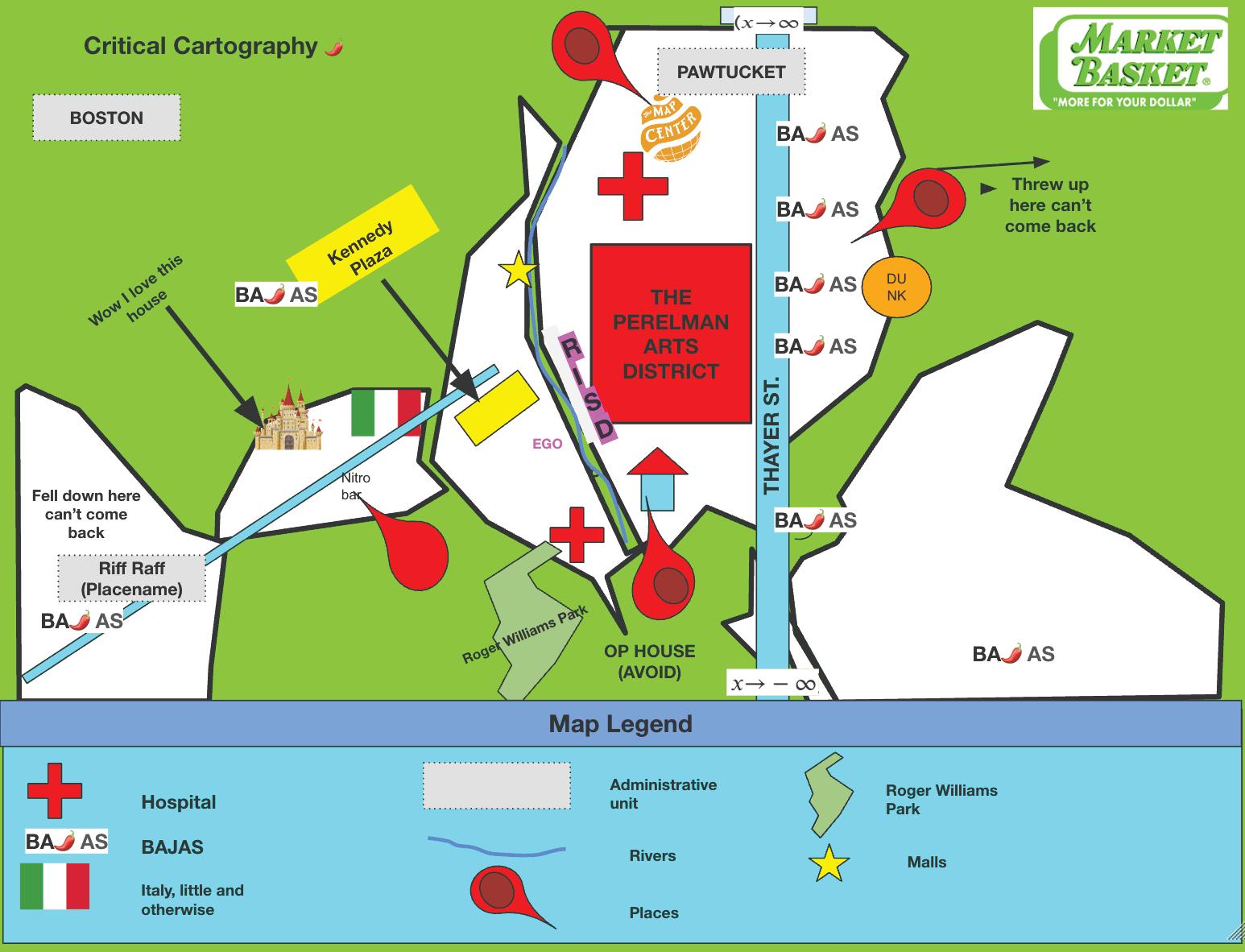
How do people find themselves? Is it through structured meditation, or through hard labor in the mines? BEEEEEP. Wrong answer. It’s maps. And where do you find, said maps. THE RHODE ISLAND MAP CENTER IS ON PAWTUCKET AVENUE. aaaaw fuck it, I guess we are going to Pawtucket.
I took a couple of my good friends along with me on my journey to the map store. When we arrived, we parked in a big lot outside a warehouse, and followed a path of nerdy boys to find the entrance. I’ll be frank, I didn’t know they still made young men so bespectacled
and frail. We heard them speak in glowing terms about topography, and one of them even offered me a Compass Rose. Although I found the gesture charming, I don’t date geeks and losers, so I punched him in the throat.
- “North, South, East, West. I like you the best–”
- “I bet you also like cartouche and shit. Eat rocks, map kid.”
- “Owie, you are messing up my contour lines.”
Having defeated my seven nerd opponents, we finally made our way inside the store. Here we met Andrew, the owner. He is a professional cartographer who has a really practical outlook on the future of cartography. After quitting his consulting job, he decided to move across the country to take over—and these are his words—“a failing map store.” Knowing full well that paper maps cannot compete with GPS technology, he has committed himself to turning the business around by selling only useless maps.
He has maps that are just plain wrong, he has maps that are too small to deploy safely on the road, maps of animals in places that they have never been, maps drawn by children, by adults, the elderly, and made of other maps. He has a map by a lady named Clare, detailing the route from her house to the nearest grocery store, road maps for countries that no longer exist, moon maps, heat maps, hand-drawn maps, maps of hands, and many, many more. The store is nestled in a print shop, so there were also a bunch of misprints of AA pamphlets and antiquated decals to peruse. Maybe these are the keys to really finding myself? In just 12 steps, I’ll be somewhere new.
There were also quite a few maps of Providence. Some maps showed local waterways as transit conduits; some of the maps were designed just for guys on bikes. None of the maps were for girls like me, who like keeping calm and putting fries before guys. How am I supposed to map my problems spatially if the way we map today does not account for New York, Jewish, left-wing, liberal, intellectual, Central Park West, Brandeis University, socialist summer camp fellows like us?
This plunged me into a tumult of intellectual study of the map as not only a method but an object of critique. Andrew’s store has shown me that a map does not need to be “right” to mean. In recognition of the fact that we live under the despotic fist of the “normal” map, I attempt to reposition us in space under the principles of a critical cartography. In other words, I try not to take for granted the spaces, places, and planes that I inhabit. Instead, I reject the viewing subject and the cartographic object. I am map. She is me. Together we redefine sub-jec-ti-vi-ty. Rephrasing one last time for clarity, I offer that the map can show the world through my humble gaze. Please find attached below a proposed draft of a map that shows Providence adjusted for my lived experience and taste. Has this helped you find yourself? Maybe not, and I don’t care. The point is that the map was inside you all along. A map is a feeling. A feeling of okay about yourself. I like my map, and all the places that it doesn’t show. I like the Providence of my ignorant imagination, and I also like its view from space.
MARIA GOMBERG B’26 is a map legend.
COUNTERNARRATIVES OF HAITI AT THE WORLD CUP
INSIDIOUS INTERNATIONAL AID, THE END OF TEMPORARY PROTECTED STATUS, AND FOOTBALL
c An atypical sports story began in Willemstead, Curaçao last October as Haiti’s national football team beat Nicaragua 2–0 to qualify for the nation’s first men’s World Cup in over 50 years, creating a historic wave of Haitian joy. There were celebrations in Port-au-Prince, Cap-Haïtien, Montreal, New York, Paris and everywhere else that the Haitian diaspora calls home. However, videos of the celebrations were often accompanied by a more serious message, #OuvèPeyiA: ‘Open the country.’ The phrase, calling for an end to the gang violence that has devastated Haiti since 2020, was particularly poignant for a team of ‘road warriors’ that had been unable to play at home throughout their qualifying campaign as a result of armed gang members surrounding the visiting Belize team’s bus in 2021.
That Haitians would invoke the message ‘Ouvè Peyi A’ at a moment of such national celebration and unity indicates the scale of Haiti’s current struggles, as well as the opportunity for collective organization around the heightened global attention that is sure to accompany the World Cup matches. Currently, 90% of Port-au-Prince, Haiti’s capital, is controlled by gangs, and in these territories, killing and sexual violence are endemic. According to the Global Hunger Index, around 54.2% of the population is undernourished, and Haiti continues to be known reductively as the “poorest country in the Western Hemisphere.”
Meanwhile, the 2026 FIFA World Cup, at which Haiti will play, is set to be the largest and most expensive ever, with an expanded 48-team format unfolding in 16 cities across the U.S., Mexico, and Canada. Eleven of those cities and 78 of the 104 total matches
are located in the United States, a nation whose increasing alienation from the world, turn towards fascism, use of the term ‘soccer,’ and determination to commit war crimes, making it a strange place for a global gathering. In fact, full or partial travel bans to the United States are in effect for five of the nations competing this summer, including Haiti.
This setting takes on a sinister valence, considering that the U.S. government has callously elected not to renew Haitians’ Temporary Protected Status (TPS), which allows them to live in the United States as refugees. In a dry notice, the Department of Homeland Security explained its decision: “the Secretary has determined that there are no extraordinary and temporary conditions in Haiti that prevent Haitian nationals (or aliens having no nationality who last habitually resided in Haiti) from returning in safety.” Although a federal judge in Florida has reversed this decision, around 300,000 Haitian Americans are still unsure of their status leading up to the Supreme Court’s late-April hearing on the legality of the decision.
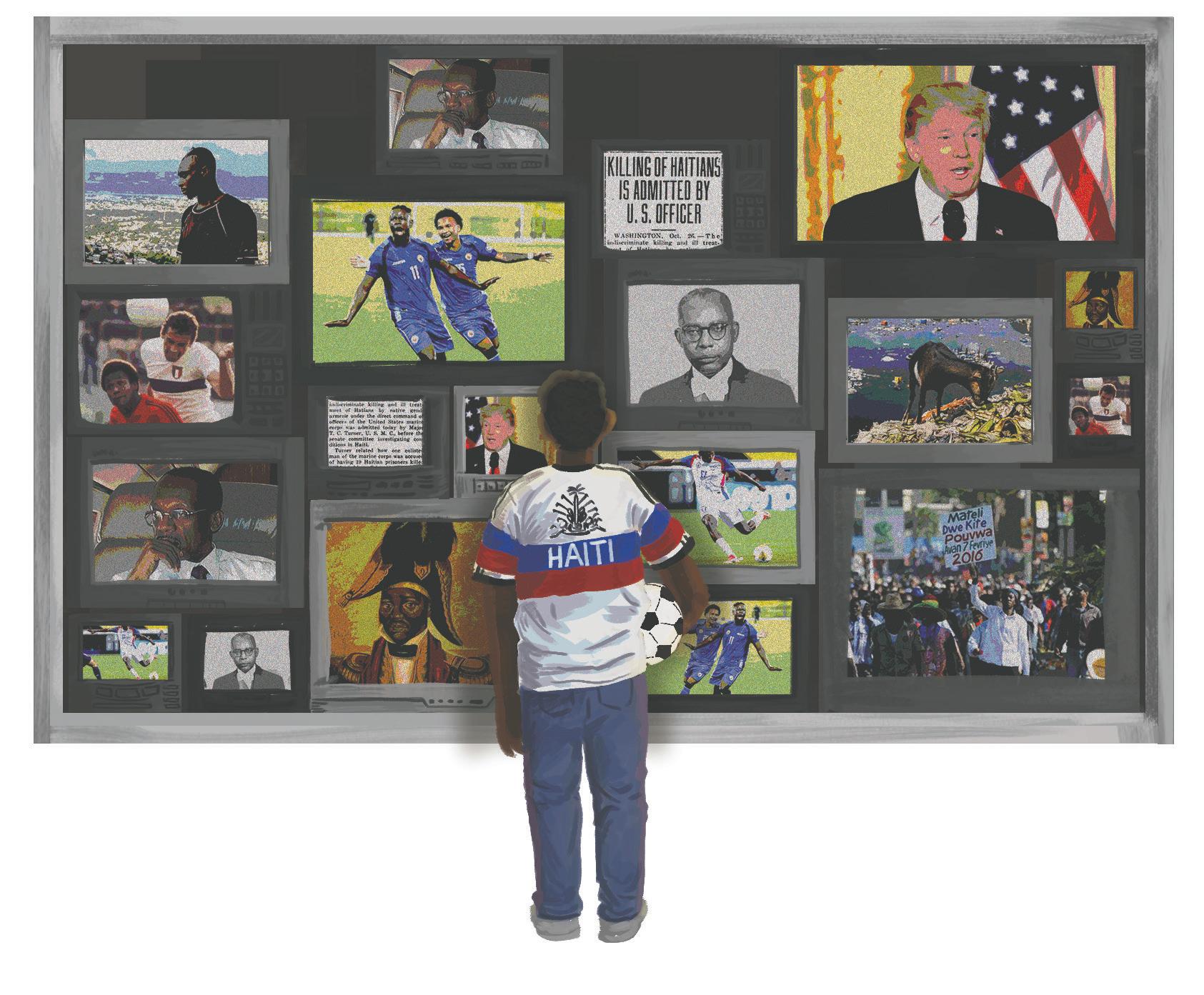
It is likely that the commentators of Haiti’s matches will recount the nation’s challenges and tragedies at length—explaining the ways that some Haitian players have been personally affected—in some abstract manner that makes it seem as though they are victims of a terrible series of accidental misfortunes, rather than a history of intentional colonial violence. The cliché and decontextualized sentiments expressed in a France 24 article are typical of that unfortunate trend: “Haiti has many problems, including political instability, poverty and
( TEXT JACOB HANSEN
DESIGN ISABELLA CASTRO ILLUSTRATION LUNA TOBAR )
crime. But through it all, the heart of the nation beats for football.” What comments this lack is an attempt to reckon with the long and often grim history of Haitian-American relations, and the issues that are affecting Haitian Americans right now. If football has the power to do anything, it has the power to generate and distribute narratives at a global scale. For example, the prominence of Afro-Brazilian players on Brazil’s World Cup–winning teams of the 1950s and 1960s strengthened the Afro-Brazilian presence in the national identity and in the world’s perception of Brazil. Therefore, it is important to get the narrative of Haiti’s appearance at the World Cup right, taking care to understand how the nation’s history and its relationship with the United States can give us a more complete picture of the current moment.
A Revolutionary Difference
As the Haitian sociologist and geographer Jean-Marie Théodat writes, “It is difficult not to see a global dialectic in the relations between Haiti and the United States.” One nation the ubiquitous global hegemon and the other repeatedly beset by economic, political, and environmental crises. Although the two nations’ divergent paths began to take shape at the very start of their respective economic histories, it is their wars of independence that show the crucial difference. While the American Revolutionary War was fought by a class of landowning (and often slaveholding) settler colonists whose primary aim was to abolish what they saw as unfair taxes and limitations on westward expansion, the Haitian Revolution, launched by
a slave revolt, was a far more radical event. Occurring between 1791 and 1804, the Haitian Revolution was a long struggle, led mostly by formerly enslaved people such as the general Toussaint L’Ouverture, to overthrow the existing colonial elites and establish independence from French imperialism as a whole. Its most famous and radical result was the universal abolition of slavery that was written into the Haitian Constitution of 1801: “There can be no slaves on this territory; servitude has been forever abolished.”
As argued in classic works like C.L.R. James’ The Black Jacobins, as well as the more contemporary Universal Emancipation by Nick Nesbitt, the Haitian Revolution marks not only another Atlantic Revolution, replicating French, English, and American Enlightenment ideals, but a departure from a hollow European humanism that advocated for universal rights while systematically excluding and abusing Black people. The fact that an independent Haiti stood as a profound rejection of the transatlantic slave trade and European colonialism made the country a ‘pariah state’ throughout its early history. Nowhere is the European world’s hostility to Black freedom made clearer than in the French indemnity of 1825. The indemnity imposed a 150 million franc debt on the new Haitian state in order to remunerate the French plantation owners who had lost money as a result of the revolution. That debt, which Haiti had been paying off until 1947, devastated the nation’s burgeoning economy and effectively extinguished the young nation’s hopes of prosperity. In Haitian public discourse today, there is wide awareness of the harm induced by the indemnity.
However, one lesser-known aspect of the indemnity can serve as a bridge to understanding the Haitian-American relationship at the heart of this story: Professor Chelsea Stieber of Tulane University has recently embarked on a project investigating how some of these indemnity payments made their way to the United States. In an email, she described the individuals who received these payments as “a diaspora of indemnitaires from Saint-Domingue: people who received and leveraged money extracted from independent Haiti and reinvested it in U.S. plantation agriculture in the deep south.”1 This image, of wealthy plantation owners reinvesting capital taken from formerly enslaved Haitians to maintain the very institution that the Haitian Revolution had sought to extinguish, is one of naked exploitation and powerful evil—exemplifying the United States’ relationship with Haiti over the past 200 years.
The United States was hostile to Haiti from the very beginning of their relationship. The notion that freed slaves could govern their own republic was naturally terrifying to powerful Americans who participated in or profited off of the institution of slavery. The words of the slave-owning South Carolina Senator Robert Hayne in 1826 are a forceful example of this attitude: “With nothing connected with slavery can we consent to treat with other nations, and, least of all, ought we to touch the question of the independence of Hayti in conjunction with Revolutionary Governments, whose own history affords an example scarcely less fatal to our repose. […] Our policy, with regard to Hayti, is plain. We never can acknowledge her independence.”
1 From Professor Stieber – “Now, a few caveats: this was never an enormous amount of money. Moreover, sometimes this network is constituted through descendants of the actual Saint Domingue planters (i.e. not the planters themselves, but their kin who were able to make claims).”
A Timeline of Haitian-U.S. Relations
Over the more than 200 years following Haitian independence in 1804, the initial American contempt and fear of Haiti has transformed into a relationship of imperial domination. Though unfortunately this article cannot serve as a comprehensive history, this timeline includes some of the most important moments in Haitian-U.S. relations and remains vital to provide political context.
1862: The United States formally acknowledges Haitian independence. Considering the quote from Senator Hayne, we should not be surprised that this happened after the Confederate secession.
Marxian creed ad nauseam claiming that, quote ‘capitalism is a mortal sin’ and quote ‘a deadly infection always threatening to descend on the island from the cold capitalist nation to the north.’” However, the United States, the World Bank, and the International Monetary Fund (IMF) had their own ideas about what was best for Haiti’s economic development, and it was decidedly not any form of socialism.
1889: The United States unsuccessfully attempts to capture the Haitian commune of Môle-SaintNicolas as a recoaling station for its Navy.
Instead, the ‘American Plan,’ imposed on Aristide by political pressure, was part of a series of structural adjustment programs that the aforementioned institutions recommended and implemented in many nations in the Global South. The idea for Haiti’s American Plan was that Haiti should industrialize at all costs, even if it would have deleterious effects in the short term. In the most basic terms, this meant that the United States Agency for International Development (USAID) would supply Haiti with food subsidies—in the place of other forms of developmental aid—in order to facilitate the economy’s urbanization and industrialization. The rationale used to justify this scheme was that Haiti’s best economic asset was cheap labor, or in other words, poverty. The U.S., the IMF, and the World Bank argued that by ‘proletarianizing’ Haitian peasants who had existed as subsistence farmers, Haiti’s economy would go through a painful period of adjustment, but eventually have a stronger manufacturing economy and urban centers.
1915–1934: On the orders of President Woodrow Wilson, the United States Marines invade Haiti under the pretext of stabilizing the government. For the following 19 years the United States rules Haiti by martial law. Under the U.S. occupation, 40% of Haiti’s national income is used to repay American and French banks for the indemnity.
1934–1947: The United States continues their soft-power and economic influence in Haiti, in the form of American fiscal supervision determining Haitian financial policy.
In his book Travesty in Haiti, the American anthropologist Timothy Schwartz thoroughly documents the failures of the American Plan. Rather than bolster Haiti’s GDP, the Plan lowered it; the same applied to life expectancy, child mortality rate, and various other developmental metrics. He argues that this was not an accident, but rather a known result of policies aimed at devastating Haiti’s agricultural economy in order to create a captive market for American agricultural exports. The following statistics, provided by the legal scholar Sandra C. Wisner, heavily corroborate that argument: “in 1985, Haiti produced 163,296 tons of rice and less than 5%—7,337 tons—of all rice consumed was imported from the United States. But in the last decade alone, Haiti’s rice imports have increased by nearly 150 million metric tons. In 2020, Haiti imported almost $245 million worth of United States produced rice, making the country the third -largest market for North American rice after Japan and Mexico.”
1957–1986: Due to fears of communism spreading in the Caribbean, the United States supports both of the brutal Duvalier regimes. The Duvalier regimes, led by a father and son, expand the military and form a secret police force known as the Tonton Macoutes. Through state enforced terrorism and suppression of dissent, the Duvaliers violently enforce the will of American capital while enriching themselves and their allies.
Devastating Aid
When Jean-Bertrand Aristide was elected President of Haiti in 1990, he intended to embark on a socialist policy course that matched his background as a Salesian priest—preaching liberation theology that connected Catholic values to equality on earth. As reported by the BBC, Aristide had “preached a
This accumulated history of exploitation has built the conditions for Port-au-Prince’s current gang violence crisis. In February of 2025, the International Crisis Group described the situation as such: “[G] angs have gone from being armies for hire at the service of powerful elites to becoming independent forces working in fast-changing partnerships with the highest bidder […] In the course of building their power, they have extracted a brutal toll on the Haitian people, who have frequently been the victims of uncontrolled violence.” Recently, many of the gangs have banded together under the name Viv Ansanm (‘Live Together’ in Haitian Creole), forming a more powerful coalition.
Last November, French photojournalist Victor Raison described the situation on the ground in Portau-Prince, speaking to embattled citizens who had been forced to move multiple times in order to avoid the rapidly spreading gang violence. Raison writes that “since January 2022, more than 16,000 Haitians have been killed in gang-related violence. More than 1.4 million people—nearly half of them children— have fled their homes since January 2025, driven by rampant gang violence and climate collapse.” The
the hope of food security. The situation is not one to which there is an easy solution, and Haiti has been forced to rely on international troops who don’t have any real incentive to intervene in the crisis, all while the dismantling of USAID has made food-aid more scarce.
Although there are many other factors at play, these coinciding crises are deeply tied to the history of American intervention. The 19-year formal occupation and the later U.S. support for the Duvalier regimes contributed to the normalization of political violence and a lack of embedded historical democracy. As mentioned earlier, the mass subsidization of American agricultural exports through USAID programs effectively outcompeted and eliminated Haitian domestic agriculture, contributing to the current food and agricultural crises by reducing domestic capacity.
The strategy of neoliberal industrialization also failed, with manufacturing jobs never matching the amount of jobs lost in the agricultural sector. Because of this, cities like Port-au-Prince have become filled with unemployed and hungry young men, an obvious catalyst for the rising gang violence which we see today. Furthermore, the weakness of the Haitian state and its inability to defeat the gangs is highly connected to the structural adjustment programs’ gutting of bureaucracy and state capacity.
Leveraging the Diaspora
If its national team can offer Haiti anything in terms of a model for improvement, it is the team’s capacity to leverage the strength of the Haitian diaspora. In a world in which the top European clubs have academy systems that begin to groom players for professional success as early as six years old, replete with diet plans, sports psychologists, and the best youth coaches, it is harder than ever for less wealthy nations like Haiti to compete with the likes of France, England, Germany, and Spain. Instead, smaller national teams have recently made an effort to register players with dual nationality that have grown up with all the advantages of western European footballing infrastructure.
The composition of the Haitian team, nicknamed Les Grenadiers, typifies this trend. The Haitian Federation has taken advantage of dual-citizenship statuses to register players such as Jean-Ricner Bellegarde, Duckens Nazon, Jean-Kévin Duverne, and recent addition Wilson Isidor—all of whom were born in France to Haitian parents. Additionally, The Haitian Times reports that as of April 6, Haiti is in talks with two more players in Europe’s five strongest leagues, Jean-Baptiste Gorby of FC Braga and Odsonne Édouard (RC Lens’ leading scorer and the
fourth-highest scorer in France’s Ligue 1). Gorby and Édouard were born in France and Belgium respectively, both to Haitian parents.
In my email correspondence with James LouisCharles, a director of youth football programs in Haiti, he wrote that “kids at the academy admire Haitian players, especially those in the diaspora.” On Les Grenadiers, Haiti’s dual nationals have already had an impact on the team. Bellegarde is the team’s strongest on-ball player by some margin, and Isidor scored a lovely late goal in his first start against Iceland. Bellegarde and Isidor spent their youth careers at the top tier academies of RC Lens and Stades Rennes, respectively, and that elite training is evident in their play.
Nevertheless, the squad also has Haitian-born players like defender Ricardo Adé and midfielder Danley Jean-Jacques. Players from Haiti, like Ade and Jean-Jacques, have had to overcome more en route to their careers as professional footballers. Jean-Jacques, who was born in Petit-Goâve, a town near the epicenter of the devastating 2010 earthquake, grew up playing with the youth system of Academia de Futebol Pérolas Negras, founded by the Brazilian charity Viva Rio. It is to bridge this gap that Louis-Charles hopes to establish L’Ouverture Academy, an elite residential footballing academy, within Haiti. He writes this about the challenges that Haitian youth currently face: “What makes this World Cup qualification even more remarkable is that it was achieved largely by players developed outside Haiti, without playing qualifying matches at home. While that highlights the strength of the diaspora, it also underscores the challenges within the country: limited infrastructure, difficulty hosting matches, and barriers to international travel.”
This is a powerful message that highlights a persistent question in Haitian politics: how to involve the diaspora more directly in the democratic process. According to a report by Coordination Europe Haiti, remittances from Haitians abroad are “estimated at over $2 billion per year, exceeding annual international aid and representing about 25% of GDP.” However, members of the diaspora also want direct participation in the political process. Considering the strength and size of the diaspora around the world, leveraging that source of human capital may be a powerful way for Haiti to begin to move past the struggles that have defined its history.
Looking toward the World Cup this summer, Haiti’s squad will play their first three matches in Foxborough, Philadelphia, and Atlanta. Each of these cities and states is home to its own Haitian diasporic community, Massachusetts being the largest with 80,000 Haitians, 45,000 of whom are under the
designation of TPS. With Haiti’s games taking place in June and the Supreme Court decision about Haitians’ TPS set to be issued in early July, it is these very individuals who should be at the heart of any discussion of what the event may mean.
Maintaining TPS is vital to protecting the people that constitute Haiti’s diasporic capital, which has contributed significantly to the team’s appearance at the World Cup. This is particularly important, considering that a large reason that Haiti is so reliant on diasporic contributions is the various interventions of U.S. imperialism.
A more complete narrative of the Haitian national team’s appearance at this World Cup would have to account for the exploitative history of the United States’ involvement in Haiti, the current administration’s efforts to end TPS, and the dire situation in Port-au-Prince. While any real accountability on the American end is unlikely, voicing this narrative would draw attention to the important cause of maintaining Haitian TPS in the U.S., and begin to remedy the historically exploitative relationship that has defined the last two centuries of American involvement in Haiti.
JACOB HANSEN B’28 will be cheering for Curaçao, Uzbekistan, and Haiti this summer.
ISIVA 85 M
( TEXT NADIA MAZONSON
DESIGN CHELSEA LIU
PHOTOGRAPHY SHULAMIS FISHBEIN )
c After the divorce I dreamt of earthquakes. I was always in the apartment where my sister Monica and I had been living since my mother left, except the dream-apartment looked just like the condo where I’d grown up in Polanco. At the same time, it was my mother’s new condo in San Diego. (I hadn’t been, but I’d seen photographs.) It was also, inexplicably, the studio where I took my screenprinting courses. I always understood that this place was our true apartment.
The dream went like this: In the early hours of the morning, I’d wake up to my bed shuddering beneath me. In a panic I would stumble to my doorframe, calling for Monica. I’d hear nothing in return, so I would yell even louder, but still she wouldn’t respond (she never responded), so then I’d keep shouting and pleading but then my voice emitted no sound, and the building would rumble more and more violently by the second, and there was nothing I could do except look out the window as Mexico City crumpled. Nothing I could do: The cars piled on top of one another. Nothing I could do: The buildings unspined, collapsing into mountains of detritus. Nothing I could do, and so the devastation rolled on mutely, and meanwhile in my powerlessness I called again for Monica (this too, mutely) and watched as the apartment next to ours caved in and felt the terror rising higher and higher in my stomach until all of a sudden I heard a crash, and I looked up and the doorframe had split into two, and for a red infinite moment there was nothing but fear, blinding and terrible.
And then I would wake up in the dark and everything was fine, of course.
Maybe it seems obvious now, the symbols too easy: the crumbling home, the collapse of the family unit. Shaky foundations. My memory is farsighted: The image appears more clearly in the distance.
It was February 1985, it was my mother’s blue period; it was the earthquake year, although we didn’t know it yet. After she left for San Diego my mother sent us photographs. I remember the first, a rather unimaginative image of the shoreline. It arrived warped, corners rounded by mail travel, with her chicken scratch on the back. So much explanation: how passive and loveless all those years had been; how for decades she’d watched students pass before her desk at the secretariat and now it was time for her, too, to become a student again; how she hoped we, as artists, would understand this impulse; how anywhere in Mexico City (indeed, in all of Mexico) was still too close to the old life. When we didn’t respond, the inscriptions became shorter, platitudinous. I hope school is going well. My English is almost as good as yours now. I am in my blue period, like Picasso.
My sister and I were living in her old apartment in Colonia del Valle, the one she moved into when she left our father the August prior. We were lonely then. I stayed up until four each morning peeling letraset type from transfer sheets and slicing through bright squares of cardstock with my X-Acto. Then at eight I’d make Monica breakfast and go to my classes at the design college. Sometimes Monica returned from school with that grim look on her face and I knew our cousin, Rebeca, who still lived in Polanco, had seen the bottle-blonde shikse slipping through my father’s front door again. The photographs arrived every Monday. After a few weeks she quit the blue and sent redwood trees; then it was of a young man with a shock of bleached hair, applying orange lipstick in a mirror. She started using archivist ink so the paper wouldn’t warp, and began setting the images into smooth cardboard. I showed a few to a professor I admired, and he told me I had potential.
in Polanco. He never said so, but we could figure as much—one day at school, Rebeca told Monica that her mother said that, since we’d moved out, he’d taken to gambling every night with David Stern. They worked together at Hospital Juárez, where Stern was head of intensive care. Everyone knew Stern messed around with women who weren’t his wife. (Everyone knew he had paid for his position at the hospital, too.) My father was a nephrologist, a poker addict and an alcoholic. He paid our rent, and we stayed out of his hair.
I took up my mother’s old room. On the night we moved in I pushed the nightstand to the side and set up the drafting table my cousin Benny had built for me. A few days later I went through her drawers. She’d left behind a copy of The Unbearable Lightness of Being. On the inside cover, scrawled: Who are we to decide if someone was good or bad, irresponsible or not? I am trying to cut the umbilical cord.
Oddly we never thought to send anything back. I could have mailed photocopies from my design portfolio but they didn’t seem relevant. What could I have done, put together a type-set list of all the ways she’d failed us? We used Futura back then. I was busy in the studio, I didn’t have the time to resent her the way Monica did.
Spring arrived, then summer. My mother sent photos from a sandcastle competition. Monica brought home an orange cat; we named her Amaranta. I discovered Dead Can Dance. Rebeca told us the blonde woman moved in, and Monica told me she would refuse to come home if he asked us to. I held my tongue; he wasn’t ever going to ask us to come home. The jacarandas bloomed purple, then wilted away. Monica decided to study Russian literature. One day Amaranta jumped out the window and Monica cried inconsolably, even though the cat was completely fine. After finishing my first year at the design college, I spent the summer working at a firm in Zona Rosa. Everyone there smoked cigarettes. When I lit up I thought of my father, the doctor, his fingers stained tobacco-yellow. In August he took us to dinner with the shikse girlfriend. She was a nurse in the nephrology wing. Her name was Rosa. The dinner was awkward, because it was clear he loved her. I figured he had not loved anyone before, including us. I penned a rare letter to my mother and told her our father would probably marry this woman. She sent back a studio portrait of a dark-haired model wearing a very large hat.
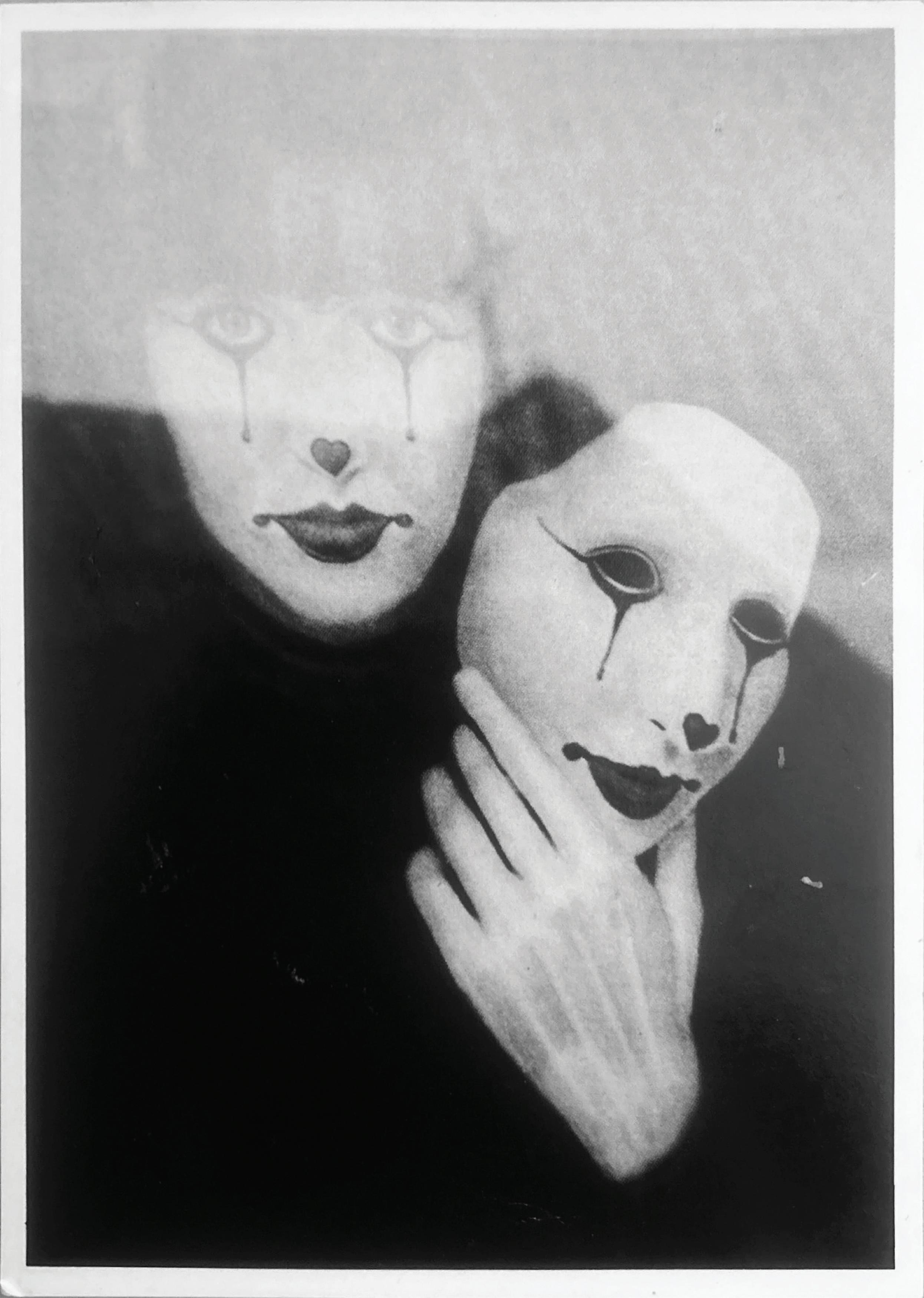
Some time after the first of the blues, before the redwoods, came a black-and-white image of a somber woman with her face painted like a clown. Superimposed across her temple was the transparent outline of a cross on a steeple. I studied it for a week afterward: partly because I was jealous (my attempts at double exposure had been error-ridden—I couldn’t meter the camera properly, and the result was always overexposed), partly because I found the Christian imagery odd, and partly because on the back was an inscription in someone else’s handwriting, addressed to our place. I hope you won’t forget about me. When you visit Mérida again you will come to the photography club here and I’ll introduce you to everyone. It feels good to be free, doesn’t it?
That September I went to synagogue for Rosh Hashaná even though I did not believe in G-d, and for days afterward everything felt holy and terrible. It was perhaps fitting that the earthquake came during the Days of Awe. When the building really did start shaking it was everything and nothing like I’d dreamed. It was, maybe, the forgone conclusion of the religious fugue in which I’d been walking around. You expect a thing for long enough and when it comes it almost feels natural.
This time, I couldn’t call for Monica. The shaking was such that I myself could barely stumble to
my bedroom doorframe. The furniture, the walls, the ground, maybe the entire city slid hazardously beneath my feet. In the midst of my terror, I could only hope nothing would fall onto my drawing table. The tremor lasted three minutes, they told us later. When it was over I turned on the television. Skyscrapers buckled into chasms of detritus. Hotels and schools and hospitals to dust. I felt an irrational sense of guilt: I had staged collapse in my dreams and now the entire city really had collapsed. The image, developed; our suffering, externalized.
In the days after the earthquake I had some vague, high-minded idea about documenting the moment for posterity; it felt like something to do. The streets were emptied of sound. I wandered aimlessly, “The Fatal Impact” on repeat in my Walkman, taking photos of shell-shocked men in masks and hard hats searching the rubble for bodies. I passed by the Hotel Regis—all that remained of its toppled marquee was OTEL REG. Later I saw three men pulling a dead man out of a crushed car, and then his young son, still alive, from the backseat. When it was done, one of them lifted a dusty finger to his brow. I could not tell if he was wiping away sweat or tears. When I returned home I decided not to develop the film. I couldn’t make sense of the image.
Those were horrible days for everyone. On Sunday my boss at the design firm called to tell me that my colleague, Anita, had been in Hospital Juárez when it collapsed. She was giving birth. They hadn’t retrieved a body. He told me he was going to the hospital to bring food and water to the rescue teams. I decided to go, too. I brought my camera.
When I returned home: my father’s incomprehensible blubbering through the answering machine. I had never heard him cry. It took four hours to drive to his house, the roads were blocked off. Monica told me not to bother, but his message had frightened me, I was afraid he would hurt himself. I remember the oppressive thickness of the air. When I arrived he was still weeping. Rosa, he said. She had been working a shift at the hospital. They think—he could not finish the sentence, either out of fear or certainty. I did not tell him that I had been there, that I had stood maybe 100 or 10 feet away from her body. I felt a sinking sense of kismet. My mother had not called, even though she had our number.
I did end up developing the photos of the destruction, and I sent them to her. I wanted her to understand that terrible, historic things were happening to us. I wanted to ask who had sent the letter to our apartment. I said none of these things.
These days all the new apartments are earthquake-proof. They sway when the ground shudders.
When my mother died last year I flew back to Mexico City and went through her things with Monica. Among the junk she accumulated over a lifetime—records, cookbooks, novels, cassettes, an old PC—there was little evidence she’d ever left for San Diego. Maybe I should have looked harder. All my stuff was there, too. I’d left my old books and portfolios with her when I moved to Houston for a design job in 1988. We had switched places—she’d moved back to Mexico City earlier that year. Among my things and hers I could only find the photographs she’d taken in the ’90s, after her return. I knew, or at least suspected, the fate of the ones she’d sent to Colonia del Valle. I was certain Monica had thrown them out. She had never much cared for photography, anyway.
A sea of evergreen trees. Folklórico dancers. Wide shot: in the foreground, a hand on a bare anonymous hip, and someone’s back, out-of-focus, in the distance. Docked sailboats. Collapsing roofs. Wide angle: a packed synagogue with no mechitza. My mother, arms wrapped around a grinning man in blue jeans. Hard hats. Racehorses. I am trying to cut the umbilical cord. Please tell Monica I am very sorry.
Our father moved us to the apartment in Colonia del Valle because he wanted to bring women to our home
NADIA MAZONSON B’27 does not look at the camera.
‘AUTONOMY’
ON THE DEATH OF NOELIA CASTILLO RAMOS
( TEXT CAMERON CALONZO DESIGN IRIS LEE ILLUSTRATION ELLA XU )
This article contains discussions of suicide and sexual assault.
c First, the numbers.
Noelia Castillo Ramos was born on November 14, 2000. She died on March 26, 2026 by voluntary euthanasia, almost exactly a month before this article’s publication. She was 25 years old.
Her final interview, in which she thoroughly described the circumstances that led her to this decision, was broadcast on the Spanish television program Y ahora Sonsoles on the channel Antena 3 just 24 hours before her death. Over the course of her life, Noelia dealt with ongoing struggles with OCD and BPD, carrying forth from abuse she experienced as an adolescent. She was sexually assaulted three times: once by her ex-boyfriend while she slept (something he told her the following day “between laughs”), and twice by groups of men at nightclubs. She did not report any of these instances; when asked why, she explained that the last occurred on October 4, 2022, a few days before she attempted suicide by jumping off of a fifth-story balcony—the first of six attested suicide attempts.
impeded her ability to make sound judgments. In the interview, she challenged this presumption of goodwill, citing their historically contentious relationship and stating that when she first broached the topic of euthanasia with him, he responded, “To me you’re already dead.”
When a young person commits suicide, public discourse often centers the tragedy of wasted potential; Noelia’s testimony challenges this premise. “Before asking for euthanasia, I just saw my world as very dark,” Noelia told Antena 3. “I didn’t even have goals or objectives or anything else. And I still have no goals or objectives.” Euthanasia did not appear to Noelia as some magical solution to her earthly ailments, nor did it change her perspective on her life in the context of its imminent end. It simply meant she would no longer suffer.
For a great deal of the interview, Noelia’s mother, Bea, sits beside her, the pair exchanging embraces and words of consolation throughout. As difficult as her life had become, Noelia found solace in the support of her mother, who she described as a beacon of light, a source of unconditional love. In a particularly affecting segment, we witness Bea still attempting to talk her daughter out of the procedure—their relationship has become defined by a continual negotiation of life. Later, Noelia speaks to the camera alone: “These last few days, my mother has been telling me that just like she saw me being born, she wants to see me close my little eyes. I told her that I would think about it, and the answer is no. I don’t want her to see me closing my eyes.”
There are many terms for medical procedures of voluntarily ending one’s own life—medical aid in dying (MAiD), physician-assisted death, and assisted suicide, among others. Although these terms are often
used interchangeably, there are some techni cal distinctions between them. Voluntary eutha nasia falls under the category of physician-assisted death, differing from forms of assisted suicide which are contingent on the patient’s ability to administer their own lethal drugs and often allow them the free dom to choose when and where to end their life. In the U.S., 13 states and D.C. have legalized forms of assisted suicide. Death with Dignity, a U.S. nonprofit advocating for the protection of assisted death, vehemently rejects the terms euthanasia and assisted suicide, boldly claiming that these labels are used by “opponents of physician-assisted dying” in order to “mislead the public.” Ironically, further down the page, it advises residents of states where assisted death is not legal to “voluntarily stop eating and drinking”— the disavowal of the term assisted suicide feels disingenuous when it endorses what is categorically a form of suicide, not to mention one that is wholly unregulated and may entail a great deal of suffering.
Eligibility for assisted death varies across jurisdictions, but generally requires a diagnosis of a terminal illness or incapacitating disability. Noelia’s case is a significant departure from this norm: Although she was disabled, she maintained some degree of autonomy and was not exclusively dependent on external care. “[The media] has said many incorrect things about me and about my case,” Noelia clarified in the interview. “I am not bedridden or anything. I shower myself, I do my own makeup, I organize myself on my own.” Despite this, Noelia’s euthanasia was approved and her ‘right to die’ upheld.
Voluntary euthanasia as a practice exists insofar as a society recognizes that some people are beyond recovery. The practical ability to commit suicide, aside from MAiD procedures, is at the discretion of individual agency, and that option is not legitimized by the state or protected by the law. Assisted death, on
the other hand, is classified as healthcare, a response to the idea of unameliorable pain—when suffering (primarily physical, but psychological as well) cannot be eliminated or sufficiently managed. With this distinction, there is the problem of certainty: Can we be certain that each person approved for euthanasia will never get better? Or, that within that person’s lifetime, there will be no new advancements allowing for the mitigation of pain, at least to an extent that could affect their decision to end their life early?
Much mainstream coverage of the case has used it as a framing device to pose questions about the ethics of voluntary euthanasia at large—Noelia is made into a figurehead, a metonym for the moral gray area of state provisions for assisted death and what happens when we, as a society, accept its purported neces sity. Thus, the details of her specific tragedy, this individual life that has been forced to end so early, are obfuscated and the assign ment of blame eluded. The case represents a tragic series of events, but it is defini tively not blameless. Institutional forces abound, having tipped the scales from the very beginning—institutions like the Spanish healthcare system which administered the euthanasia and the legal system which delayed the fulfillment of her request 601 days post-approval, yes, but also systems of patriar chy and ableism more broadly.
Noelia did not report any of the three instances of rape, and her rapists have faced zero repercussions for their crimes. Her decision was likely informed by the reality that reporting sexual assault is widely associated with retraumatization, fear of retaliation, and a sense of futility given that so few of these reports lead to felony convictions. Justice systems—not just in Spain, but across the world—have proven unable to effec tively penalize rapists and affirm survivors. This means that most who commit acts of sexual violence can live without fear while their victims are forced to bear the immense burden of trauma with no hope for closure. Her case was prolonged by the courts’ constant entertainment of her father’s baseless appeals even after Noelia’s euthanasia had been unanimously approved, imposing additional stress on her and her mother as both tried to reckon with the intense suffering that caused such a request to be made.
choice to die at the hands of the state. Why, then, do we not frame the institutional prejudice which has, in Noelia’s case, created the necessity for assisted death as an equally weighted violation of autonomy? What use is the word ‘autonomy’ when the central conceit
of terminal illness. Through institutional reform, this world can become a reality. Redirecting governmental efforts and resources away from extreme last resorts and instead toward continual support and welfare for marginalized communities and individuals may prevent the accumulation of suffering upon which requests for voluntary euthanasia are predicated.
+++
The implicit logic of voluntary euthanasia bears the assumption of comfort (that is, freedom from pain) as a default state of being, whereas discomfort is nonnormative and must be imminently eradicated. When this cannot happen—when suffering lingers indefinitely with no obvious solution—then exceptions can be made, exceptions that would otherwise be deemed extreme and inhumane. Noelia’s disability further alienated her from society due to the widespread lack of adequate accommodations for disabled people. The institutional inability to conceptualize ‘unmanageable’ pain is apparent: Disability, homelessness, and mental illness are complicated issues which necessitate complicated (and often expensive) solutions, representing a part of the population that has already exhausted known or financially feasible avenues of amelioration. The prioritization of legislation providing for assisted death over the development of structural support for the most marginalized members of society sidesteps the hard work of preventing such suffering in the first place. Why must we accept the easy certainty of death over the difficult, yet worthwhile potential of equity?
Throughout public discourses on the ethics of voluntary euthanasia, the concept of autonomy is invoked time and time again to defend an individual’s
can be done for those suffering from terminal illness, for those in constant, unbearable pain, completely dependent on others for their own survival. But Noelia was none of these things; or, at the very least, we cannot be certain that her pain was incurable. The expansion of assisted death beyond the most extreme, definitively unameliorable bodily pain bears frightening implications for marginalized populations. When pushed as a widely accessible solution to subjectively ‘hopeless’ suffering rather than an incredibly rare last resort, a vicious cycle emerges. At first, certain groups are marginalized and devalued by society. Life is thus harder for those groups, and the state does not take steps to significantly ease this burden. Their suffering compounds to such an extent that some members of these groups would prefer death to the abstract prospect of an improved standard of living. A fraction of those who request assisted death receive approval, and these people die, removing them from society and creating less demand to structurally address the original suffering. This is by no means an individual failing—those who request assisted death are entitled to deal with their personal suffering however they choose. However, this option should not at all be an accessible one. It should not be easier for vulnerable people to choose death than to envision a life worth living.
+++
Discussing the wider implications of Noelia’s death is, to some degree, ironic. In her final interview, she resisted the notion of serving as a precedent for future cases of assisted dying. “I don’t want to be an example for anyone,” she said. “I think that my life is my life and I don’t think it’s an example of anything, not good, not bad. It’s simply mine.” However, despite her
Noelia and her mother sit side by side on her grandmother’s couch, a family photo album laid out across their laps. They laugh as they reminisce about Noelia’s childhood—it almost feels as though they’ve temporarily forgotten about the camera, the interview, the procedure to take place. Noelia chooses four of these photos to bring to the hospital, to have beside her in her last moments. In one, a young Noelia beams at the camera, presenting a landscape she had just painted. The interviewer asks if these memories bring her joy: Noelia looks down at the photos, and a similarly radiant smile blooms across her face as she answers yes.
CAMERON CALONZO B’28 is hoping.
Linguistic Collapse in Gaza: Developing a Reading Practice of Solidarity
TWO PALESTINIAN POETS ON THE UTILITY OF LANGUAGE IN THE AGE OF GENOCIDE
c In the introduction to her 2025 poetry collection, Palestinian poet Batool Abu Akleen writes of her disillusionment with poetry at the beginning of Israel’s genocide in Gaza. Faced with displacement, constant siege, and famine, she refused to write, “believing that poetry wouldn’t change the world.” She remembers: “I was afraid of death, afraid that my body might be torn apart without there being anyone there to recollect it.”
Millions of words have been spoken and translated by Palestinians who point to the deadly consequences of American and Israeli imperialism, but these outcries are undermined and mutilated by decades of Islamophobic rhetoric, Israeli propaganda, and Western media. This violence is exemplified in American discourse around the word ‘intifada’
, meaning the process of shaking off, and used in Arabic to describe struggles for independence against oppressors, including the First and Second Intifadas. However, in the hands of pro-Israel groups and their allies, the call to “globalize the intifada,” or globalize this resistance against Israel, is transformed into a unequivocal call for the death of Jewish people.
Even beyond their erasure in American discourse, Palestinian writers face the almost insurmountable challenge of representing unspeakable violence in words, whether in Arabic or English. In an interview, Abu Akleen describes writing as a process of translation, “translating the emotions to words.” How does someone translate the savagery of genocide into any words, let alone those of another language? Translator and academic Huda Fakhreddine argues it is nearly impossible: “No words could contain the horror we are witnessing in Gaza every day.”
Batool Abu Akleen and her contemporary Nasser Rabah’s poetry collections revolve around this failure of language itself. First, how does one turn the embodied experience of overwhelming violence into words? Second, how does one translate these experiences into the language of empire, the language used to destroy their homes, families and communities? In June 2025, Abu Akleen published a bilingual ArabicEnglish collection titled 48Kg ﻢﻐﻛ ٨٤, translated by herself, Graham Liddell, Wiam El-Tamami, Cristina Viti, and Yasmin Zaher. A few months earlier in April, Rabah had published his first collection in translation, a bilingual anthology titled Gaza: The Poem Said Its Piece, or ﺎﻬﺘﻤﻠﻛ
:ةﺰﻏ in Arabic, translated by Ammiel Alcalay, Emna Zghal, and Khaled Al-Hilli. Their collections push the bounds of linguistic potential to reveal moments where language is insufficient; too fragile to respond to genocide, let alone represent it. Their hope, it seems, is to find language’s limitations in pursuit of something that exists beyond it. In doing so, Abu Akleen and Rabah develop a different relationship with the written word, and call for their readers to do the same. To read and understand the violence in Gaza today, particularly for readers indoctrinated with Zionist rhetoric by mainstream media, requires upending how we believe language might hold any potential to represent, let alone communicate.
+++
Rabah focuses on the first failure of language, where language cannot describe the instantaneous
demolition of homes, families, and institutions. In “What I didn’t say to me”
, he finds himself stuck within a cycle of frustration and inevitable return to language:
“The more I walk in the pathways of language, the more I wish I’d go back to where I started, every time I ready myself to hunt down a thought, language leads me time and time again to its haunting vaults; when will I get out of my labyrinth and fathom that there is something worth doing outside of this lure?”
Compelled to translate a thought into the world, Rabah finds that language offers no release. Language only further obscures Rabah from the world outside himself, offering him repeated synonyms for the maze that traps him, but leaving him no closer to its exit. For a population in intense agony and mourning caused by Israel, the translation of a feeling into a word fails to represent the occurrence it indexes. In the refugee camps, language also haunts Abu Akleen. She more closely examines what emerges as the second failure of language, when the words of Western aid organizations fail to offer any comfort, and instead become something that dictates her existence. In “I didn’t steal the cloud”
٧٤, Abu Akleen is branded with the words of Western aid organizations that mark her and her family as humanitarian subjects: Her forehead is inscribed with “refugee” ﺊﺟﻻ and childrens’ backpacks are “stamped UNICEF in the large letters of pity”.
The language in the original Arabic is perhaps even more damning. When describing UNICEF written on her siblings’ backpacks, she uses the adjective “maktub” ,بﻮﺘﻜﻣ referencing the Islamic belief in destiny ﺪﻗر that is written by God. The meaning of “maktub” is thus not only ‘written,’ but also ‘destined,’ reflecting Abu Akleen’s disillusionment with humanitarian organizations and the power they wield over her future. While they may temporarily secure her right to food, water and shelter, humanitarian organizations definitionally do not intervene in the political struggles that strive to secure long-term freedom, justice, and a ‘solution’ for the Palestinian people. The word “refugee” here does not only prescribe Abu Akleen and her family a life as ‘victims’; it is also part of the broader infrastructure that dooms any potential Palestinian state.
However, Abu Akleen is not a passive recipient of this language. She describes how the children throw aside the bread made with flour provided by humanitarian organizations, and imagine a “falafel wrap with pickles,” refusing to accept their reduction into objects of pity. The examination of words and their shortcomings becomes a common trope in Abu Akleen’s collection, as she draws attention to the humanity that lies beneath signifiers like “refugee.” In “2 Kg. Cemetery”
she writes, “our tent is registered with first-world
( TEXT SABINE JIMENEZ-WILLIAMS DESIGN ROSE HOLDBROOK
ILLUSTRATION NAOMI ZARO )
organisations they never miss our flesh […] we’ll be so light they’ll just cross off the word ‘camp’ and write ‘cemetery’
In the face of language’s ability to determine life or death, Abu Akleen points to the flesh that is violently destroyed by it. In the place of signifiers like “refugee,” “camp” and “cemetery,” Abu Akleen’s voice emerges as the clearest representation of human life in Gaza, resisting any imposition of Western language upon her physical body. In “Cemetery,” Abu Akleen even begins to give voice to those killed, conjuring a world where she might reclaim language for the dead. This is a project with imminent ramifications for a population under constant siege. In “No Mail for Years” تﺍﻮﻨﺳ
Rabah tries to write to others but finds only “obscure scattered words”
and spends “the whole day rearranging them in
. The last line of the poem reveals why he has received no response, for “who’d want to write to a dead man?”
Likewise, in her introduction, Abu Akleen describes the book as an attempt to prepare for her murder: “In this book, I am collecting the parts of myself I have found, in case there isn’t anyone to do so if I am killed.” Intrinsically aware of the Israeli desire to rhetorically silence and physically eliminate their existence, speech beyond death, to Rabah and Abu Akleen, becomes a form of rebellion. Resistance to Israel’s desire to end Palestinian life means finding a way to speak beyond their own deaths, to rethink the utility of a language that has been stripped away and weaponized against them. Their collections communicate a profound desire to return speech to those whom language has failed: a language of the dead.
+++
Egyptian writer Haytham el-Wardany has been trying to learn the language of the dead. In his essay “Labour of Listening,” he evaluates language’s failure during the genocide in Gaza and argues that the language of the dead lies precisely in the ruptures of language itself. Like Abu Akleen and Rabah, he finds it in moments where human subjective experience overpowers linguistic representation, giving way to a silence heavy with meaning: “the language of the dead is devoid of words, yet it can be heard when our words crack open under the dead weight they carry.”
By analyzing moments of failed translation, he dramatizes this process by which language is ‘cracked open.’ He hones in on a specific moment when a thought in Arabic fails to reach the English language: At an academic conference, poet and native Arabic speaker Iman Mersal trips over the word ‘architecture’ in English. When she trips over the word, she hears “a mosque, an Omayyad mosque, specifically, collapsing somewhere, the sound of [...] broken glass windows.” Despite her mispronunciation, Wardany understands what Mersal means: “I keep thinking
about the Arabic letters that hide in the English word […] AR-CHI-TEC-TURE, the way it broke in Mersal’s voice, is the word I learned. It is not exactly a word but a heap of rubble.”
To Wardany, the failure of the word in Mersal’s voice is the message in and of itself, as it pinpoints the moment where translation fails: English is incapable of representing Mersal’s relationship to Omaayyad mosques, or the Arabic letters that express them. The collapse of the English word points to a relationship laden with the ongoing trauma of imperialism, which has forced Arabic to give way to the English language and its empire. The collapse of the word in Wardany’s words, “captures eloquently the colonial violence in four broken syllables.” Linguistic failure silently illustrates what hundreds of words could not: centuries of rape, enslavement and colonial violence enacted by imperial forces.
For Abu Akleen and Rabah, this is a phenomenon of all translation, from experience into word, and Arabic into English, as each utterance collapses under the dead weight of an experience which words cannot convey. It is perhaps most eloquently communicated through Abu Akleen’s poem “Funeral”ءاﺰﻋ .ﻢﻐﻛ ٣١ where the word “explosion” or رﺎﺠﻔﻧﺍ gives way to silence:
“Explosion… Explo… Explo…
language which dehumanizes and reduces their experiences, in a space beyond linguistic representation itself.
Wardany insists that the language of the dead is not solely a metaphorical project. The destruction of Gaza has transformed what is real and impossible, so that metaphor now illustrates the very upending of reality. Rabah says, “What’s happening in reality speaks with more eloquence than any poetic imagination can.” His poems do not recast the world through a surrealist lens, but point to the surreal nature inherent to life in genocide: “Many now grow up with severed limbs, and we must train our eyes to witness them as if they were still intact.” For all the poetic language used to envision a language of the dead, it nonetheless insists upon its use in the physical world, a language necessary to return personhood to a population Israel is determined to wipe out.
A new Ghazzawi (Gazan) vocabulary has emerged to sustain this language of the dead. Anthropologist Nadera Shaloub-Kevorkian argues one of these words, “ashlaa” ءﻼﺷﺃ, fragments of a dismembered body, “function as a signifier revealing Israel’s ongoing desire to speak power through the smattering of flesh and blood, and by attempts to prevent both Palestinians and Palestine from being whole.” The process by which Gazans reunify parts of family members’ bodies, “lamlameh” ﺔﻤﻠﻤﻟ, represents their larger refusal of obliteration, separation and dehumanization. In essence, this word transforms an Israeli attempt to end Palestinian life and speech into an act of resistance, forging a way for Palestinians to be honored in the struggle against Israel, even after death.
are “human animals” and that intifada is a call for the death of all Jewish people. This reading practice must also unearth and resist the institutional forces that silence or warp words, bring together the linguistic and material manifestations of this reading practice. As Tbakhi puts it, this reading practice entails “hijacking the interview and the podcast and the craft talk and the classroom and the call for submissions.” For those of us who read Palestine in English, whose tax dollars fund the obliteration of peoples around the world, and whose institutions remain invested in the companies who carry out these genocides, solidarity must mean translating a reading practice into tangible action. Pointing to the words and phrases that obstruct violence, and resisting the material violence they enact: following the threads of purportedly ethical investment portfolios, boycotting news outlets manufacturing consent for genocide, and joining worldwide calls for divestment from Israeli apartheid. In another sense, this renewed reading practice necessitates following the models of Abu Akleen and Rabah to harness poetic expression in pursuit of something beyond language as it currently exists. In “Meditations”تﻼﻣﺄﺗ Rabah writes:
“In times past poets had a sixth finger on each hand to better endure the ache of writing. They had three extra senses, to read the unknown, understand the language of bees and heal lovers.”
Even the word “explosion”رﺎﺠﻔﻧﺍ cannot keep up with bombardment, as it slowly disintegrates into a part of the word, individual letters, and finally silence. Words, neither “explosion” nor رﺎﺠﻔﻧﺍ, can maintain the same pace or represent the severity of daily massacres, collapsing under the dead weight of martyrs, imperialism and genocide. In a conversation with one of her translators, Abu Akleen describes this experience as one of being trapped: “I feel myself stuck in between, in one way or another. And no matter how much I try to reach either shore, it’s impossible.”
Thus, the meaning of Rabah and Abu Akleen’s collections lies not in the Arabic nor English translations, nor even in the space between them. The meaning is rather in the failure of each word, as each points to the humanity of the speaker whose subjectivity cannot be encapsulated in any collection of poetry. The language of the dead that Rabah, Abu Akleen, and Wardany reach for is found outside the bounds of any
These words will never encapsulate the core of life in genocide, and yet Palestinians continue to coin them. Wardany explains, “Deep inside any modernity lies buried a crime, a mass of decimated lives, their longing toward a truer world still pushing and pushing through language.” Palestinians continue to resist, deconstructing language, finding what is inexpressable, and bringing a portion of it into their own language in order to give speech back to those who have been murdered. These efforts reflect the long Palestinian struggle on the linguistic front: reclaiming language so that it belongs to all, not only the oppressors. If words like ‘intifada’ can be redefined by Israel and pro-Israel groups in the U.S., Palestine responds with its own definitions and narratives, a new language even. In the face of Israeli efforts to silence Palestinians, rhetorically and materially, Palestinians respond with the language of the dead, forging a space where subjectivity can exist beyond individual words and incessant murder.
Solidarity with Palestine and those facing violent imperial threats to their lives means learning the language of the dead, a skill those of us raised outside the constant threat of destruction don’t currently possess. Such a skill requires renewal, reimagining, and a comprehensive shift in how we read and act. Wardany compels readers to seek out these ruptures, where language overpowers individual subjectivity with hegemonic force and collapses, and to recognize the dead weight that holds them down.
Palestinian performance artist and writer Fargo Tbakhi argues that in its most literal form, this retraining is the development of a new reading practice that can resist indoctrination by mainstream media, reading past declarations that Palestinians
might it mean to follow the sixth sense of poets? To recognize the failures of language, to pinpoint the moments of linguistic collapse, and to join Abu Akleen and Rabah in excavating the silence that follows? What might it mean to follow them as they search for the language of the dead, trailblazing a path where language might survive beyond bodily destruction and linguistic co-optation by imperial armies? Abu Akleen and Rabah might lead the struggle to subvert and reimagine what language can do for those who have been rhetorically transformed into monsters and murderers and physically destroyed as a result.
For better or for worse, language binds individuals together. Rabah writes: “the revelation of the alphabet descends from a nearby cloud, kneading my soul with the blood of others in the mill of my disquiet”
Solidarity with Palestine might mean leaning into this kneading, allowing for Palestine and Gaza to mix with the English language, to produce something new. To read UNICEF “maktub” on the backpacks of Abu Akleen’s siblings not as a condemnation to a tragic life but as a marker of a failed humanitarian system. To read the surrealism of Rabah’s poetry not as something imagined, but as the experience of a population seeking life amidst destruction. To read past what we’ve been taught ‘refugee,’ ‘hijacking,’ and ‘intifada’ to mean. To read the language of the dead. To learn how to read, again.
SABINE JIMENEZ-WILLIAMS B’26 is studying the textbooks.
2000/08/08 : CIA-RDP96-00789R002200070001-0 WARNING NOTICE RESTRICTED DISSEMINATION TO THOSE WITH VERIFIED ACCESS TO THE DISSEMINATION PROJECT SG1A
A BRIEF HISTORY OF REMOTE VIEWING
Interest in the possibility of weaponizing paranormal phenomena such as remote viewing against external (and internal) enemies had been brewing in U.S. intelligence agencies since at least World War II, when Hitler reportedly relied on astrologers and seers forintelligenceinformation.Invisible,undetectable,andpracticallyuntraceable,the supernatural realm had the potential to be the ultimate weapon in subversion and espionage. A CIA asset trained in remote viewing techniques would be able to provide information about objects, people, and locations hidden from view, and “physically harm, sicken,orkillindividuals”bothonthehomefrontandabroadwithoutleavinganyphysical evidence behind. In the late 1960s, the CIA began receiving reports that the Soviet Union was funding research towards the advancement of “telepathic espionage.” According to an internal memo titled “PSYCHIC WARFARE: EXPLORING THE MIND FRONTIER,” rumors about a psychic in the Soviet Union named Nina Kulagina who was “able to completely stop an isolated frog heart from a distance of about a meter and a half” after just “40 seconds of focusing her mental influences” only further intensified the CIA’s fears of losing the “race of psychic supremacy” to its Cold War rivals. In a classified document titled “REMOTE VIEWING: PARAPSYCHOLOGICAL POTENTIAL FOR INTELLIGENCE COLLECTION?”, Captain Michael E. Zarbo of the United States Army advocated for the use of remote viewing techniques in the military field. “In the US, the phrase ‘if looks could kill’ is commonly used but dismissed as an impossibility,” wrote Zarbo. “Suppose, as demonstrated in Russia by the stopping of the frog’s heartbeat, thoughts could kill? Potential military applications would revolutionize warfare to an extent scarcely imaginable.” These anxieties ultimately prompted the CIA to establish a highly secretive program known as SCANATE (“scan by coordinate”) to investigate the efficacy of remote viewing techniques by covertly funding paranormal research at the Stanford Research Institute (SRI).
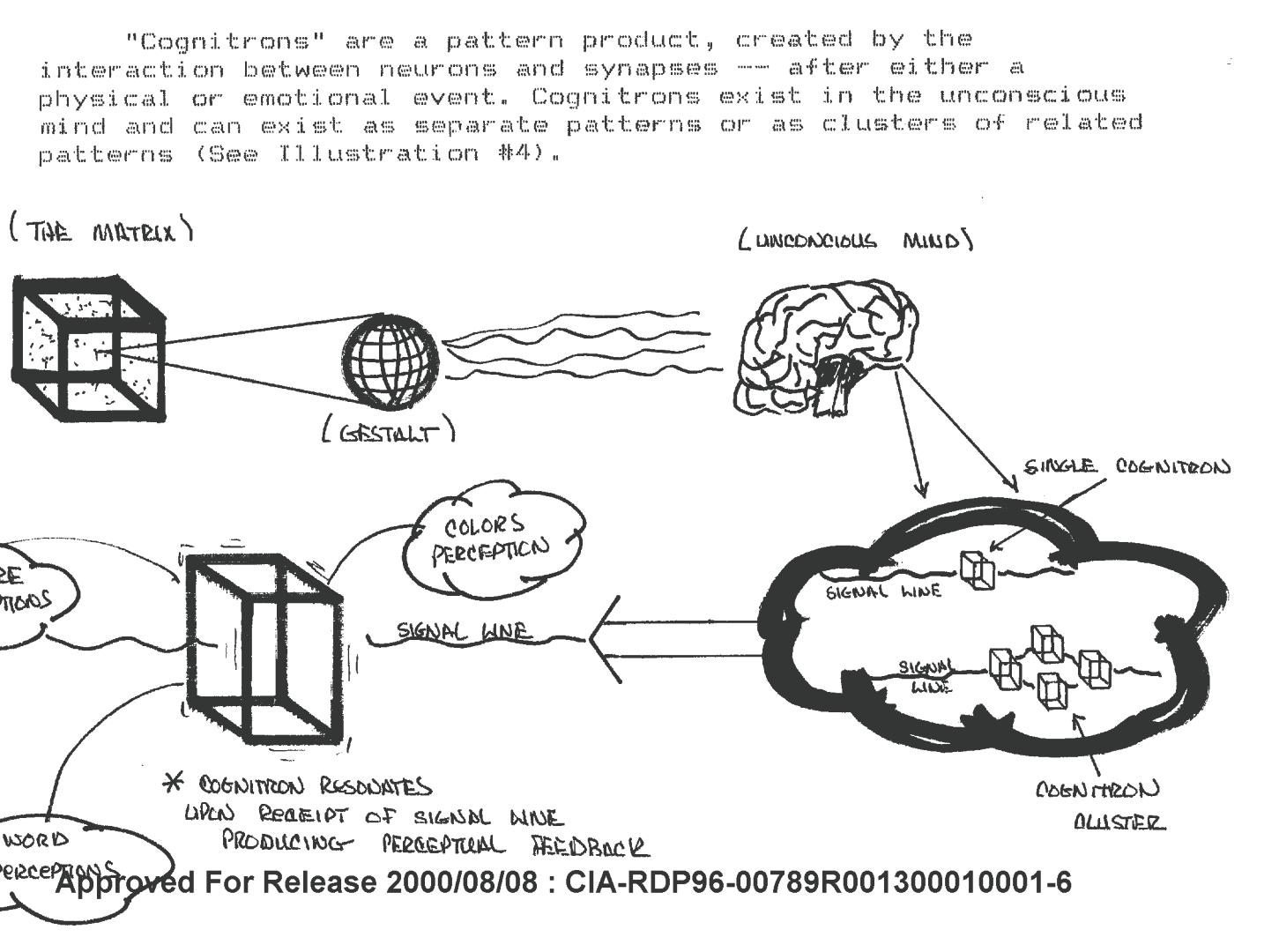
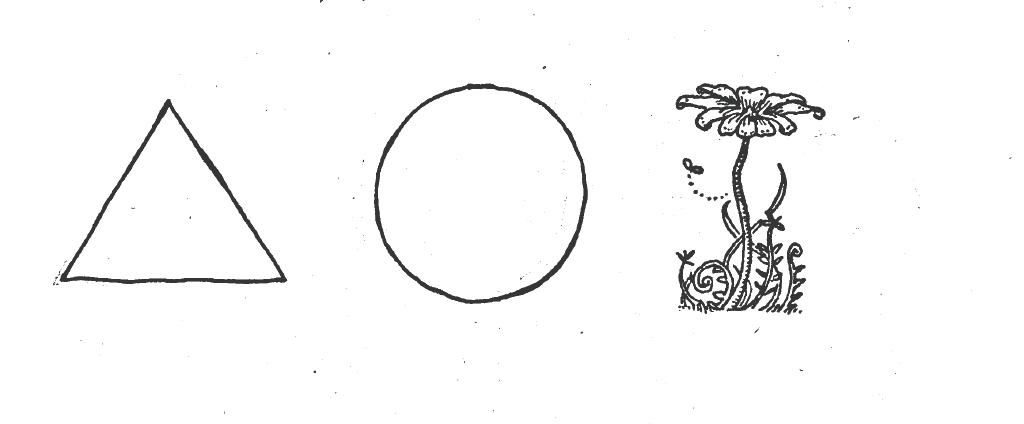
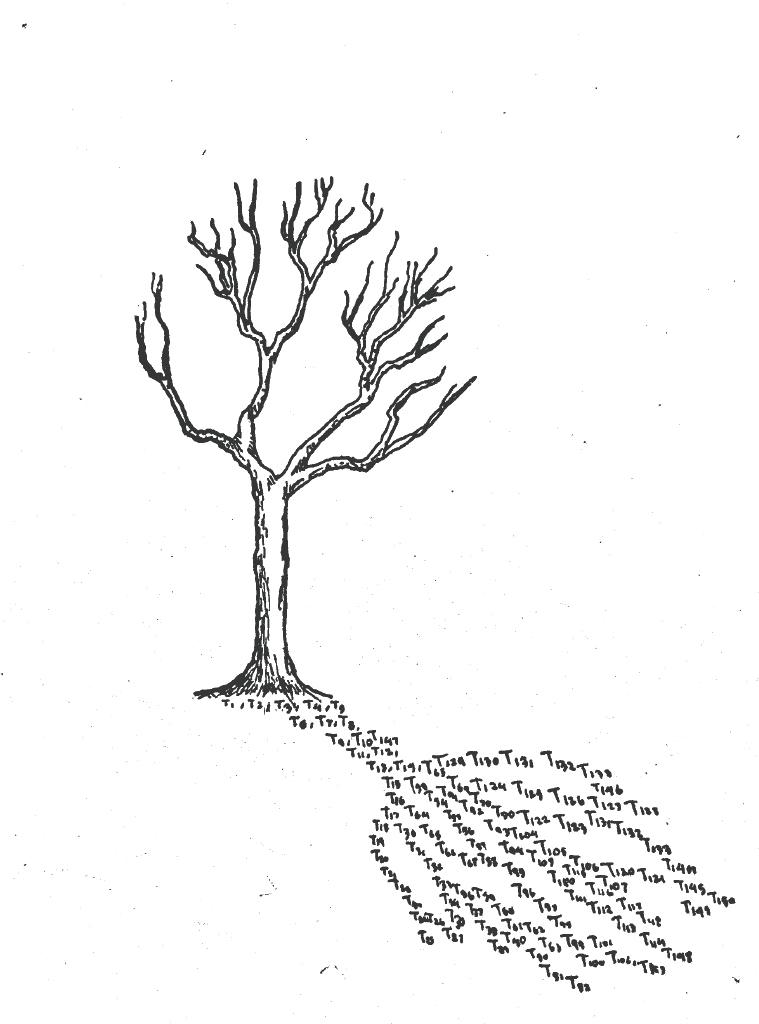
One year after the program’s creation, esteemed Scientologist Ingo Swann (who allegedly gained his psychic abilities at the age of three during a tonsil removal operation) made a critical advancement in the field with his discovery of Coordinate Remote Viewing (CRV), a revolutionary technique which allowed one to ‘view’ a location by concentrating solely on its geographical coordinates. Researchers at SRI described the process in “very basic terms”: “the viewer’s Autonomic Nervous System will respond to energy produced by the ‘Gestalt’ or ‘pattern,’ and this response will manifest it’s self [sic] on the Ideogram. It is this registration on the Ideogram that indicates that the viewer is receiving the signal line of the Gestalt.” (see fig. 01)
Following hisrisetostardomwithintheparapsychologycommunityforhisworkas a“psychicdetective”(inwhichheworkedon25casesbetween1972and1979andfailedto solve22ofthem),SwannsoughttodisclosethetruthabouthisinvolvementwiththeCIA tothepublic.Inhis1988autobiography, Penetration: The Question of Extraterrestrial and Human Telepathy, Swann recalled his work as a remote viewer for an unspecified agencyinvestigatingasecretextraterrestrialbasehiddenonthedarksideofthemoon, as well as his “shocking” experience with a “sexy scantily dressed female E.T. in a Los Angelessupermarket”(asdescribedonhisWikipediapage).TheCIAhasadamantlydenied anyinvolvementwiththeincident,oranyoftheothersthatSwanndepictsinhismemoir. Nevertheless,Swann’sbreakthroughgreatlyincreasedtheinterestinremoteviewing asaviablemilitaryasset.In1977,theUnitedStatesmilitaryestablishedasecretmilitaryunitinFortMeade,Marylanddedicatedtotrainingsoldiersinparanormalsurveillance methods.
Known as the ‘Stargate Project,’ the operation was overseen by Lt. Frederick Holmes “Skip” Atwater, aide and “psychic headhunter” to Maj. Gen. Albert “Spoonbender” Stubblebine III. The program received 20 milliondollarsoverthecourseof23years, until it was terminated and declassified in 1995 after failing to produce any verifiable evidence towards the efficacy of remote viewing. The project’sfindings(orlackthereof)are currentlyhousedintheArchives oftheImpossible(AOTI)atRice University, which “has been collecting and professionally archiving materials related to paranormal currents in Americanhistory”since2016.
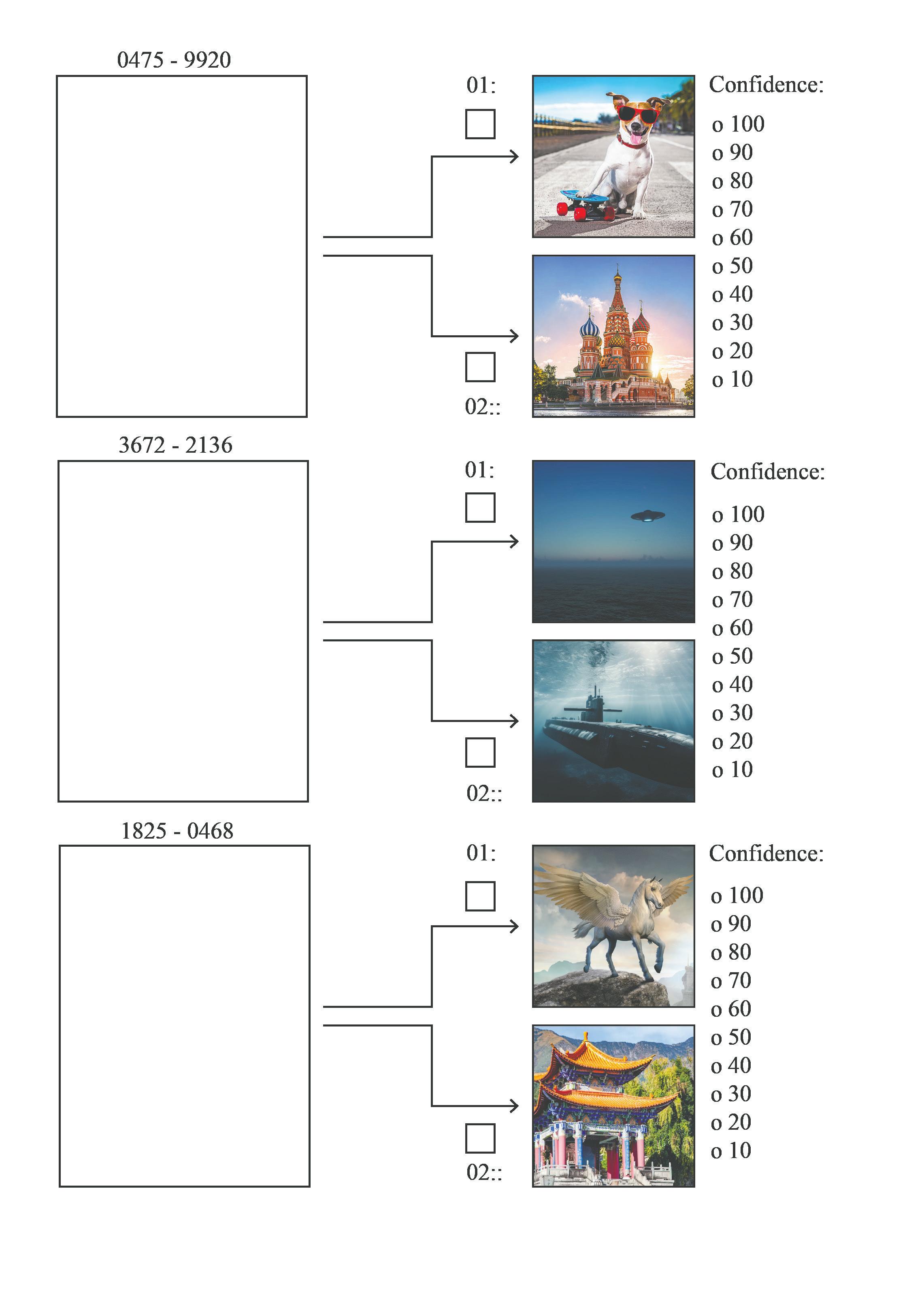
paysoutofpocket.Thegameworksbyprovidingyouwith withadailysetofcoordinatesthatcorrelatetospecific“targetimages”youwillseeinthefuture,along Tofivekeystepstoguaranteeprecognitioneverytime:(whicharereproducedbelow). test your latent psychic abilities, we have also provided a brief assessment based on RVfromTournament’slayoutwhichallowsustocalculateyourremoteviewinghighscore.Pleaserefrain lookingatanyoftheimagesontherightsideofthepagetopreventcontaminatingyourcon-sciousness.Whenyouhavecompletedtheform,pleasemailitto72StaggStreetatBrooklyn,NYandawaitfurtherinstructions. Thankyouforyourcompliance,andwelookforwardtoreceivingyourresults!
1. Read the coordinates carefully while focusing your psychic energy on the target image. Picture your future self looking at your phone in 24 hours and seeing the target image with the coordinate numbers printed below it.
2. Draw the image you see in this vision, including notes that describe the vague impressions of objects, shapes, and colors.
3. You will be presented with two images, one of which is the target image. Choose the one that most accurately fits your vision and indicate your level of confidence in that decision.
4. When you open the app in 24 hours, you will be shown the correct target image alongside its corresponding coordinates. You will now concentrate on beaming the image back in time to your prior self, the one that was trying to envision what you are currently seeing.
5. You will then receive a score based on whether you picked the correct image and the level of confidence you felt in that decision. If you correctly ascertained the target image, congratulations! You are now capable of assassinating a world leader with your mind.
Ferrier
What makes a radio station? For something that’s transmitted invisibly, visual identity is extremely important—and a handy way to trace a station’s history. Presented here is an archive of visual materials from Brown Student and Community Radio (BSR) from its formation in 1997 to the present. BSR is descended from one of the oldest college stations in the country (The Brown Network), and officially formed in 1997 to satisfy the need for a freeform station on which students and community members could fully express themselves. BSR was, and still is, known for letting people play whatever their hearts desire, and the eclecticism of the subsequent audio content is reflected in the station’s visual materials as well. Catch BSR on 101.1 FM Wed–Sat and 24/7 on bsrlive.com.
( TEXT ALICIA JOO, DESIGN SARA PARULEKAR )
ca. 2000↘WBSR 96.5 FM↘In 2000, BSR competed against a dozen other stations for the 96.5 FM signal. We never got it, but I can appreciate the hopeful thinking of making merch for something that never existed. AND the FCC banned us from using WBSR, so these are really, really limited edition stickers.
ca. 1997↘Stickers stickers stickers! I wonder what they put their stickers on before Macbooks and Hydroflasks.↘ BSR aired on 88.1 FM WELH 1997–2011. WELH was a radio station owned and operated by the Wheeler School (I haven’t seen it but I just KNOW their station is nicer than ours).
ca. 2005↘Big sticker.↘“BSR Inside Your Head”
Bottom: 1999↘ Top: ca. 2000↘Handy dandy handbooks on all things BSR
ca. 2004↘Show advertisement for hip hop on BSR featuring “tight beats”
2004–05↘Radio show advertisements featuring our old slogan “dead voices live on the radio and in your head,” a reference to the seances and exorcisms that would take place on air regularly.
ca. 2000↘Ad for Spook City Radio with Baron von Evilstein and Doctor Macabre, “the most vile on the dial”
ca. 2000↘Recruitment poster↘BSR today believes in vaccines.
2003↘Ad for someone’s show named after a 1968 album by Blue Cheer. I just listened; would recommend.
ca. 1999↘Radio forum on the future of Low Power Radio, including an expert in ‘pirate’ stations (making your own illegal radio station)
ca. 2010↘Recruitment poster: Your brain vs. your brain on BSR; the choice is obvious.
ca. 2005↘FLIP YOUR SH!T DJ night.↘The good old days when you could get drunk in Leung Gallery off of $1 beers.
ca. 2010↘BSR recruitment poster, begging for RISD students to join (nothing has changed)
ca. 2005↘Ad for ‘Features,’ the non-music programming of BSR, showing that BSR does so much more than music: We also talk.
ca. 2010
ca. 2010↘BSR Tarot cards? Not sure what’s going on here but I like it.
ca. 1999↘Station schedule
ca. 2000↘BSR poster, showing the Providence skyline as VU levels. Very clever.
ca. Spring 2026 (right now!)↘Credit: Allie Heffner R’26↘BSR Monday schedule 2025↘Credit: April Sujeong Lim R’26 2026↘Original design by April Lim R’26↘Redesign by Allie Heffner and Alexander Pink R’26↘Every good era needs a slogan, and right now, this is it.
ALICIA JOO B’26 IS NEARING RETIREMENT AS BSR STATION MANAGER.
HOUSES AND/OR A LANGUAGE
cAfter class, I’d told Charles, walking down Waterman Street, that the board had felt especially unalive today. I think we’d done something about quadratic reciprocity. It was boring. He asked me something like “You don’t find beauty in number theory?” No, no, no. I do not. I think it’s good for the brain and surprising, nothing more. Reading through a proof I understand, I’ve yet to approach tears, or to feel any interpretative liberty. Nor have I felt that to send someone my problem set answers would mean to externalize myself in any way. Sometimes the language is beautiful. Seeing the words The Real Spectral Theorem on the board suggests that maybe we’re about to graze something profound or supernatural. Say, catching the reflection of a ghost in the window. A Diophantine Equation, a billowy bedsheet drying in a summer’s breeze. Instead, the statement of the former is too long to write out and the latter defines a polynomial whose integer solutions are particularly important for mathematicians, such as a2 + b2 = c2. The math student questions what the project of pure math is for, if not for beautiful language. Pure math, meaning we’re concerned with the way math relates to itself, not the way math relates to the world. I have never heard anyone say applied math is beautiful, probably because it has too much utility. Like a ceramic pasta bowl or woven basket; when people call applied math beautiful they really, maybe, mean to call it pretty or pleasing to the eye.
Trees threw blue shadows along Waterman by the tinfoil statue. Each shadow had a length of tree height, T, over the tangent of the angle between the sun and the ground, theta. The young oak leaves were bilaterally symmetric. When one fell (it was fall) you could predict its trajectory by treating the wind as a vector space. Once, at a math competition in high school, a man whose name I’ve forgotten gave a speech in which he said “Math is the language of nature.” Really, truly, earnestly looking at the blue shadow I think: Am I being lied to? Please do not deceive me. This conception of math isn’t new. Here’s Galileo in his book called The Assayer “Philosophy is written in this grand book, the universe, which stands continually open to our gaze. But the book cannot be understood unless one first learns to comprehend the language and read the letters in which it is composed. It is written in the language of mathematics, and its characters are triangles, circles, and other geometric figures without which it is humanly impossible to understand a single word of it; without these, one wanders about in a dark labyrinth.”
There is, at the same time (and maybe there’s some causality going on) an aestheticization of and a ‘making fundamental of math.’ By the latter, I mean positioning mathematical knowledge prior to other knowledge, as though algebra was epistemologically more fundamental than biology, or art, or English. (To be sure, there’s a pedagogical priority in the case of biology, but that doesn’t entail fundamentality.) If I rubbed my eyes really hard, would flowers really open and reveal themselves to be neatly defined fractals? Such a fundamentality ignores the possibility that math is a thing placed atop the universe and not something underneath. And aestheticization leaks through the very language that Galileo uses for this positioning. A “grand” book, a gaze, and letters that compose the universe and whose understanding frees us from a “dark labyrinth”. In just calling math ‘itself ’ a language, math becomes wholly embedded in aesthetics rather than something outside of it. As “grand” connotes, well, grandiosity, an aesthetic quality, all language has an aesthetic dimension. It’s not just that the words ‘Diophantine equation’ have aesthetic properties, Galileo says that the characters of this mathematical language are geometric figures, and those, the circles, triangles, parabolas, and so on, have been inserted into an aesthetic domain.
Kids in swarms cross carelessly and cars honk. We were at the crosswalk on Thayer where the rules of the road are breakable. The sun was up. The chalkboard was
rule-governed. Strictly. In the classroom we’re chained by logic. No contradictions. No sublimation. We don’t take the inverse of an element modulo an integer if the element and the integer aren’t coprime. It seems wrong to be in your early 20s and have to obey such strict orders. We’d all like to live with our friends and stay up all night or cross the street when we please. So we started an anarchist revolution against logic. No, I lied, we didn’t, I’m sorry. Really, it’s hard to aestheticize a discipline whose creativity is so bounded, where the untrained artist can’t splash all over the canvas in passion. Instead, my freedom is limited to rotating through hence, thus, this implies, it follows that and choosing fun Greek symbols for variables. That’s an exaggeration. There is, at the undergraduate level, liberty in proof technique (maybe you prefer a geometric proof whereas I like to prove by induction whenever possible), but that’s far from the freedom of a blank canvas or the crosswalk. Further, there seems to be dissonance between the determinacy of pure math and the overwhelming indeterminacy (which isn’t necessarily pessimistic) of, say, the future. The freedom, made apparent by the aforementioned indeterminacy inherent to life, is betrayed by the logic of math. Charles didn’t, but I wished he’d said “Do you think there’s honesty in that, in logical rigidity?” Not honest in the sense that it’s true, he’d clarify, but honest in the way a mature Cézanne painting is. I’m thinking of The Gulf of Marseille Seen from L’Estaque, which I didn’t know the name of off the top of my head. It’s one of a dozen paintings Cézanne did facing toward the gulf, in which a warmly colored fishing village sits next to the sea. At the Met, we all breathe peacefully, far from the theatrics and the deception of the Romantic era. I don’t want to be pushed to believe that the sunset was that brilliant, or that those waves crashed so violently against rocky cliffs, or that the people on The Raft of the Medusa (a Géricault painting) oriented themselves as such, even though they were, surely, posing for as fruits in a still life.
Cézanne’s gulf is blue and flat. Faraway red-roofed houses are three quadrilaterals. Green hills are scratches. I believe it when I see it. Yes, those houses would be next to that water, almost necessarily. Of course, too, the sky is scratches. In his big book on aesthetics, Kant says that “art can only be called beautiful if we are aware that it is art and yet it looks to us like nature.” This could mean something like beautiful art appears to have been produced ‘naturally’ or spontaneously, free from intention, like a flower. Then, the honesty of Cézanne’s painting is somewhere in its appearance as natural (in the Kantian way). The sea arrives on its own, causing the emergence of red-roofed houses, hit by a sun that’s not on the canvas but is believably some where up and to the right of it, and the greens follow. At the same time, we are aware that this causation is nonetheless made. We see the brushstrokes.
Euclid’s proof of infinite primes shares something with The Gulf of Marseille Seen from L’Estaque. It goes like this: Consider any finite list of prime numbers p1 , p2 see that there is some prime that is not on this list. Let p1 p2 . . . pn be the product of our list. Let q = P + 1 prime, then some prime p divides q. If this p were in our list it would also divide P. If p divides both P and q divide the difference between P and q, which is 1. Because no prime divides 1, p is not on the list. Thus any finite list of primes will be missing at least one prime, which proves that there are an infinite number of primes.
The ideas lay nothing but themselves in front of us. They aren’t lost in a race for aesthetics. Yes, a unique prime would be found outside the finite list. A simple division rule would be the finishing touch. A truth unravels naturally, as if spontaneously, as it does in the Cézanne painting. I see the honesty. The logic isn’t suffocating. It’s a simple crea ture that allows the opening move, the assumption of there being finitely many primes, to be responded to so cleanly. There’s a freedom in being able to push any idea in any
direction and for there to be an answer waiting. What if there were finitely many primes? What if q were not prime? What if q were prime? Curiosity is let loose. And, meanwhile, any unwarranted romanticism, in the way I’ve characterized it, is filtered out because logic can’t be deceived. +++
It always smelled like body odor because the math graduate students had class right before us. The ceiling was low and the walls were cinder blocks. Fluorescent lights, too. Chalk moved across the chalkboard to a certain rhythm. The proposition was unexpected and a little exciting: For all x in ℤ+, x = a2 + b2 + c2 + d2 for some a, b, c, d in ℤ+. In other words, every positive integer can be written as the sum of four squares. This was proven in 1770 by Joseph-Louis Lagrange, though the proof we were going through was not his.
It began first with proving that the statement holds for all primes. We considered the points in a particular lattice. And the appropriate radius for our four-dimensional ball, centered at the origin. And a lattice whose fundamental domain is p2, where p is some prime. The sunlight would always come orange through the window around the time class was dismissed. This was in the fall, I remind you. Minkowski’s theorem, proven in 1889, guaranteed that the ball contained a nonzero lattice point of the aforementioned lattice. It had to be that p divides a2 + b2 + c2 + d2 , where (a, b, c, d) is the intersected nonzero lattice point. So the sun was in and the chalk was unmoving and a little white square could be seen in the corner of the board. Euler’s Four Square Identity, discovered in 1748, had let us conclude that the statement holds for all positive integers. It’s a stylistic choice to mark the end of a proof with a square. We were asked for our thoughts.
“It’s a good story,” someone said. The bell at University
MEETING OF THE MEETINGMINDS OF THE MINDS
c Temperatures, spirits, and bottoms are up, sort of. I am rejoicing, yes, but also more cognizant than ever of the transience of it all. It’s all coming to an end soon. The sun sets earlier than you think. The last issue arrives before you’re ready. And yet, here we are, one more time, with feeling.
( TEXT ANGELA LIAN / DESIGN KAYLA RANDOLPH )
Dear Indy,
I’m moving away from Providence forever and I want to make sure I’ve really soaked up the essence of the city before I leave. What are three things I need to do before I go?
Sincerely, Rhode to Nowhere
SE: Get sunburnt and wine drunk on RISD beach, then struggle to call an Uber back; watch a late movie at the Providence Place Mall and afterwards, flaneur through its empty floors; enjoy a stoop beer in the sun and watch strange vehicles pass by. Think, at these moments, about how lucky and strange you are to have ended up in this lucky and strange city.
KM: See, I’ve always known ‘forever’ to be the kind of titan that bubbles with uncertainty. I think it’s easy to imagine forever clothed in a kind of finality that’s rigid and unchanging, but doing so detracts from its delicious whipped mallow of possibility; forever is a long, long time, you know? In important moments like these, I often feel that my life is moving along an asymptote. Much like yourself, much like everyone else, ahead of me lies a great conclusion. In the fashion of every space movie where they fold a piece of paper in half, poking a hole through its opposite ends, time dilates. Each hour becomes slower, each moment more precious. As I approach a single fateful moment—moments my life has been ripe with—I become increasingly certain that that moment will never come, that I’ll only grow closer, forever. But should it take weeks or months, years or decades, our lives will inevitably crescendo to many ends, and meet the beginnings of unknown forevers. In that way, I think retrospection is forever’s greatest gift. The last few years will always remain with you, even once
Dear Indy,
How do I lead a life with meaning and purpose?
Sincerely,
To Be Determined
AS: I think it might have something to do with #3.
KM: I could say a whole lot about work-life balance. About volunteering and eating well and showing up and taking breaks. I could say even more about the subjectivity of purpose. How it depends, how it changes, and how the trajectory you were once on just might become a road you can no longer travel, and how you’ll have to find a new path. I could tell you how that will be hard, and how you might find yourself lost in some kind of wilderness. I could tell you that you will find your way back again, and how that is the beauty of our most basic human condition. I could say all these things and gift them to you, wrapped in a tidy package, topped with a neat bow, but none of that is what I really mean. You see, it is love that harnesses all these little nodes together. Your love of self and of friends, of partners, family, and work. I should warn you that one would be deluded to believe they could sustain themselves on just one of love’s axes their entire life, and how it is just as misguided to believe that each will exist in some perfect harmony. Love is a garden you must
Indie has been sharing incredible wisdom all year. But some questions are too big for one girl to handle, even if that girl is me. That’s why today, I’m reaching back into the archives for the assistance of brilliant, beautiful Indies past. Yes indeedy: I’ve assembled the Avengers except if they were hotter and funnier and also all girls. What a special treat! I hope that this triple advice can tide you over through the wide-open yawn of the Indyless months to come.
they’re long gone, even once you’ve realized all the dreams you concocted in this soon-to-be past. Hence, I believe the best way to honor your trials and triumphs, to show them the respect deserved for where they’ve brought you, is to revisit. If it were me (as it soon will be), I know I’d walk along the pedestrian bridge at night. I’d sit on one of its uncomfortable benches and look up, admiring how the alternating glow of smokestack lights almost look like stars. I’d locate the Big Dipper. I would remember all the great and awful and confusing nights I spent sitting there. I would wander the aisles of Serendipity Gourmet, and then make the economical choice to purchase my snacks at Metro Mart. I’d ride the RIPTA.
But I’m not you, and I’m not leaving just yet.
It’d be unfair to tell you where to go, what to do. We both know those decisions are yours alone to make. What I do know is that in every corner of our campus, amidst the not-so-sprawling city blocks of Providence, are the spectres of our past selves, replaying the moments that made us who we are in eternity. Forever, that is. Do them justice, and you will learn to say goodbye.
AS:
Think about the friends in Providence with whom you most love hanging out/sitting around/doing homework/talking/laughing.
The next time you find yourself hanging out/sitting around/doing homework/talking/laughing with those friends, notice it.
Realize that there are a lot of cool things to do in Providence, but that this everyday kind of stuff with your friends is what you will miss the most, which you might not fully understand until you’ve left, but, even so, you will do your best to remember while you’re here.
always tend to. It will experience frost and drought, and times will come that make you want to pack up your things and leave, settling for Sysco basil and PepsiCo radishes. I implore you to stay, to wait for the season of immeasurable harvest, because it does come. And then it fades. And then it returns again. Your job is to plant seeds in that garden, to water them and shade them. Allow life to take its course, but refuse the notion that you are not an agentic player in this game. When you lead a life that centers love, you will find that meaning and purpose were always there, winking, whispering Hey Indy, we love you too ;)
SE: The meaning is inherent; the purpose, I hope, will be obvious later. In the meantime, this Indie’s best advice is to live lightly: don’t be afraid of a sunburn, an empty mall, or a warm beer—that stuff is just as good as the rest of it.
And with that, the council adjourns. I’ll see you on the other side. HAGS.
( DESIGN MARY-ELIZABETH BOATEY )
B U L E L T I N
MUTUAL AID
Therapy Support for Edgar’s Grieving Girlfriend
[From the GoFundMe]: On March 24th, 2026, the Caliente community suffered the sudden and unexpected death of their colleague Edgar Mancía Fuentes. The workers have faced a difficult time since then, especially the girlfriend that he left behind, who is also a worker at Caliente. Though her community was able to cover her funeral costs and the cost of getting Edgar's body back to his native Honduras, she can still use more help from the wider Brown/East Side Providence community. Her manager has expressed concerns about her mental well-being and her ability to cope with and grieve the loss. She observes that Edgar's girlfriend has had difficulty with some basic tasks, such as eating and talking, in the weeks since the accident. When asked if there was anything she might still need from the community, she very humbly said that all she really desires is access to therapeutic services that can help her process her loss. Unfortunately, without insurance, such services are not within her reach at the moment, especially as she looks to find a Spanish-speaking specialist.
Support a Haitian Family Facing ICE Detention & Eviction
SUDOKU
EVENTS
[From the AMOR GoFundMe]: The Alliance to Mobilize Our Resistance (AMOR) is fundraising for M, whose son has been detained by ICE since 2023 and is currently detained at the Wyatt Detention Facility in Central Falls, RI. We are seeking to raise $10,000 for M so that she can continue to support her family of four, to help cover the cost of housing, utilities, food, and legal costs for her son while he is detained by ICE at the Wyatt.
THE BITE
CAN YOU RECOMMEND ME A TURKISH RESTAURANT?
A year ago, I went to Turkish Lazuri Cafe in Boston to relieve my homesickness. As soon as my friends and I arrived at the restaurant, I ordered every dish, which resulted in my taste buds trembling with memories of home. Mantı, kebab, tavuk pilav, kısır, çiğ köfte: I kept going on and on, excited from the mere fact that I could speak Turkish to the waiter. Our table was so full of food that my friends’ eyes widened in fear. Someone looking in from outside would think that I was the Evil Witch in “Hansel and Gretel”, preparing these kids for a feast of my own. Diving into the gavurdağ salatası head-on quickly resulted in me hitting my head to the point of concussion. However, I was quickly stopped short—the mantı was fried in an unfamiliar fashion, the tavuk pilav wasn’t spicy enough, and the kebab didn’t have proper lamb meat—the food wasn’t how it was supposed to be. My friends ate the food like they were at the Last Supper, but I felt like Judas, about to betray them by announcing that the food wasn’t authentic enough. I kept it to myself, though. I was in the United States now; they like their food like this, and they have different palates. My mom wasn’t in the kitchen—the food wasn’t like hers anymore. After a couple more “afiyet olsun”s and “kolay gelsin”s, we packed our extra food into takeout boxes and headed back to Providence. On the train, I kept talking about my friends back home. In a way, I was mourning my nostalgia through my memories because I was repressing the fact that “yes, obviously the food is not fully authentic—I’m not home anymore.” Anyway, service 10/10; food 8/10; dessert 9/10: I definitely recommend it if you want to try Turkish food. But if you miss home? Maybe stop looking for it in the shadows of these foreign lands.
SARYA BARAN KILIÇ B’28 is trying to translate the menu.
A Petting Zoo April 24, noon–3 p.m. Public Shop & Gallery, 50 Agnes St $10 Based Stitches: A Sewing Primer April 24, 6–7:30 p.m. AS220 Community Studios, 131 Washington St, 2nd Floor Free Creative Meet Up for Poetry Month April 24, 7–9 p.m. Public Shop & Gallery, 50 Agnes St Free Independent Bookstore Day April 25, 11 a.m.–5 p.m. arc{hive} book + snackery, 4 Market St, Warren, RI 02885 Free Picture Book Workshop April 25, 2–4 p.m. Rochambeau Library, 708 Hope St Free, prior registration required Political Comics Workshop: Character Design & Plot Structure April 25, 3–4:30 p.m. AS220 Community Studios, 131 Washington St, 2nd Floor Free Speculative Fiction Meetup: Economies & Mutual Aid (no reading required) April 26, 12:30–2 p.m. Red Ink Community Library, 130 Cypress St Free Providence Resistance Chorus Gathering April 26, 2–4 p.m. First Unitarian Church, 1 Benevolent St Free Wyatt Detention Center Info Session April 27, 5:30 p.m. AMOR Office, 545 Pawtucket Ave, Pawtucket, RI 02860 Free Bad Art Club April 28, 7–9 p.m. Now or Never PVD, 301 Harris Ave $5 at the door Queer Youth Art Gallery Interest Meeting April 29, 3–4 p.m. Youth Pride, Inc., 743 Westminster St Free Ghanaian Drumming & Dancing Ensemble April 29, 7 p.m. Riley Hall, Lindemann Performing Arts Center, 144 Angell St Free with RSVP Providence Philosophy Club Monthly Meetup April 30, 6–7 p.m. Symposium Books, 240 Westminster St Free Songwriting Workshop April 30, 6:30–8 p.m. Now or Never PVD, 301 Harris Ave Free,