Caiden Demundo, Sarya Baran Kı lıÇ, & Vanessa Berman
Our readers have spoken, and it seems our dear, little, analog, old-world paper has gotten a bit too chronically online. Come on guys. Don’t you know the internet’s a book, and vice versa? Here’s The USB Issue. By the way, have you noticed they put the Feed the Cheeks inside of the Moka&Co? Chag Same’ach: It’s Passover. One song for the holiday is “Dayenu,” which means ‘it would have been enough.’ One has the impression that alright cookies or specialty Yemeni coffee would have been enough. We get both; one inside of the other. USB. (US Blessed.)
ILLUSTRATION EDITORS
Selim Kutlu
Serena Yu
ILLUSTRATORS
Abby Berwick
Rosemary Brantley
Rosalia Gonzalez Pousa
Koji Hellman
Jiwon Lim
Ellie Lin
Megha Nambiar
Ruby Nemeroff
Meri Sanders
Angelina So
Luna Tobar
Naomi Zaro
Cora Zeng
Alena Zhang
Faith Zhao
COPY CHIEF
Eric Ma
COPY EDITORS
Jordan Coutts
Mackenzie Ellis
Kainalu Faucher
Lucie Huang
Indy Nijjar
Camilla Rodriguez
Zeke Tesler
Sasha Watson
WEB EDITORS
Casey Gao
Erin Min
WEB DESIGNERS
Maja Mishevska
Amy Pan
Dominic Park
Joy Zou
SOCIAL MEDIA EDITORS
Olivia Falk
Sylvie Foster
Isabel Hahn
Avery Reinhold
Eurie Seo
SENIOR EDITORS
Jolie Barnard
Nan Dickerson
Paulina Gąsiorowska
Sabine Jimenez-Williams
Angela Lian
Nadia Mazonson
Talia Reiss
Luca Suarez
OUTREACH AND INCLUSION
COORDINATORS
Raamina Chowdhury
Naomi Nesmith
The College Hill Independent is a Providence-based publication written, illustrated, designed, and edited by students from Brown University and the Rhode Island School of Design. Our paper is distributed throughout the East Side, Downtown, and online. The Indy also functions as an open, leftist, consciousness-raising workshop for writers and artists, and from this collaborative space we publish 20 pages of politically-engaged and thoughtful content once a week. We want to create work that is generative for and accountable to the Providence community—a commitment that needs consistent and persistent attention.
While the Indy is predominantly financed by Brown, we independently fundraise to support a stipend program to compensate staff who need financial support, which the University refuses to provide. Beyond making both the spaces we occupy and the creation process more accessible, we must also work to make our writing legible and relevant to our readers.
The Indy strives to disrupt dominant narratives of power. We reject content that perpetuates homophobia, transphobia, xenophobia, misogyny, ableism and/ or classism. We aim to produce work that is abolitionist, anti-racist, anti-capitalist, and anti-imperialist, and we want to generate spaces for radical thought, care, and futures. Though these lists are not exhaustive, we challenge each other to be intentional and self-critical within and beyond the workshop setting, and to find beauty and sustenance in creating and working together.
Week CaffeINe Review
c The only thing that I have really ever learned on College Hill is that cafes have the ability to rob you of every cent you own. I was warned all the time in high school that people would invite you out to smoke or drink, but little did I know that the real damage to a wallet is done by your friends inviting you to the fair trade sit-down cafe on Wickenden Street that sells lattes for $6.30 before tax and mandatory iPad tipping. (Multiple times a week, mind you! It would probably be cheaper to get addicted to cigarettes.)
The real problem with this lifestyle of cafe consumption is that, like most consumerist tendencies, it is not value-neutral. It seems like every week a new cafe is under fire for a workers’ rights controversy. Who can keep track? Where can I still go for a good cup of brown butter cortado? Consider this article a guide to what coffee shops it is still woke to visit.
Is it accurate? Probably not. The information you’re about to read will be spotty. It will be uninformed. And it will be an accurate representation of what I, a curious but uninvolved individual, was able to discover about the cafes featured in her goldfish-memory rolodex of recently cancelled locations. Please digest this investigation into the most controversial cafes of College Hill.
CEREMONY
Average customer order: Ceremony Latte
My order: Ceremony Latte
Least normal-sounding drink: Miso
I am a California girl who slowly watched her local strip malls get replaced by increasingly expensive aesthetic tea locations. It stands to reason that my first impression of Ceremony was negative–I was disappointed to find out that Erewhon-type L.A. tea places had somehow managed to spread to the East Coast. Here I was thinking I was safe.
Over time, however, my hesitancy began to wane and my skepticism mellowed. When there’s a location where all your friends and advisors invite you to, you have no choice but to let the joy of those interactions consume you a little bit. I have to admit, Ceremony has been a staple of my College Hill experience–at least in the earlier hours of the day. After 1:00 p.m., you have to deathmatch 50 Brown students for an empty seat.
Ceremony’s lukewarm vibe and millennial neutrality lulled me into a false sense of security — how could this place hold any controversies when it’s so beige and mellow? Yet, 10 weeks ago, I was handed a serious reality check. The Ceremony Instagram page, @ceremonypvd, posted a series of bizarre Canva edits full of non-sequitors. It basically seemed to me like whoever was running the Ceremony Instagram account had lost it.
I didn’t have to wonder about it for long. In the description was this lead: “Guilty Until Proven Innocent — coming soon. Chapter 1 will be published on Substack.” Guilty? Innocent? I hope whoever this is isn’t posting about a litigation on Substack of all places…
THE REDDIT THREAD
I wasn’t the only person whose intrigue was spiked by the mysterious posts. Hordes of people sprinted to r/providence from Ceremony’s Instagram page in confusion. One post, disappointingly titled “The Ceremony Files,” asks: “can someone that’s not the owner or upper management of Ceremony (any AI comment = probably her) explain what’s actually going down with ceremony?” So here is somebody accusing the Ceremony owner of being a shameless ChatGPT user.
Another commenter simply wrote: “Be honest, batshit insane people are what make Rhode Island the best!!” So she is an AI user AND batshit? Those are some pretty serious Reddit indictments.
There was only one comment that was helpful. It redirected the conversation back to the Substack. I decided that it was time to stop looking for other people to summarize the situation for me and do what I should’ve done at the beginning: read Chapter 1, published on Substack.
THE SUBSTACK
Step right up, because forget the Miso Caramel Hojicha Latte: This Substack article might be the most insane thing Ceremony is serving. The first chapter, titled “Prologue — The Hearing,” did not actually give me answers about “The Hearing ” There are no timestamps and no contextual information; it’s instead an immersive first-person account by the
owner of Ceremony, having a meeting with her newly unionized employees. It’s hard to tell what’s happening, which, arguably, could be a very effective writing choice on the part of the author. After all, she’s just so in shock: “numb to how absurd the words sound.” In fact, she’s kind of the victim here.
According to the author’s account, an employee named Cheyenne was soon to be appointed the statutory supervisor, or someone who makes hiring and management decisions on behalf of the union. “I look at her and don’t see a ‘supervisor,’” the author says, “because she isn’t one. She’s a young woman who spends half her days whisking matcha and half her nights dreaming up captions that make strangers feel seen.” You might be thinking that this is kind of a demeaning thing to say about your own employee, but it’s also a pretty egregious deployment of therapy-speak against her employees. Throughout the article, the author insinuates that the union is dehumanizing people—beacons of American individualism—into a less animated collective horde. She calls the union negotiation room “a place where living, breathing people get pressed flat into ‘facts.’” There is something pretty jarring about a business owner weaponizing self-help BS to Union Bust. Under commercial circumstances, it’s disingenuous to act like you are all part of an agential, neutral, big, happy family. It made me concerned about how she may have actually acted towards her employees. I needed more answers.
THE FRIEND OF A FRIEND
I was so confused by the phrasing in the Substack article that I decided to speak to someone who was actually involved in the unionization effort. A friend and former Ceremony employee pointed me to Michael, a coworker of hers who had been involved with the unionization process. According to Michael’s timeline, they had begun petitioning for a union in February 2025 and successfully unionized later that year. “But union-busting can continue after the union has been successfully recognized,” he said. And that’s exactly what happened under Ceremony’s ownership.
When asked to comment on the owner’s response to the union, Michael said, “She kind of spent most of the year making every [old staff member] her pet project until she harassed them enough to leave. That was her way of union-busting.” When I inquired about the specific relationship she had with workers pre-union, he said, “She was misleading folks by saying she would fly them off to Japan, real grandiose gestures to ensure employees were doing work off the clock. They saw […] that work and life boundaries were not respected.” To me, all of this sounds pretty manipulative. She expected her employees to work overtime, demanded that people treat their job like a family unit, and asked people to give up their lives for overpriced matcha drinks. This type of behavior is just begging for a union to form.
DAVE’S COFFEE
Average customer order: Iced Latte
My order: Never been.
Least normal-sounding drink: Double-shot Blind Pig Espresso
I love thinking about going to Dave’s, but not actually going to Dave’s when I’m on my way to something else. Because of this, I actually do not know anything about Dave’s. I’ve just looked up photos online, and my first impression is that it looks kind of Whole Foods-y. I mean. Wait, what’s this? Dave’s Coffee is… cancelled?
LINKEDIN
The best part about Dave’s Coffee to me is that the guy who founded it is named Dave. To me, there’s something novel about Dave’s Coffee quite literally being Dave’s coffee. And Dave is real, which means he has an online presence I can comb through. We all know LinkedIn is stalking for the new age, so of course, I had to go check Dave Lanning’s page. His current LinkedIn bio says “Founder, Dave’s Coffee | Making Rhode Island’s coffee milk syrup with real coldbrewed coffee and cane sugar since 1998.” That’s pretty normal, but unfortunately, I’m on his LinkedIn all the time and know that as recently as March 8, 2026, his bio was “CEO | Mentor. Thoughts from the trenches, not the sidelines.” What’s with the switch up, huh, Dave?
If Reddit is to be believed, he might’ve genuinely been in the trenches: bravely fighting head-to-head, tooth and nail against his LGBTQ+ employees.
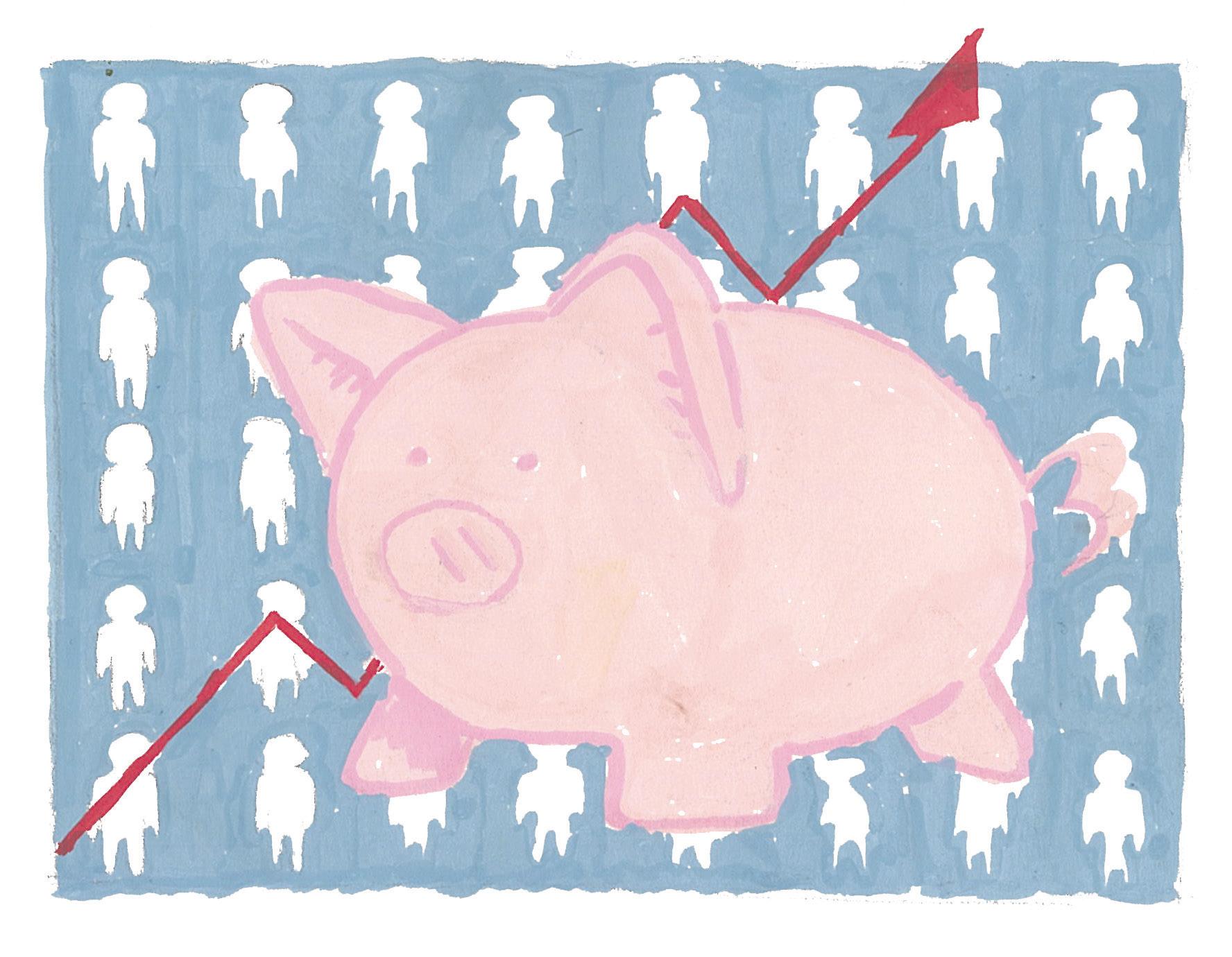
( TEXT ALENA ZHANG DESIGN SEOYEON KWEON )
THE REDDIT THREAD
We return to r/providence. Two years ago, a burner account called 143103628 (which also happens to be Week in Review SE Maria Gomberg’s phone number, feel free to drop her a line) created a thread titled “Dave’s Coffee is having it’s [sic] third mass exodus of staff in ~6 years.” According to the thread, Dave had been gravely mistreating LGBTQ+ employees. One of the most notable examples of this behavior was his permissiveness and neutrality when a front of house lead harassed an employee over their pronouns. When the incident was reported by the staff manager to Lanning, he drew out the situation, insisting on a month-long investigation, during which the accused employee was still staffed alongside the party under investigation. Before the month was over, the accused was fired, presumably for unrelated reasons. Only a few weeks later, Lanning fired an employee for pushing back against a policy of his that would cut down on hours. After this, basically, everyone quit.
MY FRIEND
She told me to go look at more Reddit threads.
THE SECOND REDDIT THREAD
A follow-up post, simply titled “Dave’s Coffee update,” showcases a photo of the front door of Dave’s Coffee. A sign had been put up that read: “Stay tuned friends! […] We are making several much-needed updates improvements [sic] and will be back soon!” In the replies, user 143103628 from the previous thread stated that the closure was sudden, with some employees finding out with 12 hours’ notice and others actually showing up to work without learning about the closure.
SMALL POINT CAFE
Average customer order: Iced Vanilla Latte
My order: Brown Butter Latte
Least normal-sounding drink: Brown Butter Latte
I honestly couldn’t care less about the food and drink at Small Point Cafe. I have never liked it enough to go back, but it’s inoffensive. I have a vague memory of my move-in day during freshman year that involved buying a 10-dollar avocado rye toast, and I don’t remember what it tasted like. That is bad news. But what the people don’t know about Small Point Cafe is that they have free board games that you can just take out and play for however long you want. You can enjoy The Settlers of Catan without owning The Settlers of Catan—which is incredible. However, the reason that Small Point Cafe has made an appearance in this article is due to a long-running secret of mine. Over the last four years, I have been walking around Providence with the niggling sensation that Small Point Cafe had experienced a controversy that no one except me can seem to remember. And the worst part? I found almost nothing about it online.
REDDITORS REMINISCING ABOUT A POSSIBLY NONEXISTENT CONTROVERSY
Let’s go to r/providence, one last time. Two years ago, a Redditor posted a thread titled, “Small point cafe boycott?” The concerned commenter asks about some flyers they’d seen around South Main Street about boycotting Small Point Cafe for one reason or another. Comments seem split on whether or not this boycott is valid.
MY FRIEND
I DMed my friend on Instagram asking if she remembered anything about this situation. “Nope, not at all,” was the response.
CONCLUSION
It seems like there isn’t really a morally safe place to get coffee. I am getting paranoid. I keep looking up cafe names with the word ‘controversy’ to see what hits the first page search results. I guess I am going to switch full-time to Bru Instant Coffee.
ALENA ZHANG R’26 is going to stop going to all cafes. Forever.
Caramel Hojicha Latte
“A Team for All Rhode Island”
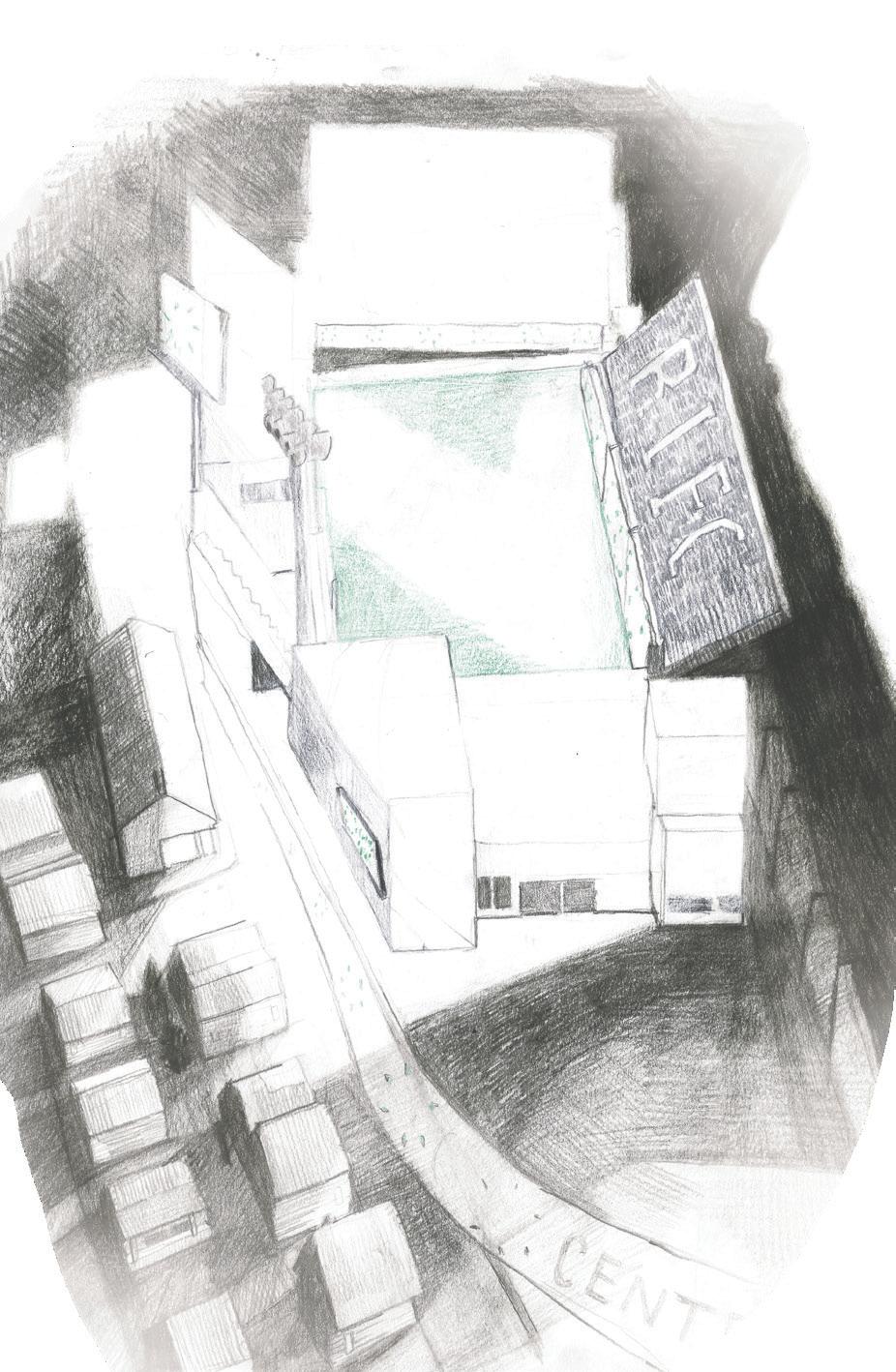
Centreville Bank Stadium, Private Equity, and a Deepening Housing Crisis in Pawtucket
debuted in the United Soccer League Championship, the second-largest professional soccer league in the U.S. The club played its first home game at Centreville Bank Stadium in May 2025, which sold out the 10,500seat arena.
Centreville Bank, the principal financial sponsor and namesake of RIFC’s new stadium at Pawtucket’s Tidewater Landing, has a much longer history in the state. The bank has operated since 1838 and has 24 branches—eight of which came through a 2019 expansion into Eastern Connecticut. In April of 2025, Centreville Bank posted a video on YouTube titled “RIFC Hype Video.” The video includes clips from the stadium’s groundbreaking ceremony, media coverage of the development, team practices, and interviews with fans spliced together to foster “hype” for the new stadium. It begins with drone footage of a soon-to-bedeveloped patch of dirt, alongside the date August 12, 2022, indicating, at least symbolically, the beginning of the development process. But about a year and a half before that day’s ceremonious groundbreaking took place, the City of Pawtucket and its police department forcibly displaced a homeless encampment with more than 20 residents.
In 2019, then–Rhode Island Governor Gina Raimondo and Pawtucket Mayor Donald Grebien announced Tidewater Landing, a 25-acre development that would stretch across both sides of the Seekonk River in downtown Pawtucket. In addition to the stadium, plans for the development included a hotel, more than 600 units of housing, an indoor sports event center, commercial office space, and a pedestrian bridge. Estimating around $400 million for the project, the funding plan made by the city and its collaborating development firms called for approximately 20% public investment through government bonds ($70–90 million), with the rest coming from private sources. However, inflation and supply chain issues have raised the cost for Pawtucket taxpayers to approximately $114 million over the next 30 years. Countering concerns about taxpayer burden, the developers have said that the project will pay for itself over the next three decades with the creation of housing and commerce.
thetidewaterlanding.com, the primary website for the development, consists of a homepage describing Tidewater Landing as the “largest economic development project in the history of Pawtucket” and a series of mostly defunct hyperlinks. The website pledges that the project will “completely transform Pawtucket’s riverfront and support economic growth in the Blackstone Valley and Rhode Island for years to come.” Concerns about allocating $70–90 million in public funds dominated much of the discourse around the construction plans. Though it did not include information on voters’ rationale, a 2022 poll
( TEXT BEN UNDERWOOD DESIGN ESOO KIM ILLUSTRATION PAUL LI )
likely Rhode Island voters, 56% opposed the plan, 31% supported it, and 12% weren’t sure. The poll captures a wariness of the project’s affordability for a city with a median household income of just over $64,000, compared to the statewide median of about $83,500, and 13% of its population living below the poverty line, according to the 2024 American Communities Survey. Given these demographics, affordability concerns, such as housing and food access, are among the most desired allotments of public funding in the city; the stadium’s uncertain benefits made its development a point of contention.
Citing rising costs, the city repeatedly paused and resumed funding throughout the stadium’s development, postponing RIFC’s first season at Tidewater Landing from the originally planned 2022 to 2025. As the developers’ request for public funding grew and shifted from the site’s broader development to the stadium alone, R.I.’s Commerce Board questioned the wisdom of the investment, echoing continued concern from Pawtucket residents on the tax expenditures and transparency of the project. In 2022, Governor Dan McKee broke a tie in a Commerce Board vote and approved continued public funding for the stadium. In response to concerns about the stadium’s construction, McKee said, “I’m not thinking about that. I have a very high expectation that this is going to be built.”
Though the stadium is the most notable and publicized aspect of Tidewater Landing, many of the arguments for the project hinge on the coming construction nearby, most of which remains unbuilt. Corporate and government support for the project, though, remains strong. In 2025, Brett Johnson, the CEO and cofounder of Benevolent Capital and founder of Fortuitous Partners—the primary private equity firms funding Tidewater Landing and RIFC— received the Pawtucket Foundation’s “Pawtucket Person of the Year” award for his “outstanding contributions to Pawtucket’s vitality, prosperity, and quality of life.” Exemplifying the importance of Tidewater Landing to developers, the ceremony was held at Centreville Bank Stadium. In a video celebrating Johnson’s accolade, Governor McKee sports an RIFC jersey and praises the drive and passion of the entrepreneur. After describing the upcoming commercial developments, McKee says, “In the end, [Johnson’s] dream, his idea—which was fragile—is reality.” +++
Developments like Tidewater Landing and the private equity firms that fund them around Pawtucket signal a new trend of urban renewal in the city. In an interview with The College Hill Independent, Jason Pezzullo, Pawtucket’s commerce director since early 2025, characterized the stadium’s construction as the beginning of an “era of reinvestment in the city.” Between a new MBTA Commuter Rail station,
plans to replace the now-empty Apex property, and a Downtown Gateway plan to attract economic development in the city more broadly, Pawtucket has seen a ramp-up in development over the last few years. This commercial growth has happened alongside an increase in costs for residents. According to HousingWorks RI’s 2025 housing factbook, the annual income needed to affordably purchase a median-priced house is roughly $128,000, though the city’s aforementioned median household income is $64,000. In 2019, when Tidewater Landing was originally approved, nine homes in Pawtucket sold for more than $500,000, one for $600,000 or more, and none for $700,000 or more. In 2024, 157 homes sold for $500,000 or more, 66 for $600,000 or more, and 16 for $700,000 or more.
Pezzullo characterized the recently built MBTA station and Tidewater Landing as hubs for future development in the city. With intentions of further expansion around the station and the stadium, Pezzullo said, “[The stadium’s construction] changed the status quo. Developers were more excited to be proposing in that area.” Before his role in Pawtucket, Pezzullo was the City of Cranston’s planning director, where he said, “people were very NIMBY [‘not in my back yard’] and didn’t want new development.” In Pawtucket, though, “we have people come and speak at public hearings saying, ‘Can you make it more dense?’” said Pezzullo.
Development in Pawtucket has not been without contention, though. In one of the most well-documented development fights in recent Rhode Island history, Pawtucket residents have been challenging the pavement of Morley Field. As one of the only green spaces in Pawtucket’s Woodlawn neighborhood, the decision to transition the athletic field into a parking lot four years ago was highly contentious. 74% of Woodlawn’s residents are people of color, and 59% live at or below the poverty line, according to ecoRI News. Most people live in triple-deckers or multifamily units, often with no backyard.
Tarshire Battle, the founder and executive director of Roots2Empower—a grassroots organization working for educational and environmental equity in Southern New England—was a steady voice in the fight for Morley Field. At a 2022 rally at the park, after emphasizing the need for green space, Battle held, “it seems like [the city] is not interested in listening to the voices of the people.” Critiquing the city’s wider refusal to consider community input, she said, “We
spoke out about the concerns about the Tidewater project, but that still happened. And it’s displacing a lot of our long-term residents.”
Battle, a Pawtucket resident for 20 years, was recently forced to relocate to East Providence, citing the city’s rising cost of living, a consequence of its urban renewal initiatives. “I’m privileged to be able to say, ‘If I’m going to be paying $2,000 or more in rent, then I need to find a place that has amenities.’ I had that option. Not a lot of other people do,” she said in an interview with the Indy. To her, this urban renewal is “good and bad.” Battle continued: “Hopefully [urban renewal] is done correctly with a mix of market-rate and affordable housing,” but she questioned whether this “affordable housing” would meet the needs of residents. “What’s affordable in the eyes of ‘affordable’ now?” she said.
Pezzullo sees concerns about gentrification as a “double-edged sword.” Discussing the challenges of not pricing people out of the city, he asked, “We’re supposed to invest a lot of money into the city but not make it more desirable?” Pezzullo asserted that including an “affordability component” to new developments is the solution.
Of the 600-plus housing units to be built as part of Tidewater, at least 300 will be market rate, and 72 will be affordable. The 72 units are part of Philadelphiabased Pennrose LLC’s new development directly across the river from the stadium. The complex will house a total of 28 units at 60% area median income (AMI), 15 at 30%, 14 at 80%, 13 at 70%, and two at 50%.
A 1991 Rhode Island law mandates 10% of each municipality’s housing be affordable, though municipalities have historically not met this goal. In a 2025 brief on the need for affordable housing in the Pawtucket, the municipal consulting firm Libra Planners held that “sub-standard housing conditions and overcrowding persist, due to the age of many existing units and the steady rise in housing costs.” The brief’s purported goal is to identify strategies to meet and, potentially, exceed the mandated 10%.
Alongside Tidewater Landing’s social success, Pezzullo highlighted its environmental benefits, saying, “It’s hard to imagine what this area was like prior to the stadium. It was a power plant, and it was basically a dead piece of land that had to be remediated. There was no activity there, no excitement, no life down there.” A 1996 inspection found dangerously high levels of toxic metals and waste in the ground from an early-20th century gas plant. The 23-acre plot was owned by the city for decades, with piecemeal cleanups scattered throughout, but Pawtucket did not seek a thorough restoration of the land until Tidewater Landing’s development began. Though Pezzullo’s holding that the land’s toxicity needed to be addressed is true, the land was far from “dead.” A homeless encampment had sat on the site for at least six months prior to the stadium’s groundbreaking.
In an “Ask The Governor” interview on Rhode Island’s WPRO radio station from August of 2023, Governor McKee reaffirmed the stadium’s purported profitability by saying, “It’s gonna be good for Pawtucket […] We’re supporting local communities every way we can.” In the same interview, the host questioned the governor about a separate homeless encampment in North Providence. McKee said that, as far as he knew, “all the individuals had been removed from the property,” and the Department of Transportation was “cleaning it up.” Declaring that Rhode Island’s state government is “supporting local communities every way [it] can” while speaking about unhoused community members as obstacles to be “removed” is the same discordant logic behind the state’s deepening housing crisis. +++
In 2024, the City of Pawtucket released its “2025–2029 Consolidated Plan.” In this report, the city estimated that 877 Pawtucket residents experienced homelessness in a given year, with that number increasing each year. According to the Rhode Island Coalition to End Homelessness (RICEH), this figure places approximately one-third of the state’s homeless population in Pawtucket. The city’s report defines homelessness as a “symptom of large, systemic problems that inhibit individuals from being able to obtain safe, stable, and affordable housing.” Despite this, government-proposed solutions like “infrastructure improvements” and “economic development” do not
address the needs of all community members without stable housing. In the case of Tidewater Landing, state-sponsored economic development directly forced community members off the site.
During the displacement from the stadium site, Alexandrea Gonzalez, the founder and CEO of the nonprofit Gather Together United as 1 (GTUA1), helped place people living on the site into shelter. The movement from the stadium site came in early 2021, two years after the initial approval of the Tidewater Landing project. In an interview with the Indy, Gonzalez said the encampment had been in place for six months when the city sent an immediate notice to leave. “We were able to successfully move everyone safely, but why did it fall upon us?” Gonzalez asked.
GTUA1’s help, says Gonzalez, went uncompensated. Speaking to the funding challenges in the move, she said, “I didn’t do it because I wanted funds or anything. I did it because of my own lived experience.” Gonzalez herself experienced homelessness before her career in advocacy and service. Though she is “not opposed to private investment” in Pawtucket, she wants to see developers “willing to support initiatives and donate to organizations that support the community.”
While Gonzalez was unsure of the exact number residents of the encampment, she recalled moving more than two dozen people into hotels and other short-term accommodations for two weeks. Of those two dozen, as far as Gonzalez knows, only three are currently in stable housing situations. Getting people into stable housing, said Gonzalez, was a very difficult part of the move. Due to the necessary turnaround time for the move, GTUA1 was not able to utilize Rhode Island’s Coordinated Entry System (CES). “It was hard for us to do it the ‘right’ way,” said Gonzalez. Rhode Island’s CES is the pathway through which people experiencing homelessness get coordinated resources for attaining housing and support, though, as Gonzalez says, “not everybody wants to be in the system.” In its 2025 State of Homelessness report, RICEH found that between 2024 and 2025, overall homelessness in the state decreased by about 3%, while the number of people experiencing unsheltered homelessness rose by about 15%. Unsheltered homelessness encompasses people living in places unfit for human habitation, such as streets or tents, while the overall figure includes people in emergency and transitional housing as well. Though the reported number of unhoused Rhode Islanders may be decreasing, the conditions for those who remain unhoused are not improving.
GTUA1 was not the only organization that helped with the move. As Gonzalez says, “We had help from neighbors; we had help from some smaller organizations.” Battle was amongst those who helped. She described her and Gonzalez’s role as largely being an “intermediary between the city and the homeless folks that were there.”
“We helped to keep the police at bay, keeping people from getting arrested,” Battle said. Without these community members as intermediaries, the
criminalization and arrest of unhoused residents is almost guaranteed. Though the city was generally agreeable during the move and funded some of the temporary hotel costs, Battle said, municipal assistance largely stopped there. “It wasn’t a long-term fix,” Battle added. “It was like slapping a Band-Aid on an issue instead of actually addressing the issue at hand.” The lack of continued support for unhoused people in the state, according to Battle and Gonzalez, makes advocacy work very difficult.
The hardest part of the move, said Gonzalez, was that she “couldn’t give [the residents] everything they wanted.” She continued, “It’s hard having to tell them, ‘I can’t promise you that you’re going to be [in this housing] forever, but I can do the best that I can.’” While Gonzalez acknowledged that universal housing in Pawtucket is far from reality, she said, “We could do better. We have to do better.”
To help fund the move, GTUA1 had to leverage a $1,000 grant they’d planned to use for gift cards for unhoused community members. Speaking generally about the financial instability of running a nonprofit, Gonzalez said, “I’m at a point now where it’s like, can we continue on with the org?” Earlier this year, Roots2Empower, Battle’s organization, sought funding for a citizen science project to test the quality of the Seekonk River due to concerns about potential sediment inputs from the stadium’s construction. They were rejected for their first grant due to “tight funding” by their prospective source, 11th Hour Racing, a Newport-based organization that funds research on the ocean and in New England’s waterways. Roots2Empower is currently awaiting a decision for a smaller grant from the Rhode Island Department of Environmental Management. Praising the goodwill of Pawtucket residents in the move, Gonzalez said, “We couldn’t have done it without our neighbors. I can’t believe what they did for their community.”
Rhode Island Football Club calls itself a “Team for all Rhode Island.” As of this article’s publication, their next home game is April 4 against the Detroit City Football Club. Sponsored by Santoro Oil, a Providence-based energy company, this game’s theme is “401 Night,” during which you can “Celebrate the state with drink specials and a gloves giveaway!” According to RIFC’s website, “the club identity and crest [were] developed with input from hundreds of Rhode Islanders.” The club’s desire for community input largely stopped at aesthetics; despite their limited choice in the stadium’s construction, taxpayers are on the hook for the $114 million.
BEN UNDERWOOD B’27 doesn’t really like watching soccer anyway.
CLIT-BAIT
GOING DOWN ON MINDY SEU’S SEXUAL HISTORY OF THE INTERNET
( TEXT EMERSON RHODES
DESIGN ROSE HOLDBROOK
ILLUSTRATION SERENA YU )
break the intended use of the tool.” Thus, the performance commences.
In 2025, Seu published a book with the content of the original lectures, sharing the same title. It’s odd, however, to access Seu’s work via book format. Seu seems to acknowledge this. On the back of the book, instead of the usual blurb or praise, Seu stamps three axioms: THIS BOOK IS A HISTORY, THIS BOOK IS A SCRIPT, THIS BOOK IS AN EXPERIMENT. The first two axioms reference the book’s content, while the third is a reference to the book’s production model of decentralized profit. These axioms all gesture vaguely at the unusual format in which the book exists—one that bears some physical resemblance to the form of a book, but lacks any of the usual literary content. The pages are pale gray ink printed on black, and on any given set of facing pages only the right side has text. Opposite the text on the left are timestamps
five words at a time, and thus take the reader dozens of pages to get a complete sentence. Considering the inherently solitary act of reading (especially as opposed to the collective experience of a lecture), the project’s insistence on a digital form loses its traction in an analog medium.
Invariably, The Sexual History of the Internet inserts itself into the discourse of said internet, but the choice to insert itself into that discourse in a tangible form is a curious one. The book (and Seu) are clearly aware of the inherently online quality of the lecture. The book itself has links to an Are.na page where readers can see all of her references, and given that half of the physical paper of the book is dedicated to a faux-digital timestamping, it’s hard to get away from the ‘plugged-in’ nature of the book. But why a book? Why pivot toward such an offline medium? Seu’s answer here is preservation. As a scholar
format. While Seu’s words are—yes—preserved by the book’s existence, it’s clear that she is interested in the piece as something beyond mere preservation. When Seu introduces the book as a form of preservation, it is done so, not with love for the form of the book itself, but with contempt for the fleeting nature of the internet, and that is simply not enough to justify its existence. In the introduction, a discussion of the original choral lecture performance, Seu writes that she “took great pleasure in hearing men recite ‘our labor’ or ‘my clitoris.’” That is lost in a solo reading of the book. The internet is a collective task we all work on independently; the chorus is simply a physical manifestation of the unseen collective work of online culture. Once Seu transitions the relation between her and the audience from lecturer-participant to author-reader, she loses the ability to talk back and retransitions the form to one of solidarity. This
it. All the same, the lecture cannot seem to square this idea with itself. Is the internet good? Is the internet bad? Well, it’s sexual!
Seu is less interested in advancing a specific thesis about the internet than she is in talking about it simply as a cultural object. Sex is here! You are holding sex in your phone! Seu’s mission is primarily informative. That being said, much of what she is saying is somewhat novel, thus it’s hard not to wonder when she does land on a thesis, why she doesn’t push it further. Even with the book’s introductions about denying the pleasure of an Instagram Story swipe, most of the book’s academic content is talking about the very literal intersections of sex and the internet: porn, penetration, and the phallus. But is it not equally compelling to think about sex, not simply as intercourse, but as the natural pleasure that attunes everyday life? The internet, actualized through our phones, has literally materialized instantaneous pleasure into our pockets. There are retreats, built like rehab clinics, to get people off the internet. By not touching on the casual dopamine rush of access that the internet provides, Seu seemingly forgets about a critical angle of her argument. In starting the book with a conversation of pleasure, Seu primes the reader for a more complete discussion of sex, the internet,
and the pleasure of both than she provides.
None of what Seu postulates in the book is groundbreaking—especially for the circles she inhabits. The text is littered with references and citations, which inclines one to believe that originality is not her primary goal—it is still a history of the internet. However, the most interesting moves that Seu makes in the book are not those of a thesis, but those of a piece of art. She utilizes the ephemerality of the Instagram Story format to linger, not lecture, on the small libidinal oddities of the digital age. When she does this, she pairs grainy pictures of vaginas and prostitution ads next to suggestive text: “The first JPEG was a stolen image.” This is to raise the question again: So the internet is sexual, what should we do with this?
We are living in a culture primed to receive messages about the erotic nature of our devices. The success of electronic artist Ninajirachi’s I Love My Computer and its leading track “Fuck My Computer” suggests interest beyond the cyberfeminist-academic world for work about the sexual nature of the internet. In the album, much of the lyrical content details a solitary relationship with the internet. The album’s most-streamed song, “iPod Touch,” has a line where Ninajirachi brags about having “a song that nobody knows.” More acutely, in the album’s most explicit cybersex track, “Fuck My Computer,” Ninajirachi sings, “I wanna fuck my computer/’Cause no one in the world knows me better.” Much of the album focuses on Ninajirchi’s monogamous, personal relationship with the internet, and much of the praise for I Love My Computer acknowledges the duality of this sentiment: Everyone feels personally interlinked with the collective internet.
Seu’s work feels dissonant with that thesis; Seu is arguing for a collectivist internet, but does little work to acknowledge the individual labor that forms one’s relationship to general onlineness. In the most compelling moments of the book, she is expressing a single person’s impact on how people use the internet, but far more often (like in the ephemeral sections of “THE COMPUTER MOUSE AS VULVA”), she is speaking more philosophically, gesturing towards general interpretations of internet symbolism. This is not to deny the validity of her claims, and she is not unconvincing in her claim that the computer mouse is a yonic object, but it would be wrong to assert that that is even close to a universal (or even pervasive) observation. In fact, something that seems less than acknowledged throughout the entire work is the slightly bifurcated nature of the phrase “the sexual history of the internet.” The first part is something deeply private; the second is universal. Sex and the discourses around it, although they are on a liberal upswing, are not nearly as discussed as the second part of the phrase—the internet. Perhaps this is intentional on Seu’s part; during her initial showing of the lecture, Seu arranged participants into groups to read some of the Instagram Stories in chorus. The elaborate juxtaposition of the collective reading and the solitary nature of scrolling is an interesting formal choice on Seu’s part. As she says, it is “an attempt to break the intended use of a tool.” But reading books, like using the internet, are generally solitary activities, and given the lack of adaptation to a materially-realized, serial form, there is nothing to compensate for this feeling in the book. If in the lecture performance, we are supposed to exercise restraint by not swiping, how do you exercise restraint in a book? Is there a dangerous, addictive pleasure in reading too fast? Is that the same pleasure as swiping? How can you break the intended use of a book?
This is all a little bit of an overcritical take on Seu’s work. The Sexual History of the Internet succeeds under its provided premise—to provide a libidinal lens to internet history. Her work showcases the trifecta of artist, professor, and theorist that Seu is. For those interested in Seu’s previous work, this will
be a rewarding enough read to excuse some of the minor ideological tensions. Ultimately, however, the most ‘problematic’ element of the book is that its content doesn’t even want to be a book. For an artist like Seu, who seems to be all-in on the internet as part of practice and production, the critical and professorial urge overwhelmed the artistic one in this particular project. She is justified in her work! Yes, it was an art piece! But now it’s a book with an ISBN that you can cite! Suck it, establishment academia!
Really, what Seu wants is a performance, and a paper to accompany it. This is why the interactive lecture format works for The Sexual History of the Internet. In its serialized form, performance and paper become an identity crisis of artful prose and academic posturing. While both identities are interesting and valuable, the theoretical whiplash that it causes is frustrating (especially when the whiplash is drawn out over 50 extra pages, only half of which have words on them).
In the closing ‘slides’ of the book, Seu writes: “For this entire performance, you’ve let me control your phone through the appendage of Instagram Stories. You chose to follow my rules. Tech support is a power play.” These lines follow a story of a dominatrix having her clients grant her remote access to their devices as a form of sexual stimulation. The comparison is thus made easy: Your phone is a sex device, and I just fucked you with it. It is easy to imagine that, after sitting through what Seu timestamps as a 45-minute lecture, this is a decently poignant sentiment. In a book, the sentiment is lost. There is a stronger sense of equity between a writer and a reader as compared to a lecturer and a listener, and certainly more than a dominatrix and a submissive. There is no talking back; the creator does not have to observe the consumption of their creation.
The book does not fuck the reader in the way that Mindy Seu fucks the phone. If anything, through the cracking of its gargantuan spine and fingering of its pages, the reader fucks the books, and slowly, then, when the deed is finally done, someone will slide the book into its rightful hole on the shelf.
EMERSON RHODES B’28 does clit-icism.
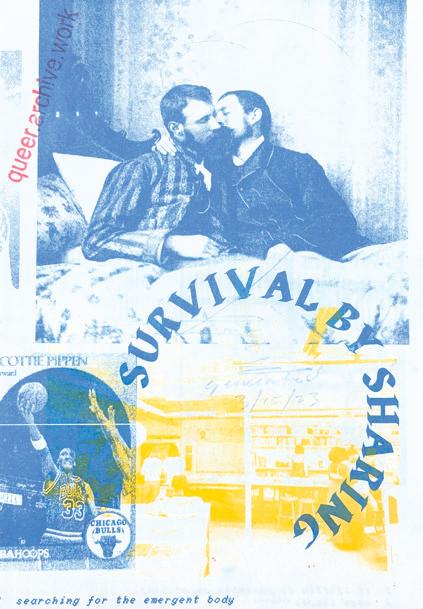
THE LIVING ARCHIVE OF BINCH PRESS X QUEER.ARCHIVE.WORK
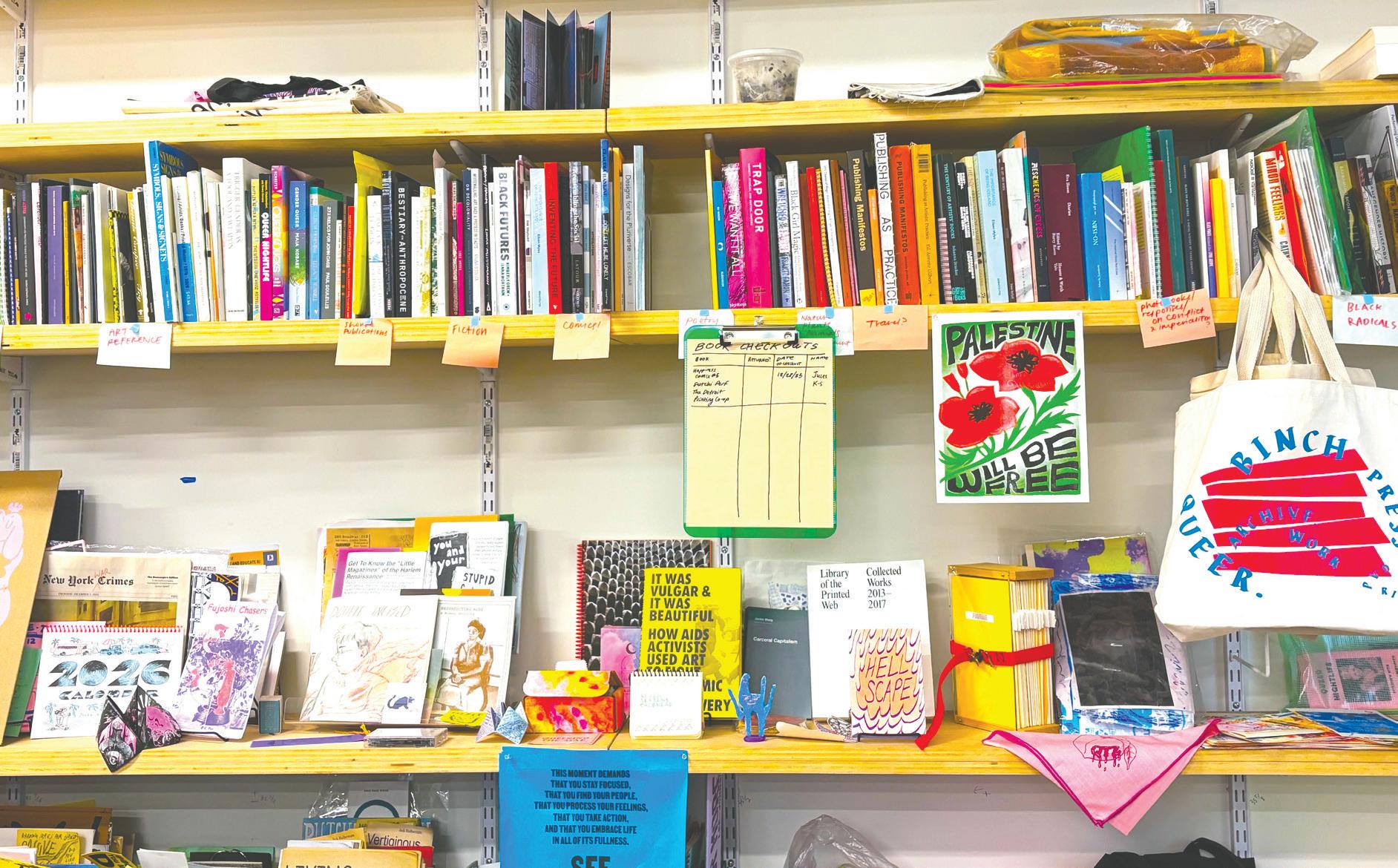
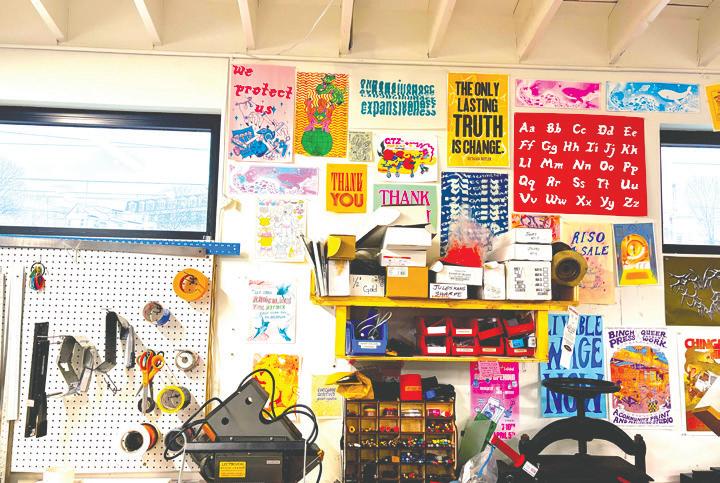
In the heart of industrial Providence, between Olneyville and Federal Hill, a studio collective contains three wall-to-wall bookshelves. They bear and accumulate books, zines, and printed fragments. This is a living queer archive, shaped by a rich history of residents, members, and local artists working with risograph, screenprint, letterpress, digital printing, and tactile handwork.
This space is the collaborative project of Binch Press, a volunteer-run print cooperative centering queer and trans artists, and Queer.Archive.Work, a 501(c)(3) nonprofit library, publishing studio, and residency. Together, they produce a steady flow of physical work, forming a continuously expanding archive— collective making shaped through access, collaboration, and care.
To learn more about this living archive and the artists who shape it, we spoke with:
Dana Heng (she/her) Cofounder of Binch Press, via email
In-person conversation with:
Zooey Kim Conner (they/them), Board Co-chair
MJ Sanqui (they/them), Board Treasurer Anonymous (they/them), Studio Member
Written and verbal statements edited for clarity.
Dana’s Statement:
“I grew up going to warehouse shows and parties in Olneyville, and as a young adult, I hoped to keep this underground culture alive. Soon after my return to Providence in 2016, the Ghost Ship Warehouse Fire tragedy1 happened. […] People already in the margins of society were getting scorned and pushed even further into precarity. DIY spaces all around the country were getting shut down or becoming more ‘legit.’
In Dailen’s2 original email to me and five other friends [in Feb 2018], she asks for help ‘laying the groundwork’ for a space that prioritizes queer people and BIPOC [in Providence]. Most of the shows we had been to as youth did not reflect our experiences and identities, so why not change the tide? At the time, the city was still small and affordable enough to have that kind of optimistic DIY ethos. […] In our first meetings, we discussed what felt absent in Providence to each of us, what we would do with a multipurpose space, and what our nightmares were. Our meetings became called the ‘Summer of Dreams.’
Tycho Horan3 wanted to be able to print in-house show flyers and support movement work through screen printing and self-publishing. Fast forward to Spring 2021, upon our move to Providence from Central Falls, we joined forces with Paul Soulellis4 of Queer.Archive.Work (QAW). We were both seeking a new home for our projects at the same time. It made sense to connect because Binch Press and QAW were aligned on our missions and practices. […] We started out as roommates, and then merged. A lot of the work that gets printed/published in-house becomes archived in the library. We also host Open Library Hours, which allows the public to access the library archive once a month. Nowadays, I see the two operating as one, but as […] different programs and operations. Binch is the umbrella that is actively creating and producing work. QAW is the entity that holds memory via its archive. I think people are starting to use the names interchangeably. It’s pretty queer to have melded to your partner and be known by multiple names!”
On December 12, 2016 in Oakland, California, a fire spread through an artists’ collective, within an unlawfully converted warehouse in the Fruitvale industrial neighborhood which prohibited residential and entertainment use of its buildings. Thirty-six lives were lost, making it one of the deadliest building fires in California history.
Dailen Williams is a cofounder of Binch Press.
Tycho Horan is a cofounder of Binch Press.
Paul Soulellis is the founder of Queer.Archive.Work
A Conversation with Studio Me Zooey, MJ, and Anon:
Sara: Queer history has so often been preserved through objects never meant to survive. What does it mean to produce within that tradition? Do you feel the weight of that lineage in the studio?
Zooey: History has a physical presence in this space. […] My personal creative practice is a lot about taking an absence and turning it into a physical object. But especially in this moment where everybody—especially queer and trans people—are heavily surveilled under so much digital scrutiny, being able to produce something that has a physical presence and less of a digital footprint feels particularly important. It’s harder to erase […] because you can actually store it somewhere, hide it somewhere–even if it does have potential for decay.
Sara: Q.A.W. maintains a non-circulating library of books, zines, tools, objects, and downloadable files. How does the act of preserving these works change their meaning? What gets lost—and what gets found— when something made to be temporary becomes part of an archive?
MJ: I think it’s funny, because [the print media are] actually not very carefully preserved in this archive.
MJ: All of us are thinking about different ways that an archive is engaged with. We’re adding our work to this archive. A lot of us are pulling from this archive for reference. This archive [is] a testament to queer history, to queer living, to queer existence. You can’t search through this archive. A lot gets lost in this archive every day. It is here, but are people seeing it? I don’t know. [Q.A.W.] is a space where things get to be made and the archive being part of that is where the meaning is. An archive is a lot of lost things unless it’s actually being used.
Sara: Binch’s studio membership is pay-what-you-can. This feels like a deliberate refusal of how most arts institutions operate. Can you talk about the philosophy behind designing out financial barriers?
Zooey: I grew up in Providence, but haven’t had any long-term institutional affiliation. I didn’t go to art school, and I’ve really struggled with access to art spaces in Providence because so many
of them require institutional affiliation. It’s always been really important to reduce the barriers to access and create a space that is not about how much money you can put in, or how much money you’ve already put into your education, or what opportunities you’ve already had.
Anon: [Binch Press] is a membership-based collective, but a big part of us is inviting outside members, like the community from Providence, also our friends and the people that are in our circles and in their circles. We have orgs who come into the space and we screenprint together or use the riso [risograph printer]. A lot of [Binch Press] is being able to open the space up to more people to learn how to use all of this too.
Sara: You’ve described the space online as a printing utopia, a place to share, learn, work, and rest. This word rest also stands out. What does it mean for Binch Press Studio to be a place of rest, especially for queer and trans artists?
MJ: Queer.Archive.Rest. We’ve been saying that for so long.
Zooey: Yeah, that’s our big joke. The alt name. Not Queer.Archive.Work.
Anon: Post institution, post burnout, I was not making work for a very long time. A big part of the space is that it was very restorative. Just existing and being near each other and talking, gossiping, telling stories, hanging out is a big part of what springs a lot of our ideas with each other too, and also just like excitement within each other. It’s been really nice to have a space where you don’t feel pressured to work all the time. You could just exist. It’s great to be here and just sit with the library for hours and explore and take your time.
Sara: Are you making things to last or to circulate? How do you think about the lifespan of all of the objects that are being produced here? Because there is an archive, but you mentioned that things get lost in the archive all the time, too.
Zooey: You never actually know how long a thing is gonna last, [which creates] an element of mystery and decay and chaos. [For] anyone whose chosen medium is zines or books, there’s an element of temporary-ness.
MJ: To be loved is to be changed. Books are meant to be opened and cracked and worn over time. The archive does end up being the deposit box for everything that gets made here. But all the stuff that’s getting made here is being made to get distributed elsewhere. I don’t think anybody’s making work to be put in this archive necessarily. The archive is just a part of the process. At the end of every edition I put
a copy in [Q.A.W.] so that there is some record of what was physically made here, but most things that get made here are being made to go out into the world.
Sara: If someone encountered documentation of Binch Press 50 years from now—in an archive, a library, a zine collection—what would you want them to understand about this moment, this place, and this community?
MJ: There’s this idea that […] institutions […] are the only way to imagine a life for yourself where you’re making things. When I came here, I was trying to imagine a version of this in my hometown, in Western North Carolina, like a very rural place. There aren’t things like [Binch Press], quite yet. The origin story of how this place came to be is eight people being like, “we need to make some sh*t happen right now.” And I think now there is a level of institutionality that comes with Binch just because it’s been here for a long time. We do have infrastructure and a reputation and impact on the community around us. I hope that more people see the importance of an archive or how magical print can be.
Sara: How do you think about the relationship between the physical act of printing and the political content that moves through your studio? Is the medium inseparable from the message, or do you hold those things in productive tension?
MJ: [Politics has] been a really important function of the studio in the last few years. So much of what I’ve made has been movement work for people, like advocating for Palestine. That feels inherent to the values that we try to hold as a studio. […] The political content is really important. More than just sustaining people’s personal practices, almost every member has an element of their personal practice that is making political work.
Binch Press Print Cooperative
Bloquejar-ho Tot / Blocchiamo Tutto / Let’s Block Everything
LESSONS FROM BARCELONA’S MOVEMENT FOR PALESTINE, AND HOW THE GLOBAL SUMUD FLOTILLA BUILT POWER
( TEXT TALIA REISS & CAROLINE NIETO DESIGN JENNIE KWON ILLUSTRATION ELLIE LIN )
c This piece was published in collaboration with The Blue and White, Columbia University’s undergraduate magazine.
On the evening of October 1, 2025, Arnau Rot was drinking tea at a bar in Barcelona. He was gearing up for an early morning and a long day of protesting. As a student organizer with the socialist group ContraCorrent Catalunya, Arnau had helped send off the Global Sumud Flotilla one month prior. The flotilla, a coordinated fleet of 40 boats and 500 activists, had hoped to break Israel’s naval blockade around the Gaza Strip and deliver humanitarian aid. As the boats approached the shoreline, Arnau had a familiar feeling—based on past patterns of interception, it was likely that the Israeli Navy would stop the flotilla that night. By 8 p.m., he was watching the siege begin, live from the bar TV.
We first learned about ContraCorrent when two students at the Universitat de Barcelona (UB), where we are studying abroad, interrupted our class to promote a socialist open house on campus. Our professor didn’t shoo the students away—she just smiled and nodded while they relayed the details, and repeated them to us in slower Spanish after they left.
If we hadn’t already gathered it from the city’s plethora of leftist graffiti, it became clear at this moment that support for progressive student organizing was strong in Barcelona. Palestinian liberation in particular is overwhelmingly popular in Spain—a survey conducted by the Elcano Royal Institute in 2024 found that of respondents in a representative sample of Spanish adults, 78% supported the swift recognition of the State of Palestine. The left-wing party currently in power, led by Prime Minister Pedro Sánchez, has also been firm in its rhetorical support for Palestine. Unlike the United States, Spain recognized Palestinian statehood in May 2024 and formalized a total arms embargo on Israel in October 2025. Still, Spain maintains some economic and diplomatic ties with Israel, an issue that has spurred massive protests. In the past two years, Spain’s pro-Palestine movement has built power by creating the kinds of intermovement and transnational coalitions that organizers in the U.S. have yet to manage.
At the open house, Arnau was tabling for ContraCorrent and the feminist organization Pan y Rosas. We got to chatting about our struggles with student organizing, frustrated by our respective universities’ cruel responses to student protests. UB’s student movement had started off small. In the first months of Israel’s assault on Gaza, UB students hosted assemblies with around 60 participants. “But then it started dying slowly; it just tore apart,” said Arnau. “There wasn’t any union in this fight,” he added, pointing to fragmented efforts by students, professors, and workers. So when the Boycott, Divestment, and Sanctions (BDS) chapter in Valencia launched Spain’s first pro-Palestine encampment on Wednesday, April 17, 2024, students in Barcelona were quick to follow. Around 50 student organizers met that Friday to lay the groundwork, and by Monday, the UB encampment was up.
Around 100 students slept in tents in a small
garden on campus. “There were activities organized every day all morning. Formaciones, like charlas: speeches, seminars,” said Arnau. “We had a lot of concerts on Fridays […] Obviously Rosalía didn’t come, but some well-known artists were coming.” In the early days, students cooked meals in Antiga Massana, a nearby building that had been occupied by activists in 2020 to counteract gentrification and support people living in the neighborhood. Community members donated additional food and materials to the encampment.
Arnau attributed the size and power of the encampment to “una red”—a network—of activist organizations working together, including the University Network for Palestine, Universities with Palestine, the Student Committee of Solidarity with the Palestinian People, and the Prou Complicitat amb Israel (Enough Complicity with Israel) platform. This coalition assembled 200 to 300 people every day. At these daily assemblies, attendees voted on a basic political program. Although each organization maintained its own platform, people collectively voted that the UB encampment would be anti-capitalist, anti-imperialist, and anti-colonialist. “It was very democratic,” said Arnau.
Students also formulated a clear demand: “for our university to leave any European program or
international university program in which Israel was participating,” said Arnau. This included divestment from companies funding and arming the Israel Defense Forces (IDF). Arnau pointed to entities like Santander Bank, which provides scholarships and grants to universities and their students. According to BDS, Santander finances companies such as Boeing and General Dynamics, which manufacture weapons for the IDF.
Private contributions account for a little under half of UB’s funding—just enough for the university to still be considered public. Whereas Brown and Columbia are not required to disclose the details of their private funding, UB has an online transparency portal detailing the university’s annual accounts. Economic transparency has made it simpler to demand specific investment changes from the school, but UB’s reliance on private investors meant that those demands were unlikely to be fulfilled. The university had an easy way out of financial accountability. Protesters were backed into a corner.
Unlike in the U.S., popular pro-Palestine sentiment in Spain created pressure for UB to support the encampment. “Because it’s meant to be a leftist university, they couldn’t publicly condemn what we were doing. It had a political cost for them,” said Arnau. “But at the same time, they as an institution
were facing this barrier, which was that they couldn’t meet our demands to the end because they had some economic interests that they couldn’t ignore.” Despite agreeing to the divestment demand, UB prolonged its implementation and the movement fizzled. Similarly, the Brown Corporation agreed to negotiate with student organizers, but voted down the divestment proposal in secret months later. Columbia provided no substantive proposal at all, even when the Columbia College student body overwhelmingly passed a divestment referendum in 2024. Like at UB, the movement for Palestine at both Brown and Columbia has waned—perhaps because of the October ‘ceasefire,’ but also because violent repression from our universities and federal government has made protesting more dangerous. Though the climate for organizing differs between the two countries, Americans can learn a lot from the student movement for Palestine in Spain—namely, the importance of building coalitions and making decisions multilaterally.
In the year following the UB encampment, organizing for Palestine in Barcelona had shrunk to one protest every few months. The Global Sumud Flotilla sparked a revival. As the flotilla approached the Gaza Strip in the days prior to the October 1 interception, Barcelona celebrated. “It was talked about everywhere here,” Arnau said, rolling a cigarette. “I remember partying that same weekend […] in the streets, and people would sing chants for Palestine in the parties. Everyone was drunk and just very moved. It was very emotional days.”
Organizers hoped the flotilla would both provide some much-needed aid and raise global awareness about the famine in Gaza. Israel controls the borders around Palestine, dictating the type and amount of aid that enters Gaza. For decades, Israel has blockaded border checkpoints and sea ports to weaponize starvation against the Palestinian people. As part of its 2007 attack on the Gaza Strip, the IDF imposed a strict naval blockade and closed the Karni Crossing, the primary terminal at the time for the import of basic goods into the Gaza Strip. The closure produced major shortages of food and medical supplies, yet the
Israeli government blocked humanitarian aid from the United Nations Relief and Works Agency for Palestine Refugees (UNRWA). Dov Weissglass, then a senior advisor to Israeli Prime Minister Ehud Olmert, explained that the closure was intended “to put the Palestinians on a diet, but not to make them die of hunger.”
“They knew that they weren’t going to get to Palestine. It was just a call for people to get up again.”
Denying civilians necessary food and medicine is illegal under the Fourth Geneva Convention, which prohibits militaries from intentionally targeting civilians. Amnesty International criticized Israel’s blockades as “collective punishment” of the Palestinian people for electing Hamas in 2006—the first statewide election in Palestine in a decade. Still, Israel permanently closed the Karni Crossing in 2011.
Today, the most direct routes for aid are the border crossings on land, either at the recently re-opened Rafah Border Crossing between Egypt and Gaza or along the Gaza-Israel border. Throughout its genocide in Gaza, Israel has strictly controlled the movement of supplies through these crossings. “Anything they saw as being potentially usable by Hamas was blocked,” said Dr. Adam Levine, Professor of Emergency Medicine and International and Public Affairs at Brown. Israel’s definition of military use was sometimes “really ridiculous, like scalpels,” he said, and other times “reasonable but still difficult—like concrete, for instance, which is needed for reconstruction but obviously can also be used for construction of military barracks and tunnels.” Israel has also blocked diesel fuel, which is essential for powering hospitals. For Israel to designate itself the arbiter of what constitutes a potential weapon has fatal consequences.
In March 2025, Israel implemented a near-total blockade on Gaza for almost three months. By August, the United Nations confirmed that more than half a million Gazans faced famine—a classification marked by extreme food shortages, acute malnutrition, and starvation-related deaths, according to the World Health Organization. In response, the Global Sumud Flotilla prepared to set sail from Barcelona
with a symbolic amount of aid—food, water, and medical supplies—to meet the immediate needs of some Palestinians. They could not carry enough to solve the humanitarian crisis, as the lack of deep-sea ports in Gaza makes it difficult to deliver substantial aid by ship. Instead, organizers largely intended the flotilla mission as an advocacy tool to draw attention to Israel’s blockade and the resulting famine. “They knew that they weren’t going to get to Palestine. It was just a call for people to get up again,” said Arnau.
The last time a maritime aid mission to Gaza had succeeded was in 2008, when two boats from the Free Gaza Movement broke Israel’s naval blockade and landed in Palestine. In the eight years following, the Movement launched 31 boats with humanitarian aid, but none reached Gaza. The 2010 Gaza Freedom Flotilla, for instance, carried around 700 passengers and 10,000 tons of aid. In international waters, Israeli soldiers boarded the ships and killed nine passengers. Israel also intercepted freedom flotillas in 2011, 2015, and 2018, detaining and deporting their passengers. Under the UN Convention on the Law of the Sea, it is generally illegal for countries to seize ships in international waters, though wartime exceptions exist. But even if Israel intercepted the flotillas inside its own naval territory (12 nautical miles from the Gaza shoreline), the seizures would likely still be illegal. The blockade itself would be “probably perfectly reasonable under international humanitarian law, as long as Israel is allowing enough aid to go in through the Israeli crossings or the Egyptian crossings by land into Gaza, which, at this time, they are not doing,” said Levine.
Facing a horrific material reality, symbolic action alone cannot be enough. Still, a strong coalition of organizers can produce palpable results.
Israel’s bombings and blockades endanger the most immediate needs of Palestinians, culminating in mass starvation, loss of shelter, and death. Up against the machine of Israel and its allies, humanitarian groups without government backing or an aggressive military presence supply aid in the ways they can. Instead of providing substantial relief, which would
be untenable for a single mission facing an atrocity of this scale, the flotilla leveraged symbolic power to highlight the realities of the ongoing genocide. Israel’s military and political domination is enough to demobilize a political movement, especially given the relationship between Israeli Prime Minister Benjamin Netanyahu and President Donald Trump. Israel’s genocidal tactics are anything but symbolic, which makes the position of political organizers even more fraught. Facing a horrific material reality, symbolic action alone cannot be enough. Still, a strong coalition of organizers can produce palpable results.
For three days before the Global Sumud Flotilla set sail on September 1, thousands of people gathered for a festival by the port. ContraCorrent organizers volunteered to stock the ships and hosted comrades from neighboring chapters who had come to Barcelona to help. Public figures such as the Swedish environmental activist Greta Thunberg and the Game of Thrones actor Liam Cunningham gave speeches. Both Thunberg and Cunningham sailed on the flotilla, along with the former Mayor of Barcelona Ada Colau, deputies from the European Council and Mandla Mandela, a grandson of Nelson Mandela.
A productive community of organizers requires a collective consciousness that guides each action. When Israel intercepted the flotilla on October 1 and detained 443 passengers, the global outrage was overwhelming. World leaders from at least 15 countries had condemned a potential interception, and millions of people worldwide participated in demonstrations for Palestine. In Italy, the protests were historic. More than two million workers and students participated in a general strike called by Italy’s largest trade union. Protestors shut down ports, railways, highways, and schools in more than eighty cities. In Rome alone, one million people marched in the streets, chanting “Blocchiamo tutto”—“Let’s block everything.” They were following up on a promise made by Riccardo Rudino, a dockworker with the Autonomous Port Workers’ Collective in Genoa, at Italy’s flotilla send-off a month prior: “If, even for 20 minutes, we lose contact with our comrades on the flotilla, we will block all of Europe: from Genoa’s docks, not a single nail will leave, it will be a global strike.”
Organizers in Spain responded to the call. “Following the example of Italian workers and students, people got excited here to fight for Palestine again,” said Arnau. Across Spain, students paraded through university buildings “singing chants, going inside the classes, stopping the teachers, inviting all the students to come out, wearing Palestine flags, then meeting in the gardens or whatever to make an assembly,” he said. Students acted in tandem with activists from the anarchist union Confederación General del Trabajo (CGT), which called a 24-hour general strike the same day. Together, they demanded that the Spanish government cut financial ties with Israel.
The protests on October 3 gathered tens of thousands of people, 50 of whom camped out in a city square that night. “The protests were very big,” said Arnau. “We had, for three days straight, protests at night next to the port with a lot of police violence.
They would throw pepper [spray], they would throw smoke.” He remembered protestors burning dumpsters, barricading streets, throwing fireworks, and shattering the windows of McDonald’s and Starbucks buildings. “It was some very intense nights,” he said. Two weeks later, the CGT called for another general strike for Palestine. “And this time we did sleep in universities to close the faculties [department buildings] the day after,” said Arnau. “We woke up, we were here all morning, we barricaded the doors and all classes were stopped.”
Though the Global Sumud Flotilla never reached Gaza, strategic organizing made the mission effective. Organizers had hoped the participation of famous activists like Thunberg would both amplify publicity and help protect the passengers. “These very big public figures—really you couldn’t torture, you couldn’t put [them] in prison for more than two days, because that had a very big political cost,” Arnau said. Later, however, Thunberg would detail her extreme mistreatment at the hands of Israeli soldiers. Another passenger, an American named Windfield Beaver, told Reuters that Thunberg was “treated terribly” and “used as propaganda,” suggesting that the IDF had targeted her because of her celebrity. Fame may not have protected Thunberg or her fellow passengers, but Israel’s abuse of a public figure made headlines and brought attention to Israeli violence, further motivating protestors.
The flotilla organizers also used the internationality of participants to provoke a global political response. With passengers from 44 countries, “you couldn’t find in one same ship two people with the same nationality,” Arnau said. That way, if Israel were to imprison or abuse passengers, each of their respective countries would be obliged to provide consular protection in opposition to Israel. Organizers would win regardless of the outcome—either a government’s lack of response would demonstrate Israel’s shirking of international law, or diplomatic fallout would affect the flow of financial and material support for Israel’s genocide. In Spain, the latter proved true. The month the flotilla set sail, Prime Minister Sánchez announced a total arms embargo on Israel. Around one week after Israel’s interception, lawmakers approved the embargo in a 178 to 169 vote. Though it’s impossible to say with certainty whether the flotilla mission caused the policy change, it’s clear that the resurgence of support for Palestine in Spain has extended beyond the symbolic.
+++
Arnau anticipates a similar revival in organizing for Palestine when the latest Global Sumud Flotilla leaves from Barcelona this month. Like the last flotilla, this one aims to break Israel’s illegal blockade and deliver essential supplies like food and medicine. This mission, however, is less symbolic: “They really do want to try to step foot on Palestinian land,” said Arnau. This flotilla will also be much larger, with more than 100 boats and 3,000 participants from over 100 countries. As part of the Gaza Medical Mission, the flotilla will include a dedicated medical fleet carrying essential medical supplies and 1,000 healthcare professionals. The Spanish nonprofit Open Arms, which is dedicated to humanitarian rescue missions at
sea, will donate one of their largest ships. The rest of the flotilla’s funding has come from “just people. Not any institution. There’s not any government behind it. That’s what’s so powerful about it,” said Arnau.
But protest has historically been a powerful tool, which is why generations of political organizers, students, and workers have put themselves on the line again and again. This is what has worked in the past: fostering relationships between people and groups to exert real influence.
As the U.S. government continually powers Israel’s genocide with material and financial support, Americans cannot forget the power of collective action. Understandably, protests for Palestine dwindled after student movements were brutally suppressed by universities and the federal government. Now, with protests focused on an endless onslaught of American violence—from ICE terror to a senseless war on Iran—it seems Americans have set aside the fight for Palestine, where, despite the ‘ceasefire,’ most border crossings have recently closed, Israeli strikes continue, and millions remain in crisislevel hunger.
If this flotilla can’t reach Gaza, why shouldn’t Americans swear to “blocchiamo tutto”? Following the examples of Italy and Spain, students and unions in the U.S. should come together under a coalition for Palestine. We should vote on our own political program, join the global days of action, and respond to overseas calls for general strikes from school and work. It’s difficult to maintain hope and energy when one’s government responds to protest by detaining student activists, terrorizing journalists, and shooting protestors in their cars. But protest has historically been a powerful tool, which is why generations of political organizers, students, and workers have put themselves on the line again and again. This is what has worked in the past: fostering relationships between people and groups to exert real influence. For instance, the Student Workers of Columbia have just voted to authorize a strike in which boycotts, divestment, and sanctions are a key demand. Alliances between student unions and organizers for Palestine would amplify both movements’ goals.
Once the Global Sumud Flotilla docks in Palestine, its organizers aboard plan to stay, helping local communities rebuild their homes, schools, and hospitals. “From what I’ve been told, it’s a plan against Trump and Netanyahu's’plan of making a resort,” said Arnau. The organizers “really do want to stay there and try to build a powerful team and community of people who are able to […] rebuild life again there.” When the flotilla embarks on April 12, we will be there to send it off—cheering, singing, and above all, looking with our people toward the horizon.
TALIA REISS (BROWN ’27) & CAROLINE NIETO (COLUMBIA ’27) for a free Palestine.
Our research suggests this dataset is the first scientific data repository entirely housed on Pinterest.
The resultant dataset of 100 images can be accessed at https://bit.ly/ai-image-dataset
Dataset accession
* Also annotated by gender presentation where applicable.
3. Brain, 4. Circuit, 5. Hand.
2. Figure (human), containing all individuals of homo sapiens form,*
1. Figure (robotic), containing all bodily subjects with visible circuitry,*
A pilot study collected 5 dominant motifs, from most to least frequent:
Dataset labelling Data were labelled using Amazon’s Non-Mechanical Turk (that is., Skylar Sargent Walters, author). Each image was annotated with a primary and a secondary color based on visual abundance.
5. The letters “AI,” which function as typographic markers as opposed to interpretive imagery (fig. 1e).
4. Logos (fig. 1d),
3. Ai (singer) (fig. 1c),
1. Duplicate images (fig. 1a), 2. Informational slides, blog headers, and YouTube thumbnails (fig. 1b),
Elijah Wood In [6], the presence of an Elijah Woodesque figure references the 2003 film Spy Kids 3-D: Game Over , in which his character, The Guy, is the ideal form of the cyborg gamer. Critically, The Guy faces immediate
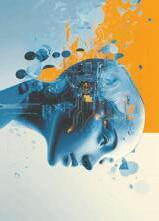
Neural networks [5] is the sole data entry depicting a neural network, the algorithmic framework behind artificial intelligence. A sequence of matrix multiplications is funneled into a robotic mind. The nodes converge, glow, and imply cognition, performing as thought instead of calculation (see Brain ). In effect, the only image gesturing toward the mechanics of AI still anthropomorphizes—and literally funnels— this process into a being.
Color Blue is overwhelmingly present in the dataset. This visual convention draws on longstanding associations between blue and qualities like precision (blueprints, Engineer’s Blue for marking metal at cutting points), professionalism (CEOs in navy suits, LinkedIn logo), and informativeness (hyperlinks, IBM logo). These blues glow, suggesting an aspect of illumination and knowledge.
As the scientist/artist pair Kate Crawford and Trevor Paglen outline in their essay ‘ Excavating AI’ (2020), these visuals are sedimentations, compressed outputs of the cultural material.
The preliminary dataset consists of the top 100 image results for “ Artificial Intelligence. ” To ensure the dataset consists of visual representations of AI, the following images were excluded:
Dataset collection and curation
Methods
ate the form of The Computer Science Research Paper to understand why the internet likes AI to be sexy, its backgrounds circuit-filled, and its brains blue.
c Images of AI are blue, neon, and human. They do not depict an array of numbers or a series of partial derivatives, but a disembodied robot hand holding a circuit, or a sexy, sexy cyborg woman. In the few images that aren’t in human form, AI is depicted as a human brain or a localized circuit, which carry associations of human cognition and simplified hardware systems, respectively. Thus, the image of AI is removed from the data and mathematical relationships that construct it. These depictions become the visual foundation through which we understand systems like ChatGPT or Claude. Instead of imagining them as statistical models built from data and optimization, we are encouraged to see them as humanlike entities: intentional and embodied. Here, I (a glorified CS major [working in an office with no view]) appropri -
In A Cyborg Manifesto (1985), the feminist scholar Donna Haraway asserts that “the cyborg is a condensed image of both imagination and material reality.” Haraway’s formulation suggests that the figures representing technological systems are constructions that form our understanding of how these systems work. To the non-scientist, the robot hand or glowing brain constitutes ChatGPT or Claude. Images of AI operate simultaneously as aesthetic objects and conceptual frameworks through which viewers interpret the working of the machine. Haraway’s cyborg was intended as an unruly character that resists binaries of human/machine or natural/artificial. Here, however, this ambiguity is resolved rather than embraced. The cyborg is aestheticized as stable and compliant.
Brain In the philosopher Bruno Latour’s terms, representations of AI as a brain act as a “black box” concealing algorithmic “thought” behind an image of the mind. When images of AI systems emphasize the brain, they convey that these reasoning systems are closer to human cognition than to numerical equations and vast quantities of energy.
Image creation The creation of these images is less a question of individual authorship than of systems aggregating and producing visual norms. Many of these images are AI-generated (denoted with blue highlights). AI-generated imagery is more common in the warmer, feminine end of the spectrum. This suggests visual depictions of AI often rely on gendered cues that frame these systems as approachable, intuitive, or nurturing.
SKYLAR SARGENT WALTERS B’26 prefers sexy, sexy human women. (
* Elijah Wood: When will he get his Oscar?
* Social Implications: What systems are reinforced when humanizing AI imagery? In employing brain and circuit motifs?
Circuitry The circuit is a noticeable outlier to the anthropomorphism of the body and the brain. Its linear imagery emphasizes hardware and low-level computation [11]. A circuit implies directed relationships and traceable decisions—features absent from AI systems that are responsible for lack of output transparency. The resulting image is a neat and linear representation of AI.
Furthermore, blue is frequently gendered masculine. This is in contrast with the largely female depictions of AI. When viewed as a system, AI is a mathematical, calculating feature of masculinity; when viewed as a figure, it is a welcoming woman (and significantly less blue— see Femininity and compliance ).
The data analysis of artificial intelligence largely pulled out themes of femininity and compliance, neural networks, circuitry, and the brain to convey that imagery of AI impacts the collective understanding of AI systems. * Limitations of Language and Imagery: Is imagery capable of capturing the broad array of systems represented by the phrase “Artificial Intelligence”? How do these images shape our perceptions and, in turn, our language to describe AI?
in the world. I work in an office with no view.
I Googled “artificial intelligence imagery” and fell in love with a beautiful and curvaceous blue woman I named Claudeine. She has no hair but her skull is transparent, so I can see her brain and all the circuits that form the neurons made to think about me. I am the most normal and clean-shaven man
At the warmer end of the color spectrum, the feminized machine slips into the fantasy of the sexy cyborg: a figure whose allure lies in her perfect compliance and programmable desire. These figures are accepting; their stern side profiles [1, 2] depict a disciplined, emotional flattening that reads as availability. In [3], a finger is raised to the lips in a shushing motion, a gesture aestheticizing and instructing silence. In [4], the cyborg resting her hand on her chin suggests she is in thought, waiting to be used—perhaps already in use.
The joining of hands references The Creation of Adam suggesting a divine bond between human and machine. Where Michelangelo attributes creation to the divine, these images relocate creation to the human-AI connection point; each image centers a spark of machinery [7, 8, 9] where the beings meet. Critically, the touch lacks a hierarchy between the human and AI hand, as there is between God and Adam [7, 8, 10]; they reach from the same height, establishing the relationship between person and machine as equal in a shared act of creation.
Joining hands
Femininity and compliance
demise at the hands of the online security system, making this piece the most radical anti-AI image in the dataset: Wood is killed by the web, yet he maintains an impression of strength in its presence.
Results
Did you mean: A data analysis of artificial intelligence imagery
Unheimlich Maneuvers
FREUD’S UNCANNY, AMERICAN HEALTHCARE, AND THE PATH TO CONSPIRACY
c My mind tends to fixate on the shirt I was wearing the day before my body stopped speaking its usual language. At the time, it was new and exciting, featuring a distorted, almost off-putting image of one of my favorite singers, Weyes Blood. It had come in the mail a few days earlier and I couldn’t wait to show up in it, niche and interesting, to my end-of-summer field trip to the bowling alley. On that last day of normalcy, I decided I had messed up: I should have saved this favorite shirt, that lucky idol, for the first day of school. That night, I set aside a different, less memorable outfit and went to sleep.
The next morning, the first day of my sophomore year of high school, I woke up feeling more nauseous than I’d ever been in my life. Somehow, I stumbled out of bed and began my carefully planned routine, punctuated by unexpected interruptions. Brush teeth. Rest. Put on clothes. Rest. Run to the toilet in abject horror. Rest. Think about breakfast. Almost throw up. Rest. The path from my house to my bus to my school was confusing and dizzying. Once there, I realized I couldn’t will myself through the day—hanging my head, I went to see what would end up being the first medical professional in a seemingly never-ending stream: the school nurse.
My ‘sickness,’ which started on that first day of sophomore year and has persisted in some form or another for the last three and a half years of my life, seems undiagnosable and incomprehensible. As explanation after explanation failed to fully capture what was happening to me, I dissociated from the confusion in and around my digestive system. During the months and years that followed, my body—which I had previously believed I knew so well—detached from my understanding of it, while I remained some how, somewhere, trapped inside.
In his essay “The Uncanny,” Freud explores the two-pronged concept of the English ‘uncanny’ is derived; closely translated to ‘unhomely’ in English, while heimlich, its apparent antonym, is ‘homely.’ Heimlich interpretations and connotations based on the idea of ‘home.’ While the home is familiar, it is also a place of privacy, where things are concealed and kept hidden. Thus, the uncanny is not just the opposite of the familiar, but arises both with the appear ance of something familiar in an unfamiliar form, and with the revelation of something that should have remained hidden.
The uncanny can act as a psychopathological phenomenon that accompanies illness, charac terized by fear, restlessness, and a sense of inexplicability caused by a loss of control.
In illness, the parts of existence we tend to forget when everything functions normally—the body’s essen tial uncontrollability and steady march
towards death—become the things we fixate on most. Together, an inability to understand the body and the reappearance of these repressed aspects of life become overwhelming.
Despite wearing my ‘lucky’ Weyes Blood shirt to as many fun medical tests and appointments as possible, three and a half years, two gastroenterologists, two nutritionists, one gastropsychologist, three X-rays, one colonoscopy, innumerable blood tests, at least four different medications, and a swallowing study later, nobody seems to know what’s wrong with me. Many of my symptoms, while much less acute, persist. Apparently, I have slight lactose intolerance. I may have the most minuscule of hiatal hernias, but I barely understand what that means or if that’s really what my doctor was trying to say. I probably have some sort of anxiety disorder. There’s some irritation in my digestive tract, but it could be from any number of things. No matter what my ‘illness’ ‘might’ be, nothing can be identified as one singular root cause. I’m also constantly faced with contradictions: my original gastroenterologist tells me I must eat more fiber while the doctor performing my colonoscopy informs me that fiber is only useful for maintaining an already healthy digestive system. My first gastroenterologist shuts down my hypothesis that everything is somehow linked to my original E. coli while my new one tells me that E. coli can linger in unexpected ways.
In its own insidious way, the healthcare system
( TEXT ZEKE TESLER
DESIGN KAY KIM ILLUSTRATION JIWON LIM )
and modern medicine can cause a sense of the uncanny that extends beyond basic bodily experiences. Outside of my ‘illness,’ I’m a frequent patient—I get sick, I go to the doctor, they give me something, I get well. Alternatively, they give me nothing, I wait a week, I get well. This is a common experience with common illnesses: Things like the flu, strep throat, and ear infections are frequently experienced and frequently solved by doctors. Those are the moments that confirm that doctors know what they’re doing, that healthcare is caring for our health. However, this system broke down as soon as my sickness became too complex. Just as my sick body became unfamiliar, so too did the supposedly predictable healthcare system. My common experience of going to a doctor to solve an issue transformed: Sick to doctor to well became sick to doctor to still-sick to doctor to still-sick.
My frustration with the healthcare system did not begin until my illness. But this frustration, emerging from an uncanny experience, is far from just a personal one. The American healthcare system is broken. One major issue is fragmented care, as doctors and care providers from different areas and times in people’s lives rarely communicate with each other. Doctor-patient communication lapses come from many places, including the rushed schedules of doctors who are only allotted minimal time to spend with patients, and the unfortunate fact that there often isn’t an easy or comprehensive solution to complicated medical issues. Additionally, healthcare is deeply intertwined with money, which brings its own slew of problems. According to one survey, more than 50% of working-age people struggle to afford healthcare. Even people with good insurance aren’t safe, as one study shows nearly one in five insured Americans received surprise medical bills over a two-year period. These issues are worsened when illnesses are complicated, chronic, and have no easy solution, leading to more appointments, more bills, more possibility for miscommunication, and more opportunity for frustration. All of these systemic issues add up to a distorted form of ‘healthcare’ that often fails to accomplish its purported purpose.
On a basic level, people tend to trust doctors. A recent Gallup poll showed 57% of people give medical doctors a “high” or “very high” rating for honesty and ethics and 31% give them an “average” rating. However, fragmented care and lapses in communication reveal that doctors are part of a flawed network that doesn’t always respond well to the complex needs of a patient. Receiving a surprise bill, even with health
insurance that is supposed to lessen financial burdens, makes one feel that the system is more about money than care. These uncanny revelations erode personal trust in doctors and the healthcare system. Rather than merely overt and immediate terror or horror, the uncanny produces the creeping sense that something is profoundly off—a slow onset of distrust that motivates a search for alternative options.
When people don’t trust their doctors, there are real consequences. They stop participating in mainstream medicine and turn to alternative sources online. There, they find conspiracy theorists waiting to take them in.
Health conspiracy theorists play with the repressed fears and doubts of their audiences—of the healthcare system, of authority—to augment an uncanniness many may have already experienced. Through this lens, the familiar is the generally accepted comfort and protection of government, organized society, and by extension, the healthcare system. The repressed are the fears and doubts we often tamp down in the back of our minds about those systems—are they really looking out for us?
This repressed fear manifests in a kind of trust paradox: The Edelman Trust Barometer shows that while people don’t necessarily believe the government is competent or ethical, they still trust it to solve major issues like environmental protection and the income inequality gap. When citizens are then confronted by undeniable evidence of governmental or institutional wrongdoing, the repressed doubts they harbored all along return, attaching themselves to something previously thought to be understood. These conspiracy theorists often start with a true or partly true revelation, building strong foundations of distrust before going off the deep end.
Gubba Homestead is a self-proclaimed conspiracy theorist who spreads misinformation about health and politics on the internet. I encountered Gubba randomly—and was immediately, profoundly alarmed and obsessed. Her conspiracy theories are wide-ranging, but center on an anti-institutional, homesteading-chic aesthetic that prioritizes the ‘natural’ over all else. Luring people in with seemingly benign homeopathic medical advice, she soon starts recommending drinking raw milk and ignoring the existence of viruses. While most of Gubba’s takes are ridiculous and harmful, she occasionally produces content premised on something foundationally correct. In a video about making homemade apple cider vinegar, she uses the frame of Big Pharma exploitation to make her broader political point that “the best medicine is free.” In another video, she uses Project MK-ULTRA, an illegal mind-control program conducted by the CIA that used unethical medical experimentation, as a launchpad for a conspiracy about celebrities being mind-controlled CIA assets. By framing her ‘healthcare’ alternatives around a political worldview that exploits already existing uncanny feelings about societal institutions, she brings people even further away from mainstream, evidence-based healthcare.
The conspiracy theories parroted by people like Gubba are a gateway drug to wider and wilder anti-scientific and conspiratorial movements like MAHA. In the first pinned video on his Instagram account with almost three million followers, influencer Gary Brecka says that “he will never go to a doctor again” because his doctors were unable to fix problems like bad cholesterol, snoring, and blood pressure. All they want to do, apparently, is give us pills. He plays directly into people’s distrust of modern medicine to promote his alternative ‘bio-hacking’ health advice. Additionally, he weighs in on wider American health issues like childhood sleep deprivation and, of course, “ultra-processed foods,” directly calling RFK Jr. a game changer for his efforts toward a mandatory processed food labeling system.
RFK Jr. uses both aspects of the uncanny, sowing distrust in “corrupt” medical institutions and playing into frustration experienced in the healthcare system. He spreads misinformation about COVID-19 and healthcare issues in the U.S. using rhetoric such as “bureaucratic inertia” and “politicized science” that play into repressed doubts about institutions like the CDC. He promotes nonfunctional medical alternatives, particularly anti-vaccine talking points around ideas like vaccines causing autism and the use of vitamin A to prevent measles. When going to a doctor feels like an exercise in bargaining, budgeting, and information-gathering rather than an experience of receiving care, these ideas seem more than plausible.
The concept of the uncanny can explain how people get caught up in healthcare misinformation. There are fundamental problems in our healthcare system that manifest as dissonance between expectations and the reality of receiving care. Those spreading health misinformation, whether they be influencers or the federal government itself, reproduce a more systemic version of the individual uncanny experience. The uncanny is a more powerful tool than simple distrust, fear, and frustration, leading to an overarching dread that colors not just our present, but also our past. Something has always been wrong— maybe we’ve always known it—but it’s been hidden. Experiencing the uncanny makes us feel tricked and deceived in some fundamental way, by both ourselves and our institutions, fostering a stronger and more complicated form of bitterness.
We must learn to have empathy for the victims— and they are victims—of health misinformation. It’s easy to scoff at and mock ridiculousness, but it’s much more important to understand that these victims are far from ‘crazy’; many of them are confronting real, grounded mistrust in healthcare, and just choosing the wrong response. During the pandemic, anti-vaxxers who then died from COVID-19 were relentlessly mocked on social media. While this tendency to vitriolically ridicule makes sense—prominent anti-vaxxers really did spread harmful beliefs about COVID-19—when these kinds of hatred and gloating-tinged mockery become the main way we see anti-vaxxers and their ilk, we miss the real problem
of a broken healthcare system that inspires harmful beliefs.
Not until fundamental changes to the American healthcare system come about, changes that seem far-off if not unobtainable—a miraculous shift away from financial motivation, a structural addressing of fragmented care practices—will conspiracy cease to be produced by uncanniness. Until then, we must fight conspiracy with objectivity and empathy, rather than disgust, seeking to understand its uncanny roots rather than dismissing them outright.
Almost four years later, my Weyes Blood shirt has fallen almost completely out of rotation. I put it on rarely, when I run out of clothes, and feel gross. Its once-familiar form lies stretched and unfitting on my body. Darkened armpit stains mark its corners as reminders of frustration and overuse. Its form rejects my body’s years of change. Maybe if I had saved it for the first day of school, it would have given me the luck I thought it was imbued with. Maybe if I had worn it to the right appointment, I would have been offered a miracle prescription. Maybe I wouldn’t have gotten sick. Maybe my body would still feel familiar. But more likely, my shirt is just a shirt, and offers no satisfying alternative answers.
ZEKE TESLER B’29 is dodging questions about scheduling a follow-up appointment.
( TEXT KEYA MEHRA &
JOSIE HATCH
SELLING SEURAT
c Long before the curtain rises, the show has already begun. Dot by dot, piece by piece, bit by bit: a person becomes a painting, a park becomes a composition, an artist becomes a brand. The Barbican’s 2027 revival of the iconic Sunday in the Park with George arrives partially composed. At its center stand popstar Ariana Grande and “Sexiest Man Alive” Jonathan Bailey, reunited under Marianne Elliott’s direction and illuminated by Wicked’s commercial afterglow. Burnished with Hollywood glamour and prestige, two of the most visible stars in contemporary popular culture will be heading to the West End to star in one of musical theater’s most exacting works. What a production. What a spectacle!
Yet, the musical they are entering imagines art under far less glitzy conditions. Stephen Sondheim and James Lapine’s Sunday in the Park with George begins not with a finished masterpiece but with the difficult, unglamorous business of making one. Inspired by Georges Seurat’s painting A Sunday Afternoon on the Island of La Grande Jatte, the first act of Sunday foregrounds the process of creating. The titular character, George, captures his neighborhood park in pointillist brushstrokes. As the park settles into form and its figures are held in place, Dot—lover, muse, casualty—is caught between intimacy and use. The second act jumps forward a century to another George (the original couple’s great-grandson) as he moves through galleries, patrons, and the deadening hum of contemporary art. We see George unveiling his current piece, the seventh edition of his light machine called the Chromolume. Despite the acclaim, however, George is forced to grapple with concerns that his work is nothing more than a lackluster reproduction; a once revolutionary idea now gone stale. Together, the two acts trace the price of making art: the labor of creation, the strain of continuation, and the sacrifice it necessarily entails.
Indeed, the musical’s own preoccupations with consumption and legibility offer a discerning way of interpreting the marketing extravaganza in which it is now embedded. Before a single scene has been staged, the production has already been given a frame. We are given a set of famous faces, associations, and expectations through which the musical is meant to be understood. This phenomenon, however, is not unique to Sunday, nor is any critique an indictment of the actors themselves. Rather, it reflects a broader logic of spectacle that now shapes not only live theater, but perhaps artistic production more generally. In that sense, the Barbican revival is less an exception than a particularly vivid example of a wider tendency. A textbook case can be found in the movie Wicked
If you have somehow escaped the cultural blitz around Wicked, it is the two-part film adaptation of the Broadway musical of the same name, starring Cynthia Erivo, Ariana Grande, and Jonathan Bailey. Universal’s campaign for the first film involved more than 400 brand partnerships and was valued at roughly $350 million in promotional media, generating some 25 billion views in 2024. From RuPaul’s Drag Race to Formula 1, Wicked was everywhere. The Sunday campaign has, in many ways, attempted to borrow its cultural relevance.
Promotional material did not simply announce Ariana Grande and Jonathan Bailey as Dot and George; The Guardian, for example, framed their partnership as a reunion of the “Wicked co-stars.” The production is being sold not only through the actors themselves, but through the emotional residue of an earlier property. The frame shifts almost at once from this particular show to the story of the actors’ careers, from George and Dot to the celebrity personae who interpret them.
Indeed, as The Guardian ironically commented in a different article, screen names have become regular draws on the West End, as some producers and venues are increasingly reluctant to move ahead without a recognizable star attached. The pattern is visible across recent seasons: Sigourney Weaver in The Tempest, Brie Larson in Elektra, Rami Malek in Oedipus, Tom Hiddleston and Hayley Atwell in Much Ado About Nothing, Jonathan Bailey in Richard II. Celebrity casting fills theaters, drives publicity, and reduces risk. But this also creates a vicious cycle. Big names raise the profile of a production; raised profiles raise stakes, prices, and expectations; and those inflated stakes then make theaters feel they need even bigger names to justify the cost. And if ticket-buyers only respond to fame, new or small-budget plays may never see the light of day.
What is being imported, moreover, is not just Hollywood stars, but Hollywood logic. Live theater increasingly borrows not only film actors, but a distinctly filmic promotional apparatus: reunion headlines, teaser announcements, celebrity-centred coverage. It is also beginning to absorb the habits of social media publicity—influencer brand deals, quirky and carefully managed ‘relatability,’ playful Instagram comment section engagement.
And yet, dispiriting as this may be, the uncomfortable question remains: What if all this is necessary? Spectacle may not simply distort art from the outside; it may now be part of the conditions that allow certain kinds of art to be made and sustained at all. If so, the problem is not that art has been corrupted by what surrounds it, but that what surrounds it has become a necessary condition of its existence.
This need for external appendage is fittingly captured by one of Sunday’s own songs, “Putting It Together.” In Act I, ‘putting it together’ refers to the compositional labor of painting itself: the slow discipline of assembling fragments, tiny dots of color, until the image coheres. George studies the park, adds point after point, and gradually puts the painting together. In Act II, however, the phrase no longer refers only to the making of art as such. As George moves through the gallery world, ‘putting it together’ comes to mean assembling not just the artwork, but the conditions that allow it to exist and circulate. The song makes that shift explicit. “Say cheese, George / And put them at their ease, George / You’re up on the trapeze, George / Machines don’t grow on trees, George”: The artist is now asked to charm, reassure, perform, and fundraise. What must be put together no longer consists only of form, color, and composition, but patrons and publicity. The inward labor of creation is overshadowed by the outward labor of circulation. Managing the social and the financial become part of the process of creation, even entangled in the artwork itself. This becomes explicit when George sings, “I put the names of my contributors on the side of each machine.” Financial patronage is no longer merely an external support system; it becomes part of the artwork’s visible structure.
Yet even as the musical critiques this newer form of ‘putting it together,’ it registers its necessity. “Every time I start to feel defensive / I remember lasers are expensive” is funny precisely because it is so deflating. The line reduces artistic argument to material fact. George cannot simply defend his artistic choices against external criticism because the technological apparatus required for the Chromolume depends on institutional funding. Art may begin in vision, but it reaches the public only by passing through money, institutions, and systems of display.
And, as the ensemble matter-of-factly proclaims at the very end of “Putting It Together,” this is “the state of the art.” Ordinarily, the phrase refers to the
Advancing art is easy (spoken)
Yes. (sung)
Financing it is not
highest point of technical or creative achievement. Here, it is bitterly ironized. The ‘state of the art’ names not excellence alone, but the actual social and material conditions in which art must now survive. Sunday in the Park with George already knows that art becomes public only by passing through institutions of display, patronage, reproduction, and reception. The Grande/Bailey spectacle is not an unforeseen blasphemy but a deeply ironic embodiment of what the musical attempts to critique. Grande and Bailey function as commercial guarantee. Producers are not only selling Sunday to Sondheim audiences; they are borrowing the much larger audience already attached to Wicked, to Ariana Grande, to Jonathan Bailey, to celebrity itself. That may well bring new people into the theater. But it also means that by the time the musical begins, much of the work of interpretation has already been done.
Take, for example, Playbill’s announcement of the revival. The headline presents Wicked’s phrase “deserve each other” visibly crossed out and replaced with Sunday’s lyric “belong together,” above an image of Ariana Grande and Jonathan Bailey seated before Seurat’s painting and gazing at one another. The gesture is revealing in its bluntness. It primes audiences to interpret the show as a continuation of a prepackaged celebrity pairing they already know and love instead of evaluating it anew. The crossedout phrase remains legible; Wicked is not erased but carried into Sunday, haunting the newer caption with the emotional shorthand of the earlier pairing. What is being foregrounded is not the musical’s difficult meditation on art, attention, and use, but the apparent romance of two beautiful stars looking beautifully at one another.
If Sunday is recast as the afterlife of an already successful celebrity pairing, it risks imposing a frame onto George and Dot that does the delicate complexities of their relationship a disservice. George and Dot are not an easy couple. They are not a reunion to root for, nor a romance built to flatter preexisting affection. George’s attention is exacting, even visionary, but it is also consuming; again and again, Dot is figured less as a partner than as material, folded into the painting he cannot stop refining. The easy reciprocity implied by the reunion marketing risks softening precisely the abrasiveness that gives the musical its force.
Another example can be found at the bottom of the musical’s official promotional website: the slogan “Be part of the picture.” At first glance it seems clever, obvious enough; the slogan references Seurat, the famous painting, the audience stepping inside an iconic image. But within the logic of Sunday, becoming “part of the picture” is not an innocent proposition. To be in George’s picture is to be arranged—posed, fixed, framed, made available to view on someone else’s terms. The finished painting
is serene only because the people within it have been stilled into place, their movement and discomfort absorbed into composition. Sondheim and Lapine dwell on this tension throughout the first act. The figures in the park do not experience themselves as the calm image George eventually produces; they are restless, impatient, inconveniently alive.
The slogan “Be a part of the picture” thus invites the audience not simply to view the artwork but to enter it as material. But perhaps what presents itself as intimacy with the production—a closeness theater purports to provide through its live, reciprocal relation between stage and audience—begins instead to look like subsumption by the spectacle. On the official site, “Be part of the picture” sits alongside “SIGN UP NOW” and “Give us more to see,” with mailing list enrollment positioned as the user’s first act of participation. Participation in the artwork becomes participation in the marketing that surrounds it. The spectator is turned into a participant in precisely the kind of aesthetic capture the show itself scrutinizes: not immersion in the play’s tensions, but incorporation into its promotional surface. By the musical’s own logic, that incorporation is a form of assembly that can be coercive, even flattening; it can reduce not only the complexity of the musical, but capture the audience and fix our relation to the show.
For the French theorist Guy Debord, the spectacle is not simply a flood of glamorous images or a synonym for publicity. It names a historical condition in which life is increasingly organized through representation, with representation acquiring priority over direct experience. Debord states the spectacle is “a social relation among people, mediated by images.” Images begin to organize how we interact and conceive of objects, each other, and our own desires. Debord insists that this condition belongs to the development of capitalism. If an earlier phase degraded being into having, the present one pushes having into appearing. What matters now is not simply possession, but legibility. This is why stars become so central. They are, as Debord writes, “the spectacular representation of a living human being,” “object[s] of identification,” and images of “possible role[s].” They condense recognizability into forms (personae) that can circulate quickly and widely through mass media.
Central to Debord’s critique is the notion of separation: separation from direct experience and from authentic human interaction. Yet most of the marketing surrounding the musical seems to proffer a sense of immediate access and legibility. The spectator is offered a ready-made intimacy and closeness:
two stars we already know, a pairing we are already trained to read, a sense of reunion, chemistry, all before the performance has even begun. Yet this apparent closeness is precisely what serves separation. It replaces the harder, riskier encounter the musical might produce with a prepackaged relation to its image. We are made to feel that we already know what this production is, and that feeling of nearness keeps us at a distance from the work’s actual tensions. We are given access merely to an image of intimacy, not to intimacy itself.
And yet denunciation can only take the argument so far. To complain that a major West End revival has been packaged through celebrity, spectacle, and advance recognition is easy enough. The harder question is what, under present conditions, could plausibly stand in their place. Seats have to be filled. Productions have to be financed. Workers’ livelihoods depend on whether a show sells. To ask art to appear wholly outside the material conditions of its circulation is not a serious demand; it is often just another way of condemning the artwork to nonexistence. Are there any conceivable solutions? Government funding perhaps, or the construction of an enlightened world in which unadulterated musicals become en vogue and extraordinarily marketable. Maybe the deconstruction of capitalist structures would finally manage to birth an art purified from commerce? Sunday in the Park with George itself is too intelligent a work to indulge that fantasy.
But maybe there is some light at the end of the tunnel. Sunday concludes on a hopeful note with the song “Move On”, as spectral Dot addresses her great-grandson. The lyrics “stop worrying if your vision is new” and “anything you do / let it come from you” are often read as a simple endorsement of authenticity. Yet, it is perhaps inaccurate to treat Dot’s counsel as a sentimental endorsement of self-expression: ignore the world, be true to yourself, create from within. Sunday has spent two acts showing that no artist creates outside the world. The first George’s self-isolating and commodifying approach to what surrounds him is constantly problematized and questioned. On the other side of the spectrum, the later George is captured by his conditions; he is hemmed in by inherited expectations, technological expense, and the exhausting pressure to remain new. The play critiques both artists.
What “Move On” offers instead is not escape from those pressures, but a refusal to let them dictate the terms of beginning. “Anything you do / Let it come from you” does not simply mean that whatever feels
inward or personal is therefore true. Rather, it resists a situation in which the work is shaped in advance by the need to be original, the fear of seeming derivative, and the urge to imagine reception before anything has been made. And while no solution for the financial or social constraints placed upon the artist is given, by the end of the musical, George is not blocked because he lacks ideas or funding; he is blocked because every idea arrives already shadowed by outside judgment. What Dot restores is not authenticity in any soft sense, but the possibility of making before the verdict is in Sunday affirms making art as an ongoing act that must pass through uncertainty.
In the end, we are transported back to the original scene of Seurat’s composition, and the family tree collapses into a single character; one actor represents both Georges simultaneously. And, in one fell swoop, both learn, in their own way, to ‘move on’: Act I George moves on emotionally, reconciling with Dot and the community of people who surround him. Act II George moves on creatively, reconciling with his heritage and seeking newfound inspiration in the attitudes and potentiality of his predecessor. Sunday seems to suggest that looking backward can sometimes provide the push we need to move forward.
At least in the case of the West End revival, they too might want to look backwards—past Wicked all the way to the original message of the show and Sondheim itself. Not a retreat to Sondheim as a purer past, nor a pious wish that theater could somehow return to a pre-spectacular era, but a return to the musical’s own argument. Sunday already knows that art is made under pressure, that publicity and patronage are not accidental contaminants, and that beauty may depend on arrangements that are ethically and socially fraught. If the revival is to learn anything from the work it stages, it will not be how to escape those contradictions, but how to not let them be smoothed over. At its best, the production could expose the tension between spectacle and art rather than merely profiting from it. It could make that contradiction visible instead of naturalizing it.
It could remind us that beautiful pictures are often assembled slowly and laboriously—and perhaps there is value in looking past the gleam and glamour into the arrangement itself; somewhere beneath the polish, the dots should still be showing.
KEYA MEHRA B’29 & JOSIE HATCH B’29 love ellipses.
A Sunday on La Grande Jatte—1884, Georges Seurat, The Art Institute of Chicago
THE PORCELLIAN CLUB
c The doctors said the pig’s heart wouldn’t change him, but from the moment he arrived home from the hospital, I began noticing signs.
For one thing, his appetite was insatiable. In the hours following the surgery, he began clearing our kitchen cupboards of their contents: tortilla chips and Ritz crackers and half-empty bottles of Tabasco sauce, a sack of raw potatoes. After that, he started rummaging through the trash, so I confined him to a night of bed rest. He snorted and chuffed so loud in his sleep, I worried the neighbors would hear. Yet when he awoke the next morning, he announced that he didn’t dream of anything at all.
I had hoped that these were just side effects from the anesthesia, but as the weeks wore on, his behavior grew increasingly erratic. He began to cook exclusively soups and stews, always serving himself the larger portion, even eating scoops straight from the pot. Then, he refused to cook at all, waiting to be fed. It seemed like every day, we made new routines: he piled the furniture into the corners so I could wash the floors. So he could submerge himself, nightly, in warm baths from head to toe, I took cold showers. When I brought up my concerns to him, he quoted the doctors at me: “Our hearts and pigs’ hearts are anatomically the same. Any behavioral side effects are purely coincidental.”
Even this was a cause for concern. My husband never used to be so scientific.
It wasn’t long before our fights reached a breaking point: “What would you rather I be?” he cried, pink in the face. “What’s the alternative?” It was true, he wouldn’t have lasted much longer: his old, human heart was broken beyond repair. Some nights, I found him hunched over at his desk, clawing at his chest, and all I could do was cry because I was so afraid.
My husband was a damaged person, even when I met him. When he was editor-in-chief of our college lit mag, even the most mediocre works could move him to tears. And when we made love for the first time, he told me that he found fellatio ‘anti-feminist’ and asked for a dry handjob instead. This was just one of the many ways he liked to torture himself. I always got the sense that there was some vast, beautiful world locked away inside him that nobody could reach. “I feel too much,” he told me that night after I jerked him off to completion. Then, he started to cry. I was hopelessly in love with how little I understood him.
After the procedure, I would find him hunched over spreadsheets of our finances instead of poetry, utterly entranced. He paced the limits of our
apartment, gesticulating wildly with his arms: “Some serious restructuring needs to happen around here!” (‘Restructuring’ was a word he picked up from one of the personal finance books he had started reading.) One morning, he traveled from room to room, stuffing our vintage novels and sentimental tchotchkes into a plastic bag that we could sell to make our loan payments.
“Which one is more meaningful?” he asked me, holding out a tee shirt from an artist’s initiative in New York and a box of oil paints my favorite professor had gifted me. And when I threatened to jump out of the car on the drive over to the pawn shop, he reached over and squeezed my hand.
“Don’t worry,” he said reassuringly. “I’ll buy you better ones.”
Pig hearts, just like human hearts, are made of fallible, organic material. They are a temporary fix, made to be replaced after a couple decades of wear.
But as the years collected under our belts, my husband’s transplant showed no signs of giving out. His was a radical success story: shortly after the procedure, he found a new job with a boss he adored; he would come home squealing with delight over the insightful conversations they shared about ROIs and SWOT analyses. We moved out of our old apartment and bought a condo in the suburbs, filled with expensive things: sectionals and console tables and sleeper sofas and ottomans, all inoffensive shades of beige. Even our fights grew increasingly devoid of passion: “My transplant gave us this,” he would say, gesturing— always gesturing—at the furniture. “Do you understand how much pain I was in before?”
“You used to love being in pain,” I would retort. “And you used to love me.”
One night, he came home in an unusually good mood—some big success at work, I guessed—and, in celebration, we groped each other in the kitchen. That was when I noticed the tail. Small and curlicue and shockingly velveteen, it stuck out over the lip of his boxers as he humped my leg. Our wedding photo hung in the periphery. It struck me how thin and squalid he used to look, then, how miserable. And as he heaved
wet breaths into my neck, dampening my hair, driven mad with pleasure, I realized suddenly that there was nothing left for me to learn about him. This was it.
I threw myself barefoot into the street, desperate to feel that cold, unbearable sting against my skin. Overhead, the stars settled like a blanket across the night sky—not an afghan, or a throwover, but a normal blanket, one that’s been slept and fucked on. My husband stood in the doorway, holding my shoes.
“You should put these on,” he said. “You’ll catch a cold.”
I ignored him, transfixed on the sky. There were fewer stars up there than I remembered. I wanted badly for a plane to come by, or a shooting star; something amazing to rip me from the comfortable apathy we had spent the past several decades building for ourselves. My husband—my once sad, sensitive husband—sighed, and I remembered, then, something that he had written in a poem long ago: due to the stiffness and rigidity of their neck muscles, it is impossible for pigs to look straight into the sky.
“Isn’t it sad?” he told me then. “Most of them have never seen the stars.”
Slowly, wordlessly, I walked over to my husband, seized his head, and forced it upwards.
“What are you doing?” He tried to pull away, but I kept my fingers planted firmly between his temples.
“Look,” I said.
For a long time, he was quiet. Overhead, a satellite drifted past, blinking its message down to Earth in invisible signals.
“Look,” I said again, and he replied, “What am I looking for?”
His face was soft beneath my hands. His eyes were empty and black. The satellite disappeared behind a cloud. We went inside.
ANNIE JOHNSON B’28 oink!
CAN’T A GIRL HAVE FUN?
Bad times are upon us. Every time I walk by the Shell Station by Trader Joe’s, the gas price has gone up. The other day it was $8.95!!!!! We have a problem on our hands!!! But then I realized I wasn’t wearing my glasses and it actually said $3.95. Which is still really high I think. I don’t have a car.
The problem with money is nobody knows how to get it. And then after getting it, nobody knows what to do with it. And you know what they say. Use/invest it or lose it! Unfortunately, most around me lose it. Last week, one of my friends invested her tax return in her ex-boyfriend’s protein supplement company. I thought about staging an intervention, but I was too busy managing my assets. I am regularly shocked by the financial habits of my peers, though I can sympathize. Or empathize. I, too, was once lost and confused like a teeny tiny small deer. They call those fawns. I, too, didn’t know what an “IPO” or a “Boglehead” or a “credit score” was. And I didn’t have the money (“bread”) for any of it to matter. Then, after accepting this incredibly lucrative position as southern New England’s premier advice columnist, I had more “bread” than I knew what to do with!! I was just absolutely swimming in it. Drowning. And I didn’t escape until I sat down with an econ major named Derek to really figure my sh*t out. He taught me about compound interest and helped me set up a live count of my net worth now streaming in Conmag! I won’t brag, but let’s just say that it’s in the grillions. Ever heard of them? Point is, I made it, and you can too.
The other problem with money is that nobody wants to talk about it frankly and honestly. It’s a tricky little thing, that, and everyone wants to either avoid awkwardness or gatekeep their richesse. Not me though. Dearest readers, you know you can always rely on me for frankness and honesty. It is with the most givingest of spirits that I bestow upon you all: some Financial Advice.
The fact that you’re considering investing is already a great sign! Letting your money just sit there in your piggy bank/under your mattress is basically letting it WASTE AWAY due to inflation (fancy term for when things get big). All financially savvy men and women and nonbinary people of all gender appropriations and the pronouns should make their money work for them. Investments are a form of what we in the Industry call “passive income.” They are always a good idea. I can’t necessarily tell you exactly what to put where without knowing the details of your situation, but I can help you out by explaining some common terms to clear up any confusion you might have:
▪ Portfolio: All of your assets put together
▪ Stock: When a store has something in-store and you can buy it
▪ Bond: What I have with my readers! Invaluable.
▪ S&P 500: A common stock market index tracking the performance of the stocks of 500 leading companies listed on stock exchanges in the U.S., seen as a top indicator of U.S. stock market performance.
▪ A needy F: Disparaging term. Do not use.
▪ Equity: Woke
▪ Diversification: Also woke
▪ Risk of loss: Things might go wrong so just know that
Count the number of lip products you own and you tell me.
I don’t blame you for not sharing, but this page is a safe space. And since this is a safe space, I will tell you about the goat. I do not need to explain everything that led up to the goat. What you need to know is that I was at a county fair, I had been having a very good financial year, and someone told me that goats were “the new chickens” in terms of backyard livestock investment. I did not have a backyard. I bought the goat anyway. Her name was Balthasar and she cost me all of my savings. This leads me to the single most important rule of personal finance: do not make financial decisions at fairs. The fair is designed to impair judgment. The fair is where they get you. Since it’s already a bit too late for you, here is how you can recover and maybe recoup some losses. Download this app called Kalshi and follow the instructions on the screen. I made eight thousand dollars after predicting Lady Gaga’s appearance at the Super Bowl. Balthasar lives on a farm in New Hampshire now. We do not speak.
I AM A MAGPIE. WHERE CAN I FIND SHINY THINGS IN THE AREA?
▪ Buxton House
▪ Kennedy Plaza
▪ T.F. Green Hall costume closet
▪ Broadway bridge over the I-95
▪ RISD Beach
HOW DO I BUDGET?
There is a popular method called the 50/20/30 rule: 50% of your net income to necessities like rent and groceries, 20% to savings, and 30% to unnecessary wants like your 19th pair of shoes, or cheese. You can follow this. You can also follow an alternative system, one I developed myself after extensive research: 50% to necessities, 20% to savings, and 30% to the Providence alt-weekly of your choice. Both are widely considered to be sound financial practices.
I THINK I ACCIDENTALLY JOINED AN MLM? I SIGNED UP FOR SOMETHING CALLED “ABUNDANT HORIZONS WELLNESS CIRCLE” BECAUSE MY COWORKER SAID I COULD MAKE BACK MY INITIAL INVESTMENT WITHIN 30 DAYS IF I JUST GOT THREE FRIENDS TO SIGN UP. IT’S BEEN 90 DAYS. I HAVE LOST TWO FRIENDS.
If you mean a man-loving-man relationship, congrats I think! If you mean a multi-level marketing scheme, well. Real business opportunities do not require you to recruit from your social circle. They do not have a “circle” in the name in an effort to hide their true pyramidal form. They do not host “vision board brunches.” And if you signed up through a woman named Gretchen, please do not contact Gretchen. Contact me directly.
The BuLletin
Help a Father of Three Rebuild His Life and Business
[From the AMOR GoFundMe: The AMOR community is raising funds for a local family to assist their father in supporting himself and rebuild ing his business now that he has been deported to Bolivia. F is a loving husband, father of three, and an avid photographer and videographer whose life has been upended by ICE.] Do you have an event or mutual aid fund you’d like to promote? Or perhaps you have a burning (but short!) opinion bite you’re dying to share?
Well, you can now submit it to Bulletin!
1 of Perfecting Ratty Tiramisu Until the Sun Comes Out Again It all started with a Reel. By now, the average chronically online student is familiar with the UCLA tiramisu guy, workshopping culinary masterpieces “until UCLA is the #1 public univer
sity again.” The creative genius has been perfecting the art of making tiramisu in UCLA dining halls for the past few months. On February 13, my friend and I settled in the Allergen Aware corner in the Ratty, and unbeknownst to the diners at the tables adjacent to ours, history was about to be made. Combining our brainpower, we created the game plan for our seemingly impossible mission: creating Ratty tiramisu.
Our first hurdle? The mascarpone-based cream. Mixing cream cheese, unsalted butter, and whipped cream together with a professional-grade whisk (a fork), we made the consistency of the cream indistinguishable from what Italian chefs mix up in Federal Hill. While ‘ UCLA tiramisu guy’ wannabes have been seen using bread dipped in coffee as their ladyfinger substitutes, we made the executive decision to outdo the precedent and use chocolate chip cookies. We baptized the cookies in a mug of New Harvest Original Blend brew, introducing them to the world of fine dining. Swiftly, we transferred the dunked cookies into a bowl, layering with our ‘mascarpone cream.’
“Cookie, cream, cookie, cream” was the chant we internalized as we constructed our pièce de résistance. In the absence of cocoa powder or a functional hot fudge dispenser, our bodies followed our brains to the ice cream station, picking up crushed Oreos, crushing them further, and using them to garnish our creation.
At last, our Mona Lisa was finished. As we dug our spoons into the bowl, my friend and I shared a look of pride, as if we were sending our child off to their first day of school. Post a brief “cheers,” we let the flavors settle on our tongues. Alas, Rome wasn’t built in a day, and neither was our perfect Ratty tiramisu recipe. We weren’t mad, just disappointed. The main flavor that stood out was the cream cheese, and the experience would have been refined with a dash of salt. The only thing left to do now was to strive to improve our recipe and hope there wasn’t a Michelin Guide inspector watching our every move from a nearby table.