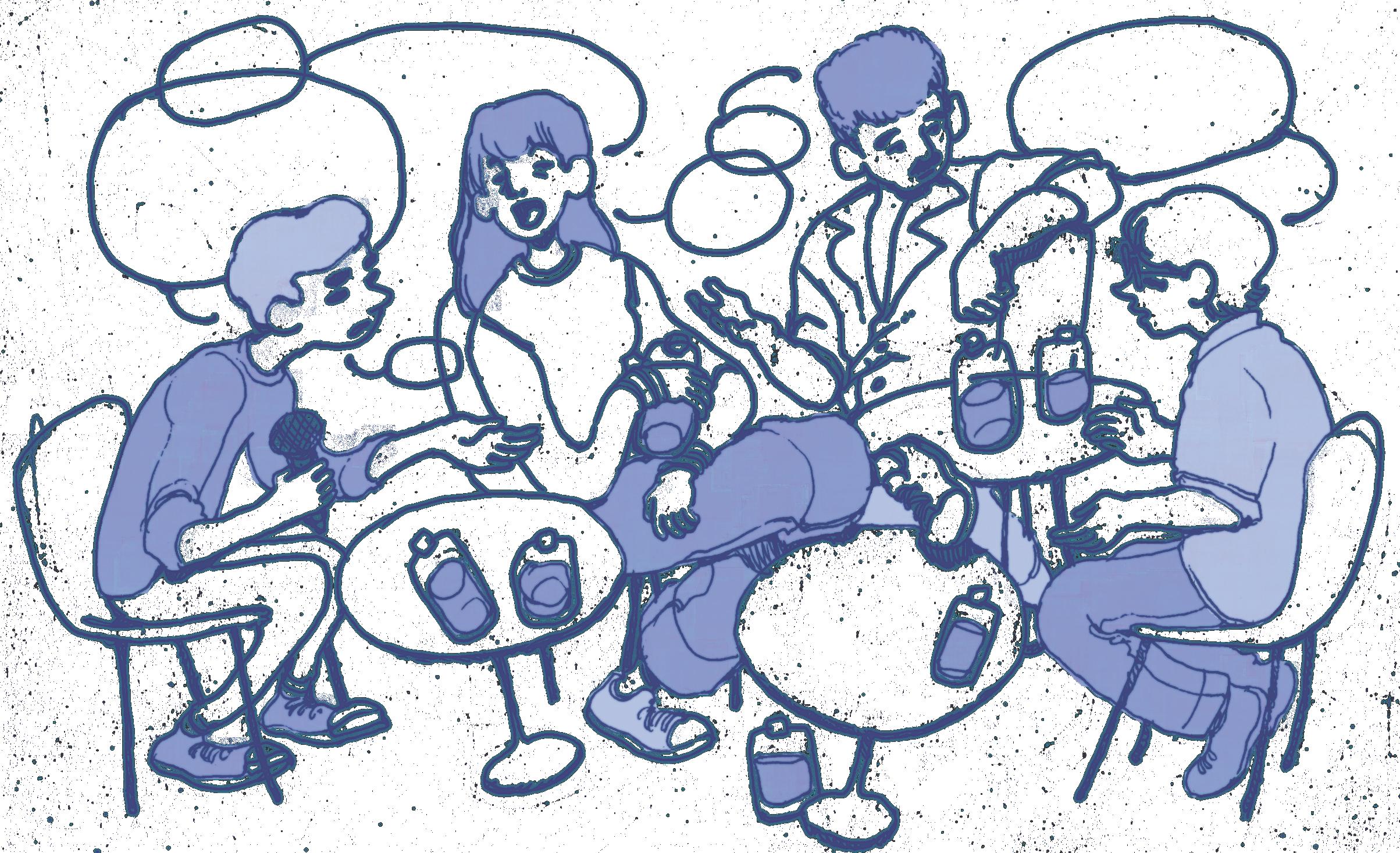
You may be wondering why we’re encouraging you to buy the Indy calendar™ in the last week of March. The year is almost twenty-five percent over, you’ve given up on your New Year's resolution to stop oversharing with people you’ve just met, and you just need to make it to Spring Break so you can make it through midterms so you can make it to finals! But if you’re reading this on the date of publication (Friday, March 20), then the dreadful retrograde is over, Jupiter in Cancer is making a luscious trine to Mercury in Pisces, and the Sun is leaving the last sign of the zodiac and running to meet Venus in Aries! If none of that made sense to you, then all you need to know is: the (real) New Year begins today!
And the Indy is here to support you as we enter the verdant months of spring, so buy a calendar!
DESIGN EDITORS
Mary-Elizabeth Boatey
Kay Kim
Seoyeon Kweon
DESIGNERS
Isabella Castro
Hongrui Guan
Rose Holdbrook
Esoo Kim
Jennifer Kim
Jordan Kinley
Selim Kutlu
Jennie Kwon
Hyunjo Lee
Soohyun Lee
Chelsea Liu
Kayla Randolph
Ana Ïs Reiss
Lea Seo
Liz Sepulveda
Anna Wang
Caleb Wu
STAFF WRITERS
Layla Ahmed
Tanvi Anand
Cameron Calonzo
Megan Chan
Nan Dickerson
Ray Eggerts
Jacob Hansen
Maxwell Hawkins
Mohamed Amine Jaoudi
Annie Johnson
Nadia Mazonson
Keya Mehra
Naomi Nesmith
Nikolaos
Nikolopouslos
Alya Nimis-Ibrahim
Nora Rowe
Alex Sayette
Samdol Sichoe
Luca Suarez
Santino Suarez
Mahliat Tamrat
Ben Underwood
Ellie Wu
Jodie Yan
ALUMNI COORDINATOR
Peter Zettl
SOCIAL CHAIRS
Raamina Chowdhury
Lila Rosen
Alex Sayette
DEVELOPMENT
COORDINATORS
Peter Zettl
Cindy Li
FINANCIAL COORDINATORS
Zak Hashi
Simon Yang
ILLUSTRATION EDITORS
Selim Kutlu
Serena Yu
ILLUSTRATORS
Abby Berwick
Rosemary Brantley
Rosalia Gonzalez Pousa
Koji Hellman
Jiwon Lim
Ellie Lin
Megha Nambiar
Ruby Nemeroff
Meri Sanders
Angelina So
Luna Tobar
Naomi Zaro
Cora Zeng
Alena Zhang
Faith Zhao
COPY CHIEF
Eric Ma
COPY EDITORS
Jordan Coutts
Mackenzie Ellis
Kainalu Faucher
Lucie Huang
Indy Nijjar
Camilla Rodriguez
Zeke Tesler
Sasha Watson
WEB EDITORS
Casey Gao
Erin Min
WEB DESIGNERS
Maja Mishevska
Amy Pan
Dominic Park
Joy Zou
SOCIAL MEDIA EDITORS
Olivia Falk
Sylvie Foster
Isabel Hahn
Avery Reinhold
Eurie Seo
SENIOR EDITORS
Jolie Barnard
Nan Dickerson
Paulina Gąsiorowska
Sabine Jimenez-Williams
Angela Lian
Nadia Mazonson
Talia Reiss
Luca Suarez
OUTREACH AND INCLUSION
COORDINATORS
Raamina Chowdhury
Naomi Nesmith
*Our Beloved Staff
MISSION STATEMENT
The College Hill Independent is a Providence-based publication written, illustrated, designed, and edited by students from Brown University and the Rhode Island School of Design. Our paper is distributed throughout the East Side, Downtown, and online. The Indy also functions as an open, leftist, consciousness-raising workshop for writers and artists, and from this collaborative space we publish 20 pages of politically-engaged and thoughtful content once a week. We want to create work that is generative for and accountable to the Providence community—a commitment that needs consistent and persistent attention.
While the Indy is predominantly financed by Brown, we independently fundraise to support a stipend program to compensate staff who need financial support, which the University refuses to provide. Beyond making both the spaces we occupy and the creation process more accessible, we must also work to make our writing legible and relevant to our readers.
The Indy strives to disrupt dominant narratives of power. We reject content that perpetuates homophobia, transphobia, xenophobia, misogyny, ableism and/ or classism. We aim to produce work that is abolitionist, anti-racist, anti-capitalist, and anti-imperialist, and we want to generate spaces for radical thought, care, and futures. Though these lists are not exhaustive, we challenge each other to be intentional and self-critical within and beyond the workshop setting, and to find beauty and sustenance in creating and working together.
WEEK IN THE PURSUIT OF PROPERTY, PT. 2
( TEXT MARIA GOMBERG
DESIGN SEOYEON KWEON
ILLUSTRATION
ALENA ZHANG )
c This time a few weeks ago, I went to a Providence City Council meeting to stand in favor of a bill proposing rent stabilization. Good on me. Fine, not too good. As the tone and substance of this article will make it incredibly apparent, this was my first time ever laying eyes on the city government. But I really do care about freezing rents. Fuck, I meant controlling, nobody should be paying above—Not that either? Oh—uhm—well…Stabilization. I care about rent stabilization, and I care a lot. Which is why I made a little piece of cardboard with the words “rent control NOW!” on it, and walked all five blocks to Kennedy Plaza on my god-given time off. Politics is easy; you should try it someday.
In truth, it’s a little bit embarrassing that I had never, until that point, been to a City Council meeting—the most bare-bones demonstration of local political engagement that can come to my mind. In Providence, the council meets on the first and third Thursdays of every month, which means that I have had 86 opportunities to go, and have only been this once. To be frank, I thought that what turned out to be City Hall was an abandoned hotel. There go my claims to civic engagement. But hey, this one time, I actually made it inside.
I followed a group of on-campus housing activists to what looked to me to be a pretty precarious operatic balcony on the top floor of City Hall, from which one could see the proceedings on the floor. We were told to leave our posters and banners outside, a directive we dutifully ignored. Since we had arrived just a few minutes shy of the start of the meeting, I took a second to get a good look around. Primarily, I tried to suss out the vibe of the crowd. The good thing about attending a politically charged event is that, unless it is a family dinner or a wedding with a defined dress code, people make good use of their clothing to tell you what side they are on. The demographics and positionality of the people present were made incredibly legible by a variety of T-shirts, with clear slogans that ranged from “Free Rents” to “I am a landlord and proud.” Soon, however, the room was called to order. Roll call, and some preliminary motions were now underway. I learned that a city council meeting takes a while to build up to the meaty issues on the voting block. Before the word rent was even uttered by any of the legislators, blue ribbons were handed out to a particularly adorable middle school football team; several opaque legislative operations were tabled; and a motion to open a motion to consider a committee on the history of the Providence City Council was unanimously approved. As the tiny football players— the Providence Cowboys, as they would like to be called—filed out of the building, they were replaced by a second wave of protestors—these far more flashy than us. One guy had a light-up tuba, which he blared at full volume in support of the bill.
+++
The truth is that rent control feels like a very personal issue. My parents are lifelong renters. My childhood home is a sixth-floor apartment in a dilapidated building in a German enclave in the south of Mexico City. Although we have lived there for nearly 25 years, we still rent. Our landlord is named Krista Klimpfot,
she has the mannerisms and emotional predisposition of a neurotic lapdog, and we pay her under the table in cash. Inadvertently, our apartment is rent-controlled. Since she isn’t a career landlord, but rather a clueless inheritor with no interests other than having us out of her hair, she hasn’t raised our rent in at least 10 years. She has a perm that makes her look like a graying little orphan Annie, and she has never fixed a single problem we’ve had, but at least I get to keep my childhood bedroom 20-odd years in.
Before Krista, my parents had lived in New York City, where they had a similar—and arguably more stable—arrangement. Protection from the city let them live in a two-bedroom in Washington Heights as grad student émigrés from the Soviet Union. They had a dining room and a next-door neighbor who had personally known Eichmann. They slept on a mattress on the floor and split a Chinese restaurant lunch special over six meals, but at least they didn’t have to move until they had immigrated to a different country, for good.
My grandparents live in subsidized housing, regulated by the city, and their landlord is not allowed to raise rent. My friends are fortunate enough to have strong renters’ unions, and in the cities I’ve lived in there are laws to protect me from price gouging on leases. All in all, making rent—perhaps the world’s most important, consistent, and upsetting expense— not-quite-so-ruinously bad. And although I know that landlords, if given free reign, will be ruthless and evil, thanks to luck and common-sense policy, I have never had to experience it firsthand. That is, until this year, when I moved to an apartment in Providence, RI, and met my famously evil slumlord—let’s call him Mr. Bed.
Mr.Bed owns roughly 36 properties in Providence, but he will have you think that he has been dekulakized and dispossessed if you ask him as much as to pay for a necessary expense, like heat, water, or anything else he has to provide by order of law. Bed is aggressively present, and if it’s not him, it’s one of his men. His primary peon, stripped of individual identity, goes by the same name as his boss. He smokes inside our building, especially if he is dealing with our gas valve, and I don’t think that any of us have ever heard him talk. Together they sulk around our big block of student apartments and knock on our doors if we dare to have as much as an ounce of some fun.
I see my landlord more than I see most of my friends and family. We have a rapport and know each other’s biographies by heart and in detail. Even still, the rent for our crappy apartment has skyrocketed by 600 dollars in the last year. This rate is decidedly prohibitive, and we know for a fact that he is raising the rent for the next year again. If we wanted to stay for another semester (which we don’t, because it’s a dilapidated shack), we would have to sell all of our furniture and subsist off of what is remaining of our grain stores. Rumor has it that in a few years, he will be
charging close to one zillion, and that he is yet to give the same number of keys that there are tenants, or to fix the hole in the ceiling that lets us peek through the neighbor’s floor.
It isn’t just student-geared slumlords who treat their tenants with disrespect and contempt. At the City Council meeting, I listened to witnesses—social workers, public servants, and some renters themselves—tell horror stories about children and the elderly being forced to live in group homes and their cars because of unbridled price gouging that has displaced them over time.
The landlords, who turned out to be inconspicuously present en masse, were given their turn to speak. They contrasted the harrowing stories of ruined lives and livelihoods, medical complications caused by instability and stress, with stories of annoying tenants who they blamed for the need to raise rent.
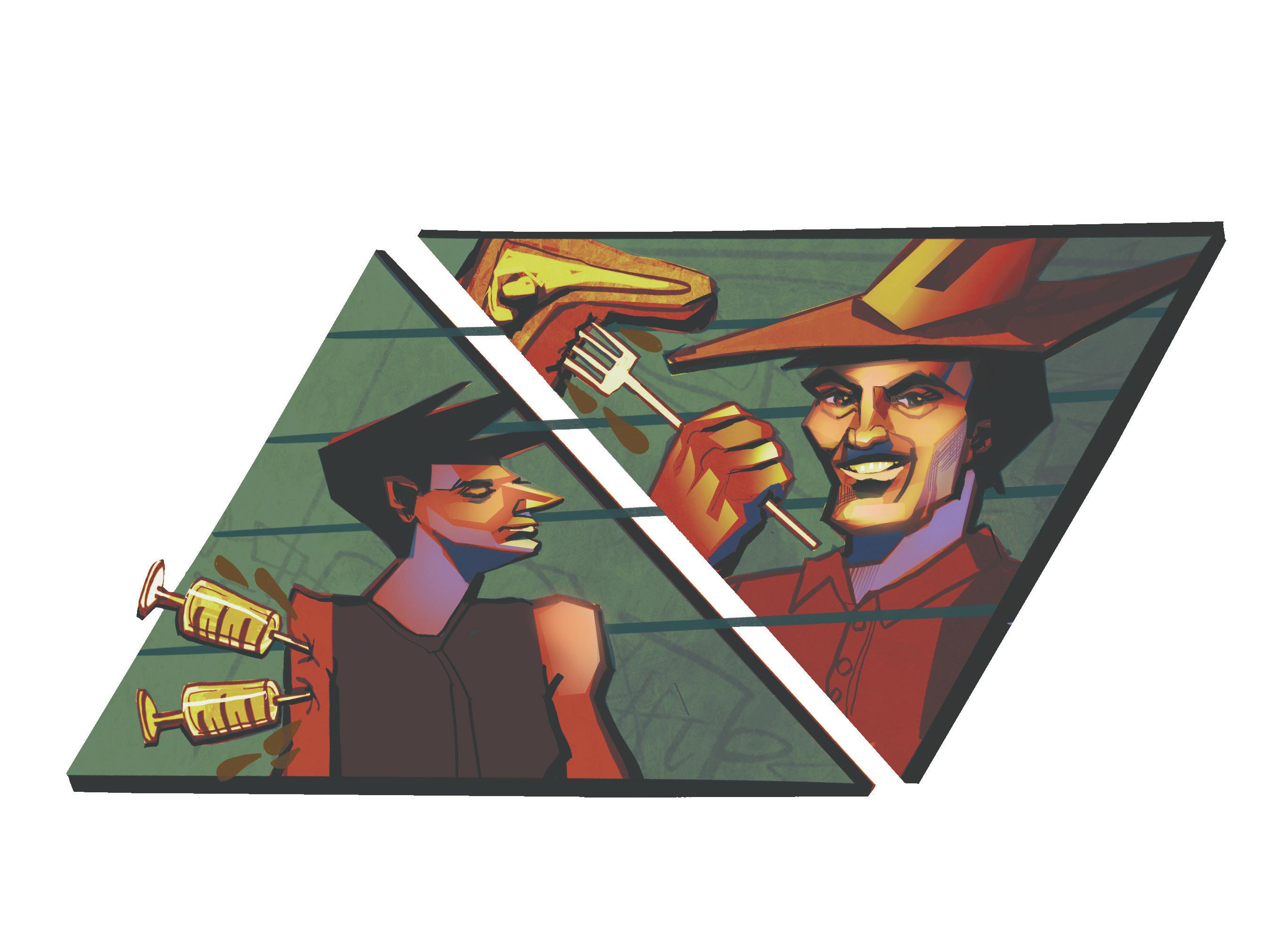
I have to admit that as this issue was, once again, tabled for a meeting some time in the future, I felt that my heart had sunk deep into my legs. I waddled catatonic into the lobby, and as I turned towards the exit, I saw a familiar frame. There, advocating for the rights of his fellow landlords to evict, dispossess and manipulate unrestrained, was Mr. Bed himself in his iconic neon jumpsuit and beard. And in one of those moments of almost-too-literal political friction, here was a landlord and tenant, facing off, literally face-to-face.
MARIA GOMBERG B’26 is going to do better next year.
“Fortress Brown” Inside and Out
MAPPING INCREASED SECURITY
PRESENCE AT BROWN
(
TEXT MIKAYLA KENNEDY
DESIGN ANNA WANG
ILLUSTRATION ABBY BERWICK )
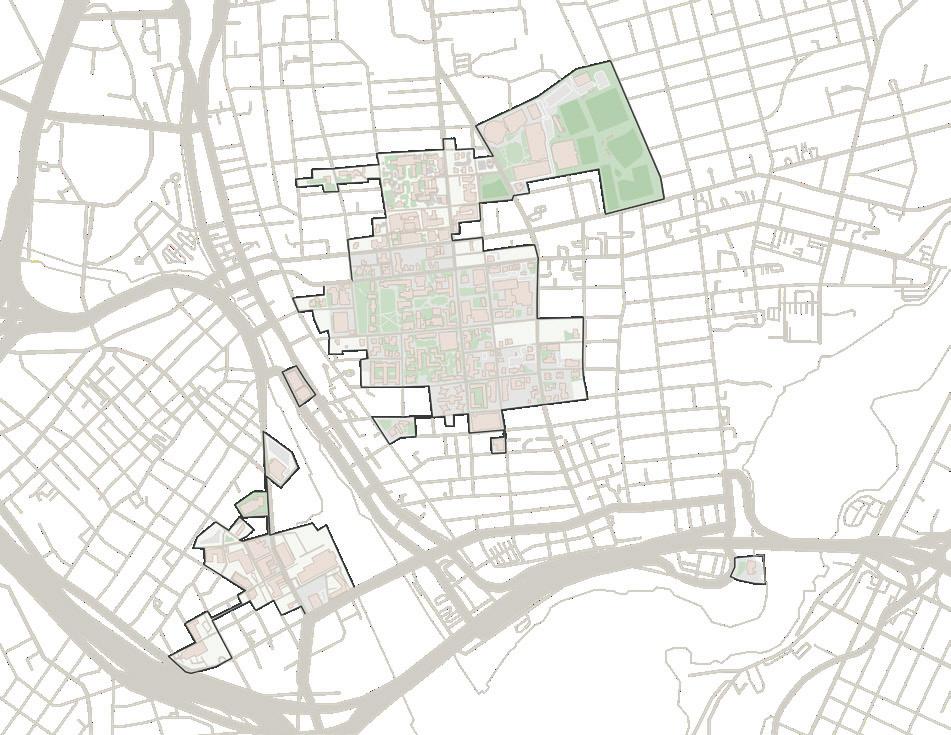
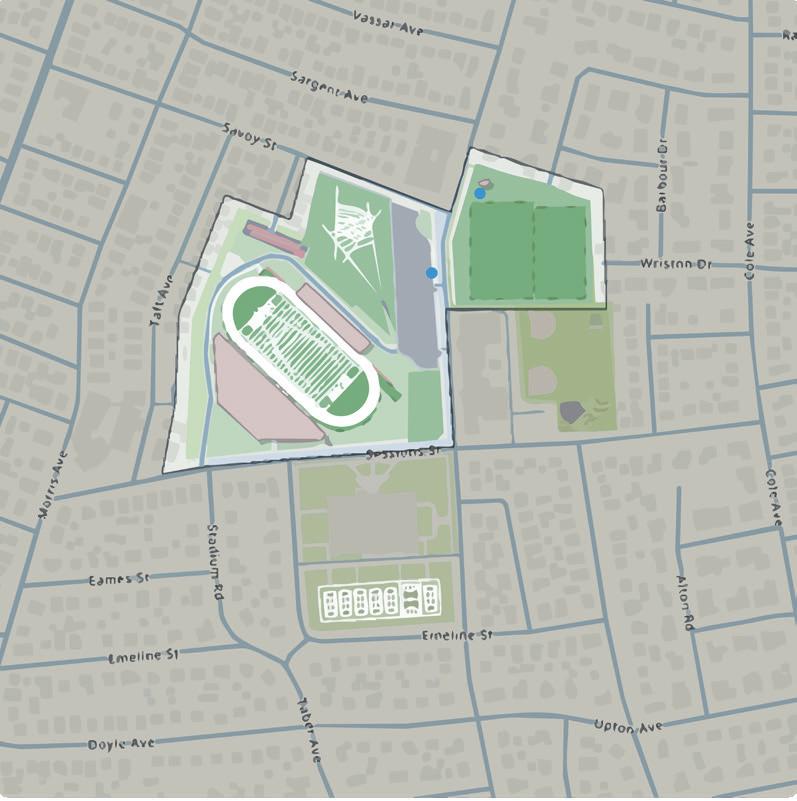
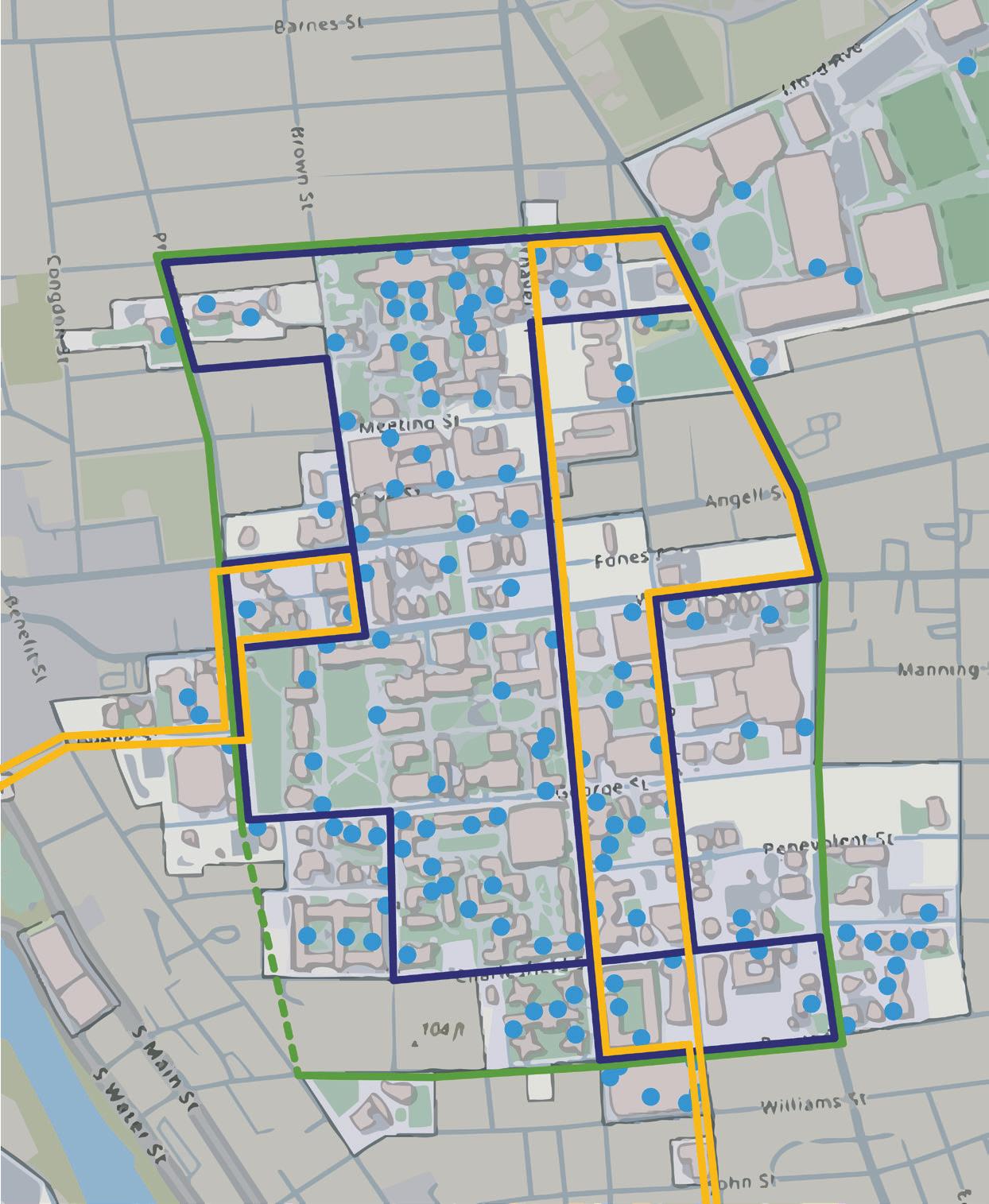
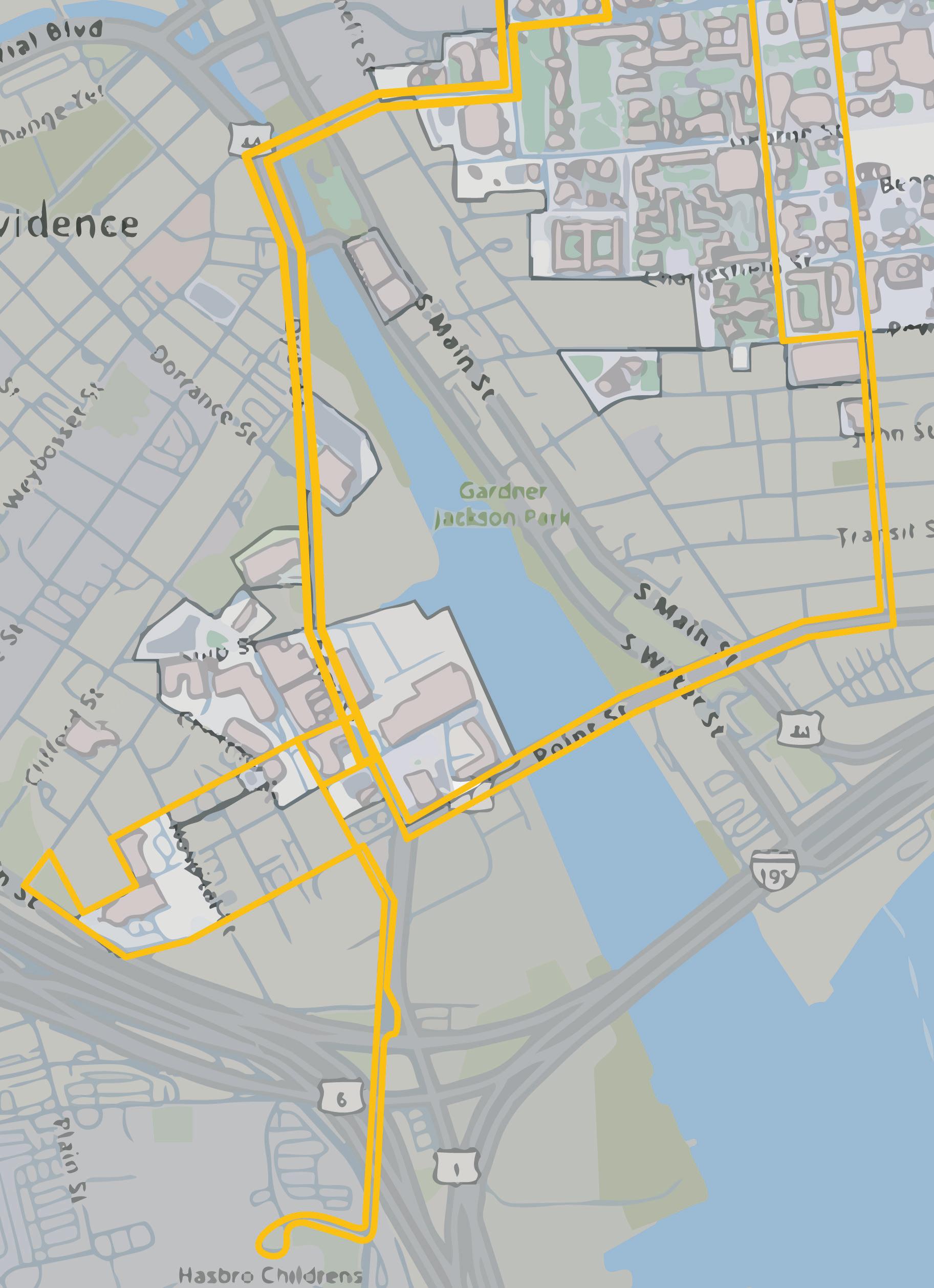
The College Hill Independent traces Brown University’s “campus boundaries” as defined by its security and surveillance apparatuses. The map is composed of both the University’s explicit surveillance systems, like police and security vehicles around campus, and less explicit ones, like the Brown University Shuttle.
Information Key
Brown University Properties (black line): Buildings owned and operated by Brown University
Daytime Shuttle (yellow line): Daytime Connector and Express Routes operate from Monday–Friday, 7 a.m.–7 p.m. All shuttle vehicles are equipped with dash cameras.
Evening Shuttle (dark blue line): Evening shuttles operate on Sunday–Wednesday, 5 p.m.–2 a.m., and Thursday–Saturday 5 p.m.–3 a.m. All shuttle vehicles are equipped with dash cameras.
Safewalk (green line): Two-person teams of Safewalkers patrol Brown’s main campus on Sunday –Thursday, 9 p.m.–2:15 a.m., and Friday–Saturday, 10:15 p.m.–2:15 a.m., walking a similar route to that of the Evening Shuttle.
R December 13th Brown University Law Enforcement Perimeter (red squares): At 11:06 p.m., December 13, 2025, this perimeter was published through Brown RAVE Alerts. Individuals within the perimeter were instructed to shelter in place. Law enforcement evacuated occupants from the administrative buildings outlined in red.
X Phones (blue dots): According to the University’s campus map website, there are approximately 200 Blue Light Phones across its campuses. In addition to their function as a means to quickly contact DPS, the University is in the process of installing cameras on all phones.
b Police Cars (maroon dots): Based on a survey of campus conducted on March 8, 9, 10, 13, 14, 9 - 10 p.m., Providence Police and Brown Police vehicles are consistently seen at these locations.
b Security Cars (orange dots): Based on the same survey, USENTRA and Allied Universal vehicles are consistently seen at these locations.
Not pictured in the map are the more than 1,200 security cameras on Brown’s campus. As it stands on March 19, 2026, Brown ID card swipe is required for all buildings owned and operated by Brown University, and a significant number are guarded by private security.
* This piece anonymizes an undocumented student to protect their identity.
c The December 13th shooting profoundly altered the sense of security on Brown University’s campus. While mourning the loss of Ella Cook and Mukhammad Aziz Umurzokov, community members grappled with a changed perception of their physical safety. Ava Rodriguez B’29, who was present at the review session where the shooting took place, said in an interview with The College Hill Independent that in “the first week back on campus, I would get really scared when people who are obviously not students would walk past me.” Rodriguez went on to clarify that she generally felt “pretty okay.” Still, at other points in the interview, she appeared apprehensive about who did or didn’t belong on campus. Rodriguez expressed feeling “a bit unsafe” when holding doors for people walking behind her. “It’s not like you’re gonna slam the door in their face, [but] there’s the thought in the back of my mind: what if you’re not supposed to be here?” she said.
For those who remained on or near campus after the shooting, safety concerns were intensified by the presence of local, state, and federal law enforcement in the neighborhoods immediately surrounding the University, as well as on the campus itself.
Michael Ziegler, President of the Graduate Labor Organization, said he heard from one GLO member that an FBI agent came to their neighbor’s door and asked to be let into their apartment voluntarily. Ziegler additionally recalled that while walking in Fox Point, a neighborhood that borders the University’s main campus, he saw an agent wearing a Homeland Security Investigations vest. He went on to share that a graduate student had left their visa and passport in Barus and Holley when they were ordered to evacuate, and were not able to get them back until about a week after the shooting. “They were scared to death to leave their house,” he said, adding that “they’re detaining people for much less” than not having their visa on them.
Ziegler said that the communication he received from the University regarding law enforcement in the area “was generally couched in terms of ‘that should make you feel safe.’” But many GLO members felt “just the opposite,” he said.
The University announced on December 15 that, in addition to hosting police departments from other cities and funding “ongoing patrols throughout campus” by teams from Allied Universal, a security company, it had doubled its staffing of the Brown Department of Public Safety and Emergency Management, often referred to as DPS. A January 16 community message explained that this “heightened presence” of law enforcement—be it private security, the doubled DPS staffing, or the Providence Police Department (PPD)—would continue until a Safety & Security Assessment was completed this spring.
On January 29, Russell Carey, the executive vice president for planning and policy at Brown, announced that Teneo, a global consulting firm, would run both a Safety and Security Assessment as well as an After-Action Review. The review will evaluate “campus safety in the period leading up to the tragedy, the preparedness and response on Dec. 13, and the emergency management response in the aftermath.” Carey added that the assessment will focus on “Brown’s safety and security policies, procedures, infrastructure and training” and guide
longer-term decisions related to campus safety.
In addition to increasing police and security personnel, the University has added additional security cameras to the campus, which supplement the more than 1,200 cameras already in place before December 13th. Although they may be less obvious forms of security, student safewalkers—two-person teams that serve “as additional ‘eyes and ears’ for community safety,” according to the Safewalk website—are a DPS program. Anand Tansakul, the student coordinator for Safewalk, wrote to the Indy in an email that “Safewalk does not follow specific routes, but we try to maintain a presence within the border of campus,” adding that “Safewalkers often walk along routes similar to those used by the Brown shuttle.”
The University has also limited access to almost all on-campus buildings to those with a Brown ID card. Brown has additionally stationed or increased security presence at the campus’ primary libraries and dining halls, as well as some university buildings.
The University has justified these security measures through appeals to the value of campus safety. In an interview published on February 27 by The Brown Daily Herald (BDH), President Christina Paxson stated that: “We don’t want to be over-policed at Brown. I don’t think anybody wants that. That’s not the goal. But we know that we can’t fulfill our mission unless the people who are here—students, faculty and staff—feel safe.”
But to many students, an increase in safety doesn’t require an increase in police presence. In response to the question “What would make you feel safer?” asked on DPS’s 2021 and 2024 Public Safety Community Surveys, increased lighting and access to transportation were students’ most requested accommodations. Respondents also expressed that they felt safer walking with Safewalk, which points towards an alternative to increasing security and police presence. Tansakul additionally shared that Safewalker applications have increased this semester. “It has been one of the larger applicant pools we’ve had in some time,” he wrote.
The role of DPS on campus has long been a topic of contention. Most recently, in 2020, police presence was subject to scrutiny from student groups following the murder of George Floyd. Student organizers formed Grasping at the Root, an abolitionist group that called for the reduction of the department’s budget ($8 million in April 2021), demanded the department end its relationship with the PPD, and petitioned for a reassignment of some of its responsibilities, like crisis intervention and event security.
In response, the Office of Residential Life took on resolving business-hours lockouts and completing checks on student wellbeing in residence halls, responsibilities previously under the purview of DPS. The then-DPS chief, Mark Porter resigned in December of that year. Like many campuses and cities across the country, Brown pivoted away from policing in 2020 and 2021. In an October 2020 meeting of the Undergraduate Council of Students, reported on by the BDH, Director of Student Activities Joie Steele stated that “We are definitely thinking about alternative options to keep our students safe without having police officers on every corner.”
While police and security officers are not on every corner today, their presence on campus is undeniably significant. As pictured on the visual of Brown’s security apparatus attached to this article, between approximately 9 and 10 pm, there were, on average, six police and five security cars within the approximate 0.75–square mile radius monitored over the course of five days. For almost anyone who has set foot on Brown’s campus since the new semester began, the heightened security presence is unignorable.
When asked about where he usually encounters increased police and security presence, Kevin LoGiudice, President of the Graduate Student Council and a PhD candidate in Biomedical Engineering, said that “I work in Barus and Holley, so anytime you swipe in, there’s always a police officer.” He elaborated that “For me, I guess it brings a sense of
For almost anyone who has set foot on Brown’s campus since the new semester began, the heightened security presence is unignorable.
security that it’s an actual police officer, rather than a security guard.” LoGiudice acknowledged, though, that some students think “the likelihood of anything happening again is so small. What is the police officer really doing? What’s the point?”
LoGiudice said that among the “vastly differing opinions” he’s heard about the increased security presence, there’ve been some who “say all the changes are excessive and get in the way of their work, or just their daily time on campus.” Yet he has also “heard from people that all the changes are necessary. They understand why they’ve been done, and the increased security presence makes them feel safer,” he said. Some students have even told him that “maybe even more should be done.”
Moreover, he acknowledged that a given change could represent “something different to different students.” The same security guard, for instance, could give one student “a sense of safety” and put another “on edge, like they’re being watched.”
Though he shared the anecdote to express his belief that calls to DPS are being taken more seriously this semester, LoGiudice’s memory of an incident a graduate student recalled to him is emblematic of this split in student experience. LoGiudice described that after holding the door for someone coming into a Brown building, a student “felt uneasy about it,” leading her to call DPS. He continued that “she received a call back from DPS, [that said] we verified they were a student, but thanks for your concern and sending the report in.”
V, an undocumented Brown student, described feeling a pervasive sense of awareness of the police presence on campus today. “It’s always just in my mind,” they said, adding that they hoped the police had received de-escalation training. Describing their experience returning home at night, V said: “I walk home past the cop every day, and I’m just kind of like, oh, should I even look into the car? Should I just act as if I don’t even notice it? If I notice it, is that a bad thing?”
V shared that when they drive with other friends of color around campus, they intentionally avoid the police. Though V acknowledged that they had never heard about Brown police escalating a situation, they said: “you never really can expect or predict how someone else is gonna act, so I’d rather be more careful.”
Though Rodriguez had a different reaction to V, she shared in V’s awareness of police cars at night. “A lot of the police cars will sit with their lights on, and it makes me think something is happening,” she said. Rodriguez said she appreciated the new card swipe access restrictions and would like them expanded to the Sharpe Refectory, a dining hall at the center of campus that can currently be accessed without a card swipe, though its entrance is monitored by a security guard throughout its opening hours.
Part of Teneo’s assessment process includes gathering input about changes made to security. In his March 2nd announcement to campus through Today@Brown, Carey outlined that the firm would receive feedback from focus groups, virtual webinars, and a Public Safety Community Survey to be sent to students, faculty, and staff. He also wrote that a significant portion of two meetings of the Brown University Community Council (BUCC) would be dedicated to the topic. The announcement explained that nine focus groups composed of up to 30 participants would be created to represent students, faculty, staff, and alumni, as well as individuals nominated and appointed by “local government, business and neighborhood leaders.” The virtual webinars will be held for parents and alumni.
The March 10 BUCC meeting was the first iteration of this information-gathering process. At the meeting, Courtney Adante, Teneo’s Global Head of Security Risk, and David Cagno, Teneo’s Head of Public Safety Solutions, presented their plan for Teneo’s After-Action Review and Comprehensive Safety and Security Assessment, and answered questions about them from BUCC council members as well as the wider audience.
Though the meeting was the first opportunity for community members to provide feedback to security changes, turnout was small, and seating was only halffilled. Outside of BUCC members, there were approximately 30 attendees, five of whom looked like they might be students.
Neither Rodriguez nor V said they were aware that the meeting was happening. Rodriguez described it as “really concerning” that students who experienced the shooting were not specifically informed about the meeting. Rodriguez said that after the shooting, she had stood in confusion outside Barus and Holley with a group of students who had been in the building with her until a police officer told them to leave. “Eventually we had to hide in the basement of some random person who let us into their house,” she said, adding that eyewitness perspectives were critical to understanding “how security handled it the day of.”
During the meeting’s Q&A, a discussion emerged about William Bratton, the executive chair and co-founder of Teneo, who is widely credited for turning the ‘broken windows’ theory of crime, which posits that increased criminalization of low-level offenses results in a decrease in more serious crime, into a policing strategy. The approach, which Bratton implemented in both New York City and Los Angeles during his time as police commissioner of both cities, has been consistently criticized for leading to disproportionate policing of communities of color. Denise Davis, a professor of Gender and Sexuality Studies at Brown, prompted Teneo to “speak to [the] concern” that Bratton “is a big part of [the] firm.”
Adante responded that “in the day-to-day,” Cagno will be “running this” review, and added that “I don’t think broken windows plays a role in [...] the work that we’re doing.”
Davis responded by recalling that in 2016, “students of color, in particular Black students, told me that DPS would regularly ask them for their ID and ask them to account for their presence on campus.” She added: “That’s where the broken windows part comes from [...] this idea of policing at a very low level.” Davis additionally clarified that “in my understanding that doesn’t happen anymore,” but explained that her “concern is anything that would return us to something like that.”
The past Davis pointed to is visible in DPS’s 2017, 2018, and 2019 Stop Data Reports. Though the data does not distinguish between stops of students and individuals not affiliated with the university (who
comprise the vast majority of stops) and does not provide a reason for the stops, the reports indicate that Black people were disproportionately stopped in the “field” (meaning not in a vehicle) relative to the Black population of the neighborhoods where DPS patrols. No additional Stop Data Reports have been publicly published since 2019.
In 2020, Margolis Healy conducted a review of DPS internal affairs, but its results were not shared publicly. It remains to be seen how much of Teneo’s current report will be shared. Cass Cliatt, Brown’s Senior Vice President for Communications, said in an interview with the Indy that the University has to consider “what does our community wants from us in terms of accountability, but also how do we balance security and safety.”
The speed at which changes will be implemented also remains unclear. When a faculty member asked about it, Paxson stated that there may be some “no-brainer things that you just have to do,” but said that the University would wait until the fall to seek additional community input on other policies.
Alicia Joo B’26, a station manager of Brown Student and Community Radio, shared at the BUCC meeting that policies limiting access to the Campus Center, where the radio studio is located, have caused issues for the club. “We have a handful of community members who are really integral to the functioning of our organization,” she explained, elaborating that swipe-only access has meant that “anyone from a RISD student to a Providence community member who has been a part of the station for 10 plus years cannot enter the building.” Some members have “quit because they didn’t feel welcome or because they didn’t want to inconvenience us,” she said, citing an additional example of community members being denied entrance to the Hay while with students on the radio.
Leandra Shields, a Rhode Island resident who had booked an appointment at the Brown Design Workshop (BDW) but had it cancelled due to its closure to those outside the Brown community, characterized the closure as a “shocking response [...] and a very unnecessary one too.” Shields shared that she regularly attends lectures and events at Brown, has family and friends who’ve attended the university, and was on campus on the day of the shooting. Later on in the interview, Shields elaborated on their belief that closing the campus to community members is unnecessary. “I’ve never heard of someone going and partaking in the community, and then committing an act like that,” she said.
Shields pointed to the support small businesses offered to the Brown community and how it was John, an unhoused man living in Providence, who provided the critical tip that led to the shooter being identified. Shields said that she “thought there would be more regard for this sort of coming together.”
Responding to a question about how open she felt Brown’s campus to be, Shields said that: “wherever you’re going in Providence, you are probably going to walk through the Brown University campus. You’re probably going to encounter Brown University students. In spite of that, I don’t feel it’s very open.” She additionally described Brown as being “more closed off,” after the shooting.
In addition to owning a significant portion of Providence land, the University is one of the top 10 employers in the city. Brown and Providence are not
“Wherever you’re going
in Providence,
you
are probably going to walk through the Brown University campus. You’re probably going to encounter Brown University students. In spite of that, I don’t feel it’s very open.”
just tangentially connected; they are significantly intermeshed. Yet by closing previously publicly accessible spaces, including the BDW, the University has significantly isolated itself from the surrounding Providence community.
Though the University has justified security changes mainly on the grounds of safety, its increase in security and police presence arguably sends the message that non-Brown community members are not welcome. Around campus, police cars have become ubiquitous. Referencing how often a police car sits in front of the Wayland Arch, which leads to Wriston Quadrangle and a significant number of dorm buildings, V said that “it kind of feels like a gated community almost, like we have a guard posted up.”
As Ziegler put it, Brown seems to be “moving towards something that’s a little more like ‘fortress Brown’ even than what had been the case before” due to its “private police force” that’s accountable not “to the public at large but to the institution.”
Brown has never been just a benevolent neighbor to the city of Providence. As part of its construction of the previously mentioned Wriston Quadrangle, Brown demolished 51 buildings, including housing, shops, and a school, in the 1950s. Beginning in the 1970s, Brown University student renters displaced lower-income Cape Verdean, Portuguese, and Irish immigrant communities from Fox Point. More recently, in 2023, protestors criticized the University for its Payment in Lieu of Taxes Agreement with Providence. This agreement allows Brown to directly pay the city of Providence about $175 million over 20 years, a lower number than what it would pay if taxed normally. It is clear that rather than existing in isolation from Providence, the University has a direct impact on the city.
Reflecting on the relationship between the University and Providence, Shields said that they weren’t sure if students and professors wanted to be “like a penguin’s huddle” and “locked on to one another for warmth and not the outer community.”
Shields added that “if that’s not the sentiment and that’s coming from the administration, then I hope that people speak up and try not to let one, you know, rageful person, impact the way the relationship is maintained moving forward.”
MIKAYLA KENNEDY B’26 felt nervous about watching the cops.
How Far Can a Good Story Get You?
MAKING AND UNMAKING TIBETAN
REFUGEES’ CLAIMS FOR FRENCH POLITICAL ASYLUM
This piece anonymizes one interviewee to protect his identity. All interviews in Tibetan were translated by the author.
c It is difficult to speak of westward migration in the Tibetan exile community without running into a contradiction. The word chigyal comes up often: chi, outside; and gyal, country. Once, chigyal merely referred to foreign lands beyond Tibet’s snow-capped mountains. For decades, Tibetans seeking exile fled to India and Nepal, where most of them now reside. Today, however, chigyal is reserved for the West: France, America, and Australia, for example. If someone were to say a relative has “gone to chigyal,” everyone understands they do not mean Delhi or Kathmandu but a second, further destination. The paradox of this term lies in the fact that us Tibetans in exile have already lived ‘outside our country’ for generations.
This long, drawn-out displacement began in the last few months of 1950, when China’s People’s Liberation Army marched into Tibet, the red of their flags bleeding into the slaughter of more than a million Tibetans. Nine years later, after an uprising in Lhasa (the capital of Tibet) was crushed, the Dalai Lama and some 100,000 Tibetans fled Tibet, through the Himalayas into India, Nepal, and Bhutan. In exile, we Tibetans have rebuilt our political, religious, and social life, eventually establishing a democratic polity under the Central Tibetan Administration (CTA). But exile in South Asia, as organized and durable as it has been, never crystallized into a feeling of settlement.
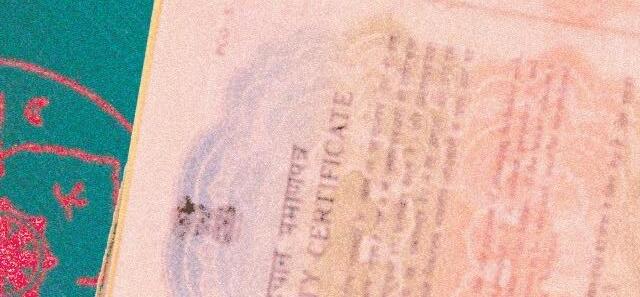
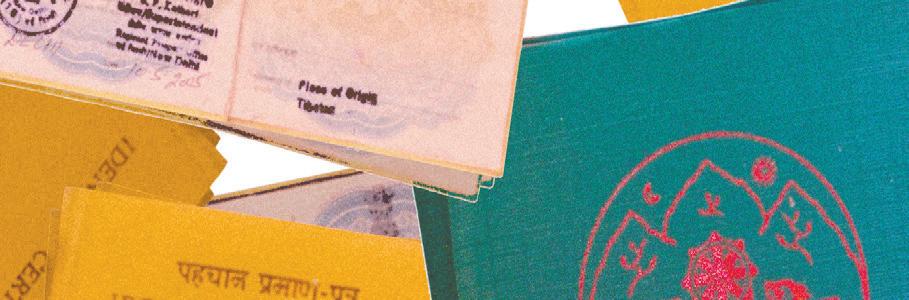
Most Tibetans in India, including at least two generations born there, still hold Identity Certificates (IC) rather than citizenship. Issued by the Indian government, the ICs function as a travel document, but do not confer full rights of belonging: Tibetans remain classified as foreigners, unable to vote, buy land, secure government employment, or move through life with any of the other guarantees that citizenship affords. The other document structuring life in exile is Rangzen Lakthep. Referred to as the Green Book in English because of its dark green cover, possessing it both marks its holder as a Tibetan in exile and would constitute a claim to citizenship if Tibet were to regain independence. It also allows its holders to participate in exile-specific institutions, such as the hospitals and health programs run by the Tibetan Department of Health.
Meanwhile, inside Tibet, China’s repression has only intensified. After protests erupted across Tibet in 2008, partially spurred by Beijing’s whitewashing campaign for their Olympic moment, a more totalitarian regime took hold. Today, nearly one million Tibetan children, or three-quarters of the Tibetan students aged six or older, are now estimated to be in colonial boarding schools run by the Chinese government, far from their homes, where Mandarin is the primary language spoken, and “patriotic education” is used to cultivate allegiance to the Communist Party over attachments to Tibetan identity, language, religion, and even family. Alongside this runs an expanding biometric and digital dragnet, with Citizen Lab estimating that between 2016 and 2022 police in the Tibet Autonomous Region may have collected between 919,000 and 1.2 million DNA samples, a number that covers as much as one-third
of the population, from people with no evident ties to criminal investigations. With tighter surveillance and more guarded borders, escape into India or Nepal has become nearly impossible.
In Tibetan poet Tsering Wangmo Dhompa’s words, “home was transitive.” So, it turns out, is exile. To be born in exile is to inherit a homeland through someone else’s memories, someone else’s stories. Is it any surprise, then, that onward migration demands yet another narrative?
The route from South Asia to Europe is a chain of handoffs: a recruiter in Delhi, a passport one receives in Bangkok, a warehouse in Turkey, an airport bathroom in Frankfurt. Somewhere between shedding one’s IC and clutching a boarding pass with someone else’s name, the journey becomes less about transition than subtraction, forcing one to erase their time in India in order to become an “acceptable” refugee. Between 2007 and 2019, the population of Tibetans in India fell by 44%, raising the question of what caused this staggering decline. India is not a signatory to the 1951 UN Refugee Convention and does not formally grant refugee status, leaving most Tibetans suspended in a long-term legal foreignness. That status carries with it daily consequence; for example, in universities, Tibetans are often treated as foreign students, sometimes paying higher fees or even barred from attending at all. Of course, chigyal exerts its own force on the Tibetan imagination, with the West promising much that India cannot: legal permanence, mobility, more secure educational and professional futures, stronger social support systems. A story that circulated in the exile community a few years ago tells of a Tibetan refugee who, after months of climbing through the Himalayas, stepped into India only to find himself missing the highways China had built, having little patience for cow-traffic, and road bumps; before long, certain renditions of the story goes, he returned to Tibet. Apocryphal as this tale may be, it is a metonym for the reality of exile in South Asia: the material insecurity that accompanies relocation and the anxiety over what life might look like in the future as the Dalai Lama ages and New Delhi slouches ever closer to Beijing.
It is this chronic insecurity that spurs contempo rary Tibetan migration to Europe, Canada, the United States, and Australia. But lacking citizenship, and with most countries not recognizing the IC, Tibetans are shut out of straightforward legal pathways—and many are forced to assume different identities. In France, most Tibetans seek political asylum, but the process is knotted by a central paradox: The most faithful telling of a life already lived in exile is precisely what the system struggles to accommodate. Time spent in India or Nepal, that first refuges so central to the Tibetan condition, must often be omitted or obscured in claimants’ stories as it could recast them as people who had already found protection elsewhere and thus render them inadmissible into France’s borders.
( TEXT SAMDOL SICHOE DESIGN SELIM KUTLU
ILLUSTRATION MEGHA NAMBIAR )
former program advisor to the National Democratic Institute, a U.S.-based NGO, described a system that is at once organized and deeply unstable, intimate yet opaque. “It’s not been long, not more than 20 years, since Tibetans started moving to Europe with fake documents,” Sangmo said. These fake documents are instrumental in refashioning one’s identity.
After being exiled in 1959, most Tibetans stayed relatively close to where they had landed after their arduous journey across the Himalayas: in settlements called shichaks; strung across the plains and hill stations of India, tucked into the Kathmandu valley in Nepal. The West, including France and the United States, was far away, and largely closed off to most ordinary Tibetans. But in 1990, when the U.S. introduced a resettlement program for 1,000 Tibetan refugees, called the “Transition for Displaced Tibetans” under Section 134 of the U.S. Immigration Act, immigration restrictions began to ease.
Other than this, the only substantial resettlement program has been Switzerland’s rehabilitation of 1,000 Tibetan refugees, an initiative that was passed by the Swiss Federal Council in 1963, making Tibetans the first non-European refugees to be granted refuge in Switzerland. Supported by the Rockefeller Foundation, nearly 30 of these refugees, mostly monks, found their way to France in the 1960s. It wasn’t until the mid-2000s, however, that large numbers of Tibetans began arriving in France, settling quietly into a handful of Parisian neighborhoods, primarily La Chapelle and Stalingrad in the 18th and 19th Arrondissements.
Tibetans are brought to Europe via intricate smuggling networks, wherein refugees are rendered illicit cargo. According to Sangmo, the first intermediaries connecting Tibetans in India to the smugglers are Tibetan, “since [refugees] have to trust [the smugglers].” She likened the recruiting process to a “chain,”
passports were meant to ease entry into these transit countries, from which they usually attempted to move farther west, toward France, Switzerland, or Germany.
Speaking from her living room nestled in the hills of Dharamsala, the center of Tibetan life in India and the starting point of many of these asylum seekers’ long journeys, Tenzin Sangmo, a journalist and
However, these journeys took weeks. One man, Sangmo recalled, took more than a month and a half to get from India to Switzerland. Such a traveler would have to later claim asylum as having arrived directly from Tibet, or as otherwise untraceable, since any evidence tying them to India would derail their chances at a smooth entry process. People were told to travel lightly, empty their phones of contacts that could be traced back to India, and throw away ATM cards—discarding any proof of where their
There are many ways to get to chigyal. But all of them require the same careful arithmetic of choosing what to destroy and what to carry forward. Learning to be a refugee requires, as TD put it, shedding everything but the “bare minimum of proof required to be recognised as one.”
journeys began. Bhuchung described one group that made it to Germany, only to be caught and sent back to their country of origin because an Indian number was found on one of their phones.
Within these accounts, an intricate choreography of movements and appearances emerges: At some borders, people have to dress ‘poor’ to disappear into the undifferentiated flow of other border crossers; at other crossing points, smugglers dress them up and put them into fancy cars. Groups of travelers, which often start with numbers in the tens, could swell up to over a hundred, as they’re joined by other refugees.
Sometimes, these journeys have stalled indefinitely. Sangmo recalled one group that was held for days in a warehouse in Turkey, in total darkness, “like prisoners.” Many such stories circulate through the exile community—part rumor, part warning. One in particular has stayed with me: Two young Tibetan girls from Nepal placed their faith in the chain of hands that was supposed to deliver them to Europe. Instead, they were sent to Lesotho, where, according to those familiar with the case, they were held hostage and sexually assaulted. They escaped, the story goes, by jumping out of a bathroom window.
interviews the claimant. Between these two stages, NGOs such as France terre d’asile (‘France, land of asylum’), alongside community networks, often help asylum seekers understand the procedure, assemble their documents, and fill out a written account shaping their case before their interview. Only then does the applicant appear before OFPRA, usually with an interpreter, to give their testimony.
For Tibetans seeking asylum in France, preparing this testimony is a community-wide exercise in readability. Friends, relatives, and others in the community help applicants “straighten out their stories,” as one interlocutor put it, refining scattered biographies into claims the system will view as credible—dates, routes, and motives, arranged in the correct order.
Tenam, or Tenzin Namgyal, has watched this process for years. He himself came to Paris in 2005 on a tourist visa, met his French partner there, and has lived in the city ever since, helping many other Tibetans with their papers and asylum applications. “Most importantly, you need to prepare your story, [or] récit in French,” he said. You must detail why you left, what work you did, what political activity pushed you out of Tibet, and why return is impossible.
“They will ask questions based on your story,” he said, “trying to see if your story is real.” The OFPRA interviewer is looking for coherence, it seems, more than truth.
histories of immense repression and the granting of asylum, there lies a narrative bottleneck. When facing an interlocutor unsatisfied with a history of loss that follows a less-recognizable trajectory, one’s story must be transfigured into something acceptable.
+++
In recent years, Tibetan asylum seekers appear to have been met with a more permissive system. Not only more so than the one they would have encountered just 10 years ago, but also more permissive compared to the one most other refugees face. Some date this shift to the years preceding the COVID-19 pandemic; Nicola and others place it a little earlier, or around 2018. During this time, even as asylum categories generally became stricter, Tibetans landed on the “good part of the list,” in her words.
Part of this has to do with Tibetans occupying a somewhat awkward position when it comes to the question of return. “There is no such country like Tibet,” Nicola told me, by which she meant that France cannot deport Tibetans back to their countries in the straightforward way it might for others, since the former have effectively become stateless. While this does not free Tibetan immigrants from bureaucratic precarity, it does make their removability a murky question to broach. With deportation thereby complicated, the rest of the system must bend around the problems it poses.
Another account concerned three young men who had set out for Switzerland, but, because their contact at the airport had not been on shift, landed in Germany instead. The instructions had been precise: Once you land, go straight to the airport bathroom, destroy your documents, and tell the authorities you have nowhere to go. “If you have papers,” I was told, “then you have a khung—a source. They will know where you came from and they will send you back.”
At the airport, the three were separated and questioned by a Tibetan interpreter on the phone. For two of them, their accents gave them away: They spoke with accents of Tibetans raised in shichaks outside of Tibet and easy for the interpreter to flag. Fortunately, TD, the other one, had the intuition to adopt the lilts and harder consonants of the Phayul, or fatherland— the accent of Tibetans raised in Tibet. He was later put temporarily into the German foster care system before securing his papers and continuing his now much-delayed journey to Switzerland.
This last journey happened more than 10 years ago. Such routes, I was told, have become much less common after the pandemic. Now, more people go “the legal way,” or at least a more legal way: They use a Schengen visa secured through their entry as part of a dance troupe, marriage, or for a family reunification. The passage is not as overtly clandestine as pre-pandemic routes, but the underlying pressures to be legible as a refugee have not changed much.
There are many ways to get to chigyal. But all of them require the same careful arithmetic of choosing what to destroy and what to carry forward. Learning to be a refugee requires, as TD put it, shedding everything but the “bare minimum of proof required to be recognised as one.”
In France specifically, an asylum claim first passes through the initial reception system and then the Guichet unique de demande d’asile (GUDA), the one-stop registration desk where prefecture officials and OFII, the French Office for Immigration and Integration, register the individual and assess “material reception conditions.” This evaluation ensures that the asylum seeker will have housing, basic support, and an allowance when in the country. Then, the file is moved to OFPRA, the French Office for the Protection of Refugees and Stateless Persons, the agency that actually examines these claims and
What emerges from Tenam’s account is the pressure on Tibetan refugees to tell the right kind of story. He personally estimates that 80–90% of Tibetans seeking political asylum in France were not born in Tibet, but in India or Nepal. However, Indian and Nepali Tibetan refugees cannot refer to their true place of birth because it deviates from the more acceptable claim of directly fleeing from Chinese persecution in Tibet. So the récit must be built differently. It must explain ‘the paper problem,’ or rather the ‘no-paper problem,’ where most refugees do not have papers—perhaps they were ‘lost’ in a rushed escape, or perhaps they were taken away by a smuggler en route. It must also anticipate the interviewer’s small traps. If you say you are from a city in Tibet, he explained, officials may expect you to speak Chinese; if you say you are from a remote village, however, you can get away with not knowing Chinese. Similarly, the scope of the political perse cution has to be contained— what you did to flee cannot be too grand, nor too vague; your story must be plausible enough to sustain questioning. “You have to be very inventive,” he said. He has heard that putting up anti-CCP posters in the village overnight hit the mark.
These stories, with their omissions, embellishments, and constant adjustments, are bound to produce absurdities of their own. Nicola Schneider, a German Tibetographer living and teaching in Paris, told me that when she and her coresearchers compiled rough statistics from an OFPRA file, they found around 11,000 Tibetans listed there. Most claimed to come from either Tingri or Kyirong, an implausible number given that Tingri itself had only 6,850 residents according to the 2020 Chinese census.
For years now, Nicola notes, even Tibetans who are denied asylum are not deported. The worst outcome is that they remain suspended in Paris without papers, unable to enjoy social benefits or work legally, lingering in this state of bureaucratic limbo until they reapply two or three years later. Even with a claim underway, life is arduous; they must use temporary papers, live on a meager allowance, rotate through emergency accommodations, and work for under-the-table salaries in Chinese restaurants, one of the most feasible ways to make a living without formal employment.
The longer a case drags on, the more the state must either provide for claimants while barring them from legal work, or push them into the limbo of undocumented life. Looked at using this light, the relative permissiveness shown toward Tibetans today begins to look less like generosity than begrudging obligation. The dry language people use when speaking about this—phrases such as ‘filling up the files’—sounds almost comic in its bureaucratic flatness. But perhaps this reveals yet another truth of the asylum system: that it functions not only to decide who deserves protection, but also to sort groups into categories of administrative difficulty.
Tenzin Youten and her family belong to this more recent phase of Tibetan arrivals into France, and her story illuminates the practical workings of this system. She was 20 when we spoke, though as she told me with a laugh, 21 in France, thanks to a social worker’s clerical
“Tingri must have run out of all its people,” Tenam said.
But in a real way, Tingri, a town near the NepalTibet border, serves a specific purpose in the stories of many Tibetan asylum seekers. For an asylum seeker, the further inland your posited point of origin, the more details are required, and the greater the chance that “your lie,” as Tenam frankly put it, “will emerge.” Saying you fled from one of these inland regions, whether Lhasa or Kham, invites a geography exam: What route did you take, whom did you meet on the way, how long did it take, what checkpoints did you pass?
A streak of the absurd tinges even the smallest details. Officials often ask hyperspecific questions: What is the most popular brand of matches in China? What images are used on a one- or five-yuan note? In preparing for entry, applicants must anticipate these questions and memorize every possible response.
Still, a harsher truth underlies these stories. Tenam himself was careful on that point. “There are, of course, many real [political prisoners],” he said. But his account brings forth the fact that between real
India, in this telling, receded into a brief stop rather than the place where she and her sister had, in fact, grown up. “When they asked my amala [‘mother’], she said she ran away from Tibet, came to India—only for a few months—not directly from Tibet to France.” Since Youten and her sister were still minors, only their mother had to attend the asylum interview. This narrative, Youten suggested, had become easier to pull off than it once would have been.
“Before, it was complicated, “ she said. “Now you can sometimes even use your IC.” The IC is precisely the kind of document that would once have jeopardized a claim, insofar as it testifies clearly to a life lived India rather than a direct escape from Tibet. Though the contents of the interview appear to have remained more or less the same, this loosening of documentary requirements as well as minor institutional changes seem to have made the process much simpler. Upon arrival in France, many Tibetans today take their Green Book to the Tibet Bureau in Paris as proof of their Tibetan iden tity; the Bureau then stamps a supporting document that attests to their ethnicity. Once this document has been created, the Green Book itself also signifies that a claimant once lived in India is, for the purposes of the asylum file, no longer a factor in the process.
There are now also more informal structured guides. Nicola spoke to me of a Tibetan man who runs a “counselling office” for newcomers, coaching them not only through the paperwork, but in the small theatrics of appearing asylum-worthy. She once accompanied a friend to OFPRA and watched Tibetans arrive almost ceremonially in their traditional chupas, folders neatly arranged, their faces plastered with the same “big smile.” She laughed when telling me this, but the image carries its own indictment, betraying the absurd spectacle of displaced people having to dress the part. It is all about, as Youten called it, “selling a story” to an asylum apparatus well-rehearsed in its reception.
This fluency has become visible even in the interviews themselves. Nicola contrasted Tibetan cases with others she had seen. While a single refugee from another country is usually interviewed for half a day or more, “there are now six to eight Tibetans coming in in half a day. It goes very quickly.”
Of course, there is far more at work here than mere efficiency. The relative ease with which Tibetan claimants move through the system is also shaped by the kinds of groups French officialdom reads as troublesome, and the kinds it does not. Nicola put it bluntly, explaining how, as she sees it, Tibetans do not carry a reputation for criminality. “There may be one or two little criminals, “ she said, “but there are no big criminals.” Tenam suggested something similar based on his interactions with those on the other side of the interview table. Once it is ascertained that someone is Tibetan, he said, OFPRA officers often feel less need to probe further. “OFPRA officers, they are people [...] [They] have biases, [they] have prejudices. Tibetans…we are seen as good.”
after he won the Nobel Peace Prize in 1989, helped consolidate the moral vocabulary of this movement and win it great sympathy. But that sympathy is not without terms, of course. It is extended most readily to the Tibetan who can appear calm rather than angry, spiritual rather than political, dignified rather than unruly. It elevates Tibetans while flattening them, rewarding narrow performances of goodness and making other kinds of suffering harder to see. In one of his essays, Bhuchung D. Sonam describes how Tibetans can be “popularly defined by a few generic sentences: ‘Tibetans are kindhearted,’ ‘Tibetan culture is so interesting,’ or ‘You are a Buddhist so you are a vegetarian.’” (Nothing brings my German mother—a self-proclaimed “Tibetan in another life”—more joy than to comment on the “utterly adorable red cheeks of Tibetan newcomer children.”)
What this image cannot easily accept is a Tibetan who lies, rages, smokes, steals, or simply refuses to remain morally exemplary. When the filmmaker Tenzin Dasel’s Royal Café came out in 2016, part of what made it so startling was precisely that it refused such flattening. Dasel herself described the film in an interview with Tibetscapes as a collection of stories about “flawed Tibetan men and women,” and recalled expecting backlash because some scenes were considered inappropriate to show in a Tibetan film: domestic abuse, gender-based violence, gangsters, drinking and smoking. Tibetans, she said, were not used to seeing themselves “in that light.”
Expectations of Tibetan moral clarity have become so entrenched that, for outsiders used to stereotypical images of Tibetans—and even within Tibetan society itself—ordinary human messiness is rendered unacceptable because it can jeopardize sympathy for the cause.
This selective sympathy also takes shape horizontally. Tibetans do not move through the French asylum system in a vacuum, but against an already racialized landscape in which other migrants are more quickly cast off as criminals, religious threats, welfare burdens, or demographic alterants. To say that Tibetans land on the “good part of the list” is also to say that others are made to occupy the bad part of it. The relative ease Tibetans encounter is inseparable from a broader hierarchy of suspicion: one in which anti-Blackness and Islamophobia help determine whose suffering is easier to sympathize with, whose presence is threatening, and whose claim is met first with doubt. Tenam alluded to the steep odds certain groups such as Afghans or those from Sub-Saharan African face in the asylum system. Afghans in France
migration and asylum in France notes, OFII housing regulations send many asylum seekers outside the capital, a move which has sparked gossip among and anxiety for Tibetan refugees who want to reside where the community is most concentrated. “If you stay in Paris,” one research participant said, “they will cut funding for food and basic support.” In 2019, French police cleared a camp of hundreds of Tibetan migrants in La Courneuve, a municipality just outside Paris, and buses dispersed them to emergency accommodation elsewhere.
As refugees, we Tibetans are taught, implicitly and explicitly, to be perpetually grateful to our hosts, whoever they may be, for we are always aware that the space we occupy belongs to someone else. Critique of our host states is therefore uneasy terrain: Even as we enter the 12th year of Modi’s Hindu Nationalist reign, Tibetans continue to hold annual “Thank You India” events, while criticism of the Indian government, though it certainly exists, borders on impropriety. India, after all, is the country that so graciously received us. It is thus difficult to name violence in France, since to do so can be cast as bad form; public condemnation is especially frowned upon in light of France’s comparative leniency towards Tibetans. Yet such leniency does not mean that there is no violence. Even when the French state does not expel Tibetans outright, it exercises quieter forms of violence in dispersing them, exploiting their dependency, deciding which kind of refugee is to remain where
Perhaps this is why Paris matters so much to Tibetans in the first place. It is where the Tibetan community is blossoming, where transition is eased by the presence of friends and family, and one is not entirely severed from what is familiar. Paris, like Toronto, New York City, and Dharamsala, has its own recurring choreography; weekly (avidly streamed) Gorshey (Tibetan circular folk dance) gatherings, Sunday classes in language and dance, shops and restaurants doubling as small engines of community. “For me, honestly, it is really good,” Youten said. “It doesn’t feel like I have really left [India] sometimes.” This ease is not evenly distributed: She and her sister, having arrived young, adjusted quickly, while her father, unable to use his Indian master’s degree, had to retrain as an accountant, and her mother now works at a pottery factory that likes to employ “many a good Tibetan.” Living in Paris may attenuate the upheaval of a second displacement, but it does not dissolve the frictions of beginning again.
France’s treatment of Tibetan refugees seems to often be read as a moral triumph, proof that the Republic can still recognize suffering when it sees it. But what sits behind all this is a distinctly French anti-communitarian view that imagines concentrated migrant life as symptomatic of a failed assimilation, even a threat to social coherence. As Willis-Jones writes, the state is “egalitarian at best, isolating at worst,” where one is received only to be redistributed. There is another irony here. Tibetans are easiest to admire when they are safely Shangri-la-ified; the homeless Tibetan living in a camp on the edge of Paris
to international audiences not only as refugees, but as the right kind of refugees: peaceful, devout, disciplined, grateful, nonthreatening. The global prominence of His Holiness the Dalai Lama, especially
this friend’s paperwork was being sorted, she was sent to Toulouse, a city 421 miles away from Paris before being able to return.
As Charlotte Willis-Jones’ thesis on Tibetan
Rules for Living at Night: Three Poems
cNights fall like a child in the woods. The roots reach up, interlocking in tiled matrices.
I try to run in my dreams but can only grapple my breath from my chest: the rest is walking down a long road for a long time. I make the shape of anger with my hands: two curled snail shells. Between my bone-white temples there is a space without structure. The spires I see mean little to the living and even less to the buried—the forest behind my house, the road unfurling its earthen tongue across the hills, the birds streaming in great tufts overhead, breaking apart and reassembling their arcane, rippling patterns. I mistake the windowpane for the sky.
ANDREA LI B‘28 is looking outside.
( TEXT ANDREA LI, MO AIG-IMOUKHUEDE, JASON CHEN
DESIGN
SEOYEON KWEON ILLUSTRATION PAUL LI )
That Night Okapi Didn’t See A Moon
cAlways been the pilgrim. Never been of this no never. Never felt a breath late-night beside me on the mattress. Never heard a yes before I yanked those flowers out. Always begging Daddy for a dog. I’d plug my ears when he called dogs false wilderness. Them fake animals.
Christmas Eve Daddy grinning with all teeth wheeled a four-hundred pound okapi into the compound tar stunk between its toes. It spent one night in the generator room pulsing between electrics and the pouring rain beyond.
Okapi fell apart in velvet crumbles. Tracing game with my tongue ’til the marrow gives
Throw yourself in mud three times Rub the carcass on your eyes Rear a thousand chickens, nothing change Still ain’t no animal smell on your pillow.
MO AIG-IMOUKHUEDE B’26 knows how to bark.
Resonance
cIf the coin continues to spin, every dog in the world will be flush with time to whine, warble, maybe even spit. I listened to your body ram the air, drive a white-hot wedge between the Pacific and its barnacled wrecks—once, you were a spiral source, birthplace of motion pictures, bronze Colossus grazing the sun. But the ringing melody repeated itself and you sank beneath your rolling creases, turned your back to the barrel, laid your muzzle on the ground. We have forgotten why we sing; I can only take a guess: there must be recompense in the plains we occupy, in the voice that returns to us and the voice that doesn’t. For a moment, we are louder than the coin. I asked the terrier, made wolfish from starvation, if he would be alright not knowing which side the world will end on. He jerked his head and whipped his tail and began to make sounds. Nonsense to me. But you might have heard something else, yourself.
JASON CHEN B’28 got that dog in him.
( TEXT LAYLA AHMED DESIGN ROSE HOLDBROOK ILLUSTRATION FAITH ZHAO )
ON AMAZIGH IDENTITY IN ALGERIA
c I remember being dropped off at my aunt’s house and greeting her with a kiss and hug, before stepping directly into my grandma’s room, where she was waiting to similarly greet me with a kiss and some chocolate. For the duration of our visit to Algeria, my parents ensured that my siblings and I spent time in my grandma’s room—even if we weren’t able to speak to her and were just playing cards in her presence— because she treasured any time we could spend together. I couldn’t have been more than seven or eight at the time, and no more than two years later she passed away.
The thing about having a grandparent pass away at such a young age is that my grandma was My Grandma, the woman who gave me sweets, stroked my hair, and exuded warmth and love through each action, even if she was limited by illness in her older age. At that time, she was not her own person with her own history and identity. If she were still alive, I could ask her questions about her life and our family
history, but instead all I’m left with are blurry memories, pictures stored on various hard drives, and details that remain dormant until a conversation with my dad or cousins revive them.
During one such conversation, I asked my cousin Yusra if we were Amazigh, people indigenous to North Africa, soon after a woman had asked me the same question when I told her I was Algerian. It’s a question I’ve frequently received in the past because people would see my pale complexion and assume I was Kabyle—the largest Amazigh population in the country, who often have paler skin. Even though
Kabyles are from the Atlas Mountains in northeastern Algeria (not the northwest where my family originates), I still wondered whether we had Amazigh ancestry. I thought that Yusra would confirm that we were not Amazigh, but she did the opposite, asking whether I remembered our grandma’s tattoos. Her question prompted my memory of the inked marks on her forehead. Shortly afterward, I sought confirmation from my dad, only to be told no. Years later, he and some cousins maintained that no. Wonderful. As if I didn’t have enough identity issues to sort out already.
These conflicting answers within my family, whether they stem from disavowal of any indigenous ancestry or a genuine uncertainty, are emblem atic of how Algeria’s long history of Arabization and ethnic division, particularly during French colonial ism from 1830 to 1962, contributes to a lack of consensus on a national iden tity. Likewise, the country’s majority Arab population influences the ways in which Algerians with Amazigh ancestry engage with this element of their personal history.
Arabs arrived in North Africa during the seventh century under the Umayyad Caliphate, introduc ing Islam and the Arabic language to the region. Although Amazigh tribes maintained their respective languages and customs throughout the follow ing centuries, the Islamic Almohad Amazigh dynasty (1121–1269) emerged during the Fatimid Caliphate’s rule and survived the latter’s collapse in 1171.
the pasha, the highest-ranking official in the Ottoman government.
The modern Algerian state did not yet exist within the same borders. The Kabyles ruled under three distinct political entities in the Atlas Mountains: the Kingdom of Aït Abbas, the Kingdom of Kuku, and the state of Aït Jubar. During the Regency of Algiers, a period from 1516–1830 in which northern Algeria was a semi-autonomous state under the Ottoman Empire, these kingdoms supported political campaigns under
After France began colonizing Algeria in 1830, these kingdoms defended themselves until 1872. Amazigh people across the country maintained leading roles in the Algerian resistance against the French. Beginning in the 1950s through 1962, the National Liberation Front (Front de Libération Nationale, FLN) included revolutionaries from the Kabyle people and the Chaoui people in the northeastern Aurès region, among others. The organization established footholds in the Aurès and Kabylia as the war progressed, which proved vital to the FLN’s activities: the 1956 Soummam Conference, during which the FLN formalized its aims and structure, was held in Kabylia. Amidst this dynamic anti-colonial resistance, the French sought to sow discord between Algerians. France’s first attempts to do so relied on the Kabyle myth, which claimed that the Amazigh had European descent, were distinct from Arabs, and were less attached to Islam than Arabs. However, this strategy did not reflect any genuine partiality from the French toward the Amazigh over Arabs. One study that assessed French anthropological work during the colonial era examined how the anthropologists researched Amazigh people across Algeria as a means of advancing the colonial project and finding areas to exploit. One particular colonel’s publications were shown to have “undermined the value of the Amazigh, portraying them as less developed and treating them with disdain by other peoples, including the Arabs.”
The import of French beauty ideals also devalued Amazigh aesthetic practices such as tattooing, which remains a recognizable marker of the Amazigh. These tattoos use different motifs to convey tribal membership, promote healing, and maintain spiritual protection. Although men would receive tattoos in some
tribes, women were the primary recipients and played a key role in passing down the associated knowledge. Factors such as population displacement during the colonial era contributed to the decline in tattooing. Securing independence from France certainly led to efforts to strengthen and revive social practices across the country, yet, as historian David C. Gordon described in his book The French Language and National Identity (1930–1975), Algeria was “the most vociferous in proclaiming its Arab Muslim identity.” As the role of Islam (which forbids tattooing in multiple interpretations) expanded in official and private spheres, tattooing declined among the Amazigh. The government’s attempts at engineering a homogenous existence for Algerians further interfered with how people engaged with Amazigh identity socially and personally.
For a country such as Algeria, which has a heterogenous population, promoting a monolingual and monoethnic ideal of national unity perpetuates the same harm produced under French imperialism.
Arabization policies, which began in the ’60s and were projected to last until 2000, largely focused on linguistic efforts to unite the country and its different ethnic groups. As the term suggests, privileging Arab culture was a key element of the government’s strategy. Frantz Fanon, a psychiatrist and philosopher who witnessed the impact of French colonialism in Algeria and wrote about the Algerian Revolution, discusses the concept of disalienation in The Wretched of the Earth, in which he psychoanalyzes colonization’s impact on the colonized. He believed that a colonized subject must pursue psychological and cultural liberation by “develop[ing] a new way of thinking and endeavor[ing] to create a new man” based on values and practices rooted in the pre-colonization society. For a country such as Algeria, which has a heterogenous population, promoting a monolingual and monoethnic ideal of national unity perpetuates the
same harm produced under French imperialism. Indeed, similar to how the French forbade Arabic in schools, the FLN’s government prohibited Tamzight (an umbrella term for Amazigh languages) from being taught, though exceptions persisted. Amazigh linguist Mouloud Mammeri taught Tamazight classes at the University of Tizi Ouzou in the Kabylia region until 1972 when the FLN finally forbade his courses. He still worked to promote Amazigh culture, and in March 1980, he organized a Kabyle poetry event at the university with other Amazigh academics. However, the government cancelled the conference, prompting demonstrations termed the Amazigh Spring
On March 11, 1980, students from the University of Tizi Ouzou protested outside the city’s regional offices, during which they chanted “Amazigh culture is Algerian culture” and “stop the cultural repression.” Slogans throughout the Amazigh Spring, which lasted until June, rejected the government’s censorship of Amazigh identity and centralized power among the FLN, which was the only legal political party in Algeria until 1989. Various demonstrations throughout the Spring faced violent repression from the police, and multiple protestors were arrested; during one such protest that April, 32 demonstrators were reportedly killed, prompting a general strike. The Amazigh Spring remains a reminder of the extent to which the government would go to marginalize Amazigh identity in favor of its Arabization project. Other protests occurred throughout the following decade. A school strike from 1994 to 1995 led to Tamzight officially receiving national linguistic status. Since the 2000s, the government has increased its recognition of co-existing Amazigh and Arab identities by making Tamazight an official language and incorporating Amazigh holidays into the official list of public holidays in the country. However, there is no national support for Amazigh cultural events, which instead are under the purview of local authorities. Critically, the government has yet to recognize the Amazigh as indigenous people, which, according to the International Work Group for Indigenous Affairs, limit the extent to which Amazigh can fight against infringements of their rights. Even if Algerian officials seem to signal a changing attitude toward Amazigh people on a policy level, such gestures stop short of structural change.
In May 2025, the historian and professor Mohamed Amine Belghit was arrested after claiming that “there’s no such thing as Amazigh culture” during an interview on an Emirati news program. Although the prosecution noted that one of the charges against Belghit was “disseminating hate speech and discrimination,” it is notable that more emphasis was placed on “the crime of undermining national unity” by insulting a symbol of Algeria. The absence of hate speech charges signals that the government takes greater issue with the potential for Belghit’s inflammatory remarks to spark demonstrations or sow social discord. This simultaneously allows officials to avoid addressing how previous political actions influence remaining bigotry against the Amazigh. Even the Haut Commissariat à l’Amazighité, the governmental department charged with Amazigh affairs, denounced Belghit’s claims as an attempt to destabilize the
country. He was given a five-year prison sentence, but an appeals court reduced it to three.
Even though the past two decades mark an improvement in how the government engages with Amazigh people, Amazigh activists maintain that the actions taken thus far are largely insufficient. When visiting my cousin Yusra this past fall, I realized what they mean. While she gave me a tour of the University of Chicago, we stopped by her alma mater’s Institute for the Study of Ancient Cultures, West Asia & North Africa, previously called the Oriental Institute until 2023. There, she told me about the Institute’s collection of Amazigh artifacts from my dad’s village. Upon learning this information, I thought, “random” then, “of course they do.” When I asked her how our village could get these items back, she said that the government would have to care enough to file a lawsuit—like other countries who had successfully reclaimed their stolen artifacts.
Of course I felt a sense of injustice on behalf of those Amazigh people, in the same manner that I do when I think about the British Museum, or the Brown University Haffenreffer Museum’s collection of stolen belongings. I couldn’t help but wonder: If my grandma had the chance to see the materials, what would she say? Would she recognize them? What about my dad or my uncles or my aunts? We didn’t have time to go inside that day, so I don’t know what the items look like, but I don’t think I would have been able to explain the meaning behind the archived materials anyway. Perhaps I would have more certainty if my grandma had been able to raise her kids under circumstances that didn’t make her marginalize her own identity, if her knowledge could have been passed down to me (assuming, of course, that Yusra is correct about our ancestry). As it stood, I left Chicago with the Institute in the back of my mind, unsure whether I was justified in feeling personal loss or had simply created an attachment that was never mine to create. I would like to visit Chicago again, and I’ll keep digging and talking with my family in the meantime. I hope to return with an answer.
LAYLA AHMED B’27 inherited uncertainty.
Vaccines, Autism, and MAHA’s Imagined Enemies
HOW MAHA AND MAGA WORK TO EXTERMINATE FICTITIOUS THREATS
c As measles resurged last year, spiking at a 25-year high of 2,144 cases and killing two children–outbreaks surfacing most prominently in communities with lower vaccination rates–Health and Human Services Secretary Robert F. Kennedy, Jr. slashed the number of required vaccines for children from 17 inoculations to 11, fired and replaced 17 members of a panel of CDC vaccine experts, and restricted eligibility requirements for the COVID19 vaccine. According to Kennedy, these measures will Make America Healthy Again.
Many have condemned MAHA’s vaccine changes. In 2025, a coalition of medical organizations ranging from the American Academy of Pediatrics to the American Public Health Association sued Kennedy and the HHS for their “arbitrary and capricious” dismantling of vaccine infrastructure. They won: As of Monday, March 16, a federal judge has blocked MAHA’s sweeping overhaul of vaccine policies.
Still, setting MAHA’s actions aside, the nation is facing a legitimate health crisis. “Americans are sicker, die younger, and struggle to afford essential healthcare,” said Joseph Betancourt, President of the Commonwealth Fund, a private foundation dedicated to improving U.S. healthcare. Statistics portraying the U.S. as a country in dire straits proliferate. To list just a few: The average child in the U.S. was 15–20% more likely to have a chronic condition in 2023 than in 2011 (sleep apnea, depression, and obesity, among others), approximately 129 million people in the U.S. have at least one chronic disease (including heart disease, cancer, and diabetes), and the nation continues to grapple with an opioid epidemic, reaching “324 overdose deaths per 1 million residents” in 2025.
MAHA inflates these rates with dubious numbers: realfood.gov declares that “50% of Americans have prediabetes or diabetes,” “75% of adults report having at least one chronic condition,” and “90% of U.S. healthcare spending goes to treating chronic disease—much of which is linked to diet and lifestyle.” With the move ment’s diagnoses of rampant illness, MAHA prods at the nation’s sore spots—the ravaged zones of our bodies— and then promises a cure-all. But MAHA’s navigation towards a nebulous horizon of health is fundamentally off course. For one, MAHA is often factually incorrect. Health policy researchers at the U.S. think tank RAND contest the data on realfood.gov, stating that the 90% figure is “not an accurate reflection” of their own sur veys. Kennedy also decided to cut lifesaving vaccine pro grams because he believes that vaccines are linked to autism, despite experts emphatically stating time and time again that the two are unrelated. Many more of Kennedy’s health claims have been debunked or decried by scientists.
MAHA, moreover, aims at the wrong targets. The initiative’s goals include “tackling the autism epidemic,” “cleaning up public drinking water” and “removing pe troleum-based food dyes,” according to the official HHS website. Except for one brief mention of “lowering pre scription drug prices,” the webpage fails to address the high cost of healthcare in the U.S. or the other deep-seat ed issues that prevent Americans from accessing essen tial treatment. Structural problems do not concern Ken nedy nor MAHA. What does concern them—and per haps consumes them—is an irrational fear of internal
decay instigated and accelerated by invaders all around, permeating and penetrating the body.
Almost every MAHA crusade opposes some foreign entity that enters the body and interrupts its organic processes. The neurological, musculoskeletal, and digestive systems are all under attack: Food dyes “impact children’s health and development.” Fluoride in water is associated with “arthritis, bone breaks, and thyroid disease.” Vaccines and environmental toxins can cause autism. “The Solution,” a page on realfood.gov claims, is for “Americans to avoid highly processed food.” Concurrently, ‘natural’ foods are deified. MAHA, for instance, has flipped the food pyramid upside down, placing protein, vegetables, and healthy fats (“whole, nutrient-dense foods,” in Kennedy’s words) at the top. The HHS secretary has also declared his faith that consuming red meat will “end the chronic disease epidemic in this country”; for him, eating beef is “transformative,” a full-body experience that he undergoes daily, often “twice a day.” Ingestion—the act of taking into the body—becomes a sacred ritual, as it supposedly alters the human form from the inside out. Your interior must then be protected from the pervasive threats encroaching from outside: the chips in aisle 10, the shot accompanying the annual doctor’s visit, your tap water. Only pure, original sources of sustenance are acceptable, the farm-to-table meats and vegetables supposedly untouched by modernity’s arms of metal and plastic.
As Kennedy rails against the production of ultra-processed foods, he is reflexively responding to the health issues plaguing low-income communities, where these types of foods abound—but his response only skims the surface. True, certain ultra-processed fare, defined broadly as foods with heavily modified chemical compounds and divested of nutrients, have proved detrimental to the human body. But what Kennedy cannot see—or is perhaps unwilling to acknowledge—are the
(
TEXT ANDREA LI
DESIGN
KAY KIM
ILLUSTRATION VERA DANE )
His response to ‘environmental toxins’ reveals a similarly myopic line of reasoning. Again, there is a kernel of truth in his polemic against toxins when he warns against the growing risks that contaminants such as microplastics pose to children’s “long-term health”: harmful microplastics and PFAS have indeed become increasingly extant in the world’s environments as 21st-century production and lifestyle practices have led to an increase in pollution. To this end, climate change undeniably worsens living conditions and health outcomes. Yet in a 73-page MAHA document proposing several action items to “Make Our Children Healthy Again,” there is not a single mention of global warming, or even the climate. Then, as with ultra-processed foods, environmental toxins are distributed unevenly; it has been widely reported, for example, that air pollution is concentrated in low-income communities that are also most vulnerable to its damaging health effects.
Kennedy ignores these interwoven elements inflicting real pain on people and chooses to instead attribute the detriments of environmental toxins to a bogeyman of his making—autism. In fact, autism is the phantom haunting much of his work as HHS secretary: Environmental toxins cause autism, vaccines are dangerous because they could cause autism, taking Tylenol increases the chances of autism, food dyes cause autism. “Autism destroys families,” Kennedy said in an April press conference. He also alleged that children with autism “are kids who will never pay taxes, they’ll never hold a job, they’ll never play baseball, they’ll never write a poem, they’ll never go out on a date [...] [they’ll] never use a toilet unassisted.” (Many autistic people and their families have publicly pushed back against Kennedy’s statements, underscoring ableism and the tendency to problematize autism as the actual factors making it difficult to live with autism. Kennedy, of course, has not backed down from his stance.)
Kennedy because, to him, it forecloses “normal” family activities (the parent can’t play baseball with their autistic son who can’t “use a toilet unassisted”), restricts progenic multiplication (if you don’t date, you can’t have children), and shuts off avenues for independent economic contribution and thus individual uplift (how can a person who can’t pay taxes make their own money?). From a broader perspective, Kennedy’s fears reflect conservative, ‘pro-family’ policies which assume a pre-existing family structure adherent to cultural norms (stay-at-home mother, working father, children, and no abortions) and that is insulated from outside forces. Traditional family values, for example, dictate that women should not work, despite the external economic conditions that often make it necessary for them to do so. Autism also invades and disrupts individual behavior, in Kennedy’s view; he believes that autistic individuals are “non-toilet-trained, nonverbal, stimming, toe-walking, hand-flapping.” Thus, for Kennedy, the specter of autism enters into and degrades normative internal structures—the hermetic form of the nuclear family and the individual’s ‘typical’ cognitive processes. America’s insides are eroded and it is autism’s fault.
Striking parallels emerge between Kennedy’s vision of autism and Trump’s imagination of immigrants. Though Trump’s diatribes against immigrants are far more vitriolic than Kennedy’s against autism, both of their respective phantoms destabilize and, in a way, are a “death wish for our country,” as Trump has said about immigrants. Perhaps most revealingly, Trump’s fantasized immigrants are “poisoning the blood of our country,” just as Kennedy perceives autism-causing toxins to be leaching into the body’s bloodstream. Both Trump and Kennedy raise their hackles at fantasized threats that intrude into the body—whether national or individual—to effectuate internal decay; when taken altogether, it becomes apparent that MAGA and MAHA are carrying out entwined missions to construct an enemy that the nation can wrestle with and suppress.
The philosopher Achille Mbembe identifies an equivalent strategy of contriving opponents in his book Necropolitics, a text which reveals the brutal inner workings and colonial enterprises of ‘liberal democracies.’ Through his examination of formally democratic governments, Mbembe asserts that the “desire for an enemy” is in fact a necessary and constitutive element of all liberal democracies. This desire, stated in more explicit terms, is a “movement through which the subject—enveloped on all sides by a specific fantasy [...] sets out to conquer” a “terrifying object” which the subject’s desire must “continually invent.” In Trump’s America, the nation’s object of terror, its self-made ‘fantasy’ that it both runs from and attacks, manifests in manifold fictitious forms: as the ‘family-destroying’ autism, as the ‘criminal’ Latin American immigrant, as the Arab ‘terrorist.’ Following Mbembe’s argument, this enemy-production operation seeks to separate the ‘inside’ from the enemy (the subject from the object, or the nation from the outsiders) as state actors erect barriers to guard against pervasive and imagined threats.
Crucially, inextricable from the state’s programs to construct enemies and walls of separation is, according to Mbembe, a “fantasy of extermination” that the state projects onto its resented, imagined enemies. “Because we are in the precise position of being victim to an external attack,” Mbembe writes, “it is within our rights to retaliate.” Motions toward creating, separating and exterminating enemies are thus deeply imbricated. A regime of separation can only stay separate with threats or violent retaliation; the border wall is lined with armed guards. Violence is itself justified by fears of “external attack.” For Kennedy’s MAHA, this multilayered process—of imagining, guarding the subject from, and exterminating a falsified enemy—is realized on one level through decrying autism (creating a foe), on another level through avoiding vaccines, food dyes, environmental toxins, and other posited dangers that allow autism to infiltrate (protection), and then on a third level by dismantling the systems that facilitate the passage of these enemies, such as with his maiming of vaccine infrastructure (extermination). Meanwhile, for Trump’s MAGA, the conquering and oppression of invented enemies materializes in more immediate scenes of brutality.
Trump made literal the U.S.’s politics of separation by creating a southern border wall to “protect” America from the chimerical ‘dangers’ that lie outside its borders. And today more than ever, America’s fantasy of extermination is a tangible reality: ICE’s occupation of cities like Minneapolis, for example, have unleashed agents who murder and kidnap people in broad daylight in the name of suppressing perceived threats. +++
For the MAHA movement, there is also an interesting temporal quality motivating its actions. Consider, for example, the upturned food pyramid: The prioritization of whole foods echoes a desire to escape to a time before the invention of ultra-processed foods. Likewise, Kennedy and his meat-loving peers claim to ground their diet in history, linking their carnivorous habits to a study that argues for the health benefits of a traditional, high-protein, high-fat Inuit diet. MAHA also frets over the recently magnified prevalence of environmental toxins. Then there is the fact that Kennedy is particularly troubled by autism’s rise as concomitant with the turn of the century; a key problem lies in the fact that it has surged “400% since 2000,” according to the HHS website. Another telling page from the MAHA report warns in bold font that “Rates of Neurodevelopmental Disorders are Increasing,” right above a graph charting the putative increase of “Autism Rates Among Children Age 8” from 1992–2022. (It is true that rates of autism have increased in the past few decades. But experts also point out the simple fact that our diagnostic thresholds for qualifying autism have changed, while the criteria for having the condition have also broadened—which does not mean that the number of people with autism has itself increased.)
Put simply, MAHA is trying to return to the past. This backwards-reaching motion, of course, is not confined to MAHA, as MAGA writ large promulgates a mythic vision of a resurgence of past ideals: Christian values, the nuclear family, and a racial hierarchy of white supremacy, among others. It’s in the name MAGA itself— the second “A,” ‘again,’ heralds the re-emergence of a once-glorious, now-degraded America that Trump promises to revive. In Mbembe’s words, our era is one marked by “an enthusiasm for origins,” as in an invented, original past of a nation without foreign entities. This enthusiasm is also characterized by a fear of encountering the “phantasmatic” ‘other’—the invented, outsider enemy—because to do so would force us to recognize that, as Mbembe argues, “at bottom, we are made up of diverse borrowings from foreign subjects.” Though Mbembe’s use of the word origins connotes tracing blood-related ancestral origins and is set in a specific colonial and postcolonial context, resonances still surface between his text and the unstated underpinnings of MAGA’s (and MAHA’s) temporally motivated movements. MAGA’s “enthusiasm for origins” is located in its quest to retrace and recreate a past where America was populated by free white people, living together in God-loving clusters of nuclear families. In this fantasy of the ‘original’ past, though, there is a refusal to recognize the “foreign subjects” that constructed this America to begin with, whether through their labor or the defining of certain bodies as ‘foreign’ in the first place—a classification which allows the state to distinguish between citizens and ‘others,’ ultimately creating the category of citizen that is imperative for nationhood. At the same time, Kennedy’s ventures rely on enthusiastically positing a picture of original health. MAHA’s objectives allude to an antecedent time, when unvaccinated and neurotypical individuals, all ‘healthy’ and all consuming whole, unprocessed foods, thrived together in a premodern society unassailed by today’s terrifying others; by the diseases and the diseased (who were and are, through institutional design, often poor, of a racial minority, or both: the “foreign subjects” that Mbembe elucidates). Both MAGA’s and MAHA’s courses of action hinge on the “again” in their names.
But the U.S.’s race- and class-based hierarchies, ongoing imperial schemes, and historical regime of slavery and its still-unfolding legacy, provide (indeed, have always provided) the material basis for the (usually white, usually male) subject’s freedom and, in the first place, create the subject’s capacity to understand their freedom as such. Without the slave, there is no master, and
without the immigrant, there is no ‘natural-born’ citizen: This is what MAGA obfuscates when it proposes a return to an enemy-free, subject-dominated past. Here, too, is where MAHA fails as it strives toward an originary and ultimately impossible past of perfect health. In order to do so, MAHA must erase ‘abnormalities’ (such as autism) through state-sanctioned ignorance: shunning vaccines; lionizing whole foods as a panacea; advocating for a reduction in environmental chemicals while avoiding discussion on the climate change and capitalist systems that really govern health outcomes. MAGA, on the other hand, attempts to wipe out its enemies more directly. Thus MAGA builds border walls and unleashes terror in migrant communities and holds people without due process in detention centers, driven by mythological enemies and an impulse to return to the past—a past which never really existed. We retaliate against the ever-present threat to assure ourselves that the ‘we’ of America was never already an uncertain, exclusionary, and flawed ideal predicated on violence and separation.
There is, Mbembe argues, another way to formulate human existence; not as a question of being, but of mutual recognition: Existence “is the question of knowing how to transport myself to faraway places that are at once different from mine and implicated in it [... and] of reciprocity between multiple fleshes and their multiple names and places.” Stated plainly, human existence is not a metaphysical quest for self-knowledge but is—and consists wholly of—living in community with and alongside others. To live is to build a mutual mode of being together from the ground up. This is again where MAGA and MAHA fall short with their solutions of isolated avoidance and the construction of a life apart. Without a conception of mutuality, their proposed fixes to their fictive problems never work and only go on to fragment communities and wreak havoc. Real people bear the brunt of their divisive discourse: MAGA unleashes a campaign of terror against immigrants; MAHA vaporizes crucial research jobs with consequences that will emanate into the future, all while neglecting to provide material health-related support for the people who need it the most. In Providence, ICE is still kidnapping migrants as they go to their court appointments at Garrahy Courthouse. Meanwhile, the percentage of food-insecure households in the city increased 37.5% from 2020 to 2025.
Just as MAGA and MAHA overlook and exacerbate systemic injustices, Kennedy and Trump, in their public addresses, omit any reference to the critical work that communities take on to mend the gaps their regime tears in the social fabric. Such a mention would confirm the impotence of their policies and reveal the ways that their campaigns do not and can not ameliorate—or even inflict and intensify—the deep wounds that communities nurse. Doing so would also restrict the unbound negativity of their rhetoric; it is easier to tear down than it is to bolster. Thus, it would be a mistake here to solely point out the afflictions of local communities. There are projects that heal: In Rhode Island, robust community-organized mutual aid networks ensure better outcomes for at-risk individuals. City Farm, a South Providence operation, provides healthy produce to thousands of individuals every year, while offering workshops on how to cultivate community-based urban gardens. The Deportation Defense Network, mobilizing its members to local areas, has successfully deterred ICE on multiple occasions from unlawfully detaining and deporting migrants.
However you shape it, MAHA and MAGA are blindly fighting off phantoms that are sometimes imagined, sometimes half-real, and never exist at the root of things. These movements, founded on policies of enmity, separation, and suppression, will never make America healthy or great. They can only divide. Maybe, then, collective actions built on mutual relations provide a framework for how to live together.
ANDREA LI B’28 is vaccinated.
BETWEEN TWO PERSONS
FRANK O’HARA AND THE PROMISING PROBLEMATICS OF PERSONISM
When is a poem a ménage à trois?
Personism, a movement founded by the New York School poet Frank O’Hara in 1959, “puts the poem squarely between the poet and the person, Lucky Pierre style,”1 and gives the poem its fair share of enjoyment.
If a poem is “between two persons instead of two pages,” as O’Hara describes a Personist piece, how should we read it? Should we read it at all?
“Personism: A Manifesto,” rich with O’Hara’s gleeful facetiousness, details this “very exciting movement which will undoubtedly have lots of adherents.” It demands poetry addressed to one particular person—or, occasionally, a set of particular people— whom the writer loves. If one wanted, one could use the telephone instead of verse: “Hello, hello! How are things with you?”
A Personist poem, in O’Hara’s telling, is a body that lives and breathes, gives and receives. The lines squeal with triplicate pleasure: the pleasure of the poet, the pleasure of the particular person, the pleasure of the poem. No wonder O’Hara ruefully confesses that his movement “may be the death of literature as we know it”—for where does this leave the reader? Not the specific individual for whom the poem was written,2 but the unmarked ‘reader’ who, say, picks up Lunch Poems at their local bookstore, thinking “Hey, this is the book my pretentious but essentially kind-hearted English major friend recommended to me! Golly, I wonder what the Ratty has today?” If a poem is “between two persons instead of two pages,” as O’Hara describes a Personist piece, how should we read it? Should we read it at all?
Spectating is a gratifying, productive act; if O’Hara had not been not paying close attention to the street ballet around him, after all, how could he have written this Lunch Poem?
Frank O’Hara was not uninvested in voyeurism. Many of his poems were fabricated during his lunch breaks spent roaming the avenues around the Museum of Modern Art, where he worked as a curator. The poet had few scruples turning the things he saw, heard, and experienced in these public places into material for
1 “Lucky Pierre” refers to the central member of a threesome who is simultaneously penetrator and penetrated, or, usually alternatively, a man involved in a threesome with two women. As the poet and art curator was, unsurprisingly, also an inveterate homosexual, one deduces he was indexing the former rather than the latter.
2 We can assume they are floating somewhere above Manhattan in an updraft of amorous delight.
his Personist pieces.3 In “A Step Away From Them” O’Hara describes his walk:
First, down the sidewalk where laborers feed their dirty glistening torsos sandwiches and Coca-Cola, with yellow helmets on. They protect them from falling bricks, I guess. Then onto the avenue where skirts are flipping above heels and blow up over grates.
Everything in the city seems to be happening for his enjoyment. People raise no objections to being looked at, admired, incorporated into the poetic ménage. Existence within this public space entails consent to being seen, at least by poet passersby. Spectating is a gratifying, productive act; if O’Hara had not been not paying close attention to the street ballet around him, after all, how could he have written this Lunch Poem?
Regardless of whether the young moviegoer attends to the action onscreen or to the action unfurling between them and the seat over, they will be gratified by the act of watching.
O’Hara’s poetic principles, his ecstatic watching, are hard to separate from the ethos of cruising, an intractable aspect of gay male life in 20th-century New York City. In cruising, desire and pleasure are mediated through looking. Casual glances may lead to prolonged visual contact, which may lead to physical contact—and new spectatorship, if other parties, hoping to involve themselves or merely watching for watching’s sake, take note. Some of O’Hara’s poems laud the chance encounters begot by the city’s public eros. In “Ave Maria,” he exhorts:
Mothers of America let your kids go to the movies! get them out of the house so they won’t know what you’re up to it’s true that fresh air is good for the body but what about the soul that grows in darkness, embossed by silver images At the movie theater, the kids may get up to some intrigue of their own. With wry adulation, O’Hara describes being taken home by: a pleasant stranger whose apartment is in the Heaven on Earth Bldg
3 Lived experience in general was O’Hara’s superlative source of inspiration. In his “Statement for The New American Poetry,” written for an anthology of countercultural poetics from 1945 to 1960, he explains “What is happening to me, allowing for lies and exaggerations which I try to avoid, goes into my poems.”
near the Williamsburg Bridge oh mothers you will have made the little tykes so happy because if nobody does pick them up in the movies they won’t know the difference and if somebody does it’ll be sheer gravy and they’ll have been truly entertained either way
Personism, which conceives writing poetry as a ménage à trois between poet, person, and poem, positions the general audience as witnesses—not unlike the circle of interested parties that might form around more successful cruisers.
The relatively public space of the movie theater provides an opportunity for a pleasurable, if ethically dubious, first sexual experience. But more importantly, the movies engender looking. One’s soul will shine with the silvery glow!4 One will see new, exciting things, not just the humdrum of one’s domestic life. Regardless of whether the young moviegoer attends to the action onscreen or to the action unfurling between them and the seat over, they will be gratified by the act of watching.
Although O’Hara’s poetic practice shares cruising’s investment in mediating eros through the eyes, many of his poems focus not on the pleasures of looking at someone, but on the pleasure of looking at some one: that is, one particular person whom the poet loves. These are not casual cruising encounters—though O’Hara is no man to pan that form of intimacy either—but lengthy, dedicated devotions. The poet had a number of lovers throughout his life,5 but the man to whom he dedicated the most Personist poetry—indeed, the man with whom O’Hara was in love when he founded the movement itself—was Vincent Warren, a dancer for the Metropolitan Opera Ballet.
Of the poems O’Hara wrote for Warren that center around the pleasures of looking at Warren,6 4 And O’Hara was dedicated to the magic of the cinema! Many of his poems are rife with references to black-and-white film stars and their lives on- and offscreen. In “Personism: A Manifesto,” he claims that “only Whitman and Crane and Williams, of the American poets, are better than the movies.”
5 No small number, at that.
6 Including, but not limited to, “Poem ‘À La Recherche D’ Gertrude Stein,’” “Poem (That’s Not a Cross Look It’s a Sign of Life),” “Now That I Am in Madrid and Can Think,” and “Steps,” all of which this author frankly demands you peruse.
one of the most well-known is “Having a Coke With You.” He claims:
I look at you and I would rather look at you than all the portraits in the world except possibly for the Polish Rider occasion ally and anyway it’s in the Frick which thank heavens you haven’t gone to yet so we can go together the first time
No small claim for a curator at MoMA!
Looking at Warren, and being looked back at, is an infinitely superior way for O’Hara to spend his time. But it is not enough for O’Hara to watch his orange-shirted lover in the warm four o’clock light. He closes the poem with its own raison d’être:
and what good does all the research of the Impressionists do them when they never got the right person to stand near the tree when the sun sank or for that matter Marino Marini when he didn’t pick the rider as carefully as the horse it seems they were all cheated of some marvel lous experience which is not going to go wasted on me which is why I’m telling you about it
If reading Meditations in an Emergency instils in you an ambiguous absence; if paging through Lunch Poems makes you envy O’Hara’s opaque relationship with someone other than the general reader; if, reading this article, you wish to cry out, “It’s not fair that O’Hara can narrate his doing this and doing that and have people care!”, become a Personist!
The “you” of the poem’s final line is both Vincent Warren, the particular person of the poem’s address, and any other reader. We are, after all, whom O’Hara is “telling” this to—even more so than Warren, who presumably was there for the Coke and thus knows the scene’s broad strokes. It matters for the poet both to tell Warren about this sight and to tell us. Personist pleasure would be incomplete or, at the very least, weakened without the literary audience. We read “Having a Coke With You” and relive O’Hara and Warren’s delight 60 years after the fact—with the added ability to experience the poem as a work of art not unlike The Polish Rider, in addition to a personal declaration of adoration. Just watching, pleasant and powerful as it may be, falls short. Experience demands not only to be experienced, but to be told—and thus
re-experienced, again and again—in the form of a Personist poem.
Personism, which conceives writing poetry as a ménage à trois between poet, person, and poem, positions the general audience as witnesses—not unlike the circle of interested parties that might form around more successful cruisers. Looking is far from a sterile, uninvolved act. Watching the streets and the people around him is pleasurable for O’Hara, but it’s also productive. Personal experience can be—demands to be—poetic material. By becoming spectators to the Personist poem, we take O’Hara’s place as a spectator of the city, of the movies, of the darling dancer for whom he writes. The poetic scene clamors to be retold, rematerialized, seen again.
So how ought we respond to the demands of Personism? How should we read a poem “between two persons instead of two pages”? Like the cruisers, we have two primary—yet hardly exclusive—options: We can satisfy ourselves by looking or we can try to get involved.
If we decide to watch, admire, and analyze, we must remain aware of the Personist poem as both a body (or entanglement of bodies) and a somebody (or entanglement of somebodies). If one was watching an erotic scene unfurl before them, they wouldn’t give equal attention to each part of the participants’ physiques. No, they would attend to what they most desired to watch or where the action seemed thickest, and dedicate little time to the heels or overly large ears—unless, of course, that was where their interest lay. In a Personist poem, not all parts are equally ‘good’ to watch, though the sections in question will vary given one’s specific interests. One must not demand that everyone’s investment mirror their own; some people like arms and some people like hands and that’s just about all that can be said for that.
these two someones the same attention as the poem itself.
Yet what if spectatorship alone, productive and pleasurable as it might be, is insufficient? What if watching the erotic interchange of poet, person, and poem play out on the page is not enough? Frank O’Hara leaves the bedroom door open for us to come creeping in. “Personism: A Manifesto,” flippantly dismissing any specific technique or content,7 cajoles us to join the movement. In a time where poetry fails to occupy many young people, even those of us with a particularly literary bent, Personism could get us invested again.
If reading Meditations in an Emergency instils in you an ambiguous absence; if paging through Lunch Poems makes you envy O’Hara’s opaque relationship with someone other than the general reader; if, reading this article, you wish to cry out, “It’s not fair that O’Hara can narrate his doing this and doing that and have people care!”, become a Personist! Write a poem for someone—several someones—whom you love. Surely this will fill them with delight. If it fails to, try again. When a relationship goes to pieces and the bodies fall where they will, we can only cry so long before a sunny day comes around and reminds us to save our moisture for sweat and other fluids.
When was the last time you wrote for some one rather than someone? And say the poem betrays you as overly invested, sentimental, or godforbid dependent—well, so what? You don’t fall in love for the sake of your superior disinterest, do you?
If watching fails to satisfy you, as it failed O’Hara, as it fails me, reach out and write. Frank O’Hara and Vincent Warren are a bit too far to touch—reading posthumous poetry is a one-way telephone call—but those around you are not. And, unlike the poets, we can nudge you back.
And say the poem betrays you as overly invested, sentimental, or godforbid dependent—well, so what? You don’t fall in love for the sake of your superior disinterest, do you?
As for treating the text as ‘somebody’: If you are falling in love or, at least, deeply in lust with someone, their particulars are suffused with urgency. Suddenly, you care very much about musical theater, or Rainer Maria Rilke, or clementines, even if none of these objects carried the least power over you before. When we read a Personist poem, we must give its particularities and peculiarities credence, not as attempts at obfuscation, but as references with real weight and meaning imbued in them. We ought not focus on the poem alone, if we can help it. This is a ménage à trois we have the pleasure of observing, after all, and there are no dead poets here! If a Personist poem is by someone and for someone, we should try and give
EVAN GRAY-WILLIAMS B’28 has written enough Personist pastiche (Faux’Hara?) for a Breakfast Poems, a Dinner Poems, and a Ratty Orange Eaten Furtively in Dorm Room While Roommate Sleeps and One Works on Indy Piece Long Past the Hours Wherein This Is Reasonable Poems too.
7 “As for measure and other technical apparatus, that’s just common sense: if you’re going to buy a pair of pants you want them to be tight enough so everyone will want to go to bed with you.”
(NOT) TALKING ABOUT AI ART
DISPATCH FROM THE “AI AND THE ARTS” PANEL
c About a month ago, I found myself in a small auditorium, eating coldish lamb off of an increasingly greasy paper plate. Starting in about five minutes was a panel on “AI and the Arts.” The panelists were a combination of artists and tech people. The artists were dressed how the tech people probably would imagine an artist dressing: One wore a loud, somewhat psychedelic pink, green, and blue shirt. When he crossed his legs, the hem of his jeans rode slightly up, revealing a kaleidoscopic sock that almost matched his shirt. The tech people wore more muted, slightly Zara-ish garb. While we waited for the panel to start, the gathering audience chatted about “the industry” which—for tonight—was “the arts.”
Only two minutes late, a student took the stage. He introduced Emergent, the group sponsoring the panel, and their goal to “bring the startup ecosystem to campus.” Emergent’s website boasts of a “300-person AI startup conference” they’d hosted a few months ago at Brown. The conference, they say, “was a massive success: one panelist hired several attendees to join her startup, two of whom dropped out of Yale to work there full-time” (bolding Emergent’s). He announced that the panel would follow a “format similar to Jubilee’s Middle Ground” series—a YouTube program with such offerings as “Anorexia vs Obese [sic],” “Is Being Poor a Choice? Unhoused vs Millionaires [sic],” “Should Wives Serve Their Husbands? Tradwives vs Feminists,” and “Does Porn Have a Negative Effect on Society? No Fap vs Porn Stars.”
Early in the event, a RISD student in the audience, responding to the event’s general bullishness on the use of artificial intelligence in the arts, described her and her peers’ experience of searching unsuccessfully for the kind of entry-level artistic jobs that are being rapidly automated by AI. Ostensibly in response to this, a panelist began speaking about an AI model trained on the writings of bell hooks and “the black queer artistic tradition.” After several more mentions of the AI model trained on hooks’ writings (a project difficult to imagine her being particularly excited about) he wrapped up his discourse with the rather cryptic enjoinder to “decolonize the AI space.” What does this have to do with the disappearance of entry-level artistic jobs? I am not sure—perhaps he was suggesting that us underemployed artistic types consult the bell hooks AI for career advice? Perhaps we should not even be trying to make art and should be focusing all of our productive energies on “decolonizing the AI space?” These are open questions.
It is rather tempting to dismiss the strange rhetorical atmosphere of this panel, non sequiturs a part of this, as simply what happens when we ask tech people to be aesthetic philosophers. The proliferation of sophomoric, slightly stoned commonplaces (“The point of art is to make you feel something,” as one panelist said) is perhaps the salary of an econocultural configuration where the questions once asked of humanistic thought have been redirected to mid-level corporate technocrats. While this is certainly true, a simple diagnosis of discursive impoverishment seems to be a somewhat dead-end project. The more productive avenue of inquiry is instead how these particular rhetorical (mal)formations register and reveal certain attitudes towards the problems that the panel was convened to address.
The panel closed with a statement that struck me as particularly strange. A panelist reeled off a list of potential ethical problems—environmental, polit-
(
TEXT LUCAS FRIEDMAN-SPRING DESIGN ESOO KIM
ILLUSTRATION ELLIE LIN )
ical, neurodevelopmental—with her decision to find work “in the AI space.” Nonetheless, she described how she (a loose, almost quote) ‘believed in the power of AI to do good in the world.’ This kind of unqualified pledge of belief in AI’s potential for good is familiar to those who have spent time listening to the proselytizations of AI people. Statements like these are often conspicuously unaccompanied by any articulation of the supposedly latent benefits of today’s actually existing-AI (Sam Altman: “There are negative things about it […] but I think on the whole it’s been a win.”)
It is rather tempting to read that statement as just a bit of sophistry—the speaker is an employee of Character AI, a company currently under litigation, with families alleging that Character AI’s chatbots initiated sexually explicit conversations with underage users and encouraged teenagers to commit suicide, among other complaints. This is a difficult position to find yourself in, and perhaps the invocation of a kind of abstract, inarticulable rightness to the enterprise you’ve found yourself involved in makes sense as a way of living with some of the unpleasant actualities of the company that signs your paychecks. That said, there remains an abiding strangeness to this kind of formulation—the argument by non-argument.
There is (and, by the laws of sequential thinking, must be) an undertext whose continuity conditions the possibility of the non sequitur’s fragmentation. There is a certain archipelago-logic to the non sequitur: discontinuous instances of a continuous, submerged chain of thinking. The non-argument operates according to different dynamics of concealment and revelation: There is an argument, a text, a chain of thinking, but I will not be sharing it. Do not doubt, though, that it exists, and, if I decided to share it with you, you would surely be convinced by it. Yes, the environmental damage, the ugliness and vacuousness, the costs to human cognition, the surveillance, the racism, your employment prospects—yes, the costs and the costs and the costs, but it is all worth it. No, I cannot, I will not tell you why.
If the non sequitur implicitly emphasizes the gap between the spoken and the thought, the non-argument, on the other hand, thematizes this gap. These rhetorical structures point to another text trapped within, struggling against the confines of the actual utterance.
In her 1966 essay “Against Interpretation,” Susan Sontag wrote of the “not so subtle philistinism” that understood a given work of art as essentially reducible to an interpretation of itself—a linguistic formulation playing dress-up, that is. Whatever the virtues or shortcomings of Sontag’s diagnosis may have been, the model of art proposed by the interpretive project she critiqued has today been entirely taken up by AI art and its defenders.
The production of ‘AI art’ is less the making of art in a traditional sense than an inverted project of interpretation. Sontag concerned herself with critical writing that retrospectively reduced the “pure, untranslatable, sensuous immediacy” of a work of art into a unified, stable linguistic object—its ‘meaning.’ The reducibility of the artwork to its meaning is presupposed, encoded within the technology of AI image-production. The AI-generated ‘artwork’ is in fact reducible to language—it is in fact a direct product of a piece of language, the prompt that generated it.
Both in the non-argument and in the AI-generated artwork, the most important thing is what is absent, that which has been evacuated. The argument is governed, the image is governed entirely by linguistic formulations that they also hide. There is a strange metaphysics to this: Images, thoughts, things are not what they actually are but rather the instances of a sentence. What matters is the meaning, that interior kernel (our interpretive metaphors so often topographical); the rest is chaff, dross. Here, there is a fundamental disdain for the work of communication, the work of making something that is meaningful for yourself also meaningful for others. The AI-generated artwork is not a journey outside itself, but rather a recursive, redundant, onanistic process of continual rearticulation of its motive ‘meaning’ (the prompt). This motive meaning, idea, core or kernel of thought is not transformed or enriched by the movement from originary idea to actual artwork. The artwork is simply a bloated restatement of the prompt.
The AI artwork forgets that the processes of making—the compression and repression, misstep and misstatement, contradiction and failure—necessarily involved in the motion from idea to artwork themselves determine the “meaning” of the work. By automating the transformation of idea into artwork, we imagine a false independence between what is said and the process, the work of saying. My focus on the rhetoric of what was essentially a promotional event for the concept of AI artwork is not entirely an act of humanistic pedantry. I am concerned with this because these rhetorical devices and structures, particularly the non-argument, show the contempt for the actual in favor of some absent, governing piece of language that is the principle of AI-generated artwork. A world governed by this logic and this technology is one in which things—images, speech, texts, music—are not things in their own right but rather pale instantiations of sentences written by some nameless worker in an overlit white room.
LUCAS FRIEDMAN-SPRING B’27 did not use AI to write this piece.
indie r
c Mm. Spring break. Isn’t it nice how it’s finally here and not further away in the future like it was before? Isn’t it nice how the plans are all set and done and weren’t difficult to make at all, and didn’t cause any inter/intra–friend group tension in the process? And we get to reap the benefits of the beautiful, financially sound plans that were sown? That is really nice I think. And I don’t know about you, dear readers, but I, for one, am ready to take off.
Last year, my friends and I committed robbery with a professor’s car, then used the money to go to St. Petersburg. It was fun! We got arrested there (unrelated to the robbery) then bailed out by a drug and arms dealer but our super Christian friend Faith got kind of weird about him so she went back to Providence (lame!). He took us to his mansion and we threatened to kill him but he liked it?? And then he played some Britney on
the piano for us. That changed everything. We started committing robberies all together like one big happy family. It was awesome until he died. I think I truly found myself that week.
This year, I am going to a warm and beachy destination that we refer to with a two-letter acronym ending with R, and I am going there with 47 of my closest friends in one big Airbnb which will surely be normal and fine, and I am going to unwind in a safe and responsible manner. My goal is to damage as much of the DNA in my skin as possible, and also to do every type of drug. But enough about me. Here’s what I have for you: a fun little way to track all the silly little things that happen this week! To be clear this is not a to-do list. But the first one to win does get a kiss on the cheek from yours truly if that’s ok with them. Let me know. And ¡buen viaje!
SPR I N G 0
get sun poisoning black out >3 times
someone cheats and their partner finds out someone cheats and their partner doesn’t find out
drunk text an ex someone unwelcome crashes at your Airbnb because no one could figure out how to tell them “no” in time
horrible interaction due to a mistranslation run into another group from the same school mysterious rash!
get >10 mosquito bites find the love of your life get scammed enter a higher plane of existence someone gets kicked off of next year’s lease
have a life-altering realization (positive) have a life-altering realization (negative) the entire friend group falls apart burn something (ambiguous) lose a passport, not necessarily yours
COVID-19 but it’s worse and also All Your Fault :/
the in-group couple gets in a really big argument and makes everything weird for a few days
( TEXT ANGELA LIAN
DESIGN KAYLA RANDOLPH )
find all seven missing Fabergé eggs find all seven Horcruxes it happened. You know what I’m talking about. mermaids are real?
the bite
out onto the street through the window in front of us. Every part of the experience felt like going home, though I’d never been to Champa before. Although the selection was more broadly Southeast Asian than what I would find at a Thai + Lao restaurant back in the Bay Area (shame on me for being pampered with good Asian food), I appreciated seeing the delicious and underappreciated crab rangoon on the menu. We didn’t wait long for our entrees, just the perfect amount of time to have a shorter version of an explosive conversation that one can only have in an empty restaurant at 4 p.m. on a Thursday. Maybe I was hungry, but my drunken noodles were the best thing I had eaten all month. Everything from the texture to the flavor set off happy little fireworks in my brain. I fear for my dopamine levels if and when I try the noodles alongside a Thai iced tea next time. My meal at Champa Thai + Lao restaurant was a beautiful experience I’d recommend to anyone who appreciates joy and good food.
Sudoku
VANESSA BERMAN B’28 discovered the floor was lava.
You Gotta Chomp at Champa Thai + Lao Right across from the church on Hope Street in Fox Point, there lies a tiny, unassuming Thai and Lao restaurant. It pales in renown when compared to Persimmon or Dolores up the block, but walking inside, you’re greeted by a mural of orchids and the classic look of a Thai restaurant you can find anywhere in America, and that is more than enough. The ‘Global Thai’ program has supported Thai chefs opening restaurants abroad since 2002, nearly doubling the number of Thai spots worldwide within a decade. This gastrodiplomatic initiative has an overlooked benefit: It can make you feel like you’re at home even when you’re not. In fact, it can make you feel like you’re anywhere you’d like to be. The similar atmosphere of most Thai restaurants, with the Buddha statues and the banana leaves and woody interiors, makes you feel like you’re never too far from your local Thai spot—and I think I’ve found my ‘right around the corner’ Providence Thai place. My first time there, my friend and I were seeking shelter from the snow and stepped inside the cozy and tiny restaurant. We sat at a corner table, gazing
aid
Help a Father of Three Rebuild His Life and Business [From the AMOR GoFundMe: The AMOR community is raising funds for a local family to assist their father in supporting himself and rebuilding his business now that he has been deported to Bolivia. F is a loving husband, father of three, and an avid photographer and videographer, whose life has been upended by ICE.] Bulletin Submission Form Do you have an event or mutual aid fund you’d like to promote? Or perhaps you have a burning (but short!) opinion bite you’re dying to share? Well, you can now submit it to Bulletin!
Coloring Night March 26, 6–8 p.m. Now or Never, 301 Harris Ave $9 Legislative Testimony Workshop March 27, 5–7 p.m. Youth Pride Inc., 743 Westminster St Free Silent Book Club March 28, 11 a.m.–1 p.m. Public Shop & Gallery, 50 Agnes St Free Paint a Pot March 28, noon–2 p.m. Now or Never, 301 Harris Ave $23 No Kings March & Rally March 28, 1 p.m. RI State House, 82 Smith St, mallside Free Rainbow “Tea” March 28, 5–9 p.m. arc{hive} book + snackery, 4 Market St, Warren, RI, 02885 Free Electrical Basics Skill-Share March 29, 1–5 p.m. PVD Things, 12 Library Court $10–50 suggested donation Polish Your Poems April 1, 6–8 p.m. Public Shop & Gallery, 50 Agnes St Free Drink & Draw! April 1, 7 p.m. Riffraff Bookstore + Bar, 60 Valley St #107A Free
Farm Fresh Friday Market March 20, 5–9 p.m. Farm Fresh RI, 10 Sims Ave, Unit 103 Free Jazz Night March 20, 6 p.m. Riffraff Bookstore + Bar, 60 Valley St #107A Free March Mineral Madness Open House March 21, noon–2 p.m. Museum of Natural History and Planetarium, Roger Williams Park, 1000 Elmwood Ave Free with museum admission Learn to Play Pokémon March 21, 3:30–6:30 p.m. Farm Fresh RI, 10 Sims Ave Free Rent Party: proceeds keep a community member housed! March 21, 8 p.m.–midnight Public Shop & Gallery, 50 Agnes St Suggested donation: $10–25 Speculative Fiction Meetup (no reading required): Disaster Preparedness March 22, 12:30–2 p.m. Red Ink Community Library, 130 Cypress St Free Galactic Roller Disco: Intro to Skating March 22, 6–7 p.m. The Space, 171 Chestnut St, Suite 200 $20 PVD Crochet Club: Slow Market March 25, 6–8 p.m. Now or Never PVD, 301 Harris Ave $10