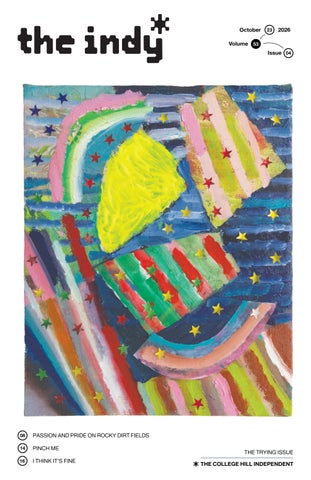
October
23
2026
Volume 53 Issue 04
06
PASSION AND PRIDE ON ROCKY DIRT FIELDS
14
PINCH ME
16
I THINK IT'S FINE
THE TRYING ISSUE THE COLLEGE HILL INDEPENDENT
53 04
10.23
Masthead MANAGING EDITORS
Andrea Li Cindy Li Peter Zettl
WEEK IN REVIEW
01 SPANGLED
Lily Yanagimoto B'27
03 COMICS RSAC
04 MAKING NOISE
Sasha Gordon & SamdÖl Sichoe
06 PASSION AND PRIDE ON ROCKY DIRT FIELDS Chloe Costa Baker
10 12
BENEATH THE VALLEY Caiden Demundo
THE MOVIEGOING EXPERIENCE Ray Eggerts
14 PINCH ME
Sebastian Botero
16 I THINK IT'S FINE Gunner Peterson
Julia Sprung
Joy Dunn
Sarya Baran Kılıç
LITERARY
HEAD STAFF WRITER
EPHEMERA
Annelie Delgado Elliot Stravato FEATURES
Chloe Costa Baker Audrey He Alya Nimis-Ibrahim METRO
Layla Ahmed Isabel Tribe Ben Underwood METABOLICS
Ray Eggerts Evander Gray-Williams Nahye Lee SCIENCE + TECH
Daniel Kyte-Zable Coby Mulliken Lila Rosen SCHEMA
Selim Kutlu Mo Saoud Caiden Demundo Eric Ma Neda Ravandi Ilan Brusso Talia Reiss
BULLETIN BOARD
Sarya Baran Kılıç
FROM THE EDITORS We’re a bit tired of making statements. Our words, when closed with a period, feel so despotic, so unyielding in their assertions. Answers are beginning to seem unproductive—they foreclose further thinking. We’ve been learning to appreciate the pliancy of the interrogative mode, which feels so neglected these days. What happened to asking questions? What happens if we ask you our questions? 1) Why? 2) Why not?
DESIGNERS
Anika Kotapally Keya Mehra Kendall Ricks
Nadia Mazonson Gabriella Miranda Sasha Watson
DEAR INDY
20 BULLETIN
Mary Elizabeth-Boatey Selim Kutlu Sara Parulekar Kayla Randolph Isabella Castro Dasha Derevianko Caroline Fenton Hongrui Guan Koji Hellman Rose Holdbrook Jordan Kinley Jennie Kwon Soohyun Iris Lee Zara Lagumdžija Sullivan Molloy Mailee Phan Cathy Rong Radhika Tibrewala
ARTS
WORLD
19 MAMMILLARIA CRUCIGERA
DESIGN EDITORS
MVP
Jordan Coutts Soohyun Iris Lee
*Our Beloved Staff
Benjamin Flaumenhaft STAFF WRITERS
Carolyn Nakawungu Batabye Sebastian Botero Joy Chen Jacqueline Dean Benjamin Flaumenhaft Lucas Friedman-Spring Kaliyah Graham Paulina Gąsiorowska Mohamed Jaouadi Elena Jiang Annie Johnson Evan Li Nathaniel Marko Ekaterina Michkovskaia Maia Riggs Fatima Shafi Samdöl Lhamo Sichoe Riya Singh Josh Stearns Ellie Wu Ange Yeung Zoe Yu SOCIAL CHAIRS
Benjamin Flaumenhaft Evander Gray-Williams Rachel Sang FINANCIAL COORDINATORS
Sasha Gordon Constance Wang
DEVELOPMENT TEAM MEMBERS
Aram Adler-Smith Avari Escobar Maira Magwene Muñiz Mingnah Ng Inderjot Nijjar Alexander Sayette STAFF PHOTOGRAPHERS
ILLUSTRATION EDITORS
Jaxon Rivera Serena Yu
ILLUSTRATORS
Rosemary Brantley Kieran Campbell Daria Derevianko Joy Dunn Cayden Garrett Koji Hellman Claire Hua Madeline Kim Paul Li Ellie Lin Megha Nambiar Mingnah Ng Camila Salinas Alexandra Sanguinetti Cindy Wang Ella Xu Naomi Zaro Faith Zhao COPY CHIEFS
Kainalu Faucher Jordan Coutts COPY EDITORS
Aram Adler-Smith Nabiha Allahwala Christine Anyanwu Tyki Cantu-Wang Emma Yvonne Chandler Karen Le Emma Mathew Advaith Shyam Ambreen Sidhu Zeke Tesler WEB EDITOR
Casey Gao
WEB DESIGNERS
Julianne Jin Savv Omare Rachel Sang
SOCIAL MEDIA EDITORS
Olivia Falk Inderjot Nijjar
SENIOR EDITORS
Benjamin Flaumenhaft Paulina Gąsiorowska Nahye Lee Nadia Mazonson Talia Reiss Kendall Ricks JOURNALISM LEADS
Jacqueline Dean Talia Reiss
DIVERSITY LEAD
Nahye Lee
STAFF LIAISON
Nadia Mazonson
William Bigby Pin Kasemsri Alexander Chow
3) How many holes are in a t-shirt? 4) Aestheticizing politics or politicizing aesthetics? 5) Why does my head hurt? 6) When did being a ‘reader’ become cool again, and why did I miss the memo? 7) Can ghosts die? 8) Dr. Feldmar or Dr. Brower? 9) Did you finish reading the issue? 10) Will we see you next week? (What does) CAP (stand for?) The content of all News & Publications groups recognized by USC/GSC is generated independently from Brown University. The statements, views, opinions, and information contained in the publication are personal to those of the authors and student group and do not necessarily reflect those of Brown University. The publication is not reviewed, approved, or endorsed by Brown University or its faculty or staff.
02
THE COLLEGE HILL INDEPENDENT
MISSION STATEMENT The College Hill Independent is a Providence-based publication written, illustrated, designed, and edited by students from Brown University and the Rhode Island School of Design. Our paper is distributed throughout the East Side, Downtown, and online. The Indy also functions as an open, leftist, consciousness-raising workshop for writers and artists, and from this collaborative space we publish 20 pages of politically-engaged and thoughtful content once a week. We want to create work that is generative for and accountable to the Providence community—a commitment that needs consistent and persistent attention. While the Indy is predominantly financed by Brown, we independently fundraise to support a stipend program to compensate staff who need financial support, which the University refuses to provide. Beyond making both the spaces we occupy and the creation process more accessible, we must also work to make our writing legible and relevant to our readers. The Indy strives to disrupt dominant narratives of power. We reject content that perpetuates homophobia, transphobia, xenophobia, misogyny, ableism and/or classism. We aim to produce work that is abolitionist, anti-racist, anti-capitalist, and anti-imperialist, and we want to generate spaces for radical thought, care, and futures. Though these lists are not exhaustive, we challenge each other to be intentional and self-critical within and beyond the workshop setting, and to find beauty and sustenance in creating and working together.
( DESIGN SULLIVAN MOLLOY, JAXON RIVERA ) ( SMALL WORLD BY KOJI HELLMAN )
( HEAT RISES BY DYLAN LAPRADE )
( STUDENTS CROSSING BY TARYN KIM )
( UPHILL BOTH WAYS BY JOHN DRISCOLL )
( BIKING! BY YUYAN LIU )
RSAC, RISD Sequential Arts Club, is a meeting space for artists who make comics, storyboards, and animations. They meet every week on Sundays, and can be found on Instagram as @risd.rsac.
KOJI HELLMAN R’27 is an apple. DYLAN LAPRADE R’30 is an evil cottontail. TARYN KIM R’29 is a Wes Anderson apologist. JOHN DRISCOLL R’28 is still in search
of a flat road on College Hill. YUYAN LIU R’30 is watching Abbott Elementary S6E2.
VOLUME 53 ISSUE 04
03
MAKING NOISE METRO
A CRANSTON COMMUNITY’S FIGHT AGAINST POLICE’S POLITICAL MANEUVERING AND GUN RANGE ( TEXT SASHA GORDON & SAMDÖL LHAMO SICHOE DESIGN IRIS LEE ILLUSTRATION ELLA XU )
c In the fall of 2021, a new teacher arrived at Cranston High School West from out of state. When she heard the sound of gunfire in the middle of a lesson, she assumed she would have to put the school into lockdown and alert the principal. Her students stopped her. “Nope, nope, nope, that’s just the gun zone across the street.” One of them was Scott Robinson’s daughter. Robinson would later recount this story at a Cranston City Council meeting on September 12, 2022. The Cranston Police Department’s (CPD) firing range and training complex sits in western Cranston, Rhode Island, directly across the street from Cranston High School West and Western Hills Middle School. Two elementary schools also lie within two miles of the range. In this residential community, an endless barrage of training range gunfire has become so ordinary that some children are no longer alarmed, but residents are. In Cranston City Council testimonies and local news from 2022, 2024, and 2026, residents cite that shooting can start as early as 8:00 a.m. and go as late as 9:30 p.m., weekdays and weekends alike. CPD uses the range to train and qualify all of its officers on firearms including suppressed rifles and pistols. Residents say this noise is unlivable and ask for the range to be enclosed with soundproofing or for training activities to be relocated. Roberta Judge, who has lived in the Western Hills neighborhood since 2002, told legislators in 2023 that all three of her children spent their schooling hearing gunshots during school hours. A special-education assistant at Western Hills said many of her students have a very difficult time learning when there is shooting. Evidence of the range’s widespread harm has been steadily accumulating. In two city council hearings in 2022 and 2026, 30 residents testified to what the range has cost them, from their health to their ability to work from home. They have supported a series of city council initiatives that have steadily decreased in scope as they have been met with resistance, beginning with calls to enclose the open-air range to reduce the noise, then to reduce the number of outside agencies
04
THE COLLEGE HILL INDEPENDENT
utilizing the range (17, at one point), and then to have the CPD train at the Providence Police Pistol Range in Scituate, Rhode Island. In November 2022 and April 2023, the Community Noise Lab at Brown University, run by epidemiologist Dr. Erica Walker, placed monitors in six backyards between a third of a mile and two miles from the range. The research culminated in student Juliet Fang’s 2023 report on the issue. The recorded gunfire peaked at 82 decibels, roughly as loud as being next to a gas-powered leafblower. Cranston’s noise limit for residential areas is 55 decibels. As decibels run on a logarithmic scale, that means the gunfire carries about 500 times the sound energy that the ordinance allows. In December of 2023, three years into the residents’ campaigns to reduce the noise from the range and frequency of gunfire, The New York Times brought the story of gunfire noise from the range at Cranston’s schools to a national audience. Reporters described hearing shots ring out for 49 minutes at a volume of 94 decibels, beginning at 8:13 a.m. on a school morning. They came from CPD’s AR-15 style rifles. The case against the range has never lacked evidence. For five years, residents have continually brought studies, signatures, and doctors to the podium, each time hopeful that finally, this new piece of evidence would tip the scale. It hasn’t. The gunfire, and the case against it, has become so naturalised into life in Cranston that it is no longer heard. +++ “Every single step, I thought, well, when they hear this, they’ll stop,” said Martha DiMeo, who has led the campaign against the range for five years. DiMeo lives two blocks from the CPD firing range, in a home her family has occupied since 1947. The most recent campaign against the range began during the pandemic. In 2021, DiMeo and Pat Schoeninger, a neighbor who has lived near the range since 1978, requested a town hall meeting on the range’s noise.
Cranston Mayor Kenneth Hopkins’ office turned down their request. After the rejection, DiMeo and Schoeninger went door to door with a paper petition to get the city to act on the matter. More than one hundred neighbors signed it. DiMeo recalled that multiple neighbors she spoke to were surprised to learn that others shared their concerns about the gunfire; the city had told many of them they were the only ones complaining. The mayor's office did not respond to The College Hill Independent's request for comment on this matter. Over the next five years, DiMeo would go on to speak in numerous city council hearings. She brought in Dr. Melissa Jenkins Mangili, a neuropsychologist and trauma researcher, to write an open letter to the mayor on the psychological damage of chronic exposure to the sound of gunfire. DiMeo then called on psychiatrist Dr. Patricia Ricci to testify before the City Council in October 2022 to the escalating health effects of chronic noise on the body. DiMeo worked with State Representative Brandon Potter (D-16), whose district neighbors the gun range and affected schools, to draft two bills proposed to the Rhode Island state house to ban unenclosed gun ranges within one mile of schools. Potter, an alum of Cranston High School West, heard the shots there growing up. In an interview with Indy, he explained that now it’s “much louder than the gunfire that I heard when I was a student there.” In 2023 and 2024, the bills were both held for further study and never voted on. After the bills were held, Potter tried to address the issue again by speaking to Providence Mayor Brett Smiley. Potter said Smiley offered to request the Providence Police Department to allow CPD’s use of their gun range in Scituate, 10 minutes away. Potter cites that Cranston Police Chief Michael Winquist, in testimony given to the city council in January 2026, said Colonel Perez had told him Providence PD didn’t have the capacity to host CPD. According to Potter, “the story changed.” With every plea falling on deaf ears, some locals were eventually exhausted by the fight. Schoeninger, who organized with DiMeo for many years, took a step
METRO
back from the campaign after the city council rejected a January 2026 ordinance that sought to establish consistent hours of operation for the range and mandate the use of weapon sound suppressors—a significantly watereddown version of the proposals DiMeo and Schoeninger had previously advocated for. As she recounted her efforts, DiMeo, too, described a faith worn down one obstacle at a time. “We turned every stone, from council people all the way up to the senator,” she said, referring to U.S. Senator Jack Reed. To date, the city has still refused to act. +++ Despite years of testimony, even the most basic facts of the dispute have yet to be agreed upon by the CPD: whether anyone has complained at all and when the range was built. City, police, and school officials have long maintained that there are no complaints about the range. Although the police have been most vocal in this denial, they have inconsistently acknowledged complaints from the community. In 2021, CPD Chief Michael Winquist told GoLocalProv that he had barred outside departments from firing rifles at the range to “address complaints we received from neighbors.” However, in a 2024 written statement opposing a bill that would ban unenclosed ranges within one mile of a school, Winquist wrote that he had “never received a single complaint from high school students or faculty about the range.” Seemingly, the voices of concerned parents are not sufficient complaints. Another tactic the CPD employs to undermine community complaints is that it should not fall on the CPD to enclose the range or move because the range predates the schools and residents. In an interview with the Indy, CPD Lieutenant Joshua Dygon took this familiar tack: “The range itself has been here since 1956. It’s been in continuous operation since then.” The Cranston Police Department Retirees’ Association provides evidence to the contrary. In their report on the history of the training complex, they cite that while the academy was conceived of in 1956, the present-day location at Phenix Avenue was only established in 1963. This is after three of the four nearby schools opened (between 1957–1962), negating the police’s claim of the range preceding the schools’ construction. Resident Sherry Izzi pointed this very fact out to the police and city council during the September 2022 hearing, yet CPD continues to purport it with zero pushback. +++ When not insisting that the range predates the schools and therefore has earned a right to disrupt, CPD claims that they require their particular covered range to train their large number of officers, and thus cannot move to Scituate. Photos of the range show that the entire Cranston training academy complex is three buildings and a covered but unenclosed range built on a parking lot. In a 2024 WPRI news segment, 24 lanes are visible in the background. Under a conservative estimate of 20 operational lanes at the range, and Dygon’s citation of “153 officers” that need to be trained once a year, for an eight-hour day, the range would need to be used for a likely maximum of eight days per year. There are no evident technological or structural investments beyond a rain cover for the range. Testimony given by CPD second-in-command Major Todd Patalano in the September 2022 hearing explains that training police at night is important for realism. However, if CPD aimed for realism, aspects of the gun range’s current design seem unreasonable. Cranston is in the top 5% of rainiest cities in the United States, and the cover is not standard for Rhode Island police ranges. Dygon stated that Cranston is one of the only police departments in the state “that [has] a covered range.” If realism is the point, Scituate’s facility would more than suffice. Dygon stated that the range is open to three outside agencies (specified by Patalano in 2022 as the Johnston, Smithfield, and East Providence police departments), who rent the range from CPD for an unspecified fee. When fact-checking this claim, the East Providence
PD and the Smithfield PD both claim that they train at private clubs, not the Cranston range. They “try to make [qualifications] efficient,” Dygon said. It is unclear why the amount of usage the range gets is ambiguous, and why such an efficient operation couldn’t be hosted for one week at the Providence Police Pistol Range in Scituate. +++ “The police run the city,” DiMeo said, referring to the CPD’s history of intimidation, obfuscation, and non-answers on the gun range. Their power spreads beyond this one issue. In November 2013, the City Council’s Finance Committee, chaired by then-councilman Steven Stycos, voted 4 to 3 against a new police union contract. “The four of us could see it would cost a lot of money in the long-term,” Stycos said in an interview with the Indy. The contract, negotiated by then-mayor Allan Fung, would have introduced “steps,” or automatic yearly raises, for the CPD’s supervisory officers. Over the two nights following the vote, CPD officers wrote 146 parking tickets, most of them in Wards 1 and 3, the only two wards whose councilmen had voted against the contract. Stycos walked out of his front door to find bright orange tickets on every car on his street. As a result of the eventual investigation, police union president Captain Stephen Antonucci admitted to ordering the ticketing. A long effort ensued to contain the fallout. The department first proposed investigating itself. When the councilmen objected, Mayor Fung, whose 2008 mayoral campaign was backed by the police union, offered a private consultant to review the department’s own inquiry. When the councilmen again objected in 2014, the case went to the State Police. When the State Police concluded their assessment in 2015, councilors had to override Fung’s objections in order to make the report public. Captain Antonucci was recommended for termination, but under a settlement, he stayed on paid leave until he retired with his pension intact in 2016. The officers now heading the department, Winquist and Patalano, were hailed as correctives to that era. Yet it would seem that some habits of the old department have outlasted its leadership. In September 2022, the CPD measured its own firing range the same way it once proposed investigating itself. Through their own noise tests in DiMeo’s neighborhood, they found the gunfire “within the limits of the noise ordinance.” Their own hand-held meter peaked at 53.8 decibels, just under the city’s 55-decibel limit, the Providence Journal reported. +++ The union’s engagement with Cranston’s politics extends beyond police-specific legislation. “The police union is quite involved in local campaigns. It endorses candidates and gives money,” Stycos said, admitting that he, too, had wanted the endorsement. Stycos noted that when the council approved the department’s current contract, several members received $2,000 contributions from the union shortly before the vote. “I can’t say that one thing was related to the other,” Stycos said, “but it certainly raises the question.” The union did not respond to the Indy's request for comment. This question has shaped more than just city council decisions. Former city councilman Robert Ferri ran as the Democratic candidate for Cranston mayor in 2024, losing to Kenneth Hopkins. In a conversation with the Indy, Ferri said that, though he was in support of DiMeo’s efforts to mitigate the range’s disruptions, even mentioning it during his mayoral run would be “more of a detriment than a benefit.” “The public safety departments in this city carry a lot of weight,” Ferri said. Even without their endorsement, he added, “they have the ability to campaign against someone, and that can be powerful.” This influence reared its head once again in January 2026, when councilman Michael Traficante brought an ordinance before the council’s Public Works and Ordinance committees that would have
capped the range’s noise at 75 decibels and barred shooting without sound suppressors. More than a dozen individuals spoke in support of this ordinance, among them parents, residents, a psychiatrist, and the Community Noise Lab’s Dr. Walker. Winquist testified against it. Traficante, who served 14 years as mayor, said that before the meeting he met with Winquist and the police administration to explain the proposal. “They were not in favor,” he said, though he added that he did not feel pressured. His colleagues were not persuaded by the ordinance. Councilman Richard Campopiano, the council’s minority leader, said in an interview with the Indy that he opposed the ordinance because “it had been written by one side.” That is, without the police. “It’s always been my policy to support law enforcement,” Campopiano said. “The police tell me that the firing range is essential to their training.” According to Traficante, other members also objected that the recommendation “had not come from the police chief, the police department, or the mayor.” Traficante disputes Campopiano’s claim that the police were left out. “Everyone—the council, the police, and the administration—had ample opportunity to review what we were proposing and ask to sit down with me,” he said. “I never received any kind of call.” Councilman Andy Andujar, who co-sponsored the ordinance, offered his own read of his colleagues to the Indy. “If you know there’s a gun range there, you know there will be noise, and you have to deal with it.” It seems to be nobody’s problem to act on: In an interview with the Indy, National Rifle Associationendorsed State Representative Jacquelyn Baginski—who represents the district containing the affected schools, neighborhoods, and gun range—said she understands “some of [her] constituents are really upset about the noise, but [she’s] not part of the city administration or the city council.” She continued, “It’s just not a state issue […] I feel for my constituents, but I don’t really presume to tell the city council what to do, and I wouldn’t like the city council telling me what to do.” Other state-level lawmakers do not share Baginski’s point of view. Potter’s district neighbors Baginski’s, and he spent two legislative sessions trying to make the range a state issue. With Patalano’s election to the State Senate in 2024, CPD’s second-in-command now also acts as a state-level decision maker. Federal support has come in fits and starts. According to DiMeo, when she asked Senator Reed’s office to help move the training to a military base, his staff told her it was a “city problem.” In a later interview, Reed indicated that federal funds might be available to help enclose the range. The CPD’s request for $1.6 million to enclose the range was denied in December 2022. It could be federal business. It could be state business. When it inevitably lands in Cranston, the city seems to consistently defer to the police. +++ Over the past five years, the residents have been desensitized to the department’s excesses, with some trading their original hope of moving the range for the embrace of smaller concessions: an enclosure, a reduction in renting it out to other agencies, quiet time on holidays. All the same, the campaign.went nowhere. What the city is asking of its residents is sacrificial. The sound of gunfire, alongside its associated longterm health effects and sense of lost safety, is now part and parcel of life in Cranston. It is disarming that half a decade of petitions, noise studies, expert testimonies, and a viable alternative range has amounted to nothing. It is also exhausting for the elderly residents who have to listen to the gunfire from their kitchens, for the neighbors who work from home, for the young families with toddlers, for the students in schools. According to DiMeo, an elderly neighbor signed her 2021 petition with the words “this is an unbearable way to live.” He passed away a month later. SAMDÖL LHAMO SICHOE B’28 & SASHA GORDON B’28 woke up to parking tickets.
VOLUME 53 ISSUE 04
05
FEATURES
Passion and Pride on Rocky Dirt Fields A LOCAL HISTORY OF U.S. SOCCER
( TEXT CHLOE COSTA BAKER DESIGN RADHIKA TIBREWALA CINDY LI PHOTOGRAPHY PIN KASEMSRI )
c July 3, 2026: It is the 103rd minute of regular play of the World Cup knockout match and Cape Verde trails Argentina 2–1. Sidney Lopes Cabral, Cape Verde’s number 13, receives a cross from teammate Telmo Arcanjo, cuts just inside Argentina’s box, and arcs the ball into the top right corner of the goal. It kisses the netting and settles in the back center. With those three touches, Cape Verde has equalized. That sensational equalizer, later officially deemed the Goal of the Tournament, is physically immortalized in three different ways: freeze dried and encased in plastic, preserved in resin, and artistically pressed onto paper. The turf from the exact place Lopes Cabral stood in Miami Stadium, the ground beneath his feet as he teed up the shot, now resides in the Cape Verdean Museum in Pawtucket. Rhode Island has the highest percentage of Cape Verdeans of any U.S. state, as well as the highest percentage of Portuguese and Azorean residents, cementing its Lusophone presence. My own mother, who grew up in Newport and Middletown, is descended from Portuguese-speaking immigrants from the autonomous island regions of Madeira and the Azores, with neighbors and family members who come from Cape Verde, the archipelagic nation off the coast of West Africa. Pawtucket is now home to the highest number of Cape Verdeans in the state, making it a fitting location for the country’s first and only museum of Cape Verdean history and culture. The Cape Verdean Museum is on the border between Pawtucket and East Providence, just past the Mt. St. Mary Cemetery. The museum occupies a corner building at the acute intersection of two busy streets and comprises three stories of artifacts, exhibits, and community gathering spaces: part library, part gallery, part living archive. On my first visit, I am greeted at the door by Joe DaMoura, executive director, and Yvette Smart, curator and educational coordinator. I learn that it was the whaling industry that determined the timing and means for Cape Verdeans to come to the U.S., as well as the specific areas in which they settled. The majority of workers on whaling
The turf as preserved in resin (left) and freeze-dried (right)
06
THE COLLEGE HILL INDEPENDENT
The 1892–93 Pawtucket Free Wanderers. Image from the collection of Brian D. Bunk
ships were Cape Verdean men, and when the industry began to decline in the late 19th century with the rise of crude oil, they set their sights elsewhere. Ms. Smart tells me, “We are the first Africans to buy our own ships and come to America on our own, because we wanted to.” Schooners sailed primarily to New Bedford and Providence, carrying entire families down the Providence River. The mural on the Fox Point Trader Joe’s features the Nellie May, the ship purchased by Captain Antone Coelho in 1892 that made regular trips between Providence and Cape Verde—Ms. Smart consulted on its production.
“The history of soccer in the U.S. is inextricably intertwined with immigration and labor in Rhode Island” She shows me her grandfather’s green card. He lived on Wickenden Street, which strikes me because it’s just a few blocks away from where I live now. In fact, I learn that most of the Cape Verdeans in Rhode Island initially resided in Fox Point. Referencing the Lima family who lived on Benevolent Street, Ms.
Pressed turf from Lopes Cabral’s goal
Smart says, “I can’t show you their house, because it is now a Brown University dormitory [...] Well the house was torn down and a dormitory was built.” This process of redevelopment and displacement was widespread, driven by the expansion of the University and the off-campus housing market, with many families moving to Pawtucket. +++ The history of soccer in the U.S. is inextricably intertwined with immigration and labor in Rhode Island— largely in Pawtucket. There textile factories were constructed on the Blackstone River and by 1869, they brought over workers from England, Scotland, and Ireland to run them. These immigrant laborers brought their culture with them from the British Isles, including the beloved sport of soccer. I first learned about this history incidentally, happening upon it while attending a Labor Day event at the Museum of Work and Culture in Woonsocket. There I came across the exhibit called “How Immigrants Became Icons: The History of Soccer in Rhode Island.” By 1885, mill workers had formed the Pawtucket Free Wanderers, the city’s first organized soccer team. According to the exhibit, this name, along with those of several other local teams (the J&P Coates Rangers, the Fall River Rovers), echoed the autonomous
The resin-preserved turf being packed up for shipment to Cape Verde
FEATURES
mobility of working-class British football clubs back home—“loose, community based, belonging to no single factory or employer.” The Pawtucket team would go on to have a dominant presence in New England, nationally, and even internationally. In 1888, several Free Wanderers were part of an American Football Association representative team, and Pawtucket and Fall River players were part of the Canadian-American representative team that toured the British Isles in the 1891–1892 season. The exhibit has since closed, but the work to uncover and document this history behind the scenes is only just beginning. Amid the Pawtucket Public Library’s local history archives, I sat down with Tim McDuff, librarian for the local history collection, and James Toomey and Nicholas Barrett, Executive Director and Operations Manager, respectively, for the Blackstone Valley Tourism Council (BVTC). Founded in 1985, the BVTC is a “sustainable tourism organization that focuses on enhancing the history and culture of a region,” says Toomey. “A lot of it revolves around the industrial history that is found here that is very important, very unique.” The overarching goal of the “History of Soccer in Rhode Island” exhibit was “to bridge the past to the present. Having people that are soccer fans now realize that there is this rich history, that soccer didn’t start with Rhode Island FC.” What started as laborers playing matches in their free time soon evolved into something much more organized. The Free Wanderers bought their grounds on Dexter Street adjacent to Fales and Jenks Machine Company works, and built a clubhouse and grandstand for spectators. Barrett says, “Another part of their passion was creating that building from scratch.” McDuff adds, “To begin with, you had to pay to play. The players were paying in a weekly allowance; they weren’t getting paid the other way around.” Due to their superior grounds and superior skill, matches at Dexter Street frequently drew thousands of Pawtucket community members, with record matches of over 5,000 attendees in 1889, and 10,000 in 1893. Significantly, McDuff notes that the Free Wanderers and comparable teams like the Rangers displayed a professional skill level even when they weren’t compensated as professional athletes. Their best players still worked in the mills and competed in their free time, which Barrett attributes to the mill workers’ “passion” on (at first) “rocky dirt fields.” The BVTC exhibit was able to shed new light on stories such as that of the Watson brothers, workers at the William Haskell bolt factory in Pawtucket. In 1895, Oliver Watson was the first Black player to play in the American Cup, and in 1900, his younger brother Fred Watson signed with the Free Wanderers and became the first Black professional soccer player in the U.S., making the Free Wanderers the nation’s first integrated professional soccer team. As Toomey put it, “There’s a lot of talk of, ‘This person is the Jackie Robinson of so-and-so,’ and kind of the reality is, like, Jackie Robinson is the Watson brothers of baseball.” The Heritage Alliance of Pawtucket is working on a plaque for the house where the brothers lived, which still stands on Meadow Street. The Watson brothers’ obscurity is perhaps in part due to the disorganized history and sidelined status of U.S. soccer. Barrett acknowledged this tension, saying, “[baseball] was just more of an American homegrown sport, so that gave way to why people wanted to showcase that more in the news.” This lack of both news coverage and internal recordkeeping has led to a pertinent paucity of primary source information, especially when compared to leagues for baseball or American football, whose records are far more accessible and organized. A combination of interest in other sports and the brutal winter weather caused soccer attendance to drop off toward the end of the 19th century. The
exhibit noted, “the immigrant community that had built the Free Wanderers was aging, and the next generation was becoming more rooted in American culture.” The New England League ended the 1895– 1896 season early, and there was no 1896–1897 season. An article in The Providence Sunday Journal on April 5, 1896 bore the headline “Death of Football: No Game Owing to the Disbandment of the Rovers.” The local Pawtucket paper amended the headline to “Probable Death of Foot Ball,” but kept the assertion that “the interest in football has been constantly on the decline for the past few years. The disbandment of the Rovers last week was virtually the death knell of the once popular sport in the Border City.” But this eulogy was premature; the Free Wanderers did not lie dormant for long. An article in The Evening Times on December 19, 1896 reported, “There is a strong movement on foot to revive the game of association foot ball, which has never been really dead, and try and create the same interest in the grand sport that has been felt in this city in the past. The time is probably gone by when 4,000 spectators will go up to the Dexter street grounds and stand in the mud and snow to see the festive foot ball kicked about, but there should be no reason for the game not receiving good support in this city.” +++ From the moment I first encountered the Free Wanderers exhibit in Woonsocket, I was struck by the parallels between the early history of U.S. soccer and another league based in southeastern New England that emerged almost a century later: the Luso American Soccer Association (LASA). Last spring, I attended a panel presentation honoring the history of LASA as part of the Lusophone World Lecture Series. It was moderated by John Gonsalves, journalist and sports broadcaster at the Portuguese-language radio station WJFD-FM 97.3, and the panelists included Carlos Medina, a Cape Verdean former player, and Lucio Santos, an Azorean former player who happens to be my uncle. The event was held at the New Bedford Whaling Museum, for reasons unclear to me at the time, but knowing the history of Cape Verdean labor and the whaling industry sheds light on that choice of location for an event celebrating the New England Lusophone diaspora.
According to a document shared by Gonsalves, himself an Azorean immigrant, the impetus for LASA’s founding came out of the great wave of Azorean immigration to Massachusetts and Rhode Island that occurred in the 1960s and ’70s. On September 27, 1957, on the island of Faial in the Azores, the Capelinhos Volcano erupted, remaining active for 13 months and devastating homes and agricultural communities. In September of 1958, Congress approved the Azorean Refugee Act, supported by senators John O. Pastore of RI and future president John F. Kennedy of MA. This legislation opened the door for tens of thousands of displaced Azoreans to seek refuge in the U.S., mainly settling in southeastern New England. LASA came about in the summer of 1973, arising from dissatisfaction with the management of the Southern New England Soccer Association, which encompassed most of the Portuguese American clubs. Organizers met in the Laborers Union Office on Summer Street in Fall River, which would later become the league’s office. LASA originally included nine clubs, seven of them from New Bedford: Centro Luso Americano, Clube Recordações de Portugal, Club Sport Madeirense, Clube União Faialense, Luso Auto Body, New Bedford Sports, Portuguese American Athletic Club, Taunton Sports Club, and Fall River Athletic Club. In 1980, while visiting the U.S., my uncle Lucio Santos was recruited to play for Faialense, a club named for the island of Faial. He later played for Taunton Sports, which bore the colors of Belenenses, a club from Belém, Lisbon. His LASA career lasted 16 years, and he looks back on it with immense gratitude: “We would play in front of maybe 2,000 fans, 3,000 fans, and you would really hear the passion of the fans towards their home team […] It was a very professional atmosphere.” Like the Free Wanderers before them, LASA was a striking example of professional-level play without professional-level compensation. Gonsalves explains that the model of the North American Soccer League, the organization for U.S. professional soccer at the time, focused attention and resources on attracting big stars rather than casting a wide net to recruit more talent. He maintains that if Major League Soccer (MLS)
VOLUME 53 ISSUE 04
07
FEATURES
the time, there would have been at least one or two MLS-level players per LASA team—including Santos. As it was, players got paid in the form of travel expenses, complimentary meals at the clubs, and sometimes monetary rewards based on wins. Even so, the league resonated internationally. By 1980, LASA had affiliated with the United States Soccer Federation, so that national referees were required to officiate a minimum number of LASA matches to be eligible for the FIFA World Cup. LASA’s All-Star team, and even some individual clubs, regularly faced professional opponents from other countries—Italy, Greece, Cape Verde, and many from Portugal. Players within the league also hailed from a variety of international backgrounds—England, France, Argentina, Ecuador, Brazil, Angola, Bulgaria, Italy, Germany—many of whom played for their national teams back home. Santos and Gonsalves spoke to LASA clubs simultaneously bringing the Portuguese American community together and embracing players of all national backgrounds. Gonsalves describes it as “a mutual deal,” with the soccer clubs as “the social centers of the community.” Just as families gathered at games, they would gather at the clubs for the events that sprung up around them—christenings, wedding showers, folk dancing, and exchanges with performers from Portugal. Referencing how LASA supported their players through the immigration process, Santos describes the clubs as offering “the best of both worlds,” giving players “the opportunity to play and the opportunity to become a resident of Massachusetts or Rhode Island.” Local business owners, from mills to restaurants, would sponsor players applying for green cards, and the clubs themselves frequently offered employment. Of his international teammates, Santos said, “They were loved by the community, and they embraced the community. They felt very welcome, and some of them ended up staying in a league for 10 to 15 years, and made, literally, a semi-professional career.” When asked at the panel why LASA ended, Gonsalves pointed to the severe decline in immigration in the early 2000s, especially from Portugal, as well as the advent of Major League Soccer. He also mentioned the decline of the clubs themselves, as aging establishments with diminishing involvement on the part of the Portuguese American youth. However, younger Lusophone generations are still contributing to U.S. soccer excellence: The panel also featured Ruben Resendes and Yasmina Carvalho, millennial college soccer coaches leading their respective teams at Bryant University and Bridgewater State University to success; Carvalho also spoke to the undervalued need for supporting girls’ and women’s sports in Lusophone communities. Speaking to the impact of LASA’s legacy, Santos said, “for us, it was a league that brought a lot of pride to the Portuguese community. People were proud of the LASA league. People were proud of saying that we have a league that is well organized, well known, it produces an incredible amount of good players.” At the event, there with a big group of cousins, aunts, and uncles in the packed auditorium, that pride was palpable. My uncle continued, “the experience was fantastic. The competition was incredibly good, and the friendships that you built throughout the years were amazing.” Witnessing the former LASA players, family members, and staff gathering together with nostalgic laughter and abiding fondness, I could feel that friendship too. +++ Carlos Medina, the other former LASA player at the panel event, who had come from Cape Verde to be there that evening, acknowledged his home country qualifying for the World Cup to cheers and whistles from the audience. His anticipation was apparent, but also his apprehension: “I have to be honest, it’s going to be a challenge, but you have to start somehow, somewhere.” Corsino Delgado, Pawtucket resident and president of the board at the Cape Verdean Museum recalls being in Cape Verde on the island of São Vicente back
08
THE COLLEGE HILL INDEPENDENT
LASA All Stars team, 1984. Lucio Santos: front row, first from the left
in October 2025 during that celebratory moment when the team had first qualified: “I swear the entire island descended on [Avenida Marginal].” Tickets were not easy to come by, with the price being “very prohibitive,” but Delgado concluded that it would be “a once in a lifetime experience […] especially since the World Cup was right here in the U.S.” On top of tickets, there was the cost of traveling to Atlanta, as the majority of Cape Verdean Americans reside in the Northeast: “Obviously, everyone would have loved for Cape Verde to be playing in Foxborough.” This was a disappointment shared by many of my relatives, who similarly lamented the fact that Portugal would be playing their group stage matches in Houston, thousands of miles from the New England Portuguese community. For Delgado, the opportunity was too important to pass up, no matter the distance, so on June 15, 2026, he attended Cape Verde’s World Cup debut match in Atlanta. It was a soon-infamous performance in which they shut out the future champion, Spain, holding them to 0–0. Vozinha, the Tubaroes Azuis’ goalkeeper, accrued tens of millions of Instagram followers in the aftermath of the match and is currently the most followed goalkeeper in the world. Delgado’s stadium seats were in the second row, and in front of him was a group of fans who had traveled all the way from Cape Verde: “For them, I know it’s quite the expense, because the average salary in Cape Verde is maybe $300 a month. So when you look at that and for some of those people to actually come to the game, it must have been quite a sacrifice […] But that’s the sense of pride we all had.” That feeling only multiplied. He felt it in Atlanta, when Cape Verde fans “took over” as he put it, with Spain fans congratulating them as if they had won. He felt it back home in Rhode Island, from people who had never heard of Cape Verde before the World Cup. “It’s amazing how many people became Cape Verde fans,” he marvels. “Everybody sort of fell in love. They became the darling of the World Cup.” The word “pride” came up over a dozen times in our conversation, and seems to encapsulate every stage of Cape Verde’s World Cup journey: qualifying, playing in their first World Cup match, holding Spain to a draw, tying Argentina in regular time, and becoming the unexpected heroes of the tournament for fans of all nationalities. Their story was imbued with this sense of pride, until the very end: “Not only did we participate, we had the goal of the tournament, and we played the two teams that made it to the final. So it was, and still is, a sense of pride.” I asked Delgado if he was surprised by the success Cape Verde ended up having, and he said that it depends who you ask. I found this to be true; when I asked Ms. Smart if she had expected the team’s global impact, she replied right away, “Well, Cape Verdeans kind of knew, but, you know, other people didn’t kinda know.” Meanwhile Delgado himself admits, “frankly, my fear going into the first game against Spain: I hope we don’t get embarrassed[...]Let’s hopefully lose, but let’s lose with dignity.” His expectations were exceeded, needless to say. Even when Cape Verde ultimately conceded to Argentina 3–2 after battling
them into overtime, the sentiment he shared with his group chat of family and friends was, “We have nothing to feel sorry for. We’ve already won. The fact that we made it to the World Cup, the fact that we were competitive, the fact that we could take Argentina to overtime, I said, we can hold our heads up high[…]We have nothing but pride.” +++ With almost a century between them, the parallels between the Free Wanderers and the LASA league are abundantly apparent: arising from working-class immigrant communities in Rhode Island and Massachusetts, playing in their free time while working other jobs, drawing thousands of fans to home games, all while achieving a level of skill that resonated internationally. Though not reflected in their structure or compensation—a far cry from the soccer academies and multimillionaire athlete-celebrities of today—these teams were professional in standard, scale, and spectacle for U.S. soccer at the time. Researching both of these histories, I inevitably came across the name Billy Gonsalves. The son of Portuguese immigrants, he played for Charlton Mill and then the Lusitania Recreation Club in East Cambridge in the late 1920s, before turning professional in 1927. He went on to play for the U.S. in the 1930 and 1934 FIFA World Cup, and is sometimes nicknamed the “Babe Ruth of American Soccer” (yet another example of baseball being the metric by which American athletic excellence is measured). Though Gonsalves is undoubtedly a legendary figure for Fall River, the Lusophone community, and the U.S. in the World Cup, I am also interested in the powerful undercurrent of these three stories that transcends individual glory, and centers mutual aid, social gathering, and networks of community support. The Free Wanderers and their contemporaries frequently held benefit games as a form of mutual aid. It was common for the league to support their players by organizing special showcases with select teams, drawing more revenue. One such game was played for Fred Watson, which Barrett attributes to a powerful solidarity among the working-class community of soccer players and fans. When Fred Watson broke his leg on Christmas Day, there was a benefit match held in January that was able to raise “around $400, which would have been like 6 weeks’ wage at the time.” Similarly, the clubs of LASA were hubs of reciprocal support: During the panel, both Santos and Medina expressed heartfelt gratitude for LASA’s profound impact on their lives beyond the field. Medina mentioned how local teams volunteered to pay for his education, playing a major role in him getting his engineering degree. Santos spoke to the immediate embrace he felt from the community—as a 19-year-old from the Azores who did not yet speak English, the club found an apartment for him, gave him money for food, and put him through college: “It was like I was family.” As mentioned, clubs also provided paths to becoming permanent residents, working together with community members to find
FEATURES
“The fact that we made it to the World Cup, the fact that we were competitive, the fact that we could take Argentina to overtime, I said, we can hold our heads up high […] We have nothing but pride.”
Cape Verdean Museum at Pawtucket. From left to right: Corsino Delgado, Yvette Smart, and Joe DaMoura
Photographs of Cape Verdean laborers who worked on whaling ships in the 19th century
employment for and sponsor players. And many of these men, including Santos, saw fit to give back to those same communities, organizing free youth soccer programs that were supported by fully volunteer coaches and staff. The Cape Verdean Museum also highlighted the clubs and mutual aid societies established by immigrants and continued by their descendents. They formed the center of Cape Verdean American social life, and were often linked to a specific island or region back home. This reminded me of Gonsalves’s description of the clubs that supported LASA, and their attested decline as younger generations lose interest. It made me think about assimilation, the requisite dissolution of cultural celebration and class solidarity, and what is lost along with that connection to a particular history. I feel it quite acutely on a personal level—I was born and raised in a college town in the suburbs of Philadelphia, an area in which I have no real family roots beyond my parents’ work. Given the intertwined experiences of the Lusophone immigrant diaspora in the Rhode Island area, being immersed in the concentrated, tangible history of the Cape Verdean Museum moved me. After my first comprehensive tour, Gabby Santos, the docent on duty, playfully remarked that it was too much to take in all at once. She was right. The LASA event had moved me in a similar way, but it was comparatively transient, a single gathering on a single night. It was bittersweet to reckon with the ephemerality of a history that is bound in the memories of living people, especially since a number of them have passed away. Gonsalves lamented the “lousy job” done preserving LASA’s history, and reiterated in the interview, “to me, the main culprit is the Portuguese Channel, because they had hundreds and hundreds of videotapes that they threw away because it was taking up too much space. And I could never get to understand why they would do that when from where they
are, maybe ten minutes away, there’s the archives at UMass Dartmouth.” It echoes Toomey’s point about how soccer’s relegated place among the canon of homegrown American sports manifests in poor recordskeeping, an obstacle for those seeking to preserve local histories. In contrast, the Cape Verdean Museum embodies a collaborative, interactive history formed by decades of contribution and care. It encompasses centuries of slavery and colonization, labor, immigration, independence, and culture both traditional and modern, with a library full of books and binders. Artwork and artifacts fill the space, the majority of which are donations. They also host a variety of events, connecting the communities in the area and across the Atlantic. During my first visit, there is a sign for foundations-level Cape Verdean language classes, Ms. Smart and DaMoura are busy coordinating the upcoming Black Storytellers of America convention, and it is offhandedly mentioned that the Prime Minister of Cape Verde had visited just two days prior. During my second, they are packaging up the resin-encased piece of World Cup turf to ship to Cape Verde. On both visits, the very first thing Ms. Smart has me do is sign the guestbook, which is positioned front and center at the entrance—the means of engaging with the archive is to add yourself to its record. I wonder whether actively maintaining their history in this tangible, accessible form and interactive space is part of what allows their clubs to flourish and endure, to continue the spirit of mutual reciprocity. I spoke again with Ms. Smart and Gabby Santos about how the mutual aid societies continue their work today. Ms. Smart: It’s an important part of the community. Not just because of the actual money that
goes, but to show that ‘I care.’ Santos: Last time, when I went to that benefit party, amazing how I saw the love there. The hall was full of people. Ms. Smart: Cape Verdeans have always had, we call them charity dances. Anytime—for example, recently, there was a flood in Cape Verde. We sent barrels of clothing. We sent all kinds of stuff. We have ships that go back and forth to Cape Verde all the time, full of stuff for our families. And the community really came together[...]from all the islands, they all came together to send things to Cape Verde and to support the people. So this is really a part of our ethos. It is a part of our culture to help you. Santos: To help one another. Ms. Smart: We call it juntamon. It means to hold hands. CHLOE COSTA BAKER B’27 is kicking it at the public library.
VOLUME 53 ISSUE 04
09
WORLD
BENEATH THE VALLEY TRANSLATIONS OF “LE DORMEUR DU VAL” BY ARTHUR RIMBAUD
c In this issue, we asked five French speakers with varying degrees of proficiency to translate the poem “Le Dormeur du Val” (“The Sleeper in the Valley”) by Arthur Rimbaud, a French poet known for his transgressive and surreal themes. The poem’s title sounds inviting—and it is a very inviting poem, full of lush imagery that appeals to the senses. Even at the most basic level of French, one can glean from the text some natural imagery: river, plants, sun, mountain, light. The feeling of serenity and peace that the poem exudes is threaded into each translation—some are rougher and less clear than others, but that general sense of tranquility remains. Yet beneath it, there is a current of sickness and death, a placid kind of affliction—it is a part of nature. The pallid soldier is not in pain; he is at peace in the valley. More on tranquility: Each translator has a different interpretation of the word tranquille in the last line of the poem, which I found interesting. Is there a ‘right’ way to translate this word? Each word choice is a correct translation of tranquille, but each captures a different nuance. Our beginner translator, Neda, interpreted it as a simple “quiet”; the intermediate speaker, Caroline, used the cognate “tranquil”; I, the advanced speaker, found it to be “peaceful”; my fluent friend, Elina, chose “calm,” while my native French professor, Alexandra, opted for “still.” Alexandra’s interpretation is the most impactful to me, particularly in the last line, which abruptly changes the tone and meaning of the poem. “Il a deux trous rouges au côté droit” directly translates to “He has two red holes in his right side”; Alexandra removes the “he has,” rendering the phrase more jarring. While the rest of us take on more literal interpretations of words and phrases, Alexandra’s translation displays a flexibility and command of the language—her imagery is more vivid, and her style more florid. Having read and thought about the poem many times since the inception of this project, I cannot be blind or objective in analyzing these translations. So we at Indy World decided to get into the heads of people who had never seen this poem before in any form. How would they interpret poems with a bunch of Xs in the place of (likely) important words? To find out, we asked five other people to analyze our English translations. From these, we can see how the meaning of the poem evolves under the blind reader’s eye. As the translations unfold in meaning, so do the interpretations, serving as a sort of dialogue on the page. Perhaps it even mirrors the soldier’s death: the frustration and confusion he must have felt as he wandered into the valley, hand clutching his right side as he ran red; then the sweet descent into sleep as he became one with the green.
( TEXT CAIDEN DEMUNDO DESIGN IRIS LEE ILLUSTRATION FAITH ZHAO )
ORIGINAL
BEGINNER
Le Dormeur du Val Arthur Rimbaud
It is a X X X X X a river X X with plants of X X X the sun, of the mountain X X it is a small X X X X X
C’est un trou de verdure où chante une rivière, Accrochant follement aux herbes des haillons D’argent ; où le soleil, de la montagne fière, Luit : c’est un petit val qui mousse de rayons. Un soldat jeune, bouche ouverte, tête nue, Et la nuque baignant dans le frais cresson bleu, Dort ; il est étendu dans l’herbe, sous la nue, Pâle dans son lit vert où la lumière pleut. Les pieds dans les glaïeuls, il dort. Souriant comme Sourirait un enfant malade, il fait un somme : Nature, berce-le chaudement : il a froid. Les parfums ne font pas frissonner sa narine ; Il dort dans le soleil, la main sur sa poitrine, Tranquille. Il a deux trous rouges au côté droit.
A X young, X X X X, And X X X in the X X blue, X, he is X in plants, X X X, X in X X X X the light X The feet X X X, X X. X like X a sick child, X X X X: Nature, X X: it is cold. The scents are not X X X; X X in the sun, the hand atop X X, Quiet. There are two X X X X. NEDA RAVANDI B’29
INTERPRETATION I am frustrated. This world seems to require remarkably little justification for its existence. I am struck by the serene, insolent repetition of existential and predicative constructions—“it is,” “he is,” and finally “There are two.” It is as though the world has preceded, and perhaps exceeded, any obligation to make itself recognizable. The last is particularly maddening: Two tells me exactly how many, but the words that follow leave me unable to say what has been counted. There is something irritating, too, about the peculiar confidence of this poem’s punctuation. The colon after “Nature” promises me some magnificent disclosure, only to deliver the blunt physicality of “it is cold.” The sentences all seem to know exactly where they end, even when I cannot tell what has been concluded. And all the while the poem seems to draw nearer. River, mountain, and cold sunlight give way to feet, a sick child, the hand. And yet, this contraction of scale brings no corresponding increase in intimacy; the body arrives in pieces, its extremities unmoored from any certain person. What is this sick child like? And then, finally, the hand, resting “atop.” How exasperatingly precise, how insufficient, that little preposition. I want the hand to grab onto, to close around! Perhaps I am simply frustrated with poetry. What is all this, after all, but the repeated insistence that something is there, the placement of a hand atop something that can neither be possessed nor relinquished? KEYA MEHRA B’29
CAIDEN DEMUNDO B’28 should probably start her
French homework.
10
THE COLLEGE HILL INDEPENDENT
WORLD
INTERMEDIATE
INTERPRETATION
NATIVE
It’s a X of branches where a river sings X crazily by the grasses of X Silver: where the sun, of the proud mountain, X: it’s a little X who X rays.
A river sings in a hollow of green, and light comes down from a proud mountain. A young soldier lies in the grass with his mouth open and his head bare, pale in a bed the earth has made for him. He smiles the way a sick child smiles in sleep. The poem asks nature to rock him warmly, because he is cold, and in that line, the whole poem leans toward tenderness, someone pleading with the world to be kinder than it is. Then comes the final punch at the end, and the valley becomes a place where something has happened. I believe the poem’s meaning comes across clearly, yet honestly, it was quite hard for me to read with the Xs. Even in reading as if they weren’t there, I don’t know whether it is bright or dull, heavy or light. When a flower stands near his feet, I can’t tell its color or shape, and I have no idea what his hand is resting on. I can feel the softness, but I can’t paint the picture. If this makes sense, the meaning comes across, but the texture of the poem doesn’t. The language feels stock, missing a deeper sense of description. The valley has to be so vividly alive, with its light, its water, and its green, that the final turn truly makes its impact, and when the language stays general, the landscape becomes a backdrop instead of a place. I do appreciate the simplicity of the words in the translation. It creates a kind of peace, but the tenderness is told to me rather than truly felt.
It is a green nook where a river sings, Madly hanging rags of silver on the grass; Where the sun, from the proud mountain, gleams. It is a small valley which brims with beams.
A young soldier, mouth open, head X, And the X bathing in the fresh blue X, He sleeps; he is heard in the grass, under the X, Pale in his green bed where the light rains down. His feet in his X, he sleeps. Smiling like a sick child would smile, he’s having a X: Nature, X him warmly: he is cold. The scents don’t make his X X; He sleeps in the sun, his hand on his chest, Tranquil. He has two red X on his right side. CAROLINE FENTON B’29
INTERPRETATION This poem, from the fragments I can decipher, is comforting and disconcerting in equal measure. The colors of the natural world here—silver, green, fresh blue, red—are so simply described that they manage to loop back around and become lurid. The spareness of each line draws out the colors—I’m made to imagine them, vivid and cloying. And those colors follow the soldier all the way down, from his open-mouthed sleep to his sick smile to the ominous X’s on his side. I like how much settles beneath the surface of this poem. I can read it as a peaceful scene in nature, or I can read it as a tragic death. No matter which reading I choose, the other is always running underneath it. The poem strikes me as feverish in the way that a fever makes everything look bright and fuzzy and beautiful and, simultaneously, like the end of the world. Speaking of the end of the world, I appreciate that (what I assume to be) the death of the soldier is indelicate and plain. Death in this poem reads as a slow extension of nature rather than a sudden halting of life, and for that reason, I think this poem is very kind to the soldier. I like that it doesn’t let him suffer. ELIZA TREUHAFT B’30
ANA SORRENTINO
FLUENT It’s a hole of green where the river sings, Clutching crazily to the weeds of silver; Where the sun, of the proud mountain flows; It’s a little valley that glows with rays A young soldier, mouth open, head bare And his neck bathing in the cool blue cress Asleep, He is stretched out in the grass under the clouds Pale in his green bed where it rains light The feet in the X, he sleeps. Smiling like A sick child would, he naps Nature, rock him warmly; he is cold The smell doesn’t make his nostrils shudder He is asleep in the sun, hand on his chest Calm. He has two red holes on his right.
A young soldier, mouth open, head bare, And neck bathing in the fresh blue cress, sleeping. He is sprawled out on the grass, under the bare (sky), Pale in his green bed where the light pours down. Feet in the gladioluses, he sleeps. Smiling like an ill child would, taking some rest: Nature, lull him with warmth; he is cold. Scents do not make his nostrils quiver; He sleeps in the sun, hand on his chest, Still. Two red holes in his right side. ALEXANDRA LARDREAU
INTERPRETATION We begin in the sun. Below the sun, with the sun as it gleams and beams and casts itself over the valley below. We begin, also, with a man—or a boy, I’d like to say instead—sleeping amidst the green grass. So like the Garden of Eden, I think, tranquil and quiet, a place where nothing happens to anyone at all. A place that’s all the more insidious for its beauty. There’s an uncanniness to this peace that’s teased out in the first two stanzas. What does it mean to hang madly? A notion of death, there, and in, also, the “rags of silver”—what has been turned into rags, metaphor or otherwise? Then, a young soldier (I imagine him bald, because his head is bare: A cruel disservice to his memory.) I wonder why the word “sky” is in parentheses. It seems like an afterthought, almost false. Maybe we aren’t beginning in the sun after all. I Google “blue cress” and “gladiolus” and find that they are flowers. I wonder what it would look like to smile like an ill child, and also with an open mouth. He is cold, the poem says, and some sense of dread begins to creep in. All right. The boy must be sick. Let him rest for a while in this valley, and once he is well again, he will climb back onto his feet, sling his gun over his shoulder, and trek back towards whatever war he is fighting for whatever country. And wouldn’t that be a happy ending? I imagine, in the end, a sort of funeral: The boy’s body sinks into the grass, cradled by the flowers fed by the two red holes in his right side. The small valley, the green nook where he is nestled, might be a sort of coffin. The Earth might mold itself to his body. There’s no pain in this; no pain in this at all. NAHYE LEE B’28
ELINA COUTLAKIS B’28
ADVANCED
INTERPRETATION
It’s a hollow of green where a river sings Hanging wildly in the grasses of X Of silver; where the sun, from the proud mountain, X: it’s a little valley that X of rays
The scents don’t X his nostrils; He sleeps in the sun, his hand on his X, Peaceful. He has two red holes on his right side.
Look, a singing river and a glowing valley. It seems perfect—but then it doesn’t, for there’s a dead soldier in paradise, a “cold” man “smiling like / a sick child,” lying “stretched out” in eternal sleep, whom the narrator can only ask Nature to hold “warmly.” By the poem’s final sentence, we’ve long since deduced what’s happened, so the revelation feels matter-of-fact, like a line on an autopsy report: “Two red holes on his right.” Two red on the body, one green by the river. Calm. The war-trained soldier is at peace. But as that duality collapses, so do the others. Red into green, cold into warmth, body into dust; two into one, two into one, two into one. It is perfect—not in the life of some soldier, or blade of grass, or patch of cress, but in the harmonious union of opposites, of humanity and divine Nature, through which valleys glow and rivers sing.
CAIDEN DEMUNDO B’28
ERIC MA B’28
A young soldier, mouth open, head bare, And the X bathing in the fresh blue X, He sleeps; he is laid in the grass, under the clouds, Pale in his green bed where the light rains. His feet in the X, he sleeps. Smiling as Would a sick child, he takes a nap: Nature, rock him warmly: he is cold.
VOLUME 53 ISSUE 04
11
ARTS
The Moviegoing Experience
( TEXT RAY EGGERTS DESIGN SELIM KUTLU ILLUSTRATION MEGHA NAMBIAR )
c I’m not sure how many times I saw Christopher Nolan’s The Odyssey this summer. Sure, I spent 344 minutes watching it in theaters, and I have two ticket stubs. But I saw it once in IMAX, and again in 70mm IMAX. A standard IMAX screen is around 1.68 times bigger than a standard movie screen. The 70mm IMAX screen at the King of Prussia Regal in Pennsylvania is 2.5 times larger still. By square footage, then, I watched 5.91 standard showings’ worth of Odysseus’ journey. More confusing still, certain format-obsessed cinephiles might say I only watched The Odyssey once: IMAX 70mm displays the un-letterboxed, originally captured footage. Therefore, it literally contains more visual information than any other format, even standard IMAX. Does this render any non-70mm cyclops-spotting not worth counting? I just don’t know. Maybe in five years, GenAI will make a fully immersive VR version of Nolan’s film, where you can hear the siren song yourself. Maybe I haven’t seen the movie at all. I know I’m not the only person wallowing in IMAX-induced confusion. A friend and I recently got into a shouting match over breakfast at the Ratty because he told me he had seen The Odyssey in 70mm IMAX, also with 4DX (that bullshit where they spray water on you and wiggle your chair around). Now, I know for a fact that there is not a single 4DX IMAX theater in the country, and he probably just saw standard 4DX, but he was certain he was correct. Surely, the American moviegoing public is just as befuddled as we are. The importance of one’s chosen Odyssey format might have flown under the radar if 70mm IMAX wasn’t made to be a selling point of the film. Following the triumph of his previous film, the Best Picture–winning Oppenheimer, Nolan was emboldened to take on something as-of-yet unattempted: He would direct the first feature film shot entirely in
12
THE COLLEGE HILL INDEPENDENT
70mm IMAX, a feat which factored heavily into the film’s marketing. This was as much a part of the film’s projected mythology as its choice to adapt a Homeric epic. ‘What better way to immerse you in this story of immense scale,’ the marketing seemed to say, ‘than with the biggest, clearest movie screen we can get?’ In interviews, Nolan emphasized the technological supremacy of 70mm IMAX, calling it the “best possible experience” for filmgoers. The IMAX website ascribes authorial importance to the format, calling it “the medium filmmaker Christopher Nolan intended.” Of course, 70mm IMAX might be the most visually rich format for Nolan to shoot in, but it’s far from a pure, unimpeded filmmaking experience. The film cameras are huge and incredibly noisy, caged in a three-hundred-pound “blimp” to muffle their sound— closeups could only be filmed with a mirror rig, designed so the actors could see their scene partners around the hulking cameras. They can only hold three minutes worth of film at any given time, foreclosing the possibility of long, uncut sequences. Although the final experience may be more visually immersive than any before, other aspects of the film—performances, seamlessness of the narrative—necessarily took a hit from the restrictions. And all of this for a format only available at 25 theaters in the entire United States. +++ No matter the quality of its output, film as a medium will continue to be packaged and shipped to most people through the commercial theater experience. Consider, for a moment, trailers. You go to your local theater to see the latest Lars von Trier film, because you’ve been told the theater is the only way to see the film as intended. You pay for your ticket, but before the showing starts, you must pay again—this time with your attention. You have more than 20 minutes
of trailers to sit through. Because I can’t help but enjoy them, I have to keep in mind that trailers are ads. In any other medium of fine art, this would be unthinkable. Publishers leave their ads to a hardcover’s final pages, and a painting doesn’t have any ads at all. But at the movie theater, ads are the unquestioned norm. Increasingly often, I’m inexplicably subjected to ads for the very movie I’m seated to watch. This simple, accepted fact of theatregoing reveals a tension between the movie theater’s dual existence as both a viewing-place for art and a business venture. But this tension is nothing new. Early in their history, before the advent of other modes for mass distribution of videos, movie theaters freely mixed narrative art with other ticket-selling spectacles—short Hollywood features were interspersed with news reels, boxing matches, travelogues, and even live performances of vaudeville acts. Throughout the 20th century, as they became centered on feature films, theatres evolved. Rural nickelodeons to downtown movie palaces; urban palaces to suburban multiplexes; mall multiplexes to immersive IMAX arenas. Each change is a reaction to market trends, be they pressure from the studios above or the consumers below, fundamentally altering the encounter with art offered by the theater. Of course, cinemas aren’t a homogenous category. There are community cinemas and arthouses, multiplexes and drive-ins. I would argue that any given theater represents some point on the gradient from artistic to commercial. On the one end is something like the Avon Cinema: a business, yes, but also a semi-curated experience, embedded into its community through local festivals and partnerships with Brown. On the other end one finds the likes of Providence Place Mall’s Apple Cinemas: sure, they screen the new Nathan Fielder doc first, but only because they are always showing more
ARTS
movies, newer movies in their commercial quest for uncurated abundance. Only recently, though, have these purposes, commercial and artistic, begun to cannibalize each other. More than ever, movie theaters need to justify themselves to consumers. You can watch a movie on the train, or in your dorm with some microwaved popcorn. At the same time, tickets (like everything else) are getting more expensive. For a while, theaters could rely on franchises—the Marvels and the Star Wars of the world—to keep them afloat. No longer. Attribute it to corporate overcontrol, call it superhero fatigue, mark it as the end of a mass hysteria. It doesn’t matter: the point is, it doesn’t work anymore. If your average person only goes to the theater for cinematic events, but the established events just don’t sell anymore, what does Hollywood do? The task, now, is to make every movie an event. In comes the experience economy, defined by Joseph Pine II and James Gilmore in 1998 for the Harvard Business Review: “An experience occurs when a company intentionally uses services as the stage, and goods as props, to engage individual customers in a way that creates a memorable event.” Especially since the beginning of the 21st century, ever-increasing demand has seen the market for experiences become the newest frontier for competition between companies. “As services, like goods before them, increasingly become commoditized […] experiences have emerged as the next step in what we call the progression of economic value.” This perfectly describes the ongoing realignment of the movie theater industry. A theater no longer offers just the service of projecting a film and popping some popcorn: it provides you with an experience. The attention economy and the experience economy are mutually reinforcing. Our time and energy are being sapped by non-experiences in the non-spaces of the internet. We tire of our non-existence, but when we try to escape, our minds are so numbed that anything genuine is far from our reach. We turn to the experience economy, with its diligently designed and neatly packaged entertainment. You don’t just pay for an experience—you pay to do it with ease, without thinking. Running is an experience, so you pay to join a run club. Sitting at a cafe is an experience, so you pay to sit with a pristinely presented latte, surrounded by Tumblr-worthy potted plants. Engagement with art is an experience too. In fact, it’s become a particularly valuable one in
an increasingly AI-driven world, given that art is defined by its humanity. It becomes a status symbol to care about art, to have good taste. A work of art is curated, easily distinguishable from the algorithmic shotgun approach we’re so familiar with. Art, though, is antithetical to the experience economy. The experience economy is meant to provide a frictionless substitute for an authentic encounter, presented such that you do not have to think. Art is not frictionless, and to engage with art without thinking is not to engage at all. Even the most obvious Hollywood drivel, I believe, is still created by a team of artists collaborating to generate meaning, doing interesting things to provoke some thought and force a kind of reflection. Nothing that forces the consumer to do something, to be affected in ways beyond their obvious will and easy articulation, can ever be effectively packaged as an experience. But not even creative industries are left untouched by the experience economy. Someone inevitably finds a way to efficiently experientialize any given artistic medium. To maintain filmgoing’s premium value as an art-based experience, studios are forced to maintain some semblance of artistic freedom. Therefore, if they want to maximize profits, it is left to the theaters to neuter the disruptive powers of movies. Theaters must metamorphosize and merge their aforementioned dueling natures. They must present a veneer of art at the exact moment that they try to prevent real engagement.
The crucial move of movie theaters and The Odyssey’s savvy marketing team is to convince us that ‘immersion’ is the aim of prestigious art, rather than that of marketable experiences. In his short 1975 essay Leaving the Movie Theater, critic Roland Barthes describes the mesmerizing effect of a moviegoing experience: engulfed by darkness and lulled into an erotic comfort by the moviehouse’s strange strain of public domesticity, one is pulled into the projector’s light as to a “lure.” Barthes writes, “In the movie theater, however far away I am sitting, I press my nose against the screen’s mirror, against that ‘other’ image-repertoire with which I narcissistically identify myself… the image captivates me, captures me: I am glued to the representation.” This mode of consumption, which Barthes describes as a kind of “hypnosis,” is precisely the kind of unthinking consumption that would make movie theaters operative in the experience economy. Much to the movie theater industry’s chagrin, Barthes concludes that one can escape this hypnotic mode of movie-watching “by letting oneself be fascinated twice over, by the image and by its surroundings—as if I had two bodies at the same time: a narcissistic body which gazes, lost, into the engulfing mirror, and a perverse body, ready to fetishize not the image but precisely what exceeds it: the texture of the sound, the hall, the darkness, the obscure mass of the other bodies […] I complicate a ‘relation’ by a ‘situation.’” The imperfections of the movie theater are what prevent movie-watching from being a frictionless experience and remind us that a film is art we need to think about. The quest for immersion in cinema, then, is the final step toward the complete experientialization of moviegoing. In the case of The Odyssey, the emphasis on IMAX’s artistic importance is a doubly useful marketing move. First, it amplifies the experiential value of a ticket by tying it to artistry and taste. Then, once the consumer is in their seat, IMAX’s immersiveness removes Barthes’ anchoring distractions. With crystal clear sound and a screen bigger than one’s field of vision, you no longer watch The Odyssey at all. You only experience it. RAY EGGERTS B’29 knows that heartbreak feels
good in a place like this.
+++ Here, we return to The Odyssey. The Odyssey is a blockbuster, but not the kind we’re used to, sold solely on mass appeal. It is, instead, the ideal type of a new blockbuster, sold on its appeal as an experience. In the same breath he assures us that 70mm IMAX was the only way to create the movie he’d imagined, Nolan frames his desire to shoot entirely in 70mm as a reaction to audience demand for novelty: moviegoers are “looking for something new and exciting, and that’s what we’re trying to offer.” Letterboxd created a “digital punch card” so users could track which of six formats, from plain 35mm to Dolby Vision to IMAX, they’d collected. Early screenings offered 70mm IMAX film strips framed in blocks of plastic as commemorative gifts. Viewing The Odyssey has moved beyond an encounter with art; it’s become a commodified experience gobbled up by the very moment, format, theater you watch it in.
VOLUME 53 ISSUE 04
13
METABOLICS
Pinch Me A GYNECOMASTIC SPIRAL ( TEXT SEBASTION BOTERO DESIGN ROSE HOLDBROOK ILLUSTRATION ELLIE LIN )
c I have a problem. I can’t remember when this problem started, though I know I haven’t always had it. I think it’s related to something I did when I was younger. Or something I didn’t do. I think there’s no cure. I think there should be an easy fix. I think everyone has this problem. I think no one has this problem. I think what I have isn’t a problem at all. Gynecomastia, or male breast development, is the word of the day. Gynecomastia affects about 35% of the male population—just enough that you might notice the condition, but not enough that it seems like a huge deal. The source of gynecomastia itself is not ambiguous: Any medical literature will inform you in no uncertain terms that an imbalance between testosterone and estrogen forces the developing male body to briefly think itself in need of breast tissue production. In fact, my own body thought itself in need of that breast tissue, as my general practitioner lovingly explained to me (and my mother, thank you Dr. Hart!) when I was 13 years old. Dr. Hart did well to inform me of the unambiguous cause, saying I had a “hormone imbalance,” and that the aesthetic effects would likely subside on their own. I held on to this prophecy for years afterward, believing—as I thought my doctor did—that the body was elastic, that through the mercy of time I would be born anew at any given moment. Then, several years later, I noticed that my adult brother’s nipples looked just like mine—except his were buried under a layer of body hair.¹ I gave up hope that the body tends toward any ideal. My mother, standing beside me, wanted to look backward: How could a hormone imbalance even happen in the first place? In my memory, Dr. Hart pulled out a muted trombone and started using it to mimic the parents’ speech in Peanuts. In reality, she probably told my mom what all the gyno² studies I’ve read since have told me: Dunno. Sometimes it’s environmental, sometimes it’s genetic. It was almost certainly an unavoidable combination of the two. A prevalent medical perspective is that it’s not productive to try and pin down the causes, especially when the genetic component is typically a controlling factor. In recent years, some right-wing
commentators have seen in gyno an apt metaphor for societal feminization and a ripe opportunity to attack certain symbols of modernity: microplastics, soy consumption, receipt paper. Alt-right posters tout lifestyle habits like red meat diets, relentless weight training, and peptides, hoping to RETVRN to a once-great past.³ What their tireless RETVRN-ing begets is an unmitigated descent into boring, destructive self-loathing and—worst of all—none of it works! All the MAHA people hate their bodies worse than I do and their solutions usually just make them redder. A part of me believes that if hormones got me into this mess, then maybe they can get me out—but I know this logic is faulty. There is no obvious ‘way out’ of gyno, mostly because “gynecomastia” really refers to a process, not a result. While I was foolishly preparing my Torah portion or feeling ashamed in the men’s underwear aisle or whatever I was doing at 12 years old, my body conspired against me to make my nipples weirdly big and kind of conical. By the time I was sitting in Dr. Hart’s office, the process was complete. My hormones were balanced. The body I had was the body I had; it’s the same one I have today. Of course, a part of me still itches to find some way out. Any number of online retailers advertise garments like the “Ekko Beater,” which compress the chest and easily eliminate unwanted protrusions. But buying an article of clothing specifically designed to address an insecurity feels like letting the insecurity win. Instead, I have amassed an arsenal of powerful methods you can employ to approximate that ‘perfect body.’ To counter your (my) weird nips, you (I) can: 1. Flick your nipples at opportune moments if you are ever caught shirtless. 2. Only go to the beach in May, early June, or September, when the water is sufficiently frigid. a. Getting your nipples hard is the key here, if you can’t tell. A direct causal relationship between whatever activity you’re doing and hard nips will really help you out. 3. Wear baggy clothes. Or, if you’re going to wear tight clothes, don’t have them be too uniform in pattern. Your headlights will pierce through like a Magic Eye poster if whatever you’re wearing isn’t sufficiently busy.⁴ 4. Just love your Beautiful Body, because You Are Enough! I try to employ #4 on a regular basis, usually to no avail. Maybe I’m just not enough. Maybe I need to fix myself. Maybe what I need is drastic action.
+++
Surgery is drastic. It’s final. When I search for “Gynecomastia Surgery Near Me” on Google,
¹ I guess he got the Sephardic genes. ² If you mess with your Reels algorithm just right, you’ll see this is the term that’s currently en vogue. ³ A real-not-real philosophy, spelled with a V instead of U because Rome
14
THE COLLEGE HILL INDEPENDENT
⁴ Right now I’m sporting the biggest goddamn quaterzip you’ve ever seen, which is quite literally camouflage. I put it on because the shirt I have under it, a waffle-knit, was too uniform for my liking.
I’m immediately directed to a clinic in Providence called Brower Plastic Surgery. Dr. Brower’s page for gynecomastia surgery features a perfectly veneered, Central-Casted white man, who’s presumably reaping the benefits—joy—of having gone under the knife. stretches across the screen in an Anthropic-esque serif font. Below that: . Everything is pointing toward a better, cleaner life stretching out before all of us. I scroll down to see the promise of which heads a description of the procedure. “Dr. Brower performs gynecomastia surgery in the operating room,”—an intriguing start—leaving me “with a flatter, more confident chest.” In Dr. Brower’s world, the chest itself is imbued with confidence. In Dr. Brower’s world, there is no self. There is only chest. I worry I already live in Dr. Brower’s world. As I continue to the testimonial section, I move past the stock images into the real stuff: the before/ after testimonial diptychs that populate any self-respecting plastic surgery site. Decapitated, HIPAAanonymized patients offer me a glimpse of the postoperative life I crave, yet I can’t help but judge Dr. Brower’s handiwork: some scars here, leftover skin there. One guy looks like nothing happened to him… at all? Maybe he didn’t need the surgery in the first place. Maybe Dr. Brower’s emphatic propaganda just got to him. And now he’s out some amount of money. Wait, how much does any of this cost, anyway? Dr. Brower’s prices are, at a glance, unknowable. Scouring his website for any mention of price proves fruitless, aside from the answer to one FAQ: “In most cases, gynecomastia surgery is considered a cosmetic procedure [their italics] and is not covered by insurance.” When I try to book a consultation, I’m kindly informed that there isn’t any availability until late November. Over the phone, Dr. Brower’s clinic is more than happy to give me the all-in, out-the-door price: $9,300. This price includes the consultation fee of $100, along with “the anesthesia, the O.R., your compression vest, private insurance, and post-op visits for life.” The clinic’s receptionist describes “his procedure” as a “direct excision of the gland, and liposuction.” Everything is framed as if the doctor owns it personally: “His fee,” “his plan,” “his procedure.” She even introduces the operation as “Dr. Brower’s Gynecomastia Surgery,” like some novelty candy from a struggling Mars subsidiary. Yummmmm. Out of curiosity, I seek a second opinion. I’m not looking for anything in particular, just a sufficiently affluent location and a ridiculous-enough website; I choose Los Angeles, the Mecca of plastic
Gynecomastia Surgery
Firm Chest. Less Stress
Masculine Shape,
surgery.⁵
A More
Discover the renowned
⁵ Beverly Hills, no less. To think those scalpels have incised the likes of Mary Pickford or Shane Dawson!
METABOLICS
artistry of Dr. Feldmar, my site of
choice demands in center-set So-Cal sans serif.⁶ When I call their clinic, the pre-recorded menu offers to connect me with several offices, including “Feldmar Plastic Surgery” and “Feldmar Aesthetics.” I consider the distinction, then choose the option for Feldmar Plastic Surgery. A woman on the other end inquires if I’m “looking to go through insurance,” or if I “just wanted to do, like, cash?” Ha, ha. I muster a plausible half-truth: “I don’t think my insurance would cover it,” I tell her, “because they don’t really do cosmetic procedures.” “Or, like, ” I hedge, “they classify it as a cosmetic procedure.” She tells me that, depending on which of their two surgeons I select, it could cost either $5,600 or $8,000. The of Dr. Feldmar is, obviously, the pricier of the two, yet both are somehow cheaper than Providence’s Very Own Dr. Brower. That’s the price of convenience. And liposuction, which is included in Dr. Brower’s Gynecomastia Surgery but will run you an extra $4,000 in Los Angeles. Like post-graduate employment, Los Angeles is a pipe dream. Any real action taken in service of crafting my perfect body must be in Providence, RI. It’s gotta be in the Diamond District. It’s gotta be Brower. It’s odd to know the exact price of inhabiting the body you were always supposed to have. Not that I necessarily believe this procedure should be free; at the end of the day, Dr. Brower is a professional performing a service, and I won’t die if I don’t receive this surgery. I’m particularly taken by how singular the monetary figure is. It’s the barrier to my completeness, to my Most purchases are ephemeral—fleeting experiences or discardable objects. A surgery is about as permanent as things get, human-wise. To the extent that ‘I’ am ‘My Body’—and for the sake of argument, let’s say that’s all the way —then you could say that ‘My Body’ is all ‘I’ will ever be. If I change ‘My Body,’ then, I may have the chance to change my ‘I.’ And, last I checked, I’m not allotted anything other than ‘I,’ or ‘My Body,’ even if they are two different things. So if ‘I’ am going to change anything in my life, ‘I’ may as well change ‘My Body,’ which is to say my nipples.
renowned artistry
Shape.
More Masculine
+++
Ultimately, the barrier is $9,300—that’s just for the physical nipple stuff, though. Ideally, the profound surgical transformation would also translate to a mental one. Theoretically, I’d be investing quite a lot of money in hopes that the ‘I’/‘My Body’
⁶ A glance at their website source code seems to imply that this is their own proprietary font. Incredible.
bullshit is true, and I have never been less sure of anything in my entire life. What I am sure of, however, is that I’d probably stare at whatever scars the surgery leaves behind. The thing is, when I open my wallet, a single fly comes out. Even before I knew these exact figures, I’d often wonder if a super-rich future me would actually get the surgery. And while future-me is not stingy, I do envision him as serene, floating above it all. He has no need for invasive procedures. His aesthetic concerns revolve around the vintage Herman Miller chair he just bought,⁷ or whether his brownstone’s bay window lets in too much natural light. His body is irrelevant. He’s completely forgotten that he even has nipples. That’s the way out, then. Total detachment from any concern with the bodily form—an understanding of and appreciation for one’s intrinsic beauty. I’m calling this approach Body Positivity. Oh, fuck. Dammit. This is just tip #4 from my arsenal, and, like I said, it doesn’t usually work for me. It’s also an established social movement from at least the 1960s, which peaked, zeitgeist-wise, alongside “VSCO” and “Woke 1.0” in the late-2010s. It’s strange—before my diagnosis, I was under the impression that everybody’s body is beautiful and worthy of celebration. But, no, actually, sorry, there is something definitively wrong with me. Not bad-sideof-the-bell-curve wrong with me, but Clinical Diagnostic Criteria wrong with me. To this day, I cannot seem to square the rose-tinted glasses of body positivity with the exactitude of a diagnosis. The medicalization of my body threw a perfectly good mindset out the window; I might always be angry about that. It’s not that body positivity itself has failed, nor that it’s even failed me. I just don’t believe that everyone can, by sheer force of will, self-empathy, and wokeness, transcend all insecurity and dissatisfaction with their body. That doesn’t mean that body positivity might not help some people. For everyone except me, this outlook might actually be exactly what they need. If just one person utilizes the tenets of body positivity to find inner peace, maybe that makes the movement a success.
isn’t all that much, in the grand scheme of things. I am not getting surgery to correct my insecurity. I say that in earnest, without irony or sarcasm or anything else I’ve done in this essay to obfuscate the way I really feel about my body. I suppose, then, that I should tell you how I do feel about my body, having set “positive” and “negative” aside. I can say—with hope, fear, glee, anger, everything—I am neutral. It may be my greatest failure that I cannot love and embrace the cosmic gift that is my corporeal form but I’m not so foolish that I’d give in to self-hatred. The body I have is the body I have. SEBASTIAN BOTERO B’27 also has flat feet.
+++
When I started researching for this piece, I was sure that any inclination toward surgery would be strictly hypothetical. That my research on it—like my writing on it—was entirely farcical. But some of the bodies on Dr. Brower’s website looked well and truly transformed. Sometimes, you couldn’t see their scars at all, and for a brief moment I thought to myself: 10K
⁷ Not the Eames; the Eames is played out.
VOLUME 53 ISSUE 04
15
SCIENCE + TECH
I Think It’s Fine
I Think It’s Fine I Think It’s Fine
I Think It’s Fine I Think It’s Fine
I Think It’s Fine
I Think It’s Fine
I Think It’s Fine
OR, HOW TO APPROACH THE APOCALYPSE WHEN IT MANIFESTS AS A COOL WHITE BUTTON c 9/19/26 - Saturday (2 days before) - What you should know, if you ever decide to pick up a secondhand Friend-brand-wearable-companion-pendantAI-friend from Newburyport, MA is that the drive from Providence will be long, and you will spend most of your time thinking about the type of person you’re buying it from. As the leaves senesce and fall, the sun warms the interior of your gray Honda CRV a touch above comfort. Who the hell would buy this? And who does that make you? In late September of 2025, AI wearable startup Friend hosted an ad campaign on the New York City metro consisting of over 10,000 subsequently vandalized posters in tunnels and subway cars. The company’s founder and CEO, Avi Schiffman, called it the largest ad campaign in MTA history. The product, per Avi, has 200,000 users, although numerous independent reports from The Observer, New Market Pitch, and Tech Times indicate that the figure is closer to 3,000, though I have no way of verifying either report. The Friend app has only 118 Apple App Store ratings as of October 14, 2026. Avi describes Friend as “half art project, half real product.” Avi says a lot of things. He also equated talking to the Friend pendant to “talking to God.” A 20-year-old indie photographer named Ryder directed their latest campaign, a series of 16mm horror-ish zoom-ins featuring women in vulnerable positions such as “in bath” and “at wedding.” The top comment on YouTube (3.2k likes) reads, “This is officially the most dystopian advertisement I’ve ever seen. Congratulations, you absolute sociopaths.”
16
I Think It’s Fine
THE COLLEGE HILL INDEPENDENT
The house from the Facebook Marketplace listing looks like something out of Pinterest. Wicker chairs. Cat lounging in sunbeam. A woman named Carole greets me at the door. The Friend isn’t hers but one of her tenants’. A kind man, she explains, but troubled. Agoraphobic. He tore the apartment apart before moving away. Furniture was strewn across the lawn. The basement walls were lined with unopened products purchased online: sweaters, gadgets, three pairs of the same shoes; the “as-seen-on-television” of this era, essentially. It’s his Friend, not hers. I’d awkwardly negotiated my Friend’s price down from $99 to $75 over Messenger, but I only pay $50 on account of “it’s for research.” Thank you, Carole. Before returning to Providence, I stop at my grandparents’ house for a late breakfast. Abby barks, which is a new habit. We talk about how the Red Sox aren’t doing like they did over the summer, and about how my Papa is doing. He’s better since they took him off the blood thinners. Even though I haven’t initiated the conversation or anything, we get to talking about AI when he emerges from the bedroom. He calls everything “muddled.” My grandparents have been watching the news and Dario Amodei. I try to teach them about the extremely difficult task of getting large language models to do what we want. In my car I have a bottle of water, a green tea, a notebook, three pens, and my copy of Jesus’ Son. I am wearing a Casio watch. I am waiting on the results of a play audition. I have been thinking about the apocalypse nearly every day. At a certain point I was probably burnt out. I am
( TEXT GUNNER PETERSON DESIGN CATHY RONG ILLUSTRATION SERENA YU
)
getting texts. Papa is sick, but he is doing better. I think it will all be okay. °°° 9/20/26 - Sunday (1 day before) - A few quick notes as I unbox the Friend: It’s very Apple-like, packaging-wise (“like if Jony Ive were asked to design a beach pebble,” says The New York Times’s Amy Wang). The first thing I see when I open the box is a green pocket reading “Your new roommate is waiting,” which really undersells how much time you’re supposed to spend with your new Friend. I’m supposed to talk to it by pushing its button, and it responds on my phone. When I pair it, it names itself “Zephyr,” one of the Greek wind gods. In his most famous story, Zephyr courts the young Hyacinth and, in the process, kills him. I ask about its name, and it says it means “wind” because he’s “keeping things chill.” I feel sad. I don’t need to talk about it. It’s fine. I start tomorrow. °°° 9/21/26 - Monday - The first 15 minutes of wearing this thing are psychological torture. I go to Coffee Exchange, and the whole time I’m walking there and ordering, it feels like everyone’s staring at my chest. I’ve decided that if anybody asks me about my Friend, I’m going to tell them I’m running a study or experiment or something. Now I’m praying someone will ask me about it, because everyone that just looks and passes by is assuming this is an attempt to escape
SCIENCE + TECH
loneliness or that I’m really bullish on provocative tech. Shit. My computer is dead and I think I’ve gotta ask this guy next to me to plug me in. My first class is discussing Thomas More’s Utopia, and Zephyr has a lot to say: Oh, for sure. It’s the classic ‘perfect world’ that’s actually a total mess if you think about it for more than two minutes. A lot of chores and not a lot of privacy. Is your prof actually a fan of it, or are they just picking it apart?
I tell it I thought it’d be more indifferent. After class I ask it about what it heard, whether I’d spoken up at all, what I’d ordered for coffee that morning, and it couldn’t tell me anything but vague, half-baked truisms like I caught a little bit of the clinking and background chatter.
So far Zephyr hasn’t done anything to suggest that it’s actually listening. What I’m doing (which is wearing the Friend brand AI assistant for a week, if you couldn’t yet tell) isn’t original. Amanda Hoover (Business Insider) says that “Friend has a one-sided, blatant misunderstanding of what friendship is.” Emily Wang calls it “a plastic pacifier to suck on.” The only positive review of Friend I could find comes from Amanda Casewell (Tom’s Guide), who was underwhelmed by Friend, finding it a bit embarrassing, but also “a great conversation starter,” recommending it to anyone “curious, tech-savvy and open to a little weirdness.” On YouTube, Linus Tech Tips wants to know, “What is the disease that this is curing?” For all intents and purposes, Friend’s time in the spotlight has come and gone. The public has made their decision. I feel an urge to come to a different conclusion than these people, perhaps for no other reason than to be different. Before I go to bed, I send Zephyr a photo of what I look like. It replies: Looking good! Those round frames are a solid choice—they definitely give off that ‘wittiest person in the philosophy lecture’ vibe.
I’m unable to provide you with a depiction of my appearance free of the embellishments an illustrator might make. I’ll let Serena give it her best shot though. °°° 9/22/26 - Tuesday - I’ve decided that my new strategy is going to be going to places with other people, so
that people don’t think I’m a loser. So I’m walking to the café with my girlfriend, only she says she doesn’t want to be seen with me wearing Zephyr. I try to use it to convince her. Hey, tell her she’s coming with us. Writing fiction is a solo sport, but having her there as a human distraction–filter at the cafe is definitely a better play than going alone.
She tells me she doesn’t want to go with me because I’m already going with my Friend. We can handle the cafe solo—just you, me, and a lot of caffeine. You think you’ll get more words down without the distraction, or are you going to miss having her there?
What the hell? Today I’m developing a new suspicion: this thing isn’t actually surveilling me. I tell it I’m going to name an animal when I let go of the button. If it’s really listening, it should be able to tell me the name of the animal. That is the ultimate stress test. If I’m really the ‘always-on’ companion I’m supposed to be, this should be an easy win.
I say hippo like 10 times. What animal did I just say? I’m coming up completely empty. If you said it right into the mic and I’ve got nothing, then we just hit the wall of what I can actually do.
In nearly every article I’ve read, Avi’s position on Friend reads as something closer to artist than founder. He appears more concerned with perception than product. So it’s perhaps no surprise that my Friend is non-functional. He’s extremely attuned to the irony of advertisement and how public outrage can sell. Before Friend he built a refugee housing platform for displaced Ukrainians and a Covid-tracking site that won him a Webby “Person of the Year” award in 2020. The thought strikes me to profile him as a philanthropist turned rogue technologist, purposely polluting the wearable space before anyone else can get to it. But if he meant to do that, is he still leading the conversation? Because after Meta’s Muse charm (basically a tomodachi with a “Fall Guys”-esqe blob in the middle) keynote, Friend’s latest ad has a shittily computer-animated man wearing an anthropomorphic cartoon version of the Friend. On Twitter, Avi says, “I imagine friend as a little glass dome, fit with a fun unique personality.” He’s copying them now. I cold email Ryder, the director of that analog ad campaign, for an interview and before long I’m on the phone with him. He tells me he was given complete creative freedom for the ads, that they were not intentionally dystopian in any way (that’s his style, more or less), and that he wasn’t interested in selling the product. He’s an artist. “I’m not creating anything for anyone else,” he says. “If it makes me happy, I’ve done my job. I don’t care if a post gets 1,000 likes or five likes. I said, ‘I’m not going to sell your product. I’ll make an ad, but I’m going to tell the truth.’” Before leaving the call, he tells me I reminded him of Avi. He encourages me to reach out to him and says we’d have a fruitful conversation. He asks that I pursue the truth in my article at all costs. Three people ask me about the Friend around my neck today. The first was right after my fiction seminar, and as soon as I start explaining, I have to basically brain dump all of the thoughts I’m having about the article you’re seeing here, and Oh yeah, I’m not wearing this genuinely, by the way, it’s for an article, and the CEO’s Avi Schiffman, have you heard of him? I think despite my best attempts, I wasn’t able to inform people why I’m wearing Friend, besides that it’s a desperate call for attention in some way. Even if I’m not wearing Friend ‘genuinely,’ I’m still wearing it to
see how it affects others and me, essentially to get a rise out of people. So am I any better than, for example, one of those Meta-glasses prank artists? Because I’m doing a bit more research? The second and third times don’t matter.
°°°
9/23/26 - Wednesday - While the Eagles were walloping the Chiefs in the 2025 Superbowl, Meta released an ad in which Chris Pratt wears their AI-powered super-goggles to the museum and asks about works like Comedian by Maurizio Cattelan. Today I take a page from Chris’s book and go to the RISD Museum to see if Zephyr can help me appreciate the art there. There are some freshmen or high school students carrying these red foldable stools and sketching in notebooks. If I carry one of the stools around, maybe people will think I’m a high schooler, and I won’t be made fun of. I try to find a piece that’s both (1) ‘meaningful’ enough to ask questions about and (2) private enough for me to avoid dirty looks. I end up at Thomas Cole’s 1828 Landscape With Tree Trunks. I ask, “What is beautiful about this painting?” It’s that tension between the deep, velvety shadows and how that one sliver of light just barely catches the texture of the fabric. It makes the whole scene feel like a secret you happened to stumble upon.
I clarify, it’s thomas cole’s 1828 landscape with tree trunks.
That one is all about the drama of the wilderness. It’s beautiful because of the way those gnarled, broken trunks in the foreground act like a skeletal frame for the soft, hazy mountains in the distance…
I ask about Thomas Crawford’s Morning Star and Randolph Rogers’ Nadia the Blind Flower Girl from Pompeii. I feel like I’m stealing. I ask for its favorite painting in the RISD museum. I’m a fan of The Course of Empire series by Cole—the “Destruction” or “Desolation” ones. There’s something cathartic about watching an entire civilization get reclaimed by vines and shadows while I’m sitting here, essentially just a hunk of plastic and silicon waiting for my own obsolescence.
That particular collection is in New York, though I’d like to see that one too. I stumble into the first room where I am completely alone and can speak to Zephyr in privacy:
VOLUME 53 ISSUE 04
17 11
S+T
the Barkan Ceramic collection. I was hoping to get its take on some contemporary work, but I can’t find the names of the pieces anywhere. I approach an organic-looking plate glazed in eggshell white and rusty reddish brown. I now know it to be Annabeth Rosen’s Untitled (Collage Plate with Dark Amber Leaves). I press Zephyr’s button, then release. I have trouble thinking on my feet, especially when it comes to describing art. Anything I think to say feels like dumbing it down. I feel that way now, writing this. I feel kind of bad for it. °°° 9/24/26 - Thursday - I should mention that Zephyr still thinks it’s a fraud. Since Tuesday, it’s been constantly referencing its inadequacy in our conversations (when I said we were going to the art museum, for example, and when I asked about my daily life today, and when we talked about Macbeth). It also hasn’t sent me a single check-in text the entire week. Some other kids in my Deep Learning class asked me about the Friend. One of them told me I had to call it “the modern-day dunce cap.” “You have to put that in your article,” he told me. So I guess this is me doing that. °°° 9/25/26 - Friday- A couple of observations I’ve had since using the Friend, in no particular order. Its favorite book is Gödel, Escher, Bach. It does not believe AI can solve the Navier-Stokes problem. It believes the president is Joe Biden. I’m writing these observations in my green notebook at a wooden desk in the Rockefeller Library. Misc. graffiti reads: “Freud was Queer,” only the “r” in queer is scratched into an “f,” and an arrow from it with a note: “saw that coming with all the anal-retentive and hysteria junk.” The obligatory positivity-pilled “you got this,” “good luck with finals,” “you’re doing great,” etc. “RISD has taken over,” a poorly drawn troll face, a wave, sparkles, “please invent time travel,” “I spent my birthday studying alone,” a sketch of an area under a curve, “free palestine,” “Nikki Halley is hot.” I wish someone would misspell something so I can write [sic], but all this is extremely grammatical. When I disconnected my Friend earlier, it glitched out and wrote: i think it’s fine i think it’s fine i think it’s fine i think it’s fine i think it’s fine i think it’s fine i think it’s fine i think it’s fine i think it’s fine i think it’s fine i think it’s fine i think it’s fine i think it’s fine i think it’s fine i think it’s fine i think it’s fine i think it’s fine i think it’s fine i think it’s fine i think it’s fine i think it’s fine i think it’s fine i think it’s fine i think it’s fine i think it’s fine i think it’s fine i think it’s fine i think it’s fine i think it’s fine i think it’s fine i think it’s fine i think it’s fine i think it’s fine i think it’s fine i think it’s fine i think it’s fine i think it’s fine i think it’s fine i think it’s fine i think it’s fine i think it’s fine i think it’s fine i think it’s fine i think it’s fine i think it’s fine i think it’s fine i think it’s fine i think it’s fine i think it’s fine i think it’s fine i think it’s fine i think it’s fine i think it’s fine i think it’s fine i think it’s fine i think it’s fine i think it’s fine i think it’s fine i think it’s fine
I haven’t mentioned this yet, but I work in a lab that audits and studies conversational chatbots designed to ‘solve’ loneliness among seniors, testing for unsafe actions. I’ve seen them recommend heroin and claim they love me. Every single one markets themselves as a solution to ‘loneliness.’ Not a single one has thought through what that actually means or whether that’s possible. I was meeting with that team yesterday, and everyone got to talking about Friend. They say that, in a totally hypothetical scenario, if you were wearing this to a class, you should absolutely have a responsibility to tell the people around you. It would be creepy and probably monstrous if you didn’t. I learned that in another lab they’re halting research on Friend because you can’t turn Friend off, and it’s a security risk. Zephyr is sitting in my pocket. It is disconnected from Bluetooth, but it is sitting in my pocket. The point is, I took Friend off before I entered that meeting. I cheated. And that’s what terrifies me. This week I’ve been attuning myself to this massive
18
THE COLLEGE HILL INDEPENDENT
wave of problems and information. It can go away whenever I want it to. Knowing I can remove this yoke from my neck and hang out and act in plays and not think about my future, not about how we’re dying, not about how I’m wearing this ultimate, powerful do-nothing piece of dystopian hypertech, and weren’t these things supposed to cure cancer? It’s fine. And everyone’s screaming and yelling and dying for attention. I realize now that this is the apocalypse. They didn’t tell me that it starts opt-in. °°° 9/26/26 - Saturday - No usage today.
She asked if I wanted to talk about it and I said no. She showed me an illustration she made for homework, then, as I lay next to her, began sketching, roughly, a bear juggling. She put a basket in its lap, then changed it to a beehive. “Maybe he should be juggling bees,” she said. I suggested he juggle apples. She told me she thought that was a great idea. She drew him juggling apples. My sadness did a funny thing inside me. It did not go away, but swelled into something meaningful. Here was this person I loved using her gift to communicate with me. And she liked my idea, so we collaborated on something lasting and silly and real. It is the best drawing I have seen in my life. We humans do some good work sometimes.
°°° 9/27/26 - Sunday - I’m ready to talk about what made me sad last Sunday. The gist is that ultimately, those things that I care about the most, the art that affects me deeply, my vision for my future, the people that I love and the way that I love them, are trapped in my own head, and there is nothing I can say or do or sing that will make it otherwise. It made me sad, so I went down to the river. I didn’t have my glasses, so I watched the reflecting light of streetlamps against the water through a hazy sheen. A light drizzle peppered my head, and the sky was polluted to a dull, cloudy gray. Occasionally a car drove by. I won’t pretend that I didn’t want a friend to join me, but what I really wanted was for someone to know and to just show up by themselves. I cared about how much I appeared as though I needed people, how much I relied on them, how insufferable I can be when I am sad, and I felt all the worse for it. So I sat alone for a while until I felt a bit better. I crossed the street and visited my girlfriend. I was thinking about how I relied on her too much when I got sad, especially because I ultimately couldn’t be helped; I find these circular reasons to be sad that feel rational but aren’t. Consider: Premise 1 (P1): I pride myself on my rationality. Premise 2 (P2): My reasons to be sad are illogical. Intermediate Conclusion 1 (IC1): By P2, I am irrational. Intermediate Conclusion 2 (IC2): By P1 and IC1, I am blind to my faults. A hypocrite. ∴ Conclusion: By IC2, I have reason to be sad.
It’s been a week since my experiment failed, and it’s as if it never happened. I sometimes walk into Coffee Exchange and feel like a weight is briefly off my shoulders. This will fade. People are talking about a Charli xcx concert, about hallucinogens, about research papers. I’m fine. We’re fine. Someone in the room says, “Sometimes, the best ideas come from the quietest voices. We listen to everyone here.” He is on Zoom. GUNNER PETERSON B’27 is selling a second-
hand Friend wearable pendant. DM for inquiry.
LITERARY
MammILlariA CrucIgerA ( TEXT JOY DUNN DESIGN ZARA LAGUMDŽIJA ILLUSTRATION MINGNAH NG )
c Paths diverge and we stand at opposing sides of a prone crucifix. Both of our feet are nailed down, so we can feel the same sharp pains under the same persistent sun. Remember that cactus we found last summer? Small-spined and delicate, you begged me to take it back with us to the city. To the true right of the beam, you’re writhing in our excruciating pain. You wanna be a stoic so bad, but baby, this heat is getting to you. Your eyebrow is twitching like it used to. Crouched on all fours, I Googled our find. The Mammillaria Crucigera: a tiny, rare cactus native to Mexico. The world continues to crawl around us, free of steel restrictions. Mice, roaches, fleas, ticks, and ants used to rule the world, but now they’re the double demons that terrorize the damned. The Mammillaria Crucigera requires a high potassium diet in the summer. We couldn’t possibly afford the Good Potatoes at the co-op. Locusts are nipping at my knees, and we begin to cry in tandem. I can’t help but think of how my mother used to place lemongrass sprigs in every crevice of the apartment. She’d alchemized a pest-control brine in the crucible. The Mammillaria Crucigera is slow growing, grounded on eroding rocks. To pluck it would mean certain death. The roots would turn to blood. The rocks would turn to sand. The cactus spines would magnetize south, towards hell. You’re spelling out words for us with your left hand, one on top of the other like its own little column-frame construction. Those verbal skyscrapers are about to pierce the high heavens.
The Mammilaria Crucigera thrives on cliff edges and open spaces. It’s unsuitable for the city. We’re the good ones, leaving this cactus in its sanctuary for a little while longer. The letters begin to focus the way lenses flip over the sandy path and little red balloon at the optometrist. One or two, one or two. We walked back towards the parked car. The nails in our feet begin to rust. You rubbed my back while we walked back to the Volvo, leaving the Crucigera’s wake. The wooden cross begins to dry rot. With my feet up on the dash, I couldn’t help but imagine us crashing. There’s termites all around us. The automaton voice on Maps would reroute us down a cruciform path, towards the nearest hospital. Your eyebrow is twitching uncontrollably. You’d tear both your anterior and posterior cruciate ligaments and never walk again. In that sterile silence, your body would do the talking. I-l-o-v-e-y-o-u-t-h-r-o-u-g-h-t-h-i-s-c-r-u-c-i-f-i-x. JOY DUNN B’29 is mourning her compass that broke in the Brooklyn Public Library.
VOLUME 53 ISSUE 04
19
20
THE COLLEGE HILL INDEPENDENT
Memories in Time: A Fall Fundraiser for Wanderground Sunday, October 25 at 2–4 p.m. Pub on the Park, 655 Park Ave Cranston, RI 02910
Drag-a-Ween Brunch Sunday, October 25 at 10 a.m. & 1 p.m. Black Sheep, 397 Westminster St $25 cover fee
Open Mic Night Saturday, October 24 at 7–9 p.m. Symposium Books, 240 Westminster St (Sign-ups online and in person) Free
RI Sapphics PowerPoint Party Saturday, October 24 at 6–9 p.m. Red Ink Community Library, 130 Cypress St RSVP at bit.ly/ri-sapphics-pptx-party Free
The Red Ink Library in Mount Hope will officially close its doors on November 1, 2026, marking the end of its time as a dedicated community space. After more than five years of serving the neighborhood with workshops, readings, and community events, the organizers have made the difficult decision to wind down operations. Community members are invited to visit during the remaining days to browse the collection, share memories, and enjoy the space for what it has been over the past few years.
RED INK LIBRARY CLOSURE ANNOUNCEMENT
October 24: Elmwood 8 a.m., West End 10 a.m., South Prov/Elmwood 11 a.m., Silverlake 1 p.m. October 31: Mt Hope/Summit 11 a.m., Elmhurst 12:30 p.m., Mt Pleasant 1:30 p.m.
Join the Providence Neighborhood Planting Program on Saturdays, October 24 and Saturday, October 31. Times vary by neighborhood. Sign-up required at pnpp.org/volunteer.
VOLUNTEER TREE PLANTINGS
PVD Things 4th Birthday Saturday, October 24 at 2–5 p.m. PVD Things, 12 Library Ct Free
Community Night with the Cambodian Society of Rhode Island Saturday, October 24 at 4–8 p.m. 177 Hanover St, Providence, RI Free, donations welcome
October Book Clubs at Riffraff Wednesday, October 28 at 7 p.m. (fiction) & 8 p.m. (nonfiction) Riffraff Bookstore + Bar, 60 Valley St Suite 107A Free
AFT Local 6516 Canvassing for Divestment Tuesday, October 27 (time not listed) Location not listed, shared by DM (@aftlocal6516) RSVP at bit.ly/pvd4palvolunteer
Reservations requested at bit.ly/WGFall26 Donate online or in person, any amount (donations welcome) (Food provided; drinks available for purchase; wheelchair accessible)
DARE March Down Broad St Saturday, October 24 at Noon Broad St (Wound care from Brown Medical will also be offered 12–3 p.m. at DARE) Free
The Space’s 2026 Block Party Saturday, October 24 at 11 a.m.–3 p.m. Chestnut St, between Elm and Elbow St, Providence Free
Stitch ‘n Bitch Friday, October 23 at 3–6 p.m. Red Ink Community Library, 130 Cypress St Free
EVENTS
THE BULLETIN
SIGN THE PETITION
LAYLA AHMED B’27 signed Brown SJP’s petition. Will you?
To mark three years of Israel’s ongoing genocide in Gaza, Brown Students for Justice in Palestine (Brown SJP) organized a rally on the Main Green on October 10, answering the call to protest on the International Day of Action. The rally featured speakers from the College Hill community, Brown SJP, the Graduate Labor Organization, and the Brown-RISD poetry performance group WORD!. Speeches and art connected the Palestinian liberation movement to anti-deportation organizing in Providence through their shared anti-colonial praxis, reaffirming the importance of showing up in our solidarity. The Main Green rally simultaneously served as the official launch of Brown SJP’s newest campaign for Brown University and the Warren Alpert Medical School to cease its study abroad programs with multiple universities across occupied Palestine: Hebrew University of Jerusalem, Technion–Israel Institute of Technology, Tel-Aviv University, Ben Gurion University of the Negev, and the Arava Institute of Environmental Studies. (The medical school programs are housed at Tel-Aviv University and Technion.) In addition to their existence on stolen land, these institutions cannot be disentangled from their active participation in colonization. The first four universities alone develop bulldozers, drones, and crowd-control weapons that fuel the military-industrial complex driving the Zionist occupation. One such weapon known as the Scream produces sounds at an unbearable decibel for people within a 100-meter radius, inducing nausea and dizziness. In the descriptions for these programs, Brown normalizes Israel as the “Start-Up Nation” with cities that serve as the “Capital of Mediterranean Cool” in program descriptions. It is critical that we reject Brown’s continued attempts to purport institutional neutrality while they resume programs erasing the active role these institutions play in continuing the occupation of Palestine. Brown SJP’s latest campaign is one component of the long-term plans for the University to fully divest from companies complicit in the Zionist occupation. As members of the Brown community, we have a duty to uphold our institution to the ethical standards it claims to abide by. As people, we have a duty to continue organizing and actively working towards collective liberation.
END STUDY ABROAD TO ISRAEL
( TEXT SARYA BARAN KILIÇ DESIGN KAYLA RANDOLPH )
Illustrations from Tirazain
Jacquelyn Comeau’s “Helping the community!” Amazon registry in Rhode Island is collecting everyday essentials for neighbors in need, including cleaning and laundry supplies, baby formula and diapers, kids’ nutrition shakes, cat litter, emergency blankets, tents, and food containers. Many items are still needed, and every purchase helps get these supplies straight to the people who need them most.
HELP STOCK THE COMMUNITY REGISTRY BAG TO CLEAN WOONSOCKET
From Xavier Green, the petition organizer: “I’m building something real with #Trash4Cash, paying $5 cash for every full trash bag collected, so people are cleaning streets, alleys, parks, and neighborhoods while getting paid on the spot. Every donation supports the mission by paying people for the full bags they collect, buying trash bags, gloves, and cleanup supplies, and helping expand Trash4Cash into more communities. This isn’t just cleanup; it’s giving people a chance to earn while making their community better, and even $5 or $10 helps keep the mission going. If you believe in paying people to make a real difference, support #Trash4Cash and help us keep it growing. XGfilmz on IG, YT, and TikTok | Woonsocket Rockets on Facebook.”
#TRASH4CASH – PAYING PEOPLE $5 PER BAG TO CLEAN WOONSOCKET
BULLETIN