How Long Should a Car Insurance Claim Take? You dropped your car off at the garage in Chennai three days ago after a minor collision, and you still have no idea when it'll be ready. The mechanic keeps saying "insurance approval pending." Sound familiar? Claim timelines are one of the most misunderstood parts of car insurance in India. Most people only learn how the process actually works the first time they're stuck in the middle of it, which is the worst possible time to be learning anything.
The Honest Answer: It Depends on the Claim Type There's no single number that applies to every claim. The timeline shifts based on what actually happened to your car. ● Minor damage, cashless at a network garage: often 3 to 7 days ● Major accident damage, cashless: typically 7 to 15 days, depending on parts availability ● Reimbursement claims (non-network garage): usually longer, since you pay first and get reimbursed after ● Theft claims: can take 30 to 60 days, since these require police investigation and a formal non-traceable report ● Total loss claims: often 20 to 45 days, involving surveyor assessment and IDV settlement If your insurer promises "instant approval" for every single case regardless of complexity, be a little skeptical. Genuine claims processing takes real verification steps, and any insurer that skips those steps isn't being efficient, they might just be cutting corners.
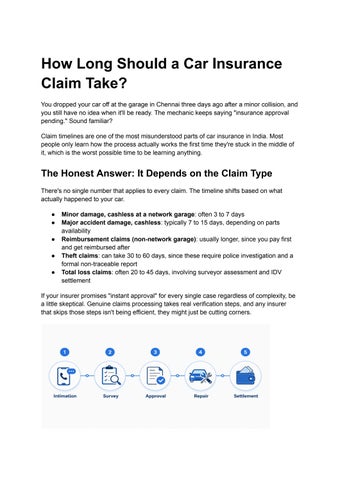
What Actually Happens Behind the Scenes Understanding the stages helps explain why claims take the time they do. 1. Intimation, you report the incident to your insurer, ideally within 24 to 48 hours 2. Survey, a surveyor inspects the damage and estimates repair cost 3. Approval, the insurer reviews and approves the claim amount 4. Repair, the garage begins work once approval comes through 5. Settlement, payment is released, either directly to the garage (cashless) or to you (reimbursement) Here's the thing though, most of the delay people experience doesn't happen during the actual repair. It happens in the gap between steps 1 and 3, waiting for a surveyor to show up and for approval to come back. That waiting period is where insurers genuinely differentiate themselves.
Why Some Claims Take Longer Than Others A few factors slow things down regardless of which insurer you're with. ● Parts availability, imported or rare parts can add days or weeks ● Multiple vehicles involved, accidents with more than one party take longer to assess liability ● Incomplete documentation, missing RC copy, license, or FIR (for theft) delays everything ● Non-network garage, reimbursement claims typically take longer than cashless ones ● High claim value, larger claims often get an extra layer of internal review None of these are unusual or suspicious. They're just part of how insurance actually works when real money and real verification are involved.
What Slows Claims Down That Shouldn't Some delays are avoidable, and they usually come down to process gaps rather than genuine complexity. ● Claims passed between multiple departments or representatives, with each handoff losing context ● No clear point of contact, so you're calling a general helpline and repeating your case each time ● Lack of visibility into where your claim actually stands ● Slow surveyor scheduling due to internal backlogs This is where claims ownership structure matters more than people realize. When a claim gets passed around between different teams, something always gets lost in translation, and that's usually where the delay creeps in, not in the actual repair work.
A few insurers have started addressing this directly. Kiwi General Insurance, for example, assigns every customer a dedicated Claims Specialist who owns that specific claim from intimation through settlement, rather than routing it through different departments at each stage. It doesn't eliminate every delay, since parts availability and documentation issues are still real factors, but it does remove the handoff problem that causes a lot of unnecessary waiting.
How to Speed Up Your Own Claim A few things are genuinely within your control. ● ● ● ● ●
Report the incident immediately, don't wait "until things calm down" Keep RC, license, and policy documents saved digitally and accessible Choose a network garage when possible, since cashless claims typically move faster Respond quickly if the insurer or surveyor requests additional documents Avoid inflating or bundling in unrelated pre-existing damage, since this triggers extra scrutiny and delays the whole claim
Questions Worth Asking Your Insurer Before You Buy ● ● ● ●
What's the average claim settlement time, and is that number time-bound or vague? Will one person handle my claim, or will it move between departments? Is there a way to track claim status without calling a helpline repeatedly? How wide is the network garage list for cashless claims in my city?
These aren't unreasonable questions. Any insurer confident in their process should be able to answer them clearly, not vaguely.
Bottom Line There's no universal answer to "how long will my claim take," because it genuinely depends on the type of damage, documentation, and garage network involved. What you can control is reporting fast, keeping documents ready, and asking the right questions before you buy, not after you're stuck waiting for updates. A little preparation upfront makes the difference between a stressful three-week wait and a claim that moves the way it's supposed to.