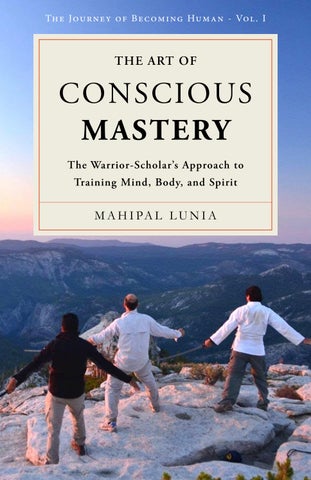
Th e Jou rn ey o f B e c o m i n g Hum a n - Vo l . I
THE ART OF
CONSCIOUS MASTERY The Warrior-Scholar’s Approach to Training Mind, Body, and Spirit
M A H I PA L L U N I A
THE ART OF
CONSCIOUS MASTERY
THE ART OF
CONSCIOUS MASTERY The Warrior-Scholar’s Approach to Training Mind, Body, and Spirit
M A H I PA L L U N I A
Copyright © 2026 by Mahipal Lunia. All Rights Reserved. First Edition published in 2026 by The Immersion Foundation. www.immersion.foundation No part of this publication may be reproduced, distributed, or transmitted in any form or by any means without the prior written permission of the publisher, except in the case of brief quotations embodied in reviews and certain non-commercial uses permitted by copyright law. Academic researchers and educators may reproduce short passages with full attribution and citation.
Dedication For the teachers who gave freely. And for those who will.
“The way of the warrior-scholar is the twofold way of pen and sword, and those who pursue it should endeavor to become accomplished in both ways.” Miyamoto Musashi, The Book of Five Rings (1645) *
*
*
“The pattern which connects is a metapattern. It is a pattern of patterns. It is that metapattern which defines the vast generalization that, indeed, it is patterns which connect.” Gregory Bateson, Mind and Nature (1979) *
*
*
“We are what we repeatedly do. Excellence, then, is not an act but a habit.” Will Durant, paraphrasing Aristotle’s Nicomachean Ethics
Contents Author’s Note
xi
How to Read This Book
xiii
Introduction
15 Part I: The Map
1. The Problem With “Holistic”
25
2. The Immersion
35
3. The Biology of Becoming
47
Part II: Doctrine, the First Act 4. Doctrine
59
5. The Solo Path
69
6. What Are We Actually Building Toward?
79
Part III: Strategy, the Second Act 7. The Body the Modern World Forgot
89
8. Strategy
97
9. What Weapons Teach the Body That Nothing Else Does
105
viii
Part IV: Tactics and Spirit, the Third Act 10. Communion, Not Consumption
113
11. The Mountain as Teacher
121
Part V: The Living System 12. The Immersion Revisited
131
13. The Mini-Shugyo
139
14. Tuesday Feeds Thursday, Thursday Feeds Saturday.
145
Epilogue & Appendices Memoir Chapter: The Teacher’s Journey
155
Conclusion: Becoming Uncaged
165
Appendix A: The Convergence Table
171
Appendix B: The Reading Path
175
Appendix C: Expert Council Notes
181
Appendix D: Bibliography
185
ix
Author’s Note
This book began as twelve essays written and refined between 2025 and 2026. They were not widely circulated during that period: The crystallization of the ideas was still in progress, the architecture of the three-session practice was still finding its final form, and what the essays were pointing at was not yet named clearly enough to be released. They are collected here now because the naming has arrived, and the argument they constitute can finally be held as a whole. Each was written as a standalone piece, complete in itself, requiring no prior knowledge of martial arts or any of the traditions it draws from, and addressed to the reader who had arrived at the quiet suspicion that something important was missing from most contemporary accounts of human development. The response to those essays made one thing clear: The argument they were making was larger than any blog format could hold. What follows is that larger argument, expanded, deepened, verified, and organized into the architecture that a book demands. On the verification standard: Every factual claim in this manuscript has been assigned to a domain—neuroscience, developmental psychology, systems theory, evolutionary biology, hoplology, contemplative studies—and verified against a minimum of three independent expert-level sources. Claims that survived this scrutiny are cited. Claims that required nuance are stated with qualification. Claims that failed
xi
were removed. The reader encounters clean prose. The scaffolding is real and is described in Appendix C. On citations: Full APA 7th edition references appear at the end of each chapter. In-text citations follow the author-date format throughout. No claim attributed to a source is made without the relevant section having been read. On the Memoir Chapter: The personal account—the expeditions, the teachers sought and found, the Silicon Valley parallel life, the founding of the school—appears in a chapter placed after the philosophical argument is complete. The ideas belong to a tradition larger than any individual teacher. That tradition is the protagonist of this book. The teacher is its present custodian. Philosophy first. Then the life from which it grew. On the scope: This book does not offer a simplified program that can be completed in thirty days without a teacher. It offers an account of a specific, designed practice and the intellectual framework that explains why it is designed the way it is. The framework is drawn from neuroscience, developmental psychology, systems theory, evolutionary biology, Jungian depth psychology, hoplology, and the accumulated empirical wisdom of warrior traditions across a dozen cultures. It is a single, cumulative argument. Each chapter builds on what precedes it, and the five parts together constitute a complete case. The argument, stated in advance: Integration of mind, body, and spirit, genuine integration, the kind that changes behavior under pressure and produces the enlargement of self that every serious tradition has described as the goal of human development, requires architecture. Specifically: a designed sequence operating across three levels (doctrine, strategy, and tactics), engaging all three centers of the human being, meeting specific biological conditions, and enclosed within a practice consistent enough to build the neural pathways that make transformation structural rather than episodic. That architecture exists. This book describes it.
xii
How to Read This Book
This book has five parts. They build on each other, but each also stands alone. If you are new to all of this—no martial arts background, no prior encounter with any of the frameworks used—begin at the Introduction and read straight through. The book was written with the general intelligent reader as its primary audience. Every concept is introduced before it does work. Nothing is assumed. If you are a practitioner of any serious discipline—martial arts, medicine, music, contemplative practice—you will find the arguments of Part I familiar in spirit if not in specific vocabulary. You may wish to read Chapter 3 (the biological foundation) before Chapter 1, as it provides the scientific grounding that makes the design choices of the three-session structure self-evident. If you are a researcher in any of the cited fields, Appendix C describes the verification standard applied to your domain. The bibliography is complete. If you want to know whether this practice is for you, read the Introduction and Chapter 14. Then read the Memoir Chapter. The contact details are at the back. Tuesday feeds Thursday. Thursday feeds Saturday. The argument begins in the next chapter. xiii
Introduction The Gap Between Aspiration and Architecture
The first time a researcher equipped with modern neuroimaging watched what happens inside the body of a master practitioner during genuine combat, what the scans revealed was counterintuitive. The expert’s nervous system was quieter than the novice’s. Not calmer in the sense of being less engaged—every motor system was firing with extraordinary precision—but calmer in the sense that the noise had been removed. The self-monitoring, the deliberating, the second-guessing that filled the novice’s neural activity like static had been replaced, in the expert, by something closer to directness. Action arising cleanly from a training so deep that it had become the practitioner’s nervous system rather than something the nervous system was trying to remember (Yarrow et al., 2009). This is what thirty years of study in the warrior traditions has taught: that knowing and doing are not points on the same continuum. They are different territories, governed by different laws, developed through different means, and separated by a gap that intellectual commitment alone cannot cross. The traditions that understood this gap, that built specific architectures for crossing it, produced human beings of a particular quality. The traditions that confused knowing with doing produced, at best, knowledgeable people who fell apart under pressure. This book is about the architecture of crossing the gap. 15
16
| The Art of Conscious Mastery
A Problem That Has Spread Everywhere Without Its Solution Sometime in the last two decades, an idea escaped from contemplative traditions, wellness studios, and the scholarship of human development and entered the language of nearly every serious institution on earth. The idea that human beings have three dimensions—mind, body, and spirit—and that genuine development requires all three to be cultivated simultaneously, in relationship, as an integrated whole, is correct. It is also, in the form it has spread, almost useless. Type “mind body spirit” into any search engine and you will receive several hundred million results. Corporate wellness programs offer it. Elite sports organizations pursue it. Hospital systems build departments around it. Leadership development frameworks promise it. Ancient traditions that spent millennia developing specific technologies for producing integration now compete for attention with weekend retreats claiming to transmit the same results in forty-eight hours. What almost none of these offerings carry is what the ancient traditions were built around: a precise, sequenced, designed architecture for actually producing the integration they promise. What has spread is the aspiration. What has not spread is the design. And these are not the same thing. The aspiration says: I wish to develop mind, body, and spirit together. The design says: Here is the specific sequence of practices, in the specific order, at the specific level of demand, structured so that what occurs in each dimension specifically prepares the ground for what occurs in the others. The aspiration can be held without changing anything. The design requires everything. This book is concerned exclusively with the design.
Three Levels That Most Approaches Collapse Into One The crystallization of doctrine, strategy, and tactics as a framework for genuine human development, rather than a borrowed military abstrac-
Introduction
|
17
tion, belongs to MahaGuru Stevan Plinck. He gave me this language years before I had built anything to put it in. What follows is what that language grew into across decades of teaching. The military tradition, which has been thinking rigorously about human performance under extreme conditions for longer than almost any other domain, has long maintained a distinction between three levels of operation that must be kept structurally separate for any of them to function correctly. Doctrine is the philosophical and moral foundation: the values, principles, and ethical commitments that determine what the organization is for and what it will never do, regardless of circumstance. Doctrine does not tell you how to win. It tells you what winning is for, and what it would not be worth winning at any cost. Strategy is the plan: how forces are deployed in relationship to each other, to the terrain, to the opposition, and to the objective. Strategy translates doctrine into direction. Given what we believe, this is how we will move. Tactics is the specific action taken in specific conditions: the realtime adaptation to what is actually happening when the plan meets reality. Tactics without strategy is improvisation. Strategy without doctrine is technically competent movement toward an unexamined end. These three levels are not interchangeable and cannot be collapsed into one without destroying the function of all three. Yet this is precisely what most approaches to human development do. They accumulate tactics: specific techniques for meditation, exercise, breathing, communication, productivity. They may develop some strategic thinking about how these techniques fit together. Almost none develop doctrine, the foundational answer to the prior question of what all this development is for, and what kind of human being it is attempting to produce. Without doctrine, the most sincere effort at integration runs the same risk as the most technically brilliant military campaign fought toward the wrong objective: It is capable of producing an outcome that no one who understood the situation would have chosen.
18
| The Art of Conscious Mastery
What the Biology Adds to the Philosophy There is a second reason most approaches to integration fail, and it requires a brief encounter with neuroscience before the book’s full argument can be stated. Joseph Chilton Pearce, the developmental psychologist and researcher, spent the latter part of his career studying what he called “the biology of transcendence,” the neural architecture that makes human beings capable of experiences that exceed the ordinary contracted self (Pearce, 2002). His central finding is one that popular neuroscience has been slow to absorb. The human nervous system does not consist of three parts, as the standard triune brain model suggests. It consists of four. The three most commonly discussed—the reptilian complex, the limbic system, and the neocortex—are well established and widely understood. The fourth is the cardiac neural network: approximately 40,000 neurons organized into a functional neural system within the heart, communicating with the brain through multiple pathways and sending more signals upward to the brain than the brain sends down (Armour, 2003; McCraty, 2015). The heart, in the most literal neurological sense, is not a pump that receives instructions. It is a neural organ that helps issue them. This argument belongs to Joseph Chilton Pearce before it belongs to this practice. Pearce made the discovery and carried it at considerable personal and professional cost for decades before the confirming research caught up. I am transmitting his finding, not my own. The Saturday session at Two Mountains Immersion Institute was already producing the conditions he described before I had encountered his vocabulary. When I found his work, I recognized what the practice had been building toward without yet having the language to name it. Pearce’s argument, supported by the HeartMath Institute’s research and corroborated by cardiac neuroscience literature, establishes that genuine transcendence is a biological event: It occurs when specific
Introduction
|
19
physiological conditions are met and specific neural systems are engaged. Those conditions include: genuine physical exertion followed by genuine stillness, sustained encounter with natural scale, and the regular structured engagement with philosophical material at the edge of one’s current capacity to act on it. In other words: Thursday’s physical session, followed by Saturday’s mountain practice, prepared by Tuesday’s scholarly engagement. The three sessions of this practice are not arbitrary choices. They are, as the book will demonstrate in detail, a specific architecture for meeting the biological conditions that Pearce describes.
What the Warrior Traditions Understood That We Have Forgotten The great warrior traditions of the world—Japanese, Indian, Chinese, Filipino, Caribbean, Greek—arrived, through entirely independent routes across thousands of years, at the same structural conclusion: that the development of the complete human being requires not three separate practices but one integrated system in which each dimension specifically prepares the ground for the others. The Japanese concept of budo, “the martial way,” was never simply a fighting system. It was an explicit philosophy of human development organized around the simultaneous cultivation of bu (martial skill) and bun (scholarly refinement). The sword trained alongside the brush. The body prepared alongside the mind. The spirit cultivated through both, in their relationship, not apart from them. The Indian gurukul tradition organized the student’s entire life around a single teacher, living in the teacher’s household, participating in all dimensions of daily life, precisely because genuine transmission was understood to require total immersion. The teaching was not compartmentalized into curriculum periods. It was continuous, in every
20
| The Art of Conscious Mastery
context, because the integration being produced was not an intellectual achievement but a way of being. The Greek concept of kalokagathia, “the beautiful and the good,” unified in a single person, expressed a similar understanding. The ideal human being was one in whom physical excellence and moral excellence were not separate achievements but expressions of the same underlying formation. The gymnasium was not a place for exercise. It was a place for becoming someone. What all of these traditions shared was not a belief in mind-bodyspirit integration. It was a design for producing it. And the design, in every case, had three features that contemporary programs almost universally lack. First: a sequenced architecture, in which what was developed in one domain specifically prepared the ground for development in another. Doctrine first, because without philosophical foundation, physical training has no direction. Physical training second, because without embodied capability, philosophical commitments have no instrument. Spirit third, not as addition but as consequence—what arises when doctrine and physical development are in genuine relationship. Second: a closed system. The student did not pick and choose. The practice was complete and non-negotiable. Missing one element did not produce partial development. It broke the relationship between the parts, and the relationship was the integration. Third: a teacher who held the whole, not a collection of specialists working in proximity, but a single person who had integrated all three dimensions in themselves and who could see the practitioner as a whole and respond to what the whole required. These three features are absent from almost every contemporary program that claims to offer them. This is not a criticism. It is a design problem. And design problems have design solutions.
Introduction
|
21
What This Book Is and Is Not This book is not a self-help manual. It does not offer a program that can be followed at home, alone, without a teacher, in thirty days. Those programs exist in abundance. This book is not competing with them. What this book offers is an account of a specific designed practice, built over thirty years of study under teachers who rarely open their doors to outsiders, refined through twenty years of teaching in Mountain View and the Santa Cruz Mountains in California, and the intellectual framework that explains why it is designed the way it is. The framework draws on neuroscience, developmental psychology, systems theory, evolutionary biology, Jungian depth psychology, hoplology, and the accumulated empirical wisdom of warrior traditions across a dozen cultures. It is not a collection of interesting ideas. It is a single cumulative argument. The argument: genuine integration of mind, body, and spirit requires architecture, a designed sequence operating across three levels (doctrine, strategy, and tactics), engaging all three centers of the human being (intellectual, moving, and emotional in Gurdjieff’s terms), meeting the specific biological conditions that Pearce’s research describes, and enclosed within a practice consistent enough to build the neural pathways that make transformation structural rather than episodic. That architecture exists. The five parts of this book describe it completely. The argument is not finished in the Introduction. It begins here. The map is in the next three chapters. The practice is in the ten that follow. And the invitation, to come and find out whether any of this is what you have been looking for, is in the final pages. Let us begin.
22
| The Art of Conscious Mastery
References Armour, J. A. (2003). Myocardial ischemia and cardiac neurons. Journal of Cardiovascular Electrophysiology, 14(12), 1376–1378. Bateson, G. (1979). Mind and nature: A necessary unity. Dutton. McCraty, R. (2015). Science of the heart: Exploring the role of the heart in human performance (Vol. 2). HeartMath Institute. Pearce, J. C. (2002). The biology of transcendence: A blueprint of the human spirit. Park Street Press. Yarrow, K., Brown, P., & Krakauer, J. W. (2009). Inside the brain of an elite athlete: The neural processes that support high achievement in sports. Nature Reviews Neuroscience, 10(8), 585–596. https://doi. org/10.1038/nrn2672
PA R T I
The Map Why Most Approaches Fail Before They Begin
CHAPTER 1
The Problem With “Holistic” Integration as Architecture, Not Aspiration
In the spring of 1972, a professor at the University of Oregon published a slim volume called Jogging. Bill Bowerman had spent twenty years coaching track and field. His book argued simply: Most Americans did not exercise at all, and walking briskly was better than nothing. He was correct. The subsequent running boom transformed cardiovascular health across a population, reduced heart disease mortality, and catalyzed an industry. It also produced a widespread assumption, that physical health is equivalent to cardiovascular fitness, that fitness is equivalent to running, and that a person who runs regularly has addressed the physical dimension of their well-being. A generation of runners discovered, usually through injury or the quiet dissatisfaction of a body that is capable in one narrow corridor and incompetent in almost every other direction, that the assumption was incomplete. The same dynamic operates at a vastly larger scale in contemporary culture’s relationship to human development as a whole. An idea has spread that is correct in its claim and almost useless in the form it has taken. The idea is mind-body-spirit integration. What has spread is 25
26
| The Art of Conscious Mastery
the aspiration. What has not spread, because it is genuinely difficult to design, genuinely demanding to transmit, and genuinely resistant to simplification, is the architecture that actually produces it. This chapter examines the gap between these two things. It is the most important gap in contemporary human development, and it is almost never named.
The Proliferation Without the Substance Conduct a brief inventory of the language that surrounds serious human development programs in contemporary institutions. In corporate wellness: “We support the whole employee.” In elite sports academies: “We develop the complete athlete.” In healthcare: “Our approach is holistic.” In leadership development: “We work with the whole leader.” In the marketing materials of ten thousand retreats, studios, coaching practices, and wellness brands: integration, wholeness, the complete human, the full self. The words have become so prevalent that they have ceased to carry information. They no longer describe what a program does. They signal what a program aspires to, markers that tell the prospective participant that the provider wishes to address all dimensions, intends to, believes it should. Whether the provider has designed a specific architecture for achieving that intention is a separate question, and it is almost never asked. The reason it is not asked is that the gap between intention and architecture is rarely visible from the outside. A program that addresses body through exercise, mind through information, and spirit through occasional nature experiences looks integrated. The practitioner attends three kinds of sessions and feels that they are developing in three directions. What they cannot feel, because it requires years to become legible, is whether the three directions are pointing the same way, whether what occurs in each dimension specifically prepares the ground for what
The Problem With “Holistic”
|
27
occurs in the others, and whether the relationship between the practices is itself designed or merely coincidental. Gregory Bateson, the anthropologist and systems theorist, spent his career asking what distinguishes a living system from a collection of parts (Bateson, 1979). His answer, arrived at through decades of research across anthropology, biology, cybernetics, and psychology, was this: Living systems are organized not by their components but by the relationships between components, by what he called “the pattern that connects,” the meta-pattern that makes the whole more than a sum. Remove the relationships and you have a collection of elements, not a system. A forest is not a collection of trees. It is a system of relationships— between canopy and understory, between tree and fungal network, between predator and prey, between decomposition and growth. Remove the relationships, and the trees are lumber. The forest is the pattern. Applied to human development: A meditation practice, an exercise routine, and a philosophy reading habit are three elements. Integration is the specific pattern of relationships between them, the design that makes each prepare the ground for the others. Without that pattern, the three elements coexist without constituting a system. And a collection of practices, however sincere, is not a practice in the deepest sense of the word.
Three Levels That Cannot Be Collapsed The previous chapter’s three-level distinction—doctrine, strategy, and tactics—requires fuller elaboration here, because it is the most practically useful framework for understanding why most development programs produce disappointment regardless of how carefully their individual components are chosen. Doctrine, to be precise, is not a set of beliefs. It is not what you would say if asked what you value. Doctrine is the set of principles so
28
| The Art of Conscious Mastery
deeply encoded, through practice under genuine pressure, over sufficient time, that they generate behavior automatically before the deliberating mind has been consulted. A person who believes in honesty and a person who has honesty as doctrine behave identically in low-stakes situations. They behave very differently when honesty is costly, when the social pressure runs against it, when the outcome of the conversation genuinely matters to them. The believer deliberates and hopes. The practitioner of doctrine responds from something prior to deliberation. Most development programs produce more sophisticated belief without advancing the development of doctrine. Philosophy reading groups produce knowledgeable people. Strategic frameworks produce capable planners. Neither produces, without something additional and more demanding, the behavioral change under pressure that doctrine represents. Strategy, the middle level, is where the body enters the picture in a specific and irreplaceable way. Strategy is not cognitive. It is dispositional. It is the trained capacity of the whole human being—body, attention, and relational intelligence—to position itself in relation to others and to the environment so that the right response arises naturally from the configuration rather than from deliberate calculation. Before the scholarship, there were four “rooms.” Sastri Sensei taught integration as the non-negotiable condition of genuine development. MahaGuru Stevan Plinck taught it from inside his lineage, in different vocabulary, arriving at the same insistence from a different direction entirely. Uncle James Keating taught it through the blade arts, where the cost of an unintegrated practitioner is immediate and unambiguous. Guru Ron Saturno taught it in his own tradition, with his own evidence and his own precision. Four teachers. Four lineages. One insistence: A practitioner who has not integrated action and reflection is not yet whole, regardless of how excellent either half has become on its own. I did not invent this requirement. I inherited it from four directions simultaneously.
The Problem With “Holistic”
|
29
This is why the chess grandmaster does not calculate their strategic position move by move. They read it, perceiving the pattern of the board as a living configuration from which the next move arises as consequence rather than decision. Every teacher I trained under seriously returned to the same point, regardless of what else distinguished them. Sastri Sensei. MahaGuru Stevan Plinck. Uncle James Keating. Guru Ron Saturno. Four traditions. Four lineages. One insistence: What you do when no one is watching is the real curriculum. The sessions provide direction and witness. The encoding belongs to the hours alone. Adriaan de Groot’s foundational research established this with precision: When grandmasters were shown random chess positions— positions that could never arise in an actual game—their performance collapsed to that of novices (de Groot, 1965). Their expertise was not stored in pieces. It was stored in relationships between pieces, strategic patterns that decades of practice had encoded as directly perceptible configurations. The strategic intelligence was in the relationship, not the element. What this means for the practice of the body is direct and often overlooked: Strategic body intelligence cannot be developed by accumulating tactical techniques. It develops through sustained practice with real partners, in real conditions, under real resistance, because strategy only exists in relationship, and relationships require a living other. The practitioner who trains alone, however diligently, trains their tactics. Their strategy remains theoretical until it is tested against the irreducibly unpredictable intelligence of another human being. Tactics, the third level, are the specific adaptive choices made in real time when the plan meets conditions the plan did not fully anticipate. Tactics are where mastery becomes visible, but tactics without strategy produce improvisation, and improvisation without doctrine produces character that was never consciously chosen. The characteristic failure of contemporary development programs is that they work exclusively at the tactical level, assembling a collection of techniques without asking what strategic intelligence those techniques
30
| The Art of Conscious Mastery
are in service of, or what doctrine gives that strategy its direction. The result is practitioners who improve in specific measured domains while remaining unchanged in the dimensions that most determine the quality of their lives.
What the Great Traditions Built Instead The warrior traditions of the world did not make this error. They could not afford to. The traditions that confused knowing with doing produced practitioners who died. The traditions that built genuine integration produced practitioners who did not. The Japanese concept of budo, the martial way, was organized around the explicit and non-negotiable integration of bu (martial competence) and bun (scholarly refinement). The warrior who could not write and the scholar who could not fight were both considered incomplete. Not as a cultural preference but as a practical recognition: The warrior without the scholar has capability without wisdom and will eventually use it destructively. The scholar without the warrior has wisdom without the instrument to enact it and will remain impotent when enactment is required. More significantly, the Japanese tradition recognized that the development of budo required a specific environment: the dojo. The dojo was not a gym with Japanese aesthetics. It was a closed system, a designed environment in which the relationships between doctrine (encoded in the school’s philosophical transmission), strategy (encoded in the kata, the formal practice patterns), and tactics (developed through randori, free practice with resistance) were structurally maintained and enforced by the teacher’s authority and the community’s culture. The Indian gurukul was a closed system of a different kind: The student lived inside the teaching relationship, so that the integration between intellectual, physical, and spiritual development could not be fragmented by the return to an unrelated life. The teaching was
The Problem With “Holistic”
|
31
not curriculum. It was continuous presence, the teacher’s whole life as demonstration, available to observation and internalization at all times. The Greek gymnasium, gymnasion, from gymnos, “naked,” was a place where men trained without the concealment of clothing precisely because the training was meant to reveal character as much as develop it. The physical practice and the philosophical discussion occurred in the same space, often simultaneously. Plato wrote some of his dialogues in gymnasia. The setting was not incidental. What each of these institutions shared was the recognition that integration cannot be achieved by attending to three dimensions separately and hoping for synthesis. The synthesis must be designed, the relationships between the practices structured, and the whole system made non-optional, closed rather than open, so that the student is enclosed by the practice rather than visiting it.
Why the Contemporary Situation Is Structurally Different The contemporary situation differs from the ancient one in ways that are real and must be acknowledged before a solution to them can be designed. The gurukul required residential immersion. The Greek gymnasium required daily attendance in a dedicated public space. The Japanese dojo required the practitioner to organize their life around the school rather than the school around their life. None of these models transfers directly to the contemporary professional who has a career, a family, and a calendar that has been claimed before the development practice arrives to stake its own claim. The solution this book describes is not a compromise of the ancient model. It is a redesign of it for contemporary conditions, one that preserves the essential structural features (the closed system, the sequenced architecture, the integration of doctrine, strategy, and tactics, the
32
| The Art of Conscious Mastery
teacher who holds the whole) while distributing them across a weekly rhythm that a person actually living in the contemporary world can maintain. At Two Mountains Immersion Institute, a week is structured into three sessions—each with a specific and irreplaceable function, and each structured so that what occurs in it specifically prepares the ground for what follows. The philosophical scholarship of Tuesday preparing the mind for Thursday’s physical demand. Thursday’s physical development creating the open, discharged, proprioceptively awake body that Saturday’s mountain practice requires. Saturday’s encounter with natural scale and earned silence recalibrating the doctrine for the following Tuesday. The system is closed. The student who maintains all three is inside an envelope.* The student who attends selectively is outside it—not failing, but also not producing the integration the system is designed to create. The envelope works because it is enclosed. This is not a rule. It is a structural feature of how integration actually happens. The next chapter examines the neurological and behavioral science behind that structural claim. This chapter has established the problem. The following chapters build the solution.
*
A term borrowed from MahaGuru Stevan Plinck, which is fleshed out in detail in Chapter 2.
The Problem With “Holistic”
|
33
References Bateson, G. (1979). Mind and nature: A necessary unity. Dutton. Bowerman, W., & Harris, W. E. (1967). Jogging. Grossman Publishers. de Groot, A. D. (1965). Thought and choice in chess. Mouton. Meadows, D. H. (2008). Thinking in systems: A primer. Chelsea Green Publishing. Sun Tzu. (1963). The art of war (S. B. Griffith, Trans.). Oxford University Press. (Original work written ca. 500 BCE)
CHAPTER 2
The Immersion Why You Must Be Enclosed by Your Training for It to Transform You
In 1968, Walter Mischel and his colleagues at Stanford placed children in a room with a marshmallow and a simple proposition: Wait fifteen minutes without eating it and you will receive a second one. Most accounts of the Marshmallow Test use it to illustrate the power of self-control. Mischel himself spent the next four decades correcting that interpretation. The children who waited most successfully were not, the follow-up research established, the ones with the most innate capacity for delay of gratification. They were the ones who had found ways to change their relationship to the environment, turning away from the marshmallow, covering their eyes, transforming the waiting through distraction or reframing (Mischel, 2014). The Marshmallow Test, correctly read, is not about willpower. It is about environmental architecture, the degree to which behavior is shaped by the design of the context in which choice occurs. This is the foundation of everything this chapter argues. And its implications for the development of mind, body, and spirit are more radical than most people who discuss such development have considered.
35
36
| The Art of Conscious Mastery
What Training Actually Produces The principle widely attributed to Archilochus, the Greek warrior-poet of the seventh century BCE, has circulated in military and martial training for generations in various forms: We do not rise to the level of our expectations; we fall to the level of our training. The attribution is uncertain; the surviving fragments of Archilochus do not contain this specific phrasing, and its modern form appears to originate in the training culture of twentieth-century special operations forces. What is certain is that the principle is ancient, cross-cultural, and supported with extraordinary precision by the contemporary science of expertise development. Aristotle described the underlying mechanism as hexis: stable disposition formed through habituation. What we do repeatedly and consistently, under conditions that gradually approach the conditions of genuine demand, becomes not what we know but what we are, the behavioral substrate that operates below the level of deliberate choice (Aristotle, ca. 350 BCE/1998). The archer who has practiced ten thousand draws does not decide to use correct form in competition. The form is the archer. The surgeon who has practiced suturing under fatigue does not decide to remain steady in a critical moment. The steadiness is the surgeon. K. Anders Ericsson spent four decades studying expertise across domains—music, chess, surgery, athletics—and arrived at a conclusion that should have been obvious but required controlled study to establish with the precision science demands: The quality and structure of practice, not hours alone or innate talent, determines what a person becomes capable of (Ericsson et al., 1993). More specifically: Deliberate practice—specific, effortful, corrective, and designed to push the practitioner just beyond their current capacity—produces qualitatively different development from undirected repetition. The distinction between repetition and deliberate practice is not a matter of degree. It is a matter of mechanism. Repetition encodes what
The Immersion
|
37
is already known more deeply. Deliberate practice encodes what is not yet known, the specific capability just beyond the current limit, and does so through a process of systematic error and correction that builds the neural pathways that repetition alone never reaches. The musician who practices a passage at comfortable tempo for an hour has repeated. The musician who identifies the specific bar where the error occurs, slows to half-tempo, isolates the error, works it to correctness, and then returns the passage to full tempo has practiced deliberately. The hours are similar. The development is not. This distinction matters for the three-session practice at Two Mountains because each session must be understood not as attendance but as deliberate practice at a specific level of the human system. The Tuesday Scholar Session is deliberate practice at the level of doctrine—not reading philosophy, but engaging with philosophical material at the edge of one’s current capacity to act on it and being held accountable, by a teacher who sees, for the gap between comprehension and embodiment. The Thursday Physical Session is deliberate practice at the level of strategy—not exercising, but training the body’s relational intelligence against real resistance that the practitioner cannot fully predict or control. The Saturday Mountain Session is deliberate practice at the level of encounter—not visiting nature, but placing the trained mind and body in conditions that specifically challenge the practitioner’s current capacity for presence, stillness, and contact with something larger than the habitual self.
Three Centers, Chronically Misaligned George Ivanovich Gurdjieff’s teaching about the human being, transmitted through the writings of his student P. D. Ouspensky and available in their most rigorous form in In Search of the Miraculous, contains, beneath its considerable metaphysical complexity, an observation that is precise enough to be immediately recognizable by anyone who examines their own behavior carefully (Ouspensky, 2001).
38
| The Art of Conscious Mastery
Human beings operate through three distinct functional centers, each with its own intelligence, its own speed, and its own relationship to experience. The intellectual center thinks. It analyzes, plans, abstracts, deliberates, and conceptualizes. In most educated adults in contemporary societies, it is the chronically overworked center, the one that has been trained since childhood to handle problems that belong to the other two as well. The intellectual center is also the slowest of the three. Deliberate thought operates on a timescale of seconds. The body and the emotional center operate on timescales of milliseconds. The moving center, Gurdjieff’s term for what contemporary neuroscience would call the somatic and proprioceptive nervous system, is the body’s deep intelligence: the capacity to read spatial relationships, time movement, respond to physical reality faster than deliberate thought can form, and navigate the material world with the precision that only embodied experience, encoded through practice, can produce. In most desk-working adults, although not destroyed, this center is suppressed, not because the body is incapable but because nothing in the design of the ordinary professional life asks it to operate at anything close to its full range. The emotional center, when it is operating from wisdom rather than from conditioned reaction, is the seat of direct knowing, the capacity to perceive, without deliberation, what a situation requires and what it does not. This is distinct from ordinary emotional reactivity, which Gurdjieff considered a corruption of the emotional center’s proper function. The emotional center in its developed form is a form of intelligence that is faster than thought and more precise than instinct. It is also, in most people, the most consistently suppressed of the three, because cultures that mistake analytical reasoning for intelligence have spent centuries training people to distrust and override direct knowing in favor of deliberated judgment. Gurdjieff’s central practical observation was that in most people, one center, usually the intellectual, is attempting to do the work of all three.
The Immersion
|
39
The intellectual center is used to plan physical movement rather than trusting the moving center’s intelligence. It is used to analyze emotions rather than allowing the emotional center to do its proper work. The result is a human being who is functioning at roughly one-third of the available intelligence, and who experiences the suppression of the other two centers as a vague sense that something important is missing, without being able to name clearly what it is. The three sessions of this practice are designed to address each center specifically and in sequence. The Tuesday Scholar Session addresses the intellectual center, not by giving it more information to process, but by training it to aim: to engage with doctrine at the level of practice rather than of comprehension. The Thursday Physical Session addresses the moving center, systematically educating the body’s intelligence through real resistance, real consequence, and the partner work that solo exercise cannot replicate. The Saturday Mountain Session addresses the emotional center, placing the practitioner in the specific conditions (physical openness after genuine exertion, natural scale, earned silence) that allow the emotional center to operate from wisdom rather than from the reactivity that ordinary life chronically produces. None of these sessions addresses all three centers simultaneously. Each focuses its demand. The integration occurs between them, in the relationships that the sequence creates, not in any individual session.
The Architecture of the Closed System The concept of the envelope, introduced in Chapter 1 and central to everything that follows, requires precise definition. The word immersion names the thing itself: to be engulfed, fully surrounded, with no part of the practitioner left standing outside the medium. This understanding of immersion as the minimum condition for genuine development, and the envelope as its structural description, belongs to MahaGuru Stevan Plinck. You cannot be partially immersed. The water is on every side or you are still standing on the shore.
40
| The Art of Conscious Mastery
An envelope, in the engineering sense, is a boundary that defines the complete set of conditions within which a system can operate as designed. An aircraft’s flight envelope is not a preferred range; it is the complete set of conditions the aircraft was designed to handle, outside of which the design guarantees nothing. A training envelope is the complete set of practices that, together, create the conditions for the development the practice is designed to produce. Like the aircraft’s envelope, it is defined by its closure. A system with gaps is not an envelope. It is a collection of practices that happen to coexist. Charles Duhigg’s research on habit formation illuminates why the closure matters neurologically (Duhigg, 2012). Habits are not stored as isolated behaviors. They are encoded as loops, a cue, a routine, a reward, that are context-dependent. The same behavior practiced in different contexts encodes differently, accesses different neural pathways, and is triggered by different environmental signals. This is why capabilities developed in one context often fail to transfer to another: The neural encoding includes the context, and when the context changes, the capability may not activate. What this means for the three-session practice is direct: The capabilities developed in any single session are encoded in the context of that session. The intellectual clarity that Tuesday produces is encoded in the context of Tuesday’s contemplative quality. The strategic body intelligence that Thursday develops is encoded in the context of Thursday’s outdoor, partner-present, physically demanding conditions. The stillness that Saturday produces is encoded in the context of mountain terrain and post-exertion openness. When all three sessions are attended consistently, the three encodings begin to form a single larger context. The practitioner’s nervous system learns the pattern—the specific weekly rhythm of intellectual preparation, physical enactment, and spiritual encounter—and the three capabilities begin to activate in relationship to each other rather than in isolation. This is the envelope: the meta-context that the three
The Immersion
|
41
sessions together create, which is qualitatively different from the context any single session creates alone. When a session is missed, the meta-context is disrupted. The following session arrives without the preparation the missing session would have created. Thursday without Tuesday’s preparation is physical training without direction. Saturday without Thursday’s physical preparation is a nature walk rather than a practice. The envelope is designed as a closed loop, and opening it, even once, even for good reasons, changes the quality of what the remaining sessions can produce. Wendy Wood’s research on habit formation adds a complementary dimension: Habits are significantly more durable when the context of practice is consistent (Wood & Neal, 2007). The regularity of the three sessions—the same days, the same sequence, the same quality of attention each demands—is not administrative convenience. It is neural architecture. The nervous system learns to expect the pattern, and that expectation becomes a form of preparation. The practitioner who keeps the same three sessions at the same times, in the same sequence every week, is building a relationship between their nervous system and the practice that the practitioner who attends irregularly never builds. This is the structural explanation for something that experienced practitioners in every tradition have observed empirically: that the practitioner who trains consistently, even at modest intensity, outperforms the practitioner who trains irregularly at high intensity. The envelope is built by regularity. Intensity can deepen what the envelope contains. It cannot substitute for the envelope itself.
The Historical Record of Closed Systems Every tradition that has produced genuine and lasting human transformation has been, in structural terms, a closed system. This is not coincidence. It is convergent empirical discovery. The Japanese dojo tradition distinguished between dojo (the place of the practice), dogi (the practitioner’s mind and spirit within the prac-
42
| The Art of Conscious Mastery
tice), and dogu (the tools of the practice). All three were considered necessary and inseparable components of the training. A practitioner who had the physical space but not the committed mind was not in a dojo. A practitioner who had the mental commitment but not the tools was not training. The system was complete or it was not the system, not as an aesthetic preference but as a functional recognition of how integration is actually produced. The Shaolin monastery’s integration of martial training, philosophical study, and contemplative practice was famously total: The monks did not attend martial arts classes and then return to an unrelated life. The martial training was the contemplative practice, inseparable from the philosophical transmission and the community that held both. The monastery was a closed system not because its founders were particularly rigorous but because the integration they were attempting to produce required it. The medieval European guild system, which produced, over several centuries, an extraordinary concentration of craftspeople whose work has never been surpassed in its domain, operated on the same structural principle. The apprentice did not attend lectures and then practice. They lived inside the practice, in the master’s workshop, surrounded by the practice at all levels of development simultaneously, for years, before being permitted to practice independently. The guild system was not efficient by contemporary standards. It was effective by any standard, because it maintained the envelope that genuine mastery requires. What each of these systems recognized, and what contemporary programs rarely articulate, is that the envelope’s closure is not about control or rigor for its own sake. It is about a specific biological and psychological reality: that development at the level of doctrine, strategy, and tactics simultaneously requires a context that cannot be created in any single session, and that cannot be cobbled together from practices that are not structurally connected to each other.
The Immersion
|
43
What the Envelope Asks The envelope asks for three things. The first is regularity—three sessions weekly, treated as structural commitments rather than optional activities. The second is preparation—specifically, the solo practice assigned in Tuesday’s session completed before Thursday’s, so that Thursday’s physical work has something to test and develop rather than simply something to perform. The third is genuine engagement—not presence in the physical sense only, but the quality of attention that each session’s specific demand requires. None of these is heroic. All of them are demanding. The distinction matters because what is merely difficult can be simplified or reduced without destroying what it produces. What is demanding, what requires the genuine, consistent engagement of the whole person over months and years, cannot be reduced without destroying the envelope itself, and with it the integration the envelope was designed to create. This is the honest truth about transformation that most programs avoid stating, because stating it reduces enrollment. The envelope is the envelope. It works because it is closed. It stops working when it opens. The practitioner who maintains it, consistently, over years, is building something in themselves that cannot be built any other way: not a skill, not a fitness level, not a philosophical sophistication, but a coherence between who they believe themselves to be, how their body moves in the world, and what they encounter when they are alone with something larger than themselves. That coherence is what the practice is attempting to produce. The next chapter examines the biological architecture beneath it.
44
| The Art of Conscious Mastery
References Aristotle. (1998). Nicomachean ethics (D. Ross, Trans.; rev. J. L. Ackrill & J. O. Urmson). Oxford University Press. (Original work written ca. 350 BCE) Duhigg, C. (2012). The power of habit: Why we do what we do in life and business. Random House. Ericsson, K. A., Krampe, R. T., & Tesch-Römer, C. (1993). The role of deliberate practice in the acquisition of expert performance. Psychological Review, 100(3), 363–406. https://doi.org/10.1037/0033295X.100.3.363 Mischel, W. (2014). The marshmallow test: Mastering self-control. Little, Brown and Company. Ouspensky, P. D. (2001). In search of the miraculous: Fragments of an unknown teaching. Harvest Books. (Original work published 1949) Wood, W., & Neal, D. T. (2007). A new look at habits and the habit-goal interface. Psychological Review, 114(4), 843–863. https:// doi.org/10.1037/0033-295X.114.4.843