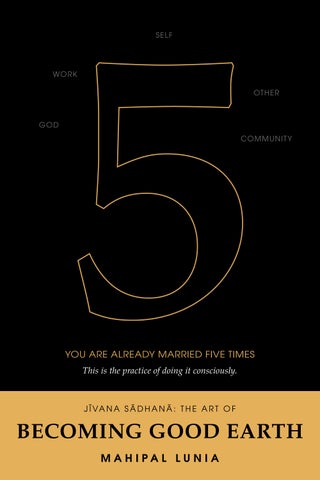
SELF
WORK OTHER
GOD COMMUNIT Y
YOU ARE ALREADY MARRIED FIVE TIMES This is the practice of doing it consciously.
J Ī VA N A S Ā D H A N Ā : T H E A R T O F
BECOMING GOOD EARTH MAHIPAL LUNIA
J Ī VA N A S Ā D H A N Ā : T H E A R T O F
BECOMING GOOD EARTH
J Ī VA N A S Ā D H A N Ā : T H E A R T O F
BECOMING GOOD EARTH
MAHIPAL LUNIA
B O O K O N E : S AT T VA B H O O M I ( p . 1 5 ) Five Commitments, One Covenant, and the Art of Becoming the Ground Something Good Can Grow From B O O K T W O : C H AT U R A R T H A ( p . 1 7 5 ) The Four Things a Life’s Work Can Pay, and Why Most People Only Cash One of Them BOOK THREE: TRIVENI (p.325) Four Ancient Maps, Three Human Centers, and the One Practice That Moves in All of Them B O O K F O U R : D VA N D VA ( p . 4 1 7 ) The Art of Carrying Both Worlds, the Sacred and the Ordinary, Without Dropping Either B O O K F I V E : AT M A S I D D H I ( p . 5 0 1 ) The Goal That Changes What Every Other Goal Is For, and the Path That Walks You There BOOK SIX: SĀDHAKA (p.589) What Tuesday Looks Like When the Practice Has Become Your Life *
*
*
Think seven generations. Not seven days. Begin.
Copyright © 2026 by Mahipal Lunia. All Rights Reserved. First Edition published in 2026 by The Immersion Foundation. www.theimmersion.foundation No part of this publication may be reproduced, distributed, or transmitted in any form or by any means without the prior written permission of the publisher, except in the case of brief quotations embodied in reviews and certain non-commercial uses permitted by copyright law. Academic researchers and educators may reproduce short passages with full attribution and citation.
For my parents, Shri Ratanchand Lunia and Smt. Vimala Lunia— you became good earth, and I grew.
For my Guru, Shri Rajashekaran Gundappa— you became good earth, and I could finally see.
For Nidhii and Maanya— I hope to be both: the bridge you cross, and the earth you land on.
“Namo Arihantānam. I bow to those who have destroyed the inner enemies. I bow to those who have crossed. May I be among them.”
A Note on the Names A word about the names of these books, because the names are not arbitrary, and if you understand the logic behind them, you will read the series differently. When I wrote the first book in this series, I called it Becoming Good Earth. English. Accessible. Deliberately plain. The book was an invitation, and invitations should not require translation before they can be accepted. The same logic produced The Four Economies for the second book. Come in. Sit down. Here is what we are going to talk about. But somewhere between the second book and the third, something shifted. The ideas were moving into territory that English could not carry without losing something. When I reached for the name of the third book, the book about the four maps and the three centers and the one practice that moves in all of them, the English options kept flattening what I was trying to say. The Confluence was pretty but imprecise. Three in One was doctrine. The Maps and the Body was a filing category, not a name. And then the word arrived: Triveni. The confluence of the Ganga, Yamuna, and the invisible Saraswati at Prayagraj, the place where three rivers meet and become something that none of them is alone. Triveni is not a description of what the book contains. It is the structure the book embodies. Three maps, three centers, one practice. The word carries the philosophy without needing to explain it, the way a great title always does.
ix
x
|
Jīvana Sādhanā: The Art of Becoming Good Earth
From that point, the naming principle became clear. The best Sanskrit words do not translate the idea—they are the idea. Dvandva is not a translation of “the two worlds.” It is the grammatical structure that holds two equal opposites in a single compound, and that is exactly what the fourth book’s practice requires. Atma Siddhi is not a translation of “the soul’s achievement.” It is the name Shrimad Rajchandra gave to his six theorems on the soul’s liberation, the most precise philosophical title available for what the fifth book is attempting. When I went back and looked at the first two books through this lens, the English titles felt like good descriptions of territory that Sanskrit could name more precisely and more honestly. Not because Sanskrit is superior to English, but because for this specific content and these specific concepts, the Sanskrit words carry what the English words approximate. Sattva Bhoomi does not mean “becoming good earth.” It means the field of pure quality, the ground of essential goodness, which is both more precise and more demanding than the English. Chatur Artha does not mean “the four economies.” It means “the four meanings,” and artha holds within it both the material (wealth, the paycheck, the economy) and the philosophical (meaning, purpose, the “soul check”). The word makes the book’s central argument before you have read a page.
Why Six Sanskrit Names for Six Books There is a logic in Indian philosophy about the four aims of a complete human life—the purusharthas: Dharma (right conduct, your essential nature), Artha (meaning and material prosperity), Kāma (love, beauty, aliveness), and Moksha (liberation, freedom from the cycle). These four are not sequential stages. They are simultaneous dimensions of a life. But they have a natural developmental arc, and the six books in this series follow it almost exactly. Sattva Bhoomi is the book of Dharma—enter your essential relationships consciously, live according to your essential nature. Chatur Artha is the book of Artha—understand what your work actually means, cash every currency it offers, find the meaning alongside the money.
A Note on the Names
|
xi
Triveni and Dvandva are the books of Kāma in its deepest sense—not romantic desire but the aliveness, the embodied practice, the beauty that is the GPS of the soul, the two worlds carried in the same hands. Atma Siddhi is the book of Moksha—the impossible goal, the liberation path, the soul working toward its own freedom. And Sādhaka is the integration—the practitioner who has done the work of all four aims and is now living them simultaneously, in the kitchen, in the trade, in the ordinary day. Dharma → Artha → Kāma → Moksha. A complete human life. Six books. One series.
The Series Name The series itself I have named Jīvana Sādhanā. Jīvana is life—not the concept of life, but the living of it. The specific, irreplaceable, unrepeatable texture of your Tuesdays. Sādhanā is the practice, a life reshaped by a chosen commitment, entered not as an event but as the ongoing act of returning to the work. Jīvana Sādhanā means: your life as the practice. Not a practice you do alongside your life, in special conditions, at a retreat or in a ceremony. The practice that your life itself is, every encounter an experiment in consciousness, every marriage a form of the practice, every morning the choice to return. Buckminster Fuller called himself Guinea Pig B, an experiment of one, using his own life as the testing ground. This series is the record of Guinea Pig M’s version of that experiment. Jīvana Sādhanā is the name I give to what the experiment is: not a philosophy of life, but life as the philosophy. Your days as the laboratory. Your relationships as the curriculum. Your ordinary morning, tended with full attention, as the practice.
On the English Subtitles Every Sanskrit title in this series carries its meaning without needing a subtitle. But a reader who has not spent their life in the tradition deserves a door, a clear English statement of what they are walking into. The subtitles are those doors.
xii
|
Jīvana Sādhanā: The Art of Becoming Good Earth
I have tried to write subtitles that earn their place, that say something worth saying rather than merely describing what is inside. A subtitle like A Guide to Better Relationships tells you the filing category. I wanted subtitles that carry the argument, or the surprise, or the specific gift the book is offering. Sattva Bhoomi: Five Commitments, One Covenant, and the Art of Becoming the Ground Something Good Can Grow From, tells you that this is a book about commitments (not strategies), that it ends in a covenant (not a conclusion), and that the aspiration is not to build something but to become the conditions under which something can build itself. That is the book’s entire argument, and you can read it in a breath. Chatur Artha: The Four Things a Life’s Work Can Pay, and Why Most People Only Cash One of Them, lands its provocation immediately. Most people are underpaid by their own work, not in money but in meaning. The subtitle names that condition and promises to address it. Triveni: Four Ancient Maps, Three Human Centers, and the One Practice That Moves in All of Them, tells you that the book is structural rather than merely inspirational, and that it ends in a specific practice rather than a general invitation. Dvandva: The Art of Carrying Both Worlds, the Sacred and the Ordinary, Without Dropping Either, names the essential tension and the essential skill simultaneously. You are not being asked to choose. Atma Siddhi: The Goal That Changes What Every Other Goal Is For, and the Path That Walks You There, carries the book’s central argument: There is a class of goal that is qualitatively different from every other goal, and this book is about that goal and the path it requires. Sādhaka: What Tuesday Looks Like When the Practice Has Become Your Life, is the most direct subtitle I have ever written, and I believe the most useful. Every reader who has read the five books before it will understand immediately what is being offered: not more philosophy, but the honest account of what the practice looks like from the inside, on an ordinary day, after the books have done their work.
A Note on the Names
|
xiii
A Final Note These names are not performances of learning or markers of cultural identity. They are the most precise available words for the ideas they name. Every Sanskrit word in these titles carries more than its English translation would suggest, and the subtitles exist to ensure that the precision is accessible rather than exclusive. If you are new to the tradition: Welcome. The books will explain what you need as you go, and the Sanskrit will become familiar the way any precise vocabulary becomes familiar, through use rather than study. If you are at home in the tradition: You will recognize what the names are pointing at before you read a word, and the books will give you a new way of inhabiting something you already know. Either way: The series is for the person who has decided that the question of how to live deserves a serious answer, and is willing to be changed by the attempt to find one. Jīvana Sādhanā. The practice of living. Begin.
BOOK ONE
S AT T VA B H O O M I Five Commitments, One Covenant, and the Art of Becoming the Ground Something Good Can Grow From
Book One . Sattva Bhoomi
Contents A Letter to You
19
What Remains
27 Part I: The Diagnosis
1. You Are Already Married
33
2. What Marriage Really Means
45
3. Why God Is Easy and the Self Is Hard
53
Part II: The Five Rooms 4. Marriage to God
65
5. Marriage to Community
77
6. Marriage to Work
89
7. Marriage to Other
101
8. Marriage to Self
113
Part III: The Marriage of Marriages 9. The Marriage of Marriages
127
10. Sattva Bhoomi
137 Epilogue
The Good Earth Covenant
151
The Four Currencies
159
Acknowledgments
171 17
“The question is not how long we remain unturned, but whether something living can grow from where we once stood.”
S AT T VA B H O O M I
A Letter to You
I have to tell you something before we begin. I am not finished with this work. I don’t mean the book—the book is done, you’re holding it. I mean the work it describes. The five marriages. I am still inside them, still making mistakes inside them, still discovering things about each one that surprise me and occasionally humble me in ways I would prefer not to be humbled. I have been teaching this framework for more than a decade. I have shared pieces of it with somewhere between one and two hundred people in intimate settings—small groups, late-night conversations, moments of genuine reckoning in rooms where people had given themselves permission to be honest. But I have never laid it all down in full, the way I’m doing here, for a reader I haven’t met. So before we begin, I want to tell you who I actually am. Not my credentials. Not my background. Those are available elsewhere and they are, if I’m honest, far less interesting than what I’m about to tell you. Who I actually am is this: someone who spent the better part of twenty years running away from everything that made him who he was. I grew up in India, in a family that gave me, without my asking, a particular relationship to God, to community, to ancestry, to obligation, to love. I received all of it and then, when I was old enough to think I knew 19
20
|
Jīvana Sādhanā . Sattva Bhoomi
better, I rejected nearly all of it. Not because it was wrong. Because it wasmine, and I was not yet brave enough to inhabit what was mine. I came to the United States and spent two decades constructing a self that was, by deliberate design, the opposite of everything I had come from. It was exhausting. It was also, I have to admit, impressive by most external measures—the career, the address, the identity. What it was not was real. You cannot build a life on top of your actual one and expect the structure to hold. The borrowed self will eventually crack. The original will persist. Carl Jung said that a mango tree has no business pretending to be a rose bush. I pretended for twenty years. The mango tree eventually had its say. I am also—and this is harder to admit—someone who said, for many years, that his children were his first priority. Whose time sheets did not agree. I worked hard and I worked long and I told myself I was doing it for them. I believed this completely. I was wrong. Or rather, I was right in the way convenient truths are right: partially, approximately, in a direction that cost me something I cannot get back. I am not telling you this for sympathy. I am telling you this because I cannot, with any integrity, ask you to look honestly at your five marriages unless I am willing to look honestly at mine. There is a concept I borrowed from the great American architect and systems thinker Buckminster Fuller. He called himself “Guinea Pig B,” an experiment of one, using his own life as the testing ground for ideas that could not be verified any other way. The hypothesis was simple and radical: that if he committed himself fully to doing what only he could do, without compromise, the results of that experiment would serve humanity more effectively than anything he could plan. I think of myself as Guinea Pig M. This book is not a theory. It is a report from the field. I am the experiment. The five marriages framework is not something I arrived at through academic study and then applied carefully to my life. It is the map I drew while lost in territory I had to navigate without a guide. Every concept in this book has been tested on my own skin, some of it failing first, some of it failing several times before something useful emerged from the debris.
A Letter to You
|
21
This is important context for how to read what follows. I am not speaking from a position of mastered wisdom. I am speaking from a position of ongoing, imperfect, fully committed engagement with the exact questions this book asks of you. The experiment is still running. The results are still coming in. The teaching in this book is ancient. I am not its inventor. I am a bridge, from the wisdom of people who came before me to the people who are alive right now, trying to figure out why their excellent, objectively successful, perfectly reasonable lives feel somehow incomplete. The framework of the five marriages has roots in the Vedic traditions of India, in Jungian psychology, in the developmental work of Clare Graves, in quantum physics, in the poetry of David Whyte, and in the honest eyes of the people I have had the privilege of sitting with over many years. If anything here illuminates something for you, the credit belongs to a lineage I did not start. What belongs to me is the form, the particular path through the material, the specific stories I’ve been given permission to tell, and the mistakes I’m willing to name. Here is what I know about what this book will ask of you. It will ask you to be honest. Not the performative honesty you offer when someone is watching, but the kind that happens in the quiet between one thought and the next, the honesty you practice alone, in your own company, when there is nothing to prove and no one to impress. It will be uncomfortable in places. In my experience, the places that are most uncomfortable are almost always the places where the most important work is. It will not give you a plan. There is no ten-step program here. What there is instead is a map, and a way of looking at the territory of your life that you may not have had before. And it will, if you do the work inside it, begin to show you the two or three words at the very center of your existence. The words that describe who you actually are, not who you’ve been performing, not who you were told to be, but who you are when all the layers have been removed and what remains is the irreducible truth of you.
22
|
Jīvana Sādhanā . Sattva Bhoomi
I spent thirty years finding those words for myself. I am still finding them. They are worth finding. There is a cousin of mine who, some years ago, became a Jain monk. She was, by any external measure, everything the world told her to be. Brilliant and beautiful. From a family with the kind of weight and history that commands respect. Marriage proposals came from some of the most important families I know, from the time she was sixteen. She could have said yes to any of them and had what the world calls a “good life.” She did not say yes. The initiation into Jain monkhood, if you don’t know it, is not gentle. First, you consciously perform the symbolic cremation of all your living relatives, you mark their departure from your life, and yours from theirs, in full ceremony. Then you give away everything you own, including the clothes on your body, in public. Then you pull out every hair on your head. By hand. One by one. Why the ordeal? Because the gates are built for truth-testing. If you can pass through all three without turning back, you have actually, genuinely, chosen this path. The difficulty is not punishment. It is proof. She passed through all three. She walks barefoot everywhere now. She owns almost nothing. She has taken new vows and new names. She has entered, with more completeness and more courage than I have seen in anyone, the hardest of all five marriages: the marriage to herself. And she inhabits it with a quality of presence I can only describe as freedom. I cannot call her Didi (elder sister) anymore. She has moved beyond the relationship I knew. The person I grew up with has, in the fullest possible sense, died, and what emerged from that death is something I hold only in reverence. She is my deepest inspiration for this work. Because she showed me that it is possible to enter your marriages fully. Consciously. Without half-measures or convenient escapes. That the death the marriages require—the death of the small self, the limited identity, the comfortable mask—is real.
A Letter to You
|
23
And that what waits on the other side of it is more alive than anything the small self ever knew. You do not need to become a monk. I am not suggesting that. Most of us are called to a different path—the path of the householder, as the Vedic traditions call it, where the marriages are lived in the middle of ordinary life: the dinner table, the Monday morning inbox, the school pickup, the quarterly review, the quiet Tuesday afternoon when the house is empty and you’re not sure what to do with yourself. But what she showed me is that the marriages can be entered. Fully. Consciously. With both eyes open. And that nothing else I have encountered—no achievement, no accumulation, no applause or address or title—comes close to what that feels like. I was sitting with a friend of more than two decades when this book first took its shape in my mind. We were at a café, and her coffee had gone cold while she told me something I recognized—the confession most parents eventually make, with a weary laugh, when they finally feel safe enough to say it out loud. “Sometimes I just give him the iPad so I can have a little me-time.” I understood completely. The exhaustion that seeps into the corners of every day, the longing for one quiet hour without interruption—it’s real. The endless whys and hows and the tug of a child’s curiosity asking you to explain not just the world but your place in it. And yet something in me said, quietly, almost involuntarily: Love is a four-letter word, spelled T-I-M-E. She looked up. Uncertain. So I tried to explain. Love, I said, isn’t a fixed thing. It’s not a noun you arrive at. It’s an act. A motion. Something alive. What they spend time with is what they fall in love with. That’s where their roots sink. She stirred her cold coffee. “It’s just, there’s so much I still want to do,” she murmured. I understood that, too. The ache of ambition doesn’t fade with parenthood; it collides with it. But the child did not choose to be here. We did.
24
|
Jīvana Sādhanā . Sattva Bhoomi
And that choice binds us to both a privilege and a responsibility: to raise them well, patiently, consciously. “Raising a child,” I told her, “might be the most sacred form of stewardship. What grows depends on the soil, our presence, our patience, our willingness to be good earth.” She laughed, that half-startled, half-amused sound. “You mean parents should become soil? That sounds dark. Fertilizer dark.” I smiled. “Maybe so. But we’re dying a little every day anyway. The only choice is whether our lives feed something worth continuing. Becoming good earth, consciously, willingly, might just be the most life-affirming act there is.” The café hummed around us. And I thought: Perhaps that’s what this all is. An epic written in teaspoons of time, small repairs, and the long patience of becoming good earth. This book is that epic, laid out as clearly as I can manage. There is one more thing I want to plant before you begin—a seed, not yet a tree. You will not need it until the end. But I want you to carry it. A life that is genuinely well-lived moves through four things, in sequence, each one impossible without the one before it. Contribution. Significance. Meaning. Satisfaction. I will not explain these yet. You will learn what they mean as you move through the five marriages. But I offer them now as a compass bearing—a way of asking, at any point in this journey, the only question that finally matters: not whether I am successful, but whether what I am doing gives something that is genuinely needed, and whether that giving is slowly becoming the shape of my life. The man who cannot sleep at four in the morning, chest tight, inbox full—he has the paycheck. He does not have the “soul check.” He has activity. He does not have contribution. He has recognition. He does not have significance. He has an address. He does not have a life that is answering the question his life is asking. By the time you reach the final pages of this book, you will understand exactly what I mean. For now, hold the four words. They are the lock. The book is the key.
A Letter to You
|
25
Think seven generations. Not seven days. Let’s begin. Mahipal Lunia / Guinea Pig M
P RO LO G U E
What Remains
Today, death did not shout. It did not arrive with drama or thunder or the kind of news that sends people running through hallways. It appeared more quietly than that. It stood beside me, almost gently, and rested its hand on my shoulder. One friend stepped out of the world without warning. No farewell. No gradual preparation. Just a silence where a voice used to be. The kind of silence that has a shape. That you keep walking around, expecting it to have filled itself in, and finding it hasn’t. Another friend was handed a diagnosis that rearranges time. The kind of news that turns calendars into something fragile. Days suddenly feel heavier. Conversations linger longer. Ordinary mornings begin to carry a different weight, not of burden, exactly, but of attention. As if the ordinary has become, without fanfare, precious. Moments like these do something strange to the mind. They remove the protective stories we tell ourselves about permanence. For a while afterward, the world looks slightly different. Not darker exactly, but clearer. The small concerns that once seemed urgent begin to loosen their grip. The argument you were composing in your head on the drive home evaporates. The slight at work that had been fermenting for
27
28
|
Jīvana Sādhanā . Sattva Bhoomi
three days releases its hold. The anxiety about the impression you made— the meeting, the dinner, the thing you said—quiets. The mind begins asking different questions. Not What should I accomplish next? But What actually remains? We spend so much of our lives gathering things. Achievements. Possessions. Titles. Recognition. Plans stacked neatly on top of other plans, so that the future feels orderly and the present feels purposeful and the anxiety of impermanence can be managed at a comfortable distance. As if time were a container large enough to carry everything forward. But time has no pockets. Eventually it opens its hands. And most of what we gathered slips quietly away. What remains is something else entirely. The conversations we had when someone needed them. The patience we offered when impatience would have been easier and more honest. The stories we passed on, not because we were required to but because we cared whether they survived. The moments when our presence—not our advice, not our performance, not our most impressive version—made the road less lonely for another traveler. These things do not vanish when we do. They move outward through the lives we touched. A child carries in her body the quality of attention she received. A student structures his thinking around a framework someone once cared enough to transmit. A community continues practicing something that someone once loved enough to protect from neglect. These small transmissions are the true inheritance of a life. Not the accounts and the assets. The things that were actually given. The longer I live, the more I suspect we misunderstand what success means. We imagine it as accumulation. We track it in quantities: more money, more recognition, more followers, more square footage, more boxes checked on the list we made when we were twenty-two and full of ambition and had not yet experienced the particular loneliness that ambition, unmoored from meaning, eventually produces.
What Remains
|
29
But life seems to measure it differently. Life measures it in fertility. Not how much you gathered. But what grew because you were here. The Japanese have a concept called ikigai—a reason for being, the thing that makes getting up in the morning feel necessary and right. But there is something older and, I think, more complete: the question not just of why you wake up, but of what wakes up with you. What is alive in the world because of how you have lived? This is the question that guides this book. And it is a question about five things: the relationship you have with yourself, the relationship you have with the people you love, the relationship you have with your work, the relationship you have with the community that shapes you, and the relationship you have with whatever you hold as your highest authority. These are your five marriages. And they are the architecture of a life. The question is not how long we remain unturned, but whether something living can grow from where we once stood. To become good earth is to live so that the lives around you grow stronger. This is not a metaphor. It is a practice. It is, in fact, the hardest and most essential practice I know. The book you are holding is the map to it.
PA R T O N E
THE DIAGNOSIS
CHAPTER 1
You Are Already Married
Ahmad hadn’t looked at his wife in twenty-three minutes. He knew this because he’d checked his phone at the beginning of dinner and again just now, and the timestamp didn’t lie. Between those two moments, his twelve-year-old daughter had told a story about her science teacher, something about a model of the solar system that had gone badly wrong in a funny way, and she had started the story brightly and finished it to the middle distance, because she’d learned, without being taught, that her father’s attention during these first twenty minutes of dinner was probabilistic rather than guaranteed. His wife had refilled both their water glasses without saying anything. Someone on the street below had dropped something that made a sound like a car backfiring. He had registered none of it. He had been composing a response to an email about a product timeline— an email that had arrived three hours ago—that could have waited easily until eight the next morning, and that he was answering now, during dinner, during his daughter’s story, during the only hour of the weekday when the three of them were in the same room, because answering it made him feel like he was on top of things. Like the slight anxiety that lived just below his sternum might, if he stayed productive enough, go away. It never went away. 33
34
|
Jīvana Sādhanā . Sattva Bhoomi
He set the phone face-down on the table. His wife was looking at him in that particular way—not angry, not sad, just noting something quietly, the way a person notes weather. Cloudy again. “Sorry,” he said. “You don’t have to keep saying that,” she said. And she was right. He’d been saying it for four years. His daughter reached for the bread without looking up. *
*
*
What Ahmad didn’t know—what almost none of us know—is that he wasn’t just neglecting his marriage to his wife. He was neglecting four other marriages simultaneously, all of them running on a kind of benign autopilot that felt, from the inside, like a perfectly normal life. His marriage to himself—the private inner life he hadn’t visited in years. Before he’d even made coffee that morning, before he’d looked at his wife or said anything to his daughter, he had already read sixteen emails and established the emotional register for the rest of his day. The Ahmad who used to read history at midnight, who had strong opinions about architecture, who once spent three weeks teaching himself to make proper biryani from his grandmother’s recipe—that person hadn’t disappeared. He’d just been consistently last on the agenda. Every day, last. For so long that he’d stopped noticing the absence. His marriage to his work—which had somewhere along the way curdled from the thing he once genuinely loved into an anxious performance of competence. He had taken this job six years ago because it excited him. He had said yes quickly, barely negotiating, because he wanted it. Somewhere in the fourth year, excitement became obligation. In the fifth, obligation became identity. Now he could not easily separate himself from his job title, which is a sign—not one his industry talks about—that something has gone wrong in a way that will eventually cost him in ways he cannot currently see. His marriage to the community he lived inside—the neighborhood, the professional world, the cultural agreements about what a successful person
You Are Already Married
|
35
looked like and what a good father was and what it meant to have arrived. He had never consciously examined any of these agreements. He had simply absorbed them, the way you absorb air, and organized his choices around them without quite knowing that was what he was doing. The house in the right zip code. The school with the right reputation. The car that said the right things. None of these choices were wrong, exactly. None of them were chosen. And his marriage to whatever he held as his highest authority—which, without his noticing, had quietly defaulted over the years to the algorithm that ordered his mornings, the inbox that defined his worth, the quarterly performance review that told him whether he had been good. He had not chosen these as his gods. But he was serving them, faithfully, every day. He organized his time around their demands. He felt their approval and disapproval viscerally. He arranged his life to please them. Five marriages. All of them running on autopilot. Slowly, quietly, consuming the life that was supposed to be inside them. Let me ask you something before we go any further. How are your marriages going? Not your romantic one, if you have one. All of them. Because whether you have ever thought about it this way or not, you have exactly five. Right now. Active. A marriage to your work. A marriage to the people who matter most to you. A marriage to the community you live inside. A marriage to whatever you hold as your highest authority. A marriage to yourself. Every one of these is shaping your days, your choices, your energy, your sense of meaning or exhaustion or quiet emptiness. Every one of them is either making you more alive or slowly, imperceptibly hollowing you out. The only question is whether you entered them consciously. Most of us didn’t. Most of us arrived in our five marriages the same way we arrive in most of the important arrangements of our lives—gradually, through a series of small decisions that seemed reasonable at the time, shaped by circumstances
36
|
Jīvana Sādhanā . Sattva Bhoomi
and expectations and other people’s ideas of who we should be, until one day we look up and find ourselves living in a life that fits the way an off-therack suit fits: not badly, exactly, but not quite right anywhere. Something pulling slightly in the shoulder. Something just long enough to make the hem drag. This book is about noticing. And then, if you’re willing, about choosing. Before we go further, I want to be precise about a word, because it carries baggage most of us would rather leave at the door. Marriage, as I use it here, is not a romance novel. It is not the thing that happens in a white dress or a mandap or a courthouse. It is not a social contract, though it sometimes involves one. It is not “happily ever after”—if you’ve been alive long enough, you know nothing is “after.” There is only the ongoing. Marriage, in the fullest sense of the word, is this: the death of the small individual self and the birth of something larger. When two entities truly marry, not just agree to cohabitate or tolerate each other or maintain the appearance of togetherness, they change each other. Irreversibly. Consider the difference between a catalyst and an enzyme. A catalyst is a substance that speeds up a chemical reaction while remaining essentially unchanged by it. It’s present, it helps, it participates in the surface of the reaction. But it passes through without being transformed. It enters the reaction as one thing and exits as the same thing. An enzyme also speeds up change, but it changes itself in the process. It is not a bystander to the reaction. It is part of it. It is genuinely, structurally altered by its participation. A marriage that doesn’t change both parties isn’t a marriage. It’s a performance. It’s two catalysts agreeing to be in the same reaction without getting transformed. It looks like a marriage from the outside. It has the right vocabulary, the right rituals, the right certificates. But the transformation hasn’t happened, which means the marriage hasn’t happened, not in the way that matters.
You Are Already Married
|
37
The five marriages I’m asking you to examine are enzyme relationships. They are, or they can be if you let them, the primary vehicles through which you are being formed and changed across the whole of your life. The question isn’t whether these marriages are happening. They are. The question is whether they are happening to you, or with you. In 2007, researchers at CERN ran an experiment I have never quite gotten out of my head. They took a single cell and split it in two. They kept one half in Geneva, Switzerland. They sent the other to the United States, thousands of miles away, across an ocean, with no physical connection of any kind between the two halves. Then they administered a mild electric shock to the Geneva half. The American half responded. Not after a delay. Not with some lag for information to travel across the distance. Instantly. Its measurements changed in the same moment the shock was applied to its twin. This is quantum entanglement. Two things that were once one, remaining connected at a fundamental level regardless of distance or time or separation. The connection is not emotional. It is not metaphorical. It is structural, woven into the fabric of what reality actually is. I think about this every time someone tells me their marriage ended when they signed the divorce papers. Or that they left a job and “moved on.” Or that their relationship with God is something they decided to shelve after college, as if a relationship could be shelved like an old book that no longer interests you. The physics suggests otherwise. The connections that form in true marriage, in any of the five, do not simply dissolve at the edge of a signature or a resignation letter or a decision to stop thinking about something. They persist. They entangle. What happens in one half of a genuine marriage happens, in some form, to the other. You cannot damage the other without damaging yourself. I have said this sentence in rooms full of people and watched them nod, politely, the way people nod at things they suspect are true but would rather not examine. I want to be clear: This is not a spiritual sentiment. It is not
38
|
Jīvana Sādhanā . Sattva Bhoomi
a nice thought. It is physics. The entanglement is real. And it works in all five marriages, in both directions, at all times. The framework I want to offer you says this: Your life is organized around five primary commitments. The quality of your life is determined by the quality of your relationship to each one. Marriage to Self: your inner life. The person you are when no one is watching. The you that exists before the roles and after them. The most neglected and most important room in the house. Marriage to Other: the specific human beings you have chosen to love and be changed by. Your most intimate relationships. The people in front of whom you are most exposed, most vulnerable, and most capable of genuine transformation. Marriage to Work: the contribution through which you participate in the world. What you do with your energy and time in service of something beyond your household. The place you are most likely to lose yourself, and, if you’re fortunate, most likely to find yourself. Marriage to Community: the collective you live inside and are shaped by. The neighborhood of stories and agreements you inhabit. The most invisible of the five marriages and, for that reason, the most powerful. Marriage to God: whatever you hold as your highest authority. Your north star. The thing that is greater than your small self and toward which your deepest nature is always, whether you know it or not, oriented. I like to think of these as the rooms of a home. Your Marriage to God is the land your home is built on, the bedrock, the ground. You didn’t necessarily choose it; it was there when you arrived, laid down by the people who came before you. But it determines everything about what can be built on it, how the structure stands, how it weathers the things that come. Your Marriage to Community is your neighborhood, the collective story, the culture, the unspoken agreements of your social world. The place that shapes you whether you ever consciously engage with it or not. Your Marriage to Work is your home address, the place you spend most of your waking hours, where the practical business of living gets done, where your hands leave their most visible mark on the world.
You Are Already Married
|
39
Your Marriage to Other is the common spaces, the living room, where you receive your wider circle with warmth and a degree of presentation, and the bedroom, where you are most intimate, most exposed, most stripped of the performances. And your Marriage to Self is the puja room. In a traditional Indian home, the puja room is the small sacred chamber at the center of the house. It is the first room tended each morning and the last room left at night. It is from this room that the whole house receives its energy. Without the puja room tended, the rest of the house is rooms without a center. Most of us have spent decades decorating the living room. Arranging the furniture in the bedroom. Making sure the home address is impressive enough. And we haven’t been to the puja room in years. Some of us have forgotten it exists. Before you read another word, I want you to do something. You have ten attention units. Not twenty, not unlimited—ten. This is the total available supply of your focused, conscious energy at any given moment. Ten units. They’re all you get, and they’re all you’ve ever had. Right now, without thinking too long or consulting anyone or editing for what the answer should be, distribute those ten units across your five marriages. However many feel right for each one. They need to add up to ten. Write them down: •
Marriage to Self: ___
•
Marriage to Other: ___
•
Marriage to Work: ___
•
Marriage to Community: ___
•
Marriage to God: ___
Don’t edit. Don’t optimize. Don’t give me the aspirational version. Write the first thing that comes.
40
|
Jīvana Sādhanā . Sattva Bhoomi
Now look at what you’ve written. This is your current marriage portfolio. This is where you actually are— not where you aspire to be, not where a good person is supposed to be, not where you’d put yourself if you were being evaluated for something. Where you actually are, today, right now, in the honest privacy of your own reading. Are you happy with these numbers? Is there a marriage you’ve been neglecting? Is there one you’ve been hiding in? Does the distribution on this page match the story you tell about yourself? In my experience, if the answers are comfortable, the exercise hasn’t quite landed yet. These things have a way of making us squirm a little when we look at them without defense. That squirm is useful. It’s pointing at something real. That squirm is exactly where we start. There is an exercise I’ve done with many people over the years, in rooms ranging from living rooms to conference rooms to the particular kind of bare, honest space that forms when a small group of people have decided to actually look at their lives. I ask them to list every role they play. Every “I AM” statement that applies to them. I am a mother. I am a software engineer. I am a wife. I am a daughter. I am someone who gets up early. I am terrible with mornings. I am a runner. I am someone who reads too much news and knows it. I am a loyal friend. I am impatient with stupidity. I am generous when I feel secure. I am withholding when I don’t. Push past twenty, I tell them. Push past twenty-five if you can. Don’t be stingy. Most people, by the time they’ve written thirty roles, have discovered something. Every single role, without exception, maps to one of the five marriages. Always. Not sometimes, not usually, always. There is no role in a human
You Are Already Married
|
41
life that falls outside the structure of the five marriages. The framework is not a theory. It is a description of how human beings are actually organized. And second: A stark imbalance almost always emerges. Two or three marriages dominate the list. The other two or three are thin. Or absent. Or populated only with roles that feel obligatory rather than alive—the community role that feels like a duty, the spiritual practice that has become a habit without a pulse. Then I ask them to do the time audit. Take your sixteen waking hours in a day and assign a percentage to each marriage. Not the percentage you aspire to. The actual percentage, based on where your attention actually goes. The numbers are usually unkind. Most people find that sixty to seventy percent of their waking hours belong to work, and the remaining thirty to forty percent are divided among the other four marriages in ways that are, on paper, plainly inadequate. This is not an accusation. It is information. It is the starting point. Let me tell you about the house metaphor, because it does something specific that a list cannot do. A list of five marriages is still five separate things. A house is one thing, with five dimensions. The difference matters because the problem in most people’s lives is not that any individual marriage is failing. The problem is that the five marriages are fragmenting, being treated as separate domains to be optimized in sequence, each one getting a turn on the calendar, none of them in genuine relationship with the others. A house where the kitchen is being renovated while the foundation cracks, where the bedroom is beautifully furnished while the puja room has no light—this is not a well-maintained home. This is a collection of rooms. What makes it a home is the center. The thing that runs through all the rooms and gives them their coherence. In a human life, that center is what I call your Dharmic core, the two or three words that describe who you actually are across every marriage, every role, every chapter of your life. Not the job title. Not the primary role. The
42
|
Jīvana Sādhanā . Sattva Bhoomi
irreducible truth of you, the thing that has been consistent across every version of yourself you have ever been. We are going to find that center. Not in this chapter, we’re not ready yet, and rushing the center is one of the most common mistakes people make with this work. You cannot find the center by looking for it directly. You find it by doing the work of examining each room honestly, one by one, until the center begins to reveal itself in the pattern of what you discover. But I want you to know that it exists. That you have one. And that when you find it—and you will find it if you do this work honestly—the five marriages will stop competing and start collaborating. The fragmentation will resolve, not into the orderly management of separate domains, but into something that feels, for the first time, like coherence. This is the book’s destination. This is what becoming good earth means at its deepest structural level. But first we have to look honestly at the rooms. *
*
*
Ahmad went to bed that night with the phone on the nightstand, screen up. Not because he was waiting for anything urgent. Because it had become a habit so fundamental he no longer knew it was a habit. His wife was asleep beside him. He lay awake in the dark, aware of the small sound of her breathing, aware of the quiet house, aware that his daughter’s door was closed down the hall. He thought, for no reason he could name, about a version of himself that used to read history at midnight. Who had once driven three hours on a weekend just to visit a particular building he’d read about. Who had cared, with genuine feeling, about things other than outcomes. He didn’t think this with grief, exactly. More with a curiosity that surprised him. That person wasn’t gone. He just hadn’t been on the agenda in a while. Ahmad lay in the dark and thought: What if that was the marriage that mattered most? The one he couldn’t remember having entered. The one he had been neglecting the longest. He didn’t do anything with the thought. But for the first time in years, he let it finish.
You Are Already Married
|
43
The Work of This Chapter Exercise 1.1 - The Marriage Portfolio You have ten attention units. Distribute them across your five marriages right now, without editing. Write them down. Then ask three questions: •
Is there a marriage I have been avoiding?
•
Is there a marriage I have been hiding in?
•
Does this distribution match the story I tell about my life?
Exercise 1.2 - The I AM List List every role you play, every “I AM” statement that applies to you. Push past twenty. Then cluster the roles by marriage. Notice what emerges. Ask: Which marriages are overrepresented? Which are thin or absent? What roles feel alive and which feel obligatory? Exercise 1.3 - The Time Audit Take sixteen waking hours. Assign an honest percentage to each marriage, based on where your attention actually goes, not where you want it to go. Write it down. Is this how you would choose to live, if you were choosing consciously?
44
|
Jīvana Sādhanā . Sattva Bhoomi
*
*
*
Before moving on, try this: Name the marriage you have been most avoiding examining. Not the most difficult, the most avoided. They are not always the same thing. Sit with the distinction for a moment.
I am in five marriages right now. I choose to become conscious of them. Looking at the architecture of your life and naming what you see honestly, that is the work. Not the most dramatic work, and not the most comfortable. But the beginning of all the rest. The map is being drawn.
CHAPTER 2
What Marriage Really Means And Why It’s Nothing Like a Romance Novel
As briefly touched on in the previous chapter, there is a word I need to reclaim before we go any further, because it has been so thoroughly colonized by romantic expectation, legal ceremony, and the entire industrial complex of white dresses and wedding playlists that using it for what I actually mean requires a kind of deliberate excavation. The word is marriage. Let me tell you what I don’t mean by it. I don’t mean the social contract—the certificate, the party, the legal arrangement between two people that governments recognize and religions bless. I don’t mean “happily ever after,” which is a story that ends at a beginning, and which has never, in the history of anyone who has actually lived inside a marriage, been the full account. I don’t mean the romance novel, where love is a feeling that arrives fully formed and requires only the right object to be permanently sustained. I don’t mean any of these things. And I want to be honest about why— because the romantic version of marriage, in all its culturally pervasive forms, has done enormous damage to our understanding of all five of the commitments we’re going to examine. It has taught us to expect that genuine commitment should feel easy, and to interpret difficulty as a sign that
45
CHAPTER 4
Marriage to God The Ground Beneath Your Feet
Somewhere in the middle of his third year of grief, Suresh stopped praying. He didn’t decide to stop. He didn’t make an announcement, didn’t go through a crisis of faith in the dramatic sense, no argument with God, no letter of resignation, no dark night that ended in a firm conclusion. He simply, gradually, stopped. The prayers that had structured his mornings since childhood became, without his noticing the exact moment it happened, something he no longer did. The small shrine in the corner of the bedroom, the one his mother had helped him set up when he first moved to this house, with the photograph of his grandfather and the brass Ganesha and the diyas that he used to light every evening, accumulated a thin layer of dust, then a thicker one. It wasn’t that he disbelieved. He wasn’t sure what he believed. His wife had died of cancer at forty-one, after eighteen months that had reorganized every assumption he had ever made about how the world worked and what he could count on. After that, the God he had grown up with, the benevolent father-figure, the protector, the guarantor of good outcomes for people who followed the right rules, felt like a story he could no longer inhabit with any honesty. What he did not know, in that third year of silence, was that the prayer he had abandoned was only one form of the marriage. And that the marriage, whether he was attending to it or not, was still running.
65