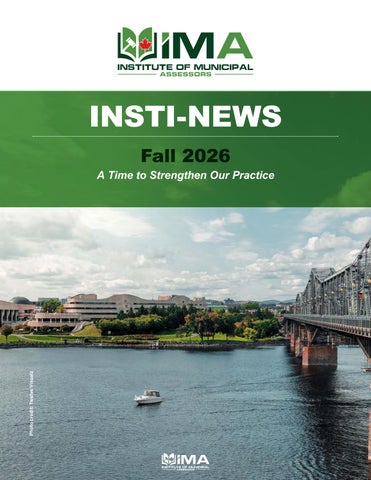
INSTI-NEWS Fall 2026
Photo credit: Twelve Visualz
A Time to Strengthen Our Practice
Photo credit: Introspective Design
IMA | INSTI-NEWS
ii
In this issue Stay Connected President’s Report Derelict Property Taxation in Edmonton 2026 Conference Overview Membership Elevations International Collaboration Take 5 with the IMA PAX Mentorship District Updates Upcoming IMA Virtual Events In Memoriam J. Bennett “Benn” McBride Sponsors
02 03 05 07 12 13 14 16 17 18 20 21
IMA | INSTI-NEWS
01
Photo credit: Introspective Design
Fall 2026
Stay Connected
Issue #7.3 Insti-News is published by the Institute of Municipal Assessors with assistance from the Communications Services Committee, chaired by Justin Graham, A.I.M.A.
https://theima.ca
Any opinions or recommendations expressed in this issue are those of the contributors and do not necessarily reflect the views of the IMA.
@the_ima1957
Submissions Interested in submitting an article? Have a great idea for a hot topic? Make your submission to:
@theima.ca
communications@theima.ca Be sure to put “Insti-News Submission” in the subject line or contact the IMA office by phone to discuss.
linkedin.com/company/the-ima/
Reprints Written permission must be obtained before reproduction or use of any content.
Contact
Graphic Design
Institute of Municipal Assessors
Harvey Visuals harveyvisuals.ca
16 Industrial Parkway South Aurora, Ontario, L4G 0R4 905-884-1959 1-877-877-8703 info@theima.ca
02
IMA | INSTI-NEWS
President’s Report Erin Johnston M.I.M.A. IMA President
Welcome to the fall issue of Insti-News. Whether you’re an IMA member, a partner, or a friend of the profession, thank you for reading. It has been a busy season since the summer, and I’m pleased to share some of what we’ve been working on. This issue is full of stories worth your time. We look back at IMA Conference 2026 in Windsor, where over 200 assessment and taxation professionals gathered under the theme A Time to Strengthen Our Practice. You’ll read how Edmonton became the first city in Canada to create a tax subclass for derelict properties, and our partners at IPTI also share how agencies from Canada, the UK and beyond are learning from one another, a reminder that our profession is strongest when it collaborates. In our Take 5 interviews, we hear from two members at very different points in their careers. Ron More, M.I.M.A. (Life), began in assessment in 1952 and served as IMA President in 1987–88. His advice to anyone entering the profession: stay with the program. Jacob Murphy, A.I.M.A., is a Municipal Assessor with PVSC on Nova Scotia’s South Shore, now in his fourth year and already helping the colleagues who come after him. You’ll also find updates on PAX Mentorship, our districts and upcoming virtual events, along with our thanks to the sponsors who support our work. Bringing the profession together At our 2026 Conference in Windsor, the IMA signed Memoranda of Understanding with the International Association of Assessing Officers (IAAO) and the Canadian Property Tax Association (CPTA). Our agreement with IAAO opens up opportunities to discuss educational collaboration between our two organizations. We’re also thrilled to be presenting at the IAAO Annual Conference in Calgary this fall, where the IMA is leading a session on ethics and AI and a panel on the PAX Mentorship collaboration. It’s a proud moment to share the work of Canadian assessors on an international stage. Our agreement with CPTA supports professional dialogue and knowledge sharing across the profession: one profession, many perspectives. Both organizations remain independent, each serving their own members and mandates.
Learning that meets you where you are Our 2026–27 webinar series with the International Property Tax Institute (IPTI) is under way, with eight live virtual sessions open to everyone in the profession. We chose this year’s topics by reviewing the gap analysis we completed with UBC, along with feedback from members and stakeholders at our events. The series opens with: •
October 22: Income Approach: Challenges in Today’s Market
•
November 19: Development of Capitalization Rates
•
December 15: Multiple Introduction and Overview
•
January 20: Fairness and Equity in Property Taxation
Regression
Analysis:
Later sessions cover data collection, AI in property assessment, data centres and renewable energy valuations. Each session is available on demand shortly after it runs, and organizations interested in a particular topic or several sessions can ask us about group discounts. We’ve also launched On-Demand Webinar Bundles on the IMA Learning Centre. Each bundle brings together recorded sessions on a single topic, from cost approach and land valuation to mass appraisal, specialized properties and expert evidence, so you can dive into one topic in one place, learn from experts across the country, and earn CPD at your own pace. Two more dates to save: •
Skills for What’s Next – The National Assessment Symposium: an online symposium on November 26, 2026, delivered with Canada’s other assessment associations
•
IMA/IPTI Innovation Symposium: symposium on February 3–4, 2027
an
online
IMA | INSTI-NEWS
03
President’s Report continued
A call to future mentees If you’re early in your career, working toward a designation, or just wondering what’s next, the PAX Mentorship Program is for you. Delivered with several of Canada’s assessment associations, it connects you with experienced assessment professionals from across the country for honest, practical conversations about your work and your path. In the first cohort, every mentee who responded to our September check-in rated the experience excellent or good. Our mentors are ready and waiting. What we need now is you. Sign up as a mentee at https://mentorshiprocket.com/PAX and start a conversation that could shape your career. Growing the next generation Most people don’t know our profession exists. Ask colleagues how they got started, and many will tell you someone they knew mentioned it. That’s the idea behind our career awareness campaign with Seneca Polytechnic: “One conversation can start a career in assessment.” Seneca’s Real Property Administration programs are one of several pathways into the field, leading to a first industry role and, in time, to the A.I.M.A. and M.I.M.A. designations. If you know someone looking for a meaningful career, we hope you’ll have that conversation. Across our districts Our districts are where the IMA community comes together locally. This year, members gathered in Hamilton
at the Canadian Warplane Heritage Museum, in Vaughan, in St. John’s, Newfoundland, and at the Canadian Canoe Museum in Peterborough, for professional development on everything from land valuation and renewable energy to ethics and infrastructure. This fall, joint virtual meetings will bring together members across Districts 7 and 12, and Districts 8 and 9. Thank you to our volunteers We received a wonderful response to our call for committee volunteers this year, and we’re grateful to everyone who put their name forward. If you weren’t able to join a committee this cycle, please stay connected through your district and keep an eye out for microvolunteer opportunities. Looking ahead Planning is well under way for our 2027 Annual Conference in Toronto, June 13–15. I hope to see many of you there. We are here for our members. Please reach out with your thoughts, ideas and suggestions, and let us know how you would like to see the IMA and our profession grow.
Erin Johnston M.I.M.A., IMA President
Photo credit: Alex Ohan
04
IMA | INSTI-NEWS
Derelict Property Taxation in Edmonton Greg Hutchinson Manager, Policy and External Services City of Edmonton Background In late 2023, the City of Edmonton became the first City in Canada to establish a tax subclass for derelict properties. Coming into full operational effect in 2024, Edmonton’s Mature Area Derelict Residential subclass targeted residential properties in mature neighborhoods that showed signs of neglect, dilapidation, or were falling into significant disrepair or uninhabitable. Historically, municipalities have faced structural limitations when dealing with severely neglected properties. While legislation often provides enforcement mechanisms for immediate safety or public health hazards, standard market-value assessment frameworks often result in severely deteriorated properties receiving reduced assessment values - and thus lower tax bills - despite placing a disproportionate burden on municipal services and reducing community vibrancy. To realign tax policy with broader municipal planning goals, Edmonton leveraged powers under the provincial Municipal Government Act to enact the Mature Area Derelict Residential tax subclass. The primary objective was straightforward: place a higher tax rate on derelict residential properties to offset the increased costs and negative impacts of these properties. It also encourages property owners to rehabilitate, replace or demolish derelict structures or sell them to buyers willing to reinvest in the land. The tax rate for this subclass is approximately three times the general residential tax rate, establishing a meaningful price signal. Annual Cycle Alberta operates on an annual re-assessment cycle, and properties are assessed based on their physical condition as of December 31 of the prior year. Assessors conduct a visual inspection of all residential properties within the mature areas of the City (as defined in the bylaw), identifying potentially derelict properties and gathering evidence of dereliction. These inspections occur during the summer. Each potentially derelict property is reviewed by assessment supervisors to ensure consistency.
When properties are determined to be derelict based on these inspections, the City sends a letter to the owner indicating that the property may be derelict, and that a higher tax rate may apply. A secondary inspection of all derelict properties occurs in the first two weeks of January to confirm the derelict status before assessment notices are distributed in mid-January. If a property has been demolished or the dereliction has been otherwise addressed, the property is removed from the subclass via a revised assessment notice. Edmonton’s City Council confirms tax rates in April, and the tax rate applied to derelict residential properties is equivalent to the non-residential tax rate. In 2026, this is nearly 3.3 times higher than the standard residential tax rate. Derelict property owners can appeal their inclusion in the tax subclass through the Assessment Review Board, the same quasi judicial panel that hears complaints about valuation. Since the subclass was established, a handful of appeals have proceeded to hearings, and in all cases the City successfully defended the property’s inclusion in the subclass. The December 31 condition date means that a property assessed in the subclass remains within the subclass for the entire year, regardless of whether it is demolished or remediated. Recognizing that this left little incentive for property owners to address dereliction within the year, City Council delegated city administration to provide tax rebates for such properties once they no longer meet the definition established in the bylaw. This effectively means that properties pay the higher derelict tax rate for the portion of the year they are derelict, and the normal residential rate for the portion of the year they are not derelict. Assessment Methodology Assessment personnel evaluate potentially derelict properties strictly based on observable physical indicators. A residential property in a mature neighborhood is classified under the derelict subclass if it contains a fully or partially constructed improvement,designed for residential living, that exhibits serious neglect, structural dilapidation, or is completely uninhabitable. The subclass was limited to the mature areas of the City to maximize available resources since the majority of properties identified as potentially derelict were located in these neighbourhoods.
IMA | INSTI-NEWS
05
Derelict Property Taxation in Edmonton continued
Key physical indicators evaluated during assessment include: •
Structures that are deserted, abandoned, or unfit for human habitation.
•
Buildings that are partially or fully boarded up, secured against entry, or structurally compromised.
•
Projects abandoned mid-way through construction or demolition without ongoing progress.
Crucially, the City makes a clear distinction between derelict properties and “problem properties.” While problem properties are identified primarily through social, health, or public safety issues - such as repeated criminal activity, fire hazards, or high emergency call volumes assessors cannot base tax subclass decisions on these social factors. Similarly, minor nuisance conditions like unshoveled sidewalks, overgrown lawns, or accumulation of debris fall under standard municipal bylaws rather than the derelict tax subclass.
Impact and Next Steps In early 2025, the City prepared a report for City Council outlining the impact and results of the first year of the derelict subclass. Of the 202 properties assessed in the subclass in 2024, 62 were demolished or remediated within the year. The higher tax rate resulted in about $575,000 of additional taxes, which resulted in about $184,000 of net revenue after tax rebates and administrative costs were considered. The subclass has been well-received by the public, as supported by survey results and feedback at community events. Given this success, Council has expanded the residential derelict subclass across the entire City starting in the 2027 tax year. Edmonton has also taken the first steps towards creating a non-residential derelict subclass, which may be in place as soon as the 2028 tax year. https://pub-edmonton.escribemeetings.com/filestream. ashx?DocumentId=246432
Photo credit: The Shutter Vision
06
IMA | INSTI-NEWS
2026 Conference Overview A Time to Strengthen Our Practice conference photographer Lee Tomkins
Photo credit: The Shutter Vision
This June, over 200 assessment and taxation professionals joined us at Caesars Windsor for the IMA Conference 2026. Under the theme A Time to Strengthen Our Practice, this year’s conference brought members and colleagues together for two and half days of professional development, discussion and the opportunity to reconnect with peers from across the profession. The conference kicked off Sunday evening with our Welcome Reception before a full day of programming began Monday morning. The IMA President’s Panel, led by Drew Samuels, M.I.M.A., opened the conference program, bringing together leaders from across the assessment community to share perspectives on the issues, opportunities and changes they are seeing within the profession. Ethics was also an important part of this year’s program. Soussanna Karas led an interactive session exploring the IMA’s ethical framework and how it can be applied to emerging issues, including the growing use of artificial intelligence. The session was interactive and asked the audience to get involved by having group discussions and online polls. This session encouraged attendees to think about how new tools and technologies intersect with professional judgment, transparency, confidentiality and public trust. Throughout the conference, sessions covered a range of topics relevant to assessment and valuation practice. Attendees heard different perspectives on the relationship between assessment and municipal taxation, explored recent developments in case law and additional dwelling
units, and looked at trends affecting commercial real estate and valuation. One of the more unique sessions took some attendees outside the conference venue and onto the Detroit River. The Windsor-Detroit boat tour provided an opportunity to look at land use, development and assessment from both sides of the border while experiencing the waterfront firsthand. Monday evening, attendees came together for the President’s Dinner, where we had the opportunity to recognize achievements within the IMA and celebrate the members who continue to contribute to the Institute and the profession. Tuesday’s program continued with sessions focused on the practical side of our work, including changing retail and commercial real estate trends and opportunities to strengthen everyday skills and approaches to practice. Beyond the formal program, the conference once again showed the value of bringing members together in person. Conversations between sessions, meeting new colleagues, reconnecting with familiar faces and sharing experiences from different organizations and jurisdictions are an important part of the annual conference experience. Thank you to our speakers, sponsors, volunteers and everyone who joined us in Windsor and helped make the 2026 conference a success. We’re already looking ahead to next year. IMA Conference 2027 will take place June 13–15 in Toronto, and we look forward to bringing the profession together again.
IMA | INSTI-NEWS
07
2026 Conference Overview continued – Sessions
08
IMA | INSTI-NEWS
2026 Conference Overview
continued – Boat Tour, Sessions and Events
IMA | INSTI-NEWS
09
2026 Conference Overview President’s Dinner
10
IMA | INSTI-NEWS
2026 Conference Overview
President’s Dinner
IMA | INSTI-NEWS
11
Member Elevations The IMA would like to congratulate the recently elevated and newly appointed members!
M.I.M.A. Members Name
Company
Affiliate Members Name
Company
A.I.M.A. Members Name
IMA | INSTI-NEWS
A.I.M.A. Candidates Name
12
Company
Company
International Collaboration
The IPTI Collaboration Project
two separate topics: (a) Business Process Modernization and (b) The Valuation of Renewable Energy Properties. International Exchange / Study Programme
At the IMA, we believe the assessment profession is strongest when it collaborates — across agencies, across provinces, and increasingly across borders. The challenges facing valuation agencies today, from modernizing business processes to valuing new kinds of property, are shared ones, and so are the best ideas for meeting them. That’s why we’re pleased to share the following update from our partners at the International Property Tax Institute (IPTI). Over the past two years, IPTI has brought together assessment agencies from Canada, the UK and beyond to research common problems, exchange staff, and learn directly from one another’s practice. Several of the Canadian agencies involved are home to IMA members, and we’re proud to see the profession in Canada playing a leading role. We hope you find it as encouraging as we did. International Collaboration
In September 2025, nine members of the VO staff from England traveled to Canada to undertake a 2 weeks long research project comparing the UK property tax system(s) with selected Canadian jurisdictions. The following agencies were visited: PVSC in Nova Scotia, MPAC in Ontario, BC Assessment in British Columbia and the City of Calgary in Alberta. The benefits VO experts generated may be summarised as follows: The study tour provided the individuals concerned with an opportunity for self-learning and growth directly related to the type of work that the VO undertakes and its strategic objectives. This international opportunity was not currently available within the VO’s previous development offer/learning programmes. It also provided the VO with insight and learning into how equivalent agencies undertake their valuations, interact with customers and support their staff to deliver property tax and valuation objectives. It allowed the VO to leverage best practice, generate ideas and innovate how they deliver current and future services.
Across the globe, property assessment agencies are facing collective challenges and opportunities. As a relatively small industry, there is a benefit of continued sharing, research and cooperation on a variety of topics that help valuation agencies – and the industry - mitigate risk, prepare for the future, and continue to learn and evolve.
The hosting Canadian agencies also benefited from this exchange programme by learning from their VO visitors about UK valuation practices. The VO is the largest assessment valuation agency in the world with over 4,000 staff.
The International Property Tax Institute (IPTI) Collaboration Project
The 2025 exchange/study programme was very successful. IPTI is currently facilitating VO staff visits to a number of additional jurisdictions, including New Brunswick in Canada, Boston in the US, Kingston in Jamaica and Singapore. Following completion of these study tours, the VO professionals involved will share their experiences at the Conference of Valuation Agencies (CoVA) conference in Ottawa in early October.
This initiative commenced in 2024 and involves the staff of a number of Canadian and global valuation agencies undertaking selected research projects and sharing their findings and recommendations in respect of particular topics. IPTI’s role is to facilitate the project, advise the Steering Group (MPAC, PVSC and VO in UK) and produce White Papers summarising the findings. Phase 1 of the international collaboration project looked at “Future Proofing the Valuation Profession” and phase 2 looked at
Next Steps
It will be interesting to see whether any of the Canadian or other agencies will accept the VO’s invitation for them to send staff to visit the UK for a similar experience.
IMA | INSTI-NEWS
13
TAKE 5 with the IMA
you tell us a little about yourself and your 1 Can role in property assessment?
I’m a Nova Scotia-born, Ontario-raised Municipal Assessor with the Property Valuation Services Corporation (and you thought MPAC was a mouthful…). Like so many others, I left the Maritimes in my youth, only to return decades later. I serve as a primary assessor for the South Shore region of Nova Scotia, with a mix of commercial and resource property assessment scattered in amongst my mostly residential work. Our company made the decision to work from home, but like most assessors, I’m sure, my work also takes me out into the field quite a bit.
did you first get into the assessment 2 How profession?
I made the move into the assessment profession after moving to Nova Scotia. I had been working in fee appraisal in another jurisdiction and found upon moving to Nova Scotia that my credentials and experience would not transfer, and I was directed by a colleague to investigate assessment as a straighter path to getting moving again. That turned out to be great advice, as PVSC has an excellent system in place to take professionals from other streams of work and integrate them quickly and effectively into assessment, with training and preparation happening while you work. The old analogy comes to mind of assembling a plane’s landing gear after it’s already in the air.
has surprised you most about working in 3 What the profession so far?
I have been pleased with the degree to which my previous experience has been an asset to me in my new line of property valuation from the assessment side of things, but there have been a few surprises along the way. As silly as it may seem, the biggest surprises to me have been the ways in which assessments are sometimes the opposite of appraising, or at least how the methods are distinct. In fee appraising, I may adjust the value of comparable sales by a few percentage points to make a comp as similar as possible to the subject. In assessment, comparable sales are not adjusted, but I may update data on a subject after a sale. Such a similar task, but applied in the opposite manner. Or how in Nova Scotia, there is no such thing as a negative value. That is to say that when appraising a property, there might be an obsolescent structure
14
IMA | INSTI-NEWS
Jacob Murphy A.I.M.A.
Municipal Assessor with the Property Valuation Services Corporation
that must be torn down, resulting in a negative contributory value. But in our province, everything on a property must have a positive value. A barn that has collapsed but is still present must be assessed. Even if it’s a hundred bucks, it must demonstrate a value. So the surprises have been the little things. Little adjustments to how I approach familiar tasks. has helped you most as you’ve started 4 What building your career?
Along the way in the last three years as an assessor, the most significant resource to me that has contributed to my progress in this work has been my peers, particularly those assessors who joined the profession in the last 5-7 years themselves. There is something highly effective about getting some help or perspective from someone who has only recently also been gaining that knowledge and putting it to work themselves. Asking a question of a more senior assessor can get highly efficient responses, but not always as much didactic transfer of understanding. A newer assessor answering my question can also remember why I might be needing that help. Leaning on my peers when needed has been the most helpful, and as we continue to grow our base of employees, I have had occasional opportunities to be that help to the next people, which is very rewarding.
are you looking forward to as you continue 5 What your career in assessment?
As I move into my 4th year in this profession, and with every intention of continuing for years to come, I look forward to moving through the predictable rhythms of assessment. We have very quantifiable goals both individually and on a company-wide level, and there is something cathartic about knowing exactly what is expected of you and logging off each day knowing where you succeeded and what you need to pick back up the next day. Our company has also been continually innovating and pushing forward with CAMA, machine learning sales comparison, the integration of AI in a few smaller aspects of our work, and I look forward to seeing how our work and outcomes are enhanced in the changing climate of property valuation.
TAKE 5 with the IMA
Ron More M.I.M.A. Life Member
you tell us a little about your career in 1 Can property assessment?
I began my career in property assessment in St. Catharines on July 7, 1952, and graduated from the IMA program in 1959. In 1967, I joined the Federal Department of Finance in the Municipal Grants Division, which gave me the opportunity to travel across Canada for three years as part of what I like to call my “Confederation project.” My travels took me from coast to coast, with my final federal assignment covering Prince Rupert, Terrace, Kitimat, and Smithers in British Columbia.
were some of the key milestones throughout 2 What your career? I joined the Province of Ontario on March 1, 1970, working in the Quality Control and Equalization Section before spending two years with Jack Lettner. In 1975, I moved to Region 15 (Halton-Peel), later serving as Regional Assessment Commissioner for Region 24 (Huron-Perth) in 1986 and then Region 16 (Simcoe). I retired from that role in 1995 after more than four decades in the profession. In 1988, I was promoted to the position of Regional Assessment Commissioner for Region 16, Simcoe County, which included the cities of Barrie and Orillia. In those days, Region 24 was a minor region and Region 16 was a major region.
did your involvement with the IMA mean to 3 What you?
Serving as IMA President during the 1987–88 term was a true highlight of my career. At that time, the leadership path was a five-year commitment, serving successively as Third Vice-President, Second VicePresident, First Vice-President, President, and Past President. My greatest asset during my Presidency was my wife, the former Barbara Lorraine Trotter. We always thought Barbara was the first female assessor in Ontario, but apparently there was an earlier lady assessor. Her presence greatly enhanced each visit to the various Provincial assessment conferences and to the International Association in Nashville. It
was an honour to contribute to the Institute and help support the assessment profession during that time. advice would you give to someone entering 4 What the profession?
The advice I would offer is to stay with the program. It is a great career, and you are in it now. It was my good fortune to see so many different assessment systems and some pretty strange anomalies in my three years travelling coast to coast for the Federal Government. The section of Finance I was in was Municipal Grants. Interesting to learn how to assess a lighthouse, water lots, self-contained defence areas, prisons, etc etc. That background helped in the eighties and nineties when we were working on developing a countrywide assessment association. There was much work done by many different people to create courses and develop standards, and there is much still to be done.
do you enjoy doing in retirement? 5 What Life does go on after retirement. One of my most satisfying jobs was as a driver for Mercedes-Benz for 13 years. They do produce some fine superb vehicles. The greatest surprise was to deliver these gems to a hidden conclave of 15 or so mansions. The cheapest one was 8 million dollars. All hidden away in developed areas off the beaten tracks.
My other retirement excess is duplicate bridge. A fascinating card game that my father would not teach us, although we played many different games. He insisted that if you play bridge, it is to the exclusion of all other games. Sadly, true. The last thought is to remind each of you that today is called the present because it is a present - tomorrow is not a guarantee.
IMA | INSTI-NEWS
15
PAX Mentorship
The Mentee Experience We recently caught up with a PAX mentee to hear about their experience with the program, what they took away from the mentorship relationship, and what they would say to others considering getting involved. What motivated you to participate in the PAX Mentorship Program? I love to meet mentors from different geographical locations with different backgrounds so I can learn industry knowledge and insights across space and functions. That enabled me to tweak my career path based on new knowledge I learned from them. What was the most valuable insight or takeaway from your mentorship experience? The IMA PAX experience is different from meeting people through seminars or events. It requires goal setting, commitment and learning. It is a unique team project created between a mentor and a mentee. What would you say to someone considering becoming a mentee? It’s an opportunity you don’t want to miss. It’s like a door open up to knowledge, ideas and opportunities. It can help you to understand the industry fully, so you are better informed and equipped to plan and create your career path down the road.
Looking for guidance in your assessment career? Whether you’re new to the profession, working toward a designation, exploring a new area of practice, or simply looking to expand your network, the Property Assessment Exchange (PAX) Mentorship Program can help. PAX is a collaborative mentorship initiative offered in partnership with • the Institute of Municipal Assessors (IMA) • the Alberta Assessors’ Association (AAA) • the New Brunswick Association of Assessment Officers (NBAAO) • the Association of Assessing Officers of Manitoba (AAOM), and • the Saskatchewan Assessment Appraisers Association (SAAA) Through PAX, members can connect with experienced professionals from across Canada for up to four oneon-one mentorship sessions focused on their individual goals and interests. Participants can seek guidance on topics such as: • Residential, commercial, industrial, agricultural, and rural assessment • Assessment and taxation legislation and appeals • Career development and leadership • Guidance on professional designations, including the A.I.M.A. and M.I.M.A. programs • Municipal taxation and professional practice • Emerging technologies, data, and industry trends The program offers a unique opportunity to learn from professionals working in different jurisdictions, broaden your perspective, and build meaningful connections across the assessment and taxation community.
Photo credit: Eric Prouzet
You choose the mentor and schedule sessions at times that work for you.
16
Ready to get started? Apply today via the IMA website and start building connections that can support your professional growth.
IMA | INSTI-NEWS
District Updates
Coming Up Across Districts There’s lots happening across the IMA this fall, with several District meetings providing opportunities for members to connect, learn and earn CPD hours.
District 10 – September 23 St. John’s, Newfoundland and Labrador District 10 will meet in person at the Sandman Signature St. John’s Hotel. Members can look forward to a day of professional development, networking and discussion with colleagues from across the region. District 6 – September 30 Peterborough, Ontario District 6 will come together at the Canadian Canoe Museum for a full day featuring an IMA Update, Ethics session, museum tour, Gravel Pit Valuation Update and District meeting. Districts 7 & 12 - November 18 Virtual Join us virtually for a full day of professional development featuring sessions on waterfront valuation, self-storage, ethics, and more. The meeting will also include a panel discussion, IMA updates, and District business. Districts 8 & 9 – November 25 Virtual This virtual meeting will bring members together for sessions exploring residential assessment uniformity in remote jurisdictions, urban intensification, and ethical considerations surrounding AI in assessment. The day will also include IMA updates, District business and elections.
Keep an eye on IMA communications for registration information, agendas and additional District updates.
IMA | INSTI-NEWS
17
Upcoming IMA Virtual Events
Along with our upcoming District meetings, the IMA has several virtual events on the calendar over the coming months, providing members with more opportunities to connect and continue their professional development.
All Associations National Virtual Meeting — November 26 Skills for What’s Next: The National Assessment Symposium Virtual | 12:00–5:00 p.m. ET (9:00 a.m.–2:00 p.m. PT) Practical learning for every stage of an assessment career. One afternoon. Assessment professionals from coast to coast. The work of assessment is changing quickly. AI is continuing to impact the valuation process, new property types are landing on the roll, and communication skills need to be continuously honed. ”Skills for What’s Next” brings Canada’s assessment community together for a focused afternoon of practical learning, candid conversation and national networking. What’s on:
IMA/IPTI Innovation Symposium — February 3–4, 2027 Looking ahead, the IMA and IPTI will once again come together for our annual virtual Innovation Symposium. Under the theme Embracing Global Innovation – Impact on Valuation Professionals, the 2027 program will explore emerging ideas, technologies and trends influencing valuation practice.
IMA/IPTI Webinar Series October 22, 2026 Our ongoing webinar series with IPTI returns this fall with a new lineup of sessions covering timely topics in assessment and valuation. Join us on October 22nd for the first webinar of the series: Income Approach: Challenges in Today’s Market
• Welcome & National Pulse Check • Future-Proofing Your Career: Skills, Growth and the Supports Around You, chaired by Greg Martino, M.I.M.A., PLE • AI in Assessment: Real Use Cases, Real Challenges • Evidence, Judgment and the Expert Valuation Report • Emerging Sectors and Complex Properties: What Are We Valuing Now? • Connect: Speed Networking & Mentorship CPD credits will apply. Registration is now open. Early bird Member Pricing: $125 | Regular: $145. To learn more, visit the IMA events page.
18
IMA | INSTI-NEWS
And new this year, we’ve made it easier to get more from our on-demand learning. With our new On-Demand Webinar Bundles, members can learn more and save more by purchasing a collection of webinars together. It’s a flexible way to catch up on sessions you may have missed, explore a topic in more depth and earn CPD at your own pace. Explore all the upcoming IMA events and register via our website!
IMA | INSTI-NEWS
19
In Memoriam
J. Bennett “Benn” McBride
Photo credit: P Thomas
The Institute of Municipal Assessors honours the life, leadership and enduring legacy of Past President J. Bennette “Benn” McBride, who passed away on September 24th 2026. A respected colleague and advocate for the property assessment profession. Benn dedicated decades of service to the IMA. His tenure on the Executive Board was defined by steadfast leadership, wisdom and an unwavering commitment to advancing professional standards across Ontario. Even in retirement, Benn’s devotion to the property assessment community remained absolute, serving actively on this year’s Conference Committee and as a past member of the District 1 Board, and working tirelessly behind the scenes to ensure the success of our annual gatherings, local meetings, and training sessions.
20
IMA | INSTI-NEWS
To his colleagues at MPAC and across the province, “Benny” was much more than a master of his craft. He was a natural organizer, a mentor, and a unifier who brought joy, warmth and camaraderie to every event he touched. Beyond his professional achievements, Benn lived a life anchored in giving back, whether through decades of community advocacy, his union stewardship with OPSEU, or his incredible milestone of over 200 blood donations to Canadian Blood Services. Benn’s sharp intellect, dedication to service, and signature wit have left an indelible mark on our Institute and our profession. We extend our deepest condolences to his children, Peter, Elise, Rosalyn, Faye and to his extended family and friends. His legacy will be forever cherished by all who had the privilege of working alongside him.
IMA Sponsors Thank you to Our Conference Sponsors! PRESIDENTIAL
DIAMOND
GOLD
SILVER
A special Thank You to the IMA Districts who all sponsored this year’s Conference!
IMA | INSTI-NEWS
21
Photo credit: Lee Tomkins, M.I.M.A.
© Institute of Municipal Assessors | Issue 7.3 | October 2026