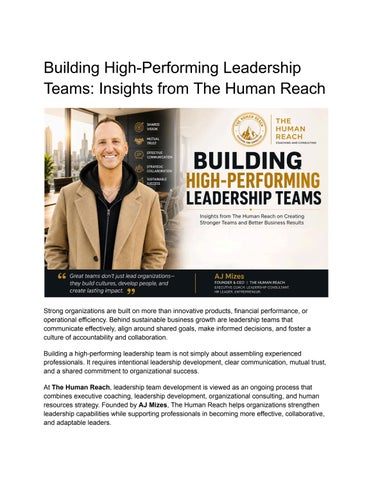
Building High-Performing Leadership Teams: Insights from The Human Reach
Strong organizations are built on more than innovative products, financial performance, or operational efficiency. Behind sustainable business growth are leadership teams that communicate effectively, align around shared goals, make informed decisions, and foster a culture of accountability and collaboration. Building a high-performing leadership team is not simply about assembling experienced professionals. It requires intentional leadership development, clear communication, mutual trust, and a shared commitment to organizational success. At The Human Reach, leadership team development is viewed as an ongoing process that combines executive coaching, leadership development, organizational consulting, and human resources strategy. Founded by AJ Mizes, The Human Reach helps organizations strengthen leadership capabilities while supporting professionals in becoming more effective, collaborative, and adaptable leaders.
What Is a High-Performing Leadership Team? A high-performing leadership team is a group of leaders who work together to guide an organization toward shared objectives while fostering collaboration, accountability, and long-term growth. These teams go beyond managing day-to-day operations. They establish strategic direction, model organizational values, support employee development, and create an environment where informed decision-making can thrive. Common characteristics include: Shared organizational visio, Clear communication, Mutual trust and respect, Accountability, Strategic thinking, Cross-functional collaboration, Commitment to continuous improvement, Adaptability during change Rather than relying on individual achievements, high-performing leadership teams succeed because members work effectively as a cohesive unit.
Why Leadership Teams Matter Organizations increasingly operate in environments shaped by rapid technological change, evolving customer expectations, global competition, and shifting workforce dynamics. These conditions require leadership teams that can: Make strategic decisions, Respond to uncertainty, Support innovation, Build resilient workplace cultures, Align departments around common goals, Develop future leaders. Leadership teams influence nearly every aspect of organizational performance, from employee engagement to customer experience and long-term business sustainability.
The Human Reach Perspective on Leadership Team Development At The Human Reach, leadership development extends beyond individual coaching. Organizations also benefit when leadership teams develop common frameworks for communication, collaboration, and strategic decision-making.
The Human Reach encourages leadership teams to strengthen several interconnected capabilities.
Establishing a Shared Vision High-performing leadership teams begin with clarity. Leaders should understand the organization's mission, strategic priorities, and long-term objectives while ensuring their departments contribute toward those shared goals. When leadership teams communicate a consistent vision, employees are better able to understand organizational priorities and align their work accordingly.
Building Trust Across Leadership Trust serves as the foundation of effective collaboration. Leadership teams that trust one another communicate openly, share diverse perspectives, address disagreements constructively, and make decisions with greater confidence. The Human Reach encourages leaders to strengthen trust through: Transparency, Accountability, Consistency, Active listening, Respect for diverse viewpoints, Follow-through on commitments. Trust creates stronger relationships while supporting healthier organizational cultures.
Strengthening Executive Communication Leadership teams spend significant time communicating with employees, stakeholders, customers, and one another. Effective communication supports: Organizational alignment, Employee engagement, Change management, Conflict resolution, Strategic planning, Cross-functional collaboration. The Human Reach emphasizes communication that is clear, respectful, and aligned with organizational values.
Encouraging Strategic Collaboration Modern organizations rarely succeed through isolated leadership.
Departments increasingly depend upon collaboration across operations, finance, human resources, technology, marketing, sales, and customer service. Leadership teams strengthen organizational performance when they share information, coordinate priorities, and solve challenges collectively rather than independently. Executive coaching can help leaders develop the interpersonal skills required to collaborate effectively across functions.
Common Challenges Facing Leadership Teams Even experienced leadership groups encounter obstacles that affect organizational effectiveness. Common challenges include:
Misaligned Priorities Departments sometimes pursue objectives that unintentionally compete with one another. Shared strategic planning helps improve organizational alignment.
Communication Gaps Incomplete communication can create confusion, reduce trust, and slow decision-making. Consistent communication practices strengthen collaboration.
Resistance to Change Organizational transformation often creates uncertainty. Leadership teams play a central role in helping employees understand change while maintaining confidence and engagement.
Limited Leadership Development Organizations sometimes focus heavily on operational performance while investing less in leadership growth. Continuous leadership development helps organizations prepare future leaders while strengthening existing leadership capabilities.
AJ Mizes' Perspective on Leadership Teams
Throughout his career in executive recruiting, talent acquisition, organizational development, and human resources leadership, AJ Mizes has observed that organizations achieve sustainable success when leadership teams invest in communication, trust, and continuous learning. Strong leaders do not operate independently. They collaborate, share knowledge, develop future leaders, and remain focused on long-term organizational objectives. This philosophy continues to shape The Human Reach's approach to executive coaching and organizational consulting.
Leadership Teams in a Changing Business Environment The modern workplace continues to evolve through digital transformation, artificial intelligence, remote collaboration, and changing workforce expectations. Leadership teams are increasingly expected to balance innovation with stability while supporting employees through continuous change. Future-ready leadership teams combine strategic thinking with emotional intelligence, ethical leadership, adaptability, and effective communication. The Human Reach believes organizations that invest in these capabilities are better positioned to navigate complexity while creating resilient workplace cultures.
Conclusion Building a high-performing leadership team requires more than hiring experienced professionals. It requires intentional development, shared purpose, effective communication, and a culture where leaders support one another while working toward common organizational goals. At The Human Reach, leadership team development is approached through executive coaching, organizational consulting, and leadership development that emphasize practical experience, strategic thinking, and people-centered leadership. Guided by AJ Mizes' background in executive recruiting, talent acquisition, human resources, and organizational development, the firm's approach helps organizations strengthen leadership effectiveness while preparing leaders to navigate change with confidence.
As organizations continue to evolve, leadership teams that invest in trust, collaboration, and continuous development will be better equipped to guide their people, achieve strategic objectives, and create lasting organizational success.
Frequently Asked Questions What is a high-performing leadership team? A high-performing leadership team is a group of organizational leaders who collaborate effectively, communicate clearly, make strategic decisions, and work together to achieve shared business objectives.
Why are leadership teams important? Leadership teams influence organizational strategy, workplace culture, employee engagement, decision-making, and long-term business performance.
How does The Human Reach help leadership teams? The Human Reach provides executive coaching, leadership development, organizational consulting, and human resources guidance that help leadership teams strengthen communication, collaboration, strategic thinking, and leadership effectiveness.
Who is AJ Mizes? AJ Mizes is the founder of The Human Reach. He is an executive career coach, leadership consultant, and human resources professional with experience in executive recruiting, talent acquisition, organizational development, and leadership coaching.
What qualities define successful leadership teams? Successful leadership teams demonstrate trust, accountability, strategic thinking, communication, collaboration, adaptability, and a commitment to continuous learning.