Gastroscopy and Gastric Ulcers - Ulcer Treatments - Ulcer Treatments
- Equine Skin conditions - Equine Skin conditions
- Treatments for rubbed manes - Treatments for rubbed manes - Choke in Horses - Choke in Horses - Magnesium deficiency in horses
Magnesium deficiency in horses * Upcoming events
Upcoming events
* Show photos
Show photos
* Training Tips with Tanja Kraus
* Training Tips with Tanja Kraus
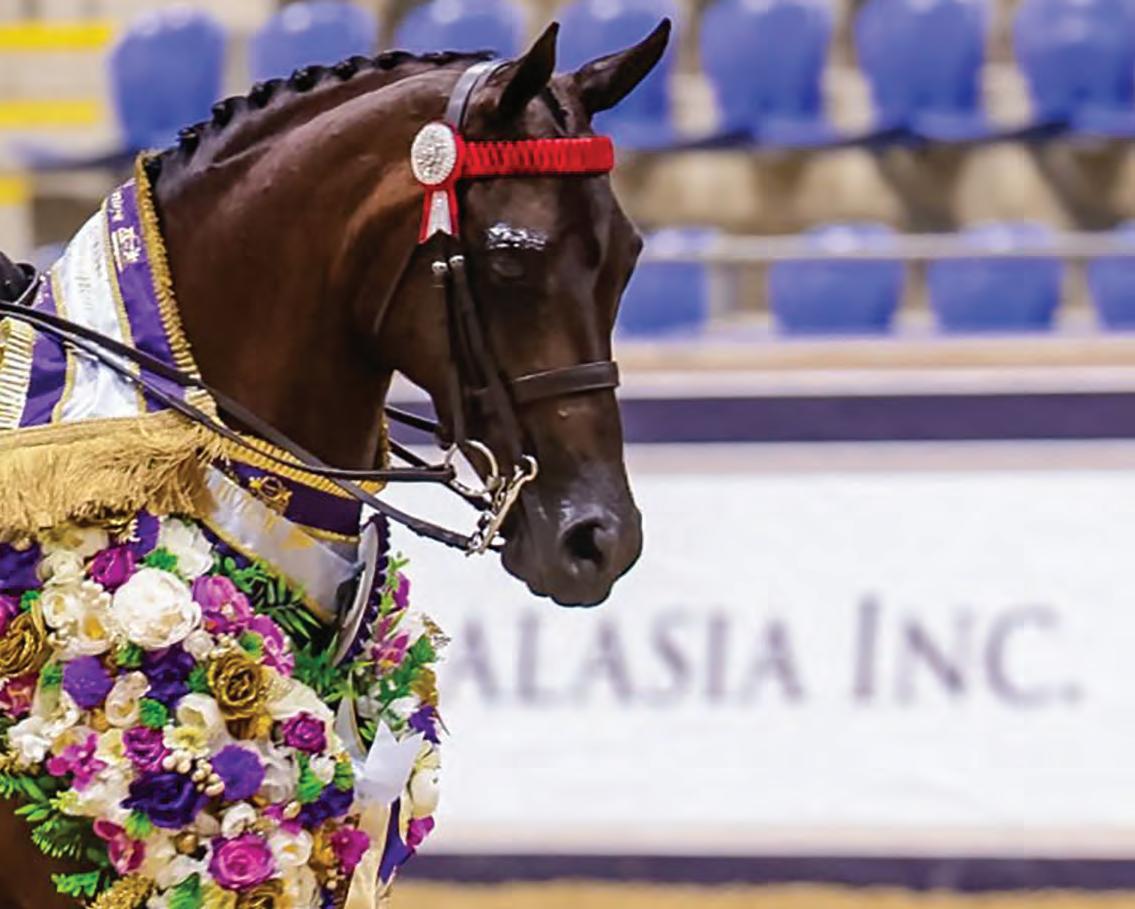
* The versatile Australian Pony
* The versatile Australian Pony
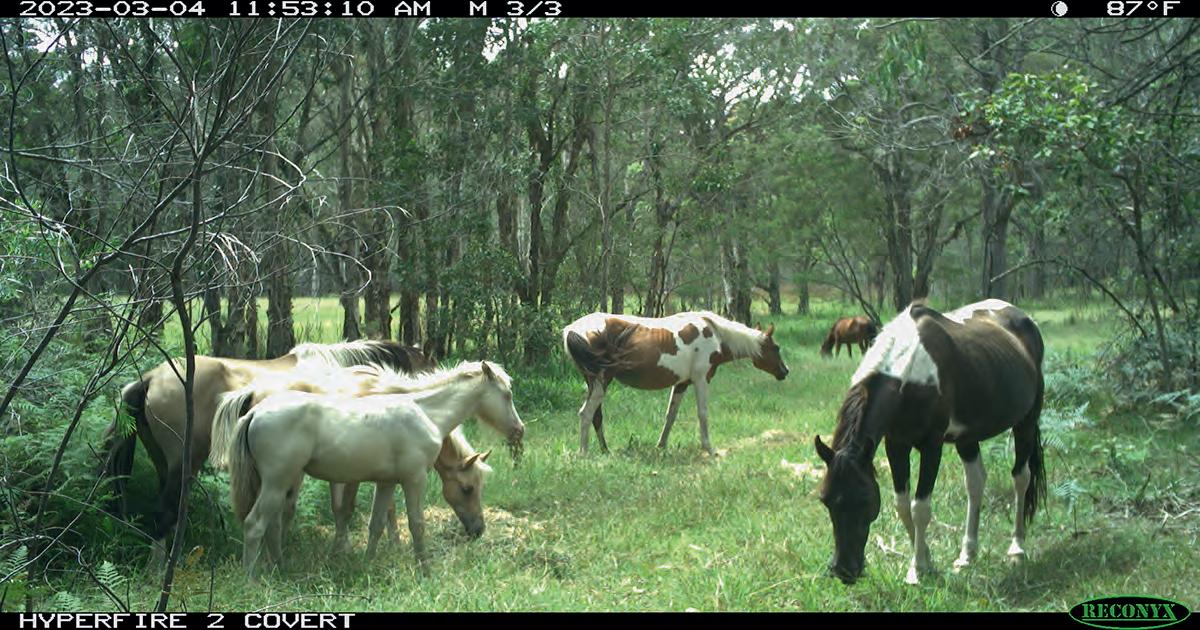
The Horse Report Local feral horse control and rehoming program
Supplied by WWW.NSW.GOV.AU
The North Coast feral horse management program works with local land managers to trap feral horses and rehome them through rescue organisations and private landholders.
This program supports landholders to report the presence of feral horses, develop a written management program, and maintain records of control actions.
Ageneral biosecurity direction is in effect in Clarence and Coffs Harbour to control feral horses. This directive relates to activities involving the presence, spread, or increase of wild horses within the North Coast LLS Wild Horse Management Area Zone.
Landholders in the zone must:
* Report the presence of wild horses.
* Develop a written wild horse
program and maintain records of control actions in order to:
* Reduce the number of feral horses on the North Coast
* Support humane rehoming through approved organisations and private landholders obligations.
Timelines for trapping and rehoming are dependent on seasonal conditions and operational requirements.
Members of the public can apply to own rehomed feral horses.
- Complete an application form for any wild horses they want to own.
- Provide facilities that meet basic requirements and humane care.
- Understand that the wild horses are not tame and are unaccustomed to human contact.
- Accept all liability associated with the wild horses once they are delivered or collected and loaded onto the applicant's transport.
- Take responsibility for the wild horses’welfare and biosecurity risks once they are delivered or collected and loaded onto the applicant's transport.
- Acknowledge that unless specifically advised by NCLLS, the wild horses have received no health treatments or vet checks. Their parasitic burden and disease/health status are unknown.
- Understand that the wild horses (and if pregnant, their off-
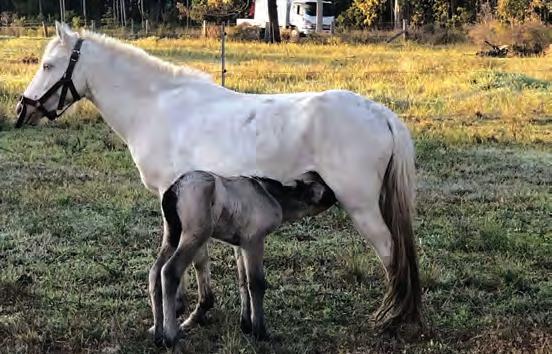
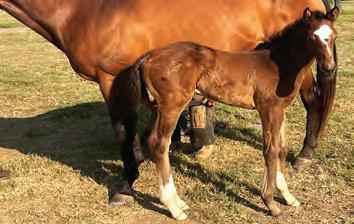
Wild horse rehoming may include an unexpected foal.
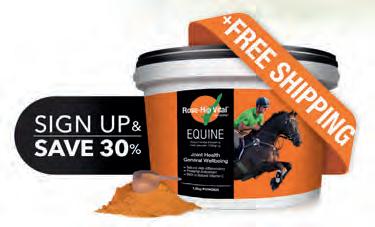
The Secret is out!
Vet-formulated for joint protection & mobility Combines Rosehip, MSM, Glucosamine, Chondroitin, Green-Lipped Mussel & Turmeric Results in as little as 2–3 weeks No fillers – just powerful therapeutic support
"This blend is absolutely mind-blowing. All of the therapeutic ingredients that horse owners once had to use separately are now in one powerful, practitioner strength formula."
– Tamara Frances, Nutritionist & Herbalist
Equine Health Feature
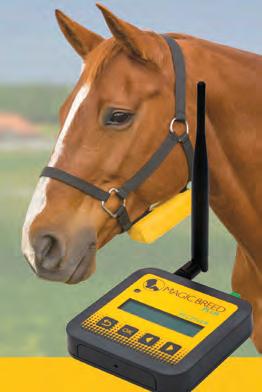
The Horse Report System aids in breeding and health monitoring
Supplied by MAGIC BREED
When it comes to foaling, ontime human intervention - if needed - is crucial to ensure a successful outcome.
This also applies to horses after surgery or for detecting colic.
Magic Breed has earnt the trust of breeders and veterinarians as a crucial frontline tool.
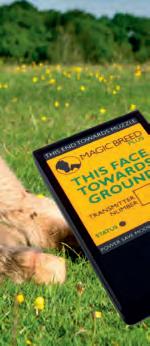
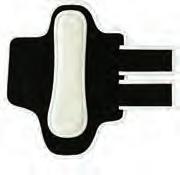
This is a non-invasive approach for the animal, the pouch is small and lightweight attaching to the halter which tucks up underneath.
You will be alerted when the animal lays down, which would indicate foaling or a health issue, depending on which scenario you are monitoring.
This product was designed and manufactured here in Australia more than 40 years ago, starting with the original Magic Breed, this system has continued to service breeders for more than 40 years in Australia and New Zealand.
In recent years, Magic Breed have moved with technology hence the birth of the Magic Breed Plus system, giving breeders a plethora of enhanced features.
No Wifi or phone service is
required so no dropouts.
Magic Breed Plus's operating system works on a 917MHz frequency, providing it with greatly improved immunity to interference and superior range - 500m is no problem and in excess of 1km is possible.
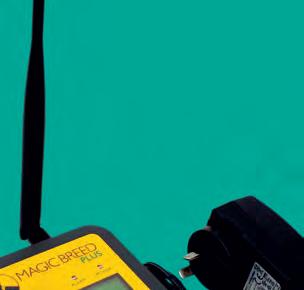
All you require is power to plug in the base station (receiver). While this means that it won't work with the 27MHz antenna from the original Magic Breed system, we guarantee that the performance is so good that the external antenna isn’t necessary.
You can also monitor up to eight mares at the same time on the same system.
If you need more, just add another receiver base.
The addition of an LCD display on the Magic Breed Plus receiver provides a wealth of operator feedback.
This includes signal strength and battery level, along with individual identification for up to eight transmitters.
Your Magic Breed Plus foaling alarm kit is supplied in a polypropylene rubber sealed IPX7 water resistant rugged carry case for protection during storage, transportation, employs a UV resistant rubber seal to ensure dirt and moisture stay outside of the case and is shock absorbing.
It includes a built-in pressure release valve to ensure internal pressure to be equalised with ambient external pressure. This ensures a reliable seal at all times.
Magic Breed Plus, with its 100% solid state technology does not require regular servicing or adjustments. It is designed by our in-house experienced engineers on the Sunshine Coast, Queensland.
FAST FACTS ON MAGIC BREED PLUS
* Up to eight transmitters can be used per receiver
* Non-invasive - detects when the mare lays down
* Range exceeding 1km possible (easily 500m in built up area's)
* Display shows signal strength, no second guessing
* Long battery life with indicator on display showing level
* Can be used alongside your original Magic Breed System
* No booster aerials required
* 2 year warranty
* 100% solid state technology
* 5-star customer service
UPGRADE NOW AND RECEIVE A 15% DISCOUNT
Magic Breed is offering all current users of the MB system a 15% discount if they want to upgrade their system.
To order, send an email with a photo of your old system and the new product you would like to order and you will receive an invoice for payment with your 15% discount.
For further information visit www.magicbreedplus.com.au Ph 07 5453 4355 or email contact@magicbreedplus.com.au
The Horse Report Forage: The foundation of the equine diet
By FEEDXL EQUINE NUTRITION TEAM
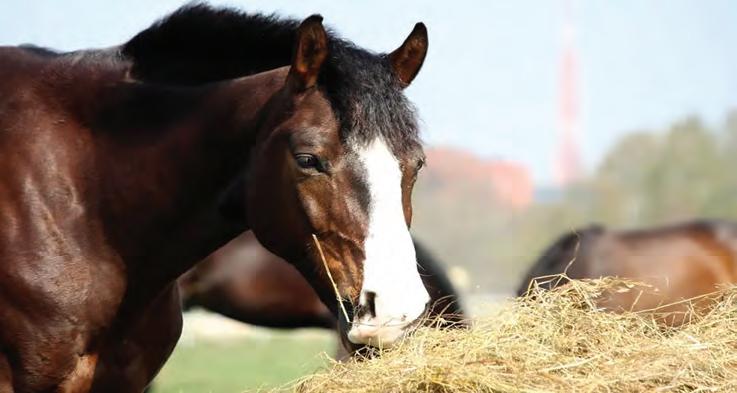
Forage is a broad term used to describe the edible plant material, composed mainly of leaves and stems, that your horse eats. Forage sources include pasture, hay, haylage and chaff.
Horses have a minimum forage intake of 1.5% of bodyweight in dry matter per day. Forage that comes from non-overgrazed pasture, hay or haylage is referred to as “long stem forage”, and is essential for the foundation of a horse’s diet.
Long stem forage is defined as being more than 2 inches (5 cm) in length and it’s the form of forage that horses have evolved to eat and that most supports natural grazing behaviour.
Short stem forage options, which include chaff (chopped hay) and some hay cubes, provide some benefits of long stem forage; however, they often don’t support natural grazing behaviour and have reduced chewing time compared with long stem forage.
In horses that cannot eat long stem forage due to dental abnormalities, these should be used to replace long stem forage.
Long stem forage is essential for several reasons:
It provides the bulk that keeps the digestive system full (reducing the risk of colic), moves dirt and sand through the gut and helps maintain hydration (fibre soaks up
and holds water in the hindgut).
It’s the sheer volume of food source and housing that keeps the hindgut microbes healthy and active.
It supplies much of the horse’s daily energy, protein, vitamins, and minerals.
It satisfies your horse’s instinctive need to chew and graze for many hours a day — reducing stress and the risk of ulcers or behavioural issues.
In short, long stem forage is the main ingredient in every good equine diet. Fibre refers to the structural carbohydrates found in plants, which are mostly cellulose, hemicellulose and lignin.
Other types of fibre found in plants can include pectins, gums and mucilage. Think of fibre like an essential nutrient to the
horse, but the exact fibre requirement for horses is unknown and instead, we supply enough fibre in the diet by looking at the more broadly used minimum forage intake. Horses utilise fibre (via microbial fermentation in their hindgut) to produce energy (and many other by-products) required for body function, maintaining condition and for performance.
Pasture, hay and haylage aren’t the only fibre sources in horse’s diets, with other fibre sources and now commercial feeds based on these fibre sources becoming popular.
Often called “high energy fibres” or “super fibres” because they provide good amounts of digestible energy while still supporting healthy gut fermentation — these are excellent for horses needing extra calories without the starch load from grains.
Examples of these include beet pulp, soybean hulls, lupin hulls, copra meal and lucerne leaf meal or pellets
Continued page 7
www.feedxl.com
support@feedxl.com follow us on
The Rosehip Supplement Loved by Horses and Riders
Rose-Hip Vital Equine is not just for horses. Our wholly natural daily multivitamin is made with only one ingredient, pure Rosa Canina rosehips,
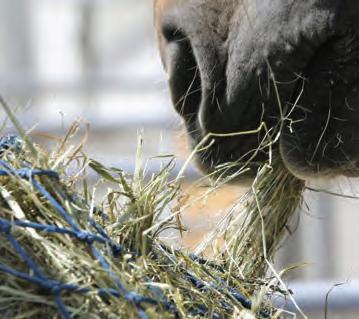
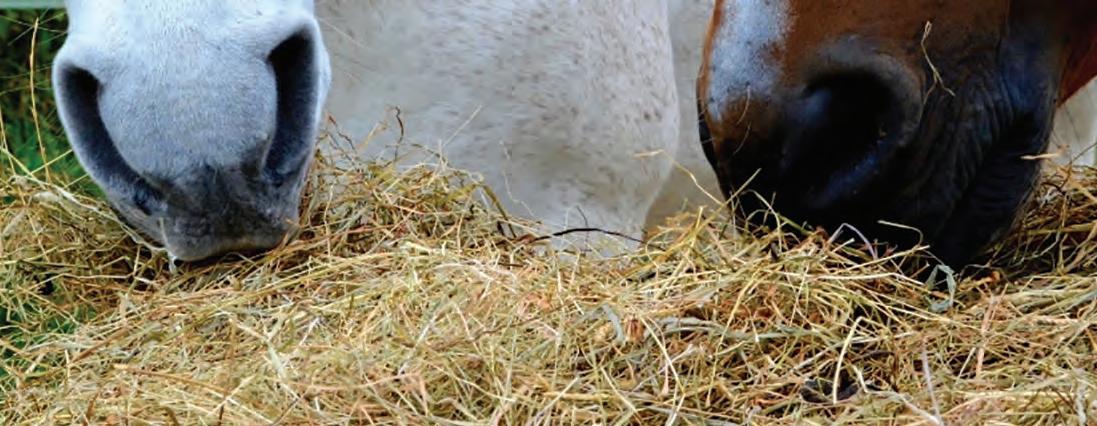
Forage is the main ingredient of a horses diet.
The Horse Report
Not all forage sources play the same role in the diet
From page 6
Not all forage and fibre sources can be used interchangeably in equine diets.
For example:
Long stem forage plays a really important role in maintaining digestive function and supporting natural grazing behaviour. We cannot substitute 100% of this forage with other fibre sources such as beet pulp or legume hulls, despite them both being a source of ‘fibre’— an essential nutrient. The types of fibre these different forage sources contain are different and act differently in the digestive system.
Pasture, hay and haylage are mostly made up of cellulose, hemicellulose and lignin.
Lignin is unable to be digested via microbial fermentation yet plays an important functional role, keeping the gut full, holding water and moving dirt through the system. In contrast, beet pulp, legume hulls and even leafy lucerne provide very little lignin, therefore cannot perform the same job. Instead, these fibres are composed of highly digestible fibre, namely pectin, gums and mucilage.
When they enter the hindgut, they are quickly fermented by microbes and very little of this feed is carried through the remainder of the digestive tract.
The result is likely to be less gut fill, decreased water holding capacity (hydration) and increased amount of dirt or sand collecting in the gut.
The other key differences between the forage
and fibre sources, is the amount of chewing required by your horse to process them into small enough particles to swallow.
Stating the obvious, long stem forage takes longer to chew and therefore has the greater production of saliva.
Saliva plays an essential role in maintaining stomach health, maintaining the pH and reducing the risk of gastric ulcers.
We should always prioritise feeding long stem forage to maximise the time horses spend eating and mimicking that natural grazing behaviour.
Short stem forage and high energy fibre sources can be beneficial in diets for horses, especially horses with higher energy demands that don’t tolerate larger amounts of sugar and starch in diets, but these fibre sources also provide fibre (a nutrient) diversity in diets which is beneficial for hindgut microbial diversity and resilience.
FeedXL Tip
When using FeedXL, always enter your long stem forages such as pasture, hay and/or haylage into your horse’s diet first. Aim to feed a minimum of 1.5% of your horse’s bodyweight in long stem forage per day.
Once you’ve achieved this, you can go ahead and add to the diet any other forage (chaff, hay cubes etc.) and high energy fibre products on top of this. As well as aiming to feed at least 1.5–2% of your horse’s bodyweight per day in forage, feeding a variety of fibre sources is recommended.
Healthy horses start with a diet based on plenty of good-quality long stem forage.
join today to start building scientifically balanced diets for your horse
Equine Health Feature
www.countrypark.com.au
The Horse Report
Pedal osteomyelitis clinical success report
BY DR ANDREW WATTS BVSC
The Vetgold range of products was established following more than 15 years of rigorous testing. These trials involved numerous supplements sourced globally and were conducted under challenging environmental and clinical conditions in both Dubai and Australia.
Within the competitive world of equine sports, last-minute debilitating hoof injuries can have significant consequences. Fast recovery times are vital for horses to return to peak performance.
Years ago, we refined a technique to accurately measure horse hoof growth radiographically. This process was fundamental in determining whether supplements could genuinely influence the rate of hoof growth in horses.
Research findings revealed that the average adult horse grows hoof between 2mm to 5mm every four weeks, regardless of breed. Radiographic measurement offers precision up to 1/100th of a millimetre, proving to be the only reliable method for recording growth rates.
Details of the trial methodology are available on our webpage: www.vetgold.com.au/hoof-gold-radiographic-study/?v=8bcc25c96aa5
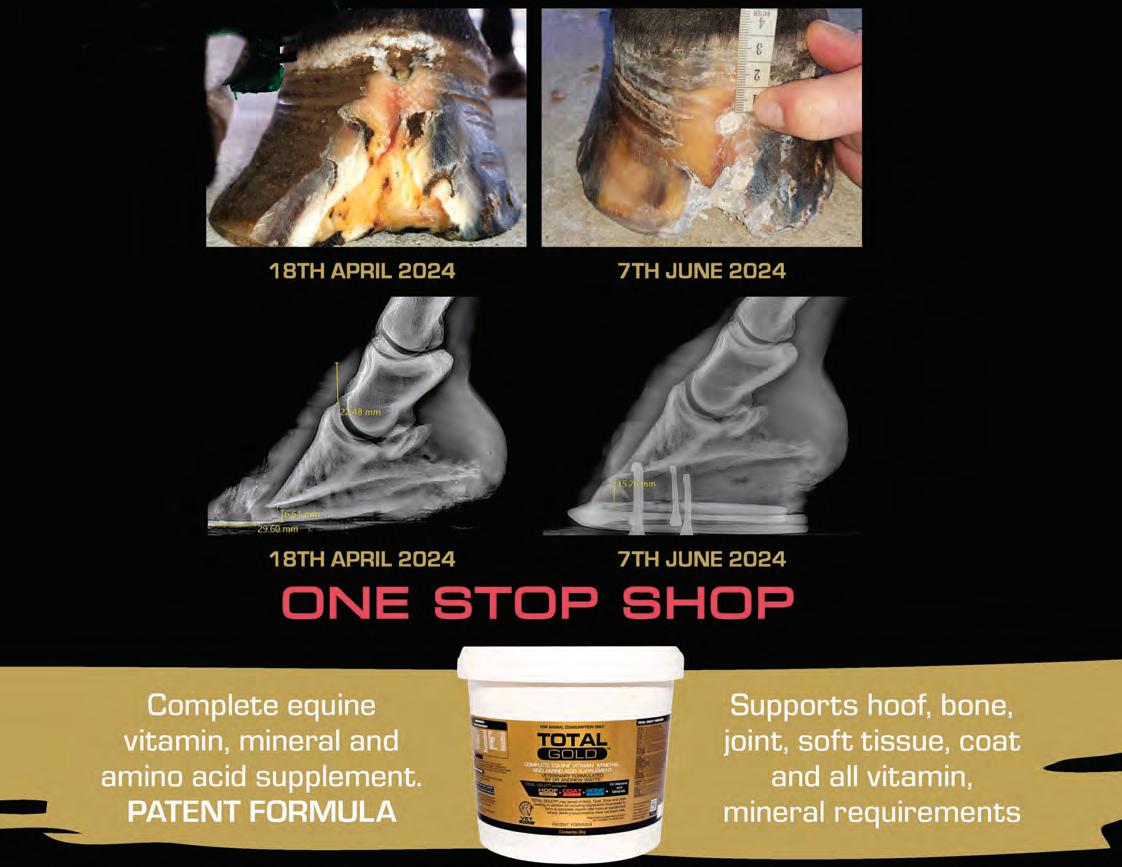
The first product in the Vetgold range, Hoof Gold, demonstrated significant success in increasing hoof growth during trials. Results showed an increase from just over 3mm to more than 13mm in four weeks, representing more than a 400% improvement in growth rate. Enhanced rates of hoof growth are essential for the recovery from any hoofrelated condition.
At our Podiatry Facility, we are presented with a high volume of severe hoof cases. Achieving increased hoof growth rates is a critical element in the rehabilitation process. Total Gold, our newest and most complete supplement, was an integral part of the treatment program in the following case.
VETERINARY REPORT
* Clinical Findings - 5th Feb 2025: Apregnant mare presented with a grade 4 out of 5 lameness in the right hind limb. There was a three-month history of lameness accompanied by discharge from a solar abscess.
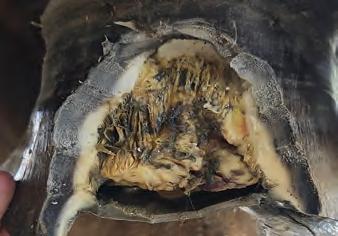
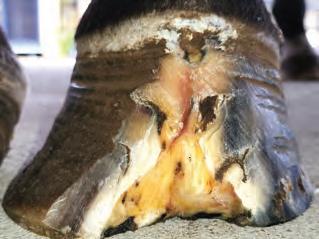
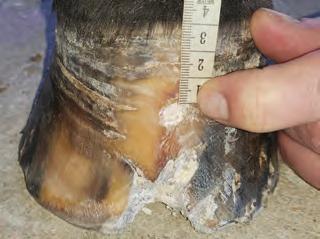
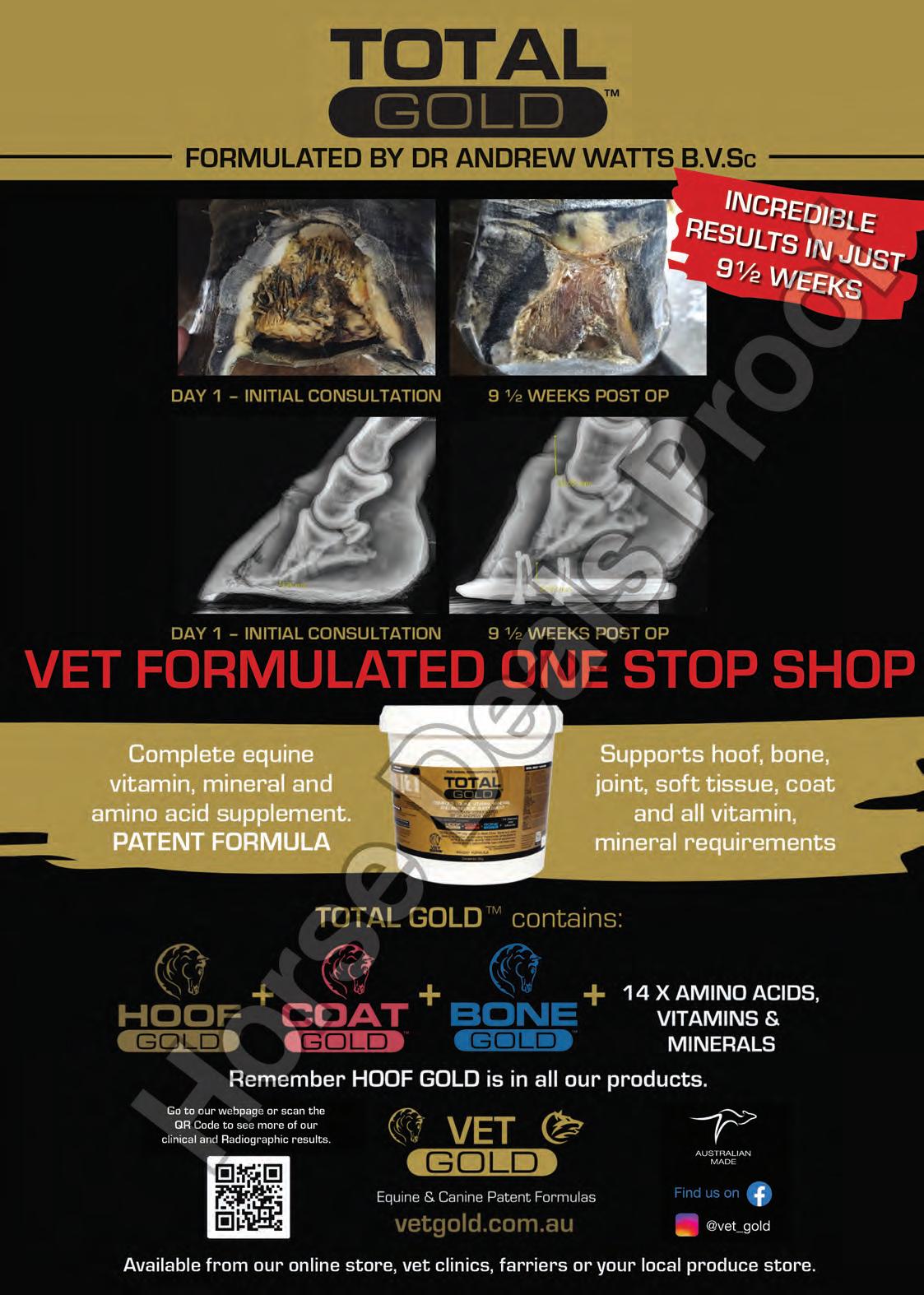
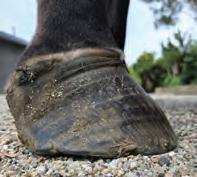
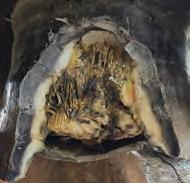
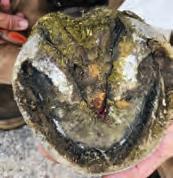
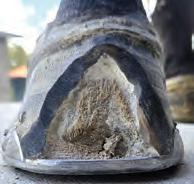
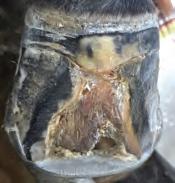
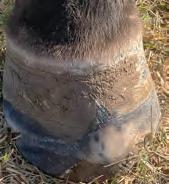
Upon examination, as depicted in Figure 1, the hoof capsule of the right hind was distorted. Red arrows show dorsal wall crimping comparative to heels. Noticeable heat was detected in the hoof capsule, and a pronounced digital pulse amplitude could be identified. Notably, there was minimal response to hoof testers around the periphery of the sole. Mild haemorrhage and black purulent discharge was identified at the apex of the frog and discomfort elicited with testers over the entirety of the frog - see Figure 2.
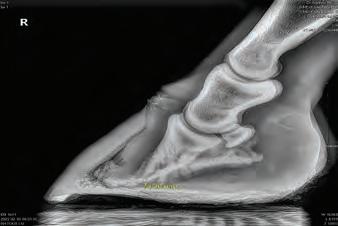
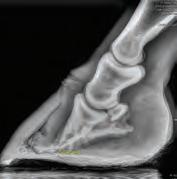
* Radiographs - 5th Feb 2025: Radiographs taken on the same day revealed severe rotation and sinkage of the coffin bone on the lateral view with only potentially 3.3mm of remaining sole depth in addition to a significant dorsal wall gas cap
extending from just below the coronary band - see Figure 3.
Sole depth measurement, while visible in the initial radiographs, was ultimately misleading. Both the sole and frog were completely under run and delaminated. Surgical removal of the necrotic sole and frog exposed the coffin bone ventrally.
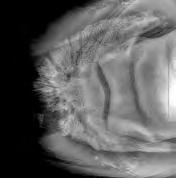
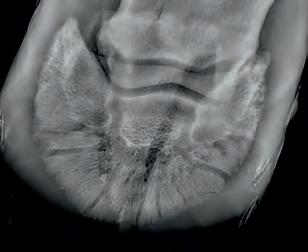
The dorsoventral view displayed extensive loss of integrity of the third phalanx (P3), with total lysis of the coffin bone observed at the toe margin as indicated by the red arrows in Fig 4.
TREATMENT:
The dorsal wall of the affected hoof was surgically resected to allow access to the extensive infected tissue. All infected material was thoroughly flushed and debrided to remove necrotic debris.
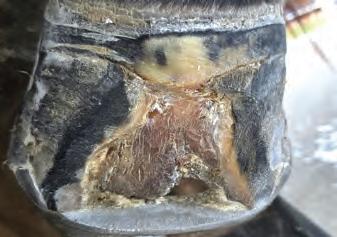
As shown in Figure 4, secondary to the severe abscessation and pedal osteomyelitis, only remnants of the sensitive laminae remained visible. The original structure of the laminae was largely destroyed by the ongoing infection.
The ventral sole and frog had become entirely undermined by infection, resulting in total dislocation from the hoof capsule both dorsally and ventrally. Avideo of the extent of sole loss can be seen on our webpage Infected material and granulation material at the dorsal coffin bone margin was debrided.
The sloughed frog and ventral sole with associated necrotic tissue was surgically removed.
It was estimated that there was less than 15% of the capsular laminae still intact - meaning 85% of the hoof capsule attachment had been lost.
Only the medial and lateral walls remained for ventral support. An open heeled alloy shoe was seated out to the solar circumference and applied essentially bracing and supporting the hoof capsule ventrally acting as a bridge underneath the hoof to hold the hoof together to prevent further collapse of the bone through the sole.
The surgical site was thoroughly flushed debrided then packed with a mix of procaine penicillin and TMPS paste.
Post surgery and post shoeing the mare showed only mild discomfort and was classified 1/5 at the walk.
Surgical packing was changed daily for 14 days then every 72 hrs subsequently till reexamination on the 14th March.
The mare was placed on a strict low sugar diet and administered 3 x scoops of Total Gold once per day. Pedal osteomyelitis of this degree associated with severe rotation and sinkage has an extremely low survivability and loss of the foal was predicted.
* Clinical Re-Examination -14th Mar 25:
At five weeks following the initial consultation, the mare was re-examined and found to be 0.5/5 lame at the walk. Digital pulse amplitude was low and there was no notable heat in the hoof capsule.
The surgery site was dry, free from odour, and showed no exudative discharge - see Fig 6. There were no signs of ongoing infection. The right hind hoof capsule remains significantly compromised but has stabilised since the resection procedure.
Incremental hoof growth has elevated the sole, and the development of new, healthy dorsal wall has increased capsular laminae adherence. Approximately 40% of the hoof capsule is now attached to the sensitive laminae, an improvement from the previous estimate of 15%.
The frog and most of the sole are drying, with evidence of healthy keratinisation. However, at the toe-where pedal osteomyelitis was previously identifiedirregular granulation tissue has emerged and required resection. Additional sub-solar granulation tissue may develop and could necessitate further resection as healing continues.
The absence of suppurative discharge and stabilisation of the pedal margin indicate that pedal osteomyelitis is currently under control. Continued careful topical management of the site remains necessary.
* Radiographs - 14th Mar 2025: On the 14th of March 2025, radiographs were taken to assess the progress of recovery. Lateral views demonstrated an increase in sole depth from an initial measurement of 3.3 mm to 9.02 mm. However, it is important to note that this increase in depth is somewhat misleading. Initially, there was no measurable sole present, and the observed subsequent increase is attributable to significant circumferential wall growth.
continued page 12
Figure 1 Figure 2
Figure 3 Figure 4
Figure 5 Figure 6
Figure 8 Figure 11
Photographic coverage throughout treatment and recovery
The Horse Report
Gastroscope days just scratching the surface
By Dr RHIAN PARTRIDGE MACantab VetMB MRCVS
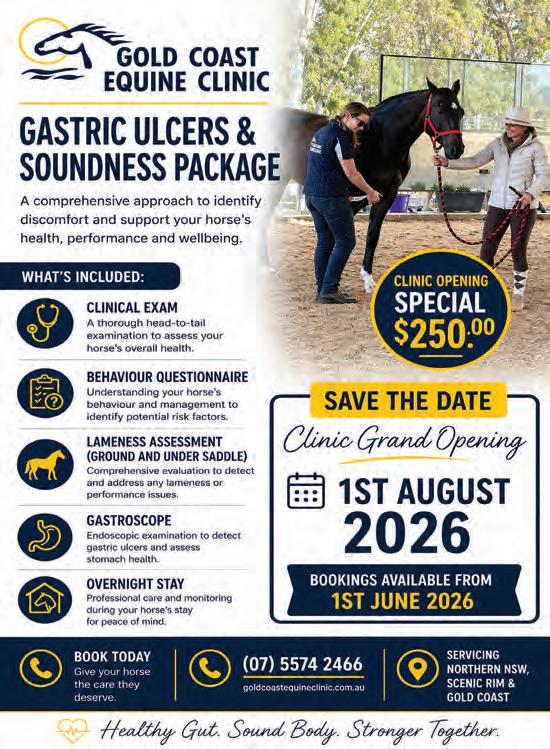
At Gold Coast Equine Clinic (GCEC), gastroscopy is not viewed as a quick stand-alone procedure where we simply look for ulcers, prescribe medication and send the horse home with the problem considered solved. Although it can seem appealing at the time for the owner with some highly discounted "Gastroscope Days" available on a regular basis, with the approach often finding visible ulceration, this methodology can miss the more important question: why did the ulcers develop in the first place?
Equine gastric ulcer syndrome is quite common and is not isolated to one breed or type ~ performance horses, racehorses, show horses and pleasure horses under regular work are all susceptible.
However despite being common their cause and how they are treated and prevented sadly isn't simple.
Gastric ulcers have many contributing factors that can be linked with feeding patterns, workload, travel, stress, management, medication use, intense
exercise and very importantly pain elsewhere in the body.
Gastric ulceration is a condition that often requires broader investigations to establish the underlying cause.
It is only when we establish the cause of the ulcers that we can successfully treat and most importantly prevent their recurrence, allowing best management of the patient long term.
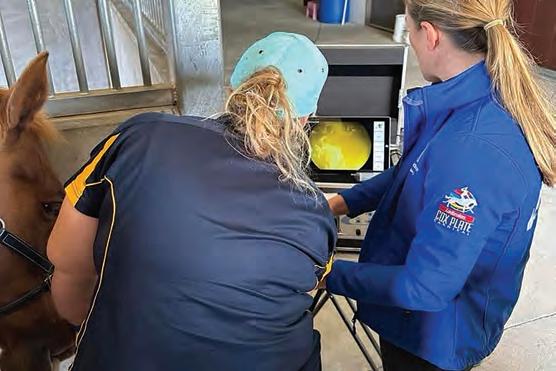
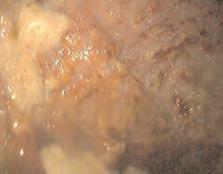
Gastroscopy is still the only way to accurately diagnose gastric ulcers as it allows the vet to
directly visualise the lining of the stomach.
However gastroscopy should be considered part of the investigation into the reason for presentation, not the beginning and end of it.
Part of horse ownership is knowing your horse's usual behaviours and understanding what they are trying to tell us. Some common traits that could potentially be related to gastric ulcers is the horse may present as girthy, resentful under saddle,
dull in performance, reactive to the leg, difficult to collect, reluctant to go forward, cranky around feed time, tucked up, sensitive through the back or simply "not quite right."
Agastroscope may reveal ulcers and medication may improve those ulcers.
However if the horse is carrying unresolved musculoskeletal pain, poor saddle fit, dental discomfort, low-grade lameness, foot imbalance, training-related strain or chronic compensatory soreness, the ulcer picture can return because the stressor driving the problem was never removed.
This is one of the major reasons GCEC is building a different model of equine veterinary care. We want clients to move away from reactive veterinary care, where the horse is only examined once the issue becomes obvious, expensive or performance-limiting.
We want to lead a more proactive standard, where the horse is assessed as a whole athlete, not as a stomach, a leg, a back, a mouth or a behaviour problem in isolation.
Continued page 13
Happy ending after life threatening diagnosis
Continued from page 12
This growth has mechanically elevated and protected the sole, allowing for its gradual rejuvenation. Examination of the dorsal wall and sole revealed no evidence of gas lines. This absence suggests that all infected material has been successfully removed.
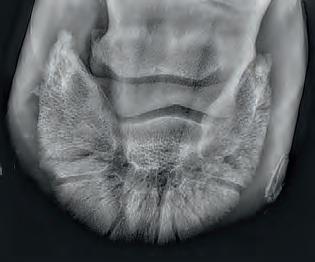
The dorsoventral radiographic view indicated stabilisation of the pedal margin.
Furthermore, a total of 11.21 mm of dorsal wall growth was measured radiographically since the initial consultation.
* Clinical Exam - 14th Apr 25: 9 and a half weeks post initial consultation, the mare was observed to be only mildly uneven while walking on her right hind limb. Upon examination, there was minimal digital pulse and no evidence of increased hoof capsular heat, indicating reduced inflammation.
The surgical site appeared dry and clean, with no detectable odour or exudative discharge present, suggesting healthy postoperative recovery.
The sole and frog were meticulously debrided to reveal healthy, newly keratinised and organised corium.
The sole has successfully regrown, and new bars have now formed, demonstrating positive tissue regeneration.
The previously irregular granulation tissue located sub-solar and ventral to the osteomyelitis site has since keratinised and was able to be trimmed, further indicating progress in healing.
*Radiographs - 14th Apr 2025:
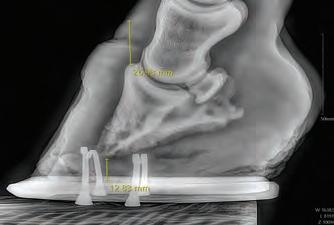
Lateral radiographic views revealed a progressive increase in sole depth, rising from 3.3mm at the initial assessment to 12.88mm after nine weeks.
This indicates substantial improvement in the protective sole structure.
Measurement of the dorsal wall, as assessed radiographically, demonstrated a total growth of 28.84mm since the initial consultation.
It is important to clarify that the recorded increase in sole depth may be misleading. There was no discernible sole present at the outset; therefore, the subsequent increase in depth is largely attributed to substantial circumferential wall growth. This mechanical elevation of the wall has both protected the sole and facilitated its rejuvenation during the recovery process.
The hoof capsule has stabilised, with an estimated 50 to 60 percent of the sensitive laminae wall now adhering to the coffin bone.
Additionally, there is greater than 50 percent adhesion of the sole and frog papillae.
The combined growth of both the wall and sole has been remarkable, particularly considering this progress has occurred within just over nine weeks.
* Treatment:
The previous surgical site underwent further resection, which also included removal of tissue from both the sole and frog.
Following the trimming procedure, an aluminium open-heeled shoe was reapplied. ACastle pad was placed over the area, and the entire sole was then filled with Solepac CS. Additionally, the dorsal wall resection was packed with Solepac CS, which eliminated the need for bandaging
* Clinical Exam - 7 Oct 25: Happy Endings At 35 weeks, or approximately 8.75 months following surgery, the mare has demonstrated a strong and positive recovery. The mare presented as sound and in good health. She successfully foaled and is now the dam of a beautiful and healthy filly. This marks a significant milestone in her rehabilitation, given her initial presentation with severe, life-threatening debilitation.
The hoof capsule, as observed in Fig 11, exhibits only minor distal wall changes. This is notable considering the seriousness of her original condition.
The nature of these changes is indicative of successful recovery and ongoing health.
For further info email: info@vetgold.com.au or visit www.vetgold.com.au
Gastroscopy is the only way to accurately diagnose gastric ulcers.
The Horse Report
Thorough diagnosis may uncover other conditions
From page 12
Agastroscope day should therefore be treated as an opportunity to gather evidence.
If ulcers are present, we can grade them, identify whether they involve the squamous or glandular region, prescribe appropriate medication and give targeted management advice.
But we also need to ask what the horse's body is telling us.
Is the horse guarding through its back because the stomach hurts, or did back pain contribute to the stress load that helped create the ulcers?
Is the horse reluctant to go forward because of ulcers, or because hock, stifle, foot or sacroiliac pain has been simmering in the background?
Is the horse anxious in work because of temperament, or because discomfort has slowly become associated with being saddled and ridden?
This distinction matters because treating the ulcers without addressing the cause can create a cycle.
The horse scopes positive, receives medication, improves, returns to work, then gradually declines again.
The owner feels frustrated, the horse becomes labelled as difficult, sensitive, or ulcer-prone, and the original underlying problem continues.
In many cases, the stomach is not the whole story.
Our preference is to use gastroscopy as part of a wider clinical conversation.
That may include a lameness assessment,
dental examination, saddle and workload discussion, hoof balance review, bloodwork, body condition assessment, nutrition plan, training history and management changes, working alongside a team of professionals. Ulcer medication has an important place and when ulcers are confirmed treatment is necessary for comfort, healing and maintenance. However, ulcer medication alone cannot correct a painful hock, a poorly balanced foot, an ill-fitting saddle, dental disease, inappropriate workload, limited forage access or the ongoing stress of a horse being asked to perform through discomfort.
This is where proactive veterinary care becomes more valuable than simply reacting to symptoms.
That is the difference between a gastroscope
day and a complete veterinary plan.
For owners this means the conversation may be more detailed than expected.
We may ask about changes in behaviour, recent competitions, travel, feed routine, turnout, workload, body soreness, shoeing, saddle fit, previous injuries and subtle performance changes.
These details help us determine whether the ulcers are likely to be part of a broader pain or stress picture.
For the horse, this approach is fairer, as we are of the belief that horses do not fake discomfort, but they often express it in ways that are easy to misread.
Gastric ulcers can make a horse reactive, but so can pain elsewhere.
When both exist together, the clinical picture becomes layered.
The horse may not need more discipline, more gadgets or more pressure. It may need a proper vet investigation. This is the standard GCEC wants to be known for.
We are striving to change the way owners currently view equine veterinary care. Challenge the "norm", - create a space where owners start to think a little outside the square.
Gastroscope days still have enormous value. They allow us to diagnose ulcers properly, rather than guessing based on symptoms alone.
That is the future of equine veterinary care at Gold Coast Equine Clinic ~ working toward proactive, investigative, evidence-led medicine centred on the whole horse.
Gastric ulcers can make a horse reactive but the pain may be elsewhere.
The Horse Report
Byron Bay Equine Practice
Dedicated
Routine Visits & Preventative Health
Lameness & Orthopaedic Checks
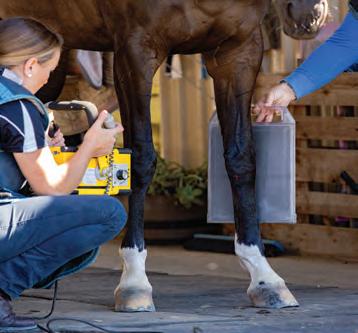
Portable Diagnostic Imaging
Dental Exams & Powerfloating
Reproduction & Breeding Services
Routine Surgeries
Freeze Branding & Stud ID
Emergency & After Hours Services
The Horse Report
Understanding different types of hay
By LARISSA BILSTON, BAgrSc (Hons 1), Nutritionist, Farmalogic
Hay and fresh grass are both essential forage sources for horses, but they differ in their nutritional composition due to processing and storage methods. These differences can significantly impact a horse's diet, particularly for those with conditions like laminitis. This article examines common types of hay, their nutritional profiles and considerations for feeding specific horses.
Types of hay for horses
1. Grass Hay
Grass hay is the best substitute for pasture during drought, dry summers or for horses in stables, yards or kept on overgrazed paddocks.
- Meadow Hay is widely used in southern states and is made from various combinations of naturalised grasses and sometimes native grass and legume species. It varies widely in nutritional value, often providing moderate protein and energy.
- Ryegrass Hay is a palatable, nutrient-dense feed with moderate to high protein (12-18%) and energy levels. However, its high ethanol-soluble carbohydrate (ESC) and starch content makes it unsuitable for laminitic horses. In some regions, ryegrass may contain endophytes, which can cause health issues like ryegrass staggers.
- Rhodes Grass Hay is typically low in ESC and starch, making it a safe option for horses prone to laminitis, insulin resistance, or equine metabolic syndrome (EMS). Rhodes grass has a moderate protein content (8-12%) and high fibre, promoting digestive health. Rhodes hay is one of the most common types of grass hay available in northern states.
- Teff Hay has become a popular choice for metabolic or overweight horses. It is frequently low in sugars and starch, has moderate protein and typically is high in fibre. However, like many warm-season grasses, it can contain moderate to high levels of oxalates, which may interfere with calcium absorption and contribute to conditions like
nutritional secondary hyperparathyroidism (NSH) or "big head disease" if fed long-term without calcium supplementation. While it is palatable and digestible for most horses, testing for oxalate content and balancing the diet with calcium supplements is crucial when using Teff hay as a primary forage source.
- Jarra Hay is grown in the Northern Territory (NT) and is popular for its palatability with moderate protein (8-12%) and energy content. Jarra hay is low in oxalates, unlike many other tropical grasses such as Humidicola or Buffel grass. However, its nutrient levels can vary depending on maturity at harvest, so testing is recommended to ensure it meets the horse's dietary needs.
2. Cereal Hay
- Oaten or barley hay is made from green oats/barley harvested before the grain matures. Cereal hays are commonly used in Australia but should not be the sole forage source for horses without grazing. They are highly palatable and provide moderate energy and protein (5-10%) but are often high in carbohydrates, unsuitable for metabolic horses. Quality can vary widely depending on plant maturity and seed fill at harvest.
- Straw is made from the dry stems of a mature cereal crop (wheat, oats, barley or rice) cut and baled after the grain has been
harvested. It is high in fibre but low in protein (2-5%) and energy. Straw is sometimes recommended for weight loss, used to substitute up to 50% of hay intake but its sugar and starch content can vary, so testing is recommended before feeding.
3. Legume Hay
Legume hays are richer in protein and energy than grass hays, making them ideal for topping up the diets of performance horses, growing foals, and lactating mares.
- Lucerne Hay is the most popular legume hay fed to Australian horses. It is nutrientdense with high quality protein (16-25%) and calcium levels. It is usually low in ESC and starch, making it a suitable source of quality protein for horses with metabolic issues. Whilst beneficial in many horse diets, lucerne should be limited to 20% of the total daily intake. For horses with a sensitive gut, lucerne's richness can lead to digestive upset even in small quantities.
- Clover Hay has a high protein content (1520%) and is often baled as a ryegrass and clover mix for cattle. Clover hay can be too rich for horses and some contains phytoestrogens or mycotoxin producing endophyte fungi. It should only be used strategically in small quantities to boost protein and calcium levels.
Continued page 17
The Horse Report
Not all types of hay have the same nutritional value
From page 12
The importance of feed testing
The nutritional value of hay is influenced by plant species, maturity at harvest, and growing conditions. Key nutrients to test for include:
* Digestible Energy (DE (horse)) is a value given in MJ/kg, an indicator of the amount of 'fuel' the hay contains. Younger, leafier and cool-season pasture hays (such as ryegrass) are higher in energy than hay from mature (stalkier) plants and warm-season species.
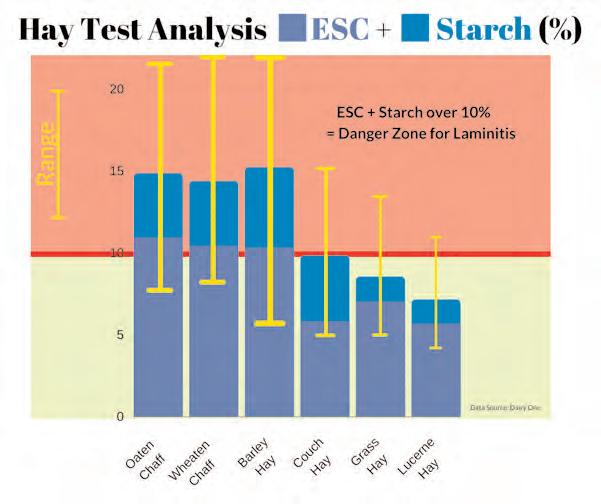
* Carbohydrates. Water Soluble Carbohydrates (WSC) include simple sugars (monosaccharides such as glucose and fructose; and disaccharides such as sucrose and maltose), short-chain polysaccharides (oligosaccharides and fructooligosaccharides), and fructans. Ethanol Soluble Carbohydrates (ESC) measures only simple sugars and short-chain polysaccharides. Starch is a carbohydrate made up of complex polysaccharides which are digested in the foregut. Hay high in ESC and starch increase the risk of laminitis through their influence on blood insulin levels.
* Crude Fibre (CF%) is an indicator of the total amount of indigestible fibre in the hay. This is fermented by microbes and is an important component of gut health. Acid Detergent Fibre (ADF) measures cellulose and lignin levels whilst Neutral Detergent Fibre (NDF) measures cellulose, hemicellulose and lignin. Hay made from more mature plants is usually stalkier, and higher in indigestible fibre.
* Protein (CP%) supports muscle development, body maintenance and overall health. While high quality protein is essential for young, growing horses, broodmares and horses in intense work, excess protein can lead to unnecessary nitrogen excretion, which stresses the kidneys. Lucerne is considered a quality protein source for horses because it is rich in the amino acids that horses are commonly lacking.
* Mineral level analysis of hay, especially when it forms a dominant part of the diet, ensures supplement requirements can be accurately calculated. Look for analysis of the macrominerals: calcium, phosphorous, magnesium, sodium, chloride, potassium and key trace or microminerals: iron, copper, zinc, selenium, iodine and manganese.
Plant maturity at harvest
The maturity of plants at the time of harvest is a significant factor affecting hay quality.
Leafy Hay (Early-maturity)
- Plants harvested at an earlier stage of growth retain more leaves than stems, which are richer in nutrients.
- Early-maturity hay has higher protein and digestibility but lower fibre, making it more energy-dense.
Mature Hay (Late-maturity)
- Plants allowed to grow to full maturity have more stems and seed heads. This results in lower protein but higher fibre. The energy content depends on the amount of filled seed heads (grain) and remaining leaf.
- Mature hay is often coarser and less digestible but may be better for horses
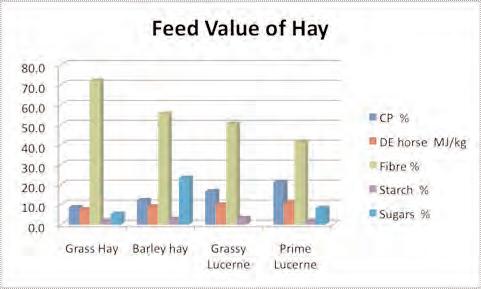
Grass hay tends to have the highest fibre content, whilst cereals are high in sugars and lucerne is high in protein.
requiring low-calorie diets, such as those at risk of laminitis, provided the carbohydrate levels are in the safe range.
Choosing hay that’s safe for laminitisprone horses
Metabolic dysregulation (insulin resistance) is the primary cause of laminitis, which is triggered a spike in blood insulin caused by eating food high in sugar and starch. Forage for horses prone to laminitis requires constant, detailed attention to sugar and starch levels.
1. Ideally, choose hay which has been analysed and has a combined ESC + Starch value of less than 10%.
2. Avoid high production grasses such as ryegrass and do not feed cereal (oaten, barley, wheaten) hay.
3. If carbohydrate levels of hay are unknown, soak in warm water for 30 minutes or cold water for 60 minutes to remove soluble sugars. Drain and discard soak water before feeding.
Soaking hay can reduce water soluble carbohydrates by up to 30%.
Rhodes grass and teff hays generally have lower carbohydrate levels than cereal hays. Some meadow hay can be suitable, although this varies based on species, growing conditions, and harvest timing (hay cut in the late afternoon is higher in energy than early morning cuts).
Factors to consider when buying hay
1. Nutrient Analysis - where possible buy in bulk and test hay to ensure it meets the specific nutritional needs of your horse. Some large hay sellers provide test results for each batch of hay.
2. Visual and Physical Inspection - look for some green colour (indicating freshness) and a sweet smell. Avoid hay with mould, dust, or foreign objects.
3. Horse-Specific Needs - match hay type to your horse's workload, age, health condition, and metabolic status, taking into consideration the nutrient balance of the rest of the diet (pasture, hard feed and supplements).
Forages for laminitis-prone horses should contain no more than 10% combined value of ESC plus starch.
Testing each batch of hay is strongly recommended as levels can vary widely.
Even lucerne hay, which is usually safely below the 10% level can occasionally be slightly too high.
Some grass hay can test inside the safe level, but many harvests will be too high in carbohydrates to be fed to horses with metabolic conditions.
Conclusion
Hay is a cornerstone of equine diets, providing essential fibre and nutrients when horses lack fresh pasture.
However, its nutritional value varies widely, and careful selection is key to meeting a horse's specific needs. Compared to fresh grass, hay contains lower levels of water, vitamins and omega-3 fatty acids as these are lost during drying and storage, making supplementation essential.
The mineral content of hay is similar to that of the fresh grass from which it was made. By considering the interplay between hay type, nutrient content, and horse health, owners can make informed decisions that promote optimal wellbeing and performance.
Choke in horses is extremely common, in fact one of the most common conditions seen in horses.
When there is a partial or complete obstruction of the oesophagus choke will occur. The oesophagus is the tube that transports feed from the mouth down into the stomach. When a horse chokes it is very different to that of a human choking as unlike horses when people choke they are also unable to breathe.
When a horse is choking it means that they are unable to move food or water from the mouth to the stomach effectively causing a temporary blockage.
CHOKE SYMPTOMS
The symptoms relating to choke are:
Horses experiencing choke may exhibit the following signs:
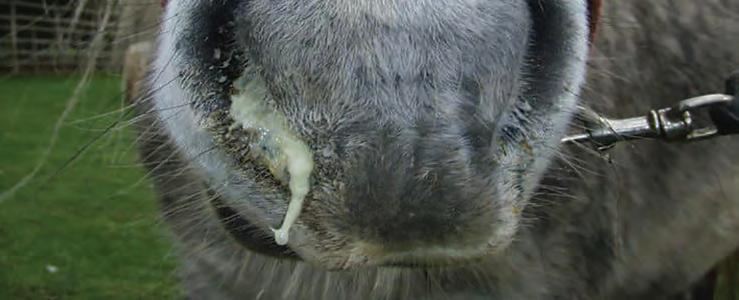
Food and saliva coming from the mouth or nostrils. Can be foamy and white to green in colour.
Hypersalivation
Stress and lethargy
Swallowing may be difficult.
Not eating or drinking
Coughing
May give the appearance of colic symptoms.
They will try to stretch their necks and repeat trying to swallow, this can cause the neck to spasm. They may even try to roll to try to dislodge the blockage.
CAUSES OF CHOKE IN HORSES?
There are many reasons why a horse may choke, remembering it is very common is generally related to horses consuming dry or abrasive food which is almost always eaten too quickly.
Any pelleted feed that is commercially produced swells very quickly once it encounters saliva. It is then chewed and begins to pass down the oesophagus, very often horses will choke in these circumstances.
If the feed is too wet prior to the horse taking it into the mouth, then this can accelerate the risk of choke in some cases.
If the horse normally eats his feed quickly this can be another contributing factor as the feed is not chewed sufficiently. Horses with dental issues also tend to choke as once
again they do not chew the feed correctly. Hay that is coarse does not encourage the horse to chew sufficiently and can be lodged in the oesophagus, even eating treats such as carrots or harder types of feed can contribute to the risk of choke.
An abnormal oesophageal anatomy can also contribute to choke.
VETERINARY TREATMENT
Veterinary treatment is generally not required, but certainly if you are uncertain always call you vet as in a minority of cases it can be quite severe.
If your horse required medical treatment, he or she should be able to return to normal work 1-2 weeks later.
The following symptoms, could be complications from choke if you notice any of these call your vet immediately:
Coughing
Nasal discharge
Lethargy
Increased respiratory rate
Loss of appetite
Temperature
Head down, rolling, look of fear in their eyes, uncomfortable.
If you horse has suffered choke it is important to make sure you change the way you are feeding and ensure a gradual return to normal eating.
You may be required to restrict the diet for a few days.
We must always remind ourselves that horses only have small stomachs. and there is often a tendency to feed more. Reducing the quantities per feed is an absolute must.
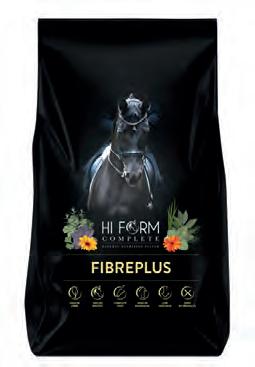
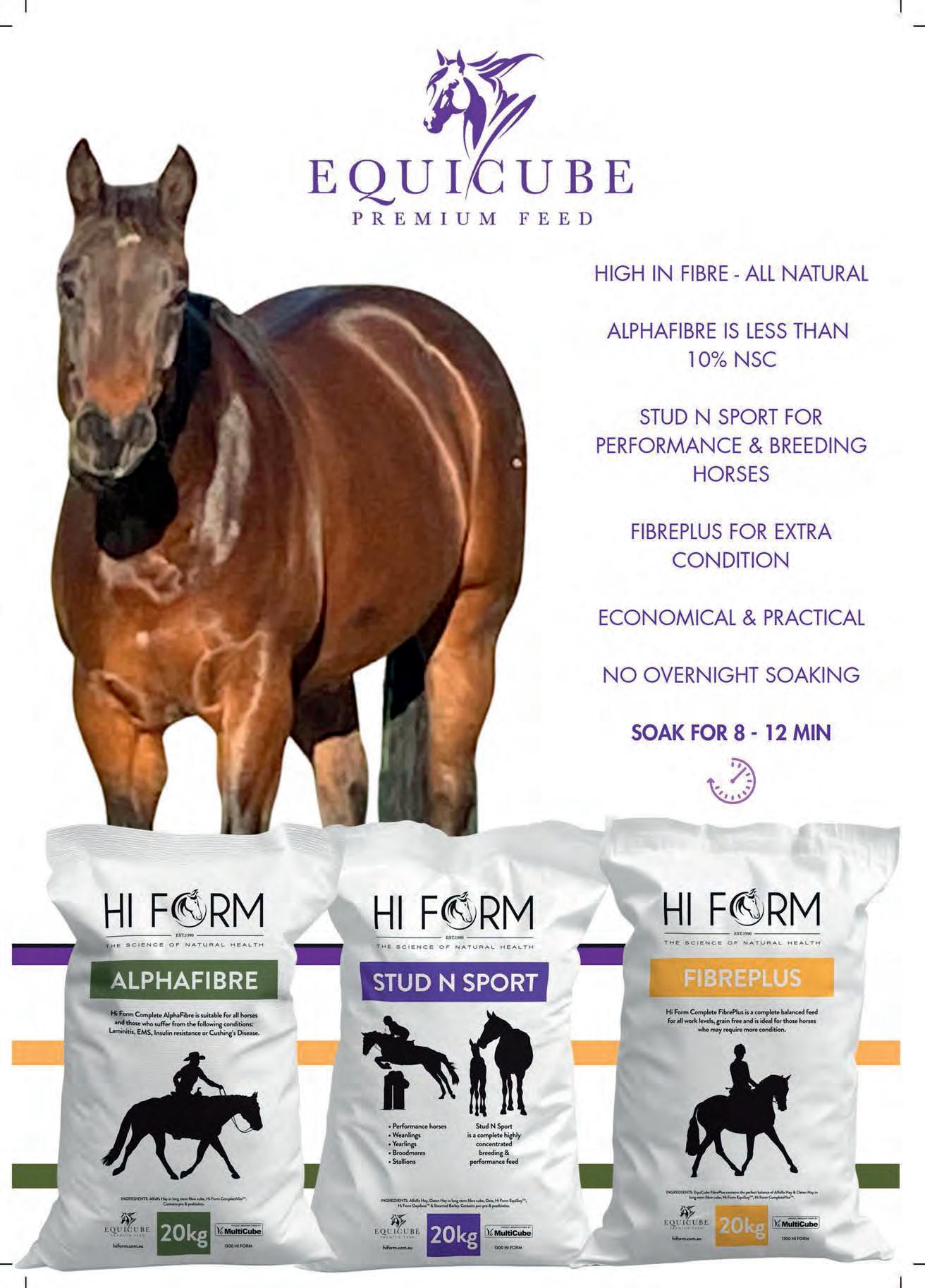
If you are feeding a hard feed to your horse, you can reduce the risks by feeding a feed that is preferably long stem fibre like Hi
Form EquiCube , these are long stem fibre cubes and have not been processed prior to production.
For horses that have a history of choke, the following suggestions may assist to reduce the risk in the future:
Hay feed small amounts but often Limit grazing and perhaps hand graze
Soaking or steaming hay
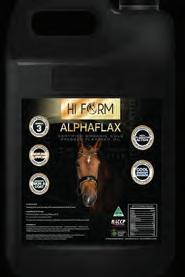
Using oil such as Hi Form AlphaFlax oil added to the cubes may be a huge advantage in reducing the risk also.
BEST ADVICE TO PREVENT CHOKE
Make sure your horse's teeth are maintained on a regular basis not matter what age and always ensure there is fresh clean water. Agreat way to reduce the risk of choke is to slow down those horses that tend to eat fast by providing the hay in slow feeder hay nets with a smaller hole.
Horses often eat too quickly when they are in a shared situation as they are constantly competing for food, reduce the competition.
Dampening the feed using oil such as AlphaFlax 100% first pressed is a great way to reduce the risk and long stem fibre cubes such as EquiCube are also a great way to encourage the horse to chew normally and will slow them down.
Spreading feed out over a large sized feed bin or out on a rubber mat so they have to "forage" for their feed will slow down the process.
Also when using a hay net do not have the net too high this goes against the natural inclination to have the head and neck low when feeding.
For further information and advice, please contact us via email: enq@hiform.com.au or phone 03 9775 6422
Horses experiencing choke may exhibit mucus coming out of the mouth or nostrils.
The Horse Report
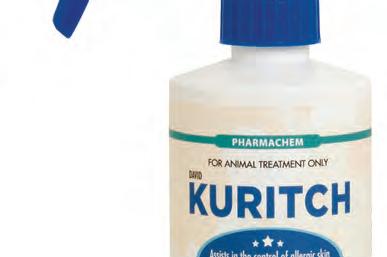
“BYE BYE FLY”
QUEENSLAND ITCH, SWEET ITCH, SUMMER ECZEMA and EQUINE ALLERGIC DERMATITIS are names for distressing skin conditions which affects horses in spring and summer months throughout Australia and around the world.
The usual cause is a hypersensitivity to the bites of flies (in particular sand flies or midges).
While the bite of the flies are an irritation, some horses develop sensitivity to the bite and will rub themselves so much that they cause injury to their skin.
Research shows the cause is an allergic reaction to the chemicals in the saliva of the midges (as with humans).
Not only that, but once or twice a day, stable lies come to the horse, feed vigorously for a minute or two, and then return to the shade to digest their food. These bites can cause intense irritation in some horses. The bites appear as small raised lumps with a central scab.
The effects on the horses can be dramatic. They suffer intense pruritus (itchiness) on the mane, tail, face, ears and back, resulting in biting, rubbing, hair loss, self-trauma and a change of temperament. They become miserable and irritable.
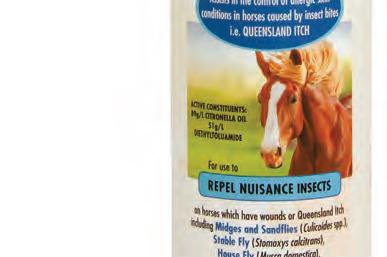
KURITCH has been specially formulated to help assist this problem effectively, in a number of ways:
Firstly, it repels the biting insects using the combination of the natural repellent “Citronella Oil” and a highly effective repellent “DEET”. Secondly, it soothes the irritated areas thus relieving the horse from biting and rubbing, which in turn allows the normal healing process to begin.
It achieves this by the inclusion of the natural antiseptic “Eucalyptus oil” and Camphor oil” which naturally relieves itchy skin.
Also rugging, hooding or stabling your horses between the hours of 4pm – 7am during spring and summer will limit the contact of the flies.
Should your horse already be suffering from the effects of allergic skin dermatitis, ensure you use QUIT ITCH to treat and relieve the effects of insect bites.
Since the 1970’s, QUIT ITCH has been an essential weapon in the fight against skin disorders in horses.
These significant benefits are also enhanced by the “Rain Resistant” and “Low irritant” formula. As it doesn’t contain alcohol (prevalent in most fly sprays) it won’t “sting” the horse. It can also be applied to surface wounds, minor cuts and skin abrasions to help prevent irritation and possible infection by nuisance insects.
Registered by the APVMA in Australia for over 40 years, extensive field experience has proven KURITCH to be a most effective solution for both preventing and healing distressing skin conditions caused by biting insects.
As well as KURITCH as a repellent, environmental management will also assist in protecting your horse.
Midges breed near stagnant water. As they don’t fly more than a few hundred metres from their breeding area, housing or paddocking your horses more than 500 metres from those areas will reduce their exposure to the flies.
The Horse Report
Common skin conditions in horses
By RANVET
The skin consists of three layers (the epidermis, dermis, and hypodermis) and is the body’s first line of defence against disease causing agents (pathogens).
The skin also has a role in sensory perception, excretion, and temperature regulation.
COMMON SKIN DISEASES:
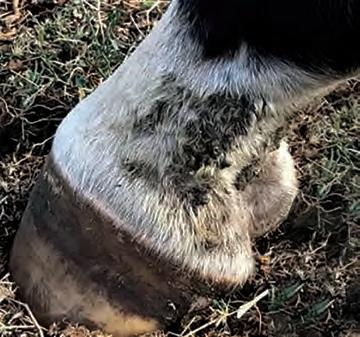
- Greasy heel/mud fever (commonly caused by Dermatophilus congolensis)
- Rain scald (commonly caused by Dermatophilus congolensis)
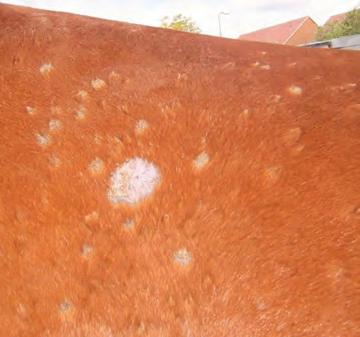
- Ring worm (commonly caused by Microsporum gypseum)
- Girth itch (commonly caused by Trichophyton equinum)
CONTRIBUTING FACTORS TO INCREASED SUSCEPTIBILITY:
Environment: warm, dark, crowded and moist conditions will lead to an increased chance of infection due to the ability of bacteria and fungi to proliferate in this type of environment.
Age: younger animals may be more susceptible to skin infections due to the immaturity of the immune system.
Degree of previous exposure and immunity which has developed.
Health status and body condition of the horse may reduce the ability to combat an infection or allow the entrance of external pathogens.
Photosensitivity: some skin diseases are photosensitive and will occur in areas of lighter coloured hair or skin.
Greasy heel
Greasy heel, a common skin disease in horses, often occurs during the wetter months of the year where moisture and bacterial prevalence is rife.
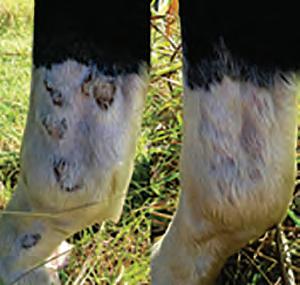
This particular condition is usually seen in the hind limb pasterns and is the result of a bacterial or fungal colonisation, often supported by continuous standing in wet, moist conditions.
The skin around the affected area becomes swollen, itchy and painful to touch and will often have a ‘greasy’appearance due to abnormal secretions from within the sebaceous (fat secreting) glands.
Skin quality may be affected if a dietary deficiency of zinc, biotin, Vitamin A(found in lush, green feeds), Vitamin E, or B-group vitamins exists.
Rain scald/mud fever
Rain scald or mud fever are common names for a condition known as Dermatophilosis, caused by the bacteria Dermatophilus congolensis which lives on the skin of carrier horses. D.congolensis needs a moist environment to thrive and reproduce, thus rain scald often occurs after rain in warm and humid climates.
Infected horses have sores, lesions and scabbing usually concentrated on the rump, back, and legs. Carrier horses are prone to developing rain scald, but do not always show clinical signs, acting as a source of
infection. Rain scald can be transmitted directly from horse to horse, or carried on items shared between horses, such as grooming tools, saddle cloths and rugs.
Ring worm
Is a fungal infection which presents on the surface of the skin, often causing noticeable changes in the hair and coat. Care should be taken when your horse has contracted ring worm, as it is highly contagious to other horses and humans.
Due to the ease of transmission, care should be taken not to share tack, rugs, buckets or grooming kits which have been used on horses with ring worm.
Girth itch
It is especially common in younger horses, often appearing in the girth region and can cause serious discomfort when trying to saddle a horse. This condition can be identified by bald, sore and inflamed areas of the skin, particularly around the girth region.
Whilst it can be bacterial or fungal based, girth itch may be predisposed by poor skin quality (often the result of a vitamin and mineral deficiency), an ill-fitting girth, repeated exposure to wet and humid conditions.
Anhydrosis
Anhydrotic horses possess an inability to in response to hyperthermia. This impacts on the horses ability to maintain an appropriate body temperature of 38°C.
“Dry coated” (anhydrotic) horses will often show a range of clinical signs including rapid breathing (tachypnea), poor exercise tolerance, dry skin, poor coat condition and hair loss, often on the facial region. Horses suffering from this condition may also show signs of inappetance, reduced exercise tolerance and may be more likely to “blow” after exercise in an attempt to expel body heat via the respiratory tract.
Photo-sensitivity
Common plants found in your horses paddock may trigger sunlight hypersensitivity, predisposing them for serious skin damage after sun exposure.
Plants that cause photosensitivity include Alsike clover, St. John’s Wort, Bishop’s Weed, Spring Parsley, and Buckwheat. The toxins in
these plants are not destroyed during the drying process and therefore hay may also cause a reaction.
In some cases, signs of photosensitivity may not show up for several weeks after a horse has consumed the dangerous plant.
Primary photo sensitisation occurs when sunlight reacts with plant toxins circulating in the blood close to the skins surface.
Secondary sensitisation is caused by ingestion of other plants, as well as some moulds and mycotoxins (fungi) that cause liver damage and thus increase the reaction of skin to sunlight. Some plants can cause both types of reactions.
The symptoms associated with photosensitivity are very similar to that seen in mild sunburn, however in cases where exposure is prolonged, fluid discharge, scab formation, and skin tissue death can occur.
Sunburn
Sunburn can affect not only light coloured horses, but also white markings on dark coloured coats. It is most often seen in the early months of summer and spring when longer daylight hours coincide with shedding of winter coats.
Redness, swelling, blistering, or peeling in severe cases can be seen on the skin around the muzzle, eyes, top of the tail and tips of the ears. Ensure adequate shade is provided in your horse’s paddock.
Contact your veterinarian to establish the predisposing cause and to determine treatment. It is generally advised to move the horse away from damp areas, keep hosing to a minimum and keep the horse’s legs dry. To clean any dirt or dried discharge from the affected area, wash with soap and water and pat dry, do not rub. To make certain the area is absolutely dry apply talcum powder and dust off. One treatment is Ranvet’s White Healer which can be applied liberally to the affected area once or twice daily until the condition is resolved.
Greasy heel/mud fever and ring worm are common skin conditions that affect horses.
Equine Health Feature
The Horse Report
NEW PRODUCT FOR RUBBED MANES AND TAILS
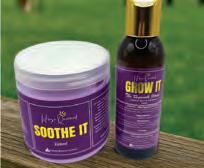
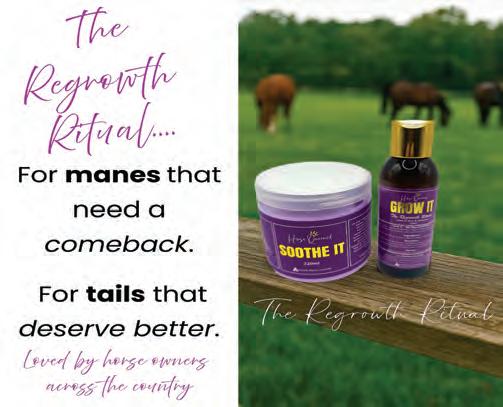
The Regrowth Ritual Pack
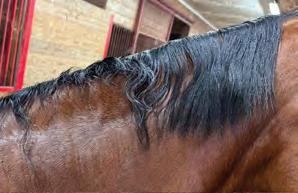
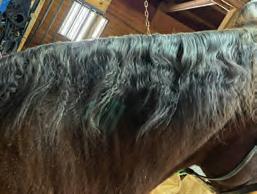
For many horse owners, dealing with thin manes, rubbed tails, rug rubs, or patchy hair can feel frustrating, especially when you're doing everything right and still not seeing results.
That's exactly why Horse Queened created the Regrowth Ritual Pack. Made in regional Victoria by horse people, this simple two-step routine combines Grow It, a nourishing mane and tail serum, with Soothe It, a rich purple comfort cream designed to support skin exposed to rugs, weather, and everyday horse life.
Together, they work routinely to support healthier-looking hair while keeping the skin feeling soft and comfortable. What makes it different is how easy it is to use.
No complicated routines, no harsh ingredients - just practical, everyday care designed for real horses in real conditions.
The Regrowth Ritual Pack has quickly become a favourite among customers across Australia and the world, with many horse owners incorporating it into their regular grooming routine.
At Horse Queened, everything we make is created with one goal in mind: simple, effective care that fits into a busy horse life. For more information visit www.horsequeened.com
EQUESTRIAN CENTRE, AIRBNB, SUBDIVISION POTENTIAL
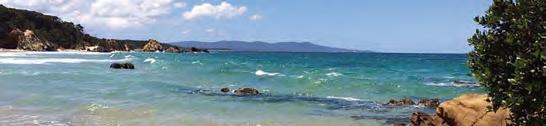
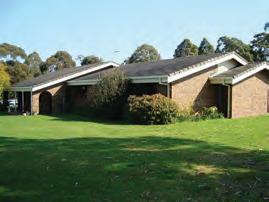
Offered for sale is this outstanding property located just 3km from the beach at 17 Genoa-Mallacoota Road, Mallacoota.
Set on 8 acres, the 481 square double brick 4 bedroom home has two large family rooms and two bathrooms. The large master bedroom has a huge ensuite and walk-in-robe. There are three large children's bedrooms, 2 of which have built-in robes and the third a walk-in robe close to the second family bathroom with shower. The office could serve as a fifth bedroom. The house has recently painted inside and out ready for the new owner to move in.
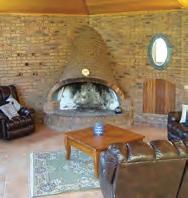
The home features beautiful Western Red Cedar cathedral ceilings, Oregon beams and Blackwood dado wood panelling.
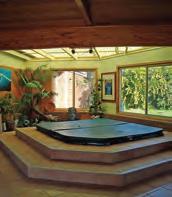
In addition, there is a large 8 seat spa, a built-in bar, wood heater, carport and double garage topped by a new colour bond roof. Two phase electricity and also wired for generator power, the property runs on both electricity and cylinder gas so is outage-proof.
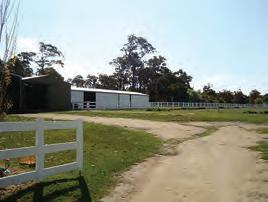
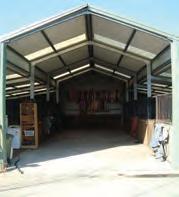
The property boasts a large 7 bay stable and tack room, a shed port that has housed a helicopter, a massive workshop with work benching and a large 3 double bay feed shed (approximately 45 squares of shedding).
Children will love the 3 level tree house with fireman's pole, 70m zip line and pulley system…or feed the chooks in the large fox proof poultry run.
Surrounded by mature trees, the garden offers colour and fragrance through all seasons with a fully enclosed veggie garden next to the orchard of fruit and citrus trees.
Completely fenced with mostly new white polycarbonate horse fencing and completely new boundary fencing all around, the property is also eligible for subdivision.
This outstanding property is perfect for a large family, an equestrian centre or luxury Airbnb.
For further information email: catherine.tregellas@gmail.com
The Horse Report
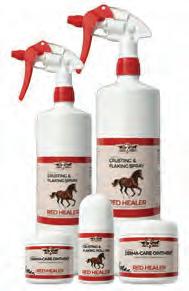
Red Healer is an Australian company that specialises in the research and development of natural equine and canine skin and coat products.
By A Cox, K Wood, G Coleman, AJ Stewart, F-R Bertin, H Owen, WW Suena, and CE Medina-Torresa
Essential oil spray reduces clinical signs of insect bite hypersensitivity in horses
Objective: To assess the efficacy of an herbal spray combining various essential oils, with a claim of mast cell stabilisation, antipruritic, antiinflammatory, and insect repellent effects on the clinical presentation of insect bite hypersensitivity (IBH) in horses.
Methods: Twenty adult horses with clinical IBH were treated with a daily application of herbal spray or placebo for 28 days in a randomised, cross-over fashion, separated by a>28-day washout period. Horses were examined and scored prior to and after the completion of each treatment. Histopathology was performed on four horses.
Owners kept daily diaries of observations.
Results: The herbal spray significantly reduced the severity of all assessed parameters (pruritus, excoriations, lichenification and alopecia; P< 0.05) compared with baseline values (pretreatment) and with placebo.
Owners reported improvement of pruritus in 19/20 horses (95%) with complete resolution in 17 horses (85%) following treatment. Skin biopsies showed resolution of orthokeratosis in 4/4 horses, reduced thickness of the stratum spinosum in 2/4 horses and complete resolution of histopathological abnormalities in 1/4 horses after treatment
Ask us about our latest trial and publication on a potent natural anti-inflammatory ointment for all other equine skin conditions
The tested herbal spray may be an effective treatment for the management of equine IBH.
- What we learnt from this trial on our Equine QLD Itch 3 in 1 formulation: 'Insecticides and horse covers only prevent new bites and can't help with existing itching and lesions - a multi-action spray that repels, stops the itching and heals the existing lesions is necessary.'
BARREL RACING
www.abha.com.au
MAY
8 - 9 Moonbi, NSW
9 -10 Gracemere, Qld CQLX
9 -10 Geurie, NSW
9 - 10 Lockington, Scurrah Reserve, VIC
16 Cootamundra, NSW
17 Waubra, VIC
17 Quirindi Rodeo Arena
17 Bartlett Park
17 Cootamundra, NSW
21 - 24Gracemere, Qld
23 - 24 Walkamin QLD
23 Cooranbong, NSW
23- 24 Bundarra Showgrounds NSW
23 - 24 Walgett NSW
29 - 31 Hillier, SA
30 - 31 Nebo Campdraft Arena, QLD
JUNE
6 Biloela, QLD
6-7 Walkamin QLD
7 Biloela, QLD
20 Beaudesert, QLD
20 - 21 Paradise Lagoon QLD BREEDS
MAY
8-10 Qld Arabian Challenge Show
10 -13 NSW State QH show @ SIEC
15-17 Qld ASH State show
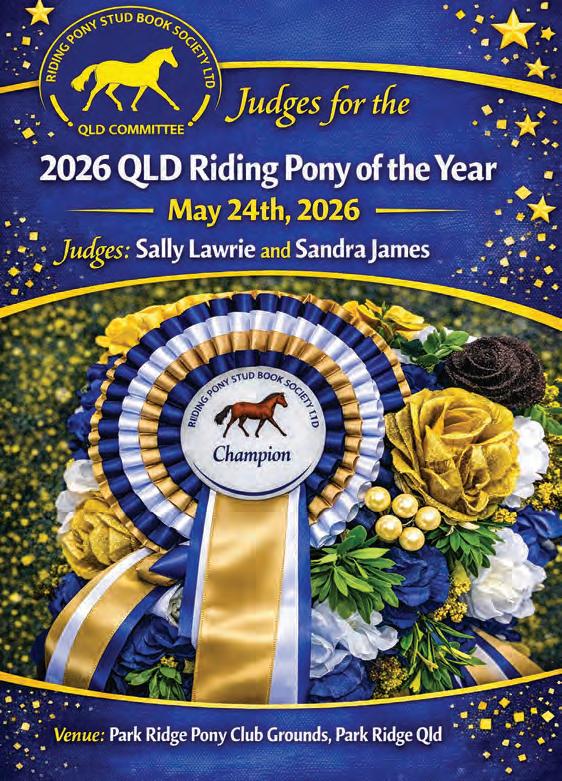
24 Qld Riding Pony HOTY@ Park Ridge
JUNE
13-14 Scenic Rim Clydesdale Spectacular CAMPDRAFTING/CUTTING /TEAM PENNING
BONE Gold nutritional bone joint and collagen supplement was formulated to provide some of the essential amino acid requirements of collagen type I, II and III (found in bone and connective tissue) in addition to supporting the nitric oxide pathway which has been found to assist in the formation of bone callus postinjury.
Veterinary surgeons have recommended that Bone Gold may assist with sore shins, tendon injuries, ligament injuries, osteoarthritis and post-surgery in horses and polyarthritis, geriatric osteoarthritis, and post-surgery in dogs.
Here is a veterinary radiographic report on a horse with a fracture evident on the medial toe and after treatment and feeding Bone Gold during this period. More information on these products can be found at www.vetgold.com.au
VETERINARY RADIOGRAPHIC REPORT
HORSE: "XXXXXXXX"
DATES OF EXAMINATION: 26TH AUG, 21ST OCT 21 & 17TH NOV '21
PLACE: XXXXXXXXXX FARM
XXXXXXX's left and right front feet were radiographed on 26th Aug, 21st Oct (8 weeks) and again on the 17th Nov '21(12 weeks).
RADIOGRAPHS:
26.08.21: Right Front: Large P3 solar margin fracture evident on medial toe 32.6mm x 4.1mm with approximately 1.4mm separation from parent bone as below left image.
21.10.21: Right Front: Fine residual 4.2mm fracture still evident, approximately 90% resolution
17.11.21: Right Front: Fracture fully resolved
RECOMMENDATIONS:
Radiographic results as of the 17th Nov '21 show total resolution of the original fracture.
XXXXXXX was reshod today utilising off an alloy shoe with a toe clip - inner circumference seated out to avoid any sole pressure.
The horse can return to training. Please do not hesitate to contact me if you have any further queries
COMMENTS:
Solar margin Type IV fractures of this magnitude have well-documented internationally published healing rates of 7 - 12 months. Full resolution of these fractures is rare as most often the fracture fragments are resorbed.
Full resolution in a 3 month period was not anticipated.
The horse was on Bone Gold 3 x scoops fed once per day for this period.
"Go to our webpage or scan the QR Code to see more Bone Gold Radiographic results"
The Horse Report
Magnesium deficiency in horses
Supplied by RANVET
Magnesium plays an important role in nerve and muscle function of horses; it is an activator of many enzymes and participates in muscle contractions.
It is necessary for the maintenance of electrolyte balance, particularly for calcium and potassium.
Magnesium works in concert with calcium and is also one of the major minerals found in bone.
When a horse becomes excited, its body will also use magnesium in the process of calming down and relaxing.
The magnesium requirement of a typical horse is around 20 milligrams per kilogram of bodyweight per day.
Horses that are growing, lactating, or in heavy work may use more each day.
Symptoms of magnesium deficiency:
Magnesium deficiencies or abnormalities in horses usually present through influencing neuromuscular function and cardiac tissue.
Horses deficient in this vital mineral often show symptoms including:
- History of tying up
- Nervousness, wariness or excitability
- Muscle tremors or trembling not related to environmental temperature
- Does not tolerate work well and works up, not down
- Tight sore backs (not related to saddle fit) Incoordination
- Difficulty focusing on work or poor work ethic
- Repetitive movements such as weaving, pacing or head bobbing
Sources of magnesium:
Magnesium is found in varying quantities in forages and grains.
It often tends to be deficient in spring pasture due to the fast-seasonal growth experienced.
Concentrate feeds may or may not have additional magnesium, depending on the amount contained within other ingredients. There are supplements available such as Ranvet’sSettle’em Plusthat contain sufficient levels of magnesium.
Supplemental magnesium can be either inorganic (magnesium sulfate or magnesium oxide) or organic (chelatedmagnesium). Settle’em Plus contains all 3 supplemental magnesium’s (chelate, sulfate & oxide) and
has been developed to help counteract hyperactive behaviour in horses.
It also contains:
Vitamin B1- Known for its calming effect on hyperactive horses.
Vitamin B2- Supplements high grain diets which are naturally low in B2.
Vitamin B6- Supports protein metabolism and muscle development.
Zinc- Supports hoof health, coat health and bone health.
Vitamin E- Supports muscle and nerve function.
If you are concerned that your horses’diet may be lacking in key nutrients, simply complete our diet evaluation form and have your horse’s diet analysed by our technical team. Submit your horse’s diet online for a free diet evaluation!
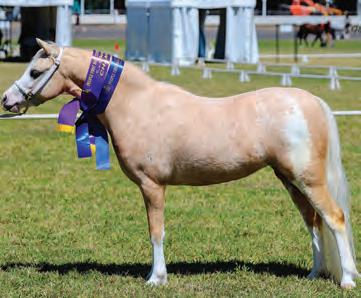
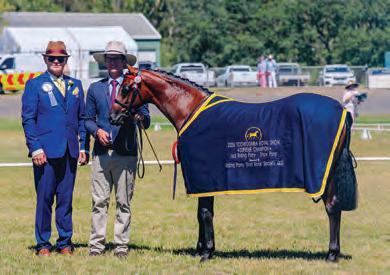
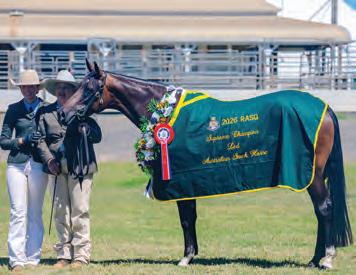
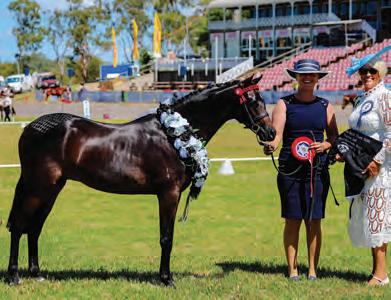
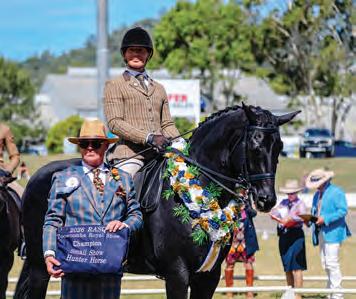
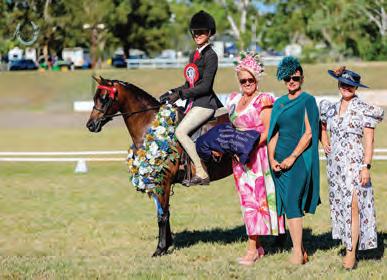
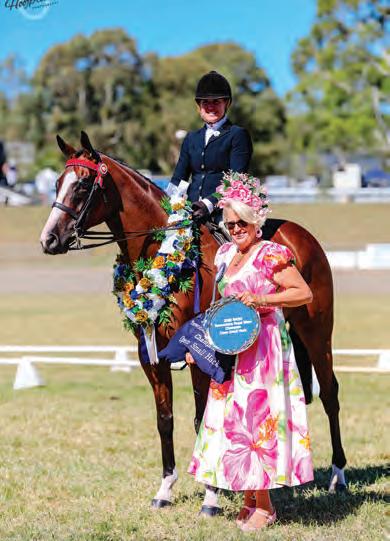
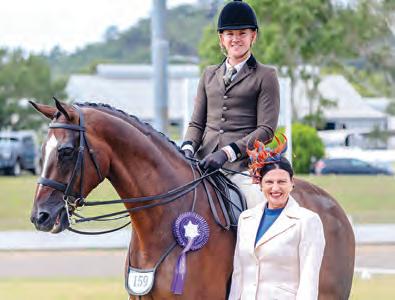
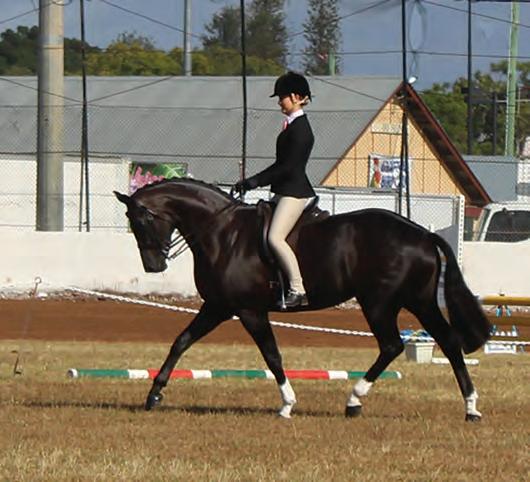
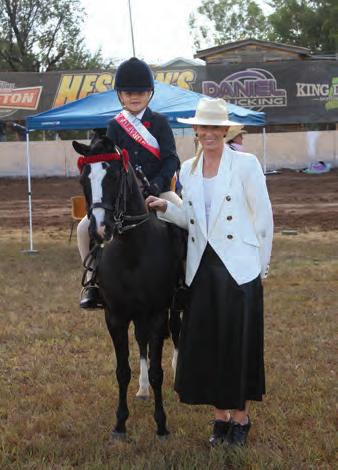
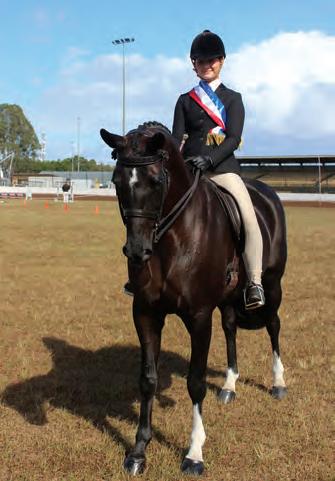
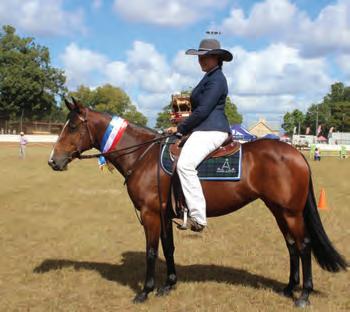
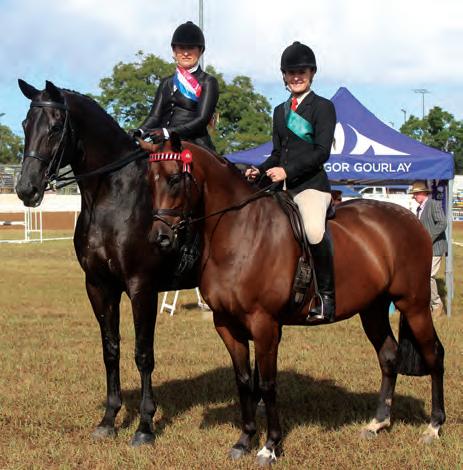
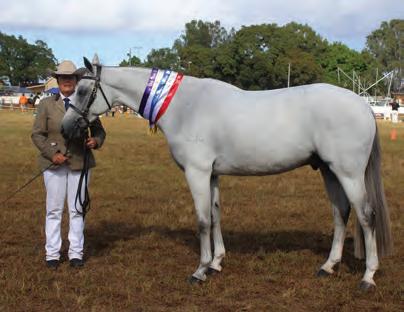
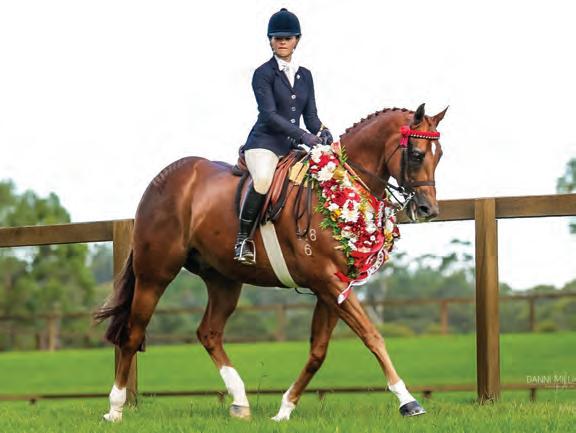
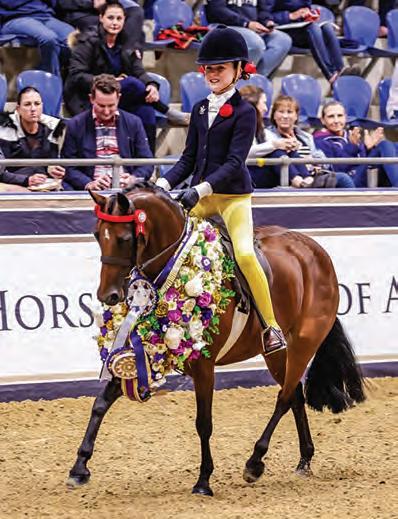
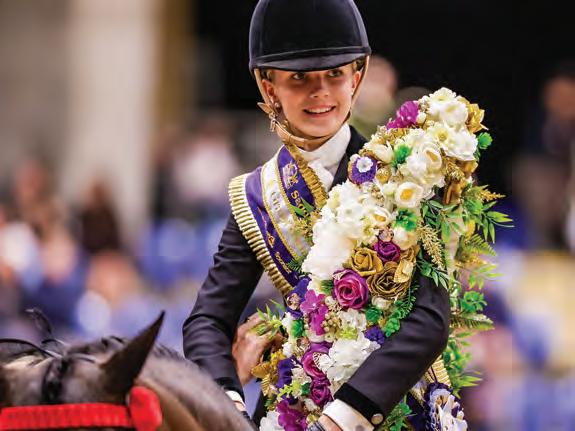
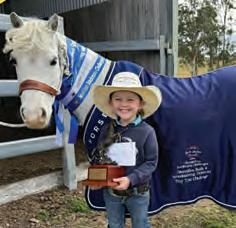
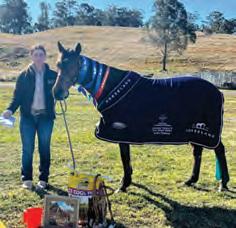
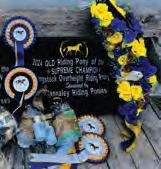
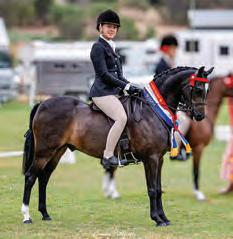
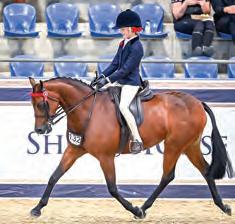
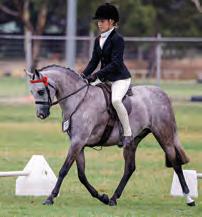
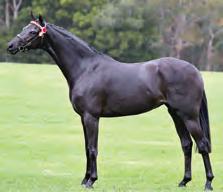
Supreme Champion Led Riding Pony Whitmere Pop the Bubbles
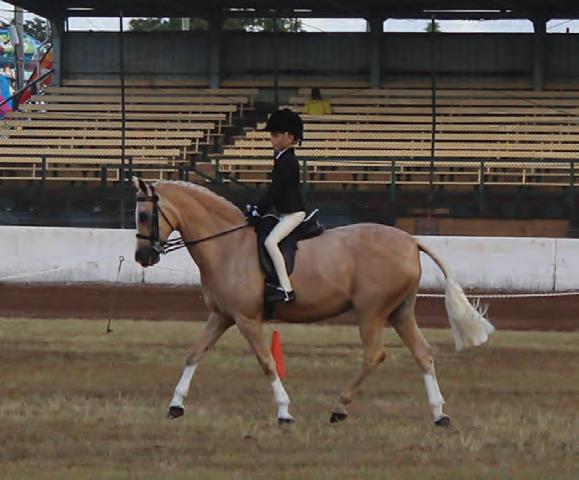
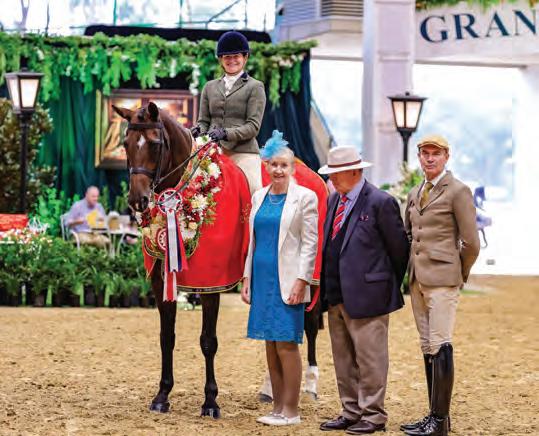
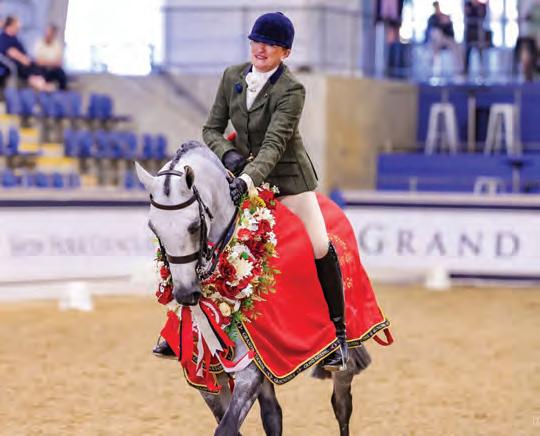
Supreme Champion Led ASH Sheady Montana
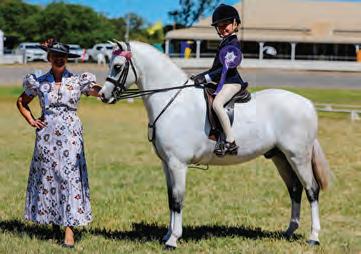
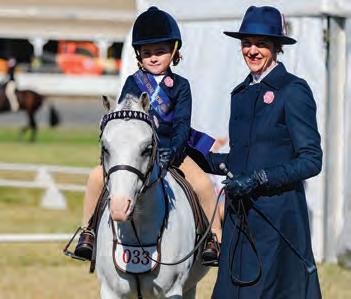
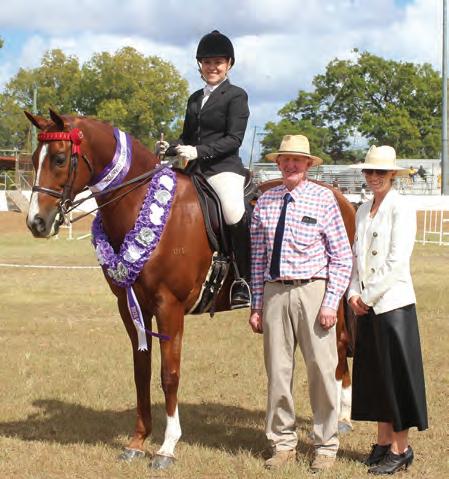
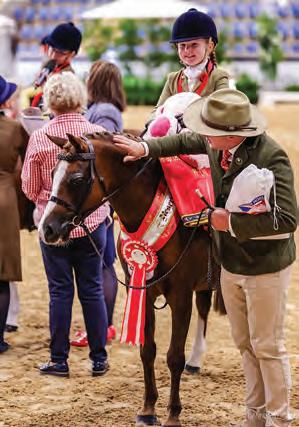
Champion Led Welsh
Supreme ChampionLed Australian Saddle Pony Mcarthurparc Iconic
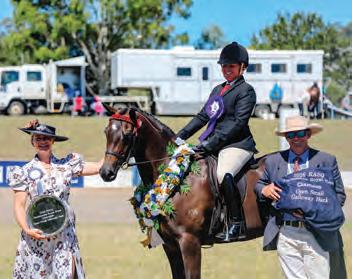
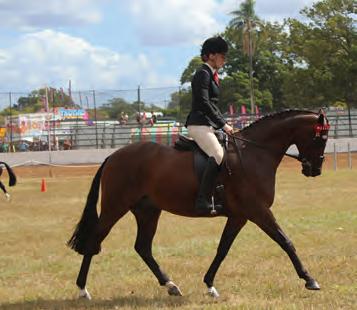
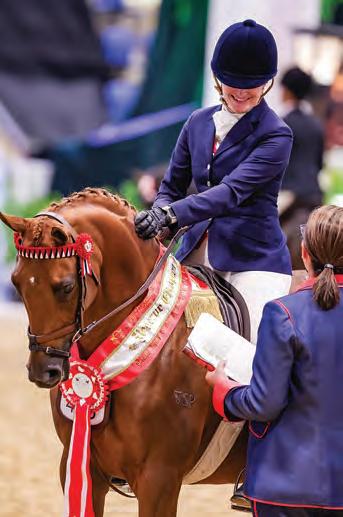
Champion Small Hunter Hack Araluen Motown
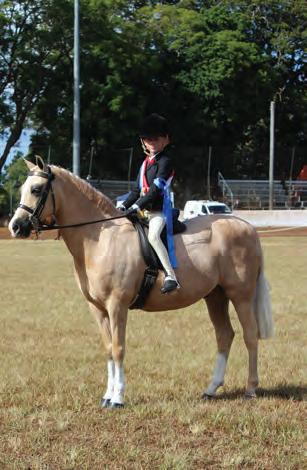
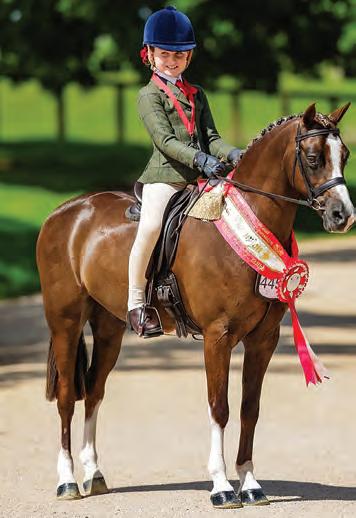
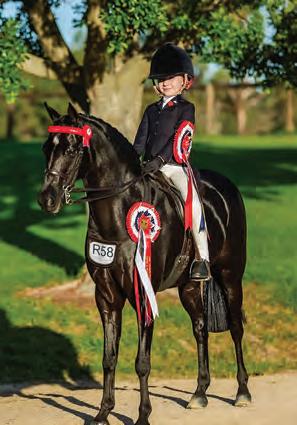
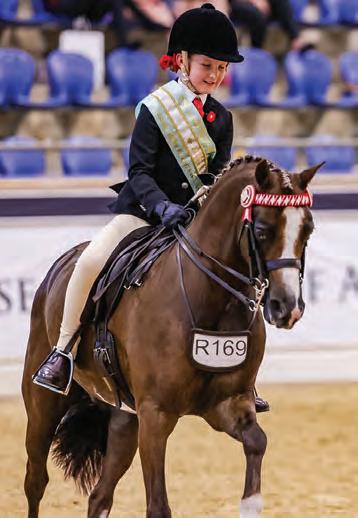
Champion Mini Childs Pony Merry Trinket of Royalwood
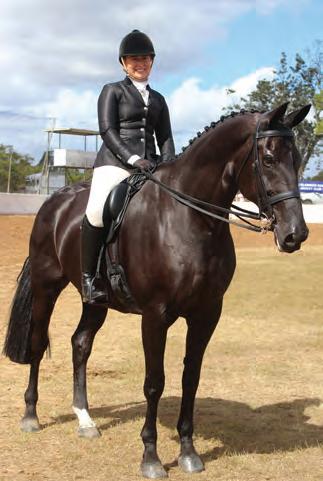
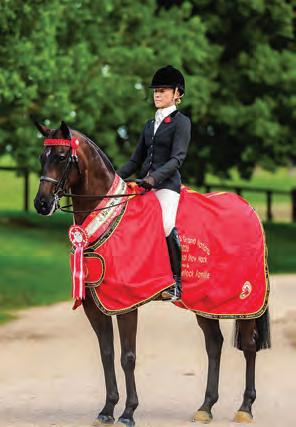
Supreme Champion Hack Whitmere Splendid Morning
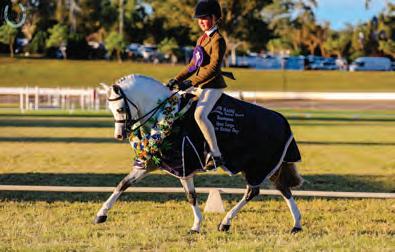
Champion Small Galloway Melody Park Royal Symphony exhibited by Sarah Young
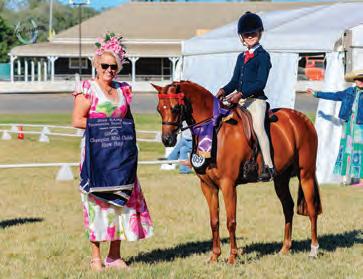
Addison Rides Champion Junior Girl Rider
Champion Show Hunter Pony Preston Park Mr Darcy
Champion Large Galloway Belmont Rockstart & Tyler Buchanan
Champion Show Hunter Galloway Paulgren Park Vancouver
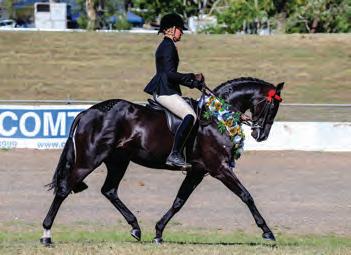
Champion Small Hack Trending / Stoicism exhibited by Melissa Sambrooks
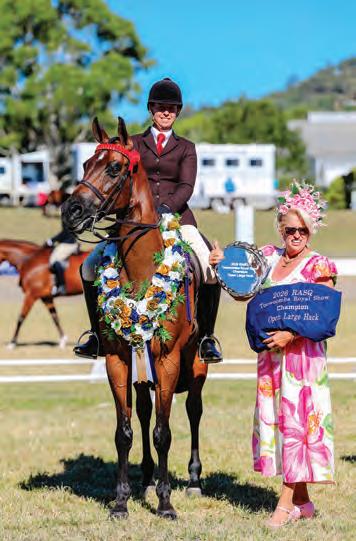
Champion Large Hack RS Supremacy exhibited by Karen Shaw
Supreme Champion Rider Alli Reinke
Champion Large Hunter Hack Hollands Bend Royal Consort & Jaspa Beattie
Champion Novice Galloway Melody Park Royal Symphony exhibited by Sarah Young
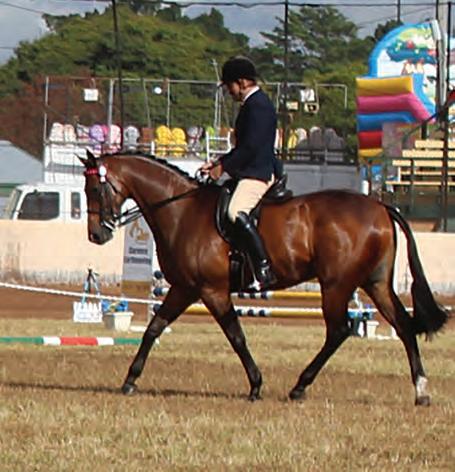
Reserve Champion Hack exhibited by Ben Hudson
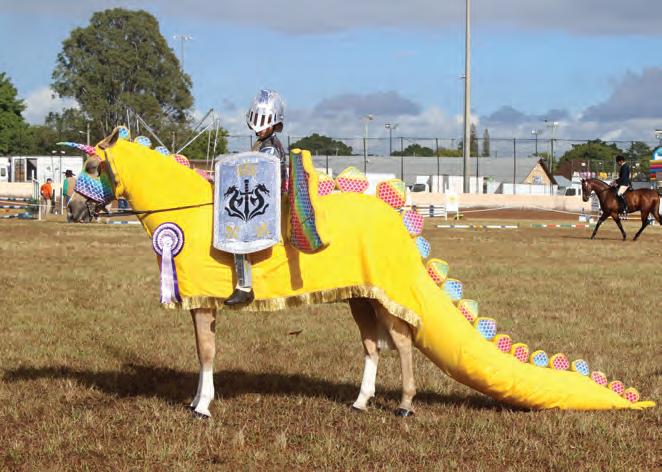
Winner of the Fancy Dress Cody Want and Elvanora Park KandymanCody Want
Trem
Champion Show Hunter Pony and Suprem show hunter Elvanora Park Kandyman and Cody Want
Supreme Champion Rider and Champion SHow Hunter Hack HV Furstin Highness and Anastasia Blanch
Champion Adult Rider Lindsey Blanch Reserve Champion Charlee Anthony
Champion Junior Girl Rider Tahlia White
Trem
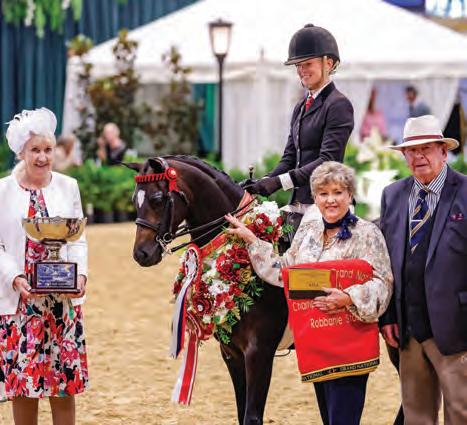
Superme Hack LC Davinci exhibited by Chloe Dwyer
Champion Senior Girl Rider Anastasia Blanch
Reserve Champion Junior Boy Rider Cody Want
Reserve Champion Show Hunter Hack exhibited by Lindsey Blanch
Champion Novice Galloway Tremayne Dance with Me exhibited by Charlee Anthony
Supreme Led ASH Meluca Stud Moondust exhibited by Meredyth Regan
Champion Working ASH Margarita One Moore exhibited by Amie Harrison Want
The Horse Report Flexi-Fibre®
Flexi-Fibre
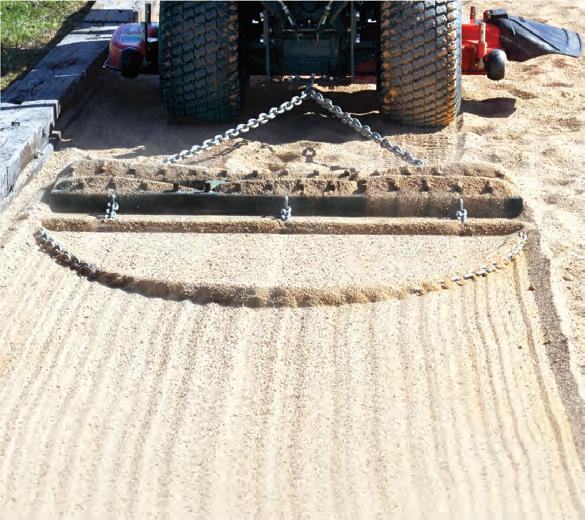
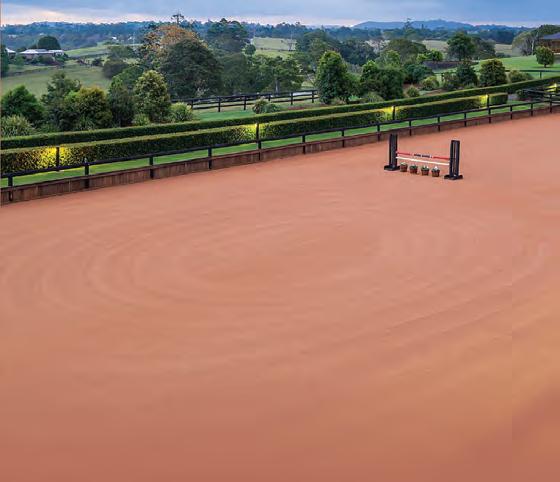
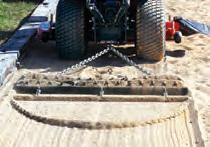
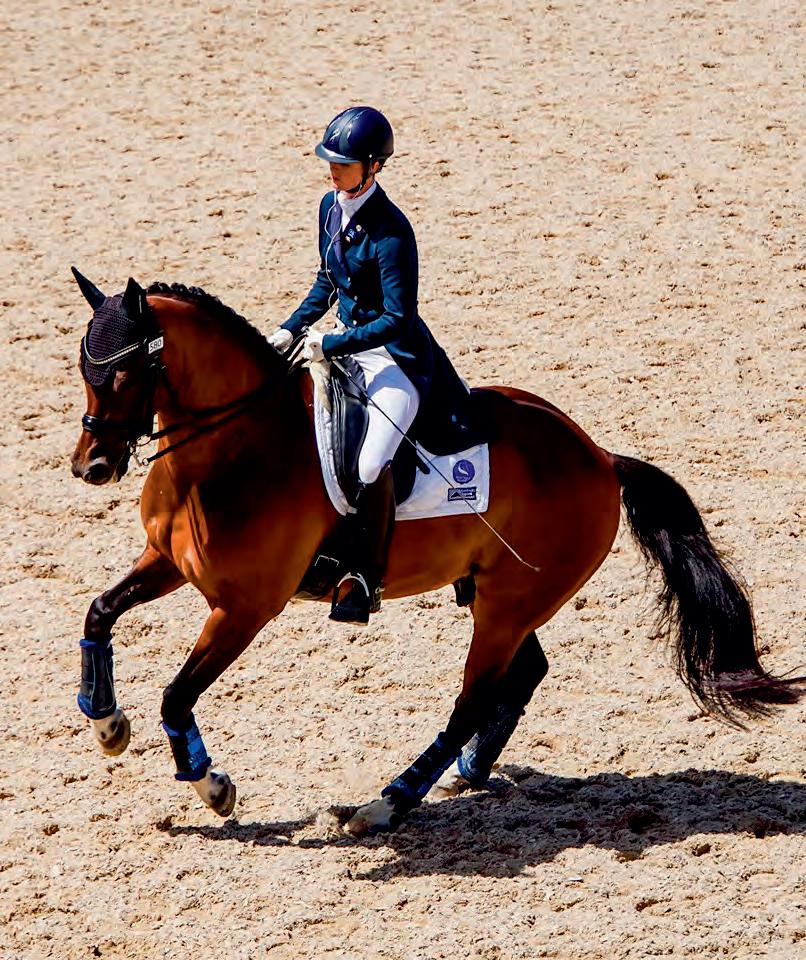
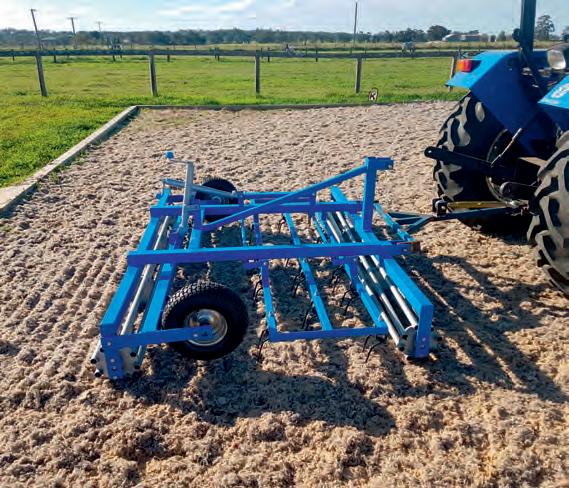
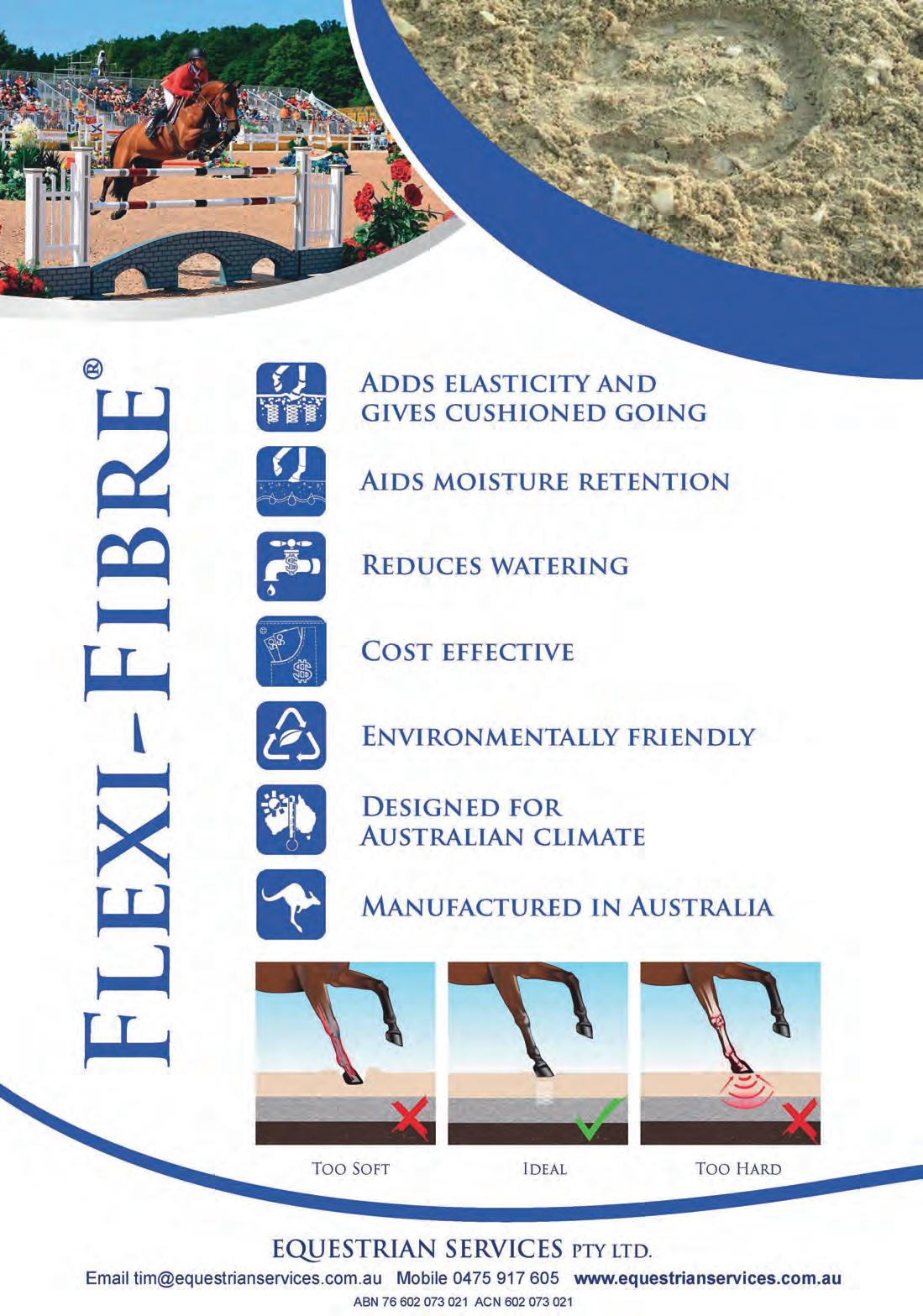
Fibre provides root structure, similar to grass roots in turf, to existing or new sand-based riding surfaces. Fibre improves the surface stability, therefore the horse will work ‘on top’ of the surface rather than ‘through’ it.
Our Flexi Fibre is a mixture of polypropylene, polyester and nylon Fibres which are the base material to all of our surfaces worldwide and similar to all other top surface suppliers. We
Australian conditions and manufacture here in Australia, enabling us to produce at very competitive rates.
• Improves preformance
• Improves stability of new or existing sand surfaces
• Enhances drainage
• Long
The Horse Report
The Horse Report
Unique Collaboration takes riders to a deeper understanding
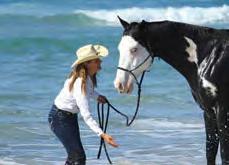
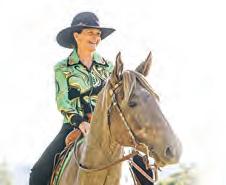
By TANJA KRAUS
Ive been teaching clinics for quite some time now, and I have witnessed first hand the power of owners being able to understand their horses on a deeper level.
Trainers
Understanding why your horse reacts the way they do to certain things, how they see the world, how they learn, respond and think takes training to an entirely new level. But, there has always been something missing. The last piece of the puzzle that will allow a deeper connection and way of being with our horses, and that is a deeper understanding of ourselves.
It's been long understood that horses are a prey animal, humans are a predator, and thus we both see and respond to the world differently. This has been the heart of my teaching over the past 15 years - helping people see the world through their horses eyes.
But what about having a deeper understanding of ourselves?
How does the human brain think, feel, learn, react and respond.
Why do I get frightened when my horse does something ?
Why do I get angry when he does something else?
The human mind is a complex thing, and we don't learn a lot about its function when we are children. In fact most of us go through life 'at the mercy' of our mind, without realising we can learn how to understand it, and more importantly, how we can control it.
Since late last year I have been collaborating with Linda Sawrey, to deliver a unique retreat experience. Aclinic like no other, where you learn from a horse behaviour expert, and a human behaviour expert at the same time, to have a deeper understanding of how we function, how our horse functions, and how we can optimise that partnership together.
In a short time we have helped many people understand how and why they respond and react to situations the way that they do.
Coupling that knowledge with how the horse responds and reacts with the world has forged a deeper and more confident connection in both the horse and the human. From understanding the Window of Tolerance, Trauma, relationships and attachment styles, students have reported not only
having a better, safer and deeper connection with their horses, but with their family, friends and co-workers.
This collaboration has been a long time coming to the Equine community, and is rapidly becoming a 'game changer'.
Masters have long said the horse is a reflection of ourselves, so isn't it time we knew more about who is looking back at us from the mirror?
Tanja Kraus is an experienced horsewoman specialising in building skill and a deep understanding of the horse. Linda Sawrey, a highly qualified Psychotherapist, Clinical Counsellor, and Registered Nurse and blends evidence-based psychotherapy with real-world leadership experience to help individuals and teams navigate stress, build resilience and strengthen connection
MAY
13 - Staying Safe - Free Webinar
JUNE
4 - The Brain - Free Webinar
5-7 - 3 day Intensive Retreat (Humans Only) Gold Coast
JULY
8 - Anxiety - Free Webinar
21 - 25 - 5 day Immersion (Bring a horse) Gold Coast
To find out more about Tanja or Linda visit their websites Tanja Kraus- www.horsemanshipforperformance.com
Linda Sawrey- www.nurturedbynaturepsychotherapy.com.au
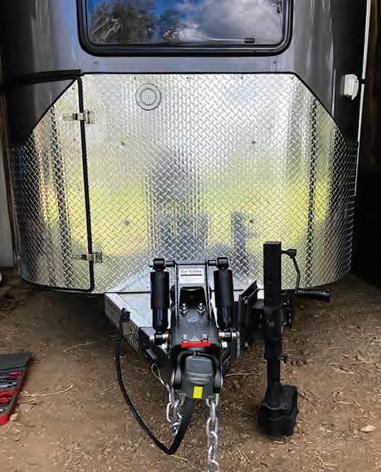
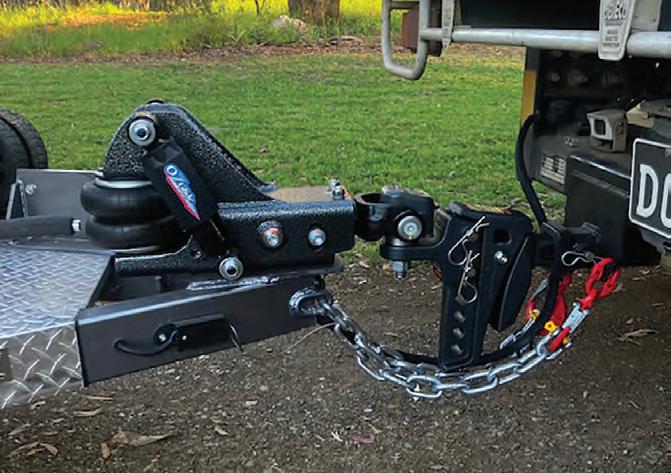
The Horse Report Your Horse Deserves A Better Ride...OzGlide
What is the Oz Glide?
* Premium towing solution;
* Enhances stability, safety and control for tow vehicle;
* Minimises vibrations and impacts generated by travel -for tow vehicle and float;
* Improves longevity of vehicle and float chassis;
saving $ on your investment
* Provides a smoother, more stable and comfortable travel experience for your horse;
Less stress related behaviour, less fatigue, less anxiety
* 100% Australian owned and manufactured;
* Guaranteed to work - or your money back;
* Simple installation
The Horse Report Intelligent Inventions recognised with awards
BY ADRIAN MORGANTE
Intelligent Inventions (II) continues to lead equine welfare and performance innovation, now recognised with 29 international awards across its expanding product range.
Recently awarded seven major global awards for 2026, Intelligent Inventions is recognised for their leadership in equine safety, welfare, engineering and performance innovation.
These awards highlight why more trainers, riders, veterinarians, retailers and owners from around the world are choosing to stock and use II Winners products. Each award affirms the credibility, trust and proven results behind our patented designs.
Below is a summary of II Winners seven newly awarded products:
1. Magic Fly Mask with Sunglasses
Award: Global Equine Comfort & Welfare Innovation Award 2026
Recognised for transforming equine visual comfort, UV protection and behavioural calmness.
2. Magic Horse Calmer & Eye Protector Award: Global Equine Safety Product of the Year 2026
Celebrated for dramatically reduc-
ing loading anxiety, transport stress and eye injuries.
* Riders and trainers prefer equipment that is proven, tested and independently recognised.
* This portfolio of seven new world-class awards positions our products as the leading equine innovations for 2026.
The team at Intelligent Inventions looks forward to helping you and your horses benefit from the world's best equine safety and welfare technology. Discover more at www.iiwinners.com
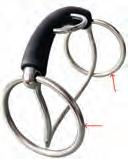
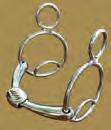
The design creates Power Steering and Brakes for strong horses. Very kind in the mouth and relaxes them. Lowers the horse’s head, creating a smooth, and time faults, making the difference of winning. Award-Winning Bit. Horses, trainers, coaches, and riders love them,
The Horse Report
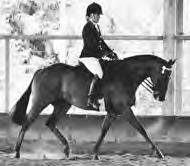
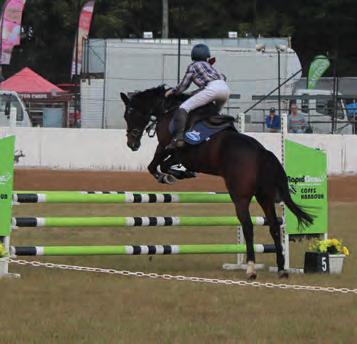
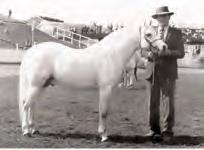
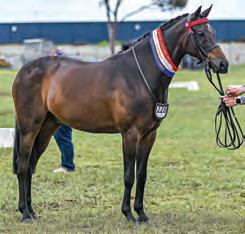
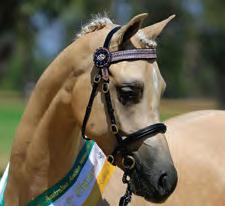
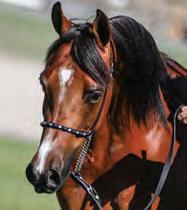
The Australian Pony- a truly versatile breed
Supplied by QUEENSLAND AUSTRALIAN PONY OWNERS AND BREEDERS
The Australian Pony, from its inception, was always purpose bred.
Our Australian Ponies were bred to be hardy, hardworking equines that could stand up to the harsh Australian conditions. This tough pony is noted for its endurance, agility, sure footedness and exceptional temperament
Its ancestry dates back to the arrival of the First Fleet in 1788.
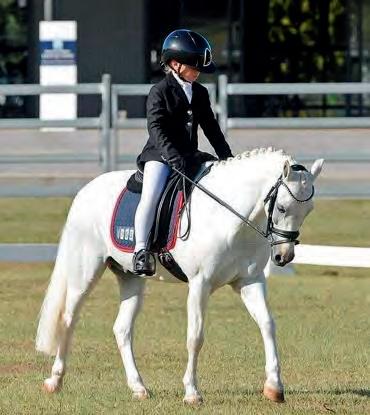
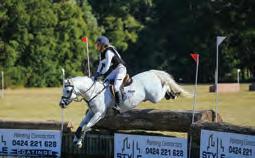
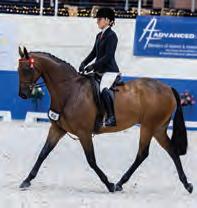
The Australian Pony is used in every equine discipline.
Possibly the world’s most versatile pony - a beautiful pony with great bone and substance, renowned for its intelligence, athletic ability, speed, quiet temperament and great mind. It has all the prerequisites for a first-class, modern-day performance pony.
This pony did not just appear as a recognised breed in 1931 at the formation of the Australian Pony Stud Book Society.
It had developed from the time of colonisation and with the importation of the very first equines into Australia.
Thoroughbred, Mountain and Moorland ponies, Timor ponies, Arabians, Manipur and Batik Hill ponies, as well as that little Hungarian pony, Bonnie Charlie, all contributed to the foundation of our breed.
The Australian Pony was a combination of all these genetics and more.
Over 100 years of breeding has gone into this breed for it to become one of the most versatile and outstanding ponies in the world.
The Australian Pony has evolved during this time as Australia’s own pony.
The harsh conditions and vast open spaces of early Australian
settlement demanded a tough, durable pony with a good mind and a comfortable ride, able to work on the farm, deliver the kids to school (usually bareback) and to harness up and take mum to town.
It was suitable and handsome enough to transport the family to Church on Sundays.
The pony continued to develop and a definite type was emerging by the 60s.
In the 70s and 80s a very consistent type of pony, that, if left to develop, would have set a standard easily recognisable as our own true Australian Pony.
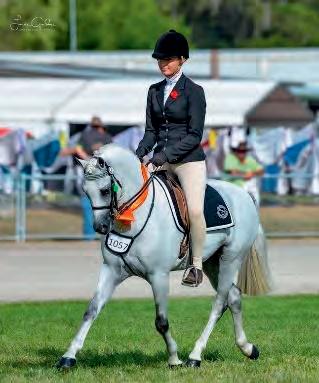
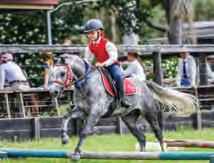
Today, the Australian Pony is still an exceptional pony as it can do a hard day’s mustering on an outback Australian station, go to the local agricultural show and compete in hack and child rider classes, then off to a gymkhana to compete in the novelty events. They even capably chase cows in a Campdraft and that’s only mentioning a few of its disciplines and talents.
The purebred Australian Pony is known for its great mind kind and trainable nature and its reliability, it has been used for many equestrian pursuits by children and adult riders or drivers.
It is a very versatile and accomplished pony that excels in the show ring, pony equitation,
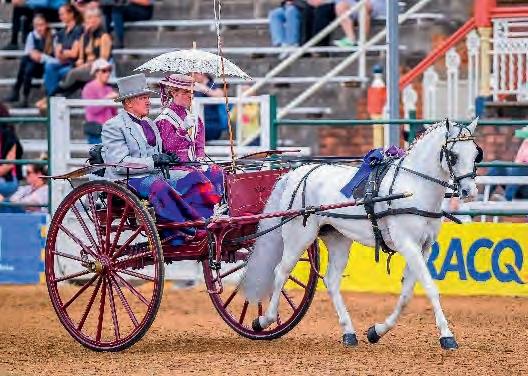
English and Western pleasure, pony jumping, sporting classes such as barrel racing, flag and bending races, pony jumping, harness, dressage, pony club and pleasure riding.
It is still used to this day on large and small country properties to muster cattle or sheep and then their young riders can enjoy their ponies by swimming with them in the dams and creeks, after a long day’s work.
The relatively new Inter-school competitions have proved to be an area where Australian Ponies are very proficient.
There are five disciplines for young riders to compete, these being Dressage, Jumping, Eventing, Show Horse and Combined training.
Pony dressage is another discipline that is becoming increasingly popular and once again this pony has risen to the challenge and is highly competitive.
Our Australian Pony will do all of this without complaint and very successfully.
They also make the best children’s ponies from a very young age looking after their little human and, in a lot of cases, the kids use them as playmates.
They don’t need shoeing and live on love, feed and hugs all year round.
Many Australian Ponies have
been highly decorated in their fields of expertise prior to the formation of The Australian Pony Stud Book Society.
There are many records, pictures and results of Australian Ponies, from our very early Royal shows, winning their classes in hand and under saddle.
The Australian Pony should not exceed 14 hands and all colours are acceptable, grey being a dominant colour.
The Queensland Australian Pony Owners and Breeders Group was formed in late 2023 by a few dedicated Australian Pony enthusiasts.
The group’s main function is the preservation and promotion of the Australian Pony whilst being governed by the rules of the Australian Pony Stud Book Society Inc.
We promote the Australian Pony in all equine pursuits and welcome new members or enthusiasts whether you own, breed or are interested in the Australian Pony of today or yesterday.
We produce a quarterly newsletter Aussie Antics, for anyone keen to read it (accessed via our Facebook page).
It provides information to assist new and established owners and breeders through educational articles and details of promotional activities.
The versatile Australian Pony is used in every equine discipline.
The Horse Report
GLENARTHON STOCKMANS CHALLENGE
The 2026 Glenarthon Stockmans challenges will be held at Woodenbong Showgrounds on the weekend of July 4 & 5 at Woodenbong showgrounds
There is a lot on offer this year not only for the Open rider but for everyone. They will be running11 challenges and the challenges are open to all breeds not just Australian Stock Horses.
Events include the Tiny Tots Challenge, Mini Challenge, Junior Challenge, Youth Challenge , Encouragement and Rookie Challenges and Challenges for 2, 3 and 4 year old horses.
Plus the feature event the Open challenge Winner of this years challenges will recieves prize money , rugs and great prizes thanks to the wonderful sponsors.
There will be an auction on saturday night to raise money for Neimann Pick Disease awareness and they are still looking for donations for the fundraising auction.
For further information contact the Event Co Ordinator: Colleen McQueen 0429 334 041 Email glenarthonstockhorses@hotmail.com
July 5
Winter show - Park
September
October
1/8
www.qld.equestrian.org.au
The Horse Report
ARE YOU READY FOR PONY CLUB
The 2026 Pony Club is well under way, club have been running camps and rally days and competition have started.
If you haven’t yet signed up:
All registrations are done online via JustGo. Simply head to www.pca.justgo.com/Account.mvc/SignIn
• Log in or create an account
• Select your Pony Club and membership
• Follow the prompts to complete your registration For clubs needing new uniforms or promotional gear visit www.williamson.com.au
Looking for a pony club event in the school holidays why not enroll for a Murwillumbah Pony Club camp. The Murwillumbah club runs a camp in each school holidays. The camps are open to all ages including little lead line riders, junior and senior and associate riders and adult riders so that mums dads and kids can all enjoy pony club and all it offers together. They offer great facilities, stables, camping, canteen, new dressage arenas, jumping and sporting equipment, qualified instructors, friendly helpful members. Based out of the Murwillumbah Showgrounds, Queensland Road, Murwillumbah. For further information contact Paula on 0413 733 294.
QLD RIDING PONY OF THE YEAR
The 2026 Qld Riding Pony of the year show will be held on May 24 at the Park Ridge Pony club grounds.
The show offers an excellent program for both youngstock and senior led and ridden ponies. There are great prizes on offer including rugs, trophies and garlands for all the Supremes, prizes and rosettes for all the champions and trophies for the most successful exhibiter and breeder. Programs are now available at www.rpsbs.com.au/qld/qld-events/ and entries are now open via https://docs.google.com/.../1FAIpQLSdVMlmz6y8eJt.../viewform For more information email rpsbsqld.treasurer@gmail.com
SCHOOL HOLIDAY CAMPS
The Horse Report
THE 2026 MUDGEERABA SHOW
The 96th Mudgeeraba Agricultural Show will be held on Saturday 27 and Sunday 28 June. For nearly 100 years, the Mudgeeraba Show has celebrated the very best of agriculture, community, and country living right here on the Gold Coast Hinterland with two days of competitions, displays, entertainment, food, and family fun. With more than 20,000 visitors each year, it’s the place “where the country meets the coast.” Saturdays ring events start at 8:00 and nominations or taken on the day. The program includes led and ridden breed classes, Hack hunter and rider classes, Western and Ranch riding, and a beginner ring. SUnday will be a full day of showjumping starting at 7:15 am and showjumping nominations are via www.nominate.com.au closing on 27 June For further information visit www.mudgeerabashow.org.au or Email: info.mudgeerabashow@gmail.com
THE 2026 MALENY SHOW
"The friendly Maleny Agricultural Show will be held on Friday 29 May and Saturday 30 May 2026. You can download the schedule, horse health decs, waivers and view details for Camping and Yards on their website www.malenyshowsociety.org.au Get in early to book your yards. Competitors can nominate online through www.nominate.com.au or you can nominate on the day at the Horse Nomination Ring Office. Friday events are led and ridden breeds, local and district classes. Saturday events include Hack and Rider classes, Side Saddle, Harness and Miniature Horses. Show Jumping is continuous across the two days. Dairy, Beef, Poultry and miniature goats are also on show. There will be loads of entertainment to keep you entertained including monster trucks and thrilling stunts, cowgirls with wings, trick riders, freestyle motorcycle trials and stunts, live bee keeping demos and workshops, robotic sheep mustering dogs, circus, bubble workshops for the kids, woodworking workshops, wildlife unleashed shows, nursery, whip cracking, gem fossicking and much more. Followed by Fireworks spectacular both nights. The show offers 2 days of family friendly FREE entertainment. Early bird online gate admission tickets are now on sale via our website. For further information visit the website www.malenyshowsociety.org.au Email: secretary@malenyshowsociety.org.au or horses@malenyshowsociety.org.au
MALENY SHOW MALENY SHOW
Friday 29 May & Saturday 30 May 2026
nominate online via www.nominate.com.au or on the day at the Horse Nomination Office. www.malenyshowsociety.org.au
Email: horses@malenyshowsociety.org.au
TRADES & SERVICES LINE LISTINGS ($44 for 6 months or $77 for 12 months)
A record of movement (ROM) must be submitted prior to entry into NSW - https://appcattletick.bfs.dpi.nsw.gov.au
Resources: : NSW DPI Biosecurity https://www.dpi.nsw.gov.au/biosecurity/managing-biosecurity/forms NSW DPI cattle tick record of movement https://app-cattletick.bfs.dpi.nsw.gov.au
NSW legislation www.legislation.nsw.gov.au
QLD cattle tick zones & accredited certifiers for cattle tick https://www.business.qld.gov.au/
We recommend speaking with one of our authorised officers on 0429 185 136 or email cattletick@dpi.nsw.gov.ua prior to bringing animals into NSW.
Department of Regional NSW
The Secret is out!
Vet-formulated for joint protection & mobility Combines Rosehip, MSM, Glucosamine, Chondroitin, Green-Lipped Mussel & Turmeric Results in as little as 2–3 weeks No fillers – just powerful therapeutic support
"This blend is absolutely mind-blowing. All of the therapeutic ingredients that horse owners once had to use separately are now in one powerful, practitioner strength formula."
– Tamara Frances, Nutritionist & Herbalist
The Horse Report
IT’S WHO YOU KNOW
Price: $ 8,000.
Height: 16.0 hh
Reg: SHC
Bay Gelding
Sire: Apologia
Dam: Catakate
Spud is a lovely educated gelding who has had professional training since retiring from the racetrack.
He has good established flat work and is a nice ride with balanced paces.
Spud is suitable for an intermediate rider and above wanting a nice horse to enjoy and educate.
Spud has had 1 season in the show ring and low level show jumping training.
Contact: Shauna McClean
Ph: 0478 191 171
LORD MARKEL
Price: $ 9,000 - This Week ONLY!
Height: 15.3 hh
Reg: SHCV/Thoroughbred
Bay/Brown Gelding
Sire: Hallowed Crown
Dam: Given With Love
Quality Small Hack – “Pickles” 9yo Thoroughbred Gelding | Sourced from Greg Gerry, Whitmere Stud. Pickles is the full package, stunning looks, exceptional movement, and undeniable presence. Currently in his newcomer year, he’s already proving himself, winning at every outing and taking out his Ridden OTTto qualify for VAS.
He’s in full work and show condition, ready to continue his successful campaign. This beautiful gelding oozes quality and turns heads wherever he goes.
Like any OTTB, Pickles will best suit a knowledgeable home to continue his showing career, he has all the makings of a highly competitive hack in the right hands.
Price is negotiable to the perfect home.
Footage available upon request.
Contact: Amber Baker
Ph: 0422 033 123
SANLIRRA NOTATION
Pice: $25,000.
Height: 15.3 hh
Reg: RPSB
Brown Gelding
Sire: Sanlirra Revelation
Dam: XX
15.3hh 9yo Gelding
Reg Riding Pony x Thoroughbred
Sire: Sanlirra Revelation
This beautiful little gelding is not limited to the show ring, possessing three quality paces, and a natural ability to expand and compress within the pace, Noah could have a future in the dressage arena.
His experience lies within the show ring, in 2022 he qualified for Grand Nationals and was Champion Novice Hack and winner of his open at Brisbane Royal, in 2023 he again placed in all his classes at EKKA, and has too many Champion Small Hack titles to list.
Noah has performed well in very big atmospheres and indoors. He is very sweet on the ground and straight forward to ride but wouldn't suit a nervous or novice level rider, he takes alot of confidence from his rider, and under the right riderhe happily does just about anything (see video ??
Avery talented, clever and fun horse to ride!
For further videos and details please phone.
Contact: Courtney Larard
Ph: 0415 592 569
SUPER ANGEL
Price: $20,000.
Height: 15.2hh
Reg: Thoroughbred, SHC, Equimillions Eligible
Colour: Black/Brown Mare
Sire: Super One
Dam: Bangal Angel
Quality Small Thoroughbred Show Mare
Madge is a rare find — a small TB mare with a lovely temperament, correct conformation, and genuine show-ring potential. She is soft, sweet-natured, and very straightforward to handle both on the ground and under saddle. Aconsistent and reliable ride, Madge is at the very beginning of her showing career but already boasts impressive results — including winning at her first Royal Show under extremely challenging conditions without putting a foot wrong. Her most recent results include winning her novice and open hack 15-15.2hh class at Brisbane Royal 2025.
She would suit a capable teen rider or an adult looking for an uncomplicated and honest mare to enjoy and produce. However is not a beginners horse and does require a confident rider still. With limited outings due to work commitments, she’s only been lightly shown and would thrive in a home with time to bring out her full potential.
Easy to handle in every way
Contact Lillian Mills
Ph: 0429 916 767
The Horse Report
JA REGAL TEMPEST
Price: $12,000.
Height: 13.2 hh
Reg: Riding Pony & Saddle Pony
Bay Gelding
YOB: 2020
Sire: Willowcroft Regal Alliance (exp NZ)
Dam: Kolbeach Roses
Offered for your consideration.....
'JARegal Tempest' 5yo Riding Pony 'Gary' as he is known is by Willowcroft Regal Alliance (exp NZ) and from Kolbeach Roses. This pony is super pleasant, unspoilt and an all-round 'Gary'. Just a good bloke.
His first official competition was the QLD State Riding Pony Show a few short weeks ago. He was Reserve Champion Led SH Pony and Supreme Ridden Hunter Pony. He was a pleasure to prepare and exhibit. Gary is still green in the competition arena but we know with the correct guidance, he will be a super show pony for the whole family. In show work and ready to be viewed at Paul Austin Equestrian in Tamborine QLD. About to go home to Gympie for a spell over Christmas so be quick!
Enquiries Paul Austin on 0401 660 189 or Mel Gauld on mel@westerhorseannual.com
LYNLEA PRINT DELIGHT
Price: $12,500.
Height: 13.0 hh
Reg: EA, WPCS, RPSB
Bay Gelding
Sire: Ponsteffan Simwnt
Dam: Lynlea Paper Doll
Legs is a sibling to the highly decorated hunter pony Lynlea Print Design. He is sure to follow the same path in the show ring and is truly royal quality.
Legs is rising 5 with an attitude and work ethic of a school master. Nothing fazes this guy, he epitomizes the saying box to ring with no work down required down required and no plugs. He is happy to carry my six year old daughter around both at shows and home.
Legs has attended three agricultural shows with success at each of them. Only reason we are selling him is with four little children and other ponies in work I am finding I don’t have the time legs deserves.
Legs is 100% sound and blemish free. More photos and videos available for genuinely interested parties.
Contact: Sammy Reeves
Ph: 0431 487 166
Ph: 0421 483 920 Contact: Suzie
MEADOW'S GOLDEN GIFT
Price: $15,000.
Height: 13.0 hh
Reg: EA
Brown Gelding
Sire: Kolbeach Holly's Gold
Dam: Pemberley Amazing Gift
4 years old, by Kolbeach Hollys Gold and out of the beautiful, Pemberly Amazing Gift. Currently measuring 13 hands.
Teddy has been brought on slowly and is now ready to find his new home. His nature is impeccable - absolutely NO dirt. Easy to trim, clip, wash, travel. Atrue fuss free pony that has never put a foot wrong. Although green, he has been ridden by child riders with no issue, never requiring any lunging. Whilst he has no shying or silliness, he is forward moving, so would also be suited to a teen or small adult in his first season!
Teddy has recently attended his first 2 shows for broad sashes, and has been ridden off property to indoors, trail rides and the beach. He is a much loved family member and is only available to the best of homes - you don’t get a temperament like this often!
Contact: Sarah Ryan Ph: 0437 526 076
WESTON PARK MAXIMUS
Price: $19,000.
Height: 13.0 hh
Reg: Welsh
Colour: Chestnut
Sex: Gelding
YOB: 2016
Sire: Steehorst Kyro
Dam: Weston Park Madonna
Atrue standout in and out of the ring, Maximus is the ultimate all-rounder for a competitive child rider. Professionally schooled in dressage, exposed to jump lessons, pony club, riding school environments & jump days, Max is beautifully educated, level-headed, and ready for his next little rider.
Career Highlights:
Highly placed in open Show Hunter pony classes, Melbourne & Canberra Royals
Reserve Champion Welsh B Exhibit, Canberra Royal
Contact: Jessica Stalling
The Horse Report
MALIBU PARK TOP CLASS
Price: $ 20,000.
Height: 14.1 7/8 hh
Reg: ASPB, EA, SHCV, Part Welsh
Colour: Bay
Sex: Gelding
YOB: 2018
Sire: LLanarth Top Cat
Dam: Malibu Park French Kitten
Patch is a full novice & has completed at HOTYshows, Barastoc, Royals Melbourne, Geelong, Adelaide, Canberra. He’s also done pony dressage, suited to someone who can take him higher, someone who is not a full beginner, loves food & liquorice & carrots. Patch has beautiful paces. He’s currently in full work & condition, in Mornington VIC.
Contact: Sharon Ph: 0477 157 638
LENDENE SKYFALL
Price: $12,000.
Height: 14.2 hh
Reg: AHSA, WPCS, Dilutes
Colour: Palomino Gelding
Sire: Ablue Moon’s James Blond
Dam: Marwans Fortune KP
With beauty, movement, and an enviable show record, ‘Tucker’is a superb coloured Galloway who will shine in a competitive show home. Triple registered, he is 4yo and has recently measured just under 14.2hh. Lightly shown with enormous success as a halter horse, Tucker’s accolades include Australian National Champion, Supreme at the Melbourne Summer Horse Show, and Supreme at Barastoc HOTY, with numerous other Champion and Supreme titles to his credit. These already impressive achievements offer only a taste of what is ahead.
Professionally broken in by the Lee sisters at Tamrie Park, and ready to go on with, Tucker’s height, movement, and temperament make him a superb prospect for a ridden home. Kind and willing, with absolutely no dirt, he has taken everything in his stride and has proven to be very quiet under saddle. Elegant and scopey, with beautiful length of rein, a gorgeous face, and expressive eyes, He is easy to do anything with, great to catch, rug, trim, wash, clip, float, etc., and has a lovely, people-oriented nature. He is available to a loving show home where he will have the opportunity to fulfil his potential, and we welcome your enquiry. $12k firm - Video available on request.
Contact: Tamara Lee Ph: 0409 182 938
Contact: Sonja Ph: 0449 527 233 Contact: Suzie
GREENWOOD PARK
CALVIN KLEIN
Price: $14,000.
Height: 15.0 hh
Reg: Riding Pony x TB
Brown Gelding
Sire: Royalwood Boy Soprano
Dam: Keys to Windsor (TB)
Calvin is a beautiful kind gelding with an eye catching big soft front and way of going. Calvin has only been lightly shown over the last 3 years through no fault of his own but due to having another large Galloway and starting a young family not long after he was ready under saddle. Calvin is full brother to Greenwood Park Prada Champion Galloway 2025 Perth Royal show. He is currently stabled and in show condition and he can happily go days or weeks without a ride and ride no lunge etc.
He is gentle and polite to handle on the ground and loves attention, he does require a competent teen or adult with a kind encouraging nature to bring out the best in him as he is very eager to please.
Please don't let Calvin’s age deter you from enquiring, he has not been spoilt and all of the hard work has been done ready for his lucky new owner to take the reins and reach his full potential.
This is a difficult sale and Calvin will only be sold to the best of homes. $14,000 negotiable.
Video and more photos available on request.
Contact: Emma Panizza
Ph: 0439 134 175
JEWEL OF AJMAN
Price: $ 4,500.
Height: 14.2 hh
Reg: Arabian Bay Gelding
Sire: Ajman Monisione (Dec)
Dam: Daughter of Kiss and Tell
Highly competitive with movement to burn.
Very pretty 14.2hh Pure-bred Arabian Gelding that oozes presence and demands attention in the ring. Julez is one of the most affectionate and loving horses I've known. He loves his person wholeheartedly, very in your pocket type gelding.
Julez has competed successfully in Halter at both Ag and National levels ranging from National Capital, East Coast, Double Diamond, Victorian Championships andwalks out in the Champion circle every time.
Has attended dressage training days and Ag shows lightly.
Julez is still relatively green under saddle due to life getting in the way of our saddle plans. Fantastic for the farrier, float, catch, rug etc. No Kick/bite/buck
Julez is not a beginners mount - he is far to smart, he will however be perfect for capable, sensitive and confident older teen/young adult who is looking for a horse to take them up the levels in both show and or dressage, he would also hrive in endurance as he is bold and inquisitive.
Heartbreakingly hard sale of a loved member, He is not one I ever thought I would sell (my childhood dream type) however it just seems to be in the cards for us. He is being sold out of the paddock and out of work therefore is priced accordingly will negotiate to the right home
The Horse Report
BARINDALE BUTTONS
Price: $7,000. neg
Height: 12.2 hh
Reg: SHC, RPelig Part Welsh
Brown Gelding
Sire: Chelleason Soldier of Fortune
Dam: Morningside Fancy Affair
Suzie
Buttons is a stunning small show pony with the world at his feet and has the nature to be an exceptional child's pony in the future. Full brother to successful child's show pony Barindale Silhouette.
He has had a fantastic start and been out to his first show taking out Champion Newcomer Small Pony at SHC Rising star. Buttons has taken everything in his stride and been a pleasure to have and show.
Only for sale as was purchased as a foal to be a lead rein pony and unfortunately got a little big.
Contact: Melissa Harding
Ph: 0402 660 884
ARTSWORTH PARK LOVE STORY
Price: $20,000. - Price Updated!
Height: 12.2 hh (life measured)
Reg: RP, SHC, EA
Bay Mare
Sire: Final Edition of Astral
Dam: First Love of Astral
Lexi provides the perfect opportunity for a confident young rider looking to dominate the show ring or excel in any discipline.
Lexi is beautifully educated, sits softly into the bridle and highly responsive to seat aids.
Aconsistent winner in the show ring, having qualified for EANationals and Grand Nationals multiple times.
While she shines in the ring, she is just as happy at Pony Club, popping over jumps, or enjoying a relaxed trail ride. Apleasure to do anything with and an absolute professional to take out requiring no work down at shows. Lexi is very in tune with her rider and is therefore best suited to a confident, capable rider who wants a pony that can take them to the top of their game.
She is ready to bring as much joy to her next family as she has to ours.
Plenty of photos and videos available.
Contact: Jodi Goss
Ph: 0407 941 497
ASCOT TRU LA LA
Price: $8,000. - Price Updated!
Height: 12.3 hh
Reg: Riding Pony, Welsh, SHC
Grey Mare
Sire: Mirinda Field of Dreams
Dam: Ascot True Love
Newcomer 2026
Layla is beautifully bred and is going to be a super competitive child’s large pony with having the most beautiful movement that floats across the ground and she has been an absolute pleasure in every way to have at home and show in such a short time of her career with minimal work down at the shows.
Layla has been ridden by my 8 year old at home, she has a lovely soft mouth and sits in frame and has a lovely way of going. She is not lazy and always happy to please. She has been ridden at the shows by a 15 year old and is now qualified for Adelaide royal 2026.
Layla would suit a teenager to finish her newcomer career and then she would absolutely be suitable for a child once she has done some miles. She has no nasties whatsoever. She can have days off and jump on and go.
She has been on trail rides on her own and with others and always a pleasure to take out.
She is amazing to float, clip, tie, shoe. She has no vices, full vet check is welcome.
Contact: Naomi Karutz Ph: 0425 198 277
CARLINGFORD PARK SWEET SURRENDER
Price: $5,500.
Height: 12.3 hh
Reg: Riding Pony, EA& SHC
Black Mare
Sire: Royalwood Rossini (exp NZ)
Dam: Carlingford Park Sweet Embrace
Lightly shown with success. Although very quiet and easy to ride with little to no work down required Sia isn't a huge fan of show preparation and coupled with the fact she is more of a small pony type in a 12.3 body we decided it was in her best interest to retire her. She has since enjoyed a number of years wasting in the paddock as a beautiful paddock ornament as we’ve reduced our breeding interests.
We would prefer a home wishing to do some light riding or as a broodmare where she offers some very beautiful bloodlines for the discerning Riding Pony breeder.
She paddocks well, isn't pushy with others, and does very well on very little.