Senior Turner Korotzer and junior Ashley Burdo fold the flag at Sunday’s Decoration Day ceremony. See A2 for coverage.
Michigan’s oldest college newspaper
CCA speakers talk sports By Elijah Guevara newS editor Lecturers discussed and debated the state of college sports and sports economics during this semester’s second Center for Constructive Alternatives lecture series Nov. 8-11. %e CCA, titled “%e Economics of College Sports,” included lectures from Clay Travis, a sports radio host and political commentator; Kerianne Rubenstein, assistant professor of sports analytics at Syracuse University; Business executive and former NFL safety Jack Brewer; William Anderson, a senior editor at the Mises Institute and former professor of economics at Frostburg State University; and others. Speakers discussed how college sports, today a multi-billion dollar industry, have lost public trust due to NCAA regulations, professionalization of college sports, and the loss of a student-athlete’s education.
See CCA A3
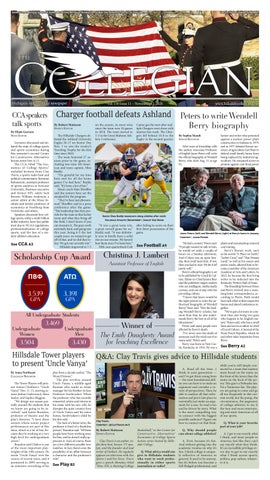
%e Hillsdale Chargers defeated the Ashland University Eagles 28-17 on Senior Day Nov. 7 to win the rivalry’s Traveling Trophy for the first time since 2022. %e team honored 27 seniors prior to the game, including two-time All-American and team captain, Shea Ruddy. “I’m grateful for my time here and for all the home games I’ve had here,” Ruddy said. “It’s been a lot of fun.” Head coach Nate Shre&er said the seniors have set the standard for the program. “%ey’ve been just phenomenal,” Shre&er said in a press conference after the game. “%e leadership that they provide for the team in that locker room and what they bring off the field, I don’t know if you can measure it. %e guys work extremely hard, and going into this year, being 6-5 the last couple years, we wanted to get off of that, and we did that today. We got our seventh win.” Hillsdale improved to 7-3
Hillsdale Tower players to present ‘Uncle Vanya’ By Anna Northcutt Collegian reporter %e Tower Players will present Anton Chekhov’s “Uncle Vanya” Nov. 11-15, starring seniors Joshua Underwood, Mara Seeley, and Sophia Miggins. “We design our season partially around the students that we know are going to be involved,” said James Brandon, professor of theatre and the play’s director. “I have three seniors whose senior project performances are part of this show, which is a lot of fun, because they’re working at a very high level for undergraduate actors.” Brandon said Chekov is one of the most important playwrights of the 19th century. He wrote “Uncle Vanya” over the course of several years, and it premiered in 1899, serving as an extensive reworking of his
play from a decade earlier, “%e Wood Demon.” The plot revolves around Uncle Vanya, a middle-aged Russian who works as estate manager for his brother-in-law, Professor Serebryakov. When the professor, who has recently remarried, retires and returns to his estate with his new wife, he disrupts the quiet country lives of Uncle Vanya and his niece Sonya, Serebryakov’s child by his first wife. “For lack of a better term, the professor is kind of a thankless person,” Brandon said. “All these people have been working away for him, and he doesn’t really appreciate it. And, of course, there are a few different possible love matches. In fact, there’s even the possibility of an affair between a character and the professor’s wife.”
See Play B2
www.hillsdalecollegian.com
Vol. 150 Issue 11 – November 12, 2026
Charger football defeats Ashland By Robert Matteson SportS editor
The Collegian | Samantha Mandel
on the season, its most wins since the team won 10 games in 2018. %e team moved to 5-3 in the Great Midwest Athletic Conference.
Canter got the start after multiple Chargers went down with injuries last week. %e Chargers fell behind 10-0 to the Eagles in the second quarter,
Peters to write Wendell Berry biography By Sophia Mandt Senior reporter After years of friendship with the author, Associate Professor of English Jason Peters will write the official biography of Wendell Berry, who died Aug. 31 at age 92.
farmer and writer who protested against a nuclear power plant construction in Indiana in 1979, and in 1977 debated former secretary of agriculture Earl Butz to defend small family farms from being replaced by industrial agriculture. He remained active in protests against coal-fired power
Senior Shea Ruddy maneuvers along sideline after catch. Hillsdale Athletic Department | Ashley Van Hoose
“It was a great team win, a great overall game for us,” Ruddy said. “It was definitely nice to finally have a solid win on our resume. We haven’t beat them since I’ve been here.” Fifth-year quarterback Cole
after failing to score on their first three possessions of the game.
Jason Peters (left) and Wendell Berry (right) at Berry’s home in January. Courtesy | Jason Peters
See Football A9
“He had a system,” Peters said. “If people wanted to talk to him, he would set aside a couple of hours on a Sunday afternoon. And if there was an open Sunday, then you’d meet him. If not, then you had to wait. We hit it off pretty well.” Berry’s official biography is set to be published by Creed & Culture. Editor-in-Chief Jeremy Beer said the publisher targets readers who are intelligent, intellectually curious, and out of step with the prevailing culture. “I knew that Jason would be the right person to write the authorized biography of Wendell Berry,” Beer said. “He’s the leading Wendell Berry scholar, but more than that, he also understands Berry the best in all of his dimensions.” Peters said many people were affected by Berry’s death. “I’ve never seen the death of someone suck the wind out of so many sails,” Peters said. Berry was born in New Castle, Kentucky, in 1934. He was a
plants and mountaintop removal coal mining. Berry’s literary work, such as his novels “A Place on Earth,” “Jayber Crow,” and “%at Distant Land,” as well as his essays and poetic works, allowed him to become a member of the American Academy of Arts and Letters. In 2015, he became the first living writer to be inducted into the Kentucky Writers Hall of Fame. %e friendship between Peters and Berry evolved into a yearslong letter correspondence, according to Peters. Both would host each other at their respective homes and attend conferences together. “We’ve got a lot more in common than just being two guys who happen to be English majors,” Peters said, who has a small farm and serves as editor-in-chief of Local Culture: A Journal of the Front Porch Republic, which he said often takes inspiration from Berry.
See Berry A2
Q&A: Clay Travis gives advice to Hillsdale students A. Read all the time. I think in your generation — and I’ve got three young boys — the most foundational ability you can have is to make an argument and consider a variety of perspectives. %en, be able to analyze all that information and put it into place to essentially just make an argument for a case. So read a ton and be driven by story. What is the most compelling way to connect with the biggest possible audience? Figure out how to connect on that front.
Clay Travis. Courtesy | @ClayTravis on X
By Robert Matteson SportS editor Clay Travis is an author, radio show host, lawyer, TV analyst, and the founder and lead writer of Outkick. He regularly appears on television with Fox Sports 1 and Fox News. Travis gave a speech Monday, titled “How NIL is Ruining College
Basketball,” in the Center for Constructive Alternatives’ Economics of College Sports lecture series hosted by Hillsdale College. Q. What advice would you give to Hillsdale students who want to work professionally in either sports journalism or radio?
Q. Why should people care about college athletics? A. First, because it’s fun. And without getting into the academic treatise on why it’s fun, I think college is uniquely reflective of America in general. It used to be anyway, but it’s before you become a full-fledged professional, and
while you’re still deeply connected to a team that matters more based on the name on the front of the jersey than the name on the back of the jersey. %is guy’s a Nebraska fan. I’m a Tennessee fan. %e players are going to come and go all too frequently in this current world, but the pomp, the circumstance, the pageantry of college athletics to me is the best and most entertaining and most American of all of our sports. Q. What is your favorite part of your job? A. I get to say exactly what I think, and most people in America feel like they can’t say exactly what they think. It’s an incredible privilege every day to get to say exactly what I think across sports, politics, pop culture, whatever it is.
www.hillsdalecollegian.com
A2 November 12, 2026
Birzer, Spalding named finalists for book prize By Charlee Amason Collegian reporter Two Hillsdale professors have been named finalists for the Ciceronian Society’s Herbert J. Storing Book Prize on American Federalism and Natural Law for their books on the Declaration of Independence.
founding from James Otis’ 1761 speech defending the common law, to the adoption of the Declaration in 1776, examining how the colonists’ arguments for independence developed over 15 years. One of Birzer’s central arguments focuses on the influence of the Roman historian Tacitus and the Anglo-Saxon
“The idea that a work of art that I created meant something to somebody else, that means everything to me.” Bradley Birzer, professor of history and the Russell Amos Kirk chair in American studies, was nominated for his 2026 book “The Declaration of Independence: A Radical Experiment in Liberty,” and Matthew Spalding, dean of Hillsdale’s Van Andel Graduate School of Government in Washington, D.C., was nominated for his 2025 work, “The Making of the American Mind: The Story of Our Declaration of Independence.” “I had not intentionally gone into writing about the Declaration,” Birzer said. “But it was two years before the 250th anniversary, and it seemed like really good timing, and I was honored to be asked, so I just dove into it.” The Ciceronian Society is an interdisciplinary association of Christian scholars focused on studying the classics. Their book prize is named after Herbert J. Storing, an influential political philosopher known for his scholarship on the American founding and constitutional government — particularly his work on the Anti-Federalists. Birzer said he was approached nearly two and a half years ago by the American Institute for Economic Research as it established Stonehouse Press. The organization wanted to publish a book commemorating the 250th anniversary of the Declaration, Birzer said. He spent one year researching and another writing the book. Spalding’s book, based on lengthy study and years of teaching the Founding period, examines the intellectual traditions that influenced the Declaration of Independence, including classical Greek and Roman political thought, British constitutional philosophy, and even Christianity. “We think of the Declaration too much today as merely an invention of Je%erson’s mind, as if it just kind of popped out of his mind — but he was actually drafting it for the Continental Congress,” Spalding said. In writing his book, Spalding said he wanted the Declaration to tell its own story rather than relying on secondary sources. In writing his book, Birzer said he sought to bring together differing schools of thought about the American Founding. According to Birzer, some historians understand the founding primarily as a product of Enlightenment liberalism, specifically John Locke, while others emphasize roots in classical republicanism and classical traditions. Birzer argues that these interpretations don’t contradict each other, but can instead contribute to a fuller understanding of the Founding. In the book, he traces the narrative of the
tradition on the American Founders. Birzer explains that the Founders were familiar with accounts of the early Anglo-Saxon traditions including trial-by-jury, traditional marriage, and protections for the innocent. Spalding said he wanted to o%er a distinct perspective in a more narrative style, rather than writing another textbook on the Declaration. His book follows the events leading to independence, the Continental Congress, and the drafting of the Declaration, while examining the meaning behind the Declaration’s language and structure. George Washington, Thomas Je%erson, and John Dickenson appear throughout the narrative in a storytelling manner. In doing so, he shows how the Declaration is the culmination of the Greek, Roman, Christian, and moderate Enlightenment traditions that combine in a unique American natural law argument based on “the Laws of Nature and of Nature’s God.” By examining the debates surrounding the document, its changes, and the circumstances of its creation, Spalding said he hopes readers will recover some important aspects of the Declaration that are often overlooked. “It always helps to read a great document or a great book carefully,” Spalding said. “In that sense, reading the Declaration carefully is like reading a great piece of prose or poetry.” Associate Professor of History Korey Maas, chair of the history department, said Birzer’s book o%ers a valuable contribution to a longstanding debate about the American Revolution. He described the Revolution as both a “novel and radical departure” from the past and simultaneously an event deeply rooted in political and intellectual tradition. Maas said the nominations reflect the college’s longstanding interest in both the American founding and the history of great ideas. “Both of these books are very much investigating the question, ‘What are the actual ideas that informed what the Founders are doing and how they’re doing it?’ And that’s a big part of what we are doing in the history department,” he said. Spalding said the nomination is a significant honor, particularly due to the recognition associated with the prize’s namesake, Storing. Birzer said he was honored simply to be recognized among the finalists, regardless of the eventual winner. “The idea that a work of art that I created meant something to somebody else, that means everything to me,” Birzer said.
How to: Advertise with The Collegian
To advertise in The Collegian, please contact Elizabeth Caneday at ecaneday@hillsdale.edu.
Campus reacts to US midterm elections By Francesca Cella opinionS editor Democratic candidates exceeded expectations in the midterm elections but did not achieve a landslide victory, according to College President Larry Arnn. “In general, the midterms were within the range of normal for losses by the incumbent party, but there were some surprising places,” Arnn told Radio Free Hillsdale WRFH 101.7 FM in an interview. Hillsdale professors and students said the midterm election results indicate that voters are unhappy with President Donald Trump’s administration and that voters turned to Democratic candidates in hopes of seeing change. “Ninety-four percent of the counties in America shifted left by some margin in this election, so I think we’re really looking for the candidates to actually start addressing the things that Trump promised, which are popular, like releasing the Epstein list, less foreign aid to Israel, fixing the economy, and stopping forever wars in the Middle East,” said vice president of College Democrats and junior Becca Nuar. “Those are popular, and Trump promised them and he didn’t do them, and I think a lot of these new candidates will be working on those issues.”
College Republicans president and junior Joseph DiPrima said that although the current administration has not delivered on some of its promises, the Democratic candidates’ large margin of victory was unanticipated because the country’s issues are less severe than they have been in recent elections. At press time, Democrats had flipped 43 seats in the U.S. House and eight seats in the U.S. Senate, giving them a total of 254 seats in the House and 55 seats in the Senate. In Michigan, Senator-elect Abdul El-Sayed defeated his opponent Mike Rogers with 52.5% of the vote. “I don’t see the reason why the Democratic win was so large other than to say there’s this adverse reaction to foreign entanglement right now that there just wasn’t previously and there’s a lot of antisemitism on both sides of the aisle,” DiPrima said. “There’s a lot of frustration with Trump as a president. There’s a lot of frustration with the economy.” Professor of Politics Thomas West said voters are turning to other candidates because they want to see costs of living decrease. “The election was a referendum on Trump’s last two years,” West said in an email. “In exit surveys, voters had concerns about the Iran war and ‘a%ordability.’ These are connected: The
war was blamed for higher prices, especially gas.” Matthew Aguilera, a graduate student at the Van Andel Graduate School of Statesmanship, said the election results reflect more on the failure of the Senate than on the president. He said the Senate’s inability to pass the SAVE America Act, a legislation that would aim to ban mail-in ballots and would require voter identification, particularly hurt Republicans’ chances of winning this cycle. “I think this comes down to the Senate refusing to do anything. Voters are not happy when Congress won’t act,” Aguilera said. “We’ve had two years to pass things like the SAVE Act, and Senate Republicans have been hiding behind the filibuster and refused to do anything. They’ve been playing the same game of ‘We’re going to lower taxes, we’re going to pass a budget,’ and they won’t take any of the serious tasks to heart. Meanwhile, I think the Democrats offer a real, alternative vision for America.” DiPrima said the rise of the Democratic Socialists of America made it particularly challenging for Republican candidates to win because the DSA o%ered radical solutions to high-priority voter issues. “They’re looking to get into power because they want to destroy America and change it
fundamentally,” DiPrima said. “When that’s on the ballot it’s really hard to tell people, ‘This is the issue, this is the fundamental problem,’ when you have so much frustration at the current administration and what they’re doing, and you have new people who are promising a shiny new toy.” More than half of the 294 DSA-endorsed candidates won their races, and eight were elected to Congress, according to The New Republic. “One should have hope. This country is not a despotism,” Arnn said. “It might become one, but it’s not right now. There’s still room to live your life, so you should try to live it well.” The “blue wave” of this election shouldn’t discourage students from engaging in politics, DiPrima said. He pointed to the Senate race in Alaska, in which the Democratic candidate, Mary Peltola, is leading by narrow margins of a few thousand votes, as examples of how important it is to vote. “We sit here in Hillsdale, and we talk about the polis, and we talk about Aristotle, and what it means to be a political animal. And if we don’t go out and realize that, the fullest example of which is voting, then we’re failing not only ourselves but the education which we’ve been striving to achieve for ourselves,” DiPrima said.
Students to debut documentary on Hillsdale frats By Lonán Mooney Collegian reporter A new documentary telling the stories of Hillsdale Greek life over the last 70 years will debut at 7 p.m. Nov. 17 in Lane 124. The documentary is a showcase of fraternity life at Hillsdale over the years, according to Buddy Moorehouse, a lecturer in journalism and documentary filmmaker. “We’re interviewing some graduates and former frat guys,” Moorehouse said. “The idea is to give a feel for what campus life and what Greek life was like back then, and we illustrate it through telling some stories, an anthology.” “Frat: Stories of Brotherhood at Hillsdale College” is the final project of four stu-
Berry from A1 Peters said he didn’t have much of an opinion on whether he’d write the definitive Berry biography. Yet Mary Berry, Berry’s daughter who serves as executive director of the Berry Center, approached Peters last January and asked him to consider writing the biography, according to Peters. “After she asked, I started to think about it more seriously, and then agreed about a month ago that I would do it,” Peters said. “I could be in way, way over my head. This could take 15 years. His letters to people are still scattered all over the world. I have a file of 70 letters here, and I have fewer letters from him than a lot of people do. He farmed behind horses, and he still had time to write 50 books. But if you don’t have a TV, you’re not distracted.” Former Hillsdale Professor of English Michael Jordan, who lives in Hillsdale, first met Peters in 2003 at a Wendell Berry colloquium, when Peters was an English professor at Augustana College in Rock Island, Illinois. Jordan invited Peters to two Faith and Life lectures at Hillsdale in 2015, and Peters was hired soon after. Jordan, who formerly served as chair of the English department, said he is grateful that Peters teaches at Hillsdale. “I’m glad he’s here,” Jordan said. “He’s a more able spokesman for agrarianism than I was.” Jordan said Peters is well-suited to write Berry’s biography.
dents in Moorehouse’s Documentary and Filmmaking class. The film will hone in on Hillsdale’s recent history through the lens of fraternities, according to Moorehouse. “I think that fraternity life in many places has been looked on negatively, so it’s cool to look back at what seemed to be the golden age of a sort in frat life here at Hillsdale,” said sophomore William Davis, who is in Moorehouse’s class. “One of the guys we interviewed talked about how his time as a frat guy was the best time of his life in many ways.” Davis noted how the alumni truly had mentorship in their fraternity. “He looked a lot to the older brothers in his fraternity house, and one of the only ways he was able to succeed
through college was through fellowship and relationships he found there,” Davis said. “They had a lot of fun but also were serious in a lot of ways.” The class spoke to members from various fraternities from the ’60s through the ’90s. “We just interviewed a couple of guys who were Tau Kappa Epsilon here in the ’70s,” said Davis. “They had some really great stories.” Moorehouse said one of the story’s highlights is when a future U.S. president visited Hillsdale’s TKE chapter in 1977, before the chapter was o&cially disbanded at the college in 1995. “We cover the story of when Ronald Reagan came to visit his fraternity on campus,” Moorehouse said. Reagan was previously the president of the
TKE chapter at Eureka College. The documentary’s intended audience is past and current students alike, according to Davis. “Students should go because it’s going to be super entertaining, but also a lot of past fraternity brothers here continue to donate and serve the college and their time here is something worth exploring and appreciating,” Davis said. The film premiere promises to be a fun and enlightening experience for attendees, according to Moorehouse. “We’re looking to appeal to alumni, but I think that it’s good for students to have an appreciation of where Hillsdale was in the past and how some of the things that led to the school being the way it is today,” Moorehouse said.
“It was a pleasure when I heard that,” he said. “I’d never even thought about who would be writing his biography. In a lot of ways, I don’t envy Jason and that work because it’s a massive amount of fiction. Wendell Berry treated writing letters with utter
“What he would do mainly is he would get up, do his farm work,” Peters said. “He had a writing shack down the road that he built, and he would write for part of the day. He actually invited me to go do his chores with him on that day. So he was one
erals didn’t like him because he was against abortion. The conservatives didn’t like him because he felt there was nothing free about the so-called free market, especially for farmers. So he was unique in that he didn’t have a political home.” Peters said Berry wrote fiction, poetry, and essays. Though seen as a social commentator, Berry’s main focus was agriculture, according to Peters. “He was a defender of farmers and farmland and small communities,” Peters said. “In his view, both the left and the right were just playing footsie under the table with the economy for the sake of colonizing rural places.” Peters said Berry’s 1977 nonfiction work, “The Unsettling of America,” critiqued o&cial government policy on farmers. He will teach a 1-credit class on the book in the spring titled “Unsettling of America at 50.” “The government was saying, ‘You got to get big, or you got to get out. You got to go do something else,’” Peters said. “Small farmers were just being told by their own government and free land that they weren’t allowed to follow their vocation to do what they wanted to do. But he also gave a pretty wide-ranging critique of the human attitude toward land and fertility. As he said at the 25th anniversary of its publication, the tragedy of this book is that it’s still relevant. The problems he was talking about didn’t get better. They got worse.”
“We’ve got a lot more in common than just being two guys who happen to be English majors.” seriousness and depth. There are his letters, novels, short stories, his poetry, his many essays.” Jordan said Berry’s books are important yet overlooked. “He sees globalism and corporations coming in and utterly changing agriculture,” Jordan said. “You change the way you do agriculture, and it’s going to change your culture. He talks about the separation of body and soul, past and future. People say ‘progress,’ ‘forget about the past,’ and he talks about tradition.” While Peters said he finds the task daunting, he said he knows he’ll receive good direction from colleagues who can help him think through the project. Peters said Berry kept a large garden and raised livestock in his younger years. Later, Berry raised sheep for slaughter.
How to: Subscribe to The Collegian
To receive weekly issues of Hillsdale College’s student newspaper, please contact Elizabeth Caneday at ecaneday@hillsdale.edu.
of those guys who just spent part of his days writing and part of the day farming. But he did it on a much bigger scale than I do, and for profit.” While most people think of Wendell Berry as a writer, Peters said Berry considered himself a farmer. “When he was a teenager, he figured it out that that’s what he was born to do,” Peters said. “That’s one of the things I would try to get people to understand: that as accomplished a writer as he is, that was something he was also doing while he was farming his whole life.” Peters said Berry didn’t fit neatly into political categories. “He used to joke that the liberals wanted to publish him, and conservatives wanted to come visit him,” Peters said. “The lib-
How to: Join The Collegian
To find out more about how to contribute to The Collegian through writing, photography, or videography, please contact Ellie Fromm at efromm@hillsdale.edu.
www.hillsdalecollegian.com
November 12, 2026 A3
‘A duty to uphold’: Marine group hosts Decoration Day By Samantha Mandel Collegian reporter
“We spent three weeks doing a deep dive into the personal stories, the personal anecdotes, and letters written by these guys back and forth to their families and to each other,” Burdo said. “It was such a shame that history had been lost, and that our students don’t even know our own history.” Decoration Day, a national holiday, originated after the Civil War and eventually evolved into Memorial Day. Burdo said the students chose the Sunday before Veterans Day for the event to accommodate the academic calendar, and that they hope to establish the ceremony as a permanent college tradition. Senior Macartan Moore, a member of the Marine Officer Group, delivered a reflection on the Civil War soldier monu-
in his speech. “If they can understand what these boys did, people just like them, that’s The Marine Officer Group what I want them to take away.” hosted its second annual DecMoore, who plans to comoration Day ceremony at the mission as a Marine Corps ofCivil War statue Nov. 8, revivficer in May, said his decision ing a historic college tradition to serve stems from a sense of to honor Hillsdale students who obligation. served in the Civil War and mil“I think I have a duty to upitary veterans. hold,” Moore said. “I can’t let The event drew on original everyone else in the military Decoration Day programs while do their part without doing my incorporating modern military own.” honors to recognize veterans Moore said reviving Decoraacross generations, including a tion Day as a Hillsdale tradition 21-gun salute and a flag dedicais a good start toward fulfilling tion. The memorial event began that responsibility. at Hillsdale in 1895 at the dedThe ceremony also included ication of the Civil War statue. the national anthem performed Junior and Marine Corps by Daniel Doyle ’26, a scripSgt. Ashley Burdo, one of the ture reading from Ephesians student organizers, said the by senior Gabriel Beckwith, a event originated from a summember of the Platoon Leadmer course taught by Assoers Class, and a speech from the original D e c o r at i o n Day event that was printed in The Collegian about the monument delivered by senior Judah Newsom, another member of the PLC. A recitation by senior Hayden Ho%pauir of “Our Living Army,” written by former Hillsdale mathematics professor A.E. Haynes, recalled the college’s origi na l D e c orat ion D ay Senior Turner Korotzer and junior Ashley Burdo fold the flag. observances. The Collegian | Samantha Mandel Newsom will ciate Professor of Leadership ment and the young men whose commission in December, and Studies Peter Jennings, during names are inscribed upon it. Beckwith and Ha%pauir plan to which students studied Hills“All these students here at commission in May. dale’s involvement in the Civil Hillsdale College walk by the The ceremony concluded War and visited the Gettysburg statue, and they don’t really pay with a military salute, the playbattlefield. any attention to it,” Moore said ing of taps, and the ceremonial
CCA from A1
“One idea is that the university and the private equity firm establish a new for-profit LLC in which each holds equity,” Hanssen said. “The PE firm contributes upfront private capital of some kind or other. The university contributes existing commercial rights or physical infrastructure, something of value.” But, Hanssen said, there are risks with whether forming for-profit LLCs would threaten a university’s tax-exempt status. Brewer, who spoke Mon-
Rubenstein on Sunday a&ernoon analyzed the collapse of the NCAA amateurism model, arguing that the organization functioned as a “cartel.” Member schools didn’t compete over athlete compensation, and the NCAA imposed limits on pay and scholarships, according to Rubenstein. “Obviously, price and output were fixed,” Rubenstein said. “We have to pay, which was at the scholarship value, and it put hard limits on the number of scholarships that programs could o%er.” Rubenstein said those rules gave schools an incentive to cheat, pointing to the 1987 Southern Methodist University scandal, where SMU paid players under the table for recruitment. A solution Rubenstein advocated was ending the cycle of NCAA rules and allowing a free market in athlete compensation. “I think that we should break free of the interventionism spiral,” Rubenstein said. “I don’t think it’s actually going to happen. But I think that we should continue to kind of have these conversations about what would be better than letting us go down that path.” F. Andrew Hanssen, a professor of economics at Clemson University, argued Sunday night that private equity should be increased in college sports as universities become more market-based to involve player compensation. Hanssen said this would take the NCAA’s becoming a real market a&er years of being a “cartel arrangement,” which Rubenstein had described earlier in the day, to the next step of inviting collaborators in private equity to maximize revenue. This could include universities and private equity firms establishing for-profit LLCs, while universities protect their nonprofit status.
lin Wall coming down. “For a long time, the NCAA stopped all capitalism from existing under rules. For those of you who are history people, it was like Eastern Europe,” Travis said. “There was a form of communism that the NCAA ruled, and o&en its rules were arbitrary, capricious, and not particularly well-founded. Well, the Supreme Court ruled 9-0 in 2021 that NIL is suddenly legal, and it’s the equivalent of 1989 when the Berlin Wall came down. Suddenly, raw, unfettered, unregulated
“We’re going to tell America we’re something different.” day afternoon, lectured on issues such as Name, Image, and Likeness — the legal right of college student-athletes to make money from their personal brand — allowing grown men up to 29 years old to compete against teenagers, and the “professionalization” of amateur sports that blurs the lines of mentorship and fatherhood. Brewer suggested several structural changes to restore accountability and educational focus to the NCAA, including transfer limits and academic guardrails. “My proposal is to track education, athlete welfare, and the impact on the sports altogether,” Brewer said. Brewer advocated for governance committees of unpaid, third-party governing bodies to review rules and provide recommendations, similar to a professional league structure. Travis spoke Monday night on the history of the NCAA, from strict regulation to an era in which players can profit from their likeness due to the 2021 Supreme Court decision in NCAA v. Austin. Travis argued that NIL being legalized was like the Ber-
capitalism came for Eastern Europe, and it came for college athletics.” But Travis said NIL quickly became a “pay-for-play” system, with top players now worth millions and the distinction between collegiate and professional sports disappearing, with athletes acting as free agents who o&en move schools a&er a year. Anderson, who spoke Tuesday a&ernoon, lectured on the economic incentives of the NCAA and how it evolved into a regulated industry like airlines and telecommunications. But, he said, NIL represents a period of “pure deregulation” in college sports, and while NIL isn’t wholly bad, it has introduced new market pressures and antitrust concerns. Everything in college sports now includes economic tradeo%s, Anderson argued, and if profitable sports like football subsidize all other programs, non-revenue sports like track and field may be cut. “There really are no true solutions,” Anderson said. “There are only going to be trade-o%s, and what you hope is, by the way, are trade-o%s
folding of the American flag before its presentation to College President Larr y Arnn at the event. Retired Army Chaplain Rev. Ralph Pieganek, who served 25 years in the military, said the ceremony stirred memories of his own ser vice and the men he lost along the way. “Different things trigger memories for different The Decoration Day ceremony took place at the Civil War statue Sunday. veterans,” PieThe Collegian | Samantha Mandel ganek said. “I have names on dates in the cal“I love my country, and I’m statue on campus. endar over the next couple of grateful for the many people “Knowing a little bit more months, and when those days who’ve served,” he said. “What about the names that are on come, I’ll cry remembering the made today great was that it it, it’s not just another decorayoung men who died.” was a reminder of so many tion or statue around campus,” Pieganek said the playing of people who served, at di%erent Beckwith said. “I feel more contaps carries a particular emo- times, in di%erent places.” nected to it, and more proud of tional weight for veterans. Jennings praised the stu- Hillsdale College.” “That’s what rattles you, be- dents for independently orBeckwith said he looks forcause it seems so final and real,” ganizing the ceremony, which ward to returning to future cerPieganek said. “They’re dead, they modeled after an 1889 emonies in uniform. and they’re never coming back, Decoration Day program pre“I’m excited to come back and I’m never going to see them served in the college’s historical and wear my own blues when again.” records. we commission in the spring,” Despite the painful mem“They organized it, planned Beckwith said. “That’s going to ories, Pieganek laughed as he it, and executed it, and I just be really special.” recalled his original motivation followed orders,” Jennings said. Jennings said the ceremony for enlisting at 17, contrasting “They told me they wanted me reminds Hillsdale students that it with the students’ reflections to speak, so I did.” the principles they study in the on building character through Jennings said the college’s classroom extend beyond acamilitary service. Civil War history offers stu- demics, pointing to the college’s “People join the military for dents a personal connection to Civil War soldiers as examples a lot of reasons,” Pieganek said. the history they learn in class. of self-sacrifice and service to “I joined the military because “Those names on there are others. I hated farm life. I hated farm just like you,” Jennings said. “Can you deny yourself life, and I thought, ‘I’m going to “When the war came, those and give yourself wholly for escape if it kills me.’” kids put down their books and others?” Jennings said. “That’s Pieganek said the ceremony picked up their rifles.” ultimately what this education was a beautiful tribute to the Beckwith said learning the comes down to.” men and women who served history behind the monument before him. changed how he would view the that might actually include the fans.” Kevin Lennon, the former NCAA senior vice president of policy and governance, spoke Tuesday night about how the NCAA has transitioned from a membership-driven organization to a “public trust,” where schools no longer hold authority over their future. According to Lennon, the lack of transparency and internal trust in college sports — especially due to abuses of academic and mental health waivers to ensure player eligibility, dishonesty in transfer portals and student commitments, and exploitations of NIL — have contributed to a loss of public trust. “Unless we identify the groups that are accountable and to hold them accountable through transparency in the decisions, when that is all mixed and matched together in this ecosystem, it’s very hard to not only have accountability but to get anything done,” Lennon said. Lennon proposed recalibrating the NCAA to focus on championships, competitive equity, and sports wagering integrity, while giving regulatory and financial matters to the College Sports Commission. “We need to recognize and honor your approach to college athletics as di%erent from this opt-in model that everyone seems to think is college athletics,” Lennon said. “I would love to have — Dr. Arnn and I talked about this previously — an honor code grouping. I don’t care what division you’re in — Divisions 1, 2, 3, NIA. Come forward. Here’s how we’re going to conduct ourselves through a code of conduct. I don’t care if it has a regulatory enforcement arm, but we’re going to tell America we’re something di%erent.”
North quad adds snow, ice melting system By Joshua Mistry Collegian reporter A new electric heating system will melt snow and ice on the north quad, according to Chief Administrative Officer Rich Péwé. The snow melt system was installed beneath the recently-poured concrete under the quad in front of Christ Chapel, and the college plans to install more under the undercro&, grand staircase, and all other pavement around the north quad, according to Péwé. “The entire chapel plaza has snow melt under it,” Péwé said. “In winter those pipes stay at a consistent temperature and keep the concrete or the decorative stone warm enough so snow and ice will not accumulate. The system stays active all winter. This eliminates the need to salt or use heavy snow removal equipment.” The concrete and snow melt systems are only the latest parts added to the north quad, which has been closed for construction since the spring of 2024, with construction plans staged out to be completed in two years, Péwé said. “The area south of the fountain will not be completed until the War Memorial and Library Undercro& are done, probably spring of 2028,” Péwé said. “The area further south with the knee wall commemorating the ’26 and ’27 senior class will not be completed until a&er the north elevation of Central Hall is completed.” Péwé said a start date has not been set for the construction of the Central Hall addition, but that when it does, the addition will take two years to complete.
The front doors of the Grewcock Student Union and the staircase area in the library which were recently unveiled are the only openings students should expect to see before the spring, according to Péwé. “There will not be anything more opening up this semester,” Péwé said. “We plan to have the fountain area open in April 2027.” Senior Jackson Casey said the quad gave students a space to interact and gave him great freshman-year memories. “Campus definitely felt much more connected during the school week back when we had the quad,” Casey said. “Especially during the fall, students would sit on benches or on the grass reading and spending time with their friends. It was also really nice to be able to get right to the library from Saga if you had to print something before class.” Senior Nathan Furness said he remembers how unifying the quad was for students at the start of his freshman year. “The way that community formed at this college through simple grass in between a couple of buildings was peak. My freshman year, we would play spikeball on the quad, and it was goated. The best part about it was you could run into anyone random on the quad because everyone was just there,” Furness said. The closing of the quad might have temporarily affected students’ experience at Hillsdale College, but the work being done will be worth it, Péwé said. “Everyone who has seen the progress is pleased that the architecture and spaces are truly making the college’s meaning visible,” Péwé said.
Opini$n%
www.hillsdalecollegian.com
A4 November 12, 2026
The Collegian Weekly
The o.inion of the Collegian editorial staff Online: www.hillsdalecollegian.com Editor in Chief | Ellie Fromm Managing Editor | Alessia Sandala Senior Editors | Megan Li | Elaine Kutas News Editor | Elijah Guevara O.inions Editor | Francesca Cella City News Editor | Gemma Flores S.orts Editor | Robert Matteson Culture Editor | Grace Brennan Features Editor | Sophia Bryant Social Media Manager | Hershey Hackberry Circulation & Ad Manager | Elizabeth Caneday Assistant Editors | Lucy Billings | Elizabeth Caneday | Henry Fliflet | Skye Graham | Jayden Jelso | Daniel Johnson | Ashley Luke | Patrick Matteson | Faith Miller | Ethan Savka We4 & Pu55le Editor | Matthew Tolbert Illustrators | Maggie O’Connor | Paige Kutas Faculty Advisers | John J. Miller | Maria Servold The editors welcome Letters to the Editor but reserve the right to edit submissions for clarity, length, and style. Letters should be 450 words or less and include your name and number. Send submissions to the Opinions Editor at fcella@hillsdale.edu before Saturday at 3 p.m.
Collecting is an art By Reagan Vicars Collegian FreelanCer Collecting things isn’t materialistic — it’s human. A collection, gathered well, is a physical representation of what you love. It is tempting to dismiss collections as materialistic clutter, the result of acquiring objects that serve no purpose. When done correctly, collecting is not a symptom of materialism but a remedy for it. A collection exists simply because it is delightful, and as such, it teaches the collector about what he truly loves. My miniature Colosseum, glass chicken, hand-carved Indian elephant, and tiny clay mushroom are from all around the world, and seem to have little in common. The relic of Rome is a souvenir; the bird, an heirloom; the elephant, a gi); and the fungi, a discovery from an a)ernoon walk in the park. These trinkets stand perched on my bookshelves, alongside other small (gures from various people and places. Together they
tends a single rose and thinks it is the only one of its kind. The prince is heartbroken a)er he (nds a garden with thousands like it. He then meets a fox who teaches him that what we care for becomes “unique in all the world” to us. The Prince’s rose is no rarer than the others; it is unique precisely because it is the object of his attention. Proper noticing takes practice, and leads to collecting in a way that re(nes your desires. The collector must look closely, choosing this shell over that one, this painting, and that car. To some, collections like these indicate disordered desire, and an unhealthy focus on finite objects. However, there is an important distinction between the materialist and the collector. The former asks his possessions to make him whole; the latter asks nothing of them, cherishing each simply for what it is. Through this intentional collecting, he learns the desires of his heart, and can distinguish
Praying with friends 4uilds community in Christ When Jesus said in Matthew 6:6 to go into your room and shut the door when you pray, he didn’t mean to shut people out of your prayer life. Humans are meant to pray in community. That’s why we’re born into families who teach us how to pray and why monks live in monasteries where they learn how to pray better. As students, few of us live with our families during the school year, and we de(nitely don’t live in
monasteries. But we can (nd a group of friends who will get on their knees with us. Your zeal for the Lord will increase as you pursue a relationship with him alongside other people who also desire to know him better. It’s inspiring to see how the Lord is working in your friends’ hearts and how they understand matters of faith that you struggle with. And when we pray in community, we’re particularly close to
Christ, who said, “Where two or three gather in my name, there am I with them.” If you pray with a friend, your relationship with each other will strengthen as you orient yourselves toward Christ. Having a church community is helpful, and saying grace before meals is a start. But we can all benefit from friends who will pore over the Gospel of Matthew for morning prayer or who will
sing praise and worship together at night. Perhaps the most mournful line of the Gospels is Christ’s reprimand to Peter, James, and John, who could not stay awake with him while he prayed in the garden. Spend an hour with your friends in prayer. Even Christ wanted companionship in Gethsemane.
Go home for Thanksgiving while you can By Grace Brennan Culture editor Students should go home for Thanksgiving, even if the only magical part of it will be the spread of turkey, stuffing, and cranberry sauce. Some people would rather go home with a friend or a signi(cant other for Thanksgiving break. Though the relationships you make in college are really important, that doesn’t mean you should sacri(ce the time you get with your family members. You have more freedom than you did as kids to decide where you want to spend Thanksgiving, and you shouldn’t abuse that freedom by choosing someone who you just met over the family that’s loved you since you were born. Being a part of a family is not always easy. In fact, sometimes family members are almost impossible to put up
with. Yet we love our family members more than we love most of the people we meet in college. In his book “Heretics,” G.K. Chesterton compares living with a family to falling down a chimney at random and getting along with the people inside. It’s a miracle that we love the people we grew up with, even though we didn’t get to pick them. Just because we can pick our college roommates doesn’t mean we love them as much as we love our parents. Don’t take the miracle of the family for granted, especially during the holidays. “In other words, when we step into the family we step into a fairytale,” Chesterton said. The holiday season is magical in Hillsdale when the campus gets covered in white, glistening snow. But it is far more magical when a fairy tale unfolds at home with every bit of teasing from siblings, and tears
from mothers who miss their kids. You aren’t guaranteed a long-lasting relationship with your freshman-year boyfriend or girlfriend, and it would be selfish to choose something possibly fleeting over a family that will always be yours. Family time can also be short and sweet. There’s no telling if you’re going to move back home when college ends. When your signi(cant other from freshman year turns into a ring-by-spring, you can assume that next year’s Thanksgiving might be spent with the in-laws. You should prioritize your family right now, when you’re still in college, and go home for the holidays before other relationships take priority. Not everyone is able to go home for such a short trip. Plane tickets are expensive, and some people don’t have loving homes to return to. If
your family is eager to welcome you home and you have the means to travel, you should count yourself blessed and take advantage of the opportunity. Only at your own home will you have your favorite Thanksgiving dish made just the way you like it, and only with your family will you feel 100% comfortable being yourself and feel the weight of school fall off your back. Go home for Thanksgiving and remember that you and your family members were given to one another. College is an exciting time in which we’re ready to move on, but there might be something wonderful waiting for you when you get home. Maybe you’ll feel the magic of the family that Chesterton wrote about. Grace Brennan is a junior studying English.
Letters to the Editor A bigger wedding will establish a lifelong community By Elaine Kutas Senior editor
form a whole that could belong to no one else: a portrait of what I love and who I am, arranged on my shelf by my own hand. Souvenirs and heirlooms hold memories of the experiences and people I love. I can’t sell the mushroom for anything, but I keep it because it is delightful. Rather than collecting things simply to take joy in them, the materialist accumulates objects to satisfy a need those things can’t ful(ll. Some may seek status from their collections, or be so afraid to let go of them that they gather dust in basement boxes. These collections become hoards that lack intentionality to the detriment of the hoarder. A well-cultivated collection results in delight, and it is good to have lovely things — even if they are not useful. The world is full of “useless” goodness and beauty, from the colors of the sunset to the extravagance of 350,000 species of flowers. Children understand the importance of these ordinary, charming things instinctively. A child at the park pockets a rock not because it is useful, but because he likes it. In “The Little Prince,” a boy who lives on his own tiny planet
them from what is newest or nearest or advertised. In doing so, the collector imitates the oldest act of creation: bringing order out of the disordered void. Genesis calls each day’s work good, but it becomes very good when God sees it all together. We cannot create in the same way that God does, but we can gather unique things together into something new and more meaningful. A collection is more than a set of random objects. A Colosseum replica alone is a souvenir, but set beside a glass chicken and a clay mushroom, it becomes part of the story of the person who noticed and collected them. Like any work, a collection tells the truth about its maker, about what and how he loves. Ask your friends what they collect, and why. Behind every peculiar collection stands a collector, and in learning what he has chosen to keep, you will understand a little more of who he is. Reagan Vicars is a freshman studying the liberal arts. Illustrated by Paige Kutas.
In her op-ed “Prepare for your marriage, not your wedding,” Olivia Glisson claims that the wedding industry demands grand weddings and that the reason weddings are large and multiple-day events is that society pressures couples to throw “the best party for their friends.” An engagement can be fruitful, even if the couple plans a big party that includes all those who love and support them. A large celebration can help the couple usher in the next phase of their lives and allows guests to show the support they will continue to give the couple long a)er the reception concludes. As I have been planning my wedding over the last few months, the time of our engagement that we actually devote to wedding planning
becomes a conversation about those we love and want to celebrate this milestone with more than a question about what the cake budget should be. Glisson claims that “a wedding o)en used to be a small affair with close friends and family at a church” but that weddings now are “extravagant parties aimed at showing off.” She is right that social media and the wedding industry have put pressure on how extravagant many modern weddings should be. But hosting a beautiful party to celebrate your marriage and the union of two families is a good thing. Jesus performed his first miracle at the wedding feast at Cana. Though we don’t know who this couple is or how closely connected Jesus was to them, we do know it was a big enough party that they ran out of wine although they
were prepared, as we see in the scriptures. I pray that my wedding is such a joyful gathering of everyone who my fiancé and I love and who love us that we also run out of wine. As I have planned my wedding, prices have shocked me: reception venues can cost more than $10,000, our flowers cost half of our budget, and simple cakes cost more when preceded by the word “wedding.” But our vision is toward the future, and our wedding day marks the uni(cation of our families, creating a community that will support us through life’s challenges. Our preparation for marriage comes not from planning a massive rager for our college friends, but from providing a gathering of the people in our lives who mean the most to us and who we want to meet each other and create the community we will lean on forever.
The people who held me as a baby, traveled across states to witness my First Communion, cheered at my track meets, and will watch me graduate this May are the people who will be there when I have my (rst child, lose a job, or buy my dream house. They deserve a part in another important milestone and a few glasses of wine at my wedding. To me, wedding planning has already begun unifying our families. It is some of the best marriage prep we can do while we enter a new commitment together alongside the people who have shaped each of us into who we are. Elaine Kutas is a senior studying English.
Eastern Orthodoxy was already in Hillsdale By Fr. Steven Allen Blake Schaper’s Nov. 5 article on the new mission at St. Peter Episcopal Church (“Orthodoxy moves closer to campus…”) may give the unwary reader the impression that prior to the establishment of St. Olga there was no Eastern Orthodox parish in Hillsdale. This is not true. St. Ier-
onymos (Jerome) Orthodox Church, a parish of the Church of the Genuine Orthodox Christians of Greece, has been holding regular services in Hillsdale since our establishment in the fall of 2021. Our current location is at 77 N. Broad St. Though we inhabit a humble storefront space, the visitor will be struck by the beauty and
sacrality of our little chapel inside, as well as the prayerfulness and profundity of the divine services. Our particular Orthodox jurisdiction is marked by its adherence to the traditional ecclesiastical (“Old” or “Julian”) calendar and its refusal to indulge in the compromises of ecumenism and modernism that plague “mainstream” Orthodoxy
today. A schedule of divine services can be found on the home page of our website: https:www.stjeromehillsdale. com. Visitors seeking the fullness of the Orthodox faith are most welcome. Fr. Steven Allen is the rector of St. Ieronymos Orthodox Church.
Opini$n%
www.hillsdalecollegian.com
Pick a TV show. You will make new ‘Friends.’ By Gabriel Schrock Collegian FreelanCer I watched a TV show almost every night in high school and finished all 10 seasons of the 1990s sitcom “Friends.” TV shows give you a good outlet to rest from heavy responsibilities. If you have never become hooked by a show, now is the time. Most shows premiere in the fall between the months of September and November, right after the Emmy awards. The new season of “Percy Jackson and the Olympians” will come out later this month, and the “Harry Potter” and “Pride and Prejudice” miniseries will release in December. Watching a TV show, whether it’s a sitcom, suspense, or soap opera, serves as an exciting break from everyday life and helps viewers grow their imaginations and think critically about the world. On average, TV shows have longer runtimes than movies — the audience witnesses much more character development over the course of a 10-season show than over a 90-minute movie. Chandler from “Friends” is a perfect example of this. He begins as an immature individual with low self-esteem, but ends with confidence in his character and goals to pursue his dream job in advertising, provide for his young family, and buy a house. TV shows can also embed insightful messages within the plot. Sitcoms like “Family
Matters,” “The Fresh Prince of Bel-Air,” and even “Leave it to Beaver” center on family values, including lessons in each episode that the viewer can apply to his own life. In a “Leave it to Beaver” episode, Beaver and his brother Wally stay home alone while their parents are away. Beaver takes a bath and accidentally leaves the water running a(erward, causing water to leak through the
Zone.” Episodes use peculiar storylines to convey important moral lessons. In the first episode, a man finds himself alone in a town with no recollection of his identity. Eventually, he goes mad and screams for help right before he wakes up from a trance. At the end, the show reveals that the man was part of a psychological experiment conducted by the army. The results of the experiment sig-
kitchen ceiling. The boys have to decide if they should confess their mistake to their father or attempt to cover it up. Eventually, they confess, their father forgives them, and helps fix the leak. The episode draws the viewer towards the virtue of forgiveness by engaging his imagination through an enjoyable medium. Onscreen stories also teach truths about life and human relationships. A notable example is “The Twilight
nify man’s need for companionship. Although reading “Aesop’s Fables” or Dante’s “Divine Comedy” can teach someone the same truths about forgiveness or companionship, these shows convey them through a far more relaxing medium. TV shows are also good for bonding with your friends or peers. Spending an hour a week watching an episode with your roommate gives you a plot to argue over,
character development to analyze, and details to discuss. While reading a book with a friend also provides a good topic of conversation, it’s not the same as the shared experience of watching a TV show. In a book, the imagination of the story is le( up to the reader, but on screen, the imagining has already been done for you. Hillsdale students are already reading dense pieces that require lots of brain power. It’s a nice break to come home and enjoy an episode of “Friends.” Similarly, a TV show director determines the camera angles, lighting, and acting styles that shape the presentation of the story. Shows are works of art that require hard work, creativity, and talent to become excellent. Your job is to figure out how someone else’s interpretation of the story fits together. TV shows provide an opportunity to engage the world critically with your friends while relaxing your brain from writing your “Moby Dick” paper. Grab a blanket and some popcorn and jump into a TV show this week. You may find yourself invested in a thrilling story with characters you might follow for years to come. Gabriel Schrock is a freshman studying the liberal arts. Illustrated by Mag gie O’Connor.
You’re not safe from Gen Z’s faults
By Megan Li Senior editor
Hillsdale College students o(en hear that they will save the world. Whether it’s from a friend of the college, a parent, or a CCA speaker, we get the compliment o(en. While no student will object to the praise, we should not accept it blindly. Hillsdale remains a bubble. We cannot assume Hillsdale students are the salvation for the United States if we do not know what plagues our generation and our country — and how we are unknowingly part of the problem. The Society for Risk Analysis found that Generation Z sees more danger in life than previous generations. Instagram feeds filled with pictures of engagements and baby ultrasounds make us forget we’re in the middle of a dating recession. Gen Z does not speak to neighbors, to peers with different political beliefs, or to strangers on public transportation. Young adults increasingly report having no friends and feeling relieved when social plans are cancelled. Many factors have contributed to the breakdown of social dynamics in America. Pew Research Center has tracked declining trust in social and political institutions that used to bring people together. Political polarization further divides young men and women. Social media exacerbates these problems. It produces hyper-curated feeds that trap its audience inside a bubble masquerading as a new and improved reality. Instead of encouraging us to meet people, travel, and get out of our
comfort zones, social media keeps us in our houses, where we try to live vicariously through our screens. Leaving the bubble, or venturing into anything that is not the status quo, requires risk. Somewhere along the way, Gen Z lost its appetite for that. We don’t want to be labeled “cringe,” so we don’t dance in the rain or ask strangers questions. We fear rejection, so we don’t try — whether that’s asking a girl out or applying for a dream job. These factors are not as unfamiliar to Hillsdale as we
better than our peers, but in many ways, we have no reason to feel elitist. We still engage in the self-isolation and risk aversion that afflicts Gen Z. We too must be wary of our generation’s faults. But we are lucky to go to a school that engages in free dialogue, takes virtue seriously, and isn’t afraid to ponder what it means to be human. We are lucky to be in a community filled with intelligent, genuine, and respectful individuals, mentored by professors who invest in their students. As a Delaware native, I was
might think. We have “Hillsdating” — spending time with a romantic interest without committing to an o)cial relationship because commitment requires vulnerability and risk. Many students flock to Jodel for the juiciest campus gossip, and the anonymity there protects them from being held responsible for anything they say. Social groups like Greeks and fundies, Protestants and Catholics, and athletes and non-athletes alienate one another, but talk badly about each other just the same. We are told we will save the world and o(en think we’re
stunned by Hillsdale’s Midwestern kindness. It’s a place where strangers make eye contact and smile, conversations happen spontaneously in the lunch line, and someone you’ve only met once will hug you the next time you cross paths. Strangers can launch into a heated Protestant-Catholic debate in the library and emerge as close friends. We have sporting events like “Frat vs. Fundie” and El Clásico, the annual soccer game between Catholics and Protestants. Through various clubs and on-campus jobs, students venture out of their friend groups
to make new ones. For four brief years, our lives overlap in a thousand di,erent ways, through many connections we might not even be aware of. Our shared curiosity about the world, our commitment to the Honor Code, and our love for the divine have brought us together. This type of wonder is disappearing quickly among our generation. It will vanish if not protected. We cannot take this community for granted because it may not exist anywhere else. Four years at Hillsdale is too short to hold grudges and make assumpt ions ab out people you have never spoken to. For those of us graduating next spring, don’t be mistaken: Hillsdale is still a unique community. You may find many of your future co-workers are very different people from your peers at school. But this is no reason to feel superior. It is a burden of greater responsibility. Seniors must ask themselves how they can take this culture elsewhere and how they can be examples to others in the same way Hillsdale professors, mentors, and friends were examples to them. Humbling ourselves to answer that question might be the first step to saving the world. Megan Li is a senior studying economics. Illustrated by Mag gie O’Connor.
November 12, 2026 A5
Give El-Sayed a chance By Becca Nuar Collegian FreelanCer Abdul El-Sayed’s election is good for Michigan. Since he was elected to the Senate last week, the Democrat has already said what his top priorities will be when he enters the Senate in January, and they’re not implementing Shariah law or expanding trans healthcare. Instead, he said he plans to represent all of his constituents in Michigan. Most of his initial priorities are common sense policies that the majority of Michiganders support. The first priority he mentioned is ending the war in Iran, giving war powers back to Congress, and pushing for diplomacy. Fox News voter poll data shows that 3 out of 4 Michigan voters factored the war and the perceived resulting increase in living costs into their voting, and that 3 out of 5 voters support ending the war entirely. Ending the tariff war against Canada, our longterm trade partner, is another of El-Sayed’s priorities. Michigan’s automobile industry is deeply intertwined with Canada’s, and Trump’s current tari, plan includes a 50% tari, on all Canadian cars, trucks, automotive parts, and steel, and is scheduled to take e,ect on Jan. 1, just two days before El-Sayed takes o)ce. He plans to work
In addition to ending the war in Iran, El-Sayed wants the U.S. to step away from all foreign entanglements, especially in the Middle East. He has called for the U.S. to stop funding “forever wars” in the region and to tie percentage increases in funding for the Department of War to an equivalent percentage increase in funding for the Department of Education, making education and literacy a priority. This type of policy could result in Hillsdale’s public schools receiving more funding, improving the Michigan education system as a whole. El-Sayed also stated that he wants to implement a moratorium on data centers, a bipartisan view that his Republican opponent Mike Rogers also held. This moratorium would pause current data center construction until a more secure regulatory process could be established. Some of his policies, like eventual universal healthcare for all, do make some Michiganders nervous. Universal healthcare is a radical policy, albeit rooted in the idea of every person possessing inherent dignity. But this policy won’t pass anytime soon, considering that even a large segment of the Democratic Party is opposed to it. Even if it does get passed, it won’t be forced on Michiganders who don’t want it — El-Sayed’s pro-
“Elected officials should represent their constituents. If there’s one thing El-Sayed has proven, it is that he will be easily accessible.” to reestablish our trade partnership with Canada, which benefits both countries. El-Sayed also said he hopes to address Michigan’s healthcare costs, but his immediate plan isn’t to pass universal healthcare for all, a policy that many conservatives oppose. It is, however, to pause the Medicaid cuts that will go into e,ect in 2027. The Michigan Department of Health and Human Services estimates that about 200,000 Michiganders will lose their health insurance coverage on Jan. 1, 2027 — 8% of the 1 in 4 Michiganders who rely on Medicaid. El-Sayed wants to prevent these cuts from going into e,ect until better options are available. Most of his other priorities are also good for Michiganders and widely popular. For example, El-Sayed supports overturning Citizens United v. FEC, a 2010 Supreme Court case that allows unlimited corporate spending on campaigns. Elections are supposed to represent people’s views — not companies’ — so large organizations shouldn’t be able to sway elections by pouring millions into the candidate who promises to benefit their company. The majority of Michiganders agree: Michigan Ballot Proposal 2, a similar but more limited policy which would prohibit “certain regulated electric and gas utilities, government contractors and certain associated individuals and organizations from making specified campaign contributions,” passed with more than 80% support in last week’s election.
posed policy doesn’t involve banning employer-provided private insurance. El-Sayed isn’t just good for Michigan because of his policies, but because he is a representative of the people. He hasn’t taken any corporate PAC money and so is not beholden monetarily to any corporations that might pressure him into voting for one bill or another. Eightyeight percent of his campaign finances came from individual contributions in a grassroots campaign that knocked on hundreds of thousands of doors across Michigan — contributions that he has promised to honor by voting for policies that will benefit Michiganders, not corporations. His transparency shows he will fight for Michiganders. Throughout the campaign process, he was approachable to constituents and media, and even now as an elected senator, he was seen at the tailgate of his former college, University of Michigan, last week. Elected officials should represent their constituents. If there’s one thing El-Sayed has proven, it is that he will be easily accessible. If you disagree with his policies, call his o)ce or send them an email. But regardless of how your views di,er from his, a senator who is completely independent from corporations, actively fighting for Michiganders, and available to the public is good for Michigan. Becca Nuar is a junior studying politics.
www.hillsdalecollegian.com
A6 November 12, 2026
City News
City considers barring Hardway from council seat By Ethan Savka ASSiStAnt editor The Hillsdale City Council may refuse to seat Ward 1 councilwoman-elect Jill Hardway. The council’s Operations and Governance Subcommittee held a meeting Nov. 10 to consider Hardway’s eligibility for office. The meeting addressed concerns brought by city administrators over Hardway’s company, JB Office Building LLC. The subcommittee reviewed Hardway’s eligibility under the city charter, which prohibits anyone in default to the city from holding elected office. Under Hillsdale’s charter, the city council decides the eligibility of its own members. Unless the council determines Hardway ineligible, she will be sworn in Dec. 1. The council was not notified of the meeting until
Wednesday, according to Ward 1 Councilman Jacob Bruns. “I was made aware only a%er receiving an email from the mayor this evening,” Bruns said Wednesday. The subcommittee, composed of Ward X Councilman Greg Stuchell and Ward X C ouncilman William Morissey, resolved to consult a legal expert on the matter. The city issued an Obsolete Property Rehabilitation Act certificate to Hardway’s company for properties at 30 N. Howell Street and 32 N. Howell Street in 2022. OPRA certificates are part of a state program to encourage the redevelopment of public buildings that are functionally unusable. “The OPRA grant was given for the second-floor rehabilitation because it was a blighted space, so you have to rehab the building within the
Dawn Theater to open speakeasy By Elaine Kutas Senior editor The Dawn Theater will sell co$ee and cocktails in its Speakeasy Co$ee Lounge, according to a plan by its new management team to reimagine the historic theater as a day-and-night community-building space. Sp e a ke asy LLC, t he Dawn’s new management team, is an event business hosted in the Dawn Theater and operated by the Hillsdale-based consulting group Jason Walters & Associates. According to Jason Walters, who oversees the planning and operations of the project, Speakeasy Coffee Lounge was born out of a hope to bring people into
of course, and it’ll be the only local co$ee shop that supplies Ad Astra.” Walters said that among his work as the food and beverage manager, Busby will also work as the day-today manager of the theater. “He’s a bright young man with years of experience running a co$eehouse, and I’m excited to see what he brings to the Dawn,” Walters said. According to Busby, the company has not solidified a first event, but is still working on getting a liquor license and adjusting the Dawn Theater to suit the Speakeasy’s needs and working with the Friends of the Dawn nonprofit dedicated to the support and fundraising
“We also want to be able to open a daily coffee house, and I’ll be slinging coffees of course, and it’ll be the only local coffee shop that supplies Ad Astra.” the Dawn during every day of the week. “We envisioned a co$ee lounge by day and a cocktail lounge by night, with the theater continuing to host live events,” Walters said. The Speakeasy planning team currently includes Walters and Ad Astra owner Jackson Busby, who works as the food and beverage manager on the project. Busby said the group has been brainstorming events they’d like to host to make the space available to the community, and events in partnership with his co$ee company are included in the o$erings. “We want to be able to host weddings and fundraising events, galas, there could be comedy shows and plays of course,” Busby said. “We also want to be able to open a daily coffee house, and I’ll be slinging co$ees
of the historic building. “The opportunity to use the Dawn as our venue came up about six months ago, and we worked together to put together a proposal that the Friends of the Dawn liked. It’s been a lot of meetings and business plans and renderings to get to the point where we are now,” Busby said. “We wanted to put together a business plan that was so entirely community based because it’s a building that deserves to be used by the community and bring joy to the community.” Though the group has settled on name and branding, opening is still in the works, according to Walters. “We don’t have an opening date or first event date to announce yet,” Walters said.
Hardway was elected to the council Nov. 3. Courtesy | Jill Hardway
granted time,” Hardway said. “The hiccup for me, that’s kind of a stab in the back, is that I said I’m happy that they were using local contractors for the
Keefer House, but because of that, they could not get in and work on my building because they were under pressure to get things done at the Keefer.”
In October, the city administration reached out to Hardway about her OPRA filings. “We are now several weeks past the deadline, and as part of our annual review of property tax abatements, we need to verify if the project has been completed, or whether you will be requesting an additional extension,” former Assistant City Manager Sam Fry wrote in an Oct. 21 email to Hardway. “Additionally, you have overdue annual reporting. Please complete the report and send it back, along with your project status, so we can help keep your property tax abatement in compliance. Failure to do so may result in sta$ asking City Council to revoke the abatement.” Hardway told Fry her company could not complete the project because the city was prioritizing renovations on the Keefer hotel. “We will need another ex-
tension, as we have a shared contractor with the Keefer project that has delayed our project,” Hardway wrote in a reply email. “While the delays have been frustrating, I am happy that local contractors are involved with this rehabilitation project.” Hardway said she was never told anything she was doing risked ineligibility from her elected office. “I didn’t finish it by deadline,” Hardway said. “Did I know that this was going to have anything to do with my city election? No, because I’m not in default. I don’t owe money.” The Keefer’s renovation has faced delays, requiring seven deadline extensions before structural rehabilitation was completed by the Sept. 30 deadline, though the hotel remains closed.
Wortz elected as Republican Deputy Whip By Gemma Flores City newS editor State Rep. Jennifer Wortz was elected to serve as the Republican deputy whip in the Michigan House of Representatives in a vote of her peers Nov. 5. “It was an unexpected honor,” Wortz told The Collegian. “I look forward to working with the caucus. We have a lot of work to do in the next couple of years to regain the majority in 2028.” Wortz, who represents Hillsdale County, Branch County, and portions of Lenawee County, won a second two-year term as a member of the state house Nov. 3, when she defeated Democrat Jeff Cooley with 70.8% of the vote.
Wortz said she had not originally planned to run for party leadership, but changed her mind when no one else volunteered for the position. Representative Tom Kunse of Clare County and Representative Rachelle Smit of Allegan County were elected the Republican leader and the assistant Republican leader, respectively. Representative Bill Schuette of Midland will serve as the Republican whip. “The caucus whip is a job of critical importance in communicating key information among legislators,” according to a press release from the Michigan House of Representatives. “Wortz, along with whip Rep. Bill Schuette, will inform colleagues about important issues and decisions
coming up on the House &oor to continue moving Michigan forward. She will also serve as a liaison between caucus leaders and other members, tracking votes, and assisting legislators with policy-related questions.” Democrats will have a 63-47 majority in the statehouse in January, a%er Republicans lost their current 58-52 majority in last week’s elections. Wortz said the Republican Party in Michigan needs to focus on outreach the next two years in order to come out on top in 2028. “We need to really listen to our constituents better,” Wortz said. “We need to work across the aisle better. We need to work on affordability. We need to work on true economic growth in the state of Michi-
gan, not funding that through more tax breaks to bring companies here. We need to allow for real natural growth to occur. We need to address the issues and a$ordability across the board with healthcare, from health insurance to prescription drugs to the rising costs in hospitals.” To accomplish this, the GOP needs to be willing to cooperate with the Democrats, according to Wortz. “Obviously we are not the party in control for the next two years,” Wortz said. “So, we need to be the voice that brings common sense to the table. And, hopefully, our colleagues on the other side of the aisle are willing to listen and work with us. We’ll see what happens.”
Share the Warmth buys former school building By Megan Li Senior editor Share the Warmth purchased the former Hillsdale Preparatory School building on Mechanic Road for $425,000 Oct. 31 with the plan to open a year-round homeless shelter. Share the Warmth is a local nonprofit and the only official homeless shelter in Hillsdale County, operating out of Sozo Church since 2019. Its current location will close March 31 next year, limited by its contract with the church. The shelter is currently open every night from Nov. 1 to April 1. At its new location, it plans to open year-round from 4:45 p.m. to 8 a.m. starting Nov. 1 of next year. “We can’t promise that because funding isn’t going to be an issue,” Executive Director Penny Myers said. “But our hope is to once we open in November, our hope is to be open all year.” Though Share the Warmth had planned to move into Southern Michigan RV, a body shop on W. Carlton Road, Myers said the property fell through before any purchase agreement was signed. Myers said she talked to Share the Warmth’s real estate agent, Christie Plemmons, to find a new site. Hillsdale Preparatory School was a charter school that had just closed over the summer, and its property was available for sale, though not publicly advertised, according to Myers. “I said, ‘We’re interested
in the Hillsdale Preparatory School property,’ and she said, ‘Oh my gosh, Penny, I just literally walked out of that building,’ because she was going to be their real estate agent,” Meyers said. Myers said Plemmons told her she could buy the property from the Preparatory School’s board of directors, which spanned three buildings and five acres, for under $500,000. “She said, ‘You are going to have to move quickly on this because there’s going to be other people that are going to be interested in it because that’s a hot piece of property,’” Myers said. The main building is about 20,000 square feet, the gym is about 10,000 square feet, and the third building is about 4,000 square feet, according to Sam Negus, vice president of Share the Warmth’s board of trustees. Negus said the buildings they purchased are more than three times larger than the property they formerly considered, with plenty of space to renovate and expand. “It may have actually been that they just accepted our o$er because we had the cash available, which was the other providential part,” Negus said. Myers said some anonymous donors that she and her husband had met a few years ago said they were interested in helping fund Share the Warmth. “We had a meeting with them, and they said, ‘We are going to give you the full amount with no strings attached to pay
for that building,’” Myers said. Negus said, due to the city’s zoning code, Share the Warmth needed the city planning commission’s permission to move properties and obtain yearround status for its new building. The city’s zoning office gives advice and processes applications to put them in front of the zoning board, who are volunteer public members appointed by the mayor and voted in by the council, according to Negus. “They were encouraging when we talked to them,” Negus said. “We’re optimistic that we’ll get zoning approval, but that’s certainly not guaranteed. That’s the next step before we do anything else.” Myers said Share the Warmth has contacted architects, who have preliminary drawings for the renovations. “It’s going to be a huge undertaking, but we really feel like this community has stepped up for us,” Myers said. “The cost of running a full time shelter is going to rise exponentially. It’s a major undertaking.” Share the Warmth first opened in 2018 at the House of Refuge Church. Myers said the board understood a nighttime emergency shelter open only during the winter was not going to be enough. Myers said the shelter hopes to hire a program director and work with recovery and mental health programs in the Hillsdale community. The shelter currently has a kitchen manag-
er, an operations sta$er, and an administration assistant who work as volunteers, according to Myers. She said the new property will easily fit 50 to 75 people overnight. Christina Howard, a former guest at Share the Warmth, said she came to the shelter in 2019 from Coldwater. Though she had come from outside of Hillsdale, Myers let her stay during the winter months for four years. “It connected me with very nice, wonderful people that volunteer there, not only Penny but the other volunteers there too,” Howard said. Howard said she was happy to hear about Share the Warmth’s new year-round status because it has become hard to put up tents anywhere because of the city’s ordinance banning camping on public property. “We have to go out of town to put up a tent which is quite a way to be walking and trying to get your life straight,” Howard said. “The volunteers are very upset when it’s time for you to have to leave for those few months in the summertime when you can’t be there.” Myers said because Share the Warmth wants to remain free from federal or state funding, it makes the shelter dependent on the community for donations and volunteers. “We are so thankful for this community and how they have supported us,” Myers said.
Ava-Marie Papillon illustrated the City News header.
November 12, 2026 A7
www.hillsdalecollegian.com
Hillsdale hunters ‘I am speed’: Motocross in Hillsdale prepare for ‘zombie deer’ By Alessia Sandala MAnAging editor
“It’s his passion,” she said. “It’s his $rst love.” The motocross track is also another place where Moore said Clayton makes friends. “The little boy coming up right here, Ryder Brown. He
The revving of engines rang out as a group of kids flew through the air. They turned the handlebars to position themselves for a clean landing. Dirt splattered up as they hit the ground and one rider began to pull away from the others at the Sandbagger Classic race Nov. 7. MotoXtreme, located about 10 miles south of Hillsdale, is a place where motocross riders can practice and compete in the sport. Motocross is a type of off-road motorcycle racing on dirt tracks with tight turns and jumps. The race in- Chase Pennington soars through the air. cluded different The Collegian | Alessia Sandala categories such as schoolboys and Clayton met here and (12-17 years old) and Vet Be- have been friends ever since,” ginner (25+ years old), and she said. “Every time they see kids as young as 9-year-old each other, they make a point Clayton Moore could race. to get together and he’s from E ach c ategory races in two rounds, or motos. The rider with the lowest score a%er both halves wins. The categories are also broken up by the type of engine in the dirt bikes. Moore rides 65cc bikes, which are typically for 6- to 1 0 - y e a r- o l d s , while 250cc bikes are for teens and adults and can go about 70 mph. T i f f a n y Moore, Clayton’s mother, said he started riding dirt bikes at 4 or Clayton Moore crosses the finish line. 5 years old. “His dad rides The Collegian | Alessia Sandala dirt bikes. It’s something they Fremont, Indiana, and we’re both love doing and they don’t from Jonesville, Michigan.” just ride on the track,” Moore Moore said she’s happy to said. “They ride on the trails encourage her son’s passion, and his dad is his huge men- even though it can be dangertor.” ous. Motocross racing is Clay“It just warms my heart seeton’s favorite thing to do, ac- ing him so passionate about cording to Tiffany Moore. something,” Moore said. “He
just strives to do so much better. We have a track in our backyard and he’ll go out there and practice. He’ll be like, ‘Dad, come out here. Let’s do some starts. Can you get me ready?’”
Will and Amanda Frisch say they understand the risk that comes with racing dirt bikes. Their 14-year-old son Austin jumped through the air
time a%er time during Saturday’s race and took $rst place in his category. While this race went smoothly, Will Frisch said watching his son on track can be scary. “The main thing is to have fun. That’s what we’re always telling him,” Will Frisch said.
“It’s nerve-racking for mom and dad, though. Last year he was off 10 months because he tore his ACL off the top of his tibia and so he had two knee surgeries and broke his $bula.” The Frischs said they drove over an hour from Ohio so Austin could compete and continue to improve. “He just started on the 250cc dirtbike this year. So far, locally, he holds his own and does a pretty good job,” Will Fr i s ch s ai d. “We’ve been to some national races, and he’s around midpack and he’s only 14. We’ve got a lot of work to do and we’ve got a lot of time of riding the big bike. That’s what we’re here for.” As Austin moves up in the categories, Will Frisch said the family goes to races most weekends out of the summer. Over Labor Day weekend, he said they traveled to Millington, Michigan, for a national competition with the newer 250cc bike and finished in the middle of the $eld. Racing is hard work and requires hours and hours of practice each week, according to Austin Frisch. While he managed to finish first in the Sandbagger Classic, he said he was tired a%er the first half of the race. Austin Frisch has been racing competitively for about four years now, but he said he rode dirt bikes in the mountains before he got hooked on “going fast.” “I always trail rode and then there was a track at a trail riding place,” he said. “I started riding there. I just always wanted to race.”
By Rebecca Aponte CollegiAn FreelAnCer Hillsdale County hunters should be wary of chronic wasting disease in deer, according to a wildlife biologist for the Michigan Department of Natural Resources. “Two cases have been con$rmed in free-ranging deer, and there has been one privately owned cervid facility that has a con$rmed case of CWD,” Samantha Courtney, a DNR deer biologist said. “We are not currently doing any active surveillance in Hillsdale County this year, but we will accept hunter-submitted deer and test as they come in this fall during the hunting seasons.” CWD is a neurological disease that affects various members of the deer family. It is spread by an infectious prion — a protein that is misfolded during the replication process and is then spread in bodily fluids such as saliva, urine, and respiratory droplets. Chronic wasting disease spreads among deer through deer-todeer contact and contaminated environments such as soil, where prions can potentially lay dormant for decades. The disease primarily impacts the brain, which severely weakens deer and inevitably results in death. Affected deer are o%en compared to zombies. While Courtney said that CWD is unlikely to pose an immediate threat to the county’s deer population, studies in other states show that longterm deer population declines can occur if officials do not take action to stop the spread of the disease. “Wisconsin and West Virginia have both documented localized population declines in areas with high CWD prevalence,” Courtney said. According to Courtney, deer with chronic wasting disease often exhibit severe emaciation, excessive drooling, poor coordination while walking, and a loss of fear of humans. Though CWD has not been proven to affect humans, it shares many biological similarities with mad cow disease, which in rare cases has resulted in human fatality. Sam Fry, former Assistant City Manager, said hunters in Hillsdale should take addition-
al precautions to test deer for CWD. “We have a lot of folks locally who hunt and harvest deer,” Fry said. “Some more guidance should be coming down from the DNR, because this is something that continues to make its way through a lot of our communities.” Courtney said the Michigan Department of Natural Resources completed its $rst full rotation to establish a baseline disease prevalence rate and understand where the disease may be located throughout the state. Now that the rotation is complete, biologists are comparing data from this past year to understand whether disease prevalence rates have increased. “The rotation requires hunter participation in submitting samples,” she said. “The DNR highly encourages people to use our free test kits to get their deer tested for CWD. We do have free test kits available for Hillsdale County.” Jeffrey Van Zant, professor of biology at Hillsdale, said that, while no cases of CWD have been confirmed in humans, Hillsdale County hunters should test their deer by extracting and mailing lymph node samples to the DNR. “Usually, cutting out the brain stem or the thyroid glands is the gold standard,” he said. “You have to cut off the animal’s head to test it. Wear disposable gloves and wash your tools in a 50/50 bleach solution.” Van Zant added that, while he recommends hunters to test their deer for CWD, the transmission rate of the disease is slow because CWD is di&cult to contract. “Deer coming along into a prion-infected environment can get CWD from the soil or plants that they eat, but that is very di&cult. Deer o%en have to be together and pass saliva back and forth, ” he said. He added that, according to a 2005 study, humans who accidentally ate CWD tainted deer have not shown signs of the disease. “I would still be careful. Once hunters know about these things, they should just familiarize themselves with the disease, how it’s passed, and how it’s tested.”
Grosvenor House hosts fundraiser 5K By Olivia Glisson CollegiAn reporter The Grosvenor House Museum in Jonesville hosted a Thanksgiving “Grosvenor Gobble” 5K race Nov. 8 to raise funds for renovations at the house. About 40 people participated in the race Sunday. According to their website, the Grosvenor House in Jonesville is “a Victorian Italianate design completed in 1874 containing thirty-two rooms with 14-foot ceilings on the main floor and 12-foot ceilings upstairs.” It is a Michigan State Historic Site and on the National Register of Historic Places. Senior Mary Virginia Vietor ran the race and invited many of her friends along. “I’m just doing the run I would normally do,” Vietor said. “But now I’m doing it with my friends for a good cause.” The race started at the museum, went around Jonesville High School, and back to the museum. Sophomore Jacqueline Hearne, who won first place for her age group, said
it was a good way to connect registration and donations to necessary to keep the house the windows need to be putwith the community. update the house. Julie Wa- running. tied inside,” Waters said. “The “ There inside of weren’t rethe house ally a ton is in pretty of people darn good doing it,” shape and Hearne we work said. “But real hard it was reto keep it ally sweet, that way, because it but there’s was defialways nitely just something the people that needs from the to be commufixed in a nity. There 150-yearwere some old house. older peoOur bigpl e , an d gest things then there are the were some windows.” y o u n g T h e kids. EvGrosvenor eryone just House was seems to hoping know each to raise other, so it $1,500 was really from the fun.” race, and RegvolunStudents Audrey Nugent, Clairvaux Villa, Mary Virginia Vietor, and Sharon Zhang pose outside the museum. istration The Collegian | Olivia Glisson teers enfor the couraged race was $25. The Grosvenor ters, a volunteer at the mu“We’ve got some cracked people to come to their upHouse will use the funds from seum, said these updates are windows off of the library and coming fundraising events.
Ann Johnson serves on the museum board and has been active with the house since 2009. “People are welcome to call, schedule a tour, and we can share more details about the inside of the house,” Johnson said. The Grosvenor House Museum was $nished in 1874 after two years of construction. It was built for Ebenezer Oliver Grosvenor, who was the Lieutenant Governor of Michigan. The designer of the project, Elijah E. Meyers, was the architect who built the Michigan Capitol building. According to the Grosvenor House Museum website, recreating the house today would cost between $5-6 million. The Grosvenor House Museum’s upcoming fundraising events include a Christmas Carol Dinner Tour Nov. 14 and Victorian Christmas Open Houses on Dec. 5 and 12. “Come see us,” Waters said. “We love to talk about the history of this house. And we love it when people want to come see.”
www.hillsdalecollegian.com
A8 November 12, 2026
SportS
Men's Basketball Season opener brings triple digits, first time since 2020
By Evelyn Shurtliff Collegian FReelanCeR Four Chargers scored double digits as the Hillsdale men’s basketball team opened its season with a 107-62 win against the University of Michigan-Dearborn Nov. 9 at home in Dawn Tibbetts Potter Arena. Junior guard Tommy Morgan led with 27 points, followed by sophomore guard Braylon Morris with 22, senior forward Connor Stonebraker with 17, and fifth-year forward Garrett Bolte with 10. The Chargers went on an early 16-point run only two minutes into the first half to make the score 20-5 at the 15-minute mark. They continued to add to their lead, reaching a 25-point lead 10 minutes into the game. By the half, the Chargers had a 64-27 lead over the Wolverines and were commanding the floor with 26 points in the paint and 15 second-chance points. The team shot 40% from the three-point line in the first half. “The win is a great start to our season,” Morris said. “Getting a big win like that sets the tone early and gets the ball roll-
commended his team’s performance. “I thought our guys did a fantastic job defensively, especially in the first half, which gave us opportunities to get out in transition and play in the open court,” Bradley said. “They also did a great job sharing the basketball, finding each other, and then capitalizing by making some great plays and knocking down shots.” The Chargers reached triple digits for the first time since 2020. Looking ahead to the rest of the season, Morris said the team’s goal is always to win the Great Midwest Athletic Conference and make the national tournament. “We have created goals for each game to help place us in the best situation to win the games,” Morris said. “If we achieve said goals, we have a very high chance of coming out with a win. So staying grounded in those goals game by game e%ectively allows us to reach our long-term goals of winning the G-MAC and making a run in the national tournament.” On Friday, Nov. 13, the Chargers will face Grand Val-
Junior Tommy Morgan scores against the Wolverines Nov. 9. Ashley Van Hoose | Hillsdale Athletic Department
ing in a positive way. It allows us to learn and grow from the mistakes and positive moments from the game which will help us prepare for our next game Friday.” The Chargers kept their momentum in the second half, maintaining a lead of over 30 points for the remainder of the game. They out-rebounded the Wolverines 49-24 and shot 60% for their second half field goals. Head coach Keven Bradley
ley State University at 7 p.m. in Dawn Tibbetts Potter Arena. Morgan said he is excited for the season and upcoming games with his teammates. “It felt awesome to be out there with my team again,” Morgan said. “We have a lot of returners which is fun and it is also great to get on the court with my new teammates. I’m looking forward to Grand Valley; they are a good team and we are going to take it one day at a time in practice to prepare.”
Feature
Meet the hidden MVPs of Charger Athletics By Lucy Billings assistant editoR
track,” Dubina said. “I had to go to physical therapy. Seeing the sports medicine route and all the physical therapist knew about all the medical terminology, I thought ‘wow, that’s really cool.’ So as I was deciding what I wanted to do after high school, I came across athletic training and everything they do. I was super impressed with the way
“Watching them be back on the court excited and happy, and being able to play healthy, that is extremely rewarding,” Kemp said. “It can be grueling watching some of them go through what they go through and sometimes it takes a very large mental toll on them and me as well, so watching them get back to their sport is extremely rewarding.”
On the sidelines for more than running water bottles or wrapping an Ace bandage, the athletic trainers at Hillsdale College are essential in physically and mentally supporting the health of student-athletes, according to athletic trainer for baseball and volleyball Jordyn Dubina. Athletic trainers work with teams before and after practice, stay present during practices, and spend additional time with injured athletes individually throughout the day. They will also travel with teams for games and meets, always ready to assist during competitions, Dubina said. In 2024, the Hillsdale athletic training staff was voted the Great Midwest Athletic Conference The Sports Medicine and Performance Staff in the training room in 2024. Training Sta% of the Courtesy | Austin Thomason Year. Awarded for hospitality, preparedness, athletic training was involved According to Dubina, athand care for student-athletes in sports and the variability of letic training provides a rare and visiting teams, the title is where you could go with it.” advantage in personal relagiven to one of the 14 teams Sean Balfour, hired this tionships. in the G-MAC every year. summer by the college as the “Athletic training is really Hillsdale also won the award athletic trainer for softball unique in the fact that you get in 2018. and assistant athletic trainer to know the person as a per“I don’t think anyone tru- for football, said he switched son before they get injured,” ly understands the scope of majors from biomedical en- she said. “It’s nice to be able to what we do,” Dubina said. “In gineering to athletic training tailor that process to ‘OK they professional sports, you see after an interview he did for respond well to this or they athletic trainers running out a project with his athletic don’t respond well to this.’ onto the field and they have trainer as an undergraduate Whether they’re a baseball water and I feel like some- student. player or a volleyball playtimes we get misconstrued “I did a project where I er, being able to tailor their as water girls. They don’t had to look into a career field recovery and return back to understand that we do emer- I was interested in. I reached sports in a way that makes gency care, evaluation, and out to one of my old athletic sense to them is unique to diagnosis, but we can also do trainers,” Balfour said. “I sat athletic training, because you the preventative care. We’re down with them for the inter- might not get that in other the ones that coordinate view and they were like ‘you healthcare professions.” with surgeons and doctors to should probably pursue this Balfour emphasized the make sure athletes are taken career the way you talk about importance of these personal care of and getting imaging. it.’ Then I started looking into relationships to their work as And we’re the ones that work it and switched my major al- trainers. alongside physical therapists most instantly.” “There’s an element of to get them back to the field.” Athletic trainer for men’s trust with the athletes that Dubina said she developed and women’s basketball Mi- you have to build,” he said. a passion for athletic training kayla Kemp, said her work is “If you don’t have the athlete’s as a profession after working most gratifying when, having trust, what makes them want with an athletic trainer for an built relationships with stu- to come to you and disclose injury in high school. dents, she gets to help them what’s going on? Trust is im“I had a knee injury when move toward their recovery portant, and also when you I was in high school running goals. get to know the athletes you
can tell how they are feeling o% their mannerisms and how they act. Normally if an athlete is very high energy and ready to go, and now they’re acting like ‘I don’t want to do this. I don’t want to be here,’ you can tell something is going on, so I find it very important to have that personal connection.” Balfour said the hours were not something he gave much thought to before he started working full-time, but it’s something he has gotten used to. The hours at work in athletic training can be intense, often late, according to Dubina, but she appreciates the e%ort of Hillsdale College to support their sta% in a worklife balance. “Working at Hillsdale is di%erent than probably anywhere else,” Kemp said. “Athletic trainers across the country are trying to advocate for themselves to get more work-life balance. These people that have been doing it for thirty years, they are used to working sixteen hour days with no breaks.” Kemp also said athletic trainers can often act as a ‘sounding board’ for student-athletes as someone they can trust. Dubina said it can be hard to be the person students go to in discouragement. “I’m the person everyone goes to when they are having a bad day,” Dubina said. “Someone has a significant injury and I have to tell them they are out for the season. Being the bearer of bad news and being the person they go to to say ‘hey I don’t feel good,’ or if I have a day where everyone comes in saying they are feeling worse or not feeling great, that can be emotionally taxing. But then on the flipside, I get to see them get back to the field or get back to the court, which makes the harder days worth it.”
CHARGER CHATTER John Morris, Basketball If you had to eat one food for the rest of your life, what would it be and why? 03269)1"?>)'#*2$$#'"@"4&"4.4" 4#9)'"-)#$$&";-)#,".1)'<"A-"'3)"#$'." 4#9)'"-)#$$&";..*"(.((&'))*"63269)1<" +3):'"#"%.1*)-/>$"6..98"'."3.1)',$&8" '3)"6.>$*"4#9)".1)",321;"/.-",3)"-)'," ./"4&"$2/)"#1*"!"%.>$*")#,",3#,< If you could have a pet on campus, what would it be? !:*"5-21;"4&"*.;8"032)/<"!"42''"324=" 3):'"#"',>*"./"#"*.;<
Compiled by Evelyn Shurtliff
What would you like to tell the rest of campus? B,3$),)'"'3.>$*"6.4)",."!1,)-7#-'2,&" C25$)"',>*&".1"D>)'*#&"12;3,'8"#1*",." )7)-&5.*&E",3#,"F)'>'"$.7)'"&.>G
If you had to live inside a board game what board game would it be and why? !"#$%#&'"($#&)*"+),,$)-'"./"0#,#1"%2,3" 4&"/#42$&"#,",3)"5)#63")7)-&"&)#-"#1*" !"#$%#&'"%21"2,"'.8"!",3219"!:*"5)";..*"#," %21121;"21'2*)"./"2,<
Photo Courtesy | Austin Thomason
www.hillsdalecollegian.com
S&orts
November 12, 2026 A9
Women's Swim
Opinion
'Work is paying off': Chargers look toward mid-season meet
UConn will win another championship
By Lucy Billings assistant editoR
By Gabe Schrock Collegian FReelanCeR
The women’s swim team took one win and a loss at a double-dual meet hosted by Lewis University Nov. 7. Beating Bethel University 149-102 and losing to Lewis University 162-87, the Chargers placed first in two individual events. Head coach Kurt Kirner said staying competitive was more difficult this meet, since multiple swimmers were out with or impacted by illness or injury. “We did not swim our strongest lineup,” Kirner said. “We were able to beat Lewis last year and I think if we had our strongest lineup we would have matched up better, but we did get some really good times in certain events. Our relays were the fastest we’ve been so far this semester.” Junior Matilyn Wilhelmsen placed first in the 1,000yard freestyle in 10:46:76 and second in the 50-yard freestyle with a time of 25:28. She was also on the 200-yard freestyle relay team taking second. Wilhelmsen said this was her first time swimming the 1,000-yard freestyle since February and she shared how prayer plays a part into how she mentally prepares for a distance event. “I always give glory to God. Everything that I am able to do and all the abilities and energy I have are because of the Lord’s goodness,” she said. “Worshipping him is how I approach races. Without the Lord’s strength and provision I wouldn’t be here at Hillsdale or have the team that I have.” Team enthusiasm stayed high throughout the meet, according to Wilhelmsen, and there were encouraging personal improvements. “We all had a great attitude going in,” Wilhelmsen said. “We had some really great relays where we were neck and neck with Lewis the whole time, and cheering each other on. Everybody did really stellar. Alyson [Early] had a great 400 IM with a personal best, so truly, a really good meet.” Freshman Cali Kissel took first place in the 100yard backstroke in 58:99 and swam backstroke for the 200yard medley relay, placing third. According to Kissel, she has been recovering from a minor knee injury and so she
Football from A1
Hillsdale cut the deficit to 10-7 when Canter connected with freshman tight end Will Simpson for a 25-yard touchdown with 6:07 remaining in the second quarter. “I didn’t know if Avery [Holt] was going to be back or Colin [McKernan], but I was ready. I’ve been ready all year,” Canter said in the press conference. “Coach trusted me, and I feel like every time I go on the field, I can step in and do it seamlessly like every other quarterback. On senior day especially, this is big to get a win and to play.” After a defensive stop, Canter threw a deep ball to Ruddy who hauled in a 56yard touchdown to give the Chargers a 14-10 lead going into halftime. “I’ll give a shout out to the offensive line, zero sacks,” Canter said. “And I feel like we have the best receivers in the country, so just getting the ball to them and letting
came into the meet with different expectations of herself. “I’ve been fighting a knee injury so I haven’t been going as hard in the past week since it flared up again,” Kissel said. “I was just going into the meet thinking ‘if I can do all my events without hurting, praise God,’ because that will be a win for me. I was definitely not expecting to win the 100 back.” Other strong swims from the weekend include sophomore Avery May taking second place in both the 1,000yard freestyle with a time of 10:50:72 and the 500-yard freestyle in 5:13:92. Junior Ella Schafer also took runner-up in the 100-yard freestyle with a time of 54:48. According to Kirner, over the next few weeks before Christmas break the team will refine its race-plans and keep figuring out where it can push harder. “You can go out and swim your guts out, but if you’re not swimming your race plan you’re not pacing well, you’re not getting out on your events, you’re not figuring out where you can pick it up,” Kirner said. “You have an opportunity when you’re tired to really figure these things out because you want to leave the pool with the tank empty.” Wilhelmsen said the team is proud of their results from dedication at practice and looking forward to carrying their progress into midseason. “We were seeing the fruits of our progress throughout the week,” Wilhelmsen said. “We felt a lot of ‘wow, the work we’re putting in is paying o%.’ Our details were strong. Our focus before races was strong. Bringing each other up when we were tired was strong.” Kissel agreed the team is feeling powerful in the water and is keeping their attention in practice on the finer details of a race. “We’ve been doing good with mind over matter,” Kissel said. “Starts, turns, and underwaters are probably what we’re going to be working on because they are smaller things. We’ve already built the endurance.” The Chargers will travel to Davenport University in Grand Rapids for their mid-season meet, the Don-Kimble Invitational, Nov. 21.
them do their thing makes it easy for me to just have to read coverage.” Ashland opened the second half with a touchdown. On the ensuing kickoff, Ruddy delivered an 85-yard kickoff return for a touchdown, to put the Chargers ahead 21-17. It was Ruddy’s nation-leading third returned kicko% this season. “It was right after they had scored a big touchdown, so getting that right back and putting us back in the lead was huge for us,” Ruddy said. “I think it deflated them for the rest of the game.” Hillsdale added to its score when junior linebacker Luke Penola intercepted an errant Ashland pass and returned it for a 20-yard touchdown. “Going into that play, it was a drop where I probably haven’t been great for a lot of the year, so I was thinking about it pre-snap,” Penola said in the press conference. “The other guys had great coverage, forced him into a bad throw, and then I took it. I think I was supposed to go up the near sideline, but I saw
The college basketball world will be rocked this season when the University of Connecticut takes home the national championship trophy for the 3rd time in five years. Dan Hurley was hired as the head coach for the Huskies in 2018. Since then, he has won two national championships, in 2023 and 2024, lost to the University of Michigan in the national championship in 2026 and a second-round appearance in 2025. The Huskies lost to the eventual national champions, the University of Florida, by two points. Hurley coaches with one of the most intense, motivational, and unique styles in the sport. During practices and games, Hurley harshly criticizes his players on mistakes. Rebounds particularly
annoy him, according to The New York Times. He is harsh, not to bring his players down, but to motivate them to play better. Hurley drills his athletes on fundamentals such as dribbling and layups, along with a new European style of basketball that keeps his offense constantly moving and the defense guessing. It allows the offense to successfully penetrate almost any defense. Before he adopted his current coaching style, his teams had early exits in the tournament that pushed him to be a better coach. Hurley’s father, Bob Hurley, is one of three high school basketball coaches inducted into the basketball hall of fame. Basketball runs in the family line. Curt Cignetti, head football coach at Indiana University, has a similar coaching style to Hurley. They both focus on efficiency and per-
sonal improvement of their players throughout the season. Cignetti took a program with the most losses in college football history to their first national championship in 2026 after only two years of being the head coach, something Hurley will do with Connecticut this season. UConn’s average margin of victory in the 2023 and 2024 campaigns was 23 points, obliterating their opponents, and bringing home championships, the fifth and sixth for the program. Last spring, in the tournament, UConn had the upset of the year, March 29, with a 73-72 victory over the No. 1 seed, Duke University. Freshman Braylon Mullins sank a 3-pointer that capped a 19-point comeback over one of the best teams in the country. The Huskies went on to lose to the University of Michigan in the title game
by six points. Michigan head coach Dusty May assembled one of the best teams the sport had seen in decades. Finishing with a 37-3 record and an average margin of victory of 21 points in the 2026 tournament, the Huskies fell just short of a third championship title under Hurley. Now that May is o% to the NBA to coach for the Dallas Mavericks, that leaves a new king for college basketball to enter the stage, or for the return of one. Thus far, after being ranked 4th in the preseason polls, Uconn is 3-0. The Huskies won their rematch against Michigan 85-77 on Nov. 6 at the TD Garden in Boston, Massachusetts. It seems the Huskies have all the motivation in the world to take back the sport that they claimed dominance over time and time again.
Women's Basketball
Assistant coach brings pro experience By Bristol Whitley Collegian RepoRteR
Kylie Jimenez was hired in 2026. Courtesy | Austin Thomason
Kylie Jimenez has joined the women’s basketball sta% as an assistant coach specializing in defense. She comes to the Chargers after a season as an assistant coach at the Metropolitan State University of Denver where she helped secure a nine-win improvement over the previous season. Jimenez began her career playing at Portland State University where she was point guard for four years. At Portland State she won several honors, including Big Sky Freshman of the Year as well as being named to the All-Big Sky team twice and the All-Big Sky Tourney team, according to her. She graduated the end zone, so I had to go take that.” Penola was named the G-MAC Defensive Player of the Week for the second time this season. Senior Jonah Jensen added an interception and Hillsdale’s defense forced four turnovers on downs. Fifth-year Cos Davis led the team with 10 tackles. Jensen and Penola each added nine tackles. “To send these seniors out that way was pretty special. These guys pour in so much, and I’ve been so grateful to have these guys here, and I wanted this so bad for them today because we needed a big win like this,” Penola said. “Being able to send them out that way, there’s nothing better than that. I love those guys, and they put in the work. They deserve this.” Seniors Evan Bienick and Drake Badger each contributed 1.0 sacks. Badger leads NCAA Division II with 11.0 sacks on the season. Canter ended with 211 passing yards and two touchdowns. Sophomore running
from Portland State one of only three players to have scored more than 1,000 points, 500 assists, and 250 steals. A Colorado native, Jimenez has been a fan of basketball her whole life. Her mother played basketball in college and her father coached her and her sister growing up. “I grew up in a basketball family,” Jimenez said. “It was the only sport I really loved and stuck with.” After Portland State, Jimenez took advantage of the NCAA COVID-19 eligibility extensions, and decided to take a fifth year at the University of Nevada-Reno, where she got to play a season with her sister. That season, she started all 33 games, helped lead the Wolfpack to a 20-win season, and finished top 10 in the Mountain West Conference in steals and assists, placing her second in the NCAA Division I in assist-to-turnover ratio, with 3.19. “After that, I got the opportunity to sign with an agent and went overseas to Germany. I was only there briefly,” Jimenez said. “I always knew I wanted to get back into coaching.” She moved back to America, and took up the o%er her coach at Portland State made to her when she was a student: “When you’re ready to get into coaching, let me know, and I will help you find a position.” back Ben Ngishu led the backfield with 41 rushing yards. Ruddy finished with seven catches and 126 receiving yards. “[Cole]’s been a backup the last couple years and today, and even last week when he got pressed into service, he showed that he was ready,” Shre,er said. “That’s all we ever ask of those guys because they don’t get as many reps during the week. When it’s their turn to take advantage of the opportunity in front of them, they’ve got to be ready. This guy was ready. He did a great job.” Hillsdale will finish the regular season on the road against Ohio Dominican University Nov. 14. “This is a good team that we’re playing this week, much better than they have been in the past, so just finishing the season with a win is the goal,” Ruddy said. “It would be a great ending for the season, great season for us, and then we’ll see what happens with the bowl game or not.”
Jimenez joined coach Lynn Kennedy at McNeese State University and coached there for two years before following Kennedy back to her home state of Colorado where she spent last season. “He took an athletic director spot and got out of coaching, which left me up in the air of what I wanted to do, and then the timing of everything worked out perfectly,” Jimenez said. “I came out here for an in-person interview and it felt like a great fit for me.” Hillsdale head coach Brianna Schepel said Jimenez came at a perfect time for the program. “Our athletic director, John Tharp, absolutely loved her and said we could o%er her the job on the spot, and then thankfully she accepted on the spot,” Schepel said. “She loved it just as much as we loved her.” Looking at the 2026-27 season, Schepel says they want to be the best and are excited about the strong buy-in they have from the coaches and athletes leading into games. They look forward to winning the G-MAC title and not only making it into the NCAA tournament but winning games in the postseason. “We want to be consistently at the top,” Schepel said, “and so I’m excited for teams to get to see what we have and the way we’re going to be able to do that.” Jimenez says she has a com-
petitive spirit that’s already bringing out a competitive edge on the court. The team won its Nov. 14 exhibition game against Schoolcraft College by more than 30 points with the debut of Jimenez’s new defensive style. “It’s a zone, and it’s one that we’ve never played anything like before,” fifth-year forward Sydney Pnacek said. “It’s fast and it’s going to be called on the fly, so it will confuse other teams very quickly, and they won’t necessarily have time to figure out how to break it.” Pnacek said Jimenez’s experience on the court is one of the greatest strengths to the team. “Analyzing as a point guard is the type of thing that we need in a coach, because she, as the point guard, sees every position very well,” Pnacek said. “She can see how the parts all move together, rather than just the individual strengths of each position.” Schepel added that Jimenez’s experience as an athlete will contribute to the culture of the team. “From our first conversation, it was easy to talk with her and hear her heart,” Schepel said. “We knew from a cultural and relational standpoint that she was going to do more than basketball and really be here to care for the people around her and do that at an elite level.”
Games
Cartouche The product of the entries in each bolded region is noted in its top-left corner. However, digits in a dashed region are first added together, and that sum is multiplied by the remaining entries. Each row and column contains one each of 1–6.
11/5 Solutions Crossword puzzle solutions from the 11/5 paper can be found online at hillsdalecollegian.com/nov5solution This week's solutions will appear alongside next week's puzzles. If you have questions or feedback, please contact Matthew Tolbert at mtolbert@hillsdale.edu.
Hillsdale Football seniors pose with the Traveling Trophy after defeating Ashland University Nov. 7. Ashley Van Hoose | Hillsdale Athletic Department
C harger S portS
www.hillsdalecollegian.com
A10 November 12, 2026
Cross Country
Kuzma earns back-to-back G-MAC titles, men finish sixth By Blake Schaper Collegian RepoRteR Junior Ally Kuzma defended her Great Midwest Athletic Conference individual title Nov. 7, winning the 2026 Women’s Cross Country Championship for the second year in a row as the women’s team finished third overall at the meet. “I was definitely excited to get the title a second time, and happy to have a confidence boost going into regionals,” Kuzma said. Kuzma, the 2025 champion and 2026 G-MAC Runner of the Year, won by nearly 40 seconds with a 6K time of 20:57.20 at the conference meet in Tiffin, Ohio. Senior Eleanor Clark earned her second consecutive first-team All-G-MAC
honor with an eighth place finish. Sophomore Mavis Banks earned a personal best at the meet with a 17th-place finish. Banks also earned second team All-G-MAC honors for the first time. The women’s team scored 85 points to finish third overall, behind champion Cedarville University and just 10 points behind runner-up Ashland University. Meanwhile, the men’s team finished with 150 points in sixth place, defeating Northwood University in a tiebreaker. Sophomore John Richardson led Hillsdale with a 17th-place finish, earning second team All-G-MAC honors in the process with a time of 24:49, a new collegiate best at the 8K distance. Junior Will Winsor took 28th in 25:10.60, a 16-second
Junior Ally Kuzma earned 2026 G-MAC Runner of the Year.
improvement on his previous personal best, while sophomore Jefferson Regitz placed 29th in 25:13.10, also a collegiate best. Kuzma previously broke the G-MAC cross country 5K record on Oct. 2 and won the U.S. Track & Field and Cross Country Coaches Association’s NCAA DII Women’s Cross Country Athlete of the Week Sept. 14. Despite her accomplishments, she said that she was still nervous going into the meet. “It was my first time racing this course, but it was definitely an experience,” Kuzma said. “It reminded me of a high school course. I tried to get up in front and stick with the pack. I definitely think it was more crowded towards the back, and it would have been a little bit more of a challenge when you were in a bigger group than where I was.” Kuzma said that she sees the team’s third place finish as a testament to Hillsdale College’s athletic excellence. “I am happy with the team’s performance,” Kuzma said. “Hillsdale has six girls and we were able to perform third. The fact that most girls teams are 20 to 30 girls, it’s awesome that we’re so small, but we can score.” Like Kuzma, Banks said she made sure to run ahead at the beginning to avoid being stuck in the narrow crowd in the run,
and was happily surprised with her performance. “It was really exciting because part of me didn’t think that I could have done that,” Banks said. “I didn’t really believe that that was a possibility for me. But I just went into it, like a little overconfident.” Banks said that she needs to work on staying relaxed and confident during the races. “I was a little scared at times,” Banks said. “Some of the hills were really hard, so if I was in a lot of pain, I would wear it on my expressions very clearly. I think if I had just relaxed a little bit, I could have maybe executed a little bit better. For the team, the biggest thing is closing the gap between our five and six girls with Ally in the front, which is hard because she’s so fast.” Junior Will Winsor said the men’s team did not have a strategy beyond running as fast as they could and doing what the track required. “We don’t have super distinct race plans — we just go in and try to compete,” Winsor said. “The races go out super fast sometimes. Last year I went out in 80th place at the mile. This year, I went out in the same and I was like 20th or 30th at the mile. We just tried to put ourselves in good positions at the beginning of the race and compete from there.” Head coach Joe Lynn said he was happily surprised to see
Junior Ally Kuzma at the G-MAC Conference Championship Nov. 7. Nicole Nemeth | Tiffin Athletics
the women’s team finish third place at the conference meet, and attributed it to Kuzma’s perseverance and the team’s hard work. “They were not predicted to finish that high,” Lynn said. “We could have still ran a little bit better across the board, but that gives us good confidence and momentum in the regionals.” Lynn added that some competitors showed great improvement from the conference meet last year, mentioning that sophomore Mavis Banks moved up
50 spots from last year’s race. “On the men’s side, John Richardson did a great job leading the men as he has done all year, and Will probably ran the best race he has for us,” Lynn said. Both teams will compete at the NCAA Midwest Regional in Kenosha, Wisconsin, Nov. 21. Lynn said he does not expect an invitation to the national meet this year, but he is focusing on improving the team and making sure each runner gives the competition their best.
Courtesy | Tiffin Athletics
Volleyball
Reverse sweep books spot in G-MAC semifinals By Ashley Luke
assistant editoR Hillsdale volleyball stormed back to defeat Ohio Dominican University 3-2 after losing the first two sets in the Great Midwest Athletic Conference tournament quarterfinals Nov. 10. The Chargers will play Ashland University in the semifinals in Ashland, Ohio, Nov. 13. In a tight five set match, Hillsdale lost the first two sets
25-15 and 25-19, but came back to win the next three 2520, 25-20, and 15-13. Sophomore outside hitter Taylor Cook led with 16 kills and fifth-year libero and defensive specialist Chloe Pierce had 15 digs. Both teams’ defenses were strong with Hillsdale having a .272 hitting percentage compared to the Panthers’ .253 hitting percentage. The Chargers secured the 5 seed in the tournament after finishing their last home weekend of the season with a
Sophomore Taylor Cook and junior Ella Byrum against Tiffin University. Ashley Van Hoose | Hillsdale Athletic Department
win against Ti%n University and a loss against the University of Findlay Nov. 6-7. They completed their regular season 15-12 overall and 10-5 in the conference. “There is more of a sense of urgency,” head coach Chris Gravel said in a press conference after the match against Ti%n Nov. 6. Hillsdale swept Ti%n 3-0, avenging an earlier loss this season. The Chargers won the first set 25-20, the second 25-21, and the third 25-22. Senior right side and outside hitter Marcelina Gorny led with 14 kills and Pierce had 12 digs. “Ti%n as a team started off really slow and has really picked it up so it was a good challenge for us,” Gravel said. “They are going to the playoffs. It’s important that we play well against teams that are peeking towards the end.” Hillsdale came back Nov. 7 to play against the Oilers, losing the first set 25-11, 25-14 in the second, and 27-25 in the third. Findlay outhit Hillsdale with a hitting percentage of .261 while Hillsdale only had
a .044 hitting percentage. Junior middle and outside hitter Ellie Fles led with 9 kills and sophomore defensive specialist and libero Madison Peal made two aces. “I was a little bit surprised on day two against Findlay,” Gravel said. “I thought it was going to be a battle. Since we beat them last time, I knew they were going to be extra motivated to come into our building and play hard, but I did think we were going to put up a little bit more of a fight than we did.” Gravel said the Chargers have a history of coming back to defeat teams that they have lost to previously. Before the match against the Panthers, he said he hoped the quarterfinal game would continue that trend. “For the teams that we’ve lost to this year, we seem like we come back and play them really well,” Gravel said. “So the fact that we lost to Ohio Dominican at their place before, I was hoping we get a redo on that one. And I need to be careful what I wish for, but we got it and it’s going to
Seniors Molly Kennedy and Marcelina Gorny with their parents Nov. 6. Ashley Van Hoose | Hillsdale Athletic Department
be a redo.” The Chargers celebrated their seniors, middle hitter Molly Kennedy and Gorny after the game Nov. 6. “This program puts you through it and it is so special that you get to go through this with people that coach brings together,” Kennedy said. “It’s such a wide array of girls and they have become my best friends and I’ve gotten to do this for four years with my best friend.” Even after they graduate, Kennedy and Gorny said they will have a connection with the
team. Kennedy said a volleyball alumna texted her and Gorny the morning of the senior day match, congratulating them. “We have generational love,” Gorny said. “The alumna who reached out to us was the most pleasant surprise. It got me thinking that I am so excited that I have so many contacts with so many women that have already passed from this program.”
www.hillsdalecollegian.com
November 12, 2026
B1
Paul Keller, Fred Radke, and Chris McCourry perform on stage at the Dawn Theater. The Collegian | Grace Brennan
C U LT U R E ‘Masters of music’: Radke plays big band music and talks jazz By Grace Brennan Culture editor The Dawn Theater hosted renowned trumpeter and director of the Harry James Orchestra Fred Radke Nov. 6 for a night of impromptu jazz. Radke was accompanied by Terry Lower on piano, Larry Ochiltree on drums, Paul Keller on bass, and Chris McCourry, Hillsdale College’s teacher of music and director of jazz studies, also on trumpet. Radke said the history of jazz is worth telling and performing, which is why he loves coming to Hillsdale to perform. “Big band music is a part
of America’s heritage, and it’s important to keep it alive,” Radke said. Radke and his band took song requests from the audience, accepting most and turning down some. They played jazz songs with lyrics such as Frank Sinatra’s “Come Fly With Me,” Doris Day’s “Sentimental Journey,” and Chet Baker’s “Time a%er Time.” Radke took a few breaks from playing the trumpet to sing a range of classic jazz vocals. Since none of the songs were rehearsed beforehand Radke forgot some of the lyrics, but didn’t waste any time to keep the audience entertained. When singing “Sentimental Journey,” he handed
the microphone to Keller, who also had forgotten the lyrics and began to make cat noises. Radke previously referred to Keller on stage as the “No.1 cat,” and this performance fit that description. The crowd laughed and clapped when Radke then joined in, barking like a dog. A%er the song Radke said to the audience, “Can you imagine describing to our children and grandchildren what we just did?” The atmosphere relaxed after the dog and cat fight when the band played “The Way You Look Tonight,” requested by sophomore Lily Williams, who helped run the event as the college’s jazz department librarian.
“I asked for ‘The Way You Look Tonight’ because the Tony Bennett version of that standard is my ultimate autumn/cold weather song right now,” Williams said. “I thought Fred Radke did a phenomenal job capturing the slow sweetness of the song in a lovely ballad tempo. He captured the simple words with a warm tone. The fact that he played what I asked for made an extra special performance.” Another crowd-pleasing moment was when Radke teased McCourry, asking him to play with the flugelhorn, and then switching up his mind right away asked him to play the trumpet. A%er a silly back and forth, McCourry called Radke’s blu$ and played
Choirs sing of patriotism, panthers, and places By Kiara Aldana Collegian FreelanCer Last weekend in Christ Chapel, the Hillsdale College Choir and Chamber Choirs performed “America Sings!” conducted by Director of Choirs Bradley Holmes in honor of America’s 250th birthday. The performance opened with the theme “Preachers and Patriots,” a collection of four hymns and spiritual songs. The first was “Let the Tyrants Shake Their Iron Rod” by William Billings, written during the Revolutionary War. “Circuit riders traversed the countryside, carrying not only Bibles but oblong hymnals that contained hymns like the first one that was saved by William Billings, who’s considered America’s first composer,” Holmes said. The next section was on “Poets and Pianos.” It contained poetry by Robert Frost, Emily Dickinson, James Agee, and Ogden Nash set to the piano. Holmes said his vision was to mix the rustic songs of the first American composers with the cultivated arts of Mozart. Graduate student Isabella Zink said she enjoyed listening to others singing and the piano accompaniment, es-
pecially in “Choose Something Like a Star” by Frost. “I noticed this time as we got to the end of the Frost, the ‘O star’ motif, that octave jump that you hear from the choirs initially and it’s so delicate, was going on in the piano as they were doing those very low notes with the choir. But that motif was still there. It was lovely,” Zink said. She said another of her favorite pieces was Dickinson’s “The Moon is Distant from the Sea.” “It sounded exactly like what Dickinson poetry as a song should be,” Zink said. “There’s an element of the haunting. There’s an element of seeking. There’s constant motion in the piano; you’ve got this beautiful interplay between the choirs.” Junior Ava Carlson said the choir wearily convened at the end of a long week to practice three of Nash’s “Animal Cracker” poems, but sight-reading them changed the room’s energy. “We were laughing so hard we could barely sing,” Carlson said. By the end of the first run through, Carlson said the choirs were all energized again and ready to keep singing. At the opening of “The Panther” by Nash, the College
Choir tiptoed to their places and spooked at the jolting piano cord. They hid behind their music binders and looked around fearfully. “‘The Panther’ has been so fun because the audience always gets jumpscared by it, because it comes a%er a calming, beautiful piece of music, and then it’s just like BAM, the panther,” Carlson said. If the audience’s initial reaction was surprise, it was soon changed to laughter as the choir repeatedly sang “Moo” before singing, “The cow is of the bovine ilk; One end is moo, the other milk.” A collection of folk and old spirituals titled “People and Places” followed. The Chamber Choir tenors and basses began singing “Down to the River to Pray” while mounting the stage. With the verse “O sisters, let’s go down,” the altos and sopranos approached from the center aisle. The choir was not only singing; it was performing. “Holmes wants to delight the audience through having our singing be quality, but also having our bodies be alive and smiling, and making it a performance,” sophomore Nolan McCue said. “Variation on Simple Gi%s
(from Appalachian Spring)” featured a trio: sophomore Anastasia Dementyev and juniors Carlson and Evelyn Gray. “Ain’t-a That Good News” got the choir binders bobbing in the jazzy rhythm; Holmes looked like he was nearly dancing. The final section of the concert was called “Pride and Providence” and featured the song, “My Country Tis of Thee,” performed by both choirs. After the performance, sophomore and soprano Ali Teeter said she was proud of the choirs. “This is just an epic set that we just did,” Teeter said. “All of us are super excited about how it came together. How they all wove into one another was really what made it more than the sum of its parts.” She encouraged other students to get involved in choir and participate in the arts on campus. “The previous director said to come down on Tuesdays and Thursdays and lubricate your soul with song,” Teeter said. “I like that idea. You’re gonna get rusty over time if you’re just working on your schoolwork. But you need art to really remember what it’s all about.”
Guest pianist inspires childlike wonder By Adelaide Dixon Collegian FreelanCer Before even saying a word, concert pianist Cameron Fuhrman ’09 sat down and played a short piece for her guest recital in McNamara Rehearsal Hall Nov. 6. At the recital, Fuhrman played works from composers Arvo Pärt and Leo! Janáček under the theme of “Truth: A Guide to Childhood.” Fuhrman said she wanted to make her audience think through both the music and her storytelling. Before she ended her performance, she told spectators to dwell on how these two composers displayed child-like wonder, underwent turbulent searches for truth, and added their experiences to a greater tale of human drive and accomplishment. According to the recital program, Fuhrman travels around the country, performing a number of pieces. She told the audience she enjoys incorporating Russian and Eastern European music into her programs, hoping to encourage her audiences to ponder the possible underlying stories within each work.
The concert was divided into three sections, each featuring di$erent pieces from the two composers. Fuhrman said she focused on their origins, inheritance, and culture, specifying how they created and added to it. Throughout the program, she gave commentary on how she wove together the lives, thoughts, struggles, and experiences of the two artists. The audience seemed impressed by her performance and gave her a standing ovation at the end. At the end of every piece, spectators clapped loudly, and each new part of the story, they smiled and laughed. When asked how she arranged the music, Fuhrman said that it was chosen simply because of the “necessities of life.” As a mother, Fuhrman sought pieces she could practice while her daughter slept, and that inspired this concert’s selections. She said the di$erent melodies from Pärt and Janáček allowed her to explore new music and develop a story for her Hillsdale audience. “We think of artists as these divine creatures that have divine inspiration come down on them,” Fuhrman said. “But I
think the necessities of life really dictate [how we create].” Associate Professor of Music Daniel Kuehler has similar thoughts when approaching music. “Music is always shaped by the person, the family, the society, the spirituality, and all of this stu$ works to combine the art,” Kuehler said. Kuehler first met Fuhrman in graduate school at the Eastman School of Music in Rochester, New York. Kuehler recalled their professor lecturing the students on how to support one another in the world of music a%er school. Watching Fuhrman perform was incredibly nostalgic for Kuehler, he said, especially when he looked back and saw her excellent musical growth. He said their teacher from Eastman greatly encouraged Fuhrman to perform, telling her that she “belongs on stage.” In her performance, Fuhrman included stories behind each piece and gave background information on what occurred at each stage in the artists’ lives. “She did such a great job talking about the history of the composer’s life, the history of
what was going on at the time, incorporating that into the music,” Kuehler said. Freshman John Chisholm, who participated in Fuhrman’s masterclass before the recital, said her teaching style was “crazy, fun, and engaging.” “I was intrigued by the way she portrayed the music like she was there,” Chisholm said. Fuhrman had students participate in a number of di$erent musical exercises, such as unique vocal warm-ups and interesting physical movement, Chisholm said, adding that participating in the masterclass before the recital helped students better understand her work, and those who attended her concert could watch through that lens a%er being in her class. Both the students and audience seemed to appreciate Fuhrman’s work. “She made a great case for [this art] tonight through the totality of the all-encompassing nature of music, the ability to not only attract us on the sensible level, but also on the cognitive level, and also on the moral or cathartic level,” Kuehler said. “Great works of art can delight you on all three of those levels.”
both flugelhorn and trumpet at once, according to Radke. Senior Nick Heide accompanies the jazz vocal students as a pianist, and said he enjoyed hearing the band play “Spring Can Really Hang You Up The Most,” popularized by Ella Fitzgerald. “It’s a pretty tune that you don’t hear people play that often,” Heide said. “Fred stated the melody beautifully, and the rhythm section backed him really nicely.” Heide said he enjoys watching great jazz artists perform. “It’s great to see masters of this music like Fred Radke and Paul Keller get together and make some nice, swinging music,” Heide said. Radke said he’s been play-
ing the trumpet for 77 years and has never had a dull moment listening to jazz or performing jazz. “I think that jazz is constantly evolving,” Radke said. “That’s what’s so great about being a jazz musician – every time you open up your instrument case, you’re going to learn something new.” Radke said he loves coming to Hillsdale to perform, especially when he gets to play on campus for a young audience. Radke will perform Friday at 7:30 p.m. in the McNamara Rehearsal Hall for the 6th Annual Battle of the Big Bands, and on Saturday at 8 p.m. with the Harry James Orchestra in the Searle Center.
Students sing in jazz studio recital By Moriah Mulligan Collegian FreelanCer Student jazz vocalists led a band in classic jazz tunes to showcase what they have been working on this semester in Conrad Recital Hall on Nov. 4. Students, faculty, and families who attended were delighted by the exciting improvisation of each tune, according to sophomore Margaret Winter. Winter said she attended to support her friends who performed and that the concert’s energy was upli%ing. “I was smiling the whole time. I had so much fun,” Winter said. “Jazz has such a good beat, and I was just tapping my feet and bopping my head up
Katharine Reyes, and Elizabeth Ross, junior Elizabeth Schueckler, and sophomore Lily Williams. Before each performance, the students introduced themselves and shared something about the song they chose. They sang songs like “Waiter, Make Mine Blue,” “Everything Happens To Me,” “Autumn Leaves,” and other classic jazz songs from the 1920s to late 1950s. Van Goor said she gives her students suggestions so they pick songs that will further their understanding of jazz. “I do let them choose, but I steer them in a direction,” Van Goor said. This was Williams’ first solo vocal jazz recital. She said jazz improvisation can be both exciting and nerve-racking.
Adjunct Professor of Double Bass Aaron Johnson on bass, junior Morgan Milam on drums, senior Nick Heide on piano, and senior Andriy Pasichnyk singing. Courtesy | Olivia Van Goor
and down, and having a really good time.” Eight of the nine students who take private vocal jazz lessons with Adjunct Instructor of Music Olivia Van Goor took the stage. The vocalists were accompanied by a trio of instrumentalists: senior Nick Heide on piano, Adjunct Professor of Double Bass Aaron Johnson on bass, and junior Morgan Milam on drums. Many songs included instrumental breaks with improvisation from the musicians. This was the first time the vocal soloist and the instrumentalists performed these songs together, which led to exciting moments of improvisation and spontaneity, according to Van Goor. “The format of the recital is really a way for us to try out some of the things that we’ve been working on,” Van Goor said. “The recital is like a hybrid between a casual jam session and a totally clean performance.” The students who participated in the jazz voice studio are seniors Seth Doer, Samantha Mandel, Andiy Pasichnyk,
“It’s very fun. We’re all having fun together and communicating but without words, and learning all these cool code language signs with your hands,” Williams said. “It was kind of scary because I’m so used to following the book, but you have to create your own thing.” Vocalists used hand signals to give the band directions. Directions include repeating or cutting phrases, changing tempos, or ending the song. Heide has accompanied many of the recitals in the past and said he has enjoyed watching the vocalists improve over the years. “It was really great to see the students of Olivia really blossom under her leadership,” Heide said. The atmosphere both on and off stage was joyful, according to Williams. She said this genre and performance were special to her. “It’s just like sharing and creating something beautiful together, and being a part of that is super fun,” Williams said.
www.hillsdalecollegian.com
C U L T U R E
November 12, 2026
B2
New film ‘Wildwood’ is a triumph 16 years in the making By Jayden Jelso assistant editor Laika Studio’s newest stop-motion !lm “Wildwood” was made frame-by-frame with human hands and has shattered all limits for what an animated feature can be. Laika first acquired the rights to Colin Meloy’s middle-grade fantasy novel of the same name back in 2011, just two years after their now-classic !lm “Coraline” hit theaters. Over the next decade, “Wildwood” sat in slow development, but in 2021, production !nally ramped up. The actors recorded their lines and the animators got to work. “ Wi l d w o o d” f o l l o w s
13-year-old Prue McKeel who, after her baby brother Mac is abducted by a murder of crows, ventures into the woods outside of Portland, Oregon to rescue him. Along the way, she and her friend Curtis encounter talking animals, epic battles, and the evil Dowager Governess Alexandra, who wants to sacri!ce Mac to resurrect her own dead son. Modern fantasy is often derivative and therefore lacks the sense of wonder that comes with stories like “The Chronicles of Narnia” or “The Lord of the Rings.” “Wildwood” serves as a reminder of what good fantasy can be. Prue begins as cynical and overly self-reliant but eventually learns her own limits. Curtis’
Throw on an old Toga and party By Elizabeth Caneday assistant editor Kirn Residence, also known as New Dorm, invites all of campus to party in an ancient style at Toga Party Saturday, Nov. 14, from 9-11 p.m. in Penny’s. “We always move all the furniture out so that there’s room for people to dance, listen to music, and have snacks,” said senior Nora Shipp, Kirn’s head resident assistant. “We invite all of campus to it, so we love seeing people from all around. And we especially wanted to reach out to the freshmen women and have it be a fun way for them to get to know an upperclassmen dorm a little bit better.” But Shipp said there’s more to Toga Party than simply the party. “There’s a competition component where the men of campus can have the opportunity to compete to become the sweetheart,” Shipp said. “In the past, sort of like Mr. Hillsdale, one guy was voted by the residents to become the sweetheart.” Sophomore Katie Joyce, an RA in Kirn, said the dorm is changing the way the competition works. “This year, instead of one person as our dorm sweetheart, we’re doing a whole dorm, which I think is nice because it’s not just one guy singled out. I think it’ll freak guys out less, and it gives this kind of sense of competition for your dorm and not just for yourself,” Joyce said. Last year, junior James Joski won the competition. This year, Shipp said three students from each male residence will represent their dorm, and one of them must be an upperclassman. “We have three rounds,
testing mind, body, and soul. Very Hillsdale,” Shipp said. “In the past there have been things like strike a statue pose or pickup lines or testing on naming Disney princesses. It’s been fun, silly things for a light-hearted competition.” Kirn residents will vote on the competition’s winners, and one dorm will be chosen as its 2026-2027 sweetheart. “There aren’t necessarily a lot of criteria for what’s required of the sweetheart,” Shipp said. “In the past, the sweetheart typically shows up to our campus-wide events to support the dorm, and brings us snacks from time to time. Again, we don’t want it to feel like a bunch of criteria that they would have to ful!ll, but just a way to build campus culture. We would be interested in potentially baking cookies for our sweetheart, so it’s a reciprocal relationship.” Whether or not students participate in the sweetheart competition, Joyce said they should come for the food and live music from a Theta Epsilon band. Senior Nick Rutkoski, Niedfeldt’s house director, will emcee the competition, and one of Kirn’s RAs, Ashley Luke, is making homemade cupcakes. “We have some really great snacks. We’re going to have Shirley Temple mocktails and popcorn, and it’ll just be a party,” Joyce said. “I’m excited for people to come and get dressed up in togas.” Shipp said she’s gotten a lot of questions about how necessary it is to wear a toga to the party. “It’s more fun if everyone’s wearing a toga, to be honest,” she said. “But if it’s a barrier to people coming, we’d rather you come, even if you’re not wearing a toga.”
arc was the most surprising, as the !lm develops him from a timid boy into a brave and protective young man, a character type often lacking in modern cinema. Even Alexandra broke the modern filmmaker’s obsession with justifying evil. Though the audience understands her grief-fueled motives, the !lm doesn’t go out of its way to excuse her actions, allowing her to serve as a truly formidable villain. The plot is well-written, engaging, and emotional, with plenty of twists that keep you guessing, not to mention the stellar stop-motion and breathtaking visuals. After buying the rights to the novel, Laika decided to build up its technological capa-
bilities instead of rushing into immediate production. The technology required to make a stop-motion !lm of this scale hadn’t yet been invented, so the production company developed it over the next decade with !lms like “ParaNorman,” “The Box Trolls,” and “Kubo and The Two Strings.” The wait was worth it, as the new technology allows the !lm’s visuals to shine in a way it otherwise couldn’t. At two hours and 12 minutes, “Wildwood” is the longest stop-motion animated !lm ever made, and the team of 20-40 animators used 236 di$erent puppets on 132 unique sets. An eagle character known as the General was made with over 9,000 individual feathers. But perhaps the most impressive
By Elizabeth Caneday assistant editor Students can watch “Teenage Mutant Ninja Turtles,” eat St. Joe’s pizza, and listen to commentary from College President Larry Arnn and the movie’s screenwriter at 5 p.m. Thursday, Nov. 12. The President’s Office and the Student Activities Office will host the movie night in the TV Lounge in the Grewcock Student Union. Executive Assistant to the President Mary Ann Powers said the event is part of a series which Arnn began in the spring semester of 2025 with showings of two “Rocky” movies. Last spring, the movie nights featured Bill Murray films. Arnn formed “The Committee” with Professors of English Justin Jackson and Stephen Smith to host movie nights with the Student Activities Board, according to Powers. She said the weeknight events give students a
cheesy delivery and try-hard joke. But this is a small flaw that’s easy to ignore amidst the well-written plot and impressive !lmmaking. “Wildwood” is rated PG13 for strong fantasy violence, bloody images, thematic material, suicide-related material, brief partial nudity, and language. The voice-actors recorded their lines in 2021, during the height of “wokeism,” and there is a reference to they/ them pronouns and a brief same-sex kiss. But if you leave the kids with a babysitter and ignore these elements, “Wildwood” is a feat of !lmmaking well worth the price of a ticket. Good human-made art is worth supporting.
Rocky is still a knockout 50 years later By Ethan Savka assistant editor Fifty years following its original release, “Rocky” captures a story of the grit that once de!ned American culture. Sylvester Stallone’s Italian Stallion rocked Hollywood when the movie !rst played in 1976. For its 50th anniversary, “Rocky” returned to theaters this week through Fathom Entertainment in nearly 1,000 locations, remastered in 4K and paired with an exclusive !rst-look featurette from the upcoming biopic “I Play Rocky.” Half a century after it won Best Picture, the original underdog story is still drawing audiences back to the big screen, proof that it holds a place in the American conscience. The story behind John G. Avildsen’s !lm is as unlikely as the one on screen. Stallone, then a struggling actor, wrote the script in a few days after watching journeyman Chuck Wepner !ght through the 15th round against Muhammad Ali in 1975. Studios wanted the screenplay but not its unknown writer, but Stallone refused to sell unless he played the lead. Shot for about $1 million in less than a month, “Rocky” became the highest-grossing !lm of 1976 and won three Oscars, including Best Picture and Best Director. The story of Rocky Balboa’s rise from a hired hand and washed-up boxer to !ghting the heavyweight champion of the world o$ers audiences a look into an ideal of the American dream. When we meet him, Rocky is !ghting for pocket change at clubs in Philadelphia — the original American city — and collecting debts for a loan shark, though he
can’t bring himself to break the thumbs he’s told to break. His trainer, Mickey (Burgess Meredith), has given his locker away. His only sources of happiness are Adrian (Talia Shire), the painfully shy pet store clerk he ends up dating, and her brother Paulie (Burt Young). All three actors earned Oscar nominations for those roles. Then the champion, Apollo Creed (Carl Weathers), loses his
Junior Martha Günsche said she’s planning on attending the movie night. “It’s just a really random thing that Arnn is doing. It’s just fun, and it’ll be a cultural experience,” Günsche said. “I have a lot of friends who are Ninja Turtle fans, so I think it’ll be cool to tell them that I heard the screenwriter talk about it and maybe met him. I like food. I like Arnn. I think I’ll like Ninja Turtles.” Senior Luke Jones said he’s also planning on going. He said the event will be a good use of his time. “I’ve never seen the movie and heard mixed reviews about it, but if Arnn views it as worthwhile, I’d be foolish not to give it a chance,” Jones said. “Having the screenwriter there and delivering remarks is cool and a rare experience.” Jones said the college is lucky to have a president who cares about spending time with students. “Arnn is unique in the way he runs the college and interacts with the students,” Jones said. “This is just an
“America is the land of opportunity,” and he quickly says he does. Apollo sees the Bicentennial as a marketing opportunity. He enters the ring dressed as George Washington, then strips down to an Uncle Sam out!t. Weathers, a former NFL linebacker, plays him as charming and smart, not as a villain, but Apollo treats America as a show. Rocky takes it as a promise.
‘Rocky’ 50th Anniversary poster. Courtesy | Instagram
opponent for a Bicentennial title bout and decides to give a local nobody a shot, picking Rocky largely because of his nickname. The !lm has no reservations about the message it wants to send. When he’s pitched on !ghting the heavyweight boxing champion, Rocky is asked if he believes
‘Cultural experience’: Arnn hosts movie night fun break from homework, with classic movies and dinners themed on the movies. This movie night will not feature commentary from Jackson and Smith. Instead, Arnn will be joined by Bobby Herbeck, screenwriter of “Teenage Mutant Ninja Turtles.” “Dr. Arnn is friends with Herbeck. He had the idea this summer to invite him to campus for a showing of the ‘Teenage Mutant Ninja Turtle’ movie as an installation of the movie series,” Powers said. “It is always a lot of fun, and the ‘Teenage Mutant Ninja Turtles’ movie night will be extra special with Bobby Herbeck himself introducing the film and sharing a bit about his experience making the movie.” The 1990 movie follows four Teenage Mutant Ninja Turtles — Leonardo, Donatello, Michelangelo, and Raphael. They live in a sewer and fight crime with the help of their mentor, the mutant rat sensei Splinter, while avoiding the wrath of their archenemy Shredder.
feat is the 142,000 3D-printed faces the animators used to sync the characters’ expressions with the voice recordings. All together, the animators completed around three seconds of footage for every 40 hours of work. According to Oregon Live, Director of Replacement Animation Brian McLean said, “On a puppet, 99.99% of that stu$ you see, moving — the hair in the end scene, blowing around the fabrics, her riding her bike and her shirt moving around — that’s all done by stop motion animators on set.” Though the majority of “Wildwood” succeeds, it su$ers a little with its dialogue. Some of the writing feels quite Disney-i!ed, with the occasional
example of that, considering film as both entertainment and a method of scholarship. And then the fact he sits and watches with us, he could just put on the event and not participate — he’s very busy after all — but he takes the time to stay because he sees the importance of it.”
Bobby Herbeck, the screenwriter of 'Teenage Mutant Ninja Turtles.' Courtesy | Mary Ann Powers
Modern viewers might ask why Rocky even tries. He begins the movie with a life lacking fulfillment and unmoored from any values. From what the audience sees for the !rst half of the !lm, he has no reason to hope for anything better. The !lm prefers not to tell us what Rocky’s motives are,
PLAY from A1 Meanwhile, the middle-aged bachelor Uncle Vanya feels that he’s wasted his life, while the people he’s wasted his life for don’t appreciate him, according to Brandon. “There’s drama going on in this country estate,” Brandon said. Miggins, who plays the role of Sonya, said she’s never seen Brandon so excited before about a play. “He is just so enlivened with Chekhov, and it’s infectious, really,” Miggins said. Brandon said he’s enjoyed collaborating with Associate Professor of French Anna Navrotskaya as assistant director of “Uncle Vanya.” Navrotskaya volunteered to help in order to learn more about the production side of theater, but her knowledge of the Russian language became very bene!cial, according to Brandon. “She’s very familiar with literary and theoretical approaches to theater,” Brandon said. “She’s also Russian, so we’ve been looking at Chekhov’s original Russian when we’ve had questions, and it’s really helpful. She just wants to learn, and I’m sucking all possi-
but to show us. On the protagonist’s mirror are pictures of his younger self and his parents, and he carries cutout clips of his past fights with him, seemingly at all times. When the champion o$ers him the !ght, Rocky takes full advantage of the opportunity. He wakes before dawn to gulp down raw eggs and punches sides of beef in Paulie’s meatpacking plant. Set to Bill Conti’s “Gonna Fly Now,” he !nally reaches the top of the Philadelphia Museum of Art steps with his arms raised. Fifty years later, tourists still run those steps in honor of the underdog boxer. Even then, Rocky doesn’t expect to win. The night before the !ght, he tells Adrian he can’t beat Apollo. All he wants is to go the distance, to still be standing at the !nal bell, so he can know for the !rst time that he isn’t “just another bum from the neighborhood.” He does exactly that, losing by a split decision yet hardly noticing as he yells for Adrian. The !lm ends with the two embracing during Rocky’s proudest moment. During the final scene, the announcer calls Rocky’s journey “a Cinderella story.” But this is not Disney. Rocky’s story is an American story, told without a fairy godmother. Nothing magical happens to Rocky. He earns every round he survives. From its underdog themes to the little throwaways — like Rocky naming his turtle Moby-Dick — “Rocky” is a thoroughly American film. Its rerelease 50 years later should alert audiences that American heroes show grit, stay determined, and roll with the punches.
ble knowledge I can out of her.” Miggins said one of her favorite moments from rehearsals was when junior Winston Dugdale, who plays the role of the professor, asked if he could fall after being shot at. “He then proceeds to tell the story of when one time his dad and he were running through the airport, and his dad fell, and then Winston recreated the way his dad fell so perfectly that I think we were in stitches for !ve minutes before we had to pull it back together,” Miggins said. “If nothing else, come see ‘Uncle Vanya’ so you can see Winston’s peak physical humor, because it’s hilarious.” Both Brandon and Miggins agreed that “Uncle Vanya” concludes with a very Christian message about maintaining hope even during the darkest times of one’s life. “It’s expressed near the end of the play by Sonya, actually,” Brandon said. “It doesn’t matter how much we su$er here as long as we know we’re going to heaven. Seeing characters who are really overwhelmed by negativity who can still maintain that point of view is beautiful and the best part of this play and this author.”
www.hillsdalecollegian.com
F
E
A
T
U
‘Hillsdale people love Hillsdale people’: Alumna joins DC staff By Monica Smies
CollEgiAn rEportEr An alumna and the daughter of a professor now works as the manager of professional development at Hillsdale in Washington, D.C. Josie Miller ’22 joined the staff in June, after working for the news division of the Global Catholic Television Network EWTN. “I understand who our people are because I have the undergraduate experience in common with so many people, whether or not I overlapped with them. Hillsdale people love Hillsdale people,” Miller said. “Being able to say we have this thing in common already creates a good connection between us.” Miller, who graduated with a degree in management and marketing, focuses on alumni relations and career development. She tracks alumni and their jobs, especially in Washington, D.C. Miller also helps Hillsdale seniors and alumni find employment in the capital. She is the daughter of John J. Miller, director of the Dow Journalism Program. “It wasn’t enough for her to be my daughter. She also wanted to be my colleague,” John Miller said. Josie Miller was born in Washington, D.C. and grew up in the area until her family mo-
ved to Hillsdale in 2011. “Interacting with alumni is really fun,” she said. “Being able to socialize with them but also being able to find jobs or people to hire or a mentee for the WHIP class has been really fun.” Miller wants Hillsdale in D.C. to help alumni in the area, and she said she strives to connect with as many alumni as possible. “I have been out in D.C. for four years and trying to connect with the large volume of alumni that we have is not a struggle, but new territory,” Miller said. “I don’t personally know everyone, and there is no way I will ever personally know everyone, but to build those personal relationships from the ground up. I know a good few handfuls of people out in the area already, but there are a lot more people that I just don’t know yet.” Miller said she hopes alumni and students know about the support system the D.C. campus offers. “We are meant to be a home base for our people, we want them to know they can turn to us,” she said. “If there are any alumni out in D.C. that need a single thing, that’s what I’m here for.” Dottie Roland ’25, Hillsdale’s undergraduate program coordinater in D.C., works with Miller. “She’ll be the first one to come in and offer help,” Roland said.
Josie Miller is now Hillsdale’s manager of professional development. Courtesy | Austin Thomason
Roland said she encouraged Miller to join her in working at the D.C. campus. !ey met through Catholic circles and often attended hockey games together. Roland said Miller always leaves her colleagues feeling like the day was well spent. “Getting to go to work with people you consider true friends just makes getting work done so much more enjoyable,” Roland said. Njomëza Pema ’25 is the hospitality coordinator for Hillsdale in D.C. and helps greet donors and coordinate events. Pema and Miller collabo-
If you were a ghost, what would you haunt?
What is it like having a sibling on campus?
Ted Fehringer is a senior and a history major.
I would haunt the Suites Residence because there’s nothing really going on. I’d be a lazy ghost.
It’s basically like having a built-in partner in crime. You can tell them whatever you want, and you don’t have to branch out for a close friend as much.
Fehringer in Sevilla holding a pan of paella. Courtesy | Ted Fehringer
I would probably teleport to Saga at 5 p.m. because I sit in the same booth every day, the fourth booth. My brother and I have been eating at the same time pretty much every day, and we get the same booth, and we’ve been doing that for the past two years.
Have you kept up any routines since freshman year? Since freshman year I have worn the same Cotopaxi jacket every day. I really like the jacket. It’s a legacy jacket. When you were little, what did you want to be when you grew up, and what are you doing with your life now? When I was younger, I really didn’t know, and now I’m a senior studying history, and I think probably a common route for anyone doing humanities, law school. I mean, my dad’s a lawyer, my grandpa’s a lawyer, so he’s probably always just around in the background. !at, or, a radio host.
rated on the Constitution Day celebration and the Hillsdale Bulldogger’s Guild, a group of alumni in the media. !ey assist in registering their guests in the program and give alumni a place to find community in the D.C. area, according to Pema. “It is great to have an expanding staff of really competent and wonderful people who care about the students and alumni, and who are looking out for them,” said Pema.
What is your favorite movie and why? I like “Good Will Hunting” because it’s a relatable movie because he’s a genius, and I’m a genius. I’m kidding. I think it’s a very good movie, the acting is really good. What’s your hot take? Athletes make the school better. !ere are a lot of personalities and a lot of good people that some NARPs (non-athletic-regular-person) probably don’t branch out to meet them. I live in the Suites with two football players, and they’re solid people. What do you love about living in the Suites? I like being able to go to bed at 10 p.m. every night, not being bothered. What is something people don’t know about you, but should? I would say I’m probably more of a normal guy than people would think. People probably think I’m pretty weird, the weird guy with the same jacket, studying in hell every day.
Students revive consulting club and hope to compete By Sophia Bryant
FEAturEs Editor English major and junior Luc LeBlanc wants to make Hillsdale’s consulting club a competitive organization that makes money through providing consulting services. “At places like University of California Berkeley, the consulting clubs have a 1% acceptance rate and make $100,000 a year,” LeBlanc said. “!ese consulting clubs are so prestigious at other schools, and if we consider Hillsdale to be among the more prestigious schools as it is going to be, and because it is becoming more elite, we want the club to represent that.” !is semester, LeBlanc rewrote the bylaws and created a new board for the consulting club. He said he hopes the club will work with real businesses
Vets from B4 “What most motivated me was some of the things I’d learned here, that you need to serve something bigger than yourself,” Stanton said. “My family has a fairly long history of service in Vietnam and World War II, and there’s something to joining that long tradition of service.” Korotzer, who is currently studying economics, served as a network operator in the Marines from 2015-2020.
in Hillsdale County. Fourteen people attend the club regularly, and they meet on !ursday nights at 7:30 p.m., according to LeBlanc. LeBlanc said his main goal is to get the club started and build a strong foundation, then hand off leadership to an underclassman knowledgeable and passionate about consulting. He also hopes to enter the club in a case competition next year, which are competitions where judges present business problems, and consulting clubs from various colleges compete to come up with the best solution. Charles Steele, associate professor of economics and the consulting club’s adviser, said the consulting club was dormant until LeBlanc approached him and said he wanted to make it more competitive. “I was talking to a prospec-
tive student at Hillsdale, and I said, ‘Where else did you apply besides Hillsdale?’ He said, ‘Harvard, Yale, Princeton, Columbia, New York University,’” Steele said. “And I said, ‘You know, that says something about the quality of this place and the reputation among people who know it.’ Luc’s point is that we ought to be aiming this club at that kind of a level.” Steele said bringing the consulting club from a dormant organization to a prestigious one will take hard work. “He’s found a small number of students who are interested in this, and we’d like to expand it from there,” Steele said. “And I think there’s a lot of promise in that.” Junior and consulting club board member Anna Armesto said she joined the club last year because she enjoyed spending time with the members.
“It was definitely a little bit more chill last year, but we’re working to build it up,” Armesto said. LeBlanc said because he believes in the club’s mission and is excited about it, people have wanted to share his vision for the club. “My thought process when I was going into it was, ‘I don’t know anything about consulting. I don’t know anything about starting a club,’” LeBlanc said. “But I wanted to put myself into a situation where I had really no information or knowledge about it and try to figure out how far I can take something, and I think you learn as you create a club like that. People share in your excitement, and it’s contagious.”
“I was born in 1996, so I have a memory of the World Trade Center attacks,” Korotzer said. “It’s not super clear in my mind, but what that meant was I grew up watching the War on Terror unfold. And in combination with reading books about military exploits during World War II and Vietnam, I looked at all these people, and I said, ‘If they’re doing it, why shouldn’t I go do it as well?’” Stanton, who was deployed to Afghanistan and Bahrain in 2007 and 2021, said while he served overseas and didn’t know if tomorrow would come,
his family continued normal American life thousands of miles away. “!e hardest part of the two
Rogers said he remembered watching his sons cry when he was deployed. “I saw my wife hold down
I never thought I would pretend to be an ant with a Nerf-blaster for a class at Hillsdale. On a blustery November day, Associate Professor of Biology Christopher Heckel took my Biology 101 class outside to the South Quad. While many 100-level sciences classes at Hillsdale perform labs, very few have the intense, hands-on approach Heckel’s experiment took. We acted as ants with the ability to spray formic acid (shoot blasters) that immobilized our competitors. Heckel divided us into three groups, and assigned each group a different phenotype, or observable characteristic. One group could use all of its fingers to shoot, one group had their fingers taped together to look like Spock hands, and the third had all four fingers taped together to look like a mitten. The goal? Be an agent of natural selection by killing those with different phenotypes and stay alive to pass on your genotype — a genetic component of the phenotype — to the next generation. As part of the mitten phenotype, I wrapped four of my fingers in tape, picked up my single bullet-blaster, and prepared to ambush my classmates. “Go!” For the next 40 minutes, my classmates and I darted around the quad, filling the air with swarms of foam bullets. We played five rounds of the experiment. In the first round, Heckel assigned more students to the Spock phenotype than to the two other groups. After the round was over, he counted the surviving players and noted their phenotype. The eight Spock phenotype players were the only ones to survive. Heckel explained that scientists can measure the evolution of a species by tracking the changes in genetic variants known as alleles. Each allele has either a capital H for a dominant trait or a lower case H for the recessive. To inherit a dominant trait, you need at least one capital H. To inherit a recessive trait, you need two lower case Hs. Free hands were Homozygous dominant, HH, which displayed the dominant trait because they had the same two alleles. Spock hands were the Heterozygous dominant, Hh, which displays the dominant trait even though they had two different alleles. The mitten hands were Homozygus recessive, hh, because they had the same two alleles and displayed the recessive trait. For the second round, Heckel called for five free hands, 11 Spock hands, and five mitten hands. I was a mitten again. My classmates and I reloaded our blasters. This time, the mittens made an alli-
ance with the free hands. Even with our groups combined, we had less people than the Spock hands, so an alliance gave us a better chance of survival. We formed a tight line of defense across from the Spock hands. Heckel yelled “Go,” and we battled again. People shouted at each other, slipped in the grass, and hid behind trees for protection. Professor of Classical Studies Joseph Garnjobst’s Greek class in Kendall Hall paused its translation to look out the window at the chaos on the quad. “Dr. Garnjobst stopped mid-sentence and looked towards the window with a look of utter bemusement,” sophomore Aislinn Hawkins, who was in Garnjobst’s Greek class, said afterward. “The whole class just stared for a bit. Even after we had gone back to reading, I could still see people standing on tables and most of whatever war was happening. I found it highly entertaining.” After a few minutes, Heckel called time and counted the surviving players. My friend junior Grace Brennan and I had fought valiantly, and while she had survived, I had been shot on the tips of my fingers half way through the match. Heckel counted three free hands, four Spock hands, and three mitten hands who had survived. After a third round, which went down almost exactly like the second, Heckel counted us and gave us some advice before we began again. “Are you guys studying the revolutionary war right now with your whole line up and shoot each other strategy? Let’s see some guerilla warfare,” he said. For the last round, we switched to a different section of the quad which had more trees to hide behind. This time, Heckel called for six free hands, 11 Spock hands, and four mitten hands. After the match, three free hands, five Spock hands, and three mitten hands had survived. Standing on the sidelines after I had been shot, my friend junior Katie Ozog came up to me with her fingers still taped and her blaster in hand. “We take the sciences very seriously at Hillsdale,” she said. This is the first year Heckel has tried out the experiment. He said Visiting Lecturer in Biology Angelica Pytel, who teaches another section of Biology 101, is considering doing it with her class too. When I asked Heckel if he would do the experiment again, he responded with an emphatic yes. He said he might have to modify the experiment so that allele change is more frequent. Heckel said he might also solicit the help of Assistant Dean of Men Jeffery “Chief” Rogers. “We might have to get Chief involved and get some strategy so more people die,” he said.
Baby Bio students fought with Nerf guns in a lab. Courtesy | Christopher Heckel
“There’s something to joining that long tradition of service.” deployments I had was saying goodbye to my family, and realizing the likelihood that we might not come back, but also what they faced when I was gone,” Stanton said.
S
Baby Bio students learn survival of the fittest
AssistAnt Editor
By Grace Brennan
If you could teleport anywhere on campus to get there as quickly as possible, where?
E
By Ashley Luke
Campus Characters: Ted Fehringer CulturE Editor
R
November 12, 2026 B3
the fort and keep things going, and life still moves,” Rogers said. “And when you come home, life does move, and the forks aren’t where they were a year ago.”
Spahr served from 19982019 in the Air Force Nurse Corps. She said her hardest experience came after she delivered her first child. “It’s doable, but it was hard to leave her when I had to go back to work,” Spahr said. “I remember crying for like a week, and I remember my friends who were already moms saying ‘It gets easier, it gets easier,’ but that was one of the hardest times.” Spahr said the U.S. $ag represents her home, where there are freedoms greater than any other country.
“!ere is a long list of veterans that have preserved those rights,” Spahr said. “Every single one of these liberties have been preserved by those that have served before us. And I’m truly grateful for that. When I see the $ag $ying in my own home, or anywhere else, when I watch people raise the flag and carefully fold the $ag over the co%n of one of our fallen soldiers, that brings tears to my eyes. !is is our country. Protect it, honor it, be a good citizen, and love your country.”
www.hillsdalecollegian.com
November 12, 2026
B4
The heat one competitors after the competition with student trainers. The Collegian | Bristol Whitley
F E A T U R E S Professor beats students at Gallant contest By Bristol Whitley
CollEgiAn rEportEr In just 27 minutes, 17 seconds, Associate Professor of Psychology Collin Barnes completed almost two miles of a medicine ball run and more than 100 burpee pullups, setting a record at the Gallant Fitness Challenge Nov. 7. The Gallant Fitness Challenge, which took place at Founders Gym, is one of two “Hero Workouts” organized by student trainers at Hillsdale. This year, seniors Jesse Custer, Angel Jimenez, and Moriah Mitchell, and junior Maggie Phillips hosted the event. Barnes, senior Gabriel Higbie, and freshman Gabriel Holzwarth competed in the %rst heat of the morning, and four students competed in the second heat. The men took off on their %rst event — a one-mile run with a 20 pound medicine ball — around 9 a.m. Higbie made it back from the run first, and Barnes finished soon a!er. But Barnes completed the %rst section of burpee pull-ups quickly and headed back outside for the half-mile run. Barnes said the %rst mile was the hardest part of the workout. “I tried to block it out and just pace myself,” Barnes said a!er the event. “On that %rst mile, you’ve got all your energy, but if you pour it all on that %rst mile, you’re going to be blitzed.” He said he tried to treat the burpees like recovery. “Today, compared to running with the med ball, it felt a little better,” Barnes said. “I think it’s easy to underestimate how taxing an awkward object can be.” The workout is named for Taylor Gallant, a second class U.S. Navy Petty O$cer who served in the Explosive Ordnance Disposal Mobile Unit 12 based in Virginia Beach, Virginia. He died in 2012 while conducting diving operations off the coast of North Carolina, according to the Gallant organizers. Mitchell, who has been a student trainer for two years, explained that in addition to the legacy Gallant le! behind, the %tness challenge has a rich history at the college. “It’s a health event that we’ve had here for years, and it’s been really popular. We repeat it every semester,” Mitchell said. “In the fall, we do the Gallant, and then in the spring, we do the Murph, which is themed a!er a different hero o$cer.” Hillsdale’s %rst Gallant challenge was held in the fall of 2024 to complement the spring Murph competition. The Gallant challenge is one of 246 hero workouts created by the CrossFit brand.
Barnes has been competing in the Gallant for the last three years. His wife, Meghan Barnes, was there to watch him compete. She said he has a grit that makes him a great athlete. “He’s just got that extra gear that can go extra hard. They say ‘go dark and just get it done,’ and I don't have that. I can do the workout, but it would take me a long time,” Meghan Barnes said. “I’m so proud of him.” The Barnes’ started doing CrossFit training together in 2023. “I did this with him a couple years ago,” Meghan Barnes said. “I’ve been working out since college. He’s been working out since grad school, and now two of our daughters do CrossFit exercises with us. It’s kind of a family thing.” Collin Barnes said he got into CrossFit training after COVID-19, but he was a runner %rst. “In grad school, I discovered that I could run long distances,” he said. “I was in rural Oklahoma near Sallisaw, as I recall — the middle of nowhere. I was working a job tagging an endangered species of beetle for the University of Oklahoma’s museum of natural history. There was a lot of downtime in the a!ernoons. We’d drive a long stretch of highway to get to the worksite. One day I thought I’d try to run it. It was about 8 miles round-trip.” Barnes said that his wife encouraged him to try something new, and that the difference in workouts has allowed him to make serious gains in his strength and mobility that he hopes will let him be active with his grandchildren one day. “My wife got me into CrossFit exercises, and I discovered that’s a different world,” Barnes said. “You can be great at running, and you can really suck at being cardiovascularly %t enough to move weight rapidly. The more you do one repetitive motion over and over again, the less ability you have to do other things.” The two began training together, and now their daughters join them in the gym. “All my daughters are physically active, and it’s become something that we kind of bond around,” Barnes said. Barnes said they like to make fun of how much they love the sport and the fact that they sometimes watch The CrossFit Games like football. “Isn’t it kind of stupid that we do so much working out?” Barnes joked. “I think it’s good to try to remain as lighthearted as you can — we enjoy it.”
Veterans speak about their service By Sophia Bryant and Leonard Fritz
FEAturEs Editor And CollEgiAn FrEElAnCEr Years a!er U.S. Army veteran Steve Tulloch finished his military service, he stood in Arlington National Cemetery by the grave of his former roommate’s son, who died in Afghanistan. “It was the saddest day of my military life,” Tulloch said. Tulloch shared his experiences at a Veteran’s Day Panel, led by Associate Dean of Men Jeffery “Chief ” Rogers, who also spoke at the panel. David Stanton ’98 who served in the Navy, senior Turner “TJ” Korotzer who served in the Marines, and Jenny Spahr who served in the Air Force also spoke on the panel. Tulloch flew helicopters for the Army. He said he grew up attending a hunting camp with World War I, World War II, Korean War, and Vietnam War veterans. “There was an obligation
to serve, if you will, around the table,” Tulloch said. “They would just say, ‘Are you going to go in before college or a!er college?’ It was not ‘Are you going to go in?’ It was just ‘When are you going in?’” Tulloch said at the end of his sophomore year of college, someone asked what he planned to do a!er he graduated. “I said, ‘Oh, I’ll probably go to law school.’ He said, ‘What a waste of time! I want you to go to summer camp. Go to boot camp,’” Tulloch said. “And I did, and I absolutely loved it. So while I always had military inclinations, it was a!er that summer that I knew I was just going to go.” Stanton, Hillsdale’s executive director of alumni relations, enlisted in the Navy a couple of years a!er he graduated from Hillsdale.
See Vets on B3
‘Best of both worlds’: International students share experiences By Charlee Amason
CollEgiAn rEportEr Eighteen foreign countries are represented at Hillsdale, as international students crossed oceans to study in a city of 8,000. Senior Ané Dannhauser came to Hillsdale from Johannesburg by committing to play tennis for the Chargers. Senior Vasiliki Paplomata from Thessaloniki, Greece, also discovered Hillsdale through a recruiting agency that connected her to the volleyball program. “I could feel the sense of community,” Paplomata said. “I know it’s cliche, but as we say: it’s the people. You can feel it even on a Zoom call.” Sophomore Yves Ulysse was born and raised in Cap, Haiti. His father, knowing his interests in politics and law, encouraged him to visit Hillsdale, where his brother — senior Widley Montrevil — attends. A!er sitting in on classes and meeting friends, Ulysse quickly decided Hillsdale would be his home for the next four years. “I fell in love with this place. I loved the people here,” Ulysse said. Dannhauser said the weather was the greatest adjustment. Johannesburg has relatively mild temperatures throughout the year, which made Michigan winters an entirely new experience. “When it got cold, it got a little harder,” Dannhauser said. “I’ve never had to deal with the cold, and it was just a whole new ball game.” At the same time, Dannhauser found herself pleasantly surprised by the abundance of choices and opportunity in America — particularly in grocery stores. “Everything is bigger,” she said. “Like, if you drop me off at a grocery store, even to this
day, a!er being here for three years, I am still overwhelmed by the amount of choices I have.” Paplomata said Mediterranean culture is more relaxed compared to American athletics, which are more demanding, with more intense practices, weightli!ing, and time commitments. She also said she noticed the differences in how people interacted socially. “In my culture, we don’t really have a concept of over-
foundation, which was one of the reasons he chose to attend. Dannhauser said she misses her family, especially her two dogs. Paplomata said she misses the Mediterranean, especially the comfort to be found in walking along the gentle waves. Ulysse said he misses Haitian food and the culture surrounding it. “Making a dish is not just about eating it,” he said. “It’s about the host and the stories that they’re telling you.”
Paplomata is from Thessaloniki, Greece. Courtesy | Katerina Paplomata
sharing,” Paplomata said. “We just say things. We don’t consider anything to be oversharing. And here people are a little more socially conservative in what they will share with you.” Initially, she said her openness surprised many of her American teammates, but eventually she found that her willingness to speak candidly fostered a culture of honesty and vulnerability within the volleyball team. Ulysse said the sheer number of cultures he has encountered within the United States stands out to him most, with Hillsdale itself maintaining a distinct identity. He said he particularly appreciated the college’s Christian
Despite the challenges, each student has found things that they deeply appreciate. Dannhauser said she particularly enjoys the sidewalks in Hillsdale — something South Africa does not have — which allows her to take walks without causing worry about tra$c. Paplomata said she appreciates the structure and discipline within American culture, especially the reliability of people and their desire to help others. Ulysse said he values America’s legal system and laws, which he contrasted with the impunity state of Haiti. “I love that in the United States, it’s governed in a way that there are consequences,” Ulysse said. “Haiti does not
have that, and so people %ght. But here there are consequences, which makes it just the best country ever.” Ulysse, who is studying rhetoric and media and politics, said he hopes to pursue law school and become a diplomat. He wants to experience different cultures more deeply and meet people to help them address international problems. Paplomata, a marketing major, le! the volleyball team a!er her sophomore year to explore other opportunities on campus. She now works with the college’s sports marketing department and manages social media for admissions. As for Dannhauser, she said she hopes to pursue graduate school in accounting to work toward her American Certi%ed Public Accountant license. She hopes to maintain a connection to both the U.S. and South Africa. Ulysse encouraged students not to be so consumed by academics that they miss the friendships and memories that make college meaningful. Paplomata advised students to remain open to other cultures and recognize that there is something to learn from other ways of life. “You don’t have to be one thing or the other,” she said. “You can have the best of both worlds.” Dannhauser said the distance between those worlds is the greatest challenge. If she could change one thing, she said, she would make South Africa and America closer together. “Because I want to share my two homes with everyone I love,” she said. “It’s so hard that it’s always so far away. But it’s okay. I’m just glad that I found this place and met everyone. It’s awesome.”
Quick Hi ts: Je f f re y Van Zan t By Adam Robbins
sEnior rEportEr
In this Quick Hits, Professor of Biology Jeffrey Van Zant talks grizzly bears, superpowers, and family. Van Zant received his Bachelor of Science in wildlife biology at the University of Montana and his Ph.D. in zoology/animal biology at Auburn University before joining Hillsdale’s biology department in 2008.
have aquatic mammals, the whales and dolphins. We have seals and other mostly aquatic mammals that are readily adapted to that lifestyle, so they take the basic physiology of a mammal, and they adapt it to that lifestyle. Some of the seals can dive over 5,000 feet
we watched whales do what’s called bubble net feeding. We saw an abundance of wildlife while we were there. I don’t think there’s anybody else I’d rather be with than my wife and my four kids, so it was a great adventure and perfect for me.
What is your opinion of bats? I love bats. They’re one of my favorite animals, as well, just because of the variety of ecological niches they %ll. When I was at Auburn University, all the bats that were found dead in the state were sent there for testing, and one of the things they tested them for was rabies.
Where does your interest in biology come from? I have had an interest in biology for as long as I can remember. I loved following bugs across the yard, catching turtles and frogs and snakes and all of that stuff. Being outdoors has always been important to me. I had a third grade teacher named Mrs. Wilson, and she helped me with that a lot. She was into monarch butterflies and various other things, and she helped me along with my interest in nature, but I’m fortunate. I’ve always known what I love to do, and if I can make a living doing that, that’s the best life. If you could be an animal, what would it be and why? Grizzly bear. I just think they’re sort of majestic and noble looking, and they’re probably my favorite animal. What is the coolest thing the human body can do? I can think of one thing for mammals in general. We all have similarities in our physiology, but we have mammals that fly, the bats, and we
I’d probably take my chances with 100 mice-sized bears. Bears are pretty large, and I would not want to tangle with one if I did not have to. I’d probably take my chances with the smaller, even if there are more of them. If you get a bunch of ants on you, you can defeat them, but they can leave you in a lot of pain.
What is something that most people might not suspect about you? I run a lot. Last June, I ran in the Charlevoix Marathon, and I quali%ed for the Boston Marathon. Van Zant with his family in Alaska. Courtesy | Jeffrey Van Zant
and stay underwater for over an hour. But I think the coolest thing about humans is our brain, and our ability to think and reason, and use logic, and to understand the rest of the world around us. That is my favorite thing. Where is your ideal adventure, and who would you bring with you? My family and I went to Alaska a few years ago, and it was a great adventure. We walked with grizzly bears, and
If you could choose to have any superpower, what would it be and why? I think I would like to live forever. I love learning. I love college. That’s why I’m still here. I love adventures, and I’d love to travel around the world. I’d like to live for a long time and continue to travel. Would you rather fight one bear-sized mouse or 100 mice-sized bears?
What is the most interesting thing about beach mice? They are the only mammal that lives full time in that beach habitat. Other mammals will be out there, but they don’t spend their lives out there.They made a model for a lot of questions that I had.