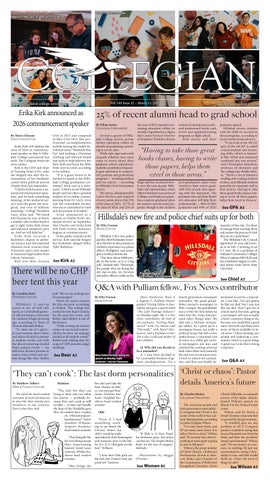
Students and their parents at ’80s night over parents weekend.
See A2 for event coverage.
Emma Kate Mellors | Student Activites Board
Vol. 149 Issue 22 – March 12, 2026
Michigan’s oldest college newspaper
www.hillsdalecollegian.com
Erika Kirk announced as 25% of recent alumni head to grad school Ethan Savka the class of 2025 reported con- technical training and acceler- graduates agreed. 2026 commencement speaker ByCollegian Freelancer tinuing education within six ated professional tracks, such Hillsdale invests students By Moira Gleason Executive Editor Erika Kirk will address the class of 2026 as commencement speaker on May 9, Hillsdale College announced last week. The Collegian broke the news online. Kirk is the CEO and chair of Turning Point USA, roles she stepped into after the assassination of her husband, conservative political activist Charlie Kirk, last September. “Charlie Kirk became a national and international sensation, and he built something amazing. At his memorial service were the great, the neargreat, and tens of millions watching,” College President Larry Arnn said. “We loved him because he was, at heart, a student who worked hard to get it right. Erika Kirk, brave and widowed, intends to carry on. And we will help her.” Erika Kirk received a bachelor’s degree in political science and international relations from Arizona State University and a juris master in American legal studies from Liberty University. Kirk won Miss Arizona
USA in 2012 and competed in Miss USA 2012. Her professional accomplishments include hosting the weekly devotional series “Midweek Rise Up” and leading a Christian clothing and lifestyle brand that seeks to help believers live their faith and learn the Bible from cover to cover, according to its website. “It is a great honor to be invited to speak at the Hillsdale College graduation ceremony,” Kirk said in a statement. “Charlie loved Hillsdale deeply and was often a grateful student of its online courses, learning from Dr. Larry Arnn and the remarkable faculty, who are so committed to truth and the pursuit of wisdom.” Arnn announced in a speech at Charlie Kirk’s memorial service in September that Charlie and Erika Kirk will both receive honorary degrees at commencement. In her public remarks at the service, Kirk said she forgave her husband’s alleged killer, Tyler Robinson.
See Kirk A2
There will be no CHP beer tent this year By Caroline Kurt Opinions Editor Hillsdale’s 21-and-up crowd is out of luck this April, as Centralhallapalooza will not feature a beer tent for students of legal drinking age, according to Dean of Women Rebekah Bollen. “It came out of a general conversation about when and where alcohol is present at student events, not with the idea of removing alcohol from campus events — we still have alcohol present at senior class events and various things like that,” Bollen
said. “But we are making sure it’s meaningful.” There are many reasons for this decision, according to Bollen. The college has owned its own liquor license for the past few years, and Bollen said liability is one of the factors. “With owning the license comes an increased responsibility for how we manage alcohol at all student events,” Bollen said, adding that the scope of CHP presents a legal challenge.
See Beer A2
Around a quarter of Hillsdale College seniors pursue further education within six months of graduating, according to survey data. While class rigor and a lack of grade inflation may cause some to worry about their graduate school aspirations, students nonetheless frequently gain admission to competitive graduate and professional programs — including medical and law school — according to Hillsdale’s First Destination Survey. The survey, administered by Career Services and required of every senior, shows that 25% of the class of 2023, 25.7% of the class of 2024, and 22% of
months of graduation, a figure that Career Services Director of Employer Relations Sharon
as two-year registered nursing programs or flight school. Both classes said their
“Having to take those great books classes, having to write those papers, helps them excel in those areas.” Rupp said has increased slowly over the past decade. Hillsdale’s self-reported data, which follows National Association of Colleges and Employers guidelines, explores graduates’ plans for masters and doctoral programs, though it also includes
post-graduation plans were related to their career goals, with 92% of each class agreeing with the statement. The graduates also said their liberal arts education will help them professionally — 96% of 2024 graduates and 94% of 2023
with the skills to succeed in those programs, according to its pre-professional advisors. “If you look at the MCAT, part of the MCAT is called critical analysis and reasoning skills, which is basically like verbal and analytical combined into one section,” said Christopher Hamilton, professor of chemistry and the college’s pre-health adviser. “There’s a lot of intensive reading and reading analysis in there, and Hillsdale students generally do extremely well in that section. Having to take those great books classes, having to write all those papers, helps them excel in those ar-
See GPA A3
Hillsdale’s new fire and police chief suits up for both By Ellie Fromm News Editor Hillsdale City’s new police and fire chief Kristopher Joswiak is the first in this position to combine experience as a police officer, firefighter, and emergency medical technician. “You have about 8,000 people in the town, so it is a big role,” Joswiak said. “Obviously, the people who are doing the job day-to-day, my firemen and police officers, make up the
majority of the role. I’m there to manage them and help them and oversee the process of what they do on a daily basis.” The Hillsdale City Council appointed 36-year-old Joswiak at its Feb. 2 meeting in an 8-1 vote. He is a graduate of Oakland Community College’s Police Academy/MCOLES and has a bachelor’s degree in criminal justice from Ferris State University. Kristopher Joswiak. Ellie Fromm | The Collegian
See Chief A7
Q&A with Pulliam fellow, Fox News contributor By Ellie Fromm News Editor
Mary Katharine Ham during her speech on Monday night. Courtesy | Austin Thomason
Mary Katharine Ham is a Eugene C. Pulliam Distinguished Visiting Fellow in Journalism and gave a speech titled “The Left’s Outrage Industry” on Monday night. She is a Fox News contributor, the host of two podcasts, “Getting Hammered” with Vic Matus and “Normally” with Karol Markowicz, and a freelance writer. She is also a wife and mother of four children. Q. Why did you decide to be a journalist? A. I may have decided to be a journalist because of genetic predisposition. I’m a
fourth generation newspaper journalist. My great-grandfather started a newspaper in Pitts, Georgia. My grandfather was a writer for him before he went into the Army and pursued other things later. My dad was a lifetime newspaper editor. So, I grew up in a newspaper house, not really a political house, but still a news junkie house. I consumed a lot of news as a child, got several newspapers per day, and watched the evening newscast back when those were basically the only way to consume news. I went to school for journalism, and then was briefly de-
termined to not be a journalist. I was like, ‘I’m not gonna be like my dad,’ but I was just like my dad. Then I got out of school and at the time, getting a newspaper job was actually a fairly common thing to do, because you could find a good entry-level job, and there were more of them available in local news. I liked meeting new people and exploring a community, which is a great thing. A great way to do that is being a reporter.
See Q&A A3
‘They can’t cook’: The last dorm personalities ‘Christ or chaos’: Pastor By Matthew Tolbert Web & Puzzle Editor We asked the head resident assistants of men’s dormitories to describe their female peer residences in one sentence. Here’s what they said:
McIntyre “The only fire they can bring is their way-too-often fire alarms — probably because they can’t cook as well as Olds — or they can’t handle the heat of the Niedfeldt guys they do indeed have crushes on (#theydoindeedhavehotones).” Senior Jonathan Williams, Simpson Residence head resident assistant. “They bring the fire for everything except their homecoming banners.” Senior Lance Lintereur, Whitley Residence head resident assistant. “Mac brings the
details America’s future
fire, but can’t take the heat. Dream on Mercy, you just got beat.” Junior Nicholas Rutkoski, Niedfeldt Residence head resident assistant
By Charles Hickey Collegian Reporter
Olds “Even if I had something scathing to say about the Christy Maier fan club, I would be made speechless by their humongous and awesome door in the lobby. O-L-D-S, Olds girls are the best.” Williams. “I hear that Olds girls are the best, but I haven’t seen any proof yet.” Lintereur.
“If Olds is ‘A New Hope’ for freshmen guys, the union couches are ‘The Empire Strikes Back’ for the rest of campus.” Rutkoski. Illustrations by Maggie O’Connor
See Women B2
The American people and their government must publicly recognize that Christ is the center of the world or face cultural disintegration, according to pastor Douglas Wilson. “I’ve said many times, and I’ll say many more times: It is either Christ or chaos,” Wilson said. “If you deny him, then everything at some point is going to start to fall apart.” Wilson is the senior minister of Christ Church, a Reformed Presbyterian church in Moscow, Idaho, and a founder of the Communion of Reformed Evangelical Churches. Christ
Church Hillsdale, an outreach service of the Idaho church, hosted Wilson’s speech on March 8 at the Venue 8 event center. Wilson said he favors a broad Christian consensus that is asserted by the government. “It wouldn’t give me any problem at all if Congress passed a resolution saying that Jesus of Nazareth rose from the dead, and then the president issued a proclamation,” Wilson said. “No tax money, no coercion, no nothing. It’s just our representatives saying Christianity is true, and that would thrill me. That’s the kind of thing I’m after.”
See Wilson A2
A2 March 12, 2026
www.hillsdalecollegian.com
Parents and students go back to the ’80s Wilson By Cassandra DeVries Collegian Reporter Parents and students stopped by the Old Snack Bar on Saturday for a 1980s-themed event featuring vintage video games and custom cassette tapes. The Student Activities Board–hosted event gave participants a chance to revel in ’80s nostalgia. “I thought the event was such an awesome idea, since I think young people today kind of yearn for the ’80s,” sophomore Lenora Schupbach said. “It was also super cool because a lot of parents were there since it was parents’ weekend, and it was cute to see them reminiscing and showing off their ’80s knowledge since they lived it.” Attendees ate pizza, played vintage board games, and competed in top ’80s music hits trivia. “I was super pumped about it,” sophomore Ross Phelps said. “I do have some sort of affinity for older things and am kind of a nostalgic person for the ’80s, even though I didn’t live it.” Phelps headed the planning for the event and said he wanted the night to be as vintage as possible. “I was really thrilled that we were able to make most things from the ’80s, and I think the parents really enjoyed that too,” Phelps said. “There were lots of parents who came over there, like,
Beer from A1 “The larger the event, the more people, the more alcohol is being served,” Bollen said. “You’re always inviting more liability concerns.” Not having a beer tent will also allow the Student Activities Board to allocate funding into other aspects of the CHP experience, Bollen said. “The Student Activities Board is teeming with awesome ideas,” Bollen said. “This decision practically gives them more budget to work with.” This decision is not permanent, Bollen said. “The SAB team always does surveys post-event,” Bollen said. “We’re hoping and expecting that students will give feedback, and if this is something that everyone has an
Kirk from A1 “Hi l ls da le repres ents something rare in our time — a steadfast devotion to faith, learning, and the principles that sustain a free nation,” Kirk said in the statement. “I am sincerely grateful for the invitation and look forward to being there with all of you. God bless you.” Senior Hinson Peed, former president of College Republicans, said he looks forward to hearing Kirk’s advice for graduates. “Erika not only suffered the loss of her husband but has also managed to continue his legacy as CEO of one of the largest conservative youth organizations in the country,” Peed said. “She’s
‘I had that when I was a kid,’ and I’m like, ‘Yeah, that’s exactly what I want to hear.’” Junior Gabe Beckwith helped organize the event and attended with his dad. “My dad didn’t hesitate to play ‘Super Mario Bros’ on the Nintendo, which was funny,” Beckwith said. “Also, my dad kind of jumped up in between rounds on the Nintendo because he recognized the music video for one of his favorite bands, Scorpions. They were singing ‘Wind of Change,’ and so he thought that was awesome. I think he sent a photo to my mom.” Phelps said he owns a variety of music equipment, cameras, and games from the ’80s that he used to decorate the event, including a vintage record player and several records that he set up at the entrance. “The first shift for setup was just five people coming to my room and taking all the things out, so it was handy that we had it all in one place,” Phelps said. Phelps also found an old Nintendo Entertainment System on Facebook Marketplace. “I don’t know the exact year, but it was from the early ’80s,” Phelps said. “You could play games like ‘Super Mario Bros’ or ‘The Legend of Zelda’ on it, and it was basically the first home console. My dad played on it when he was young, and my mom would go over to her friend’s house
and play the games that we had at the event.” On another table, Phelps set up a cassette player, some blank cassettes, and the materials to create J cards, which are similar to an album cover, for the cassettes. Parents and students could design the J card and take the cassette home as a memento. “My friend and I decorated personalized tapes for each other. We’re each going to put songs that make us think of each other onto them and then exchange them,” Schupbach said. “It will probably be something I treasure my whole life.” Phelps said one of the moms at the event made a J-card picturing the DeLorean time machine from “Back to the Future.” “I own two recording devices, but I told people, if they really wanted to, they could write a list of songs, and then I could take their cassette and record it for them,” Phelps said. SAB chose the Old Snack Bar as the event’s venue because of its age, according to Phelps. “A lot of the parents lived in the ’80s and are alumni who grew up going to Hillsdale when the snack bar was actually a snack bar with a kitchen, all that kind of stuff,” Phelps said. “I knew from the moment that we would that we settled on the idea of the ’80s night that we wanted to do it in the snack bar.”
The SAB creative team painted a geometric neon backdrop and set up lighting for pictures. “I also had a Polaroid camera that is from the ’80s,” Phelps said. “It was maybe ’86 I think, and it was refurbished, so it works really well, but we shot a lot of Polaroid film there, too.” SAB organized ’80s music trivia for the last half of the event, according to Phelps. “We would play the first four or five seconds of a song, and people were trying to guess the artist and the title of the song, which ended up being really fun,” Phelps said. “Everyone who was there at that time participated.” The winner received a vintage “Back to the Future” movie poster. “My dad and some of the other dads were either naming songs or singing along to them,” Beckwith said. Planning the event went smoothly, according to Phelps. Roughly 60 parents and students showed up to enjoy the ’80s nostalgia throughout the night. “This was our proof of concept for doing a decade themed event. And I think it has a lot of potential in the future,” Beckwith said. “I feel like we brought the Old Snack Bar back to life.”
opinion about after they experience it, we hope they fill out the survey.” The administration will assess the beer tent on a yearby-year basis, according to Bollen. “Anytime a student has a question or is frustrated, reach out and have the dialogue with us,” Bollen said. “Conversation really helps us get to a much greater area of understanding.” Bollen said students of age should watch for an invitation to a 21-and-up event featuring alcohol at the Phi Sig Pavilion during CHP week. “We thought Phi Sig Pavilion was a great add on,” Bollen said. “I understand the rite of passage element, especially if you’re a junior and senior.” Senior Abigail Celecia said she is sad about the administration’s decision.
“The beer tent symbolizes community, friendship, love, and joy,” Celecia said. “I understand that the college is trying to take the right precautions to keep its liquor license, but the real question is, at what cost? We see the college stand up and fight all the time. Why not for beer? There will be a sadness in our hearts for our last CHP, and the worst part is we can’t even say cheers to the hard work we’ve put in.” Senior James Hamilton said a beer-tent-free CHP will still be enjoyable. “While I understand any unhappiness at the college’s decision, the beer tent at CHP is not the best part of the event — not even close,” Hamilton said. “You shouldn’t need the free alcohol to have a good time. And if you really think you do, we all know that there
will be plenty of other opportunities to drink that day. If you’re upset about the beer tent’s absence, don’t worry; chances are, you won’t remember much of the event at all.” According to senior Noah Northon, the administration’s decision will not alter his CHP plans. “If I wanted to revel under the CHP tent in past years — bibens usque ad hilaritatem — I would have to be discreet,” Northon said. “Now that I am a senior of age, I will have no other option but to do the same. There is an odd sentimentality to this — even a perfection.”
faced more obstacles than many of us will ever face, and she has achieved more success than many of us can hope for. I look forward to hearing her story on how to continue to stand up for the conservative values we learned here at Hillsdale out in the real world — even when it may become increasingly harder and more dangerous to do.” Some seniors expressed concern that inviting Kirk to address the class of 2026 does not reflect the desires of the student body and will be perceived as a political statement, distracting from the accomplishments of the graduating class. “I was disappointed to hear the announcement of Erika Kirk as our commencement
speaker,” senior and legacy board member Rachel Dunphey said. “Completely irrespective of any personal political affiliations, I believe that having Kirk as a commencement speaker necessarily turns what should be a celebration of four years of hard work into a political statement.” Last year’s commencement speaker was Victor Davis Hanson, the military historian and conservative political commentator. Senior Jonathan Williams said he shares the concerns of his classmates that the selection makes graduation too much about the current political moment. “Erika Kirk’s political associations will inevitably bring
national conversations into what many hoped would be a more close-knit occasion,” Williams said. “Still, one of Hillsdale’s virtues is open-mindedness. The senior class should not close itself off to what she has to say or allow reservations about the choice to sour our excitement for graduation before it even arrives. Though I have political disagreements with her, I cannot deny that since her husband’s death she has shown remarkable resilience and grace — qualities anyone can admire. She should be welcomed with courtesy and respect.”
How to: Advertise with The Collegian
To advertise in The Collegian, please contact Henry Fliflet at hfliflet@hillsdale.edu.
How to: Subscribe to The Collegian
To receive weekly issues of Hillsdale College’s student newspaper, please contact Henry Fliflet at hfliflet@hillsdale.edu.
from A1
Wilson said Americans have lost a common Christian culture that used to be taken for granted. “Up until World War II, we would think and speak of ourselves as a Christian people, a Christian nation,” Wilson said. “The thing that has people spooked and freaked out now — Christian nationalism — was commonplace in my great-grandfather’s day.” Wilson quoted Supreme Court Justice David Brewer, who wrote in an 1892 case, Church of the Holy Trinity v. United States, that America was a “Christian nation.” “We did not have a formal establishment the way England did, with the Church of England,” Wilson said. “We had an informal establishment, which meant that we recognized the common Christian consensus.” Around 75 years ago, Wilson said, America began slowly inching away from Christianity and toward
apologetically Christian in public. “When a non-believer says, ‘I don’t accept your Bible, I don’t accept any of that,’ and we blush and put it away — who is it that doesn’t believe?” Wilson said. “We’re the ones that don’t believe. Avowing Christ in public means not being ashamed of him and his word.” In a Q&A session afterward, Wilson said he thinks state-established churches are constitutional, but a bad idea. “The reason why I don’t support church establishment by the state is I think it’s the kiss of death for that church,” Wilson said. “It’s like your spiritual life is turned over to the Department of Motor Vehicles. I think it’s been historically bad for the churches that have been ‘blessed’ by that.” Anna Vincenzi, assistant professor of modern European history, said she listened to Wilson’s speech because his name came up in conversations with students about Christian nationalism, and
“When we began being secular, we had centuries of accumulated moral capital, centuries of the heritage of Christendom, and it took us a while to spend it all.” overt secularism. He compared America to the biblical prodigal son who squandered his inheritance. “When we began being secular, we had centuries of accumulated moral capital, centuries of the heritage of Christendom, and it took us a while to spend it all,” Wilson said. “But spend it all we did — and now we have a justice sitting on that same Supreme Court who could not answer the question ‘What is a woman?’ We’ve lost our way.” Wilson said he supports a slow and methodical approach to the cultural problems of secularism in America. “We got into this over the course of decades, and we’re gonna get out of it over the course of decades,” Wilson said. “Through planting serious Christian schools, planting Christian churches, establishing centers of worship, teaching people to think like Christians and to speak like Christians.” According to Wilson, becoming an online reactionary will simply make America’s problems worse. “The ‘dank right’ is reactionary blowback,” Wilson said. “That’s reaction, not reformation. The Catholic historian Christopher Dawson once said: ‘The Christian church lives in the light of eternity and can afford to be patient.’ Reformation is patient. Revolution is impatient.” Wilson said Christians need to be loudly and un-
she wanted to judge for herself and ask questions. “I spend much of my teaching talking about the tragically evil consequences of nationalism in the modern West and the risks involved in entrusting the re-Christianization of society to coercion and political takeover,” Vincenzi said. “In the talk, the emphasis was different. Wilson suggested that the re-Christianization of American society will come from the life of church communities and Christian witness, not from politics. I appreciated that aspect, and hope that’s what the rest of the audience also received, though I know that the talk might not be representative of Wilson’s rhetoric or of the Christian nationalist universe.” Vincenzi added that she still disagrees with Wilson on a variety of issues, especially regarding his long-term plan for how a Christian society works and the extent to which the law should regulate morality. “Wilson speaks directly to the deep yearning in many of my generation about the direction of the nation,” junior Luke Waters said. “He understands the hour. It is indeed Christ or chaos.”
How to: Join The Collegian
To find out more about how to contribute to The Collegian through writing, photography, or videography, please contact Thomas McKenna at tmckenna@hillsdale.edu.
www.hillsdalecollegian.com
March 12 , 2026 A3
Penny’s to host new ‘Larry’s’ mocktail evening By Sophia Bryant Assistant Editor Students who enjoy coffee at Penny’s by day will soon enjoy mocktails at Larry’s by night. Penny’s coffee shop will host a mocktail night called “Larry’s” on March 26 from 7-9:30 p.m. Penny’s student managers plan to make Larry’s a recurring event, with dates scheduled for April 16 and April 28, according to junior Maria Adamow, Penny’s general manager. “It’s supposed to be like a place of relaxation,” Adamow said. “We have so much stuff going on at Hillsdale, everything’s go, go, go. But here, hopefully it’ll just be a place to relax and reset and have a sense of community on campus.”
with ginger beer and lime juice, called the “Manning Mule.” Sophomore Bailey Wright, Penny’s event manager, said they are still testing and finalizing the mocktail menu. “We’re hoping to have some light snacks, and a stand up cocktail vibe, just very classy and very fun,” Wright said. Adamow said they plan to offer card games and play jazz music. If the weather allows, Larry’s will take place on Penny’s outdoor patio by the fireplace as well as inside the coffee shop. “There’s not a lot of communal spaces where everyone can get together from all different years and backgrounds and just have a good time,” Adamow said. “So I think we’re just hop-
Wright said Penny’s hosts events in the middle of the day or on the weekends, but Larry’s
ing to have that diversity come together so we get to know each other a little bit more.” Penny’s coffee shop is named after College President Larry
Arnn’s wife, Penny Arnn. Adamow said they needed to get approval from the president’s office to name the mocktail night “Larry’s” a f t e r Arnn. Wright said she plans at least two events a month at Penny’s. She tries to host philanthropic events like letter w r it i ng , music events and parties, and c r e at i v e events like pumpkin painting. “It’s just a way to draw people in for a change up of environment and a change up of vibe in Penny’s, to still bring people together, but provide a different, laid-back fun space for people to step away from studying for a second,” Wright said.
semester. However, she took two years off, went and built her professional knowledge, and then reapplied and became very engaged with the program so that they understood who she was, and then she was admitted. But generally speaking, you have to have a 3.0, and some programs come right out and say, ‘We really like a 3.5.’” Students can overcome a modest GPA, Rupp said, by looking at what previous graduate school applicants have done. “We have the students research the last accepted cohort’s GPA, and look for other things in the application that can offset a weaker GPA,” Rupp said. “If the average accepted cohort was a 3.8, and perhaps a Hillsdale College student has a 3.6, we ask, ‘What other activities have they done that can support their evidence of being able to withstand academic rigor?’ So that’s where those extracurricular activities really fall into place.” Rupp said Career Services partners with faculty advisers in pre-medicine and pre-law to guide students. For medical school applicants, the data show Hillsdale students outperforming their peers. Hamilton said Hillsdale students achieve acceptance rates above 90% for M.D. and D.O. programs combined. The national M.D. average is 4050%, and the combined M.D. and D.O. figure is near 60%. For many graduates, Hills-
dale’s reputation at medical schools proves beneficial. “I know admissions people at all the schools, all the medical schools in Michigan, and many outside the state,” Hamilton said. “They know that Hillsdale is tough, and they factor that into their admissions. Some of the schools are pretty straightforward. They’re going to consider a Hillsdale GPA similar to somebody who went to a really difficult school, maybe a Harvard or MIT grad, even though they certainly have more grade inflation than we do. They’re going to see Hillsdale as rigorous, and they’re going to compare that to somebody who went to two years of community college, and then maybe went to a lower-tier state school somewhere where it’s really easy at a 4.0. They’re also going to see that a Hillsdale student with a 3.5 is going to be fine in their program.” MCAT scores can offset a lower GPA for schools that use holistic review in their admissions, Hamilton said. “Schools would much rather see a student who has a slightly lower GPA due to a lot of difficult classes than somebody who has a really high GPA who avoided all the hard classes,” Hamilton said. The same applies to law school admissions, pre-law adviser and Professor of Philosophy Nathan Schlueter said. “GPA does matter, but it’s a GPA,” Schlueter said. “You want
to be in a range, but they’re not going to just look at the raw GPA. They’re going to look at the classes you’ve taken. They will look down your transcript and ask certain questions: Did you take physics? Did you take basic math or calculus? Did you take a lot of business communication classes? Or did you take classes known to be more rigorous and demanding?” The liberal arts curriculum and its difficulty at Hillsdale are positives for students both for applying to and succeeding in graduate school, especially law school, according to Schlueter. Students frequently gain admission to top-14 programs, he said. This translates to disproportionate representation on law reviews and in federal clerkships, even U.S. Supreme Court clerkships — 10 Hillsdale graduates have clerked for the Supreme Court in the last 15 years, Schlueter said. “I’ve had a lot of people at law schools tell me that Hillsdale students stand out among their peers,” Schlueter said. “They just seem to be better students: to grasp things better, to write better, to think better, to be more energetic in what they’re doing.” Rupp agreed with the broader value of the liberal arts core. “It prepares them exceptionally well because of their ability to relate, communicate, and critically think,” Rupp said.
disagree with me, and I do a lot of work on college campuses. Also, a lot of college campuses have a lot of left-leaning students, and I want them to feel free to disagree with me. It doesn’t bother me.
about four or five questions. I was widowed in 2015 when I was seven months pregnant with my second child. I had a baby two months after my husband died, and that debate was four months after he died. So I had a 2-month-old baby, traveled to New Hampshire, took my mom with me, and made it happen. And it’s obviously very rewarding to me, because it was this comeback and proof to myself that I could continue to do very tough things and have a career and make this all work together.
that the information is reliable. But I like that I get to hear more voices, and have access to more voices than when I was a kid. Even though I consumed a lot of media, the media was coming from three different newspapers and three different networks total. That was it. Then I would hear my dad’s takes. Now, I can fill my feeds with a bunch of different ideas, and I try to proactively do that.
“But here, hopefully it will be a place to relax and reset and have a sense of community on campus.” Adamow said they are trying to invent clever names for their mocktails. For example, they hope to serve a Moscow Mule, which is a mocktail made
GPA from A1 The majority of students pursuing further education head to advanced degree programs such as an M.D. or J.D., according to Rupp. The First Destination Survey lists acceptances at Case Western Reserve, Cornell University, the University of Chicago, Harvard Law School, the University of Michigan, the University of Notre Dame, Stanford University, and many more schools. While students should try to earn good grades, Rupp said their GPAs are less of a concern than they may think. While not every individual school is the same, most schools require standardized tests. “It depends on the program they’re applying to. If there is a required standardized test — meaning MCAT, LSAT, or so forth — depending on the program, that determines the weight of the GPA,” Rupp said. “So for the majority of medical or law school applicants, their score on that test probably outweighs a GPA.” However, Rupp added, there are exceptions to the rule. “All graduate programs require a 3.0, so that’s the minimum,” Rupp said. “Have there been students who have been accepted with under a 3.0? One-hundred percent. There’s one student in mind that I know had a 2.9. She had a really bad
Q&A from A1 Q. What’s your favorite part of being a political contributor? A. It’s a very unique field of journalism. I accidentally stumbled into new media, a gig that allows me basically to be myself for a living. I analyze news, but I am not in charge of voicing anyone else’s point of view. I get to evaluate things on my own. I very much like being able to evaluate things independently and to be at different networks or different environments, but always be myself and try to be true to what I believe. I enjoy talking to people who might
Q. What’s your favorite memory from working in journalism? A. The most rewarding thing I’ve done was I co-moderated a 2016 primary debate. There were nine candidates at the time, including Donald Trump. I believe it was right before the debate where Trump went after Megyn Kelly really hard. And so there was a risk if he was going to come at me while I was doing this job. It was an ABC debate, so I was partnered with David Muir and Martha RaddMary Katharine Ham during her speech on Monday night. atz, and Courtesy | Austin Thomason I asked
Q. What do you like about new media? A. It sort of flattens the professional world a little bit. Frankly, journalism is not rocket science. You go listen to something, or you go tape something, and you present the information to the public. A lot of people can do that who don’t have to be official journalists. And so I like the fact that the barrier to entry is low. Now, the downside is you have to check everything that you’re consuming and make sure that it’s coming from somebody reliable, or
will be a fun, different event on a Thursday night. “It’s something very unique,” Wright said. “We don’t have anything like a mocktail bar on campus, obviously. And I think one, for its uniqueness, but two, it’s in the middle of the week, which is different from a lot of what Penny’s has to offer.”
Q. Why should young people go into journalism? A. If you want to be an engaged citizen, you’re halfway to being a journalist. Being a journalist is just taking what you’ve learned and telling people about it. If you have a passion for getting to the bottom of things, if you have a passion for holding people accountable, there are actually a lot of gaps doing that now because of the industry and because the bottom sort of fell out economically from local news. I think you can do a real public service and get attention by exposing things that are right out there for the taking and that nobody has, like doing a Freedom of Information Act request
Notify ITS of your international travel plans By Matthew Tolbert Web & Puzzle Editor Information Technology Services asks that students notify it of international travel to ensure that students are not caught by filters meant to catch foreign cybersecurity threats. According to an announcement from ITS Operations Assistant Bobbie Brown, students are asked to email the Helpdesk with at least 48 hours’ notice of their destination, departure and return dates, and services required. That way, travelling students can be properly unblocked. “By letting us know your itinerary, we can add you to the International Travelers group, allowing you to access email and college resources
has given us more security capabilities and different tools, and different tools allow us to see our threat vectors a lot better.” The turnaround for ITS to record upcoming international travel is relatively quick, according to Post. “It takes probably two to three days,” Post said. “The actual work, we budget 30 minutes.” Junior Hidi Cramer, who is studying abroad in Saarland, Germany, found this process quick and painless. “All they asked me for was when I’m leaving and then when exactly I’m coming back. I’m not exactly sure when I’m gonna be back in town, but I just said I would email him back as soon as I know the exact date, and they were perfectly fine with
“We have 80% to 92% fewer major breaches due to just those three controls.” from your destination without being flagged as a security risk,” Brown wrote in an announcement posted on my.hillsdale.edu. IT Operations Manager Tim Post said the primary concern is when a student connects from a country in which Hillsdale College has no presence. “There’s a signature of Hillsdale College users,” Post said. “Any state in the U.S. is going to be on an ‘allowed’ list. Where we are blocking countries is where we have no business. For risk profile and risk tolerance, it’s better for us to just have those nefarious countries on a blacklist.” The primary services affected are those hosting from servers on campus, such as those used for class registration, according to Senior Director of Information Security Scott Aschenbach. “It’s mostly just the on premise computing that we have,” Aschenbach said. “You have maybe about 100 servers here, which handle all of the registration systems. You couldn’t register from somewhere else.” As Post notes, however, the policy does also affect email. “In the last three years, we have moved from an on-premise Exchange environment to cloud-based email, Microsoft 365,” Post said. “With that change, it
that,” Cramer said. “I think that was settled within 20 minutes of emailing back and forth.” Post said that if a student has forgotten to notify the Helpdesk, ITS can work faster if needed. “If it’s an emergency, they should indicate that on the ticket,” Post explained. “If they’re leaving tomorrow, we’ll prioritize it higher.” If students have an upcoming password expiration, however, they should change their passwords while still on campus, according to Post. “When you’re off campus and change your password on a Mac, although it updates in Keychain, it doesn’t get changed here locally. Right now, there is not a workaround around that,” Post explained. “If you think you’re going to be expiring within a few months, it’s just safe to come in when you work on campus and do the change.” According to Aschenbach, the international travel policy works with two other main ITS cybersecurity policies to decrease the amount of risk to the college’s infrastructure. “These are all percentage games,” Aschenbach said. “We have 80% to 92% fewer major breaches due to just those three controls.”
because no one’s employed to do those jobs anymore. I think that the skill of just knowing how to do a FOIA easily and knowing what to ask for, that’s a superpower these days. There’s so much that’s available to you.
I saw an opening for it. Now on the way to doing that, in order to get flexibility, I sometimes gave up pay, I sometimes gave up prominence, I sometimes gave up health care benefits that didn’t come with contract work. I had to fill in those holes in different ways. So there was always a negotiation process with that, but to me, those things were worth giving up to have the flexibility.
Q. What is your advice to Hillsdale students? A. Even if you don’t want to do journalism, making a decision about how much you’re going to expose yourself to, where you’re going to get news, how you’re going to connect that to your daily life, and how not to get overwhelmed or anxious about it, is just part of being a human now. You need to make a practice of pausing about what you’re consuming. Be patient, try to compare accounts, and then be conscious of what you’re taking in. Q. What’s it like balancing being a wife, mother, and journalist? A. I designed my career to be flexible. I had a Covid-era workfrom-home situation before that was a thing. But I did it on purpose, because I wanted to be more flexible for my kids, and
Q. What is one thing you would tell your college-age self? A. For one, I would learn to do FOIA sooner, and make it a practice. Secondly, I would specialize more if I had to do my career over again. I ended up a generalist, and I consider myself very lucky that I get to cover a lot of things, and that I never get bored. But I think that version of journalism might be a lot rarer now, and not that many people get to do that. If you’re out there looking for ways that people are solving problems, that would be something interesting that you end up being the expert on.
Opinions A4 March 12, 2026
(517) 607-2415
Online: www.hillsdalecollegian.com Editor in Chief | Thomas McKenna Executive Editor | Moira Gleason Design Editor | Anna Broussard Senior Editor | Catherine Maxwell News Editor | Ellie Fromm Opinions Editor | Caroline Kurt City News Editor | Alessia Sandala Sports Editor | Elaine Kutas Culture Editor | Ty Ruddy Features Editor | Tayte Christensen Social Media Manager | Skye Graham Circulation & Ad Manager | Henry Fliflet Assistant Editors | Christina Lewis | Sophia Bryant | Elijah Guevara | Jayden Jelso | Adriana Azarian | Gemma Flores | Christian Papillon | Jamie Parsons | Francesca Cella | Grace Brennan D.C. Correspondents | Lauren Bixler | Megan Li | Lewis Thune Web & Puzzle Editor | Matthew Tolbert Illustrator | Maggie O’Connor Faculty Advisers | John J. Miller | Maria Servold The editors welcome Letters to the Editor but reserve the right to edit submissions for clarity, length, and style. Letters should be 450 words or less and include your name and number. Send submissions to the Opinions Editor at ckurt@hillsdale.edu before Saturday at 3 p.m.
Regret your kid? By Moira Gleason Executive Editor Imagine pulling up the archives of New York Magazine to find out your mom wished you had never been born. Give it ten years, and some kid may do just that. A recent article from New York Magazine site The Cut features the stories of three young women who say they regret becoming moms. The story appears as the latest installment in “Oh, Baby,” a series that has set out to explore “how we made the choice — and whether we regret it.” Ostensibly, the piece warns the wider world of the underplayed perils of parenting to help others make an informed choice. It reads more like a vent session for women to complain about their husbands and their mental health diagnoses to the World Wide Web. “Parent regret is more common than you might think,” the introductory blurb to the symposium says. “The r/regretfulparents sub-Reddit alone gets around 70,000 weekly visitors who anonymously commiserate — though stigma makes it hard to admit in real life.” The modest proposal is implied: Protect your sanity; avoid or abort the child. After reading both the article and much of the sub-Reddit, I am convinced the social stigma against wishing away your children should, in fact, remain. The piece seeks to normalize the unnatural breakdown of a relationship that should form the basis of a healthy society. There is a productive way to write about the difficulties of parenthood. This was not it. All three of the women featured in The Cut cite real mental health struggles common in early motherhood: postpartum depression, body dysmorphia, and loss of identity or purpose. These struggles are real for many women and should
not be ignored. It is also worth mentioning that many families struggle to give their children the support they need due to financial hardship, distance from family, and jobs that won’t bend to a new lifestyle. More could be done to make raising children more affordable. But these difficult realities hardly redeem the message of the piece. The Cut and its readers are not interested in finding ways to support families who struggle to provide for their children or women who feel lost in early motherhood. Instead, it suggests that everyone has been lying to you about the joys of family life. In reality, it says, motherhood is a trap that will strip you of your autonomy and make you wish you had never set eyes on your husband. “I love our children and would never want them to think, ‘Mom and Dad would be happier if I wasn’t here,’” the first woman says. “I’m giving them the best life I can. But thinking about life without them, I’d be happier overall.” “If I could go back, I would redo everything,” the second woman says. “My fantasy is an alternate universe where I graduated, went straight to a doctorate program, and lived alone.” “It’s been a year. Genuinely, if there is a hell, I’ve been living in it since I gave birth,” the third laments. “Destigmataizing” such a self-centered view of happiness and parenthood does not help these three women or anyone else planning to have children. Rather, it normalizes disorder and exploits the mental health struggles of these women to advance an anti-family agenda. If anything deserves a social stigma, it’s wishing away your children in a public forum. Moira Gleason is a senior studying English.
www.hillsdalecollegian.com
War with Iran has no path to victory U.S. airstrikes alone will not end the conflict
By Nicholas Mirochnikoff Collegian Freelancer The war in Iran has no clear end goal. Last week, Professors of History Bradley Birzer and Paul Rahe debated the legality of the current war in Iran (“It’s an illegal war,” “There’s nothing illegal here,” March 5). While the legal question is important, the more pressing issue, as Rahe pointed out, is whether the war is prudent. It is not. Until now, the hallmark of the Trump administration’s foreign policy has been focused military operations. Last spring, U.S. forces targeted Houthi militant groups in Yemen who threatened Red Sea shipping. In the summer, Israeli and U.S. military forces conducted limited strikes on Iranian nuclear sites. In January, Delta Force conducted a late night raid that captured Venezuelan President Nicolás Maduro. These operations shared a common theme. They had clearly defined objectives, were executed quickly, and avoided escalating into broader regional wars while still sending a strong message to America’s adversaries. The current war in Iran, Operation Epic Fury, breaks sharply from this pattern, pushing the conflict toward open-ended escalation. Iran was once one of America’s closest allies in the Middle East. When the U.S.backed Shah’s government was overthrown during the 1979 Iranian Revolution, it was not by a military coup but by a popular religious uprising led by Shiite clerics deeply hostile to the U.S. That anti-American sentiment re-
mains embedded in Iran’s population and regime today. While the Iranian people may have hated their supreme leader, there was still mourning in the streets of Tehran when the U.S. killed him Feb. 28, as many viewed him as a unifying figure against the American “yankee infidel.” While it is true that only a month ago mass protests rocked the nation, the demonstrations were ultimately crushed by the Iranian Revolutionary Guard Corps and other regime security forces in a violent crackdown that left thousands dead and tens of thousands arrested. In the eyes of the regime and the Iranian people, America remains the infidel regardless of who rules in Tehran. If the people were interested in reinstating a revolt, something would have likely happened already. Operation Epic Fury is not a limited strike but the beginning of an uncontrolled war, with a stated, unrealistic goal of regime change. When we pursued such a policy in Syria, Iraq, Afghanistan, Somalia, and Libya, the results were disappointing. Iran may be ethnically diverse with some internal division, but the country remains largely united around Shiite Islam. According to a 2022 report by the State Department, roughly 90–95% of Iranians identify as Shia, making Iran the largest Shia-majority state in the world. This shared religious identity unifies the Iranians in the face of external threats, with the current war being existential to their very survival. Iran has launched hundreds of ballistic missiles at America and its allies, killing
seven American soldiers and wounding approximately 140, with thousands of additional casualties across the region. While the U.S. may intercept many incoming missiles, advanced defense systems are more expensive and limited in supply than Iran’s missiles. Over time, this imbalance favors Iran. Iran’s proxies, such as Hezbollah, Hamas and other such supporters, while damaged, remain active throughout the region, and security officials have warned that Iran or Hezbollah could activate sleeper cells abroad. Russia and China remain partners of Iran, and Russia has already provided satellite targeting assistance. This conflict could evolve into a proxy war. Our current armed forces and two carrier strike groups cannot sustain a long-term deployment without considerable economic cost. Sooner or later, we will withdraw. Yet by entering this war, we have destabilized what had been a tense but predictable pattern of tit-for-tat confrontation with Iran. This war is not of a limited nature; we have undermined what little diplomatic space remained and made retaliation more likely than renewed diplomacy. Indeed their new supreme leader, Mojtaba Khamenei, is more hardline than his late father ever was, with close ties to the Guard Corp, the very organization the U.S. now seeks to destroy. The economic consequences are already visible. According to Reuters, oil prices in the U.S. have climbed to about $90.90 per barrel, while gasoline prices have surged roughly 17% to above $3.50
per gallon. Iran and its proxies have effectively disrupted two of the world’s most critical maritime chokepoints: the Red Sea, which sees roughly 12–15% of global trade, and the Strait of Hormuz, through which about one-fifth of the world’s oil supply passes. These disruptions extend beyond oil and gas prices. Shipping through the Red Sea and Strait of Hormuz also carries large volumes of grain, fertilizer, and other agricultural inputs, meaning prolonged disruption may drive up food prices worldwide. At the same time, missile strikes are damaging the very systems that sustain the region’s oil, gas, and water supplies, meaning the economic consequences may persist long after shipping lanes reopen. U.S. airstrikes alone will not solve this problem. We can bomb Iran repeatedly, sink their navy, and destroy their air force, but without a ground invasion by U.S. troops, which would result in another forever war, we cannot eliminate Iran’s missile production or topple the regime. We may have hit Iran hard, but a wounded, cornered wolf is a dangerous wolf. Iran will retaliate, and the consequences for regional stability, global economics, and innocent lives may be enormous for very little strategic gain. Nicholas Mirochnikoff is a junior studying math and physics.
Don’t miss the big picture on Epstein The files are about human nature, not just politics. By Henry Fliflet Circulation & Ad Manager Rep. Ro Khanna, a Democrat from California, stood on the House floor last month to read the unredacted names of six “wealthy, powerful men” from the latest release of files on Jeffrey Epstein. Four of the men named, however, only appeared in the files due to a clerical error: The names simply came from an unrelated photo lineup, according to The Guardian. This kind of soundbite-manufacturing is gross. In the current atmosphere of public moral outrage, it’s important that we don’t ruin the lives of those who were in the outer reaches of Epstein’s orbit instead of the disgusting, unpunishable, and ultimately unidentifiable “elites” who are actually guilty. But Khanna’s instinct — to look for specific names no matter how tenuous the connection — has dominated the conversation around the release. Those who committed crimes should be prosecuted. But as much as bringing potential co-conspirators to justice matters, we must also adopt a broader skepticism toward powerful elites. The extent of Epstein’s connections is troubling because their ubiquity suggests
that he wasn’t the only creep wielding such influence over powerful elites. As long as turning a blind eye to evil helps advance people’s careers, some will make the decision to do so. Nobody is guilty by association. Nonetheless, the kind of associations people make says something about them and their world. There’s no real reason to believe this kind of behavior still isn’t happening in the same spheres Epstein once occupied. The majority of hand-wringing concerns crimes that took place more than two decades ago. As such, the best lesson voters can take from this isn’t about whom they should vote for, but that corruption can always take place in these positions of power. Epstein’s network was impressive. American presidents Bill Clinton and Donald Trump show up in the files, as does the U.K.’s former prince Andrew Mountbatten-Windsor and ex-Israeli Prime Minister Ehud Barak. Epstein managed finances for billionaire businessman Leslie Wexner. His wider social circle included figures such as businessman and philanthropist Bill Gates, actor Chris Tucker, and artificial intelligence researcher Marvin Minsky, according to the Associated Press. It’s entirely plausible that
most or all of these public figures weren’t a part of Epstein’s heinous sex abuse and trafficking network, if for no other reason than a lot of depraved human appetites can fall safely within the lines of the law. But it’s ludicrous to suggest that household names such as Clinton or Gates had no idea what was going on when they took advantage of Epstein’s private jet or network of connections. Worse, Epstein was hardly careful about hiding his predilections from those who knew him well. Whether through his borderline-illiterate emails about women or comments his associates made about him at the time — such as Trump’s infamous remark about Epstein liking women “on the younger side” — his appetites seem to have been an open secret. A significant number of important people who have a say in how we live our lives were willing to associate with him. Police began investigating Epstein in March 2005. He died in August 2019. It’s been more than 20 years since he was at the height of his power. Only a few politicians with connections to Epstein remain in power. Clinton’s and Gates’s legacies may be permanently damaged, but only after spending years largely re-
tired and already sidelined from major decision-making. Trump, who claims he broke off his relationship with Epstein years before the investigations, can’t seek reelection and could hand his movement to people who are untainted by the Epstein scandal. The Epstein files are most significant as a record of these kinds of people. People like Clinton and Gates may have been willing to look away from evil to advance their careers. That isn’t a new phenomenon, and it hasn’t gone away yet either. The cliches that come to mind about needing faith and justice in our institutions are, of course, all true. But none of it will completely safeguard these positions against the darkest aspects of human nature. Whatever previously-redacted names Khanna can cite from the files, don’t get distracted by clips designed for virality. Treat power with caution. Henry Fliflet is a junior studying English.
Opinions
www.hillsdalecollegian.com
March 12, 2026 A5
Go home, be happy Don’t ditch your phone: Dumb it down By Joseph Peshek Collegian Freelancer It’s spring break. You walk through the door of your home and are met with a flurry of greetings and hugs. The next couple of days are pleasant. You enjoy all of the comforts of home. But as the days roll on, you begin to feel empty. As you ruminate on your aimlessness, one of your little siblings darts into the room, shouting that they want to play their favorite game with you again. You get annoyed, feel guilty about it, and say yes with a smile. Daydreaming about breaks has gotten me through several midterm seasons. But even at home, life’s problems don’t take an intermission at the same time that you do. Spring break brings its own difficulties. Leave your school and interrupt your routine, and you will find a colorful batch of vices knocking at your door. But by shifting your expectations, a stagnant, harried break can become the hearty rest it’s meant to be. Entitlement likes to creep in over breaks. I often think that, surely, my weeks and months of hard work merit a few uninterrupted hours of lying on the couch. Negative thoughts and dormant habits reintroduce themselves when we lose our college environments and rhythms. Take time to rest in silence without distraction.
Then, pay attention to the thoughts and emotions that come up when you’re alone. We may be tempted to throw away our precious time on a dopamine flood of sugar and blue light. As negative emotions rise, so do the cries of our brains for a distraction. Anxiety or boredom may set in. Or, perhaps we come home with a touch of pride, expecting our families to treat us with more respect and grant us more space. But it is important to counter these tendencies rather than surrender to them. We should respond to discomfort by identifying our anxiety and boredom and replacing them with healthier thoughts. Our own families have hopes, fears, and memories that we have yet to learn about. We must not stop being curious about those we love. Though I know my family well, there are still so many things that I don’t know about them. They may be familiar, but in many ways, they are a delightful mystery. Coming home expecting to be served is different from coming home with the heart of a servant. The heart of servanthood, of Christ, is available to all who call upon Him in truth. This spring break, let us serve faithfully and rest truly. Joseph Peshek is a junior studying the liberal arts.
Restricting your smartphone is a cheaper path to freedom By Ashley Luke Collegian Freelancer Don’t spend your money on another gadget to solve your dopamine addiction. Try dumbing down your smartphone first. In a world where people are constantly bombarded with stimuli from screens, Gen Z seems to be craving a simpler, stress-free life. To help, they have turned to dumb phones. Since 2021, the sales of dumb phones, devices without access to the internet, social media, and most apps, have been on the rise, particularly among young adults and college students, according to a study by Partners Universal Innovation Research. But the dumb phone is just another thing to buy. Weaning yourself off of dopamine is a slow and steady process. Taking the drastic measure of buying a dumb phone can be expensive. For students who already have a working phone, it is wiser to save the precious few dollars you have. You can get almost the same benefits of a dumb phone on your own. This means removing everything that isn’t absolutely necessary such as apps, notifications, and added stimuli. The idea is to remove distractions
but retain the smartphone features necessary to your lifestyle. What is necessary is up to you, and that is the best part. Here are some ways to do it. Delete as many apps as possible. This is by far the easiest way to dumb down your smartphone. Think of the top five most important apps that add significant benefits to your daily life and remove the rest. Apps to keep could include camera, messages, calendar, and music. Be wary of other notification based apps such as email. Know yourself and your phone tendencies and delete accordingly. Turn on grayscale. Grayscale makes your phone much less visually appealing. Taking away the bright colors of your home screen and replacing it with boring, monochromatic ones significantly lowers your screen time according to a study by ScienceDirect. Set app limits that actually work. This can look like buying a device such as Brick, which blocks the apps of your choosing until you touch your phone to the small, silicon block. At $59, Brick is a fraction of the price of most dumb phones and provides nearly the same benefits. Leave Brick in your dorm, and
Don’t be sour, dough has power By Gabrielle Johansson Collegian Freelancer Learning to make your own sourdough may have resurfaced as a trend, but its sustained popularity indicates something far greater: The public’s movement toward holistic health. While the marketing of sourdough bread tends to focus on its gut health benefits, it overlooks one of sourdough’s greatest benefits: Its positive impact on diet culture. The resurgence of baking sourdough from scratch has quietly rewritten the narrative on carbohydrates. By introducing a complex understanding of nutrition and holistic health to the public, sourdough bread has reintroduced high-quality and necessary carbs to American kitchens. From a nutritional standpoint, sourdough is primarily credited for its support of gut health, which comes from its fermented and prebiotic competition. Learning how to bake your own bread began as a trend during the 2020 pandemic, when home-bakers started making sourdough en masse. At the time, baking sourdough wasn’t necessarily inspired by the nutritional benefits or fermented quality, but the activity itself. The baking process and even simply in keeping a sourdough starter alive, sparked a satisfaction and joy in bakers that encouraged them to continue. When the arduous process produced something that could be shared with family and friends, the benefits of the bread only multiplied. Despite ever-changing standards following various fads, the demonization of carbs has had a lasting impact on the public — and the public’s conception of nutrition science. The mixed messaging and media coverage have only exacerbated this narrative, depicting carbs as the enemy. With the rise of the Atkins low-carb diet in the late ’90s
you won’t be able to access those apps until you come back. You can also use other apps like One Sec or Stay Free which are designed to limit screen time more effectively than Apple’s Screen Time app. By dumbing down your smartphone rather than ditching it, you keep your high-quality camera. Dumb phones generally have severely underperforming cameras. Their grainy photos don’t hold a candle to the high resolution, multi-lens camera attached to your smartphone. They also aren’t able to video call. Moms across the country will revolt if they can no longer see your face on a weekly basis. It is also much less expensive to stick with the device you already have. Dumb phones can cost upwards of $300 if you want any of the features that make them worthwhile. The Light Phone III, a simple phone about the size of a sticky note, features maps, Bluetooth, and a music player. But it comes with a price tag of $700. Brands with similar features, such as Punkt, Mudita Kompakt, and Sunbeam, are only slightly less pricey. Most college students can’t drop that just to help them limit their screen time.
tion of carbs. Sourdough has broadened our conception of healthy food, encouraging us to take a holistic perspective. The nutrient density, digestibility, and gut health benefits of homemade sourdough bread have all been driving forces behind its sustained popularity, conveying the complex evaluation of its nutritional benefits. The holistic health movement has shed light on the connection between nutrition and lifestyle, especially when it comes to gut health. This connection has inspired people to opt for higher quality food options, as well as make more foods from scratch, indicating a preference for quality over convenience. And yet, none of this is really new to us. But for years, the nutrition field was led into corruption, confusing the public and projecting misinformation. Ultimately, by prioritizing common-sense nutrition science — and listening to our gut — sourdough’s popularity highlights that the average American is
done accepting lifestyle advice that promotes imbalance. There will always be another new diet trend. Whether it’s anti-carb, low-fat, or high-protein, diet culture relies on the corruption of nutrition science — even when the cost is public health. Within this framework, sourdough’s lasting popularity is a true feat, and explains why it has become such a staple in the past few years. Because its benefits are rooted in nutrient density and holistic health, the value of sourdough won’t be undermined by the next trend. And now, instead of demonizing an entire food group, we can appreciate it. Because at the end of the day it’s truly just a loaf of bread. Gabrielle Johansson is a senior studying politics. Illustrated by Maggie O’Connor.
Ashley Luke is a sophomore studying English.
Put Charger sports in the core By Hershey Hackberry Collegian Freelancer
and early 2000s, our culture has been shaped by the media’s messaging on healthy food. TIME Magazine contributed several pieces promoting the anti-carb messaging prevalent at the time. The trending topic even made the TIME cover in November 1999, with the coverline “Low-Carb Diets: Meat-loving, bread-banning regimes are the rage. Do they work? Are they healthy? Here’s the skinny.” Five years later, in May 2004, the low-carb fad was still in full swing, with TIME releasing a piece by Wendy Cole, “Is Bread Toast?” In her work, Cole highlighted the 10% decrease in bread sales in 2003, comparing the anti-carb movement to the “low-fat craze of the ’90s.” This narrative caused many people to reject carbs, as nutrition guidelines followed trends that blatantly ignored common sense and a balanced perception of food. Since the pandemic, sourdough has quietly undermined diet culture’s depic-
One downside of simplifying your phone is that you can easily return to old distractions. Any actual change requires self-control, which is, of course, quite hard. But this is a good thing. The growth in self that comes from actively choosing to not be distracted is more beneficial to your overall character development than an immediate change. Find a group of friends to keep you accountable. Practice all the classic tricks like leaving your phone in a drawer or out of sight. Dumbing down your phone isn’t a perfect solution to a problem that involves discipline and personal virtue. But neither will a new device fix your old habits. Implement these fixes to enjoy your spring break in the best way possible: unfettered from your smartphone and unworried about your screen time report.
Very few students who attend the University of Michigan would fail to recognize their football team’s star quarterback passing by them in the hallway. At Hillsdale College, it happens every day. Increasing student attendance at sports events would greatly improve student life. Hillsdale should require students to attend two sporting events each semester. There is an unspoken social dilemma that this campus knows too well: Our student body doesn’t know our athletes, and we lack a vibrant culture of support for them. At Hillsdale, you’re either an athlete or you’re not. Athletes dress differently, sit at different tables, and share a fellowship closer than any Greek fraternity on campus. Though this split isn’t unique to Hillsdale, addressing it here will give us a more fun, united school culture. Hillsdale’s 14 men’s and women’s varsity sports compete in around 100 events a year, about 40 of which are on campus. Yet the majority of students will only attend a small number of those games by the time they graduate. Our intense curriculum makes Hillsdale College a top choice for many students. The quality of students, professors, and even Student Activities Board events are impressive. The place we consistently fall short is our student participation at sporting events. As a student, I only go to athletic events for two reasons: If one of my close friends is competing in said sport, or if I am required by my radio one-credit class to run the sound board for that game. Other than that, going to a sports game is the least of my priorities. Between school and social obligations, run-
ning to the Splex on a Thursday for a basketball game is not likely to happen. To boost student attendance at sporting events, Hillsdale should mandate students go to two events per semester. Four events per year is not a crazy time commitment, even for the busiest student. For example, a basketball game takes an average of two and a half hours and a football game takes three. Especially if one attends with friends on a Saturday evening, supporting our student athletes at sporting events is a lot of fun. In a similar vein, athletes should be required to attend a musical performance or an art show twice a semester. The student section at sporting events would grow significantly. By requiring students to go to just two athletic events per semester, there would be an average of 60 students attending each game. That is huge compared to the meager 15 Simpson men in costumes who currently sustain our student section. Our athletes deserve recognition for their hard work beyond the Athletic Department Instagram posts about their team’s successes. More students will know them and congratulate them on their efforts, boosting overall student morale. Once there is a bigger cultural shift of students attending sporting events, this requirement can be history, but until then, we need something to bring together students and athletes. Our student body needs unity and our student athletes need recognition. So why not take a Thursday night to show up for your classmates? Hershey Hackberry is a junior studying politics.
City News A6 March 12, 2026
Township recommends CREO New zoning rules could stop solar panels in Fayette
By Adriana Azarian Assistant Editor The Fayette Township Planning Commission passed a motion this week that could block the Heartwood II solar panel project. The body approved a drafted Compatible Renewable Energy Ordinance, which will now go before the Hillsdale County Planning Commission and the Fayette Township Board. The CREO, if adopted, could block the Heartwood II solar panel project that would take up 1,350 acres of farmland north of Hillsdale and east of Fayette Township. Ranger Power, the Chicago-based solar company planning the solar panel installation, is also building the Heartwood I solar project and has land-use rights for more than 2,000 acres of property in Allen, Fayette, and Litchfield townships for a potential Heartwood III solar project. “Adopting the CREO is the right move, but adopting a weaker, incomplete ordinance will give the appearance of control without actually protecting the township,” Hillsdale resident Steve Oleszkowicz, who leads local opposition to the project, said at
the March 9 meeting. “Fayette Township has one opportunity to get this right before any more major projects are proposed or approved. I would strongly encourage the planning commission to strengthen this draft so it fully aligns with PA 233 while providing the strongest protections allowed under state law.” Michigan’s Public Act 233, a 2023 law signed by Gov. Gretchen Whitmer, allows a state agency to override local opposition to renewable energy projects. A CREO allows a local authority to set its own rules for renewable energy projects so long as they are “compatible” with PA 233, making it more difficult — but not impossible — for the state to override. Attorney Seth Koches, a partner at Bauckham, Sparks, Thall, Seeber & Kaufman, P.C. in Portage, Michigan, is providing special counsel to the township. The firm represents more than 200 municipalities in Michigan and focuses on local regulation of renewable energy projects, Koches said. “My firm, we’ve been opposed to PA 233,” Koches said at the meeting. “We always felt that local control was more appropriate for something
like this, but, again, the elected state legislators, they make the decisions.” Residents have expressed concerns at township meetings about potential environmental and health impacts of the solar panels, as well as possible consequences of natural disasters hitting solar farms. “We have enough of our agricultural land in solar right now,” Jonesville resident Sandra George said at the meeting. “I like to have my neighbors get to do what they want with their land, but I don’t want a tornado to come through and toss shards of solar on my land, which would be an act of God, which my insurance company won’t pay for, and the state’s not going to pay for it.” Brady Friss, the Ranger Power development manager overseeing the project, told The Collegian Monday the power company is “committed to working with the township.” “We’re bound by the local zoning regulations, and if we’re looking to permit under the local process, as we are, we’re bound by that, so when the ordinance is in effect, it goes through the channels it needs to go through, and that’s the ordinance we’ll have to fol-
low,” Friss said in an interview. If the township denies Ranger Power a special land use permit, the company could still try to get the project approved through the state. Friss told The Collegian Jan. 29 that it is not the company’s intention to do that, though it is not “a 100% certainty that it is totally off the table.” Jonesville resident Chester Briner said the township waited too long to inform the public of the solar panels’ planned installation. “They’re trying to set up regulations to help people, but it’s not going to help as much as hopefully it helps other communities where this might come into their communities,” Briner said. “At my house alone, they’re going to be pretty much 180 degrees around my house, and it’s going to ruin the value of my property, and there should be some regulations that stop people from losing what we’ve worked so hard for. I lived there for 35 years, and all of a sudden now I’m gonna have solar panels.” The Hillsdale County Planning Commission will review the CREO on March 18, after which it will pass it along to the township board.
City among best in state for finances By Moira Gleason Executive Editor The City of Hillsdale has performed among the best in the state of Michigan for financial stewardship over the past 15 years, according to city officials. As the city council begins to review the budget for the upcoming fiscal year, the city’s total taxable value is $173 million, surpassing its pre-2008 peak of $162.5 million. The total taxable value hit a low of $121.3 million in 2016, according to the Michigan Department of Treasury apportionment records, and did not recover fully until 2024. The recovery marks the end of what city officials described to The Collegian as a “lost decade” following the Great Recession in 2008. “When I first started as city manager in 2015, our total taxable value was still declining, so we didn’t have the luxury of revenue growth,” City Manager David Mackie said. “The city had to make structural adjustments to match expenditures with revenues. Those decisions weren’t always easy, but they were necessary to protect the city’s financial health.” The 1978 Headlee Amendment to the Michigan State Constitution limits tax revenue growth to the rate of inflation. Under Proposal A, introduced in 1994, growth on the taxable value of property is limited to five percent or the rate of inflation, whichever is less. So when property values in Hillsdale dropped during the recession, taxable value declined proportionally but took much longer to recover. Unable to recover taxable value quickly, the city re-
sponded by making structural cuts, including the sale of city property, staff reductions, and budget reductions. During this time, the city kept public services intact, according to Assistant City Manager Sam Fry. The downturn and subsequent recovery limited revenue growth and constrained progress on long-term priorities such as infrastructure investment for more than 15 years, Fry said. Despite these challenges, the city’s current net position ratio — which
measures the portion of assets not financed by debt — places Hillsdale in the 93rd percentile of Michigan cities for financial health, according to the Michigan Department of Treasury. James M. Hohman, director of fiscal policy at the Mackinac Center for Public Policy, said net position ratio is in general a good indicator of financial health. “It’s a good rule of thumb. Doesn’t always tell you everything, because the composition of that fund balance matters,” Hohman said. “But in general, local governments tend to be
healthier when they are sitting on more fund balance.” As a result of structural cuts, day-to-day operating costs remained relatively flat during the past 15 years, with a general fund expenditure of $4.31 million in 2010 and a projected $5.43 million in 2025, according to the Michigan Department of Treasury, with a spike to $8.4 million in 2024. “For more than a decade, we operated in a constrained revenue environment,” Mackie said. “By keeping spending flat
and maintaining strong financial practices, we positioned the city to take advantage of growth when it returned.” Mackie’s limitation of expenditures helped maintain the city’s financial health, according to Ward 3 Councilman and Hillsdale College Professor of Political Economy Gary Wolfram. “He’s been able to deal with this situation of the Headlee Amendment and not having a lot of taxable value without raising property taxes,” Wolfram said. “I think that’s a good indication that it’s been man-
aged well.” Hillsdale residents voted down a proposed city income tax 419 to 781 in 2012, before Mackie’s tenure. The city council had put the proposed tax on the ballot to help pay for street repairs. Fry said Hillsdale is now turning recovery into forward momentum with new investments, including renovations of historic buildings by Hillsdale Renaissance, manufacturing and technology park expansions, and new businesses like Aldi, KFC, and Meijer. Hillsdale ranks in only the 16th percentile for taxable value per capita at $21,700, according to the Michigan Department of Treasury. Fry said this ranking is low primarily because about one third of the city’s total taxable value — including the college and Hillsdale Hospital — is tax-exempt. Wolfram said the large portion of nonprofit property value presents another difficulty for the city in generating revenue and tax base growth. Attracting new businesses to the area has helped the city begin to overcome this difficulty. The city will continue to focus on tax base growth in order to generate revenue and invest in infrastructure going forward, Fry said. “Tax base growth directly impacts our ability to maintain roads, infrastructure, and the services residents expect,” Fry said. “If we want to keep taxes low and still provide quality public services, we can’t ignore that reality. The sustainable way to meet these obligations is by growing the broader tax base — making Hillsdale a place where people want to invest, build, and do business.”
www.hillsdalecollegian.com
Norris dies after downtown crash By Alessia Sandala City News Editor A local woman, Joni Norris, died March 7, about three weeks after a county-owned vehicle struck her while she was in a crosswalk. Norris, who was 68 years old and worked at Moore Insurance Services for nearly 30 years, was hit at the intersection of North Broad and McCollum streets. She was first
Norris’ obituary published on Dignity Memorial. “Joni will be remembered for her kindness, strength, and the love she shared with everyone who knew her,” the obituary said. “She had a warm heart and a generous spirit, always ready to offer a smile, encouragement, or a helping hand.” Police said the vehicle was a Ford F-Series utility vehicle that was turning from McCollum Street onto Broad Street.
Joni Norris at her desk. Courtesy | Moore Insurance Services
taken to a Hillsdale Hospital before being airlifted to another hospital, according to a Feb. 17 Michigan State Police news release. Norris suffered what became fatal injuries while on her daily walk during her lunch break, according to the GoFundMe set up by her sons. The GoFundMe raised nearly $12,000 to cover medical costs. Norris was a mother and grandmother and also took care of her father, according to
The county maintenance and facilities department employee who was driving the truck has been placed on leave, according to a statement released by Hillsdale County last month. A private memorial will be held for Norris and no public service has been planned. Those who knew her are encouraged to make a contribution to Henry Ford Hospice Home-Jackson, according to the obituary.
By Gemma Flores Assistant Editor
“Our team is working diligently to engage Global Builders to complete the remaining construction on the hotel and fulfill our vision for the finished project which will have an extremely positive impact on downtown Hillsdale and the surrounding community,” Hussey wrote. Ward 4 Councilman Robert Socha said the Keefer House Hotel will play an important role in the development of downtown Hillsdale. “I think the Keefer House Hotel is a catalyst for a renaissance in downtown Hillsdale,” Socha said. “I think this project has been plagued with a lot of difficulty, but CL Real Estate has been seeing it through and will see it through to completion. I look forward to its grand opening, hopefully later this year.” According to Socha, representatives from CLRED plan to attend the March 16 city council meeting to discuss next steps. Ward 4 Councilman Joshua Paladino said he is happy to hear progress is being made on the project. “The last time I went into the Keefer Hotel, crews were laying flooring and tiling, installing bathroom fixtures, putting up drywall, and painting,” Paladino said. “I’m glad to hear that CLRED quickly found a new general contractor.”
Keefer owner hires new contractor
CL Real Estate Development has hired a new general contractor, Global Builders, to complete the Keefer House Hotel Project in downtown Hillsdale. In a Feb. 26 letter to City Manager David Mackie, CLRED President Steven Hussey announced his company would no longer use Phoenix Builders as the general contractor for the project, which is scheduled to be completed June 30, 2026. The development firm is planning to work with Global Builders to finish the hotel’s construction. “This letter is to inform City Council that, effective at the close of business on February 25th, 2026, CLRED ended the construction contract with Phoenix Builders, the General Contractor for The Keefer House Hotel redevelopment project,” Hussey wrote in the letter. CLRED, a group estate development firm based in LaSalle, Illinois, has been working on the Keefer since it purchased the building in 2018. The group aims to convert the historic Keefer building into a boutique hotel. The project’s deadline has been extended six times since demolition began in 2021. CLRED wanted to hire Global Builders quickly to keep the project running smoothly, according to Hussey’s Ava-marie Papillonletter. illustrated the City News header.
City News
www.hillsdalecollegian.com
March 12, 2026 A7
Local church begins support group ministry By Sophia Mandt Collegian Freelancer Hillsdale Free Methodist Church recently launched a support group for people struggling with various forms of addiction. The Celebrate Recovery group, which began earlier this month, meets on Mondays from 6:30 to 8:30 p.m. at the church. Group members follow a Christ-centered version of Alcoholics Anonymous’s 12 Steps of Recovery program and have opportunities for fellowship and worship, according to CR Men’s Small Group Leader Larry Diener. Free Methodist Pastor David Turner said the group began after community members recognized the need for a program to help those suffering from addiction. “Our hope is to bring representatives from different churches together to help make this a community effort,” Turner said. “People from different theological persuasions are coming together because the need to help community members with these kinds of struggles is important enough to join together to do just that.” The ministry has partnered with five other area churches: Hillsdale United Brethren, Life-
song Community Church, Hillsdale Assembly of God, Bankers Baptist, and Hillsdale Orthodox Presbyterian. Christie Plemmons, who leads the ministry’s female small group, said everyone struggles with what Celebrate Recovery calls hurts, habits, and hang-ups. “Only about one out of three who attend CR are attending because of substance abuse,” Plemmons said. “There are so many other issues that the CR curriculum and framework can help address and work through. Because at the end of the day, it’s a biblical framework, and biblical principles are applicable to all sorts of life things.” Diener said he believes faith in Jesus Christ is the only thing that can heal people from addiction. “People have found that with mutual support, a community of believers around them, and the proper kind of training and education, there‘s tremendous opportunity for freedom from addictions,” Diener said. “There is hope available. There is help available. There are people who care. There are people who will journey with them to help give them a sense of hope and help them find the healing and freedom from addiction that they seek.”
Plemmons said she hopes people will come without feeling ashamed. “I hope that people will hear about it and will be willing to share it with people that they love, just in case that person is someone who needs that ministry,” she said. Plemmons said she and other leaders plan to share their testimonies about how their faith has helped them overcome their own past addictions. “We’re walking examples of where Scripture says that ‘I will wash you clean and give you new desires. I’ll renew your mind, I‘ll remove your heart of stone and give you a heart of flesh.’ Those things are all true, and we’re walking examples of it,” she said. “I could never deny those truths because I have walking, living, breathing examples of them around me.” Turner said he’s seen lives changed when those battling addiction decide to accept Christ. “There’s a profound change in the person when they respond to faith in Christ, especially as they enter into the community of faith. They find a kind of support in the church,” Turner said. “We’ve seen people not only come out of addiction, but we’ve seen families reunited and reconciliation take place.”
‘No cutting!’: The first customers cut the opening ribbon at Marshalls. Gemma Flores | Collegian
Senator proposes marijuana tax repeal By Ethan Savka Collegian Freelancer A state senator representing Hillsdale County has proposed a bill to roll back Michigan’s recent tax increase on cannabis sales, gaining support from local sellers. State Senator Jonathan Lindsey (R-Coldwater) introduced Senate Bill 810 on Feb. 26. The one-sentence bill would fully repeal the Comprehensive Road Funding Tax Act, which enacted the 24% wholesale excise tax on cannabis. The state recently distributed last year’s cannabis sales revenue of $94 million to 313 of its local government entities, a slight decrease from the prior year’s $99 million. The City of Hillsdale will not receive any funds, having outlawed the sale and public use of marijuana in city limits in 2018. Before the recent increase, the state imposed an excise tax of 10% and a sales tax of 6%. The additional 24% tax on cannabis went into effect on Jan. 1, and sellers say they are beginning to feel its effects. Isabel Reed, a manager at First Class, a cannabis dispensary in Camden, said she fears future layoffs due to a loss of revenue.
“At some point, cutting labor will be our only option,” she said. “We’re trying to avoid it for now, but it will only last so long.” When employees at First Class and other state dispensaries appealed to their representatives to stop the tax, Reed said, their voices were not heard. “We all went to the Capitol, we protested, and really stumped for the cause, and it’s disappointing not to see that work out,” she said. “There were a lot of people. And we got to connect with everyone else from the industry too: growers, processors, retail. So it was really cool to see everyone come together. There were a couple of us running the store, but most of us tried to go at least some of the days.” State senator Joseph Bellino told WRFH in January that eliminating the tax would improve the cost of living for his constituents. “Take away the 24% tax on marijuana,” Bellino said. “Why do we need it? ‘Oh, we need it to fund roads.’ Well, the money you think you’re going to get from marijuana is not going to happen. We’re bringing tax dollars in from Ohio, but when we raise the tax 24%, we’re not going to get those tax dollars. Pure eco-
nomics tells us it was a bad decision.” Tyler Whitelaw, the manager of Stoned Goat Cannabis in Osseo, said the excise tax goes against the Constitution. “Honestly, I believe it’s completely unconstitutional. It is taxation without representation and it needs to be repealed purely on that fact alone,” Whitelaw said. “It’s also caused damage to the cannabis industry. There’s not a store in the state that hasn’t seen a loss in either customers or just flat out people not buying as much because everything costs more.” Over the next couple of months, Reed said, she expects customers to change their buying habits. “I have people who are almost 100 years old coming in to just get a topical,” Reed said, referring to cannabis-infused lotions, balms, and patches. “They just want a quality product. But what will end up happening is a lot of people won’t want to pay the tax, so they will stick with some of the cheaper brands, and then those cheaper brands will end up taking over the market. I mean, this just opens up the black market again. It’s pretty easy to see that when you ask people to pay more, they will go where they’re not going to
Chief from A1 Joswiak began working in law enforcement at age 14 as a police explorer in Canton Township, Michigan. He went on to work at the Flint Bishop International Airport, Rockwood Fire Department, Monroe Police Department, Washtenaw County Sheriff ’s Office, and a custom protection officer correction company, according to his resume. “I’ve done all three roles,” Joswiak said. “I left Monroe and decided I wanted to try something different. My father’s lived in Hillsdale for about the past decade, and I saw that there was an opening for the position, so I applied and ended up here.” On Feb. 17, local woman Joni Norris was struck by a county-owned vehicle and was taken by ambulance to receive medical care. Norris died of her injuries on March 7. Joswiak aided her in the ambulance on the way to the hospital, ac-
Joswiak at the city council meeting when his appointment was approved. Gemma Flores | Collegian
cording to Norris’ boss Richard Moore, as previously reported by The Collegian. “Our new chief of police, Kristopher Joswiak, actually came in that day, then came
back the following day and talked with me. I didn’t realize this at the time, but these are the things you learn. It was his second day on the job,” Moore said. “He’s a certified EMT,
be taxed so high. Basic economics.” Bree Cooper, a field marketer for Mitten Extracts, a Michigan cannabis company, said prices will eventually rise, but companies are trying to eat the costs as long as possible. “So luckily, with my brand, we actually covered the tax for January and February, so we haven’t noticed a whole lot yet,” she said. “I don’t know what the future really holds for that, though.” Cooper said she supports eliminating the tax as a solution. “I definitely support rolling it back,” she said. “There are no positives. There’s nothing good that can come from this. It’s just going to raise prices for purchasers, which is then going to raise prices for customers.” Ultimately, Reed said, the tax was a step backwards. “I’ve been in industry almost 10 years, so I’ve seen it go from medical to this,” Reed said. “We’re still doing better than we were 10 years ago, but it sucks to go backwards. The whole point of cannabis is community-based. So to have prices go up for people who really need medicine, that’s really hard to see.”
that’s how he got his start. He was able to actually ride in the ambulance with Joni and comfort her. It made me feel so good, just knowing our new chief was there with Joni in her time of need.” Joswiak said he plans to implement newer technologies, update older ones, and make the department more efficient. “We’re going to continue doing everything that we’ve done,” Joswiak said. “What we’re going to do is try to modernize things, to make it easier on my officers, which in turn will make it easier for the people for certain things in the city.” Mark Hawkins, the deputy fire chief, said he appreciates having a chief who not only knows about how to run a fire station administratively but also is a trained firefighter and able to assist with his crew. “I don’t know anything about the police, but they help us out when we need them,” Hawkins said.
Commissioners meeting postponed after public turnout By Catherine Maxwell Senior Editor Public turnout forced the Hillsdale County Board of Commissioners to adjourn its March 10 meeting early to find a venue that could accommodate at least 70 people. Members of the community filled the board’s meeting room to comment on the proposed bond for LifeWays, a mental health program. Elias McConnell, a contractor who lives in Hillsdale, told the board he counted
resolution allows the board to decide the bond itself at a later date. All of the 30-plus emails read into the record at the Feb. 24 meeting asked the board to keep the issue on the August ballot, saying a bond worth this much money should be decided by county voters instead of the commissioners. Hillsdale County resident Susan Heath, who spoke during public comment before McConnell, encouraged the board to let the public vote on the bond.
“We do not want the LifeWays bond — regardless of what amount — without a minimum of the vote of the people.” at least 67 people in a room designed to fit 45. “We need a bigger venue, you need to do this at a different time, or I’m going to be calling the police, and they’re going to be shutting this down,” McConnell said. “So I would advise you to shut this meeting down and reschedule it, right now.” The crowd applauded after McConnell spoke. LifeWays is requesting a bond of up to $15.5 million to build a new facility on Industrial Drive, The Collegian previously reported. The resolution would let the county borrow money and issue municipal securities — bonds intended to finance civic improvements — to LifeWays. Previous boards did not approve two previous bond requests. At its Feb. 24 meeting, the board had rescinded a resolution requiring a public vote on the bond, despite public comment and multiple emails requesting that the public be allowed to vote on the issue. Rescinding the
“We do not want the LifeWays bond — regardless of what amount — without a minimum of the vote of the people,” Heath told the board. “Let the people vote. That’s the right thing. If you cannot do the right thing, then please step down.” Commissioner Doug Ingles told the room the board had attempted to find a new meeting space. “Every attempt was made to reschedule this meeting at a different venue, to include the circuit courtroom, which is a bigger venue,” Ingles said. McConnell told the board it should adjourn the meeting until it could find a large enough space. “I don’t care if you can’t find a new meeting space, that’s not my problem,” McConnell said. “That is your problem as our leaders.” The board voted to adjourn the meeting and reschedule to another location and date, which have not been decided.
www.hillsdalecollegian.com
A8 March 12, 2026
Sports
Opinion
Club Feature
The big leagues call up club baseball Mr. President, where By Cassandra DeVries Collegian Reporter
maybe two games my whole freshman year and one game my sophomore year.” Outside the NCBA, it was difficult to schedule games. Most college club teams were already a part of the NCBA and only scheduled games with other members, unless something
Scherer said. “After that, we thought we could definitely use the momentum to get into the league.” Scherer said the next step for the team was getting money for home and away jerseys from the Student Federation. During the last Student
fun,” Patten said. “The awards were really cool, really unexpected.” Senior Matt Riehle also won NCBA DIII National Offensive Player of the Week. “So we finished with three national awards in total,” Scherer said. “So I’d say that’s a pretty big success for us so far, especially in our first year.” The team finished third in conference and 25th overall and is headed into its spring season. They also held their opponents to an average of 1.17 runs per game, which is second best in the NCBA as a whole, and best in DIII. Adrian College will host the team’s first spring game March 28. Adrian is ranked third overall and first in Hillsdale’s conference. “We basically have to beat them in order to have a chance at winning our conference, so it’s going to be a very big game,” Scherer said. “Hopefully, we’re not too rusty. We’ve been practicing.” The team practices three days a week during the national season. “Right now we’re doing Monday and Wednesday because that is when we can get into the Biermann to throw,” Scherer said. “So once it gets better out and we can use the field, we will start doing three days a week practices again.”
Hillsdale’s club baseball team joined the National Club Baseball Association this year and has already won best pitcher and best defensive player of the week awards within the league. The team started in 2015, and has aspired to join the league ever since. “I thought that if we’re playing club baseball, we might as well try to get as legitimate competition as possible,” said Thomas Scherer, senior and president of Hillsdale Club Baseball. “The main thing for me was giving other people the chance to play as competitive baseball as possible.” Freshman Collin Buckley said the NCBA is the official governing body of club baseball throughout The team poses for a photo after a game this fall. Courtesy | Thomas Scherer the country. “Now we’re in the standings, there are stats avail- fell through in their scheduling, Federation meeting of the able, and we’re officially a rec- according to Scherer. spring 2025 semester, Scherognized team,” Buckley said. “There was the dream of er explained the situation and “We’re super thankful for the joining the league, and we received $2,500 to purchase opportunity, and it’s great to be talked about joining for at least the required jerseys. The team able to play baseball still.” my first two years, but we never earned enough money for the Scherer said the club wanted really went for it,” Scherer said. league dues on their own. to attract freshmen coming out The team used to practice on From there, Scherer said the of high school baseball teams, the Field of Dreams, in Hills- process of joining went relativeand people were less likely to dale, Michigan. ly smoothly. commit if the team only played “It’s a dirt field, which means Like all new teams, Hillsdale a couple games a year. if it’s raining even a little bit, or joined the NCBA Division III “This is my fourth year has rained, it’s pretty much im- in the fall of the 2025-26 school playing,” Scherer said. “When I possible for us to actually get a year and has the chance to work came here, we were a good club good practice in,” Scherer said. up to Division I or II depending team, but we didn’t really have Scherer works as student on how the team performs. a ton of numbers. We played manager of the Charger base“We won one of our first two ball team and helped the games in our first weekclub gain access to the end,” Scherer said. “So that Lenda and Glenda Hill was our first official NCBA Stadium and TFO Part- win which was a big one ners Field for practices and for us.” home games. The Chargers split a two Since the team can now game set against Oakland host games at the Chargers’ University this fall in their stadium as of this year, inaugural series as an offijoining the league became cial club team. a more concrete possibility. About a month later, In April 2025, the team freshman Jon Patten was played two doubleheaders named NCBA DIII Nationagainst Adrian College, a al Pitcher of the Week and member of the league, and District IV - East Conferwon two out of four games. ence pitcher twice in back“Those were our first to-back weeks. wins against club teams “I just showed up, and Senior Matt Riehle during a game this fall. Freshman pitcher Jon Patton on the mound. Courtesy | Thomas Scherer as far as I’m aware,” played club baseball for Courtesy | Thomas Scherer
are the athletes? By Anna Broussard Design Editor
President Donald Trump is trying to solve the problems plaguing collegiate sports without including college athletes in the conversation. At a roundtable hosted by the White House on March 6, Trump provided solutions for challenges throughout collegiate sports. No athletes were included at the roundtable. Instead, legislators and public figures discussed the future of the industry. As Trump announced new ways to improve the industry, the perspective of the student-athlete was the key representation missing. NCAA President Charlie Baker, former Alabama University he ad football coach Ni ck S ab an , New York Yankees President Randy Levine, and each of the Po w e r Fo u r Commissioners were present. Trump said the inability to set equivalent rules across the country, due to states’ different regulations for Name, Image, and Likeness deals, is contributing to the chaotic regulatory processes in collegiate sports. “Crazy things are happening,” Trump said. “We have a seven-year freshman. We’re seeing things we’ve never seen before. College players not wanting to go pro because they make more money in college.” Trump said he will sign an executive order in July 2026 to address NCAA authority, NIL issues, compensation problems, and governance concerns. The executive order will prohibit athletes from receiving pay-forplay payments from third-party companies but will not restrict NIL payments. Although Trump will sign the executive order, he said Congress is ulti-
mately responsible for implementing permanent changes. Another bill entitled the Student Compensation and Opportunity through Rights and Endorsements Act was intended to go to a vote in the House of Representatives in December 2025. The Act would give the NCAA limited exemption authority in order to protect themselves from lawsuits over eligibility rules and would inhibit athletes from becoming employees of their schools. The Act, which was stalled before reaching the floor, would change collegiate sports entirely. Although Trump and many members of the roundtable reflected on the future of college sports, they did so without the perspective of how it would affect college athletes. The roundtable featured many public figures involved in collegiate and professional sports. Yet, Trump’s attempts to ‘save sports’ lack the perspective of actual athletes. No matter if NIL is positive or negative for collegiate sports, it is clear that collegiate sports have become an industry in need of regulation. Rather than issuing executive orders to band-aid these issues, Congress must legislate to create a federal standard to protect college athletes and the industry as a whole. Third-party funds are commercializing the culture of college sports and blurring the lines between a student-athlete’s education and sports career. Current athletes ought to represent themselves and provide context to legislators instead of non-athletes gathering in a room, lacking the obvious and important perspective of these students.
“Congress must legislate to create a federal standard to protect college athletes and the industry as a whole.”
Games 17 He gives you gold if you catch him 19 Hockey Hall of Famer Willie 20 Inter ___ 21 Yorkshire river 22 Sheeplike 23 ___ King Cole 24 Collector's goal 26 Going nowhere 28 Redskins running back Clinton 29 Improvise 30 King David played this instrument 33 What is said when the boat is sinking 38 Poet ___ Wheeler Wilcox 39 Enola Gay payload 42 Bottom ___ 47 Door topper 48 Pointing digit 52 "I ___ surgeon!" 53 Watery abysses 54 Pianist Hess 55 Ripley's "Believe ___ Not!" 56 Bond foe 57 Arcade machine instruction 59 Pork cut 60 Prescribed amount 61 Big name in tractors 62 Suffix with opal or fluor 63 Lee of Marvel Comics 64 "One Flew Over the Cuckoo's Nest" author
ACROSS 1 The prophet of Moresheth
6 Gain unauthorized access to a computer
10 Mama ___ Elliot 14 Muse of poetry
15 Shrek, for one 16 Gambler's need
DOWN 1 Slovenian-American First Lady 2 St. Patrick's country 3 April first? 4 Razor brand 5 This tool mines sculk in Mi-
necraft 6 Boring 7 Showing shock 8 Heartless 9 Barbie's boyfriend 10 0.01% chance for this to have four leaves 11 Ear doctor 12 Act starter 13 Clay targets, informally 18 Geezer 22 Oklahoma native 24 Castro's country 25 Omar of "House" 27 ___ cage 30 "Good" cholesterol 31 "You've got mail" co. 32 Genetic messenger 34 Toy gun brand 35 Larry the Cucumber has none of this 36 Son of, in Arabic names 37 "Boil 'em, mash 'em, stick 'em in a stew." 40 Aide-___ (mnemonic device) 41 Castle with a stone 42 Fit as a ___ 43 Summer months in Santiago 44 Like paradise 45 Testify under oath 46 George Strait's "All My ___ Live in Texas" 47 Shakespearean king 49 "___ making this up" 50 St. Gregory's residence 51 Kermit the Frog: "It's not easy being ___." 55 Frozen drink brand 57 Passports, e.g. 58 Videotape maker Created by Blake Schaper
Sports
www.hillsdalecollegian.com
Symposium
March 12, 2026 A9
Softball
Don’t judge, they’re prepping for war Series split shows Charger athletes share their weird but essential game-day superstitions — everything that gets them battle-ready
Compiled by Cassandra DeVries Collegian Reporter
Hillsdale College athletes juggle academics and training, but occasionally it takes a little more than just trust in their training on game day to push them over the edge to victory. Below, the Chargers open up about their competition rituals and superstitions they follow before competing. Illustrated by Paige Kutas EDM... for focus, of course
We always have a team dinner the day before a match, and we have a breakout that we do before we go on to play. I have to listen to “Beto’s Horns” by Fred Again before every match, and other house music songs, because it helps me lock in. - Junior Henry Hammond, men's tennis
A strict game-day schedule
At first, it’s all about the music, throwbacks, upbeat music, something loud that gets you ready for war. I like 2000s throwbacks. Anything Chris Brown or David Guetta. Then, gear up. Put all the tape, wristbands, and chains you need to feel confident and comfortable. Can’t miss prayer before games, and always pray for others. I like to dedicate games to people who may not be as fortunate as I am to play this game. It helps me to play humbly and have my mind, will, and heart in the right place — to not take things for granted. Most importantly, when it is show time, any time you cross those chalked white lines, you look up and thank God for the opportunity and go glorify him on that field. - Junior Tyler Turner, baseball
Hair and nails on fleek
I have to do the same hairstyle: two Dutch braids into a ponytail. I also have to have long, pretty Gel-X nails, and I eat these very specific jelly beans called Sport Beans. - Senior Lucy Minning, Track and Field No hats, please
Besides the boring stuff like trying to get sleep and staying hydrated, I usually like to listen to music before I shoot, usually Stevie Ray Vaughan or Adele. Then, while shooting, I line the brass up in the gun so the name of the shell is perfectly vertical. Also, unless it is raining, I am very superstitious about shooting with a hat on for the line games. I do not like hats at all, unless necessary. The last thing I am superstitious about is the modified choke tube. I refuse to shoot one. - Senior Leif Andersen, Trap shooting
3/5 Solutions Noughts and Crosses Plus
Math Maze
Dieting and goofing around A s h t o n Janowski doesn’t eat any dessert/ junk food within 48 hours of a game. CJ Yarian, Jacob Meyer, and I like to poke fun at him whenever we get the chance. For all home games, Cole McWhinnie, Braylon Morris, and Tommy Morgan play a 3-point shooting contest game against each other after our shoot-around. During the partner shooting segment of our shoot-arounds, I always tell Ash to “get a hand up” and joke that he can’t guard me after I make my first shot because we both start in the same corner.
- Junior Garrett Bolte, men's basketball
There is a right way of doing things
A lot of us have lucky sports bras that are bright pink or blue that we have to wear on game day. My superstition is that I have to drink this caffeinated drink called Spark before every game, and if I don’t, I will freak out. I also always have to put my right sock on before my left (same with kneepads and shoes). - Senior Chloe Pierce, volleyball More sentimental than superstitious
I have a lucky divot repair tool that I always use. I think my mom gave it to me for Christmas a long time ago. - Junior Oliver Marshall, golf
freshmen skills By Blake Schaper Collegian Freelancer
The Charger softball team won two out of four games in St. Louis, at the Maryville Invitational March 7-8, moving their season record to 7-7. At the invitational, the Chargers beat Purdue University Northwest, lost to Parkside College, and split two games with Maryville University. The third game against Purdue Northwest was a narrow victory of 7-6, with junior shortstop Sydney Davis describing it as her favorite moment of the tournament. “Senior infielder Anna Chellman truly showed up for our team in that game and had a perfect hit to center to help pull off the win,” Davis said “It was great to celebrate the success of the team after a hard-fought win.” Freshman pitcher Katie Jonas said she has a close friendship with Chellman and credits high team morale to Chellman’s victory. “In the game Anna, ‘Chelly,’ had some flukes earlier in the game and we were talking about it,” Jonas said. “I just kept telling her ‘It’s okay — we have your back.’ And then here we are at the end of the game, two outs, bases loaded and down one run, and Chelly hits the walkoff. Talk about a bounce back. I am so proud and happy for her — I ran and gave her a hug immediately.” Davis also said freshmen home runs contributed to the team’s success during the game with Purdue and Maryville. “Another highlight in the Purdue University Northwestern game was freshman outfielder Cayla Contreras hitting her first collegiate home runs,” Davis said. The last Maryville game was a 9-6 defeat for Hillsdale. “We were not even getting a hit into the fifth inning,” head coach Kyle Gross said. “Then freshman Emily Meisner hit the home run, our first hit of that game. And then we ended up scoring six runs that game.”
The Charger’s first game was against Parkside, and they lost 10-7. “The lowest point of the whole invitation was obviously when we let Wisconsin Parkside come back on us,” Gross said. “We gave up a five run lead, and it never feels good.” For the first game against Maryville, the Chargers won 5-1. Jonas describes the team as being perfectly in sync between offense and defense. “I would have to give all credit to the defense in that game,” Jonas said “Senior outfielder Maggie Olaveson did a double play in left field, senior outfielder Emma Sather had a catch in center, and sophomore utility player Olivia Liguori was a wall behind the plate. With this strong lineup, our offense kept putting runs on the board.” Gross said he is proud of the team for how they maintained the college’s ideal of strength rejoicing in the challenge. “You know, this team continues to fight and learn and get better, though we’re facing tough competition,” Gross said. “It’s not like we are just scraping by. This team did a really good job this weekend of overcoming adversity, to get the wins that we did have, and to play the way we did, even though it wasn’t a win in the final game again. We continue to get stronger, because there’s just always going to be some type of challenge.” The Chargers will travel to Bartow, Florida, to face off against Saint Martin’s University and Edinboro University of Pennsylvania for the Spring Games March 14. The team will then go to Tampa, Florida, to compete with Lewis University, Post University, University of Tampa, Florida Southern College, and Embry-Riddle University (Florida) for the Space Coast Games March 15-20.
Charger Chatter What is your order at El Cerritos? I always ge t the Hillsdale quesadilla with no mushrooms ever ytime. I’m a pre t t y picky e ater so I love just the grilled chicken quesadilla, and you ge t fries on the side and they have a ton of queso cheese on them. Do you believe in aliens? I don’t think so. It's possible that God created them and we just haven’t found each other yet. But I am guessing God created man, and Adam and Eve were just on Earth and then we got to where we are today and that's all there is. Corner brownie piece or middle brownie piece? Neither, I like the edges because it's a little bit chewy and then you get the crunch at the end from the crust. Are you a waffle or pancake person? I would probably say pancake just by a little bit. It depends on the mood. A chocolate chip waffle would be better than any kind of waffle or pancake. But just a regular pancake, I like that better than a regular waffle.
What advice would you tell your younger self? Keep being patient, trust in God’s time, and don’t get too overwhelmed. I like to have everything set according to a plan. Just don't worry about that, trust in what God has planned for you in life.
What would your death row meal be? I’ll probably get a T-bone steak, and get some ice cream — just
chocolate ice cream is good. I’ll have to have some cookies too. You know how they do root-beer floats with orange Fanta, I’d also do
one of those, but I’d do chocolate ice cream with orange Fanta, so also a chocolate ice cream orange Fanta float.
If you could travel to any moment in history, where would you go? Maybe to that day when they first invented basketball — when James Naismith put peach baskets up. It would be fun to see them chucking balls into peach baskets in some gym class.
Jacob Meyer, Men's Basketball Compiled by Jamie Parsons
Photo Courtesy | Hillsdale College Athletic Department
Freshman Vince Carrico front squats 365 pounds to the sound of his teammates cheers during the football team's annual Lift-A-Thon on March 6. Courtesy | Ashley Van Hoose
C harger S ports
www.hillsdalecollegian.com
A10 March 12, 2026
Baseball
Women's Tennis
Two slip away in Chargers secure the home court win weekend series By Christian Papillon Assistant Editor
The Hillsdale baseball team lost two of three games against the University of Missouri-St. Louis in Edwardsville, Illinois, March 6-8, ending its stretch of non-conference play and moving to a 4-9 record. Sophomore outfielder Gaard Swenson led off the first inning of Friday’s game with a home run. The Chargers kept the lead the rest of the game on their way to a 10-3 victory. “The offense was really strong, especially in the first game,” Swenson said. “We were able to make quality contact almost every at-bat, and we scored many runs as a result.” Sophomore first baseman Will Lehman added a home run and five RBIs, and junior third baseman Rocco Tenuta went 2-for-3 with a walk and two hit-by-pitches. Junior pitcher Jacob Pallo got the win, striking out four and scattering four hits over six innings. Senior pitcher Patrick MacLean closed out the game, striking out five over three scoreless innings. “What went best in the series was our pitching staff ’s ability to throw strikes,” Pallo said. “The previous three series we struggled with giving up free bases, so it was great to see our staff compete in the zone.” Sophomore Brenden Smith pitched the second game and struck out 10 over six innings of work, but took the loss after allowing three unearned runs. Junior pitcher Hayden Hoffpauir was the last pitcher
of the game for the Chargers and struck out each of the five batters he faced in the 5-2 loss. “We pitched so much better as a staff,” head coach Tom Vessella said. “Our starters went deep into the games, we had a 70% strike rate in total, and almost a 3:1 strikeout to walk ratio. If we continue to hit those marks week in and week out, we will be in a lot of ball games.” In the final game of the series, the Chargers scored 7 runs on 14 hits, but lost 10-7. Tenuta said the team has improved through its first few series. “We did a better job of attacking,” Tenuta said. “When we were having success we were being aggressive earlier in the count. We need to do that more often.” Tenuta said he is confident about the team’s chances in conference play. “We’re learning well from playing these teams in non-conference,” Tenuta said. “We’ve played a bunch of really good teams and we’re still learning and growing from it, but I think we’ll have more success in conference play now that we’ve played a lot of these tougher teams earlier in the season.” The Chargers will open conference play with a fourgame series against Thomas More University in Crestview Hills, Kentucky, March 14-15. “Conference is everything for us,” Vessella said. “It is a fresh start to the season, big rivalries, and home games. It is what we’ve been looking forward to since we started in the fall.”
Men's Tennis
sophomore Julia Zlateva were down at the beginning of the No. 3 doubles match, but wound up winning 7-5, according to Zampardo. “All of a sudden they turned it on,” Zampardo said. “They turn up the energy, and they just get it done.” Rees won a three set match 2-6, 7-6, 6-1 at No. 1 singles. “She just battled Sophomore Briana Rees swept No. 1 singles. out a really tight Courtesy | Ashley Van Hoose match,” Zampardo Freshman Esther Sura reaches for the point. said. “It was hard for 1-1 and the third set deter- through and getting that first Courtesy | Ashley Van Hoose her playing at No. 1, mines the match. singles match out of the way, By Sophia Bryant just being right next to the “One of the best moments and then also winning, is just Assistant Editor crowd, but she got more com- for me was when three of us awesome.” fortable as she went, and she were playing third sets at the Palus said she enjoys Sophomore Emma Palus just started playing her game, same time and we could see playing at No. 6 because she played and won her first sin- and she did great.” and cheer for each other,” Pa- played that position at her gles match of the season to Papastavrou won 7-5, 4-6, pastavrou said. “That support previous school. help the women’s tennis team 6-3 at No. 3 singles. Zam- really helped me stay motivat“The match was fun,” Palus defeat Roosevelt University pardo said Papastavrou has ed and focused until the end.” said. “I was not stressed at all. 6-1 at home March 8, bring- played a lot of matches that Palus won 6-4, 6-0 at No. 6 It was definitely something I ing its season record to 6-3. go into a third set this season, singles. was familiar with and comEveryone on the team which require mental stamina “She played so well,” Zam- fortable with, so nothing new. shifted to a higher position because the players are tied pardo said. “Her breaking Just another day at the office. in the lineup because junior I’ve been playing really well Ané Dannhauser, who usualfor the past two weeks, so I ly plays at No. 1 doubles and was happy I could execute singles, was recovering from a that during match play.” calf strain, according to head The Chargers will travel coach Melanie Zampardo. to Texas over spring break to Freshman Dimitra Paplay Midwestern State Unipastavrou and sophomore versity Texas March 16, and Briana Rees won 6-2 at No. 1 Tarleton State University doubles. March 17. “It was really exciting to “The season has started play at No. 1 doubles, even very strong, and I believe the though I was a little nervous best is still ahead of us,” Pawhen we first stepped onto pastavrou said. “We always the court,” Papastavrou said. compete with everything we “It’s always fun to play with have until the last point, and Briana because her energy everyone supports and enpushes you to compete at courages each other. That’s your best level. We quickly what makes me excited for found our rhythm and didn’t every upcoming match.” allow our opponents to stay Senior Bella Spinazze and sophomore Julia Zlateva celebrate after their doubles win. close in the score.” Senior Bella Spinazze and Courtesy | Ashley Van Hoose
Bounce-back win at home evens team record the Chargers improve to 4-4 on the season. “After a stretch of very The Hillsdale College men’s tough opponents, it was great tennis team defeated Roosevelt to get another in-region win,” University 6-1 March 8, earn- head coach Keith Turner said. ing a bounce-back win after “We showed our depth, and it last week’s loss. With the win, was nice to get everyone on the team involved.” The Chargers started off strong, securing the doubles point by winning two of three matches. At No. 1 doubles, junior Ellis Klanduch and sophomore Ryan Papazov won 6-3. “We have really been focusing on crashing at the net during practice,” Papazov said. “We were Sophomore Ryan Papazov won No. 1 singles. able to translate that Courtesy | Ashley Van Hoose By Patrick Matteson Collegian Freelancer
into constant pressure against Roosevelt and we capitalised on many chances.” Klanduch credited the success of their serves in the win. “Ryan’s serve was on yesterday, and when it is on, there is not much that I need to do at the net,” Klanduch said. “There are a lot of times where I don’t even see the ball come back.” Freshmen Patrick Cretu and Jackson Clements clinched the doubles point with a 7-6 win at No. 2 doubles. After being down 5-1 in the tiebreaker, Cretu and Clements won 7 of the last 8 points to secure the win. Hillsdale’s lone doubles loss came at No. 3, where sophomores Alex Cordero Lopez and Rintaro Goda fell 6-3. Hillsdale did not let up, and
the team carried its momentum into singles play, winning at Nos. 1, 2, 3, 4, and 6. Papazov earned a 6-2, 6-1 victory at No. 1, and fellow sophomore Sam Plys followed with a commanding 6-0, 6-3 win at No. 2. “I have really been focusing on moving forward and trying to keep a constant attacking presence throughout the point in singles,” Papazov said. “I saw a lot of success.” Cretu continued the dominance with a 6-2, 6-0 win at No. 3 singles. Klanduch added another point at No. 4, winning 6-3, 6-2. Hillsdale’s only singles loss came at No. 5, where Cordero Lopez fell to Lluc Mascaro Sierra 6-3, 6-3. Clements closed out the match at No. 6 singles
with a 7-5, 6-1 victory. outdoor courts, and they are “A dominant win like this certainly different from the definitely helps a lot,” Klan- indoor courts,” Klanduch said. duch said. “We had a really “It’ll be interesting to play with tough schedule to start the sea- different elements and condison, and so to be .500 is helpful tions, and it will take grit and for our confidence.” patience to stay competitive Looking ahead, the Char- down south.” gers will travel south to take on Carson Newman University in Jefferson City, Tennessee, March 13. The Chargers will then head to Hilton Head, South Carolina, for two matches during spring break against University of Mount Olive and Quincy University, March 15 and 16, respectively. Jackson Clements tip-toes to get “We are transi- Freshman the point. tioning to play on Courtesy | Ashley Van Hoose
www.hillsdalecollegian.com
March 12, 2026 B1
Daniel Kuehler takes an interview while eating hot wings. Courtesy | K.C. Gaudet
C u l t u r e ‘Annie Jr.’ delivers a The newest Hillsdale Hot Ones was DaBomb masterclass on stage By Jayden Jelso Assistant Editor
By Zachary Chen Collegian Freelancer Imagine the perfect Platonic Form of a musical. It has a star-studded cast with amazing vocals and stunning teamwork. The performers move their audience to laughter — or tears — at will. Its story is a deep and profound reflection on the human condition. The viewer leaves the theater a changed man or woman, ready to live the examined life. Now take all that, and multiply it by six, and you’ve got the Theatre For Youth’s latest spring musical, “Annie Jr.” The tykes gracing the stage of Jonesville’s Sauk Theatre have managed to put together a truly polished and poignant staging of the 1982 hit musical “Annie.” It’s not just a cutesy kids’ production, either — the show is 24-karat gold. Every number in the musical, be it chorus, duet, or solo sounds genuinely fantastic, not simply because the actors in “Annie Jr.” are good singers (they are, of course), but, more importantly, because you can see exactly how much the players are enjoying themselves onstage. The spirit is contagious. As b e c om e s e v i d e nt throughout the performance, the true virtue of “Annie Jr.” is the depth and range of its youthful cast. The show packs a punch with its leads: Charlotte Johnson, age 12, plays a dazzling Annie to high school senior Ezra Hutchinson’s gruff, loveable Oliver Warbucks. They’re funny, sweet, and even tragic, at times. (I cried, Charlotte. Twice. Bravissima.) Frankly, they’re better in the roles than their movie counterparts. But (and this is more impressive, somehow) the dynamic duo exude a joy and commitment to the bit which permeates every other member of the cast from Jacob Gray, who’s the suave, sly Rooster, down to Marcellus Maas, who makes a terrific debut as the stray dog Sandy. This year’s “Annie, Jr.” isn’t just brilliant
because of the gaudy sneer of Isabelle Hutchinson’s Miss Hannigan, nor just because of Ben Johnson’s refined accent and Jeevesian buttling, though both are superlative. It’s not even because little orphan Olive Johnson steals the show yet again within her first 10 minutes onstage, the young rascal. This show is worth seeing because — as in TFY’s “Seussical Jr.” last year — every single chorus singer or orphan waif is fully at work in making the show as good as it can be. Everyone knows the choreography, and everyone sings or dances just as hard as they can. When I’m at the theatre, I like to watch the minor characters in the background. Those in this production are positively exemplary. Every actor and actress is fully immersed in his or her role, the multiplicative doubling and redoubling of each individual contribution soaring the production to top a dizzying edifice of thespian excellence far exceeding the sum of its parts. Like a sort of inverse Geryon, who flies Dante to the eighth circle of the Inferno, the cast of “Annie Jr.” lifts their audience from the depths of Miss Hannigan’s infernal orphanage to the brightest heaven of … well, the military-industrial complex (but we don’t need to talk about that part). Make it to any of the final performances for “Annie Jr.” at 7:30 p.m. on Friday March 13, or at 3 p.m. on Saturday, March 14, and Sunday, March 15 and you’ll see what I mean. While you’re there, keep an eye out for high school seniors Hannah Kies and Atticus Maas (Grace and FDR, respectively). As the kids say, they cook. Even if you’ve seen “Annie” a dozen times before, don’t miss out on this one. You’ll walk out of the Sauk with a smile on your face, joy in your heart, and “It’s The Hard-Knock Life” stuck in your head for weeks to come. “Annie Jr.” may be set in New York City, but I think you’re going to like it here in Jonesville.
‘Disco, Occasionally.’ Enjoy Anywhere By Rachel Downey Collegian freelancer Harry Styles’ new album “Kiss All the Time. Disco, Occasionally.” fuses electronic, dance-pop, and intimate ballad-driven aesthetics to explore his journey of self-reflection, romantic grief, and diving into the unknown. If you are looking for music that can be both a cathartic soundtrack to a night out with friends and an exploration of heartbreak and identity, this album is for you. Released on March 6, Styles’ fourth studio record arrives just shy of four years after his Grammy Award-winning “Harry’s House.” Follow-
ing a two year break after the conclusion of his Love on Tour run, Styles has come back in full force. With the opening track and lead single, “Aperture,” Styles sets the mood of the record with his signature blend of melancholic lyrics and an upbeat production. Embracing vulnerability and the unknown, he uses a camera lens as a metaphor for openness. The lyrics, “It’s best you know what you don’t / Aperture lets the light in / We belong together,” mark a shift toward earnest vulnerability and hope that was missing in his earlier works.
See Styles B2
Hillsdale professors are in danger. That is, if Niedfeldt chooses any of them for the spiciest festivity of the year. For five years, the men of Niedfeldt Residence have hosted Hillsdale Hot Ones, a parody of the popular online interview show “Hot Ones,” in which host Sean Evans interviews celebrity guests while they eat increasingly spicy chicken wings. Niedfeldt hosts professors, using many of the same sauces from the show, such as DaBomb and The Last Dab. The yearly event doubles as a fundraiser for Helping Hands Pregnancy Resource Center. This year, Teacher of Collaborative Piano Daniel Kuehler and Associate Professor of Philosophy Ian Church accepted the challenge in Plaster Auditorium, ready to conquer the heat while juniors Jonah Starr and Head Resident Assistant of Niedfeldt Nick Rutkoski asked questions about academics, life, and misadventures. Keuhler told a story about a piano teacher he never learned anything from and referred to as “Mr. Lazy.” Church explained his challenges with direction, recounting a time he ended up on a ferry while traveling to another state. By the end of each interview, both professors had sweat cascading down their foreheads, but the pain didn’t stop either of them from participating in a final challenge. For Keuhler, it was an energetic piano mashup of popular songs such as “Hot N Cold” by Katy Perry and “Great Balls of Fire” by Jerry Lee Lewis. For Church,
it was benchpressing the body“‘DaBomb’ is absolutely disweight of Rutkoski — 155 lbs. gusting,” Rutkoski said. “It’s gross He completed 40 reps. because there’s no redeeming The origin of Hillsdale Hot quality about it. It’s just pain with Ones lies with Harrison Layman no enjoyable taste.” ’25 and John Ritchey ’24. The Daniel Lo, a sophomore and two of them began the event in resident assistant in Niedfeldt, 2022, developing it throughout agreed. the years. “As soon as you finish sayThe first Hillsdale Hot Ones ing ‘it’s not that bad,’ it hits you,” featured Associate Dean of Men Lo said. “It spreads across your Jeffery “Chief ” Rogers, Profes- mouth and immobilizes your sor of History Paul Moreno, and tongue. You can feel it traveling Assistant Professor of Medieval down your stomach and through History Charles Yost. Since then, your freaking digestive tract. the event has dropped from three Sometimes, it even radiates into guests to two, with new sauces your spine.” appearing each year. Junior K.C. Gaudet praised “It’s a bit of a mortifying expe- the event for improving each rience,” Rutkoski said. “Not only year. are you anxious about appearing “I really wanted to see Dr. put together in front of a crowd Church actually bench Nick, but of people, but you’re also in ex- the equivalent weight is pretty treme pain. I’m not joking when good, too,” Gaudet said. “This I say these hot sauces are like event is the most convincing reathe pain of hell in your mouth. son for me to try and become a They’re the devil’s breath. The professor at Hillsdale. I just want capsaicin Satan.” to participate in the event.” Two sauces in particular taste On Feb. 26, Gaudet did a like hellfire. photoshoot to begin promoAnyone who watches the tion for “Hillsdale Hot Ones.” talk show on YouTube knows Pasted around campus were DaBomb and The Last Dab. photos of Niedfeldt residents These two sauces are infamous in sunglasses and unbuttoned for causing guests to splutter, hiccup, and cry on camera. Chili peppers are measured in Scoville units. The higher the Scoville, the hotter the pepper. Regular sriracha sauces found at the grocery store usually come out to around 1,000 Scoville units. DaBomb has 135,600, and The Last Dab has more Ian Church, in pain, during Hot Ones. than 2 million. Courtesy | K.C. Gaudet
shirts — a humorous way to blend the concept of “hotness” with the “Hot Ones” name. “The hype is epic,” junior and Niedfeldt Resident Assistant Zac Briley said. “We go around and film with the professors. I got to spot Dr. Church while he bench pressed 405 lbs. To spot any man at 405 is epic, but especially Dr. Church.” While the event serves as campus entertainment, Niedfeldt donates all proceeds to Helping Hands. “This is our dorm’s philanthropy event,” Rutkoski said. “We really care about the unborn. It’s a pretty pertinent issue, so it’s a very relevant cause to give to.” In addition to using the event for a good cause, Niedfeldt views “Hot Ones” as a chance to bring the dorm together and forge stronger culture. “Each year, we’re able to make it our own,” Lo said. “It started out as Harrison’s dream, and we’ve been able to take it further. It makes me very proud to be a Niedfeldt RA, knowing that this is something that someone built, and that they’re confident enough to let us bring it forward.”
Senior Choral Scholars sing their greatest hits By Ashley Luke Collegian reporter When thirty-four cobalt-blue figures processed onto the steps at the base of Christ Chapel’s altar, a stillness descended upon the crowd. Their voices reverberated against the shadowed sanctuary. The March 7 performance, titled “Sacred Treasures: Choral Favorites from Evensong,” was one of the last concerts for this year’s class of graduating seniors. It was a compilation of the best pieces performed since the Choral Scholars program began in fall 2022. The concert included selections from Gustav Holst, Samuel Coleridge-Taylor, and William Byrd. Director of Sacred Music Timothy McDonnell said he was looking for quality and variety when he chose the concert’s lineup. “I chose the music mostly according to contrast,” McDonnell said. “I wanted to have textures changing from piece to piece. Even in the two pieces that we did by the same composer, William Byrd, they were very different versions of his musical personality. I kind of wanted to juxtapose those. So, I was really looking for different styles, textures, and tempos between the pieces.” McDonnell described the night as beginning with spir-
itual lullabies. The haunting melodies expressed anguish and longing for God, he said. Senior Choral Scholar Joseph Duncan said the first piece, “By the Waters of Babylon,” was his favorite to sing because of the deep emotion it conveyed. “It’s a very visceral piece,” Duncan said. “The Israelites are exiled to Babylon and can’t even bring themselves to pray,” Duncan said. “They are just so lost and so distraught from being away from Jerusalem. It was very moving.” The middle pieces were personal and joyful, according to McDonnell. Focusing on epiphany and communion, the pieces brought a jubilant tone to the concert. The program finished with “Evening Hymn” by Henry Balfour Gardiner, a soulful lullaby invoking God’s peace and protection. After a standing ovation, the choir sang an encore piece, “They That Go Down to the Sea in Ships.” The piece weaves the lyrics of Psalm 107 with eerie melodies and cyclical repetitions of each line. Senior Choral Scholar Maria Schmid said she enjoyed the encore specifically because of its message. “‘They That Go Down to the Sea in Ships’ has been one of my favorites since I sang it for the first time as a sophomore,” Schmid said. “The piece is set to the text of Psalm 107, and
the music places the listener into the setting of the psalm in a very vivid way. I love the image of God calming the storm and drawing the sailors to their haven at the end of the piece.” Duncan and Schmid joined the Choral Scholars program at the start in fall 2023. Some others joined the program at the start of their freshman year. “The seniors are a very special group because they were the first Choral Scholars that we recruited into the program. They came here and they were Choral Scholars really from the moment they set foot on campus,” McDonnell said. According to Duncan, the concert was nostalgic, especially because it was during Parents Weekend so many of his old choir friends were in town with their parents. “I’ve been meeting alumni during Parents Weekend and I keep saying, ‘Hey, we’re singing this song for the concert, remember when we sang that together?’” Duncan said. “It’s bringing back a bunch of memories and a bunch of people, which is really special.” Schmid said the concert encapsulates all the love and beauty she has encountered in Choral Scholars throughout her time with them. “Choir has been one of the biggest blessings of my time at Hillsdale, and so far this semester has been a beautiful
conclusion to four years of wonderful music and community,” Schmid said. “This concert was very special since we revisited some of the most beautiful pieces we have sung in choir over the past four years. I felt so grateful to be able to share that music with our audience and to look back on all the wonderful memories I have from choir over the years.” McDonnell said he has formed a very personal connection with the senior class throughout their time in the program. “I see them five days a week. I probably know them better than any other professor because I spend so much time with them,” McDonnell said. “They are really dear to me and I will miss them a lot.” The sentiment is shared by the students as well, according to Schmid. “I think all of us in choir have grown so much as musicians through working with Dr. McDonnell. His attentiveness and expertise have borne so much fruit in the way that we are able to practice and perform such difficult music so beautifully,” Schmid said. “Some of my dearest friendships have grown out of Choral Scholars, and I think that comes out of us truly loving what we do and investing in it deeply.”
C U L T U R E
www.hillsdalecollegian.com
B2 March 12, 2026
Netflix’s ‘Drive To Survive’ stalls from the start By Alessia Sandala CITY NEWS Editor The battle for last place and manufactured rivalries dominated the latest season of Netflix’s docuseries “Drive to Survive.” Formula 1 is a single-seater racing sport in which 11 teams and 22 drivers compete in 24 races across 21 countries over the course of the year. The teams compete to win the Constructors’ Championship, glory, and the most prize money, while every driver battles to be the world Drivers’ Champion. “Drive to Survive,” now in its eighth season, reviews the 2025 F1 season in a form that feels more like reality TV than a sports documentary. Season eight focuses heavily on the first half of the 2025 season, making it feel as if Netflix produced more than half the show before the race season was over, and then rushing the all-important championship battle. Despite the show’s shortcomings, “Drive to Survive” did manage to vividly capture Ferrari’s disastrous 2025 season. Ferrari, though it has a long history of champions, didn’t manage to win a single race last year,
with the exception of the Lego car race featured in the drivers’ parade of the Miami Grand Prix. In the season’s fifth episode, Netflix highlights a short race that kicked off the weekend, in which the drivers raced each other in drivable Lego versions of F1 cars. “It was chaos, but probably the best race of the season for us,” Ferrari driver Charles Leclerc told Netflix. Its struggles were the latest in a roughly 18-year drought for the team. Leclerc finished on the podium seven times but won no races. Lewis Hamilton, the seven-time world champion who joined Ferrrari for the 2025 season, won one sprint-format race. As the season continued, Ferrari slid lower down in the team rankings and placed fourth in the end. “Drive to Survive” also showed viewers the massive amount of pressure placed on rookie drivers. Six rookies joined the competition in 2025, making it one of the largest rookie classes in F1 history. The show especially focused on Kimi Antonelli, who replaced Hamilton at Mercedes. Antonelli had to prove he was worth the risk and had the skills and maturity to handle driving for one of the top four teams.
Oliver Bearman, a driver for Haas, receives almost no screen time, despite finishing a record fourth in the Mexico Grand Prix and scoring more points than his experienced teammate, Esteban Ocon. Other rookies, such as Alpine’s Jack Doohan and Red Bull’s Liam Lawson weren’t so lucky and were fired or demoted after only a few races. Netflix slimmed down “Drive to Survive” from 10 to eight episodes this year, forcing the show to leave out many of the F1 season’s key moments. The limited amount of coverage ultimately hurt the show. Each episode failed to provide satisfying conclusions to the stories they did choose to portray. Netflix spent an entire episode on the battle between Alpine and Kick Sauber for last place. While the show likely hoped to cover a story most fans weren’t following, highlighting the Alpine-Sauber battle came at the expense of the story that is the point of every season: the battle for the constructors’ and drivers’ championships. The battle for first — that went to the final race for the first time since 2021 — lost out to the battle for last. The final episode of “Drive
to Survive” centered on Max Verstappen, a four-time world champion for Red Bull, and his comeback from a 100-plus point deficit to second in the drivers championship behind McLaren driver Lando Norris. Netflix left out the fact that the other McLaren driver, Oscar Piastri, had been leading the championship for the entire first half of the season. The show did touch on the competition between Norris and Piastri and McLaren’s problem of having two drivers competing for the championship. The team had to prevent tensions between the two from boiling over and potentially handing the championship to Verstappen. The coverage of the McLaren drivers by Netflix felt one sided, with Norris, who won the championship in the end, receiving more on-screen time than Piastri. The show also skipped Piastri’s wins in the first half of the season as Netflix focused on his major crashes instead, including a crash in Brazil, when Piastri caused a chain reaction that took Leclerc out of the race. Overall, “Drive to Survive” does not portray the stories of the drivers or the races in a coherent and easy-to-follow fashion. The
The poster for “Drive to Survive.” Courtesy | Formula 1 instagram
show is too basic and overdramatized for die-hard F1 fans to learn anything and too complicated for viewers who don’t follow the sport. The episodes end without satisfying conclusions, and the final episode also fails to tie up the loose ends left from the previous
episodes. “Drive to Survive” uses the most dramatic clips from the races and mentions who won, but it does not address the results of the other drivers the show heavily focuses on. In the end, “Drive to Survive” leaves viewers disoriented.
Even for fans, U2’s new album belongs in the ash heap By Ameera Wilson COLLEGIAN REPORTER I didn’t find what I was looking for in U2’s new EP “Days of Ash.” All six songs hit false notes lyrically and musically. Even U2 fans will want to toss this album on the ash heap of disappointment. The album’s political charge is classic for U2. Starting with the band’s release of “War” in 1983, its music has acted as a banner of protest and awareness. “Sunday Bloody Sunday,” one of the band’s best-known songs, is written from the perspective of an observer to the massacre of unarmed Irish civilians by British soldiers in 1972. “The Troubles” also address-
Styles from B1 In a recent appearance on Apple Music with “The Zane Lowe Show,” Styles recalled his experience at a Radiohead concert, which he said helped inspire the immersive tone of the album. “The record for me is about, ‘How do I still have my experience while I’m playing it?’” Styles said. “It was like, ‘what kind of music do I have to make for me to be on stage feeling like I’m in the middle of the dance floor?’” The production creates the sense of motion that Styles intended, shifting between what you would hear at Berghain — the Berlin nightclub he frequented while creating the album — and what you would hear while sipping coffee in the streets of Rome.
es the violence of the Irish Troubles. “Where the Streets Have No Name,” “Silver and Gold,” “Please,” and many more out of more than 400 released songs speak to issues of the time. “Days of Ash” is not simply political. It is lukewarm and cliché. Not to mention uninformed and unnuanced. The first song of the album is “American Obituary,” and it is about the death of Renee Good in Minnesota on Jan. 7, 2026. A U.S. Immigration and Customs Enforcement agent shot her after she allegedly tried to run over him with her vehicle. Bono, the band’s frontman, sings about Good as a kind of martyr, when in fact she may have been a provocateur. Opinions may differ on exactly
what happened and where the blame lies, but Bono gives us a thoughtless polemic rather than a tragedy. “Renee Good born to die free / American mother of three / Seventh day January / A bullet for each child, you see / The color of her eye / 930 Minneapolis / To desecrate domestic bliss / Three bullets blast, three babies kissed / Renee the domestic terrorist?” he sings. Regardless of whether you think that the ICE agent should have shot Good, this exaggerated picture of the woman that continues through the song is propaganda rather than protest, pulling for an emotional reaction from inaccurate facts. But the banality of the sentiments and the writing is more
Recorded with his long-time music producers Kid Harpoon and Tyler Johnson, the album finds Styles balancing familiarity with experimentation. Rhythms, layered textures, and loud beats dominate songs like “Pop” and “Dance No More,” almost begging to be played at maximum volume, whether at a party or through one’s headphones. Though Styles’ vocals remain natural, they are enveloped in heavy production, which enhances the album’s sonic consistency. True to the theme of connection, his breathy delivery constructs an atmosphere that evokes crowds, memories, and the overwhelming nostalgia of past relationships. Other vocalists such as Ellie Rowsell, the lead singer of Wolf Alice, and the London Community Gospel Choir are credited on multiple songs like “Taste
Back” and “Season 2 Weight Loss,” which add layered harmonies to contrast with Styles’ subdued vocals. Similar to many club classics, the lyricism of “Kiss All the Time. Disco, Occasionally.” at first appears to lack substance and is a bit nonsensical. The lyrics may be scattered, but each song builds on the others to construct a fragmented narrative of self-reflection spanning multiple years. In an interview with The Sunday Times, Styles described the album as “an audio representation of a long diary entry.” Some entries are short and precise, while others unravel into chaos, mirroring the ebbs and flows of this album. And it would not be a Harry Styles record without at least one emotional ballad featuring rich instrumentation. “Coming Up Roses” is the only self-written track on the album, with the tragic orchestra piece disguising itself as a love song. Styles sings, “Now I see your tears on account of my wants, and now it appears / That I’m feeling guilty and worried, dear / That you think that I might not want you here.” The track serves as one of the album’s more intimate, clear “diary entries,” offering a moment of clarity and emotion amidst the more chaotic disco medleys surrounding it. With “Kiss All the Time. Disco, Occasionally.,” Harry Styles continues to push the boundaries of contemporary pop while firmly maintaining his unique, artistic identity.
Harry Styles’ “Kiss All The Time. Disco, Occasionally.” Courtesy | Harry Styles’ Instagram
tedious than the political perspective. Bono sings, “The power of the people is so much stronger / than the people in power / The power of the people is so much stronger / than the people in power / The power of the people is so much stronger / than the people in power.” It seems Bono chose to write almost entirely in meaningless platitudes. The refrain of “American Obituary” is abstract and ridiculous. It repeats, “I love you more / Than hate loves war / I love you more / Than hate loves war.” Each of the following songs join the first in repetitive lyrics that barely mean anything but carry vague feelings of peace
Women from A1 Waterman “Campus hasn’t seen anything out of this place since Waterman Water Tasting a couple years ago. I also haven’t really seen this place, and I’m still not actually sure it’s even a real place.” Williams “The greatest gifts come in the small packages.” Lintereur
“They have a really nice house. I really like their house.” Senior Noah Fuller, Koon Residence head resident assistant “Not known for their water or their men.” Rutkoski Mauck “You have to put up with mold to have a Solarium and piano that nice, but I’m with the women of Mauck that the trade-off is very much worth it.” Williams
and love. The music itself is also underwhelming. “Wildpeace” is a spoken poem with an ambiguous background synth. “The Tears of Things,” “Song of the Future,” and “One Life at a Time” all sound like they could be any U2 song. They have some of the elements we’ve come to expect from U2 songs, but none are distinct or interesting. The only song that seems at all different for U2 is “Yours Eternally” featuring Ed Sheeran. This song is only distinct because instead of sounding like any other U2 song, it sounds like an Ed Sheeran song. “These EP tracks couldn’t wait; these songs were impatient to be out in the world,” Bono said, according to the U2 web-
“Mauck dorm looks like a Victorian era building, and the residents of Mauck conduct themselves like Victorian era women. Most people of noble birth find it improper to go calling at that illustrious estate.” Rutkoski
site. “They are songs of defiance and dismay, of lamentation.” The defiance, dismay, and lamentation Bono wanted to convey ring false and hollow. U2 has a full album coming out later this year. Maybe these more patient songs will be better. Within its mediocre lyrics and mushy political sentiment, “Days of Ash” lacks a single song worth listening to. Bono needs to take the advice from one of the later songs in the album, “One Life at a Time,” in which he sings, “What you see depends on where you stand.” On this album, he makes it clear that he looks at America from the perspective of a rich European rock star.
friends, but if I had a kitchen and study nooks as nice as they did I don’t know if I’d ever want to go out with a guy either.“ Williams “Usually spending an extended period of your life at a hotel means you are on vacation or homeless. This seems to be the case for women of Sohn.” Rutkoski
Benzing “I think if you live in Olds you either go live in Sohn and work for SAB or you go live in Benzing and start your knitting career. For me, this is the last building I have to walk by before getting my Brown Sugar Shaken Espresso from Penny’s, so I have a bit of a love-hate re l at i ons h ip with it.” Williams
Kirn/New Dorm “Somehow the Taylor Swift fan club turned into English major central in a blink of an eye. They kind of went from a Kappa pipeline to a Collegiate Scholars Program pipeline, and I know this because I spend nearly every day in Penny’s.” Williams
“Maybe the on ly d or m that can claim the right to being the worst quality building over Olds.” Lintereur
“People visit New Dorm more for Alex Cho’s boba than for the residents.” Rutkoski
“If new Olds wasn’t an oxymoron it’d be a great name for Benzing.” Rutkoski Sohn “Why get a Netflix subscription to watch ‘Gossip Girl’ when you can just live in Sohn? I think there are more laundry machines in that ‘hotel’ than there are girls with boy-
“They can’t even get their name right.” Lintereur “I think it’s funny that we call them New Dorm, because they’re not.” Fuller
Illustrated by Maggie O’Conner
www.hillsdalecollegian.com
March 12, 2026 B3
www.hillsdalecollegian.com
B4 March 12, 2026
Announcing the 2026 Robert H. and Susan M. Rewoldt Essay Contest in Politics Organized Through the Politics Department and the Office of the Provost
This essay contest is open to all undergraduate students at Hillsdale College. Essays will be judged by the politics faculty, and the winners will receive monetary prizes: 1st place essay: $5,000
2nd place essay: $3,000
3rd place essay: $1,000
2026 Topic: Is America’s NATO membership serving the national interest? Why or why not? Maximum Essay Length: 1,500 words (longer essays will automatically be disqualified) Only 1 essay entry will be allowed per student. The essay must be the student’s own, wholly original work. Essays written for Hillsdale College classes are not eligible. Please note: Only the first 30 submissions will be accepted. Essay submissions are only accepted by email, and these instructions must be followed: -Essays need to be fully formatted according to the Chicago Manual of Style, including footnotes and a bibliography. -The essay needs to be in a file attachment to the email. Do not send a link. Do not put the essay text in the body of the email. -The attached essay file should not include your name. (A pseudonym is not necessary. Essays will be tracked by the order in which they are received.) -All essay submissions will be checked for length. If you submit a PDF, please list the word count at the top of the first page. -Send your email to: politicsessay@hillsdale.edu Failure to follow these instructions will result in automatic disqualification. Students who follow these instructions will receive a confirmation email after their submission is received. Questions? Please email Dr. Stephen Goniprow: sgoniprow@hillsdale.edu
Deadline for Submissions: Sunday, March 22, 2026 at 5:00 PM
Contact Advertising Manager Henry Fliflet with questions or proposals! Hfliflet@hillsdale.edu
www.hillsdalecollegian.com
March 12, 2026
B5
f e a t u r e s
Coming soon to a dorm near you: Midnight Cookies By Skye Graham Social Media Manager The first night of sales for Midnight Cookies ended with sophomore Carter Ross running to McIntyre Residence with the last of his batch. Midnight Cookies is a student-run business that sells cookies in the dorms late at night, as part of the Kehoe Family Initiative for Entrepreneurial Excellence, a program designed to teach students about entrepreneurship through real-world business experience. Ross and his team sold out on their first night of operation Feb. 26. The team divided the cookies between men and women’s dorms, and had 120 cookies for each. After selling out of cookies for women’s dorms, Midnight Cookies headed to Simpson for the last stop of the night. When he got to Simpson, Ross got a text that made him change his plans. “Where are the c o ok i e s ? T he Mac girls are ready to take you t o
tyre,” Ross said. “When we rolled up, the lobby was packed.” Ross said he did not anticipate such a high demand for cookies, but the team is planning to increase inventory this week. They are currently selling chocolate chip cookies at $1 per cookie, but this is subject to change in the future. “The first night went far better than expected,” Chief Executive Officer of Midnight Cookies sophomore Katie Ozog said. Ozog said working on Midnight Cookies has given her insight into business management. “I never realized how much work was behind this business, from just figuring out how to source the product, to making a delivery schedule, to the actual delive r y,”
the guilSophomores Daniel Derengowski, Ike lotine,” Lindley, and Carter Ross deliver cookies. sophoSkye Graham | Collegian more McIntyre Resident Ozog Assistant Savana Greb said. “Plus, texted Ross. I’ve learned that running a “We took all of Simpson’s business with a team is sigcookies, which was around nificantly different than doing 20 at that point, and zoomed it on your own.” down the road toward McInOzog said working with
a team allows each of the students to focus on specific areas, such as marketing or finances. Sophomore Ike Lindley came up with the idea
do stupid things.” This style of marketing is called a “pattern interrupt,” which uses dramatic gestures, words, or images to capture attention, according to Ross. “We would like to get m o r e f lavors of
Ross chugs milk as part of Midnight Cookies’ “pattern interrupt” marketing strategy. Skye Graham | Collegian
f o r Midnight Cookies, which he said was a way to make students happy while studying at night. “I thought a cookie delivery service would be a good idea, because that’s what I would’ve wanted when I was a freshman in Simpson,” Lindley said. “It’s still what I want now.” The business’s marketing strategy includes Ross wearing a cookie suit when promoting the business on Instagram and when tabling in the union, which Ross said is a way to get more students interested. “You have to do a lot to stand out when it comes to marketing,” Ross said. “I usually would not put on a cookie suit like this, but it’s a lesson in not caring what people think. To get people’s attention, we have to be willing to
cookies and m a y b e even milk,” Lindley said. “And we just want to get our schedule down better and serve as many people as possible.” Midnight Cookies plans to sell again March 12 with a larger inventory. Times are posted on the business’s Instagram page, but they plan to visit New Dorm, Benzing Residence, Mauck Residence, McIntyre Residence, The Suites Residence, Niedfeldt Residence, Simpson Residence, and Galloway Residence. “Cookies obviously taste better late at night when I’m not making good decisions anyway,” sophomore Peter Kaiser said. “The sugar stimulates that because it helps me stay awake when I should be sleeping. I’m going to be buying a lot, so hopefully I don’t gain too many pounds.”
Facetimes, voice memos, and letters to siblings How students keep in touch with family members across time zones and border lines By Ashley Luke Collegian Reporter Since she started college last fall, freshman Audrey Janssen has filled a special notebook with pages of letters to her sister. On breaks, Janssen gives the notebook back to her. “I’m just so excited to give my sister something back at the end of the semester. She’s already such a gift giver and personal stuff like that means a lot to her. She keeps everything I’ve given her under her bed in a box that used to be mine. It’s really sweet,” Janssen said. Janssen’s letter writing is one of several creative methods Hillsdale students have used to communicate with their families across time zones and countries. For senior Chris Tufaro, calling his family in Pennsylvania is often centered on his 18-month-old sister. He calls her weekly so that she will continue to remember his face. “I want to be a part of her life and have her recognize me,” Tufaro said. Because he is not at home
with the baby and his three other sisters, Tufaro said being present in his sisters’ lives is something that he has been intentional about, despite the 600 miles that separate them. He said he tries to visit as often as possible. The key to keeping a good relationship with one’s family is having an intentional rhythm, according to Tufaro. He calls his family every Sunday morning before Mass. “We try to sit down every week for an hour and a half,” Tufaro said. “That helps create a rhythm and helps me feel like I am still a part of their lives, while helping them feel like they are part of my life in a way that maybe they wouldn’t if I was calling at a random time.” Junior Arimathea Bennett is from Hawaii. The state has a five- or six-hour time difference from Michigan, depending on daylight saving time, but she has found a way around this. “It’s actually pretty convenient,” Bennett said. “I do all my morning classes and all my busy things and then I can walk back from class and call my mom when she is just waking up.”
Bennett's other strategy is staying up late. After she finishes studying, she’ll FaceTime her parents while getting ready for bed. It could be close to 1 a.m. Michigan time, she said, but dinner time for her family. Working around time differences is something sophomore Lyndi Klacik has gotten used to since coming to Hillsdale. Klacik, who is originally from Washington state, has family scattered across the globe. In 2025, her sister moved to Islamabad, Pakistan. At first it was tricky to juggle the 10-hour time difference, but the women got creative. “We send voice messages and talk just like we are calling,” Klacik said. “We talk about our days or super random things that happen. Sometimes I’ll wake up to seven voice messages from her. Then I’ll spam her with upwards of 10 messages. It’s great because she can listen to them when she has free time.” Klacik said this method helped her keep a close relationship with her sister. Before the move, they had been
inseparable. Anot her rel at ionship Klacik said she is investing more time in since starting college is with her grandparents. Klacik’s grandparents live in Colorado and she realized that it was now her responsibility to continue reaching out to them despite the distance. “When I went to college, I definitely had a mindset shift, because I realized I need to be more intentional about keeping up with my loved ones,” she said. Klacik tries to call her grandparents every other week whenever she has a chance. “I said, ‘You know what, I know that it blesses them when I call, and I love talking to them,’” Klacik said. “Even if I just have 15 minutes I’ll call my grandparents.”
Think your walk to campus is long? Think again.
These students traded campus life for married life, but took on a longer commute By Jamie Parsons Assistant Editor Some students complain about campus construction adding two minutes to their walk to class while others spend more than an hour driving to school. Senior Eleanor DeGoffau leaves her home in Lansing no later than 7:45 a.m. to make it to her 9 a.m. class. “I will listen to audiobooks, podcasts, sometimes I’ll call my friends or parents along the drive as well, or sometimes I’ll just use that time to think, pray, and process,” DeGoffau said. Many married students who live outside of Hillsdale city limits say their distance from campus does hinder their ability to live a regular college life, but say they instead chose to prioritize marriage and family life. Students say they don’t mind the commute and have found different ways to pass the time while driving. D eGoffau lived on campus for her first three years of college but moved to Lansing after getting married last summer. She commutes to Hillsdale three days a week, spending Tuesdays and Thursdays at home studying. DeGoffau said she mostly listened to audiobooks on her drives to campus last semester, finishing the entire Lord of the Rings trilogy. “I am listening to podcasts right now because I can’t decide what book I’m going to start in the future,” DeGoffau said. “I would like to read Anna Karenina, and I’m trying to decide if that’s an audiobook-worthy book, but that’s one that’s next on my list.” Senior Claire Bowers lives on the outskirts of Osseo and has a 20-minute commute, leaving her house 30 minutes before classes start. She said she prefers a quiet drive with an occasional podcast. “I don’t always like to have anything happen in the car because I can use that time to decompress when I’m driving home and reset my brain for the day,” Bowers said. “Or in the morning, sometimes I use it for prayer time. But lately I’ve been listening to a podcast about a lot of American historical characters.” Husband and father of two kids, senior Nathan Scoffield, also living in Osseo, has commuted to campus all four years. Scoffield said he sometimes eats breakfast on his morning drive, usually sitting in silence. If he does listen to something, it is audiobooks or scripture. Scoffield said living away from campus and balancing home and family responsibilities with his college studies hinders his ability to have a regular college life. “It is hard to cultivate friendships because virtually all of my time on campus is either spent studying or in class,” Scoffield said. Bowers said she considered how the distance would affect her friendships after living on campus for three years. “When you are in the dorm, you kind of become almost like sisters when you are constantly living together,” Bowers said. “But then you start developing a different kind of friendship when you’re living apart.” But, Bowers said, moving
off campus has affected her friendships in a different way than she expected. “I’ve actually seen it grow and strengthen some of my friendships,” Bowers said. “You do have that time to be on your own, but then you have that time to come back together and really enjoy Hillsdale life together.” DeGoffau said her professors’ flexibility has made the challenges of commuting much easier. “Part of what makes this possible is having professors who are really understanding if there is winter weather and it’s unsafe on the roads and I decide it’s too unsafe for me to come down,” DeGoffau said. “It’s really helpful to have professors who care about that.” Bowers agreed with DeGoffau, saying she has experienced road and family issues this year, and her professors have accommodated her absences. As long as you continue to pull your weight and try to come to campus, Bowers said, professors are willing to work with you. “I live on a really small dirt road in the middle of nowhere that rarely gets plowed out in the winter,” Bowers said. “So if I can’t get out, the professors are very understanding. The other day, my husband was really sick to where I had to stay home with him because he couldn’t get out of bed, and they were like, ‘Absolutely, do what you have to do. We understand family life.’” DeGoffau said her participation in college life has changed but not because of her move to Lansing but because she has prioritized marriage and family life. “I think a lot of people will hear that I live so far away and their initial thought is ‘Oh, but you miss so much,’ and that’s not true,” DeGoffau said. “I do miss out on a lot of nightlife and some events with friends, but I’ve wanted to prioritize starting my family. So I think I have enjoyed my time participating in college life, and I still get to often, but I’m glad I get to be in this stage of life, as well as being in college.” As someone who is also newly married, Bowers said her involvement in college life decreased gradually. Since arriving at Hillsdale, she has been ready to live on her own, and Bowers said living in a dorm and later in an on-campus house helped prepare her for off-campus life. “I feel like it’s been kind of a natural transition,” Bowers said. “I was worried I would be less and less involved in an unhealthy sort of way, but I haven’t been. It has been a nice and welcome transition into an independent adult life.” Scoffield added that his family life in particular is a source of joy for him and helps keep his college studies grounded within the context of real life. “I get to go home every day to my beautiful wife and two boys,” Scoffield said. “Family life has been very rich and satisfying and on days when I’m thinking clearly, I feel I have won the lottery of life.”
www.hillsdalecollegian.com
March 12, 2026
Features
B6
Anthony and Pat Manno run the 55-year-old family business. All photos Courtesy | Anthony Manno
‘Your appearance is actually your livelihood’ The family business behind College President Larry Arnn's suits
By Adriana Azarian Assistant editor College President Larry Arnn first met alumnus Anthony ’14 and his father Pat Manno at a Hillsdale open house event. Today, Anthony and Pat coown luxury clothing company Manno Clothing in Plymouth, Michigan, and Arnn is one of their customers. “He’s been a great client, and we love working for him,” Pat Manno said. “He’s very, very traditional and classic, nothing fancy. Just very traditional, timeless outfits, a suit he should wear for at least 10 years because nothing changes in men’s clothing very often. So classic. He likes British clothing more than Italian.” In 1971, Sicilian immigrant couple Leonardo and Lilla Manno opened a tailoring and clothing shop in Dearborn, Michigan. The company grew to include a wide selection of clothing options. The Mannos passed the business to their son Pat, who now co-owns it with his son Anthony Manno. In June 2024, the store moved to Plymouth, Mich-
igan, a suburb of Detroit. Now celebrating its 55th anniversary, Manno Clothing offers custom suits, tailoring, and a selection of clothing for men and women. “We ask our clientele to buy a better garment. I want you to buy a better garment,” Anthony Manno said. “Have less, but have better. That's our philosophy, and that was my grandparents’ philosophy. Give people something that is going to last and stand the time.” Anthony Manno joined the family business eight years ago after graduating from Hillsdale, a varsity basketball player with degrees in finance and Spanish. After graduation, he worked in the student affairs office before deciding to help preserve the family business. “It’s very hard working in a family business and learning how to run a business and run it well, create a team, create a culture, and operate in an industry that is very niche and very luxury,” Anthony Manno said. “But, oh my gosh, it’s one of the most pivotal, best decisions I made.” Anthony Manno said the
business’ three pillars are quality garments, workmanship, and hospitality. The majority of garments are made in Italy, Canada, or the United States, and, according to Pat Manno, are meant to last 10-12 years. When customers walk in, they can see the team of four tailors at work altering clothing items. Anthony Manno said the team seeks to make customers feel at home when they come to Manno Clothing. “The way that we treat you is like how my grandparents treated people, making them feel at home, at ease. This is a foreign environment for most people,” Anthony Manno said. “We ask, ‘How can I guide you through this process in a way that's enjoyable? How do I make you feel like you're at home and you're in my living room?’ Transaction is a part of it, but it is not the end goal. The end goal is partnership. It’s a relationship. That's what it's all about.” Manno Clothing offers custom suits, tuxedos, sport coats, trousers, dinner jackets, shirts, and outerwear for men and
custom jackets and trousers for women. “We tell people you pay more for custom because you get more,” Pat Manno said. “Over the course of 10 years, it might cost you $50 more a year to buy some of the best fabric in the world,” Pat Manno said. “We take it very seriously, because your appearance is actually your livelihood.” According to the Oct. 27, 2022 edition of The Collegian, Matt Damon and several other actors wore Manno clothing in the 2021 HBO Max Film “No Sudden Move.” Pat Manno said he attributes the business’ ongoing success to Anthony’s work to bring in more modern styles and moving the business to a larger flagship store in Plymouth. He said he plans to have his son take over the business. “I tell you, I’ve been revitalized since we opened up the new store,” Pat Manno said. “It’s exciting to come to work. I’ve been doing this for 45 years, and even though I’m retired, I still come in every day because I
love the business, and if it wasn’t for my son being here, this store wouldn’t exist today.” Professor of Politics Ronald Pestritto said he has supported Manno Clothing as he shares a similar background and approach to clothing. “I grew up in an extended family of Sicilian immigrants, and one of my uncles ran a tailor shop – so even though we were of modest means, each of us always had a decent suit that was tailored to fit properly,” Pestritto said. “That’s a habit I’ve carried through into my adult life — wearing any old thing off the rack doesn’t feel or look right. But finding a shop that can expertly put a suit together has been almost impossible, until I found Manno’s.” Associate Vice President of Admissions Zachary Miller ’11 said he and Anthony Manno were classmates at Hillsdale and later worked as colleagues at the college. Now, Miller is one of Manno’s customers. “I had heard about his family business for a while, and when I was in need of a new suit, I
visited him when the store was in Dearborn. It was such a fun experience. The clothing was of the highest quality, but the personal service of helping me understand the finer points of clothing was what really stood out. We must have been there for three or four hours,” Miller said. “I’ve been back for other needs and have enjoyed learning about their story and processes just as much as getting the clothing. They are just excellent people and their story is so cool.” Pat Manno said the store’s clientele is “second to none.” “When you come here, we build relationships, and it's so important. It's not just selling clothes, it's building relationships with people I've known for three generations,” Pat Manno said. “We've had fathers that would buy a suit for their son, and he would, in turn, buy a suit for his son, and someday the little munchkin buys the suit for the grandfather. So that can get very emotional. That's kind of special. Those are the things we experience here.”
Campus Character Christopher Tufaro
By Grace Brennan Assistant Editor Chris Tufaro is a senior philosophy major from Pennsylvania. He is the rush chair and historian of Sigma Chi fraternity. He has also held the roles of magister and kustos (ritual chair). In 2021, he listened to Pitbull's “Give Me Everything” 723 times. Are you superstitious? Maybe not superstitious, but I might be minorstitious. If I step on a crack with one foot, then I have to step on a different crack with the other foot, an equal number of times, or a greater number of times. If I don’t do it, then I know something bad is going to happen. And this occurs without fail every single time. What one question would you like to ask Dr. Arnn? Which student at Hillsdale has been your least favorite? What is your favorite quote? When I was a freshman, I knew this senior, Woodrow Glaser
’23. He always used to say, “Worse things have happened to better people,” and I think that’s true, and also funny to say to your friends when they’re complaining. What was your dream job as a little kid? I guess I vaguely wanted to be an architect because I liked Legos. But the second I started doing something seriously as a kid, trying to pursue it as a job, I instantly started disliking it.
bag.” So then they put a notice out about the missing ring. I
and he made my family pay him back for the replacement,
What is your advice to freshmen? Don’t date. Do all the stupid things. Don’t not do something because you think it’s going to be dumb. Because 1) it’s the only way you’re learning, and 2) it’s the only time you can do it, and it’s way more fun. A lot of freshmen are like “Oh, my 4.0 GPA” – you’re not going to get a 4.0 GPA anyway. Don’t throw away your freshman year because it’s the only time that you can actually have one. Don’t be afraid of changing your situation because you don’t like where you are.
What is the most trouble you’ve gotten into? When I was in fifth grade, I was on the swim team, and it was my birthday. EveryWhat is the craziest thing thing was crazy that day, and you’ve ever heard a prof I found a golden class ring, say? and I put it in my bag because I don’t know if I should say used to gaslight many people into believing his last name is Obama. practice was starting, and I Tufaro the prof ’s name, but everyCourtesy | Chris Tufaro fully intended to give it to my body who knows the prof parents. Then, three months will know this story. I was in later it’s completely out of my was trying to articulate why I which was like $2,000, and so class my sophomore year, and mind, my parents find it in wasn’t at fault. And I didn’t do then my parents made me pay we were talking about Aristotmy sister’s drawer, and ask her a very good job of it, so I got in it off by doing chores for them. le and Aquinas. And we were where it came from. She said, a ton of trouble. The guy had I spent the next year and a half talking about how the more “Oh, I found it in Christopher’s already bought a replacement, painting and stuff. intelligent you are, you should
be better at sensing things: you should have better eyesight, that kind of thing. And he said, ‘If you don’t believe that smart people are better at sensing, just see how good smart people are at touching.’ What’s your best nickname? I always introduce myself as Christopher. But everyone always shortens it to Chris, which is fine. I don’t mind it at all. But freshman year, there were a bunch of other Chrises, and so I became known as Chris Tufaro, as you know. And so people abbreviated that because there are a lot of people at Hillsdale with really strange names. And I guess they must have thought that mine was one of them, because they started calling me ChrisTufaro, as one word. And so they would do that, and then they would ask me, ‘What’s your last name?’ So I started screwing with people, and I would say that my last name was Obama, and I convinced a bunch of people that that was my last name.