
By ADAM YAO’26
THE HILL NEWS
RECENT VISA POLICY CHANGES CREATE UNEASE AND CONFUSION
EDITOR
The Trump administration’s recent shifts to visa policy have created an air of uncertainty among both Hill student and faculty, especially those who are visa holders. At Hill, 15% of the student population hail from outside the U.S. from as many as 17 countries.
As of September 2025, an employer must now pay international employees $100,0000 to issue them certain new H-1B visas. H-1B visas are a selective, employer-sponsored visa target ing high-level foreign profession als such as software developers,
“Every time I go home now, friends and family ask me just how my life is and how work is because of all the news they’re hearing … they think that if you’re on a work visa in America, then your rights have kind of like vanished.”
-Kristopher Donaldson
engineers, and university professors. Traditionally, H-1B visas



whole bunch.”
All of these massive changes may seem intimidating to current international students hoping to one day work in the U.S. “I think policy can change really quickly, especially with the Trump administration ending, and I’m also only a senior in high school,” Colin Wang ‘26 mentioned, citing the uncertainty which comes with the unpredictability of H-1B visa changes.
Nonetheless, Donaldson insists on remaining hopeful, especially for international students that may be sharing his unease and frustrations. “I want them to know that there are avenues, even if the news might make it seem like it’s all lost hope,” Donaldson said. “I hope Ms. Qiu and I can both serve as testaments that it can be done. It just takes a while and if you really want to be here and work here, it’s worth it in the
“I think policy can change really quickly, especially with the Trump administration ending, and I’m also only a senior in high school,”
—Collin Wang ’26


Chase Aquino recieves recruiting’s
Fourth form SGA holds election for new candidate mid-year
By ALEX VOGT ’28
WRITER
The 4th Form held an SGA election for a new male candidate halfway through the school year. It began on MLK Day with six different candidates: Naldo Espinoza, Matthew Young, Frank Xu, Leo Li, Aaron Kraus, and Liam Wachob.
They were each asked to spend 30 seconds introducing themselves and their ideas if elected. “My main goal would be to create better communication from faculty to students,” said Naldo. “Since arriving at Hill this Fall for Preseason, it really felt like a home for me, and when I tried to put together why Hill is such a strong, tight-knit community, I realized that it’s the people that bring everyone closer together, and SGA representatives are great examples,” said Aaron. After a caucus narrowing it down to only three candidates, Leo, Aaron, and Liam were selected. Each was given tailored questions based on their strengths. When asked what has changed since he ran at the end of last year, Leo said, ‘Since 3rd form year, I’ve gotten a lot more dedicated to what I do, and I’ve gotten more pas-
sionate about what I do.”
On the snow day, Ayaan Rege and Avery Cohen announced that Liam would be the new SGA representative. Liam will be joining Mingming Yang, the female candidate for the 4th Form. He is an incoming boarding student from North Carolina.
“I think it’s great to see another student athlete working in SGA. It really is a lot of work balancing both, and SGA leaders who understand that could help to make better solutions.”
—Cecilia Demarco ’28
After being asked if he felt coming in not as a 3rd former would help him with SGA, Liam responded, “I think having experience as class president at a public school will not help everything, but it will definitely help a lot, giving me experience that I can use as a class president here.” He is also a member of the Boys Varsity Ice Hockey team.
When asked how he plans to balance hockey and SGA, he replied, “I had a bunch of success at my last school doing it. I’m sure I can do it here.” Other students are also curious to see how the switch will affect SGA. “I’m excited to see what the new leadership will bring,” says Jaydon Robinson, another 4th form student. “SGA has often struggled to pass things, so I hope his experience with Student Government elsewhere will help get things done.”
Student athlete, Cecilia Demarco, says, “I think it’s great to see another student athlete working in SGA. It really is a lot of work balancing both, and SGA leaders who understand that could help to make better solutions.”
Liam has already begun working for SGA, helping to arrange the winter formal and a karaoke form social.
When asked what being a class representative meant to him, he replied, “A class representative means representing the entire form. Not just doing it for myself, but for the form. Having people come up to me, asking for what they need for the betterment of the form and the school is very important, and being a voice for that community is what it means.”

Deans’ Office institutes new lunch announcement rules
By MICHELLE LAWRENCE ’26
CO-EDITOR-IN-CHIEF
Towards the end of every seated lunch, students and faculty have the opportunity to address the Hill community at the podium. This time, when used the right way, is an efficient way to inform many people at the same time about an upcoming event or something they should be aware of. While announcements from students have needed approval from the Deans’ Office in previous years, this year, they have become more intentional about enforcing these pre-existing expectations.
The first expectation is that no more than 2 people representing a specific group are to come to the podium to make an announcement. In past years, only one person was allowed to talk, but since the inception of that rule, this restriction has been loosened to allow both people at the podium to talk. Additionally,
the announcement being made must be a schoolwide announcement. In other words, it should apply to the majority of the school. “For example, ‘If you’re interested in joining Chess Club, please come to this meeting’ would be approved,” Coleman Weibley, Dean of Students explained. “However, ‘A reminder to Chess Club members that we are meeting tonight at...’ is something we would prefer be sent directly to members or sent in Today on the Hill.
The main reason for this, Donna Eilberg, Assistant Dean of Students mentioned, is that there is a time constraint in making sure that all announcements are finished before the bell rings at the end of lunch. As such, when giving approval for announcements, the Deans’ Office will prioritize more relevant announcements, especially if there are already a lot of announcement approval requests for a certain day.
Despite the additional enforcement of announcements, the Deans’
Young Women on the Hill,
The Hill School Alumni Association, and Hill Leadership Programs collaborate to host Skill Up Professional Development
Night

Office hasn’t run into many issues from students requesting approval. “Sometimes we might ask students or faculty to shorten their announcements,” Weibley mentioned. Often times, however, faculty announcements come as a surprise as they don’t always let the Deans’ Office know they’ll be giving a lunch announcement, according to Eilberg.
Furthermore, the enforcement of pre-existing lunch announcement policies hasn’t faced backlash from students. In fact, many students agree that the guidelines are beneficial. “I like the rule where you can only make announcements if they apply to everyone,” Ayaan Rege ‘26, SGA Co-President stated. “By only allowing lunch announcements that go to the entire school, it not only reduces the amount of time spent on the podium but also ensures that everyone pays attention to the announcements.
Kelsey Cummings ‘26 echoed this. “I do pay more attention to announcements because I know all of
By BRIAN STONE ’27
STAFF WRITER
Transitioning to the professional workplace can be a complicated task. However, on January 23, this transition became easier with presentations from Anna Bayne Carouge ’08, Brandon Jacobs ’07, Will Baas ’87, and Emma Wright ’18. Organized by Young Women on the Hill, The Hill School Alumni Association, and Hill Leadership Programs, the Skill Up Professional Development Night event consisted of 4 workshops that gave students useful skills needed to be successful in the professional world. These skills included resume building, interview skills, crafting an elevator pitch, and designing a LinkedIn profile.
Stella Wu ‘27, one of the members of Young Women on the Hill, helped organize the event. “I wanted people who had experience in the workplace to come and pass their skills and expertise to current Hill students,” she explained. Her primary goal was to give students “the confidence in the process of finding jobs and also having a general idea on what the process is going to look like.”
The event started out with a dinner in the Memorial Room during which the four alumni presenters introduced themselves. Following the dinner, students were separated into groups and
them apply to me and it’s a good reminder for smaller events that might not be in Today on the Hill.
As with most expectations that are set with a goal of improving efficiency, there are always additional refinements that could be made to further optimize the situation. “It would certainly be helpful to have some sort of ‘announcement overview’ where Avery and I could get an idea of how many announcements would be made beforehand, so that we could accordingly call the two-minute warning and dismiss everyone on time,” Rege added. “This would help with scenarios where announcements run over or under time and students become late to class or don’t have enough time to eat.”
With the busy schedules at Hill, time is of the essence and valued by many members of the community. To combat lunch announcements running over time, future policy changes could include setting a cap on the number of announcements
moved through each of the different workshops. In Wright’s workshop, students learned how to build a strong resume through looking at examples of both good and poor resumes. As a recruiter for Hogan Lovells LLP in New York City, Wright has a lot of experience looking through resumes and thus was able to share tips regarding content to include. Students received a unique opportunity in that they heard exactly what recruiters look for in candidate resumes, giving them a slight advantage over others who aren’t completely sure about the things companies pay attention to the most.
Jacobs’ workshop taught the importance of an elevator pitch which is useful “not just for potential bosses, but also for just any networking situation in general,” Ben Choi ‘27 mentioned. An elevator pitch is a concise 30- to 60- second summary of yourself that can clearly convey who you are and what you do. It is designed to spark interest and further conversations.
The third workshop of the night was Carouge’s LinkedIn workshop. A business leader at LinkedIn for 10 years, Carouge has first-hand experience identifying attractive profiles. She spoke about the usefulness of having an active, effective profile and how this one factor can completely change the whole job search process for the better.
Finally, Baas, a seasoned human resource executive, presented the STAR
per lunch period as opposed to indirectly imposing this limitation through solely content restrictions.
“Other [times] we might tell them that someone else is already making an announcement about the same thing, so [to] please follow up with them,” Weibley added. This is in alignment with the policy that only one announcement is permitted per event.”
method which is used to break down any high-pressure question into a manageable answer. Using the STAR method to describe a specific Situation, Task, Action, and Result ensures that stories are concise and compelling. Students learned that this method can be usedwhenever an interviewer asks you a question similar to “tell me a time when you did this...”
“My biggest takeaway was that you can truly utilize your resources such as LinkedIn, to create more opportunities for yourself by sharing your experiences and accomplishments,” -Lily Mauro ‘27
Not only were students able to develop leadership and soft skills through these workshops, but also received a sense of clarity and confidence when it comes to the professional workplace. Given its success, this Skill Up Professional Development night is likely to become a recurring event in the near future.
STAFF
PHOTO COURTESY OF HILL PIXEVETY
PHOTO COURTESY OF HILL PIXEVETY
2025-26 SGA Co-Presidents Avery Cohen ’26 and Ayaan Rege ’26
Ryan Sung advances to PMEA state-level festival
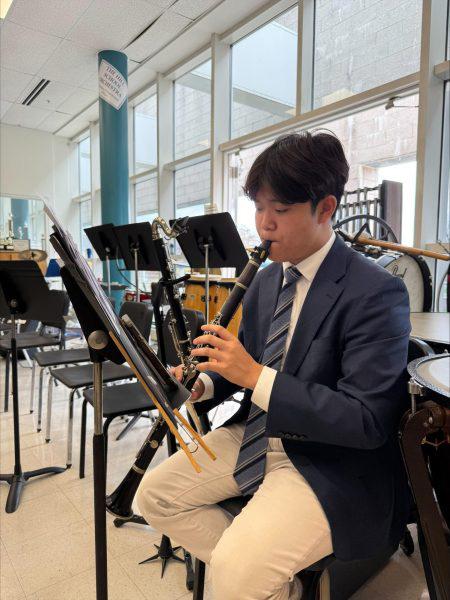
Ryan Sung ‘27’s outstanding accomplishment in the recent Pennsylvania Music Educators Association state-level festival can be attributed to his dedication to music as well as the long-standing legacies that The Hill School has had over the years.
In addition to Sung’s persistent and considerate characteristics, Hill’s supportive and enthusiastic environment also played a decisive role in helping Sung succeed in the competition.
“What really defines our students here at Hill is their personal characteristics and features that get passed on as a form of legacy, student after student,” said Margaret Neiswender, Director of Instrumental Music, during her interview about Sung’s achievement.
Sung demonstrated extraordinary musical abilities among his competitors at the regional level and was selected to play the bass clari-
net in an all-state orchestra concert that is expected to receive hundreds of audience members. The audition process involved students from across the state of Pennsylvania. According to himself, Sung was able to catch the judge’s attention by delivering a fluent and intact piece. Specifically, his ability to prioritize tasks and manage his time can be considered the biggest factor for this accomplishment.
“As a student attending a very competitive boarding school, I get limited time to work on things outside of academics,” Sung said.
“During the winter season, I also swim for our school team, which adds an athletic commitment to the already overwhelming agenda. But I still made time to practice music. I remember that I would listen to the audition piece when I eat dinner and even when I shower. Whenever I had the chance, I would go to the CFTA to
practice clarinet, too.”
Besides optimizing the time and resources available to him, Sung made sure that he was disciplined and thoughtful, which also contributed to his performance.
According to Neiswender, Sung has intense focus on whatever he does. “His attention was what really allowed him to maximize his quality of practice. This characteristic, I don’t see in every musician. In general, I feel like he was thoughtful in an independent way. He was smart in the way he used his limited time and produced the most out of what he had.”
After complimenting Sung’s values as an excellent instrumentalist, Neiswender highlighted a special trait that is present in the musical community at Hill. Classes of students graduate and join every year, but music students inevitably undergo a process where they receive influence from
their senior students, and the legacy continues.
“Sung possesses qualities like unselfishness and care for others, which are big aspects of our musical environment here. It’s like a mentorship that is visible in every generation of students, where their attitudes, spirits, and knowledge are inherited by the students who go after them,” Neiswender said. “First there was Casey Li, then Gabe Bak, now Sung, and he’s passing his qualities down to newer students like Alex Li. It is thanks to both the well-rounded students we accept, and the environment Hill provides that fosters successful students like Ryan.”
Ryan, too, admits to the positive influence he received from the elder students. As a musician, he stated the importance of being humble and learning from the people around him.
Hill’s Revisit Days shatter attendance records
By NORAH CHEN
With a record number of prospective students visiting campus, this year’s Revisit Days marked one of the largest turnouts in Hill’s history. Across three events, the school welcomed an exceptional number of admitted students, each arriving with their own questions, hopes, and impressions.
According to Tom Eccleston, the Assistant Head of School for Enrollment Management, 173 prospective students RSVP’d across the three day-long events, with the largest single day expected to welcome 65 families. The scale of this year’s Revisit Days highlights a noticeable increase in interest, even as competition among top boarding schools continues to grow. “The enrollment competition with other top schools is steep,” said Eccleston.
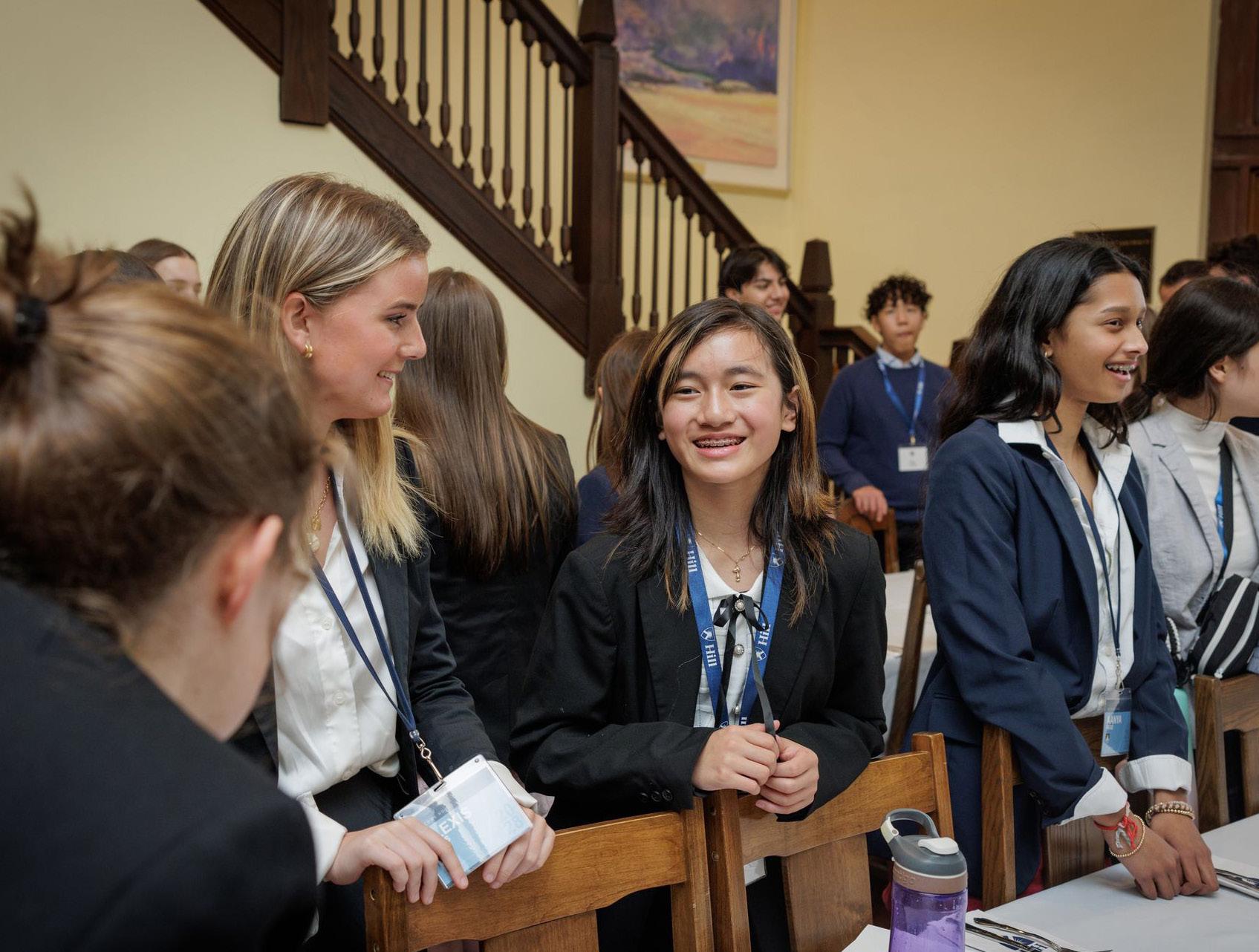
For current students who were given the opportunity to host, the day brought a memorable experience. Hosts accompanied visitors to classes, seated lunch, and the co-curricular fair, actively presenting the
school throughout the day. “I mostly showed them around campus and helped them see what the Hill is actu-
ally like in person,” Sophia Li ’29 said. “It’s really different from just seeing it advertised online.” For many, hosting meant balancing normal academic responsibilities with the added pressure of making a strong impression.
Students who weren’t hosting still felt the effects of the day. Classes were slightly larger, and routine moments, such as participating in discussions or moving between classes, felt a bit different with unfamiliar faces present. “It kind of made me more aware of how I was acting, and it felt like the whole campus had more energy than usual,” said Andy Lee ’29. Despite the differences in how students experienced the event, the success of Revisit Day depends on the collective effort of the broader community. From admissions staff organizing the logistics to students and teachers welcoming visitors into their routines, each group contributed to creating a meaningful experi-
“Not only do we share our interests in music and guide each other to become better at playing our instruments, but, more importantly, we communicate the skills and habits that have helped us succeed in the path of music,” Sung said. “It is specifically these aspects that have shaped me into who I am today and what led me to success in PMEA.”
ence. As Eccleston emphasized, the goal is for visitors to leave with “a true sense of the community” as well as “a clearer understanding of Hill’s culture.” While tours and information sessions offer helpful overviews, spending time on campus alongside students and faculty offers visitors an honest sense of what Hill calls a “family boarding school” experience.
As Hill continues to attract strong interest from applicants, events like Revisit Day remain an essential part of the admissions process. They help future students picture themselves here through authentic, everyday moments shared by the people who already call Hill home. For families and their students walking around Hill’s campus for the first time, that glimpse into the community can be the moment when Hill becomes more than an option and starts to feel like a possibility.
SAMH organizes annual substance abuse awareness fair
By NATALIA BARNES ’29
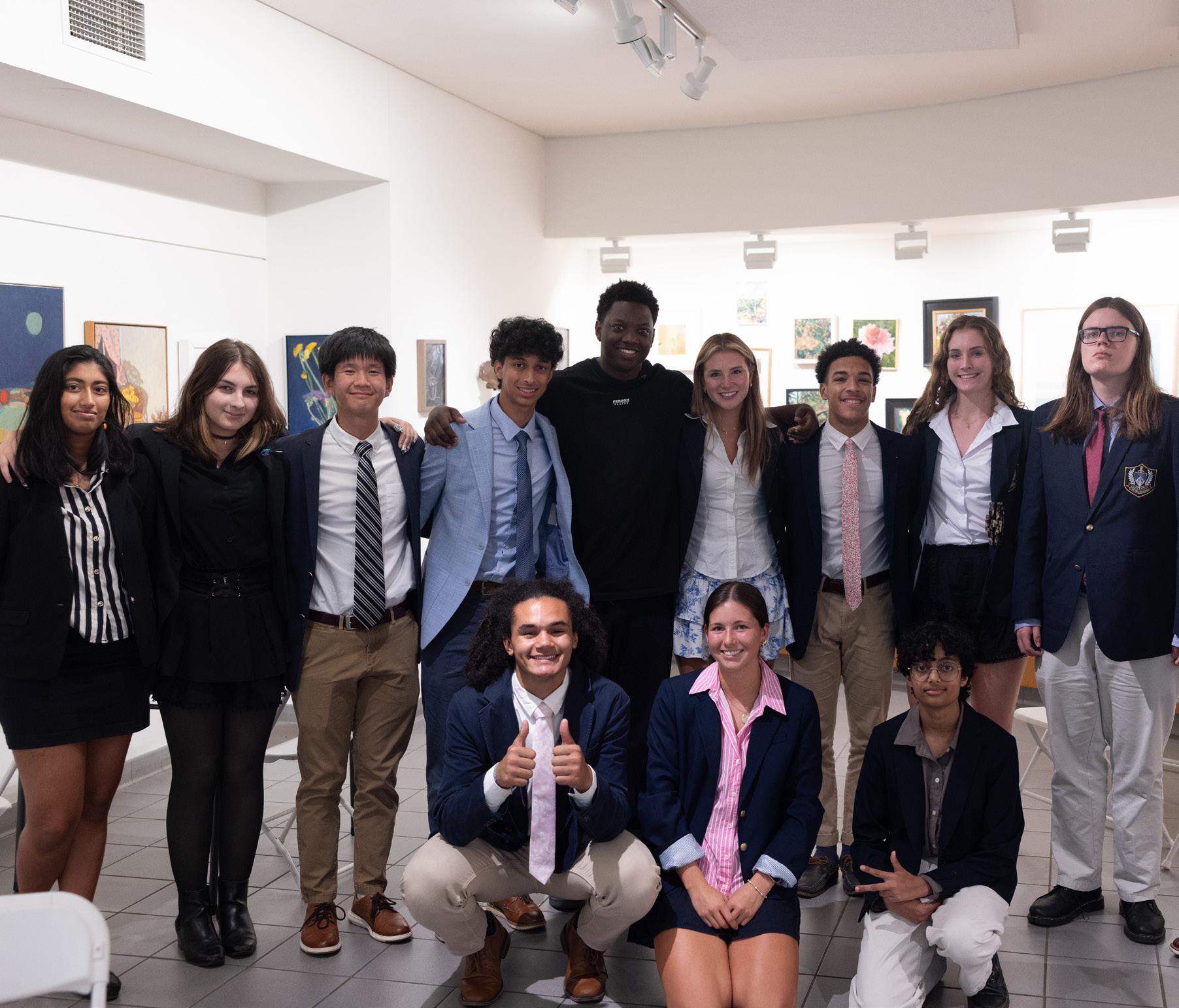
The substance abuse fair is an event organized by Doug Jones, prevention education specialist, and SAMH that is designed to help raise awareness and educate students about the issues surrounding substance abuse and mental health. The fair serves as an important event for raising awareness about substance abuse in our current society and the effects it has on mental health. By bringing together various activities and resources, the fair creates a supportive and educational environment where students can engage in these topics in a meaningful way. The fair has been held for approximately five years and features a wide range of engaging activities designed to inform and warn students about substances.
A highlight of each year’s substance abuse fair is the pedal cart activity, where students navigate an obstacle course while wearing alcohol impairment goggles. This interactive experience allows students to get a deeper understanding of the challenges and dangers posed by driving under the influence. This activity helps the fair’s goal to raise awareness about responsible and safe behavior around substances. When students enter the fair, they receive a stamp card, encouraging them to participate in hands-on activities and educational stations. Students who collect stamps are entered in a raffle with prizes. The
structure of the fair allows students to educate themselves on the topic but also get an interactive experience.
The substance abuse fair also has a critical connection to Jones’ eudemonia class, a course designed to explore safety and mental health awareness. To promote attendance, students from Mr. Jones’s class were given a pass to skip class if they earned three stamps on their card, allowing the fair to be an educational extension of the classroom. In an interview, Mr. Jones highlighted the importance of addressing substance use among youth. “We want people to have the opportunity to recognize that substances are out there and our goal is not to demonize them but rather educate people about the potential harmful effects and say hey, we know that they’re out there and you may have access at some point, but here’s some important things to know as you navigate the world and make decisions,” Jones said.
The fair is a powerful way to improve our community and help spread safe messages across campus. A large number of high school students encounter and struggle with substances in their lives. Speaking out against this problem through fairs and other forms of communication allows us to keep teenagers across the country safer.
STAFF WRITER
’29
STAFF WRITER
PHOTO COURTESY OF LANDON QIU ’27
PHOTO COURTESY OF HILL PIXEVITY
PHOTO COURTESY OF HILL PIXEVITY
SAMH students pose with speaker Kaleb Johnson in Oct. 2025
By ADAM YAO ’26
MULTIMEIA MANAGER
The U.S. has always been seen as a beacon for all immigrants, a place where anyone can come and achieve their dreams. Among these immigrants are brilliant researchers and scholars, the smartest and most talented people from all over the world, who see America as the place with the most resources and least limitations. However, this depiction has been damaged over the past decade with increasingly harsh restrictions on immigration and foreigners as a whole, as seen especially in the past year with the Trump administration.
In 2025 alone, more than 3800 research grants from the National
Is the U.S. facing a case of Brain Drain?
Institutes of Health and the National Science Foundation were terminated or frozen by the Trump administration in their goal to realign funding priorities. Billions of dollars that were meant to fund neuroscience, education, cancer research, immunology, and more are now no longer available to the world’s leading organizations in healthcare and science. “If you’re a researcher who has spent years of your career working on something and your research is cut so capriciously… it leads many people to say, ‘What am I doing here?’
“ Dylan Jennings, Instructor of History, commented. This, along with many other cuts in research grants and funding, has people wondering whether the US is
currently facing brain drain, and what repercussions these actions may have.
Brain drain occurs “when educated or trained individuals leave the United States for elsewhere,” Nicholas Malinak, Teaching Fellow for the history department, defined. “That could be U.S. citizens who decide to leave, immigrants to the United States who decide to go home or elsewhere, or someone trained in the United States who does not stay after graduation.” From this definition, it’s easy to see how researchers and scholars may be incentivized, now more than ever, to work in other countries. Besides the obvious budget cuts to funding, there have also been restrictions
on immigration, with H1B’s being harder to obtain than ever. On top of that, markets are being established and sometimes even beat US industries in other nations. An example of this is China’s dominance in the production of electric vehicles. Lastly, the U.S. has been shifting politically over the past few years in directions that many researchers may not agree with and in a way that could silence or harm certain fields of research.
“We’re creating a climate where educators and researchers are fearful to look into or talk about certain topics,” Jennings explained.
Brain drain not only affects the people who are leaving, but
also the greater community. As the U.S. loses its top talent, people will leave being their contributions. Jennings added, “When you stop looking into certain topics, you’re preventing yourself from understanding that part of science or technology.”
According to Malinak, the best way to minimize the continue effects of brain drain is “to reform the H1B visa system to allow more highly skilled workers to come and stay in the United States. Research shows that immigrants increase economic output and more than pay in taxes than they cost, and it would go a long way to make an investment that says the United States is open for business.”

Hill students face challenges balancing academics and extracurricular activities
By ETHAN LUO ’26
LAYOUT MANAGER
Hill students have packed schedules, with classes in the morning, activities in the afternoon, and study hall at night. As the winter co-curricular season came to a close, an increasing number of matches, meets, and games flooded student’s schedules.
While Hill prides itself in creating well-rounded students and community members through classes, speakers, and co-curriculars, the relentless pace of the shorter winter term presented a unique challenge for the whole community. February’s schedule brought an avalanche of matches, meets, and performances that emphasized mental and physical stamina, pushing even the most organized and disciplined students to their limits.
For instance, the boys squash
team faced a brutal schedule the week after returning from the Winter Long Weekend. Beginning on Wednesday, February 4, the team played seven matches in an eight-day stretch, with three consecutive matches on February 10, 11, and 12. This left them with virtually no recovery time.
Monroe Short ’27, co-captain of the boys’ varsity squash team, shared that “8 matches in 9 days [was] brutal, but when the schedule [said] that, you [had] to keep showing up at 100%. Learning to
“It is a little tricky to balance schoolwork and hockey, especially when we are gone for the weekend,”
—Samuel Brebner ’26
play under any circumstances no matter the opponent is a key fac-
tor to getting better.”
Meanwhile, Hill’s hockey teams are well-known for their frequent overnight trips to play away games nearly every weekend. With games often scheduled on back-to-back days, the excursions often consume the whole weekend, leaving little time for schoolwork aside from the lengthy bus rides.
Basketball teams met their own demanding schedules. Midweek games frequently disrupted the student-athlete’s routines, with the PAISAA and MAPL tournaments in February further complicating their schedules.
However, Faella also acknowledged how being an athlete has improved her time management. “I focus on trying to take advantage of every bit of free time I have, even if I only have time to complete something small,” Faella remarked.
Outside of athletics, other co-curriculars faced similar challenges. The Ellis Theatre Guild underwent intense daily rehearsals for the “Legally Blonde” show, which was performed from February 13-15. The week before the showing, known as “Tech Week”,

consisted of 4-hour evening practices with study hall beforehand. Balancing rigorous academic work with busy lives outside classes demonstrates the aptitude and time management skills that Hill
students gain during their high school experience. Although hard work can be taxing and mentally draining, it can also be rewarding at the same time when one sees their hard work pay off.
PHOTO COURTESY OF HILL PIXEVETY
ILLUSTRATION BY YIANNI JACOBY ’28
Jacob Xu ’26 starring as Warner in “Legally Blonde”

3rd
and 6th formers rewrite the school’s athletic record books
By FRANK XU ’28
STAFF WRITER
Records freeze moments in time. A number becomes permanent, even as the work behind it fades from view. This winter, Hill athletes across track, basketball, and wrestling rewrote the record book. Their accomplishments were shaped by seasons of unseen effort: moments of patience, belief, and growth that unfolded long before the milestone arrived. Even still, spring athletes have started to make their mark as well with about a month left to go in their seasons.
The 2025-2026 indoor track season saw several records fall, both individual and relay records. While many individuals were involved in these efforts, 3rd former Olivia Akpan ‘29 had a standout debut season. At her first-ever meet competing for Hill on Dec. 6, 2025, Akpan sprinted to a school record in the indoor 55-meter dash, stopping the clock at 7.33 seconds. Moments later, she claimed another record in the long jump, flying 18 feet and ¾ of an inch. The setting mattered less than the poise.
“Going into my very first meet at Hill, I felt ready because of everything I had already experienced earlier in my track career.”
-Olivia Akpan ’29
She explained that “I’ve been doing track since I was nine years old,” and that competing at events like “Junior Olympics, New Balance Nationals, and Nike Nationals” taught her how to “handle pressure, stay focused, and compete at a high level.”
Akpan went on to become a three-event MAPL and PAISAA champion, and a PTFCA state medalist in the 60-meter and 200-meter dash. Furthermore, she was a part of the 4x200 girls relay team who broke the school, Hill Relays, and Hauser Track Facility records on April 11, 2026 at the 2026 Hill relays with a time of 1:44.38. Mae Dixon ‘26, Harper Latham ‘26, and Tatum Hall ‘29 were also members of this relay which broke the previous record by 9.12 seconds.
On that same day, Robyn Eliason ‘26, varsity girls lacrosse goalkeeper, recorded her 200th career save in the game against Mercersburg Academy. Eliason will play for the University of Scranton’s women’s lacrosse team next year.
Like the indoor track team, Hill boys’ basketball finished their season on a high note, defeating The Phelps School 74-56 on Feb. 27, 2026, to claim the 2026 PAISAA Championship Title. Instrumental team members contributing to this win included Ethan Johnston ‘26 and Cole Trn ‘27, who reached milestones of their own, in addition to Caleb Jameson ‘26. All three players scored their 1,000th high school career point during the 2025-2026 season on December 19, 2025, Feb. 4, 2026, and Dec. 10, 2025, respectively. Johnston will be continuing his athletic career at Marquette University next year, and Jameson will be playing for Carnegie Mellon University.
Head Coach, Seth Eilberg remarked, “We have multiple 1,000-point athletes on our team, and that really boosts our culture. We share the ball,
we pass it, you know, we have the highest assist conversion percentage. So I think that’s a really strong culture.”
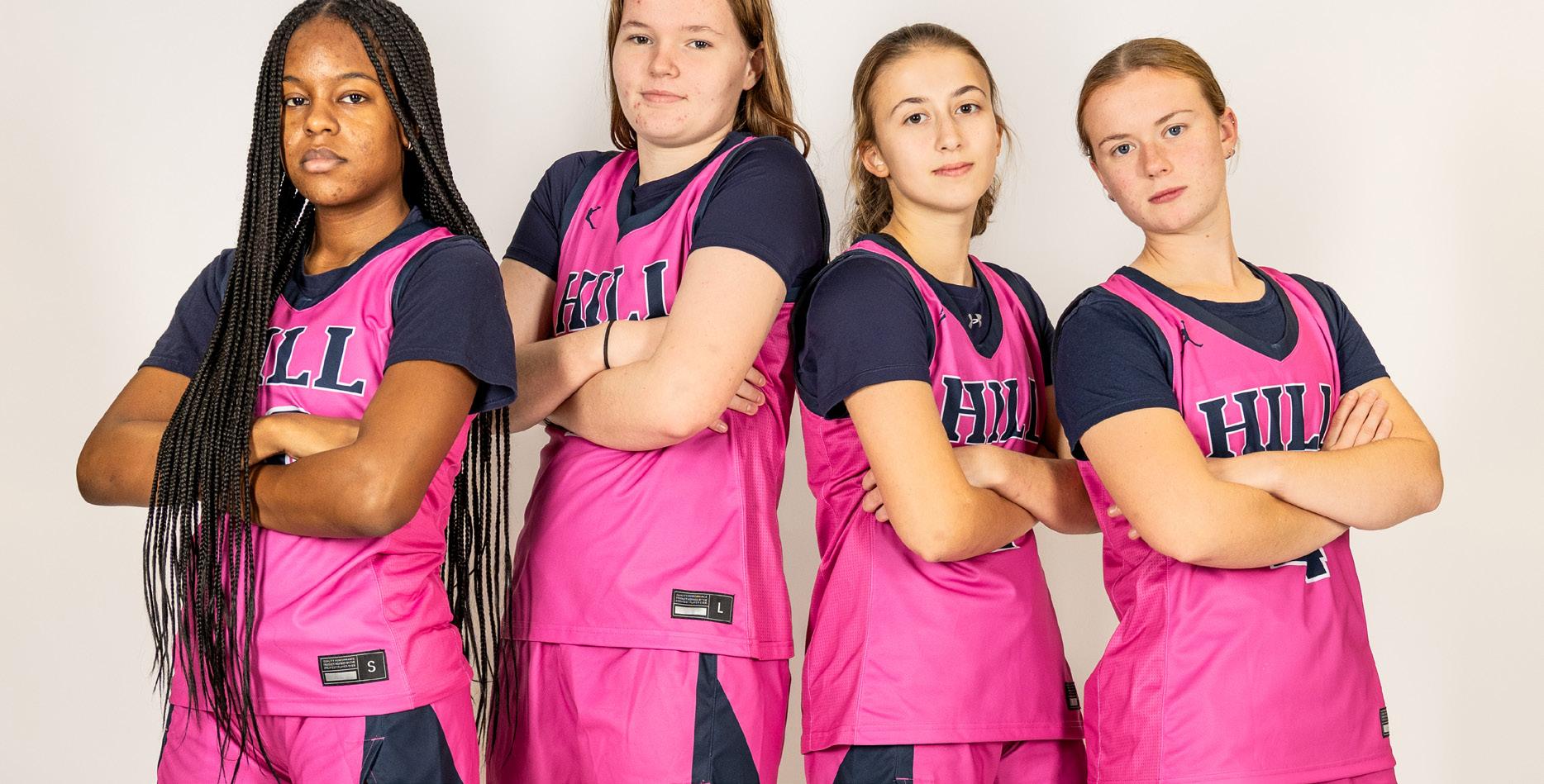
On the girls side, Sammie Faella ‘26, also reached the 1,000-point barrier, even surpassing it to become the high-scoring player in Hill basketball history. On Feb. 19, 2026, during the PAISAA Commonwealth Cup Semifinal game against Jack Barrack Hebrew Academy, Faella tied the record, previously held by Hill School Athletics Hall of Famer Barry Pierce ‘90 who scored 1,581 points during his career, and then broke the record. During her final Hill game on February 26, Faella scored 23 points, leading the Hill girls basketball team to victory as the 2026 PAISAA Commonwealth Cup Champions and finished her Hill career with 1,605 points. Faella will be joining the MIT Engineers for their 20262027 basketball season.
Finally, on Jan. 10, 2026 at the 2026 Bissell ‘33 Tournament, Arment Waltenbaugh ‘26 earned his 100th career victory, reflecting years of commitment.
Describing Arment’s approach to competition, Head Coach of Varsity Wrestling Coach David Hoffman ‘01 said, “Arment was born into the sport of wrestling and competing his entire life.” Because of that experience, Hoffman noted, “there is never an event or a moment that is too much for him.”
Where pressure overwhelms many athletes, Arment remains composed. “Where a lot of kids will feel overwhelmed and feel tight, Arment is always calm and cool under pressure,” Hoffman said.
Each victory demanded recovery, resilience, and the willingness to return to the mat after setbacks. Waltenbaugh’s achievement symbolized durability more than dominance. It marked a career defined by persistence and presence.
Together, these records tell a larger story about Hill Athletics. Sports are about more than just success; they are rooted in patience, preparation, and shared purpose.
“A milestone like that is what makes the work so gratifying,” -Caleb Jameson ’26
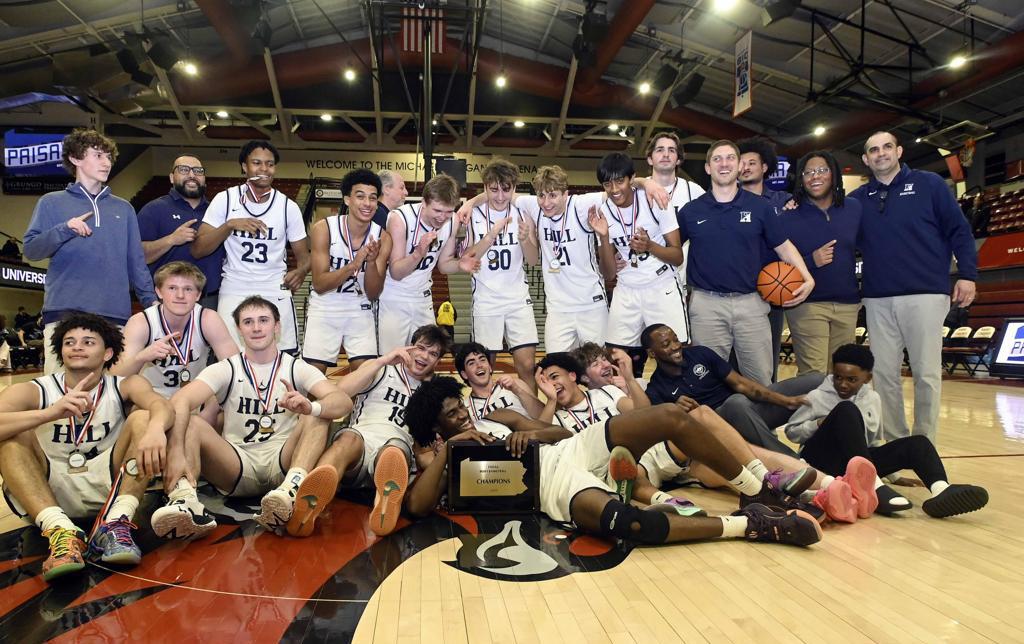
PHOTO COURTESY OF HILL PIXEVETY
PHOTO COURTESY OF KATHY LEISTER
Boys’ Varsity Basketball team celebrates their win over Phelps at the PAISAA Championships.
“Marty Supreme” and the Golden Globes
By JOSH GONG ’28
Ever since the start of “Marty Supreme”, I found myself thinking that this is not someone who lacked talent, but one who mistook his talent for permission.
Marty Mauser, the main character of Josh Safdie’s solo directorial debut, is characterized as abrasive, narcissistic, and relentlessly self-focused. He is constantly trying to achieve his goals, chasing his next win, and keeps looking forward, ignoring those who get flattened along the way. And yet, by the end of the film, I found myself rooting for him anyway. I could not look away. That contradiction is not a flaw. The film presents something to the world that many movies don’t: an ethical dilemma. Marty thinks, “I live with the confidence that if I believe in myself. The money will follow,” a way of thinking that influences belief to be seen as justification.
Josh Safdie has long been drawn to characters caught in a desperation-humiliation loop, people who believe one decisive leap will lift them out of misery, only to land in deeper trouble. “Marty Supreme” fits squarely within this tradition. Marty believes, correctly, that he is extraor-
By ANONYMOUS
To the girl at the Chinese restaurant I will never know.
All I wanted was to break a fifty for the tailor next door, for my blazer with a rippedopen sleeve.
But your azure voice among that frozen corridor I could never forget.
All I wanted was to break a fifty for the tailor next door.
You could have nodded and taken my money,
but your azure voice among that frozen corridor I could never forget,
asking the man at the burning wok if you could break me fifty.
dinarily talented at table tennis, the best even. What he believes incorrectly is that talent can exist without consequence. “Yeah, the chosen one. It’s a nice picture right?”
Set in 1952 New York, the film surrounds Marty with a shortage of money, dignity, safety, and opportunity. Along with being poor, he is reminded over and over again that the world has little interest in his ambitions. Once a character suggests to him, “I’m not trying to control you Marty, but I don’t think you understand the stakes. You have no power here,” his obsession with winning feels less like arrogance and more like survival. Safdie and co-writer Ronald Bronstein make us understand how desperation leads to selfishness and how humiliation becomes constant background noise. Marty is not justified for his behavior but is at the very least understood for his actions.
The film’s greatest risk lies in the uneven distribution of empathy. Rachel, Marty’s girlfriend, is repeatedly put in danger and emotionally ignored, but is never granted the same interpretive generosity. Although her suffering is severe, it’s not considered
You could have nodded and taken my money, I would have never seen the endearing jewels in your consonants.
Asking the man at the burning wok if you could break me fifty, and your father told you that I must I buy something.
So I stuttered my way into buying some dumplings for my blazer with a rippedopen sleeve.
Hungry yet for the moments of a life solely glimpsed
To the girl at the Chinese restaurant I will never know.

tragic and rather registers as collateral damage. This imbalance reveals the genius and unsettling part of the film’s moral vision: desperation is treated as narratively compelling only when it is loud and self-mythologizing, whereas when struggle is quiet or relational it becomes expendable and is set aside.
Yet the film refuses to resolve this tension, and that refusal is precisely why it lingers and feels uneasy. Marty Supreme does not offer a moral lesson about dreaming big. Instead, it asks something deeper. Why are people okay with a world where extraordinary talent allows someone to ignore the harm they inflict? Marty will continue moving, winning, and burning through lives because the film asks us to confront the ethical cost of mistaking ability for permission. As a description that Safdie gives of Marty puts it, “It’s his goal and it’s his passion and it’s his job to elevate the sport of ping pong. That’s what makes him great” even if, at times, that pursuit leads him down a dead-end path. This perspective on his purpose can even make his destructiveness seem admirable.

LITERATURE
PANEL
Edited By RICHARD LIU ’26
By CLAIRE BRESSI ’26
WRITER
STAFF
“Just Like Heaven” by The Cure “I’ve Wanted You” by First Aid Kit “Always Forever” by Cults “I’d Like to Walk Around In Your Mind” by Vashti Bunyan “Long Long Time” by Linda Ronstadt “Songbird” by Oasis “Sweet Nothing” by Sunny War “She’s a Rainbow” The Rolling Stones “I Love You” by Fontaines D.C. “Lovers Rock” by TV GIRL “have fun” -Claire




REVIEW: Bruno Mars “The Romantic”
By ADDIE BECKEY ’26
STAFF WRITER
Bruno Mars has recently announced the completion of his fifth studio album, The Romantic. It has been ten years since his last collaborative project (A Night with Silk Sonic with Anderson Paak) was released, and his new release has gotten fans wondering if it is a newfound creative spark or a 50-million-dollar gambling debt that has Mars back in the studio.
The announcement for the album came suddenly. January 5th, Mars announced on Twitter that his new album was finished, and on January 7th, promotional materials such as notebooks, CD/vinyl preorders, and merch dropped on his website along with a single for the album named I Just Might.
Mars’ music exploded into popularity with his debut single “Just the Way You Are”. While there are myriad reasons to explain why his music is adored by the world (16 Grammys and counting), his distinctive blend of retro influences in a modern production is what draws people in. Nostalgia and Memory are powerful tools to reel listeners in. Perhaps he listened to funk and soul growing up, and perhaps she enjoyed hip-hop and unadulterated swag. All of these listeners found a place for the sounds they love in the music of Bruno Mars. His songs, such as “Love’s Train” and “If I Knew” exemplify his style and his infectious musicality. There has been speculation on the internet that Bruno Mars is returning to music on a larger scale as a result of the 50-million-dollar-gambling debt that
he has accrued from gambling at MGM Grand. Some postulate that his multi-year residency at MGM Resorts was a result of his efforts to repay that debt. Mars claimed on Instagram that he was “Almost out of debt BehhhhhBehhhhh!!!”. Following his July 2024 performance with Rose for their hit single “APT”.
On the other hand, MGM Resorts International has vehemently denied claims of Mars’ debt. They maintain that the debt rumor was completely false, and that they have a blossoming partnership with the singer-songwriter.
Gambling debt or not, Bruno Mars is a blessing to the ears of the world. We are once again graced (for the fifth time) by another one of his upcoming masterpieces.
Every chapel talk does not need a standing ovation
Not every chapel talk is “a good one.” Some stories drone on without a clear resolution, while some messages are delivered unclearly. I don’t mean to criticize the talks that may be viewed in such a regard, but rather, I want to address this reality, as it is often discussed amongst our fellow peers. The uneven quality of chapel talks is, at its core, what makes them so nuanced and unique, and yet, whether a talk that isn’t able to move us still deserves a standing ovation is still constantly debated amongst students. The answer, I would argue, is not just yes, but an unambiguous and enthusiastic yes, and the reasoning behind it reflects something far greater about who we are as a community.
The standing ovations that we give are never only about the quality of the speech’s content, and are much more nuanced than that in hindsight. An aspect of the chapel talk that’s rarely spoken of much is the courage that sharing a personal experience requires, let alone in front of the entire school.
At the end of the day, regardless of whether we think the chapel talk was executed well, our applause shows that in hindsight, we are able to recognize and feel the courage of the speaker. Our ovation is, therefore, not a verdict of your performance, but a sign that we saw you, we heard you, and we appreciate your bravery for sharing with us.
I am in complete agreement, and I believe she is describing something rarer than it might appear. The support that we have for one another at that consistency and sincerity is not something that can be simply enforced.
I’ve felt the grandeur of our school spirit myself. During L-Ville weekend, as the varsity water polo game entered its final seconds, the crowd had doubled, or perhaps even tripled. The entire pool had been laden with the camaraderie of chants and peers from our peers, and it just comes to show that we were worth showing up for. Even though we ultimately lost the game in overtime,
“Whenever people ask me about the school, I always think and say that our students show up for one another very very well. When someone makes an announcement in the dining hall, for example, they all cheer and clap for the person speaking. It really shows the students’ desire to show that appreciation and support for one another, especially during chapel talks,”
- The Rev. Confer Martins
that night was not filled with the disappointment of being defeated, but with the feeling of pride that came from being supported by our community.
Chapel applause gives off that same feeling, except compressed into thirty seconds at the end of a talk. It is our school’s greatness made audible, and this tradition should never stop.

US should look to Pottstown and lead the way for nuclear energy
By CONNOR MCGRATH ’28 STAFF WRITER
The creation of energy has fascinated society’s scientists for years, and even at The Hill School, the debate over nuclear energy remains relevant.
The most impactful limiter of nuclear energy is the cost. As Nicholas Malinak, instructor of history at the Hill School, explains, “To build a nuclear power plant requires billions and billions of dollars… often over $10 billion, and it takes decades to pay back.”
This massive investment required by companies discourages them from planning a future with nuclear power, which reflects a system that prioritizes short-term profits over the well-being of the country.
Due to high costs, nuclear energy lags behind faster and cheaper energy alternatives such as solar power and natural gas. Even though nuclear energy is expensive, it is necessary to expand nuclear production to ensure future U.S. energy dominance.
Public reception to fully adopting nuclear power is another obstacle. Malinak states that “The two main reasons… are the high upfront cost and public fear—especially after Three Mile Island and Chernobyl.” These major events formed a reputation of danger around nuclear energy that continues to falsely affect public opinion.
Even though modern nuclear technology is dramatically safer
than in the past, many people still think of nuclear energy with major disasters instead of the benefits it would bring. Here in the US, stories like the Three Mile Island incident only served to prove to Americans the dangers of nuclear power. As Malinak explains, “Three Mile Island was the most serious nuclear accident in the United States… but no deaths have ever been directly linked to it.” This only furthers the gap between citizens’ perceptions and reality.
Although this event occurred in the past, its effects are still visible today, especially for students at The Hill School, where the nearby Limerick Generating Station serves as a reminder of both the benefits and fears

surrounding nuclear power.
Current policy thinkers still reference Three Mile Island when discussing nuclear power; this outdated fear-based belief hinders American energy policy.
Even very unlikely risks are taken seriously because of the potential ramifications.
Malinak points out that, “A nuclear catastrophe isn’t when one thing goes wrong—it’s when many things go wrong at once.”
The unlikelihood does not stop the need for stricter regulations, which in turn adds to costs and slows build times.
Another problem with adopting nuclear energy is the ever-so-outdated U.S. energy grid.
Large swaths of infrastructure are not designed to effectively trans-
port energy across long distances, such as the entire United States. Rather than using the outdated grid to discourage nuclear expansion, it instead proves that the U.S. needs to modernize. This culminates with Malinak explaining that, “You can’t build a power plant 500 miles away and expect it to work efficiently—you lose too much energy in transmission.” This only serves to add to the costs of nuclear energy because you would have to upgrade the entire U.S. energy grid to make cross-continent transportation profitable. The United States energy sector will lose its dominance until it can move beyond the outdated fears and invest in more forms of long-term infrastructure.

Editors-in-Chief
Lawrence ’26, Ryan Qiu ’26
’27
Cheng ’27
Cheng ’26 Staff Writers & Staff Contributers Brian Stone ’27, Ella Armstrong ’27, Michael Pham ’27, Frank Xu ’28, Addie Beckey ’26, Vincent Lin ’28, Lion Krussen ’27, Kelsey Cummings ’26, Yianni Jacoby ’28, Joshua Gong ’28, Brody Fronheiser ’27, Connor McGrath ’28, Norah Chen ’29, Natalia Barnes ’29
Faculty Advisers Alec Swartz, Nancy Body
Content Policy
The Hill News is the student-run newspaper of The Hill School. Content is determined by and reflects the views of the student editorial board and staff and not school officials or the School itself. The Hill News acts as an open forum for student expression where they have complete control over the content produced.


Want to contribute to The Hill News?
Come to our bi-weekly meetings or contact a member of our staff. To submit a letter to the editors or an opinion piece, email mlawrence26@thehill.org rqiu26@thehill.org


PHOTO COURTESY OF ARTURO RAMOSVIA VIA WIKIPEDIA
OPINION: Kyrgios vs Sabalenka: what did the Battle of the Sexes tell us about tennis?
By JOSHUA GONG ’28
On December 28, 2025, Nick Kyrgios and Aryna Sabalenka faced off in an exhibition tennis match in Dubai., marketed and billed as a new “Battle of the Sexes”. Though the 2025 match was marketed as such, the match was never meant to be a competitive comparison between males and females, but rather a match for attention, entertainment, and money.
Historically, the “Battle of the Sexes” carried real weight. The past match between Billie Jean King and Bobby Riggs wasn’t about flamboyance or entertainment; rather, it was based on respect, legitimacy, and credibility. Unlike Kyrgios vs. Sabalenka, both King and Riggs were invested in the match and the outcome.
Right when the match started, you could tell the Kyrgios & Sabalenka matchup didn’t have the same focus as others in the past. When Sabalenka entered that match, she was one of the most talented players in the world. Her preparation, intensity, and disci-
pline are what drove her to be one of the most accomplished tennis players. She would have treated the event like a real competition for her if she wasn’t facing Kyrgios.
Kyrgios has built his tennis career unconventionally. There have been times when he has admitted his lack of dedication to the sport. He is now better known by the media for his antics than his gameplay. This difference between the two’s work ethic was enough to disprove the true competitiveness of the match.
Director of Racket Sports, Joshua Schofield, stated that Kyrgios “was the worst pick for a match like this. He doesn’t take anything seriously, not even against the top players.” Making Kyrgios the representative of men’s tennis was misleading. While it cannot be denied that he possesses great talent and is one of the best, he does not have the commitment or discipline that other top players have.
A true comparison between men’s and women’s tennis would require players who take the sport seriously. If one of the two isn’t a

player with that mentality, then the match results lose their entire meaning. The skill involved in the match was still outstanding, but Kyrgios’ unseriousness paired with the weird rules of the match turned what would’ve been a real competition into nothing more than a show. The match rules, the exhibition’s format, and the lack of consequences reinforced the idea that this was a performance, not a match. Sabalenka
was given a 9% smaller court as compared to Kyrgios’ and a single-serve limit was instituted for both players. It is said that these rules were designed to neutralize the perceived power advantage of the male player, though many felt as though this gimmicky environment was created to overshadow the high-level talent that Sabalenka possessed. Advertising the match as “Battle of the Sexes” implied the se-
riousness that it never provided. The match didn’t show any gap between men’s and women’s tennis but rather demonstrated how easily competitive integrity can be thrown away when entertainment replaces seriousness. Ultimately, the match was widely characterized as a “joke” and one played for entertainment, instead of a serious competition like the true 1973 “Battle of the Sexes”.
History was made at the 2026 Winter Olympics
By LION KRUSSEN ’27
The 2026 Milan Winter Olympics began on February 6 and ended on February 22. Held in both Milan and Cortina d’Ampezzo, two cities in Northern Italy, the 2026 Winter Olympics marked the first time an Olympics was co-hosted by two cities. Milan hosted the Opening
Ceremony and primarily hosted the indoor and ice-based event. Cortina hosted the sliding sports as well as women’s alpine skiing.
Even so, various events were held in other cities across Italy, including Valtellina, Val di Fiemme, Trentino, Lombardy, and Veneto.
The move towards holding the Winter Olympics across a widespread region meant that less infrastructure needed to be built

By BRODY FRONHEISER ’27
Every year, thousands of elite high school athletes receive recruitment ratings based on individual play and potential to play at the college level. Typically, these ratings are expressed as a star system, with five stars being the highest and one star being the lowest. Midfielder of the Hill varsity boys lacrosse team, Chase Aquino ’28, recently received the highest honor of lacrosse recruitment, being named as a five star prospect.
Aquino, a midfielder for the varsity boys lacrosse team, is in only his second year at the Hill School and is taking high school recruiting by storm. Aquino started playing lacrosse at age six, and currently plays club lacrosse at Team 91 Long Island in Commack, New York. As only a sophomore, Aquino is doing things on the field that many will never accomplish after picking up a la-
crosse stick.
“He’s very two-handed,” two year teammate Leo Gillette ’27 mentioned.
“He probably shoots the ball at 100 miles per hour and only five miles per hour less with his left.”
Gillette, who is another highly recruited player who just recently committed to play at Boston University, spoke highly about Aquino’s work ethic and willingness to work on his craft.
“He’s probably the hardest worker on the team, and I always see him shooting after practice,” said Gillette.
“Not only does he shoot after practice, but he’s extremely locked in on the things that he needs to work on. That’s what makes him such a special player.”
In high school lacrosse, out of 113,313 male lacrosse players, only about 13% of those players will play college lacrosse. Incredibly, out of that 13% , only about 0.5% out of the 13% will become ranked as five-star prospects. This
and thus resulted in less financial burden on a single city.
Since the last time Cortina hosted the Winter Olympics in 1956, the number of events doubled, and the number of participating countries tripled, justifying the need to minimize cost while accomodating a large number of people.
As predicted, figure skating and ice hockey were the most watched events, with the Men’s Gold Medal ice hockey game being the single most-watched event of the 2026 Winter Olympics. Many fans awaited the Canada vs. United States rivalry featured in the gold medal game, which the U.S. ultimately won 2-1 in overtime. This win marked the first time in 46 years the U.S. men’s ice hockey team won a gold medal and the first time in U.S. history the team won a gold medal with a roster featuring NHL players.
For the first time since 2014, professional hockey players re-
is an incredible feat for any aspiring college lacrosse player, and for Aquino, it has become a reality.
Dave Page, head coach of the varsity boys lacrosse team and a key part in Aquino’s d`evelopment, mentioned Aquino’s coachability as a key factor in his ability to be so highly rated amongst the lacrosse community and recruiting team.
“The thing with Chase that’s so exciting is how coachable he is.” Page noted. “Chase is as coachable as a kid who’s been here for a year and a half and is still figuring out what he’s doing out there and that’s a key to why he has become the player that he is today.”
Page, a former college lacrosse player himself, expects big things out of Chase throughout the rest of his high school career and into college. “I think the potential for him is to be a first team all-American when he gets to college.” Page stated.
“The exciting thing is he’s truly still scratching the surface in
turned to Olympic competition after the NHL agreed to pause its season, allowing players to represent their home countries. All 32 NHL teams sent players to Italy, and every franchise had at least one player reach the men’s ice hockey semifinals game which included Canada, Finland, Slovakia, and the United States.
More notably for the United States, the U.S. women’s ice hockey team had a parallel win to the men’s team, defeating Canada 2-1 in overtime. Thus, the 2026 Winter Olympics was the first time in history that both ice hockey teams swept the Olympic hockey gold medals in a single year. These wins helped contributed to the Milano Cortano Olympics being the most successful winter games for the U.S, where athletes brought home 33 total medals, including 12 gold medals.
Furthermore, Swiss athlete Marianne Fatton and Spain’s Oriol Cardona Coll made history,
terms of the player that he’s going to become.” Aquino, who has had a phenomenal start to his sophomore season, recently had a six goal performance in a 12-11 loss against The Hill Academy on April 30.
Aquino’s ability to put the ball in the back of the net has been what many, including himself, have given him credit for. “I think I’ve been gifted with having a pretty fast and accurate shot,” said Aquino.
“I think that’s helping a lot on the field.” Aquino, who has been playing lacrosse for around a decade at this point, credits his family and their unwavering support for helping out his development and for growing his love for the sport.
winning the first-ever sprint gold medals in the 2026 Winter Olympics debut event ski mountaineering, often called skimo. The mixed relay team of French athletes Emily Harrop and Thibault Anselment also won gold. This high-intensity, timed race tested athletes’ speed, stamina, and technical skills as they climbed uphill and skied downhill along a checkpoint-marked mountain course.
The 2026 Milano Cortina Olympic Games made history in many ways, being the first co-hosted games, the most successful US winter games, and surpassing previous viewership and engagement records. As the most-watched Winter Olympics in over a decade, the public points to the more favorable time zone of Italy for global audiences and the gender-balanced Games as factors influencing this surge.

“My dad and my mom, they take me to everything possible. The showcases, tournaments, and everything just to help me get better. I’ve always been playing with my brothers, and since they have committed to high division one schools, I’ve always wanted to play at the next level. With everything that Chase has accomplished throughout his minimal time at the Hill, it’s no secret why he is highly regarded as one of the best lacrosse midfielders in the country. His quickness, two-handedness, and overall ability is why he has been discussed to have such high potential for the remainder of his lacrosse career.
As Gillette put it, “I think he has a real shot to win the Tewaaraton, the award for the most outstanding player in college lacrosse.”
STAFF WRITER
STAFF WRITER
STAFF WRITER
Hill lacrosse player achieves the highest recruitment honor
PHOTO COURTESY OF CNN ILLUSTRATION BY ETHAN LUO ’26