THE HILL NEWS VERBA VOLANT, SCRIPTA MANENT
VOLUME CXXXV. NO.2
DECEMBER 12, 2025
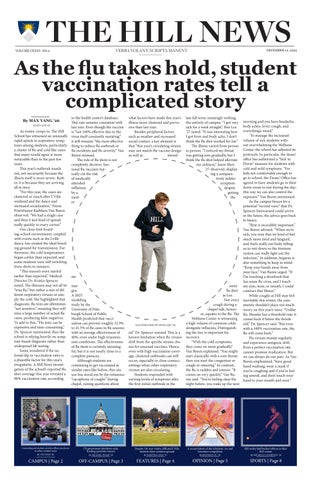
As the flu takes hold, student vaccination rates tell a complicated story to the health center’s database. This rate remains consistent with SPORTS EDITOR last year. Even though the vaccine As winter creeps in, The Hill is “not 100% effective due to the School has witnessed an unusually virus itself constantly mutating” rapid uptick in respiratory symp- it still remains “the most effective toms among students, particularly thing to reduce flu outbreak or a cluster of flu and cold like cases flu incidents and flu severity,” Van that many would agree is more Buren stressed. noticeable than in the past few The role of flu shots is not years. completely decisive. SeaThis year’s outbreak stands sonal flu vaccines typout, not necessarily because the ically cut the risk illness itself is more severe. Rathof medically er, it is because they are arriving attended all at once. influenza “For this year, the cases are by a clustered so much after L’Ville modweekend and the dance and erincreased socialization,” Nurse Practitioner Kathleen Van Buren observed. “We had a single case and then it just kind of spread really quickly to every corner.” Our close-knit boarding-school environment, coupled with events such as the Lville dance, has created the ideal breeding ground for transmission. Furthermore, the cold temperatures began earlier than expected, and some students were still switching from shirts to sweaters. “This season’s wave started earlier than expected,” Medical ate Director Dr. Kristin Spencer noted. The illnesses may not all be mar“true flu,” but rather a mix of difgin. ferent respiratory viruses or simA 2025 ply the cold. She highlighted that modeling diagnostic flu tests are oftentimes study by the “not sensitive,” meaning they will University of Pittsmiss a large number of actual flu burgh School of Public cases, producing false negatives. Health predicted that vacciTo add to this, “Flu tests can be nation can prevent roughly 32.9% expensive and time-consuming,” to 41.5% of flu cases in flu seasons Dr. Spencer mentioned, thus the with an average effectiveness of school is relying heavily on symp- 40%, even under high-transmistom-based diagnosis rather than sion conditions. The effectiveness widespread lab testing. of flu shots is certainly meaningSome wondered if the naful, but it is not nearly close to a tional dip in vaccination rates is complete panacea. a plausible factor for this year’s Although students are irregularity. A Hill News investicontinuing to get vaccinated at gation of the school’s reported flu similar rates like before, this seashot coverage this year revealed a son has stood out by the infamous 86% vaccination rate, according “cacophony of coughs” during chapel, raising questions about
By MAX YANG ’26
Counseling and student activities offices join forces to reduce student stress By YIYI WAN ’28
CAMPUS | Page 2
what factors have made this year’s illness more clustered and pervasive than last year. Besides peripheral factors such as weather and increased social contact, a key element is that “this year’s circulating strains may not match the vaccine design as well as intend-
ILLUSTRATION BY RYAN QIU ’26
ed,” Dr. Spencer warned. This is a known limitation when flu viruses drift from the specific strains chosen for seasonal vaccines. Hence, even with high vaccination coverage, clustered outbreaks can still occur, especially in close-contact settings when other respiratory viruses are also circulating. Students responded with varying levels of symptoms after the first initial outbreak in the
late fall term, seemingly striking the entirety of campus. “I got very sick for a week straight,” Ben Lee ’27 noted. “It was interesting how I got fever and body ache, I don’t think the flu shot worked for me.” The illness varied from person to person, “I noticed my throat was getting sore gradually, but I think the flu shot helped alleviate my sickness,” Jason Shen ’27 observed, displaying a comparatively milder symptom despite getting the
same flu shot as Lee. Not every cough during a chapel talk, however, equates to the flu. The Wellness Center is witnessing a high volume of common colds alongside influenza. Distinguishing the two is important for recovery. “With the cold symptoms, they come on more gradually,” Van Buren explained. “You might start classically with a sore throat, then you start the congestion or cough or sneezing.” In contrast, the flu is sudden and intense. “It comes on very quickly,” Van Buren said. “You’re feeling okay the night before, you wake up the next
morning and you have headache, body aches, fever, cough, and everything’s weird.” `To manage the increased volume of sick students without overwhelming the Wellness Center, the school has adjusted its protocols. In particular, the deans’ office has authorized a “Sick in Dorm” measure for students with cold and mild symptoms. “For kids not comfortable enough to go to school, the Deans’ Office has agreed to have students go to their dorm room to rest during the day; this way we can also control the exposure,” Van Buren mentioned. As the campus braces for a potential “second wave” that Dr. Spencer forewarned could arrive in the future, the advice goes back to basics. “Rest is incredibly important,” Van Buren advised. “When we’re sick, you note that we kind of feel much more tired and fatigued, and that’s really our body telling us to rest down so the immune system can really fight out the infection.” In addition, hygiene is also something to keep in mind. “Keep your hands away from your face,” Van Buren urged. “If I’m touching a doorknob that has some flu virus, and I touch my eyes, nose, or mouth, I could contract that illness.” While coughs at Hill may feel inevitable this winter, the community shouldn’t place too much worry on this year’s wave. “Unlike flu, Measles has a threshold rate; it comes back if below the threshold,” Dr. Spencer said. “But even with a 100% vaccination rate, the flu will come back.” Flu viruses mutate regularly and experience antigenic drift. Even a perfect vaccination rate cannot promise eradication. But we can always do our part. As Van Buren emphasized, “have good hand washing, wear a mask if you’re coughing and if you’re feeling unwell, and don’t touch your hand to your mouth and nose.”
US government shutdown ends, funding questions remain
Despite 136-year rivalry, Hill and L’Ville students share common ground
A recent history of the Scholastic Art and Literature competition
Hill varsity field hockey reflects on their 2025 season
By MICHAEL PHAM ’28
By MARTINA CHAI ’27
By RICHARD LIU ’26
By MICHELLE LAWRENCE ’26
OFF-CAMPUS | Page 3
FEATURES | Page 4
OPINION | Page 5
SPORTS | Page 8
CAMPUS NEWS
THE HILL NEWS | 2
DECEMBER 12, 2025
Counseling and student activities offices join forces to reduce student stress By YIYI WAN ’28 STAFF WRITER
At Hill, students are constantly balancing academics, co-curriculars, and countless other deadlines. Busy Hill students often face mounting pressure during these times, both internally and externally, leading to stress. Activities on campus bring students together during stressful periods of time and foster joy and togetherness. As we approach the end of fall term, many students face exams, essays and final projects while sixth formers complete college applications. It is therefore to manage our mental health and take time off for a break. The student activities department and Student Life Association (SLA) work on providing fun activities, which range from exam pop-ups like a coffee bar and donuts, to weekend trips to study spaces. This year without fall term finals, LaMarca, the director of student activities said, “We’re focusing on keeping it a calm weekend, especially after Lawrenceville by offering activities on a smaller scale.” She also explained that Lawrenceville weekend is like the “light at the end of tunnel for fall athletes” and serves as a brief
reprieve after a long fall where students take a much-needed break. As a head coach, an advisor, and a dorm parent, LaMarca expressed the importance of reminding the kids that “it’s okay to take a break, take a step back.” It’s easy to get overwhelmed without realizing because of high-achievement goals in many areas. Similarly, Mark Agnew, school clinician, also told the students that “procrastination is not always a bad thing.” The key is to work at the right pace for you and to maintain a healthy balance. Faculty constantly check-in with students and encourage them to engage in abundant opportunities here. With SAMH and counseling department, the discussion on mental health is much more prevalent than in past years. The discussions often revolved around the importance of remaining open, continuing conversations, and reaching out for help and support all the time if needed. Many faculty work on sharing parts of their lives and finding common ground with students, even sharing their own experiences with stress and their coping mechanisms. We don’t have to have it all figured out. Especially for upper formers, at a place where academic excellence and
college is so important, there is an ongoing competition, whether directly spoken of, between students and pressure put on everyone. The counselling department shared seeing many kids struggling under pressure, either overly anxious or burnout, and worked with Hill students to build an awareness for mental health and to share coping strategies. SAMH invited inspiring speakers over the years, including our fall term speaker Kaleb Joseph addressing being truthful and seeking help on Oct. 3. “The community has done a great job at moving the taboo around mental health,” Agnew said. “It feels good to be a resource that people aren’t afraid to use on campus.” The community strives for everyone to be their best, and keep everyone in a good place. He advocated that we should reduce the competitiveness of academic and find ways to spot children struggling with mental health. We can all do a part by being an active and caring member of the community. Specifically to sixth formers: strive for the college you really want to go and take care in this stressful time.
PHOTO COURTESY OF HILL PIXEVETY
SAMH and the counseling office held an event last year to raise student awareness about the risks of drug use.
Spoon banging tradition sparks conversations about care By ADAM YAO ’26 MULTIMEDIA EDITOR
Lawrenceville Week is always filled with traditions, whether it be the pep rally or Red Meat Dinner. Out of all of these, one of the most memorable (and certainly the loudest) is spoon banging. Starting at least 25 years ago, spoon banging has always been a fun tradition since it was introduced. Walking into the dining hall every lunch during L’Ville Week, you are instantly greeted with a cacophony of noise. Students are holding metal spoons, pounding them on the tables with vigor as a sign of their excitement for the coming games. The noise comes to a crescendo during Red Meat Dinner, where it can get so loud that you can
barely hear if someone’s talking to you from across the table. Despite all of the noise, it really is an incredibly memorable tradition: one where you’ll remember the ringing in your ears years after you graduate. However, there has been a problem that has arisen as a result of the spoon banging tradition. While you are supposed to bang the spoons parallel to the table with the round bottoms hitting the table and making noise, some students, in their excitement, bang the spoons vertically with the hard handles hitting the table. While this might seem fun at first as you
DEI programming looks to expand campus presence
are able to slam the spoons down even faster, it also has some issues with it as well. The biggest problem is that it can damage the tables, usually permanently. Since the spoons’ handles are made of metal with a very small surface
riddled with dents and scratches due to mistakes like these. Because this issue had been occurring for a few years prior to an announcement being made, there is now a reminder at the beginning of L’Ville Week instructing students
area, it can dig into tables with unfortunate consequences. These small marks, while unnoticeable at first, become much more visible after years of doing it. The dining hall tables are incredibly special to Hill, usually donated by alumni who cared deeply about our school, and so it can be disappointing to see them
to bang the spoons properly and that doing it in any other fashion causes damage to the tables. “Spoon banging can cause damage,” Assistant Head of School for Enrollment Management Tom Eccleston said. “I do think our students enjoy and celebrate this week with good decorum.”
By KATE JUNG ’28 STAFF WRITER
DEI, or diversity, equity, and inclusion, is a framework that promotes fairness for a diverse range of groups, particularly those that are underrepresented. Led by Dean of Equity and Inclusion Eric Khong and Student Co-Chairs Jahiem Pratt ‘26 and Layla Choudhri ‘26, the DEI Student Leadership Council comprises eight groups: East Asian, South Asian, Black Students, Hispanic Students, Women, Body Positivity, LGBTQ+, and Disability Inclusion. The Hill School aims to foster a diverse and supportive community in which all members acknowledge that everyone deserves respect and recognition. However, assumptions about certain groups may make it difficult for others to participate in events hosted by these groups. “Last year, the HASOGI events were really lackluster in the sense that one of our most important days had really few people [participating],” Lydia Sahin ‘28, HASOGI leader mentioned. “There wasn’t a lot of support because of the perception that it [HASOGI] is a gay club, but it’s a gay-straight alliance.” To combat this difficulty this year, various DEI groups have been collaborating with each other and with other student-run groups around campus to host more events. “We’ve been trying to do a lot of events. We had a movie PHOTO COURTESY OF HILL PIXEVETY night in collaboration with the Machine Learning Club. Our very first event was Students tried the game of Carrom during Diwali celebration
bracelet making in the Warner Center, which had thirty attendees, which is really big,” Sahin expressed. Increased attendance at events is just one of the ways that DEI has changed heavily since Khong’s arrival at the start of the 2024-2025 school year. From the formation of our modern DEI structure in 2020 to now, DEI has been a bustling center for connections and bonding. It has served as a bridge that connects people with different backgrounds and allows everyone to enjoy many cultural programs. “The core principles of DEI in our office have remained pretty steadfast: our goal is still to foster a school community where everyone feels valued, and a big part of that is respecting, recognizing, and celebrating the diversity in cultural traditions here on campus,” Khong stated. However, Khong recognized when he came to Hill that despite these steadfast values, there was still a deep inclination towards change. “People wanted to see this change, and I think acting as a new set of eyes and ears helped the office reimagine what the DEI program could look like.” One of the changes that has been implemented over the past year is acting as a consistent presence around campus. “Everyone loves a big festival, but if our work is only one big event every term, that’s not moving the needle on our mission,” Khong explained. “We needed to facilitate gathering with each other in community more often, more consistently, and with more intention about what we were doing when we got
In the end, spoon banging remains what has always been: a loud expression of Hill spirit. Just like many traditions, it only endures when those who inherit it treat it with care and respect. By banging spoons the right way, we honor not just the dining hall tables, but also the alumni behind them and the future students who will sit at these tables. Through balancing enthusiasm with respect, spoon banging will continue to echo through L’Ville Week long after our own ringing ears have faded.
ILLUSTRATION BY RYAN QIU ’26
together.” Instead of hosting a festival or party once in a while, DEI started directing its interest towards gathering consistently and purposefully, helping DEI focus on intimate, consistent, quality meetings. This helped reinforce the innate purpose of these gatherings. Secondly, another major change in DEI is flexibility in the affinity programs. Khong stated, “[I] restructured the affinity program so that student facilitators could have more freedom and support for what they wanted to accomplish within their groups internally while also encouraging them to create cross-affinity and open events to make sure that we were focused on cultural competency, education, and invitation for everyone.” By allowing affinity group leaders more leeway in events they plan based on their goals and holding cross-affinity events, DEI programming has become more modern and has helped educate more students about the multitude of different cultures represented here at Hill. Overall, DEI has reported a rise in attendance and engagement as a result of the changes made to DEI programming over the past year. Modernizing DEI and making it a consistent, accountable presence has helped all students feel that they live in a place where they feel comfortable in. In a place where many students live for four years, DEI is critical in helping students to understand each other and themselves during these budding adolescent years.
OFF-CAMPUS NEWS
DECEMBER 12, 2025
THE HILL NEWS | 3
Alyssa Slade steps into new role as Hobart’s Run director Hobart’s Run has been a Hill School initiative for the Pottstown Community for more than a decade. Since its inauguration, Twila Fisher has been the Executive Director of the program. This year, however, the organization will see a new head. As Fisher departed the Hill to head to Ellsworth, Maine, she passed the torch to Alyssa Slade, Hobart’s Run’s new Executive Director of Community Engagement and Economic Development. Slade was also on the Pottstown delegation for the Pottstown Regional Community Foundation. Slade first encountered Hill and Hobart’s run through LinkedIn. But the connection started to truly develop during the interview process. During the process, she shared that she immediately found Hill as “a great community and a great place to work” because she felt that Hill was “really trying to vet and get somebody that’s truly interested.”
Slade assumed her new role on Sept. 15. During her brief time here, she has been listening to the voices of community members and organizations, seeing what their vision is for Pottstown. As the new Executive Director, Slade’s work is half and half regarding community engagement and economic development. She shared that she has been working with Head of School Kathleen Devaney for the Hill side of things. Specifically, with the strategic plan and the implementation of it for Hobart’s Run. She also aimed to embed “social impact opportunities into the classroom” and finding ways for Hill members to invest in Pottstown. One of the community projects going on, Slade shared, is the idea of a Pottstown Passport. The idea is to start “giving discounts to students to go and invest in the local community.” Slade also suggested her plan for more student facing developments with Hobart’s Run. “I have plans, I do have
plans,” she hinted. Currently, though, she is engaged with Cathy Skitko’s, Director of Hobart’s Run Communications and Community Partnerships, community service program. On the economic development side, Slade is currently overseeing some grants with the aim to revitalize the area and ensure safety; one of the projects include “a lighting grant to get lights on Beech Street.” Another project in conversation is the development of a passenger rail going from the Reading to Philadelphia via Pottstown and Phoenixville. Slade believed that the “federal budget’s getting closer to approving” the project. Slade’s overall vision for her leadership in Hobart’s Run is about “finding the balance between the two.” “If Hill is thriving, then Pottstown can thrive, and if Pottstown is thriving, then Hill can thrive,” Slade said. Prior to Hill, Slade spent around a decade at Alvernia University in com-
munity engagement work as the Senior Director for the Holleran Center for Community & Global Engagement. But she was no stranger to Pottstown, as it was her family’s hometown and quite close to her heart. At Hill, she found the community to be “incredibly welcoming and has never stepped into a role where I just felt like this is where I’m supposed to be.” “I’m going to many different coalition and board meetings and steering committees, and there’s the same people are in the room, and that’s amazing that you’re getting the same people talking about the same things together, and truly trying to collaborate,” Slade said. “It’s a true collaboration.” Regarding Hobart’s Run’s recent fall open house in High Street, Slade shared that it was very successful. She noted that “it was a wonderful event for me as a new individual, to get to meet with the community partners.” Hobart’s Run also launched a resident survey at
By ERIN LEE ’26 STAFF WRITER
their open house to see what the community is looking for, “whatever it may be.” She also shared that Hobart’s Run will be hosting a few more introductory meetings. Specifically, one in December at the Rickett Centre.
PHOTO COURTESY OF HOBART’S RUN
Zohran Mamdani wins big in New York City mayor election By JAMES GONG ’26 STAFF WRITER
The New York City mayoral election was by far the most widely discussed topic this recent election cycle, capturing the eyes of millions of Americans on both sides of the political aisle. This attention was almost entirely directed towards one man: Zohran Mamdani, winner of the Democratic party primary and self-proclaimed democratic socialist. Mamdani won with a majority of total votes, surpassing his two opponents: independent Andrew Cuomo, the former state governor, and Republican Curtis Sliwa. One particularly new part of Mamdani’s campaign was the use of social media; as many users and even Hill students could tell you, Mamdani had a much larger presence on social media compared to Cuomo and Sliwa, likely contributing heavily to his victory in the election.
With Mamdani’s election, many New Yorkers and even Americans faraway from New York have questions and even concerns, particularly with Mamdani’s position as a democratic socialist and what that entails for future city policy. Mamdani’s campaign and plans as mayor primarily focus on affordability. Some of his most discussed and controversial policies included his plan to make buses free, open cityrun grocery stores, expand affordable housing, and freeze rent in rent-stabilized housing. The popularity of these policies is varied, with many praising the policies as ambitious and much-needed change, while others believe they are unrealistic and will result in more harm than good. Along with his city policy, Mamdani has taken a fierce stance against President Donald Trump, to the point of naming one of his policy categories on his campaign website
as “Trump-Proofing NYC”. His main points of contention with the president lie with ICE activity, LGBTQ+ citizens, and social services. President Trump, who backed Cuomo during the election, initially responded to Mamdani by accusing him of being a communist and threatening to pull federal funding for NYC if he had won the election. However, now that Mamdani will officially become mayor, both men seem to have become more direct and even cordial. Mamdani has publicly stated that the relationship with Trump is crucial, and Trump has told reporters that the two “will work something out” for the benefit of the city. Even though they both most definitely have clashing perspectives on what will benefit the city, there no longer seems to be as much open hostility as before. Regardless, only time will tell whether Mamdani will be able to fulfill all his campaign policies and
US government shutdown ends, funding questions remain By MICHAEL PHAM ’27 STAFF WRITER
ILLUSTRATION BY ALEX VOGT ’28
Around mid-September, Republicans and Democrats had a dispute over the nation’s overall funding package, particularly the healthcare-related provisions. The tension soon reached a stalemate as neither party could reach the 60-vote threshold required to pass a temporary bill, marking the beginning of the federal govern-
ment shutdown on October 1, 2025. Such an event is not unprecedented. However, unlike previous ones that occurred in the past administrations, which under Obama’s administration, for instance, only lasted for 16-17 days, the 2025 shutdown lasted for a 43-day record, which officially marks the longest shutdown in American history.
To what extent the shutdown affects the aggregate economy or our Hill school specifically, is a question worth examining. At its core, the shutdown presents a political maneuver. While Republicans aim to minimize government intervention and reduce the national deficit, Democrats prioritize health and social subsidies to support low-in-
goals. One effect of this election is certain, however: the American political climate will shift, possibly dramatically. Mamdani’s new form of campaigning and his more left-leaning policies both represents shifts
ILLUSTRATION BY YIANNI JACOBY ’28
come Americans. When Republicans proposed spending cuts to Affordable Care Act (ACA) aid, all 52 Republican senators voted in favor. With only eight additional Democratic votes for Congress to advance the bill, Democrats withheld their support to pressure negotiations and defend ACA. The negotiation, which inadvertently prompts the shutdown, has immense effects on all segments of society, whether directly or not. The immediate impact is that many federal workers, across departments, were furloughed, leading to a halt of national public services. Among the most visible disruptions were significant delays in air transportation, caused by understaffed air-traffic control (ATC). Programs for R&D in education and medicine, as well as aid for marginalized communities, were interrupted as well. At the Hill school, the shutdown created logistical inconveniences. Fourth Form Enrichment Day had to be rescheduled; Advanced Economics class was forced to revise its Washington DC trip due to security shortages. From Mr. Baum’s perspective, the Assistant Head of School and instructor of AP Economics, “the shutdown is a disgrace, because it represents yet another instance of elected officials failing to understand the interests of the people they are sworn to serve—a dysfunction,” he stated. In the borough of Pottstown, many residents rely on federal programs, including SNAP and housing
support. Amidst the federal stalling, the “bottom third” of municipalities were disproportionately harmed, especially given that winter season is approaching. “It is cruel and unusual… to have such political volatility every two, four, six years”, Mr. Baum noted. From a macroeconomic perspective, the scale of the impact, among which is its ability to undermine longterm economic growth, is substantial. Critics estimate weekly losses of up to $15 billion, driven by slow productivity and delayed investment. Although the stock market, which is highly attributable to the performance of trillion-valued tech companies, remains unaffected, the shutdown acts as a drag on the business cycle. Mr. Donaldson, an instructor of Advanced Economics, remarks that “governments are here to facilitate transactions yet the shutdown shows us inefficiency and partisanship”. Not only expressing disappointment on Washington’s failed trip, he also highlights how federal employees face severe outcomes, including missed paychecks with no assured compensation. “Those contract workers…they don’t get paid. Those are real effects”, he said. Even after reopening on November 12, the shutdown has shaped the lives of many individuals and a lasting scar on the national economy. The event exposes the flaws of federal allocation of capitals and significant burdens placed on vulnerable communities.
from the status quo of politics, and two questions are left unanswered: how will Republicans respond, and will Democrats shift alongside Mamdani or remain more moderate?
FEATURES
THE HILL NEWS | 4
DECEMBER 12, 2025
Despite 136-year rivalry, Hill and L’Ville students share common ground By MARTINA CHAI ’27 STAFF WRITER
As the fifth-oldest high school rivalry in the country, Hill and Lawrenceville’s friendly competition has been ongoing for 136 years as of 2025. With so much tradition and school pride embedded in the event, one might wonder: what do Hill and Lawrenceville students really feel about each other? Are sentiments truly friendly? Do they hate us? Do we hate them? It seems that opinions clash, even within schools. A Lawrenceville student says she thinks people at Hill are “just generally well-rounded,” dedicated to both academics and sports. While she has no personal issue with Hill, she admits that the rivalry “fuels a little bit of unhealthy competition rather than friendliness.” This seems to be the com-
mon belief across both campuses. While rivalries are fun and contribute to long-standing school traditions, the surge of school spirit during this week tends to spark biased feelings toward the rival school. “I think Hill kids are mostly nice,” says Ethan Lee ’27 from Lawrenceville. “We just kind of villainize them for the spirit of the rivalry.” On school opinions, Lee has a slightly more radical belief. Similar to many Hill sentiments towards Lawrenceville, Lee claims that Hill is “fine, just not as good as us”. For the sake of impartiality, we shall not dive into the correctness of his statement. From Hill’s perspective, students recognize similar patterns. Jackson Bala ’27 admits that school pride can “boost certain stereotypes”. He notes that Hill students may view Lawrenceville
students as “overly competitive or defined by privilege,” but believes those assumptions are misleading. “The rivalry can make it easy to reduce them to ‘the other side,’” Bala says. “In reality, both schools share similar values. We both push for hard work, tradition, and pride in our communities.” The spirit of rivalry is certainly important, but it is also true that the competition can become overwhelming. It may be beneficial for events to prioritize honoring the shared history and respect between the two schools, instead of only the rivalry itself. Cecilia DeMarco ’28 agrees that rivalry stereotypes can be overstated. “Many people at Hill expect there to be a lot of animosity from Lawrenceville, which usually isn’t true—and if it is, it’s usually in good fun.” Furthermore, stereotypes range from de-
Declan Reardon ’28 prepares to pass before the game-winning goal during L’Ville Weekend’s varsity boys soccer game.
Enrichment Day extends learning beyond the classroom By GRACE LIPTON ’28 STAFF WRITER
The Hill School has a vast variety of educational activities and experiences for its students to participate in from Enrichment Day to weekend learning workshops for one to hone a hidden skill or discover a new one. This year, Enrichment Day took place on Monday, October 27, and not only was meant to bring a form closer together socially, but also to teach them something. “The 3rd form went to the Franklin Institute and the Philadelphia Zoo, so we were able to participate in interactive games and learn at the same time,” Grace Rushin ‘29 mentioned. “I overall really enjoyed it.” Meanwhile, the 4th form had a longer bus ride to Gettysburg where they learned about the progression of the American Civil War and the various angles and perspectives surrounding events that took place on the historic battlefield. The visit was mainly comprised of a presentation in the Visitors Center, with little interactive activities.
“I wish instead of spending two hours in the visitors center, we spent that time actually on the field walking around and exploring,” Isie Haberland ‘28 stated. “I learned more during the part where we were allowed to walk around [the field] a little.” Similar to the 3rd form, the 5th form also spent the day in Philadelphia, learning about the American Revolution and other historical events. The Museum of the American Revolution and the Philadelphia Art Museum, offering a walk through history through artwork and other historical artifacts, both hold much educational value for their visitors. These displays provide a view into the mind of people living in ages past, allowing viewers to better understand history, including operations carried out by Washington and his soldiers. “I thought it [Enrichment Day] was a really interesting experience,” Jill Patel ‘27 expressed. “It helped me solidify a lot of the concepts we were learning about in APUSH because there were engaging visuals and interactive displays that helped me immerse
myself into the lives of those living during the American Revolution and understand what was actually happening during that time period through their different perspectives.” Finally, in contrast to the other forms, the 6th form remained on campus for the most part during Enrichment Day. The campus that usually holds a wide range of liberal arts classes from math to humanities was transformed into an educational hub where students had the opportunity to engage in a variety of unique activities, including learning to ballroom dance with Laura Johnson, Adjunct Dance Instructor, or painting wooden signs with famous quotes from literature with David Hoffman ‘01, Instructor of English. Additionally, students were given time to work on their college applications as November 1 deadlines were right around the corner. “I actually found Enrichment Day really fun, and I liked that we did service projects instead of just college stuff,” Kelsey Cummings ‘26 recounted, referring to the card-writing activity for veterans, those with mental health issues, and the elderly and the plush-making activity for sick children that 6th formers participated in following lunch. Overall, Enrichment Day is a tool that The Hill School uses to expand students’ knowledge bases and circle of friends and to help re-kindle passions.
rogatory comments to one Lawrenceville student’s belief that Hill is “extremely primp, proper and strict” and “strives to be like British boarding schools”. Students may not realize this, but Hill and Lawrenceville share more in common that one might think. Both schools have students who complain about not having enough time to get ready for Hoco after returning to school; both have complaints that the long drive is not fun; both cherish the time spent with friends during the day. Lee describes Lawrenceville’s spirit week leading up to Hill Day: themed dress-up days, a pep rally, and house-made banners—almost identical to Hill traditions. In concurance, Demarco points out that both schools are very similar in their traditions and history, though “Lawrenceville students think they’re better than
us, which helps to drive the rivalry.” Still, her favorite moments of Lawrenceville Week—red meat dinner and the dance—are reminders that, in the end, school pride brings people together. After 136 years, Hill-Lawrenceville Day remains more than just a game; it’s a reflection of two communities that, while divided by colors, share the same heartbeat of tradition, competition, and pride.
“Many people at Hill expect there to be a lot of animosity from Lawrenceville, which usually isn’t true—and if it is, it’s usually in good fun.” —Cecilia DeMarco ’28
PHOTO COURTESY OF HILL PIXEVETY
“I was in the journaling workshop with Mr. Bala. It was my first time journaling in a while, and it actually made me start doing it again,” Cummings noted. Furthermore, most weekends on campus are eventful and have exciting and fun activities for students to participate in, some that even teach valuable skills outside of academics. Earlier this fall, there was a workshop in the Map Room, led by Taylor Timbrook, president of the Knit and Crochet Club where students were
able to crochet pumpkins. It was transformative, allowing beginners who had never picked up a crochet hook before to leave the workshop with a basic understanding of crocheting and their first piece completed and ready to be displayed in their dorm room. Together with Enrichment Day, this workshop, serves as a testament to Hill’s commitment to developing well-rounded students with a wide skillset both in and out of the classroom.
PHOTO COURTESY OF HILL PIXEVETY
DECEMBER 12, 2025
Faculty & alumni share favorite Hill experiences in light of upcoming
FEATURES
Courtney Neese ‘00 Athey Family Master Teacher, English
Walking through our campus today, it’s hard to imagine a time when The Hill School wasn’t coed, but as we approach The Hill School’s 175th anniversary, it’s worth noting that for most of those years, Hill was an all-male institution. There was a time when women at Hill weren’t permitted to wear pantsuits, when their role was relegated to pouring coffee for male teachers and students, when pregnant women were barred from the dining hall, and when new female teachers received vacuum cleaners as welcome gifts. The very idea of coeducation was treated as absurd, greeted with “riotous laughter” when the 6th form performed a skit about it in the early 1940s, deemed “dangerous” by our debate team in the late 1940s, dismissed as “impractical” by administration in the 1950s, and mocked in April Fools headlines throughout the 1960s. Even into the 1970s and 1980s, arguments against coeducation persisted: it was “unnatural,” “too great a risk,”
175th
school anniversary By ETHAN RYU ’26 OFF-CAMPUS EDITOR
Chris DeLucia Senior Master Teacher, World Languages; Head Boys’ Cross Country Coach
“On the Friday evening of Nov 2, 2018 (Lville weekend) a major storm hit Pottstown and everyone in the Hill dorms had to go down and huddle in the basement or 1st floor for several hours. The next morning, McMains and I went to the golf course to get ready for the Lville race and discovered that a tornado had ripped at least 20 giant trees completely out of the ground and we had to reroute the course. I’m attaching 2 picture, one was a gigantic tree that fell across the entire middle of the first fairway (team picture, you can see the clubhouse in the back left). The other picture is right at the 1 mile mark
on the 5th hole. It was an exciting day, Lville had won the MAPL championship and they were very strong that year. However, we ran amazingly well, and when it finished, the score was 28-28 (one point of displacement, our 6th runner finished 10th, beating their #5, adding one point, to create the tie). As it turns out, the “tie breaker” was the place of the 6th man, so Trent Lopata ’19 not only brought us into the tie, he was the tiebreaker that gave us the win over Lawrenceville.”
THE HILL NEWS | 5
would harm male students’ college prospects, and as late as 1989, could create “a terrible rush for young boys and girls to leap from childhood to adulthood.” When the school finally embraced coeducation in 1998, the last all-male graduating class wore shirts reading “The Last Proud Class” as they jumped into the Dell. But when 89 of us walked onto campus that fall, new shirts appeared declaring “The FIRST Proud Class.” One proud class after another has followed, as we’ve celebrated our first female prefects, SGA senators, team captains, Honor Council presidents, department chairs, assistant heads of school, chaplains, academic deans, and our first female Head of School. Looking back 26 years after my own Hill graduation, I’m filled with immense pride knowing that an already great school became even greater in 1998, and I’m confident that this decision to embrace our full community of students has laid the foundation for the next 175 years to be nothing short of extraordinary.
DeLucia stands next to the uprooted tree that blocks the start of the Brookside Country Club course.
The 2018-19 varsity boys cross country team poses with the tree.
The place marker of Trent Lopata ’19 during the L’Ville race
ALL PHOTOS COURTESY OF CHRISTOPHER DELUCIA
ARTS & LEISURE
THE HILL NEWS | 6
D’Angelo leaves a soulful legacy Michael D’Angelo Archer, also known as the Neo-Soul R&B Legend, D’Angelo, passed away after a prolonged battle with pancreatic cancer on October 14, 2025. D’Angelo’s influence, his life, and his legacy, however, will live on through the grooves and melodies of countless musicians who have been inspired by his music. Born February 11, 1974, he was the son of a Pentecostal Minister father and a Preacher mother. D’Angelo’s musical talents developed at an early age. He began learning piano by ear at the age of three and was performing at his father’s church by five. Later, his parents split. Young D’Angelo
and his mother grew up facing the world alone, growing into a “new phase of life”. There was a sense of survival during these times, which doubtlessly followed him into his teenage years as he began to take hold of the world through his music. It began in Richmond, with covers at family reunions and talent shows with his small singing group called Michael Archer and Precise. At age eighteen, he won the amateur talent competition at Harlem’s Apollo Theater three weeks in a row, which led to connections in New York City, and just like that, he was off to the big leagues. While other artists cut through air, D’Angelo’s notes swim through water. There
DECEMBER 12, 2025
By COLLIN WANG ’26
ILLUSTRATION BY CASPER HAO ’27
STAFF WRITER
is a certain feeling of warm inebriation in the thick bass and multilayered vocals that characterize his music. In that depth and warmth is a profound richness unseen in any previous interpretation of soul. His music blended soul, jazz, funk, and hiphop; there was so much soul it could instantly possess any unlearned casual who has never heard of the name D’Angelo. His signature style of improvisational and groovy music changed the R&B Landscape and later influenced artists such as Tyler, The Creator, and Lauryn Hill. His debut album, Brown Sugar, felt like skin against skin on a warm summer night. Songs such as “Lady” and “Brown Sugar”
have come to define his discography with his signature style. His sophomore album, Voodoo, built upon his style and added incredible funk that transcended time and space. Inspired by the likes of Prince and Marvin Gaye, Voodoo saw breathtaking originals such as “Untitled (How Does It Feel)” and reinvented covers such as Roberta Flack’s “Feel Like Makin’ Love”. D’Angelo’s passing is mourned by musicians and fans across the world. His legacy blooms, however, with the bassline of every song that carries the faint reminder of his soul-imbued, drunken beat.
LITERATURE PANEL ILLUSTRATION BY LILLIAN CHENG ’27
By JAKE SPRAGUE ’26 STAFF WRITER
Playing football with friends in the fading light, sweating and laughing on a warm summer night. The sky glows orange as the sun goes low, and everything feels gentle and slow. The grill starts smoking and dinner’s near, hot dogs, burgers, the smells are so clear. Stars come out and the fire burns bright, our voices floating into the night. Then a jump in the pool to cool off fast, hoping the feeling could somehow last. A memory held close, simple and right, my favorite warm summer night.
ILLUSTRATIONS BY ANAIKA BANDI ’27
A recent history of the Scholastic Art and Literature competition By RICHARD LIU ’26 ARTS & LEISURE EDITOR
ILLUSTRATION BY TAYLOR TIMBROOK ’26
The Scholastic Art and Writing Competition is a national competition for high school visual art and literature. Created by Maurice R. Robinson of the Scholastic Corporation, the competition has had a rich history of winners. Artists and writers such as Sylvia Plath and Andy Warhol have all submitted to the competition early in their careers. The competition begins at the regional level, where students submit to compete in their respective regions, such as the Pennsylvania region. The winners of these regions receive Gold Keys, Silver Keys, and Honorable Mentions. The winners with Gold Keys are advanced to the national level, where they compete for gold and silver medals, as well as scholarships. These winners are recognized at the annual awards
ceremony at Carnegie Hall each June. Because of the competition’s history, it is highly prestigious and competitive. It has become a household name for students interested in submitting their art and writing to a competition that will be recognized by colleges. The value of the Gold Medal, as well as the thousand-dollar scholarships that portfolio winners are offered, compels students of all backgrounds to contribute their work to the vast collection of submissions received by Scholastic each year. However, the existence of a prestigious competition also introduces its own problems. When people want to win badly, they often forgo the means of achieving that victory. Scholastic has been dealing with recent issues in AI Usage for submissions. The competition permits AI usage during the brainstorming and outlining of the work; however, artificial intelligence is strictly prohibited for the actual creation of the work. Students oftentimes focus their
topics, language, and execution of the work to align with the popular beliefs of the judges. Many students now, inspired by the work of Ocean Vuong, focus their art and writing on themes of diaspora and generational trauma. This is just an example of a way that popular writing is influencing young writers and the central topics of the competition. Many other students seek help from outside consultants, who often revise, change, and even rewrite the work that the student will eventually end up submitting. There is definitely the sense that winning the competition seems to hold greater significance to some entrants than what they want to say. With that said, the Scholastic Art and Writing Competition remains an enduring and iconic pillar of young art and writing in America. It will continue to enjoy its national adoration as generations of young writers, like the greats that come before, look to the gold sheen of the medals as a marker for their bright future.
OPINION
DECEMBER 12, 2025
The college process lasts four years, and it isn’t good
THE HILL NEWS | 7
By ARKADI BINDAR ’26 OPINIONS EDITOR
Every single year, the upper form at Hill has a certain unease in the fall. If you’ve been around even a single senior during your time at Hill, you know exactly what that uneasiness means: college season. Every year, the 6th form scrambles for November 1st and beyond, hoping to be able to secure a spot for their future in the country’s top colleges. Whether its weighing athletic offers and going through recruiting, or just sending in applications to colleges, everyone goes through the process in some way. And as most people who’ve done it will say, its not the most fun experience. And while they’re important, most people find the process to be not only a negative experience in terms of stress, but as a four year process that culminates in the blowover of stress in the fall of their 6th form year. In the last 10 years, acceptance rates all across the board have dropped signficantly. Boston College accepted 48% of applicants for the class of 2015, and 12.6% for the
ILLUSTRATION BY RYAN QIU ’26
class of 2029. Students have more statistics to worry about: whether their Extracurriculars are sufficient, how many leadership positions they hold, how many awards they’ve received and how their personal background could be of benefit or to the detriment of their chances of “getting in”. Everyone scrambles to gather as many titles and benefits to their name as possible, and it results in a rat race for the
“I’ve been stressed for so long I forgot what it’s like to not.” - Collin Wang ’26 whole school. Obviously, this then leads to people worrying about this from the moment they get into high school. Evan Meyers ‘28 said “I’m a sophomore and im already planning on what activities I need to do and what I should put on my college application”. Students are carefully curating their application and achievements before they can even get a driver’s license. And its a pattern seen across the board in schools, more and more students each year get this mindset. And while self improvement and aiming for heights is a good goal to set, it be-
comes harmful if those goals matter more than you do to yourself. High school has become more of a proving ground for students heading into college, than a place to get truly ready for college. Every failure in high school is made out to be catastrophic, and they’re compounded even further by online content related to the process. Every aspect of high schooler’s lives become engulfed by the college process, and it’s clearly not a good effect “I’ve been stressed for so long I forgot what it’s like to not”. Colin Wang ‘26 told me this during an interview, and I think it sums up the effect of this process. As more and more colleges drop acceptance rates, and people become obsessed with college and admissions earlier and earlier, the effect on the mental health of all students no matter where is seen. High school has morphed from a place where you can mess up and get back up, to a deciding factor and a key point in many people’s careers and lives when it really shouldn’t. “You aren’t gonna remember the test you failed in IM 32 when you’re 30, or even 20. And if you do, you’ll realize it doesn’t matter.” Brooks Bernabei ‘27
It’s hard to appreciate guest speakers when there’s too many of them By BROOKS BERNABEI ’27 STAFF WRITER
Earlier this year I was sitting in the CFTA, listening to one of our guest speakers, when I tried to recall some prior ones we had in the year. I could only recall one. When I tried doing the same thing for last year, I could barely recall one, and I couldn’t remember one from my 3rd form year. I didn’t remember thinking that any of the speakers we had were bad, I thought that alot of our speakers were great, but a lot of them were just difficult to recall. But then something kind of became clear. It was because of the amount of guest speakers we have. Every year, the school tries to bring in new and interesting people to campus, in the hopes of showing new perspectives and worldviews to
Hill. And even though every speaker delivers, most people don’t tend to remember much about their talks later. And I think the cause of that is the number of the speakers that come in. We have upwards of 10 come each year, which while a great sign for the pull the school has, leads to students being a little overbeared with the number of speakers that come in. “It’s like we have so many speakers come in, I can’t remember who’s who” said Connor Rauch ‘27. And it’s an opinion I’ve heard fairly often. The speakers brought in are good, but most people don’t tend to remember them. And I believe that it’s directly connected to the number of speakers that the school has. Having many varied talks is great, but for a message to truly resonate less can be more. Chapel separates itself as the audience knows the speaker on a per-
sonal level sometimes, and even then we don’t remember most chapel talks that happen throughout the year off the top of our heads. The simple fact is that the amount of guest speakers coming in ends up diminishing the specialness of the event. If we have a lot of guest speakers throughout the year, we don’t really end up seeing the speaker as the noteworthy person they are. If you have a Nobel Prize winner come in every other week, at some point people aren’t going to listen as closely as they did with the first one. The simple fact is that many people don’t really see the speakers as a unique event because there are so many of them. Jason Smith ’27 said that “we have a new speaker every other week, and we don’t really know anything about them before the speech”. So what could be done to help
make these talks more memorable and meaningful for students? Generally, I think the main thing to do would be have fewer. It doesn’t mean we should have one or two come in throughout the entire year, but maybe have a smaller number, so every guest speaker that comes to Hill is an event and something that students would care about. I also think that having
You should watch “Death by Lightning”
Editors-in-Chief Visual Managing Editors
By WINSTON VALENTINE ’26 STAFF WRITER
When one watches movies or television shows about American history, many take place during the Revolution, the Civil War, World War II, or the last fifty years. Large sections of fascinating American history have been forgotten despite their importance. One part of American history that has been overlooked is the corrupt, unequal, and industrious times after the Civil War, called the Gilded Age. This entertainment drought regarding this fascinating period came to an end last month when Netflix released a new historical drama, Death by Lightning. James A. Garfield is a relatively unknown president of the United States; the only thing people know him for is his death, the victim of an assassin’s bullet. However, this forgotten president was a man who wanted to reform the corrupt and unequal system of the Gilded Age and had the popular mandate to do so. He had won his political battle against the pro-Grant and Pro-corruption
aspects of the Republican Party while outmaneuvering key party bosses. At this total moment of victory, Garfield, a veteran of some of the bloodiest battles of the Civil War and one of the most likable politicians of the era, was shot down not by some cabal but instead an insane man who was refused political office. All of this dramatic and fascinating history was covered brilliantly by Netflix in Death by Lightning. If you like facial hair and epic bears, and mustaches, the show is for you. All of the 1800s facial hair is done in full glory. The show transports you back to the 1880 Republican Convention for President, the 1880 cities of Washington, New York, and Chicago, and shows you all of these figures one reads about in books on the screen. The key figures of President Garfield, Senators Conkling and Blaine, Vice President Chester A. Arthur, and the insane loser Charles Guiteau, who brought this great era of hope and change to a quick end with an as-
ILLUSTRATION BY TAYLOR TIMBROOK ‘26 sassin’s bullet. If you like expertly written dramas, comedies, or tragedies, this aspect of the show will make you like it. The show is filled with some of the best actors on television, Michael `Shannon, Matthew Macfadyen of Succession fame, Shea Whigham of Boardwalk Empire and Mission Impossible fame, and most notably Nick Offerman of Parks and Recreation fame. It is a great, historically accurate show about a neglected part of US history, with a great cast, great set, and really shows you how one crazy man can change history and quickly be forgotten.
PHOTO COURTESY OF HILL PIXEVETY more announcements and making more people aware of the person before the talk would help people come in and already be interested in the person, and just have that talk be that much more impactful. “I remember Colson Whitehead more than any other speaker because I read his book before his talk,” Connor Rauch ’27 said.
Guest speaker Laura Huang spoke at the CFTA.
Michelle Lawrence ’26, Ryan Qiu ’26 Taylor Timbrook ’26
Campus News Elizabeth Zhang ’26 Multimedia Off-Campus News Ethan Ryu ’26 Opinion Features Ambrose Cole ’26 Arts & Leisure Layout Ethan Luo ‘26, Ryan Qiu ‘26, Sports Shinyu Zhang ’27 Head Illustrator Social Media Manager
Staff Writers & Staff Contributers
Faculty Advisers
Anaika Bandi ’27, Brooks Bernabei ’27, Martina Chai ’27, Emma Fang ’27, James Gong ’26, Casper Hao ’27, Neil Huang ’28, Grace Lipton ’28, Michael Pham ’27, Winston Valentine ’26, Alex Vogt ’27, Yiyi Wan ’28, Collin Wang ’26, Chase Zhang ’27 Alec Swartz, Nancy Body
Content Policy The Hill News is the student-run newspaper of The Hill School. Content is determined by and reflects the views of the student editorial board and staff and not school officials or the School itself. The Hill News acts as an open forum for student expression where they have complete control over the content produced.
@hillnews
Adam Yao ’26 Arkadi Bindar ’26 Richard Liu ’26 Max Yang ’27 Lilian Cheng ’27 Elva Cheng ’26
@TheHillNews1
Want to contribute to The Hill News? Come to our bi-weekly meetings or contact a member of our staff. To submit a letter to the editors or an opinion piece, email mlawrence26@thehill.org rqiu26@thehill.org
thehill.news
/whatsoeverthingsarenews
SPORTS
THE HILL NEWS | 8
DECEMBER 12, 2025
Hill varsity field hockey reflects on their 2025 season By MICHELLE LAWRENCE ’26 EDITOR-IN-CHIEF
This year, co-captains Caroline Calello ‘26, Sofia Ferri ‘26, Abigail Gerdeman ‘26, and Opal Sparling ‘26 successfully led the Hill girls varsity field hockey to capturing their 15th Middle Atlantic Prep League championship title after beating Lawrenceville 9-0 on Nov. 8. “On paper we did not have a season akin to our historic one last year, but nevertheless a team that can lose together proves to be stronger than one that does not face any adversity,” Calello, forward and Kenyon College commit recapped. Currently ranked 6th in Pennsylvania and 11th in the nation by Max Field Hockey, the young team overcame several challenges this season from learning to play together as a team of athletes from different clubs and states and with different playing styles to some team members being asked to step into new roles due to team injuries. Gerdeman, midfielder and Duke University commit, was one of the players who battled injury this season. But the support she received from her team throughout her recovery process is a testament to the close-knit community that Hill field hockey works hard to maintain. “The team supported me by always checking in, keeping
me involved, and encouraging me when I couldn’t play,” Gerdeman explained. “When I came back on limited minutes, they were patient, positive, and made me feel confident during every step of my recovery.” Throughout the season, as the 10 new and 11 returning girls adapted their individual playing styles to play better together, the team saw several close-game wins. “Our first game against Notre Dame proved to us that we could win tough games,” Ferri, defensive player and UNC Chapel Hill commit mentioned. Sparling, a midfielder and forward player and Stanford University commit, known for her last-minute game winning shots, scored three minutes and 33 seconds into sudden-death overtime on Oct. 1, sealing the win against the #1 team in the nation. “Taking the shot, I didn’t really know where I was,” Sparling recounted. “All I was thinking was ‘shoot the ball as hard as I possibly can’, and I did. Hearing the ball hit the back of the goal, a feeling of relief, joy, and astonishment went through me all at once.” “Beating Notre Dame was the first time I felt that my work and the team’s work had truly paid off,” Calello added. Having suffered a couple of tough losses beforehand, winning their game against Notre Dame helped boost the morale
of the team and gave them the confidence to push through the remaining difficult season. “We play a national schedule, and arguably the toughest high school field hockey schedule in the country,” Katherine Bowie, head coach of varsity girls field hockey explained. “Every game is no guarantee, and we try to treat them as such. We had a few 1-goal losses that did not go our way this year against nationally ranked opponents, and sometimes that happens in the game of hockey. When we did beat nationally ranked opponents, we were working as a team and on the same pages, carrying out our game plan.” As leaders, Calello, Ferri, Gerdeman, and Sparling addressed both the team’s wins and losses and leaned on Hill Field Hockey traditions including having team breakfast before every game and playing music that everyone on the team enjoyed before games and practices to help keep the team motivated. “HFHF is instilled in traditions and while there are too many traditions to count, we always focus on being a family,” Calello noted. To the girls, Hill field hockey isn’t just a team; it’s also a family. It’s a family who stays true to themselves and constantly builds each other up, a family who supports each other both on and off the field, and a family who doesn’t give up even when it gets hard.
“I think the team is very special in many ways and one of them being that we have an amazing relationship with all of our coaches,” Ferri commented. “I will miss the people I met and the family I made within Hill field hockey. I wouldn’t have gotten through these four years without some of my closest friends,” Sparling agreed. As Calello, Ferri, Gerdeman, and Sparling look towards the beginning of their college field hockey careers, they remain enthusiastic about the future of Hill field hockey. “I hope the team continues to work hard, support each other, and stay focused on the little things,” Gerdeman stated. “If everyone buys in and stays connected, they’ll do amazing things next year and hopefully bring back another state championship.”
Graduating 10 6th formers, three of them being Top 10 recruits in the class of 2026, Hill field hockey will experience a huge loss of both talent and leadership next year. Nonetheless, Bowie expecting this loss, has prepared the team well to be successful in future seasons. “I brought in a larger class this year in anticipation of this loss and hope to bring in another larger class as well. It will be big shoes to fill as this class did so much for HFHF in their four years,” Bowie concluded.
“While there are too many traditions to count, we always focus on being a family” —Caroline Calello ’26
ILLUSTRATION BY ANIKA BANDI ’27
JV soccer closes out another winning season By NEIL HUANG ’28 STAFF WRITER
The JV soccer team closed a second straight winning season with a 0-0 draw against Lawrenceville, a 13–2 powerful opponent. “As the game went on, my players felt like, yeah, they’re good, but we’re keeping up with them,” head coach Matthew Gettings noted. “We showed ourselves we’re just as good as they are.” Building team consistency at a boarding school introduces various challenges. The rosters change each year as new students arrive with different training backgrounds and ambitions. Gettings spends the early part of each season thoughtfully evaluating players, sometimes moving them to completely new positions based on what he observes in past
games. “People have played certain positions, but just because they’ve played it doesn’t mean it’s the best fit for my team,” Gettings stressed with coaching acumen. “It’s not my job to make them happy. My job is to put the best team on the field.” During this fall season, five or six returning players gave out their leadership and game knowledge, while a strong pool of freshman class provided important contributions. Players like Joshua Fletcher ’29, Grayson Steele ’29, Hugo Townhill ’29, and Jayden Yee ’29 all stepped into key roles. “There are a lot of factors that go into our team’s improvement,” midfielder Derek Zhang ’27 pointed out. “There isn’t one single decisive factor. But the new freshmen brought a lot more play to the team.”
Speed was a considerable advantage this year. Gettings designed the team’s style around factors such as quick passing, fast releases, and getting the ball up field before defenses could settle. “We could outrun a lot of our opponents,” he said. “We would run right by them.” Practice sessions served a pivotal role in buttressing the team’s steadiness. There are more than twenty players in the roster, and the team could run full 11-on11 scrimmages. Drills like the “World Cup,” where two teams shoot at the same goal, and small-sided games (many players’ favorite) helped players sharpen their finishing and decision-making in tight spaces.. These drills and approaches manifested their reward in tight matches throughout the season. Four games ended with 1–0 in
PHOTO COURTESY OF HILL PIXEVETY Varsity boys cross country faces off against L’ville at Brookside Country Club.
Lawrenceville Weekend this A summary of year brought all the expected L’ville Weekend fervor. Perhaps the weekend’s By EMMA FANG ’27 STAFF WRITER
most significant achievement was logistical: successfully managing the influx of the entire Lawrenceville student body onto
the school campus, this is a rare, if not unprecedented, occurrence that required meticulous planning and coordination. “It was a total team effort between a number of departments at the school,” Bill Stiles, for whom this was his first Lville
PHOTO COURTESY OF HILL PIXEVETY JV boys soccer completed their season with a 7-3-2 record.
Hill’s favor, and two others finished as draws. Late in the season, a 1–0 win over Haverford School stood out as a noteworthy achievement. Hill scored in the final twenty minutes, then the team successfully held off sustained pressure to secure the victory. “Our opponents
had a lot of chances,” Gettings said. “But our kids were doing everything just to keep it out of the net.” “It showed how much we improved over the season and how much faith we had in each other as teammates,” Gettings said.
Weekend as athletics director, said. “From the Head of School’s Office on down, it was truly all hands on deck to ensure that the day was fun, but safe, and met the standards and expectations of Hill. Mr. Weibley and the Dean’s Office, Mr. Kuklentz and the Security Team, and Mr. Peterman and the Facilities Team, in particular, were great partners with Athletics to help make sure the weekend ran as smoothly as it did.” “Of course, all the planning in the world wouldn’t mean anything if our amazing students didn’t meet the challenge of our expectations and what we asked of them—and they did, and then some!” he added. The final results of the weekend saw both schools trade blows across various courts and fields, but Lawrenceville ultimately took home the Meigs– Green Cup by an overall score of
10.5–5.5. “With the exception of a few lopsided scores on each side, most of the games were very competitive,” Stiles noted. The true narrative of the weekend hinged less on the final scoreboard tally and more on the indelible moments of Hill community spirit that emerged. “I have never seen so many students at cross-country and even watched Mrs. Devaney direct traffic on Jackson Street to make sure that our students crossed safely,” Stiles said. At the end of a tough football game, Stiles recalled a group of students spontaneously lining up to form a tunnel for the football players as they exited the field in appreciation for their “toughness, perseverance, and heart.” “I am getting chills thinking about it now,” said Stiles. “I will never forget that—another ex-