






Original buildings to be revamped, modernized
ASB plans, improves prom from feedback, emphasizes accessibility Jason Lai and Olivia Levesque Ouellette
Plans are in place to demolish the C and L buildings and replace them with a single modernized building, principal Denae Nurnberg said. The construction is set to begin by the end of next school year and is scheduled to be finished by the start of the 2028-29 school year, Nurnberg added.
“The C building is very old, incredibly costly to renovate, and we’ve run into a number of issues with the A and B building when they were renovated instead of rebuilt,” Nurnberg said. “The decision was made a while ago to rebuild the building because it’s almost the same cost to renovate, but you don’t get as good of a product.”
The cost of the project will be around $30 million to $40 million, paid for by the bond program that funds upkeep and maintenance throughout the district, FUHSD operations manager Faith Carrillo said.
Following reconstruction, the number of classrooms across both buildings will be cut down from 34 to 24, Nurnberg said.
“We don’t have the funding left in the bond [program] to make a 34-classroom building,” Nurnberg said. “We also don’t need 34 classrooms, but the plan is to make the most flexible arrangement of the building. So, over time, should the population and enrollment change or be projected to change and go back up at HHS, we would be able to build a building in addition to what is existing.”
The lack of modern technology in both Ivy Guo, Krist Ferreria and Alan Zhang

buildings, narrow entrances and exits and a vision to safely connect the new building with the fire alarm system drove the change, superintendent Graham Clark said.
Additionally, Nurnberg said the school has struggled with keeping up with HVAC’s requirements because of the poor quality of the buildings.
“The noise associated with the HVAC is terrible, and it makes it really hard to teach and learn in that building. But, replacing them is [expensive], you might as well replace the whole building,” Nurnberg said. “New units require a great deal of engineering, and anytime you touch a part of the building, you have to do the whole thing per [Division of the State Architecture] requirements.”
reconstruction is capable of the same.
“I felt much more comfortable learning in this place. It felt like I belonged to HHS, like I belonged [in] the community,” Haldar said. “When I talk to my underclassmen in my photography class, in my chemistry honors class, I understand that they feel like HHS isn’t giving enough for them. With these renovations, we can hopefully get prestige and pride for underclassmen and rejuvenate school spirit.”
Hopefully, we will have newer technology in the classrooms, and that will provide an opportunity for a feeling of something clean and new.
—English teacher Sara Moreno
When construction starts, C and L building teachers will have to adapt to a completely new environment, English teacher Adrian McMahon said.
The joint junior and senior prom will take place at The Tech Interactive in San Jose on May 2, with food, beverages and activities, ASB adviser Hector Almendarez said.
Deciding on a Technicolor theme, ASB aimed to give students a chance to dress either colorfully or more classic black and white, senior class officer Arcus Foo said.
“The main reason we chose Technicolor is the venue is the Tech Museum, and it’s a fun pun that highlights the wonder and vibrant nature of the location,” Foo said. “We picked the decorations and amenities, including photo booths, with this theme in mind, so you can expect a colorful and striking dance atmosphere with multicolored lights.”
The state of these buildings has worsened the learning environment for students, especially when compared to the more recently renovated buildings, senior Kedar Haldar said.
“You go from A and B [buildings] to this decrepit and old C building or L Building. It breaks the mood down, you feel like you don’t want to learn,” Haldar said. “I’m a sucker for ambience and lighting, so when I walk into these buildings [and] there’s no natural lighting coming from outside, it [feels] all old and shabby.”
After the A and B buildings were renovated, Haldar said he felt a strong sense of pride and home from the school, and the


“We’ll be moving to portables, or sometimes, you share classrooms,” McMahon said. “It’ll probably be different for everybody, and they’re going to fit us where they can. It’ll be tough for a couple years, [but] I’ve done it before where I’ve shared classrooms.”
Due to the reduced size of the new building and classrooms, many teachers will have to completely reorganize their classroom layouts, English teacher Sara Moreno said.
“The takeaway right now is we know we’re going to have to rearrange the way we have our seating arrangements,” Moreno said. “We’re going to have to be more judicious about the materials we have around the room. I look at it as an opportunity to do some spring cleaning. I have a lot of things, and I’ve been in this room for many years, so this is a great opportunity to do an inventory of the things that are necessary and the things that could perhaps find a new home.”
Ultimately, Moreno said she is excited for the plans and hopes that the changes will contribute to a more productive learning environment.
“New things are pretty, and they are clean and fresh, so I think that part of it is going to be amazing,” Moreno said. “Hopefully, we will have newer technology in the classrooms, and that will provide an opportunity for a feeling of something clean and new, and that’s always fun to be around and to have. It’s like walking into a
It’s a
Competitors participate in business events, earn points for chapter based on placement
Ivy Guo and Aashka Nagarkar
FBLA attended the California State Leadership Conference in Anaheim from April 9-12, winning first place and continuing their streak, vice president of technology competitions, junior Alessandro Montesi said. Competitors who performed sufficiently well at states advanced to the national conference in San Antonio, Texas from June 29 to July 2, Montesi added.
“It’s a great opportunity for high school students, especially, to do something outside the classroom,” Montesi said. “[SLC] is a great experience for anybody in general. Even if you’re not interested in business, it’s a great chance to meet new people, to hear their perspectives on different things, to compete. It’s a lot of fun.”
SLC, page 2
Economics club team discusses age-specific challenges
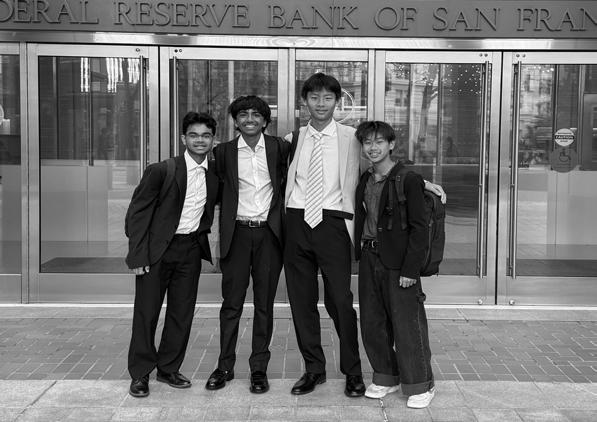
The economics club’s all-freshman team placed third in the Northern CA State Final of the National Economics Challenge on April 2, economics club adviser Christy Heaton said. The team, made up of club members Andy Xu, Ishaan Agrawal, Ian Leung and Praneel Sharma, competed in the David Ricardo division representing non-AP students.
“[They had] the commitment and dedication to do well in the
competition,” Heaton said. “They haven’t had an economics class, so they had to self-study the material. They know more than, I’d say, the senior economics classes do.”
The freshmen took a preliminary online test while on campus to qualify for the State Final competition, in which the team scored 870 of 900 points, economics club president, junior Naomi Chi said.
During the State Final, the competition was divided into an individual test, a team test and a final quiz bowl round, which was open only to the top five scorers, Heaton said.
“It’s quite a huge accomplishment,” Heaton said. “There are complicated questions that take
Continued from page 1
Following the competition, it was announced that HHS earned the most sweepstakes points, which were awarded based on where competitors placed in each competition. This win was FBLA’s 27th consecutive state title, Montesi said.
At states, teams competed in various competitions, including case, speaking, tech and written, Montesi said. For example, Montesi said he competed in computer game and simulation programming, a tech competition.
“I’m proud of my team. We got second place for our competition,” Montesi said. “Looking at our rubric scores, there was only a twopoint difference between us and the first place team, and we could have definitely beaten them if we
had just put in that small amount of more effort needed. That’s a bit unfortunate, but overall, I think we did great.”
To plan the trip, the officer team and advisers registered the 161 competitors, booked hotels and planned travel, Montesi said. Officers also hosted vetting sessions where professionals, alumni and former teachers gave competitors outside perspectives, executive vice president of competitions, senior Smyan Shanbhag said.
Meanwhile, competitiors prepared by utilizing resources such as textbooks given to them by business teachers and officers, freshman Gulnar Zamindar said. Zamindar, who competed in the Introduction to Business Concepts
a lot of independent study on behalf of the kids.”
To prepare for the final, the team reviewed previous test samples over late-night calls, watched videos to revise concepts and studied independently, Sharma said.
“A lot of this relies on your individual preparation,” Sharma said. “As a team, we do group tests, [and] if you don’t know something, it’s okay because we can all explain it to you. At the same time, if you don’t know anything, we can’t just keep catching you up, because then that’s not efficient.”
While the team’s dynamic made things interesting, their preexisting friendship was a source for distraction.
“When you get distracted, it’s often just for a short period of time,” Sharma said.
“For example, we might get carried away and talk about something, and then we realize how late in the night it is [and] we’re like, ‘Oh, we’ve got to lock in and finish up,’ and that’s what brings us back to the present.”
Despite these hiccups in focus, Sharma said the team succeeded because of their shared interest in doing well and learning economics.
“It’s about motivation to learn,” Sharma said. “To be involved in the competition, you need to have some sort of interest in [economics], so the fact that there’s a reward
competition, said she also utilized online practice quizzes to prepare.
“[Introduction to Business Concepts is] a really interesting competition, and it has information from all the different aspects of business,” Zamindar said. “I feel like [that] is really good, because it’s a good competition to get started.”
This year’s SLC was more competitive than previous conferences. Because of the increased competition, the Bay Section competition had more teams trying out for SLC, leading to fewer HHS teams qualifying, Shanbhag said.
The club’s performance dipped in comparison to previous years, with second place, Los Osos High School, closing the gap, Montesi said.

if you do win in the competition or even just participating alone amplifies your knowledge as you learn and try to win.”
The team performed the best on questions about international concepts, despite some minor blunders regarding macroeconomics and microeconomics, Agarwal said.
Based on their test results, the team secured their spot in the quiz bowl, Agarwal said.
“We were pretty intimidated, because most people we were going up against were sophomores or upperclassmen,” Agarwal said. “[It was] not necessarily that they’ve taken a class before, but they’ve probably had experience in economics or higher-level mathematics that could give them an advantage.”
During the final quiz bowl however, the team missed the opportunity to go to nationals by a narrow margin, Xu said.
“We were pretty disappointed because we were one question away from first [place],” Xu said. “We were pretty close because we knew the answer to that question, too.”
Having already made it to the state final in their first year with the club, Heaton said the team can now look forward and aim to compete in the higher AP division in coming years.
“Hopefully, it develops a passion for a subject that they enjoy learning about and take ownership for. It goes far beyond what we do in the classroom,” Heaton said. “Instead of kids getting to senior year [before having learned about economics] and already knowing what they want to study, maybe if they start as freshmen, then they’ll actually develop a love for economics.”

Continued from page 1
Focusing on affordability, Foo said ASB partnered with Minga to offer an early bird sale that lowered ticket prices down by $10 to $20, with regular tickets costing $90 to $100 and guest tickets costing $110.
Additionally, with rising amenity prices, ASB has worked hard to simultaneously manage budgeting, ensuring prom is an affordable event for everyone, Foo said.
“Part of the reason we were able to lower the cost was that last year’s class cabinet saved up a lot of money we were able to put toward prom costs, which is really nice,” Foo said.
different activities during the event, Almendarez said.
“[This year] there is plenty of room in the venue. It doesn’t feel cramped at all, which I knew was an issue for last year’s prom,” Almendarez said. “The venue has interactive games you can play and places to go to if you want a little bit more quiet time and to not feel super overwhelmed by the music, noise and people. We feel like it has a little bit of everything for everybody.”
“This year, there was only a 30-to-40 point difference between us and the second place,” Montesi said. “In previous years that gap has been bigger. If you just look at this year, we did a great job, [but] it is a bad sign that the gap is closing.”
Despite the close margins, Montesi said the awards announcement remained his favorite part of the event.
“We were scared that we were going to lose the streak that we’ve had going for so long,” Montesi said. “But then, to hear ‘Homestead’ and everybody cheering was really exciting.”
Since Prom is taking place the weekend before AP testing, many students have been hesitant to attend the event, Foo said. However, the discounts have motivated students to purchase tickets, Foo added.
“I know a lot of people are upset about [the date], because it’s really close to the start of AP testing,” Foo said. “We didn’t pick that, and we don’t really like it that much either, but it’s just what fits with our menu and contract.”
To create a more comfortable atmosphere than last year’s prom at Levi’s Stadium, the school selected a venue with multiple areas where students can participate in
On top of planning prom far in advance, ASB has been working with an outside event planning company, Event Group SF, to ensure an organized and enjoyable event, junior class officer Sophie Enders said.
“I hope students have a good time, especially since now working [with the planners] we have two dance floors, there’s [going to be] a lot of dancing and good vibes,” Enders said. “I think the Tech Museum, because it’s a new venue, will let students have a good night dancing with their friends, and it will be lots of fun.”
Three staff members to retire, reflect on HHS careers
Sachin Chandran, Elina Li and Advay Ranade
Business teacher
Graeme Logie
After 25 years of teaching, Logie said he is following through on a decision he made several years ago to retire at the age of 65.
In college, Logie said he was mildly interested in teaching but chose to venture into the private business industry instead. After being laid off and struggling to find a new job, Logie said he interviewed to be a
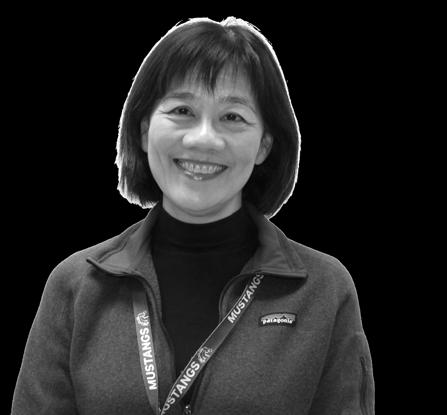
Chinese teacher Vivian Ju
A full-time teacher at HHS since 2017 with 35 total years of experience in education, Ju said she is retiring this year for her health and age. With the extra time that comes with retirement, Ju said she plans to take music classes, volunteer in the community and travel.
Since beginning as a teacher, Ju said her foremost goal has been to genuinely inspire students while teaching Chinese. Specifically, Ju said she tries to approach students as whole individuals and bond with them while deepening their understanding of the language and culture.
“My goal was really to make
teacher in hopes of a more stable career.
“[Teaching] is a grueling job the first couple of years, but then you get the rhythm,” Logie said. “It was the right decision. I look back at what I’ve done and how many students I’ve reached in my career. There are some that still come back and reach out to see how I’m doing.”
As an adviser and Bay Section director for FBLA, Logie said the club has provided him with many gratifying moments.
“You see lots of kids grow up and become doctors, lawyers or business people,” Logie said. “I had some part in that. It may not have been directly where they ended up, but [I] may have
Chinese fun. I don’t want students to think, ‘Chinese is so difficult and boring,’ [and] they are forced by their parents to come and take Chinese because it’s their heritage, or it will be useful later on in their life,” Ju said. “I wanted to help them see Chinese culture and language from a different perspective.”
In addition to teaching, Ju said she advises four clubs, including NCHS and TSA. Ju said she is pleased to see members embrace Chinese culture at campus events such as annual C-Nights, an event in which she played a major organizational role.
When Chinese classes were at risk of being cut from the
French teacher Muriel Von Stein
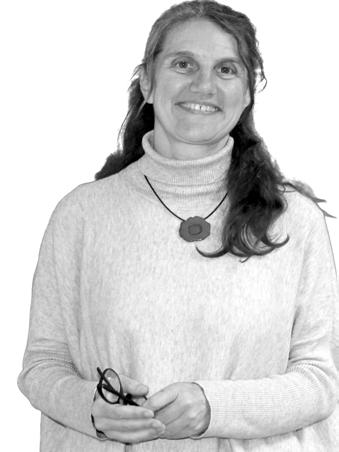
Concluding 21 years of teaching at HHS, Von Stein said she is retiring to spend more time with her two daughters, who both live and study in Germany.
Originally a pharmacist in Germany, Von Stein said she pivoted to teaching after moving to the United States because her diploma did not transfer over.
As the transition gave her the opportunity to teach diverse curricula for French, Von Stein said she was grateful she could bring students up to
lit a fire to pursue something.” Reflecting on his career, Logie said one of his crowning accomplishments is the vast growth of the business department, a testament to continuous staff dedication.
“I have my own way, but together, [business teachers] managed to connect with students for 24 years to get them to achieve great things,” Logie said. “We have built a department that’s strong and is looked upon as one
of the best in the district, if not the region. To me, the legacy is what we built, and now, we are passing it on to people we trust.”
language department in 2023, Ju said she witnessed the strength of the community built around the program, with stu dents and parents advocating for its continuation. From all the work she has done, Ju said the most memorable part of the job is the love and recognition she receives from the people she reaches.
“I’m very blessed to have the opportunity to serve the HHS community,” Ju said. “My students [and] th parents, have given me a lot, and I feel so grateful. They really make my life fun, rewarding and fulfilling.”
that level of advanced discussions, encompassing topics such as philosophy.
“To see the growth in students is really amazing,” Von Stein said. “I love that, and that’s something that I’m going to miss. For example, I have my French 1 and 2 [classes] now, and I know some of them are going to really fly and be super professional.”
Capping off her career, Von Stein said the most impactful lesson she has learned is to support students in their struggles.
“In the beginning, when students wouldn’t do homework, my thinking was, ‘He doesn’t care,’ ‘He doesn’t want to’ and ‘They don’t make an
effort,’” Von Stein said. “Very quickly, I’ve learned there is always a story behind the student. No student would come into a class saying, ‘I’m going to be in trouble with my teacher because I didn’t do the work or because I’m not paying attention.’ There is much more behind the facade.”
Ethan Xue
Local: Cherry Blossom Festival celebrates Japanese culture
Cupertino hosted its annual Cherry Blossom Festival at Memorial Park April 25-26, according to Mercury News. Celebrating Japanese tradition with its sister city, Tokoyawa, Japan, organizers incorporated new elements like a cosplay meetup, according to Mercury News.
The adjacent Quinlan Community Center hosted a gallery of Toyokawa student artwork, according to Cupertino City. Along with the center’s gallery, the festival featured additional exhibits, music, dance, martial arts and interactive activities, according to its website.
Throughout the afternoon, food court vendors offered cuisine staples like sushi, mochi, bento and boba, according to Mercury News.
Regional: Landmark social media lawsuit
A California jury found Meta and Google negligent in a social media harms trial on March 25, according to NPR.
It concluded the companies were to blame for depression and anxiety of a woman addicted to social media as a child, awarding her $3 million in compensation and another $3 million in punitive damages, according to CalMatters.
The verdict marks one of thousands of recent lawsuits filed by students, school districts and state attorneys general against Meta, YouTube, TikTok and SnapChat, according to NYT. Ultimately, this outcome reflects a new legal perspective that social media companies can cause personal injury, driving greater accountability over users’ mental health, according to NYT.
National: Higher oil prices hit California
Important snapshots, public comments from April 7 board meeting
The Board of Trustees met on April 7 for a four hour-long celebration of HHS staff and students, followed by their set agenda.
HHS recognitions
The board meeting kicked off with a statement of recognition from principal Denae Nurnberg, where she shared appreciation for the school community’s achievements in collaboration, problem-solving and academic excellence.
“We want every student to walk on our campus knowing exactly why they’re here and feeling like they have a team of adults who truly have their back,” Nurnberg said. “Of course, we don’t do
this alone. HHS is only as strong as the community that carries, to the parents and partners in this room.”
Then, English teacher and FEA site president, Ashley Pitta, took the stage to highlight various student achievements.
The ASB executive team joined to present on general student life, offering details on how they worked to create a sense of community at school. Their presentation encompassed various student clubs and initiatives, such as the new student wellness center. The Student Wellness Advisory Group was present to expand on their efforts surrounding campus wellbeing.
Afterward, librarian Shannon Vakili was named Classified Staff Member of the Year for her dedication and compassion.
Additionally, Government teacher Carrie Nakamura was announced Teacher of the Year by
assistant principal Nico Flores. In a surprise announcement, superintendent Graham Clark revealed Nakamura to be District Teacher of the Year as well.
“She’s the colleague who quietly lifts others up, someone who challenges thinking in a respectful way [and] keeps the focus on students,” Flores said. “[Nakamura] truly represents the very best of our profession, and we are incredibly fortunate to have her.”
See page 10 for more details on poster students and see article above on retirees, who were all commemorated at the meeting.
Agenda items
The second half of the board meeting began with designated time for public comment.
Several FUHSD students and parents spoke on the topic of public transportation, proposing new measures that expand support for
Art teacher Edmond Kwong and paraeducator Miao Carroll declined interviews to appear in this article but will also be retiring at the end of this school year. Interventions program assistant for guided studies Rosalie Walton is also retiring—scan the QR code here to read.

alternative transportation.
Climate collective lead, junior Chloe Dahl advocated for the improvement of bike racks and repair centers. This change could be funded by increased prices for parking permits and reevaluating which students receive priority for permits, Dahl said.
“Cars create congestion and global warming, and in addition to these environmental concerns, they pose safety problems and do not support student health,” Dahl said. “We want our board to join the growing movement of cities [instituting] alternative transit and active transportation.”
As a parent of three former CHS students, Olivia Shearin called the board to increase parking permit fees to $300 and require students to be farther than one mile away to obtain a permit.
Several other attendees shared perspectives, prompting the board to further discuss the topic.
In recent weeks, the Iran war has led to rising global oil prices, and in the U.S., California has been impacted, with prices averaging $2 above national rates, according to NYT. However, evidence suggests high prices in California are more due to a combination of high taxes, fossil fuel restrictions and other environmental policies, according to The Washington Post.
To remedy this, the Trump administration is tapping into the Strategic Petroleum Reserve and easing crude oil product regulations, according to CBS. Amid the ongoing conflict, reopening the Strait of Hormuz would most effectively lower prices, according to CBS.

Volume 64 · Issue 7 · April 30, 2026
Editors-in-Chief
Parth Dhaulakhandi Alicia Liste
Web Editor-in-Chief Amanda Boles
Print Managing Editor Maya Dutt
News Editors
Danielle Feldsher
Ethan Xue
Opinion Editors
Sachin Chandran Adam Orrin
Lifestyles Editors
Annika Abraham
Aviv Matas
Alan Zhang
Arts & Culture Editors
Jason Lai
Malar Raguraman
Sports Editors
Olivia Levesque Ouellette
Selina Wang
Copy Editors
Ethan Xue
Alan Zhang
Photo-Illustration Editor Isabela Guilardi
Design Editors Maya Dutt Aviv Matas
Junior Design Editors Ivy Guo Kaylin Yi
Multimedia Editors Isabela Guilardi
Aashka Nagarkar
Junior Multimedia Editor Yichen Yao
Social Media Editors
Sanjeet Jayaseelan Advay Ranade
Reporters
Natasha Bandil
Alexander Cao
Emma Chang
Krist Ferreria
Henry Hu
James Jiang
Elina Li
Saachi Nangare
Kanmani Raguraman
Julia Song
Ethan Tan
Chloe Wang
Catherine Yang
Adviser Natalie Owsley
Mission Statement
The Epitaph is a non-profit publication at Homestead High School, 21370 Homestead Rd., Cupertino, CA 95014.
The Epitaph is a designated forum for student expression and not subject to prior review, in accordance to Education Code 48907. The staff is comprised of HHS Journalism students. Views expressed do not necessarily represent views of the school, its staff or the district. Editorials are opinions of the editorial board.
The Epitaph welcomes letters to the editor but reserves the right to edit submissions. Letters should be limited to 300 words. Include contact information. Unsigned letters cannot be published, but names will be withheld upon request. Send via homestead.epitaph@gmail.com, or drop letters in the newsroom or the office mailbox.
If The Epitaph has made an error, please send corrections to homestead.epitaph@gmail.com. The corrections will be published in the corrections box for the next issue.
To reach the Epitaph in C102, call (408) 522-2572.
Advertising
One email and you can reach over 2,400 students, teachers, administrators and community members from Northern Sunnyvale to Southern Los Altos. If your target market is between ages 14 to 18, contact The Epitaph at epitaph.ads@gmail.com, and we can make it happen.
Thank You to Our Donors & Supporters
FUHS Foundation
Homestead PTSA
Every year, hundreds of students walk past club posters, half-listen to morning announcements and leave club fairs with flyers they will never look at again.
To keep students engaged, ASB must make it easier for students to access event information for all clubs on campus at their convenience.
Currently, ASB has a centralized spreadsheet for students to access information such as club officers, advisers and meeting times. However, the resources are not updated with any changes to club meetings or any club-specific events outside of general meetings.
Additionally, ASB’s Digital Club Fair, a section of ASB’s website where some club information can be accessed, is outdated, with most clubs’ supplemental links listed being from previous years.
With ASB’s current system, to access up-to-date information about a club they hope to join, a student must be a member of the email list or follow the respective club’s Instagram account. However, many clubs do not send emails punctually enough, and many students do not have access to Instagram to find necessary information, reducing the accessibility of club events to the most dedicated club members.
While the school facilitates a daily bulletin board and morning announcements where club information could be broadcast, these forms of communication are not required for clubs and also have limited space, restricting the number of clubs that can be featured.
Also, the bulletin board email and morning announcements normally con tain summarized information, using ar bitrary phrases such as “every other Fri day,” which are unclear and confusing to students.
To rectify the issues listed, ASB should create its own website or online platform and aggregate information about every club on campus, enabling students to eas ily explore their interests, navigate clubs and find various events.
An example of a website that could be used as a model is TinoClubs, created for CHS by their former ASB club commis sioner Jiaming Liu.
See the infographic for a detailed view of the TinoClubs website.
If HHS were to implement a similar website to TinoClubs, they could incor porate supplemental links such as club email lists, officer applications, websites and more.
Additionally, they could add a new event logging system, so events outside of meetings could be added on the site’s calendar by club officers.
To begin working on the website, ASB can contact CHS ASB and request the source code of the site, Liu said. They can also reach out to Liu to understand the site’s technical structure, adapt the site to HHS clubs, expand its calendar and make any modifications, he said.
In next year’s club orientation meetings, ASB should require club leadership to enter all necessary information. After the creation of the website, ASB should facilitate a prominent launch of the site through announcements, ASB Instagram
promotion and physical flyers to increase student awareness.
The creation of a website similar to TinoClubs tailored to HHS will provide students with easy access to information regarding active clubs across campus. Through one simple website, students will be able to find, join and support campus organizations in a matter of a few clicks.
The Epitaph editorial board voted unanimously, 15-0, in support of this stance.
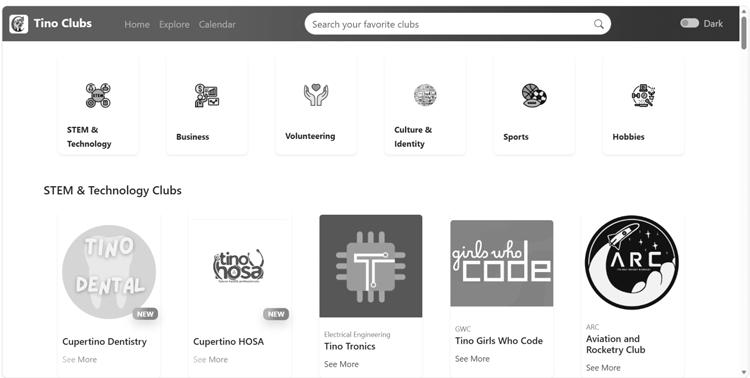


Adding the current pages present on TinoClubs and additional features would allow students to easily and efficiently view a list of club events.
At CHS, every club is registered with ASB and, in turn, is required to have a listing on the website, Liu said. ASB must similarly mandate each club’s involve ment in a centralized site.
To keep the website relevant, Tino Clubs also includes a proprietary ranking algorithm that increases the rank of clubs that frequently update their description and have a large word count, Liu said. This incentivizes clubs to keep their in formation updated so they can rank high er on the website.

Acknowledging actions does not require blind respect
Annika Abraham
I grew up constantly exposed to media with distinct ideas of good and evil. Cinderella did not have a dark past, and no villain would be granted the mercy of redeeming qualities. Now, as the movies I watch and books I read change, it has been a long time since I have had the luxury of dealing with black-and-white morality.
Fortunately, with fictional stories, my judgment of a character can end when I shut the back cover of the book. But, when the leaders in the world around me misstep, it forces society to draw uncomfortable conclusions as to whether such people should be allowed to maintain their revered status.
As such, it is necessary for society to learn how to separate characters from political achievements, subsequently taking leaders off their pedestals and contextualizing how we interpret their actions.
In the case of labor union activist Cesar Chavez, reports of sexual misconduct, pedophilia and rape have surfaced from women within the union. As their stories emerge, individuals and organizations struggle to decide if
they should continue celebrating their former hero, according to PBS.
This was the case for Ana Marguia, Debra Rojas and Dolores Huerta, victims of sexual assault by Chavez. From family members to internal pressures, they reported feeling the need to stay quiet about what they had endured in fear of backlash, ostracization and damaging the union’s revered leader, according to NYT.
When society attempts to glorify its leaders, it creates a culture that encourages their offenses to be swept under the rug.
Victims are vilified for tainting the idolized pictures of leaders when, instead, they should receive acknowledgment and support from the people around them. Consequently, those hurt by actions taken by the leaders feel pressured to suppress their trauma and conceal how they were hurt, ironically separating accountability from justice for those who are meant to defend it.
When learning about idolized historical figures, their injustices are often glossed over or even skipped altogether to preserve the gilded image society likes to view them as.
This is exemplified by Mahatma Gandhi when his nonviolent methods are praised and lectured on, while accusations of racism and sexual abuse are kept out of lesson plans and classroom group discussions.
By ending the idolization of those we impetuously consider heroes, we facilitate the process of acknowledging their shortcomings or injustices, as there is no pedestal we are forced to remove them from. When we subconsciously build up unrealistic ideals of who our heroes are, we are setting ourselves up for disappointment, as we become blinded by our own personal characterizations.

As such, we also need to contextualize the behaviors of the people we believe in, evaluating the “art” on its own merit and the “artist” and their character separately. Support for them as individuals and respect for their accomplishments should be mutually exclusive, and we need to decide whether our leaders are worthy of one or both of these forms of recognition.
Ivy Guo
When I am walking around school or hanging out with friends, I often hear people tossing around political talking points, revealing their underlying misunderstandings of the political spectrum.
High school students tend to follow the political beliefs of friends, family or social media influencers instead of educating themselves and building their own opinions due to a desire to fit in. To combat this, teachers and students alike must quickly take action to improve political awareness.
Many students are fearful that differing opinions may cause rifts in their relationships with others and isolate them. This is a common thought process because teens are at an age where they are trying to find their place in the world, according to the American Psychological Association.
Tube Shorts, I came across a street interviewer asking people their opinion on abortion. I thought the interviewer’s content made a lot of sense, only to realize a few years later that his content was heavily biased and he was purposefully making everyone who disagreed with him look irrational.
Due to strong influences on the beliefs of high school students via social media, as well as their peers, high school curriculum must include education on all political views.
For a school-centric focus, English classes should incorporate fact checking political disinformation in the Navigating Digital Information unit of freshman literature classes to teach students how to debunk media forms like online propaganda.
Teaching students about the political spectrum at a high school level is important to show students new perspectives and to teach them how to think independently.
As society continues to venerate leaders, it creates a system that requires moral perfection for individuals to remain on their pedestal.
This approach allows their victories and failures to co-exist as actions of the same person instead of black-and-white indicators of humanity. Consequently, as good and evil will never be polar opposites, it is necessary that we begin separating actions from character and stop glorifying the leaders who are being removed off their pedestals.
Right-wing Bay Area shift must be supported
Advay Ranade
Not long ago, wearing a MAGA hat in a San Francisco tech company was like a resignation letter. Today, it might get you an exploratory meeting with your CEO.
Silicon Valley executives used to follow the trend in California of quietly donating to leftist political campaigns while endorsing no candidate and keeping politics and business separate, according to Yahoo News.
However, residents must realize that this right-
ward shift toward conservatism in the Bay Area is very healthy and should be supported by local governments, constituents and other leaders who hope to change their views, as well.
This trend emerged during the 2024 presidential election cycle.
A plethora of influential figures in Silicon Valley, such as businessman Elon Musk and venture capitalists Marc Andreessen and Peter Thiel openly aligned themselves with Republican president Donald Trump, according to NYT.
When those shaping technology and policy are forced to defend their ideas and face push back from others, their beliefs become more developed. With more developed ideas, policies that are implemented in the country become more effective and better tailored to serve the interests of all stakeholders.

By late 2025, venture capitalists and executives
across all California industries joined the executives in supporting the broader conservative movement. Together, they began to donate to conservative political action committees across the country and support conservative policy initiatives, according to the Wall Street Journal.
Due to this change in the sentiments of people taking action across the Bay Area, constituents must realize that the political diversification of companies and executives in the Bay Area is beneficial for constituents along with executives. Otherwise, a social environment where only one political view is perpetuated through the community’s culture will narrow the diversity of political thought.
Additionally, industry leaders across the country must learn from tech executives in the Bay Area to break away from past normalities and extend the political spectrum in their businesses exposed to the public, their workforce and others.
As Silicon Valley continues to be at the forefront of tech policy and the economy, it now moves forward with executives across the entire political spectrum. The uniform voice that once defined the Bay has now diversified, and this change should be supported and encouraged.
Social media content also has a strong influence on the political views of students. When high schoolers see their favorite influencers talking about their political beliefs, they are likely to follow them.
When I was younger and watching You-

beliefs.
Chloe Wang
Mountain View recently terminated their contract with Flock Safety, a company that provided cameras to law enforcement, which allowed them to obtain information on vehicle license plates. Santa Clara County also banned the sheriff’s office from using the service again.
Flock Safety was banned because, in February, officials uncovered that other law enforcement agencies were searching the city’s camera data without permission, according to NBC News.
By parting with the vendor, the Mountain View government demonstrated accountability and a righteous will for justice. Henceforth, policymakers should continue this behavior by being more cautious in ensuring digital safety to protect citizens.
The implication that a company is illegally transferring data has appalling consequences. Stolen personal information can lead to identity theft, fraud and unauthorized financial transactions, all while violating the right to privacy.
Despite society’s normalization of data leaking, the government should take this matter as a constant threat that will impact many lives. The state must invest more resources into enforcement of digital safety.
There are various situations where the local government can increase digital safety efficiency. To eliminate concerns, California’s government must implement clearer regulations regarding ownership of captured data in future contracts, forbidding vendors from selling information to unauthorized groups.
Currently, searches are not as reliable, as they suffer from weak vendor security practices as well as lack of standardized processes regarding these vendors, all leading to a neglect of safety performance, according to Babel Street. Therefore, a more thorough investigation of the companies the government partners with should be conducted.
In implementing these changes, the government can ensure that technological advances do not compromise citizens’ private data. Steps like these ensure greater government accountability.

New bill prevents unnecessary job terminations
Sachin Chandran
COLUMN — The hum of processors reverberates through the office building as a soulless bot skims through an employee list, looking for the next person whose rent, food and livelihood it can strip away. Firing, one of the most personal and devastating aspects of business, is now becoming automated by corporations.
Thankfully, members of California’s state legislature created SB 947, the “No Robo Bosses” act. This measure would require human review to make a final decision in firing processes, according to CalMatters.
SB 947 is a necessary step to worker protection in a time of increased AI dependence, and must be expanded by banning automated firing practices altogether.
A publicized instance of automated firing was presented in 2025, during the Department of Government Efficiency’s quest to accelerate workforce reduction. They utilized a software that fed weekly employee reported accomplishments into an algorithm, evaluating whether or not the job that person served was necessary for the department’s success, according to Wired.
Firing is a process that should be based on human deductions and observations over a long period of time. Although it may increase efficiency, a computergenerated formula cannot possibly judge a person’s future performance based on the finite view it is provided.
Unfortunately, leaders in the government have not recognized the urgency of this situation. A version of SB 947 was approved through the state legislature, where it was vetoed by Governor Gavin Newsom for being too sweeping, according to Mintz.
This veto was catastrophic, as it denied basic worker protections that are vital to workplace fairness. Therefore, if the state legislature passes the bill to governor Gavin Newsom again, he must correct his mistake and approve the bill.
However, the legislation in its current state is not sufficient in protecting worker’s rights due to its leniency on AI involvement in firing processes. As it passes through the state legislature, clauses must be added to prevent any usage of AI.
If a person truly must be fired, that decision should be made with full human agency and no reliance on an AI-generated answer. This will protect workers from excessive termination, valuing worker’s rights over corporate optimization.

While hanging out with my friends, I hear one say they only slept five hours to work on numerous assignments, followed up by another proudly bragging that they only slept for three to cram for exams.
Although high schoolers often view staying up late and overworking as something to admire, students must realize its negative effects and stop treating sleep deprivation like a competition.
While challenges can be beneficial for a student’s future, they must find a suitable balance to protect themselves from burnout. This is a widespread issue that over 27% of teenagers struggle with, according to a Harvard study.
Burnout can lead to stress
and decreased motivation, which undermines academic success and overall well being, leaving permanent damage via weakened immune systems and reduced memory, according to Cleveland Clinic. When students boast about being burnt out, it normalizes unhealthy habits, doing more harm than good.
Over time, these effects can make it difficult for students to manage their workload, leading to decreased productivity despite the extra effort they put in. Without a healthy body, students’ quality of life will deteriorate, making it harder to do simple tasks.
To reduce the stress level of worn out students, schools should promote mindfulness around workloads by encouraging classes to do more outside physical activities, where students can have a much needed break from academic pressure.
When an overworked student shares and brags about their schedule, it sets an unrealistic standard that pressures others.
BOTC was once a symbol of campus competition, a week of events where students combine their efforts to bring their class to victory. That symbol now faces roadblocks in its future, as events such as “Jersey-day” are repeated across many spirit weeks.
However, this transition from high-energy engagement to repeated events is not accidental.
Before an event can happen, ASB’s ideas go through a vetting process with administrators who review whether they follow school rules, can be run safely and are realistic to organize, ASB advisor Hector Almendarez said.
This process is not only constraining but it also imposes boundaries on ASB officers, forcing them to reduce the variety of events on campus.
To create more engaging campus events, the process must give ASB more room to revise their ideas so they abide by school policies and focus on campus engagement.
Leadership students often have to brainstorm and troubleshoot with school administrators amid countless “what-ifs,” leading to specific ideas being altered or dropped.
For example, the “Anything But a Backpack Day” was banned for fear that students would

Consequently, students feel guilty for not doing as much as their friends and view resting or taking a break as laziness, resulting in further proliferation of toxic work culture.
Hearing another student talk about their busy schedule makes a familiar guilt creep up my sleeve, telling me I am not doing enough. These feelings force me to join more clubs and take on more re sponsibilities, greatly harming my work-life balance with constant exhaustion and pressure.
I realized the negative ef fect it had on me and slowly overcame the toxic thoughts. Instead of glorifying burnouts and treating them as something to be proud of, students should call out their peers when they boast about it.
By challenging the idea that overworking is admirable, stu dents can shift their own con versations away from compe tition over who is the busiest. This will emphasize the importance of rest and stability,
and students can ultimately contribute to the denormalization of burnouts.
Students must internalize that it is okay to get a good night’s sleep, as a healthy balance measures success better than prolonged exhaustion.
bring stolen shopping carts onto campus, Almendarez said.
For events that make it through the vetting process, policies further limit the range of activities offered at those events.
Leadership students are often forced to play it safe when selecting events because they cannot afford to have them fail. Instead of bringing fresh ideas to campus, they end up repeating the same activities over and over, making school spirit feel increasingly predictable.
These boundaries grow, not only because failure is excused, but also because financial pressure worsens the problem.
Overall, creativity is replaced by caution, and the same recycled events continue to drain the originality school spirit is supposed to foster.
The same events will continue to persist until the strict policies behind event admissions are addressed.
To fix this, administrators and leadership should make the event vetting process more transparent by clearly separating non-negotiable safety guidelines from ideas that can be revised.
Events involving theft, student safety or supervision concerns should still be restricted, but proposals that are simply unconventional should not be rejected outright. Instead, administrators should work with ASB to set clear limits on what can be modified so that more creative events can be approved.
To tackle the financial risk, ASB should implement a safety net by testing engagement.
Through smaller events, leadership could gauge participation through trial runs that would involve fewer materials and lower costs. This would give ASB more room to experiment with new ideas before turning them into major events.
Without better collaboration between ASB and administration, campus traditions will continue to feel overused rather than exciting.

FUHSD needs clearer plan for students

As the school year nears its end, students are selecting their classes for next year, with many packing their schedules tight.
In an already stressful and uncertain process, fitting an entirely new, required class into a schedule would be nearly impossible. Unfortunately, that might be compulsory for incoming freshmen in a couple years.
The Ethnic Studies class was supposed to be offered starting in the 2026-27 school year as a required course for Class of 2030, following state mandates for all public schools. However, due to funding issues at the state level, preparations and future funding for the class were halted at the district level.
Currently, neither the staff nor students know when it will be funded, making it a very uncertain situation for everyone. If the class is not funded, it will not be a graduation requirement, Principal Denae Nurnberg said. Due to this uncertainty, administrators must keep students in the loop on the class by sending dates through student communication platforms.
Figuring out schedules and balancing classes is already difficult. If the class gets funded, the sud den addition of a grad uation requirement will only be an extra incon venience to work around.
Upon searching for any mention of the Eth nic Studies class in emails to students from admin istrators, all the infor mation I found about the class was vague and only led to more confusion. Students have not direct ly received information on future plans for Ethnic Studies in regards to how graduation require-
ments may change and in what time frame.
In the coming years, the school should give students, especially incoming freshmen, a clearer plan regarding Ethnic Studies. Given a plan, students can choose classes around it and be prepared in case it is funded. By sending frequent informational emails with updates on the class, utilizing systems like the Weekly Blast or the HHS Bulletin, students would stay up to date and choose their classes with more comfort.
Staff should also hold a mandatory brief where they inform students about the class, the changes regarding it and where to find information on further changes. This could be held during a designated tutorial to ensure all students receive this information.
While the school cannot control what the state does for funding for the class, they must maintain clear and concise communication with students. In the end of the day, students will be the ones most affected if the current uncertainty and lack of communication about the course continues.

Without proper communication on the status of the class, students are unaware of the impact of the change.
Climate collective event features student innovation
Gathering together at the Computer History Museum, the FUHSD climate collective hosted their annual Earth Day celebration on April 22, site co-lead, junior Chloe Dahl said. From student presentations to choir and drama performances, the collective focused this year’s event on teen-led contributions and initiatives.
“We hope they can get in-

spired to do their own research and come up with their own solutions, and they’ll follow through with those solutions and implement them as initiatives or start groups on campus,” Dahl said. “We also hope they can join the climate collective so they can continue contributing throughout the district.”
Historically garnering over 1000 attendees, the extensive planning process for the event started in the fall, as they brainstormed their vision for the event, climate collective lead and MVHS teacher Kavita Gupta said.
As spring approached, the collective began advertisement initiatives, inviting students and teachers to attend, organizing volunteers and planning the layout of the event.
This year’s event featured a stronger focus on student-made projects, with the collective moving away from longer speeches to short, passionate presentations from FUHSD students, site co-lead, sophomore Cynthia Li said.
The event hosted approx-
imately 100 student presentations on diverse, climate-related topics, Li said. This allowed attendees to learn more about the environment through lenses such as art, research, app development and public policy.
“It’s powerful when outside organizations and adults are like, ‘Hey, this is really bad,’ but when youth speak up, I’ve noticed it’s way louder than when anyone else talks,” Li said. “High schoolers are busy. We have other things to do. So when someone stops and says, ‘We need to do something about climate change,’ everyone listens, and having those youth voices be amplified is so important.”
The event also showcased the type of student-driven technological innovation that is vital to the future of environmental science, Gupta said.
“We have a robot, a drone and a VR experience, which we’ve never had before, and it is all by students,” Gupta said. “A student made a robot that cleans up trash, a group made a drone that can find trash and collect
Organized campaign brings neurodiversity awareness
Sanjeet Jayaseelan and Kaylin Yi
Students with disabilities enter the spotlight during the first ever Abilities Awareness Week from April 27 to May 1. This new campus effort emphasizes inclusion, communication and community, Special Education Inclusion PTSA Committee chair Susan Salop said.
“The aim of the whole week is to build awareness that there are people in our school community and the community abroad who have disabilities and have different abilities,” Salop said. “By having people with disabilities out in society enjoying their lives, it creates more empathy, and when neurotypical people see them, they’ll be more understanding.”
To make the week a reality, the committee partnered with The
Differences Among Us club, support specialist Julio Llerenas and Academic Community Transition student-founded businesses, Salop added.
The first of the week’s three activities was a showcase of several ACT businesses, who gathered in the quad to display their products for purchase on April 29, Salop said.
Items sold by the businesses managed by students with disabilities as part of their curriculum, included organic pet treats, T-shirts and themed food baskets, Salop added.
The business exhibition was followed by a power soccer demonstration on April 30, wellness space support specialist Julio Llerenas said.
Power soccer is designed for individuals who use power wheelchairs, where players score goals by maneuvering oversized soccer balls to the net, Llerenas said.
“To make sure everyone feels included in something equitable, everyone on campus and in the
community has an opportunity to participate in sports and everyday activities as well as [run] businesses,” Llerenas said. “That’s [the idea] we’re trying to promote, and hopefully students can get that information and awareness from us.”
Closing out the week, members of TDAU will host their annual Buddy Ball on May 1, a prom-style event for students with special needs, TDAU president, junior Noe Vorbau said.
The event, which offers a safe, less overwhelming alternative to traditional campus dances, will also feature student volunteers,” Vorbau said.
it and then the VR experience is through the city of Cupertino.”
This year, the advertising process was especially challenging due to the newfound need to secure a larger number of student presenters. While the collective utilized methods ranging from social media posts to paper flyers, Li said she thought personal outreach was the most effective method of connecting with the student body.
“In the beginning, there were issues with getting student projects,” Li said. “But the more we reached out individually, [the better]. We noticed someone who’s passionate and were like, ‘Hey, do you want to sign up?’”
“The overall goal of the event is to teach students that they can do something and help the environment because I think every action has a reaction, kind of like the butterfly effect,” Li said. “The most important aspect of letting students lead in the climate space is letting them learn that whatever they do has such a huge impact, especially when you start early. It’s really that shift in your mindset that ultimately leads to change.”
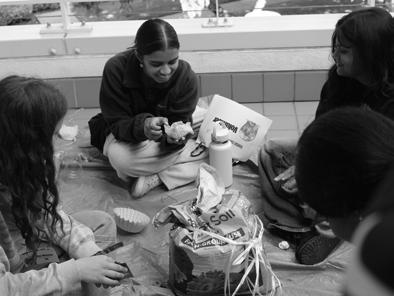
Beyond learning new information, Li said she hopes attendees take action in whatever capacity they are able, whether that means biking instead of driving or attending next year.
Karen Asakawa learns teaching skills in World Literature
Returning to the same bustling hallways she walked through not long ago, alumna Karen Asakawa ‘23 said she now serves as a World Literature student teacher.
“The biggest thing is to meet the kids where they’re at while making things relevant to them, regardless of which kind of culture they’re used to being in,” Hinton said. “Sometimes it’s hard getting up there and teaching is intimidating sometimes.”
As a student of Hinton, junior Naomi Chi said Asakawa has become a guide she can gain advice from, whether on projects or worries outside the classroom.
“Getting to know more people and getting to hear other people’s stories and experiences [while] teaching and working with students has been really fun for me,” Asakawa said.
After finishing her undergraduate degree at UC Santa Cruz as a literature and linguistics major, Asakawa said she committed to San Jose State University for her master’s degree and teaching credential.
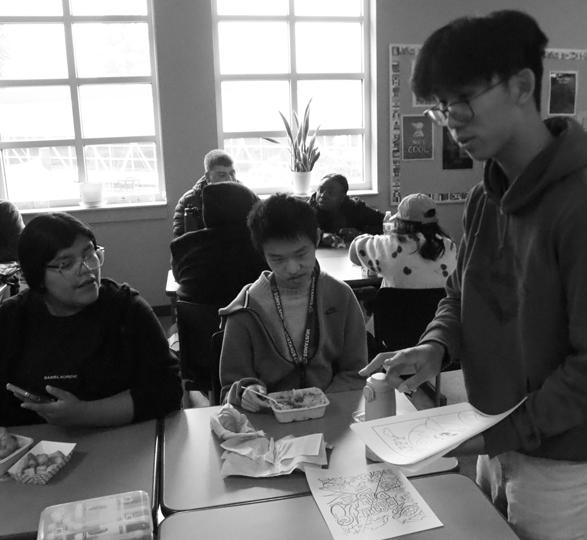
Photo by Sanjeet Jayaseelan
“Volunteering is very important for this event because it gives people the opportunity to not only interact with kids with different disabilities, but also to serve themselves as well as serve for others at this event,” Vorbau. “That’s the most positive thing about this event, going and serving and taking time out of your day to go give out some popcorn or do some face paint.”
Since the committee is new this year, organizers approached the week as a starting point from which to expand from in the future, Salop said.
“We wanted to make sure we can handle it,” Salop said. “Then, ideally, next year we might even do something in the fall, then the spring, and just build on what we do this year.”
The week’s ultimate intention is to help the student body nurture a greater understanding of disabilities, Salop said.
“Having folks interact more helps everybody,” Salop said. “It helps students with disabilities, because they feel more comfortable when they’re out in society. It also helps the neurotypical students, because they realize, ‘Oh, there are a lot of people in the world who are different than me.’”
As a high school student, Asakawa said she greatly enjoyed her literature classes, and also participated in the jazz and marching band.
“Being part of and creating a community was really important to me, and all my teachers did a really good job of doing that, as well, because it wasn’t only in band that I experienced that kind of community building,” Asakawa said. “[In] a lot of my classes, we sit in groups and we end up being good friends at the end of the school year, even if we didn’t know anybody in the beginning.”
English teacher Kirk Hinton, who now serves as Asakawa’s mentor teacher in her student teaching process, said she was previously a student in his Honors American Literature class.
As a student teacher, the current goal for Asakawa is to continue strengthening her self-confidence while learning the ropes of classroom logistics, Hinton added.
“I’ve had confusions about different assignments or about college or the future, and she’s helped answer my questions and elaborate on things that weren’t clear,” Chi said. “Non academically, I think it’s been amazing talking to her because I don’t actually know that many people in my social circle who are in her age range.”
Overall, Asakawa said her return to campus is a way to give back to the community that taught her many valuable lessons.
“The most impactful teachers I’ve had were in high school, which is why I’m back trying to teach high school,” Asakawa said. “But even when I was in elementary and middle school, I’ve had great teachers who really inspired me to keep going with my educational career.”
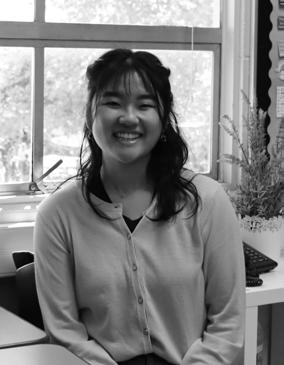
has been a full circle moment, Karen Asakawa said.
From furry friends to appetizing entrées,there are many ways people interact with animals. Students discuss all things animals.
Sachin Chandran, Olivia Levesque Ouellette and Kanmani Raguraman
Taking the bull by the horns, three students are expanding their interest in animals to professional and academic spheres.
Uta Sasada:
Senior Uta Sasada said her experience volunteering at Mini Cat Town, a non-profit organization centered around rescuing kittens, initially piqued her interest in becoming a veterinarian.
“I’ve always been interested in becoming a vet, but I wasn’t certain,” Sasada said. “My sophomore year I was like, ‘I need to think of something I really wanted in the future.’ It was kind of vague at that point so I tried volunteering, and it was really fun.”
Majoring in animal science at UC Davis, Sasada said she will be able to access graduate-level resources, and study at one of the best veterinary schools in the U.S.
“Davis is a good, big agricultural school,” Sasada said. “After majoring in animal science, I can do wildlife conservation, I can work at shelters, like I am now, [or] I can do animal research. Maybe I’ll go into college and try [something] and actually find out that I like it more than becoming a vet. But, right now, I’m hoping to become a vet.”
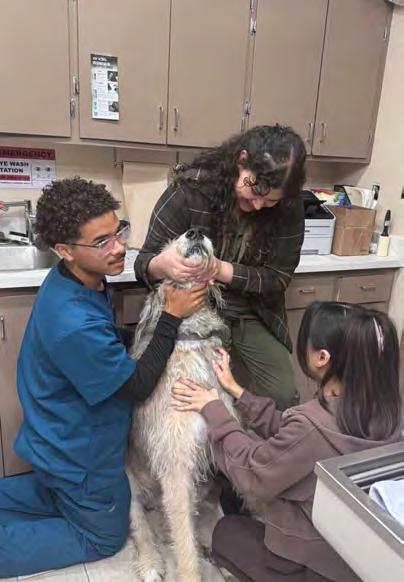
Elijah Burse: Junior Elijah Burse said he accepted an opportunity to become a veterinary assistant for his uncle at the start of the school year.
“Obviously, humans, animals, we’re all related. We’re all species, and being able to provide care for [animals] where they’re lacking is something I enjoy doing,” Burse said. “On a daily basis, you have to know the patients [because] you can’t communicate with animals. Some of them do know basic commands, but you have to make sure that they are comfortable.”
Burse said serving as a veterinary assistant has helped him decide that he wants to pursue a career related to physical rehabilitation with human patients.
“Introducing myself [to a vet’s office] somewhere that isn’t as high-stakes is really good for me,” Burse said. “I can get my grounds to understand what a more laid back environment is compared to
what I will potentially be dealing with in the future when I have to deal with people and have more responsibilities to take on.”
Suri Yau:
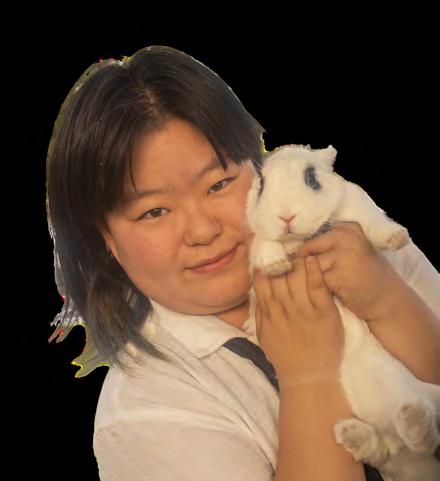
Fearing replacement by artificial intelligence, senior Suri Yau said she decided to stay true to her passion for animals while exploring a technologically resistant career. Yau said she plans to study computer science and animal sciences at the University of Illinois Urbana-Champaign.
“Originally, when I came into high school, I wanted to major in something business related,” Yau said. “I felt a little unfulfilled with that. So, when I was trying to find something else to study after high school, I went back to what I love to do the most [which] is just hanging out with animals, observing them and seeing them happy and healthy.”
Yau said she keeps bunnies as pets, which has inspired her to also pursue veterinary school in the future.
“It’s exhilarating. Getting to develop a relationship with an animal is so amazing because they can sometimes be less trusting than humans,” Yau said. “For example, when you’re volunteering with bunnies, they’re prey animals, so they’re usually more hesitant to get close to humans. It’s really fun when you get to develop a relationship and they trust you.”

Junior Noe Vorbau said she spent her childhood growing up with an abundance of animals, including chickens and lizards. Throughout her life, Vorbau has built a special bond with one particular lizard, a bearded dragon named Lightning.
“He’s my best friend. I take him on walks, and I used to have a lizard leash for him,” Vorbau said. “I paint his nails, and he also sometimes comes to school with me or comes to the store with me. He loves our little adventures, especial ly when he gets to walk in the rain or in the grass.”

How many pets Is it ethical to keep animals in zoos?

“From one point, people can see nature [in zoos] and understand it more. But on the other hand, some zoos do not keep animals safe, so they could be in danger. I think it’s ethical to keep some animals in some zoos. If they’re really endangered, then zoos should probably keep them to make sure they’re safe and can reproduce.”
— Junzhi Wang (9)

“We’ve here, we the house. house, us to that when ferent the house.” — Yuval

Q: What led you to become vegetarian?
A: When I was around seven, I decided to be come vegetarian because my dad explained to me what a chicken tender was and how it came to become a chicken tender, and little 7-year -old me was like, ‘Oh, my God, I can’t do that. I don’t want to kill this animal to eat it.’
Q: How does your diet contribute to environmental causes?
A: In really bad big farms, endless materials [are] used. To have animals, you need a lot of water, land and food


A: I’m a religious person, and I believe it’s honestly okay to eat meat. I just like the taste of meat and the health benefits. In general, red meat, besides being a good source of protein, tastes good if you’re a
Q: How do you personally attempt minimize damages
A: “I know most farms do treat their livestock pretty well, but I also know that in the U.S., there tends to be some farms that do unethical actions to their livestock. do you have?

Rescuing multiple types of birds over the years, junior Zainab Baig said caring for her pigeons has allowed her to learn about their diet and habits.
“Sometimes on walks, people will

“We’ve always had pets, and when we moved we felt really sad without an animal in house. We want more animals in the house, but our house owners only allowed have one small dog. My mom told us when we move out and we have a different house, we could have more cats in house.”
Yuval Harel
(9)
Senior Carl Chu said they were introduced to their pet rabbit, Tank, through a social media post. Tank’s previous family could no longer adequately feed or house him.
“Tank is my first emotional support animal,” Chu said. “I haven’t had one before, but since I’ve been going through a lot of mental health stuff, he’s made me realize that we need each other, and it’s really important that he’s in my life. I would have never went through college [applications] without him.”
animals feel complex emotions?

“Yes, to a certain extent. I don’t think it’s as intense as what humans feel, but I do think that [animals feel] some emotion. I have a cat, and when my cat is happy, I can tell. Whenever I get home, she crowds around the door and is very active and hyper. I would consider that a positive emotion.”
— Cierra Hagan (11)
EL speech contest offers unique chance to improve speaking skills
Annika Abraham and Amanda Boles
ELD students tested their public speaking skills in the district-wide EL speech contest on April 29, EL site coordinator Grace Henson said.
“The purpose is for the students to get used to the idea that public speaking is very important,” Henson said. “At the same time, it’s scary, but if they accomplish this big feat, they will learn something out of it. Maybe speaking in public won’t be as scary as they think.”
The contest featured both informative and persuasive speeches, Henson added.
During the competition, students were graded on criteria such as the clarity of their speech and presence of filler words, student judge, junior Tiara Rezvani said. While she initially volunteered to receive hours for HOP, Rezvani said she was drawn to the competition’s laudable intentions.
“It’s important they expose themselves to uncomfortable situations of speaking a language that they’re not fluent in,” Rezvani said. “I hope they learn to talk to a big group without feeling nervous and that they’re more comfortable using English in day-to-day life.”
To prepare, Henson said students picked a topic, wrote their speech and practiced under the guidance of teachers.
“[Students] do speak in class, but they don’t have this capacity of actually being in a contest, so this is a good way of showing

Charlyse Phan tailors thrifted clothes
From altering pants to DIY-ing custom tops, sophomore Charlyse Phan said she began tailoring thrifted clothing in her freshman year after watching online posts about thrifting.
“I see fabric or material and I get inspired by to create a new top or piece,” Phan said.
Phan said she began sewing in elementary school, learning at summer camps and through tutorials on YouTube. Now, she spends hours tailoring her own clothes.
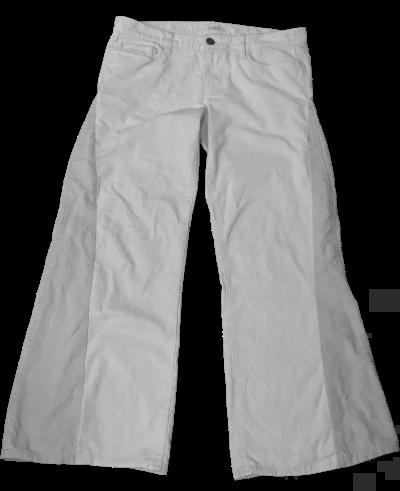
After thrifting a particular article of clothing, Phan said she imagines how she wants the piece to fit and then sketches out the idea. The most challenging part of the tailoring process is getting the measurements right on her first try, Phan added.
“I take inspiration from how it originally looks and then I try to keep the aspects that I like because sometimes it’ll be a pattern that I like, but I don’t like the cut, so I’ll reshape it,” Phan said. “I wanted to make [a pair of pants] wider, so I found another set of pants that were the same material, then I matched the thread color, and I mashed them together.”
Phan also uses her creativity and talent to pamper her friends, sophomore June Ballantyne said.
“Last year for my birthday, she asked me what kind of design I liked, [and] she made me a really cool flower bag from scratch,” Ballantyne said. “She sewed each piece individually, and then she turned it inside out and sewed that together. It was really cool.”
Similarly, sophomore Beatrice Lee said she once gave Phan a pair of ill-fitting pants to tailor. After Phan’s revisions modified the pants to better suit her style and taste, Lee now wears them often.
Aside from developing a fashionable wardrobe, Phan said she upcycles to help the environment by combating the wasteful effects of fast fashion.
“It’s a big problem. Peo ple like to cycle through clothing really easily,” Phan said. “But when you make it and you dedi cate a lot of time into it, you don’t feel like you need to get rid of it as fast.”
In the future, Phan said she hopes to continue tailoring clothing and sharing her art form with others.
“I like the challenge of it,” Phan said. “It’s really
their growth in the English program,” Henson said. “Hopefully, by the time they [have done] their speech, they will have learned a lot throughout the school year, and then that will show when they do their speech.”
ELD student, sophomore Marwa Safa Jamshidi said she spoke on the importance of sunscreen for skin protection.
“I [was] scared, but at the same time, I [was] ready, and I felt that I could do it really well,” Jamshidi said. “In the future, there will be times I have to do speeches bigger than this, and this will be nothing compared to those.”
CMEA festival offers musical feedback
play and listen to.”
Specifically, Li said the band performed three different culturally rooted pieces, including the Australian “Gum-suckers March,” and Floridian “Sitruhs.”
“Our second piece is called ‘Deep River,’ and it’s the best piece of all time,” Li said. “It has a nice saxophone feature, and it’s about slavery. I like the history it holds, and how it sounds.”

satisfying to make something new or improve something so I can
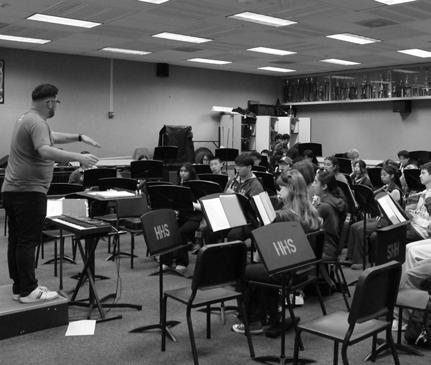
The band and orchestra attended the annual California Music Educators Association festival from April 24-25, euphonium player, senior Catherine Li said. Musical groups from across California met to perform to a panel of judges at FHS.
Over the past two months, musicians rehearsed during and after school, bassoon player, sophomore Marcus Feng said. Given the band’s strong fundamental skills, feedback was focused on more intricate details.
“Music has a lot of different emotions. Sometimes, the piece is happy, and sometimes, it’s sad,” Feng said. “As musicians, we want to convey the emotion to the audience.”
To convey musical nuance and emotion to the judges, band director Ben Scharf said he carefully selected a mixure of pieces.
“When we pick music, we want to have a nice variety of sounds and styles,” Scharf said. “We don’t want it to all sound the same. We want to find music that is both achievable and also provides an appropriate challenge for the students. We also want to find music that is fun to
After each performance, judges provided technical feedback during a clinic, Scharf said.
“I [was] really excited to learn from the judges so that we can keep growing as students and as a program,” Scharf said. “They tell us about things we can improve on like, ‘You can be more in tune here,’ or ‘You can have better balance here.’”
Ultimately, Feng said he hopes the performance will resonate with regional judges and audiences.
“A goal I have for every performance whether it’s a competition or just a fun performance,” Feng said. “Whether that be happiness or sadness, I want our music to affect one person. I think that’s the goal for every musician.”
Winners reflect on title’s significance
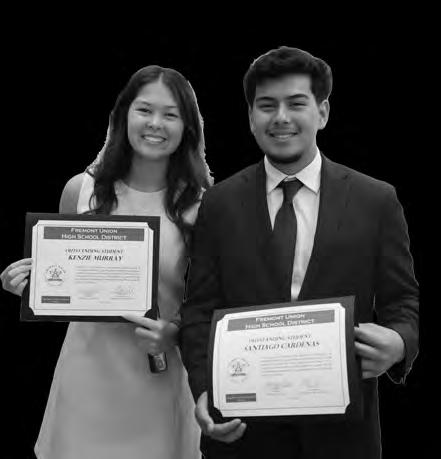
Seniors Santiago Cardenas and Kenzie Murray were recognized as HHS poster students at an FUHSD board meeting on April 7.
Santiago Cardenas
The recognition, which was first announced over the morning announcements on March 6, came as a surprise, Cardenas said.
“It was fun, but it was confusing because I wasn’t paying attention to the morning announcements until I saw [administrators] walk into our fourth period with balloons and a bag of nerds,” Cardenas said. “This accomplish-
ment gives me courage to keep up with my work. I am someone that likes to help others and not expect something back from it, so it was really unexpected because I do things from my heart.”
As an EL Commissioner and member of the Site Equity Action Team, Cardenas said he draws from personal experience to highlight the challenges ELD students face, having reclassified out of the ELD program in his senior year.
“This award is something that represents all the effort and work that I have put into making HHS a better place,” Cardenas said.
ASB adviser Hector Almendarez said Cardenas’s genuine attitude has left a positive impression on those around him.
“I only got to know him this year, but it felt like I’ve known this kid for a long time,” Almendarez
said. “You don’t have to ask him to do a lot of the things that he does. He just does it. That proactivity and willingness to put himself out there is awesome to see, especially [for] somebody so young.”
Kenzie Murray
Murray said she attributes this recognition to her involvement in various campus organizations, from French club and sports medicine to the EL program, where she serves as an EL Commissioner.
“To me, it was really cool how I was able to see that I was actually known around campus in a way,” Murray said. “I knew a lot of the admin team as well as the teachers, and throughout my whole high school experience, all of those interactions have stayed with me. So being recognized with this [award], but also having
all that support during all of my years here, was really cool.”
Murray said athletic trainer Dan Yusim, along with counselor Wilma Wu, EL site coordinator Grace Henson and Almendarez, have especially influenced her academic career.
Murray’s calming presence as an experienced member of the leadership team is one of her greatest strengths, Almendarez said.
“She never gets too antsy or stressed out, at least it doesn’t look like it,” Alemendarez said.
“She somehow is able to balance everything and present
herself in such a way that people gravitate towards her. Her leadership just speaks for itself.”
Winter percussion, guard perform last show for community
Maya Dutt and Ethan Tan
Culminating winter percussion and winter guard’s dedication to their craft, the annual home show was held on April 23 in the large gym. The home show was members’ final chance to perform the shows they spent the last five months perfecting, center snare player, senior Nathan Krimsley said.
“The goal is to allow all students and parents to be able to see a performance, [as we usually] perform farther away from home,” Krimsley said. “Normally, no one gets to see the show unless you're going on the trip.”
The theme for this year’s winter percussion show was titled “Everything Must Go,” synth player, senior Claire Limsui said. The story revolved around the largest mall in the United States during the 1800s, which slowly degrades as time passed and people turn to different trends, Limsui said.
“Everything Must Go” employed an unorthodox approach of using comedy to create a more casual setting for audiences, Krimsley said.
“Last year was definitely a more serious vibe, even though it was simpler in concept,” Krimsley said. “This year's show was very bright, colorful, matching
the things that we did during this year's [marching band] fall show of Candyland and mimicking that in the indoor setting.”
Meanwhile, winter guard’s show focused on dark themes about witches and the occult, captain, senior Alyssa Kolin said. Though not possessing a strong plot, the show captured the creepy atmosphere perfectly, Kolin said.
Beside featuring performances of the shows, seniors were also recognized for their contributions, Kolin said. Members gave posters and personalized gifts to seniors from their section, Kolin added.
“I really looked forward to this home show because it marked the end of my HHS journey in terms of color guard and winter guard,” Kolin said. “This show was the best show I’ve ever been part of and I think it’s cool that I’ve been
able to help the program grow into what it is today.”
While previous home shows served as a send-off before the teams’ respective final competitions, this year’s event was the last opportunity for attendees to view the show before the definitive end of the season, Limsui said.
Parent and student volunteers from Tri-M Music Honor Society ensured the event ran smoothly, Limsui added.
As her first and last season of winter percussion came to a close, Limsui said the home show reflected all she has accomplished as a part of the music program.
“I've made a lot of friends and gotten a lot closer to other people, so I feel like that's definitely been something good,” Limsui said. “This was my last big performance, and I felt like it's a nice way to close out my HHS career.”
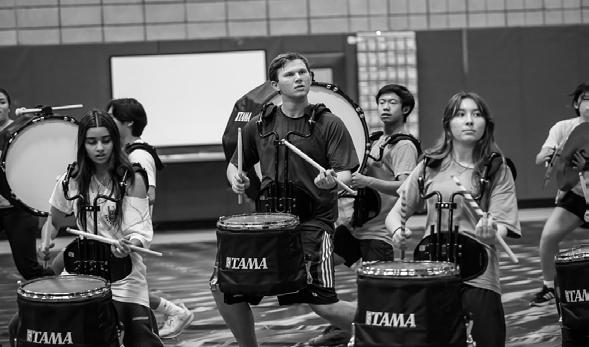
Jen Schaub discusses experience bettering student health
In her first year as health clerk, Jen Schaub said she has aimed to improve student wellbeing, whether by providing routine medication or lending a helping hand during medical emergencies.
Schaub, whose children graduated from HHS, said she was looking for a change after seven years of volunteering for the music department.
When administrators asked if she was interested in the health clerk position last spring, she embraced the opportunity, especially given her master’s degree in public health and background working in health education, she said.
“I like checking in with [students],” Schaub said. “I like knowing a little bit more about them than if we were just passing in the hallway.”
Schaub said her daily responsibilities have consisted of dispensing medications to students and reviewing paperwork for them, such as medical management plans filled out by a doctor.
During more serious medical incidents on campus, Schaub has done her best to ensure students’ comfort, such as providing jolly ranchers and stickers.
“Sometimes we’ve had to have the ambulance come for some kids,” Schaub said. “But I try and make it as low-key and as stressless as possible.”
However, Schaub said the scope of her authority as health clerk has been limited. For example, she is unable to diagnose
any students with medical issues and can only provide medications through the permission of a doctor’s order.
“I will help [students] as much as I can, but the person who can really help them might be their parent or the paramedic,” Schaub said. “I’m the stepping stone.”
As a student managing epilepsy, sophomore Erica Knapp said the calming atmosphere of Schaub’s office provided comfort during times of panic.
“You don’t have the pressures of everybody else around you, so you feel safe,” Knapp said. “[Schaub]’s also really understanding. She always talked me through it, and I never really felt there were any issues with anything.”
Knapp added that it is reassuring to have someone on campus who is so courteous to students and vigilantly aware of their medical needs.
“It was really nice when she remembered who I was, and I felt happy that there was that sense of community,” Knapp said. “I do think she’s a vital [part] of the student body, just because she is
helping the people who might not get the help they need.”
District nurse Parvaneh Sanaeinourani, who trained Schaub in the medical aspects of her job, said Schaub proved diligent and hardworking during her instruction.
“She’s very good at following up about whatever is needed for the students,” Sanaeinourani said. “She’s in a good mood with the kids whenever they’re coming. When [students] come to the health office, they don’t feel good, and they usually appreciate what ever we are doing for them.”
Amid more logistical respon sibilities, Schaub said the primary skill of a health clerk is maintain ing an air of compassion to bal ance out the inevitable anxiety of medical issues and to remain pos itive for the students.
“I think that the key is to treat everyone with respect,” Schaub said. “Any way that you can show a student that you are there pay ing attention to them and that you are there to help them, whatever the issue is, is something that I like about this job.”
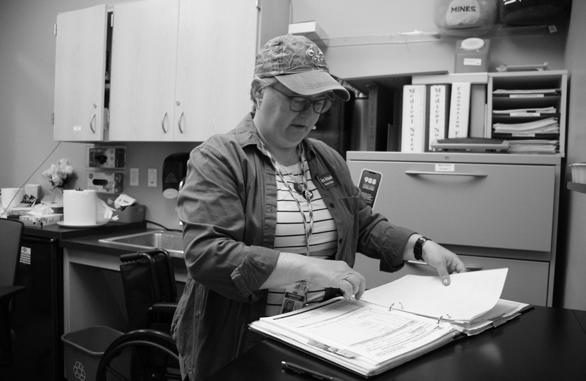
Zhang
To celebrate Hispanic culture, the Latinx student union, Spanish National Honor Society and Spanish department will host their first-ever Noche Hispana on May 1 from 5-7 p.m. in the cafeteria, LSU co-president, senior Gianella Arteaga said.
The event will begin with a small talent show as a welcoming activity, followed by cultural presentations from students in Spanish classes, Spanish teacher and LSU adviser Adrian Buenrostro said. The event will close off with several student performances, including singing and poetry.
Drawing inspiration from other campus cultural events such as C-Night and J-Night, Buenrostro said H-Night will transfer the language department’s efforts into a broader school setting.
“We do a really good job in the Spanish department to foster a community and nurture our students with culture inside the classroom, but there’s opportunity for growth outside the classroom,” Buenrostro said. “We are trying this ave-
nue, which has helped other languages [on campus], so we want to be able to tap into their knowledge and experience.”
To supply the food sold at H-Night, organizers partnered with local restaurants, who will sponsor dishes from countries like Mexico, Colombia, Venezuela and Argentina, Buenrostro said.
While the food will only highlight a few countries, Buenrostro said organizers have made an effort to include information from all Spanish-speaking countries through presentations and activities.
Beyond the festivities, H-Night creates a space for underrepresented Hispanic communities to come together, LSU co-presidentsenior Mishell Martinez said.
“This idea originated years ago, but now we have the opportunity to do it because we want to be more recognized and stick together,” Martinez said. “It is really important for me because I know that Mexican culture is already known, but there are other cultures that need more recognition.”
Ultimately, Arteaga said she hopes this year’s efforts will lay the groundwork for H-Night to continue in the future.
“We’re really excited, we’re nervous, but we hope that this will be [hosted] every year,” Arteaga said. “We’re putting a lot of effort into it and want to show our diversity.”
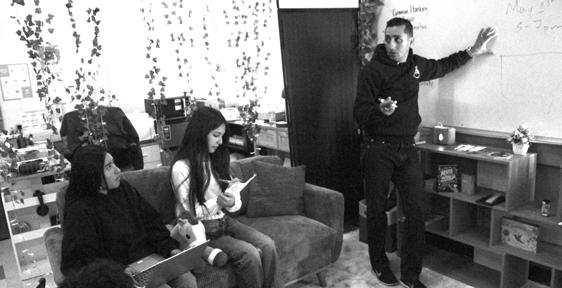
Strike a pose for prom
“This pose is a fun thing that you can do with friends or with somebody you’re dating, so it’s very versatile. I like poses that have a lot of energy, and you don’t have to be trying to look good.”
- Eden Rademacher (right) (12)
“I like it because I like to think of myself as carrying my peers on my back at all times. It’s all around a great pose and it stands out in a crowd.”
- Matthew Raybon (bottom) (12)
“I like this pose because it’s just very easy. If you have a huge group of people, you could line up in height order, or by color of dresses. I think it’s really cute and versatile.”
- Amber
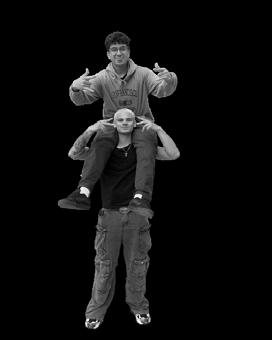



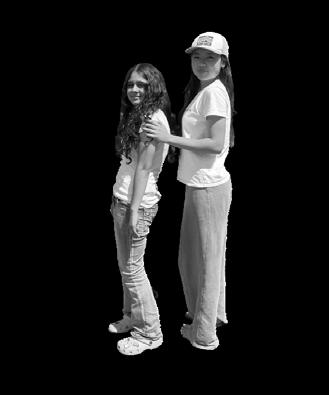
Premium burger place serves up premium prices
After two hours of tiring badminton practice, I stepped into Katsu Burger, the new Japanese burger place located off El Camino Real. As I absolutely adore burgers, it was no surprise to my family that I would choose this place for lunch.
Inside, I looked over their diverse menu, which ranged from spicy pork to juicy chicken burgers. Beyond its thoughtful halal and spice-friendly options, the menu also included different flavored shakes and fried sides. The open kitchen layout and minimal-
istic interior designs were also a nice addition to the atmosphere.
Despite the restaurant’s crowded interior, the service was extremely fast, with my food and drink being made in front of me within mere minutes. However, the bill was hefty, coming in at $30 without tips and taxes.
To start off my meal, I opened my properly packaged box of Banzai Bites. At first taste, the fried chicken pieces were tender, however the second piece was dry rather than juicy, highlighting the dish’s inconsistent texture due to it being overcooked.
While I was eating the Banzai Bites, I started sipping my refreshing matcha shake. To my delight, it was neither too sweet nor too bland.
Even with the American twist
on the drink, Katsu Burger remains authentic to Japanese culture, choosing to use real matcha powder instead of artificial flavoring. The drink had the texture of a real milkshake, unlike the watered-down consistency of McDonald’s. Despite my initial satisfaction, after drinking about a quarter of the cup, I became a little bored of the same old taste. I would highly recommend simply getting the smallest cup size for this drink.
After enjoying my drink and sides, it was time for me to chomp
AI protests are not inherently virtuous
As the spread of artificial intelligence becomes more common in our daily lives, arguments about the ethics of AI usage have transformed into heated debate.
On one side of the discussion are enthusiasts who take an optimistic stance in awe of technological advancement and innovation. Contrastingly, there are anti-AI activists arguing that the harms outweigh the benefits.
Since they are able to amplify their opinions through social media, these activists have made it a trend to publicly denounce AI usage through boycotts and internet discourse.
Although this trend is a valid demonstration of personal beliefs, it has created a trail of posers who jump on the technology hate train for clout. These imitators spare no time to question the significance of this movement, joining in simply for performative reasons.
In their mission to agree with the majority, protest posers blindly follow opinions that appear to care about the bleak job markets
and worsening state of the environment. Some even go so far as to openly criticize those who utilize bots in their personal lives.
However, behind the scenes, many find themselves depending on computer-generated content.
Some of my peers are quick to criticize others for using AI-affiliated apps or extensions, while secretly relying on chatbots to help them with their assignments. This kind of duplicity damages the credibility of the actual anti-AI movement.
Additionally, detesting AI and boycotting it has become a sign of virtue in today’s world, symbolizing a strong moral compass that values current issues.
into the main part of my meal: the Tokyo Classic burger, the signature dish of Katsu Burger. After tearing away the wrapper, I came to appreciate the burger’s generous portions.
The burger was topped with massive layers of cabbage shreds, pickles, tomatoes and a thick slab of beef katsu. Although I had rel-

ply become a social weapon in their defensive arsenal, simultaneously revealing their hypocrisy.
People need to consider the reasoning behind their activist voices. Instead of blindly following the majority, protesting causes to support personal beliefs must be the driving force behind protest movements.
Hence, people who criticize AI must pause to wonder whether they protest because they truly believe in the reasons it may be harmful, or warped they cannot help but hop on the hate train.

However, many people latch onto misinformation that drastically exaggerates the effect of AI on the environment. In spite of this belief, they fail to actually promote environmental causes. This argument has sim-
Biopics constrain, reduce subjects into fiction
Last year, I watched “Catch Me if You Can,” a 2002 film detailing the life and crimes of Frank Abagnale, a man who defrauded millions out of banks while living a life as an airline pilot, surgeon and lawyer, all before he turned 21.
When the movie finished, I was left amazed and eager to learn more about the mythical trickster the movie was based on. However, after doing my own research, I found out that it was nearly complete fiction and a wild story that refused to acknowledge that the real Frank Abagnale had spent his teenage and early adult years in prison.
Biopics are movies made about a person’s life, often to honor and detail their accomplishments. Yet, in their attempts to appeal to as broad an audience as possible, they often sanitize the subject’s controversies and simplify their successes.
“Michael,” a biopic released on April 24 centered around the life and career of singer Michael Jackson, has come under fire for simplifying Jackson’s multiple controversies. Jackson’s family reportedly has paid millions to ensure the biopic will avoid any talk of Jackson’s most infamous controversies, including his alleged abuse of minors, according to the Mercury News.
Attempting to depict the lives of celebrities in a nuanced yet objective manner will always result in a watered-down depiction. Exploring a person’s controversies dis-
respects and harms their family, but appeasing family and avoiding controversy disrespects any alleged victims of the accused. There is no middle ground, making biopics inherently harmful.
Although millions of people will rush to theaters to see “Michael,” what we see should not be the basis of our perception of Jackson’s life.
On the other hand, these biopics also simplify and distort the actions of those they cover to make them more digestible as en tertainment. In the 2010 film “The Social Network,” the creation
atively high expectations for the burger, I was slightly disappointed with the beef katsu. The sauces and toppings masked the meat’s natural flavoring, which lacked depth. Additionally, the buns felt store-bought with their dry texture.
After spending the afternoon at Katsu Burger, I returned home,satisfied and full. Despite the pricing and meat flavoring that could be easily found elsewhere, after considering its generous portions, fresh ingredients and speedy service, Katsu Burger still manages to deliver a satisfying meal that is worth trying at least once.
Restaurant: Katsu Burger Grade: B3006 El Camino Real, Santa Clara, CA 95051.
Game originality is
COLUMN—Defenders protecting plant sites from attackers. “The Chosen One” storylines. Another unmemorable franchise sequel. While these common videogame tropes can yield amazing games, pairing these clichés with a lack of innovation makes them intolerably unenjoyable.
Game developers often get stuck following the formula to appease an audience. This is immediately apparent with new installments of “Call of Duty,” as each iteration gets less unique, eating away from the reputation the series once had.
Hence, it is only through real innovation that the best games can be produced.
Game developers can do this by fusing old ideas together to make new ones. “Valorant” executes this perfectly by catering to two audiences at once.
The creativity of “Valorant” stems from thoughtfully combining existing structures with original concepts, such as by mixing the robust “Counter Strike” economy system and tactical first person shooter experience with interesting character abilities like those from “Overwatch.”
Their success is clear in their player count data, which shows an either increasing or consistent trend in player count since the game’s release in 2020, according to Tracker Network.
of Facebook is depicted trivially, sparked by founder Mark Zuckerberg’s anger after being dumped by a girlfriend.

This misconception was pointed out by Zuckerberg himself, who called the film’s mischaracterization of his motivations a cheap way to engage audiences and earn more money, according to the San Francisco Chronicle.
While Zuckerberg is a controversial figure, he does not deserve to have his greatest accomplishment reduced to the humorous plotline of revenge on an ex-girlfriend. “The Social Network” is an example of how biopics reduce accomplishments to force them into
Another way to build an ingenious game is by creating new genres or reviving old ones, a task best tailored to indie game developers.
In the same manner that indie games like “R.E.P.O.” and “Lethal Company” popularized limited communication multiplayer horror, the exploration of new genres is necessary to rejuvenate gamer enthusiasm. Even if studios want to stick to a base formula, they can keep the players engaged the way “Counter Strike” did.
Instead of forcing users to buy a new game, “Counter Strike” successfully retained their audience by offering all “Counter Strike: Global Offensive” players a free upgrade to “Counter Strike 2,” according to Gaming Trend. Acts like this signal a commitment to elevating gaming standards. For “Counter Strike,” creativity means showing a willingness to avoid stagnancy. Nothing upsets me more than trying to explore the gaming community only to find the same styles sloppily recreated and slightly changed. Significant innovation requires either a longterm commitment to incremental development or a confident trek down unexplored lanes of gaming.

an interesting story, turning the most influential people in history into simple, myopic figures for a quick cash grab.
People must recognize that while biopics may seem to be faithful retellings of a person’s life, there may be uglier topics that they fail to cover entirely.
Furthermore, audiences are not the only ones who need to change. Producers must stop making biopics entirely. The creation of these films is harmful and misleading as the constraints biopics put on a person’s story make them worthless to society. A life measured in decades could never be respectfully told in ninety minutes, and it is time Hollywood recognizes this.
GAP redefines ads by making them cinematic music videos
My screen lights up with a flurry of movement as music builds with a rhythmic beat. Every frame feels meticulously produced, from the stark lighting to the fluid camerawork. The dance begins with intentional choreography, each movement syncing cleanly with the music.
Before long, you forget that what seems like a KATSEYE music video is actually a marketing stunt for GAP jeans.
Through Spanish lyrics and striking visuals, the ad feels less like a commercial and more like a unique expression of the artist. The authenticity is what elevates the ad, as it builds a genuine connection to the culture it represents and allows the audience to reflect on it like an independent work of art.
This shift in the marketing of ads is largely due to the new way people consume media.
I have noticed how easily I skip past traditional ads, contrasting Catherine Yang
Following the success of KATSEYE’s GAP advertisement, more ads should take on this new style, transforming them from boring, easily ignored content to an engaging and creative video.
One key feature of this shift to cinematic ads is the blurring of the line between art and marketing.
KATSEYE’s ad was built for the group themselves, centered around their diverse dynamic to create an unforgettable performance. The clothing they highlighted moved seamlessly with them, becoming a key part of the visual.
Taking inspiration from the GAP and KATSEYE collaboration, Puerto Rican rapper Young Miko featured in a GAP ad that felt like an extension of her own music.
Traditional ads that prioritize textual information are boring and formulaic. In this digital age of endless scrolling, content only has a few seconds to capture attention before it is skipped or swiped away. This style makes advertising genuinely enjoyable.
with the interest I feel observing this new style. Whenever I come across the KATSEYE GAP ad, I cannot find it in myself to skip due to how visually intriguing it is. The content truly feels like something I would have chosen to engage with rather than being forced on to me.
More brands should take advantage of this shift by rethinking how they advertise. Rather than the generic strategies, brands should create ads that stand out while resonating deeply with consumers If more brands follow GAP’s lead, advertising will no longer be skippable and filled with irrelevant clips. It will evolve into something more creative, culturally relevant and engaging to the audience.

Singer’s diverse music style fluidly conveys deeper message
released her first EP, “before zero,” in 2018, and has released three albums since then: “darkness at play,” “this is no longer a dream” and “Devotion & The Black Divine.” Maya Dutt
COLUMN — I often receive music recommendations from friends as material for this column, and I am almost always amazed by the artists I encounter because of this. However, when a fellow Epitaph staffer recommended anaiis, I was drawn into her vivid soundscape unlike any artist I had heard before.
anaiis, whose name is lowercase as a tribute to the feminist author, critic and activist bell hooks, is a French-Senegalese songwriter living in London. She

Additionally, she sings in multiple languages such as English, Portuguese and Latin, increasing her music’s appeal to a more global audience. Her training from NYU also shines through her diverse songs and bold experimentation with different styles.
For example, her latest album, “Devotion & The Black Divine,” delves into church choral, R&B and classical ballads. The voice notes interspersed throughout add a personal touch and tonal variety to the album.
The first song, “Something is Broken,” deals with anaiis’s trauma and disillusionment, starting off very muted. However, choral harmonies are slowly layered to make a climax where each voice fights for attention, bringing lis-
Teen magazines are obsolete, unappealing to target audience
Aashka Nagarkar
In the ‘90s and 2000s, teen magazines ran rampant, filling the shelves of every shop corner and enticing teens with their relevant content. Containing advice columns created for those on the verge of adulthood and interviews with pop culture icons, they presented ways to get involved with young adult culture.
Teen magazines are important cornerstones of culture for high schoolers because they are a place to engage with creative, centralized coverage of news and media that directly affect us. Larger magazine companies must place emphasis on appealing to this au-
dience as accurately as possible. With notable teen-oriented magazines such as Seventeen shutting down in 2018 and Teen Vogue ceasing all print publication, young adult magazines are no lon ger as prevalent in the mainstream. In fact, Teen Vogue remains as the only prominent magazine tar geted toward high school ers. With the rise of rapid digital trend cycles, remaining teen magazines often fail to keep up with the fast pace.
Most teens use social media regu-

larly. Despite this, Teen Vogue’s social media presence is not felt with the population, with each of their posts averaging under 10,000 likes on Instagram. In fact, their posts asking for teen input rarely receive more than 3,000 likes.
Clearly, there is a disconnect between the youth and Teen Vogue. This disconnect creates a lack of resonance with young individuals, leading to less visibility with their target audi-
On social media, I see influencers who create workouts and shortcuts to achieving the “perfect body” and in contrast, others who eat unhealthy amounts of food because “everyone deserves a treat.”
These contrasting views of body positivity hide the movement’s true meaning; supporting different body types, practicing self-love and accepting people for who they are.
While I believe media should portray realistic body types, these stereotypical ideas of self-acceptance leave students assuming that healthy habits are not necessary.
Influencers need to balance their content to show that body positivity is viable while taking care of yourself mentally and physically.
For example, online mukbangers and so-called “foodies” post content showing themselves eating various foods in large quantities. These influencers, often considered celebrities and role models, make viewers feel like building unhealthy habits is okay.
Countering this popular yet flawed form of body positivity content, one influencer who really catches my attention is Spencer Barbosa. Known specifically for her self-love content, I found Barbosa different from other influencers because she truly shows what body positivity means.
In one of her videos, she explains that she exercises multiple times a week, sleeps and eats well, and despite her healthy lifestyle, her body is still not go-
teners into anaiis’s inner world.
This is followed by “Deus Deus,” a more mellow track. She repetitively sings “deus deus,” likely emphasizing the depth of her love for her significant other, as “deus” means “god” in Latin. The repetition also adds a rhythmic element with her vocals.
This technique adds a cool feel
ence. Less interaction with teens leads magazines to produce content that does not connect with their audience.
However, when magazines focus coverage on topics timely to teens, their audience pays attention. For example, Teen Vogue’s coverage of Alyssa Liu gained swathes of popularity because the publication focused on a figure who was rapidly gaining fans and was a big phenomenon.
Another problem with teen magazines is they don’t create content youth want to read.
Advice columns directed at young adults were one of the main appeals of these magazines. However, because of the current lack of direct outreach from magazines, advice presented generally does not have any relevance to modern day teens.
Similarly, many articles pub-
ing to fit “perfect” beauty standards.
This highlights the crux of body positivity: your body does not define how healthy you are, and building good habits is far more important than achieving your dream body.
Although Barbosa’s videos showed me what self-love meant and cleared up my interpretations of body positivity, she is one of the very few influencers you can find online doing so. Hence, it is necessary for more influencers to be considerate of their audiences by creating content to show a balance of healthy choices and self love.
This can be done by influencers posting a quick walk around their neighborhood or eating a nutritious meal, which inspires their audience to adopt their role models’ habits.
Influencers need to promote true body positivity, supporting different body types while demonstrating to the audience that they should continue to keep themselves healthy. By doing so, students will be able to discover body positivity’s true meaning.
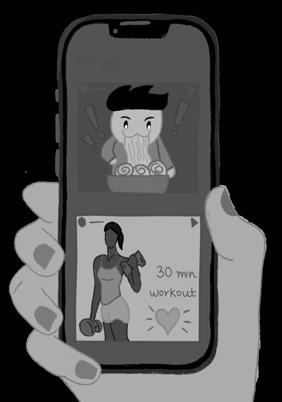
about what body positivity means to them.
to the music but is rarely utilized by most artists, and it is refreshing to anaiis using such musical techniques to elevate her sound. anaiis is heading a new generation of musicians, transcending the traditional borders of genre and style. You will “Learn to Love” her because she opens her heart to those who listens closely enough.
lished by teen magazines do not advertise to teen perspectives.
The content of a teen magazine should be focused on appealing to teens rather than people who should not be reading the content.
To combat these issues, teen magazines should involve more young adults with their publications as both writers and marketers. Young adults know what can appeal to others in their generation, so their social media and web content will actually appeal to modern-day teenagers.
The youth magazines of the ‘90s catered community, news and advice that teens could depend on, something we are missing out on today. To achieve what they did in the past, teen magazines should prioritize youth perspectives rather than solely relying on what worked for them in the past.
Pickleball club duo place at nationals after winning regionals
Aashka Nagarkar and Emma Chang
Pickleball club members, seniors Adam Orrin and Rohan Bedekar, won the DUPR California Super Regional pickleball tournament on March 7. The pair went on to place second in the DUPR High School National Championship in Atlanta on April 11, Orrin said.
“We hadn’t done a lot of formal training,” Orrin said. “We have no coaching staff. A lot of the other teams did, so we were honestly very surprised to win.”
Due to the lack of coaching, Orrin said he mainly relied on Bedekar, as well as the rest of the club, for technical advice. Addi-
tionally, sponsorships the club received from various pickleball paddle companies provided them with the gear necessary to play at a higher level.
Leading up to the competition, the duo would train in Memorial Park after school along with other members of the club, president and junior Poorva Khambekar said.
“Bedekar and Orrin are a really fun duo because they both get really competitive and hyped up whenever they play,” Poorva said. “It’s really fun to watch their team dynamic, which is a funny combination of them cheering each other on, but also giving each other constructive criticism.”
Bedekar, who is primarily a tennis player, said he picked up pickleball because he wanted to see how the sport worked.
“I saw pickleball taking up the
tennis courts,” Bedekar said. “I played it once, and I realized it was really fun, and I just kept on playing it because the level for [pickleball] skill-wise is much easier than tennis to get good at.”
Despite achieving positive outcomes at both competitions, Orrin said he believed the team could have performed better, with greater resources.
“We were playing against these kids who have been playing for years, so we were more than happy with second place. Obviously, it did hurt a little bit to get that far and lose, but losses are inevitable and we knew eventually we would have to hit that wall,” Orrin said. “For the future, we
need to build a program at HHS where we can teach and train underclassmen and juniors. So, for
the next year, we come back prepared and stronger than we were this year.”

Players, coach reflect on record-breaking journeys, outcome
The frosh/soph boys and varsity boys track teams set new school records in the 4x800-meter relay while attending the Bay Area Relays at Foothill High School on March 28, coach Kenrick Sealy said.
The varsity boys track team continued their record-breaking streak at the Arcadia Invitational, where they ran 17:58.06 in the 4x1600-meter relay, on April 11, runner Leo Silberstein added.
With the frosh/soph team running 8:27.53 and varsity running 7:56.43 at Foothill High School, it is the first time the team broke eight minutes for the relay, Sealy said.
“I wasn’t expecting [them] to run sub-eight at that time because, for a lot of the training, we haven’t done a whole lot of speed,” Sealy said. “To see them run that fast before doing any speed-specific stuff is definitely a feather in our cap.”
In preparation for the race, Sealy said he adjusted training to include more intensive workouts. With practices emphasizing foundational aspects like mileage and tempo, rather than focusing on speed train-
ing, Sealy said he was surprised by the time they achieved.
“The pace has gotten faster, so as a result, time is going to get faster,” Sealy said. “If you look at the PRs that the kids have now compared to four years ago, it’s almost night and day.”
Although both teams had practiced the 4x800 format before, frosh/soph runner, sophomore Owen Dickins said the actual relay’s competitive atmosphere enabled them to run faster than anticipated.
“I was looking at the timestamp on the scoreboard, like, ‘Wow, wasn’t the record like 8:40 at this school?’” Dickins said. “I was not totally sure what the record was, and I was like, ‘Is it right? Is this really gonna happen?’ So it was a surprise when I was told how much we beat the record by.”
Following the frosh/soph group’s record-breaking run, varsity runner, senior Joshua Lim said he felt motivated to build on their success.
“Our frosh/soph team broke the 4x800 record right before we did, so they set the stage. We knew we couldn’t let these [underclassmen] outshine us,” Lim said.
After a series of strong contributions from all four runners, the varsity team managed to achieve their record-breaking goal, Lim said.
“Parker Levy opened, ran a two-flat and passed the baton off to Josh Williams, [who] caught
like three guys. We were behind three other teams, but Josh managed to catch the ball by running a really good split,” Lim said. “Josh passed to me, and I maintained the lead we had there. Then Sotaro [Koyama], our fastest 800 guy, closed off, and we got the school record there.”
During the Arcadia Invitational relay, Silberstein said it was a challenge to stay balanced on the track, due to the high number of runners competing simultaneously.
“It’s a tough event,” Silberstein said. “The fact that there are four of us going, we’re all doing the same thing, and we’re doing it for each other makes it more special than when you’re doing it individually.”
Before hitting the track, Silberstein said he calmed his nerves by spending time with his teammates.
“If you’re always stressing, the race isn’t going to go well,” Silberstein said. “We have fun. I like the camaraderie. We stayed together before and after the race.”

With the sub-eight performance marking a highlight of the Foothill High School relay, Sealy said the team will likely place a greater focus on the 4x800 structure in the future.
“In the past, we’d get a great aggregate time, meaning we’d piece together everybody’s PR,” Sealy said. “It’s the first year we are actually [focusing on a 4x800], so from here on out, that’s what we’ll be doing.”
Aside from the thrill of three record-breaking races, Sealy said
he felt proud of the athletes’ continuous dedication to their sport, and will continue supporting their growth as they advance to CCS.
“This group of athletes is, straight across the board, just outstanding,” Sealy said. “They’re very young. Even though this year, we got the most seniors I’ve ever seen, a lot of them are not seasoned veterans. But collectively, we’ve got one strong group that is going to be lights out.”


“My proudest moments are when there's a lot of pressure in the game, and then I can pull off something that helps the team win, like a strikeout or an easy pop out for the infield to get.”
— Evelyn Chan (9)
Photo by Malar Raguraman


“My proudest moment was when I was able to drop four seconds on my main event. It felt like everything that I've ever done amounted to that, and I felt very accomplished.”
— Issac Mills (11)

“My proudest moment was my first varsity start this year against Prospect High School because I wasn’t a starting player [before] and I was able to earn a spot after scoring 15 points, the most points for the team.”
— Owen Ouyang (10)

“[My proudest moment] was at the 2022 Northern California state championships. We were down in the last inning and I hadn't been doing too good up to that point. I happened to be in a big spot, and came through. Luckily, we ended up winning the state championships that year.”
— Owen Partridge (10)
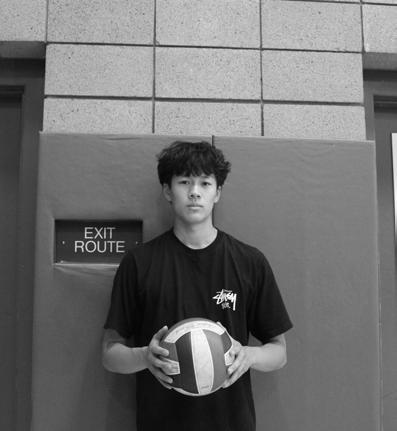
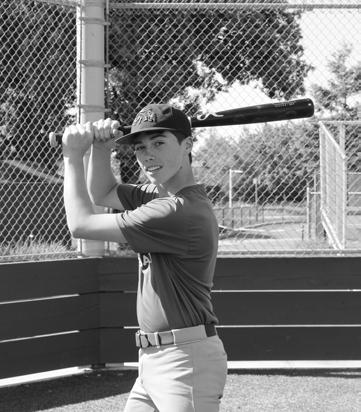

Freshman sprinter perfects her stride with vibrant dedication
Whether she is lining up for a sprint or preparing for a long jump, freshman Lili Timar stands out through the tenacious energy she brings to the track team, coach Shane Fernando said.
“She has been a big team player and has truly reflected that, on and off the track,” Fernando said. “Her dedication to getting better is something that helps push along her teammates in a friendly competition, and that sets the overall attitude toward people’s outlook on their events.”
Before high school, Timar said she was introduced to track during a middle school PE unit, sparking a new passion for the
sport. As she began competing for the middle school team, Timar said her confidence grew after qualifying for the county-level competition in eighth grade.
“I enjoy the feeling when you cross the finish line and you know that you put your best foot forward and it finally paid off,” Timar said. “All the weeks of practice in preparation paid off, and you won or got a new PR.” Fernando said Timar’s focused mindset during competitions also provides her with a unique advantage.
“Her willingness to compete is something you can’t really coach,” Fernando said. “Having an intrinsic desire is something that sets her apart from her peers and her competitors, as well.”
After getting to know Timar this season through their shared sprint events, senior Caroline Lee said Timar’s effort shines through
her strong commitment to training.
“She’s very hard-working,” Lee said. “She always puts her full effort into whatever we end up doing, and she always tries her best. She is very motivating. Working out with her makes you want to do your best.”
Over the next three years, Timar said she hopes to shorten her 400-meter time, improve at long jump and continue setting personal records. Timar is also aiming to qualify for bigger invitationals.
Looking ahead, Lee said Timar already sets the tone for younger athletes and could quickly become someone others look up to.
Beyond a mere show of athleticism, Timar said track has become a source of personal inspiration.
“Track means
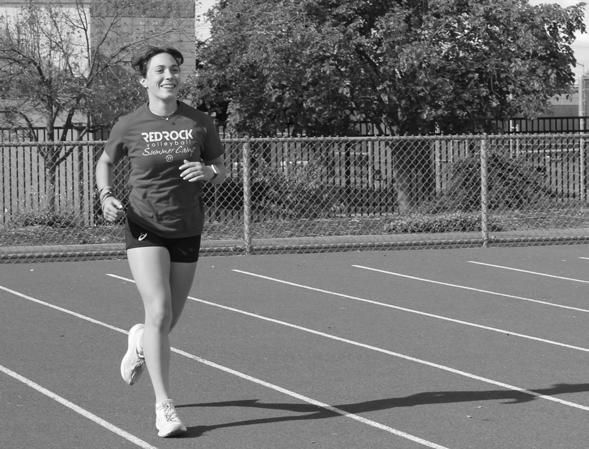





Sex is a touchy topic that is often glossed over. Along with statistics regarding students’ involvement with sex, the school community discusses their recommendations to reform the Sex Ed curricula, and the misportrayal of sex in the media.
While sex is increasingly becoming a primary aspect in many stories, it is especially normalized in homosexual relationships, Buricea said.

“It’s fine to include sexualized scenes, but a lot of the time, the media glamorizes it, like with ‘Heated Rivalry,’” Buricea said. “Everything is sexualized, but when it’s portrayed in movies [or shows], especially with ‘Heated Rivalry,’ [sex] becomes the only thing it is about.”

Media often blurs the line between consent and as sault, with cases like kissing without permission being normalized in many people’s minds, Yadav

57.1% feel prepared for the possibility of having sex after learning from the HHS Sex Ed curriculum



“‘The man chases after the woman after many rejections, and she finally gives in.’
That trope sucks, and many more conversations need to be had about relationships that don’t get shown in the media,” Yadav said.
As a literature teacher, McMahon said he often has to deal with pieces of writing that can make students uncomfort able, and it’s important to respond ac cordingly to prevent awkwardness.

“In Shakespeare, you see a lot of sex,” McMahon said. “‘Romeo and Juliet’s the dirtiest thing I’ve ever taught, hands down. But by being clinical and forthright, we are treating people like adults, and they generally respond [well].”



5.36 Students rate the Sex Ed curriculum an average of out of 10
From film to curriculum, sexual portrayal and social representation is becoming more prevalent in recent years. With these changes, seniors Finn Fiedler, Olive H. Artole and Ryan Park discuss its coverage and possible improvements.
“I asked a question about intersex people in my Sex Ed class in freshman year, and [my teacher] didn’t know how to answer. For people of different sexes like intersex people or trans people like myself on HRT, their bodies go through changes that schools don’t talk about. If there was more Sex Ed for [these] kids, there would be safer sex and ways to prevent AIDS. There are ways for schools to implement queer-friendly policies, like a celebration at Multicultural Night that would make them feel seen.”



— Finn Fiedler (12)

“There should be more [info] about the cost of different products and contraceptives, [including] specific laws about minor anonymity without parents knowing, because costs are a really big part of it. There should be more resources about California-specific laws, because that's something people might struggle with navigating.”
— Ryan Park (12)

“It’s very important for women to know about their monthly cycle, what months and days they can get pregnant, their ovulation and what can happen with that. My parents almost opted me out [of Sex Ed] because they felt uncomfortable with me knowing a bit more because of my religious standing. However, it’s extremely important for people to realize what’s happening in their bodies, especially because we’re teenagers.”
— Olive H. Artole (12)