








FUHSD halts Ethnic Studies course plans 5 Iran war is not a punchline 10 Sheltered classes guide EL students to academic success
12 Manga vs. comics: it isn’t black and white 14 Alum reflects on professional baseball career
FUHSD halts Ethnic Studies course plans 5 Iran war is not a punchline 10 Sheltered classes guide EL students to academic success
12 Manga vs. comics: it isn’t black and white 14 Alum reflects on professional baseball career
Administration announced its Tardy Reduction Campaign, running from March 9-April 9, in a schoolwide email on March 6. The campaign states that classes with the best attendance will earn rewards, while tardy students will be held accountable through randomly assigned morning detentions.
Interim dean Derek Chan, who is overseeing the campaign, said the new system was created to mitigate tardiness. After two two-week periods, Chan said he reviews attendance data, rewarding classes with the best and most improved attendance.
“The detention piece is more [about] accountability,” Chan said. “[But] it’s twofold. We’re trying to celebrate people who are on time, so all the classes working toward minimizing their tardies are also being looked at.”
Following an increase in tardies and growing teacher concerns over the past year, principal Denae Nurnberg said administration felt it was important to address the ongoing issue.
“In the quad, five minutes into the period, there are kids who are like, ‘I’ll get there when I get there,’ and it’s wild,” Nurnberg said. “It’s a really unhealthy dynamic, and then the burden lands on the teacher
and the other students to catch that student up. All those things happen right in the middle of them trying to get their day started, so it’s definitely a culture we need to shift.”
Under the current attendance system, Nurnberg said teachers must write referrals to give detentions, placing more work on them and leaving implementation to their discretion.
“There’s not an automated process, but that’s something teachers have asked a lot for,” Nurnberg said. “That might be something we look at implementing at the beginning of the school year next year, to support this notion of students being on time.”
To hold students accountable with the Tardy Reduction Campaign, one class is randomly selected per period in each department to be surveyed for attendance, Chan said. The randomization enables a representative yet feasible survey for the high number of weekly tardies, Chan said, with any tardy students in selected classes receiving a detention.
With tardiness frequently being an issue in his first-period class, Spanish teacher Paco Arevalo said he believes the new system provides a beneficial but not all-encompassing solution. Specifically, Arevalo said he appreciates its random selection that parallels real-life situations.
“For example, if you are a driver and you are speeding, but you usually don’t speed,
it may happen that [police] pull you over,” Arevalo said. “But it’s more likely that if you respect the speed limit, you won’t be pulled over, even if you do it once or twice.”

Band, orchestra attend biennial large trip
Ethan Tan and Catherine Yang
lowed student musicians to connect with peers, other schools and new conductors, Lee added.
Featuring music styles curated from various different composers, percussionist, senior Nathan Krimsley said he felt excited to perform the energetic selection.
“A lot of these pieces got pretty loud, and it is fun to play very loud things,” Krimsley said. “Mr. Scharf chose a repertoire that had a lot of groove to it.”
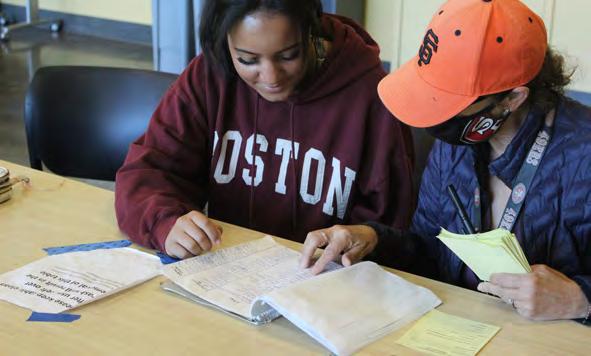
Junior Tristan Le, who attended detention on March 25, said he felt its 30-minute duration did not serve as a major punishment.
“Personally, it doesn’t impact anyone too much because not a lot of people are here,” Le said. “[Detention] is a short time, but it does dissuade being tardy a bit.”
During the first week of the campaign, administration recorded 1,470 tardies, and 1,009 tardies in the second, four-day school week, Chan said.
The plan is temporary as administration aims to analyze the campaign to adjust next school year’s success, Nurnberg said.
First two weeks of new tardy system: From March 9- April 9, tardies are handed out with more severe consequences. Instead of the usual three tardies for one detention, one random class per department is randomly checked every period, and any tardies result in immediate
Second two weeks of tardy system:
“It’s not a long-term plan, but if we find it effective, our goal is to reduce tardies,” Nurnberg said. “We’re going to look at the data at the end and see where we go from there.”
Classes with the least tardies are to be incentivized with a pizza or donut party, with the metric shifting from least tardies to most improvement since the first week.
Analyzing data post-campaign: Administrators hope to use the campaign to identify useful ways to combat tardiness. New and revamped solutions will be sought after this tardy policy and its effectiveness are properly examined.
Parth Dhaulakhandi and Alicia Liste
ASB hosts affordable underclassman event about sophomores and this helps build that connection,” Alavez said. “This is our first year having it, so it’s anticipated [and] special to us. It’s something you can only have for the first two years.”
Although exact details of the dance remain a surprise, Alavez said it will feature food, drinks and fun games. The laidback nature of Spring Fling also allows students to enjoy themselves without the worries of elaborate dances, such as Winter Formal, Alavez added. 3
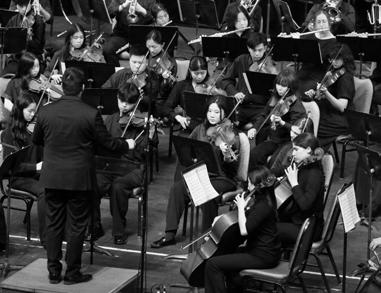
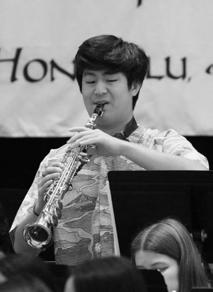
Collaborating with the CHS orchestra, the symphony orchestra and symphonic wind groups participated in the international Pacific Basin Festival from March 22-26 in Honolulu, Hawaii, assistant band director Mark Lee said. With the HHS music program traveling to attend large performance showcases every other year, the festival al-
The underclassman exclusive Spring Fling dance, one of this year’s most affordable and casual dances, will take place April 24 in the cafeteria and quad, freshman class cabinet member Victor Alavez said.
“It builds community between us underclassmen. Freshmen don’t know much
See Spring fling, page 2
Continued from page 1
As a casual event, Spring Fling did not see significant attendance when ASB tried bringing dances back after the pandemic. This trend was similar to those of several other dances, former ASB adviser Jessica Kirby said.
“The one we had at the school cafeteria was very cute,” Kirby said. “It was student-run, run by our freshman and sophomore classes, so they’re the ones who put the whole dance together. They did all the decorations and planning for it, [and] students seemed to really like it.”
With tickets costing $5 and $10 with and without ASB, respectively, ASB adviser Hector Almendarez said he is hopeful about the dance’s success among a younger crowd.
“In attracting students to want to come, the ticket price is a big thing. The fact that it’s on campus so it’s easily accessible, especially for underclassmen who are likely not able to drive or get themselves to events, all that bodes well,” Almendarez said. “If this becomes regular, then it’s something that can become a part of HHS tradition.”
While cabinet members attempted to introduce Spring Fling last year, the event’s large scale meant administrative approval was only possible for the following year, sophomore class
cabinet member Camille Weng said. This preliminary planning, along with support from counselors and persistence from cabinet members, helped make the dance a reality, Weng said.
ASB is also eager to break even, which they were unable to do for the similarly underclassmen-exclusive Cirque De Homestead event on Jan. 23, Weng said.
Given winter formal’s recent underperformance, sophomore class cabinet member Madeleine Jaw said ASB is creating posters and social media posts to establish Spring Fling’s presence early and avoid similar issues.
“At this time of year, upperclassmen have a lot of things going on with prom and other events held by ASB, and it’s important that underclassmen have things to look forward to,” Jaw said. “Casual dances are a great way to give people the opportunity to hang out with friends in an environment where they feel safe.”
Continued from page 1
Heading into performances, both groups hoped to qualify for a command performance, an invite-only concert where ensembles are selected based on quality of their performances, trumpet player, junior Max Dyke said.
“A command performance is basically an encore performance. It’s low stakes,” Dyke said. “There’s no grade associated with it. It’s more of a ‘have fun’ performance for the general community, rather than judges.”
With both ensembles obtaining gold designation and the the symphonic orchestra advancing to the command performance, violist, senior Anna Chong said it was exciting to gain additional performance time.
“We performed once for the adjudicator and once for the public. [After we performed well], we
Jason Lai and Alan Zhang
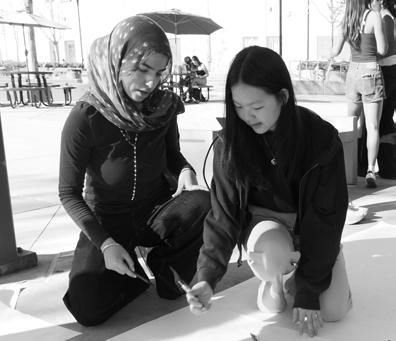
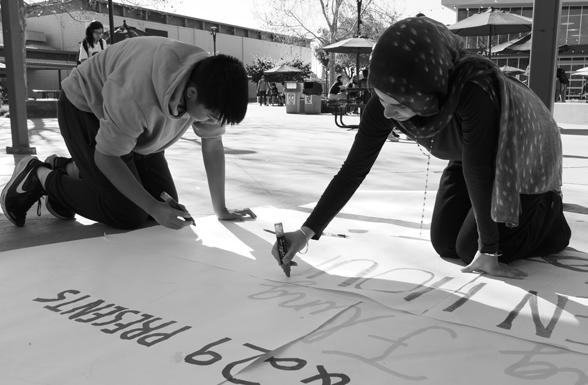
Working closely with the Japanese department and other clubs, Japanese National Honor Society will host its 10th annual Japanese Cultural Night, or J-Night, on April 10, president, senior Uta Sasada said. Aiming to reach beyond students in the Japanese program, Sasada said the event will allow the broader community to experience and engage with Japanese tradition firsthand.
Since preparations began at the start of the second semester, vice president of external affairs, senior Thomas Ogi said JNHS has held several weekly officer meetings. These split the club’s nine officers into small groups to manage different parts of the event, including food, music and overall logistics, Ogi said.
To create a more interactive cultural experience, Sasada said JNHS and other participating clubs will offer activities like kendama, a ball-and-cup toy and the water balloon catching game yo-yo tsuri.
“A lot of the activities we will do [are] things you might see at Japanese summer festivals, but you don’t really get to do it here,” Sasada said. “Even calligraphy is well known, but doing it at home is harder, so we’re trying to set up a place where people can participate and enjoy the activities.”
As J-Night takes shape, one notable challenge has been working through the inexperience of a mostly new officer team, Ogi said.
“We’re pulling up a lot of old documents,” Ogi said. “We’re using spreadsheets from 2024 and 2025 to base everything off of. Past that, we’re really trying to add our own spin to the event, trying to get new games and new foods.”
In an effort to address prevalent issues from previous iterations of the event, JNHS is planning to incorporate new
activities, such as a participation-based prize system and an optional, traditional dress-up, Sasada said.
“The feedback we got is that sometimes, [J-Night] is hard to navigate through, and also, we’ve been doing the same things for past years a lot, so we’re trying to add new things so people who are not in Japanese club can enjoy it,” Sasada said. “Because everything’s been going well in the past years, doing new things would be really fun.”
For catering, organizers have reached out to parents for food donations and plan to feature snacks from past events, Ogi said.
Tying in work from Japanese classes, J-Night will largely feature student presentations and plays produced during classtime, JNHS adviser and Japanese teacher Junko Birdsong said.
“Usually, students give me positive feedback, and they’re happy they had a place to show what they have learned to the community,” Birdsong said. “It’s not just for the school, the classroom or activities. The families enjoy seeing what students are learning at school.”
In Japanese 4, for instance, students are writing and filming a Japanese rendition of “Ro-
meo and Juliet,” senior Ryder Tong said.
“I hope we can showcase Japanese culture, engage people and encourage people to join the Japanese class,” Tong said. “I hope the video looks fun to work on, and people, maybe upcoming freshmen, will be excited to join Japanese and continue with the language [until] senior year.”
Additionally, J-Night will include a completely new karaoke segment, where students and volunteers will sing along to a predetermined song, Birdsong said.
“We are going to do karaoke to honor the students who are graduating,” Birdsong said. “They are submitting their baby photos and current photos, and we will show those on a big screen in the cafeteria.”
At its core, Birdsong said J-Night is meant to help students feel a lot more connected to the broader school community.
“I want my students to feel like school is a fun place to be and have a sense of belonging because they are entertaining others by doing this,” Birdsong said. “Also, learning should be connected to what they like, their passions or interests, so hopefully they get a positive experience from [J-Night].”

were able to play in Blaisdell Concert Hall on the last day,” Chong said. “This is the first time we had the ‘If you do good, you get to play one more time.’”
By practicing alongside and listening to other bands, saxophone player, senior Nathan Saputra said that attending players gained valuable perspectives.
“I really liked the selections of other bands. Each piece complemented each other with different styles, speeds and types of expression,” Saputra said. “Listening to other ensembles showed us that we’re not the best band, and that hopefully has given our players drive to improve.”
Compared to local performances, Dyke said performing at larger-scale events like the festival enabled the group to have cleaner performances.
“We got to perform at a really nice concert hall. Every venue you perform at is built differently, which means it’ll sound different,” Dyke said. “It’s a cycle of ‘you get what you put into it.’ Even if a group is playing the exact same, things will generally sound bet-
ter because a concert hall will be more resonant.”
Throughout the trip, Dyke said he connected with others who shared his passion for music.
“What’s so special about music is it’s a universally understood language,” Dyke said. “You don’t need to have an insane background [to understand it], which I think is beautiful, especially with like-minded individuals who love honing their craft of music and performing.”
Beyond student experiences, Lee said sharing insights with other teachers helped him develop ideas for the music program. Ultimately, Lee said the festival provided a supportive stage for the music programs to express its talents while forging memories together.
“When I was in high school, we did a trip to Australia and New Zealand, and I still remember interacting with people I never would have talked to before,” Lee said. “It’s on these trips [where] you don’t remember the music or the things you do, but [the] experience of being in a different place.”
After approving the Ethnic Studies course as a graduation requirement for the Class of 2030, the FUHSD board of trustees has halted its development in the 2027-28 school year due to state-level issues, principal Denae Nurnberg said.
The state measure mandating Ethnic Studies was passed in 2021, requiring the California Senate Appropriations Committee to allocate funds for it in following years. However, due to concerns about anti-semitism in the curriculum, the CSAC omitted the estimated $276 million for additional funding in the state budget, according to CalMatters.
While FUHSD does not receive extra funding for new school additions required by law, it is not directly affected by the state measure’s funding issues and is not legally obligated to follow
through without funding, Nurnberg said.
“The legislation says that it will not be a law unless it’s a funded mandate, so we are pausing it right now,” Nurnberg said.
“There will still be curriculum development toward 12th grade come 2030. But if [the state] doesn’t fund the mandate, then it will not be a requirement for seniors that year to graduate.”
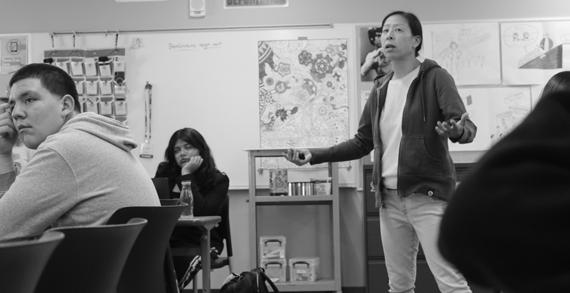
In the 2023-24 school year, FUHSD piloted the class as an elective with a cohort of around a dozen students per school, former Ethnic Studies teacher Andrea Yee said. Throughout the course’s initial pilot, Yee said it was tailored toward each school’s unique student body.
“It’s a course where students learn about themselves and the communities in which they reside,” Yee said. “The units are built around that larger goal, starting from the individual and spanning out. [The pilot teachers] worked together to create the curriculum, but we also took our students into account. I focused a lot more on local issues.”
By emphasizing a proj-
ect-based learning approach, Ethnic Studies helped students learn about themselves through direct investigation rather than memorization, former Ethnic Studies student, junior Kat Heller said.
“We would have this reflection journal, and it was based on the assignments we would do in the week,” Heller said. “But we would always connect what we learned in these projects back to our own identities and reflect on them, including [social assessments].”
Considering these positive
impacts, despite the halt at the district level, administrators are working with teachers across the district to convert the curriculum to a 12th grade level in accordance with state law and prepare for updates with the state mandate, Nurnberg said.
“There is a team of teachers who will be co-developing it, and the [ninth-grade] class was board approved,” Nurnberg said. “There are many comments and revisions that will be implemented to turn it into a 12thgrade course, but we haven’t gone through that as a district.”
Auditions begin for upcoming talent show
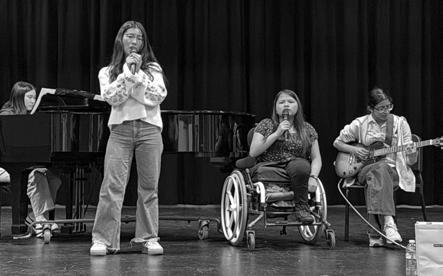
The drama department held in-person tryouts on March 4 for their upcoming event, Homestead’s Got Talent. The new event, taking place on April 5, will be a talent show featuring student-run productions, director, senior Archit Gunhal said.
The idea for the event stemmed from the drama club officers recognizing a shortage of school spirit, Gunhal said. Inspired to bring people together and spark conversation, he said the initiative came from a desire to be proactive in creating unity.
“HHS doesn’t have anything that unifies the school,” Gunhal said. “It’s often that one club does this thing, one club does this event, and they do it for their
members, but no one ever does anything for the entire school.”
From planning auditions to selecting judges to critically examine the performances, Gunhal said planning the event came with a need for prior preparation. However, Gunhal said he was glad to have the opportunity to immerse himself in the community.
“I love watching the auditions because you stay for a little bit after school, and you listen to good music being played, and you’re entertained by magic acts or whatever you see, like the band performance,” Gunhal said. “I wouldn’t have got that if I was sitting at home scrolling reels. This was a really good use of my time.”
In her last year of high school, performer, senior Revati Tambe said the talent show provided a great opportunity to try new things. Reflecting back on the experience, the talent show gave her and her friends a reason to come together to produce their
musical act while also spending valuable time with each other.
“I get to hang out with my friends, and I get to play music, which are two things I love doing, so combining them is even better,” Tambe said. “Going into the audition, we were nervous. But, then after, we were like, ‘Oh, wow, we just did that. That was kind of cool.’ It’s been a really fun experience overall.”
Volunteer judge, attendance specialist Bethany Salvador said she took a unique approach to judging the auditions, focusing on students who were having fun and exuding confidence rather than sticking to a strict evalua-
tion rubric.
“I’m always in my own little corner here, so I think it’s cool to interact with students and see what else you guys got going on at school,” Salvador said. “It’s helpful to get to know students, too, and see what they have going on. It’s really cool because I’m always seeing kids that are tardy or absent, but this was a time that kids could showcase their talents. I thought it was really nice.”
Microtransit aims to make trips easier for residents
Attempting to make public transport more accessible, a new public transit service will be introduced to Sunnyvale resi-
dents in September 2026, Sunnyvale mayor Larry Klein said. The new transit operates on an on-demand service known as the Sunnyvale Zero-Emission FirstMile Last-Mile Microtransit Project, or the Sunnyvale Microtransit Service, Klein said.

The service will have a oneway fare of $3.50 for adults and a discounted rate of $1.75 for students and seniors, Klein said. It operates from Monday to Friday from 7-9 p.m. and 9 a.m. to 5 p.m. on weekends, with riders having the ability to request a ride through an app on their phone or calling a number, Klein added.
“High school students weren’t
being well-serviced by VTA, and fixing that required convening a conversation among VTA, FUHSD, city staff and council members to come up with a solution,” Klein said. “Ultimately, the solution was mainly improved transit route regularity and increased availability of monthly passes for students.”
With the goal of making transportation easier for older people and students, the council held meetings with city staff and council members to ease traveling difficulty with the shuttle service, Sunnyvale council member, Linda Sell said.
“Students coming home from school activities in the evening, students who accidentally missed the bus and parents who are at work will be able to have mobility to get to school sooner rather than waiting for the next bus,” Sell said.
As a target audience for this new service, junior Sufee Kathane
Xue
Regional: Heat wave increases California fire risk
Average temperatures across California and other western states reached record highs from March 16-21 in a massive heat wave. They have since returned to normal, according to The Weather Channel.
Despite the gradual Bay Area cooldown, the impact of recent hot and dry weeks will likely extend to summer, according to Mercury News.
The heat has accelerated the drying of vegetation and raised fire risks, according to Mercury News. In response, regional authorities have issued heat advisories and public warnings to stay hydrated and remain indoors with air conditioning, according to NBC.
National: ICE deploys to major U.S. airports
Amid the partial government shutdown over funding conflicts for the Department of Homeland Security, TSA staff have worked without pay for over a month, with hundreds having quit thus far, according to BBC.
In response, White House border czar Tom Homan began dispatching hundreds of ICE agents to over a dozen major airports on March 23 to alleviate lengthening traveler wait times, according to BBC.
Being instructed to not wear masks, ICE is to provide general support in addition to standard law enforcement while trained TSA officers fulfill more specialized roles, according to Politico.
With senators from both parties holding their ground in the federal budgeting stalemate, signs point to the shutdown and airport situation persisting in the near future, according to AP News.
International: U.S. deploys additional troops to Middle East
With the Iran war progressing for over a month, president Donald Trump sent a 15-point peace proposal to Iran via Pakistan as an intermediary last week, which was rejected by Iran, according to NBC.
said that her commute to school is difficult because she lives on the boundary between districts, leading her to ask her parents to drive her or commute via bike.
“[The new service] is an affordable option for me to get around, not just to school, but also to other places where my parents can’t take me,” Kathane said.
The Sunnyvale Microtransit Service will be supplemental to the existing VTA bus routes, helping students when they miss the VTA bus, Klein said. He hopes the new service will benefit the people of Sunnyvale, Klein said.
“After the Council dropped my original proposal in 2023, I didn’t give up. I focused my efforts with the city manager to have Sunnyvale apply for potential grants to run a microtransit service,” Klein said. “I’m overjoyed that we received a grant from the State, and City Council finally approved the first five years of the Sunnyvale Microtransit service.”
Around the same time, the U.S. ordered over 2,000 Army paratroopers to deploy to the surrounding Middle East, adding to existing thousands of Marines sent to the region, according to NPR.
While Trump is currently focusing on diplomatic resolutions to the conflict, this military move sets the stage for a more aggressive potential alternative, according to NYT.

Volume 63 · Issue 6 · April 2, 2026
Editors-in-Chief
Parth Dhaulakhandi Alicia Liste
Web Editor-in-Chief
Amanda Boles
Print Managing Editor
Maya Dutt
News Editors
Danielle Feldsher
Ethan Xue
Opinion Editors
Sachin Chandran Adam Orrin
Lifestyles Editors
Annika Abraham
Aviv Matas
Alan Zhang
Arts & Culture Editors
Jason Lai
Malar Raguraman
Sports Editors
Olivia Levesque Ouellette
Selina Wang
Copy Editors
Ethan Xue
Alan Zhang
Photo-Illustration Editor Isabela Guilardi
Design Editors Maya Dutt Aviv Matas
Junior Design Editors
Ivy Guo Kaylin Yi
Multimedia Editors Isabela Guilardi
Aashka Nagarkar
Junior Multimedia Editor Yichen Yao
Social Media Editors
Sanjeet Jayaseelan Advay Ranade
Reporters
Natasha Bandil
Alexander Cao
Emma Chang
Krist Ferreria
Henry Hu
James Jiang
Elina Li
Saachi Nangare
Kanmani Raguraman
Julia Song
Ethan Tan
Chloe Wang
Catherine Yang
Adviser Natalie Owsley
Mission Statement
The Epitaph is a non-profit publication at Homestead High School, 21370 Homestead Rd., Cupertino, CA 95014.
The Epitaph is a designated forum for student expression and not subject to prior review, in accordance to Education Code 48907. The staff is comprised of HHS Journalism students. Views expressed do not necessarily represent views of the school, its staff or the district. Editorials are opinions of the editorial board.
The Epitaph welcomes letters to the editor but reserves the right to edit submissions. Letters should be limited to 300 words. Include contact information. Unsigned letters cannot be published, but names will be withheld upon request. Send via homestead.epitaph@gmail.com, or drop letters in the newsroom or the office mailbox.
If The Epitaph has made an error, please send corrections to homestead.epitaph@gmail.com.
The corrections will be published in the corrections box for the next issue.
To reach the Epitaph in C102, call (408) 522-2572.
Advertising
One email and you can reach over 2,400 students, teachers, administrators and community members from Northern Sunnyvale to Southern Los Altos. If your target market is between ages 14 to 18, contact The Epitaph at epitaph.ads@gmail.com, and we can make it happen.
Thank You to Our Donors & Supporters
FUHS Foundation
Homestead PTSA
As a way to address an increase in tardies since the end of the COVID-19 pandemic, HHS has implemented a tardy reduction campaign. Running from March 9-April 9, it aims to reward good attendance and discipline chronic lateness, principal Denae Nurnberg said.
Although an admirable effort, this new system is unnecessary and does not combat the root of the issue. For true reform, tardies must be completely overhauled and automated to remove the current subjectivity in the system.
Under the new tardy reduction campaign, one class from each department during each of the seven periods is randomly chosen at the start of two-week cycles. During this timeframe, all tardies in selected classes are met with morning detention, according to an email sent to HHS families on March 6.
This policy is too harsh and does not promote punctuality in a healthy way. One-time infractions should not be met with such drastic and unnecessary punishment.
Additionally, with the system operat ing on random selection, harm ful disparities are created in rules that should be fair and universal.
For example, if a rarely tardy student were in a selected class, they would be punished for an isolated incident of lateness. Meanwhile, chronically late students might slip through without re ceiving their fair share of discipline.
is up to teacher and dean discretion, as well. The teacher decides how to handle the first three tardies a student incurs, and after the fourth tardy, they will be referred to a dean, according to the HHS website’s attendance policy page.
This is a reasonably effective method to control tardiness, but only if it is well-enforced. Stemming from leniency or busyness, some teachers may not keep track of tardies or reprimand students by sending them to a dean, allowing those who are chronically late to cheat the system.
To address these inadequacies, administration should adopt a more equitable policy that handles student attendance objectively while lessening its
In this way, misdirected strictness creates an oversight that undermines the campaign’s core principles and pro motes frustration instead of growth.
Through the new campaign, class data is also evaluated every two weeks to determine which have seen the best or most improved attendance. Subse quently, winners from each depart ment will receive a pizza or donut party, according to an email sent to the HHS community on March 6.
This is meant to positively encour age students to be on time, but it is an unsustainable use of resources and proves to be insufficient for its purposes.
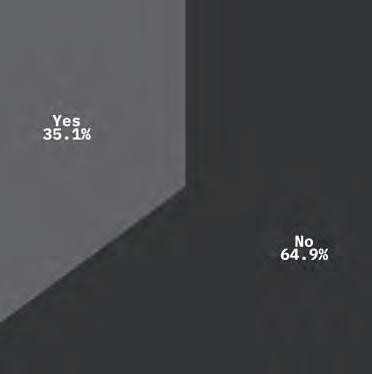
According to a survey The Epitaph conducted of 188 students, 64.9% said a pizza or donut party would not in centivize them to be less tardy.
Considering that the majority of the student body is unresponsive to this, the appeal of the tardy reduc tion campaign’s competition factor is nullified. Instead, it would be wis er to identify and correct the flawed tardy data collection system, which is the origin of the problem.
Currently, at the start of each class period, teachers are re quired to manually take atten dance, lending a subjective view to the tardy policy. Whether a stu dent who was a few minutes late is counted as tardy depends entirely on if their teacher chooses to be lenient with them.
The assigning of detention
them for the Minga attendance tracking feature.
Despite the initial financial investment, the long run benefits of this new attendance system would effectively compensate. Making barcode scanners available to every classroom would make a meaningful difference in attendance enforcement and efficiency.

The Minga system would expedite teacher routines and save class time for productivity. With timestamps on the barcode scans, this automation would remove subjectivity in attendance tracking, upholding standards strictly and consistently.
Ultimately, this past month’s tardy reduction campaign does not present a helpful enforcement tool. Instead, it acts more as an irrational, ineffi-

Plan of Action:
- HHS purchases additional barcode scanners so all classrooms have one
- Students file in before the start of class and scan their student IDs
(digital, card or paper)
- Scans link with Minga online browser to automatically update attendance, syncing with Infinite Campus user data
Enforcement:
- Teacher monitors to ensure one scan per student, so that there is no scanning on others’ behalf
- Standardized default: for every three tardies that Minga tracks, deans
will assign one detention - 10+ tardies results in dean intervention, including parent conference Margin of error:
- Students on-time but delayed by scanning line can request correction from teacher
Advantages:
- This system removes subjectivity in tardy classification by different teachers, establishing equitable and attainable guidelines
- Streamlined digital process efficiently and automatically logs attendance, making use of common resources like a barcode scanner, while saving time for teachers
Whether at school, work or home, many people have been victims and perpetrators of one of the most frustrating and annoying trends: ragebait.
To avoid its pitfalls, students must learn to distinguish the fine line between harmless joking and direct bullying.
Ragebait is a media term used to generally describe annoying acts such as teasing, sarcastic statements and inconveniences that serve to mildly provoke another person. Bullying, on the other hand, stems from wanting to deliberately harm another person through words or actions.
Although ragebait has benefits, such as emphasizing patience and endurance in frustrating moments, it can take a toll on the person on the receiving end.
In my experience, ragebait often turns into personal attacks like rude comments on someone’s appearance or downplaying a traumatic or upsetting experience.
These insults are damaging, and cannot be masked under the the umbrella term of rage bait. This can seriously af fect people’s perception of themselves, damaging confidence and mental health over time.
It is vital to understand that not everyone will react the same way, especially in a pub lic environment. Joking around with mildly rude language can be
acceptable when done in a close circle of friends, but there must be greater emotional awareness when people make these comments.
While rude humor is prominent in today’s society and plays a key role in ragebaiting, we must revisit the basic concept of boundaries to find the balance between humor and responsibility.
For ragebait to not be categorized as bullying, perpetrators must start by exercising a basic understanding of social awareness.
Those who look to add humor to a conversation through ragebait must be mindful of how a comment or action is received, depending on the setting and individual.
This can manifest by taking reactions into account and reading the tone of the room. Awareness and accountability are important, and ragebait becomes toxic when it is not monitored.
Fun comments should not warp into harmful rhetoric, which is why students must consider the potential consequences of ragebait.

Krist Ferreria
The United States and Israel conducted an attack on Iran that killed Ayatollah Ali Khamenei, citing them as a nuclear threat on Feb. 28, according to NBC. Since then, nearly 2000 Iranians across the country have died due to subsequent strikes, as bombs hit places like homes and medical facilities, according to Aljazeera.
Even as civilians are affected by high gas prices, president Donald Trump and Israeli prime minister Benjamin Netanyahu have insisted that the attacks are for a good cause. It is disappointing to see the U.S. and Israeli gov ernments mocking the severity of the war, and the public must recognize these wrongdoings.
Posts made by the official White House account on X have degraded the lives of those lost in the war with video game and movie clips remixed into videos of real strikes, according to The Guardian.
Additionally, the military campaign, which aims to assert control over Iran, is named “Op eration Epic Fury,” according to the White House. This illumi nates the unseriousness of the American government and how the U.S’s global reputation has fallen drastically in the past cou ple of years.
From the outside looking in, posts about the war from our government may seem like a vi-
Student evaluations must be made mandatory
Kaylin Yi
Amid daily chatter from my peers, one topic stands prominent: teachers. Praises, funny moments, new projects and most importantly, performance feedback that will never reach the teacher themselves.
Multiple times since entering high school, I have felt confused due to ambiguous teaching styles or because I did not un
derstand the reasoning behind a project. I felt unable to approach my teachers with these problems, fearing it would end unfavorably on my end, so I kept quiet.
In conferring with my peers, it seems I am not alone in this feeling. Several of my classmates have expressed their dissatisfaction regarding unhelpful teaching methods and classroom structure in some of their courses.
For the benefit of students’ education, HHS must intervene by standardizing opportunities for students to clearly commu-

able way to get updates about the war. However, these videos poke fun at the misery of thousands, only serving to desensitize the public to atrocities.
While Trump has stated the war will end soon, Israel has contradicted that by emphasizing the conflict is far from over, according to Aljazeera. As a result of Israel’s statements, Trump declared the operation would continue, according to Fox News.
This shows that our government is unreliable, further proving they are not confident in the war. Americans need to realize these inconsistencies as officials continue to spit out confusing or even inaccurate statements to the public.
should draw their own conclusion and educate themselves on the war using different sources and independent news rather than from the government. Current updates on social media exemplify extreme immaturity, which reflects the administration’s lack of care for those affected by the war.
The American public must empathize with the victims of these strikes and reflect on real events, rather than openly accepting information prompted by sensational posts from unreliable sources. If the public takes initiative to inform themselves about the war, our leaders’ unserious jokes will be rightfully condemned.

school system is ineffective. The lack of standardization renders this method ineffective, there are no mandatory reflections or scheduled check-ins.
In fact, the current method could discourage students from sharing issues they have for fear of unfair retaliatory treatment. Though they are not at fault, educators are left in the dark about possible improvements they can make in their teaching.
The school should take charge in leading the effort of self-reflection in order to mediate this pressing issue.
To correct the lack of communication between students and teachers, HHS must implement mandatory and quarterly evaluation forms that both teachers and administration would have access to.
For these reflections, students would fill out anonymous feedback forms to critique their teachers’ performances and give helpful comments on what to improve.
A direct pipeline for students to express their concerns or praises for teachers would greatly improve the school system. By allowing students to be more involved in their education, the classroom would become an environment where all voices are heard.
It is unreasonable to expect teachers to keep track of exactly how well every student is performing in their classes, so evaluations must be standardized to help teachers moniter and adjust to student struggles and complaints.
Congress turns the page on reading
New bill requires expansion, higher budget
COLUMN—Ordering food from a restaurant, filing taxes and understanding this very article. Although these may seem like disconnected tasks, they all require a fundamental skill: reading.
Even though it requires further development, the Science of Reading Act that recently passed through the committee on Education and the Workforce will streamline teaching and address current disadvantages that inhibit students’ ability to learn this essential skill.
The act aims to institute a philosophy that requires students to make phonetic connections between sounds and letters, according to K-12 Dive.
This format provides students with an innate understanding of how language works, both verbally and in writing, further enhancing the bill’s effectiveness.
Additionally, the bill dis courages methods proven to be detrimental. An example is the three-cueing system, which forces students to identi fy words from visual elements, according to Congress.
Unfortunately, the current strategy forces students to guess or use context clues to de rive words, so they do not form
the same connections as they would with the Science of Reading. Therefore, the revamped format is a greater system for students.
However, students in need must still be allocated resources for personalized instruction.
A potential solution that has been considered is the allocation of funds to support reading tutors and diagnostic testing for underperforming districts, according to the U.S. House Appropriations Committee.
As this bill reaches the House floor, legislators must take advantage of its current bipartisan backing to add on these funding increases for underperforming schools.
Moreover, future legislation must be created to standardize the Science of Reading formula across the nation, as it will bring about greater advancements in students’ reading abilities.
Prioritization of child literacy must not end here, so Congress must continue their forward momentum and pave the way to a nation where every student can follow the path of their reading journey.
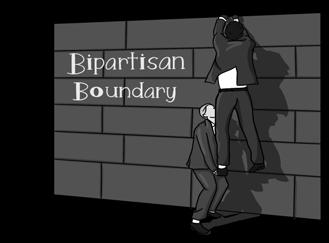
New rideshare service increases inequality, disparity in the city
In one corner of Sunnyvale, a high school student can tap an app at 5 p.m. and get a private, cityfunded ride home for free. But, starting in September 2026, just a few miles south, another teen will have to pay money for a shared shuttle for a trip of the same length.
Within the borders of one Silicon Valley city, the city-funded rideshare system can mean either a free, on-demand ride or a paid, shared shuttle, with the difference coming down to a home address.
This divide began with the City of Sunnyvale’s decision in Feb. 2025 to launch Peery Park Rides, a two-year pilot, city-subsidized rideshare program This program serves as an on-demand service that provides rides free of charge to those ages 13 and up, according to the City of Sunnyvale.
However, this rideshare system only services northeastern Sunnyvale, with no public plan to expand the much needed service to the remainder of Sunnyvale’s constituents.
On Feb. 24, 2026, the Sunnyvale City Council approved plans for a citywide microtransit program, including a rideshare shuttle service where people living in Sunnyvale can call a ride to and from any location inside city bounds, according to the Sunnyvale CA Legistar.
However, the new microtransit program is distinct from Peery Park Rides because, instead of being a free-of-cost rideshare service, you must pay a fee for yourself and extra based on the number of people accompanying you.
The key issue with this is it creates a two-tiered system inside the City of Sunnyvale. By making constituents pay for the shuttle service, the city creates a disparity
between those from northeastern side and the rest of the city.
To rectify this problem, the City of Sunnyvale must revise its city-subsidized transportation programs by shutting down plans for the new shuttle service and expanding Peery Park Rides’ free rideshare services across the city.
This would allow for the entire city to receive city-subsidized transportation systems free of cost that are not only reliable but also private, similar to Uber or Lyft.
Shutting down Peery Park Rides and expanding the microtransit program also prevents the two-tier system.
If Peery Park Rides is expanded, the city provides free rides to all constituents, ensuring all residents are treated fairly. However, if the City of Sunnyvale continues with the plans for their new paid, shared shuttle service, they must address whether or not they plan to expand Peery Park Rides.
By expanding Peery Park Rides' free rideshare to the entire city, whether by allocating funds that would be used on the microtransit plan or through alternative sources of funding, Sunnyvale can guarantee all constituents an equal opportunity transit system.
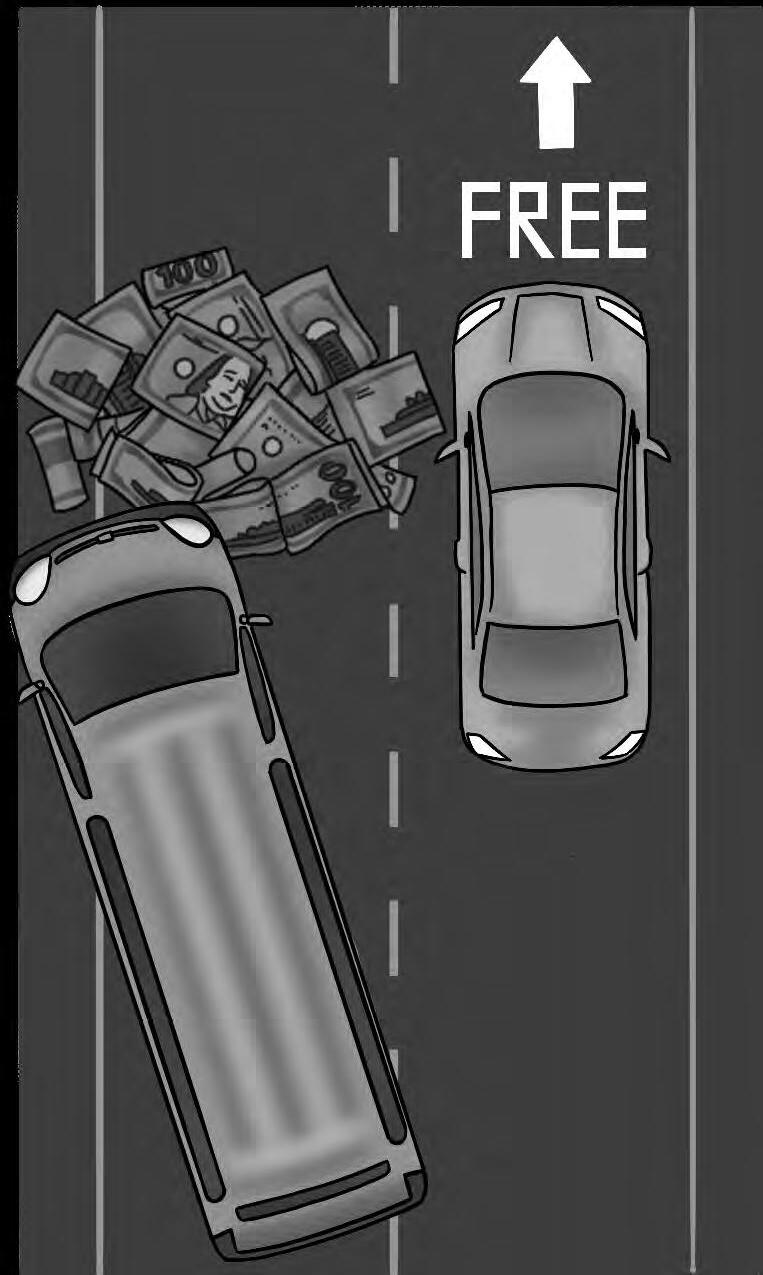
increases access to healthcare
Lai
As healthcare cuts from the Trump administration leave families struggling to receive care, the Service Employees International Union-United Healthcare Workers West and other economic scholars proposed the 2026 Billionaire Tax Act.
This proposed initiative imposes a 5% one-time wealth tax on California billionaires and needs support to qualify for the November ballot, according to the ITEP.
To help everyday Californians who deserve access to healthcare, the 2026 Billionaire Tax Act must be passed.
As California has lost $100 billion due to federal cuts, this act would allow California to regain that money, putting 90% in healthcare funds and the other 10% into education and food assistance programs. Fortunately, this can stabilize insurance coverage and ensure healthcare services are staffed, allowing families to get the care they need and
deserve, according to the LAO.
Additionally, this act would make sure billionaires pay a more equitable amount in taxes.
The initiative contains many provisions that make it difficult to escape the taxes, allowing the billionaires to actually contribute to the common good, according to the ITEP.
Furthermore, the 5% tax is small compared to the overall wealth of those affected. Billionaires’ wealth usually appreciates at a greater rate, so these charges would be minuscule, according to the Econometrics Laboratory at UC Berkeley.
This act has its critics, such as Governor Gavin Newsom, who say this would cause the rich to leave California to avoid taxes.
However, since it taxes billionaire residents who resided in California as of Jan. 1, they cannot avoid the tax. Furthermore, it is unlikely that they would leave the state with the largest economy and where key industries, like
the technology sector, dominate. Unfortunately, this initiative would need to fight many legal battles in the California Constitution to be passed. This leaves its fate uncertain and in dire need of the public’s support.
To help create amendments in the California Constitution, we must support interest groups and labor unions such as SEIUUHW, that fight in the courts.
Furthermore, donating to organizations such as the Billionaire Tax Now increases the likelihood of this act being passed.
Ultimately, the minute taxation of 200 individuals would

Every Jewish athlete is told the story of the legendary Dodgers baseball player Sandy Koufax, who, in his devotion to his faith, skipped Game 1 of the World Series to observe Yom Kippur.
Although most high school sporting events are not at the level of the World Series, students of all religions are constantly left with the uncomfortable choice between faith and athletics.
To support equality in sports, HHS should advocate for changes to league rules that restrict or ban games and tryouts from occurring on major holidays.
Having played water polo for four years, I have missed numerous games to observe my faith. Unfortunately, missing games for religious purposes has left me feeling guilty for abandoning my team when I could have made a meaningful impact.
This problem is not limited to
any one religious group. Many students miss games to celebrate a wide variety of holidays, such as Eid and Diwali.
Coaches are given the power to reschedule games around holidays or request the dates be changed for religious holidays. In the past, the school has requested that the football game traditionally held on the Friday of Rosh Hashanah be played on a Thursday, athletic director Chris Grossman said.
Since coaches can request to change the dates of games, standardizing these changes allows for an equal opportunity system that protects athletes regardless of the coaching staff.
While the sports leagues HHS currently competes in do not directly restrict sporting events or tryouts from occurring on major holidays, it is possible if voted into the bylaws by athletic directors and approved by principals, Grossman said. By expanding protections for religious students and using the models they have already creat-
It’s time to officially refresh the phone policy
Phone policy requires greater consistency
I sit in the back of my class work ing diligently on the day’s assign ment. Beside me, my peers endlessly scroll Tiktok or are immersed in an intense video game, with an empty phone caddy dangling on the wall by a single push pin.
While the phone policy instat ed this year is a large step in the right direction, it is not effective in promoting healthy habits. Through more consistent implementation of phone restrictions, HHS can bet ter support its students in the fight against distractions.
The phone policy began in accordance with Assembly Bill 3216, which required schools to restrict or ban phone usage to improve stu dents’ mental health and academic

openly scroll Instagram mid-lec-
An experimental educational psychology study found that in classrooms, students who were given access to phones performed worse in their final exams in comparison to students who did not have their phones with them, ac-
To bolster enforcement, administration should check for phone caddies being used when they do their usual check-ins with classes. This method will increase accountability by standardizing classroom dynamics across the school, which will
ed to change game schedules, students can feel secure in their faith while championing their school on the field.
Making athletes choose between their culture and their passion creates a toxic environment. The league’s athletic directors and principals need to make bylaw changes that allow students to hit home runs without being struck out by faith.

make real changes to the phone culture on campus.
If the systems meant to break addiction and support student mental health are not implemented fully, then they will fail to achieve their goal.
One way teachers have been able to make students consistently use the phone caddies is by taking attendance with it. This system works because it clearly lays out the consequences for using your phone from the caddy while also integrating it with Apiece of students’ schooling.
Personally, I am much more likely to put my phone in the caddy when I know that I will be marked absent otherwise.
Phones will always be a part of students’ lives. To mitigate distractions, HHS must make sure the phone policy is implemented consistently in every classroom.
Students, staff discuss process behind class dances, competition
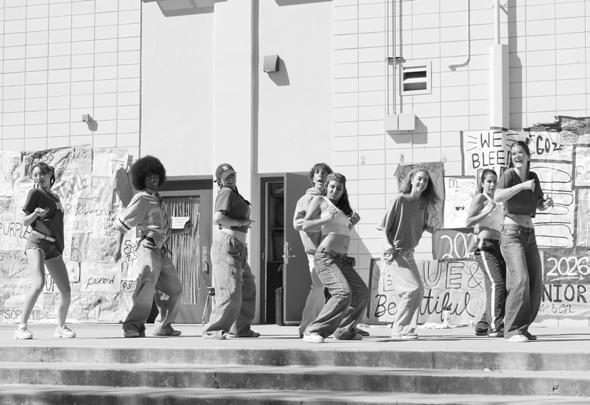
Amid energetic music and passionate cheers, performers took to the quad stage during the Battle of the Classes dance performances from March 9 to 13, ASB adviser Hector Almendarez said.
To lead each class’s performance, ASB selected dance captains through an application process, Almendarez said. Applicants were assessed based on their experience and ability, with captain responsibilities including choreographing the routine, planning formations and scheduling practices for dancers.
Although captains must apply for their position, any student can sign up to participate in their class’s dance, Almendarez added.
While creating the senior dance, captain Justine Skov said
the choreography process ran smoothly due to the dancers’ enthusiastic dedication.
“The group of people we ended up with was just a blast,” Skov said. “They were great, and everybody showed up ready to learn. It was really good, and we were super efficient. We would finish everything within an hour and a half, and then we just had the rest of our rehearsals to practice and go over anything.”
Having danced for eight years, freshman dance captain Peggy Wang said she was inspired to create a hype, hip-hop dance as a dance captain. The competition allowed her to use previous dance knowledge to help teach and work with her friends.
“I feel like all of us bonded the first time we were [dancing] together,” Wang said. “My inspiration for the dance came from a previous choreography session of my own dance [outside of school]. I also added a bit of choreography
Crochet club hosts multi-day event with the Wellness Center
Ivy Guo and Yichen Yao
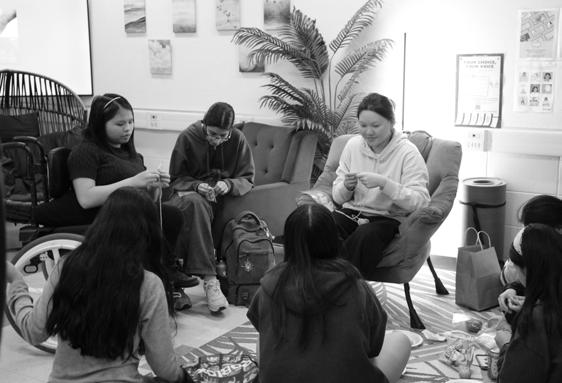
Bright yarn and quiet focus brought students together as the crochet club held educational workshops and socials in the Meadow from March 17 to March 20, crochet club president, senior Jessa Yang said.
Students chose from three kits that provided all the materials needed to make a crochet piece resembling cherries, ice cream or a donut, Yang said. As the event spanned multiple days, students were left with enough time to finish their crochet piece while socializing with others.
Other than expressing their creativity, Yang said the crochet club specifically decided to collaborate with the Meadow to promote how stress-relieving crocheting can also be.
“Ater every test I take, I always crochet, and it just helps me to really calm down,” Yang said. “It’s a very rhythmic movement, and once you know how to do a few stitches, you could really make anything.”
Recognizing the popularity of crochet amongst her peers, junior Maya Yatziv said she came to the event to support her friends, who
are crochet club officers.
“I really enjoy how [the event] seems very community-based,” Yatziv said. “I’m pretty sure most of the people here are meeting for the first time, and yet there’s a communal aura around it that I enjoy participating in.”
A casual crocheter, freshman Anna Lu said the event incorporated students of all skill levels, helping members feel more comfortable regardless of their previous experience.
“What they have going here is really nice. I love how they have a little guiding group over there to teach them how to crochet,” Lu said. “It’s also good for intermediate or advanced crocheters to find their people.”
With this event featuring a larger turnout than originally expected, activities director, junior Sion Lee said she hopes to continue hosting similar events in the future to make crocheting more approachable for all students.
“I hope to spread this hobby around a little bit more, because I feel like crocheting has a bit of a learning curve, but once you get to learn it, you can find communities or groups that are also interested in this hobby,” Lee said. “It’s a great way to reduce stress and connect with other people.”
from a dance I learned from my dance teachers.”
Although the choreographing process was an enjoyable learning experience, Wang said scheduling times with others was difficult, resulting in only two practices before their performances.
“Everyone has such different styles, so the dance didn’t look clean at the beginning,” Wang said. “We had to talk about [refining our movements] and facials to make it better.”
Additionally, during the freshmen dance team performance, ASB ran into technical difficulties with the music, Almendarez said. The dancers skillfully persevered through their routine nonetheless, Almendarez added.
“I thought [the dances] were really great, [considering] some of the hiccups with the audio files that we received,” Almendarez said. “We did our best on our end to try to make it happen and keep going. But overall, I thought it was
great that the creativity was good amongst all of the classes.”
Following an anonymous vote by staff members, the senior class dancers were selected as the competition winners and performed the same routine at the
BOTC rally on March 13, Skov said. “It was a fun, new experience for sure,” Skov said. “[The win] was unexpected, if I’m being honest, but it felt so good to be able to win as a senior and for the overall class.”
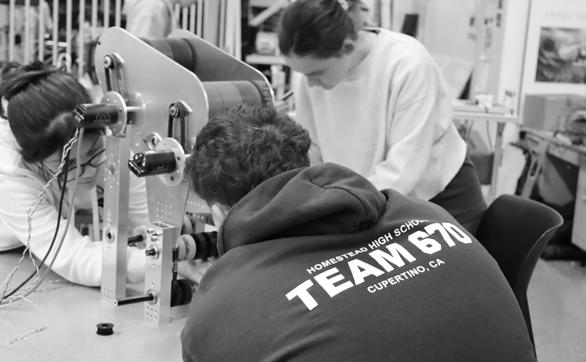
Under the glare of gymnasium lights, students in matching T-shirts watched robots come to life at the Half Moon Bay District For Inspiration and Recognition of Science and Technology, or FIRST, competition on March 7.
The team placed 16th out of 26 teams during the event, which was their first competition of the season, lead driver, junior Nikhil Anoop said. While the tournament’s outcome was a disappointment, the experience highlighted areas for improvement and exposed new members to the atmosphere of a competition, Anoop said.
To gain points and rise in the rankings at the competition, robots were required to score during matches by shooting balls directly into funnels around the game area, tech lead, sophomore Aarush Joglekar said.
Though the team had initially felt confident about their robot’s abilities, they encountered unexpected issues during the rounds, fabrication lead, senior Gus Bar said.
“We tried to intake these foam balls, and we wanted to take as many as we could, and then we’d be able to shoot them from that,” Bar said. “The intake mechanisms were not working, so we weren’t able to actually get the foam balls and shoot them to score points, which was obviously a problem.”
After returning from the competition, the officer team decided to build an entirely new robot from scratch, vice president of competitions, junior Sree Vemuri said.
“A few other people and I spent a full 30 hours over the long weekend to get the robot done and do other polishing within a couple days,” Vemuri said. “Our largest issues were that our intake had far too much compression, so we
weren’t able to intake foam balls remotely fast enough, so that was the first big change [we made] with the new robot. Then, we optimized our drive base. The full drive base used to be a square. Due to the length of our shooter, we lost so much of that space. In the end, we swapped it for a more reasonable drive base size.”
While piloting the new robot at the California District Sacramento Qualifying Event from March 21 to 22, the team experienced a remarkable jump in their performance from their previous competition, Vemuri said.
“We placed second out of 40 teams, and we almost made it to the semi-finals and were set to be finalists as the captains of the Second Alliance, but we got dis-
qualified due to a red card,” Vemuri said. “The momentum that we got from proving to ourselves that we could do so much gives us motivation to actually do another rebuild for our upcoming district championship competition.”
Having improved from their setbacks in Half Moon Bay, the team has now set their sights on conquering the FIRST District Championship from April 10 to 12, Vemuri said.
“The success we had at Sacramento was great, but I think the main benefit to this was just the momentum that we built as a team,” Vemuri said. “Our current build was competitive for this event, but for the district championship, we need to improve from there.”

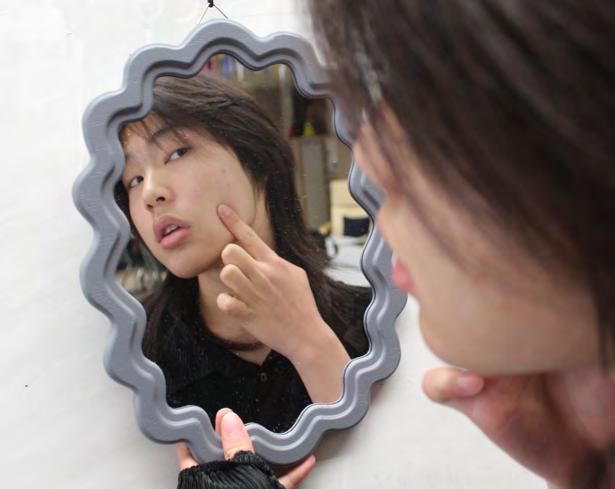
“Alot ofAsians wear a lot of sunscreen to try to prevent being tanned. I thinkAmericans are more inclined towards natural tones. For example, I think looking tan is is more appreciated inAmerica.”



Beauty standards affect teen mental health
While attempting to develop their identities as young adults, teenagers are often pressured into fitting into a specific, ideal form of beauty, school therapist Sarah Loyd said.
“When I was in high school, magazines were how we got our beauty standards,” Loyd said. “Because we’re constantly putting the best pictures of ourselves online and with filters, it changes the landscape of everything, and what ‘perfect’ should be is always in your face.”
While most teenagers recognize how easily social media content can be falsified, they remain at risk of developing unrealistic expectations, senior Scarlett Ozturk said.
“Beauty standards that are pushed onto young girls are similar to those that are heavily sexualized,” Ozturk said. “For young men
as well, heavily sexualized beauty standards, Pornhub and things like that have distorted both young men and women’s perception of what real people are supposed to look, act and feel like. I think that none of it is real. It’s really important to close the screen and seek something different.”
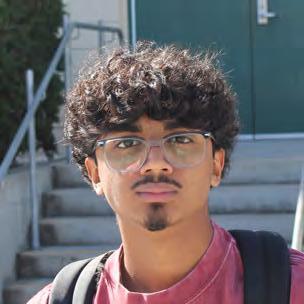
In addition to differences between genders, beauty standards can also negatively impact perceptions of beauty within certain races, junior Berwen Xu said. Beauty standards are often Eurocentric and can cause people to vilify ethnic features, Xu added.
“I had a friend who was doing my makeup, and he was like, ‘You have lashes but they’re swallowed by your monolids.’ A lot of makeup beauty standards are Eastern European or European which I just think is unfair,” Xu said. “ But I feel like I’m very hypocritical. Even though I disagree with beauty standards, I still will fall into them, because there will always be a beauty standard.”
Angst over one’s physical appearance often extends toward one’s sense of fundamental self-
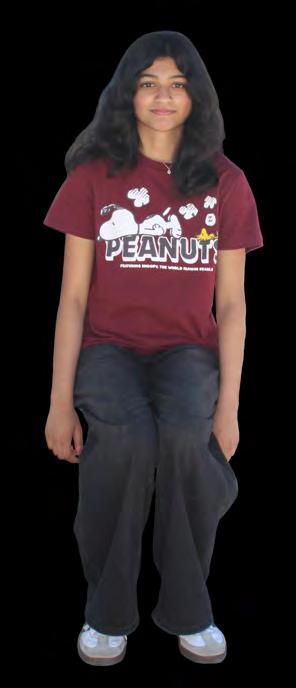
“[In India what’s valued is having big eyes and lots of hair because [thick] hair is a sign of beauty. Some cultures like straight, thin hair.”
- Mishti Doshi (10)
worth, senior Archit Gunhal said.
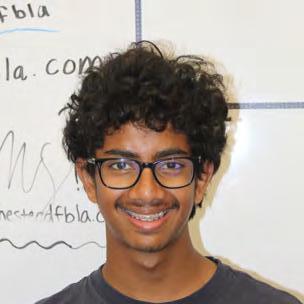
“If you impart too much weight to everything people think about you, it definitely detrimentally affects your mental health, because your whole life revolves around getting the approval of others,” Gunhal said. “[When] you don’t have that validation, you start spiraling. It’s like, ‘Oh my god, the world hates me. Everyone hates me. I’m such a failure,’ even though your inner self-worth should not be determined by these outside factors.”
Reflecting on feminine beauty culture, Ozturk said she tries not to let negative thoughts about her appearance dominate her mind.
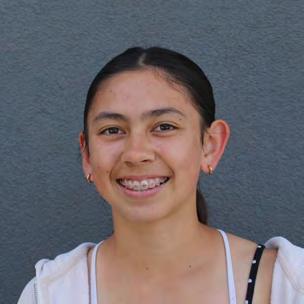
“I don’t feel it’s worth living so much of my life and wasting so much of my energy on something that doesn’t really matter,” Ozturk said. “There are days where you feel beautiful, and there are days where you don’t. Everybody feels like that.”
Constant exposure to unattainable beauty standards, especially through social media, can lower teens’ confidence, potentially leading to disordered eating or over-exercising, Loyd said.
“In the end, it comes down to self-esteem and recognizing what about ourselves we like and what we think is beautiful,” Loyd said. “When those [bad] days start to outweigh the good days, that’s when we have to really look and [say], ‘Okay, what’s really going on?’”
Although feelings of inadequacy seem inherent to the teenager experience, they must not fully define it, Ozturk said.
“From my own personal experience, I’ve always felt like there was at least one thing that I didn’t like about myself, and I know many people feel the same way,” Ozturk said. “But, I also think it’s important to talk about it. I don’t think that there’s anything shameful in feeling like you don’t align with something that you wish to align with, and that doesn’t mean that you’re not inherently beautiful or attractive.”

Instagramfeeds,beautystandsasoneofsociety’smostcovetedtraits. experienceswithphysicalattractiveness.
an international trip as students culture-specific beauty standards
Mexico
“I would say that there’s a larger appeal for fatness [in Mexico].Women can be chubbier. Obesity, sometimes, is an indicator of fertility [and] also the ability to eat a lot.Also, because of the high obesity rates in Mexico.”
-MarcelValdez (11)


Mustangs sharetheiropinions onbeautystandards
The Epitaph spoke with model, sophomore Tiare Staats about her experiences with photo shoots and channeling her creative side.
The Epitaph: What was your biggest source of inspiration entering the modeling industry?
Tiare Staats: The biggest factor that has inspired me is the fashion industry. When I was in elementary school, I started getting into fashion, but I was mostly just playing dress up. As I got older, I started getting more into media and Pinterest especially. From there, [I got into] more designers, big names and stuff. It’s another way for me to express my creativity. My family is full of artists, my aunt is a graphic designer, my sisters do art, my parents used to do art when they were younger, too, so just being surrounded by a lot of creative individuals inspired me a lot when I got into modeling.
which is also not something that I would have done by myself, but I think it’s good, too, because it pushes me out of my comfort zone and forces me to do things I normally wouldn’t have done. That forces me to grow as a person and also not be so attached to myself in this physical sense.
TE: What do you enjoy about modeling?
TS: My favorite part of modeling so far has been meeting new people, especially creatives, because being surrounded by people with so many amazing ideas has really helped me come up with my own ideas and has inspired me in pretty much all aspects of my life. I’ve met other models, photographers, makeup artists, hairstylists, stylists, influencers and creative directors, the creative energy behind the entire photo shoot.
TE: What do most modeling organizations expect from models?
you believe in pretty privilege?
you do to feel beautiful?
“Confidence is a big part of self love, because what you like, wear what you like, you like you want to [then] it doesn’t what other people think.”
- Subham Sengupta (10)
“I try wearing something I like and doing my hair nicely. When I do, I just feel more confident with myself all day.”
- Sarah Power (9)
TE: What does a typical day for a model look like?
TS: I wake up [at] about 6 a.m. or 7 a.m., and I drive to the photo shoot. It’s usually in San Francisco or Oakland, and they range from three hours to up to six hours. I’ll stay for however long the shoot is, and then I’ll usually go somewhere [for food] with my mom afterwards. It doesn’t take very much preparation, to be honest, because you’re supposed to show up with a bare face. You can’t wear makeup or have any hair products, so just roll out of bed and get to the photo shoot.
TE: How do you manage your time being both a student and a model?
TS: There have been times that I had to sacrifice a day of school to get to a shoot, especially when you’re working with an art college. All their stuff happens over weekdays. If you have a shoot on the weekend, you need to plan out your time so that you can get all your homework and extracurricular stuff [done] before you get to the shoot, so you can be completely focused on that and not have to cram everything once you get back. If anything, it’s probably helped me. It’s not really distracting, not something that I really think about when I’m having my classes or doing work, but it’s something that I can write about.
TE: What are some challenges you have encountered while modeling?
TS: There’s been times that I didn’t want to do something. When I was 14, they wanted me to dye my hair a little lighter [which] I wasn’t too happy with, but I was okay with it. Now I have to cut my hair shorter,
TS: My specific organization [is] very lenient compared to other agencies. Part of the reason is my age, because they don’t want to push too much onto me at such a young age. Beauty standards and modeling is obviously full of expectations and standards [and] if you push that onto someone at a really young age, it can unfold really badly. [During photo shoots], they decide how your hair looks, if you have to dye it or cut it, it’s pretty much all in their control. They will give you goals, and they’ll set a certain goal for a certain show or photo shoot you have.
TE: What do you currently think of modeling, and how do you hope it improves in the future?
TS: I don’t think it’s a really sustainable career to follow, so I’ll probably focus on it a little more in college when I have time, but I don’t think it’s ever going to become a full-time career. If I had enough resources and stuff to make it a sustainable career, I would enjoy doing that for a living. In recent years, there’s been more plus-size models and different ethnicities entering the mix. It depends on the trends happening at that moment, but hopefully, it does continue getting more inclusive.
Editors’ note: Staat’s responses have been edited for brevity.

Danielle Feldsher and Kanmani Raguraman
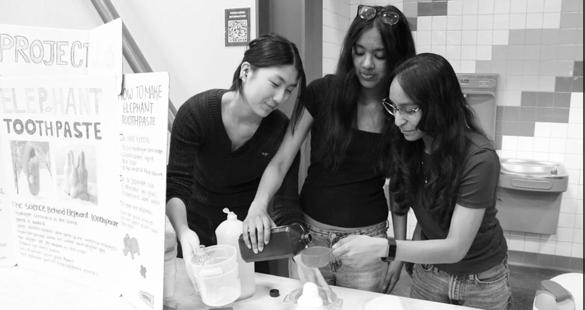
With activities ranging from gooey slime-making to crafting dish soap rainbows, the cafeteria filled with local elementary and middle school students during the annual STEM night on March 6.
The event, organized by Sci ence National Honor Society, brought clubs to spark kids’ cu riosity about STEM through a creative, hands-on approach, children’s president, senior Nora Steel said.
Expanding upon previous years, Steel said the event fea tured clubs from diverse back grounds who offered unconven tional perspectives on STEM, such as the Tri-M Music Honor Society.
“They were able to talk about the physics and the biology [be hind] how it sounds in music,” Steel said.
In accordance with this year’s theme of sustainability, the caf eteria was embellished with na ture-themed decorations such as paper-mache globes, sophomore Arulviyabini Rajesh said.
While the club initially consid ered “KPop Demon Hunters” as a theme after seeing its popularity at elementary schools, they ulti mately prioritized environmental awareness in their final decision, Rajesh said.

Students recommend, discuss features



“It’s really practical and basic. It works really well, and it fits all my friends. I like the seating. It has a really big trunk, and I put a bean bag in there. put five water bottles in my seat. It’s really nice. The aux also makes it convenient because anybody’s phone can play music, and it’s easy to use.”
For the past seven years, Semele Heller has worked behind the scenes to support the Mustang community, from organizing uniforms for marching band members to volunteering at the Grad Night Party.
Amid her contributions, Semele Heller said she has recently taken a step back to focus on recovery after a cancer diagnosis.
As a stay-at-home mother of three, Heller said volunteering feels like a natural extension of her parenting. Heller is heavily involved in marching band, which her two older sons were part of, PTSA, and most other opportunities she is presented with.
“Being able to volunteer is a way that I can contribute that works well for my family and me,” Heller said. “Without parent volunteers, it would be very hard for many of these groups to function. I feel like I should volunteer because I’m able to, and I really e
joy it.”
While interacting directly with campus programs, Heller said she cherishes the opportunity to serve as a trusted adult to the student body.
“The students that I first got to know when my oldest was a freshman have now graduated from college, and they’ve moved on to careers and graduate school,” Heller said.
“It’s really gratifying to see how they’re doing and watch them become adults.”
Heller’s daughter, junior Kat Heller, said her mom has become a familiar presence for many on campus.
“She’s always been

really supportive in what me and my brothers want to do, and it makes me happy to know that she is extending that to other kids,” Kat said. “I thought it was really sweet and cool because she was going above and beyond for my brothers and their band community.”
Marching band member, soph-
omore Samuel Chiutena said Heller has become someone he could turn to for support and communication when facing challenges, especially during his first year with the band.
“[Heller] has had a huge impact on the band members, especially the ones in marching band.

Personally, I feel like she’s a second mom to me,” Chiutena said.
Following a Stage 1 esophageal cancer diagnosis and a major surgery on Feb. 10, Heller said receiving support from the Mustang community has helped her throughout the recovery process.
“I’ve had students say, ‘Hey, can I do anything for you?’ One stu-
dent was like, ‘Hey, my mom is an anesthesiologist, and if you have any questions, I’ll put you in touch with her,’” Heller said. “Just knowing that people are thinking about us and wanting to support us makes a difficult time easier for my family and me.”
Heller’s absence from volunteering has not only affected students close to her but the marching band as a whole, Chiutena said.
“She really took everyone under her wing,” Chiutena said. “For her, receiving letters from 200 kids shows how much she’s impacted everyone in the marching band. Some of us wrote about how we hope she’s feeling and how much we appreciate everything she has done for us.”
Throughout her years of volunteering, Heller said her favorite memories stem from the impact she has made for the larger school community with her efforts.
“It means a lot to be able to share those moments with them,” Heller said. “Watching students do what they’re passionate about and seeing them grow into who they become is incredibly special.”