







Winter formal faces a troublesome fate 5 Not every struggle is a major disorder 7
Teachers balance extracurricular activities 12
‘Marty Supreme’: a smash hit or dink shot 14
Referees are major players in sports
Winter formal faces a troublesome fate 5 Not every struggle is a major disorder 7
Teachers balance extracurricular activities 12
‘Marty Supreme’: a smash hit or dink shot 14
Referees are major players in sports
hhsepitaph.com
District holds meetings with teachers, updates classroom instruction strategies
In response to the district’s decline in English learner progress on the California dashboard assessment published, 2025 English Language Development classes are being reworked to include more practice for the English Language Proficiency Assessments for California language test.
Although these indicators are not always reliable and vary between years, coordinator of curriculum and teacher leadership Welton Kwong said the district is working with a Santa Clara County Office of Education representative to improve ELD teaching strategies.
“We’ve put much emphasis on supporting teachers and providing professional development so teachers can implement instructional strategies that directly help students develop in the four language domains, [listening, speaking, reading and writing],” Kwong said.
These strategies also help students prepare for the ELPAC test, one of the primary means of measuring EL growth, Kwong said. Hence, improving students’ test scores is a core focus of the district’s strategy to improve the ELD program.
One aspect of growth is instilling the academic value of the ELPAC test as a representation of EL learner accomplishment, Kwong said.
“We want to emphasize the purpose of this test because some students don’t even know why they’re asked to take this test,” Kwong said. “Hopefully, it will [be taken] seriously because it’s meant for them to show that they’re learning English and improving each year.”
Additionally, some ELD teachers have volunteered to participate in a Stanford study that allows them to use an app called FLOW Speak, Kwong said.
“The idea is that there are lessons for students to practice,” Kwong said. “It would say, ‘Here’s a tip to improve your pronunciation,’ for example, so it’s like instant feedback.”
Having implemented the app in his class,
ELD teacher Adrian Buenrostro said he can monitor his students’ progress efficiently and accurately, especially since it provides detailed information on their learning stages.
“We have recognized that one area of improvement for us has been speaking,” Buenrostro said. “The app has different lessons every week that allow students to improve their speaking abilities and skills. As a teacher, I’m able to see where they are, and I can give them feedback [and] be very specific on what they need.”
In addition to FLOW Speak, the district’s professional development instructs ELD teachers on how to approach ELPAC testing when creating curriculum, EL site coordinator Grace Henson said.
“[ELPAC practice] should be something we do anyway in our classes,” Henson said. “It’s just being able to make sure we incorporate it somehow, whether it be a short, five-minute thing or something we subconsciously try to incorporate.”
To educate teachers best, these full-day meetings allow teachers to collaborate and engage with other professionals to form comprehensive lesson plans, Kwong said.
“The more a student knows before having to read or discuss something, the better they are at engaging in those activities,” Kwong said. “‘How do we do that for English learners?’ Those are the kinds of strategies we would like teachers to incorporate more into their lessons.”
To improve ELD student learning, Buenrostro said teachers must apply tech niques like ELPAC practice tests to their own curricula.
“We talked about all teachers incorporat ing ELPAC activities in classes, so students can have more practice in class,” Buenrostro said. “When they take the test, they [will al ready be] used to seeing the ELPAC.”
Despite district efforts, Kwong said many external factors still contribute to EL stu dents’ learning.
“It depends on where they went to school before they came to the US, the kind of ed ucation and quality of education that they had and also what’s going on in their lives,” Kwong said. “A lot of things might contribute to both the rise and decline of these scores. We are definitely keeping an eye on that.”
Although focus has shifted to the upcom
Event fosters musical growth, camaraderie
Sanjeet Jayaseelan and Alan Zhang
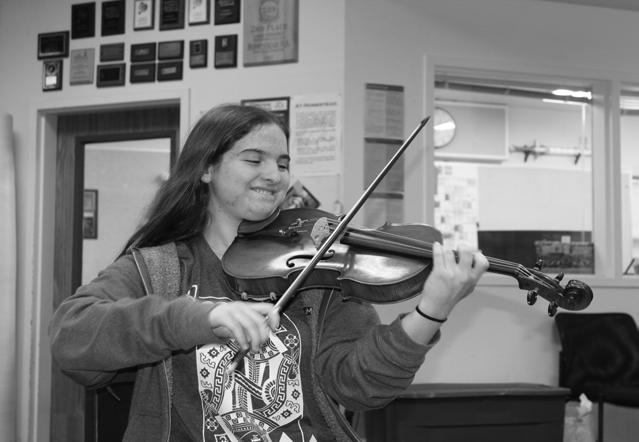
The music department will host an orchestra festival on Feb. 6 -7 in the auditorium, viola section leader, junior Daphna Raveh Glassman said. Composed of around 30 orchestras from across the Bay Area, from places like Berkeley and Fresno, director of instrumental music Ben Scharf said the event provides a great opportunity for the ensemble to improve.
From early outreach to ongoing preparations, Scharf said the event has required careful logistical planning.
“[It] started by inviting a panel of judges to come and do this event. Then, we sent out a registration to a bunch of schools to see if they wanted to come and perform at this event,” Scharf said. “It’s been a lot of planning to get flights and hotels for our judges, make sure we have all the facilities we need and [do] a lot of behind-thescenes logistical work.”
With professional musicians acting as judges, ensembles from the Bay Area will receive personalized feedback on their
ing ELPAC test, Kwong said staff still hold student wellness and sense of belonging as a big priority for the ELD program.
“It’s really about caring for our En glish learners so we make sure they have the language skills, but also the academic and social skills to participate fully while they’re with us in our high schools, but then after they gradu ate, too,” Kwong said.

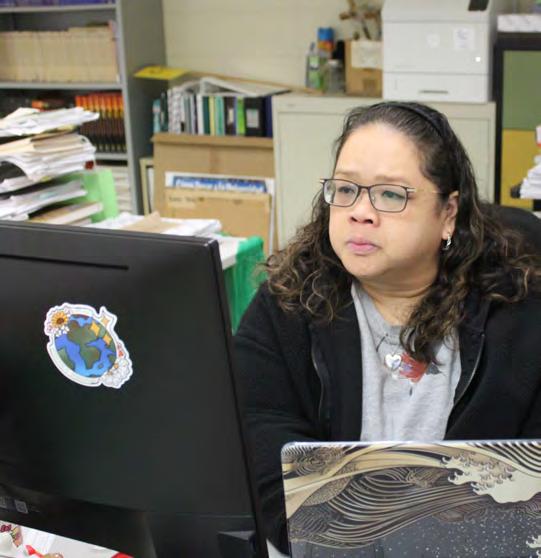
2. FLOW Speak app implemented in classrooms
judges will have a video or audio recorder [to] give feedback saying, ‘Hey, you’re doing a really good job here, or you can improve this in the future’ while orchestra is perform ing,” Scharf said. “Then afterwards, one of those judges will go into another room with that orchestra and will give a 20-to25 minute clinic.”
1. English learner scores decline
A measure of proficiency for EL students is whether they improve their ELPAC scores between the fall to spring test. In the 2025 school year, 64.8% either decreased or maintained the same scores. Among EL students with special needs, no student in the district improved their scores, according to data from the California School Dashboard.
Sophomore Chenyang Lei works on an ELD assignment. The self-paced FLOW Speak app, utilized as part of a study with Stanford University, allows students to improve their pronunciation and confidence when speaking , ELD teacher Adrian Buenrostro said.
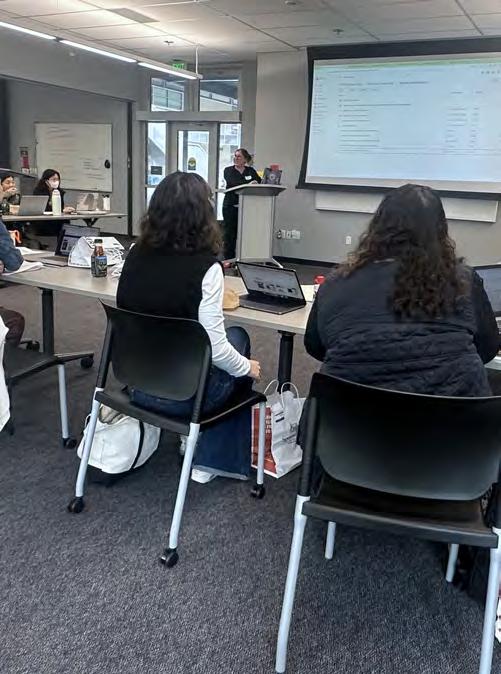
3. Professional development on Jan. 20
Teachers across the district participated in professional development meetings to learn how to better support students while they navigate challenging sections of the ELPAC, EL site coordinator Grace Henson said.
Steps toward improving the ELD curriculum
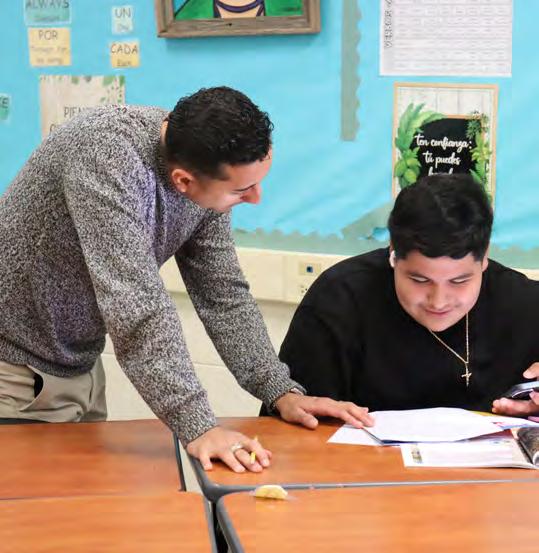
4. ELPAC testing week of March 9 ELD teacher Adrian Buenrostro helps a student with an English assignment. This year, the district is asking both students and teachers to make time to practice for the ELPAC test, especially because the format might be unusual for those who have not taken standardized tests in the United States, Kwong said.
PhotobyMayaDutt
Continued from page 1
In addition to giving students advice and feedback, the festival will also serve as a fundraising opportunity for the music department, Scharf said. As a result, the budget for the event will largely come from the registration fees from other schools.
While logistics were being established for the festival, orchestra prepared through both sectional and full group rehearsals, sophomore Lauren Ou said.
“There’s a lot of aspects of the orchestra that we can improve on, and there’s specific parts of pieces that are difficult for a certain section, [including] balancing out the parts and making sure we’re not rushing,” Ou said. “Certain types of rehearsals, like sectionals, help us improve difficult parts. Full
group rehearsals help us with our balance and tempo. A mix of everything is what’s best for us as an orchestra.”
Specifically, they are focused on blending individual parts into a cohesive and balanced ensemble, Glassman said.
“Obviously, each person needs to learn their part, but that’s the easy part,” Glassman said. “[To] make it sound unified and good as a group is the more challenging part.”
Beyond financial support for the ensemble, the orchestra festival provides many opportunities for new students to gain early recognition to join the ensemble, senior Athan Kong said.
“I just hope that there’s more people in the orchestra because
there’s a huge band presence [and] not that much interest for [the] orchestra,” Kong said.
With the event just around the corner, Scharf said he strives to ensure the ensemble has an enjoyable experience on top of gaining new knowledge.
“There’s two sides to it,” Scharf said. “One is having a great performance, and the other side is to tailor to the educational aspect of making sure that each group gets really solid feedback and gets to grow because of the experience here. The goal [is] making sure that both sides of the experience really shine through.”
Wellness center partners with SWAG, clubs
Since reopening in December 2025, The Meadow has focused on collaborating with students to tailor the space’s offerings to their preferences, wellness space support specialist Julio Llerenas said.
“I am a very big advocate of student voice because, most times, we don’t know what they need,” Llerenas said.
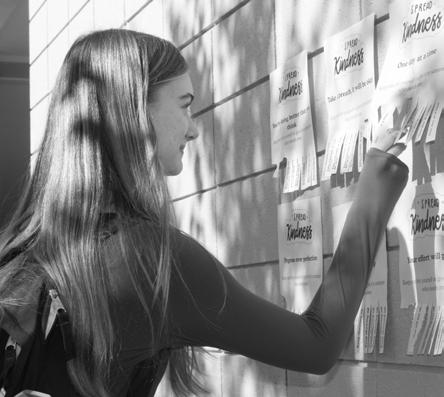
Most recently, The Meadow worked with the Student Wellness Advisory Group to hold Great Kindness Week, which aimed to spread positivity throughout the student body, from Jan. 26 to Jan. 30, junior Kat Heller said.
SWAG, which was formed following The Meadow’s opening, is tasked with collecting student feedback and organizing mental health awareness activities on campus, Heller said.
“We [also] want to do eating disorder awareness week and al-
cohol addiction awareness week, activities that promote calling attention to mental health issues and helping students have a say in what is done,” Heller said. “Mental health-wise, it’s hard to be a teenager. For many adults, it’s been a long time since they were a teenager. And, it’s not that they can’t understand, it’s that a lot of them may have forgotten how it feels.”
In addition to SWAG’s contributions, The Differences Among Us club and psychology club worked with The Meadow to plan and host lunch activities during Great Kindness Week, TDAU president, junior Noe Vorbau said.
“One of the things we hosted is kindness bingo, where anyone who wants to participate is given a bingo card with [things like], ‘give someone a compliment today’ or ‘thank your teacher,’” Vorbau said. “The main point is finding new ways that you’ve never tried before to be kind every day.”
With both establishments sharing similar goals, Vorbau said TDAU’s collaboration with The Meadow presented a valuable experience to promote inclusion.
“At our buddy lunches, we en-
courage people to never sit alone and sit with a buddy, sit with someone you’ve never sat with before,” Vorbau said. “It’s similar [to The Meadow] because it’s a room where there’s no judgment. You can be who you want to be, even with people who look different, who act differently.”
Beyond the duration of weeklong events, The Meadow has also prioritized more regular partnerships with clubs, reflecting the center’s mission for continuous mental support, Llerenas said.
In particular, the yoga club began hosting monthly meetings in The Meadow in November 2025, Llerenas said. Aside from helping spread awareness of The Meadow’s values, the club benefited from the center’s more inviting environment for meetings, compared to their previous room in the gym.
“Yoga is meditation, and in some yoga, they [practice] mindfulness,” Llerenas said. “That’s our key aspect, too. As a wellness center, we work on mindfulness, meditation, practices and tools that help students be resilient, cope with situations of reliance,
anxiety and stress. So, with that, yoga and meditation work handin-hand in what we do here as a wellness center.”
Looking to continue incorporating student perspectives, Heller said SWAG hopes to recruit more students to the organization. Heller said she hopes establishing a more expansive member base will expand SWAG’s planning capabilities, and allow for broader perspectives regarding potential improvements to The Meadow.
“It’s hard to find a small group of students that’s actually diverse and reaches across campus,” Heller said. “You can only do so much with the opinion of so few.”
In the coming
Decrease in ticket sales threatens future event status
Isabela Guilardi and Olivia Levesque Ouellette
The annual winter formal dance took place at Villa Ragusa in Campbell on Jan. 16 despite challenges throughout the planning process, ASB adviser Hector Almendarez said.
As of Jan. 13, ASB had sold 352 tickets of their 450 ticket goal. Given the low ticket sales even after multiple extensions, the ASB activities team was uncertain whether the dance would occur in following years, Almendarez said.
“Winter formal as a dance has a lot of value to our school,” Almendarez said. “But then there’s the realistic perspective [where] it’s not responsible to be wasting money, especially if we get to this similar state again next year. We are still heavily considering what we will do in the future.”
The initial deadline for ticket sales was Jan. 11. However, ASB delayed the deadline up until the day of the dance, giving extra time for students to sign permission slips and purchase tickets, ASB social events manager, junior Maya Power said.
Additionally, ASB sent campus-wide emails, created social media posts and spread the word about the dance in hopes of gaining more engagement, Power said.
“I do think [the lack of ticket sales] has a lot to do with the timing of things. With finals and winter break people are not as tuned into signing up and buying tickets,” Power said. “Also, the advertising maybe didn’t fully reach the student body, or the response hasn’t been exactly how we’ve seen in the past year.”
Planning the logistics of the event began last year during second semester with reaching out to different venues and scheduling a date, Almendarez said.
“We had provided the payment to the venue, and so what we would rather have been [doing]
during the week of the dance is just promoting it, getting people excited, getting people hyped up for a great night, instead of still pushing people to buy tickets,” Almendarez said.
After having attended winter formal during both her sophomore and junior year, junior Tiara Rezvani said hosting winter
months, The Meadow is looking to hold further club collaborations and organize additional events to ensure support for students’ mental health, Llerenas said.
“The more we get information from our students, the more we can accommodate them,” Llerenas said. “[We can] make a space that works for them, versus something that we’re trying to make on our own.”
formal in a smaller venue would allow for more achievable ticket sale goals, preserving her hope for the dance to continue in the future.
“If the dance were to be cancelled it wouldn’t impact me all that much,” Rezvani said. “It would be upsetting for some people that didn’t get to experience it or [if it

happened] during my senior year, where I would want to have something like that.”
While the future of winter formal is still undecided, there is a chance the event could evolve into an entirely new format, Almendarez said.
“A number of things can happen. It’ll change completely, it won’t happen at all or it will become something else. What is something else? I don’t know,” Almendarez said.
Despite the obstacles faced, Almendarez said winter formal still served as a valuable experience for students.
“It’s a night that feels a little bit more special than just any other night,” Almendarez said. “Everyone comes together and is there for the same reasons, to have a good time and enjoy each other’s company. I just want to stress that if the decision comes to us not having a formal, it was not an easy decision to make.”
Ethan Xue
Local: Lunar New Year celebration
Participating in the Bay Area’s largest Lunar New Year celebration, tens of thousands of community members lined the Santa Clara streets for the 2026 Silicon Valley Lunar New Year Together and Night Market events on Jan. 31 and Feb. 1, according to KRON4.
Recognizing the year of the Fire Horse, the festivities took place on Lafayette St. from noon to 9 p.m., according to the Silicon Valley Voice.
Featuring traditional dancers and hundreds of artists from diverse East Asian cultures, the live performances were accompanied by hundreds of local and out-of-state vendors who offered food and arts and crafts activities to enhance the atmosphere, according to Palo Alto Online.
Instead of being organized by Santa Clara County directly, the event was partner-led by local organizations like Silicon Valley Community Media and OMG Entertainment. This contributed to a more expansive celebration of the cultural holiday overall, according to the Silicon Valley Voice.
National: Imminent partial government shutdown
In light of the recent string of shootings by federal immigration officers against U.S. citizens, Senate Democrats are pushing for the defunding of the Department of Homeland Security, which the Immigration and Customs Enforcement agency is a lower branch of, according to NPR. Specifically, senators have formed a comprehensive list of demands for DHS change, including requirements for immigration arrest warrants and agent identification, according to Politico. However, any upcoming changes to the bipartisan funding package would jeopardize its signing in time, according to Politico.
If Democrats deny support for the upcoming multi-bill federal spending package, this mounting pressure would result in a partial government shutdown. Nonessential employees would get furloughed, and essential employees would work without any pay, according to NYT.
While certain nationwide services such as Social Security payments, Medicare and Medicaid would likely not be affected, the funding measure’s impacted agencies have not released contingency plans yet, according to CNBC.







Title IX, a national law that prohibits sexual discrimination in any federally funded educational program, is complex. Here are some facts to clarify your protections.
Fact 1: Not all sexual harassment is under Title IX.
Sexual harassment outside of “sexual assault, dating violence, domestic violence and stalking” is not protected un der Title IX and is dealt under a Uniform Complaints Process (UCP), according to FUHSD Board Policy Code 5145.71. Here are some examples of what would and would not be considered a Title IX offense:
Title IX
- Nonconsensual sexual act
- Violence toward a ro mantic or intimate partner
- Conduct that causes fear to a reasonable individual
Accordingto
on
Not Title IX
- Sexual jokes, comments or gestures
- Showing someone or re questing them for inappropriate sexual images or videos
Most reports are cases of sexual harassment and do not fit into legal definitions of criminal activity, associate superintendent Trudy Gross said. Not being covered by Title IX means there is no police involvement, but disciplinary action can be taken, Gross added.
Jason Lai and Advay Ranade
The quiz bowl team attended the 30-20-10 Tournament of the Long Island Quiz Bowl Alliance circuit online on Dec. 14, 2025, placing in the top 20 out of over 300 teams globally and achieving second place in the state, quiz bowl vice president, senior Vivek Athavale said.
Having qualified for the LIQBA national tournament in Denver, Colorado from May 30-31, the team looks forward to growing its skills and succeeding, Athavale said.
“[Quiz bowl] really hopes to place,” Athavale said. “We want to place top ten or better definitely and cement HHS as a top quiz bowl team in the nation.”
Quiz bowl had a streak of nationals qualification for ten years but lost the streak last year after not being able to qualify, varsity team captain, senior Srinish Kollipara said. However, quiz bowl reclaimed the streak with their 30-20-10 performance this year, Kollipara said.
“Qualifying again for nationals is pretty important because we continued the performance that quiz bowl is known for and reinforced the standards required to be a part of the team,” Kollipara said.
Hoping to improve the team as captain, Kollipara said he aims to maintain the team’s composure and cohesion while
answering competitive questions.
To prepare, the team is rapidly organizing weekly practices for the five attending contestants, co-president, senior Sonali Wake said.
“The way we practice is we’ll find a packet of quiz bowl questions, and one of us will be the reader for that meeting. We’ll go through the toss-up questions and bonuses, which are team questions,” Wake said. “The best way to practice for quiz bowl is just to be exposed to as many questions as possible.”
Additionally, to maintain quiz bowl’s legacy and ability to attend future competitions, such as LIQBA nationals, quiz bowl also trains juniors and sophomores on a regular basis during weekly meetings and signs up for local tournaments, Athavale said.
“We host mock tournaments and get them more prepared for what they should expect in a varsity level tournament,” Athavale said. “We try to move kids up and make them play varsity rather than standard, which is what we’re doing now when we take them to nationals this year.”
Through the LIQBA national tournament, the officer team looks to rebuild the club’s previously strong reputation, Wake said.
“It’s our goal to do our best and contribute to the prestige HHS has had in the past with quiz bowl,” Wake said. “We have placed really high at national tournaments previously, and hopefully we can regain that status.”

Fact 2: Even after six months, an incident can be considered sexual harassment or a Title IX violation.
While the FUHSD website states that a Title IX violation should be reported within six months of the incident or knowledge of the incident, Gross said she has investigated events older than six months that were found in violation of sexual harassment or Title IX policy. Reports should still be made after six months, especially if the victim is still at risk of danger in school, Gross said.
Fact 3: You can recieve protections from the district while the investigation is ongoing.
At the start of an investigation, measures are put in place, in cluding “no contact contracts,” Gross said. Through Title IX, “emergency removal” of the alleged perpetrator from campus can happen on a case-bycase basis, Gross said.
Fact 4: After an investigation, you have the right to appeal the district’s decision. There is an appellate process for Title IX to the Office of Civil Rights through the state government, Gross said. Both the perpetrator and victim have the right to appeal regarding the district’s findings or sanctions through UCP, according to the California Department of Education.
New planning strategies improve annual event
Yi
Creating an experience for the student body to learn about and experience elements of French culture, the French National Honor Society hosted its annual French Cafe Night on Jan. 30 in the cafeteria, French teacher Muriel Von Stein said.
“We wanted people from outside the school or families with little kids to come, have fun and enjoy good food and activities,” Von Stein said. “It’s serves as a place where [students] can use the language with purpose in a real-world environment and where we can make the language more visible to the community.”
In addition to serving French food, French Cafe Night featured live performances of relaxing music and a painting activity by partnering with the National Art Honor Society and Tri-M Music Honor Society, STAR, senior Meridith Tan said.
As a repetition of the most successful aspect of last year’s event, the jazz ensemble performed for attendees throughout the night, contributing to the authentic cafe-like atmosphere FNHS was aiming for, public relations officer, junior Ada Buricea said.
“Live music is really fun to have, and I feel like it makes it more different than just having
a cafeteria where you’re serving food,” Buricea said. “It actually makes it feel like a cafe.”
Furthermore, FNHS members had the productive opportunity to serve customers food as waiters, Tan said.
“It’s was a great opportunity for our members to really serve the French community and also share our French culture with other people,” Tan said. “It’s a way to gain volunteer hours for their member requirements.”
Looking to improve on past experiences, FNHS prepared more food at home to mitigate the risk of lost product, Buricea said.
“We tried to do a lot of stuff where we were baking it there, like we had some tarts that we made before, but we would cook them at the school cafeteria, and I don’t think that worked very well,” Buricea said. “We had some burnt [food], so this time, we’re going to make more from home.”
Despite these previous dificulties, last year’s French cafe provided a valuable learning experience for both the club members and attending customers, Von Stein said.
“One of the goals is to offer our members an activity where they can be more exposed to French culture and the French language because the waiters are speaking French, and they are taking orders in French,” Von Stein said. “It’s a place where they can use the language they are learning with a purpose in a real-world environment.”

Volume
Editors-in-Chief
Parth Dhaulakhandi
Alicia Liste
Web Editor-in-Chief
Amanda Boles
Print Managing Editor Maya Dutt
News Editors
Danielle Feldsher Ethan Xue
Opinion Editors
Sachin Chandran Adam Orrin
Lifestyles Editors Annika Abraham Aviv Matas
Alan Zhang
Arts & Culture Editors
Jason Lai
Malar Raguraman
Sports Editors
Olivia Levesque Ouellette
Selina Wang
Copy Editors
Ethan Xue
Alan Zhang
Photo-Illustration Editor Isabela Guilardi
Design Editors Maya Dutt Aviv Matas
Multimedia Editors
Isabela Guilardi
Aashka Nagarkar
Social Media Editors
Sanjeet Jayaseelan Advay Ranade
Reporters Natasha Bandil Alexander Cao Emma Chang Krist Ferreria Ivy Guo Henry Hu James Jiang Elina Li
Saachi Nangare Luna Pitl
Kanmani Raguraman
Julia Song Ethan Tan
Chloe Wang
Catherine Yang
Yichen Yao Kaylin Yi
Adviser
Natalie Owsley
Mission Statement
The Epitaph is a non-profit publication at Homestead High School, 21370 Homestead Rd., Cupertino, CA 95014.
The Epitaph is a designated forum for student expression and not subject to prior review, in accordance to Education Code 48907. The staff is comprised of HHS Journalism students. Views expressed do not necessarily represent views of the school, its staff or the district. Editorials are opinions of the editorial board.
The Epitaph welcomes letters to the editor but reserves the right to edit submissions. Letters should be limited to 300 words. Include contact information. Unsigned letters cannot be published, but names will be withheld upon request. Send via homestead.epitaph@gmail.com, or drop letters in the newsroom or the office mailbox.
If The Epitaph has made an error, please send corrections to homestead.epitaph@gmail.com.
The corrections will be published in the corrections box for the next issue.
To reach the Epitaph in C102, call (408) 522-2572.
Advertising
One email and you can reach over 2,400 students, teachers, administrators and community members from Northern Sunnyvale to Southern Los Altos. If your target market is between ages 14 to 18, contact The Epitaph at epitaph. ads@gmail.com, and we can make it happen.
Thank You to Our Donors & Supporters
FUHS Foundation
Homestead PTSA
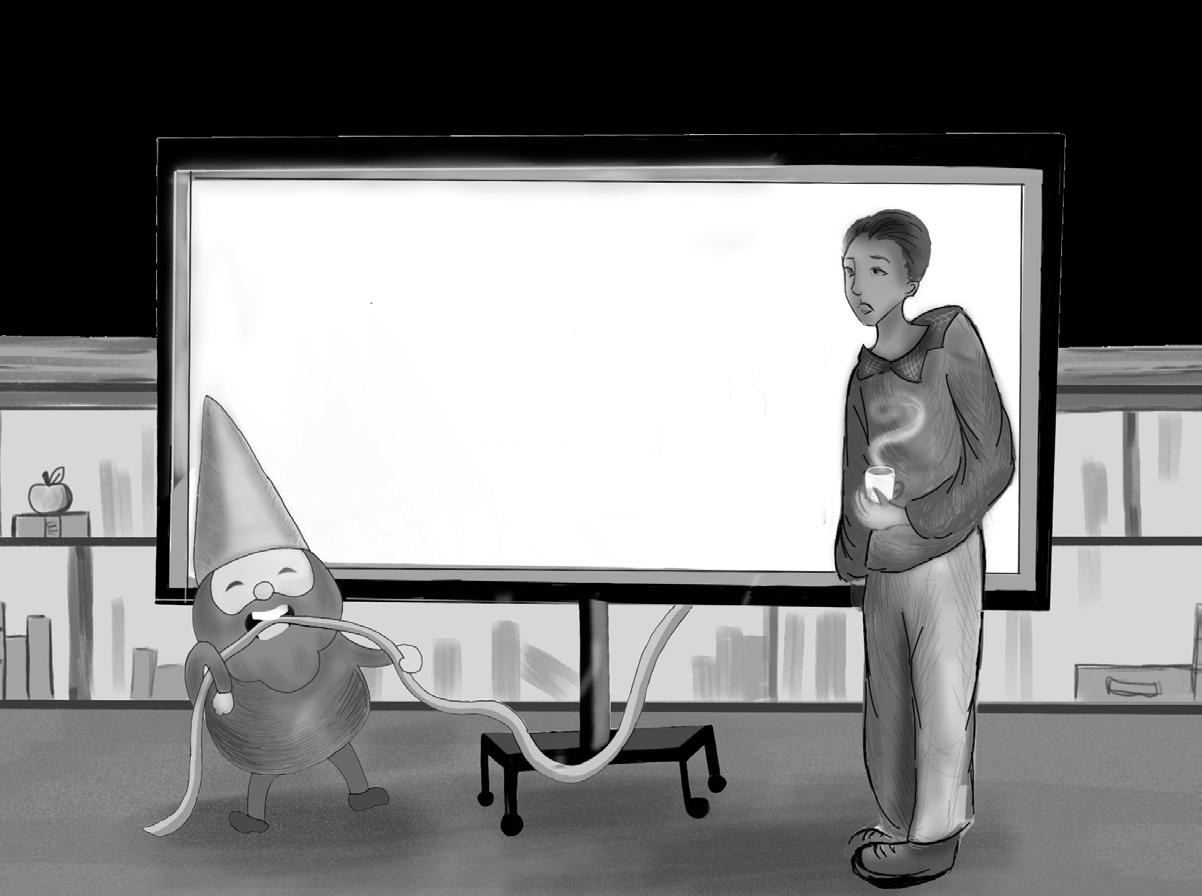
With the WiFi restructure after midyear break, teachers and administrators were required to download Securly certificates for internet access, superintendent Graham Clark said. Unfortunately, instituting Securly for staff has had detrimental consequences, as it can block crucial sites used to educate and support students. To mitigate this, FUHSD must revert to the original network system or limit teacher restrictions so staff can efficiently assist students’ development.
For years, faculty members have been using many of the same websites. If staff cannot use resources they have tried and tested, students will miss out on quality education and support.
58%
of staff said downloading Securly has impeded their ability to perform their job in some way
For example, in media literacy lessons, teachers cannot use examples of unreliable sources, as those sites are often blocked by Securly as adult content.
the minor benefits a simpler WiFi system presents.
A potential workaround to Securly’s internet restrictions comes in school-issued databases. However, while these resources contain a plethora of information, the information is finite and often unhelpful to teachers.
ing WiFi that lack harmful side effects.
This change was made in response to ongoing WiFi issues, as servers previously allowed teachers to access WiFi without a certificate but required it from students, complicating the structure. By making login requirements uniform across both FUHSD networks, the smoother connection will minimize glitches and sudden disconnections for everyone, Clark said. However, 65% of staff stated that sites they wanted to use for their jobs have been blocked by Securly, according to a survey of 57 faculty members. The survey also shows that 58% felt downloading Securly has impeded their ability to perform their job in some way.
With these changes, staff will be forced to spend valu
If staff cannot rely on FUHSD WiFi, many may turn to cellular data or VPNs to maintain unblocked internet access on campus. Cellular data is slower than WiFi and often does not work at all in some buildings, undermining the original purpose of improved internet access.
Ultimately, there should be no obligation for teachers to bypass school regulations to do their job, especially if it costs them time and money.
While staff can submit requests to unblock sites, these changes can take up to 24 hours to process and accept, Clark said.
This could force staff to rapidly accommodate schedules and waste valuable lesson planning time waiting for websites to be approved. Flexibility in the classroom is indispensable, yet is obstructed by the inevitable wait to view blocked sites.
Additionally, network filtering can pressure staff to do their class planning outside of school hours, which is
From using Pinterest for art inspiration to playing educational YouTube videos for visual learners, teachers must be able to access the entire internet for its vast range and convenience. They cannot turn to research papers if Securly blocks the content they need.
Beyond more efficient WiFi, staff restrictions on inappropriate content are an added side effect of Securly. This includes pornography and gambling, which, while not illegal for staff to access on school campus, are still considered vulgar in a work environment, Clark said.
This is precautionary and is not a result of a widespread issue, Clark said. However, FUHSD’s use of Securly for faculty communicates their lack of faith in staff’s responsibility.
Acknowledging Securly’s disadvantages, the district must revert to its original network structure so staff may perform necessary tasks and educate students without obstructions. No solution to a network issue should be solved by restricting staff’s online use.
However, if Securly is absolutely necessary for teachers, the district must find ways to reduce filtering so only extremely explicit and unsuitable content is inaccessible, rather than essential sites.
Without Securly, staff would no longer have to overhaul class materials and resources to fit overly restrictive guidelines, nor would they waste essential time scouring the internet to replan lessons.
65%
of staff tried to access websites they wanted to use for their job that were blocked by Securly Infofrom a survey of 57 staff members
If it is a potential concern, inappropriate web usage should be addressed on a case-by-case basis, not with preventative measures like Securly that handicap all faculty members.
By addressing one issue with WiFi, the district has introduced bigger problems for staff and students. Instead of fighting fire with fire, FUHSD must find other methods of improv-
Furthermore, FUHSD must trust staff to abstain from watching inappropriate content at school. If a related issue arises, it must be dealt with individually and investigatively, and certainly without forcing Securly on all staff.
If Securly constrains staff’s internet access to the point of harming their ability to instruct, plan or provide for students, WiFi efficiency comes at too high a cost.
The Epitaph editorial board voted with a majority of 17-1 in support of this stance.

Looks like this page isn’t allowed Staff share anonymous anecdotes of Securly’s inconveniences
- Could not order classroom supplies or snacks
- Had to troubleshoot cloud-based tools that are frequently disrupted by the new security protocols
- Unable to bypass Securly restriction on link to purchase drama performance tickets
- Could not access or explore websites with unreliable information to teach media literacy and credibility
- Teacher blog used for curriculum design resources was blocked and labeled as “gambling”
Senioritis is an
Malar Raguraman
Frolicking, ditching school and making memories: all encompassed by the blissful word “senioritis.” With college applications stacked away, senior year feels like it has just started.
But, in our haste to cherish our last months of high school, we leave behind the nights of studying and hours of homework. The shocking bombs of C’s and D’s near the very end of a report card seem to be the ritual of every second-semester senior.
Despite its normalcy, the word “senioritis” isn’t just a petty excuse to stop caring about school. It is an abused escape hatch that many lower-income students cannot afford to use.
Even after accepting students, colleges have the right to cut thousands of dollars from the institutional financial aid package of students whose GPAs have dropped substantially, according to EBSCO.
The apathetic mindset of senioritis doesn’t just stain tran-
scripts. It burdens families with more responsibility to pay for college, and it can cost students tens of thousands more to pay off larger student loans. Students can actively save money by maintaining their GPA or improving it in senior year to qualify for more aid.
The lack of responsibility that second-semester seniors in the Bay Area demonstrate only reflects the misguided belief of collective privilege in our community. In reality, 13.8% of people under 18 in the Bay Area live in poverty, according to Tipping Point Community.
The economic disparity of our community highlights the detrimental effects of adopting a widespread mindset of senior itis. While some of us may be able to kick up our feet for the rest of the year, the spread of that culture only stresses students who do not have that privilege. Such pres sure will only isolate them in their efforts or lose them money in the long run.
As a school, we must stop spreading senioritis as a lazy ex cuse to avoid work. That is our choice and a reminder of our
privilege other students may lack. Students planning to take out loans for university should also not fall into the overwhelmingly relaxed environment of the senior class. Whether taking time to individually apply to private scholarships or maintaining GPAs, those who have to worry about money must not leave productivity in the past and should aim for a more secure financial future.
Pressing the “Celebrate” button on Common App feels like closure, but for some, there are six months of work that still follow. That’s a difficult commitment, especially around people who expect you not to do it.

Bipartisan bill deserves equal contributions
Imagine you are playing charades with your friends, but with a twist: you already know all of the answers. This incredibly unfair advantage will inevitably ruin the game for everyone.
Unfortunately, this behavior is deemed okay in the game of politics through politicians’ ability to trade stocks. This practice only provides them an opportunity to
line their pockets and exacerbate corruption while deliberately harming future markets, which is why it must be limited through bipartisan legislation.
Thankfully, some lawmakers have taken it upon themselves to ignore party lines and attack this issue. Representatives like Chip Roy and Seth Magaziner crafted a bill forcing all members of Congress to sell their stocks, according to NPR.
This bill, if passed, would limit the financial corruption our elected representatives can engage in, ensuring they are motivated to help their districts.

But, of course, a partisan agenda got in the way of reform. When this bill reached committees, it was gutted completely by Republicans to fit their agenda of “economic freedom.” Under the new legislation, lawmakers would still be able to keep and sell their stock with a week's notice, according to the New York Times. It is not economic
freedom when leaders exploit classified knowledge to benefit themselves instead of helping the constituents they were elected to represent.
Although it was primarily Republicans who gutted the bill, insider trading is a bipartisan problem. Politicians on both sides take advantage of their position for monetary gain, which is why a bipartisan solution is necessary.
Rather than providing ineffective measures to disincentivize insider trading, steps must be taken from both parties to ban stock trading amongst congressional representatives. There is no justification for enabling politicians to abuse their power for financial benefit.
Bills like what Roy and Magaziner originally pushed for must receive support from both parties. Signing these bills into law is the only way to solve a bipartisan problem. If lawmakers don't, there will be no reliable way to ensure our politicians are not legislating based on their stock portfolio.
Countless times, I have encountered online influencers filming their crying sessions and claiming to have anxiety or depression after a stressful week. While some personal stories online help bring serious problems to light, others can magnify daily struggles to look like deeper clinical issues, minimizing the severity of genuine disorders.
With mental health awareness becoming more prominent in society, self-diagnosis has increased, and the definitions of mental illnesses have broadened. While society has taken steps in the right direction to distinguish signs of mental illness, we must also work on determining the absence of it.
Most of the time, self-diagnoses stem from online platforms, as individuals associate their symptoms with the ones they see online. However, studies have shown that young adults who label themselves as depressed coped less effectively compared to those who consulted a professional, according to the National Library of Medicine.
Additionally, a vague understanding of mental health not learned from medical professionals undermines those who experience serious cases of medically diagnosed disorders. Those who label them-
threaten one of the main purposes of mental health awareness: destigmatization.
I’ve seen online influencers and even peers make jokes about being depressed or having anxiety as a way to express their negative sentiments in an exaggerated manner. Though those comments can be seen as harmless, but some diagnose themselves with mental illness largely as a means to gain attention.
Awareness should be utilized for education on mental health, not for romanticization or trends.
Now more than ever, there are many resources available for those who struggle to navigate mental and emotional challenges. However, there should be more emphasis on determining the root of these problems rather than whether or not they are present.
Mental health literacy is just as significant as mental health awareness, as it starts with recognizing symptoms to avoid under or over-interpretation. If someone feels they are struggling with their mental health, it is important to consult a professional before putting a label on it.
As a school community, HHS can implement these resources by helping students determine what is and what is not a mental disorder. This can be done through individual check-ins and friendly conversation. Students can also contribute by learning to adjust the way they speak about mental health so it becomes a topic built on empathy.

Mental illnesses look different for everyone, which is why it is important for students and all members of society to reflect and seek professional aid before coming to a conclusion. If you feel you may be struggling with a mental health issue, reach out to a trusted adult or find resources within the HHS student wellness resources page.
Learning the differences between a disorder and stress improves personal recovery
Vigilante journalists push false narratives, sow division
150 million views, a governor’s resignation, a police shooting and massive protests. All of this is the result of one 40-minute video from Youtuber Nick Shirley.
Anyone can claim to be a journalist and use social media to promote videos with misleading narratives. They take advantage of algorithms designed to brew hate and spread their lies to aggravate the public.
Americans must learn to doubt social media journalism, but social media companies must also redesign their algorithms to pres-
ent all viewpoints rather than trapping users in echo chambers.
In his viral video, Shirley visited several businesses outside of operating hours, recording locked doors and absent employees as false evidence that inoperational businesses were illegally collecting welfare, according to NPR.
Despite Shirley’s manipulation, millions have unquestioningly accepted his claims, leading to increased ICE raids and protests in Minneapolis, according to CNN.
Independent reporters like Shirley create unwarranted division that leads to the unrest we currently see plaguing Minnesota. People view their lies as fact and surround themselves with people parroting the same lies, causing any counterpoints to be met with cognitive dissonance and hate.
With so much unrest stemming from reporters like Shirley, people must start to question so-called independent journalists on social media. They must recognize that they report not to inform, but to increase their own visibility and follower count.
Instead of solely looking toward social media for their news, people must consume their news from a diverse range of sources, ensuring they have a strong foundation of truth to build their views off of.
While reporters like Shirley may stoke the flames, social media platforms are equally to blame for perpetuating these false stories. Platforms like Instagram and TikTok show users content that conforms to their existing opinions to keep them scrolling, ac-
cording to the National Academy of Sciences.
Users in these echo chambers are enraged by reporters like Shirley, and the false narratives they push are reinforced by other creators in the same space, lead ing to greater political polariza tion.
The issue lies with both peo ple like Shirley and the plat forms that echo his hate ful views. The government must hold these companies accountable for in stigating hate by forcing social media companies to disclose the specific models that propel their algorithms to
third-party regulatory organizations.
Shirley exposed the real fraud plaguing America: social media reporting. Americans must learn to question the narratives presented to them so that 40-minute

ASB must explore alternatives to save Winter Formal
Amanda Boles
After 23 emails and a promotional video urging students to attend Winter Formal, it has become clear that the event has danced its way into obscurity. Interestingly, I am not surprised by this outcome.
In my four years at HHS, Winter Formal has always been hosted at Villa Ragusa, and nothing notable has changed. The event carries a $60 price tag and offers very little outside of a photo
booth and dance floor, activities better suited for a prom or homecoming-style event.
This has compelled me, and clearly, a large majority of my peers, to opt out of the Winter Formal experience.
If ASB plans to continue hosting Winter Formal, they must establish a unique identity for the dance and make drastic changes for it to be financially sustainable.
Currently, Winter Formal is situated awkwardly between Homecoming and Prom. Being significantly less iconic in American high school culture, it lacks the same classic appeal and hype that convinces students to attend.

To combat this trend, ASB could experiment with alternating venues in a fouryear cycle. That means each year, the event could be held at one of four different locations, allowing students to experience
Public transit offers cheap adventure
Alicia Liste
Hundreds of cars rush past as my eyes peer over the stream of traffic in an eager search for my $800,000, 30,000-pound ride: a Valley Transportation Authority bus.
Beyond the ordinary journey to and from school, the full benefits of taking public transit for teenagers must be better appreciated. By freeing themselves from the burden of a cumbersome car-centric world, young people can push a sense of convenient, affordable and exciting freedom into their lives.
For teenagers without driver’s licenses, public transit allows for independence from the unpredictable availability of adult drivers. I appreciate being able to meet up with friends or explore new downtown areas without the fear of upending my parents’ schedules by requesting a ride home.
compromising on my lofty local itineraries. Instead of going all or nothing on a tank of gas, public transit optimizes my spending so I can buy an extra ticket to the Stanford Theatre or treat myself to some Salt & Straw ice cream.
With adequate planning ahead of time, public transit also provides a unique sense of adventure for riders taking recreational trips.
The Route 17 bus, for instance, connects San Jose with Santa Cruz. For a round trip cost of $14, riders can enjoy a charming day trip to the beach without worrying about packed park

ing lots or winding roads.
Nonetheless, our local public transit does falter in key areas. Some routes suffer from infrequent service, and taking public transit often means facing travel times of more than double that of car rides.
a new setting each time.
While this may be more expensive and less convenient in the short term, it offers a chance to reclaim the novelty that Winter Formal has been lacking. The only caveat is that finding four different locations that are as convenient as Villa Ragusa could be difficult, especially since ASB has established a long-term relationship with the venue, leadership teacher Hector Almendarez said.
However, it is not just HHS that has struggled with hosting and lackluster student attendance for Winter Formal. Lynbrook’s Winter Formal has been cancelled indefinitely, according to The Epic. Similarly, FHS no longer hosts the event, Almendarez said.
Like the IDC Rally, schools across FUHSD should collaborate to plan and execute Winter Formal. Not only would the pool of attending students increase, but doing so would establish a unique appeal that other school dances don’t offer.
Many students have friends at other FUHSD schools, and events such as the IDC exchange have been quite popular among students, Almendarez said. Making the dance a celebration of the entire FUHSD community would boost attendance while offering an event that is able to create its own identity as a unique setting for intradistrict spirit.
No matter the type of change, ASB must take steps to reinvent Winter Formal and prevent it from dying out. Any opportunity for friends to create long-lasting memories through our school is a good one, but Winter Formal needs to change if it wants to dance another day.
Adam Orrin
The food pyramid has come toppling down, and with it came not only health risks, but also a destructive environmental policy. Health secretary Robert F. Kennedy, Jr. recently displayed his new food pyramid, which reworks the old one to make red meat and cheese the largest piece of the triangle.
The new food pyramid sends the wrong message to families and misinforms the public as to what constitutes a healthy diet. We must ignore his advice and listen to real food experts when making our health decisions.
RFK´s slogan has been “Make America Healthy Again,” but his meal plan will achieve everything but that. Even the dietary guidelines the pyramid is based on seem to know how bad a plan this is, with it directly contradicting the pyramid, according to The Guardian.
experts, and they filter out lies with real science, according to Civil Eats.
By using these alternative guidelines, families can gain access to legitimate science and make good nutritional and financial choices.
Not only is this new pyramid an awful health decision, but it also presents an environmental commitment the U.S cannot afford to make. This bump in protein consumption has dangerous effects, as certain meats like beef require 20 times more land and emit 20 times more greenhouse gases than plantbased proteins, according to the World Health Institute.

Through its reduced youth fares, public transportation is an especially appealing option for teenagers with limited money. For example, a round trip from Sunnyvale to San Francisco on CalTrain costs a mere $2 for teenagers under 19 years old.
As a thrifty spender, I gladly take advantage of this opportunity to travel cheaply without
Yet, these inefficiencies are far outweighed by the independence that public transit offers, especially for young riders.
Public transit presents a myriad of benefits and must not be overshadowed by the car popularity. From greater autonomy to low-cost expedition, hopping on a local bus or train offers teens the opportunity to transform their downtime through the magical world of government-funded transit.
To combat this blatant misformation and provide real nutrition advice, we should follow the Uncompromised DGA. These guidelines are independently made and supported by numerous health organizations and
With emissions on the rise and land already limited, following these new guidelines would cripple American towns and destroy our environment. This continues the Trump administration’s trend of making wide policy changes without regard for their effect on the majority of citizens. These health guidelines are a dangerous step in the wrong direction. RFK, Jr. has spent the first year of this administration peddling falsehoods about vaccines and nutrition, but I refuse to let him stuff my brain and stomach with lies. We must listen to actual scientists and use our wallets to put only what’s best for ourselves and our environment on our plates.
School-based AP self-study resources are much needed
Entering freshman year, I self-studied AP psychology and AP macroeconomics, scouring the internet for helpful lesson videos, learning tools and advice. Months flew by as I filtered through sketchy Reddit posts and dozens of pay-to-ace exam studying platforms to teach myself. Even after hundreds of dollars and many hours spent on Princeton Review books and classes, I failed to deliver fives on the tests.
As the academic landscape gets more competitive each year, a larger number of students are taking AP exams, with self-studiers making up a noticeable portion of test takers, according
to College Board. To save students time and money, HHS should provide greater support for students choosing to self-study an AP course.
Historically, the school has maintained a no-help stance for the majority of self-studying students due to strong concern over possibly promoting excessive commitment and stress, principal Denae Nurnberg said.
With this skepticism, only teachers with related classes offer study resources upon request, such as economics with AP macroeconomics and AP microeconomics, history department lead Christy Heaton said.
Time management is an essential, formative part of maturing as high school students, so concerns over stress and academic competition are not valid restrictions against exam-only study resources. As such, HHS must acknowledge and promote students’ responsibility over their own academic decisions instead of discouraging rigor.

Stress is an aspect of any exam, but administration can mitigate this by helping students achieve their goals instead of ignoring their wants. Students like me feel stress over self-studying not because it’s difficult, but because we don’t know
where to start, which is where the school can help.
A resource directory would not only kickstart this process but would also alleviate financial pressures to buy tutoring services and textbooks by introducing affordable yet effective alternative tools.
In particular, freshmen in FUHSD schools are unable to take AP courses, leaving exam-only options as the only pathway to attaining early college-level learning and credit.
While many may argue that freshmen should take their first year of high school slowly as they adapt to the new environment, this idea fails to account for the financial support AP tests offer.
Taking an AP test in high school can save students money on courses and books in college, according to The Princeton Review. For many students, AP testing is a decision that can help them afford a postsecondary education. Making this harder hurts both their scores and their wallets.
The school district must push administration to release a directory of free resources made available to students through a schoolwide email at the beginning of each school year.
Through collaboration and a little extra effort, HHS can support students’ AP self-study journeys, diversifying academic options while setting responsible exam-only ventures as proactive, meaningful avenues to college credit and personal learning.
Teachers pursue passions, support community
Henry Hu and Ethan Xue
Whether advising Design It or building the next generation of tennis superstars, photography teacher Edmond Kwong said his career has encompassed far more than teaching. Outside of official school hours, teachers work diligently on a variety of overlooked responsibilities, Kwong added.
Aside from serving as an avenue to receive required supervision credits, principal Denae Nurnberg said most teachers take on more activities to foster connections with students.
“Some teachers just really like having a relationship with students in a different venue. For example, Marisa Amezquita, the school counselor, is the adviser for the ‘Magic: The Gathering’ club,” Nurnberg said. “She’s gotten to know a subset of students she [likely] never would have
gotten to know very well, see into their world and learn their interests in a different way.”
Kwong said his extra responsibilities, which include advising the Life in Focus club and Design It club, photographing campus culture and coaching tennis, give him opportunities to pursue his own interests while mentoring students.
“Yes, it takes management, and it does create a bit of stress, but I enjoy seeing the outcome and how it positively affects people around me,” Kwong said.
Similarly, world language teacher Kelly Ronsheimer said advising the yoga and wellness club allows her to support student wellbeing.
“Yoga is my passion,” Ronsheimer said. “I actually have a second job. I’m a yoga instructor at Yoga Source, and it’s something I found that helped me through physical therapy, depression and anxiety, so I wanted to share that with the kids.”
Although many additional responsibilities are enjoyable,
history teacher Gregory Russo said some extra expectations can place a burden on teachers.
In particular, Russo said writing letters of recommendation, such as for summer programs or college applications, often evolves into an unwritten expectation, despite their optional nature.
“All industries deal with what’s called job creep,” Russo said. “Finding a way to balance that with your responsibilities is difficult in every job. Whether it’s writing recommendation letters or other obligations, it can be difficult to have more added to your plate each year.”
While her involvement in several roles has been mostly manageable, thus far, Ronsheimer said she takes time to ensure the extra responsibilities do not hinder her devotion to students
“I find that after a while, if I’m feeling burnt out, I notice it and decide, ’Okay, next year, I’m gonna not do that anymore, or I’m gonna ask someone else to take that position,’” Ronsheimer said.
Creators express themselves on social platforms
Across the vast social media landscape, content creation has become more accessible than ever. Taking advantage of this opportunity, juniors Jennifer Wong, Josh Lin and sophomore Xander Chang express their personality and passions to the online world.
Jennifer Wong
Wong said her journey in content creation began early on as she initially started posting on Youtube in third grade. Wong now posts content about relatable happenings in her life on her Instagram account @jeneral.reels.
“Since I was in elementary school, I always wanted to be like a YouTuber,” Wong said. “Now, I post [on Instagram] for fun. I think it’s cool to be an influencer. When someone can relate to you, it’s a good feeling.”
Wong said the majority of her content, such as her most liked video on Instagram, which garnered over 538,000 likes, are inspired by everyday experiences, including grades and her social life.
“Sometimes in school or at work, I would think about something that happened and then [think about] what kind of content I can make,” Wong said.
To reach a larger audience, it is important to have supportive friends that not only follow the accounts but also actively engage with videos, such as by commenting and liking the post, Wong said.
“The reason why I went viral in the first place was because my friends supported me,” Wong said.
Josh Lin
Sparked by a communal interest in tasty cuisine, Lin said he founded the restaurant review Instagram account @bayeats1 with four friends in November.
“We’ve been seeing food reviews lately on TikTok and Instagram reels, so we decided to hop on it,” Lin said. “[The account is] mostly supporting small businesses and finding very niche food nobody knows about.”
To students who may be interested in similarly pursuing content creation, Lin said he encourages publishing engaging content that relates to their interests.
“Content creation is mostly your passion. If you like doing what you’re doing, you’ll actually be good at it, and that’s how we got started,” Lin said. “We like
“If I notice that it’s knocking me out of balance and taking my passion away for teaching, I put up a boundary.”
Despite the pressures of a heavier work load, Kwong said his extracurriculars enrich both his career and the broader campus community. “I don’t want to be the teacher
eating food, and we want to review it and let people know.”
Moving forward, Lin said he and his group hope to diversify their content from restaurant reviews to tours in the kitchen, offering a behind the scenes look into food production.
Xander Chang
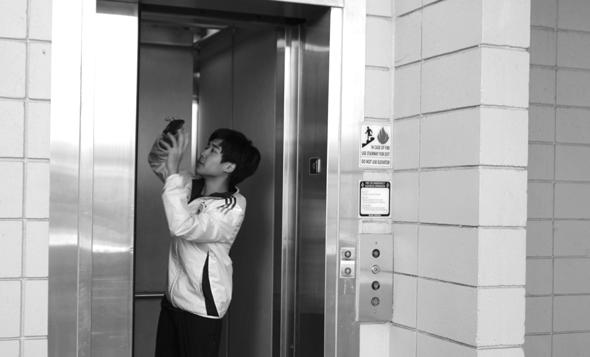
Documenting an often undervalued technology, Chang said he reviews different types of elevators across the Bay Area with his YouTube account @xandrinii. Though Chang’s interest began as a casual hobby, he eventually built connections within the unique field.
“I didn’t expect to reach much of an audience,” Chang said. “As I’ve met other elevator content creators, I’ve decided to commit more effort towards expanding my brand and trying to get other elevator enthusiasts to watch my content.”
In addition, Chang said his parents played a large role in his success, when he began posting videos in 2015.
“I’ve been doing this for 10 years, and when you’re four or five years old, you don’t have many resources unless you ask your parents for them,” Chang said. “So they really supported me in trying to get videos out and creating better and better content.”
Now having reached career highs, including filming the second tallest elevator on the west coast, Chang said he plans to expand his scope. Recently, Chang attempted to contact elevator manufacturers to get machine room tours.
“I want it to be normal for weird hobbyists to be able to have a platform and do stuff without being judged,” Chang said. “Be confident, don’t be afraid to put yourself out there because the more confident you are, the better your videos are going to be.”
that just comes to school, [does] the classes and then goes home,” Kwong said. “I want my teaching experience to be more than that, and [extra activities] allow me to better connect to the school, the students and the community. That’s what makes it fun for me because I wouldn’t do it if I didn’t enjoy it.”
Alan
In preparation for a Black History Month spirit week scheduled for the week of Feb. 23, the Black Student Union is organizing a lineup of activities, president, senior Gabriel Nelson said.
Most notably, the club plans to feature a chalk mural where students can freely participate in creating a large drawing on the quad stage, Nelson said.
“It’s mostly a community event, because one of the things we try to focus on the most is having people actually interact with the club,” Nelson said. “It’s something for people to have fun with, talk to each other and get into the Black student community.”
In addition to the mural, BSU is planning to highlight historical Black figures during morning announcements, secretary, sophomore Gabrielle Harris said.
“The people we’ve selected, all they wanted in history and for the development of Black people in the future were that we were treated as equals,” Harris said. “[They wanted] all races, all kinds of people, to be treated the same and to have that togetherness of peace and harmony.”
Similar to other spirit weeks, there will be a dress up event with students wearing clothes in the theme of 90s hip-hop, Harris said. Moreover, the club will be displaying decorations featuring culturally significant art piec-
es as well as notable historical figures and events for the entirety of February.
Beyond the week’s celebratory intentions, BSU hopes to highlight the vibrant legacy of the Black community, adviser Shay Bellamy said.
“We have a rich history in this country. We helped build this country. I think that it’s important that our students know how influential we are,” Bellamy said. “Especially with the economy and the times that we’re in now, it’s super important to not only be a strong ally to [Black] people, but also to be aware of the things that are happening in our society that affect your friends that are Black.” Reflecting on the impact of Black History Month as a whole, Nelson said the tradition allows him to be proud of his racial and cultural identity.
“It’s useful for people standing from the outside looking in trying to understand and experience the culture through celebrations,” Nelson said. “I like to focus on the month more as something for Black people. Online I see posts and edits for Black History Month, [and] it makes me feel very prideful, like a sense of accomplishment, seeing what other people who look like me have experienced or have accomplished.”
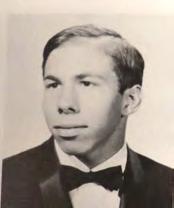


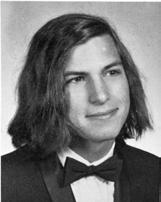
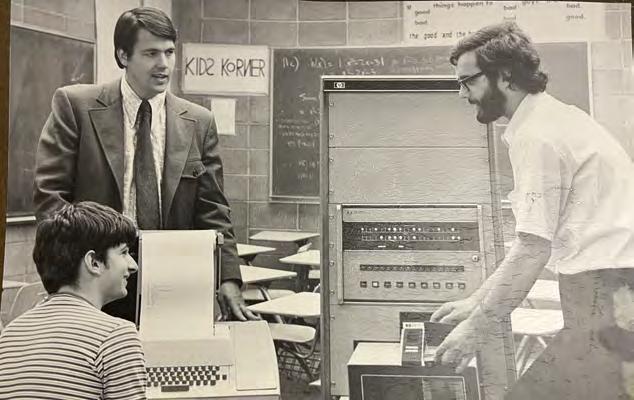
The Epitaph spoke with retired HHS math teacher Stephen Headley, who taught from 1967 to 2007, about the evolution of technology over his tenure.
The Epitaph: Comparing your first year of teaching to your last, how did you witness the evolution of everyday technology in the classroom?
Stephen Headley: There was no technology when I got there. There was an adding machine in the math department office, a great big Friden adding machine. If you knew what numbers to put into it, you could almost make it play a tune because if you did a huge division problem, it would [play different noises]. When I left, even The Epitaph had computers. In my room, I had 10 round tables with four students at each table, and I had at least four or five TVs with computers hooked to them and VCRs. We could look up something on the computer and it would come on all the TVs, so it changed quite a bit.
TE: As the former adviser of the computer club, could you tell us more about what the computer club was and what activities you were involved with?
SH: The idea was to write small programs and run them, and we used a language called BASIC. There were some games that you could play. Sometimes we would just write our program and then see if it worked. If it didn’t work, then we’d have to rewrite it and try to make it work.
TE: We heard you were involved in the building of a computer facility. Could you tell us more about that?
SH: Things changed over the years. We started with the [teletype in a] suitcase, and then I continued to work with people at Hewlett-Packard. After, in 1973, we got a Hewlett-Packard 2114. It was a box that was about one foot wide, one foot high and three feet long, and it
had 8 [kilobytes] of memory.
We had a paper tape reader and a card reader. Students could write programs using a number two pencil. At one time, we had 12 teletypes in the room, and they were hooked to this one computer from HP.
The real fun came when Chris Espinoza [an HHS student and early Apple employee] walked into the room with an Apple I board, and at that time, Steve Wozniak and Steve Jobs were putting together computer kits to be sold at the Byte Shop, and Chris was working with them. This board did not work, and I said, “Well, what are you doing with it?” He said, “Well, I think I can make it work.” So he made it work.
I don’t know where we got any money, but we bought a keyboard and a power supply, and I went out to the wood shop and built a box to put the keyboard in and the CPU board inside. Then, we set a little monitor on top. That particular Apple I is now in the Smithsonian Institute.
TE: Tell us about the founding of the robotics team.
SH: I said, “Well, a team?” you get $5,000, $10,000, with about The member test was bar. When we took it up to tend the basketball with that TE: rience technology?
SH: I terested been times the police the school spent a fun. I did were a math teachers, time at




heard about robotics and I “Well, what do we do to start team?” When you start a team, lots of help. Xerox gave us another company gave us $10,000, and I think we ended up about $18,000 our first year. funnest [competition] I remember was when part of the conwas hanging from a 10-foot
When we finished our robot, took it into the gym and drove the basketball hoop to exthe arm [and] hook it over the basketball hoop. We had a lot of fun that particular robot.
What was it like to expesuch drastic changes in technology? loved it. I was always interested in doing more. There had times when my wife had called police to knock on the door at school to see if I was okay. I lot of time and had a lot of did a lot of things in math that little different than some teachers, but I had a great HHS.
What do you see as the longterm impact of AI club? “From the outside, it is an intimidating field because it’s so technical and there’s so much math and programming involved.

So I hope AI club becomes a space where students have the comfort to ask questions and explore machine learning.”
How will you adapt to the advancement of large language models? “We’ll teach members how to read academic literature because usually, new models are released alongside a paper and benchmark test. So, we’ll teach our members how to understand what those models mean.”
What tech projects have you been involved in? ”AI safety is something I was really inspired by, and from there, I am working with a group of other students I met on AI safety research, and we ended up publishing that paper to the NeurIPS conference.”
How was this impacted by HHS?
“When I joined HHS, I looked at clubs like computer science club, AI club and data science club where I was inspired and ended up becoming an officer for CS and AI club. That was the beginning of my interest in tech.”

What is your most impressive tech accomplishment? “I am currently in the process of publishing a book with a couple co-authors, and we created an adapted climate risk index for over 135 countries. It’s especially important because of the increasing risk that climate change brings.”

How does that align with your interest in technology? “It aligns with technology because we created the index using technology. We used principal component analysis, which assigns weighting based on relevance, and we coded the whole thing, created the data sets and normalized everything by ourselves.”


As Robotics Team 670 enters its 25th year, members have the privilege of taking advantage of an array of new technologies, marking a far cry from their humble beginnings in 2001, secretary, junior Nina Gupta said.
Reflecting on growth since the team’s initial formation, adviser Ed Taylor said the addition of more powerful machines has sparked a digital transition and productive workflow.
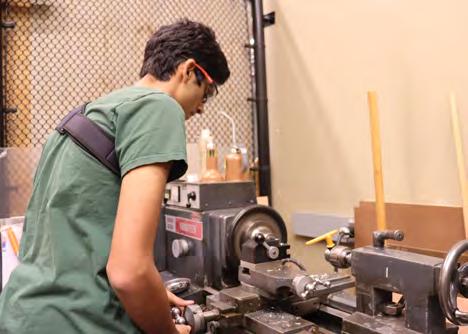
“When you take a look at the lab where we have all the tools, before [that] time, we had one lathe, one milling machine and maybe one automated CNC [a computer numerical control],” Taylor said. “Now, when you look at the shop, we have an automated laser cutter, so more students can actually do the machining that required the skill sets of a mentor 10 years ago. Now, students can do their design on the computer.”
In particular, Gupta said CNCs have modernized the team’s prototyping process and enabled wider member engagement in technical areas.
“The year before I joined, we got our first CNC, and it was able to cause our robot to be built faster and more precisely,” Gupta said. “This increased our production speed very much. We’ve been able to build and prototype
a lot faster and provide this experience of using these machines to a lot more students.”
While earlier robots relied on less adaptable construction materials like PVC pipes, the use of custom parts allows for more complex creations, fabrication sub-team member, junior Anushree Ogale said.
Additionally, the acquisition of a super pit, a consolidation of every competition necessity for a workshop, has vastly improved competition coordination and efficiency, Gupta said.
With the server-based computer setup, Taylor said students have gained better coordination, faster planning and diverse hands-on experiences.
“You can have a lot of students collaborating, and then they
can download that design to a machine and have the machine do all the work,” Taylor said. “If you walk through the lab now, we have over 50 students engaged in building two robots for this next competition. It’s fantastic to see.”

Aside from technical improvements, Gupta said contributing to the competitive legacy of the team has been a priceless experience.
“It’s nice to see such a long-term history and know that there were so many mentors that brought us to this point,” Gupta said.
Student directors bring their creations to life on HHS stage
Featuring four student-directed plays, the annual One Acts performances hit the stage from Jan. 29 to Jan. 31, director, senior Demi Yau said. From navigating friendships to proving innocence in court, each performance shared a different story and allowed directors to showcase their work to a broader audience.
“Directing is such a big role generally, so it’s cool to be able to do that as a student,” Yau said.
Two of the four productions are original works written by students: “Jury Duty” by Yau and “Before All That” by junior Marie Asano Suzano, senior Archit Gunhal said.
As the director of “All Out,” a play about how capitalism pushes people to make irrational decisions, Gunhal said One Acts is unique because it creates a forum for students to express diverse perspectives.
“For the fall play, it’s what Ms. Caires thinks is a good play. But for [One Acts], it’s four different stories put into one,” Gunhal said. “[Each play shows] what one person feels super strongly about, so they create a story people connect with.”
Despite the focus on student leadership, One Acts still involves some adult guardians, Yau said.
Students submitted their proposed performances to drama teacher Alana Caires for review in November. After an interview process, Caires selected which plays to greenlight.
Rehearsals ran on a tight schedule, Gunhal said. To ensure actors were prepared, Gunhal’s directing process included adequate repetition and practice.
“They’re running [the play] until they can memorize and do it in-
stinctively,” Gunhal said. “[Actors] should have rehearsed so many times for the performance that it feels like second nature.”
Suzano’s play followed two friends over three months as they faced challenges that posed a threat to their relationship, eventually overcoming the difficulties. Over the characters’ journey, themes of love, jealousy and friendship were explored through the performance’s depiction of teenage friend groups.
“I didn’t base it on any of my actual personal experiences, but I wanted to write a story about something that could happen between a friend group that felt realistic but was entertaining,” Suzano said. “I knew I wanted to write a heartfelt story about growing up.”
Having begun writing her play about six months ago, Suzano said she had noticed movies and TV shows mostly featured adults playing teenagers, which felt unrelatable. Since One Acts is primarily run by students, Suzano said she took this opportunity to create a play with an all-teenage cast that could accurately portray
the experience of growing up.
“There’s a special [realism] when teenagers play teenagers, and it’s such an interesting time in our lives where everything feels so dramatic, and everything feels so important,” Suzano said.
Inspired by the upperclassmen in drama club as a freshman, Suzano said she believes writing and directing the play has allowed her to leave her own mark on the close-knit community.
“The drama club’s been a sanctuary, a second home, a found family type place, and so it feels like I’m finally able to give back to the club,” Suzano said.
All in all, Suzano, who aspires to pursue a career in musical theater, said the One Acts is crucial chance for students to step into the shoes of a director and showcase their talents.
“It’s incredibly important because there aren’t so many opportunities in the real world for young writers and young directors to start really putting out their work,” Suzano said. “It’s really important to encourage and support artistic youth in every way that’s possible.”

Art club event allows for constructive feedback
Ivy Guo
Helping artists hone their creations, the art club held a peer review event on Jan. 23, event planner, junior Sree Vemuri said. Members brought various art pieces, and students provided anonymous constructive feedback.
Whereas his usual feedback is limited to the context of the AP Art classes, art teacher Tyler Cripe said the event allowed students to receive productive advice from contemporary perspectives.
“I’m 46 years old, so if somebody paints anime or something, I probably won’t understand what they’re doing exactly other than they’re making a painting,” Cripe said. “[They] might give each other better feedback than I would because I just don’t know what they’re doing.”
External activities director, junior Misha Ranjan said they received mostly positive feedback on their creations and enjoyed viewing work from students not enrolled in a campus art class.
Compared to prior peer reviews they have attended, Ranjan said the anonymous format allowed for more honest interactions.
“I’ve had experiences where I go up and people sit there and stare at [my art] and [say], ‘I like this. I don’t like this,’” Ranjan said. “Having the post-its helps a lot because there’s a lot of pressure that’s removed. If you wanted to say something that maybe was not the nicest thing to say, you wouldn’t want to say it to their face.”
As students interchange opinions in a welcoming environment, Cripe said peer reviews are indispensable to artists’ improvement. Given the event’s benefits, Cripe hopes the club considers holding a follow-up review later in the year.
“The peer reviews can be more supportive [than my reviews]. Students listen to each other, so it makes the process easier,” Cripe said. “You see what other people are working on, and can learn from the people you’re exposed to as you could from an instructor who has 20 years of experience.”
“It’s interesting seeing art that might not be shown to everybody. It gives me a better sense of who they are as a person,” Ranjan said. “I got to see what people’s first impression of my piece was and [what] the one strong thing that existed was. It [helped] because then I can emphasize that.”
by Ivy

Award-winning author discusses recent novel, writing process
The Epitaph spoke with award-winning author Susanne Tagder about her most recent novel, “The Color of Shadows,” published on Sept. 13, 2025. (Tagder is a parent of senior Sarah Meier). Tagder’s German-language mystery crime novel surrounds a true story of a missing child investigation in 90’s Germany.
The Epitaph: What research did you conduct to write this novel?
Susanne Tagder: The crime that happens in my book is a real case that happened in a German town, so I actually went to that town and looked at the street where this had happened to get a sense of the atmosphere there. I also interviewed people in the police station and asked them questions about how to conduct an investigation when you have a missing child. The research you do beforehand translates onto the page, and makes your book better.
TE: Walk us through a typical day-in-the-life while drafting this novel.
ST: For this book, it was my full-time job, and that’s a privilege. The typical day depends on what phase of the writing process you’re in. But, if you’re in the writing phase, you sit at your desk, and you pick up where you left off the day before, and try to continue the story. I usually try to write for at least three or four hours, and if I’m lucky, even more than that. Not every day is the same in terms of how many words you write, but I try to stick to my routine.
TE: What was the biggest challenge you faced while writing this novel, and how did you overcome it?
ST: It was finishing [the book] on time. I’m a writer who is very meticulous about language, so I take time to work through [my writing] several times and make it as good as I can. At some point, I noticed I didn’t have much time left. I had to mute my inner critic and just let go of a few things that I thought weren’t done yet. They are done, just sometimes you don’t know. It’s more important to finish than to make it perfect. There is no perfect.
TE: What was the proudest moment of your career regarding the writing or publishing process of this novel, and why?
ST: One moment was when I got an invitation to read from this book in the town it’s set in. That was a special moment for me because [I got] to get in touch with readers who live there and hear what they have to say. What I liked was how appreciative they were that their town is actually dealt with in a novel. They were proud of that. The other thing was that, [at] the end of December, the novel was awarded a German prize for crime fiction. That made me very proud and very emotional. It was a big deal.
TE: What advice do you have for teenagers who are interested in becoming authors?
ST: I recommend, at some point, to take a creative writing class. It’s good to start with shorter works, like short stories or even flash fiction, and work your way up to longer pieces, and one day, maybe a novel. What’s really important is to trust yourself and be persistent. The truth is that it can take 10 years from your first idea to the finished novel, so you have to have some patience.
TE: How do you find inspiration for your writing?
ST: Inspiration comes from all kinds of sources and unexpected areas. It could be a walk, it could be a conversation with someone, it could be a long drive in the car, it could be a newspaper article, a podcast or even other books sometimes. All those things can be an inspiration, but what they have in common is that I need a real interest. There has to be a spark and an idea that I notice, keep thinking about and get really excited about. I can’t let go of it, and then at some point it becomes a story.
Editors’ note: Tagder’s responses have been edited for brevity.



“When I saw you, I stopped using Google because I found everything I was searching for.”
- Sanjeet Jayaseelan (10)
“If you were words on a page, you would be fine print.”
- Elina Li (9)


“I need your hotspot because I’m trying to connect.”
- Henry Hu (12)
“No pen, no paper, but you still draw my attention.”
- Ivy Guo (9)
“Excuse me, I think you dropped something. My jaw.”

- Olivia Levesque Ouellette (11)



Among the larger, schoolbased choir, many students form their own small groups that function as autonomous bodies, choir teacher Jeff Morton said.







While the school-based choir features about 60 singers, smaller choir groups range in size from under 10 members to 12 or more people, choir member, sophomore Lalie Gingembre said. Because of the groups’ reduced sizes, members get a chance to perform in a more intimate environment, Gingembre said.
“It brought confidence into my singing, especially since you get to sing with people who have the same level as you or the same type of voice as you compared to [normal] choir where it’s mixed,” Gingembre said. “We did our first performance the week before school ended, so I think we were all stressed, we all supported each other, smiling at each other during the song, so we would not be as scared because we’re in a smaller group.”
Members of the student-run groups benefit from greater independence over which songs they perform, choir member, senior Ruofei Yang said. During main choir performances, small groups also often perform an extra song
as an addition to the broader set list.
“Some years, a small group is just a group of friends,” Yang said. “In our case, we held auditions for any choir student who was interested. So, there are people we’re less familiar with inside the group, as well, but it helps with forming bonds and bringing the community closer.”
Members are also able to showcase their unique vocal strengths, choir member, senior Yujun Lee said. Small groups typically implement an acapella format, resulting in clearer harmonies and a distinct spotlighting of individual voices.
Aside from expressing their talents, participation in small groups also teaches students valuable managerial skills, Morton said.
“I don’t have time to lead smaller groups, [so] it’s good to have students run groups, because they learn skills of how to run a rehearsal and get everybody learning the parts and putting it together,” Morton said.
Typically meeting outside of class time, including during lunch, small groups are able to spend more time reflecting on their performance, Gingembre said.
“It’s fun to listen to our recordings after we sing and see, ‘Oh, wow, we did this really well’ or ‘wow, we did this really badly, let’s fix that,’” Gingembre said. “We all get to laugh and enjoy it.”

said.
Cooking assignments serve a delicious, educational experience
In a twist on the traditional group project, students in various language classes undertake a unique challenge: to step in the kitchen and assemble a delicious meal.
Chinese 4 students most recently tried their hand at the culinary arts, culminating their efforts with a potluck on Jan. 20, Chinese teacher Vivian Ju said. The project, which AP Chinese students also completed in September, has several goals that aim to present students with a comprehensive assessment of their cultural knowledge.
Following an in-class introduction to the geography of China and Taiwan, students thoroughly researched the characteristics of a designated region, Ju said. After successfully preparing a dish,
students created a slideshow documenting the cooking process and presented about their region to the class, Ju said.
Chinese 4 student, sophomore Alyssa Leung said she, alongside sophomore Jolene Luong and sophomore Cerie Huang, made scallion pancakes from scratch, kneading the dough, chopping ingredients and frying it as a team. The combination of food and group work proved an entertaining, educational experience.
“This helped us with learning what the different regions’ food were like because our unit was on describing different kinds of foods and their tastes,” Leung said.
Furthermore, Leung said seeing other creations during the final potluck reinforced the key objective of appreciating culture from across the Chinese-speaking world.
In a similar format, Japanese classes also present food-based assignments, with traditional foods such as bento and oyakodon introduced over each class level,
Japanese teacher Junko Birdsong said. Depending on the specific assignment, students either individually follow a recipe or collaborate to research a region and film an informative cooking video.
“You have probably heard many people say, ‘I love Japan’ and ‘Japanese food is so good,’” Birdsong said. “Food is very important for [students] to explore any new culture. Usually, [people] love eating different foods. From the food, we understand their lifestyle. [People’s] lifestyles and what they eat make us how we are.”
The creative, hands-on nature of cooking projects remains enjoyable for students and teachers alike, Birdsong said. It provides practical knowledge that cannot be learned from textbooks and offers learners tangible, fulfilling results.
“I love [the project] because, whenever I see the students enjoy something, that’s my joy, too. So even when they are working on the research, or coming up with ideas to film the video, they’re
having fun,” Birdsong said. During the Chinese class potlucks, Ju said she was impressed with students’ ability to successfully understand and recreate the individual flavors of each regional cuisine. “I really could taste the difference [between cuisines], even though it’s student-made,” Ju said. “I told them, it has to be authentic, so you have to look at the recipe and make sure you do it correctly. So when I ate the food brought in by the students, even as a teacher, I was really amazed. It’s a handson experience.”

Normalized sexual content is problematic
As pornography consumption increases, it is no surprise that popular culture constantly responds with an onslaught of sex-related media, according to the National Library of Medicine. However, these forms are often toned down to appeal to a general audience, giving rise to softcore porn on the internet.
You have likely encountered graphic thirst traps or #BookTok at least once. Think: cooking videos with suggestive undertones, people on Instagram who barely
avoid getting censored and women raving over explicit scenes in their favorite hot CEO fanfiction-adjacent novels.
Unfortunately, the problem is that I am not even the target demographic for this content. Like others, I encountered it because social media algorithms are designed to push for viewership and profit. Since sex sells, softcore porn has seemingly invaded every corner of the internet and become apparent in many of the movies and TV shows we consume.
Normalizing explicit content can feed into people’s pornographic desires and commodify what is otherwise an intimate experience that provides depth to relationships. An example of this
perception shift is visible in the new TV show “Heated Rivalry.” Its buzz is a microcosm of how mainstream sexual content affects public reception.
While the show does carry some merit with its undertones of LGBTQ+ empowerment, its popularity among many viewers ultimately hinges on two conventionally attractive hockey players, Shane Hollander and Ilya Rozanov, hooking up.
The rather pointless sex scenes add little complexity and message to the progressive plotline, which is better displayed through the side story of another couple present in only two of six episodes.
Due to the prioritization of sex appeal over emotional depth
stemming from softcore porn’s chokehold on media, themes that spark catharsis within viewers have become rare.
Undeniably, sex-driven content is trendy and profitable, creating a cycle of exposure and normalization. Both viewers and the media promote this dynamic, and thus, both need to be careful about what trends they push into the mainstream for all demographics to see.
This normalization is a slippery slope, and more often than not, softcore porn detracts from the media we consume. People should think twice before watching
Artists need to prioritize purpose over profit
I scrolled in pure awe when I first saw photojournalist Christopher Anderson’s recent Vanity Fair collection of the current White House administration.
The images included a bland photo of secretary of state Marco Rubio being compared to the stature of a small lamp, a close up shot of press secretary Karoline Leavitt’s extremely visible lip filler and political advisor Stephen Miller’s head under a painting of colonizers and Native Americans.
One might look at these photos and wonder why they were so awkwardly shot and barely edited, but that was the artist’s intention. Through his perspective, Anderson was portraying
those running the White House as extremely unim pressive and pa thetically narcissistic.
When I first pieced this together, I was unbelievably fascinated by this modern form of artwork. Instead of perfect editing and compositions to draw viewers in, Anderson intentionally chose unflattering images, but each one delivers subtext that an “ideal” photo could never capture. His photos sparked online discourse and let citizens see their leaders through his lens.

Most importantly, these images highlight what many pieces of art have been lacking: an underlying human intention to impact and change others. Even in other mediums like film, reading and photography, there has been a shift to prioritizing unoriginal content for profit and viewership instead of purpose.
an explicit TV show or continuing their scrolling habits, prioritizing personal and societal perception of intimacy.

Along with this, art has seen a rise in generative AI that has drained genuine creative intuition behind artists’ works.
An example of art without an ardent purpose is popular author Colleen Hoover’s novels.
While she attempts to combine multiple genres in her books to convey an apparent message, in reality, she mass-markets and strives for quantity over quality. Her books are then adapted into movies, which cause her banal artwork to infest multiple mediums.
However, these bland creations can never spark civil discussion and intellectual curiosity
that art containing real and passionate purpose like Anderson’s current White House photoshoot could.
Approaching art with thoughtful intention allows artists to express themselves and their unique perspectives, while fostering engagement and intellectual discourse for consumers.
Making others think critically and remember why the world matters is what art should represent instead of slop just created purely for mindless entertainment.
As authentic art continues to be threatened by external factors such as AI and profit mongers, it is up to us to treasure and preserve it.
We must continue to ponder the reasons why we enjoy art and shift focus toward those who create with authentic and fervent purpose.
Unique take on film classic brings emotion, passion to theaters
Adam Orrin
On the backstreets of a 50s era New York, anything goes, and Marty Mauser will do whatever it takes to win in this dark and powerful twist on the classic sports underdog story. “Marty Supreme,” released on Dec. 25, is the story of a desperate man on a mission to prove himself to the world, no matter what it takes.
This complex antihero is perfectly portrayed by Timothée Chalamet, who is currently on his own underdog path in Hollywood.
Chalamet’s performance captures a wide range of emotions from paternal love to unbridled rage.
The movie is elevated by an amazing, diverse cast, continuing director Josh Safdie’s creative and unconventional casting streak.
For example, Kevin O´Leary, a rich, haughty entrepreneur in real life, perfectly fits his character as an antagonistic business owner in “Marty Supreme.”
One of the film’s main elements is its character study on Mauser, whose struggle is a unique journey of accountability.
At the end of the movie, Mauser turns down money to achieve a personal victory against his one-sided rival Koto Endoto.
When his manic journey comes to an
end, he looks less like a malicious criminal and more like a morally ambiguous antihero.
The film illustrates this change by perfectly depicting the contrast between who he is at the beginning of the film and at the end.
Looking at the massive marketing campaign for this film, one line stood out to me: “‘Marty Supreme’ is an American movie.” This perfectly encapsulates the true meaning of Mauser’s story.
In the film, he is not a hero to be praised and admired. Instead, his story acts as a meaningful critique of the disillusionment caused by the American Dream.
Poor pacing, incoherent plot hinder supreme performance
After constantly hearing advertisements for the Dec. 25 release of “Marty Supreme,” I ran to my local AMC Theatre. I was eager to see a unique and engaging sports thriller akin to “The Last Dance,” but I walked out lamenting my poor use of Christmas Day.

Mauser’s journey toward greatness shows how his path to success in an unforgiving postwar America turns him into a depraved version of himself, blinded by the bewitching appeal of wealth and fame that ultimately uravels in spectacular fashion.
Safdie has directed a perfect balancing act between a dark, twisted commentary and a crudely humored underdog plot.
“Marty Supreme” lobbed over all my expectations with smash hit performaces, cementing Marty Mauser in cinema history as truly supreme.
“Marty Supreme” attempts to combine comedy, drama and sports, but fails to capture any genre in a satisfactory manner.
The result is a poorly paced, incoherent movie that wastes brilliant performances and a beautiful story.
From professional table tennis matches to sensual bedroom scenes, Chalamet expertly plays with the audience’s emotions. Chalamet had me on the edge of my seat, both rooting for his victory and simultaneously praying for his downfall. Despite its star-studded performances, “Marty Supreme” suffers from poor pacing. Within the first 30 minutes of the movie, protaganist Marty Mauser is frantically rushed from a cobbler’s workshop
to the final match of a table tennis championship to the halftime shows of the Harlem Globetrotters. The next 90 minutes of the movie cover Mauser’s wild escapades unrelated to table tennis, from almost killing a mob boss to blowing up a gas station.
The jarring change from a rapid to a slogging pace left me confused, bored and frustrated as I waited for Mauser to wrap up his tomfoolery and become the champion he believed himself to be.
Beyond poor pacing, the film’s attempts to combine multiple genres together left me frustrated at how many plot points lacked depth. If Safdie focused on developing the themes of Mauser’s relationships instead of action scenes, the film would have felt more polished. Instead, the movie delivers superficial storylines.
The biggest offender is the subplot between Mauser and famous actress Kay Stone. The movie spends an abundant amount of time building up a romantic relationship between the two, just for it to abruptly end with no impact on the rest of the story.
“Marty Supreme” would have been far better if it had firmly settled on what story it wanted to portray, instead of meddling between themes and genres.
At its core, “Marty Supreme” is a spectacular story about one of the most interesting athletes to ever live. Tragically, this potential is overshadowed by structural issues, a result of lousy pacing and an unclear idea of what the film represents. Disappointingly, “Marty Supreme” ends up being anything but supreme.
Current film villains lack complexity to enhance stories
Many films use villains to counter heroes and present them with purpose and hardship.
Thought provoking, emotionally rousing antagonists breathe life into a story and hook the audience in.
However, in recent years, the film industry has experienced a steep decline in the quality of antagonists, leaving audiences clinging to old favorites rather than embracing new releases.
Film villains from the early 2000s, such as Azula from “Avatar: The Last Airbender” and Judge Claude Frollo from “The
Hunchback of Notre Dame,” left big shoes to fill for the next generation.
Despite varying greatly in age, gender and personality, both of these villains are widely successful due to their complexity and shared belief that they are always in the right.
For instance, Azula is known for her intriguing use of psychological warfare and her crippling God complex despite her shockingly young age. Cut from the same cloth, Judge Frollo embodies hypocrisy and self-righteousness in his mission to exterminate vice and sin, despite his own vulnerability to these qualities.
Taking a big step back from previous successes, the film industry has been cranking out villains who are increasingly formulaic and shallow.
One such example is King Magnifico from Disney’s “Wish,” who contributed great ly to controversy surrounding the movie upon re lease. He lacks the villainous intent and flawed moral com pass that viewers crave, heavily disappoint ing audiences with poorly written dialogue.
Unlike complex an tagonists from the 2000s, King Magnifico’s charac ter comes across as comical and quirky rather than sinister, as displayed in

Online board games benefit consumers, companies
Parth Dhaulakhandi
I love board games. However, they require people to remain in close proximity for hours at a time.
I first discovered online versions of board games as a unique way to interact with people during the COVID-19 lockdown. Even today, they continue to bring accessibility to gaming experiences, expanding to appeal to every audience.
Even board game fiends like myself can’t always fit two hours of dedicated game time into a
four-hour hangout window. However, getting on a Discord call with friends after dinner to pass the time is significantly easier to plan and execute.
Online board games let people continue to play these games without having to dedicate a larger amount of time outside of the gameplay. Instead of having to pair playing a board game with a monumental task of event planning, this digitized gameplay lets players play whenever and wherever they want to.
Even from the standpoint of current online game enthusiasts, board games present a new genre of gaming on the internet.
Most gamers are tired of the same video game tropes and remakes present in online gaming. We don’t always need a graphically impressive cinematic masterpiece, or worse, another multiplayer shooter game.

Bringing board games into the video game world may be the breath of fresh air this vast audience needs.
By combining an audience looking for new content with another one that craves accessibility, a shift to online games will be largely supported.
For me, this realization came through the online version of “Codenames,” which turned an uneventful break during a hackathon into a brilliant, on-thespot team bonding activity.
Another simple way to embrace this digital shift is to make social media sites integrate games into their platforms.
Discord does this particularly well through Discord Activities, using games like “Chess in the Park” and “Poker Night 2.0” as viable digital substitutes for traditionally in-person games.
For companies that wish to continue building profit while offering these games to wider audiences, setting a price on these online game versions presents a possibility for profit.
A tier-based membership system could also allow companies to keep making money online. Free accounts could have advertisements included, and ad-free paid memberships could grant customers premium options.
Internet adaptations are the future of board games since both the producers and the consumers can only stand to benefit from it.
Board game companies need to utilize the same strategic thinking they promote in their games to make their products more readily available.
A$AP Rocky conveys deep message with chaos in new album
Throughout the project, the listener is met with brash shifts between high-octane bangers and slower, introspective songs about his family and personal growth.
in the album, I was concerned A$AP Rocky wouldn’t be able to connect each distinctive element to create a complete album experience.
To my surprise, he succeeds Sachin Chandran
In the eight years since his eccentric, divisive last album “Testing,” A$AP Rocky has pioneered a fashion brand, won an assault trial and had three children, all while ignoring his music career. Thankfully, on Jan. 16 after nearly a decade of directionless singles, he released his long-awaited album “Don’t Be Dumb”. The album couples subtle lessons about protesting against injustice with an exploration of genres new to A$AP Rocky, reflecting his continued artistic evolution.
A prime example of A$AP Rocky’s development on this album is his use of musical tone to shape themes in different tracks.
The stand-out tracks “STOLE YA FLOW” and “STAY HERE 4 LIFE” use this unpredictable formula. The former features invigorating, head-banging rage production that is sure to get you out of your seat and jumping, while the latter follows with a pop-flavored R&B beat that enables A$AP Rocky to gush about his love for his partner Rihanna. Along with serving a larger purpose to the album’s message, this dichotomy keeps listeners on their toes, leading to a varied and engrossing experience.
While this variation thoroughly immersed me
his humorous mannerisms and misguidedly upbeat songs. While villains can benefit from having a softer, more comedic side, King Magnifico lacks the ruthlessness to balance out the rest of his personality.
Not every evil-doer needs to be relatable or have redeeming qualities, especially if it weakens the plotline and their pres-
Only a few 2020 shows like “Arcane” showcase multifaceted antagonists that keep audiences hooked.
Riddled with deep childhood trauma and guilt, the main character in “Arcane,” Jinx,
is manipulated into committing murder and causing mass destruction. However, juxtaposing her formerly innocent personality with her current manic identity garners empathy from the audience.
Taking inspiration from Jinx, the current film industry needs more well written, layered villains to keep viewers entertained.
The early 2000s to 2010s set the standard for nuanced villains who are unapologetically invested in their ambitions, and those of the modern era are far from reaching their esteemed legacy.
To improve the quality of films in upcoming years, the cinema industry must focus on crafting realistic, nuanced antagonists instead of monotonous cardboard cutouts for the protagonist to vanquish.
Album covers are meant to carry deeper stories, impact
“Don’t judge a book by its cover.” Though we’ve all heard the phrase before, it should not apply to album covers.
Currently, album covers are treated like detached aesthetics. However, they play a vital role in the listening experience. When designed with intention, its cover can add to an album’s story and purpose.
Iconic albums like Charli XCX’s “brat,” Pink Floyd’s “The Dark Side of the Moon” and Nirvana’s “Nevermind” have impacted the way people view music and are perfect examples of an album cover’s power over listeners.
A notable example of a meaningful cover comes in Billie Eilish’s debut album “WHEN WE ALL FALL ASLEEP, WHERE DO WE GO?” The cover echoes the dark, horror-like themes of the album’s songs, and it contributes to her distinct presence in the music world.
The intense stare

and streetwear are all I can associate her with now due to the impact of her album cover. This kind of evocative imagery has the power to tell the artists’ stories and invoke feelings within viewers, to improve listening experiences.
An album cover has not only a significant impact on the eyes, but also the mind. Visual elements have a greater effect on memory than auditory ones, emphasizing the importance of album covers art, according to the National Library of Medicine.
The reinstatement of the Best Album Cover category for the 2026 Grammys is a step in the right direction to recognizing that album covers shape people’s perceptions as much as music itself. Celebrating album covers shows how valuable they are to listeners’ personal experiences, as well as their influence on culture and artists’ footprints.
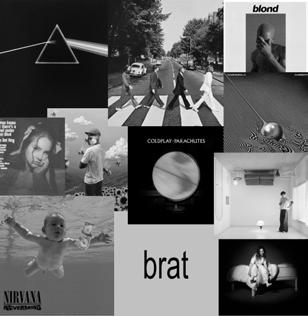
Album covers play key parts
and album identities.
through sharp songwriting in his final tracks. During the interlude of the ethereal “DON’T BE DUMB / TRIP BABY,” A$AP Rocky gives his definition of “dumb”: “Temporarily unable or unwilling to speak.”
“THE END” follows that fantastic song, by taking a shockingly political turn. A$AP Rocky laments over the systemic woes that plague the African American community and its youth, ending with a chilling outro from alternative singer Jessica Pratt, a previous collaborator.
This profound climax sheds light on the essence
While album covers are significant for marketing on an artist’s end, they make a difference to listeners, through the memories we form, the stories we tell, and the imagery of our listening experiences. Album covers serve to embellish music while determining how we connect to it.
of “Don’t Be Dumb”: we, as listeners, cannot be “unwilling to speak” out against issues that torment our community. Just as A$AP Rocky invites chaos through sonic discordance, we must create chaos with protest to spark real change.
Although it possesses a few weak moments, such as the drab “ROBBERY” featuring Doechii, the positives far outweigh the negatives with this project.
Its novel, daring take on alternative hip-hop make “Don’t Be Dumb” worth the excruciating eight-year wait.
Album: “Don’t Be Dumb.”
Grade: B+.
Artist: A$AP Rocky.
Officials channel passion for sports into creating order
Serving as a neutral presence on the arena, referees are a staple of every game as they make calls and enforce the rules, athletic director Chris Grossman said.
Though they may be overlooked by some, hiring referees is an essential consideration when organizing games, Grossman said. To ensure all sports are adequately staffed, HHS partners with Bay Area Sports Officials, which assigns referees to individual games once coaches establish a season schedule.
“They call it the same way for both teams, and without them, without parents, without coaches, none of these athletics work,” Grossman said. “That’s why it’s such a community effort to make sure that we provide a good experience for our students.”
Many referees have prior experience refereeing lower levels for their children or at recreational games, but people are welcome to join, regardless of their experience with the sport, owner of Bay Area Sports Officials Rick Moore said. Most commonly, prospective officials have a desire to serve the community and let youth enjoy athletics.
Basketball referee John Logan said he played basketball in high school and started refereeing junior divisions on weekends. After graduating, he began working at high school games and has been doing it for nine seasons since.
Apart from the sport itself, Logan said the most rewarding part of his job is the opportunity to watch youth commit to the game, and grow as players and people.
“I’ve seen people start on the freshman team, and then after four years, they’re a starter on varsity,” Logan said. “The growth and development of each player keeps me involved and makes me enjoy the game.”
Despite the joys of refereeing, the job demands more than just technical knowledge of a sport, Moore said. Officials are required to develop the emotional capacity to handle possible verbal abuse and deescalate arguments.
“If we’re invisible, if people didn’t even know we were there, that’s the best thing for us,” Moore said. “One of the books that I’ve [recommended] is ‘Verbal Judo,’ which basically speaks for itself. When someone’s saying something, you have to learn how to talk and not antagonize. Everybody wants to be heard. So, if they’re asking you questions, you should be able to answer them.”
Moreover, officials must navigate the additional challenge of a severe referee shortage in several sports caused by the COVID-19 pandemic, Moore said. As the number of available officials does not match the number of games, the games must be staggered throughout the week to accommodate the BASO’s limits, and the organization is actively
Students share experience in sport shooting, archery
Honing in on the target, sport shooter, sophomore Anna Liang and archers, sophomore Mishti Doshi and freshman Meera Aravind aim to pursue and thrive in these sports not offered on the HHS athletic roster.
Shooting, Anna Liang
Having begun shooting at 14 years old, Liang said she was first introduced to the sport through an event at her local range that her mother heard about. Among the many benefits of shooting is the opportunity to unwind in an unconventional manner, Liang said.
“When you are shooting, you do not exactly have to think about anything, so it is actually pretty satisfying and relaxing because you only have to focus on the target,” Liang said. “You do not have to worry about any other stuff, so it is a way for me to relieve some stress.”
Through her precise aiming, Liang said she was given the chance to compete on a team and reach the level of expert. Moreover, Liang also stepped out of her comfort zone to recruit new shooters to her team.
“I wanted to work on my teamwork and my ability to talk with other people, because I don’t really like talking to strangers,” Liang said. “Through this, by recruiting others to the team, I can improve my socializing skills with other people.”
Archery, Mishti Doshi
Ever since watching the 2020 Summer Olympics, Doshi said she has been enthralled by archery, starting the sport competitively a year later.
“My favorite part is seeing how your hard work translates into your scores,” Doshi said. “After all your practicing and the long hours that you spend on it, see-

ing the results makes you feel so much better.”
Doshi said her dedication to the sport has paid off, successfully climbing the ranks to become 5th place in California in the Recurve U18 female category. Doshi hopes to continue archery during college as she enjoys the unique challenges posed by the sport’s different events.
“Indoors is a shorter distance, but you have a smaller target, and then outdoors there’s farther distances, but you have a larger target,” Doshi said. “Personally, I prefer outdoors since it’s more interesting because there’s wind and sunlight and there’s lots of different factors. It’s also more fun to shoot long distances.”
Archery, Meera Aravind
“The Hunger Games,” Aravind said she picked
up archery as a hobby over the summer in 2025. With her father, a former archer, lending a helping hand, Aravind saw rapid improvement.
“When I first started I wouldn’t be able to get a bullseye, but as you practice and you figured out the different tricks you can really see how much you hit the target,” Aravind said. “You could see how many errors you actually made on the target, which was really cool.”
Despite recently placing archery on hold due to academic demands, Aravind said archery has taught her valuable life lessons on attentiveness.
“[I learned] concentration because if you aren’t focused on your target, it’s hard to get to the goal that you want,” Aravind said. “It’s like a metaphor for life where you have to be focused to reach your target.”
“Organization is important, but we like the game to flow, the players to have fun, the game to be close [and] the fans to be involved,” Logan said. “We want everyone to have a good time, and watch good basketball as well.”
working to recruit new referees. Ultimately, in the heat of a game, referees are faced with a fragile balancing act, Logan said. Officials must work diligently to speedily evaluate the legality of plays and ensure the game remains fair for both sides, while not detracting from the sport’s natural excitement, Logan said.
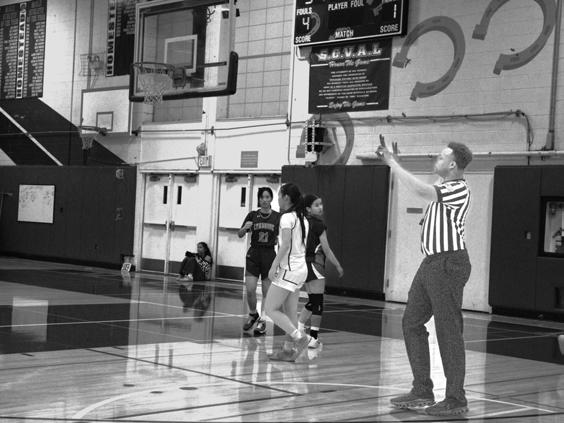
Through years of steady commitment on the court, varsity boys basketball point guard, junior Ashton Tam said his dedication has shaped both his playing style and work ethic.
“I’ve been playing basketball since second grade,” Tam said. “Basketball in general has been one of the most consistent things in my life. I enjoy it a lot, because what you put into it is what you get out.”
While Tam said his interest in basketball began by watching others play at a young age, his skills were deepened through training with his dad. Aided by his budding discipline, Tam successfully earned a spot on varsity during his sophomore year.
“Being able to start on the team means a lot to me,” Tam said. “I think it was a reflection of how much work I put in. It felt like one more step.”
Tam’s skills as a player and a teammate have grown significantly throughout his athletic career, particularly in his maturity on the court, coach Matt Wright said. This season, Tam has taken on additional responsibilities while adjusting to his new role as a team captain.
“He’s always been a phenom-
enal shooter,” Wright said. “But this year, he’s really grown as a leader. Teams key in on him, and he handles that pressure well. He doesn’t complain, and he works with his teammates and runs the offense.”
Tam also recently earned a nomination for the Bay Area News Group boys athlete of the week after scoring 26 points in a win against Mountain View High School on Jan. 20, according to The Mercury News.
As a testament to his spirit on the court, forward, senior Will Hamburger said Tam takes the collaborative nature of the sport to heart.
“He knows when it’s his role to do more, or when he has to take his foot off the pedal a little more to be more efficient and to help the team succeed,” Hamburger said. “He’s willing to do whatever it takes to help the team win, because that’s what’s best for everyone, and that’s what we want to do as a team.” Looking ahead, Tam said he hopes to finish as a qualifier for CCS and finish the season strong, supported by the meaningful relationships built while on the team.
“Thank you to my teammates and coaches because I feel like without them, the team wouldn’t find success,” Tam said. “Without trust and without fully knowing your teammates, you cannot have a successful team.”



Student-athletes discuss the significance behind their jersey numbers.
“My number was [the only] one that wasn’t in bad condition. It didn’t mean anything before, but [now] it feels right for this season. “- Renee Lam (9)

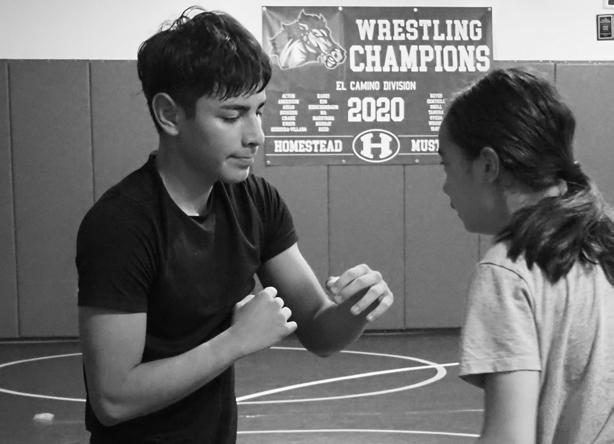


“If I had a number on wrestling, it would probably the number one, because I’m number one because I’m trying to be the best every day.”

“Jason Kidd, who used to play for the Brooklyn Nets and Mavericks wore the number 5. I really look up to him, and he inspires me to play better.” -
4 GIRLS SOCCER 3 4 BOYS SOCCER 2 7 GIRLS BASKETBALL 1 3 BOYS BASKETBALL 4 0 WRESTLING 7
Wrestling: 2/6, SCVAL wrestling tournament
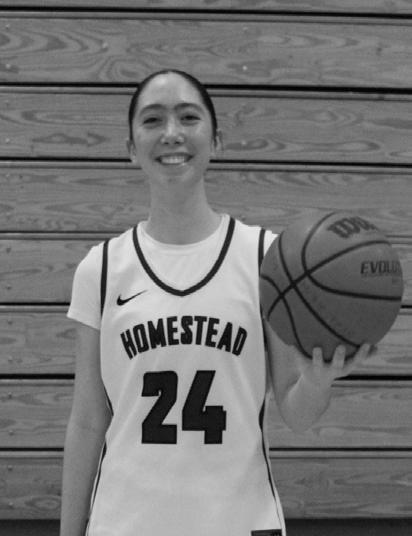
“My jersey number is after Kobe Bryant. He’s a player that I’ve really looked up to my whole basketball career, and obviously, he’s one of the goats of basketball. ” -
Varsity Girls Basketball: 2/6 at LHS at 6:15 P.M.
Varsity Boys Basketball: 2/10 vs Mountain View High School at 7:00 P.M.
Varsity Girls Soccer: 2/10 at Woodside High School at 6:15 P.M.
Varsity

Katie Tal, Kaylee Ouyang attain recognition
By Jason Lai and Alicia Liste
Two student-athletes, varsity basketball player, junior Katie Tal and varsity soccer player, sophomore Kaylee Ouyang, were recently nominated for Bay Area News Group girls athlete of the week, principal Denae Nurnberg said.
Katie Tal Tal was nominated for the title after scoring 30 points during a 57-47 win against Los Altos High School on Dec. 11, 2025 according to The Mercury News.
In her first season with the team since transferring to HHS from Torrey Pines High School in San Diego, Tal has already made her mark as an indispensable scorer, teammate junior Hope Yin said.
“She’s one of our best offensive players. Her aggressiveness in-
spires other people on my team to also do the same as her, ” Yin said.
“She’s become an integral member of our team, and this season, we wouldn’t have as much success as we’re getting without her.”
Though adjusting to the new atmosphere was a challenge, Tal said the process was eased by her supportive and welcoming teammates.
“[For] team bonding, we go to House of Bagels and do fun things that make it more than just basketball,” Tal said. “You find your people. During practice we’re always laughing, and that helps when it gets to the game.”
Coach Megan Fong said Tal’s presence has enhanced the team’s dynamic, injecting a refreshing sense of competition.
“Her greatest strength as a player is her good court vision.
She can see things developing on the court with her teammates, and even [spot] open gaps for her to take up by herself,” Fong said.
“We knew that the game against Los Altos was going to be a tough one for us, and she shot really
well, drove really well and had an all around really nice game that they didn’t have an answer for.”
Kaylee Ouyang
Ouyang was nominated for the title due to her two goals and one assist during a 9-0 win against FHS on Jan. 3, according to The Mercury News.
As one of the younger players on varsity, Ouyang said she was initially intimidated to play in a more competitive environment, but soon settled in comfortably.
“It’s been a big jump from JV, so I definitely had to put in a lot of work and be committed,” Ouyang said. “Sometimes, if I struggle with confidence, I have to just keep the mindset that if I keep working hard, I’ll get to where I want to be.”
Looking ahead to the rest of the season, Ouyang said she plans to continue dedicating time and energy to improving as a player. Off the field, Ouyang’s athletic career has been fueled by a comprehensive support system.
“My coaches [offer] words of
encouragement and just help motivate me to keep trying to be a better player,” Ouyang said. “My parents are encouraging, and they drive me to all the games and everything, so I appreciate that.”
Coach Raquel DeJesus said Ouyang’s performance is characterized by her impressive speed and agility, which poses a chal-

lenge for the opposing team.
“She’s probably one of my top players that gives 110% on the field, whether she’s practicing or in a game,” DeJesus said. “She is very easy to coach, so I definitely do give her some critiques, some feedback, and then she also asks a lot of questions that help her become a better player.”
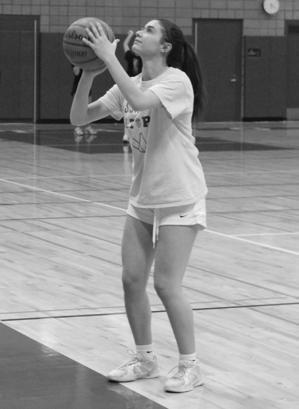
Many students participate in unique hobbies outside of traditional sports. Students share how and where they build community around these interests and their motivations behind them.
Finding your people can be a struggle in high school. Here’s how seniors Nikunj Govil and Andrew Kwok formed clubs around their talents.
Kwok said he established the Magic: The Gathering club last school year with hopes that other players would join.
“I started [playing Magic] because a friend taught me the basics, and I thought it was really fun,” Kwok said. “There are always new people [joining] the game. So if you meet someone and you’re inter ested in playing, if [you] ask, they’ll probably help you.”
MTG Club meets every Wednesday at lunch in room A-102.

Starting Rubik’s cubing in sixth grade, Govil said he strives to build a cubing community at school through holding public events and competitions.

“We hold these cubing competitions on the quad every semester,”
Govil said. “We were able to bring a lot of people in on the last one, because they all saw the numer ous cubes we have and the ones we just bought recently, and they decided to show up.”
Muaddi said she fell in love with martial arts at a young age by sparring with her brother and uncle.
“My biggest motivation is believing in myself because it doesn’t really matter who’s there or what anyone else is thinking. It matters what mindset you’re in when you’re on the mat,” Muaddi said. “Just believing in yourself matters because I’ve had times where I didn’t believe in myself, which made it a lot harder to win or do my best.¨
Competing in three or four tourna ments per year, Muaddi said she com petes against other dojos in the region, where the competition is difficult.
“But then [when you win], and it feels great when they put the medal around you and call your name,” Muaddi said.

Fishing for striped bass is a big mountain to climb, and catching one is the pinnacle for new fishers, Shi said.

“I fished [at a] spot for a full month before I caught one fish,” Shi said. “It was a breakthrough experience. I really figured it out, and I was a lot more successful at catching them.”
In the fishing community, not a lot of people give out tips and tricks to newcomers to the hobby, Shi said. But after improving on your own or with a group of friends, the community will embrace you later on, Shi added.
“When you finally get to the point where you’re doing better than other people, they start asking you for help,” Shi said. “You feel like you’re able to benefit the community, which is something I really enjoy.”
Beginning chess in first grade, Vernik said chess was a way to honor her family traditions, with her mom teaching her how to play competitively.
“My grandpa used to [play chess] back in his home country, and my mom wanted a way to remember him, so she taught her kids how to play chess,” Vernik said.
Cubing club meets every other Friday during lunch in room A-201.
Vernik said she began competing in chess in fourth grade, with strong motivation from her mom.
“My mom told me I wasn’t able to reach my siblings’ levels, and she didn’t want to pay for my chess classes,” Vernik said. “I wanted to prove her wrong, so I just played myself without any coach.”

The Sunnyvale Community Center offers a variety of activities for Mustangs, such as basketball, pickleball, badminton and zumba. For more creative-focused students, there are theater programs, painting and a pottery studio. The Sunnyvale Community Center has an activity for everybody to further their passions, according to the city of Sunnyvale.

Interested in learning a skill or picking up a new hobby? Local businesses offer accessible ways to meet new people and cultivate unique passions.

Illusive Comics & Games
Illusive Comics and Games is the one -top shop for gaming and comic communities. With frequent events and competitions, Illusive has something for everybody. Outside of trading card games, Illusive has one of the most expansive board game and comic selections in the area. It is the perfect store for people to get into a new hobby, or for experienced players looking to compete.
Bowhunters Unlimited Archery Range, found in the beautiful Stevens Creek Park, is a free public range. Accommodating for the beginners among us, Bowhunters offers group lessons and provides all the equipment needed, starting at the reasonable price of $40 for an hourlong lesson, according to Bowhunters Unlimited.