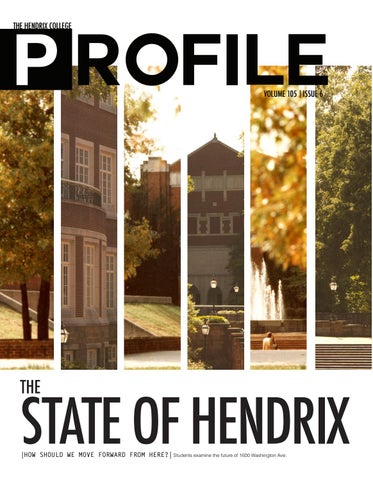
THE HENDRIX COLLEGE
ROFILE VOLUME 105 ISSUE 6
THE
STATE OF HENDRIX |HOW SHOULD WE MOVE FORWARD FROM HERE?| Students examine the future of 1600 Washington Ave.
LETTER FROM THE EDITOR THE HENDRIX COLLEGE
P ROFILE Editor-in-Chief: Brooke Nelson Managing Editor: Casey Hawkins Business Editor: Chirag Lala Layout Editor: Jessica Emerson Layout Editor: Liz Green Photo Editor: Megan Prettyman Copy Editor: Sydney Meyer Photographer: Leah Headley Photographer: Aditya Katke Photographer: Konrad Witkowski Staff Writer: Marlee Bird Staff Writer: Jenson Chier Staff Writer: Peyton Coffman Staff Writer: Barrett Goodwin Staff Writer: Hunter Herrera Staff Writer: Adam Williams
HENDRIXprofile.com . Online Editor: Sarah Gilmour
Advisor Jamie Groat
MISSION STATEMENT As a student-run and student-funded newsmagazine, The Profile uncovers the smart edge to campus culture: the people, places, ideas and trends that curious, confident students and faculty want, need and ought to know. By critically examining issues important to the Hendrix community, The Profile aims to act as a catalyst for change, a tool for transparency between the student body and faculty and a source of inspiration for its readers to begin thinking globally and acting locally.
2
THE HENDRIX COLLEGE PROFILE
T
his time last year, Hendrix revamped its website almost overnight, and we all woke up to a new school slogan: Be Hendrix. Since then, we’ve seen those two words everywhere: on banners, on coffee mugs, in Twitter and Instagram hashtags (for better or worse)… and the list goes on. But what, exactly, does it mean to “Be Hendrix?” That’s the question we at The Profile set out to answer this year. In our first issue, we revisited the weird mixture of nervousness and excitement that everyone feels their freshman year in “How to Hendrix,” which laid out the best and worst of the day-to-day Hendrix experience: which clubs to join, where to eat, and who’s who on campus. Our “Traditions” issue investigated how Hendrix came to be the place we know and love today, including the people and practices that have shaped its history, from parties to dorms to liberalism. Now, in our final issue, “The State of Hendrix” explores how we think our college should improve in the future. We grapple with tough topics like money and budget cuts, the diversity of the student body and how people with disabilities can access facilities on our campus. In many ways, the evolution of the issues this year reflects my own experience at Hendrix and countless others’ experiences, too, I am sure. I first stepped foot on campus four years ago as a quiet and anxious freshman, with no friends and no expectations. The first week—heck, the first semester—consisted of lesson after lesson (good and bad) about what it meant, exactly, to go to Hendrix and how to survive this lovely yet crazy school. Over the next few years, I began to construct my own history here as I learned about Hendrix’s traditions from the past. Now, as a senior, this place has become my home, and I fit into it as snugly as a broken-in pair of jeans; Hendrix feels like a second layer of skin, bending and creasing around me perfectly. But in that familiarity, I also see the places in which the college could improve—as do we all. That said, this issue aims to act as an exercise in reflection and critique of the school we love so dearly, yet admittedly get so frustrated with at times. If Hendrix has taught me anything over the past four years, it is how to reflect and use those lessons to improve going forward. In that sense, I hope this issue—and all of the issues from this year—have contributed to campus conversation in a meaningful, constructive way. Thank you for giving me the opportunity to take that exploration with you. Perhaps we answered what it means to “Be Hendrix;” perhaps we didn’t. But in the end, if you picked up an issue just once and if you opened just one page, I hope you learned something. I hope it changed your perspective, made you think twice and spurred you to action. The way I see it, that alone is a victory.
CONTENTS 4 Dry Spell
NEWS
Senior class falls short of top scholarships
5 Dr. Campolo: Zombie Apocalypse Professor shares last message to seniors
6 Changes to Academic Requirements Learning domains tweaked for 2017-2018 year
OPINION
Ramping Up pg. 12
8 Senior Editors’ Farewell Messages Chirag Lala and Megan Prettyman say goodbye
FEATURE
8 Hendrix’s Unbearable Whiteness
History of the college’s diversity transformations
12 Ramping Up
Are we a disability-accessible campus?
14 The Road Ahead
Next year’s budget cuts and what to expect
15 Warriors Hit Hard
Baseball pg. 15
Diversity pg. 8
SPORTS
Baseball team faces adversity amidst injuries
CULTURE
18 Ode to the OTC Printer
Students’ sentiments for the dreaded machine
Dry Spell pg. 4 MAY 2017
3
NEWS
DRY SPELL
Photo by Aditya Katke
SENIOR CLASS FALLS SHORT OF TOP SCHOLARSHIPS
T
his is the first year in recent memory that the senior class has not received any distinguished scholarships, including the Fulbright and Watson Fellowships and the Marshall and Rhodes Scholarships. Considering the fact that the Class of 2017 came in as the biggest class in the college’s history, the dry spell came as a shock to many. Nevertheless, the seniors made a competitive stand. “The quality of the students’ applications was stellar,” librarian and Watson liaison Britt Murphy said. “The Rhodes and Marshall are very competitive, and we got people to the interview stage with both of those.” The Watson Fellowship involves a somewhat unique application process. It asks students to look at their past, come to terms with the things they like and don’t like and grow from this introspection. That transformation is also one that Hendrix attempts to facilitate through its mission statement, curriculum and Odyssey program. “The Watson is a more rigorous self-examination process [than other applications] because students are really discovering what they’re passionate about and how they’re going to apply that in an international setting for a year,” Murphy said. “They’re designing their own projects. No one is telling them what to do.” Along with the project proposal, the Watson also requires a personal statement. “The personal statement is a very difficult document,” Murphy said. “It’s probably more difficult than the proposal for the Watson. I get to see people as they try to develop this statement that is really a statement of
4
THE HENDRIX COLLEGE PROFILE
HUNTER HERRERA
who they are. It’s a statement of their story up until this point in their life and what is important in their life and who the players are in their story. It’s a lot.”
I REALLY SEE STUDENTS TRANSFORMED BY THIS PROCESS. AND THAT IS WHAT I HOPE THEY’RE ULTIMATELY PROUD OF. -BRITT MURPHY
In the end, not receiving the fellowship or scholarship is not a total loss, Murphy said. Often, the application process itself holds more value than the actual monetary reward because it is so long, demanding and personal. “These scholarships are really competitive. They’re really hard to get. So if we get one, it’s much to be proud of. But the fact that we don’t get a fellowship or scholarship in any given year is nothing to be ashamed of.” Working tirelessly and reflecting on oneself is an accomplishment in itself, according to Murphy. “As a scholarships advisor, I really see students transformed by this process. And that is what I hope they’re ultimately proud of.”
NEWS
ZOMBIE
APOCALYPSE DR. CAMPOLO SHARES LAST MESSAGE TO SENIORS DR. CHRIS CAMPOLO
I
t’s difficult to talk to seniors at this time of year. If you ask what they’ll be doing after graduation, their faces crease with panic, and they stammer something like: “What did I ever do to you?” Well, then, do they want to stay at Hendrix? “Oh my God, no…the horror...” In the end, you realize that talking to them at all is a little cruel. But what’s it all about, this terror? You’d think that they were about to be thrust into a zombie apocalypse. Doesn’t that seem a bit overly dramatic? Are they really going to have to eke out a meagre subsistence in wrecked and predatory world? Well, yes. But are they going to be surrounded by mindless automatons, bent on sucking the life out of them? Actually, yes. But will they face scarcity, destruction, competition, injustice, incompetence, indifference, stupidity? OK…maybe it is a bit like being tossed into a zombie apocalypse. Still, think about it: zombies never seem to mind being in a zombie apocalypse. For all we know, becoming a zombie is the best thing that could happen to you. Why fight it? It would be natural at this point to wonder about the use of all that becoming-a-whole-person stuff. Shouldn’t that have been the best thing that could happen to you? Shouldn’t that, at any rate, have armored you somehow against zombies? I mean…it’s possible that you didn’t do it right. All those skipped classes. The alcohol. The pot. The group cheating. Miss Hendrix… You certainly puzzled us at times. Maybe if you had Hendrixed better… But I don’t think that that’s it. Is the whole thing is a sham? The Edenic brochures, scholarships, football, azaleas… “Be You. Be Brilliant.” Like you were going to be a superhero. Not true. But don’t be angry. After all, you got to live in a lovely compound, zombie-free. And it will increase your income…if you get a job. It’s not nothing. Surely, you long ago realized something about liberal arts education, even the adulterated version we practice here. It’s not meant to protect against zombies. You spent years learning: Donne, mitosis, Descartes, the progressive era, constitutional law, Bellini, Bellamy, chemical kinetics, Deloria, discrete mathematics, Addams, Fourier transforms, Buddhism, ring laser gyroscopes, Beauvoir, social psychology, Woolf, zoology, opera, Plath, and that damned pendulum, just for starters. Amazing stuff. But not “practical.” Wait: Why not go zombie? Think again about how content they seem, how purposeful, how unconflicted. Much easier than this “whole person” stuff. Seriously. You can walk on graduation day and just keep walking. We wouldn’t blame you. The truth is, we haven’t prepared you in any concrete way for battle. We’ve been trying to show you some ways to sculpt a self worth protecting, one that can connect and grow and learn and feel and say. No zombie can do those things. That kind of self is hard to preserve in this world. It’s up to you now. Good luck. Oh, and Congratulations.
PEYTON COFFMAN
10 WAYS TO HANDLE FINALS STRESS
1
Listen to early ‘00s feel-good pop. This means Britney, Rihanna, Destiny’s Child.
3
Take 10 deep breaths.
5 7
2 4
Look at a picture of Ryan Gosling. This is what the internet was made for.
Try a coconut oil hair mask. Spread it through your hair and rinse after at least 30 minutes.
Have a conversation with Mrs. Mimi. She learned your name for a reason!
6
Massage your scalp with the tips of your fingers.
Go outside and look at all the flowers. (You paid for those!)
8
9 10
Like good food? Have no money? Watch Chef’s Table on Netflix instead.
Go to thequietplaceproject.com/thethoughtsroom, type in your worries and watch them burst into stars. Google image search “baby pigs in pajamas.” This is self-explanatory.
MAY 2017
5
NEWS
ACADEMIC REQUIREMENTS CHANGED LEARNING DOMAINS TWEAKED FOR 2017-2018 ACADEMIC YEAR
PEYTON COFFMAN Illustration by Nicola Bryan
I
n the rush and excitement of Welcome Week, there comes the making of the academic schedule. For freshmen, wide-eyed and clueless on their first trip around the academic block, Capacities and Learning Domains are confusing. They’re still confusing later in the year when freshmen create their sophomore schedules. And the next year, when audit sheets have fewer blanks, the organization of academic requirements is less confusing, but still an inconvenience to navigate. And so on, until graduation. Capacities and Learning Domains came about in 2001 when Hendrix switched from the trimester system to the semester system. Faculty worked on the current academic program for three years as it underwent a series of intense revisions. The plan eventually agreed upon is the one that has remained in place through this year. It includes Capacities, which, as the Hendrix website states, are “designed to guide students toward proficiency in fundamental skills used across multiple disciplines,” and Learning Domains, which are intended to “introduce students to various methods of knowing and learning.” When Learning Domains were designed, the faculty was afraid that students would satisfy too many requirements within their own majors, so they added the requirement that each of the seven courses taken across six Learning Domains must from a different discipline. However, as time went on, faculty realized that students didn’t have an issue maintaining breadth in their schedules and that the seven courses didn’t need to be taken across seven different disciplines. “Numbers have shown that student’s haven’t been getting too many courses in one department,” Dr. David Sutherland, Associate Provost
6
THE HENDRIX COLLEGE PROFILE
and ex officio member of the Committee on Curriculum, said. “Tweaks to the Learning Domains have already been approved. They keep the original intent, but make [the requirements] less complicated.” Starting next year, the seven required courses in six Learning Domains will no longer have to span seven different departments. The courses can be from any department. This also applies to the Natural Science Inquiry (NS, NS-L) requirements, which will no longer have to be satisfied in separate departments. The second change to the Academic Program deals with the counting of quartercredits. In the past, partial credits couldn’t be combined to create a whole credit. For instance, if a student had earned two PACT quarter-credits and a quarter-credit from Explorations, those credits couldn’t be combined because they aren’t from the same department. Starting next academic year, however, partial credits can be combined to create a full credit, for up to two credits. “This means if you get behind,” Dr. Sutherland said, “you can take a quarter credit and combine it to get a whole credit.” These changes have already been approved by the faculty and will be included in the 2017-2018 catalogue, which will be released over the summer. And there’s more good news: The changes apply to all students, regardless of the catalogue year they have declared. “These seem like small things, but they seem to be problems for a lot of people,” Dr. Sutherland said. “Hopefully these changes will be easier for students and for faculty, and there will be fewer mistakes, fewer last minute surprises when students get their senior audits.”
OPINION have had the distinct privilege of working under two Editorsin-Chief at The Profile. I am especially grateful to one of them, Brooke Nelson. She recruited me as a staff writer in my sophomore year. She also worked tirelessly to provide my colleagues and me the freedom to write how we wished. When I became Business Editor, she involved me in a series of discussions about The Profile’s role on campus. She enabled The Profile to build a platform for serious conversations about Hendrix. I intend for this message to convey some of my own thoughts from that process. I will start with introspection. Many Profile articles are written in the wake of controversies on campus. White Trash Bash (the party), tuition increases and safe spaces are examples. These controversies naturally breed intense passion among the student body. The Profile seeks to explain the origins of the resulting debates, what they mean for the college’s future and what the lines of division are. Our goal is to make students pause and think. Reflection is crucial to the liberal arts. Hendrix College cannot build a future without knowing its history. Passion is not enough without context. Moreover, we Hendrix students cannot act on such reflection without understanding our identity. The most important article I wrote for The Profile was a feature investigating how Hendrix lives up to its “progressive” identity. During my interviews, it became clear that defining “progressiveness” was not the problem. Students were cognizant of their goals: inclusiveness, achievement and ambitious improvements to campus life. The problem was involvement. Enough students were not making their voices heard, allowing others to be heard or forgoing complacency. If there is a gap between our words and actions, The Profile will shed light on those gaps. Students must then decide what to do next. Finally, The Profile remains committed to objective intermediation. In any issue, in any time, there exists a plurality of perspectives. Most issues,
I
as our Editor-in-Chief is fond of saying, are a mixture of black and white. The Profile is devoted to ensuring all perspectives are on the table and left for students to judge. However, we recognize that there is a limit to relativism and only providing packets of information. Our job includes curating information into something useful for our readers. We struggle with this, as all publications do. But we urge our readers to make use of our work and doggedly encourage improvement. We are always open to your criticism. It has been an honor to write for The Profile. At my core, I am a cerebral introvert. My way of engaging with the world will inevitably involve the pen more than it will the banner. I owe my fellow staff members, the senior editing team and all of you readers a great deal. I learned a lot about Hendrix because of The Profile. It was my way of serving the campus. I am proud to have left you with an articulation of our values. But please remember that I too struggled to make sense of them, as you will with your own. But forge ahead as best you can. The Profile will try to help along the way.
GOODBYE TO ALL THAT FINAL MESSAGE FROM THIS YEAR’S SENIOR EDITORS CHIRAG LALA
W
hen Brooke asked me sophomore year, “Hey, Megan. Do you maybe want to join The Profile, and would you please apply to be a photographer?” I had no idea what all I was getting myself into. My high school had a slight rivalry between our newspaper and yearbook staffs, and I fell firmly on Team Yearbook. When I first got to Hendrix, I assumed I would continue along that same path. Lesson learned: Never dismiss the persuasiveness of your roommate/Editor-inChief. You will listen to her (and be extremely grateful you did). I’ve learned a lot over the past three years, both as a photographer and as an editor. I have now perfected the art of emailing people I have never met to ask, “Is there any way you would be available sometime before my deadline for me to please take your picture? I would greatly appreciate it,” and “I know you are a member of this organization and I really need photos from this event you did a year ago, can you please save me and send me pictures? Thank you in advance.” I now know where I can go online to find photos from Hendrix in the 1880s, as well as whom I need to talk to in the library to go into the physical archives. I have taken pictures at an event next to photographers from the Democrat-Gazette, where we both were trying to take an interesting photo of people talking (Coincidentally, my favorite photo I’ve ever taken was from this event. Everyone wants to see Bill Clinton coerced into taking a selfie). I cannot thank everyone who has been a part of The Profile with me the past three years enough. We’ve made some pretty significant leaps forward in the quality and style of our publication. We’re now online, which means I can now bug all my Facebook friends constantly to read what we produce. I think our writing has improved, the pictures are clearer and
MEGAN PRETTYMAN more interesting and the overall content production is much stronger. I can definitely say I proud of everything this staff has accomplished. Saying goodbye to The Profile is hard. It has been a staple of my Hendrix experience, and I’m not quite ready for it to end. I almost definitely won’t continue to be involved in journalism after I graduate, and that saddens me. The Profile has been central in documenting the course of Hendrix for decades (Trust me, I know. I’m a history major), and now I have been a part of that legacy. I know the importance of a strong newspaper and how later people will look to what we’ve produced to judge the environment of Hendrix in 2017. I’d say we’ve done a good job. But hey, what do I know? I’m just a photographer.
MAY 2017
7
THE UNBEARABLE WHITENESS FEATURE
OF HENDRIX
8
THE HENDRIX COLLEGE PROFILE
ADAM WILLIAMS
S
FEATURE HENDRIX FIRST OPENED ITS DOORS TO STUDENTS OF COLOR IN 1965—10 YEARS AFTER BROWN V. BOARD OF EDUCATION. FIVE DECADES LATER, WE MIGHT CALL OURSELVES A “DIVERSE” CAMPUS... BUT ARE WE REALLY THERE YET?
T
he story of racial integration in Arkansas is one that many students may recognize: The Little Rock Nine, Orval Faubus and screaming crowds of white residents come to mind. However, the story of racial integration at Hendrix College is an issue that students may be less familiar with. In 1965, the first African-American student began attending classes at Hendrix. Linda Chesterfield would go on to graduate from Hendrix and is currently serving in the Arkansas legislature as a state senator. While Chesterfield’s story is a successful one, the story behind the integration process of the college was fraught with problems. The Hendrix President at the time, Marshall Steel, appeared to be dragging his feet on the issue of integration. It would have been interesting to see how much longer segregation would have been the norm at Hendrix if it had not been for
the active involvement of the Methodist church. Especially active were three Methodist ministers from Arkansas who took a role in trying to move the administration forward on integration. Finally, at a Board of Trustees meeting in 1964, the college voted to change a few words of its admissions policy to allow individuals of color to apply and be accepted to the school. Reverend Wayne Clark noted that with this change in policy, “there wasn’t a big fanfare.” The Board of Trustees and the President had not completely reversed the position of the college to be one of acceptance and tolerance; rather, it had made a grudging admittance of non-white students. Diversity would not yet be celebrated at Hendrix until decades later. After Chesterfield’s enrollment, the student body at Hendrix became progressively more and more heterogeneous. The integration process, as delayed as it was, opened the campus
to new minority groups, changing the college forever. But even though we are now 53 years removed from the beginning of the integration of Hendrix College, it is important to look back on that time, as well as examine where Hendrix stands today. The current social climate on college campuses nationwide is as tense and heated as it has ever been. The Black Lives Matter movement as well as the election of President Donald Trump has caused significant division and conflict among students. It is in this climate that questions about racial issues have been raised and highlighted once again. Moreover, the current concerns over diversity and inclusion between students demands some examination of the integration of Hendrix College and what the current successes and failures that followed that issue are.
Continued on next page
LEFT: The Hendrix College Choir sings in front of the fountain, 1969. Although Hendrix was integrated at this time, very few minorities were represented in campus organizations like the choir. RIGHT: The Raney Hall Dorm Council stands on the steps of Raney Hall, circa 1970. Among them, from left to right, include: Joyce Meggerson, Linda Abney, Jean Shackleford, Anna Nicholson, Patti Sanders, Debbie McClendon and Sue Presley. Meggerson was close friends with Linda Chesterfield, Hendrix College’s first African-American student.
Photos from Hendrix College Archives MAY 2017
9
Photo from Hendrix College Archives
A TIMELINE OF INTEGRATION AND DIVERSITY AT HENDRIX 1954:
The United States Supreme Court rules that state laws establishing separate public schools for Black and White students are unconstitutional in Brown v. Board of Education.
1957:
Nine African-American students enrolled in Little Rock Central High School are prevented from entering the school by Orval Faubus, then the Governor of Arkansas, and the Arkansas National Guard. President Eisenhower sends the 101st Airborne Division to protect the students from angry mobs outside Central.
1965:
Hendrix integrates for the first time since the college’s founding in 1876. Linda Chesterfield (then Linda Pondexter), the college’s first African-American student, enrolls that same year. Last year, Dr. Dionne Jackson was hired as the Vice President for Diversity and Inclusion and Chief Diversity Officer (CDO), the first of its kind reporting to the President. Hendrix is also the first among the Associated Colleges of the South member to have a CDO position. This position was established last year as part of President Tsutsui’s initiative to address specific issues surrounding diversity. Dr. Jackson has worked this year with students, staff and faculty to help Hendrix become not only a more diverse campus, but a campus that is also more inclusive of different interests, ways of thinking and experiences. A concern that Dr. Jackson sees on campus is a lack of diversity amongst faculty at Hendrix College, especially for African-Americans. “When we talk about support of students, students that are AfricanAmerican would love to have an African-American professor, advisor or mentor,” Jackson said. The role of a mentor on campus that can help students to reach and achieve their full potential is vital. With the retirement of Dr. Alice Hines at the end of the year, the faculty at Hendrix College will be woefully unrepresentative of the African-American student population. Dr. Jackson sees this
10
THE HENDRIX COLLEGE PROFILE
issue as more than just attempting to convince post-doctoral students to live in Conway, Arkansas. For her, the issue is trying to fill the right interest in the right department at the right time. Dominique Kelleybrew, director of Multicultural Student Services, believes the representation of minority students in positions of leadership in student clubs and organizations is an issue on campus. “When you come in as a freshman and you don’t see people in those positions, it’s a lot harder to imagine yourself as being that person,” Kelleybrew said. According to Kelleybrew, minority students are less likely to get involved in clubs and organizations if they do not feel that those clubs are actually representative of who they are. And if minority students are not properly integrated into clubs and organizations, the integration process at Hendrix is not complete. Senior Pratheepa Ravikumar, chair of the Multicultural Development Committee (MDC), is one of the unique students who does serve in a campus leadership role, and she sees the effects of a lack of representation on campus.
FEATURE
CLASSROOM CUES: Students chat in a classroom, circa 1970. Accounts by Black students that attended Hendrix until the 1970s recall discrimination by their White classmates.
2017:
1981:
Hendrix’s student body is currently 76.3 percent White, 5.9 percent Black, 5 percent Asian, 4.7 percent Hispanic or Latino, 3.1 percent two or more races, 0.6 percent Native American and 0.5 percent other.
Hendrix’s first African-American faculty member, Dr. Alice Hines, is hired as an English professor.
2016:
Dr. Dionne Jackson, associate professor for education at Hendrix, becomes the Vice President for Diversity and Inclusion and Chief Diversity Officer, the first of its kind among the Associated Colleges of the South. “Though diversity and inclusion have gotten better on campus, there are still many struggles and issues we must address,” Ravikumar said. For Ravikumar, one of the biggest issues that the college must face is finding more ways to promote an inclusive campus climate. “Whether it’s through more campus-wide inclusive programs for students or just a small gathering organized by a multicultural student organization, the importance of diversity and inclusion needs to be made clear and emphasized,” she said. When looking at issues of diversity and inclusion on campus, it is important not to view these subjects as something to check off a to-do list. “Diversity and inclusion is a process—not a goal,” President Bill Tsutsui said. “If there is one thing I know about Hendrix students, faculty and staff, it’s that they don’t mind wrestling with hard issues.” In 1964, Hendrix College finally decided to wrestle with issues of inclusion. Years later, that fight is still going on. While this process will most likely never be complete, Hendrix College must embrace policies and strategies that will push it forward towards better representation and acceptance of all Hendrix students, regardless of background.
WHETHER IT’S THROUGH MORE CAMPUSWIDE INCLUSIVE PROGRAMS FOR STUDENTS OR JUST A SMALL GATHERING ORGANIZED BY A MULTICULTURAL STUDENT ORGANIZATION, THE IMPORTANCE OF DIVERSITY AND INCLUSION NEEDS TO BE MADE CLEAR AND EMPHASIZED. -PRATHEEPA RAVIKUMAR
MAY 2017
11
RAMPING UP MARLEE BIRD
Photos by Leah Headley
RESIDENCE HALLS WITHOUT ELEVATORS. STAIRS LEADING TO CLASSROOMS. HOW ACCESSIBLE IS OUR CAMPUS, REALLY?
A
mong other things, the Americans with Disabilities Act (ADA) “ensures access to the built environment for people with disabilities. The ADA Standards establish design requirements for the construction and alteration of facilities subject to the law. These enforceable standards apply to places of public accommodation, commercial facilities and state and local government facilities.” This is a direct line taken from the United States Access Board. Its description of ADA requirements pertains to Hendrix College as it does to any other institution; however, the ADA requirements bring up important questions about accessibility on our campus. Is our entire campus wheelchair accessible? Are we up to code, legally and morally? The answer is yes and no. First of all, our campus is not fully wheelchair accessible. Only a few buildings on campus actually have an elevator for anyone needing wheelchair accommodations, and while the Brick Pit may be a wonderful staple of the college, there is no doubt that it makes campus accessibility harder for students who may not be able to use stairs.
12
THE HENDRIX COLLEGE PROFILE
That being said, Hendrix is, in all legal respects, ADA-certified. Julie Brown, the Director of Academic Success at Hendrix, a job which includes advocating for students with disabilities on campus, noted that the ADA requirements understand the limits to elevators and accessibility, especially because many of our buildings are so old. However, Brown noted that Hendrix has followed ADA procedures when building the SLTC and WAC, and they will continue to do so with the Welcome Center and other buildings in the future. “I have seen great commitment on the part of the college to do what is morally right and legally required,” Brown said. “I think we live in a time of more inclusive spirit, and I think Hendrix is honoring that and trying to do their best.” While we currently do not have any students using wheelchairs full-time on campus, in 2009, two students who used wheelchairs for transit enrolled at Hendrix. We also currently have many students with temporary disabilities, some of which might call for using a wheelchair. Injured athletes, for example, face similar challenges in trying to obtain the right accommodations.
Sophomore Sai Techawongtham, who is blind, noted the ability of the college to tailor each individual need, whether they are dealing with a temporary or permanent disability. “I think the accommodations we have are really adjusted for each student, and I think that’s great because I know at some schools it’s very fixed,” Techawongtham said. “Even for a student that comes here with the same disability [as another student], we all have different backgrounds and abilities.” Techawongtham started the Disability Awareness Club this year to spur the conversation about disabilities and to lift the stigma of talking about them to begin with. The club grew out of an Odyssey project idea. Techawongtham went to a restaurant in Thailand where people ate their food in the dark, and she wanted to re-create that experience for Hendrix students. As a blind person herself, the idea was for other people to understand the sensation of not having sight. She noted that the Disability Club plans to do more next year, including another Dining in the Dark event, a service trip and frequent online articles about various disabilities to
G P
FEATURE WHEN WE SAY DIVERSITY, PEOPLE AUTOMATICALLY THINK OF RACE, SEXUALITY, GENDER, RELIGION MAYBE, BUT NO ONE REALLY THINKS OF DISABILITIES, AND DISABILITIES ARE AN ASPECT OF DIVERSITY. THAT’S ONE THING I WISH PEOPLE WERE MORE AWARE OF. -SAI TECHAWONGTHAM spread awareness. Sophomore Ginny Greer is also a member of the Disability Awareness Club. Greer has mild cerebral palsy, and she noted the challenges she has faced on campus. “Freshman year, I had a lot of issues with the lofted beds,” Greer said. “It became dangerous for me because there were a couple of times I almost fell.” While trying to receive better accommodations this year, she ran into some hurdles. “I think they wanted to help, but there was a lot of miscommunication and confusion about what my needs were.” Greer believes that part of the issue stems from the relative newness of colleges dealing with disabilities, noting that it has only been 40 or 50 years since disabled people started attending college in larger numbers. She stated that is important for every student, along with faculty members, to know the rights that disabled students have. She was in agreement with Techawongtham, however, in the positive ways Hendrix has helped her succeed. “Everybody I’ve worked with here on an individual basis has been really open-minded and wants me to feel comfortable,” Greer said. “I think it’s just an issue of making the system—and this is not unique to Hendrix, it happens everywhere—more transparent and smooth.” Hendrix has more students with disabilities than might be apparent. Brown noted that we currently have around 125 students receiving accommodations, which is significant for a school of our size. “When people think of disabilities, they think of something they can see, like blind people using canes or someone in a wheelchair, but a lot of students here have disabilities and you can’t tell,” Techawongtham said. Although our school has made a lot of progress in the ways we acknowledge and provide for people with disabilities, there are still many misunderstandings. The stigmas that surround disabilities limit conservations and the ability to be open and honest, which is the opposite approach the Disability Awareness Club wants to take. Techawongtham, in thinking about the ways that Hendrix could be more inclusive for people with disabilities, mentioned that it is largely a problem of miscategorization. Our conversations about diversity and inclusion too often fail to recognize people with disabilities. “When we say diversity people automatically think of race, sexuality, gender, religion maybe, but no one really thinks of disabilities, and disabilities are an aspect of diversity. That’s one thing I wish people were more aware of.” MAY 2017
13
FEATURE
THE ROAD AHEAD: WHAT TO EXPECT REGARDING NEXT YEAR’S BUDGET CUTS
BARRETT GOODWIN
L
iberal arts colleges across the country are facing tough times financially, and unfortunately, Hendrix is no different. Why has Hendrix been facing budget shortfalls over the past few years, what do these cuts mean for students and how is Hendrix working to shore up its financial situation? Hendrix’s deficit for the current fiscal year is short of a million dollars, but next year it might surpass that mark with a very large senior class graduating this May. This is according to President Bill Tsutsui, who has worked to trim down on deficits over his past few years in office by broadly spreading cuts among various departments’ budgets. Next year, almost every department is looking to make cuts again, with a goal of $1 million in cuts overall. Some cuts include the Hendrix in Brussels program due to a lack of student interest (although it will be re-evaluated next year), and a trim to Freshman Orientation that will reduce the number of days parents are on campus during that week. Staff pay will remain mostly the same as previous years, which may result in staffing decreases going forward, according to President Tsutsui. One issue that has raised student concern is the recent announcement that students living in apartments next year will be required to have a minimum five-meal plan. Since students enjoy having the option to save some money by making their own meals in apartments, there will be an appeal process for those that cannot afford to be on a meal plan due to financial need. However, there will be an increase in funding in other areas next year. For example, there will be an increase in Bailey Library’s budget due to their new expanded hours, and there will be more funding for counseling services on campus. Additionally, Public Safety and Facilities, which has been hit particularly hard by cuts the past few years, will be insulated from any reduction in funding for next year. How did we get here, you might ask? “Volatility is our biggest enemy” in terms of student enrollment, President Tsutsui said. Hendrix has had fluctuations in enrollment over recent years, which makes consistent budgeting very difficult. Although there is a large senior class currently, the other classes have been smaller than anticipated. The goal in the future is to have 400 students per class with a strong retention rate, for an overall enrollment of about 1,500 students. In addition, the school will need to balance students who are “low-need” in terms of ability to pay close to full tuition while making a Hendrix education affordable to “high-need” students via scholarships and need-based aid. Interestingly, low enrollment numbers from Texas have hurt Hendrix in the past few years. There is intense competition in the affluent Dallas-Fort Worth area, but enrollment numbers are up this year after hiring a resident high school recruiter in Dallas, according to President Tsutsui. Still, the competition is tough; there are 70 resident recruiters in the area, with Hen-
14
THE HENDRIX COLLEGE PROFILE
drix joining Rhodes and Trinity as the only liberal arts colleges represented. The college is also exploring the addition of a resident recruiter for Northwest Arkansas, as well as hiring a new Executive Vice President for Enrollment to replace Karen Foust, who is retiring. Hendrix also hopes to increase its recruitment marketing efforts, hiring a new marketing consultant to create more bottom-up marketing drives like the #BeHendrix campaign that highlight the student experience at Hendrix and our unique campus community, Associate Vice President for Marketing Communications Rob O’Conner said. The impact on academic life here at Hendrix is largely separated from the budget process, according to Hendrix’s Provost Dr. Terri Bonebright. When it comes to divvying up available resources between academic departments, the big challenge is figuring out how to best allocate those resources in a way that is flexible over time. It is a question of focusing on departments with the most need and making sure they are able to provide robust support for the students in their majors. Every year, departments send in requests for funding in their departmental budgets. Departmental programs also undergo regular review with an outside group to collect data and determine the best way to meet those departments’ changing needs, Dr. Bonebright said. Financial setbacks for the college do not have as much of an impact on the academic side of things as one would think. Requests for new faculty to fill a spot vacated by a retirement or a professor leaving for a new job are evaluated holistically. The enrollment in that department by majors, the fit for the proposed new faculty member in terms of course offerings and fit within the department in terms of their field of expertise are all criteria examined, with no guarantee that a faculty spot will be filled in a given year. Dr. Bonebright stressed that these processes are all about meeting the needs of academic life here at Hendrix in a way that best serves the students. It is important to remember that there is a difference between the budget and Hendrix’s capital campaigns for the new Welcome Center and the upcoming Creative Quad. The budget pays for operating expenses yearto-year, while Hendrix’s efforts to raise money from alumni for big projects are something outside of a single fiscal year. In the past, Hendrix borrowed money to construct the WAC and the SLTC. Hendrix does not want to add to its debt and instead would like to pay for these things up front, President Tsutsui said. The money for the Welcome Center has already been pledged, and the capital campaign for the Creative Quad is well underway. As frustrating as these times of fiscal constraint are for students, faculty and staff, Hendrix appears to be bouncing back in terms of enrollment numbers for next year’s class. This is a sign that the current budget constraints are not here to stay, but are still necessary for a fiscally stronger Hendrix going forward.
SPORTS
Photo by Aditya Katke
WARRIORS HIT HARD BASEBALL TEAM OVERCOMES INJURIES
JENSON CHIER
MAY 2017
15
W
SPORTS
“THIS YEAR’S TEAM HAS DEFINITELY BEEN THE HARDEST-WORKING TEAM THAT I’VE BEEN A PART OF.” -DREW JUDSON
Photos by Aditya Katke
T
he crack of a bat is loud around the diamond, but the sound doesn’t carry to the ears of many Hendrix students across the street. It’s drowned out by the noise of cars going by and the distance from the center of campus. The few who hear it are the dirty, determined baseball players who have been grinding all spring season in the heat and pollen. “This year’s team has definitely been the hardest-working team that I’ve been a part of,” junior Drew Judson said. Judson has been a leader on the team so far this season and perhaps its most consistent hitter. “These guys have a high level of focus that has led us to a lot of our wins. The whole team, including the coaches, have come together as a unit, and that’s what defines a great team,” he said. The cohesion this team has achieved so far is somewhat of a miracle in itself. Many of the team’s key players have been unable to play all year due to injury. “The injuries that guys have had have all stemmed from very different circumstances, and we cannot pinpoint one particular thing that has led
16
THE HENDRIX COLLEGE PROFILE
to them taking place,” Head Coach Neil Groat said. “Some have been random things like a batter getting hit by a pitch and breaking a bone, to the normal elbow and shoulder injuries due to overuse that are typically associated with our sport.” Naturally, the effects have been felt, especially by upperclassmen like Judson. “Not only have a couple of players gotten hurt, but younger players have been forced to step up on the field and to fulfill a leader-type role,” Judson said. Groat is proud of his young team’s ability to fill big shoes. “Those guys have learned and developed well over the course of the season. I’ve been happy how different guys have stepped up to different roles, and no one has really used our injury situation as an excuse,” he said. Those young arms as well as some old bats have rescued what looked like a failed season early on, and the Warriors have a chance to make some noise this postseason for Division III College Baseball. Most recently, the leader of those old bats has been Senior Wyatt Hogan. The Warriors have benefitted from Hogan’s love for hitting the ball;
WHO’S ON FIRST?
A GUIDE TO WHO’S WHO ON THE FIELD
JUNIOR DREW JUDSON JUNIOR MATTHEW LILLARD
SENIOR WYATT HOGAN
SOPHOMORE DYLAN BOWERS SOPHOMORE JORGE LEON
SOPHOMORE JOSH WALKER
SOPHOMORE TAYLOR BARKER
Photos courtesy of Hendrix College
SENIOR JAMES MARTIN
he’s leading the team in home runs. “I’ve been working really hard on my swing and approach this year, so the results that are coming for me are nice to see,” Hogan said. While the players deserve a lot of credit for how the team is performing, so does Coach Groat. He recently earned his 100th win as head coach of the team, an impressive number for just his fourth year in the position. Winning seems to come naturally to Groat, who played at Hendrix from 2002 to 2005. Prior to 2012, he split responsibilities as an admission counselor and assistant baseball coach. Now, his time is spent focusing his team for a postseason run. That means practice after practice in the dirt and sun on the baseball diamond near the edge of campus. The schedule can be grueling for the players, but it is what’s necessary for Groat’s goals. “Though young in some areas, we feel like we are a good team that is capable of playing with the best our league has to offer, and we plan to do that come tournament time,” Groat said. The players have bought in. “Nothing compares to the insane atmosphere that comes with being at
home for conference, so we’re working very hard to make that a possibility,” Judson said. “The excitement before every game is something that I live for.” That thrill pushes him in all areas of his life. “My main goal is to do whatever I can do to help this team win,” Judson said. “Whether it be getting hits or picking people up, I want to be the best positive force I can be. As much as I have struggled with staying positive on the bad days in the past two years, my biggest personal goal is to progressively mature into an admirable example of a great player.” Hogan is in the same boat. “I play baseball because it’s fun, and I love the game. It has given me the opportunity to travel all across the county and interact with younger players, passing on knowledge as well as hopefully giving them a role model to look up to,” Hogan said. As the season winds down and the temperatures rise, the grind won’t become any easier for the team. However, these are student athletes who have shown they can do the improbable, so for them, each practice is just another day. MAY 2017
17
Culture
ODE TO THE OTC PRINTER HENDRIX’S INFAMOUS LOVE-HATE RELATIONSHIP, IN LYRICAL FORM
I
t seems like every Hendrix student has had that moment: You’re running behind on the day, rushing to print out a paper or assignment before class. Then, it happens. The printer is offline. Or out of ink. Or jammed. Or out of paper. Or your reading for class is in a PDF, so when you print doublesided to save paper it prints one. Page. At. A. Time. In honor of the campus’ most cherished (and most detested) printer, here are some tributes from Hendrix creative writers and otherwise frequent patrons of the OTC.
BARRETT GOODWIN
THE PROBLEM PRINTER A simple thing: to print upon a page the written word in lines of double space, but this one seems to show her growing age as every sheet compounds her sad malaise. As essays print, no student stops to think how thanklessly this printer does comply. Until at last, though still she carries ink, “No more of this!” defiantly, she cries. She’ll print no page nor shall she make a sound. Someone remarks, “This seems to happen daily.” Defeated staff, perplexed, now gather ‘round. They’re forced to say, “Perhaps you should try Bailey.” Now placed upon the door, a simple sign which reads: “OTC Printer is offline.” -Everett Roddy ‘19
AUBADE FOR THE OTC PRINTER I see you, old friend through the blur of 7 a.m. sunlight in uncaffeinated eyes, and your multitudes swim and flutter like copy paper cranes strewn to the wind. If I fold you a thousand, will you print my thesis before it is due? Or will you, cruel mistress, stall my breath, jam your inky claws into my heart, and send me running in search of another? -Amanda Ayers ‘17
18
THE HENDRIX COLLEGE PROFILE
SLTC-OTC You bulky, whirring, piece of junk— thank you for the numerous essays you’ve printed, the research articles you’ve seen—
A LITTLE PRINTER HAIKU FOR YOU Will you ever work? They should just put up a sign: “Go to library.”
-Ellie Black ‘18
but please, I’m begging you, please be working. I just need to print this paper. -Krys Stetler ‘17
Illustration by Nicola Bryan
OTC DECALOGUE I am the Printer thy God; thou shalt have no Assignments completed without me. Thou shalt not swear loudly when thy Printer renders thine assignment into a discolored, crumpled mass. Remember thy Ink and thy Toner, and keep them holy. Honor the Print Quota. Thou shalt not assault thy OTC workers, for they are holy in My sight, secretly canceling the current job halfway through when thou art not looking, which pleaseth Me. Thou shalt not print the entirety of any Article or Text; they are abominations in My sight, and they shalt be divided. Thou shalt not utilize the Apple computers to print more than forty pages at a time, lest my wrath fall upon thee. Thou shalt not place thy neighbor’s work in the recycle tray, cover it with scrap paper and giggle to thyself as thou leavest. Thou shalt not covet thy roommate’s printer, nor thy professor’s printer, nor thy neighboring college’s printer nor any printer which is not I. Thou shalt not come to Me five minutes before class with expectations of mercy, for I have none. -Steven Hulsey ‘17
MAY 2017
19
1600 Washington Ave Conway, AR 72032