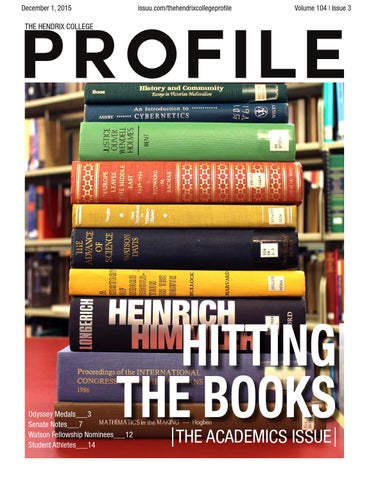
December 1, 2015
issuu.com/thehendrixcollegeprofile
Volume 104 | Issue 3
THE HENDRIX COLLEGE
PROFILE
HITTING THE BOOKS
Odyssey Medals___3 Senate Notes___7 Watson Fellowship Nominees___12 Student Athletes___14
THE ACADEMICS ISSUE
THE PROFILE
CONTENTS
Volume 104 Issue 3 December 2015
Photo by Konrad Witkowski
NEWS 3 Odyssey Medals HDX honors alumni
4 Kinesiology
Change in health sciences
4 Art Show
Exhibition of student work
5 Candlelight Carol New tradition
OPINION 6 Major Importance Why all majors are worthwhile
7 The Zucchini Death by lightbulbs
7 Senate Notes By James Owen, guest senator
8 Explorations Changes in the program
FEATURE 9 Liberal Arts Benefits Pros and cons
10 Academic Burnout Study tips and more
12 Watson Fellowship HDX nominees
13 Interdisciplinary Creating majors
SPORTS 14 Student Athletes Balancing sports and school
15 Basketball Beginning of new season
CULTURE
pg.15: Basketball
THE PROFILE STAFF EDITOR-IN-CHIEF
MARY KATHERINE BARKER 501-213-5885 BarkerMK@Hendrix.edu
MANAGING EDITOR
LAYOUT EDITORS JACKIE OAKLEY LUCY MORGAN
PHOTO EDITOR
MEGAN PRETTYMAN
CASEY HAWKINS 501-231-6216 HawkinsCT@Hendrix.edu
COPY EDITOR
ASSOCIATE EDITOR
PHOTOGRAPHERS
CHIRAG LALA
16 Netflix and Study Beneficial or distracting?
17 Steve Jobs Movie review
18 Calendar ISSUU.COM/THEHENDRIXCOLLEGEPROFILE
2
JAMES OWEN
MADISON DEALING JORDAN MAY KONRAD WITKOWSKI
STAFF WRITERS
CONNOR NEWTON GINNY GREER MCKENNA JACQUEMET BAYLEY KRELL SARAH GILMOUR MARLEE BIRD GREER VEON
HDX in the Real World
NEWS
Distinguished alumni receive Odyssey medals
By Sarah Gilmour
O
n Oct. 22, Hendrix College honored four alumni with awards for distinction in post-graduate accomplishments at the annual Odyssey medal convocation. Each year, an Odyssey committee comprised of faculty, alumni, college board members and at least one student nominates Hendrix graduates doing exemplary work in one of the six categories of Odyssey projects. “The idea was to find a way to recognize what our alumni do that is in fact just like what we’re saying the Odyssey program is,” Dr. George Harper, who sits on the Odyssey medals nomination board, said. “How are they now living lives that exemplify what we think of as Odyssey?” The process of selecting honorees is no easy task. With so many talented graduates accomplishing so many feats in fields of research, global awareness, service to the world, and artistic creativity, it’s difficult to isolate those who are most deserving of distinction. “The committee gets a packet of information about the accomplishments of nominees, and tries to decide who, amongst all these exemplary lives, stands out,” Dr. Harper said. After the nomination board selects candidates, the Board of Trustees votes on the final winners. This year, honorees were awarded medals in the categories of research, service to the world and special projects. Dr. Omer Shedd, a member of the class of 1993 and a fellow of the American College of Cardiology, was awarded a service to the world medal for his establishment of a hospital in a small town in Haiti, a country which he says has only one doctor for every 10,000 people. Dr. Shedd has spent years training Haitian physicians to perform
life-saving cardiological procedures. He expressed that with the series of natural disasters and decades of financial distress, Haitian people have little access to good health care. “It’s hard to conceive that just 1,500 miles from here, this level of poverty persists,” Dr. Shedd said. “In my heart, I have been called to do what I can to help. It may not be much, but if I can affect just one person’s life, to heal their body and possibly their soul, it’s worth it.” Dr. John C. Byrd, a class of 1987 graduate and clinical specialist in leukemia and other
have worked with visual and musical artists in New York City. Norton fondly recalled his early days as an artist at Hendrix, creating art pieces in the Trieschmann fine arts building while taking in the euphonious sounds produced by the music classes. “There are parts of your mind that work visual arts which are affected in a very fine way by hearing music,” Norton said. “It was my first art studio, and to me it was just heaven.” Ragsdale Norton expressed that her days at Hendrix encouraged her to be versatile and to approach novel situations with an open mind and heart. She encouraged current students to internalize this philosophy. “A wonderful lesson I learned at Hendrix: Do not disregard that which you do not understand or which is new to you— there is a story there. There is history there. And if you will take the time to understand, to walk in others’ experiences, you will build bridges, and you will build a better world,” Photo courtesy of Hendrix College Ragsdale Norblood diseases, received the research medal ton said. for his contributions to advances in myeloid Dr. Harper expressed that the goal of the leukemia and chronic lymphotic leukemia Odyssey medals ceremony is not only to therapies. In addition to his ardent dedicahonor distinguished alumni, but also to fill tion to clinical research at Ohio State’s current students with a resolve to pursue Comprehensive Cancer Center, Dr. Byrd challenging and unique endeavors. spends several hours each week caring for “The experiences [the medal recipients] patients with leukemia. had here prepared them to have the experi“While it is easy to coast through life with ences they did in whatever path they took— success, we must push ourselves, as Henand many of them recounted that in their drix has taught me, to the point of being unspeeches,” Dr. Harper said. “It helps our comfortable, so as to grow,” Dr. Byrd said. current students see that in 15 or 20 years, Dr. Wendel Norton III and Elizabeth it could be them coming back—because they Ragsdale Norton, graduates of the classes of have the same foundation and opportunity. 1973 and 1975, respectively, were awarded a The recipients of the Odyssey medals slept special projects medal in light of their founin the same dorms, played the same sports, dation of Norton Arts, Inc., which practices studied with some of the same professors. fine art conservation. Norton and Ragsdale Where they were is where you are, and Norton have restored historically and culwhere they are is where you could be.” turally significant artifacts for decades, and DECEMBER 2015
3
Cycling Out Kinesiology
The future of health sciences at Hendrix By Bayley Krell
I
n early spring 2015, Hendrix made the announcement that it would be cycling out the kinesiology major and reworking the structure of the health science major. Students that had already declared as kinesiology majors would still be able to graduate with that degree; however, the option would not be available to incoming freshmen. “We worked with them individually to see how their schedule would go to make appropriate substitutions so that they can graduate with a degree in kinesiology,” Dr. Joyce Hardin, the health sciences department head, said. The last class to be able to graduate with a degree in kinesiology will be the class of 2017. There were several contributing factors in choosing to cycle out kinesiology. As it was part of the health sciences department, the decision was made to restructure the health science major and include it in the biology department. “That health science major was the bulk of the students in that department. [They were] moved to biology basically because we will be fostering the health science major,” Hardin said.
Another factor was that there was only one full-time professor in the department, who was teaching with the assistance of various adjunct professors. “Don’t get me wrong: adjuncts are wonderful, and we couldn’t survive without them,” Hardin said. “But for the long-term, you try to get full-time people because there’s more to the job than just teaching. There’s advising and working with student groups and all that. So having full-time people is important for the long-term health of the program.” The reworked major would get rid of the current concentrations and a student in the program will instead receive a blanket health science degree. This new approach allows students to receive their education from a range of full-time professors. These professors will help to develop the program the longer they stay at Hendrix. “What we did was try and take the common classes that were already here, make that the core and then give a list of classes that people could pick and choose from,” Hardin said. This will allow more flexibility for the health
science majors. If upon completing observation hours students felt that they were more interested in physical therapy rather than occupational therapy, they would simply switch their course load rather than having to go to the registrar and officially change their major. This new major will still allow students to pursue careers that they would with a kinesiology degree. In fact, the new structure of health science was intended for just that. “What we did was look at graduate schools that these people would be attending and what were the common threads that everyone seemed to require. These [are the] things that were added to the core [curriculum],” Hardin said. This new major hopes to further the education of Hendrix students and sufficiently prepare them to be accepted into and excel in the graduate program of their choice. “I think it streamlines it a lot,” Hardin said. “We’re hoping that that’ll make things easier and better for the students.”
The ART of Competition By Sarah Gilmour
E
very autumn, the senior art majors at Hendrix work together to host an art show displaying work from Hendrix students. This year’s show opened on Nov. 10 and the winners were announced on Nov. 12. Senior Carl Napolitano is one of the students who helped put in all of the work for the show. He explained the volume of work that goes on behind the scenes to make the show happen. “All the art major seniors, there are eight or nine of us, are in charge of running it and divvying up tasks amongst us,” Napolitano said. “Some things we might do are collect submissions, put up posters, make posters. We coordinate with the outside juror who comes and picks which works go in the show and what pieces get prizes. We set up the show, we hang up all the artwork, and we run the reception. So pretty much everything that goes into running the show, we all do together.” The students opted to keep the theme for the show open so as to encourage more entries. “We want to get as much good work as we can from the student body,” Napolitano said. “We
Show exhibits student work; prizes awarded
wanted to keep it an open show so we can accept anything. People won’t have to feel the need to make something in a short amount of time just for our show. People can be like, ‘oh, I already have this work that I did for class or on my own, so I might as well submit it to the show.’ We want to give people the least amount of excuses they can to not submit.” Senior Anna Sheals, another student involved in the process of running the show, believed that the show’s cash prizes would encourage entries as well. “We have a first, second, and third place prize,” Sheals said. “First place is $100, second place is $50, third place is $25 and then there are two honorable mentions, so it’s a really good chance for students to get involved. Offering prizes, we thought, would get more interest too.” First place went to senior Ali Bair for her work, “Centerpiece.” Second place went to junior Lexi Adams for her work, “Canoe on Lake Clinton,” and third place went to senior Mary Katherine Barker for her untitled work. Two honorable mentions were given to sophomore Jordan May
ISSUU.COM/THEHENDRIXCOLLEGEPROFILE
4
for his work, “Search for Self,” and to senior Chloe Showalter for her work, “Woman with Guitar.” The show occurs every year because it allows the students to experience running an art show. “I think the art department kind of wants it to be a chance for all the senior art majors to organize a show before our senior art show,” Sheals said. “We do one just for us in the spring, and all of us work together to put that together. I think the faculty wants us to get some experience doing that in the fall as well.” Napolitano added that the show also serves as a good opportunity for the artists whose work is shown. “I think the show is just a good way for students to put their artwork out there to get their fellow students to see it, as well as the public,” Napolitano said. “Hendrix students spend a lot of time in art classes and they make a lot of work. It’s nice to share that work with the whole campus to cultivate our campus culture.” The show will be on display in the lobby of art building A until Dec. 4.
NEWS
The Inauguration of a
Photo by Madison Dealing
Candlelight Carol Competition Hendrix College choir builds on a Christmas tradition By Marlee Bird
F
or many members of the Hendrix community, Christmas would not be complete without attending a Candlelight Carol service. Starting in 1964, Hendrix Candlelight follows the tradition of A Festival of Nine Lessons and Carols famously sung by the Kings College choir in Cambridge. This service teaches nine lessons accompanied by nine carols, although here at Hendrix, the choir adds a few more carols at the beginning and end of the service. The Hendrix choir even takes the lessons on the road, performing at Methodist churches in Little Rock, Memphis and other areas that have strong ties to Hendrix. This year marked a new tradition within Candlelight with the start of a yearly Hendrix College Candlelight Carol competition. Composers around the world were invited to submit works that would tie into the service and the lessons of the carols. Since this was the first year, one would suspect that submissions would be low. Astoundingly, however, a generous 85 composers submitted pieces to the competition. Hendrix choir director Dr. Andrew Morgan expressed his surprise
and thrill upon receiving so many submissions. “I was immensely pleased,” Morgan said. “These are composers from such a wide range of traditions and backgrounds, musically, that want to be a part of the tradition here, and I think it’s a great way to build on the prominence of Candlelight Carol, to build upon its reputation, to expose it to new audiences, and to keep the tradition of music-making.” The process of choosing one piece from 85 submissions was no easy feat. After scanning all of the pieces, Morgan chose a top 10 and then submitted these pieces to a committee. Sydney Hickok, a junior philosophy and music double major, was one of the members of the committee who helped decide which piece should be performed at the services. Hickok explained that each member of the committee ranked the pieces separately, which made for an interesting mix of musical tastes and opinions. “I basically broke it down into different categories like originality, harmony, its relevance to Candlelight, and how it fits with the other pieces in the program,” Hickok said about how she ranked the pieces. Hickok explained that being on the committee
DECEMBER 2015
5
was also a valuable experience because of her interest in music composition. “It helped me understand what judges are looking at and what they are taking out of the piece that you submit,” Hickok said. After committee deliberations, the piece chosen for Candlelight was “A Christmas Lullaby” by British composer Edmund Joliffe. In addition to bragging rights, Joliffe received $1000 from Hendrix for his contribution. Both Morgan and Hickok stressed the importance of Candlelight for the Hendrix community and beyond, Morgan adding in the fact that Hendrix’s recent donation from the late Mary Ann Dawkins, the biggest in history, was inspired by the Candlelight service. “Even if you are not religious, you can still learn from the lessons and appreciate what the Candlelight services are for, which is to build community,” Hickok said.
The By Greer Veon
Major
Issue Do all majors share equal merit?
A
s the season of finals approaches and the workload grows, I find myself wrestling with a recurring frustration. Every now and then, I either overhear or read online comments made about unruly amounts of papers or exams and how life would just be easier if he or she had picked an “easy major” upon coming to college. But if you actually believe that there is such a thing as an “easy major,” I feel that you are offending your fellow peers. I notice that this debate on college majors seems to be an issue not only for students on this campus, but also on college campuses across the globe. As I went to research this topic, I came across an article in The Washington Post from January 2012. Columnist Michelle Singletary wrote, “I have this game I play with college students. ‘What’s your major?’ I ask. The student might say ‘English,’ ‘psychology,’ ‘political science’ or ‘engineering.’ And then, in my mind, after factoring in some other information, I say to myself ‘job’ or ‘no job.’” The comment, along with the article’s title, “Not all college majors are created equal,” struck me enough to check what other article titles might pop up from a Google search. They range from “What’s the Most Useless Major?” to “10 Worst College Degrees to Earn.” All of these writers argue about the same things: the increasing unemployment rates, low financial stability, and overall uselessness of certain degrees in any well-known career. And while I completely understand their arguments, I found that every outlook was made in a completely negative light. When you make critiques on the overall worth of effort put into a major by using words such as “easy” or “useless,” you’re missing the point of obtaining the major itself. Some majors require mostly exams, while others are filled with one paper after another.
Others conduct research, spend hours on presentations, or present multiple pieces of artwork. But all college majors, whether from the sciences, the humanities, or the professional fields, share an equal merit. All fields of study share a common thread of providing their own set of challenges and obstacles for students to complete. But the amount of work should not matter, nor be compared. Deciding a college major is a completely personal yet rewarding experience. A student weighs their passions and interests with the overall scholarly experience that he or she wants to follow in college. As students, we expand our knowledge on a subject that interests us.
We must remind ourselves that our majors will lead us toward a fulfilling lifestyle, one that will make us proud in the end. This should be celebrated. When you choose your major, you are actively pursuing a passion. You aim toward the desire to expand your own understanding of something that excites or strikes you. Whether you study biology, art history, business or psychology, you make the choice to grow as an educated individual, and that decision leads toward a more fulfilling life. I don’t intend to knock down those who choose their majors based on future financial stability or job security. Those who weigh the practical points are smart to do so. After all, some majors are designed to guide you directly towards a future career program once you receive your degree. Nor do I want to criticize those who might make these kinds of comments in a joking manner. I think we all can admit to envying
ISSUU.COM/THEHENDRIXCOLLEGEPROFILE
6
those who might seem to have less work. But what I do argue is that we should not compare the amount of our work, the difficulty of our majors and our overall academic experiences to one another, because this kind of debate divides the center of academia. As individuals, we are all unique. We value different things. We excel in different classes. We seek to answer our curiosity with the world in different ways. And that’s what makes the college environment so admirable. We also shouldn’t draw this correlation between college majors and potential careers. They are two separate paths. There are those majors in the professional field that aim students toward a certain career path once they earn their degree, but the choice to actively pursue that goal in the end is in the graduate’s hands - not the major’s. A major, whether career-oriented or not, does provide the necessary basis for learning in the professional world. Your major is far from useless, because each one teaches you to think critically, write and articulate your thoughts clearly, practice problem solving skills, and apply information to real life situations. The knowledge and experience that you have under your belt allows you to adjust to many careers in different ways. We need those that can be doctors, lawyers, and police officers. We also need those who can teach, write, and create, as well as those who are leaders in politics or faith. Overall, we have to value the groups of citizens that are bold enough to attend college and pursue a major in their interests. As members of the Hendrix community, we must work together to recognize the value and high regard placed on every student who is set on a path for scholarly growth. We have to reject these ideas that there is such a thing as an easier or useless degree. Although our minds are currently wrapped within the stress of our finals, we must remind ourselves that our majors will lead us toward a fulfilling lifestyle, one that will make us proud in the end.
OPINION
The Zucchini: By Connor Newton
T
Death by lightbulbs
he time is 8:53 a.m. on Friday, Dec. 14. A man waves a badge across an automated lock, its light flickering from red to green, and he opens the door and ventures forwards. Reflected in the many windows to the left, a man, dressed in a well-tailored black suit, sporting a slim black tie, holds a piping hot cup of coffee. Simultaneously turning right and not spilling a drop of coffee, he lifts the cup to his lips, taking the time to catch a scent of the black sludge with his nose. Before him is a line of yellow type scrawled with the word: “CAUTION.” Behind that, the collection of small cells known as the Bailey Library study carrels lie in wait. Sunlight streams in from behind him; he swishes the coffee inside his mouth, coating his palate with the acidic sludge, and removes the lip of the coffee cup from his mouth, exhaling a warm bitter steam, and says, “damn fine cup of coffee!” The time is 8:54 a.m., Friday, Dec. 14. … “Good morning, Agent. Right this way to the scene,” a stock-figure cop bellows out to Agent upon his arrival to the scene. “Mondays…I hate Mondays,” Agent sneaks out the words from behind his coffee cup. “But it’s Friday,” idiotic TV drama cop replies, showing some more than usual confusion. “Exactly!” snaps Agent. The banter was perfect.
Agent turns the corner once more, now peering inside each of the small, glass chambers until he finally stops. He sees a long patch of blonde hair attached to a limp body sitting down, face flat against the desk in front of her, motionless. Agent opens the door to the carrel, looks down at the carpet and does a sweep of the cell, from bottom to top. He removes a blue latex glove from his pocket and struggles to fit his hand inside of it, giving the end a pop against his wrist. He proceeds to rub his finger against the blank (except for poorly done pencil graffiti) white walls, pulling his hand back towards his face every now and again to check for something. He leans in closer to examine the body, poking at the skull of Blonde Hair with the end of his pen. Agent maneuvers around the tight space, finds the light switch, and slowly flicks the lights on and off, on and off, intently listening to the drone of the fluorescent bulbs. Still flicking the lights, Agent angles his head towards the cop who currently stares mindlessly at Agent’s tactics. “Whaa... Whaaat is it?” typical cop says. “The lights….it’s…the lights,” Agent says, taking deep breaths between pauses for no reason. “I’m, uh, still not getting it,” the cop mumbles, tilting his head like some breed of dog. Agent pauses, turns fully towards the cop and starts to reach into his pocket. “Well, let’s just say these fluorescents here…” Agent puts on his dark sunglasses (quick zoom
to Agent’s face), “…really put her lights out!” Cue any “The Who” song. … While what you just experienced was a fictional rendering, we here at The Zucchini would like to take the time to raise awareness about PFLS. PFLS, or Prolonged Fluorescent Light Syndrome for long, is a terrible condition that has been growing more and more dangerous each year, especially approaching finals season. For years, we’ve thought that it was those old cathode ray tube television sets that were rotting brains, but we have been sorely mistaken. The high frequency at which the fluorescent bulbs burn, compounded with the hum at which they drone, generates a peculiar resonance that does indeed fry one’s brain. It is our understanding that prolonged hours of studying, especially in the carrels, can do one’s body serious harm. So please, this finals season: don’t put things off until the last minute and then stay up all night frying your brain beneath the white lights…just get a C.
*A note to the reader: The Zucchini is a spinoff column of The Onion, a satire news publication that is based in Chicago, Ill. Nothing written in an article under The Zucchini column is factually true; please do not take it seriously.
Senate should speak for students We’re ready to listen
By James Owen, Off-Campus Senator
C
onversations can be powerful instruments of change. In the past few weeks, our campus has been having many meaningful conversations. We have talked about race. We have talked about cultural appropriation. We have talked about discriminatory language. Through Project Pericles, we have even held forums to specifically address these issues. But it does not take a specific forum devoted to a topic to have a conversation about something that is important or meaningful to a student. These conversations happen across campus in every residence hall and at every hour of the day and night. The Hendrix College Student Senate is also a place to have these discussions. Better yet, we strive to work with students to find concrete solutions to the problems facing the Student Association. This year, per campaign promises by the president and vice-president, Senate has taken steps to become both more proactive and more transparent. As a body, Senate passed a new agenda struc-
ture that requires the minutes of each Senate meeting to be approved and published in order to be as transparent as we can. The reformed agenda structure also has the intent to give students a significant say in their student government. In short, the new agenda requires any new business that can be voted on – almost any issue of importance – to undergo at least two weeks of discussion before a vote can take place. In these two weeks, we want to get as much input from the students as possible. After all, I see no reason why students, rather than senators, shouldn’t be the driving force behind the conversations that matter to this school. As senators, we hold no power except that which is given to us by the students. It is true that many of the votes we have are to allocate funds to the various student organizations across the campus that students are involved in, but these don’t have to be the only tasks before Senate. I want to see Senate be more. I want to see Senate become a place where students do come to discuss important ideas – and help us figure DECEMBER 2015
7
out solutions. If you have an idea about how to improve the safety of students, come talk to us. If you have an idea about how to make buildings more efficient, come talk to us. If you have an idea about how to create a more inclusive community, come talk to us. I recognize that Student Senate can be a muchmaligned institution. By no means are we perfect representatives of the Hendrix College community. By no means are we the solution to all of the problems that face the Hendrix College Student Association. By no means are we doing the best job that we could do. But we can get better. And we are trying. We need your voices to dictate the direction of Senate. Let’s talk. * While this column does talk about Student Senate in generalities, please note that it does not reflect the views of all of Student Senate or the views of The Profile. The writer’s opinions are his own.
OPINION
Exploring
Explorations: The Current Changes By Jordan May
H
endrix requires all students who are enrolled in “The Engaged Citizen” (TEC) to also be enrolled in “Explorations: The Liberal Arts of Life.” This includes all freshmen and transfer students who were not exempt from TEC. The purpose of Explorations is to help new students transition into the community of Hendrix College, and foster the students’ engagement with the liberal arts experience. The intent of the course has remained the same this year; however, its structure has changed. This year, a freshman’s Explorations teacher is also his or her advisor, and as a result, a freshman’s student advisor is also his or her Explorations peer assistant (EPA). Last year, junior Emily Hardick ran a pilot Explorations course with her advisor on which the current changes to the program are based. Freshmen tend to only meet with their advisor at the very beginning and end of the year when they are working on their schedule. Hardick explained that the first year studentadvisor relationship should be more productive than just working on schedules, which is why administrators decided that the program needed to change. With freshmen having their advisor
also be their Explorations teacher, they are forced to have a relationship with their advisor. When I was a freshman, my advisor was not my Explorations teacher; however, he was my TEC teacher. This was just a coincidence, but I benefited from my advisor teaching me in a class just by the simple fact that I saw him three times every week, rather than just seeing him once a month. While the changes in Explorations might help many freshmen transition into the Hendrix community, it may not be for everyone. Junior Katie Dobbins enjoyed her advisor and Explorations teacher being different people. “I feel that reducing the Explorations course to just being with the advising group takes away the administration’s access to get to know new students,” Dobbins said. “Both of my Explorations experiences were with non-professors, Britt Murphy as my teacher freshman year and as Dean Baoua’s EPA. Explorations also exposes you to new people outside of your proposed major, which is an amazing aspect of the randomized groupings of students to their Explorations teacher.” As a student gets further along in his or her academic career, it not only gets harder to meet
professors outside of your major, but also just new professors in general. Dobbins’ argument makes a lot of sense, and while I liked having my TEC teacher being my advisor, I also liked that my Explorations teacher was from the English department, which was definitely outside my academic comfort zone. As a course, Explorations has been pretty successful in its intention of acclimating new students to Hendrix. Sophomore Zoie Dilley wished she could have taken Explorations this year as a transfer student from the University of San Diego. “I really did not know a lot about the Odyssey program at Hendrix until just recently,” Dilley said. “Even though I was exempt from The Engaged Citizen, I think I could have benefited from taking Explorations, especially considering there really was not a specific class like this one at University of San Diego.” While the structural changes in Explorations are very minor and have their pros and cons, the benefits from it remain the same in the way that the class helps transition new students at Hendrix, and the active role it plays in emphasizing the liberal arts in higher education.
It’s Legal. It’s Safe. It’s Anonymous. Safe Haven is a law designed to protect babies. What is Safe Haven? In Arkansas, the Safe Haven law allows a parent to give up a newborn anonymously. The purpose of Safe Haven is to prevent babies from being hurt or killed by unsafe abandonment. Unsafely abandoning a baby puts the newborn in extreme danger that can result in the baby’s death. It also is illegal, with severe consequences.
There is an option. Don’t abandon your baby. 1-888-510-BABY 2 2 2 9 w w w. a r k a n s a s s a f e h a v e n . o r g www.HumanServices.Arkansas.gov | Division of Children and Family Services
ISSUU.COM/THEHENDRIXCOLLEGEPROFILE
8
Photo by Jordan May
FEATURE
Weighing the Pros and Cons: The Value of Liberal Arts By Ginny Greer
T
he frank truth about most high school applicants is that when they say they want to go to a liberal arts college, they are not often thinking about the denotative meaning of the term. Most of us associate liberal arts education with small class sizes, high academic ratings, and, let’s be honest, shorter lines for better cafeteria food than public universities. However, beyond these vague assumptions, liberal arts schooling offers a rich set of ambitious goals that turn out graduates with well-rounded analytical and problem-solving skills each year. The Association of American Colleges and Universities defines liberal arts education as “an approach to learning that empowers individuals and prepares them to deal with complexity, diversity, and change. It provides students with broad knowledge of the wider world (e.g. science, culture, and society) as well as in-depth study in a specific area of interest.” At first blush, being required to take courses from a variety of disciplines can seem to be grueling, dull, and even a waste of time. To some students, streamlining through a straightforward set of courses to file into a defined career path can seem far more attractive than spending time taking classes in subject areas that don’t interest them. However, after a semester or two, some students feel that this design helps them garner a more cogent understanding of
various subjects and a clearer idea of what path they want to follow. “[A liberal arts experience] was positive for me because when I started here, I wasn’t sure what I wanted to study,” freshman Trenna Lemons said. “Getting to take classes from various subjects helped me figure out what I’m interested in.” Additionally, some students value the fact that a liberal arts education allows them to pursue multiple interests simultaneously. “I’ve been interested in studying both biochemistry and economics,” freshman Sarah Glass said. “I’ve thought that I would have to pick one, but with the liberal arts program, it’s easier to become a double major if that’s what you want to do.” One unique way that Hendrix embraces the liberal arts philosophy of encouraging students to become critical thinkers prepared to address problems in a constantly evolving world is through the required freshman course, “The Engaged Citizen” (TEC). First-semester freshmen students select a TEC with a theme that interests them, all of which involve interdisciplinary study of both modern and age-old issues including poverty, prejudice, sex and innovation. Students in TEC courses work collaboratively with their classmates to ponder heady topics under the instruction of two professors from different disciplines. “TEC does two things,” English profesDECEMBER 2015
9
sor Dr. Toni Jaudon, who co-instructs a TEC course on the Haitian Revolution, said. “It encourages civic engagement—explores the reasons why we should care to be involved. It also shows us that in order to be engaged citizens, and to understand who we are and how we perceive the world, we need multiple disciplines.” The liberal arts curriculum can be challenging because quite often, it is more demanding than other learning approaches. However, many graduates of Hendrix feel that the emphasis on diverse learning and analytical thinking has been beneficial far beyond their time in college. “When it comes to solving problems in the world, at work, or in your personal life, it’s rare for there to only be one solution,” assistant director of Student Activities Dominique Kelleybrew said. “A liberal arts education not only affords you the critical thinking skills to discover those solutions, but its inherent holistic approach allows you to recognize the many paths that may be used to get there.” Kelleybrew also expressed that the extra hours spent studying and composing essays during his college years helped make him more competitive in the job market. “A great friend of mine who went to a state school once bragged to me that he only had to write two papers during his college career, while I averaged two papers per week,” Kelleybrew said. “I have an amazingly creative job that I love. He’s still looking.”
Academic
Burnout: By McKenna Jacquemet
D
o you wake up unrested, exhausted, and dreading getting out of bed? Is what was once the highlight of your day just not exciting to you anymore? Are you overwhelmed with work and feel like you have a constant ball in your stomach, or feel your throat closing up? Every student has been there; it’s called burnout. According to a spring 2013 National College Health Assessment survey, almost half – 46.3 percent – of all undergraduate students surveyed reported that they felt trauma or overwhelmed in regard to their academic responsibilities. Finals week is approaching rapidly and many students are keenly aware of this fact. Burnout is the body’s reaction to being overworked and overstressed. It can lead to emotional fatigue and physical depletion, not to mention epic amounts of procrastination. “In dealing with those who are undergoing great suffering, if you feel ‘burnout’ setting in, if you feel demoralized and exhausted, it is best, for the sake of everyone, to withdraw and restore yourself,” the Dalai Lama said. “The point is to have a long-term perspective.” Burnout occurs at some point in most college students’ careers. Signs of burnout include intellectual exhaustion, a decline in academic performance, loss of motivation, inability to concentrate, long-term fatigue, and a lowered immune system. The cure for academic burnout is easy and often quite elementary. The trick is to take the time to actually take care of oneself and let that little stress monster go, at least for a little while. In order to manage one’s time, automating menial tasks can help. Exercise, even if it is a short walk around campus. 30 minutes of exercise a day can drastically reduce your chances of burning out. Eat healthier food, such as fruits and vegetables. Take regular breaks to put the stress away.
Hang out with friends and watch funny movies. Get more than four or five hours of sleep each night. While all of this may seem to be what doctors, parents and adults have been telling students our entire lives, it does work. Take it one step at a time; the stress will reduce and soon, your cheeks will be pink with energy again. “Sometimes you need to put down your books, leave the library, get on a plane and fly away from your academic troubles,” senior Emily
“In dealing with those who are undergoing great suffering, if you feel ‘burnout’ setting in, if you feel demoralized and exhausted, it is best, for the sake of everyone, to withdraw and restore yourself,” - The Dalai Lama Nichols said. While it may be difficult to fly away, sometimes simply taking a break from the library can be just as beneficial. Full-time college students study fifteen hours a week on average, according to a 2011 study released by the National Survey of Student Engagement. Studying more hours does not
ISSUU.COM/THEHENDRIXCOLLEGEPROFILE
10
necessarily mean students are more successful, the study suggested. A news release about the annual “Fostering Student Engagement” campus-wide study posited that even students that spend at least 20 hours studying per week are still not always prepared in class. While the library is an invaluable tool that should be extensively utilized, studying for hours on end without break is neither recommended nor practical in this Netflix-filled world. The best way to be prepared and avoid burnout is to begin studying early. Not for hours on end, but read over your notes and take twenty minutes every weekend to review what you learned in class and lengthen that time as the semester goes on. That way, you avoid cramming when finals fever finally hits. Caffeine may be a godsend during finals week, but avoid guzzling it down. If you need several cups of coffee or tea to get through the day, the answer is sleep. One unknown fact is that, according to the National Sleep Foundation, it takes about six hours for one half of caffeine effects to be eliminated. This means that too much caffeine will affect your sleep, even if it seems like the caffeine has run its course. In the long term, sleep is better for retaining information than cramming information into a sleep-deprived brain. Do whatever it takes to ace those exams without hitting the brick wall of academic burnout. Hold a mini dance party with your roommate during a study break. Have a midnight Waffle House run. Watch a horrible, brainless, funny movie. Occasionally embrace procrastination to give your brain a break. Look up pictures of Ryan Gosling telling you to study on Pinterest. Do whatever works for you, but make sure it’s something fun! And the cure to everything, as Remus Lupin has so kindly told us, is chocolate.
FEATURE
The Disease of Our Generation 10 Necessary Study Tips 1. Play an instrumental Pandora or Spotify station very low in the background to help focus through the boredom. 2. Leave yourself a gummy bear or candy train when reading. This especially works when slogging through massive textbooks containing long paragraphs. With each paragraph finished, have a treat! 3. Write down all of your formulas at the beginning of the test. As soon as your professor hands out the test, write every formula you remember in the side column so you do not forget. 4. If you are dyslexic, there is a special font called Dyslexie that could help you read more easily. 5. Use a program like Cold Turkey for PCs or Self Control for Macs to block distracting sites on your computer for a set period of time. 6. For history and anthropology classes, watch a documentary on the topic. It will help you have a deeper understanding of the material. If no documentaries exist, open YouTube and do a search on the topic. Just be sure that the video is reliable. 7. Take better notes by pretending you are taking them for someone else. Or, try the Cornell Notes method of color-coding, or rewrite your notes based on category, names, or dates just before the test. 8. While studying, do a short review session at each twentyminute interval of the newly learned material. 9. Google “site:edu [subject] exam� to find many different college exams featuring problems pertaining to that subject, or try an online interactive flash card site like Quizlet. 10. Use acronyms, poems, and songs. Go back to middle school with this trick because we all know that it works. Photos by Jordan May
DECEMBER 2015
11
Photos by Konrad Witkowski
Women for Watson Four Hendrix students nominated for the Watson Fellowship By Greer Veon
W
hat if you could spend a year on an independent journey exploring the research project of your dreams? The students who desire that kind of opportunity are part of the Thomas J. Watson Fellowship. Each year, the Watson awards graduating seniors with a one-year grant for independent research outside of the United States from an applicant pool of nominees from 40 partner colleges. This year, seniors Ali Bair, Shelby Morrow, Michelle Stockwell and Jessa Thurman are the four Hendrix nominees that will compete in that pool. “I propose to investigate what makes us love, hate, or simply ignore insects and how this perception has inhibited both our study and appreciation of these creatures in our modern world,” Thurman said. While Thurman is interested in living insects, Bair is more interested in artificial flies. “I will be cued by the weather as I follow fly fishing peak-seasons,” Bair said. “I aim to craft a modern and inclusive documentary on fly fishing culture, visiting communities in Norway, Russia, Japan, Mongolia, New Zealand, Argentina, and Belize.” Morrow’s project also looks to tie together cultures, but through the commonalities of artifacts that are left behind. “My project is about cross-cultural knitting communities and how they affect identity,” Morrow said. “Knitting is important to me personally, but I’m also really interested in how physical objects work as cultural artifacts, and what they communicate.” Stockwell hopes to communicate a different message. “I will explore the power of storytelling to engage people in the complex narratives of migrants,” Stockwell said. “Through street portrait photography, podcast interviews and written pieces, I will share the stories of people who leave home for opportunity or refuge, the loved ones they leave behind, and the stories of people who lack the agency or resources to choose
where they make a home.” The ideas of each of the nominees began to develop long before their senior year. “I heard about an informational meeting about the Watson as a freshman,” Bair said. “The openness of the ‘research’ project was what really attracted me. I decided that day that I would apply when I became a senior. I was already overflowing with ideas.” The Watson allows for applicants to take total control on researching and studying a topic that they choose to design in places best suited for gaining their information. “It was impossible to not be interested,” Thurman said. “I have always known that I wanted to apply and would never forgive myself for passing up this opportunity.” To be nominated by Hendrix is an intense process. The proposals must be submitted by the end of September or beginning of October. Then, there is a 15–minute interview with the Hendrix Honors Committee. “At first, it’s a panic of what you’re going to do a project on and how valid that project topic is,” Thurman said. It may sound easy, but after choosing the perfect topic, the rigorous application must be completed. “You brainstorm ideas as far in advance as possible,” Stockwell said. “Then you write a project proposal, personal statement, find people in your Watson sites that are interested in your project, and create a budget.” Bair notes that her drafts were rewritten numerous times, and that professors, peers, and even family members helped to critique her work. “I had the task of taking all that feedback and using it to transform my idea into a clear and fundable project,” Bair said. “The task of saying, ‘Hey, you can trust me with $30,000 next year because my idea is that good.’” The fact that all four nominees are women is also noteworthy. Recent nominees and recipients show that the women who are nominated ISSUU.COM/THEHENDRIXCOLLEGEPROFILE
12
alongside men on campus seem to excel in the competition. So how are these ladies so successful? “I think that women in the fields that we are interested in entering are used to always showing up prepared and working extra hard in order to be taken seriously,” Stockwell said. Bair also shares the same belief. “In nearly every aspect of life, [women] must be thorough, well-thought out, and even overprepared should we expect to be taken seriously or even heard at all,” Bair said. “In situations like the Watson, I am very glad I have this ability to thoughtfully communicate my passions.” Morrow, however, not only emphasizes the hard work and character of the individual, but the strength of the projects themselves. “The people that have been chosen in the last few years, including the other ladies who are applying this year, are some of the most passionate and intelligent people I’ve ever met,” Morrow said. “I would say they’ve been chosen to apply for this opportunity because they were somehow able to communicate that investigating their project is vital to their humanity.” Thurman believes that this kind of vitality is rooted in the personal connection to the study. “The success of the project depends on your emotional connection to it, and if you haven’t gone through the necessary personal exploration, then you are unable to make that connection, or at least convey it in your proposal,” Thurman said. “That genuine emotional connection is what Ali, Michelle, Shelby, and I have.” Whether or not the nominees ultimately win the title of Watson Fellow, the overall experience has definitely been positive for each student’s individual growth. “Even if I don’t get the Watson in the spring,” Morrow said, “I’ve learned a lot about myself already.” The nominees are finishing the final application process and will later hear the Watson’s final choices in March.
Making Your Own
FEATURE
Major
What it takes to be interdisciplinary By Bayley Krell
T
here are currently 34 majors available to students at Hendrix College. These range from the fine arts to the hard sciences and touch on everything in between. Most students come to college with a specific major in mind and, somewhere along the way, end up on a completely different track. Despite the slight detour, most Hendrix students find their way into a major that aligns with their passions or aspirations. But what happens to those students who don’t fall in love with politics or anthropology? Rather than choosing a major that almost fits their goals, there is always the opportunity to major in interdisciplinary studies. An interdisciplinary studies major is officially described as a major that, according to the Hendrix website, “allows students the freedom to design and develop a course of study which combines classes taken from several departments or areas.” This gives students the freedom to create a major that specifically suits their talents and goals rather than compromising by following one of the predetermined courses set forth by the school. “I realized that my current major as environmental studies was a good major, but that I just wasn’t invested in a lot of the classes that I was taking. I was sick of not being at all engaged in class or about the material that I was learning,” senior Emily Kleinfelter, an urban studies major, said. It is mainly students that experience some sort of dissatisfaction with the majors available that choose to go forward with developing an interdisciplinary major. “They don’t offer anything super specific here [as a major] and I wanted to specify,” sophomore Ella Thomas, a visual arts major, said. There are several steps necessary to becoming an interdisciplinary major. It is better to make the decision to develop a major sooner rather than later in one’s academic career; it is recommended to begin the process before spring registration of the sophomore year. The process begins with a discussion with the student’s academic advisor about what the student’s goals are in developing a major, what it would involve and the basics of what courses the advisor would recommend. The next step is submitting a proposal. “I had to make [the proposal] a page and a half or two pages about why I wanted to do
this, what am I all about, what am I focusing on, and what am I going to do in the future,” Kleinfelter said. Before the student can submit the proposal, he or she must ask professors in the areas they wish to study to sit on a supervising committee that will review the proposal and assist the student throughout his or her time at Hendrix. Following the submission and acceptance of the student proposal, the student must select the coursework for the duration of his or her time at Hendrix. This is arguably the most difficult and time-intensive part of getting an interdisciplinary major approved. “I’ll go through the entire catalog, literally three hours of my day just looking, ‘oh okay, maybe this [class]’ and highlighting,” Thomas said. “But then you get on the course catalog and the last time this class was taught was fall 2012 by a teacher who doesn’t work here. So
“...it will add a bit of an edge in interview and job potential. It will give me an extra push.” -Ella Thomas you have to account for all these little things. You can’t really plan what classes they’ll offer or when a professor is on sabbatical or if the professor is going to quit.” Though this task may be daunting, as the catalog is extremely thick, most students do not start from scratch because they are basing their major off of a major that is available at a different academic institution. “I did a lot of comparison with Rhodes because they have an urban studies major,” Kleinfelter said. “I looked at their course list and looked at what we have and where can I replace this [class] and that [class].” Pending the approval of the student’s committee and the associate provost, the hard work is done and the process is complete. Students interested in developing an interdisciplinary major should take particular care DECEMBER 2015
13
in his or her class selections. “Once you do [submit] it, it’s a lot more paperwork to go back and fix things you want to change. Once you send it in to the registrar, that’s what you’re stuck with,” Kleinfelter said. Being an interdisciplinary major offers many freedoms that do not come with following a traditional major. This is most noticeable during the senior year. “It’s exciting to plan the senior year experience, the whole capstone,” Thomas said. “A lot of people are not wanting to do that. But for me, I’m like, this could be something really interesting, you know? There is also the potential for being able to do internships that can coincide with the major.” Though this flexibility is exciting and allows an interdisciplinary major something to look forward to, it can also be intimidating to take on such a large project without the academic support of one’s peers. “I think next semester is where it’s going to be weird,” Kleinfelter said. “Every major has its group of friends that have been together for a while, they all know each other, there’s all those little cliques to support each other in their academics, and I’m by myself.” Despite some trepidation and hard work, the interdisciplinary experience is one that, when pursued, students believe makes their academic experience more enjoyable and worthwhile. “I’ve allowed myself to take more classes that I actually really want to take and I wasn’t having to be like other students who are suffering through a class that they know they aren’t going to use in the future,” Kleinfelter said. In addition to having an academic leg up on the competition, it is possible that having such an active role in creating one’s own major can give interdisciplinary students an advantage once they graduate from Hendrix. “It’ll just help to differentiate me,” Thomas said. “I wanted to make my own; it will add a bit of an edge in interview and job potential. It will give me an extra push. I won’t be in a sea of art majors. That’ll just be something that they can ask me about in interviews.”
Hendrix Student
Athletes
Managing academics and athletics By Marlee Bird
Photo by Megan Prettyman
F
or Hendrix students, managing the academic load is no easy task, and when extra-curricular activities are thrown in, it becomes even harder to balance obligations. While every Hendrix student is busy, no group is more notorious for hectic schedules than the Hendrix student athletes. From the outside looking in, it can be hard to grasp how one would be able to attend morning workouts, class, practice, meetings, and then do homework all in one day, but somehow, these student athletes make it work. One reason athletes at Hendrix are able to manage their load is because they are surrounded by supportive and understanding coaches. Coach “Buck” Buchanan, head of the football program, discussed how he tries to keep the quantity of practice hours down but aims to utilize every practice to its full potential. “One thing we don’t want to do is waste our
players’ time,” Buchanan said. Teachers are another great support system for student athletes, and because Hendrix is a small school, teacher-student relationships are easier to maintain. Buchanan emphasized that a healthy relationship between a student athlete and his or her teacher is imperative due to the fact that schedule conflicts arise with traveling. “The upperclassmen are great about it, and the freshmen have to learn that the hard way,” Buchanan said. “I think it teaches self-reliance.” Being a student athlete at Hendrix also has its perks in regards to Division III athletics. One of the biggest critiques of Division I sports is that they often fail to treat student athletes as both academic students and athletes, and the incentive to play is largely based on the strength of the athletic program and not the academic one. However, the story changes in regards to Division III athletics. “Most of the guys here really want to play [football], but they also came here because they wanted a place where they could get a great education,” Buchanan said. Hendrix is one place that offers the opportunity to pursue both academics and athletics. “I had to make a life decision, not a sports decision,” junior Mark Hickey, a politics major, said. “Hendrix presented the opportunity to receive a world-class education and continue to play football . . . I consider sports to be the cherry on top for coming to Hendrix.” “I knew about the school because of the sports, although I wouldn’t have come here if it wasn’t a good school,” sophomore Lauren Petrisin, a member of the volleyball team, reiterated. While being a student athlete is impressive enough, many have taken extra steps to be engaged in the Hendrix community through clubs and other groups on campus. Hickey involves himself further as an Explorations peer assistant and as the chair of Campus Kitty. When asked why he decided to
ISSUU.COM/THEHENDRIXCOLLEGEPROFILE
14
load his plate so high, Hickey explained that he wanted to make an impact, not just on the Hendrix community, but on the greater part of Conway as well. Petrisin, who is a health science major with a minor in music, is also involved in the choir. “Part of the reason why I came to school here is that I am able to do both [volleyball and choir],” Petrisin said. Managing these different roles as a student athlete is no easy feat. “I have three calendars,” Petrisin said. According to both Hickey and Petrisin, time management is a blessing and a curse for student athletes. “You have no choice but to have a structured schedule in season, but you have to learn how to manage your time in the off-season, when you have more free time,” Hickey said. Student athletes also have to make sacrifices when it comes to extra-curricular opportunities, such as lecture events that almost always interfere with practice times. In addition, certain social events, internships, and study abroad opportunities are much harder for student athletes to undertake, although not impossible. There are also the stigmas that surround student athletes, originating from the media or high school experiences, which follow them as they enter college. “Non-athletes may come into Hendrix with these pre-conceived notions about what athletes are like, and that sometimes means that [the athlete] might have to work harder to make friends outside of your team,” Hickey said. Although stepping outside the sports bubble can be hard for some, Hickey emphasized the importance of both athletes and non-athletes creating a wide range of friends and resources on campus together. “That’s just part of the pursuit of the college’s motto, ‘Unto the whole person,’” Hickey said. Although being a student athlete comes with its challenges, it isn’t devoid of rewards. “I don’t know what else I would do if I had five hours out of my day,” Petrisin said. For student athletes, being a part of a team means forming lifelong bonds, being a part of a community, and having an outlet to let go of the stress of everyday life. “We just try to go in the gym and flush whatever else is going on in life,” Petrisin said. “Most of the time it’s stress relieving just to be in that environment.”
SPORTS
Photos by Konrad Witkowski
Shoot for the Hoop Basketball gears up for new season By McKenna Jacquemet
H
olding high hopes for both players and coaches alike, the Hendrix Warriors basketball season has officially begun. Last season, the female Warriors reached the semifinal round of the Southern Athletic Association (SAA) tournament. Their playoff run was cut short after playing Millsaps College in the second round, and the female Warriors’ season came to an end in the SAA semifinals with a 1314 overall record. “I expect, along with my team and my coaches, that we can host the conference tournament,” senior Estrella Flores said. “We have created as a team this goal, this mindset that we want to host the tournament. It is going to take each and every one [of us], but I believe we can do it.” The optimism for the new season is pervasive throughout the team. “Personally, I have very high expectations for the season…We will have hard games, no doubt, but I see a very successful season up ahead,” sophomore Cathy Waylan said. The team’s strategy is to force turnovers while
taking care of the ball in an up-tempo game. “We’re a run and gun team, I’d say, and we’re good at making people pay in transition errors,” Waylan said. As for the 2015-2016 basketball season, the female Warriors have new assistant coach Meredith Mesaris on their side of the court. However, adding a new staff member does not seem to be a distraction for the team. “Coach Mesaris is a badass,” Flores said. “She was and is an incredible basketball player and knows her stuff.” With the Hendrix men’s basketball team, expectations are sky high after their Cinderella run last season, with the Warriors reaching the first round of the NCAA tournament. The squad finished the 2014-2015 season with a 12-17 mark and clinched the program’s first SAA championship, as well as their first NCAA tournament appearance in nearly 20 years. “I expect to prove everyone wrong who thinks that this year’s team isn’t just as good, if not better, than last year’s,” junior Bryce Parker said.
DECEMBER 2015
15
“The biggest challenge for us will be details. We need to be able to execute or play correctly and with correct timing.” If the team can execute the fundamentals, they have the potential to make another conference run. “Expectations are high and our goal is to win another conference championship,” senior Jordan Barrett said. The players seem to have bonded over this shared goal of championship and pushing their boundaries. “Our team does really well at having each other’s back. Everyone tries to help each other out during practice,” Parker said. The male Warriors also have first-rate coaches to aid them in their dreams of championships. “Coach McCracken and Coach Merkel are class acts and fun coaches to play for,” Barrett said. “They go out of their way to put us into situations to succeed.”
Photo by Madison Dealing
Netflix and Study? Students weigh in on how Netflix can distract or motivate them while studying By Sarah Gilmour
T
he movie and television streaming service Netflix has been steadily rising in popularity over the last few years, and college students in particular seem to love “binge-watching” their favorite shows. However, some students have difficulties moderating their usage of the service and can find their study habits falling behind as a result. Sophomore Alysha Hemani recently noticed this issue. “I’ve never really been a procrastinator,” Hemani said. “I would always come home and get my homework done right away, go to my organizational meetings and stuff, and then if I had time, I would watch Netflix or something.” However, that formula for productivity changed when Hemani’s family got Netflix. “Last year, I didn’t have Netflix because I knew I would be distracted, but then my family got Netflix this year and it’s been horrible,” Hemani said. “I think I’ve watched two seasons of Grey’s Anatomy already, within the span of like three weeks. So, yes, it’s a very big distraction.” According to Hemani, it can be difficult for some students to stop watching when there is work to
be done. “Sometimes, I’ll be like ‘oh, I’ll just watch one episode to calm down and relax,’ and then it ends up being like five episodes and I’m up until like three in the morning and haven’t done any homework,” Hemani said. Although some may attempt to watch content while working or studying, freshman Christine Gozdalski argues that complete focus is required to study effectively. “I can’t even have music playing at the same time,” Gozdalski said. “When I do homework, I have to focus completely. I can’t do anything else.” Many students blame their lack of productivity on Netflix and its content, but as Gozdalski noted, there are other factors at play. “I think it’s just the shows that they have,” Gozdalski said. “There are a lot of popular shows on there that people watch. They’re addictive, you know? Also, there’s the fact that people just don’t want to do their homework so they’ll find something else to do. Even if I don’t want to go on Netflix, I’ll go on Reddit or something.” Hemani advised students to watch Netflix as a
ISSUU.COM/THEHENDRIXCOLLEGEPROFILE
16
reward for studying to increase productivity. “I would say to use it as an incentive or a motivator,” Hemani said. “Like, ‘if I finish my homework by 6 p.m. then I can watch an episode or two of my show.’ Or, save it for the weekends. Like, ‘this week I worked really hard and I’m done with all my work and I have some free time now . . . so I can treat myself on the weekend.’” Regulating the amount of time spent watching Netflix can also prevent it from interfering with studying. “Set a timer,” Hemani said. “If I have a meeting to go to and I only have a 30 minute break, and I can’t complete my homework in that time, I’ll just watch Netflix just for those 30 minutes because then I have to go to my meeting later so I can’t keep watching it.” Gozdalski gave similar advice. “Just turn it off,” Gozdalski said. “That’s what I do. I just put the laptop away and just don’t even think about it. Even if you do watch it, watch it after you do like an hour of homework, as a reward.”
CULTURE
It Does the Job “Steve Jobs” uses technology to create perspective By Connor Newton
“
Photo courtesy of IMDB
Steve Jobs” (the film) focuses in on Steve Jobs (the person) minutes before he unveils another of his products: once before he releases the first Macintosh, then before his own NeXT computer, and finally before the reveal of the first iMac. To further emphasize the difference in these three eras, the film’s director, Danny Boyle, shot the movie in three formats: 16mm, 35mm, and digital. Similarly to Jobs’ unveiling of new technologies to move the film along, Boyle presents the audience with a shift in visual technology to signal time shifts. The audience views a progression, from film to digital, and experiences the contrast each shift displays. In a film built around evaluating technology and its benefits, Boyle’s stylistic technique seems to ask the viewer to question visual technologies as well. The various visual styles serve to ground Jobs in those specific technological eras, preserving his different states of life. But implicit in the idea of preservation is the longing to retain, even though Jobs has already passed away. Let me explain. It’s difficult to watch “Steve Jobs” and not think about how the real life Steve Jobs has already passed away. Ostensibly, “Steve Jobs” works as both a biopic and a memorial to the late businessman. I now wonder how we might view Boyle’s stylistic technique in light of this fact.
DECEMBER 2015
17
Does seeing the last section of “Steve Jobs” in digital rather than film change our perceptions of the movie? Each progression in visual technology reveals more: we get a better image of a man, but an aging man, a dying man, a man we know has died before the film’s release. Do we relish in seeing more detail in Jobs’ face, in his attire, in the products he stands over, or do these newly seen details allude
How will “Steve Jobs” the film further be an artifact of the life of Steve Jobs the person and the various moments of technology he helped usher in? to a future sadness? A good friend put it best: I wonder how people will view the film years from now when a newer technology comes out and replaces digital. How will “Steve Jobs” the film further be an artifact of the life of Steve Jobs the person and the vari-
ous moments of technology he helped usher in? Implicitly, the movie asks the viewer if changes in technology are good. Throughout “Steve Jobs,” technology works in two ways: it causes conflict in Jobs’ life, but it also brings Jobs closer to people. Jobs’ job security is reliant on the sales of his technology; Jobs pushes himself to sell both his product and himself as an innovator, which turns him into an ass for the majority of the film. However, Jobs also tries to use technology to bring himself closer to people. In the film’s ending, which I find rather problematic, Jobs connects with his daughter, who he’s rejected for the majority of the film, by stating how we will put 1,000 songs in her pocket. Jobs wants to reach out to his daughter, but he must use technology as a crutch. “All in all, I find it hard to critique technology sometimes,” I type in the word processor program on my MacBook Pro. We want to push against it at times, to not let it get in the way of our relationships with those around us, to not be like Jobs, but often we can’t deny its essential place in our everyday lives. “Steve Jobs” suggests that technology, both visual and computing, is always moving forward, and that in some ways, change is inevitable. “Steve Jobs” leaves it up to the viewer to judge those changes.
Capitol Building
DEC. 1 - DEC. 5
Manic Focus
Wednesday, December 2 6 p.m. Warrior Women’s Basketball. Hendrix vs. Rhodes. Conway. 8 p.m. Warrior Men’s Basketball. Hendrix vs. Rhodes. Conway.
Thursday, December 3
11:10 a.m. Student Recital. Reves Recital Hall. Conway. 7:30 p.m. Candlelight Carol Services. Greene Chapel. Conway. 8 p.m. Chris Janson. Juanita’s. Little Rock. 8:30 p.m. Cas Haley. Stickyz Rock ‘N’ Roll Chicken Shack. Little Rock.
Friday, December 4
7:30 p.m. Candlelight Carol Services. Greene Chapel. Conway. 9 p.m. Little Rock Salsa Presents: Salsa Dancing. Juanita’s. Little Rock. 9 p.m. Manic Focus. Stickyz Rock ‘N’ Roll Chicken Shack. Little Rock.
Saturday, December 5
9 a.m. Warrior Men and Women’s Swimming. Alumni Meet. Conway. 7:30 p.m. Candlelight Carol Services. Greene Chapel. Conway. 9 p.m. Jeff the Brotherhood. Juanita’s. Little Rock. 9 p.m. Lovedrug. Stickyz Rock ‘N’ Roll Chicken Shack. Little Rock.
ISSUU.COM/THEHENDRIXCOLLEGEPROFILE
18
december
CULTURE
CALENDAR CONWAY, LITTLE ROCK, & CENTRAL ARKANSAS DEC. 6 - DEC. 12 Sunday, December 6 4 p.m. Candlelight Carol Services. Greene Chapel. Conway. 8 p.m. Like A Storm. Juanita’s. Little Rock. 8 p.m. Run River North. Stickyz Rock ‘N’ Roll Chicken Shack. Little Rock.
er’s Tour. Stickyz Rock ‘N’ Roll Chicken Shack. Little Rock.
Wednesday, December 16
8 p.m. Christmas Karaoke benefiting The Van. Stickyz Rock ‘N’ Roll Chicken Shack. Little Rock.
Friday, December 18
Saturday, December 12
DEC. 13 - DEC. 19
Tuesday, December 8
Sunday, December 13
8 p.m. Night Riots. Juanita’s. Little Rock.
8 p.m. Keith Harkin. Juanita’s. Little Rock.
9 p.m. Little Rock Salsa Presents: Salsa Dancing. Juanita’s. Little Rock. 9 p.m. Will Hoge - Desperate Times, A Storytell-
8 p.m. Highly Suspect. Juanita’s. Little Rock.
Friday, December 11
Monday, December 14
Tuesday, December 15
9 p.m. The Sword: High Country Tour (with Royal Thunder). Juanita’s. Little Rock. 7:30 p.m. Candlelight Carol Tour. Asbury United Methodist Church. Little Rock. 9 p.m. Little Rock Salsa Presents: Salsa Dancing. Juanita’s. Little Rock. 9 p.m. Stephen Neeper & The Wildhearts. Stickyz Rock ‘N’ Roll Chicken Shack. Little Rock.
DEC. 20 - DEC. 26
9 p.m. Ian Moore. Juanita’s. Little Rock.
Wednesday, December 25 9 p.m. Little Rock Salsa Presents: Salsa Dancing. Juanita’s. Little Rock.
DEC. 27 - DEC. 31 Monday, December 30 3 p.m. Warrior Women’s Basketball. Hendrix vs. Centenary. Conway.
Photos courtesy of: Capitol Building
http://www.littlerock.com/!UserFiles/businesslistings/partners/Arkansas%20State%20Capitol%20at%20Christmas.jpg
Chris Janson
http://www.allaccess.com/assets/img/editorial/ raw/cj/CJBMAB.JPG
Chris Janson *In the November issue of The Profile, a source for the story “Confederate Flag Debate: Heritage or Hate” was misrepresented. If there are ever any concerns about the quoting of sources in future issues, please contact the Editor-in-Chief.
DECEMBER 2015
19
Manic Focus
http://cpfp2.c3cdn.com/wp/wp-content/uploads/2015/01/MF_Headshots_Finals_8bw.jpg
1600 Washington Ave Conway, AR 72032