P ROFILE
THE HENDRIX COLLEGE
VOLUME 109 ISSUE 2
CAMPUS CONVERSATIONS
THE HENDRIX COLLEGE
P ROFILE
Let’s Talk 4 5 6
7 8 10 11 12 14 15 16 17 18 19
Back at Homedrix Pandemics and College Admissions The Apothecary Election Aftermath Art and Activism What Can We Really Do About Politics? A Short Resource List Advice from Current Upperclassmen Off the Clock Cats and Chats COVID-19 and the Future of Fine Arts Social Media and Coping A Slice of Life Why We Shouldn’t Call Complicity Civility
Editor-in-Chief: MiKayla Millard Online Editor: Hannah Diggs Photography Editor: Rebecca Burks Copy Editor: Josiah Vallone Layout Editor: Monica Martinez Fact Checker: Roth Coats Fact Checker: Phillip Powell Photographer: Lauren Allen Staff Writer: Jay Vicente Staff Writer: Phillip Powell Staff Writer: Danielle Kuntz Staff Writer: Lauren Allen Staff Writer: Sophia Isely Staff Writer: Sophie O’Reilly
ADVISOR Dr. Erin Hoover
MISSION STATEMENT As a student-run and student-funded newsmagazine, The Profile uncovers the smart edge to campus culture: the people, places, ideas and trends that curious, confident students and faculty want, need and ought to know. By critically examining issues important to the Hendrix community, The Profile aims to act as a catalyst for change, a tool for transparency between the student body and faculty and a source of inspiration for its readers to begin thinking globally and acting locally.
@Hendrixprofile
The Profile At Hendrix
hendrixprofile.com
2
HENDRIXPROFILE.COM
Cover photo by Rebecca Burks
NOTE FROM THE EDITOR
MAK MILLARD EDITOR-IN-CHIEF
Whether you’re living with your family or you’re lucky enough to be quarantined with a few of your friends, we’re all missing the nuances of living on campus: people filtering through the Burrow, the controlled chaos of the caf during lunch, those friendships you make by sitting next to the same few people all semester. It’s a background noise that you don’t realize exists until it’s gone, until the call ends and you’re left with silence. We won’t pretend to have an answer to that silence. We can only offer another way of keeping the hopelessness at bay. This issue - our last before the holiday season complicates things even more - is based on conversations. A few professors weigh in on what it’s like to juggle teaching and parenting under the same roof. Upperclassmen give advice to a freshman class that still hasn’t been properly introduced to life at Hendrix. We explore the ways students have found to vent their frustrations, and we even talked to Eric the Pizza Guy, just to see how he’s doing. We can’t talk in person just yet, and maybe we won’t be able to for a while, but we can still send our voices out to each other in the ways we know how. As the world searches for ways to stay
afloat, art comes up again and again as a lifeline, and this issue continues our foray into highlighting students and their art. We’re extremely pleased to have Victor Gomez as our featured artist for this issue, as well as a poem by Quinn Carver Johnson. No one knows what next semester is going to look like, so let’s let tomorrow worry about itself for just another minute. In the meantime, I hope you can take a moment to sit with this issue and listen. Good luck with finals, and we’ll see you around the bend. Sincerely,
Have a question, response, or inquiry? You can reach us anytime at thehendrixcollegeprofile@gmail.com. Follow us on Facebook and Instagram to stay updated on the latest stories.
NOVEMBER 2020
3
NEWS
BACK AT HOMEDRIX
As faculty and staff prepare to welcome students back in the Spring, students share their thoughts on campus changes Lauren Allen| Photographer
The prospect of moving back to Hendrix in the Spring brings mixed emotions. Students are excited to be back on campus, but they are also nervous and scared about what the semester may look like now that a pandemic has taken over our lives. Many rules are changing to make the students’ arrival back on campus a success. According to the college’s reopening plan, which hints at potential rule changes, “all community members will be expected to comply with all COVID-19 safety and health policies. Community members should feel comfortable in appropriately and gracefully pointing out violations.” Officially established policies include the enforcement of masks that meet CDC recommendations, social distancing, and a mandatory COVID-19 test upon move-in. All of this is to protect the safety of the faculty, staff, and students who have chosen to return to in-person instruction this spring. At the Senate meeting on November 10th, Dean Wiltgen estimated that 95% of students will return to campus, and 80% of faculty will teach in-person. With so many people electing to return to Hendrix in the spring, everyone must step up to protect one another’s health. While some students will remain off-campus and continue to learn remotely, many others will live in on-campus apartments, in singles, or in doubles transformed to limit close contact. With two dorms closed for renovation, the college had to do something to make more room. The Hendrix website’s Spring 2021 reopening plan says that “one of the College’s pandemic response strategies is to reduce the density of the traditional halls for the spring semester. We should be able to provide additional single bedroom options to all students wanting to live on campus because a number of students will select remote learning for the spring semester, and through the addition of Veasey Hall as a living option.” Veasey itself is a living legend. Through interviewing some of its former inhabitants, I learned how special Veasey is to the Hendrix community. Gifty Agana, former Veasey Vice President, spoke to me about what living in Veasey was like:
What was it like for you to hear that Veasey was being closed for remodeling? “I was really happy! I love Veasey, but it needed a lot of work, and I was hoping that the renovations would allow us to bring more girls in and create a better sisterhood within Veasey.” What was it like living in an all-female dorm? “It was really great. I always felt like I could go to the Veasey President [or my RA] if I did something stupid, and she would be able to help. At parties, I knew I could put up what we called the ‘creeper C,’ and any Veasey girl would know what it meant and would come to help me.” Greta Kresse, a senior who lived in Veasey for two years, spoke to me about the college converting Veasey into a coed space: How do you feel knowing that Veasey will be co-ed next semester? “I think that Hendrix changes so much year to year, and each class makes it their own. A lot of my male friends loved Veasey and kind of claimed it anyways. I’ll just be excited for [the freshman] class to be on campus and actually experience Hendrix. The campus is so small and close that there really isn’t room to get too possessive over one version of something.” Greta’s right. It just so happens that the COVID-19 version of Veasey is co-ed. Hendrix is a wonderful community, and if students all work together to wear masks, remain socially distanced, and be responsible, they can safely get through the semester. Hendrix is home, but students have different ideas of what that word means. For some, Homedrix is a place of study and fun and friendship. For others, Homedrix is not only that, but also an escape from unaccepting parents or homelessness, or any number of other unknown variables. While students prepare to move back on campus in January, it is important to keep in mind CDC recommendations for health and safety so that Homedrix can be a welcoming place for everyone. We know this isn’t easy or ideal, but it’s also not forever.
Editor’s Note: The full spring reopening plan can be found here.
4
HENDRIXPROFILE.COM
Photo by Rebecca Burks
PANDEMICS AND COLLEGE ADMISSIONS
Photo by Rebecca Burks
Lauren Allen | Photographer
COVID-19 has drastically changed the way institution’s evaluate prospective students The COVID-19 pandemic has irreversibly changed many facets of our lives. As young adults, we can remember the stress of the college admission process. For months, we wrote essays, researched degree programs, and even toured a few campuses. All of these processes have changed now that the pandemic is here. Currently, students applying to college face stressors on all sides, including sickness, questions about the future, and any of the other consequences that 2020 has had on students’ life. So, how has Hendrix responded to the pandemic, and what steps is the admission office taking to ensure equity this year? One area that’s changing is the college’s ACT/SAT test requirement. According to Jeremy Dickerson, the Associate Vice President for Enrollment and Director of Admission: “The College adopted a test-optional policy in the summer of 2019 to take effect for students entering in 2020. We wanted students to seek fit and find joy when choosing Hendrix rather than worrying about high-stakes tests… This spring as students across the globe had their ACT/SAT exams canceled, it was very gratifying to tell students they did not need to worry about how that might affect their admission to Hendrix.” These are comforting words for prospective Hendrix students who need not fear the impact of COVID-19 on their post-high school plans. However, for the approximately 200 colleges that accept less than 25% of their applicants, lower-income students are inherently disadvantaged this year. Highly prestigious colleges have “feeder” schools, which admissions counselors look to for nearly automatic admittances. Schools that get thousands of applications must be just as selective as usual this year. Because so many extracurriculars and
tests have been canceled, the students that go to these “feeder” schools (typically elite private schools), have an advantage because of the school name on their application. Lucy Pfeiffer, an Mt. Juliet High School student applying to Harvard, says that the new standards have put even more pressure on her to be successful. “There’s a lot of pressure to apply Early Decision. My high school counselor told us that early decision applications are down this year because families don’t have the means to commit $60-70k a year with the economic turmoil occurring right now. Because of this, we’re being encouraged to apply early if we can, to show our commitment to the school. COVID has just added a lot of factors to worry about.” Unfortunately for Lucy and all of the other students applying to college this year, these added stressors exacerbate an already stressful process. Prospective Hendrix students need not worry about showing interest; Hendrix College does not offer the binding Early Decision round of admissions. Instead, Hendrix offers Early Action. This type of admissions allows a student to receive their admissions decision early without committing to the college. Students who know that they will need to compare financial aid offers can take advantage of Early Action without the stress of being bound by its decision. Thankfully, Hendrix students have completed that tumultuous part of growing up. Despite that, it is reassuring to hear that the admissions office at our college is doing everything that they can to make the application process simple and equitable for prospective students.
NOVEMBER 2020
5
POETRY
THE APOTHECARY Quinn Carver Johnson|Contributer
Mopsy brews a potion from the scents she’s collected on her fur—droppings of squirrels & small rabbits, a stray bird feather, mulch from my mother’s garden. & rotten tomatoes. I catch her, sometimes, in this act of gathering ingredients, rolling onto her back & pressing the final remnants of something magic deep into her coat. She notices lingering enchantments the rest of us miss. My mom finds cat shit in the flower bed & Mopsy says, We’ve had visitors. A bee stings her for getting too close & she has still been gifted something pleasant. To her, what once was magic is always magic. Tonight, she goes to work with legs stained green from fresh-cut grass & a dead beetle hanging from her beard, & she brews a potion. It cures everything.
Quinn Carver Johnson is a senior at Hendrix College, pursuing degrees in Creative Writing and Performance Studies. Johnson was an editorial intern at Sundress Publications, a volunteer for the 2019 VIDA Count, and currently serves as the Editorin-Chief for the Aonian. Johnson’s work has appeared in Rappahannock Review, Right Hand Pointing, Flint Hills Review, and elsewhere. Mopsy Doodle Daisy is an eleven-year-old dachshund-schnauzer mix. She enjoys eating bugs and taking long naps. If you’re looking for the TV remote, she’s probably sitting on it.
6
HENDRIXPROFILE.COM
ELECTION AFTERMATH: WHAT’S NEXT?
FEATURE
Phillip Powell|Fact Checker
Photo by Lauren Allen
“[America] has never been more indecisive on the path it wants to tread into the future” After a grueling and often insufferable campaign season, the verdict is in. Joe Biden was elected the 46th President of the United States, and Kamala Harris was elected the 49th Vice President of the United States, the first woman and first African American and Indian American person to hold the office. The Biden/Harris ticket won the most votes of any Presidential ticket in American history, 79 million and counting, in the highest turnout since 1960. Biden and Harris also defeated an incumbent President with the highest percentage of the vote (51.0) since Roosevelt beat Hoover back in 1932. Due to the COVID-19 pandemic, many states drastically expanded absentee voting. The states’ hasty adoption of increased absentee voting led to the Associated Press and other major news outlets unable to call several key states the night of the election. Americans around the country waited from election night on Tuesday, November 3rd until midday Saturday, November 7th for the AP to project Biden as the winner of the 2020 Presidential Election with 306 electoral votes beating Donald Trump’s 232. It is important to note that there is no tradition of finalized election results on election night. Many voters remember the 2000 election, which was so hotly contested that George Bush wasn’t declared the winner until weeks after Election Day. As of November 18th, President Trump has refused to concede the election to President-Elect Joe Biden, breaking a democratic tradition integral to America’s electoral process since John Adams conceded to Thomas Jefferson in the Election of 1800. President Trump has issued lawsuits challenging election practices in multiple states and has repeatedly claimed himself the winner, blaming widespread voter fraud for aiding Biden. It should be noted that there is absolutely no evidence of widespread voter fraud or widespread election malpractice. Many of Trump’s lawsuits have been voluntarily dismissed by his lawyers because of their complete lack of evidence for any of their claims. But secondly, even if many of these cases alleging voter fraud were substantiated, the tiny number of fraudulent votes would not overturn a 12,000-vote lead in Georgia, a 10,000-vote lead in Arizona, a 150,000-vote lead in Michigan, a 20,000-vote lead in Wisconsin, a 100,000-vote lead in Pennsylvania, and a 30,000-vote lead in Nevada. Trump must flip the vote counts in all of those states to win the election, and it is impossible for him to do this. Recounts may change the final certified vote totals on the margins, but it will not flip thousands and thousands of votes to President Trump. Finally, even if you are still unconvinced that this was a free and fair election—think—if Biden and the Democrats had truly rigged the election, then why did Democrats lose seats in the House of Representatives? Why did Democrats fail to pick up Senate seats in several states? Why did Republicans
retain control over several State Legislatures? How did Democrats rig the Presidential race while keeping the down-ballot races fair? The answer is: They Didn’t. However, there is one important caveat. While Biden has won the election, not only with a convincing popular vote victory but also in the Electoral College, the Electoral College has not met to certify the election results. The Electoral College will meet on December 14th to vote on behalf of their states for the next President and Vice President, and while many states have laws forcing electors to vote for the candidate who won their states, many states do not have these laws. So, while it is highly, highly, highly unlikely, there is still a sliver of a chance that Donald Trump could become President even while losing the election. Suppose there are enough faithless electors, or state legislatures send electors who represent the Republican Party to vote, even though Biden won those states and is entitled to the electors from those states. In that case, Trump could still achieve the 270 electoral votes necessary to be elected President. The country is both in mourning and jubilant. Many fear the possibilities of the next four years, while others are excited about what the next four years may bring. Regardless of how you feel about this election, there are three facts that all of us must grapple with: one, Biden defeated Trump, but Democrats did not defeat Republicans. Liberalism/Progressivism did not beat Conservatism. President-Elect Biden does not have a convincing mandate to govern, as evidenced by a smaller Democratic majority in the House of Representatives and the fact that Republicans have already secured 50 seats in the Senate. If the Democrats manage to win both run-off Senate races in Georgia, they will only have a Senate majority with VP Kamala Harris’ tie-breaking vote. Second, Trump isn’t going anywhere. President Trump’s refusal to concede and his incredibly strong and enthusiastic support base will make him increasingly relevant to Republican politics and the nation’s overall national discourse for years and years to come. Finally, the nation is more polarized than it has been in a very long time. There are two America’s that have been forming for a very long time. Those two America’s are increasingly embracing two separate realities, based upon distinct concepts of what America has been and what it should be. Conciliation and compromise have become all but impossible, and even while America is reaching more and more levels of involvement and engagement, the country has never been more indecisive on the path it wants to tread into the future. NOVEMBER 2020
7
ART AND ACTIVISM: A MEXICAN ARTIST’S TAKE Victor Gomez| Guest Writer
Art demonstrated is the work of Victor Gomez
Editor’s Note: You can find Victor’s work on Instagram @victor.gomez.art
More information about the Acansa Art Gallery can be found here.
8
HENDRIXPROFILE.COM
As far as I can remember, art has always been a part of my life and who I am. The earliest memories I have of making art go back to when my mom and I still lived in Mexico with my grandfather. At that time, art was nothing more than a pastime for me. It wasn’t until I moved to the US that art became a coping mechanism for everything I was experiencing and for the things I couldn’t understand. Art helped me transition into a new life and allowed me to communicate and express myself in ways I couldn’t do verbally. My name is Victor Gomez, and I am originally from Cardenas, San Luis Potosi, Mexico. Like many immigrant families, I left home at a young age and moved to the US looking for something better. Everything about the transition was difficult, but I specifically remember first grade being the most challenging. Communicating was extremely tough, and I was constantly challenged to keep up with all of my classmates. I still remember struggling with learning a new language and making friends. Throughout all of this, making art was one of the only things that made me feel happy and in control. Art class was the only class I enjoyed and the only class in which I outperformed all of my classmates. Looking back, art was extremely helpful in giving me the confidence and courage to push forward during that first year. Art encouraged me to work harder in other areas of school and gave me the confidence to step out of my comfort zone. By the end of second grade, I was able to communicate with teachers and other students, and my grades had improved. Art allowed me to break most of the barriers I faced that first year, and it took away a lot of the fear and anxiety of being in a new environment. Fast forward a couple of years, and not much has changed. Art has continued to open so many doors and opportunities for me and has allowed me to grow as a person. I’ve been able to meet, work, and learn from some incredible people and mentors. Art has also allowed me to reflect on my identity and what I want to accomplish through my work. While I’ve managed to stay connected to my heritage and roots, there are aspects of my culture I will never be able to experience. I constantly think
about how different my life would be if I hadn’t moved to the US, and how much I missed out on by not growing up in Mexico. I also think about everything I’ve been able to accomplish here and how most of that wouldn’t be possible where I come from. Nevertheless, I am extremely thankful for the decision my parents made to move and for their constant reminders of how important it is to stay connected to my culture and traditions. I had my first solo exhibition last October at the Acansa Art Gallery in North Little Rock. The show was titled Ser Un Inmigrante, or To Be An Immigrant. It focused on my experiences as an immigrant, and how that has shaped me into the person I am today. Apart from sharing my story, I wanted to address and bring attention to other important issues regarding immigration and immigration policies within our country. Some of these issues included the separation of families, children in cages, the mistreatment of agricultural workers, and the rescinding of DACA. Being an immigrant has forced me to question my identity time and time again, and has largely impacted my day-to-day life. I think that sharing my story and experiences will provide people with a unique perspective on the struggles and fears that immigrants face daily. Having this opportunity has helped me realize the sorts of things I can do with my work going forward. It was an awesome experience to put on this show and to see people talk about such consequential issues as a result. I believe art has the power to change our communities and to help solve many of the issues that we face today. There is something magical and unique about the way you can communicate ideas and messages without saying a single word. I think art is so powerful for that exact reason! Regardless of age, race, gender, or nationality, art can evoke emotions specific to each individual. It has the power to change the way we look at or think about certain things and can allow us to come together. I don’t know where I will be 10 or 20 years from now, but I hope to be doing something impactful in the Arts. Art has been such an integral part of my life, and I don’t ever see that changing. NOVEMBER 2020
9
WHAT CAN WE REALLY DO ABOUT POLITICS? Sophie O’Reilly| Staff Writer
Photo courtesy of CreativeCommons.org This historic—and undeniably stress-inducing—election week left many American voters feeling overwhelmed and unsure of what the future of our nation would hold. Election seasons are already periods of high stress, but these emotions were exacerbated by the presence of the COVID-19 pandemic and the deep-set polarization of modern politics. That being said, it’s important to remain politically engaged outside of electoral contexts. Dr. Kolev, Associate Professor of the Hendrix Department of Politics and Director of the Hendrix Odyssey Program, notes, “As a scholar of electoral processes, I believe elections are absolutely necessary, but not sufficient. They do increase the likelihood that societal preferences will be translated into policy. But they provide no normative guarantee for a just, fair, and happy society. If societies are uninformed, elections are more likely to produce uninformed or unaccountable governments.” So, then we’re left with a question: where do we go from here? Before approaching political activism, evaluating where we are on an emotional level is important and allows us to be more effective advocates and changemakers. Jake Lerner, a Co-Founder of Tulsa Changemakers (a youth leadership development organization), describes political burnout as “a feeling of exhaustion and sometimes helplessness that is brought on by contentious advocacy efforts without clearly defined victories.” Andrew Spector, the fellow Co-Founder of Tulsa Changemakers, reminds us of the importance of kindness and compassion in political activism. “So often do I see people involved politically that are advocating for causes of equity and justice, but they’re not loving or compassionate in their relationships,” he notes. “By just being a good person to yourself, to friends, to family, to neighbors, to acquaintances, in some ways that’s just as, if not more, impactful than the political advocacy people are devoted to.” Self-awareness and empathy are absolute necessities in any form of engagement, but particularly in political engagement. One of the best ways to remain engaged outside of election seasons is to remain aware of varying perspectives. This attentiveness comes to fruition as we participate in meaningful dialogue or engage in activities that spur change. Hanna Al-Jibouri, a 2012 Hendrix alumnus, exemplifies this; she is the President and Volunteer Coordinator of Poetic Justice, an organization which teaches poetry and art courses to incarcerated women nationwide. She recommends activists “try and stay caught up on current events from multiple sources/perspectives. [She tries] to read/watch news a lot of different ways and places to try and get the least biased information out there.” Suppose you want to take this level of engagement a step further. In that case, you can volunteer your time and resources through organizations like Poetic Justice that work to dismantle oppression and center silenced voices. Another way to investigate the voices of ostracized or disadvantaged communities is by collecting and analyzing empirical data. Dr. Kolev notes, “We sometimes get so caught up in being right without ever subjecting our claims to real-world data. At the same time, some of our most divisive debates can at least be informed, if not settled, by collecting evidence about the consequences of our debated alternatives.” This isn’t to say, however, that data can always encapsulate the total scope of issues. Large-scale structures, such as institutional racism, xenophobia, misogyny, homophobia, transphobia, and oppression aren’t always immediately visible when analyzing numbers. However, the blend
10
HENDRIXPROFILE.COM
of evaluating empirics and listening to the voices of ostracized or disenfranchised people allows us to be more effective in our advocacy. It’s for this reason that Lerner and Spector employ a “listenlisten-act” approach to the Tulsa Changemakers initiative. This process calls student leaders to reflect on their own lived experiences, define the struggles of the community they are attempting to serve by way of one-on-one interviewing, and respond to the needs that were uncovered along the way. Political engagement doesn’t always occur in such explicit terms; there are ways to be subversive and active that don’t necessarily fall under the popular purview of political participation. As Al-Jibouri states, “Political engagement can mean a lot of different things to different people! For me, I feel like being a public school teacher is an act of political engagement because I am working daily to disrupt the structures and narratives that public schools were built on, which are basically the same as our country-- dead, white, powerful men.” Spector corroborates this through the work he and Lerner do. By empowering young people’s voices, they help secure a generation of engaged citizens who have the skills and the confidence to continue these fights. Spector furthers this analysis by drawing attention to civil rights activist Ella Baker and her conception of “spadework”: slow, respectful work that might go years without demonstrating clear outcomes. He notes, “A lot of the spadework Ella Baker is speaking of began in the ‘40s spending months just to support a few more African Americans to get registered to vote. I think this is helpful because we can fall into despair and hopelessness when we don’t see success.” That being said, defining political success in terms of elections is insufficient; instead, varying our approach between internal and external, slow and quick, and indirect and direct practices is one of our most valuable political engagement tools. There are things that you can do on campus—even remotely— that aid in this process. Dr. Kolev says that, “we are often very superficial in expecting that just because we can vote, we are assured representation, peaceful coexistence, prosperity, and tolerance... I think getting involved with politics at the local (or even campus) level is essential as a start.” Across the board, one of the most common pieces of advice is to simply ensure that you are diversifying your media consumption and registering to vote. Beyond that, though, you can take political and historical courses, volunteer, participate in student organizations, and go to campus discussions, such as Real Talk Mondays and Steel Center talks. Holistically, the goal isn’t always to persuade others of your politics; in most instances, the goal it is to encourage you to challenge your perspective and inspire others to do the same. On the next page of this magazine, you will find a list of resources that you can utilize as a launch point for political engagement. The most salient thing that you can do before consulting those sources, though, is considering the extent to which you are authentically challenging yourself and reflecting on your political and humane values. Participation in elections is not the end-allbe-all of politics. As Poetic Justice reminds us in a chant conducted at the end of every course: “I have a voice. I have hope. I have the power to change.” Do not allow political burnout to dim the unique qualities and possibilities your voice carries.
Editor’s Note: Click on the organizations featured in this piece to learn more about them: Poetic Justice and Tulsa Changemakers.
NOW WHAT?
A SHORT RESOURCE LIST As you search for ways to stay involved after the elections, we wanted to provide a few resources that might be useful. This list is by no means comprehensive - we hope these links give you a decent place to start as you fight for the causes that are important to you, but, as always, the internet is your friend. See where your peers and professors are getting involved and make a greater impact together. HENDRIX INSTAGRAM ACCOUNTS
USEFUL LINKS: GENERAL ORGANIZATIONS
@hendrixmdc @hendrix_ecc @hendrixdiversity @hdxengage @hdxsenate @hdx.wbc @campuskitty
Haymarket Books Poor People’s Campaign ACLU Planned Parenthood No White Saviors
USEFUL LINKS: ARKANSAS ORGANIZATIONS
A READING LIST FROM HAYMARKET BOOKS
ACLU of Arkansas Mosaic Templars Cultural Center Decarcerate Arkansas Compassion Works for All Soul Food Cafe Community Action Program for Central Arkansas Sierra Club
Freedom is Constant Struggle
NOVEMBER 2020
11
CULTURE
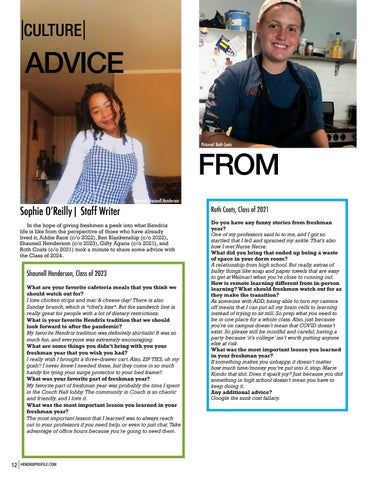
ADVICE FROM Pictured: Roth Coats
Pictured: Shaunell Henderson
Sophie O’Reilly| Staff Writer In the hope of giving freshmen a peek into what Hendrix life is like from the perspective of those who have already lived it, Addie Race (c/o 2022), Ben Blankenship (c/o 2022), Shaunell Henderson (c/o 2023), Gifty Agana (c/o 2021), and Roth Coats (c/o 2021) took a minute to share some advice with the Class of 2024.
Shaunell Henderson, Class of 2023 What are your favorite cafeteria meals that you think we should watch out for? I love chicken strips and mac & cheese day! There is also Sunday brunch, which is *chef’s kiss*. But the sandwich line is really great for people with a lot of dietary restrictions. What is your favorite Hendrix tradition that we should look forward to after the pandemic? My favorite Hendrix tradition was definitely shirttails! It was so much fun, and everyone was extremely encouraging. What are some things you didn’t bring with you your freshman year that you wish you had? I really wish I brought a three-drawer cart. Also, ZIP TIES, oh my gosh!! I never knew I needed these, but they come in so much handy for tying your surge protector to your bed frame!! What was your favorite part of freshman year? My favorite part of freshman year was probably the time I spent in the Couch Hall lobby. The community in Couch is so chaotic and friendly, and I love it. What was the most important lesson you learned in your freshman year? The most important lesson that I learned was to always reach out to your professors if you need help, or even to just chat. Take advantage of office hours because you’re going to need them.
12
HENDRIXPROFILE.COM
Roth Coats, Class of 2021 Do you have any funny stories from freshman year? One of my professors said hi to me, and I got so startled that I fell and sprained my ankle. That’s also how I met Nurse Necie. What did you bring that ended up being a waste of space in your dorm room? A relationship from high school. But really, extras of bulky things like soap and paper towels that are easy to get at Walmart when you’re close to running out. How is remote learning different from in-person learning? What should freshmen watch out for as they make the transition? As someone with ADD, being able to turn my camera off means that I can put all my brain cells to learning instead of trying to sit still. So prep what you need to be in one place for a whole class. Also, just because you’re on campus doesn’t mean that COVID doesn’t exist. So please still be mindful and careful; having a party because ‘it’s college’ isn’t worth putting anyone else at risk. What was the most important lesson you learned in your freshman year? If something makes you unhappy, it doesn’t matter how much time/money you’ve put into it, stop. Marie Kondo that shit. Does it spark joy? Just because you did something in high school doesn’t mean you have to keep doing it. Any additional advice? Google the sunk cost fallacy.
Pictured:Gifty Agana
Pictured: Ben Blankenship
CURRENT Ben Blankenship, Class of 2022
Do you have any funny stories from freshman year? Hendrix used to have not-so-great drainage, so whenever it would rain, areas would start to flood. My freshman year, there was a particularly severe storm which caused the lawn outside Bailey to fill with water. Someone saw this and thought that it would be perfect for kayaking. Seeing a person bring out their kayak and then proceed to row across a field was definitely an interesting sight. What are some things you didn’t bring with you your freshman year that you wish you had? If I could go back to the start of my freshman year, I would try to spend more time making my room a relaxing and comfortable place to be. Invest in some better lighting, big rugs, and go crazy with the blankets-- you’d be surprised at the difference it can make in helping you adapt to college life. What did you bring that ended up being a waste of space in your dorm room? I brought far too many clothes with me. While I thought it would be nice to give myself options, the “options” ended up just cluttering all of my closet space. My advice would be to find out what clothes you wear the most and leave the rest at home. What was the most important lesson you learned in your freshman year? Don’t be afraid to look stupid! Ask questions even at the risk of making a fool of yourself.You’re in college to learn, so don’t feel bad for taking advantage of your resources. Any additional advice? Step outside your comfort zone, foster relationships with your peers and professors, and always find time for yourself.
UPPERCLASSMEN Gifty Agana, Class of 2021 Do you have any funny stories from freshman year? Freshman year, I accidentally called a professor by the wrong title in an email (I had never sent so many emails in my life). I thought it was the end of my life. But it wasn’t, and I have made many more silly mistakes since then. As a freshman, it felt SO big. What are some things you didn’t bring with you your freshman year that you wish you had? I wish I had brought scissors (trust me) and definitely a more open mind to try new things. What did you bring that ended up being a waste of space in your dorm room? I brought a coffee maker, but I am not a big coffee drinker, so it just sat there. I also brought way more clothes than I needed. College shows you which clothes are actually your favorite. How is remote learning different from in-person learning? What should freshmen watch out for as they make the transition? Watch out for the college “bubble.” Remember there are people and things outside of college, and you should take a break once a week to go enjoy them by going on a hike to somewhere new or order in from a local business you’ve never been to. What was the most important lesson you learned in your freshman year? Have fun!! (but go to class).You have time to figure it all out.
NOVEMBER 2020
13
OFF THE CLOCK
Professors share stories about their children and life at home
Sophia Isely|Staff Writer Although we see our professors multiple times a week over video chat, do we really know what they are dealing with in their lives? The short (yet true) answer is no. During the brief time that we see them, sometimes their children make a brief appearance or can be heard playing in another room. For many professors who do have children, there is no longer the much-needed separation between work and home life. For those of us who don’t have kids of our own, it can be hard to fathom the amount of stress that comes from taking care of young people full-time, especially while simultaneously navigating this strange new version of life in a pandemic and the pressures of a full-time teaching job. Getting to spend a (theoretically) unlimited amount of time with your children does have its perks, but it can also be mentally tolling. Dr. Vidal-Torreira, a Spanish professor, has been quarantined with her children for the past eight months. Since she has gone into “momma bear” mode to protect her children’s safety, she decided against taking the alternative route of putting her children in daycare. She openly admitted that this has been painstaking for her mental health, since she feels like she needs to be in multiple places at once. Although she has a live-in sitter who works 18 hours a week, she has no family nearby, and her husband works outside of the home. She gets to spend a lot more quality time with her kids, but they undoubtedly make important aspects of her job more difficult to efficiently execute. For example, she often grades essays while her children play, and she sometimes has to start over to ensure that distractions don’t prevent her from giving student work that attention that it deserves. Dr. Vidal-Torreira has also decided not to return to campus in the spring due to mental health concerns and to protect her family’s safety. Dr. Zorwick, a professor of Psychology, has also been in quarantine with her two kids. Dr. Zorwick, her husband (who is working from home), and her parents all work together to help take care of the kids. Dr. Zorwick is grateful that her children are healthy and her familial relationships are strong, but that this pandemic is still rough on her mental health. Other than a few hours during the day when she is teaching and a few hours at night when she is grading (from roughly 10 pm to 3 am), Dr. Zorwick is with her kids full-time. This has left her feeling like she has no downtime, as if she is juggling two full time jobs. Her older daughter feels like she is
14
HENDRIXPROFILE.COM
Photo submitted by Dr. Ty Jaeger
“missing someone she really wants to see,” even though her mom is under the same roof, since Dr. Zorwick’s teaching responsibilities prevent her from giving her children constant attention. One of her daughters also periodically wakes up during the night crying about death—concerned that Dr. Zorwick or her husband will die from the virus. A young child having this concern is sad, but it is a part of our current reality. This spring, Dr. Zorwick will be on sabbatical, so she will not be returning to campus. Although this is not the sabbatical that she had dreamed of, she is glad to have the ability to relish in this extra time with her kids. We may not see their lives outside of the classroom often, but our professors are struggling through this pandemic just like everyone else. This year has not been easy for any of us, but imagine yourself in the position of many professors here at Hendrix— having to wrangle children for months on end whilst also working the full-time job of aiding students on their academic journeys. Despite a constant fear for the physical and mental health of themselves and their children, they are making an effort to keep your college education intact, whatever that might mean. Even though everything feels distant through a computer screen, taking the time to acknowledge their work and say thanks never hurt— and that goes for professors without kids as well. After all, we all need a little extra love in 2020.
Sophia Isely| Staff Writer
CATS AND CHATS After a campus-wide scare, students celebrate the presence of the cat colony now more than ever Picture this: you walk out of MC Reynolds after finding out you did badly on a test in one of your classes. Tears in your eyes, you attempt to book it back to your dorm before anyone asks what is wrong. But as you are making this desperate sprint, you notice a fuzzy orange cat staring at you—begging for love and maybe even a few treats. You bend down and begin petting him, and your worries about that test seem to disappear. You sit on the ground with him as he stares into your soul with those sweet green eyes. Next thing you know, your whole hour-long break has passed, and you have to leave the cat behind. You say your goodbyes as he attempts to follow you all the way inside the building, and you leave feeling loved and much calmer. Does this experience sound familiar? For many students on campus, myself definitely included, Tad is a source of cuddle therapy when the days seem too rough to handle. In case you have never met Tad, he is the treat-loving orange kitty that lives around the Brick Pit. His presence alone brings countless smiles to people on campus, and he is very dear to hundreds—perhaps even thousands—of people’s hearts. During the very end of October, a person passing through campus—who is not part of the Hendrix community— thought that Tad was a stray and decided to take him. Since Tad is such an attention-loving friend, he followed this person all the way to their car, so they assumed he was looking for a home. Luckily, thanks to social media, Tad was returned on November 11. He is now back at home and wearing a stylish new collar to make it more apparent that Hendrix is his permanent home. Darryl Manes, the primary caretaker of the cat colony, says that there are no hard feelings towards the person who removed Tad from campus, and he believes that it was an innocent mistake. I decided to make a visit to see Tad in his new spiffy collar, and let me tell you, he has been adorned with love, attention, and treats all day long. Perhaps for the first time in his entire life, Tad was too full to eat his supper. Darryl calls him the “Mayor of Hendrix,” and I suppose this is actually true. After all, he now has a name tag on his collar with this name, so it is official. Throughout this time of sheer panic for the cat lovers at Hendrix, it was heartwarming to see just how many people care about Tad— even though a large majority of us are not on campus due to COVID-19. There were flyers shared all over social media, and Robin Salinger, one of the owners of the @hendrixcollegekittens account on Instagram, believes that this whole ordeal with Tad has reaffirmed just how important the cats are in our community. Arin Soileau, a senior that has been the President of the Animal Rights and Rescue Club (also known as the Cat Club) for several
Photo courtesy of Pearl Jangjiravat
years, says that the outpouring of people who wanted to help or wanted updates—plus the collective vocal concern for Tad’s well-being—made her feel good about the Hendrix community. Upon posting about Tad’s return to campus, there have almost been 900 likes and many joyous comments. From my knowledge, this is by far the most engagement on any of the posts on the @hendrixcollegekittens Instagram. Darryl and all of us cat-loving students would like to genuinely thank everyone who engaged with the posts about Tad; your support and love are incredibly appreciated. I am so thankful that this article can be a celebration of the cats on campus, instead of a depressing article where I admit my overwhelming sadness about Tad being taken. For many students, the cats are so therapeutic. We love these sweet kitties, just like they are our own pets. The overflow of love that Tad has received, both on social media and in person, shows that the cats in the Hendrix cat colony are cherished members of our community. The unconditional love and joy that they bring to our campus could never be replaced.
NOVEMBER 2020
15
COVID-19 AND THE FUTURE OF FINE ARTS Danielle Kuntz | Staff Writer
Professors of music, art and theater are working through the challenges to come in the Spring
With COVID-19 cases in Arkansas and across the country rising at an alarming rate, students have no guarantee that another shutdown won’t come knocking at their doors. Even if Hendrix can keep students on campus in the Spring, strict social distancing rules will create a very different Hendrix. The current online semester has brought many new challenges. Still, these drastic changes are perhaps felt most in departments like Music and Dance, which depend so heavily on in-person interaction between students. Even the idea of an in-person Spring semester raises questions of how to practice and perform safely. Dr. Gretchen Renshaw-James, the Wind Ensemble Conductor and Instructor of Low Brass, is just one professor having to adjust to this situation. She writes, “Holding music classes and ensembles online is certainly a challenge, but one that we’ve fortunately been able to overcome. Although some things had to function differently this fall, we were still able to successfully achieve our course learning goals - even if we had to do so in a new way… For example, Wind Ensemble relied on virtual sectional rehearsals and virtual band projects that allowed us to, in a way, perform together.” From navigating Zoom rehearsals to redefining what it means to perform as a group, remote musical collaboration has been a unique experience for everyone involved. When it comes to the Spring semester, Dr. Renshaw says, “We’ll be taking numerous precautions to keep everyone safe… when we rehearse indoors, we’ll be practicing in groups of 8-12 people spaced about 12 feet apart. We’ll use two rehearsal locations so that we can spend about 25 minutes in one space before moving to the next space. In addition, we’ll be rehearsing and performing with specially designed face masks and bell covers. As soon as the
16
HENDRIXPROFILE.COM
weather is warm enough, we’ll plan to move many rehearsals outside.” As Dr. Renshaw demonstrates, sometimes the best option for a group like this is to try and exceed the minimum guidelines (like spacing out 12 feet instead of six) in the interest of everyone’s safety. Students in Hendrix’s Fine Arts departments feel the effects of the pandemic with a unique intensity. For a senior, having to alter or completely miss performance milestones throughout the year can be especially disappointing, since they might not receive a “doover” without staying at Hendrix for an extra year. Lauren Porter, a senior member of the Dance Ensemble, writes, “... [We’ve] been meeting virtually this semester to work on pieces that will be performed at the spring concert… [and] we will have to be distanced on stage. I was really excited about an idea I had… but I ended up having to scrap it to maintain distance.” Lauren’s experience shows one way in which the pandemic is, not only affecting how students gather, but also altering the art they’re able to create as a result. She continues to say that “It’s definitely disappointing… but we are all trying to make the best of it… this semester has made me so appreciative of my community at Hendrix, and I am beyond ready to be back in Trieschmann with everyone.” Though returning to campus in January will prove challenging, this online semester has prepared both professors and students for the obstacles to come. Finding a way to perform despite being miles apart has also provided these groups with a new appreciation for their community. Our fingers are crossed for an in-person Spring semester, but regardless, we can rest assured that artists at Hendrix will find a way to keep creating and performing.
Photo by Lauren Allen
SOCIAL MEDIA AND COPING @howareyoudoing.hdx on Instagram gives students a platform to share their struggles on Danielle Kuntz| Staff Writer
Photo courtesy of @howareyoudoing.hdx on Instagram It’s just another Tuesday when you notice an account by the name of “Student in a Pandemic” follow you on Instagram. Upon further inspection, you see the handle name is @howareyoudoing.hdx, and their account has only one post. It reads, “We are all struggling in some way, and it’s very difficult to share our raw, genuine experiences while remote. Share how you really feel in the link in the bio.” On that first day, seven anonymous responses from Hendrix students were submitted and shared on the page. The creation of such an account certainly piques interest— so we decided to reach out to the person behind it all. I initially direct-messaged @howareyoudoing.hdx on Instagram to ask if they would be willing to do an interview. They were happy to participate, so I took the opportunity to ask questions about the account that are probably on most students’ minds. First, I asked the most obvious: why did you start this account? They replied, “I started this account because, for a while, it felt like I was the only one struggling being remote… Some of my friends opened up and told me that they haven’t been doing well either, but they didn’t feel like they could say that because it seemed like everyone else was fine… So, this account is a place for people to open up about how they are really doing, and a place for Hendrix students to see that they aren’t the only ones struggling.” I followed up by asking what it is like to run the account. The owner said, “It’s been both rewarding and difficult. Of course it’s sad to read about people’s struggles with mental health, but I also realize that people… most likely feel at least slightly better after writing it all down and putting their words into the world.” Out of curiosity, I also asked about the most common submissions they receive, which, not surprisingly, “are about how difficult it is to perform academically online while struggling with mental health.”
Eventually, I moved on to a question that I thought may be tough for the creator of an altruistic account to answer— do you think the account successfully provides students a place to vent? The account owner replied yes, “because the submissions tend to be really heavy, and right now I have 50 submissions, yet so many people seem to be fine. Sometimes I go to class and wonder, how many of these people are going through something and yet putting a smile on their face for class?” They raise a very good question here, and one prominent in the world of mental health. How many people are putting on a happy appearance while actually struggling, and what can be done about it? In light of this realization about mental health and the mission of the account owner, I asked if there were any words of advice or support they’d like to offer to Hendrix students. @howareyoudoing.hdx offers this to us: “... I would encourage students to reach out to your friends, loved ones, or professors when you’re struggling. It may seem like everyone else has their shit together, but the reality is we are all struggling in some form. We shouldn’t have to go through this pandemic alone and we don’t have to.” They also add: “Hendrix Counseling Services is a great resource.” The creation of @howareyoudoing.hdx provides us valuable insight into our peers’ lives and minds, as well as a platform for venting, which is a healthy practice. Many are struggling, and those who are struggling are certainly not alone. So, if the state of the world and our lives make you feel less than okay, reach out to those in your support system, take advantage of Hendrix’s free counseling, and perhaps anonymously vent using the platform offered by @howareyoudoing.hdx. Whatever you choose to do, we encourage you to always make sure you’re taking care of yourself first.
NOVEMBER 2020
Photo by Rebecca Burks
17
A SLICE OF LIFE WITH ERIC THE PIZZA GUY
Jay Vicente| Staff Writer
As the Hendrix campus prepares to reopen, so do the many different departments and services that Hendrix offers. Many students are impatiently waiting to return to their dorms and jobs on campus, but another place that many students are looking forward to seeing again is the cafeteria. The cafeteria is the hub of Hendrix life, and the directors and staff of the cafeteria have been working tirelessly to make sure that the reopening goes as smoothly and positively as possible. One of the most well-known members of the cafeteria staff is Eric Jones, or as students know him, Eric the Pizza Guy. Eric works at the pizza station in the cafeteria and is known for his creative and delicious pizzas, which he makes every day of the week for the enjoyment of Hendrix students. Last week, we sat down to talk about how things have changed and what Hendrix’s favorite pizza Picasso has been up to since the cafeteria shut its doors. When asked what he thought the most important thing to know about the cafeteria is, Eric said that “[the cafeteria staff] is there for the students no matter what.” He continued that creating pizzas excites him and that he typically caters to student preferences. There are several crowd favorites, including a pesto pizza that frequently graces Eric’s menu. Eric disclosed that he somewhat fell into the role of “the pizza guy” after his supervisors thought he would be good for the job, but he made it very clear that he loves to interact and talk to students about pretty much anything. He believes his job goes beyond just making pizzas and thinks that his position “wouldn’t be as exciting” if students weren’t talking to him. He’s grateful for the chance to break up the monotony of everyday life by really connecting with students. It’s no secret that the cafeteria staff favors certain meals, and our Pizza Guy is no exception. Eric enjoys the fried shrimp offered on Sundays and the Honolulu chicken. Both are delicious options that students get to look forward to eating again in the spring. Other favorites foods of his include lasagna, a good steak, coconut cake, and caesar salad, most of which are served in the Hendrix cafeteria. Eric also revealed that even though he creates pizzas that the students prefer, he has to stand by his personal favorite pie: Hawaiian. Like a lot of students and faculty, Eric did admit to being lonely during the quarantine. Thankfully, he does have a hobby outside of creating new and exciting pizzas for Hendrix students. In his spare time, Eric collects antiques. He’s currently focusing on Roseville pottery and can frequently be found in flea markets and antique shops searching for the next addition to his collection. We spent a fair bulk of the interview talking about how life has changed since Hendrix closed, and it came as no surprise that Eric is excited to come back to campus. He’s “a little nervous [but] ready to have social interaction” and pledges to do his best to uphold all the guidelines the school has put in place to protect students, himself, his fellow staff from COVID-19. Eric feels the stress of isolation just like the rest of us do, and he is “ready to get out of the house and cook some pizzas and see faces again.” To close, we asked Eric if he had any advice for new and returning students. Eric urges new students to always “try to be open to new experiences” as he knows how transformative and amazing Hendrix is for everyone who comes to stay on the campus. He reminds returning students to “enjoy [their] time here.” Time is fleeting, and even though quarantine and isolation have been going on for months now, time is just as important as it always has been. To all students,
18
HENDRIXPROFILE.COM
Eric recommends following him on Instagram (@eric_thepizzaguy) to be up to date on all of the goings-on at the pizza station and the cafeteria as a whole. Eric the Pizza Guy is only one member of the fabulous Hendrix cafeteria staff. There are so many other people like Eric, who are working tirelessly to make sure that the return to campus is as seamless as possible. So upon returning to campus, make sure to thank the cafeteria staff and all other members of the various departments and offices that made reopening possible. And on that fabled first trip back to the cafeteria, be sure to swing by the pizza station and say hello to Eric the Pizza Guy. You’ll be glad you did.
Photo taken through a screenshot from the Instagram app
OPINION
Why We Shouldn’t Call Complicity Civility Roth Coats| Fact Checker
As you may or may not be aware, there was recently an election. Up to the election, and even following it, many social media posts have circulated that encourage us to be friendly and civil to those who support a political ideology different from our own. The most popular instance is the ballad of Bob and Sally, who remain friends post-election, despite voting for different candidates. For some people, overlooking the voting behavior of others is easy to do. Let’s imagine you’re a white, straight, cisgender, able-bodied, middle-class man chatting with a pal who is of the same demographics. No matter who you (and your buddy) voted for, you likely won’t lose access to healthcare or voting rights. You won’t have to worry about being harassed for using the bathroom, and you won’t face structural violence simply for existing as you are. But, if you substitute any of these privileged identity factors for a marginalized one, political discourse becomes more high stakes. It becomes more than a casual discussion when your basic rights are the topic at hand. You are likely aware of the threat that the appointment of Amy Coney Barrett poses to rights like safe abortion access and gay marriage. Outside of the Supreme Court, political opposition to police abolition (or even reform) continues to place Black Americans at risk of experiencing deadly violence. Additionally, the failure to take action against the coronavirus pandemic has led to hundreds of thousands of avoidable deaths, especially in the community of Americans with disabilities. But, the power of politicians does not simply lie in their ability to enact, reverse, and block legislative change. Political figures define and enforce social normalities, not just for die-hard supporters, but for the entire population they serve. As much as you may try to separate yourself from the candidate for whom you voted, what they support is what becomes socially acceptable. In 2016, counties that hosted a Trump campaign rally saw twice the amount of hate crimes as similar counties that didn’t. After his election, counties that Trump won by a large margin faced “an anomalous spike in hate crimes,”
which constituted the second-largest uptick in the last 25 years, ranking only behind violence post-9/11. This doesn’t mean that every Trump supporter consciously endorses or commits hate crimes. It does mean that every Trump supporter voted for a world in which committing this violence is acceptable, if not encouraged. When you vote for politicians that create and reinforce asymmetrical power balances, you must also take accountability for the behavior that this inspires. When you vote for politicians who actively threaten the safety and rights of others, you can’t expect those affected to offer you an empathy that you chose to not extend. Asking for civility after choosing to endanger the rights of others means asking people to be complicit in their own oppression. It means asking them not to fight injustice so that you won’t feel guilty or inconvenienced. As a transman, people often seem kind and accepting, so I assume the best of them. But sometimes the same people who claim to support me in personal interactions choose to support politicians with transphobic views or choose to join organizations that encourage conversion therapy. Pointing out this hypocrisy with kindness and civility is not enough to change people’s minds. I’ve tried (see Chi Alpha 2018). It provides no pressure for them to change, and it’s exhausting, just like it’s exhausting listening to others endlessly debate whether my identity is valid. My existence and my lived experience are not up for debate. If you want to reach out and show kindness to those who endanger you, I support you. But no one can tell you that you’re wrong for being too exhausted to do so. So fuck civility. I don’t have to support people who consider me “less than.” Neither do you.
NOVEMBER 2020
19