Board of Directors
André T. Heinz
Chairman
Teresa Heinz
Chair Emeritus
John Heinz
María Marteinsdóttir
Wendy Mackenzie
Damon Aherne
Judith Davenport
Carolyn Duronio
Sameera Fazili
Patrick Gallagher
Nick Hoffman
Maxwell King
Rick Lowe
Shirley Malcom
Board of Directors
André T. Heinz
Chairman
Teresa Heinz
Chair Emeritus
John Heinz
María Marteinsdóttir
Wendy Mackenzie
Damon Aherne
Judith Davenport
Carolyn Duronio
Sameera Fazili
Patrick Gallagher
Nick Hoffman
Maxwell King
Rick Lowe
Shirley Malcom
The Heinz Endowments was formed from the Howard Heinz Endowment, established in 1941, and the Vira I. Heinz Endowment, established in 1986. It is the product of a deep family commitment to community and the common good that began with H.J. Heinz, and that continues to this day.
The Endowments is based in Pittsburgh, where we use our region as a laboratory for the development of solutions to challenges that are national in scope. Although the majority of our giving is concentrated within southwestern Pennsylvania, we work wherever necessary, including statewide and nationally, to fulfill our core focus.
That focus is to grow an exemplary, sustainable Pittsburgh region where everyone prospers and belongs. We also seek to advance knowledge and practice in the field of philanthropy through our grantmaking programs of Arts & Culture; Civic Participation; Climate, Environment & Health; Community & Economic Development; Food Systems; Veterans; and Workforce, all of which aim to strengthen a more durable, whole and just community.
In life, Howard Heinz and Vira I. Heinz set high expectations for their philanthropy. Today, the Endowments is committed to doing the same. Our charge is to be diligent, thoughtful and creative in continually working to set new standards of philanthropic excellence. Recognizing that none of our work would be possible without a sound financial base, we also are committed to preserving and enhancing the Endowments’ assets through prudent investment management.
h magazine is a publication of The Heinz Endowments. At the Endowments, we are committed to promoting learning in philanthropy and in the specific fields represented by our grantmaking programs. As an expression of that commitment, this publication is intended to share information about significant lessons and insights we are deriving from our work.
Editor: Carmen Lee
Production Manager: Courtney Tolmer
Editorial Team: Becky Brindle, Chris DeCardy, Amy Gianficaro, Scott Roller
Design: Landesberg Design
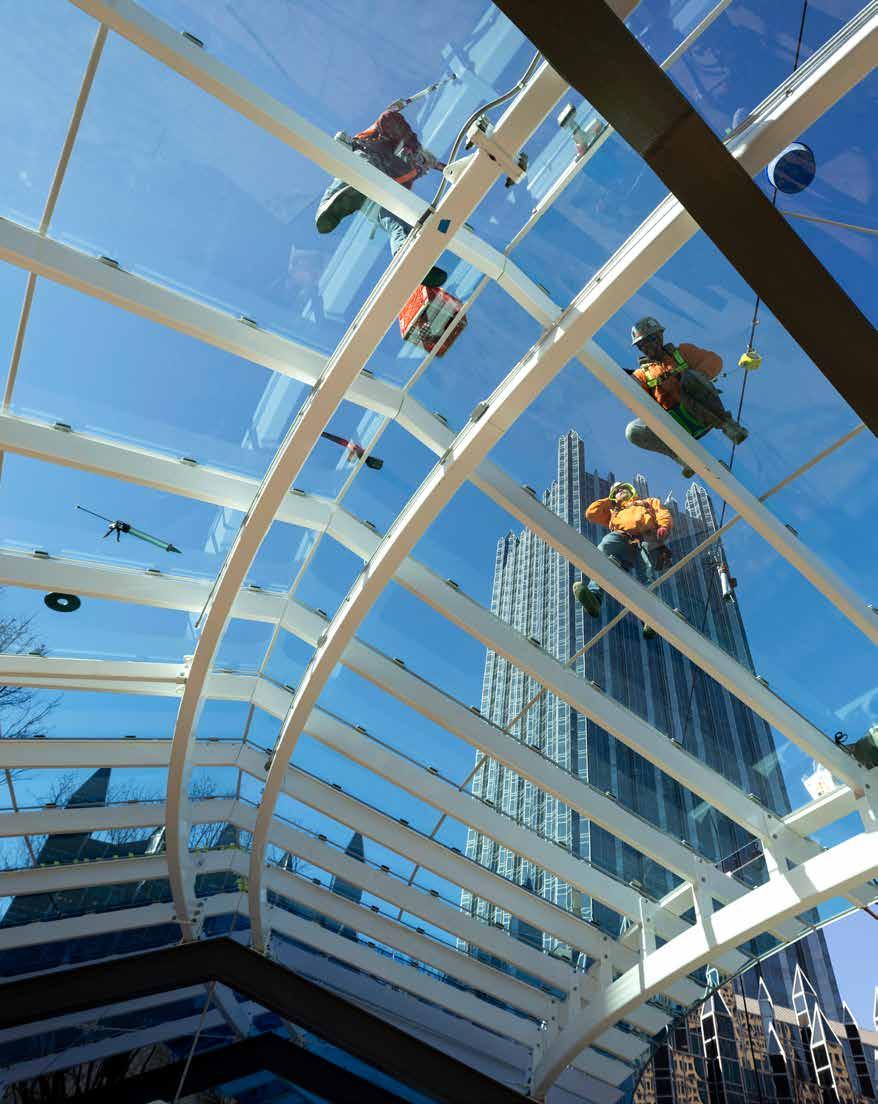
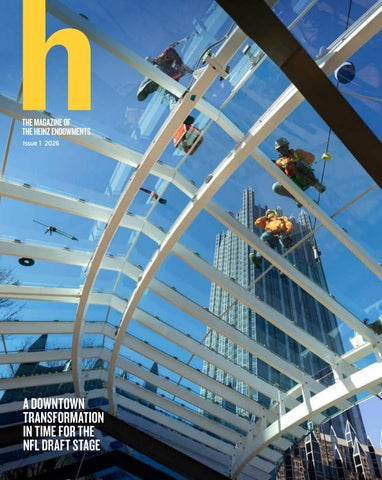
About the cover: As part of the renovation of Market Square in Downtown Pittsburgh, workers have constructed the Market Anchor, a pavilion structure with a semi-circular glass roof.
Photo by Joshua Franzos ISSUE 1 2026

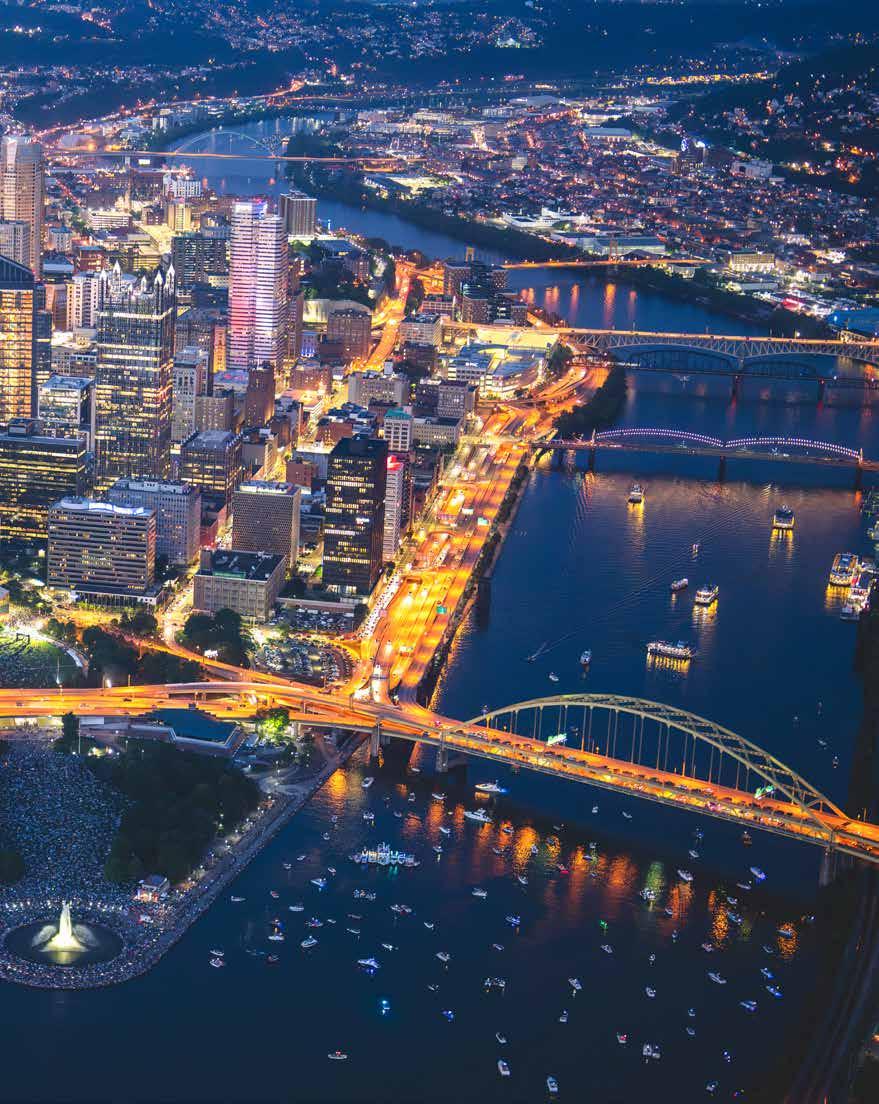
Efforts to revitalize Pittsburgh’s Downtown have included construction and renovation projects, and the city hosting the NFL Draft in April was an additional incentive.
As The Heinz Endowments increases its investment in local journalism, the Pittsburgh region has faced the wake-up call of almost losing its largest newspaper.
Hazelwood Local’s arts and entertainment activities help to connect residents to the neighborhood’s new development and to each other.
HOMETOWN
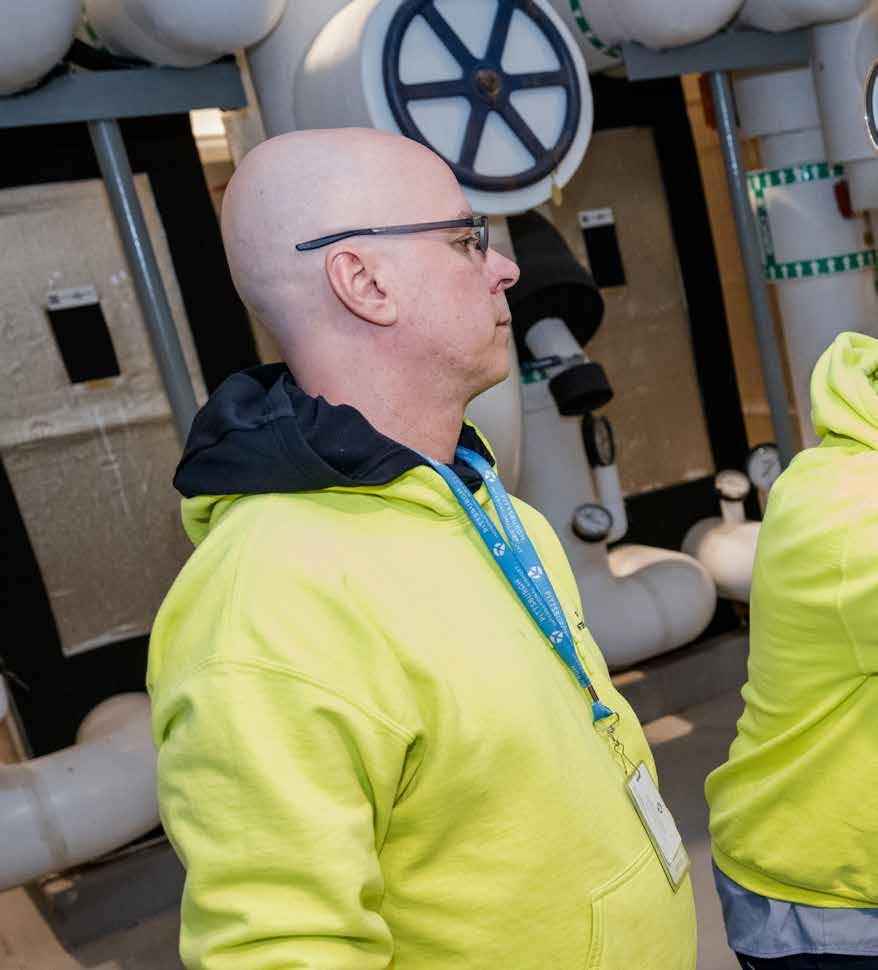
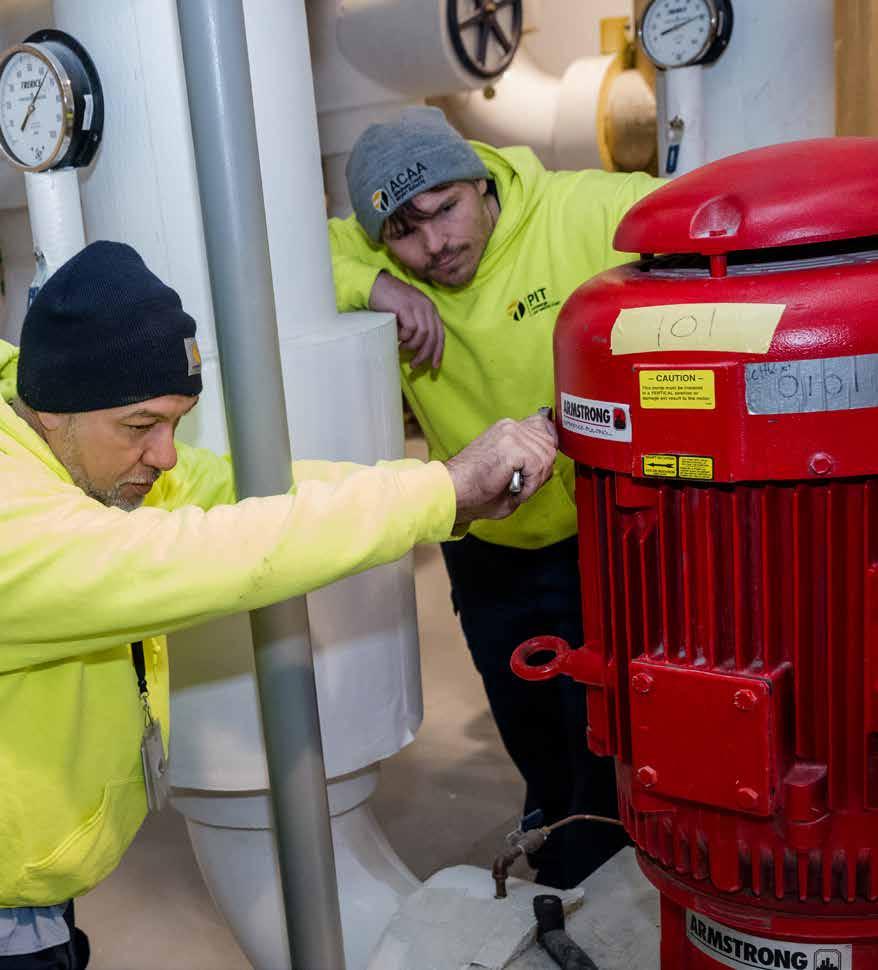
Pittsburgh International Airport hasn’t just constructed a new terminal; it also is helping to build the region’s future workforce.
PIT2Work is a free, five-week training program hosted by the airport in partnership with the nonprofits Partner4Work, a workforce development organization, and Pittsburgh Gateways Corporation, which provides management and planning services to communities, research and academic institutions, and private enterprises. Participants receive classroom instruction along with hands-on field experience to prepare them for careers in construction trades. More than 100 individuals have already completed the program, stepping into high-demand roles with confidence and industry-recognized training.
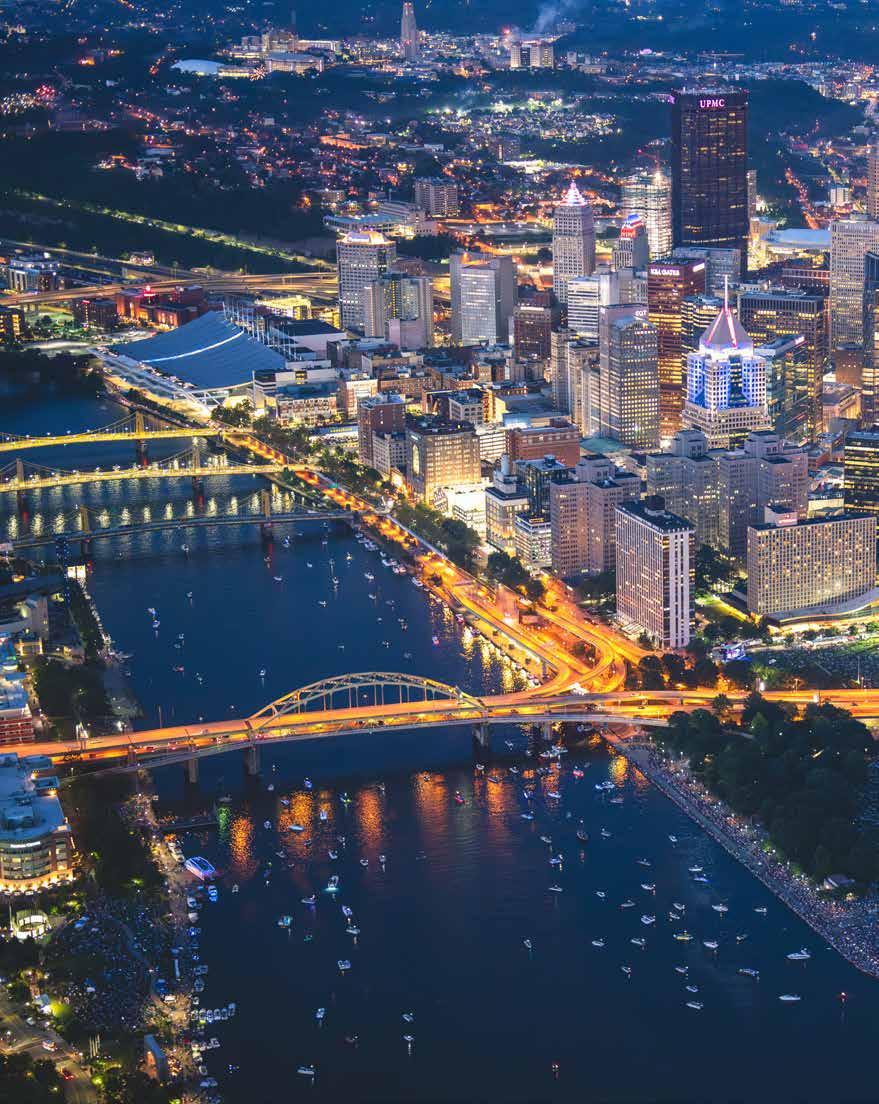
Pittsburgh’s Downtown received a massive injection of creativity and investment as part of local and state revitalization plans just in time for the NFL Draft. By Elwin Green
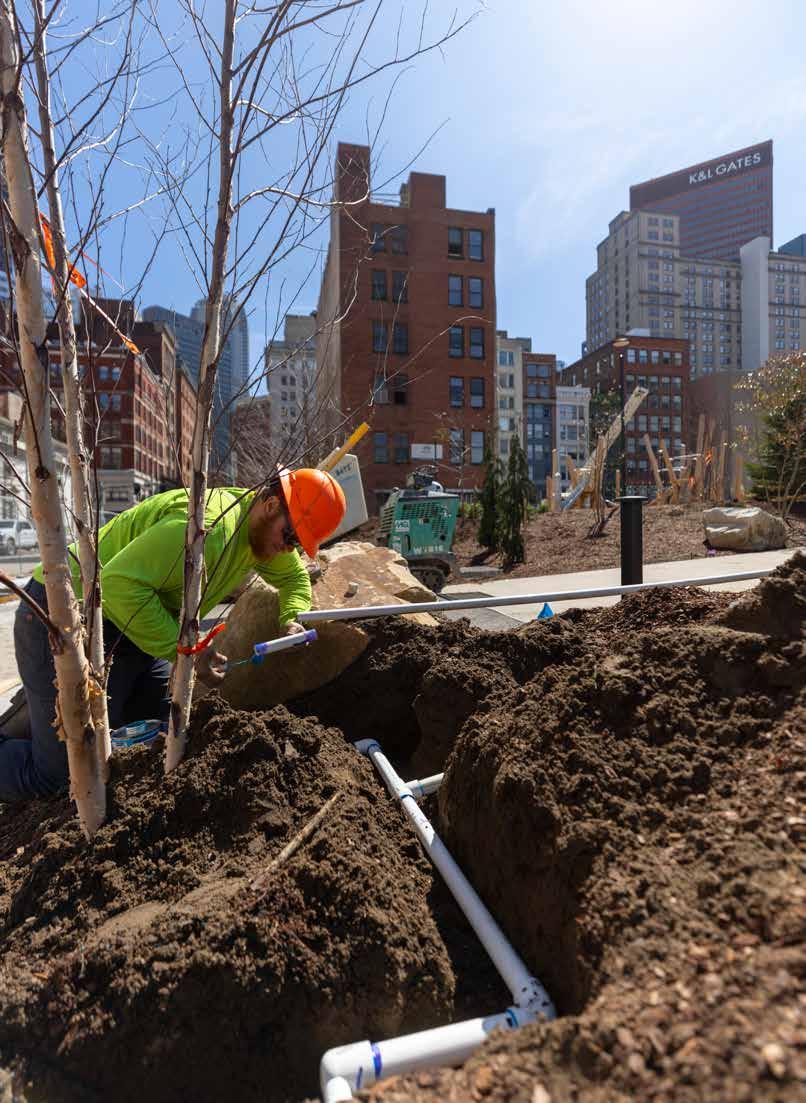
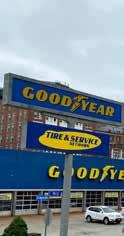
Bakers installs an irrigation system that runs through Arts Landing in Downtown Pittsburgh and waters numerous trees and shrubs. The 4-acre entertainment and recreation park was the former location of a Goodyear Auto Service Center and several parking lots.
7th Street and 9th Street in Downtown Pittsburgh was a drab slab of parking spaces punctuated by a Goodyear Auto Service Center. It may not have been blight, but it was perhaps one of the bleakest areas in the heart of the city.
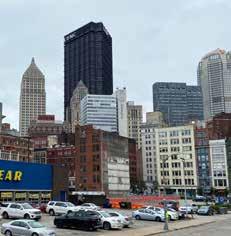
It was also part of the Cultural District, a 14-block chunk of Downtown that the Pittsburgh Cultural Trust, a nonprofit arts organization, has largely transformed into a vibrant mix of performance venues and galleries that make Downtown the center of Pittsburgh’s artistic and cultural life.
Now the Trust has transformed the area into a four-acre park. Arts Landing, previously known simply as the 8th Street Block, includes a large lawn, a bandshell for live performances, pickleball courts, a garden walk, and a play area for children.
It celebrated a soft opening in April and will be an important anchor to a range of revitalization efforts to breathe new life into Downtown following the loss of businesses and decline in office occupancy rates after the pandemic. Arts Landing’s early days were just in time for the NFL Draft, April 23–25, which was one of the largest events Pittsburgh has ever hosted, bringing attention to the region from around the world.
■ Parts of a 10-year, $600 million revitalization plan for Downtown Pittsburgh were completed or nearly completed when the city hosted the NFL Draft.
■ One project launched in April was Arts Landing, a 4-acre park for arts, recreation and entertainment that received $31 million in funding from different investors, including The Heinz Endowments.
■ Arts Landing is a project of the Pittsburgh Cultural Trust, which manages city’s Cultural District, a 14-block section of Downtown Pittsburgh with performance venues and galleries
■ Other Downtown revitalization projects included renovations to the Market Square restaurant hub; improvements to Point State Park; and various conversions of office buildings to apartments, several of them affordable housing.
■ The current revitalization efforts echo in some ways those of the city’s Renaissance I in the late 1940s and through the early 1970s, and Renaissance II in the late 1970s and through the early 1990s, which both included a number of new construction projects.
Beyond that momentary focus, Jeremy Waldrup, President and CEO of the Pittsburgh Downtown Partnership, believes that Arts Landing will contribute significantly to Downtown’s long-term growth as a neighborhood
“Our goal of doubling the population Downtown will require that we invest in new parks and public spaces in order to attract and retain these residents,” he said. “The addition of green space is sorely needed, as is the investment in a playground.
“We would like to see young families begin to call Downtown home, and this is a critical part of that effort.”
Efforts to upgrade the 8th Street Block have been discussed for years, yet its evolution into Arts Landing wasn’t announced until after Pennsylvania Gov. Josh Shapiro unveiled a 10-year, $600 million plan in 2024 to transform Downtown Pittsburgh, often referred to as the Golden Triangle. The name refers to its triangular shape, which is formed by the bordering Allegheny, Monongahela and Ohio rivers, and its history as a center of industrial wealth.
The plan arose from months of conversation among officials with the City of Pittsburgh, Allegheny County, and organizations such as the Pittsburgh Downtown Partnership and the Allegheny Conference on Community Development. A state funding commitment of $62.6 million catalyzed local investment that was already in play.
In his announcement on Oct. 25, 2024, Shapiro said, “Pittsburgh’s elected officials, corporate leaders, sports teams, nonprofits, union workers and artists are all behind this plan, and, together, we will write the next chapter of this great city’s story.”
The various pieces of the revitalization puzzle have held particular significance for different groups. For example, more than a dozen agencies and philanthropies, including The Heinz Endowments, funded the $31 million development of Arts Landing, which will have its grand opening in June to coincide with the Dollar Bank Three Rivers Arts Festival, after which it will become the festival’s permanent home.
“It’s really meaningful to us because the Cultural District itself was the visionary brainchild of H.J. ‘Jack’ Heinz, so this feels like a natural evolution of that original vision,” said Jasmin DeForrest, Managing Director of Arts & Culture for the Endowments, which contributed
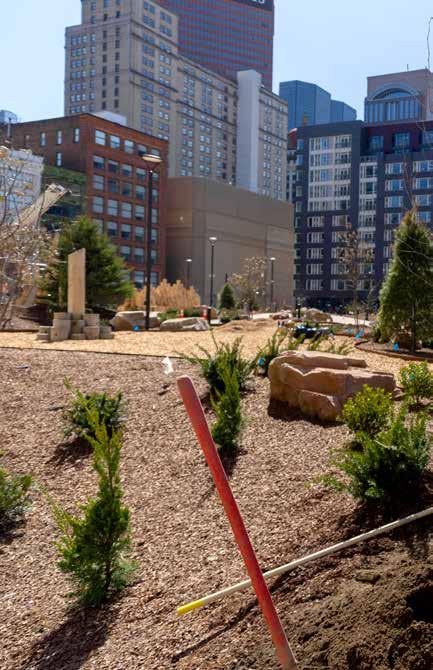
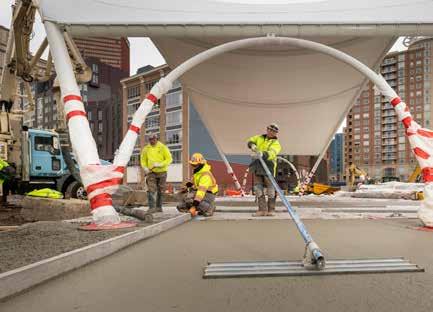
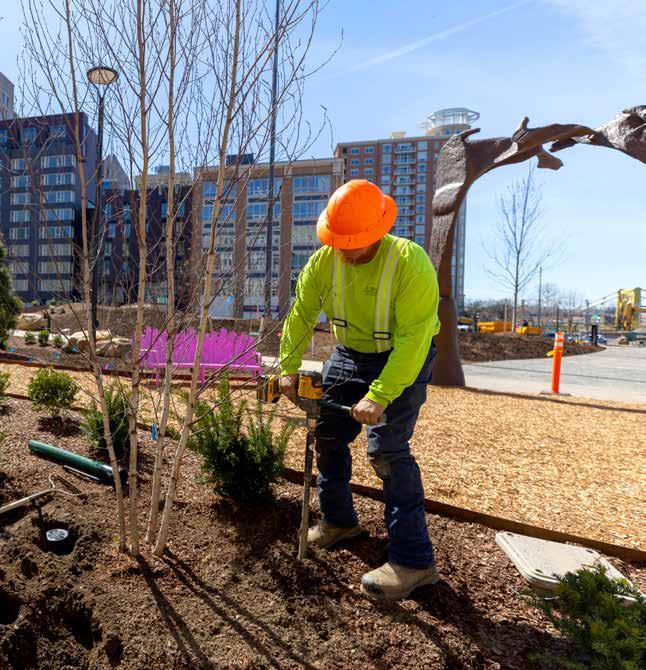
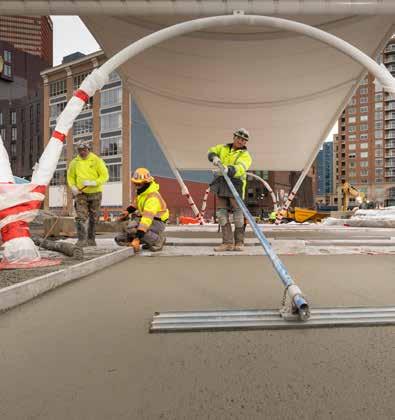
Preparations for the new Arts Landing park included planting trees, left, and smoothing out the concrete base of the bandshell, below, that will be a venue for live performances.
THIS IS PROBABLY ONE OF THE BIGGEST THINGS TO HAPPEN IN THE CULTURAL DISTRICT IN 25 YEARS, AND IT’S GOING TO BE A PLACE WHERE YOU CAN CATCH A FESTIVAL, SEE SOME AMAZING PUBLIC ART, OR JUST GRAB LUNCH AND RELAX. IT’S EXACTLY THE KIND OF SPACE THAT BRINGS A COMMUNITY TOGETHER.”
Jasmin DeForrest, Managing Director, Arts & Culture, The Heinz Endowments
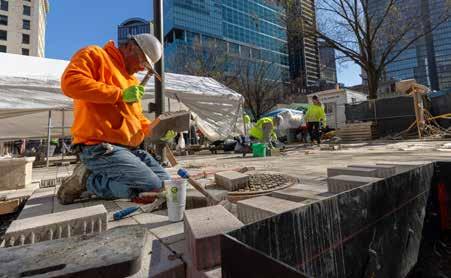
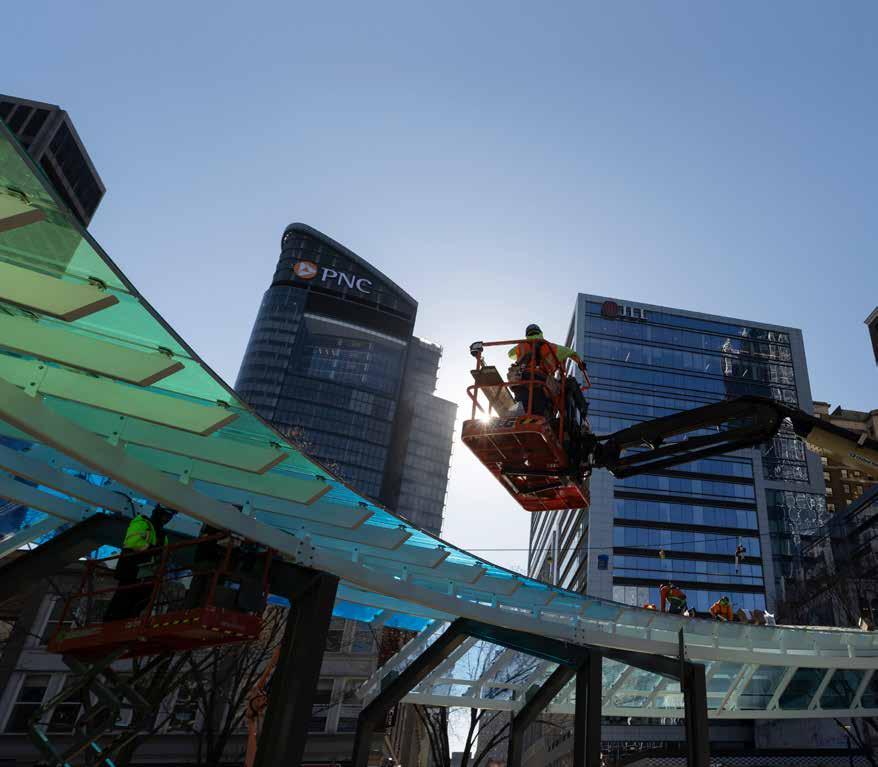
The Market Anchor, below, is the focal point of the newly renovated Market Square in Downtown Pittsburgh. The pavilion’s glass roof was inspired by a semi-circular building that stood in the market area more tha 200 years ago. Other improvments included replacing the old brick and cobblestone walkways, left, with smooth, uniform precast pavers.

TO THE DEGREE THAT THERE IS A FORMULA THAT WORKS, ONE OF THE KEY COMPONENTS IS THAT THERE IS A FAIR AMOUNT OF SAFE AND ENJOYABLE AND ACCESSIBLE PUBLIC SPACE.”
Jeff Burd, President/Founder, Tall Timber Group
$5 million to the project. “What’s great about it is that while the Pittsburgh Cultural Trust owns it, they’re designing it completely for public use— that’s just who they are as an organization.
“This is probably one of the biggest things to happen in the Cultural District in 25 years, and it’s going to be a place where you can catch a festival, see some amazing public art, or just grab lunch and relax. It’s exactly the kind of space that brings a community together.”
DeForrest sees the project as one that aligns with the Endowments’ current goals for Downtown: promoting beauty and excellence in design; advancing fairness in accessibility; uniting people; enhancing connectivity to natural spaces; increasing equity in serving and supporting people; and providing a transformative example compared to other urban revitalization projects.
“We want to make sure we’re creating spaces that truly welcome everyone,” she said. “I mean, spaces where a great-grandmother with a walker feels just as comfortable as a teenager on a skateboard, where families can enjoy themselves alongside young professionals, where someone with developmental differences can participate fully in community life. These spaces need to work for all of us, not just some of us.”
Toward that end, the Pittsburgh Downtown Partnership, a nonprofit community development organization dedicated to enhancing the city center, is overseeing a different part of the revitalization plan
— the modernization of one of Downtown’s most wellestablished public spaces, Market Square. The $15 million refresh expands outdoor dining for the restaurants around the square, adding an outdoor pavilion called the Market Anchor with its dramatic semi-circular glass roof. The improvements also provide new infrastructure, including lighting, power, and water access, “ensuring that it remains a vibrant hub all year round,” Waldrup said.
These changes are built on the foundation of the Partnership’s ongoing efforts, which include its On-Street Services program that operates seven days a week, deploying three teams of workers: Golden Triangle Ambassadors offer directions, assist with events, and serve as additional “eyes and ears” on the street. The Clean Team works daily from 7 a.m. through 11 p.m., removing litter and graffiti, power washing sidewalks and addressing maintenance needs. And the Outreach Team connects individuals in crisis to social services.
Jeff Burd sees the type of ground-level work that the Partnership is doing as essential to Downtown’s revitalization. He is the founder and President of Tall Timber Group, which publishes two magazines devoted to news about commercial real estate in the Pittsburgh region, Breaking Ground and Developing Pittsburgh.
“To the degree that there is a formula that works, one of the key components is that there is a fair amount of safe and enjoyable and accessible public space,” he said. “That
then supports living Downtown or going Downtown for lunch or dinner and hanging around a bit.
“It’s also important for having people feel comfortable about going Downtown for work —assuming that the public spaces are maintained —that there is an adequate public safety presence.”
While the Jewish Healthcare Foundation wants its staff to feel safe when they come to the organization’s Downtown office, it has other reasons for its investment in the revitalization effort, which includes support for Market Square upgrades.
that has worked since 1999 to cultivate the potential of Pittsburgh’s riverfronts.
Riverlife’s work, which the Endowments helps to fund, has largely focused on two projects. The first, called Closing the Loop, involves developing a 15-mile set of parks, trails and green spaces that run alongside portions of the Allegheny, Monongahela and Ohio rivers. The second is the creation of what Riverlife calls “river rooms,” which incorporate all three rivers and the bridges that connect Downtown to the north and south shorelines. The Roberto Clemente, Andy Warhol and Rachel Carson bridges connect the end of Downtown containing Arts Landing and Allegheny Riverfront Park to the city’s North Shore. The bridges and the shorelines are viewed as forming the walls of the Allegheny River Room with the river as the floor.
WE LIKE TO FUND VENUES THAT BRING PEOPLE TOGETHER. I THINK SAFETY AND CONNECTIVITY, ENDING ISOLATION, BOTH FALL FOR US CLEARLY IN THE REALM OF HEALTH.”
Karen Feinstein, President and CEO, Jewish Healthcare Foundation
“We like to fund venues that bring people together,” said Jewish Healthcare Foundation President and CEO Karen Feinstein, naming Arts Landing, Market Square and Point State Park as examples. “I think safety and connectivity, ending isolation, both fall for us clearly in the realm of health.”
Downtown enhancements also include improvements such as new tree plantings along Fort t Duquesne Boulevard that visually connect Arts Landing to the upper level of Allegheny Riverfront Park, which sits on the opposite side of the road overlooking the Allegheny t River. The park itself underwent a renovation to its upper i promenade, which includes installation of new bluestone pavers, tree canopy additions, widened park corners, and new light poles and bollards. The upgrade is being done under the auspices of Riverlife, a nonprofit organization
The positioning and design of Arts Landing will mean that for large-scale events, especially those centered on the Allegheny River, it can function as an extension of the Allegheny River Room, giving visitors a unified experience of Downtown and the North Shore by way of the bridges. Riverlife President and CEO Matthew Galluzzo said this design will express a major shift in how the river is viewed by Pittsburghers who, like residents of other river cities, “really treat their waterfront as this linear edge.
“The shift in thinking for us is that riverfronts are not an edge, but an invitation to explore, whether that’s natural wonders or opportunities for respite or recreation, or to explore what’s on the other side of the river,” he said.
Rob Stephany, the Endowments’ Senior Program Director for Community & Economic Development, said hat Riverlife has become something of a role model for urban planners across the globe.
“People come from around the world to understand Riverlife,” he said, “to understand how we took a river hat industry essentially used as a gutter and turned it nto a public realm that drove economic development up and down the river’s edges.”
He sees the potential for Arts Landing to have a similar impact, stimulating the redevelopment of surrounding parcels. “High-quality, well-managed and programmed parks are known for creating really strong
economic development and housing developments around them,” he said.
Other projects that are part of Downtown revitalization efforts include current renovations to Point State Park, which sits at the confluence of the Allegheny, Monongahela and Ohio rivers.
The park’s initial upgrade package is complete and includes major repairs and lighting improvements.
The bulk of the state-supported Downtown revitalization efforts proposed involve renovating some of Downtown’s largest buildings to transform office space into apartments, many of them affordable housing. (See “Looking Up: A More Affordable Pittsburgh Renaissance” sidebar.) While individual projects have long been in various stages of planning and preparation, what has been called a residential pipeline of developments is underway, and the state’s $62.6 million funding package helped to bring them all together into a single vision for Downtown.
n the last century, the periods in Pittsburgh’s history known as Renaissance I (late 1940s into early 1970s) and Renaissance II (late 1970s into early 1990s) made significant transformations to the Downtown, from improving the air quality to creating the signature Point State Park to erecting dramatically designed skyscrapers.
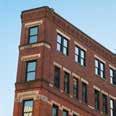
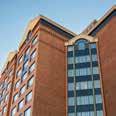
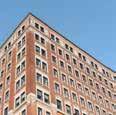
Current revitalization plans include several quality-of-life enhancements that add entertainment, recreational and natural amenities for residents and visitors to enjoy. The improvements also involve expanding residential options and adding a special focus on affordable housing, which the U.S. Department of Housing and Urban Development defines as when occupants are paying no more than 30% of their income for total housing costs, including utilities. Some of the latter are occurring through converting large office buildings into apartments. Among the residential renovations that are underway or complete are:
A THE MAY BUILDING
Preservation of 86 existing apartment units, 66 of them affordable
B APARTMENTS AT 9TH AND LIBERTY
Conversion of two office towers into 50 apartments, all affordable
C THE IVY RESIDENCES
Completed office building
conversion with 15 apartments, including 7 affordable units
D FIRST AND MARKET
Office building conversion into a 93-unit apartment building, all affordable
E SMITHFIELD LOFTS
Office building conversion into a 46-unit apartment building with 39 affordable units
This latest chapter in Pittsburgh’s revitalization history follows earlier periods when bursts of new development transformed Downtown.
The first period, dubbed the Pittsburgh Renaissance, began with the passage of a smoke control ordinance in 1946, David L. Lawrence’s first year as mayor.
The physical reshaping of Downtown began in 1950, when warehouses and railroad yards were cleared away from the confluence of the Allegheny and Monongahela rivers to make room for Gateway Center, an office and commercial complex, and for the beginning of construction of Point State Park. At the opposite end of Downtown, hundreds of families, many of them African American, were displaced in a controversial move to make room for the Civic Arena entertainment center.
Point State Park, developed as the identity-enhancing tip to the Golden Triangle, was the first Renaissance project and became the final one to be completed, being dedicated and opened to the public in 1974.
In 1977, days after his election, Mayor-Elect Richard K. Caligiuri announced plans for “Renaissance II,” a plan to build on his predecessors’ work. During the 1980s, the construction of a half-dozen skyscrapers, including the neo-Gothic glass “castle”–styled PPG Place, transformed Downtown’s skyline, and the city gained a light rail system that connected Downtown to its southern suburbs.
While the scale of the current plan for Downtown’s revitalization echoes Renaissances I and II in some ways, it differs significantly in others, such as the emphasis on affordable housing, which was not the case decades ago. And some of the fruits of these revitalization efforts will be on wide display soon. In April 2025, the Pittsburgh Post-Gazette reported that according to the NFL, television viewership reached as many as 54 million people across all three days of previous NFL Draft events.
POINT STATE PARK, DEVELOPED AS THE IDENTITY-ENHANCING
TIP TO THE GOLDEN TRIANGLE, WAS THE FIRST RENAISSANCE PROJECT AND BECAME THE FINAL ONE TO BE COMPLETED, BEING DEDICATED AND OPENED TO THE PUBLIC IN 1974.
A year later, those millions watching football draft picks in Pittsburgh also saw the vibrant, modern Downtown envisioned by civic and government leaders because of a newly constructed Arts Landing, a renewed Market Square, a renovated Point State Park, and several large real estate projects in the Golden Triangle. h
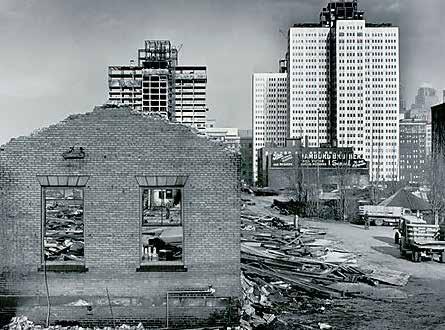
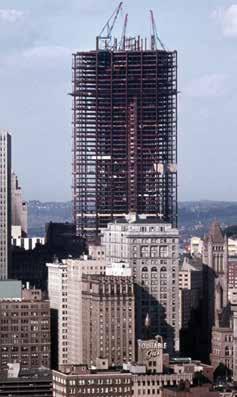
While construction of new buildings or renovation of existing ones has occurred periodically over the years in Downtown Pittsburgh, coordinated revitalization efforts like those currently underway have been rare. The two most recent instances etched in the city’s history are known as Renaissance I, which occurred from 1946 to the early 1970s, and Renaissance II, which took place from the late 1970s to the early 1990s. Together, the two periods transformed Downtown in ways that continue to define it today.
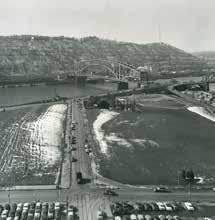
Transformation of the Downtown skyline began with the construction of Point State Park at the confluence of the Allegheny, Monongahela and Ohio rivers.
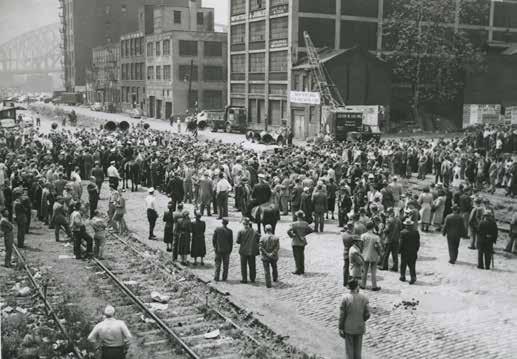
A demolition ceremony on May 18, 1950, kicked off the clearing of abandoned buildings, freight yards, largely unused railroads and debris to create the 36-acre park, completed in 1974.
Across from Point State Park, more old buildings had to be demolished to enable construction of the Gateway Center office and commercial complex.
The outline of Point State Park began taking shape by the mid-1950s, but some roads and bridges still needed to be closed, torn down or, in a couple of cases, constructed to accommodate the park development.
Construction of the U.S. Steel Tower, Pittsburgh’s tallest building at 841 feet, began in 1967 and ended in the early 1970s.
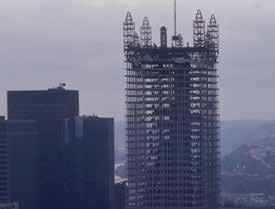
Another Downtown skyscraper, PPG Place, was built between 1981 and 1984. After completion, the six-building complex stood out on the Pittsburgh skyline because it was covered with about 1 million square feet of clear reflective glass. Its tallest building is the 635-foottall One PPG Place.
A less visible but still a notable addition to Downtown Pittsburgh was a light rail system known as “the T.” It runs mostly underground in the heart of the city and under the Allegheny River to North Shore but operates above ground as it extends into the southern suburbs. Construction began in 1980 and continued into 2012 as new lines were added.
1951


As The Heinz Endowments expands its investment in local journalism, the need for its commitment has been made even more apparent after the Pittsburgh region’s largest newspaper was threatened with and later saved from closure.
By Anthony Todd Carlisle
When the federal government withdrew funding from the Corporation for Public Broadcasting last year, forcing its closure and sending public television and radio stations across the country scrambling to fill large financial gaps, it was a major blow to local journalism.
Pittsburgh Community Broadcasting Corp.— operator of radio stations WESA, a National Public Radio affiliate, and WYEP — was set to lose hundreds of thousands of dollars annually. Local media alarms began to blare.
But worries about federal actions gave way to distress about decisions closer to home with the Jan. 7 announcement that the Pittsburgh Post-Gazette, which traces its roots back to 1786, would cease operations this May. The move was viewed by many as devastating to southwestern Pennsylvania’s journalism landscape.
■ Previously scheduled to close in May, the Pittsburgh Post-Gazette, southwestern Pennsylvania’s largest newspaper, has been purchased by a nonprofit organization, but the threatened closure still highlights concerns about the state of local journalism in the region.
■ For The Heinz Endowments, support of local nonprofit journalism is an important part of its democracy-focused Civic Participation strategy.
■ Local nonprofit media representatives believe that support from funders like the Endowments helps them fill the gaps in news coverage left by newspapers closing across the region and country.
■ Last year, the Endowments made a multi-year commitment of $3.7 million to media and media research as part of its Civic Participation strategy with $3.3 million going directly to nonprofit media.
Then, just as some in the region were settling into a reality of Pittsburgh without a major metropolitan newspaper, the Venetoulis Institute for Local Journalism, publisher of the Pulitzer Prize-winning Baltimore Banner, announced on April 14 that it would buy the Post-Gazette’s assets. The sale to the nonprofit digital news outlet is scheduled to take effect May 4, and the Post-Gazette’s name is to remain unchanged
“It’s a best-case scenario especially for folks who work at the Post-Gazette and for the broader community,” said awardwinning Pittsburgh journalist Andrew Conte on the day of the sale announcement. “You have a buyer who is invested in journalism and who wants to invest in local journalism in Pittsburgh.”
Conte is Assistant Vice President and Managing Director of the Center for Media Innovation, a journalism laboratory based at Point Park University in Pittsburgh that focuses on finding innovative ways to support local media. He cautioned that
the future of this new version of the PostGazette in the current media ecosystem remains to be seen.
He noted several recent changes to journalism landscape, including the purchase of the alternative weekly Pittsburgh City Paper, which like the Post-Gazette had been owned and scheduled for closure by Block Communications. The new City Paper owner also is a nonprofit organization.
Conte said the threat of losing the Post-Gazette was a warning sign to the public, which needs to decide if it will support the newspaper now that it has received a reprieve.
“If the public has no personal stake in it, it won’t last,” he said. “If they decide to support it, then local news has a bright future here.”
After also learning on April 14 of the Post-Gazette sale, Christopher Baxter, President and CEO of Spotlight PA, an independent nonprofit newsroom providing investigative and public service coverage in Pennsylvania, agreed with Conte that the Venetoulis Institute’s purchase was one of the best outcomes in a difficult situation. He gave similar precautions about what lies ahead.
“The significant financial investment and nonprofit ownership will give the company the time and resources to find its way in a rapidly changing news environment. But we should also be clear-eyed: In the coming weeks and months, the Post-Gazette will almost certainly have a smaller staff as it seeks financial sustainability,” Baxter said. “This sale does not resolve the structural challenges facing local news, particularly the kind of deep, time-intensive investigative and accountability journalism that communities need most… The lesson of this moment is not that the problem is solved. It’s that the work of building durable, community-supported journalism has to keep going.”
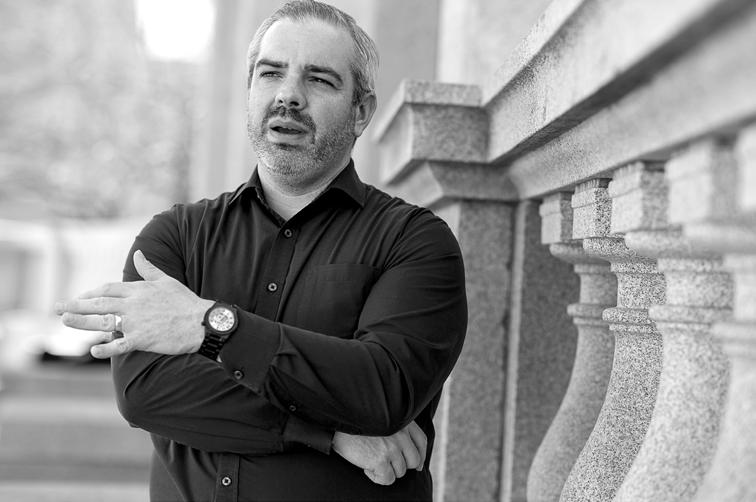
that the problem is solved. It’s that the work of building durable, communitysupported journalism has to keep going.”
Christopher Baxter, President and CEO, Spotlight PA
Both Baxter and Conte pointed to the importance of having the support of institutions, such as local foundations, that understand the immense value of local news and challenges it faces.
As newspapers around the country shutter and funding for public broadcasting shrinks, The Heinz Endowments has made supporting local journalism among its core philanthropic efforts and a key part of a democracy-focused strategy.
The motivation behind that support is that a healthy media ecosystem goes hand-in-hand with a strong functioning democracy, explained Matt Barron, the Endowments’ Civic Participation Director.
“Without access to reliable information from independent nonpartisan media, it can be really challenging to even know what’s happening in your community,” Barron said. “And we’ve seen so much
I think the philanthropic community has been
critical to helping Pittsburgh figure out what the present and future of local news looks like.”
Andrew Conte, Assistant Vice President and Managing Director, Center for Media Innovation, Point Park University

constriction in the field. We’re losing journalists and papers every year.”
Between 2005 and 2025, nearly 3,500 print newspapers closed their doors nationwide, according to the Medill Local News Initiative at Northwestern University.
The initiative’s “State of Local News: The 2025 Report” found that newspapers are dying at the rate of more than two a week, with 148 closings in 2025 alone. The report also highlights the prevalence of news deserts — gaps in local news coverage in communities — describing how 212 counties nationwide were absent any news source and 1,525 counties having only one. These numbers indicate that almost 50 million people in the United States have little or no access to local news, the report said.
In the Pittsburgh region, news consumers also have had to contend with news outlet closures. Several small newspapers in the region had shuttered over the last 10 years , while other larger city newspapers had reduced or eliminated their print editions.
The Endowments has invested in local nonprofit journalism for a number of years. Barron explained that as news outlets in the Pittsburgh region continued to close or diminish in size and reach, the decrease in professional journalism of the highest standards became a pressing concern because of the foundation’s belief in the importance of independent, high-quality journalism to a functioning democracy.
This is why the Endowments made a multi-year commitment in 2025 totaling more than $3.7 million to media and media research as part of its Civic Participation strategy’s commitment to promoting access to reliable information, he said. Of that amount, the lion’s share, more than $3.3 million, is going directly to support nonprofit media.
This funding includes supporting community-based journalism and investigative reporting by sustaining nonprofit journalism in Pennsylvania, particularly
in western Pennsylvania, according to Barron.
“The idea is that we want to be a larger, more sustainable funder in the field to give [local nonprofit media] the space to innovate, to test new things, to try to develop some of these new business models, and to know that they will have some sustainable funding from us in order to do that,” he said.
“It’s a really tough field to be in, and a lot of the traditional funding sources for media and journalism have dried up and changed, and so philanthropy has been a major source of funding, particularly for the nonprofit journalism space.”
Barron added that the news organizations will need more than philanthropic funding however. For this reason, the Endowments’ strategy includes helping them to build individual donor and membership programs and to find ways to sustain their work beyond foundation support
The Endowments also is looking for opportunities to support journalism in rural parts of the region where there are news gaps. The foundation wants to help journalism in places where either local newspapers have closed their doors or they’ve been bought up by national conglomerates, providing less local, on-the-ground reporting, Barron said. Currently, the Endowments is exploring new potential partners outside of Allegheny County as part of its effort to look beyond urban areas to provide funding in more rural and suburban parts of the region.
“To have a clear understanding of what’s happening in their communities, to know what’s happening in their governments and with their local elected officials and to be able to hold those folks accountable, when need be, all of that is made possible by robust independent journalism. If we lose that, we really run the risk of even
more disinformation informing people’s views,” Barron said. “It’s just really critical that we maintain high-quality independent nonpartisan journalism in the region.”
Among the local nonprofit news outlets and media organizations the Endowments has supported over the years to ensure the accessibility and survivability of community-based and investigative journalism are Spotlight PA, WESA 90.5 FM, Public Source and the Center for Media Innovation at Point Park University.
When the Center for Media Innovation opened in 2016, it was the Endowments that offered early help, Conte said.
“Heinz was one of the first foundations that came to us once we opened the Center for Media Innovation,” he explained. “We had a grant from the Allegheny Foundation to create the Center, but then Heinz was one of the first ones to come to us and say, ‘We really appreciate what you’re doing, and how can we be involved?’”
Conte said the Endowments provided a $16,000 grant to the Center for Media Innovation to address issues revealed in a report the foundation commissioned that examined the Pittsburgh media ecosystem. What ultimately came from that report was a media collaboration in the form of the Pittsburgh Media Partnership, a collection of news outlets working together to produce news reports for the benefit of the community. That group began with 20 members and has grown to 33 media outlets, representing 10 counties in southwestern Pennsylvania.
In addition to the Pittsburgh Media Partnership, the Endowments, along with other foundations, has supported the Center’s initiatives around training a new generation of journalists, as well as supporting diversity in newsrooms and coverage. More recently, the foundations have supported the Center in forming and housing the southwestern Pennsylvania chapter of Press Forward, a national movement that brings together donors and foundations to support local journalism.
“I think the philanthropic community has been critical to helping Pittsburgh figure out what the present and future of local news looks like,” Conte said, “so, we’re trying to figure out what journalism looks like today and tomorrow, and the foundation community is giving us that kind of a runway.”
Pittsburgh is fortunate to have not only a deep tradition of philanthropy, but also “generous institutions” that take their commitment to journalism seriously, said Terry O’Reilly, President and CEO of Pittsburgh Community Broadcasting, WESA’s parent company. O’Reilly called foundations good friends whom his organization has worked with for years in its efforts to be of service at a time when journalistic enterprises in the region are shrinking. The Endowments has been critical in staffing support for WESA, he said.
“In a general sense, their operating grants allow us to sustain a newsroom that is larger than our newsroom has ever been before and to be able to cover a breadth of journalism that we no longer see elsewhere here in this region,” O’Reilly said. “We have people who are covering county government and city government, political processes, arts and culture, the sciences and health, and education. Dedicated journalists [are] covering those beats. Without the general operating support of the Endowments, it just simply wouldn’t be possible.”
One of the major ways that the Endowments has assisted is to allow his news outlet to have a broadcast presence in Harrisburg to ensure western Pennsylvania issues are reported, O’Reilly said. The Endowments helped to fund a full-time correspondent to cover issues exclusive to western Pennsylvania.
“Pennsylvania is three ‘states.’ It’s Pittsburgh, it’s Philadelphia, and it’s a large, primarily rural population in the middle,” O’Reilly said. “And the notion of somehow trying to create generalized coverage that is of equal value to all three of these audiences isn’t really possible.
Pennsylvania is three ‘states.’
It’s Pittsburgh, it’s Philadelphia, rural population in the middle.”
Terry O’Reilly, President and CEO, Pittsburgh Community Broadcasting Corporation
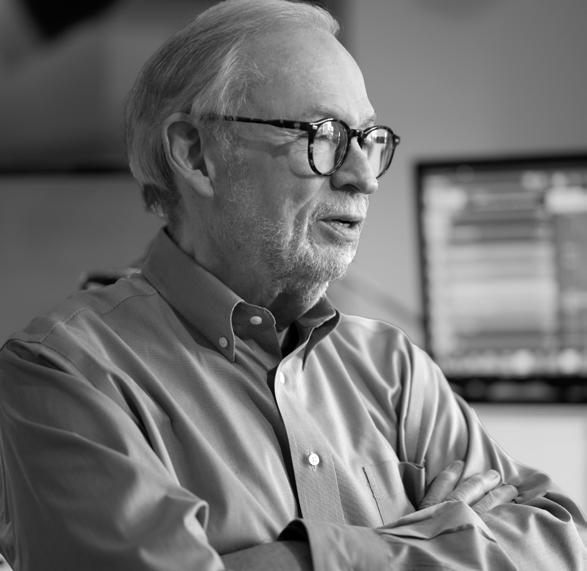
and it’s a large, primarily

“We wanted to be able to say, ‘You know, western Pennsylvania has very specific needs, very specific interests, and we’d like somebody who, depending on the day, would be either the best friend or the most critical set of eyes on every politician from western Pennsylvania who’s at the state Capitol.’”
In its role as an independent watchdog, Spotlight PA offers its investigative and public service journalism lenses as a public resource available at no cost to readers and to any other newsroom across the state that wants that work. Spotlight PA shares its coverage with more than 130 news organizations across Pennsylvania. For Spotlight PA to make its stories available, the Endowments has been an important funding partner, according to Baxter. In addition to financial support, what Baxter appreciates is the Endowments’ understanding of journalism and its importance to a functioning democracy.
“It was clear they understood the industry. They understood where it had gone wrong. They understood how to assess its existence for a deeper understanding,” Baxter said. “It was valuable because we can obviously have more informed, intricate conversations, but also, they understand that this is a funding need for some stability.”
In addition to supporting communitybased journalism and investigative reporting, the Endowments also recognizes the need to support diversity in local newsrooms.
“We want to put a particular focus on journalism that reflects the communities in which they are reporting,” Barron said.
As for the other parts of the Civic Participation strategy—civic infrastructure and social trust, and responsive local governments — Barron explained that civic infrastructure and social trust involve supporting initiatives that rebuild a sense of shared identity in the region through repairing bonds of trust that have frayed over the past several decades. This includes addressing people’s lack of trust in government, media and each other as community members. He said efforts to encourage responsive local governments involve to helping local governing bodies in the region struggling with budget cuts and staffing challenges to build their capacity to be more effective in serving their residents and to help them work better together across municipal boundaries.
The Endowments’ sense of urgency to ensure that credible journalism exists in the Pittsburgh region also is reflected in the type of work that the foundation is supporting in the changing media landscape,
Barron said. Part of that involves recognizing that the way people consume media is constantly evolving, and residents must be met where they are. That could mean investing in journalism delivered to people through social media if that journalism still meets high ethical standards and practices in these new formats.
As part of maintaining a viable democracy, there’s a continuous need to have well-trained journalists who understand the landscape and who can reach people through a range of platforms that might be more relevant to their lives, Barron said.
“I don’t think we can have a democracy if we don’t have a really strong, independent media ecosystem,” he added. “People need to know that they can trust that information, that it’s not partisan or one-sided, and that it really is being done with journalistic ethics and with editorial oversight, all of those things that we’ve lost a lot of over the last couple of decades.”
For Conte, the announcement of the Pittsburgh Post-Gazette closing — even though it did not go through — highlighted the critical need to sustain credible independent journalism for people in southwestern Pennsylvania.
“All of us who have been working in this space, including The Heinz Endowments, have felt a sense of urgency for some time,” he said. “My hope now is that more people are waking up to what it means for southwestern Pennsylvanians to have access to reliable local news and information.” h
Editor’s note: Learn more about the nonprofit news outlets and media organizations working to provide vital coverage of southwestern Pennsylvania and issues important to the region by listening to interviews with Andrew Conte and Christopher Baxter on the Endowments’ “We Can Be” podcast, www.heinz.org/podcast.
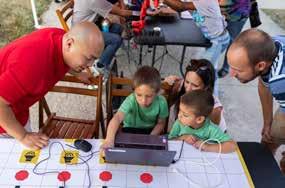

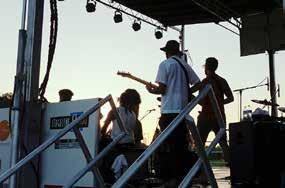
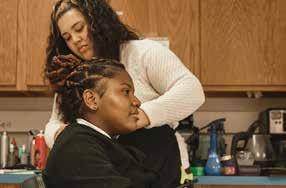
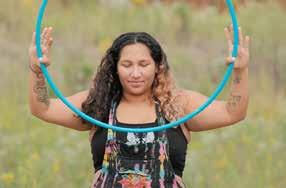


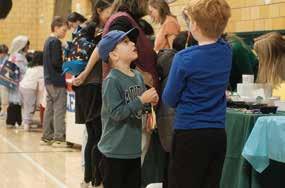

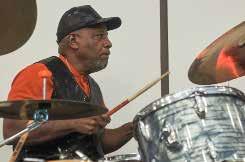

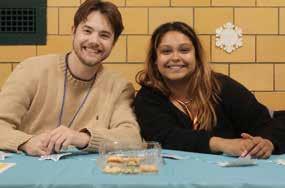
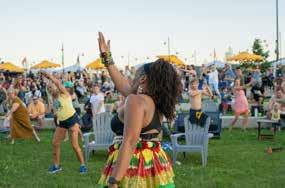



HAZELWOOD LOCAL PROVIDES MORE THAN ARTS AND ENTERTAINMENT ACTIVITIES AT PITTSBURGH’S HAZELWOOD GREEN. IT’S STRENGTHENING NEIGHBORHOOD CONNECTIONS TO NEW DEVELOPMENT AND BOOSTING COMMUNITY ENGAGEMENT AND OWNERSHIP IN THE PROCESS.
BY DONOVAN HARRELL
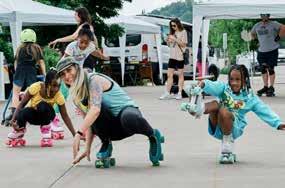
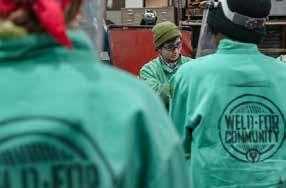
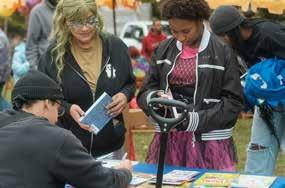
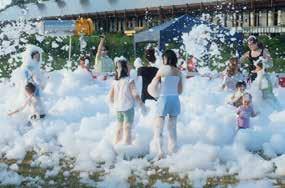
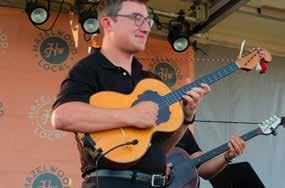
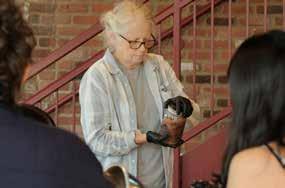
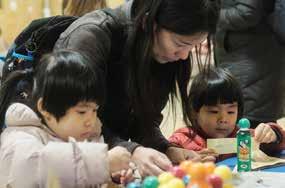
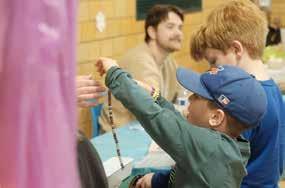
These scenes from Hazelwood Local activities organized by the initiative and its partners illustrate the variety of creative opportunities available in Hazelwood for residents to enjoy.
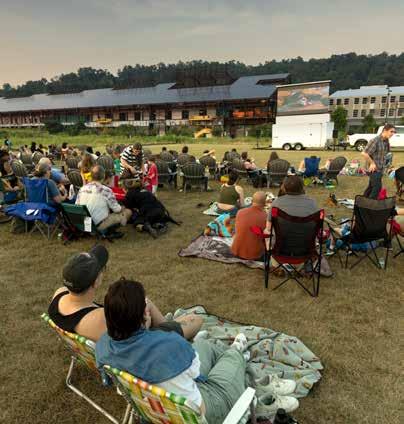
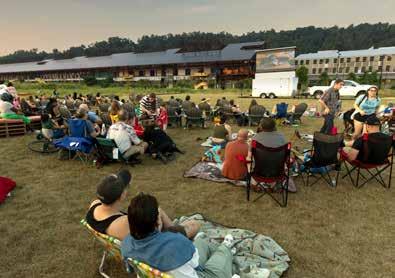
On a warm Friday last summer, Hazelwood Green Plaza was quiet until dusk. As the sun dipped behind the industrial backdrop, a crowd gathered where a 20-foot screen stretched across the lawn. There was free popcorn from independent movie theater Row House Cinema and face painting by Beanie Paints. Families settled on blankets. Children played in the soft glow. Soon, “A Minecraft Movie” flickered to life—the story of an unlikely hero in a film about belonging.
This Movie Night on the Lawn, hosted by Hazelwood Local and Row House Cinema, was more than an open-air film screening. It was a moment when the arts, recreation and connection to Pittsburgh’s Hazelwood neighborhood converged in service of a larger purpose: making Hazelwood Green —and its promise for sustainable, green development — feel like a space owned by the community that built the neighborhood in the first place.
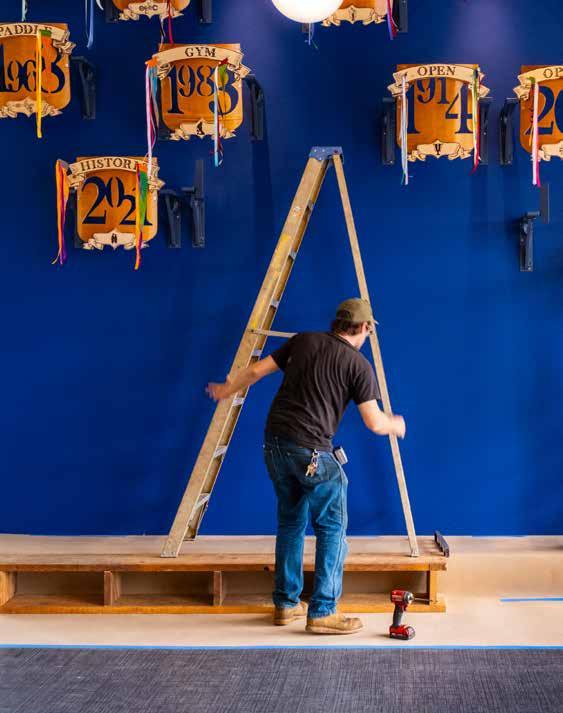
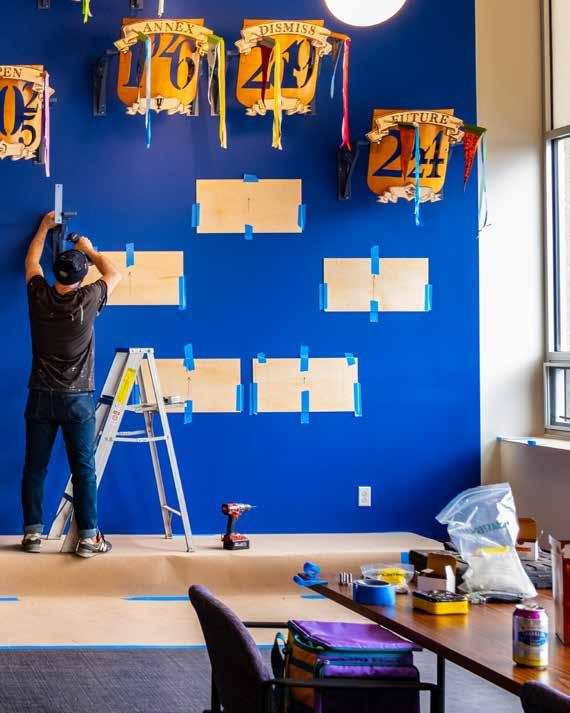
As part of another Hazelwood Local program, Andrea ColemanBetts, a lifelong Hazelwood resident and community disability activist, was among the participants in the “Story Shields” project coordinated by the organization and artist Edith Abeyta. The group created the art installation for the lobby of the Gladstone Residences, a complex where Coleman-Betts lived last year that is a few blocks away from Hazelwood Green. The project used imagery, symbols and materials to incorporate residents’ stories into sculptural shields that honor the Gladstone building’s past as a school and its present as a home.
■ The Hazelwood Local initiative organizes a range of art and entertainment activities at Hazelwood Green, a 178-acre redeveloped former mill site, to foster community engagement and partnerships.
Coleman-Betts, who has moved to another part of Hazelowood, uses a wheelchair following a stroke and advocates for developers to preserve Hazelwood’s history and to make sure any new development projects are accessible to disabled people. She said the programming offered through Hazelwood Local gives people with disabilities a chance to get out into the community and learn new skills.
■ Local artists and entrepreneurs are featured at Hazelwood Local events.
■ Hazelwood residents of all ages and abilities are participating in Hazelwood Local activities and appreciate the creativity and inclusion.
■ Hazelwood Local events are helping to deepen understanding between the Hazelwood community and the Hazelwood Green development.
“I think that’s a major asset to the community itself,” Coleman-Betts said. “I think that’s very important, that inclusion [is offered in] more than just words but in the actions.”
Hazelwood Local is a placemaking and storytelling initiative designed to help connect residents to the Hazelwood Green development and to one another. Activities include pop-up markets, outdoor performances, hands-on workshops and storytelling art projects. While many events and programs take

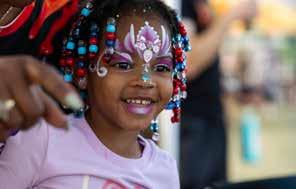

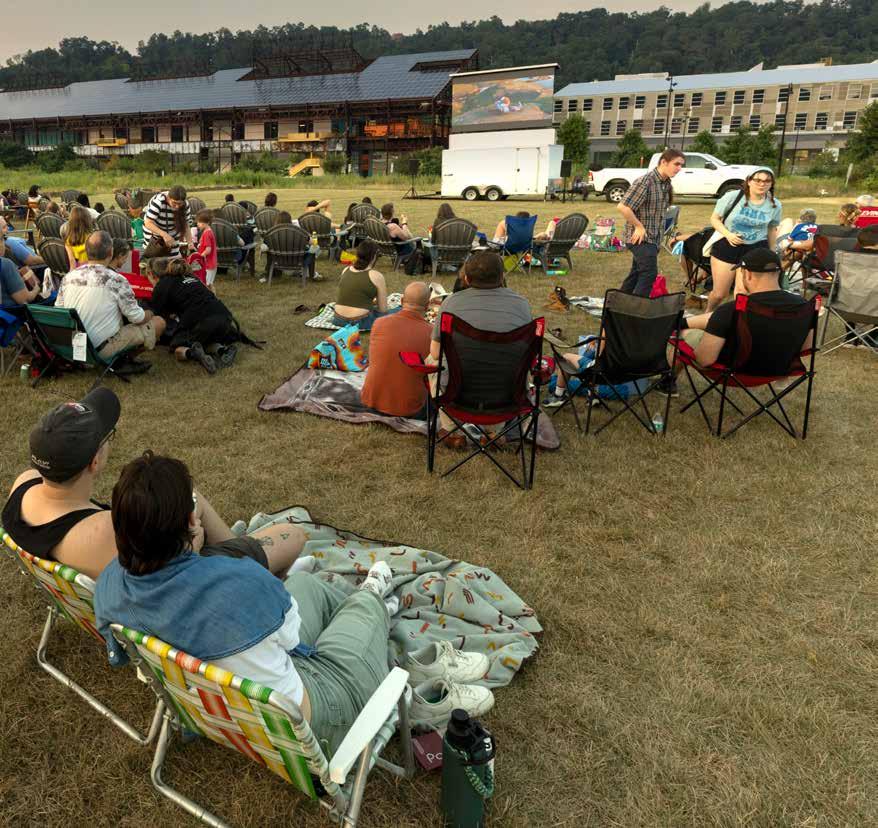
Hazelwood Local has a range of events that include outdoor movie screenings on the plaza lawn of the Hazelwood Green development, which last summer also provided a chance for children like Onari Patton, top left foreground, and Ada Zehmisch to play with robots while Kamila Murphy enjoyed her face paint.
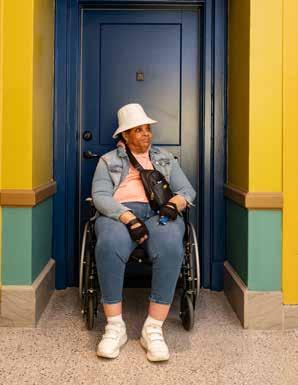
Workers hung handmade sculptural shields, center, in the lobby of the Gladstone Residences in Hazelwood last year as part of the “Story Shields” project that Hazelwood Local coordinated with artist Edith Abeyta, founder of Arts Excursions Unlimited (AEU). Andrea Coleman-Betts, above, was one of the Hazelwood residents who helped create the art installation that reflects the building’s history
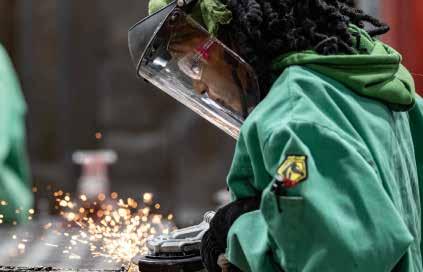
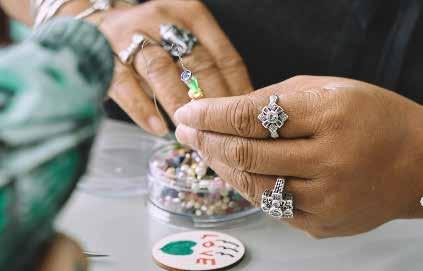
Far right, Hazelwood Local’s creative partners include the Industrial Arts Workshop (IAW) and AEU, both of which have developed their own range of projects in the Hazelwood neighborhood over the years. IAW offers welding courses that merge creative expression with skills training, top. AEU’s Abeyta organizes craft activities that include bead work, middle. Abeyta also coordinates crafts projects for children during Hazelwood Local’s annual Holiday Portrait Fair, bottom. The event offers opportunities for residents to receive free seasonal family portraits taken by professional photographers.
place on the development site, others occur within the Hazelwood neighborhood.
“Hazelwood Local is designed for neighbors to be neighbors having social time together, strengthening ties and enjoying their community,” said Jen Giovannitti, President of the Claude Worthington Benedum Foundation, one of the funders that supports the group’s work. “Community programs can achieve a variety of positive outcomes from social to academic to building pride in place.”
The Benedum Foundation, along with The Heinz Endowments and the Richard King Mellon Foundation, also is part of a consortium known as Almono LP, which owns Hazelwood Green.
The philanthropies came together in 2002 to purchase the 178-acre former steel mill site and wanted to advance
cutting-edge redevelopment while preserving public space and ensuring a direct benefit to the surrounding Hazelwood community.
As Hazelwood Green continues to evolve, Hazelwood Local has become part of that community benefit, focusing on creating spaces where residents can show up as their full selves—whether attending yoga classes, participating in a youth sports camp, or simply bringing a lawn chair to movie night. The programming is important, the organizers contend, but it’s the relationships that sustain it.
“We’d love to see continued and deepening ownership of [Hazelwood Green] by the broader Hazelwood community. That means not just inviting people in for our programmed events but also expanding the scale of community events around Hazelwood,” said Cassiopea McDonald, Project Director for Street Plans, a national

urban design and public space developer that helped create Hazelwood Local.
“Physically, we also want to see stronger connections between the neighborhood and the Green. Walkability and bike-ability are key, especially linking Hazelwood Green to the rest of the community in ways that feel safe, natural and welcoming. It’s about making sure the development doesn’t stand apart but rather grows as an integrated part of Hazelwood, where residents feel a real sense of ownership and access.”
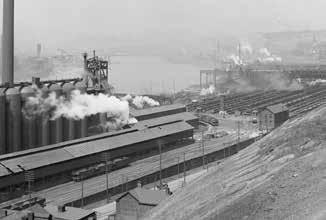
Once one of Pittsburgh’s steelmaking giants, the LTV Steel plant in Hazelwood closed in 1998, leaving behind an empty lot and opportunity. As Hazelwood Green, the former brownfield is now a mixed-use development with technologically advanced facilities in areas such as robotics and biomanufacturing, landscaped gardens and
recreational spaces. While supporting the transformation, one of The Heinz Endowments’ priorities became ensuring that Hazelwood residents maintained their homes and their community as the redevelopment takes shape, said Rob Stephany, the foundation’s Senior Director of Community & Economic Development.
This is done through a community-focused strategy that ensures the space promotes economic opportunities, mixed-income housing, arts excursions, and health and wellness programming, which drives the sustainable and equitable development of the space, he explained.
The Endowments, which also supports Hazelwood Local, commissioned the Reinvestment Fund, a nonprofit community development financial institution with offices in Philadelphia, to evaluate the work in Hazelwood. Last fall, the organization’s policy solutions team released its report, “Can a Neighborhood Experience Development without Displacement: The Hazelwood Story.” The study found that overall, the different types of investments in the community appear to have created a buffer that is preventing Hazelwood from experiencing the market pressures indicative of displacement related to new development, in this case Hazelwood Green.
“[We’re] providing a next generation of innovation as it relates to making sure benefits are broadly shared and connecting the community to the development agenda, the planning and ultimately the implementation of key components to the development on site,” Stephany said. “Building meaningful cross-class relationships is a complicated set of circumstances, but building the platform for that to happen is one of the things that we’re trying to do.”
McDonald and Nikki Martin, Community Events Manager at Street Plans, described how Hazelwood Local aims to create a welcoming space that emphasizes community partnership.
“More than just event producers, we see our work at Hazelwood as being community engagement,” McDonald said. “For us, placemaking isn’t just about building new spaces, it’s about listening to the people who’ve been here all along and fostering a sense of belonging. By bringing people on to the site for joyful experiences— children, teens, families, seniors, people who traditionally don’t have time or opportunity to engage at these public meetings for a variety of reasons—it gives them an opportunity to have a voice and a part in the evolution of Hazelwood Green.”
Martin added that the important element of healing has been involved in both the redevelopment and Hazelwood Local’s work.
“Hazelwood Green sits on land with a complicated industrial history, and one of Hazelwood Green’s core
values is recognizing that history while supporting environmental and community renewal,” Martin said. “A great example of that is the field where much of our programming now takes place—it’s been fully remediated and returned to public use. Through our events, we’re not only activating that space, we’re helping the community reclaim it as a place where people gather and create new memories.”
Hazelwood Local hosts 20 to 25 events a year, McDonald said, and since 2021, the organization has hosted around 110 events. It maintains a regularly updated calendar on its website.
Hazelwood-based organizations such as Industrial Arts Workshop (IAW) and Arts Excursions Unlimited (AEU) have organized multiple activities through Hazelwood Local and have contributed permanent art installations that aim to reflect the values of the community.
The workshop, established in 2018, merges creative arts with technical skills, particularly welding, to engage high school students. It has conducted summer camps since 2021, focusing on public art and community engagement. Through its multiple welding programs, including after-school welding labs, welding bootcamps and welding workshops, IAW helps community residents build trade skills while producing meaningful art at the same time. Notable projects include a three-dimensional mural in Hazelwood, a large bird sculpture at Hazelwood Green Plaza and sculptures for a women’s rehabilitation center.
AEU focuses on community-led arts projects, including temporary public art, cultural excursions and workshops. Recent projects include a mural on the Elizabeth Street Bridge, a garden at the neighborhood library and the “Story Shields” installation at Gladstone Residences.
Tim Kaulen, IAW’s Executive Director, said Hazelwood residents have a strong appetite for public art and can appreciate the exchange of ideas that public art brings to the neighborhood. Through multiple conversations with community members, Kaulen said he was drawn to the curiosity and enthusiasm to convey Hazelwood’s unique history through art and realized the opportunities available.
“We could be an important part of representing the neighborhood as it is in this space between the previous industrial era and whatever happens in development,” Kaulen said. “That’s the wonder — that aspect of how can art be a catalyst for other conversations—and yes, those conversations can include hardship and challenges and discourse.”
That wonder and curiosity led to projects such as the “Braids of Hope” mural, created in 2023 in collaboration
Pittsburgh’s Hazelwood neighborhood was once known for a steel mill that stretched along the shoreline of the Monongahela River. Today, Hazelwood Green overlooks the river and has green spaces and renovated or newly constructed buildings that complement the neighborhood.
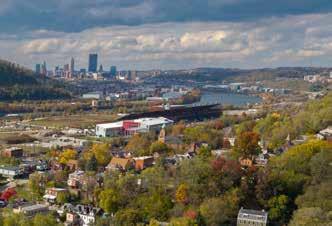
Hazelwood Green sits on land with a complicated industrial history, and one of Hazelwood Green’s core values is recognizing that history while supporting environmental and community renewal.”
Nikki
Martin, Community Events Manager, Street Plans
with Edith Abeyta and Hazelwood residents to capture the spirit of residents’ dreams for the future of the neighborhood
Abeyta, an artist and founder of AEU, has worked in Hazelwood since 2014. Abeyta said the organization has created multiple art projects around the community through murals, sculptures, paintings and art installations. AEU helps emphasize the importance of relationships and trust within the community, which has led to increased engagement and resilience, she said.
“I think what it really allows is this sort of deep trust and care for each other and through this process of just brainstorming, thinking, creating, learning new things, maybe taking risks that you might not normally take so early on,” Abeyta explained.
In the decades since the mill closed, Hazelwood community leaders have wrestled with how to preserve the needs of longtime residents and incoming residents while seeking new opportunities for work, art and community.
Hazelwood Local and the Hazelwood-based nonprofit Center of Life work together to provide a platform to
address those different needs through arts and cultural programming, said Center of Life CEO Tim Smith.
Center of Life supports youth and families through programs in music, arts, education and athletics. The organization offers programming ranging from jazz ensembles and robotics clubs to mentoring and family support services. Creating pathways for success that begin in the neighborhood and extend far beyond is the goal, said Smith, who founded Center of Life in 2001 on the belief that strong communities are built through consistent investment in people.
“What people don’t realize a lot of times is that when development comes into a community—when developers come into a community— they begin to propose things that they want in the community,” Smith said. “They do that a lot of times without a true background of who that community is.
“Through the arts and culture, we can communicate to developers what we want to see in our community that has a connection to who we are as a people, and where we’ve been, so that we don’t lose ourselves in some new buildings that have nothing to do with who we are.” h

The Endowments’ “We Can Be” podcast completed another season of in-depth conversations with leaders and doers of impactful organizations in southwestern Pennsylvania. We learned more about topics and issues such as environmental challenges and grass-roots efforts to overcome them; the Sarah Heinz House, a 125-year-old community service institution that began as a resource for children of immigrants on Pittsburgh’s North Side; and the future of journalism in our region, state and country.
Endowments President and “We Can Be” host Chris DeCardy welcomed guests including:
Tim Kaulen
Executive Director, Industrial Arts Workshop
Demeshia Seals
Chief Executive Officer, Sarah Heinz House
Matt Mehalik
Executive Director, Breathe Project
Matt Galluzzo
President/Chief Executive Officer, Riverlife
Michelle Naccarati-Chapkis
Executive Director, Women for a Healthy Environment
Chris Baxter
Chief Executive Officer/President, Spotlight PA
Kendra Whitlock Ingram
President/Chief Executive Officer, Pittsburgh Cultural Trust
Gillian Graber
Executive Director/Co-Founder, Protect PT
Sonya Tilghman
Executive Director, Hazelwood Initiative
Andy Conte
Managing Director, Center for Media Innovation
Episodes are available on all major podcast platforms and YouTube; use search term “Heinz We Can Be.”
The last two years have seen a wave of environmental organizations celebrate anniversaries, and some additional ones are marking their milestones in 2026. “The Allegheny Front,” an award-winning public radio program, began providing environmental news and interviews concerning the western Pennsylvania environmental landscape in 1991 on WYEP 91.3 FM. After 35 years, the program continues its environmental news coverage and has expanded to several stations in the region, including WESA 90.5 FM, a National Public Radio affiliate. “The Allegheny Front” also has added special news feature series and two podcasts. The nonprofit Upstream Pittsburgh, formerly Nine Mile Run Watershed Association, turns 25 this year. It oversees the Nine Mile Run Ecosystem Restoration Area in the city’s Frick Park, develops green stormwater capture sites in the East End section of Pittsburgh, and offers environmental justice programming countywide. Upstream Pittsburgh plans to unveil a new multi-decade plan for stormwater management in the Nine Mile Run area later this year.
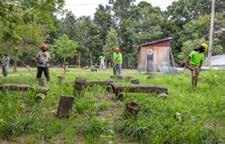
Landforce, a nonprofit that focuses on restoring and maintaining green spaces while providing training to individuals who face structural barriers to stable employment, has opened a zero-waste wood processing center called The Mill. The 10,000-square-foot facility in the eastern Pittsburgh suburb of Wilkinsburg repurposes fallen or salvaged urban trees into useful forms such as lumber, pallet parts, tree stakes and biochar. The Mill also trains workers in skills they can use in other jobs.
Landforce invested $2 million in The Mill, which received support from organizations such as the U.S. Environmental Protection Agency, the Pennsylvania Department of Conservation and Natural Resources, the Allegheny Foundation, and the Endowments.
As Pittsburgh hosted the 2026 NFL Draft April 23–25, the Western Pennsylvania Conservancy (WPC), the Pittsburgh Parks Conservancy (PPC) and 412 Food Rescue partnered with the event’s Pittsburgh Local Organizing Committee on projects to benefit the region.
WPC and PPC began planting a total of 500 trees across the city and Allegheny County as part of the NFL Draft’s environmental legacy program.
The WPC is scheduled to plant 400 largecaliper trees by spring 2027 in Downtown, the North Shore and communities where there are significant gaps in the tree canopy.

Target city neighborhoods include Homewood, Beltzhoover, Hazelwood and Garfield while McKeesport, Clairton and Penn Hills are among the county municipalities that will receive the plantings. The PPC will plant an additional 100 trees as part of a cityfocused effort to enhance green spaces and project areas in neighborhoods that lack adequate tree coverage.
The nonprofit 412 Food Rescue implemented a food recovery strategy to deliver surplus food from the three-day event’s activities to residents in need.
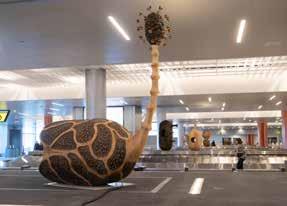
When the new $1.7 billion terminal opened at Pittsburgh International Airport near the end of last year, many of its aesthetic, health-related and staff-support features were supported by local foundations. Among the enhancements were colorful murals and sculptures, kiosks with mental health awareness videos, and onsite training for skilled trades workers.
The Heinz History Center has acquired the archives of renowned historian and author David McCullough. The archival materials of the Pittsburgh native include a treasure trove of manuscripts and awards, such as his two Pulitzer Prizes for the biographies “Truman” and “John Adams,” two National Book Awards, the Presidential Medal of Freedom from George W. Bush in 2006, and a 1987 Emmy Award for the PBS television series “Smithsonian World.” Also in the collection are letters to and from U.S. presidents and government leaders, artifacts from the author’s family history, and notes revealing how McCullough developed his works. The Heinz Endowments, Henry L. Hillman Foundation and Richard King Mellon Foundation provided support to help cover the costs of transportation, storage and archiving.

Rick Lowe, an internationally respected artist and professor of interdisciplinary practice at the University of Houston, has joined The Heinz Endowments board of directors. Lowe has more than three decades of experience in community-based art that has gained him recognition and awards both in the United States and abroad.
His extensive body of work in painting, drawing and installation has been exhibited in dozens of cities in the United States and in countries that include Italy, Greece, Korea and Japan. Lowe was appointed by President Barack Obama to the National Endowment for the Arts’ National Council on the Arts in 2013 and was named a MacArthur Fellow in 2014.
The Heinz Endowments began the year with new leadership in grantmaking and communications. Megan Hophan joined the Endowments as the Director of Grants Administration and manages the foundation’s grantmaking systems, processes and policies. Before joining the Endowments, she worked with Geneva Global, an advising firm for effective philanthropy. Amy Gianficaro is the new Managing Director of Strategic Marketing and Communications for the Endowments, guiding the foundation’s marketing, communications, branding and public relations functions. Prior to joining the Endowments, she was Senior Vice President of Marketing at the National Philanthropic Trust, the nation’s largest independent sponsor of donor-advised funds.
The nonprofit youth empowerment organization Young Black Motivated Kings & Queens (YBMKQ) is recognizing Endowments Civic Participation Director Matt Barron with one of two YBMKQ Legacy Awards as part of its 10 Year Anniversary Gala on July 11. The other Legacy Award recipient is Celeste Smith, founder of the Black-led consultancy Grants & Grit. The honor recognizes individuals who have demonstrated long-term commitment and belief in young people and have provided support that played a defining role in YBMKQ’s growth and impact.
Howard Heinz Endowment
Vira I. Heinz Endowment
625 Liberty Avenue
30th Floor
Pittsburgh, PA 15222-3115
412.281.5777 www.heinz.org
facebook.com/theheinzendowments
youtube.com/c/theheinzendowments theheinzendowments
linkedin.com/company/the-heinz-endowments