the index The student voice since 1888
The Haverford School · Haverford, PA 19041 · September 2026 · Volume 94, No. 1 · thsindex.org
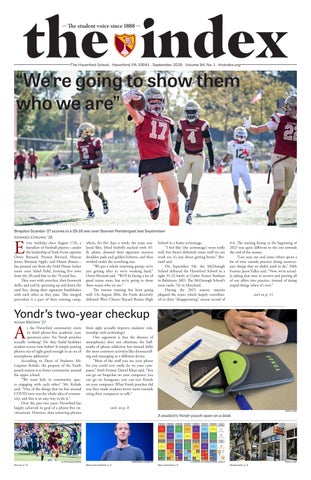
“We’re going to show them who Title we are”Goes Here
COMMUNICATIONS
Braydon Scanlan ’27 scores in a 28-24 win over Bonner Pendergast last September Edward Cheung ’28
E
very weekday since August 17th, a battalion of football players—under the leadership of Sixth Form captains Owen Bernard, Preston Bernard, Marcus Jones, Brennan Apple, and Mason Braun— has poured out from the Field House locker room onto Sabol Field, forming five rows from the 20-yard line to the 70-yard line. They start with stretches, then footwork drills, and end by sprinting up and down the yard line, doing their signature handshakes with each other as they pass. This integral procedure is a part of their training camp,
where, for five days a week, the team analyzed film, lifted barbells stacked with 45lb. plates, donned their signature maroon shoulder pads and golden helmets, and then worked under the scorching sun. “We got a whole returning group; we’re just getting after it; we’re working hard,” Owen Bernard said. “We’ll be facing a lot of good teams soon, but we’re going to show these teams who we are.” The intense training has been going well. On August 28th, the Fords decisively defeated West Chester Bayard Rustin High
School in a home scrimmage. “I feel like [the scrimmage] went really well, but there’s definitely some stuff we can work on; it’s just about getting better,” Bernard said. On September 5th, the McDonogh School defeated the Haverford School in a tight 35-25 battle at Under Armor Stadium in Baltimore, MD. The McDonogh School’s team ranks 7th in Maryland. During the 2025 season, injuries plagued the team, which largely contributed to their “disappointing” season record of
4-6. The starting lineup at the beginning of 2025 was quite different to the one towards the end of the season. “Last year, me and some others spent a lot of time outside practice doing unnecessary things that we didn’t need to do,” Fifth Former Jason Talley said. “Now, we’re actually taking that time to recover and putting all of our effort into practice, instead of doing stupid things when it’s over.” con’t on p. 11
Yondr’s two-year checkup
Adam Brown ’27
A
s the Haverford community starts its third phone-free academic year, questions arise: Are Yondr pouches actually working? Do they build healthier student screen time habits? Is simply putting phones out of sight good enough in an era of smartphone addiction? According to Dean of Students Mr. Luqman Kolade, the purpose of the Yondr pouch system is to foster community around the upper school. “We want kids in community spaces engaging with each other,” Mr. Kolade said. “One of the things that we lost around COVID time was the whole idea of community, and this is an easy way to do it.” Over the past two years, Haverford has largely achieved its goal of a phone-free environment. However, does removing phones
from sight actually improve students’ relationship with technology? One argument is that the absence of smartphones does not eliminate the hallmarks of phone addiction but instead shifts the most common activities like doomscrolling and messaging to a different device. “Most of the stuff you use your phone for you could very easily do on your computer,” Sixth Former Daniel Khan said. “You can go on Snapchat on your computer, you can go on Instagram, you can text friends on your computer. What Yondr pouches did was they made students hover more towards using their computers to talk.” con’t. on p. 8
ACTIVE IMAGE MEDIA
Soccer, p. 12
INDEX STAFF
A student’s Yondr pouch open on a desk
WIKIMEDIA COMMONS
Meta and students, p. 3
COURTESY OF UPPER SCHOOL OFFICE
New schedule, p. 6
INDEX STAFF
Restaurants, p. 9
the index · editorial
Page 2
the index 2026-2027 Staff Adam Brown ’27 Editor-in-Chief Matthew Lo ’27 Editor-in-Chief Ayush Varma ’27 Editor-in-Chief Brandyn Luong ’27 Senior Managing Editor
September 2026
editorial
Approaching the new year, step by step
E
very year, at the start of summer, we think about the vast stretch of time ahead of us. And every year, we are struck by the sudden start of school. We want more time to spend with our friends and relax in leisure, yet we later scorn it as a
waste of time when inundated by the pressure of work, whether it be duties or aspirations. Our lives often have a certain repetitiveness, with days seeming to conclude identically, never quite achieving our ambitions.
Edward Cheung ’28 Managing Editor Will Komada ’28 Managing Editor Byron Yang ’28 Managing Editor Ben Qu ’28 Kent Foo ’28 News Editors Alex Fenton ’28 Ignacio Aliaga ’29 Features Editors Jayden Thomas ’27 Hanru Li ’29 Academics Editors Vikram Ponnuru ’29 Neighborhood Editor Alex Keuffel ’29 Campus Opinions Editor Andrew Yang ’28 Off-Campus Opinions Editor Sahil Manjeshwar ’28 Arts Editor
INDEX STAFF
Editors-in-Chief for the 2026-27 school year: (from left to right) Ayush Varma ’27, Adam Brown ’27, and Matthew Lo ’27
And when we turn to look at others, we guilt ourselves for being unable to measure up to their triumphs. Yet in all this, we have fallen victim to a horrible trap. We compare our shortcomings to others’ victories. We are our harshest critics and others’ greatest supporters. We forget that we are only human and that rest and recovery are a part of progression. As we come out of a period of rest away from school, we should not forget to step away from what we are doing and reset, reflecting on who we are and how far we have come. Though it may not feel like it, the only person we need to prove ourselves to is ourselves. The start of the school year brings new possibilities. The new schedule, new teachers, new classmates—let them inspire us. But do not let them control us. Change is slow, and it is only visible with time and reflection. Try to make small, mindful changes every day. We should be proud that we raised our hand in discussion. We should be proud that we talked to someone new at lunch. We should be proud that we learned a new Spanish word. We should be proud of ourselves. Small steps taken every day carry us further than overexerting and burning ourselves out ever will.
Letter from the student body president Mac Brenan ’27
Cody Luong ’29 Voices Editor Keith DiMarino ’27 Vijay Khanna ’28 Sports Editors Jesse Kanefsky ’29 Photography Editor Dr. Micah Del Rosario Faculty Advisor Mr. Thomas Stambaugh Faculty Advisor
The Index is a student-run publication of the Haverford School that does more than bring news: it provides the diverse perspectives of the Haverford student body. It is an outlet for student writers to take stands on issues they deem important. It chronicles the daily struggles and accomplishments of the Haverford community. The Index also provides a forum for discussion of pertinent issues, such as student culture, academic policy, and Haverford’s place in world affairs. The Index presents new ideas and aspires to influence constructive change. All opinions and viewpoints expressed herein do not necessarily reflect those of The Index or the school. The Index is designed and produced digitally. Photographs may be retouched. Submissions and letters to the editors regarding any and all articles are welcomed at index@haverford.org. The Index, a member of the Columbia Scholastic Press Association, is composed using the applications of Google Suite and Adobe Creative Cloud. Its surveys are conducted via Google Forms and are advertised on email to current Haverford students. Graphic designs are created by Index staff via Canva. Southern Dutchess News prints 200-400 copies of each issue, and its editorial staff distributes them in the Upper School on the day of release. The Index serves the needs of a total school population of 1152 community members, consisting of 952 students and 200 faculty and staff members. Contact The Index: 450 Lancaster Ave, Haverford, PA 19041 index@haverford.org Twitter: @Haverford_Index Instagram: @Haverford_Index Volume 94, No. 1 - September 10, 2026
INDEX STAFF
Mac Brenan ’27 speaking in front of the upper school student body
W
elcome back, boys. I hope your summer had as much fun and relaxation as mine did. Those three precious months between school years are meant for rejuvenation, revitalization, and to bring you fully charged into the next school year. But as the summer winds down and school picks back up, it’s important to use that newfound energy to kick the year off right. Energy for Friends: The summer is meant to bring the Haverford community together. People should spend time together and foster our community outside of school. As classes pick back up, however, it becomes harder to find time for the guys around you. Don’t let that happen. Make an effort to see
your friends outside of school whenever you get the chance. Energy for Academics: The first month of school is one of the most important for where you want to be when May comes. The grades you get on first tests or summer essays can determine if you’re playing catch-up for the rest of the year. Use your time early to get things done—and done well—so you won’t be a step behind in grades or assignments the whole rest of the year. Energy for Activities: People commonly say Haverford is only great if you buy in, participating in as many things that interest you as possible. During the first month of school, it’s important to join as many clubs as possible, go to as many games as possible,
and maybe even try out for a fall sport. Start these activities now, so when they pick up later, you are on top of things.
For this year to be everything we want it to be, we have to use the energy and time we have now to make sure it starts off right. For this year to be everything we want it to be, we have to use the energy and time we have now to make sure it starts off right. Go Fords.
the index · news
Page 3
September 2026
news
Meta to limit screen time for teenagers after $17 billion lawsuit
Ignacio Aliaga ’29
A
s part of a recent settlement with U.S. states and territories, Meta has agreed to pay up to $17.1 billion over allegations that it designed Instagram and Facebook with addictive features that harmed young users. The lawsuit highlights how detrimental social media is. “Scrolling and spending time on social media is causing teens to go to bed later, and not getting enough sleep is linked to depression,” School Counselor Mrs. Janet Heed said.
The agreement reached on August 26th also requires major changes to how teenagers use Meta’s platforms. Stories, posts, likes, comments, reposts, reels, and DMs all play roles in students’ lives, but the new restrictions could change how teenagers use these features. Perhaps the most impactful change is “Night Mode.” Instagram will implement a default blocked usage period from 12 a.m. to 6 a.m. that can only be disabled with parental consent. During this period, users will not be able to view anything, including likes, posts, com-
WIKIMEDIA COMMONS
Mark Zuckerberg, one of the founders of Meta and its current CEO
during school hours can still be lured into using Instagram. The new Meta restrictions could change some social media habits among Fords and other teenagers, although their effectiveness will depend partly on whether teens follow or circumvent the new limits.
ments, and reels. In addition, teens will not receive notifications during these hours. Meta will also implement a two-hour daily limit, which, alongside “Night Mode,” can be disabled with parental consent. However, some students pointed out the limitations of these measures. “Considering the fact that kids use their parents’ driver’s licenses to bypass Roblox chat blocks for people 18 and under, I think they’ll find a way past the parental consent,” Fourth Former Hanru Li said. Meta’s age-assurance systems can flag accounts suspected of belonging to users under 13 or teenagers who registered with an adult birthday. Meta can use contextual clues, including users’ activity and other behavioral signals, to estimate their ages. They also use visual AI scans to estimate users’ ages from their posts. Once these systems flag an account, they will ask for an ID or a selfie, where they can estimate age again. However, stronger age-verification systems have also raised concerns about privacy and the collection of personal information. Meta has agreed to mute most push notifications from 8 a.m. to 3 p.m. on weekdays—when phones will be in Yondr pouches. However, as notifications encourage teens to open Meta’s platforms, students with access to a device such as a computer
Mr. Thorburn’s responsibilities find new homes throughout Haverford Byron Yang ’28
F
or more than three decades, former Assistant Head of School Mr. Mark Thorburn’s responsibilities stretched from student support and health services to parking and campus security. With his retirement this summer, Haverford has permanently divided his former responsibilities among several existing administrators. Head of School Mr. Tyler Casertano said the school spent time before Mr. Thorburn’s retirement deciding where each part of his unusually broad portfolio would go. “He oversaw everything from student support to health services to parking and kind of everything in between,” Mr. Casertano said.
“I would joke that nobody in their resume would have everything from academic student support to parking to the registrar.” MR. TYLER CASERTANO Part of the reason Mr. Thorburn had such a wide range of responsibilities was the way his position developed during his tenure at Haverford. “There are certain areas of school that didn’t actually exist when Mr. Thorburn stepped into his role nearly three decades ago that now do exist and that are able to absorb those responsibilities in fairly obvious ways,” Mr. Casertano said.
One of the biggest changes involves campus operations. Chief Financial Officer Mr. Peter Maas now oversees parking and campus security, both previously under Mr. Thorburn. Mr. Maas already oversees the school’s facilities team, which made those responsibilities a natural fit for his existing role. Student support has been divided differently. Instead of one administrator overseeing health services, academic student support, and psychological services across the entire school, oversight will now depend on what grade the student is in. Mr. Mark Fifer, Dr. Jay Greytok, and Mrs. Jenni Scoggin, the respective heads of the upper, middle, and lower schools, will oversee these areas within their divisions. Mr. Thorburn’s crisis-management responsibilities have also been divided. Mr. Maas, Head of Communications Ms. Sarah Garling, and Head of Campus Safety Mr. Michael Chambers now share responsibility for crisis management. Each will handle responsibilities connected to their existing roles. Crisis communications, for example, will fall under Ms. Garling and the communications office. Assistant Head of School for Academics Dr. Pamela Greenblatt will supervise the academic program in coordination with division heads and department chairs. Mr. Thorburn had also been heavily involved in areas Dr. Greenblatt already oversaw, including professional development and the academic program, but he was not formally responsible for them. According to Mr. Casertano, the new distribution of responsibilities is permanent. When new needs emerged without an obvious office or administrator to handle
them, those responsibilities often ended up with Mr. Thorburn. “I would joke that nobody in their resume would have everything from academic student support to parking to the registrar,” Mr. Casertano said. “Mr. Thorburn was certainly a unicorn in that respect.” Even with the number of responsibilities changing hands, Mr. Casertano said students should not expect much to change in their everyday experience at Haverford. Mr. Casertano said many of Mr. Thorburn’s responsibilities were more staff-facing than student-facing, while the services themselves will continue under different administrators.
“I don’t think that any of you will, on a day-to-day basis, notice the difference,” Mr. Casertano said. What students will notice is Mr. Thorburn’s absence. In addition to his administrative work, he was a regular presence in the hallways, at games and performances, and in the woodshop, where he taught. Mr. Casertano described Mr. Thorburn as a “pillar of our community” and expressed the school’s gratitude for his more than three decades of service. While Haverford can distribute his former responsibilities among other administrators, Mr. Casertano said there is “no way to replace Mr. Thorburn on a human level.”
BYRON YANG ’28
Mr. Thorburn’s retirement spurred a re-distribution of his former responsibilities
the index · features
Page 4
September 2026
features
Dr. Jennifer Branscom brings lessons from abroad
Ayush Varma ’27
I
t was unforeseeable that Spanish Teacher Dr. Jennifer Branscom would end up teaching here. Her father had attended Haverford, but her son and daughter had attended Harriton. Her career path changed when she met former Speech and Debate Coach and English Teacher, Mr. Kyle Traynham, who met Dr. Branscom’s son through speech and debate. “He [Mr. Traynham] and I got chatting, and I thought he was fantastic. We were just talking about teaching, and he said I could observe one of his classes. I really loved his class. He was an amazing teacher, and the way he taught, I was just so impressed.” Mr. Traynham then introduced her to Spanish Teacher Mr. Andrew Poolman. She found out that Mr. Poolman also went to Middlebury College and that his love for global studies was no less than hers. Coincidentally, Mr. Poolman worked in collaboration with LITA, a widely recognized rural-focused language immersion program in Spain—the same program Dr. Branscom’s daughter attended when in high school. “I learned about LITA as a teacher myself, and when I saw the way he did it, I was like, ‘Oh, my gosh, this is great.’ It was designed exactly how I would design a program.” Although Dr. Branscom previously had some connections to Haverford—her husband occasionally photographed the school, and her neighbor had attended—she had never considered teaching here. However, when a position opened up, Dr. Branscom was inclined to be around great people like the ones she had met. With her, she will bring knowledge and expertise from her time abroad, most notably in Spain. Her time there defined what she valued in a community. “What I loved most about [Spain], but can almost articulate more after COVID, is the way that life occurs out in the town or the streets or wherever, as opposed to in people’s houses,” she said. “Here, it feels like the person with the most amenities in
their house is kind of where everyone gravitates. [In Spain], there are tapas, and café con leche, and it’s just so social. And I was there not too long ago, and it just hasn’t changed—people are just still in those main squares that you see. They had a Cirque du Soleil performance the last time I was there at night, and everybody came.” Dr. Branscom’s daughter is partly responsible for her frequent trips to Spain, as both of them studied at Universidad de Salamanca, one of the oldest universities in Europe. “I just remember arriving in Salamanca and looking at these buildings, thinking, ‘Oh, my gosh, I’ve never seen anything like it before,’” Dr. Branscom said. “I loved being in the university environment where there were writers who had been there that were there so long ago. You could see the history and development of scholarship. It felt really incredible and inspiring.” Part of that lively atmosphere and ideal community is inclusiveness. “It feels like there’s a lot more to do that everyone’s invited to [in Spain].” These trips have naturally shaped her pedagogy, and she hopes to continue traveling. “What sucked me into this was actually the travel, so I would a hundred percent [go on study abroad trips],” Dr. Branscom said. “At Moorestown Friends most recently, I did some service learning in Puerto Rico, which was pretty cool.” Dr. Branscom will teach two sections of Spanish II and will share her classroom with Spanish teachers Ms. Brooke Kenna and Ms. Maria Luis. “They have their rooms very nicely decorated,” Dr. Branscom said. “I could point to some of her colorful posters when students were at a loss for words. What I’ll try to do is bring the Spanish-speaking world into the classroom.” Apart from her travels, her involvement in clubs will influence her teaching. “I do a club called Toastmasters, a public speaking club. It’s like speech for adults.
INDEX STAFF
Dr. Jennifer Branscom joins the language department It’s so important for people’s careers,” Dr. fore leaving to finish her degree. She holds Branscom said. “Hopefully, I’ll incorpo- a B.A. in International Relations from Penn rate it into my class. Obviously, teaching State University, an M.A. in Spanish from language can be a great way to learn pub- Middlebury College, and a Ph.D. in Spanish lic speaking because it’s even more difficult. from Temple University. [Toastmasters] does impromptu every single “I taught at Germantown Friends for a meeting. I find it so helpful to learn how to little while, but again, it was sort of interspeak in public. Sure, you have presentations spersed with my kids and all that stuff, and you prepared, but it’s much harder to do it then I ended up teaching at Moorestown impromptu.” Friends, another Quaker school near New This teaching style dates back to her Jersey. [College counselor] Mr. Damian time at Middlebury. Long was actually the college counselor at “Middlebury is sort of known for de- Moorestown.” veloping this language-immersion style of Outside of school, Dr. Branscom loves teaching, and it really impacted the way I to experiment with Spanish culture, particteach,” Dr. Branscom said. “Even in the hall- ularly Spanish music and food. Although it’s ways, I usually still speak to my students in her first time in a non-Quaker, all-boys high Spanish. I try to make it as natural as possi- school, she is already excited. ble so that students become comfortable ex“The experience I had when I did a pressing everyday things, not just what’s on demo class and when I was meeting with the test. I found that my students loved it different people was so positive,” she said. “I and embraced it.” didn’t even realize I was passing some of my Dr. Branscom previously worked at students in the hallways. They always said, Temple University, where she enrolled in ‘Hola,’ and I thought, ‘Yeah, this is a nice an immersion program before pursuing her place to work.’” Ph.D. She later taught at Penn Charter be-
Ms. Marielle Alexander’s love for literature
Matthew Lo ’27
I
n an era when technology has become such an essential part of daily life, it may be easy to question the importance of studying English. Upper School English Teacher Ms. Marielle Alexander—who is joining this year to teach English II and English IV—disagrees with such pushback. “Everybody’s writing something at some point,” Ms. Alexander said. “Whether you have a job where you send a lot of emails or you’re a scientist writing up a research paper from whatever experiment you’ve been do-
ing … you have to have the vocabulary and the mechanics of writing in order to convey whatever it is you’re thinking.” Ms. Alexander argues that the historical context of classics written hundreds of years ago is valuable. “When we learn from history, [about] how people handled situations or thought about different things, we can either emulate that or push back and say, ‘No, that’s not going to work for us now,’ and learn a lesson from that,” Ms. Alexander said.
INDEX STAFF
Ms. Marielle Alexander will teach Fourth and Sixth Form English
Originally from South Carolina, Ms. Alexander moved to Pennsylvania for her undergrad at Villanova, where she later obtained a B.A. in English and an M.A. in Education. Then, she spent a year teaching at Monsignor Bonner & Archbishop Prendergast High School and nine years at the Academy of Notre Dame. Ms. Alexander cites her upbringing as a cause for her love of literature. “I [was] raised by parents who really valued reading, so my earliest memories are [...] my parents making up stories and telling them to me,” Ms. Alexander said. “We had books all over our house, and a lot of our conversations were around books. [Reading] was always something that I loved to do, and [teaching] my students to love to read and talk about books is something I’m really passionate about.” Ms. Alexander emphasized the importance of such discussions. “Over time, what’s interesting is that students start to realize they can disagree with things being said by their peers, or disagree with something they’ve read the night before,” Ms. Alexander said. “They can interrogate it, question it. At the end of the day, in addition to hopefully learning to love to read, being able to find your own voice and articulate your thoughts and questions
is essential to any English class. That’s what I really hope my students take away.” Ms. Alexander describes how she not only teaches but also learns from her students. “I genuinely don’t view myself as the be-all and end-all expert in anything,” Ms. Alexander said. “The reason I’m a teacher is because every time I teach something, even if I’ve taught it before, even if I’ve read it a hundred times before, I learn something new about it from the perspectives of the people in my classroom.” Thus, Ms. Alexander also encourages mutual engagement in the classroom. “Don’t be afraid to tell me what you truly think about something,” Ms. Alexander said. “Don’t be afraid to put yourself out there and engage in discussion. I’m just a person too, and I’m learning from you, and you’re learning from me.” Outside of teaching, Ms. Alexander enjoys many activities, is multilingual, and has visited over 30 countries. “I really like to draw [and] swim,” Ms. Alexander said. “I can speak Spanish [and] I love to travel a lot. Last summer, I [lived] in Oxford, England. Anytime I have time off from work, I’m always going somewhere new.”
the index · features
Page 5
September 2026
Mr. Nathaniel Williams joins the performing arts team
Alex Fenton ’28
C
entennial Hall Technical Assistant Mr. Nathaniel Williams joins the performing arts team this fall. Raised in Texas, Mr. Williams has participated in productions throughout his life. “My earliest memory is auditioning for a show when I was a really, really small child,” Mr. Williams said.
“The focus is always on providing the best opportunity for the students.” MR. NATHANIEL WILLIAMS He continued building on his acting skills throughout high school and college. During his senior year at Rice University,
he experimented with the technical side of theater. “Getting everything together was something that I really found interesting,” Mr. Williams said. He had been acting for three years and had not had the chance to take on any leadership positions. When an opportunity came to help direct a major production, he took it. “I was expecting it to be harder work, but it was a lot of fun,” Mr. Williams said. After college, despite not being a theater major, he began designing sets in theaters in both Michigan and Texas. He also worked at a repair facility that fixed lighting equipment. These jobs gave him an inside view of each part of technical theater. “I’ve touched almost every part of theater at one point,” he said. Now, Mr. Williams wants to put all of his focus into one theater instead of sporadic works. He particularly enjoys the student-focused experience that Haverford provides.
INDEX STAFF
Mr. Nathaniel Williams has assumed the role of Centennial Hall Technical Assistant “[Here], the focus is always on provid- worked before,” he said. “I think that having ing the best opportunity for the students, a that dedicated focus … is good as a guiding contrast to the community theaters where I principle.”
Mr. Jack Payne enriches the ELC
Adam Brown ’27
T
his month, Haverford welcomes Learning Support Specialist Mr. Jack Payne to the Enrichment and Learning Center (ELC). Having been an English teacher for seventeen years before transitioning to learning support, he hopes to bring the two perspectives together to help students become their best selves. Mr. Payne has previously taught at three nearby schools, yet Haverford’s model for its ELC stands out to him and was the feature that drew him to the school. “Every school I worked at had a slightly different model for what their learning cen-
ter looks like,” he said. “And the model here, the opt-in model, where the boys have to make the choice to come—I really like that because automatically you have a level of self-advocacy. Automatically you have built in somebody who wants to be better.” The action of reaching out for help is something that Mr. Payne hopes to reinforce in his engagement with the Haverford community. “It’s so easy to be comfortable, but where we are at our best is when we are courting that discomfort,” he said. “When we see something that is hard to do, and we make the decision we’re going to go do it anyway.”
He especially hopes to aid incoming Third Formers in their transition to upper school, providing them with the resources they need to succeed in a new, more intensive environment. He described it as helping new upper school students reach past their natural ceiling with the proper tools.
“I want my student thinking, ‘Okay, I’ve got to write a paper. These are the first five things on my checklist that I have to get done.’” MR. JACK PAYNE
INDEX STAFF
Mr. Jack Payne prepares to attend an early faculty meeting
“I want my students to have a toolbox so that if a teacher says, ‘All right, you’re going to write a paper,’ I don’t want my student thinking, ‘What am I going to do?’ I want my student thinking, ‘Okay, I’ve got to write a paper. These are the first five things on my checklist that I have to get done,’ so they can immediately spend their energy doing the work and not spend their intellectual energy figuring out how to do the work,” Mr. Payne said. Mr. Payne is also an athlete. Having played football, ice hockey, and lacrosse in
high school, he has continued to carry his passion for lacrosse to the present day. “My son was born three years ago, and up until the point he was born, I had been involved in organized lacrosse as a player or a coach since I was ten years old,” Mr. Payne said. “I’ve worked for STX Manufacturing Company, I played it at a good level in college, and I spent a year coaching in England.” Despite this, Mr. Payne will not coach a sport during his first year, though he looks forward to any opportunity to do so later on. “I really want to focus on getting in, doing this job as well as I can, learning the community, building relationships, and really understanding what my role is and how best I can join the team and serve the community of boys,” he said. “[Lacrosse] is the game I know the most. It’s the game I love the most. And Haverford has an amazing program. It’s a perennial national power… I’m sure there are a lot of opportunities at sub-varsity levels where I can step in and help out to some degree or another.” Mr. Payne remains firm that his main goal is to impact students and help them reach their full potential. “You have eighteen years’ worth of life under your belt, and there’s still more growing that you have to do physically and emotionally,” Mr. Payne said. “If I can help students understand the importance of those [academic and social] relationships, I think that’s a really powerful thing.”
Ms. Elizabeth Amstutz enters Haverford’s backstage team to aid in set design and construction Alex Fenton ’28
H
averford’s theatrical productions require months of building, testing, and practicing. Each aspect of the production must be critically analyzed so that on opening night, visual and acoustic details are perfect for the audience.
“[School theater] really makes you feel like part of a team when you’re working on a production.” MS. ELIZABETH AMSTUTZ Performing Arts Technical Assistant Ms.
Elizabeth Amstutz joins Haverford to help facilitate this process. She will advise students while positioning lighting fixtures and building set pieces. Ms. Amstutz has participated in the performing arts since high school, when she began doing stage crew as a sophomore. She particularly enjoyed lighting design and continued her passion for the technical aspects of the performing arts at the University of Pittsburgh. She recalls a production of The 39 Steps as being particularly impactful. “I loved working on that set because I was really pushing myself and learning what I liked creatively and where my style lands, and it was really fun to add lots of easter eggs to the set,” Ms. Amstutz said. Now, Ms. Amstutz enjoys contributing
to community productions, but there has always been something particularly appealing about school plays.
“[School theater] really makes you feel like part of a team when you’re working on a production,” she said.
INDEX STAFF
Ms. Elizabeth Amstutz will serve as Centennial Hall Technical Assistant
the index · academics
Page 6
September 2026
academics
Haverford’s new schedule: opportunity or challenge?
Mason Choi ’29
T
he 2026–2027 school year promises more changes to improve our academics and involvement with our school. The most prominent change is the five-class-a-day schedule. It brings shorter, one-hour class periods and a shortened lunch time of just 30 minutes. All students except for Sixth Formers are required to have the core subjects (math, English, science, and history) and one language of their choice. While the school has already made its decision firm, skepticism persists. Some students distrust the five-class schedule, believing it will result in more homework each night. “I don’t like the new schedule because getting used to the change is different, but I don’t know what the [upper school administration] knows, so it may be right. But I am not fond of it myself,” Fourth Former Za-
COURTESY OF UPPER SCHOOL OFFICE
The new upper school academic schedule brings five shortened classes per day cial for certain classes, it encourages rushing block schedule,” Luong said. kariya Oladunmoye said. While some students aren’t fond of the Sixth Former Brandyn Luong, after ex- and might not produce the outcome teachers periencing the old schedule for the past three were hoping for. I benefited from using ASB schedule change, the new courses and teachyears, believes the new schedule benefits to review for tests and for completing work, ers may spark renewed interest. And while students’ learning but may impact them in and now that it is moved to the end of the some changes may not be exciting for Havera negative way contrary to the school’s in- day, fewer students will use it. Overall, it’s ford, students will learn to adapt and maybe not a horrible change, but it’s inconvenient even thrive. tended outcome. “While the schedule change is benefi- for students who have been used to the four-
Sixth Formers face college application season Andrew Yang ’28
A
s students return to campus, Sixth Formers face a uniquely demanding start to the school year. Along with adjusting to new classes, finishing up summer work, and attending to extracurricular commitments, they must continue working on college applications as early deadlines approach. Many Sixth Formers have already started drafting their essays for college applications before the school year begins. Still, there is plenty to do. Students must revise essays and finalize their college lists and applications as the school year resumes.
“It can get stressful with homework and activities, but making progress, even small amounts at a time, makes it easier.” MAC BRENAN ’27 For Sixth Formers participating in fall sports, the intense preseason schedules make finding enough time for college applications especially difficult. “Preseason was tiring because we would have long practices, and afterward I still had essays and applications to revise,” Sixth Former Aidan Zwilling said. “It was hard to focus when I was exhausted, also knowing that I had to balance college applications with
summer work and soccer, which both take lots of time out of my day.” Now that classes have begun, the challenge has shifted. Sixth Formers must balance applications with homework, assessments, practices, games, clubs, and all other responsibilities.With early application deadlines arriving in October and November, the amount of time available is shrinking rapidly. Even with careful planning, the process can still be stressful. Sixth Formers must make decisions that could shape the next four years of their lives while continuing to meet the expectations of their final year at Haverford. At the same time, the experience can help them reflect on their interests, accomplishments, and goals for the future. Many students manage the pressure by dividing the process into smaller steps. Instead of trying to complete an entire application at once, they may spend one evening revising a paragraph, researching a college, or completing some other parts of their college application. Calendars and weekly goals can also help prevent deadlines from growing overwhelming. “It’s definitely hard to keep up with everything once school starts,” Sixth Former Mac Brenan said. “I usually try to work on my applications whenever I have some free time, even if it’s only for a little bit. It can get stressful with homework and activities, but making progress, even small amounts at a time, makes it easier.” For now, Sixth Formers are most focused on using their remaining time wisely.
INDEX STAFF
College pennants hang outside the college counseling office As deadlines move closer and the school year time wisely may be just as important as writbecomes busier, staying organized and using ing the applications themselves.
Page 7
the index · neighborhood
September 2026
neighborhood
Ardmore McDonald’s closes its doors
Vikram Ponnuru ’29
T
he McDonald’s on Lancaster Avenue in Ardmore, located next to Chipotle and several other restaurants, has closed its doors after more than 20 years. The building is now listed for lease. According to the posting, it’s the first time the property has been available in over a generation. Roughly 20,000 vehicles pass the site every day on Lancaster Avenue. According to the Ardmore Business Association, the location had been operated by a local franchise family with more than 25 years of experience in the Main Line area. No public reason has been given for the closure, and neighbors seem just as unsure.
Whatever caused the closure, a decline in business along Lancaster Avenue doesn’t appear to be one of the culprits. A South Ardmore community Facebook group has a thread of residents asking the same question, with no clear answer from anyone connected to the restaurant. Theories have circulated in this group, though none have been confirmed by the restaurant
INDEX STAFF
The former McDonald’s, located at the corner of Ardmore and Lancaster Avenues or its ownership. Several commenters noted the franchise owner may now be focused on rants. So if McDonald’s struggled, it wasn’t for lack of foot traffic. If anything, the area that the location had a poor reputation for several other locations instead. Whatever caused the closure, a decline has grown even more competitive, with sevyears, pointing to broken self-order kiosks in business along Lancaster Avenue doesn’t eral chains fighting for the same lunch and and rude staff as recurring complaints. Other residents suggested a lease or appear to be one of the culprits: The Chi- after-school crowds. What replaces McDonald’s is still unfranchise agreement may have simply come potle next door remains consistently busy, up for renewal without being renewed, not- especially during the lunch rush, and Just known, but with its rare drive-thru access ing that McDonald’s franchise agreements Salad opened nearby earlier this year as part and heavy daily traffic, the site is unlikely to typically run for twenty-year terms and that of a wave of new Ardmore fast-casual restau- remain empty for long.
Can you still eat for $10 on the Main Line?
Alex Fenton ’28
E
very weekend since July 27, 2025, my friend and I have taken our lunch break together at the local pizzeria: a large cheese and two fountain drinks, always costing $21.28. Just last week, as I reached for my phone to pay, the small kiosk displayed “22.68.” Our meal had not changed, yet it was still a dollar more expensive. These price hikes are becoming increasingly common, and the cost of eating out keeps climbing. For Haverford students, food is inevitable. As students accumulate more extracurricular and athletic responsibilities, they need to stay longer on campus, so at some point, whether it be in between rehearsals, practice, or meetings, they must find something to eat. But for those strapped for cash, can just ten dollars provide a filling meal within a mile of school? A famously affordable spot on the Main Line is El Limón. It serves a variety of tacos, burritos, and other Mexican foods. Three
tacos will set you back $10.50 before tax, although it is important to recognize that there is a 3% upcharge for using a credit card. Additionally, said tacos are only $3 each on Tuesdays, making them the optimal choice for those who want to save some money on that particular day. Besides tacos, the restaurant has several other options, including quesadillas, sopes, tamales, and empanadas.
Hu’s Kitchen may be the better choice for students wanting more protein, while Yu Noodles vastly outclasses the Bryn Mawr restaurant in terms of variety. Another option right next to El Limón
is Hu’s Kitchen. The restaurant offers a variety of noodle soups, rice bowls, and pan-fried buns. Four of their pork buns cost $10.60 with tax; they’re a dish likely to keep you full longer than other comparable options. Those with different tastes may opt for a bowl of broth, either vegetable or meat, which costs $2 less. Both Hu’s Kitchen and El Limón’s proximity to the Ludington Library means students have a close and quiet place to relax or do work before their activities. However, when I visited, I noticed the speed of service. It took nearly 30 minutes for my food to be prepared, so those in a hurry may consider avoiding Hu’s. Away from Bryn Mawr, Ardmore Pizza has been a reliable student favorite for over fifty years. A cheese slice costs under $5, meaning those who are especially ravenous can likely get two with only one $10 bill (with tax). They also have a variety of other slices at a similar cost. Students have near-
INDEX STAFF
El Limón’s Bryn Mawr location sits on Lancaster Avenue opposite the Bryn Mawr Film Institute
by access to the Ardmore train station and several buses if they are in a rush, an option which Bryn Mawr’s restaurants can’t claim as robustly. Service is quick and easy, too, and should take no more than five minutes. Finally, there is Yu Noodles, located on the outskirts of Suburban Square. However, the titular dishes are slightly more expensive and are not a viable option for the most frugal. Instead, many of their dim sum dishes are under $10 and quite filling. Popular options include pork wontons, steamed vegetable buns, and scallion pancakes. Thus, Hu’s Kitchen may be the better choice for students wanting more protein, while Yu Noodles vastly outclasses the Bryn Mawr restaurant in terms of variety. Unfortunately, although all of these restaurants are accessible by public transportation, this factors in an additional charge, not to mention the time spent waiting at the station. Instead, most students end up walking, which is time-consuming in itself. While it may be difficult, students with or without a car can still eat for close to $10 near Haverford and on the Main Line, but it requires planning, time, and effort.
Page 8
the index · campus opinions
September 2026
campus opinions Yondr’s Two-Year Checkup, con’t. from the front page Adam Brown ’27
Some think that a larger, more cumbersome device cuts down on the “dopamine hit” provided by the readily accessible smartphone. “With the phone it’s easier to scroll in the app and watch stuff, but with a laptop or even an iPad you kind of have to actually click stuff with a mouse,” Fifth Former Alton Tiongco said. Mr. Kolade agrees. “Computers are just far less efficient devices than phones are for doing that sort of stuff,” Mr. Kolade said. “You’re not going to walk around the hallways holding a computer. Having a computer, you have to be seated in a place.” Social spaces like hallways are among the most important places to eliminate smartphone use. In a place meant for spontaneous interaction, even one visible phone can change the social atmosphere.
“My screen time’s not that high. I just put it in my suit pocket and walk to my car.” DANIEL KHAN ’27 “Having no system didn’t work because kids were just on their phones all the time,” Mr. Kolade said. “They were in the hallway, they were leaving class, [and] they were in class on their phones. They weren’t talking to each other.” “The whole idea behind it, originally, was to get everybody to interact more with each other, and I think that’s the best feature of the Yondr pouch,” Fifth Former Josh Bloom said. Yondr pouches have largely succeeded in eliminating visible phone use during school, but what happens once access resumes after dismissal? Some students may feel that being away from a smartphone creates a pull towards it, especially when notifications accumulate during the day. “You’re on your phone on all these other days, [so] it’s kind of a normal thing. But then you get out of school, and the first thing
INDEX STAFF
A collection of students’ Yondr pouches on a desk you want to do is just check your phone. had your phone all day,” Mr. Kolade said. As for enforcement, Yondr pouches proYou’re immediately on it. I feel like there’s an extra necessity or want to have the phone,” vide a more robust way of eliminating visible phone use than the previous caddy system. Bloom said. “Yondr does the job of not seeing “First I’ll get bombarded with twenty email notifications or ten message notifica- phones around. It’s much easier to monitor,” tions or miscellaneous notifications,” Khan Mr. Kolade said. “If a teacher sees a kid with said. “I’ll read through all that. My screen a phone in the hallway, the teacher knows time’s not that high. I just put it in my suit there’s a problem.” “The Yondr is a tool to help you not pocket and walk to my car. I don’t stand break that [‘don’t have your phone out’] there on my phone for half an hour.” rule,” Sixth Former Mookie Dombar said. Additionally, the administration plans “It’s lowered my to use both periods before community time in the new schedule for Yondr checks in an screen time a lot, and effort to reduce evasive practices. This will it’s probably for the also ensure students are checked if they have better.” first period free or if a teacher forgets to check their pouches. ALTON TIONGCO ’28 However, the Haverford administration currently has no plans to extend the Yondr However, others note how any reduc- initiative to address students’ broader smarttion in screen time can help curb smart- phone habits. “This is the way that we can say that phone addiction and foster healthier habits. “It’s lowered my screen time a lot,” we’re not going to allow [phones] in the Tiongco said, “and it’s probably for the bet- school day. That’s essentially it,” Mr. Kolade ter. Because usually I don’t want to be on said. “If anything else comes from that aftermy phone, [but] I just end up being on my wards, that’s great.” As Haverford purports to be “preparing phone.” Some hold the opinion that students boys for life,” part of its duty is to instill good will doomscroll after school either way, and practices to allow its students to live healthy, so a reduction in screen time does not have balanced lives. Meta’s recent $17 billion settlement over teenagers’ social media addicadverse effects. “You don’t have more time in the day tions shows that students need to heal their after school than you did before. You’re not relationships with technology now more going to use your phone any less because you than ever.
What are Haverford students to do once they enter a Yondr-free world if they have not improved their relationship with technology but merely relegated their phone use to outside of school? Reducing technology use during school may still encourage healthier habits beyond the school day. “We live in a day where technology is controlling us, and it’s made us less social with each other; we’re having trouble creating social networks and social connection, and I think it’s a problem,” Tiongco said. “I’m part of the problem too. I think most of us are. But it’s important to remember that if we just get off of phones and technology, that’s a huge step.”
Page 9
the index · off-campus opinions
September 2026
off-campus opinions Philadelphia’s Korean food scene should go beyond the grill Byron Yang ’28
O
ver the past few years, Korean food has grown in popularity across the United States. Korean barbecue and Korean fried chicken, once relatively unfamiliar to many Americans, can now be abundantly found in cities across the country. Philadelphia is no exception. While Korean barbecue and fried chicken may be the most recognizable, they represent only a small part of Korean cuisine. Philadelphia needs not only more Korean restaurants but more variety in the types of Korean restaurants it has. Having eaten Korean barbecue in Philadelphia, New Jersey, New York City, Los Angeles, Irvine, and San Francisco, I have found that one of the best parts is the experience itself. Everyone gathers around the same grill, cooking samgyeopsal (pork belly) or galbi (short ribs), dividing up the meat,
and talking while the next batch cooks. It is almost like sitting around a campfire roasting marshmallows, except you are grilling meat instead. The cooking itself becomes an activity. Everyone cooks together,
The kimchi most Americans recognize is probably the version made with gochugaru, but there are many other ways it can be prepared. eats together, and shares the same food. Sharing food isn’t unique to barbecue, either. A typical Korean meal has several dishes in the middle of the table for every-
INDEX STAFF
Bam Bam Seoul Kitchen serves Korean food in downtown Ardmore
one to share. Kimchi-jjigae (kimchi stew) or doenjang-jjigae (soybean paste stew), for example, can be eaten alongside rice and several other dishes. For me, this has always been one of the most important parts of Korean food. At home, Korean food brings my family around the same table. Everyone has their own rice, but most of the food is shared rather than eaten as separate meals. Interestingly, this has started to change in Korea itself. As eating alone has become more common, one-person Korean barbecue restaurants have started to open. The fact that solo barbecue developed into its own restaurant concept shows just how social Korean barbecue has traditionally been. Beyond the social aspect, Korean food also has much more variety than barbecue might suggest. One of the best examples is banchan (Korean side dishes). At some Korean restaurants I have visited, close to a dozen different banchan have been served at the table. These can include baechu-kimchi (napa cabbage kimchi), kkakdugi (cubed radish kimchi), kongnamul-muchim (seasoned soybean sprouts), sigeumchi-namul (seasoned spinach), oi-muchim (seasoned cucumber), eomuk-bokkeum (stir-fried fish cake), and gamja-jorim (braised potatoes). Even kimchi has far more variety than many people realize. The kimchi most Americans recognize is probably the version made with gochugaru (Korean red pepper flakes), but there are many other ways it can be prepared. Mul-kimchi (water kimchi), for example, can be made with the same cabbage, just without gochugaru. Together, these dishes make Korean meals much more varied than the meatheavy image that Korean barbecue can sometimes give. Vegetables, beans, seaweed, fermented foods, rice, soup, and meat or fish
can all end up on the same table. The different dishes also work with one another. Samgyeopsal (pork belly) can be eaten with kimchi or wrapped in ssam (leafy vegetable wraps), while acidic or fermented banchan helps cut through the richness of the meat. Hot barbecue is also commonly paired with naengmyeon. One dish helps balance another. Yet this is still only one type of Korean meal. Korean cuisine also includes dishes like sundubu-jjigae (soft tofu stew), seolleongtang (ox-bone soup), galbi-jjim (braised short ribs), kalguksu (knife-cut noodle soup), and gimbap (rice and fillings rolled in seaweed), among many others. This is where Philadelphia has the opportunity to expand. Korean restaurants do not just serve one type of food, and even Korean barbecue restaurants can have large menus that go well beyond the grill. Having more diverse Korean restaurants would bring more menus, dishes, and styles of Korean food to the area, giving people more opportunities to try parts of the cuisine they may not otherwise know about.
For a city with such a diverse food scene, there should be more opportunities to experience more of what Korean cuisine has to offer. Korean food is also not limited to traditional dishes. It is constantly changing, especially through its street food. Dishes such as tteokbokki (spicy rice cakes), gilgeori-toast (Korean street toast), and gamja-hotdog (potato-coated Korean corn dog) show how Korean street food takes different ideas and influences from around the world and makes something new out of them. Philadelphia already has some Korean restaurants, and I would certainly not complain about getting more Korean barbecue. But for a city with such a diverse food scene, there should be more opportunities to experience more of what Korean cuisine has to offer. Korean barbecue has helped introduce Korean food to a much larger audience. Now Philadelphia should look beyond the grill.
the index · voices
Page 10
September 2026
voices
Fall: a retrospective
Brandyn Luong ’27
M
aple leaves floating in the wind each carry their own story. Fall announces itself with the usual signs—I know by the familiar scent of pumpkin spice and those chic wool sweaters. I snag a leaf drifting through the air and crunch it in my hand.
In less than nine months, I will walk up the stairs in McBride Court, diploma in hand, closing the first chapter of my life. School has started, and I find myself torn between two worlds: craving routine and the familiarity of my friends yet refusing to accept that my last predictable summer is already behind me. In less than nine months, I will walk up the stairs in McBride Court, diploma in hand, closing the first chapter of my life. I’ve always pictured my life following a strict trajectory: graduate, go to college, work, retire, in the end having done better than my parents. But I never considered how much of my identity was anchored right here, inside the routine I was ready to abandon, rooted in the few friends who became brothers and the frantic mornings scrambling to finish homework. It isn’t pure dread that I feel; it’s an uncertainty that underlines the clear future I’d promised myself and my parents. Yet I also see a fresh opportunity for renewal in the inevitability of meeting entirely different people and learning how to navigate the world beyond Lancaster Avenue. It’s not that I’ll forget Haverford and the people who built me but simply that the
INDEX STAFF
Brandyn Luong ’29 world is vast, and I long to broaden my perspective.
We stormed into the theater the way flocks of teenagers usually do—unannounced, loud, and hyper. Maybe this push for autonomy and change has distanced me from the point of it
all: the journey. I remember watching, after some disagreement, Spiderman: Brand New Day with friends. They had planned this only thirty minutes prior, but I did what I do best: started the minivan and picked everyone up one by one until we were shoulder-to-shoulder, looking like the cast of the movie ourselves. We stormed into the theater the way flocks of teenagers usually do—unannounced, loud, and hyper. Yet, even while watching the movie (and enjoying every minute), I couldn’t stop thinking about how
they were slowly slipping out of reach. It felt like one of the last spontaneous memories I might share with them before I’m off to college, slowly forgetting their faces and voices. So what is this retrospective really about? For me, it’s about slowing down and inhabiting the present, rather than sacrificing the moment to college anxiety or a desperate need for certainty. I am fortunate enough to have the room to choose, to fail, and to try again, even if my parents view success differently. And maybe you should, too.
were too young, remembering doesn’t have to be based on your own experiences. It can be through stories you’ve heard from your grandparents or stories you listened to on the way to school this morning.
Twenty five years ago, the world wasn’t the same as it is today. But as long as these stories keep being told and remembered, September 11 doesn’t have to be another date collecting dust in a history book.
9/11’s 25th Anniversary
Cody Luong ’29
I
t’s been 25 years since the attack on the Twin Towers, and the world has changed drastically. The first iPhone was released in 2007. Fortnite made its debut in 2017. COVID reshaped our lives in late 2019. But despite these advancements, every September 11 we set aside a day to remember.
How do we commemorate the fallen without having experienced it first-hand? Neither I nor my classmates were born when the attack on the Twin Towers occurred, yet we know about this tragedy, how 2,977 people lost their lives in the attack. But this begs the question: How do we commemorate the fallen without having experienced it first-hand? There is no right or wrong answer to this question. Still, remembrance doesn’t require you to be there. Something simple like taking a moment of silence to slow down when life moves too quickly can be a big step to memorializing those we’ve lost. Maybe go visit a memorial. It’s up to you to decide how to pay tribute to the lives that were lost. Whether it’s simple acts of reflection or other activities, what matters most is remembering history.
Even though I wasn’t old enough to remember the attacks on 9/11, the aftermath prevails in our day-to-day world. The Transportation Security Administration (TSA) was created as a result of this event, and with it the oft-annoying 3.4 fluid ounce restriction on carry-on items like toothpaste. The Twin Towers were a major financial hub, and the attacks on the tower were direct attacks on America itself.
We need to preserve memories of 9/11, to pass down the stories of countless victims who lost something precious to them on this fateful day. So what can we do as a community to make sure 9/11 is never forgotten, to ensure this never happens again? Maybe the answer was there all along: oral tradition. It was used by our ancestors thousands of years ago. We need to preserve memories of 9/11, to pass down the stories of countless victims who lost something precious to them on this fateful day. We, the younger generation, and all living generations can contribute to this cause. For those like me, who weren’t there or
INDEX STAFF
Cody Luong ’29
the index · sports
Page 11
September 2026
sports
EDWARD CHEUNG ’28
Football practice two days before the September 5th McDonogh game
“We’re going to show them who we are”: football’s 2026 redemption season starts, con’t. from front page
Head Football Coach Mr. Brian Martin emphasizes creating healthy habits. “[Last year], a couple of guys came up and approached me talking about goals for [this] year,” Coach Martin said. “Goal number one is to stay healthy. Number two is for us to compete, and to be physically and mentally tough. That’s our priority.” Unfortunately, injuries are almost inevitable for those in contact positions. In 2025, Apple suffered a back injury at the start of the season. After coming back too early, he then suffered from a torn anterior cruciate ligament (ACL). Both were largely unpredictable and came down to bad luck. “You can’t really prevent injuries,” Apple said. “As long as you’re going 100% and really focused and not distracted, your chances of getting hurt are slimmer, though. For the captains, we are trying to instill those good habits into all the guys.” Injuries from overtraining can be controlled more easily, however. The Bernard captains, both of whom have previously suffered from overtraining, emphasize proper recovery. “Recovery, eating, drinking, staying hydrated and sleeping right: We gotta stress these as the main things we really need to focus on, especially with the summer heat,” Preston Bernard said. “I also make sure my neck is very strong, because that kind of thing can help with head injuries.” Head injuries are very common. Fifth Former Sean Friel had two concussions in his Third Form year. Extra padding, using the correct technique when tackling, using spe-
cialized equipment for the neck and shoulders, and strengthening untrained muscles like the neck are some of the best ways to prevent head injuries, according to interviews with the football team and coaching staff. “Thank God, I haven’t had a concussion since freshman year,” Friel said. “Proper technique definitely helps prevent injuries like that.”
“Everyone was super locked in, and we all really respected the leadership.” LUKE ANDERSON ’28 On one sunny August afternoon, energy ran high in the Field House locker room. Half-finished red Gatorade bottles, Core Power protein shakes, and Barbell protein bar wrappers were strewn across the floor. The players were energized and ready to lift. At 4:15 p.m., they all gathered in the weightlifting room, or “workroom,” each wearing their black “all swag, no sweat” T-shirt, a gift for participating in the Strength and Conditioning program. Everyone eagerly gathered around the front, waiting for Physical Education Teacher and Strength and Conditioning Director Mr. Matthew “Sko” Rosko. However, Mr. Rosko was unavailable for practice that day.
Everyone looked at the guy next to them, not knowing if they would be able to lift or not. Then, Preston Bernard walked to the front of the room. “Yo, set em up! Set ‘em up!” Preston Bernard said, in a tone imitative of Mr. Rosko. The rest of the players eagerly followed. Soon the weight racks were loaded, the benches were set up, music began playing, and practice went on. “It felt just as if Sko was there. Everyone was super locked in, and we all really respected the leadership,” Fifth Former Luke Anderson said. The initiatives by not just the Bernards, but also all the other captains and senior leadership left an impression, especially on Coach Martin. “Our senior leadership is on point,” Coach Martin said. “After our last scrimmage [against Bayard Rustin School], they stayed back to pick up trash in the weight room and the locker room. It’s those little things that make me super lucky to have them around. They are great guys all around.” Football can get very competitive. With players vying for limited college recruitment spots or being fixated on wanting to dominate, a team atmosphere can easily turn toxic. However, football captain and University of Tennessee-commit Marcus Jones works to prevent that. “I’m trying to keep everyone positive. Whether it’s a bad play or bad practice, at the end of the day it’s not that important,” Jones said. “Keep everybody on the same
page and make sure everyone’s still believing in themselves, regardless of how they feel or what it looks like.” “It’s guys like the Bernards and Marcus—they’re the ones that will lead by being selfless and not selfish. They kind of set the standard for that, so, you know, we stress it, but they really implement it,” Offensive Coordinator Mr. Andrew Pidgeon said. “The camaraderie this year is definitely going to help us a lot. I mean, we’re all tight,” Friel said. “We battle for one another; if we get through something, we get through it together.” Fifth Former Henry Ingersoll agrees. “I think being surrounded by our boys and going through the same struggles while doing something hard makes it a lot easier,” Ingersoll said. Once, Mr. Rosko made the football team do an exercise called “Board Drills,” according to Ingersoll. In the exercise, the entire team encircled the “H” on the Sabol Field, and two players were selected to push the other out of the circle—akin to sumo wrestling. While superficially competitive, the exercise deepened camaraderie. “The one time I was able to go, I went against [Fifth Former] Spencer [Holland]; he got the best of me, but I can’t wait to get back at him,” Ingersoll said. Holland, who happened to be nearby, chuckled when he heard the comment, dapped up Ingersoll, and put on his helmet. “It feels like there is no exclusive Junior Varsity or Varsity,” Fourth Former Theodore Young said. “We all just feel like one team.”
Golf notches two local wins
Keith DiMarino ’27
F
ords Golf opened its season in Florida with two losses against Oxbridge Academy and The Benjamin School. “We played pretty well, put up a solid fight, just kind of missed it by a couple of shots,” Sixth Former Quinn Gallagher said. After coming home from the Sunshine State empty-handed, the Fords rallied for two significant wins. “We beat Strath Haven, and then we beat Radnor for the first time since my arrival at Haverford,” Gallagher said. Gallagher was quick to point out just how mature and consistent the younger golfers are. “It’s very impressive to see freshmen and sophomores [scoring] this low consistently,” he said. Gallagher also highlighted Fourth For-
mer Jesse Shurman, who recently got his first hole-in-one. “I knew that he had worked really hard in the off-season, and had improved a lot from last year, which was really cool to see,” Gallagher said. Gallagher was on the third hole when he made the hole-in-one and got to hear from Jesse himself once he saw him on the tee box. “His younger brother was there, his dad was there, so it was very cool to see,” Gallagher said. After falling short of the Inter-Ac title last season, the Fords look to bounce back. “I think this team is capable of doing just about anything,” Gallagher said. “Obviously, winning the Inter-Ac is the number one goal.”
NATE BURMAN ’25
Quinn Gallagher tees off during a October 24, 2025 practice
the index · sports
Page 12
September 2026
Can Fords Soccer defend the PAISAA title?
Vikram Ponnuru ’29
A
fter taking the 2025 PAISAA championship in a 1-0 victory over the Westtown School, Fords soccer will play the 2026 season with a target on their backs. “The accomplishments of the past have earned us respect, but they guarantee us nothing. This year’s team will write its own story,” math teacher and Director of Soccer Mr. Keith Cappo said in a preseason meeting. “Our success will be determined by the commitment each of us makes to the team
every single day.” The captains—Sixth Formers Finn French, Graham Costello, Christopher Burnetta, Hudson Coulson, and Brody Collins—hosted additional practices under the blazing July sun. Third Former Oliver Green attended these practices. “Practices were hard, just because it’s a different level of physicality [from the middle school], but it unfolded well with the team in the games,” Green said.
ACTIVE IMAGE MEDIA
Brody Collins ’27 (right) outruns a Churchman in last year’s 1-0 EA Day win
The competitiveness during preseason has been at an all-time high, leading to the team performing well in Shipley’s play day against Conestoga, Germantown Academy, Episcopal Academy, and Shipley. They came out with a dominant 5-0 win against Peddie in their first scrimmage. The team recently won their first match 1-0 at Conwell Egan on September 4th. Since August 24th, the team has generally had two practices per day: one from 8:00 a.m. to 11:00 a.m. and another from 3:30 p.m. to 5:30 p.m. Along with these practices, the coaching staff has raised the standard of the fitness test, known as the ‘beep test,’ an arduous task. “The expectations remain high because that’s what this program demands. Success isn’t something we inherit; it’s something we earn every day,” Mr. Cappo said. The coaching staff also welcomes assistant coach Mr. Nick Dodds, a soccer coach with 10+ years of experience at Lower Merion Soccer Club and the Philadelphia Union. He founded ND23 Training, a developmental soccer program. Players often feel pressure from external expectations and internal fears about performance. “If I want to make a difference in this team, I cannot play scared, and I have to help my teammates around me,” Green said.
“It’s gonna be an amazing experience playing with these guys.” “I feel like a lot of seniors try to be big, bad, scary seniors,” Sixth Former Brody Collins said. “It was really just about being personable and kind to [underclassmen]. That makes them trust us more, and that gets them coming to the practices.” The Fords will lose last season’s starting left back, Berkin Kinalikaya, to the new MLS Next Rule—if students play soccer outside of school at the MLS Next level, they won’t be able to participate in Inter-Ac competitions. To mitigate the loss, Fifth Former Andrew Yang, who could not play last season due to the Inter-Ac rules regarding switching schools, is now eligible to compete in Inter-Ac competitions. The team recently went to Long Beach Island. Even then, they trained, did yoga, and recovered. “So a big goal of the team is to compete to the best of our abilities, and if that’s winning Inter-Ac or a state championship, that’s what it is, but it’s [about] playing to our potential,” French said. “We just gotta make sure we put our egos to the side,” Collins said. “Don’t make sure our heads are too big, and, honestly, if we keep it like that—put our egos to the side—then we’ll be successful for sure.”
Fords Water Polo seeks to be the Beast of the East
Cody Luong ’29
W
ater polo is a sport where standing still isn’t an option. It already takes a lot of energy just to stay afloat, but the water polo players do it like it’s second nature. The team is made up of both JV and Varsity teams, led by head coach Mr. Kevin Van Such. Sixth Former Mookie Dombar notes an additional surge of new freshmen and sophomores. “It’s really refreshing to see a lot of new guys coming in. We have a lot of young guys on the team. I think we have like seven or eight freshmen and another seven sophomores, so that’s really good to see. There are guys really working hard and really getting after it,” Dombar said. The water polo team opened its season with mixed results, going 3-2 at their first tournament: The Philmore Cup in Maryland. “[We had] one really close loss and an-
other where we kind of just got blown out,” said Dombar. “But I think it really shows us our baseline of what we’re capable of, and we have a lot of potential to be really good this year.”
“We want to be Flight One, which is the top-eight teams in that tournament.” EZRA WALTERS ’27 One of the team’s major goals is winning the largest high school and youth club water polo tournament on the East Coast: the Beast of the East. “We want to be Flight One, which is the top-eight teams in that tournament,” Sixth Former Ezra Walters said. “Then we want to win Easterns, which is our end-of-season, big conference tournament.”
This year, the team is striving to establish a stronger culture that aims to find the balance between having fun and hard work. “The team kind of just moved to, ‘Oh, it’s just a big play date where everyone’s laughing, goofing off, and having fun.’ While that is obviously still important for building team chemistry, we need to reinstate that sentiment of, ‘We are better than other teams because we work harder than other teams.’ We’re really pushing to fulfill that sentiment in practice by encouraging hard work and leading by example,” Dombar said. Walters wants to focus on team camaraderie. “Personally, my goal is kind of just to foster a community of brotherhood on the team. We’ve had a lot of problems in the locker room before, and I kind of want to turn away from that time and build towards something better for the future,” he said. Dombar also notes Fourth Former Bri-
an Lentz as a promising rising goalkeeper, praising his growth throughout the years. “I’m also really excited to help Brian Lentz grow as a player and watch him develop into a better goalie,” Dombar said. “He got so much better over the offseason playing club and summer. He is definitely better than I was when I was his age.” Though it’s great to have outstanding players in the season, the best outcome is to make the whole team take a place in the spotlight. “I really hope this year, while we do have standouts like [Sixth Formers] Thomas [Springer], Henry [McDade], and Mookie [Dombar], everyone thinks of the whole team when they think of the water polo team,” Walters said. “They’re not just thinking, ‘Oh my God, some guys are just so good ’; they’re thinking, ‘Wow, this team really works together.’ They’re able to move the ball, get goals, and get good blocks as a team, not just as individuals.”
Cross country to begin 2026 with youthful energy
Cody Luong ’29
C
hampions aren’t born on race day. They are built through work, grit, and patience before the starting gun goes off. For the cross-country team, that work has been underway for the past couple of weeks. This year, the team will be led by Sixth Form Captains Raymond Kresge, Thomas Lentz, and Lucas Crutchlow. “We have a meeting before the season starts with the entire team, where we go over the training we do and the general expectations that the season has,” Kresge said. “We then hold a vote, where three people are chosen as captains based on the vote.” But captains earn their leadership long before they receive the title. “Captains act like captains well before they are officially named captains. They set the standard for consistency and volume, modeling what it means to work hard,” assistant coach and English teacher Dr. Timothy Griffiths said. “So far I’m really impressed by what our captains have brought to the table this year. That said, captains also never get to take a day off from steering the ship, so
the true measure of a captain is manning that wheel all year.” “In past years, we see stronger seniors than freshmen,” Lentz said. “This year, racewise, it’ll be primarily led by freshmen and sophomores. It’s really exciting.” “Showing up to the first day of preseason, I could just see the energy in that group. Everyone was focused, motivated, and happy to be there,” Kresge said. While the season has yet to begin, coach Griffiths has noted changes in the team already. “It’s a bit early to say, but I’ve certainly seen progress in fitness, attitude, and camaraderie from our returning members. It was always a supportive team with a positive culture, our #1 rule being ‘no one runs alone,’ but I think the guys are getting better at pushing each other when they run in packs and looking out for everyone on the team, regardless of whether or not they share their running pace,” coach Griffiths said. With the future in mind, the captains have their own goals for the team.
“When it comes to new guys finding their place, I want to make sure that everyone is as comfortable in a very uncomfortable sport,” Lentz said. “As a captain, finding that balance between having a team culture where they feel connected with the other members on the team, but also pushing them a little harder is important.”
However, winning races is only one measure of success. “Our number-one priority is giving the runners a good experience where they feel welcome and challenged,” History teacher and head coach Mr. Brian Long said. “Everyone should finish the season having gotten faster and made new friends.”
ACTIVE IMAGE MEDIA
Colin Park ’29 at his EA Day finish last year