the index The student voice since 1888
2026 EA DAY The Haverford School · Haverford, PA 19041 · November 2026 · Volume 94, No. 3 · thsindex.org
FIRST LAST ’##
[Description of Photo]
JESSE KANEFSKY ’29
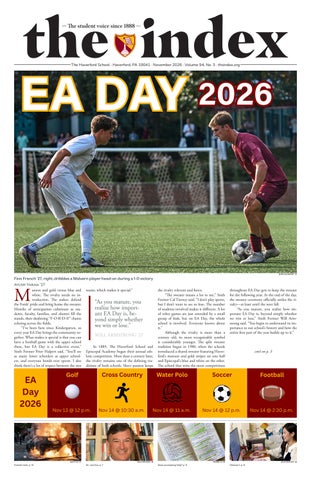
Finn French ’27, right, dribbles a Malvern player head-on during a 1-0 victory Ayush Varma ’27
M
aroon and gold versus blue and white. The rivalry needs no introduction. The stakes: defend the Fords’ pride and bring home the sweater. Months of anticipation culminate as students, faculty, families, and alumni fill the stands, their deafening “F-O-R-D-S!” chants echoing across the fields. “I’ve been here since Kindergarten, so every year EA Day brings the community together. What makes it special is that you can have a football game with the upper school there, but EA Day is a collective event,” Sixth Former Peter Halpert said. “You’ll see as many lower schoolers as upper schoolers, and everyone bonds over sports. I also think there’s a lot of respect between the two
teams, which makes it special.”
“As you mature, you realize how important EA Day is, beyond simply whether we win or lose.” WILL ARMSTRONG ’27 In 1889, The Haverford School and Episcopal Academy began their annual athletic competition. More than a century later, the rivalry remains one of the defining traditions of both schools. Sheer passion keeps
MATT LO ’27
French riots, p. 14
the rivalry relevant and fierce. “The sweater means a lot to me,” Sixth Former Cal Tierney said. “I don’t play sports, but I don’t want to see us lose. The number of students involved makes it different. A lot of other games are just attended by a small group of kids, but on EA Day, the whole school is involved. Everyone knows about it.” Although the rivalry is more than a century old, its most recognizable symbol is considerably younger. The split sweater tradition began in 1980, when the schools introduced a shared sweater featuring Haverford’s maroon and gold stripes on one half and Episcopal’s blue and white on the other. The school that wins the most competitions
ALEX FENTON ’28
Dr. Joe Cox, p. 7
throughout EA Day gets to keep the sweater for the following year. At the end of the day, the sweater ceremony officially settles the rivalry—at least until the next fall. “As you mature, you realize how important EA Day is, beyond simply whether we win or lose,” Sixth Former Will Armstrong said. “You begin to understand its importance to our school’s history and how the entire first part of the year builds up to it.”
con’t on p. 3
HANRU LI ’29
Does annotating help? p. 11
ALEX FENTON ’28
Chinese I, p. 8
the index · editorial
Page 2
the index 2026-2027 Staff Adam Brown ’27 Editor-in-Chief Matthew Lo ’27 Editor-in-Chief Ayush Varma ’27 Editor-in-Chief Brandyn Luong ’27 Senior Managing Editor Edward Cheung ’28 Managing Editor
November 2026
editorial
An EA Day of brotherhood, not rivalry
O
ur world is often marked by turbulent times. It can be easy to get swirled up in the tides of division and unrest amid midterm elections, ongoing wars, riots, and pressing news headlines. In our own community, EA Day marks further division between us at Haverford and our rivals at Episcopal Academy. Haverford has a history of passion. No one else can match our energy when we are
at our best—whether we are screaming our lungs out for our brothers from the football bleachers, the edge of the soccer pitch, the grassy sidelines of the golf and cross-country courses, or the concrete deck of the pool. The crazy haircuts we get are a testament to the dedication we have to each other. Competition is intense. The thrill of barely edging out a victory by one shot, goal, second, or point is exhilarating. The devas-
Will Komada ’28 Managing Editor Byron Yang ’28 Managing Editor Ben Qu ’28 Kent Foo ’28 News Editors Alex Fenton ’28 Ignacio Aliaga ’29 Features Editors Jayden Thomas ’27 Hanru Li ’29 Academics Editors Vikram Ponnuru ’29 Neighborhood Editor Alex Keuffel ’29 Campus Opinions Editor Andrew Yang ’28 Off-Campus Opinions Editor Sahil Manjeshwar ’28 Arts Editor Cody Luong ’29 Voices Editor Keith DiMarino ’27 Vijay Khanna ’28 Sports Editors Jesse Kanefsky ’29 Photography Editor Colt McDevitt ’28 Mason Choi ’29 Staff Writers Dr. Micah Del Rosario Mr. Thomas Stambaugh Faculty Advisors
The Index is a student-run publication of the Haverford School that does more than bring news: it provides the diverse perspectives of the Haverford student body. It is an outlet for student writers to take stands on issues they deem important. It chronicles the daily struggles and accomplishments of the Haverford community. The Index also provides a forum for discussion of pertinent issues, such as student culture, academic policy, and Haverford’s place in world affairs. The Index presents new ideas and aspires to influence constructive change. All opinions and viewpoints expressed herein do not necessarily reflect those of The Index or the school. The Index is designed and produced digitally. Photographs may be retouched. Submissions and letters to the editors regarding any and all articles are welcomed at index@haverford.org. The Index, a member of the Columbia Scholastic Press Association, is composed using the applications of Google Suite and Adobe Creative Cloud. Its surveys are conducted via Google Forms and are advertised on email to current Haverford students. Graphic designs are created by Index staff via Canva. Southern Dutchess News prints 200-400 copies of each issue, and its editorial staff distributes them in the Upper School on the day of release. The Index serves the needs of a total school population of 1152 community members, consisting of 952 students and 200 faculty and staff members. Contact The Index: 450 Lancaster Ave, Haverford, PA 19041 index@haverford.org Twitter: @Haverford_Index Instagram: @Haverford_Index Volume 94, No. 3 - November 12, 2026
INDEX STAFF
Editors-in-Chief for the 2026-2027 school year: (from left to right) Ayush Varma ’27, Adam Brown ’27, and Matthew Lo ’27
tation of watching our brothers put everything on the line without victory is crushing. Whether we have trumped our rival or just fallen short, the focus of our competition is our enemy. Haverford versus EA. Maroon and gold versus blue and white.
A win only counts if we are proud of how we acted. If we were honorable, honest, and kind. This divide should not bring about anger, hatred, or other negative emotions. Rather, we should treat it as an opportunity to focus on our own community. A win only counts if we are proud of how we acted. If we were honorable, honest, and kind. Though this day is named after our rival, our focus should not be on them. The true winners are the ones who can pick themselves up knowing they gave everything they had to give—win or lose. Make good decisions, treat others with respect, and above all, prioritize each other and our community. Go Fords.
Letter from the student body president Mac Brenan ’27
J
uly 27, 2026. The Philadelphia 76ers have just a 1% chance of winning the NBA championship, according to Kalshi. Unlike traditional sportsbooks, Kalshi operates as a prediction market: its odds reflect what people are willing to bet an outcome is worth, rather than some objective measure of a team’s potential. Just one week later, after acquiring fourtime NBA champion LeBron James and 2024 Finals MVP Jaylen Brown, the Sixers’ championship odds had climbed to 25%.
All they had done was make a change. It guaranteed nothing, but it changed what people believed was possible. They hadn’t won a single game. They hadn’t secured a favorable playoff seed or even held a practice together. All they had done was make a change. It guaranteed nothing, but it changed what people believed was possible. The same principle applies to you. People will always try to define your goals, your abilities, and your limits. But they don’t know what you have planned, what you’re capable of, or what you might change along the way. Fast-forward to today: the Sixers sit atop the Eastern Conference with an 9–2 record. No one knows how the season would have unfolded without those changes. No one knows what might have been possible if the team hadn’t decided to take a chance on becoming better. Others may not recognize your potential, but that doesn’t mean it isn’t there. You cannot control what people expect of you. You can control what you do next. Make the changes, put in the work, and give them a reason to believe.
INDEX STAFF
Student body president Mac Brenan ’27 welcomes the upper school to an assembly on September 14.
Page 3
the index · news
November 2026
news
EA Day 2026, cont. from front page Last year’s EA Day ended in disappointment for the Fords, as Episcopal reclaimed the coveted sweater for the first time since 2019. Haverford entered the final football matchup tied with EA at two wins apiece after hard-fought victories in water polo (6–5) and soccer (1–0 in overtime). That left the sweater hanging on the outcome of the afternoon’s football game. EA, however, pulled away with a 24–3 victory, securing the overall win and taking the sweater back to Newtown Square. Now, with a year of waiting behind them, the Fords come in strong. “This year, as a senior, I know a lot of the people playing important minutes in these games,” Armstrong said. “We have some really competitive sports teams, and I think we have a good shot at taking the sweater back.” “There’s a ton of buildup and hype,” Sixth Former Brayden Trexler said. “Alumni often come back, too. That’s what’s special about this place: people want to return and give back. It shows how much the community cares. At the end of the day, you need to know what we’re playing for. It’s bigger than yourself. You’re playing for the sweater.” Fords golf shared the PAISAA title. Fords Footy won the Inter-Ac. The Gridiron Fords have picked up several commanding wins: 39–19, 31–20, 42–7, 48–0, and 24–6. The last two came against Inter-Ac rivals Penn Charter and Germantown Academy, respectively. Fords cross-country is coming off of a strong Inter-Ac League Championships race. “It’s a highly competitive environment, with a lot of passion and emotion going into the games,” Trexler said. “It’s probably the most attended event of the year because it’s not just about the upper school. Lower schoolers, middle schoolers, alumni, parents, and everyone else knows how important the day is and tries to be there.” “I like that brotherhood the school always talks about and being able to spend time with people you don’t know very well, whether at a football game or a soccer game,” Third Former Connor Mullin said. “I think the energy is much greater than anything else.” For other teams, such as Fords water polo, this determines if they win the Inter-Ac League. “For me, the environments have always been really positive,” water polo captain and Sixth Former Thomas Springer said. “I enjoy having a big crowd, especially at Haverford when they’re right there. I’ve seen it bring out different emotions in different people. For some, it creates more pressure, but I’ve always seen it as a really cool atmosphere.” For some athletes, EA Day is the only time they get to compete in front of a large crowd. “It’s the only time anybody really watches us,” cross country captain and Sixth Former Lucas Crutchlow said. “It always makes it the most fun race of the year and the most exciting for us to compete in.” “The crowd is inconsistent because the
COMMUNICATIONS
Jose Hernandez ’28 pings a ball in last year’s 1-0 EA Day win A key part of maintaining a positive atstarts and finishes are the most electric parts of the entire season,” Fourth Former Naren mosphere is setting an example for younger Lee said. “When we’re running through the students. “I always remember the people I looked woods, it’s completely different. But seeing everyone as we finish, especially at the top of up to when I was younger,” Halpert said. “I think you should treat everyone the same and the hill, is a real motivator.” EA Day also draws spectators to sports be someone they can talk to. Whether it’s a lower schooler or a freshman, you should be that they might not typically watch. “I usually wouldn’t go to watch a a genuine person they can look up to. Treat cross-country or water polo match, but on them equally and be a good role model for this day in particular, I’d go to anything,” them. Be a brother to them.” For some Sixth Formers, recognizing Sixth Former Kevin Chan said. “It’s the biggest competition of the year, and I want to that influence shapes what they say and do. “I definitely looked up to the seniors support our Fords in any way I can.” when I was younger,” Sixth Former Christian Case said. “I thought they were grown “It’s about putting men. I want to be that person for the younger guys, too. I know I have more influence our guys ahead, but than I sometimes realize, so I have to be careit can also be about ful with what I do.” showing that we’re Others agree. better than them.” “It’s important to show them how to conduct themselves,” Springer said. “ComMAC BRENAN ’27 ing in as a freshman, the team is different, the way it plays is different, and the expecHowever, the intensity of EA Day can tations are much higher. It’s important to sometimes bring out a less admirable side show younger students how they should act of school spirit. At other athletic competi- during a game. Make sure they’re not yelling tions this year, student behavior has crossed a at the referees or losing their cool. In big moline, with some students banned from games ments, when things get heated, being able to and facing disciplinary consequences. With stay composed is a really good skill to have.” That said, loyalty to Haverford should the rivalry’s heightened stakes and packed crowds, a question arises: Can students sup- not have to come at the expense of sportsport the Fords competitively yet respectfully? manship. “It’s about putting our guys ahead, but “As much as it’s important to want to beat EA, because that’s the whole point of it can also be about showing that we’re better the day, it’s also important that we conduct than them,” Brenan said. “In a way, that puts ourselves in a way that doesn’t embarrass them down, but I don’t think it’s the worst ourselves or reinforce harmful and untrue thing to show our strength by beating them.” “It’s really all about sportsmanship,” stereotypes about our school,” Fifth Former Benno Goldstein said. “We need to main- Fifth Former Amir Brown said. “Just because tain the fiery brotherhood that we have here EA is the opposition doesn’t mean they’re necessarily your enemy. It’s important to recwhile doing that.” ognize that there’s more to the rivalry than To put a name to this idea: inclusivity. “It’s easy, especially as seniors, to say, just competing against another school.” EA Day traditions have not always ‘This is our EA Day. It’s our last one,’” Armstrong said. “But to maintain that sense of looked the way they do today. In the 1970s, school spirit, it’s important to include every- Episcopal students reportedly took the train from Merion Station before marching down one and rally the entire school.” “A big part of being there for the young- Lancaster Avenue toward Haverford. Haverer guys is remembering the seniors who ford students, meanwhile, organized car knew me,” Tierney said. “Instead of just tell- parades to Episcopal’s former campus along ing younger students that they have to come, City Line Avenue. The celebrations also feait’s important to actually build relationships tured pep rallies, bonfires, and even an old with them. You have to be loud and vocal, car brought to campus to be smashed. On letting everyone know that we’re a brother- one occasion, a plane flew overhead carrying hood and making sure everyone feels includ- a banner that read, “GO FORDS—BEAT EA.” ed.” The buzz-cut tradition, however, has be“Leadership is about reminding those students what it felt like to all be together, come increasingly controversial, with some and helping the new students understand questioning whether it crosses the line into that that’s what EA Day is all about,” Sixth hazing. “I’m telling everybody to get haircuts,” Former and Student Body President Mac Brenan said. “For the returning guys, every- Crutchlow said. “I’m trying to get every sinone remembers what the atmosphere was gle person on the cross-country team to get like last year. We didn’t win, but it was still one. I’m getting some pushback, but we’re the most together I’ve ever seen the school.” making progress.”
“If you don’t want to get a haircut, you can just not go to the places where people are getting them, and you’ll be fine,” Case said. “But I can totally understand how someone might not realize they’re being pressured into getting a haircut. I think that’s something we need to be careful about.” Students have been responsive to these concerns. “I think we’ve done a pretty good job as a school of staying away from hazing,” Springer said. “It’s about leading by example, not just shaving all the freshmen’s heads because they’re freshmen. It’s about making the choice to get a haircut to support your team.” One thing is for certain: EA Day has created lifelong memories for Haverford boys. “EA Day 2025 was the greatest game I’ve ever experienced in my life,” Brenan said. “I consider last year’s performance the best I’ve ever played in any sporting event, because no matter how tired I was, I still had infinite energy because of the guys in the stands. Hearing them chant my name and seeing them get excited when we did something tough kept me in the game. Even when I made a mistake, they were still there supporting me.” “It’s not just a high school event,” Third Former Alejandro Escobar said. “EA Day is for everybody, from lower schoolers to high schoolers.” In recent years, Spirit Week has added to the festivities with themed dress-down days and school-wide activities. This year’s themes are Quarter Zip vs. Nike Tech (Monday), Red, White, and Blue (Tuesday), Jersey/Sports Day (Wednesday), White Out (Thursday), and Maroon and Gold (Friday). Students who dress down must follow the daily theme or their form loses a point in the week’s competitions. “Even though all the teachers love to assign homework and projects that week, it’s still so much fun,” Case said. “We get to do random things, and everyone has ridiculous haircuts.” “Even my brother told me before I went to high school that Spirit Week would become my favorite part of the year,” Trexler said. The rivalry even extends to the alumni community. Through the annual Scramble for the Sweater, graduates from both schools compete to see which alumni network can achieve the higher participation rate in giving. In 2025, Haverford raised $25,019 from 212 supporters. This year’s competition is underway, with the final results to be determined on EA Day. “It’s all about service and the work we do surrounding EA Day,” Goldstein said. “As much as there’s a rivalry, there’s also a sense of camaraderie between the two schools.”
the index · news
Page 4
November 2026
Haverford’s unique school spirit JESSE KANEFSKY ’29
Haverford’s electric student section during the home football game against Malvern, October 24, 2026 Adam Brown ’27
A
thletics are a major part of Haverford’s community, and nothing is more representative of that than raw student engagement. Nearly every week, sporting events draw dozens, sometimes hundreds of students cheering on their peers. But at what point does cheering go too far? For many students, athletic school spirit is an important part of the school’s social environment. “The atmosphere is amazing. Especially being my last year, the atmosphere is electric,” Sixth Former Brayden Holland said. “The main bloodstream of school patriotism’s what riles up the student body,” Sixth Former Alex Scharpf said. However, student sections have not always been such a major part of the school’s athletic culture. Head of Upper School Mr. Mark Fifer said, “Around 2004, in the early days of my time at Haverford, and for the first ten to fifteen years, we certainly had EA Day. There certainly was school spirit. But there weren’t as many opportunities to showcase that spirit in a collective way… I can’t remember there being that large of a student section that created the dynamics that we’re talking about now with large crowds and maybe some behavior that moves beyond those boundaries.”
“Nowadays you have people saying ‘attendance will be taken. Freshmen, you’d better be there, we’ll be taking attendance.’” DANIEL KHAN ’27 Student fan sections have become a more visible part of the school’s athletic culture, especially compared with that of other schools. “I’ve been to a bunch of schools, and Haverford by far has the strongest school spirit,” Sixth Former Daniel Khan said. “But it comes with the caveat that sometimes we may or may not go a little too far.” Khan notes the expectations surrounding school spirit have become more demanding in recent years. “Beforehand, the upperclassmen would say ‘attend, show up, be there for your boys’ and whatnot, in a positive spirit,” he said. “Nowadays you have people saying ‘attendance will be taken. Freshmen, you’d better be there, we’ll be taking attendance,’ and stuff like that. It’s been getting a lot more cultish.” As student sections become more or-
ganized, the boundary between appropriate and offensive becomes hard to discern among administrators and students alike. Mr. Fifer said, “It’s all about lifting up our team, supporting our team, affirming our team. That is really what I think is most meaningful to those who are performing… When it becomes about the other team and bad-mouthing the other team or disrespecting the opponent is when it becomes unproductive.” Although some in-school experiences may foster feelings of self-superiority and disrespect for opposing teams, students recognize which behaviors are acceptable and which are not. Scharpf said, “In lower school [during the EA Day pep rallies] we had Coach Martin in average football gear and another coach in EA gear, dressed like a nerd. Oppose that to calling the opposing team too poor to go to Haverford or whatnot. There’s a certain level of decorum.” Respect is essential to maintaining a positive atmosphere at sporting events. Trouble comes when students try to push the overall atmosphere outside the confines of high school sports. Dean of Students Mr. Luqman Kolade notes how aspects of the college athletic atmosphere permeate Haverford and its students’ views on games. “I think the kids want it to be a college atmosphere,” Mr. Kolade said. “People are tailgating at some of these games, which is weird to me because it’s high school sports. This isn’t professional sports or college sports.” This mindset, when amplified by the perceived anonymity of the crowd, often leads to inappropriate statements toward both other teams as well as our own team, crudely echoing poor sportsmanship of bigleague sports. Mr. Kolade said, “I was having a conversation with one of the players on the football team. I said, ‘Apparently kids were chirping you,’ and he was like, ‘Oh, I guess I suck then, apparently.’ He said, ‘That’s ridiculous. No one would ever say that to me, though.’ The kids, our kids, who were chirping one of our football players would never go up to him and say that… I think that’s absolutely nuts. That’s the safety of the crowd.” The “safety of the crowd” plays a large role in how rapidly sporting behavior grows, and that safety becomes even more common in online spaces. The online home of the student fan section is where much of the encouragement around sports takes place; opinions amongst students are mixed. An anonymous student said, “I think the [student fan section group chat] is great. It’s amazing that you have such a big orga-
nization and a lot of people who are devoted to keeping it anonymous. It’s just a place where you can just shoot the bull; it’s like locker-room talk.”
“You get to be at the game; you don’t have to be at the game.” MR. LUQMAN KOLADE Other students expressed discomfort with the content shared in the group chat. “I left the [student fan section group chat] [in a previous] year,” an anonymous student said. “It’s not for me. Do I still participate in the games in the section? Yes, but I don’t [participate] in that group… I would say things have gone a little far when being in the [student fan section group chat].” Another anonymous student said, “The high command of the group chat needs to understand [that] you’re leading the next generation of Fords, [so] act appropriately, act accordingly.” Mr. Kolade feels that the aspect of anonymity present among both online spaces and within student sections negatively affects the atmosphere. He said, “I’m against the face coverings because if you cover your face, it gets very Lord of the Flies and people start doing things they wouldn’t normally do… There’s no reason to be covered. I think sometimes it’s kids pretending to be ‘tough,’ for lack of a better word, or some sort of image or persona they’re trying to portray.” Maintaining a positive atmosphere at games ultimately depends on students re-
specting players and opponents. School spirit can properly exist, but it depends on how well it is executed. Scharpf said, “I think ragging on other groups out of patriotic fervor is kind of an inherent part of patriotism in general. It just has a limit on what is expected and what is indecent.” It is up to students’ discretion not to cross the boundaries of disrespect. After all, attending games is not part of the required curriculum.
We should be grateful for our opportunity to participate and treat the players and the game with respect. “No one is entitled to be at the games. It is a privilege,” Mr. Kolade said. “You get to be at the game; you don’t have to be at the game. So if you can’t act within the boundaries of what Haverford says… then you don’t get to be there.”
COMMUNICATIONS
Fords fans light up the pool in last year’s EA Day water polo contest
the index · news
Page 5
November 2026
Students reflect on midterm elections
Ben Qu ’28
W
hen Sixth Former Daniel Khan turned 18, he went straight to Pennsylvania’s voter registration website. Two weeks later, he received a card with his polling place address. On November 3th, he voted in person. “It was a process that I initiated immediately on my own,” Khan said. For Sixth Former Ray Kresge, however, the election did not catch his attention until Election Day, when others around him were already voting. By then, Pennsylvania’s voter registration deadline had already passed. “I remember that day; a lot of people were talking about it. A lot of people were voting, and that’s kind of how I got interested in it and remembered it,” Kresge said.
“In a young person’s mind, I can see how prioritizing voting sometimes just doesn’t make it.” MS. HANNAH TURLISH Their experiences highlight different levels of awareness among Sixth Formers eligible to vote in this year’s midterm elections. Some deem this year’s election as a historic rout, as the Democrats have control of both the House and the Senate, flipping a Texas that has been red for decades. The election also raised questions about how prepared newly eligible students are to participate in the voting process. Although voters ages 18–29 shifted politically in this year’s election, they remained underrepresented relative to their share of eligible voters. According to The New York Times, voters under 30 account for approximately one-fifth of eligible voters but cast only about one-eighth of ballots. Meanwhile, voters ages 65 and older account for approximately one-quarter of eligible voters but cast about one-third of ballots. Khan said he noticed only two or three other people while waiting to vote. “I thought the midterms were a much
bigger deal,” Khan said. “I thought a lot of people cared about doing civic duty.” Upper school history teacher Ms. Hannah Turlish offered a possible explanation for why some young voters skip midterm elections, drawing on her own experience. “Once, when I was in college, I didn’t vote because you just feel like you’re busy,” Ms. Turlish said. “In a young person’s mind, I can see how prioritizing voting sometimes just doesn’t make it.” Beyond registration, some first-time voters may struggle to find information about elections that receive less attention than presidential races. “There’s not really one unified spot where they give you dates for every time you can vote. Outside of really big votes, it’s kind of hard for you to understand how to get more local votes that impact your community,” Khan said. According to The New York Times, voters ages 18–29 favored Democratic House candidates by 70% to 28%, compared with 53% to 44% in 2024. Ms. Turlish suggested that economic concerns may influence how young voters choose candidates.
“Inevitably, the Democrats will screw something up. The Republicans will win it back. The Republicans will screw something up. Democrats will win it back.” DANIEL KHAN ’27 “If the economy doesn’t improve, young people might swing back just as hard to the other direction,” Ms. Turlish said. History Department Chair Mr. Timothy Lengel said young voters have generally leaned more liberal in recent decades, raising the question of whether the 2024 election was an exception.
UKINUSA VIA WIKIMEDIA COMMONS
PA Governor Josh Shapiro ran for reelection on November 3rd Khan, who reported voting Republican, people say that, [and] all of a sudden you’re anticipated electoral losses for the party but short a million votes,” Khan said. was surprised by their extent. He still considMs. Turlish previously ran for a local ers himself a Republican, but his view of the township position, losing by just 67 votes president has changed. out of approximately 3,000 cast. She said “Trump has taken more and more steps she reminds her 15-year-old son that his [that] have made it sort of difficult for me to generation has a significant stake in future justify or defend,” Khan said. elections. Khan said he does not expect either par“You have the most at stake,” Ms. Turlty to maintain political power indefinitely. ish said. “These are laws that are going to im“Inevitably, the Democrats will screw pact you more than me.” something up. The Republicans will win it back. The Republicans will screw something up. Democrats will win it back,” Khan said. Khan suggested that Haverford dedicate a 30-minute period to helping eligible Sixth Formers understand how to register and where to vote. “We sort of leave them up to their own devices. I think it’s a bad thing,” Khan said. Kresge similarly suggested that the voting process can be easy to overlook without reminders.
“To give up the right to vote is self-defeating. People are going to make choices for you, and it’s sort of a rejection of the promise of this land.” MR. TIMOTHY LENGEL
PA STATE REP. VALERIE GAYDOS
Pennsylvania general election voting dates
Ms. Turlish and Mr. Lengel pointed to assemblies, classroom discussions, and assignments as ways the school encourages students to engage with politics. Still, Mr. Lengel puts emphasis on voters’ own responsibilities. Choosing not to vote, he said, means letting everyone else decide. “To give up the right to vote is self-defeating,” Mr. Lengel said. “People are going to make choices for you, and it’s sort of a rejection of the promise of this land.” This year gave a stark example to anyone who says that one vote doesn’t matter. On November 4th, Democrat Scott Colom led Mississippi Republican Senator incumbent Cindy Hyde-Smith by only sixty-five votes. Later, that gap had grown. “One vote doesn’t matter until a million
Page 6
the index · news
November 2026
MS. BROOKE KENNA
The Entrepreneurship Club on October 6th with McDevitt Company CEO Mr. Wade McDevitt (center)
CEO Mr. Wade McDevitt vists Entrepreneurship Club
Edward Cheung ’28
D
uring the A-Lunch period on October 6th, Room 209 hosted a special guest: Mr. Wade McDevitt, P ’30 and ’28, and CEO of The McDevitt Company—a global, full-service retail, client-representation, real estate, and site-selection advisory firm. Entrepreneurship Club leaders Ms. Brooke Kenna and Fifth Formers Christopher “Teddy” Weber and Grant MacColl organized the session. More than a dozen upper school students attended. During the session, Mr. McDevitt described his journey from a college student considering law school to the founder of an international real estate advisory firm.
“Part of the exercise was cold calling. The expectation was that for the first four hours every day, all you did was dial numbers.” MR. WADE MCDEVITT
When taking over, they invited three former Equivest employees to work for them—Mr. McDevitt was one of them. Mr. McDevitt would be approached by another company, Law and Associates, based in Seattle, that specialized in national client representation—a concept unheard of at the time—and they had seen what Mr. McDevitt had accomplished with Helmsley. They offered to collaborate with him, and Mr. McDevitt accepted. At the time, Mr. McDevitt primarily helped businesses find retail locations within specific regions. He believed that understanding a client’s needs would allow him to provide the same service in markets across the country. “You could move me, you could drop me in Chicago, give me some time to acclimate to the market,” Mr. McDevitt said. “I could do the same thing there and save you the lead time of going there and having to educate the next Wade McDevitt on what [your] requirement is and what [your] store should look like.” After getting approval to start his own division for client representation in Helmsley, Mr. McDevitt began building his client base, which included companies like Starbucks. Under his brokerage arrangement, Mr. McDevitt received 60% of his commissions while the firm retained 40%. As he grew more prominent and more successful, he began to wonder why he was paying out 40%. However, if he quit, he would get no guaranteed income. Mr. McDevitt spent more than a year considering whether to leave.
self.’” His departure marked the beginning of The McDevitt Company. Without the financial stability and support of an established firm, Mr. McDevitt had to secure clients independently. “I go back out to the oldest clients again and say, will you [work] with me? At that point the non-compete agreements had expired, and fortunately, a couple said yes,” Mr. McDevitt said.
“Earlier on, I didn’t have the resources to do all the research, to invest in the data and research for probably the health decisions. It was a leap of faith and guts.” MR. WADE MCDEVITT
The McDevitt Company began with an office in Philadelphia before expanding naDuring his senior year of college, Mr. tionally. McDevitt considered following his father “If I don’t do something quick, [my and grandfather into law. However, a conclients are going] to lose confidence in my versation with his then-girlfriend prompted ability to represent them nationally,” Mr. him to reconsider his career path. McDevitt said. “So I have to demonstrate “[She asked], ‘Why aren’t you going to my commitment to them. I then opened an business? Don’t you love business?’” Mr. Mcoffice in California. As we get bigger, I split Devitt said. “I started businesses in college; the country into thirds, and we spend quarI had a fascination with business. I read evters, and fifths, and so on, and now we have erything I could about it, and a light bulb offices across the U.S. Offices are in Philadelwent off.” phia; Connecticut; Mr. McDevitt subsequently interviewed Nashville, Tennessee; Houston, Texas; Eventually, Mr. at several banking firms. After a series of Dallas, Texas; and more.” McDevitt decided demanding interviews, Mr. McDevitt evenTo identify suitable locations for clients, to establish his own tually joined Equivest, a company with a The McDevitt Company relies on market substantial Philadelphia real estate portfolio. research and data analysis. The company anbusiness. The company’s real estate work interested alyzes market data to help clients determine Mr. McDevitt, although the position came where to open new locations. This research with challenges. “Two or three of my other friends had would help The McDevitt Company be“Part of the exercise was cold calling. The left the firm and kept saying, ‘When do you come reliable and eventually help them start https://drive.google.com/drive/folders/1LFP3i9HtlnO4ujbQLokpkT6QQYLvUeMO expectation was that for the first four hours leave?’ [and], I was like: tomorrow, tomor- their own real estate developments. every day, all you did was dial numbers,” Mr. row, tomorrow,” Mr. McDevitt said. “So I go, it’s time to put money where McDevitt said. “It [was] a grueling exercise Eventually, Mr. McDevitt decided to es- your mouth is,” Mr. McDevitt said. “You because you have to get accustomed to re- tablish his own business. helped other people make decisions about jection, because you’re interrupting [people] “I say, ‘John, I’m leaving the firm. real estate; start taking it for your own sake and disturbing their workday.” Thank you so much. I appreciate, you know, and invest in yourself ” Mr. McDevitt advanced at Equivest be- the support you gave me over the years, but Drawing on his experience researching fore the company was acquired by Helmsley. I’m gonna take my business and go do it my- real estate opportunities for clients, Mr. Mc-
Devitt began investing in properties himself, including shopping centers, retail spaces, and hotels. Today, The McDevitt Company operates tenant representation, landlord representation, and investment divisions. “I’d like to tell you when I started this, I knew that was a plan, but I didn’t have a clue,” Mr. McDevitt said. “I figured it out as I went along; it was completely just good fortune. [It was] many lucky relationships along the way, and hard work.” Following his presentation, students asked Mr. McDevitt about entrepreneurship, career decisions, and managing risk. “You said you didn’t want to take an office 9-to-5 job route when you were young. For people who are going into the next step of their lives [in and out of college] who want to do the same thing [you did], what do you think the first step to that would be? ” Weber asked. “Luck plays a big part in this game,” Mr. McDevitt responded. “You’re lucky [because you are at Haverford]…So you’re being provided all the tools to be successful… [That first step is] figuring out what you’re excelling at. Are you just good with people? Or naturally charismatic? You should enhance and capitalize on one…It’s also about being dependable. There’s no reason why you shouldn’t finish any task you take on.” “When you were in college [where you started your own businesses], [how do you think that helped] you later on on your own for real business?” Fifth Former Nicholas Deaver asked. “It [first] helped me identify that I liked being an entrepreneur. [Then it taught me] how to run a business, how to be responsible with cash flow, as well as managing people. So, the second you bring someone else into your circle, friend or otherwise, that adds a whole new dynamic to business…The mistakes I’ve made in business are mostly dealing with personnel… so the person who was the wrong person, but it was not identified [that] they were the wrong person soon enough.” “When opening new offices and such, how did you evaluate if the risks were worth taking?” Third Former Noah Wang asked. “Earlier on, I didn’t have the resources to do all the research, to invest in the data and research for probably the health decisions,” Mr. McDevitt said. “It was a leap of faith and guts.”
the index · features
Page 7
November 2026
features
Remembering Dr. Joe Cox: a legacy of leadership, service, and compassion
ALEX FENTON ’28
F
ormer Headmaster Dr. Joe Cox passed away on October 8th after a long fight with dementia. He worked at Haverford for fifteen years, serving as Haverford’s eighth headmaster and proving himself a dedicated Ford. Dr. Cox grew up in Massachusetts in a working-class family. During this time, his interest in poetry began to develop. Eventually, he served in the United States Army during the Vietnam War before getting promoted to Colonel. Once his three-decade army career ended, he chose to continue working despite the opportunities to retire, as he later became a tenured English professor at West Point. At Haverford, Dr. Cox dedicated himself to the renewal of the school’s campus. Over the course of fifteen years, he implemented the construction of a new athletic center, a new lower school, an expansion to the upper school, and finally an addition to Palmer House. These buildings have become pillars of everyday life for many students.
“[He got] everyone together in the winter…when the days were dark, [which] really helped the faculty come together.” MS. KAREN SUTER Dr. Cox did not only further Haverford’s master plan, but he also built genuine relationships with everyone across the school’s three divisions, both students and teachers. Head of Middle School Dr. Jay Greytok noted that Dr. Cox dedicated himself to becoming a friend to all on campus. “Dr. Cox knew everybody’s name, from the littlest kid to alums that had been part of the school for, you know, 50, 60 years… [He knew] the guys that are doing our grounds crew and our landscapers. He made a point to get to know everybody and help bring people together,” Dr. Greytok said. “He really wanted to take care of people.” Dr. Cox enjoyed writing letters to students, sending birthday cards to kindergarteners, and giving out “Cox coins” to exceptional boys. Not only was he a friend to each student, but he was also each student’s greatest advocate. Head of School Mr. Tyler Casertano believed that his dedication to convincing each boy that they belonged at Haverford remains one of his greatest strengths. He recalled the story of a struggling student who considered quitting Haverford and how Dr. Cox led him to stay. “Dr. Cox found him and told him that not only did he believe in that boy’s ability to be successful, but that he was going to meet with him every day in his office to check in to make sure that he had done the things that day that he needed to do… to allow him to regain his confidence,” Mr. Casertano said. Dr. Cox also established a close relationship with faculty. Middle School English Teacher Ms. Karen Suter recalls being invited to multiple faculty dinners at Dr. Cox’s home and enjoying food with colleagues from all divisions. “[He got] everyone together in the winter…when the days were dark, [which] really helped the faculty come together,” Ms. Suter said.
ALEX FENTON ’28
The Haverford School’s Eighth Head of School, Dr. Joseph T. Cox Middle school history teacher Mr. John way because of the life that he had led, both Suter also bonded with Dr. Cox by sharing in the military and also as a poet and an educator,” Mr. Casertano said. stories about their service. Arguably Dr. Cox’s most significant im“He proudly served and had a lot of awards and was very proud of his accom- pact on student life is the implementation of the Honor Code. Inspired by the code of plishments,” Mr. Suter said. Dr. Cox’s military background was par- conduct that he committed to as a soldier ticularly notable. The colonel exemplified and professor, Dr. Cox was able to agree with qualities like leadership and also showed a the student body on an Honor Code to be vulnerable side. Mr. Casertano stated that followed dutifully. None of this is to say that Dr. Cox’s time this is one of the qualities that he admires most about how Dr. Cox ran the school and as headmaster was without hardships. Notably, at the start of his tenure, a dip in the one that he tries to emulate. perception of boys’ schools hurt Haverford enrollment rates. Dr. Cox’s passion for boys’ “I think that Dr. Cox education would not let the school fade away, was able to represent however. He furthered involvement with the International Boys School Coalition, later service, leadership, hosting more than 200 schools from across intellectualism, senthe world in 2010. He also supported consitivity, and toughsulting school psychologist Dr. Michael ness.” Reichert’s research program Center for Studio Boys and Girls’ Lives, which researches MR. TYLER CASERTANO gender in education. Combined with local campaigning that urged the benefits of an “He was not afraid to be vulnerable, and all-boys education, Dr. Cox was able to grow I think he furthered a culture here in Haver- the school’s numbers. Dr. Cox retired from his position in ford of vulnerability and authenticity. He made it okay to cry. He made it okay to be 2013, yet his impact on Haverford is still scared. He made it okay to be caring,” Mr. readily apparent. For one, the Joseph T. Cox Leadership Scholarship Fund, established afCasertano said. Mr. Casertano also admired how Dr. ter his departure, continues to provide necesCox exemplified what it means to be a mul- sary scholarships to those with demonstrated tifaceted member of the Haverford commu- financial needs. More apparent, however, is the Joseph T. Cox Servant Leadership Symnity. “I think that Dr. Cox was able to repre- posium, a program that has brought former sent service, leadership, intellectualism, sen- NFL players, authors, and documentary prositivity, and toughness through his unique ducers to Haverford and provides students combination of scholarship and military with a new perspective on how others live service. He was able to do it in an authentic their lives in the hopes of making them more
thoughtful global citizens. Beyond this, Dr. Cox’s legacy continues to affect those at Haverford and those who have left. Notably, former English teacher Dr. W. D. Ehrhart reflected upon his long relationship in his piece “A Most Unusual Man: Joseph T. Cox, 1946-2026” in Merion West, a publication run by Haverford alumni. Dr. Ehrhart described the effect Dr. Cox had on both the diversity of students and how they acted. “Joe was a ranger, a paratrooper, and a war veteran, but he wrote poetry, hugged other men unabashedly, and wept in public sometimes,” Dr. Ehrhart wrote. “He made it safe for a football player or a wrestler to be up on stage in the spring musical singing and dancing or to enter a painting in the student art show.”
Dr. Joe Cox was a remarkable man with an equally remarkable impact on those around him. Ultimately, Dr. Joe Cox was a remarkable man with an equally remarkable impact on those around him. In his fifteen years of service to our school, Dr Cox showed that students can be leaders while still being vulnerable. He created an environment where students hold each other to high standards while still feeling supported. To celebrate the life of Dr. Joe Cox, the school will host a memorial service on Monday, November 16th, at 2 p.m. in Centennial Hall.
the index · features
Page 8
November 2026
Mrs. Kara Cleffi, cornerstone of the science program
Brandyn Luong ’27
M
ost students who enter the firstfloor biology lab pass a small office without giving it much thought. The room is lined with laboratory equipment on counters and cabinets, including an autoclave, several incubators and thermocyclers, alongside rows of micropipettes. In the far right corner, a door leads to a small office. Inside is usually biology teacher Mrs. Kara Cleffi, who, when not teaching Biology I* or one of her two senior electives, works just steps away from the equipment used in her molecular biotechnology course. Over the past 15 years, Mrs. Cleffi has worked with other members of the science department to develop the laboratory resources necessary for students to conduct biological experiments. The department has gradually expanded its capacity to accommodate more students working in the lab at once. “The ability for us to have a full 16 kids working on this kind of lab at one time has required us to slowly build up,” Mrs. Cleffi said. When Mrs. Cleffi first took over the molecular biotechnology course, the existing molecular biology class was not particularly lab-based. With a master’s degree in cell
and molecular biology and graduate research experience studying DNA repair, Mrs. Cleffi saw an opportunity to incorporate more of her background into the classroom.
“I wanted to get more molecular biology and biotechnology in the senior electives.” MRS. KARA CLEFFI “I wanted to get more molecular biology and biotechnology in the senior electives,” Mrs. Cleffi said. “When I took it over, I made it more of a biotechnology course and really said, ‘This is going to be a lab-based course.’” The spring semester course begins with students studying developments in biotechnology, including mRNA and CRISPR technologies. They research products developed by leading biotechnology companies, examining how those products function and how they were discovered. As the field continues to change, students and Mrs. Cleffi must keep up with new developments.
“Every year, we start by doing research on what is the latest going on in biotechnology,” Mrs. Cleffi said. “So I’m constantly learning new things every year, as well as doing it alongside students.” The course then moves from studying other researchers’ work to conducting an experiment of their own. Each student applies the concepts they have studied by carrying out a multi-step genetic research project. “The second half of the class is spent sequencing a gene—actually going through the process of isolating a gene from a plant organism of their choice and going through the entire process of sequencing that gene,” Mrs. Cleffi said. Making that kind of work possible in a high school classroom requires equipment that students might not otherwise encounter in their biology courses. The laboratory’s autoclave sterilizes laboratory materials; the multiple incubators and thermocyclers are used in polymerase chain reaction (PCR) to amplify DNA. Even the micropipettes cost hundreds of dollars each, making their handling an important part of keeping the lab operational.
“I keep a list of all the possible summer science activities and extracurricular things that students can do, and I help them apply to those things as well.” MRS. KARA CLEFFI
ALEK DELEO ’28
Mrs. Kara Cleffi in the honors biology classroom
“We have to calibrate them, but also, we have to ensure students are taking care of them and using them properly,” Mrs. Cleffi said. Mrs. Cleffi’s work with students also extends beyond the school laboratory. Through the Advanced Laboratory Research Cooperative (ALRC), Mrs. Cleffi helps students find research opportunities at external laborato-
ries, prepare resumes, and apply for internships. Her guidance also extends to students exploring other ways to spend the summer pursuing their interests in science. “I keep a list of all the possible summer science activities and extracurricular things that students can do, and I help them apply to those things as well,” Mrs. Cleffi said. For students seeking course credit through ALRC, the summer experience has to involve more than exposure to laboratory techniques. Students must complete at least six weeks of research and contribute to an ongoing project. Mrs. Cleffi emphasizes the distinction between learning how to work in a lab and actually participating in research. “You have to be working on an actual project with someone. You can’t just be learning different lab techniques, but have to actually be part of a research project that you can write up,” Mrs. Cleffi said. The work continues into the fall, when Sixth Formers take a one-semester seminar to analyze their data and prepare to share their findings. The course culminates in the Science Research Symposium, where students present to classmates, faculty, families, and visiting scientists. Because students are balancing their research with other coursework, the program offers flexibility in how they meet with Mrs. Cleffi. “We set it up like an independent study, so it doesn’t have to be scheduled,” Mrs. Cleffi said. “All I make sure of is that you and I share a free period.” The science department aims to offer honors courses across its major disciplines, including at least two in biology, though additional electives depend on student interest. Mrs. Cleffi welcomes the opportunity to expand the biology offerings. “I would love to offer more biology senior electives,” she said. The thermocyclers, incubators, and micropipettes remain on the counters of Haverford’s biology lab, ready for the next group of students. Just a few steps away, Mrs. Cleffi returns to her computer, continuing to create opportunities for students to explore scientific research of their own.
A class of one: Chinese I offers a unique learning experience Alex Fenton ’28
A
t 8:30, only one student sits at a gray desk in front of the board as Chinese Teacher Ms. Yi Lee begins teaching the countries of the world in Chinese. He has no classmates to accompany him. This year, Chinese I has only one student: Third Former Raphael Sommer. He decided to switch from Spanish to Chinese, an uncommon transition, unaware that his decision would leave him as the class’s only student. “There’s 118 people [in my grade], so I was astonished that there’s only going to be one person in Chinese I,” Sommer said. Learning a language without classmates presents unique challenges. “A one-student class cannot offer the same variety of conversation partners or group dynamics. I serve as his conversation partner and adapt games and role-plays, but speaking with a teacher is different from speaking with a classmate,” Ms. Lee said. Despite this, Ms. Lee argues that the one-person class still provides many benefits. She is able to catch mistakes in writing and speech and correct them before they become entrenched habits. In a larger class, it is harder to assist every confused student,
and small errors can slip through and begin to snowball. Because Ms. Lee already has an established curriculum for Chinese I, she can adapt it to Sommer’s needs. “The learning goals remain the same, but the way we practice changes. For example, I might become his speaking partner for conversation, and [do] less whiteboard activity,” Ms. Lee said.
“I really do love Chinese—learning the characters, the intricate designs of the characters, the patterns.” RAPHAEL SOMMER ’30 As for the student perspective, Sommer believes this one-person class is beneficial for his learning. He argues that large class sizes are distracting and do not let him learn efficiently. So far, he appreciates Ms. Lee helping him start this new language and her dedication to helping him discover a new
INDEX STAFF
Chinese teacher Ms. Yi Lee working at her desk passion. nese II, not Chinese I. This leaves only those “I really do love Chinese—learning the who are switching languages, are new to the characters, the intricate designs of the char- school, or are adding a second language eliacters, the patterns,” Sommer said. gible to take the class. While some years have But why does the school allow for such had more than fifteen students in the class, small classes? For starters, the size of Chi- the majority of Chinese I classes have had nese I classes has been known to fluctuate. around seven people. Most students who take a language course “[Raphael’s] preparation and effort have in middle school continue it in high school, allowed us to move through the material while those taking Chinese move to Chi- faster than in previous years,” Ms. Lee said.
the index · features
Page 9
November 2026
Mr. Michael Burr brings fresh ideas to the dining hall
Vikram Ponnuru ’29
S
tudents who have walked into the dining hall this year have likely noticed a change: lunch has grown noticeably more engaging. Much of this change can be attributed to Director of Dining Mr. Michael Burr. Mr. Burr has been at Haverford for nearly a year. Before that, he spent approximately ten years at JPMorgan Chase in Wilmington, Delaware, where he oversaw food service operations for a campus of around 3,000 people. Although he greatly valued his work there, he sought a new opportunity and hoped to remain in food service with a Monday-through-Friday schedule, something that is difficult to find in an industry that often requires nights, weekends, and holidays. Raised in Delaware County, he was already familiar with the area.
“I jumped on [the position] right away, and then fell in love with it.” MR. MICHAEL BURR “I jumped on [the position] right away,” Mr. Burr said. “And then fell in love with it.” Mr. Burr joined in the middle of last school year, so he did not immediately make significant changes. He spent his first couple
of months observing how the kitchen operated, speaking with faculty members, and listening to students. Then, he started making some changes. First, he reduced the number of times chicken thighs were served. Second, he re-organized the kitchen. Mr. Burr’s surveys guide recent changes. One survey was sent out last spring, and the most recent one opened at the end of October and will stay open through December. Mr. Burr said some responses are blunt or appear to be written out of frustration, so he pays more attention to the thoughtful and detailed ones. Everything gets reviewed by his marketing and leadership team, who look for patterns, such as dishes that people consistently report are too salty. He doesn’t react right away. He takes time to consider the feedback and then builds a plan around what keeps coming up. Then there’s the “fun” part. Mr. Burr aims to host one themed day each month, and he does not announce them ahead of time. “We really want people to come in and experience it,” Mr. Burr said. Halloween was the most recent themed day, and Mr. Burr commented that plans for the upcoming holidays had not been finalized yet, since the dining team had to work around the school calendar. Mr. Burr is also thinking about introducing a Dr. Seuss Day, which, of course, would consist of green eggs and ham.
INDEX STAFF
Mr. Michael Burr, Director of Dining Feeding the entire school is even harder than it sounds. The dining hall staff serve students from first grade through senior year, plus over 100 faculty and staff every single day. Mr. Burr explained that a tater tot bowl could go well with younger students, while other dishes tend to be more appealing to upperclassmen. The peak performance station, with a grain or rice base and a simple protein like grilled chicken breast or ground
turkey, is popular among students. His own favorite is teriyaki chicken with broccoli and rice, which he says is one of the most popular things students order. Additionally, if something isn’t available, Mr. Burr makes sure to find another way to provide students with quality food. “I never want to say, ‘No, you can’t have that,’” Mr. Burr said.
Tesla: a new road ahead
Ignacio Aliaga ’29
T
esla is a dominant force in the automotive industry today. However, before it became a widely respected brand, Tesla was a niche startup attempting to change the dynamic of the automotive industry forever. In the early 2000s, the concept of an electric car was widely overlooked. Electric vehicles were viewed as having short ranges, tedious charging times, and poor performance in comparison to their gasoline-powered counterparts. Tesla and Elon Musk didn’t succumb to these challenges or social pushback. While Musk’s co-founders, who eventually left the company during the 2008 financial crisis, proposed basic prototypes, Musk encouraged a more innovative design. This led to the release of the Tesla Roadster in 2008. It was a small, two-seat vehicle with a performance-driven focus. It shocked the industry, but as the first of its kind, it had some
mechanical issues, and Tesla charged a hefty price for the sub-four-second 0-60 mph acceleration time. Ultimately, it did pave the way for the newer models’ success.
“I like how smooth Teslas ride on the road, and with the battery costing so much less, it is the perfect everyday car.” THEO YOUNG ’29 Following the Tesla Roadster, Musk set his sights on the mainstream or “commuter” automotive sector. First came the Tesla Model S in 2012. Although luxurious and fast, it was still a four-door sedan with a different
DANIEL TOROK, WHITE HOUSE VIA WIKIMEDIA COMMONS
United States President Donald J. Trump presents a National Medal of Science to Elon Musk in Washington, D.C., Thursday, October 8, 2026
focus from its predecessor. However, Tesla’s rise on the streets came with the Model 3’s release in 2017. With more convenience, a bigger screen, a smoother ride, and a much lower price point, the Tesla Model 3 was the perfect mid-luxury commuter. “I like how smooth Teslas ride on the road, and with the battery costing so much less, it is the perfect everyday car,” Fourth Former Theo Young said. Consumers were similarly surprised by the feel and technology, including the promised Full Self-Driving (FSD). 325,000 pre-orders were placed within the first week of its release. Many Haverford students have had their own experiences with Tesla’s safety technology. “One time, I was merging into a lane, and a car was in my blind spot; not only did it notify me, but it took complete control and redirected me back into my lane,” Fourth Former David Falcone said. “I am a student driver, and knowing that my car can do that gives me confidence.” Falcone experienced this in a Model Y, Tesla’s best-seller, which accounts for 37.2% of the electric vehicle market. Part of the reason it sells so well is that this technology comes at no additional cost. “Safety, especially, is paramount for us,” Musk once said. “The absolute primary thing is to maximize the safety of the car.” Full Self-Driving (FSD) costs an extra $99 per month, allowing the car to drive itself anywhere with no limitations. The only issue owners have expressed concerns the constant supervision required when using the FSD mode, as a camera watches the driver’s eyes to make sure they are attentive to the road. Some say it defeats the purpose of self-driving, because people want to be watching a movie or sending emails while they get driven to their destination. Musk’s ambitions to forever revolutionize the transportation industry didn’t come without pushback. Full Self-Driving passed all tests, but Musk and Tesla have constantly been under fire on this topic. There have been many legal disputes, notably a federal
investigation into Tesla’s violation of traffic laws. Although controversial, FSD has been a success and is an enticing feature for many buyers. Today, Musk focuses on continuing to break barriers in the automotive industry. The viral 2023 release of the Cybertruck was highly controversial, appearing straight out of a sci-fi film. Although it was a financial flop, it was once again that “weird guy” producing “weird things,” but that is innovation, and that is how the company started in the first place.
“The Tesla Roadster is just propaganda; I can’t imagine somebody paying that much for features you won’t use.” HANRU LI ’29 In a partnership with SpaceX, Tesla has now released its latest Tesla Roadster. Utilizing cold-gas rocket thrusters, it accelerates from 0 to 60 mph in around 0.81 seconds and can theoretically fly for a short amount of time. In addition, it can drive and park on the roof or walls due to its fan-powered vacuum system. “The Tesla Roadster is just propaganda; I can’t imagine somebody paying that much for features you won’t use,” Fourth Former Hanru Li said. Now, Tesla and Musk keep seeking new sectors of the transportation industry as they’re working on the new fully autonomous robo-taxis. A network has already been established in 15 major U.S. cities. Tesla has begun testing in Philadelphia and surrounding areas, offering a safer and cheaper alternative to Uber and Lyft for Haverford students. Although Elon Musk may be an unconventional man who is politically controversial, he has changed the world once. Who is to say he won’t do it again?
the index · features
Page 10
November 2026
Hugh Williams’ short film endeavor
Ben Qu ’28
T
he man checks the door. He checks it again. And then again. This repeated action is at the center of Iterum, a three-minute psychological thriller that Sixth Former Hugh Williams wrote, directed, filmed, and produced this summer. The film follows a man with obsessive-compulsive disorder (OCD), with its title coming from the Latin word Iterum, meaning “again.” Williams has submitted the film to several festivals, including the Sundance Film Festival. Williams said he had always been interested in filmmaking. He was inspired after watching Obsession, the horror film, directed by Curry Barker, that gained widespread attention this summer. Barker began by making videos on YouTube before moving into feature filmmaking “It was just so cool to me that an indie filmmaker, this guy who just posts comedy videos on YouTube, could become a global superstar director,” Williams said. “I was just
like, ‘I’m gonna give it a shot.’” Williams began the project by writing his first screenplay.
“I had never done anything with a camera before in my life.” HUGH WILLIAMS ’27 “I had never done anything with a camera before in my life,” Williams said. “I think the coolest thing about the project was that I learned how to do everything that goes into filmmaking as I made the film.” Williams had experimented with color grading photos and videos of nature, inspired by edits he saw on Instagram. He began editing the film in Adobe Premiere Pro before switching to DaVinci Resolve for color grading. He also composed the film’s
soundtrack using GarageBand. “It isn’t the best film by any means. I was learning how to do it, but I think I put a lot of work into the color grading specifically, and I’m really happy with that,” Williams said. “It takes an enormous amount of time to make a film that’s an hour and a half long. For my first [film], I just wanted to show myself that I could do it,” Williams said. To study filmmaking techniques, Williams spent part of the summer watching films from Letterboxd’s list of the 300 greatest films. Williams also credited his father, who studied English and film in college and has written several books, with teaching him the importance of storytelling. “I wanted to learn how to tell a story better,” Williams said. The film stars Haverford alumnus Philip Okala ’26, who now attends Amherst College. Okala said the idea for the project emerged after he, Williams, and several
friends watched Obsession together. “It was sort of whoever was available,” Okala said. Okala said one of his biggest challenges was portraying the character’s movements and behavior. “A lot of it isn’t able to come to life as well if you’re not fully calm and confident in yourself to deliver the subtle movements of a character with OCD,” Okala said. Okala’s favorite shot occurs when the character walks into the kitchen after repeatedly locking the door and looks toward the camera through a mirror. Okala said the scene reminded him most of Obsession. Okala said the film also explores the character’s relationship with a doctor whose actions affect his life at home. After reviewing footage from the first day of shooting, Williams brought the actors back to reshoot scenes and incorporated suggestions from the cast and crew. “That was a great way to see what we have, analyze it, assess it, see where we need to go from there, and rinse and repeat until we’re done,” Okala said. Okala had acting experience before Iterum and plans to continue acting.
“I think the entire character was a challenge, and that’s why I liked it so much.” PHILIP OKALA ’26
HUGH WILLIAMS ’27
“This time I’m taking the exact same scene over and over again until we have one line of film that’s the best above all others,” Williams said. “I think the entire character was a challenge, and that’s why I liked it so much,” Okala said. Williams plans to release Iterum publicly after receiving decisions from the film festivals to which he submitted it.
Haverford alumnus Philip Okala ’26 starred in Hugh Williams ’27’s short film Iterum this summer
The ensemble of non-theater theater kids
Ibby Kanchwala ’30
F
or Sixth Former Finn French, the highlight of his theater experience hasn’t been a monologue or a bow in front of the audience. It’s been a boat. In this fall’s production of Moby Dick, French and his classmates pull their oars in unison as they row out to attack the famous white whale, Moby Dick. “Watching everything come together with the whole cast has been really fun,” French said. “This was a new experience I wanted to try before I left Haverford.” French, a Duke men’s lacrosse commit, is far from the only athlete to make that choice. Over the past several years, the school’s performing arts program has drawn a growing number of students who previously never thought of themselves as theater kids: athletes, team captains, and mainly Sixth Formers looking for one last experience before graduation. The shift took off after the pandemic and picked up speed once the program opened its ensemble to newcomers. Ever since, there has been a growing number of participants from all corners of the community. Performing Arts Department Chair Mr. Darren Hengst remembers when cast lists were much shorter. Pre-pandemic, the shows were filled with students who took the classes and already loved theatre. Then came Something Rotten! After a preview of the musical, “students were very excited,” Mr. Hengst said. “People wanted to try it.”
The real inflection point was Les Misérables. Mr. Hengst changed the casting process, opening ensemble roles to students who wanted to be part of the show without taking on a principal role. That cast included more athletes than any previous production, including 11 sports captains. “It opened access and interest,” Mr. Hengst said. “It’s snowballed since then.” For athletes, the jump from the field to the stage is more manageable than it looks, since teamwork and discipline carry over.
“There’s been an influx of kids doing theater. It’s been very positive.” ALEX SCHARPF ’27 “People from sports are very coachable,” Mr. Hengst said. French felt that crossover right away. “Being on the lacrosse team taught me how to take coaching and work with a group, and that carried right over into rehearsals,” French said. That does not mean his first rehearsal was easy. “I was definitely nervous, because the shows I’d watched were so good and I wasn’t sure I could perform at that level,” French said. However, French didn’t make the jump
alone. “A lot of kids on the lacrosse team have tried the play this year,” said French. “It has been fun to attack this new challenge as a group. Instead of competing against an opponent, we’re all working toward one performance for an audience.” Sixth Former Alex Scharpf has watched the change from the inside. Scharpf fell in love with theater in third grade, when he saw the upper school’s production of West Side Story. This year marks his sixth year participating in Ford’s Theater. “There’s been an influx of kids doing theater,” Scharpf said. “It’s been very positive.” What surprised him most was how seriously newcomers approached the work. “Their fervor has carried over,” Scharpf said. “They take it very seriously.” It hasn’t always been smooth. “It’s different with every group,” Mr. Hengst said, recalling an instance where a group of new performers trashed the dressing room before a Sunday matinee. On the whole, though, new participants have made the program stronger. “There’s just more support overall,” Mr. Hengst said, pointing to fuller casts and a steady stream of new faces. They have also changed the program’s reputation, making performing arts more accepted than it used to be. “There’s definitely more weight behind it,” Scharpf said. Hence, Mr. Hengst wants newcomers to
know what they are signing up for. “[Theater is] one of the most collaborative arts out there,” Mr. Hengst said. “It’s no joke.” If newcomers share one regret, it’s timing. “I do wish I’d tried it earlier,” French said. “It turned out to be such a great experience, and I’d like to have more time to do it.” Mr. Hengst hears that often. “Seniors who give theater a shot end up actually loving it,” he said. This is exactly why he hopes more students will try it before their final year.
“It pushes you out of your comfort zone, and you’ll probably have more fun than you expect.” FINN FRENCH ’27 French’s advice to younger athletes is simple. “Go for it, even if you’re nervous,” he said. “It pushes you out of your comfort zone, and you’ll probably have more fun than you expect.” For anyone unsure whether they belong on stage, Scharpf has a reminder of what theater really is. “At its core, it’s playing… It’s a space to enjoy yourself and be something you normally couldn’t. You don’t need to be a professional actor.”
the index · academics
Page 11
November 2026
academics Midyear exams return
Hanru Li ’29
A
fter a six-year hiatus, the upper school is reintroducing a designated exam period at the end of the first semester. The change aims to provide students with more structured time to prepare for cumulative assessments while establishing greater consistency across academic departments. According to Head of Upper School Mr. Mark Fifer, the decision was motivated by the growing difficulty of balancing unofficial end of semester assessments and regular coursework. Previously, many teachers administered midterms within the regular academic schedule, leading to situations where students would be forced to take multiple tests in the same day or prepare for major exams while doing regular coursework. “We wanted to draw some clearer lines for students,” Mr. Fifer said. Students had been attempting to navigate semester assessments alongside their usual academic responsibilities. Feedback from both students and teachers highlighting the pressure this caused contributed to the administration’s decision to restore a designated exam period. The return of midterms also reflects an effort to align the two semesters. With finals already taking place at the end of the second semester, the administration saw an opportunity to establish a more consistent structure throughout the school year. Mr. Fifer also emphasized the identity of Haverford as a preparatory school for college, where exams like midterms remain common. However, the decision was not made without its drawbacks. Allocating dedicated days for midterm examinations means sacrificing class time. Mr. Fifer noted that teachers could potentially lose two or three class meetings during the designated period. The timing of the examinations presented another challenge. Rather than scheduling them before winter break, the administration opted to place them after students returned, citing that the midterms should
INDEX STAFF
Mrs. Kara Cleffi prepares to teach her honors Biology I class cover the full scope of the semester. To avoid to remember.” the pressure of students studying during Science classes present a different set winter break, two weeks provide a buffer of considerations. Different science courses period between returning from winter break combine a unique ratio of conceptual underand the first midterms. standing, mathematical skills, and laboratoAcross academic departments, the re- ry work, making a single examination format turn of midterms presents different opportu- less appropriate across every class. nities and challenges. Science Department Chair Dr. Daniel In math, where concepts build upon Goduti explained that assessments will vary one another throughout the semester, cumu- depending on the course. Standard and honlative exams are a natural part of the curric- ors courses for younger students will follow ulum. Math teacher Mr. Matt Ator, having generally aligned formats, while electives will taught calculus since 2019, administered offer greater flexibility. Some electives may midterms from 2020 to 2025 without a des- use projects, laboratory experiments, or writignated period. ten reports rather than traditional examinaMr. Ator believes the new system could tions. reinforce the importance of remembering Dr. Goduti also emphasized the cumumaterial throughout the semester. He re- lative nature of science exams, noting that called a moment in class when a concept in- students must connect concepts introduced troduced during a lesson became a midterm at different stages of the semester. While question. some students may be comfortable making The possibility of seeing earlier materi- these connections, others may find it more al again on a higher profile exam serves as a challenging. reminder that material learned in September Beyond a stressful measure of acacan still be relevant in January. While grades demic performance, Dr. Goduti hopes that should not be students’ only motivation, Mr. midterms will give students and teachers a Ator believes that midterms can pressure stu- chance to reflect on their progress. dents to “not just memorize, but find a way “I hope that students see it as a really
good opportunity to celebrate and show what they’ve learned,” Dr. Goduti said. He also hopes that students will view examinations as opportunities for growth rather than a definitive judgment of their performance in the classroom. More flexible than a final, midterms provide the opportunity for a student to improve in the following semester. Ultimately, the administration plans to evaluate the new system through student and faculty feedback as well as exam performance data. The success of the return of midterms depends heavily on how well the students and teachers are able to adapt to them. For students, the change could mean a greater emphasis on retaining information throughout a semester rather than exclusively preparing for individual assignments or tests. Whether you love them or hate them, midterms will once again become part of the academic calendar. As the school year moves forward, the question Haverford is asking is not simply whether students will perform well in January, but if the addition of more standardized testing encourages deeper and more comprehensive learning.
Is annotating worth it?
Steve Xie ’29
U
nderlining, highlighting, taking notes in the margins—we’ve all been there. Whether it be for English, history, or science classes, annotations have become a staple of upper school academics. This practice is not unique to Haverford. In fact, annotations have been around for thousands of years, with scholars of all kinds annotating in an effort to understand the world around them. Despite the history, some students tend to brush off annotations, whether it be for
a lack of time or personal preference. These students tend to believe that annotating interrupts their reading and creates distractions on the page. All of these factors culminate in the question: are annotations actually beneficial to us as students, or are they just another obligation? Fourth Former Eric Xiao is a firm supporter of annotations in his education. “Annotating helps me keep track of things and allows me to write important notes to myself when I need to review them
INDEX STAFF
A Sixth’s Former’s Hamlet annotations
later,” Xiao said. “It helps me with long-term recall of information and forces me to understand what I’m reading instead of subconsciously skimming over the text.” The science backs this up. In a 2022 study published in The Journal of Research in Innovative Teaching and Learning, students who annotated received test scores 7.9% higher than students who didn’t. While annotating is traditionally associated with humanities such as English or history, Xiao also believes that annotating is valuable in other classes. “In chemistry class, annotating allows me to keep track of important values and details, allowing me to organize my thoughts while performing multi-step problems and experiments. I use a variety of symbols such as boxing and circling to differentiate types of information,” Xiao said. In a study by the Springer Nature Link, researchers found that while annotating consistently improves memory of a certain subject, the actual effects of annotation on the readers’ comprehension were minimal. While remembering information is important, understanding deeper meanings and themes of a text is essential both for assessment performance and long-term retention. Additionally, the study found a significantly smaller benefit among K-12 students compared to college students.
The idea of “active reading” also changes perspectives around annotations. Many scholars, including Mortimer Adler and Tung-Tien Sun, believe that reading and annotating require a level of questioning. Specifically, Sun defines active reading as “reading with specific questions in mind and searching for answers.” This shows that annotations by themselves are not nearly as effective without the right methodology. In order to access the full benefits of annotations, students must actively ask questions and connect with readings in the pursuit of answers.
Page 12
the index · academics
November 2026
Mr. Branch discusses the power of the college essay
WILL KOMADA ’28
H
ow can students express their entire personality and story in 650 words or fewer? This is the formidable challenge set by the Common App Personal Statement. Although writing college essays can be a lengthy, tiresome process for some, they offer admissions officers insight into who applicants are outside of the classroom. Now, how should you approach college essays? Whether you are writing your personal statement or a supplemental essay, avoid viewing these essays as homework or tasks to complete as quickly as possible. Instead, approach these essays as opportunities to show who you are and, most importantly, trust the process. College Counselor Mr. Jeremy Branch said, “Look at the essay less as a biography and more as a chapter. It becomes almost an impossible task if you think that you can tell your whole story in under 650 words. You are sharing a story, and then talking about why that story matters.” Many students don’t realize that essays often go through multiple drafts, and some require substantial revisions or even complete rewrites. Mr. Branch said, “Don’t be afraid of drafts. Don’t be afraid of abandoning ideas. Don’t be afraid of asking for help.” Students who overlook this advice may expect to produce a perfect college essay on the first attempt and be promptly disappointed. As you write, keep three questions in mind: Does the reader understand more about who I am and who I’m looking to be? Does the reader better understand how I learn from experiences? Does the reader know a little bit more about me that they didn’t know prior to reading my essay? Considering these questions can help students write genuine, thoughtful college essays. However, you must accomplish this within the 650-word limit. How can students make the most of this limit? Branch compares the process to a first date.
“When you first meet with someone, you aren’t going to share everything about yourself with them,” Mr. Branch said. “Instead, you would only share bits and pieces of your story and past life experiences, which is similar to how you should approach writing college essays.” Some essays, though, undergo excessive editing by parents or others. “The best essays,” Mr. Branch said, “are the genuine, heartfelt ones, written by the student, not a parent. It should not sound like a 45-year old wrote it.” As artificial intelligence becomes increasingly common, its use in college essays can take away the opportunity for some students to express their creativity and past life
experiences. There is also no single “correct” topic for a college essay. It completely depends on who the person is, what they have experienced in their life, and how they have grown or learned from these experiences. “For some kids, their essay may focus on personal growth, while others may focus on their creativity and what makes them unique. No matter what you choose to write about, it is imperative that it shows admissions officers who you are,” Mr. Branch said. On top of the personal statement, supplemental essays are also a major part of a student’s application. Their prompts and word limits vary considerably among colleges.
“If a supplemental question, for example, talks about gratitude, try and think about why this college is asking me about gratitude,” Mr. Branch said. “Then, ask yourself, ‘What does this tell me about the college? What does it tell me about what this college might want in a student?’” Writing college essays may seem daunting, especially when students feel pressured to achieve perfection, but it is important that you, the writer, enjoy the process. Mr. Branch said, “The most important thing is to have fun. While it may seem cliche, this is one of the most crucial aspects of what makes the college essay process worth it. And, most importantly, it will be reflected in your writing.”
ALEK DELEO ’28
A student drafting his personal statement in the Severinghaus Library
Can students use AI ethically?
Vikram Ponnuru ’29
A
t Haverford, every classroom has its own rules for AI. In some, it is banned outright. In others, it is encouraged, and teachers use it themselves. Students are left to work out the difference on their own. Can students use AI ethically? Apparently, yes, and avoiding it altogether is not the answer. It is a powerful tool that is becoming increasingly common. The difficult question is where should we draw the line.
Fifth Former Van Hinton, a leader of the AI Club, argues that AI’s growing role in the future makes it crucial for students to learn about new technologies. “AI is going to be a huge part of the future, and it’s important that we learn how to use it responsibly now,” Hinton said. His club gives students hands-on experience with tools like NotebookLM, which can organize class notes and make difficult readings easier to understand. For Hinton,
ALEK DELEO ’28
A student opens ChatGPT on his laptop
the line comes down to purpose. “Using AI ethically means using it to help you rather than having it do the work for you,” he said. Math teacher Mr. Samuel Walters puts the stakes in practical terms. If AI is replacing a student’s thinking and learning skills now, he argues, there is little reason it would not replace the student’s job later. Fourth Former Vyom Shukla, who leads the AI Helpers club, put it in terms of school policy. “I would draw the line at anything that would get you in trouble with the Honor Council,” Shukla said. He started his club after experimenting with AI programs over the summer. The club shows students how AI functions and how they can apply it to their academic and personal lives. Fourth Former Alexander Peter applies the same principle, and he built an entire tool around it. Over the summer, Peter wanted to review for a test scheduled for the first week of school. He usually uploaded his notes to an AI tool, but it proved unreliable at making good quizzes and flashcards, so he decided to make his own. “The idea just grew as I kept building,” Peter said. The product, Notely, takes a student’s resources and builds custom study guides and study materials from them. Peter noted it is meant for reviewing, not for taking shortcuts. “Don’t use it to do your homework or write essays for anything graded, but you can
have it review stuff with you,” Peter said. Peter argues that no tool can fully prevent misuse. Notely and other AI programs have safeguards, but they are not perfect. “People who are going to use it to cheat are going to do it either way,” Peter said. The shortcut has a catch: a student who submits flawless homework and then fails the test may reveal a gap between their submitted work and actual understanding. Part of the problem is that many students are still sorting out what is acceptable, especially when rules can differ between classes. “I think a lot of students are still figuring out what’s appropriate and what’s not,” Hinton said. A third club, AI Awareness, led by Fourth Formers George Garabedian and Davis Elam, combines AI activities with Mrs. Elam’s famous baking to attract students. The students interviewed generally agree: AI is not something to ban but something to learn to use well. One club leader said not every use of AI is about cheating or taking shortcuts, and that schools should spend more time teaching students what they can do with it, not only what they shouldn’t. Another said AI “can be used well if it is in the right hands.” A third student put it most simply: “It’s not the tool. It’s your intentions,” he said. “The issue is how you use it.” For these students, the line is clear. It stops where AI starts replacing the learning it was meant to support.
Page 13
the index · neighborhood
November 2026
neighborhood
PopUp Bagels’ hole in the center
Gage McDevitt ’30
T
he bagel—a classic breakfast food prized for its simplicity—has remained popular for generations. But as the 21st century brought new technology and opportunities for growth, the breakfast industry began to change. Soon after, breakfast food appeared in fast food restaurants and microwavable meals to try to expand the industry. Using fun new dips and clever advertising targeting the younger generation, at its Ardmore location in Suburban Square, Pop-up Bagels turned a beloved breakfast item into a new-gen food craze.
Although PopUp Bagels’ business and marketing techniques are impressive, they lack the actual product. Pop-up Bagels has set itself in the breakfast community as a new-gen bagel company with endless ideas, but how is the actual bagel? The first thing I noticed was that, after ripping into the bagel, the dough was very soft and steamed out. The cream cheese tasted good, and the bagel itself was enjoyable, too. Still, the hype surrounding Pop-Up Bagels had raised my expectations considerably. In reality, though, I didn’t find it better than local shops such as Up-Rise Bagels and Manhattan Bagel. The rotating weekly spreads are one of the company’s smartest ideas. It keeps people looking forward, eager to find out what next week’s spread is going to be. This is their whole concept: to get peo-
INDEX STAFF
Pop Up Bagels, near Suburban Square’s Shake Shack ple looking forward to what the company egies set them a league ahead of their comhas planned. It gives people a sense of antic- petitors. Their unique approach of creating ipation. This keeps people coming back, so a company that targets a specific customer they can try the new dip to see if they like it base with a well-loved food in an unexplored more or less than last week. This smart ad- industry is an amazing idea. Through their vertising targets the younger generation by new-gen approach, they set themselves apart from classic bagel shops and give customers promoting new products online. While Pop-up Bagels’ online advertising a new, exciting experience. Although PopUp Bagels’ business and attracts new customers, their business strat-
campus opinions
marketing techniques are impressive, they lack the actual product. They spend so much time focusing on creativity and business that they almost forget about actually making an amazing bagel. The bagels taste pretty good. Still, if the company allocated more attention to developing its recipes and improving the bagel, the product could better match the strength of its marketing.
An honest reflection on the virtue of the year Caden Zhang ’29
T
he virtue of the year is honesty. But has it actually influenced the actions of students in Haverford? Has it changed what we consider to be a student at Haverford, or how we choose to conduct ourselves in the near future? What is the purpose of even having a “virtue of the year”? I have never looked to the virtue of the year to help guide my actions or dictate how I should conduct myself, nor do I expect to in the future. Until recently, my friends and I even had difficulty in remembering what the virtue of the year was. Based on my observations, I would imagine many others have a similar sentiment, rarely considering the virtue as a significant influence on their behavior. Some students still use AI to complete assignments and present it as their own, while others refuse to acknowledge their mistakes and avoid accountability. These behaviors suggest that the virtue of the year has done little to make an impact on the way students conduct themselves.
Without a greater emphasis on practicing the virtue in everyday situations, or meaningful encouragement to follow, the virtue of the year risks remaining a mere symbolic tradition.
All virtues should be practiced whenever the opportunity arises, rather than treating one virtue as significantly more important simply because it was the virtue for the year. Even if the virtue of the year had a greater impact on students, emphasizing only one virtue for the year could unintentionally influence them into prioritizing that virtue over others. All virtues should be practiced
JESSE KANEFSKY ’29
The virtue of the year displayed on the Walk of Virtues whenever the opportunity arises, rather than ties that everyone should strive to apply, even treating one virtue as significantly more im- on their most challenging days. portant simply because it was the virtue for Their importance should last longer the year. than a single school year: to encourage others That being said, all virtues are still quali- to practice it in the future.
Page 14
the index · off-campus opinions
November 2026
off-campus opinions French students are protesting. Why aren’t we? Matthew Lo ’27
B
urning and blackened cars line the streets. Piles of charred bikes clutter the roads. Around the Place de la République, the ground is littered with broken glass, stones ripped from the pavement, and debris. The surrounding stores are barren, with smashed-in windows. People wearing hoods and masks, holding an assortment of projectiles in their hands, surge towards police firing tear gas and water cannons. Meanwhile, crowds of protesters chanting France’s national anthem, waving flags, and playing instruments march toward northwestern Paris. Across France, estimates of turnout on October 17th range between 550,000 and 800,000, including about 110,000 in Paris. That Saturday, the 19th-century City Hall in Limoges nearly burned down.
This chaos originates from high schools, with students protesting the conditions of their education. This chaos originates from high schools, with students protesting the conditions of their education. The movement began mid-September at the Antoine de Saint-Exupéry High School in Créteil. Students followed their teachers, who were on strike, walking to protest a lack of resources. Excluding vocational schools, French high school classes average around 30 students, while more than half of middle and high schools lacked at least one teacher for reasons including insufficient wages and safety concerns at the beginning of the 20262027 academic year. The detrimental effects of teacher shortages are clear, with more than 19 million hours of secondary school classes going untaught during the 2023-2024 academic year.
French education also lags on the infrastructural side. Fewer than 15 percent of French school buildings have been renovated in the last ten years. As a result, the increase in heat waves in recent years has made classroom conditions nearly intolerable, with one school even setting up a testing center in an underground parking lot. On top of that, some schools struggle with rat and cockroach infestations, not enough toilets, and even a lack of tables and chairs. Though the protests are largely due to educational issues, other factors contribute to tensions. Many feel that the government prioritizes older voters, as a mid-October government report found that 32 percent of the education ministry’s budget went towards pensions. Other concerns driving these protests focus on affordability and general dissatisfaction with the government. Many protests are peaceful blockades, but others become violent and cause genuine harm. In a single week, from September 28th to October 5th, more than 6,000 people were arrested, with close to 90 percent of those held in custody being minors. On October 14th, Prime Minister Sébastien Lecornu said 248 students, 149 school staff, and 937 police officers had been injured since the start of the protests. One fifteen-year-old in Lens lost his hand when a police grenade exploded. On October 23rd, a man even killed one child and injured five in an allegedly racially motivated shooting to avenge shopkeepers from the October 17th looting. In response, the government has taken many steps. It sent 3,000 substitute teachers into schools, dropped its plans for charging tuition for certain programs, and suspended the use of a type of stun grenade. On October 26th, the government even proposed up to 4 billion euros in loans for school renovations and a 28-student cap for some first-year high school classes by 2027, and a replacement for Parcoursup, France’s college admissions plat-
form, by 2028. Still, student leaders remain unsatisfied as protests continue.
Even if things do not directly affect us, when do we stand up for the things that we believe are right? Part of the difference between French students and us may be entrenched in history itself. America’s independence is celebrated every Fourth of July, commemorating its freedom from a king across the ocean. France’s national holiday, the fourteenth of July, is tied to the 1789 storming of the Bastille, against their own king. As historian Michel Pigenet argues, violent protest is not particularly French, but mass mobilization is, leading to the notion that one way or another, the government must eventually listen. While the exact outcomes of these pro-
JORGE JARAMILLO VIA WIKIMEDIA COMMONS
Protests and riots in Paris on October 17th
Defining “brotherhood” in the midst of Cornell 7 case Simon Davidson ’29
A
t Haverford, we hear the word “brotherhood” all the time, whether at assemblies, on sports teams, or when people talk about what makes our school different. It’s something we take pride in, and I think it’s one of the best parts of going to an all-boys school. But recent allegations involving seven fraternity members at Cornell University made me question what brotherhood actually means. I won’t go into the details of the allegations, which remain under investigation.
What stood out to me was the reported group chat involving fraternity brothers. It made me think about loyalty, responsibility, and silence. At Haverford, we’re taught that being a good man means having integrity, respect, honesty, and courage. These values aren’t just words; they’re supposed to guide how we act. But what happens when doing the right thing means going against your friends? That’s where brotherhood really gets tested. What if someone who witnessed con-
tests are unclear, a handful of crucial questions remain that we as students, young adults, and Americans should be asking. First, are the students and protesters right? I believe they are; everyone should have access to education where having a chair to sit on is not a concern. Second, at what point does an issue become severe enough to mobilize people into public protest? At Haverford, we do not have rats in our classrooms or a lack of teachers. All of us are privileged to attend such an institution where we can learn and grow relatively comfortably. Even if things do not directly affect us, when do we stand up for the things that we believe are right? Third, at what point do issues warrant violence? Is there anything that justifies harming people and property? If so, to what degree? And who pays the price? Should innocent bystanders, like Hassan Rashdul, who lost at least 70,000 euros when his phone shop was looted, be the ones to pay? On the day his business was targeted, three-quarters of those arrested in the Paris region were adults—were these individuals truly acting in support of student activism or protesting to gain self-serving capital? Finally, did the government respond too harshly? When teenagers lose their hands or eyes at protests over their education, it is hard to say no, but police and school officials have also been injured. Although these conflicts are occurring on a different continent separated from America by an entire ocean, we need to consider these questions for when we might be the ones in trouble, especially because we rarely do.
cerning behavior had spoken up? What if someone had challenged what was being said or tried to get help? We can’t know what would have happened, but we can recognize that speaking up matters. Some people might define brotherhood as protecting your friends no matter what, believing loyalty means keeping your mouth shut or staying out of situations that could cause problems for the group. This case made me realize that’s backward. Real brotherhood shouldn’t mean protecting your friends from the consequenc-
es of their actions, especially when those actions hurt other people. It should mean caring enough to call them out when they’re wrong and having the courage to step in before things get worse. Being part of a group doesn’t mean we should stop thinking for ourselves, even when speaking up means going against our friends. At Haverford, we talk about becoming good men, not just successful students or athletes. Part of that is understanding that our actions—and sometimes our silence— can affect people outside our friend group. None of us knows exactly how we’ll react in a difficult situation. It’s easy to say we’d speak up. I imagine it’s a lot harder when everyone around you is staying quiet. Brotherhood means little if we’re only willing to do what’s right when it’s convenient. We spend a lot of time talking about brotherhood. Perhaps its greatest test isn’t whether we’re willing to stand by our friends, but whether we’re willing to stand up to them when they’re wrong.
Page 15
the index · off-campus opinions
November 2026
Should party affiliations trump individual beliefs? Daniel Melville ’28
M
idterm elections play a major role in determining the political direction of the United States. These elections determine who represents voters in Congress, shapes federal spend-
ing, and exercises oversight of the executive branch. Both parties compete for control of the House of Representatives and Senate. Democrats gained control of the House of Representatives following the 2026 midterm elections. They also flipped the Senate, winning seats in historically Republican states such as Texas and Iowa. In Pennsylvania, Democrats won 11 seats, including four highly competitive districts. Republicans lost seats overall but retained representation in both chambers of Congress.
Differences in students’ political interests and beliefs can strengthen discussions within the Haverford community. Political beliefs also shape conversations within school communities, particularly Haverford. Interviews with several Haver-
ford students revealed a range of political beliefs, with some placing greater importance on personal values than party affiliation. Several interviewed students expressed political beliefs that did not fit neatly within either major party.
No two students approach politics in the same way, which makes Haverford an interesting place for political discussion. When asked about their political affiliations, students gave varied answers. Some leaned toward a major party without fully identifying with it, while one described themselves as independent. Other students expressed support for individual candidates whose positions aligned with their personal beliefs. Differences in students’ political interests and beliefs can strengthen discussions
within the Haverford community. I believe personal ideals should come before party loyalty. Students should feel free to form their own political opinions rather than being pressured to identify with a particular party. Haverford should encourage students to develop their own political beliefs, creating an environment where different perspectives can be discussed and challenged. That doesn’t mean students should avoid party affiliations. I appreciated the range of reactions students had to the midterms. Some students followed the elections closely, while others were less familiar with the candidates and issues. These different perspectives contribute to a more varied political environment at Haverford. No two students approach politics in the same way, which makes Haverford an interesting place for political discussion. I enjoyed hearing how different students’ beliefs influenced their views of the midterms. One of Haverford’s strengths is that students can engage in meaningful political discussions even when they have different levels of knowledge or interest.
Sixth Formers reflect on how college-admissions race affects their hobbies Sahil Manjeshwar ’28
S
ixth Former Benas Antanavicius started rowing the summer before eighth grade. “I’ve been ‘all in’ on it ever since,” Antanavicius said. He also wanted to try robotics but held off for most of high school because he worried about how college rowing coaches would view his commitment. “Spending time on things besides rowing can sometimes be a negative to college coaches because they think you’re less than absolutely committed to the sport,” Antanavicius said.
“Unless you’re applying to a large number of schools, the workload is managable.” HUGH WILLIAMS ’27 The Common Application allows students to list up to ten activities, turning extracurricular involvement into another part of the college admissions process. But how much of what students do is motivated by personal interest rather than college applications? Antanavicius and Sixth Former Hugh Williams offered different perspectives. Their answers revealed that the distinction between personal interests and college admissions is not always clear. Williams acknowledged that some of his activities were influenced by college ad-
missions but not the majority. “To be honest, some of them are,” Williams said. “But I love a lot of what I do.” Williams has written a short film and participates in Haverford’s Philosophy Club. He has less time, however, for personal hobbies. “I’ve been getting into movies recently, and I’ve been watching a lot of old films,” Williams said. “I wish I could watch an old film every day. I also like to improvise on piano, but I haven’t had the chance to do that.” Williams said college applications have affected how he spends his time, but not which activities he enjoys. “The things that I like to do, I’ve continued to do,” Williams said. “You can’t force a hobby on someone. But applications have reallocated the time I used to spend on those hobbies.” Williams said he believes the college application workload is manageable with effective time management. “People always say it’s so much work,’ Williams said. “But unless you’re applying to a large number of schools, the workload is manageable. It comes down to managing your time well.” Despite having less free time, Williams said he would not give up any of his current activities. “There isn’t one single thing making me busy besides college admissions,” Williams said. “The activities I’m still doing are the ones I love, so I wouldn’t remove any of them. I already cut the nonessential things that I didn’t want to do.”
One activity Williams chose to keep was Philosophy Club, which he participates in because he genuinely enjoys it. “It’s something I could have sacrificed to make more time for college applications,” Williams said. “But I enjoy bringing my friends together and building a community of people who want to ask questions.”
“I think my worry about being recruited to college hindered my ability to pursue something like robotics.” BENAS ANTANAVICIUS ’27 For Williams, pursuing genuine interests and building a strong college application are not necessarily separate goals. “I think you can [be genuine and impressive] at the same time,” Williams said. “Many people say admissions officers are only looking for one specific thing. But a robot isn’t admitting you. A person is, and that person needs to connect with your story on an emotional level. If they see that you’re doing something you truly love and making an impact, that is the best way to get into college and to live your life.” For Antanavicius, college recruitment influenced his extracurricular choices in a
different way. “I think my situation is a little different, but sometimes to appeal to college coaches I would stay out of other activities that would be a big commitment,” Antanavicius said, “I think my worry about being recruited to college hindered my ability to pursue something like robotics.” Still, Antanavicius said he had not joined activities solely to strengthen his college application. The two Sixth Formers experience different pressures. For Williams, college applications take time away from personal hobbies. For Antanavicius, concerns about recruitment have influenced which activities he pursues. Antanavicius’s advice for underclassmen aligns closely with Williams’s answer. “I think you should find something that you’re actually passionate about and use that passion to be good at it,” Antanavicius said. “That can bring you on a path that lets you pursue that passion at a university that will be strong in that subject.” Both Sixth Formers have continued pursuing their main interests, although college admissions have limited the time they can devote to other activities. Antanavicius recently joined the robotics team after putting off the activity for much of high school because of concerns about college recruitment; Williams continues to work on his short film. Inherently, those activities may not be “impressive” for colleges, but they are what both of them truly enjoy.
Page 16
the index · voices
November 2026
voices
The pressure of joining extracurriculars
Kent Foo ’28
A
s I have progressed further into high school, one feeling has increasingly dominated my life: the need to do more. The college admissions process is getting more and more competitive, and it’s gotten to the point where extracurricular activities seem more important than just having good grades. The emphasis on extracurriculars led me to stack as many activities as possible, reinforcing the feeling that I was never doing enough.
My grades have always been good, but I’ve increasingly felt that academic success has become an expectation rather than an achievement. I didn’t always feel like this. As a Third Former, my only extracurriculars were crew and squash. I didn’t feel pressured to participate in activities that I didn’t need to do, so I didn’t. However, I gradually began to feel
like I was falling behind. As everyone around me started building their résumés, I felt inadequate by comparison. In Fourth Form, I started joining more extracurriculars, not out of interest, but out of comparison to my peers. I felt that I was suddenly a less accomplished student because I lackedinvolvement in activities. Alongside the pressure of being able to compare to my peers came the pressure of living up to expectations, both of others and my own. Throughout my time here, I have always been seen as the “smart” kid. Everyone assumes that I will get into a good college, but I don’t feel the same. My grades have always been good, but I’ve increasingly felt that academic success has become an expectation rather than an achievement. I constantly find myself looking for what I need to accomplish next. It’s INDEX STAFF
A lot of my time this summer was spent either at summer programs or in the robotics shop doing work for my team. this never-ending cycle of accomplishments that I once felt proud of becoming the baseline, leading me to chase more achievements. Eventually, as my extracurriculars started to stack up and my schedule became more and more full, I started to view free time as a bad thing. Whenever I find myself without anything to do, I wonder what I should have been doing instead. I felt like every hour of my day had to be spent doing something productive. This mindset extended into the summer, transforming what should have been a break from the workload of school into another opportunity to pursue extracurriculars.
Kent Foo ’28 in Wilson Hall A lot of my time this summer was spent either at summer programs or in the robotics shop doing work for my team, and it felt like my summer was not really a break. This year, I’ve made some changes. I dropped out of Model UN and crew, and with the extracurriculars I have added, I’ve balanced the time commitments with my
Choosing to not pursue every opportunity doesn’t mean I’m falling behind. previous activities so that they take up the same amount of time as last year. As the academic workload has increased due to moving up a grade and with the new schedule, I know that adding more activities will just burn me out and make me lose more sleep, of which I already have so little.
I’ve also started to understand that the quantity of activities is not the only thing that matters; true depth of involvement and enjoyment is far more important. For many of my activities, I realized that I was passively participating and not truly engaging, which actually weakens how that activity looks for college. As a result, I started focusing on the activities that I truly found enjoyment in, which are also the ones where I feel motivated enough to accomplish something of meaning. As college applications loom ever closer, I’ve come to accept that there will always be another opportunity to pursue, another accomplishment to add, or another goal to reach. But that doesn’t mean I have to pursue every single one. Choosing to not pursue every opportunity doesn’t mean I’m falling behind. It just means that I’m focused on the things in which I genuinely find value and enjoyment.
November 11: what Veterans Day should mean
HARRISON GURK ’30
A
s students with busy routines, it is easy to take our most fundamental freedoms for granted. The right of free speech, the ability to vote, practicing our beliefs, pursuing education, and feeling secure in our daily lives are privileges possible due to the sacrifices and service of our American veterans. Despite the significance of Veterans Day, some people are unaware of what November 11 really represents. To understand this day, we must look back to the closing chapters of World War I,
Harrison Gurk ’30 in Wilson Hall
then known as the “Great War.” The Treaty of Versailles was signed on June 28, 1919, officially ending the war.
As I have grown older, my perspective on this holiday has shifted. However, fighting had come to an end several months earlier when an armistice of
INDEX STAFF
hostilities between Germany and the allied powers went into effect on the eleventh hour of the eleventh day of the eleventh month. It is this historic moment of relief that we honor today. Therefore, November 11, 1918 is known as the end of the “war to end all wars.” In 1954 President Eisenhower renamed the holiday Veterans Day. On Veterans Day we honor our veterans for their heroism, love for their country, and their fierce patriotism. It is a day to recognize their willingness to serve and sacrifice for the United States of America. While we learn about the major events, dates, battles, and tactics in past wars, there is a difference between memorizing history and understanding it. We often think of veterans and active soldiers as just numbers and test content, when they are real people who return home with silent struggles and monumental challenges that often go unnoticed by the same people they fought to protect. When I was younger, I used to see Veterans Day as little more than a day off, a parade, or another ordinary day on the calendar. As I have grown older, my perspective on this holiday has shifted. I have come to recognize that the peace and security we take for granted come from a profound history of sacrifice, from generations of soldiers who traded their own lives so others can enjoy the freedom that they chose to protect. November 11th therefore has become a sacred reminder of the debt of gratitude we owe America’s protectors.
Although many of us will not hesitate to thank veterans for their service, a genuine understanding of Veterans Day would reveal that words are simply not enough. Whether by making donations to veteran organizations, volunteering at local VA hospitals, supporting veteran-owned local businesses, or just spending time listening to the stories of veterans in your community demonstrate our gratitude in concrete ways.
It reminds us that freedom is never free, but is given by the selflessness of the men and women who answered the call of duty. Veterans Day is an annual reminder of the sacrifices made by men who carried courage, loyalty, and love for our great country in their hearts. It reminds us that freedom is never free, but is given by the selflessness of the men and women who answered the call of duty. We must proudly carry their legacy of devotion in our hearts, ensuring that our nation remains forever united as the land of the free and the home of the brave. Therefore, let’s salute our veterans and make them feel appreciated on this upcoming Veterans Day.
the index · arts
Page 17
November 2026
arts
Notables prepare new music
Cody Luong ’29
M
usic has the power to bring people together, regardless of backgrounds or language barriers. For The Notables, Haverford’s selective a capella group, this connection extends off campus. Recently, many students, teachers, and parents gathered to watch a joint performance by The Notables and the Danish exchange students from Ordrup Gymnasium. Their performance was part of a longstanding connection between The Notables and Ordrup. For more than 15 years, the program has brought students from Denmark to visit America before The Notables travel to Denmark the following year. “The school, Ordrup Gymnasium, wanted to start a program like what we have here,” Mr. Holdren said. “So we started going there to perform with them and for them, helping to get their program off the ground. Then it sort of became an exchange.” When The Notables travel to Denmark in March, they will have the opportunity to perform at Frederiksborg Castle. “The chapel in the castle has the most amazing acoustics,” Mr. Holdren said. “You have to be invited to sing there; they don’t just let anybody come and perform.” Beyond the international exchange, The Notables also have a strong presence outside of the school community, as many of their performances take place off campus. Sixth Former Alex Scharpf highly values these opportunities to sing outside of Haverford. “The role the Notables play is best described as ambassadors for the school,” Scharpf said. “The student body themselves don’t see us often, unfortunately. But what we do is project the school’s image to other communities because we can be hired by pretty much anyone.” Fourth Former Rex Lobach similarly emphasizes the group’s value.
COURTESY OF MR. ANDREW POOLMAN
Ordrup Gymnasium students participate with Haverford students in a workshop led by Ms. Aki Torii “I think The Notables help bring at- get to know everyone in the group really Bells of Notre Dame,” a medley based on the tention to the school and contribute a great well.” 1990s Disney film The Hunchback of Notre Lobach also describes how the frequent Dame. deal of artistry to the Haverford community,” Lobach said. “They are a big pillar of the rehearsals help foster a sense of camaraderie. “It’s about six minutes long, and there community, and I think they represent the “It’s a small group, so you get to know ev- are some hard parts to it. But, by the time eryone because we rehearse together so of- you get it down, it’s a lot more fun,” Church school very well.” Behind the Notables’ performances is ten,” Lobach said. “It creates a strong sense said. a tight-knit group of singers who have built of brotherhood. Bringing so many different Apart from their performances, The people together creates a really tight-knit Notables provide a variety of opportunities meaningful relationships with one another. Fourth Former James Church believes group.” to represent Haverford, build strong relaWhile the audience only sees the final tionships, and share their passion for music. that much of this chemistry stems from the abundance of rehearsal hours. “In football, product, each song requires hours of prepaFor Mr. Holdren, these opportunities you’re out there every week for a lot of time, ration and rehearsal. The process can be te- are what make singing so meaningful. “Muand you get to know the other kids,” Church dious at times, particularly when learning sic is something that has tremendous power said. “It’s the same thing with The Notables. songs for the first time. to bring us together,” Mr. Holdren said. Church describes this process with “The You’re there for a while every week, and you
Moby Dick to be performed a week after EA Day
Noah Wang ’30
O
pening shortly after this year’s EA Day, the fall play Moby Dick will premiere on Friday, November 20th. Moby Dick describes the story of Ishmael, a young sailor on the whaling ship Pequod, led by Captain Ahab, who is hunting the white whale, Moby Dick. The story combines exciting adventure with philosophic and symbolic reflections on obsession. The performing arts department brings out these
themes through adaptation, stage design, and production. Students have been working towards a thrilling opening night. Director and Performing Arts Chair Mr. Darren Hengst will debut his very own adaptation of Melville’s famous novel. Mr. Hengst wrote his own version after reading other adaptations. His, completed over the summer, preserves what he felt was the most important theme in Moby Dick.
“There are moments in our lives where we are so focused on one thing that we lose sight of what is most important,” Mr. Hengst said. “Ahab does everything for [the whale] and just loses his sight of everything else in his life.” Alongside the guidance of Mr. Hengst, student-actors have been working to perfect their craft. Rehearsals run four days a week, each lasting two hours.
WIDE EYED STUDIOS
Last year’s spring production of Ragtime
Fifth Former Harry Hengst, who plays Ahab, found the text surprisingly hard to learn. “Memorizing lines is really hard, because we have a lot of long monologues and just a lot of things to remember,” Hengst said. Many students found the process of learning long scripts difficult. Actors also face physical challenges throughout the production. “I have a peg leg in the show—a fake leg I have to walk with. My leg is fully stiff, and I have to [walk with] a little bit of a hunch,” Hengst said. “Walking differently is really weird. I also have to walk with a cane. It’s just a big adjustment.” Alongside the cast and director, many other behind-the-scenes individuals work to make the play a success. For each specific scene, the stage crew figures out the best way to make it come to life. “We have someone who is our costume designer, then we have someone on microphones, we have someone who designed the lights, and I mean, that process is a ton of work,” Mr. Hengst said. When staging scenes, Mr. Hengst tries to simplify the situation as much as possible and focus on the people, not the set. He relies on the ensemble to bring feeling and context. “What we do is we basically ask the audience to imagine things as well,” Mr. Hengst said. “The actors drive this show. So, the ensemble is creating different scenes. It’s very little furniture, very little set.”
the index · sports
Page 18
November 2026
sports
Golf team looks to set the tone for EA Day
Vijay Khanna ’28
O
COMMUNICATIONS
Quinn Gallagher ’27 tees off at Merion West’s hole 5 in an October 1st 180190 win over St. Joe’s
ne match decided the Inter-Ac title this fall, and the Fords had to watch Episcopal Academy celebrate it at Waynesborough. The varsity golf team will get its rematch with EA at Gulph Mills Golf Club, the Fords’ home course, in the opening event of EA Day Weekend. With the rest of the sports competing on Saturday, a golf win would give Haverford an early lead in the race for the sweater. “The loss to EA in the final match, which decided the Inter-Ac, was obviously devastating for everyone,” Sixth Form captain Harry Neilly said. “The team definitely believed we could get the job done, and we actually played very well; EA just played better.” For Sixth Form captain Quinn Gallagher, watching EA celebrate only fueled the team. “It really stings coming so close but not getting the job done, so I think everyone is super motivated,” Gallagher said. The Fords have already shown they can beat the Churchmen. At the Haverford Invitational in October, the team topped EA by nine strokes at Gulph Mills, the same course where EA Day will be played. Haverford then tied to win the PAISAA Championship at Radley Run Golf Club on October 26th, again finishing ahead of EA. The title added to a strong recent run for the program, which also won PAISAA in 2024. Both captains said that this year’s PAISAA win came without the team’s sharpest golf, and that is exactly what gives them confidence. “PAISAA was definitely a confidence
booster, but we know it wasn’t our best day,” Gallagher said. “I think that is what gave us the most confidence: that we won without having our best stuff.” “Our showing at PAISAAs proves we have what it takes,” Neilly said. “We beat EA, and we knew we didn’t have a great showing.” Beyond the scorecards, Neilly said the Inter-Ac loss revealed something about the group itself. “The biggest thing we learned is how much we want to win, our passion for the game, and how close we are as a team,” Neilly said. “We came together after the loss and really supported each other.” Still, Gallagher said the match is about more than revenge. As the first event of the weekend, golf carries responsibility for every Haverford team that follows. “It’s less about winning on Friday for revenge but more for the sweater. As a team, we understand that golf sets the tone for Saturday, so giving the rest of the sports a 1-0 lead is our ultimate goal.” The captains say the team is ready for that responsibility. “Our team is definitely pumped up for EA Day,” Neilly said. “Energy is high, and we all know we have what it takes to take EA down.” With only Sixth Formers able to attend, Neilly asked his classmates to show out for the team at Gulph Mills, noting how hard the players have worked this season and how much their support would mean. The Fords lost the league at Waynesborough. On EA Day, they get the chance to win something that matters even more.
Cross country prepares for EA Keith DiMarino ’27
“E
ven if we don’t win, we hurt the most,” Sixth Form captain Thomas Lentz said. Fords cross country is seeking its first EA Day victory since 2018, when they narrowly defeated EA 27-29. So far this season, the Fords have fallen short against Episcopal Academy: at September’s opening Inter-Ac meet, 49 to 15. At the more recent Inter-Ac Championship, the Fords finished fourth with 99 points to EA’s winning 31. The cross-country program has focused on young talent. Fourth Formers Colin Park and Munashe Kachidza have led the Fords competitively. At the Inter-Ac Championships, Park finished 12th with a 17:57 5K, while Kachidza finished 14th with an 18:06 5K. “They’ve worked their butts off to get there,” Lentz said. “It’s a huge accomplishment.” This year, the Sixth Form captains have worked to support these flourishing younger runners by instilling a strong team culture. Sixth Form captains Raymond Kresge and Lucas Crutchlow described how their leadership styles help them support their teammates. “We see various needs in the team, and we cater to those needs,” Kresge said. Kresge recalled helping a teammate who was struggling with running recognize his potential. “I kept telling him that once we finish
JESSE KANEFSKY ’29
Cross-country team members gather before EA Day 2025 this, you’re gonna have done something that together at PAISAA, something he emphayou thought you never would have been able sized to the younger runners at the beginning of the season. to do,” Kresge said. Crutchlow focuses on bringing the team together. “We learned how “I’m trying to bring everyone into the central part of the team where everyone gets to pace, and I think to know each other,” Crutchlow said. most importantly, we Lentz has been working on encouraglearned that we can ing teammates during races at PAISAA; he do it. We can keep described cheering Kresge on as he was running past him. up with these guys.” “I ran past Ray, and I was like, ‘Let’s go, Ray!’ And I helped push him up the RAYMOND KRESGE ’27 parachute,” Lentz said. “Parachute Hill” is a notorious section on the PAISAA’s Belmont “In the JV race, a bunch of them endHill course. Lentz recalled seeing runners running ed up finishing up front,” Lentz said. “They
were all packed together.” Looking forward to EA Day, Kresge emphasized the importance of learning how to control the race as a lesson from his earlier competition against EA. “We learned how to pace, and I think most importantly, we learned that we can do it,” Kresge said. “We can keep up with these guys.” For Kresge, his final EA Day is also sentimental. “I’m really sad to be leaving,” Kresge said. “This team’s given me so much.” With EA Day approaching, Crutchlow emphasized the team’s commitment to giving its full effort. “We may not win every race, but we work as hard as we can,” Crutchlow said.
the index · sports
Page 19
November 2026
Water polo gaining confidence for EA
Teddy Walkenhorst ’29
N
ovember has arrived, and EA Day is quickly approaching. For the water polo team, the focus has remained on looking ahead rather than dwelling on past setbacks. Every practice and every game brings the Fords one step closer to their biggest goal: defeating Episcopal Academy. This year, they’ll have to do it on enemy territory, as the matchup takes place at Episcopal. Before EA Day, however, the polo team has been working hard toward its last big tournament of the year: Easterns. The team’s last two tournaments were up and down. They started strong, winning the first three games at the Philmore Cup in Baltimore before fizzling out the next day to finish 3-2. Beast of the East brought similar results,
but in opposite fashion. The team also went 3-2 but finished in flight-three of the tournament after a disappointing day-one loss to Perkiomen Valley. They rebounded by winning the next three games, but lost in the championship.
“If we have confidence, we will dominate, and I know we will.” BRYAN LENTZ ’29 With the loss of key Sixth Former Henry McDade to injury, the team has struggled in some games on offense, especially creating
shots and scoring off them. Fourth Former goalie Bryan Lentz has risen to the occasion many times throughout the year in the absence of Sixth Form goalie Mookie Dombar. “I’m just thinking about how to improve by myself. As a team, we have struggled with scoring, which means that I have a lot of responsibility,” Lentz said. While the offense has needed work, the team has excelled on defense, consistently keeping teams to low scores. With EA Day looming, different players prepare in different ways. “I think if we just value the ball and put good shots on cage, I think we will be okay. We just have to go into Easterns and EA Day with confidence,” Lentz said. Even with the inconsistency seen this
year, the team seems to share one belief heading into the season finale: confidence. “If we have confidence, we will dominate, and I know we will,” Lentz said. After some key Sixth Formers left before the season started, many younger players have had to step up and perform for the Fords. "We have prepared by focusing on practice and working together as a team. We have also been doing competitions that bring out our grit and make us a stronger team,” Fourth Former Liam Jones said. Over the past few weeks, the team specifically focused on pushing themselves to their limits and bonding.
“Right now, we are much stronger than we were at the beginning of the season, and we are ready to win EA Day.” LIAM JONES ’29
JESSE KANEFSKY ’29
Mookie Dombar ’27 during EA Day 2025 playing goalie
“Looking ahead, we have worked really hard and have been waiting for this last stretch all season,” Jones said. With this attitude and determination, the team believes it can deliver on EA Day. “Right now, we are much stronger than we were at the beginning of the season, and we are ready to win EA Day,” Jones said. This season, Episcopal has been disappointing, but the last meeting between the two teams ended in a nail-biting Churchmen victory. As the season comes to a close, the Fords can share the Inter-Ac title with Malvern if they defeat Episcopal. Through all the transition and adversity the polo team has gone through, they believe in themselves more than anyone else, the best attitude a team can have going into the big game.
Page 20
the index · sports
November 2026
Soccer schedule packed tightly with PAISAA and EA Day
Edward cheung ’28
G
olden rays of sunlight illuminate Memorial Field’s turf. Cars blur by on Lancaster Avenue, and the golden hue of Casa Del Sol overlooks the field. As the clock strikes 3:15 p.m., the Haverford Soccer team members slowly spread over the field. This is their arena, their training ground, and their second home. Then the clock strikes 3:30 p.m. Head Coach Mr. Keith Cappo arrives.
“We know that it’s going to be very close. Every single match matters.” RJ NEILLY ’27 “Let’s go,” Mr. Cappo said. Followed by a half-field lap and a players-only pep talk, the team forms lines; they begin with stretches, then dynamic warmups. They have followed this routine since their pre-season in August. Since then, they’ve seized a dominant
16-1-1 record. Additionally, they have carried on their dominance with a second Inter-Ac league championship. On October 27th, the soccer team picked up a 6-0 win against Germantown Academy (GA). Prior to that, GA had upset Haverford 1-2 on October 9th. “The season’s been great. Only one loss, but it’s all right. We keep our calm composure,” Third Former Dixon Gillis said. A key reason for success was the unspoken motif for the team: avoiding overconfidence. “Coach Cappo, he’s been really [reining us in], [as well as] our [assistant] coach, Papi [Harris],” Sixth Former RJ Neilly said. “They just make sure that we know that we might be on a win streak, but [we’re] not number-one in a competition right now. We might be [12-0] or [12-1], but we all know that every game counts.” Sixth Former Jose Hernandez agrees. “I’m not trying to look too far into the future, just trying to get one game done at a time,” Hernandez said. Another aspect of not being overconfident is knowing limits and making an effort to stop injuries.
JESSE KANEFSKY ’29
Brody Collins ’27 dribbling a soccer ball during EA Day 2025 “We’re really [focused on] stretching “We know that it’s going to be very before and after practice, keeping us healthy close. Every single match matters,” Neilly and making sure that we’re ready for every said. “We all know water polo, football, and game,” Gillis said. golf are all going to be 50-50 matches, so we To close off the Inter-Ac season, the know that, you know, we have to focus on Fords look to take on a highly ranked EA ourselves. We focus on what we need to do team at their campus on November 14th. in order to win.”
Fords football is ready to fight on EA Day
Christian Kirby ’30
T
he Gridiron Fords recently celebrated a 33-10 win against Germantown Academy after a 17-16 loss to Malvern Prep. The most recent win over Germantown brought the team to a 4-4 record. The tight game against Malvern showed Haverford’s opponents that they are serious contenders. “The biggest thing the team learned was don’t give up and take advantage of opportunities,” Head Coach Mr. Brian Martin said after the loss. “We have to control what we can control,” Martin said. Although crushing, the one-point loss to Malvern showed that the Fords are extremely competitive in their league. At 2-1 in Inter-Ac play entering Saturday, the Fords still had an opportunity to make a push for the league title. But that path became more difficult after a 28-21 loss to Springside Chestnut Hill Academy. SCH,
which shared last year’s Inter-Ac championship with Episcopal Academy and Malvern Prep, proved once again to be a formidable opponent. Sadly, the SCH game was the final time Sixth Formers played a football
“We have the best student body section around! They bring the juice, and our guys feed off of their energy.” COACH BRIAN MARTIN game on Sabol Field. Now, with the season approaching its final stretch, the Fords will look to regroup and finish strong against a talented EA team. The upcoming rivalry match carries plenty of significance.
The support the football team receives from the students is a big factor. “We have the best student body section around! They bring the juice, and our guys feed off of their energy,” Coach Martin said. The week after the SCH game is long-awaited EA Day, and everyone is ready for that sweater to be back. EA Day just feels different; every athlete is playing for the whole community and every athlete before them. The electric atmosphere puts pressure on everyone, and anything can happen. The mindset is that it’s another week of work and domination. Everyone on the team wants their redemption after last year’s 24-3 loss at home. With Sixth Form leadership from captains and all the players who have played in big games like this throughout high school, they know what to expect and can prepare younger guys who have stepped up for the team.
After a shaky start to the season, the feeling around the team now is that they are on fire and going to keep steamrolling past competitors. The talent is unmatched. Fourth Former running back Mick Slachta is having a breakout season. Sixth Form wide receivers Marcus Jones and Logan Evans and Fifth Form wide receiver Justis Kirk are all making big plays on the field, and Fifth Form quarterback Gunnar Hermansen is leading the explosive offense week in and week out. Sixth Form Navy commits Preston and Owen Bernard are anchors of the Fords’ offensive and defensive line. Also, Sixth Former Mason Braun, the captain of the steadfast defense, brings key tackles and leadership. Other defensive key players like Fifth Formers Simeon Cobb and Landon Waller bring valuable physicality. At the start of the season, Coach Martin’s biggest message was that the team has to be physical and bring fear to the opponent every week. That message has gotten through.
Anything can happen when these rivals meet. One thing, though, never changes: Haverford will show up ready to fight for the Inter-Ac and the sweater.
JESSE KANEFSKY ’29
Christian Joachim ’27 celebrates after an interception during a win against GA
The Fords may be riding high, but the challenge ahead is a big one: their final game of the season, on Episcopal's home turf. The excitement surrounding EA Day, however, extends far beyond the field. Haverford's student section is always at its biggest and loudest, turning every matchup into a sea of maroon and gold. On EA Day, the goal is always the same: bring the sweater home. Each year brings a different team, a different matchup, and a new set of circumstances. Anything can happen when these rivals meet. One thing, though, never changes: Haverford will show up ready to fight for the Inter-Ac and the sweater.