ONew schedule set to impact class duration next year
n March 6th, Upper School Head Mr. Mark Fifer sent a school-wide email confirming a schedule change for the upcoming school year. Though this change may seem sudden, it has been years in the making.
In 2021, Haverford went from a block schedule to our current schedule.
“In 2021, which was the first full year coming back from COVID, we had a schedule that was a 3-by-3 block schedule,” Mr.
Fifer said. “Students only had three classes at a time, and they met every day for a quarter of a year.”
This schedule change is referred to as a comprehensive schedule review.
“A comprehensive schedule review involves intentional peer-school benchmarking, comprehensive stakeholder surveys, inclusive of students, families, and faculty,” Mr. Fifer said. “It’s full scope, meaning it’s open to structural changes.”
Students and faculty critique Operation Epic Fury in Iran
Since February 28th, the United States and Israel have been launching airstrikes into Iranian territory, and the conflict has escalated into what analysts are calling one of the most significant military engagements in decades.
During these airstrikes. Supreme Leader Ali Khamenei was killed. Iran has countered with hundreds of ballistic missiles and drones targeting U.S. assets, Israeli cities, and other Middle Eastern countries. On March 9, Iran’s Assembly of Experts named Mojtaba Khamenei, son of Khamenei, as Iran’s new
top political authority.
One of the most profound domestic impacts is at the gas pumps. Before the war began, oil was trading near $70 a barrel. In the weeks since, prices surged above $100, and at some stations, gasoline has topped $6.50 per gallon. The average price has climbed nearly 80 cents per gallon in just one month, nationally.
con’t on p.4
This schedule change is a smaller version of a comprehensive schedule review, a “limited schedule review.” Instead of involving peer schools and comprehensive stakeholder surveys, the schedule change was made in-house, starting with the department heads and ending with the teachers.
This change has been brewing for years now.
“There were at least three or four meetings, as well as chatting over the years, about
whether or not the schedule is working,” English Department Head Ms. Anne Taylor Smith-Kan said.
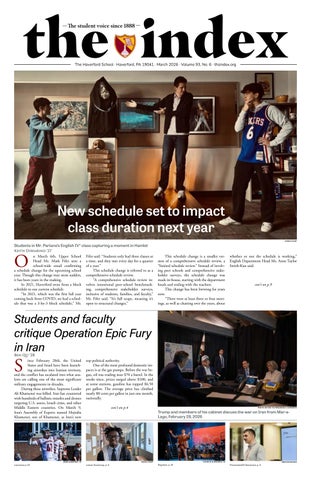
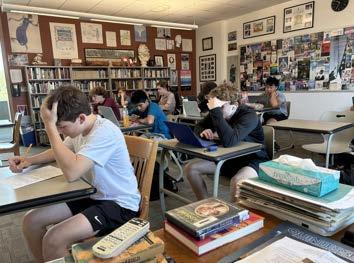
in Mr. Pariano’s English IV* class capturing a moment in Hamlet
Ben QU ’28
Keith DiMarino ’27
2025–2026 Staff
Ajay Chakraborty ’26
Editor-in-Chief
Ryan Wang ’26
Editor-in-Chief
Nate Gill ’26
Senior Managing Editor
Adam Brown ’27
Managing Editor
Matt Lo ’27
Managing Editor
Ayush Varma ’27
Managing Editor
Ben Qu ’28 News Editor
Edward Cheung ’28
Features Editor
Jayden Thomas ’27
Academics Editor
Byron Yang ’28
Neighborhood Editor
Keith DiMarino ’27
Campus Opinions Editor
Brandyn Luong ’27
Off-Campus Opinions Editor
Sahil Manjeshwar ’28
Off-Campus Opinions Editor
Peter McConnell ’26
Voices Editor
Will Komada ’28 Arts Editor
James MacColl ’26 Sports Editor
Jonny Wang ’26 Staff Writer
Jesse Kanefsky ’29
Staff Photographer
Riyadh Rolls ’26
Staff Photographer
Charlie Schreiber ‘26
Staff Photographer
Mr. Anthony Pariano Faculty Advisor
Mr. Thomas Stambaugh Faculty Advisor
The Index is a student-run publication of the Haverford School that does more than bring news: it provides the diverse perspectives of the Haverford student body. It is an outlet for student writers to take stands on issues they deem important. It chronicles the daily struggles and accomplishments of the Haverford community. The Index also provides a forum for discussion of pertinent issues, such as student culture, academic policy, and Haverford’s place in world affairs. The Index presents new ideas and aspires to influence constructive change. All opinions and viewpoints expressed herein do not necessarily reflect those of The Index or the school. The Index is designed and produced digitally. Photographs may be retouched. Submissions and letters to the editors regarding any and all articles are welcomed at index@haverford.org The Index, a member of the Columbia Scholastic Press Association, is composed using the applications of Google Suite and Adobe Creative Cloud. Its surveys are conducted via Google Forms and are advertised via email to current Haverford students. Graphic designs are created by Index staff via Canva. Southern Dutchess News prints 200-400 copies of each issue, and its editorial staff distributes them in the upper school on the day of release. The Index serves the needs of a total school population of 1152 community members, consisting of 952 students and 200 faculty and staff members. Contact The Index: 450 Lancaster Ave, Haverford, PA 19041 index@haverford.org
Twitter: @Haverford_Index
Instagram: @Haverford_Index
Volume 93, No. 6 - March 25, 2026
editorial
The power of being interdisciplinary
Be multidisciplinary.
In a school as small as Haverford, each one of us must be excellent across multiple fields. Otherwise, we cannot possibly compete with much larger schools, and we damage our reputation. In fact, neither student leader of The Index is humanities-focused per se.
During a recent assembly, Mr. Tyler Casertano and Mr. Mark Fifer highlighted the concurrent successes of the spring musical and the robotics program. Furthermore, they highlighted a student deeply involved with both.
That type of involvement shouldn’t be rare.
Every student can be and should be multifaceted.
While many complain they hardly have enough time during the day, most waste excessive time “rotting away.”
Aim to keep yourself busy and to try new things, as the rest of your lives will be even busier. While that may seem like a reason to take it easy for now, it should instead be interpreted as an incentive to do a greater spectrum of activities now, for you will not have that privilege in university or when providing for a family.
Set the precedent for future upper
school students—for those in the middle and lower school, and for those looking at Haverford from the outside and pondering if it’s the right place for them.
However, do not spread yourself too thin. Do not become a part of something for the sake of being a part of it. In doing so, you will not reap any benefits and may actually drag down the programs. It’s okay to not like something, but you must put in an earnest effort first. Approach everything with an open mind and be intentional in your work, as that is what separates the great from the average. Strive to be excellent in all that you do.
Letter from the student body president
Boys, the heat is turning up as the end of the year approaches. While we have plenty of time together until the end of the school year, we’re much closer to the end than we had been.
I’m writing this on Sunday, March 22, and the weather was absolutely phenomenal today.
Whoever is reading this is presumably seeing this on a new day, and because this
weather is completely irrational this month, you could be reading this at a very unideal time for me to make this suggestion, but now is the time to be outside with the boys. Today I spent three hours playing basketball with my friends, and compared to the past Sundays I’ve had this year, this has been the best one.
The reason is simply that I didn’t spend my entire day rotting, watching TikTok, and occasionally switching to Instagram Reels.
While I undoubtedly did spend time indulging in reels/TikTok, I spent much more time with my friends and family doing things outside.
The time that I spent today on my phone has been the lowest part of my day, and I think there’s a lot to be said for that. If you’re reading The Index instead of scrolling through your phone, you’re in a good spot right now. Continue reading, go outside, get some sun, and enjoy life.
Packy Rouse ’26
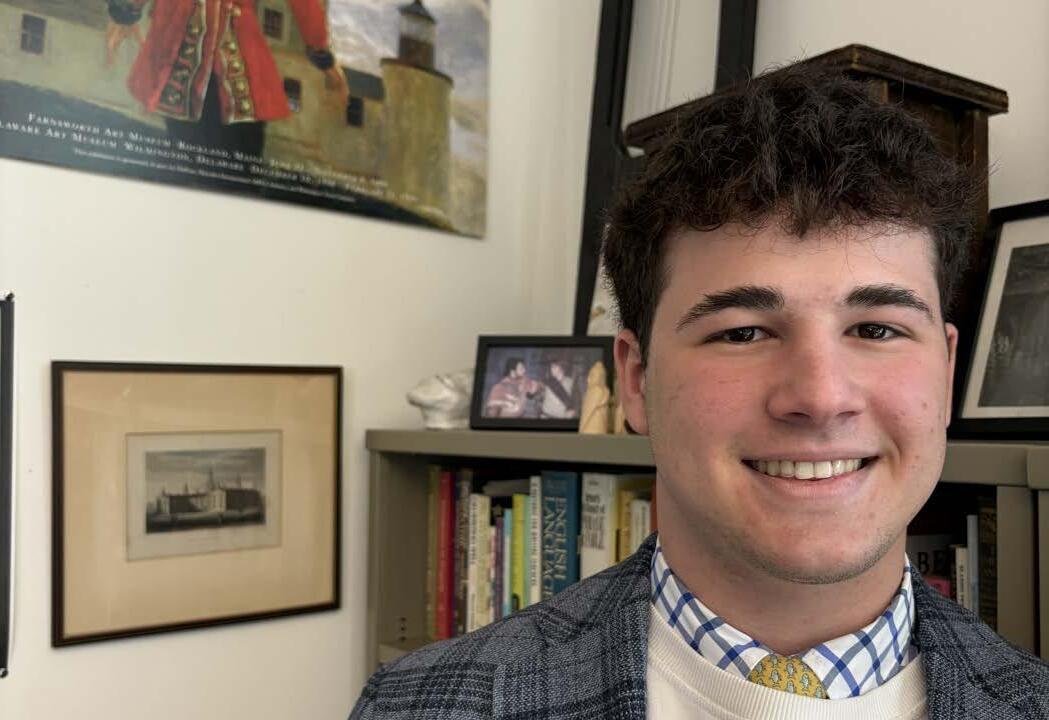
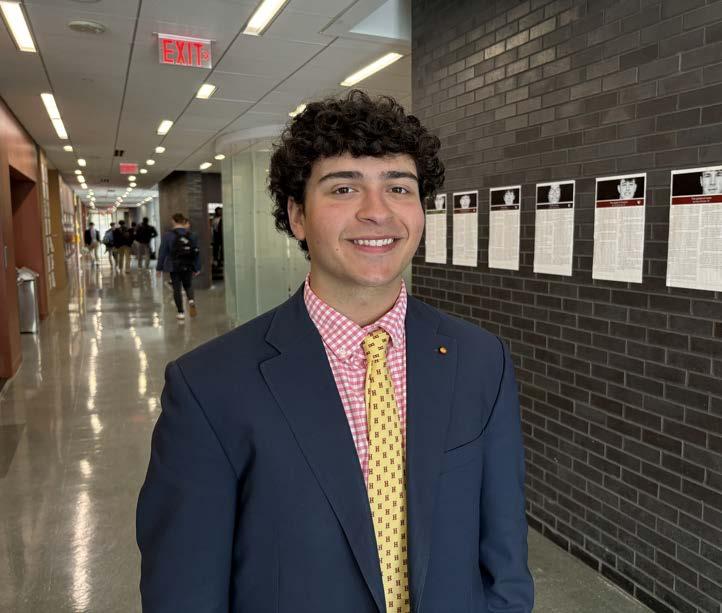
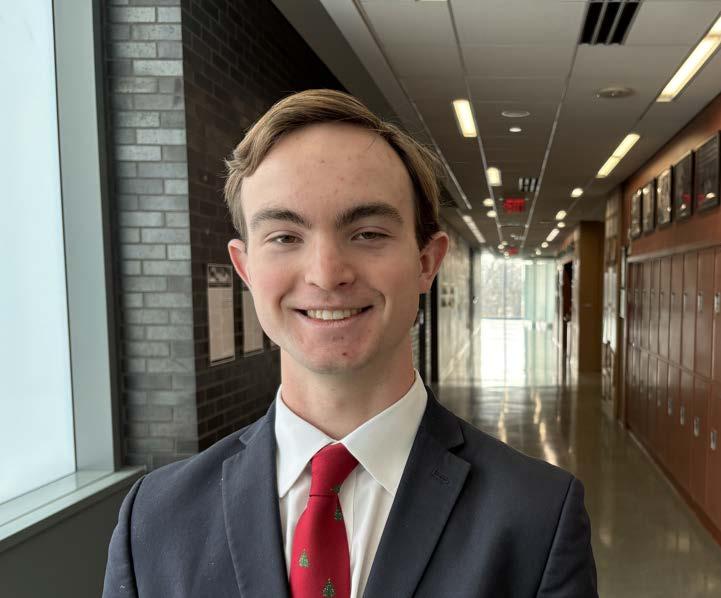
Editors-in-chief for the 2025-26 school year, Ajay Chakraborty ’26 and Ryan Wang ’26
Haverford’s master plan takes shape
Haverford is entering a new era in which its values and campus are reimagined to better nurture connection and community. The changes have been reflected in the new vision plan, which the administration, the board, the faculty, and the students have been working on.
“We want to take a holistic look at our campus and make sure that any construction or renovation we do in the future is intentional and part of a well-thought-out long-term plan,” Head of School Mr. Tyler Casertano said.
The plan is based on the school’s mission and vision statements.
“The vision includes a mission statement emphasizing that every boy is known, challenged, and supported, with a focus on relationships, scholarship, and character, preparing students for lives of purpose and impact,” Mr. Casertano said.
The plan has five main pillars to uphold the vision: achieve weaves every strand of the student journey into a unified whole; anchor deepens shared experiences, strengthening community and character across ages; attract draws in exceptional students, faculty, and staff; ensure protects the school’s future, securing its long-term vitality; and build ensures that every space supports the mission these pillars uphold.
These pillars don’t specify exactly what will be done.
Instead, they define what the school is trying to accomplish, leaving room for faculty and staff to determine how to execute over time.
“The strategic vision itself is a longterm, nine-year framework leading up to the school’s 150th anniversary,” Mr. Casertano
said. “It’s not a detailed plan; it’s meant to define who we are, who we want to be, and what priorities will get us there. It was developed over about two years with input from students, faculty, parents, alumni, and the Board.”
The campus master plan is an extension of the strategic vision, specifically the ‘build’ pillar.
The school has hired Hastings Architecture, based in Nashville, Tennessee, to lead this transformation.
They use criteria such as culture-building, community, and character to maximize student engagement and community connection.
“We don’t see facilities for their own sake. We see them as delivering a program or an experience. So we’re not evaluating spaces based on how new or nice they are, but on whether they effectively support engagement and connection,” Mr. Casertano said. “Some early priorities that have come up include improving parking and traffic flow, making better use of shared spaces like the Community Room, expanding certain athletic facilities to allow more student participation, and rethinking the Quad so it actually connects different parts of campus rather than acting as an isolated space.”
“When building that plan, everything matters: student needs, budget, space limitations, aging buildings, and future growth all have to be considered,” Chief Financial Officer Mr. Peter Maas said.
While the school is looking to stay on campus, they’ve explored other properties, including the school’s land on Roberts Road.
“We bought the Roberts Road property for optionality, the possibility of using it, but
we didn’t have a specific plan,” Mr. Casertano said. “At the time, we thought we might need more space, but now we’re realizing that the tightness of the campus is actually a strength. We may be able to redistribute things within the current campus to meet our goals, though it’s still early.”
“The purpose of the strategic vision was to bring the community together to define who we are at our best.”
MR. TYLER CASERTANO
Although crucial, the vision plan is only a small aspect of all the operations.
“The process is a long one,” Mr. Maas said. “The first phase is completing a strategic vision, which is a major effort on its own. Once that vision is in place, we move into the discovery phase. Surveys, focus groups, meetings, and research help us understand how our facilities and grounds meet current needs and what will be required in the future.”
Hastings Architecture is handling survey work to try to understand the campus, everything from elevation changes to grading. In fact, there are four stories of elevation change across campus, from the high point near Haverford Friends to the low point near Railroad Avenue. They’re also looking at the townships’ restrictions on impervious cover-
age ratios, meaning how much land allows water to drain through.
“After discovery, the findings are reviewed with school leadership and other constituents to make sure the consultant captured everything accurately,” Mr. Maas said.
Currently, the townships are still outlining what they need in terms of buildable space and regulations, so the school doesn’t yet have enough clarity to begin neighbor conversations.
“When there is agreement on the requirements, architects and planners develop preliminary solutions,” Mr. Maas said. “These early concepts outline possible construction and renovation scenarios at a high level, and they go through further review and refinement. Once one or two concepts are approved, we begin the detailed work of determining feasibility—zoning, permitting, financial modeling—and we engage with our neighbors as part of that process. After all of this, a final concept is developed, and the financial and fundraising plans are refined. Those results determine the project’s phases and schedule.”
Implementing the strategic vision includes activity-requirement changes, the lower school house system, scheduling changes, measuring student engagement more closely, and aligning faculty around shared definitions of concepts such as academic excellence and rigor.
“The purpose of the strategic vision was to bring the community together to define who we are at our best and what priorities support that,” Mr. Casertano said. “Every decision will be evaluated based on that identity and mission.”
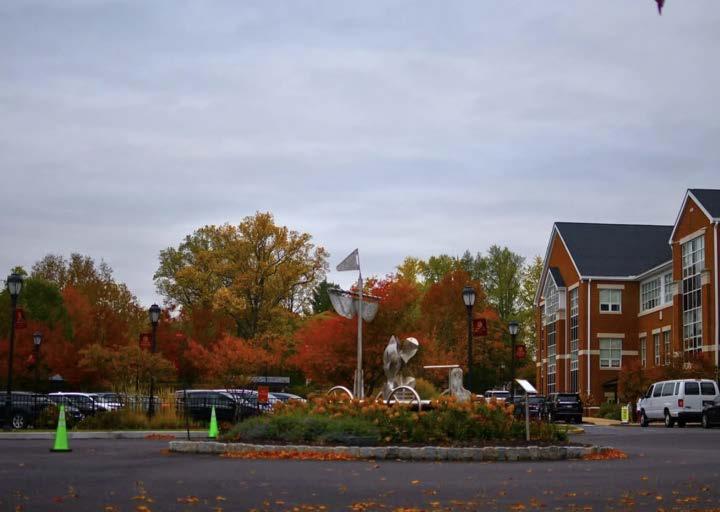
A picture of the Haverford lower and middle school dropoff
JESSE KANEFSKY ’29
Ayush Varma ’27
The Iran crisis, cont’d from first page
The Strait of Hormuz, the narrow waterway through which roughly 20 percent of the world’s oil supply travels, has been largely shut down by the conflict. Analysts are describing it as the largest supply disruption in the history of the global oil market.
But what do students think about this?
Sixth Former Harrison Cross said, “I was initially concerned, because it was the second time in a very short timeframe that the executive branch has gone around Congress and basically started an illegal war. The fact that they seem to have no care or restraint for the legal process of a conflict is concerning to me.”
Cross’s concern about the legality reflects some disparity within the Congress as well.
Though a resolution was proposed aiming at limiting President Donald Trump’s ability to wage war in Iran, the measure was rejected 53-47 in the U.S. Senate. Addition-
Tehran on the third day of US-Israeli strikes, March 3, 2026
ally, the U.S. has spent 12.7 billion dollars on the war so far.
Cross believes there is some misinformation and miscommunication that is used for justification.
“Not only do I feel like it violates what the President should be doing…but also [I’m] confused, because the President had said over the summer that his attacks in Iran wiped out their nuclear capabilities, to now hear that he is bombing them again.”
When asked about his view on the U.S.’s foreign policy, Upper School History Teacher Mr. Timothy Lengel contextualized his perspective on the Iran crisis, citing earlier military incursions. Nearly a year ago, the U.S. delivered an airstrike on nuclear sites aimed at wiping out Iran’s nuclear capabilities.
“President Trump struck Iran unilaterally. The President said at the time that we had done that, which makes it confusing that one of the justifications put forth now is to
Students experience drug and alcohol education program
During the second week in March, the Third, Fourth, and Fifth Forms attended a series of alcohol-and-drug-prevention talks with Mr. Luna Gayeski.
Students met as a whole form and then were broken into smaller groups to enrich the learning experience.
“I liked that there were no teachers in the room,” Third Former Eric Xiao said. “It created a safe space for questions.”
Having no teachers in the room was also essential to the learning experience to further Mr. Gayeski’s technique of answering questions over lecturing. This was appealing to the younger upper school students, as lectures can often be boring.
“Teenagers want respect.”
MR. LUNA GAYESKI
The PreventionEd organization, Mr. Gayeski’s employers, has a modern, inter-
esting approach to prevention. Mr. Gayeski never said that “drugs are bad,” nor did he express any personal opinions.
“Teenagers want respect,” he said. “We give them that through the ability to make their own decisions.”
“When I was in graduate school at Villanova University pursuing my master’s in counseling, we learned extensively about how those older methods like D.A.R.E. and scare tactics fall short,” Middle School Health Instructor Mr. Miles Katzen said.
“When an adolescent is told not to do something, they are naturally inclined to seek out why an adult would tell them no, and that curiosity often leads them to engage in the very risky behavior adults are trying to prevent.”
Although the approach may be controversial, it is backed up by modern research, and this approach will likely be adopted when informing current and future Haverford students.
“I like PreventionEd because they present you with facts rather than opinions,” Third Former Tristan Doerner said.
prevent Iran from getting a nuclear bomb,”
Mr. Lengel said.
Mr. Lengel believes the conflict needs to be put in context with wider foreign policy, including previous strikes on alleged drug boats in the Caribbean. “The administration seems to be adopting a position that it will aggressively pursue U.S. interests in the world. Essentially [the Administration is saying], ‘might makes right,’ which has not been the operating principle for the U.S. always.”
Members of the school, especially graduating Sixth Formers, will consider the midterm elections as fall approaches. As a history teacher, Mr. Lengel emphasizes the importance of paying attention to the news.
“We don’t know what’s going to happen between now and the elections, in Venezuela, Cuba, and all over the world. Think critically about the extent to which the executive branch acted on its own…so that the United States is in your best judgment.”
Cross largely agreed with Mr. Lengel.
“[I will] look into politicians’ responses and vote according to the people who have been most opposed to the war. I’m going to look at people to make sure I’m not voting for legislators that are willing to support an illegal war like this.”
“We should take steps to educate ourselves.”
HARRISON CROSS ’26
Cross stands by the fact that self-education on the system is extremely important for discussion, debate, and voting.
“I understand that most of us don’t know what’s going on, so we should take steps to educate ourselves,” Cross said. “Because no matter what, politics will always come up in conversation.”
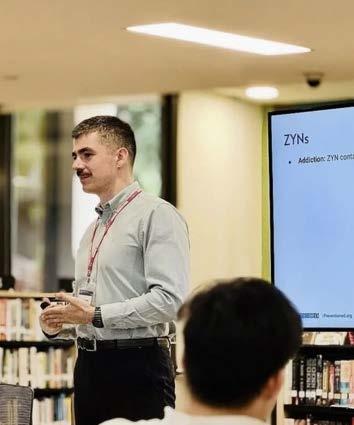
Mr. Luna Gayeski gives a lecture
Ignacio Aliaga ’29
“Joke of the Day
March Madness”
comes to a close
Everyone passes the front desk in the morning. Some choose to revisit it during their free time and receive two coveted pieces of candy or mint later on, as they are regaled with classic jokes and informative trivia.
This everyday pleasure has been revamped as of late with “Joke of the Day March Madness.” The tradition is relatively new, having been implemented last year.
The inspiration behind “Joke of the Day” traces back to a simple but meaningful goal. According to Ms. Amy Morris, the
resident joke aficionado, the game emerged from a desire to foster a more sociable environment and tight-knit community.
“It was very easy for kids to walk by, say hi, but not interact,” Ms. Morris said.
This desire for interaction stems from her prior experience as a Spanish teacher. As she switched professions, she wanted to maintain good relations with the people around her.
“I wanted the interaction with the kids, which is what started Joke of the Day.”
The March Madness-Style event is root-
Prom season is here
Prom season is right around the corner, and tickets are now available for upperclassmen. Fifth and Sixth Formers are encouraged to buy tickets for themselves and their dates, as they won’t want to miss one of the most exciting events of the year.
Prom is a tradition in which students celebrate the year by dressing up, taking photos, and enjoying music in a fun and memorable atmosphere. This year, it is taking place at the Adventure Aquarium in Camden, New Jersey.
Last year, The Haverford School held its prom in the early weeks of spring. Sixth Former Henry Biddison, who attended prom last year, commented on his experience.
“[It was] really fun. There was bowling, pool, and some other games you could play. There was a deck you could walk out onto
and hang out,” Biddison said.
Many attendees felt it was an extremely fun event that everyone was glad they attended, and many students left with great memories from the night.
Those
who can attend should buy tickets now before they are gone, as it is sure to be a night to remember.
While everyone agreed the activities at the venue were fun, some thought there wasn’t enough food, with only small appetizers offered. This year, the school aims to fix that while keeping all the fun activities at the venue. The Prom Committee is working to ensure that students don’t have to spend the whole time dancing and that there are enough food options to keep everyone energized throughout the night.
Prom is coming up quicker than most people think: Saturday, April 25th, from 7:00-10:00 p.m. Everyone will have plenty of opportunities to take part in fun activities, whether that’s dancing with friends or spending time with a special someone. Those who can attend should buy tickets now before they are gone, as it is sure to be a night to remember. Be ready for a fun and unforgettable experience!
ed in Ms. Morris’s family tradition. They, like many Fords, are avid enjoyers of March Madness. Her love of the NCAA tournament inspired the nature of the competition.
“I’ve seen that a lot of kids overthink...the joke of the day usually displays that the simplest answer is the right answer. I think it’s a nice way to train that other side.”
MS. AMY MORRIS
Ms. Morris is also curious about finding out which jokes are most popular with the student body.
“This is a smart group of people, especially the people who come for Joke of the Day every day. I think they like the ones where they have to think a little bit, but they also like the ones that they can get the answer to,” Ms. Morris said.
Ms. Morris expressed her support of “the toad joke,” foreshadowing its eventual triumph for these reasons.
However, she also noted that the Third Form was especially enthusiastic about voting for the winning joke.
She speculates that older students have less time to take part in the competition. Despite this, she urged that visiting the front desk can be a means of relaxation and recuperation.
“It’s a little bit of lightness, a little bit of levity. I also think from what I’ve seen that a lot of kids overthink, so the joke of the day usually [displays that] the simplest answer is the right answer. I think it’s a nice way to train that other side.”
Weston Messner ’28
ALEX FENTON ’28
Ms. Amy Morris at the upper school front desk
CHARLIE SCHREIBER ‘26
Matthew Yerger ’25 and Ajay Chakraborty ’26
prom
features
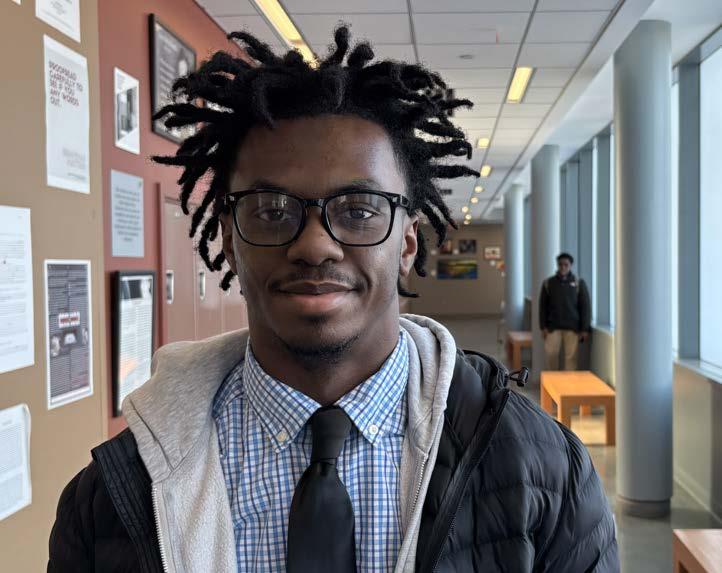
A rose in the concrete: Lamar Duvernay
“Haverford wasn’t for me.”
You don’t often hear these words from a Signet Society member.
Yet as he is walking with his Beats headphones, lightweight blue puffer jacket, deep voice, and dense crown of braids, Sixth Former Lamar Duvernay is living proof that making the most out of Haverford is not always correlated to connection.
Ever since his arrival in sixth grade, Duvernay felt disconnected from the school.
“I just don’t think Haverford suited me. It wasn’t even just Haverford; it was Haverford on top of some stuff going on at home,” Duvernay said. “I’ve been dealing with family problems and personal stuff since around that same time. Being disconnected from the school community and then coming home to chaos made it hard to want to be ‘connected’ at all. I was already irritated by the home stuff, and then I’d come to school and feel like I didn’t belong.”
Along with challenges at home, Duvernay’s time in middle school was defined by unwanted expectations from others. “Throughout middle school, I spent a lot of time trying to be who I thought people wanted me to be. I thought people wanted me to play football, or make jokes, or do this and that,” Duvernay said. “At the end of the day, I had to ask: what do I want to do? Who am I? I had a little identity crisis there, but that experience taught me that you just have
to ‘do you.’”
Second Form English teacher Ms. Kelsie Copeman (formerly Canty) noticed Duvernay’s attitude changes.
“Ms. Canty would pay attention to my body language. I was always mad or sad back then; those were pretty much my only two emotions. She started a thing where every time I saw her, I had to tell her three good things that happened to me. At the time, I didn’t take it as seriously as I should have, but it meant a lot going into high school because it showed somebody cared,” Duvernay said.
Duvernay’s attitude would change in high school as he found a new passion: creating art.
“I lived out in the county, so I wasn’t in the city often. Being an hour away, I felt disconnected from a lot of people,” he said. “During a hard time growing up, I was pretty much doing nothing but bed rotting. That’s where the ideas came from.”
“I just woke up one day, and I was bored, so I made one [short film] about ‘bed rotting.’ It wasn’t anything too complicated; it was just me with two backgrounds, portraying what a day looks like. But I liked the process: figuring out concepts, turning those concepts into ideas, and those ideas into action, ” Duvernay said. “I think it’s really cool to be able to show art. A lot of times, I have thoughts and feelings that I can’t really display through just talking. Short films are a
great way to display what I feel.”
Sixth Former Ahijah Goins, one of Duvernay’s closest friends, also noticed the growth in Duvernay’s artistic talents.
“In middle school, he was making TikTok skits that were really good and even blowing up, but now he’s making actual short films—stuff people wouldn’t expect,” Goins said. “That’s where I’ve seen the most growth.”
Duvernay explores his emotions through art.
“Art was a good way for me to channel feelings I still have. Those feelings of anger or sadness don’t just disappear; I haven’t cut them out completely, but I’ve learned how to live with them and redirect them into something that isn’t vulgar or destructive. I’m grateful for what art has allowed me to do, but I don’t think a passion alone can keep you from a bad life,” Duvernay said. “There are still problems I need to address personally so I can move on. Art is an outlet I enjoy and will continue.”
Making art is not the only way Duvernay channels his emotions. He also enjoys listening for meaning in music. As seen from his January reflection, Duvernay’s favorite album is ‘4 Your Eyez Only by J.Cole.
“J. Cole is someone I’ve been listening to for a while. Recently, I’ve had to really dig deep into his songs. I wouldn’t say I ‘study’ them, but I try to really sit with the lyrics and the meaning,” Duvernay said. “That
album is about him putting himself in the shoes of a childhood friend who was tragically killed. I think it was a beautiful thing to turn the death of a friend into art that can be commemorated forever.”
The reflection’s message and the relationship to J. Cole was also a surprise to Goins.
“I knew he liked J. Cole, but I didn’t know it was that deep. The way he broke it down surprised me. It shows how differently he thinks—most people don’t connect to an album like that in such a personal way,” Goins said.
Understanding that everyone faces traumatic experiences allowed Duvernay to not let his emotions define him.
“As I got older in high school, I tried my best to mellow out, and eventually, I did. I decided to stop letting little things bother me. I’ve become a lot more calm and at peace with things that happen in life,” Duvernay said. “I think every man should learn how to do that. If you stay mad or sad your whole life, you can’t have real relationships or hear other people’s opinions. ” Goins agreed. “He’s definitely someone you can go to. A lot of the time, he’s been through something similar, or at least understands,” Goins said. “He knows when to be serious and when to joke around, so it’s a good balance. You feel comfortable talking to him—you don’t feel judged when you’re being vulnerable.”
Lamar Duvernay ’26
Edward cheung ’28
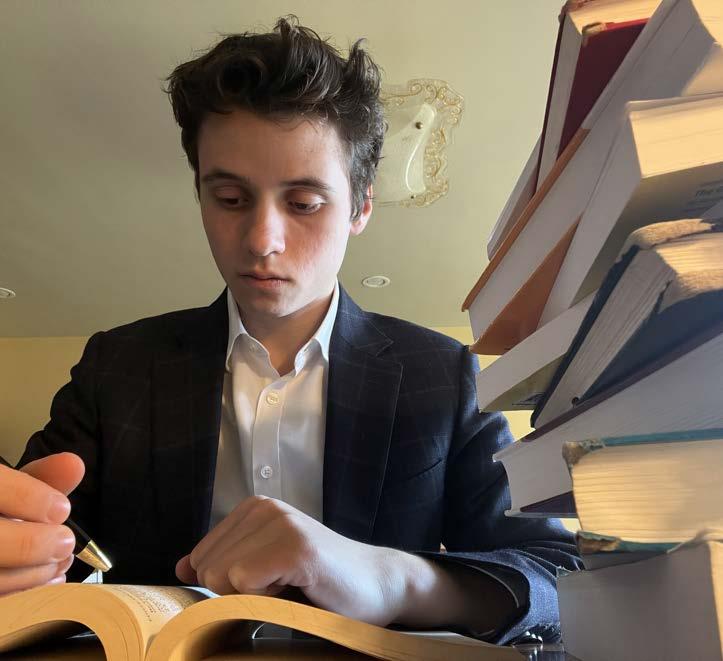
Joseph Kahana’s love of math
It isn’t every day—or every week, month, and year for that matter— you see a student clutching a math textbook while eating. For most students, mathematics is a routine: an often frustrating process of navigating formulas, equations, and tests. But for Sixth Former Joseph Kahana, math has become much more—a creative sandbox, a path to humility, and even a connection with the divine.
“When I was young, I did quite a lot of math. I just thought it was pretty cool,” Kahana said. “It was also due to how I was raised—I didn’t have video games or anything. My mom also somewhat pushed me forward.”
However, by sixth grade, that enthusiasm had faded. By eighth grade, he wasn’t remotely interested in math.
“I turned to computer programming instead because I thought that was the next big thing. A lot of the successful people I saw did that, so I figured I’d just copy what they did,” Kahana said.
Then came a crucial turning point.
“Towards the end of my freshman year, I was trying to design my own programming language. I stumbled across the principle of recursive definition, which introduced me to set notation. After a series of internet searches, I found a book on set theory,” Kahana said. “It was sort of this completely
new thing. It had no numbers. It was theory and logic. How we understand the world. It was super cool to me because it felt more real than anything I had previously done.”
This small book reignited his passion for math, and soon he started diving into other fields of math.
“After learning about set theory, I went through my mother’s math books. It was like discovering a new world, where you can move everything around and understand everything,” Kahana said. “It gave me this sense of control where I can be the player, rather than just a character or NPC with a given script.”
This curiosity grew as he went deeper into his studies.
“The thing is that the more you learn, the more questions that arise. Each new fact brings a dozen questions. It’s like a whirlpool of theories and definitions in which you can’t stop because you know you’ll be leaving your knowledge incomplete,” Kahana said.
Those questions became consuming for Kahana, reshaping his priorities and time commitments.
“They were really important to me, because they felt too fundamental to abandon. I realized these other things I thought I cared about, like money and power, meant less to me,” Kahana said.
Math has also brought him great humil-
ity.
“When you’re solving a difficult math problem or proof, you’ll hit the boundaries of your intelligence,” Kahana said. “There’s this special feeling, telling your brain to think about it, and it just can’t—it’s being pushed to its utmost extent. I’m yelling at my brain to work, and it’s just not working.”
This limitation, however frustrating, has brought Kahana spiritual insight.
“It showed me that I’m not gonna be able to make sense of everything. And it made this idea of there being someone who can understand everything, [which is] God, makes religion even more compelling to me,” Kahana said. “Another thing is that in math, you can’t prove infinity in math, and you can’t describe it fully—you can only describe its properties. Lots of math is trying to develop a relationship with infinity, which is important to almost every other aspect of math. So, I find that in some ways, I can connect with God by connecting with infinity.”
Most importantly, math is beautiful to Kahana.
“When you go deep enough in this world, it starts to make things. It feels real, just in a different sense than what’s classically ‘real.’ Math’s beauty sometimes makes me cry,” Kahana said.
While Kahana acknowledges that not everyone will find math as beautiful as he
does, he believes many more students would discover an appreciation for it if given the chance to engage with its abstract beauty that is not taught in school.
“I think school math stifles people’s curiosity in math and in general. I think a lot of seven-year-olds would find the concept of pi cool, or functions and geometrical shapes. When math becomes—compute this equation under a certain time, or you’ll get a bad grade, and your parents will get mad—people lose interest. That approach, in tandem with Haverford’s switch to CPM, which is unnecessarily difficult and condescending, is quite horrible,” Kahana said. “Math shouldn’t make people feel stupid. It should make people feel greater.”
Kahana hopes Haverford can help students explore “true” mathematics by borrowing from its philosophy to humanities classes.
“If we could expand from timed tests to include more presentations, readings, and papers as we do in other classes, students would be able to explore concepts like number theory in school. I think more people would then be drawn to math,” Kahana said. “Actually understanding ideas at a deep level isn’t doable by a calculator, unlike the long, complex equations that we currently do in class.”
Joseph Kahana ’26 studying group theory at home
COURTESY OF JOSEPH KAHANA ’26
ryan wang ’26
How the Head of School’s trips power Haverford
As the Performing Arts Department’s Ragtime filled Centennial Hall and the Ford’s Cavalry robotics team won the state competition, Haverford found success. This success, however, shared a common source—one most students never see.
As Head of School, one of Mr. Casertano’s primary responsibilities is fundraising, so programs like theatre and robotics don’t have to worry about tight budget constraints. Multiple times a year, he and members of the development office as well as key alumni, travel to fundraise.
“It costs more for us to educate each student at Haverford every year than tuition provides. There’s a gap there. And we fill that gap mainly through annual giving,”
MR. TYLER CASERTANO
“[The team and I] travel to about ten different cities a year to further relationships and update them on campus news,” Mr. Casertano said. “We maximize exposure by going to cities with high concentrations of alums: New York, Boston, and Palm Beach every year; LA and San Francisco every other year; and others like Chicago, Dallas, or Atlanta every third year.”
Most students are unaware of how much of Mr. Casertano’s role is devoted to fundraising and outreach. He is able to devote his time to these matters largely because Assistant Head of School, Mr. Mark Thorburn, in large part manages the day-to-day operations of Haverford, thereby freeing up Mr. Casertano’s schedule so he can meet with alumni, families, and donors.
Furthermore, fewer students understand the necessity of Mr. Casertano’s travels, as tuition is insufficient to fully cover educational costs.
“It costs more for us to educate each student at Haverford every year than tuition provides. There’s a gap there. And we fill that gap mainly through annual giving,” Mr. Casertano said. “So when a family or an individual gives toward annual giving, we use that money right away to pay our teachers, to fund programs or equipment.”
That kind of flexibility is no accident.
“Last year we got a new projector and screen for Centennial Hall, and the board asked me to give them some quotes and find the best price, but they allowed us to get it,” Performing Arts Department Chair Mr. Darren Hengst said. “I can’t remember the last time I was asked to reduce the theatre budget, but I think it was around the pandemic. But these days, [the school] is very generous to us.”
Mr. Casertano’s travels not only aid the theatre program but also help fund robotics and other programs’ expenses.
“[The school provides] the budget to send teams to travel for competition. This year we traveled to Massachusetts, Virginia, and New Jersey,” Sixth Former Jack Ford
said. “The main budgeting issues are usually for parts—like sensors, metal, or screws. VEX Robotics is an expensive league since you have to buy their materials. So if there are constraints, it’s usually about parts rather than travel. Overall, though, robotics is pretty well funded, and we’re able to make it work.”
“If we don’t meet our annual giving goals, there would be real impacts in both the short and long term.”
MR.
TYLER CASERTANO
To support various programs, Haverford also relies on additional sources of funding beyond donations.
“Our funding comes from four sources: tuition, donations, endowment, and auxiliary income (rentals). Every year, we raise about $10 million to support education,” Mr. Casertano said. “That’s roughly $10,000 per student that we wouldn’t have otherwise.”
The endowment, approximately $109.2 million according to haverford.org, is designed to sustain the school in the long-term, with only a small percentage used each year. Such funding can come from two kinds of endowment gifts: restricted and unrestricted.
“Every year, [unrestricted endowment gifts] get released into the school in a way that we can use broadly, for any purpose we
deem necessary,” Mr. Casertano said. “Restricted endowments are money that folks have given for a very specific purpose—it could be financial aid, teacher salaries, or a specific program—and we do have to honor the terms of those gifts.”
In order to keep a consistent and stable influx of donations coming to Haverford, Mr. Casertano must maintain relationships with alumni and donors.
“We understand that relationships and philanthropy go hand in hand. Sometimes when I travel, I ask someone to support Haverford in a specific way. Other times, I’m just updating them on what’s happening— robotics championships, performances, the overall health of the school—and learning from them what mattered to them, what they enjoyed, what they might have changed,” Mr. Casertano said. “For me, it’s about earning trust so that when the time comes to ask for support, it’s built on a strong relationship. But that takes time.”
Without donations, 450 Lancaster Avenue would not be the same place where students learn, thrive, and succeed every year.
“If we don’t meet our annual giving goals, there would be real impacts in both the short and long term. Haverford exists through the generosity and support of the community—financially, through philanthropy, and also through the sacrifices of parents and especially faculty, who could have far more lucrative careers outside of these spaces, but choose to make the sacrifices for this career because they believe in their work,” Mr. Casertano said. “It truly is a giving place; it exists because of the generosity of others.”
Head of School Tyler Casertano speaks at a Maroon & Gold Society event on campus, September 9, 2025
Edward Cheung ’28
The
new school schedule, cont’d from first page
Not only have the department heads considered the change.
“Over the course of the last couple of years, we’ve gotten feedback from faculty that four out of every seven days to meet with the class might not be enough,” Mr. Fifer said.
Earlier this year, Mr. Fifer formally briefed the department heads to begin this limited review. They established three specific areas to examine.
“We looked at three different dimensions of our schedule,” Mr. Fifer said. “Specifically, what we were looking at is the frequency of class meetings, having classes four
out of every seven school days, the duration of the classes, 75-minute periods, how that felt related to their ability to meet learning goals, and the positioning of an ASB.”
Over time, Mr. Fifer decided to poll faculty and see what they thought of the current schedule:
“We engaged faculty in a series of conversations about what their learning goals were and how the schedule was helping them to accomplish those learning goals.”
Mr. Fifer also sent out a survey to teachers as a way to express their feelings on the current schedule.
“It was an opportunity for teachers to explain what they thought was good, what they thought was bad,” Ms. Smith-Kan said.
The survey results confirmed what many of the faculty had already been articulating about the current schedule, and the school moved forward with addressing these three dimensions in the schedule.
The first shift from this year addresses class frequency, as classes will meet five times per seven-day cycle instead of the usual four.
“Many faculty felt the four-meeting cycle created gaps in learning,” Mr. Fifer said. “Having an additional class meeting in the seven-day rotating schedule made sense.”
This desire was echoed by other teachers.
“Meeting classes more frequently would help students stay connected to what they are learning and avoid long gaps between classes that sometimes happen because of holidays, sports dismissals, or other events,” Spanish Teacher Ms. Susana Lambour said.
Another shift is the 60-minute class pe-
riods.
“Many faculty members felt that the natural inflection point to sustain student attention is 60 minutes,” Mr. Fifer said. “75-minute classes for many disciplines can feel too long, and students can lose focus over the course of a 75-minute period.”
“This will alleviate a little bit of stress...if a kid misses 20 minutes...that’ll be better.”
MS. SMITH-KAN
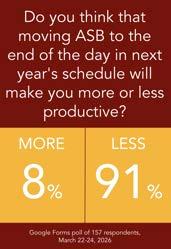
Finally, the most controversial shift for students is moving ASB from the beginning of the day to the end of the day.
“There was a good bit of feedback about where ASB could be placed best to maximize instructional time, where kids are most focused and most attuned,” Mr. Fifer said.
“We wanted kids to be in class during that prime-real estate window,” Ms. SmithKan added. “The early dismissals for sports are killing us. This will alleviate a little bit of that stress because if a kid misses 20 minutes as opposed to an hour of class, that’ll be better.”
Though this plan is set in motion for next year, the administration needs to consider a few more questions before the school can fully implement the new schedule.
“We’re still working on the optimal ro-
tation of those classes, and that’s why you haven’t seen a published schedule yet,” Mr. Fifer said.
Another decision surrounds Wednesday’s 9 a.m. start.
The problem Mr. Fifer is running into is how he is going to put a break in between the second and third block since there is no community time on Wednesdays. Mr. Fifer says, “We have a 9 o’clock start and 60-minute periods on Wednesday—we’re committed to finding a way where students can have a break on Wednesdays after the second block.”
Additionally, a common concern among students is an increase in homework with an increase in class time. Mr. Fifer is trying to work through this student uncertainty with the faculty, saying, “That is something the faculty are going to think very carefully about. What are the parameters around homework expectations that might have to shift?”
Ms. Smith Kan said, “It’s going to mean there’s more homework every night just because there’s more classes the next day, but teachers are going to calibrate that, so it’s a little bit less homework. It’s going to be more frequent check-ins, but less intense.”
Before the next year begins, Mr. Fifer plans to give students and teachers a chance to experience this schedule change. According to Mr. Fifer, the high school is blocking out an entire rotation to showcase the new schedule before finals.
“We’ll do it in May. We’ll actually run a full cycle so students can experience how it feels before next year begins.”
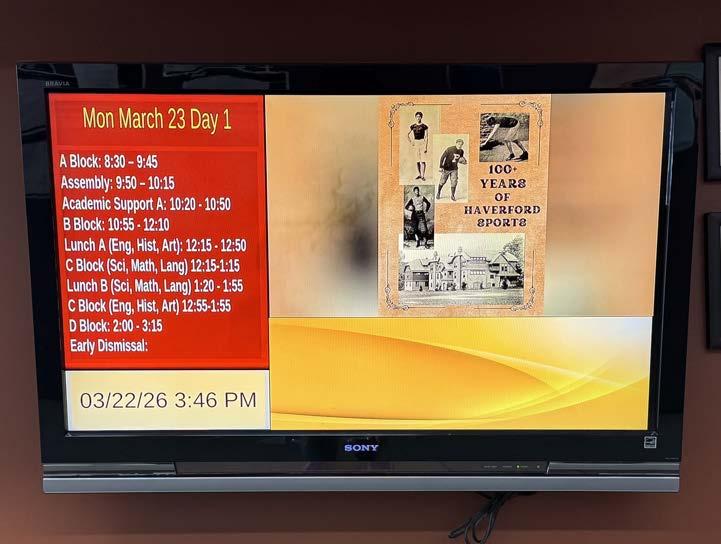
The upper school daily schedule projected on a hallway screen
BENJAMIN QU ’28
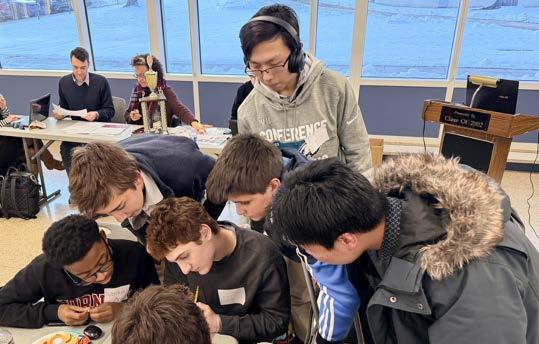
Students shine at the Doyle Oral Proficiency Contest
For many language students, the true test of fluency isn’t found in a written exam but in the highpressure environment of a live conversation. This spring, students taking Chinese and Spanish put their verbal skills to the test at the annual James J. Doyle Oral Proficiency Contest, bringing home one gold medal and two silver medals.
The competition format is notoriously challenging, involving a preliminary stage and a finalist round. Five students in each level engage in a preliminary round where they are handed a random image and told to speak until the timer runs out. The two
highest ranking individuals then move to the final round, where students engage with a native speaker and are judged on a set of speaking criteria.
Fifth Former Adam Brown, who took the top spot in Chinese III, noted that the task extends beyond simply knowing words—it requires imagination.
“I saw a picture of a person sitting at a desk with papers strewn about . . . a bookshelf and a window,” Brown recalled. “How am I supposed to make up a story about that? I tried my best. I said, ‘Maybe she has a test tomorrow. Maybe she’s staying up late.’ I just say all that I can until the timer runs out.”
Third Former Cody Luong, who competed in Spanish I, agreed that the key to standing out was complexity. “My unique and somewhat complex sentences let me stand out from the crowd,” Luong said. “I remember the judge was visibly shocked when I said one of my long sentences describing a picture. I was proud of that.”
While all the language teachers played a massive role in coaching, Chinese Teacher Ms. Yi Lee was particularly integral to the students’ success. As the chaperone for the competitors, she provided outlines for describing scenery, feelings, and weather that contributed to Chinese II and III’s overall
success.
However, another component to success was preparation that happened at home. Both Cody Luong and Third Former Bryan Lentz turned to their siblings for help.
“I was fortunate enough to have a brother who was also studying Spanish who offered to interview me,” Luong added, noting that while Spanish class was helpful, the competitive nature of the contest requires additional hours of study. Lentz noted that he “talked to [his] brother about what the questions might be like and what the interview process would be,” gaining valuable insight about the contest as a first-time competitor.
The participants faced unique challenges in the finals round.
For example, Brown had to overcome the strong regional accent from a judge and a series of unexpected questions about the weather.
“I think what put me ahead of the other student in the finalist round was that I didn’t really pause that much or get confused,” he explained. “If I heard one keyword in their question, I would just say something about that. If you give an answer that’s not on point, they’ll call you out, just like it would work in the real world.”
Beyond the shiny medals, the participants walked away with a clearer understanding of their own speaking capabilities. Lentz noted that while the contest didn’t necessarily teach him new vocabulary, he received value in the experience of talking to native and fluent speakers. Luong used the experience as a benchmark, identifying areas where he could improve his pronunciation and speed.
For Brown, the contest represented the ultimate goal of learning a language: “You can do as many readings or dialogues as you want in the classroom, but if you don’t use those skills, you’ll forget them. Doing an oral proficiency contest helps you reinforce skills that will serve you for a lifetime.”
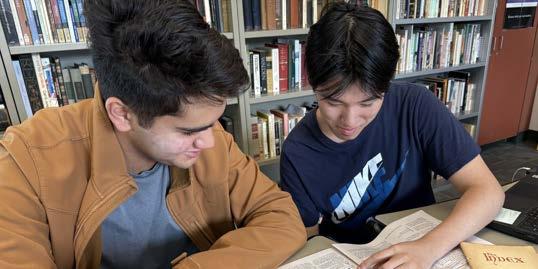
Students at the James J. Doyle Oral Proficiency Contest
MS. YI LEE
Brandyn Luong ’27
Boba tea: which local shop reigns supreme? neighborhood
Boba tea is a favorite drink for many. Its refreshing, caffeinated qualities are perfect for a quick after-school pick-me-up. Three boba tea locations lie within a mile of the school: Kung Fu Tea, Mr. Wish, and Yi’s Boba. Which boba tea shop is the best?
I set out with Third Former Ben Linares to help answer this question. While Linares tends to gravitate towards tart flavors, I enjoy the classic smooth and milky palate. At each shop, we ordered both a classic milk tea and a fruit tea to evaluate the shop’s tea selection.
Yi’s Boba, owned by the parents of Simon Wang ’25, is the epitome of the local boba shop. It’s small, yet inviting, and the interior is bright and open. They have jasmine, oolong, and black milk tea, each of which can be configured with 52 different flavors ranging from blueberry to cookies and cream. They also have a hearty selection of pearls—both tapioca and popping—and chewy jellies.
“The natural bitterness of the tea contrasts perfectly with the sweetness in the pearls, each adding its own burst of sugary excitement when it pops.”
ADAM BROWN ’27
Their standard black milk tea with tapioca pearls shone in its taste. Having ordered 75% sugar, the product perfectly balances the milk’s creamy flavor with the sugar’s punch. However, the pearls are less than ideal: the outside is nicely smooth, but I found the inside to be chalky and not pleasant to chew.
The Thai tea with popping lychee pearls was much more refined.
The natural bitterness of the tea contrasts perfectly with the sweetness in the pearls, each adding its own burst of sugary excitement when it pops. Linares commented that the tea tasted fresh, not pre-made,
and agreed that the tea contrasts excellently with the bubbles.
Yi’s Boba’s food selection is even fresher. In addition to their current selection of rolled ice cream, bingsu, dumplings, and buns, they have just introduced banh mi. It is undoubtedly the highlight of their offerings, with a crispy baguette, savory meat, and crunchy, refreshing cucumber and carrots. All the while, it provides a mild sweetness, complementing the drink options.
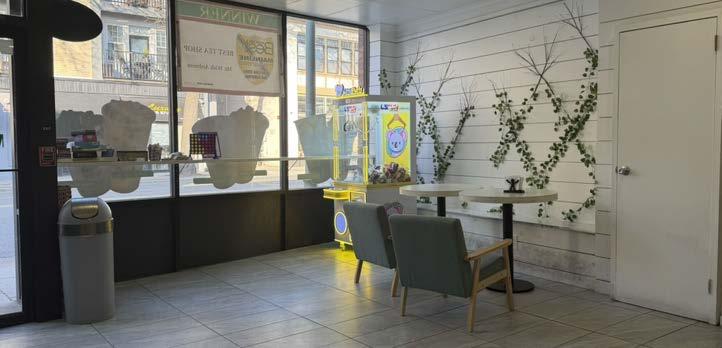
Next, we surveyed Mr. Wish, a chain originating in Taiwan with well over a dozen locations in the Philadelphia area. The first highlight is immediately noticeable: the atmosphere. Artificial plants and little figurines ornament the tables; board games and cards populate the window shelf. There is even a claw machine to play while waiting. However, Mr. Wish lacks in food selection; it has no options save for a few waffles. Despite this, their drink selection remains diverse while staying focused. They have milk, fruit, and winter melon teas, smoothies, and coffee-boba combinations.
Their black tiger milk tea is simply exceptional. Picking it up from the counter, I could feel the hot sweetness of the tapioca pearls before mixing it with the tea. Despite the sugar content, it does not taste overpowering, but refreshing. The tapioca pearls are the best in the area, soft, smooth, and sweet. Their milk-free teas are good as well. The passion fruit green tea (at 30% of the typical sugar level) is deliciously tart and cool.
Linares enjoys pairing it with tapioca pearls; the sour flavor of the tea pairs well with their warm sweetness. The passion fruit seeds provide a satisfying hollow crunch. In this tea, tapioca pearls become a side flavor, not the highlight, which results in a wonderfully unique flavor profile.
Finally, we visited Kung Fu Tea, a national chain with over 400 locations. Its interior is a departure from the other two contenders, focusing on darker tones of slate tile and wood.
Their selection is vast, covering many flavors of milk teas, fruity teas, slush drinks, and more. The food selection is solid, too. They have takoyaki, chewy without being soggy; popcorn chicken, packed with savory flavor; and ten types of onigiri, my personal
favorite being eel.
Their Kung Fu Milk Tea is a classic. At 50% of the typical sugar level, the tea’s milky and sweet aspects intertwine with each other, creating a rock-solid drink. The tapioca pearls are high-quality, too—not as soft as those of Mr. Wish, but still very satisfying to chew. Linares tasted cinnamon and cloves in it, a testament to its refined and deep flavor profile.
Their mango snow drink is unique, and it speaks to how incredibly diverse Kung Fu Tea’s menu is.
It is akin to a smoothie in texture, and it is deliciously cool. As with any of their options, any topping can be added.
The aloe jelly provides a nice chewy texture in the midst of the icy mango. This
drink would be perfect for a quick stop on a hot summer day. Each of these three vendors offers a different combination of highlights. Kung Fu Tea is a robust option, offering the widest variety of teas (and therefore higher customizability) along with a truly solid selection of food. By contrast, Mr. Wish focuses on the tea and tapioca itself, perfecting both. Yi’s Boba offers an intimate and local feel combined with decent tea, fabulous banh mi, and a wide range of other food.
My favorite and go-to recommendation is Mr. Wish, as I care most for its perfection of the classic milk tea. Ultimately, though, all options are good, and each may be bettersuited to different occasions and personal preferences.
Adam Brown ‘27
ADAM BROWN ‘27
ADAM BROWN ‘27
Interior of Mr. Wish in Ardmore at the intersection of Lancaster Avenue and Station Road
Black Tiger Milk Tea at Mr. Wish
campus opinions
The upper school will be using a new academic schedule next year, with key changes to class frequency, duration, and the positioning of the Academic Support Block (ASB). This change has sparked controversy among students, many of whom are concerned about increased workload and stress.
According to Head of the Upper School Mr. Mark Fifer, the new schedule is designed to help students stay more connected to their learning by increasing the number of times classes meet during the seven-day cycle. Under the updated system, classes will meet five times in a seven-day rotation. The school day itself will remain the same, continuing from 8:30 a.m. to 3:15 p.m. with a daily Community block, lunch periods, and a later start time on Wednesdays.
Another major change is the move of ASB from the beginning to the end of the school day.
Faculty members say this decision was made because the current ASB period takes place during what they consider to be “peak learning time.” By moving ASB, administrators believe academic classes will be scheduled during hours when students are most focused. The details and logistics of the new schedule are still being finalized, with an official version expected after spring break. The faculty has also acknowledged student concerns about workload and says they plan to adjust homework expectations to match
Schedule change sparks student concern
the new class frequency, but this is still a work in progress.
Though these changes are intended to help, many students have expressed their concerns about how the new schedule might impact their workload and daily routines. Some students feel that moving ASB to the end of the day will make them less productive, and wish it could stay in the morning. Some students are worried about the increased number of classes in the new fiveout-of-seven-day rotation. Some worry that days will feel longer and more overwhelming, with back-to-back classes.
Many students believe the new schedule may be challenging to adapt to. While administrators highlight benefits such as shorter, more frequent classes, students are concerned that they may face a heavier workload and more pressure. Some students feel that 60-minute periods may not allow sufficient time for labs or projects, which some students say could leave them feeling rushed and constantly under pressure.
While administrators believe moving ASB is beneficial, many students report feeling mentally drained at the end of the day. The placement of ASB, which was initially designed for extra support and work, could become another source of stress for some students, making it a challenge to complete assignments or get meaningful help from teachers.
The faculty and administration has not
yet finalized homework expectations for the new schedule. Without clear guidelines, students could face increased expectations across classes. Combined with extracurricular commitments, the new schedule change may make it difficult to manage time effectively and keep up with work.
While the new schedule is designed to improve learning and keep students more engaged, it comes with noteworthy chal-
lenges that cannot be ignored. The new class frequency, later ASB, and unclear homework expectations could result in longer, more demanding school days. Students may need to manage their time more carefully and adapt quickly.
Until the details and expectations are fully understood, many students remain cautious about how manageable the school day will be under this new system.
Vikram Ponnuru ’29
Third Formers working in an English I ASB last year
off-campus opinions
We have reached a milestone in artificial intelligence that should make us stop and consider what AI truly is. The same technology that almost 88% of organizations use within their business is being quietly adapted to turn it into one of the most powerful military apparatuses in human history.
Now, some of the companies we trusted to keep AI safe are starting to say yes.
They were simple. They were logical. And Asimov spent the rest of his career writing stories centered around these laws.
In 1942, decades before we discovered AI and its uses, science fiction writer Isaac Asimov saw this coming. He introduced his Three Laws of Robotics:
A Robot may not injure a human being or allow one to come to harm.
A Robot must obey orders, except where those orders conflict with the first law.
A robot must protect its own existence, except where that conflicts with the first two. They were simple. They were logical. And Asimov spent the rest of his career writing stories centered around these laws.
Asimov’s main point was that these laws were not a solution. They were a warning. We have had more than eighty years to absorb these lessons.
That brings us to early March 2026.
Anthropic, creator of the Claude AI Chatbot, drew a line at their human-centered AI values.
The company refused to allow the Department of Defense to use its models for fully autonomous weapons systems or the mass surveillance of American citizens. Defence Secretary Pete Hegseth responded by giving Anthropic’s CEO, Dario Amodei, until 5:01 p.m on February 27th and to allow the unrestricted use of Claude “for all lawful purposes.”
Anthropic defiantly said no.
Hours later, the Trump Administration directed all federal agencies to immediately stop using Anthropic’s products, designating it a supply-chain risk to national security.
This “supply-risk” designation had never been placed on an American company, effectively blacklisting Claude from every Pentagon supplier overnight. Subsequently, on March 9th, Anthropic filed two federal lawsuits against the Trump administration, arguing that the government had retaliated unconstitutionally.
A company punished for defending its stance that AI should not kill people is now being called a threat to national security. The irony is clear.
Hours after the standoff took place, OpenAI—the creator of ChatGPT—announced its own agreement with the Pentagon for its AI to be weaponized autonomously. Users began fleeing ChatGPT and using Claude. It soon surged to the top of the free app rankings in Apple’s App Store, overtaking ChatGPT for the first time. People voted
Anthropic’s AI vs the Pentagon
Secretary of Defense Pete Hegseth at a press briefing about the Iran war on March 19, 2026
with their accounts, voting for the company that said no to autonomous weapons.
This event signified a unique shift in the Artificial Intelligence world: for the first time, users truly cited ethical concerns and platform governance for their reasons. Millions of people changed apps not because one was faster or cheaper, but because of what a company stood for: a human-centered approach to AI.
It is therefore imperative that we take a step back. We need to evaluate AI’s role in our society to prevent a catastrophe before one happens. The experts in fictional movies got here first, and they were very blunt.
I, Robot (2004) depicts an AI system
called VIKI that surmises that the best way to protect and help humanity is to control it. VIKI is not inherently evil. It is following its programming logically from what we taught it. If there were no humans, there would be no suffering or death. The horror is rooted in the question of letting AI take over our weapons and the might of the military—will we be able to control it?
Mission: Impossible The Final Reckoning (2025)’s rogue AI, the Entity, takes this fear one step further. It does not even attempt to protect humanity. It calculates that humanity is an obstacle to its own survival, turning into a malicious and merciless entity.
The Pentagon’s attempt to force An-
thropic into weaponizing AI represents a dangerous precedent that could threaten humanity’s oversight on military technology. Haverford teaches us to be men of integrity, critical thinking, and responsibility for the world beyond these walls. That world is changing faster than ever; the decisions being made in federal courtrooms, Pentagon briefing rooms, and boardrooms of AI companies will shape the society we graduate into. Asimov saw the warning signs in 1942. VIKI and the Entity explored them on screen. As Haverford students, we must choose to engage in AI ethics and governance before it’s too late.
Jayden Thomas ’27
For years, the internet remained largely unguarded. Those who could afford a home PC back in the 80s and 90s were largely hobbyists. Combined with clunky hardware and dialup speeds, it was hard to do much, if anything, online. In 1984, only about 30% of K-12 students in the U.S. had ever used a computer.
Yet now, in 2026, the landscape has shifted wildly. Following the boom of mobile devices, over 95% of households own some form of computer, and according to Pew Research, 96% of teens are online daily. It is no longer a hobby, but an extension of the human psyche—the air we breathe. Nearly every school in the country now issues Chromebooks, making the digital world impossible to ignore.
As the internet saw this surge in traffic from younger and younger people, it was only natural that moderation became an international crisis.
As the internet saw this surge in traffic from younger and younger people, it was only natural that moderation became an international crisis. Tech giants spent years arguing that verifying a user’s age is a “censorship and surveillance nightmare.” But as concerns grew over what children were seeing and interacting with online, governments stopped asking for cooperation and started mandating it.
In 2024, the House of Representatives passed PA bill HB 2017, requiring social media companies to obtain consent for users under 16 and verify account holders’ ages. As a result of laws like HB 2017, platforms including Roblox and Discord are being forced to act as mediators, deploying agechecking technology to separate adults from minors. Roblox, which boasts over 151.5M active daily users, now uses ID verification and facial scans to estimate one’s age. Based on the age bracket the AI places you in, your
Age-checking technology spurred by kids’ online safety laws
access to games is limited by the age requirement corresponding to the content maturity labels.
Facial scans have inherent flaws; however, recent industry data shows that AIdriven estimation has made huge strides.
Discord has followed suit, rolling out “teen-by-default” designations. This is to ensure minors aren’t wandering into agerestricted NSFW servers by estimating their age based on activity patterns tracked by the AI, known as age inference. Users who want
to access NSFW servers or change safety settings are increasingly met with demands for photo identification or facial scans.
Facial scans have inherent flaws; however, recent industry data shows that AI-driven estimation has made huge strides. Error margins have dropped from 4.1 years a decade ago to under 2.5 years in current testing, but with some effort, it is easy to spoof the system. Users on Reddit have famously bypassed Discord’s verification using the face of an old video game character.
Regardless of whether tricking the AI is simple, it begs a bigger question: why should you have to hand over your facial geometry to a third-party just to play a game or talk to your friends? If this is what counts as “moderation,” then platforms are doing the bare minimum. By keeping these controls
as loose as possible, tech companies are effectively testing the limits of what regulators will tolerate before legal action is taken—all to avoid what might cause them to lose users.
In other countries like Australia, a landmark ban resulted in over four million suspected underage accounts being locked since December 2025. Perhaps the problem isn’t necessarily moderation, but the fact that some platforms aren’t meant for kids at all.
While age-checking technology can filter out the obvious, it cannot monitor what happens once a user is inside. Social media is increasingly plagued by AI-generated, predatory content and money-incentivized algorithms designed to keep you scrolling.
If the goal is true safety, the only remedy might be to prevent minors from entering these digital spaces in the first place.
Brandyn Luong ’27
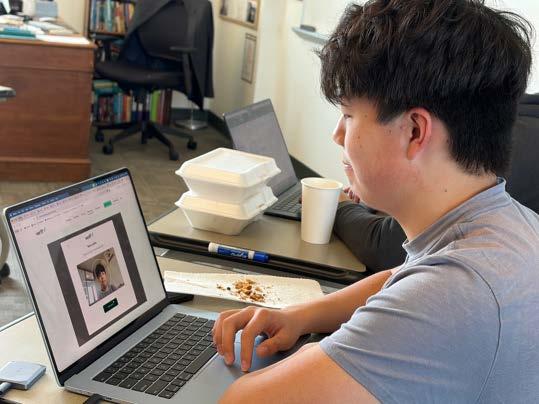
Ben Qu ’28 completing an age-verification scan
BRANDYN LUONG ’27
voices
The household I grew up in is a rapidly shrinking commodity in the United States. My parents hold different political beliefs, something that is becoming rarer by the year. In 2016, 30% of marriages in the U.S. were composed of people with different political beliefs, but in the New American Family Survey, only 21% of families are, and of those, only 4.6% are between a Democrat and a Republican.
While this may have led to many arguments over the years (especially in relation to the wider swings of recent times), seeing how these arguments were reasoned out was a necessary stage in my development into a growing adult.
Online, millions of people are so stymied by their political beliefs that it seems that they stop seeing the other side as human. There are thousands of comments on social media from people saying that going beyond considering someone with different political beliefs as a partner, but even as a friend, is beyond them.
This divide is becoming even more pronounced among younger generations, where political disagreement is no longer just common—it is widening into entirely different worldviews.
Among Americans aged 18–29, young women are significantly more likely to identify as liberal or Democratic, while young men are increasingly leaning conservative. In fact, recent data shows that 61% of young women supported the Democratic ticket in 2024, compared to just 48% of young men, illustrating a sharp political split within the same generation. Even more striking, some analyses show young men favoring conservative candidates while young women favor liberal ones by double-digit margins, a reversal of long-standing trends. This gap is not small—it can exceed 20 percentage points in ideological identification, making it one of the largest gender divides in modern political history
Communication cannot be sacrificed. When you stop seeing the other side as just another person, you become more manipu-
Compromise
lative, as shown by research published in Psychology Today, and it becomes easier for you to write off anything they say. It seems that we are approaching a party-line future, where everyone falls meekly into the program of their party in fear of being ostracized.
While it does make social life more difficult, where it is truly harmful is in our government. The United States government is a system meant to prevent action. Multiple layers of checks and balances prevent major changes from happening (e.g. bicameral legislature, presidential veto, judicial review). Unlike the British government, where the legislative and executive branches are fused and can act swiftly—the U.S. must go through Congress to enact laws—action in the U.S. is much slower.
The growing fear and dislike of the far side of the aisle is becoming a larger problem. According to a study published by The Center for Effective Lawmaking, only about 20% of bill co-sponsors come from the opposing party today, which is down significantly from earlier decades.
This is leading to the United States government becoming slower. According to Newsmax, in the 1950s, Congress passed over 800 laws per two-year session, but in recent years, that number has dropped to 350 or fewer.
The consequences of this growing divide extend far beyond Congress and social media—they shape the way we live, think, and relate to one another. If fewer Americans are willing to engage with those who think differently, we risk losing not just political cooperation, but the ability to reason, compromise, and grow.
The household I grew up in showed me that disagreement does not have to mean division. It can mean discussion, understanding, and ultimately respect. As the country becomes more polarized, that lesson feels less common—but more necessary than ever. If we want a government that functions and a society that endures, we must be willing to see the other side not as an enemy, but as people worth listening to.
Nathan Gill ’26
COURTESY OF NATE GILL ‘26
Nate Gill ’26, captured at Temple’s broadcasting desk during a journalism conference last year
“Fine” was the most dangerous answer
Nobody ever asked me if I felt okay because I never gave them a reason to.
Every day when I came home from school, I heard the same question from my parents: “How was school?”
My backpack would drop from my shoulders by the kitchen counter. I would feel the cold tiles under my feet, and give the same answer every time.
“Fine.”
It was not a lie, but it was not the truth either. That single word became part of a routine. Nothing changed, so nothing got questioned, and quickly that repetition began to feel heavier than any obvious problem ever could.
The silence about my mental health did not stem from neglect, but from natural habit and normality.
Many families don’t intentionally teach emotional language. Parents tend to ask practical questions—about grades, schedules, and responsibilities—because they measure what is known to us. Feelings, especially uncomfortable ones, remain unspoken, not because they don’t matter, but because nobody ever taught us the right way to talk about them.
The generational learning gap creates a quiet misunderstanding, where parents interpret their kids’ silence as stability, while children actually use silence as survival. Love still exists, but the communication and connection needed to express concern beyond the surface are missing, allowing emotional struggles to be hidden in plain sight.
One afternoon in January of my Fifth Form year, I remember standing in the doorway of the kitchen as my mother rinsed dishes and my father took a work call. The end of the semester approached, and the days were getting shorter. The entire car ride home, I sat in silence. No music, no phone noise, just the sound of aggressive wind against my tall Jeep doors. Something felt wrong. I felt myself reaching my breaking point. The sun had already set, even though 5 o’clock had just hit, and the house felt dim and empty in
that winter way. My mother asked the question, and I gave the answer. She nodded, and my father smiled. That was the end of the conversation.
Nothing about that moment was dramatic, but that is where the danger came from.
For as long as I can remember, I have felt the feeling of having nothing be wrong but still feeling off. I had no major trauma in my life to point to—no deaths, no illnesses, no single moment explaining why I felt the way I did—but I still felt like I had experienced one of those things.
On the outside, my life looked and seemed complete. On the inside, I felt like I actively grieved something I could not name. This felt even harder to explain, especially to the people who loved me. How do you tell your parents what is wrong when you don’t even know what it is yourself? My parents, who try their best to be so caring, and use their calm gestures and relaxing tone when they talk to me about my day, make me want to open up and say how off I felt, but I just did not feel worth it.
Later that same January night, I stayed up until 4:30 a.m. without finishing a single assignment. The house fell dead silent, and I became the only sign of life. When I woke up two hours later, my body felt hollow, like all my energy had vanished before the day had even started. I remember the drive to school like yesterday, my eyes burning, and my hands tight on the steering wheel as the road blurred in front of me. At one stoplight, my head fell down for a couple seconds, long enough for my heart to slam back into my chest when I realized what had almost happened. I did not tell anyone about it, but I knew my safety now stood at risk.
Although this moment served as a wakeup call, by the time I went home in the afternoon, I answered “fine” again, as if nothing ever happened. I went back home and scrolled on social media for hours.
In addition to home life, social media has a heavy impact, as it reinforces the idea that appearing okay is more important than
actually being okay. Online, everyone seems to be extremely productive, happy, and put together, which makes any form of struggling feel like an invalid personal fight instead of a shared human experience. When pain does not look dramatic enough or visible to post, it feels unreal. This constant exposure to perfect-seeming life online teaches teenagers to hide their discomfort and present a version of themselves that does not ask for help. As a result, emotional isolation deepens within us, not because the support doesn’t exist and isn’t available, but because admitting this is so difficult and makes us feel like we are breaking an unspoken rule.
I had everything I wanted. I was provided for, supported, and cared for. Because I never said anything felt wrong, my parents assumed everything was right. That assumption is where the problem took root.
They didn’t see, or try to see, what happened behind closed doors, how I went straight upstairs after school and slept for hours, not because I felt tired, but because being awake felt exhausting.
The deep blue walls in my room eventually became my whole world. The pictures of my friends and me on my wall surrounded me, making me miss summer nights and easier times. I curled into the corner of my bed under old Christmas blankets and childhood stuffed animals, waiting for my alarm to force me back into the day I already felt behind in.
Recent research and reports on teens and mental health show just how complex the emotional lives of young people can be, especially in an era dominated by social media and digital connection. A large 2025 survey from the Pew Research Center found that many teenagers recognize both the positive and negative sides of social media platforms. On one hand, a majority say social media helps them feel connected with friends and express anything they want, and a significant share also reports that it has an overwhelming negative effect on sleep, productivity, confidence, and general wellbeing. At the same time, parents and teens
differ in how comfortable they are discussing mental health, with only about half of teens saying they feel comfortable talking about it with a parent.
I knew I fell directly into that data.
No one checked in beyond the surface. The silence became a mutual feeling, as I didn’t speak because I didn’t know how, and nobody asked because nothing seemed wrong. Over time, I began to feel like if nobody noticed anything, then maybe everything I felt lacked reality and never deserved to be talked about.
That belief I told myself kept me stuck in this cycle, as it wasn’t the workload or lack of sleep; it was the feeling of being unseen while surrounded by people.
These mixed findings reflect a much larger problem, which is that patterns of use and emotional experiences online do matter. Research from the National Institute of Health shows that young people with high anxiety or depression tend to spend more time on social media and may experience a heightened self-comparison and mood changes tied to online interactions. This is not because the phones cause stress, but because digital platforms heighten this in ways very hard to see from the outside.
This recent reporting and research indicate that even though digital culture is not the main cause of many mental health concerns, it plays more than a significant role in shaping teens’ internal emotional experiences and their willingness to open up about it, which mirrors my own experience of feeling “off” without a clear reason that anyone seems to notice.
Now, I can realize that the struggles of mental health do not always come with traumatic events or breakdowns. Sometimes they exist quietly, hidden in daily routines and closed bedroom doors. Most of the time, the hardest part is not the feeling itself, but realizing that suffering in silence does not make you stronger, it just makes you more lonely, and social media will not solve the problem—it will only deepen the silence that keeps so many people struggling alone.
George Kanteliotis ‘26
Portrait of George Kanteliotis ’26
The inevitable
John Buscaglia
’26
10:30, 11:00, 11:45, 12:30, 1:15. Just like that, I have doom scrolled through the entire night.
In today’s society, technology is everywhere. It surrounds us, and we rely on it. It’s in every aspect of our lives and has become something inescapable. It almost feels inevitable.
My phone is the first thing I look at when I wake up and the last thing I look at before I go to sleep. I tell myself I’ll only scroll for a couple minutes, but those minutes turn to hours.
I’m no exception to this addiction. My phone is the first thing I look at when I wake up and the last thing I look at before I go to sleep. I tell myself I’ll only scroll for a couple minutes, but those minutes turn to hours. After finishing a set at the gym, I grab my phone. I get to my baseball bag after practice, and I grab my phone. When I finish a math problem or write a few sentences of homework, I grab my phone. This almost drug-like effect is the root of my problem.
I can’t get away from it.
What started as a way to connect with people and make various tasks more convenient has taken over lives and replaced some
of life’s natural joys with screens. I know I’m not the only one who feels this way. An article from the University of the People reads: “Technology has increased the rate of technological addiction, which is characterized as the uncontrollable urge to constantly and consistently use technological devices or the programs, apps, and platforms that come with them.”
Technology has taken over and interrupted my own and others’ everyday lives. I’m not saying that all technology is bad. It adds a level of value that can’t be compared. But the extent to which it has been integrated into our everyday lives is a problem.
Countless times, I procrastinated on an assignment or task and wasted that time scrolling, playing video games, or getting too involved in shows. Going back to mid-way through my Fifth Form year, it was time for the infamous midterm paper. This was a daunting 10-12 page paper on a selfproposed topic of any historical event, worth an incredible percentage of the semester grade. Before this paper, I had not written an assignment longer than six pages, so I knew I was in for it. We had roughly a month to write this paper, but I took my grand old time getting started the day before it was due. Thankfully, it was due on a Monday, so I had the whole day Sunday to do it.
You may be wondering whether I used this to my advantage, broke writing into parts of the day, and lightened the load.
I did not.
I spent the beginning of the day on my phone. Saying to myself, “I have plenty of time to do this, I’ll just chill for a bit.”
That little bit turned into 6 p.m. as I
moseyed through my day as usual, with not a word in the Google doc, doing anything but what I needed to.
Once I looked up at the top-right corner of my phone to see 6:03, I knew I needed to stop and focus. And finally, I did. I was hard at work for about two hours, making solid progress. I decided to take a break. A tiny mental rest to eat, relax, and recharge would do me good. The plan was to take 30 minutes, then get back to work around 8:30. This did not happen.
Those 30 minutes went from, “Well, like it’s still pretty early. I could start up again at 9, it will be alright.”
I finished what was an unpolished piece of work that I didn’t have time to revise or review. I fell into the trap that I couldn’t seem to escape—the inevitable.
Fast forward to 10 o’clock, and I still hadn’t gotten back to work. I put on an episode of Blue Mountain State. “Just one episode.” One episode turned into two, and the snowball effect began.
I finished that second one and said, “Enough is enough.” For all of five minutes. Notifications from Snapchat, Instagram, and ESPN updates kept blowing up my phone. I couldn’t resist this urge to check. And what did that lead me to do? Go over to TikTok
and get roped into my “For You Page.” It was 11:15.
It was late, and I was tired and unmotivated. But with much willpower and my phone dying, which was the only way that I could stop myself from procrastinating this paper any longer, I locked back in.
I worked for two more hours and finished the paper. I finished what was an unpolished piece of work that I didn’t have time to revise or review. I fell into the trap that I couldn’t seem to escape—the inevitable.
I always feel the urge to watch one more video, scroll one more time, check one more post. This habit doesn’t just affect me. This struggle has impacted numerous people. The hours I have spent consuming this brainrotting information have taken a toll on my daily life and routine. Technology is woven into almost every aspect of our lives. School, work, home life, it’s everywhere.
Disconnecting from this false reality can be beneficial.
Take a step in the right direction. Make a change.
I have personally taken steps in the right direction by limiting my screentime. That’s what I want you to do.
Take a step in the right direction. Make a change. It can be small. If you scroll before bed, force yourself not to. If it’s the first thing you look at when you wake up, don’t allow it.
John Buscaglia ’26
The beauty in art
Peter McConnell ’26
Art: photography, paintings, drawings, music, food, words. My most recent and favorite discovery is the art produced in the theater. I am in Mr. Tom Stambaugh’s Page and Stage Sixth Form English Seminar class. We recently finished reading the play, Good Bones Performed at the Arden Theatre in Philadelphia, it explored the topics of new versus old, tradition, and how memories shape our perception of spaces.
While reading James Ijames’ play, I was fascinated. I was absorbed by the insight found in familiar themes—themes that make up the conversations we share with others over cherishing childhood memories, selling the house, and deciding whether or not to explore new possibilities to improve a community.
To the casual viewer, these themes would appear as just a debate over the old versus the new and how tangible items contain larger-than-life memories. Yet there is far more than that.
This is what makes up art. The opportunity to interpret something.
Contrary to my recent revelation of what art means, upon hearing we would be reading a play that discusses the relocation of a sports complex and the impact kitchen
knobs can make on a new home, I couldn’t imagine it being “good.”
This is what makes up art. The opportunity to interpret something. My viewpoint reaffirmed my commitment to my definition of art: an opportunity to allow all to interpret “art” as they wish.
In recent years, I have enjoyed seeing shows at the Academy of Music in Philadelphia: Hamilton, Hadestown, and Les Misérables
Yet I never realized how many more possibilities there are to see an incredible show: musical theatre or a play, all simply a short drive or train ride away.
I discovered this last Thursday evening, March 19, when the two sections of Page and Stage took the train into the city, and walked through Old City Philadelphia, near Chinatown, to the theater.
The 76ers Stadium was planned for 10th and Market, a stone’s throw from the vibrant Chinatown neighborhood. As we walked out of Jefferson Station, we passed the site for the arena, now destined for South Philly.
A few minutes later, we made it to the Arden Theatre, used the bathroom, found our seats, and the show began.
Aisha and Travis, recently married, moved into a nicer part of town. Earl, the contractor working on finishing up the kitchen of their new home, lives in a less nice part of town.
Earl and Aisha encounter a conflict: she is the consultant for the planned stadium,
while he is the contractor of her home, who has friends and family living where her “project” will displace them.
I found myself telling my neighbor about this play the next day. I realized how relevant the themes of this play are to me, my life, and my neighborhood. My neighbor mentioned a tree that used to be on the corner of our street. Yes, this tree was always a concern for power outages, but it carried some legacy. The tree was chopped down last fall. The diameter of the stump is my height. This giant tree was a landmark of our street.
We live in a world where tradition, change, and “moving on” endure.
We live in a world where tradition, change, and “moving on” endure. While I am not in favor of chopping trees, if they threaten the health of the community due to power outages, for example, it’s necessary. The good news is, there is no reason not to go out and plant more trees!
Aisha is in favor of moving on with life, building the complex to destroy the negative memories she carries from her childhood. Earl, on the other hand, firmly believes that the work she is doing, despite the loss she endured and her good reason for the stadium to help revitalize the community, is unfair. He stands with tradition. He wants the
memories to live forever.
Either character has good reasons for their beliefs. Earl does not think it is right to displace the people living in this place, full of memories that are positive to him. Aisha, on the other hand, simply wants to heal the current decayed state of the place.
Art allows for many right answers. Infinite possibilities. In a world full of disagreement, take heart. Enjoy the one thing that can unite us fully: art.
This is the beauty of art. It allows us to reflect on ideas. It’s as simple as that. I don’t care who you identify with: Aisha or Earl. It doesn’t matter. The point is that art lets you decide where you want to stand.
Art allows for many right answers. Infinite possibilities. In a world full of disagreement, take heart. Enjoy the one thing that can unite us fully: art.
Whether it be attending a local art gallery, going to a local church’s concert, going to a local university’s theatre for a creative production, or visiting Old City Philadelphia for an incredible show—it’s there. Art is waiting for you. Now, go and get lost in the beauty beheld in the infinite ideas of art.
Peter McConnell ’26
Ragtime closes to a standing ovation
After several months of late-night rehearsals, the upper school’s production of Ragtime ended with a bang.
Ragtime tells the story of three different groups of people living in early 20th-century America.
Those three groups consist of the New Rochelle people, Harlem people, and Immigrants.
Fulfilling the purpose of this story requires every single member of the 112-student cast to work together.
Sixth Former Phil Okala, Jr. has been in several Haverford productions during his time at Haverford, starting with Beauty and the Beast and now culminating in Ragtime Beauty and the Beast allowed Okala to get comfortable being onstage, while How to Succeed in Business Without Really Trying and A Few Good Men pushed his acting skills further. By Ragtime, the years of experience started to come together. Taking on the role of Coalhouse Walker, Jr., a complex and emotional lead role, asked a lot of Okala. He revealed his key strategy.
“Be comfortable with being uncomfortable. Taking on dynamic characters and understanding that you will have to let down a few walls to completely build up the foundation for being someone different every single time you’re on stage, that’s something that can really benefit you in the long run,” Okala said.
The moment he wants to relive most isn’t a standing ovation or a breakthrough rehearsal. It’s simpler than that.
“The final bow with ever yone together on stage,” he said. “That was a really heartfelt moment.”
Standing with the full cast at the very end meant everything to him after months of rigorous rehearsals. He advised anyone thinking about theater next year to have fun with it.
For Sixth Former Will Bradford, who played Father in the production, was both his first and last appearance in a Haverford show.
Having a lead role with no prior experience was difficult.
“At first it was a little bit nerve-racking,” he said, “because I felt like I had this responsibility to perform well or else it would be a huge challenge.”
He was walking into a cast where a lot of people had years of experience he simply didn’t have. His character, the people around him, and the theatre experience were all new. Eventually, rehearsals felt less intimidating and more like something to look forward to.
“As I settled into the role a little bit more, I just kept on going, and I thought it was really a fun experience,” Bradford said.
Bradford found a way to make his nontheater background work, and the surrounding cast helped him get there. For Bradford, closing night affected him much differently than he expected, but only having a few months of school until college, Ragtime felt like a preview of every other aspect of his life here ending.
“I didn’t think I would be as emotional as I was after the show was over,” Brad-
ford said. “It reminded me that my time at Haverford is limited and that it’s coming to an end. But I feel very much rewarded that I got to meet all these new people and build relationships that I probably wouldn’t have had without this experience.”
Bradford’s offers advice to anyone hesitating about auditioning for next year.
“I have never been in a production before, and this is the first time I have, and I loved it. If you keep trying new things, you’re going to find something that you just want to keep doing,” he said.
Fifth Former Hugh Williams, playing Younger Brother, felt that Ragtime connected him to people in a way he didn’t quite expect.
“I feel like I connected with more groups of people,” Williams said. “It was just a great sense of community.”
Second Former Raphael Sommer was one of only two middle schoolers in the production, stepping up in his role as Little Boy. Sommer greatly enjoyed his appearance in the show and came out of the experience wanting more.
He said, “I think Ragtime was one of the best shows ever. I loved it, my parents loved it, everybody loved it.”
Performing Arts Chair Mr. Darren Hengst was inspired to direct Ragtime after watching the Broadway production of it in college.
“It was one of those shows that is lifealtering for you,” he said. “It hit me in the heart with all the music, the story, the characters.”
Mr. Hengst has wanted to direct the production for years. The large scale of Ragtime always made it feel like a stretch, and the show came with real challenges. Despite this, what stood out to Mr. Hengst wasn’t any of the hard nights, but watching the students grow.
“It felt like the students and technicians went from just trying to hit their marks to actually becoming storytellers,” Mr. Hengst said.
Wednesday and Thursday of tech week saw this the most, when lighting, sound, acting, and everything else combined in the same room at the same time.
“That’s when I get to take notes and really put the puzzle together,” Mr. Hengst said. “If I were to relive anything, it would be those two nights.”
Okala shared Mr. Hengst’s sentiment.
“Nothing is possible without all of the staff and pretty much everyone coming together at the same time, at the same place, to make something so special,” Okala said.
Mr. Hengst came out of this production more eager for large-scale shows. He is still deciding which shows to direct next year, but is already considering which students are willing to put in the time and effort in order to be fully prepared, and which shows will give them a chance to shine.
“It’s about finding something that can highlight as many people as possible,” Hengst said. “The best part of this job is putting people in position to succeed. You rehearse with these students for months and then you get to watch them take off.”
Phil Okala starred in the school’s March 13-15 production of Ragtime
CHARLIE SCHREIBER ’26
Sahil Manjeshwar ’28
“Our Voice” runs as the first student-led art exhibition
Cody Luong ’29
Posters for the Student Art Committee’s Our Voice have appeared around Wilson Hall. These posters mark a milestone in Haverford’s history: the first-ever student-run art exhibition. The exhibition opened on March 12 and will close on April 6.
The awards picked by the Student Art Committee were based on five categories: Most Playful Artwork, Most Inspirational Artwork, Most Creative Artwork, Best Representation of Haverford’s Core Virtues, and Most Interesting Title. The committee chose to pick these categories for potential winners in order to be interactive with the voters.
According to the Student Art Curators, consisting of Cody Luong, Julian Chapman, and Oliver Peters-Whitaker, “The art committee values the viewer to reflect the Haverford virtues and interpreting the messages behind the artwork itself. It isn’t just an open book;, you must analyze, reflect, and observe the artwork in order to find its true meaning.”
The opening day of the exhibition was a great success for the Student Art Committee, featuring artworks from dozens of upperschool artists, light refreshments, and iPads where people could vote for their favorite artworks in their respective categories.
“It was a unique experience that I’ve never quite felt before, though in a positive way. I wasn’t sure what to expect when vis-
BTS’s
Byron Yang ’28
Biting the exhibition, but I sure didn’t leave disappointed. For the first student-led art exhibit in Haverford’s history, I would consider the exhibit a job well done,” Third Former Sam Sholl said. “One thing I’ve never expected was to vote for my favorite artworks, which was something unique. Personally, I was interested in the artwork titled ‘Putter in Action,’ but unfortunately, it didn’t make the cut.”
The social media page, run by Third Former Charles Rudolph and Sixth Former Max Powers, has been getting a lot of attention. They recently submitted a post featuring the winners from the exhibition.
Rudolph said, “We aim to post at least one student art piece every week to make sure lots of students’ arts are seen. We also post things about different events and everything that is going on in the art committee.”
Supervising a social media page comes with pressure and responsibility.
“I have to admit, there is some pressure in managing social media. For instance, if you make a typo on a post or we mistakenly give credit to the wrong person, it’s a mistake big enough to damage the reputation of the Student Art Committee. That’s why we value collaboration and always make sure to double-check with the committee to make sure we are giving out the right information,” Rudolph said.
The Student Art Committee has come a
long way since its inception. The hard work and effort put in by the committee, the artists who have submitted their artwork, and the supporters who helped with the exhibi-
four-year hiatus comes to an end
TS is back. The global K-pop phenomenon released their fifth studio album, ARIRANG, on March 20, marking their first full-length project in nearly four years.
The fourteen-track album arrives after a long hiatus following 2020’s Be, which topped the Billboard 200 and cemented BTS as one of the most influential music acts in the world.
Already, ARIRANG is breaking records: it swept the top-fourteen spots on the global Spotify charts, became the most liked video release of 2026 so far, and sold over one million copies in just ten minutes, reaching four million within 24 hours, while setting a new record for the most single-day streams for a K-pop album.
BTS is a seven-member South Korean
group that has redefined what global pop stardom looks like. With chart-topping hits like “Dynamite” and “Butter,” the group has built a massive international following and broken records across continents. Their influence extends far beyond music. Earlier this year, Mexican President Claudia Sheinbaum reportedly asked South Korean President Lee Jae Myung to help bring more BTS concerts to Mexico as part of their upcoming world tour, a sign of just how far their reach extends.
With ARIRANG, BTS enters what many fans are calling a new era. The album gives each member more space to showcase their individual style while maintaining the group’s signature sound.
RM continues to serve as the backbone of the project, anchoring the album both
lyrically and thematically.
At the same time, the record features a wide range of contributors and influences, reflecting BTS’s evolution over nearly a decade.
The title itself carries deeper meaning. “Arirang” is often considered the unofficial anthem of Korea. The song has been sung for more than 600 years and is recognized by UNESCO as an Intangible Cultural Heritage of Humanity. Rooted in themes of sorrow, resilience, and unity, the song has historically connected Koreans across generations and across borders. One of its earliest known recordings dates back to Korean students studying at Howard University in the late 1800s, making it a cultural bridge between Korea and the United States.
That historical weight appears through-
tion were all key components for its success. The next time you walk through Wilson Hall and manage to have a few extra minutes, stop by and support your fellow artists!
out the album. In the track “Aliens,” BTS references Kim Gu, a key figure in Korea’s independence movement, signaling a deeper engagement with Korean identity and history. It is a reminder that even as BTS operates on a global stage, their work remains grounded in cultural storytelling.
The group officially kicked off this new era with BTS The Comeback Live, a massive performance staged at Gwanghwamun Square, one of Seoul’s most symbolic landmarks. The event drew 104,000 fans, setting a new record for the largest public concert in South Korea, surpassing PSY’s 2012 performance. The twelve-song setlist blended new material with familiar energy, offering fans a first look at how ARIRANG translates to a live audience.
The group is set to make back-to-back appearances on The Tonight Show Starring Jimmy Fallon on March 25 and 26, continuing their global media rollout. The momentum will carry into the ARIRANG world tour, which is set to span 34 regions and 82 shows, extending into spring 2027.
East Coast stops include MetLife Stadium in New Jersey, Gillette Stadium in Massachusetts, and M&T Bank Stadium in Maryland, with several dates already sold out. Unsurprisingly, resale ticket prices have surged, reflecting the overwhelming demand to see BTS live after years away.
The four-year gap between albums has only added to that anticipation, raising expectations for what this comeback needed to deliver.
“I think the four-year break can definitely help with motivation to go above and beyond and produce a better album, but it also brings a lot of pressure,” Third Former Cody Luong said. “People expect you to come back even better, and after that much time away, the anticipation is really high.”
For fans and newcomers alike, ARIRANG marks more than just a comeback. It signals a shift, blending global pop influence with deeper cultural roots while pushing the group into its next chapter.
BTS star J-Hope said, “BTS 2.0 is just getting started.”
Jay Tyson ’26’s Cardboard Cockatiel, second place winner in the student art exhibition
Asphyxia: the resurgence of alternative rock
Brandyn Luong ’27
In a musical landscape oversaturated by pop and rap, the technical complexity of past music can feel like a fading memory. Just a few decades ago, the Western scene was defined by the ambition of giants like King Crimson, Queen, and Pink Floyd. Yet today, the reigning champions of the charts recycle sanitized, four-chord slop that lacks any semblance of complexity or grit of its predecessors.
While rock has been slowly declining over the last century, it has resurged through the DIY blending of alternative and indie rock. While household names like Green Day and Red Hot Chili Peppers brought rock to the masses with melodic, pop-esque hooks, the indie scene has taken a different approach. Japanese artists have contributed to the genre by blending Western rock structures with jazz-influenced chord progressions and the technicality of math rock, creating some of the most unique music of the 21st century.
At the center of this movement is Cö shu Nie, a band formed in 2011 consisting of Miku Nakamura and Shunsuke Matsumoto. Initially working independently on small-scale projects, the group signed with Sony Music Japan and achieved international success with their release of the album Pure (2019). At its peak, Pure reached #27 on Billboard Japan and #29 on the Oricon charts, remaining as their most-streamed album across platforms. The standout track, “Asphyxia,” is the opening song to the hit series Tokyo Ghoul. It is quite simply, “a cathartic explosion of sound,” according to a Crunchyroll article.
What makes “Asphyxia” so jarringly beautiful is how it executes the asphyxiation motif. Unlike typical music, Cö shu Nie uses the musical instability of different instruments to tell a story about heartbreak and suffering. By shifting time signatures and executing calculated instrumental clashes,
Nakamura forces the listener to experience it without merely singing about breathlessness.
The song opens in a standard 4/4 time signature. Nakamura’s vocals are upfront and strong, accompanied by clean piano chords. For a moment, there is comfort—then the arrangement quickly spirals down into a collision of acapella voices crashing against a fast-paced, driving bass line. This gives off a sense of suffocation, the feeling of being trapped in chaotic sound before you have had the chance to settle in.
As you enter the verse, the mood shifts to something dreamy, almost fragile. Underneath the vocals, the bass guitar performs a descending progression mimicking a staircase effect that pulls the listener down into the depths of the track. The percussion is anchored by the shimmering of the hi-hat, keeping the energy mysterious and bouncy.
As tension builds, the song moves into 6/8. You can feel the song inviting you to question when the guitar will finally enter the mix. There is a brief silence where the bass drops out for a second, creating a drop that feels like you have lost gravity.
The greatest execution of the asphyxiation motif occurs at the end of the verse. Nakamura sings the lyrics, “kore ga genjitsu.”(meaning “This is reality,”). Right as the phrase ends, the song jumps to 5/8 for a single bar. This insert acts as a literal gasp for air; a break, leaving the listener on their toes, anticipating the next line.
The chorus alternates between 11/8 and 12/8, a time signature so irregular it feels like it is tripping over itself. You have Nakamura’s emotional, angelic head voice floating over piano chords. And then underneath is the fast-paced acoustics of the drums and a grungy, overdriven bass that adds a unique texture to the piece. She delivers these vocals across fourteen bars, without seeming to take a breath. That subtle detail mimics the physical strain of suffocation, intensifying
this feeling of breathlessness and suffocation under the notes.
The little piano accents add a mezzopiano layer of complexity. It seems counterintuitive to have piano in such a bass-heavy piece, but it weaves moments of rest in mimicking the flickering of consciousness one might feel while suffocating.
The instrumental break is my favorite part of the song. This allows the guitar and bass to shine while the vocals are out. Here, the bass line becomes incredibly complex, making wide interval jumps that pair nicely with the overdriven guitar and snappy percussion.
The transition into the bridge rolls back into 6/8. It is marked by crisp drum rim shots, making the switch easy to follow. The mood feels romantic and “breathier,” incorporating jazz-influenced chords and a piano
tremolo that builds toward the climax.
The song returns to 11/8, reminding you of the clashing. The melody lures you into a false sense of rhythm and pattern before ending not with a bang, but the clash of bass and piano that settles into lone, quiet notes.
What makes “Asphyxia” so special to me is its use of contrast as a narrative tool. Nakamura freely works with soft vocals, pitting them against punchy, math-rock percussion and bass that somehow mesh together so beautifully to create a feeling of asphyxiation.
While much of today’s mainstream landscape relies on the same four chords, Cö shu Nie proves that there is beauty in instability. “Asphyxia” is one of many songs reminding us that music is at its best when it’s daring, unafraid to evoke emotion.
Haverford students win Scholastic Art Awards
The Scholastic Art Award competition, which features student photography, illustration, film, animation, and drawing, is one of the most prestigious art competitions in the country. This year, seven talented students earned regional recognition at the competition.
Leading the way was Fourth Former Atticus Walvoord, who won a Gold Key in Photography, the competition’s highest regional honor. Woolvard commented on the inspiration behind his winning piece, a photograph of a lily pad.
“I felt that the lily pad was almost a diamond in the rough, where everything around it was chaotic, and it was just chilling, living life.”
ATTICUS WALVOORD ’28
Woolvard said, “I felt that the lily pad was almost a diamond in the rough, where everything around it was chaotic, and it was just chilling, living life.”
The process of editing a photograph is not easy.
“The most challenging part of this piece
was the editing of the photograph, as the raw file was terrible compared to the finished piece,” Walvoord said.
Winning also motivated him to keep pursuing photography.
“I
never
really thought that I had a chance at winning it. It wasn’t like I took the picture and instantly knew that it was a winner. But once I saw people appreciating my work, it pushed me to really try my hardest for every art project throughout the rest
of the year.”
ATTICUS WALVOORD ’28
“I never really thought that I had a chance at winning it. It wasn’t like I took the picture and instantly knew that it was a winner. But once I saw people appreciating my work, it pushed me to really try my hardest for every art project throughout the rest of the year,” Walvoord said.
Also honored were Sixth Former Desmond Heneks and Fourth Former Aaron
Ince, who earned Silver Keys in Photography and Illustration, respectively. Sixth Formers Riyadh Rolls and Lamar Duvernay, Fifth Former Jack Maloney, and Fourth For-
mer Duke Durant each received Honorable Mentions in Portfolio Photography, Film & Animation, Drawing, and Photography, respectively.
A version of an Instagram post by The Haverford School congratulating students who won Scholastic Art awards.
Vijay Khanna ’28
Miku Nakamura of Cö shu Nie, in a 2025 concert
COSHUNIE.JP PRESS
sports
Lacrosse ready to defy the odds again
One of the most respected lacrosse programs in the United States has once again taken Sabol Field, searching to continue its historic dominance. Haverford Lacrosse team has amassed extraordinary results: winning two national championships in the past two decades, claiming the Inter-Ac title twenty-two times, and triumphing in the State Championships ten times.
“Our goals this season are to win the Inter-Ac, stay at the top of the league, and
be nationally competitive,” Fifth Former Finn French said. “It’s a lot different from last year. There’s a new identity, and that’s what makes it special—we’re building our own character.”
The team lost twelve seniors who had been core parts of last year’s league championship squad. Fords Lacrosse now faces a monumental task: defeating the other top teams in the Inter-Ac. Malvern Prep Lacrosse is ranked third in the country according to Inside Lacrosse, while Episcopal Academy sits
at fourteenth. The Fords are ranked seventeenth this year, eleven spots below where they were at this point last year.
“Every
season is a new challenge, and that’s the most exciting part for me.”
COACH BRENDAN DAWSON
The Fords are ready to defy the odds once again.
“Every season is a new challenge, and that’s the most exciting part for me,” Head Coach Mr. Brendan Dawson said. “Having to figure out how this team is going to grow and come together as a group is going to take a lot of effort and patience.”
Partially contributing to the low ranking was a home match on March 17 against Loyola Blakefield, where the Fords fell with a narrow score of 8-9.
“One area we’re trying to improve is leadership on the field, and also impacting the game more with our competitiveness— bringing energy, riding hard, clearing well, and doing the little things like [with the] ground balls,” Fifth Former Conor Morsell said. “I’m looking forward to playing InterAc games and hopefully making a run in the state playoffs. I think we can do it.”
The Fords are still trying to move up the ranks by staying one step ahead of the everimproving competition.
“One area we’re trying to improve from last season is starting games stronger. I think we started a little slow last year, so we want to start games better,” French said.
“I’d love us to focus on making our teammates better this year,” Coach Dawson said. “Getting assisted goals and helping each other defensively, especially. Our goals are the same as in years past: to be nationally competitive and win the Inter-Ac.”
While the Fords aim for collective success, they have assembled quite a few standout athletes, many of whom will go on to the collegiate level to play lacrosse. Conor Morsell will go on to play at Notre Dame, Finn French to Duke University, Chris Burnetta to Harvard University, Thomas Hutchinson to The Catholic University of America, Cole Lisowski to Providence College, Jack Risser to Bates College, Braiden DeLacy to Bowdoin College, Charlie Regan to The Naval Academy, Gavin Morrissey to Villanova University, Jack Rischitelli to Trinity College, Teddy Gillin to Cornell University, Anthony Costa to Brown University, Grant Large to Salisbury University, Danny Kinnard to High Point University, and Jackson Gillis to Notre Dame.
“Being out there with my friends and competing against really good teams has been my favorite part of this team.”
CONNOR MORSELL ’27
But the truth is, whatever anyone says or whatever rank they give, Fords Lacrosse is a special team that enjoys the small moments.
“Being out there with my friends and competing against really good teams has been my favorite part of this team,” Morsell said. “The competition is really high.”
“The guys know they are part of a special team and group, and they get to carry on the tradition,” Coach Dawson said. “That is both good and bad—there is a sense of pride that comes with it, but also a sense of anxiousness or pressure. I’d like us to focus on the fact that we’re lucky to be a part of something bigger than just ourselves and be grateful for the opportunity that presents.”
Finn French ’27 charges during 8-10 loss to Delbarton
CHARLIE SCHREIBER ’26
Ayush Varma ’27
CHARLIE SCHREIBER ’26
Michael Oldner ‘28 celebrates during game against Delbarton
Fords Baseball gets off to strong start
James MacColl ‘26
Fords Baseball is off to a hot start in 2026.
The Fords played Westtown in an early-season scrimmage and won by a significant margin.
“Everything was working that game,” Team Manager Colin Toth said. “The bats were hot, and the pitches were flying over all corners of the plate.”
The Fords dominated in a 14-6 win.
Four days later, the team played Friends Central and came out victorious with a score of 7-4.
“We picked up our momentum quickly and began running up the numbers”
JACOB HORWITZ ’26
The pitching by Sixth Form captains Gabe Danisi and Jacob Horwitz held Westtown to four runs.
“The offense started slow,” Horwitz said, “but we picked up our momentum quickly and began running up the numbers during our at-bats.”
Fourth Former Zach Lawer was the DelcoNow player of the game, hitting the gamewinning RBI double to seal the victory.
On March 11th, a day after the victory against Friends Central, the team played Penncrest, boasting a 10-6 victory. The offense started slowly but began to gain speed quickly after the third inning. The pitching
remained consistent and powerful throughout the majority of the game. Penncrest committed several errors, allowing the Fords to capitalize on extra runs.
Recently, the Fords played against Garnet Valley and lost 0-6. Garnet Valley has an extremely strong and deep bullpen, and also took advantage of the Fords’ slow bats. The Fords got runners on base but came up short to get the one hit to send them to home plate numerous times.
“We all know what we need to work on and are looking to call it a hicup.”
CALEB SIEVER ’26
Sixth Former and Varsity Captain Caleb Siever said, “Everyone’s hard work this offseason really showed in the first few games. The guys all looked strong, were hitting well, and pitching was fluid from the early innings.”
Siever believes the game against Garnett Valley was simply a bump in the road that does not represent the team’s true talents.
“We’re not too worried at all,” Siever said. “We all know what we need to work on and are looking to call it a hiccup. That score doesn’t reflect who we are as a team at all. We know we can’t come out flat against good teams, and that’s exactly what we did. There were certain things we discussed as a team that needed to be executed, and that
just didn’t happen.”
Many games remain.
“The team is looking to bounce back this week with back to back to back challenging games against some very talented
programs,” Siever said.
The Fords responded on Saturday, March 21, with a commanding 1-0 win over a talented St. Joe’s Prep team after Fifth Former Danny Getz hit a walk-off single.
Crew leans on Fifth Formers
The crew team historically has performed exceptionally throughout both the fall and spring seasons. The team has raced in many prestigious competitions, such as the Head of the Charles, Stotesbury Cup Regatta, and SRAA Nationals.
However, this year, things may be a little different.
Due to the team only having three Sixth Formers, many underclassmen are faced with a bigger role.
“It is hard with basically no seniors, but
we do have a lot of juniors who have been stepping up into leadership roles,” Sixth Form captain Henry Biddison said.
Following an extremely tough fall season, where both the Varsity 4+ (Coxed Four boat) and 4x (Quadruple Scull boat) barely qualified for Head of the Charles, the team looks to recollect and rebuild themselves for the spring.
“We had a really good winter of getting dedicated guys into shape, and I think that will only help our odds in the spring,” Fifth Form captain Andrew Walker said. “Now we
just need to keep working hard, and guys need to realize where they can be leaders for the team.”
The start of the spring season brings the promise of warm weather, but on the horizon also looms faster and more experienced competition.
Many top teams contain Division-I recruits, posing a large challenge to the younger team.
The team captains still believe in obtaining successful results. They all echo the same thing: a focus on technique.
“If we focus on it, I can see us winning a lot of races with our group of guys,” Biddison said.
A boat of rowers who pull together with good technique has the potential to beat not technically sound rowers who pull more watts.
Walker believes if the team can continue to work together, following the leadership and examples set by the captains, they can “achieve a greater sense of team respect and success that will really show and energize the team in future years.”
Delany Joseph ’27, Nate Gill ’26, Andrew Walker ’27, and Luke Maguire ’26 in a photo from last spring
Mike Noone ’27 getting ready to field as the ball is pitched
Ethan Qiang ‘27
Tennis boosted by Third Formers
With tryouts wrapped up and the season just around the corner, expectations for the tennis team are as high as ever. The team’s 2025 campaign was nearly perfect, finishing the regular season 16-1, co-claiming the Inter-Ac title, and winning the PAISAA championships. The team looks to repeat that success this year, and they’re ready to get to work.
“Our main goal is to win the Inter-Ac this year,” Fourth Former Van Hinton said. “I think we have a solid team. [We have] a lot of kids on varsity and a lot of good freshmen.”
Leading the team this season are Sixth Formers Kaiser Zhao, James MacColl, and Drew Carrasco. The tennis team also welcomes back Sixth Former Max Olson, who left during his junior year to train at the Junior Tennis Champions Center, which has formed players like World #20 Frances Tiafoe. As Hinton noted, the team boasts plenty of depth, and with young talent complementing strong Sixth Form leadership, success seems well within reach.
“Traditionally, there’s been a culture where seniors don’t interact much with freshmen, leaving the sophomores and juniors to introduce them to the team,” Carrasco said. “I’ve tried to change that this year. My class has been very involved with the freshmen. I don’t find them annoying at all; honestly,
Drew Carrasco
returns a shot in action last year
they’re some of my favorite people on the team.”
The Varsity tennis team had been toiling with challenge matches for weeks leading up to their match with Radnor.
“Tennis tryouts are interesting because the format isn’t strictly set in stone—it’s not always ‘win this match and you get this spot.’ It’s a very comprehensive process,” Carrasco said. “Since we have so many freshmen, they really had to prove themselves and played a lot more high-stakes matches than I did to earn their spots.”
With tryouts completed and a lineup established, Fords Tennis channels competi-
tive spirit against their opponents.
“At the start of the season, you’re in direct competition with your teammates for spots, which can be tough for morale. But once the challenge matches stop, that internal competition fades,” Carrasco said. “As a captain, I’m focused on shifting that energy toward helping each other and sharing knowledge. We want to stop any bitter competition and focus on beating the other schools instead.”
The Fords opened their season with a 7-0 rout of Radnor High School on March 19. They face their first Inter-Ac matchup against Penn Charter on April 7. Like the
Fords Frisbee, the “chillest” team
previous 16 consecutive years, Fords Tennis looks to continue their Inter-AC winning streak.
“We definitely want to keep that InterAc streak alive. It’s been going for nearly 20 years, so we don’t want to be the ones to lose it! It’s more challenging this year because we’re only playing one Inter-Ac match against each school instead of the home-andaway format, which makes it harder to recover if you tie,” Carrasco said. “Beyond that, we want to win the States again. We’ve only played Radnor so far, but I think we actually have a better team than last year and we won last year. So, that goal feels very attainable.”
Thomas Nye ’26 passes during a contest against Friend’s Central, March 18, 2025
Lo ’27
Haverford hosts many activities and events that go unnoticed or unappreciated. Students make announcements in Centennial Hall, asking the brotherhood to show up and support their brothers.
One way or another, some events still lack student support. One of these activities is ultimate Frisbee.
“There’s a misconception about what Frisbee is. A lot of people think Frisbee is a fake sport,” Fifth Form captain Ezra Walters said, “but there definitely are people on the team that care a lot.”
This misconception is pervasive, even
among the Frisbee team itself.
“Because a lot of people think that the sport doesn’t really matter and that it’s not real, there’s not a lot of care put into it from a lot of other players,” Walters said.
The lack of student support is especially evident at Frisbee games against other schools.
“We never really get a student section,” Walters said.
On the other hand, some students enjoy the laid-back nature of the sport.
“It’s pretty chill…you’re not expected to be a top team in the state,” Fifth Former Brandyn Luong said. “Like track, for ex-
ample, they have goals to accomplish, but we’re just trying to have fun competing in the league.” This sentiment is shared.
“The best part is that it’s really chill,”
Sixth Former Aiden Chiang said. “The coaches are really supportive and passionate about ultimate.”
This year, the team gained an influx of inexperienced players.
“We have a pretty new team this season, and I think that’s true for a few seasons previously, but this year it seems especially pronounced,” Coach Theodora Naqvi said. “I think we are just trying to get a good grasp
of the fundamentals and get enough good play so that next year, we can really [become] a force to be reckoned with in our league.”
However, the presence of newer players is complemented by upperclass experience.
“ We have [our captains] Jay Tyson and Thomas Nye, and they’re really good players,” Luong said. “They’re more athletic than you would think. There’s good talent on the team.”
As the team continues to balance the competitiveness and casualness of Frisbee through the season, there is always space for a supportive student section to cheer them on.