the index
The Haverford

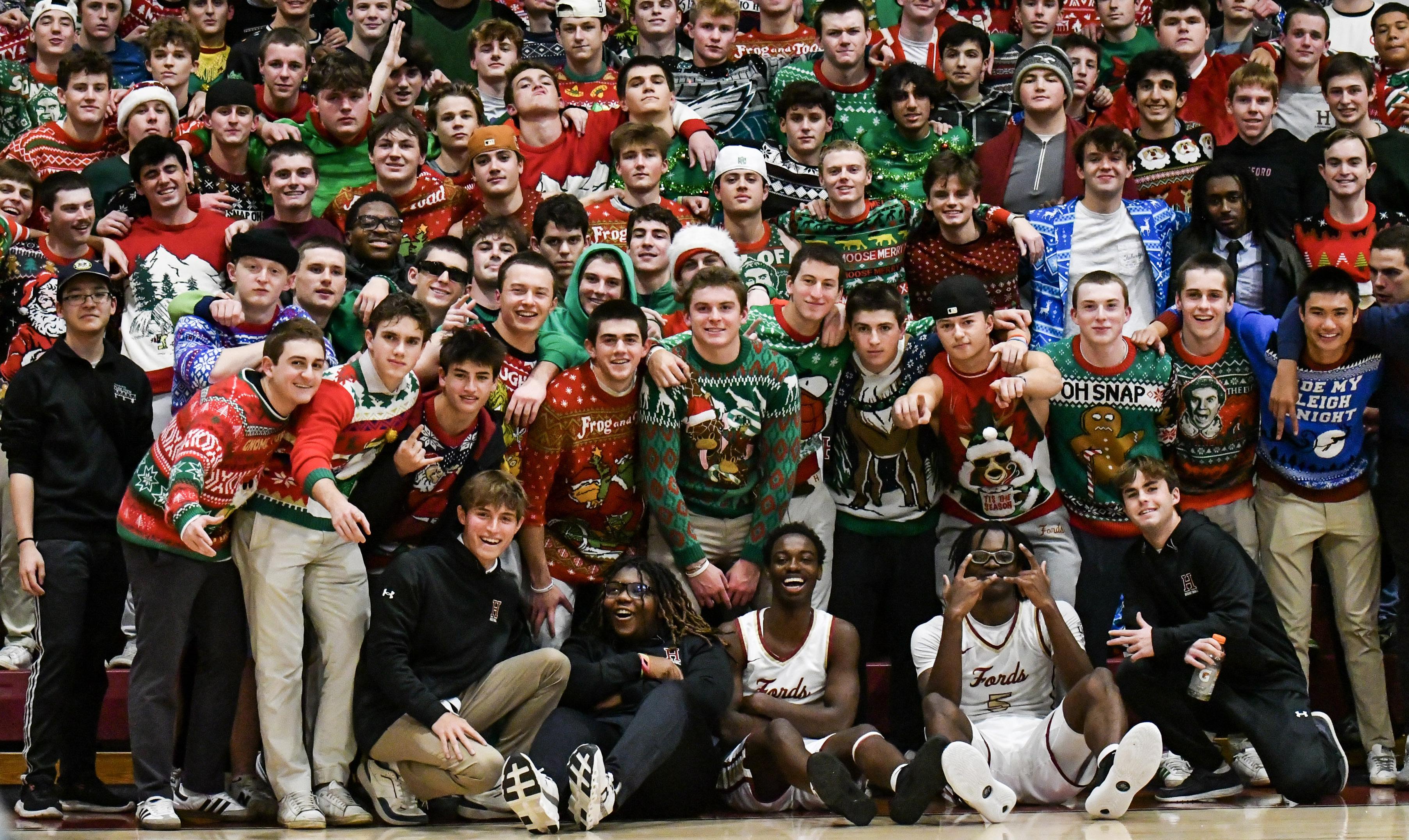
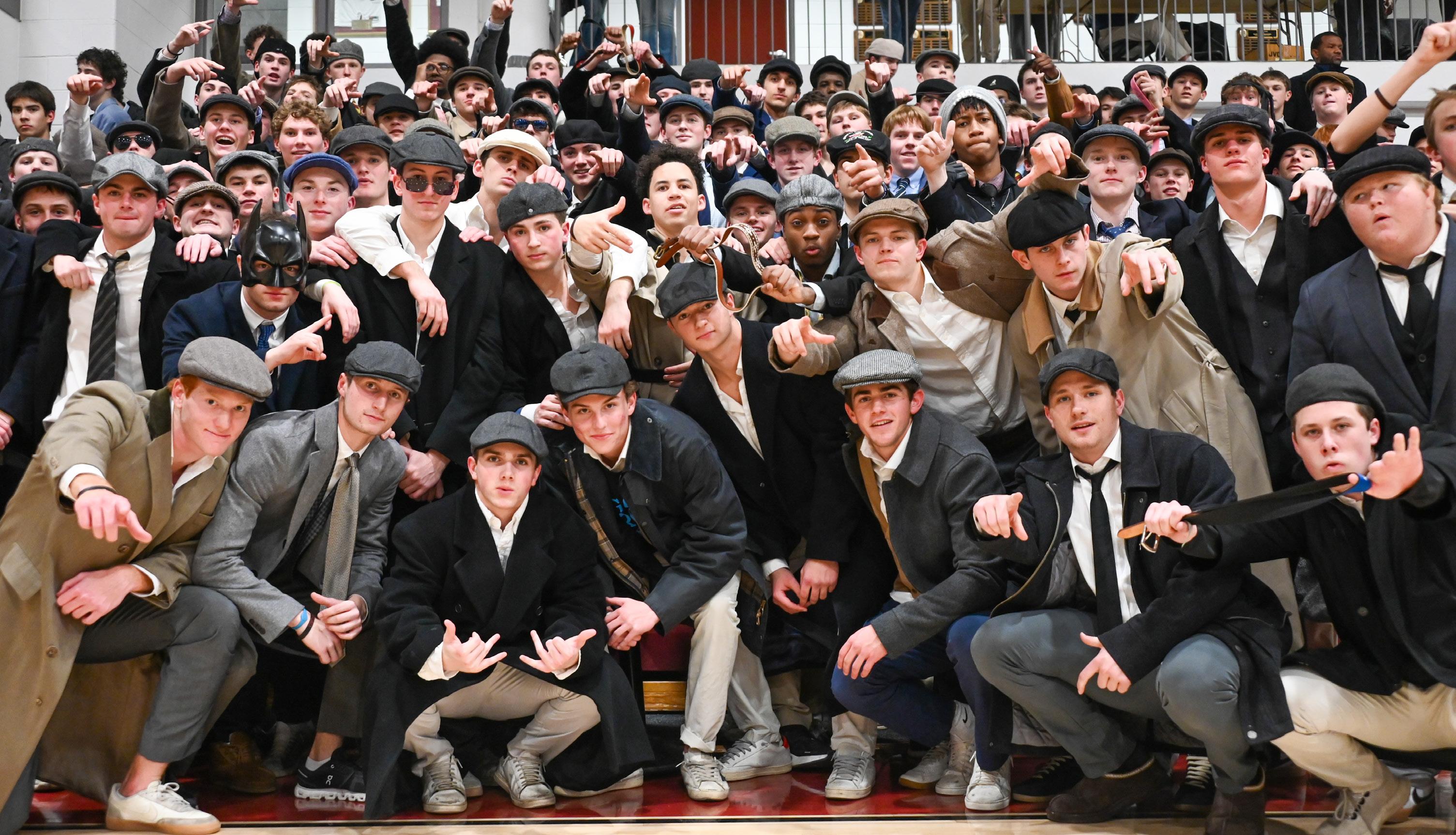
Members of the class of 2026 (front) at the “Silent Night” basketball game
Ryan Wang ’26
Dear Class of 2026, I have not had an ordinary Haverford experience. No parties. No beach or ski trips. A few sports games. No cafe trips or food off campus during community, ASB, and lunch blocks. Instead, fruits as mid-day snacks and home-made lunches every day.
Yet, as I list off these “unordinary” aspects of my time here, I realize that I’m still
as much of a Ford as anyone else. And more importantly, Haverford’s Class of 2026 does not have one defining identity or experience.
Much of my connection and contribution to the Class of 2026 has come within the school’s boundaries. I’ve found a second home in the Conservatory, where I’ve perhaps inspired a few of the many lower schoolers who take lessons there to deepen their commitment. For others, this home
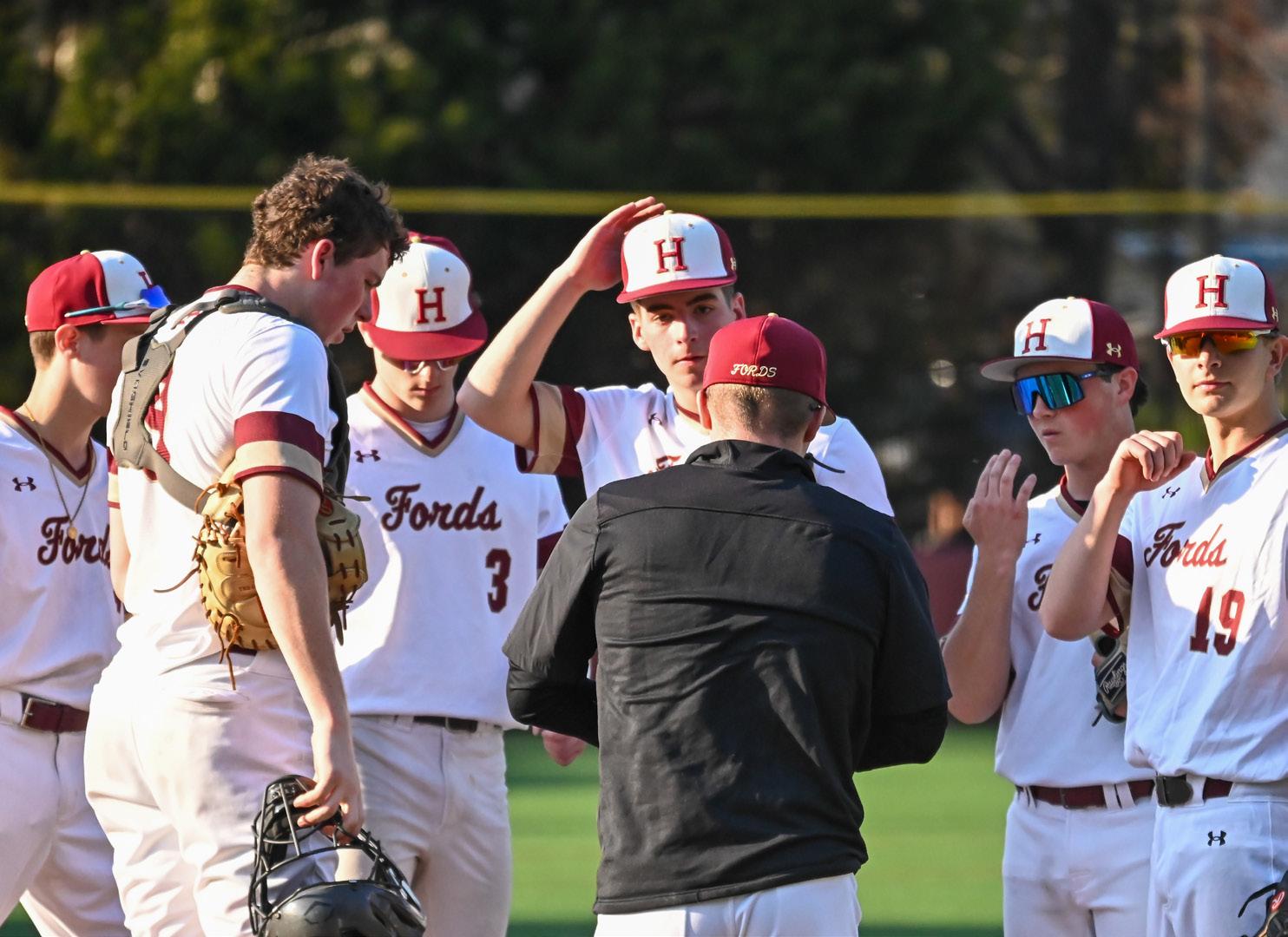
Fords Baseball finished with an overall record of 15-13, though this record does not fully reflect their Inter-Ac or PAISAA tournament performances. The Fords finished the Inter-Ac season with a 3-7 record. However, notable individual recognitions came from the Inter-Ac games, as Fourth Former Zack Lawler made the all-Inter-Ac first team, and Fifth Former Danny Getz made the all-Inter-Ac second team.
Despite the tough Inter-Ac regular season matches, Fourth Former Ethan Stern finds much to be proud of.
“This season showed a lot about who we are as a team. I think finishing any season

with a winning record is a sign of success for the program. We definitely battled through adversity this year, but we never stopped competing, and it showed when it mattered most during the playoffs,” Stern said.
Going into the PAISAA state tournament as the #5 seed, the Fords opened against the #12 seed Abington Friends and won with a convincing 10-0 score. The dominant performance set the tone for their postseason run.
con’t on p. 24
was the Athletic Complex or perhaps Centennial Hall’s stage.
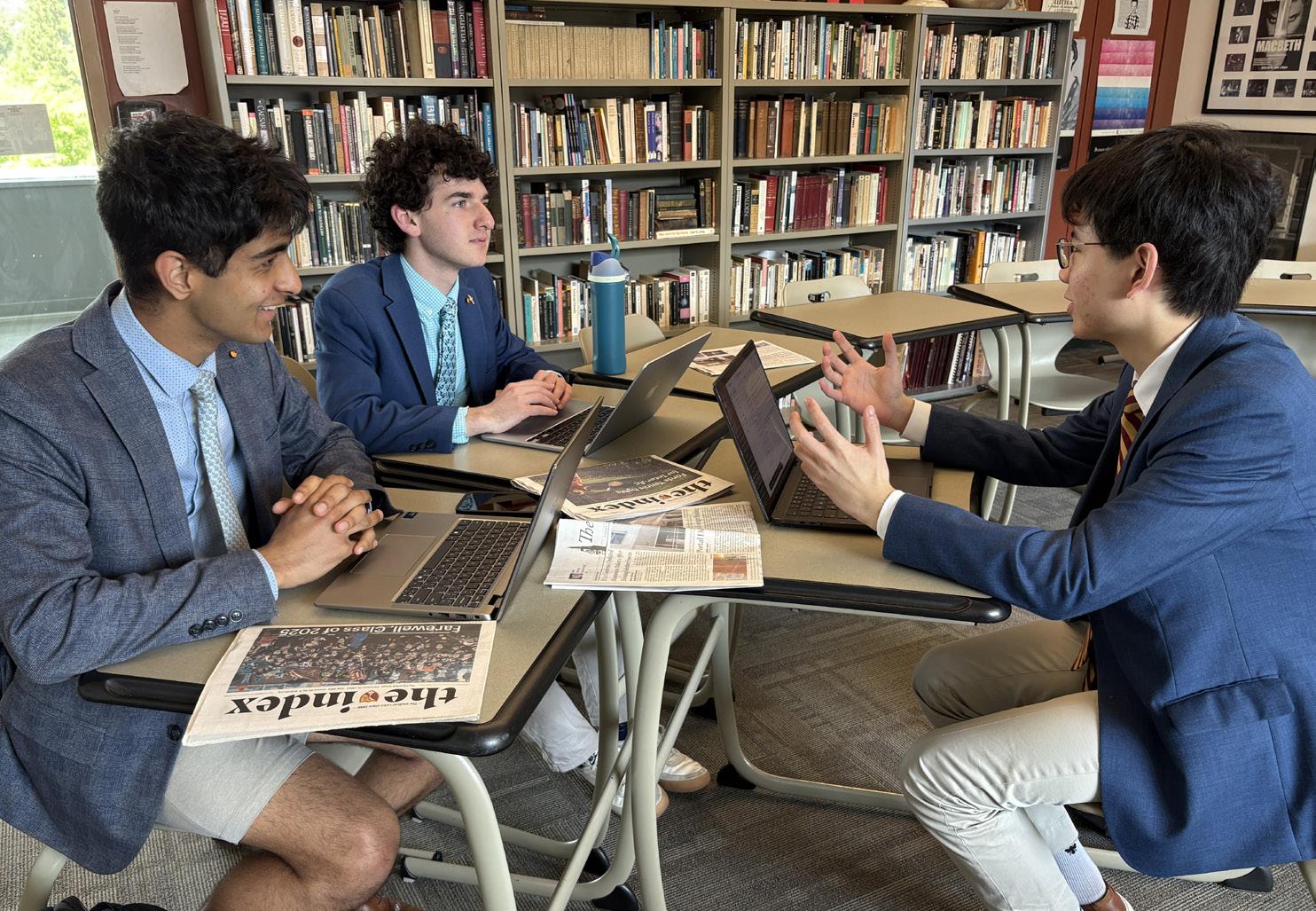
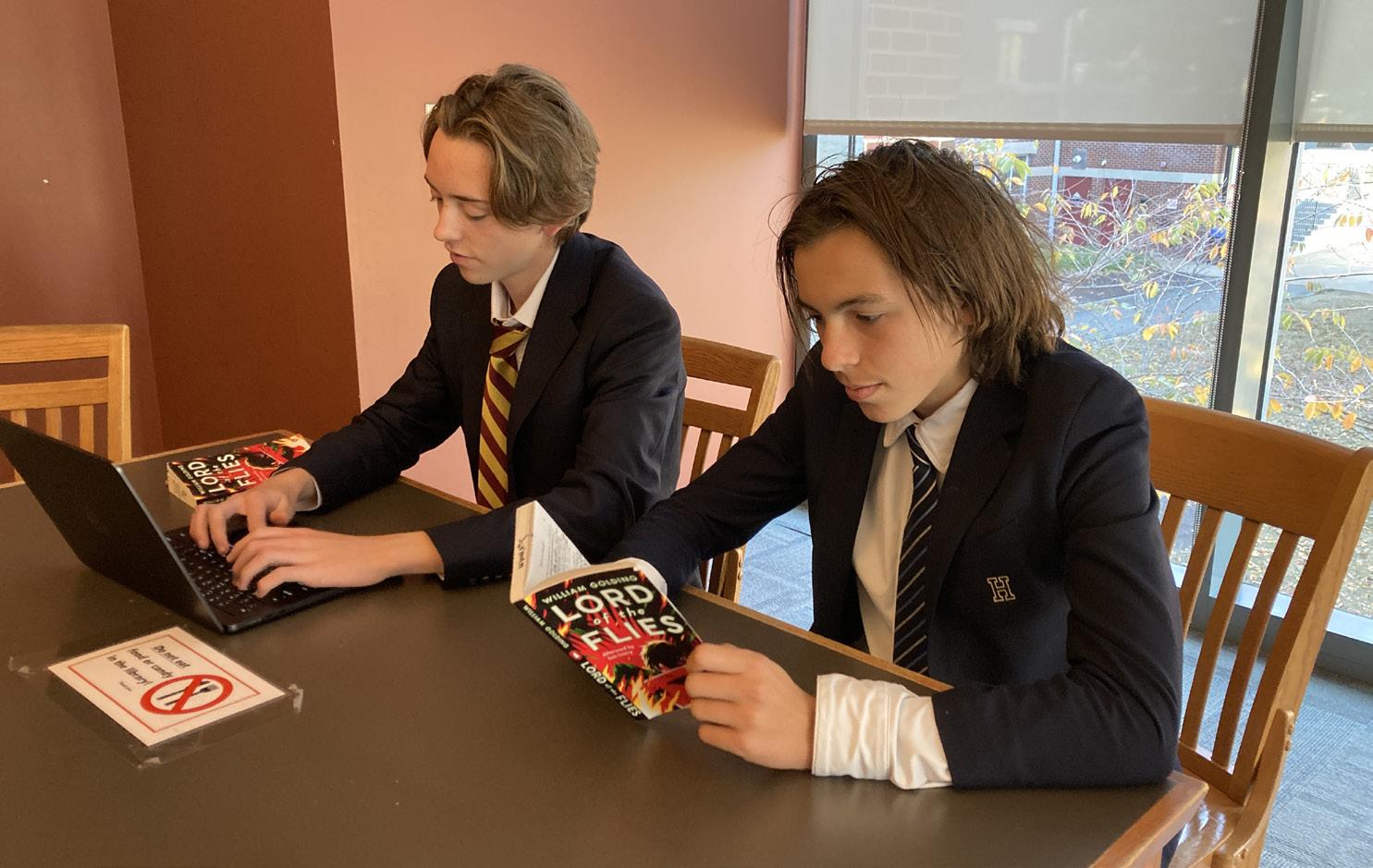
I must mention the school library, where I consistently saw the same 20 to 30 of our guys. In the short time we had between finishing lunch and our next class beginning, we formed a community housed on the center table. We had our final assignment and exam cram sessions; GeoGuessr and impostor games; philosophical, religious,
moral, and straight-up stupid debates; and last-minute sprints from the library to avoid tardiness.

To the Class of 2026, thank you not only for your relentless commitment to The Haverford School but also for simply making Haverford a home. Your character has been seen and appreciated, whether in sports, theatre, academia, or extracurriculars.
This community will remember your names long after you’ve departed. We will
Mr. Anthony Pariano
Mr. Thomas Stambaugh
Dr. Micah Del Rosario
The Index is a student-run publication of the Haverford School that does more than bring news: it provides the diverse perspectives of the Haverford student body. It is an outlet for student writers to take stands on issues they deem important. It chronicles the daily struggles and accomplishments of the Haverford community. The Index also provides a forum for discussion of pertinent issues, such as student culture, academic policy, and Haverford’s place in world affairs. The Index presents new ideas and aspires to influence constructive change.
All opinions and viewpoints expressed herein do not necessarily reflect those of The Index or the school. The Index is designed and produced digitally. Photographs may be retouched. Submissions and letters to the editors regarding any and all articles are welcomed at index@haverford.org
The Index, a member of the Columbia Scholastic Press Association, is composed using the applications of Google Suite and Adobe Creative Cloud. Its surveys are conducted via Google Forms and are advertised on email to current Haverford students. Graphic designs are created by Index staff via Canva. Southern Dutchess News prints 200-400 copies of each issue, and its editorial staff distributes them in the upper school on the day of release. The Index serves the needs of a total school population of 1152 community members, consisting of 952 students and 200 faculty and staff members.
Contact The Index: 450 Lancaster Ave, Haverford, PA 19041 index@haverford.org
Instagram: @Haverford_Index Volume 93, No. 8 - June 3, 2026
remember the way you walked through the hallways, supported one another through classes, and smiled at underclassmen. But most importantly, we will remember how you taught us what it means to be a Ford, just as your predecessors did for you.
Recently, we have appreciated you more than ever. We remember your footprints more fondly after you’ve taken your last
steps. We still listen for your voices long after they stop ringing through the halls. We miss your presence now that the dining hall feels empty, and the school feels a little less excited since you’ve staged your last play, delivered your last speech, performed in your last ensemble, and built your last robot.
To the rest of us, through the ebbs and flows of the school year, we have gained strength, but we have also been dragged through each month more rapidly than the last. Our fear of falling behind leads us to fight our natural need for recovery.
You don’t need to be anywhere else, doing anything else.
So lie in your warm bed under your snug covers to rest. You don’t need to be anywhere else, doing anything else. Sitting might feel like a waste of time because the brain associates self-worth with productivity, but it’s crucial for cognitive development and physical healing.
Take the opportunity to write a letter, give someone a call, and share your unique passions with those around you. The student body has built a strong community over the past year. Let us not lose it for the next.
ords, as the final grades are etched in the gradebooks, as doors start to close until September, and as answers on exams are fretted over one last time, we wrap up our time here together.
Throughout this year, we have experienced many ups and downs, from devastating losses to legendary triumphs. We’ve had moments where honor took a back seat to taking shortcuts and moments where virtue prevailed.
Yet we’ve always found the light, whether it’s cloudy or not.
All of these moments share a backbone:
the Class of 2026. Through every tough moment, each gentleman in our walls had someone to look up to and rely on. But as they depart, their shoes need filling.
Whether you are a rising Sixth, Fifth, or Fourth Former, more responsibilities will fall to you, and more accountability will be expected of you.
But as students of the Haverford School, you will be prepared. Each and every student must rise and make it a personal mission to continue steering Haverford in the right direction.
This mission cannot be turned on and
off whenever we want. Being a role model and leader matters with every breath you take and every action you execute.
Although this burden is omnipresent, the summer is a time for relaxing and doing what you want to do; being a good person and role model doesn’t always have to come from doing something extraordinary or impressive.
Have fun with your friends and pursue your passions while always being a Haverford man.
Go Fords.
A farewell letter to the class of 2026, con’t. from front page
During spring break this year, a basketball league emerged: Ballright. Sometimes we played at school, but we usually traveled to the YMCA. Some of us drove almost an hour each way to hoop. The games are usually quite atrocious, but we’re having fun together, and that’s what matters.
The Class of 2026, specifically its student council, is responsible for the first Haverford Week, an inter-school battle between the maroon and gold teams held during the first week of February. We observed magical music performances, not-so-magical magic tricks, airballs, failed dunks, and an incredible buzzer beater. It provided us with fun rivalries and beautiful opportunities to unite. May this become a long-lasting Haverford tradition, starting with you, Class of 2027.
Beyond the establishment of Haverford Week, we upheld and grew our past traditions. EA Week was electric as always. We led great student sections, especially at basketball games. The team went undefeated in the Inter-Ac with last-second free throws from Sixth Former Dillon Gamble to send the game to overtime against Malvern. What a game for many first-comers. Students flocked to see Ragtime, starring many Sixth Formers such as Philip Okala Jr. and William Bradford.
“I think the Class of 2026 and the school in general has just been a second home for me; a place where I can go if I need anything at all,” Sixth Former Zach Faragalli said. “I think a great thing about our class is that you don’t have to worry about not getting along with people. I feel like I can go in and talk to anyone. Everyone has a good heart, and you can tell people have each other’s best interests in mind.”
One such moment came during the summer before this year’s football season.
“All of the seniors agreed to get up and talk about a hardship, a hero, and a highlight in their lives. I vividly remember [Sixth Former] Quinn Gallagher’s talk. He was super emotional and vulnerable; his hardship was the many injuries he had throughout high school, and the entire team then knew how much they meant to him,” Faragalli said. “He got hurt again during his first game of the season against Bonner, and from then on, we were able to gather around him and root him on and do our best to get him back in shape. His first full game was on EA Day, our final match of the season, and he had a great game that day. That success was super impactful to us. He didn’t even know if he was going to have a senior season, so getting to watch him do his thing was just awesome. I think that’s

the type of leadership we embody.”
While it’d be great to say that we were unified, I think we can be honest with ourselves. Haverford has some cliques. In fact, my conversation with Zach yesterday was my first after four years here. And it’s not just the Class of 2026 nor just Haverford. However, I think the fact that my conversation did happen is something special about our school. Two almost strangers, working together to sign the class off.
For the most part, we split into cliques, and the people within those cliques do get really close.
“There are times where the student body is really together, like during sports events and community moments like Haverford Week. However, outside of that, for the most part, we split into cliques, and the people within those cliques do get really close,” one Sixth Former said.
We often hear that Haverford has a super-inclusive tight brotherhood. I never really found that true, and I think a lot of people say it’s true but, deep down, don’t believe it. It makes sense. Administrators tell us that Haverford is this type of place, and all of those before us claimed that it was true, and how different could we be? And why should we not believe this great thing about us?
That is the problem. We’re told we’re doing a great job, even when cliques still dominate the social scene. While it’s unreasonable to flip the script completely, I hope Haverford can start moving away from cliques, and the Class of 2026 has started that process.
“Something that separates Haverford apart from other schools is that we have so many amazing opportunities: I’ve gotten the opportunity to run a mock trial team and a tutoring program. Getting myself involved in so many activities helps me bring people together and really contribute to the brotherhood,” Sixth Former Colin Toth said.
“Haverford is very hierarchical socially, just as at all high schools… You know, there’s the popular group and whatnot. But I don’t think there’s a lot of social superiority in our grade, and I don’t necessarily think the same of the previous classes.”
Sixth Former Manny Butts also aimed to bring people together.
“I try to be a guy who can relate to a lot of people. Here at Haverford, we all come from different backgrounds, but we share the same small place,” Butts said. “I wanted to be much more than this tall college-recruit basketball player who, well, slept in class. I wanted to be a funny guy who cared for everybody and made sure nobody’s left out.”
I, the 5’6” nerdy kid, became close friends with the 6’6” collegiate basketball player in this manner. I met him through my other friend one day during lunch. We saw each other as equals, got to know each other, and formed an ironic “beef” of signaling “you’re too little” whenever we saw each other—well, at least ironic from one side. And it’s something I treasure deeply: a special opportunity at Haverford, with its small yet diverse student body.
We already take advantage of these opportunities, but these types of friendships should be more common. That’s what a community is about. Manny and I do not belong to the same clique (or any clique for that matter), and there’s a power in that. Many people in the Class of 2026 do not belong to a clique, and my greatest joy here has been getting to know those many people and hanging out with them semi-frequently, in the classroom, in the library, or at the YMCA hoops. This doesn’t look like the typical “connectedness,” but I argue it resembles a school-wide brotherhood much more.
So, while there will always be cliques, I encourage you all—genuinely, actually, for real—to go out of your way to get to know someone new every day for the many years to come.
Congratulations everyone.
Ryan
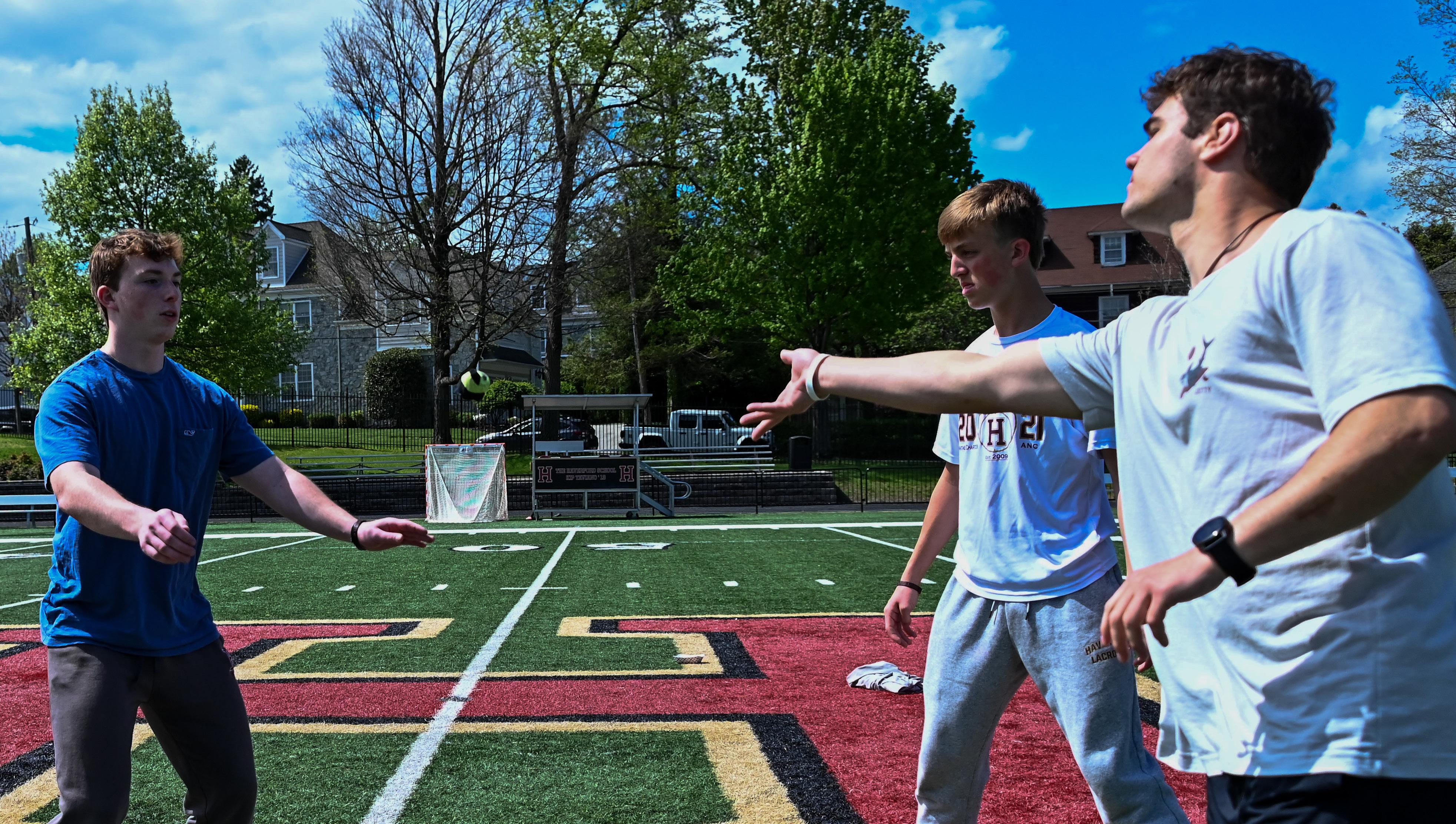
In 1972, a few friends in Oregon City tried to keep a hand-sewn bag in the air using anything but their hands. This game is now known as hacky sack. Hacky sack has been a viral trend, with people showcasing their various skills and techniques on social media. As a game that was most popular during the 80s and 90s, it has suddenly flourished amongst younger generations.
People first saw this trend through videos on TikTok and Instagram showing off trick shots and cool techniques. People enjoy hacky sack because of its vibe, being offline and non-competitive. Third Former Peter Pierce said it’s “a way to bond, where you can make friends through playing and showing off tricks.”
Compared to other popular school-day games such as spikeball and football, “sacking” requires less space, time, price, and people. Students can be seen sacking across the Haverford campus in locations such as The Quad, Sabol Field, and Memorial Field. The flexibility of the game, combined with the
“I find the rise in hacky sack to be more funny and weird but also interesting how it suddenly blew up.”
MR. LUQMAN KOLADE
low price of the bag, allowed students of all ages to get involved easily.
Teachers have mixed feelings about hacky sack. The simplicity of the game has led to students playing indoors as well, where it often causes distractions and disruptions in the hallways, leading to a ban on sacking indoors. Despite the ban, the hype and popularity of the game have led to many students continuing to sack indoors.
“I find the rise in hacky sack to be more funny and weird but also interesting how it suddenly blew up,” Dean of Students Mr. Luqman Kolade said.
On the other hand, hacky sack has allowed students to further their sense of community. The various groups of students sack-
ing together allow students to disconnect from social media and live in the moment while building connections to their classmates.
With hacky sack’s sudden rise in popularity, we can only wonder what other retro hobbies might make a comeback.
With hacky sack’s sudden rise in popularity, we can only wonder what other retro hobbies might make a comeback.

Ignacio Aliaga ’29
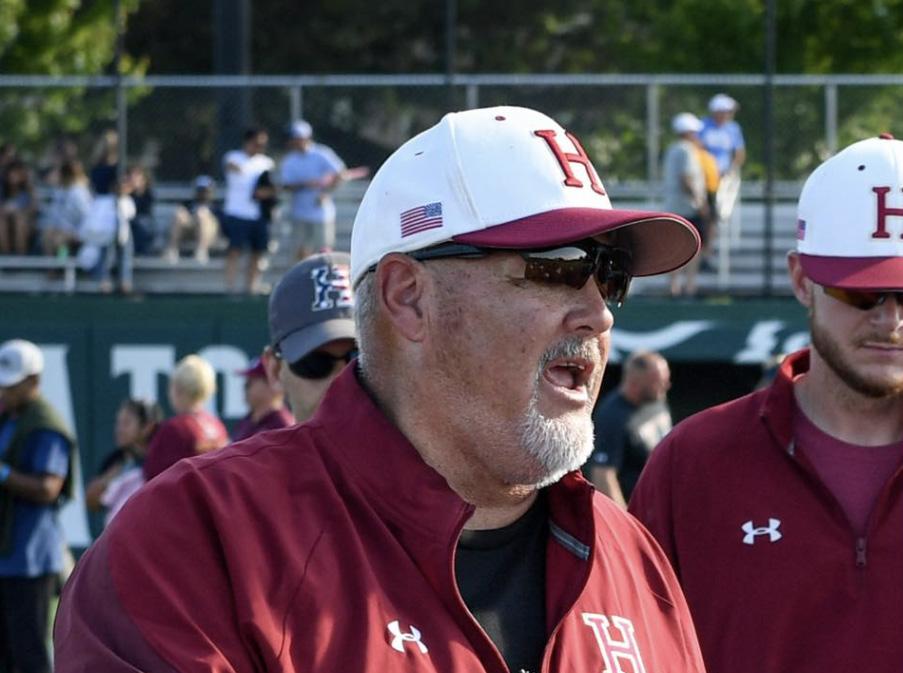
Lower school physical education teacher and former long-time Baseball Director Mr. Bob Castell, has made a profound impact on thirty-three graduating classes.
On the baseball field and in the gym since the spring of 1993, Coach Castell is more than a coach—he’s a genuine and caring person.
“I will miss our daily talks about life, sports, and class,” lower school physical education teacher and Basketball Director Mr. Bernie Rogers said. “Coach Castell was always around to give a helping hand to anyone who needed it.”
Rogers noted that Castell’s impact extended well beyond day-to-day interactions.
“Coach Castell has been the leader in organizing our annual Philip Bishop Day,” Coach Rogers said.
On Philip Bishop Day, a staple of the Haverford experience, students are split into teams of maroon and gold, and they battle it out in various athletic games to see which team wins for that year.
“His presence on and the lead-up to Philip Bishop Day inspired my classmates and me to be competitive and really bring the community together,” Third Former Shaya Khojasteh said. “My brother is in third grade and has echoed this to me, which shows the tradition is still going strong thanks to Coach Castell.”
Coach Castell was many Haverford students’ first introduction to sports.
“He deeply cares about all the students and wants each boy to learn and grow during PE class,” Coach Rogers said. “It is not easy to coach younger children because physical activity is hard and requires mental toughness.”
“Coach Castell was a good coach to bring the introduction to sports for younger students,” Third Former Mason Choi said. “He was very creative with his activities, and he was a very nice guy overall.”
Coach Castell’s kindness and creativity led many Haverford students to become athletes.
“I think that one of the traits that stands out to me is his patience and calm demeanor, no matter the situation,” Athletic Director Mr. Michael Murphy said. “Especially as a baseball manager, no matter the situation, whether it was a really tight, hotly contested game or a game that may have been lopsided one way or another, Coach Castell always had a calm and relaxed demeanor. I think
that really benefited his teams, and they fed off of that, staying calm and focused, no matter what was going on in the game at the time.”
Coach Castell will forever be remembered, but not just because of his three Inter-Ac and four PAISAA titles. He will be remembered because of his personality, the way he is open to conversation, his embodiment of sportsmanship, and his character.
“One of his biggest impacts was that his philosophy and coaching style really reflect-
Alex Fenton ’28
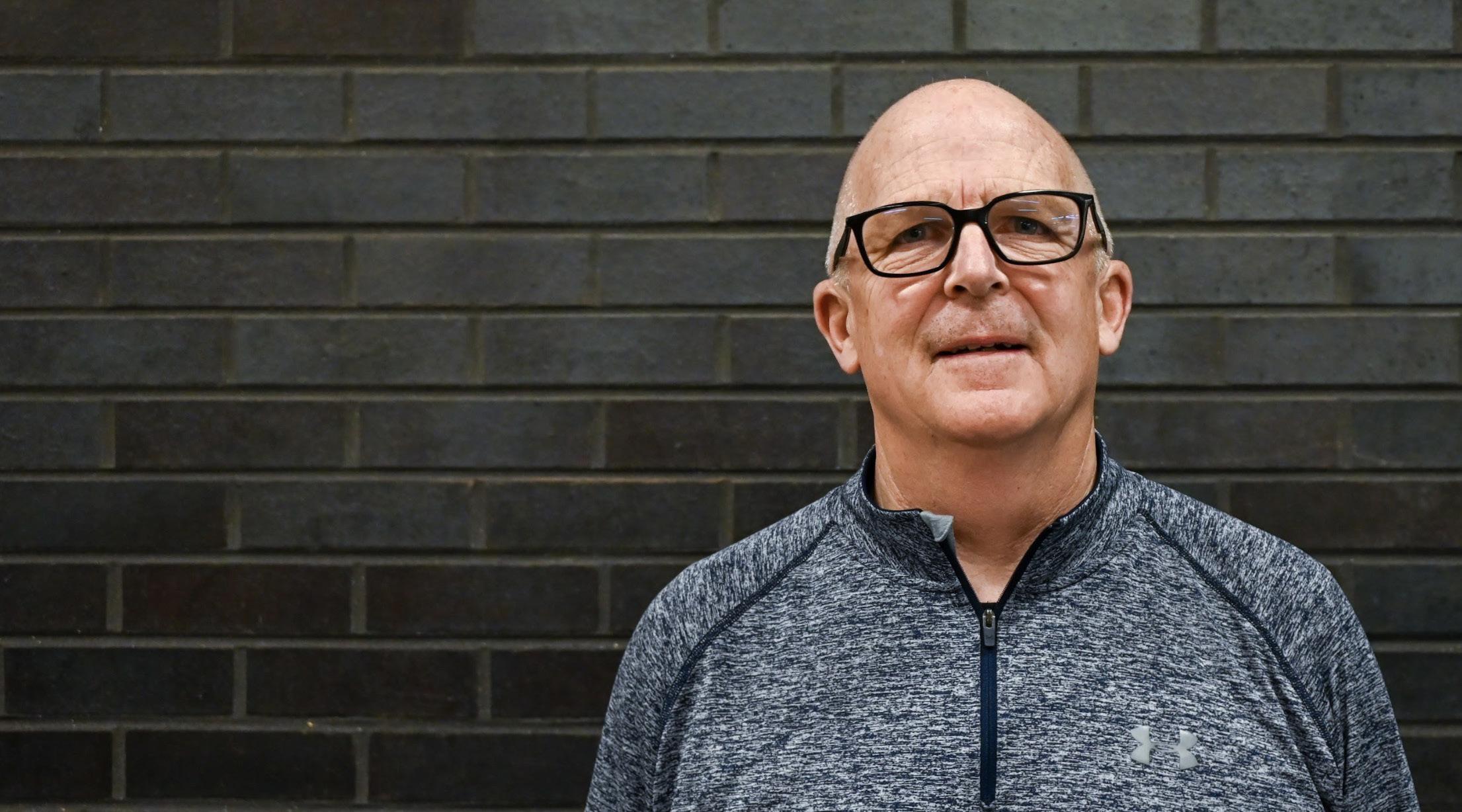
“It was always a calling,” Assistant Head of School and woodworking teacher Mr. Mark Thorburn said. Now, after 32 years of service in art, administration, and education at the school, Mr. Thorburn has completed his calling.
Whether in the woodworking shop or helping escort students during drop-off time in the lower school, Mr. Thorburn has been a constant in Wilson Hall.
Raised in New England, teaching and woodworking were always in his life. As a result, Mr. Thorburn grew to love art and its many different applications.
“We were always renovating houses as a kid,” Mr. Thorburn said.
His father’s job as a high school principal required the family to move frequently; as a result, his family moved several times from New Hampshire to Maine.
Mr. Thorburn soon became enamored of geology and nature, leading him to pursue a bachelor’s degree in geology at Bates College.
“You get out in the great outdoors and get to travel to some pretty remote areas to do some geological mapping,” Mr. Thorburn said.
After graduating from Bates, he searched for work, but there was no clear path. One path that quickly presented itself was the oil industry, although this job would
never be for him.
“People were looking for oil all over the world, and as I came out of college, those jobs dried up,” Mr. Thorburn said.
Without immediate work, Mr. Thorburn worked several jobs in both sales and natural resources, which, although enjoyable, still “really wasn’t who [he] was.”
Around the fall of 1985, Mr. Thorburn began working as a teacher at Hebron Academy, a private boarding school in the countryside of Maine.
His stark shift in career focus was influenced by his childhood.
“I think because I grew up in a household of educators, I knew what an awesome lifestyle it was,” Mr. Thorburn said.
During this time, he also began revisiting his woodworking skills for some extra income.
“I’d either work in Portland or a little closer to where I lived, with various carpenters, and we would build houses from the foundation up,” Mr. Thorburn said.
A few years later, after meeting his wife in California, he sent what seemed to be an insignificant application to be the Dean of Students at The Haverford School. Following that, he moved to the East Coast, where he worked closely with the former Dean of Students to establish several key programs that support the student body, such as counseling and the ELC.
Eventually, Mr. Thorburn’s role would
ed the mission of the school and the athletic program. That being: playing baseball was an educational experience, an extension of the classroom,” Mr. Murphy said. “He, of course, wanted to win, but that was secondary to the educational mission of the experience.”
Coach Castell stays rooted in gratitude even as he prepares to depart.
“It was always a privilege for me to coach one of the teams at Haverford,” Coach Castell said, “and I took a lot of pride in that.”
transition to what he is known for now: the Assistant Head of School.
“Once you develop programs, you’ve got to manage some of the folks that you put into them.”
This shift also meant taking on more public appearances and maintaining good relationships with everyone involved in a school. In these interactions, he found what he truly loved about being in education.
“I think that’s why I like my job so much, is that I get to work closely with kids and families and with faculty and staff,” Mr. Thorburn said.
A few years into his tenure at Haverford, former art department chair Mr. Christopher Fox presented a new job opportunity to Mr. Thorburn: teaching woodworking.
“It’s a great way to interact with kids and to help pass on [my passion for woodworking]to the next generation,” Mr. Thorburn said.
Mr. Thorburn hopes that students will follow a similar path to his and pursue several avenues of life with genuine curiosity.
“I think the idea of being curious about life, and about what you could be doing, I think that’s really important to keep that flame alive,” Mr. Thorburn said.
For him, this flame is his ability to create that links his pursuits together.
He said, “I like to build, and I like to be able to sustain [educational] programs as well as structures and pieces of art.”
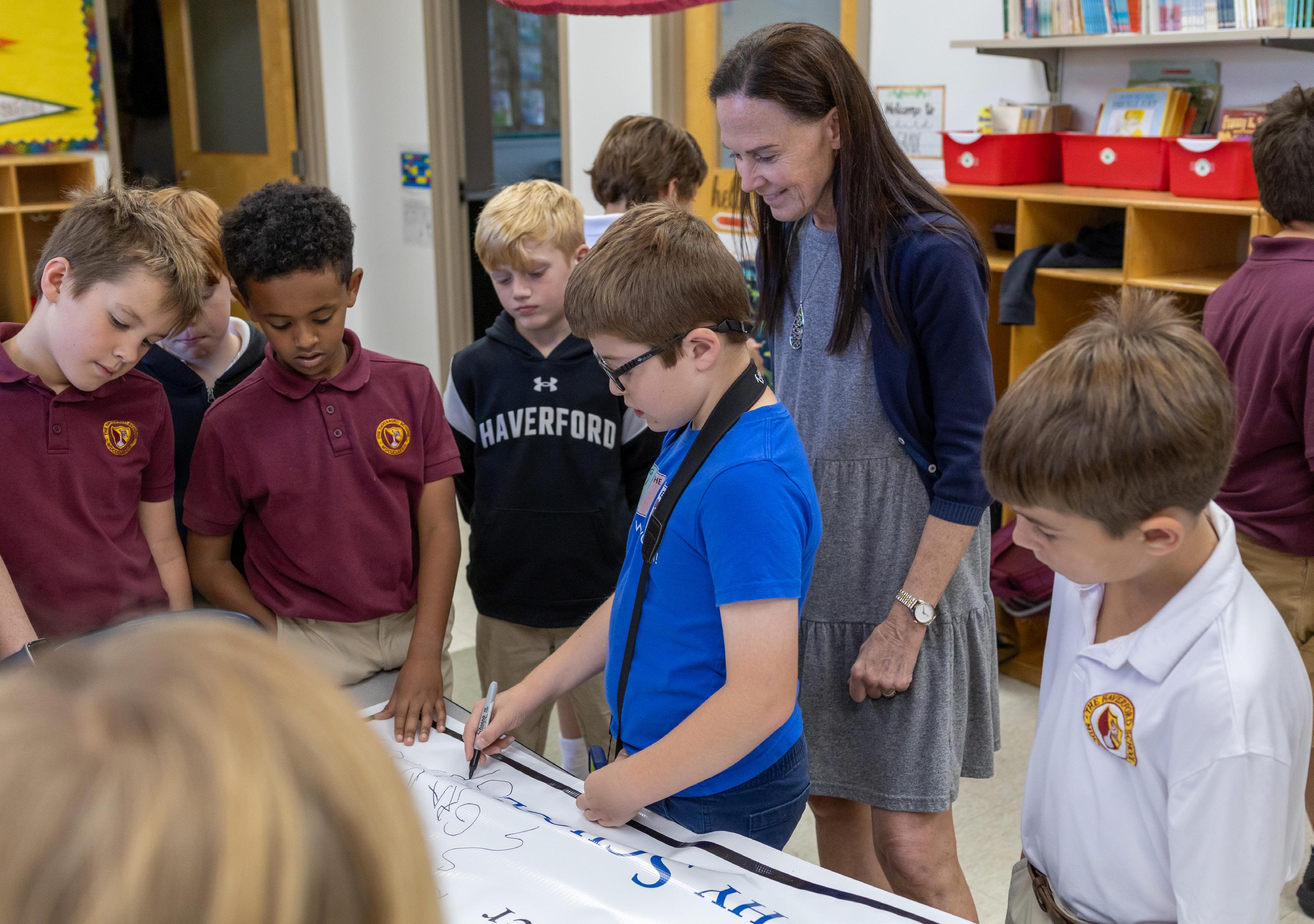
After 30 years of teaching, third-grade teacher Mrs. Kate Thorburn departs, but leaves behind a legacy of respect and honor. She has taught boys not just classroom topics, but life skills that will carry them for years to follow.
Mrs. Thorburn appreciates teaching third graders due to their unique place in development and the impact she has on the boys.
“Each year, I get more refreshed because you get a new group of gentlemen coming in that you know you want to mold. I think it’s so satisfying to see them when they come in as little squirrely second graders, and I know in my heart they have so much potential, but they just don’t know it yet,” Mrs. Thorburn said.
In order to help the boys achieve their hidden potential, Mrs. Thorburn pushes them further throughout the year.
“My goal is to raise the bar high and to have them reach it. I would never lower that bar, and they know that. I say at the beginning of the year, ‘I’m here, then I’m here, then I’m here,’ and you’re gonna reach it,” Mrs. Thorburn said, “and if you just keep telling them, they will believe in themselves.”
For her, this shared effort grows especially clear at year’s end.
“On that last day, when we’re doing the countdown out in the pod, they’re in tears, we’re in tears, and that’s how it should be at the end of the year,” Mrs. Thorburn said. “They’re so excited to go, but there’s still a little piece of them that wants to stay here.”
“You might not get it the first or second time, but you’ll get it.”
MRS. KATE THORBURN
Boys exit Mrs. Thorburn’s classroom with more than just classroom knowledge.
“I am big on respect and eye contact and handshaking and life skills that will hopefully take you far in life, because we all know in the end, that’s what’s important: being a good person. And that’s what I try to instill in these gentlemen,” Mrs. Thorburn said.
In her time teaching, she prioritizes the experience of her students over all else.
“Boys are number one, and everything else can change around it, but our goal is to make changes that make it better for you as a student. I think that’s really important,” Mrs. Thorburn said, “Not just getting the A’s, but equivalent to being a good person, and a respectful person, an empathetic person.”
“Don’t ever feel like you’re above the boys. We’re all here together, and I’ve never looked at ‘I’m here, you’re here’ ever.”
MRS. KATE THORBURN
Mrs. Thorburn’s approach stemmed from a visiting speaker.
“We had a speaker here once, and he said, ‘What’s the number one [most important aspect]?’ And I learned its safety, letting them know that it’s okay to make mistakes,” she said. “You might not get it the first or second time, but you’ll get it. And that’s something that kids need to know, especially nowadays where things are so fast and thrown at them, that it’s okay.”
Mrs. Thorburn had never intended to begin a career in teaching. Her career started in retail, then pivoted to boarding school development upon her marriage. She then moved to Philadelphia and enrolled her children in Haverford’s lower school, where she
started volunteering to meet people in the area.
“I would put Ellen on my back, and we would come volunteer every day because I didn’t know anyone. [Sam] repeated junior-K because he was young. And so we had another round, and I volunteered so much that they said, ‘Would you like to be an assistant in Kindergarten?’ That’s how I started,” Mrs. Thorburn said. “And then they said, ‘We’d like you to teach. We’ll send you for your master’s.’ The ball just started rolling, and I started graduate school. Then I finished my master’s and took over, and I have been here ever since.”
“They can do so many amazing things that they don’t know they can do. Never leave anyone behind.”
MRS. KATE THORBURN
Teaching at Haverford for so long has allowed Mrs. Thorburn to fully realize her impact on the boys and the school.
“The beauty of Haverford is you don’t just have them for a year. I tell them ‘you’re my boys now forever,’” Mrs. Thorburn said.
She hopes students will continue to embrace her values and high standards.
“I just hope the best for them. They know my values, and I hope I’ve instilled a lot of those values in them that will carry them through Haverford,” Mrs. Thorburn said. “I feel like hopefully I was a little piece of wherever they make their little navigation, and I wish them all the best. I’m proud of each one that comes through here and makes it through Mrs. Thorburn.”
She hopes, too, that teachers will continue her legacy of foremost treating the boys with respect.
“Don’t ever feel like you’re above the boys. We’re all here together, and I’ve never looked at ‘I’m here, you’re here’ ever. I think that makes you build relationships and trust that you’re working as a team,” she said.
“Hopefully, my legacy in some of them will live on.”
MRS. KATE THORBURN
Mrs. Thorburn remains hopeful for the talent to come from future students.
“They can do so many amazing things that they don’t know they can do. Never leave anyone behind. Give everyone the opportunity to try new things, not just a few,” she said. “Everybody should have that opportunity, because they’re all different learners, and they all have their unique styles, but in the end they have so much to offer.”
She feels accomplished in her career and, just like the boys at the end of a year, feels bittersweet about moving on.
“I feel like I’m part of the furniture here after being here so long, but it’s gone fast. When the school year goes fast, I always say to the boys it’s because we’re busy and so successful, and I feel like this career has gone so fast because I’ve just loved it,” Mrs. Thorburn said.
Upon retiring, she plans to move to Maine, visit her grandchildren more, and experience life without being devoted to a schedule most of the time. But ultimately, she wishes that her impact on the boys will not be forgotten, and that the life skills she has committed to teaching them will guide them far.
“Hopefully, my legacy in some of them will live on,” Mrs. Thorburn said. “Hopefully, now and then, little things that I’ve taught will spark in people’s brains, and they’ll make the right choice.”
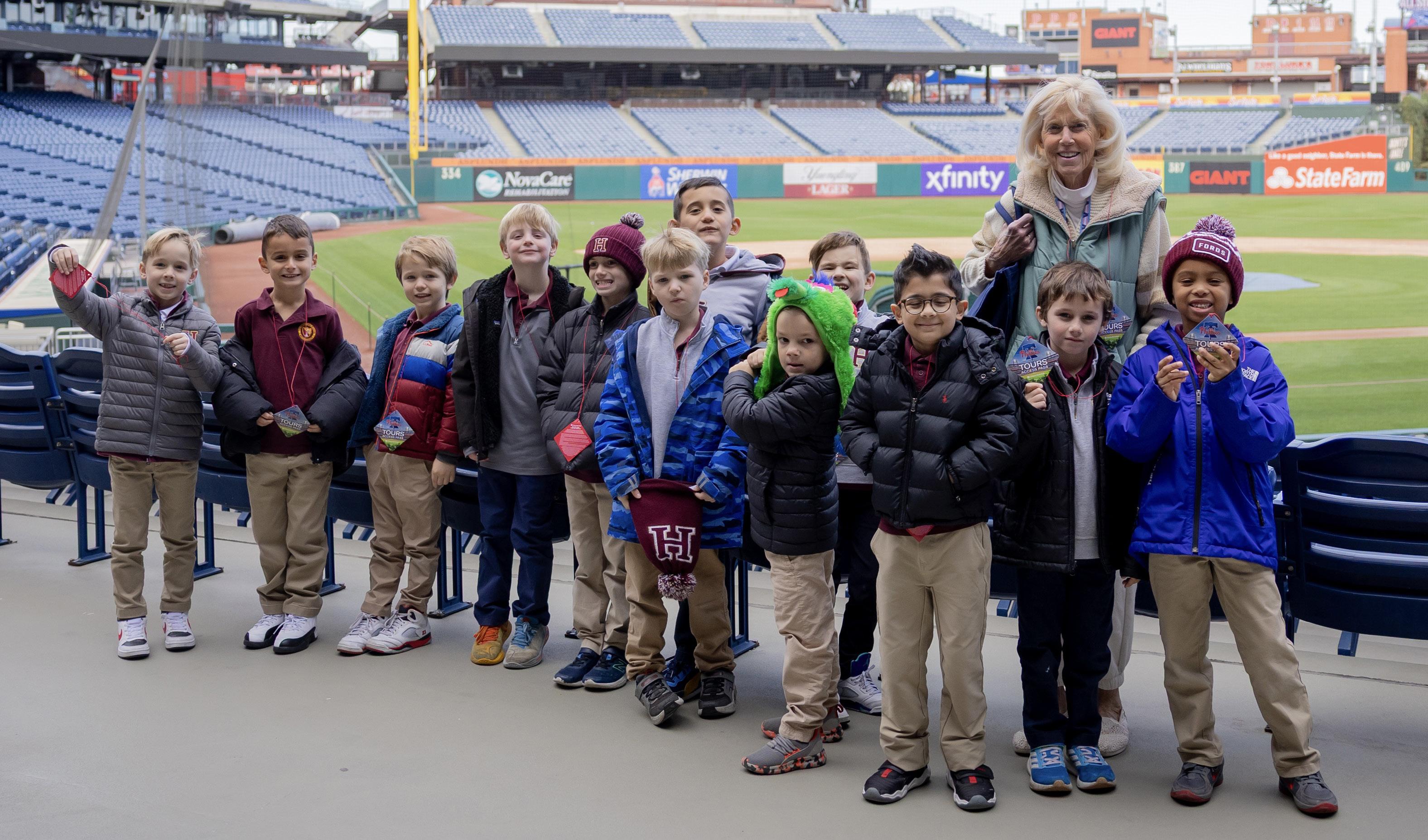
On that brilliant first day of school in 1986, first-grade teacher Ms. Mary Lou Gallagher walked through the lower school corridors, up two flights of stairs, and past a couple of pods with a radiant smile on her face. She was just looking for her classroom, but what she discovered would transform her life as she knew it.
For the next 36 years, the boys of the lower school would constantly call out her name for teaching, inspiration, or simply to have a familiar friend. She lit the hallways with her ever-present kindness and enthusiasm, yet as her tenure comes to a close, memories of her time at Haverford flood back.
“I’ll never forget one time—this was probably 30-some years ago when I was teaching Kindergarten,” Ms. Gallagher said with a chuckle. “A little boy kept coming up to me, saying he had something to tell everyone. He finally said, ‘My mother is the tooth fairy!’ You just looked at their little faces, and they all believed it. He was just so full of joy. That’s my favorite story from Haverford— these little children, and then they grow up, and you just hope they keep that spirit in them.”
Her name soon filled the lower school
as she dreamed up exciting art projects, curated new games to play, and converted her inviting play rug into the boys’ favorite playground.
“She could draw like nobody’s business,” lower school music teacher Ms. Valerie Case said. “When she designed her classrooms, she would create everything in the classroom just by drawing. We recently did a medieval presentation where she wrote a little play, wrote the script, and made all of the copies. She is just over-the-top creative.”
She was so devoted to Haverford that her own son followed her into the classroom as a teacher: Ms. Gallagher and a previous second-grade teacher, Mr. Connor Hullhorst, became the first parent and child to teach together.
“I thought she was awesome.”
CHRISTIAN CASE ’27
Despite the pressure of having to raise her own children and being responsible for young students’ development during their critical transition into primary education,
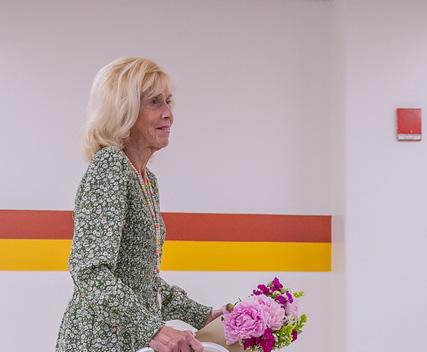
Ms. Gallagher has always felt embraced by Haverford.
“The support I’ve had from the parents all these years has always made me feel positive about what I’ve done,” Ms. Gallagher said. “There’s never been a time when I’ve had a bad day here—never. Things happen, but I always leave here feeling like I’ve had a great day.”
“She has a passion for teaching that is rare.”
MRS. KATE
THORBURN
It is no surprise, then, that the boys who passed through her classroom never quite forgot her.
“Ms. Gallagher was an inspiring teacher to me and to countless other students,” Fifth Former Lukas Messick said. “She was an extremely nice person as well.”
“I just remember her being a really sweet person,” Fifth Former Christian Case said. “I thought she was awesome.”
Ms. Gallagher has not only impacted countless students’ experiences at Haverford but also those of the faculty.
“Mrs. Gallagher was my introduction to the Haverford School when I was her assistant,” Mrs. Thorburn said. “She’s a phenomenal teacher. During my first year, I felt totally prepared [when she left to raise her children] because she had prepared me so well. She’s so creative and so kind, and such a great teacher. She is my role model.”
As a cornerstone of the community, Ms. Gallagher’s presence has elevated the standard of excellence. Beyond her daytime hours in the classroom, she created and directed the Haverford Homework Start program, an after-school initiative designed to build foundational study habits in lower school students. Still, Ms. Gallagher points out that nearly nothing has stayed the same since her arrival.
“The brotherhood that has developed in all these years that I’ve seen has been remarkable,” Ms. Gallagher said. “Before, when I first started here, it wasn’t quite as warm and inviting to the outside community. It’s really developed, and it’s brought in so many great boys, and the diversity has changed, and it’s just a whole different place than it was all
those years ago. I’m just fortunate to have a connection where you can actually teach [students] when they’re six years old and then see them all the way through to twelfth grade. You don’t have that at many schools.” Ms. Gallagher specifically promotes a brand of optimism and encouragement in her classroom.
“I hope people remember Ms. Gallagher as someone who takes a plain classroom and turns the environment into such a warm, safe, and nurturing place where boys can take risks and not be afraid of mistakes, because she’ll always be there to pick them up—and always do so with a smile on her face,” Mrs. Thorburn said. “She has a passion for teaching that is rare.”
As Ms. Gallagher says her final goodbyes to Haverford, her reputation and echoes of her teachings will linger long after she departs.
“This has been my life for all these years. And I can’t even imagine not being in a classroom.”
MS. MARY LOU GALLAGHER
“I want people to remember how much she loves and cares for the students, her boys,” Dr. Pam Greenblatt said. “Ms. Gallagher is such a joyful presence in the lower school, and she brings such joy into some of the earliest years of a student’s educational experience. I think about all of the students that have passed through her classroom and what a phenomenal legacy she has, and the impact that she’s had on thousands of students at this point—how she cared, loved, and [taught students how to be] curious learners and good friends.”
However, it’s difficult to say goodbye to such a large portion of one’s life.
“It’s hard,” Ms. Gallagher said. “This has been my life for all these years. And I can’t even imagine not being in a classroom. Every year of my life, I’ve gone to school, even when I was a student. In September, you start school. So when September comes, it’s gonna be different. Really different.”
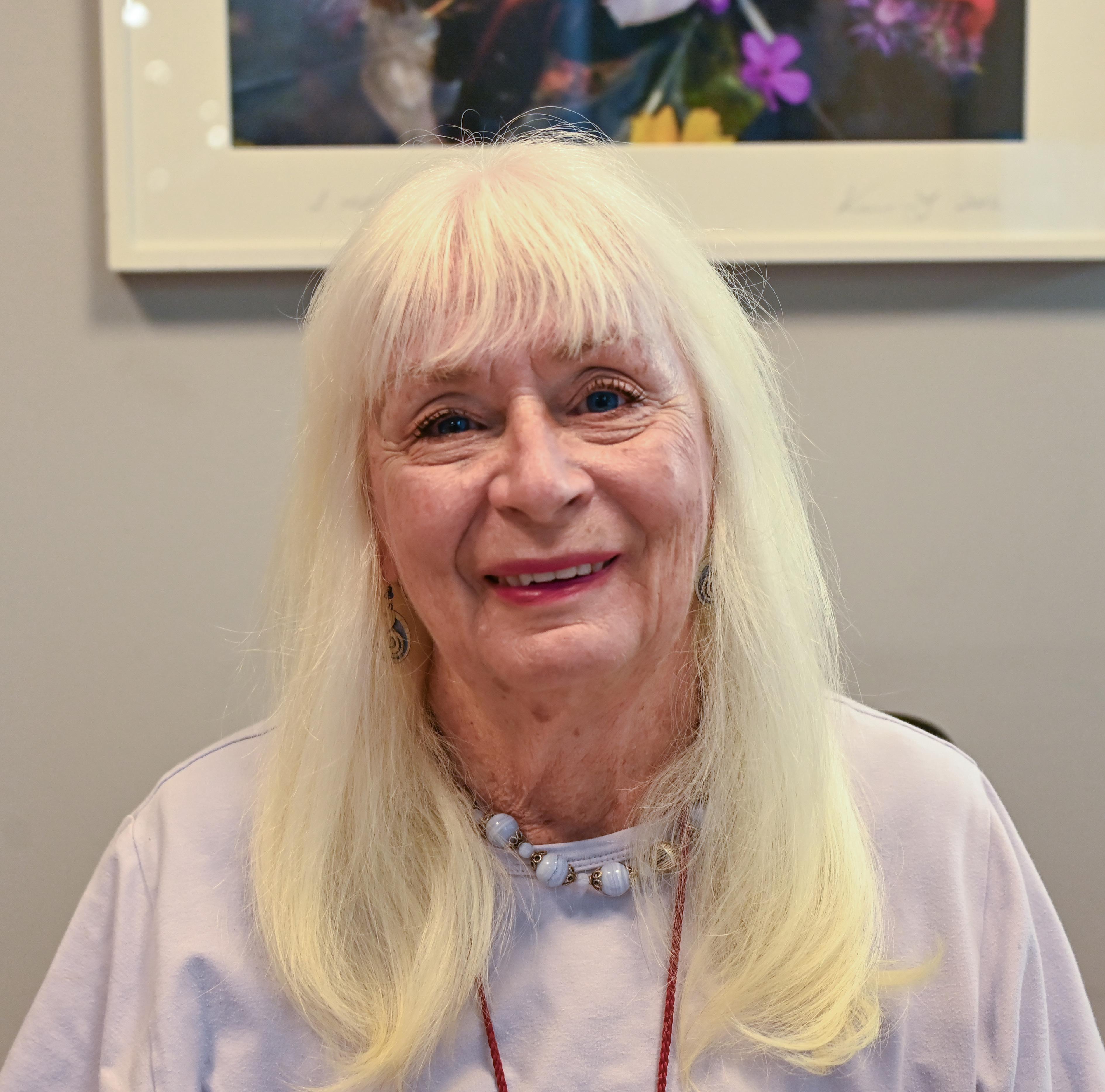
During an assembly for the lower school, Director of Service Learning Ms. Jini Loos asked the boys if anyone knew what she did at Haverford. One lower school boy raised his hand right away.
“I know, I know,” an anonymous lower school student eagerly said. “You’re in charge of kindness for the whole school!”
Ms. Loos would not put it any other way.
“It’s been a pleasure to serve as a conduit for good things in our community and in our world,” Ms. Loos said.
When Ms. Loos first arrived, the school had no formal service learning program. When a Haverford family funded a feasibility study, she spent two years researching whether the school could build one, and in 2003, she and a colleague opened the Service Learning Center. From there, she turned her ideas into reality. Students begin service in pre-Kindergarten so that by the time they leave the lower school, they already understand how they can help change the world for the better.
Most of that work came down to one belief: service is not the same as charity. She wanted to get rid of the idea of “us [volunteers] and [those in need].” The goal, in her words, was a hand up rather than a hand out.
“You don’t have to be anything but yourself to help others,” Ms. Loos said.
For some students, the first thing they will remember about Ms. Loos is candy. It started years ago when her own kids asked for an afternoon snack. Since then, she has kept treats around for students. All she asked in return was a good morning or a thank you. Plenty of those quick visits turned into friendships over the years.
“I take from you as much as I ever give to you guys,” Ms. Loos said. “You’re the ones who are young, and you’re the ones who have the ideas and the energy.”
“The students this year are a special group—full of ideas and more than willing to do the work.”
MS. JINI LOOS
Service became Ms. Loos’s life by chance. She spent eight years in art school studying psychology and hoped to become an art therapist, but during her training, she realized she could not separate herself from the pain her clients were carrying. For this
reason, she set herself a simpler goal: to help people in the world, even though she had no idea what that would look like. Years later, she says the universe placed her at Haverford, where she could help people every single day.
After her departure, Ms. Loos wants the service board to keep opening itself up to new people and new possibilities and to remember that they have the power to help others.
“The students this year are a special group—full of ideas and more than willing to do the work,” Ms. Loos said.
“Her smile, warmth, passion for service, and equally important, her commitment to learning, are all qualities I hope to maintain and model.”
MR. STEPHEN CLORAN
Next year, Upper School Learning Specialist Mr. Stephen Cloran will take over the program. He is not a stranger to it. For the past two decades, he has seen the impact of Ms. Loos’s work, as all three of his sons went
through Haverford’s various service programs.
Mr. Cloran’s parents showed him the value of lending a hand through words and their actions, and his 90-year-old mother still teaches him what service means today. His faith-first community has taught him that “to whom much is given, much is expected.” He also credits his wife for sharing that same spirit and pushing him to keep being kind to others.
“While I know I cannot fill her very big shoes, I will do my best to keep her spirit of service and generosity alive and well,” Mr. Cloran said.
What he hopes to hold onto is harder to measure than any program.
“I hope to carry forward the aura that Ms. Loos brought to everything she did. Her smile, warmth, passion for service, and equally important, her commitment to learning, are all qualities I hope to maintain and model,” Mr. Cloran said.
Ms. Loos’s final advice for Mr. Cloran is simple.
“Create a welcoming space,” Ms. Loos said to Mr. Cloran, “listen with an open heart to whoever comes through the door, so they can learn how they too can make a difference, not just for other people, but in their own lives.”
Students hollering at each other during a warm-up activity with Spanish pop music playing over them: this must be the language hall.
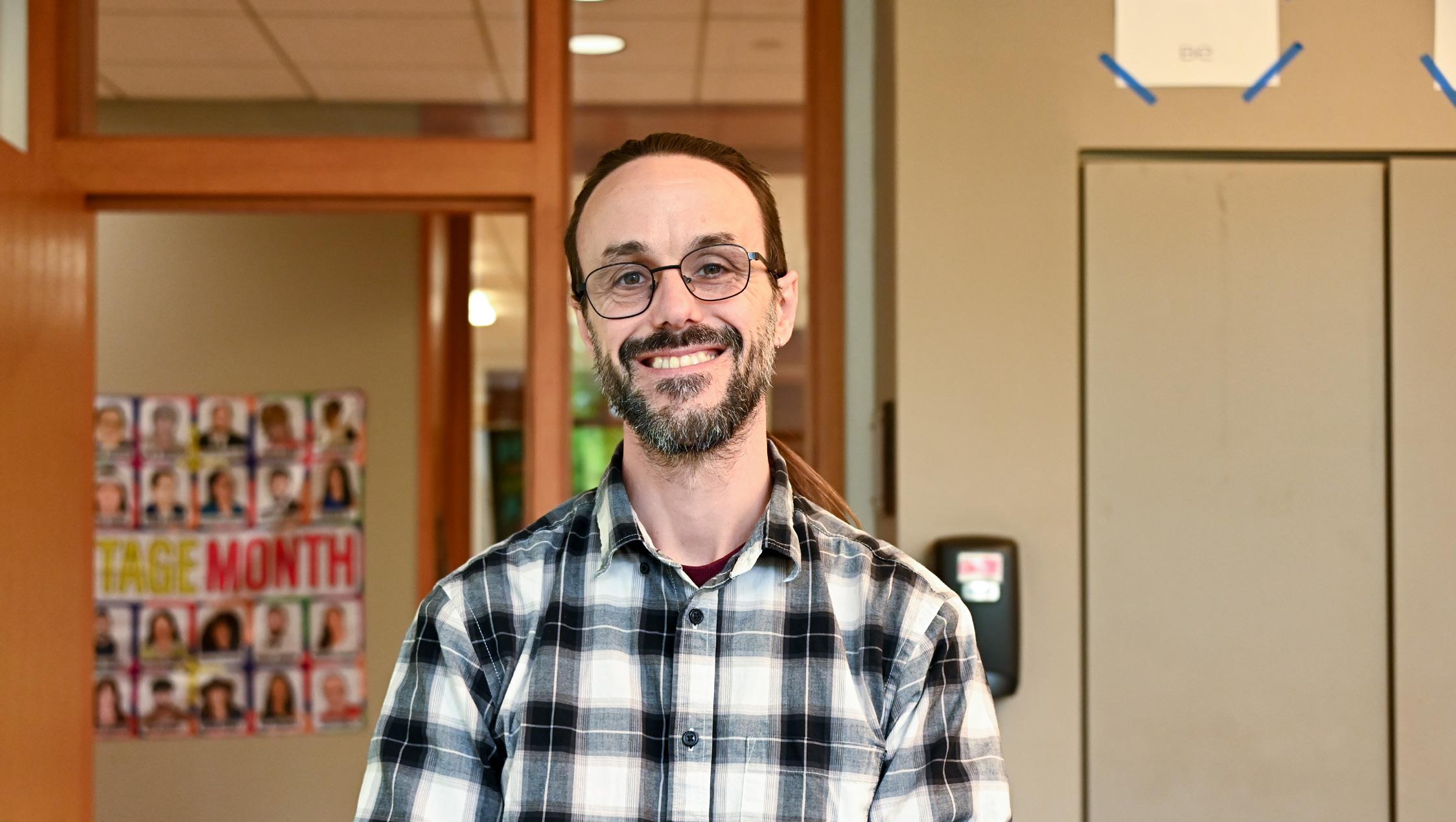
Peer inside his classroom at any time of day and find a passionate group of students laughing and debating in Spanish: this classroom belongs to none other than Mr. Javier “Profe” Lluch and his infectious love of learning.
Beginning in Spain, then working in Toledo, Ohio, for five years, Mr. Lluch sought to make a change. Although he interviewed at schools across the country, Haverford immediately stood out among the others. That fateful day, he watched a student’s Reflection in Centennial Hall.
“Such a level of vulnerability was really impressive for, you know, somebody their age,” Mr. Lluch said.
As he moved into this new and unfamiliar area, Mr. Lluch thrust himself into responsibility.
“They had me helping out with Model UN, which was good. They had me helping with the prom, which was not good. I’m not good at that,” Mr. Lluch said.
During his time advising Model UN, he was able to observe the speech and debate team during their late-night practices and was immediately captivated by the activity. He decided to co-counsel the activity, yet neither Mr. Lluch nor his colleague had done speech and debate.
“We started just relying on the captains, and we learned a ton along the way,” Mr. Lluch said. “This effort has paid off tremendously, as the school has sent several teams to the Pennsbury State tournament and even more to district qualifiers.
Still, debate never fully satiated Mr. Lluch’s love for academia. A few years ago, he revitalized Quiz Bowl after inspiration from an old colleague from Ohio. Quiz Bowl had been an activity that had lain dormant
for several years.
Mr. Lluch has also maintained his love for travel throughout the years. Ever since his time in graduate school, he has constantly travelled as both a teacher’s assistant and a faculty member during trips abroad. Mr. Lluch described Haverford’s global studies program as seamless.
“We have a dedicated person here who is in charge of that, and we also put our learning goals at the forefront,” Mr. Lluch said.
Mr. Lluch emphasized the importance of exchange rather than mere tourism, arguing that the student relationships, whether it be between La Farga or Tainan First Senior High School, are the most valuable parts of the trip.
“[Global studies and exchange programs] will really take you out of your comfort zone in the most extreme kind of way, because you’re in a different country with a different family, you don’t necessarily speak a language that well,” Mr. Lluch said.
Back on campus, however, Mr. Lluch places a similar importance on curiosity and risk-taking. With the rise of technology, many language teachers have shifted their programs so they are not easily abused by students’ use of artificial intelligence. Mr. Lluch opted to rely solely on pencil and paper to avoid translations and AI tools.
This is not to say that language learning and technology cannot go hand in hand.
“I need to just take a look at it and find, you know, what are some ways that I can use
it that will make it more efficient and where I can have technology helping students in a way that’s really promising,” Mr. Lluch said.
In fact, the presence of technology has made him and fellow language teachers shift their courses to focus on other elements of learning.
“It feels like our program is way more focused on communication and culture, not so much on repetition and accuracy and stuff like that,” Mr. Lluch said.
Above all else, Mr. Lluch is thankful for his colleagues and students who have helped support him.
“When I first came here, I had no idea what the school was like at the end of the culture. Having people around that are supportive was really helpful,” Mr. Lluch said.
English teacher Mr. Anthony Pariano joined the Haverford faculty in 2017, originally teaching Form II English. In 2022, he transitioned to the upper school, and in 2025 he became a faculty advisor for The Index. His impact on his students makes his
departure even more significant. His unexpected decision to leave resulted from multiple tragic personal events in his life this year.
“I had some pretty harrowing life events take place. It’s pretty clear that the responsibilities of being there for my parents are completely on me now,” Mr. Pariano said.
“I had no intention of leaving Haverford. I thought I was really going to end my career here.”
He describes his new school, University School, as “like if you took the Haverford School and picked it up and dropped it on the East side of Cleveland.”

“It feels like a good fit. There are some differences, but overall, it seems like we are truly peer institutions,” Mr. Pariano said.
Mr. Pariano takes a selfless approach to his teaching, ensuring that his students feel like they are truly discovering things themselves.
“I think the best part is when I see kids have those moments, and then I get to say, ‘Do it again.’”
Mr. Pariano operates with some unique approaches.
“I couldn’t care less if my students respect me,” Mr. Pariano said. “I want deep personal connections with my students, and I want students to feel connected to their subject matter. And if respect is a byproduct of that, that’s fine. I’m not in it for fulfillment or respect. I’m in it for those moments where I sense that kids have learned something. I don’t want it to be about me.”
Mr. Pariano remarked that moving away was a difficult decision.
“My colleagues have been absolutely phenomenal, and I use the term ‘colleagues,’ but many of them are colleague friends. I think I’ve felt more connected than I’ve ever felt anywhere else to the people here at the school, to the kids and to the families. It’s hard to say goodbye to all of that.”
“It feels like I’ve been here a long time, and I’ve just started,” Mr. Pariano said.
Haverford has three main divisions: the lower, middle, and upper schools. Sometimes, students overlook the Haverford Center. Nestled
within the lower school, this program cares for children below pre-Kindergarten age.
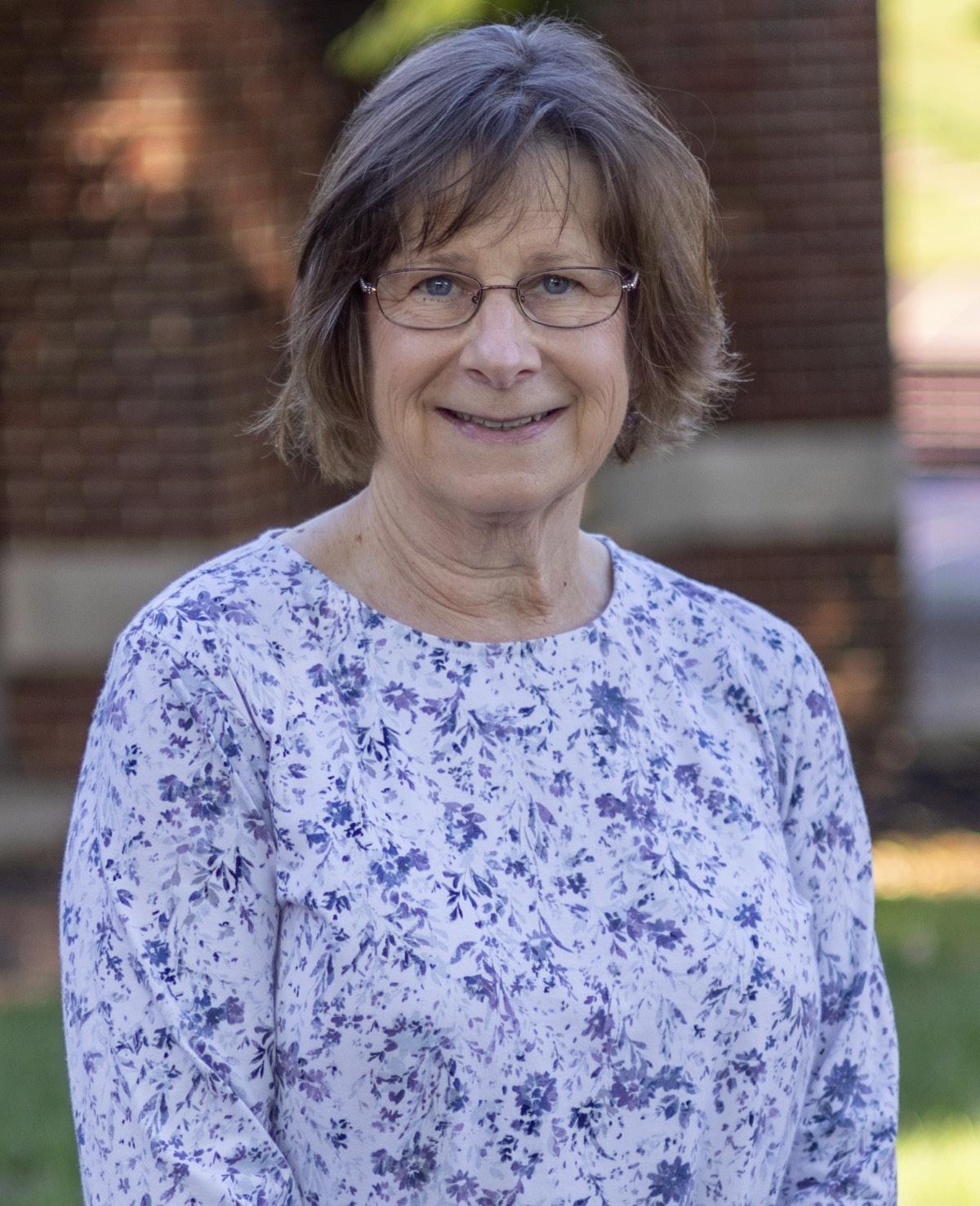
Since 2005, Director Ms. Susan Zickler has overseen this lively, vibrant environment full
Jack
of curious and spirited children. “When we first started the center, I was a half-day teacher in the infant room and [also] half-day administrative,” Ms. Zickler said.
“It is really nice that we have children who [have] parents from all different divisions of the school.”
MS. SUSAN ZICKLER
Ms. Zickler quickly outgrew her teaching position and began specializing in the administrative side of the job. Soon, she handled important government paperwork and helped hire and train licensed professionals, all while bonding with each young child in the center.
Despite this, the job initially seemed somewhat isolating. The demanding nature of childcare meant that she and the rest of the staff rarely interacted with the school’s other teachers and administrators.
Although Ms. Zickler will say her final farewell to our school soon, her days will still be filled.
Frequent parent visits ameliorated this problem.
“It is really nice that we have children who [have] parents from all different divisions of the school,” Ms. Zickler said. “We
might get to know more middle and upper school teachers than a lower school teacher.”
Since opening, the program has taught boys and girls; furthermore, it often serves as the boys’ first step toward a Haverford education.
“Some of the boys who are here in the center apply to and enroll in the pre-K of the Haverford School,” Ms. Zickler said.
Although Ms. Zickler will say her final farewell to our school soon, her days will still be filled.
“I would look for opportunities to volunteer in my community,” Ms. Zickler said, referring to the John Heinz Wildlife Refuge. “There’s a lot of outdoor opportunities there and things that certainly rely on volunteers to have those programs running.”
“Everybody’s been really warm, caring, and supportive here.”
MS. SUSAN ZICKLER
Without the interruption of work—and with much-needed vacation time—she also hopes to garden. However, these plans will not begin until the summer’s end.
“I’ve been on a schedule for the past 25 years of having summers off, so it won’t really feel so much to me,” Ms. Zickler said.
Ms. Zickler’s dedication to helping the children of Haverford’s faculty and staff has been rewarding in its own ways.
“[I’ll miss] the day-to-day, small interactions with the children, but also with the teachers here in the center, and also a lot of people at work here on campus,” Ms. Zickler said. “Everybody’s been really warm, caring, and supportive here.”
Sahil Manjeshwar ’28
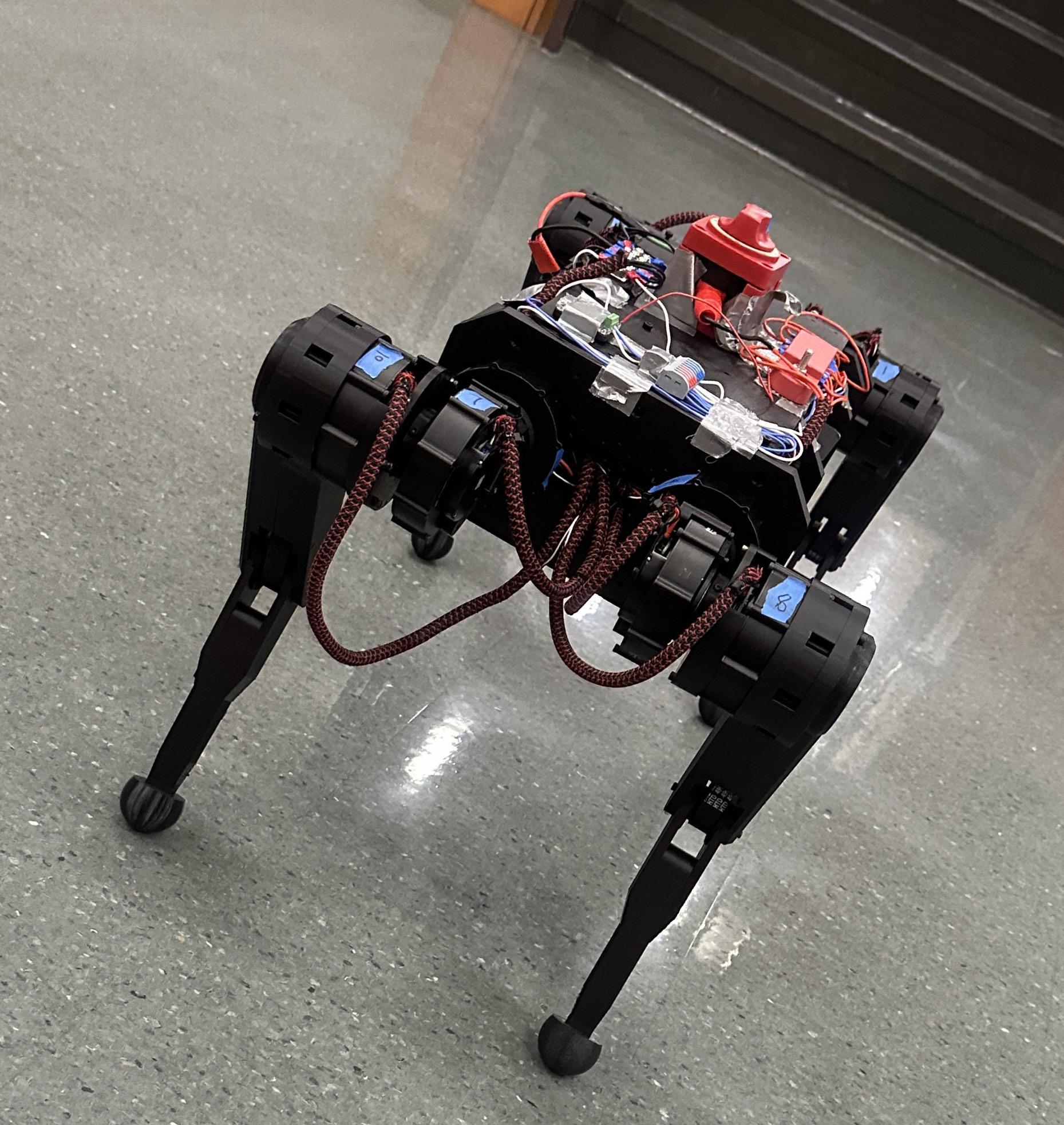
Sixth Formers Jack Ford and Matthew Cerniglia have built a quadrupedal robot dog for their graduation project. They control it with a PlayStation controller, and it can walk on flat or rough ground, turn in any direction, and even jump in place.
The idea came from the real robot dogs that companies such as Boston Dynamics make. Those robots have become popular over the last few years for their ability to go places that are not safe for people, including rough terrain, damaged buildings, or searchand-rescue sites. A robot dog can climb over obstacles and damaged terrain far more easily than their wheeled counterparts.
Neither Ford nor Cerniglia was taught many of these skills in school.
The motors, the circuit board, and the software Ford and Cerniglia used are the same kinds of parts that would have been used by a company or university.
The robot has four legs, and each leg bends at its knee joint, similar to a human knee. All of the electronics sit inside the body, including the batteries and the motherboard that controls it. The legs work together so that the dog stays balanced while it moves. Two legs stay on the ground while the other two step forward, which keeps it steady and lets it move at a decent speed.
Neither Ford nor Cerniglia was taught many of these skills in school. Ford taught himself to code in seventh grade by watch-
ing YouTube, building his own projects, and leading the school’s VEX robotics team. He spent last summer working with robot dogs at the University of Pennsylvania, and he is continuing his education at the Pratt School of Engineering at Duke University. Cerniglia ran the design and building side of the project and has made similar technology before, including a humanoid robot head and a chessboard that can tell where the pieces are by using magnets.
The hardest part was not the design or the math. It was getting everything to work at the same time.
“It’s a lot of moving parts,” Cerniglia said.
The robot uses twelve motors, and all of them have to listen to one computer. A single loose wire or a motor that quits could stop the whole process.
“Find a project you think is interesting and go after it.”
JACK FORD ’26
Building this robot has been a learning process in itself, and it certainly does not come free of regrets. Ford said he would make the dog smaller, since the current one is heavy and the weight is hard on the motors. Cerniglia said he would build it out of metal instead of plastic. Currently, every part is 3D printed, and metal was the original plan before time and cost became a problem.
Neither Ford nor Cerniglia is taking the
robot with them when they graduate. Both have been showing underclassmen how it works, and some underclassmen have even helped put the legs together and assisted with other aspects. The plan is to leave the
robot behind so the incoming upper school students can keep working on it and take it further.
“Find a project you think is interesting and go after it,” Ford said.
Kent Foo ’28
In an extremely successful season for the robotics program, two teams from Haverford attended the VEX Robotics World Championships, which hosts over eight hundred of the best high school robotics teams from around the world to compete for a chance to become world champions. Teams 169A and 169X, when combined, contained students from every upper school form.
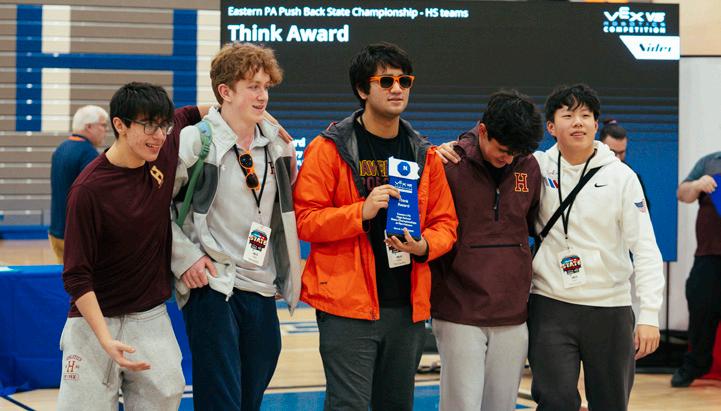
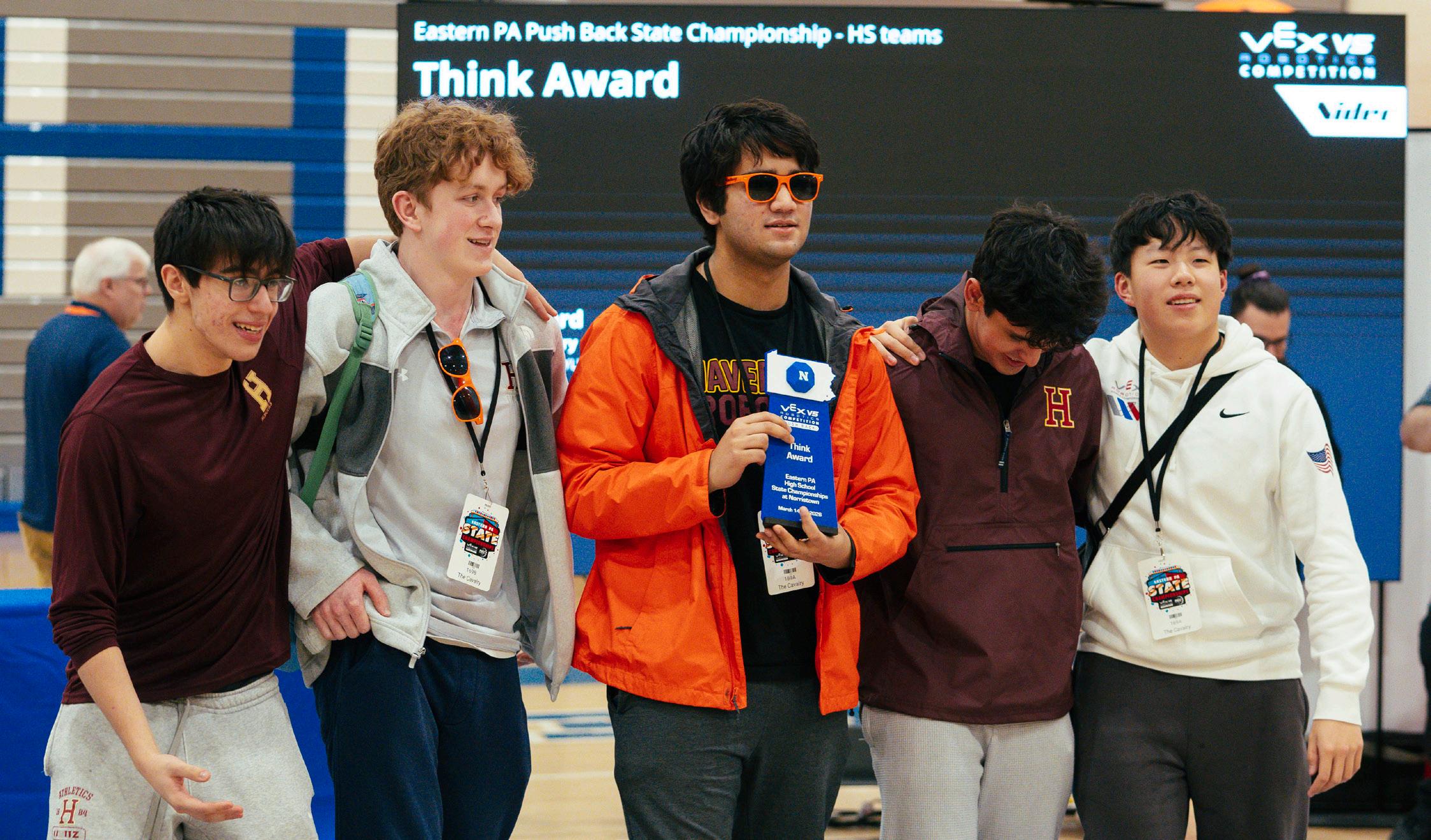
Haverford teams qualified for Worlds through the Eastern PA State Championships, where teams can win a spot by advancing to the final level at the competition or receiving an award for their robot based on a judged interview. Haverford sent all five teams to the state championship, with three teams making it to the semifinals and 169X winning a close final against 169A to become state champions. Team 169A also received the Think Award, an award presented to the team with the best implementation of code into their robot.
In the weeks leading up to the competition, the Haverford teams made various improvements to their robots and code. Haverford also hosted a large scrimmage with nearby teams, hoping to test out their new robots and see how they matched up against others.
After landing in St. Louis, the Cavalry started competing in qualification matches, hoping to secure a good seed and alliance partner for the elimination bracket. Both teams performed extremely well, with 169A securing the seventh seed and 169X securing the twenty-second seed, advancing both of them to the elimination bracket.
Fourth Former Ben Qu, member of 169A, said, “For each match we developed
a game plan, we went over it, and then we fixed our robot, and we made sure everything worked before each match.”
Hopes were high as both teams paired up with their alliance partners and prepared for their round-of-16 matches. Unfortunately, both teams lost in extremely close contests, resulting in elimination.
“It was really disappointing,” Third Former Eric Xiao, member of 169X, said. “With our current robot, driving skills, and coding, we definitely could have gone a lot further.”
“It was a little bit of a mixed feeling. We were a little bit disappointed, but obviously we still got seventh in our division at Worlds, that’s pretty good,” Qu said.
Despite the disappointing losses, this year was the first in recent years to send two teams to Worlds, and Haverford was able to claim another state championship title.
“I think, overall, teams did better because they were so passionate and so ready to work,” faculty advisor Mr. Adam Myers said.
Both teams have young members who
will be returning next year, signifying an even brighter future for the program.
“We’re only freshmen, and next year we’re gonna come back even better and even stronger,” Xiao said.
Haverford’s robotics teams have already started working on designs for the next season, and the organization as a whole looks poised to have an even more successful year.
“The passion continues to be high,” Mr. Myers said. “The understanding of how to do robotics well is going to continue to grow.”
Hephaestus is the god of the forge, and he serves as the namesake for the Hephaestus Society. In order to earn an invitation from the society, a student must be in one of the following academic clubs: The Index, Model UN, Speech & Debate, Mock Trial, Robotics, Haligoluk, and Pegasus.
The society held its banquet on April 16 in the Big Room. The featured speaker was Mr. Sam Turner ’18.
Latin teacher Dr. Andrew Fenton said, “Sam is a super smart, creative, and a really interesting guy. I would describe him as not only academically accomplished, but
also someone who is creative, curious, and genuinely interested in learning about how the world works. I still use a project he created ten years ago to show to students. Any teacher who had Sam Turner would sing his praise.”
Third Former Evan Taylor, who attended the banquet, thought Turner’s speech was interesting and intriguing.
“[Mr. Turner] was very dedicated to Haverford and clearly had a very interesting story he wanted to tell everyone,” Taylor said. “I thought it was a good speech that showed how he transferred his own skills and learnings from Haverford to business and
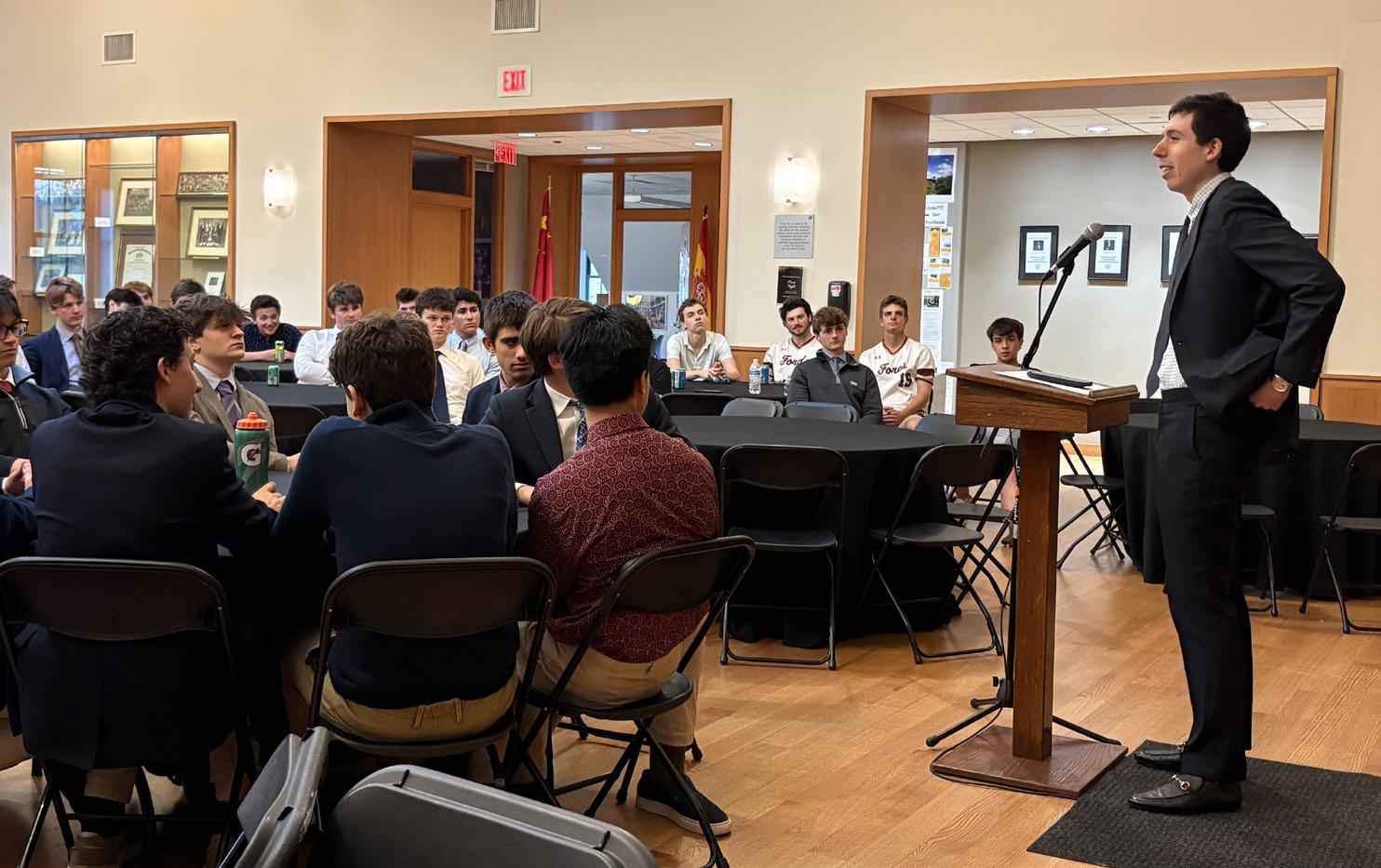
adapted wherever he went.”
Third Former Sam Sholl said, “He was persistent on his projects and did them for experience and to better the world rather than focusing on just the money. I could tell that he truly was interested in what he did, and he worked hard to achieve the amazing accomplishments he earned throughout his career.”
Dr. Fenton came up with the idea for the name for the group.
He said, “I thought using Hephaestus was an appropriate figure from Greek mythology to give the society its name. Think about it, he’s the god of forge and represents the god of creation and engineering and building things. That creativity and impulse to build things align with the values of the society.”
The Hephaestus Society’s creation was a collective effort. It couldn’t have been created without help and teamwork from other faculty members and supporters. When the society first started, Former Headmaster Dr. Nagl had a helping hand with organizing the speakers.
“When we first started the society, Dr. Nagl utilized his wide variety of friends and personal connections to get speakers to come give speeches,” Mr. Javier Lluch said.
After Dr. Nagl left Haverford, Mr. Lluch was given the honor of offering the evening’s first speech.
“Ever since Dr. Nagl left, Mr. Casertano decided to allow me to give the opening speech, and I have been giving opening
speeches for all of these past banquets, including this one.” Mr. Lluch said. “Since the Hephaestus Society had been running long enough, we had connections with a variety of alumni who were originally a part of the society who we could rely on to be a speaker.”
This year’s Hephaestus Megistos was Sixth Former Nicholas Zafiriou.
The Hephaestus Society rewards the members of the society, giving every member one pin for every club that they are a part of.
One award holds higher value: the Hephaestus Megistos is granted to a Sixth Form member who participates in many clubs and activities. The Hephaestus Megistos also gives a speech to the society. Selecting one person for the Hephaestus Megistos is a difficult process, as choosing only one out of a promising bunch of members is a challenging decision.
Mr. Lluch said, “To select a proper candidate for the Hephaestus Megistos, we send an email to all faculty advisors, which asks the teachers to nominate students they think would be a great fit for the Hephaestus Megistos. After receiving the nominations, faculty advisors will vote for the student they think deserves the award the most.”
This year’s Hephaestus Megistos was Sixth Former Nicholas Zafiriou.
Brandyn Luong
’27
For many Sixth Formers, the final year of high school is defined by a singular chase: building a legacy, cementing it, and securing their future in college. Higher education is often an unspoken certainty, but the paths students take to get there are rarely identical.
While some spend their fall afternoons workshopping their supplemental essays, others have already locked in their futures on the field.
The journeys of Sixth Formers Caleb Siever and Charlie Neel represent these two distinct tracks: athletic recruitment versus the academic pipeline.
Siever’s trajectory was shaped by a clear ambition: a career in law. He applied to colleges as a political science major with law school as the goal, but it was ultimately his talent in baseball that solidified Washington College as the destination.
“I knew almost my whole life that I’d go to college and eventually law school,” Siever said. “I wanted a small school environment like Haverford where I could build close connections with faculty.”
Neel’s inspiration, by contrast, was rooted in campus culture and childhood memories. His sights were set on Boston College.
“The most important thing you can do is build relationships with teachers as a senior.”
CALEB SIEVER ’26
“When my older sister was applying to colleges, we visited Boston, and I saw the Boston College campus,” Neel recalled. “I was only in fifth or sixth grade, but I thought it was the coolest place ever.”
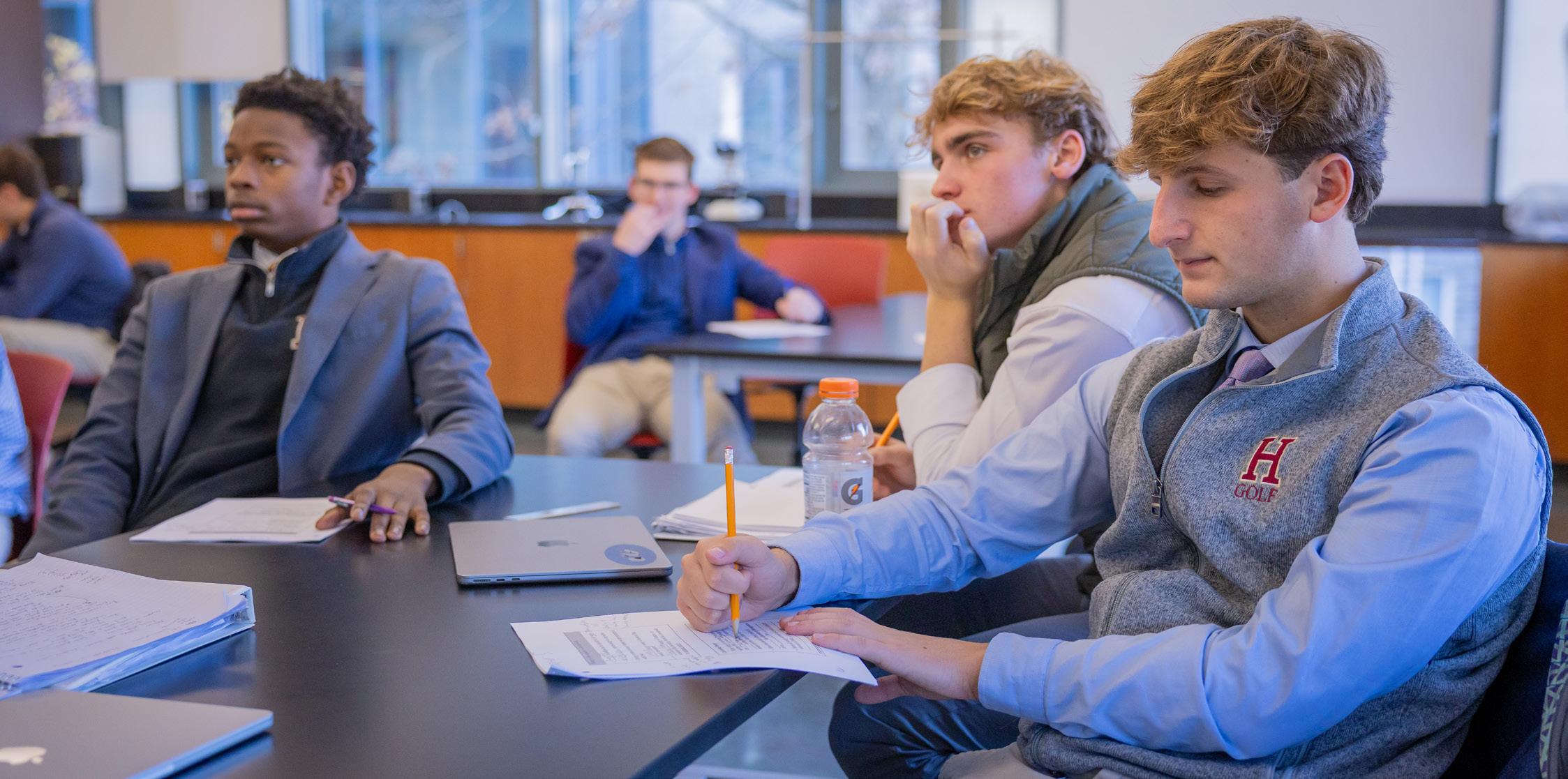
Instead of a traditional fraternity system, he was drawn to Boston’s social scene built around clubs like skiing, golf, and theater.
As Fifth Form progressed, their application timelines diverged sharply. For Siever, the recruitment timeline shifted the traditional pressure away from standard deadlines.
“The application process itself was fairly smooth because Washington College didn’t require supplementals, though I still had about ten people review my main essay,” he said. “On the field, it was exposure: meeting the coach at a tournament led to a phone call, then a campus visit, and finally a Division-III roster spot.”
Neel, pursuing the Early Decision II pathway, navigated the academic side of the climb. In particular, he emphasized maintaining his grades.
“Junior year is definitely not the year to slack off, and by the final month of that year, I felt a massive weight on my shoulders trying to pull my grades back up from B-pluses,” he said. “You just have to grind through it.”
Neel credits his college counselor with helping him navigate the final stretch.
“When it came to applications, almost every school on my list came from my counselor, Mr. Long, who was instrumental in helping me get everything buttoned up and ready to submit,” Neel said.
For Siever, fulfillment arrived in the mail as a physical confirmation of his hard work.
“When the acceptance letter arrived, the first thing I saw was that it was on behalf of admissions,” he said.
While it was an official academic acceptance, he noted that his future coach still held a major influence in securing him that spot.
For Neel, the verdict came down to an evening email notification.
“It was around 7 p.m. in February when the email notification came through,” he said. “I was actually with my girlfriend when I opened it, and we were ecstatic. The whole process is a weight on your shoulders, and
Alex Fenton ’28
On May 19, students from seven schools gathered at The Shipley School to attend the Philadelphia Area Independent Schools College Fair, which hosted more than 130 colleges. This fair spearheads the beginning of college application season and gives students the opportunity to discover their potential dream schools or even simply ones they would have never considered.
For many students, the experience began during their own independent research of the attending schools.
Fifth Former Sean Scott said, “I had done some research on a couple of the schools there, and I had visited one, but a lot I hadn’t really given any thought before the fair.”
Others chose to do more directed research on the specific things they wanted in a school.
“I have a sense of what I want,” Fourth Former Alton Tionco said, “I looked into things related to majors I’m interested in.”
For many, the interactions with the college representatives were the most valuable aspect of the night.

having my top-choice school locked in by February was an incredible relief.”
With their next four years secured— Siever bound for Chestertown, Maryland, and Neel heading to Chestnut Hill, Massachusetts—both students offer parting wisdom to the rising Sixth Formers entering the process this summer.
Siever emphasizes the value of community.
“Spend more time in teachers’ rooms,” he said. “The most important thing you can do is build relationships with teachers as a senior.”
Neel, meanwhile, urges Fifth Formers to stay hopeful in a competitive landscape, reminding them that a rejection letter is not a dead end.
“Build up a strong list of schools that appeal to you across all different levels of admission rates, and keep your head up through the rejections or waitlists,” Neel stresses. “Worst-case scenario: the transfer portal is more active than it has ever been.”
Tionco described a particularly positive experience with the representatives of Wake Forest University, a school he had previously not been particularly interested in.
“She answered all my questions, and, honestly, now it’s one of my top schools,” Tionco said.
Scott echoed a similar sentiment after the visit.
“After the fair, I began to like TCU [Texas Christian University] and SMU [Southern Methodist University], which I have now been researching a ton and continue to like,” Scott said.
Each college at the fair was able to make itself heard despite the noisy gymnasium.
Each college at the fair was able to make itself heard despite the noisy gymnasium.
Still, some students did feel somewhat rushed. The 90-minute window means that most students can visit around 20 schools at the most.
“I wish I had more time to talk to more schools,” Tionco said.
The time allotted means students are less free to stroll through the aisles and must pick specific colleges to focus on. Despite this flaw, the experience was a net positive for many.
Tionco said, “I’m really gonna try to go to more college fairs after this.”
From May 14-17, the world’s finest golfers were only fifteen minutes from campus. The 108th edition of the PGA Championship, one of the four majors in golf, took place at Aronimink Golf Club in Newtown Square, with 156 players competing for the Wanamaker Trophy.
Aaron Rai, a 31-year-old golfer from England, sealed his first major championship with one of the most memorable shots of the tournament: a 68-foot putt on the seventeenth hole. With this win, he became the first Englishman to win the PGA Championship since 1919. A large portion of the school community was there to witness it, including computer science and statistics teacher Mr. Stuart Alden, who volunteered at the event and was thus able to see it firsthand.
The interesting aspect of the event was not with the players—it was the spectators.
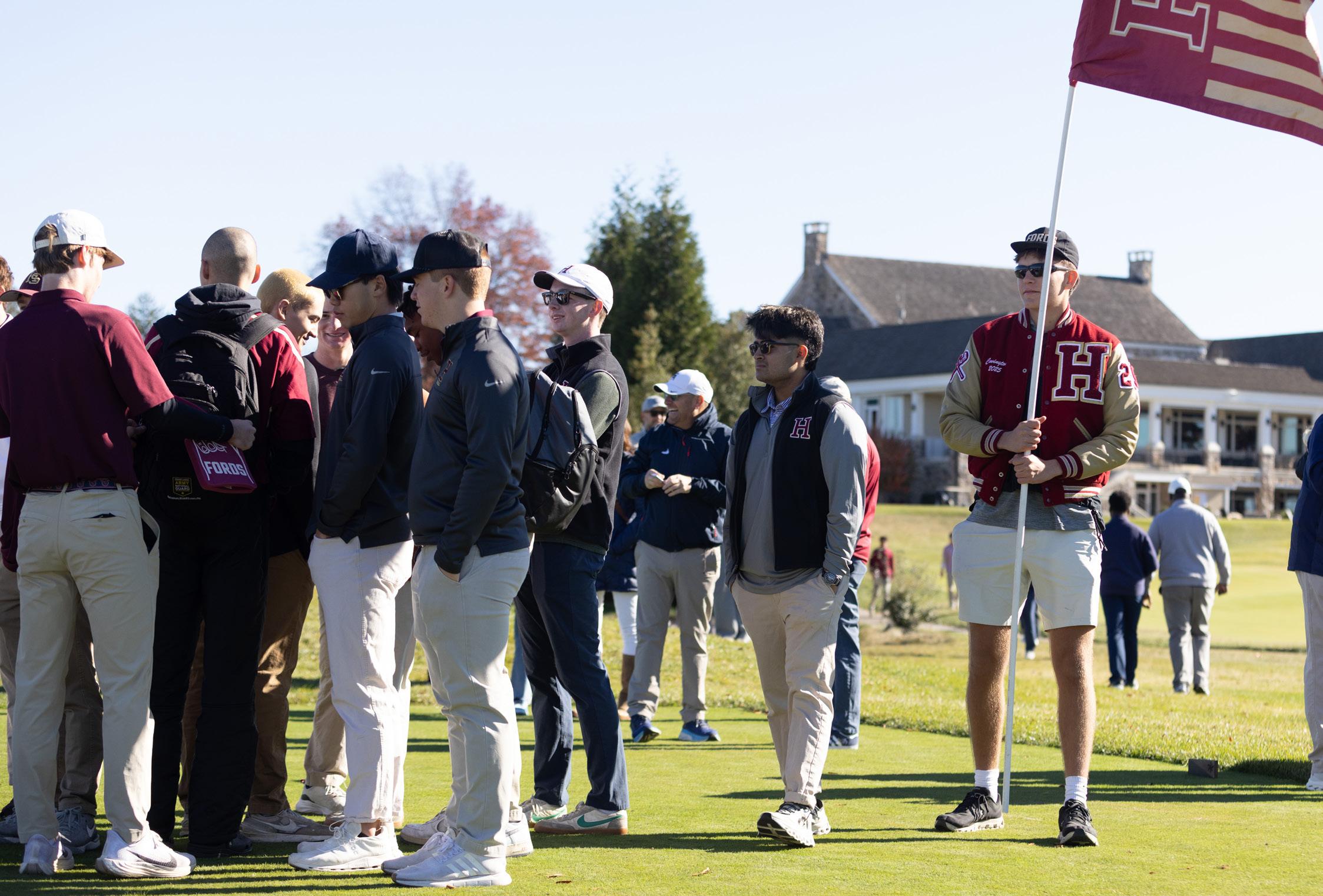
The interesting aspect of the event was not with the players—it was the spectators. With the PGA installing a tall fence around the course, neighbors whose houses border the property lost their usual view, so they got creative. Homeowners built raised platforms in their backyards, giving them free views of the action.
Newtown Square felt different for the entire week as well. Traffic on West Chester Pike was heavier than usual, and restaurants near the course were packed. Many smaller spots—coffee shops, delis, and places unrelated to golf—had their busiest weeks in a long time. Some even posted signs welcom-
ing fans. Nearby hotels were fully booked. Pulling off an event of this size in a residential area is no small task. For months leading up to the tournament, Newtown Square had been preparing. Roads were marked, shuttle routes were mapped out, and large open fields were converted into temporary parking lots. Local police coordinated with the PGA to manage traffic, and thousands of volunteers signed up to help run the event.
The Episcopal Academy, located right next to Aronimink, closed for the week. Even residents who were not directly involved had to plan around it. The preparation itself was not without controversy. To build a broadcast center for the tournament, Aronimink needed to clear roughly ten acres of trees on its property, though the club committed to replanting hundreds of trees afterward.
The PGA Championship is just the start. Philadelphia is set to host matches for the 2026 FIFA World Cup this summer, and the city will also host the MLB All-Star Game.
For a region that does not always receive the national spotlight in the way New York or Los Angeles does, these upcoming events are a chance to show what the Philadelphia area is capable of.
Ben Linares ’29
The global stage is officially setting its sights on the City of Brotherly Love.
As FIFA prepares to bring the 2026 World Cup to Lincoln Financial Field (temporarily renamed “Philadelphia Stadium” due to FIFA’s ban on corporate branding at its venues), Philly is bracing for an influx of energy comparable to the Super Bowl a few
months ago.
SEPTA is demanding all hands on deck, as the number of potential riders is expected to land within the 40–50 thousand range, more than triple the number at a typical Eagles game. This increase in traffic comes at a cost to SEPTA workers, with vacations and time off heavily restricted. From a transportation standpoint, SEPTA’s two

busiest routes, the Market-Frankford Line and the Broad Street Line, are being doubly reinforced, with an additional ten trains per match on Broad Street and overnight service on both lines running every 30 minutes.
Of course, the World Cup would not have its esteem without the level of athleticism from the players, but the world’s best talent requires a world-class stage. To ensure the games are played at their highest speed, Philadelphia has undergone a literal “ground-up” transformation, starting with the soil at Lincoln Financial Field. The field uses a specific mix of Kentucky Bluegrass and Perennial Ryegrass, meticulously trimmed to exactly 22 millimeters, all interwoven with a HERO Hybrid fiber mesh. These synthetic fibers are stitched between the roots of the
To ensure the games are played at their highest speed, Philadelphia has undergone a literal “ground-up” transformation.
grass, acting like a skeleton to keep the grass from tearing during heavy slide tackles.
Because the games will take place in the middle of a hot Philadelphia summer, the city has installed a SubAir moisture manage-
ment system capable of siphoning moisture away during thunderstorms and blowing cold air through the roots to keep the grass from wilting in 90-degree heat.
When the world arrives in a few months, Philly will be ready to greet it with pride and spirit.
Even greater will be the fan and spirit culture surrounding the event. The FIFA Fan Festival will take place at Lemon Hill in Fairmount Park. It will feature over 70 food trucks, local artisan stands, and countless screens to enjoy the games. Community groups from all over the city will also be participating in the celebration, including the Philadelphia Boys Choir, which is scheduled to perform the national anthem at the July 4th game, giving Philadelphia’s own young musicians a role in welcoming the world to the city.
As the countdown to the summer continues, Philadelphia is preparing to showcase not only its passion for sports but also the energy, culture, and community that define the city.
When the world arrives in a few months, Philly will be ready to greet it with pride and spirit.
Andrew Yang ’28
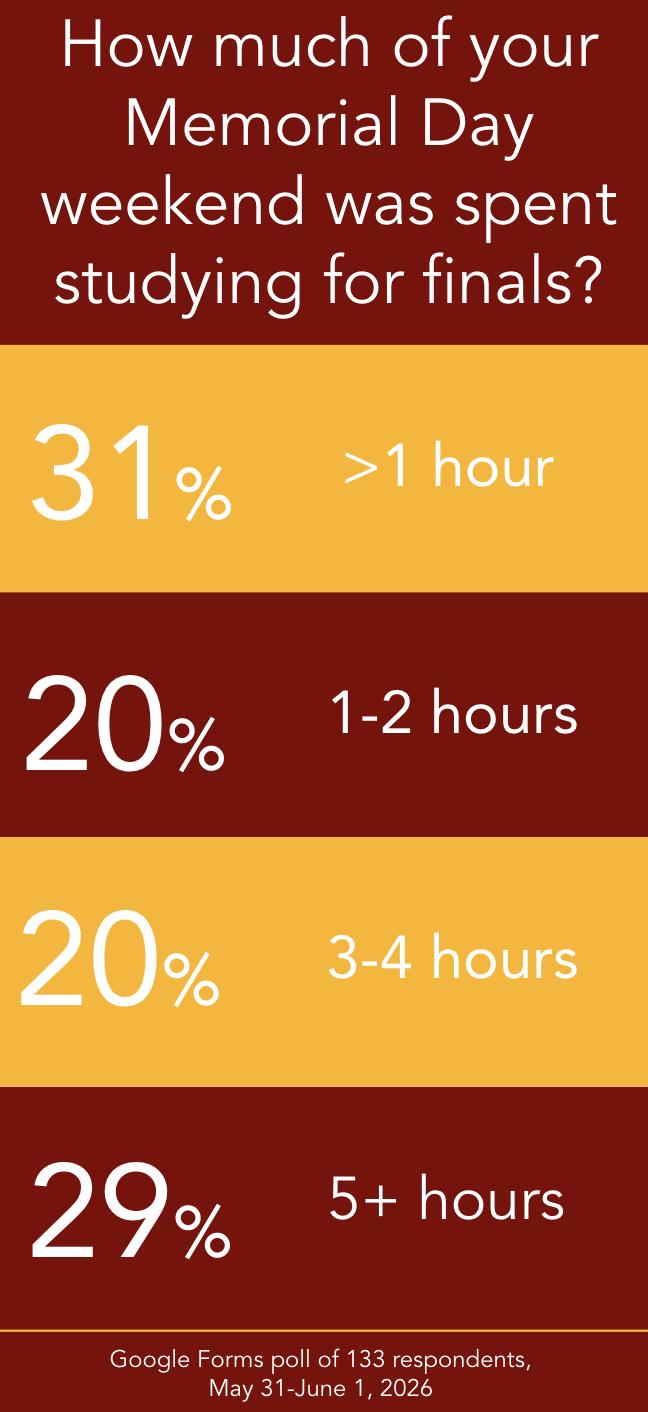
Every year, students look forward to Memorial Day weekend as one last break before summer: a golden opportunity to relax before the end of the academic year. However, with finals starting just two days after Memorial Day, some students are opposed to the timing.
Many students ended up spending the weekend studying. Still, not everyone sees it as a bad thing. Some students appreciated
having an extra day to review materials and prepare for finals. A few said it was the most focused studying they had done all semester.
The frustration is less about the studying itself, but more about the transition from Memorial Day weekend break to exams a few days after.
Fourth Former James Paul went to Avalon with his friends for Memorial Day weekend.
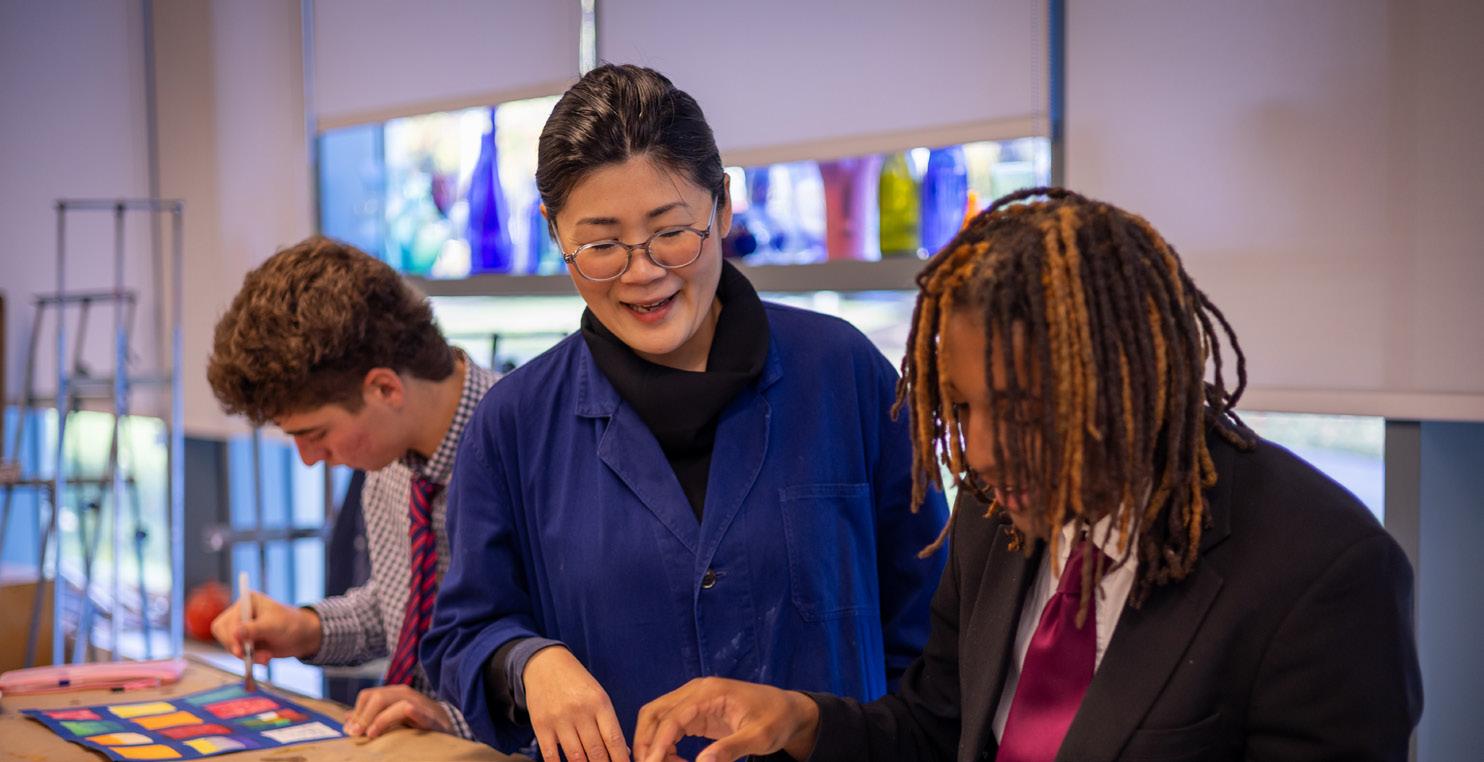
When middle school students enter the upper school, they are asked to join a theater, visual arts, or music class. While these classes may serve as a break from the academic rigor of the upper school, it becomes a burden, as Haverford requires two full arts credits for

“I knew that the finals would be right after [Memorial Day], but I really wanted to spend some time with my friends down at the shore,” Paul said. “I think that Memorial Day weekend is a great time to go to the beach and hang out with friends.”
Whether you spent the weekend at the beach or at your desk, many students feel that knowing finals are right around the corner makes it almost impossible to switch off and not study.
Students who have family trips planned, or whose families celebrate the holiday in a big way, are put in a tough position. Taking time off feels irresponsible, but staying home to study while everyone else is out feels miserable. Either way, someone loses something.
It is worth noting that this schedule is not unique to Haverford. Many other schools across the country operate similarly, and there is rarely a perfect solution. Finals have to go somewhere, and late May is a hard time to plan finals.
Fourth Former Patrick Chang headed to the coastal town of Margate for the weekend.
“Hanging out with my friends and making fun memories is more important to me than studying for finals,” he said. “I also enjoy time away, as it is like a reset for me from my traditional, more stressful life, especially with sports.”
graduation.
While many students opt to take at least two art classes or participate in another arts credit, the arts credits are nonetheless unnecessary.
Giving students more choice in the classes that they take would allow them to make the most of their time at Haverford.
In my case, I chose to take two languages instead of taking an art class, as the arts were never very interesting to me, and I would rather take another academic course. However, this leaves my two arts credits to be fulfilled during my Fifth and Sixth Form years, which is especially important because these are the years of high school where electives are more diverse and align with my academic interests.
Another difficulty with achieving arts credits in my case is that I participate in
sports and robotics, which conflict with the theater production, the jazz ensemble, and the Notables.
Part of the reason why the school makes arts credits mandatory is that they believe it will help students become more creative and express themselves.
For me, art classes can feel like a waste of time because that slot could be used for a class that aligns with my future.
If the school were to remove the arts-credit requirement for graduation, most students would still choose to take art classes, and there would still be plenty of active participation in ensembles and the musical. This change would allow students to take more classes that they are truly passionate about. Giving students more choice in the classes that they take would allow them to make the most of their time at Haverford.

From trading the cards to battling with them, Pokémon cards are an integral part of childhood. But in recent years, their increasing popularity has brought to light the shady business of selling a chance to children.
According to CardLadder, a premier resource for measuring a card’s worth that compiles sales recorded across the internet, sales in April 2026 soared to more than $600 million from only $400 million at the start of the year. The market has spiked after the excitement generated by Logan Paul’s sale of the $16 million Illustrator Pikachu and the franchise’s 30th anniversary.
This excitement over Pokémon has drawn the attention of an easy-to-manipulate audience: children. The colorful cards and popular characters, combined with the

seeming innocence of the product, make it easy for children to become addicted. Fourth Former Oliver Peters-Whitaker, owner of Malvern card store King Street Cards, said, “Opening Pokémon cards is considerably more dangerous than gambling or buying a lottery ticket. The only way you could possibly not become infatuated with the risk and reward of opening packs is if you either have no real connection to the characters found in the pack, or if you have already convinced yourself that you will get nothing from every pack.”
“It’s only a $5 pack, all I can lose is $5, which turns into buying a $200 booster box.”
NOAH GATES ’29
He believes there is a strong psychological effect from getting nothing.
“The feeling of having lost something that belongs to you is so powerful that it drives people to buy more packs and lose more money, which repeats the cycle,” Peters-Whitaker said.
This affects all customers but especially those middle and high school-aged, who
make up the majority of their customer base. These cards represent a gray area between toys and gambling. Although studies from the National Library of Medicine show that there is no direct correlation between opening booster packs and having gambling problems, these studies also mention that opening booster packs mirrors the kind of gambling found in casinos.
Many argue that these cards are instead more like stocks than gambling.
Furthermore, research on this matter fails to address the fact that Pokémon, even if not a form of gambling, is becoming increasingly expensive. This is a result of the sheer demand for Pokémon and the card re-selling that ensues. While buying a pack for market price is often only around $5 per booster, on the secondary market, the same pack will fetch double or triple the price. Third Former Noah Gates, who buys from Pokémon vending machines, expressed the mentality this instills.
“It’s only a $5 pack, all I can lose is $5, which turns into buying a $200 booster box,” he said.
This is a best-case scenario, however: the majority of Pokémon sales happen on
second-hand sites such as eBay and TCGPlayer, where independent sellers can charge a premium due to the lack of standard retail availability.
Many argue that these cards are instead more like stocks than gambling. Cards such as the Illustrator Pikachu have been known to double in price over time. However, much of the secondary market is saturated by modern products, which, unlike older cards and stocks, are not scarce to any extent. In the entire history of the Pokémon Trading Card Game, nearly 100 billion cards have been printed, and 50% of those have been printed in the last five years.
“The Pokémon card market is artificially inflated. It is not as unusual as it is disappointing that people will spend over two times the retail price for a product,” Peters-Whitaker said. “People see others get expensive and cool cards online and believe they can do the same, when in reality the chance of pulling something good is entirely determined by how lucky you are.”
This aspect of the “hobby” is another factor. An instance of this was the initial “hype-phase” in 2021, where Logan Paul’s Pokémon YouTube videos contributed to the almost 250% increase in card sales. Online content is especially influential on youth, with more than 50% viewing social media influencers as role models equal to their parents, according to the National Literacy Trust.
Despite all these factors, regulations on trading cards remain unwanted and undiscussed. Ultimately, children do not have enough money to plunge themselves into debt, and their actions remain in the hands of their guardians, who are responsible for teaching their children about making responsible purchases.
“It’s fine to collect cards. If you’re going to collect Pokémon, don’t say, ‘rip packs,’ more so ‘collect cards,’ because you end up spending so much money and you wish that you spent that money on a card that you actually want,” Gates said.


Cody Luong ’29
As the school year comes to an end, students struggle with exams but, most importantly, with what their future will hold. How does one choose their career, or even know if it is what they want to do? Lots of students have these questions, and they are completely valid.
According to Forbes, “Nearly two-thirds [of college students] are unsure about their future career path, and one in four are struggling to break into the field they thought they’d pursue after graduation.”
It’s completely normal not to know what to do, even if one is about to graduate from college.
Hopefully, this article will assist with discovering one’s career path, as well as some advice for the underclassmen who still have a bright future ahead of them.
First of all, one should never choose a job just for the money. This advice comes from Latin teacher Dr. Andrew Fenton.
“I don’t think that a salary should be the deciding factor in choosing a career,” Dr. Fenton said. “Salary also doesn’t correlate with a career being future-proof, which people can commonly get mixed up with.”
Dr. Fenton also gives a word about finding the right career path.“Finding a career that will provide you with satisfaction will go way beyond how much money you make.”
So, when one thinks about their ideal career, they shouldn’t just associate it with a salary. An ideal career provides satisfaction. Remember: a career choice might dictate one’s whole life; pick a career that will be
ideal to work in for a long portion of time.
So if not money, then what should drive the decision for a student? No one answer fits all cases.
“Oftentimes, people pursue things based on monetary rewards, like high pay. For me, it’s about being satisfied and being truly fulfilled.”
RAYMOND KRESGE ’27
“It’s a difficult question, and it’s one that I’ve been pondering for a while now,” Fifth Former Raymond Kresge said. “Oftentimes, people pursue things based on monetary rewards, like high pay. For me, it’s about being satisfied and being truly fulfilled.”
Kresge believes that fulfillment and satisfaction should lead one to pick a career. Kresge also points out that, “There are a lot of programs at Haverford that will propel you into the new world. Limiting yourself to just one career is really cutting yourself off, so keep trying new things to see what you like. Opening yourself to new things helps you discover things you don’t like and like, which may help you find a career that fits.”
Now that choosing a career is a bit clearer, what major should one take in the first place? Should you pick a major based on how
broad it is, or should you pick a major that is restrictive but offers a lot in a vertical investment? Spoiler alert: the right major may take ten days or your whole life to decide.
“I haven’t picked my major yet, but I believe that you should try as much as you can,” Kresge said. “Try a lot of things, and if you find new experiences throughout your high school career, you can identify what you like and dislike.”
While picking a major may be stressful, Kresge suggests an alternative approach.
“I don’t think that people should be concerned about their major,” Kresge said. “People fall into the trap of trying to appeal to colleges. I think people should just try things for the sake of trying things, not for the college apps. It’s healthier, more natural, and low-stakes. I found my love for English and literature by letting it come to me naturally.”
The age-old question that most people struggle with is: should you stick around school and get your master’s or doctorate, or should you go straight into the workforce?
“Usually, work experience benefits you way more than getting your doctorate,” Sixth Former Adonai Belete said. “Getting a master’s or even a doctorate [can] make you overqualified [for the job]. [However], doctorates and master’s can help you get into jobs that require that high level of education, as well as higher-up jobs that people without master’s can’t reach. At the end of the day, getting your doctorate matters on what path you decide to embark on.”
So, what should the underclassmen do now, while they still have a few more years until college? These students and teachers have reached a consensus that Belete captures well.
“Make sure you work hard now and get the best grades you can in high school,” Belete said. “Then, go through a route that has reliable job security while being a major that suits you the best.”
It doesn’t matter who did the most clubs; it matters who has their story.
Ultimately, deciding on a major isn’t as easy as it might appear to the naked eye. It takes trying new things, finding what you truly like, and finding the career and major that will bring you satisfaction and fulfillment.
As Kresge said, don’t spend too much time worrying about majors and especially future careers for now; most of you have a couple of more years at Haverford.
Make sure to set time for yourself, but also find a balance between personal time, extracurriculars, and schoolwork. It doesn’t matter who did the most clubs; it matters who has their story.
Remember: one only lives once. Live a life without regrets.


Hanru Li ’29
You may have heard of the hantavirus outbreak on a cruise ship from your Instagram or TikTok feeds. Most of us immediately think of COVID-19 upending our daily lives for three years.
In these videos, hantavirus is described as having a high mortality rate of over 30%, and our correlation between hantavirus and Coronavirus leads many to believe that it is highly contagious.
In reality, much of this information is the result of exaggerations by creators seeking higher engagement on their videos. The comments clearly reflect that the engagement bait is working, with many even calling to “burn the ship.” In the midst of all of this, reality becomes murky. So what’s true and what isn’t?
First of all, hantavirus is real. It is a disease that originates in rodents and spreads to humans through contact with urine or droppings.
It is also true that hantavirus does not have a known cure, and its mortality rate can range from 30-40%.
So that seems to settle it: we should be terrified of hantavirus.
Well, not quite. Hantavirus is really rare, with the United States only having anywhere from twenty to fifty cases per year. Also, most cases of hantavirus do not transmit person-to-person.
It is important to remember that what we see on our screens may not be factual or could be presented misleadingly.
the virus, Andes Hantavirus, that can spread between humans. Even still, Andes Hantavirus needs very specific conditions to spread amongst people. Unlike Coronavirus, hantavirus is not an airborne disease.
Hantavirus can only be spread through saliva or mucus and requires prolonged or repeated close contact with an infected person. It just so happens that a tight cruise ship on a long journey meets those criteria, and is one of the few environments where a hantavirus
outbreak can occur.
Outside of the cruise ship, though, it is extremely unlikely that a hantavirus outbreak could occur, and it is almost impossible that it even comes close to the scale of the Coronavirus.
The paranoia of another pandemic and fear-mongering by creators, whether intentional or not, has had many people commenting on or liking videos related to hantavirus. This pushes these videos further,
creating a dangerous snowball effect of misinformation.
It is important to remember that what we see on our screens may not be factual or could be presented misleadingly. With social media, the spread of alarming misinformation often outpaces the truth.
In the future, we need to be mindful about the content with which we engage, and we should slow down and find out what is really happening.



Their nation’s future was decided at a dinner table. They went to class.
“Taiwan’s fate was repeatedly reshaped by great powers according to their own strategic interests, often at negotiating tables where the people of Taiwan were not present,” said Ms. Sharon Yang, a history teacher at Tainan First Senior High School and faculty advisor during the Taiwan-Haverford global studies trip.
From the spotless subways, bustling night markets, and the unremitting hospitality I received during winter break, my Taiwan experience was transformative. Consequently, I was greatly worried that the Trump-Xi summit and the subsequent quiet pause on a $14 billion arms sale seemed to endanger the culture I experienced.
After all, Taiwan is always of “strategic interest.”
Surprisingly, many Taiwan exchange students were indifferent to the news.
“I heard about this recent meeting with the two presidents, but to be honest, I have been so busy with my final exams that I don’t really think about these things,” thirdyear student at the Tainan First Senior High School Paul Chen said.
Chen’s classmate, Owen Lin,
shared a similar sentiment.
“To be honest, I still live my normal life, go to school and play with my friends like nothing happened, but when I watch the news, I feel a little stressed about the future,” Lin said. “This uncertainty makes it harder for me to plan ahead, like deciding whether to buy a house in Taiwan or study for a gov-
My media consumption led me to expect that Taiwanese students would express similar fear for the fate of their nation.
ernment job after I graduate.”
Their somewhat impartial attitudes contrasted with the fear I saw in the media. A Reuters Connect video displayed Taiwanese citizens firing rifles at paper silhouettes ahead of the summit. Additionally, a New York Times Article investigated the Taiwanese President Lai Ching-te’s obstacles, including being denied access from American airports en route to Eswatini, a country that
still acknowledged Taiwanese sovereignty. My media consumption led me to expect that Taiwanese students would express similar fear for the fate of their nation.
However, Taiwan has had a substantial history of being deferential to power politics.
“The strategic ambiguity in the 1972 Shanghai Communiqué, the severing of official diplomatic relations between Taiwan and the United States in 1979, and the restrictions on arms sales in the 1982 August 17 Communiqué all made Taiwan deeply aware of the realities and vulnerabilities of international politics,” Ms. Yang said.
However, Ms. Yang urges her students to understand the facts over emotions.
“When I look at my students, I feel a deep sense of concern. They are only teenagers, working hard for their exams, college admissions, and future careers. Yet their future may be influenced by high-level meetings taking place far away in Washington or Beijing,” Ms. Yang said. “I do not want my students to fall into fear or anger. Instead, I hope they can learn to understand the world calmly and clearly. International politics is not simply about who is a friend and who is an enemy, nor is it a fairy tale of heroes and
villains.”
I had initially thought Lin and Chen’s indifference was from a lack of information or care. However, it now looks less like indifference and more like the resilience that teachers like Ms. Yang work to instill, pushing students to see history and current geopolitics through a different lens, not one of aggression or fear, but of resilience.
Rather than being immobilized from fear of uncertainty, Taiwanese people had adapted, planned, and carried on with their lives.
In truth, Taiwan has had uncertainty since the 1970s, and that may continue well beyond their lifetimes. Rather than being immobilized from fear of uncertainty, Taiwanese people had adapted, planned, and carried on with their lives.
Their resilience is not the absence of worry, but the drive to continue despite it.
Caden Zhang ’29
As the school year comes to an end and finals come and go, summer is arriving. This poses the question of how people are going to spend their summer and make the most of it.
For me, the answer is clear. As a Third Former, I’m not burdened by the work that upperclassmen shoulder, so I would like to get a job and start looking for valuable work experience.
With an abundance of time, summer is the perfect time to start working. But although working may have a monetary benefit and cultivates a sense of independence, the toll it can have on one’s mind—the fatigue and long shifts—will deter some from pursuing it.
You can’t forget about the vacation aspect when someone mentions summer.
A more fun and relaxing way to spend the summer may be to spend it hanging out with friends. You can’t forget about the vacation aspect when someone mentions summer. A day on the beach or walking on the boardwalk is a great way to calm one’s nerves and detox from school life.
Summer also offers time to tone your body and feel good about yourself. As the
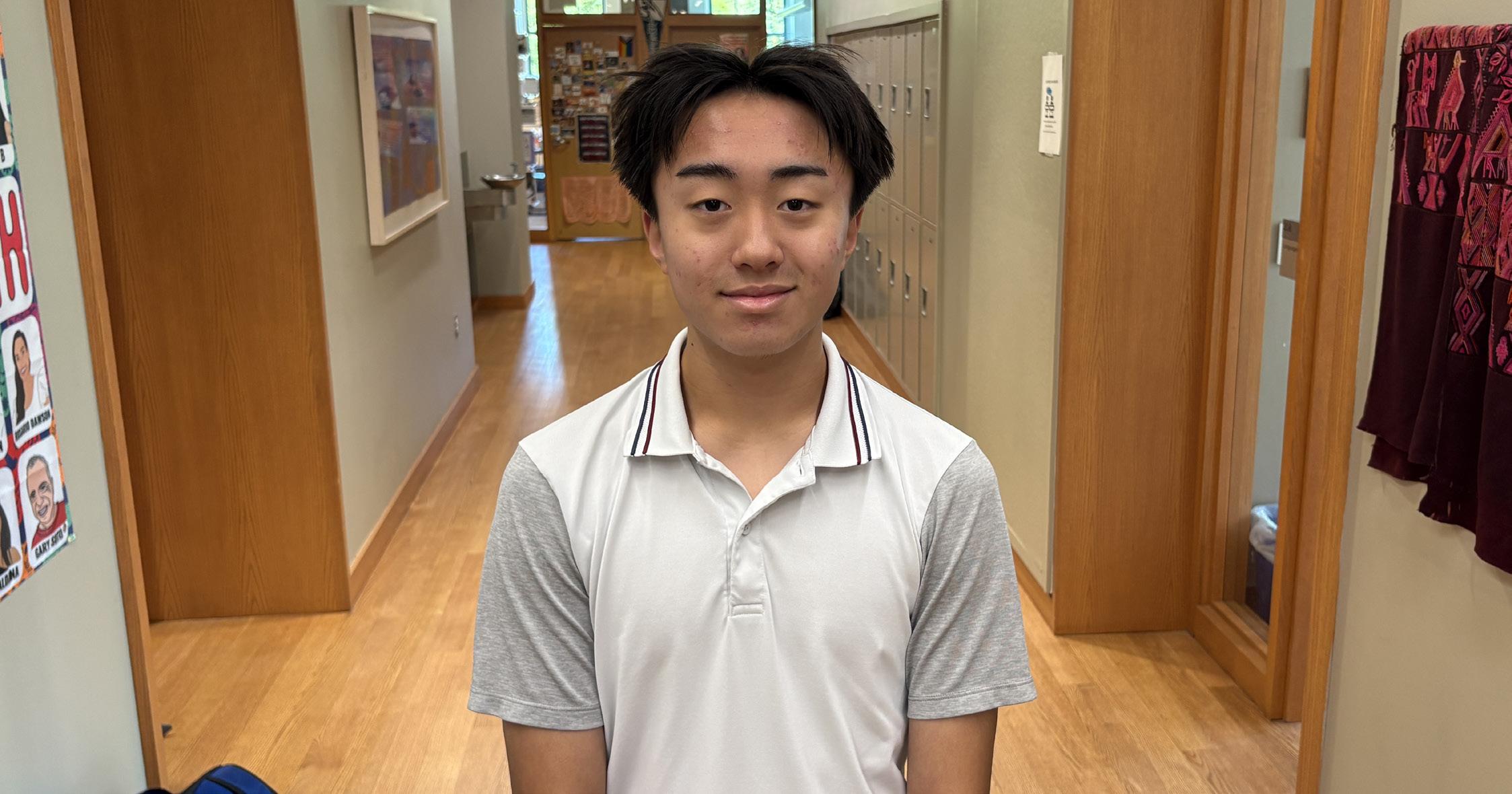
allergy-ridden spring comes to an end, summer becomes an excellent opportunity to start exercising. Training in hotter temperatures builds endurance and strengthens mental fortitude. By the time school begins, you’ll return as a better athlete, regardless of the sport.
Others may use this time to study for the SAT or prepare for college applications. I
Sam Sholl ’29
Diet is an essential part of our lives. Like it or not, most adults stress the importance of a healthy diet because it directly affects you. Health Direct notes that some diet issues may cause shortterm problems such as low energy levels, while other problems with diet can cause long-term diseases like type-2 diabetes and obesity.
Millions of scientific studies have been conducted to find how different foods affect our bodies. Over time, though, youths around the country trade their health for tasty but unhealthy food. In that pursuit, they ignore the long-term effects that come from making these mistakes.
Another common issue is that students don’t make time to eat breakfast—a huge mistake. Failing to eat the recommended three meals daily can often lead to unhealthy eating habits such as constant snacking, which only adds more unhealthy food into an already lacking diet. All of these habits seem insignificant on their own, but it depends on what a student is eating as well as how much they are eating.
Getting strong isn’t just from eating protein but also having a balanced diet.
Even if breakfast isn’t practical, eating balanced meals is key. Popeye the Sailor once said, “I’m strong to the finish ’cause I eats me spinach.” While light-hearted and comedic, I believe this is deeply true. Getting strong isn’t just from eating protein but also having a balanced diet.
Harvard Medicine suggests that, for optimal health, over half of our plates should contain fruits and vegetables with only a fourth of a plate for protein. Popeye is right about his spinach. Usually, a main component kids are missing from their school lunch is vegetables.
Sodexo is great about keeping the school lunches healthy. But even though there are plenty of healthy options to choose from, I
rarely see students asking for the veggie of the day as part of their meal or picking up a fruit cup from the refrigerator.
Think ahead into the future, and trust me, your body will thank you.
personally have been planning to intern under my parents to look better for colleges and future jobs.
Work and exercise alone won’t make your summer perfect. While it’s important to make room for hard work, it’s also important to make memories.
These lived experiences, combined with the enjoyment from hanging out with
The human body needs a balanced variety of foods to survive, and as more and more kids abandon their daily fruits or vegetables in favor of pound cake or chips, they miss out on vital nutrients.
Health-food writer Joyce Hendeley mentions in one of her articles that protein alone cannot build and support muscle mass without the aid of essential nutrients including iron; spinach happens to be one of the
friends and family, will extract maximum value from your summer.
So try out that new restaurant, watch a play—start small. Stop sticking to the same few activities.
Make this summer more memorable by doing new things or being productive, and don’t forget to relax in between.
highest natural sources of these nutrients. So the next time you stroll into the dining hall, ask yourself how important your diet is to you? Do you want to eat the pound cake for the short thrill, or do you want to have the vegetable medley that will give you long term health?
Think ahead into the future, and trust me, your body will thank you.
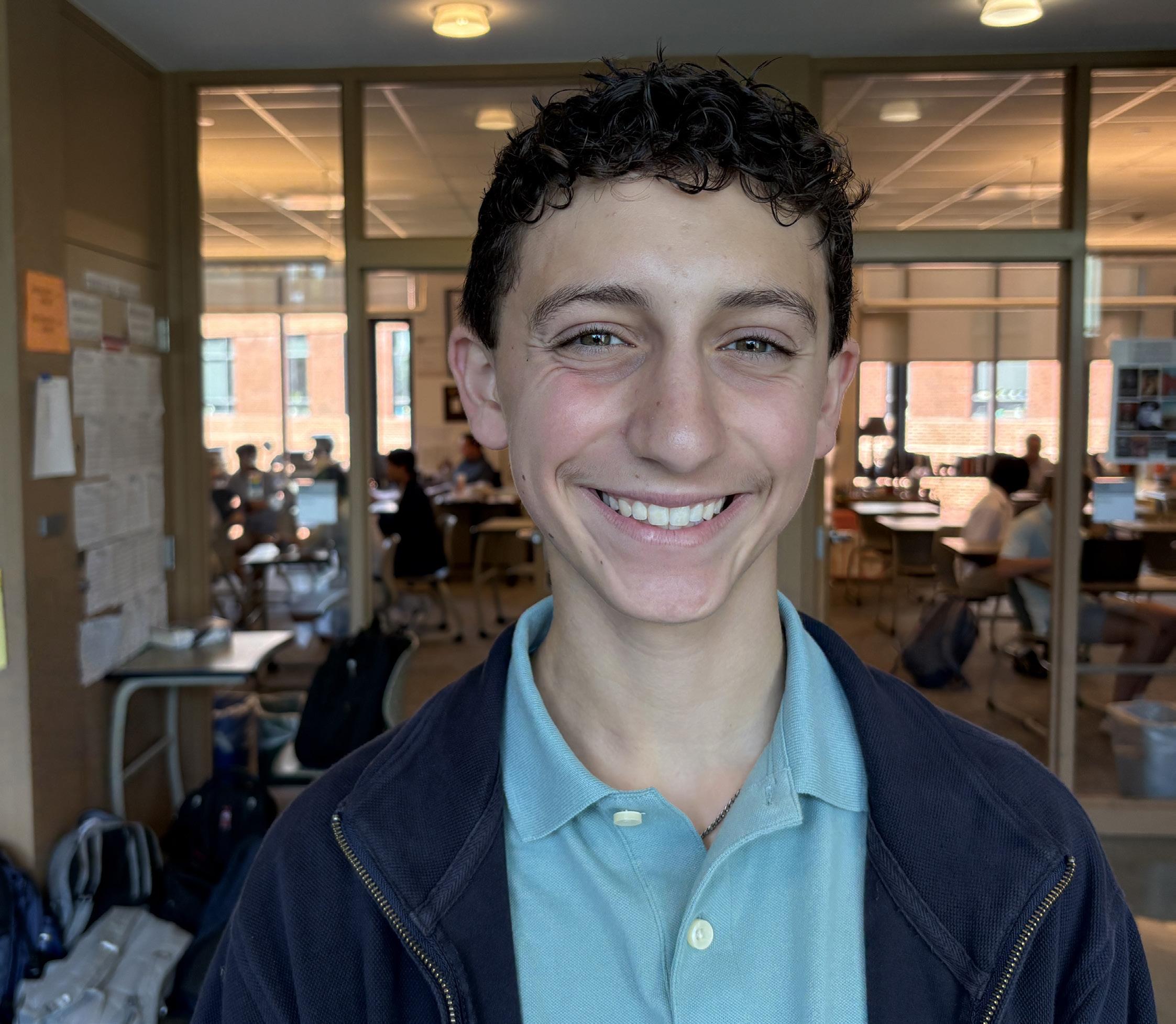
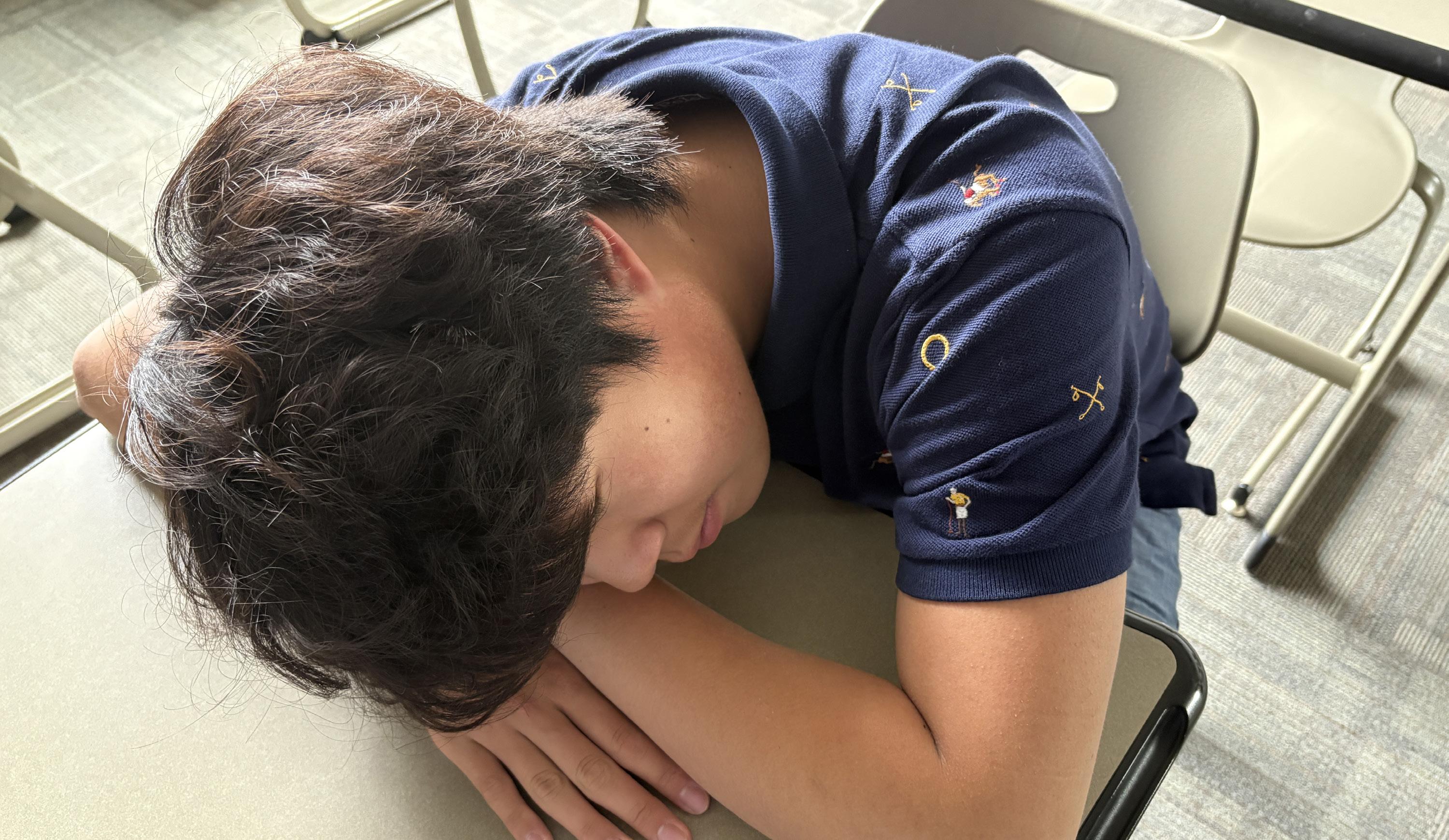
Ben Qu ’28, sleeping on a desk.
Ben Qu ’28
Endless studying, practice problems, and overanxious review—this pattern has dictated the past few weeks of school as final exams loomed over me. Waking up feels only more tiring instead of rejuvenating, and I ask myself the same question: Is staying up this late even worth it?
Lately, sleep has been a privilege and a luxury. Six hours of classes daily, combined with homework and after-school activities, can make sleeping early feel unproductive and counterintuitive. Problem sets consume much of my time already; glossing over test materials takes even more. By the time I’m finished, the clock has creaked past 12:00 a.m.
It is not entirely our fault for being late sleepers or for believing that staying awake longer is necessary.
But it is not entirely our fault for being late sleepers or for believing that staying awake longer is necessary. According to a study by Johns Hopkins Medicine, teenagers experience a natural shift in circadian rhythm, the body’s internal clock that con-
trols hormone production and our wakesleep cycle. That is why it feels “acceptable” to sleep late. But by damaging our biological clock, we throw it off balance, and that tips off everything else running our system: our mood, feelings, and attention.
We should not encourage the dangerous culture of sleep deprivation, which has become so common nowadays that we laugh over the few hours of sleep we manage to snatch, a dangerous normalization. Teachers say, “get some rest” and “sleep earlier,” statements we ignore but should really take to heart. We encourage ourselves to be successful, but we cannot manage that if we are unclear about our own intentions for rest. If we aren’t ready to tackle problems in school with a fully rejuvenated mind and body, how can we prepare ourselves for life?
With a clearer mind, what you study can be applied much better than when you’re overwhelmed with tiredness.
Medical professionals recommend that teenagers aged thirteen to eighteen should sleep for around eight to ten hours a day,
mainly because it not only develops the mind but also helps memory retention and stabilizes mental and physical health. With a clearer mind, what you study can be applied much better than when you’re overwhelmed with tiredness.
I am not exempt from this issue. My phone stays too close to me at night.
I am not exempt from this issue. My phone stays too close to me at night. When I’m unable to fall asleep, I end up reaching for it and scrolling for thirty minutes. The sleep debt compounds, and I come to school tired, half-awake with baggy eyes.
So, how do we fix this issue? The answer is clear: we need to dedicate ourselves to it. The solution is putting our phones away, taking a nap if you need it, stopping yourself from eating temptations, and turning off the lights in your room earlier. We must take these small steps first if we want to solve our sleep debt. When finals arrive, the students who do better are often those who are more rested.
As many of our teachers would say, “Don’t take your foot off the gas pedal.” But don’t go speeding either.
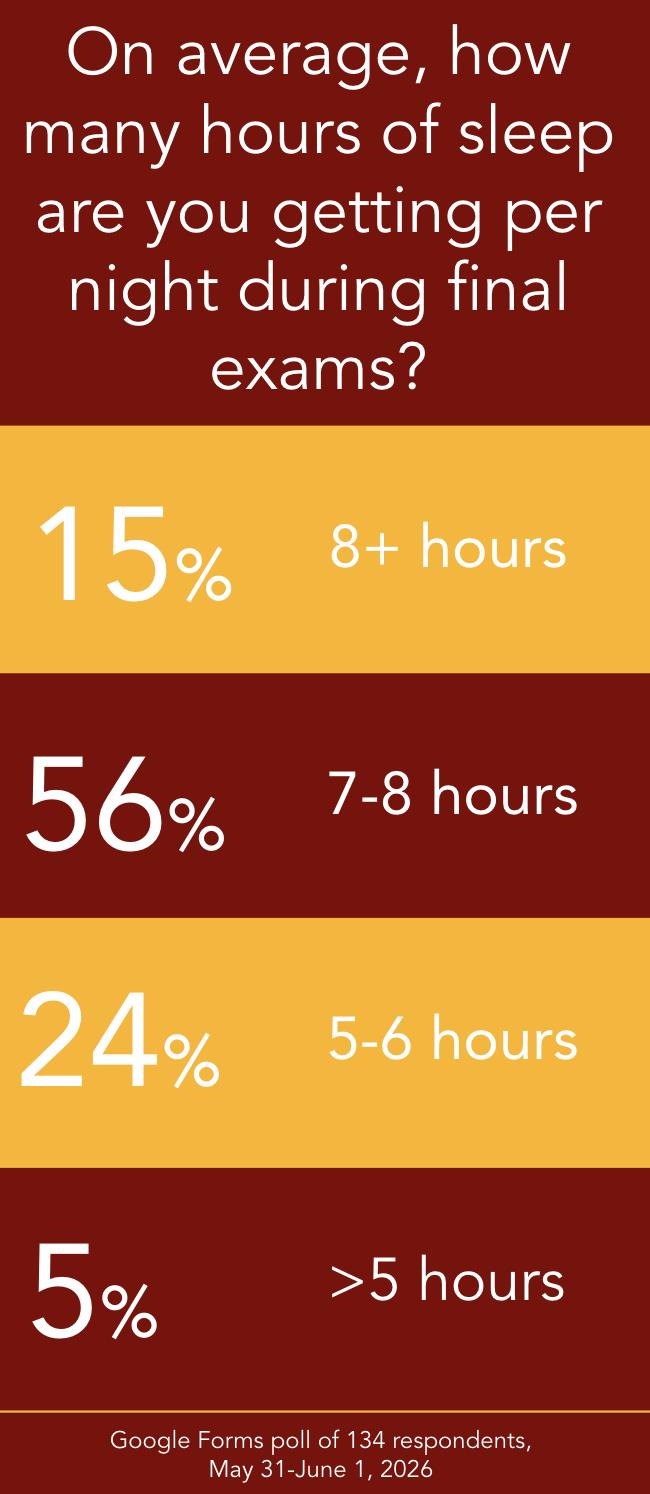

Sahil Manjeshwar ’28
For Fourth Former Greyson Heneks, the road to a lead role at the Walnut Street Theatre, one of the oldest theatres in the country, started with his love for singing.
“Since I was a kid, I really loved music,” Heneks said. “I would always just sing, because it’s what I love to do.”
His mother, a dance teacher, first got him into dance, and one day she suggested that he try acting. He gave it a shot. Before long, he started earning roles.
“I just want to let the wind take me where I want to be.”
GRAYSON HENEKS ’28
His connection to the Walnut Street Theatre started about three years ago, almost by chance. He signed up for the theatre’s summer camp, and it grew into something a lot bigger. Since then, he has built a real resume there. He played Brett Sampson inthe musical 13, took a part in Aladdin, and performed in Anything Goes this past summer. He even played Buddy in Elf, his first time playing as a main character in a show. Now he steps into Jack Kelly in Newsies Jr., which
is his first leading role at the Walnut Theatre.
“I found a group of people, and those people are my people,” Heneks said.
Even in the months when he is not in a show, he says he still talks to them every day.
Leading a show is a different kind of pressure, and Heneks does not pretend otherwise. But he has a clear reason for taking it on.
“It’s a lot of work, but at the end of the day it comes down to me wanting to do this as a career,” Heneks said.
He puts in the extra time because he knows it pays off later, since a bigger resume makes the next audition or role easier to get.
That next step is already lined up. Heneks got accepted into a competitive summer program called Stage Arts, led by performer JJ Niemann, that accepts only about 60 students from around the world.
Interestingly, Heneks found out that he got accepted into this program over a FaceTime call from a player for the Savannah Bananas. He also plans to audition in front of college theater programs at a Pittsburgh event a full year before he actually has to, so he can get early feedback.
Looking further out, Heneks wants to make theater his career. He is drawn to both film and the stage, though he leans toward the stage, and he is in no rush to box himself in.

“I
keep singing in an a
through college. For Heneks, none of these interests feel like separate goals. It is all the same thing—doing what he has loved since he was a kid.
Matthew Lo ’27
Given their frequent presence at major school events, we often take for granted the group of boys who regularly sing a capella arrangements of various songs. Even at commencement, the Notables can be seen and heard. As a final parting gift, it has been tradition in recent years for Sixth Form Notables to pick and arrange a song.
This year, Sixth Former Andrew Witmer was in charge of picking the song. While choosing such a monumental event may seem strenuous and challenging, this was not entirely the case. However, the process was
not short nor straightforward.
“ When Mr. Holdren and I were looking for songs, I sent out feelers [to the rest of the Sixth Formers] trying to figure out what those guys would like, and we all kind of consolidated around slow, sad songs,” Witmer said.
Selecting the song itself was closer to a happy accident.
“[We] happened to be listening to barbershop [music] at the time, and we weren’t really thinking about the message,” Witmer said. “When [Mr. Holdren] actually pulled

up the lyrics, we realized that it was really a great send-off and was already arranged perfectly for The Notables. We took it down a half step, though.”
The song the Notables are performing is adapted from the musical Jekyll and Hyde, arranged by the legendary Freddie King for the 1990 International Quartet Champions, Acoustix. Luckily, the boys are more than equipped to deliver. After all, being a part of the group requires significant skill and dedication.
“This year, we only had four or five spots to fill, so the competition was pretty intense,” Notables Director Mr. Donald Holdren said. “There were a lot of great singers that came out, which then makes the decision process really difficult because of all these great singers to choose from.”
Singers who auditioned were evaluated on their intonation, general musicality, diction, and phrasing in two auditions, a general and a callback audition.
“At the first round of auditions, the students come in individually and are rated on a rubric that considers intonation, diction, breathing, praising musicality,” Mr. Holdren said. “In the callback round, the students sing with current members of the group and then are evaluated based on musicality and how their voice blends in with the rest of the group.”
Furthermore, being a part of the Notables is also affected by the roles available.
“Sometimes a really good singer doesn’t make the group, and it’s not necessarily because he wasn’t good; it’s because I needed a
tenor and he was a bass,” Mr. Holdren said.
The result of such rigorous auditions and thorough practice is top-quality singing.
“I consider myself really lucky because when the guys get to upper school and they’re auditioning, I know that if they’ve been here at Haverford, they’ve already been through one of the best music training programs for boys in the area, and I’m grateful for that,” Mr. Holdren said.
“[I] have the unique position of being in the group longer than Mr. Holdren. Seeing what it was like before he was here and the monumental change he’s had on the group… it’s really incredible.”
ANDREW
WITMER ’26
This gratitude is reflected by the singers. “ I would really like to thank Mr. Holdren for everything he’s done over the past three years,” Witmer said. “[I] have the unique position of being in the group longer than Mr. Holdren. Seeing what it was like before he was here and the monumental change he’s had on the group…it’s really incredible.”
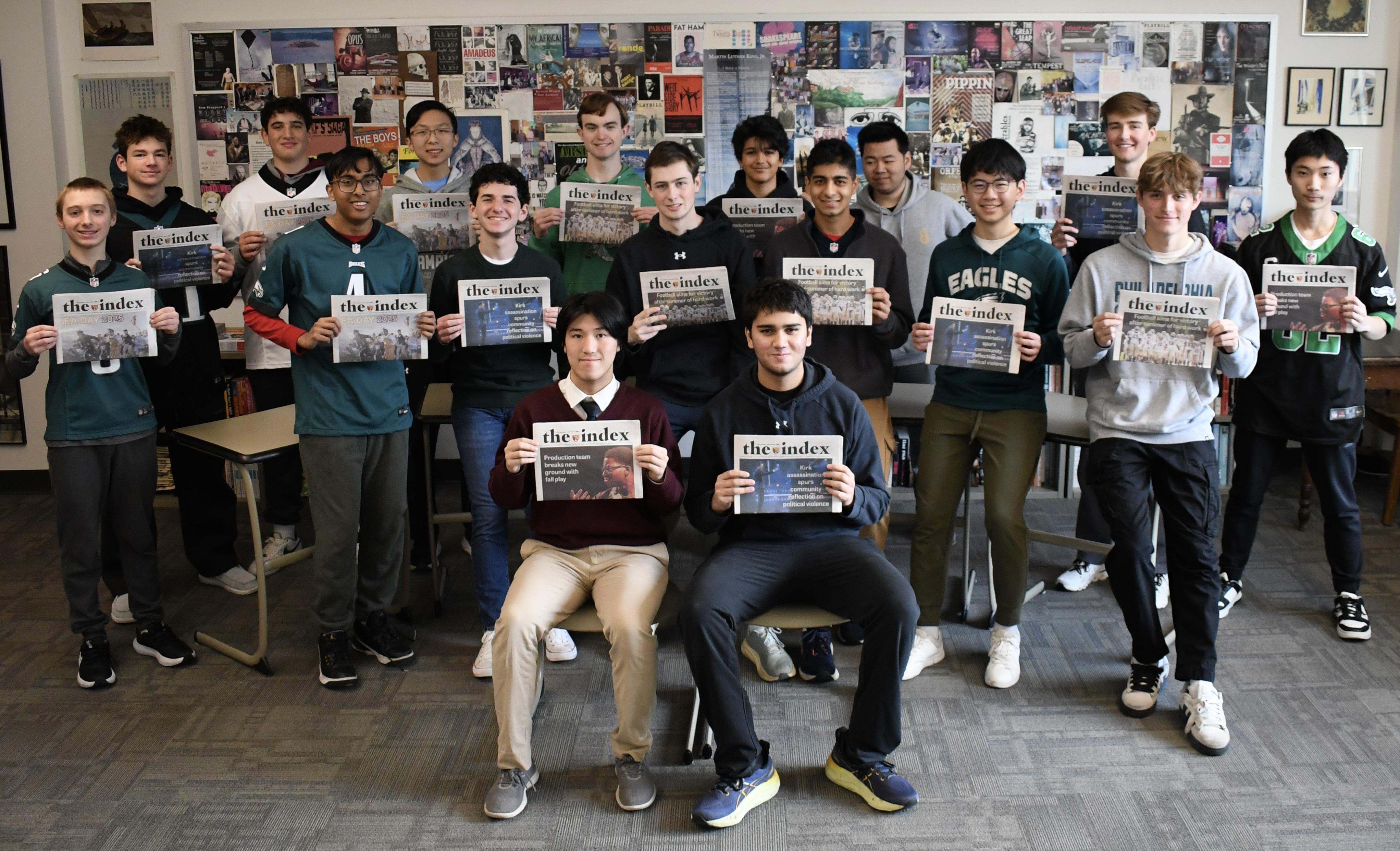
Benjamin Qu ’28
As the Inter-Ac season comes to a close, Fords Lacrosse reflects on its performance. Despite an unfortunate 8-6 loss in the PAISAA state championship finals, the Laxmen defied the odds in their matches, achieving an 8-2 record in the Inter-Ac and an overall 14-7 record.
“It was still a great year, and a lot of lessons were learned,” Fifth Former Jackson Gillis said.
The team faced many challenges this year, but they pushed through them.
“We faced a lot of adversity with a lot of injuries. But ultimately, as a group, we became a lot closer than any team before—the upperclassmen, and even the sophomores and freshmen on the team,” Gillis said.
“A lot of people were thinking we were going to have a bad year because we started off one and three, so it was good to see that we fought back and ended up having a good year,” Fifth Former Finn French said.
Haverford Lacrosse defeated Episcopal Academy in an amazing 12-10 win on May 19th, extending their winning streak against Episcopal.
The team’s brotherhood was another highlight of the season.
“The guys put the team on their shoulders and battled to the end. Even though sometimes it didn’t look like it, we still found ways to pull games out.”
ANTHONY COSTA ’26
“A lot of the guys on the team got injured, including myself, and then we had the guys behind them step up and fill some impactful roles. They did a great job of handling that,” Gillis said.
The team’s spirit-focused attitude was
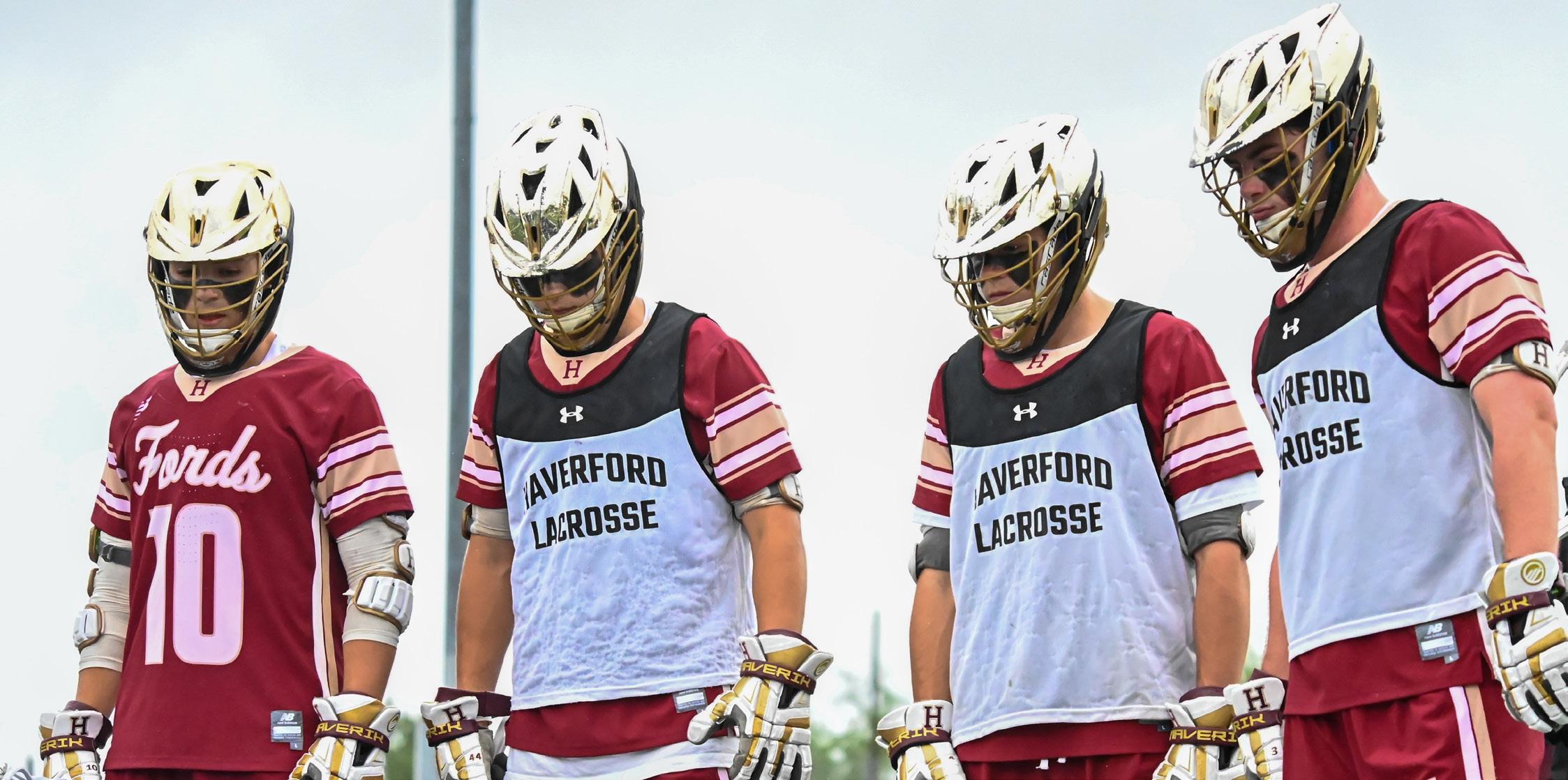
Laxmen get ready for a game
especially pronounced following losses against Malvern.
“I think when we lost that first and second Malvern game, we came together [a lot closer] as a team. Even though the outcome of the final game wasn’t what we wanted, we shared a bond that I don’t think will ever be matched,” Gillis said.
Sixth Former Anthony Costa, who is headed to Brown University for college, praised the culture and work ethic of the team.
“Getting together in the off-season, talking about our goals—it just keeps the tradition going. The morning workouts were important to get everyone up before the competition wakes up, and to do something hard together,” Costa said.
Costa also emphasized the importance of pre-game talks.
“It’s something cool that a lot of teams don’t do. Before practice every day, Coach Dawson would tell us the plan for practice. He would give us a quote; someone else on
the team would talk. It’s a good way to get everyone involved,” Costa said.
The team reflected on how their struggles paid off this season.
“It showed a lot of character that we made it to the last possible day we could’ve played. We were doubted the whole season, and we still beat Episcopal three times to make it to the PAISAA finals,” French said.
“I’m proud of how we battled,” Costa said. “We had a young group, and just getting out there every practice made us better. We made it farther than other people thought we were going to. The guys put the team on their shoulders and battled to the end. Even though sometimes it didn’t look like it, we still found ways to pull games out. It was a communal suffering, doing something hard as a group. It’s the brotherhood of lacrosse.”
The team also praised some of the individuals and people behind their success this year.
“I think the seniors did an amazing job
Keith Dimarino ’27
After a successful spring, Haverford’s Crew Program concluded its 2026 season by sending twelve athletes in three boats to SRAA National Championships in Oak Ridge, Tennessee, including the Varsity Four, the Junior Varsity Four, and the Junior Varsity Quad.
The Junior Varsity Four was the only Haverford boat to reach the grand final, with a 6th place finish. The Varsity Four reached the second final but did not make it to the grand final. The Junior Varsity Quad did not make it past the semi-final round.
The journey to Tennessee came on the tailwind of wins during May. At the Philadelphia City Championships, Haverford swept the podium across almost every event, taking home four golds, one silver, and two bronzes. Most notably, the Varsity Four claimed the championship trophy for the third consecutive year. Junior Varsity Four rower and Fifth Former Jake Barton said the strong City’s position was expected for the work they put in this year.
“Every boat knew they could win,” Barton said. “We put in a lot of work this year for this event.”
At Stotesbury, the largest high school regatta in the country, the Junior Four got bronze and the Junior Varsity Quad silver. The Varsity Four, who won Stotesbury last year, reached the final but went home with
this year, leading and showing what Haverford Lacrosse is supposed to be,” Gillis said.
French highlighted College Counselor Mr. Jeremy Branch and his appearances.
“Mr. Branch comes to all of our practices and games, and he’s always there for the players on the team,” French said.
The Laxmen retain high hopes for next year with their upcoming senior class.
“We kind of had a slow start this year,” Gillis said. “Next year, we can compete nationally for that number one spot and win the Inter-Ac and PAISAAs.”
Costa concluded with his biggest takeaway from years of lacrosse.
“What I want the younger guys to take away is to not take anything for granted,” Costa said. “We had a great season this year, and it went by really quickly. It goes by so quickly, you don’t realize until it’s already over. Don’t take anything for granted and always keep grinding and living in the moment, because once that moment passes, you can’t get it back.”

5th place.
Varsity captain and Fifth Former Benas Antanavicius looks at the season through a broader scope.
“The team is young, and I think we’ve ac-
complished a lot despite not having a senior on varsity,” Antanavicius said. “I’m excited to see what we can bring next year, when other teams have plenty of people graduating, and we have everyone returning.”
Vijay Khanna ’28
The quarterfinals were a statement game for the Fords. The #4 seed Episcopal Academy had beaten them twice during the regular season, 10-6 on the road and 5-4 at home, but when it mattered the most in the PAISAA quarterfinal, the Fords pulled out a grueling 2-0 victory.
Stern recounted the atmosphere.
“Going into the game, we knew that we all had to perform our best if we wanted to beat EA, and I think everything came together. The bats got hot when we needed them most, the energy was there from start to finish, and the pitchers shut the door,” Stern said. “It was an all-around team win.”
After a big win against Episcopal Academy, the semifinal brought a matchup against the #1 seed Malvern Prep, a team that had beaten the Fords 12-2 and 7-1 during the regular season. Unfortunately, the Fords lost 10-0, ending their strong run. Friars baseball went on to beat Germantown Academy 2-0 in the PAISAA championship, ending with a 34-4 record.
“Losing in the semis hurts no matter
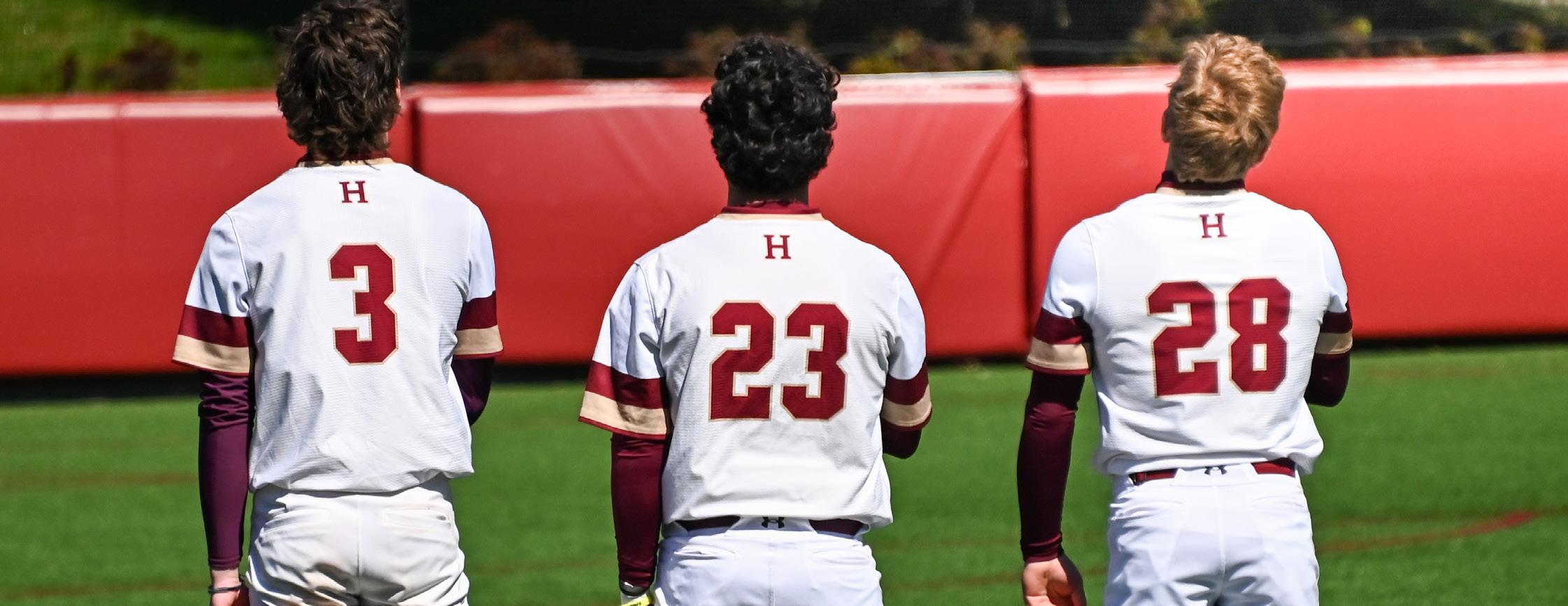
who it’s against, but I think we learned a lot from it and it’s going to be used as fuel for us next season,” Stern said.
Despite the loss to Malvern to end the season, the improvement from last season is hard to ignore. After finishing the 2024-25
season 9-16 with a second-round PAISAA exit, the Fords went 15-13 this year and reached the PAISAA semifinals.
“I think one of the biggest takeaways is how important coming into every game with as much energy as possible is because we’ve
seen how much of a difference it makes,” Stern said. “ I’m proud of how all the guys did this season, and I had an absolute blast going out with them every day. Next year, we’re going to stack more wins together and continue our progress.”
The track and field team placed second in the PAISAA championship this spring, capping off an impressive year for the program.
“What made the accomplishments
stand out was that it was not carried by just one or two athletes,” Fifth Former Haven Hoilett said. “The team scored points across the board, with strong performances from the team, especially in short distances. We

should have won the PAISAA Championship, but [we] just fell short.”
The outstanding second-place 4x400m relay team consisted of Sixth Former Ahijah Goins, Fifth Formers Haven Hoilett and Bryan Tucker Jr, and Fourth Former JR Hawkins.
Several individual athletes also had great performances in the meet, including Fifth Former Charlie Beifeld. Beifeld placed first in both the 100m and the 200m sprints in the PAISAA Championship. Among the individuals who performed well with high stakes were Hoilett, who placed 2nd in the
“We had great relays and independent performances...the most important part is what we can do as one team.”
AHIJAH GOINS ’26
200m sprint, Goins, who placed 2nd in the 400m sprint, and Fifth Former Isaiah Bland, who placed 3rd in the 800m sprint.
For the Sixth Formers, the team’s accomplishments meant a lot more than placing second. It was the payoff of years of weekend practices and long travel days to meet across the region.
“I’m most proud of the team for having some of the best collective stats in the state, from winning indoor states and Inter-Ac’s to almost sweeping at PAISAA. We had great relays and independent performances all year, but the most important part is what we can do as one team,” Goins said.
Reflecting on his last season at Haverford, Goins looks past the loss.
“We ran a hard-fought first round for the Inter-Ac title, and we fell short of the Championship of America division at Penn Relays,” Goins said. “We were less than a second away, and unfortunately, our top competitor, EA, got the last spot. Despite that, we bounced back and won the Philly Area Final in the pouring rain and cold weather.”
Back-to-back PAISAA championships and a 16th consecutive Inter-Ac title are only a couple of the achievements for this year’s tennis team.
“The team won PAISAAs with hard work, gritty competitiveness, and talent,” Head Coach Tracy Tooke said.
In tennis, a mistake can only be blamed on yourself; there are no factors other than you and your racket. Players are there for each other always, which results in thrilling victories.
“I see how the juniors and seniors carry themselves on and off the court. Speaking for the underclassmen, they have inspired us this year and really motivated us to get another title for the team,” Third Former Shaya
“I have been on the team since freshman year; the team has continuously grown in chemistry.”
Khojasteh said.
Captain and Sixth Former Kaiser Zhao has been the glue holding the team together.
“Kaiser’s passion for tennis and competition trickled down for all to emulate. He is not just a talented Division-I recruit to the University of Rochester, but he is a role model who can show the team how to win games mentally,” Coach Tooke said.
Fifth Former RJ Neilly was ready. It was the final challenge of the season: win consecutive PAISAA championships. Haverford had just come back, and this was match point. Neilly prevailed.
“Being the person that the match came down to and being able to pull out the win in the state final meant everything to me,” Neilly said. “This team, especially the seniors, has given so much to the program, and being able to send them off with a back-toback state title was amazing.”
However, in order for the tennis team to continuously win, it must always improve its chemistry.
“I have been on the team since freshman year; the team has continuously grown in chemistry,” Neilly said. “Every match, the team shows more and more support.”