the index


BGamble
BGamble
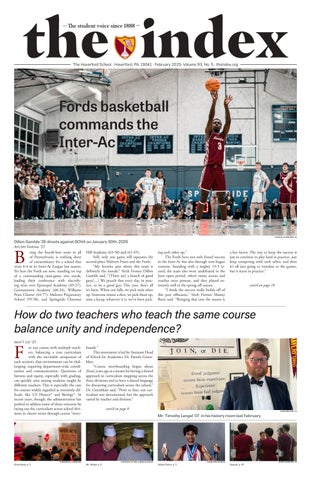
shoots against SCHA on January 30th, 2026
eing the fourth-best team in all of Pennsylvania is nothing short of extraordinary for a school that went 6-4 in its Inter-Ac League last season. Yet here the Fords are now, standing on top of a commanding nine-game win streak, leading their conference with electrifying wins over Episcopal Academy (49-37), Germantown Academy (68-34), Williams Penn Charter (64-77), Malvern Preparatory School (59-58), and Springside Chestnut
Hill Academy (63-58) and (61-45).
Still, only one game still separates the second-place Malvern Friars and the Fords.
“My favorite part about this team is definitely the morale,” Sixth Former Dillon Gamble said. “[There are] a bunch of good guys[…] We preach that every day, in practice, to be a good guy. This year, that’s all it’s been. When one falls, we pick each other up. Someone misses a shot, we pick them up, miss a layup, whatever it is, we’ve been pick-
ing each other up.”
The Fords have not only found success in the Inter-Ac but also through non-league contests. Standing with a mighty 19-3 record, the team also went undefeated in the June open period, where many scouts and coaches were present, and they played extremely well in the spring off-season.
“I think the success really builds off of this past offseason,” Sixth Former Manny Butts said. “Bringing that into the season is
a key factor. The way to keep the success is just to continue to play hard in practice, just keep competing with each other, and then it’s all just going to translate to the games, but it starts in practice.”
cont’d on page 18
For any course with multiple teachers, balancing a core curriculum with the inevitable uniqueness of each section’s class environment can be challenging, requiring department-wide coordination and communication. Questions of fairness and equity, especially with grading, can quickly arise among students taught by different teachers. This is especially the case for courses widely regarded as extremely difficult, like US History* and Biology*. In recent years, though, the administration has pushed to address some of these concerns by laying out the curriculum across school divisions in clearer terms through course “storyboards.”

This movement is led by Assistant Head of School for Academics Dr. Pamela Greenblatt.
“Course storyboarding began about [four] years ago as a means for having a shared approach to curriculum mapping across the three divisions and to have a shared language for discussing curriculum across the school,” Dr. Greenblatt said. “Prior to that, our curriculum was documented, but the approach varied by teacher and division.”
cont’d on page 8

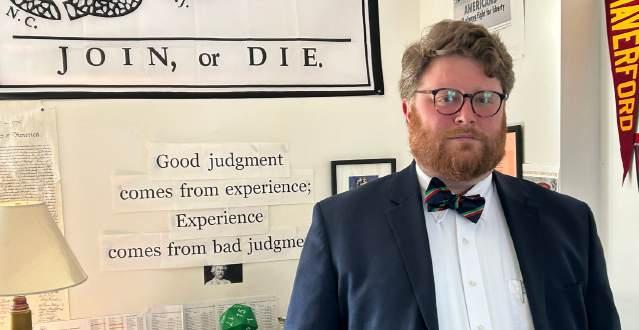
Mr. Timothy Lengel ’07 in his history room last February


2025–2026 Staff
Ajay Chakraborty ’26
Editor-in-Chief
Ryan Wang ’26
Editor-in-Chief
Nate Gill ’26
Senior Managing Editor
Adam Brown ’27
Managing Editor
Matt Lo ’27
Managing Editor
Ayush Varma ’27
Managing Editor
Ben Qu ’28 News Editor
Edward Cheung ’28
Features Editor
Jayden Thomas ’27
Academics Editor
Byron Yang ’28
Neighborhood Editor
Keith DiMarino ’27
Campus Opinions Editor
Brandyn Luong ’27
Off-Campus Opinions Editor
Sahil Manjeshwar ’28
Off-Campus Opinions Editor
Peter McConnell ’26
Voices Editor
Will Komada ’28 Arts Editor
James MacColl ’26 Sports Editor
Jonny Wang ’26 Staff Writer
Jesse Kanefsky ’29
Photography Editor
Riyadh Rolls ’26
Photography Editor
Charlie Schreiber ‘26
Photography Editor
Mr. Anthony Pariano Faculty Advisor
Mr. Thomas Stambaugh Faculty Advisor
The Index is a student-run publication of the Haverford School that does more than bring news: it provides the diverse perspectives of the Haverford student body. It is an outlet for student writers to take stands on issues they deem important. It chronicles the daily struggles and accomplishments of the Haverford community. The Index also provides a forum for discussion of pertinent issues, such as student culture, academic policy, and Haverford’s place in world affairs. The Index presents new ideas and aspires to influence constructive change. All opinions and viewpoints expressed herein do not necessarily reflect those of The Index or the school. The Index is designed and produced digitally. Photographs may be retouched. Submissions and letters to the editors regarding any and all articles are welcomed at index@haverford.org The Index, a member of the Columbia Scholastic Press Association, is composed using the applications of Google Suite and Adobe Creative Cloud. Its surveys are conducted via Google Forms and are advertised via email to current Haverford students. Graphic designs are created by Index staff via Canva. Southern Dutchess News prints 200-400 copies of each issue, and its editorial staff distributes them in the upper school on the day of release. The Index serves the needs of a total school population of 1152 community members, consisting of 952 students and 200 faculty and staff members. Contact The Index: 450 Lancaster Ave, Haverford, PA 19041 index@haverford.org
Twitter: @Haverford_Index
Instagram: @Haverford_Index Volume 93, No. 5 - February 6, 2026
In recent months, our country’s Immigration and Customs Enforcement (ICE) has caused significant controversy. Renee Nicole Good was shot and killed by an ICE agent in Minneapolis, and it is still unclear if Good was simply following the agent’s orders or if she was driving her car towards the agent. Alex Pretti was killed in a similar manner, and it is unclear whether or not he was wielding a weapon when he was shot by ICE.
Left-leaning media is portraying ICE and President Trump as the next fascist
dictatorship, while right-leaning media is portraying seemingly harmless American citizens as evil and dangerous. Simply put, it is impossible to get the facts. One media group might tell us one thing happened, and another media group might tell us something else completely different happened. Although extremely frustrating, there is little we can do.
The Index offers a simple message: practice unity. Due to the nature of partisan media, it is impossible to get the facts completely straight. We don’t know if ICE agents were
practicing self-defense in the murders of Good and Pretti, so it is impossible to form a fact-based opinion. We must listen to each other with respect and build off each other’s ideas if we want to have positive discussions regarding these recent events.
Don’t mindlessly vilify ICE. Don’t mindlessly praise ICE. Instead, listen to people who have different opinions and be truly open to changing your perspective based on what you learn.

for
2025-26 school year, Ajay Chakraborty ’26 and Ryan Wang ’26

The cold, icy island called Greenland wasn’t supposed to be controversial—until it was. For the last 200 years, the Kingdom of DenmarkNorway kept it peaceful until the Danish government and missionary Hans Egede established a monopoly in Greenland. After the Denmark-Norway union dissolved in 1814, the territory remained solely under Danish rule. It was declared a colony until 1953, when it became part of Denmark.
The day was January 9th, 2026, when President Donald Trump stated that he was “going to do something to Greenland, whether they liked it or not.” The president also mentioned that “it may be a choice” whether to preserve NATO or seize Greenland, and he felt that he “no longer had an obligation to think solely about Peace” after not receiving the Nobel Peace Prize.
Greenland, however, has one of the most peculiar locations in the world. Located closer to the North Pole than any other country, Greenland is in a superb location to extract resources from the Arctic, one of the most resource-rich places, holding a remarkable untapped 30% of the world’s gas and 13% of the world’s oil.
Additionally, Greenland is is directly under the shortest distance from Russia to the U.S., a path heavily defended during the Cold War, hosting up to thirteen bases and a complex Ballistic Missile Early Warning System (part of their Distant Early Warning line across the Arctic in 1961) located near their main base, the Thule air base (now the Pituffik Space Base), which once housed thousands of personnel, bombers, and interceptors to protect the base and track soviet planes or missiles.
“I don’t think the United States should completely take over Greenland, but the land could be put to better use while keeping the local population involved,” Fifth Former Ethan Qiang said. “There’s potential value in Greenland’s resources, which could justify strategic interest.”
However, History Department Chair Ms. Hannah Turlish and others in the Haverford community point out that such conquests are not necessary.
“Denmark is a NATO country. Greenland is part of Denmark. To try to forcibly take over Greenland would be an invasion of a NATO country. We would be destroying NATO if we did anything to try to access the land by force. I am also confused as to why we would need to do that since we have had essentially unlimited access to any military bases we needed since 1945. This would
blow up the post-World War II international order in a very dangerous way,” she said.
“While Greenland is geographically closer to Russia via the Arctic, the United States already owns Alaska, which is directly adjacent to Russia,” Fifth Former Ezra Walters said. “China is not geographically close to Greenland, though it has sought an Arctic presence through research and economic initiatives, as has Russia. The United States should similarly increase its Arctic involvement without needing to control Greenland.”
Allies of the U.S. have rallied to find a new dependable trading ally: The People’s Republic of China. Historic, revered allies since 1942 have seen these “bully” tariffs as increasing economic strain, trade instability, and strained diplomatic relations.
“When it comes to Canada and European democracies, these countries have looked to the United States as a fellow democracy to resist totalitarian attempts to take over the world,” Ms. Turlish said. “Now they are looking at us as a totalitarian state trying to take over the planet. Canada and Europe are trying to figure out how to move forward without us as an ally. They are beginning to see us in the same camp as Russia and China, which is terrifying.”
Tariffs now stand at a threatened additional ten percent on select European countries, increasing to twenty-five percent until Trump is allowed to purchase Greenland. This, paired with additional tariffs for not winning the Nobel Peace Prize have not yet been implemented, but has instead played a factor in the European Union’s compromise with the U.S. to set U.S. tariffs on Europe at fifteen percent, while EU nations eliminated most tariffs on the U.S., including their retaliatory tariffs, with this new deal. This deal, created at the World Economic Forum in Davos, has still not cleared the European Parliament yet, as they need to discuss whether they would be giving in to President Trump’s “bully” diplomacy.
“We have turned over a new page in the world order,” history teacher Mr. Bhelly Bagbonon said. “Many of the allies that we have entrusted for decades feel bitter, feel betrayed, and are looking for new opportunities. Mike Carney, the newly elected prime minister of Canada, announced that he will use strategic approaches to build new alliances around climate change, global security, and economic prosperity. If that means China or American geopolitical opponents are involved, that is a loss for American civilians to lose the fabric of those alliances and trade negotiations. I do think that the consequences, if they are not felt immediately, will come in the short and
intermediate term.”
“Trump’s actions regarding Greenland may have pushed some allies closer to China,” Qiang said. “While Russia, China, and other countries are all active in the Arctic, the United States could pursue its interests there, but it should be careful not to escalate tensions into conflict. Using Greenland to encourage allies to increase their security contributions has some merit, but the way it is being pursued is aggressive and potentially destabilizing.”
A great deal has ensued after such perceived threats from President Trump, including Danish Prime Minister Mette Frederiksen threatening that this could halt NATO cooperation, and NATO symbolically deploying forty personnel to Greenland.
“To do anything other than maintain the status quo is to destroy NATO,” Ms. Turlish said. “Destroying NATO is Vladimir Putin’s greatest fantasy. The most dangerous thing to do is anything that jeopardizes NATO’s stability.”
Despite some annual Arctic preparation expeditions from NATO, President Trump claims that such security is not enough. In 2024, NATO allies agreed that a benchmark of two percent of every country’s GDP should go directly to their defense spending to counteract Russia’s actions in Crimea and Ukraine.
However, many countries, including Denmark, Germany, Italy, and Canada, did not rise up to this two-percent mark until recently, when it jumped to 2.4 percent to give more aid to Ukraine. A significant factor in this was President Trump’s criticism of low European defence spending. However, even then, President Trump did not think it was enough. While the country with the largest GDP in the world was consistently contributing four percent, which equates to twentyfive percent of NATO’s security spending, NATO countries were barely scraping two percent—an idea known as free riding (off of the U.S.).
Many even see this as the reason Europeans get benefits such as cheap education, free healthcare, and employee benefits. Following this, at the June 2025 NATO Summit in The Hague, NATO leaders formally pledged to raise defence and security-related spending to five percent of their GDP by 2035.
“Even if Europe has underinvested in defense spending, annexing or pressuring Greenland does not improve that situation,” Walters said. “While increasing security cooperation in Greenland may be reasonable, annexation is not justified. I do not think this adds anything meaningful to the coun-
try. It appears to function more as an ego boost for the president than as a policy with tangible benefits. Also, public perceptions of Greenland’s size are distorted by map projections. Greenland is often believed to be far larger than it actually is due to how world maps stretch regions farther from the equator, so many think it is more important than it is.”
“This situation sends a clear message to other global powers, such as China with Taiwan and Russia with Ukraine, that the United States may act unilaterally, disregarding allies,” Ms. Turlish said. “Regarding trade relations, keeping partnerships with the Allies and close trade relations with Europe is in the best interest of the United States. Trade deficits, in my view, are not inherently problematic. The U.S. is a purchasing country that produces intellectual goods while importing manufactured goods. [These actions] threaten the stability of the alliance and risk repeating the conditions that led to global conflict in World War II.”
Recently, Russia and China have increased activity in the Arctic, with Russia rebuilding and expanding military and logistical infrastructure, including dozens of Arctic bases and naval exercises, to secure the region and assert control over the Northern Sea Route, which cuts the distance from Northeast Asia to Northern Europe by forty percent. This route is much more logical than the previous and dated Suez Canal made in 1869, and China is positioning itself as a “near-Arctic state,” investing in shipping, energy projects, and joint exercises with Moscow, including the “Polar Silk Road” as a part of their Belt and Road initiative.
“Both the Russians, as well as the Chinese government, have made inroads into the Arctic Circle,” Mr. Bagbonon said. “The Russians have launched robotic drones onto the ocean floor of the Arctic to plant flags on the ocean floor in their imperialistic conquest of controlling the Arctic. I do think that building awareness around how Greenland can be used as a strategic home base to push up against our geopolitical opponents in Russia and in China is a good thing. But creating a shift towards that requires that all allied powers have an equal opportunity to speak and that their interests are heard equally, not just the voice of the United States.”
As an attempt to justify this threatened imperialism, President Trump mentioned the Monroe Doctrine of 1823, stating that it symbolized that America is first and most important.
“The Monroe Doctrine was signed and ratified by our Congress to ensure that the United States practiced isolationism and avoided becoming overly involved in European affairs and global conflicts,” Mr. Bagbonon said. “However, it is contradictory to say that we are using the Monroe Doctrine to practice isolationism while still heavily involving ourselves in international affairs and pushing against our allies in Europe to take territory that is not within our control or jurisdiction.”

Cody Luong ’29
Imagine a world without any sports commentary. It would be awkward, wouldn’t it?
Any sports contest you watch would just be players on the field. From news reporters to social media, there’s always been somebody commenting on an event.
Commentary is crucial to help the audience understand what’s going on, while also providing entertainment and insight.
For years, at basketball home games, Haverford hasn’t had any commentary. This is where the Production Club comes in, as students now livestream and add commentary to home games.
Executing livestreaming is difficult, but a few dedicated individuals manage to facilitate it for every game, providing a valuable service to the school.
“We have a handful of cameras, which are a unique type: AI Hudl Focus cameras. These cameras help track the players and the ball with ease. We also have a Production Truck, which collects all the audio, video, and data and outputs it into Hudl TV, the website where the game is being streamed,” Fifth Form Production Club leader Jayden Thomas said.
Working alongside Fifth Former Ayush Varma, these students have made the stream possible, but the stream wouldn’t be complete without the commentators.
“For me, being new to broadcasting this year, I didn’t know what I was getting into. I really liked sports in general, so I wanted to try commenting. So far, this experience has been really enjoyable,” Third Form commentator Teddy Walkenhorst said.
Walkenhorst believes announcing is important for modern entertainment.
“Announcing adds excitement to games. Listening to a basketball game by itself would probably be less enjoyable, but the
announcer provides lots of commentary that adds to the overall amount of fun in games,” Walkenhorst said.
“It’s very important to have good contact with the sport,” Fifth Form commentator Raymond Kresge said. “If you have that, it’s not too difficult to commentate on a game. For me, I already watch a lot of sports
and use the commentators as inspiration to commentate to the best of my abilities.”
The club has also begun to post highlights of each game. They have made watching games significantly more accessible for people who miss a contest.
Kresge also thinks livestreaming helps promote the school.
“Haverford is the only Inter-Ac school that professionally livestreams games with commentators,” Kresge said. “It shows our strong school spirit, teaming up together to organize a livestream that focuses on our players. Plus, it promotes our players’ games to more fans, allowing easy access to watch a game if you can’t make it.”

Ignacio
Aliaga ’29
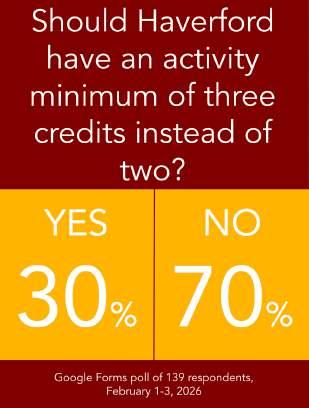
Turmoil has permeated through the Third Form, murmuring about a change that will profoundly impact time commitments. Haverford Newsletter was recently sent out to parents of Third Formers with an announcement of a controversial change: current and incoming Third Form students will now have to satisfy three sports or activity credits during their Third and Fourth Form years.
The official statement released by the school to students’ families on January 23rd states that the change comes from the premise that some students go home on school days and are unproductive with their time. Haverford approaches the change with the
goal of “cultivating a deeply engaging, relational, and formative upper school experience.”
This change, however imposing it may seem, should not affect the majority of students, but should rather establish a baseline for activities.
“It doesn’t impact me. I think it is good because it forces uninvolved students to be involved,” Third Former Naren Lee said.
However, in a recent poll sent out exclusively to the Third Form, 47.1% of students said this change will impact them.
“I think this change doesn’t consider those who have two sports or activity credits in school, but have many extracurriculars
outside of school,” Third Former Jesse Kanefsky said.
The administration wants students to spend their extracurricular time at school, which presents a conflict with student-athletes, especially now that they are mandating one credit to be exhausted in the fall.
Strength and Conditioning, commonly known as “Sko,” has been approved by the school to fulfill one required sports credit. This approval applies regardless of how long the course is taken; even when completed year-round, Strength and Conditioning counts as a single credit. The school has applied this change to account for the many students who work out in Strength and Con-
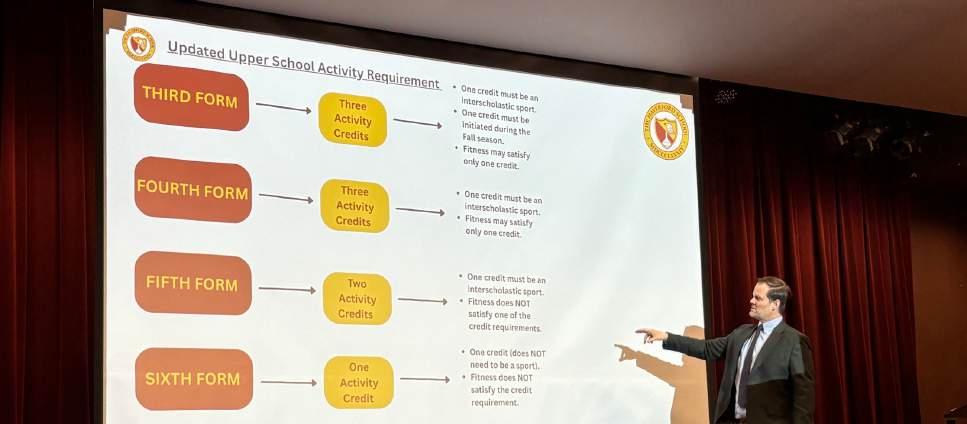
ditioning, but who will now lack a sports credit below the baseline of three.
At least one of the credits has to be an interscholastic school sport.
Overall, this change of rules seems fair to most upper school students. Especially because it is “a refinement, rather than a departure, from our longstanding activity expectations,” as stated in the official document. However, some students and faculty think some amendments should be made.
“At least one requirement should be that students have to do a non-interscholasticsport activity,” English teacher Dr. Micah Del Rosario said. “Something like being in the school play, or doing mock trial. Most students here at Haverford don’t need to be pushed to do a sport.”
Edward Cheung ’28
At 3:15, while students pack their bags and head to sports, home, or stay at the Rounders to chat, Sixth Former Ahijah Goins has already begun mental and physical preparation for his track meets. For him, race day does not start when the pistol goes off: it starts with a routine that he has developed over his thirteen years of running track.
“It starts the night before. I try to get a lot more sleep because I know I’ll have school the next day,” Goins said. “I also eat light on meet days, and I stay away from heavier foods because running takes a big toll.”
“I try to stay relaxed throughout the day. Overthinking things actually makes you more tired”
AHIJAH GOINS ’26
On meet days, Goins prioritizes energy conservation.
“I try to stay relaxed throughout the day. Overthinking things actually makes you more tired than you think, so while I still do all my assignments, I try not to walk around too much and waste mental and physical energy,” Goins said.
“It feels like a movie. Once I’m on the line, the only thing I hear is the starter saying ‘set’ and then the gun.”
AHIJAH GOINS ’26
By 4:00 p.m., vans make their way to the Ott Center for Track and Field at the University of Pennsylvania. Goins prioritizes relaxation.
“When we get there, sometimes I joke around with my friends to forget about the race. That helps because I usually get quiet
before races and think about them a lot. Other times, I try to take my mind off it on the way to the track or while waiting. I think about it, but not too deeply,” Goins said.
When warming up for the upcoming race, Goins keeps his mind focused with music and his body warm with exercise.
“Music is essential—I listen to it all the way until I have to take my AirPods out to check in. I mostly do dynamic drills because there’s less time, but I keep my headphones in as long as possible to stay relaxed,” Goins said.
In no time, Goins lines up on the starting block, narrowing his focus.
“It feels like a movie. Once I’m on the line, the only thing I hear is the starter saying ‘set’ and then the gun. My heart is pumping like crazy. I focus on staying relaxed, doing forceful exhales to control my body. As soon as the gun goes off, all the nerves leave, and I’m in the race,” Goins said.
To the audience, the race is brief, often finished in under a matter of minutes. But for Goins, it is an uphill battle of pushing his body to the limits.
“I would tell myself that I’m more tired

than I actually am,” Goins said. “But as I got older, I realized that your body’s gonna get tired. Everybody’s tired, but there are only a few moments where you really have to stop, and that’s like if you’re injured. But most of the time, you can push through it just with mental toughness.”
Regardless of the race outcome, Goins feels relieved.
“If I set a personal best, I feel great and forget how much my legs hurt. If it doesn’t go well, it’s harder mentally, especially if I didn’t get the result I wanted. Most of the time, though, I feel good afterward. There’s excitement, but also relief, ” Goins said.
After the race, Goins cools down and cheers for the rest of his team. At home, he takes ice baths and starts his preparation for another race day, if necessary.
Goins’ routine may start the night before, but his training has been non-stop even during his fall off-season. When the Gridiron Fords hammer through drills, and cross-country athletes circle the campus, Goins trains with Head Track and Field Coach Mr. James Hawkins on the Spencer Stadium track.
Their partnership has spanned over a decade.
“I was at the YMCA with my parents one day. My track coach now was at the Y training his kids. And like he asked me where my parents were because I was just running around the track having fun. And then, as much as I can remember, I joined his club team that day,” Goins said.
At the peak of his sophomore year, Goins would develop a nagging foot injury. Despite this, he would run through the injury and his biggest race: the Nike Indoor National Championships.
“I had the best race of my life. But my foot really started to bother me, and I got it checked out, and they said I couldn’t run for the whole rest of the season. And like at first, I didn’t really know how to process that information because I just got to the best point in my track career,” Goins said.
A stress fracture on his third metatarsal would impede the remainder of Goins’ track season. Instead of lining up on the starting blocks and sprinting at the whistles, Goins had to watch from the sidelines.
“I had to watch all my friends and my teammates go to the meets and run the stuff that I wanted to do. So it was definitely mentally challenging,” Goins said. “I was often asking why it had to happen to me, but I guess in the end it taught me perseverance.”
“Every time I step on the track, I gotta prove myself week in, week out.”
AHIJAH GOINS ’26
Despite not being able to participate on the field, Goins would still help by actively contributing to the track community
“I learned how to take pictures at the track meets,” Goins said.
While no one is immune to bad results or injuries, Goins believes every race and practice needs to be met with full intensity.
“Every time I step on the track, I gotta prove myself week in, week out,” Goins said. “Sometimes races don’t go your way, but there are a lot of races, so you gotta keep your head up because you will have another chance at it.”
Alex Keuffel ’29
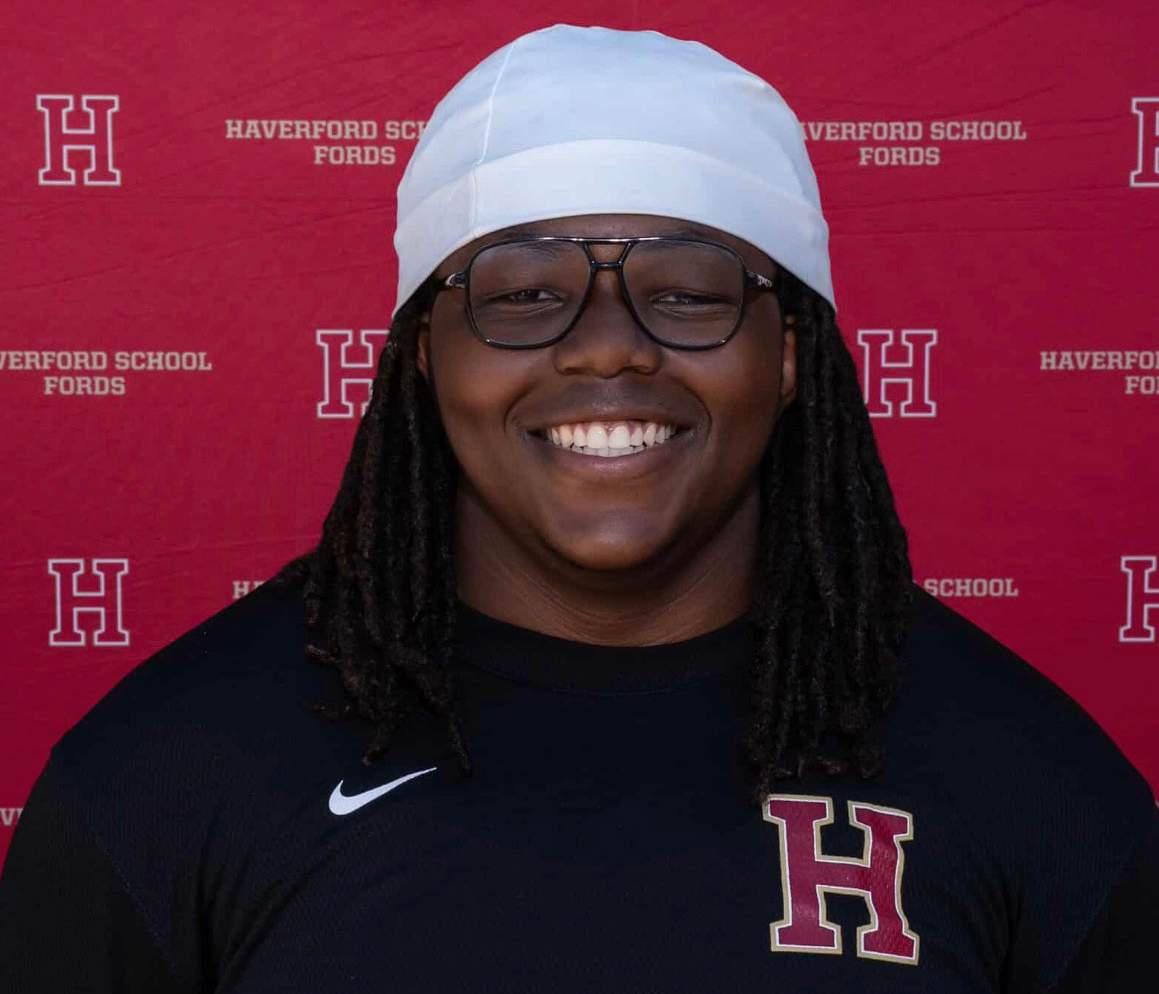
When Sixth Former Riyadh Rolls quit football, he was devastated. It was the sport that he dedicated countless hours to, while also balancing other disciplines such as photography and theater.
“The story I tell people is that I got a concussion, and my doctor told me to stop playing. In reality, I had gotten four concussions,” Rolls said. “One day I went into [the weight room], and I was trying to rehab. I had just gotten cleared to go lift by my doctor, and when I went to deadlift, I almost passed out and fell over. At that point, I knew that it was over. I was not going to be that same person I was before, and it was hard to accept that.”
Although it seemed like a dark time in his life, quitting football kindled reflection. It made him realize that ever since his Third Form year, he had still been “figuring things out,” and he still had a long way to go.
Like many other students, at the end of his Form II year, Rolls was on “an education high.”
“I thought I was going to have a 4.0, the highest SAT score, apply to all these different schools, and all of that stuff. Now, I do not have a 4.0, I did not get the highest SAT score, and a lot of the schools I said I was going to apply to, I did not apply to at all.”
Instead, Rolls tried other activities, like photography and auditioning for the musical.
“I had always been around cameras. There was a lot going on [in] my freshman year, but I was bored and needed to find something fun to do. When the time came, I took my chance to pick up a camera. Ever since then, I’ve been going out and taking photos.”
For Rolls, both theater and photography have become “interwoven,” and he attributes them to how he has progressed.
“My idea of success has changed from being the smartest kid or having the best grades, to just focusing on being yourself
and growing as a person. For instance, I never saw myself doing photography in college, but now, it is my greatest strength,” Rolls said.
Rolls believes that students should pursue their interests and not conform to soci-
Caden Zhang ’29
Foreign countries have always captivated travelers with their different ways of life, geography, and food. For some, life in a different county is often more entrancing than their own. While being in a familiar environment can be comfortable, witnessing a separate way of life can be eye-opening.
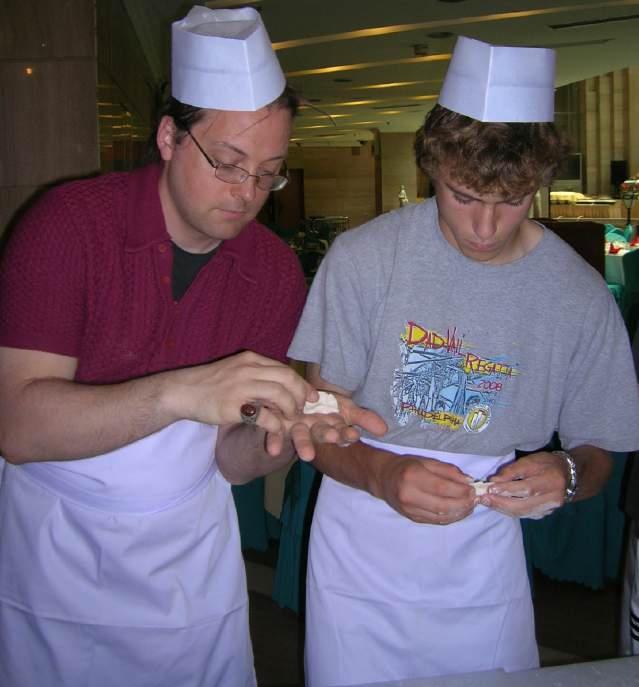
In 2009 and 2012, physics, astronomy, and electronics teacher Mr. Jamison Maley traveled to China and Taiwan with the late Chinese program founder Ms. Sonya Hsieh; Mr. Christopher Fox, the former art department chair who taught at Haverford for forty years; and twenty-six students. However, Mr Fox didn’t go in 2012. Together, they toured many high schools, ancient sites, and temples. They even slept in the same living quarters as monks.
Mr. Maley described these experiences as nothing short of “spiritual.”
“Both trips had a very profound impact on me, one that I think about even to this day,” Mr. Maley said.
The experiences in China and Taiwan even inspired Mr. Maley to incorporate aspects into his education.
“It was the initial spark that sent me on a very particular trajectory that included the creation of a distinct China unit for my environmental ethics course and also basing my entire thesis on China’s environmental challenges when I chose to go back to school,”
Mr. Maley said.
The first weeks of the trip were spent in China, with the remaining week spent in Taiwan. A major part of the program included a steep cliff hike in the Yellow Mountains, where newlywed couples attach a lock to a chain and throw away the key to symbolize eternal love. In Taiwan, they stayed in the Grand Hotel, the same place where visiting diplomats stay.
Prior to the trip, Mr. Maley was hoping to find a quality Mongolian Horsehead Fiddle, a musical instrument. While in Beijing, he stumbled across a music store in the Xinjiekou South Street, where the owner brought him and a few musically inclined students tea, and asked his daughter to play violin for them.
Such hospitality stunned Mr. Maley.
“[We] entered a parallel universe where customer service meant grace and mutual respect,” Mr. Maley said.
Yet another transformative experience occurred when the group sailed to Putuoshan Island, as a 108-foot statue of Guanyin: someone who was revered in Buddhism for guiding sailors back to land and calming the sea, stood looming over them. The statue guided the group back to safety in a terrible rainstorm, providing shelter on a small island, a mere seventy-three thousand miles from Haverford, PA. However, no distance separated Mr. Maley and his group from
etal expectations.
“A lot of kids think that: ‘If I go to Haverford, I have to go into finance, business, or private equity,’ and things like that. I would say that having real success at Haverford is not about what you do after Haver-
ford, but more about what you do while you are here,” Rolls said. “What many people don’t realize is that the more they put themselves into Haverford, the more they are going to get out of it.”
bringing back valuable lessons and beautiful memories.
“[Ms. Hsieh] designed a truly immersive experience where students were expected to absolutely rely on their language skills,”

Byron Yang ’28
With the 2026 political midterms approaching, the school’s politically minded Sixth Formers face a familiar responsibility: selecting their representatives. Some may be surprised to learn, however, that one of their own—Haverford alumnus Jahmiel Jackson ’20—is running for Congress and could make history in the process if elected.
Given that the minimum age to serve in the House of Representatives is 25, it is easy to assume that for most members of Gen Z, the thought of running for Congress feels distant, if not unrealistic. For Jackson, though, the idea has been taking shape for years.
“When I applied to internships, employers would ask me what my goals were, and I told them I wanted to run for office—to come back to West Philadelphia, radically change my community, and be a voice in national politics,”
JAHMIEL JACKSON '20
“I knew I was going to run for Congress, I think, three or four years ago,” Jackson said. “When I applied to internships, employers would ask me what my goals were, and I told them I wanted to run for office—to come back to West Philadelphia, radically change my community, and be a voice in national politics,” Jackson said.
The sense of purpose sharpened as Jackson watched the political landscape from afar.
While studying in a pre-law program at the University of Chicago, he grew increasingly disillusioned with the candidates entering the race on both sides of the aisle.
To Jackson, government often seemed disconnected from young people and from those with working-class backgrounds like his own.
He is not alone in that view: a Good Governance Survey from the University of Chicago shows that nearly 60 percent of young voters disapprove of both major political parties.
As the Black Lives Matter protests erupted during the COVID-19 pandemic, Jackson grappled with staying on the sidelines. At the same time, he wanted to better understand perspectives across the political
spectrum.
In college, he joined a conservative publication, despite identifying as liberal, in order to engage with ideas different from his own and understand the concerns of people across ideological lines.
In a 2023 NBC 5 Chicago interview, Jackson captured the frustrations he observed firsthand.
“Coming from a single mother of three kids, being homeless for multiple years, losing my father to gun violence—you grow up really fastWhen you’ve lived a life like mine, no one else can impersonate that.”
JAHMIEL JACKSON '20
As a Resident Assistant at the University of Chicago, Jackson voiced concerns from students who felt campus COVID restrictions were unnecessarily limiting their college experience.
To Jackson, moments like these reinforced a larger conclusion: meaningful change would not come without new voices entering politics.
“I saw people jumping into the race who didn’t speak [from] the background that I lived through in Philadelphia,” Jackson said. “I saw more of the same career politicians, and I said I would be remiss if I didn’t come back to Philly and advocate for my generation.”
“I was basically new, and I beat people who had been envying that seat for years. That caused a lot of tension and a rift. I think I carried a lot of that experience with me into college.”
JAHMIEL JACKSON '20
Jackson’s political instincts were shaped not only by national events but also by personal adversity and his time at Haverford, where he transferred in as a Fifth Former.
During his first year, he made history as the first African American student elected to the Honor Council—an achievement that came with resistance.
“I was basically new, and I beat people who had been envying that seat for years,” Jackson said. “That caused a lot of tension and a rift. I think I carried a lot of that experience with me into college.”
Faculty members who knew Jackson during his time at Haverford say his political ambitions were evident early on.
“I think he was always thinking about improving the lives of others, both here and outside of here,” Senior Associate Director of College Counseling Ms. Karen Ley said. “That was always his mission, and he was mature beyond his years as soon as he got here.”
“I think he’s used to adversity. That experience really guided him
MS. SUZANNE TASSONI
Others echoed that sentiment, pointing to Jackson’s resilience.
“I think he’s used to adversity,” Assistant Director of Admissions Ms. Suzanne Tassoni said. “That experience really guided him.”
Despite encouragement from many to pursue smaller offices, such as the city council or a school board seat, Jackson has remained firm in his decision to run for Congress.
“I’ve heard people say, ‘You should wait’ or ‘You should run for something smaller,’” Jackson said. “But if you listen to your critics and wait for them to be ready for you to take the first step, then you’ll always be too late.”
“Learning how to pace yourself is huge. Whether it’s financial obstacles, doubters, or haters, you have to adapt. That’s not just politics—that’s life.”
JAHMIEL JACKSON '20
For Jackson, learning to navigate doubt has been just as important as learning policy. He describes politics and life as a process of adaptation.
“Learning how to pace yourself is huge,” Jackson said. “Whether it’s financial obstacles, doubters, or haters, you have to adapt. That’s not just politics—that’s life.”
That adaptability, Jackson says, helped
him survive—and thrive—in vastly different environments. Growing up in West Philadelphia shaped his worldview in ways he believes few career politicians can replicate.
“Coming from a single mother of three kids, being homeless for multiple years, losing my father to gun violence—you grow up really fast,” Jackson said. “When you’ve lived a life like mine, no one else can impersonate that. Those values and experiences can’t be bought.”
Those experiences also taught him how emotionally complex politics can be, particularly when building coalitions across different identities and struggles.
“I saw people dealing with racial issues, sexuality, poverty—all different kinds of hardship,” Jackson said. “It showed me how difficult it is to build a coalition, but also how necessary it is.”
Jackson credits much of his confidence at Haverford to faculty support, particularly from Ms. Ley.
“One hundred percent, it was Ms. Ley,” Jackson said. “She was always present. Whatever I needed, she was my advocate.”
As Jackson looks ahead to the 2026 midterms, he believes his purpose resonates with young voters.
“I think having that clarity is why so many people have bought into my campaign,” Jackson said. “Young people are frustrated, and we want to fight for the future.”
“I think having that clarity is why so many people have bought into my campaign. Young people are frustrated, and we want to fight for the future.”
JAHMIEL JACKSON '20
Historically, midterm elections tend to favor the party opposing the sitting president.
Over the past 80 years, 18 out of 20 midterms have resulted in seats flipping—a pattern that could shape the political landscape Jackson hopes to enter.
For Jackson, however, the race is about more than electoral trends. It is about representation, lived experience, and the belief that government should reflect the people it serves.
“I think we, as politicians, should be focused on something,” Jackson said. “We should stand for something—not just be in opposition to the president.”

styles, cont’d from front page
Although one might assume that course storyboarding creates complete standardization, where course material is taught the same way at the same time, they serve a different purpose.
“Broadly speaking, course storyboards are meant to help ensure that students in the same course are working toward shared learning goals, or what students should know, understand, and be able to do, while still allowing teachers flexibility in how they teach,” Dr. Greenblatt said.
“Mr. Lengel’s [style] was completely different [from my previous teachers].”
RANVIR GILL ’26
Another guardrail for avoiding unequal expectations for different sections of a course is careful communication between teachers about grades and assessments.
“ In terms of grades, we work pretty carefully together to make sure that the average is either identical or very close to each other,” History Department Chair Ms. Hannah Turlish said. “ [For] the cumulative semester test that we both administered, we talked with each other about the raw score average and then made an agreement to have our scale be consistent. That doesn’t mean I had more A’s or fewer A’s, it just means that the averages were similar.”
In Biology*, this approach is taken a step further.
“Ms. Cleffi and I create our assessments together and then review a grading rubric and decide on the amount of points each
question will be so that we grade the questions similarly,” Biology teacher Ms. Lewis said. “We also trade assessments and papers to make sure we grade assessments equally.”
Naturally, the level of standardization possible in courses is also heavily influenced by the level of subjectivity inherent in the course.
“ I think it’s easier in science and math [for standardization] because there is the correct [answer],” Biology teacher Ms. Cleffi said. “I feel like [in] the humanities, it’s a little bit more subjective.”
These systems do not address the other unique aspects of the classroom environments that arise between different teachers, however. In many ways, though, this is not problematic and is even a strength.
“I would really bristle if I had a dictated curriculum where I could not bring in my particular interests,” Ms. Turlish said. “ I would like to think that the school would be delighted to have a teacher who is most passionate about fashion, history, art history, women’s history, sports history, etc. That is what makes a department healthy, and to say, ‘you all should teach the same stuff,’ is actually taking away our areas of expertise. You’re all learning certain things that are common, but how it’s done, with my encouragement as department chair, [is] up to the teacher in terms of how to deliver the material.”
These differences largely do not affect the core curriculum, however.
“ I know a lot about the Civil War,” Mr. Lengel said. “ Maybe in discussion, I can go a little bit deeper there [and Ms. Turlish] can go a little bit deeper over here. I don’t think [this affects] the U.S. History survey curriculum, but it does allow for the department itself to get a wider grasp.”
The largest area where these differences
come into play is in the specific classroom environments and experiences.
“You get a case about some period in history with details that you learn as you go through that case study, and that’s how you learn over time.”
ANANTVIR OTHIE ’27
“Mr. Lengel’s [style] was completely different [from my previous teachers],” Sixth Former Ranvir Gill said. “Mr. Lengel prefers to have a sort of class where it’s more student-led and discussion-led. I find it a lot more entertaining and more engaging as a student because I have an active part in my own education, and it’s helping me, kind of piece by piece, get to the final conclusion.”
Others also noted the conversational nature of Mr. Lengel’s teaching style.
“His case study method, instead of being notes on a board, is [mostly] conversations,” said Fifth Former Anantvir Othie. “You get a case about some period in history with details that you learn as you go through that case study, and that’s how you learn over time.”
Students in U.S. History* sections taught by Ms. Turlish noted other methods they found unique that aided their learning experience.
“[Ms. Turlish] used trailers for historical movies to help us learn specific topics we covered in class and with [Eric Foner’s Give
Me Liberty], and [she] also had us watch a movie,” Sixth Former Will Bradford said. “[Her] usage of film really helped me understand certain topics and is something that [I think] is unique to her.”
Similarly, students in different sections of Biology* noted distinctive aspects of their classroom experiences that they found beneficial.
“[Ms. Cleffi] always did a lot of active recall,” Sixth Former Peter McElhone said. “She spent the first 15 minutes of class going over what we did in the previous class.”
Others agreed on the helpfulness of this practice.
“[Ms. Cleffi] went around the room and asked each one of us a question on the topic we covered the class before,” Bradford said. “This method of teaching was very helpful to me as it helped me review, and also was a good way for confusing things to be cleared up from the class before.”
In Biology* sections taught by Ms. Lewis, students described another enjoyable style of teaching.
“ Ms. Lewis is [unique] because we used to be able to ask questions in chemistry, but I feel like [it was limited],” Fifth Former Benas Antanavicius said. “Ms. Lewis [answers] half the class’s questions, and that really lets people learn about what they want to learn.”
While concerns about differences between teachers and classes persist, the uniqueness and experience that each teacher brings to their class often helps students with different learning styles succeed, and the school-wide effort to provide structural guidelines through course storyboarding ensures that although students might take different paths, the end goal for learning is shared.
Adam Brown ’27
Come next year, one more class will be added to the gauntlet of the Fifth Form year: Personal Finance.
As mandated by the Commonwealth of Pennsylvania Department of Education, all schools will be required to teach a class covering topics ranging from income to investing and credit during the 2026-2027 academic year.
Although not widely known, Haverford currently offers an elective that covers these topics.
Upper school math teacher Mr. Stuart Alden, who teaches classes ranging from computer science to finance, currently teaches the course and will help build its new curriculum.
“We currently call it Financial Literacy,” Mr. Alden said, “and starting next year, we’re going to give it the name Personal Finance, because that seems to make a little more sense.”
In recent years, the class has seen mod-


erate levels of interest. It garners more students than many small elective classes, but not nearly as many as core subjects.
“The classes are typically about threequarters seniors, one-quarter juniors. Starting next year, I believe the plan is for it to be a required course, one semester long, for all juniors,” Mr. Alden said.
The proposition of another class added to an already busy year may seem daunting for many students. However, the upper school administration has initiated a schedule review this year.
Still, Mr. Alden notes a lack of causality between the two.
“Talking about changing the schedule has been something that’s been knocked around for several years now,” Mr. Alden said. “The two are completely unrelated.”
It is hard to separate the two, though. The addition of a new class changes any schedule, regardless of its novelty, and since the Commonwealth requires the addition of a personal finance course, the schedule must change.
“Starting next year, in order to graduate,
Andrew Yang ’28
ChatGPT, or GPT for short, has been used commonly in STEM fields. This may sound like a disaster for teachers and for students’ future, but many think it isn’t terrible, considering that GPT can be mainly used for good. Artificial intelligence is substantially changing
how students are learning. AI can solve many different problems relating to school.
Many students use AI to learn and to develop their intellectual curiosity without limiting their work capabilities.
“It’s like having a tutor available 24/7,” an anonymous Fourth Former said. “When
I’m stuck on a challenging math problem or chemistry problem, I can ask AI to teach me the concept and break it down into understandable parts like a lesson instead of waiting until the next day to ask my teacher.”
Using AI to understand concepts rather than to get answers, he, like many others,

you need the equivalent of this one-semester course in financial literacy,” Mr. Alden said, “so it’s something we have to do. We don’t really have a choice, so we’ll find a way to fit it in along with all the other requirements that you guys have.”
Many students will likely be eager to learn personal finance. After all, the name is truly what the program is all about.
“Guys will find it to be a very enjoyable and informative class,” Mr. Alden said. “It’s about as practical a class as you can possibly get.”
sees AI as a learning tool similar to Khan Academy or YouTube tutorials.
Still, upper school math teacher Mr. Samuel Walters disagrees with this claim, as he believes that solely relying on AI to teach students things is detrimental to student brains.
Mr. Walters notes that AI is sometimes wrong or misleading, as it doesn’t have access to our student textbooks and teaching ideals. AI will most of the time take its ideas from websites they find, and most of the time, the concepts are advanced ones that are not taught to high school students.
Mr. Walters likes to implement problem-solving and critical thinking skills through more teamwork practice instead of individual learning.
“I want to see AI used as a learning tool and not a shortcut to answers. I don’t believe in AI since I teach math, but other teachers of STEM may have a different view,” Mr. Walters said.
While Mr. Walters does not use AI, he sometimes worries seeing some students turning to AI immediately after not understanding something.
Despite the controversies, others argue that the ability to study with AI is a crucial STEM skill.
“Using AI for good is a critical skill in many STEM areas to learn and improve at various topics,” Fifth Former Anantvir Othie said. “Learning to work alongside AI, and using it to help practice questions, is preparing us for better things in the future, not cheating our education.”
Vikram Ponnuru ’29
Philadelphia International Airport (PHL) is one of the busiest airports in the nation, serving millions of travelers every year. While it plays a crucial role in connecting the region to the rest of the world, many passengers notice that the airport is facing a mix of strengths and challenges.
PHL has several terminals within the airport, each of which offers restaurants, shops, lounges, and seating areas. Some parts of the airport have been updated recently, but other areas still feel crowded or outdated. Signage can be confusing, waiting areas are not always comfortable, and some facilities could certainly use maintenance. Overall, the airport functions adequately, but there is room for improvement.
Passenger experiences at PHL vary. Long lines at security checkpoints, slow baggage claim, and occasional flight delays are common frustrations. PHL ranks among the most delayed U.S. airports, with roughly 73.6 % of flights facing delays. Still, airport staff members work to keep everything as smoothly and efficiently as possible. Recent efforts, like adding digital information screens and speeding up check-in, have started to make travel a little easier.
Transportation to and from the airport is generally convenient. There are several parking garages, ride-share services, taxis, and public transit options available. However, parking can get quite expensive or full during peak hours. Accessibility for travelers with disabilities has improved over the years, but there is still more work to be done. The airport hopes to improve on its outdated infrastructure, signage issues, and minimal restrooms.
Despite these challenges, PHL remains an important hub for Philadelphia and the surrounding areas. It supports local businesses, connects the city to domestic and international destinations, and employs thousands of diligent people.
Looking ahead, continued investment in passenger services and infrastructure will be key. Expanding and enhancing the terminals, improving technology usage, and prioritizing accessibility could help PHL meet its goals and make it a smoother, more enjoy-

able experience for visitors. Philadelphia International Airport is currently renovating its outdated infrastructure through a $500 million renovation project designed to replace
and smarter wayfinding systems.
Adam Brown ’27
In just a few months, the City of Brotherly Love will gain two new siblings: the Norwegian Jewel and the Norwegian Pearl. For the first time in nearly two decades, cruise ships will depart from Philadelphia.
The new port, run under the umbrella of PhilaPort—Philadelphia’s cargo port authority—is set to open this April. It is a joint venture between PhilaPort and Norwegian Cruise Line, and will be located on sixteen acres of land between Philadelphia’s airport and the Delaware River.
Travelers can now enjoy cruising without flying to Florida’s ports. On April 16, the Norwegian Jewel will embark on a seven-day round-trip cruise to Bermuda. Later, the two
A quick, airport-hassle-free travel option is now practically in their backyards.
ships will trade voyages to the Caribbean, and then travel north to New England and Canada, reaching as far as Québec City.
The new terminal will also attract visitors from nearby areas looking for an alternative to long-distance air travel. Its location adjacent to the airport makes it ideal for those flying in to transfer to their vacation destinations, while leaving ample opportunity to drive or take a quick taxi and quickly reach the heart of Philadelphia. Locals will benefit from this new addition, too: a quick, airport-hassle-free travel option is now practically in their backyards.
As with any new project, the question of traffic always comes up. As the new port is set to be next to the airport, most travelers will use I-95 to access it. This stretch is already burdened with traffic congestion, which the addition of another major attraction will only add to. Those looking to avoid the traffic congestion are out of luck.
SEPTA’s Airport Line runs infrequently, and SEPTA currently has no plans to extend it to the new cruise terminal, rendering public transit largely impractical, save for the im-
plementation of bus routes. An increase in travelers, however, will benefit the city economically, which could allow the city to invest more in infrastructure that supports the new travelers and existing residents.
With ongoing updates and improvements to these issues, PHL is likely to keep running smoothly for the millions who pass through each year.
For students or anyone close by looking for something interesting to do this summer, a cruise just a short drive away may be the perfect option.


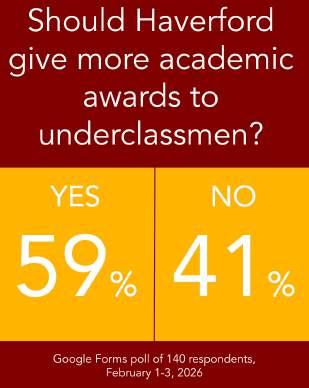
When awards are announced on Honors Day, upperclassmen anticipate awaiting their moment in an unpredictable future. For many Third and Fourth Formers, who sit and wait, a question arises: should Haverford give more academic awards to underclassmen?
As the college admissions process continues to become more daunting, some argue that earlier recognition would both benefit the students and set them up better for college admissions success.
One of the simplest but most challenging sections for students on the Common Application is the Awards Section. It


Sprovides space for students to list up to five awards won as an upper schooler. Students often look at this for the first time in the summer before Fifth Form and ask themselves: how do I fill any of this in?
The last time I received an award, I was a Second Former at the graduation ceremony. Looking around at fifteen of my friends sitting with me in the dining hall, I recently realized that none of them had been formally recognized in any way, even though many of them are incredibly talented and accomplished students.
The end-of-the-year awards list recognizes 56 different things in total. So, what’s the issue? Of the 56 awards listed on the Honors Day Program, 21 awards are specifically limited to and designated for Fifth and Sixth Form students, compared to six awards for Third and Fourth Formers. While the remainder are not specifically limited to upperclassmen, the vast majority are typically awarded only to upperclassmen. Furthermore, by the time these awards are given out in June, it is often too late to help students show off their achievements in college applications.
Haverford should create more award opportunities for underclassmen. Awards serve many benefits. First, achievement doesn’t begin in the Sixth Form. Students are doing meaningful, academic, athletic, artistic, and leadership work starting in Form III. Second, when students can see their work
ocializing with other students is a pivotal part of the school experience. Whenever students need a break from schoolwork, they can hang out with their friends in many different spots around campus. With so many other areas to choose from, it can be tough to pick one. This begs the question, which one is the coziest?
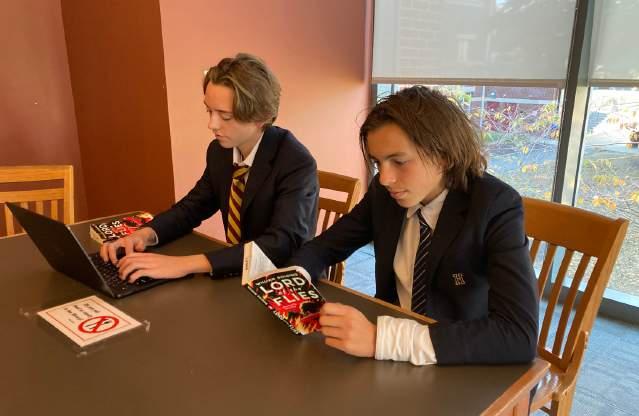
When walking through the back doors of Wilson Hall, one of the first things to catch the eye is the library. There are booths with padded seats along the windows that let you fit up to four people. They provide comfort and a nice table to do schoolwork. There are also tables with charging stations if you need to charge your computer.
and their talents recognized early on, they become more committed and are motivated by positive reinforcement. Third, the awards can be tailored to subject-based excellence and character at each grade level. Fourth, giving out awards earlier benefits Haverford as a school, too, as it will strengthen students’ applications and therefore improve college placement data.
What are some of the downsides? In my opinion, there are none. Some might say giving out more awards could be compared to giving out participation trophies, but that is not what I am suggesting.
The school should not lower standards or award things for the sake of awarding them. I am all for meritocracy, but excellence and achievement do not start in Form V or VI. There can be grade-level awards and associated grade-level assemblies for such awards that are clearly merit-based, for example, giving individual class-level subject matter awards each year, culminating in the final school-level awards at the annual Honors Day assembly. Expanding when awards are given out and offering varying class-level related awards does not reduce the value or rigor of the awards in any way. In sum, giving out awards earlier is a win/win for everyone involved.
usually not too crowded, but it isn’t fun to climb up to the third floor, and there isn’t much reason for me to use it since I don’t have many classes up there, ” Rush said.
Overall, these places have some good qualities, but there are downsides to every spot. In the end, it really comes down to what the student finds best.
“It’s a good place to hang out, and it is pretty big, so there is a lot of seating. The only thing I don’t like about it is that it can be loud at times,” Third Former Zack Rush said.
The library is one of the most convenient places to hang out, since it is on the first floor.
The pods on the second-floor “Street” are another popular spot for students to hang out. They provide seating around a circular table. It can be a good spot to hang out because of the privacy provided by its surrounding glass walls.
“I don’t really use the pods very often, since they are usually always occupied. I can see why it would be a nice place to hang out, but there are too many people,” Rush said.
On the third floor, the Big Room stands out as a great place to study. The space is large, so people can have conversations without disrupting other students.
“The Big Room is a nice place and is


On January 20, 2025, at age 79, Donald Trump was sworn into office as the 47th president, becoming the oldest president to enter office. Throughout his presidency and presidential campaign, many have noted cognitive decline in the aging president. Recent polls from YouGov show that nearly half of the population believes the president is experiencing a degree of mental decline that is not conducive to leading the world’s most powerful nation.
This decline began long before our president was sworn into office. After all, Trump had attended the 2024 Presidential Debate with Democratic candidate Kamala Harris just months earlier, in which he was frantic and rambled through the entire event, making false accusations that Haitian immigrants were “eating the dogs” in Springfield, Ohio. Recently, the president has been seen nodding off during the signing of bills and during critical cabinet meetings.
In response to the uproar, he has doubled down and justified his sleeping by claiming these meetings are “boring as hell.” The character the president has warped into is a far cry from his days as the host of the reality television show The Apprentice, where he carried himself with a degree of sternness and professionalism lost in recent years.
This issue of aging presidents predates Trump, and skepticism of aging presidents based on their mental and physical decline was arguably more prevalent during the Biden administration. Videos of Former President Biden falling on the stairs of Air Force One, falling from his bike, and visibly losing focus during his own presidential debate with Donald Trump are not hard to

In recent years, fashion has become more popular than ever. Short-form videos on platforms such as TikTok and Instagram constantly promote new styles and clothes, encouraging viewers to expand their closets in order to keep up with the latest fashion trends.
The constant demand for trendy clothes in recent years has led to the rise of “fast fashion” companies such as Shein and Temu, known for their extremely large catalog and ultra-cheap price point. They take advantage of the micro-trends being promoted on social media to sell as many clothes as possible. This strategy has worked extremely well, as both Shein and Temu have surpassed brands such as H&M and Zara in terms of annual revenue.
Though these fast fashion companies allow customers to participate in fashion trends at affordable prices, serious environmental and ethical downsides surround them. In order to keep prices down, these

find, serving as damning evidence that presidents of his age should not be the precedent. In fact, his fellow Democrats demanded he drop out of the 2024 presidential race due to their apprehension towards putting a president of such age in office again.
The choice not to seek reelection was based on polling: 86% of voters felt that Biden was too old and incapable of being an effective president at the end of his term. These elderly presidents have proved un-
popular and incapable, leading to calls for an age limit. According to The New York Times, potential Democratic presidential candidate Rahm Emmanuel stated in a Center for American Progress meeting that, “Across all three branches of government, 75 years— you’re out.”
Although Americans nearly unanimously believe there should be some sort of age limit, it is unclear where this distinction should be made, as recent YouGov polls show.
None of the groups described outnumbered the group that supported the status quo; as a result, passing this law would certainly be a Herculean task requiring a united bipartisan vote to pass.
For now, Americans must grapple with the fact that the most difficult job in the world that controls their livelihood has seemingly been throttled by a wave of elderly politicians.
companies focus on a high-volume, lowquality production model in which clothes are often thrown away after just a few uses.
The disposed clothes are then sent to landfills, which are major sources of carbon emissions.
Mass-market fashion manufacturers produce most of their products in China, where fossil fuels are commonly used to power factories, further contributing to air pollution. To keep up with consumer demands, the fast fashion industry also heavily relies on air freight rather than using sea freight, which is much more emissions-intensive.
All of these factors contribute to Shein being the largest polluter in the fashion industry, emitting 16.7 million metric tons of carbon dioxide in 2024, almost triple H&M’s number, according to Forbes. Shein’s carbon emissions are only expected to rise in the coming years, signifying a major problem with the fast fashion business model.
The issues with these companies don’t
stop at environmental threats. The factories have been accused of serious ethical issues.
According to the BBC, employees reportedly work 75-hour workweeks with minimal days off, in unsafe facilities. Investigations from the U.S. have also revealed a high chance that both Temu and Shein use forced labor and child labor as a way to maintain their low prices.
As a response to their criticism, Shein recently announced that it is currently trying to be more sustainable through their evoluSHEIN program that aims to use more recycled materials and waste. However, this initiative is unlikely to do much if Shein wants to maintain their low-cost business model.
Since climate change is one of society’s most pressing issues, consumers must choose environmentally friendly clothing. Though fast fashion might seem appealing due to its large selection and affordability, we must factor in its extremely negative effects on the environment.
Our responsibility as consumers is to ensure that fashion does not come at the expense of our planet.


Every February, the youth lead worship at my church on a designated Sunday. During this service, the youth do everything: the prelude, prayers, scripture readings, preaching, the benediction, writing texts for the worship service, selecting hymns and music, and more. This year, I am a preacher. As I prepare my sermon, I have been pondering the idea of finding joy, even amidst struggle.
After hearing a first draft of each of the sermons, a collective theme arose: God is present in all circumstances in our lives. After we all preached our rough drafts for the first time in the chilly, dimly lit chapel, Andy, the youth pastor, commented, “Why is it that each of you endures so much struggle in your lives? I need to talk to the adults in your life about this.”
Why he mentioned the adults in our lives, I don’t know. But he seemed to indicate that in previous generations, people our age did not struggle with the issues that we do now, especially surrounding mental health. Why? Why is our generation struggling so much? Why can’t we receive more help? Why am I a victim? Why didn’t anyone help me earlier? Why am I stuck dealing with my mental health issues now?
In reading my sermon for the group, I was annoyed that my sermon felt too long and too repetitive—this is normal for a first draft, or as my tenth-grade English teacher would say, a “trash draft.” As I read from the pulpit, I voiced some of these ideas aloud, and the youth pastor said, “Stop all of the negative self-talk, Peter!” with conviction. I have always done this, especially when confronted by my peers viewing my work. I find my flaws and ensure people are aware of them. I suppose it’s a form of self-defense, to make sure people are aware that it could be “better.” Or, it could be another form of “people pleasing.”
This idea of “people pleasing” is the subject of Katy Waldman’s New Yorker review “How to Recover from Caring Too Much.” The piece discusses the “fawn re-
sponse,” an idea akin to that of “people pleasing.” My interpretation of the “fawn response” revealed in the article is a means of expressing oneself to others in a manner that is different from the true you in order to prevent conflict or unwanted tension in relationships. I imagine it could also be seen in my “self-defense” of my flaws.
Waldman shares that one of the psychotherapists studying this idea posted online a great reassurance for us fawners.
A post read, “Your mind is lying to you because it’s scared. I know you may have this fear that you’re secretly a bad person and it’s just a matter of time before everyone finds out, but you’re actually safe.” One psychotherapist quoted in the article reveals that fawning is the “belief that we have to neglect ourselves for the comfort of other people.”
This is definitely true for me—working too hard on group projects to be sure it is clear I did my share, spending too much time on homework so the teacher knows I tried, etc. The result is that fawning can trigger some seriously negative effects on mental health. Waldman restates what the psychotherapist said, “for some people, fawning is about being more of who they are—smart, generous, successful, or beautiful.”
Yet fawning is not limited to those traits, and can also be seen in the opposite way: toning down one’s normal, good qualities: “vocal, ethnic, creative, self-assured, or able to set boundaries.” If you must change the good qualities that make you you, then there’s probably something wrong. Fawning also “wears various faces: perfectionism, promiscuity, self-depreciation, workaholism, and overspending.”
Some of these apply to me. I find myself working way too hard, spending much more time on schoolwork than I should, trying to ensure perfectionism all the time, all while I should be taking care of myself instead. Perfectionism can lead to even worse mental challenges, such as OCD, which I struggle with.
Andy’s question to the youth about our
shared struggles struck me. An increase in mental health struggles correlates to young people’s experience within the COVID-19 pandemic. The National Institute of Mental Health explains that there is “an association between the COVID-19 pandemic and impaired mental health and maladaptive brain development among adolescents.”
So why aren’t more careful measures taken to improve mental health if, according to the World Health Organization, “one in seven 10 to 19-year-olds experience a mental disorder?” This means that there are likely two people in my roughly fifteen-person classes in school who struggle, too. Hypothetically, if I am one, then who are the others? Why don’t I know who they are so we can help each other out? Why can’t we help each other a little more with this?
The topic of mental health is such a crisis, yet it is so difficult to discuss because of the vulnerability behind it, so we just push it off to the side until it is too late. But there must be a better way.
I have struggled with OCD for my whole life. I suppose that many of the people-pleasing, “fawn-response,” symptoms I experience are associated with my OCD— a desire to “make sure” everything is “okay” and that I did not do anything wrong to others. I began noticing symptoms back in middle school, likely due to the isolation of the pandemic. Every night, I found myself turning off my phone at night, walking away from it, then returning to the radiator where my phone sat and pushing the home button on my old iPhone 8 vigorously to be sure it was off. Or, once I was in bed, the lamp clicked off next to me, and I had to repeat the time displayed on the clock to myself over and over again, as if I had to memorize it. My OCD ebbs and flows. It moves on from issue to issue, so I grew out of the hand-washing phase, the phone-checking, the time-memorizing, and the latest phase has moved onto bigger, “real-world,” problems. Recently, it has prevented me from wanting to go out and do other things.
This winter, I have discovered that I actually need to get some help coping with this, and fortunately, I am getting it. I wish I had found help sooner. I live in fear of dishonesty, so I find myself constantly thinking I am being dishonest. This isn’t fun, as I constantly overthink my life choices and change up the experience, making myself think I have actually done something wrong. It’s about time to figure this out.
It can be so challenging to live with my OCD, yet what boggles my mind is that so few people know this about me—and I know nothing about any mental health struggles of my peers. This is the very nature of the problem.
It’s understandable not to want to constantly share these struggles aloud all the time, but a slightly greater awareness would be beneficial. If we could make one another aware, then we would collectively not have as great a challenge with mental health. While I am not saying that I want to discuss my mental struggles with everyone openly, if we were all a little bit more aware of the struggles surrounding our lives, then perhaps we would be able to cope with our mental struggles. I’m tired of my mental issues. I’m desperate for change. I’m ready to find a way out of these struggles.
To answer your question, Andy, we are struggling because we are not heard by one another enough. The world won’t listen to our struggles. They may hear about them and apologize, but the only way to prevent them is to take action and wholeheartedly listen and learn of others’ mental-health needs.
Instead of fawning all the time, trying to prevent others from dealing with our own personal struggles, we must bring them to the table. We must bring the plate closer and start gnawing on the bone instead of pushing it farther and farther away. We must let others know that we are struggling in hopes that it will help us. I can’t do it alone.
Often, we are told that we are late. Late to figure out, late to deliver, late to grow up. When you scroll through Instagram Reels on your phone, you’ll find a teenager launching a startup company, people getting into their dream schools, and early adults who have already “made it” in life.
But what if this concept isn’t true?
I remember the first time I heard about robotics back in seventh grade.
I ignored its presence and actually hated the idea of ever joining it. I thought it was a waste of time because I didn’t start early enough. But when I look at myself four years later, I realize that opinion was not true. I am experienced, confident, and satisfied with myself.
School is similar.
We are tucked into hour-long schedules, learning concepts, with one semester to prove ourselves and four years to define who we are before college; it makes sense that we feel like we are sprinting down a relentless treadmill.
Perhaps, however, when we take a step back to think, we realize that time is more generous than it seems.
The prefrontal cortex of our brain doesn’t fully develop until the age of twentyfive.
Frankly, full confidence rarely appears until you’re a mature adult. Purpose is often blurred and confusing in our life paths. Even passions, like playing a musical instrument, sport, or a hobby, take years of failure and trial to start to master. We expect this clarity to happen too soon—to show its success in the first few minutes of its existence.
We avoid risks because we feel that the cost will be too great. We rush our actions because we hate the idea of uncertainty. Ironically, in trying to save our time, we cast a shadow of self-doubt, comparison, and worry.
When we accept the idea that time is not too short, everything changes. Our mistakes are data that we learn from, and we allow ourselves to change decisions, to drop
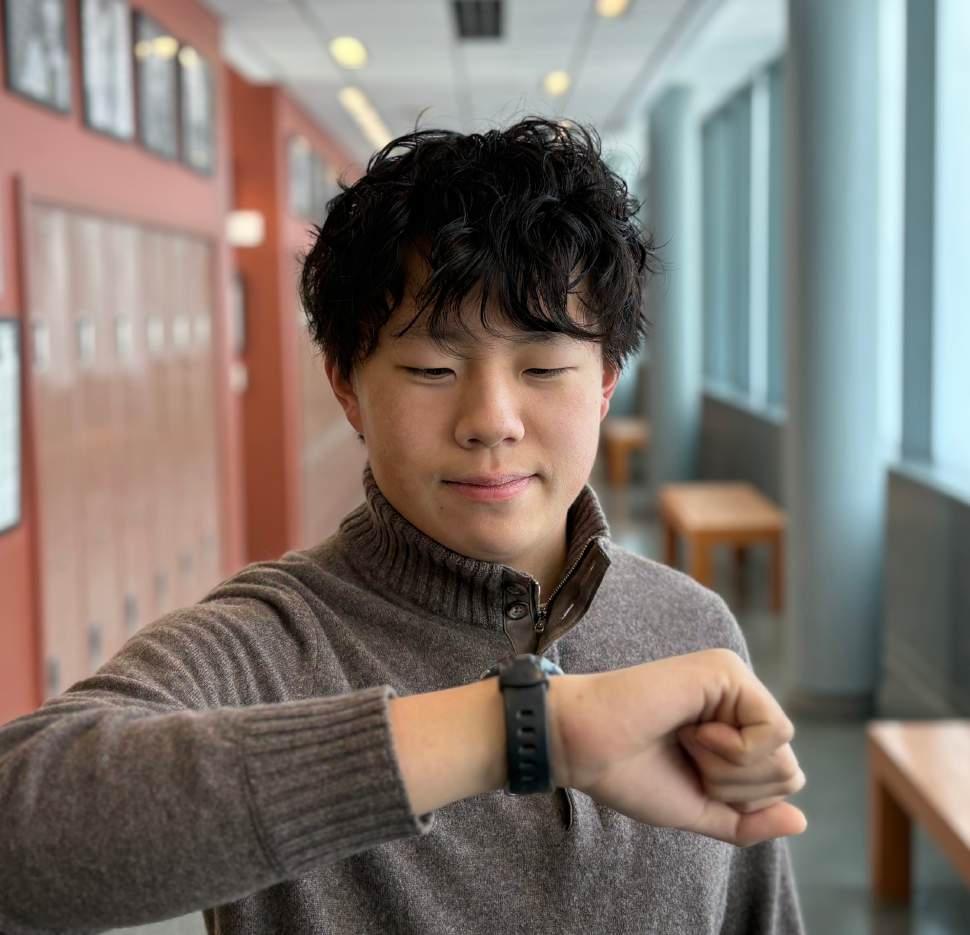
or pick up, or retry something without the idea of shame. Life becomes a journey and process rather than a race to one hundred percent.
This doesn’t mean that effort should
be ignored or that we have an indefinite amount of time for everything. Rather, we gradually build on the art in our human nature, creativity, with the finite time we have. We make the most of it.
Time doesn’t hunt us down. As long
as we’re still trying, doing, and becoming, there’s nothing that signifies us being behind, since what matters most isn’t what you’re perfect at—it’s what you love. Despite what we’re told, time is not too short.
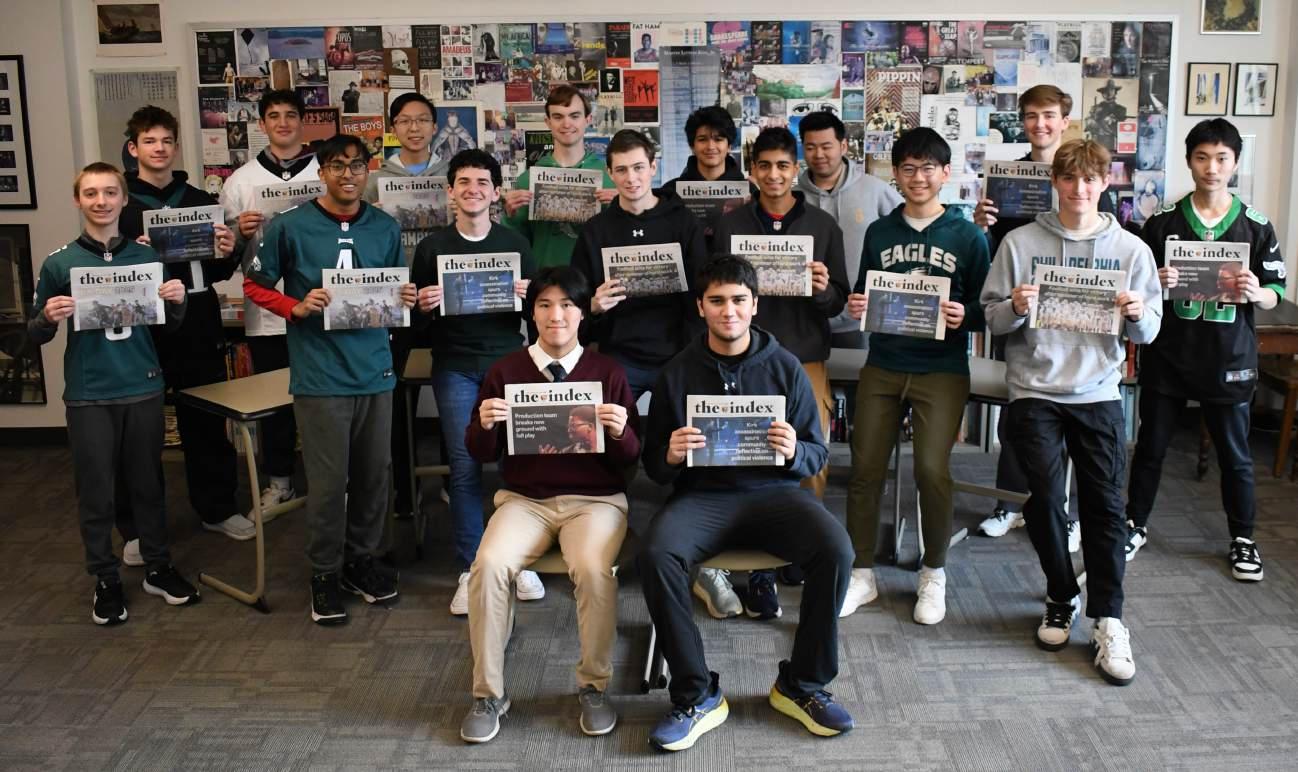
2025-2026 Index Staff
Students with a shared passion for art are coming together to change how visual art is experienced at Haverford. Their goal is not only to showcase artwork, but to understand the professional process behind it. A newly formed Student Art Committee is stepping in to re-energize the art scene within the Haverford community.
The purpose of this group is allows the school to host more art exhibitions and expand the presence of visual art around campus. There are five different positions and sixteen boys in this art committee: curator, art handlers/installers, graphic designer, marketing and communications, and photographer. Its members collaborate to both create new art exhibitions and support preexisting events, such as Artsfest.
After outlining the committee’s purpose, Art, Design, and New Media Chair Ms. Aki Torii explained the educational goals behind the group, saying, “We want to educate the boys in the committee more about how to host art exhibitions and how to do it professionally, which is a skill that may be useful for them to know later in life.”
The roles within the committee reflect the positions that art galleries around the world depend on, making this an especially valuable learning opportunity. Furthermore, each role plays an equally important part in the success of an exhibition.
“In order for an art gallery to be successful, you need every single one of these jobs, so no job is more important than another,” Ms. Torii said. “In addition, I strongly think that teamwork and collaboration is one of the most important skills in order for this committee to create a successful exhibition.”
In the classroom, students often learn about the historical aspects of art, which can feel distant from contemporary art. Art

history is often taught through slide shows, limiting students’ interactions with physical works. The Student Art Committee aims to bridge that gap by giving students hands-on experience with real pieces of art and guiding them through the process of displaying them. Through this, students will also gain a deeper understanding of how a gallery functions behind the scenes.
The committee is already planning its first visit: a tour of Atelier Fine Art Services in Philadelphia, a specialized art services company that helps museums, galleries, private art collectors, and cultural institutions manage, move, and install valuable artworks.
During the visit, the boys will explore the company’s storage space and speak with an art handler about how artwork is professionally installed.
Ms. Torii said, “This is truly an invaluable experience for the boys. I think they will benefit a lot from talking to professionals and learning about what goes into a successful art gallery.”
Marketing and communications is a particularly crucial role within the committee, as it focuses on promoting student artwork and exhibitions. By doing so, more members of the community, including those who don’t take art, will become aware of
what is happening in the arts. No activity credit is attached to being a part of the committee, meaning that every member of the committee is genuinely interested in art and passionate about showcasing it.
Ms. Torii reflected on the enthusiasm students showed during the application process.
“All of the students that applied to the committee had to go through an interview process, and they all felt that there wasn’t enough art to be seen around the school. These students are extremely excited to begin working and put on a successful art exhibition.”
Rehearsals are now underway for this year’s spring musical, Ragtime, which may be the largest production the school has ever staged. With 112 students in the cast, it is also the biggest ensemble that Performing Arts Department Chair Mr. Darren Hengst has directed, bringing both excitement and logistical challenges.
Ragtime explores the American Dream through the lives of three distinct groups of people living in early 20th-century New York.
For Mr. Hengst, the show holds personal meaning.
“I saw the original production when I was in college,” Mr. Hengst said. “It was one of those shows that is life-altering for you. It hit me in the heart with all the music, the story, the characters.”
Although he had long admired the show, he never expected to direct the musical, due to its scale and difficulty. That large scale is essential to the story Ragtime tells.
“This show is kind of demanding to have a large cast,” Mr. Hengst said. “It helps us represent the three different groups of people really well.”
The size of the ensemble allows the production to fully capture the scope and complexity of the musical’s themes.
Managing such a large group has not been easy, though.
“Trying to get everyone in the same room for rehearsal has been the biggest challenge,” Mr. Hengst said. “With absences due to illness or conflicts, rehearsals often require extra time for review.”
To adjust, Mr. Hengst has changed his approach.
“I’m really trying to review much more than any show in the past,” he said, “while also moving rehearsals at a quicker pace.”
In this show, the ensemble carries much of the artistic storytelling.
Mr. Hengst said, “There are a ton of different scenes and a ton of different characters,” noting that coordinating costume changes and movement has required careful planning.
“Ragtime is one of those perfect shows where every moment matters for the whole story.”
MR. DARREN HENGST
The production features ambitious technical elements, including a three-level set, an electric Model-T, and the return of a lighting designer who last worked with the
program in 2019.
“Ragtime is one of those perfect shows where every moment matters for the whole story,” Mr. Hengst said.
Ultimately, Mr. Hengst hopes the show
leaves the audience thinking beyond the final curtain.
He said, “I hope that people will understand what it is to be an American and what their place is going to be.”


Global sensation TWICE is coming to the XFINITY Mobile Center on February 24. While longtime fans may have already secured their tickets, the concert offers a rare opportunity for newcomers to experience one of the most influential pop groups of the past decade live.
TWICE is a nine-member South Korean girl group formed in 2015 by JYP Entertainment. Over the past ten years, the group has become one of the most recognizable names in K-pop, known for high-energy performances, catchy hooks, and a devoted
international fanbase. As they celebrate their tenth anniversary, their stop in Philadelphia marks a major moment in their career—and a notable one for the city’s music scene.
Large K-pop groups have often skipped Philadelphia in favor of cities like New York or Washington, D.C., making this concert a change of pace for a city that doesn’t frequently see global pop tours stop locally.
TWICE’s decision to perform in Philly signals a recognition of the area as a serious tour destination, and brings a genre rarely represented here to a wider audience.
Beyond the music itself, TWICE con-
certs are known for their atmosphere. The shows blend tight choreography, bright visuals, and an engaged crowd, creating an experience that feels more like a celebration than a traditional concert. Fans often participate through chants and light-stick displays, but the environment remains welcoming even for newcomers, making it easy to enjoy the performance without being familiar with the group’s music.
For Haverford students, the concert presents more than just a night of music. It’s a chance to experience a different pop culture scene than what typically comes through the
city—one that blends choreography, visuals, and performance in a way that’s distinct from most Western concerts. Even for those who don’t regularly listen to K-pop, TWICE’s show offers an accessible entry point into a genre that has shaped global music trends over the past decade.
For anyone open to trying something new, February 24 could be the perfect opportunity. Whether you’re a longtime fan or simply curious about what all the hype is about, TWICE’s Philadelphia concert marks a rare and exciting moment for the city’s live music scene.
Nate gill ’26
Ford’s squash is off to a smashing start, opening the season 7–1, with both its only loss and its most dominant win coming against reigning national champion Brunswick. Despite recently dropping a narrow 4–3 road match, the Fords had a commanding 6–1 home victory earlier in the season, a result that highlighted the team’s strength.
“We had a great home win against Brunswick, and we lost an extremely close 4–3 at their place,” Coach Alex Stait explained. “We had two five-game losses in that match. It could have gone the other way. It just was not our day that day.”
Sixth Form captain Grant Oliver agreed.
“The loss was definitely tough,” Oliver said. “So many of our guys play outside of school in national tournaments, and the second Brunswick match lined up right after one of those, unfortunately. Additionally, we did not have home-court advantage. The crowd really helps. Brunswick has very different courts, which gives their team a physical and technical advantage. It’s a very different atmosphere. When we played here [at Haverford], a lot of our guys played very well—especially Peter Pierce, who beat one of the top guys in the age group he had just moved into.”
With the majority of the players competing outside of school as well, the season demands an intense weekly schedule. As a result, managing player health has been a priority.
“A lot of these guys play seven days a week. I need to make sure they are not pushing themselves too hard.”
COACH ALEX STAIT
“A lot of these guys play seven days a week. I need to make sure they are not pushing themselves too hard. One of the really good things about this team is that I can always count on the guys giving 100 percent,” Coach Stait said. “However, I need to make sure they can last the season. It’s definitely easy to burn out. Quite a number of our guys are carrying little injuries. Everyone has some sort of problem. Playing squash at this level, you’re never 100% fit. However, we have no major injuries. I also make sure they take rest days, see the trainers often, and do lots of stretching.”
Additionally, with Haverford’s wealth of talent, the team can rest players during matches to help them recuperate.
“For all of the Inter-Ac matches, Coach Stait will send a very good squad,” Oliver shared. “He will send Peter and me down to every match, but he will let some of the other guys relax. He’ll send some lower-down guys so they can get more experience.”
Beyond roster depth, new coaching additions have also played a major role in the team’s success this season.
This year, the team has added Mr. Nick Platt, a new English teacher who previously coached at the Gilman School, another squash powerhouse, and professional player Mr. Nathan Keuh from Malaysia. Keuh is

currently ranked 140 in the world and, during his collegiate career at Penn, won two national championships and posted the best win-loss record in the program’s history.
“It’s really great for the boys to be able to play with a pro,” Coach Stait said. “It gets them used to the physicality and pace of the pro game. He really pushes them hard and brings the intensity of the sessions up. It’s very helpful to the boys.”
Sixth Former Aiden Chiang agreed.
“Coach Nathan is tough, but getting to hit with him is really good exposure,” Chiang said. “It’s helped my individual results a lot.”
While new coaches have elevated the team physically, Stait emphasized that squash is as much a mental game as it is a physical one. Coach Stait explained his coaching philosophy to address this challenge.
“It varies from player to player,” he said. “We play an individual sport, but we play as a team. It’s all about the culture of the team. Everyone is at different parts of their training. We need to set really good principles. They’re set well in middle school, so I can continue moving them forward into the more tactical and mental side instead of hand-holding.”
Even with the team’s strong start, Stait believes there is still room for growth.
“I would like to improve the team’s mental toughness. One of the biggest areas is sticking to a good strategy when under pressure. It can become very emotional, and you don’t think as well when that happens,” he stated. “It’s hard to be cold and collected when your heart rate is at 200, but that’s what we need to do. Being brave is not running hard and bumping people. It’s about staying calm, stepping on the court, and making good decisions. Beat them with our brains. It’s tough, but Aiden [Chiang] and the seniors do it very well and set a great example.”
Chiang shared how he prepares mentally for matches.
“I need to be really consistent with my warmup, as it gets me into the right mindset,” he said. “Just be consistent. Know all of the little things, like that it takes five steps to cross the court. Also, get off to a better start. Once you’re winning, the pressure starts.”
The team’s close-knit culture has rein-
forced that mental preparation.
“We have an interesting dynamic,” Oliver shared. “Almost everyone is Haverfordgrown and has been here throughout middle school. We also do outside practices, and almost everyone shows up. Most of the team already knows each other. All of the freshmen were acclimated very fast—they can all talk to us. We don’t have the normal dynamic. It’s a lot closer. We only have twelve guys on the team.”
Despite competing against some of the most established programs in the country, the Fords rely on a roster that blends experienced leadership with emerging young talent.
“We have a lot of young guys with a lot of potential,” Coach Stait said. “We’re a dangerous team because of that.”
Leading the lineup is Chiang, whose consistency and professionalism have made him a cornerstone of the team.
“He’s one of the best players in the country for his age. He’s truly exceptional—both physically and mentally. He’s very mature, and he handles pressure incredibly well. He’s so far unbeaten, potentially the best Haverford player of all time. Sometimes I feel bad for him with all of the pressure, but he’s really capable of handling it,” Coach Stait said. “If someone’s going to beat him, they’re going to have to play for an hour and a half. The first game in our last match was half an hour. He’s a great role model, and the other players can really learn from that.”
Third Former Peter Pierce has also emerged as a major contributor, delivering one of the season’s most memorable performances with a win over a top player during the team’s first Brunswick match.
“That was one of the most unexpected wins I’ve seen in school squash,” Coach Stait said. “His opponent is one of the best players in U17 and is going to play squash at Virginia. Peter performs well with a crowd and really showed up that day.”
The team also has a Second Former on the roster, Arnaam Burhan.
“It’s great to have him,” Oliver shared. “He’s been beating people out of his weight class all year.”
Coach Stait also expressed appreciation for the team’s senior leadership.
“Grant Oliver and Grayson Morgan
have been great captains in different ways,” he said. “They are both very good at preparing and helping the team. We are going to miss them next year.”
As the regular season winds down, the Fords enter the most important stretch of the year. The upcoming Inter-Ac Championship matchup against Episcopal Academy looms large, followed closely by Senior Day against Lawrenceville and High School Nationals in February.
“We’re dangerous because we’re a really deep team. It’s a good opportunity going into nationals.”
AIDEN CHIANG ’26
“Inter-Ac against EA next week is the big one,” Stait said. “That’s always a battle.”
Two years ago, Haverford was in the same position and came up short.
“We’re excited for it,” Chiang shared. “Two years ago, when Drew Glaser was captain, we lost at EA. It’s a big deal for us to reclaim the Inter-Ac. We’re dangerous because we’re a really deep team. It’s a good opportunity going into nationals.”
After, EA only nationals remain. The team will be able to rest, as well as have more time on the courts, as JV will be done.
Looking ahead to nationals, Stait expressed confidence in his team’s ability to compete with the country’s best.
“One team is clearly the best, but the next five—including us—are all very close,” Coach Stait said. “Our goal is to be top five in the country, and we definitely have the ability to beat teams above us.”
Oliver agreed.
“Our players know that they can rely on their teammates if they drop a game,” Oliver said. “We trust each other and stay strong.”
With a deep lineup, a strong mental approach, and a growing sense of belief, the Fords enter the postseason with confidence and ambition.
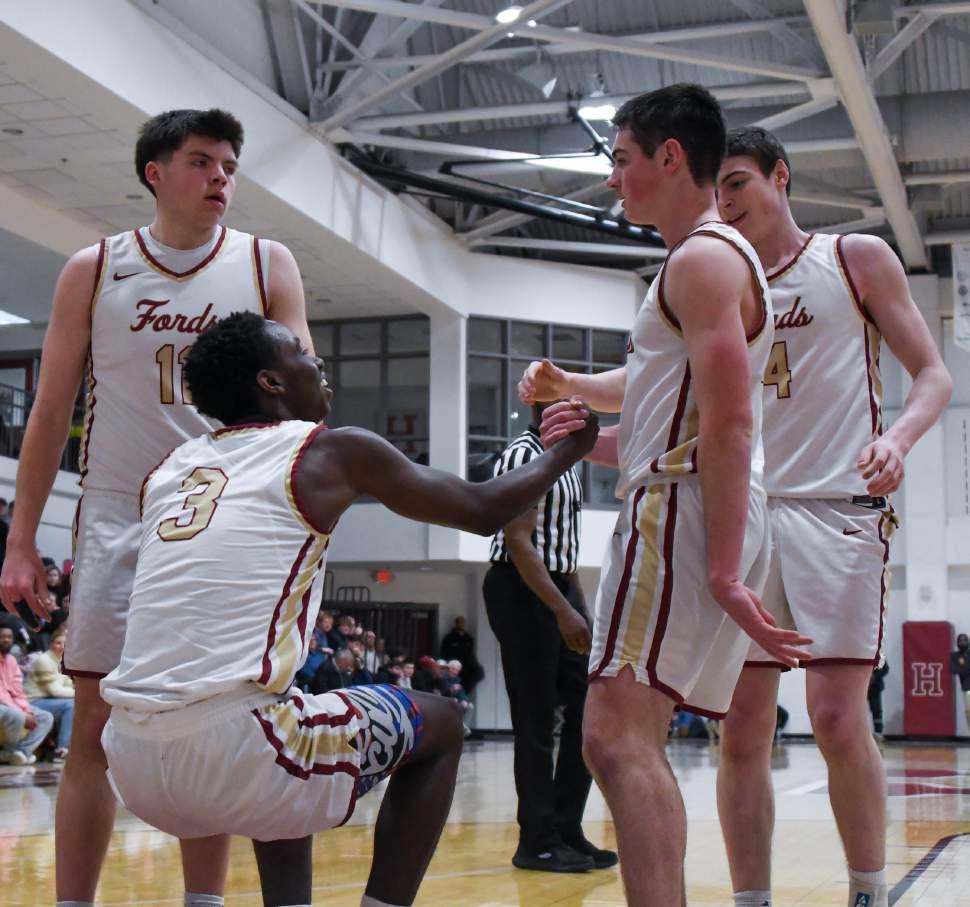
A huge factor in the Fords’ success is their defensive intensity. To date, only one team has surpassed sixty points. The defense has kept star players in check with a strong combination of zone and man defense. Germantown Academy’s James Brenner, for example, was averaging twenty points per game until the Fords held him to zero.
“You know, we’re playing really good team basketball both offensively and defensively, and different guys are stepping up different nights, so hopefully we stay focused and keep it going,” Coach Bernie Rogers said. “It’s been really, really balanced. Silas [Graham], Manny [Butts], and Dillon [Gamble] have all done a good job.”
“We have a mindset that has allowed us to stay composed offensively and especially defensively,” Fifth Former Frank Gilbert said. “With our zone defense and our man defense, we try to play really hard, and that mindset helps us make sure we’re staying locked in on every play, so there’s no mishaps defensively.”
“And that if we stay grounded, believe in each other, and we just work hard, the rest will fall in place.”
DILLON GAMBLE ’26
“Our strength is definitely our defense,” Butts continued. “We’re doing a good job of holding a lot of teams under 50 points and a lot of teams’ best players under their average, so as long as we can team do that, we’ll be good. We definitely work together on that as well. A lot of it comes from one-on-one guarding, but also from help defense, and we
all build off of each other.”
“Our success comes from all of us playing together, playing team defense; relying on Dillon [Gamble] and Silas [Graham] to attract defenders on the drive and kick it out is key for me and Frank [Gilbert] to shoot,” Fifth Former Conor Morsell said.
However, with so much attention—being atop the Inter-Ac, photographers capturing every game, Fordslive live-streaming, and more and more fans attending each game— it is very easy to lose sight of the goal.
“We fell into a trap early in the year when we weren’t focused on the next game and tried to focus on the whole season,” Gilbert said. It came back to bite us for the loss against Friends Central.”
“So now that we beat the first five and we’re halfway there, I feel like to maintain success, all we’ve got to do is just stay grounded,” Gamble said. “Don’t get our heads too bright. Don’t think about the goal. Think about the kind of process and just focus on each game, game by game, playing the hardest we can, understand that our goal is to win in Inter-Ac, but we have to win each game because each game is a playoff game. And that if we stay grounded, believe in each other, and we just work hard, the rest will fall in place.”
“Every game kind of goes into the fourth quarter in our league,” Coach Rogers said. “I think we’ve been pretty good at being focused throughout the game. You’ve got to stay in the moment because at any point it can change. So hopefully we can continue to finish in the fourth quarter.”
With games almost always being decided in the last few minutes, the Fords have discovered a significant change helping them this season.
“One of the biggest changes from last season has been the mental aspect,” Fifth Former Silas Graham said. “I’ve been really
Last year, we had some drama on the team; obviously, every team’s gonna have its ups and downs, but I feel like this year we didn’t have that much drama. So I feel like we can only just keep stacking on this,” Gamble said. “I’m definitely looking forward to what we can do, especially with the Inter-Ac and states. We’ve still got a lot to prove, and a lot of teams to beat. So if we just keep doing what we do, I think we’re gonna have a lot of success here.”
Apart from the mental aspect, the Fords have also found a great deal of joy in playing basketball the way the Fords do: gritty and unbeaten.
“Even just in practice, people are laughing, and it’s a delight,” Morsell said. “Be ready for the next game. Malvern will be a huge game because they’re second right now, so that’ll be like a championship.”
“I found a lot of joy in playing with the team, playing with the guys,” Gilbert said. “I think it’s been my favorite season I’ve ever played. I’m just looking forward to these next five Inter-Ac games and trying to close out the season well.”
“We found different ways to win in different games,” Coach Rogers said. “Staying focused as a team has helped us. We’ve had a lot of guys come through the program. Dillon [Gamble] and Manny [Butts] as seniors have gotten better each year, and watching these kids grow and develop is fun to watch.”
The Fords’ bonds have been carefully developed over the past few years. They find joy not only in winning on the court, but also in the smaller, hidden moments.
“My favorite part of the season is doing Thursday night dinners with the team,” Graham said. “I’m really excited just to see how well we can do in the Intrer-Ac. Malvern will be a big game, Penn Charter will be a big game, but now it’s on us.”
happy this season, less tired, and just excited for practice every day. It just adds so much power when playing.”
“I’d say this group really loves each other, and we’re really united. If one person scores, we all score; if one person passes, we all pass. We all just believe in each other, and we all understand the goal and the outcome.
“My favorite part about this season so far has definitely got to be the Malvern game,” Butts said. “Not even the game winner, but just finally going over to their house and beating them for the first time, and I think it was what, a thirteen-game drought? The goal is just to come and win the InterAc. This is the year.”

Fords Swimming and Diving has been off to a strong start this season. They have raced everyone in the Inter-Ac, boasting a 3-2 overall record, whilst maintaining a 2-2 record against Inter-Acteams, losing to Malvern Prep and Germantown Academy. Their three wins against Penn Charter, Episcopal Academy, and Perkiomen Valley were all blowouts.
The team is recovering from its loss of seniors like Evan Boratto and Zack Oswald.
The team is recovering from its loss of seniors like Evan Boratto and Zack Oswald last year, mainly because of the younger swimmers who have been stepping into big shoes.
Fourth Former James Paul is one of the swimmers who has stepped into their role. As someone who does not even swim year-round, Paul has had numerous breakout swims, the most notable being in the 200-meter freestyle against Penn Charter. His strong performance was one of the highlights and primary reasons for the blowout win. Third Former Liam Jones and Fourth Former Wyatt Hoke have also shown major improvement throughout the season.
“One of the great supports we have had this year is getting some of the best water polo players to come and put up great times

in the pool,” Sixth Form captain Jack Grimley said.
Fifth Formers Thomas Springer and Henry McDade are two of these young men who have stepped up in the pool this year and have helped contribute to the relay teams.
Just recently, Grimley broke a school record, swimming 3:59.10 in the 400 freestyle, missing the pool record by just half a second.
“Breaking the record felt amazing,”
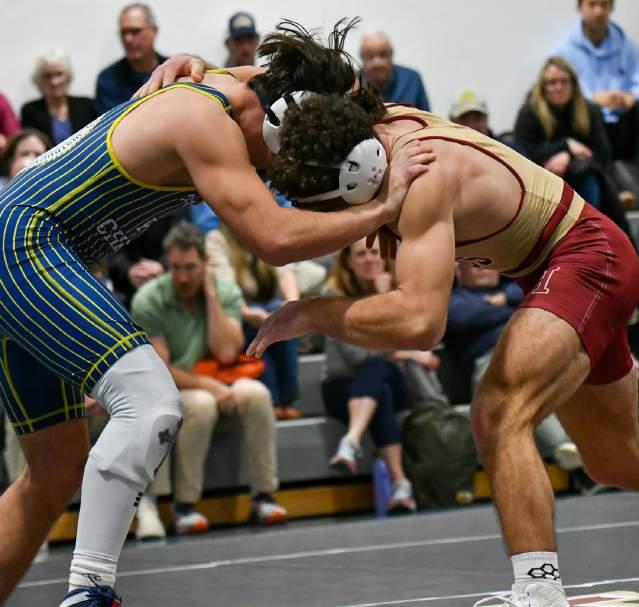
FAfter finishing last season with an 8-12 dual-meet record, Haverford wrestling has demonstrated notable improvements this season.
“Our team has found a lot more success this year compared to last year, and that confidence has shown in how we compete,” said Sixth Form captain Ian Thomas. This year, the Fords sit 4-3 in dual meets, with wins over Radnor, Peddie, Wood, and Pottsgrove.
Much of the improvement this year can
be correlated to the team’s mindset in practice, where perseverance has become a pillar of success.
“We always find a way to preserve.”
IAN THOMAS ’26
Grimley said. “It really put into perspective the time and effort we put in as a team in practice and gave a result to show for it.”
Grimley thinks breaking school records is more important to the team as a collective unit because they boost the swimmers’ morale and spark others to break records of their own.
On January 31, the team took third in the Independent School Invitational. There, Grimley won first in both of his individual
events, the 200 freestyle and 100 butterfly, while Wyatt Hoke took first in the 100 breaststroke.
The boys look to grow closer as a unit in the coming weeks and hope to keep boosting a strong sentiment to the younger swimmers who have already made a significant impact.
As always, the main goal of the season is to perform well at Easterns on February 12-14.
“During our grind-it-out practices, we always find a way to persevere together,” Thomas said. “Those moments are when the team really clicks.”
That mentality is shared across the roster, as bonding through adversity has become a defining theme.
Fifth Former Jason Talley points out that the team’s most demanding training sessions are moments that have brought the team the closest together.
“The days when we suffer together in practice are when we really understand what it means to be a team,” Talley said.
This sense of “bonding through pain” has helped elevate the team’s practices. The team’s training and success have been built on the basics: consistent practice and embracing “the grind.”
One of Haverford’s state qualifiers last season, Fifth Former Mac Tryon, said, “The want for success is definitely present in the room.” Coach Mr. Chris Kober echoed the
“The guys have brought great energy every day, and that’s shown in both our results and our growth.”
MR. CHRIS KOBER
wrestlers’ thoughts.
“The guys have brought great energy
every day, and that’s shown in both our results and our growth,” Coach Kober said. “They’ve wrestled hard, supported each other, and embraced the work.”
That intensity in the room has begun to show up in close, hard-fought matches throughout the season.
“I see a lot of improvement in the newer guys with how they take chances and find a way to make things work in matches.”
IAN THOMAS ’26
Thomas said, “I see a lot of improvement in the newer guys with how they take chances and find a way to make things work in matches. It is good to see them win matches they lose on paper.”
With the regular season winding down, the team is focused on carrying that mindset into its remaining duals and its postseason. Their upcoming matchups include a road dual against SCH and a home senior night against Inter-Ac rivals, Episcopal Academy.
“Senior night against EA is going to be a battle, and having the boys in the section cheering us on will mean a lot,” Thomas said. “It’s the kind of match we’ve been working toward all season.”
As February rolls in and winter sports begin their final stretch, the ice hockey season is winding down.
While the team may not have reached the level of success it hoped for, with a 2-8 record, the story of this season is far from one of disappointment. Instead, it has been defined by perseverance, improvement, and commitment to competing every time the puck drops.
Several matchups came down to the final minutes, with the outcome often decided by a single goal or a costly bounce.
From the season’s opening faceoff, the team faced a demanding schedule filled with tough opponents and closely contested games. Several matchups came down to the final minutes, with the outcome often decided by a single goal or a costly bounce. Although those moments did not always fall in the team’s favor, they refused to back down.
“As the
season
progresses, we sort of realized that we don’t have anything to lose.”
One of the defining qualities of this year’s team has been its work ethic. Coached by Thomas Lindberg ’07, the team’s practices have remained intense and focused, with players continuing to push themselves. Coaches have emphasized the importance of discipline and accountability, including cre-
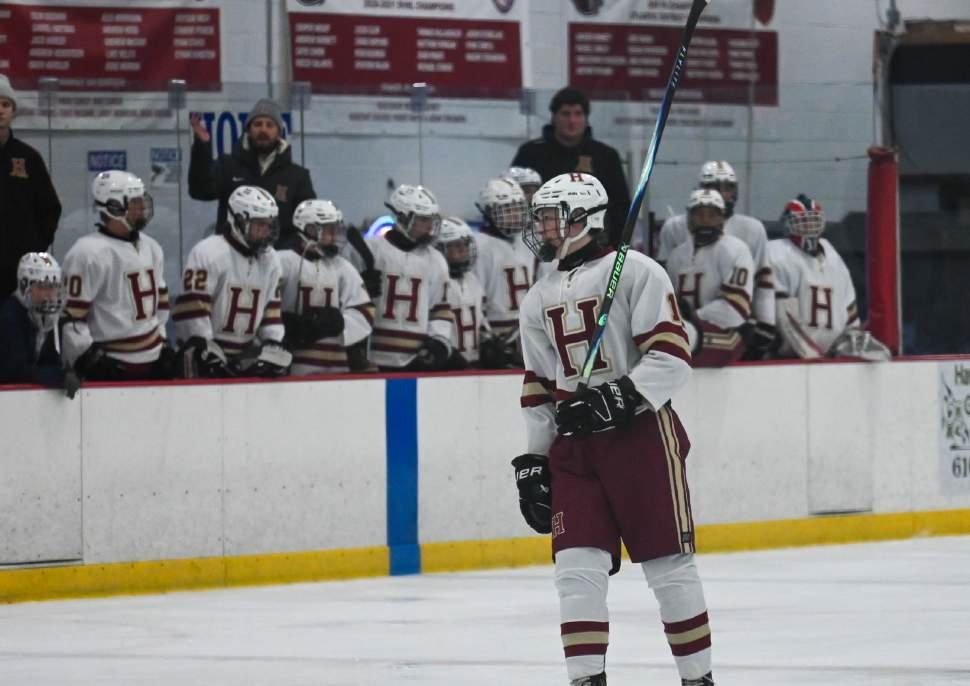
ating an environment where the mindset of “leaving it all out there” is a priority.
“As the season progresses, we sort of realized that we don’t have anything to lose,”
Fourth Former Liam McGrath said.
That dedication has shown on the ice, particularly in the team’s improved defensive play and increased physicality.
Leadership has also played a key role. Upperclassmen have stepped up by setting the tone both during games and in practice. They encourage teammates to stay confident and power through setbacks. Meanwhile, younger players have gained valuable experience learning what it takes to compete at
a high level and to lay down ground rules for seasons to come. These lessons were a key aspect of building their program, while not always being seen on the scoreboard.
Another bright spot has been the team’s camaraderie.
Fifth Former Harry Neilly said, “We have a great group of guys that strengthen our team’s relationships.”
Rather than letting losses define them, players have returned to the rink with determination and energy. Whether trailing late in games or facing tough opponents, the team has continued to fight until the final horn. That mentality has made the team take
what is already a rigorous sport on the body and challenge themselves and their capabilities.
As the final games approach, the focus remains on finishing on a high note. The team is fired up to play with pride and to represent Haverford with effort and sportsmanship. While championships are out of reach this year, the foundation they built is clear.
The team next faces Devon Prep at 8 p.m. on February 5th at Havertown’s Skatium.

Just a year ago, the Eagles made a fantastic postseason run and won their second Super Bowl. The team was unstoppable, and fans in and around the city were loving it. This year, hopes for another championship were cut short. The Birds faced a disappointing elimination in the first round.
Two weeks after the loss, Haverford community members were still stunned.
Fourth Former Sean Friel said, “I’m still upset and outraged by what happened at the end of the season. We couldn’t get any offense going, and it was very disappointing.”
The future of the team is unclear. Many
contracts are ending, and trade rumors have circulated. Kevin Patullo was hired to the coaching staff in 2021 as pass-game coordinator. Patullo had many ups and downs and was eventually promoted to offensive coordinator following last year’s Super Bowl win. After facing backlash from fans, head coach Nick Sirianni decided to fire Patullo at the end of this season.
Friel said, “I like the Patullo firing. He put us in a position for failure.”
As the search for a new offensive coordinator continues, many are still wondering what the fate of star wide receiver A.J. Brown will look like. Brown was acquired in a trade
with the Tennessee Titans nearly four years ago. Since then, he has brought leadership and talent to the team.
Surprisingly, Brown had a down year this season. He had noticeably lower production and poor leadership. One of the main instances was on the sideline versus the 49ers when he engaged in an intense argument with Sirianni.
“[Brown’s] performance was abysmal, four dropped catches in a game like that. It should not happen,” Fifth Former R.J. Neilly said. “They need to get rid of him and find a new young receiver.”
This seems to be the thought process
behind many fans.
One bad season does not define a team’s history. A bounce-back is definitely possible, and fan support is essential.
“They
have my 100% support.”
MR. CHRIS DIBELLO
Chemistry teacher Mr. Chris DiBello remains loyal.
“They have my 100% support,” Mr. DiBello said. “Go Birds!”